Spring 2026
The Mullen Gift
A remarkable donation
A Persian silver vessel
Centrepiece of the Galloway Hoard
Operation Rimau
Retracing an escape route
Number 156 September to November sea.museum $9.95
Bearings From the Director
WELCOME to the spring edition of Signals. The stories in this edition draw together objects, journeys and places that reveal the breadth of maritime heritage and its power to connect people across time and distance. At the heart of this edition is the remarkable John and Jacqui Mullen Collection, a generous contribution to the National Maritime Collection that strengthens the museum’s capacity to preserve and share our maritime past. Gifts such as these are acts of trust, ensuring that important histories remain available to future generations and continue to inspire research, interpretation and public engagement. We also look outward, following Fleet staff members Andrew Bibby and Matt Coco as they visit the Chesapeake Bay Maritime Museum in Maryland and Mystic Seaport in Connecticut, a trip made possible through the Director’s Bursary.
This extraordinary object speaks to networks of trade, craftsmanship and cultural exchange that stretched far beyond the Viking world, reminding us that the sea has long carried not only goods, but also ideas and beliefs. Closer to home, this issue revisits the courage and desperation of Operation Rimau commandos in 1944 through a re-enactment of an escape attempt by boat through Indonesia, bringing into focus the human experiences behind one of the Second World War’s most daring and tragic episodes. As ever, the museum’s work is driven by a commitment to uncovering new perspectives, caring for significant objects and places, and connecting past experiences with present-day conversations. We invite you to join us this spring as we continue to explore and celebrate the stories that connect us across oceans, generations and cultures.
Their journey reflects the value of international exchange, enabling staff to learn from leading maritime institutions, explore shared challenges and bring new ideas back to our collections, vessels and public programs. The global reach of maritime connection is captured in a story about a Persian silver vessel featured in Treasures of the Viking Age – The Galloway Hoard.
Daryl Karp AM Director and CEO
Illustration from Voyage de la corvette l’Astrolabe by Dumont d’Urville. A first edition of this work is included in the Mullen donation.
Contents Spring 2026 Number 156 September to November sea.museum $9.95
Acknowledgment of Country The Australian National Maritime Museum acknowledges the Gadigal people of the Eora nation as the traditional custodians of the bamal (earth) and badu (waters) on which we work. We also acknowledge all traditional custodians of the land and waters throughout Australia and pay our respects to them and their cultures, and to elders past and present. The words bamal and badu are spoken in the Sydney region’s Eora language. Supplied courtesy of the Metropolitan Local Aboriginal Land Council. Cultural warning People of Aboriginal and Torres Strait Islander descent should be aware that Signals may contain names, images, video, voices, objects and works of people who are deceased. Signals may also contain links to sites that may use content of Aboriginal and Torres Strait Islander people now deceased. The museum advises there may be historical language and images that are considered inappropriate today and confronting to Aboriginal and Torres Strait Islander peoples. The museum is proud to fly the Australian flag alongside the flags of our Aboriginal, Torres Strait Islander and Australian South Sea Islander communities.
2
A remarkable gift
A preview of the John and Jacqui Mullen donation
10 A Sasanian silver vessel
Centrepiece of the Galloway Hoard
16 Two weeks in American museum shipyards
Fleet staff visit Chesapeake Bay and Mystic Seaport
24 Retracing an escape route
Marking the 80th anniversary of a desperate journey
32 A light that shaped a harbour
Restoration and reinterpretation at Macquarie Lightstation
40 Northshore Yachts
Aussie ingenuity in production boats
46 Foundation appeal
Seeking your support to help us reconstruct the Cockle Bay Boat
48 Members letter and events
This season’s talks, tours, book launches and events
52 Exhibitions
What’s in our galleries this spring
56 Unique to Ultimate Depth
A timepiece that travelled to the Mariana Trench
58 Navy 125
The schooner Ayesha and the Battle of Cocos, 1914
66 Collections
A trove of Australian shipping memorabilia
72 National Monument to Migration
A Chinese student makes a life-changing choice
74 Readings
An Inconvenience of Penguins; Surveying the Wild Abyss
82 Currents
Sydney Ship Modellers Expo 2026
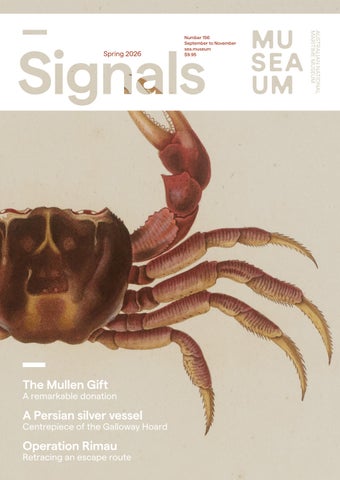
Cover Detail of a lithograph from Louis de Freycinet’s Voyage de l’Uranie, Plate 77, depicting a crab collected during the expedition, c 1820. ANMM Collection 00057939 donated by John and Jacqui Mullen through the Australian Government’s Cultural Gifts Program. See article on page 2.
Image Jasmine Poole/ANMM 2
Signals 156 Spring 2026
A remarkable gift The John and Jacqui Mullen donation
Last year, the museum received one of the most important donations in its 30-year history from John and Jacqui Mullen under the Australian Government’s Cultural Gifts program. The objects are now on display in our gallery Under Southern Skies. By Dr Kimberley Webber.
The gift has been curated by John Mullen to document emerging European understanding of the ‘Great South Land’ Australian National Maritime Museum
3
Two of the donated objects are connected to Phillip Parker King, a remarkable sailor, navigator and hydrographer
The exceptionally rare ‘Spice Map’ by Petrus Plancius is of particular Australian interest due to the figuring of ‘Nova Guinea’ (New Guinea) and early references to the project of the Dutch East India Company (VOC). ANMM Collection 00056705
FORMER CHAIR of the museum’s Council, John Mullen AM, is a passionate collector with a particular interest in maritime history. The maps, charts, chronometers, silver, manuscripts and published works that he and his wife, Jacqui, have given to the museum are the first tranche of a larger donation and can be seen in our gallery Under Southern Skies. John Mullen’s first purchase was a letter connected to HMB Endeavour. As he recalls: It was not a very important letter … but I found it in a bookshop … [and] that was the first time I actually got to touch and feel something of that age, and it went from there. Some 50 years later, the collection amounts to 2,000 objects that will soon be housed in a purpose-built museum. John and Jacqui Mullen are long-term supporters of the museum, particularly of maritime archaeology. In 2007, they founded the Silentworld Foundation to support maritime archaeology research, and regular readers of Signals will recall some of their remarkable finds in collaboration with the museum. These include locating the final resting place of Phillip Parker King’s HMCS Mermaid, the vessel Cato – one of the earliest colonial merchant vessels wrecked in Australian waters – and the World War I submarine HMAS AE1. The gift has been carefully curated by John Mullen to document the emergence of European understanding of the ‘Great South Land’ from the 16th century to the 1840s. The earliest work is ‘The Spice Map’, first published by the noted cartographer Petrus Plancius in Amsterdam in 1592. It depicts the Maluka Islands (Moluccas), which were famous for ‘their extremely great wealth in spices’. At the time, Europeans had little idea of a southern landmass and this map was intended to encourage Dutch interest. An exceptionally rare work in the collection is Memorial Number 11, one of 14 known to have been published by Fernández de Queirós between 1607 and 1614. Having, as he thought, ‘discovered’ the Great South Land in 1606, he spent seven years appealing to King Phillip III of Spain for funds to support another voyage. Although he finally obtained the King’s approval, De Queirós died two months after setting out and did not find the southern land mass; however, his passionate belief in its existence encouraged others to try. Australian National Maritime Museum
5
01
03
6
Signals 156 Spring 2026
02
01 Used by Charles Darwin aboard HMS Beagle, this 1825 chronometer by William Edward Frodsham remains in pristine condition. It exemplifies the precision that ensured accurate navigation during the Beagle’s five-year voyage. ANMM Collection 00056994 02 In his Memorial Number 11, Fernández de Queirós petitioned King Phillip III of Spain to fund a voyage in search of the Great South Land. As well as a ‘great increase in revenue’, he promised the conversion of native peoples to Christianity, ‘an inestimable service to God’. ANMM Collection 00056707
Two chronometers represent the best of early-19th century French and British innovation
Over 80 years later, in 1663, the French author and diplomat Melchisédec Thévenot published Relations de divers Voyages Curieux, which included an extraordinarily detailed map of New Holland that revealed the substantial increases in European understanding, largely as the result of Abel Tasman’s voyages of 1642 and 1644. The volume also contains Commander Francisco Pelsaert’s description of the 1629 wreck of the Batavia. Published in French, this was the first opportunity that Europeans had to learn about the terrible events that unfolded with ‘many disasters … and shedding of human blood’. John Mullen has a particular interest in Phillip Parker King, a remarkable sailor, navigator and hydrographer and the first colonial-born person to achieve success outside the colony. Two of the donated works are connected to him. The first is a four-volume set of English privateer William Dampier’s account of his voyages in the 1690s around the world – including time spent on the west coast of Australia. King acquired this set in 1817, at a time when he was commissioned to complete the chart of the Australian coastline begun by Matthew Flinders. As he explored the same stretch of coast as Dampier, he annotated the text, correcting and expanding on Dampier’s observations some 120 years after they were first made. For example, to Dampier’s description of First Nations peoples (likely to be the Baria people) and their weapons at King Sound, King has added a note that the description of a sword ‘shaped somewhat like a Cutlass’ is likely to have been a boomerang.
03 This extraordinarily detailed map of New Holland, published in 1696, revealed substantial increases in European understanding, largely as the result of Abel Tasman’s voyages of 1642 and 1644. The eastern half of the landmass remained a mystery for more than another century. ANMM Collection 00056699
A second is a bound collection of manuscripts given to King by Surveyor General John Oxley. Dating from between 1813 and 1824, they are a reminder of the value of such first-hand accounts at a time when little published information was available. Thus, Oxley includes his two descriptions of sailing up the east coast of Australia, with advice as to landforms, winds and weather as well as latitude and longitude. He recommends Jervis Bay as ‘the best [anchorage] to make … particularly in thick and hazy weather when … uncertain of Latitude’. There are also accounts by surveyor George Evans of his 1813 and 1815 explorations beyond the Blue Mountains, including the first contact with Aboriginal people on the Bathurst Plains. There, on 21 December 1813, he came across two women with their children, who ‘fell down with fright … I gave then what Fish we had, some Fish Hooks, Twine and a Tomahawk they appeared glad to get from us’. The gift includes two chronometers that represent the best of early-19th-century French and British innovation. The Louis Berthoud Number 35 was issued to Captain Nicolas Baudin for his 1800 voyage to the South Pacific. Considering it to be the most accurate of those on board, he named a deep inlet on the west coast ‘for the inestimable artist to whom the navy owes its best chronometers’. The second dates from 1825 and was made by a 20-year-old apprentice, William Edward Frodsham. It was one of 22 taken on HMS Beagle on its hydrographic survey of South America and found to be ‘rather good’. Australian National Maritime Museum
7
Sketches by Harden Melville capture the essence of early surveying voyages
01
02
8
Signals 156 Spring 2026
French interest in the ‘Great South Land’ is represented by remarkable expedition accounts by Freycinet and D’Urville
Just as rare as the chronometers are sketches by Harden S Melville, which capture the essence of early surveying voyages. Titled Sketches in Australia and the Adjacent Islands, these works were created during the surveying voyages of HM Ships Fly and Bramble under Captain Francis Price Blackwood between 1842 and 1846, enriching the historical narrative of maritime exploration. A known rarity among voyage and Australiana collectors, they are of particular importance for Queensland and the Great Barrier Reef. The sketches include a number of important ethnographic illustrations of Aboriginal and Torres Strait Islander communities. French interest in the ‘Great South Land’ is represented by two remarkable expedition accounts: Louis de Freycinet’s Voyage Autour du Monde (1817–19) and Jules Dumont D’Urville’s Voyage de la Corvette l’Astrolabe (1826–29). Both are in their original condition, with pages uncut and volumes unbound. Beautifully illustrated, they gave Europeans some of the first detailed descriptions of these new ‘pacific’ worlds, including Australia. D’Urville’s first landing on Australian soil was on the west coast at King George Sound, where they stayed for some time, making observations, collecting specimens and replenishing supplies. He describes an approach by men of the Menang Noongar people, aged between 16 and 40 and wearing kangaroo skins, whom he says were ‘delighted to meet us’.
01 The published account of Louis de Freycinet’s voyage includes the lavishly illustrated Zoologique, which features finely detailed and coloured engravings of the animals encountered, including this skink captured in the Blue Mountains. Of the 100 live specimens on board, it was the only one to survive the wreck of l’Uranie in the Falklands. ANMM Collection 00057935 02 In the 1840s, Harden S Melville made valuable ethnographic drawings of Australian Indigenous people, which were published in Sketches in Australia and the Adjacent Islands. ANMM Collection 00056703
Durville’s publication is complemented by a firsthand account of life on l’Astrolabe by the surgeon and naturalist Jean René Quoy and of the assistance First Nations people provided to their scientific collecting. During l’Astrolabe’s time at Port Jackson in October 1826, Gadigal people gathered specimens of fish, petrels ‘in great quantity’ and the skins of seals and kangaroos to exchange for tobacco and other goods. Quoy praised the industry of the women, who caught a large number of enormous lizards that would have been ‘impossible for us to procure without their help’. Many of the objects in the Mullen gift are unique and each has story to tell. This is an exceptional donation that provides a rich resource for research, teaching and display. It is an invaluable addition to the National Maritime Collection, substantially strengthening our ability to tell the story of Europe’s fascination with an imagined ‘Great South Land’ and the courage and skill of generations of sailors, which culminated in its identification and charting. Dr Kimberley Webber is a project manager at the museum and has worked on the acquisition of the John and Jacqui Mullen Collection.
Australian National Maritime Museum
9
01 The depiction of a lit fire-altar on the silver vessel helped to identify where it originated. Image National Museums Scotland 02 A lit fire-altar also appears on the reverse of this silver drachm of Sasanian king (Shahanshah) Bahram IV (reigned 388–399 CE). Image Metropolitan Museum of Art, New York. Public domain
The production of high-quality silver vessels and coins was a remarkable feature of the Sasanian culture of Persia
01 10
Signals 156 Spring 2026
A Sasanian silver vessel Centrepiece of the Galloway Hoard
02
The Galloway Hoard, now on show at the museum, features a finely worked silver vessel made centuries ago in Persia. Associate Professor Peter Edwell examines its iconography, the culture that created it and how it might have made its long journey to Scotland.
PERHAPS THE MOST INTRIGUING ITEM in the Galloway Hoard is a lidded silver vessel that contained 27 smaller items from a range of cultures and timeframes. Initially thought to originate from the Frankish empire established by Charlemagne in the second half of the eighth century CE, it actually came from Sasanian Persia (224–651 CE), thousands of kilometres to the east. Testing on lead isotopes contained in the decoration of the vessel, which was done by a conservator from the National Museum of Scotland, traced their likely origins to the lead–silver mine of Nakhlak in modern-day Iran. Sasanian Persian silver production
The production of high-quality silver vessels and coins was a remarkable feature of the Sasanian culture of Persia (modern-day Iran). The most intricate of these were silver platters, manufactured for the powerful Persian elites, probably as diplomatic gifts. Sasanian silver coins contained very high levels of silver (as much as 96 percent in the third century CE). The consistency of their high silver content, together with their iconography, demonstrated Sasanian Persian political and economic stability at a time when other empires in the region were struggling.
The iconography of the silver-lidded vessel in the Galloway Hoard demonstrates some of the key features of Sasanian silverware and coins. Leopards and tigers are depicted, and a number of surviving Sasanian Persian silver vessels show rulers hunting or wrestling these creatures. The lit fire-altar
More importantly, the silver vessel in the Galloway Hoard depicts a lit fire-altar, which was a key component of the religious iconography of Zoroastrianism. The Sasanian Persians were closely intertwined with the religion of Zoroastrianism; their earliest kings were apparently priests of the religion. Zoroastrianism was in many ways a state religion for the Sasanians. The lit fire-altar depicted on the vessel appears extensively on Sasanian silver coinage from its beginnings in the 220s CE right through to the end of the dynasty in the middle of the seventh century. It was the central iconographic feature of the reverses of all Sasanian silver coins. The identification of this feature led researchers working on the Galloway Hoard to conclude that the silver vessel had a Persian origin. Australian National Maritime Museum
11
01
02
03
Main routes to the Silk Road The Silk Road Viking voyages
To Vinland and Greenland
er Rive r
Baltic Sea er
Riv er
Dneip
Galloway
Vol g
Irish Sea
Black Sea
Constantinople
Mediterranean Sea
12
Signals 156 Spring 2026
Caspian Sea
Samarkand
01 Detail of a tiger on the silver vessel from the Galloway Hoard. Image National Museums Scotland 02 This Sasanian-era silver bowl, probably made in the sixth or seventh century CE, is a beautiful example of the depiction of a tiger. Image Metropolitan Museum of Art, New York. Public domain 03 Possible routes by which the objects in the Galloway Hoard made their way to Scotland. Image Jeremy Austen
At the time of the hoard’s deposition, around 900 CE, Galloway was part of an extraordinarily interconnected world
It is also possible that the silver lidded vessel in the Galloway Hoard was manufactured after the Sasanian Persian dynasty ended in 651 CE. While significant changes took place after the overthrow of the Sasanians by the forces of the Islamic Caliphates, there was some continuity of Sasanian cultural and administrative practices – in particular, the iconography of the lit firealtar (and the depictions of Caliphs) was carried on in the silver coinage of the post-Sasanian period. This coinage is known today as Arab–Sasanian coinage, and it would continue into the latter part of the eighth century. Given the continuity of Sasanian imagery on coins produced in the post-Sasanian world, the silver lidded vessel may have been manufactured after the Sasanian dynasty fell, its iconography inspired by this ongoing and familiar design.
How did the vessel travel so far?
Of course, the question that springs to mind for even the most casual observer of the Galloway Hoard is how did a silver vessel manufactured in Persia come to form part of a hoard deposited in Viking-age Scotland? At the time of the hoard’s deposition, around 900 CE, Galloway was part of an extraordinarily interconnected world encompassing Scandinavia, much of Europe, southern Russia and Ukraine and the Middle East. The East Roman and Byzantine empires had been strongly connected to the world of the Sasanian Persians via war, trade and imperial embassies across the whole period of the third to the seventh centuries CE. In the early decades of the seventh century, Byzantium and Persia were almost constantly at war, and in the 620s, Roman armies took large amounts of loot from captured Persian cities. Is it possible that the silver vessel initially made its way to the Byzantine world, perhaps Constantinople itself, as loot, and that this was the first step on its long and circuitous journey to Scotland? Byzantium and the Vikings
Potentially connected to this was the development of a relationship between Byzantium and the Vikings from the latter part of the ninth century. Initially threatening Constantinople (now Istanbul) in the middle of the ninth century CE, Viking elements (known as Varangians) were later recruited into the bodyguard of Byzantine emperors. By the last decades of the tenth century, approximately 6,000 Viking or Norse recruits served in the Varangian guard at Constantinople. They were highly effective and owed their loyalty entirely to the emperor. Was the silver vessel acquired by an individual serving in the Varangian guard and taken back to Scandinavia when they returned? Australian National Maritime Museum
13
A relationship developed between Byzantium and the Vikings from the latter part of the ninth century
Although barely 10 centimetres high, the lidded silver vessel contained 27 items – including jewellery, gold bullion, a tiny carved rock crystal jar, and even two balls of dirt. Image National Museums Scotland
The Vikings and the Abbasid Caliphate
Another possibility relates to trade between the highly mobile Vikings and the Abbasid Caliphate in Persia, which grew considerably in the ninth century. A hoard of gold and silver found in 2012 at Bedale, north of York in England, demonstrates strong trade connections between the Vikings and the Abbasid Caliphate. Deposited around the same time as the Galloway Hoard (c 850–900), some of the silver in the Bedale hoard came from melted-down silver dirhams of the Abbasid Caliphate. The trade interest of the Vikings with the Abbasids, therefore, was closely connected to the acquisition of high-quality silver coins. It is possible that an item like the Sasanian silver vessel, surviving into the Abbasid period or perhaps originating in a post-Sasanian context, was acquired via the extensive trade networks the Vikings were involved in. Ownership of the vessel and the hoard more generally is also an interesting question to consider. Given the Christian and Anglo-Saxon material contained in the vessel, 14
Signals 156 Spring 2026
it is possible it was owned by an early English elite, perhaps even the Northumbrian church from which some of the treasure seems to derive. While it is understandable to be amazed that the Sasanian silver vessel travelled so far, the strongly connected world in which the Vikings played such an important role suggests that perhaps we shouldn’t be surprised at all. For more on the Galloway Hoard, see Signals 155 (Winter 2026), page 2.
Peter Edwell is Associate Professor in the Discipline of History and Archaeology at Macquarie University, Sydney. He is also Director of the Australian Centre for Ancient Numismatic Studies. Peter has published two monographs about Rome’s relationship with the Sasanian Persian empire: Between Rome and Persia (2008) and Rome and Persia at War (2021), together with numerous articles and book chapters focusing on the topic.
Win a cruise in Norway! In celebration of Treasures of the Viking Age – The Galloway Hoard and the museum’s partnership with Viking, we are excited to offer you the chance to win an 8-day Viking Shores & Fjords cruise for two, valued at $16,590. To enter, become a member, renew your membership or visit the exhibition and submit your entry by Sunday 11 October 2026. With visits to UNESCO sites and cruising amid the spectacular scenery of Norway’s fjords, don’t miss your chance to win this remarkable journey courtesy of exhibition sponsor Viking.
To become a museum member or renew your membership, please scan the QR code.
Two weeks in American museum shipyards A visit to Chesapeake Bay Maritime Museum and Mystic Seaport Museum
What can other institutions teach us about our own? Two of our Fleet staff, Andrew Bibby and Matt Coco, recently travelled to the USA to find out. By Andrew Bibby.
16
Signals 156 Spring 2026
The shipyards at Chesapeake Bay and Mystic both operate within museum institutions, but at slightly different scales
Schooner LA Dunton (centre) undergoing major restoration in the Henry B du Pont Preservation Shipyard at Mystic Seaport Museum. On the right is Mayflower II, a 1950s reproduction of the ship that brought pilgrims to the New World. Image © Mystic Seaport Museum
Australian National Maritime Museum
17
SOME OF THE BEST PRACTITIONERS of the museum shipyard game are located in the United States. Our opportunity to visit them came as the inaugural recipients of a bursary, established by the ANMM’s Director and CEO, Daryl Karp, to encourage staff development. In a fortnight with our American colleagues, what we discovered was equal parts inspiration and hard-won pragmatism. First, we spent a full week at Chesapeake Bay Maritime Museum in St Michaels, Maryland, followed by another week at Mystic Seaport Museum in Connecticut. Both shipyards operate within museum institutions but do so at slightly different scales. Chesapeake Bay Maritime Museum (CBMM) is focused on vessels of Chesapeake Bay and its vast tributaries, home to some beautifully unique vessel designs created for the oyster tonging industry, in which oysters are harvested with a set of long-shafted tongs. When Matt and I arrived on a cold Maryland morning, we were greeted with the same easy warmth that would follow us for the next two weeks. After a tour of the grounds and facilities we were introduced to the mob and handed tools. This hands-on welcome set the tone for everything that followed: generous, practical and full of the unfiltered reality one only receives from people who face similar tasks and challenges. Chesapeake felt intimate and agile. The shipyard is well equipped on a modest footprint, with a bandsaw mill for turning logs into usable lumber, a ship-saw ‘bevelling bandsaw’, a large thicknesser, a steam box with its own wood-fired steam generator, and myriad power and hand tools. The workshop barn itself is large enough for boatbuilding and a raised walkway gives the public close-up views of the work without them getting in the way. Around the museum campus lay stacked a wide selection of logs available for milling, obtained through windfall, donation or purchase (a practice echoed in Mystic). The marine railway, built in 2006, runs almost year-round, staying busy with a steady mix of long-term restorations, seasonal maintenance of their own fleet of 10 vessels and the occasional new build. In the last few years CBMM has also undertaken ‘customer work’, in cases where vessels are of significant local historic value. One of the largest feathers in that cap was the construction of the Maryland Dove replica, launched in 2022. 18
Signals 156 Spring 2026
01 Matt Coco (left) and Andrew Bibby fastening off bottom planking on Winnie Estelle at Chesapeake Bay Maritime Museum. Image Andrew Bibby/ANMM 02 Skipjack Rosie Parks on the marine railway at Chesapeake Bay Maritime Museum. Image Sharon Thorpe 03 Matt Coco (third from left) and Andrew Bibby (fourth from right) with Chesapeake Bay shipyard colleagues. Image © Cheaspeake Bay Maritime Museum
We spent several days replacing bottom planks on the Winnie Estelle, a Chesapeake buyboat – a design used for running catch from the oyster boats to market. This design is interesting for its cross-planking, similar to some of the Queensland prawn-trawler fleet. We discovered that, just like at home, sourcing suitable material was one of the biggest issues; some of a recent purchase had to be rejected. Still, we fastened off planks, shaped others and painted them while snow flurries drifted across the yard – my first time experiencing snowfall. We later toured the small-boat collection and the unique log-bottom boats that define the region’s maritime heritage, hewn from solid logs in a manner akin to a dugout canoe. We also went out to nearby Tilghman Island to see the last working skipjack harbour. Skipjacks are hard-chine, shallow-draft vessels and still operate commercially, with ‘push boats’ acting as massive outboards for the otherwise unpowered sailing vessels – the somewhat amusing result of a late-19th-century regulation forbidding steam vessel operation, indirectly creating a uniquely capable vessel. Another side trip took us to Richardson Maritime Museum, Cambridge, Maryland (which was closed for winter), where huge slipway winches sat in an open field like forgotten giants, alongside presidential yacht USS Sequoia (1924) and more log-bottom boats and skipjacks.
01
02
03
Australian National Maritime Museum
19
01
02
20
Signals 156 Spring 2026
01 Chesapeake Bay Maritime Museum campus from the air. Image Dick Bodorff 02 Whaleship Charles W Morgan, a National Historic Landmark Vessel, at Mystic Seaport. Image © Mystic Seaport Museum
CBMM runs a very successful apprenticeship program. At two years, it is half the length of Australia’s, but it places a stronger emphasis on traditional skills. The course includes scratch-building a boat, and the museum’s high-school internship program often serves as a feeder into it. With woodworking classes having largely disappeared from American secondary schools, the intern and apprenticeship programs provide a vital entry path into the trade. Evening and weekend courses – in bronze casting, woodworking, women in woodworking, and marine– diesel familiarisation, among many others – keep the equipment in regular use and bring fresh energy to the yard. The shipyard programs are complemented by offerings such as summer camps, home-school days and lighthouse sleepovers, keeping the educational side lively. The members’ marina is busy most of the year, with members bringing friends, family and visitors to the site. The people we met were the real highlight. We chatted with shipwrights, staff, educators and the director, and did a quick photo and interview for their social media team. Everyone we met was generous with their time and knowledge. We left Chesapeake feeling energised and already turning over ideas for how some of their agile, community-focused approaches might translate back home. We then travelled to Mystic Seaport Museum, five hours north. The old soul of the village of Mystic was still visible through the veneer of modern tourism; with sights like the Mystic River Bridge (1922), Captain Daniel Packer Inne (1756) and Pequotsepos Manor (1717), it was clearly a storied place. We first spotted Mystic Seaport by the masts of Mayflower II, one of two non-collection ships out of the water for repairs. The second, Susan Constant, is a longer-term project.
Everyone we met was generous with their time and knowledge
Mystic Seaport’s campus is expansive. Its Seaport Village is a wonderful collection of relocated historic buildings – a ropewalk, a sail loft, others themed as blacksmith shop, cooperage, druggist, even a planetarium. Many run live demonstrations through the summer. The 1841 whaling ship Charles W Morgan, rebuilt in 2013,1 is now a permanent in-water exhibit nearby, as is the coal-fired steamboat Sabino, now running on a hybrid steam/diesel–electric setup. A small-boat program using donated craft is free to visitors during the summer season. A busy public marina supports operations, and an externally managed onsite hotel contributes to the overall ecosystem. The schooner Brilliant (1932) is the museum’s sail-training vessel and has trained thousands of sailors since its arrival at Mystic in 1953. After a recent extensive refit, Brilliant is definitely a head turner, with its double-planked mahogany and sleek lines. The ship was still wintered during our visit, with the rig in the workshop getting the attention needed to continue the ship’s mission. Mystic’s shipyard has a metalwork shop, engineering workshop, main workshop, small-boat workshop, store, timber yard, sawmill and paint-shop. The main shed boasts two huge thicknessers, a resaw, a ship bandsaw and a mind-blowingly giant ex-Navy spar-lathe, capable of turning 70-foot masts! The shed is publicly accessible via a raised viewing deck, keeping work flowing and everyone safe. Just outside, staff were shaping a new fighting top out of purpleheart for the Susan Constant. We walked the lumber yard, where stacks of white oak, live oak, yellow pine, cedar and purpleheart were air-drying – all this in addition to what must have been 200 tonnes of logs and lumber in the carpark alone. Two bandsaw mills and a Lucas chainsaw mill (Australian-made) stood ready. Australian National Maritime Museum
21
Everywhere we went, the calibre of people was exceptional. They couldn’t do enough for two curious Aussies
01 Henry B du Pont Preservation Workshop at Mystic Seaport. 02 Another National Historic Landmark Vessel, the steamboat Sabino, at Mystic Seaport. Images © Mystic Seaport Museum 01
22
Signals 156 Spring 2026
Everywhere we went, the calibre of people – shipwrights, boatbuilders, carpenters, engineers, blacksmiths – was exceptional. They couldn’t do enough for two curious Aussies. So, what are we bringing home? 02
The long-term projects were sobering in scale. The schooner L A Dunton (1921) is undergoing a major restoration; it had hogged (bent upwards in the middle) so badly that the bow had to be raised by 90 centimetres and the stern by nearly 60 to correct the sheer, or the curve at the deck. New stem, forefoot, keel and sternpost were in place; every frame and futtock was slated for replacement. Scaffold was going up around the transom, with a view to replacing it. As an indication of the timescale and scope of work, the decision was made to install an elevator into the vessel for visitor accessibility. The main shed also houses the fishing sloop Emma C Berry (1866), known as the last American well smack (containing a live well for the catch). It was restored in 1931, had a significant rebuild at Mystic in 1969 and is now being rebuilt again – a testimony to the museum’s longevity and dedication. Side trips to Snediker Yacht Restoration and Thomas Townsend Custom Marine Woodworking showed us the immaculate Doris, a 1905 Herreshoff being rebuilt. We also saw the realities of modern commercial woodenboat yards. Despite the deep maritime heritage of the area, which includes Mystic, Boston and Rhode Island, commercial yards are increasingly refusing wooden-boat work because of liability and skill shortages, mirroring similar trends globally.
The power of letting the public see real work. Both museums show that visible shipyard activity drives dwell time and visitor satisfaction. Simple viewing decks, clear wayfinding and well-trained volunteer guides make all the difference. The value of steady, practical revenue streams. Marinas, boatbuilding programs, short courses and selective donation schemes all help sustain operations and keep the yards viable year after year. Apprenticeships and succession matter. Capturing retiring masters’ knowledge through mentoring and documentation is non-negotiable. The right tools in the right quantities. A good bandsaw mill, thicknesser and shipsaw go a long way when working hard and softwoods alike. Materials. Get as close to the source as possible; the more you outsource, the more control you lose. Finally, the human factor. Every yard runs on relationships – with volunteers, apprentices, local trades and neighbouring institutions. The warmth we experienced wasn’t accidental; it was cultivated. After 14 days in two very different shipyards, we came home tired, inspired, quietly determined and with a notebook full of ideas. It isn’t about copying everything; it’s about borrowing the bits that fit and making them our own. The real work, as always, starts now. 1 For more on Charles W Morgan, see Lesley Walker, ‘In the wake of a whaleship – sailing on the Charles W Morgan’s 38th voyage’, Signals 108 (Spring 2014), page 38. Australian National Maritime Museum
23
24
Signals 156 Spring 2026
In an attempt to evade capture, six of the commandos sailed in local boats across five Indonesian seas, spanning some 3,000 kilometres
Retracing an escape route On the trail of commandos from Operation Rimau
In November 2024, two explorers set out on a small boat through the Indonesian archipelagos of Riau and Lingga, south of Singapore. Their aim was to re-create a journey taken 80 years earlier by six commandos from the ill-fated Operation Rimau. By Denis Smirnov.
OPERATION RIMAU, in late 1944, was the follow-up to Operation Jaywick, which had taken place the previous September. Both missions involved British and Australian commandos from Z Special Unit of the Services Reconnaissance Department. The Jaywick operatives had penetrated deep into Japaneseoccupied waters and attacked shipping in Singapore’s harbour, using folding kayaks to transport commandos across the Singapore Strait. The attack resulted in six or seven ships being sunk or damaged by limpet mines set by the commandos.1 All 14 men returned safely to Australia, after one of the most audacious and successful commando raids in history. Operation Rimau was a much larger operation that aimed to sabotage dozens of ships in Singapore Harbour, using 23 men – six of them Jaywick veterans. This time, instead of folding kayaks, the commandos were to use motorised submersible canoes, known by the nickname ‘Sleeping Beauties’.
Denis Smirnov with the expedition’s kolek. The vessel’s distinctively pronounced keel allows it to sail closer to the wind but, combined with its weight, makes it difficult to pull ashore. The narrow knife-shaped hull caused the boat to rock heavily, and the expeditioners could only move around in it on all fours. All images Denis Smirnov
But after the mothership Mustika carrying the raiding party was discovered by a water police patrol made up of local collaborators of the Japanese, the group dispersed. In an attempt to evade capture, six of the commandos, led by Lt Albert Sargent, sailed in local boats (first in two kolek, and then in a hijacked perahu) across five Indonesian seas, spanning some 3,000 kilometres. All that is known about the story of the escape attempt is based on information obtained from Japanese military sources and a few local eyewitnesses. Australian National Maritime Museum
25
01 Master Usman Ali from Mapur Island, who built the kolek for the expedition. 02 The route, camp sites and daily distances of the expedition. Image Jeremy Austen
01
Planning the expedition
In November 2024 I organised a small expedition as part of a historical investigation into these events. I was particularly intrigued by the local kolek used by the commandos. This general term was applied locally to a wide variety of fishing boats. But how seaworthy were they, and could they be used to cross large sea spaces? How fast could they move under oars and sails, and how did the newbies cope with handling them? Could the commandos move between islands by kolek without being noticed by the Japanese and locals? In the summer of 2024, I spent almost two months on the Riau islands, visiting several key locations of the Jaywick and Rimau operations. I was fortunate to meet locals who maintain the tradition of kolek building, and thanks to the kind invitation of Mazlan Nasir from Keban island, I even took part in his family project to build a kolek for traditional sailing regattas. But the definitive answers to my questions could only be obtained by testing the boat at sea, and, even better, by retracing the path of the group led by Lt Sargent. 26
Signals 156 Spring 2026
A powerful current tried to sweep us out to the open expanses of the South China Sea
By early November, 64-year-old craftsman Usman Ali, from the village of Nendiang on Mapur island, had made a kolek to my order, from a traditional design still used by local people. Mapur is just nine kilometres from Merapas island, where the commandos had met up after the attempted attack on Singapore in October 1944, and it is likely that the koleks of the Sargent group were also built on Mapur. The kolek built for my expedition could accommodate three people, with a length at the gunwale of 5.1 metres and a width amidships of 1.1 metres. I sewed the sail (about six square metres) myself, using information about local boats published in the early to mid20th century, and my local friend Darmin helped me make the mast and yards. Lastly, our kolek was equipped with traditional bow-facing oars – designed for Asian-style rowing, standing and facing forward – plus a big steering oar for sailing and a traditional anchor (jangkar), made of wood with a stone as a weight.
Malaysia Singapore
South China Sea t
trai re S
po nga
Si
Start – Nendiang, Mapur Island
Bintan
Batam
1 Mapur Is
Bulan
Camp 1 – Mapur Island
Pangkil Start 4 Kijang 6
po m De t
i ra St Pompong Is
3
7 km
2 Merapas Is
Buton Is
18 km Camp 2 – Merapas Island 28 km
5
Camp 3 – Pangkil Besar Island 20 km
Riau Archipelago 7
Camp 4 – Kijang 14 km Camp 5 – Antu Island
8
22 km Camp 6 – Karas Kecil Island
Teban Is
33 km Camp 7 – Udip Island
9 Gentung Is Tjempa Is
Sumatra
28 km Equator 10
Lingga Archipelago
11
Lingga Is
Camp 8 – Pompong Island 27 km Camp 9 – Bakung Kecil Island 30 km Camp 10 – Dasi Island 22 km
Selajar Finish
25 km
N
Singkep Is
Camp 11 – Lingga Island 29 km Finish – Jagoh Pier, Singkep Island Average distance travelled per day – 23 km
02
The journey
On 8 November we left Nendiang, spending that night on Mapur and travelling to Merapas the next day. Then, on 10 November 2024 – 80 years after the events of Rimau – our expedition officially began as we set off from Merapas. The second crew member was Briton Bryan Moore, who had accepted my invitation to join the expedition just a month earlier. The departure time, like that of the Sargent group, fell during the transition period to the northern monsoon, which reduced the likelihood of persistent headwinds from the south. However, we could not count on regular tailwinds from the north. Overall, the other conditions of our expedition were similar to those of our predecessors. We had no support group or emergency communication method to call for help if we got into trouble. Our meagre food ration consisted almost entirely of instant noodles, small tins of canned fish, and biscuits. We took 60 litres of
fresh water on board, and had no idea where we could replenish this supply along the way. For authentic navigation, I acquired a typical army prismatic compass and copies of early 1940s Admiralty nautical charts used by the commandos.2 The locals of Mapur were sceptical about our preparations for the voyage, and had good reason to doubt that we would even be able to reach the nearest port of Kijang on Bintan island, which was only 40 kilometres from Merapas. We reached Kijang on the second day after leaving Merapas, however, disproving this forecast. On the fourth day, we rowed across the Riau Strait, the largest stretch of open sea on our route. Five days later, we crossed the equator. This was the first time either of us had done so by sea, so we celebrated by exchanging gifts we’d prepared in advance and sharing a bottle of red wine brought along for the occasion. That evening, we camped on an island just 500 metres south of the equator. Australian National Maritime Museum
27
The absence of storm winds in this transitional period between monsoons created favourable conditions for us to navigate the open sea. The only nervous moment was in the Temiang Strait, where we were suddenly caught in a powerful local squall, accompanied by torrential rain. Fortunately, a passing Indonesian motorboat came to help and towed our kolek to a sheltered area near an adjacent island. Headwinds from the south only hampered our progress for a couple of days, but fair northerly winds were also rare, so we had to row for most of the time, with the sail idle. The very first attempt showed that in the open sea we could not row standing up with the traditional bow-facing oars; the wobbly kolek made it too difficult to maintain balance. Besides, in a heavily loaded boat with two passengers, there was too little space left to row standing up. We decided that it was better to row ‘European’ style, where the rower faces the stern of the boat. In a calm sea, our average rowing speed was only 4.5 kilometres per hour, so the currents – some resembling a mountain river in speed and strength – became challenging. As we crossed the Dempo Strait, one current tried to sweep us out to the open expanses of the South China Sea, and it took hours of gruelling, non-stop rowing to cover the remaining 4 kilometres to the nearest island. On rare days of favourable winds, the sail helped us overcome the currents. In fresh winds, the kolek would reach speeds of 10–12 kilometres per hour, and we enjoyed the moments when our boat surfed along the following waves. 28
Signals 156 Spring 2026
01
Our experience showed that sailing on kolek limited the choice of landing sites, which for the Sargent group meant an increased risk of detection, and pulling a heavy boat onto a beach requires considerable physical effort. Also, for safe anchorage, we had to look for bays protected from the wind. Furthermore, stop and departure times had to be co-ordinated with the tidal cycle, which significantly alters the coastline. On the other hand, the unremarkable kolek itself helped us blend into the local seascape and made us effectively invisible. In most cases, locals passing in their boats paid us no attention. In addition, the traditional conical bamboo hats that we wore provided excellent protection from the scorching sun and rain and also hid our faces. Such camouflage may have been equally effective in 1944. Eleven days after leaving Merapas, we reached Singkep island in the southern Lingga archipelago, a journey of over 250 kilometres. There is evidence that in early December 1944, the Sargent group stopped at the southeastern tip of Lingga island to repair one of their koleks with the help of local people.3 Somewhere in this area, the men replaced their small kolek by commandeering a larger perahu, capable of long sea voyages. From there, the trail of Sargent’s group disappears until 500 kilometres to the east, off the coast of Borneo, on the other side of the Karimata Strait.4
01 Bryan Moore frying six fish he caught during a stop on Pompong island. They were a pleasant change from the expeditioners’ meagre rations, but this was their only catch. 02 The expeditioners’ camp, at the only beach on Pompong island. This was the rendezvous point for the commandos with MV Krait during Operation Jaywick in September–October 1943. A year later, the Operation Rimau commandos are believed to have visited the island on their escape route.
We had no support group or emergency communication method to call for help if we got into trouble
02
Australian National Maritime Museum
29
The unremarkable kolek helped us blend into the local seascape and made us effectively invisible
01 The last stop before the end of the route was on one of the tiny Lima islands, where the Sargent group was supposedly spotted in 1944. 02 Denis Smirnov in the Riau Strait, the widest stretch of open sea on the expeditioners’ route. They crossed it in complete calm and sweltering heat. 01
30
Signals 156 Spring 2026
02
The last days of Operation Rimau
The end of our journey
It is believed that at this point, the remaining Chinese crew of Sargent’s perahu mutinied against their hijackers. Two commandos – Lt Bruno Reymond and Cpl Colin Craft – were thrown overboard and drowned. Lieutenant Albert Sargent reached the shore but was captured by the Japanese and later executed.
In Singkep we parted with our kolek and took a passenger ship to Batam, the largest city of the Riau archipelago, which has an airport and a ferry service to Singapore.
The three surviving commandos managed to regain control of the perahu and continue east across the Java Sea. On a small island in the Makassar Strait, Pte Douglas Warne was left behind, probably unable to continue due to severe malaria. He managed to recover and leave the island but was also captured. His life ended in April 1945 in the Naval Hospital near Surabaya, Java, where he became a victim of inhumane experiments by Japanese naval bacteriologists who tested anti-tetanus serum on prisoners. The last to continue their journey home were Australians WO Jeffrey Willersdorf and LCpl Hugo Pace. They crossed the Flores and Banda seas, but with only about 500 kilometres remaining to the nearest Australian territory, their luck also ran out. They were captured by the Japanese on 19 January 1944 on Romang island, near Timor. Both died in Dili prison from wounds sustained during capture and brutal torture.5 In stark and tragic contrast to Operation Jaywick, there were no survivors of Operation Rimau. All 23 operatives were either killed by the Japanese military at various island locations or were captured, later dying of their wounds or from torture, or being executed.
This ‘dive back in time’ not only gave me an understanding of the seaworthiness of the kolek and experience of sailing in local seas, but also strengthened my feeling that the existing reconstruction of the events of Operation Rimau cannot be considered complete. Archaeological research of the commando camps and the sites where they clashed with the Japanese, as well as the search for and survey of the sunken mother ship Mustika, could significantly enrich our understanding of Operation Rimau. 1 Peter Cundall, ‘Operation Jaywick: a reassessment of results’, 2012. <https://www.combinedfleet.com/Cundall_Jaywick.htm>. 2 The Australian National Maritime Museum has digitised the maps, which are now available to the public. 3 Lynette Silver, The Heroes of Rimau, 1990, chapter 14. 4 Ibid, chapter 14; Lynette Silver, Deadly Secrets: The Singapore Raids 1942–45, 2010, chapter 14, page 282. 5 Silver, The Heroes of Rimau, chapter 17; Silver, Deadly Secrets, chapter 18, page 351.
Denis Smirnov has a degree in geography and works mainly in Southeast Asia, specialising in wildlife conservation. Retired former coalminer Bryan Moore has made several solo sea and river kayaking trips in Southeast Asia. Australian National Maritime Museum
31
A light that shaped a harbour Continuity and change at Australia’s oldest lightstation
Perched on the rugged cliffs of Sydney’s South Head, where land meets ocean in dramatic fashion, Macquarie Lightstation is one of the city’s most compelling historic places. A recent project by the Sydney Harbour Federation Trust has conserved and reinterpreted the precinct, connecting colonial history with deeper cultural narratives.
32
Signals 156 Spring 2026
When the lantern was lit on 30 November 1818, its beam could be seen 35 kilometres out to sea
Viewed from the southwest, the lighthouse is seen in gentle evening sunlight. All images Sydney Harbour Federation Trust
Australian National Maritime Museum
33
AT THE ENTRANCE TO SYDNEY HARBOUR, on Birrabirragal Country, the story of Australia’s first lighthouse unfolds across more than two centuries. It is a story of ambition and innovation in a young colony, of tragedy, renewal and – more recently – of meticulous conservation that enables visitors to experience this extraordinary place in new ways.
01
The lightstation is cared for by the Sydney Harbour Federation Trust. As Executive Director, Janet Carding, explains: A historic lighthouse conservation program is never truly completed. For Macquarie Lightstation, we use a combination of heritage management, routine maintenance and story-focused interpretation with the aim of preserving authenticity and encouraging the public to enjoy the scenic environment while learning from their experiences on tours. A vision on the edge
In 1816, Governor Macquarie ordered the construction of a lighthouse at the entrance to Port Jackson. Remarkably, the task fell to Francis Greenway, a British-born architect who had been transported to New South Wales as a convict. His design, constructed from sandstone quarried on site, was completed in 1818. When the lantern was lit on 30 November that year, its beam could be seen 35 kilometres out to sea. The lighthouse served a dual purpose: guiding ships safely into Sydney Harbour, and signalling their arrival to a waiting colony. The significance of approaching ships was tremendous, so their arrival was keenly anticipated. Built to a Palladian-inspired design, it is also a work of architectural significance. At first, its surroundings were open and undeveloped – a far cry from the built-up surroundings of Sydney’s modern Eastern Suburbs. 34
Signals 156 Spring 2026
Tragedy and transformation
Despite its importance, the lighthouse’s position – away from the harbour entrance – drew criticism. Those concerns were tragically realised in August 1857, when the ship Dunbar was wrecked against the cliffs at South Head. Of the 122 people on board, only one survived. The disaster led to changes in navigation around the harbour, including the construction of Hornby Lighthouse at South Head proper. By the 1870s, the tower was failing – its sandstone had weakened and its lantern room was too small to house the newer, more powerful Fresnel lens that was to be installed. A new structure was commissioned, designed by architect James Barnet to closely resemble Greenway’s original. Completed in 1883, the new tower stood alongside the earlier one, until that was demolished in 1887. Standing at 26 metres tall, Barnet’s lighthouse became – for a time – the most powerful navigational beacon in the world.
01 Sydney Heads from the South, 1874. Hand-coloured engraving by Frederic B Schell. Macquarie Lighthouse is visible in the upper left. ANMM Collection 00039569 02 Old and new Macquarie Lighthouse, 1884. Photographer New South Wales Government Printing Office. State Library of NSW SPF/3444 02
Completed in 1883, the new tower stood alongside the earlier one, until that was demolished in 1887
Evolving technology
There have been substantial technical changes over the lifetime of the lightstation. The Harbour Trust’s Director of Heritage and Design, Libby Bennett, explains: Macquarie Lighthouse has gone through every major phase of lighthouse development over more than 200 years. The first lighthouse operated on whale-oil lamps and reflectors! Over the 20th century, technology moved on. Macquarie Lighthouse had been electrified in 1883, but standardisation across the nation’s lighthouses caused a transition to kerosene until 1933, when it returned to electricity. In 1976 it became fully automated and, by 1989, the era of the lighthouse keeper came to an end. Through all of these changes, Macquarie Lightstation remains the nation’s oldest continuously operating navigational light source. Revealing the original lightstation
While the tower has long dominated the skyline, recent work has brought renewed attention to a less visible element of the original site – a retaining wall that once supported the front area of the original Greenway structure. Running along the site’s eastern boundary, the sandstone wall is the only above-ground remnant of the 1818 lightstation. There was little documentary evidence to reveal the original layout. Libby Bennett says: It was exciting, in archaeological terms, to find remains of where the northeast and southeast corner lodges had been, thus revealing the full length of the wall. Over time, sections of the wall had collapsed due to erosion and drainage issues. The Harbour Trust’s ‘Greenway Wall Conservation Project’ has transformed this fragile reminder of the original structure into a centrepiece of interpretation and the visitor experience. 36
Signals 156 Spring 2026
Collapsed sections have been carefully reconstructed, original stonework retained and traditional methods respected wherever possible. A clear principle was followed: change as much as necessary, but as little as possible. Due to the significance of the wall, a method of conservation was devised that fulfils both the requirements of Commonwealth Heritage Listed (CHL) buildings and the Australia ICOMOS (International Council on Monuments and Sites) Charter for Places of Cultural Significance (the ‘Burra Charter’). As a result, you can still see sections of the original fabric – including the lime-based mortar – where it was feasible to retain it, alongside sympathetic modern materials added to make the wall secure for the long term. Conservation as storytelling
What makes the project particularly compelling is how it goes beyond conservation to reveal the broader story of the site, and its position on the changing coastline of Sydney. Archaeological discoveries have been interpreted through subtle interventions: stone paving that marks the footprint of the first lighthouse, steel and stone elements indicating the former lodges, and a new lookout positioned that reflects the historic compound. The site has also been reshaped, addressing longstanding drainage issues while restoring the form of the original terrace.
01 Looking east towards the Pacific Ocean, this stone-paved area marks the footprint of the original 1818 Greenway Lighthouse. 02 Visitors on a guided tour enjoy the story of the original Greenway Wall and what it reveals about the history of the original lightstation buildings.
The sandstone boundary wall is the only above-ground remnant of the 1818 lightstation
01
02
Australian National Maritime Museum
37
01 Standing on the lighthouse balcony, visitors get a stunning vista north across the former keeper’s residence and Sydney Heads and east over the Pacific Ocean. The Federation Walk footpath can be seen to the right, running close to the clifftop. 02 The mosaic tiled floor has a beautiful marble and brass inlay featuring the NSW crest. The fine iron spiral staircase leads up to the tower.
The project incorporates engaging ways to understand the changing nature of the coastline over millennia 01
38
Signals 156 Spring 2026
Visiting Macquarie Lightstation
Located in Vaucluse, along the spectacular Federation Cliff Walk on Sydney’s southeastern coastline, Macquarie Lightstation offers visitors far more than the opportunity to look at a historic lighthouse. Access is available by car, with parking readily available, or using bus services along Old South Head Road, followed by a short walk.
02
While the grounds can be enjoyed at any time, the best way to experience the lighthouse is through a guided tour, reintroduced following the conservation works and available monthly. These provide behind-the-scenes access to one of Australia’s most significant maritime landmarks, including an opportunity to explore the interior of the structure, with expert insights into the site’s history, architecture and conservation. The highlight of the tours is climbing the fine cast-iron spiral staircase to the top of the structure, walking through the Lantern Room and out onto the exterior balcony. As Janet Carding notes, you are suddenly met by ‘a remarkable open panorama in multiple directions to the Pacific Ocean, Sydney Harbour and the city skyline – it has to be one of the best views in Sydney.’ An enduring landmark
Importantly, the project incorporates engaging ways to understand the changing nature of the coastline over millennia. As Janet Carding notes: … through interpretation developed with advice from our First Nations Advisory Group, visitors can learn about the changes to the coastline that First Nations people would have witnessed over tens of thousands of years. Remarkable illustrations show the way in which sea level rises formed Sydney Harbour as we know it today, accompanied by stories provided by the Gujaga Foundation and Coast History. Standing here, information boards help you to visualise how the Parramatta River once wound its way through a valley between what are now Sydney Heads, and across a wide coastal plain to a shoreline that was 10 kilometres away from its current position. Together, these elements create a richer, more layered experience – one that connects colonial history with much deeper cultural narratives.
Few places in Australia offer such a vivid sense of continuity. From 1818, Macquarie Lightstation has guided countless ships into one of the world’s most beautiful natural harbours. Its story encompasses convict ingenuity, colonial ambition, technological change and world-class conservation. Standing beside the restored Greenway Wall, with the Pacific Ocean stretching beyond, it becomes clear that this is more than a landmark. It is a place where past and present meet – and where the enduring power of a light continues to shape how we understand Sydney’s history. Established in 2001, the Sydney Harbour Federation Trust has played an important role in shaping Sydney’s harbour identity for 25 years. As the custodian of nine significant harbour destinations, the Harbour Trust is entrusted with protecting and managing places of national and international importance to First Nations peoples and Australia’s convict, military and maritime history. Through conservation, remediation and adaptive reuse, the Harbour Trust protects cultural heritage and environmental landscapes, improves public access, welcomes more than two million visitors each year and creates a lasting legacy for all Australians. Australian National Maritime Museum
39
Northshore yachts were responsive, practical boats designed to sail well in Australian conditions
40
Signals 156 Spring 2026
Northshore regatta, Pittwater, October 2025. Image courtesy MJS Images
Northshore Yachts The iterative art of yacht production
From a bucket of resin and a roll of fibreglass, a young English migrant developed an entire line of efficient, lightweight Australian production yachts. Kristy Theissling profiles John Buck and his Northshore Yachts.
I LEAP OVER THE COMPANIONWAY STEPS to land with my feet pressed into the cabin sole, careful to stay clear of the running rigging. Above me, shouted instructions cut across the breeze. The boat leans hard into a portside rounding, and I’m handed a collapsing blue kite – 60 square metres of billowing fabric. Tumbling spinnaker fills my vision and the cabin. I haul it in through the companionway, pulling sun-warmed fabric towards its bag in a well-practised move, working fast but gently, until my fingertips reach the shackles, free them one by one and I lay tack, clew and head in the portside cabin corner, ready for packing. It’s a small part of the Northshore legacy in motion. Northshore – an Australian line of efficient, lightweight production yachts – still draws a community together. It’s October 2025, and I’m crewing on a Northshore 38 in the Northshore Regatta, hosted by the Royal Motor Yacht Club Broken Bay. We’re at Pittwater, north of Sydney, among 100 crew and 15 sister boats.
Behind Northshore Yachts is John Buck, born in 1940 in Hastings in the UK. This setting nurtured a resourcefulness that John took into an Australian boatbuilding legacy. Apprenticed young and arriving in Australia with £53 to put towards some tools to start a business, John Buck shaped a Sydney-based evolution of design, production and systems thinking. Northshore Yachts began in the practical world of fibreglass repairs, where skill met necessity, and where John discovered a medium for efficiency and design. It started with a bucket of resin and a roll of fibreglass. John started to explore the world of moulds and fibreglass in the late 60s, initially with the trailer-sailer Cole 23. By the first half of the 1980s, Northshore Yachts had evolved a lineage – the 27, 33, 38, 46 and later the 31, in an iterative art of yacht production. John tells me that in pursuit of efficient production, his collaboration with Hank Kauffman helped design ocean-ready confidence for Australian yachtspeople. Australian National Maritime Museum
41
Some of John’s creative ignition was influenced by a chance encounter with the Dufour 24, one of the first sailing vessels to use a one-piece fibreglass insert as internal fitout – the most innovative thing he’d seen, and one that reduced the overall fitout costs. John recognised this as a good idea, and identifying and using good ideas was one of his practices. John leveraged his trade experience, his time on factory floors and, from his earlier work on the Cole 23, his knowledge of fibreglass moulds. His understanding of repetition and production systems was enough to set in motion his aspiration for production boats. The Northshore 27 became the first yacht under the Northshore banner. John’s understanding of Australian marine industries and the market’s needs and desires brought to life one of the first successful Australian production yachts.
42
01
Its extra beam created a hull that felt planted, and its generous interior gave the Northshore 33 a cult status that it still carries today. Between 80 and 100 were produced. The Northshore 38 – maintaining the fractional mast and more than double the weight of the 27, at 5.2 tonnes – loves to be loaded up. John estimates 50 to 60 were produced.
Material exchanges, moulding refinements, tradeinformed decisions, durability and ease of production: the 27 is why the Northshore lineage exists. John believed in his product and mortgaged his house to fund this dream.
Then came the Northshore 46. Its design shifted from the earlier models’ fractional rig (where the forestay attaches below the masthead at a ‘fraction’ of the mast’s full height) to a traditional masthead rig. This provided a more straightforward cruising sail plan for longer bluewater passages. An estimated eight were made.
The Northshore 27 has a light, responsive hull shaped for inshore sailing, and its fractional rig is forgiving and easy to depower. John estimates 100 yachts were produced. The 27 had a sail area of 195 square feet (18.1 square metres). The 33’s leap to 537 square feet (49.9 square metres) of sail area, with a deeper fin keel, translated to an offshore, adaptable racer or cruiser.
Produced in relatively small numbers after the NS46, the Northshore 31 had a production run of approximately 29 yachts, according to designer Hank Kauffman. The NS31 was one of Kauffman’s original Northshore designs and retained John and Hank’s established balance between sailing performance and comfortable accommodation.
Signals 156 Spring 2026
Arriving in Australia with £53, John Buck shaped a Sydneybased evolution of design, production and systems thinking
01 Brochure for the Northshore 38. 02 Fast Buck was John Buck’s own Northshore 38, built c 1986. He raced it in the dedicated Northshore 38 division at the Royal Prince Alfred Yacht Club on Pittwater. Images courtesy John Buck 02
Australian National Maritime Museum
43
01
03
02
01 John Buck received the Australian Boating Industry Association Boat of the Year Award in 1986 for the Northshore 38. 02 John Buck (left) and Hank Kauffman, 2025. 03 Plan and internal fitout from sales brochure for the Northshore 46. Images courtesy John Buck
Dutch-born designer Kauffman brought the shaping intelligence to the Northshore line. Boats were present early in his life – he was raised partly on the waterways around Amsterdam before emigrating to Australia as a child. Whether sailing with his father on Holland’s shallow lakes or racing dinghies on Narrabeen Lagoon, Kauffman’s introduction to the sport was partnered with an ability to visualise forms in three dimensions. Seeing the finished hull in his mind before committing lines to paper, Kauffman could walk around a boat, observe its proportions and later redraw it from memory with remarkable accuracy. Working with John Buck, Kauffman translated his intuitive design sense to balance sailing performance with the realities of fibreglass production. He understood that a successful production yacht was not simply a good sailing shape but a system: moulds, structure, materials, labour hours and the economics of building dozens of boats rather than one. In that partnership, Buck brought the factory knowledge of fibreglass construction, while Kauffman shaped the hulls and rigs that would give Northshore yachts their character: responsive, practical boats designed to sail well in Australian conditions.
John’s collaboration with Hank Kauffman helped design ocean-ready confidence for Australian yachtspeople Model
Number produced
27
approx 100
31
approx 29
33
80–100
38
50–60
46
8
Back at the regatta, the fleet converge toward the next mark. Hulls of the same lineage are separated by decades but move with a shared intent. The systems Buck refined and the shapes Kauffman imagined are still sailing, still working and still gathering people together. What was built at Northshore wasn’t just a fleet of yachts, but a philosophy of making. I’m curious about how this lineage of craft and quiet excellence carries forward into the community I’m a part of in the 2020s. Buck and Kauffman approached boatbuilding as a system, and that system now extends beyond their Pittwater beginnings. It lives in how owners maintain their boats and in the informal exchange of knowledge across the fleet. The production logic that once reduced variation now supports a shared understanding of how these boats are sailed, cared for and valued. The result is durability not just in material terms, but in community. It is the people who give that system meaning, sustaining it through use, care and shared experience, and through the rhythms of regattas, gatherings and an appreciation of Northshore yachts as part of Australia’s sailing heritage. Kristy Theissling is a writer, water woman and researcher with a passion for systems thinking, yacht design and the stories behind iconic boats. Australian National Maritime Museum
45
Foundation
The Cockle Bay Boat Our history under reconstruction
A pioneering project is undertaking Australia’s first full reconstruction of a colonial-era vessel, and we are seeking your help to fund this vital work.
This will serve as an important test-run for the full reconstruction and assist in the design of the vessel’s display cradle, ensuring the finished vessel can be shared with the public for generations to come.
THE NSW GOVERNMENT recently handed over to the museum the priceless remains of what is thought to be the oldest surviving vessel built by colonists in Australia. Unearthed during construction of Sydney’s Barangaroo metro station, the vessel – formerly known as the Barangaroo Boat – is now undergoing painstaking preservation before going on public display at the museum. Our specialist team of conservators, maritime archaeologists, designers and storytellers are working to unearth the vessel’s secrets and present them to visitors.
Exhibition and storytelling
Reconstruction and research
The vessel is an eyewitness to history – to the first tentative decades of European colonisation, when Port Jackson was the conduit for transport and trade and many kinds of vessels plied its waterways. This is the perfect archaeological project for Australia’s museum of the sea, and an unparalleled addition to the National Maritime Collection.
Through the generous support of donors, the vessel’s surviving timbers will be reconstructed in a purposebuilt, publicly accessible Maritime Archaeology Workshop at the museum. The reconstruction will support research into the techniques used by colonial boatbuilders and the local timbers selected for the vessel, including Sydney blue gum, spotted gum and banksia. By examining how these materials were sourced and used, the project will contribute valuable new knowledge about the skills, resources and maritime practices of the early colony. Using detailed scans of its timbers, our team will digitally reconstruct the vessel to explore how it may have originally appeared. The scans will also be used to 3D-print each timber, creating a detailed 1:5 scale model of the vessel as reconstructed from the archaeological evidence. 46
Signals 156 Spring 2026
By supporting this project, donors will help uncover new knowledge about Australia’s maritime past, contribute to pioneering archaeological research, and play a direct role in bringing an extraordinary vessel back to life.
Permanent display at the museum is planned for late 2027, and will be supported by immersive media and interpretation. Our Education team will develop new programs for schools, universities and community groups, linking Sydney’s origins to today’s global city. Online access through virtual tours and digital content will extend the project’s reach nationally and internationally. Museum director and CEO Daryl Karp says:
The storytelling opportunities for the Cockle Bay Boat are truly exciting: far more than a Sydney story, it is a national tale that marks a pivotal moment in Australia’s maritime history. I thank Minister John Graham and Sydney Metro for their stewardship of the Cockle Bay Boat, and we look forward to bringing this exceptional artefact’s story back to life in the coming years. Sola Mak, Foundation and Partnerships Lead Benjamin Wharton, Maritime Archaeologist
Foundation
01 Museum Director and CEO Daryl Karp AM in the Maritime Archaeology Workshop. 02 Maritime archaeologists Benjamin Wharton and Dr James Hunter with 3D-printed ‘timbers’ that will be used to reconstruct a 1:5 scale model of the boat. Images Marinco Kojdanovski
Your tax-deductible donation can be made: • online at sea.museum/donate • by direct deposit into the Foundation’s account, with your name as the reference: BSB 062 000 Account 16169309 • by phoning 02 9298 3777 and speaking with the Foundation team 01
• via the QR code
02
Australian National Maritime Museum
47
Message to members
This season brings interesting new talks and tours, plus a chance for you to share reminiscences of the museum as it celebrates its 35th anniversary. WE HAVE A BUSY AND EXCITING members event calendar coming up this spring, with a wonderful range of talks, cruises and tours to enjoy. Highlights include cruises aboard Ena and John Louis, as well as visits to the Norman Lindsay Gallery in the Blue Mountains and the Australian War Memorial in Canberra. In November, the museum will celebrate its 35th anniversary. Since opening on 29 November 1991, the museum has presented many outstanding exhibitions, vessels, events and programs. During this time, the National Maritime Collection has continued to grow, with new objects helping us share the stories of Australia’s maritime heritage and future. To mark this milestone, we would love to hear from you about what you have enjoyed most over the museum’s 48
Signals 156 Spring 2026
John Louis will take to Sydney’s waters this spring for special harbour cruises. Image Jenni Carter/ANMM
35-year history. You might like to share a favourite object from the collection and tell us why it is meaningful to you, or reflect on a particular exhibition, vessel, event or program that has stayed with you. Please email your reflections to members@sea.museum, or write to us at Members, Australian National Maritime Museum, 58 Pirrama Road, Pyrmont, NSW 2009. Your insights help us plan future exhibitions and consider new acquisitions. We will compile the stories we receive and we hope to feature a selection in the December issue of Signals. And remember to mark your calendars for our annual Members Shopping Event on the last weekend of November! Members get 25% off both in store and online. Looking forward to seeing you at the museum soon. Warm regards, Matt Lee, Manager – Members & Volunteers
Members events
On the water
Guest speaker
On the water
SY Ena harbour cruise
Writing memoir – a life worth telling
John Louis harbour cruise
10 am and 1 pm Thursday 24 September; 10 am Thursday 26 November Enjoy a leisurely two-hour cruise on Sydney Harbour on our beautifully restored Edwardian steam yacht Ena. SY Ena was designed by Sydney naval architect Walter Reeks and built for local banker and yacht racing enthusiast Thomas Dibbs. Named after his wife Tryphena, it was used on Sydney Harbour for government functions and weekend entertaining. In 2017 Ena was generously donated to the museum by John and Jacqui Mullen.
2–3.30 pm Saturday 26 September Thinking of writing a personal memoir or family history but don’t know where to start? Join writer, researcher and cultural specialist Marie Geissler to learn how to go about it. Marie will then be joined in conversation by one of her students, yachtsman John Keelty, a life member of the Cruising Yacht Club of Australia, who has over seven decades of sailing experience.
12.45–2.45 pm Wednesday 7 October Join us for a leisurely two-hour cruise on Sydney Harbour on our beautifully restored pearling lugger John Louis. Built in Broome in 1957 using local Western Australian timbers, John Louis was one of the last traditional pearl shelling luggers. $80 / $60 Members. Includes light refreshments
$10 / Free for Members
$120 / $80 Members. Includes light refreshments. This special cruise is for 20 people only.
Speakers talk
Book launch
Speakers talk
MV Krait
My Old Man and Me
William Dampier
2–3.30 pm Friday 25 September
2–3.30 pm Saturday 3 October
2–3.30 pm Wednesday 14 October
MV Krait is best remembered for Operation Jaywick, a 1943 commando raid on Japanese shipping in Singapore Harbour that demonstrated extraordinary bravery, resilience and ingenuity. Terry Lancaster, from our volunteer Speakers Group, tells how this former Japanese fishing boat became one of the most famous Allied boats in World War II.
Forty years after Thiet Huynh smuggled his family out of Vietnam, he faces a final challenge: a massive stroke, and the need to be cared for by those he once protected. His son Kim Huynh will be in conversation with Dr Roland Leikauf, Curator of Post-war Migration. After the talk, guests can join a curator tour of the exhibition Voyage to Freedom.
This talk highlights the important contributions William Dampier made to navigation and science. He was the first person to circumnavigate the world three times, and his observations and analysis of natural history were deeply influential.
$10 / Free for Members. Enter promo code MEMBER
Copies of the book will be available for purchase and signing by the author.
Krait on Darling Harbour. Image Tim Levy
Free for all attendees
Presented by Terry Lancaster from the museum’s Speakers Group. $10 / Free for Members. Enter promo code MEMBER Image ANMM Collection 00000846
Members events
Special event
Author talk
Meet the Neighbours trip
For founding members
Australia’s Dambusters
3–5 pm Thursday 15 October
2–3.30 pm Wednesday 21 October
Australian War Memorial, Canberra
We celebrate the 35th anniversary of the museum with our most special members, those who have been with us for 20 years or more.
Colin Burgess talks about his revised and updated book on the Australians involved in the famous Dambusters Raid – the 1943 air attack on the formidable, welldefended dams of Germany’s Ruhr Valley.
This afternoon tea, attended by museum Director and CEO Daryl Karp, is to thank our longest-serving members for their dedication to the museum. Free; by invitation only
Slung beneath the belly of each aircraft was one of the war’s greatest secrets – a bouncing bomb. Flying straight and level into the teeth of terrifying enemy fire, the famous 617 Squadron succeeded in breaching the two principal dams. Free for all attendees Detail of cover courtesy Simon & Schuster
9 am–9.30 pm Thursday 29 October Join us for a trip to the Australian War Memorial’s newest galleries. Our special guided tour will take us through the Anzac Atrium and the Anzac Hall, which focus on the two world wars, conflict in the Middle East from 1990, the war in Afghanistan, and peacekeeping operations from 1947. We will also visit the reopened Aircraft Hall, which displays classic craft from the both world wars and the Korean War. $120 members / $140 non-members. Includes lunch Image Clearviewstock/Shutterstock
Book launch
Speakers talk
Speakers talk
The Memory Tapes
A history of Sydney in 10 wrecks
2–3.30 pm Saturday 17 October
2–3.30 pm Thursday 22 October
The HMAS Sydney–HSK Kormoran battle
Join Dr Shirleene Robinson AM to hear about a new landmark publication showcasing the extraordinary oral history and folklore collection of the National Library of Australia – more than 58,000 recorded hours of interviews, from the mid-19th century to today.
Looking at the remains of 10 ships, this talk combines history and archaeology to tell the European history of Sydney. From the sailing ships of the early colonial era, through the steam revolution and up to the 20th century’s commercial and naval vessels, these wrecks show how Sydney has developed over 200 years.
Copies of the book will be available for purchase and signing by the author. Free for all attendees
Presented by Pam Forbes and Greg Jackson from our volunteer Speakers Group. $10 / Free for Members. Enter promo code MEMBER
2–3.30 pm Wednesday 4 November Two ships met in battle off the Western Australian coast in November 1941: HMAS Sydney (II), pride of the Australian navy, and the deadly German merchant raider HSK Kormoran. Within half an hour, both were destroyed. Presented by Kez Hasanic from our volunteer Speakers Group. $10 / Free for Members. Enter promo code MEMBER
Members events
Meet the Neighbours trip
Annual event
Book launch
Norman Lindsay Gallery
Members Anniversary Lunch
9.30 am–3.30 pm Friday 13 November
Saturday 28 November
C Y Tung – The Rise of Modern Chinese Shipping
Norman Lindsay – artist, cartoonist, sculptor and novelist – also had a passion for maritime history and design. This day trip includes a special guided tour of his house and gallery at Faulconbridge. Discover Lindsay’s paintings, illustrations and a variety of ship models, each representing different historical vessels and periods. $99.95 members / $120 non-members. Includes lunch Norman Lindsay with ship models, 1964. Image courtesy Norman Lindsay Gallery
Join museum Director, Daryl Karp AM, for pre-lunch drinks and canapés followed by a three-course meal by award-winning caterers Sydney Restaurant Group at our annual Members Anniversary Lunch. It’s a chance to catch up with old friends of the museum and meet new ones, and to hear from special guest speakers, bestselling authors Peter FitzSimons AM and Lisa Wilkinson AM. We hope you can join us for this special event. Please check our website for updates and further details.
2–3.30 pm Saturday 5 December
$140 / Non-members $160
Free for all attendees
Exclusive opportunity
Logistics of the First Gulf War
Members shopping event
2–3.30 pm Wednesday 18 November
Saturday 28 and Sunday 29 November
Copies of the book will be available for purchase and signing by the author. Free for all attendees
Copies of the book will be available for purchase and signing. Detail of book cover courtesy University of Melbourne
Book launch
Dr Victor Rudenno will speak about his new book, which focuses on the logistics of the Royal Australian Navy’s participation in the 1990–91 First Gulf War (Operation Damask). It details the remarkable achievements of those who prepared the initial task group to deploy in three short days and then sustain them and a second task group until hostilities ceased.
Tung Chao-Yung (1912–1982) established the largest fleet in Chinese history and became a world-renowned shipping magnate, founding the companies Chinese Maritime Transport and Island Navigation, and pioneering container shipping for Asia in Orient Overseas Container Line/OOCL. This new book by Howard Dick and Stephen Kentwell tells his story.
Members will receive a special 25% discount both in store and online during the last weekend of November. This event coincides with the Members Annual Lunch on Saturday 28. This is a great time to escape the crowds and get your Christmas shopping done early. Check out our new product ranges online or during your next visit to the museum.
More events will be announced shortly. Please keep an eye on our website. Bookings are essential. Email memberevents@sea.museum and tell us which event you wish to attend, and who is coming. Or book through Eventbrite, phone us on 02 9298 3777, or scan the QR code above. For all other events, including family and school holiday events, please see sea.museum/whats-on
Exhibitions
Treasures of the Viking Age: The Galloway Hoard Until 11 October
In 2014, a metal detectorist in Galloway, Scotland, discovered a rich hoard of gold and silver artefacts that had lain buried for more than 1,000 years. These rare and beautiful pieces are now on display.
Image Marinco Kojdanovski
52
Signals 156 Spring 2026
TREASURES OF THE VIKING AGE: The Galloway Hoard presents one of the most intriguing hoards ever discovered. This exhibition showcases the results of seven years of in-depth research, presenting a stunning variety of materials and treasures from the medieval kingdoms of Britain and Ireland, mainland Europe and as far away as Central Asia. The exhibition was created by National Museum Scotland. For more information, see the article on page 10. sea.museum/galloway
Exhibitions
Ocean Photographer of the Year 2026
Navy 125
Secret Strike: War on our shores
From 19 November
Now showing
Now showing
This exhibition commemorates 125 years since the establishment of Australia’s navy, exploring how it has grown alongside our nation – from colonial defence to a modern maritime force.
2025 marked the 80th anniversary of the end of World War II. To commemorate this historic milestone, a temporary exhibition focuses on the 1942 Japanese midget submarine attack on Sydney Harbour. Secret Strike: War on our shores features the stern section of the midget submarine M22 and voice pipes from HMAS Kuttabul. The exhibition explores the raid and includes historic images of the aftermath of the attack and first-hand accounts of the impact it had on ordinary people’s lives.
This spring, Ocean Photographer of the Year returns to the Australian National Maritime Museum. Featuring over 100 breathtaking photographs from around the world, the exhibition celebrates the beauty of our oceans and highlights the urgent need for their protection. It showcases shortlisted and winning images from amateur and professional photographers across nine categories, including Wildlife, Adventure and Conservation. This year’s exhibition also introduces Ocean Unseen: Hidden Worlds, a new category focusing on the macro ocean world and the intricate details of marine life. sea.museum/ocean-photographer Pygmy seahorse, Raja Ampat, Indonesia. © Iris Uijttewaal
Voyage to Freedom: The story of Tu’. do Now showing
Step into the powerful story of Tu∙ � do (Freedom), a boat that carried Vietnamese refugees to Australia in 1977. Discover the story of perilous refugee voyages from Vietnam to Darwin. These journeys represent a broader human search for safety, liberty and a better future. An intimate experience, Voyage to Freedom invites visitors to listen, reflect and connect with our shared migration history. sea.museum/voyage-to-freedom
This temporary display in the Navy Gallery brings together portrait photography, significant objects from the National Maritime Collection, a graphic timeline and a major First Nations artwork. Together, they tell stories of service, courage, innovation and care at sea and on shore. At its heart are the people of the navy – past and present – whose experiences reveal a force shaped by war and peace, humanitarian response and cultural change.
Please note, Secret Strike: War on our shores is located in Wharf 7, adjacent to the main museum building, and is not open on weekends or public holidays. *
sea.museum/secret-strike
sea.museum/navy-125-display
Ur Wayii (Incoming Tide) Now showing Torres Strait artist Brian Robinson uses painting, printmaking, sculpture and design to illustrate the region’s mythology, cosmology and spirituality. Robinson incorporates contemporary icons taken from video games and Hollywood movies to reflect on Islander history, humour and love of fishing. sea.museum/incoming-tide Brian Robinson with his large-scale artwork Tropical Efflorescence Hibiscus. Image Marinco Kojdanovski
Ultimate Depth: A Journey to the Bottom of the Sea Now showing Ultimate Depth invites you to experience and understand our ocean, so together we can help to protect it. Join us as we dive into each zone, encounter extraordinary creatures, and uncover the cutting-edge technologies that reveal their secrets and their hidden world – including DEEPSEA CHALLENGER, in which James Cameron travelled to these extreme depths in 2012. sea.museum/ultimate-depth
Exhibitions
Pearling Elders
Touring exhibitions
Voyage to the Deep
Now showing
A Graphic Tale of Shipwreck
From the late 19th to early 20th centuries, the Torres Strait was the global centre of the mother of pearl industry, supplying shell used in buttons, instruments and luxury goods worldwide. This exhibition explores the industry, focusing on the experiences of Aboriginal, Torres Strait Islander and South Sea Islander seafarers.
Victor Harbor National Trust Museum, SA Now showing
Horniman Museum, London, UK Now showing
Through portraits, oral histories and research led by Kuku Yalanji woman Nerelle Nicol, it honours the remaining elders who worked on pearling luggers and preserves their stories for future generations. Albert Ware with model of lugger Rebecca. Image © Wayne Quilliam 2025
This visually arresting exhibition takes visitors through the process of creating a graphic novel about South Australia’s oldest known shipwreck, the whaling ship South Australian (lost 8 December 1837). After years of research, the wreck site was finally discovered in 2018. Since then, maritime archaeologists have re-created the disaster in the form of a stunning graphic novel of the site. This exhibition presents the dramatic imagery from the novel as well as real shipwreck artefacts recovered from the site.
Based on French author Jules Verne’s 1870 classic, Twenty Thousand Leagues Under the Seas, the exhibition brings to life the adventures of Captain Nemo, his fantastical Nautilus submarine and his mythical world. Kids can venture through the world below the waves, including the octopus’s garden with its huge clamshell, a giant squid to slide down and a maze of seaweed to wander through in the kelp forest. This exhibition’s tour is managed by Flying Fish.
View from the Docks: written and illustrated by Sam Wallman
James Cameron – Challenging the Deep
Brickwrecks – sunken ships in Lego® bricks
Now showing
Vasa Museum, Stockholm, Sweden Now showing
Mystic Seaport Museum, Connecticut, USA Now showing
In the mid-20th century, a group of worker–artists created The Wharfies’ Mural to capture the industrial and political struggles of their time. Today, the wharves are dominated by smart machines – but has everything changed? Artist and wharfie Sam Wallman thinks not. He offers a contemporary lens on dock life, capturing its enduring spirit through bold, graphic artworks that connect past and present. sea.museum/sam-wallman
Encounter the deep-ocean discoveries, technical innovations and scientific and creative achievements of underwater explorer James Cameron. Created by the Australian National Maritime Museum’s USA Programs and supported by the USA Bicentennial Gift Fund. Produced in association with Avatar Alliance Foundation.
Featuring large-scale LEGO® models, interactives and audiovisuals, Brickwrecks explores some of the world’s most famous shipwrecks, including Vasa, Batavia, Titanic, Terror and Erebus. Developed and designed by the Western Australian Museum in partnership with the Australian National Maritime Museum and Ryan McNaught. Brickwrecks at Mystic Seaport Museum. Image Nathan Turnbull
Exhibitions
Cats and Dogs
Croc! Lost giants to living legends
Valerie Taylor: An Underwater Life
Albany’s Historic Whaling Station, WA Until 30 September Lavington Library, Albury, NSW Until 28 November
Queensland Museum Kurilpa, Brisbane Until 5 October
Batemans Bay Heritage Museum, NSW Until 30 November
Meet one of the planet’s most powerful and fascinating animals – the crocodile. This interactive all-ages exhibition brings you face to face with the ancient ‘supercrocs’ that once roamed alongside the dinosaurs, right up to today’s crocodile species. Croc! Lost giants to living legends explores the science, culture and enduring connections between people and these remarkable creatures.
At a time when oceans are under more threat than ever, Valerie Taylor AM has been a key change-maker, breaking the mould, pushing boundaries, and capturing an underwater world that – in some places – no longer exists. She shows the impact one person can have and embodies the urgency to act now.
In a seafaring life from which families and children are usually missing, and are often very much missed, pets provide a focus for emotions and affection. Sydney photographer Sam Hood went aboard countless ships between 1900 and the 1950s. He took hundreds of photographs of crew members as souvenirs of their visit or to send home to families. This selection of images shows how much pets meant to many seafarers. English steamship captain and dog, c 1910. ANMM Collection 00020289 Samuel J Hood Studio
Dark Victory HMAS Cerberus, Heritage and Learning Centre, Crib Point, VIC Until 4 October HMAS Stirling, Heritage and Learning Centre, WA From 10 October This display tells the story of Operation Jaywick, a clandestine raid on Japanese shipping in Singapore’s Keppel Harbour in September 1943, and the terrible unforeseen consequences it had for the civilian population.
Co-produced by the Australian National Maritime Museum, Queensland Museum, and Museum and Art Gallery of the Northern Territory.
Over 60 years in the ocean, Valerie Taylor has captured the underwater world and shared her knowledge with the public, encouraging greater protection of species and their habitats. In 2018, she donated a vast archive of photographs, objects and stories to the National Maritime Collection.
Sea Monsters: Prehistoric ocean predators
Valerie Taylor: An Underwater Life is not just one woman’s incredible story, it is a call to action for all the potential ocean change-makers out there – to inspire all of us to advocate for the oceans in our own way.
Mandurah Museum, WA Until 30 October Sea Monsters – Prehistoric ocean predators is a visually rich, graphicsbased exhibition. Explore the story of ichthyosaurs, plesiosaurs and mosasaurs – ancient reptiles that left the land behind to become the dominant hunters of the prehistoric seas – and discover how these colossal creatures compare to the top ocean predators alive today.
This touring exhibition is supported by the Australian Government’s Visions of Australia program. Valerie Taylor with sea lion pups in the Neptune Islands, South Australia. ANMS1469[635]
For information regarding all touring exhibitions, please see sea.museum/ touring-exhibitions
Exhibitions
Unique to Ultimate Depth Your chance to see a remarkable timepiece
IN NOVEMBER LAST YEAR, the Australian National Maritime Museum was excited to welcome the arrival of a legendary artefact of deep-sea exploration: a Rolex Deepsea Challenge experimental watch that accompanied explorer and filmmaker James Cameron on his record-breaking solo dive to the bottom of the Mariana Trench in March 2012. Due to popular demand, our exhibition Ultimate Depth: A Journey to the Bottom of the Sea is being extended until August 2027. We are pleased also to announce that Rolex have extended the loan of this significant and historic timepiece. The Rolex Deepsea Challenge watch, guaranteed waterproof to a depth of 12,000 metres, was exclusively developed and manufactured by Rolex for the expedition. Attached to the outside of Cameron’s custom-built submersible DEEPSEA CHALLENGER, assembled here in Sydney, Rolex Deepsea Challenge watches kept perfect time at a depth of 10,908 metres. This was a feat not seen since a 1960 exploration by oceanographer Jacques Piccard and US Navy Lieutenant Don Walsh to the Mariana Trench, during which a Rolex watch was also attached to the outside of the bathyscaphe Trieste. Ultimate Depth: A Journey to the Bottom of the Sea invites everyone to embark on a journey through five distinct ocean zones – from the ocean’s sunlit surface to its deepest, darkest depths, each brimming with its own wonders and unique marine life. It features James Cameron’s submersible, showcases many of its pioneering technologies and highlights the significant role exploration plays in helping us understand – and, more importantly, protect – the world’s ocean, which covers 70 per cent of our planet. 56
Signals 156 Spring 2026
In 2019 Rolex launched its Perpetual Planet Initiative. In partnership with over 30 partners and leading bodies such as the National Geographic Society and Mission Blue, this initiative funds expeditions, research and solutions in areas including ocean conservation, wilderness protection and climate action. Rolex, through its Perpetual Planet Initiative, recognises the importance of the work of leading ocean explorers such as James Cameron and Sylvia Earle, and established the Rolex Awards 50 years ago to support scientists, conservationists and researchers working on projects with long-term global impact. In June, the museum hosted ‘Beyond the Bleach’ as part of our Big Blue Ideas series of talks. We were proud to welcome Associate Professor Emma Camp, 2019 Rolex Awards Laureate for her work in coral resilience, and Mission Blue Hope Spot Champion Dr Ben Fitzpatrick, along with Torres Strait Islander artist Brian Robinson and social commentator Adam Spencer. You can watch this spirited discussion, which challenges the notion that the Great Barrier Reef’s decline is a foregone conclusion, on our YouTube channel. We thank Rolex for their generosity in allowing the museum to showcase the Rolex Deep Sea Challenge watch and for supporting Beyond the Bleach as part of the Rolex Perpetual Planet Initiative. The Rolex Deepsea Challenge watch is on display in Ultimate Depth until August 2027.
Exhibitions
Ultimate Depth highlights the significant role exploration plays in helping us understand and protect the world’s ocean
01 The Rolex Deepsea Challenge watch kept perfect time at a depth of 10,908 metres. Image © Rolex 02 Panellists for the ‘Beyond the Bleach’ talk at the museum: Emily Jateff, Associate Professor Emma Camp, Brian Robinson, Dr Ben Fitzpatrick and Adam Spencer. Image Jacquie Manning
01 02
Australian National Maritime Museum
57
Navy 125
A wily escape The Battle of Cocos and the schooner Ayesha
58
Signals 156 Spring 2026
Navy 125
During World War I, a trip ashore to destroy an enemy cable station turned into an 11,000-kilometre odyssey for sailors from SMS Emden. David O’Sullivan traces their story.
EARLY ON THE MORNING of 9 November 1914, Australian light cruiser HMAS Sydney (I) was positioned 88 kilometres east of the Cocos (Keeling) Islands. It was travelling with the first-ever Australian and New Zealand (ANZAC) Ship Convoy, which comprised 28 merchant ships and three naval escorts, carrying over 20,000 servicemen. They had left Albany in Western Australia eight days prior. At a small Allied cable station on Direction Island on the Cocos Atoll, the staff had noticed an unknown warship approaching from Horsborough Island. They would soon find out that this was the German cruiser SMS Emden. The manager of the cable station at the time, Superintendent Dover Farrant, recounted these events:1
Schooner Ayesha anchored off Direction Island, November 1914. Image Australian War Memorial EN0393
Ayesha had not been maintained and was not altogether seaworthy, but Mücke still saw opportunity in it
At 5.50 am on the 9th [November 1914] I was informed that a warship with four funnels was steaming for the entrance between Horsborough and Direction islands. Quickly investigating, and finding that the fourth funnel was palpably canvas, I found Mr La Nauze and instructed him to proceed immediately to the wireless hut, and to put out a general call that there was a strange warship in our vicinity, asking for assistance and signing our naval code. At the same time I proceeded to the office and sent services, as previously instructed, to London, Adelaide, Perth, and Singapore. These messages were picked up by the ANZAC ship convoy and HMAS Sydney was quickly dispatched to investigate. Australian National Maritime Museum
59
Navy 125
In the meantime, Captain Karl Friedrich von Müller of SMS Emden sent a landing party ashore to Direction Island to destroy equipment at the cable station and cease any further messages transmitted by Farrant and his team. They succeeded in destroying instruments and cutting one cable, from Direction Island to the cable station at Cottesloe in Perth, but failed to sever the second cable to South Africa. Farrant recalled the ‘agreeable’ nature of this landing party:2 Lieutenant von Mücke, in charge of the landing party, was exceedingly agreeable. He informed me that he had landed three officers and 40 men, and his instructions were to destroy the cable and wireless station. Further than this, he said, they would not go, and all private property would be respected. He instructed me to collect the staff and take them to a place of safety as he was blowing up the wireless mast.
60
At 8.45 am, Emden made a desperate call with both sirens and flags for the landed party to return to the ship. By 9.30 am, a report had reached Direction Island that HMAS Sydney was approaching from the east. Emden steamed off quickly and engaged Sydney, leaving the landed party behind on Direction Island.
While initially warning Mücke against this plan, the cable station staff soon lent a hand in assistance. In an account Mücke later wrote of the landed party’s escape, Mücke noted:4
On Direction Island, the German flag was hoisted and German martial law was declared. Mücke waited until nightfall for Emden to return, which it failed to do.3 After learning of its grounding on North Keeling Island, Mücke turned his attention to a three-masted topsail schooner moored in the lagoon off Direction Island – the Ayesha.
the sporting side of the situation began to appeal to the Englishmen, and they almost ran their legs off in their eagerness to help us. Could it have been gratitude that impelled them to lend us their aid? They fetched out cooking utensils, water, barrels of petroleum, old clothes, blankets, and the like, and themselves loaded them on trucks and brought them to us.
Ayesha had been bought by the Clunies Ross family, the original settlers of the islands, as a cargo vessel in 1908. The 29-metre-long vessel transported copra from the Cocos Atoll to Batavia (now Jakarta) two or three times a year. After being replaced by a steam vessel, it was left on Direction Island. Ayesha had not been maintained and was not altogether seaworthy, but Mücke still saw opportunity in it, and his party began preparing Ayesha as best they could for a planned voyage to Batavia.
Mücke and his crew set off at 6 pm on 9 November with no navigational charts. They were towed by Emden’s steam launch, which they had retained from their initial landing on Direction Island. Once in open water, they abandoned the launch and were then faced with the challenges posed by Ayesha’s aging state. The sails and many of the ship’s timbers were found to be rotting, and leaks on the underside of the hull were so bad water rose almost above the iron ballast the men slept on.
Signals 156 Spring 2026
Navy 125
At a small Allied cable station on Direction Island on the remote Cocos Atoll, the staff had noticed an unknown warship approaching
01 Mr La Nauze, who sent the signal about Emden from the Direction Island cable station. Image Australian War Memorial H16834 02 The Direction Island cable station team, 1914. Image Australian War Memorial P11611.061.001
01
02
Australian National Maritime Museum
61
Navy 125
01 Emden survivors preparing to embark on Ayesha, with Direction Island cable staff observing nearby. Image Australian War Memorial P11611.013.002 02 A German propaganda poster says that Emden is ‘reborn by German spirit and German courage’ on the Ayesha. Captain von Mücke is lauded as ‘our man, his magic word – on and on’, and the Ayesha praised: ‘what you accomplished, no one has replicated’. Image Western Australian Museum Maritime Heritage Collection
The voyage of the Ayesha and the return journey of the Emden survivors were used by the German government as a propaganda tool 01
62
Signals 156 Spring 2026
Navy 125
02
On 13 November Ayesha faced a particularly violent storm front, causing it to pitch and roll heavily most of the day. Mücke took a course through what was effectively a monsoon region, with winds changing every few minutes, and skilful seamanship was necessary for his crew to survive. These conditions he recalled less favourably:5 A violent gust of wind from the north-west swept down on the ship from forward at the same moment as one from the south approached aft. We were therefore obliged to tack by close hauling the foresail, while at the same time, the mainsail had to be set for the wind from astern. During this time, we were deluged with hot-andcold showers which could not have been bettered in a modern sanatorium. The gusts from the north-west brought torrents of ice-cold rain, whilst the one from the south showered us with water comparatively hot. At 10 am on 23 November, Mücke sited land. By late afternoon he established that they were lying just outside the Seaflower Channel, 80 nautical miles (130 kilometres) from Padang. In relatively calm conditions, they launched their jolly boats and very slowly towed Ayesha into the harbour, with the later assistance of a Dutch destroyer and a Malay pilot.
On 14 December Mücke and his crew transferred to the German Norddeutscher Lloyd steamer Choising for an onwards voyage to Southern Yemen. Before the steamer departed, they had to watch Ayesha being scuttled – with undoubtedly mixed emotions, as the schooner had carried them almost 3,200 kilometres. Once in Yemen, the Emden survivors made for Turkey by land, assisting Arab and Turkish forces in various battles along the way. Notably, the group suffered losses during battles near the Hejaz Railway, a Turkish rail route that stretched from Damascus in Syria to Madinah in Saudi Arabia. Those that survived made for Constantinople, arriving on 4 April 1915. Overall, Mücke and his men had travelled some 11,000 kilometres from the cable station on Direction Island, surviving numerous perils and challenges, with Ayesha pivotal in their return home to Germany. Many of the men who made it back to Germany were sent to other theatres of war and lost their lives. For much of the rest of World War I, the voyage of the Ayesha and the return journey of the Emden survivors were used by the German government as a propaganda tool through posters, often for military recruitment. Similarly, propaganda materials based on HMAS Sydney’s victory also circulated widely through Australian military channels. Retrospectively, the Battle of Cocos has had more representation in Australian military historiography than in that of Germany. One distinctive way that Ayesha has been remembered in Germany is through the ‘Emden family’. This entity comprises descendants of Emden’s crew, some of whom have connections to Ayesha. Emden family members have the right, unique in Germany, to add the suffix ‘Emden’ to their name. Australian National Maritime Museum
63
Navy 125
One distinctive way that Ayesha has been remembered in Germany is through the ‘Emden family’, an entity that comprises descendants of Emden’s crew
01 Emden wreck, 2012. 02 The HMAS Sydney – SMS Emden Friendship Mast was erected in 2014 on West Island in the Cocos Keeling group. It commemorates the sailors of Australia and Germany who were killed in action during the Battle of Cocos in November 1914. Images courtesy Henning Bess 01
64
Signals 156 Spring 2026
Navy 125
02
The current head of the Emden family is Henning Bess, grandson of Hans Bess, Emden’s first lieutenant from 1911 to 1913. Henning, a retired rear admiral, dived on the wreck of the Emden off North Keeling Island in 2012:6 It was stunning, it was really something for me you know. It’s not very deep, 8–12 metres or so, and seeing the bits and pieces down there – you dive mainly at the back part of the ship, not the front, as that is too shallow and [there are] too many movements of the sea. There are propellers, shafts, some guns, some parts of the engine, quite a lot really. Henning also visited Cocos Keeling in 2014 for the 100th anniversary of the Battle of Cocos. As part of this trip, a life ring from Ayesha was donated by Hellmuth von Mücke’s son Björn to the Cocos Shire Council. This life ring is on display at the Home Island Museum. Another ceremony, held on Direction Island, included representatives from the RAN and German Navy. Henning remembers fondly:7 It was quite emotional to see all the people, to meet the Governor and the Chief of Navy, to see the ceremony and do the wreath laying, meeting all the people and making friendships – it was quite a good time.
1 Superintendent Dover Farrant, ‘Cocos Island – German Landing 1914’, Overseas Telecommunications Veterans Association, <https://www.otva.com/blog/cocos-island-german-landing-1914/> 2 Ibid. 3 After a 90-minute battle, the greater firepower of HMAS Sydney severely damaged Emden, and Emden’s captain ordered it to be beached on North Keeling Island. Aboard Emden, 134 men were killed and 69 wounded, compared with four dead and 16 wounded on Sydney. Some of Emden’s complement were sent to Australian prisoner-of-war camps in Australia. 4 ‘Direction Island Cable Station and the Battle of Cocos’, History of the Atlantic Cable and Undersea Communications, <https://atlantic-cable.com/Article/1914BattleOfCocos/index.htm>. 5 ‘Last Voyage of the Ayesha’, Naval Historical Society of Australia, <https://navyhistory.au/last-voyage-of-the-ayesha/>. 6 Oral history interview between Henning Bess and David O’Sullivan, 2 October 2025, Western Australian Museum. 7 Ibid. Further reading Stephen Gapps, ‘Duel to the death: a sailor’s view of the Battle of Cocos’, Signals 109 (December 2014), page 16. Stephen Gapps, ‘Mementoes of war and captivity: artefacts from SMS Emden’, Signals 109 (December 2014), page 24. David O’Sullivan, ‘A week in the Cocos Atoll: a distinctive maritime culture’, Signals 152 (September 2025), page 56. Bruce Stannard, ‘Oh! What a lovely war!: prisoners in Arcady’, Signals 150 (March 2025), page 36.
The Western Australian Museum continues to work on interpretation and conservation projects on Home Island through the Indian Ocean Communities Program, a federally funded initiative for both the Cocos (Keeling) Islands and Christmas Island. Australian National Maritime Museum
65
Collections
A legacy collection Alan Rice and his Australian shipping memorabilia
Glass plate negatives, ship’s plans, dinnerware, postcards, linen, logbooks and archival records – these are just a few categories of item in a vast collection of memorabilia that has taken the museum 30 years to catalogue, writes Ana Perez.
66
WHEN PEOPLE THINK OF MUSEUMS, what probably comes to mind first are exhibitions, public programs and visiting spaces – all the things that enable people to engage with objects and learn about and interact with the past. Of the behind-the-scenes areas, the most familiar are curatorial, object conservation, research and community engagement. However, there is also Registration, the department that looks after the collection and facilitates access, movement and storage.
New acquisitions have many shapes and sizes; some are an individual object, while others comprise multiple artefacts. However, museums have the daily challenge of not only maintaining their collection, but also catering to the public and attending to myriad other matters to ensure the museum’s normal operations. This, and the evolution of museum standards and collecting practices over the last 30 years, has resulted in museums having what are known as ‘legacy collections’.
Once an object is added to a museum’s collection, it is catalogued, which includes registering the object into the collection database to capture its data. It is then digitised. Cataloguing an object makes it easier for others to find – essential when there are thousands of objects in storage, many of which may be very similar. For example, the National Maritime Collection contains 783 coins from the Batavia wreck, each of which is individually catalogued.
A legacy collection can be described as older materials that do not meet modern best-practice collection management and curatorial standards, and which require considerable resources to be preserved for future research.1 As museums ensure the preservation and accessibility of their collections, they constantly discover items in the database that require evaluation and maintenance to maintain updated records. This is the case with the Alan Rice Collection.
Signals 156 Spring 2026
Collections
After five years and thousands of hours, a total of 1,596 objects were catalogued
01 Souvenir miniature lifebuoy made of plastic, rope, paint, paper and glass, decorated with the house flag of Huddart Parker Limited and the Australian Red Ensign. ‘Remembrance’ probably refers to TSS Zealandia’s loss during the Japanese air raid on Darwin in 1942. ANMM Collection 00007760 02 Postcard of Royal Mail Lines passenger liner Asturias. Reproduction of an artwork by Kenneth Shoesmith. ANMM Collection 00007862
01
02
Australian National Maritime Museum
67
Collections
01 02
68
Signals 156 Spring 2026
Collections
The Rice Collection was purchased by the Australian National Maritime Museum in 1989 from merchant seaman Alan Rice. Originally from Adelaide, Rice spent 40 years collecting memorabilia related to coastal shipping and vessels that have sailed in Australian waters. Included are glass plate negatives, ship’s plans, brass makers’ plates, luggage tags, menus, cutlery, glasses, plates, postcards, linen, logbooks, sketchbooks, scrapbooks, flags, window panels, advertising material, library books and journals, magazines, instruments, archival records and other memorabilia from many different vessels. When the museum was established, acquisition policies differed from those of today. Nowadays, stricter procedures are followed when an object is proposed for acquisition. Careful consideration is given by curators, who thoroughly research the provenance and significance of items to gain as much information as possible. The Conservation and Registration teams also play an integral role in assessing each object’s condition and its long-term storage and maintenance requirements. All these elements are considered before acquiring a new object, and even more so if there are multiple items within one acquisition. When the Rice Collection was acquired, the museum building was still under construction. This museum was conceived to become a repository for Australia’s relationship with the ocean. The Rice Collection presented a plethora of objects with a significant relationship to the ocean, and therefore, to the story the museum was trying to convey.
Together, these objects show the experience of travelling in ships throughout different times of the last century
01 Booklet issued by the Melbourne Steamship Line to promote their ship TSMV Duntroon, 1940s. ANMM Collection ANMS0178[097] 02 Photograph album compiled by Alan Rice, of shipping in Australian waters. Shown are PO passenger liners Strathaird, Strathnaver and Strathallan. ANMM Collection 00007399
Legacy collections usually comprise a large number of objects that would take time and focus from the institution’s other, more pressing priorities, such as exhibition research and installation. Therefore, it is between busy periods that legacy collections usually get a registrar’s focus. Australian National Maritime Museum
69
Collections
01
I worked with the Rice Collection for five years. When first assigned this mammoth task, I encountered a spreadsheet, a few conservation reports and a pallet of boxes in a storeroom. Only the most relevant objects had been catalogued when first acquired. The rest had been inventoried into what we call ‘Archive Series’, briefly describing the contents and giving a rough estimate of items in each series. While working with this collection, I went through all the boxes and reports previously reviewed when acquired. The preliminary count of the archival records was 440 objects. After five years, three interns who assisted in different projects, and thousands of hours creating records, scanning archives and editing images, a total of 1,596 objects were catalogued. This collection was interesting to work with, because not until I had examined the entire contents of the boxes could I gain a broader view of its significance. Individually, I went through 371 menus, 329 brochures and 201 postcards, to mention just three categories of item. 70
Signals 156 Spring 2026
Together, these objects show the experience of travelling in ships throughout different times of the last century. The menus and postcards create a picture of what people experienced when they migrated from Europe to Australia, and their daily lives when travelling on ocean liners. The brochures show the transformation of travelling for pleasure, including entertainment and leisure on board cruises, and the growth of international tourism. The documents recording ship trials and plans provide an insight into the more technical aspects of vessels. Logbooks and archives reveal the everyday aspects of shipping and shipping companies. The scrapbooks in which Alan Rice compiled newspaper clippings of maiden voyages and of ships sunk due to war or storms provided further insights into the vessels to which his memorabilia pertained. Finding objects that cross-related helped to create a context in which these items were used, evoking the era and setting in which they originally existed and functioned.
Collections
02
Working in Registration gives first-hand opportunities to see objects up close and become familiar with them. Managing large collections like this can become monotonous, as similar objects are found in the hundreds, making cataloguing repetitive. At the end of the process, however, looking at the collection as a whole gave me a sense of accomplishment. After more than 30 years, the memorabilia collected by Alan Rice was catalogued, accounted for and in the process of being digitised. Now the objects he so carefully compiled are available for people to find, learn about and enjoy, allowing his collection to preserve and share Australia’s maritime history. 1 MacFarland, Kathryn and Arthur W Vokes (2016). ‘Dusting off the data: curating and rehabilitating archaeological legacy and orphaned collections’, Advances in Archaeological Practice 4(2):161–75.
Ana Perez is a former registrar with the museum.
Cataloguing an object makes it easier for others to find – essential when there are thousands of objects in storage 01 Menu for Christmas dinner in 1933 aboard the Huddart Parker Line ship TSS Nairana. ANMM Collection ANMS0169[259] 02 Huddart Parker Line TSMV Westralia baggage label. Westralia served on the Sydney–Melbourne–Adelaide– Fremantle passenger service until 1939, when it was requisitioned by the Royal Australian Navy for World War II. It had a distinguished career as, among other things, a landing craft and a troopship. ANMM Collection ANMS0176[015] Australian National Maritime Museum
71
National Monument to Migration
The chance of a new life Founding a future
BORN IN SHANGHAI, CHINA, in 1957, Shou Min Guo grew up during the Cultural Revolution, when schools closed, everyday necessities were scarce and life was shaped by political uncertainty. After high school, he was assigned to the Shanghai Shipping Company, beginning his career as a sailor before studying navigation and working his way up to become a second officer on cargo ships. Throughout the 1980s, Shou visited Australia many times while working at sea. A simple act of kindness from a stranger in Adelaide, who offered him an umbrella during a heavy rainstorm, left a lasting impression. Alongside Australia’s lifestyle, sense of fairness and opportunities for hard-working families, these experiences convinced him this might be where he wanted to build his future. In 1989, Shou arrived in Sydney to study English, hoping to improve his career while deciding whether Australia could become his permanent home. With very little money, he found work on a building site the day after he arrived and took on multiple jobs to support himself while studying. Following the events of Tiananmen Square later that year, Australia allowed Chinese students already in the country to remain, giving Shou the opportunity to build a new life here. 72
Signals 156 Spring 2026
He was later reunited with his wife and young daughter, and together they established a future founded on hard work, family and opportunity. Reflecting on that decision, Shou says, ‘If you work hard, you can build a future for your family. I think we made the right choice.’ Shou shared his story in an oral history interview with the museum’s Curator of Post-war Immigration. The interview will be added to the oral history collection in the Vaughan Evans Library, as part of the museum’s commitment to recording migration stories for future generations. The Guo family’s migration story is also permanently honoured on the Welcome Wall, Australia’s National Monument to Migration. Your family’s story deserves to be remembered, too. A dedicated Chinese panel is planned for an upcoming unveiling, offering Chinese migrants and their families another meaningful way to honour their journey, celebrate their connection to Australia and preserve their story for generations to come. Madina Mangal, Community Partnership Lead
National Monument to Migration
A simple act of kindness from a stranger in Adelaide, who offered Shou an umbrella during a heavy rainstorm, left a lasting impression
01
For a tax deductible gift of $500, your name, or the name of a family member, relative, co-worker or friend, will be etched in bronze onto the Welcome Wall, Australia’s National Monument to Migration, as a lasting acknowledgment of their journey across the seas to make Australia home.
02
A dedicated Chinese panel is being planned for a future unveiling of the monument. To be included on the monument, register online at sea.museum/nationalmonument or phone (02) 9298 3777.
01 Shou Min Guo and Jing Sun, their six-month-old daughter Feng Guo, and Shou’s parents Rui Wan Guo and Yong Jin Wang. Image taken in Shanghai in April 1990, just before Shou came to Sydney. Jing and Feng followed him to Sydney in December 1991. 02 Shou Min Guo and Jing Sun added their names to the National Monument to Migration in November 2025. Images courtesy Guo family Australian National Maritime Museum
73
Readings
No penguins, no party An avian adventure
AS COVID DIVERSIONS GO, Jamie Lafferty’s was crazily ambitious. When lockdown obliterated the freelance travel writer’s livelihood almost overnight, he cooked up a madcap plan: to see every one of the world’s 18 penguin species. He was no stranger to penguins, having already seen them on numerous work trips to Antarctica. In late 2020, unemployed due to Covid, he is sad-drinking in Sorrento and reminiscing about penguins in South Georgia. He finds out that the Galápagos Islands, unlike most other places, are not closed to visitors. So he travels there, goes from penguin curious to penguin obsessed while watching them frolic, and hatches the idea for this book. 74
Signals 156 Spring 2026
All penguin species live, he notes, on the edge of the known world – from the Antarctic sea ice on which some Emperor penguins spend their entire lives, never setting foot on land, to coastal deserts, rainforests and remote islands. Seeing them in normal circumstances is not always easy. Seeking them amid Covid uncertainty is another task entirely. He manages it by getting himself aboard ships and trips as and when he can, sometimes paying his own way, other times as a writer or photography guide. He goes to Antarctica (again), the Falklands, New Zealand, Chile, Argentina, South Africa and the ‘profoundly inconvenient’ Tristan da Cunha. In all of these places, he searches out the birds and those who observe, study, live among and care for them.
Readings
An Inconvenience of Penguins
Jamie Lafferty and King penguins on Macquarie Island. Image Jamie Lafferty, courtesy Wildfire Books/ Headline Publishing
He describes penguins with often lyrical fondness, calling them ‘demented little fun machines’, noting their ‘preening and pratfalling’ and ‘terrestrial idiocy’. He never glosses over their darker traits, though, which include a tendency for recreational violence, repugnant mating habits and occasionally sadistic predation. Lafferty writes with verve, wit and vivid and evocative descriptions of all manner of things – among them Covid paranoia in Ecuador, the origins of the Penguin character in Batman, and Roy and Silo, a homosexual pair whose lives spawned a book that is among the most widely banned in the United States. The work is global in scope, covering the many things that affect and threaten penguins. Some are obvious: over-tourism, climate change, human greed and indifference, avian flu, and predation by pets and other introduced species. Others are surprising: the war in Ukraine, which limited supplies of synthetic guano and led to increased harvesting of the real thing; volcanic eruptions on sub-Antarctic McDonald Island, which have reshaped penguin habitats; and novel causes of penguin fatalities, such as the Falklands War, when birds zooming into shore from the sea were mistaken for torpedoes and shot. Then there are mysterious threats: recent mass disappearances of adult penguins while at sea, for no obvious reason, leaving their chicks to starve. It’s a roundabout journey, accompanied by the everpresent stench of guano. This potent fertiliser is lucrative, but collecting it often threatens the birds that produce it. Lafferty visits a dismal mining town near a conservation area in Peru, where guano harvesting has devastated the resident Humboldt penguins.
By Jamie Lafferty, published by Wildfire, London. Softcover, 318 pages, illustrations. ISBN 9781035413140 RRP $35.00 VEL 598.47
Lafferty is always conscious of those who came before him and their effects on, and reactions to, the regions they visited. He disses Darwin for treating animals as ‘edible playthings’ and is not a huge fan of the big names of polar exploration – ‘old stone-faced Amundsen’, ‘daft Shackleton and incompetent Scott’. During a sponsored trip on a Ponant cruise of almost absurd luxury, Lafferty compares his own situation to that of Apsley Cherry-Garrard who, in the same latitudes, endured extreme privations on his infamous ‘worst journey in the world’. The book is part memoir, too. Lafferty is never intrusive – he knows the penguins are the stars – but his personal journey is often funny, occasionally touching and always engrossing. It takes the reader from dreary days of unemployment and anxiety, to the joys and difficulties of encountering penguins and adjacent wildlife in various places, to proposing to his girlfriend in Antarctica (where else?). There’s also a gonzo detour when he drops a tab of LSD while watching Rockhoppers in the Falklands and spends several hours in a mysterious haze. The book is also a reflection on the craft and art of travel writing – how precarious it is, especially in recent times, when most is bankrolled by resorts and travel companies in return for positive copy. While Lafferty benefits from sponsored travel for many of the trips undertaken for this book, he is not a sycophantic writer. Instead, he is honest, critical – in the best sense – occasionally pugnacious, but always curious, engaged and engaging. Joining him on his quixotic journey is an entertaining (and convenient) way to learn more about these charismatic birds. Reviewer Janine Flew is the editor of Signals. Australian National Maritime Museum
75
Readings
Upstream of the Sydney wars Navigating gaps and silences
THREE RIVERS are the natural borders of what we now know as Sydney: the Hawkesbury, the Nepean and the Georges River. It is a powerful way to think about the city. Sydney does not begin with Circular Quay, the Harbour Bridge or the arrival of European colonists, but with river systems, travelling routes, camps, fishing places, language areas and storylines that long predate the English names laid over them. Barry Corr’s Surveying the wild abyss asks us to hold that older map in mind. For tens of thousands of years, Aboriginal people travelled along and across the Hawkesbury–Nepean River – or Dhurabang – by canoe, reading its currents, crossings and floodplains as part of a living system. The river provided food, abundance and connection. Sydney is often told as a harbour story, as if salt water alone shaped the colony. Corr reminds us that fresh water, flood water and river transport were just as central. The Hawkesbury–Nepean was one of the routes through which the settlement was fed, defended and expanded. 76
Signals 156 Spring 2026
Corr has spent decades in relationship with the community and Country he is writing about. He brings together art, history, media, memory and archive, and reads them through an Indigenous framework for understanding Country. Surveying the wild abyss is the result of roughly 30 years of research into the Hawkesbury–Nepean. Part 1 explores frontier war across 1788 to 1846, asking what occurred and how those events were remembered, suppressed and pushed to the edge of Sydney’s story. Corr shows what happens when a First Nations scholar writes from inside the consequences of those wars, rather than treating them as closed events. He reads the colonial record carefully, but he also reads against its silences and evasions, and against its confidence that possession could become history if it was written down often enough. The depth of time matters here. The oldest dated site in the Dhurabang catchment, Loggers Shelter, reaches back roughly 13,000 years. Corr places the violence of the late 18th and early 19th centuries inside that much longer human relationship with the river.
Readings
Surveying the wild abyss: unravelling settler memory By Barry Corr, published by NewSouth Publishing. Softcover, 448 pages, illustrations, notes, bibliography. ISBN 9781761170423 RRP $49.99 VEL 994.4102 COR
The book is at once memoir, archive and philosophy, braided together across three parts Author image © UNSW Press
After 1788, Dhurabang quickly became a vital thoroughfare for the colony at Port Jackson. Settler use of the river depended, however, on remaking Aboriginal Country into ‘property’ and treating Aboriginal defence of Country as obstruction. The archive often records this as administration. Corr reads it as invasion. The book is at once memoir, archive and philosophy, braided together across three parts. It traces an ancestral connection to place, while showing how the river’s ancient identity was unravelled into a template for colonial expansion that would be repeated across other rivers and coastlines of Australia. One of Corr’s strongest contributions is to make this a maritime history. The colony’s formative years saw frontier war fought along Dhurabang in ways that were, quite literally, riverine. Punitive parties travelled upriver by boat. Conflict concentrated around fords, landings and river flats. Settler access to fertile ground depended on the same waterways. Boats formed part of the machinery of frontier violence, carrying authority, weapons and fear into river bends and settlement edges. Australian National Maritime Museum
77
SURVEYING THE WILD ABYSS
Ri
gro
ald
an
cdon
M
Ma
ve
ve
Cr
r
t
River Ck
enc
y
Littl
Ha w
by’s Ck
So ut h Ck
Ck sers F ra
Ck
er
Ma ga b b i e C k
Prospect Hill
Penrith
ha Orp
River
P rospect Ck ool Ck
SYDNEY
Botany Bay
n Sch
i Br
k
C u r ra B n u r ra n
Riv
yC
Cobbity Ck
Ck
Port Hacking
r ge s R i v e r
es River
er
k
C
n
l ge l
s we Lo k C
Liverpool G e o Geor g
abr am a t t a C
k
Ck
th C
oa ulg
Wa r ra ga m b a
matta
Sou
M
Campbelltown
i We r r
Nepea
Be
er
ra Pa r
T
oon
Parramatta
Castlereagh
C
k
Lapstone
ern
Ri
ast
s Ck
Port Jackson
E
cka
r
Looking Glass Rock
e Ca t t a i C
Pitt Town Windsor
n R iv rr
iC
nR r
Camden
iv e
Mt Hu
k
n
ter
R.
Appin
0
iver
The Oaks
Wo l l o n d i l ly R
Cox Riv
R
Shaw
r
Corr brings together art, history, media, memory and archive, and reads them through an Indigenous framework
i Ck
ose
ve
N ep ea
Gr
bury Ri
Richmond
Yarramundi Lagoon ive
kes
Broken Bay
a Ca t t
Wilberforce
and
iver
k
rr Cu
Isl
d tlan Por over’s Leap L Ck
Ck
ny
Bil
ee Wh
ry R
Head
long
C
olo
esbu
llet
Spencer Ha wk
Mu
ng
rov
eP
eek
o in
10 km
Picton
Sydney’s waterways and some of the places and towns mentioned in the book. Image © UNSW Press
The waterways, and some places and towns mentioned in this work.
The work reads as much as philosophy and literary essay as conventional history. If historians such as Stephen Gapps and Henry Reynolds have established that the war happened and was organised, Corr asks a harder question: what does a nation do with that knowledge once it can no longer be denied? This is where Corr’s work differs from earlier frontier-war historiography. Where historians such as Stephen Gapps have mined the colonial record for the war it would not name, Corr is also interested in what the record, and the society built on it, chose not to remember. That is one of the things a First Nations historian brings to the field: not just new content, but a different form of history-writing, one that does not pretend the historian stands outside the story. The approach will not satisfy every reader. Some may want a cleaner chronology or a sharper line between evidence and reflection. Yet the structure also reflects the problem Corr is working through: a history broken into fragments, official reports, place names, family memories, recurring violence and partial returns. The book offers a way to think about how Sydney’s Aboriginal past is held in public space, and why some places are allowed to carry history while others are made to appear empty, available or newly discovered. The river becomes a test case for whether a city can remember beyond its monuments. 78
Signals 156 Spring 2026
The most intriguing section is Part 3, ‘Restorying’, which asks what ethical and imaginative work might follow the erasure of the past. This prevents the book from becoming only a catalogue of damage and asks what kind of historical imagination is needed, after the facts of violence have been accepted. The force of Surveying the wild abyss is in showing that the Hawkesbury–Nepean is an archive of movement, survival, dispossession, resistance and return. Once that evidence is visible, the question becomes how Sydney chooses to remember, teach and mark the Country beneath its roads, bridges and suburbs. For cultural institutions, this is a necessary provocation. It asks us to treat river histories as maritime histories, and to recognise the knowledge systems that have always connected inland water, salt water and Country. Corr’s book gives readers a way to stand upstream of the familiar Sydney story and see, with greater clarity, what has been flowing towards us all along. Reviewer Matt Poll is the museum’s Head of Indigenous Programs.
‘My foster carer taught me to be the best of myself.’
Foster care shapes a child's story Hear directly from those who've lived it.
For over a decade, SSI has placed children in the hearts and homes of foster carers.
ssi.org.au
Readings
Recent additions to the Vaughan Evans Library We are constantly adding new works to our library across a wide range of topics. We also offer new magazines and maritime, genealogical and general research databases. Check our library catalogue, schedule a visit and enjoy our great new books. Visit sea.museum/collections/library
Catherine Ball Converge: a futurist’s insights into the potential of our world as technology and humanity collide 303.490905 BAL Steven P Bennett More than a conqueror 304.894041 BEN Laurence Bergreen Over the edge of the world: Magellan’s terrifying circumnavigation of the globe 910.41 MAG Ryan Butta Blackbirding 331.62960943 BUT Claire G Coleman Lies, damned lies: a personal exploration of the impact of colonisation 305.89915 COL Barry Corr Surveying the wild abyss: unravelling settler memory 994.4102 COR Samantha Faulkner Growing up Torres Strait Islander in Australia 305.8991 GRO Norman Friedman British destroyers & frigates: the Second World War and after 623.82540941 FRI
80
Signals 156 Spring 2026
Martin Goldberg and Mary Davis Treasures of the Viking age: the Galloway Hoard 941.101 GOL Billy Griffiths, Larissa Behrendt and Sean Ulm The first inventors: how people shaped a continent 500.89915 FIR Antoine Grima Sea level change and maritime boundaries 341.448 GRI Sarah Hamylton Plotting the oceans: stories of powerful maps and their makers 526 HAM Thor Heyerdahl Early man and the ocean 910.45 HEY Melinda Hinkson Aboriginal Sydney: a guide to important places of the past and present 919.441 HIN Tim Marshall Prisoners of geography: ten maps that tell you everything you need to know about global politics 320.12 MAR Joy McCann Heart of ice: a journey into Antarctica’s frozen realm 919.89 MCC
Patrick Nunn The edge of memory: ancient stories, oral tradition and the post-glacial world 398.209 NUN Charles River History’s famous women pirates: Grace O’Malley, Anne Bonny and Mary Read 910.453 PIR John Seymour Australia’s naval alliances: lessons of history 359.00994 SEY Ben Silverstein (ed) Conflict, adaptation, transformation: Richard Broome and the practice of Aboriginal history 305.89915 SIL Diana Thorp Code of silence: how Australian women helped win the war 940.530820994 THO Jakelin Troy The Sydney language 499.15 TRO Bruce Watt Dharawal: the first contact people: 250 years of black and white relations 994.460049915 WAT Alexis Wright Carpentaria 823.3 WRI
Image © National Museums Scotland
On now until 11 October 2026 TICKETS
Produced by
Exhibition sponsor
Currents
Eight different clubs will be exhibiting, each bringing its own focus
Expo 2026 A festival of model shipbuilding
01
CLIPPER SHIPS, tugs, Sydney ferries, paddle steamers and a Korean turtle ship – these are just some of the model vessels that will feature at Expo 2026, which brings together ship modelling clubs from across New South Wales. We are expecting more than 40 exhibitors and over 100 models, ranging from over two metres in length to tiny miniatures that could sit comfortably in the palm of a hand. Some will sail on a created sea within a glass case. The models will span centuries in time, from the ships of Columbus to modern warships. Endeavour always makes an appearance. They have been constructed of many materials – paper, timber, brass, plastic, resin or even Lego – and their components could be made by carving, cutting, lathe-turning, photo-etching or 3D printing. Some have been produced from kits that provide plans, materials and instructions. Others began with primary research, an approach called ‘scratch building’. Eight different clubs will exhibiting, each bringing its own focus. Members of the Sydney Model Shipbuilders Club, co-hosts of the event, build non-working display models, including sailing ships of the Napoleonic era and a paddle steamer that plied the Mississippi River. 82
Signals 156 Spring 2026
Ships in bottles are always a favourite, and one of our members will tell visitors how he gets his models, which include modern naval vessels as well as typical sailing ships, through the narrow necks of the bottles. Models from our sister club in Canberra will include USS Constitution, the last sailing ship to serve in the United States Navy, and a Korean turtle ship, a 16th-century warship with an iron-plated deck that allowed the Koreans to defeat the Japanese navy. Both the St George and Hubertus clubs regularly sail their models guided by radio control. Whether in or out of the water, these models are beautiful examples of their skills. And from the Northern Beaches, a Manly hydrofoil will be a new addition to their collection of classic Sydney ferries. Two clubs – the International Plastic Modellers Society and the Australian Plastic Modellers Association (APMA) – have members who enjoy maritime subjects, particularly modern naval vessels. This year we are expecting a number of seaplanes as well as the usual ships. APMA members will contribute with a continual live model-making demonstration. This is a highlight of the show for many visitors, and our exhibitors are always happy to chat about their craft.
Currents Expo 2026 is co-sponsored by the Sydney Model Shipbuilders Club and the Australian National Maritime Museum. You can visit and talk to the museum’s own ship modellers at their dedicated desk on the top level of the museum.
01 Model of Sir Ernest Shackleton’s Endurance by John Beazley. 02 Detail of steam launch Lady Murray, modelled by Malcolm Murray. 03 The elaborately carved stern of Sovereign of the Seas (1637), modelled by Janos Nemeth. All images courtesy of the model owners
Expo 2026 When 10 am–8 pm 31 October and 10 am–3.30 pm 1 November Where Wests Ashfield Leagues Club, 115 Liverpool Road Ashfield NSW Entry Free
Also featured will be two dioramas currently under construction, one showing an Ansett ANA Sandringham flying boat – the type that flew many holidaymakers to Lord Howe Island during the 1950s and 60s – hauled up at Sydney’s Rose Bay terminal. The second depicts the moment that Jewish refugees arrived in Sydney in September 1940 aboard HMT Dunera. And for something completely different, we expect a number of Lego pirate ships to remind us just how sophisticated this way of building has become. After the show closes on Sunday at 3.30 pm, a raffle will be drawn and awards presented for the models that visitors have chosen as their favourites. Wests Ashfield has ample parking as well as multiple food outlets. Children of all ages are especially welcome – our exhibitors always enjoy talking to them and answering their questions. Expo 2026 will make a great day out and, as an added bonus, entry is free! For queries or more information, please phone Michael Bennett on 0411 545 770 or email mjbennett@ozemail.com.au.
02 03
Acknowledgments The museum’s honours system recognises individuals who have made a significant contribution to the museum and to Australian maritime heritage and culture generally. Honorary Fellowships are the highest honour conferred by the Council, awarded to people who have made an exceptional contribution to the museum and whose status and ongoing association will serve to promote the museum and its activities. Ambassadorships are awarded by the Council to people who have donated $100,000 or more to the Australian National Maritime Museum Foundation.
Honorary Fellows Peter Dexter AM John Mullen AM Valerie Taylor AM Ambassadors Norman Banham Christine Sadler Dr David and Jennie Sutherland Major Donors Peter Dexter AM Daniel Janes David Mathlin Honorary Research Associates RADM Peter Briggs AO RAN John Dikkenberg Dr Nigel Erskine Dr Ian MacLeod Jeffrey Mellefont David Payne Dr Vanessa Pirotta Lindsey Shaw Benefactors Margaret Cusack Basil Jenkins Dr Keith Jones Janette Parkinson RADM Andrew Robertson AO DSC RAN Peter Whitsed Geoff and Beryl Winter Honorary Life Members Yvonne Abadee Dr Kathy Abbass Bob Allan VADM Tim Barrett AO CSC RAN Lyndyl Beard Maria Bentley Mark Bethwaite AM Paul Binsted David Blackley Marcus Blackmore AM John Blanchfield Alexander Books Ian Bowie Colin Boyd Ron Brown OAM Paul Bruce Anthony Buckley AM 84
Signals 156 Spring 2026
Richard Bunting Kevin Byrne Sue Calwell RADM David Campbell AM RAN Marion Carter Victor Chiang Robert Clifford AO Hon Peter Collins AM QC Kay Cottee AO VADM Russell Crane AO CSM RAN Stephen Crane John Cunneen Laurie Dilks Dr Nigel Erskine John Farrell Dr Kevin Fewster CBE AM FRSA Bernard Flack Daina Fletcher Sally Fletcher Teresia Fors CDR Geoff Geraghty AM RAN Anthony Gibbs RADM Stephen Gilmore AM CSC RAN Paul Gorrick Lee Graham VADM Mark Hammond AO RAN RADM Simon Harrington AM RAN Jane Harris Christopher Harry Gaye Hart AM Janita Hercus Robyn Holt William Hopkins OAM Julia Horne Kieran Hosty Marilyn Jenner VADM Peter Jones AO DSC RAN Hon Dr Tricia Kavanagh John Keelty Richard Keyes Kris Klugman OAM Judy Lee Matt Lee David Leigh Keith Leleu OAM Andrew Lishmund James Litten Hugo Llorens
Tim Lloyd Ian Mackinder Stephen Martin Will Mather VADM Stuart Mayer AO CSC and Bar RAN Bruce McDonald AM Lyn McHale VADM Jonathan Mead AO RAN Rob Mundle OAM Alwyn Murray Martin Nakata David O’Connor Gary Paquet David Payne Prof John Penrose AM Neville Perry Hon Justice Anthe Philippides Peter Pigott AM Eda Ritchie AM John Rothwell AO Peter Rout Kay Saunders AM Kevin Scarce AC CSC RAN David Scott-Smith Dr Sergio Sergi Ann Sherry AO Ken Sherwell Shane Simpson AM Peter John Sinclair AM CSC RADM Peter R Sinclair AC KStJ RAN John Singleton AM Brian Skingsley Eva Skira AM Bruce Stannard AM J J Stephens OAM Michael Stevens Neville Stevens AO Frank Talbot AM Mitchell Turner Adam Watson Ian Watt AC Jeanette Wheildon Hon Margaret White AO Mary-Louise Williams AM Nerolie Withnall Cecilia Woolford
Volunteer with us Our volunteers are the beating heart of the museum. We’re always on the lookout for new members of our crew. Whether you’re a maritime buff or just looking to be part of your community, we have a wide range of roles for people of all interests and backgrounds. For more information sea.museum/volunteer
Voyage to Freedom The story of Tự do Exhibition on now sea.museum/voyage-to-freedom
Signals ISSN 1033-4688 Editor Janine Flew Staff photographer Jasmine Poole Design & production Austen Kaupe Printed in Australia by Pegasus Media & Logistics Material from Signals may be reproduced, butonly with the editor’s permission. Editorial and advertising enquiries signals@sea.museum Signals back issues Back issues $4 each or 10 for $30 Extra copies of current issue $4.95 Email theshop@sea.museum Search all issues at sea.museum/signals Australian National Maritime Museum 2 Murray Street Sydney NSW 2000 Australia. Phone 02 9298 3777 Our opening hours are 10 am–4 pm (NSW school holidays 9.30 am–5 pm) The Australian National Maritime Museum is a statutory authority of the Australian Government
ANMM Council Hon Hieu Van Le AC (Chair) Daryl Karp AM Councillors Padraig (Paddy) Crumlin Dr Bülent (Hass) Dellal AO Nataliya Dikovskaya Dr Kevin Fewster AM CBE FRSA Hon Donald Harwin Hon Leo McLeay RADM Christopher Smith AM CSM RAN Australian National Maritime Museum Foundation Board Daniel Janes, Chair Hon Hieu Van Le AC (ex officio) Daryl Karp AM (ex officio) John Barbouttis Simon Chan AM David Mathlin Grazyna Van Egmond American Friends of the Australian National Maritime Museum Robert Moore II John Mullen AM Daryl Karp AM
Become a museum member Options for individuals, families and people who live interstate or overseas offer a great range of benefits, such as four issues of Signals per year; unlimited entry to our museum, vessels and exhibitions; and special discounts on events, food and beverage and merchandise. Visit sea.museum/members Follow us on social media
Errata for Signals 155
On page 10, it stated that the Åland Maritime Museum is in Sweden. This is incorrect; it is in Finland.
Signals is printed in Australia on Sovereign Silk 250 gsm (cover) and Sovereign Silk 113 gsm (text) using vegetable-based inks. 86
Signals 156 Spring 2026
On page 18, in the caption for image 02, the name of the model pearling lugger should be Rebecca, not Macoy. The museum apologises for these errors.
What’s in the shop? Browse in store or on line for our range of homewares, books, clothing, toys, gifts and exhibition merchandise. Denz & Co earrings Whimsical designs of sea life. Lightweight recycled stainless steel, 100% hypoallergenic gold-plated stainless steel hooks. $35–$45 / Members $31.35–$40.50 Nauticalia fine china mugs Hand decorated with nautical phrases or crew rank. Individually gift boxed, dishwasher and microwave safe. Height 9 cm, diameter 8 cm, capacity 275 ml. $26 / Members $23.40 Madras Link housewares Hayman Coral Blue range includes platters, bowls and salad servers. Mango wood with glossy enamel. Other designs and products are available. From $24 / Members $21.60 Maine Beach skin care and home Includes hand and nail cream, lip lustre, body mousse, soy candles and diffusers. With sea salt and pearl extract, Ligurian honey or Kakadu plum. From $14 / Members $12.60
Members receive 10% discount Open 7 days a week Email us at theshop@sea.museum Shop online sea-museum.myshopify.com Follow us on Instagram instagram.com/seamuseum_shop
Thank you to our partners We gratefully acknowledge the generous support of our valued partners. Their commitment empowers the Australian National Maritime Museum to inspire current and future generations to explore, understand and connect with Australia’s rich maritime heritage and the oceans that shape our world.
Exhibition on now Tickets at sea.museum/ultimate-depth MAJOR PARTNERS
MEDIA SPONSOR
Supported by the USA Bicentennial Gift Fund
An endorsed activity of