The Galloway Hoard
Viking-age treasure
Pearling Elders
Torres Strait Island tales
King Khufu’s Solar Boat
A ship for the afterlife
The Galloway Hoard
Viking-age treasure
Pearling Elders
Torres Strait Island tales
King Khufu’s Solar Boat
A ship for the afterlife
This season’s stories traverse oceans, centuries and communities, revealing the richness and diversity of maritime heritage that continues to shape our understanding of the world.
At the heart of this issue is the extraordinary Galloway Hoard, one of the most significant collections of Viking-age artefacts ever discovered. Drawn from across Europe and beyond, these remarkable objects speak to a complex web of trade and human connection, offering new insights into a period often defined by myth as much as history.
Closer to home, we turn to the stories of those who lived and worked at sea. Powerful portraits of Torres Strait pearling elders bring long-overlooked voices to the forefront, honouring the resilience, skill and community of those who sustained one of Australia’s most demanding maritime industries. Alongside these experiences, the history of the pearling lugger John Louis reveals both the opportunity and hardship of a trade that transformed coastal Australia.
This edition also reflects the museum’s role as a place of gathering and exchange. In September, we will host the International Congress of Maritime Museums, welcoming colleagues from around the world to Sydney to share knowledge, ideas and collective ambition for the future of our sector.
Across the magazine, we sweep history – from the global to the deeply local. We explore ancient ingenuity through the mystery of King Khufu’s Solar Boat and evoke the isolation of life a rugged Tasmanian light station. We also mark significant milestones, from Albany’s bicentenary to the 40th anniversary of the Vaughan Evans Library – an essential resource for researchers and storytellers alike.
These stories are complemented by reflections on boatbuilding traditions, contemporary exhibitions and the many ways in which maritime heritage is preserved, shared and reimagined. Together, they underscore the enduring connections between people, place and the sea.
As ever, the museum’s work is driven by a commitment to uncovering new perspectives, amplifying overlooked voices and connecting past experiences with presentday conversations. We invite you to join us this winter as we continue to explore, share and celebrate the stories that connect us – across oceans, across generations and across cultures.
Daryl Karp AM Director and CEO
The Australian National Maritime Museum acknowledges the Gadigal people of the Eora nation as the traditional custodians of the bamal (earth) and badu (waters) on which we work.
We also acknowledge all traditional custodians of the land and waters throughout Australia and pay our respects to them and their cultures, and to elders past and present.
The words bamal and badu are spoken in the Sydney region’s Eora language.
Supplied courtesy of the Metropolitan Local Aboriginal Land Council.
Cultural warning
People of Aboriginal and Torres Strait Islander descent should be aware that Signals may contain names, images, video, voices, objects and works of people who are deceased. Signals may also contain links to sites that may use content of Aboriginal and Torres Strait Islander people now deceased.
The museum advises there may be historical language and images that are considered inappropriate today and confronting to Aboriginal and Torres Strait Islander peoples.
The museum is proud to fly the Australian flag alongside the flags of our Aboriginal, Torres Strait Islander and Australian South Sea Islander communities.


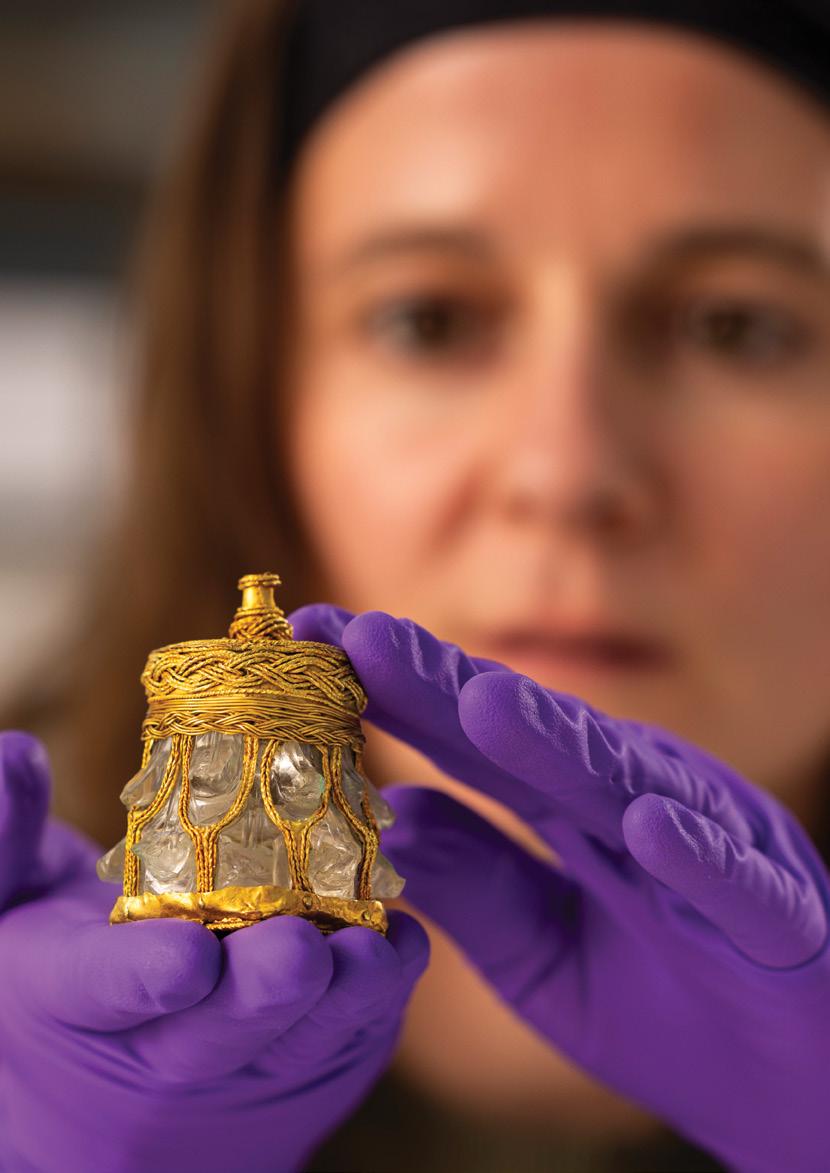
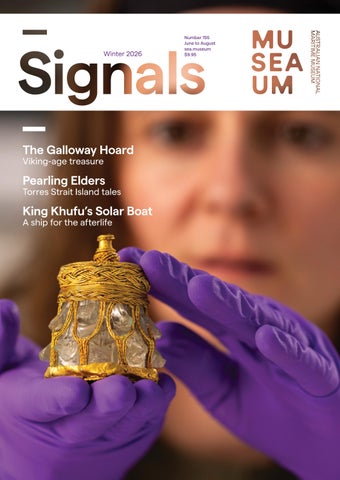
Cover Conservator Bethan Bryan holds a rock crystal jar from the Galloway Hoard. Image © Duncan McLean/ National Museums Scotland News
2 The Galloway Hoard
A rich collection of artefacts sheds light on Viking-era life
10 International Congress of Maritime Museums
Coming to Sydney in September
14 Forty fathoms deep
Portraits and stories of Torres Strait pearling elders
20 Dark green, deep blue and mother-of-pearl
The life of John Louis, one of the last pearling luggers
26 A magnificent maritime resource
Celebrating 40 years of our Vaughan Evans Library
30 King Khufu’s Solar Boat
A modern shipwright analyses an ancient vessel
36 The Tasman Island Light
Tales from the ‘Siberia of the south’
44 Amity and Albany
Western Australia’s oldest colony celebrates its bicentenary
48 Celebrating boatbuilding heritage
The museum hosts Norman R Wright & Sons craft
52 Foundation
Re-rigging Endeavour ; inspiring the next generation
56 Members news and events
The latest talks and tours for winter
60 Exhibitions
What’s on display this season
64 Navy 125
HMAS Armidale (I): a short career, a shared heritage
72 Collections
The voyages of Indonesian contract labourers
78 Readings
Whale: The illustrated biography
82 Currents
Veteran yacht Kathleen Gillett returns to its spiritual home
A new exhibition at the museum showcases the richest collection of Viking-age artefacts ever found in the British Isles. By Bruce Blacklaw of National Museums Scotland.
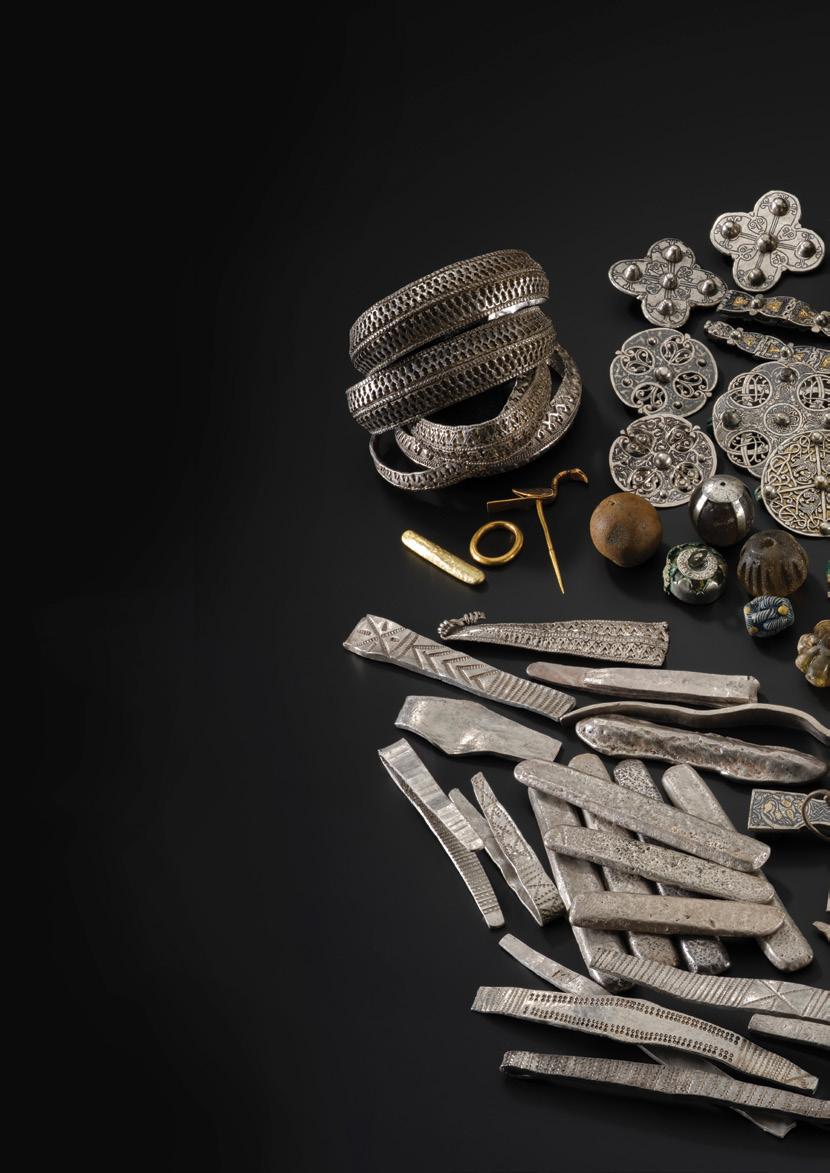
The magnificent Galloway Hoard contains objects from as long ago as imperial Rome and as far away as modern-day Iran. Image © National Museums Scotland
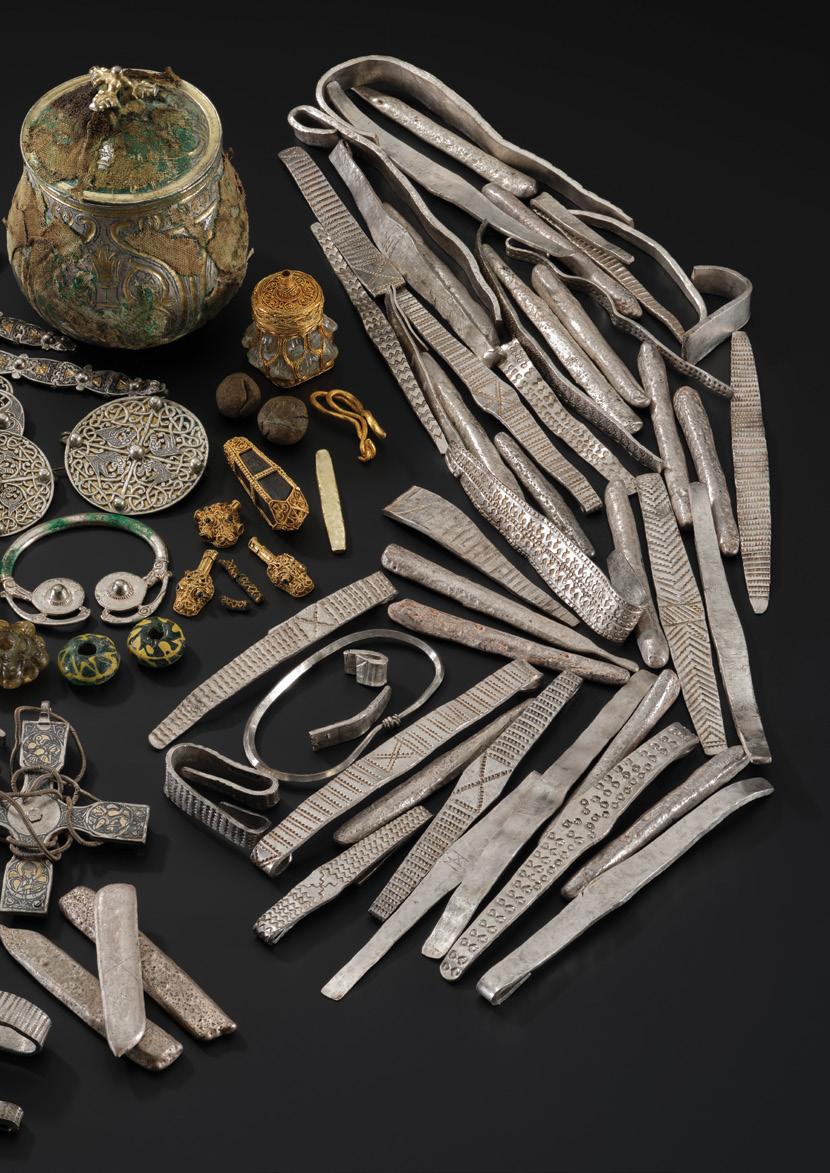
Curators, researchers and conservators spent seven years working to preserve and understand the hoard
In the 9th century AD, Scandinavian connections across the North Sea brought warfare, trade and settlement to Britain and Ireland
01
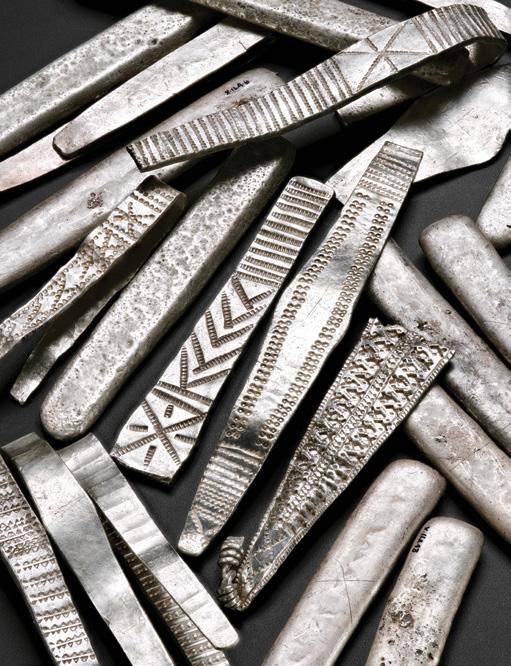
Silver bullion, in the form of both ingots and decorated flattened arm rings, from the upper layer of the Galloway Hoard. 02
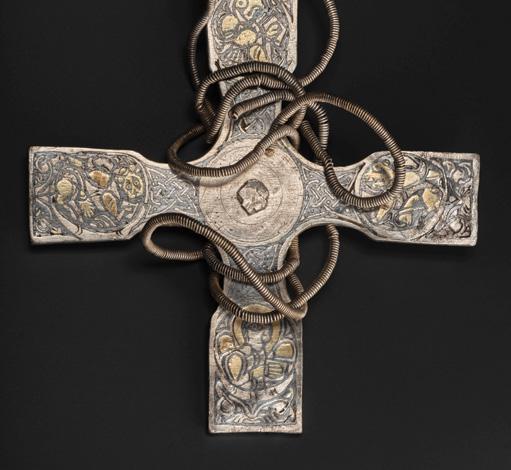
One of two silver pectoral crosses from the hoard. This example depicts the four gospel writers of the Christian Bible and is decorated with gold and niello.
Images © National Museums Scotland
A silver pectoral cross is the first clue that there is something unusual about the Galloway Hoard
THE GALLOWAY HOARD is the richest collection of rare and unique Viking-age objects ever found in Britain or Ireland. Buried around the end of the 9th century AD, the hoard brings together a stunning variety of materials and treasures from Ireland, the Anglo-Saxon kingdoms and as far away as Asia.
It was discovered by metal-detectorists in 2014 on what is now Church of Scotland land in Kirkcudbrightshire, southwest Scotland. In 2017, a major fundraising campaign by National Museums Scotland saved the hoard for the nation. Curators, researchers and conservators spent seven years working to preserve and understand the hoard. The exhibition showcases the results of that work and the knowledge it has revealed.
In the 9th century AD, Scandinavian connections across the North Sea brought warfare, trade and settlement to Britain and Ireland. This period of history is often called the Viking Age and is well known for silver hoards. However, as the Galloway Hoard is revealed, layer by layer, it becomes ever more obvious that this is not your average Viking-age hoard.
Silver bullion made up of arm rings and ingots formed the upper layer of the Galloway Hoard. The most common objects in the hoard are silver band arm rings made by hammering out carefully measured portions of portable silver bars, called ingots. Many are standardised weights, multiples of a 26.6-gram unit, equivalent to an ounce of silver. The Viking-age settlement of Dublin in Ireland has the best evidence for the use of lead weights of this unit that tell us about the silver economy and trade around the Irish Sea. Many of the arm rings have been decorated in their own distinctive style and most have never been shaped to be worn. They are flattened and folded, intended as bullion and valued for their weight, like the ingots they were found with.
Christian objects are unusual in Viking-age hoards, but there was also a silver pectoral cross with the bullion. The fine spiral chain wrapped around the cross suggests that it had been recently worn before burial, but it is damaged. Was it loot? Or protecting the hoard? Did it come from a nearby Christian site? This hoard is also unusual because there is excavation evidence that it was buried within a timber building. It was discovered on what is now church land, although we do not yet know whether there was a church there when the hoard was buried.
Patient and painstaking cleaning of this cross revealed its decoration for the first time in a thousand years. The four gospel writers of the Christian Bible – the evangelists Matthew, Mark, Luke and John – are symbolically represented in the four arms of the cross. Gold picks out important features and niello (a black silver sulphide paste) is inlaid into carved designs for contrast against the bright silver. These materials and the distinctive style of figurative and naturalistic art are much more common in the Anglo-Saxon kingdoms. The cross is the first clue that there is something unusual about the Galloway Hoard.
The Galloway Hoard was much bigger and more complex than the initial discovery indicated. Beneath the top layer, hidden under a layer of clean natural-looking gravel, was a much richer deposit in three parts. The first contained more than double the amount of silver bullion, bound together with leather. Four arm rings were inscribed with Anglo-Saxon runes, not the Scandinavian runes we would have expected. Three are inscribed with Old English name-elements. A complete Old English name, Egbert, was carved on a hacked arm ring recovered from the surrounding site. Each of the runic-inscribed arm rings in the lower bullion deposit is folded and flattened in a distinctive way. There are groups of arm rings which match each of the four folding patterns. Did each group of arm rings belong to a different person? These four owners were unlikely to have been equals, because the share of bullion was not an even split. The largest runic arm ring is more than twice as heavy as the other inscribed examples. It features the longest inscription, from which a recently accepted translation yields a further tantalising insight, as it reads: ‘This is the community’s wealth’.
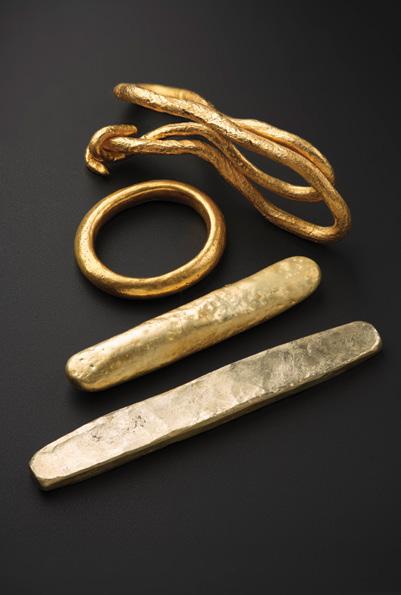
The second group of arm rings in the lower layer was different from the rest of the bullion. Again, there are four, but these elaborately decorated silver ribbon arm rings are complete, unhacked, and as they would have been worn. The largest is a double arm ring, twice the size of the others, with pointed-eared beasts facing each other, their tongues becoming the knot binding the two bands together. All four are bound together tightly by a smaller band arm ring. This unusual cluster of arm rings surrounded a small wooden box containing three gold objects – a ring, an ingot and a pin in the shape of a bird. Gold is much rarer than silver in Viking-age hoards.
The lidded cup
This is only the third silver-gilt and decorated cup to be found as part of a Viking-age hoard in the UK. The other treasure vessels contained silver, but here the silver bullion was buried outside, and the contents of this cup are unlike any other Viking-age hoard. This is also the only vessel used as a treasure container to have a surviving lid. The cup is decorated with Sasanian-inspired iconography, a clear indication that it originated thousands of miles away from Scotland, in Asia. Indeed, subsequent analysis of the metalwork has traced the origin point of materials used to make the cup to a mine in modern-day Iran.
The lid sealing the cup helped to create unusual conditions within for leather and textile preservation. These materials are of huge value to archaeologists because they rarely survive and, unlike gold or silver, they can be scientifically analysed using techniques such as radiocarbon dating.
A collection of beads, curios, and pendants were bundled and strung together at the top of the cup, resting as a group on a silver brooch-hoop. The evidence for how this bundle was wrapped has only partly survived. As metals in the hoard have corroded, the copper leaching out helped create the environment for preserving organic materials, so only where there is metal are there microscopic survivals of the textile wrappings that bundled this group of beads, pendants and curios together.
The best evidence for the wrapping of this top bundle survives on an unusual ‘relic’ pendant made from a broken bead enclosed in silver and capped with a perforated coin. The coin was minted for Coenwulf, the King of Anglo-Saxon Mercia (died AD 821), several generations before the hoard was buried. The broken bead is probably several centuries old. This is the clearest clue that this unusual collection of curios was handed down as heirlooms.
The cup contains materials not normally considered to be valuable, such as glass or stone, and even dirt – yet they have been wrapped in a similar way and hoarded with the largest collection of Viking-age gold in Britain and Ireland. This uniquely composed collection would have been priceless to the person or people who brought it all together.
The contents of the cup also include the first collection of Late Anglo-Saxon brooches from Scotland. Disc-brooches are more normally found in England, from what were the Anglo-Saxon kingdoms of southern and eastern Britain. Two unusual cross-shaped, quatrefoil brooches are unique to the Galloway Hoard. This makes the Galloway Hoard the largest single collection of Late Anglo-Saxon brooches in the UK.
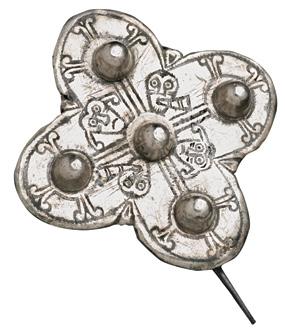
Two unusual cross-shaped, quatrefoil brooches are unique to the Galloway
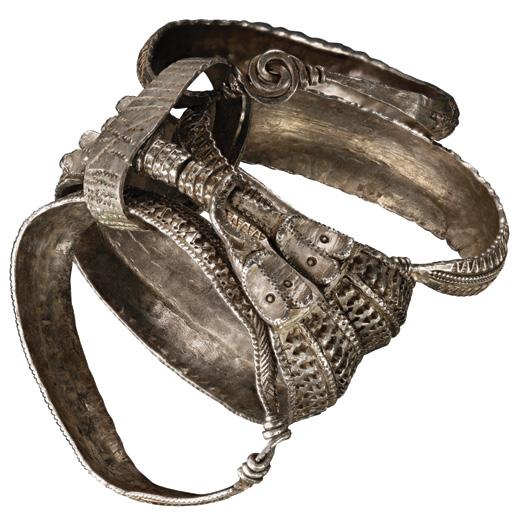
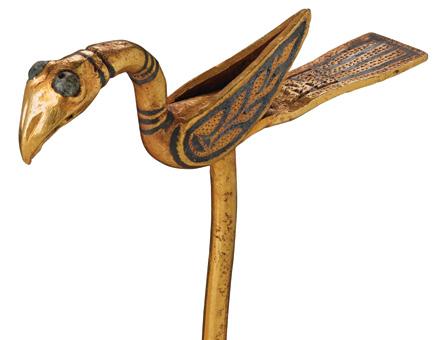
01 Gold is much rarer than silver in Viking-age hoards
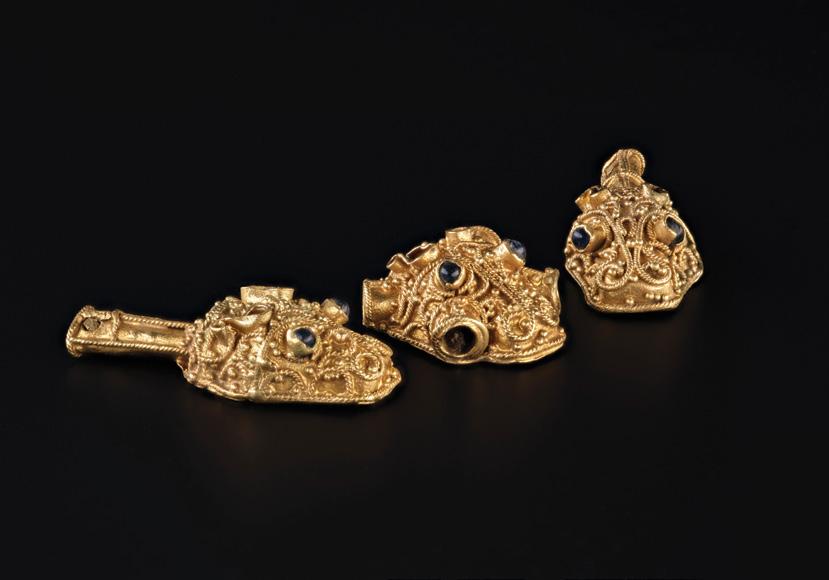
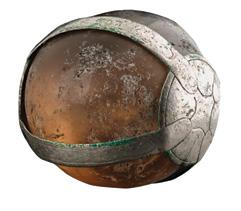
Lower down within the carefully packed and sealed vessel, the conditions for textile preservation were exceptional. Two bundles containing leather, linen and silk (as both cord and fabric) have been preserved, wrapped around golden jewels. In contrast, two balls of dirt seem mundane at first glance, but must have been of great significance to their owners. Although these rare organic and mineral survivals are too fragile to display, they offer many more clues towards interpretation than are available for most hoards, and they provide unique opportunities for research when studied in combination with the exotic and precious materials.
For instance, three gold filigree-decorated jewels were wrapped in a bundle and connected by silk-woven braids. Tubular sockets on the gold jewels match the diameter of the cord, which suggests this could have been a single object – perhaps a silk girdle (fine belt set), an elaborate head-dress or veil, decorated with gold filigree mounts. Previously, these gold-socketed mounts were single finds and thought to be bejewelled manuscript pointers, known as ‘aestels’ in Anglo-Saxon historical sources. This is the first time a group have been found together and the relationship with the silk braid suggests these are not aestels at all.
The Galloway Hoard includes the largest collection of gold surviving from Viking-age Britain and Ireland. All the gold objects are unusual and distinct from one another, perhaps coming from distant places and different manufacturing traditions. A touchstone, a goldworker’s tool for assessing the quality of gold, was encased in an exceptional gold framework, again treated like an heirloom and suspended as a pendant on silk braid.
What was thought to be the most exotic object, a goldmounted rock crystal jar contained in a silk-lined leather pouch, may also be one of the oldest. The technology needed to carve rock crystal was relatively rare in the ancient world and this one is a relic of Imperial Rome, over 600 years old by the time it was covered in gold and turned into a jar. When the jar was carefully removed from its pouch, Latin letters formed from intricate gold filigree were revealed on the base, spelling out ‘Bishop Hyguald had me made’. Hyguald is another Anglo-Saxon name of a previously unknown Northumbrian bishop. Although we cannot identify this as a known historical person, the remarkable ‘relic’ nature of this Christian object, like the cross in the top layer, is further evidence that this hoard has a whole new story to tell.
When you visit the exhibition at the museum, what you will see is the story so far. The exhibition shows not just what we have learned from the Galloway Hoard since its discovery, but also how we can learn from treasures like these. Many unexpected connections between Scotland and the wider medieval world have been revealed. And yet it still poses many questions.
Bruce Blacklaw is the Communications Manager at National Museums Scotland.
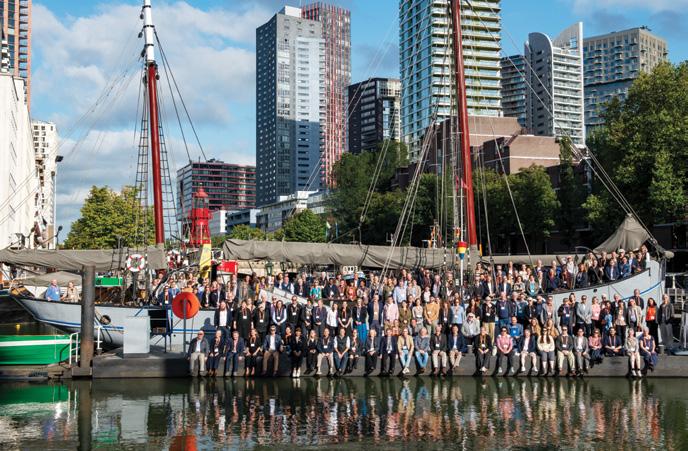
01 The 21st Congress was held in 2024 in Rotterdam and Amsterdam. Delegates were photographed on and around the VL Balder, a former herring lugger launched in 1912. Image Mirjam Lems Photography
02
From 13 to 18 September, the museum will host the 22nd Congress and up to 120 international delegates. Image Ken Butti/ANMM
The museum is honoured to have been selected to host the 22nd International Congress of Maritime Museums, the first to be held in Australia and only the second in the southern hemisphere. Dr Kimberley Webber previews the program.
FOR FOUR DAYS IN SEPTEMBER, the museum will host the 22nd International Congress of Maritime Museums. To deliver a memorable meeting on the edge of one of the world’s greatest natural harbours, the museum has been working with Kirsten Greenaway, President of the International Congress of Maritime Museums (ICMM) and CEO of the Chesapeake Bay Maritime Museum, along with the ICMM Executive Council and the ICMM Congress Committee, the latter led by Dr Hanna Hagmark, Executive Director of Sweden’s Åland Maritime Museum.
The theme of the congress will be Maritime Museums in Action: Moving Forward with Courage and Conviction, and events will commence with a formal welcome on Sunday 13 September, focusing on First Nations cultures. This will be followed by four days of formal presentations, each featuring a renowned keynote speaker. We are delighted that our museum’s Chair, the Hon Hieu Van Le AC , will speak about his experiences arriving in Darwin as a refugee, having escaped Vietnam by boat. Mereoni Camailakeba will deliver a keynote focused on community engagement through the lens of underwater archaeology, drawing on her work with the Fiji Museum.
Dr Kim Sajet, formerly Director of the Smithsonian’s National Portrait Gallery and now the Donna and Donald Baumgartner Director of the Milwaukee Art Museum, will address ‘Courageous leadership’, and Seb Chan, Director and CEO of the Australian Centre for the Moving Image, will put forward proposals for ‘Tomorrow’s museum’. Dr Sajet’s participation has been made possible with the support of the USA Bicentennial Gift Fund.
In total, there will be some 60 plenary papers, short presentations, workshops and roundtables, with around 120 delegates from Australia, Europe, Asia, the Americas and Oceania attending. Among those who have confirmed their participation are Dr Enric Garcia-Domingo, the Director of Barcelona’s Maritime Museum; Larissa Nabuco Nogueira, Director of the Alexio Belov Foundation in Brazil; Zhao Feng from the China Maritime Museum; Captain Jonathon Boulware from South Street Seaport Museum in New York; Jeongsum Lee from Korea’s Incheon National Maritime Museum; and Ulla Teräs, Director of Sweden’s Forum Marinum Maritime Centre.
Conference organisers are aware of the significant costs of attending, particularly for those from less wellfunded museums. The ICMM is therefore once again offering Richard Foster bursaries. One of the recipients is Dmytro Kobaliia, Head of Archaeology at the Khortytsia National Reserve in Ukraine. He will be speaking about the collaboration with the Swedish National Maritime,
The theme of the congress will be Maritime Museums in Action: Moving Forward with Courage and Conviction
In September 2025, the President of ICMM, Kristen Greenaway, visited Sydney and toured the sites of the upcoming congress. Image Felicity Ferguson
Transport and Military Museums which, with ICMM support, successfully documented and excavated an early-18th-century chaloupe, which dates from the war between the Russian and Ottoman empires over control of the Crimean Peninsula.
On Monday, Tuesday and Thursday, the keynote and plenary sessions will be followed by short presentations. This will give delegates the opportunity to learn about developments across the maritime museum sector. Afternoons will feature parallel workshops covering such topics as historic ships and their interpretation, sustainable museums, ship models, maritime refugees, underwater archaeology and collection care.
As is traditional for these congresses, Wednesday will be an excursion day. Delegates will have the opportunity to discover the rich heritage of Manly’s 1832 Quarantine Station followed by a tour of the convict and naval sites at Cockatoo Island.
The museum appreciates the generous welcome being extended by other Sydney cultural institutions, which is enabling diverse social activities. The Sydney Heritage Fleet will take delegates on a twilight sail on the 19th-century barque James Craig. Australia’s oldest museum, the Australian Museum, will give exhibition tours followed by a welcome from the Director and CEO, Kim McKay AO. On Thursday, some delegates will enjoy a special ‘behind the scenes’ tour of the remarkable map collection held by the State Library of New South Wales, while others compete in a yacht race on Sydney Harbour.
September is going to be a busy month at the museum, and we appreciate the enthusiastic response of our volunteers to the request for assistance. With their help, we are confident that this will be a memorable experience for all involved.
The Lugger Bort project aims to bridge the gap between archival records and personal experience
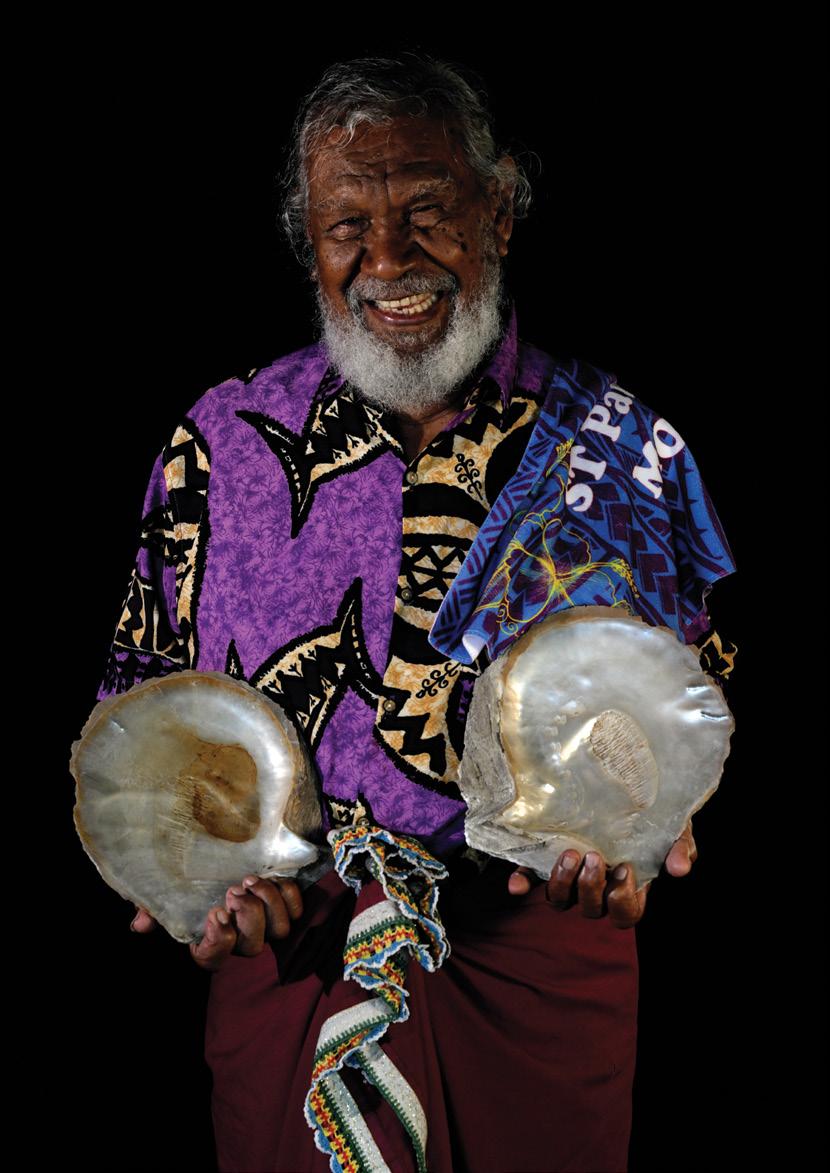
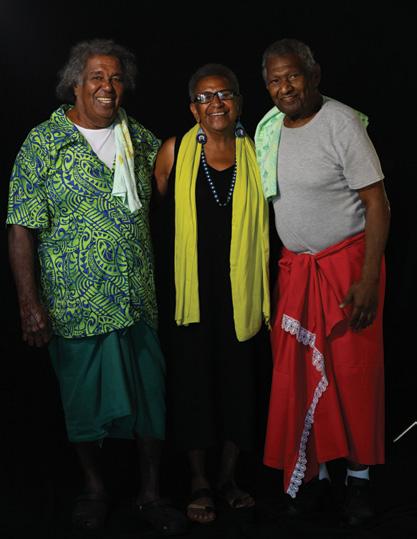
A series of portraits of former pearl divers, commissioned by the museum, focuses on the Torres Strait Islanders who worked in this dangerous and lucrative trade in the 1960s. By Indigenous Programs Manager Matt Poll.
THE TORRES STRAIT was the centre of the global mother-of-pearl industry in the late 19th and early 20th centuries – but for hundreds of years previously, gold-lip pearl shell (kina) sourced from the strait had been a valuable trade item throughout the nearby island of New Guinea. Today the national currency of Papua New Guinea (PNG) is known as the kina in recognition of this ancient trade economy.
The modern pearling industry began in 1869, when Captain William Banner harvested 50 tonnes of pearl shell from Warrior Reef in a matter of months. The industry quickly escalated – just two years later, in 1871, the annual pearl shell harvest was valued at £25,000 – equivalent to some $3.7 million today – and by 1874, more than 700 men and nearly 60 vessels were engaged in Torres Strait pearling.
Vast quantities of shell were harvested from the seabed and shipped to the fashion capitals of London, Paris and New York. There, the versatile shell was made into lustrous buttons that adorned the clothes of the world’s elite, as well as many other luxury and everyday household items.
Yet, for over a century, the personal stories of the backbone of this lucrative trade – the Aboriginal, Torres Strait Islander and South Sea Islander seafarers – remained largely untold outside of the industry’s workers and their families. Independent researcher and curator Nerelle Nicol is working to change that. Born and raised on the homelands of the Kuku Yalanji people and now living on Djabugay Country in Cairns, Nicol has dedicated over a decade to unearthing the social and political histories of Far North Queensland.
Her project, Lugger Bort – a creole-influenced name for the ‘lugger boats’ that defined the era – has evolved from a grassroots research initiative into a significant cultural movement. Nicol’s work, which earned her a 2024 Encounters Fellowship at the National Museum of Australia and the 2025 Monica Clare Research Fellowship at the State Library of Queensland, aims to bridge the gap between archival records and personal experience. She says:
These stories are more than historical footnotes. They define the very identity of Queensland. Through Lugger Bort , we are ensuring First Nations voices are at the forefront of the narrative.
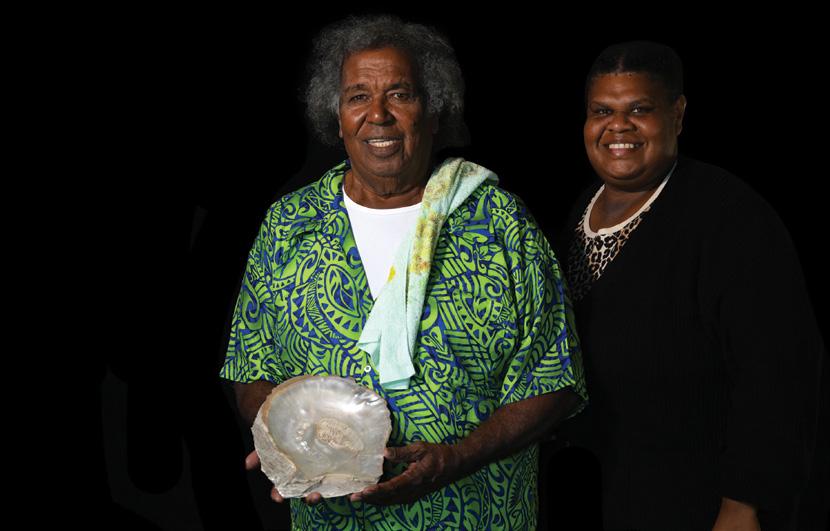
In June 2025, the museum’s First Nations and curatorial divisions, represented by Daina Fletcher and Matt Poll, organised a photo shoot alongside Nerelle with six of the remaining Torres Strait community members who worked on the lugger boats in the 1960s. These men’s experiences on the boats encompassed good and bad, but all were united by the comradeship they shared.
The industry demanded extraordinary resilience. As competition among the various boats extracted more pearl shell each season from easily accessed locations, other sites – more lucrative but more dangerous – were sought on outer reefs. One diver remembered:1
So we work all year round. ‘You fellers go out now’. And we carry damper belong we. Damper. Damper enough for four. Four slice. One, two, three, four. That’s all that’s for dinner. Go down catchem shell bringem come. Go, go, go, go. Right down ... We pick up shell and we shout to our mate, ‘Come, shell, plenty shell. Shark go come. Watch them cross one, hammerhead! That’s the one. Oh dear, careful this one.’
Long before the invention of scuba equipment in the mid-20th century, Japanese divers introduced ‘hard-hat’ diving equipment, allowing harvesting in much deeper waters. They used heavy canvas suits, helmets and air pumps to work safely in deeper areas. Despite these new technologies, there are modest estimates that at least one in ten Japanese pearlers died while on the job. The high mortality rates were mostly caused by decompression sickness (‘the bends’) and environmental events such as cyclones.
Erub (also known as Darnley Island) is one of the most easterly islands in the strait, geographically closer to PNG than to Queensland. One storied site was known as the Darnley Deeps. This terrifying abyss – at the extreme limits of the equipment of the day – was where many divers lost their lives or suffered excruciating cases of the bends.
For these men, the luggers were not just places of work; they were important sites of community
01
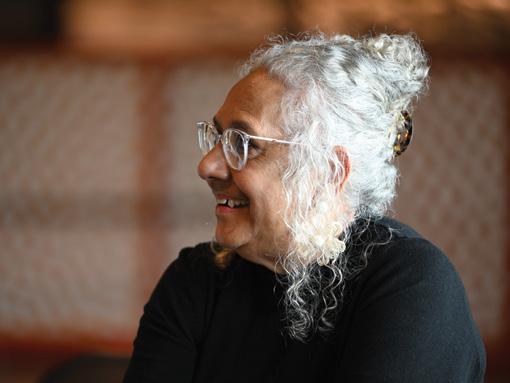
Nerelle Nicol, owner of the Lugger Bort project, during consultations with pearling elders in June 2025.
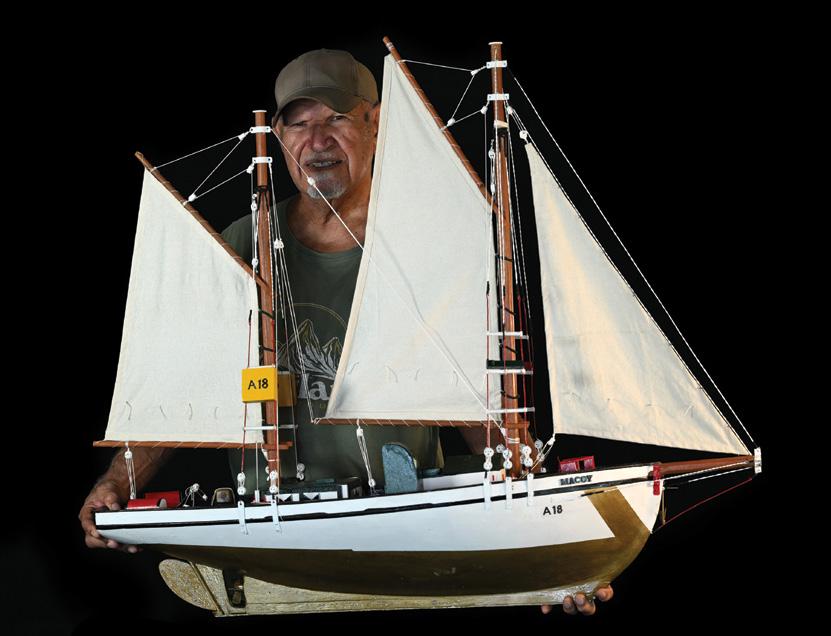
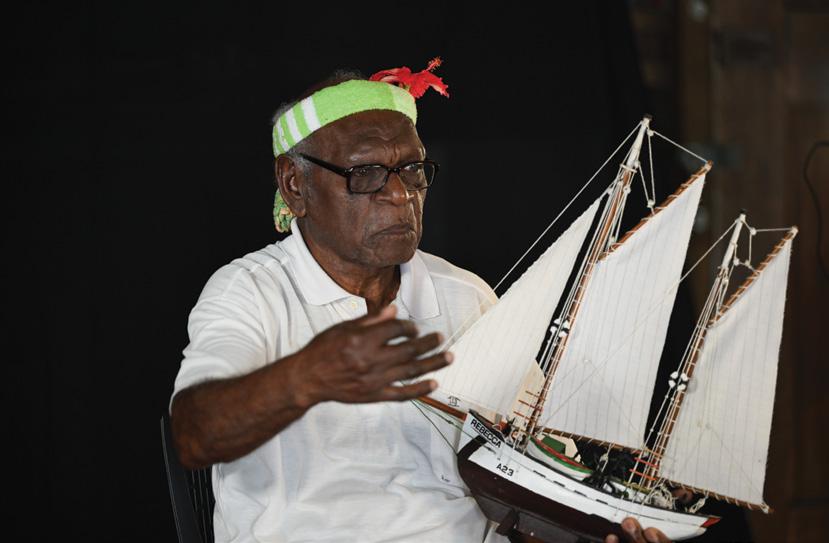
02 Pearling elder Albert Ware tells his story of life working on the luggers. He holds a model of the Macoy from a private collection.
Images Wayne Quilliam 2025
With each passing year, the number of elders who carry memories of ‘lugger life’ dwindles
Teenage boys from many islands across the Torres Strait, often as young as 15, were recruited into lugger life, working as cooks, deckhands and ‘tenders’ – the crucial lifelines who operated the air hoses for divers below. In interviews with the pearling elders, Nicols’ research captures the first-hand memories of elders like George Mosby and Jeffrey Bob. For these men, the luggers were not just places of work; they were important sites of community.
Amid the pressures of commercial deadlines, and competitiveness between privately owned boats and the so-called ‘company’ boats controlled by the government, a distinct maritime culture emerged. Songs – such as ‘Forty Fathoms’ by Henry ‘Seaman’ Dan – were composed to the rhythm of the tides, dances were choreographed to mimic the movement of the sea, and oral histories were forged that bound generations together.
With each passing year, the number of elders who carry memories of ‘lugger life’ dwindles. The urgency of Nicol’s work is becoming more apparent; two potential candidates for the photographic portraits have sadly died since the project was first proposed. The Lugger Bort project seeks to resurrect this legacy through compiling multiple sources of information from archives and museums in Australia.
Over two days in June 2025, Nerelle Nicol and the Australian National Maritime Museum brought together the remaining pearling divers for a special opportunity to sit with acclaimed portrait photographer Wayne Quilliam in Cairns, Queensland.
Originally from Tasmania, Quilliam learned the photographic trade while in the navy in the 1970s. In an outstanding career he has received some of the nation’s highest honours, including the NAIDOC Indigenous Artist of the Year (2009), a Walkley Award for photojournalism, and the Human Rights Media Award for his poignant documentation of the National Apology to the Stolen Generations.
Recognition of Quilliam’s singular vision in the art of photographic portraiture was further cemented when he won the National Photographic Portrait Prize in 2022 for his powerful work Silent Strength. His experience working with Aboriginal and Torres Strait communities was invaluable in producing these portraits.
The final versions of the portraits were developed with generous assistance through philanthropic support from The Sid Faithfull and Christine Sadler Program, and Peter Dexter AM
1 Nonie Sharp, ‘Culture clash in the Torres Srait Islands: The Maritime Strike of 1936’, presented to the Royal Historical Society of Queensland on 24 June 1982.
Pearling Elders is now open in the museum’s Tasman Light Gallery.
Nerelle Nicol was named the 2025 Monica Clare Research Fellow by the State Library of Queensland (SLQ). Her work can be followed online through the library or the Encounters Fellowships program run by the National Museum of Australia.
Every vessel in the museum’s fleet has numerous stories, many of them still arriving via object donations and chance visitors.
Becky Summers-Lee explores how a handful of photos and receipts recently donated to the museum open up the rich pearling life of our historic lugger John Louis.
Broome’s booming pearling trade
Broome is well known for its long pearling history. The late 1800s saw a massive boom in the mother-ofpearl trade, specifically in the Pinctada maxima species – the largest pearl oyster in the world. Luggers were an adapted schooner design, suited to the demanding climate. They were both a diving platform and a home for the hard-working crews who aimed to fill the hold with shell – and occasionally find a pearl.
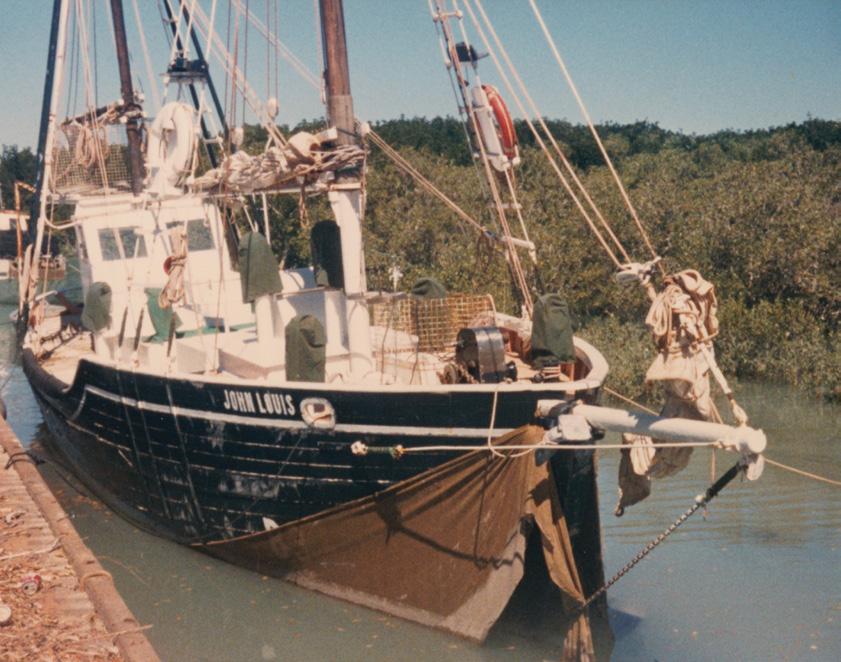
THE PEARLING LUGGER JOHN LOUIS has been with the Australian National Maritime Museum since 1988 and is the only operational lugger in an Australian museum collection. Resting now on the wharves in front of the museum, John Louis formerly had a long and prosperous pearling career in Broome, in the arid northwest of Western Australia.
This lugger has a particularly interesting history, being instrumental to change in the diving methods used for pearling – an industry that is both extremely dangerous and highly profitable. John Louis gives us a glimpse into the booming pearling trade that occupied Western Australia for 150 years, as well as of the daily working life of those brave enough to dive.
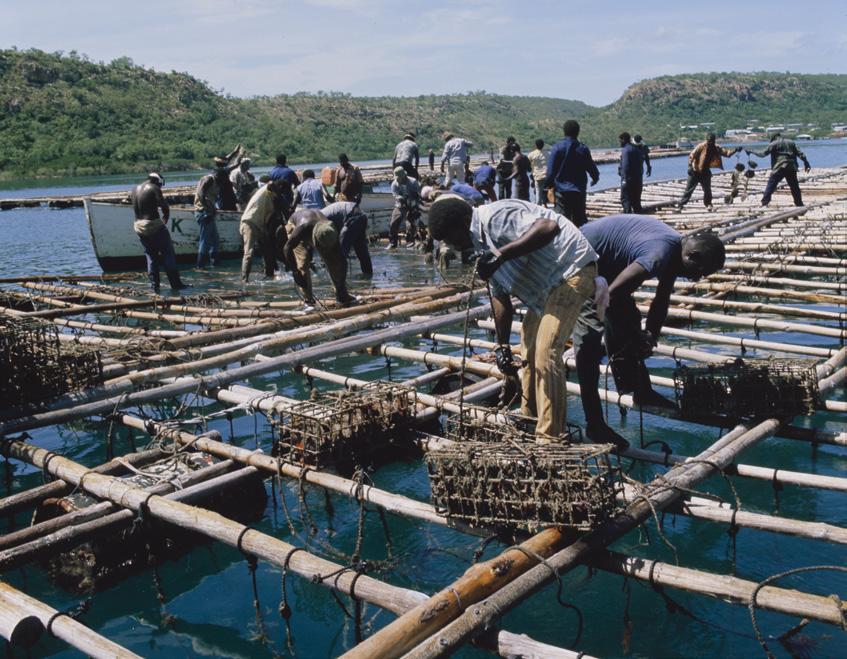
By the turn of the 20th century, there were more than 300 luggers working along Roebuck Bay, and by 1910, Broome was supplying 75 per cent of the world’s mother-of-pearl. The success of this industry was built, however, on the exploitation and even enslavement of Aboriginal and Torres Strait Islander people, who were forced to dive for pearl in the shallower waters. When these areas became overfished, the need to move to deeper waters brought in hard-hat diving, using air supplied from pumps aboard the lugger. The industry then moved to employing Asian migrant workers; however, they too were exploited, working in dangerous and uncomfortable conditions. Pearl divers were at risk of the ‘bends’, drowning, shark attacks and cyclones, while living conditions on the luggers were far from pleasant.
John Louis gives us a glimpse into the booming pearling trade that occupied Western Australia for 150 years
The industry began to collapse in the 1950s, but a reprieve came when the cultured pearl trade began to take shape
01
Pearl divers and workers at the cultured pearl farm in Kuri Bay, 1974. National Archives of Australia NAA: 11845392_0001
02
A pearl diver wearing a hard hat suit collects shell from the seabed in the Torres Strait. Image Frank Hurley, taken between 1921 and 1939, National Library of Australia nla.obj-151335501
The success of the pearling industry was built on the exploitation and even enslavement of Aboriginal and Torres Strait
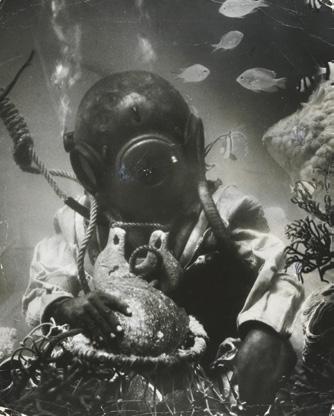
The industry began to collapse in the 1950s, after the internment of Japanese divers and the requisition of pearling luggers during World War II, combined with the increasing use of plastic to replicate mother-of-pearl.
A reprieve came, however, when the cultured pearl trade began to take shape in Western Australia, with the first cultured pearl farm opening in Kuri Bay in 1956. To create a cultured pearl, an oyster is implanted with a nucleus, or foreign body, from which the mollusc tries to protect itself by covering it with a layer of nacre, thereby creating a pearl. This process is called ‘seeding’ and was introduced to Australia by Japanese pearlers and scientists.
John Louis and the hookah
John Louis, built in 1957 by Male & Company for pearler Louis Placanica, was one of the last Broome class pearl shelling luggers built. His son John, for whom the boat was partially named, visited the museum in 2025 and was reunited with the vessel. While initially used to collect mother-of-pearl, once John Louis was bought by Pearls Pty Ltd in 1964, it was used only for the cultured pearl trade for the rest of its working life.
It was on board this vessel in 1971 that the ‘hookah’ method of diving was trialled under the command of Captain Peter Cummings. Previously, hard-hat diving was the norm, with divers wearing a bronze helmet, a waterproof canvas suit and weighted boots that allowed them to dive up to 50 times a day. This suit was extremely heavy and gruelling to work in, and to decompress, divers would have to ‘hang’ in the water for an hour at the end of each day to prevent the bends. Japanese divers were considered the best in the industry, regularly bringing in massive yields of pearl shells using the hookah method.
The hookah method had traditionally been used for abalone diving, with divers only needing to wear a wetsuit and being supplied with air through a flexible line. Not only did this allow for more movement for the diver under water, but it took less time to become accustomed to, and was safer and far cheaper.
When Cummings proposed the hookah trial, he employed divers who had won championships in Australia, as he knew they would have the competitive nature needed to be successful. They were primarily of European heritage, and the traditional hard-hat divers on Japanese pearl luggers would prove to be their fiercest competition. But the success of the trial meant that by 1974 the hookah method had become the new industry standard.
Luggers were both a diving platform and a home for the hard-working crews, who aimed to fill the hold with pearl shell
01
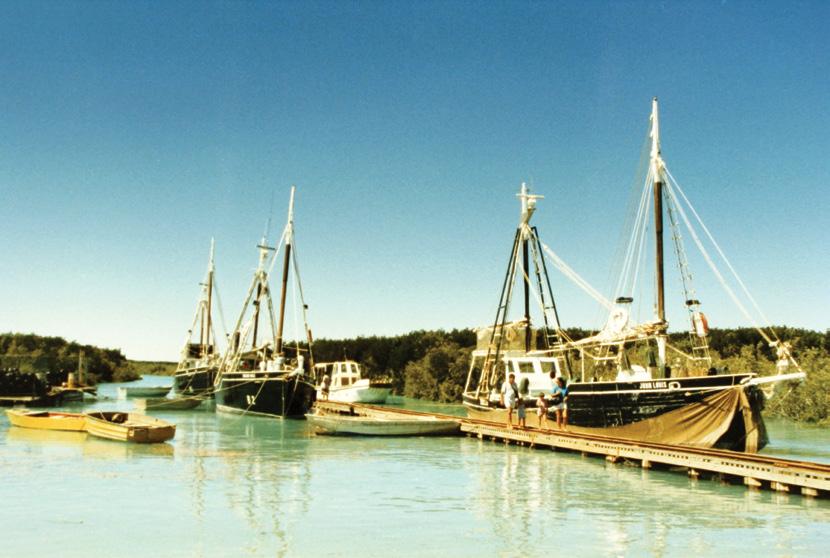
John Louis (right) and other boats at Streeters Jetty, Broome, WA, in the 1980s. ANMM Collection Donated by Noel Brooke
02
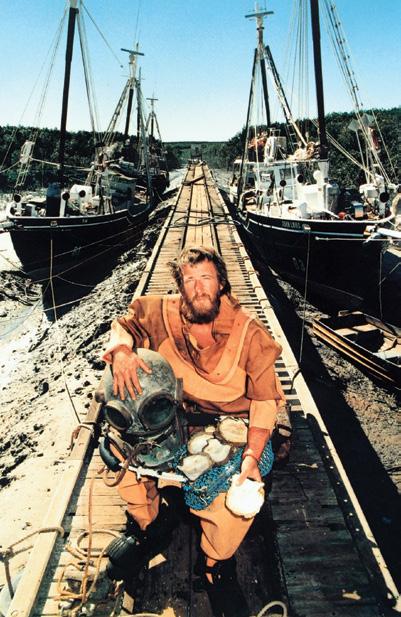
Professional portrait of a hard-hat diver, c 1970s. Image James P Sylgo, Perth, WA. ANMM Collection Donated by Noel Brooke
The working season of a pearl diver
Pearling is a short-term, high-return industry with a season usually only lasting over the summer. In 1987, Noel Brooke, a pearl diver on board John Louis, made $10,878 for six weeks of pearl diving, which averages to $1,813 per week. At this time the average Australian wage for men was $462 per week. If we adjust for inflation, in 2025 Brooke would have made more than $33,000 for six weeks’ work, translating to an annual salary of almost $290,000. Of course, divers took breaks between jobs, but these figures indicate the level of wealth returned from an intensive period at sea.
Pearl divers would be in the water before dawn and only get out of their wetsuits at sunset. The aim was to be wet for more than 500 minutes of the day, and ear infections, skin irritations and jellyfish stings were everyday occurrences. Courage, perseverance and a strong competitive streak were necessary for success in this industry.
Sister ship Kim
The dark green hull is not unique to John Louis, as the lugger has a lesser-known sister ship named Kim
As Brooke’s photos confirm, the two green-hulled vessels worked together in 1987.
With a long history dating back to 1908, the pearling vessel Kim was a standard 40-foot (12-metre) lugger built in Fremantle, Western Australia, by Murray & Howson and registered to owners George Streeter and Arthur Male of Streeter & Company. The vessel was significantly rebuilt in 1931, served briefly in World War II, then in 1958 underwent a secondary rebuild to become the 60-foot (18-metre) vessel it is now.
Pearls Pty Ltd bought Kim in 1976 and it became part of the large fleet of luggers under their ownership.
Pearls Pty Ltd – now more commonly known as Paspaley Pearls – was and still is one of the most successful pearling companies in Australia. The first cultured pearl farm had traded under the Pearls Pty Ltd name, and the company has since created the perfectly spherical Australian South Sea Pearl, widely referred to as the ‘Paspaley pearl’.
John Louis and the other vessels berthed at the museum are significant in their own right, but come to life when infused with human stories. The working lives of pearl divers on board John Louis were arduous and dangerous, but as Noel Brooke’s receipts show, for some divers the hard work earned a high return.
Becky Summers-Lee is a museum professional who has worked across several institutions, in Sydney and in London, and has a postgraduate degree in museum and heritage studies. She completed an internship at the Australian National Maritime Museum in 2025.
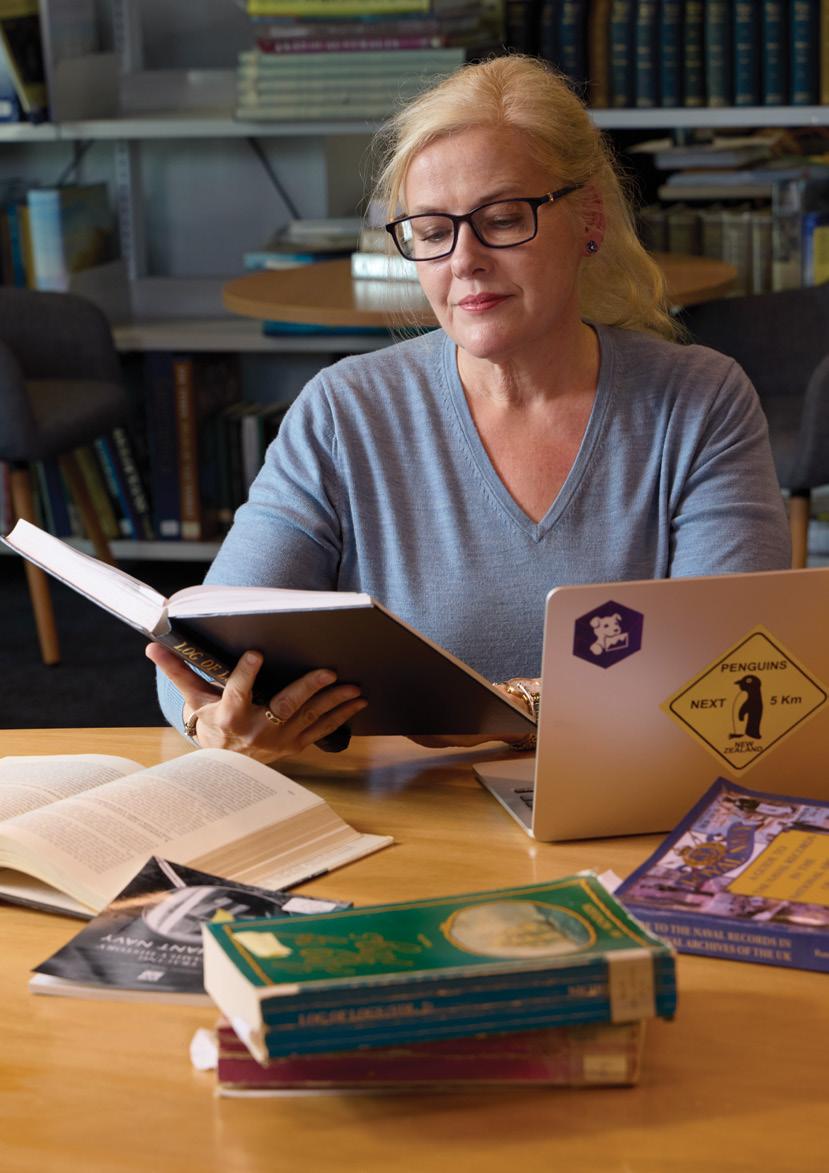
Our beloved Vaughan Evans Library turns 40 this June. It was the first part of the museum to open to the public and is now the nation’s pre-eminent maritime research facility. Library volunteer Marilyn Blackett traces its history and those who have shaped it.
FROM HUMBLE BEGINNINGS in an office in Kent Street to its present location adjacent to the museum, the Vaughan Evans Library has expanded into a national treasure. It is Australia’s leading specialist maritime research facility, safeguarding valuable books, maritime journals, shipping postcards, Lloyd’s Registers of British ships, yachts and captains, and diary transcripts. Accounts such as the 1858 journal of a voyage from Liverpool to Sydney in the steamship Great Britain, by Captain B R Matthews, make interesting reading!
The library is an essential starting point for many people with a project in mind, including researchers from the museum’s staff seeking information to assist their work. Members of the public may be searching for a record of their ancestors, who may have arrived from a distant shore on a sailing ship or a refugee boat. Volunteers who guide visitors through galleries and vessels might be curious about the background of the museum’s exhibits. Interested museum members, academics, boat restorers, model-makers, authors, journalists, film-makers or artists all value the library’s resources.
In 1986, the first permanent staff of the museum were recruited, including founding Librarian, Frances Prentice, soon joined by Technical Services Librarian Jan Harbison. They could see the shell of the new Australian National Maritime Museum under construction from their Kent Street base. Some time later, library staff moved to Union Street, Pyrmont, while the museum’s growing collection of objects was stored off site in Leichhardt.
The library was the first fully functioning, publicly accessible service of the museum, which did not open its first exhibitions until 1991. After the museum opened, visitors were informed about the library, still at Union Street, and there was talk of developing ‘Shed 7’ adjacent to the museum. Now named the Wharf 7 Maritime Heritage Centre, this became the permanent home of the library in 1999, even as renovations to the building were still under way.
Later, Research Librarian Gillian Simpson was appointed, followed by Library Technicians Jo Williams, Penny Dempsey and Helen Philips. Presently, Karen Pymble is our busy Research Coordinator, assisted by Technician Linda Moffatt.
The library collection was built up with donations of extensive personal collections, such as that of Vaughan Evans OAM in 1988. Vaughan was a key figure in Australian maritime history, playing a leading role in advocating for and shaping this museum. Our library, which contains his unpublished manuscript ‘Shipbuilding in Australia’, was named after him in 1993. He inspired other donations of significant collections, including those by journalist, yachtsman and yachting historian Lou d’Alpuget, naval architect Alan Payne, maritime historian Norman McKellar MBE and the Cockatoo Island Dockyard Library. More recently, Professor Adrian Horridge FRS bequeathed 400 works from his library – with rare works covering non-European maritime traditions – and his fieldwork notebooks and photos.
As a guardian of national maritime treasures, the library does much more than catalogue items to assist research. There is a project to enhance access to online library resources and digitise collections for current and future generations. Our library is an essential component of the museum’s functions of preserving the past, re-examining narratives and collaborating with communities to develop insights that help people understand their heritage in a changing world.
In 2025, through the National Film and Sound Archives of Australia’s digitisation program, the Vaughan Evans Library completed the digitising of its oral history collection. These recordings give greater access to a rich body of first-hand maritime experiences. The interviews can be explored via the library catalogue: library.anmm.gov.au/ANMM/Portal.aspx . This collection captures a diverse range of voices – including surfers, naval personnel, refugees, and crew members of sailing vessels and tugboats.1
Other resources available through the library include a maritime-focused journal collection, including titles such as Seacraft, Australian Motor Boat, The Rudder: the magazine for Yachtsmen and Yachting and the Naval Historical Review, along with JSTOR’s archival journal database, just to name a few.
Visitors can also access a range of microfilm records onsite, including the Australian Register of British Ships, Register Veritas (covering European-registered vessels) and Lloyd’s Captains’ Register. In addition, the library provides onsite access to family history resources such as Ancestry.com and Find My Past. For further information on resources, contact library@sea.museum
Who uses our library? Currently we have an enthusiastic family historian, Jenny Rollo; an original staff member, Jeffrey Mellefont, who is now an Honorary Research Associate of the museum; and a valuable museum volunteer, Mike Kelly. These are just a few of the many researchers and maritime devotees who contribute to, or benefit from, our library’s diverse resources.
Jenny has a varied academic background. She became curious about her family history’s maritime links to New Zealand, and googled ‘ship logs’ after discovering the diary, in Christchurch, of an ancestor, Joseph Longden, who arrived in Australia in 1850 on the Barbara Gordon. This led her to our library, and she has now connected with a wealth of physical and online resources. Her family tree now includes a Bohemian novelist, a London publisher who hosted dinners with prominent people in science, medicine, politics and women’s rights, and a distant cousin who illustrated for Charles Dickens.
To Jeffrey, founding editor of Signals and friend to successive librarians, our library has been an indispensable resource for Signals contributors and a way to keep up to date with the diverse maritime world.
01
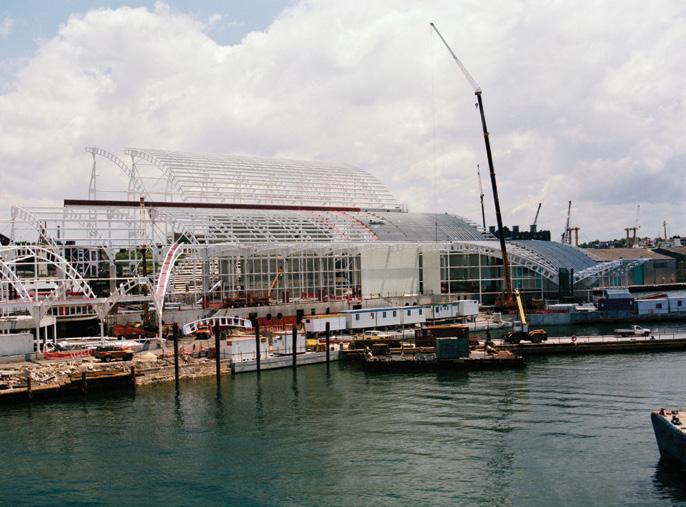
The museum under construction in 1987. The green-doored shed at the far right was later renovated and expanded to form the Wharf 7 Maritime Heritage Centre, which now houses the Vaughan Evans Library. ANMM image
02
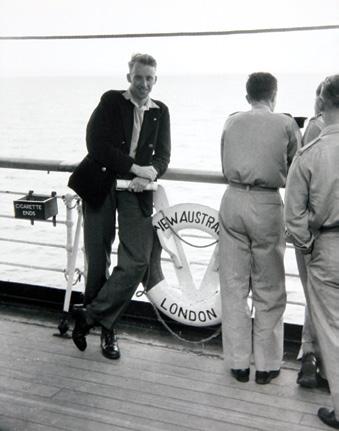
Vaughan Evans, aged 31, on the deck of the New Australia, off the coast of Port Phillip, Victoria, 17 February 1955. ANMM Collection 00050764 Gift from Vaughan Evans
The Vaughans Evans Library is open 9.30 am to 3.30 pm Monday to Thursday by appointment. To book a visit, please phone 02 9298 3739 or 02 9298 3693, email library@sea.museum or enquire at the Wharf 7 reception desk.
He knew Vaughan Evans personally and assisted Lou d’Alpuget when he had donated his unique personal library in 1991. Currently Jeffrey is collating and cataloguing over 10,000 photographs of Indonesia’s maritime traditions from the Horridge bequest. He sees our library as the dependable and constant heart of the museum, as exhibitions, galleries and leadership directions develop and change.
To Mike, volunteering at the museum was a natural choice after serving in six ships in the Royal Navy over 17 years. He is now scanning hundreds of ship photos from shipping lines worldwide, recording their information and creating a valuable database which will eventually be accessible to the public. He knows through experience that the library’s physical resources can provide information that is not available on the internet or through AI.
We celebrate the 40-year history of the Vaughan Evans Library. Its resources are a unique asset to our nation, to the Australian National Maritime Museum and to many researchers for their own maritime projects.
1 For more on the digitisation of the museum’s various resources, see ‘Deadline 2025: A lifeline for analogue collections’ in Signals 153 (Summer 2025), pp 46.
Why would anyone build a full-scale, fully functional vessel, then bury it beneath the sands of Egypt? Anthony Longhurst, master of Endeavour, looks at the mystery and mastery of King Khufu’s Solar Boat, one of the many treasures of Cairo’s new Grand Egyptian Museum.
I HAVE SPENT MOST OF MY WORKING LIFE around ships that were already old when I first stepped aboard them. Timber has a way of carrying knowledge forward: tool marks, fastenings, proportions, all speak quietly of the people who made them. Few vessels, however, speak across time as clearly as King Khufu’s Solar Boat, discovered in 1954 beside the Great Pyramid of Khufu at Giza, where it was entombed 4,500 years ago. For all the ceremony attached to it, this is not an abstract or symbolic object. It is a boat, conceived, built, dismantled and buried by people who worked with boats and understood them intimately.
The Solar Boat occupies a curious place in maritime history. It is often described primarily as a religious artefact; a ritual craft intended to carry the pharaoh King Khufu and follow the sun god Ra westward by day and beneath the earth by night, through the afterlife. While this is true, it does not explain why the vessel was built the way it was. Strip away the mythology and what remains is a full-sized, practical hull, constructed to a coherent structural logic, using materials selected for their known properties and shaped according to a tradition that long predates the pyramids.
The Solar Boat was never intended for trade, fishing or everyday transport, yet it was clearly designed to function on water. Its dimensions, hull form, steering arrangement and construction methods are those of a working vessel, not a ceremonial mock-up.
This was a craft meant to float, to be handled by a crew and to move with purpose, even if that purpose lay beyond the mortal world. It may also have been used to convey the pharaoh’s body on its final journey. In ancient times, a branch of the Nile, the Amharat, passed much closer to the pyramids, beside the Giza complex, and was used to transport stone, materials and workers to the site.
Many cultures have produced symbolic boats that resemble vessels but would never survive immersion. The Solar Boat is not one of them. It belongs firmly within the Nile boatbuilding tradition, sharing its DNA with the river craft that carried people, stone, grain and gods alike.
The boat was discovered in a sealed pit 31 metres long (13 metres shorter than the completed vessel), 5.4 metres wide and 6 metres deep, on the southern side of the Great Pyramid. It had been carefully dismantled and entombed beneath 41 massive limestone blocks, each weighing around 16 tonnes, then covered with plaster and sand. The pit was airtight and dry, which explains the extraordinary state of preservation after four and a half millennia beneath the desert.
From a mariner’s perspective, one detail is striking. Boats are directional things. To set one down with a defined heading is to acknowledge its function as a vessel. Even in burial, it was laid up, not discarded.
King
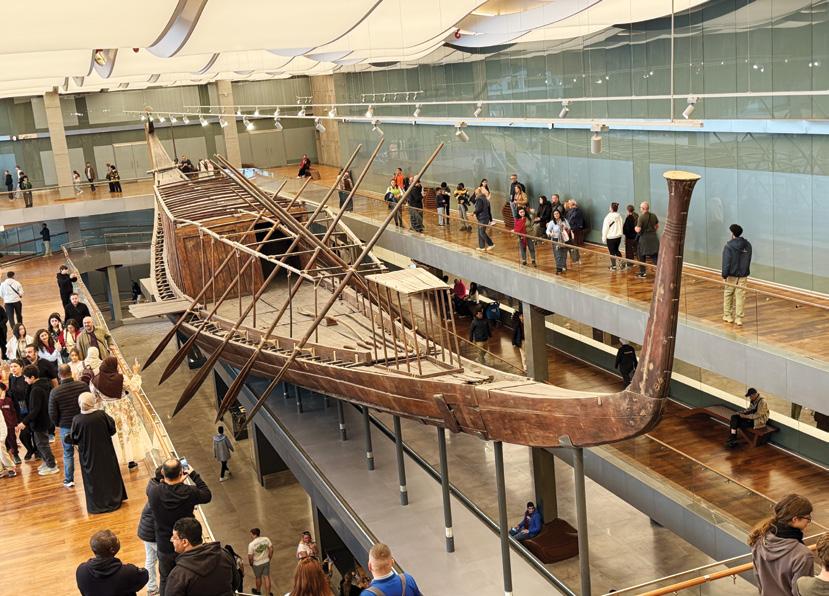
Few vessels speak across time as clearly as King Khufu’s Solar Boat, entombed beside the Great Pyramid of Khufu at Giza 4,500 years ago
Why the boat was buried
Emtombing the Solar Boat served two purposes. Practically, it protected the vessel from decay and disturbance. Spiritually, it removed the boat from the everyday world, dedicating it entirely to its funerary role. Once sealed, it was no longer a vessel in reserve, but an active component of the pyramid complex – funerary machinery awaiting activation in the afterlife.
The care taken in dismantling and packing the vessel reinforces this. The timbers were not thrown in at random. All 1,224 components were labelled with hieroglyphs identifying their location and alignment and arranged deliberately, suggesting that reassembly, whether literal or symbolic, was expected.
The primary timber used is Lebanese cedar, imported at great cost and effort. This was not simply a prestige choice. Cedar is straight-grained, relatively light, resistant to rot and stable in service – qualities well known to anyone who has worked timber boats. Egypt lacked extensive native forests, but its shipwrights knew exactly what they needed and where to get it. Acacia and sycamore were used for secondary elements, but the heart of the vessel is cedar. This tells us the builders were not improvising; they were selecting materials with a clear understanding of marine performance.
At first glance, the hull looks unusual to modern eyes: long and slender, with strongly upturned ends and a pronounced sheer. Look more closely, however, and the form becomes immediately familiar. This is the shape of a papyrus boat, as used along the length of the Nile.
Long before timber vessels became common, boats were built from bundled papyrus reeds. These craft established a hull profile ideal for river work: shallow draft, fine ends and high, raked stem and stern where the bundles were lashed together. Papyrus boats ranged from small personal craft to large transport vessels capable of carrying single-piece granite obelisks weighing hundreds of tonnes from Aswan to Luxor and Giza. When timber replaced reeds, the form remained.
The Solar Boat is a wooden translation of a papyrus vessel. Rather than redesigning the hull to suit planks, the builders preserved a shape that generations of Nile boatmen already trusted. Shipwrights recognise this process; proven designs often outlive the materials that first gave them form.
This is not the work of mystics or priests. It is the work of shipwrights
01
Shade structure showing method of lashing and papyrus bud capital on post. Image Selena Griffith
02
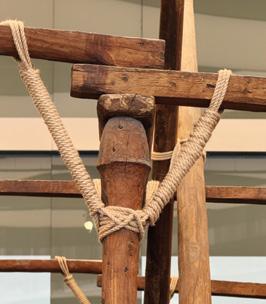
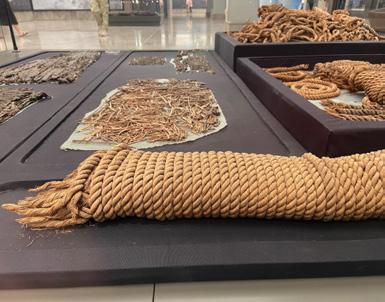
Original 4,500-year-old halfah grass rope lashings found with the Solar Boat. Image Anthony Longhurst
03
View from below, showing hooked scarf and lack of keel. Image Anthony Longhurst
The construction method reinforces this heritage. There is no keel in the later European sense and only minimal transverse framing. Instead, the hull is built plank-first, with planking up to 140 mm thick. Strength comes from the continuity of the hull skin rather than an internal skeleton, although widely spaced athwartship timbers provide local reinforcement.
Planks are aligned using mortise-and-tenon joints, supplemented by a system of rectangular, L-shaped mortices cut along plank edges. Rope lashings made from halfah grass were passed through these mortices, tightened and tied, binding the structure together without metal fastenings or trunnels. This allowed controlled movement, similar to a reed boat’s natural flexibility. The hull could flex under load, dissipating stress rather than cracking. Below the waterline, slender half-round battens were fitted over internal seams to improve watertightness, a method still used where light planking makes caulking difficult.
Where planks required lengthening, some reaching 21 metres, they were joined with hooked scarf joints and then lashed. This joint remains in use today.
Deck beams were lightly notched and lashed to the inside of the sheer strake. A central longitudinal shelf acted as a ridge pole, supporting the beams and supported by posts. Additional longitudinal girders were fitted and lashed above and below the beams, increasing stiffness and helping prevent hogging of the strongly raked stem and stern. The oars were likely loosely lashed or passed through rope grommets along these girders, forming oarlocks.
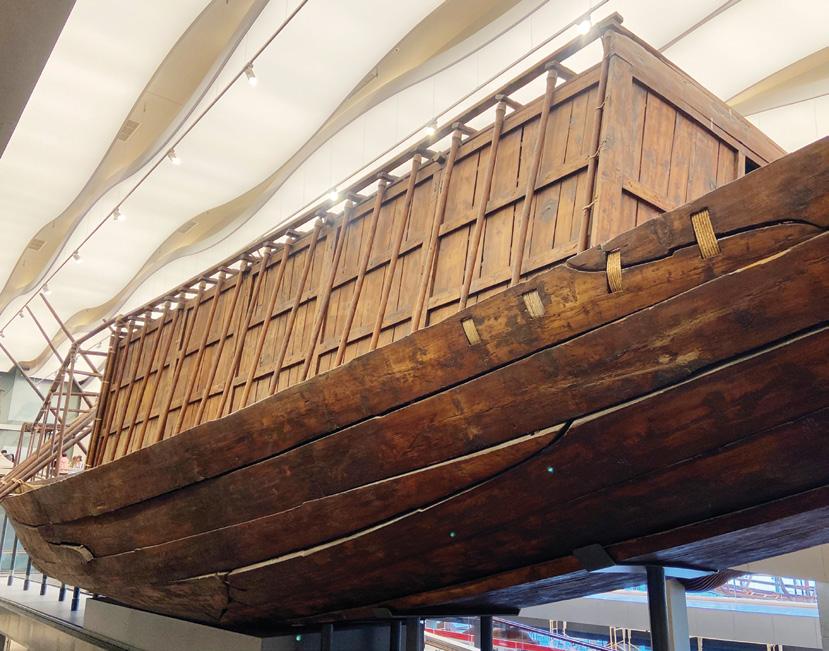
Standing before the reconstructed vessel, it is difficult not to feel professional kinship with its builders
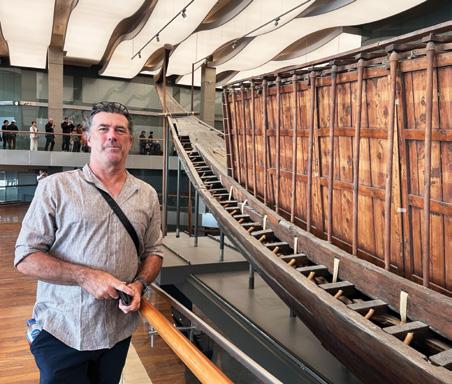
Author Anthony Longhurst visiting King Khufu’s Solar Boat.
Image K Longhurst
02
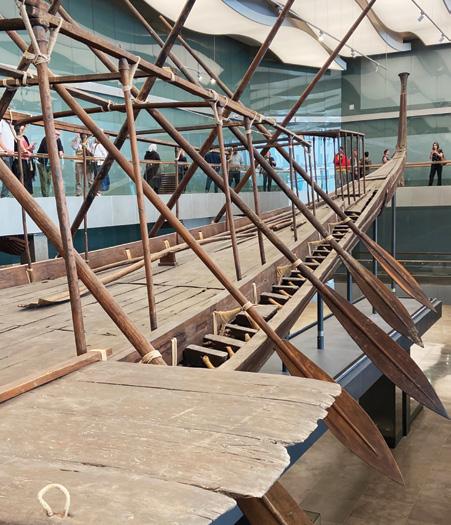
View looking forward from the gangway located amidships.
Image Anthony Longhurst
King Khufu’s Solar Boat matters not simply because it is old, but because it demonstrates continuity
Modern observers may struggle with rope as the primary fastening, yet rope was the engineering material of its time. Properly applied, it offers strength, resilience and serviceability. As timber and fibre swell when submerged, the structure tightens, possibly making caulking unnecessary.
Large steering oars mounted on the quarters provided control, their scale indicating a substantial crew. Under oar, the vessel would have been highly manoeuvrable, especially in shallow or confined water. Its shallow draft and fine ends made it well suited to the Nile, easy to beach, tolerant of grounding and simple to refloat.
No mast or mast step was found, but evidence from other Egyptian vessels suggests the boat could have carried a simple square sail. Bipod masts were common and could be lowered when not required. Whether the Solar Boat ever sailed is beside the point; the design assumes the possibility.
A deck is laid in three sections. A small baldachin was constructed forward, with a midships area and a deckhouse (royal cabin) aft. The roof beams of the royal cabin are supported by three columns topped with palm-frond capitals. The cabin is surrounded by 36 posts capped with papyrus-bud capitals, supporting a shade canopy that insulated the cabin while allowing airflow. A similar canopy covered the open deck forward.
Specifications
Length: 43.5 metres
Beam: 5.9 metres
Depth: 1.78 metres
Net tonnage: approximately 20–25 tonnes
Displacement: approximately 49 tonnes
When the pit was opened in 1954, preservation and reconstruction required more than academic knowledge. How did the lashings work? Which plank went where? How much tension was correct? Over ten painstaking years, it became clear the ancient builders had left little to chance. Components fitted because they were designed to, guided by the original labelling system.
Standing before the reconstructed vessel, it is difficult not to feel professional kinship with its builders. They worked without metal fastenings, modern tools or written plans, yet the result is coherent, balanced and purposeful. This is not the work of mystics or priests. It is the work of shipwrights.
King Khufu’s Solar Boat matters not simply because it is old, but because it demonstrates continuity. From papyrus reed to cedar plank, from river workboat to funerary vessel, the same principles apply: buoyancy, strength, flexibility and control. For marine enthusiasts, it offers a rare connection to the earliest large-scale plank-built boats, reminding us that good boatbuilding principles are discovered, refined and passed on.
Four and a half thousand years on, now displayed in the Grand Egyptian Museum, the lashings still make sense, the hull still reads true and the bow still points west, ready, as it always was, for its final voyage.
References
Cheops’s Solar Boat, Farid Atiya. Published 2009 by Abydos Publications, Egypt.
The History of Ships , Peter Kemp. Published 1978 by Orbis Publishing Limited, London.
Sailing ships , Björn Landström. Published 1969 by International Book Production, Stockholm.
The Lore of Sail. Published 1984 by Hamlyn Paperbacks, Great Britain. The Ancient Mariners, The Seafarers . Published 1981 by Time Life Books
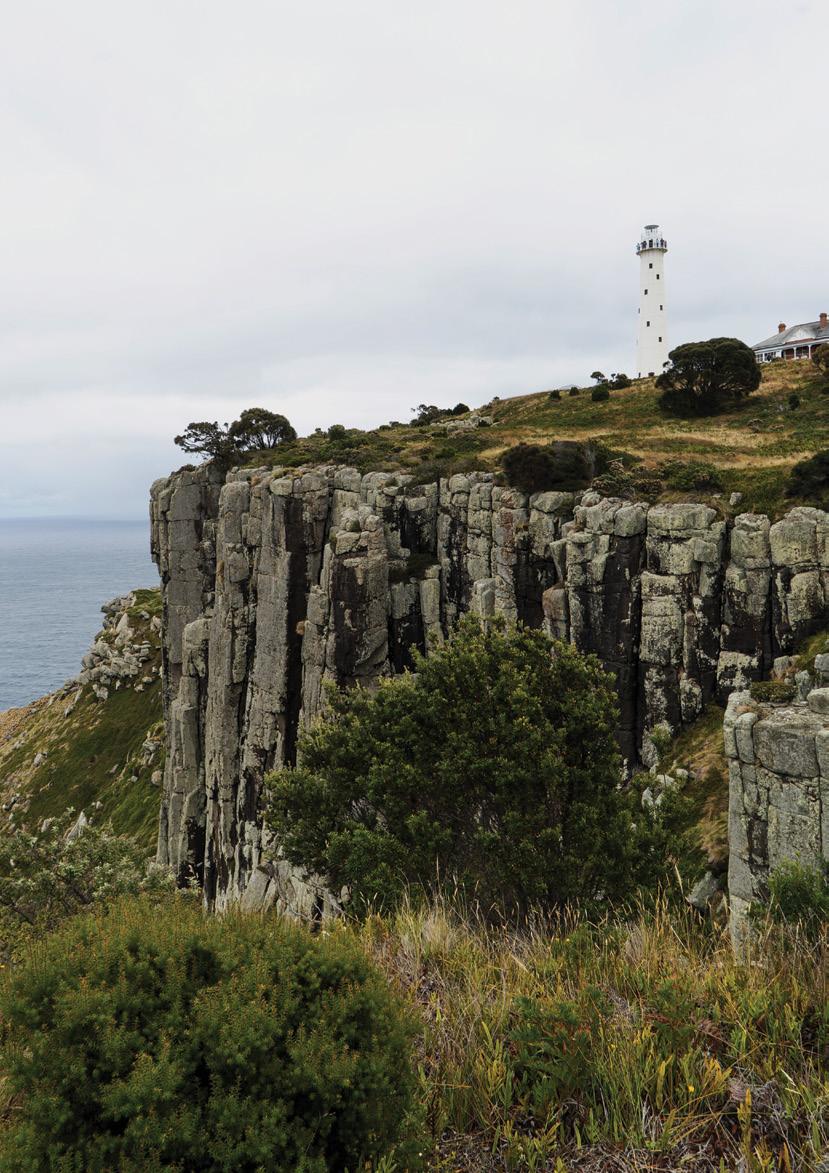
Tasman Island is surrounded by steep cliffs reaching heights of almost 250 metres
This year marks the 120th anniversary of the Tasman Island Light, the former lens of which is now on permanent display at the museum. Assistant Curator Inger Sheil traces the history of this remote light station and its inhabitants.
Standing above steep dolerite cliffs, the Tasman Island Lighthouse has been a navigational landmark for 120 years. Image Inger Sheil/ANMM
ON 12 JULY 1864, Captain Daniel Rich, master of the barque Pet, wrote to The Mercury newspaper about the dangerous approach to the Derwent River as vessels rounded the Tasman Peninsula east of Storm Bay:
I have been very many years trading to and from this colony, and my greatest anxiety always commences when I am nearing Cape Pillar, and its adjacent dangerous coast and half submerged rocks, and I believe the same anxiety is also felt by the master of every vessel bound to or from Hobart Town.
His fears were well founded. Just a few years before, in October 1861, the barque Don Pedro was wrecked between Fortescue Bay and Cape Pillar after running aground on rocks. Fortunately, all seven crew and passengers were saved. The schooner Tyne was not so lucky when, just weeks later and near the same location,
it was becalmed at night and in heavy fog, drifting onto the rocks and reefs at the entrance to Fortescue Bay. Its 41 passengers and seven crew assembled on deck, some wearing only night clothes, and watched as they neared the breakers at the foot of the soaring dolerite cliffs. Two boats were lowered, only to be smashed apart by the waves. The ship struck a reef, and four passengers perished after jumping overboard to try to swim to safety. Miraculously, the ship’s fore yardarm came to rest against a ledge on the cliffs, and some of the sailors and more agile passengers scrambled up the rigging and across the yardarm to the rock shelf. From there they assisted the remaining crew and passengers across or lifted them with ropes from the deck. Soon after the last man was taken off, about two hours after the grounding, Tyne broke up and sank. After a perilous climb to the cliff top, the survivors made their way to safety.1
01
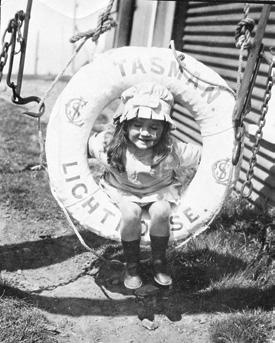
Lighthouse keeper’s daughter
Eileen Johnston, c 1924.
Eileen, born 1920 to lightkeeper Leslie and his wife Stella, was the first European born on the island.
Image Elaine Bell/Friends of Tasman Island collection
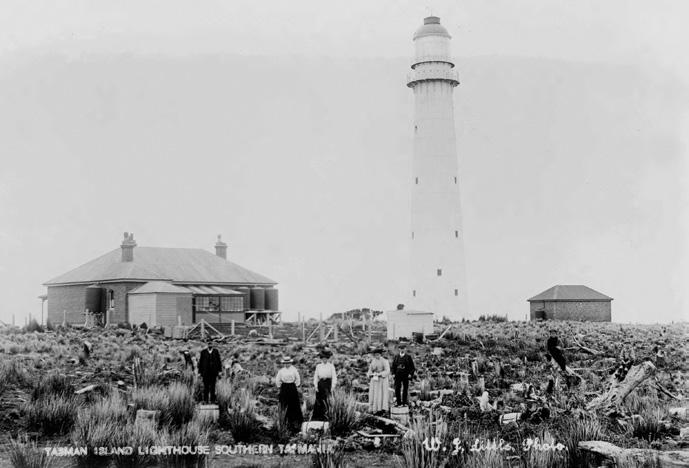
02
Tasman Island Light Station and residents, c 1910.
Photographer W J Little.
Image Tasmanian Archives
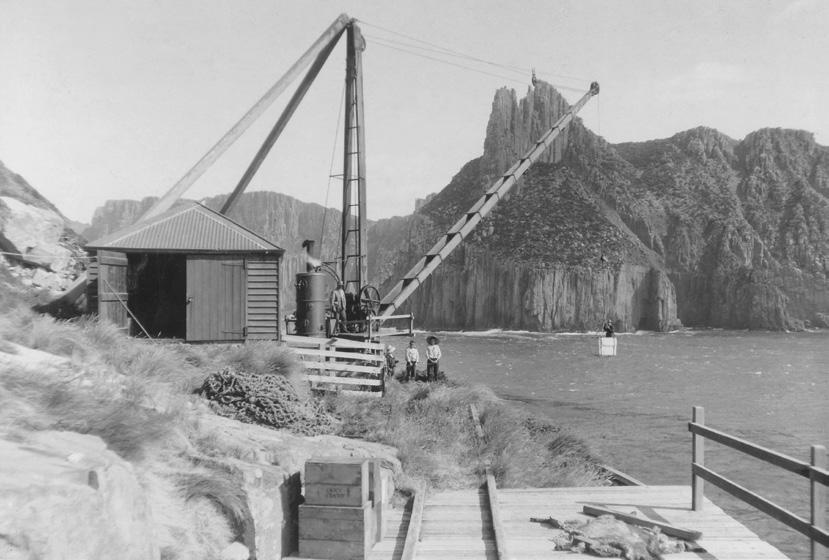
03
Landing stage with steam crane, c 1910. An accident resulting in the death of a workman in 1927 led to the introduction of a flying fox system to transfer people and supplies to the landing stage.
Image Carlene Nillsen/Friends of Tasman Island collection
Island residents would sometimes find structures on the landing stage washed away by waves and wind
Captain Rich proposed that ‘a memorial be got up by the shipowners and others interested, praying the government to build a lighthouse’,2 but he waited more than 40 years to see it happen. Not until 1885 did the matter come before the Consolidated Marine Board, and a proposal to build the lighthouse was put up in 1886. Despite efforts to find a suitable location, attempts to allocate funds and pressure from shipowners and mariners, it was not until 1903 that approval to proceed with the project was finally granted.
The location selected was Tasman Island, separated from Cape Pillar by less than 500 metres. The lighthouse itself, including the prefabricated cast iron tower, lantern room and optical apparatus, was supplied by Chance Brothers of Birmingham, UK, renowned for providing lighthouse apparatus worldwide. The Hobart firm of Henrickson & Knutsen undertook the building of the light station, including the keepers’ quarters, landing stage and haulage. In total, the build came to about £22,000. Work commenced in October 1904.
Building the light station proved a challenge. The island, first sighted in 1642 by Dutch navigator Abel Tasman, after whom it was named, is surrounded by steep cliffs reaching heights of almost 250 metres. At Cape Pillar they reach up to 300 metres – the tallest seacliffs in the Southern Hemisphere. Above the impressive rock
formations is the high plateau of the island, ranging from 200 to 240 metres above sea level, covering 1.2 square kilometres in total.
To convey supplies to the top of the island it was first necessary to build a landing and haulage way. Between cliffs and the volatile ocean, a landing stage at sea level would not be viable, and so one was constructed nearly 30 metres above the waves. The construction workers blasted into the cliffs at the northeast corner, one of the more sheltered parts of the island, and built the stage and haulage tracks. Even there, it was not entirely out of the reach of the sea; in years to come, the island’s residents would sometimes find parts of the infrastructure washed away by waves and wind. One lighthouse keeper recalled finding seaweed and a dead fish in the housing for the haulage equipment after a big storm. 3
Supplies were brought by steamer, which then used a workboat to ferry them closer to the island, where they could be lifted by a steam crane to the landing stage. From there they were hauled up nearvertical tracks to the top of the island, and a trolley ferried them across to the light station, centred around the tower in the southeast corner. Poor weather often delayed the delivery of supplies and the build, but by 2 April 1906 all was in place for the first use of the light.
Head keeper George Johnston and his wife Jessie were already established on the island – which Jessie called ‘the Siberia of the south’ – having moved there the previous December. They welcomed officials from the marine board and provided lunch, the centrepiece of which was an iced cake in the form of the lighthouse. The official party then toured the lighthouse and quarters, finding them in excellent order. A swift departure was called for, however, with a southerly gale coming on that threatened to envelop the officials. They hastened back down the haulage way and rejoined their ship, SS Mahinapua 4
On 4 April 1906, a newspaper reported that at sunset two days earlier:5
… the light which has been erected on Tasman Island for the guidance of those who go down to the sea in ships, was exhibited for the first time and in the ordinary course of events it will cast its friendly rays over the dark waste of waters for ages to come.
The new tower was 29 metres tall, with a total elevation of 276 metres above sea level. For the next 70 years the lightkeepers operated the light, ever mindful of their responsibility for keeping lives at sea safe. Karl Rowbottom, who arrived on the island as an assistant keeper in 1971 with his young family, recalled:6
A keeper’s daily routine was to make sure the light was ready to go every night. Nothing else mattered, even your own wife and family were second to the light. Illness, even death, wouldn’t matter – the light ruled over every aspect of our lives … and could sometimes be a hard mistress.
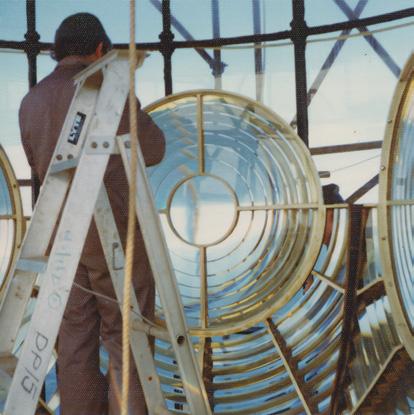
Keepers stood four-hour watches through the night. They were in the lantern room 15 minutes before sundown and attended to the light until sunrise. They worked the pump that kept the fuel pressure up to the vaporiser that transformed kerosene oil into an aerosol that burned to heat the incandescent mantle. This produced the light that was focused through the first-order Fresnel lens into a beam. The lens rotated by means of a clockwork mechanism that was wound periodically by the keeper, rotating every 25 seconds and producing a half-second flash every five seconds. Keepers cleaned off the soot, replaced the delicate mantle as needed, polished the optical apparatus and cleaned the lantern room windows, ensuring that no matter what, the lighthouse projected its beam into the night.
Conditions could be harsh. Karl Rowbottom remembers the extreme weather:7
We had very little heating up there. There was plenty of heat up in the lamp, but … we were down there working underneath it. And so many a night there you’d go up in the wintertime and you’d be up there below zero, sitting up there. And they gave us this silly little heater, no heat coming out of it whatsoever. So we’d be all wrapped up in blankets and things.
01
Dismantling the first order lens, photographed by David Ingram, Tasman Island lightkeeper. Image David Ingram/Friends of Tasman Island collection 02
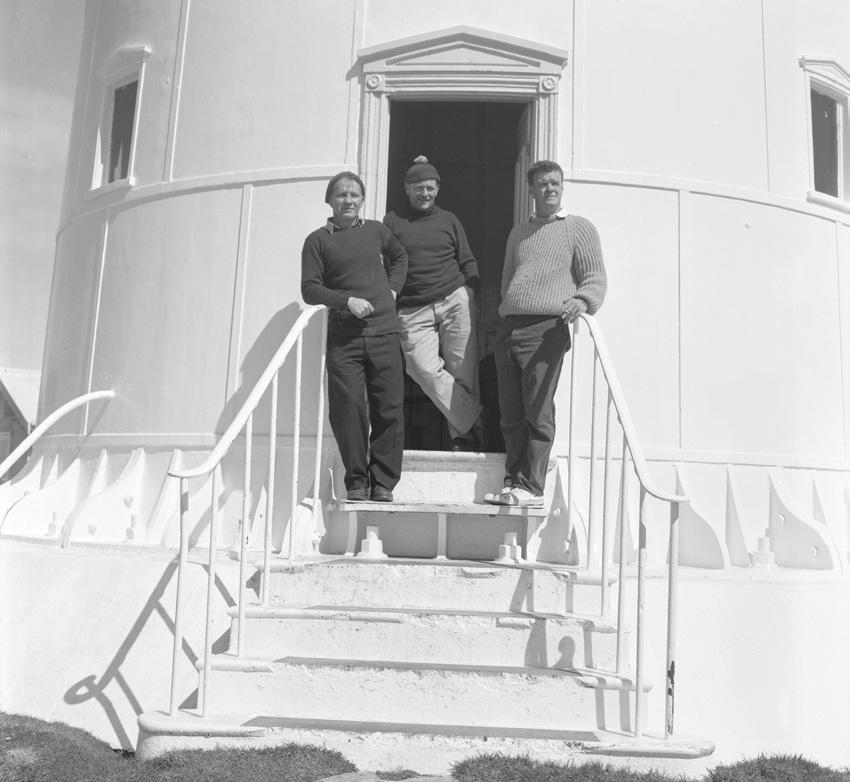
Head lightkeeper Frank Morrah and assistant lightkeepers Morris Lee and Terry Petersen standing in doorway of Tasman Island Light, 1965. Image Tasmanian Archive and Heritage Office, Jack Thwaites and Family
On some nights the weather became so wild that the tower would sway
01
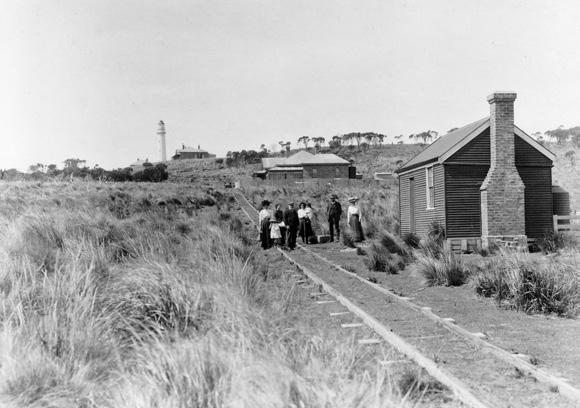
The clerk of works office was the first building erected on Tasman Island, later becoming the relief keepers’ quarters.
The photo shows the tracks for the trolley that brought supplies from the haulage to the light station, c 1911. The people shown include Edward Nillsen (third from left with cap) and his family.
Image Carlene Nillsen/Friends of Tasman Island Collection
02
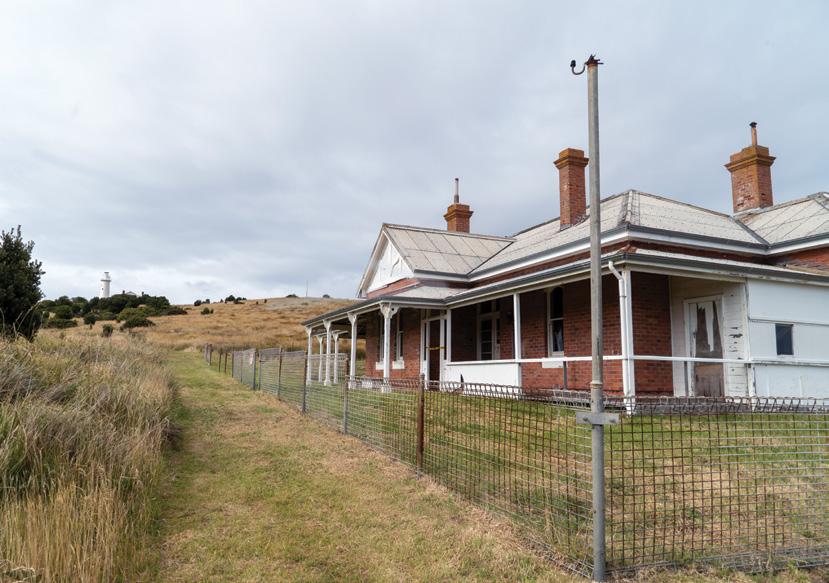
View from the head lightkeeper’s quarters, known as Q1, towards the tower on Tasman Island in March 2026. Image Inger Sheil/ ANMM
Island resident Jessie Johnston called Tasman Island ‘the Siberia of the south’
Keepers read books to pass the time when they weren’t working on the apparatus, but on some nights the weather became so wild that the tower would sway and reading was impossible. On one such night, Rowbottom recalls, winds hit the tower so hard that he thought the whole structure might come down.
Major change came to Tasman Island in 1976 with the automation of the lighthouse. The remaining people, domestic animals and livestock were removed in 1977. Today, Wildcare Tasmania’s volunteer group Friends of Tasman Island (FoTI), in partnership with the Tasmanian Parks and Wildlife Service, works towards preserving and restoring the natural environment and cultural heritage of the island. Work has included the conservation, restoration and maintenance of the lightkeepers’ quarters and the oil store.
The lighthouse, converted to solar in 1991, continues its lifesaving work and is today the highest operational lighthouse in Australia. It is managed by the Australian Maritime Safety Authority (AMSA) and their contractors. The first-order lens, removed in 1976, remained in storage until discussions with the Department of Transport in the mid-1980s led to its transfer to the National Maritime Collection. Following restoration and conservation work, it was put on display in the museum’s Tasman Light Gallery, with a light and mechanism to simulate the original rotational movement of the lens.
In correspondence with the museum, former Tasman Island lighthouse keeper John Cook expressed this hope:8
When you look at the lens revolving, remember the long hours of darkness we lightkeepers sat beside it winding and pumping to keep it going and [people] at sea safe.
Today the lens stands as a tribute to the technology and the people not only of the Tasman Island Light, but of lighthouses around the world, which have saved innumerable lives at sea.
1 ‘Loss of the Tyne Schooner’, Launceston Examiner, 7 December 1861, p 4.
2 Rich, DS, ‘Lighthouse at Cape Pillar’, letter to the editor, The Mercury, 13 July 1864, p 2.
3 Rowbottom, Karl. Interview by Inger Sheil, 7 March 2026, Australian National Maritime Museum.
4 ‘Tasman Island Lighthouse,’ Tasmanian News , 3 April 1906, p 3.
5 ‘Tasman Island Light’, The Mercury, 4 April 1906, p 2.
6 Karl Rowbottom interview, op cit.
7 Ibid.
8 Cook, J (nd). Letter to Australian National Maritime Museum c 1990 describing the commemorative plaque on the Tasman Island Lighthouse. Australian National Maritime Museum, Sydney.
The author acknowledges the assistance of the Wildcare volunteer group Friends of Tasman Island, Tasmanian Parks and Wildlife and the Australian National Maritime Safety Authority (AMSA) in preparing this article. Special thanks to Erika Shankley and Karl Rowbottom for their generosity in sharing resources, expertise and stories about Tasman Island.
Two brigs named Amity are prominent in the history of Albany, Western Australia – the original, which brought the first settlers to the region 200 years ago, and its replica, which celebrates its 50th anniversary this year.
By Tim Eastwood.
THIS YEAR, ALBANY IN WESTERN AUSTRALIA is the site for the state’s first bicentenary and the 50th anniversary of the building of the Amity replica.
Dutch seafarers had been visiting the region’s coast since as early as 1627, when the Dutch East India Company ship Vergulde Zeepaerd (Golden Seahorse), captained by Franz Thijsz, mapped more than 1,500 kilometres of Australia’s coastline southeast of Cape Leeuwin. Not until almost 200 years later, however, was any attempt made to colonise the area.
On 25 December 1826, HM Colonial Brig Amity, carrying Major Edmund Lockyer and his party, arrived at King George Sound to establish a military garrison. Less than a month later, on 21 January 1827, the Union Jack was raised and a ‘feu de joie’ fired by the troops, formally annexing the territory – and so preventing the French from staking a claim of sovereignty.
Two centuries on, a replica of the brig Amity sits on the foreshore of Princess Royal Harbour, part of King George Sound, as a reminder of these founding events.
The Museum of the Great Southern, which includes the Amity replica, received almost 100,000 visitors in the 2024–25 season. The replica helps to teach school students about early colonial life, convict history and the foundation of Albany and Western Australia. Image Adwo/Shutterstock
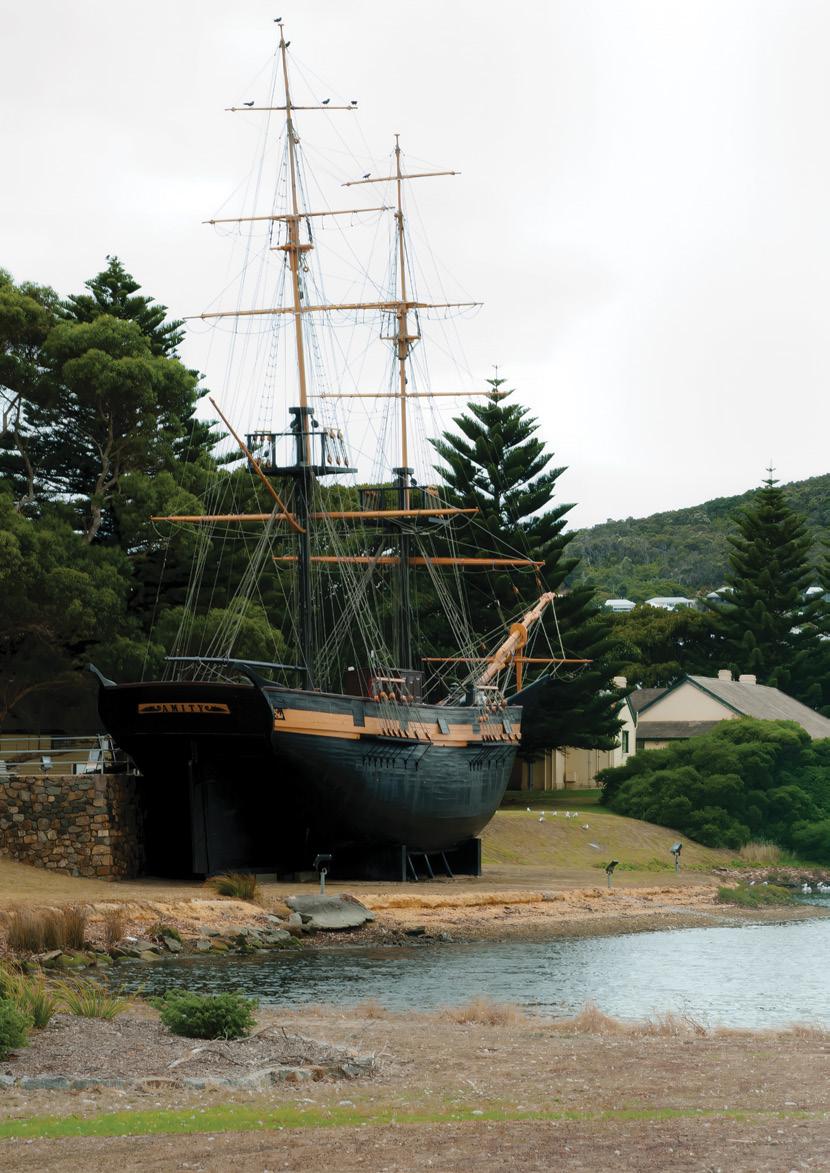
On 25 December 1826, HM Colonial Brig Amity arrived at King George Sound to establish a military garrison
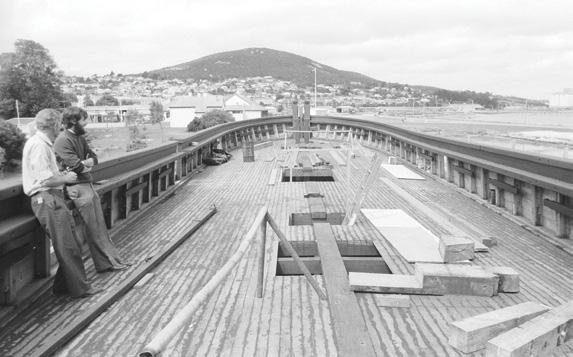
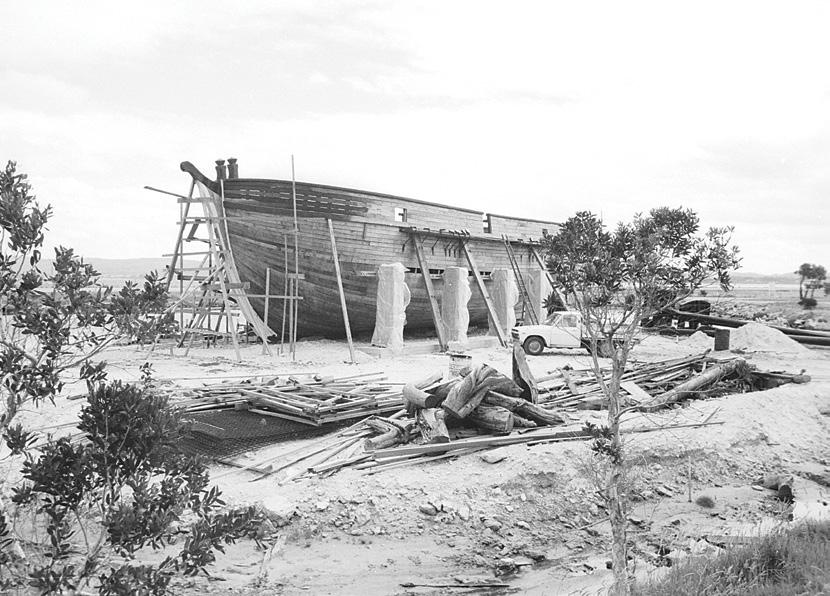
The replica was completed in less than two years, in time for Albany’s sesquicentenary in December 1976
01 Stan Austin (left), project manager of the build, on the deck of the replica during its construction. Image Ian Crawford/WA Museum
02 The Amity replica under construction in 1975, on the grounds of the Museum of the Great Southern, Albany, where it still stands. Image Jeremy Green/ WA Museum
Brig Amity
The original Amity was built as an Atlantic trader in 1816 at St John, New Brunswick, Canada. Registered as a brig of 142 tons, it was 75 feet 6 inches (23 metres) long, with a beam of 21 feet 5 inches (6.5 metres) and a depth of hold of 11 feet 5 inches (3.5 metres), constructed of black birch and hackmatack. It was said to be a beautiful ship.
In 1823, it was purchased by the Ralston family of Scotland to be fitted out for their emigration to Van Diemen’s Land (now Tasmania). After a trip of five months via Dublin and Rio de Janeiro, they arrived in Hobart on 15 April 1824. Having no further use for the ship, they soon sold it to the Colonial Government of New South Wales for exploration and supply voyages.
Sir Thomas Brisbane, on purchasing Amity for His Majesty’s Government Service, said he had ‘succeeded in getting a vessel adapted to the purpose’ – that purpose being settling, and travelling between, colonies.
Building the replica
In 1972, the idea of building a full-scale replica was considered and took hold. A small committee was formed and set about raising funds, while Les Johnson, a local ABC journalist, took on the research. As the idea blossomed into a possibility, Stan Austin offered his services as honorary designer and builder.
An exhibition, Early History of Boatbuilding around Albany, will be on show at the Museum of the Great Southern, Albany, Western Australia, from 25 June to 31 July. visit.museum.wa.gov.au/greatsouthern
The construction officially began on Stan’s 60th birthday, 19 March 1975, with Stan project managing the boatbuilding. Alongside him, Pieter van der Brugge led the construction with local carpenters Richard and Rodney Olsen and Albertus Kunus. Remarkably, the replica was completed in less than two years, in time for Albany’s sesquicentenary in December 1976 – a timetable that was staggering in its ambition.
The project demonstrated the dedication and resourcefulness typical of a country community. Local bush timbers (jarrah, karri and sheoak) were sourced for many parts of the ship, with parcels of parts arriving from all over the world.
Skill and care are both on show in this fine and faithful re-creation, which sits peacefully on Albany’s foreshore, adjacent to the Museum of the Great Southern.
This year, as Albany commemorates its bicentennial, many community members will quietly reflect on the work of Stan and his team. Fifty years ago, they dedicated themselves to this almost impossible task and timeline –and succeeded. The ‘irreplaceable’ Stan died in 2011, having lived a full 96 years. He left a tangible legacy in the Amity replica, and will live on as one of Albany’s favourite sons.
Tim Eastwood is a Manager of Special Projects at the Western Australian Museum.
From 16 to 20 January, visitors to the museum experienced Australian boatbuilding history up close. Fourteen vessels created by Norman R Wright & Sons tied up at our Heritage Pontoon for a special display celebrating the ongoing legacy of this prolific firm.
NORMAN R WRIGHT & SONS is one of the most enduring names in Australian boatbuilding and has contributed to our shared maritime heritage for more than a century. Since its inception in 1909, with the purchase of a Brisbane boatyard by Norman R Wright, generations of the Wright family have designed and built a variety of watercraft, including skiffs, launches, yachts, ferries, pilot boats and more.
The firm’s success is due in large part to its continued use of traditional craftsmanship methods alongside pioneering marine technology, and this legacy is seen in the strong representation of the company and its watercraft on the Australian Register of Historic Vessels (ARHV).
Following months of planning, the Norman R Wright & Sons event opened under grey skies and stormy weather. The pontoon buzzed with excitement and camaraderie as visitors braved the elements to see the vessels up close. Peter Moran, owner of Ellen R, said:
My crew had a fabulous time. We are a passionate lot and the interaction with the other Norman R Wright vessels and crew was icing on the cake.
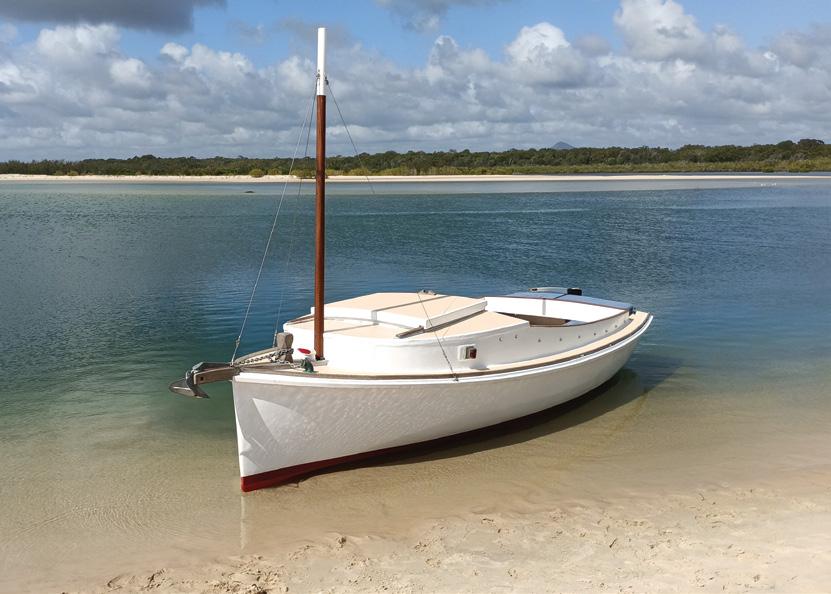
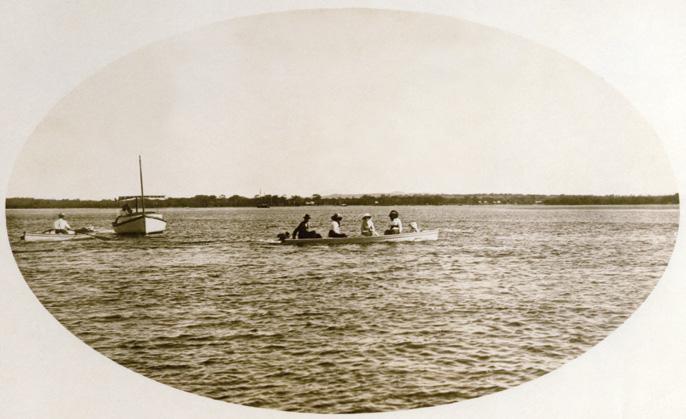
Another vessel in attendance was Jannett, a 20-foot pleasure craft which frequently stole the spotlight. Built around 1911, Jannett is the oldest surviving Norman R Wright boat and one of the first motorboats to cruise the Noosa River. Commissioned by Colonel David Elder Reid and named in honour of his wife, Jannett has performed many roles, from tourism and ferry services in the 1930s to recreational fishing in the 1940s and 1950s. Now owned by the Walker family, who have invested heavily in its preservation, Jannett continues to grace the Noosa River. Recognised on the ARHV (HV000577), it is a testament to the enduring nature of Norman R Wright’s craftsmanship.
Also present was Dorothy T, listed as HV000754 on the ARHV. The 1948 wooden motorsailer was one of the first watercraft built for private ownership after World War II.
For seasoned enthusiasts and curious newcomers alike, the flotilla was an unforgettable gathering
01
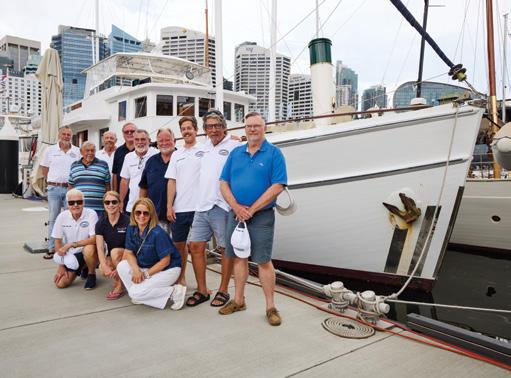
Norman R Wright & Sons vessel owners at the museum’s Heritage Pontoon, January 2026. Image Jasmine Poole/ANMM
02 Jannett at Noosa River, December 2023. Image courtesy Heritage Noosa (image no T2010438).
Jannett (left) at Noosa River, c 1920s. Image courtesy Heritage Noosa (image T4004329).
Formerly owned by the management company for iconic rock band Midnight Oil, it sports a classic Norman R Wright & Sons profile and construction.
Over the course of the weekend, vessel owners, crew, museum staff and visitors swapped stories, explored the boats and celebrated the legacy of Norman R Wright & Sons. The shared enthusiasm for maritime heritage was evident, with many attendees expressing appreciation for the craftsmanship on display. For seasoned enthusiasts and curious newcomers alike, the flotilla was an unforgettable gathering, and proof that not even a storm could dampen the spirit of the boating community.
Ian Wright and Kris Trott, owners of Jenny VII, reflected:
The Norman R Wright exhibition at the Australian National Maritime Museum was exceptional ... thank you for recognising this long-standing maritime business that has trained many Australian boatbuilders and has built some beautiful and elegant boats.
For more information about Norman R Wright & Sons, and the significant vessels created by this firm, visit the Australian Register of Historic Vessels online.
The museum would like to thank the following vessel owners and staff of Norman R Wright & Sons for their invaluable assistance:
Bill, Susan and Lachlan Wright (Magellan, built 1988)
Adam Evripidou (senior naval architect)
Ian Wright and Kriss Trott ( Jenny VII, built 1987)
Peter and Kathleen Smith
Peter Cavill ( Jenny IV, built 2003)
David, Adele and George Hannan (Dorothy T, built 1948)
Chris and Julie Tyquin (Boxer, built 2002, and Ontario, built 1996)
Peter and Marg Moran (Ellen R , built 1958)
Gary Smith (Serendipity, built 2010)
Andrew and Sally Harper (Bali Hi II, built 1964)
Murray Pollock (Bandanna, built 2002)
James Andronicus ( Anuha, built 2005)
Rob Siganto and vessel master Jacob Oxlade (South Pacific II, built 1962)
Greg Chapple and Kerryn Hurd (Dolphin II, built 1967)
The Walker family ( Jannett, built c 1911)
Matthew Ramaley (Careening Bay, built 2003)
Hannah Newman, Outreach Program Officer, and Liam McGeagh, Outreach Program Coordinator
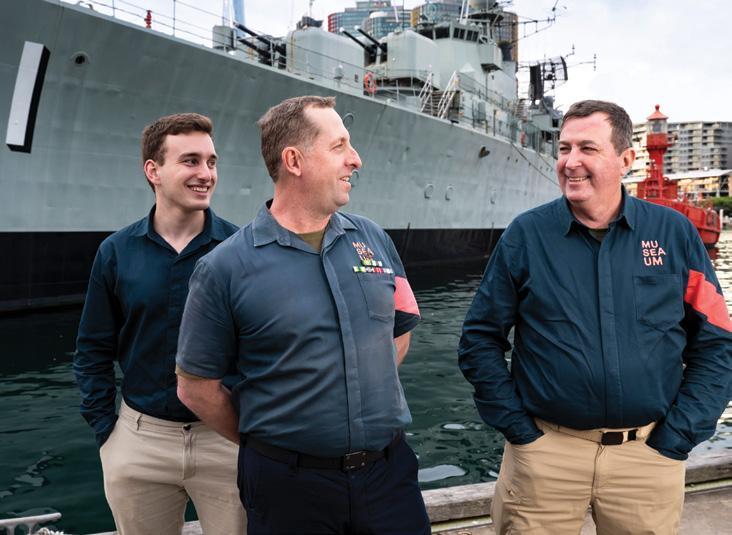
We welcome veterans of all ages from any branch of Defence to join our growing volunteer community, with a variety of roles to suit all interests and backgrounds.
sea.museum/defence-force-volunteers
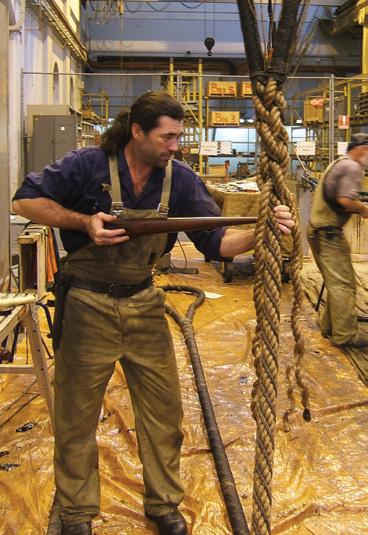
FOUNDING PARTNER
A major conservation project has begun to replace Endeavour’s standing rigging – the 56‑mm shrouds that support each mast and spar, carrying all 28 sails under constant tension. This is highly specialised work, undertaken using centuries‑old ropemaking techniques.
It will take months to complete, but it is essential to keeping Endeavour seaworthy for generations to come.
You can join us on this journey. Your donation will help preserve one of Australia’s most important maritime icons – not just for today, but for the future.
Donate now and help keep Endeavour sailing through history.
Donate now: sea.museum/donate

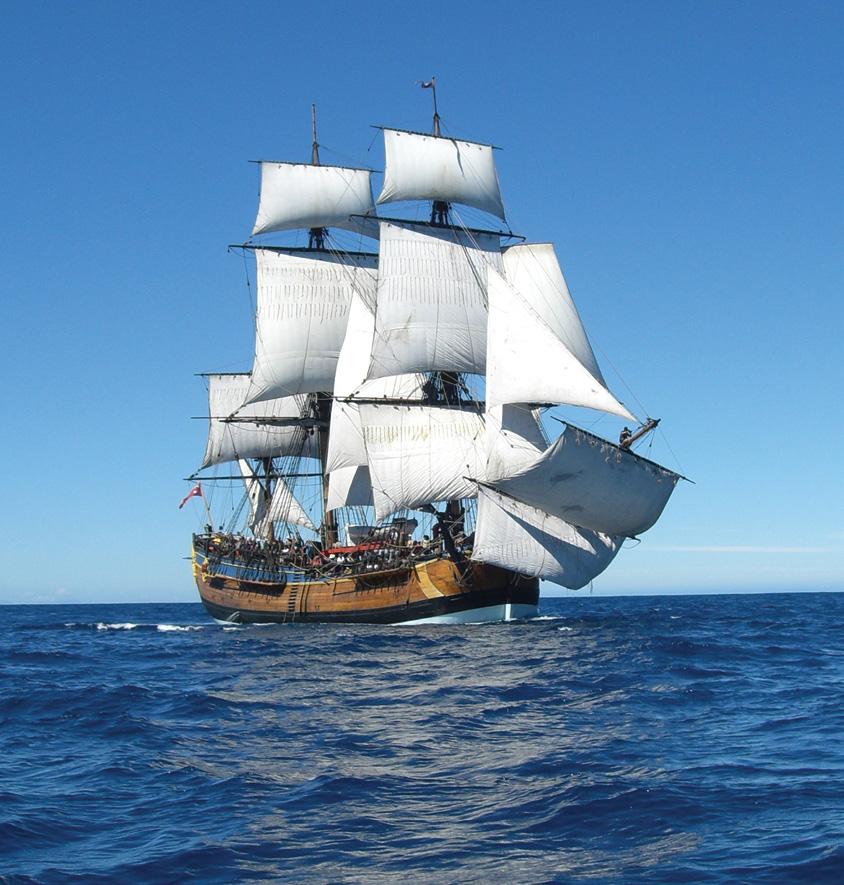
As the end of financial year approaches, the museum is seeking support in two areas central to its work: renewing the rigging of the Endeavour and developing a new national digital learning resource.
Re-rigging Endeavour
THE ENDEAVOUR is one of the most recognisable silhouettes on Sydney’s waterfront and is widely regarded as the most accurate 18th-century squarerigged ship replica in the world. From its beginning, the uncompromising intent of the build was to faithfully re-create a rugged Whitby collier using traditional materials and techniques. Now, more than 30 years after its launch in Fremantle, it remains a working sailing vessel.
Endeavour has retraced James Cook’s east coast voyage, circumnavigated the globe and represented Australia in ports across New Zealand, Europe, the United Kingdom, South Africa and North America. It now continues to sail on commemorative voyages and serves as a powerful platform for education and reflection. But to remain a sailing ship, the rigging must be renewed.
Every sailing vessel depends on its standing rigging –the network of stays, shrouds, blocks and lines that supports the masts and absorbs immense forces under sail. Made from rope and timber, these components are constantly exposed to salt air, ultraviolet light and extreme tension. Even with meticulous maintenance, they have a finite lifespan.
This year we begin a significant conservation project: the complete replacement of its standing rigging, which must be renewed every 15 years.
More than 30 kilometres of rope are being hand-made in Port Adelaide by specialist riggers using traditional techniques – stretching, tarring, serving, seizing and splicing each line by hand. At the same time, while docked at the museum, the ship is being de-rigged, with masts, yards and more than 700 wooden blocks carefully removed, inspected and conserved.
This co-ordinated effort across two cities is designed to minimise the ship’s time out of service.
Importantly, this work also reflects the museum’s commitment to living heritage – preserving not only historic vessels, but also the rare skills of specialist riggers, shipwrights and conservators. Many of these techniques date back centuries and can only be sustained through continued practice and transmission. For visitors, boarding Endeavour remains a powerful experience. From the hand-laid decks to the cramped spaces below, the ship offers a tangible connection to life at sea in the Age of Sail – and to the ongoing work required to keep maritime history alive.
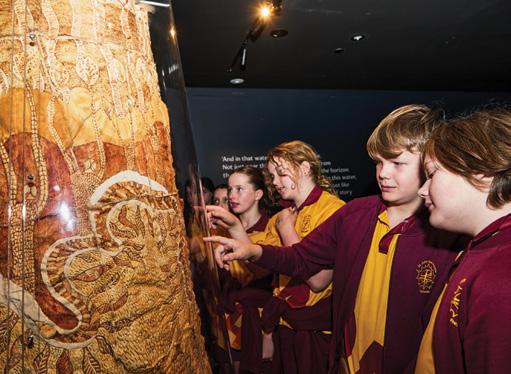
Navigators, a national digital learning resource
The Foundation is also seeking support for Navigators, a new national digital learning resource developed by the museum.
Navigators will be an online learning hub for primary school teachers and students across Australia.
Drawing on the museum’s collections and expertise, the platform will bring maritime history to life through interactive maps, animated voyages, digital objects and curriculum-aligned classroom activities.
At its core, Navigators explores how people have understood, travelled across and connected through the seas surrounding Australia.
Students will encounter stories spanning centuries, including:
• First Nations trade routes and navigation traditions
• Encounters with Makassan traders in northern Australia
• Early European voyages by explorers such as Willem Janszoon, Abel Tasman, James Cook and Matthew Flinders
• The navigational tools, maps and observations that allowed mariners to cross vast oceans.
Each module invites students to explore fundamental historical questions:
Why did people voyage? How did they navigate? Who did they meet? What did these journeys change?
Through interactive maps and animations tracing real voyages, digital reconstructions of collection objects and guided activities aligned with the Australian curriculum, Navigators transforms maritime history from static information into active exploration.
As a non-profit institution, the Australian National Maritime Museum relies on the generosity of supporters to undertake major conservation projects and deliver impactful education initiatives.
Supporters may choose to direct their gift to the Endeavour rigging or the Navigators education initiative. Together, these projects reflect the museum’s dual responsibility: to care for heritage, and to care for the future.
Make your EOFY donation to the Endeavour rigging or the Navigators education initiative
• online at sea.museum/donate
• by depositing your donation into the Foundation’s account, with your name as the reference: BSB 062 000 Account 16169309
• by phoning 02 9298 3777 and speaking with the Foundation team
• via the QR code

‘For the first two years I learned only one word –“overtime”, my first word in English.’
In 1969, John (Zvonimir) Pejic arrived in Fremantle aboard the Chandris liner Ellinis. Like so many who shaped this countr y, his story is one of grit, from twenty years at Jacques Bros Foundry to establishing his own business, Bormik Crafts, in 1989.
The Welcome Wall, Australia’s National Monument to Migration, exists to ensure stories like John’s are never forgotten.
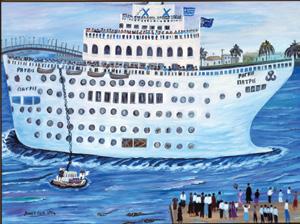
It is a permanent tribute to the migrants who built our history, community and identity.
Join our next ceremony
Honour your family’s legacy by adding their name to the monument. Register by 30 June to be part of our next special event. sea.museum/national-monument (02)9298 3777
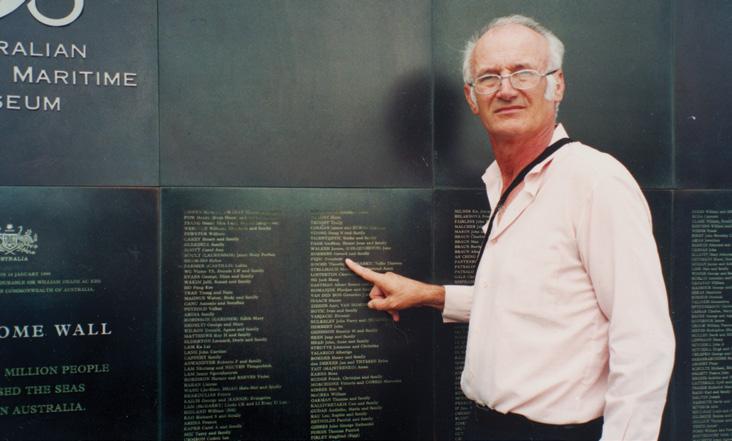
As the days grow shorter and the weather turns cooler, we are pleased to offer a vibrant program of members events at the museum to help keep the winter blues at bay.
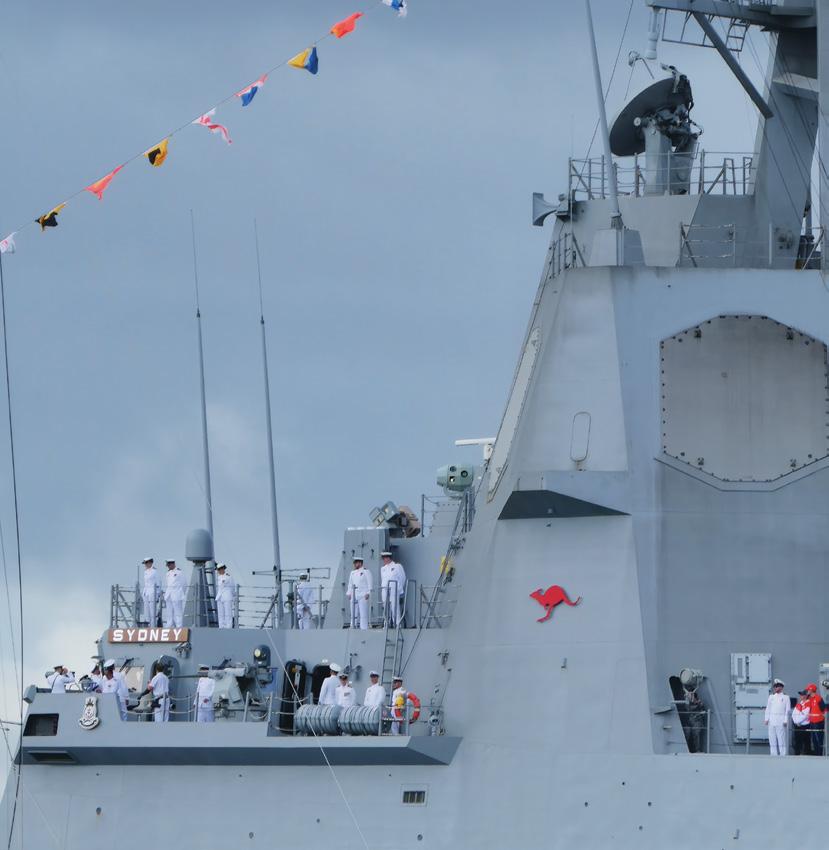
THIS SEASON we’ve come up with plenty of reasons to get you out of the house and into the museum.
Our year-long commemoration of the 125th anniversary of the Royal Australian Navy continues, featuring a series of special presentations on HMAS Perth, USS Houston, the WRANS and the history of the Red Ensign. We will also be hosting book launches for Challenging Anzac, The Burning Blue and Serving the Nation
In addition, we are delighted to present a special talk on a remarkable object featured in our new exhibition, The Galloway Hoard – the rare and intriguing Sasanian vase.
Later this year, we will share details of a special event for our long-term members to celebrate the museum’s 35th anniversary. As part of this celebration, we would love to hear your favourite museum memories –whether it was an exhibition, an object, a ship or simply a memorable visit. You will soon receive an email inviting you to share your stories, or you are welcome to contact the Members Office directly at any time.
We look forward to welcoming you back to the museum soon.
Matt Lee, Manager – Members & Volunteers
Book launch
The Cats of Australia by Jodie Stewart
2–3.30 pm Saturday 6 June
A funny, fascinating and affectionate journey through our love-hate relationship with cats, by Australia’s only cat historian.
Since the arrival of the First Fleet, cats have been loved, adored and celebrated, villainised, loathed and maligned.
Cats have joined us on farms and in shearing sheds, naval and merchant ships, hospitals, train stations and corner shops.
Cats ate ice creams with us on the beach, nursed soldiers back to health in World War I hospitals, stood firm with their comrades on the picket lines and endured the savagery of war in the trenches.
Cats also inspired us to paint, write and create, taught us how to care, and provoked fierce debates about their impact on our unique wildlife. With affection, humour and a keen eye on the big moments in history, The Cats of Australia explores our funny and fraught relationship with these enigmatic creatures.
Copies of the book will be available for purchase and signing by the author.
Free for all attendees
Cover illustration courtesy HarperCollins
Speakers talk Fever, filth and the surgeon’s scalpel
2–3.30 pm Thursday 18 June
Join us to hear about the hidden epidemics of life below deck.
History is often portrayed as a sequence of glorious achievements, but this talk will explore the unseen horrors of life at sea during the Age of Sail. Crowded, poorly ventilated below-decks quarters were incubating grounds for pathogens. Damp, stale air weakened immunity on long voyages, and extended duty caused hernias, chronic pain and exhaustion. Add contaminated water and spoiled food, toxic remedies, limited knowledge of germs and a lack of sanitation, and it’s no wonder far more sailors died of disease than in combat.
Come and shudder at conditions aboard ship, and get answers to questions you always wanted to know but were afraid to ask. This talk will make you realise how lucky you are to live in the 21st century!
Presented by Professor Richard de Grijs from our volunteer Museum Speakers group.
$10 / Free for Members. Enter promo code MEMBER
The Cockpit, Battle of the Nile, showing Horatio Nelson and other injured officers and sailors. Artist William Heath; engraver Matthew Dub. Public domain
Author talk
Challenging Anzac
11 am–12.30 pm Saturday 27 June
The Anzac legend has shaped Australia’s national identity for more than a century. Yet many experiences of war do not fit within it.
In Challenging Anzac, leading historians explore some of these stories: Aboriginal activists, deserters on the Western Front, veterans who took their own lives and soldiers who became radicalised by their service. They reveal how episodes in Australia’s war history that unsettled the Anzac legend – from the relief of Tobruk, nuclear testing on Australian soil and feminist anti-war protests, to alleged atrocities in Afghanistan – have been elided or adapted to ‘fit’ the legend.
Speakers Mia Martin Hobbs and Max Billington will examine how the reality of warfare has always been at odds with mythic representation and considers why, despite this, the Anzac legend has survived.
Copies of the book will be available for purchase and signing by the authors. Free for all attendees
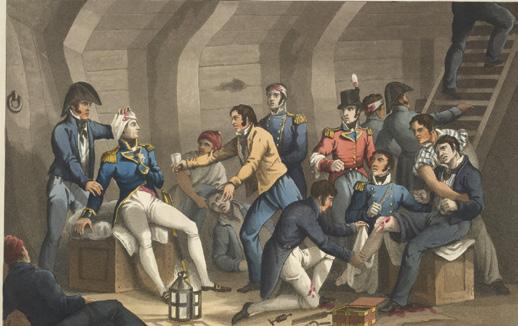
Special guest talk
Treasures of the Viking Age –a Sasanian mystery
2–3.30 pm Saturday 11 July
How did a vase from ancient Iran end up in Scotland? This fascinating talk will tell you.
To tie in with the museum’s new exhibition Treasures of the Viking Age –The Galloway Hoard, we have a special treat for history lovers.
Among the extraordinary items discovered in the Galloway Hoard is a silver-lidded vessel with origins in ancient Iran or Central Asia. It contained 27 smaller objects and had traces of silk attached to its outer surface.
Made during the period in which the Sasanian dynasty (224–651 CE) controlled Iran and neighbouring territories, how might the vessel have become part of a 10th-century silver hoard found in Scotland?
Associate Professor Peter Edwell, a historian of the Roman and Sasanian Persian Empires from Macquarie University, will discuss this incredible object and the possible journey it made over 300 years and thousands of kilometres.
$10 / Free for Members. Enter promo code MEMBER
Image courtesy National Museums Scotland
Speakers talk
NAVY 125 – Wives and sweethearts: a history of women in the navy
2–3.30 pm Thursday 16 July
As part of our series of events to commemorate the 125th anniversary of the Royal Australian Navy, this talk tells how women came to be in the RAN, discussing some of the people who made that possible and others who tried to prevent it.
But it is also the story of what went before these events. What was the inspiration for having women in the Royal Australian Navy in the first place? It turns out Australia was merely following imperial, mostly unofficial, precedent – and by doing so joined a naval tradition that was already arguably hundreds of years old.
Presented by Justin Holmwood from the Museum’s Speakers Group.
$10 / Free for Members. Enter promo code MEMBER
WRANs at the recruiting office in Collins Street, Melbourne, c 1942. Image State Library of Victoria
Author talk
Heart of Ice by Joy McCann
2.00–3.30 pm Wednesday 22 July
Heart of Ice takes the reader on a compelling journey across space and time, navigating entangled stories of ice and rock, humans and animals, through the prism of Antarctica’s ice.
Joy McCann draws on a vast body of scientific and historical research to explore how Antarctica has been imagined, inhabited and invested with meaning over time. She invites readers to see how this vast icy realm continues to shape our history and our planet.
Copies of the book will be available for purchase and signing by the author.
Free for all attendees

More events will be announced shortly. Please keep an eye on our website. Bookings are essential.
Email memberevents@sea.museum and tell us which event you wish to attend, and who is coming. Or book through Eventbrite, phone us on 02 9298 3777, or scan the QR code above.
For all other events, including family and school holiday events, please see sea.museum/whats-on
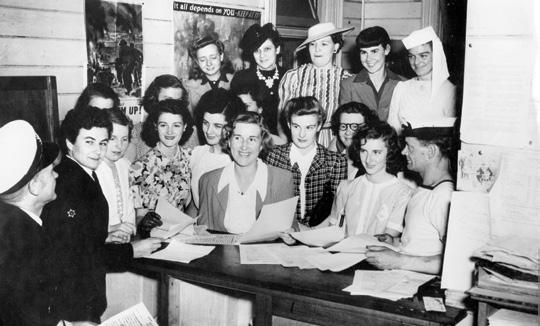
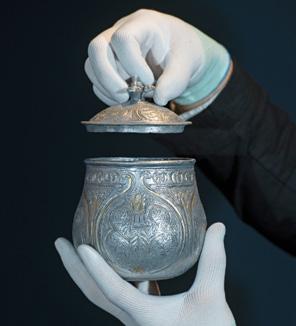
2–3.30 pm Friday 24 July
The latest book by renowned Australian naval historian Ross Gillett examines the activities of the Royal Australian Navy (RAN) during the 1950s and 1960s.
These were demanding times for the navy. It was busy with intensive involvement in the Korean War, partnerships with other navies to counter the communist insurgents against Malaya, the Indonesian confrontation against Malaysia and the war in Vietnam.
Added to these challenges were the introduction and integration of 41 new warships into the fleet and, on the home front, the never-ending political battle to secure the funds and personnel needed to perform the assigned tasks.
The same years also witnessed the revitalisation of the Fleet Air Arm from its modest beginnings in 1948, through to a sophisticated generation of carrier-based warplanes.
Despite this heavy workload, the RAN departed the 1960s in good shape, as a major blue-water navy in the region
Copies of the book will be available for purchase and signing by the author.
Free for all attendees
The Burning Blue by Mike Carlton
2–3.30 pm Saturday 1 August
Throughout the 20th century – from both World Wars, to the bombs and rockets of the Korean War, then Vietnam, the first helicopter war – the pilots of the Royal Australian Navy carved their name with pride to build a service that would become the Navy’s Fleet Air Arm.
This book tells the stories of these aviators, much of it in their own words. They are the heroes who flew high in the Burning Blue.
Copies of the book will be available for purchase and signing by the author.
Free for all attendees
The bells of Houston and Perth
2–3.30 pm Saturday 8 August
Dr Natali Pearson tells the story of two ships’ bells that reveal hidden stories from the Second World War. HMAS Perth and USS Houston were sunk by Japanese forces in the Sunda Strait in March 1942, with the loss of more than 1,000 Allied sailors. These were more than just wreck sites; they were also underwater graves, sites of legal ambiguity and focal points for moral obligation and sovereign claim.
$10 / Free for Members. Enter promo code MEMBER
HMAS Perth arriving in Sydney, April 1940. ANMM Collection 00022406
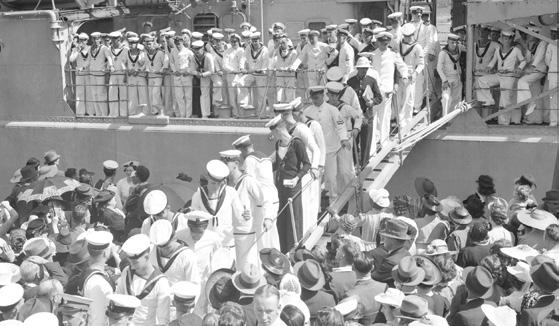
Special guest talk
History of the Red Ensign
2–3.30 pm Saturday 15 August
Vexillographer John Vaughan is considered Australia’s leading authority on the design, etiquette, protocol and history of flags. John will talk about the history of Australia’s maritime flags – including the Red Ensign – and the design of flags past and present, with the rationale behind them.
$10 / Free for Members. Enter promo code MEMBER
Red ensign from skiff Britannia ANMM Collection 00000915
guest talk
The history of the WRANS
2–3.30 pm Wednesday 26 August
This special event will reveal the story of the Women’s Royal Australian Naval Service, or WRANS, which was formed during World War II to meet a need for trained wireless operators. Today women make up around 25 per cent of permanent full-time personnel in the Royal Australian Navy. Hear about their history and their fight for acceptance and recognition.
Delivered by Viv Murray and a panel of former WRANS servicewomen.
$10 / Free for Members. Enter promo code MEMBER
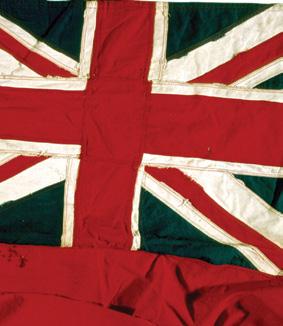
In 2014, a metal detectorist in Galloway, Scotland, discovered a rich hoard of gold and silver artefacts that had lain buried for more than 1,000 years. These rare and beautiful pieces are now on display.
TREASURES OF THE VIKING AGE: The Galloway Hoard presents one of the most intriguing hoards ever discovered. This exhibition showcases the results of seven years of in-depth research, presenting a stunning variety of materials and treasures from the medieval kingdoms of Britain and Ireland, mainland Europe and as far away as Central Asia. The exhibition was created by National Museums Scotland. For more information, see the article on page 2.
sea.museum/galloway
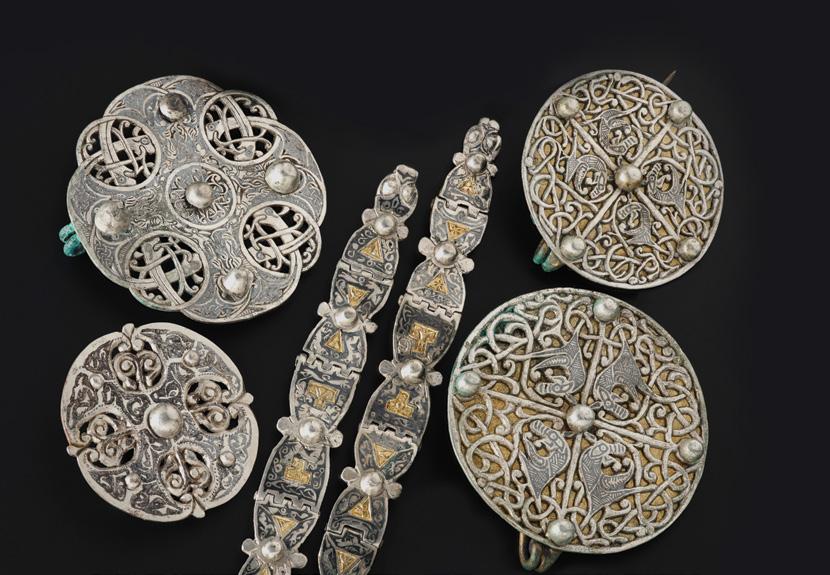
This exhibition commemorates 125 years since the establishment of Australia’s navy, exploring how it has grown alongside our nation – from colonial defence to a modern maritime force.
This temporary display in the Navy Gallery brings together portrait photography, significant objects from the national collection, a graphic timeline and a major First Nations artwork. Together, they tell stories of service, courage, innovation and care at sea and on shore.
At its heart are the people of the Navy – past and present – whose experiences reveal a force shaped by war and peace, humanitarian response and cultural change. Central to the exhibition is Spirit of Sea Rights by Djambawa Marawili AM, a major artwork acknowledging more than 60,000 years of First Nations maritime stewardship and a shared responsibility for Australia’s oceans.
sea.museum/navy-125-display
Image Jasmine Poole/ANMM
In the mid-20th century, a group of worker–artists created The Wharfies’ Mural to capture the industrial and political struggles of their time. Today, the wharves are dominated by smart machines – but has everything changed?
Artist and wharfie Sam Wallman thinks not. He offers a contemporary lens on dock life, capturing its enduring spirit through bold, graphic artworks that connect past and present.
sea.museum/sam-wallman
Now showing
There is only one world ocean, and it covers 70 per cent of the planet. Ultimate Depth invites you to experience and understand our ocean, so together we can help to protect it. Join us as we dive into each zone, encounter extraordinary creatures, and uncover the cutting-edge technologies that reveal their secrets and their hidden world – including DEEPSEA CHALLENGER, the submersible that took James Cameron to these extreme depths in 2012.
sea.museum/ultimate-depth
Image Marinco Kojdanovski/ANMM
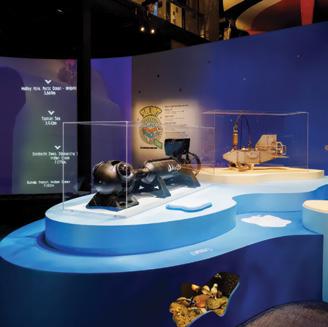
Secret Strike: War on our shores Now showing
2025 marked the 80th anniversary of the end of World War II. To commemorate this historic milestone, a new temporary exhibition focuses on the 1942 Japanese midget submarine attack on Sydney Harbour. Secret Strike: War on our shores features the stern section of the midget submarine M22 and voice pipes from HMAS Kuttabul. The exhibition explores the raid and includes historic images of the aftermath of the attack and first-hand accounts of the impact it had on ordinary people’s lives.
*Please note, Secret Strike: War on our shores is located in Wharf 7, adjacent to the main museum building, and is not open on weekends or public holidays.
sea.museum/secret-strike
Now showing
Torres Strait artist Brian Robinson uses painting, printmaking, sculpture and design to illustrate the region’s mythology, cosmology and spirituality. Robinson incorporates contemporary icons taken from video games and Hollywood movies to reflect on Islander history, humour and love of fishing.
sea.museum/incoming-tide
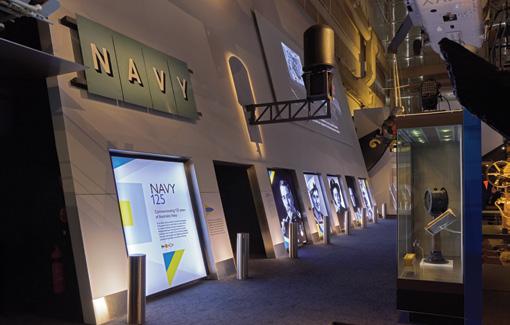
Touring exhibitions
Croc! Lost giants to living legends
Queensland Museum Kurilpa, Brisbane
Now showing
Meet one of the planet’s most powerful and fascinating animals – the crocodile. This interactive all-ages exhibition brings you face to face with the ancient ‘supercrocs’ that once roamed alongside the dinosaurs, right up to today’s crocodile species. Croc! Lost giants to living legends explores the science, culture and enduring connections between people and these remarkable creatures.
Co-produced by the Australian National Maritime Museum, Queensland Museum, and Museum and Art Gallery of the Northern Territory.
Image Katie Bennett/Embellysh
Victor Harbor National Trust Museum, SA
Now showing
This visually arresting exhibition takes visitors through the process of creating a graphic novel about South Australia’s oldest known shipwreck, the whaling ship South Australian (lost 8 December 1837).
After years of research, the wreck site was finally discovered in 2018. Since then, maritime archaeologists have re-created the disaster in the form of a stunning graphic novel of the site. This exhibition presents the dramatic imagery from the novel as well as real shipwreck artefacts recovered from the site.
Brickwrecks – sunken ships in Lego® bricks
Mystic Seaport, Connecticut, USA
Now showing
Featuring large-scale LEGO ® models, interactives and audiovisuals, Brickwrecks explores some of the world’s most famous shipwrecks, including Vasa, Batavia, Titanic, Terror and Erebus
Developed and designed by the Western Australian Museum in partnership with the Australian National Maritime Museum and Ryan McNaught.
Voyage to the Deep Horniman Museum, London, UK
Now showing
Based on French author Jules Verne’s 1870 classic, Twenty Thousand Leagues
Under the Seas , the exhibition brings to life the adventures of Captain Nemo, his fantastical Nautilus submarine and his mythical world. Kids can venture through the world below the waves, including the octopus’s garden with its huge clamshell, a giant squid to slide down and a maze of seaweed to wander through in the kelp forest. This exhibition’s tour is managed by Flying Fish.
Vasa Museum, Stockholm, Sweden
Now showing
Encounter the deep-ocean discoveries, technical innovations and scientific and creative achievements of underwater explorer James Cameron.
Created by the Australian National Maritime Museum’s USA Programs and supported by the USA Bicentennial Gift Fund. Produced in association with Avatar Alliance Foundation.
Image Anneli Karlsson/Vasa Museum
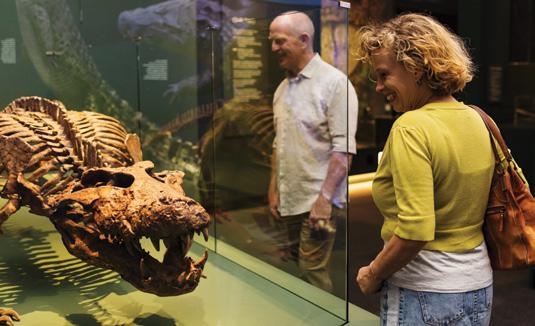
Albury Library Museum, NSW
Now showing
In a seafaring life from which families and children are usually missing, and are often very much missed, pets provide a focus for emotions and affection. Sydney photographer Sam Hood went aboard countless ships between 1900 and the 1950s. He took hundreds of photographs of crew members as souvenirs of their visit or to send home to families. This selection of images shows how much pets meant to many seafarers.
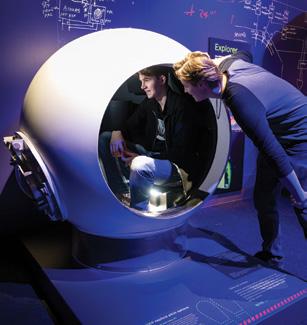
HMAS Creswell, Royal Australian Naval College, Jervis Bay, NSW Until 11 July
HMAS Cerberus, Heritage and Learning Centre, Crib Point, VIC From 18 July
This display tells the story of Operation Jaywick, the clandestine raid on Japanese shipping in Singapore’s Keppel Harbour in September 1943, and the terrible unforeseen consequences it had for the civilian population. Jaywick was one of the most daring commando raids of World War II, stunning the Japanese military with its audacity and success. Not believing that the Allied military could be responsible, they immediately suspected the civilian population. Local Chinese and Malay, prisoners of war and European civilians topped the list of suspects, and a wave of arrests, torture and executions followed.
Image Marinco Kojdanovski
Taylor: An Underwater
Forster Civic Centre, Forster, NSW Until 23 July
At a time when oceans are under more threat than ever, Valerie Taylor AM has been a key change-maker, breaking the mould, pushing boundaries, and capturing an underwater world that – in some places – no longer exists. She shows the impact one person can have and embodies the urgency to act now.
Over 60 years in the ocean, Valerie Taylor has captured the underwater world and shared her knowledge with the public, encouraging greater protection of species and their habitats. In 2018, she donated a vast archive of photographs, objects and stories to the National Maritime Collection.
Valerie Taylor: An Underwater Life is not just one woman’s incredible story, it is a call to action for all the potential ocean change-makers out there – to inspire all of us to advocate for the oceans in our own way.
This touring exhibition is supported by the Australian Government’s Visions of Australia program.
ANMM image
For information regarding all touring exhibitions, please see sea.museum/touring-exhibitions
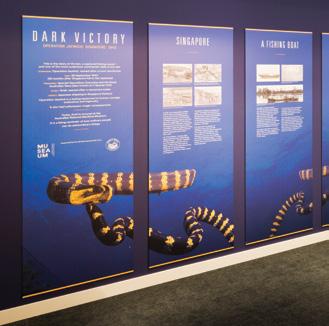
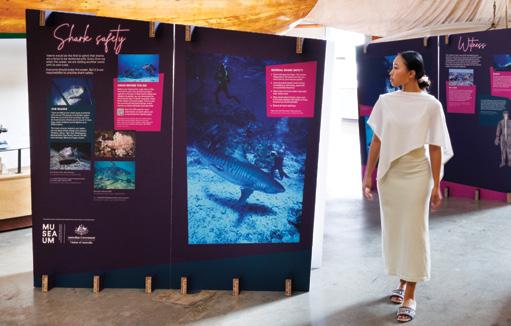
The career of HMAS Armidale (I) lasted just half a year but casts a long shadow over the naval history of four nations: Australia, Britain, the Netherlands and Indonesia.
Dr Natali Pearson relates the ship’s story and the different ways in which its lost sailors are remembered.
HMAS ARMIDALE (I) occupies a distinctive place in Australian naval history. Commissioned in June 1942 and sunk off the coast of Timor within six months, it was the only Royal Australian Navy (RAN) corvette lost to enemy action. It also experienced the highest loss of life – 100 men killed in action, died of wounds or missing presumed dead – of any Australian corvette in World War II.
Armidale ’s legacy is characterised by courage, ingenuity and endurance, most visibly in the actions of Ordinary Seaman Edward ‘Teddy’ Sheean VC, but also evident in the stories of those who lived to speak of their experiences.
Today, Armidale is increasingly understood as shared heritage, significant not just for Australia but also for the Netherlands, Indonesia and Timor-Leste. This significance is unevenly commemorated across national, institutional and jurisdictional domains, reflecting the different logics that shape the memorialisation of those lost at sea in war.
Image Australian War Memorial 026612
Armidale’s legacy is characterised by courage, ingenuity and endurance
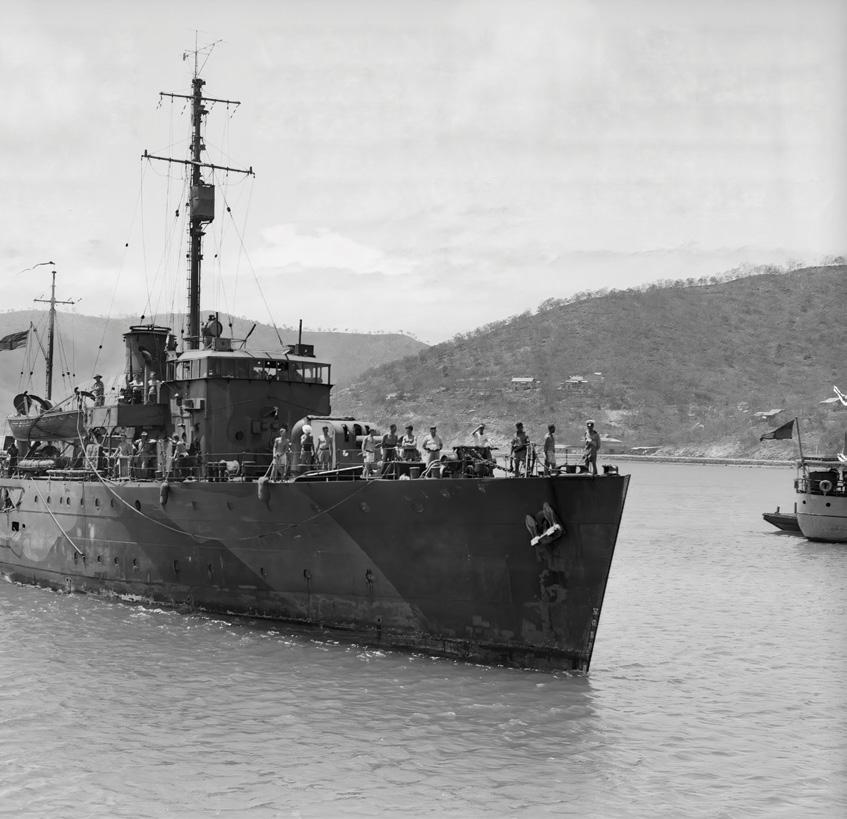
Part of Australia’s wartime shipbuilding program, Armidale was a Bathurst class corvette designed for general purpose service. After serving briefly as a convoy escort between Australia and Papua New Guinea, Armidale was ordered to Darwin in November 1942 to take part in an operation to the south coast of Portuguese Timor (now Timor-Leste).
Alongside fellow corvette HMAS Castlemaine and auxiliary vessel HMAS Kuru, Armidale was tasked with landing reinforcements, evacuating Portuguese civilians and transporting a relief detachment of the Royal Netherlands East Indies Army (Koninklijk Nederlands Indisch Leger, or KNIL).
On board were 149 men: 83 members of the ship’s company, three Australian Imperial Force (AIF) soldiers and 63 KNIL officers and troops. Armidale and Castlemaine came under attack by Japanese aircraft, and by the time they reached Betano Bay in the early hours of 1 December, Kuru had already been and gone. Eager to avoid the next round of enemy bombers that would accompany the dawn, the corvettes turned back towards Australia and caught up with Kuru about 70 miles south of Timor. The 70-odd Portuguese civilians aboard Kuru were transferred to Castlemaine, which returned to Darwin; Armidale and Kuru were ordered back to Timor to complete the operation.
Both Kuru and Armidale came under further air attack. Kuru escaped but Armidale was struck by torpedoes shortly after 3 pm. It sank so rapidly that distress calls could not be made, nor lifesaving equipment fully launched. In the chaos, Teddy Sheean strapped himself to an Oerlikon anti-aircraft gun and continued firing as the ship went down. After decades of advocacy, Sheean was posthumously awarded the Victoria Cross in 2020, the first ever bestowed on a member of the RAN.
Stories of survival and tragedy
Survivors trod water, clung to flotsam or took turns on a makeshift raft of loose timbers and cylinders. Some men pulled a bullet-riddled Montague whaler from below the waterline and lashed it to the raft, where they repaired it using whatever materials they could find. Meanwhile, a small motorboat under the command of Lieutenant Commander David Richards was given over to the most severely wounded; others found false hope on a Carley float. Survivor testimonies describe the constant threat of sharks, exposure and thirst.
01
Ordinary Seaman Edward Sheean, HMAS Armidale (1978) by Dale Marsh. This painting depicts ‘Teddy’ Sheean firing an antiaircraft gun at Japanese bombers; a number of seamen can be seen in the water, having abandoned ship. Image Australian War Memorial ART28160
02
Dry docking the whaler (1998) by Jan Senbergs. This painting is one of a series created by the artist in consultation with Armidale survivor Col Madigan. Survivors are shown raising the ship’s whaler and docking it to the raft for repairs. Image Australian War Memorial ART91497
Despite limited fuel and an unreliable engine, Richards decided to attempt the long journey toward Darwin. On 6 December, the motorboat’s 20 occupants – 17 members of Armidale ’s company and three KNIL soldiers – were rescued by HMAS Kalgoorlie. Two others had died en route.
The day before, dubbed ‘Separation Day’, the whaler party had also elected to strike for Australia. The 29 survivors, including the three AIF, were rescued by Kalgoorlie on 9 December, the whaler collapsing beneath them as they were pulled from the water.
Those on the Carley float (carrying 28 of the ship’s company) and raft (21 KNIL) – the latter of which was twice sighted by Australian aircraft – were never rescued and remain missing presumed dead.
The search for shared heritage
Armidale ’s loss was a multinational tragedy. Of the 86 Australian servicemen on board, 46 survived; of the 63 KNIL personnel, just three survived, with 60 KNIL killed in action or missing presumed dead. Data collected by the Remembering HMAS Armidale Association (RHAA) and supplemented by archival analysis of records held by the Netherlands War Graves Foundation (Oorlogsgravenstichting, or OGS) suggests that at least 50 of the KNIL troops were indigenous soldiers from Java, Sumatra, Sulawesi and elsewhere in the Dutch East Indies (now Indonesia).
In the chaos, Teddy Sheean strapped himself to an Oerlikon anti aircraft gun and continued firing as the ship went down
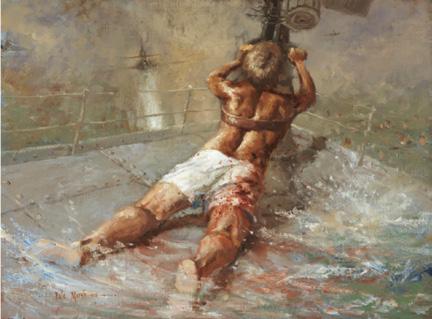
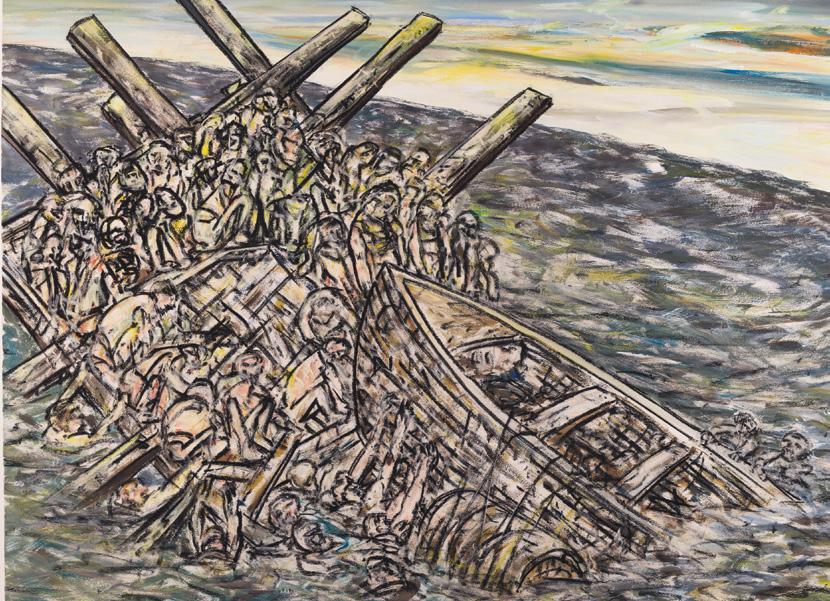
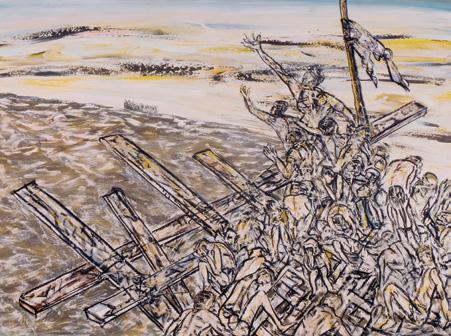
That this shared heritage has been identified is largely due to the work of RHAA, exemplifying the oftenoverlooked role of community-driven memory work. Their advocacy extends to the search for the wreck, which has taken on renewed momentum through the Finding HMAS Armidale Project. The project is overseen by Ted Graham AM, founding member of the Finding Sydney Foundation, which located the wrecks of HMAS Sydney (II) and HSK Kormoran in 2008. Drawing on archival records, survivor accounts and wartime navigation data, the project has identified a search area south of Betano, meaning the wreck is likely within Timor-Leste’s territorial waters.
A sea of wrecks
The Timor Sea is deep, seismically active and politically complex – maritime boundaries between Australia and Timor-Leste were only finalised in 2018, and offshore resource exploration and development continue apace. As a region, Southeast Asia has a dense concentration of wrecks, with an estimated 2,000 naval and merchant vessels lost in these waters during World War II.
Survivor testimonies describe the constant threat of sharks, exposure and thirst
01
Separation of the raft and whaler (1998) by Jan Senbergs. This work depicts ‘Separation Day’, 5 December 1942, when the survivors on the raft and whaler separated. Despite an attempted rescue by a Catalina, the men on the raft were lost at sea. The composition is inspired by Raft of the Medusa (1819) by Theodore Gericault. Image Australian War Memorial ART91498
02
The whaler breaks up (1998) by Jan Senbergs. HMAS Kalgoorlie tried to raise the whaler from the sea, but it broke in two after delivering the survivors to safety. The artist has depicted the whaler as a phoenix-like shape rising from the water. Image Australian War Memorial ART91502
Many contain human remains, fuel oil and unexploded ordnance. There is a growing awareness that these are sites of both historical interest and environmental risk, vulnerable to a range of threats including bottom trawling, development and illicit scrap-metal salvaging.
In recent years, initiatives such as Project Tangaroa have drawn attention to the global scale of this submerged and at times toxic legacy. This initiative has highlighted the need to co-operate with regional partners around potentially polluting wrecks, and for sensitivity in the management of human remains located on warships in foreign waters.
There is no global consensus on how to manage World War II wrecks. The 2001 UNESCO Convention on the Protection of the Underwater Cultural Heritage provides for heritage that has been submerged for 100 years, meaning World War II wrecks will not be eligible until 2039 onwards. States may apply their own, shorter limits – Indonesia’s legislation uses a timeframe of 50 years, for example – but this still does not address the complexities of managing sovereign craft in foreign waters.
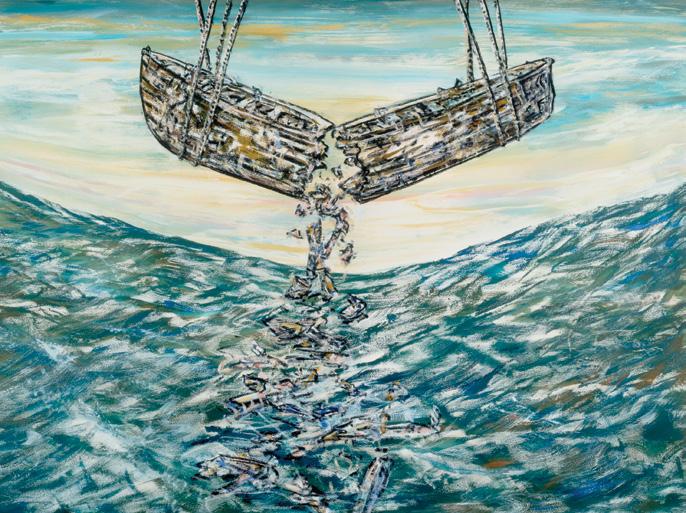
This is no small concern: Australia has such craft (both ships and aircraft), or an interest through unrecovered casualties, in the waters of at least 40 coastal states worldwide.
In recent years, Australia’s response to this wider governance challenge has begun to take clearer form. In 2025, Australia introduced a new framework for dealing with its sovereign wrecks in foreign waters, with the Department of Climate Change, Energy, the Environment and Water as the designated lead agency. The Sovereign Wrecks Agreement provides guidance for protecting Australian military craft and unrecovered casualties beyond national jurisdiction, recognising both flag state responsibility and the sensitivities of operating in other nations’ waters. Australia is also expected to soon ratify the 2001 UNESCO Convention.
Sunken warships in foreign waters are poignant indicators of how nations, institutions and jurisdictions commemorate those lost at sea in service. Armidale, in particular, brings into stark relief the fault lines around
naming, burial, graves and memorialisation – not only across nations but also between the differential treatment of war graves on land and at sea.
On land, war dead tend to be individually commemorated with named tombstones in cemeteries. Deaths at sea, however, are typically characterised by an absence of graves or recoverable remains. Commemoration therefore takes place through other mechanisms, which vary markedly across national, imperial or colonial contexts.
The states and institutions with commemorative competence over Armidale ’s dead crew address this challenge in different ways. In Australia, eligibility for the Australian War Memorial’s Roll of Honour is determined by service in the Australian armed forces. Notably, it is not conditional on burial status. As such, the 39 Australian servicemen who died on Armidale are named on the roll. However, the Royal Navy Signalman attached to the ship, Donald Coldwell, and all members of the KNIL fall outside its national scope and are thus not named.
01 All 40 Commonwealth personnel lost with Armidale are named on the Plymouth Naval Memorial, Devon, UK. Image Dave Goodman/ Shutterstock 719001394
02
The Roll of Honour at the Australian War Memorial in Canberra. Image Sue Martin/ Shutterstock 1096127864
Today, Armidale is increasingly understood as shared heritage, significant not just for Australia but also for the Netherlands, Indonesia and Timor-Leste
01
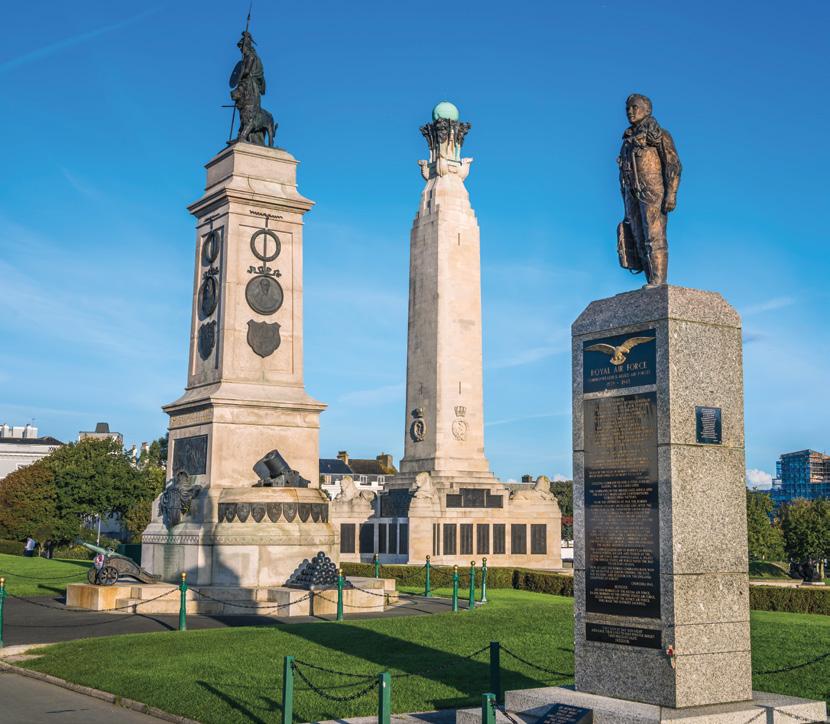
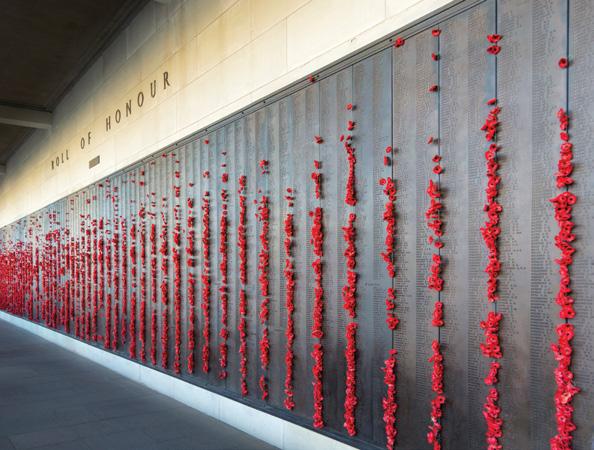
At the Commonwealth level, a similar logic prevails. Through its naval memorials to the missing, the relevant war graves authority – the Commonwealth War Graves Commission (CWGC) – commemorates individuals by name, notwithstanding the absence of remains. Notably, however, commemoration does not occur where the ship was lost, but at one of three manning ports in the English cities of Plymouth, Portsmouth or Chatham. The CWGC’s Commonwealth-wide remit means that all 40 Commonwealth personnel lost with Armidale – including Coldwell – are named on the CWGC Plymouth Naval Memorial, where inscription functions as a surrogate grave for those lost at sea.
The Netherlands takes a different approach, with burial of human remains typically a condition of individual memorialisation by the OGS. Where death occurred at sea, records carry the designation ‘sea grave’, acknowledging the circumstances of death but not producing a named memorial site. This privileging of the physical traces of death has implications for the commemoration of individual KNIL lost at sea, including the KNIL detachment aboard Armidale Instead, remembrance has tended to take collective rather than individual form.
The Netherlands also maintains a national honour roll, inclusion on which is not burial dependent – potentially paving the way for individual commemoration of KNIL lost at sea. However, while a number of Armidale ’s European- and Indo European-named KNIL personnel appear on the roll, no indigenous named KNIL soldiers do.
In Indonesia, meanwhile, the legacies of colonisation, together with post-colonial memory politics, have limited the formal recognition within national memorial frameworks of those who served in the colonial military, whether on land or at sea.
Together, these differing practices mean that the indigenous-named KNIL soldiers lost on Armidale have fallen through the commemorative cracks as individuals in their own right. These KNIL appear in administrative registers and burial classifications, but not on public inscribed memorials or commemorative space.
Conclusion
If Armidale is found, engagement with the wreck would need to take place within this complex policy and commemorative landscape – one that demands sensitive multilateral engagement and an informed awareness of the ways in which governance, memory and sovereignty overlap and diverge when it comes to sunken warcraft in foreign waters. The challenge is not simply technological, but diplomatic and ethical: how to manage a site that embodies the intertwined wartime and post-colonial histories of four modern states in a way that does justice to all who served.
Dr Natali Pearson is Senior Lecturer in Heritage Studies at the University of Sydney. She is the recipient of an Australian Research Council Discovery Early Career Award (DE250100827) funded by the Australian Government.
Jan Senbergs’ HMAS Armidale paintings are reproduced in Armidale ’42: A Survivor’s Account, which is available in our shop.
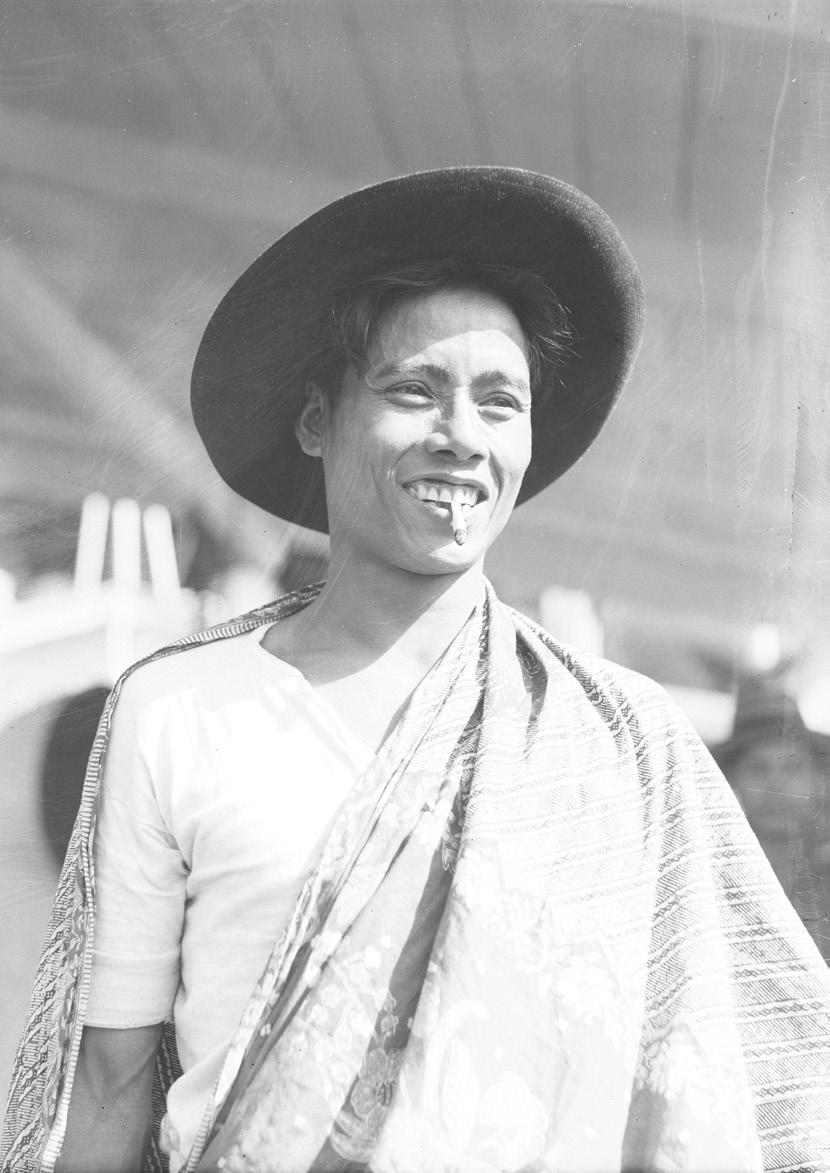
Most Javanese were sent to work on French plantations, in the mining industry or in domestic service
The museum’s photographic archives offer a glimpse into the lives of Indonesians sent to work in the French colony of New Caledonia. Dr Siobhan Campbell recalls a time when ordinary people set off on extended working journeys across the seas.
DURING THE EARLY 20TH CENTURY, thousands of Javanese people were recruited from their homeland in the Dutch East Indies to work in the relatively new French colony of New Caledonia.1 Moving from one colonial regime to another, most Javanese were sent to work on French plantations, in the mining industry or in domestic service for the duration of their five-year contract. The first Javanese went to New Caledonia in the 1890s; by 1902 some 600 had been recruited, rising to a peak of around 8,000 by 1939. 2 Some renewed their contracts and others later settled permanently in New Caledonia as independent residents. After World War II and the Indonesian declaration of independence in 1945, the Indonesian government repatriated most Indonesians living in New Caledonia, but a community descended from the Javanese immigrants still remains in Noumea today.
The men and women recruited to work in New Caledonia travelled by steamship from Javanese ports on vessels including Le Maire, SS Van Rees, Maetsuycker, Nieuw Zeeland, Roggeveen and Tasman, operated by the Dutch Royal Packet Navigation Company (KPM), and the Pierre Loti on the Saigon–Java–Noumea line. Arriving in Sydney Harbour, their status as ‘native passengers’ meant that they were not permitted to disembark and they would remain onboard while the vessel was docked, often for days or weeks at a time. While they were not allowed to experience Sydney in person, their presence was frequently reported in the Australian print media.
During the 1930s, when these steamers docked in Sydney several times a year, Australian newspapers published photographs of the Javanese people on board, accompanied by brief captions and commentary.
A community descended from the Javanese immigrants still remains in Noumea today
The Australian National Maritime Museum has several images of Javanese passengers taken by the distinguished photographer Samuel Hood, known for his evocative photographic record of life around the Sydney waterfront. 3 Hood’s images of the Javanese were taken on board the KPM passenger liner SS Van Rees in around 1934 and include portraits of young women carrying small children, a man smoking, a pair of men engaged in friendly combat on deck while other passengers look on, and a group portrait of six adults with two children. Several of these people are wearing distinctively Indonesian attire, including patterned batik sarongs, which are used to cover the lower body, as drapes around the upper body and as slings for carrying babies and young children.
In fact, this manner of carrying infants was frequently commented upon by the newspapers, with many images published of both men and women carrying babies in a sling, fashioned from a length of batik cloth tied around the neck. The image above was published in The Labor Daily on 12 September 1934 with the accompanying caption: ‘Carrying Baby: A Javanese girl, who reached Sydney yesterday, shows how a baby is carried in a scarf around the neck’.4 This image shows a very young woman, standing on the wooden deck with
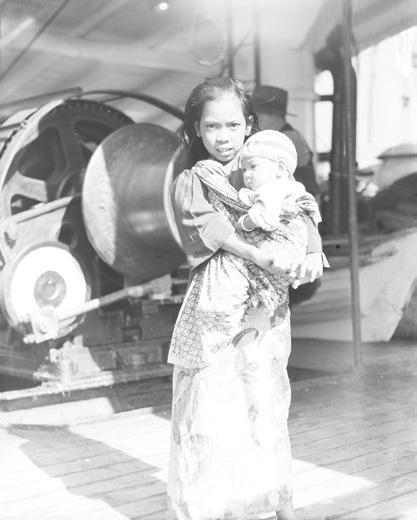
large items of machinery directly behind her, looking straight into the camera. She is possibly not the mother of the child but a sibling or relative. Her hair is loose, and she is dressed in a plain blouse and a batik skirt featuring a floral pattern. The child is wrapped in a cloth featuring the kawung motif, a repeating arrangement of interlocking ovals based on the blossom of the areca palm and originating from central Java. The child, secured against her upper body, has a striped cap on its head and is looking out to the side.
A group portrait shows six adults standing on deck with two children seated on the floor in front of them. Several are barefoot; one of the women is wearing sandals. Several women are dressed in batik skirt cloths and jackets; the latter are not usually seen on Javanese women in Indonesia but presumably were selected to protect against the cool weather on board. One woman wears a striped dress below her jacket, while another has a jumper on. The man on the far right is dressed in light coloured clothing with the distinctive batik headdress (blangkon) associated with Javanese men. He is perhaps a member of the ship’s crew, suggesting the intermingling of ‘native’ passengers and crew on board these vessels.
Young Indonesian woman holding a baby on SS Van Ree s. Image ANMM Collection 000241779 Samuel J Hood Studio 02
Group of Indonesian men, women and children on SS Van Rees . All wear traditional clothing, and three of the women wear western style jackets. Image ANMM Collection 000241776 Samuel J Hood Studio
Arriving in Sydney Harbour, their status as ‘native’ passengers meant that they were not permitted to disembark
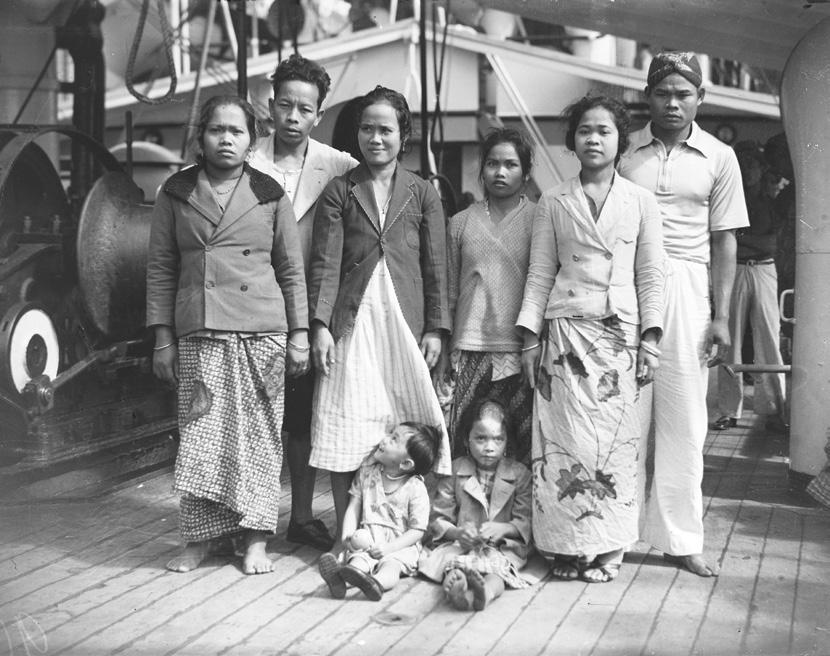
Their difference made Australian newspapers regard these Javanese contractors as a matter of public interest
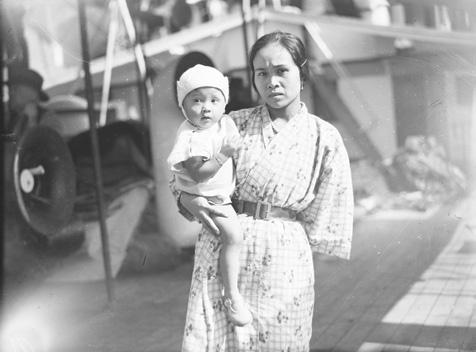
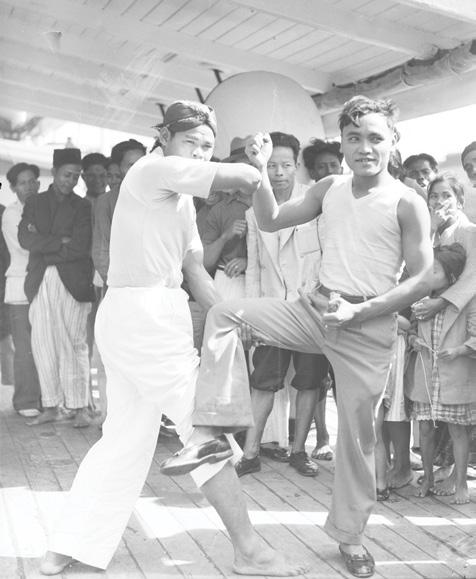
Newspapers often commented on the relaxed nature and cheerful disposition of the Javanese on board these steamers, yet emphasised their difference from the ‘white Australian’ viewers of these images – their inferior status, their exclusion from the port and their status as indentured labourers. In fact, it is undoubtedly their difference that made Australian newspapers regard these Javanese contractors as a matter of public interest. This was a time of public discussion about the use of migrant labour in Australian industry, particularly in the Queensland sugar fields. Although officially the migrations of the 19th century had ceased with the immigration restrictions of 1901, Indonesians and Malays continued to work as canecutters and field hands in northern Australia. 5 And during the 1930s, coinciding with the reporting of ‘indentured’ labour from New Caledonia, some traders based in the Dutch East Indies were trying to launch schemes to import ‘cheap’ Javanese labour into Australia on similar schemes of indenture.6
Though we lack a complete picture of why these photographic records were made, this is an important set of images. They tell us about Australia’s entanglement in the colonial empires of the 19th and 20th centuries. They are historical sources that shed light on the global interactions of ordinary people. Javanese accounts of their own experiences of contract labour are scarce and there are very few visual images documenting the migration experiences of the Javanese who worked in New Caledonia. While we might never know much of the lives of these photographic subjects, by viewing them through the prism of the vessel they travelled on, we might imagine that upon arrival in Australia they were confronted by the privileges conferred on others and the principles of a white Australia. We might also imagine that the presence of a photographer on deck gave their voyage a sense of significance.
The time frame of these images is also significant. Taken in the decade preceding World War II, they document the last vestiges of a colonial order that was about to unravel. By 1942 the Japanese had occupied the Dutch East Indies; the Indies government spent the war
years as a government-in-exile in Australia, and never regained its former colonial possession. The question of labour for New Caledonia and the repatriation of Indonesians resident there continued to concern Australia into the 1950s, when the government of the new Indonesian Republic attempted to implement a new labour immigration system to replace the former indenture contract. By that time, the issue of Indonesian ‘coolies’ in New Caledonia had become tied up in concerns about Indonesian claims to the territory of New Guinea.7 These photographic portraits of people whose lives were caught up in these historical moments thus substantiate broader histories of global movement and exchange.
1 At this time, the modern nation of Indonesia did not yet exist, so these people were the colonial subjects of the Dutch colony known as the Dutch East Indies, of which the Javanese are the largest ethnic group and inhabitants of the island of Java. From 1945, when Indonesia became an independent nation, all citizens could refer to themselves as Indonesians.
2 For a discussion of these migrations, see Julia Martínez and Adrian Vickers (2012), ‘Indonesians overseas – deep histories and the view from below’, Indonesia and the Malay World 40(117), 111–21.
3 ANMM Collection 0024174–0024180 <collections.sea.museum/objects/24613/indonesian-men-women-andchildren-on-ss-van-rees#>
4 <nla.gov.au/nla.news-page25584251>
5 See, for example, ‘Ten Little Malayans in Canefields Family’, PIX 8(13), 27 September 1941, <nla.gov.au/nla.obj-431677287>
6 See ‘Indenture Yellow Labor’, The Daily Telegraph, 16 May 1931, <nla.gov.au/nla.news-article246247234>
7 Vickers, A (2024). ‘Hands Across Australia’s Land Border’. Australian Historical Studies 55(4), 724–42.
Dr Siobhan Campbell is a researcher in the School of Languages and Cultures at the University of Sydney. These photographs were examined in the context of her work on the project Opening the Multilingual Archive of Australia, which is collecting archival sources to reconsider Australian history from a multilingual perspective: omaa-arts.sydney.edu.au/
WHALE POO gave Dr Asha de Vos her eureka moment.
As an intern at the beginning of her career, a sighting of faecal matter from a Northern Indian Ocean pygmy blue whale enabled her to prove, against prevailing belief, that the species did not migrate. More than two decades later, she is now an ocean educator, marine biologist and pioneer of blue whale research.
Whales hold many world records. Blue whales have the biggest babies, tongues, lungs and hearts; sperm whales the biggest brains and loudest voices; and Cuvier’s beaked whales the deepest dives.
Whales is a cornucopia of facts about the charismatic, often enigmatic, cetacean family – whales and their relations: dolphins and porpoises.
De Vos covers all 90 cetacean species in this book, from those that are ‘showy, well studied, and in the news’ (p 27) such as humpbacks and bottlenose dolphins, to species that are more elusive, like the spade-toothed whale, which is known only from six records over 150 years and one stranded specimen from 2024. Ten chapters cover, among other topics, feeding and hunting; migration and movement; whale song; whales and us; and ecology and conservation. There is also a list of species. While authoritative, the book is not academic in tone and is easily accessible for the nonexpert. It is largely jargon free, with the science clearly explained. The decision to illustrate the book solely with watercolour sketches, however, seems like a lost opportunity to show these creatures in their habitat. Some of the most fascinating information is the area of cetacean culture. De Vos notes that distinct populations of the same species have their own customs and habits,
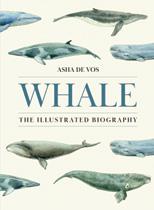
Whale: The illustrated biography
By Asha de Vos, published by Princeton University Press, Princeton and Oxford. Hardcover, 224 pp, illustrations, index. ISBN 9780691273211 RRP $50.00 599.5 DEV
citing the mating alliances of male bottlenose dolphins in Shark Bay, Western Australia, compared with those of Sarasota Bay, Florida. The vocal patterns observed in some species and populations can also be classified as culture, being passed through generations and across peers, and even changing due to the influence of visiting individuals. Cultural transmission of humpback songs occurs, for example, in the Kermadec Islands, a crossroads of humpback migration, where ‘song mashups’ have been recorded (p 162).
Since the almost-global ban on industrial whaling, many populations are recovering. De Vos discusses the various threats that cetaceans still face from humans –overfishing, ship collisions, increased underwater noise pollution interfering with echolocation, and the effects that global warming and climate change are having on whale populations. She notes that river dolphins are a sentinel species, whose ‘presence in waterways indicates a thriving ecosystem replete with food and favourable water quality’, and that whales are ecosystem engineers who create or modify their environment; they spread vital nutrients through faeces, both vertically and horizontally, and create carbon sinks in the form of their corpses.
The book has a global scope, with studies of whales in waters around all continents and at various latitudes. It rewards either a cover-to-cover reading or a random dip in and out, and advocates powerfully for our better understanding and increased protection of all cetacean species.
Reviewer Janine Flew is the editor of Signals


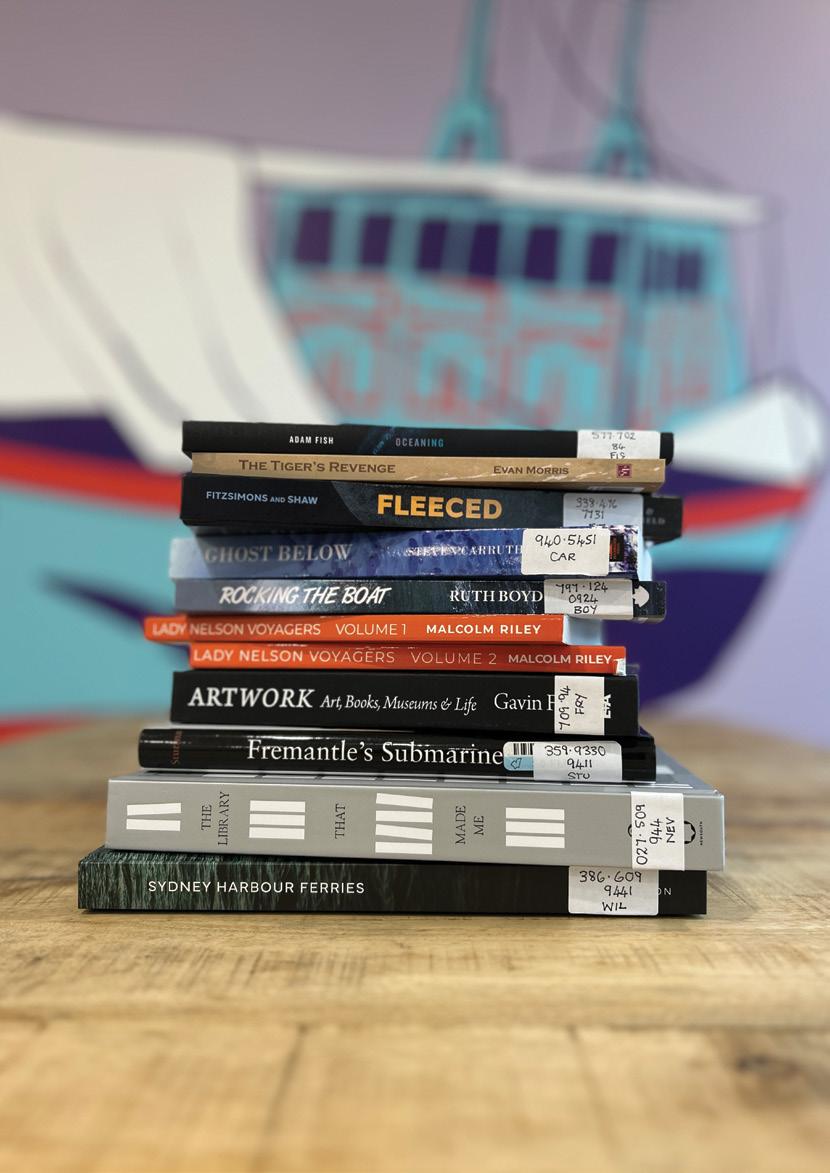
We are constantly adding new works to our library across a wide range of topics. We also offer new magazines and maritime, genealogical and general research databases. Check our library catalogue, schedule a visit and enjoy our great new books. Visit sea.museum/collections/library
Ruth Boydell
Rocking the boat: a life in three voyages 797.1240924 BOY
Steven Carruthers
Ghost below: the lost submarine of Sydney Harbour 940.5451 CAR
Adam Fish
Oceaning: governing marine life with drones 577.70284 FIS
Trish Fitzsimons and Madelyn Shaw
Fleeced: unraveling the history of wool and war 338.4767731 FIT
Gavin Fry
Artwork: art, museums, books and life 709.94 FRY
Andrew Jakubowicz
Multicultural arc: making multicultural Australia – past, present and future 305.800994 JAK
Jane Langley Descendants Association
A new beginning: the story of three first fleeters and descendants 929.20994 JAN
Craig Middleton and Caroline WilsonBarnao
Collecting social media in museums 025.84 MID
Evan Morris
The Tiger’s Revenge: the story of a largely unknown and most daring raid of World War Two 940.455994 MOR
Richard Neville and Phillipa McGuinness (eds)
The library that made me: 200 years of the State Library of NSW 027.509944 NEV
Malcolm Riley
Lady Nelson voyagers: Volume 1 –Administrators, military and First Nations people 994.602 RIL
Malcolm Riley
Lady Nelson voyagers: Volume 2 –Mostly convicts 994.602 RIL
Paul W Simpson
Fleurieu shipwrecks: tales of shipwrecks of the Fleurieu Peninsula 910.453099423 SIM
Michael Sturma
Fremantle’s submarines: how Allied submariners and Western Australians helped win the war in the Pacific 359.93309411 STU
Rob Wesley (-Smith) Rural rebel Rob 323.40994 WES
James Wilson
Sydney Harbour ferries 386.6099441 WIL
THE 2025 ROLEX SYDNEY HOBART YACHT RACE commemorated 80 years since the inaugural race in 1945. The Australian National Maritime Museum collaborated with the Cruising Yacht Club of Australia (CYCA) to acknowledge this significant milestone in Australia’s rich sailing history.
The museum is the custodian of one of the inaugural race contestants, Kathleen Gillett, which was commissioned by artist Jack Earl. The museum took the opportunity to reunite the yacht with its spiritual home at the CYCA, where this iconic race – considered the Everest of ocean racing – began.
Jack Earl’s grandson, Matt Tomaszewski, was competing in the 80th race on another classic boat, Love & War We were delighted to welcome Matt on board Kathleen Gillett. Matt said:
Kathleen was part of our family folklore and in many ways ‘came back to us’ when she was undergoing restoration when I was in my teens. So I feel I know her intimately even though it’s so long ago – way before I was born – when my mum, uncle and grandparents all lived on board in the harbour.
My grandfather Jack was an incredible person and one of the truly great characters. In some ways seeing Kathleen now is a bit like having a visit with him, and brings back so many formative memories.
After Kathleen came Maris – also an absolutely magic boat – named after my mum. I did the 50th Hobart on Maris with Ian Kiernan, met my wife on board her and even named my daughter after her! My sister Tiare owns her now – she’s in better condition than ever.
We’re about to sail off to Lord Howe together with my son and wife as well, to visit my daughter Maris who’s living over there. Many, many full circles!
Without doubt I’m drawn to the feelings of a timber boat; the connection to the seas and wind around you that comes through the touch of the helm and lines is something you simply don’t experience in anything else.
In tough conditions that led to numerous retirements, Love & War went on to cross the line 55th out of the 93 yachts that finished the race, narrowly missing out on the coveted Tattersall Cup and placing third overall. The museum offers its congratulations to Matt and all the crew on Love & War for this result.
On 9 May this year, Love & War and Maris both competed in the Great Veterans Race at the CYCA. This race is open to single-hulled, self-righting displacement boats that have competed in a Sydney Hobart race, or other veteran yachts invited by the organisers. This year the race had two classes: Classics, open to boats launched before 1976, and Modern Classics, for yachts launched from 1976 but prior to 1996. Love & War, skippered by Simon Kurts, came fourth in Classics Division 1, while Maris, skippered by Tiare Tomaszewski, came fifth in Classics Divison 2.
These yachts, and the others that joined them, demonstrate the high regard in which such classic vessels are held and are a tribute to the ongoing care and commitment of their owners.
Julia Owens, Partnerships Manager
The museum is the custodian of one of the inaugural race contestants, Kathleen Gillett
01
Matt Tomaszewski (centre), grandson of Kathleen Gillett ’s original owner Jack Earl, with (left) David Payne, former Curator of Historic Vessels, and the museum’s Deputy Director Michael Baldwin, aboard the yacht at the museum. Image Alix Fiveash/ANMM
02 Kathleen (left) and Wayfarer on their way south at the start of the first Hobart race. ANMM Collection Reproduced courtesy of Jack Earl
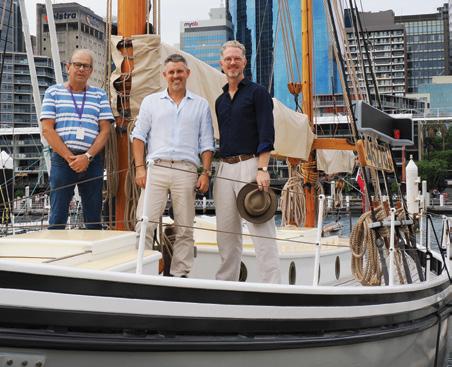
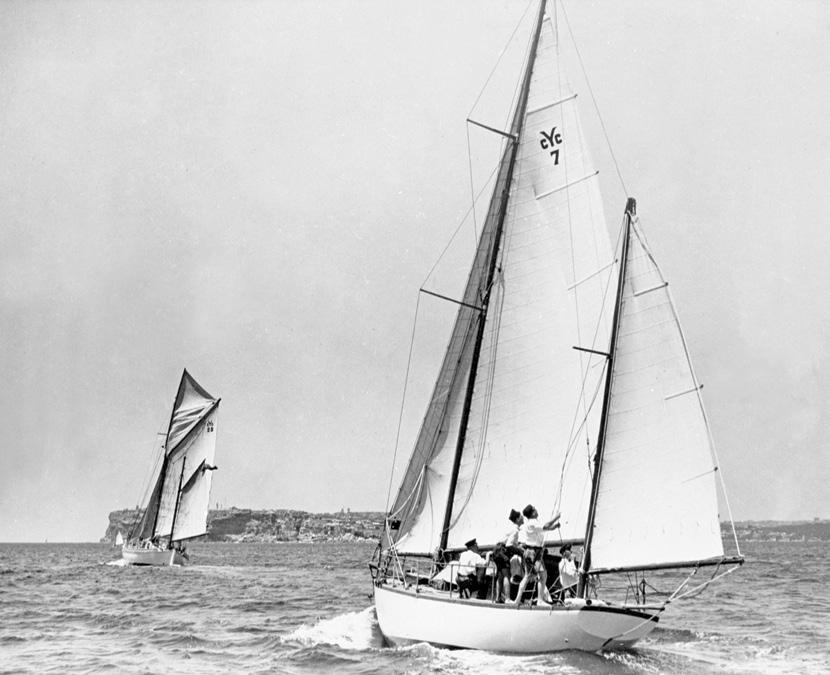
Acknowledgments
The museum’s honours system recognises individuals who have made a significant contribution to the museum and to Australian maritime heritage and culture generally. Honorary Fellowships are the highest honour conferred by the Council, awarded to people who have made an exceptional contribution to the museum and whose status and ongoing association will serve to promote the museum and its activities. Ambassadorships are awarded by Council to people who have donated $100,000 or more to the Australian National Maritime Museum Foundation.
Honorary Fellows
Peter Dexter AM
John Mullen AM
Valerie Taylor AM
Ambassadors
Norman Banham
Christine Sadler
Dr David and Jennie Sutherland
Major Donors
Peter Dexter AM
Daniel Janes
David Mathlin
Honorary Research Associates
RADM Peter Briggs AO RAN
John Dikkenberg
Dr Nigel Erskine
Dr Ian MacLeod
Jeffrey Mellefont
David Payne
Dr Vanessa Pirotta
Lindsey Shaw
Benefactors
Margaret Cusack
Basil Jenkins
Dr Keith Jones
Janette Parkinson
RADM Andrew Robertson AO DSC RAN
Peter Whitsed
Geoff and Beryl Winter
Honorary Life Members
Yvonne Abadee
Dr Kathy Abbass
Bob Allan
VADM Tim Barrett AO CSC RAN
Lyndyl Beard
Maria Bentley
Mark Bethwaite AM
Paul Binsted
David Blackley
Marcus Blackmore AM
John Blanchfield
Alexander Books
Ian Bowie
Colin Boyd
Ron Brown OAM
Paul Bruce
Anthony Buckley AM
Richard Bunting
Kevin Byrne
Sue Calwell
RADM David Campbell AM RAN
Marion Carter
Victor Chiang
Robert Clifford AO
Hon Peter Collins AM QC
Kay Cottee AO
VADM Russell Crane AO CSM RAN
Stephen Crane
John Cunneen
Laurie Dilks
Dr Nigel Erskine
John Farrell
Dr Kevin Fewster CBE AM FRSA
Bernard Flack
Daina Fletcher
Sally Fletcher
Teresia Fors
CDR Geoff Geraghty AM RAN
Anthony Gibbs
RADM Stephen Gilmore AM CSC RAN
Paul Gorrick
Lee Graham
VADM Mark Hammond AO RAN
RADM Simon Harrington AM RAN
Jane Harris
Christopher Harry
Gaye Hart AM
Janita Hercus
Robyn Holt
William Hopkins OAM
Julia Horne
Kieran Hosty
Marilyn Jenner
VADM Peter Jones AO DSC RAN
Hon Dr Tricia Kavanagh
John Keelty
Richard Keyes
Kris Klugman OAM
Judy Lee
Matt Lee
David Leigh
Keith Leleu OAM
Andrew Lishmund
James Litten
Hugo Llorens
Tim Lloyd
Ian Mackinder
Stephen Martin
Will Mather
VADM Stuart Mayer AO CSC and Bar RAN
Bruce McDonald AM
Lyn McHale
VADM Jonathan Mead AO RAN
Rob Mundle OAM
Alwyn Murray
Martin Nakata
David O’Connor
Gary Paquet
David Payne
Prof John Penrose AM
Neville Perry
Hon Justice Anthe Philippides
Peter Pigott AM
Len Price
Eda Ritchie AM
John Rothwell AO
Peter Rout
Kay Saunders AM
Kevin Scarce AC CSC RAN
David Scott-Smith
Dr Sergio Sergi
Ann Sherry AO
Ken Sherwell
Shane Simpson AM
Peter John Sinclair AM CSC
RADM Peter R Sinclair AC KStJ RAN
John Singleton AM
Brian Skingsley
Eva Skira AM
Bruce Stannard AM
J J Stephens OAM
Michael Stevens
Neville Stevens AO
Frank Talbot AM
Mitchell Turner
Adam Watson
Ian Watt AC
Jeanette Wheildon
Hon Margaret White AO
Mary-Louise Williams AM
Nerolie Withnall
Cecilia Woolford
Multidisciplinary exhibition by Brian Robinson, exploring traditional knowledge, historical narratives and a keen engagement with the contemporary globalised world.
On view in the Bamal Gallery sea.museum/incoming-tide
Step into contemporary dock life with artist and wharfie Sam Wallman. His work weaves past and present, social commentary and storytelling.
On view in the Tasman Light Gallery sea.museum/view-from-the-docks
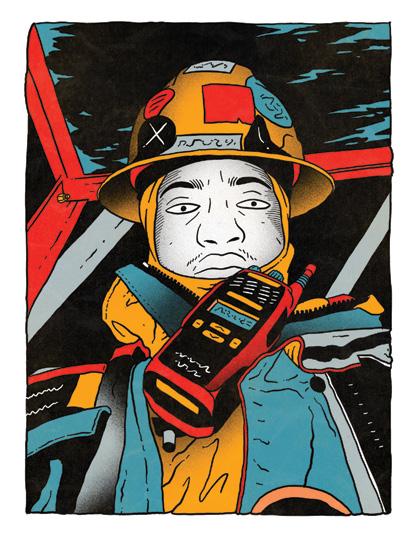
Signals
ISSN 1033-4688
Editor Janine Flew
Staff photographer Jasmine Poole
Design & production Austen Kaupe
Printed in Australia by Pegasus
Media & Logistics
Material from Signals may be reproduced, but only with the editor’s permission.
Editorial and advertising enquiries signals@sea.museum
Signals back issues
Back issues $4 each or 10 for $30
Extra copies of current issue $4.95
Email theshop@sea.museum
Search all issues at sea.museum/signals
Australian National Maritime Museum
2 Murray Street Sydney NSW 2000 Australia. Phone 02 9298 3777
Our opening hours are 10 am–4 pm (NSW school holidays 9.30 am–5 pm)
The Australian National Maritime Museum is a statutory authority of the Australian Government
Become a museum member
Options for individuals, families and people who live interstate or overseas offer a great range of benefits, such as unlimited entry to our museum, vessels and exhibitions, as well as special discounts.
Visit sea.museum/members
Follow us on social media

Signals is printed in Australia on Sovereign Silk 250 gsm (cover) and Sovereign Silk 113 gsm (text) using vegetable-based inks.
ANMM Council
Hon Hieu Van Le AC (Chair)
Daryl Karp AM
Councillors
Padraig (Paddy) Crumlin
Dr Bülent (Hass) Dellal AO
Nataliya Dikovskaya
Dr Kevin Fewster AM CBE FRSA
Hon Donald Harwin
Hon Leo McLeay
RADM Christopher Smith AM CSM RAN
Australian National Maritime Museum
Foundation Board
Daniel Janes, Chair
Hon Hieu Van Le AC (ex officio)
Daryl Karp AM (ex officio)
John Barbouttis
Simon Chan AM
David Mathlin
Grazyna Van Egmond
American Friends of the Australian National Maritime Museum
Robert Moore II
John Mullen AM
Daryl Karp AM
Shop in store or online to check out our full range of clothing, gifts, homewares, toys, books, jewellery, curios and souvenirs.
The Galloway Hoard
A range of items inspired by unique objects from our major exhibition.
Face pins
$6 / Members $5.40
Gold bird pin $18 / Members $16.20
Catalogue $20 / Members $18.00
Tea towel $20 / Members $18.00
Gemajesty jewellery
Distinctive, hand-crafted designs featuring natural semi-precious stones, sourced from all around the world and designed in Sydney.
$69–$209 / Members $62.10–$188.10
LEIF body care range
Made in Australia, LEIF formulas are vegan, cruelty-free and don’t contain sulphates or parabens. Fragrances: Desert Lime, Lemon Myrtle, Wild Rosella, Boronia, Buddha Wood, Flannel Flower. Gift sets also available.
$19–$89 / Members $17.10–$80.10
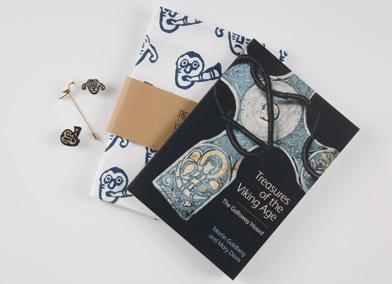
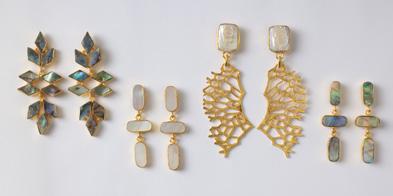
Members receive 10% discount
Open 7 days a week
Email us at theshop@sea.museum
Shop online sea-museum.myshopify.com
Follow us on Instagram instagram.com/seamuseum_shop

Thank you to our partners
We gratefully acknowledge the generous support of our valued partners. Their commitment empowers the Australian National Maritime Museum to inspire current and future generations to explore, understand and connect with Australia’s rich maritime heritage and the oceans that shape our world.