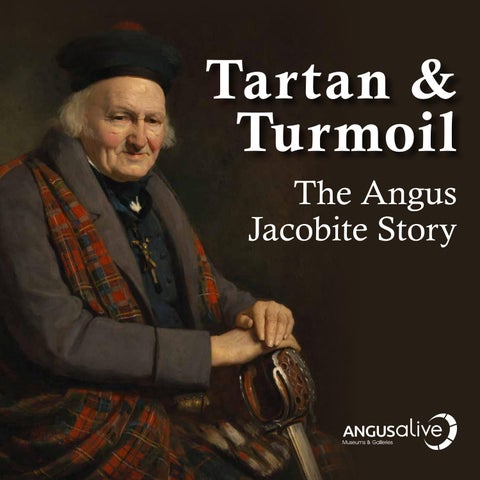

Tartan & Turmoil
The Angus Jacobite Story


acc. no. M1987.678.


J.S. Paterson, City and Castle of Brechin, 18th century;
The Angus Jacobite Story
Mostpeople have heard of Bonnie Prince Charlie, but hidden in the shadows of the Jacobite story lies Angus, whose people helped shape its most dramatic chapters.
After the Act of Union in 1707, power and patronage shifted to London. Many Scots felt ignored, and some believed that restoring a Stuart monarch might reverse the Union. But the Jacobite cause was about more than loyalty to the old ruling family.
For Catholics facing discrimination, it offered hope of equality under the law. In northeast Scotland, the Scottish Episcopal Church predominated, and was closely associated with Jacobitism due to its historical ties and political ideology.


John Slezer, Prospect of the Town of Montrose, 1678; acc. no. M2005.34.

of Angus, c. 1745; acc. no. CS2025.5.
Map
The catastrophic famines of the 1690s devastated Scotland and 13% of the population died or emigrated. Episcopal clergy even interpreted the famine as divine punishment for abandoning the Stuarts. Earlier disasters also left deep scars: two-thirds of Brechin’s population died during the plague of 1645, and by 1745 the population of Angus had barely recovered from decades of hardship.
The Union brought heavier taxation, rising nearly five-fold, and disrupted east-coast trade with Europe. As the economy contracted, smuggling flourished in ports like Montrose, becoming a politicised act of defiance linked to Jacobite support.
Though history often frames the Jacobites as Highland rebels, the beating heart of support lay here in the north-eastern shires of Aberdeen, Kincardine, and Angus.

Romeyn de Hooghe, William of Orange’s Departure from Holland and Arrival in England, 1688. Courtesy of Royal Collection Trust.
1688 and After: The Making of
the Jacobite Cause
The Jacobites were the supporters of King James VII, his son James Francis Edward Stuart, and his grandson, Charles Edward Stuart, known as Bonnie Prince Charlie.
The Stuart dynasty had ruled Scotland since 1371 and Britain since 1603. It had survived civil war, regicide, and exile, but by 1688 it was split into two competing camps divided by religion. Many of James VII’s Protestant subjects opposed both his personal Catholicism and his efforts to extend legal rights to Catholics in England and Scotland.
When James’s second wife Mary gave birth to a male heir, James Francis Edward, many feared the establishment of a long-lasting Catholic dynasty. A group of prominent Protestant English politicians invited James’s Protestant daughter Mary and her husband, William of Orange, to intervene. As William’s forces landed, James left London. Parliament interpreted this as abandoning the throne, and in early 1689 he was declared to have forfeited the Scottish crown too.
Protestants Mary and William became the new monarchs of England Scotland, and Ireland.
The Act of Union in 1707 extended the Act of Settlement, which required future monarchs to be Protestant, to Scotland. This paved the way for the Hanoverian dynasty in 1714.
Supporters of James VII, and later of his son and grandson, launched repeated attempts to restore the Stuarts. This was civil war.
More so than any other movement in British history, the Jacobite cause attracts sentimentalists and debunkers alike. It remains one of the great ‘what-if’ moments of British history.

Pieter Cornelisz van Slingelandt, James VII and II (1633-1701), when Duke of York, c. 1680. Courtesy of Royal Collection Trust.

The Legend of Bonnie Dundee
orn near Glamis in 1648, John Graham of Claverhouse, better known as Bonnie Dundee, became one of Scotland’s most enigmatic and legendary military figures. He is forever linked with the Jacobite cause and remembered for his daring leadership at the Battle of Killiecrankie.
The eldest son of Sir William Graham and Lady Madeline Carnegie, Dundee grew up on the family estate of Claverhouse near Dundee and studied at the University of St Andrews in the 1660s. His military career began in the French army under Louis XIV, where he distinguished himself at the Battle of Seneffe in Belgium in 1674, reputedly (and perhaps ironically) even saving the life of William of Orange.
Returning to Scotland in 1678, Dundee joined the army of Charles II, tasked with suppressing Presbyterian gatherings which the king viewed as seditious. His ruthless efficiency earned him the infamous nickname ‘Bluidy Clavers’.
His rise was rapid. By 1683 he sat on the Scottish Privy Council, and in 1686 he became major-general and Provost of Dundee. James VII created him Viscount
Sir Godfrey Kneller, John Graham of Claverhouse, 1687. Courtesy of Strathmore Estates (Holding) Ltd.

James VII wrote to him from his court at Dublin in 1689, demonstrating his implicit trust in the ‘right trusty and wel beloved’ Dundee. The King gives his most hearty thanks and ensures Dundee that ‘by Our writ which we are speedily to send to you, you shal be mor fully informed of all things in the mean time What Comissions we hav sent or what others we shal send we leav to you to Cancell or suspend as you shal think fitt having reposed in you the trust of that affair.’
When the Scottish Convention recognised William and Mary as monarchs in 1689, Dundee remained loyal to the Stuart dynasty. On 13 April he raised the Royal Standard on Dundee Law, declaring his support for king, country, and the Jacobite cause.
On 27 July, Dundee’s forces clashed with the Williamite army at Killiecrankie. The Jacobites won, but Dundee was fatally shot through his head, falling from his horse in the heat of battle. By August, the Scottish resistance was crushed at Dunkeld.
His dramatic death sparked countless legends. The most famous myth claimed Dundee had made a pact with the Devil, rendering him immune to lead, and that he was killed only by a silver button from his own coat. Such stories have cemented his place in Scottish folklore.
Letter from King James VII and II to John Graham of Claverhouse, Viscount Dundee, 7 July 1689 acc. no. M1981.309.
A King Without a Crown
Raised in exile, James Francis Edward Stuart (1688-1766) was the son of the King James VII and II and his second wife, Mary of Modena. When his father died in 1701, James inherited not a crown but a cause. To his supporters he was the rightful king of Scotland, England and Ireland: James VIII and III. To his enemies, he was simply ‘the Pretender.’
When James reached his majority in 1706, he wrote to the Scottish Jacobites: ‘I thought the first thing I was to do after my coming to the majority was to write to my friends in Scotland, which I do with a great deal of pleasure…’. Two years later, supported by Louis XIV of France, he attempted to invade Scotland, but bad weather and the Royal Navy prevented him from landing.
Several years passed before the Jacobites tried again. William and Mary were dead, and George I of Hanover had succeeded Queen Anne, the last Stuart monarch, despite James, her younger half-brother, being closest in blood. George was distantly related and 55th in line to the throne. His succession revealed the depth of fear surrounding the prospect of a Catholic king.

Studio of Sir Godfrey Kneller, George I, 1715-27. Courtesy of Royal Collection Trust.
The Rising of 1715 was no ordinary rebellion. It was not concerned with reforming policies or replacing an unpopular official, but a direct challenge to the political order itself. To follow James was to risk everything - home, family, and life - in pursuit of a lost crown. This portrait of King James VIII or ‘The Old Pretender’ was donated to the Museum in 1837 by James Burnes, a distant cousin of the poet Robert Burns. It is from the studio of AlexisSimon Belle, and dates to around 1712. Belle was the most prominent Jacobite portrait painter, receiving commissions from English, Scottish and French Jacobites. Displaying portraits of the Stuart Royal Family in your home was a way to show your Jacobite sympathies.


Profile of Queen Anne from a silver crown, 1707; acc. no M1980.1768.
Angus on the Edge: 1715
The1715 Jacobite rising was led by John Erskine, Earl of Mar, who had family connections at Dun near Montrose. A powerful landowner and skilled politician, Mar had helped shape the Act of Union between Scotland and England in 1707. In 1714, Mar was serving as Third Secretary of State when George I came to the throne. His letter of welcome and pledge of loyalty went unanswered, a slight that changed everything. Mar abandoned the Hanoverian cause and pledged himself to the exiled Stuart king. Acting swiftly, he raised an army of more than 10,000 men and began to take control of northern Scotland.

This document was written by the Earl of Mar in 1715. Copies were distributed around the country to gather support for James. It speaks of the ‘late unhappy union’ and argues that James is the ‘rightful and natural king’. Across Angus, government authority was visibly weakening. Reports spoke of rising tensions. One local figure, Geddes, servant to James Carnegie, Earl of Southesk, was said to compel revellers to drink to James Stuart’s health, even dragging ‘some through a miln head for refusing.’ By July 1715, the Lord Justice Clerk was warned that ‘in Angus and further north they talk confidently that the Duke of Berwick is to land in Britain with 15 or 20,000 men and another army is to land in Ireland at the same time and this is believed as the greatest certainty.’
On 6 September, Mar raised the Jacobite standard for King James VIII at Braemar, just beyond the Angus Glens. As the banner was unfurled, a sudden gust of wind tore the golden finial from its top. Many watching took this as an ominous sign.

The fears proved justified. James Stuart did not reach Scotland until 22 December, having had little warning from Mar that the rising was underway. Nor had Mar aligned his plans with Jacobite supporters in England. Despite his political skill, he was no military commander.
John Smith (after Kneller), John Erskine, Earl of Mar, 1703. Courtesy of National Gallery of Art, Washington.
Coded in Stucco
The House of Dun contains intriguing hints of secret Jacobean sympathies. The current building was built by Mar’s cousin, David Erskine, Lord Dun, a Scottish advocate, judge and member of the Scottish parliament.
Lord Dun commissioned William Adam to design his new home, but tradition holds that Adam’s final plan incorporated amendments proposed by Mar in 1731. The result is a building rich in symbolism. In the Saloon, the elaborate plasterwork includes symbols closely associated with the Jacobite cause. The white rose, a classic Jacobite emblem, appears repeatedly, though it could be dismissed as a simple reference to the gardens outside.

Plasterwork by Joseph Enzer in the Saloon, House of Dun. Courtesy of National Trust for Scotland.
The figure of Mars, God of War, offers a more ambiguous message. A Hanoverian might see the Union Flag and Mars suppressing the Scottish Crown and the Lion of Scotland. A Jacobite might read the opposite: the Crown of England and the Lion of England brought low. Some have even suggested that Mars’s features resemble Lord Mar himself.
Across the ceiling, the sea god Poseidon drives his chariot through the waves, guided by a water nymph, perhaps hinting at the hoped-for arrival of Charles Edward Stuart from across the sea. Elsewhere, a fleur de Lys symbolises France, while a crowned thistle represents Scotland.


James Maule, 4th Earl of Panmure, date unknown. Courtesy of Dalhousie Estates.
The Earl Who Lost Everything
TheEarl of Mar found powerful allies in Angus. Among them were his uncle, James Maule, 4th Earl of Panmure, then aged 60, and his younger brother, Harry Maule of Kelly, celebrated both as a brave soldier and noted antiquary.
Panmure had served as a Privy Councillor to King James VII. Although a Protestant, he remained loyal to James after his overthrow in 1688. When the Act of Union passed in 1707, Panmure openly encouraged resistance, signing a letter claiming Scotland was ready to rise for the exiled Stuarts. In 1715, following Mar’s lead, he publicly proclaimed James Francis Edward Stuart as King James VIII at the Mercat Cross in Brechin.
From his estates, Panmure raised a substantial force drawn from his tenants. How many joined willingly and how many under pressure is uncertain. Some later excused their involvement by claiming they were ‘for the most part ignorant and inured to slavery.’
This was no disorderly mob. A full roll of Panmure’s foot regiment survives, revealing a well-organised battalion. Panmure himself commanded the first company as colonel, supported by LieutenantColonel Patrick Lyon of Auchterhouse and Major Alexander Leslie. Nine further companies followed, each led by a captain with lieutenants, ensigns, sergeants, corporals, and drummers. The regiment even included an adjutant, quartermaster, surgeon, and chaplain.
At the Battle of Sheriffmuir, Panmure was wounded, captured, and held under guard in a cottage. While lying there ‘in a sorry bed’, he was rescued in a daring night raid by his brother and servants, a story later celebrated in ballad and Jacobite legend. Yet the rescue also revealed tensions within the rebel leadership: Harry Maule bitterly blamed Mar for failing to assist, accusing him of ingratitude and of risking ‘two of the most considerable men they had.’
The failure of the rising brought ruin. Panmure was convicted of high treason, stripped of his title, and lost his estates of Brechin Castle and Panmure House near Carnoustie. Forced into exile, he took a last farewell from his wife at a small hill east of the Panmure House, still known as Margaret’s Mount.
Panmure House was demolished in the 1950s, but one striking feature survives. Its ornate iron gates still stand at the western approach. In 1715, Panmure ordered them locked until a Stuart king was restored to the throne. More than three centuries later, they remain closed, silent witnesses to a lost cause.

The Barred Gate, Panmure Estate.
Amongst the prominent men who joined Lord Panmure was David Lindsay, Laird of Edzell, who sold his castle and estate for £192,502 Scots or nearly £16,042 sterling to Panmure in order to finance a group of soldiers. After the uprising failed he visited Edzell one last, unhappy time under the cover of darkness with a single servant. Once inside, they worked until dawn, burning every incriminating document they could find. Lindsay died in poverty forty years later, aged around eighty, looking after the horses at an inn in Kirkwall, Orkney.

David Waterson, Edzell Castle, date unknown; acc. no. B1978.6.

After William Hogarth, Simon Fraser, Lord Lovat, c. 1746. Courtesy of Royal Collection Trust.
The Old Fox
SimonFraser, 11th Lord Lovat (1667-1747), was chief of Clan Fraser, and a Jacobite nicknamed the ‘Old Fox’ for his double-dealings, violent feuds and changes of allegiance. Although involved in the 1715 Rising, it was not until thirty years later that Lovat was convicted of treason for his part in the 1745 Jacobite Rising.
He was sentenced to be hung, drawn and quartered, and was beheaded on 9 April 1747, the last person to be publicly executed on Tower Hill, London. Such a crowd gathered for his execution that a stand holding spectators collapsed and killed nine people. Lovat was so amused by the incident that legend has it that this is where the origin of the phrase ‘laughing your head off’ comes from.
In one letter Lord Lovat thanked Lord Panmure for his support during the 1715 Rising. He is less complimentary about the past actions of the Murray family. It’s tantalising to think that Lord Lovat may have worn these tortoiseshell framed spectacles when writing to Lord Panmure.

Lord Lovat’s spectacles, courtesy of West Highland Museum.
Defiance in Ink: Margaret and the Maule Letters
Margaret, the youngest daughter of William Douglas, Duke of Hamilton emerges from the Maule Family Papers as a woman of striking capability. Her letters reveal a woman deeply involved in overseeing her husband’s estates and directing ambitious building projects at Panmure House and Brechin Castle.
After Panmure’s exile, Margaret threw herself into the fight to protect what remained. She followed her husband’s instruction to ‘prevent all she can the bad consequences of that bill … and keep possession as long as she can’ with remarkable determination. Using the Scottish courts, she secured her own servants as legal factors on the estate, directly challenging the government commissioners. She then hid almost every moveable asset such as cattle, grain, furniture, and papers in the homes of sympathetic neighbours and relatives.
Reluctant to evict a noblewoman by force, authorities found her still in residence long after the estate had been sold to the York Buildings Company, the joint-stock firm created to profit from forfeited properties. She remained even after the company collapsed into bankruptcy.

Margaret Maule, Countess of Panmure, c.1700. Courtesy of Dalhousie Estates.
Margaret was also an astute political operator. She wrote to the king, ministers, and military leaders to assert her family’s rights. When troops were garrisoned on her estates, she combined complaints with diplomatic gifts, such as deer, subtle reminders that this was still her land and her hunting grounds. Her letters reveal both courtesy and resolve, showing a woman fully aware of how to wield influence in a world dominated by men.
Eventually, Margaret succeeded in securing for Panmure the prospect of returning home on the condition that he promised to behave peacefully. Her frank letter urging him to accept shows both courage and foresight:
‘I cannot but say that I am both very much grieved and astonished to find you are so nicely scrupulous … I beg you may seriously consider this matter, after which I am persuaded you


Grant of Pardon, acc. no. M1977.1726.
will think it is an incumbent duty on you to preserve your family from utter ruin …’ Panmure refused. He died of pleurisy in Paris in 1723, before he could receive the later Grant of Pardon which was issued by King George II in 1730 and also included the Earls of Southesk, Marischal and Seaforth.
Brechin Castle
Shadow Over Glamis
John Lyon, 5th Earl of Strathmore, raised a battalion of foot for the Stuart cause. His bravery was celebrated in an anti-Hanoverian ballad: Strathmore and Clanranald cried still ‘Advance, Donald,’ till both these heroes did fa, man. There was such hashing, and broadswords a clashing, brave Forfar got a claw, man; And we ran and they ran.

John Wootton, The Battle of Sherrifmuir, 1715. Creative Commons.
Strathmore was wounded and captured at the Battle of Sheriffmuir. The Jacobite officer known as the Master of Sinclair described his death in his memoirs:
‘On our left the brave younge Strathmore was killed after being wounded and taken …When he found all turning their backs, he seized the colours, and persuaded fourteen or some such number to stand by him for some time, which drew upon him the ennemie’s fire, by which he was wounded, and goeing off was taken and murder’d by a dragoon, and it may be said in his fate that a mill-stone crusht a brilliant. He was the younge man of all I ever saw who approached the nearest to perfection …and his least qualitie was that he was of a noble, ancient family, and a man of qualitie.’
Two months later, James Stuart arrived at Glamis. John’s younger brother Charles had by then succeeded as Earl, but the shadow of John’s death lay heavily over the household.
While at Glamis, James performed the royal ‘touch’ on local people suffering from scrofula, the illness known as the King’s Evil. Yet many supporters were disappointed. Instead of inspiring confidence, James appeared withdrawn and sullen.

John Lyon, 5th Earl of Strathmore and Kinghorne, 1710-15. Courtesy of Strathmore Estates (Holding) Ltd.

Steadfast in Defeat
n Angus gentleman, James Edgar of Keithock, served as private secretary to James Edward Stuart for almost fifty years. He was among the first to answer the Jacobite call when the Earl of Mar raised the standard at Braemar on 6 September 1715.
After the defeat of the rising, Edgar fled Scotland in disguise, wearing the clothes of one of his tenants. He joined the Jacobite court in exile and soon became essential to its daily operations. From 1728 he coordinated intelligence, managed a constant flow of correspondence, and earned a reputation for efficiency and unwavering integrity. In a court often riven by rivalries, Edgar remained trusted and uninvolved in the constant power struggles.
In this modest portrait, Edgar discretely signals his loyalty by wearing a ring set with a cameo profile of James Stuart.
A story preserved by Edgar’s great-grandniece captures his character. Britain’s powerful Prime Minister, Sir Robert Walpole, attempted to bribe Edgar into becoming a government spy, depositing £10,000 in the Bank of Venice in Edgar’s name. Edgar replied with polite firmness, thanking Walpole for the money, which he had immediately withdrawn and placed at the feet of his rightful king, who ‘had the best title to gold that came, as this had done, from England.’
James Edgar, c.1750. Courtesy of National Galleries of Scotland.
Loyalty to the Stuarts ran in the family. Edgar’s younger brother, Henry, Bishop Edgar, served as clergyman of the Episcopalian church in Arbroath for 36 years. He died on 21 August 1765 and was buried in the south aisle of the Abbey Church. Among his treasured possessions was a walking staff said to have been presented to James Edgar by Prince Charles Edward Stuart.


The Palazzo del Re was home to the exiled Jacobite court in Rome. Both James’s sons, Charles Edward and Henry Benedict, were born in the palace. Courtesy of National Galleries of Scotland.
The ring worn by James Edgar in his portrait may be similar to this one which dates from 1740 and was worn by another Jacobite. Courtesy of Victoria & Albert Museum.

acc. no. M1977.285.
The Rising that Fell
The whole inglorious rising of 1715 was over within five months. The Jacobites abandoned Perth on 31 January 1716 as the Duke of Argyll marched north. They threw their artillery into the Tay and carried little more than what was on their backs. Retreating in two columns, one through Coupar Angus, the other though Dundee, they headed for Brechin and then along the coast road to Aberdeen. Desertion was rampant.
By the time the army reached Montrose on 1 February, fewer than 4,000 men remained. James VIII stayed as the guest of John Scott at Castlestead, connected to Stewart’s Tavern, now 5 Castle Place.
After two days of consultations with Mar and his senior officers, James announced on 4 February that he would leave that night on a French ship, the Maria Theresa of Saint-Malo, taking Mar and a small party with him. From Stewart’s Tavern, the despondent James wrote to the Duke of Argyll, claiming he had left money to compensate those whose villages has been burned, and entrusting all he possessed – except himself – to General Gordon for the troops he left behind.
James Stuart is said to have drunk from this glass during his last night in Montrose with John Scott on 4 February 1716. It was treasured as an heirloom in the Scott family and was donated to Montrose Museum by Scott’s greatgreat-great granddaughter in 1924. However, despite this family tale, the opaque twist styling of the stem only occurred after 1760.
Many Jacobites fled abroad to escape persecution, but few preserved their fortunes. The journey to France, Italy or the Netherlands consumed what little they had. John Oliphant, former Baillie of Dundee, was typical. Writing from Amsterdam in 1716 to his former commander, Lord Panmure, he described his desperate flight:
‘I went to Buchan; where I disguised my self with a countrie man’s dress and got a chapman’s pack. Where I travelled nyne or ten weiks; being dragooned from place to place.’
By 1719 his situation had worsened. He confessed he had pawned his clothes to maintain appearances and avoid being pressed into service: ‘I have not received my subsistence this eleven months… the man I lodge with threatens to put me in prison.’
Even senior Jacobites were losing faith. By 1725, Harry Maule, brother of Lord Panmure, dismissed the Old Pretender’s proposal for another rising against the Disarming Act as folly, declaring that ‘none but mad men would engage in such an affair.’
Hope, it seemed, was in even shorter supply than money.

Castlestead, now home of Montrose Jobcentre.
The Jacobite Coast:
Montrose and the Road to the ‘45
On22 July 1745, Prince Charles Edward Stuart, son of the ‘Old Pretender’, landed on the island of Eriskay with just seven companions. Better known as Bonnie Prince Charlie, he had come to reclaim the British throne for the exiled Stuart dynasty.
Less than a month later, on 19 August, he raised his father’s standard at Glenfinnan and began gathering support. Although it is often said today that the Jacobite Rising of 1745 was doomed from the start, neither the Jacobites nor the Government believed that at the time. For six glittering weeks that autumn, Charles held court at Holyroodhouse in Edinburgh, surrounded by portraits of his royal ancestors and convinced that victory was within reach. The Jacobites had seized Edinburgh after their startling ten-minute triumph at the Battle of Prestonpans.
By late 1745, Jacobite forces had pushed deep into England, reaching Derby, only 125 miles from London. But faced with conflicting intelligence and fears of Government reinforcements, the Jacobite leadership made a fateful decision: they would turn back.

Glenfinnan, on the shores of Loch Shiel, where Prince Charles Edward Suart raised the standard for his father on 19 August 1745.

Yet hope was not extinguished. A treaty signed at Fontainebleau in October promised French backing for the Stuart cause. News soon reached Charles that Lord John Drummond had landed at Montrose at the end of November with around 1,000 French troops, arms, and supplies.
The eastern shires were vital to the Rising: they offered one of the few reliable routes for supplies arriving from France.
Montrose Harbour, deep and sheltered from the harsh easterly winds, was the most reliable haven on this ‘Jacobite’ coast.
To Government officials, this made Montrose deeply suspect. One Secretary of State condemned it as ‘the most disloyal and disaffected town in Scotland.’
John Pettie, Bonnie Prince Charlie Entering the Ballroom at Holyroodhouse, 19th century. Courtesy of Royal Collection Trust.

Fragment of faded blue cloth said to be part of Prince Charles Edward Stuart’s garter, donated to Montrose Museum in 1839 by Catherine Mary Watson, the great-niece of James Edgar of Keithock, who was secretary to James Francis Edward Stuart. Clothing fragments reputedly from garments of Charles are very common, but the provenance of this garter fragment is strengthened as James Edgar knew Charles personally and passed other gifts of Stuart provenance to his family. Acc. no. M1977.538.

The Ogilvy Gamble
Whenthe Jacobite Rising of 1745 began, the 4th Earl of Airlie made a careful calculation. He sent his son, Lord David Ogilvy, to fight for Prince Charles Edward Stuart, but remained at home himself, offering only discreet support. If the Jacobites triumphed, the Ogilvy title would be secure. If they failed, there would still be an Earl of Airlie to protect the family’s future.
David Ogilvy was just 20, but already a seasoned soldier. Like many young Jacobites, he had spent two years in France as an officer in the French army, fighting against British forces at Dettingen. Only six months later, he was back in Angus, ready to join the Rising.
On 3 October, Lord Ogilvy rode into Edinburgh with 600 men from Angus. His regiment led the march south to Derby and later formed the rearguard on the retreat north through Glasgow and Stirling. Ogilvy served both as Colonel of his regiment and as a member of the Prince’s Council.
Allan Ramsay, David, Lord Ogilvy, 1745. Courtesy of Winton Estate.
Throughout the campaigns he carried two silver cups; these were likely present within the company of Prince Charles and many other high ranking Jacobites. They would have been part of a larger travelling canteen, commonly used by officers in the 18th century. They show different versions of the Ogilvy coat of arms.
At Cortachy, his father supported the cause as fully as he dared. The Earl sold silver and family jewels to finance the Rising and arranged for a second local regiment to be raised. By mid-January, the Ogilvy forces had assembled at Stirling and played a major role in the Jacobite victory at Falkirk.


But the triumph was short-lived. The Duke of Cumberland advanced north with a far more powerful army. This cannonball was recovered from Culloden battlefield and the silver collar is engraved with ‘Ogilvy Culloden 16th April 1746’. Few are as poignant as this, with its provenance to a man who was there on the day leading a regiment, and who would subsequently suffer the loss of land, status and home.
Lord Ogilvy disbanded his regiment at Milton of Clova, 5 days after defeat at the Battle of Culloden.
Courtesy of Culloden Battlefield, National Trust for Scotland.
Courtesy of Culloden Battlefield, National Trust for Scotland.
Cortachy Castle was occupied by Hanoverian troops searching for Lord Ogilvy and his followers. Ogilvy escaped by switching identities with his servant, John Thomson of Lintrathen.
Legend says that the pair stopped at a roadside inn in Angus, where travellers cooked their own meals at the kitchen fire. When struggling to make his porridge, Ogilvy was supposedly urged by Thomson in a stage whisper: ‘Twinkle your little finger, my lord, twinkle your little finger.’ The fatal words ‘my lord’ were overheard, and they fled at once.

William Cadenhead, Milton of Clova, 1990; acc. no. F2006.18.
In exile, Lord Ogilvy became a favourite at the court of Louis XV and was given command of a Scottish regiment in French service: Le Régiment Ogilvy. After 22 years he received a pardon and returned to Cortachy, but the homecoming was bittersweet. His wife and father had died in his absence.
Yet he rebuilt his life. Ogilvy turned Cortachy into a small corner of France, employing a French cook and butler, speaking with a French accent, and surrounding himself with the culture that had sheltered him in exile. He rebuilt Airlie Castle, leaving a lasting mark on the family and on the landscape of Angus.

Cortachy Castle.
From Court Beauty to Jacobite Prisoner
In1745, newly married Margaret
Ogilvy became a celebrated beauty at Prince Charles Edward Stuart’s court in Edinburgh. While many soldiers’ wives followed the army, only two women of rank are known to have marched: Margaret and Mrs Murray of Broughton.
Eyewitnesses claimed that at the Mercat Cross in Coupar Angus, as David Ogilvy proclaimed Charles Edward Stuart Prince Regent, Margaret stood beside him holding a drawn sword. She remained with the army through Falkirk and Stirling, even keeping a spare horse ready for her husband in battle. After Culloden, she was captured, imprisoned in Edinburgh Castle, and charged with high treason.

Lady Margaret Ogilvy, 1745. Courtesy of National Library of Scotland.
Her escape was daring. Disguised first as a servant girl and then as a man, she fled to Hull and sailed for exile in Rotterdam, narrowly avoiding arrest when officials momentarily suspected she was the Prince in disguise.
Dress worn by Lady Margaret Ogilvy when she was presented at court at the Palace of Holyroodhouse in 1745. Now in the collection of National Museums Scotland. Image courtesy of Lyon & Turnbull.


Charles II, acc. no. B1977.449.
Hawking or Hiding?
Long before the Jacobite Risings the Ogilvy family stood firmly in support of the Stuart kings.
Charles I was executed in London at Whitehall Palace on 30 January 1649; England had entered the period known as the English Interregnum or the English Commonwealth with a republican government eventually led by Oliver Cromwell. His son, Charles II, spent time in exile, returning to Scotland in June 1650 with the backing of the Scottish Covenanters. In exchange, he was forced to sign the National Covenant, renouncing Episcopal church governance – a move that conflicted sharply with his own beliefs.

Photo of the room where Charles II slept at Cortachy Castle, acc. no. F2022.173.
By October 1650, Charles found himself chafing under the strict control of the supporters he was travelling with. While in Perth, he claimed he was going hawking, but instead, he slipped away with a few trusted friends. Charles arrived at Cortachy Castle late in the afternoon of 4 October, much to the Earl of Airlie’s surprise, and slept that night within the castle walls.
The next day, he travelled to Glen Clova, accompanied by a bodyguard of loyal Ogilvy men. Charles anticipated returning to Cortachy, but fate intervened. A search party from Perth caught up with him, and he never returned. Left behind at Cortachy were three treasured books, one of which is this Booke of Common Prayer. The leather-bound cover has the stamp of Charles I’s Royal arms; it may have belonged to him originally – Charles II was only 2 years old when it was published in 1632.
The book is filled with annotations. One inscription says: ‘This book is not to be placed in any other man’s possession’, and is signed ‘James Ogilvy’, revealing its value to the Ogilvy family.


Booke of Common Prayer, acc. no. M2025.39.
from Booke of Common Prayer, acc. no. M2025.39.
What if the Gold had Landed?
Among the Jacobite officers serving in Angus was Captain David Ferrier, a farmer and merchant from Unthank near Brechin. In 1745, Prince Charles Edward Stuart appointed him Deputy Governor of Brechin, a role he carried out with distinction.
His most celebrated achievement came on 24 November 1745, when Jacobite forces captured the Hanoverian sloop HMS Hazard in Montrose Harbour. The vessel had been sent to secure the port, but on arriving to find a hostile town, her captain opened fire. For three days and nights, the Hazard bombarded Montrose in an attempt to force its surrender.
Her capture was a major morale boost. Renamed Le Prince Charles, the ship became a brief symbol of Jacobite success in the northeast. Soon after, a French vessel arrived with 32 guns and troops under Lord John Drummond, and with it an extraordinary cargo: £13,000 in gold (around £2 million today), intended to pay Jacobite soldiers and buy desperately needed rations.

In January 1746, Le Prince Charles sailed to France to collect further arms, ammunition, and gold. The plan was to land this support at Portsoy in March. But the ship was intercepted by British naval forces. Chased by HMS Sheerness and confronted by multiple warships, Captain Talbot was forced to abandon Le Prince Charles on 26 March 1746.
Two further French ships, La Bellona and Le Mars, attempted to land after the Jacobite defeat at Culloden, but they too were driven back, leaving their cargo behind.
What if those ships and their gold had landed before the Battle of Culloden on 16 April 1746?

Plan for HMS Hazard, 1744. Courtesy of National Maritime Museum.

Jacobite Soldier wearing the Ogilvy tartan by Robert R. McIan. This idealised image is from James Logan’s The Clans of the Scottish Highlands which was published to celebrate the centenary of the 1745 Jacobite Rising.
Inside the Jacobite Army
It is often assumed that the Jacobite army was an unruly mob. Lord Ogilvy’s Orderly Book tells a very different story. His daily orders reveal clear leadership, a defined structure, and careful attention to supply of weapons, tactics, administration, and basic needs.
On 10 October 1745, Ogilvy issued a series of instructions showing how quickly the regiment was being formalised. Officers were ordered to obtain targes from Edinburgh, while key roles such as quartermaster, surgeon, and adjutant were confirmed. Every company had to send an officer and sergeant each day to receive orders, and captains were required to report which men needed shoes.
Like several Lowland regiments serving in what was widely seen as a Highland army, Ogilvy’s men wore Highland dress, including kilts. A 1745 portrait of Ogilvy painted by Allan Ramsay shows him in a red and black tartan coat and plaid, matching contemporary descriptions of him as one of the most striking figures in Prince Charles’s army.
The Orderly Book was left, almost certainly by accident, at Bannockburn House, the home of Sir Hugh Paterson, on 6 January 1746. Prince Charles’s headquarters were based there during the siege of Stirling, and the entries end abruptly on that date.
Although the manuscript bears no title, it is more than a series of orders. At times it reads like a journal, tracing the regiment’s movements.
The regiment’s losses and disappearances reveal the human cost of the rising:
• After Carlisle: 9 men transported to the West Indies
• Falkirk: 2 killed, 3 wounded
• Inverurie: 1 killed
• Crossing the Spey: 1 drowned
• Culloden: 9 killed, 2 wounded, 43 taken prisoner
The soldiers listed in the book came from every walk of life. Alongside gentlemen and farmers were shoemakers, masons, gardeners, weavers, sailors, servants, merchants, brewers, blacksmiths, and many more. This was not just a political cause or a romantic rebellion. It was a military campaign carried by working people.
Everyday Lives, Caught in the ’45
James Carnegie
James Carnegie of Balmachie was with the Jacobite Army fighting at the Battle of Falkirk in January 1746, and after Culloden sought shelter in the Angus Glens.
On one dark night he left the safety of the hills to visit his betrothed, Elizabeth Erskine of Kirkbuddo House. The night he arrived at the house there was a large company gathered, some of whom had taken part in the Rising. During the conversations one gentleman happened to mention Carnegie and how when he’d last seen him he was being carried off the field at Falkirk badly wounded.
It was at this precise moment that the young fugitive knocked at the door and asked for a bed Mrs Erskine replied, ‘My faith, you’ll get a bed tonight, although I sleep on the floor.’
James was eventually captured and spent some time as a prisoner in Dundee until his release in 1747. He suffered financial hardship as a result of his involvement in the Rising and was forced to sell the family estate in 1772, living the remainder of his life in poverty. Happily, he did go on to marry Miss Erskine, the young woman he risked so much to see that night at Kirkbuddo House.
Peter Logie
Peter Logie was a tailor from the hamlet of Tigerton. Despite being born with a badly deformed foot, he answered the Jacobite call to arms under the Laird of Balnamoon. After Culloden Peter was taken prisoner and interrogated. During this interrogation he was asked which position he held in the Rebel Army, and after a lengthy gaze at his deformed foot Peter returned sarcasm:
‘I had the great honour of being his Royal Highness’s dancing master.’
Apparently, the ready wit and ludicrousness of his answer was enough for his interrogators to allow him to go free.
Alexander Low
Alexander Low, proprietor of the Swan Inn in Brechin was a member of the town council in 1746. It is alleged he was one of those who prevented an election of magistrates and a renewal of oaths to the government at this time. After rebellion was quashed he was taken to London upon the information of the local Presbyterian minister, Mr Blair. No particular charges were brought against him, but it was thought that he could inform on others. He was confined under the charge of one of the king’s messengers, who gave him every indulgence and took him around London to see the sights to encourage him to talk.
One day he was suddenly sent for by one of the secretaries of state:
‘You will recollect, Mr Low, on such a day, of seeing Lord Airlie and other gentlemen of the county in your house, wearing white rosettes in their bonnets?’
‘It is not the practice, my lord,’ responded Low, ‘for gentlemen in my country to wear their bonnets in the house.’
He was imprisoned for 12 months.
Robert Lyon
Reverend Robert Lyon was the Episcopal chaplain to Lord Ogilvy’s Regiment. He was engaged to the daughter of Reverend David Rose, the Episcopal clergyman at Lethnot and Lochlee. After Culloden he was taken prisoner near Montrose and sent to Carlisle. He was executed at Penrith on 28 October 1746 alongside six others. He conducted service on the scaffold and declared his unwavering support for the Jacobite cause.
He is also said to have been author of the famous lines ‘God bless the King, I mean the Faith’s defender; God bless – there is no harm in blessing the Pretender; But who Pretender is, and who is KingGod bless us all! That’s quite another thing.’

Acc. no. B1977.70.
Sporran worn at Culloden by David Mitchell of Lethnot, a sergeant in the Jacobite army. Mitchell died at Drumcairn in May 1815.
John Ogilvy
When the call came, 34-year-old Captain John Ogilvy of Inshewan raised his own company of men for the County Regiment and accompanied the Prince’s Army during its march south into England. After Culloden he left across the North Sea with Lord Ogilvy, safely disembarking at Bergen in Norway. On arrival they were immediately seized and confined in the castle there at the instigation of the London Government, but after a short while were liberated and made their way to Sweden and France.
When Lord Ogilvy raised his Regiment for the French Service, Captain John Ogilvy obtained the same rank. In 1751 on the death of Sir William Gordon of Park, Lieutenant-Colonel of the Regiment, Lord Ogilvy named his close friend and kinsman Inshewan as prime candidate for the vacancy. John died in 1781.
Thomas Ogilvy
The Angus Jacobite who paid the highest price of all was perhaps Captain Thomas Ogilvy of East Mill, Glen Isla. He was held prisoner in Edinburgh Castle after Culloden. He was, for some reason, overlooked in the general amnesty of 1747. Finally, in 1751, he attempted to escape by climbing down the Castle rock but slipped and fell to his death. On 12 July, the Castle’s governor issued a receipt for the provision of his coffin.
John Palmer
Arbroath celebrated Prince Charles’ birthday on 20 December 1745 with much joy. A table was spread out at the market cross with plenty of wine and sweetmeats. Barrels of beer were placed at street corners for all to help themselves: ‘Arbroath never saw sic a day since, an never wull noo.’ This statement was made by John Palmer, a workman who joined Lord Ogilvy’s Regiment, and was witness to the scene, aged 22.
William Shaw
William Shaw of Forter was a Captain in the Second Battalion of Lord Ogilvy’s Regiment, although apparently somewhat reluctant in taking up arms as Lord Ogilvy wrote from the Borders on his march into England to Sir James Kinloch, urging him to press Shaw to join them.
Reputedly, a troop of Hanoverian dragoons were in search of Shaw after Culloden in Glenshee. In order to warn him, as well as the rest of the community, Miss Rattray of Dalruzion began a conversation with the drummer, pretending not to know its use. Expressing a wish to hear the sound, the soldier politely demonstrated it for her. The countryside echoed with the warning sound of his drum.
John Russell
22-year-old John Russell was a sail weaver from the village of Barry. At Culloden he was wounded and held prisoner in Inverness.
John Russell’s life was spared and he was pardoned, but this meant that he was banished from the country to the colonies as an indentured slave. On the 24 February 1747 with around 88 other prisoners, he was transported from Liverpool to Virginia.
Many prisoners did not survive the voyage due to the poor conditions, rampant disease and lack of food. It is not known what became of John Russell.
Iron cooking pot used to feed captured Jacobite soldiers at Culloden. Bonnie Prince Charlie took residence in Culloden House for three days prior to the battle in 1746, and the Jacobites camped in the grounds. Acc. no. A2012.163.


Robert Wedderburn
Robert Wedderburn of Pearsie was Sheriff Clerk at Forfar around the time of the 1745 rising. He raised a company of men for Lord Ogilvy and helped him to escape after Culloden. When a company of dragoons occupied Forfar and Cortachy Castle and began hunting down local rebels, Wedderburn hid out on the slopes of Cat Law in Glen Prosen for a time. On 20 July 1746, he succeeded in obtaining a protection order from the Lord Justice Clerk and quietly resumed his official duties in Forfar.


Photograph of Toorie House on Southesk Street, Montrose which was used as a Jacobite barracks. The house was demolished in 1956 after a long fight to preserve it, the failure to do so leading to the formation of the Montrose Society. MS747/58/79.

Courtesy of Dundee Art Galleries & Museums.
Survival
On4 June 1746, a dramatic and deeply symbolic ceremony took place in Edinburgh. Fourteen Jacobite regimental colours captured at Culloden were carried from the Castle to the Mercat Cross, and a proclamation ordered that the rebel colours be burned by the common hangman — a public act of humiliation intended to erase the cause they represented.
Yet not all were lost. For many years the Ogilvy Regimental Colour was preserved as a treasured Jacobite relic at Logie House, Kirriemuir; Sir James Kinloch was commander of Ogilvy’s 2nd Battalion.
The design on the Colour consists of a white St. Andrew’s Cross, between the upper arms of a thistle. Surmounting both cross and thistle is a white scroll bearing the old Scottish motto, nemo me impune lacesset: No One Provokes Me With Impunity.
The Colour was donated to The McManus Galleries in Dundee in the early 20th century. By a strange trick of fate, on arrival at the Museum, the Colour was for some time resting on the camp table of the Duke of Cumberland, which is also in their collection. It is quite possible that it was upon this table that the Duke signed his characteristic order consigning the other Jacobite Colours to the flames at the hands of the common hangman.
Plaids Against the Storm
In the mid-eighteenth century, Glenesk was a community marked by deep religious and political division.
The Church of Scotland minister, the Reverend John Scott, publicly gave thanks for the ‘late victory obtained at Culloden against the rebels.’ A firm supporter of the Hanoverian government, Scott viewed the local Episcopalians with suspicion. He denounced their priest, the Reverend David Rose, as ‘the illegal meeting house-keeper’ and helped secure his arrest and imprisonment aboard the government vessel Hazard shortly before it was captured by Jacobites.

This image shows the remains of the second St Drostan’s Church which was built in 1763. The first church which burned to the ground under Reverend Scott’s orders, was nearby.
Scott’s actions made him deeply unpopular in the glen, where many parishioners considered him a spy. In 1746, government troops of the Argyll Highlanders arrived in Glenesk to hunt Jacobites in the surrounding hills. During their visit, the Episcopalian chapel on Rowan Hill was burned to the ground. Local tradition holds that Scott urged the congregation to destroy their own chapel to avoid harsher reprisals. They complied, but the redcoats came anyway.
The chapel had been a modest building with an earth floor and heather-thatched roof. On 16 August 1745, Bishop Raitt had confirmed 70 candidates there, evidence of a thriving and determined community.
After the burning, Reverend Rose continued to lead services. He would stand in the ruined doorway with his congregation gathered outside on the green. Some wedged their walking sticks in the wall and stretched their plaids across them, creating the only shelter they had from wind and rain.
Government repression followed. Parish records from Lethnot note that on 24 December 1748 an order was read prohibiting ‘the wearing of that part of the highland dress called the plaid, filibeg or little kilt.’ In July 1749, a further decree from the Sheriff of Forfar banned all Highland dress after 1 August. Although these were government orders, many in Glenesk blamed Scott for enforcing them and for encouraging the troops’ arrival.
On 23 January 1749, as he rode to a meeting of the Presbytery of Brechin, Reverend Scott’s horse stumbled beside the ruins of the chapel he had helped to destroy. He was thrown and killed. To many in Glenesk, the manner of his death was no accident. They saw it as divine retribution.
This document of 1722 reveals the extensive support for the establishment of a home for the Episcopal congregation of Montrose, acc. no. M1989.15.


From Battlefield to Byre: The Escape of Balnamoon
ames Carnegie, Laird of Balnamoon, accepted the powerful post of Lord Lieutenant of Angus during the Rising. He appointed town governors, managed the forfeited estates of Southesk and Panmure, raised men for the cause, and collected rents to support the Jacobite army.
As a Captain in Ogilvy’s Second Battalion, he fought at Falkirk and Culloden, and stood with his comrades at Milton in Glen Clova when the regiment was formally disbanded. Many senior officers fled abroad, but at only 25 years old, the heir of Balnamoon chose to remain in Scotland. With a price on his head, he hid in the wild landscapes of Glen Esk and Glen Mark, close to his family home.
His principal refuge was a cave near the foot of Cannaud Hill, now known as Balnamoon’s Cave. Hidden some 75 feet above the riverbank and a mile and a half beyond the Queen’s Well, it offered shelter in a landscape of steep slopes and deep glens. Despite the patrols of government troops, many locals quietly supplied him with food and offered assistance.
James Carnegy of Balnamoon, c. 1745. Courtesy of National Library of Scotland.
One bitterly cold night, Balnamoon took refuge at Auchronie, the home of farmer James Mill. Disguised as a farm labourer, he was warming himself by the fire when soldiers arrived. As they questioned Mill about the fugitive, Balnamoon sat rigid with fear. Calmly, the farmer denied all knowledge, then barked at his supposed servant to tend the cattle in the byre. Balnamoon slipped out into the darkness and ran the four miles back to his cave.
Eventually, betrayal came, not from a neighbour, but from Reverend Scott. Captured and sent to the Tower of London, Balnamoon’s fate seemed sealed. Yet a legal flaw in the case secured his release. In order to inherit his wife’s family land, Balnamoon had been forced to take her name, becoming James Carnegy-Arbuthnott of Findowrie. The arrest warrant was for James Carnegy of Balnamoon so his lawyers successfully argued that technically they had arrested the wrong person!
He returned home to Balnamoon, where he later welcomed James Mill as a guest, their shared secret a lasting bond forged in dangerous times.

Balnamoon’s Cave. Can you spot the entrance?

The Last Jacobite
Peter Grant (1714–1824), was born in the small township of Dubrach (An Dubh Bhruthach) in Glen Dee near Braemar, and worked as a tailor. He is remembered today as the oldest documented survivor of the Battle of Culloden.
Grant joined the Jacobite Army as a Sergeant Major in Monaltrie’s and Balmoral Regiment and was reportedly decorated for bravery at the Battle of Prestonpans. He survived Culloden only to be captured and taken to Carlisle Castle. For many prisoners, the outcome was execution, deportation, or death from illness and starvation. Somehow, against all odds, Grant escaped.
He later settled in Glen Lethnot, Angus, where he lived quietly for decades. His wife, Mary, died there in 1811, aged 65. In 1820, two gentlemen from Montrose met Grant while walking in the glen, and were astonished to learn that he had fought at Culloden more than seventy years earlier. To prove it, Peter sang the old rebel song ‘Wha Widna Fecht for Charlie’s Right?’ and followed it with a lively demonstration of his Highland basket-hilted broadsword. Impressed by this living link to the Jacobite past, they helped raise a petition that secured him a life pension of around 50 guineas per year.
Colvin Smith, Peter Grant, Auld Dubrach, 1822. Courtesy of National Galleries Scotland.
Local tradition claims this led to an introduction to King George IV during the monarch’s famous visit to Scotland in 1822. In the most famous version, the King greeted him warmly:
‘Ah, Grant, you are my oldest friend.’
‘Na, na, your majesty,’ replied Auld Dubrach, ‘I’m your auldest enemy.’
In his later years, while still living in Glen Lethnot, Grant sat for this portrait in Colvin Smith’s studio in Brechin, aged an extraordinary 108, holding his basket-hilted broadsword. He died aged in 1824,

David Morier, An Incident in the Rebellion of 1745, c. 1753. This painting shows the Battle of Culloden and originally belonged to the Duke of Cumberland. Courtesy of Royal Collection Trust.

David Morier, William Augustus, Duke of Cumberland, c. 1745-50.
Courtesy of Royal Collection Trust.
The Fire Still Burned
Culloden was not just a defeat: it was the last pitched battle fought on British soil, and it marked the beginning of profound cultural and societal change across Scotland and the Highlands. In the years that followed, the government moved swiftly to crush Jacobite resistance, but in Angus, support for the cause still flickered.
When the Duke of Cumberland arrived in Montrose in February 1746, he issued a stern order demanding that all rebels ‘lurking in the Country’ must surrender to a magistrate or minister and ‘submit entirely to His Majesties Mercy.’
Word reached Major Chaban, the officer commanding government troops in Montrose, that a group of local boys had lit a bonfire on the links on Tuesday 10 June, the birthday of the exiled King James. Hurrying to the shore, Chaban sought out ‘the authors of this wicked and audacious proceeding.’ The boys admitted they were celebrating the Pretender’s birthday and insisted that no adult had prompted them. Chaban jailed six fathers and three mothers anyway, and had the boys whipped through the town while their parents were forced to watch.
Two years later, Montrose Town Council records show Jacobite sentiment remained troubling to authorities. In February 1748, after a late-night disturbance involving people wearing white cockades, the Jacobite emblem, the council issued a strict ban:
‘The Council prohibits and strictly discharges the wearing White Cockads at marriages or at any other time whatsoever…’
The Duke’s presence in Angus was met not only with public hostility but with quiet sabotage. When he lodged at Glamis Castle, the girths of his horses were cut during the night in a deliberate attempt to delay his army’s departure. And in Brechin, as Cumberland passed through a busy crowd, he bowed to a young woman watching from a stair. Her reply, a gesture of unmistakeable contempt, was remembered because it captured what many dared not say aloud.
Select Bibliography
Archival sources
Angus Archives
Arbroath Town Council Minute Book (1740-1766), A/1/1/2
Brechin presbytery, Minutes (1710-1717), CH2/40/6
Brechin presbytery, Minutes (1721-1729), CH2/40/8
Brechin presbytery, Minutes (1738-1749) CH2/40/10
Brechin Town Council Minute Book (1713-1759), B/1/1/2
Duke of Cumberland’s Warrant to Magistrates of Dundee, MS 439
Forfar Town Council Minute Book (1737-1758), F/1/1/4
Forfar presbytery, Minutes (1743-1748), CH2/159/4
Lethnot and Navar Kirk Session, Minutes (1747-1808), CH2/628/1
Montrose Town Council Minute Book (1733-1757), M/1/1/7
Ogilvie of Menmuir Papers, MS 120
Stracathro Kirk Session, Minutes (1709-1723) (CH2/339/1)

National Archives
Letter from Sir Everard Fawkener, Secretary to the Duke of Cumberland, to the magistrates of Montrose, 19 June 1746, SP 54/32/24C
Returne of the Earle of Panmure’s Regiment of Foot, Dalhousie Muniments, GD45/1/201
Printed primary sources
A List of Persons Concerned in The Rebellion Transmitted to the Commissioners of Excise by the Several Supervisors in Scotland in Obedience to a General Letter of the 7th May 1746, with a preface by the Earl of Rosebery and annotations by Rev. Walter MacLeod (Scottish History Society, series 1, vol 8, 1890).
Lyon in Mourning, or, A collection of speeches, letters, journals etc. relative to the affairs of Prince Charles Edward Stuart by the Rev. Robert Forbes, Bishop of Ross and Caithness, 1746-1775, edited by Henry Paton, M.A., (Scottish History Society, series 1, vols 20, 21, 22, 1895).
Ray, James, A compleat history of the rebellion, from its first rise, in 1745, to its total suppression, at the glorious battle of Culloden, in April 1746 (Robert Brown, 1759).
The Muster Roll of the Forfarshire or Lord Ogilvy’s Regiment Raised on Behalf of the Royal House of Stuart in 1745-6, with Biographical Sketches by Alexander Mackintosh (Northern Counties Newspaper and Printing and Publishing Company, 1914).
The Orderly Book of Lord Ogilvy’s Regiment, 10 October 1745 to 21 April 1746, with explanatory notes by Sir Bruce Seton (Cloister Press, 1923).

Secondary sources
Adam, David T., A Review of the Administration of the Town’s Affairs by Successive Town Councils between May, 1660 and December, 1965 (Forfar Town Council, 1967).
Annand, A. McK., ‘The Regimental Colour of the 2nd Bn. Lord Ogilvy’s Regiment, Army of Prince Charles Edward’, Journal of the Society for Army Historical Research Vol. 34 No. 137 (1956), pp. 12-14.
Atkinson, Norman Keir, The Early History of Montrose (Angus Council Cultural Services, 1997).
Black, David D., The History of Brechin to 1864 (Brechin Town Council, 1867).
Christie, W., ‘The History of the Episcopal Church in the Diocese of Brechin 1688-1875 (unpublished PhD, University of Dundee, 1967).
Dobson, David, The Jacobites of Angus 1689-1746 Part One and Two (Clearfield, 1997).
Cruikshank, Flora, Navar and Lethnot: The History of a Glen Parish in the North-East of Forfarshire (Black & Johnston, 1899).
Davidson, Flora, Glen Clova Through the Ages (Winter & Simpson, 2013).
Duffy, Christopher, Fight for a Throne: The Jacobite ’45 Reconsidered (Helion & Company, 2015).
Easton, Rev. Thomas, ‘Parish of Kirriemuir. Presbytery of Forfar, Synod of Angus and Mearns’ from The New Statistical Account of Scotland (William Blacwood & Sons, 1845).
Edwards, D.H., Glimpses of Men and Manners About the Muirside (Brechin Advertiser Office, 1920).
Fairney, Anita R., ‘Petticoat Patronage: Elite Scotswomen’s Roles, Identity, and Agency in Jacobite Political Affairs, 1688-1766’ (Unpublished PhD, University of Western Australia, 2015).
Fraser, Duncan, The Land of the Ogilvys (Montrose Standard Press, 1967).
German, Kieran, ‘Aberdeen, Aberdeenshire & Jacobitism in the North-East of Scotland, 1688-1750’ (unpublished PhD, University of Aberdeen, 2010).
Grewar, David, The Story of Glenisla (Milne & Hutchison, 1926).
Hay, George, History of Arbroath to the Present Time: With Notices of the Civil and Ecclesiastical Affairs of the Neighbouring District (Thomas Buncle, 1899).
Inglis, Rev. W. Mason, An Angus Parish in the Eighteenth Century (John Leng & Co, 1904).
Jervise, Andrew, The History and Traditions of the Land of the Lindsays in Angus and Mearns (Sutherland & Knox, 1853).
Low, James G., Highways and Byeways of an Old Scottish Burgh (John Balfour & Co, 1938).
Marshall, William, Historic Scenes in Forfarshire (William Oliphant & Co., 1875).
Penman, Alison, ‘Wha wadna fecht for Charlie? An examination of Jacobite sympathies and support in Montrose and its environs during the rising of 1745-46’ (unpublished research project, University of Dundee,1998).
Pelling, Madeleine, Writing on the Wall: Graffiti & Rebellion in Eighteenth-Century Britain (Profile Books, 2024).
Pittock, Murray, The Myth of the Jacobite Clans (Edinburgh University Press, 2009).
Prebble, John, Culloden (Pimlico, 1961).
Reid, Alan, The Royal Burgh of Forfar (G.S. Nicolson, 1902).
Riding, Jacqueline, Jacobites: A New History of the ’45 Rebellion (Bloomsbury, 2015).
Sankey, Margaret, ‘Good Manners and Bad Treasons: Scottish Jacobite Women and the British Authorities in the Rebellion of 1715,’ Journal X: Vol. 7 No. 1, Article 6 (2020).
Seton, Bruce, ‘Dress of the Jacobite Army: The Highland Habit”, The Scottish Historical Review Vol 25 No. 1 (1928), pp. 270-281.
Seton, Bruce, ‘Lord Ogilvy’s Regiment’, Journal of the Society for Army Historical Research Vol. 3 No. 12 (1924), pp. 99-100.
Seward, Desmond, The King over the Water (Birlinn, 2019).
Stirton, John, Glamis: A Parish History (W.Shepherd, 1913).
Szechi, Daniel, 1715: The Great Jacobite Rebellion (Yale University Press, 2006).
Thoms, David Boath, The Council of Brechin: A Study in Local Government (The Society of Friends of Brechin Cathedral, 1977).
Wilson, William, The House of Airlie (John Murray, 1924).
This sword belonged to a Macphail, who fought for Charles Edward Stuart. He reputedly killed several of the Duke of Argyll’s men with it, likely during the Battle of Falkirk Muir. It was later sold by a descendant living in Montrose around 1790. Courtesy of Battle of Falkirk Muir Trust.

Acknowledgments
ANGUSalive would like to thank the following organisations for their help with the exhibition and associated work:
Battle of Falkirk Muir Trust 1746
Glenesk Folk Museum
Montrose Playhouse
National Galleries Scotland
National Museums Scotland
National Trust for Scotland
Perth Museum
Strathmore Estates
Strathmore Woollen Company
The McManus: Dundee’s Art Gallery & Museum
West Highland Museum
Funded by:
Friends of the Nation’s Libraries
Gin Bothy
Montrose Bag Company
Taylors’s Auctions
Text by Emma Gilliland.
Design by Kate Hogan.

This portrait depicts Bonnie Prince Charlie in old age. He was described as of ‘a melancholy, mortified appearance’ by a visitor to Rome in 1770 as he descended into alcoholism after failing to regain the throne. Charles died in Rome of a stroke on 30 January 1788, aged 67.
Courtesy of The McManus, Dundee’s Art Gallery and Museum.
Find out more about our museums and collections by visiting www.angusalive.scot/museums-galleries/
We look forward to welcoming you at Arbroath Signal Tower Museum, Forfar Meffan Museum & Art Gallery, and Montrose Museum & Art Gallery.
As a charity, every penny we earn is invested back into our services for the benefit of the local community. We welcome donations to preserve our collections for future generations. Scan the QR code to donate now:


