THE TRANSPORT AND MACHINERY MAGAZINE OF WESTERN AUSTRALIA | Since 1994 ISSN 2202-6193 100007516 October 2026 | price $8.95
PAGE 3
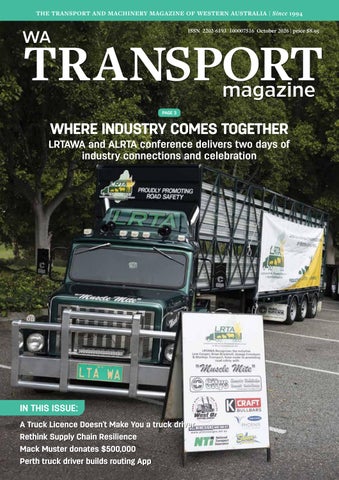
WHERE INDUSTRY COMES TOGETHER LRTAWA and ALRTA conference delivers two days of industry connections and celebration
IN THIS ISSUE: A Truck Licence Doesn't Make You a truck driver Rethink Supply Chain Resilience Mack Muster donates $500,000 Perth truck driver builds routing App
WATM • October 2026
Our Heavy Vehicle Helpdesk is available Monday to Friday. Talk to us about: Permits
Accreditation
OSOM movements
Route Assessments
Traffic Escort bookings
Compliance
The Heavy Vehicle Helpdesk is open from: 7am to 6pm Monday to Friday, and WA Public Holidays. On weekends the Main Roads Customer Information Centre will receive telephone calls on behalf of the Heavy Vehicle Helpdesk on 138 HVO (138 486) and email enquiries can be sent to hvs@mainroads.wa.gov.au
Main Roads Heavy Vehicle Services 525 Great Eastern Highway REDCLIFFE 6104
Tel: 138 486 Fax: 9475 8455 Email: hvs@mainroads.wa.gov.au www.mainroads.wa.gov.au 3 WATM • October 2021
WA
TRANSPORT
FROM THE PUBLISHER
magazine
VOLUME 32 | NUMBER 9
G
oodness me, can you believe it is already October and with the weather warming up eyes are on the Western Australia harvest with some reports showing that in certain areas it could be earlier and in others that the crops may have a lower yield. This month we have a bit of everything… As usual the LRTAWA Annual Conference, now in its 46th year was a productive event - well organised and supported. Dowerin Field Day is also covered from Kevin Toovey from the HCVC and it was interesting to come across Perth truck driver Chris Fazey who has built a purpose made routing App specifically for trucks (Page 20) and the good news is Chris is offering the basic routing App free of charge to all truck drivers. Russel Walsh (Walshy’s Perspective) is reading I think every fleet operator should
look at. The experienced truck driver’s perspective on on-board monitoring of drivers. Western Australia Truck Industry Association bring up many valid points on why Australia needs to rethink Supply Chain resilience particularly after Western Australia's multiagency resupply arrangements have demonstrated what can be achieved when government and industry work together under a coordinated framework. The challenge now is how similar principles can be applied more broadly across the nation. As always thank you to each and everyone of you who supports our home grown magazine and I love the feedback I receive each month. Thank you. Best,
Karen
Angry Chicken Publishing Pty Ltd Telephone 0430 153 273 www.angrychicken.com.au ABN: 35 486 530 095
PUBLISHER / COMMISSIONING EDITOR Karen-Maree’ Kaye T: 0430 153 273 Email: karen@angrychicken.com.au WRITERS Karen-Maree’ Kaye, Russell McKinnon CONTRIBUTORS Jan Cooper, Cam Dumesny, Cliff Graham, Lara Jensen, Carol Messenger, Ray Pratt, Russel Walsh ADVERTISING ENQUIRIES Angry Chicken Head Office T: 0430 153 273 E: karen@angrychicken.com.au DESIGN / PREPRESS Cally Browning | Bare Creative
Contents
ACCOUNTS T: 0430 153 273 E: karen@angrychicken.com.au
3.................................. LRTAWA 46th Annual Conference – Where industry comes together 7................................... Legislation introduced to progress WA freight rail buyback 8.................................. WA waste champions celebrated at 2026 WasteSorted Awards 9.................................. M ain Roads News - Heavy Vehicle Pilot updates strengthen safety, consistency and industry support A Mack Muster and Truck Show Donates $500,000 to 12............................... W
PRINTER Daniels Printing Craftsmen SUBSCRIPTIONS Subscriptions available directly from the Publisher. T: 0430 153 273 E: karen@angrychicken.com.au Australia: 1 year $130 (inc GST) Overseas subscribers: Airmail postage will be added to subscription rate.
Medical Research 13............................... Psychosocial assessment platform to close 14............................... W estern Australia Transport Industry Association - Beyond the Next
Editorial Submissions: The Publisher welcomes editorial submissions. Once received they will become the property of the Publisher who reserves the right to edit the or adjust the content to fit with the format of our publication.
Crisis: Why Australia Needs to Rethink Supply Chain Resilience alshy’s Perspective - The ‘wall’ live cameras and AI Monitoring has 17................................ W
created between management and the driver
ABN: 35 486 530 095 All rights reserved. No part of this publication may be reproduced, adapted or transmitted in any form by any process (graphic, electronic, mechanical or storage and retrieval system) or sold, resold or otherwise exploited for any purpose without consent of the Publisher.
enturion backs Purpose Energy’s $137m electric truck 18............................... C
charging network 19............................... Remember When – Fremantle Truckin 20............................. A truck routing App built by Perth truck driver 21............................... Railway Signage – Where We Are to Expect the Unexpected
Every Month 10............................... Fair Go for the Owner Driver 23............................. HCVC 24............................. Toots – Woman in a man’s world
West Australian Transport Magazine (WATM) is published by Angry Chicken Publishing Pty Ltd
Endorsed by
The publisher, contributors, editors and consultants disclaim any and all liability and responsibility to any person or party, be they a purchaser, reader, advertiser or consumer of this publication in regards to consequences and outcomes of anything done or omitted, or being in reliance whether partly or solely on the contents of this publication. No person, organization or party should rely on or on any way act upon any part of the contents of this magazine without first obtaining the advice of a fully qualified person. The Publisher shall have no responsibility for any action or omission by contributor, consultant, editor or related party for content within WATM. The opinions and content within WATM does not necessarily reflect those of the Publisher, editor or their agents. No responsibility is accepted for damage or loss of material supplied to the publisher.
WATM • October 2026 1
LRTAWA 46th Annual Conference
Where Industry Comes Together
Delegates enjoying the outside truck display
LRTAWA and ALRTA conference delivers two days of industry connections and celebration
2
WATM • October 2026
T
here are conferences, and then there are weekends that remind you why belonging to an industry association matter. The 2026 LRTAWA and ALRTA conference at Joondalup Resort on August 21 and 22 was certainly the latter. From an early start on the golf course on Friday morning to the final farewells on Saturday night, the combined Livestock and Rural Transport Association of Western Australia and Australian Livestock and Rural Transporters Association conference brought together the people who make the livestock and rural transport industry what it is. Operators, suppliers, government representatives, regulators and industry leaders travelled from across Western Australia and beyond for two days of information, discussion, networking and, importantly, a fair amount of good humour. The conference was designed around more than presentations and PowerPoints even though there were some powerful
messages shared by various speakers. It was an opportunity to reconnect with old friends, meet new people, talk business, look at the latest equipment and have the conversations that are often difficult to find time for in the day-to-day world of running a transport operation. And there was plenty to talk about. On Friday morning sponsors and members enjoyed an Ambrose Golf competition with Ross Lambrick and Bruce McAleese from NTI, Nino Violante from City Panelbeaters and Truck Repairs and Brian Spencer from Volvo taking out the honours. By Friday afternoon, attention had turned to the formal program, with Main Roads Western Australia providing an update on how operators can get maximum advantage from its mapping tool. Feedback indicated there were a few practical aspects to the system that people were previously unaware of. A practical workshop on rollover prevention and hill descent techniques,
Tim Montague, Montague Transport, Cliff Atkinson Atsure and Clayton Cowling, Volvo
Heather Jones, Healthy Heads in Sheds
Data shows “most roll overs occur from back to front”, so by the time the seat-of-pants feedback happens, the rear trailer is already gone Ben McGuire, ALRTA looks on while President Gerard Johnson recognises Jan Cooper and Sheridan Cooper’s long commitment to the LRTAWA and the ALRTA
presented by NTI Transport Research Manager Adam Gibson, provided another important reminder that safety remains at the centre of the industry's future. A key takeaway message from Adam’s presentation was to challenge the belief that experienced drivers can ‘feel an imminent roll over through the seat of their pants’. He said data shows “most roll overs occur from back to front”, so by the time the seat-of-pants feedback happens, the rear trailer is already gone. The Friday program finished with a sundowner, providing yet another opportunity for delegates to spend some money at the mini auction and catch up before the main conference got underway on Saturday.
An industry facing plenty of questions LRTAWA President Ben Sutherland officially welcomed delegates on Saturday morning. Ben briefly recapped highlights of
the previous years’ activities and concluded by drawing attention to the challenges of the next 12 months including fuel prices, possible further threats to live export and restructuring within certain sections of WA agriculture. He said it was important that associations adapt. The next generation of members is looking at associations differently to those who came before them. We need to respect the past, but we cannot allow ourselves to be defined by it. History is a foundation, not a destination. If we want younger people to join, participate and eventually take leadership roles, we need to give them a reason to see the association as relevant to their future. State Parliamentary Secretary to the Deputy Premier and Minister for Transport and Major Infrastructure, Sport and Recreation, Caitlin Collins MLA, officially opening the conference. What followed was a wide-ranging program that reflected the complexity of
modern livestock and rural transport. Wayne Crofts from Craig Mostyn Group provided an outlook for livestock markets pointing out the opportunities for livestock markets highlighting the clear relationship between GDP per capita and meat consumption. He drew attention to Bennett’s Law that observes a systematic shift as incomes rise. People eat fewer calorie-dense starchy foods and relatively more meats, oils, sweeteners, fruits, and vegetables. Main Roads WA senior representatives Des Snook and Michael Buba provided an update on matters affecting heavy vehicle operators. Changes to concessional livestock permits were canvassed as well as updates to mass and dimension limits. The tempo of presentations changed when Toby Barrie from BN Law shared his wisdom about how employers could put themselves in the best possible position if they experienced a work-related safety incident. More importantly Toby shared his map identifying the best meat pies in WATM • October 2026
3
LRTAWA 46th Annual Conference
Ben Sutherland, LRTAW president welcomes delegates
Above: Tim Mathwin, Mathwin Transport and Digby Stretch, PGA President enjoy a Scott Cumming’s joke Right: Adam Patti, TMAC enjoys a presentation
The winning golf team. Ross Lambrick NTI, Bruce McAleese NTI, Nino Violante City Panelbeaters and Truck Repairs and Brian Spencer, Volvo
Australia and asked delegates to add to the list. Head to our Facebook site if you want to contribute your recommendations. Chair of the Australian Live Exporter’s Council, Dr Chris Back encapsulated the frustration that many in the livestock industry have when challenged with outdated views when he asked, ‘why do we have to fight so hard to feed the world?’ According to Cooperative Bulk Handling Chief Operating Officer, Mick Daw the cooperative expects an average of 22mt grain by 2033. He also drew attention to the road to terminal delivery record of 8.5 million tonnes in 2026 compared to 7.1 million tonnes the previous year. There was also plenty of focus on the people behind the wheel, with sessions covering Healthy Heads in Trucks and Sheds and fuel-efficient driving. The conference concluded with former AFL footballer and media commentator Scott Cummings delivering the keynote address. Mr Cummings light hearted and honest appraisal of his career and the coaches he has worked created plenty of laughs and 4
WATM • October 2026
finished the day on the perfect note. The conference program recognised that transport operators today are dealing with much more than simply moving freight from A to B. Road access, safety, workforce issues, fuel, agricultural markets, live export, regulation, technology and the resilience of rural supply chains all have an impact on the businesses represented in the room.
The sponsors make it possible Behind every successful industry conference is a group of businesses prepared to put their hand up and support it. This year, around 45 sponsors contributed to the weekend's success. Their support was highly visible, with both indoor and outdoor product displays giving delegates the chance to inspect equipment, talk directly with suppliers and see what is changing across the transport sector. For sponsors, the conference provides something that is increasingly difficult to replicate and that is a chance to spend real time with the operators who use their products and services.
For operators, it is an opportunity to see new products, ask questions and perhaps discover something that can make their business safer, more efficient or more productive. The strength of sponsor support is also an important indication of the value placed on the livestock and rural transport sector. Perhaps the biggest demonstration of what the industry can achieve when it comes together came on Saturday night. The annual charity auction raised an extraordinary $33,000 for the Perth Children's Hospital Foundation, with the money to go towards the new children's hospice. The previous night $6000 was raised for the Harry Perkins Institute to be donated via the Mack Muster. The auction has become one of the most anticipated events of the conference, combining plenty of friendly competition with an important purpose. This year's result was a magnificent reflection of the generosity of the people and businesses within the industry. Behind every bid were people who
The Livestock & Rural Transport Association of WA
The LRTAWA greatly appreciates the support & ongoing commitment of the following sponsors at the 46th Conference.
THANK YOU TO OUR VALUED 2026 SPONSORS DIAMOND
SAPPHIRE
PEARL
Alemlube ATSURE Insurance Brokers Ausquip Industries Base Fabrications City Panel Beaters Truck Repairs CJD Trucks EVERTRANS Fuwa Khitch Haulmax Tyres Jost Australia K-Drive Michelin Australia NTS Transport Engineering Solutions RNA Fabrications Scania Australia Slims Tyre Service Bullsbrook Swan Towing Truck Art Trailers Truck Centre WA TRUCKLINE
AIR BRAKE CORPORATION
All Truck Spares BMS Risk Solutions
bp Australia
BW Truck Parts
Byrne Trailers
Capricorn
BPW Transpec Pty Ltd
Fuchs Lubricants
Global Autocoats
Lowes Petroleum
Fuel Distributors of Western Australia
Orrcon Steel
NTI
TRACTUS Australia
Great Southern Fuel Supplies
12 Volt World Albany
PACCAR & Dealer Industry Fund
NATIONAL PARTNERS
Cummins
HENDRICKSON
Power Torque Magazine
SAF Holland
Repco Commercial
V-DAQ
SPECIAL Equipment Finance Services Pty Ltd
THE VOICE OF WA RURAL TRANSPORT SINCE 1980 — PROMOTING SAFETY, PRODUCTIVITY & EFFICIENCY
08 9208 0320 | www.lrtawa.org.au
WATM • October 2026 WATM • October
5
LRTAWA 46th Annual Conference
Matt Lawrence, bp presents Steve and Nerida McWhirter with an anniversary cake recognising 50 years in business
understood that the money raised would ultimately help children and families at a very difficult time in their lives. An industry that spends much of its time talking about trucks, trailers, freight, roads and regulations showed once again that it is also prepared to look beyond itself and give back to the wider community.
Steve McWhirter, Great Southern Fuels shares a joke with Toby Barrie, BN Law
Recognising commitment Saturday night also provided the perfect opportunity to recognise long time LRTAWA supporters, Great Southern Fuels for their 50th business anniversary. Bp’s Matt Lawrence presented Steve and Nerida McWhirter with a cake fittingly emblazoned with bp, Great Southern Fuels and LRTAWA symbols. The weekend also provided a particularly significant moment for two people who have been committed to the industry over many years. Jan Cooper was recognised for 21 years of commitment to the LRTAWA, while Sheridan Cooper was recognised for eight years. Industry associations depend on people who are prepared to put in the time, build relationships, understand the history and, often, work behind the scenes to ensure the industry's voice is heard. 6
WATM • October 2026
As they move on to the next chapter, they leave behind relationships, knowledge and memories that have been built over many years.
More than a conference The real success of a conference isn't necessarily measured by the number of presentations delivered or the number of delegates sitting in a room. It is measured by what happens around the edges. The conversation over breakfast. The discussion beside a truck in the sponsor display. The operator catching up with someone they haven't seen
for 12 months. The supplier discovering what customers are really dealing with. The government representative hearing first-hand what is happening on the road. The old industry stories shared over a drink. And, occasionally, a very competitive auction bid for a very good cause. That is what makes industry conferences important. The conference may have finished, but the conversations will continue. And somewhere, no doubt, someone is already thinking about how to make next year's golf day, conference, sponsor displays and charity auction even bigger.
News
Legislation introduced to progress WA freight rail buyback
T
he State Government is introducing legislation to pave the way to bring the State’s freight rail network back into government control. While commercial negotiations with Brookfield continue to progress, the Rail Freight System (Acquisition and Reorganisation) Bill 2026 will provide the legal framework for the State Government to acquire the freight rail operation if it is economically and financially responsible to do so. As part of a major 2025 election commitment, the Cook Labor Government announced it would commence negotiations with Brookfield to return the 5,500-kilometre freight rail network to public control after it was privatised by the Liberal-National Government in 2000. The freight rail network is one of WA’s most significant strategic infrastructure assets and bringing it back into public control will ensure it can meet the needs of a growing economy and freight demand. Under the existing lease agreement, which has another 23 years to run, the State Government has little capacity to intervene to support key industries that make use of the State's freight rail network or deliver important policy objectives. Greater public control would allow for greater and more targeted government investment, and increase usage of the freight rail network, delivering significant benefits for industry, regional
communities, and the economy. Bringing the network back into public control would also better enable the rail network to meet the demand being driven by new resource projects and growth in output from the agriculture sector, supporting future WA jobs. It would also help deliver cost savings for industry through more efficient movement of commodities to and from the State’s ports. Importantly, it will help improve safety by reducing the wear and tear caused by trucks on local roads. The government will continue to undertake comprehensive legal, commercial, financial, and technical assessments before making a final decision on the buyback. Arc Infrastructure is continuing to operate the network under existing arrangements while further due diligence and negotiations to take place. Any transaction will be designed to minimise disruption to Arc’s customers and staff, with the continued safe operation of the network the priority.
Importantly, it will help improve safety by reducing the wear and tear caused by trucks on local roads
24 HR / 7 DAY ACCESS 3 MINUTE EXPRESS WASH
Tailored insurance solutions and real claims advocacy for transport and logistics operators. • • •
Industry Experience Comprehensive Cover Better Outcomes
• Road train friendly • Full chassi rinse standard • Credit card facility • Fleet accounts available
QUICK DRIVE THRU FULLY AUTOMATED TRUCK WASH www.twepicton.com.au Roadtrain / truck & dog $150 inc gst Semi $125 inc gst 6 Wheel Trucks / Bus $95 inc gst 2 Nicholson Road, East Picton T: Darren 0417 909 128 | E: info@twepicton.com.au
WATM • October 2026 7
Main Roads News
Heavy Vehicle Pilot updates strengthen safety, consistency and industry support
M
ain Roads has released a series of important updates for Heavy Vehicle Pilots, aimed at improving safety, consistency and support across the Over Size and Over Mass (OSOM) transport sector. From 1 July 2027, accredited pilots will be required to display Pilot Identification Signage on both front doors of their pilot vehicle, showing their individual pilot licence number. The updated requirements are designed to make authorised pilot vehicles easier to identify, support public confidence and improve accountability across the industry. Pilots are also reminded of the importance of clear and timely communication during OSOM movements, including the use of UHF channel 40 and the provision of regular updates to other road users to support the
safe and controlled movement of heavy vehicles on Western Australian roads. Main Roads has also updated the Heavy Vehicle Pilot Licence medical assessment process, effective 17 August 2026, to reduce duplication and provide greater flexibility for applicants and licence holders. Under the revised arrangements, existing valid commercial driver medical assessments may be accepted where they meet the required standards and remain valid for at least 12 months from the date of submission. Updated documents, including the Heavy Vehicle Pilot Licence Code of Conduct and Heavy Vehicle Pilot Licence Business Rules, can be found on the Main Roads website at ww.mainroads. wa.gov.au/heavy-vehicles/pilots/ and the Pilot Hub.
Harvest Mass Management Scheme (HMMS)
T
he HMMS was developed to assist the grain industry with the difficulties experienced loading grain from a paddock into a truck and complying with standard axle load limits. This is not a concessional loading scheme. The scheme commences each year on the first day of October and finishes on the last day of February. Grain Receivers and transport operators must comply with the HMMS Business Rules. The Order, Business Rules and Grain Receiver Registration Forms are available via the Main Roads website at www.mainroads.wa.gov.au/heavy-vehicles/ permit-order-scheme/harvest-massmanagement-scheme-hmms Throughout the season, Main Roads Heavy Vehicle Transport Inspectors will be actively monitoring compliance.
WA waste champions celebrated at 2026 WasteSorted Awards News 8
W
estern Australia’s waste leaders have been honoured at the 2026 WasteSorted Awards for initiatives supporting the State’s transition to a circular economy. The awards recognise the people who see opportunity where others see waste. They celebrate the achievements of individuals, schools, businesses, community groups and local governments leading the way in waste avoidance and the recovery of valuable resources, helping shape a more sustainable future for WA. Among the highlights at the awards was a double victory for Total Green Recycling, which won both the Business Award for expanding capacity in response to the State’s e-waste landfill ban and the discretionary 2026 WasteSorted Award for two decades’ commitment to electronic waste recovery. A $2.56 million upgrade doubled the company's recycling capacity at its Welshpool facility from 4,000 to 8,000 tonnes a year. It processed an additional 888 tonnes of material in the year following the upgrade, achieved recovery rates above 70 per cent and expanded its services to another 433 customer sites. The winners were selected by judging panels comprising industry experts, previous award recipients, and State and local government representatives. In total, 37 finalists were considered across 10 categories, with winners announced at a gala dinner on 10 September at Crown Perth attended by about 250 representatives from across government, industry, education and the community.
WATM • October 2026
2026 WasteSorted Awards winners Community Waste Award Winner: Fair Game Australia Schools Award Winner: Ashburton Drive Primary School Business Award Winner: Total Green Recycling Waste Champion Award Winner: Tony Berry, Tidy Up Waste Team Award Winner: City of Kwinana Local Government Award Winner: City of Stirling Regional Award Winner: Milligan and the City of Bunbury Community Events and Engagement Award Winner: City of Kwinana, In the Zone Circular Fashion and Pop-up Op Shop Innovation Award Winner: Edible Cutlery Closing the Loop Award Winner: Tyrecycle Discretionary WasteSorted Award Winner: Total Green Recycling
Main Roads News
It’s Show Time
H
eavy Vehicle Services (HVS) partnered with the Wheatbelt Region to represent Main Roads at the Dowerin Machinery Field Days on 26 and 27 August, which is one of WA’s largest and most iconic agricultural events. The Field Days drew thousands of visitors to explore innovations in farming, transport, and regional development. Over the two days, the team spoke with hundreds of attendees, many of whom arrived with specific questions. Topics ranged from the pilot and agricultural pilot roles, the new requirement to display a heavy vehicle pilot licence number, the Harvest Mass Management Scheme, recent changes to the national general mass limits application in WA, to route assessment applications and Restricted Access Vehicle (RAV) access upgrades, accreditation and compliance, and regional infrastructure projects. The representatives reported strong engagement and a wide scope of questions.
Everybody who visited the display left with useful information and a better understanding of heavy vehicle safety. HVS also attended other recent events including the FeNaCING Festival at Karratha on 1 and 2 August, and the Perth Boat Show during 4 to 6 September where enquiries were fielded regarding towing Over Size vessels on the road. On 4 October we will again be participating in the annual Camp Quality Convoy for children and their families facing cancer.
Australia’s No. 1 truck insurer. With more than 45 years as Australia’s leading heavy motor insurer, we know exactly what it takes to become #1. Our specialised staff and expert partners, leading Premium Repair networks, along with our awardwinning claims solutions are second to none. So talk to your broker about how NTI’s awardwinning claims solutions can protect you and your business. Because that’s what we specialise in. For more information, visit nationaltransportinsurance.com.au
Insurance products are provided by National Transport Insurance, a joint venture of the insurers Insurance Australia Limited trading as CGU Insurance ABN 11 000 016 722 AFSL 227681 and AAI Limited Trading as Vero Insurance ABN 48 005 297 807 AFSL 230859 each holding a 50% share. National Transport Insurance is administered on behalf of the insurers by its manager NTI Limited ABN 84 000 746 109 AFSL 237246.
WATM • October 2026 9
Over to you A FAIR GO FOR OWNER DRIVERS by Ray Pratt
A Truck License Doesn't Make You a Truck Driver
T
here was a time when becoming a truck driver meant more than passing a licence test, climbing into a cab and being handed a set of keys. You learnt from experienced drivers, you learnt how a loaded truck behaved, how to read the road, how to approach a corner, how to brake, how to reverse a trailer and, perhaps most importantly, when not to take a risk. You learnt because you had no choice. Your mistakes could hurt you, your truck, or somebody else but today we seem to have confused holding a truck licence with actually being a truck driver and they are not the same thing. When I was younger I learnt to drive a road grader. The foreman on our road crew said to me that anyone can drive a grader but it takes time and effort to learn to operate it. He then taught me to become a grader operator and I never forget those words as it applies to many things we do in our lives and it especially truck drivers. When I began driving trucks I used
10
WATM • October 2026
to think I was just a truck driver but as time passed I realised it was a specialised occupation requiring a lot of skill and knowledge to operate and manage heavy machinery and difficult loads especially on our busy roads. A licence proves that a person has met a particular testing requirement. It doesn't demonstrate years of experience handling a heavy combination in the real world, often carrying tens of tonnes, travelling hundreds or thousands of kilometres and sharing the road with the general public. Driving a truck safely is a skill that develops over time. Consider a road train travelling across regional Western Australia. The driver has to understand what happens when that combination is loaded differently, how it behaves on a rough road, what happens when the weather changes, how much room is required to stop and what those trailers are doing behind the cab when the road starts to twist and turn. That's not something you learn in a few hours behind the wheel.
You learn it through experience and experience matters when things go wrong. A blown tyre, a sudden obstacle, a wet road, a badly restrained load, an unexpected vehicle pulling onto the highway or a corner taken too quickly can turn an ordinary trip into a life-threatening situation within seconds. This is why the industry needs to stop looking at driver shortages simply as a numbers game. Putting more people into truck seats might solve a roster problem, but it doesn't necessarily solve a safety problem. There is a huge difference between having enough drivers and having enough ‘good driver’s’. The transport industry needs experienced people who are prepared to teach new drivers the knowledge that doesn’t appear in the handbook. They need to learn about load restraint, road conditions, fatigue, weather, night driving, country roads, tight corners, reversing and the simple art of thinking several kilometres ahead. They also need to understand that driving a heavy vehicle isn't about getting there five minutes earlier – it’s about getting there safely. The National Heavy Vehicle Regulator's new 2026 Master Code recognises that heavy-vehicle driving is a complex and changing task and that training cannot simply happen once at the beginning of a driver's career. Drivers need training appropriate to different vehicles, routes, loads, weather and working conditions. That should not be controversial. It should be common sense. Technology has made modern trucks safer. Electronic stability systems, collision avoidance, cameras, GPS and sophisticated braking systems all have an important role to play. But technology cannot replace judgement. When something unexpected happens, it is still the person sitting behind the steering wheel who has to make the decision. Perhaps the transport industry needs to stop asking, "How quickly can we get another driver into that seat?" Instead, we should be asking, "How do we make sure the person sitting in that seat is properly prepared for what can happen when the wheels start turning?" Because a truck licence gives you permission to drive a truck. It doesn't make you a truck driver experience does that. Keep it safe, Ray Pratt.
Victoria
Queensland
Western Australia
Tel - (03) 9369 0000
Tel - (07) 3372 2223
Tel - (08) 9350 6470
13-21 Bliss Court, Derrimut VIC, 3026
1/15 Seeana Place, Heathwood QLD, 4110
5 Freight Road, Kenwick WA, 6107
WATM • October 2026 11
News
WA Mack Muster and Truck Show Donates $500,000 to Medical Research
T
he WA Mack Muster and Truck Show has proudly donated another half a million dollars to the Harry Perkins Institute of Medical Research, taking the event's total contribution to cancer research to an extraordinary $1.35 million since the inaugural truck show in 2020. The donation follows the overwhelming success of the fourth event, which attracted more than 11,000 visitors and 400 trucks from across Western Australia and beyond. What began as a celebration of Australia’s trucking industry has grown into one of the state’s most successful community fundraising events for cancer research. The cheque was presented to Professor Peter Leedman AO, Chief Executive Officer, of the Harry Perkins Institute of Medical Research, recognising another remarkable year of community generosity and industry support. The achievement was made possible through the collective efforts of thousands of visitors, hundreds of volunteers, generous sponsors, exhibitors, truck owners and drivers, and businesses from across the transport, mining and construction industries. Every ticket purchased, truck registered, auction bid placed and sponsorship committed
12
WATM • October 2026
contributed directly to advancing lifesaving cancer research here in WA. Professor Peter Leedman AO said the continued partnership with the WA Mack Muster and Truck Show was making a real and lasting impact. “We are absolutely delighted that the WA Mack Muster and Truck Show has once again chosen to support medical research at the Perkins. This incredible $500,000 donation will help our researchers continue their work towards better treatments and making cancer a non-lethal disease. The commitment shown by the organisers, volunteers, sponsors and the entire trucking community is truly inspiring, and we are deeply grateful for their continued support.” The events Chairman Matt Lawrence said the donation was a milestone that belonged to everyone who had supported the event over the past six years. “To reach $1.35 million donated to cancer research is something every single person involved should be proud of. This isn’t the achievement of one person or one organisation. It belongs to every volunteer who gave up their time, every sponsor who backed our vision, every truck owner who proudly displayed their truck, every business that supported us, and every member of the public who walked through the gates.
“I’d especially like to thank our volunteer committee. They give countless hours behind the scenes throughout the year, and without their dedication this event simply wouldn’t happen. I’m incredibly proud of what we’ve achieved together. “Our industry has once again shown what it’s capable of. The trucking community has enormous heart, and together we’re helping the Harry Perkins Institute move closer to a future where cancer is no longer a lethal disease.” Founder Steven Della Bona said the event’s success had always been built on the generosity of the trucking industry and the wider community. “When we first spoke about creating a truck show that gave something meaningful back to the community, we never imagined we'd one day be celebrating $1.35 million for cancer research. That figure represents thousands of people who believed in the idea and turned up year after year to support it. “The WA trucking industry is built on hard work, mateship and generosity. This donation belongs to every driver, volunteer, sponsor and supporter who believed in the vision and helped turn it into something that’s making a real difference for families facing cancer.” While the WA Mack Muster and Truck Show has become Australia’s premier truck show and is earning recognition on the world stage, its purpose extends far beyond displaying trucks and raising funds. The event celebrates the people who keep Australia moving while introducing children and families to the transport industry in a safe, family-friendly environment. From climbing into trucks and meeting drivers to enjoying interactive displays, rides and activities, thousands of young West Australians experience the industry firsthand each year. Often described as the “Royal Show of Trucking,” the event showcases the pride, innovation and professionalism of the transport industry while inspiring future drivers, mechanics, technicians and transport professionals. The organisers are equally passionate about changing the way the community sees truck drivers. A simple arm pump from the side of the road can brighten a driver’s day, reminding them they are valued and appreciated. By creating positive connections between families and the transport industry, the event hopes to contribute to better mental health and wellbeing for those who spend countless hours behind the wheel keeping Australia supplied.
News
Psychosocial assessment platform to close
A
ustralian organisations face a new challenge in managing psychosocial risk after the Federal Government confirmed it will retire the country's most widely used workplace psychosocial assessment platform, just months after strengthened workplace health and safety obligations took effect. Since 1 July, Australian organisations have been expected to demonstrate how they identify, assess, control and review psychosocial hazards under strengthened workplace health and safety requirements. The People at Work survey – the free, government-backed assessment platform used by around 5,000 organisations and more than 160,000 workers since 2020 – will permanently close on 2 October. Developed jointly by Safe Work Australia and state and territory regulators, the platform played an important role in bringing psychosocial risk into the mainstream of Australian workplaces. Its retirement, however, leaves organisations facing a higher legal bar while losing one of the most widely used tools for understanding psychosocial hazards. One of Australia's leading researchers in organisational culture and psychosocial risk, Dr Anna Kiaos, said many organisations are still working through what the strengthened workplace health and safety framework means in practice. “Since these changes came into effect, the conversations I'm having with boards and executives have changed noticeably,” Dr Kiaos said. “Organisations aren't asking whether psychosocial
risk matters anymore. They're asking how they demonstrate they're managing it, what evidence regulators expect to see and whether the systems they've relied on until now are still sufficient.” Regulators have made clear that psychosocial risk management is no longer a point-in-time survey exercise. Organisations are expected to identify, assess, control and review psychosocial hazards on an ongoing basis, while maintaining evidence of the actions they have taken. It was this gap between measuring employee sentiment and understanding psychosocial risk that led Dr Kiaos to develop the Culture Pressure Map™, an organisational diagnostic informed by her research. Unlike traditional organisation-wide surveys, the diagnostic examines shared culture, subcultures and microcultures to identify where psychosocial pressure is accumulating, helping leaders prioritise action and create documented evidence to support governance and regulatory compliance. “The retirement of the People at Work survey marks the end of one chapter in how organisations think about psychosocial risk,” Dr Kiaos said. “The next chapter is about demonstrating action. This is increasingly becoming a boardroom conversation rather than simply an HR conversation, as organisations treat psychosocial risk as part of enterprise risk management.” Organisations can find out more at www.culturepressuremap.com
DOES YOUR SUPER FUND HAVE YOUR BACK? Partner with Australia’s top specialist fund for transport, energy and mining workers today.
Talk to us about super, pension, insurance and financial advice.
13 64 63 teamsuper.com
Issued by Team Super Pty Ltd ABN 70 003 566 989 AFS licence 246864 trustee for the Team Superannuation Fund ABN 16 457 520 308. Refer to the PDS and TMDs on our website at teamsuper.com when considering if our financial products are right for you. Financial planning services are provided by Team Super Financial Advice a trading name of Team Super Services Pty Ltd ABN 49 051 315 014 AFS licence 502700. Past investment performance isn’t necessarily an indication of future performance. Zenith CW Pty Ltd ABN 20 639 121 403 AFSL 226872/AFS Rep No. 1280401 Chant West Awards issued May 2026 are solely statements of opinion and not a recommendation in relation to making any investment decisions. Awards are current for 12 months and subject to change at any time. Awards for previous years are for historical purposes only. Full details on Chant West Awards at chantwest.com.au/fund-awards/about-the-awards
WATM • October 2026 13
Over to you WESTERN AUSTRALIA TRANSPORT INDUSTRY ASSOCIATION By Natalie Grinceri
Beyond the Next Crisis: Why Australia Needs to Rethink Supply Chain Resilience
T
he average Australian doesn't spend much time thinking about supply chains. Goods arrive at supermarkets, fuel appears at service stations, and deliveries show up at the front door as expected. It’s only when something goes wrong that we notice how much our daily lives depend on complex networks of transport, logistics and distribution. Over the past few years, Australia has experienced no shortage of disruptions. The COVID pandemic, fuel supply concerns, flooding, bushfires and major road and rail outages have all tested the resilience of the nation's supply chains. While some events captured public attention, many of the most significant challenges unfolded largely behind the scenes. The good news is that Australia has often responded remarkably well. The question is whether we're ready for the next crisis.
The Supply Chains You Don’t See The ‘toilet paper shortage’ of 2020 became an iconic symbol of supply chain disruption. Empty supermarket shelves sparked headlines and public concern, but in reality, it was just one visible part of a much bigger picture. Across the country, industry operators, 14
WATM • October 2026
transport companies, emergency services and government agencies were working around the clock to keep freight moving and critical supplies flowing. Many of those efforts succeeded because experienced people picked up the phone, shared information and collaborated to solve problems quickly. Relationships, trust and practical decisionmaking became some of Australia's most valuable assets during times of disruption. But while that approach works in the heat of a crisis, it isn't a long-term strategy.
Too Many Players, Not Enough Coordination One of the challenges facing Australia’s supply chain sector is the number of departments, agencies and organisations involved in managing disruptions. Transport, infrastructure, emergency management, freight, industry and supply chain resilience all sit across different levels of government and multiple agencies. Each has an important role, but when a major disruption occurs, navigating who is responsible for what can become complicated. The result can be duplication, competing priorities and delayed decisionmaking at a time when speed and coordination are essential.
People working across the logistics sector have seen firsthand how difficult it can be to bring together all the stakeholders needed to respond to a fast-moving event. Often, success depends less on organisational structures and more on the willingness of individuals to work collaboratively and find solutions.
Lessons from the Past Australia has faced similar challenges before. More than fifty years ago, significant reforms transformed how Defence was organised. Separate structures were brought together under a unified framework to improve coordination, accountability and the efficient use of resources. The driving force behind those reforms was the recognition that fragmented systems struggle when dealing with complex national challenges. Many of the same themes can be seen today across supply chains and logistics. Multiple organisations are working toward the same outcome, but often without a single authority responsible for directing and coordinating the overall effort. As supply chains become more interconnected and disruptions become more frequent, that fragmentation becomes increasingly difficult to manage.
Preparing for a Different Future The risks facing Australia's supply chains are changing. Geopolitical tensions, climate-related disasters, cyber threats and global economic uncertainty all have the potential to affect the movement of goods across the country. At the same time, the freight and logistics sector is being asked to improve productivity, reduce emissions and support greater sovereign manufacturing capability. These challenges are not separate issues. They are all connected through the supply chains that support Australia's economy and communities. A disruption to one part of the network can quickly create consequences elsewhere. That's why resilience can no longer be viewed as simply a transport or logistics issue. It is increasingly an economic, security and national capability issue as well.
A Case for National Leadership As future disruptions become more complex, there is a growing argument for stronger coordination and clearer accountability across Australia's supply chain sector. A more integrated national approach
could improve visibility across critical supply chains, support faster decisionmaking during emergencies and help align investments in infrastructure, resilience and productivity. It would also provide a stronger foundation for supporting sovereign manufacturing and broader national security objectives. Western Australia’s multi-agency resupply arrangements demonstrate what can be achieved when government and industry work together under a coordinated framework. The challenge now is how similar principles can be applied more broadly across the nation.
Looking Ahead Australia has consistently shown it can rise to the challenge during times of disruption. The dedication of people working across transport, logistics, emergency services and government has helped keep the country moving through some extraordinarily difficult circumstances. However, resilience should not depend solely on informal networks and individual effort. The next major supply chain disruption is coming, whether through extreme
Western Australia’s multi-agency resupply arrangements demonstrate what can be achieved when government and industry work together under a coordinated framework. The challenge now is how similar principles can be applied more broadly across the nation weather, global instability or another unforeseen event. The opportunity now is to learn from recent experience and build a more coordinated, nationally integrated approach before that next crisis arrives. Because when the pressure is on, resilience isn’t just about responding well. It’s about being prepared in the first place.
WATM • October 2026 15
Over to you
Let me introduce myself.
Walshy's PERSPECTIVE
My name is Russel Walsh. I have been in and around trucks for around 40 years. My driving career started at 20 in the town where I grew up, Mukinbudin and over the years I’ve owned, driven and fixed a couple of trucks. I did a cert IV as a heavy commercial vehicle mechanic later in life and managed a large private fleet workshop. I’ve carted most types of freight including livestock, end tippers Ag cartage to side tippers on ore jobs in Leonora, Groote Eylandt, The Granites and Bootu Creek plus some general and refrigerated and now fuel to throw into the mix.
The ‘wall’ live cameras and AI Monitoring has created between management and the driver
I
have driven with the Guardian Seeing eye retina cameras for some time now and it has saved me from the odd fatigue event. This system targets fatigue by monitoring your eyes for signs of fatigue, or if your eyes are looking away from the windscreen for too long. You generally get a chirp as a warning, followed by another chirp and a vibration of the seat. These events are recorded and then viewed by a third party. In a genuine event the employer is alerted and, if required, a message or phone call follows, along with a request to pull up for a break at the next opportunity. They are not fool proof and occasionally go off if you squint your eyes or laugh and these events are not usually elevated by the third party. I have also driven with multiple camera systems, including one forward-facing camera, two rearward-facing cameras and a driver-facing camera. Apart from the driverfacing camera, these older systems were good as they covered everyone’s arse in the case of an ‘other vehicle at fault’ incident. The evidence is stored on a SD card from the camera and is invaluable in shutting the door on lengthy court cases however, it also implicates the driver if they were at fault. The downside is SD cards can get damaged or lost and the system and adjustment of internal camera’s needs constant surveillance. I believe all that is needed are the external cameras and I am absolutely against driver-facing cameras because the area of what is deemed legal and illegal is
16
WATM • October 2026
‘grey’ now that simply eating a sandwich or having a drink can be classified as distraction and multi-tasking. The other reason is that truck cabin is my home where I eat and sleep so where is the invasion of privacy line drawn? There are too many grey areas with live driver facing cameras for me to accept so I simply refuse to drive with them. Now enter the MTData 7000AI camera system. This was the game changer forcing me to give notice and leave a job that I enjoyed. This system is extremely invasive and left far too many questions and grey areas for me and not enough information or tutorials on what the system is truly capable of. Let’s tackle the Seeing eye Machines AI retina camera on the MTData 7000AI. I will do my best to explain how it works and its capabilities. Unlike the basic Guardian system that was designed for recognising fatigue it is AI-driven and learns your behavioural patterns. It doesn’t just look for fatigue events; it also recognises seat belts, phones, distraction and multi-tasking. And this is the kicker… It has 1TB of storage in the in-truck system and stores events to the cloud via Hawkeye software when in mobile phone service. It can also be live via systems such as Starlink. It has the ability to voice record and conduct live feeds to the employer or manager who have to go through a series of permissions. This system set off my alarm bells and need for answers concerning the number of events it was recording daily - my seat would vibrate up to 20 times a day. I was doing my job and looking out the windscreen and I had it cycle continuously for about an hour a few times with the seat vibrating every 3 or 4 minutes. This did my head in so I parked up and shut the truck down and started googling unsuccessfully for information to educate myself as to ‘why’ it was recording an event, where was this event being sent, where was the data being stored, who could view it, had it voice-recorded me, was I being recorded live via the Hawk eye software, is it building a history of non-compliance against me and could this data be used against me in the case of an incident? So many questions I could not get answers for. I was infuriated my employer had not tutored or let me know about this new system so I started researching and what I found out disturbed me to the point that I
There are too many grey areas with live driver facing cameras for me to accept so I simply refuse to drive with them lost my professional trust and faith in my employer and decided to move on. This technology has taken invasion of privacy too far and I deserved to be told the truth so I could make an informed decision of accepting it or not. If a company is going to expect a driver to drive with these invasive systems, the least they can do is provide the driver with education on how they work and what settings are operating. Now, we know that 70 to 80 per cent of heavy-vehicle-versus-light-vehicle fatal crashes are caused by the light vehicle. NTI data is a good source and their older data suggests that figure is around 93 per cent for non-fatal interactions caused by light vehicles so rarely is the truck driver at fault. So, I ask, why are they going after truck drivers given these statistics?
Let’s create a scenario… A truck driver has the MTData 7000AI system monitoring them. They are having a drink while driving which is classified as distraction and multitasking by these new cameras, and the system records the event. A light vehicle crosses the white line and hits the truck head-on, killing the light vehicle driver instantly. The police view the footage and say the truck driver was distracted. The truck driver is not in the wrong because the cameras will show that the truck was in its lane and the light vehicle driver wasn’t. But… The truck driver was technically distracted when the incident happened, according to the footage. This potentially leaves an opening for the insurance company if they wish to pursue it. What has become a focus for the authorities – distraction which can also be classified as multi-tasking potentially impacting the truck driver with being sued for the cost of recovery and repairs to the truck. It could cost the truck driver their house and life’s work with these new camera systems and what’s frightening is this has already happened several times.
Another problem I have is ‘who’ is watching the truck driver live? What is their state of mind, or do they have a personal agenda? So, who still wants to drive a truck in Australia with this sort of invasive crap going on? Chain of Responsibility laws and insurance have forced management and companies to push these systems down the chain to the most important people in their business – the drivers. For years, drivers copped the blame for everything that went wrong while management wriggled their way out of it. Then came COR where management were held accountable for their drivers’ actions and accidents. A few court cases later, and management have implemented a load of policies, did some basic training that drivers had to sign off on and introduced these invasive camera systems to put the driver back in the firing line. Now industry is scratching its head wondering why it cannot retain older, experienced drivers and cannot attract new, younger drivers. Instead of trying to fix the problem and looking after their experienced older drivers many have chosen to exploit foreign drivers or those on student visas - people who are desperate for a job and happy to take the risk to make a dollar. If they stuff up they can jump on a plane and disappear. If that is not exploitation, then I’m buggered if I know what is?
So Where Do We Go From Here? The job is simple - you load freight or product, transport it and unload it. What is difficult is the overcomplication by a huge number of seat polishers in flash offices who try desperately to justify their positions by creating more stupid regulations and compliance. Perhaps if we kicked these ‘muppets’ into truck seats, we could solve the driver shortage problem and get rid of this giant pile of crap stopping us from doing our job and enjoying it. Cheers, Walshy WATM • October 2026 17
News
Centurion backs Purpose Energy’s $137m electric truck charging network
L
ogistics operator Centurion has backed a proposed network of battery electric truck charging hubs between Perth and Bunbury, in a significant step towards electrifying Western Australia’s heavy freight sector. The network is being developed by Purpose Energy, the integrated Western Australian energy company formerly known as Wind With Purpose. The business unit, known as Purpose Charging, is developing WA’s first integrated heavy freight charging network, with an initial proposal comprising three 12-bay heavy vehicle charging hubs at Rockingham, Forrestfield and Picton, together with two battery swapping stations along this major industrial freight corridor. When completed, the network will represent an estimated $137 million investment. Centurion will work with Purpose Energy to assess charging requirements, fleet demand and the potential integration of the hubs into its logistics network. “Scaling up electric trucks and battery swapping is a key part of our energy transition strategy. Exploring partnership opportunities with Purpose Energy allows us to work towards the sustainable infrastructure required to turn this strategy into reality,” said Hamish McHaffie, Group Manager Corporate Affairs and Sustainability, CFC Group and Centurion. Purpose Energy founder and Managing Director Chris Kearney said the move into freight electrification was a natural extension of the company’s founding approach to energy development. “We started with a clear conviction that renewable energy needed to be designed around the needs of industry, rather than asking industry to adapt to whatever generation was available,” Mr Kearney said. “It isn’t simply about putting electric trucks on the road. You need the vehicles, charging and battery technology, energy supply, infrastructure and customer demand to work together.” Purpose Energy has also entered into a Memorandum of Understanding with global equipment manufacturer SANY to explore the deployment of electric trucks, battery swapping technology and charging infrastructure in the State. Under the non-binding agreement, the two companies will assess suitable SANY electric truck models against WA fleet requirements, investigate road access and regulatory requirements, and evaluate the integration of SANY’s charging and battery
18
WATM • October 2026
swapping technology with the Purpose Charging network. Stanley Choi, SANY Senior Key Account Manager, said the collaboration marked an exciting step towards greater heavy vehicle electrification in WA. “WA is a strategically important market for SANY, with significant potential for fleet electrification across mining, ports, road transport, sanitation and other heavy-duty applications,” Mr Choi said. “Through our partnership with Purpose Energy, we look forward to combining global capability with local expertise to support WA’s transition towards cleaner and more efficient operations.” Mr Kearney said heavy freight electrification would create significant new electricity demand and require energy and transport infrastructure to be planned together. “Electric freight has the potential to become a major new source of industrial electricity demand in WA, but it will only scale if the vehicles, infrastructure and energy supply are developed as one system,” Mr Kearney said. Purpose Charging is one of three core business areas now being progressed by the company alongside Purpose Wind and Purpose Baseload. Purpose Wind will continue to progress the Marradong Wind Farm near Boddington, part of the company’s broader Southern Scarp renewable energy portfolio. Marradong is proposed to exceed 300MW and reflects Purpose Energy’s continued commitment to developing large-scale renewable generation for WA industry. Purpose Baseload will focus on reliable, dispatchable energy supply for industrial and charging demand, complementing renewable generation and providing the firm energy needed to support industrial operations and emerging loads such as heavy vehicle charging. Together, the three business areas reflect the company’s evolution beyond wind and have driven the transition from Wind With Purpose to Purpose Energy. “Wind remains a core part of our business, but the energy transition requires more than renewable generation alone,” Mr Kearney said. “Purpose Energy better reflects the business we are building: connecting generation, reliable energy supply and electrification to solve real energy challenges for industry. “That’s what Purpose Energy is about: powering industry and powering communities.”
History
ER
IN G
TIM
T WES
ES
Remember When ... N
AU CK STR U R A L I AN T
By ROD SIMMONDS
Fremantle Truckin’
T
he Fremantle Port was developed from an exposed river mouth into an artificial harbor by engineer C.Y. O'Connor and officially opened on May 4, 1897. It quickly surpassed Albany as Western Australia's premier port, serving a vital and strategic role in World War II and expanding into the modern container and bulk shipping thereafter. Victoria Quay initially handled most break-bulk cargo, while North Quay transformed into the primary container handling zone starting in 1969. Bulk cargo operations expanded into the Outer Harbour at Kwinana to handle grain, chemicals, petro and the growing minerals base. In 1897, Fremantle recorded a total of 474 ship visits. Of these, 127 were sailing vessels and the remainder were classified steam and sail. The gross tonnage of these vessels was about 550,000 tonnes. Today, The Fremantle Port Authority has the Inner Harbour handling multiple huge
container ships and vehicle carriers, general cargo ships, livestock vessels, tankers, cruise liners and visiting naval vessels from around the world. In 2017-18, the total number of ship visits (commercial and non-trading) handled by Fremantle Port was 1,807 plus 31 naval ship calls. The total estimated tonnage was near 72 million tonnes. The importance to the local WA economy and greater Australian economy cannot be understated and of course the constant flow of products that come and go by trucks. Double trailers, B Doubles and empty boxes are moved like a well-oiled machine with trucks of all makes, shapes and configurations. Hauling Container doubles was happening some 20years before the East Coast Ports! My brief visit over 20 year ago showed the variety of operators and their trucks working hard to keep the constant movement of freight on track. WATM • October 2026 19
Products
A truck routing app built by Perth Truck Driver
O
ur hats off to Perth based truck driver Chris Fazey who from using general navigation Apps on Western Australian roads found they were more of a hindrance than a help if you were in a truck with a load so he developed a specific Truck friendly navigation App called TruckMate. “General navigation Apps are fine for cars but if you are in a truck they can route you somewhere you can’t legally or physically go, and by the time a sign tells you – you are committed with nowhere to turn,” says Chris. “This is exactly what happened to me and was the reason I built TruckMate. I was on a Harvey run in a single semi loaded with gas weighing 45 tonnes when Google Maps sent me down a back road and half way along there was a 11 tonne maximum load bridge. Obviously, I needed to turn around and the road was barely wide enough and there was no verge so I crawled along looking for a driveway, an open gate, a paddock, anything in order to turn around with no luck. Hazards on and I ended up reversing a good kilometre back up that road to a driveway I'd spotted on the map, turned around, and went looking for
20
WATM • October 2026
another way in,” explains Chris. “General navigation Apps have no idea what you're towing, your height, width or anything else and I built TruckMate to route a truck as a truck. It works off your rig's real height, width and RAV level, warns you about low clearances, bridges, steep grades before you reach them and carries the live Main Roads WA hazard feed for closures, roadworks and floodwater. It finds fuel and rest stops a heavy vehicle can get into and watches your work and rest hours to nudge you before you run out. “It is not an approved EWD and I don't pretend otherwise, you still keep your book and if you have a serious impact, it texts your location to your emergency contacts. Chris has been truck driving for close to six years, a year in rigids, a year in semis and road trains and the like ever since. “I didn't come into truck driving the usual way - I did engineering at University, then worked in security and when COVID hit, I landed a gig on a gatehouse checking truck drivers in and out and after watching them I thought I could do that {truck driving}, so I did. The TruckMate App is Australia wide and Chris is keen to get it into as many cabs
as possible so for owner operators or fleet drivers the routing is free. He then has Driver Pro for $8.99 a month which has the full fatigue and permit tools, offline maps for no-signal areas and you can try that free for two weeks. For fleets there's a manager's portal from $19 a seat with live positions off the drivers' phones and that includes Chain of Responsibility records ready for an audit. Chris started thinking of this App a year ago and started building in in June this year when he was recovering from an injury and had the time for twelve-hour days on a computer. “I can read code well enough to know what I'm looking at, but I built it alongside AI tools, which is the only reason one bloke could do it at all. “Going from an idea to an actual App is a strange ride. At the start it doesn't look like anything, so you keep going on faith and seeing the first working version live on your phone is a great feeling. Then comes the back end — account after account with the App stores and the services it runs on, getting every piece talking to the others, and spending money hoping it isn't wasted. The TruckMate App went live on Android in July and on iPhone a few weeks later. “And now the genuinely hard part; getting it into the hands of drivers who need it so I reached out to WA Transport Magazine,” finishes Chris. TruckMate is built in Perth by Mateship Labs. Find it on Google Play and the App Store, or atmateshiplabs.com.au/truckmate.
Fighting Rail Safety Reform
Railway Signage – Where We Are to Expect the Unexpected
R
oad users should not be expected to compensate for failures in railway signage and infrastructure management. Industry advertising tells us to “expect the unexpected” when approaching railway crossings. But what happens when the signage itself creates uncertainty? Too much signage, too little signage, incorrect signage, damaged signs or signs that no longer serve a purpose can all contribute to complacency and reduce the respect road users have for railway warnings. If road users are to be given every opportunity to recognise and respond to a railway crossing, the signage and signalling must be accurate, visible and fit for purpose. AS 1742.7:2016, Manual of Uniform Traffic Control Devices – Part 7: Railway Crossings, sets out requirements for railway crossing signage and traffic control devices. Yet travelling through regional Australia, it is not uncommon to encounter signage and signals that appear outdated, damaged, disconnected or no longer relevant. The issue becomes particularly concerning where railway lines are no longer in use. Over the past eight years, much of my
reasonably rely on the traffic control devices provided to them. At an active crossing, the presence of flashing lights, boom gates and warning signs provides a clear message. At passive crossings, drivers may encounter stop or give-way controls. These are different control environments and require drivers to respond accordingly. The problem arises when the physical environment and the signage no longer tell the same story. A disused railway line displaying railway crossing controls can condition road users to disregard the warning because, repeatedly, nothing happens. That creates a dangerous precedent for the next crossing—and particularly for a crossing that is active. The answer is not simply to tell road users to “take more care”.
The system itself must be managed. Rail operators and rail infrastructure managers are required to have a Safety Management System, including processes for identifying and managing risks and reviewing the effectiveness of
The problem arises when the physical environment and the signage no longer tell the same story travel throughout Australia has involved working, living and travelling through regional areas, including extensive work within agriculture. During the past twelve months, travelling from the Midwest through to the South West of Western Australia, I have observed numerous disused railway lines where railway crossing signs and signals remain in place despite the tracks no longer being operational. Some crossings still display warning signs and signals, while the railway corridor has been reclaimed, overgrown or, in some cases, the railway itself has disappeared.
What message does this send to the road user? We tell drivers to expect the unexpected, but a driver should also be able to
those arrangements. That raises an important question: are railway crossing controls being regularly reviewed to ensure they remain appropriate, functional and compliant? Removing redundant signage from disused railway lines is a relatively simple starting point. Updating incorrect signage, maintaining functioning signals and ensuring controls accurately reflect the railway environment are equally important. “Expect the unexpected” should never become an excuse for accepting signage that is incorrect, obsolete or misleading. Road and rail safety is a shared responsibility– but road users must be given the right information to make the right decision.
By BRONWYN FALCONER
Bronwyn Falconer is an experienced HSEQ Consultant specialising in safety, risk and compliance management systems across the agriculture, mining and transport industries. With nearly three decades of experience in these industries, Bronwyn brings a practical, systemsbased approach to understanding and managing risk. Her experience extends beyond the systems, with extensive travel and working throughout regional Australia over the last eight years providing firsthand and lived experiences, exposure to the challenges faced by agricultural, transport, mining and regional businesses. Bronwyn works with organisations to develop practical management systems that support safe, productive and sustainable operations. Her approach is focused on more than compliance—she believes management systems should be integrated into the way a business actually operates. Bronwyn’s focus pertains to the relationship between risk, people, systems and operational decisionmaking, and in challenging whether existing controls genuinely provide the protection they are intended to deliver.
WATM • October 2026 21
Over to you Hills Concrete truck loaded with a concrete tank
A line up of old Chamberlain tractors
The oldest of the trucks, some are over 100 years old
Dodge power wagon
The Dowerin Field Days By KEVIN TOOVEY
F
arming and machinery have come a long way since the first Dowerin field day event was held in 1964. 62 years on, and more than 18,000 people attended this year’s event over the two days. A wet and cold second day didn’t appear to deter people from coming along. Big new machines were showcased all over the grounds, many of them with price tags of over a million dollars. Everything needed for farming was on display. Technology is very advanced now with robotic sprayers and high-capacity drones doing the work while the operator commands them from a distance. The HCVC had a good roll up of
22
WATM • October 2026
members and we parked our trucks next to the old tractors and machinery that Tracmach had on display. This year Tacmach featured 80 years of the nice dark blue Fordson E27N tractors. I counted twelve of them in the line up from fully restored to still in working condition. Also on display was a firefighting timeline from days of the Furphy water cart to modern all-wheel drive units that farmers now use. Our club makes a camping weekend out of the field days. We drive the trucks there and enjoy the evenings around the campfire. It is a very enjoyable few days away.
Flexible draper front on a New Holland Harvester
New Kenworths on display
Furphy water carts with fire trucks in the background
Bedford and Ford trucks
Bedford and Isuzu fire trucks Old International, Acremaster and Steiger 4WD tractors
The Fordson E27N tractors lined up
Mack and 6 wheel drive AM General fire truck
Three internationals surrounding a white Dodge
HCVC members having a chat
WATM • October 2026 23
History
A B O O K B Y D O N N A VAW D R E Y
TOOTS
– Woman in a Man's World Follow the inspiring and at times devastating journey through Toots Holzheimer’s life. Australia’s most recognised truck driver battling non-existent roads and no telephones from the 1960s to 1990s. • To purchase Toots’ inspiring book and merchandise visit toots-thebook.com.au •
W
orking in a dairy meant that Ron left for work extremely early each morning. Winter was bitterly cold so daily chores included chopping and storing firewood. Unfortunately, when her back was turned Ricky picked up the axe and dropped it on his foot, almost slicing his foot in half. Wrapping a towel around his foot and yelling at the rest of the kids to get in the car, Toots rushed him to the hospital where they stitched and bandaged his foot. Desperately wanting some family time, Toots travelled to Cairns to visit her sister Quintice, who was living in Redlynch. So that they could chat without having children jumping all over them, Quintice gave JB some money and told him to take his three sisters and two cousins, Rhonda and Marilyn, to the shop just around the corner and buy everyone an ice-cream and to bring one back for Ricky. Toots’ children were elated at the thought of an ice-cream. Never before had they been given money to spend on such a luxury. They skipped and giggled as they headed to the shop unaware of what was about to unfold. No-one knew that Dinghy had found out that Toots would be visiting her sister that day. He had borrowed a 4WD and was waiting near the shop. With the help of his mother and brother, Dinghy snatched the three girls and drove off. Terrified, JB ran back to Aunty Quintice’s house and told his mother. His cousins, Rhonda and Marilyn were close behind, tears streaming down their cheeks. Ice-creams had been forgotten. Toots was heart-broken. She had lost her three precious little girls. But worse was to come. It was not long after this that Dinghy managed to steal JB and Ricky in a similar fashion. Toots was devastated, frustrated and angry and determined to get her children back. Her sister and Ron’s brothers all urged her to forget the past and move forward, to start afresh. Toots never gave up trying to get custody of her children but as each day passed so did her hope. Her fears were realised in 1962, when to her dismay Dinghy gained custody of all five children, even his step-son JB. Toots was denied visitation rights and she did not have the money to fight the court order. She was deemed an unfit mother as she had no fixed address and was guilty of committing bigamy. Her stolen children grew up believing they were not wanted or loved. They endured a series of their father’s mistresses and many
24
WATM • October 2026
house maids and finally a step-mother who did not want or love them. Toots vowed to have her children back under her wing again by the time they turned 16. She succeeded, aided by the early death of Dinghy on the 24th of August 1972. Toots lamented the loss of her children and was angry with Dinghy for refusing to sign the divorce papers. But Toots was never one to wallow in self-pity. She accepted the cards she was dealt in life and although sometimes wishing things were different, she was focussed on the future, not on the past. Ron tried to console Toots as best he could. Whenever possible he took her camping and swimming, something they enjoyed with Ron’s brothers and their families. Ron’s brother John was very particular and would travel to the camping spot a day or two before the others to set up. First he would mow the grass then set up a number of tents using the tarps off the trucks. The main tent was the kitchen where he would set up two very large eskies to hold the food and the beer and some special treats, like ice-cream, for the children. He carefully selected toilet sites and dug the holes, placing toilet paper conveniently close by. Lights would be set up so that when everyone arrived all they had to do was select their tent and unpack. John took enormous pride in setting up camp, something he never tired of doing up until his death in 2008.
This space could be yours
The Livestock and Rural Transport Association of Western Australia (Inc) is the only transport association in WA specifically representing rural transporters. We are a strong voice for rural WA, ensuring that policy decisions support the viability and safety of rural transporters, primary industry and the communities they service.
for only $225 + gst per edition.
Members of the Management Committee are hands on business people, most of whom would drive a truck weekly and travel on nearly every road in WA’s 150,000 km road network in the course of a year. This close proximity between transporting operations and the advisory role means that representatives of the Association are at the coal face and as such are able to provide that all too rare practical hands on advice in committees, consultative forums and meetings.
Book for six editions and we will extend a full page of editorial on your business.
MEMBERSHIP ENQUIRIES Ph 08 9208 0320 or email admin@lrtawa.org.au www.lrtawa.org.au
To secure it please email karen@angrychicken.com.au
ON THE ROAD TRUCKS
Midlan
F = food
rook O Cranb O Albany
& drink.
Border Village Eucla O O
t/o
T.S
Hills
Wogarno Meeline Park Iowna Jumbulyer Hills BP Mt Magne t Roadhouse
Wandarrie
East
609 617
624
Park Hills
Kirkalocka Cooloaloo
Swagman
Both
606
T = toilets.
Narndee Cooladar
Gravel Pit
Mt Magne
Fu
t Creek
Fu.T.S
Mt Magne
571
pO Manjimu
Norsem
an O
O Lake King horpe Ravenst O O ce Esperan ning
O Katan
hO
Fu = fuel.
Perth
s:
Paynes Find Thundelarra Pass Oudabunna
West East
T.
Hills
Mt Eden
West
East
Shelter
t/o
Mt Gibson Mt Single
ton
West
West East West
553
O Bunbury nO Busselto
service
Mandura
ton
orlie O Kalgo alda O O Kamb die Coolgar
O Laver O Leonora
n
LeinsterO Key to
502 522 524
Shelter Shelter
Park
Ninghan Nyounda
West
East
548 551 552
t Roadhouse
t/o
Austin Towns
West
Lake Austin
West
Mainland
West
ite ( Ute Park
8.6m
)
Station
Dairy Flat
S = shower
s.
A = accomm
odation
. W= worksh
op
11:13 AM
Exmouth
Coral Bay
Australia. PRE-ORDER A HARDcopies COPYleft POSTED TO YOU Hurry Limited Last published in 2010 (note, no updates – this is a reprint only), On the Road – Trucks gives you the distances (pegs) Only $30 plus postage 22/11/10
3 On the
On the
Road Trucks
5
Road Trucks
22/11/10
OTR 2010
e
Fu.F.T.S Wubin
Mt Harry
East West
484
New Norcia
O Merredin
Souther Cross O
O
arra O dd 5
Mt Magnet
Meekath rvon O Carna
O
O
Final.in
Mullewa O nO Geraldto O Dongara O Wubin
an O Newm
O Marbl Bar
Tom Price O O doo Parabur O Onslow
Karratha O
Wubin Dalwallinu Pithara Miling Walebing
Mt Gibson
East West East
478
NORTH
on Warburt O
O Telfer
e
Port Hedland O
407 420 438
r
Fu.F.T.S.Phon
Wubin
The Wells
West East East
446 463
95
a O Pithar Moora OO Bindoon
orough
O Maryb
chydore O Maroo ngo O Miles O Nana O Caboolture O Roma ne Dalby O Brisba h mba O O Ipswic Toowooan Heads Millmerr O O Tweed OSt George Warwick O a OO Ballin Lismore indi O U¿HOG Goondiw O 7HQWH O Hebel O Moree O Innes O Grafton Glen Harbour O Coffs OWalgett bri O Narra Bourke O Pedy orth O Tamw O Coober rie O Port Macqua an O Coonanarabr dra ia NynganO O Gilganunedoo Wilcann ellbrook O Musw O era ne O O OD O Woom astle Narromi n O Newc Dubbo O O Singleto Broken Hill O Mudgee w Yunta O Lithgo O O O Ceduna O Forbes O Sydney O rough Bathurst Port Augusta Peterbo O O O Port O Burra O Goulburn ld Wyalong Wudinna Pirie k Balrana Wagga O Renmar O O Hay Wagga Elliston O O era O Canberra r O Narrand Swan Hill ans O Gawle O O Batem roo Tumut O Port Lincoln Bay O Pinna OHopetoun AdelaideO al O Tocumw a O Albury O O Coom Murray Bridge Keith Bordertown O Shepparton O OO Wangaratta Corryong O Hoesham O O Mallacoota Kingston rne Melbou dale O Bairns O O rO Sale Mt Gambie O Geelong Portland O bool Warrnam
ndo
nO
ulla O
Barringu
Cunnam
lla O Augathe O Charleville
ra
O Marla
Springs
O Alice
Kirkalocka
Wydge e Oudab unna Paynes Find
Tennant
eO
337 357
402
Goodlands
West East
370 386 398
t
Iona
O Kulge
O Mackay
ont
ampton od Westwo O Rockh tone O O O Glads Emerald a O Biloel re O
O Clerm
O Belya
Springsu O
Blackall
ville O Towns
ne
Barcaldi ch O O
O Lynd Junction
Longrea
Winton O
Towers O Charters O d Richmon
nO Mossma O O Cairns Mount Molloy
anton
O Norm
eal Camoow Cloncurry O O Mt Isa O Three Ways O Creek O
O Daly Waters astle Waters O Newc
Nannine
Tuckanarra
Cue
Mt Magne
T Shelte
Road
Roadhouse
Train Area Symes Crossi ng Jibberding
East
300 316
s
Wegners
East
288
Katalundie
nts & Service
BP Wubin Jimberding Wubin Road
East
275
Meekatharra
Nugudong
West East N/East North
WA
Comme
Fu
Piper Mc Neill Road Pithara Grain Solo Courtlea Road Dallwallinu
East
248
254 255 260
95
OTR 2010
West West
253
Kumarina Roadhouse
Katherin
Fitzroy Crossing O
Road Trucks
228 233
Hwy 95. 1.
Arkell Park
East East
241 Great Norther n Hwy
NORTH
O Derby
1 On the
Caprico rn Roadhouse
Northern
Place
Bindi Bindi Colvins Road Miling Hotel
East
204
Newman
Great Northern Hwy
West Both
220
Name /
West
177 184 190
Munjina Roadhouse
Great Norther n Hwy
Side of Road
167
95
O
Broome
120
1
Km Peg
Great Norther n Hwy
Halls Creek O
Darwin
O Kununurra
mO
Final.indd
ndham Great
Route Guide page Midland Route to Wyndh am 3 Wyndham NSW/Vic Border Albury to WA/NT border (Victori 4-12 page to Sydne Muchea Sydney to y a Hwy) to Gerald Tweed Heads ton 74-75 13 NSW/Qld Geraldton Tocumwal Border to Port Hedla NSW/Vic border to 13-15 76-77 nd Bindoon Dubbo Dubbo to to Donga Barringun ra NSW/Qld 15-18 78-79 Wubin to Border NSW/SA border Mullewa Mildura to 19-20 Cooma 79 North West Narrabri to Bourke Hwy to Onslow 20-21 80 North West Ballina to Hwy to Exmou Boggabilla 21 th 81 Nanutarra Gilgandra to Tom Price to St Georg & Parab 21 e Queen 82 Tom Price Bathurst urdoo sland Ring Road to Hay 22 83 Great Northe Albury to Wyalong rn Hwy to Paraburdoo 22 84 The Lakes Batemans to Merred Bay to Yass in via York 23 85 Northam %HUHVÀHOG WR to Pithara 7HQWHUÀHOG 23-24 NSW/Qld 85 Geraldton Lithgow Border to Gilgan to Leinste dra r via Mt Magne 25 86 Newman NT/WA Border t to Gt Northe to Kather 26-27 rn Hwy via ine 87 Marble Bar Darwin to Nullagine to Telfer NT/SA Border via Wood via Alice 28 88 Perth to Three Ways ie Wood Springs Kalgoorlie ie to NT/Qld Border 89-90 28 Order Form Mount Isa to Rockha for OTR mpton 29-32 91 Coolgardie Camooweal to Espera Qld/NT border nce 32 92 Norseman to Cloncu Coolangatta rry to WA/SA Qld/NSW Border 93-94 border 33 Kambalda , Border Brisbane to Brisban Village to Cairns to Meeka e tharra 34 95 Leonora Brisbane to Warbu to Townsv rton via Laverto ille 35-36 96-97 Kelmscott Cloncurry n to Raven to Townsv sthorpe ille 37 98 Roelands Charters Towers to Lake King to Emeral via Collie 37-38 d 99 Free Updat Caboolture es for OTR to Nanan 39-40 go 100 Perth to Barcaldine Albany to Brisban e 40 100 Northam Goondiwindi to Cranb Qld/NSW rook 41-43 Border 101 Albany to to Toowoo Barringun Esperance Qld/NSW mba Border to 43-45 102 Rockingham Augathella Nanango to Rockh (Perth) to 46-47 ampton Bunbury 102 Armadale Lynd Juncti via Mandu to Alban on to Mount rah y via Pinjarra 47 103 Molly Border Village Gladstone & Bunbury to Spring SA/WA Border 48-50 sure 104 Ceduna to Port Augus Goondiwindi to Port Lincoln ta to Westw 51-53 ood 104 Port Augus Clermont ta to Port to Macka Lincoln 53-54 y 105 Port Augus Cairns to ta to SA/NT Mossman Border via 54 106 Port Augus Dalby Coober Pedy to St Georg ta to Adela e ide 55 106 Warnertown Dalby to Goomeri to Monas 56-57 h Renmark 107 Warnertown Wallangarra SA/NSW Border to Peterb to Nanan orough via 57 go 107 Gawler to Cloncurry Jamestown Cockburn to Norma SA/NSW nton 58 108 Adelaide Dinmore Border to Paring to Goond a SA/Vic iwindi 59-60 109 Tailem Bend Border Mungindi to Roma to SA/Vic border Pinnaro 61 110 Adelaide Cunnamulla to SA/Vic o to St Georg Border Mt 61-62 111 e Tailem Bend Vic/SA border Gambier to SA/Vic via Warma border Border 62 111 mbool to Keith to Mt Vic/SA border Geelong town Gambier via Horsha 63 112 m to Melbo Cockburn Melbourne urne NSW/SA to Wodo Border to nga Vic/NSW 63 113 Nevertire Nyngan Melbourne Border to Coona to Tocum barabran 64-66 wal Vic/NSW 114 Nyngan Melbourne Border to Narrom to Bairnsd ine 67-68 ale 115 Coonabarab Vic/NSW border via ran to NSW/Q Genoa to 68 116 ld Border Singleton Portland Bairnsdale Goondiwindi to Dubbo to Sunray sia Hwy Junctio 69-70 117 Cobram n via Hopeto to Swan wn Hill 71-73 118 Cobram to Corryo ng 119 OTR 2010
d to Wy
Continued
Wyndha
AUSTRALIAN The ‘must have’ book for transport operators giving you the locations PARKING BAYS, (distances) of Transport Parking BRIDGES Bays, Bridge information, roadside ANDfacilities ROADSIDE and their services throughout mainland regional FACILITIES
INDEX Route
22/11/1
11:13 AM
0 11:13 AM
d 3
Final.ind
of truck parking facilities, bridges and roadside facilities nationally plus suitable dirt tracks in Western Australia. st areas? e incanrekeep acyou spso ding on finwritten trou Printed with a hard cover, wire bound A4 format, the internal beble easily your own notes. ving can Hapages ition
EL TRACKS in this ed GRAV WAWestern $65 plus TO postageORDER within Australia * Can be picked up from Henley Brook, Australia.
visit www.angrychicken.com.au karen@angrychicken.com.au Ph 08 9296 4488 Can be printed or stored on your phone and is emailed to•you in PDF format ALSO AVAILABLE IN DIGITAL FORMAT – $45
To receive either option, email karen@angrychicken.com.au with your name, company name and postal details (hard copy), or nominate the PDF copy and you will receive a tax invoice with EFT details www.angrychicken.com.au | Angry Chicken Publishing Pty Ltd | M 0430 153 273
WATM • October 2026 25
Bridge Size
WA Transport Magazine has always endeavoured to make the publication ‘free’ to readers. News
DIGITAL EDITIONS ~ (11 per year) FREE OF CHARGE Our digital editions (11 per year) are available at ‘no cost’ and to subscribe please email karen@angrychicken.com.au You will receive a monthly email from us and be given a link to a high quality Flip Book that you can download and access any links within the publication.
HARD COPIES ~ (11 per year) $130 We do not make any profit on our subscriptions. Due to the rising costs of postage and producing the magazine we charge only ‘what it costs us’ to print and post your publication to you. To receive the hard copies, please email karen@angrychicken.com.au with the following details and you will receive an invoice with EFT details: Name ................................................................................................................................ Company ...................................................................................................... Postal Address ........................................................................................................................................................................................................................................... ..................................................................................................................... Phone............................................................................................................................................ Email......................................................................................................................................................................................................................................................................
WANT TO PAY BY CREDIT CARD? Visit www.isubscribe.com.au/wa-transport-magazine-subscription.cfm Note, this option costs $140 (one year) and the price includes ISUBSCRIBE fees on top of $130 base cost (printing and postage only). Thank you for your understanding and support of an independent publisher who has been producing the WA Transport Magazine for 30 years
Angry Chicken Publishing Pty Ltd www.angrychicken.com.au 26
WATM • October 2026
T 0430 153 273
26