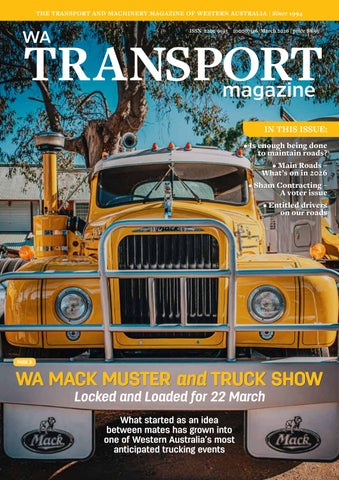
WA TRANSPORT MAG MARCH 2026 EDITION

Page 1


• Is enough being done to maintain roads?

• Main Roads –What’s on in 2026

• Sham Contracting –A voter issue

• Entitled drivers on our roads

A STRONG & POWERFUL VOICE FOR TRANSPORT WORKERS’

At the TWU, we are relentless in the pursuit of building and exercising worker power, guided by clear, strong principles. We are committed to earning and keeping our members’ trust and bargaining collectively. We aim to hold corporations to account, empowering the workforce with a strong and powerful voice.

The TWU has a number of Enterprise Agreements in a myriad of transport companies. If you work for a company that has an EA with the TWU, you, along with all transport workers benefit from the years of struggle and collective action of union members before you.

And set the standard for transport workers into the future.

TWU Members also benefit from a range of services available only to members

 Legal Services

 Wage increases and improved conditions through collective bargaining

 Enforcement of your agreement and workplace rights

 Representation for incidents or disciplinaries

 Job Security and protection

 $5,000 Funeral benefits

 Free Wills

 Extraordinary Driver’s License

 Income Protection and Group Accident and Sickness cover

 Collective purchasing power of UnionShopper to provide members with discounts on a range of restaurants, gift cards, white goods and more

You should be a member of your union, the TWU if you enjoy these benefits like:

 Annual Leave

 Maternity Leave

 Long Service Leave

 Sick days

 Leave loading

 Penalty rates

 Superannuation

 Health and safety and workers’ compensation

 Allowances (meal allowances, shift allowances)

 Rest breaks

 Unfair dismissal protection

Becoming a member of the TWU ensures you can maintain these rights into the future.

The Heavy Vehicle Helpdesk is open from: 7am to 6pm Monday to Friday, and WA Public Holidays.

On weekends the Main Roads Customer Information Centre will receive telephone calls on behalf of the Heavy Vehicle Helpdesk on 138 HVO (138 486) and email enquiries can be sent to hvs@mainroads.wa.gov.au

Tel: 138 486 Fax: 9475 8455

Email: hvs@mainroads.wa.gov.au www.mainroads.wa.gov.au

VOLUME 32 | NUMBER 2

Angry Chicken Publishing Pty Ltd

Telephone 0430 153 273 www.angrychicken.com.au

ABN: 35 486 530 095

PUBLISHER / COMMISSIONING EDITOR

Karen-Maree’ Kaye

T: 0430 153 273

Email: karen@angrychicken.com.au

WRITERS

Karen-Maree’ Kaye, Russell McKinnon

CONTRIBUTORS

Jan Cooper, Cam Dumesny, Cliff Graham, Carol Messenger, Ray Pratt

ADVERTISING ENQUIRIES

Angry Chicken Head Office

T: 0430 153 273

E: karen@angrychicken.com.au

DESIGN / PREPRESS

Cally Browning | Bare Creative

ACCOUNTS

T: 0430 153 273

E: accounts@angrychicken.com.au

PRINTER

Daniels Printing Craftsmen

SUBSCRIPTIONS

Subscriptions available directly from the Publisher.

T: 0430 153 273

E: karen@angrychicken.com.au

Australia: 1 year $130 (inc GST)

Overseas subscribers: Airmail postage will be added to subscription rate.

Editorial Submissions: The Publisher welcomes editorial submissions. Once received they will become the property of the Publisher who reserves the right to edit the or adjust the content to fit with the format of our publication.

West Australian Transport Magazine (WATM) is published by Angry Chicken Publishing Pty Ltd

ABN: 35 486 530 095 All rights reserved. No part of this publication may be reproduced, adapted or transmitted in any form by any process (graphic, electronic, mechanical or storage and retrieval system) or sold, resold or otherwise exploited for any purpose without consent of the Publisher.

The publisher, contributors, editors and consultants disclaim any and all liability and responsibility to any person or party, be they a purchaser, reader, advertiser or consumer of this publication in regards to consequences and outcomes of anything done or omitted, or being in reliance whether partly or solely on the contents of this publication. No person, organization or party should rely on or on any way act upon any part of the contents of this magazine without first obtaining the advice of a fully qualified person. The Publisher shall have no responsibility for any action or omission by contributor, consultant, editor or related party for content within WATM. The opinions and content within WATM does not necessarily reflect those of the Publisher, editor or their agents. No responsibility is accepted for damage or loss of material supplied to the publisher.

FROM THE PUBLISHER

As we begin the New Year the ‘spot light’ on Sham Contracting in the transport industry is increasing. I have been hearing the frustration of the Western Australian transport industry whose safety and businesses are being impacted by this and in this edition, Cam Dumesny CEO of Western Roads Federation and Ben Sutherland, President of the LRTAWA both talk about the problem in depth and what they are doing and what can be done to bring back a level playing field to all transport operators in this state.

Main Roads HVO gives us a run down of what they have planned for 2026 and speaking of roads – our Fair Go for the Owner Driver columnist Ray Pratt delves back into that subject and says, “If the highway is the truck driver’s office floor, then it deserves the same level of care,

investment and safety oversight expected in any other workplace.

The organisers of the WA Mack Muster and Truck Show say, “We are locked and loaded for Saturday 22 March, and it is shaping up to be a massive weekend of trucking with purpose.” The event will be back at Quarry Farm, Byford, and the full weekend is planned, polished and ready to roll, from the first trucks rolling in to the final awards on Sunday.

Happy Birthday to Alan Moody from Haulmore Trailer Sales and Rentals – at 82 years young he is an inspiration to us all and is living proof that age is no barrier to hard work, leadership and a ‘can-doattitude’.

As always, my sincere thanks to everyone who supports this magazine, now in its 32nd year.

Best,

Karen

3 WA Mack Muster and Truck Show | Locked and Loaded for 22 March 4 Contract awarded to progress Westport planning and design 5 Fuel Tax Credits, Renewable Diesel and the reality that can’t be ignored 8 Main Roads News - What's on in 2026 9 WA’s bumper grain season got a smoother ride at Esperance 10 Proposed seven day invoicing requirement impractical for Owner Drivers 12 LRTAWA - Heavy Vehicle Rest Areas–what can we learn from other countries?

Progress on one the of world’s best undeveloped iron ore deposits in the Pilbara

Technical Paper Series on Non-Fatigue Impairment launched

Western Roads Federation - WRF makes Sham Contracting a voter issue

EV and hybrid trucks gain momentum

Challenges Accepted – Alan Moody, 82 years young

Superannuation – Sharing your Super Contributions

Keep left unless overtaking - Understanding heavy vehicles

WA Mack Muster and Truck Show

Locked and Loaded for 22 March

The organisers of the WA Mack Muster and Truck Show say, “We are locked and loaded for Saturday 22 March, and it is shaping up to be a massive weekend of trucking with purpose.”

The event will be back at Quarry Farm, Byford, and the full weekend is planned, polished and ready to roll, from the first trucks rolling in to the final awards on Sunday. This is a weekend built around big iron, great people and an even bigger cause.

What started as an idea between mates has grown into one of Western Australia’s most anticipated trucking events. And in 2026, the focus is clear - bring the industry together, celebrate the people who keep it moving, and raise serious money for cancer research through the Harry Perkins Institute of Medical Research.

Quarry Farm is once again the heart of it all. A working farm turned muster ground, with open paddocks, dust in the air and diesel in the atmosphere. Trucks lined up row after row, engines echoing through the valley and a hilltop homestead looking down over what has become one of the most iconic truck show settings in the country. It is raw, real and unmistakably Western Australian.

The weekend kicks off on Friday night with the Sponsors Gala Dinner. This is where the industry connects, stories

are shared and the fundraising goes into overdrive. The auction is always a highlight and this year will be no different. Big energy, big bids and plenty of laughs, all in support of world class cancer research being done right here in WA.

Saturday night is about the drivers. The Drivers Celebration Event is a chance to park the trucks, drop the shoulders and enjoy a night dedicated to the men and women behind the wheel. No pressure, no schedules, just good company and wellearned recognition.

Sunday is show day, and it delivers in a big way. More than 350 trucks are expected covering everything from heritage restorations to modern workhorses and high-end show rigs. While the event proudly carries the Mack name, this is a show for all makes and models. Kenworth, Western Star, Freightliner, Volvo, Scania and more, all standing side by side in a powerful display of industry pride.

Competition will be tight; prizes are limited and bragging rights last all year. If you are chasing Truck of the Show, preparation matters and registrations need

to be locked in early. Once spots are gone, that is it.

Beyond the trucks, there is plenty happening. Trade displays, family friendly entertainment, great food and an atmosphere that keeps people on the grounds all day. Camping and approved vehicle parking at Quarry Farm allow entrants and crews to soak up the full muster experience from start to finish.

Most importantly, this weekend continues to make a real difference. To date, the WA Mack Muster and Truck Show has raised over $850,000 for the Harry Perkins Institute of Medical Research. That money supports vital cancer research, laboratories and scientists working to save lives. For many in our industry, this cause is personal, and it is why the support behind this event continues to grow year after year. www.mackmuster.com.au

Fuel Tax Credits, Renewable Diesel and the reality that can’t be ignored

Over the past six months, there has been growing momentum in policy circles to describe Fuel Tax Credits (FTCs) as a ‘fossil fuel subsidy’ that should be phased out as part of Australia’s emissions reduction effort,” says Anthony Boyle, Executive Director of the ALRTA.

“On the surface, that language sounds simple to anyone not operating a truck. But as we all know, this risks getting the freight decarbonisation discussion horribly wrong.

“ALRTA has been working on this issue well before it became public commentary, because for livestock and rural transport

operators, the consequences would be immediate, material, and difficult to unwind.

“The core principle remains clear. There can be no structural change to costs or taxation until reliable, affordable alternatives actually exist.

“Fuel Tax Credits are not a subsidy. They are a realignment of the road user charge.

“Heavy vehicles pay for road use through fuel excise and the Road User Charge. At present the Diesel excise is 51.6 cents per litre, the Road User Charge is 32.4 cents per litre and the on-road Fuel Tax Credit is the difference - 19.2 cents per litre.

This credit corrects fuel excise collected beyond the road user charge. It is not a free pass for the industry. Removing FTCs would not “level the playing field”.

“It would impose a new cost equivalent to a carbon price of approximately $70–71 per tonne of CO₂, almost double Australia’s former carbon price and that cost would flow directly into freight rates, food prices, and national supply chains.

Renewable Diesel -

The uncomfortable truth

“A key assumption behind calls to remove Fuel Tax Credits is that alternative fuels will be ready to step in. They are not and the available data on renewable diesel (HVO), is sobering. Australia uses around 32 billion litres of road diesel each year so even a 10% replacement would require 3.2 billion litres of renewable diesel annually. 10% of Australia’s diesel demand from canola-based renewable diesel would require around 7 million tonnes of canola seed which equates to more than 4 million hectares of cropping land which does not exist without displacing food production or exports.

“Even with current government

Contract awarded to progress Westport planning and design

The State Government has awarded a major contract to Worley Arcadis Joint Venture (JV) for the delivery of marine and port infrastructure technical advisory services for Westport.

The technical advisory services will play an essential role in the definition and design of Westport - the State Government’s plan for a future container port in Kwinana.

The scope will support current definition activities including completion of reference designs and optimisation of infrastructure planning for the new

port facilities, along with approvals, construction planning, and reliable costing ahead of final investment decisions.

The JV will also play a key role in imbedding sustainability, cost efficiency, safety, and regulatory compliance throughout the design process.

The Westport Business Case showed significant risk to the Western Australian economy from future constraints on container trade if Westport was not built by the time Fremantle Port reaches capacity at the end of the 2030s.

The business case found inaction to

address constraints on trade could cost WA’s economy $244 billion over coming decades - an average of $5 billion per year - driving significant increases in the costs of everyday household goods and for the State’s businesses.

Acting Transport Minister Dr Tony Buti said, “Westport is one of the largest infrastructure programs ever undertaken in Western Australia. Delivering a new container port is critical to the long-term strength of our economy and keeping costs down for households, which is why we’re undertaking thorough planning now.”

investment, the most realistic outcome is only 5–10% renewable diesel penetration by 2035. That is progress, but it is nowhere near a full transition for heavy road freight.

Removing FTCs now would miss the target

“Removing Fuel Tax Credits before alternatives are available would not change fuel supply, nor accelerate technology uptake, and would not reduce emissions meaningfully in the short to medium term, but it would operate like a carbon tax on essential freight.

“This risks becoming a revenue measure rather than a transition measure, raising costs first and hoping solutions arrive later.

“Productivity is the lever that works now and the Government’s own Transport and Infrastructure Net Zero Roadmap identifies the most effective near-term emissions reductions for freight as coming from safer high-productivity truck combinations, the National Automated Access Scheme (NAAS), and targeted rural road and bridge upgrades.

“These reforms reduce emissions per

tonne moved by cutting trips, fuel use and congestion, delivering permanent gains while cleaner fuels scale gradually.

“This is the sensible sequencingproductivity first, fuels in parallel, taxation last - not the other way around.

A united voice

“ALRTA raised these risks early with government and industry, and formally briefed the Australian Trucking Association last year on the dangers of premature FTC reform,” finished Mr Boyle.

ATA CEO Mat Munro and Chair Mark Parry have both publicly called on the Government to reject the Productivity Commission’s recommendation to phase out Fuel Tax Credits.

The ATA met with Infrastructure and Transport Minister Catherine King to discuss the commission’s plan to phase out fuel tax credits. Its own figures show the plan would more than double the effective fuel tax paid by trucking operators from 32.4 cents per litre now to 66.1 cents per litre in 2035.

“We told Minister King that many

WA OWNED AND RUN

trucking businesses are under intense financial pressure and have no capacity to absorb increased costs,” ATA Chair Mark Parry said.

“A recent CreditorWatch survey found that the national closure rate for road transport in the 12 months to November 2025 was 8.5 per cent – one in 12 businesses. The number of trucking businesses with large tax debts has surged.

“We argued that the Government should retain fuel tax credits in the 2026-27 budget and beyond, and that the road user charge should be increased by no more than four per cent,” he said.

WA’s premier brake and clutch specialists proudly servicing the states industrial clutch and brake applications.

From major truck workshops, heavy haulage, cranes, the mining industry and more… our team of knowledgeable and qualified technicians share over 100 years combined experience and focus on delivering prompt service alongside the supply of top name brakes and clutchesthroughout Australia and Asia.

With over 20 years in the industry we have a well-earned reputation for the development, manufacture and supply of quality standard and customised designs to suit a wide range of applications.

For the best advice and friendly service contact us today.

+61 8 9353 4411 ■ sales@knightbrakeandclutch.com.au knightbrakeandclutch.com.au

Over to you

A FAIR GO FOR OWNER DRIVERS by Ray Pratt

Are

governments doing enough to maintain roads to an acceptable standard?

Western Australians like to talk about toughness, we brag about big distances, brutal heat, long roads, and the sheer grit it takes to keep this state moving. But there’s a silent group of people carrying a burden the public rarely sees - the truck drivers running through the night, continuously across some of the most isolated roads on earth. It has long been argued within the transport industry that a truck driver’s workplace is not an office, a factory, or a mine site, but the highway itself.

Every kilometre of road, every bridge, every shoulder, truck bay and rest area forms part of the environment in which drivers earn their living. If that premise is accepted, then an uncomfortable question followsare governments doing enough to maintain that workplace to a safe and acceptable standard?

For many truck drivers, particularly those working long-haul or interstate routes, the road network is not just a place of work but a place where they spend days, sometimes weeks, at a time. Unlike most workplaces, drivers have little control over its condition. Potholes, crumbling shoulders, poor drainage, faded line markings and inconsistent signage are

not inconveniences, they are safety risks. At highway speeds, a damaged section of road can cause a violent suspension failure, a tyre blowout, or a sudden loss of control. For heavy vehicles weighing up to 70 tonnes, the consequences can be catastrophic.

Governments regularly emphasise workplace health and safety in industries such as construction and mining, where rigorous standards apply and hazards are tightly controlled. Yet on many regional and remote roads, particularly those heavily used by freight, maintenance often lags behind usage. In Western Australia and other large jurisdictions, freight routes stretch across vast distances, carrying everything from fuel and food to livestock and machinery. These roads are essential economic arteries, yet drivers often report they are treated as an afterthought when budgets are tight.

Road safety campaigns frequently focus on driver behaviour - fatigue, speed, distraction and compliance. While these factors matter, they overlook a critical element of the safety equation, the condition of the workplace itself. A wellrested, experienced driver can still be placed at risk by uneven surfaces, narrow

roads, unprotected drop-offs or poorly designed intersections that fail to account for the length and turning requirements of modern heavy vehicles.

The issue extends beyond the bitumen. Truck bays, rest areas and basic amenities are also part of a driver’s workplace. Fatigue management laws rightly require drivers to take rest breaks, yet in many regions there are insufficient safe places to do so. Truck bays may be overcrowded, poorly lit, uneven, or located too close to traffic. Some are effectively unusable by larger combinations, forcing drivers to choose between stopping unsafely or pushing on to the next location.

Even more basic is the issue of toilets and washing facilities. Many drivers spend extended periods away from home, sleeping in their cabs and living out of roadside stops. The lack of clean, wellmaintained restrooms is more than an inconvenience; it is a matter of dignity and health. Few other industries would expect workers to operate without access to basic sanitation, yet for truck drivers this is often accepted as normal.

There is also a broader safety benefit to improving rest facilities. Properly designed rest areas encourage compliance with fatigue laws, reduce unsafe roadside parking, and provide a controlled environment away from live traffic. Investment in these facilities is not just a welfare issue, it is a public safety measure that benefits all road users.

If governments truly recognise trucking as critical national infrastructure, then maintaining the roads and facilities that support it should be treated as a core responsibility, not a discretionary expense. This means consistent funding for road maintenance, freight-aware road design, regular audits of high-use freight routes, and a coordinated approach to building and maintaining rest areas with adequate amenities.

Truck drivers keep the country moving. Their workplace is vast, exposed, and unforgiving. If the highway is their office floor, then it deserves the same level of care, investment and safety oversight expected in any other workplace. Anything less is a failure to recognise the value of the people who operate on it every day. Keep it safe, Ray Pratt.

What’s on in 2026

The Compliance focus

Operational Performance

• Our coverage has expanded significantly, reaching more regions across the State than ever before.

• This broader reach has delivered valuable intelligence, enabling us to deploy resources with greater efficiency for 2026.

Strategic Focus for 2026

• Increase joint agency operations across the State to strengthen collaboration and compliance outcomes.

• Enhance regional engagement by attending new community events and increasing visibility in key areas.

Main Roads launched a media campaign in December 2025 highlighting the important role of Heavy Vehicle

Heavy Vehicle Auditors and Licenced Pilots

In 2026, Heavy Vehicle Auditors will be expected to align their practices with the updated Auditor Guidelines and WA Heavy Vehicle Accreditation (WAHVA) Business Rules, which will be released in early 2026. Auditors are reminded to regularly access the My Say Transport site, as all changes will be published through both the Portal and the website to ensure transparency and consistency.

An Auditor Conference will be held in late 2026, providing an opportunity for collaboration, knowledge sharing, and discussion of emerging priorities. Auditors who wish to raise specific items for consideration are encouraged to email accreditation@mainroads.wa.gov.au ahead of the conference to support a constructive agenda.

In 2026, Heavy Vehicle Pilots can expect ongoing collaboration between Main Roads and the Department of Transport and Major Infrastructure to update and amend regulations relating to licensing and training requirements.

Work is also underway to revise the Code of Conduct, incorporating valuable feedback received from Pilots to ensure standards remain practical and effective.

While these are long-term initiatives, progress has already begun and will

Compliance Transport Inspectors on Western Australia’s roads. The campaign aims to help all drivers gain a better understanding of their responsibilities and the role they have in improving road safety.

Growth and Capability

• We plan to grow our Compliance unit by onboarding additional Transport Inspectors, which means:

o More patrols and greater coverage with the Regions and Local Governments.

o Focusing on safer roads for all users.

2026 is shaping up to be a year of expansion, innovation, and stronger partnerships. Together, we’ll continue driving compliance forward and making Western Australia’s roads safer.

Representation at public events

In 2025 we again attended a wide range of local events State-wide from Kununurra to Dowerin, and from Karratha to Albany and Esperance to further engage with the community and share important tips on safely interacting with road trains and OSOM loads on our roads. In 2026 we will be attending new community events –more information to follow.

Projects

Development work continues on the HVS PATH-Ways project, which will replace our core systems RAVS and MOVES. PATHWays will deliver an improved customer portal, empowering users to self-manage their business information such as vehicle lists, and control account access by adding or removing users of their accounts. The platform will also streamline the application and payment process for all HVS permits, Heavy Vehicle pilot services, and WA Heavy Vehicle Accreditation requirements, while simplifying the management of renewals and audits.

Ocontinue throughout the year.

Pilots are strongly encouraged to register with the My Say Transport portal, as all regulatory updates and changes will be published there to keep the industry informed and aligned.

Main Roads launched a media campaign in December 2025 highlighting the important role of Heavy Vehicle Pilots on Western Australia’s roads. The campaign aims to help drivers gain a better understanding of their responsibilities and the contribution pilots make to road safety.

ur new public education campaign #BeOversizeWise was launched in December 2025 to raise driver awareness of Traffic Escort Wardens, Pilots, and Compliance staff. This will build on the success of our existing heavy vehicle awareness campaigns #RoadTrainDomain and #BiggerThanYou that promote safe interaction with road trains, agricultural equipment and OSOM loads, which were re-run prior to and during school vacation periods, the harvest season and key public holidays.

WA’s bumper grain season got a smoother ride at Esperance

With a bumper grain season pushing record volumes, heavy vehicles moving growers’ harvests enjoyed a safer, smoother run into the Port of Esperance thanks to newly completed upgrades on Hughes Road.

The $10.2 million Stage 2 works, part of the State Government’s three-stage $19.6 million Road Improvement Program, have transformed the port’s sole heavy-vehicle access route, easing congestion, and improving safety for an estimated 250,000 truck movements each year.

A new roundabout, upgraded road section, and redesigned entry and exit layout helped heavy vehicles flow more efficiently, keeping harvest traffic moving during the harvest season. The nine-month construction program delivered 3,000 cubic metres of earthworks, 400 metres of drainage, 500 metres of electrical conduit, and 5,800 tonnes of asphalt to strengthen the 60-year-old road network.

The upgrades directly support the four

million tonnes of road-freighted trade handled through Esperance annually and pave the way for future trade growth as Southern Ports continues implementing its 30-year master plan.

Stage 1 works, completed in 2024, delivered major safety and drainage improvements to the first stretch of Hughes Road, while Stage 3 will reconstruct degraded pavement areas on other port roads to complete the full upgrade program.

Southern Ports exported 7.3 million tonnes of grain across its ports last financial year, including 2.7 million tonnes through Esperance. This year, Esperance has already exported 1.18 million tonnesmore than double the same time last year (507,356 tonnes), including 556,441 tonnes wheat, 318,994 tonnes canola, and 307,428 tonnes barley.

Ports and Regional Development Minister Stephen Dawson said, “Hughes Road is an essential part of the region's supply chain network, critical in supporting more than half of the trade through the Port of Esperance each year, including grain, woodchips, spodumene and fertiliser.

“The Cook Government is funding upgrades that will help Southern Ports capitalise on its increasingly diverse trade opportunities through the Port of Esperance and paves the way for regional product to reach global markets.

“We’ve seen larger than ever grain harvests in our southern regions over the past few years, including a strong start to this season. This 60-year-old stretch of road has been vital in ensuring millions of tonnes of grain can be exported each year, supporting our farmers and our economy.”

The three-stage $19.6 million Road Improvement Program, has transformed the port’s sole heavy-vehicle access route, easing congestion, and improving safety for an estimated 250,000 truck movements each year

MY TEAM SUPER PERFORM? HOW DOES YOUR IS

Reid Highway interchange upgrades

Major construction is underway on the $225 million Reid Highway Interchanges Project which will improve safety and efficiency in Perth’s northeastern suburbs.

Jointly funded by the Australian and Western Australian Governments, the project is delivering two new gradeseparated interchanges to replace the existing signalised intersections at Altone Road and Drumpellier Drive/Daviot Road.

The upgrades will improve safety and connectivity for local communities, while enhancing freight efficiency by removing two of the remaining five sets of traffic signals on Reid Highway.

Entry and exit ramps with connecting roundabouts will maintain access to local roads and residential areas.

With works taking place within a tight footprint, modifications to Reid Highway and surrounding intersections will be required while construction is underway, with measures to be put in place to keep people moving safely and efficiently.

Federal Infrastructure, Transport, Regional Development and Local Government Minister Catherine King said, “The changes to intersections will make it safer and faster for heavy vehicles to travel through Perth’s north east.”

WA Transport Minister Rita Saffioti said, “Reid Highway is one of Perth’s most important east-west links, and these new interchanges will make a significant difference for residents, businesses, and freight operators moving through our northern-eastern suburbs.”

Sharing Scheme should be extended to transport

Australia’s independent automotive repairers have received official validation of their push for fair access to vehicle service information, with a Federal Government review confirming the Motor Vehicle Service and Repair Information Sharing Scheme is delivering genuine competition and consumer choice by creating a level playing field while maintaining the viability of independent repair businesses across the country.

The report also examined the economic contribution of independent repairers and the role access to service and repair

information plays in sustaining competition in the automotive sector.

The Final Report of the Review supports the industry’s position and demonstrates the scheme should now be extended to heavy vehicles, motorcycles and agricultural machinery as these sectors support thousands of regional and specialist repairers who face identical information access barriers without the same regulatory protections. Expanding the scheme would ensure consistent standards across the automotive sector and support the viability of businesses servicing Australia’s commercial and agricultural vehicle fleets.

Proposed seven day invoicing requirement impractical for Owner Drivers

The Australian Trucking Association (ATA) has lodged a detailed submission with the Fair Work Commission responding to the Transport Workers’ Union’s draft Contractual Chain Order (CCO).

The TWU has proposed a draft CCO aimed at enforcing faster payment terms and regular rate reviews across road freight transport. This includes maximum 30-day payment terms and mandatory annual rate reviews to reflect rising operating costs. Their draft aims to ensure that supply chain participants are paid within 30 days of completing work, regardless of invoicing arrangements, or within seven days with payment due within 21 days of invoice issue.

While the ATA supports the introduction of a CCO covering maximum 30-day payment terms and mandatory annual rate reviews, it is urging targeted changes to ensure the framework works in real-world trucking operations.

Representing 60,000 businesses and 200,000 workers across the road freight industry, the ATA highlighted the severe financial pressures facing operators. Rising government charges, inflation, interest rates, driver shortages, extreme weather, and the spread of sham contracting have pushed the sector into crisis, with a record 8.5% of operators filing for bankruptcy in 2025 and profit margins hovering around two per cent.

The ATA strongly supports a maximum 30-day payment standard to address cashflow problems caused by extended customer payment terms. However, the ATA argue that the proposed seven-day invoicing requirement is impractical, particularly for small operators and owner-drivers. Instead, the ATA proposes simpler, clearer rules that ensure payments are received within 30 days without creating loopholes or administrative burdens.

The ATA says fair payments and realistic rate reviews are essential to protect compliant operators and the long-term viability of Australia’s trucking industry.

CONTACTS:

7 Tipper Crt, Hazelmere WA

Office: (08) 9274 6355

Mobile: 0418 802 007

Rentals: 0488 003 228

Email: alan@haulmore.com.au

Website: www.haulmore.com.au

We have the following units currently in stock available for sale or hire:

Quad 4 Rows of 8 Full Axle Widening Low Loader with Hydraulic Suspension

Quad 4 Rows of 4 Full Axle Widening Low Loader with Hydraulic Suspension

Tri Axle Drop Deck Widener with Bi Fold Ramps

Dollys: 3x4 Low Loader Dolly – 2x8 Low Loader Dolly – 2x4 Low Loader Dolly

Side Tippers and Water Tankers

Flat Top Semi Trailers and Flat Top Extendables

Heavy Vehicle Rest Areas –what can we learn from other countries?

There is a building frustration with over-burdened rest areas, or safety bays as our organisation prefers to call them. Complaints range from not enough parking areas to poor facilities, over-crowding, misuse for maintenance, dumping and operators using them as ad hoc depots. Recently the light has been shone on the relationship of these practices to Sham Contracting, a practice that is estimated to cost legitimate businesses 20 -30% in competitive advantage.

For many years the dire situation with rest areas has been talked about, but collectively we’ve failed to find a sustainable solution. Suggested ideas have been better regulation and enforcement of time limits, introducing user pays and outsourcing management to commercial parking interests. Increased funding for more and better parking areas is welcomed, but let’s face it, are we ever going to have enough? In light of that we need to make good use of what we have.

The problems we face are not unique to Australia. The UK, and North America all struggle with similar issues however there are some interesting differences. They treat rest areas as fatigue related operational infrastructure within freight systems. In WA, they remain roadside amenities and the regulatory response to misuse reflects that difference. Unfortunately, WA’s network reflects incremental provision rather than being part of the freightsystem design process. Recent examples

of new freight links that have not included adequate safety bays shows this.

The UK has Motorway Service Areas every 20-30 miles. They are large, purposebuilt facilities with dedicated HV parking bays, lighting, toilets, food, showers, controlled access and marked heavy vehicle zones. They typically allow two hours free parking, after which charges apply. Overstay enforcement is managed by private operators using automatic number plate recognition cameras, barrier systems and parking attendants. Misuse (e.g. long-term depot storage) is uncommon.

In Canada, truck parking is often incorporated into corridor planning, especially near high-volume freight routes. Western and northern provinces rely more on gravel pull-outs, seasonal rest areas with limited amenities.

Many rest areas have posted limits from eight to 24-hour maximums. In populated provinces, provincial police may enforce overstays whereas in remote areas, enforcement is minimal. Using rest areas as a depot is less common because most truck stops are private and fee-based. Public rest areas are clearly designated as short-term use. While time limits exist and can be enforced, the regulatory emphasis is on maintaining corridor functionality, not active parking policing.

In the US, state departments of transport provide interstate rest areas with separate truck parking zones and some dual use weigh stations. The length of stay varies

by state between eight to 10 hours for commercial operators.

Facilities include toilets and lighting however, space falls short of demand, which their government is trying to address. In some areas the authority’s trade-off enforcing strict time limits to avoid the safety risk of unsafe roadside parking.

Washington State is ranked as the lowest for truck parking availability. Their parliament has directed the State Freight Mobility Strategic Investment Board, which is broadly comparable to Infrastructure WA, to develop strategies and an implementation plan to address truck parking needs at government-owned rest areas and to identify opportunities to provide additional truck parking through partnerships with cities, counties, ports and private entities to increase truck parking capacity in the near-term.

The reason for drawing attention to the international experience is that WA needs a fundamental shift in policy when it comes to rest areas and Road Train Assembly Areas. Firstly, we need to treat rest areas as essential fatigue management infrastructure, which is integral to freight planning, not an ad hoc roadside amenity that may be funded when industry players have compromised over the limited funding pool.

Secondly, there is a need to control access to rest areas and RTAAs. Perhaps we could contract management of RTAA access to a private parking concern with a certain period for free parking e.g. eight hours and charge at commercial rates after that.

Thirdly, we need to expedite the legislative change that will enable Main Roads WA to fine and move ‘over-stayers’ on and deal with those that damage the facilities through inappropriate maintenance activities. Importantly that power needs to be actively exercised and widely available to regulatory authorities and could be delegated to local authorities and police.

The misuse of parking bays requires ministerial intervention to ensure it is treated with the gravity it deserves. The safety implications are serious and genuine.

LRTAWA by Ben Sutherland President, Livestock and Rural Transport Association of Western Australia (Inc)

Progress on one the of world’s best undeveloped iron ore deposits in Pilbara

The Rhodes Ridge Joint Venture has approved a $294 million feasibility study to progress development of the first phase of the Rhodes Ridge project, one of the world’s best undeveloped iron ore deposits, in Western Australia’s Pilbara.

The feasibility study will assess development of an operation with initial annual production capacity of 40 to 50 million tonnes of iron ore.

The joint venture partners (Rio Tinto 50%, Mitsui 40% and AMB Holdings 10%) intend to invest a further $225 million on exploration between 2026 and 2028 as part of ongoing study phases.

The feasibility study is expected to conclude in 2029.

Rio Tinto Iron Ore Chief Executive Matthew Holcz said, “In partnership with the Nyiyaparli Traditional Owners, we are working to develop Rhodes Ridge, which, given its size and quality, has the potential to underpin Rio Tinto’s Pilbara iron ore business for decades to come.

“Earlier this year the joint venture welcomed Mitsui into the project, confirming Rhodes Ridge as one of the best undeveloped iron deposits in the world. We’re excited to keep working with all our partners as we progress the feasibility study.”

The Rhodes Ridge Joint Venture will work closely with Nyiyaparli Traditional Owners throughout the mine life cycle, guided by the recently updated Native Title agreement’s engagement framework, to protect and manage cultural heritage

and the environment.

Through the project design the Joint Venture is also finding better ways to reduce its impact on the environment through minimising disturbance and reducing long-term closure impacts.

The progression to feasibility study follows Mitsui’s announcement earlier in 2025 to acquire a 40 per cent interest in the joint venture.

Rhodes Ridge will be a staged development. This investment and feasibility study is focused on phase one, with an initial hub likely in the northern part of the project. It will leverage Rio Tinto’s existing rail, port and power infrastructure.

Subject to relevant regulatory approvals, first ore from the initial Rhodes Ridge development, located 40 kilometres north-west of Newman, is expected by 2030.

Rhodes Ridge, which has a potential capacity of about 100 million tonnes of high-quality iron ore a year.

Image Rio Tinto

Over to you

WESTERN ROADS FEDERATION

Western Roads Federation makes SHAM CONTRACTING a VOTER ISSUE

Technical Paper Series on Non-Fatigue Impairment launched

Alcohol-related driver impairment remains a key factor in road accidents globally as current roadside strategies don’t go far enough.

Seeing Machines Limited, a global leader in vision-based monitoring technology, has released Part One of its new Technical Paper series, dedicated to advancing the understanding and detection of nonfatigue driver impairment, starting with intoxication. This initiative marks a major step in the company’s broader focus on leveraging its Driver Monitoring System (DMS) technology to address critical safety challenges on roads, globally.

Alcohol continues to be a leading cause of road trauma worldwide, contributing significantly to fatalities and injuries despite ongoing roadside based preventative efforts. Recognising these persistent risks, Seeing Machines has launched its capability to harness the power of DMS technology to identify impairment from alcohol in real time.

The Company’s latest research highlights the limitations of relying solely on Blood Alcohol Concentration (BAC) as a benchmark for impairment. Traditional approaches often overlook the way impairment unfolds over time, resulting in gaps between BAC progression and real-world driver performance. Seeing Machines’ DMS technology aims to bridge this divide by directly assessing functional impairment in real time, ensuring enhanced detection sensitivity and more effective incabin intervention strategies.

“Roadside alcohol testing has delivered great reductions in road injury over many years. Our goal is to complement these existing roadside programs by leading the introduction of in-vehicle approaches,” said Dr Mike Lenné, Chief Safety Officer at Seeing Machines.

“By incorporating the temporal dynamics of impairment, how it evolves during both the ascending and descending

phases of intoxication from alcohol as well as the complex effects of other drugs such as cannabis, our technology can reflect realtime real-world risks and provide greater safety protections to road users.”

To support this approach, Seeing Machines is working with leading experts and universities, conducting pioneering experiments that explore the disconnect between BAC readings and actual driver impairment. These collaborations underscore the Company’s commitment to developing solutions that align technological innovation with real-world safety outcomes.

Part One of the Technical Paper can be viewed at seeingmachines.com/technicalpaper-series-intoxication with future instalments set to explore additional aspects of non-fatigue impairment, including from cannabis, and further enhance the capabilities of DMS technology for road safety.

Every day, I get calls from people saying we can’t get into a rest area because its full because some ‘ghost company’ is using it as a free depot. The rightly justified complaints also extend to dumping of rubbish, poor maintenance, misuse of ABN’s, driver skills etc.

The sad reality is politicians in Australia generally don’t care about Truck issues.

Therefore, Western Roads Federation (WRF) is focused on expanding ‘Sham Contracting’ from an industry problem into a community (i.e. the voters) problem. That effort is starting to generate public attention, therefore political attention.

WRF has split ‘Sham Contracting’ into two distinct elements - manipulation of employment costs and removing operating overhead costs.

Manipulation of Employment Costs

WRF is fully supportive of the leadership of Senator Glenn Sterle in leading the industry efforts to address the misuse of the ABN system in the transport industry. Incidentally, this is an issue the Canadian Federal Government has recently recognised and has taken action to address.

Removing Operating Overheads

company’ is using it as a free depot

WRF is using this element to make ‘Sham Contracting’ a voter, hence political problem. Sham contractors have been misusing rest areas as free depots, illegally dumping tyres and oils, even abusing truck roadhouse provided parking bays.

WRF has taken the message to the public that this means that they the voters are paying for the clean-up, they are paying for higher road safety risks and they are being impacted because of illegal parking in their streets and much more.

This message is starting to gain traction in WA’s mainstream media, and with that traction so is the State Political interest.

To start solving the issue, we are calling for a multi-agency task force to urgently address the removal of operating overhead practises. A multi- agency effort is needed, as each regulator only has a certain and sometimes limited set of powers But Every day, I

collectively, Main Roads, WorkSafe, DEWR, the Police and relevant Local Government rangers can take action.

Truck Driver Licensing and Training

WRF continues to advocate that Truck Driver licensing needs to lift to a ‘higher standard’ in Western Australia. Currently, people are basically taught to pass a road rules test. Nothing is taught about axles weights, heavy vehicle regulations etc. We just proved that again recently when we had a person do a private HR Driver training course.

Secondly, WRF are advocating that all overseas drivers regardless of country of origin be mandated to undertake training in Heavy Vehicle Regulations, Heavy Vehicle On Road Safety practices (i.e. things not written in books but the informal rules) and independent driver competency assessment.

NatRoad 2026 – 27 Pre-budget submission to Treasury

NatRoad calls for the Australian Government to fund and accelerate the delivery of a National Automated Access Scheme (NAAS) to replace the majority of heavy vehicle access permits with automated, nationally consistent access decisions.

Fund and implement a nationally consistent PBS Approval Program to streamline Performance-Based Standards (PBS) approvals, reduce approval timeframes and accelerate deployment of safer, higher-productivity heavy vehicles.

Commit to an additional $2.4 billion to complete the ‘Clean Transport Fund’ and support the heavy vehicle industry transition to net zero acknowledging the commercial realities of decarbonisation.

Create a ‘Freight Productivity and Safety Infrastructure Package’ of $300 million per year for four years

Make no change to the Fuel Tax Credit Scheme (FTCS) until a viable Forward Looking Cost Base is developed with a resultant Road User Charge (RUC) applicable to all road users.

Continue to expand the Heavy Vehicle Rest Area Program to improve fatigue management, safety, and productivity across priority freight corridors with a focus on regional, remote, and high-volume routes.

Persistent inflation combined with unprecedented increases in operating costs from insurance, wages, parts and maintenance have resulted in less than 3% margins and the industry experiencing one of the highest rates of insolvency in Australia.

NatRoad is calling for targeted budget measures that reduce compliance burdens, increase productivity, and deliver improved safety outcomes.

EV and hybrid trucks gain momentum

The latest national Quarterly Automotive Report by Pickles includes new analysis that challenges a common concern around EV ownership –that frequent DC fast charging significantly degrades battery health and they delve into Australia’s heavy transport sector which

they say is shifting from cautious testing to meaningful early adoption.

While overall volumes remain small, fleet behaviour shows the transition is accelerating as new models arrive, prices fall, and major operators commit to decarbonisation.

“We’re finally seeing data points that give operators confidence,” says Hugh Rainger, Trucks & Machinery National Manager at Pickles. “The industry is moving from curiosity to genuine planning.”

According to the MOV3MENT Electric Truck Report 2025, electric truck and van sales have surged – tripling in 2023 before rising to 278 sales in 2024, surpassing hybrids for the first time. Forecasts indicate around 300 sales in 2025, pushing Australia's total electric truck parc beyond 800 vehicles.

At the same time, market choice has expanded significantly, with available EV truck brands growing from three in 2023 to twelve in 2025, easing price pressures and improving suitability across use cases.

Fewer than 20 used EV trucks have been sold through Pickles to date, but they are no longer treated as experimental

Albany Ring Road – the final connection

The final connection in the Albany Ring Road project has begun construction with a new flyover at the intersection of Menang Drive and Chester Pass Road in Albany.

The $60 million project will improve efficiency along the Albany Ring Road route by providing heavy vehicles with a non-stop connection from Chester Pass Road to the Port of Albany.

The new grade separated interchange will allow southbound vehicles to exit Chester Pass Road via an elevated ramp, passing back over the top of Chester Pass Road via a bridge and connecting into Menang Drive westbound.

It will improve safety and efficiency along the critical freight route by removing the need for trucks to queue in the turning lane before making a right turn across oncoming northbound traffic.

Transport Minister Rita Saffioti said, "Delivering the Albany Ring Road has been a game-changer for the Great Southern region, streamlining access to the Albany Port and improving safety for local road users.

"In its first 18 months of operation, the project has taken about 2,000 vehicles per day out of the centre of Albany, including 800 trucks.

assets. EV trucks sold through Pickles have averaged $56,250.

Hybrid trucks continue to outsell EVs at roughly three to one, offering immediate efficiency gains with fewer operational changes. To date, Pickles has sold 36 hybrid trucks, at an average of ~$18,000 each.

Hydrogen remains longer term with uptake in Australia still several years away as infrastructure, servicing networks, and supply chains mature.

Pickles’ Quarterly Automotive Report – Issue 8 is available to download at www. pickles.com.au/qar/q4-2025-report#heavytransport-electrification

How do we change that entitled attitude so everyone gets home safely?

Ihave to talk about the driver behaviour I noticed while driving over the Christmas and New Year period.

It’s truly frustrating to me to see what goes on, and as I’ve mentioned many times before, I’ve always promoted police presence - not just double demerit points weekends.

Am I a perfect driver? Absolutely not but, if I had a concentration lapse and wandered over the speed limit and was caught by police, the first thing I would say to them is, “Thank you for your presence on our roads.”

The police can’t be everywhere to catch all these drivers who insist on ignoring the ‘keep left unless overtaking’ rule on overtaking lanes or those who fail to look both ways before entering a highway.

Maybe I see more because I am on the road during the increased holiday traffic. Those who sit in the right lane through overtaking lanes oblivious or ignorant to the line-up of traffic behind them or the ones who overtake a slower vehicle then remain below the speed limit themselves still in the right lane until the end of the overtaking lane with no thought for all the vehicles behind them who could have safely passed them.

Government’s do not class roads as the

had every right to be there. Even though I decelerated to let the road train overtake I couldn’t slow down any more and had no choice but to accelerate while the overtaking road train had to heavily brake to pull back in behind me.

truck drivers work place however, stupid impatient drivers make these roads a more dangerous place for trucks to perform their duties safely.

With a bumper harvest there’s been more grain trucks on the roads and there are still cattle trucks moving stock. There were more trucks carrying extra fuel for harvest and generally the increase in Christmas traffic with the added caravans, boats etc on the roads was noticeable.

I’ve seen all too often are people exiting a private property, or parking bays drive straight onto the road without looking in both directions to ensure it’s safe

Just last week I was loaded in my truck travelling along a long clear dotted line section of the road with an empty road train behind me so called him up and said, “This straight is clear old mate, bring it around,” and he responded to the affirmative. Clear radio contact was made and only when he was beside me a light vehicle pulled out onto the road from a private property 500m ahead without checking in each direction if it was safe to do so. There was a steep drop off on the side of the road with trees along both sides so getting off the road was not an option. The car made ‘no’ attempt to get off the road as they seemed to think they

All because of the ignorance of the car driver who did not give way to all traffic before entering the road. I have heard of instances where people have died just driving straight out onto the road without checking both directions. Isn’t it just common sense regardless of the road rules?

There are barely enough opportunities on our highways for heavy vehicles to safely overtake each other without hitting double white lines.

I’ve even seen cars pull out onto the road then angrily flash their lights at oncoming overtaking traffic. Not for a second considering they are the ones that are in the wrong.

I’m sure I’m not the only driver this has happened to. It’s hard work promoting road safety when some drivers don’t follow the simplest road rules regarding giving way.

There’s a big difference between being complacent, forgetting and self-entitled arrogance and no amount of police presence will curb the increase we are seeing in self-entitled drivers.

So many times, I’ve seen truck drivers have to take evasive actions to save someone else’s life who felt entitled to do something stupid and wrong. How do we change that entitled attitude so everyone gets home safely?

“Challenges Accepted”

At 82 years young, Alan Moody is living proof that age is no barrier to hard work, leadership, and a can-do attitude.

Celebrating his birthday on 3 February surrounded by his staff, Alan marked the milestone not with thoughts of slowing down, but by doing what he’s done for decades – turning up to work and leading his team at Haulmore Trailer Sales and Rentals.

Still working full time, Alan remains hands-on in the business he founded 52 years ago, a trailer manufacturing operation that continues to go from strength to strength.

Staff took the opportunity to celebrate Alan’s birthday and acknowledge the dedication, resilience and work ethic that have shaped the company’s culture.

Known for his straight-talking approach and commitment, Alan has built more than a business – he’s built a team that respects and values his leadership. His company motto, “Challenges Accepted,” reflects not only the company’s values, but the way Alan has approached every stage of his life and career.

Asked about retirement, “I’d rather wear out than rust out,” Alan says. With no plans to retire anytime soon, he believes there’s still too much to accomplish. Goals to achieve, places to travel, and work left to be done.

For Alan Moody, slowing down isn’t on the agenda, and if his past 52 years in business are anything to go by, he’ll keep showing up with the same drive and determination for as long as he’s able.

Known for his straight-talking approach and commitment, Alan has built more than a business –he’s built a team that respects and values his leadership.
Freight and Logistics Council Chair acknowledged

M inister Assisting the Minister for Transport Jessica Stojkovski has acknowledged outgoing Chair of the Freight and Logistics Council of WA (FLCWA) Board, Megan McCracken, for her significant contribution in the role over the past five years.

Ms McCracken has served in the position since June 2021, leading the FLCWA’s work in providing direct freight and logistics advice to the State Government.

Achievements during her term have included refreshing the purpose and strategic direction of the FLCWA and prioritising and improving

stakeholder and member engagement across all freight transport modes.

Under her leadership the FLCWA provided COVID-19 pandemic support through the opening of pop-up vaccination clinics at transport hubs across Perth, recommendations on strengthening the resilience of the eastwest freight system, and work to refresh the State’s regional freight strategy.

The FLCWA was established in March 2009 and meets bi-monthly to discuss and progress issues of strategic importance to the State’s freight and logistics sector and activities.

Ms McCracken’s successor in the role of Chair will be appointed shortly.

Rio Tinto and BHP explore collaboration

Rio Tinto and BHP have agreed to work together to extract up to 200 million tonnes of iron ore at their neighbouring Yandicoogina and Yandi iron ore operations in the Pilbara.

These new opportunities build on a 2023 agreement between Rio Tinto and BHP to mine the Mungadoo Pillar, which allowed mining of ore from the shared tenure boundary that was previously inaccessible.

Rio Tinto Iron Ore Chief Executive Matthew Holcz said, “By working smarter, we can better leverage existing infrastructure to unlock additional production with minimal capital requirements.

“Together we will extend the life of these operations, create additional value, and further support Western Australian jobs and local communities.”

BHP WA Iron Ore Asset President Tim Day said, “By sharing our expertise and infrastructure we will create new value and deliver benefit to our people, partners, customers and communities."

Rio Tinto and BHP have agreed to progress a conceptual study followed by an order of magnitude study. Subject to a final investment decision, first ore from both deposits is anticipated early next decade.

Superannuation

SHARING YOUR SUPER CONTRIBUTIONS

Did you know that one of the ways you can boost your super is by sharing contributions with your partner? Our friends at Team Super share how you can potentially make your super work harder if you and your partner join forces, by either boosting their super or using a strategy to split your contributions.

BOOST YOUR SPOUSE'S SUPER AND GET A TAX OFFSET

One of the easiest ways to boost your spouse’s super (or vice versa) is by making a contribution to their account. If your spouse has a low income or isn't currently working, you can both benefit if you add money to their account. They'll be rewarded with a boost to their super and you’ll be able to get a tax offset of up to $540.

SPLIT YOUR CONTRIBUTIONS

The Government allows you to split any before-tax contributions you make to your super with your spouse each financial year. You can use this to access tax-free super sooner or increase Age Pension entitlements:

Splitting strategy 1:

Access tax-free super sooner

If you and your spouse aren’t the same age, you can split your contributions. Once the older spouse turns age 60, they can withdraw these contributions tax-free or start a tax-effective account-based pension.

Splitting strategy 2:

Increase Centrelink entitlements

If you and your spouse aren’t the same age, you can split your contributions to reduce the super balance of the older spouse. Once turned 67, this would lower their assets for the Centrelink means test and could increase their Age Pension entitlement (they also need to satisfy the income test).

NOTE: the younger spouse needs to be under government Age Pension age, as super isn’t counted under the means test for people under pension age.

SUPER SPLITTING FACTS

• You can split 85% of before-tax contributions you made to your super in the previous financial year (the

other 15% is deducted by the super fund in tax), provided the amount is under your before-tax contribution cap. This includes compulsory employer contributions and any extra beforetax contributions your employer makes for you, such as salary sacrifice contributions.

• You can’t split after-tax contributions or your account balance and you can only make one split each year.

• You can split your contributions with your spouse or de facto partner provided they’re under age 65 and not retired; or they’re under preservation age (working or retired).

• We don’t charge any fees for super splitting.

• Due to the tax breaks you receive when you put money into super, the Government limits how much you can deposit in any one year. These limits are called ‘contribution caps’. You can’t increase your contribution cap by splitting contributions.

These are complex strategies, so consider speaking to a financial adviser before acting.

DID YOU KNOW?

Team Super members are entitled to a complimentary appointment with Team Super Financial Advice (personal advice on how your account is invested is at no extra cost, but there are fees associated with providing more complex personal financial advice. During your appointment your adviser will discuss the fees and how you’d like to proceed).

Not yet a member? Learn about the benefits of joining Australia’s top specialist fund for transport, energy and mining. To find out more visit teamsuper.com

KEEP LEFT UNLESS OVERTAKING

- Understanding why heavy vehicles are sometimes in the right-hand lane

Why won’t that truck keep left?” It’s a question that TRANSAFE WA’s Executive Officer Rob Sharpe hears often – and one worth addressing honestly.

KEEP LEFT – UNLESS SAFETY SAYS OTHERWISE. Western Australia’s road rules are clear – It’s a rule designed to support traffic flow, reduce congestion and minimise frustration for all road users. But on WA freeways and highways, there are times when heavy vehicles are seen travelling in the right-hand lane –particularly near on-ramps and merging zones. For some motorists, this can look unnecessary or inconsiderate.

From inside the cab of a heavy vehicle, however, it often looks very different.

THE PROFESSIONALS WHO KNOW THE RULES

Let’s be clear, the majority of truck drivers know the law and heavy vehicle operators are among the most regulated road users in Australia. They undergo formal training, licensing, fatigue management, compliance audits and ongoing assessment. The “keep left unless overtaking” rule is not new to them – it’s embedded in their professional practice.

The vast majority of truck drivers actively prefer the left lane. So, when a truck moves right, it’s rarely about convenience. More often, it’s about risk reduction.

MERGING: WHERE THE SYSTEM BREAKS DOWN

Merging is one of the most misunderstood driving tasks on WA roads. In theory, vehicles entering a freeway must adjust their speed to match traffic, give way to vehicles already on the road and merge without forcing others to brake or change lanes.

In reality, heavy vehicle drivers see something very different – every day and common merging behaviours reported by

truck drivers include:

• Vehicles entering well below traffic speed

• Drivers stopping at the end of on-ramps

• Cars attempting to merge alongside a truck’s blind spot

• Motorists assuming a truck can simply brake or move over

For a fully loaded heavy vehicle, these expectations are not just unrealistic – they are dangerous. A truck cannot brake sharply without significant stopping distance, accelerate quickly to create a gap or change lanes abruptly without rollover risk.

When a merging lane approaches and behaviour ahead is unpredictable, sometimes the safest option is often to move into the right-hand lane early, creating space and reducing conflict.

A DEFENSIVE MOVE – NOT A STATEMENT

From a car driver’s perspective, a truck in the right lane can feel obstructive. From a truck driver’s perspective, it’s often a defensive decision shaped by years of experience and near-misses. Most professional drivers can recount countless occasions where a poorly executed merge has forced heavy braking, emergency evasive action or near-collision events

Moving right through a merge zone is not about “blocking traffic” – it’s about preventing crashes.

Once clear, many drivers aim to return left. However, fast-moving traffic, short gaps and drivers unwilling to yield often make it difficult for a heavy vehicle to safely re-enter the left lane. What was intended as a short manoeuvre can quickly become a longer stay – through no fault of the truck driver.

FRUSTRATION IS A SHARED EXPERIENCE

TRANSAFE WA works closely with professional drivers across the state, and a consistent theme emerges: frustration.

Not because drivers don’t want to do the right thing – but because they feel they are forced into difficult decisions by unsafe behaviour around them. Heavy vehicle drivers manage tight delivery schedules, long hours behind the wheel, high levels of public scrutiny and abuse for actions taken in the interest of safety.

When defensive driving is misinterpreted as arrogance or aggression, it deepens the divide between road users – and that benefits no one.

ROAD SAFETY IS A SHARED RESPONSIBILITY

Keeping left remains an important rule, and heavy vehicle drivers should always return to the left lane when it is safe and practical to do so. But safer roads come from understanding, not finger-pointing.

Light vehicle drivers can help by:

• Merging at traffic speed

• Not stopping at the end of on-ramps

• Avoiding truck blind spots

• Allowing space for heavy vehicles to move back left

Heavy vehicle drivers can help by:

• Signalling intentions early

• Returning left when conditions allow

• Continuing to lead by example

THE TRANSAFE WA MESSAGE

WA’s road transport industry keeps this state moving – supplying our cities, supporting our regions and sustaining our economy. Truck drivers are not obstacles. They are professionals managing complex risks in real time.

The next time you see a truck in the right-hand lane near a merge, pause before judging. It may not be about impatience or entitlement – it may be about choosing the safest option available.

At TRANSAFE WA, our message is simple: Road safety improves when we understand each other’s challenges – and drive accordingly.

What are

Twe (the chickens in the henhouse) to do?

here’s an old idiom used to describe individuals or industries charged with policing themselves. It’s a scenario known as the fox guarding the hen house.

And an example of such a scenario playing out in Australia is the rail industry that is permitted to set its own safety standards through an organisation recently rebranded ARiSO (Australian Rail Industry Standards Organisation, formerly RISSB (Rail Industry Safety and Standards Board) which is, you guessed it, dominated by rail industry representatives and funded by contributions from the rail industry and Commonwealth and State governments.

Currently, this industry-led body ARiSO is in the process of redrafting train and rolling stock lighting and visibility Australian Standard (AS 7531) which by the time of this column being printed will have been completed.

And in the latest redraft of the standard open for public submissions until the 27th February 2026, the installation and operation of forward flashing visibility beacon lights on trains in addition to the installation and operation of side lights on trains is, you guessed it, optional, ‘not’ mandatory for rail operators.

There is a very clear conflict of interest here, rail operators obviously don't want to spend the money to make their trains more visible (as evidenced by decades of stonewalling on any notable visibility improvements to trains whatsoever) and

ARiSO clearly doesn’t intend to make them. This blatantly obvious prioritization of the commercial interests of the rail industry over public safety completely flies in the face of 58-year-old parliamentary enquiry findings in addition to 25-year-old coronial recommendations made right here in WA that all highlight the urgent need for safety and visibility lighting on trains.

And to make matters worse our own State and Territory Transport Ministers are complicit in this unsafe, unsatisfactory and protracted status quo because they all signed off on a minimum and voluntary Code of Practice for Train Visibility at Level Crossings in December 2024 for rail operators that is, you guessed it underpinned by minimum and voluntary standards for rail operators like AS 7531.

In a letter to me dated 26th September 2025, from Hon Minister Stojkovski who is assisting the WA Minister for Transport Rita Saffioti, Ms Stojkovski stated, “As a document approved by Australia’s Transport and Infrastructure Ministers the Code has legal standing and that a court may use it as evidence to determine whether a rail transport operator is managing a safety risk and complying with Rail Safety National Law.”

Ms Stojkovski’s letter suggests that no action will be taken by anyone, the Office of the National Rail Safety Regulator (ONRSR) or Government, unless ordinary people take ASX-listed rail operators with extremely generous legal resources at

their disposal to court.

I don’t know any member of the public in a position to take on a multi-million-dollar rail operator in the event of a rail crash, do you? So, what exactly is the role of our government then who is supposedly charged with the responsibility of keeping us safe?

The whole point of our push to legislate train lighting once and for all is to reduce the risk of this Code of Practice ever having to be ‘tried’ in a court of law in the first place – a point completely lost on ONRSR and senior ministers who signed off on this Code. This disappointing position again reaffirms a refusal by the government to direct change that achieves actual safety outcomes driven by legislated standards, informed by common sense, research, coronial recommendations, science, and engineering that have all highlighted the importance of improved train illumination over the decades.

So, what are we (the chickens in the henhouse) to do?

Look on in bewilderment while our own State government that in part funds ARiSO and whose primary duty and foundational responsibility is supposedly to keep us all safe, absolves themselves from policing the rail industry which in turn continues to ignore the safety and welfare needs of the communities in which they operate and from which, they generate enormous profit. Or dig in for the long haul and outsmart the fox.

The latter of the two options is my pick.

Local Perth Events

There are plenty of get togethers for motor enthusiasts around Perth. It is a matter of finding one that suits your taste and interest and they are all welcoming and you will always find somebody who is more than willing to discuss how long it took them to get their vehicle to the present stage, where and how the sourced the parts and who helped with the restoration.

I have been taken my Dodge truck to several of these events over the last 18 months and the photos that I have included

are mainly of commercial vehicles as that is my main interest, but sometimes that special or unusual car gets included and some look a bit out of the ordinary. For an example at the ‘Everything Chrysler Day’ I saw a one owner 1981 Chrysler Valiant with only 65,000 kilometres on the clock. It’s kept in a darkened garage, is in original condition and looked perfect.

The ‘Everything Chrysler Day’ is organised by the Charger Club of WA and includes everything that falls under the Chrysler badge.

Classic Cars and Coffee

‘Classic Cars and Coffee’ is at UWA and they meet once a month all year around. The December meet was the biggest event on record with over nine hundred cars on display spread across seven carparks.

‘Sunset at Herne Hill’ is organised by the EH Holden Club of WA and is a late afternoon meet in January bringing out hundreds of older vehicles as well as plenty of Holdens.

‘Hotdup, Hotrods and Donuts’ is held once a month at Willagee. The meet attracts plenty of classics as well as custom built hot rods.

Hotdup, Hotrods and Donuts
A line up of Fords
Hotrods and classics at the shops
They start arriving very early Very customised Austin truck A pair of Landrovers

Sunset at Herne Hill

One owner 1981 Chrysler Valiant, no restoration
Valliant Ute
Holden Utes
Ford and Plymouth
VW beetle turned into a Ute
Ford Pickup Holden panel van and Ford Pickup
Dodge Ute
Fargo Ute

History

TOOTS

– Woman in a Man's World

Follow the inspiring and at times devastating journey through Toots Holzheimer’s life. Australia’s most recognised truck driver battling non-existent roads and no telephones from the 1960s to 1990s.

• To purchase Toots’ inspiring book and merchandise visit toots-thebook.com.au •

Toots was glad to see the lights of Mareeba. It had been a long haul, battling the truck, the road and the physical elements. Knowing she would have a lot of explaining to do once she got home, Toots stopped to see her sister Quintice in Mareeba and have a meal before driving down the Kuranda Range to Cairns.

No one knew that Toots could drive trucks apart from her husband Ron. For the past three years Ron had allowed Toots to drive his rig for short periods on long hauls while he had a cat-nap. Ron’s younger brother John, his boss, was very outspoken about the role of women, and that role did not include driving trucks. In his opinion men drove trucks, not women! And Toots was very much a woman.

She was a very petite lady with a tiny waist. Not what you would imagine a truckie to look like. She did however have large biceps and strong legs, both of which were necessary before the days of power steering. Still, although aching from the effort to keep the Bedford on the road and exhausted from concentrating, Toots enjoyed the feeling of being in control and the pleasure of a job well done.

It had started like any other trip from Cairns to Silver Plains. Ron and John had taken two trucks loaded with freight. They had unloaded at Silver Plains and were on their way home. About 30km out of Coen Ron told John he was feeling crook and that he would head into Coen for a rest as he thought he had a touch of heat stroke. John bypassed Coen continuing on to Cairns.

As soon as John was out of sight Toots took the wheel allowing Ron to rest. By the time they reached Coen Ron was delirious. Toots drove straight to the nurse who immediately gave him an injection. The nurse did a thorough examination but could find no obvious cause for Ron’s condition and suggested they call the aerial ambulance to take him to Cairns. Reluctantly Ron agreed although he felt he was improving and just needed more fluid and some rest. The nurse called the station-hand who bundled Ron into one of the local trucks and drove him to Musgrave where he was airlifted to the Cairns Base Hospital.

Over the ensuing years Toots and Ron maintained contact with the nurse in Coen. They knew of her love of trail bike riding and when Ron delivered her a trail bike a few years later she could not contain her excitement. Before Ron finished unloading, the nurse was on the bike keen to begin her own adventures.

With Ron in the hands of the doctors Toots turned her attention to getting the load through. Time was money and there was

another load of freight waiting in Cairns. With heart pounding she climbed up behind the wheel and began the long journey home. She didn’t give a thought to the fact that she did not have a licence to drive trucks or that she was totally on her own for the very first time in the outback with no roads, no compass and no means of communication.

Previously Toots had only driven for a couple of hours at a stretch, but the challenge exhilarated her. She remembered what Ron had taught her, lessons she would pass on to her children as they began to drive. She worked her way up through the gears using the double clutch move. Ron did not use the clutch much after the first gear but Toots was not experienced enough yet to know when to change the gears without the clutch. It was not long before Toots settled into the rhythm and the Bedford responded to her touch.

Constantly looking for tracks to follow and gauging the direction from the sun, Toots surprised herself at how well she remembered the way. But then she always had been a quick learner and once she had an idea in her head there was no stopping her.

The nurse at Coen

The Livestock and Rural Transport Association of Western Australia (Inc) is the only transport association in WA specifically representing rural transporters.

We are a strong voice for rural WA, ensuring that policy decisions support the viability and safety of rural transporters, primary industry and the communities they service.

Members of the Management Committee are hands on business people, most of whom would drive a truck weekly and travel on nearly every road in WA’s 150,000 km road network in the course of a year.

This close proximity between transporting operations and the advisory role means that representatives of the Association are at the coal face and as such are able to provide that all too rare practical hands on advice in committees, consultative forums and meetings.

DIGITAL EDITIONS

(11 per year) FREE OF CHARGE

Our digital editions (11 per year) are available at ‘no cost’ and to subscribe please email karen@angrychicken.com.au

You will receive a monthly email from us and be given a link to a high quality Flip Book that you can download and access any links within the publication.

HARD COPIES ~ (11 per year) $130

We do not make any profit on our subscriptions. Due to the rising costs of postage and producing the magazine we charge only ‘what it costs us’ to print and post your publication to you.

To receive the hard copies, please email karen@angrychicken.com.au with the following details and you will receive an invoice with EFT details:

WANT TO PAY BY CREDIT CARD?

Visit www.isubscribe.com.au/wa-transport-magazine-subscription.cfm

Note, this option costs $140 (one year) and the price includes ISUBSCRIBE fees on top of $130 base cost (printing and postage only). Thank you for your understanding and support of an independent publisher who has been producing the WA Transport Magazine for 30 years

Turn static files into dynamic content formats.

Create a flipbook