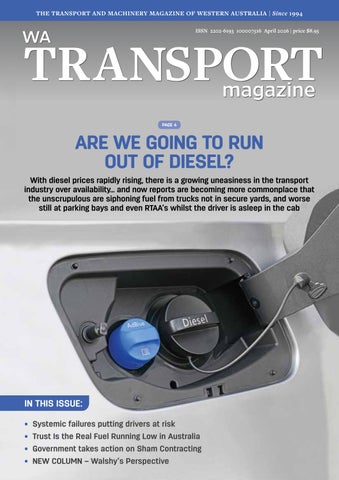
With diesel prices rapidly rising, there is a growing uneasiness in the transport industry over availability… and now reports are becoming more commonplace that the unscrupulous are siphoning fuel from trucks not in secure yards, and worse still at parking bays and even RTAA’s whilst the driver is asleep in the cab
• Systemic failures putting drivers at risk
• Trust Is the Real Fuel Running Low in Australia
• Government takes action on Sham Contracting
• NEW COLUMN – Walshy’s Perspective
The Heavy Vehicle Helpdesk is open from: 7am to 6pm Monday to Friday, and WA Public Holidays.
On weekends the Main Roads Customer Information Centre will receive telephone calls on behalf of the Heavy Vehicle Helpdesk on 138 HVO (138 486) and email enquiries can be sent to hvs@mainroads.wa.gov.au
The two big things in focus are obviously fuel uncertainty and Sham Contracting and all the safety implications that involves for all users of our roads in Western Australia.
I have been following closely what industry are saying they are experiencing on both fronts and I would like to welcome Russel Walsh to the magazine as a new contributor of ‘Walshy’s Perspective’. Russel is a driver with a wealth of experience and importantly a load of common sense. My thanks to Russel and his partner Jodie Alldrick for taking the time to put pen to paper and my hope is that their dialogue will reach the ears of the policy makers so they can make better decisions for this industry.
On the subject of Sham Contracting, I was pleased to hear that after all of the media attention… see we are good for
something… the parking bays in Geraldton that were being used as a depot have been vacated.
Fuel uncertainty from the war in the Middle East is on everyone’s worry list but especially the transport and agricultural sectors. Rising prices mean consumers will have to pay more but ‘availability’ is the biggest worry. I think Ben Sutherland from the LRTAWA hit the nail on the head when he said, “Fuel shortages create economic disruption. But the real crisis begins when businesses and consumers stop believing what they are being told.” See page 19.
As always, thank you to everyone who supports our home-grown magazine, now 32 years young.
Best,
Angry Chicken Publishing Pty Ltd
Telephone 0430 153 273
www.angrychicken.com.au
ABN: 35 486 530 095
PUBLISHER / COMMISSIONING EDITOR
Karen-Maree’ Kaye
T: 0430 153 273
Email: karen@angrychicken.com.au
WRITERS
Karen-Maree’ Kaye, Russell McKinnon
CONTRIBUTORS
Jan Cooper, Cam Dumesny, Cliff Graham, Carol Messenger, Ray Pratt
ADVERTISING ENQUIRIES
Angry Chicken Head Office
T: 0430 153 273
E: karen@angrychicken.com.au
DESIGN / PREPRESS
Cally Browning | Bare Creative
ACCOUNTS
T: 0430 153 273
E: accounts@angrychicken.com.au
PRINTER Daniels Printing Craftsmen
SUBSCRIPTIONS
Subscriptions available directly from the Publisher.
T: 0430 153 273
E: karen@angrychicken.com.au
Australia: 1 year $130 (inc GST)
Overseas subscribers: Airmail postage will be added to subscription rate.
Editorial Submissions: The Publisher welcomes editorial submissions. Once received they will become the property of the Publisher who reserves the right to edit the or adjust the content to fit with the format of our publication.
West Australian Transport Magazine (WATM) is published by Angry Chicken Publishing Pty Ltd
ABN: 35 486 530 095 All rights reserved. No part of this publication may be reproduced, adapted or transmitted in any form by any process (graphic, electronic, mechanical or storage and retrieval system) or sold, resold or otherwise exploited for any purpose without consent of the Publisher.
The publisher, contributors, editors and consultants disclaim any and all liability and responsibility to any person or party, be they a purchaser, reader, advertiser or consumer of this publication in regards to consequences and outcomes of anything done or omitted, or being in reliance whether partly or solely on the contents of this publication. No person, organization or party should rely on or on any way act upon any part of the contents of this magazine without first obtaining the advice of a fully qualified person. The Publisher shall have no responsibility for any action or omission by contributor, consultant, editor or related party for content within WATM. The opinions and content within WATM does not necessarily reflect those of the Publisher, editor or their agents. No responsibility is accepted for damage or loss of material supplied to the publisher.
BROKEN ROADS -
How systemic failures in Australia’s Trucking Industry are putting drivers and the public at risk
By JODIE ALLDRICK
Australia’s road freight industry is the backbone of the national economy. Nearly everything that reaches supermarket shelves, construction sites, hospitals, and homes has spent time on the back of a truck. Yet, behind this essential system lies a growing crisis one shaped by labour shortages, regulatory gaps, economic pressure, and structural exploitation.
Increasingly, these pressures are falling on migrant heavy-vehicle drivers, and the consequences are being felt not only by those drivers but by every road user in the country.
This is not a story about blaming migrants. It is a story from a partner of a heavy vehicle driver for the past 25 years. A system that has failed him and many others, and in doing so, has now begun failing the Australian public.
A Workforce Under Pressure
Australia has faced a long-standing shortage of qualified truck drivers. An ageing workforce, demanding hours, time away from family, and relatively low pay compared with the responsibility involved have made recruitment difficult. To fill the gap, the industry has increasingly relied on migrant labour. Many migrant drivers arrive willing to work hard, eager for opportunity, and grateful for employment pathways. But this willingness can make them vulnerable.
Reports from unions, transport watchdogs, and safety bodies over the years have documented patterns such as:
• Underpayment or wage theft
• Excessive working hours
• Pressure to meet unrealistic delivery schedules
• Poor training or rushed licensing pathways
• Limited knowledge of workplace rights
When workers fear losing visas, employment, or residency pathways, they are less likely to report unsafe conditions. This silence can allow unsafe practices to continue unchecked.
When Economics Overrides Safety
The freight industry operates on razorthin margins. Large retailers and logistics companies often contract transport work through layers of subcontractors. At the bottom of this chain, individual drivers or small operators absorb the cost pressures. This system creates what safety experts call “commercial coercion” — where drivers feel forced to choose between meeting deadlines or following safety regulations such as rest breaks and load limits. The result can be dangerous:
• Fatigue-related crashes
• Overloaded vehicles
• Poorly maintained trucks
• Drivers unfamiliar with Australian road conditions
Fatigue alone is one of the leading contributors to heavy-vehicle accidents. When a driver is pushed to stay on the road beyond safe limits, the risk is not just personal – it becomes public.
Training Gaps and Licensing Concerns
Another issue raised by industry insiders is inconsistency in training standards. Some migrant drivers may hold overseas heavy-
This is not a story about blaming migrants. It is a story from a partner of a heavy vehicle driver for the past 25 years. A system that has failed him and many others, and in doing so, has now begun failing the Australian public
vehicle licences that are converted locally with minimal reassessment.
While many are highly skilled, others may not receive sufficient orientation to Australian road laws, terrain conditions, or long-haul safety expectations. This is not a failure of the drivers themselves; it is a failure of regulatory systems that should ensure every person behind the wheel of a multi-tonne vehicle is fully prepared for Australian conditions.
When standards vary, public safety becomes uneven.
Exploitation Hidden in Plain Sight
The uncomfortable reality is that parts of the industry benefit from this imbalance.
Vulnerable workers are easier to underpay, harder to unionise, and less likely to challenge unsafe demands. That dynamic can create a race to the bottom, where companies that cut corners outcompete those that follow the rules.
Ethical operators of which there are many often find themselves pressured to match unsustainable pricing just to survive. In that environment, safety can become collateral damage.
The Public Safety Dimension
Most Australians assume that heavyvehicle regulation is strict and consistently enforced. In theory, it is. In practice, enforcement resources are limited, and responsibility is spread across federal, state, and territory agencies. When oversight is fragmented:
• Unsafe operators can slip through gaps
• Non-compliant companies may continue operating
• Drivers under pressure remain invisible
Every time a fatigued driver is pushed onto the road, the risk extends beyond the trucking industry. Families in passenger cars, motorcyclists, cyclists, and pedestrians all share that same road space.
Division Is a Symptom, not the Cause
Public frustration sometimes becomes directed at migrant drivers themselves, particularly after high-profile crashes.
But focusing blame on individuals misses the real issue: structural failure.
Blaming migrant workers for systemic problems only deepens social division and distracts from the institutions responsible for setting standards, enforcing laws, and designing fair labour systems.
In reality, migrant drivers are often among those most harmed by the current model.
When a system exploits workers, it rarely stops there it eventually compromises safety, fairness, and public trust.
What Real Reform Would Look Like
Addressing these risks requires structural solutions, not scapegoats. Experts consistently point to reforms such as:
• Stronger enforcement of fatigue and wage laws
• Clear national training and licensing standards
• Supply-chain accountability laws holding major contractors responsible
• Whistleblower protections for vulnerable workers
• Fair pay structures that remove incentives for unsafe driving
These measures don’t just protect drivers – they protect everyone.
A System Worth Fixing
Australia’s trucking industry is filled with hardworking professionals who take pride in their work and responsibility. Migrant drivers, like local drivers, are part of that backbone.
The real danger lies not in who is driving the trucks, but in the conditions under which they are asked to drive them.
When systems prioritise speed and profit over safety and fairness, everyone pays the price.
Fixing the problem means recognising a simple truth: a safe road network depends on safe drivers, and safe drivers depend on a system that treats them with dignity, fairness, and respect.
Fixing the problem means recognising a simple truth: a safe road network depends on safe drivers, and safe drivers depend on a system that treats them with dignity, fairness, and respect
Are we going to run out of Diesel?
With fuel prices going through the roof the unscrupulous are lurking in the shadows and targeting Western Australian transport operators – stealing fuel by way of siphoning it out of trucks that are often not parked in secure yards.
There have been reports of fuel being siphoned in Road Train Assembly Area’s as well as parking bays when the operator is taking a fatigue break and asleep in the cab.
Even lock caps are no deterrent for these thieves. What have we come to?
Whilst the Australian Government is stating the country has the strongest oil reserves in 15 years, the war in the Middle East has many people questioning our resilience.
And whilst, most decent people want to see the Persian people become free, Iran has the biggest bullet they can hold over the world – the supply of crude oil.
At the start of 2026, the country had an estimated 36 days of petrol, 34 days of diesel and 32 days of jet fuel. Will this stockpile be enough?
With the Strait of Hormuz, a critical shipping route for global oil and gas supplies reportedly closed in March and Israel striking a number of oil facilities in Tehran, everyone is questioning the supply of crude oil.
Australia’s domestic crude oil situation looks dismal with oil production not sufficient to meet its total demand even if we had the refineries. It is declining and without any new commercial discoveries, production is projected to cease within seven years.
There are only two remaining refinery’s – Ampol’s Lytton refinery and Viva Energy’s Geelong refinery which supply a fraction of the country’s daily consumption. With government subsidies funding these due to expire in 2027, concerns are further raised about Australia’s fuel security.
Australia imports about 90% of its fuel requirements with a significant portion of
this; oil that is refined in Singapore, South Korea and Japan. And you guessed it… they obtain their crude oil from the Middle East.
As of March, fuel stations in regional Australia were already facing shortages of diesel but this is being blamed on panic buying, akin to the toilet paper shortage.
It is already being reported from truck drivers in Western Australia that no diesel is available in certain towns, and regional fuel suppliers have restricted fuel sales to emergency services only. WA Farmers are experiencing difficulties in obtaining diesel and with seeding just around the corner this is leading to significant challenges and worry for them.
There have been reports of fuel being siphoned in RTAA’s as well as parking bays when the operator is taking a fatigue break and asleep in the cab
If supply is not an issue, which we will have to see how that plays out, the significant increase in global oil prices is bad news for everyone.
The Australian Livestock and Rural Transporters Association (ALRTA) has called on the Federal Government to provide clear leadership and transparency on Australia’s diesel supply situation.
Transport operators have reported diesel price increases of between 30 and 60 cents per litre.
ALRTA President Gerard Johnson said while isolated supply pressures were being reported, the priority must be maintaining confidence and stability across the freight network.
“Transport operators and regional communities need clear information and reassurance that Australia has sufficient fuel supplies and that appropriate measures are in place to maintain stability,” Mr Johnson said.
“Panic buying only risks making the situation worse. What we need right now is calm behaviour from consumers and strong leadership and transparency from government.”
“For many transport businesses the jump of 30 to 60 cents per litre represents a 10 to 20 per cent increase in operating costs almost overnight,” Mr Johnson said.
“With industry margins typically sitting between three and seven per cent, that level of cost escalation places enormous pressure on the viability of small and medium regional operators.”
“If diesel becomes unavailable or unreliable along key freight routes, trucks do not move.”
ALRTA also cautioned the Federal Government against rushed policy responses aimed at reducing fuel prices at the bowser.
During the temporary fuel excise reduction in 2022, the fuel tax credit available to heavy vehicle operators was reduced under the existing road user charge arrangements, significantly impacting operator cash flow.
“While excise cuts may provide shortterm relief to motorists, they can have unintended consequences for the freight sector. For transport operators the loss of fuel tax credits can effectively add a further five to seven per cent to operating costs almost immediately” Mr Johnson said.
ALRTA said the priority should be ensuring supply stability and providing clear communication to industry and the community.
“Discussion about Australia’s long-term fuel security will inevitably occur in due course, however, now is not the time to create uncertainty.
Visit our website to sign up for email updates and access handy tips and tools, including:
• A cost calculator to help with business costs
• Guideline rates of payment for 13 truck types
• Templates and tips for negotiating contracts with hirers
• Tips on how to deal with hiring disputes For more information, visit transport.wa.gov.au/ownerdrivers or scan the QR code.
Government funding for road infrastructure
Events
Explore the range of events Main Roads Heavy Vehicle Services (HVS) attend throughout the State.
We participate in a variety of events throughout the year, ranging from agricultural shows to industry expos.
Attending these events provides a valuable opportunity for our team to connect with the community, increase awareness of heavy vehicle operations, and share knowledge, information and resources while promoting road safety.
Come and say hello at one of the listed events – we look forward to meeting you.
The Federal Government’s Safer Local Roads and Infrastructure Program (SLRIP) funds new projects that typically focus on road safety, productivity, bridge renewal, road resilience, road sustainability or heavy vehicle rest areas. This outlay helps fund infrastructure investment in cities and regional and rural Australia and supports the delivery of safer and more productive roads.
The SLRIP is an application-based, merit-assessed funding program, open to all State and Territory governments and Local Governments. Funding of at least $200 million per year is available. For more information and the list of currently funded projects, visit investment.infrastructure.gov. au/about/local-initiatives/safer-local-roadsand-infrastructure-program
6 & 7 Wagin Woolorama Wheatbelt
MARCH
19 - 22 Caravan and Camping Show Metro
22 Mack Muster Metro (Byford)
APRIL 17 - 19 Outdoor Living - Caravan, Boat & 4WD South-West
DEC Date TBC St Barbara’s Festival Goldfields - Esperance
HVS Update 2-2026 – Change to
Please be advised that despite a reminder issued in May 2025 relating to Alternate Vehicle provisions in the Single Trip OSOM Vehicle Standard Operating Conditions (as per HVS Update 8-2025), HVS continued to observe a high level of non-compliance with the provisions.
As such, from 9 February 2026, the Alternate Vehicle provisions were removed from the Single Trip OSOM Vehicle Standard Operating Conditions.
Operators are required to complete
The Heavy Vehicle Rest Area (HVRA) initiative supports the construction of new and upgraded heavy vehicle rest areas. In line with the forecasted growth in truck freight over the coming decades, the HVRA initiative aims to improve road safety for heavy vehicle drivers and other road users by addressing the shortage of heavy vehicle rest stops. The HVRA initiative sits under the SLRIP with its own separate focus area.
The
Heavy Vehicle Rest Area (HVRA) initiative supports the construction of new and upgraded heavy vehicle rest areas
The Federal Government has committed $140 million to the initiative over 10 years to 2031-32. For projects submitted by Local Governments, the HVRA initiative will contribute up to 80% of the cost for projects located in regional and remote areas, and up to 50% of the cost for projects located in urban areas, up to the cap of $5 million per project. For projects submitted by State and Territory governments, the HVRA initiative will contribute up to 50% of the cost for all projects, regardless of project location, up to the cap of $5 million per project. Further information on the HVRA initiative can be found in the Fact Sheet here
Heavy vehicle drivers can suggest potential locations for rest stops via the Heavy Vehicle Rest Area Survey here The survey takes less than five minutes to complete and provides valuable insights to government for future projects to fund through the HVRA initiative.
Alternate Vehicle Provisions
the Specified Journey (Single Trip) Permit Identical Alternate Vehicle Application form, available on the OSOM Single Trip Permits page on the Main Roads website, and submit it to permit.applications@ mainroads.wa.gov.au
Operators using an alternate vehicle will need to wait for their permit to be amended prior to departing, i.e. the permit will only be valid with the correct registration numbers of the vehicles being used during the move.
If the alternate vehicle is identical to
the vehicle specified on the current permit, HVS will process the permit amendment within four hours, provided the alternate vehicle is already listed in RAVS / MOVES.
Applications for alternate vehicles that are not identical or not already listed in RAVS / MOVES will be treated as a standard permit amendment and relevant processing timeframes will apply.
For further information, please contact the Heavy Vehicle Services Helpdesk on 138 486 or email hvs@mainroads.wa.gov.au
WA Heavy Vehicle Accreditation
Heavy Vehicle Accreditation auditors play an essential role in upholding the safety, reliability and integrity of Western Australia’s heavy vehicle sector. By verifying operator compliance across Maintenance Management, Fatigue Management, Dimension and Loading, the Common Module, and Mass Management (where applicable), auditors help ensure the robustness of Accreditation systems and practices.
Main Roads recently updated a suite of Western Australian Heavy Vehicle Accreditation (WAHVA) documents and advised auditors of the opportunity to provide feedback on the proposed amendments. The documents under review include:
• Business Rules
• Frequently Asked Questions
• Auditor Certification Policy and Process
• Guideline for Audit Providers
• Auditor Certification FAQs
• Auditor Code of Conduct
Summary of Proposed Amendments
The key changes include:
• Introduction of Remote System and Compliance Audits, finalising the Remote Audit Requirements Trial that commenced in July 2023
• Updates to the Suspension Process
• Revised processes for Change of Business Name
• Amendments to the Auditor Breach Process
These updates aim to provide greater flexibility - particularly through the expansion of electronic audit methods - and to simplify processes relating to suspension and breach management within the WAHVA framework.
Opportunity for Auditor Feedback Auditors who wished to comment on the proposed amendments
WA OWNED AND RUN
were able to do so via the Auditor
My Say Transport platform at www.mysaytransport.wa.gov.au Submissions closed on 26 March 2026.
Following the review of auditor input, Main Roads will undertake separate, targeted consultation with the broader transport industry before finalising the documents for publication on the Main Roads website.
Upcoming Auditor Conference
An Auditor Conference is scheduled for 25 September 2026, providing a forum for collaboration, knowledge sharing and discussion of future priorities.
Auditors who would like to suggest topics or raise specific matters of interest are invited to email accreditation@mainroads.wa.gov.au ahead of the event to support a well structured and meaningful agenda.
the
premier brake and clutch specialists
From major truck workshops, heavy haulage, cranes, the mining industry and more… our team of knowledgeable and qualified technicians share over 100 years combined experience and focus on delivering prompt service alongside the supply of top name brakes and clutchesthroughout Australia and Asia.
With over 20 years in the industry we have a well-earned reputation for the development, manufacture and supply of quality standard and customised designs to suit a wide range of applications.
For the best advice and friendly service contact us today.
Over to you A FAIR GO FOR OWNER DRIVERS by Ray Pratt
Australia Runs on Trucks –So Why Are We Letting the Industry Collapse?
The transport industry is slowly imploding within so let’s stop pretending everything is fine. The Australian transport industry is not ‘under pressure’, it’s not ‘facing challenges’, it is in crisis.
The truck driver shortage, particularly experienced ones - the old hands who can reverse a road train in the dark, who understand load restraint by instinct, who know the Nullarbor by memory – are walking away. They’re retiring broken in body, burnt out in mind, or simply fed up and who can blame them?
The industry once offered independence and a decent living has turned into a grind dominated by big business who are determined to drive freight rates lower and lower. Contracts are awarded to whoever will do the job cheapest – no the safest and not the most experienced.
The multinational at the top squeezes the mid-tier operator, who squeezes the small fleet, who squeezes the owner-driver. By the time it reaches the person behind the wheel, there is nothing left to squeeze but time and health.
The country literally can’t function without road freight. Yet the people doing the heavy lifting are treated as expendable.
Transport companies are going broke, fuel prices are rising and insurance premiums skyrocketing. Maintenance costs are through the roof and compliance requires added office staff just to keep up. The margins are so thin they are almost invisible and one breakdown, one delayed payment, one contract lost — and that’s the end of a business built over decades.
Meanwhile, the regulatory burden keeps growing. Safety matters - no serious operator argues against that but over-regulation layered on top of broken economics does not create safety. It creates paperwork and small operators drown in it.
Larger corporations absorb it and carry on and the imbalance widens.
Sham contracting remains an open secret. Drivers labelled as ‘independent contractors’ often have no real independence at all. They carry the risk of truck ownership, the debt, the maintenance, the insurance – but none of the bargaining power with no paid leave, no super guarantee certainty and no real security. It undercuts genuine businesses and drags standards down for everyone.
Then there is fatigue. The word gets thrown around in compliance seminars and policy documents, but fatigue is not an abstract concept. It is a driver at 3am fighting to keep his eyes open on a long stretch of highway burdened with unrealistic delivery windows.
It is financial stress at home because rates have been cut again. It is two-up driving teams trying to make impossible schedules work. The industry talks about rest breaks while ignoring the commercial forces that make proper rest almost unattainable.
Young people look at this and walk away. Why enter an industry where you can work 70 hours a week, carry enormous responsibility, risk your licence and your life, and still struggle financially? We are
Safety mattersno serious operator argues against that but over-regulation layered on top of broken economics does not create safety
not just short of drivers - we are short of reasons for anyone to join.
Government responses feel like token gestures. A training subsidy here, a working group there - plenty of talk but little action. They make road safety announcements whilst ignoring the economic model that creates unsafe pressure in the first place. If freight rates do not cover the real cost of operating safely, no amount of advertising campaigns will fix the problem.
The truth is uncomfortable. The market has been allowed to distort to the point where survival depends on cutting corners or margins so fine that one mistake means collapse. When price is the only factor that matters, safety and sustainability inevitably suffer. Until major clients are held accountable for their part of the chain of responsibility laws nothing will change.
This industry needs a reset, not another review and freight must be priced realistically. Operators must be able to make a profit and recover their costs without gambling their homes. Enforcement against sham arrangements must be visible and consistent and drivers must be treated as skilled professionals, not disposable labour.
Most of all, the country needs to recognise that trucking is not just another line item in a supply chain spreadsheet. It is critical national infrastructure. When floods cut off towns, when pandemics hit, when rail lines fail — trucks keep moving.
The warning signs are no longer subtle. The question is whether anyone with real power is prepared to listen before the breakdown becomes impossible to ignore. I’m angry because nobody listens to truck drivers. We are the ones that see the problems and the impacts it has on our lives but nobody wants to listen and nobody wants to rock the boat. Keep it safe, Ray Pratt.
Westport Authority to drive delivery of Kwinana’s new container port
The State Government has introduced new legislation to Parliament to establish a dedicated authority to deliver the State's future container port and supporting infrastructure in Kwinana, securing Western Australia’s long-term trade future.
The Westport Bill 2026 will enable the establishment of a statutory Westport Authority to oversee the planning and delivery of the once-in-a-century project, to secure critical trade infrastructure for the State.
Westport will be of one of the largest State infrastructure programs in Western Australia’s history, requiring more than 10 years of complex, integrated delivery.
Establishing a dedicated authority with the necessary powers to efficiently deliver public projects is commonplace across Australia for ‘mega’, non-business-as-usual, infrastructure projects.
The Westport Authority will be a standalone entity and agent of the Crown, minimising risks and ensuring that Westport is delivered efficiently, costeffectively, and with full accountability.
The Authority will be empowered to make timely decisions, enter commercial arrangements and attract the specialist expertise required to deliver new port infrastructure, along with upgrades to road,
rail, and logistics networks.
With similar powers to Western Australian port, infrastructure and redevelopment authorities, the Westport Authority will be best placed to plan and deliver port and associated infrastructure, facilities and operations.
It will be able to buy and sell land, manage property, carry out port and other works, and enter into necessary business agreements.
The Bill preserves the Environmental Protection Act and makes no changes to the environmental impact assessment process.
It also makes no changes to Statutory heritage approval processes and does not override heritage protections established by the Aboriginal Heritage Act 1972 and Heritage Act 2018
The Westport Authority will be governed by a Westport Board appointed by the Minister, with a CEO accountable for the entity’s day-to-day activities.
The Westport Authority will be a planning and delivery arm of government, existing for a finite period and will handover completed assets to government operators.
Subject to environmental approvals and a final investment decision, construction of the new container terminal is expected to commence in the late 2020s, with operations beginning in the late 2030s.
NTC must review cross border time counting
The NTC must review the work and rest hour rules for truck drivers entering the HVNL states from Western Australia or the Northern Territory, ATA CEO Mathew Munro said.
Mathew was responding to an important court win recently, spearheaded by ATA member association SARTA.
The South Australian Magistrates Court found that a truck driver had no case to answer after he was charged with failing to comply with the BFM work and rest hours as a result of his time driving while in Western Australia. There was no suggestion the driver was affected by fatigue.
Mathew said the decision confirmed the ATA’s view that the cross-border time counting rules in the HVNL were flawed.
“Because of their complexity, the rules cause confusion for businesses and drivers. The rules discourage businesses from operating across the WA and NT borders.
“And the court decision raises the question of whether the HVNL time counting rules even apply in states that have specifically decided not to participate in the scheme.
“With the HVNL review legislation now passed, there needs to be a systematic process for updating the law.
The judgment shows that reviewing the relevant section of the law – section 245 – needs to be at the top of the NTC’s work program,” Mathew said.
SARTA, the ATA and the Livestock and Rural Transporters Association of South Australia funded the driver’s defence in the case, which involved briefing senior barristers.
is is an important win for the industry and a great example of the value of effective industry associations like SARTA, LRTASA and the ATA. We were pleased that the ATA and LRTASA joined us in fighting this important case,” SARTA CEO Steve Shearer OAM said.
The court decision applies to the specific facts of this particular case. Decisions at this level of the court system also do not act as binding precedent. Trucking businesses and drivers must continue to comply with the current work and rest rules, including for nonparticipating states, on their terms.
CONTACTS:
7 Tipper Crt, Hazelmere WA
Office: (08) 9274 6355
Mobile: 0418 802 007
Rentals: 0488 003 228
Email: alan@haulmore.com.au
Website: www.haulmore.com.au
We have the following units currently in stock available for sale or hire:
Quad 4 Rows of 8 Full Axle Widening Low Loader with Hydraulic Suspension
Quad 4 Rows of 4 Full Axle Widening Low Loader with Hydraulic Suspension
When Fuel Prices Jump, the Whole Freight Network Feels the Shockwave
By DEAN NEWMAN COO Offload
Heather Jones joins the Board of Healthy Heads in Trucks & Sheds
Healthy Heads in Trucks & Sheds (Healthy Heads) is pleased to welcome transport industry leader Heather Jones and registered psychologist Arthur Papagiannis as the newest additions to its Board of Directors.
Though their expertise comes from different fields, Heather and Arthur both share a strong commitment to fostering safer, healthier, and more supportive workplaces across Australia’s transport, warehousing, and logistics sector, making them a perfect fit for the Board.
Coupled with her dedication to improving workplace wellbeing, Heather brings over three decades of hands-on experience as a professional heavy vehicle driver. To this day, she remains active on the road, operating tippers, flat tops, tankers, oversized loads, and higher-productivity vehicles, all of which gives her firsthand insight into the daily challenges and pressures faced by drivers.
Leveraging this extensive operational experience, Heather is a certified Driver Trainer and a passionate advocate for road safety. She also founded the Pilbara Heavy Haulage Girls Group to mentor women entering the transport industry and actively engages with her Geraldton community, volunteering in schools
Recently, I had one of those reminders of how strangely connected our world really is. Oil prices spiked after tensions flared in the Middle East. Within hours, headlines were full of predictions for airlines and global shipping.
But what hit me wasn’t the price of oil itself. It was the fact that a geopolitical shift on the other side of the world can change the cost of moving goods across Australia overnight. When energy prices move, freight feels it immediately. In a country as big as ours, freight is the quiet machinery keeping the entire economy upright.
The Exposed Backbone of Australia
Almost everything you touch – food, medicine, or the steel on a construction site – spent time on a truck. Road freight is our national lifeline, but it is also uniquely exposed to the whims of the
to promote vehicle safety and careers in transport. Her significant contributions have been widely recognised, including her 2019 induction into the Transport Hall of Fame and multiple industry awards.
“I’m thrilled to join the Healthy Heads in Trucks & Sheds Board,” Jones said. “Having spent my career on the road, I understand the pressures drivers face every day. I’m committed to using my experience to help shape initiatives that genuinely support their mental health, safety, and wellbeing.”
Complementing Heather’s frontline expertise, Arthur Papagiannis brings over 25 years of experience as a registered psychologist and as founder and CEO of AP Psychology & Consulting Services. Widely recognised as a leader in psychological health and safety, Arthur has worked with boards, executives and senior leaders across government and private organisations in Australia and New Zealand to design and implement high-level policies, evidence-based strategies, and programs to enhance organisational performance in psychological health and safety, prevent psychosocial harm and meet work health and safety obligations.
Arthur has also previously collaborated with Healthy Heads to create the Healthy Heads Roadmap, Guidelines and Planner, a practical resource designed to help organisations of all sizes navigate and manage psychological health and safety in the workplace. In addition to this strategic initiative, he contributes his expertise to Healthy Heads’ How Ya Travellin’? podcast, providing actionable insights that promote resilience, wellbeing and better mental health.
“I’m excited to work even more closely with Healthy Heads in Trucks & Sheds through the Board to help shape practical, evidence-based solutions that make a real difference for employees in transport, warehousing, and logistics,” Arthur said. “Together, we can reach our joint goal of creating workplaces where mental health is prioritised and employees feel supported, empowered, and equipped to thrive.”
Healthy Heads in Trucks & Sheds Chair Paul Graham, has warmly welcomed the appointments.
“We’re thrilled to have Heather and Arthur join our Board,” Graham said. “Heather brings unmatched frontline insight, and Arthur adds decades of expertise in psychological health and safety. Their combined knowledge will guide our strategy and help us continue to develop initiatives that genuinely support the wellbeing of everyone working across the supply chain.”
energy market. Diesel is one of the highest costs for a carrier. When prices surge, operators feel it instantly. Margins evaporate and planning becomes guesswork. Small inefficiencies that normally hide in the background suddenly become systemic drains on the bottom line:
• The cost of every empty kilometre.
• The friction of every missed backload.
• The ripple effect of every poorly timed pickup.
In a stable market, these are minor annoyances. In a volatile one, they are expensive threats to viability. Across thousands of loads a day, those costs ripple through the entire national network.
Why the Old Way is Breaking
For decades, the industry has relied on manual coordination: phone calls, spreadsheets, and reactive problem-solving. It worked when the world moved slowly. It doesn't work now. When fuel swings or demand spikes, these manual systems don’t just creak; they fail. As leaders, we need to recognise that we don't need more people on the phone. We need a system of work. We need a digital infrastructure that replaces chaos with structure, visibility, and total predictability.
Technology
as the Operating System
Technology should not be a bolt-on. It must be the operating system that keeps freight moving. A truly digital network does what a spreadsheet cannot: it matches the right load with the
right carrier with surgical precision, eliminates empty running, and provides real-time visibility that allows operators to lead rather than follow.
Empowering the People Who Move the Country
We need to change how the industry views carriers. For too long, they have been seen as “capacity.” These are small businesses facing immense pressure from fuel volatility and rising overheads. They shouldn’t have to navigate fuel rationing and price shocks alone.
Technology must be a tool for their success. In my view, the future of the industry depends on:
1. Accelerated, predictable cash flow to keep wheels turning.
2. Intelligent route planning that slashes unnecessary fuel burn.
3. Consistent volume that lifts asset utilisation.
Building a System That Withstands Shock
The future of freight is about building a smarter, connected network that reduces waste and supports the people who keep the country moving.
Whether the next disruption is a fuel spike, a weather event, or a global shift, the divide is clear: Coordinated networks adapt. Fragmented ones struggle.
Keeping Australia moving is a national imperative. We must continue to build the technology and financial infrastructure to ensure our network is ready for whatever comes next.
Over to you
WESTERN ROADS FEDERATION
by Cam Dumesny, CEO
Government takes action on Sham Contracting
The Australian Taxation Office (ATO) and Fair Work Ombudsman (FWO) are ramping up their focus on sham contracting, with community insights and intelligence revealing concerning patterns of behaviour across several industries.
Sham contracting happens when an employer misrepresents to a worker that an employment relationship is an independent contracting arrangement when the employer doesn’t reasonably believe this. This might be done in an attempt to avoid paying entitlements such as super, leave and workers’ compensation. This practice undermines or ignores workers’ rights and disadvantages honest businesses. Those who engage in sham contracting can face court-ordered penalties.
ATO Assistant Commissioner Tony Goding said data continues to uncover behaviour in industries including building and construction, and road freight, that doesn’t contractually add up.
‘Some businesses seem to think they can dodge their employee obligations, like paying super and other entitlements, simply by saying their employees are independent contractors. This doesn't pass the pub test; it's also illegal and we're shining a light on those trying to hide in the shadows’, Mr Goding said.
‘If you’re treating workers like employees but calling them contractors, it may be illegal. That arrangement may not work out the way you might expect once the ATO and FWO have had a look.’
Fair Work Ombudsman Anna Booth said employers should be aware that FWO has investigations on foot into alleged sham contracting in sectors such as building and
construction, and road transport.
‘We won’t hesitate to take enforcement action where we find unlawful activity in any sector,’ Ms Booth said.
‘We are pleased to be joining forces with the ATO to shine a spotlight on this unlawful practice that leaves workers worse off and can land employers in court, exposed to significant penalties.’
Ms Booth took the opportunity to remind employers that it’s unlawful to mislabel a worker as a contractor when the business doesn’t reasonably believe this.
‘Employers also must not knowingly say something false or misleading to convince an employee to become a contractor to do the same work, or dismiss an employee to engage them as a contractor to do the same work,’ Ms Booth said.
Penalties
Under the Fair Work Act, courts can impose penalties against businesses or individuals for sham contracting. The maximum penalties for each contravention are:
• $19,800 for individuals
• $99,000 for businesses with fewer than 15 employees
• for businesses with 15 or more employees, the greater of $495,000 or three times the underpayment amount.
In one example, the FWO secured nearly $200,000 in penalties against a Sydney health and wellness research company after it terminated or threatened to terminate three workers’ employment in order to reengage them as independent contractors to perform substantially the same work.
Apart from the penalties imposed by the
Fair Work Act, businesses who incorrectly treat an employee as an independent contractor risk other penalties and charges, including:
• PAYG withholding penalty for failing to deduct tax from worker payments and send it to the ATO
• super guarantee charge (SGC), which is more than the super that would have been paid if the worker was classified correctly. SGC consists of:
o super guarantee shortfall amount
o nominal interest
o an administration fee
• additional super guarantee penalties including the Part 7 penalty amount of up to 200% of the SGC under the Superannuation Guarantee (Administration) Act 1992
Workers who are engaged principally for their labour are entitled to super regardless of whether they are correctly classified as an independent contractor.
Taxable payments annual reporting
Taxable payments annual reporting (TPAR) provides the ATO with visibility of payments made to contractors each year. Data from businesses in road freight, construction, cleaning, courier, security, IT and other industries is matched with tax returns, ABN records, super reporting and Single Touch Payroll to identify sham contracting warning signs, including:
• contractors who work almost exclusively for one business
• individuals operating with an ABN but failing to declare their income or lodge their tax returns.
Fair Work Ombudsman Anna Booth
ATO Assistant Commissioner Tony Goding
In 2024–25 through TPAR, the ATO had visibility of almost 185,000 businesses making payments to more than 1.4 million contractors, totalling over $507 billion.
In the road freight industry, many businesses are failing to comply with TPAR obligations. The ATO has seen a spike in noncompliance of contractor payment reporting in this industry over the last few years.
‘The level of visibility we have of payments made to contractors in these industries makes it much harder for those trying to avoid their obligations,’ Mr Goding said.
Shadow Economy Taskforce and tip-offs
Mr Goding noted, ‘we’re working with the FWO and other regulators as part of the Shadow Economy Taskforce to ensure workers and honest businesses aren’t being taken for a ride’.
‘The ATO-led Shadow Economy Taskforce is constantly sharing intelligence across our agencies, including almost 1,000 community tip-offs we receive every week from people who know or strongly suspect tax evasion behaviours including sham contracting. Tip-offs come in from workers, customers and competitors.’
Penalties for Sham Contracting are $19,800 for individuals, $99,000 for businesses with fewer than 15 employees and greater than 15 employees $495,000 or three times the underpayment amount
In 2024–25, the ATO received more than 7,000 tip-offs relating to the building and construction industry, with around 20% including allegations of sham contracting.
‘People are tipping us off about employers requiring staff to be contractors as well as making incorrect payments or not reporting payments to contractors,’ Mr Goding said.
The ATO also received over 800 tipoffs regarding the road freight industry in 2024–25, with nearly 25% referring to sham contracting.
‘Businesses that think they can get away with dressing employees up as contractors should know that our extensive datamatching and community tip-offs are shining a bright spotlight their way.
‘For workers who are treated as contractors even though they’re really employees, you’re the one who’s really
missing out – on super, overtime, public holiday penalties, allowances, leave entitlements and basic workplace protections you should rightfully have,’ Mr Goding said.
‘Workers with concerns they may be in a sham contracting arrangement are urged to contact the Fair Work Ombudsman directly to seek assistance,’ Ms Booth said.
The ATO encourages businesses to review their arrangements and use our online resources or talk to their registered tax professional to work out if their worker is an employee or independent contractor.
Regulators encourage workers who believe they have been misclassified to contact FWO on 13 13 94,and to make a tip-off to the ATO visit ato.gov.au/aboutato/tax-avoidance/the-fight-against-taxcrime/what-you-can-do/making-a-tip-off
Over to You
Walshy's PERSPECTIVE
Let me introduce myself.
My name is Russel Walsh. I have been in and around trucks for around 40 years. My driving career started at 20 in the town where I grew up, Mukinbudin and over the years I’ve owned, driven and fixed a couple of trucks. I did a cert IV as a heavy commercial vehicle mechanic later in life and managed a large private fleet workshop. I’ve carted most types of freight including livestock, end tippers Ag cartage to side tippers on ore jobs in Leonora, Groote Eylandt, The Granites and Bootu Creek plus some general and refrigerated and now fuel to throw into the mix.
I want to share with you a piece written by my partner of 23 years, Jodie Alldrick who has seen my trials and tribulations in the transport industry and as a professional in the mental health field she is stunned at how toxic our industry is.
Sham Contracting in Australia’s Trucking Industry
An Investigative feature
by JODIE MAREE ALLDRICK
New interchange to support Pilbara’s clean energy future
The new Great Northern Highway
Lumsden Interchange at Port Hedland in Western Australia’s central north coast is complete, laying the foundation for Pilbara Ports’ new Lumsden Point development.
The southern approach road to the Port Hedland township now features a fourway interchange including a large-scale roundabout underpass, two flyover bridges, and four new access ramps.
These upgrades provide safer access on and off Great Northern Highway, particularly for oversize and over mass vehicles, with the addition of new turning pockets for the Lumsden Point port.
Due to begin operations in mid-2026, the Lumsden Point development will be
Australia’s freight network is often described as the bloodstream of the national economy. Every supermarket shelf, construction site, hospital storeroom, and fuel station depend on trucks travelling vast distances to keep supply chains moving. Yet beneath the surface of this essential industry lies a growing structural issue that is quietly reshaping labour conditions, safety standards, and public risk: sham contracting.
Sham contracting occurs when workers are labelled as independent contractors while being treated as employees. On paper, contractors are business operators who set their own rates, choose their clients, and control their working hours. In reality, many drivers classified this way operate under conditions that mirror employment, raising serious legal and ethical concerns across
critical to diversifying trade, supporting growth, and creating new import and export pathways.
The multi-user facility and logistics hub will support the rapid growth of direct shipping services to the Pilbara, aid the export of critical minerals, and the import of renewable energy infrastructure, including wind turbines and blades.
This port expansion will help to position Port Hedland at the forefront of future green industries, helping drive WA's transition to renewables, unlocking trade and investment opportunities and creating hundreds of new jobs.
The new four-way interchange will significantly improve traffic flow and help
Tyres left behind by Sham Contractors
the transport sector.
Industry observations and worker reports consistently point to similar patterns. Drivers may be required to work fixed shifts, wear company uniforms, drive branded trucks, and follow routes and schedules set entirely by the company. They are often paid fixed rates rather than negotiating contracts, cannot subcontract their work, and rely on a single company for income. In practice, their independence exists in name only.
For companies, the incentive to structure arrangements this way can be financial. Classifying a driver as a contractor rather than an employee can reduce or eliminate obligations such as superannuation contributions, paid leave, overtime rates, workers’ compensation coverage, and certain tax liabilities. These savings can be significant in an industry known for tight margins and intense competition.
The cost, however, does not disappear. Instead, it is transferred. Drivers may become responsible for fuel, insurance, maintenance, tax, and compliance expenses, often without fully understanding the financial risks they have assumed. After these costs, some drivers report earning far less than they expected and in certain cases less than minimum wage equivalents.
The burden frequently falls hardest on those with the least bargaining power, including migrant drivers, new entrants to the workforce, and workers unfamiliar with Australian employment laws. Many accept contractor agreements believing they are standard practice or necessary to secure work. Others fear that refusing such arrangements will simply cost them the
opportunity altogether.
While sham contracting is commonly framed as a workplace rights issue, safety specialists warn it is equally a public safety concern. When drivers carry all commercial risk, they also carry pressure to absorb delays, penalties, and rising operating costs. That pressure can translate into longer hours, skipped rest breaks, deferred maintenance, and decisions made under financial stress.
In a country where heavy vehicles share roads with families, commuters, and school buses, the implications extend well beyond the industry itself. Unsafe conditions for drivers can quickly become unsafe conditions for everyone.
Australian law prohibits sham contracting, and regulators have the authority to investigate and penalise businesses that deliberately misclassify workers. Yet enforcement can be difficult. Determining whether a worker is truly a contractor or effectively an employee requires detailed examination of working relationships, contracts, and operational control. Many drivers are reluctant to report concerns for fear of losing work or being excluded from future opportunities.
The structure of the industry can also make oversight challenging. Long hours, remote routes, and isolated working conditions reduce visibility and limit opportunities for monitoring. As a result, critics argue the system often relies on complaints rather than proactive detection, meaning questionable arrangements may continue unnoticed.
Beyond individual cases, the broader effect is market distortion. Companies that comply with employment obligations must compete against operators able to cut
costs through questionable classification practices. This dynamic can place downward pressure on wages, standards, and safety across the sector. Legitimate owner driver’s true contractors running independent businesses may also struggle to compete when artificially low rates become the norm.
Australia’s freight demand continues to grow, driven by e-commerce expansion, infrastructure development, and population increases. The industry needs more drivers, not fewer, yet recruitment and retention remain ongoing challenges. Analysts warn that unless structural issues such as sham contracting are addressed, the sector risks undermining its own sustainability by deterring future workers.
The trucking industry now stands at a crossroads. Transparency, fair classification, and accountability in employment practices will play a defining role in shaping its future. For policymakers, the question is whether current enforcement tools are strong enough. For companies, it is whether short term savings outweigh long term legal and reputational risk. And for the public, the question is simple, who is really paying the price of cheap freight?
Because somewhere between the warehouse and the highway, the true cost of delivery may not be measured in dollars at all, but in fairness, safety, and human dignity.
Thanks to Jodie for describing this accurately so now we understand what it is and how it works but what are we going to do about it? Are the regulatory authorities, governments and MP’s paying attention?
~ Until next month. Cheers, Walshy.
reduce congestion, enhancing acceleration opportunities and ensuring better visibility for all road users.
Located at the Great Northern Highway, Pinga Street, and Bunarrah Drive (Lumsden Point access road) intersection, the interchange will bolster WA and the Pilbara as a world-class exporter of battery metals and minerals, as well as importer of clean energy infrastructure.
In February 2024, the Australian and WA governments finalised a $140 million agreement to build the Pilbara Hydrogen Hub.
As the first hydrogen hub in regional WA, the hub will house the Clean Energy Training and Research Institute, prioritise
The multi-user facility and logistics hub will support the rapid growth of direct shipping services to the Pilbara
the development of shared infrastructure, and drive future expansion initiatives to support the growth of hydrogen opportunities in the Pilbara region and support the State’s economy.
The efficient import of renewable energy components is essential to the development of WA’s renewable energy industry and achieving net zero goals.
In addition to providing funding towards the Pilbara Hydrogen Hub, the Australian Government is contributing $565 million towards common user port upgrades at
Lumsden Point and the Port of Dampier.
WA Transport Minister Rita Saffioti said, “Our government is continuing to invest in the economic infrastructure the Pilbara needs to power the nation.
“These upgrades will not only streamline efficiency across this critical industrial area but will improve safety for all road users travelling in and out of Port Hedland.
“Lumsden Point will play a critical role in WA’s clean energy future, supporting more direct shipping to the Pilbara and export opportunities for our State.”
Developing a forward-looking cost base
The National Transport Commission (NTC) has opened public consultation on proposals to develop a forward-looking cost base (FLCB) for setting heavy vehicle charges in Australia.
The consultation is supported by a Consultation Regulatory Impact Statement (C-RIS), which sets out a proposed model and implementation options that could be used to set heavy vehicle charges from 2027–28 onwards, subject to ministerial approval. This can be viewed at www.ntc. gov.au/project/developing-implementableforward-looking-cost-base
In May 2023, the Infrastructure and Transport Ministers’ Meeting (ITMM) approved heavy vehicle charges for 2023–24 to 2025–26. The process also identified opportunities to improve how charges are set.
Accordingly, ITMM asked the NTC to develop a FLCB, which could potentially provide a basis for setting future heavy vehicle charges.
Heavy vehicle charges are currently set using a cost recovery mechanism known as
PAYGO (pay-as-you-go). In recent years, increases in government road expenditure have driven growth in the heavy vehicle cost base, while charges have not kept pace — resulting in a widening gap between costs and revenue under the PAYGO model.
The forward-looking cost base is an alternative approach that spreads the cost of road construction and maintenance over the life of road assets. This aligns more closely with other regulated infrastructure sectors and aims to improve stability, predictability and long-term cost recovery.
Consultation
As part of this work, NTC have published the C-RIS to seek stakeholder feedback on options for implementing a FLCB.
In support, the NTC has also published a range of supporting materials, including an overview of the C-RIS, the underlying model and an online module to help estimate annual charges under different options.
Have your say
NTC invite stakeholders to review the C-RIS and provide feedback their website at ntc.gov.au//webform/2026_ flcb_submission?source_entity_ type=node&source_entity_id=1085 and you can also register to attend one of their upcoming online information sessions, which will provide an overview of the C-RIS. Recordings will be made available on the NTC website afterwards. Submissions close on the 21st May 2026.
Fuel Security Roundtable Convened
The State Government convened a Fuel Security Roundtable in March to gain insights from fuel industry representatives and key sectors on the potential impacts of conflict in the Middle East.
The Commonwealth Government is responsible for monitoring the status of fuel supply and domestic fuel reserves in all states and territories, and the most recent advice continues to be that there has been no direct impact to fuel supply, with fuel continuing to arrive in Australia in expected volumes.
However, there have been temporary disruptions to supply at some retailers as a result of increased demand.
The Fuel Security Roundtable was aimed at helping policymakers understand the situation on the ground and inform Western Australia’s response to any potential disruptions.
Premier Roger Cook said, “I am receiving regular briefings on the conflict in the Middle East, and my government is actively monitoring and preparing for any potential impacts here.”
WA leads national push for stronger eRideable laws
The State Government has committed to nation-leading eRideable safety reforms as it calls on the Commonwealth to close regulatory gaps that allow overpowered, unsafe, and modifiable devices into the country.
Responding to the Community Development and Justice Standing Committee Ride Safe report, the Cook Government supports or supports-in-principle 32 of the 33 recommendations, with one recommendation noted.
The inquiry was held in June 2025 following a pedestrian fatality involving the use of an e-scooter hired under a shared scheme. The inquiry scope was then extended to include all electric powered mobility devices after the death of a pedestrian involving the non-compliant use of an unregistered e-dirt bike.
Among supported recommendations is the Cook Government-led proposal to develop national device standards and classification of electric mobility devices in partnership with other Australian jurisdictions.
Enforcement tactics used in the successful Operation Moorhead, will also be rolled out, when required, across the State to crack down on dangerous and antisocial behaviour.
The government response supports action on safer devices and clearer rules and education, including support or in-principle support for ensuring eRideables are treated as motor vehicles in respect of alcohol and drug testing, a review of penalties to reflect the increase in eRideable device use and the risks associated with non-compliance and a focus on the integration of eRideable devices into active transport networks.
by Ben Sutherland President, Livestock and Rural Transport Association
Trust Is the Real Fuel Running Low in Australia
Fuel shortages create economic disruption. But the real crisis begins when businesses and consumers stop believing what they are being told.
Across Australia’s agricultural and freight sectors, that crisis became visible last month when news spread that the Strait of Hormuz would be shut off to oil cargo ships.
Australia imports the majority of its refined fuel, leaving the economy particularly exposed to geopolitical shocks. Roughly 30% to 50% of Australia's fuel imports pass through this route on the way to Singapore and South Korea.
Panic buying, rationed bulk deliveries and surging prices have disrupted supply chains. Transport operators face spiralling operating costs and uncertain supply. At the centre of this volatility sits a deeper issue: the growing gap between official government messaging and what industry participants believe to be true. If they believe it is true many think it is inadequate.
Global risk alone does not explain the panic. The deeper problem is trust.
For years, questions have been raised about Australia’s fuel security and the transparency of official data around reserves. As a member of the International Energy Agency, Australia is required to maintain emergency oil reserves equivalent to 90 days of net imports under the International Energy Program treaty.
Australia has struggled to meet this benchmark for more than a decade. Estimates of available reserves have varied depending on how they are measured. In some
assessments, Australia has held well under the 90-day benchmark, highlighting the country’s heavy reliance on imported fuel.
The federal government introduced a Minimum Stockholding Obligation, requiring refiners and fuel importers to maintain baseline reserves of petrol, diesel and jet fuel and report stock levels regularly.
These measures are important steps toward strengthening supply resilience. Yet they have not fully solved the credibility problem.
For many businesses, particularly in
Fuel shortages create economic disruption. But the real crisis begins when businesses and consumers stop believing what they are being told
agriculture and freight, official assurances of adequate reserves do not align with what they see in the market. When wholesalers begin rationing bulk supply and prices spike dramatically, industry operators inevitably question whether the official picture reflects reality.
Once that doubt takes hold, the market begins to behave irrationally.
Businesses that might normally order fuel based on operational needs begin stockpiling. Suppliers tighten allocations to protect their own inventories. Transport companies hedge against price spikes by
locking in supply wherever they can find it.
These reactions are understandable, but they amplify volatility. What begins as a manageable supply shock quickly turns into widespread disruption.
In this sense, trust acts like an invisible stabiliser in economic systems. When businesses believe government data is accurate and timely, they plan rationally. When they do not, precautionary behaviour spreads through the market.
Restoring that trust requires more than reassurance from political leaders. It requires structural transparency.
First, governments must publish clearer and more frequent information about fuel reserves, import schedules and storage capacity. Data that is aggregated, delayed or difficult to interpret invites speculation. In contrast, transparent and timely reporting reduces the space in which rumours thrive.
Second, verification matters.
Independent auditing of fuel reserves, whether through domestic regulators or international institutions such as the International Energy Agency, would strengthen the credibility of official data.
Third, governments must communicate honestly about uncertainty. Energy markets are inherently volatile and geopolitical events can shift rapidly. Attempting to project absolute confidence may reassure the public in the short term, but it undermines credibility when events contradict official messaging.
Finally, policymakers must work more closely with the industries most affected by supply disruptions. Freight operators often see shortages emerging long before they appear in national statistics. Structured engagement with these sectors would allow government to respond faster and communicate more accurately.
Australia’s economy is built on long supply chains stretching across vast distances. Diesel powers the tractors that plant crops, the trucks that move goods and the machinery that builds infrastructure. When fuel supply becomes uncertain, the ripple effects reach almost every sector.
But as recent events demonstrate, physical fuel is only part of the equation.
Trust is the other essential energy source that keeps markets functioning. When confidence in government information disappears, panic replaces planning and speculation replaces stability.
Rebuilding that trust may ultimately be just as important as rebuilding Australia’s fuel reserves.
LRTAWA
of Western Australia (Inc)
Consumers, businesses must be ready to pay more
Australian consumers and businesses must be ready to pay more as the cost of diesel rises, Australian Trucking Association CEO Mathew Munro said.
The market price for diesel has increased from A$130 on Friday 27 February to almost A$220 per barrel. Retail diesel prices have increased almost 19 cents per litre within first half of March and are rising.
Mr Munro said that trucking businesses operated on very tight margins and would have to pass the increases in fuel prices
onto their customers.
“Fuel is typically one of the top three costs for a trucking business. Any increase in fuel prices has a big impact,” he said.
“Some trucking businesses have fuel levies that automatically adjust their invoices as the price of fuel changes. Others depend on periodic rate reviews or don’t have rate review provisions in their contracts at all.
“Trucking businesses need to review their costs and, if necessary, have open
conversations with their customers about the need bring forward the next fuel levy adjustment or rate review.
“Operators also need to plan for delays in filling fuel orders because of the increased demand.
“Trucking businesses cannot be expected to absorb the cost of increased fuel prices. Our industry is already under extreme pressure, with one in every 12 businesses closing in the 12 months to November 2025,” he said.
Mr Munro said the ATA and its members had campaigned since 2014 to strengthen Australia’s fuel security. As a member of the International Energy Agency (IEA), Australia is required to hold oil stocks equivalent to 90 days of net imports.
Mr Munro said the rise in the price of diesel showed the importance of the ATA’s submission to the Fair Work Commission about the contractual chain order it is considering. The FWC has the power to issue orders covering the whole of the road transport contract chain.
“In our submission, we supported a requirement for yearly rate reviews, but with more frequent reviews of the price of fuel unless a contract already includes a fuel levy mechanism,” he said.
“Those requirements won’t come into force until late 2027 at the absolute earliest. The solution for now is for trucking companies to monitor their costs and talk to their customers,” he said.
20 per cent of fuel reserve released to address diesel shortage
In March, the Australian Government said they would release up to 20 per cent of Australia’s domestic fuel reserves to address petrol and diesel shortages in regional areas.
The Government will reduce what is called the baseline minimum stockholding obligation so fuel companies can release up to 762 million litres of petrol and diesel. These fuel reserves are in Australia or on ships nearby.
Companies will only be allowed to relax their storage obligations if:
• they are taking steps to prioritise supply to regional customers, with a focus for supply to regional, agricultural and maritime customers experiencing supply shortages
• they are taking steps to allocate reasonable additional supply to bulk
customers such as independent regional distributors
• they are providing the volumes needed to help meet usual demand, not to provide uncontracted distributors or customers seeking to profiteer from global price spikes, panic purchasing or stockpiling with above normal quantities of fuel.
ATA CEO Mathew Munro welcomed the announcement.
“In our meetings with ministers, the ATA urged the Government to keep Australians up to date about our fuel stocks and to address the regional supply issues that are occurring,” Mathew said.
“These shortages are due to high demand, not to a lack of fuel in Australia. Fuel shipments are continuing to arrive.
“Coupled with the Government's
commitment to release fuel supply information to the market weekly, this announcement will help make sure that regional trucking businesses have the fuel they normally use to keep freight moving,” he said.
The announcement represents Australia’s contribution to the decision by International Energy Agency member countries to release 400 million barrels of oil from their emergency reserves to the global market. It is the biggest emergency release of fuel ever.
“At a meeting of our member association CEOs, it was agreed that the ATA will collate and provide the Government with a list of regional areas where freight transporters are experiencing supply issues,” Mathew said.
By LARA JENSEN
Our State Government has the sovereign right to make this legislative change
In a welcome first for the third-term WA Cook Government, a push to improve illumination standards on trains has garnered support from WA’s Assistant Transport Minister Jessica Stojkovski.
Ms Stojkovski urged the public to contribute feedback to train lighting standard AS 7531 through a public submission process following the third redraft of the standard in four years by the rail industry owned and operated standards setting body, the Australian Rail Industry Standards Organisation (ARiSO) before the public submission period closed on February 27th, 2026.
In a Facebook post on 10th February, Minister Stojkovski stated that and I quote, “making trains easier to see helps prevent accidents and keeps people safe at level crossings.”
As someone who has fiercely advocated for train visibility improvements for many years, seeing this post on social media was a watershed moment for me.
Through countless media interviews and letters to newspapers, I have consistently referred to publicly available coroner’s recommendations and the findings of numerous parliamentary inquiries over decades that have all highlighted the serious public safety risks associated with poorly lit trains and rolling stock and the urgent need for increased train lighting for improved public safety.
It is no secret that that trains are not properly lit for modern roads, modern traffic, and certainly not for the conditions faced by thousands of regional Australians who cross railway lines daily — often in darkness, low light, or with poor visibility.
And although, for the very first time the latest redraft of the AS 7531 standard included the installation and operation of forward flashing beacon lights on trains in addition to the installation and operation of side lights on trains, the draft standard stated both safety features (beacons and side lights) 'should' be fitted not 'must' be fitted to trains.
Obviously, a safety standard that is dependent on voluntary uptake by rail operators is not satisfactory and risks inconsistent implementation and more of the same self-regulation the rail industry has been permitted for decades now.
It was also unfortunate that road user groups (particularly trucking operators) and other research and road and community safety professionals were not invited to be involved in the development of the draft standard by ARiSo and as such, there was no opportunity for their knowledge and expertise to inform the latest redrafted AS 7531 standard.
Road user representation is particularly important given that heavy vehicles are disproportionately involved in the most severe level crossing crashes
So, for the third time in four years, we have seen AS 751 redrafted and while it contains some significant lighting improvements, it is still a minimum and voluntary standard for rail operators, and we are not expected to see what the final published standard contains until at least the middle of the year.
What I also find extremely baffling is that under the Rail Safety National Law (RSNL), railways are required to operate safely “So Far As Is Reasonably Practicable” (SFAIRP).
The cost of safety and visibility lighting is reasonably practicable - less than $25k per loco. And a new loco costs around $6m so how can rail operators claim to be operating SFAIRP when they are in fact currently doing As Little As Possible (ALAP - my acronym) to improve train lighting.
Furthermore in 2008, the Australian Transport Safety Bureau (ATSB) investigated 15 level crossing crashes with a damage bill estimated at well over $100 million. So, if rail crashes cost on average more than $6.6m each, the cost of installing additional trains and rolling stock lighting represents extremely good value for money, without even considering the precious lives saved and the lifelong impact on
A push to improve illumination standards on trains has garnered support from WA’s Assistant Transport Minister Jessica Stojkovski
emergency services personnel and entire communities that would be avoided.
The rail industry has been kicking this can down the road now for decades and our government has allowed them to do just that. The rail industry has not acted on the on the evidence of the risks posed by poorly lit trains to regional road users flagged by coroners and numerous parliamentary committees and enquiries dating back to 1968 here in WA. That is a fact.
So, it is completely clear to our families, supporting organisations and professionals that legislative change to the Rail Safety National Law Application Act 2024 is urgently required if we are to bring trains up to the standard of heavy road vehicles. The rail industry has proven for decades that it won’t do the right thing if left to its own devices.
Our State Government has the sovereign right to make this legislative change. Minister Stojkovski can clearly see that making trains easier to see helps prevent accidents and improves public safety, so now it’s over to the WA Cook Government to lead the way for the rest of Australia and legislate mandatory train and rolling stock lighting once and for all.
Spark Plugs on the Hill at Collie
By KEVIN TOOVEY
The Spark Plugs on the Hill event is organised by the Veteran Car Club of WA (INC) Collie branch and is part if the annual Collie Labour Day Festival. It is held at the local football ground and attracts vintage motorbikes, cars, trucks, tractors and stationary engines.
I took my Dodge for a run from the metro area and met up with other HCVC members that live in Collie and surrounding areas for a very enjoyable day out. What made it extra special was that we ended up having three Detroit 53
series powered trucks parked beside each other. One local farmer came up and said, “I thought I had gone back in time this morning when I heard three Detroit motors driving through town”. I can relate to what he was saying as I grew up living alongside Albany Highway and you certainly could hear the Detroit powered trucks on the still nights. They do have a very special sound.
There was one Studebaker and two Dodges with Detroit motors. The Studebaker is a quite a rare truck, there
were only 311 built and we have one of them here in WA.
Many other classic cars were on display including HCVC member Colin Danks 1960 S series Valiant car. The first owner started a comprehensive logbook that was then continued by the second owner and Colin is now the third owner of this original unrestored car. He has records of all servicing, fuel usage, repairs and traffic infringements from its first day of use, 66 years of records in one folder. That is a proper logbook.
Stunning WB Holden ute
Three Detroit 53 series powered trucks Dennis Cochrane's Studebaker, Russel Mehrten's Dodge tray back and Kevin Toovey's Dodge prime mover
1970s Falcon ute
Classic Cadillac Hearse
A pair of red Falcons
Very nice Falcon ute Holden panel vans
Holdens on display
Kevin Toovey's Dodge prime mover alongside Russel Mehrten's Dodge with his Allis Chalmers crawler that won best tractor
Valiant car and Dodge van
Very well restored veteran cars
Long and low two door Cadillac
Colin Danks with his 1960 S series Valiant and holding its logbook
Dennis Cochrane's 1962 Studebaker, one of 311 built
John Piavanini's 1960 Ford truck alongside the three Detroit 53 series powered trucks
Baby blue FJ Holden
A BOOK BY DONNA VAWDREY
TOOTS
– Woman in a Man's World
Follow the inspiring and at times devastating journey through Toots Holzheimer’s life. Australia’s most recognised truck driver battling non-existent roads and no telephones from the 1960s to 1990s.
• To purchase Toots’ inspiring book and merchandise visit toots-thebook.com.au •
Following from the last edition… Meanwhile Ron arrived in Cairns and the doctors began more tests. By the next morning, he was feeling much better so he signed himself out of hospital and went to his brother’s home to tell him what had happened.
John, confused at seeing Ron without his truck demanded, ‘Where’s the truck?’ When Ron told him Toots was driving it home, he was furious. He was concerned for Toots’ safety, a woman on her own in the most inhospitable and unforgiving country of Cape York.
John bombarded Ron with accusations, ‘What if she got lost or the truck broke down or she blew a tyre?’ Ron reminded John of the special camaraderie and code of the road in the Cape. The people always, without second thought, helped each other because they knew the day would come when they needed a helping hand. John calmed down but as proprietor of the company he knew he would be held accountable if anything happened. He and Ron headed off in his 4WD to try to intercept Toots.
Although elated by the experience of successfully driving the rig on her own, Toots was feeling the strain of hours behind the wheel without a break. She pulled up at her sister’s home just on dinner time. Quintice suggested they drive down to the local café and buy fish and chips. Pleased to have a break from driving Toots climbed in beside Quintice. They reached the café just as John and Ron arrived from Cairns.
Confusion reigned as everyone talked at once. Ron wanted to know everything that happened after he was airlifted to Cairns
and Toots wanted to know why Ron was not still in hospital and John was yelling about women driving trucks. John, thinking the worst, exclaimed, ‘Where’s my truck?’ Toots, grinning from ear to ear, told him that the truck was in Mareeba and that it was in one piece.
This unexpected solo performance had boosted Toots’ confidence and now her secret was out. She decided that from now on she would be sharing the driving with Ron. No more just taking orders, she was going to be in on the action, making decisions not just tea. At last her dream was coming true, although she still didn’t officially have a licence.
Ron knew how stubborn Toots was when she had made up her mind so he began the search for another truck. It was not long before he found a second-hand Leyland they could afford.
Although Toots was intensely proud of her achievement, she was the butt of much prejudice. Ron’s brothers smirked at the thought of a female driving a truck, even though they knew Toots’ sister also drove heavy earth moving equipment. Ron’s brothers were not alone in their prejudice. Over the years many men refused to accept her help, because she was a woman, to their own detriment. One trip to Bloomfield Toots offered her assistance to a couple of blokes who had broken down on the slippery track used by the Cairns Regional Electricity Board (CREB track) to maintain their poles. Their derisive laughter implied, ‘What would you know, you are only a woman!’ They were still in the same place when Toots was on her return journey. As she passed them, she gave them a cheeky grin and regal wave. You only got one chance with Toots; she never stopped and offered assistance a second time.
Clad in her home-made skirt and boob tube Toots proved she was more than a match for any man. Her physical, mental and psychological strength were formidable and anyone who tried to outdrink her or arm wrestle her walked, or in some cases crawled, away licking their wounds. She proved that a woman could make it in a man’s world.
The Livestock and Rural Transport Association of Western Australia (Inc) is the only transport association in WA specifically representing rural transporters.
We are a strong voice for rural WA, ensuring that policy decisions support the viability and safety of rural transporters, primary industry and the communities they service.
Members of the Management Committee are hands on business people, most of whom would drive a truck weekly and travel on nearly every road in WA’s 150,000 km road network in the course of a year.
This close proximity between transporting operations and the advisory role means that representatives of the Association are at the coal face and as such are able to provide that all too rare practical hands on advice in committees, consultative forums and meetings.
DIGITAL EDITIONS
(11 per year) FREE OF CHARGE
Our digital editions (11 per year) are available at ‘no cost’ and to subscribe please email karen@angrychicken.com.au
You will receive a monthly email from us and be given a link to a high quality Flip Book that you can download and access any links within the publication.
HARD COPIES ~ (11 per year) $130
We do not make any profit on our subscriptions. Due to the rising costs of postage and producing the magazine we charge only ‘what it costs us’ to print and post your publication to you.
To receive the hard copies, please email karen@angrychicken.com.au with the following details and you will receive an invoice with EFT details:
Note, this option costs $140 (one year) and the price includes ISUBSCRIBE fees on top of $130 base cost (printing and postage only). Thank you for your understanding and support of an independent publisher who has been producing the WA Transport Magazine for 30 years