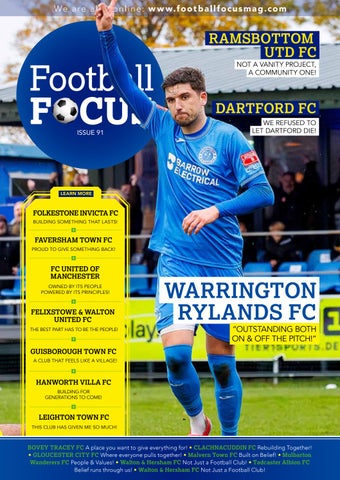
As we publish our Mid-Season issue of Football Focus Magazine, I find myself reflecting on why non-league football continues to matter so deeply, not just to me personally, but to the communities it serves up and down the country.
Non-league clubs are far more than places where football is played on a Saturday afternoon. They are meeting points, support networks and social anchors. They are run by good, authentic people who give their time freely and often quietly, without expectation of reward. Volunteers opening gates, pulling pints, marking pitches, running youth sessions, washing kits and balancing books long after the final whistle. Managers and coaches who care as much about the person as the player. Fans who turn up week after week because the club feels like home.
What I continue to witness through my work is the power of connection. At non league level you can look people in the eye, shake their hand, and share a conversation that actually means something. You feel part of something real. In a world that often feels increasingly disconnected, these clubs provide belonging, identity and joy.
This season we have again met inspiring individuals and clubs who put community before ego and people before profit. Clubs that open their doors for youth teams, families, local events and charities. Clubs that understand football is at its best when it brings people together.
For me, this is what keeps non-league football alive and thriving. It is not just the results or the league tables. It is the relationships, the shared experiences and the simple human connection that happens when people come together around a football club.
I am proud to continue telling these stories and grateful to everyone who makes them possible.
FAVERSHAM
CLACHNACUDDIN
TADCASTER
DARTFORD
GUISBOROUGH
HANWORTH
Football FOCUS CUS
WARRINGTON RYLANDS FC
NEIL REYNOLDS, TEAM MANAGER
Football is about people, trust and standards and Warrington Rylands brings all three together for me and for our community.
I was born in Liverpool and grew up in Preston and football has been the constant thread through my life. I played all the way through school, captained my school team, then went to college and ended up captaining the Great Britain side. From there I got the chance so many lads dream of. Plymouth Argyle showed interest, Peter Shilton was the manager then and Neil Warnock after him. I spent around eighteen months to two years down there. It did not work out the way I imagined. It was a long way from home and sometimes that is how football goes. When I came back north, I decided to jump on to the final year of a university course. I did not really know what I wanted to do but I leaned towards teaching. At the same time, I went down the semi-professional route in football. I played for clubs like Darwen, Clitheroe and Bamber Bridge and stayed heavily involved in the game.
In my thirties I was offered a player coach role at Bamber Bridge, then assistant manager and eventually manager. We won the first major silverware the club had seen in about twenty years and that meant a lot. After that FC United came calling and asked me to manage them. I spent six years there and there were some fantastic moments. When that chapter closed another door opened and eventually that door led to Warrington Rylands. Alongside football I have always worked in schools. The two careers have run in parallel, and they have shaped me as a leader. I started as a PE teacher, became a head of year, then assistant head, then deputy head and finally a headteacher. Every time I seemed to get a promotion at school, I found myself stepping up in football as
well. From player to captain, from captain to player coach, from assistant to manager. The pattern has repeated itself all the way through. What ties those journeys together is leadership and people. I have been lucky to work under some outstanding school leaders and some excellent football managers. People like McGarry at Darwen, Lee Sculpher at Clitheroe, Tony Greenwood at Bamber Bridge. They gave me responsibility early and they backed me. There is a saying that you need more experience or that you are not old enough yet. I prefer the view that if you are good enough you are old enough. I have been given chances on that basis, and I try to do the same for others.
My work in schools has given me experience in dealing with pupils, staff, parents and difficult situations. My work now involves executive leadership over a number of schools, including SEND and behaviour schools. The emotions you deal with in education are not that different from the emotions you see in a football dressing room. Everyone has a story, everyone has a background, one size never fits all. You learn to listen, to set clear expectations and to be consistent. You face decisions that some people shy away from. Supporting someone, challenging someone, putting a member of staff on a plan, dismissing someone when you have to, or simply giving
a heartfelt well done. Those experiences have helped me work with chairmen, directors and owners in football. Very little phases me now because I have been exposed to that level of accountability for a long time. Through all of this I have held on to old fashioned values. Punctuality, honesty, respect, personal conversations instead of hiding behind a screen. I do not like excuses. When I was sixteen at Darwen Football Club in a dressing room full of men, you could see what winning meant. It was not about money. It was about pride and standards. If the manager told you to report somewhere at one o clock on Saturday, then you were there. There were no texts about traffic or forgotten shin pads. You turned up. Simple as that. Those values were reinforced by my dad. He was not the kind of man who sat at the end of the bed reading you a book. He showed love in a different way. If I asked him for a lift, he would tell me to get on my bike if I wanted to be a footballer. At the time you think it is hard. Later on, you realise it taught you resilience and independence. When I moved into management at Bamber Bridge my dad never missed a game. He was a massive Bamber Bridge supporter. When I left to manage FC United, he wished me well but he stayed loyal to his club. That loyalty impressed me. I believe in face to face honesty. My dad used to say that if you have something
important to say to somebody you look them in the eye. I carry that into football and schooling. If a player is left out of the eleven or the sixteen, I will tell him straight and I will tell him what he needs to do.
I cannot promise everyone a starting place, just as I cannot make everyone a headteacher, but I can put people on a path and I can be truthful with them. The same goes for staff. People might not always like what they hear, but they know it is honest. That is important for trust, for mental health and for self-respect.
I am not active on social media. I expect my players and staff to carry themselves
properly on and offline. I am not a ranter or a raver in the technical area. I am calm, but my standards are very high. I expect professionalism from the way we dress to the way we arrive at games and the way we speak to each other. I still like the idea that everyone knows when and where to be without ten reminders. That sense of trust and belonging matters in a group.
All of that brings me to Warrington Rylands. The way I left FC United was simple. Results were not good enough and the club took a decision. My last game was at Rylands. I remember walking into the bar afterwards, looking around
at the supporters, at how the club operated, and thinking to myself, this is me. This is a club I could see myself at. I had always liked coming to Rylands as an opponent. I liked the directors, the chairman and the feel of the place. It is a working class club, very community based, with a big focus on junior teams, boys and girls. It felt authentic.
When Mark Pye later rang me and asked to meet, I already knew what my answer would be. I took over when the team was near the bottom of the table. The faces around the ground told their own story. This is a club that has been on an incredible journey
with promotions and a trip to Wembley in a very short time. The last thing I wanted to be was the manager who oversaw a step backwards. I promised them I would give everything to keep the club in the division and to try to build something strong.
My target last season was simple, finish higher than when I walked in. We managed that. This season the aim was to improve again. As I speak, we are top of the league and a few points clear. That does not guarantee anything. Football can change quickly. What matters is that we have put the right standards in place, brought in the right staff and players and created real camaraderie and discipline. The directors, the chairman, the supporters, they all allow me to be myself and I am grateful for that.
What makes Rylands special to me is the connection. At a big club with a huge crowd, you cannot speak to everyone. At Rylands you really get to know people. You see the work that goes on around the club. You feel how much it matters when things are going well and when things are tough. You see the kids coming through the youth system, the families, the volunteers. You see the pride in the community.
This club stands for the values that matter most to me. Honesty, hard work, togetherness, a proper connection between team and town. That is why I am proud to lead Warrington Rylands and why I believe we can keep building something the whole community can be proud of.
Owen Cooper is the youngest ever Emmy award winner and a Rylands boy who played for the since he was 8 years old!
LAURENCE BARROW DIRECTOR & MAIN SPONSOR BARROW ELECTRICAL
“The children are our future!”
I was born and bred in Warrington, and I have always loved football. From a very young age I was that typical lad kicking a ball about, playing for local teams, having a go at trials, dreaming the same dream so many kids have. My playing days are behind me now, the body does not thank me for it anymore, but the love of the game has never left. It has just changed shape.
My journey into Warrington Rylands started almost by chance. I was at a night with Tyson Fury at the Halliwell Jones Stadium, then ended up at the Rylands clubhouse where there was another event on. I got chatting to the chairman, and as a local business owner he invited me down as his guest. I went to a game, then another, bought a season ticket, started sponsoring, and before I knew it, I was part of the furniture. A few years on, my company became main sponsor, and then the directors asked me to come on board. Breakfast, a conversation, and suddenly I am a director of the club I have fallen in love with.
For me, what makes Warrington Rylands special is not only the football. It is the people. On a match day you walk into the ground, and everyone says hello. There are handshakes, hugs, people asking about your family, and you know they genuinely care. Directors, sponsors, volunteers, supporters, families, everyone is on first name terms. The football brings us together, but the human side comes first. That community feel is everything. Because of that, I feel a responsibility to make sure Rylands gives back, especially to young people. Through my business we had already been patrons of Warrington Youth Zone, which works with around ten thousand children and young people in the town. When I joined the board, it made complete sense to bring the club and the youth zone
together properly.
We have handed out around a thousand free tickets through the youth zone so that underprivileged children can come to games and experience live football in a safe, welcoming environment. Those kids are now turning up on match days, and you can see that little group of young supporters growing week by week. On the eighteenth of November, the first team are holding a training session at the youth zone. The players will train there, the kids can watch, get involved, ask questions, do little interviews. It will be an amazing day for them and for us.
We have also moved our entire female section so that they train at the youth zone. That link is not just symbolic, it is practical. It says that girls are every bit as much a part of our football family as the boys, and that the club values them and invests in them. Football has to be inclusive. It should be available for absolutely everyone.
At Rylands we also have a clear pathway for young players. We have more than four hundred kids in the academy and a long list of success stories of players who have gone into the professional game. We do not want the academy to feel like a separate world. At training you will see the reserve and academy players working alongside the first team. The coaches on both sides talk constantly. We have done that on purpose.
When you take a sixteen or seventeen year old and just throw them straight into a first team changing room, where they do not know the style of play or the standards,
you almost set them up to fail. By integrating them earlier, they know how the first team trains, how they move the ball, what is expected, what the tempo is like. When they do get that chance, they do not look lost.
A perfect example is Sam Muyengwa, who came to us at fourteen or fifteen. We could see straight away that he had something. During pre season he trained with the first team even though he was still fifteen. He turned sixteen in August, and three weeks ago he made his home debut in the county cup, starting up front in men’s football. He scored a hat trick. That is what happens when talent meets opportunity and good support.
My belief in sport and young people goes beyond the club. In my electrical contracting business we take on two or three sixteen year old school leavers every year
as apprentices. Over time I have noticed a real pattern. When a young person has been involved in sport, whether it is football, rugby, cricket or anything else, they are different in the best way. They understand teamwork, respect, turning up on time, putting in a shift, listening to coaches and senior players. Compare that with a sixteen year old who has spent most of their time stuck in a bedroom on a games console. They are not bad kids, but they often have not had that same structure or sense of responsibility. Sport gives young people a quiet education in life skills. Nobody sits you down and spells it out, but you still learn it. You learn how to win, how to lose, how to support others, how to handle pressure, how to be part of something bigger than yourself.
For me, the children and young people around our club are not an add on. They are the lifeblood. They are the future of Warrington Rylands. If we open the doors for them, if we give free tickets to families who are struggling, if we encourage them, if we show them different sides of the game, not just playing but also hospitality, analysis, marketing, media, they might find a path that shapes their entire life. Some will go on to play, some will coach, some will work behind the scenes, some will simply become loyal supporters who bring their own kids one day.
That is the full circle of football. A child walks through the turnstile for the first time with a free ticket. Years later they might be the one handing tickets out, coaching the next generation, or welcoming people at the gate. But none of that happens if you shut kids out. If you do not let them in, you shut down growth.
When I stand at our ground on a match day now, as a director, I actually see less of the football than I did as a fan. I still love the game, of course, but my eyes are often drawn to what is happening around it. The conversations between supporters, the parents who feel safe bringing their little ones, the volunteers who give up hour after hour just to make sure everyone has a good day. That is where the real magic is.
Football has given me a lot in my life. Now I want to make sure that through Warrington Rylands we pass that gift on to as many young people and families as we possibly can. The children are our future, and if we invest in them with time, care and opportunity, they will repay that many times over in ways we cannot even imagine yet.
MARK PYE CHAIRMAN
“This club is not mine. It belongs to our people, our town and everyone who walks through our doors.”
I have been part of Warrington Rylands for close to a decade now and the truth is simple. I fell in love with this club the moment I walked in. It is more than football for me. It is belonging, community, connection and a place where people feel valued. I have always believed that a club should be a safe space, a positive space and a place that gives people something good to hold on to in their lives.
That is what we try to create at Rylands every single day.
I grew up in the town. Like most kids I played local football and dreamed big. I had trials like many others, but life took me down a different path. I joined the Army at seventeen and spent seven years serving. Those years changed me. They were character building. They opened my eyes to the world, the good and the difficult. The camaraderie is something you never forget. The banter, the togetherness and the feeling of being part of something real stays with you long after you leave. That feeling is exactly what I found again in football.
When I came back to Warrington, I played a bit and then went into management.
Eventually the opportunity came to get involved at Rylands. Back then we were in the Cheshire League at step seven, and although the club had a long and proud history it had never really pushed on. I came in with a vision. I wanted to build a youth system, create a pathway for young players and turn this into a club that would give opportunities to kids in our own town rather than watching them drift away.
Youth development is at the centre of everything for me. I had a mentor when I was young, my mate’s dad, who believed in me and kept me on the right track. When he passed away it stayed with me. I always remembered the graft he put in for us. That is why I care so much about giving young people a place to grow. You never know what a kid is dealing with behind closed doors. If we can give them two hours a week where they can be free, happy and safe, then we are doing the right thing. Football changes lives. I saw it. I lived it.
The club has become that place for so many. We have young teams, community groups, elderly supporters from the retirement village, volunteers who come in to paint and sweep the ground just to get out of the house. One of our older lads told me recently that his few hours at the club each week are the only time he leaves home because his wife is unwell. You hear something like that, and you realise how important this place is. It means as much to them as it does to the kids who run out under the floodlights dreaming big dreams. People sometimes forget that a football club is a lifeline. It can be the difference between loneliness
and belonging. We try to offer that to everyone. We run community programs. We support our elderly. We help young players who have been released by academies and put our arms around them until they find their confidence again. Three of them have moved on to professional clubs. That makes me proud. We never stand in the way of a player’s dream. We want them to go on. We want them to succeed.
As for the first team, Neil Reynolds has been exceptional. I admired him long before he came here. He is honest, passionate and a people person. We work closely every day and we trust one another. The bond between the coaching team, the players, the supporters and the club is strong. Neil has opened the doors to our youth players, given them opportunities and built a connection that goes far deeper than results. He gets us. We get him. That is why it works.
Rylands has been part of this town for one hundred and twenty years. It stood here long before me, and it will stand long after me. My job is to protect its identity and push it forward without losing the heart that makes it special. Ambition is important, but the community comes with us. That is nonleague football. It is real. It is close. It is human. And I hope we never lose that.
This club belongs to everyone who steps foot inside. It belongs to the kids, the volunteers, the older lads with paintbrushes, the supporters, the families and every single person who finds a bit of happiness here. That is why Rylands matters. And that is why I am so proud to be part of it.
TONY
BENNETT
CLUB SECRETARY
I was born within walking distance of the stadium, so Rylands has always been part of my life. I have been around this football club for more than forty years. As a kid I played my football here and took part in all sorts of sports because it was originally an old works team with rugby, cricket and everything going on. It was a great place back then and in many ways it still is.
My own playing days finished about fifteen years ago. The second time I broke my ankle I knew it was time to call it a day. But my connection with the club didn’t stop there. It actually deepened when my lad Sean started playing. I took him along to Rylands when he was about seven, and like so many parents I ended up stepping in to coach because there weren’t enough volunteers. From there the club slowly pulled me in. I coached his team for a few years, then became the welfare officer
for the junior section, and eventually secretary for the whole club.
Sean doesn’t play anymore, but he stayed involved. When he was eighteen, he spent a couple of years as kit man for the first team, and he still supports us now. That’s the thing about Rylands – it becomes a family affair. Everyone chips in. Parents, kids, partners, volunteers. That’s what these sorts of clubs are built on.
We have more than thirty junior teams and over four hundred kids playing for us. On a Saturday our juniors take it in turns to walk the first team out. We all wear the same kit. That sense of unity and belonging is deliberate. We’ve worked hard to build a proper community club where everyone shares the success and pulls together when things get tough. If Rylands didn’t exist it would leave a big hole for a lot of families.
I’m at every game – it’s rare that I miss one. This season has been really positive. Compared to last year we’ve progressed well and we’ve spent time in the top six, even top spot for a while. It’s a hard league, anyone can beat anyone, but we’re playing good football and we’re definitely capable of pushing for something at the end of the season.
For me, what makes Rylands special is simple.
It’s the people. You can’t do this without good people around you. We don’t get paid. We give up our free time because of the camaraderie, the friendships and the way we rely on one another. Many of us are lifelong friends now. We go to weddings together, our partners socialise together, our families know each other. It isn’t just being colleagues on a Saturday. It’s an extended family.
I’ve always believed that being part of a football club teaches you a lot about life – working together, helping each other, sharing the load. When I first got involved coaching the under sevens, it wasn’t because I had an ambition to be a coach. I did it because I wanted my lad to enjoy the same experiences I did. That’s how most of us arrive here. You step up because if you don’t, something worthwhile won’t happen.
We’ve seen hard times and great times at Rylands, and you wouldn’t swap either, because going through one makes you appreciate the other. That’s why the club means so much to me. The football is important, of course, but the foundations – the people, the togetherness, the commitment – that’s what makes Rylands what it is. I couldn’t imagine doing it without the people beside me. And I wouldn’t want to.
BARROW ELECTRICAL BUILT ON INTEGRITY, STRENGTHENED BY COMMUNITY
BY LAURENCE BARROW
When I launched Barrow Electrical nearly twenty years ago, it was built on one simple belief: electrical work should be delivered with integrity, reliability and a genuinely personal touch. That principle has never changed. Even as we’ve grown into a trusted provider for installations, facilities maintenance and modern building services, we’ve remained first and foremost a family business rooted in Warrington, determined never to lose sight of where we came from or who we serve.
In an industry where growth often creates distance, we’ve taken a different path. We are deliberately small enough to care, personal enough to know our customers and
committed enough to ensure that every project, whether domestic or commercial, is handled with the same honesty and pride. Our aim is simple: that every client finishes a job feeling safe, secure and looked after.
Those values run through everything we do. We are trustworthy, consistent and dependable. We are open and straight-talking, believing that the strongest relationships are built on transparency. We work collaboratively, taking time to understand each client’s business so that solutions are built together, not imposed. And we are fiercely professional, from technical standards to safety on every site.
That ethos is why our partnership with Warrington Rylands FC feels so natural. Their club culture of community, honesty and long-term thinking mirrors our own. For us, sponsorship has never been about logos on
shirts. It’s about belonging, shared values and supporting something that matters to the people around us.
This year also marks an exciting new chapter for the business. Our partnership with Tyrrell Systems, led by my good friend Ged Tyrrell, allows us to unite hands-on electrical expertise with advanced building management, IoT and smart-controls technology. Together we are helping clients bring their buildings into the 21st century with integrated systems that improve efficiency, sustainability and performance.
But above all, this year has reinforced what truly matters. My wife, and Financial Director, was diagnosed
with stage 2 brain cancer last summer which naturally changed everything for our family. The courage she has shown, and the incredible care from the team at the Walton Centre, have deeply shaped my outlook. We’ve always supported local charities, but that experience strengthened our commitment to give back wherever we can.
As we move forward, that sense of responsibility, resilience and community will continue to guide Barrow Electrical. Because success, to us, is not measured only in contracts and growth, but in the impact we have on the people and communities that made us.
JOHN MASSEY
SPONSOR AND SUPPORTER, WARRINGTON RYLANDS FC DIRECTOR, ELMWOOD INTERIORS LTD
“More than football. A family club where people genuinely look after each other.”
I am Warrington born and bred and I live just around the corner from the Rylands ground in Bruche. Football has always been part of my life. Growing up, I played for my local side, Bruche Athletic, and football was always something that brought people together in our area.
My connection with Rylands really deepened through my son, Ryan. Ryan has been at the club for around five or six years now and is currently part of the Under-17s setup, playing in central midfield. Before joining Rylands, he had spent
time at Stockport County, so he had already experienced football away from grassroots. But once he came to Rylands, it felt right straight away.
What really stands out is how that youth group has grown together. A core of the lads have been together since they were about six years old. When you walk around the club, you see old photos of them as kids on the walls, and now you are watching them develop into young men pushing towards senior football. Last season they won their league, and this year they are right up there again. It gives you a real sense of continuity and pride.
As a family, we started by going down on Non-League Day just to have a look, and from there it evolved into something much bigger. Now I go home and away
whenever I can. Some of my best trips have been Tuesday nights travelling with the lads, especially with people like Mark Pye, and sharing those experiences together.
The senior side reflects exactly what the club stands for. Neil Reynolds is a brilliant manager, not just tactically but as a person. He gives time to the players and to the younger lads coming through. The respect shown by Rylands players, especially when travelling away, really stands out. It says a lot about the culture that has been built.
One of the things I love most is the mix of people at the club. You have young players, families, volunteers, and older supporters who have been there for decades. There are lads like Eddie, an older gentleman, who still goes everywhere following the team. I genuinely look forward to away games just to spend time with people like that. Everyone looks out for each other. It feels like a big family.
That sense of togetherness runs right through the club. From the board and the management to the volunteers and supporters, everyone pulls in the same direction. Football clubs do not run themselves, and Rylands is a perfect example of what happens when good people step up and give their time.
My business, Elmwood Interiors Ltd, which I run alongside my business partner Phil Nevinson, became a
sponsor this season. We specialise in commercial interiors and office fitouts and work nationwide. Sponsoring Rylands felt like a natural thing to do. It is not just about advertising a business, it is about supporting something you believe in.
The club has clearly been building with the future in mind. Promotion would be incredible, of course, but what impresses me most is that Rylands are not chasing it recklessly. The foundations are being put in place properly so that if and when the club moves up, it is ready and sustainable. That shows real leadership and long-term thinking.
For me, what makes Warrington Rylands special is simple. It is the people. One hundred percent. If the club was not here, it would leave a massive hole in the community. On a Saturday morning, if Ryan does not have a game, we will still wander down just to see who is playing and what is going on. Older supporters rely on that social connection just as much as the football.
Rylands is more than a football club. It is a place where people of all ages belong, where kids are supported, where volunteers are valued, and where everyone has each other’s back. Being part of that, as a parent, supporter and sponsor, means a great deal to me.
FOLKESTONE INVICTA FC
JOSH HEALEY CHAIRMAN
Folkestone Invicta, Built for the Future and Still Rooted in the Town
I have always been local. I was born in Ashford, about ten minutes up the road from Folkestone, went to school in Canterbury, and I played for Folkestone Invicta Youth when I was in my early teens. My mum is born and bred Folkestone, so the club and the area have always felt like part of me.
Football was my game growing up, but the school I went to played rugby, and that changed my path. When I was 14 I suffered a severe leg break playing rugby and broke my femur. It meant a major operation and a long spell out. After that, things never quite returned the same way physically and it ended any realistic football pathway for me. I ended up getting into golf and that has been my sport since then. I still played five a side before my children came along, but the truth is football remained a constant passion, even when I was not playing it seriously.
That love for the game is a big part of why I got involved at Folkestone Invicta. I took over the club in July 2023, and the honest reality was that it was on its knees, like a lot of non league clubs can be at times. There was serious debt, into six figures, and we inherited that and took it on. The stadium and the ground had not been properly looked after, and the clubhouse was in a really poor state.
So the first thing we did was focus on stability and sustainability. That meant changing the way the club operated day to day. We gutted out and completely refurbished the clubhouse, turning it into a sports bar with over twelve big TV screens, darts boards and a
pool table. It has become a hub for the community, not just on matchdays. It is open pretty much 365 days of the year, and it has become a venue in its own right in Folkestone, somewhere people can go for live sport as well as music events. That shift has made a huge difference because it means the club can bring money in outside of Saturday afternoons, and that underpins the playing budget.
One of the biggest steps we have taken has been the 3G pitch. It was a major investment, just over 1.3 million, but it was needed. With the old grass pitch the drainage was terrible and we were losing too many Saturday games to cancellations. When a Saturday match gets called off, you lose a huge chunk of revenue, and moving games to a Tuesday changes everything. It is a school night, fewer youngsters, fewer people staying for a drink, and you simply do not get the same feel or turnout.
The 3G has helped us keep games on, and it also allows us to offer the facility to the wider community. It brings youth football back onto Cheriton Road and it gives the club a much stronger base going forward.
We have also started building properly across the club, not just the first team. In summer 2024 we set up our first Women’s team, and they won their league, got promoted and won the League Cup too, which is a brilliant achievement. They are using the 3G as well. Now the big next step is to develop the youth system in a more joined up way. Youth football has been there, but it has not really been run by the club itself. It has been driven by volunteers using
the club name, and we had so many pressing first team issues when we arrived that our priority had to be keeping the club alive. Now we are in a position where we can build it properly and create a real pathway into the first team.
On the pitch this season, I think the biggest difference is simple. Recruitment. Jay Saunders and his management team have got it right. When you get recruitment right in the summer, you give yourself a chance. When you do not, you spend the season firefighting. At this level we are part time, we train two nights a week, sometimes only one if there is a Tuesday match, so you have limited time with players. Jay, and his team, have been aligned in what they do and the players have bought into it. The professionalism, the preparation, the standards, it has gone up a level.
I always felt Jay was the
right man for us because of his track record and because he is local. He understands the non league game and he knows what it takes to build a team and a culture. This season feels like the jigsaw is finally coming together. In terms of ambition, we set a target of reaching National South within the first two to three years. Hopefully we can do that, and if we do, I think there will be a couple of years of consolidation at that level. Beyond that, my long term ambition would be to get Folkestone into the National League. That is the dream, but it will depend on facilities and ground grading requirements, and it will depend on whether we can work with the council to buy the site and develop it. The budgets jump massively as you go up. You can see the gulf when you come up against higher level sides, and if you want to compete sustainably, you need revenue
streams beyond matchday. That is why facilities matter so much to me. Not just because it improves the matchday experience, but because it supports the future. We need more covered areas, better seating, improved hospitality, and more spaces that make the stadium a place people want to spend time. I also want the club to be a true hub. Things like a gym, a boxing club for kids, sensory areas for families who love football but find the noise and intensity difficult, and better education and academy links. We have already partnered with Charlton Athletic Community Trust and created classroom space, and in the first year we have had over 50 students, which is a really positive sign. To grow that, we need more space.
I also think Folkestone is in a strong position as a location. We have the high speed line into London, 52 minutes, and the stadium is five minutes walk
from the station. There is a bus stop outside and we are close to the M20. That matters for supporters, for players, and for the wider potential of the club.
And I do think non league football is having a real moment. It is more affordable, more connected, and more real. You can come down as a family and have a proper day out without spending a fortune. The Premier League is incredible, but it is a different experience. At non league you can speak to people, you can feel part of it, and that is powerful, especially with the cost of living pressure everyone feels.
For the town, promotion would be huge. Folkestone’s last title was around ten years ago, and if we can get to step two, I believe it would be the highest level the club has played at. For the community, the fans, the youngsters coming through, it would be a massive achievement.
For me personally, to have
played for the club as a kid and then to have come back as chairman and helped drive it forward, promotion would be a dream come true. But it is not just about me. It is about the team behind the scenes too. Charlie, who is our Operations Director, has played a big role in getting us to where we are today and Holly, our Head of Communications and Partnerships, has brought a real uplift in professionalism around our social media output and has strengthened relationships with our sponsors, without whom the club simply wouldn’t operate at the level it does. All of those people, and the volunteers who keep football running at this level, they matter.
At the end of the day, we are custodians. The club belongs to the supporters and to the town. My job is to respect what came before, bring people with us, and build something that lasts.
JAY SAUNDERS
FIRST TEAM MANAGER
“If You Can Manage People, You Always Have a Chance” I was born in London but moved to Maidstone when I was very young, so this area has always felt like home to me. Growing up, football was not actually the main sport in our house. My dad was a boxing man. I probably went to more boxing matches than football matches as a kid. It was only when I went to a summer football camp with my brother around the age of ten or eleven that I really caught the bug. From that point on, I was hooked.
My dad deserves enormous credit for the path I went on. He worked in London every day and still managed to take me everywhere football related in the evenings and at weekends. Without him, I would never have had the opportunity to chase the game the way I did. He was always honest with me too. If I played badly, he would tell me. That honesty stayed with me and has shaped the way I manage to this day.
I fell into management almost by accident. I was coming towards the end of my playing career at Maidstone when the manager resigned after a game. One of the directors asked me if I would take charge for the weekend. That weekend turned into nearly ten years at the club. I found very quickly that I loved management. I genuinely enjoyed it more than playing. Managing people came naturally to me, probably because my dad ran businesses and I had grown up watching him lead people.
For me, football
management has always been about people first. Tactics and coaching matter, of course, but if you cannot manage human beings then you have no chance. Players have emotions, families, jobs and pressures. Knowing when to put an arm around someone and when to be firm is the real skill of the job.
That belief is why I surround myself with good people. I am
very fortunate to have Lloyd Blackman and Tom Parkinson with me. They are top lads and they tell me the truth. Recently, after a rare defeat when my head had gone a little, Blackie pulled me and reminded me we had lost only once in fourteen games and were eleven points clear. That kind of honesty keeps you grounded. Every manager needs people around them who they trust and whose opinions they genuinely value.
When Josh first approached me about Folkestone Invicta, I was not convinced the timing was right. He was new to football ownership and I was unsure whether the project was where it needed to be.
But when we spoke again later, I could see his hunger to win and his determination to build something properly. That energy drew me in. Our relationship now is excellent because we both want the same thing. To take this club forward.
What I found when I arrived at Folkestone is something special. There is a genuine buzz around the place. People who are not even from the area are talking about the club. That tells you everything. We built a completely new squad, played away for two months while the pitch was finished, and still managed to put ourselves in a great
position. The belief in the dressing room and around the club is real.
I have been lucky in football. I have won promotions and trophies. But my biggest motivation now is seeing others experience that feeling. I want my players, my staff, Josh and the people of Folkestone to share that success. I want my youngest son to feel what my older children felt watching their dad win things at Maidstone. That is what drives me.
Family keeps me grounded. I have five children in total and without their support, and my partner’s support, this job would be much harder. Football can consume you. Losses follow you home whether you want them to or not. Having people who stand beside you makes all the difference.
This club is moving in the right direction. There is a long way to go, but the foundations are strong. When players like Joe Pigott want to be part of what we are building, it tells you something important is happening here. If we keep working the way we are, keep trusting each other, and keep our focus on the people as much as the football, I truly believe Folkestone Invicta has something special ahead.
JOE PIGOTT FIRST TEAM STRIKER
“I Wanted A Club With A Buzz, And Folkestone Has That In Spades”
I am Kent based and I have always felt that connection to the county. I grew up around the West Malling area, about forty five minutes from Folkestone, so in many ways coming here still feels local to me. People sometimes assume I was football only as a kid, but I was not. I played loads of sports growing up. Rugby was pretty much the only one I did not do. I got really into cricket, even though I took it up quite late, and I have always enjoyed golf as well. I just loved competing, whatever the sport was.
My football journey was shaped by something I noticed early on. In the team I played for as a kid, loads of lads went into academies and then a couple of years later they were back again. Me and my dad looked at that and
decided it might be better to arrive later to that whole academy scene if I could. So I did. I did not properly decide, right, I am going to try and be a footballer, until I was about fifteen. That was also the time I had to make a decision between football and cricket, which is not exactly a normal crossroads for a kid.
It was a difficult decision, but something always told me football was what I wanted to pursue, even though the odds are brutal and I knew that. When I signed with Charlton Athletic as a teenager, I was under no illusions about how ruthless the environment can be. But I also think being a bit of a late bloomer helped me. I never felt like I had cracked anything. My expectations grew month by month, and that kept me grounded and hungry.
My family were massive in all of it. My dad was a mentor for me, no question. He was there at training, there at matches, and when your parents are attending everything, they see
what is really going on. He was not a professional footballer, but he was a decent player until a couple of really bad leg breaks. Back then, the operations were not what they are now, and it can change everything.
When people ask me about mentors in the game, one name I always go back to at Charlton is Steve Avery. He was stern and disciplined, but he kept people on the right path, not just me. He had a huge role at the club for years in terms of producing players, and I learned a lot from that environment.
After Charlton, my career took me through different dressing rooms and different levels, and you learn quickly that every move shapes you. I left Charlton in my early twenties and built my way through the game, including a really important spell at Maidstone United where I worked with Jay Saunders. That period mattered to me, because I enjoyed it, it was successful, and it helped push me back toward the Football League again. We stayed in touch, and that relationship matters in football.
So when the opportunity came to join Folkestone Invicta, it made sense. I spoke to Josh and I knew Jay. I saw a club with ambition and a clear plan, a club looking to go places, and I felt it was a great opportunity to come in and be part of that. I signed in September 2025 and from the outside it might look
like a surprise drop, but inside football you know how much the project and the people matter when you choose a club. What I have really enjoyed is the feel of it all. Non league football at this level is different because it is close to people. You are right there with the supporters. You can sense the community heartbeat. Even though I was not here last season, you can tell the gates are up and the excitement around the club is growing. People are buzzing about where Folkestone can go next, and you feel that on matchdays.
The dressing room has a proper vibe too. Jay has built that before and he has built it again here. There is a cohesion. There is a togetherness. Everyone knows what we are trying to do, and that matters when you are pushing for something big.
As for the future, I am honest about it. I have thought about coaching or management, but right now I still feel like I have years left as a player. Time will tell.
What makes Folkestone Invicta special for me is a simple mix of things. The supporters, the setup, the potential, and the ambition. Not just to grow on the pitch, but to keep growing in the community too. It feels like a club that is moving forward, and it feels like a club that people genuinely want to be part of. And that is exactly where I want to be.
“It’s Not Just Sponsorship. It’s Belief, Belonging and Building Together.”
LORENZO
ZACCHEO
AND DAVID ZACCHEO STADIUM AND FRONT OF SHIRT SPONSORS ALCALINE LTD, TRANSPORTATION AND LOGISTICS
LORENZO ZACCHEO
I was born in Italy and moved to England in 1987. In 1993 I founded Alcaline Ltd, our transport and logistics business, and in 2004 we moved to Hythe in Kent, where we have been based ever since. Over the years the business has grown significantly.
Today we operate a large European fleet, including around 250 trailers and a fleet of helicopters, handling automotive and just in time transport services across multiple countries, with depots in Italy and Holland. Alongside this, we are involved in specialist operations connected to major sporting and corporate events, including VIP charters and support for motorsport and other sporting bodies across the UK and the EU.
Sport has always been part of my life. Growing up, motorsport was my biggest passion, but football is always there when you are Italian. Sport creates natural connections between people and businesses, and that network is invaluable. It is how relationships form, how trust develops and how communities strengthen.
Our involvement with Folkestone Invicta FC began in late 2022, when our local MP Damien Collins approached us. The club were in serious financial difficulty and needed urgent support. We did not step in for publicity. We stepped in because we care about the community and we could see how important this club was to the people of Folkestone. Without that intervention, the club would not be in the position it is today.
When I first became involved, I asked how many local players were in the squad and was told there were none. Everyone was travelling in from London and surrounding areas. I felt that had to change. If young players do not see a pathway into their own club, they will never truly feel they belong. Since then, the focus on youth development, community engagement and
local identity has transformed the club.
The reward for us is not financial. Non league sponsorship rarely is. The real reward is walking into the town and seeing families, kids and supporters proud of their club again. That feeling of belonging and connection is priceless.
DAVID ZACCHEO
Like Lorenzo, I was born in Italy and moved to the UK in 1987. Watching Folkestone Invicta grow into what it is today has been incredibly satisfying.
When we first became involved, things were not easy. The squad was ageing, contracts were difficult to manage, and progress took time. But football clubs are built by people, not money alone. You need the right individuals, the right culture and patience for everything to gel.
A huge part of the club’s progress has been the involvement of GSE Group and the commitment shown by Josh Healey. Josh and GSE joined us after our initial involvement and their contribution has been absolutely vital. From strengthening the club’s foundations to supporting major infrastructure projects such as the 3G pitch, their backing, experience and belief in what Folkestone Invicta could become have made a real and lasting difference. That support is underpinned by the values and experience of GSE’s founder Darrell Healey, whose influence through the business has helped provide stability and credibility at a crucial time in the club’s journey.
Another important development during this period has been the relationship built with Charlton Athletic FC. That connection came together through a combination of relationships, including our local MP Damien Collins, but also, crucially, through the work of Neil Shaw.
Neil has not simply been a contact, he has been a genuine connector and facilitator behind the scenes. His deep understanding of both clubs, his personal relationships within Charlton, and his commitment to seeing Folkestone Invicta succeed have been instrumental in bringing people together. He has played a key role in aligning conversations, keeping dialogue moving forward and helping to galvanise all of the engagements in a meaningful and constructive way. Without his input, many of these discussions would not have developed with the same clarity, trust and momentum.
That cooperation with Charlton has grown over time and has added another positive dimension to Folkestone Invicta’s development both on and off the pitch.
What I love most now is the atmosphere around the club. People who had not been to matches for years are returning. They bring their children. They spend
the afternoon and evening together at the ground. It has become a real community destination again, not just a football match.
Running a large business means I cannot attend every away fixture, but I make a point of being at as many home games as possible. You feel proud now of what is being achieved. You see the belief growing in the town, and that energy is infectious.
One of the most important lessons for me has been how essential human connection really is. Money helps, of course, but without trust, communication and shared purpose, nothing truly works. Building that trust between the board, the staff, the players, the supporters and the sponsors is what has taken these last few years, and it is what makes this journey so special.
When people ask me what makes Folkestone Invicta special, I always say it is the people. The volunteers, the supporters, the families, the kids dreaming of wearing the shirt one day, and the businesses that choose to invest locally. That collective spirit is what makes this club powerful.
We believe in Invicta because we believe in Folkestone. When a football club becomes a place where people feel valued, connected and proud, that is when sport becomes far more than just a game.
Alcaline Logistics
Keeping Britain and Europe Moving
Alcaline Logistics is a well-established international haulage and logistics company delivering high-quality road, air and freight services throughout the UK and Europe. With over 30 years’ experience, Alcaline specialises in full loads, part-loads, groupage and timecritical express deliveries — ensuring goods reach their destination on time, every time.
Strategically based near the Channel Tunnel in Kent, with additional operations in the Netherlands and Italy, Alcaline offers customs clearance, warehousing, picking and packing, and specialised handling capabilities. Our team of expert planners and multilingual operators provides seamless logistics solutions tailored to your business needs.
Whether you need urgent shipments, express air services, heavy lifting, or large-scale freight movement, Alcaline’s team is ready to support your supply chain with professionalism, flexibility and exceptional service.
Why Choose Alcaline
✓ Over 30 years of industry experience
✓ Road haulage across the UK and Europe
✓ Strategic warehousing and distribution hubs
✓ Customs clearance and simplifying EU logistics
✓ Time-critical & express delivery solutions
✓ Dedicated professional team with 24/7 service capability
Proud Main Sponsors of Folkestone Invicta FC Supporting local sport and community development.
Don’t let piles put you on the sidelines. Trust AnuSol.
Soothes itching Relieves discomfort Calms
“Folkestone Is Where Our People Are — And That Matters to Us”
DAVID UPTON, UK
COUNTRY LEADER AND FINANCE DIRECTOR, CHURCH & DWIGHT UK
SPONSOR
My name is David Upton, and I am the UK Country Leader and Finance Director at Church & Dwight UK. We are a global business, but our UK story is very much rooted in Folkestone. We now employ just over 400 people in the UK, with around 300 of those based here in Folkestone, across four separate locations in the town.
What makes that especially meaningful is how long so many of our people have been with us. We have employees in Folkestone who have worked for Church & Dwight for 40 to 50 years. That does not happen by accident. It speaks volumes about the relationship between the company and the town, the way people are treated, and the sense of loyalty that exists on both sides. Folkestone has supported our growth for decades, and we genuinely feel a responsibility to give something back to the place that has given so much to us.
I am originally from East Kent and went to school about fifteen miles from Folkestone, so I know the area well and understand what this town represents. When the opportunity came to become more involved with Folkestone Invicta FC, it felt like a very natural fit.
Our conversations with the club started about eighteen months ago, and although the sponsorship is still relatively new, I have been hugely impressed by what the club is building. What stood out to me immediately was the culture and the ethos. Yes, there is ambition on the pitch, but there is also a clear focus on creating a welcoming environment where people feel comfortable, included and part of something. That is something I recognise strongly from Church & Dwight as well. We work hard to create a workplace where people can be themselves, where colleagues become friends, and where everyone feels they are contributing to a shared goal. That same sense of community is exactly what I see developing at
Folkestone Invicta.
I have been to several matches this season and have been very impressed by both the quality of the football and the atmosphere around the ground. Even on the coldest winter days, there is a real warmth to the place. The investment in facilities, particularly the 4G pitch, makes a huge difference. It allows games to go ahead when many others are called off, and it supports the standard of football being played.
What makes Folkestone Invicta special for me, though, goes beyond the results or the facilities. It is the sense of community the club is creating. In today’s world, people of all ages can feel disconnected and isolated. A club like this provides a place where people come together, where families feel safe bringing their
children, where friendships are built, and where there is a shared pride in something local and positive.
That is why this partnership matters to us. The values we see at Folkestone Invicta — respect, fairness, inclusion, and care for people — are the same values we try to live by at Church & Dwight. When those cultures align, the relationship becomes about much more than sponsorship. It becomes about being part of something that genuinely benefits the town and the people who live here.
We are proud to be associated with Folkestone Invicta FC, proud of our people in Folkestone, and proud of the role we play in the community. For us, this is not just a business relationship. It is a shared commitment to the place we call home.
BOVEY TRACEY FC
BEN GERRING MANAGER
“This club operates far above its level. The people here make it a place you want to give everything for.”
Football has been part of my life for as long as I can remember. I grew up in Torquay, a typical football obsessed kid, and the game shaped me from grassroots all the way to signing professional in two thousand and nine. I have played at many levels and met a lot of people along the way, some good and some not so good, but the ones who stayed with me are the ones who taught me the values I now take into management.
My dad was the first big influence. He kept me grounded and gave me the values I still try to live by.
Then there was Mike Pejic, one of the best coaches I worked under. He was strict, incredibly detailed and cared about the small things that most coaches miss. He showed me the impact a coach can have when he pays attention to detail and demands high standards. Later in my career I met Alan Dowson, who I respect massively. He is a real mans man, straight talking, honest
and fair. I had three seasons with him and learned a great deal about the honesty between a manager and a player. We are still in touch now and I will always be grateful for the influence he had on me.
I was not always the easiest player to manage. I was strong minded, opinionated and I led dressing rooms. Some managers liked that and some did not. Towards the end of my career I came across two managers who could not handle my personality. Instead of trying to understand me, they flipped my strengths into weaknesses and tried to paint me as a problem. That was a big moment for me. I promised myself that if I ever went into management I would never treat players like that.
My main rule now is simple. You treat people like men first and footballers second. You look them in the eye. You tell the truth. You do not avoid difficult conversations. Sometimes players will not
like what I say, but they will always know where they stand. Honesty and respect make life easier for everyone and that sits at the heart of what we do as a team.
My first management job was at Torpoint and it opened my eyes to how hard it is when the club and the manager do not share the same values. No matter how hard we worked something always clashed. When a club is not united you spend too much time fighting battles instead of moving forward. You only need to look at where they are now to see that we were pushing against something bigger.
Bovey Tracey has been completely different. From the first day I walked through the door I could feel the ambition, the honesty and the good people behind the scenes. They want to achieve something. They want to do things properly. They want success for the right reasons, for themselves, for the area
and for the community. It was obvious straight away that our values matched. Everything aligned. It has been a seamless transition and everyone at the club pulls in the same direction.
When we sat down in the summer the club was clear. Bovey Tracey had never played Step five football and they wanted to make that happen. That became our main target. I built a squad of sixteen players who are available every week and who care deeply about the club. We agreed that we would take pride in defending, that we would be hardworking from front to back and that we would play exciting attacking football. We wanted supporters to enjoy what they were watching. So far that approach has worked. Nearly fifty goals in thirteen games and nineteen wins and a draw from twenty matches in all competitions. It has been a dream start.
The youth set up is a huge part of what we do. From under eight all the way up we want young players to feel part of the journey. Every home game one of the youth sides comes into the dressing room. They meet the players, get signatures, take photos and even join in a bit of head tennis. We also pull the reserves and youth teams into sessions, so the whole club feels connected. There is a real pathway here. Young players have already stepped into the first team. Our full backs and captain have been here more than ten years and the development of players like Jack Berman shows exactly what is possible. His progress and the attention he is beginning to attract prove the pathway works.
What makes Bovey Tracey so special is the pride the club takes in everything it does. I have played from Step one down to Step six and behind the scenes this club operates at a level far above Step six. The pitch, the clubhouse, the
food, the changing rooms, the care, the tiny one percent details that matter to players. They give everything and they do it quietly and modestly. I told them in the summer that they were operating like a Step three club without even realising it. I said we needed a team that matched what the
club was giving and that is exactly what we have built. Everything here is aligned. The club appreciates what the players give and the players appreciate what the club provides. Everyone wants success for Bovey Tracey. Everyone wants to keep dreaming of promotion and
even Wembley. Everyone wants to push as far as they can go. For me it feels like it was meant to be. I have found a club that thinks the way I think, cares the way I care and wants to succeed in the right way. Bovey Tracey is a special place with special people and I am proud to be part of it.
RACHEL VALLANCE
CLUB SECRETARY
I have been involved with Bovey Tracey for a long time now and I can honestly say it is one of the best decisions I ever made. When I look at where we are this season, I still have to remind myself how far we have come. We have twelve wins and one draw in the league and we are unbeaten in all three cup competitions including an FA Vase run that has taken us into the third round. It feels incredible and there is a real excitement among everyone involved with the club.
A huge part of that is down to our manager Ben. He is well known locally after playing for Torquay United and Woking and he has a big phone book. Even though we are a step six club he has managed to bring in former step four and step five players. We run on a limited budget but most of the lads are here because they want to play together and they want to win the league. The spirit among them is fantastic.
When I joined as secretary four or five years ago our youth section was very small and to be honest a little chaotic. Now it is thriving. We have ten youth teams and every age group is run properly and proudly. Watching that growth has been one of the most rewarding parts of being here.
I grew up in Bovey even though I was born in Birmingham. I moved here when I was two so this has always been home to me. I do not live in the town now but I am close by and very attached to the club and the community. My eldest son plays for Bovey which is what first pulled me in. Once you step through the door you feel the warmth and the purpose of the people here. It is an amazing mix of volunteers from all walks of life who share the same
love
and
Match days are one of my favourite parts of the role. I am the club secretary which means I handle the league liaison, paperwork and all the behind the scenes details. I also run on with the first aid bag when needed and sometimes I do the PA announcements. At away games I actually get to watch the football more because there are fewer jobs to do which is a lovely bonus.
One thing we do brilliantly is engage with families. We love having mascots and we really make it special for them. They get to warm up on the side pitch which is almost as big as the main pitch. They go into the changing room before the match, listen to the team talk, head the ball into the bin, get signatures from the players and have their photos
taken. We make them feel like Premier League stars and they absolutely love it.
We are almost halfway through the season so by Christmas we will have a really good idea of where we stand. I try not to tempt fate because football can change so quickly, but yes, we are set up to go up if things go our way.
We own our ground which is something we are very proud of. It makes the FA Vase home draws even more important because the income genuinely supports the whole club, from the first team down to the youth and the wider community. We have a clubhouse and some great facilities.
Our sponsors are vital. We have people who sponsor a match ball, others who sponsor a game, others who take boards, and then we have our main sponsors who are absolutely essential to us. We are growing that area little by
little, and we are very grateful to anyone who supports us because it keeps the club healthy and moving forward.
What makes Bovey Tracey so special to me is the sense of appreciation and belonging. People genuinely value what you do. Everyone supports each other through good times and difficult moments. It is a place full of connection, kindness and shared purpose. For some of the children who play here it is the highlight of their entire week which tells you everything you need to know. They would be lost without it, and that is why so many of us give our time so willingly.
I love this club. It gives me far more than I ever give it and that feeling is what keeps you coming back and wanting to do more.
Bovey Tracey is a place where people feel part of something and I am proud to be a small part of it.
for the club
the same commitment to giving something back.
KENMART LIMITED
Born and Bred Bovey, Giving Something Back
I am born and bred in Devon, a proper Bovey boy, and football has been part of my life for as long as I can remember. My family’s connection to Bovey Tracey FC actually goes back four generations. My great grandad played for the club in the 1920s and was also a referee, so the club has quite literally been part of our family history for over a century.
When I was growing up, we did not have anything like the setup the club has today. You were lucky back then if you even had a youth side. To look at Bovey Tracey now, with the number of youth teams and the clear pathway it provides for children and young people in the town, makes me incredibly proud.
Bovey Tracey was my first football club. I lived only two or three hundred metres from the pitch, so whenever the first team or reserves were playing, we would be down there watching and kicking a ball around ourselves. That is how it all started. I played for school, played youth football for a few different teams including Crediton and Morchard Bishop, and then I got picked for the Bovey Tracey first team when I was just fourteen. That was a huge moment for me and something I will never forget.
Football stayed with me for the best part of twenty to twenty five years. Bovey Tracey was always central to that journey and I was fortunate enough to captain the first team for several seasons. I probably stopped playing around fifteen years ago, and like most footballers, the body eventually tells you when it is time. I have even had a full knee replacement recently, so I have certainly paid the price for all those years of football and hard graft, but I would not change any of it.
Even when life pulled me slightly away from the town, I never really lost my connection to the club. I have been in business for a long time and lived about eight or ten miles away, so it is really only the last three years that I have been properly back around Bovey again. Once I returned, I quickly realised how much I had missed it. The social side, seeing old friends, being around football people, and watching the club move forward. It has a way of pulling you back in.
I was asked to join the committee and initially I
was unsure. Then I thought, do you know what, I am enjoying this and I want to give something back. That is the side of football most people do not see. As a player, everything is just there for you. The pitch is ready, the bar is open, the place is running. You do not realise what goes on behind the scenes until you get involved and see just how much work it takes to keep a club alive.
In time, I was asked about becoming Vice Chairman. I said no at first because I did not feel ready, but when I was asked again last May, I said yes. I have not regretted it for a second. I am genuinely enjoying the journey and being part of the club’s future.
My company, Kenmart Limited, is now one of the main sponsors of the club. We started in the South West and still cover Devon, Cornwall, Dorset and Somerset, but we will travel wherever we are needed across the South of England and beyond. Supporting Bovey Tracey FC matters to me, not just because of football, but because of what the club represents.
This season has been something special. The results speak for themselves, but what really stands out is the culture. Ben Geering has
been excellent because he makes everyone feel part of it. He speaks to the kit lady, the bar staff, the committee, the volunteers, everyone. He has time for people, and that makes a huge difference. It feels like everyone is on the same journey together.
Bovey Tracey FC is at its best when it feels like a family club. You can bring your kids, you know they are safe, they can run around, you can watch the football, have a pint, and enjoy being part of something local. That is exactly what community football should be.
For me, Bovey Tracey FC is special because of the togetherness and the shared
desire to work towards the same goal. Everyone on the committee wants the same thing. We want to play as high as we can, but we want to do it the right way and in a way that is sustainable. We do not want to go up and bounce straight back down. We want to grow steadily and build something that lasts.
A lot of people give their time for nothing, purely for the badge. That is what makes clubs like this work. Being involved again has reminded me that when you choose to give back, you actually get far more in return. I am proud to be part of Bovey Tracey FC, and I am genuinely enjoying the journey.
ForallyourneworreclaimedSlate, Stone and Natural material
I’m Don Amott, Chairman of Mickleover FC, and if there’s one thing I’ve learned through football, business, and life, it’s this: treat people with respect, whoever they are. Whether it’s the lady making the teas, the lad in the car park, the person on the turnstile, or someone sitting at the very top of an organisation, it’s the same rule. If you make people feel valued, they will remember it, and it creates an atmosphere where everyone wants to pull in the same direction.
I’m born and bred in Derby, and I’ve always loved football. I played to a good standard when I was younger, but at 26 I lost my dad, and it knocked me sideways. I stopped playing for a couple of years because I just could not cope with it. He had a massive influence on me. I still miss him now. If you ever come into our premises, you’ll see pictures
of him everywhere because he is still part of who we are and how we do things.
Dad founded our family business in 1963, starting out in caravans and leisure, and I came into the business when I left school. When he passed away in 1975, I took over the reins, and we kept building it, growing it, and later expanding into holiday parks. Even today, it is still very much a family company.
The values I got from my dad have stayed with me. Be honest. Be straightforward. Be yourself. You might have the best product in the world, but people buy from people they trust. That’s how we have always worked, and it’s how I try to run Mickleover as well. Football clubs, like businesses, are teams. If the small details are not done properly, the bigger things cannot work. Everyone matters.
That belief is why I love non-league football. It is real. It is local. It is built around community. At Mickleover, it
is not just the first team, it is the juniors, the academy, the volunteers, the families, the friendships, the matchday sponsors, and the people who simply want a good afternoon out in a place they feel welcome.
I’ve also seen the professional side from the inside. I was part of a consortium at Derby County and served as a director, and later stayed involved when the club was taken over, helping provide that link between the club and its supporters.
But whether it’s Derby County or Mickleover, the principle never changes. The star striker is important, of course. But so is the person pouring the tea. So is the volunteer on the gate. So is the sponsor who comes in to celebrate a family birthday. If you get the culture right, results and progress have a much better chance of following.
That’s what I try to do. Keep it human. Keep it respectful. Keep it welcoming. And keep building something the community can be proud of.
GARETH HOLMES
FIRST TEAM MANAGER
“More Than a Game: Building People, Teams and Communities at Mickleover”
I’m Gareth Holmes, First Team Manager at Mickleover, and football has been part of my life for as long as I can remember. I grew up in Mansfield in a family where football wasn’t just a pastime, it was part of who we were. My grandad, Arthur Scrimshaw, was a professional with Coventry, my dad Paul played at Huddersfield and
my younger brother Lee went on to play for Southampton, Derby and Preston. Football and family have always been inseparable.
My own playing journey took me through Forest and Derby, a spell in Finland, and Conference football back home. But quite early on I realised that my future was in coaching and development. I was fortunate to pass my Pro Licence at a very young age and went on to work as a first team coach at Mansfield at 26, before roles at Birmingham, Swindon, Forest, Derby and Burton. Coaching has always been my vocation. It isn’t just a job. It’s in my blood. I want people to be better, to grow, to achieve things they never believed were possible. Management came later and almost by surprise. When Don Amott asked if I would consider becoming manager at Mickleover, it wasn’t something I had been
chasing. The difference between being a coach and a manager is huge. As a coach you develop individuals. As a manager you build a team, manage personalities, make tough decisions and carry responsibility for everything that happens around the group. At semi-professional level the challenge is even greater because there are so many more variables. Players have full-time jobs, families, different physical demands and different pressures. Facilities vary. Travel changes. You see the players less. Yet the responsibility never shrinks.
What makes non-league football special is that it is a living part of the community. Mickleover is more than a first team. It is an academy, 30-plus junior sides, boys and girls, education pathways, apprenticeships, opportunities for young people to grow. The football club becomes a hub where people connect, learn
values, find belonging and build lifelong relationships. That is priceless.
Volunteers are the lifeblood of that ecosystem. The people marking pitches, opening the gates, running the bar, organising the juniors, cleaning the stands. Without them, non-league football simply does not exist.
And at the heart of Mickleover is our chairman, Don Amott. Don is honest, authentic and deeply invested in the club and the community. He tells me when things are good and when they aren’t. He creates an environment where people feel safe bringing their families, where respect matters and where everyone feels valued. Leaders like Don are rare and vital.
Non-league football reminds us what the game is really about. People. Community. Connection. And that is why I am proud to be here at Mickleover.
WHY BACKING MICKLEOVER SPORTS FEELS LIKE THE RIGHT THING TO DO
My name is Claire Binnall, and I am the Sales and Marketing Representative at Albatross Cars. I joined the business just over a year ago, and even though I am originally from Nottingham, I already understood what a grassroots football club can mean to a community. I had grown up aware of clubs like Mickleover, and I have always admired the way football brings people together and gives young people a safe place to belong.
When the opportunity came up for us to get more involved in the football community, it felt natural. Our directors have children who play football, so we see first hand the time, commitment, and care that sits behind youth sport. I reached out to Don Amott and went up to meet him, and straight away I could see why people speak so highly of him. Don is incredibly personable, genuinely supportive, and completely committed to
keeping football accessible, inclusive, and sustainable for players and supporters in the area.
For us, it is never just about putting a name on a board. We want to help in practical ways too, whether that is supporting community days, helping with transport through our minibuses and coaches, or raising awareness of what the club offers. I have been to matches in awful weather and still come away smiling because the atmosphere and togetherness are brilliant. The club is well organised, ambitious, and the football is strong, but what really stands out is the wider community spirit that Don leads from the front.
As our director Fazal Mansha puts it: “Working alongside Don Amott has been an absolute pleasure. He is a true gentleman with a big heart, a genuine passion for football, and a strong commitment to giving back to the community. That ethos aligns perfectly with our own values at Albatross Cars.”
PETER SCHERER
MEDIA AT MICKLEOVER FC
“A breath of fresh air, and a club powered by volunteers.”
My name is Peter Scherer and I am part of the media team at Mickleover FC, where my role is volunteer based, while my day job for more than four decades has been as a motorsport journalist
Truthfully, I did not go to a football match for years because I fell out of love with the professional game. It started to feel more like a business than a sport, and it became harder to connect with what I loved as a kid. Then my wife and I went along to a Mickleover Q and A, and that was the turning point. Don and the team clocked that I was asking different questions, we got talking, and before I knew it I was helping out.
Once you step in at nonleague level, you quickly realise it is not just ninety minutes on a Saturday. It is people giving their time, week after week, because they care. I ended up writing programme content, match reports, previews, and player profiles, and I have built up a proper archive of club photography over the years too.
I will be honest, nonleague is brilliant, but it is not perfect. You see different styles, different standards, and sometimes you come up against teams who lean into the darker arts. At this level, physical and verbal aggression can creep in, and time wasting can be blatant. That side of it
is frustrating. But the bigger picture is still a positive one, because most clubs are trying to do things properly, and most supporters are there for the love of the game.
What I love about Mickleover is that we try to push the community side hard, even when results do not go your way. The club is part of a wider football ecosystem locally, with youth sections and development pathways that matter. The academy and education side has produced some real stories, including cup runs where the lads have beaten high profile community trust teams, which tells you
what can be built even outside the full-time system.
From a football point of view, I have seen the highs and lows in a short space of time. We have had seasons where we were flying and then had the rug pulled from under us, and we have had seasons where the football has looked nice but not been effective enough for the league we are in. Sometimes we dominate a half, should be three up, and go in at nil nil. Sometimes you can sense from kick-off it is going to be a long afternoon. That is football, but it can test your patience.
Still, I keep coming back because, at its best, this level
feels like football used to feel. Proper access, proper connection, and a real sense that the club belongs to the people who turn up. Even the things we do with content, like Facebook Live and player interviews, are about bringing supporters closer and making the players more human and relatable.
If you want a simple summary of why Mickleover matters, it is this. The community work, the volunteers, and the people behind the scenes are the heartbeat. The first team is the visible part. The club is a place where people belong.
CARLTON TOWN FC
MICK GARTON CHAIRMAN
“Built on People, Community and Belief”
When people ask me how I became involved with Carlton Town, I always smile, because it started in a very simple way. I was born in Carlton and I have lived in Nottingham all my life. Football, business and community have always been part of my world.
I have been in retail since I was young. I set up in business back in 1980, and in 1990 we formally became MSR News Group, which I have been running as Managing Director ever since. It has been a busy life, but a rewarding one.
Sport has always been at the heart of everything I do. I played football until I was about forty-two, mainly five-a-side, and our team had some wonderful success in national tournaments over the years. I also played cricket, badminton and volleyball to a good standard. Team sport teaches you about people, about relationships, and about the importance of connection. Those lessons stayed with me and helped shape how I approach business and football.
My journey with Carlton began around the year 2000. My Sunday team was looking for a pitch, and we struck a deal with the club, then known as Snienton FC. I started going down to watch, I caught the bug, and in 2001 I was offered the chance to become chairman. One of my first decisions was to change the name to Carlton Town FC, because we were based in Carlton and the name Stenton simply wasn’t connecting with local supporters. That one change was the first real step
in building the fanbase and the club’s identity.
When I took over, we had very little infrastructure. It was more or less one man and his dog. Over the years we have slowly built the club — more volunteers, more supporters, more people involved — because in nonleague football, volunteers are everything. Without them, clubs simply cannot survive.
I attend nearly every home match and a good number of away games too. This season I worked out I had been to over twenty of our first thirty games by Boxing Day. Being present matters to me. It keeps me close to the supporters, the players and the heartbeat of the club.
What I am most proud of is the atmosphere we have created. On the Saturday before Christmas we had a singer in the clubhouse after the game, the Christmas draw was running, and the place was absolutely electric. That didn’t happen overnight. It has been building for years, and right now the feeling around the club is as good as it has ever been in my time here.
We work hard on the community side as well. We support food banks, run events at the ground, host speaker evenings and constantly look for ways to bring people together. We also work closely with our junior section, who operate with their own chair and committee but are fully part of the wider Carlton family. The kids come as mascots, families get involved, and many of them come back again and again. That is how clubs grow.
On the football side, I could not ask for a better structure. Tommy stepping
into the Director of Football role has worked brilliantly. He understands people. He knows when to put an arm around a player and when to be firm. Mark and Andy have formed a strong partnership this season and the squad are responding. We are in a strong league position, but I am realistic. Every season has its dips. There is no complacency. We take it one game at a time.
But when you strip everything back, what makes Carlton special for me is not just results or league positions. It is the friendships. The community. The people I have met over nearly twenty-five years at this club. Managers and players come and go, but the supporters are there forever. Many of them are now friends. That sense of belonging, of shared experience, of building something together, that is what stays with you.
If I had to pick one thing that defines Carlton Town for me, it would be exactly that. The friendships.
MARK
JOINT FIRST TEAM MANAGER
“Keep it real, keep it together, and the results will come”
I’m from Ockeston in Derbyshire, halfway between Nottingham and Derby, one of those towns split between Forest and Derby supporters. But wherever you are from, if you love football, you know what it means to be obsessed with it from a young age.
That was me. Weekends were spent on school playing fields, getting dragged in for dinner, then straight back out again. Football has been the constant throughout my life. I played non league and also served in the fire service, playing for their teams. I never planned to become a manager, but football has a way of pulling you forward. I’m sixty one after Christmas and still involved because I love the game and the environment around it.
My move into management was accidental. At twenty nine I snapped my cruciate ligament and was told I would never play again. I refused to accept it, worked relentlessly to get back playing Saturdays, and around that time began running a junior side at Ockeston Town, taking them from under tens through to under eighteens. Without realising it, I was learning all the time.
At thirty five I signed for a club and two weeks later the manager left. I was asked to take charge until the end of the season. With little money but strong local knowledge, I brought in the best young players I knew, we did well, and my management journey began.
What I have learned since is that management is about staying current. Too many rely on familiar players and disappear when that group ages. You have to keep watching games, doing the work, and planning ahead.
At Carlton, that mindset is essential. We cannot buy success. We develop players, work closely with the junior section, and think long term. Some of our players are attracting attention now, while we are already watching the next group coming through.
Me and Andy have always worked without big budgets, so our philosophy is simple. Keep the dressing room tight. Keep the camaraderie strong. Make it a place players want to be. That is why our lads stay after games, mix with supporters, and feel part of the club. That togetherness wins you points.
We also make sure it stays enjoyable. Every couple of
months we do something together. Last year twenty six of us went to Benidorm at the end of the season. It might not be normal at my age, but that enjoyment matters, and that is why I still do this.
This season has been outstanding, but football turns quickly, so you stay grounded. Winning fourteen and drawing one in sixteen games is exceptional, and you would take that every time.
Just as important is what is happening around the club. Crowds have grown from fifty or sixty to three hundred and more. That comes from people feeling welcome and wanting to return. Carlton is a friendly club, and that connection is what makes non league football special.
Looking ahead to Step 3, it is a big jump that needs planning, investment and patience. But I believe the club is ready because the right people are involved and there is a clear plan.
For me, the key is keeping it real. Money comes and goes, but strong culture, good people and togetherness last. That is what we have at Carlton Town, and long may it continue.
I’m Proud to Partner a Club That Puts Its Community First
JOHN MCDERMOTT
ACCOUNT MANAGER AT AB INBEV AND SUPPLIER AND SPONSOR THROUGH THE BUDWEISER BRAND I live about a ten minute walk from the club, so Carlton Town is genuinely local to me. I am a football fan and try to get down to games whenever work allows, even though my role takes me across the East Midlands. That closeness makes the relationship feel personal rather than purely commercial.
My relationship with Carlton Town began in early 2024, with our partnership formally starting in December. One of my key focuses with Budweiser Brewing Group UK is working
closely with grassroots sports clubs, not just football but rugby too. The aim is to be hands on, supportive and genuinely helpful rather than distant or transactional.
What stood out immediately was how open and collaborative the club were. Mick and the team were looking for a partner who could be customer centric, transparent and proactive, which aligns perfectly with how we operate at InBev. Putting the customer first and giving them the tools to succeed is central to everything we do.
I see my role as more of a consultant than a supplier. I work closely with Mick to make sure he understands all the options available. That has included upgrading the cellar, introducing new mobile bars and increasing points of distribution. The results have been clear, with strong growth in sales and excellent performance from brands like Mahou and San Miguel.
Supporting existing local partnerships was also important to me. Carlton Town’s relationship with Liquid Light is a great example. Rather than moving away from that, I was keen to support it. Keeping a strong local brand
presence reinforces the club’s identity and its connection to the community.
What really makes Carlton Town special is how inclusive and accessible they are. This goes beyond football. Events like the annual fireworks night are well run, fairly priced and focused on local vendors and families. Everything is designed with the wider community in mind.
You see the same approach in how the ground is used. Youth teams train there weekly, local people hire spaces for events, and affordability is always a priority. In a city where costs are rising everywhere, that effort to include everyone matters.
Communication is another real strength. Conversations with Mick are always open and straightforward, with a shared focus on how things can be improved. That makes the partnership a genuine pleasure. It is a relationship I am proud of. Carlton Town are having a fantastic season on the pitch, but just as importantly they are building something sustainable off it. They are inclusive, transparent and community driven, and that is exactly the kind of club we want to work alongside.
TOMMY BROOKBANKS DIRECTOR OF FOOTBALL
“Loyalty, honesty and a club built like family”
I’m Nottingham based and Carlton Town has been a huge part of my life. This is my 31st year in football at this level, and I’ve done the lot, player, manager, player manager, and now Director of Football. A lot of those years have been spent at Carlton, and even when I’ve been away, the club has always stayed with me.
I grew up playing locally, that was how it worked in those days. I came through with the Clifton All Whites set up and played in Nottingham until I was 29. Then in 1994 or 1995 I became player manager at Carlton, and that is where the real journey began. Over that first spell I had fourteen years with the first team and we won seven promotions, pushing our way up the pyramid to Step 4. Those were special times and they gave me an understanding of what it takes to build a club properly, not just a team.
I did move on at one point, and I went to Hucknall Town when they were in the Conference, which was a big move. But six and a half years ago I came back to Carlton. In total, I’ve done twenty one years at the club across my time, and I’m proud of every minute of it.
This season has been fabulous. We had three years in the East, and I’ll say it as straight as I can, Step 4 in the East is the toughest Step 4 league around. We made the play offs one year and narrowly missed out another year. We always felt that if we could move back into the Midlands, we would be right in the mix, and that is exactly what has happened. With travel now mostly within an hour, it has helped us massively and we’re having a great season.
The role I’m doing now
is my first year as Director of Football. I retired from management at the end of last season because I wanted to drive the club to the next level and prepare us for Step 3. I’ve got experience of that level, and I knew I couldn’t properly do the behind the scenes work while also being the full-time manager. This role is about being the bridge. The bridge between the committee, the chairman and the managers. It’s about helping the managers, supporting them, advising them, and making sure the club is ready for the next step, not just the team.
Mark and Andy have stepped up brilliantly. Mark has worked with me for fifteen years, first as my assistant and then as joint manager, and I brought him in with this exact transition in mind. They have not tried to reinvent something that already worked. They’ve come in, recognised we’ve got a strong squad and a strong culture, and they’ve carried that ethos forward. We have added a couple of key players that we felt we needed to go up another level, and the group is responding. Good lads, honest lads, intelligent lads, and that makes all the difference.
One thing I believe in, in football and in life, is honesty. If you have to drop a player, release a player, or have a hard conversation, do it properly. Face to face. Look them in the eye. No messages, no WhatsApp, no hiding. Tell people the truth, treat them with respect, and you can hold your head up when your career is done. That is the advice I always give young managers, because it protects your integrity and it protects the person you’re speaking to.
Behind the scenes, we’re ambitious, but we’re sensible. We targeted the play offs at the start of the season, we
increased the budget, and we brought in what we needed. But we also know the ground has to be right for Step 3. We need new floodlights and we need a new stand for segregation. A lot of clubs in our league have already been at that level, so they’re ready. We’re not quite there yet, so we’ve created what we call a Step 3 fund, a ground improvement fund, and we’re putting extra sponsorship into that, so we’re prepared when the time comes. We don’t want a double hit of upgrading the ground and increasing the playing budget for higher level travel at the same time. We’re planning properly.
The academy is also a big priority for me going forward. I had a lot of success bringing young players through in my earlier years at the club, and it helps keep the budget down because you are producing your own talent rather than constantly paying more and more in an increasingly competitive market. Next season we have to push that again.
Women’s and girls football is something I’d love to develop too, but the reality is we need to protect the pitch and we don’t have a 4G surface. We’ve invested heavily in the playing surface and brought in a full-time groundsman, so we have to be realistic about how much football it can take, especially with the weather being what it is. But longer term, if we
can access grants and move towards 4G, that opens the door to doing much more.
What makes Carlton Town special to me is simple. It is family. Mick the chairman, the committee, the volunteers, the fans, many of them are people I identified and brought in over the years and they became close friends. The volunteers are incredible; they spend half their lives down there because they love it. The matchday experience is brilliant, speakers every Saturday, the bar full, the music, the players mixing with supporters after the game. It feels like a proper family club.
My own family grew up at this football club. When I first took over, my kids were two and one, and my wife worked in the old snack bar. So, Carlton is not something I’ve just been involved with, it’s personal. And when I came back six and a half years ago, the club was a bit down, crowds were around sixtyfive, and to see where we are now, nearly three hundred coming through the gates, new people, new energy, everyone doing it together, it honestly feels like a pinch me moment.
Loyalty matters. It’s easy to chase the next thing. But there is something far more rewarding about building something for a long time with people you can call true friends and doing it in a way that makes you proud. That is what Carlton Town is to me.
WALTON & HERSHAM FC
CALOGERO SCANNELLA CO-OWNER & DIRECTOR OF FOOTBALL
“More Than Football: Building a Community, Not Just a Club”
I have lived in Hersham my entire life. My dad grew up about 200 yards from the ground, my grandparents lived just down the road, and our family has been part of this area for three generations since they came over from Sicily. Walton & Hersham isn’t just a football club to me. It is part of who I am.
Some of my earliest memories are of football. I was playing from the age of four or five, constantly chasing a ball around with my friends. The first match my dad ever took me to was Walton & Hersham versus Wimbledon at Stompond Lane. I was only three or four years old. That was the beginning of a relationship with this club that has never left me.
I was born in 2000, so I missed the great players of the eighties and nineties, which is something I regret. My dad always talks about Maradona, Paolo Rossi, George Best, Bobby Charlton, and I sometimes feel I missed
football in its most beautiful era. But I have grown up loving the game for what it represents. Football has always been about connection, creativity and belonging.
When I first became involved in running the club at nineteen, everything was about results. I wanted to win. I wanted to climb. But as the years have gone on, my perspective has changed. Football is so much bigger than ninety minutes. A football club is a living community. Every week thousands of people walk through our gates. How they feel when they leave matters. Whether they feel welcome, safe, valued and connected matters.
We used to have thirty or forty people at games. Now we regularly have crowds of over a thousand. With that growth comes responsibility. You cannot lose what makes the club special in the pursuit of success. At this level, families can stand pitchside, kids can run around safely, parents can have a drink, and people talk to each other. That sense of togetherness is precious and fragile.
I come from an Italian family, and family is
everything to me. That upbringing shaped me. It taught me honesty, respect, humility and the need to always improve. I am never fully satisfied with where I am. I am always asking what is next, how we can do better, how we can help more people. But everything I do is grounded in the belief that you treat every person with the same respect, whether they are a player, a volunteer, a supporter or a visitor walking through the door for the first time.
I often say football in this country is the modern version of church. It brings people together for something bigger than themselves. In a world where real community is disappearing, football remains one of the few places where it still thrives. That is what I want Walton & Hersham to be. Not just a successful club, but a powerful force for good in this community.
Ultimately this club does not belong to me. It belongs to the people who come every week. I simply have the privilege of helping guide it. And I will continue doing that with everything I have.
JOE BRINE CHIEF EXECUTIVE OFFICER
Knock on the Door. Earn Your Place. Build Something Real.
A media founder turned football operator, Joe Brine has brought brand thinking, structure and community purpose to a club rising quickly on and off the pitch.
Joe is not a lifelong local, but it did not take him long to realise Walton and Hersham is about far more than ninety minutes on a Saturday.
“Yes, we are in a strong position on the pitch, but what matters most to me is the wider feeling around the place and what the club can give back to the community that supports it.”
He grew up in Dorset, lived in Bournemouth and London, and moved around frequently before personal circumstances brought him to Walton on Thames last year. Professionally, he spent twelve years building his own magazine and media agency from scratch, learning on the job and developing it into a global brand across music, culture, fashion and creative partnerships. Those years taught him how to build identities people genuinely want to belong to.
When he arrived in Walton, a freezing day at The Hub reminded him exactly what makes non league football special.
“It reminded me what I love about the game: the closeness, the honesty, the matchday buzz and the simple ritual of it all.”
Not long after, he met with the club’s co owners, initially offering support on the commercial and marketing side. That role expanded
naturally into shaping the club’s brand, partnerships and matchday experience. By the summer, what was already happening was formalised and Joe became Chief Executive Officer.
Despite being part of the daily operation, Joe still considers himself a supporter first. He makes a point of staying close to the fan experience, listening carefully and noticing what needs improving.
“That raw supporter emotion is often the clearest feedback a club can get. You have to stay close to it.”
On the pitch, Joe is quick to credit the squad and staff. He describes the group as young, hungry and bonded into a proper unit. Moments like the late fightback from three nil down to draw three three at Dorchester reflect the mentality and togetherness running through the team.
Beyond results, what truly defines Walton and Hersham for Joe is its sense of belonging. With a huge youth section, a thriving women’s side, growing community partnerships and supporters whose families have followed the club for generations, he understands the responsibility he has stepped into.
“This is not simply a football project. It is part of people’s identity. That is both a privilege and a responsibility.”
His focus remains consistent and clear: keep raising standards, keep improving the experience, keep backing the community, and keep growing the club in a way that feels authentic to the people who have loved it for decades.
JAKUB PIETRZAK
FIRST TEAM MANAGER
From a Polish village to leading a rising non-league club built on belief, people and purpose
My name is Jakub Pietrzak, and I am the First Team Manager of Walton & Hersham FC.
I was appointed in December 2025 after stepping into the role on an interim basis, and for me, it felt like the most natural progression in the world.
I was born in a tiny village in Poland, around 30 miles from Kraków. Football was always part of my life. I played there as a kid, moved to the city at 15, and when I was 18 I came to England to study Sports Business. From the very beginning I knew football was not just something I enjoyed, it was who I was. I gave up chasing playing fulltime and instead discovered coaching, and from that moment I never looked back. What I learned very quickly is that my real strength is people. I connect with players, with parents, with kids, with staff. That connection is what allowed me to grow my own coaching business in Surrey from nothing. I had no famous playing background, no big name, just word of mouth and trust. People knew I cared about their children, about their development as footballers and as human beings. That is the same philosophy I bring into management.
When I joined Walton & Hersham two years ago, my role was not simply tactical. The players were already being coached very well. My job became making sure they were happy, understood, and connected. When I took over as manager, that challenge grew, because now I also had to make the hard decisions. Telling good players, they are not in the squad is
never easy, especially when they previously saw you as someone they could lean on. My approach is simple. I am honest, direct and respectful with everyone, from the captain to the newest signing.
Right now, the atmosphere in our changing room is something special.
We are winning, yes, but more importantly we are together. Many of these lads have been here over a year, they know each other, they fight for each other, and that togetherness carries us through every challenge. We do not talk about promotion. Not once since I took over. We talk about the next game. We celebrate every win as if it is the most important of the season, because that is what winners do.
What makes Walton & Hersham special is not only the story of its rise, but what the club is becoming. We are building a football club the right way.
We are professionalising every department. We are creating a medical structure that even clubs higher up the pyramid would envy. We are improving everything behind the scenes so that our players can thrive on the pitch. But for me, personally, the most powerful part is the people. I did not grow up here. I am not English. Yet from the moment I walked into this club, I felt part of a family. The warmth, openness and kindness of this place is rare in football. You speak to people after games and you meet everyone, from young players
dreaming of the future to supporters like Merv, our club secretary, who has followed this club for more than 50 years. Being part of something that includes all of those lives and histories is extraordinary. Walton & Hersham is a club that is moving forward. It is ambitious, progressive, and full of young people who want to build something meaningful. It is also full of supporters who have waited decades to see the club rise again. That blend of future and history is powerful. If someone is looking for a football club where they can feel they belong, where they are valued, and where something genuinely exciting is being built, this is the place. And I am proud to be part of it.
Why Supporting Walton & Hersham FC Felt
Like a Natural Fit
JAMIE
WRIGHT, PARTNER
AT SEYMOURS ESTATE AGENTS
Football has always been part of my life. I have followed it for as long as I can remember and I am a season ticket holder at Arsenal FC. I played youth football through to under 18s and while I was never the most gifted, the game shaped who I am. The discipline, teamwork and work ethic you learn through football stay with you long after you stop playing.
When we opened Seymours in Walton three years ago, our aim was simple. We wanted to build a business rooted in the community, not just operating within it. That approach has driven everything we have done and is a big reason for our growth in a short space of time.
Our relationship with Walton & Hersham FC began when the club approached us about sponsorship and it was an easy decision. We are football people and what the club stood for immediately resonated with us. They are ambitious, forward thinking and genuinely community focused, but just as important, they are good people.
At Seymours we support a number of local schools and whenever there is an opportunity to back something positive in Walton,
LENNIE TEAGUE HEAD OF MEDIA
I got involved with Walton and Hersham almost by chance. I was studying journalism at university in Winchester and about a year and a half ago the Head of Media at the time messaged me out of the blue and asked if I would like to help with the club’s media. Because journalism is what I want to do, it felt like a great opportunity, especially as this is my local club.
I started out as an assistant, learning the ropes and helping wherever I could. Over time I became more involved and during the summer I was promoted into the role of Head of Media. It has been a big step up, but
one I have really enjoyed. It is busy alongside my studies, but it is exactly the kind of experience I hoped to get when I chose journalism. On matchdays I try to be there whenever I can. I cover games, handle social media, write previews for the website, send material to the local press and deal with photographers and media visitors. I also help organise who comes into the ground and make sure people are looked after. We have a freelance cameraman who films the matches for highlights, and I have even done some commentary work as well, so it really is a bit of everything.
we get involved. Walton & Hersham felt like a perfect match. The club is embedded in the town and the story of its rebuild and progress is remarkable. Seeing young owners step in, save the club and then drive it forward so successfully says a lot about their character and vision. What stands out most is how impressive they are beyond their age. They are intelligent, thoughtful and business minded. They understand football, people and the importance of doing things properly. That is why the club continues to thrive and why success on the pitch feels sustainable.
Like many parents, I have two young children and time is limited, but we get to games whenever we can. Non league football offers something you do not get at the very top level. It is open, authentic and welcoming, and you truly feel part of something.
Walton & Hersham FC represents the values I believe in. Community, ambition, hard work and authenticity. Supporting the club is not just about sponsorship, it is about backing something we genuinely believe in and being part of a journey that matters to the town.
I played football myself growing up until about sixteen, but college and work took over. I have always been a football fan though and I am a massive Arsenal supporter. Being able to work for my local non-league club as well is a huge bonus and something I do not take for granted.
What has really stood out to me over the last couple of seasons is the positive change around the club. I have been here through a period of transition, with a new CEO coming in and a clearer structure being put in place. There is a real buzz around the place and a strong feeling that everyone is pulling in the same direction. Even though it is a competitive league, the mood around the club is very positive.
For me, what makes Walton and Hersham special is the community. Every week you see the same faces. People you know from the local area. Home games and away games feel the same in that sense. It is familiar and welcoming. The club also makes a real effort to give back, whether that is through charity events or supporting people locally. We even put out an appeal to help a parent in need of a kidney transplant, which shows the heart of the club.
That sense of community comes before anything else for me, even the football. It is about being a safe place for families, kids and supporters, where people feel connected. Being part of that while gaining hands on experience in journalism at a club like Walton and Hersham has been incredibly rewarding and it feels like the ideal place for me to be learning my craft.
From Glasgow to Walton, One Challenger Spirit FRASER WILSON, OWNER OF DUSSL SKINCARE AND OFFICIAL PARTNER OF WALTON AND HERSHAM FC
I am the owner of dussl, a gender neutral skincare brand built around simple routines and serious UV protection. I launched on Boxing Day 2024, so the brand is still new, but it is already getting strong feedback and momentum. My focus is straightforward. High quality formulas, no overwhelming jargon, and products that fit real life.
My background is marketing and brand building. Most recently –prior to launching dussl – I spent 4 years at a US tech company where my role moved quickly from Head of Marketing, to Marketing Director to Chief Growth Officer, supporting the rapid business growth and trippling turnover in the 8-figures. It was an incredible journey, but it came with a cost. I
was running at 140 percent, sometimes 160 percent, for years. Always travelling, always on the go, living out of airports, and not properly looking after myself.
That burnout pushed me towards my own health and wellness reset. I got into the gym, routines, supplements, the basics that help you feel steady again. But I also realised skin health is a huge part of overall health, and it is often overlooked, especially by men. Skincare can feel confusing, heavily gendered, or burried in science that feels reserved for experts. At the same time, skin cancer rates are rising, and the simplest daily action most of us can take to combat this is wearing SPF every single day. The problem is that many SPF products feel horrible, greasy, heavy, and easy to skip.
So I decided to take my brave bills: I left my career to build something better. I started with a two in one hero idea: a daily moisturiser with SPF that feels invisible, lightweight, and matte. To do it properly, I worked with cosmetic formulation experts at leading labs, and I built the range from there. Most
of the products are made in the UK, with specialist partners in Europe for certain items. The early signs have been really positive. Repeat purchases are high, reviews are strong, and we have even landed British GQ product recommendations, which has given the brand early credibility.My relationship with Walton and Hersham started through Joe Brine
– previously Commercial Director and now CEO at the club. We clicked quickly because of the overlap in how we think about brands, community and momentum. Football has always been close to home through my brother, who has played at a strong level and stayed involved in the game alongside a full time career. When Joe talked about what the club was building, it resonated with me.
Walton and Hersham have a story that stands out. A club with real history that came close to the edge, was taken on by a group of teenagers, and then rebuilt with energy, social media presence and relentless determination. That challenger spirit is exactly what I recognise in dussl. It might look unusual from the outside, a Glasgow skincare founder partnering with a Surrey football club, but at the root it makes perfect sense. Both are about reinvention, hard work and doing things differently.
That is why I wanted to stand alongside them for the season. Because when you see that level of perseverance and belief, you want to be part of it. I’m so proud that dussl is the official skincare partner of Walton & Hersham.
SALV MUL É DIRECTOR OF ACADEMY SALONS
Why Family, Community and Giving Back Matter to Me I have always lived locally, so Walton and Hersham Football Club has been part of the landscape for as long as I can remember. We have businesses in Hersham and Esher, so supporting local people and local initiatives has always felt like the right thing to do. When the opportunity came to sponsor the club, it was never a difficult decision. They deserved support because of the effort they put in and the way they go about things.
I would not describe myself as a footballer or even particularly sporty growing up, but football clubs like Walton and Hersham are about much more than just what happens on the pitch. They are places where people come together. That sense of connection is important to me. Anything that brings people together safely within a community can only be a good thing.
We have been sponsoring the club for around three years now. It started with supporting the youth section and naturally grew from there into sponsoring the senior setup as well. For us, the aim has always been about community spirit. If we can help fund that in some way and support what the club is trying to build, then we are happy to do so.
Academy Salons has been going for twenty-five years now. I started the business straight from school, learning the trade through a family member before going on to build something of my own.
From the beginning, the business has always been about people. We are a family business in the truest sense. Our salons are places where people come not just for a haircut, but for a chat, a coffee, and a sense of belonging. Sometimes people come in and sit down just to talk. That human connection has always mattered to us.
That is why Walton and Hersham feels like such a natural fit. There is a strong alignment between how we run our business and how the club operates. It is not corporate or forced. It is real, welcoming, and built around people.
There is also a personal cultural connection that makes it even more meaningful for me. The club’s joint owner and I both come from Italian families, from the same area of
Italy. In Italian culture, family is everything. You grow up with that sense of togetherness, loyalty, and responsibility to look after one another. That mindset stays with you for life. I see those same values reflected in the way the club is run and the environment they are creating.
What really stands out to me is how much effort the young ownership and management team put into
building a genuine family unit. Despite being a young club with young leaders, they are not doing this for themselves. Everything they do is geared towards families, young people, and the wider community. The energy, commitment and care they show goes above and beyond.
Even though I personally have not managed to get down to a game yet, many of my team are there most weekends. A lot of our staff have young families, and they love being part of it. That tells me everything I need to know about the environment the club has created.
For me, Walton and Hersham Football Club is special because of the family unity it creates. It feels inclusive, welcoming and honest. There is a clear belief that the more you give, the more you get back, and that philosophy runs through everything they do.
Being involved with the club has been rewarding not just for the business, but for our people as well. It gives everyone a sense that they are contributing to something bigger than themselves. That is what community football should be about, and I am proud that Academy Salons can play a small part in supporting that journey.
RAMSBOTTOM UNITED FC
PHIL ROSE
CLUB PRESIDENT AND PRINCIPAL SPONSOR
“This Is Not A Vanity Project. It Is A Community Project.”
I am Phil Rose, Club President at Ramsbottom United, and the principal sponsor through my company Rosebridge. I have been around this football club for a long time, in different roles, at different stages of life, and if there is one thing I have learned it is this. Ramsbottom United is not just a team. It is a community heartbeat, and it matters.
I am Bury born and bred, and football was part of me from as far back as I can remember. I played across the local scene, then joined the army at sixteen and came out around twenty three. The forces shaped me. They gave me self discipline and, more importantly, they helped me believe in my own ability. I was fortunate with the units I served with and the standards were high. Nobody needed to hold your hand. You were expected to deliver, to look after your mates, and to do things properly. That stays with you for life.
When I left the army, I went into financial services and eventually I started working in Ramsbottom, and that is where the club really became my club. I played for Ramsbottom, captained the first team for around six years, and I know what the badge means. I have won things in football and I have been around dressing rooms
other business would not operate like that. So you are constantly trying to make the right calls. Do you spend on the pitch, or do you invest in the ground and facilities so the club is stronger long term. That is the tightrope.
where standards are high, and you never forget the camaraderie that comes with that. You cannot replicate it anywhere else.
I also know what it means when clubs lose their way. I watched us climb, and I watched us slide, and for a long time I stayed close but not directly involved. I came down, watched the matches, sponsored where I could, and listened to the noise around the place like everyone does. But when we ended up back in the North West Counties, that was the moment I decided I needed to step in more seriously. My business is based right in the centre of Ramsbottom, and this is my town. If you care about your community, you cannot stand on the sidelines forever.
I have sponsored Ramsbottom in different ways over the years, and I have been first team sponsor for around seven or eight seasons now. My work has always had a close connection to football, including looking after clients from the professional game, but my involvement at Ramsbottom is not about status. It is about giving something back, and trying to build something that lasts. That is where the balance becomes real. At this level, everybody knows the truth. Budgets matter. Wage bills matter. You have to be competitive, but you also have to be sustainable. Football clubs are a strange model because so much of the turnover goes straight back out in wages. Any
A huge part of this club is our Chairman, Harry Williams. Harry is the club founder, and I will say it plainly. Without Harry, Ramsbottom United would not exist as we know it. He has built what is here, and even when things are difficult and even when the job is hard work, the respect has to be there. He is eighty three now and this is his baby. People sometimes forget that. If you walk into a place like this and start criticising everything, you are not just talking about a football club, you are talking about someone’s life work.
Now, me and Harry do not always see eye to eye. In fact, we often debate things. Sometimes we are passionate
to the point where it gets fiery. But the important part is this. The debates do not come from ego. They come from care. He is passionate and I am passionate, and even when we disagree on the way to get there, we are aiming at the same direction. Most weeks we work it out, because the club has to come first. That is the greater good.
My role becomes the bridge between different needs. Between the frugal old school approach that protects the club, and the investment mindset that can push the club forward. Harry is careful for a reason. He cannot just click his fingers and raise money. I can. That changes how you view risk. So there are times when Steve needs something, and I step in and say, do not worry, I will cover that. Not because I want applause, but because if the football side needs support to move forward, I would rather solve it than watch us stall.
And that brings me to our manager, Steve Wilkes. I have a huge appreciation for Steve. I have played for him, I know his standards, and I know his football knowledge. At this level, people talk about coaching and tactics, and that matters, but recruitment is often
the difference between good and great. It comes down to your contacts, your credibility, your ability to pick the right players at the right time. Steve has one of the strongest black books you will find in the North. For me, we have the right manager. No question.
This season has tested us. A couple of months ago, I would have said we were absolutely going up. Then reality hit, as it does at this level. Players want to play, and you can only put eleven on the pitch. Some lads do not want to be on the bench, even if it is just rotation, and
you lose bodies. In a long season, depth is everything, and in a relentless schedule of Saturday and Tuesday, with part time players who still have jobs, it becomes a mental and physical grind. I still believe we will be in the playoffs, but playoffs demand a different edge. Not just
nice football, but the steel and appetite to win when it becomes a cup final.
The thing I am proudest of is what we have done with the junior section. We have around seventy five teams and roughly seven hundred and fifty kids involved. For years, there was too little connection between the juniors and the first team. We changed that. Every junior player has a membership card and can come in free. If I can get even one kid off the street and into the ground, where they are safe and surrounded by something positive, that matters to me. And in time, those kids become our supporters, and so do their families. Now we are seeing thirty to forty juniors at games, we have mascots most weeks, and we are building a proper pathway and a stronger sense of togetherness as one club.
That is the bigger picture for me. Ramsbottom is a town of about seventeen
thousand people. This club can be a hub. It can be the place where people belong. Football is like what churches used to be for many communities. People come, sit in the same spot, see the same faces, share a pie, share a chat, and for some older supporters that might be the only human connection they get all week. Take that away and you take away far more than a Saturday afternoon.
That is why I do this. That is why I sponsor. That is why I push, debate, plan, argue, laugh, and keep turning up. Ramsbottom United is not just about results, even though we all want to win. It is about giving people something that is theirs. A club that brings the town together, looks after its young people, and keeps its older people connected.
And as long as I am in a position to help, I will keep doing my bit to make sure Ramsbottom United keeps moving forward.
STEVE WILKES
FIRST TEAM MANAGER
“I Have Learned That Managing Is About People, Not Just Football”
I am Steve Wilkes, manager of Ramsbottom United, and I have been doing this a long time now. This is my twenty ninth year in management and I have passed thirteen hundred games. Even with all of that experience, the game still throws something new at you every single day. That is one of the reasons I love it. You never stop learning. Football has been in my blood for as long as I can
remember. My dad, Brian, played the odd game for Accrington Stanley and Reading during his national service, and he also ran a Sunday league team called Ribbleton Rovers. I can still picture it clearly, black and white stripes like a Newcastle kit, and me playing every Sunday from around eleven to sixteen. That was my grounding. Proper football. Proper people. Proper community. I signed for Wigan in 1983 and it was a real eye opener. I did not come through the modern academy pathway.
I got spotted after playing well in a school cup final. A lot of scouts were there to watch someone else, and that is football for you. Timing matters. One good day in the right place can change everything. I loved the environment, even though it was tough. Back then, apprentices did everything. Cleaning, washing kit, sweeping stands, the full lot. But I was a professional footballer, and nobody can ever take that away from me, whether you play one game or a thousand.
My mum and dad were everything. We were brought up on a council estate. My mum had three jobs so I could have boots and shin pads. She never drove and I remember her getting four trains to come and watch me play reserve football, getting home in the early hours. Those sorts of sacrifices shape you. They also shape how you become as a parent. I have always tried to give my own kids the best I can, because that is how I was raised.
Football is not just a job for me either. It is family life. I have been married to my wife Alison for thirty five years and she is a massive part of anything I have achieved. I am out at football Tuesday, Wednesday, Thursday, Saturday, and we go and watch my daughter Olivia as well. Olivia is a professional footballer and captain at Burnley. My two lads have played too, and now I have lovely grandchildren. So,
when I talk about football being a way of life, I genuinely mean it. You do not do this for nearly three decades unless your family are in it with you.
The funny thing is, I never planned to become a manager. I had no coaching badges. I was a shy lad, still wanted to play, and I could not imagine standing up in front of a group and doing team talks. Then in June 1997 I got a phone call from Cath Moore at Darwen. The manager had just walked away, and she told me the players wanted me to take it. I said no at first. Then I rang Sam Allardyce, who was managing Bolton at the time, and he gave me simple advice. Do it for six or eight weeks. If you do not like it, walk away. I took the job, and I am still here all these years later.
I have changed massively as a manager. At the beginning I used to write my team talk down at work and read it from a piece of paper like a shaking dog. Now I am confident, and I try to get the players relaxed. That is a big part of my job. I use humour. I take the mickey in a nice way. I want the lads calm and ready at three o clock, because fear tightens you up. You see it at the top level as well. There is so much money and pressure that people play safe. At our level, I want players to feel free enough to go and win a game.
I also learned that management is not just football. You are a psychologist. You are a mentor. Sometimes you are
a father figure. Players come to you with real life problems, relationships, family situations, confidence, anxiety. None of us get training for that, but if you care about people, you do your best anyway. The two jobs overlap for me because I am also a manager at Royal Mail, so you deal with people in both worlds.
One thing I am strict on is respect and honesty. If I leave someone out, I tell them face to face. I do not do it by text. I do not do it by phone. I put myself in their shoes. How would I want to be treated. I learned that over time, because when I was younger it would not even have entered my head. Now it is central to how I work.
At Ramsbottom, we have built something strong. Phil Rose deserves huge credit. He is a major supporter of the club and he has backed us, and he has been part of the reason we have been able to keep pushing forward. We also have to respect what Chairman Harry Williams has built, because without his vision and his work over decades, there would be no Ramsbottom United for any of us to be part of. At a football club, different opinions are normal, but what matters is pulling in the same direction and putting the club first.
On the pitch, our aim is simple. Win the league. That has been the target since July, and it is still the target now. We had a brilliant season last year and ended up in the play offs after a huge points total.
This season we have recruited well again, we are right in the mix, and although we have had a little blip, we believe we can start putting results together again and push hard through the second half of the campaign.
But if you ask me what makes Ramsbottom special, it is the supporters. They are unbelievable. I have been at clubs where you win six and lose one and they want your head. At Ramsbottom, we lost in a play off semifinal last season and the fans were thanking me for the season. That stayed with me. It is why I made it a rule that win, lose, or draw, we go and shake hands after the match. Those people give up their time, spend their money, bring their kids, stand in the cold, and they deserve respect.
I have seen our fans do things that sum the club up. After a match where the pitch had taken a battering, seventeen supporters turned up the following weekend in awful weather to help repair it, just to try and get games on. That is not normal. That is love for a club.
That is why I am here. That is why I still do it after all these years. The camaraderie, the connection, the togetherness, and the feeling when you win as a manager, it is ten times what it was as a player. I do not know how long I will keep going, but I do know this. I will always be grateful to manage a club where the fans make it feel like it matters.
MULBARTON WANDERERS FC
GRAHAM BUNTING CHAIRMAN
“It All Comes Back to People and Values!”
I grew up in Norfolk, and as a teenager our school used to play in Mulbarton. I can still remember stepping out on what is now our first team pitch when it had just been laid. I played plenty of football when I was younger, but somewhere in my twenties and thirties I drifted away from the game. I fell out of love with it completely. Life moved on, and I honestly thought football was part of my past.
Twelve years ago, I moved to Mulbarton, and my focus then was on the community. I helped to set up a community first responder group in the village, volunteering for the ambulance service. Football was the last thing on my mind until my son, Oliver, who was eight at the time, asked if he could play. I found out that the youth team was being run by a lad I had played with twenty-five years earlier, and he said, bring him along.
My wife still laughs about it. She has a video of me saying, I am not getting involved in any football administration or anything like that. Six months later I was helping to coach, twelve months after that I was a director, and then a few months later I took on the treasurer role. Another year later I was chairman. I never planned it, but once I got involved with this club, I could not help but care.
Mulbarton Wanderers is special because of its people. We are a village of only about three thousand, yet we are competing with and beating clubs from big cities. But it is not about winning at all costs. I do not believe in that approach, especially at youth level. My passion lies in building a club that represents the whole village, a place where football is for everyone, where kids learn
values, and where families feel they belong.
We have forty teams now and are still growing, including twenty-eight mixed youth teams, six girls’ teams, two women’s teams, disability football, and our first and reserve sides. We are one of only two clubs in Norfolk to hold three-star accreditation, which shows our commitment to quality and inclusivity. We are also one of the biggest clubs in the county yet still run entirely by volunteers.
We do not have our own clubhouse, but we work hand in hand with the local social club, the scouts, and our parish council. The whole area acts as one big community hub. Football is at the heart of it. It is what our village is known for. This year we have been top of the league, had our best ever FA Cup run, and seen record crowds. I will never forget standing at a match beside an elderly lady who told me it was her first ever football game. She said, I did not know football was so exciting and welcoming, and she has been back since. That, to me, says everything.
We also make sure that football is about more than just playing. One of our families in the club fled Nigeria for their safety and settled here in Norfolk. Their three sons now play for us, and the father has been funded to complete three referee courses. He now referees his son’s games. He calls our club his family, his saving grace. That story means more to me than any win. It reminds me why community club’s matter.
Our first team managers, Ben Thompson and Danny Self, have been here for over a decade. Their parents run the tea hut and the turnstile, and one of their uncles is the adult secretary and leads security on matchdays. It is literally a family club in every sense. The youth system
they helped build is now producing local lads playing in the first team, boys from the village wearing the shirt with pride.
My own background is in public service and transformation, so I naturally think in terms of sustainability and planning. We have cut unnecessary costs, improved our commercial side, and built a five-year plan that balances ambition with realism. We want to reach step four, but only if we can do it responsibly. Every time we have been promoted, we have had to meet new ground grading standards, and each time the community has stepped up to help make it happen.
The truth is, I would not work for or represent any organisation that did not have strong values. The Wanderers have built theirs over twentyfive years. Do the right thing, help others, develop people, and make the village proud. Everyone here is community driven and wants to create a better future, not just for themselves but for others. That spirit runs from top to bottom.
My son, Oliver, has since decided to stop playing football, and that is perfectly fine. He gave me the reason to get involved, and even though he has moved on to other interests, his enthusiasm gave me back something I did not know I had lost, my love for the game, and more importantly, my love for what football can do for people.
When I stand on the touchline now, I see more than just a match. I see volunteers giving their weekends, kids laughing with their teammates, parents chatting on the sidelines, and friendships being formed that will last a lifetime. That is what makes Mulbarton Wanderers what it is, a family built on kindness, respect, and community spirit. And that, to me, is worth far more than any trophy.
BEN THOMPSON
JOINT FIRST TEAM MANAGER
“When you win hearts and minds, people come on the journey with you.” I was born in Mulbarton, so this club is part of my story in a very real way. I grew up playing for the Mulbarton youth system until the age of ten, when I was picked up by Norwich City. I went through all the years there and eventually completed a scholarship alongside the man who is now my joint manager, Danny Self. We have known each other most of our lives. We played together at Norwich, at Wroxham, at Norwich United, and several other sides along the way. That connection eventually carried us into management as a pair, which felt natural from the start.
This is now our tenth season in charge. It has been an unbelievable journey, filled with more ups than downs. We began at the very bottom of the Anglian Combination, step seven, when the manager at the time, Daniel Gaskin, stepped aside and asked us to take the reins. We had no idea where it would lead, but in our first season we went on a twenty-match unbeaten run that lifted us from the bottom of the table to third place. We also won the Mummery Cup that same year, and that was the spark that made us want to keep progressing.
Ninety five percent of the squad back then were Mulbarton lads. Even now we still have many local
boys wearing the shirt. Since taking over we have earned two promotions, reached the playoffs, and won the Norfolk Senior Cup at Carrow Road as massive underdogs. That night is something I will never forget. It lit a fire under all of us.
People often ask why the partnership between Danny and me works so well. The truth is that we complement each other perfectly. I have no interest in coaching, and he has no interest in managing the budget or dealing with the administrative side. I handle the management and he handles the coaching and together it forms a natural balance. For almost ten years we have never had a disagreement about team selection, substitutions, or how to approach a game. Everything is discussed and worked through until we land on a shared conclusion. It is always about the team and the values we set.
We also have a brilliant backroom team. Chris Carter is a perfect example. He is in his twenty fifth year at the club and is our statistician. He helped create the original Mulbarton United before the Wanderers era, and people like him carry the heart and history of the club forward every day.
Our values are simple. Train regularly. Show commitment. Set standards. Be present. In the amateur game availability goes a long way. We also have firm boundaries about money. If a player mentions money before we do, we do not take the conversation any further.
That tells us their priorities are not aligned with ours and it saves trouble down the line. Those values have served us well.
What matters just as much is empathy. I always tell the lads that this is local football. It is a small window of your life. Do not let it become everything but make the most of the friendships and experiences while you are here. When players leave, we part as friends. Only this week we lost a lad to Fakenham, but nothing changes. He is still on our end of season trip, still on the Christmas outing, still part of our group. Football should never break friendships.
There is also genuine unity across the whole club. The youth system feeds into the adult sides, and we now see boys who have been with us since childhood stepping into the first team. The under eighteen and under twentythree setup is closely aligned with us. The women’s team has enjoyed huge success with multiple County Cup wins, and they also play at Carrow Road. The levels of participation throughout the club are among the highest in Norfolk. Over the last eighteen months the whole club has grown closer than ever.
We also have a strong structure at board level.
Grant Keys, who owns Abode Construction, has taken on a major role. His business knowledge and drive have improved the matchday experience and helped the club prepare for what we
hope will be the next step.
For us the goal is clear. To reach step four for the first time in the club’s history. It is a big jump, the moment when football stops feeling like purely local sport and starts to feel like something more substantial. We are cautious because it is only early in the season, but the signs are there. We have been defensively excellent for three years running and the squad is at the peak of its three-year cycle. More success in coming weeks will take us closer to the finish line but we know nothing is done until it is done.
What matters most to me is what this club gives to the community. I was born here, so being able to contribute something meaningful back to Mulbarton means a great deal. Football clubs sit at the heart of communities, and I want to play my part in giving the village a team they can be proud of.
For me, everything comes down to winning hearts and minds. If you keep your values true, people buy into you. They join your journey. They start to care the way you care, and suddenly the club becomes their passion too. When that happens, you unlock something powerful. Everybody pulls in the same direction and does whatever they can to help, each in their own way.
That is what makes Mulbarton Wanderers special. Not just the results or the trophies, but the people who love it and the community it brings together.
LAURA GOATE DISABILITY LEAD
“No child should ever be left on the sidelines.” I am not originally from Mulbarton. I live on the other side of Norwich, but this club has become a huge part of my life and my family’s life. My son Ethan Hewitt plays for the under twelves in the disability team and that is how I first became involved. I was never a massive football fan when I was younger, but when my children got older and especially through Mulbarton Wanderers I fell in love with it. Now I absolutely love being out on the pitch.
Ethan joined the disability team in October last year when it was run by Dan Henry, who we all knew was covering the role temporarily until more permanent volunteers could be found. In August this year he approached a few of the parents and asked if anyone might be interested in helping. I offered to take on a bit of admin work because I knew all the children and all the families by then. I had been standing on the sidelines alongside them for months. I knew the kids, their personalities, their
needs, their strengths and the way they behaved on the pitch. It all felt very natural and I stepped in. Before long I had taken on the admin role, signed up as one of the coaches and started doing one to one work with one of the children. That side of it grew from something very simple. I noticed his dad was constantly needed on the pitch to support him during sessions. We always encourage parents to be involved, but I felt strongly that his dad deserved a chance to step back and simply enjoy watching his child play. These sessions are precious for us as parents. They are a chance to forget everything else and just be proud of our kids as they run about with their teammates. I wanted him to have that freedom, so I took the little boy under my wing.
The difference has been amazing. His confidence is growing every week. His skills are improving and the smiles on his face get bigger and bigger. The other week something happened that I will never forget. The rest of
the team staged a moment for him to score. They were almost diving in front of him to make sure the ball found the net. When he scored they all celebrated like he had won the cup final. It was one of the most beautiful moments I have ever witnessed. It showed everything that is good about children and everything that is good about this club.
Right now, we have one established disability team, the under twelves, with a squad of seven players who take part in the pan disability league. Last week the committee approved our plan for a new team for twelve- to sixteen-year-olds. We already have two players signed up and another on the way. The aim is to enter the league in September twentysix. We are building these teams slowly and carefully because we want every child who joins us to feel safe, supported and included.
Some of our players have been out of the education system for a while and have very limited opportunities to mix socially. Others are isolated in school or find it hard to make friendships. When they come to football, they are not the child with a disability. They are simply part of a team. They make friends, they laugh, they encourage each other and they feel valued. The friendships between them have grown far beyond the pitch.
I always say that nobody is left on the sidelines. When the little boy I work with is ready, we will get him into league games. We will follow his pace and choose fixtures that suit him. I am already
working with the FA to understand how to support that transition. Every child deserves the chance to play.
Mulbarton Wanderers has supported us from day one. Everyone I have dealt with has been helpful, approachable and genuinely interested in the growth of the disability setup. Nothing is brushed under the table. Everything is talked about openly and honestly. If we need help, they either point us to where we need to go or offer the help themselves. There is no clique, no closed doors. It feels like a family.
Having experienced other clubs in the past where everything felt a bit guarded or exclusive, the difference here is huge. This club believes in including people, listening to people and valuing the community. They have embraced the disability teams completely and encouraged us to keep developing our structure.
For me the heart of Mulbarton Wanderers lies in how the people treat one another. They are kind and supportive and they genuinely care. When I look at Ethan and the little boy I work with, when I look at the friendships forming between all the children, and when I see how the club responds to our needs, I know this is exactly where we belong.
Mulbarton Wanderers gives these children a safe place to be themselves and a chance to feel part of something. It gives their parents pride, hope and joy. It gives the coaches purpose and fulfilment. That is what football should be and that is what this club does every single week.
CHRIS CARTER CLUB STATISTICIAN
“It is the people and the friendships that keep this club alive.” I was born in Romford in Essex and like most lads of my generation I played football for the school back in the nineteen sixties. Football has always been part of my life in one way or another, but my real connection with Mulbarton Wanderers began through my sons.
When our boys reached the age where they wanted to play properly, a group of us in the village decided to form a team. Ben Thompson’s dad was one of those involved. That was how I first got into coaching at Mulbarton. We started a boy’s side and from there the club slowly became a big part of our family life.
Both of my sons, Kristian and Darren, played for Mulbarton. Darren is the older one. As the years went by, they moved from playing into helping out. Darren went on to coach and manage the reserves for three or four years. When his girls came along, he stepped away from coaching so that he could follow their football and be there on match days. They play for teams closer to where they live in the city and he now spends his time going to watch them rather than standing in a dugout, which is how it should be.
Kristian has followed a similar path inside the club. He now coaches one of the
under eights boys’ teams at Mulbarton. There are two sides at that age group, and he is in charge of one of them. I am proud that both my sons have given something back to the game and to the club that helped shape them when they were young.
My own role these days is with the first team. I work on the statistics during matches, keeping track of the numbers that help the management group see how the game is going. It keeps me involved on a Saturday afternoon and allows me to contribute in a different way from my early coaching days.
I have been involved at Mulbarton for longer than I care to remember. When I first came in it was very much a small village club. Over the years the village has grown with new housing and the club has grown with it. What has never changed is the sense of community. It is a proper village club that has expanded without losing its soul.
At our level football does not work without volunteers. You need people at every age group and every team who are prepared to give up their time. Even if you are the coach of an under sevens or under eights side, you still need someone to help put the nets up and take them down, to lay out the pitches, to organise the kit. On first team match days you need people to run the gate, to work in the tea hut, to look
after the small details in the social areas. None of it happens by magic. It happens because people care enough to turn up early and stay late.
There is also a lot more to being involved in modern football than simply knowing the game. People give their time to gain coaching badges, safeguarding certificates and first aid qualifications. They do all of that in their own time. I have a lot of respect for anyone who makes that commitment in order to give children and adults a safe and enjoyable place to play.
For me there is great joy in watching the next generation play. Our granddaughters and our grandson all play football. Most Saturdays we are out in the morning watching them. Sometimes the kick off times clash so we have to work out a little rota so that everybody gets seen and feels supported. Then in the afternoon it is down to Mulbarton to be with the first team. It fills the day, but it is a lovely way to spend your time.
That is what a good sports club does. It becomes a home from home. You build long standing friendships and share memories that stretch over decades. One of the things I value most is that when I see former players who wore the Mulbarton shirt, even if they finished playing years ago, they always stop to say hello and have a chat. There is a lasting connection that comes from playing and
working together for so long. Football gives you that.
Someone who embodied that spirit was Ken Lewis. Ken was the manager of the men’s first team in the early days and led the club to its first two promotions. When he stepped down from management he stayed heavily involved, taking on various roles on the committee. He was always interested in the football club, always around, always caring about what happened next.
Even when Ken became ill later in life, he would still ring me up to ask about the results and how the team was getting on. That tells you everything about what the club meant to him. He was a true club stalwart. After he sadly passed away, the stand at our ground was named after him. It is a fitting tribute, because his name and his work are woven into the history of Mulbarton Wanderers. When I stand and watch a game from that side of the pitch, I often think of him. In the end, what makes Mulbarton Wanderers special is simple. It is the people. Friends I have made over many years, players who stop and talk long after they have finished playing, volunteers who give up their Saturdays, families who stand on the touchline in the cold to watch their children, and characters like Ken who poured their hearts into the place. That human side, that sense of connection, is what keeps me coming back and what makes this club feel like home.
KEVIN LUNGLEY
“It’s All About Giving the Kids Something to Belong To”
I grew up in Norwich and moved out to the village around twenty-two years ago, now I cannot imagine living anywhere else. Football has always been in my blood. I played when I was young until about thirteen or fourteen, then drifted away from it, but the love for the game never left me. I can still remember going to watch Norwich with my parents when I was tiny, even though I’m a Leeds fan now.
My real involvement with Mulbarton Wanderers didn’t start until my son Freddie suddenly decided he wanted to play football about three years ago. Up to that point he had shown very little interest, so it caught us both by surprise. Graham and another parent Rich had just started a team and Freddie joined. From that moment my eyes were opened to just how big the club actually was and the direction it was heading in.
Last year I began helping with the coaching. At first, I was simply there to support Graham and Rich if either of them couldn’t make it, but then they both stepped back this season and a couple of parents Lee and Tim and I took over the reins. Now the three of us run the U12 Pumas together and I really enjoy it. Watching the boys learn, grow, bond and develop friendships with kids from other villages and school’s feels incredibly
important. They only see each other twice a week, but the relationships they build and the life lessons they learn go far beyond football.
Freddie is a great example growing up he had a lot of interests but once he found football it really helped him find his identity. And I like to think that if he sees me giving my time and supporting the club, maybe one day he’ll do the same when he has kids of his own.
We train every Tuesday and play most Sundays, and for a team that’s only been together three years, we’re doing well in a very competitive league. Midtable would be an excellent achievement for where we are in our journey. We also get along to almost all the senior home games. It’s become part of our Saturday routine now. We used to go and watch Norwich, but this season we’ve chosen to spend more time watching the Wanderers. It’s on our doorstep, it’s a fantastic level of football and it gives the kids something inspiring to look up to.
What really makes Mulbarton Wanderers special is the sense of community. For a village of only two to three thousand people, the size and ambition of the club is phenomenal. The togetherness in the first team is something the younger players notice and absorb. It teaches them respect, teamwork and how to get along with people who aren’t in their everyday circle.
My wife also contributes in her own way. She helped organise and find sponsors for the community football festival earlier in the year and is always willing to step in whenever the club needs support. That kind of spirit exists all over the club. So many people give their time, their skills or a little bit of financial help simply because they care. As a business owner, we sponsor the boys’ team and have helped with the first team’s coaching wear. It’s not huge, but when lots of people each do something small, it keeps the club moving forward.. If Mulbarton Wanderers didn’t exist, it would leave a massive hole in this village. It gives the kids purpose, friendships, confidence and a safe place to grow. It brings older people and families together, and it reminds us of the community spirit many of us grew up with.
Mulbarton Wanderers gives our children, and all of us, something to belong to. That’s why I’m proud to play even a small part in it.
U12 PUMAS COACH & PARENT
NATASHA LAKE HEAD OF WOMENS FOOTBALL
Mulbarton Ladies
A Journey Through Six Seasons
This year marks my sixth season with Mulbarton, having moved over from Thorpe just before Covid hit. It’s been an incredible journey watching the ladies’ setup grow, evolve, and achieve more than any of us could have imagined when we first started.
Our debut season was, of course, cut short and eventually voided due to Covid — but we more than made up for it. In our second season, we stormed through the Norfolk League without losing a single game, securing the title in memorable fashion. By the third season, we
expanded for the first time, adding a 7-a-side team. The First Team went on to win the league again — undefeated for the second consecutive
year — and earned promotion to the ERWFL. Meanwhile, our newly formed Sevens made a statement of their own, winning their league in their very first season.
Season four brought even bigger growth as we expanded to two 11-a-side teams plus the Sevens. In our debut ERWFL campaign, the First Team finished runnersup, the Sevens claimed backto-back league titles, and the Devs impressed with a fourthplace finish in Division Two. Their progress and ambition were clear — they requested to move up to Division One
and were accepted. In season five, the First Team held their own with a solid mid-table ERWFL finish, while the Devs matched that consistency in Division One. The standout story belonged to the Sevens, who completed a phenomenal treble — winning their league, the cup and the plate.
This season has brought new challenges as we say goodbye to the Sevens team. The First Team currently sit mid-table with some tough fixtures ahead, while the Devs are fighting hard at the top of their league.
Behind the scenes, our growth has only been possible thanks to the work shared between Cara, Rebekah and myself. From building the teams from the ground up to securing sponsors, preparing pitches, washing kit, chasing subs, and handling all the unglamorous but essential day-to-day jobs — it’s truly been a labour of love. And if I’m not serving in the team hut on First Team matchdays, you’ll usually find me on the sidelines cheering on either the Firsts or the Devs.
Six seasons in, and the pride I have for this club, these players and the journey we’ve taken together is stronger than ever.
FELIXSTOWE & WALTON FC
TONY BARNES CLUB CHAIRMAN
“The best part of my role has always been the people.”
I grew up in London, but Felixstowe became home from my early school days. Football was a constant from the very beginning. I was one of those boys who always had a ball at his feet. I played for the Cubs, for the Scouts and at school, and my passion for the game grew alongside my support for Tottenham which has run through my family for generations.
My journey into local football began in the early eighties with Walton United. I never imagined how far that path would take me. I started as a player, became captain, then manager, then chairman. I have held nearly every role at the club. When Walton merged with Felixstowe in the year 2000 it felt like the natural step for two sides that shared a town, a supporter base and a desire to grow. Walton had a strong youth section and Felixstowe had the better facilities. Together we could create something stronger than either club could build alone. A few people were unsure at the time, but the vast majority could see it was the right move.
I have either been chairman or director of football for almost the entire twenty-five years since that merger. I also stepped aside when needed because at this club the badge always comes first. None of us are anything more than custodians of something that belongs to the whole community. All you can hope for is to leave the club in a better place than when you found it.
The best part of my role has always been the
people. Junior coaches, academy staff, long standing volunteers and families who have been with us for years. This club is built from their work, not mine. People like Chris Daynes who holds everything together on match days and works tirelessly behind the scenes. The same goes for our managers Stuart and Jack Ainsley whose family I have known since before they were born. To see them now leading the first team is something that fills me with pride. They understand the club, the town and the importance of representing both.
Football teaches young people so much. Respect, discipline, friendship and a sense of belonging. We welcome boys from all backgrounds. Some come from comfortable homes, others face far more difficult situations. We treat them all the same. Nothing is more rewarding than seeing a quiet six-year-old turn into a confident seventeen year old who feels part of something bigger than himself. When that young lad chooses to stay with us because this club feels like home, you realise what community football is all about.
We are proud of the players who stay and develop with us and we are just as proud of those who move on to bigger opportunities. Charlie Warren signing for Bolton Wanderers was a wonderful moment for everyone here because it shows that our pathway can lead young people as far as their talent and commitment will take them.
The club continues to grow and the energy around the ground is remarkable. We
have one of the strongest followings at our level and recent attendances have passed the thousand mark. For a small coastal town that is something special and it shows how much this club has become a hub for the local area. It is not just about the football. It is a place to meet, to talk, to share a drink and to feel part of a community.
We are pushing hard at the top end of Step Four and our defensive record this season speaks for itself. We know that wealthier clubs can spend more than we can, but we compete with them through unity, work ethic and belief. That is what carries us and it is why people come back every week. I will always support success on the pitch but for me the real measure of achievement is the environment we create off it.
I do not bankroll the club, and we only ever spend what we can afford. Everything we have has been earned by the club itself and supported by local businesses who believe in what we do. This is a sustainable club built on good people. That is the only way you build something that lasts. When I talk about Felixstowe and Walton United, I talk about family, friendship and identity. I have given a great deal of my life to this club, but it has given even more back to me. My hope is simple. When the day comes for me to step aside, the person who follows will carry the same sense of pride, purpose and responsibility that has kept me here for more than four decades. Because this club is not just a football team. It is a part of the town and a part of our lives. And for me, it will always be home.
AND SPONSOR
ELITE UNIVERSAL
I suppose my story with Felixstowe and Walton United really began long before I ever pulled on a football shirt myself. My dad, Dougie, was heavily involved with the club, then called Felixstowe Town, through the seventies and eighties. He played for the first team and later became assistant manager, and jointly managed the under eighteens for a while. Growing up, that meant the football club wasn’t just a place you visited now and again it was a second home.
From the age of about six or seven, I’d be there every Saturday with him. He was always one of the first to arrive and one of the very last to leave, so the whole day revolved around the club. That rhythm became part of my childhood, and it built my earliest sense of belonging. People looked out for you. They knew you. They remembered you. They still do. Some of the boys I kicked a ball around with in the hockey goals all those years ago are still friends to this day.
I’m Suffolk born, originally from Ipswich, and like most lads, I grew up playing football constantly. For a long time, the dream was to be a professional footballer and at some point in my career, wear the Felixstowe shirt. I captained my school, captained my county at under-fourteen level, and played for a really strong local side, Trimley Red Devils.
But as I got older, something unexpected happened, my passion for golf overtook my passion for football. My game on the football pitch seemed to stall just as my golf started to flourish. Before long I was playing county golf at U14, U16, U18 and men’s level, and football slowly slipped out of focus.
The move to Felixstowe in 1992 was a natural step. Dad’s involvement with the club and our membership at Felixstowe Ferry Golf Club meant we were spending every weekend here anyway. Living locally made life easier, and it strengthened my connection with the club even more. Felixstowe games and especially the away trips are still some of my favourite memories. The coach journeys, being in changing rooms, the characters, the meat draws, the games of pool with players after the match, and that shared euphoria or disappointment depending on how the afternoon had gone.
Dad still comes with me now. We recently sponsored a game and brought him along as one of our guests. Although the club has grown massively over the last five to ten years and the faces have changed a little, he’s still at home there. That’s the beauty of Felixstowe & Walton United: it evolves, but it never loses its heart.
Football shaped me in more ways than I realised at the time. Being immersed in the adult environment from
such a young age taught me how to socialise, how to read a room, how to behave in public. Later, golf opened the door to my career in freight and logistics. Whilst playing golf one afternoon with someone I didn’t know at the time turned out to be the owner of a local business, he offered me a job during the round which has eventually led me to where I am now as joint-owner of Elite Universal, specialising in freight from Asia to the UK. Sport, in many ways, has dictated the path of my life.
At home, life revolves around my wife, Danielle and daughters, Leah (15) and Ella (10). The girls love coming down to the club for the burgers, the sweet shop, the buzz, the familiarity of it all. Watching them there reminds me of being their age, running around the clubhouse while Dad was busy with the team. They have more distractions than we ever did phones, tablets, YouTube, tik tok, etc but when they’re at the football, I see the same spark in them that I had.
I’m also a Crystal Palace fan, with my love for them starting in 1990. Like every Palace supporter, I’ve loved what Oliver Glasner has done for us. He’s transformed the mentality of the club. I’d be amazed if bigger clubs weren’t circling already, but for however long he’s with us, it’s been a fantastic period with lifelong memories.
These days, I don’t get down to the “Dellwood”
as often as I’d like. Running a business, family commitments, playing golf, going horse racing tend to get in the way. But whenever I do walk through those doors, the feeling never changes. It still feels like home. And as the club continues to grow on and off the pitch with bigger crowds, a stronger set-up, great management and real ambition I’m proud that Elite Universal have supported them as sponsors.
One day, when life settles down a bit and I don’t have so many distractions, I can see myself being much more involved whether that’s helping behind the scenes, supporting the board or just giving back to a place that’s given me so much.
But at its core, my connection to Felixstowe and Walton United has always been the same. It’s the people. The characters. The friendships. The family feel. It’s the memories of being a kid on the pitch in the dark. It’s the ex players and supporters who still say hello from across the clubhouse. It’s the pride of bringing my daughters down to the club and them knowing the club means a lot to their Dad..
The football club has changed over the years, of course it has. It’s bigger, more professional, more ambitious. But the heart is exactly the same as when I was that sixyear-old lad waiting for Dad to finish drinking and locking up. And that’s why it will always be special to me.
CHRIS DAYNES DIRECTOR OF OPERATIONS
“I think of myself as just a cog in the wheel, but my pride comes from seeing what our community has built together.”
I always say my playing career ended almost as soon as it started. I had a brief spell with Orwell Seagulls as a youngster before realising quickly that I was far better suited to work off the pitch. Even at school I was raising money for children in need, coming up with small fundraising schemes and ideas. When my twin brother Stuart and I found ourselves drawn to Felixstowe Town in the mid to late nineteen eighties, we would spend hours plotting how to raise a few pennies to help the club.
There have been moments in recent years when the ground has been sold out and we have stood on the media gantry looking across the stadium, remembering those early days and the incredible journey the football club has been on. The scale of what has been achieved still takes us by surprise.
That journey took shape during the early two thousands. Stuart and I were season ticket holders at Ipswich, and I was also following Lincoln City, but we became disillusioned with the
professional game. We drifted back to Dellwood Avenue, and although the welcome was the same and the people were the same, the club itself had barely changed. That was not through lack of effort. The committee at the time were restricted by the local authority, by residents and by a general lack of interest in the town for its football club.
The first team was close to dropping to Step six and the Vice Chairman Chris Hunton placed an advert in the programme asking for help. We answered it. That was twenty-three years ago. Now I have a head full of grey hair and we are still here.
We began by putting our hands up for anything that needed doing, especially on match days and with fundraising. Before long the club became a central part of our lives. I took over running the old clubhouse and bar, edited the programme, created the partnership with Ipswich Town Women which led to them playing their home games at our ground, and persuaded a reluctant committee to let me launch a public firework display. That display became our biggest annual fundraiser, attracting between three thousand and five thousand people every year until the pandemic and new environmental rules
forced us to scale it down.
The ambition to improve our facilities had existed at the club for decades, but real progress was blocked by a long list of hurdles. When I sold another business, I offered to step in as project manager on the condition that I would be able to run the new venue after it opened. After years of planning, designing, fundraising and building, including our ninety two grounds in ninety-two hours challenge with Stuart, the new pitchside facilities finally opened in twenty seventeen. It transformed everything.
Development of the
stadium continued alongside progress on the pitch. Better facilities and a competitive team helped the club grow into one of the best supported sides at Step four. I was elected Chairman in twenty twenty and helped guide the club through the pandemic before health issues, including a transplant, led me to step aside from the role. I remained involved as Director of Operations and Facilities Manager with further responsibilities in the commercial and academy areas.
Sustainability is vital for me. Too many clubs, locally and nationally, have collapsed after stretching themselves beyond their means or relying on one wealthy benefactor. We have always built on strong foundations, developing the club hand in hand with local people and businesses so they feel ownership and pride. Every improvement to the ground has been either funded or sponsored, so that each new addition continues to generate revenue in the years that follow. This has allowed us to progress on the pitch without suffering the shock that often comes when promoted clubs suddenly face strict ground grading demands.
That careful growth has prepared us well for another step forward. There is a huge sense of pride in seeing the
club each day and knowing what has been created. You will not find my name on anything at the ground, and I have never been one for the spotlight. I genuinely see myself as just one part of a much bigger machine. When the time comes for me to hand the baton on, I will do so knowing that the club is in a healthy and sustainable place.
I joined the club for the people and have made friends for life. It feels like a family. We disagree at times, but we usually end up making the right decisions for the good of the club. That philosophy has served us well.
On the pitch we have been close to Step three for several seasons now. Maldon and Tiptree are the strong favourites this year and they should be with the resources they have. But money does not always win. If we keep winning football matches, who knows where it will take us.
At the end of the day, whatever we build off the pitch or whatever we provide for the community, every weekend is always better when you put the ball in the net more times than the opposition. Whether you are a player, a coach, a parent in the under nines, a supporter in the first team crowd or a volunteer behind the scenes, the feeling of three points is what binds this whole club together.
STUART AINSLEY
JOINT MANAGER
“It felt too good an opportunity to turn down.” I have always seen myself as a Felixstowe lad. We grew up in Trimley, only a mile or two from the ground, and our family has been rooted there for generations. My mum is local and my dad, a Wallsend lad, came down when Bobby Robson brought him to Ipswich Town as an apprentice. He settled, and we never really moved far.
Sport has always been natural for me and my brother Jack. At school we did our best with the academic stuff, but sport was the thing that made sense. We played everything. Golf was big for me growing up and at one point I thought it might be golf or football, but I ended up being better with a ball at my feet than a club in my hands.
Both of us spent years in the Ipswich Town academy. I was there around ten years, Jack even longer. You learn from good people from the age of eight, and then in non-league you play under all sorts of managers and personalities. Without realising it, you pick up bits from every one of them. That experience has helped enormously recently.
Felixstowe and Walton has been my club for more than a decade. I know everyone, I
care about the place, and so does Jack. That connection makes a difference. People in the town stop you to talk football. Your mates come to games. You realise how many people this club touches.
When the previous manager stepped down in the summer for family reasons, the job came up. We had always talked about management but thought it might be too soon. I work full time, I have two young daughters, and for years I said I did not have the time. But we also knew that if we did not take this chance, we might wait years for another one. So, we backed ourselves.
We were not taking over a struggling side. The club had been reaching play offs and pushing for promotion. That brought pressure. If results had gone badly early on, people
would have judged quickly. We lost the first game of the season, and I remember thinking it might be a long year, but since then the lads have been outstanding.
We lost Charlie Warren in the summer after he moved to Bolton, and you cannot replace thirty plus goals easily. So, we focused on being harder to beat. The players have worked unbelievably hard and our goalkeeper has been exceptional. We have defended well, stayed organised and the whole group has bought into what we are doing.
The heart of this club is the community. Hundreds of boys and girls play for Felixstowe every weekend. That connection with the youth section is important. We have made a big effort to bring the juniors closer to the first team with mascots, sessions before games and more contact between coaches. The kids love it and it helps build one club.
Felixstowe is a big town and apart from Ipswich there is nobody else at this level on the doorstep. The football we play offers real value. People can come down, watch a good standard, meet the players and feel part of something.
I have great appreciation for the work done by the previous management, Tony the chairman and the volunteers who keep this place going. Me and Jack want to honour that by pushing the club forward. We are not scared of the next step. If you play football you want to win and see how far you can go. If promotion comes, you embrace it. If it is tough, at least you tested yourself.
Being a supporter and a player before becoming joint manager makes every win sweeter and every defeat harder. But that is why we took the job. We did not want to miss the chance to lead the club we love and to try to take Felixstowe and Walton to a level it has never reached before.
WARE FC
HAYLEY ELITOK CLUB SECRETARY TREASURER, SAFEGUARDING AND WELFARE OFFICER, AND OPERATIONS MANAGER
“I am very proud of what we have built and where we are now.”
On the pitch we compete in the Southern League, Central Division One at step four. It is a very competitive level with strong clubs like Leighton Town and Hitchin. We reached the play offs for two or three seasons in a row and last year was the first time we missed out, which was disappointing. This season we hope to be back in that group again. Promotion would be fantastic, but at this level you never quite know. One new sponsor or budget increase can change the whole picture. We spent many years in the Ryman Isthmian League before being moved laterally three or four seasons ago, and it can happen again at any time, so you learn to stay flexible and focused.
My journey into Ware was not planned. We live in Cheshunt and at first my husband was involved with FC Broxbourne Borough, a small local step five club that ground shared and struggled to grow. When the opportunity to take on Ware appeared, he went to look at it and came home saying we had this football club. Everything changed from that moment.
When we arrived in December 2013 the club was in a difficult place. It is a member’s club, but the ground was rundown and only a handful of people were coming through the gate. My background is banking. I spent twelve years working at Coutts Bank in various roles, finishing in
debt management. That experience helped me understand clearly what needed to be done. We personally cleared a lot of the debt and steadied the finances, although like many step level clubs it still operated at a loss.
The turning point was privately funding an artificial pitch. It allowed us to build a proper youth section. Youth teams bring registration fees, regular clubhouse activity, and year round use of the pitch without fear of postponements. From that point the club began to grow again, and the atmosphere around the ground completely changed.
During the Covid shutdown we decided to use the time wisely. My husband rebuilt the entire bar and clubhouse, and then we refurbished the hall so that everything matched and felt fresh. When football returned the difference was enormous. People walked in and immediately noticed it.
A more recent improvement has been opening our own club shop. We had used an external ordering system for years, but it was difficult to control and manage. I wanted everything streamlined in house. After persistent work with Errea we became official distributors. We turned an unused classroom into a shop and workroom, invested in heat presses and printers, and now we badge and number all kit ourselves. Parents love the convenience and every bit of profit goes straight back into the club.
Infrastructure has been just as important. In 2022 we installed brand new LED floodlights and upgraded all the wiring around the pitch.
It was a major investment but it has transformed match days, improved safety and significantly reduced our long term running costs. It was another step in modernising the club properly.
Being based within a leisure centre complex is also an advantage. The running
track and surrounding areas belong to the centre, but the stadium is ours. The boardroom, clubhouse, hall and food hatch all sit along one side and work well together. The foot traffic from the leisure centre often brings extra people into our clubhouse for food and
drinks. For our level we have a very good stadium and we are proud of that.
Football has always been part of my life. I live about fifteen minutes from the ground and the club quickly became central to my world. I genuinely love non league football. I would be lost without it. Everyone knows everyone and it feels like a true community. I can walk from the clubhouse to the stand and be stopped several times along the way by people wanting a chat. Now we get around two hundred supporters on match days, which is incredible when I think back to the handful we started with.
Our youth side is enormous. At the last safeguarding check we had four hundred and forty one youth players and thirty five youth teams plus the senior squad. That is a huge number of young lives touched by the club and I take that responsibility seriously in all my safeguarding and welfare roles.
My three children are always with me at weekends and match days. I will only encourage them into football if they genuinely want to play, but having them around the club has been lovely over the years.
Ware Football Club is far more than just a club to me. When I look at how far we have moved things forward, I feel genuinely proud. We have achieved something special and I am grateful to be part of it.
Looking ahead, we want to keep growing. One of our biggest ambitions is to secure additional land for extra pitches. If the local authority could support us, it would allow us to expand the youth section further and finally launch proper girls and women’s football at Ware. It is something we would love to achieve for the community and for the future of the club.
CHAIRMAN
“For me it has always been about building something real, something sustainable, and something that belongs to the community.” I was never a footballer myself. I’ve always loved the sport, but I’ll be the first to admit I wasn’t any good at playing it. My journey into football came in a very different way. My background is Turkish Cypriot, and years ago a close friend of mine was running a team in the Turkish League here. He came to me asking for sponsorship, so I sat down with him to understand what the money actually went toward. Within twenty minutes I realised he was essentially asking me to cover everything – the referees, the kit, the pitch. So I said to him, if I’m paying for all of that, how exactly have you registered the club?
I then asked about my father’s village team, Binatli, and was told that they had folded. At that moment something clicked. I told my friend I’d still give him a few hundred pounds toward his team, but the larger amount he was asking for, I would use to create my own team. And that is how I ended up running my first club. We were based in Harlow at the time, and we did well – we even won the league a couple of times. But eventually I realised that instead of investing money at that level, I wanted to find a club with the potential to go much further.
We moved on to Broxbourne, but the committee there didn’t share the vision I had for the future. In hindsight I’m glad they didn’t, because it pushed us toward an opportunity at Ware FC – and it has been the best move we could have made. Anyone who knows Ware FC today will know how far the club has come. The facilities, the atmosphere, the level we’re playing at – it’s all unrecognisable compared to what it once was.
My ambition is to take Ware to at least the Conference level, but I am not someone who wants to pump money in recklessly just to climb the leagues. I’d rather invest properly in the ground, the infrastructure, and the community. If the foundations are strong, the footballing success will follow naturally. We’ve been close already –we’ve made playoff runs, and we were on track for promotion before COVID caused the season to be voided. But I believe our time is coming, whether this year or next.
The atmosphere at the club is something I’m incredibly proud of. I attend all home
games when business allows, and the vibe between the players, fans, families, and volunteers is fantastic. The only setbacks this season have been injuries, but the togetherness of the club is the strongest I’ve seen it. Players chat with supporters after matches, fans buy them a drink, and there’s a real sense of belonging.
Family plays a big part in why this club means so much to me. My dad, Ayhan, still comes along when he can – either I bring him or my brother does. His walking isn’t what it used to be, but he loves being there. My own children come too, and one of my sons is autistic. Being around the club has been wonderful for him. Sometimes he’ll get ready without us even saying anything, just repeating “club, club, club” because he’s excited to go. That alone makes everything worthwhile.
I want Ware FC to continue being a place where everyone can belong. Right now we’re working on building a small extra astro area – a space where autistic children, children with disabilities, or simply kids who want to kick a ball around during matches can do so safely. It’s about giving people that extra bit of joy and inclusion.
My company, EasyShelf, is proud to sponsor the club, but for me the real reward is seeing what we’ve built. From the early days in the Turkish League to running my own team, to Broxbourne and finally to Ware – it has been a long journey. But this club feels like home. It’s the community, the growth, the families, the shared ambition. That’s what makes Ware FC special to me, and why I’ll keep working to move it forward the right way.
KEVIN KUHN
YOUTH SECRETARY, SENIOR AND EJA COACH
A Journey of Commitment, Growth and Community
My story with Ware FC started long before I held any coaching role. I grew up in the town, moved house three times, but never moved away from Ware. I played right through the youth system from under nines to under eighteens and, like most lads, I dreamed of pushing into the first team. When it became clear that playing at a high non league level was not my path, I made a decision that shaped the rest of my life. At seventeen or eighteen I took my coaching badges instead of drifting into casual Sunday football. I wanted something with purpose, something I could give myself to.
That choice opened the door to everything that followed. I began working with the youngest age groups and slowly moved upward. Over the years I completed more badges, gained more experience and eventually stepped into senior coaching. Today I am a first team coach and I also head up the youth system from under thirteen to under eighteen in what is known as the Eastern Junior Alliance. It is not grassroots. It is the level just below a Category Three academy and we treat it with the same professionalism. We mirror the first team schedule, we train twice a week, we play on Sundays and we hold the same standards. It is a genuine elite pathway for local players.
My role has grown as the club has grown. Some days I might be talking to
a parent from the under thirteens, then dealing with a disciplinary issue, then coaching the under eighteens, then preparing for first team training, then discussing loan options for a young player, then helping with planning for the weekend. It is constant and unpredictable, but that is exactly what I enjoy about non league. You learn on the job every day. You learn how to deal with people, how to read situations, how to manage emotions, how to keep standards high and how to create an environment where young players can thrive.
The best part of the job is simple. It is watching boys grow as players and as people. When you have known a lad since he was thirteen, seen him go through school, maybe lose confidence, maybe get released by an academy, then come back and play for your first team at twenty or twenty one, there is nothing better. We have had lads move on to professional clubs like Arsenal, Watford, Norwich and West Ham. We have had others return after academy spells and settle back in where they started. Some of the midfielders in our current first team came through our youth system. These stories are what keep you going.
The club itself means more to me than just a workplace. I used to stand behind the goal as an eight or nine year old watching the first team. The same people who sold tickets or worked behind the bar back then are still around today.
That continuity is rare. There is also something powerful about being local. When we win, we go to the local pub with the fans. When we lose, me and the manager still have to walk through the town the next day to do our shopping. You cannot hide and that accountability builds real connection.
Our youth setup is huge and it ties the whole community together. Beyond the elite EJA pathway, the club has around forty teams with around five hundred boys registered. We give every child and parent a free season ticket for the first team when they sign. It has transformed attendances and created a real family atmosphere. On a match day the clubhouse is full of kids in Ware jackets chatting to the senior players, running around the pitch, dragging their mates along. It feels alive. It feels like a proper community club that belongs to the town.
Football has shaped who I am. It has taught me resilience, people skills, discipline and leadership. It has shown me the value of giving something back to the place that made you. Ware FC has been part of my life since childhood and now I have the chance to help shape the next generation who will one day stand where I stand.
That is what makes the club special. It is not just the football. It is the people, the locality, the history and the sense that everyone here is trying their best to move the club forward. I am proud to be part of it and I would not want to be anywhere else.
“
” It is the people, the locality, the history and the sense that everyone here is trying their best to move the club forward.
LEIGHTON TOWN FC
SEAN DOWNEY CHAIRMAN
‘More than a Football Club’ I came to Leighton Buzzard in 1982 for my first teaching job, fresh from the University of Liverpool. I was from Leeds originally and studied History at degree level, followed by a PGCE in PE and History. I wanted a teaching role that would combine my love for both disciplines. If I am honest, I had never heard of Leighton Buzzard before coming for interview, but I was really impressed with Vandyke Upper School and was surprised and delighted when they offered me a role that would allow me to teach both subjects. As they say, the rest is history and after a 39-year career at one school, I can say without hesitation, that it was one of the best decisions I made in my life!
Alongside my career and family/friends, football has always been the other constant. I played university first team football, then nonleague for several clubs and finished my playing career at Leighton Town. From there I moved into coaching, eventually becoming first team manager at Leighton Town until I retired from managing in 2011. We had just missed out on the play offs at Step 4 with a limited budget and I knew I could not ask any more of the players or myself. I stepped away, played some golf, and kept my distance from football.
After flirting with relegation for a few years, the club was eventually relegated in 2016. It was in serial decline with
facilities in a worrying state of disrepair and there was little in the way of a playing budget to attract the right calibre of manager, coaches, or players. There was also a disconnect between the senior club and the youth section and the club and the wider town. I re-joined the club in 2017 as part of a small group who were determined to address the decline. It was critical that we rebuilt the club’s facilities and focused our immediate energies on rebuilding the football structure and the important relationships with our youth section, other clubs across the town, and the business community. It was difficult to find the time whilst working 50–60-hour weeks as a Senior Leader in school, but after retiring in 2020 I began to take on more responsibility, particularly on the football and commercial side. In many ways I have ended up chairman by default! I never chased the role. It was simply a job that needed doing and I made it my mission to recruit good people to share the considerable load that comes with running a successful non-league football club. The transformation over the past five years both on and off the pitch has been incredible. Today the mood at the club is buzzing and with good reason. We are currently unbeaten in the league, and we have achieved this in the right way. Not by throwing money at it but by providing a competitive budget, within a culture of high expectations and support. The squad has a balance of flair and resilience.
Our manager Paul Reed and his team understand our culture, engage with supporters, and pass that attitude to the players. We are sober about it. It is early days. A tough Monday night away at title rivals Biggleswade FC recently, on a surface we do not love, genuinely outplayed and yet we still ground out a point. Results like that are often more important than the 6-1 emphatic home wins when it comes to winning leagues! Reedy instils this in the players and they are a joy to watch and be around.
What makes Leighton Town special in my eyes is the connection. There is a real harmony between players, staff, committee, volunteers, and supporters. You see it on matchdays when the ground looks immaculate, the pitch is pristine, families mingle with players in the clubhouse, and the bar hums with conversation and occasionally singing! We have rebuilt the place in recent years and most recently added new turnstiles and gates. New fencing. A new irrigation system that has transformed the pitch. We are debt free. We have built strong relationships with local businesses. Every sponsor matters. Some can give a little. Some can give a lot. Every penny is appreciated because every penny helps the club and the community around it.
‘More than a football club’ is our strap line and our community profile and work is important to us. Through our partnership with Leighton Woodside, we now field over fifty teams every week. That includes pan disability football, girls, and a thriving women’s team. Recently we welcomed twenty mascots from Leighton Corinthians. Their parents came over to say how much they enjoyed the day. Many had not realised what a welcoming place it is. We reach out to all youth clubs in the town as they are all part of our journey. This is about football, but it is also about community and belonging.
Our youth pathway is clear. We have the first team, a development team made up of under twenty ones, a midweek U18 team and two under eighteen sides across Saturday and Sunday, and then teams right down to under sevens. Several of our current squad came through that route and a few have gone on to higher levels. You do not expect ten academy lads to start every week at step four and above, but if every couple of years two or three become first team ready, you are doing something right. The work of James Heeps our Head of Youth Development, a former professional and Enzo Silvestri, a former student and
player of mine, have been instrumental here, as has the work of our Head of Football across the club, my close friend, Guy Kefford.
Leadership for me means two things. Lead from the front and get good people around you. On a Friday you will find me with a group of volunteers making sure everything is gleaming. We clean toilets, sweep and mop floors, clear litter, do the odd bit of DIY, (well they do!), and then share a drink. Some of the lads are retired or live alone. Without making a song and dance about it, those afternoons do a quiet world of good for men’s mental health! None of us are above any job and our amazing volunteers are a credit to themselves and the club. Take John Rutherford, our Head Physiotherapist. He is a Harley Street practioner and back specialist. We are so lucky to have him as a volunteer and the value he adds to the club is immeasurable!
We also work hard out our relationships with everyone. Years ago, a noisy group of youngsters tested the patience of a few including myself. Instead of banning them we talked to them, set standards, and brought them in. Now many of them are in our social media team and travel home and away. That is community building in action. It is the same with our values on the touchline. We
and it would be historic when you think where we were eight years ago, struggling at Step 5 with an infrastructure that was largely broken. There is still plenty to do on and off the pitch for sure, but if we earn promotion, our plan will be in place. There is no point being in football if you do not want to progress.
want passion from the bench without losing respect. We hold each other to account. We tell the truth, kindly. It keeps us on track.
We support local volunteer charities that mean a lot to us. ‘Hospice at Home’ provides respite care and other services for families dealing with cancer and other life limiting illnesses. On Saturday before our game v Enfield FC, we held a charity lunch for 60, raising nearly £5,000 for this amazing charity.
Other partner-volunteer local charities include ‘Freddie and Friends’ who support children with special needs and ‘Walk and Talk’ our men’s mental health charity partner. They meet for long walks and host monthly talks at the club. All of this sits beside the football and gives what we do its real community impact and depth.
If promotion to step three comes we will be ready for it, or as ready as anyone can be! It would bring excitement and of course, some trepidation,
I am grateful to everyone who has helped us get to this point. The executive committee members who work so hard and selflessly behind the scenes, our talented football management team, the players, the amazing volunteers, the sponsors, (especially Laurence Freed of Freed Veneers and his family who have been and remain, hugely important to the club in recent years). Last, but certainly not least, our brilliant supporters. You are incredible and we never take you for granted! The Beds FA and the local town and county councils have also been tremendously helpful and supportive and deserve a ‘shout out’! I am also deeply indebted to my wife Eileen for her enduring support and patience! Eileen is not a football fan, but she has always been amazingly tolerant of my football passion and provides quiet but hugely important support. On Remembrance weekend she heard that we were hosting guests from the British Legion and put together a spread of sausage rolls and sandwiches to make sure they were looked after. That is the type of kindness that keeps a club like ours moving forward. You cannot do this without a supportive family. I certainly could not! It is the people that make Leighton Town FC the special place we believe it to be. When I sit in the stand on a Saturday, see the ground looking its best, watch the team play with pride, and look around at a full house of friends and local families, it gives me a deep sense of satisfaction. That is why I came back. That is why I stay. Leighton Town is my club, my community, and I could not be prouder of what we are building together.
GUY KEFFORD
HEAD OF FOOTBALL
‘People, Place and a Club I Believe In!’
I am not from Leighton Buzzard itself, I live a few miles away in Dunstable, across what used to feel like a bit of a divide. Yet I keep coming back to Leighton Town. I played here when I was younger, managed the reserves in the nineties, then the first team around ninetyeight ninety nine. I played with Sean, I managed with Sean, I coached with Sean, and now he has brought me back again. That says a lot about our relationship and about this club.
Football has been in my life since childhood. My older brother played and as a family we would go and watch him on Sundays. I loved playing until a serious knee injury in my mid-twenties forced a change. A friend came to see me in hospital and asked me to help him at a local club once I could walk again. That was the start of my journey into coaching and management. I have never seen my strength as being the man on the training pitch with the cones. My gift is connecting with people, understanding their background, their motivation, what they are really carrying into a game.
At Leighton Town I am Head of Football. I support the manager, oversee the agreed football budget, assist in player & staff recruitment and work between different parts of the club. Everything I do comes back to relationships. I have had a handful of very good mentors in football and business. They showed me that when you support people and inspire them, you can get remarkable results.
That is exactly what we try to do here. We have a very balanced committee so there are very few gaps. The improvement in the club
tells its own story. Crowds are up, the atmosphere is fantastic and the ground is being transformed. A recent home game drew around five hundred and seventyfive people. With the main hall booked for a function, everyone filtered down into the red bar, and it was still packed well into the evening. The noise, the smiles, the conversations about the team and the club, that is what makes all the work worth it.
On the pitch we have recruited with care. Last season we brought in several players who had been sitting on benches at our level or had been let go by other clubs. We did not just ask if they could play. We asked if they were the right people. One out of sync character can damage everything. So, we sign the person first and the player second. The group we have now train properly, look after each other and accept the nonnegotiables. You must run. You must work. You must help your mate. When you give players that kind of environment many of them show levels they always had but never had the chance to reveal.
We are proud of what we are doing in youth and development football too. I was asked to pick up the development team around 2 yrs ago for a month and stayed for the season. Our under eighteens had reached the second-round proper of the FA Youth Cup and lost to Stockport in the one hundred and nineteenth minute.
Several of those lads stepped into senior football with our development side, travelling all over at an average age of eighteen. They were pushed physically and mentally and they responded. Now a number of them are in and around the first team. We also have local Leighton lads starting games. The town loves seeing its own out there.
Off the pitch the progress
is just as striking. The commercial team have brought in a number of excellent sponsors and partners. Their support has paid for an irrigation system that has transformed the pitch, new fencing, gates, turnstiles and smart work in the bar. People come in and immediately see what has changed. The club feels alive and moving forward.
None of this would happen without volunteers. People come in on Fridays to clean and prepare the club. Others give their time on match day. We host a men’s mental health group, an older people’s group and other local users. For some, the club is a lifeline, a place of belonging and conversation when life is tough. We do not preach; we simply keep the doors open and make sure people know they are welcome.
Football has shaped how I see my working life as well. An office is just another changing room. You have different personalities and you form relationships through trust, communication and understanding. That way of thinking comes directly from years in the game.
If you ask me what makes Leighton Town special, my answer is very simple. It is the people. From sponsors to volunteers, from fans to players, from youth coaches to committee, from Sean at the top right through to the newest supporter on the gate. The connections run through everything. We do have ambition and we are already thinking about what might be needed at the next level, but we know the foundations must stay the same. Care, community and engagement.
When I stand in the bar after a game and look around at the faces, I feel grateful. This club has given me so much across different stages of my life. To play a part in its current journey is a privilege.
PAUL REED MANAGER
“My journey, my gratitude, and what makes this club special.” I grew up around football. I played grassroots from a young age, all local football really. When I got to about twenty-five or twenty six, something shifted in me; I started to feel a real pull toward coaching. That became my passion.
So, I went to Luton Town and joined their community section. I wanted to learn the trade properly. Session design, how to build relationships with players and how to deliver information clearly whilst appreciating the art of teaching within coaching. After four or five years part-time, I went full time at around thirty one and became the youth development phase lead at Luton Town’s CAT3 Academy. I looked after the twelve to fourteen age groups at first, then progressed into the under sixteens (full time) and worked with the under eighteens and twenty ones. During this time, I also completed my UEFA A Licence and Advanced Youth Award at St Georges Park where I came across some fantastic coach developers who helped shape my coaching journey and personal development.
When my wife and I had our daughter, I stepped away from Luton because I wanted to be at home more. I took almost a year out of football. I was enjoying watching football across all levels at my leisure with no commitment to everything else that comes with it (the bits that people don’t see). Then I got a phone
call from James Heeps who looks after the development section at Leighton Town. He asked if I ‘fancied a bit of coaching on the side’ with the under eighteens. I did that and eventually oversaw the group toward the end of that season.
Last summer, I was offered a position at Tottenham Hotspur in their academy. I became the under eleven academy lead coach. For me that was a dream come true as my whole family are Tottenham. It was a very proud moment, and I loved every minute of it. But due to a restructure in my other job, and the workload that came with trying to balance everything, I could not maintain the hours Spurs needed. So, although I did not want to leave, I had to step away.
The timing was strange, as soon as that door closed, a door opened at Leighton Town. The club approached me and said they were considering a change of manager and asked if I would come back and support Guy Kefford on an interim basis. So, the previous manager left, Guy stepped in as interim manager, and I joined him to help. We had six or seven games together, picked up some good results, had a couple of defeats and we worked well as a team.
Then, on the tenth of November, I was appointed first team manager. The club even marked the one year anniversary with an acknowledgment message on social media which was a nice surprise. When I took over, we were just outside the relegation zone and we ended up finishing seventh. We missed the play offs by
a small margin but it was a good turnaround. This season was about continuing the momentum with a familiar squad of who had built a good rapport with the fans.
This is my first managerial role, but I felt ready. Working with so many different age groups at Luton and then at Tottenham gave me a huge base of knowledge however, nothing compares to senior football. The feeling of winning three points on a Saturday afternoon in front of five hundred fans at our home games is something that Academy football doesn’t give you.
The environment at Leighton Town is special. It is a proper football club. It is built on values, by genuine people and the local community.
I will be honest, before I took the job, some coaches I knew at Tottenham, Luton, West Ham and Chelsea warned me about non-league football. They told me I would deal with egos, with players who do not want to train or listen. I took that personally and therefore I wanted to prove that I could change that narrative. When I officially took on the role, the average age of the squad was around twenty-eight to twenty-nine. Now it is around twenty-four. The boys that we have recruited are coachable, are always keen to attend training and are determined to learn. We have recruited off a profile-based system to suit the style of player we want to be known for as a management team. For some of these players it was an opportunity to secure first team football and restart their journeys with us. This is something we take pride in.
You are only ever as good as your players. You can know the game inside out but, if you have not got defenders who will head the ball, midfielders who will not cover ground, forwards who can’t impact in the final third, then your options are very limited. I am blessed with the group we have because they apply themselves every game. They go until the last minute - win, lose or drawthe supporters see a group of lads who give everything.
Working closely with Guy Kefford has been a positive experience for me. He is such an important part of the club. We learnt from each other whilst working together at the beginning and it’s important that the message is aligned from the top of the football club throughout our three-tier system into the under 18 age group.
And then there is Sean Downey. I have said this before, and I will say it again, he is one of the key reasons this club feels like home. He has created an environment that is safe, supportive and family driven. My wife, my daughter, my mum and my dad come to games, and if I am speaking to supporters or staff after a match, Sean and the committee look after them. That matters more than people realise. They are on this journey with me and Sean makes sure they feel part of the club.
The supporters are incredible - they really are. They look after us and they appreciate the way the boys run for the badge. Recently we played Hadley at home and after a 1-0 win, the club house was still busy going late into the evening. You do
not see that at most clubs at this level. Local faces, families, kids and people talking about the game and the progress of the team. It gave me a real sense of what this club means to people.
The committee, the youth coaches, the groundsman (Bruce), James - who does the interviews after the games, the volunteers and everyone who helps out, they make this club what it is. It is important to me that the players spend time with our young supporters, who also attend as mascots regularly. Creating relationships between players and supporters was something I was keen on from the beginning, I feel this valuable at all football clubs, but we do it well.
If you ask me what makes Leighton Town such a special club, the answer is easy… it is the people. The relationships, the respect, the sense of togetherness. If you took ten of these people away and replaced them with ten strangers, the whole feel of the club would change overnight. It is the people that carry the badge. Sean made that possible, Guy strengthens it and everyone protects it.
This club has given me the chance to grow, to lead, to make mistakes and to learn. It has allowed me to be a manager and still be a dad and a husband. It has given me pride, but most importantly, it has shown me what a football club can be when everyone pulls in the same direction.
That is why I am proud to be manager of Leighton Town Football Club and that is why this club means so much to me.
MIKE HIDE PRESIDENT OF LEIGHTON
TOWN FC AND SPONSOR WITH MK AIR CONTROLS
“A Lifetime with Leighton Town – A Club That Never Leaves You”
I was born in Leighton Buzzard and as a boy I only lived about three hundred yards from the ground. When a football club sits that close to your front door it naturally becomes part of your life. I used to wander down there whenever I could, watching the reserves train, hanging around the touchline and asking if I could join in. I was fascinated by the place. The sights, the sounds, the smell of the pitch, it all pulled me in from a very young age and it never really let go.
My first proper game for Leighton Town came in a way that still makes me smile. I was fourteen, still at school, sitting at home eating a sausage sandwich on a Saturday when there was a knock at the door. The coach firm that sponsored the club at the time also provided the team coach. They were on their way to an away match, one player had fallen ill and they were short. Because the ground was so close they knew I was always hanging around and they took a chance. They asked my parents if I could make up the eleven. I said of course I can,
grabbed my boots and got myself ready. Money was tight back then, so my shin pads were nothing more than folded magazines stuffed down my socks. I would ask my mum for her old women’s magazine, fold it in half and slide it into each sock. I wanted to be down at the ground as early as possible so that I could pick out a pair of socks without holes in them. It sounds like a daft story now, but it is completely true. On a Friday night I could hardly sleep just thinking about the game to come. That was my first proper taste of playing for Leighton Town and from that day on the club was in my blood.
I played for many years through my teens and into adulthood and finally stopped playing at around thirty. The game itself has changed enormously since those days. When I was playing it was very direct. Get the ball forward, put it into the penalty area and let the big centre forward battle for it. Defenders marked a man, there was no talk of playing out from the back. Today when I go down I see a very different style of football. The ball is moved through the thirds, the lads look after possession and the fitness levels are on another level entirely. Sometimes it feels almost like a different sport. But the quality of goals
they score now and the way they keep going until the end is very impressive, especially on what is quite a tight pitch. Although I do not get down as often as I should these days, I have never lost touch with the club. I have now been President for around thirtyeight years and I still follow every result. At about ten to five on a Saturday I will be on my tablet checking how they have got on. When I do go down, I am always struck by how far the place has come since my playing days. The ground looks smart, the bar is well run, families are there in numbers and there is a real sense of pride about the place.
A huge amount of that is down to Sean Downey and his team. I have known Sean for forty or fifty years, from his days as a player and through his time in teaching. He is a very dedicated and very thoughtful man. What I admire most is that he never makes it about himself. He has built two strong teams, one on the pitch and one off it, and he always talks about the people around him rather than putting the spotlight on his own work. He understands football, he understands young people and he understands how important it is to run a club as both a business and a community asset. His colleagues on the committee and in the various roles around the club are knowledgeable, loyal and willing to give up a huge amount of time, and together they have taken Leighton Town light years forward.
The town itself has grown from around ten thousand people when I was young to well over forty thousand now. The club has grown with it and has become a real focal point. They now have many sponsors, somewhere in the region of fifty, and that support is not just used to help the first team. The club backs local causes and groups that look after people who are less fortunate. They see themselves as part of the wider community, not just a place where ninety minutes of football takes place every other Saturday. That attitude is exactly what a town like ours needs.
Through my company, MK AIR CONTROLS, I have been proud to sponsor the club for many years. It is not a huge business, only around ten staff, but we have always felt that if everyone does a little bit then the club can continue to thrive. Some of my colleagues have links with Leighton Town from their own playing days and it is nice to see that connection carry on into their working lives. We do not sponsor the club for publicity. We do it
because we want the club to be there for the youngsters, for the families and for the older supporters who have followed it all their lives.
One story that sums up what Leighton Town means to people came to me through my wife. She bumped into a gentleman in the supermarket who lives in Dunstable. He told her he used to be a season ticket holder at Luton Town but found the cost and the travel harder to manage. He had started coming to Leighton Town instead and enjoyed it so much that he planned to buy a season ticket with us rather than at Luton. He liked the welcome, the atmosphere and the fact he could have a drink and walk home without any bother. That really brought home to me how strong the club’s reputation has become.
When I look back at the boy with magazines down his socks and sleepless Friday nights, and then I look at the modern, well run club that Leighton Town has become, I feel nothing but pride. Pride in the people who give their time, pride in Sean Downey and his whole team, and pride in the fact that our town has a club that truly belongs to its community. I have been involved for around seventy five years in one way or another and I can honestly say that Leighton Town has never left me.
It is still a brilliant place to be, and I am delighted that through MK AIR CONTROLS and my role as President I can continue to play a small part in its ongoing story.
LAURENCE FREED SUPPORTER AND STADIUM SPONSOR
People are what make life meaningful. That has been my experience in business, in football and in family, and it is why I feel so at home at Leighton Town. Life has always felt like a journey to me. You move from place to place, meet people who shape you, and find that the small conversations and acts of kindness are often what stay with you the longest. At sixty five, I can see clearly that everything worthwhile has come from human connection.
Communication has always been central to how I work. I have employed many people and seen first hand how complicated life can be, especially around mental wellbeing. Talking openly, listening properly and giving people space is essential. That is why grassroots football matters so much. Clubs like ours become places where people can breathe out, feel included and be part of something bigger.
Football has been woven through my life from the start. My dad took me to Luton Town and I grew up sitting on his shoulders at games. I later played for Lea Sports and spent years coaching both boys and girls teams. Grassroots football gets under your skin. I have always loved taking something from nothing and building it steadily, whether that is a team or a business. Give me a few good players and a group
of honest workers and I will build something. Business works in much the same way. You start with a seed and grow it with good people around you.
Living abroad as a youngster, because of my dad’s job with GCHQ, exposed me early to different cultures and conversations. It gave me the appetite to take chances later in life. In business I have never feared stepping forward if I believe in an idea. Perfection is the enemy of progress.
My company today sits close to the football club. We work with wood veneers and interior products, mainly for the automotive sector. The ethos in the business mirrors what you find at Leighton Town. People first. Without them, nothing works. I am fortunate to have a team who share that belief, and I see the same spirit at the club.
Supporting Leighton Town is about far more than the ninety minutes. When you walk into the ground you find people from all backgrounds talking, laughing and enjoying the day together. Even friends of mine who do not love football have felt instantly at home. Much of that comes from Sean Downey. Sean is one of the most genuine and respected people you will meet in non league football. His commitment, his honesty and his sense of responsibility run through the whole club. Under Sean and the committee, the place is stable, well run and full of
machine. Here you can see the improvements directly, from the irrigation system to the volunteers working on the ground. The clubhouse, used for charity events and community lunches, brings people together in a powerful way.
My family are part of that. My wife Bernadette and my daughter Eloise help on the social side of the club, and it is wonderful to see more women bringing their warmth and perspective to what was once a very male environment. This past year reminded us how important community is when Bernadette faced a serious illness. She has thankfully recovered well, and the support and conversations with friends during that time meant a great deal.
pride. Visiting teams always comment on the respect they receive.
Sponsoring the stadium has allowed me to see exactly where support goes. At a professional club money disappears into a large
Everything I believe comes back to simple ideas. Talk to people. Value them. Take a chance on things that matter. And give something back locally so you can see the impact with your own eyes. That is what Leighton Town represents. We are ambitious but grounded, improving step by step through sponsorships, volunteers and shared effort. I feel fortunate to play a small part in that journey. Supporting this club is not just about a team. It is about helping to grow a community.
SPONSOR, BUZZARD FASCIAS & FIXINGS
“It’s My Hometown, and That’s Why It Matters” I may have been born in Liverpool, but I’ve lived in Leighton Buzzard since I was two years old, and now at sixty-one I can say this town is well and truly home. Growing up, I played for Woodside back when the junior leagues were just getting started. I was alright for a while, but by the time I hit thirteen, I realised I had two left feet. From then on, football became more of a passion to watch than to play. I’m a supporter, but very much an armchair one these days.
Like many locals, I started drifting down to Leighton Town every now and then. It’s only five minutes from my house, and the thing I love most is the atmosphere — a proper community feel, with familiar faces everywhere. It’s the sort of place where you leave feeling better than when you arrived. A lot of my old schoolmates go down now instead of spending a fortune on Premier League games. At Leighton Town, you can watch some telly, have a drink, enjoy half an hour of football before the match starts, and the kids are safe to run around. It’s a proper club.
My connection to the club deepened about ten years ago when I first got involved with sponsorship. Back then, the club was struggling a bit,
but over the years it’s grown every season. A huge part of that is down to Chairman Sean Downey. My step-son, Sam Cooley, has known Sean since he was about four or five years old. He came through the juniors, the Under 17s, the full youth system. Sean has always looked after the boys — not just as players but as young people. They all look up to him in the right way. I’ve known Sean a long time now too, and I think the world of him. He’s one of those rare, genuine blokes that people respect because he earns it.
Sam still loves the club and goes whenever he can,
even though he’s now living up in Bedford. My lads at work — especially Simon and the others — love coming down too. When we hold our sponsor days, they treat it like an outing. They come down, enjoy the football, empty my wallet a bit at the bar, and have a brilliant time. It’s become a tradition for us. I run Buzzard Fascias & Fixings, supplying plastic building materials — guttering, trims, soffits, anything to do with windows, gutters etc, that sort of thing. We operate from Chesham across Beds, Bucks, Herts and into London, probably with
an eighty-mile radius. Even though we’re based away from Leighton now, the club still feels like ours. My hometown is my anchor, and supporting the club is a way of staying connected to what matters. What makes Leighton Town special? For me, it’s simple: it’s home. And it’s the people. Watching the club grow under Sean and the brilliant team around him, seeing more families come through the gates, and watching my own lads feel part of it — all of that means something. The club brings people together, and I’m proud to play a small part in supporting it.
“For Us, Sponsoring Leighton Town Is About Community First” AARON PHILLIPS, SPONSOR AT LEIGHTON TOWN FC, JACKSON PHILLIPS
“Leighton Town is more than a football club. It is a community hub, and what they give back is what makes it special.”
I have lived locally all my life. I went to school in the area, and Sean was actually my PE teacher, so I have always been in and around Leighton Town in one way or another. I never played for the first team, but I did pull on the shirt for the reserves for a couple of games, and even after playing days were behind me, the club still felt like part of the fabric of where I live.
I used to play seven a side as well, right up until the week lockdown was announced. I went for a game at Cedars School, and that evening I broke my leg. The timing could not have been worse, because nobody really knew what was going on back then and hospital was not exactly where you wanted to be. Thankfully it was not a serious break and it healed quickly. Being at home during lockdown probably helped, because I could rest properly. But I have not played since.
Even so, I still try to get down to the club as much as I can. I will be honest, my fellow director Andy Humphrey probably makes more matches than I do, but our sponsorship package includes season tickets, so we make the effort and we love being involved. It is not just matchdays either. I am part of a business networking group that meets at the club once a month, and I am also there for social events they put on through the year.
That monthly networking has real value because a lot of people there are running their own businesses, facing the same challenges, trying to make the right decisions, dealing with the same pressure. It becomes a sounding board. You get advice from people who have already solved problems you are currently facing, and you also learn from those who are doing well and understand how they are doing it.
What really stands out at Leighton Town is the scale of what they do beyond the men’s team. The club has made a deliberate choice to be more than football, more like a community centre. There are activities and groups constantly using the place. They support younger teams, women’s football, and
We offer Bosch Menu servicing alongside Manufacturers spec servicing for vehicles still under warranty (offering value for money and a quick, easy way of service costing)
they run things like a supper club for elderly people. They do soft play sessions for youngsters, and opportunities for disabled children too. They have gone the whole hog, and I respect that, because I know some of those things do not make money. Some probably cost money. But they do it because it is the right thing to do.
That is exactly why it matters to us. Jackson Phillips has been in the town since 1971, and we will hit 55 years in February. We are a local automotive business, vehicle repairs, servicing, maintenance, MOTs, looking after Leighton Buzzard and the surrounding villages. We have built our reputation over decades by looking after people properly, keeping customers safe, keeping them happy, and supporting local charities and events where we can. We see ourselves as part of the town, not just a business in it.
So when Leighton Town shifted even more toward community, and started bringing smaller local businesses into the club, it felt like a perfect fit. Instead of chasing one big sponsor to cover everything, they made sponsorship more accessible, more community focused, and that aligned with how we see the world. It gave local businesses a chance to be visible, to be part of something positive, and to help strengthen the club in a sustainable way.
We have been sponsors for around five or six years now, and I have recommended it to other people too. Some have taken up pitchside boards, some have gone further. The point is, it feels affordable, it feels inclusive, and it feels like it is designed to bring the town together.
And when you spend time around the place, you see the truth of it. The volunteers are incredible. I have turned up before and found the club not even unlocked, made a call, and someone has come straight down, opened up, helped set the chairs out, got the bar ready, no fuss, just pitched in. That is what makes Leighton Town what it is. People giving their time, because they care about the club and what it means to the community.
That is the heart of it for me. The football matters, of course, and it is brilliant to see the team doing so well, but what makes Leighton Town special is what it gives back. It is not talk. It is action. And that is why we got involved, and that is why we have stayed involved.
“A friendly club with big potential at the heart of the town” AS TOLD BY
MARK BAKER COMMITTEE MEMBER
AND
SPONSOR: RBB CONSULTING SERVICES
I grew up in South London, in Croydon, and like a lot of kids from that part of the world I was football mad. I have supported Crystal Palace for more than fifty years, which means I have seen more pain than glory, but that is all part of the journey. As a boy, if anyone asked what I wanted to be, the answer was always the same. A footballer.
When my dad moved the family to Bedford, my football really developed. I played decent non league football at what would now be called step four and step five, including a spell at Rushden and Diamonds when they were climbing through the pyramid. Seeing a club hoover up the best players to achieve promotion, then rebuild again for the next level, taught me a lot about team dynamics, resilience and how fine the margins can be. Those lessons stayed with me throughout my playing days as a no nonsense centre half.
That experience fed naturally into business. I built and later sold a London based recruitment company with around eighty staff, and now run RBB Consulting Services, a business mentoring and advisory consultancy working with local companies and tech scale ups. Everything I learned in dressing rooms about leadership, roles and collective responsibility still applies.
My connection with Leighton Town began after my wife and I settled in Leighton Buzzard. I wandered down to Bell Close one day to watch some local football and was genuinely surprised. The ground is right in the heart of the town, yet many people still do not realise there is a proper stadium there with stands and a clubhouse. People walk in for the first time and say they had no idea it existed.
Initially, I just wanted to give something back. I know how much work and money it takes to run a non league club properly. Sponsorship felt like a practical way to help and it grew from there. I now sit on the committee and share the head of commercial role, focused on building income and strengthening the club’s
presence in the town.
On the pitch, the arrival of Paul Reed about a year ago was a turning point. He brought a more professional and tactically advanced approach and knitted the players into a real collective. After a short settling period, we went on a run of ten or eleven straight wins last season and that momentum has carried into this campaign in a very competitive division.
Off the pitch, we have worked hard to deepen our community links. Players and management are accessible, there is a real bond with supporters and we run more events that bring people together. A charity lunch before the Enfield game raised four thousand seven hundred pounds for a local hospice at home charity. For a club at our level, that shows what football can achieve when it is used as a force for good.
Commercially, we have brought in more local sponsors, including larger employers who had not engaged with us before. We are also rebuilding our merchandise offering, including replica shirts, because identity and pride matter. We want people around town wearing Leighton Town colours and seeing Bell Close as their club.
Looking ahead, we are planning sensibly for the possibility of promotion and have already spoken with the Football Association about facilities and funding. Leighton Buzzard is a growing town with huge potential if things are structured properly.
What makes Leighton Town special to me is the atmosphere. It is friendly, inclusive and social. Families feel safe, kids gather behind the goal, dogs are welcome and after the game everyone piles into the bar together. Winning is the icing on the cake, but the real value is connection.
There is a shared belief that the club can move forward. Supporters see ambition matched with realism, attendances are growing and the town is starting to realise what is on its doorstep. For me, Leighton Town brings together everything I care about. Team sport, community, ambition and the simple joy of feeling part of something that genuinely makes life better for people locally.
DAVID BACKHOUSE, MANAGING DIRECTOR
AUSTIN
CARNLEY
SOLICITORS
“Why Supporting Leighton Town FC Matters to Me”
My association with Leighton Town FC has grown naturally over the last few years and has become something I value both personally and professionally.
My background is a little different to most. I was born in Canada, grew up in Kenya and came to school in the UK when my family moved back in the late 1980s. Sport played a huge role in my upbringing. I was educated at boarding schools and took part in swimming, rugby, cricket, hockey and some football as well. That environment shaped me, not just physically, but in how I think about teamwork, discipline and leadership.
I have been practising law in Leighton Buzzard since 2008, and Austin Carnley Solicitors has been part of the town for generations. When you work locally for that long, you feel a responsibility to support the community you serve. For me, backing Leighton Town FC is a very natural extension of that.
My introduction to the club came through a friend, Mark Wesley, who knows Sean Downey well. I remember attending a match before Covid, not long after Sean had arrived. The facilities were modest at the time, but even then, it was clear there was a vision in place. Sean had ideas, energy and a genuine belief in what the club could become.
The transformation since then has been impressive. The facilities, hospitality and organisation have all moved forward significantly, but importantly the club has retained its welcoming, inclusive atmosphere. That was a big reason why we decided to become sponsors, and we have now been involved for around three years.
What I admire most about Sean is the way he leads. He is honest, approachable and very clear about the values he wants the club to represent. His commitment to broadening involvement, including encouraging women to be part of the board and the wider club structure, really resonates with me. My own daughter played rugby from 2017 onwards, and I saw firsthand how important it is for girls and women to feel supported and included in sport.
When I attend sponsors’ lunches, I always feel comfortable and welcome. It is not just about the match itself. There is a real effort to keep sponsors informed, to talk about the club’s wider ambitions and to highlight the community and charitable work being done. That makes the experience meaningful and reinforces why supporting the club is worthwhile.
Sport has also influenced how I approach leadership in business. You learn that people have different strengths, that success comes from nurturing those strengths, and that setbacks are part of any journey. Just as in football, business has its ups and downs, and perspective is essential.
Leighton Town FC is a club built on good people, clear values and genuine ambition. Supporting the club is something I am proud to do, because it represents an investment in the town, its people and its future, as well as a partnership with a football club that is doing things the right way.
MARCH TOWN UNITED FC
“March Town United FC Is More Than Football — It’s a Community, a Family, and a Future”
LEE BROWNLOW CHAIRMAN
My name is Lee Brownlow, and I am the Chairman of March Town United Football Club. I am from March and my family’s connection with this club runs deep. On my mother’s side, my grandfather Sid Garratt was part of the famous March side of the 1950s that reached the first round of the FA Cup and played at Brentford. He later went on to manage the first team in the 1970s. My other grandfather, Mike Brownlow, was a builder who served on the board and was even chairman for a year in the late seventies. So for me, this club is not just something I am involved in, it is part of my family history.
I played for March myself until I was seventeen before moving on to Wisbech, where I won the league and cup. I later played for local sides such as Wilmington Old Boys, where we enjoyed real success climbing through the leagues together. My journey back to the club began around eight years ago when I project-managed the build of our new clubhouse. That led to me joining the board, and this is now my third year as chairman.
Being chairman is hard work. It is full of peaks and troughs. But what we have achieved together as a board makes me incredibly proud. We have one of the youngest boards in the football pyramid. I am 48, our vice chairman is 40, and our treasurer and secretary are of similar age. We are people with energy, drive and professional backgrounds in construction,
project management, safety and finance, and we bring that thinking into how we run the club.
Over the past few years, we have focused heavily on strengthening our connection with the community. We have built better relationships with local businesses, councillors, and our MP. We have improved our understanding of grants and funding and put people in the right roles to help the club grow sustainably. I am not a chairman who pours money in, but as a builder I can manage projects and make sure things are delivered properly.
One of the most important steps we have taken is merging with a youth setup. We now have 30 youth teams, two women’s teams, an under-18s side, reserves and an A team. We have created a genuine pathway from grassroots football right through to senior football. We give every youth player a free season ticket because we want them to feel this is their club. We want them to stand on the terrace and think this is their Wembley.
We very much make the club about togetherness. Our manager works full time at Stevenage but while he is here, while I am here, while the board is here, we are all in this together. We are building for the long term. We have been close in the playoffs in recent seasons, and while that is frustrating, we recognised that two years ago the football was ahead of the club off the pitch. Now, I believe the two are level. We are putting the foundations in place so that when we do go up, we are ready, competitive and sustainable.
What makes me most
proud is walking through the town and seeing March hats, scarves and shirts being worn again. Seven or eight years ago, that simply was not happening. Our crowds have grown from around 50 to averaging between 270 and 300, putting us among the top non-league attendances at our level nationally. We have also just been nominated for a local business award for the first time in the club’s history, which tells me people are noticing what we are building.
For me, what makes March Town United special is the people. The volunteers, the supporters, the board, the families, the kids, the players. Everyone gives their time and their energy to make this place what it is. We have invested in new floodlights, new fencing, new dugouts and a new tunnel. We keep the ground tidy and welcoming. When new people arrive, whether they are home fans, away fans or groundhoppers, we talk to them, make them feel welcome, and share a beer together. That spirit is what defines us.
I often say that being chairman is not just about football. It is about community, connection and responsibility. Football teaches you how to work as a team, communicate, lead and support each other. That carries into life and into business. And when you invest your time into a community club like this, the rewards are far bigger than results on the pitch.
March Town United is growing. We are building something strong, something honest, something lasting. And I could not be more proud to be part of it.
ASHLEY TAYLOR
FIRST TEAM MANAGER
“This Club Runs on Togetherness”
I am a local lad and March Town United is literally on my doorstep. I live five minutes’ walk from the ground in March and I grew up just down the road in Chatteris.
Football has always been my life. As a kid I played every single day, and I never really imagined doing anything else.
My playing career ended early, around 20 or 21, because of a hip injury. At the time it felt devastating, but it pushed me in a different direction. After redundancy from an engineering job, I spent five years working in property in London, but I always came home at weekends. Eventually I moved back permanently, met my wife and settled again in March.
I never planned to become a manager. A friend asked me to help at a small village side, Boddington, and I said yes almost without thinking. That turned out to be the spark. We got promoted, won cups and I realised how much I loved coaching. I then went to Chatteris where we won the treble in my first season. From there my journey in non-league management grew naturally.
Football runs in my family.
My dad Steve Taylor was a respected non-league manager at Chatteris, Ely and Haverhill. I grew up travelling with him, watching games, playing on the pitch next to the ground and being in dressing rooms with the lads
afterwards. That environment shaped me. Even now he still comes to watch us and gives me honest feedback. I listen to everyone, even if I do not always agree, because I value different perspectives.
At March Town United I feel completely aligned with the club. We play in a very tough Step 5 league with big names like Nuneaton, Atherstone and Rugby Borough. We have reached the playoffs in the last two seasons and lost to teams that went up. That hurt, but it also showed we can compete with clubs bigger than us.
This year our aim is to finish as high as possible, ideally second, so we get home advantage in the playoffs. There is no pressure from the board to go up at all costs. They are realistic, supportive and forward thinking. That makes my job much easier.
What really makes March Town special is the pathway and community spirit. We now have more than 30 youth teams and a growing girl and women’s section. On Saturdays some of my first team lads go down to watch the kids play. Young players come into our dressing room as mascots, high five the team and sing with us before kick-off. Families come together, spend their afternoon at the ground and feel part of something. We want to go even further. We are looking at creating a post 16 college style football programme in March so local lads do not have to leave town to pursue their ambitions. The proposed new 3G pitch is crucial to that. Once it arrives it will transform what we can offer.
Our attendances have been fantastic. We regularly
get 250 plus; we had over 500 on Boxing Day and more than 1,000 for a big derby last season. The fans sing, drum and back us properly. You feel that energy on the touchline and it drives the team on.
For me March Town United is about belonging. I can walk into Tesco and people stop me to talk about the game. That connection is priceless. You do not get that at many places.
What makes this club special is simple. Everyone is pulling in the same direction. Board, players, volunteers and supporters. When we win, I want people talking about March Town on the high street, in the shops and in the pubs. That means we are doing something right.
This is not just a football club. It is the heartbeat of the town, and I am very proud to be part of it.
CHRIS SMITH CLUB SECRETARY
“For Me, It’s Always Been About Community” I live in March and I have done for the last eight years. Apart from a brief spell up in North Yorkshire, I have always been local to the area, Ramsey, March and Chatteris, so this town and the people in it have always felt like home.
I am probably not the typical person you would expect to end up as a football club secretary because I was not really a footballer growing up. I followed Arsenal because my grandad supported them, and that was my link to the professional game, but the deeper I got into non-league football, the more I realised that is where the real connection is. It is the community side. It is knowing the players, the mums and dads, the grans and grandads. You can have a proper conversation. You can have a pint. You can feel part of something, and you can do it for a fair price.
If I am honest, the reason I got involved in March Town United was simple. You can blame my brother-in-law, Lee.
He pulled me in. He would probably smile reading that because he knows it is true. He convinced me to take on the secretary role, and I was sold a very simple version of what the job involved. The previous secretary was an older gentleman who did everything by stamp and post box, and when I met the previous chairman, Phil, and Gerry, they told me, Chris, it is one email and two phone calls a week.
It is definitely more than one email and two phone calls a week. But I enjoy it, and once you are in, you understand why people give their time to this club.
One of the things I am most proud of is that we have one of the youngest boards in our league. We have brought in young blood and energy, and it has made a difference. Yes, it can bring its own problems too, but overall, it gives the club momentum, ideas and the willingness to keep pushing forward.
For me, March Town United is a genuine community club, and we try to prove that in how we behave, not just in what we say. This season
we ran a giving tree, and we also hosted a Christmas dinner for elderly people who are associated with the club, either directly or even in a small way. Those are the things that matter to me. I do not know everybody who comes through the gate, but I would say I know about 90 percent of our home supporters. If someone is missing, you notice. You know who to phone to check they are alright. That is the bit I love the most, the feeling that people are connected to each other through the club.
We had to do a piece of work for one of our funding applications and we tried to put a number on our community engagement. I cannot remember which specific application it was linked to, it might have been floodlights, fencing, something along those lines, but the point was the same. We started counting up who comes into contact with March Town United each weekend. Youth players, managers, coaches, families, our men’s teams, our women’s teams, the reserves, the A team, and then you add in the gate itself,
plus the knock-on effect for local businesses, taxis, buses, and the catering team we use who all have families to feed and mortgages to pay. We worked it out at roughly 3,000 people a weekend. In a town of around 30,000 people, engaging with about 10 percent of the town regularly is not a small thing.
A big part of that is our youth section. All of our youth and coaches get free entry passes to league home games, and that helps create the feeling that the club belongs to everyone. My own lad, Alfie, is part of the setup too. He plays under 12s and he is absolutely football mad. If he is not playing it on the console, he is outside kicking a ball against the fence in the garden.
Seeing Alfie involved has made me even more aware of how football helps kids socially, not just physically. He has just moved up to secondary school and suddenly he is bumping into lads he has played football with for years but did not go to primary school with. That common connection makes the step up easier because he already has a network and a shared language with people.
At the club we also work hard on making the pathway feel real for the kids. One thing we have focused on is aligning the kits across the club. Different sponsors, yes, but the same identity. I want young lads & lasses to come down on a matchday and see the seniors playing in the same kit they wear. That matters. It makes the dream feel closer and it makes them feel like they belong to one club, not separate teams wearing the same badge.
I run my own health and safety consultancy, so that naturally carries over into my role at the club. I do alot of paper work for club. It is not glamorous, but it is important, and it helps the whole club run properly.
If you ask me what makes March Town United special, I will always come back to the same answer. It is the community.
Win, lose or draw on a Matchday is what it is. People come down, they support, they spend their hard-earned money, and it is not always easy for families to do that these days. So, for me the most important part is what we give back. That is what makes me keep going.
March Town United is a football club, yes, but it is also a hub. It is a place where people feel connected, valued, and part of something. That is why it matters.
FAVERSHAM TOWN FC
GARY SMART CHAIRMAN CEO, SMART OFFICE SOLUTIONS
“Born in the town, shaped by the club, and proud to give something back.”
I was born in Faversham in the 1970s, literally born in the town, went to school in the town, and had my first job in the town. I am Faversham through and through. Like a lot of lads back then, football was everything to me. I started playing for Faversham Town at the age of 12 and worked my way through the youth teams and into the first team. I gave my time to the town and to the club, and it gave me a huge amount back.
I lived in Faversham until I was 26, then moved away to build a career and make some money. Business appealed to me. I went from being a welder working on projects like the Channel Tunnel to moving into sales, learning the trade, listening to mentors, and eventually building Smart Office Solutions from nothing into a business turning over many millions with around 25 employees today.
Even while I was away, I never lost touch with the club or the people. About four and a half years ago, I became aware that Faversham Town were struggling financially.
At the time I was sponsoring a close friend of mine, Paul Bird, who was running a British Superbike Ducati team. But that was a sport operating on millions, while my hometown club was surviving on very little. The choice was easy. I stepped in as main sponsor.
Not long after that, the board was decimated. The chairman resigned, the club secretary left, and suddenly there were only three people holding the club together. They asked me to help. I went to that meeting telling my wife I definitely was not going to become chairman. I came home and had to tell her that I was. Once your heartstrings
are pulled by your hometown club, there is no real saying no.
The first thing we did was rebuild properly. We formed a board made up of genuine Faversham people, former players, lifelong supporters, people born and bred in the town. It was important to me that the club was run by people who understood its roots.
The early focus was simple. Stop the losses. Get the club into the black. Once we stabilised, we invested. Installing the 3G pitch was a turning point. Before that, we had an old grass pitch that I played on decades ago. It was constantly affected by weather and limited everything we wanted to do. The 3G pitch changed the club completely.
Now it is used every day of the week. Youth teams, Kent Youth League sides, Southern Counties youth teams, the women’s team, under 23s, under 18s, all training and playing there. That simply would not have been possible without that investment. It unlocked the club for the whole community.
Culture matters as much as results. Being from Faversham, I walked back into the club after 15 years and it felt like
I had never left. My wife and our four daughters were welcomed immediately. They are part of the fabric now. That sense of belonging is what makes this club special.
We raised standards across the board. Professionalism. Discipline. Cleanliness. Hospitality. Even the women’s facilities. When women feel welcome, families follow. Now we see parents, children and babies around the club on training nights and matchdays. Attendances have risen from around 150 to 500 regularly. The bar is busy. We have a sports bar, darts leagues, big screens. People want to come and spend time here.
On the football side, I take responsibility for the setbacks as much as the successes. We were relegated in my first season and that hurt. We rebuilt. We lost in the playoffs one year, which is brutal because the season just ends in silence. Then we won the league. Over a thousand people were there that day. It was unforgettable.
Bringing Tommy Warrilow in as manager was the right decision. We backed him, not by throwing money around, but by trusting his judgement. He refreshed the squad, brought in younger energy,
kept the budget sensible and the results have followed. I trust him completely.
Football and business are not that different. My sales team is like a football team. You have your strikers, your steady performers, your goalkeeper making sure nothing slips through. Winning mentality matters. That was installed in me at Faversham by two men in particular, Ray Leader and Pat Miles.
Ray Leader was Mr Faversham. He spotted me when I was 12, took me under his wing, drove me to training, stood on the touchline at every game, corrected me, guided me, protected me. He was a guardian angel. When I moved into senior football, Pat Miles helped shape me from a boy into a man. Those two were inseparable. They were the club.
Ray sadly passed away, but he saw the promotion, saw the pitch installed, saw the club moving forward. Pat has now taken on Ray’s role, and that feels right. I genuinely believe Ray would be proud of where the club is now.
Everything I do here is about giving something back to the town that gave me everything. Faversham is a tight knit place. If you are one of us, you are always one of us. Football is cruel at times, but it is also one of the most joyful things you can be part of.
What you see at Faversham Town is exactly what you get. Honest people. High standards. A club that belongs to its community. And a journey we are proud to be on together.
MATTHEW CROFT
CLUB DIRECTOR
MY JOURNEY WITH FAVERSHAM TOWN
“We are a family club built by football people who care deeply for each other and for Faversham Town.”
I was born and raised in Whitstable but moved to Faversham just a few miles down the road. I had been involved in football all my life and even played for Queen of the South when I lived in Lockerbie, Scotland. I nearly made it in the professional game until an injury slowly chipped away at that one percent every player needs. Those small losses add up and eventually they caught up with me. Football never left my life though and when I returned south things began to fall into place in a very different way.
One of my drivers in my transfer company kept talking to me about Faversham Town. He was an avid supporter and former player, and he kept insisting that it was a proper family club. For a long time, I brushed it off and insisted I was a Whitstable man. Eventually I relented and went down to watch a game. From that moment on everyone made me feel welcome and I fell completely in love with the club.
Not long after that I was asked if I would take on the social media. The truth is there was no social media at all, so I had to create everything from scratch. I taught myself, built it up piece by piece and over time it grew into what it is today. That was my first real step into helping the club and it was recognised by the people around me.
When our new chairman came in, the vice chairman Mark Leader invited me onto the board. He said I was an asset to the club, and I would be able to contribute on a bigger scale. The great thing about this board is that we are all football people. Every one of us has played the game at a high level and we understand what is required. That football knowledge has shaped the way the club has progressed over the last few years.
Our chairman Gary Smart is a driven businessman with a clear vision. When he arrived, he said he wanted a 3G pitch installed. We achieved that within one year. Even when we dropped into a poor position and were relegated the focus never left us. The objective was to bounce straight back. We missed out on penalties in the semifinal but the season after that we won the league and went
up. This year we are sitting strongly in step four which is a very competitive level of football, and we are proving we belong here.
A big part of that is down to our manager Tommy Warrilow. Tommy is an old school manager with enormous experience and an ability to read the game with real clarity. He brought in players he trusts and which suit the level. The ones who won the league stayed with us and we added a few new faces who have strengthened the group. Most of the squad are step four and step three players in terms of standard. Step five football is often about young players chasing all over the pitch but step four suits us because it is more technical, more structured and the pitches are better. It allows us to play our football.
Tommy is also clever enough to change style when it matters. We can play against possession sides like Whyteleafe with one approach but if the game calls for it he will go direct, stick a big man up top and play off him. Not many managers have the courage or flexibility to do that, but he does. He knows how to win football matches. His assistant Alex O Brien is another huge influence. OB is respected by the squad and brings real energy and detail to the coaching side. Together they have created a culture where every player wants to play for the badge.
Beyond the first team we have a good pathway. Our under eights are moving into the under twenty three structure and we give them chances if they are good enough. We have already had a few twenty three players step in this season and do well. With Tommy and OB if you are good enough you will be picked. That is not always the case at other clubs.
The growth of the club has also been matched by the growth in support. When I first
came to Faversham we were lucky to get one hundred and fifty people. Now we are regularly attracting four hundred to five hundred. Supporters can see that we are building something with genuine ambition and that gives them a reason to get behind us. The chairman wants to take this club to the National League within five years and as football people we know it can be done.
We also take great pride in how we look after people. The hospitality we give visiting clubs is one of our greatest strengths. We have a dedicated room, volunteers who greet teams properly and we offer teas, coffees and biscuits which seems like a small thing but actually matters a great deal. We hear it from visiting clubs all the time. They feel welcome and respected and that reflects who we are as a community.
This season has been emotional for another reason as well. Our long serving club president Ray Leader sadly passed away. Ray was a huge part of Faversham Town for many years and played a major role in shaping the values we still hold. His close friend Pat Miles has taken on the role of president and is carrying forward the sense of tradition and pride that Ray lived by. Ray was loved by so many people here and he will always be part of the story of this club.
Looking back, I see a club built on friendship, community and footballing know how. I see a group of directors who support each other. I see a chairman who sets ambitious targets and achieves them. I see a manager and assistant who have completely transformed our belief. And most of all I see a family who welcomed me from day one and continues to show the very best of non-league football.
Faversham Town is my home away from home and I am proud of everything we are building.
TOMMY WARRILOW
FIRST TEAM MANAGER
“It is all about honesty, desire and good people pulling in the same direction.”
I am a Kent boy through and through. My family moved around different parts of the county when I was young, and I have never really left it except during my playing days. Football is a small world and especially in Kent. You get to know the managers. Some of them eventually become chairmen and before long it feels like a big extended community. I have been fortunate enough to play for and manage several Kent clubs, and it feels right to be where I am.
Like most kids of my generation all I ever wanted was to play football. Schooling did not interest me one bit. I just wanted to kick a ball about until it got dark. The opportunities to break through in those days were very slim. You had one substitute, tiny squads and nobody ever seemed to get injured. It made breaking into a first team extremely hard. I was lucky enough to experience full time football then I found my way back into non-league and the passion has never left me. I always say you should never go to football without that fire in your belly. If you wake up one day dreading it you have to get out because passion is the only thing that keeps you in this game. I still love it.
People often ask about managers today compared to years ago. The truth is the game has changed beyond recognition. Training grounds look like elite performance centres. Analysis is everywhere and squads are huge. Back in our day managers judged you by watching you train and how you performed on a Saturday. If you trained well and played well, you stayed in. If not, you were out. Now there is so much information that I sometimes feel the game has become far too complicated. Football has never changed at its core. It is still about results. It is still about wanting to win. You
can hide behind possession stats and passing counts but if you lose the game, you lose the game. I have always kept things simple.
I am also old school when it comes to character. Footballers can be a lively bunch. That is putting it politely. So, if there is a weakness in your armour they will find it. That is why having played at a good level helps you because the lads know you have lived the life and they cannot pull the wool over your eyes. The modern game can lack characters. Everyone seems scared to show personality. When I grew up, I played with experienced pros at the end of their careers and they moulded me. They hammered me for everything even when it was not my fault. But I never answered back because that was the environment. Looking back those men shaped me more than they will ever know. You had respect and a little bit of fear for managers then. That has changed now, and rightly so in some ways, but the fundamentals remain the same. On the football pitch you must become a winner and you must demand high standards from each other.
I always try to treat players the way I was taught. I say what needs to be said but I also talk to them afterwards. They know I am straight and honest. I do not pretend to be someone else and I will always fall on my sword doing it my way. That is how I believe the game should be. You cannot talk a good
football match. You have to go out there and play one. Regarding this season I could not be prouder of the lads. Last season was incredibly tough. Everyone expected another team to walk the league, but we won it as champions and deserved it. This year we have stepped up a level, and I told the boys there is no reason why we cannot make a real fist of it. We are sitting right near the top and we have had a brilliant FA cup run. We beat Maidenhead away and pushed Ebbsfleet hard. To be sitting in second place at this stage is full credit to the players.
People forget how big the step up is. You win the league then suddenly you are playing stronger sides every week. Yet the boys have embraced it, and the crowds have grown, the bar is full, the atmosphere is fantastic and the whole club is buzzing. For me that is what makes this job special. When people come into the ground smiling it means the world. Any job in life is easier when you are working in a positive environment.
We are realistic as well. You are never going to win every match. If we lose, I look at how we lost. If we were dreadful then I will say it. If we played well and missed chances, then we know why it happened. You cannot start hammering players for every defeat. Otherwise, you lose respect very quickly. You have to keep a balance. As I always tell the lads you learn more about who is around you
when you lose. Anybody can be a good teammate when you are winning. The reaction to defeat is what matters and our reaction has always been very strong.
What makes Faversham Town special is the people. Gary and the others are genuine. Nobody sugarcoats anything. You walk into the bar after a win or a loss and people speak honestly. If we were poor, they say it. If we played well but lost, they say that too. There is no tiptoeing. It makes the environment easy to manage because you are surrounded by people who use common sense and genuinely care. The whole club is like that. From the youth teams to the girls’ programmes to the supporters. There is a real authenticity about the place. Nice people who want the right things. I am a great believer that good things happen to good people, and I feel fortunate to have found a club full of them.
Faversham Town shines a light in the community. When we turn up for training the younger kids are always on the pitch. The place is alive. The club has rebuilt from relegation and is going in the right direction again. My job is to help keep it moving and to stay true to the principles that matter. Honesty. Belief. Hard work. Respect for people. Football can be an ugly industry at times, but it is beautiful when you find a club like this one. I hope we can continue to grow because everyone here deserves it.
CLACHNACUDDIN FC
CHRIS STEWART
“From Volunteer to Chairman: Rebuilding Clachnacuddin Together”
I am a local Inverness lad and Clachnacuddin has been part of my life for as long as I can remember. I started going to Grant Street Park with my dad John when I was around ten years old and from that point on, I was hooked. Like most kids I played football growing up. I was never the most gifted player, but I loved the game and I loved being part of it. Even when football faded into the background after school and work took over, Clach never did. I was always there, home and away, supporting the club that means so much to my family and to the city.
My involvement with the club began properly in my late teens and early twenties, initially on a voluntary basis. I helped wherever I could, through the supporters’ club and later the supporters trust. That journey gave me a real understanding of what this club is about. Clach is owned by its supporters and that
sense of shared responsibility and belonging has always mattered to me. Over time I was invited onto the board of the supporters trust and later into football committee roles, before joining the board of directors in 2017.
At that point I was starting my own business, and I simply could not give the time the role demanded, so I stepped away from the
board. Even then, I never really left. I continued to help with fundraising, sponsorship and supporting the club in whatever way I could.
In April 2024, following significant changes at board level, the Clach Supporters Trust, as the majority shareholder of the football club, entrusted me with leading the formation of a new board of directors and
appointed me as chairman. To be asked to step into that role was a tremendous honour, but also a real responsibility. It meant providing clear, steady leadership and helping to shape a strong future for the club. It is also a privilege to lead a board made up of a mix of well respected local businessmen and long serving club stalwarts whose dedication, experience and drive are genuinely inspiring.
From the outset, the vision was clear. We wanted Clach to move forward again. Not just on the pitch, but off it too. Standing still was no longer an option. That sense of togetherness has been key. We have rebuilt trust, energy and ambition throughout the club, and that has translated directly into what people are now seeing on the pitch.
The appointment of Conor Gethins has been transformational. Conor has brought belief, standards and professionalism. He made it clear from day one that second best is not acceptable at this football club. He
reminded the players that they are representing the most successful club in Highland League history and that comes with responsibility. What he has achieved by improving players rather than constantly changing them has been remarkable. We have gone from struggling near the bottom of the league to competing at the very top, and that is no accident.
Equally important to us is our pathway. Youth development is something we are extremely proud of. We now have over a hundred young players aged between ten and eighteen progressing through the club. Many of our first team players started their journey with us as kids and have earned their place through hard work and opportunity. We also have a women’s team which continues to improve year on year, providing a clear route into adult football from the age of sixteen.
Facilities remain a challenge, but they are also part of our future ambition.
Grant Street Park has always
been our home, but we know we need to improve what we have around it. We are working towards developing our own academy facility and, in time, a permanent clubhouse. These are long term projects, but the intent and drive are there.
The response from the local business community has been incredibly encouraging. More than anything, people have asked why they were not involved sooner. Our main sponsor, HRL Scrap and Waste Solutions, stepped in at a crucial moment and their support has gone far beyond a logo on a shirt. They share our values and our commitment to the community, and that relationship sums up where Clachnacuddin is now.
There is a real buzz around the club again. In the city and across the community. We are proud of our history, but we are just as focused on our future. Clachnacuddin is moving forward together, and that is what makes this period so exciting.
CONOR GETHINS
FIRST TEAM MANAGER
“Waking the sleeping giant, with belief, standards, and people first.”
You would never see me without a ball when I was a kid back in Donegal. Football was not just something I did after school; it was the thing. I always dreamed of being a professional footballer, and I worked hard for it. Looking back now, I can say the dream came true, but it also taught me a lot about life. It is a short career, and it can be ruthless, so it is important to have something to fall back on, which I did not really have at the time, but thankfully I do now.
My big break came when I was 14. I went over to Wales to play in the Ian Rush Tournament, representing an all-star schools side. I still remember it clearly. I scored a hat trick in my first game, and Ross County’s youth staff were there. Danny MacDonald, who was involved in youth development at Ross County, noticed me that day and
kept an eye on me across the week. He even helped me when I picked up an injury. After that, he asked me to come for trials, and from there the path opened up.
At 15, I left home and moved to Scotland on my own. When I look back now, I think, how did my parents let me get on a plane at that age and head to another country alone. But my focus was total. Ross County actually suggested I stay and finish my last year of exams, and my mum asked me what I wanted to do. I told her straight, I am going. That was my dream, and nothing was standing in my way.
I moved into a house with around ten other boys. If you want the truth, you needed to be thick skinned in that environment. It built character quickly. There were moments when it could feel a bit lonely, especially at weekends when other lads could go home and I could not, but I was always comfortable in my own company. And I was determined. That part of me,
the mental strength, was a big reason my parents trusted me to go.
The people around me at Ross County mattered. Danny MacDonald was brilliant with me. There were others too who helped create a family type atmosphere and kept young players on track. The club had that feel, a group of boys being looked after properly, with standards but also support. It is no surprise to me that years later I still see the value in good people around you. Good people help you grow.
I made my first team debut at 17, and I scored two goals on my debut, a moment I will never forget. I had one of those weeks where everything happened at once. I turned 18, I was feeling on top of the world, and then I was pulled in and told I was being called into the Republic of Ireland under 19 set up. It felt like the purest version of that childhood dream, the young lad pretending to be his heroes in the garden, suddenly living it for real.
But professional football teaches you quickly. It is competitive, it is unforgiving, and unless you are right at the very top, it can be far from glamorous. That is part of why my coaching is built on honesty. I want young players, and even older ones, to understand the level, the demands, and also the importance of having balance and stability around football. When it comes to coaching and management, people sometimes ask who influenced me most. I will tell you something that surprises people. I learned a lot from the best managers, of course, but I learned just as much from the managers who were not so good. I learned how not to speak to people, how not to carry yourself, how negativity lands differently with different personalities. Some players can take a hard word in front of everyone and use it as fuel. Others will crumble if you handle them the wrong way. My job is to know the difference, and to strike the balance between
demanding standards and real care.
and why the timing mattered. The job was spoken about years before, but at that point I did not feel the conditions were right for me to succeed. I had high ambitions and a clear vision, and I knew that without certain basics in place, I would be walking into failure. Later, after my time at Nairn and more experience under my belt, the Clach opportunity came again and I felt, this is the time. Let’s see if the ideas in my head can become reality.
team will beat you. So, we focus on preparation, on honesty, and on making sure the players believe they belong. And I have said it from the start, Clach is the biggest club in Highland League history. It is time to wake the sleeping giant.
What makes Clach special to me is not just results. It is the people. It is the volunteers who graft for the badge, the youth set up, the women’s team, the community work, and the pride that runs through the club. There is an older groundsman at the club who is there constantly, doing everything, because he loves Clach. When you see loyalty like that, you understand what football really is. It is not only about the Saturday result, it is about belonging, purpose, and leaving the place better than you found it.
That is why Clachnacuddin appealed to me so much,
That care is not an act. If one of my players phoned me in the middle of the night and needed help, I would help. I believe trust is everything. Players need to know you mean what you say, that you will back them, and that you will protect their confidence while still holding the line on standards.
When we came in, Clach were second bottom. Now, we are competing right up the table. That does not happen by magic. It comes from raising standards every week, building belief, and changing the mindset from expecting disappointment to expecting performance. Progress matters. If you keep progressing, and you do not fall off a cliff, that tells you the culture is changing.
My philosophy is simple. The Highland League is too good for anyone to turn up half ready. If you do not apply yourself, any
That is the aim for me. If, when my time at Clach ends, people can say the club is stronger, the fans feel joy again, and the community feels proud, then I will know we have done something worthwhile.
RONALD DYCE
MAIN SPONSOR AND FORMER PLAYER
“Born and bred beside the Park. I will back Clachnacuddin for as long as I live.”
I was born and bred beside Clachnacuddin Park. I grew up with very little, no shoes at times, but the club was always part of my life. I have got four brothers and a sister, and not one of them ever loved the club the way I did. I was going to Clachnacuddin from the age of four or five. It is hard to explain properly, but it has always been in me.
My mum, Mary, worked in the club when it first opened, and she was there for years. So the club was not just somewhere I visited, it was part of our family life. When I was younger I even played for Clachnacuddin, for the second team. Those are fond memories for me, because you never forget pulling on the shirt for your own place. I support the club because of the people. That is the truth of it. I have never been interested in being around things for show. I have never sponsored anyone for the sake of it. Clachnacuddin is different because the committee and the volunteers are not in it for themselves. They just want the club to be successful and to keep it alive
for the community.
That is why this last stretch has been so special. Not long ago we were right down there, struggling, and now we are up at the top end competing. Seeing that change has been unbelievable for me. And it has not been bought. It has come from good people putting in, week after week, because they care.
For me, Conor Gethins
has been a massive part of that improvement. He is a great guy and he has made a huge difference. And there are others working hard in the background too, including David McDougall, who is my brother in law. When you have people like that around the place, you can feel the standards rising. You can feel the belief.
That is how I look at the club. You can have a fancy
car, but if you do not put petrol in it, it does not drive. Clachnacuddin is the same. The club only moves because people keep fuelling it. Nobody at the club is taking anything out. They are all putting in. That is why the last months have been successful.
And the club is in my family as well. My son Darrell works with me, and he is Clachnacuddin through and through. His son is the same. My daughter’s two kids follow Clachnacuddin as well. My grandchildren Conor, Brogan and Brodie are all part of it. It is something that has passed down, like it should.
People sometimes do not understand what a club like this really is. It is not just football. It is community. It is belonging. It is people turning up to do jobs for nothing, because they want the place to be strong. We have people involved who have done well in life, who have sold businesses, who have money, but they are still there doing the basics, helping, pulling their weight, because they love the club. That is why it works.
For me, Clachnacuddin will always be about the people. As it stays the way it is, as long as it stays true to itself, I will continue helping for as long as I am living. That is my club. That is my place. And I will always back it.
DAVID MACDOUGAL FORMER COACH AND SPONSOR, CLACHNACUDDIN FC CAFE V8
Why Clachnacuddin
Became My Club and Why Community Still Matters
I was never a professional footballer. Like most lads of my generation, my football was played at school, with amateur teams and through organisations like the Boys Brigade. That was as far as it went for me on the pitch, but football was always part of life. I am 61 now, and I grew up in a time when we did not have much money, but we had football, fresh air and community. Looking back, I honestly believe we had happier times because of it.
If I am being completely honest, Clachnacuddin was not always my team. Growing up in Inverness, there were three clubs around us and you tended to support the one closest to where you lived. I stayed in Dalneigh, so I supported Caley. But about 20 years ago, that began to change.
A big part of that change came through people. Donny George, the long time Clachnacuddin groundsman, played a huge role in introducing me properly to the club. Donny is one of those characters who is the club. He has given decades of his life to it, and even now, well into his eighties, he is still around the place. His son, Young George, is right beside him, carrying on that tradition. Seeing generations like that involved tells you everything about what Clachnacuddin really is.
Around the same time, a group of friends who supported Clachnacuddin came together to start a supporters club and organise a fundraising dinner. We brought Dennis Law up for the event, and that night really marked the beginning of my deeper involvement. Hughie
McIver was also on the top table that evening, and the whole night summed up what the club is about. It was not just about football or a famous name. It was about people coming together for the club, and that stuck with me.
From there, things grew naturally. I got involved in coaching youth football, working with the under fifteens and under eighteens for around twelve years. Before that, I had run an amateur team in the Inverness Amateur League for nearly two decades, so coaching felt like a natural step. One conversation turned into helping out, helping out turned into taking over, and before you know it, you are fully invested. That is how football works. You just get involved.
Those years coaching were incredibly important to me. Taking young players to tournaments in places like Spain, Blackpool, Manchester and Ayr was about much more than football. It was about responsibility. When you are wearing the Clachnacuddin badge, travelling through airports and representing your club, you learn how to carry yourself. That stays with you for life.
Football gave my generation structure without us ever realising it. We were outdoors, we were active, we were with people. We did not talk about mental health back then, but sport gave us an outlet. It focused your mind, gave you discipline and took you away from your worries. I still believe that today.
Now, I sit on the board at
big role at the club. I was a butcher for 20 years before moving into the cafe trade, and we have built a strong reputation for our pies.
We now supply pies to clubs including Ross County, Inverness Caledonian Thistle, Strathspey Thistle, Clachnacuddin and others, as well as large food service businesses across the region. At Clachnacuddin, the pies have become part of the matchday identity, and that genuinely makes me proud.
This season has been another step forward. The Highland League is incredibly competitive and margins are tight. We have a young squad, some just sixteen or seventeen, competing against teams full of experience. We have reached cup finals, climbed the table and moved a long way from where we were only a few seasons ago. Now it is about kicking on. As I have always believed, you keep knocking on the door and one day it will open.
and look
and hospitality side of
and I do that alongside some great people and good friends in Ali McIver, Jimmy Hastie and Duncan Fraser. I am also a sponsor through Cafe V8. The cafe is part of our wider family business, and food plays a
Clachnacuddin FC is special because of the people. Generations of families like the Georges, volunteers, players and supporters all pulling in the same direction. It is not easy, but it is real. Being part of it reminds me of where I came from and why football still matters. Good times. Really good times.
Donny George McKenzie driving his Tractor from the age of 7 years old.
Clachnacuddin FC
after the commercial
the club,
TADCASTER ALBION FC
ANDY CHARLESWORTH CHAIRMAN
“We feel we belong one division higher and that belief runs through every part of the club.”
I have called this area home since nineteen ninety one, more than thirty years now. Motorsport was always a passion when I was growing up, but football was the constant. My sons played and I became involved through the junior club, which eventually led to me taking on the role of chairman about ten years ago.
Bringing in Ryan Qualter as manager felt like the right step for us. Ryan is a former Tadcaster player who went on to have a strong non league career before returning to take charge of the first team. His return has brought fresh energy, clarity and real belief. You can feel it around the place.
We are ambitious. We see ourselves playing one league above where we are now. Every club at our level knows that finances are limited, but
ambition is not. The players and staff working with Ryan share that ambition. They believe in what we want to do and in the direction we are heading.
Our youth system is at the heart of the club. Junior teams use our facilities, they come to first team games as mascots, and our coaches get involved with them whenever possible. That connection is important. If even a handful of those children grow up to wear the first team shirt, then the club has succeeded in the right way.
Being at the geographical heart of our community, we believe we have a responsibility to give something back. We do this through our community programme. One element of that is working with the local youth centre, The Barn, where we mentor and coach local children in wellbeing. We look to make a difference and improve our local community. The league we play in is extremely competitive. Only a few points separate the
top sides from the teams just below. But this season we have turned heads. The work rate is there, the belief is there and the supporters have responded to it. On match days you can feel what the club means to people in the town. Tadcaster Albion is more than a team. It is a community hub and a place that brings people together.
As chairman I see the effort that goes on behind the scenes every single day. Volunteers who give up their time without question, staff who work tirelessly, players and management who drive standards. Ryan has settled quickly and has brought confidence back to the group. We are excited about where this can go.
What makes this club special is the culture of belief, the bond with the town and the desire to keep pushing forward. We are not just thinking about the present season. We are thinking about the future. And with Ryan leading the team, I truly believe we can move upward again.
KEVIN DERRY
CLUB
PRESIDENT
“Fifty Years at Tadcaster Albion — It’s the Character of the Club That Keeps Me Here.”
I’m seventy-six now, and I’ve lived in Tadcaster since I was about eighteen months old. I think that just about qualifies me as a local lad. I’ll be the first to admit I was the worst footballer you’ve ever seen, and nobody can argue with that. But while I couldn’t play, I could certainly support, and that’s exactly what I’ve done for most of my life.
I’ve been going down to watch Tadcaster Albion since I was around sixteen. I was a season-ticket holder at York City for a time too, going with my wife and in-laws, and I even spent a few years going over to Leeds when a friend would ring me offering one of the family’s spare season tickets. But these days, I wouldn’t cross the road to watch a professional game. My heart’s in non-league, and especially with Taddy.
Last year I received my fifty-year award at the club, although truth be told, I’ve been involved even longer than that. In all those years I’ve met countless good people. I don’t think I’ve ever made an enemy in nonleague football. You meet characters, you meet rivals, but you always see their point of view. The friendships you make last a lifetime.
This season has been a good one so far, even with the occasional bump. We were flying until the other night when we lost six one at home to Campion. A perfect storm, really. We had six or seven missing, and every chance they had went in. It should have been six all, but that’s football. You have to laugh. The pitch played beautifully, the effort was there, but some nights everything just doesn’t go your way. We’ll bounce back.
We’re still in the playoff places and, with a bit of form and goals, we’ll be right in the mix.
Our ambition is clear: we always want to be pushing higher. Whether we’re ready
yet or not, we’d cope. We’ve done it before. We’re a club that rises to the occasion. And we’re only halfway through the season, so everything is still to play for.
What helps enormously is having the right manager.
When Ryan Qualter rang up about the job, I said straight away, “Take him on. Don’t advertise. Take him on.” I’ve known Ryan and his family for years, and I know the type of character he is. He’s honest, straight-talking, and he cares. He won’t rant and rave; he’ll say what needs to be said, and the players will know he’s disappointed — and sometimes that hits harder than any shouting ever could.
We’ve got another home game coming up on a good pitch, and the lads will get on with it. They’ll put it right. Football is as much played between the ears as anything else, and Ryan understands that perfectly.
When people ask me what makes Tadcaster Albion special, it’s easy to answer: it’s the character. This is a club that welcomes anybody — home, away, it doesn’t matter. It’s a club rooted in the town, full of warmth, humour, graft and community spirit. I’ve been involved for more than half a century, and I’ve never once fallen out of love with the place.
That’s why I’m still here. Because at Tadcaster Albion, you’re not just part of a club — you’re part of a family.
Kev Derry receiving his 50th year award!
RYAN QUALTER
1ST TEAM MANAGER
“Football Is About People — And Tadcaster Feels Like Home.”
I’m originally from York, born and bred. I’ve always been aware of the link between home and football – the early memories of going to watch my dad play local football on a Saturday stuck with me and my younger brother Connor, who is two years younger than me. From a very young age we were out on our cul de sac kicking a ball about, and it felt completely normal. We’d finish watching Dad’s game and then stay on the field for hours afterwards just knocking a ball about. Most weekends were structured around football: travelling to games, playing, or going to watch my dad.
My parents, my mum Tanya and my dad Brendan, were absolutely central to all of that. They supported both me and Connor at every stage. I remember when Connor was at Leeds and I was at York –Sunday mornings were spent driving him over to Newcastle to meet the coach, and then they’d carry on to watch whichever of us was playing. When I was at Scarborough,
or during my time at Boston United – three hours from home – they still travelled. Without their backing, we wouldn’t have had the careers we did. Their support didn’t stop when we became adults either; they’ve followed us all over the country, and even now we still speak every Saturday night after the game.
All of that shaped the manager I’ve become. When I stepped into management, those values – family, support, community – naturally came with me. Getting the job at Tadcaster Albion felt right because it felt like home. I’d played for Tadcaster as a teenager between 2010 and 2012, and the club left a mark on me back then. Coming back as manager made sense.
The club is run by good people. Chairman Andy Charlesworth has been brilliant with his backing, and director Richard Norman messages weekly with his
support. That matters. We inherited a good core of players when we arrived, so our pre season was built around developing the environment as much as anything else. I genuinely believe what happens off the pitch is just as important as what happens on it. The bar after the game, chats with supporters, the togetherness in the changing room – all of that lays the groundwork for results.
The fans, the volunteers, the staff behind the bar, the people who clean the dressing rooms… they’re the heartbeat of the place. We’ve tried to build a strong connection with our squad too, especially because we’ve got a young group. We speak to the lads after games, not just about football but about their families, their jobs, their lives. We want them to feel supported, win or lose. Anyone can send a message
after someone’s had a great game; it’s the messages after a tough one that really matter.
Football taught me through my own mentors that honesty, connection and not burning bridges are essential. Managers like Jono Greening at Scarborough and Billy Heath at Alfreton gave me support when I went into coaching. Their calmness, their honesty and their man management shaped me massively, and I carry their influence with me now.
Being back at Tadcaster – in my home region, close to my family, in a club that genuinely values people – is special. Walking into the ground and seeing faces from when I played at eighteen asking, “How are you doing, Ryan?” means the world. That’s football for me. That’s what it’s always been: people, community, connection.
And that’s why Tadcaster Albion feels like home.
JASON MOORE
MANAGING DIRECTOR OF PREMIER RISK SERVICES
MAIN STAND SPONSOR I grew up in the Keighley area and spent most of my childhood and teenage years completely consumed by football. Like most young lads, I dreamed of becoming a professional. I played every night, represented junior teams, turned out for local sides in the Craven District League and the North West Counties, and even had a spell refereeing later on. Football was a huge part of my life, and even though I eventually stopped playing, the pull of the game never really left me.
Life and work brought me over to North Yorkshire, and I now live in Boston Spa with my business based in Wetherby. About five years ago, a friend asked if I fancied going down to watch Tadcaster. As a Leeds United fan, professional football had started to feel a bit false and difficult to access anyway, so I thought, why not. From the very first visit I was surprised and genuinely impressed. There was a brilliant community feel, a lovely environment surrounded by trees, a proper clubhouse vibe, and a sense of authenticity that you just don’t get in the higher levels of the game.
I started bringing my son William, who was around ten at the time, and the club couldn’t have done more for him. They made a fuss of him from day one. He’s been a mascot, he got his little kit, and he was instantly welcomed by everyone. He absolutely loves it. Now he’s fourteen
and he wouldn’t dream of missing a match. Even on freezing Tuesday nights in Sheffield, he’s in the car with his rattle, absolutely buzzing. The players and coaching staff always speak to him, know him by name, and make him feel part of things. For a dad, that means everything.
What I love most is that it’s such a safe environment for him. He can walk around the ground, chat to fans, meet people, and everyone looks out for each other. Home or away, we’re treated well. It really is proper grassroots football where you can hear it, feel it, smell it. There’s no ego, no pretence, just honest people who care about the club, the community, and the kids that walk through the gate.
As time went on, I saw how much work volunteers were doing and how much the club was trying to achieve. Finances were tight, so I decided to get involved and sponsor the stand through my company, Premier Risk Services. It’s been three years now and it’s been great for the brand as well as personally rewarding. I’ve actually generated business through the exposure, and more importantly, I’ve contributed to something I really believe in.
More recently, I was invited to join the board, and I didn’t hesitate for a second. I want to add energy, enthusiasm, and whatever support I can to help Ryan and his coaching team succeed. Ryan has been a breath of fresh air. His standards, his contacts, and his approach have transformed the club, and our job is simply to give him the tools to continue building.
to care deeply about. It’s become a real family thing. We fill the car and off we go. Everyone helps out however they can. Even friends of mine who aren’t football people end up getting drawn in. Just recently, a friend who works in school maintenance went down to fix a leak in the back door. It’s that kind of place. A community where people step in, roll up their sleeves, and support one another. What makes Tadcaster Albion so special is simple: the people. The regular faces, the older couple on the gate, the coaching staff who stop and chat, the players who always say hello. Everyone is appreciated. Everyone belongs. Even if the football dipped, I’d still be there. It’s a club built on something far deeper than results. It’s built on connection, care, effort, and togetherness.
Another lovely part of this journey is that my partner Louisa, has become part of it too. At first it was just me and William travelling home and away, but eventually she took the view of “if you can’t beat them, join them.” Now she volunteers on the gate sometimes, comes along to games, and the three of us spend our weekends together supporting a club we’ve come
For me, and for my family, it has become a huge part of our lives. William has grown in confidence, found role models, and discovered a place where he feels completely at home. Louisa has connected with the club too. And I’ve found a community that I’m proud to support as a sponsor, board member, father, and football fan. Win or lose, we’re all in it together. And that’s exactly what makes this club so special.
RICHARD NORMAN
BOARD
MEMBER &
SPONSOR:
FOGAL & BARNES
“Football is the platform, changing lives is the purpose” I have loved football for as long as I can remember. I played from the moment I could walk, mostly at a decent Sunday League level, and I was always a big Leeds United fan when I was younger. Over the last twenty five years though, my real passion has not just been the game itself, but what football can do for people and for a community.
Alongside my business life, I have spent most of my time involved at non-league level as a chairman or board member at different clubs. Whenever I get involved in a football club, the first question for me is never only about the first team. Football is important, of course, but the real priority is community. That means youth, women and girls, disadvantaged people, and anyone who needs somewhere to belong and feel valued. I have run my own businesses for around forty years, from retail to scaffolding and construction and then back to retail again. I now buy and sell businesses and work as a jeweller with Fogal and Barnes. At the same time, from the mid nineteen nineties onwards, I became heavily involved in community work. I opened a youth club in north Leeds called The Zone when I was chair of the group behind it. We worked with children from
local homes and with young people whose lives were far from easy.
People sometimes assume that in nice areas of North and West Yorkshire everything is fine, that all the children are happy and secure. The reality is very different. There is still abuse, financial hardship, bullying and emotional damage. When you sit with those young people, listen to them properly and sometimes simply put an arm around a shoulder, you realise how much difference you can make. The same applied when I spent three years working closely with young offenders, many of them in prison. I never excuse what they have done, and they should not excuse it either, but you begin to understand how their upbringing, their environment, a lack of parents or the wrong kind of peers, can push them into terrible decisions.
I have seen that up close. As chairman at Goole and at Frickley I know for a fact that my involvement helped save at least two lives. We stopped two people from taking their own lives. When you think about that, you do not just save one person. You change something for their parents, brothers, sisters, extended family and friends. At that point, whether a team gets thirty five points or forty five points in a season feels irrelevant. Once you have saved a life or fundamentally changed a direction, everything else is a bonus.
That is the mindset I have
brought to Tadcaster Albion. When I joined the board, I asked a simple question. What do you want this club to be. The answer was clear. We did not want to be just a one team outfit. We wanted to be a true community football club. In the space of twelve months we have brought in an under twenty three side, built a thriving ladies section and made those parts of the club central rather than an afterthought. We now have around fifty women signed up, they play almost every Sunday, they have their own social events at the clubhouse and they are very much part of the fabric of Tadcaster Albion. That has added a whole new and very positive dimension.
On the football side, I have worked with a lot of managers over the years, some good and some poor. The best I have known have been John Reed at Goole and now Ryan Qualter at Tadcaster. Ryan has done an outstanding job in his first season of proper management. He has improved players we already had, added quality and physical presence, and brought fitness, organisation and belief. Most of all, the players clearly want to play for him. He understands that they have work and family commitments as well as football, but he also sets standards and does not accept nonsense. That balance is vital.
For me, running a football club and running a business are almost the same thing. It
is all about getting the most out of people. You can only do that if you understand that everyone learns and responds differently. Some people need a quiet word, some need clear instruction, some need to see things drawn out in front of them, and some simply need to feel that someone is genuinely listening. If you recognise that as a coach, a manager or a leader, your chances of success go up enormously.
I never forget the volunteers either. At Tadcaster we have people who wash and clean the kit, work the turnstiles, serve food, do odd jobs and keep the place running. Without them there simply would not be a club. But it works both ways. The club is just as important to them. If Tadcaster Albion did not exist, it would leave a huge hole in their lives emotionally, socially and psychologically. The club gives them purpose, routine and connection. They give the club their time, energy and love.
That is why I believe so strongly in what we are doing. Tadcaster Albion is a genuine family and community club. It is full of good people who are willing to listen, to adapt, to grow, and to put others first. If there are projects around sport, emotional intelligence or helping disadvantaged young people, I will always want to be involved. Football is the vehicle, but the real work is about people and the difference we can make to their lives.
JUSTIN JOHNSON
DIRECTOR & CLUB
SPONSOR:
HUNTERS
“From boyhood memories to boardroom responsibility. A lifetime connection with Tadcaster Albion.”
I am a York lad by birth, but Tadcaster Albion has been part of my life for as long as I can remember. Even as a boy, Tadcaster was only eight miles down the road, and I always knew the club. It was grassroots football in its purest form. Proper people, good football, a good crowd and always a good pie. That connection never really left me.
I have worked with Hunters for over 23 years, growing from a boy into a man within a company that has been phenomenal to me. Around thirteen years ago, when I was managing the Wetherby office, we began sponsoring Tadcaster Albion. It felt natural. Tadcaster became our biggest local market, and the relationship with the club grew alongside the success of the business. It was never transactional. It was about being part of the same community and working side by side with people like Andy Charlesworth, Kevin Derry, Robin Derry, Vicky Mills & Richard Norman.
When I stopped playing football, I will be honest, something died inside me. You miss the changing room, the camaraderie, the buzz. Being involved with Tadcaster Albion through Hunters brought all of that back. I still had that feeling of belonging. I still had that connection to football and to people.
I have now been a director at the club for three years, but my involvement goes back much further than that. I was always around the club, attending games, helping where I could, supporting community projects. When I was invited onto the board, it felt less like a promotion and more like recognition
of years of commitment. Nobody does this for money. You do it for love. Love of the club, love of the town and love of the people.
What makes Tadcaster Albion special is simple. It is the people. From the volunteers who do the gate, pick up litter or help on matchdays, to the board members who give up endless hours, there are
business and at the club. That shared commitment makes a huge difference. Tadcaster Albion has always felt like a family club and Louise embodies that.
so many local heroes. On matchdays, everyone is together. Chairman, manager, players, supporters. One room. One club. One ethos. That is rare in football now and it matters.
My partner Louise Kelly has been part of this journey every step of the way. We have been together for seventeen years and she has always been actively involved, both in the
Our daughters, Jodi and Amalie, grew up around the club. Going to matches was part of their childhood. I have photos of them with Taddy Bear, the mascot, and memories of them being mascots themselves on special occasions. Those moments stay with you forever. Football clubs like this shape families, not just results on a pitch.
Today, with the energy Ryan Qualter has brought as manager, the standards, the psychology and the honesty, it feels like exciting times again. But whatever happens on the pitch, the foundations are strong. This club is about people first. Always has been. Always will be.
5a Market Place, Wetherby, West Yorkshire, LS22 6LQ
For me, Tadcaster Albion is not just a football club. It’s my childhood, my friendships, and some of the happiest memories of my life.
I was born and raised in Tadcaster and started playing for Tadcaster Albion Juniors when I was about seven years old. I stayed with the club all the way through to under-16s. My dad was heavily involved as well, serving as chairman of the junior section at one point, so the club really became part of our family life. By the time we finished playing, the junior section had grown into something special, and those early years gave me a network of friends that I still have today. I’m now 40, and many of the mates I see regularly are people I first met wearing a Tadcaster Albion shirt over 30 years ago.
Some of my most vivid memories come from those junior days. Training on Saturday mornings, matches on Sundays, the smell of the grass, the excitement of matchday. It was the highlight of the week and
meant everything at that age. Tadcaster Albion gave me confidence, friendships, and a sense of belonging that has stayed with me for life.
One moment that still stands out is when, through the club, my name was drawn to represent the West Riding and I was selected as a ball boy for England v Bulgaria in a Euro 2000 qualifier at the old Wembley Stadium. I ran out with the England team, met the players, and even had journalists from the local paper following me down. None of that would have happened without Tadcaster Albion.
As an adult, I’ve stayed connected to the club as a supporter and sponsor through my business, Seven Video, which I run with my two brothers. We’ve been sponsoring the club for six or seven years now. For me, it’s simply about giving something back to the place that gave me so much. I might not be down at the ground as often these days with two young children, Alfie and Ruby, but I’m really looking forward to taking both of them to games and
letting them experience that same football community I grew up with.
What makes Tadcaster Albion so special is, quite simply, the people. The volunteers, the supporters, the families, the good folk who turn up week after week. Through floods, setbacks and hard times, the club has always pulled together. I
remember helping clear up after the bridge collapsed on Boxing Day. It’s moments like that which show what this club really stands for.
When I think of Tadcaster Albion, I think of happy childhood memories, lifelong friendships, and a community that genuinely cares. And that’s why, for me, it will always feel like home.
DARTFORD FC
“We Refused to Let Dartford Die”
STEVE IRVING CHAIRMAN
My name is Steve Irving, and I am Dartford born and bred. I lived in the town for 60 years before moving five years ago to a village near Lancaster so my partner could be closer to her family, who are originally from Blackpool. Even with that move, one thing was nonnegotiable for me. I would continue as chairman, and I would keep travelling back for every home match and as many away games as I can.
I am often asked what first pulled me into Dartford FC. The truth is, I was hooked the very first time I went when I was twelve, and I have supported the club since 1971. I played football like most lads do, nothing special, and I actually went to a rugby playing grammar school and played rugby for five years. I was probably a better rugby player than I ever was a footballer, and I played First XV rugby as a fifth former, with only two of us doing that. But once I left school it came down to a simple choice. Do I play rugby, or do I watch Dartford. Dartford won.
From an early age I knew this was a special club with a special history. You look back to Dartford reaching the third round of the FA Cup two years running in the
mid-1930s, and you begin to understand the scale of what this club has always represented. Then there was Wembley in 1974, and while we did not get the ending,
we wanted, just getting there was incredible. Over the years we have had periods of real success under managers like John Steele and Peter Taylor, and the club always had a close-knit core. Home and away, week after week, you build relationships that become part of your life. That closeness is also what carried us through the darkest period in the club’s modern history.
By the late 1980s and early 1990s, a lot of us could see that the people running the club were not acting in the best interests of supporters or the wider community. Along with my good friends Dave Skinner and Norman Grimes, we got onto the supporters committee with a mission to turn things around and to persuade the directors at the time to run Dartford as a community club. They did not listen, and the situation only got worse as people became involved who were only chasing money.
Then came 1992. The ground was sold, and suddenly we had no home, no money, no players, but we still had something that mattered most. We still had the supporters. Straight away we pulled together, held a meeting, and authorised a new company to be set up to run the club. Dartford’s history survived because the old company did not go into administration, so it was not
a “death” of the club, but it was a complete restart in every practical sense. We kept going initially through the Under 18s for the 1992 to 1993 season, and then in 1993 to 1994 we applied to the Kent League and started again as the same club, driven by a new board that had grown out of the supporter base. What followed was the toughest period of my time in football.
For 14 years, Dartford were essentially homeless. We ground shared at Cray Wanderers, then Erith and Belvedere for four years, then Gravesend and Northfleet, and then Purfleet, who sadly no longer exist. In truth, we only played within Kent for a short stretch during those years. Most of the time we were travelling, renting, surviving week to week.
People forget how hard that is financially. Even then, simply renting grounds could cost around £20,000 a year, and our income was basically turnstile money, programmes, raffles and fundraising. We never had anyone throwing millions at us. We still do not. What we have always had is passion, hard work, and community support.
If I am naming the people who carried Dartford through that era, then I have to say this clearly. Dave Skinner was the lifeblood. Dave was not a wealthy man, but he believed in the club so deeply that he put his own pension and life savings at risk to keep Dartford alive. He is still held
in the highest regard by our supporters, and although we lost him two years ago, his presence is still felt in what he helped build.
The breakthrough finally came in 2006, when after many years of work with the local council, Dartford moved into Princes Park, a stadium owned by Dartford Borough Council, which opened in November 2006 and cost around £7 million.
That project did not happen by accident. The inspiration behind the idea came from Dartford Borough Council Leader Jeremy Kite MBE, who until recently was also a Director of the club. His vision that the town deserved a proper, modern community stadium was a major driver in making Princes Park a reality.
That stadium did not just give us a home again. It kickstarted the club. Crowds rose, income improved, sponsorship grew, and we were able to stabilise in a way we simply could not while travelling from ground to ground.
And it matters to me to say this too. When we did start to generate income, we paid back what we could to Dave, because we never forgot what he put on the line.
Another name that has to be written into Dartford’s modern story is Tony Burman. Tony was our first choice as manager back in 1993. He is a former player with over 500 appearances for the club and is widely recognised as a Dartford legend. Tony has
Manager Adrian Pennock loves the project at Dartford Football Club - and says his ambition is to get the Club moving up the leagues.
Ady began his professional playing career as a defender at Norwich City, before making his name at Bournemouth with 131 appearances and nine goals and then at Gillingham, with 168 appearances and two goals to his name.
He was appointed manager of Welling United in 2005, moving on to Stoke City under Tony Pulis in the Premier League where he ended up as first team coach and stayed for six years.
He later enjoyed managerial spells at Forest Green Rovers, Gillingham and Barrow, before moving to Brunei to manage DPMM.
Ady took over the helm at Dartford with relegation from the National South looking a formality and just 10 matches to go. However, in his first full season - 24-25 - he revamped the team and guided them to third in the Isthmian Premier league, missing out on promotion in the Play Off Final in front of close to 4,000 supporters at Princes Park.
He said: “It always felt like a family club and when I had my first interview with the chairman and directors, I felt the same. Everyone is very close and work hard and well together.
“They are good people here and I haven’t changed
my mind since being here. They do things properly.”
Ady cites two back-to-back appearances at Wembley for Gillingham in Play-off Finals among the highlights of his career.
He said: “The two Wembley appearances were amazing. You dream of playing there as a kid. We lost to Manchester City in front of a full house in 1999 and the following year we won and we were promoted to the Championship for the first time. I was captain and my son was mascot. They are things you don’t forget.
“The other highlight is when I was given a pro contract at Norwich City. I’d been an apprentice for two years and then got taken on. It’s a feeling that has always stayed with me.”
It’s the latter that still gives him satisfaction as a manager, today. He continued: “I know the feeling of being wanted by the management and being given a chance. It’s the same at Dartford. It’s an unbelievable feeling to get that contract. I believe in youth. I think there’s no point in having an academy if you’re not going to give them a chance.
“Supporters want to see home-grown talent make it and I’ve tried to do that wherever I have been.
“A good academy is massive. We aren’t like Man City. We have to be careful with money. If you can get one academy player through to the first team a season, it’s an amazing achievement and we are very lucky here to have quite a few in and around the team now.”
For now, Ady has his team around the play-off places and is hoping for a strong end to the season. He would love nothing more than to replicate the promotion with Gillingham 25 years ago at his new club, albeit in different circumstances.
He added: “The ambition is to get into the National League. But it’s one step at a time. We have needed to rebuild and we need to keep evolving. This is a hard league to get out of. But I’ve got a bond with the directors, the players and supporters and I want to be successful for them. I want to bring the good old days back to the club. It takes time and hard work. But the potential is here and I would love to be part of getting the Club back up.”
Images courtesy of Kicks and Clicks and Carol White-Griffiths
been a constant presence across decades, and he remains a major figure at the club to this day.
When you talk about Dartford, you also have to talk about long service. People who have given years and years of their life to keep this club moving forward. Peter Martin, our club secretary, has been with us since the mid-1990s and is one of the most respected people in non-league football for what he does.
Dave Phillips has been with us since the 1990s too and has given decades of service. These are the kind of people that supporters might not always see, but clubs like ours do not survive without them.
We also have a board that has always tried to do things the right way. We have brought in people with expertise, but we have never chased someone purely because they have money. Gareth Morgan, who works incredibly hard as our PR and Comms lead, is part of that newer energy we need, along with Wayne Beckett on the commercial side.
We have directors like Mark Brenlund, and we have long standing figures like Norman Grimes who remains deeply involved.
The way the club is structured reflects our values. We set things up so that no one person can simply buy the club. In effect, the supporters own Dartford. Some people call that a downside because it
stops a wealthy takeover. I see it differently. I see it as protection. I have watched too many clubs chase a quick fix, and it becomes a slippery slope.
That philosophy extends to football decisions too, including who we appoint as manager. The manager has to understand Dartford’s history, our financial realities, and our community identity. That is why Ady Pennock has been such a strong fit. He understands the club, he understands the constraints, and he focuses on building the right culture. He never complains and he works relentlessly to put a good side together.
On the pitch, we have had heartbreak, and I do not pretend otherwise. We have been close through the playoffs and suffered, including that painful loss to Dover. But we are determined to get Dartford back where we believe we belong.
What also makes me proud is that our vision goes way beyond the first team.
We have built a complete player pathway. We started with the Under 18s when everything collapsed in the early 1990s, and we rebuilt the club layer by layer. Today, we have a structure from age seven right through to the men’s first team, including a well-established academy. One name that means a lot to me personally is George Whitefield, because George came through from our Under 7s and is now a first team
regular. We also have players who have come through our system like Olly Box, Sam Odaudu, and Dean Naylor.
We have taken the same approach with the women and girls. Since 2016, Dartford have developed one of the most successful women’s sections in Kent, and reaching the third round proper of the Women’s FA Cup was a massive moment for everyone connected to it, even though we lost to London Bees.
Pathways matter because they shape culture, and they also help clubs like ours be sustainable. When players move on, it can create opportunities for the club financially too. Names like Dave Martin, Ebou Adams, and Cody McDonald are part of that wider story of development and progression.
I also believe deeply in the broader health of non-league football. Crowds are growing, and people are coming back because they want connection, not distance. At our level you can still meet people, speak to the board, see the players up close, and feel part of something. We have maintained strong attendances at Princes Park for many years, and across non-league you see clubs pulling in thousands for big occasions. It shows that this level of football matters.
If you ask me the one thing that makes Dartford FC special, it is simple. It is the people. The supporters who travel on cold nights and long journeys. The volunteers who keep everything running. The individuals who put the club before themselves. The community that has carried Dartford through every high and every low.
Dartford has its struggles like any borough, but the club is right at the heart of it. We are there for the people, and the people are there for us. That is why, when everything collapsed in 1992, we refused to let Dartford die.
GARETH MORGAN DIRECTOR OF COMMUNICATIONS
“When I joined Dartford, I quickly realised this is not just about ninety minutes of football. This club is a living, breathing community.” I joined Dartford about a year and a half ago at a time when the club had just been relegated and was looking to strengthen itself in a number of key areas, particularly in communication. After attending a few games and feeling the atmosphere around the place, I knew it was something I wanted to be part of.
Since then, my role has evolved into something much broader than just communications, although that’s an area that has still needed a lot of work to reshape.
The website has been completely revamped and rewritten, we’ve launched a regular club newsletter and created partnerships with universities and colleges to mentor media students, and bring them in as media assistants to support both day-to-day operations and matchday coverage. Personally, that connection between education, opportunity and the club’s future has become one of the most rewarding parts of what we are trying to do here.
Alongside that, I have become heavily involved in the business side of the club. I have previously worked with a number of start-up businesses that grew into large international organisations and that experience now feeds directly into Dartford’s long-term planning. Over the past year, we have been working on a new five-year plan with a clear objective of pushing both the men’s and women’s teams into the National League. That ambition is backed by structural change, new initiatives and revenue generation projects, many of
which begin to roll out this year and that we hope will help provide the financial foundation needed to compete at a higher level.
The women’s team is a huge part of that vision. Under the guidance of Martin McCarthy and Connor Dymond, they have finished second for the past two seasons, narrowly missing on promotion last year to Fulham, and are once again pushing hard this campaign. Their recent FA Cup run has been outstanding and brought more than 400 supporters to their last home game, the largest crowd they have ever had. Watching that growth and being able to support it is genuinely exciting for everyone at the club.
One of the most important pillars of Dartford’s future is our academy system. Our sporting director Tony Burman oversees this entire structure. We currently run three boys’ teams and one girls’ team, with the Girls Academy launching in September and already sitting top of the league. The long-term plan is to replicate the Boys Academy model so that we eventually operate six teams, all with defined pathways into both the men’s and women’s first teams.
Our men’s manager Ady Pennock has played a massive role in strengthening those pathways. We already have four or five regular first team players who have progressed
through the academy, with George Whitefield the standout example. George has represented Dartford at every age group from under seven and is now a regular starter in the senior side. That message resonates strongly with young players and their families: if you are good enough, you will get your chance.
That pathway is already producing success stories beyond our own squads. Martial Godo began his professional journey in the Dartford academy, was signed by Fulham and this September moved to Strasbourg for a reported fee of around six million pounds. It is a huge point of pride for the club and proof that the system works and talent will shine through.
What truly defines Dartford, however, goes far beyond the football. When I arrived, I felt the club was not fully highlighting just
how much happens behind the scenes. Our community section, run by Darren Phillips, delivers outreach programmes in schools, works closely with the council and police, and leads multiple community initiatives. We now produce monthly community roundups so that everyone can see the real impact the community team is making.
We also operate extensive grassroots and youth programmes, with more than 450 children playing for Dartford across those sections. Every part of the club is treated with equal importance. That is our ‘One Club’ mentality and it now runs through everything we are attempting to build.
Our volunteers are the lifeblood of Dartford. From turnstiles to reception, media, tannoy, matchday operations and administration, the club simply could not function without them. Many of them
have been involved for decades. The Supporters Association also plays a vital role, organising our annual fun day which attracts well over a thousand people, coordinating hospital visits at Christmas, running the away travel and supporting countless club events throughout the year.
Dartford FC has been part of this town since 1888. In the early 1990s the club came close to collapse before being saved by the supporters. Our current chairman Steve Irving was part of that group. That history still shapes the culture today. People here do not take the club for granted. They protect it, nurture it and pass it on to other generations.
What excites me most is that while we are ambitious and determined to climb the leagues, we will never sacrifice the values that make Dartford special. This is a family club. Players bring their children. Supporters look after each other’s kids. The players sign autographs after matches and interact with supporters in a way that feels increasingly rare in modern football.
Non-league football is thriving because of places like this. Real people. Real connections. Real football.
Dartford FC is not just a club chasing promotion. It is a community building futures.
And that is why I am proud to be part of it and excited to be part of the next chapter of its remarkable story.
CHRIS FOX, FOX ESTATE AGENTS, CLUB SPONSOR
“Real Football, Real Close, and a Club That Feels Like Family”
My connection with Dartford FC runs deeper than business. It is personal, it is local, and it is something that has grown into a proper part of my family life.
My office and my business are only about half a mile from the club, so I am around the place a lot. It is not just a football ground; it is a hub. There is a good academy setup, there is a lady’s team, and the facilities are used constantly. There is a small nine-hole golf course, a big hall where they host wakes and birthday parties, and plenty of space where local people meet, talk and do business. It is one of those places that always has something going on, and that is exactly what a community club should be.
Although I have been sponsoring Dartford for around 10 years now, my first ever connection with the club actually goes all the way back to when I was 15. I lived in Bexleyheath, the next town along from Dartford. Welling would have been the closer club on paper, but there was not much Welling back then. Dartford were playing at Wembley against Morecambe and a group of us from school, I was around 15 years old, went to watch. That was the first time I properly experienced Dartford, and it stuck with me.
Years later, football was still a big part of my life. I had been a season ticket holder at Charlton, but when I opened my own business, I made a decision that I wanted to be part of the local community, not just operating in it. I chose Dartford as the area to base
my business and one of the first things I did was contact the football club and tell them I wanted to get involved. The rest is history.
Sponsoring the club gave me two season tickets as part of the deal, and for a long time I took my dad David with me while he was alive. Those matchdays with him are memories I will always value. Now, I go with my daughter Charlotte and her three little boys, my grandsons, and it has become our routine and our shared thing.
The lads get mascots experiences, they meet the players, they get that sense of being close to it all, and it is brilliant. They are football mad. Charlie is the oldest and he is a very good player. He trains with Ipswich, which tells you everything you need to know about his level. Harry is the middle one and Louie is the youngest. Louie is only about two, but even he is left footed and looks like he has got something about him
school myself, nothing special, but watching the boys, you can tell when a kid has time on the ball. Charlie is one of those central midfield, calm, composed. When you see that, you think, yes, he could really do it.
That family thread is a big reason I have stayed so connected to Dartford, but so is what the club represents. Their slogan is real football, real close, and it is true. I sit on the halfway line, three seats back, and you can see and hear everything. You feel part of it. You know what is going on. You see the players walking around. For kids, those players look like giants, and that closeness makes the whole experience feel special.
already. They watch football, talk football, and they know everything. You can mention a club like Real Madrid and they will name the full team without blinking. I only really played at
For me though, the key thing is the feeling you get when you walk into the place. Dartford is welcoming. Everybody is friendly. You walk around and people say hello. You see the same people every week. You might not know them deeply, but you nod, you chat, you are all in it together, win or lose. You get some food, you have a drink, you watch the football, and you leave feeling like you have been part of something.
That is why I keep coming back. Dartford FC still feels like a proper club. A community club. A family club. And for me, that is everything.
The Multi Award Winning Experts
BRIAN DOWNTON, MANAGING DIRECTOR, DOWNTON & ALI ASSOCIATES
“Why Dartford FC Represents Everything I Value About Community Sport”
My involvement with Dartford FC is rooted in something very simple. It feels like home.
I may not have grown up in Dartford, but I have lived there for more than twenty years. My wife and I moved to the town when she was pregnant with our son, who is now 23, and over that time Dartford has very much become our community. The football club sits right at the heart of that.
Like many people of my generation, football was always part of my life. I grew up in Hounslow, so Brentford was my local club, and Griffin Park holds a lot of memories for me. I played a bit myself as a youngster, mostly kickabouts on fields behind the house and later Sunday league football when I was working at NatWest. I was
never anything special as a player, but the enjoyment, the camaraderie and the shared experience stayed with me.
My relationship with Dartford FC developed gradually. I had been going to matches for around fifteen years, and I also did some business networking at the ground. At one point the club had a business club, and it was through that environment that my connection deepened. About ten years ago, when a front of shirt sponsorship became available, I explored the options. It was beyond my budget at the time, but the club were in the process of expanding the bar area for corporate hospitality and were looking for a sponsor for that space. That felt like the right fit, and from there the relationship grew.
I run my own business as a financial adviser, and last year we celebrated 25 years since Downton & Ali Associates was founded. Being associated with Dartford FC has always felt aligned with who we are
as a business. We are local, long standing and built on relationships. Having our 25-year logo on the shirt sleeve this season has been something I am genuinely proud of.
Sport plays a huge role in my life beyond football. I am heavily involved locally through parkrun, where I volunteer as a run director once a month. I am a member of the local cycling and
triathlon clubs and have completed four full Ironman triathlons. That wider sporting involvement has given me an even greater appreciation of what clubs like Dartford provide. They bring people together, give structure, purpose and belonging, and they do it across generations.
I attend as many home matches as I can and occasionally travel to local away games. One of the real benefits of the sponsorship is sharing that experience with friends. We have six season tickets and have been going together for years. Win or lose, the enjoyment comes from being there together.
What makes Dartford FC special to me is the people. The volunteers, the staff, the directors and the supporters are all pulling in the same direction. The club is run with integrity, humility and a genuine focus on community. Steve Irving, Tony Burman and so many others live and breathe Dartford FC, and that passion is infectious.
If Dartford FC did not exist, it would leave a huge gap in the town. For me, supporting the club is about far more than football results. It is about backing something that brings people together, gives the community an identity and creates memories that last a lifetime.
One Family One Badge One Purpose
MIKE LYONS, PAUL LYONS AND DAVE LYONS OF DSI PROUD SLEEVE SPONSORS OF DARTFORD FC WOMEN
MIKE LYONS
I started DSI 36 years ago from my home in Barnehurst Kent. When we started to grow and employ more people I never really wanted to move the location far, which is why our head office is in Mulberry Court in Dartford, Kent and about 5 minutes away from Princess Park.
Throughout the past 30+ years I have instilled in DSI and the boys a sense of charity and community work which is why a few years ago I was awarded an MBE in the Queens Honours for charitable work in my local community.
We found our way to Dartford Football Club and sponsoring the Women’s team, as part of my work for Marie Curie, myself, Paul, David and a team of around 45 others cycled 300km around Kerala in India, and we held a charity fund raising night there.
Speaking to the Club and the entire women’s team, it is clear that there is a strong commitment to giving back, reflected in the charity work they actively undertake and help to promote. The club provided so much support on promoting our Charity Ride, the support and dedication they provided is also shown on the pitch with the women’s team and how much they support each other as a team.
PAUL LYONS
For me this starts with family and locality. We were all born and brought up around the Bexley/Barnehurst area with Dartford right on our doorstep. Supporting Dartford through DSI feels natural because it is close to home and something we can genuinely be involved in rather than a distant sponsorship.
I spend a lot of time at Tottenham Hotspur as a fan, but Dartford gives me something very different. It is calmer, more open and more personal. You can talk to people, take the whole family and feel part of the day.
That matters even more because my daughter Faith plays football. She is 10 and will be 11 this year and plays for Crayford Arrows U12’s, which is the same club Dave and I played for growing up. Seeing football come full circle in our family has been special. One of the highlights for me was organising for the Crayford Arrows girls to be mascots at a Dartford women’s match. Walking out with the players meant the world to them and summed up how inclusive the club is.
From a business point of view, DSI is a businessto-business IT company. We mainly operate around London and inside the M25, although we do work nationally. We support organisations of all sizes, typically around 100
employees upwards, covering everything from laptops, desktops and monitors, through to enterprise IT infrastructure, implementation and ongoing services and support. The principle is simple. It is about people, trust and going the extra mile. That mindset is exactly why Dartford feels like the right club for us to support.
DAVE LYONS
From my side, it is about community and connection. Life is busy and relentless but being involved with Dartford FC Women through DSI has been genuinely rewarding. From our office it takes no more than ten minutes to get to Princes Park, which makes it easy to be present and involved properly.
Football has always been part of our lives and Crayford Arrows was our club growing up. That grounding in grassroots football never leaves you. Our involvement with Dartford started when we were initially looking at venues and partners for a charity event. We came across the opportunity to sponsor the women’s team, spoke with Wayne, learned about what the club was building and quickly realised this was something we wanted to support long term.
The quality of the women’s team is clear, but what stands out most is the environment. It is friendly, welcoming and relaxed. You never feel like just a name on a sleeve. We turn up, we watch, we support and we feel part of it. You can also see the future being built properly, with younger players coming through and real competition for places.
That is why we have already committed again for next season. We believe in what Dartford FC Women are building and we want to stay part of that journey.
WHAT WE BELIEVE
We are a family firm who love football and believe in giving back locally. Through DSI we got involved to support something meaningful in our community. We have stayed
because Dartford FC Women has created an inclusive, welcoming environment that feels like family.
That is why we are proud sleeve sponsors and excited about what comes next.
GUISBOROUGH TOWN FC
ANDREW BELL CHAIRMAN
From committee kid to chairman at 42. The same values, the same people, the same pride.
I was born and raised in Guisborough and I have been involved with Guisborough Town Football Club since I was about six years old. My dad, Ian Bell, was involved with the club on the committee back then, so I naturally grew up around it. As a kid I was doing the unglamorous jobs, putting the nets up, taking them down when it was freezing cold and raining, and just helping out wherever I could. By the time I was 16 or 17 I had joined the committee myself.
Like a lot of people, life took me away for a while. You get to 18, you find the social scene, you get a job, and
suddenly you are travelling and working away. I have worked all over the UK and I even did time working up in the Scotstoun shipyards around Glasgow. I still supported the club whenever I could, but I was not involved day to day. In 2019 I came back properly and rejoined the committee. I already knew most people, so it was an easy transition. From there I ended up becoming CEO and then chairman. I am only 42, so I am quite young to be chairman really, but the opportunity came up when our previous chairman needed to step away because of work. What mattered to me was that he was not disappearing altogether, and he has stayed involved, which says everything about
Guisborough Town. We are the sort of club that keeps good people close. Both previous Chairman are still involved heavily within the club. That continuity is a huge strength and it is something you do not always see elsewhere. What makes Guisborough Town special is the people and the friendships and the generations. You see the same faces you have known your whole life, and you can stop and talk to them around town. Even the supporters who are not involved with the club beyond watching the football become real friends. I socialise with people I met through the club, outside the club, because the relationships are genuine. It is also about being hands on. I remember being about 10 years old and seeing
the chairman at the time, Dennis Cope coming over and helping us fix a fence. I remember thinking, wow, the chairman is doing this with us. That stayed with me. I try to be the same now, because kids who are 10 or 12 today might be the future committee members, directors, maybe even chairman one day.
The club matters for mental health as well. We have a group of retired lads in their 70s and 80s who meet during the week, have a coffee, bring biscuits and pies, have a good chinwag, then do little jobs like painting, emptying bins, or fixing a fence. It is brilliant for them, and it is brilliant for the club. That is what community football should be.
On the football side, I feel the big difference now is professionalism, even at the same level. We play in the Ebac Northern League Division One, but standards on and off the pitch have moved on. We have brought in Nathan Haslam as first team manager and he is organised and sets clear standards, especially defensively. That is been reflected in our clean sheets and the structure across the back line.
Off the pitch, our community set up is a massive part of what we do. We have a board of seven or eight people, including someone with a dedicated community engagement role. We work with local schools, bringing children down, letting them walk out with the players, doing tours, and showing families that there is a place for
them here. We have a thriving junior section with boys’ and girls’ teams from under 7s through to under 18s with over 300 children involved, and we also run Weetabix Wildcats sessions to help girls get involved in football in a safe, welcoming environment.
Facilities help make all of that sustainable. We are lucky to have our Priory Suite, which is used for events and functions and provides a vital income stream. It is set up as a proper community venue, including seating for up to 120 people.
Guisborough itself is a close knit market town, right on the edge of the North York Moors, and that sense of place feeds into the club. The town has around 18,000 people based on the 2021 census, and we get great engagement from local businesses who want to sponsor and support what we are building.
I have my own business as well with around 25 employees, and I genuinely believe being around a community club from a young age teaches you how to carry yourself, how to speak to people, how to build connections. It is hard to measure what that does for you, but I know it has shaped me.
Now that I am in the chairman role, I am enjoying it. It brings challenges, but I enjoy those challenges. And whatever level we play at, the most important thing for me is holding on to what makes us Guisborough Town: good people, real friendships, and a club that feels like a village.
NATHAN HASLAM FIRST TEAM MANAGER
“I have been where these lads are. That is why this club matters to me.”
I grew up not far from Guisborough in a market town called Stokesley. From the age of eight, football was my life. It never really left me. I left Stokesley at 16 to join Sheffield Wednesday and when my playing journey came to an end around the 2003 to 2004 season, I moved to the North East, started a family, and Newcastle has been home ever since.
I have managed and coached at some big nonleague clubs in the region including Bishop Auckland, Whitley Bay, Whitley Town and more recently Blyth Spartans. I also had a short playing spell at Guisborough Town many years ago, at a time when the club was struggling in the Northern League. Even then, I had fond memories of the place.
Coaching and management was always where I was heading. Even as a player, I was opinionated about how the game should be played. I wanted structure, clarity and purpose. Back then, that was not always welcome, but
I stuck to my philosophy. I believe in principles. I believe in organisation. And I believe in letting players express themselves within a framework that gives them confidence.
Along the way, I have taken lessons from many people. A school teacher played a huge part in encouraging me as a young lad. In the professional game, I worked under a number of managers and coaches. Some were excellent. Some were not. But you take the good bits from all of them and over time you shape who you are.
One thing I am huge on is the psychological side of football. Especially with young lads who get released. I have been there myself. I fell out of love with the game at one point. When you are young, you feel nobody understands how you feel. So, my job is to find common ground. To let them know I understand where they are and that there is a way back. If you want to be the best you can be, there is only one way out of it. Get your head down. Work hard. Be authentic. It is simple, but it works. My success rate in getting lads back into loving football again is something I am proud of.
At Guisborough, we are a very structured and organised team. Defensively, we are strong. That is not a secret weapon, it is a foundation. Any successful team is built on that. We have kept clean sheets in around half of our games this season, which gives us a psychological edge. Teams know they have to score goals to beat us, and we score goals as well.
The lads have earned my respect. In football, respect
is not given, it is earned through attitude, application and performance. I give players freedom too. If they see something different on the pitch, I want them to trust themselves. Football decisions happen in milliseconds. You cannot play scared. What attracted me to Guisborough was not the level. If I am honest, that did not appeal to me at first. It was the people. Once you are around the club, you feel it. I have been at big clubs and Guisborough is right up there with them in terms of togetherness. The volunteers are unbelievable. Everyone pulls in the same direction. The club sits right at the heart of the community.
Crowds have grown significantly. People come once and they come back. That tells you everything. Football has changed massively in the last twenty years. Players are fitter. Managers are more detailed. Analysis, data and preparation are part of everyday life now. But pathways for young English managers are harder. There are more of us, fewer opportunities. Sometimes the only way forward is to go abroad and find a different route. What matters most to me though is people. I did not get where I am on my own. I got there because people helped me. That is the message I push every day. This is about the team, the staff, the volunteers, the supporters and the community.
If special things are going to happen at Guisborough, they will happen because of that. And that is why I am here.
SHAUN MUIR DIRECTOR, KEVIN EDWARD
Proud to Support a Club at the Heart of Its Community Football has always been part of my life. I am still playing now for Loftus Athletic, although these days I have moved from being an outand-out winger into a more central role in midfield, where experience counts just as much as energy. It is a different way of seeing the game, and one I have really come to enjoy.
My own journey in football now runs alongside my family’s. My son Charlie is playing and enjoying his football, and my youngest, Bob, who is five, is growing up around the game as well. I am sure he too will enjoy being part of the Guisborough Town family as he gets older, because that is exactly what the club feels like when you walk through the gates.
One of the things I truly appreciate about Guisborough Town is how generous and welcoming the club is. As sponsors, we are regularly offered eight tickets, along with pie, peas and a beer, which makes matchdays something to really look forward to. And on the occasions when I cannot attend myself, I always try to pass the opportunity on to a colleague so they can experience the great
atmosphere around the club. It is those small touches that say a lot about the people involved and the values the club stands for.
Guisborough itself is a close-knit market town on the edge of the North York Moors, and that sense of place feeds directly into the club. With a population of around 18,000 people, there is a real feeling that everyone knows everyone, and the football club plays a big role in bringing the community together. Local businesses are very engaged and keen to support what the club is doing, because they can see
the positive impact it has.
The facilities also play their part in supporting the club’s wider role in the community. The Priory Suite, for example, is a valuable space that is used for events and functions, providing an important income stream while also giving people in the town somewhere to come together. It is another example of how the club thinks beyond the pitch and looks after its longterm future.
What really stands out for me, though, are the people behind the scenes. I have huge respect for Chairman Andy Bell and for Chris Wood.
The amount of time, effort and care they put into the club is remarkable, and it is done quietly, consistently and for the right reasons. Their commitment creates stability and trust, and it shows in everything the club does.
When I look at Guisborough Town, I see many of the same values that have shaped my own relationship with football over the years. Community, commitment, and a genuine desire to do things properly. I am proud that Kevin Edward can play a part in supporting a club that means so much to so many people.
“Supporting Guisborough Town FC Isn’t Just Sponsorship, It’s Community” PAUL ROGERS, REEDS RAINS ESTATE AGENTS LONG-TERM SPONSOR
I’m Paul Rogers, and I live in Guisborough now — I’ve been here five years, but my roots are in Teesside, so this area has always felt like home. I’m a big Middlesbrough FC fan and I still go to those games, but I’ve also come to really enjoy supporting nonleague football, especially Guisborough Town. There’s something different about grassroots football — the atmosphere, the local faces, the familiarness of it all — and
that’s really special to me.
I’ve been going to most of the Guisborough Town games this season and the performances have been brilliant. It’s been an exciting season, and even though the league is tight and competitive, there’s a lot of potential in this group. Watching the lads play, seeing how passionate everyone is — it’s just great football and a real pleasure to be part of that as a sponsor.
Reeds Rains has been supporting Guisborough Town for several years now, longer than I’ve lived in the town. We began with junior team sponsorships and now sponsor the senior team too.
We’ve been backing the first team for four seasons, and I’m delighted we do. It’s about being part of the community and giving something back to the area where we live and work.
One of the best things about this club is that match day doesn’t just end when the game finishes. After the final whistle you’ll find people in the clubhouse chatting — supporters, families, opposition fans, even players and officials. There’s a real community feel to it. The clubhouse and function room are great facilities and lots of local people make use of them. It’s a place where people can come together, have a drink, and enjoy themselves — and that’s exactly what football should be at this level.
The junior section of the club is fantastic. The girls’ teams and women’s football are going from strength to strength, and the reserves as well as the senior teams all add to what’s a really thriving club. On a Saturday you’ll see the under-sevens through to the under-18s involved, and that continuity matters. It’s not just about the senior side — it’s about getting families involved, introducing young people to the sport, and creating memories that will last.
In business, we’ve been around for 18 years, running and owning several Reeds Rains estate agency branches across the North, from Hull up to Durham City. Guisborough is my hometown branch
and that’s part of why I’m so invested in the club. Being involved in local sport, sponsoring teams and getting to know people face-toface, it just feels right. We encourage friends, colleagues and clients alike to come to the games — and the crowds have definitely grown. You can sense that people enjoy being part of it, and attending games has become a real day out for families and supporters alike.
Looking around the ground, seeing the supporters, the volunteers, the board, and how well structured and supported the club is — it’s clear that Guisborough Town is a big part of the fabric of this town. There’s a real infrastructure here, a big clubhouse and facilities with loads of potential. And the volunteers — there are some superb people who give up their time week in, week out to keep it all running.
What makes Guisborough Town FC truly special, for me, is the people and the community. When you go down there on a Saturday, everyone is friendly, everyone says hello, and it doesn’t matter who you are — whether you’re a local fan, a parent of a junior player, or someone new to town — you feel welcome. That’s why we support the club, why we enjoy sponsoring it, and why we’ll continue to back it as much as we can. It’s not just a football team — it’s a part of life here in Guisborough, and that’s worth championing.
HANWORTH VILLA FC
JAMES CONNOR CHAIRMAN
I have been part of Hanworth Villa for as long as I can remember. I was the club’s first ever mascot back in 1976 when my dad founded the club. I was only two at the time, but I can still recall being knee-high around the boys, running onto the pitch before games and feeling the warmth, camaraderie and belonging that surrounded the team. Those early years shaped me more than I realised at the time. Many of that original squad became lifelong friends and set the tone for what the club would always stand for.
Football was a huge part of my childhood, and I went on to play professionally with Millwall in the Championship. Mick McCarthy signed me as an 18-year-old, and I was part of a very strong youth setup that regularly produced top players. We had people like Tom Wally coaching us, and Millwall had won the FA Youth Cup just before my cohort reached the semi finals against Manchester United’s famous Class of ’92. It was an incredible environment to learn in. Sadly, my professional career lasted only ten games before a serious knee injury ended it. Everything I had dreamed of disappeared in an instant.
I was incredibly fortunate, though. The chairman of Millwall at the time, Peter
Mead – who I still speak to weekly – took me under his wing and gave me my first opportunity outside football in his advertising group. I spent most of my twenties there before starting my own financial advice business in my early thirties, which I’ve now run successfully for nearly two decades. So much of what I learned as a young player; discipline, teamwork, resilience, humility has helped shape my life and career.
After stepping away from football for many years, I eventually felt the pull back to the club that had shaped my earliest memories. Getting involved again at Hanworth Villa has given me the chance to put something back. I am currently completing my coaching qualifications through the PFA, and this season I have been helping with the under eighteens. My long-term aim is to build a genuine, credible pathway from our grassroots teams all the way to the first team. I want local kids to see a real future with us.
For me, grassroots and nonleague football offer something incredibly valuable. Professional football is a ruthless business – more ruthless than people often realise. The pressure on young players, and even on parents, can be enormous. But non-league football can provide a more realistic, more fulfilling environment. It teaches values, builds character and strengthens communities
in a way that elite football can sometimes lose sight of. I want Hanworth Villa to embody that.
Our ambition is to be a sustainable, communitydriven club operating at the highest level our finances sensibly allow. We have invested heavily in improving the facilities, most notably our superb new 3G pitch, and those developments have given the whole club real momentum. We have reached two play off finals in three years despite being outspent by many clubs in our division, and this season I genuinely believe we have the strongest squad we have ever had entering the second half of a campaign. There is a feeling around the place – you can sense it in the dressing room, around the ground, in the people who come through the gate – that something special is happening.
A huge part of that comes down to Simon Haughney. Simon is not just an excellent manager; he’s a genuinely good human being. He has created a rare sense of continuity within the squad. Players want to be here. They want to stay. In nonleague football that is far from common. People who cross the path of Hanworth Villa tend to fall in love with the club, because we offer something more than just football.
If I had to sum up what this club really stands for, the word would be friendship. My dad,
“
” I want local kids to see a real future with us.
our former chairman and now president, our long standing secretary – these are men who played together 50 years ago and are still best friends today. Their friendship formed the foundation of the club. Now I see the next generation of youth players forming their own little groups behind the goals, creating memories just like I did. And I imagine them, decades from now, perhaps running the club themselves.
The world feels uncertain and divided at the moment, but football clubs like ours quietly bring people together week after week. Nobody sits down and gives a lecture about values – they just happen. You turn up, you see familiar faces, you feel part of something that matters. For me, there is no better feeling. My favourite place in the world is down at the club on a Saturday. It is community, belonging, friendship –everything my dad dreamed of in 1976, and everything I hope we continue to build for generations to come.
SIMON HAUGHNEY MANAGER
“Good People Make a Good Club – That’s What Hanworth Villa Is Built On” I grew up not far from where I work now, in Whitton, and like most kids I spent my childhood kicking a ball about with my mates. Football shaped everything for me. I played for my school, for Middlesex County, and even as a youngster I spent time at Crystal Palace. Eventually I realised I wasn’t going to make a career as a player, so I moved naturally into coaching. It was the right decision. I discovered early that coaching and managing people gave me just as much satisfaction as playing ever did. My coaching journey started with the youth section at Hampton & Richmond. Alongside a great guy named Russell Clark, we built a thriving setup that today has hundreds of kids playing football every week. From there I coached Hampton’s under sixteens, then stepped into first-team management at Walton & Hersham. Before ever going near men’s football, I was extremely fortunate to spend time learning from Alan Dowson during his spell at Hampton – a proper mentor and a great manager. Even today, I still speak regularly with another early influence, Steve Corddry, who managed
me when I played years ago. Those relationships shaped my outlook: be honest, be consistent, work hard, and always remember football is about people.
I joined Hanworth Villa six seasons ago – not counting the two COVID years – and in all that time I’ve never once been tempted to leave despite having offers. The reason is simple. It’s the people. I have always believed that if you have good people, you have a good club. Hanworth Villa is built on that principle.
The club works because every pillar is strong: the supporters, who now average a couple of hundred each match; the committee and directors; the staff and volunteers; and the players. When all four corners of that “level one coaching badge square” are aligned, you have a club that can genuinely progress. At Villa, everyone pulls together, everyone trusts each other, and no one panics after a bad week. That stability is rare in football. It’s one of the main reasons I’ve stayed.
My relationship with James Connor, our chairman, is fundamental. I wouldn’t have carried on without him. When we were promoted, we had virtually no playing budget. James came in, gave us one, and allowed us to compete properly. But it’s not just about money with him – it’s about values. He is completely unassuming, unbelievably committed, and he leads the club with kindness and authenticity. Not many chairmen would remortgage their house to invest in a pitch or long-term facilities that will still be helping kids fifty years from now. That tells you everything about the type of person he is.
We are not trying to buy success or fling money around. We recruit the right characters, not mercenaries. If someone doesn’t fit the culture, they don’t stay. We’re building a sustainable club that can grow through its youth, its fanbase, and the revenue generated from the fantastic pitch and facilities –not through taking financial risks. That was the shared vision from day one.
There’s no ego at Hanworth Villa. We have a laugh, we take the mickey out of each other, and everyone looks out for everyone else. On my birthday the lads arranged a cake in the clubhouse and blasted it all over social media, even though they know I hate fuss. That’s the spirit of the place –gentle wind-ups, lots of banter, but real affection behind it.
The players stay behind after games to talk with volunteers and supporters. Kids run on as mascots, they play little matches at half-time, our goalkeeper even gave a young lad his gloves the other week. These small gestures matter. They stick with people for life.
We’re also building a pathway for young players. We now have a strong under18s setup, run brilliantly by Ollie Kinson with support from James. I actually first met James’s years ago when he brought a youth team down to play us. He never once mentioned he’d played professionally for Millwall – that’s how humble he is. Today, those same boys are coming through our system, and we’re connecting the whole club from youth to senior football.
We have come close to promotion twice, losing two play-off finals in three years, and although I was devastated in the moment, a part of me knew we weren’t quite ready. Promotion brings bigger costs and more travel. But with the pitch, the infrastructure and the culture now in place, I genuinely believe we could hold our own and grow in the next division when our time comes.
Non-league football is thriving, and it’s full of wonderful people. Many managers, myself included, don’t take a penny. We do it for love. We do it because we believe football can change lives. On Monday nights, I run a little coaching group for kids, and any child whose family is struggling financially plays for free. Football should belong to everyone. That’s what community means.
At Hanworth Villa, nobody talks behind each other’s backs. There’s no politics. If there’s an issue, we say it. We may agree to disagree, but everything is about what helps the club progress. We succeed together, and if someone is struggling, we all feel it. When Sam Merson won TalkSport’s Goal of the Year, it felt like the whole club won. I’d first watched him years ago at St Albans and wondered if he’d ever join us. He did – and has stayed ever since. His achievements are his, but they give everyone at the club pride and exposure.
When people ask me what Hanworth Villa means to me, the answer is simple:
It’s home. It’s family. It’s built on good people doing things the right way.
If you’ve got that, you’ve already won – whatever the league table says.
DAVID REES DIRECTOR OF MEDIA
“One Club, One Home” I’ve spent many years in non-league football, working across operations, safety, stadium management and media. You do not get involved at this level for titles or status. You do it for the club, for the people, and because football at this level still has a heart. After a long spell at my previous club I felt it was the right moment for a fresh start, and when James Connor became chair at Hanworth Villa, he brought in Tracy and then approached a small group of us with experience to help strengthen the club’s foundations.
Hanworth Villa already had a strong core of dedicated volunteers, but like many clubs that achieve success quickly, the off-field structures were struggling to keep pace. They had won the Combined Counties title, gone unbeaten, earned promotion and then reached the step four play offs. The jump between steps five and four is significant, and the demands on a club increase sharply. With my background in ground grading and stadium operations, I knew we could help put firmer structures in place without losing the goodwill and identity that make the club special.
From early on it was clear that Hanworth Villa had realistic ambition. We are happy with where we are, but
step three is the target in the next year or two, and on the right day I believe step two is not impossible. But we will not rush. Non-league has too many examples of clubs rising too quickly and collapsing when the foundations could not support it. What matters
is sustainability and doing things properly.
One of the biggest steps forward has been the installation of the synthetic pitch. Ideally every club would play on perfect grass, but with drainage issues and frequent postponements
something had to change. The new surface has transformed our ability to host fixtures regardless of weather, and more importantly it allows our youth teams and under eighteens far greater access to the main stadium. It also supports our intention to
launch a women and girls section, which is high on our agenda once we have the people and resources in place.
As Director of Media, I developed our “one club, one home” strategy, which sums up what we are trying to build. Crowds have risen significantly and more people now feel that Hanworth Villa is their club. That is not easy when you are in the shadow of bigger teams and many locals hold season tickets elsewhere, but our aim is long term. If someone enjoys their experience with us today, perhaps in a couple of years we become their first choice on a Saturday afternoon.
Part of this progress has been changing perceptions. The club was never unwelcoming, but we knew we had to open ourselves up more. We now have two fully fitted bars, a food outlet, stronger communication and a more visible identity. Some long-standing supporters were cautious about change, which is understandable, but once they saw the improvements most of them
returned with real enthusiasm.
A huge factor in our growth is the relationship between the football side and the off-field side. At some clubs these worlds barely meet. At Hanworth Villa we operate as one team. Simon Haughey and his staff are superb people to work with. They care deeply about the club, embrace new ideas and ensure the players remain connected to the wider operation. Simon is front and centre after almost every
match, speaking honestly to supporters through our media channels and helping us build transparency and trust.
James deserves immense credit for the direction of the club. He brings people in based on experience and what they can contribute, not on financial buy ins. His father Jim founded the club, and that sense of heritage runs strongly through everything we do. We have long serving volunteers, ex-players still involved, and new people bringing fresh
energy — a blend that gives the club real strength.
Non-league football is the backbone of the English game. The Premier League only thrives because of the pyramid beneath it. We see that when players from strong leagues abroad come here looking for a way into the English system. And moments like Sam Merson winning the Football Supporters Association goal of the year — beating goals from top tier clubs — show the quality on display. It was a proud moment for Sam and for the club, but also a reminder that magic happens at this level every week.
After everything I’ve experienced in football, I can say honestly that Hanworth Villa feels like the right place. We are ambitious but grounded. We want promotion, but not at the cost of our values or community. More than anything, we want to be a genuine force for good. If we keep doing that, then whatever level we play at, we will succeed in the ways that matter most.
Building Something That Will Last
We were proud to work alongside Hanworth Villa FC on a significant programme of improvements to the club’s home ahead of the current season.
Over the summer, this included the delivery of a FIFA Quality–certified full-size 3G pitch, a dedicated five-a-side training pitch for youth players, new spectator stands and a number of wider stadium upgrades. From the very beginning, however, it was clear this project was about far more than facilities alone.
Like many clubs, Hanworth Villa had faced familiar challenges - postponements, limited access for youth teams and the pressure that unpredictable conditions place on volunteers and staff. The introduction of the new 3G pitch has begun to ease those pressures. It brings reliability, consistency and confidence, allowing matchdays and training schedules to be planned with far greater certainty and enabling the club to make full use of its home throughout the week.
One of the most rewarding aspects of the project has been seeing how the facilities support the club’s younger players. The addition of a dedicated five-a-side training pitch gives youth teams their own space to develop, learn and enjoy the game. It strengthens the connection between the grassroots section and the senior side and reinforces the pathway the club is working so hard to build. For young players, access to quality facilities sends a powerful message: that they belong, that they are valued, and that there is a
future for them here.
The wider stadium improvements were delivered with the same mindset. Matchdays at Hanworth Villa are about more than football; they are about community. Supporters, volunteers and families are at the heart of the club, and the upgraded stands and fan areas help create a welcoming environment that encourages people to return week after week and feel part of something special.
Throughout the project, we were constantly reminded that the success of the work depended as much on the people involved as on the build itself. The cooperation, patience and goodwill shown by everyone at the club — from volunteers and officials to
coaching staff and supporters — played a huge role in shaping both the process and the outcome. That spirit of collaboration is captured perfectly in the words of chairman James Connor.
James Connor
Chairman Hanworth Villa FC
“We are incredibly grateful to Blakedown Sport & Play for the work they carried out at Hanworth Villa this summer. From the installation of our new 3G pitch to the wider stadium improvements, the quality and craftsmanship throughout the project were exceptional.
What stood out most was not just the standard of the work, but the way the entire project was handled. It was delivered efficiently, professionally and with real care — financially, logistically and in the detail. From day one, it was clear we were working with people who take enormous pride in what they do.
Just as importantly, the Blakedown team embraced our volunteers and the wider club community. They involved people, listened, and treated everyone with respect. That spirit of collaboration made a huge difference and
reflected everything we try to stand for as a club. The transformation has given us a home we can be genuinely proud of and has created real momentum around Hanworth Villa. It marks the beginning of an exciting new chapter for the club.”
Alongside delivering the facilities, we are also proud to be shirt sponsors of Hanworth Villa. That visibility is something we value deeply, not as branding, but as a reflection of our commitment to the club and everything it represents. Being associated with Hanworth Villa brings with it a responsibility to uphold the same values of integrity, patience and community that have defined the club for decades.
Partnerships in non-league football work best when they are built on understanding rather than obligation. From the outset, our relationship with Hanworth Villa felt natural, rooted in shared values rather than commercial necessity. There was a clear sense that everyone involved wanted the same outcome: a club that could grow sustainably without losing what made it special. That alignment is why the relationship has gone beyond a single project, and why this work is viewed as the beginning of something longer term rather than a oneoff moment.
Looking ahead, this work is not viewed as a finished chapter. Future plans are already in place between ourselves and the club, built on trust, shared values and a belief in long-term thinking. It is a partnership we are proud of and one we are committed to continuing. With the foundations now in place, we look forward to supporting Hanworth Villa as it grows , on and off the pitch, for many years to come.
GLOUCESTER CITY FC
COLIN TAYLOR CHAIRMAN
“What makes it truly special though is the way everyone pulls together.” I was born and bred in Gloucester and apart from a short spell in Sheffield, for 4 or 5 years when I was around 8 or 9, this city has always been my home. I have seen Gloucester City through good times and bad. One of my favourite memories goes back to the FA Cup ties against Cardiff. I went to both the home and away games and those occasions have always stayed with me. To see the club now back at home and doing well, with Daf and his staff leading the team, means a great deal to me.
As a youngster I was just a local lad who loved football. I played every weekend and I enjoyed everything that went with it. The football itself of course, but also the social side, being with the boys, the laughs, the friendships. I never reached professional or semi-professional level, but the game was a huge part of my life.
My deeper involvement with Gloucester City came through coaching. A local figure in the community, Jim Hart, asked me to come and help out. At first, I just agreed to give a bit of a hand and cover when needed.
Anyone who has been around grassroots football will know what happens next. Before long I was running three teams, washing kits, helping behind the bar and doing whatever needed doing. I have done almost every job at this club, from pulling pints to cleaning, and that journey is what eventually brought me to my current role as chairman.
Now I find myself responsible for making sure everything behind the scenes runs as smoothly as possible. The difference between where the club was a few years ago and where it is now is huge. It has taken a lot of hard work from many people, but we are in a far better place.
Community means everything to me and to this football club. We are fully
invested in our supporters, young and old. We want every home game to feel like an event. People can come and have food from different outlets, enjoy a beer if they like, or simply have a coffee and a chat. For me, home games are wonderful but they are also very busy. After the ball is kicked, I spend so much time talking to people that it can take me a couple of hours to get anywhere. I would not change that. That connection is exactly what I want.
When I first came to the club, the average attendance was around five hundred and thirty. This season we are averaging around eleven to twelve hundred, which is a massive step forward. We work with local schools and have started a community programme. Friday night games have become a feature, and for example, we have given away tickets to local scouts for a game
in early December. We try to do as much as we can for the community because our supporters spend their hardearned money to come and watch us. I believe strongly that we should give as much back as we possibly can.
Our coaches are outstanding. They are volunteers. They do not receive a wage, just a petrol allowance, yet they work tirelessly for our young people. It is great to see moments like Aaron coming in and speaking to our youth teams, answering questions and inspiring them. That matters.
The same is true for our girls, boys and ladies’ teams. It is fantastic to see them thriving. If we had access to more pitches, we could probably run one hundred teams. There is that much demand and enthusiasm. The youth system and the ladies’ teams are doing really well and it is a joy to see so many smiles on faces at the
weekend. At the end of the day that is what we are here for.
My relationship with Daf goes back to his earlier spell at the club when he worked with Lee Mansell. I got to know him then and I stayed in touch while he was away. He came back to watch some of our games last season and we would bump into each other and have a chat. When the opportunity arose to bring him back as manager it felt natural.
Our relationship now is excellent. He is very professional and he knows exactly what he wants. We are absolutely singing from the same hymn book. We both want the club to thrive and move forward. He is approachable, has clear ideas and I back him completely. The board backs him as well. He is a trustworthy and honest young coach who, in my opinion, has a very big future in the game.
One of the things I notice most is the bond within the squad. I am fortunate enough to travel on the coach to away games, and you can feel the togetherness. The players are willing to run through walls for him. The relationship he has with the group is professional, with clear lines that are never crossed, but it is also full of respect and belief. I cannot praise him highly enough, both as a coach and as a person. He and Kev work extremely well together and that partnership has been a real positive for the club.
In terms of ambition, we have a five-year plan. We want to get back into the National League and be sustainable when we get there. If promotion comes, it will almost certainly be into the northern section, and we know how tough that will be. Even at our current level the division is very strong. Clubs like Walton,
Gosport, Uxbridge and many others make it an incredibly competitive league. There are no easy games. There are good coaches, good teams and some very enjoyable away days. Our job is to stay honest, work hard and see how far that takes us.
When I think about what makes Gloucester City special, the answer comes easily. It is the people. It is the fans. I cannot speak highly enough of them. Young and old, from the most fanatical supporters on a Saturday to the more casual followers, they are all brilliant. When I first joined the club, we were going through relegation and some really difficult times, but they still came. They love this football club, and they have supported it through thick and thin for many years. My hope is that I can help bring some good times back for them and that we can repay that loyalty.
It is also very important for me to say that it is not just about me and Daf. It is the whole club. It is every volunteer. People like Dave, who cleans the changing rooms. People like John, who turns up to fit a door handle if we need it. There are so many others who go above and beyond. The support we have from top to bottom is incredible.
Gloucester City is a big club at this level, in a big city, with big potential. What makes it truly special though is the way everyone pulls together. From the chairman to the manager and staff, from the players to the youth and ladies’ teams, from the volunteers to the supporters, it is one united effort. That sense of togetherness, that willingness to show up and care, is what makes Gloucester City FC such a great club and it is why I am so proud to be part of it.
MY JOURNEY IN FOOTBALL
BY DAFYDD WILLIAMS MANAGER OF GLOUCESTER CITY FC
“It has always been about people and the love of the game” I was born in Bridgend a small place near Cardiff and from as early as I can remember football has been part of my life. I was only six when my father and my uncle first took me to watch Swansea City and from that
moment I fell in love with the game. Most of my mates were rugby players because that is the way of life in Wales, so I was the odd one out. But those trips with my dad and uncle made football feel like home. Their passion for Swansea and the simple joy of being around the game shaped everything for me. I grew up playing and watching football every chance I got and by the time I reached sixteen or seventeen I knew the dream of being a player was not going to happen. But my love for the sport was too strong to let it go. My family has a strong connection to education. My parents and relatives have been teachers and head teachers. Looking back now I can see how that influenced me. Teaching and coaching share the same core values. You work with people. You help them grow. You guide them. That was
probably always in my blood.
I decided to study sports coaching and performance at the University of South Wales. I did my B Licence alongside my degree and spent time coaching in the academies at Cardiff and Swansea. It gave me my first real insight into what coaching and management looked like and it opened the door to my first full time opportunity.
After university I went to Bristol Rovers where I worked for eight years and completed my A Licence at twenty-four. Those years were important because I was surrounded by good people who shaped my behaviours and helped build my standards. From there I became the assistant manager at Gloucester City when the manager I had worked with at Bristol Rovers took the job here. Gloucester were full time then and it was my first taste of senior
football. After a year or so I returned home to work at Barry Town which was part time and that eventually led me to Newport County. When I arrived in Gloucester this summer we inherited good players and brought in good players as well. But the message was the same from the start. Our standards cannot drop. You can have all the ability in the world but if your environment is not right and your culture is not strong you do not achieve anything. So, we set clear boundaries and non-negotiable expectations that the whole group agreed on. Within those boundaries every individual is treated with understanding because everyone is different and everyone responds to different methods. But the standards remain the same for all of us.
We talk a lot about becoming the best version
of yourself. It is a simple idea, but it is powerful. Some players interpret that in different ways and that is fine as long as it sits inside the expectations of the group. We built our culture through preseason and through September and October and now we are in a position where the changing room feels strong and connected. That gives us the foundation to focus more on the tactical and technical side. You cannot do that without strong culture. You become fragile and things fall apart when results turn. But if your environment is right you can get through anything.
I am also passionate about the youth and ladies set up at the club. We work closely with Josh Taylor and his youth coaches. We regularly have three or four of the under eighteen lads training with us. It is not just about tactics. It is about
letting them experience the standards and behaviours that the first team lads set. They can then take those lessons back into their own environment. The connection with the lady’s team is growing as well. They train after us and there is a natural crossover. Some of our lads even went to watch them play recently. All of this is part of something bigger at the club and that is down to our chairman.
Colin Taylor has been outstanding. From the outside last year, you could see he was having a real impact but now that I am part of the club I can see firsthand how much work he does. The sense of unity and togetherness that is growing across the whole club comes from his leadership.
Gloucester is a big city, and it is the biggest place in the country outside of the football league without a
league club. There is huge potential here and Colin and the board have put the club back into a stable and positive place again. It is a very exciting time to be a part of Gloucester City. The supporters deserve enormous credit as well. Even when I came here previously as assistant and we had a tough patch the supporters kept turning up. They backed the club even when results were hard to come by. I became a bit of a supporter myself when I left. I would come back to watch games because the club had got under my skin. Now that we are in a stronger position you can really feel the connection between the team and the fans. It is one of the strongest followings at this level and they make a real difference.
If I had to sum up what makes Gloucester City special, I would say it is
the people. The volunteers who give everything. The supporters who stand by the club no matter what. The staff players board members and everyone who contributes in their own way. There is a sense of community and unity here that is hard to find in football. People who come here for the first time talk about the feeling they get around the place. That is what we are building. That is what we want to grow. And that is what gives this club its heart.
I started this journey as a six year old boy going to the football with my dad and my uncle. They gave me my love for the game. The people I have worked with since gave me my values. Now I am proud to bring all of that to Gloucester City and to help the club become the best version of itself. It is a privilege and something I take great pride in every single day.
MANAGING DIRECTOR
CKB RECRUITMENT
& SPONSOR
Football has been part of my life for as long as I can remember. I started playing when I was six, carried it on through youth and school football, and kept going into Saturday and Sunday League until I turned eighteen and discovered nights out, a bit more money in my pocket and the distractions that come with it. But the game never really leaves you. Now, all these years later, football has come full circle for me through my two boys, Charlie and Alfie.
Coaching my son Charlie’s under fourteens team at Hardwicke Rangers is one of the most rewarding things I do. I stepped in about three years ago when the team needed someone to keep it going, and I have loved every minute of it. It gets me out on a Saturday morning, gives the boys a safe space to grow, and reminds me that grassroots football is as much about raising good young people as it is about developing good players. My youngest, Alfie, used to insist he hated football, but after spending so many weekends on the touchline watching us, he decided he wanted to join in too. Now he plays
for Hardwicke’s under eights and absolutely loves it. As a family we live and breathe the game, and as a business we sponsor both of their teams as well.
We moved to Gloucester about eight years ago and since then the city has become home for us. Supporting your local club matters, and Gloucester City FC has all the ingredients of a sleeping giant. When you look at the size of the city and the potential fanbase, there is no reason the club shouldn’t be playing higher up the pyramid. What really impresses me is how much of a pathway the club offers for boys and girls. Youth development is incredibly strong in Gloucester, and coaches across the area speak highly of the opportunities the club gives young players to push on into senior football at a proper level. At a time when it is almost impossible for most kids to break into elite academies, Gloucester City offers something genuinely meaningful.
My first real connection with the club came from taking my boys to games and joining in with some of the summer sessions the players helped run. From there the relationship grew, and for the last three years CKB Recruitment has proudly
sponsored the club. What stands out most for me is the way the club is run. Colin Taylor has brought real stability and professionalism since becoming chairman. You can see the commercial ideas, the improvements to the matchday experience and the community engagement. It all comes from leadership that genuinely cares. On the pitch, Daf Williams has done a brilliant job. He is clearly an excellent coach, and there is a real belief around the team. The football is good to watch, the crowds are rising and there is a buzz about the place that I have not seen for a long time.
Gloucester is a fantastic city and deserves a formidable football club representing it. When you look at some of the much smaller towns competing at higher levels, it feels obvious that Gloucester City should be in the National League at the very least. The club’s story shows real resilience – the
floods, losing their ground, long spells playing away from home – and now, with strong leadership and a clear identity, they are heading in the right direction. If the momentum continues, there is no reason they cannot climb back up the pyramid.
For me, Gloucester is now my adopted city. One of my sons was born here, we have built our lives here, and the friendships we have made have come mainly through football. That is the power of this sport. It connects people, communities, families and businesses in a way nothing else does. Gloucester City FC is a huge part of that, and I am proud that our company can play even a small role in supporting the journey. The club has the fanbase, the pathways, the ambition and the leadership. If Colin, Daf and everyone involved can keep building step by step, I truly believe Gloucester City can become the force it should be.
DAVE HERRIDGE
LIFELONG SUPPORTER AND SPONSOR, GLOUCESTER CITY FC
HERRIDGE GROUP LTD
From an Eleven Year
Old in the T End to Giving Back to My Club
I am Gloucester born and bred. This city is in my blood, and so is Gloucester City FC. I have followed football my whole life, but City has always been my number one. I also follow Tottenham because of my family connections to North East London and Essex, but Gloucester City is my club. Always has been, always will be.
My relationship with City really started when I was about eleven, just as I was starting secondary school. My older brother Danny was already going, and like most younger brothers, I followed him. At first it was just home games, but before long I was going everywhere. Home and away. I was probably thirteen when I started travelling properly, even though my mum thought away games were just down the road. In reality, we were off to places like Bishop Auckland and all over the country. She had no idea.
Danny always looked after
me. I went everywhere with him and the lads, and back then football was a lot rougher than it is now. No CCTV, no heavy policing unless it was a big derby. But I always felt safe. You knew the lads would look after you. That environment probably made me grow up quicker, being around adults, learning how things worked, being part of something bigger than yourself.
The T End was everything. The buzz, the noise, the characters. It was proper football. You could go anywhere in the country with Gloucester and know you would be alright. We would be in pubs with the older lads, not drinking obviously, but being part of it. It was brilliant. Once I went, it became an obsession. That has never left me. I still get the same buzz now as I did back then, whether it is home or away. If City lose, it ruins my weekend. People say it is only a game, but if you are a proper football fan, you know it is never just a game.
I still go home and away every week. That has never changed. This season has had its ups and downs. We have hit a rocky spell with injuries and suspensions, but
every club has that. I am a massive fan of Daf Williams. I love his style of play, I love the way he is as a person, and I love the connection he has with the fans, especially the T End. The football is better, more exciting, and the dressing room is united. That togetherness has spread throughout the club.
Colin Taylor deserves huge credit. He is a very close friend of mine and exactly what Gloucester City needed. He has brought stability, reduced debt, and pulled everyone back together. The foundations are solid again, and without that, you have nothing to build on. Colin and Daf together have reconnected the club with its supporters, and you can feel that every matchday.
The heart of Gloucester City is the fans. Always has been. Some of them have been through far more than I have, especially during the exile years when the club was playing away from home. Those lads went week in, week out regardless. That loyalty is unbelievable.
The characters are what make it special. People like Mark East, Chris Warrior, Adam Whitmore, Craig Rosie, Colin Henderson, and so many others. These are people who were there when I first started going and are still there now, week after week. Gloucester will always be a rugby city, but what we have at City, I would not swap for the world. We might not have the biggest crowds, but I genuinely believe we have some of the most loyal, hardcore fans in non league football.
Matchdays are ritual. We all meet in my pub at midday, have a couple of beers, walk down together, go straight
into the T End, make as much noise as possible, then walk back together afterwards. That routine, that connection, means everything to me. I have always said it, nothing is bigger than the badge. If you think you are bigger than it, you should not be at the club. That goes for players, staff, anyone. The club comes first.
Through my business, Herridge Group Ltd, I sponsor the club and individual players, Ed Williams, Kane Simpson and Daf Williams. Our T End Originals Supporters Club is funded by its members. We use that money to buy flags, approved smoke for displays, and small flags to give out to kids to help build the atmosphere. If we have anything spare, we give it back to the football club. The Supporters Club also sponsors Kieran Phillips. I have also seen the club from the inside. I spent time as Operations Manager alongside Jay Marriott, running everything from player payments to transport, hotels and matchday operations. I loved it and I hated it. Running the club you love is incredibly hard. But it gave me a deeper respect for everyone involved behind the scenes.
When I look back to that eleven year old boy standing in the T End with my brother Danny and my mate John Hulls, I can see how football shaped me. It made me more confident, more comfortable around people, and probably a stronger person. That connection I found at City back then is still with me now.
Gloucester City FC is ours. That is what makes it special. The fans. The people. The badge. I would not change it for anything.
FC UNITED OF MANCHESTER
Pulling in the Same Direction
MARK BEESLEY FIRST TEAM MANAGER
Football has been part of my life for as long as I can remember. From the age of four or five, I was always playing, always kicking a ball about wherever I could. Like a lot of lads growing up, it started on the streets and
carried on into organised football as soon as I was old enough.
I played for a local side when I was seven and ended up playing above my age group, which you could do back then. I was quick, did alright, and that took me into school football and eventually into academy football with
Preston. From a young age, I always wanted to be a professional footballer. Grassroots football, playing with mates, that love for the game was always there. Management was never something I set out to do. I fell into it more than anything. Towards the end of my playing career, I was doing a lot of work around fitness and personal training, which naturally led me into coaching. I took over at a local club at a young age and started to realise how much I enjoyed that side of the game. From there, I committed to learning properly, going through my badges and developing as a coach.
I have been fortunate to work with good people along the way. At FC United, the coaching environment has really helped me grow. I have had support, challenge and honest conversations that have made me better, and I still lean on that day to day. You also pick things up
from other managers in the league. Non-league football is competitive, but there is a lot of shared respect and a willingness to help each other. Non-league football is in a really strong place. A lot of people have become disillusioned with the top end of the game and are reconnecting with their local clubs. At this level, supporters can relate to the players and the club. They can get involved. There are good players, good coaches and, most importantly, good people. It is getting the respect it deserves.
I did not know anyone at FC United before coming here. I met the chairman, spoke with the board, and straight away I felt a connection. I have been here just over a year now and I have loved it. The club is unique. The players, the board, the members and the supporters all feel part of the same thing. Everyone is pulling in the same direction.
The club has been through some difficult years, so our first aim has been to put smiles back on faces and make people enjoy coming to games again. In many ways, we have exceeded where we thought we might be this season, but we stay grounded. We focus on small process goals each week and concentrate on what we can control rather than league tables.
What I enjoy most is the connection. The support is there win, lose or draw. The club is sustainable, honest and forward thinking. Everything is done with a plan. The ground we play in is something to be proud of and a symbol of how far the club has come.
FC United is a real football club with real values. It has a strong community feel, a long-term vision and people who care deeply about doing things the right way. Being part of that is something I am proud of.
JASON HELGERSON FOUNDER, HSG GLOBAL
SPONSOR OF FC UNITED OF MANCHESTER
From Wisconsin to Broadhurst Park
How I Fell in Love with FC United of Manchester
I am an American living in New York, but a big part of my heart now belongs to Manchester.
My connection to FC United of Manchester began through my professional work rather than football. I spent many years as a senior government official in the United States, leading a major public health programme in New York State. Through that role, I worked on healthcare reforms that mirrored developments within the NHS, which first brought me to Manchester around 2018.
After leaving government and founding my healthcare consulting firm, HSG Global,
I wanted part of our work to be international. Manchester became a regular destination and on one visit I decided to experience English football properly. I went to a Manchester United match with Warren, now a friend and board member at FC United.
The game was enjoyable, but it was what came after that changed everything. As we left Old Trafford, Warren checked his phone for his team’s result. When I asked why, he told me the story of FC United. Hearing about the 2005 fan breakaway, the rejection of corporate ownership and the creation of a fan owned club immediately resonated with me.
I grew up in Wisconsin supporting the Green Bay Packers, a community owned team that sits at the heart of local identity. My family has held season tickets since 1957 and that sense of
shared ownership has always mattered to me. Realising FC United was built on similar values hooked me instantly.
Our sponsorship came about almost by chance. During a World Cup, I was telling colleagues the FC United story in a New York bar and half jokingly suggested we should sponsor them. The next day I emailed Warren and in 2019 HSG Global became a sponsor.
What began as sponsorship quickly became something deeper. I come over every year around Easter, usually catching both home and away matches. I follow results closely and listen to FC United Radio every Saturday. After the Packers, FC United is genuinely the team I care about most.
Matchday is what I love most. The bus to the ground, a pint and a pie, the conversations and the warmth of the people. There is no barrier between club and supporters. Everyone belongs.
We are especially proud to sponsor the youth programme and previously supported the disability team as well. FC United is not just a football club. It is a community institution.
What makes it even more meaningful is that I am an American supporting a club born in protest at American ownership. Yet from day one I have felt completely welcomed. Broadhurst Park represents community, belonging and shared values. I am proud to support FC United of Manchester and grateful to be part of its story.
PAUL HURST
ELECTED BOARD MEMBER
A club owned by its people, powered by its principles, and built with belief
My name is Paul Hurst and I am an elected board member at FC United of Manchester, a club that is fully fan owned. I have been on the board a little over two years, and I can honestly say the mood around the place right now feels as positive as it has for a long time.
In many ways, the last decade has been a strange one. We moved into Broadhurst Park in 2015, and not long after that came a period of upheaval. There were fallings out, difficult decisions, and on the football side we experienced the brutal reality of life in non-league. We were promoted into the National League North and, for a few seasons, survived by the skin of our teeth.
A huge moment came when Karl Marginson, our first manager, left in 2017. He had been one of the longest serving managers in English football at the time, and it marked the end of an era, with club record goalscorer Tom Greaves taking over. Greaves started the following season in charge but resigned a few weeks into the season. After that we brought in Neil Reynolds, but the situation he inherited was incredibly difficult. Coming in mid-season, the budget had effectively already been spent, and relegation became
almost unavoidable. We fought valiantly, but we went down after four seasons in the sixth tier.
Then came the Covid seasons which robbed the club of momentum. We had a title challenge in us, and we were right up there in the spring of 2020, but the season (along with the following season) was curtailed, and ultimately it felt like we never really got the reward for the progress we were making. After that, we struggled for a couple of seasons.
In September 2024, we made the decision to change
manager again, and Mark Beesley came in with one clear mission: keep us up. When he arrived, we were deep in the relegation zone after ten games. He did exactly what he came to do. Now this is his first full season properly in charge. His first pre-season. His team. There is still a lot of work to do, and like most clubs at this level, we would love to give him a bigger budget. The reality is we do not have a wealthy backer. But what Mark has done with what he has is genuinely impressive. We’ve been competing at the
top of the table throughout the autumn, and even with a setback on New Years Day, we are still right in the mix, only five points off the top with a couple of games in hand.
Off the pitch, we have had financial challenges, and that is where the board’s work becomes crucial. My focus, and the club’s focus, is financial sustainability and getting FC United on an even keel. That is not glamorous, but it is the backbone of everything. At this level, unless you have serious money behind you, every
week is a challenge.
The difference is, our challenge is shared. We have over 2,000 members - coowners - and that brings a unique honesty to the club. If someone has a problem, they will tell you. But what they cannot accuse us of is being distant or doing it for personal gain. We are supporters doing this because we care. None of us are paid. Our chairman works ridiculous hours for nothing, purely because he believes in what this club stands for.
I have been around FC United since day one. When the Glazer takeover happened at Manchester United, I was involved with supporter groups and the protests. I remember those early meetings in Manchester, listening to people who had already lived the fan owned journey, like AFC Wimbledon. It was inspiring and it felt possible.
I am not pretending I founded the club. I did not. A small, incredibly dedicated, group of people did an enormous amount of work, and FC United was born. But I was there at the start, and so was my family. My dad, George, is now 90 and still comes. My mum, Doreen, still comes. My daughter Willow has a season ticket. My baby boy Bennett came to his first game back in September when he was three-monthsold. That is the heart of it for me. Football passed down through generations, but this time with something deeper attached to it.
And that deeper thing is ownership. For me, what makes FC United of Manchester special is that we have chosen the harder path and we have stuck to it. We are 100 percent fan-owned, and I cannot see a situation where we dilute that. Could we solve problems quicker by selling a stake to a wealthy investor. Probably. But we believe football clubs should be in the hands of the people who care most about them, the supporters.
That belief shapes everything. Even commercially. We have principles. We have an ethical
policy. We have never had a shirt sponsor because it is written into our rules, and we are honest about what that costs us. If members want to change it, they can vote. If they do not, then we find the money another way. That is what democracy looks like in football.
And that is also why sponsors who come in often do it for the right reasons. Some are local businesses around North Manchester. Others are surprising, like a supporter from New York whose company sponsors our community programmes because he fell in love with
what the club represents. That tells you everything. People respond not only to what happens on the pitch, but to what a club does off it.
So yes, we want success. We want to get back to National League North and re-establish ourselves at that level. We want to go as far as we can. But we will not do it at any cost. We will do it while staying true to who we are.
Because at FC United, if we get it right, it is all of us. And if we get it wrong, it is still all of us. That is the deal. And that is exactly what makes it worth protecting.
RACHEL FLETCHER MANAGING PARTNER
SLATER HEELIS SOLICITORS
PROUD SPONSORS OF FC UNITED OF MANCHESTER
Why FC United of Manchester Feels Like Proper Football to Me
Our relationship with FC United of Manchester began in July 2025, when we were invited to Broadhurst Park and given the opportunity to really understand what the club is about. I visited with colleagues, met the leadership team, and spent time getting to know the people behind the scenes. Very quickly it became clear that this is a club driven by values, purpose and a genuine commitment to its community.
That visit mattered. It was not just about football. It was about ethos. It was about people. It was about seeing a club that puts inclusivity, transparency and belonging at the centre of everything it does. By August, we made the decision to become sponsors, launching the partnership as FC United’s first ever Business Club sponsor. From the outset it felt like a two way partnership built on shared principles and a shared belief in doing things the right way.
I am a football fan myself. I followed Manchester United throughout my teens and early twenties, but like many others I drifted away after the Glazers took over. These days I still attend plenty of matches at different local clubs because my family all support
different teams, so there is always a game somewhere. What I love is the atmosphere and that shared sense of purpose football brings.
Broadhurst Park has something special. I absolutely love it. It takes me straight back to my childhood and memories of going to Burnden Park. It is proper football with proper vibes. Honest, welcoming and full of character.
FC United of Manchester is a club built on community
first principles. Inclusivity, grassroots football, transparency and giving people a real sense of belonging are not just words here, they are lived every day. That alignment with Slater Heelis was immediately obvious. At our firm, social value sits at the heart of what we do, from wellbeing initiatives and volunteering to charitable support and long term investment in Greater Manchester communities. The values of the club and
our values as a business sit naturally alongside each other.
I have been to the club several times now, including with my family, and every visit has been spot on. From day one we were made to feel welcome. Colleagues who have attended matches have said exactly the same. The atmosphere is friendly, open and genuinely community driven. One colleague mentioned how club leaders took time to talk them through the club’s story and values. That tells you everything about the kind of place FC United is.
For me, FC United of Manchester represents everything that is brilliant about proper football. It is real, it is raw, and it is powered by the people who love it. The fact that the fans actually run the club is something you can feel the moment you walk through the gates. There is a deep sense of ownership, pride and responsibility.
The club’s commitment to grassroots football and getting young people involved is clear, and the impact they have locally is obvious. Matchdays at Broadhurst Park have that old school football feel. Welcoming, loud, full of character and completely committed to doing things properly.
FC United of Manchester has heart. That is what makes it special. It is a club with purpose, integrity and soul, and we are genuinely proud to support it as sponsors.
MALVERN TOWN FC
CHRIS PINDER CHAIRMAN
“Built on Belief: My Lifelong Pride in Malvern Town’s Journey” I did not grow up in Worcestershire. I am originally from Gravesend in Kent and my earliest footballing memories are of playing youth football there, with our cup finals held at Stonebridge Road, home of Gravesend and Northfleet. Football was always there in my life, through school and then at university in Manchester where I carried on playing.
After university I went straight into work and set up my own business. There were no gentle start and no year out. Eventually I moved the business to Malvern about seventeen years ago and, like anyone new to a town, I wanted to build friendships and feel part of the place. That is how Malvern Town FC found its way into my life.
I joined a pub side and in 2012 we turned up at Malvern Town’s ground to play a Sunday League match. I remember standing there wondering why a Sunday team was using the main stadium and why it looked so run down and unloved. Something clearly was not right.
A couple of weeks later I saw an article in the local paper explaining exactly how serious the situation was. The club was in danger of going under, debts were mounting, and the whole future of Malvern Town FC was uncertain. At the time I had no children or major dependants and already ran my own business, so I felt I might be able to help.
I got in touch with the club and spoke to Margaret, who
at that stage was secretary, treasurer and chairman all in one. She was doing everything she could to keep things afloat, but the pressure on her was enormous. Letters from HMRC, electricity bills, debts to the brewery, and the constant fear of the phone ringing.
I had no history with the club, no preconceptions and no baggage about what it had been. I simply saw a ground, a pitch, floodlights, a
stand, changing rooms and a community of thirty thousand people around it. To me it felt like there was something worth fighting for.
One of the most daunting issues was the PAYE debt. HMRC were chasing sixty six thousand pounds and the conversations had become emotional and circular. Margaret was simply saying the club could not pay, and things were only getting
worse. I started taking the calls myself, explaining the reality: no assets to sell, no bar income due to receivership, and no ability to meet the debt.
After several difficult calls I finally spoke to someone new and decided to be direct. I said I could put six thousand pounds on my personal credit card as a gesture of intent and a full and final settlement, because the club genuinely had nothing else left to give. To my surprise they accepted it, and from that day we were able to start clearing the path forward.
From then on, it was one step at a time. We arranged payment plans with other creditors. We held what we called paint brushes and pizzas, where only the players showed up but we painted the clubhouse, tidied the place, put TVs up, subscribed to Sky and made the environment more welcoming. And gradually the crowds grew from five to ten to twenty and continued to rise.
Nearly thirteen years on, every pound I loaned the club has long been repaid and the club operates sustainably, only spending what it earns. That is something I am genuinely proud of.
Over that time, we have transformed the facilities. We installed a modern
I am not especially religious now, but I recognise the same sense of congregation, shared space, shared purpose and support. Football clubs like ours offer people a place to belong, a reason to get out of the house, and a banner to stand under together whether they play football or not.
never losing the sense of who we are.
3G pitch through Football Foundation support. We recently completed a major car park project worth almost half a million pounds. We have planning permission in place for new covered areas and a new stand. Everything has been done carefully, responsibly and with long term stability in mind.
The part of our journey that means the most to me is what the club has become for the community. Community hub is an overused phrase, but it does describe what the club now is.
Every Thursday we run the Help Centre from the ground.
Agencies like the housing association, Citizens Advice, Age UK, the Trussell Trust and others gather under our roof to support the people who need them most. It is like speed dating for support services. A cup of tea, a chat and a route to real help.
When we built new changing rooms, we converted the old ones into hospitality and wellbeing rooms used through the week by the Malvern Hills Wellbeing Centre. They offer therapy and counselling to people experiencing very difficult circumstances. I am incredibly proud that our club provides a home for that kind of work.
It reminds me of the Methodist church I grew up in.
On match days I sometimes feel like I am looking out over a gathering of stories. I know the family whose loved one is going through treatment. I know the supporter who has attended almost every game for decades. I know the stats man whose passion for numbers is his way of connecting to the club. Three or four hundred people, all with their own lives, all woven into this place. It gives me enormous pride.
Football wise we have progressed steadily. We are now at step four, which is a very good standard. Our ambitions are realistic. We work on three to five year plans. Promotion is always something we aim for, but only if we can afford it and only if the infrastructure is there. Free admission for under sixteens, sensible pricing and staying within our means are non negotiable principles.
Stability is a huge part of how we work. In more than a decade we have only had a handful of managers. My view has always been that an imperfect but loyal person is more valuable to a club than someone chasing the next opportunity.
That is why my relationship with our manager, my friend Lee Hooper, is so important. Lee was a player at the club when I first arrived in 2012. We played together. He understands the culture, the values and what the club means to people. There is a trust there that you cannot manufacture. Lee and I are completely aligned on what matters: sustainability, local identity where possible, and
Even now the vast majority of the squad comes from within twenty miles of the ground. If we go higher in the pyramid we may have to extend that radius, or accept the occasional special case, but we will hold onto our principles for as long as the game will allow.
There is always a danger that football becomes too serious as you climb the leagues. For now it remains enjoyable. The lads use GPS trackers, ice baths and all the modern tools, but the heart of the team is still a group of good people who care about the badge. If it ever stopped feeling like that, I would be open with the supporters about it. Transparency matters.
Running a business in many ways prepared me for this role. My company, now known as HD Anywhere, was built from nothing more than observation, problem solving and listening to customers. That same approach carries over into football: one problem at a time, no fear of challenges, and a steady belief in progress.
Being a goalkeeper all those years probably helped too. Thick skin, focus, resilience, and learning to deal with whatever comes flying at you. Football teaches you a lot about being part of something bigger than yourself.
When I walk into the ground on match day and see the crowd gathering, the conversations starting, the little dramas and joys of people’s lives unfolding around the touchline, I feel nothing but pride. This club has been a constant in my life for over a decade, and I am grateful every day for the journey we are on.
Malvern Town is built on belief, on people and on shared endeavour. It is a privilege to be part of its progress and to see how far we have come together.
LEE HOOPER MANAGER
“I Would Find It Difficult to Manage Any Other Club” I am Malvern born and bred. I was born within about five hundred metres of the ground, and I still live the same distance away on the other side, so Malvern Town Football Club has always been part of my life. Some of my earliest memories are of being down there as a little lad while my dad Terry was on the committee and my mum Tina was busy running the bar. I spent most of my childhood at the club, watching the first team, getting told off by the groundsman for sneaking onto the grass, and running on at half time or after the final whistle to get a feel for what it was like to be out there where the players were.
Growing up in that environment shaped me massively. Being around adults in a social club as a youngster could easily have been frowned upon by some, but for me it did my social skills the world of good. I learned how to talk to people of all ages, how to carry myself, and I made connections that later helped me in business as much as in football. A lot of the players in those days worked in the building trade and when I became self employed as a builder, I already had contacts in builder’s merchants and in the local trades because of all those evenings and weekends spent at the club.
Football wise it was just as important. I made my first team debut for Malvern Town at fifteen and across my playing career of around fifteen years I would say
that about thirteen of those were spent at Malvern. I only left for a short spell before coming back. This club has always felt like home and that is reflected in how long I have been here as a player and now as a manager.
Eventually I reached a point where my body and my life situation forced me to think differently. I had set up my own business, I had a mortgage, and my first child had just been born. I was starting to pick up injuries, and I was going into games thinking about the risk more than the football. I was playing for nothing financially, because I did not want to take money out of the club, and when the risk to reward balance tips in that way it is usually a sign that it is time to step back. I decided to stop playing, but I did not walk away from the club. Instead, I joined the board and spent a year as a director.
That year off the pitch was massive for me. It gave me a clear understanding of what it really takes to run a club properly. You see how hard people work to bring money in, how tight the margins are,
and how important it is to stay sustainable. When you have seen that first hand you do not walk into the manager’s office demanding a budget that the club cannot afford. You work within the lines that keep the club safe. That experience has stood me in very good stead as a manager because I know exactly what is going on behind the scenes and I respect it.
After that season on the board, I realised how much I missed the football side, but I also knew that going back as a player was not the right route. When the opportunity came up to move into management, I put my name forward and I have been in the role ever since. This is my ninth season now, which in modern football says a lot. Managers do not usually last this long at one club but my relationship with Malvern Town goes far beyond a normal job. It is my club and it is in my blood.
As a manager I lean a lot on what I learned as a captain. I always took the responsibility of that armband seriously. For me a good captain is not just about performances on the pitch, it
is about what you do in the changing room and how you get the best out of the players around you. You have to know who needs an arm around the shoulder, who responds to a firm word, and when to talk to the group as a whole rather than to individuals. That balance between individual approach and collective message is vital. It is the same now as a manager. You cannot treat every situation the same way, and you cannot expect to keep twenty lads happy when only eleven can start, but you can be honest, consistent and fair.
I pride myself on my man management. I see myself as an honest, genuine person and I think most players who have worked with me would say the same. Not everyone will be happy all of the time, and that is football, but I always tell the lads the same thing. My door is open. If you have a problem, whether it is big or small, come and speak to me and I will give you a straight answer. I do the same in my building business with the lads who work for me. It is about creating a culture where people feel valued, where they know the standards, and where they also know they can speak up. It is not a crack the whip environment, but it is not a free for all either. You get the best out of people when they feel respected and when they understand the boundaries.
When we recruit players,
we look well beyond what they can do with the ball. Ability is important but character is just as important. We look at whether they turn up on time, whether their attendance is good, what they are like in the changing room, and whether they fit the group socially. We have built a very strong dressing room with good cohesion and that has been the case from the start. You do not need eleven big talkers or eleven hard tacklers or eleven flair players. You need a blend. You have lads who are quiet and reserved, particularly the younger ones stepping up from youth football, and it is then down to the culture in the changing room to bring them out of their shells. The senior players put an arm round them and help them along, and before long they are part of the unit.
The progress we have made on the pitch has gone hand in hand with what has happened off it. In the past the club went up the leagues on the field but was not ready structurally or financially, and that led to a situation that was not sustainable. You hit a ceiling; things stall and then you fall back down again. We were determined not to repeat that. Since I have been manager we have won two promotions, but we have done it in a slower, more sustainable way. The infrastructure has been built alongside the team.
A massive part of that story is our chairman, Chris Pinder. When he took the club on it was in real trouble. I was still a player at the time, and I was genuinely worried for its future. Chris came in, steadied the ship, and put in the work to clear the debts and get us back on an even footing. From there he has driven the long-term development of the ground and the facilities. Being a builder myself, I did a lot of hands-on work around the place in the early days, and so did many of the players. It was all voluntary, painting, fixing, improving things bit by bit. Now, when you see a half a million-pound car park, a quality three G surface, a proper clubhouse, and plans for a veranda and extra covered areas, it is incredible to reflect on how far we have come. I never thought I would see it look like this in my lifetime.
Malvern Town now is not just a football club; it is a genuine community hub. The clubhouse is busy, the facilities are used by different groups, and the ground is a welcoming place for everyone. That family feel that I grew up with is still there and that is something we work very hard to protect. It is clear when you look around on a match day and see ex-players who I used to watch as a kid coming back as supporters. The roles have reversed but the faces are the same. That says a lot about what the club means to people.
Why Malvern Town Feels Like Home
BY RICHARD SLADE, MARKETING LEAD AT UTELIZE MOBILE AND CLUB SPONSOR
When I first started coming down to Malvern Town FC, I did not expect to feel such an immediate sense of belonging. But from the moment you walk through the gates, it is clear this is far more than a football club. Malvern Town is part of the fabric of its community.
I moved to Malvern from Hereford around twelve years ago and had heard stories of the club’s past struggles. Having seen how fragile football clubs can be when the foundations are not right, what I see now under Chris and his team feels completely different. The club has been rebuilt with care, vision and a genuine sense of responsibility to the people around it.
Through my role at Utelize, we became sponsors of the club for the past three seasons. While our
There are so many volunteers and club people who deserve recognition. Our groundsman, Ron, has been serving the club for more than fifty years. He is still there now, going round in his little vehicle, doing the litter pick and keeping on top of things, even though we now have a three G pitch instead of grass. Then there is Ann Clack, who has looked after the players for years. She brings sweets and fruit for the dressing room, she travels on the team coach for away trips, she stays over when we make a big journey, and she is part of the furniture. People like Ron and Ann are like extended family to me and to everyone at the club. They embody what Malvern Town is all about.
My own family story runs alongside all of this. My dad Terry and my mum Tina put a huge amount into the club when I was younger, whether it was on the committee, behind the bar or painting the clubhouse. Now I bring my own children into that world. My son Ronnie, who is ten, is not into football at all. He is into music and street dance. I come home from work to find Jessica, my eight-year-old daughter, kicking a ball about in the garden while Ronnie is dancing in the kitchen, and I love that. Jessica plays for Newtown Sports and they use the Malvern Town pitch on a Sunday morning, so in her own way she is following a similar path to mine, but I would never push either of them into something they do not love.
sponsorship is modest, the value has been huge. We are a growing business with offices in Malvern, Kent and Crawley, approaching fifty employees, and our HQ is in Malvern. Some of our team regularly attend matches and feel part of the club.
What stands out is how professionally Malvern Town is now run while still remaining deeply personal. Missing out on promotion by the narrowest of margins last season was tough, but in hindsight the club perhaps was not quite ready in terms of facilities. With planning permission now submitted for the new stand and the car park completed, everything feels aligned. Promotion feels less like a dream and more like an inevitability.
Off the pitch, the values of the club truly set it apart. Children are admitted free, the same volunteers return every week, and there is a real sense of warmth and safety for families. Located in one of the more deprived parts of Malvern, the club has
There is football around them all the time as you can imagine, and Ronnie has decided it is not for him. That is absolutely fine. The most important thing as a dad is that they are happy and that they feel supported in whatever they choose.
When I am asked what makes Malvern Town special, I always come back to the same thing. It is ingrained in me. From the old school volunteers who built the clubhouse and ran the gate when I was a boy, to my parents painting and working behind the bar, to the people who still come down after fifty or sixty years, it has always been a place where people give their heart and soul. I have never once felt unwanted or out of place at this club, whether I was a kid standing on a crate to play pool, a teenager making my debut, a player in the first team, a director on the board or the manager in the dugout. People sometimes ask me if I would ever go and manage another club. Honestly, I do not know if I could. I find that a really hard question, because I do not think anywhere else could match what Malvern means to me. I am not sure I could go to the lengths I go to now for another badge. This club is part of who I am, part of my family’s story, and part of the community I grew up in.
THANKS TO WILL NEVILLE FOR SUPPLYING THE IMAGES
consciously chosen to support the surrounding community through wellbeing initiatives and local engagement. That matters.
As a father of three teenage daughters, I see first hand how important environments like this are. My eldest, Amelia, plays for Welland Ladies, and I am hugely proud of her transition into senior women’s football. Clubs like Malvern do not just develop players. They develop people, confidence, resilience and belonging.
I am also an Aston Villa supporter, so spotting the light blue seats donated from Villa’s North Stand felt like a home from home. But even without that connection, I would still be here. Malvern Town is not just about results. It is about character, community and people giving their time because it feels good to be part of something that matters.
That is what makes Malvern Town special. And that is why Utelize is proud to stand alongside them.
KEVIN GOLDER DIRECTOR, INLINE ENGINEERING
MAIN SHIRT SPONSOR OF MALVERN TOWN FC Why Community Matters to Me and Why I Chose to Back Malvern Town
I have lived in Malvern since I was around four years old. I am now 42, so this town has been home for pretty much my entire life. Because of that, community is not an abstract idea to me. It is something I have grown up with, relied on and wanted to give back to.
Sport has always played a huge part in my life, although football was not my first game. I was a cricketer growing up and have been involved with Barnards Green Cricket Club since I was about six years old. I played competitively for many years, reaching Birmingham Division One, before age and eyesight eventually caught up with
me. These days I still play, but more for enjoyment, and my biggest hope now is to spend a few years playing alongside my son before I finally hang the boots up for good.
My son Hayden is 14 and sport is a big part of his life too. He plays football for Leigh & Bransford Badgers and cricket as well, and like many young players in the area, those pathways can eventually feed into Malvern Town if they want to continue into senior football. I also coach his age group in both football and cricket, alongside other coaches, and that has given me a real insight into just how important positive role models are for young people. You see first hand how kids listen to coaches, how guidance and discipline matter, and how sport can keep them on the right path at a really important stage of their lives.
My involvement with Malvern Town FC came through Lee Hooper, who I have known since school. Lee is Malvern Town through and through, as a former player, a manager and someone who goes far beyond his role, giving his own time and energy to the club alongside running his own business. Around six or seven years ago, Lee approached me with the idea of Inline Engineering
becoming the main shirt sponsor of Malvern Town.
At that point, Inline Engineering already had a long history of supporting local clubs, charities and individuals involved in good causes. When Lee talked me through his vision, and then the wider vision for the club, it genuinely excited me.
Meeting the board and directors and hearing how the club had been taken out of debt, the plans for a new stadium, improved facilities, a 4G pitch and a long term sustainable future made it very easy to say yes. It felt like something worth backing. Even though my contribution might be a small part of a bigger picture, it was something I really wanted to be involved in.
Since then, Malvern Town has become a regular part of my life. Whenever I can, I am down at the games with Hayden. It really does feel like a proper community
football club. You see familiar faces, you meet new people, and there is that sense that Saturday at three o’clock, or a weekday under the lights, is where people come together. A quick text asking if you are heading down, a chat on the touchline, everyone knowing each other. That is what local football should be.
What makes Malvern Town special for me is the shared drive and ambition running right through the club. From the board or directors to the volunteers working on matchdays, everyone has a deep love for the club.
There is also far more happening at Malvern Town than just football. During the week the club is used as a community hub, with projects that support local people in ways many do not even realise. Having seen firsthand how sport, guidance and good role models can change lives, that is something I am proud to be part of.
We are a specialist provider of compliance consultancy services to FCA regulated firms. Our clients range from global banks to small hedge fund managers in the UK and Europe.
Our mission at City is to provide cost effective compliance solutions. This enables our clients to concentrate on their mainstream activities of satisfying their clients’ needs, growing their business and adding shareholder value in the knowledge that their business activities are fully complying with FCA rules and regulations.