Indie Odyssey


Exclusive
Interview with Shigeru Miyamoto


Exclusive
01-02.

06-07. Interview with Shigeru Miyamoto
08-09. Latest Video Games & Consoles


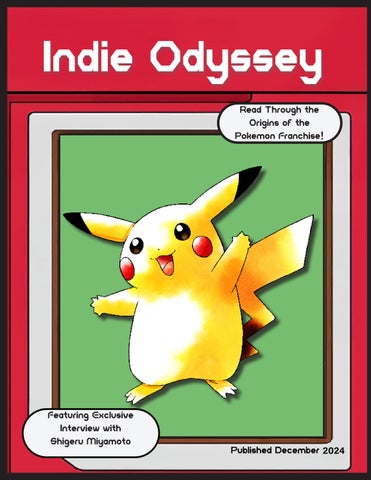
The Pokémon franchise is the most lucrative media franchise in the world, worth over $100 billion. It surpasses the value of other beloved franchises like Harry Potter, Hello Kitty, Winnie the Pooh, and even Marvel. This is an impressive feat, considering the franchise started as a magazine, not as a game developer.
Somehow, the game “Pocket Monsters” became Pokémon and grew into a cultural phenomenon that continues to entertain people of all ages.
In 1982, Satoshi Tajiri and Ken Sugimori partnered to create a video-game-focused magazine called Game Freak.
The two shared a passion for video games and complementary skill sets, writing (Tajiri) and illustration (Sugimori), which helped them bring the magazine to life. The magazine included reviews of popular games, tips for playing, and other game-related articles.


After a few years of publishing Game Freak, Tajiri and Sugimori saw the potential to add new games to the gaming industry, which saw Game Freak’s evolution from a magazine to a game development company. Thanks to this transition, both Tajiri and Sugimori are now polished game developers and designers, and Sugimori continued his love for art by becoming a professional illustrator.
Shortly after transitioning to gaming, Tajiri pitched an idea to Nintendo that he developed as a child fascinated by bugs and considering a life as an entomologist. That idea was the concept of Pocket Monsters.
Nintendo hesitantly agreed and started working on the game for their Game Boy with the help of Shigeru Miyamoto, the well-known video game developer who brought The Legend of Zelda into the world. Game Freak has not only played a role in introducing Pokémon to the world but has also developed games like Yoshi, Mario and Wario.
In 1996, the first Pocket Monster video game was released, Pocket Monsters Red and Green. The game followed much of the basic formula it does today, allowing players to collect and trade Pokémon. Less than a year later, Pokémon cards were released. Today, these cards are still popular collectors’ items, with the most expensive individual card ever auctioned selling for $369,000.


An animated adaptation of the game was released in 1997, centering around the main character, Satoshi, named for Tajiri’s work on the game, and his journey to becoming a Pokémon master.
The show ran for 26 years and over 1,000 episodes—and still has a dedicated fanbase today. In 1998, Pokémon leaped to America, and shortly after, it was taken to the United Kingdom.
The TV show character was renamed Ash Ketchum, and in the UK, the game released was a red and blue version instead of red and green. Around this time, the game’s name was shortened from “Pocket Monster” to “Pokémon.”


The first movie was also released in Japan in 1998, later making its way to American audiences; this led to the release of over 20 other movies. The most recent was released in 2020, and the highest-grossing was Pokémon: Detective Pikachu, released in 2019 and bringing in over $140 million.
Pokémon impressed players and non-players alike in 2016 when it launched its augmented reality (AR) game, Pokémon GO. It helps that the game evoked a great deal of nostalgia for people who grew up with Pokémon, capturing a wider demographic.
This version of the game also made the social aspects of Pokémon far more accessible to people by being available on mobile devices rather than requiring a gaming device or cards. Players can catch Pokémon, work with teams, evolve their Pokémon, and trade with other players anywhere they bring their phones and have internet access.
Today, Pokémon continues to release game updates, remake old favorites, and even explore entirely new gaming avenues, including slot games similar to those available at NJ online casinos, adding to the ways the franchise reaches audiences and keeps its fans entertained.
The adaptability of the game, from the screen to augmented reality to physical cards, demonstrates the franchise’s ability to reach new audiences and experiment with different options to extend its legacy. It shows no signs of slowing down anytime soon, with more movies (including live-action films) set to be released in the near future.

You can’t legitimately catch a Mew in Pokemon Red, Blue or Yellow. No matter how many times your buddy tells you that he found his Mew in a truck next to the SS Anne or how his Jigglypuff evolved into a Mew -- it’s just not true.
Through a glitch, it is possible to capture Mew in all three games. There are two ways to catch it, and you’ll need different abilities for each technique.
This is a safer, earlier way to get Mew. You'll need an Abra and the following two trainers around Route 24 and Route 25 available for battle: (Image 1)
If you've battled them prior to this glitch, you will not be able to catch Mew.

1. Save your game. Do not save again until you've successfully caught Mew.
2. Battle your way across Nugget Bridge if you haven't already. Make sure you have Abra in your party. Go all the way to the left of the bridge until you see the thin grassy area sandwiched between a wall and some water.
3. Be ready to press start. Walk slowly toward the grassy area, but make sure you are walking down the row that puts the water right next to your character. Press start right as you reach the corner of the water boarder so that you'll stop the trainer hiding in the grass from challenging you. (Image 2)
4. Once paused, use Abra to teleport out. The trainer in the grass will notice you, but you’ll teleport out if you did this correctly.
5. Walk back up Nugget Bridge and head right to Route 24 this time. You’ll have to fight a few trainers in the rocky pathy, but make sure you’ve only defeated the first three you encounter on the left half of the barricade.

6. Fight the Youngster standing on his own facing north. However, make sure you walk a few spaces in front of him, not directly in front of him. Walking directly in front of him for the battle will freeze your game.
7. Defeat Youngster, then immediately use Abra to teleport back to the Pokemon Center. Go inside.
8. Walk up to the Nugget Bridge. After walking on it for a bit, your pause menu will open on its own. Close it and you'll face a level 7 Mew.
For the second technique, you'll need to have a Pokemon that knows the Hidden Machine Fly. Two trainers in the game must be free to battle. If you had battled them before, you won't be able to do this glitch.
Here are the steps to catching Mew:
1. Save your game. Do not save again until you've successfully caught Mew.
2. Head to Route 8 and stand in front of the Underground Path door. Take a step downward and hit the start button the game before the Gambler Pokemon trainer sees you for a battle. This is the first trainer you need to have freed up. (Image 1)


3. Fly to Cerulean City and walk up to Route 24 and 25. Head over to another trainer that must be freed up, The Youngster who will be facing north and is to the left of a tree and item. He has a Slowpoke in his party. Make sure you're at the highest part of the route so he walks up to you.
4. Defeat the trainer and fly to Lavender Town. Head west to Route 8 and your menu will pop up. Press B to exit and you will fight Mew.
5. Mew will be at level 7 and only know the move Pound. Make sure you have tons of Pokeballs and only save before this technique and after catching Mew.

This short but insightful interview with Shigeru Miyamoto first appeared in an early seminal book of video game history, “terebi game denshi yuugi taizen” from 1989.
The interview captures Miyamoto in the early limelight: not yet the legend he is today, but more of a bright star among other contemporary developers. What is interesting is how clear his vision was for open, toy-like game design even then.
—Do you see yourself as an artist, or as an engineer?
Miyamoto: I can’t really say one way or the other—I think I’m somewhere in between the two. What I aspire to be, personally, is an entertainer with a lot of good ideas.
—How did you get into the work of designing video games?
Miyamoto: I had originally wanted to design toys. When I joined Nintendo, they were already making video and arcade games. Because of the huge popularity of Space Invaders, that became a much larger part of their business, and I got involved video game design.


—About how long does it take for you to finish a game?
Miyamoto: It can take anywhere from half a year to over a year, depending on the game. Some factors include how complete the design is when we start, and the overall volume of content. When you add in the amount of time we spend in pre-development planning, it can take 1-2 years for a game to be completed.
—How many people do you usually have on a development team?
Miyamoto: From 6-12 people. For our recent games with a lot of content, we need assistants, people to create the maps, etc… so the size of our teams is gradually increasing. For Super Mario, I believe we had 8 people.
—If you were to compare your work to another art medium, what would it be?
Miyamoto: Miniature entertainment movies, maybe? Also, living toys.
—Mario first appeared in the Donkey Kong arcade game, but where in the world did the idea for a character like that come from? Also, please tell us the origin of Mario and Luigi’s names.
Miyamoto: To your first question, it was just simple imagination. Also, because we had to work with small sprites and limited pixels, the mustache and overalls helped make his character seem more alive and individual. As for the names, those were added by Nintendo of America staff.
—What was your basic concept for Super Mario Bros? I’ve heard the basic idea was to make a platformer that used the Mario character.
Miyamoto: From a marketing standpoint, the idea was to make a game that anyone could enjoy, yet would also appeal to game maniacs. At the planning stage, we talked about wanting to make a game that would compile the best aspects of post-Donkey Kong platformers, and also set a new standard. We all thought it was going to be our final celebration of cartridge games… we had a lot of fun making it.


—Many people say you are a genius. What do you think of that?
Miyamoto: Really?! Hearing things like that makes me blush from ear-to-ear. I’m just a normal person.
—What kind of game(s) would you like to make in the future?
Miyamoto: I don’t want to make games where the player is just a puppet in the hands of the creator, playing exactly as scripted. Trying to get players to become better and better at your game is certainly one valid approach to making games, but for me, I want to present games to players that are more like pure toys: something you can use, explore, and play with freely.
—What do you think the future of video games looks like?
Miyamoto: I don’t know—that’s the kind of thing that if I try to think about it at night before bed, I’ll never get to sleep.
—What, in the end, are video games to you?
Miyamoto: In one sense, they’re just my job. But I am also just another player.


