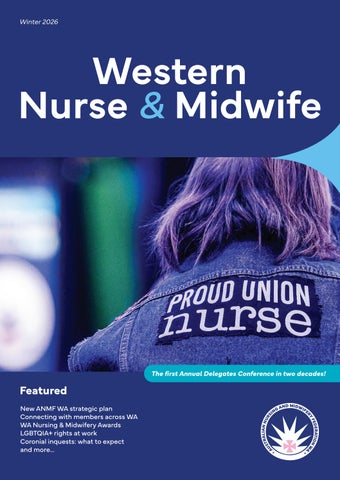
Winter 2026
Western Nurse & Midwife
The first Annual Delegates Conference in two decades!
Featured New ANMF WA strategic plan Connecting with members across WA WA Nursing & Midwifery Awards LGBTQIA+ rights at work Coronial inquests: what to expect and more... Western Nurse & Midwife |
ALWAYS ON YOUR SIDE
Eureka Lawyers are proud to represent ANMF members. We are dedicated to representing workers and their families when they’re fighting the big end of town. We take the care, and time, to get you the best results at affordable rates.
Our team are all specialists in their field, and work across areas of law including: • Workers’ Compensation • Personal Injury • Motor Vehicle Accident claims • Industrial Diseases • Family Law • Public Liability claims • Medical Negligence • Abuse claims • Criminal Injuries • Employment and Industrial Law • Violence restraining orders • Wills and Probate
2 | Australian Nursing and Midwifery Federation WA
You can speak to someone confidentially by calling us on (08) 9428 3333, or simply scan the QR code for more information at eurekalawyers.com.au
ANMF members eligible for special benefits. Call for details.
Contents
Western Nurse & Midwife Winter 2026
Features
8
Connecting with members across WA
6 Annual Delegates Conference 2026
More in this issue 4 Secretary’s report 5 ANMF WA strategic plan 10 Member wins 11 DRNP course 12 LGBTQIA+ rights at work
Member spotlight: Jeannie
15 Coronial inquests FAQ 18 ANMF national news 21 Health equity for every woman 22 News bites 24 Out & about
16 Poletti, RN and St John WA
volunteer emergency medical technician
Clinical updates 26 Cultural safety in healthcare 29 Arbovirus — a microorganism 20 WA Nursing & Midwifery Awards
The Australian Nursing and Midwifery Federation WA (ANMF WA) is the brand name that represents two entities: the Australian Nursing Federation Industrial Union of Workers Perth and the Australian Nursing and Midwifery Federation WA Branch. Romina Raschilla (RN MBA) is State Secretary of both entities.
Acknowledgement The Australian Nursing and Midwifery Federation Western Australia acknowledges the Traditional Custodians of the Lands on which our services operate throughout WA. We pay our respects to Elders past, present and emerging. We are committed to walking alongside all First Nations Peoples on our journey of reconciliation.
ANMF WA P.O. Box 8240, Perth Business Centre WA 6849 260 Pier Street, Perth WA 6000 Membership: (08) 6218 9444 Email: membership@anmfwa.org.au Front cover photo ANMF WA Delegate at the Annual Delegates Conference 2026
Western Nurse & Midwife | 3
“
“
My top priority since becoming State Secretary has been to ensure that all work across our union is aligned with the priorities of members.
To do that effectively, we need a clear sense of who we are, what we stand for, and where we are heading. As a union, it is really important for us to have a collective ‘why’ to steer us forward and so our Council has worked hard to develop a new strategic plan that defines our purpose, vision and values. We have never had a plan like this before, which is unusual for a collective of our size, and I am thrilled that we now have a clear strategy to help ensure everyone is on the same page and working towards the same goals. Our new purpose statement outlines the reason we exist: we use our collective advocacy power to advance working conditions, member wellbeing and a safer, more equitable health system for the community that depends on us. This purpose will guide every decision we make to ensure our actions contribute to stronger workplaces, better outcomes for our members, and a healthier future for the communities we serve.
Secretary’s report Our vision describes the overarching goal we are working towards. With 45,000 members, we are already the largest union in the state, giving us a powerful collective voice. Looking ahead, we want to continue building on that strength: to be the trusted voice of nurses and midwives in Western Australia, shaping the future of health care in our state while ensuring members are valued and safe at work. We are already strong but by standing together, with our focus in the right places, we can achieve so much more. As we continue growing, we will carry out our work according to our three values: professionalism, empathy and curiosity. This means that we will always hold ourselves to a high standard and follow through on what we say. We will act with care and always see the person, not the problem. And we will keep learning and growing because standing still is not an option. These values will be at the heart of our Council meetings, our delegate program and our internal policies. They will influence the way we do things across every aspect of our union. There is already lots of work underway which is closely aligned to our strategic plan, including upgrading our membership system which will improve your member experience and make it easier for the team to support you. We have also recently purchased a new office space on Royal Street in East Perth that will, over time, become a welcoming, safe and accessible space for members and union officials. It will include areas for delegate training and member meetings, as well as allowing room for future growth so we can continue
4 | Australian Nursing and Midwifery Federation WA
expanding our team of industrial advisors and organisers. This purchase is a wise investment and marks a key chapter for our union. Our Council is considering different possibilities for the future of the Pier Street site. Another important milestone was our Annual Delegates Conference in June, the first in almost two decades. It brought delegates and members together to build skills and connect. It was inspiring to see so many passionate members in one room, united by a shared commitment to strengthening our professions and our union. It is clear that we have an engaged and determined network of delegates who will help to shape the future of our union. One of my highlights from the past few months has been traveling across the state to meet with members working in regional and remote communities. It is always eye-opening to hear about the unique challenges faced by those of you who work in some of the more far-flung corners of our beautiful state. I look forward to continuing to work together to tackle problems and strengthen workplaces for all members, regardless of your location or which part of the health system you work in. Together, we’re growing stronger.
Romina Raschilla, MBA RN ANMF WA State Secretary
ANMF WA strategic plan Why we exist
What we are working towards
PURPOSE
VISION
We use our collective advocacy power to advance working conditions, member wellbeing, and a safer, more equitable health system for the community that depends on us.
To be the trusted voice of nurses and midwives in Western Australia, shaping the future of health care in our state while ensuring members are valued and safe at work.
How we work VALUES PROFESSIONALISM
EMPATHY
CURIOSITY
We hold ourselves to a high standard and follow through on what we say.
We act with care and always see the person, not the problem.
We keep learning and growing because standing still is not an option.
Our focus areas
BUILD
ENGAGE
ADVOCATE
• Recruitment and training.
• Workplace delegates and organisers.
• Improved bargaining and advocacy on issues.
• Better communications and collaboration.
• Foundations for future campaigning.
A modern union
• New policies and processes. • System upgrades.
Members and stakeholders
For meaningful change
Western Nurse & Midwife | 5
Australian Nursing and Midwifery Federation WA
Annual Delegates Conference 2026
At the conference, retired member Rosemary Lorrimar was surprised with a Distinguished Honorary Membership, awarded to her by State Secretary Romina Raschilla on behalf of the ANMF WA Council. This award is an acknowledgement of Rosemary’s dedication and advocacy over many years. You might recognise Rosemary from the front cover of the last edition of the Western Nurse and Midwife, standing in front of our iconic rally banner. Congratulations, Rosemary!
Rosemary Lorrimar and Romina Raschilla
Conference attendees said they left feeling empowered, energised and ready to make a difference in their workplaces. It was wonderful to be in a room filled with such passionate delegates and members who all want to make a difference – for each other and ultimately for our patients. The first ANMF WA Annual Delegates Conference in many years was held on Friday 5 June and the room was buzzing with passionate delegates and members who were keen for a day of learning, networking and inspiration. It was clear from the start of the day that we have a strong group of members stepping up for our union and advocating fiercely for change. The outstanding lineup of speakers included: Fair Work Commissioner Pearl Lim, ANMF Federal President Sally-Anne Jones, ANMF Federal Secretary Annie Butler, Minister for Health and Mental Health Hon. Meredith Hammat MLA, Nurse Midwife Health Program Australia CEO Lori-Anne Sharp, and Federal Member for Bullwinkel Trish Cook MP.
6 | Australian Nursing and Midwifery Federation WA
We are already getting excited for the next delegates conference!
Commissioner Pearl Lim
BUILD, ENGAGE, ADVOCATE
Conference takeaways These are some practical tips we took from Commissioner Pearl Lim’s speech to help with identifying workplace issues, building your case and advocating for change.
1
Identify the issue Clearly define the problem/issue and who it affects.
2 Gather the facts
Ask yourself: What do I know? What do I need to know? How will I find the information? (Be cautious when using AI tools, they can create a false sense of confidence and knowledge. Always verify information using reliable sources).
3 Consider the options
Explore possible solutions to the issue, identify any barriers, and think about your BATNA (best alternative to a negotiated agreement), WATNA (worst alternative to a negotiated agreement) and MLATNA (most likely alternative to a negotiated agreement) scenarios.
4 Build the case Bring together your problem analysis, evidence and solution options to present a clear, well-supported case. Anticipate the other side’s arguments and consider what they have to gain by resolving the issue in your favour.
5 Plan your strategy Work with your fellow members and delegates to map out your next steps, decide how you will communicate your case, prepare a backup plan and reflect on what worked and what could be improved afterward.
Thank you to our 2026 Annual Delegates Conference partners
Western Nurse & Midwife | 7
Connecting with members across WA Over the past few months, Romina and union officials traveled around the state, visiting members from Kalgoorlie, Geraldton, Albany, and Bunbury. They have enjoyed meeting members face-to-face and hearing firsthand about the unique challenges in rural and regional workplaces.
The visits were a chance for the team to explain the bargaining process, the role of workplace delegates, and different ways of becoming more involved with the ANMF WA and creating real change. Many members mentioned it was the first time anyone from the union had visited their workplace before. Touching down in Kalgoorlie, the team was met with scorching red dirt and an equally warm welcome from members. As the first regional trip of the year, there was a lot of excitement in the air, and the team was keen to hear from as many members as possible. A few days later they braved the blustering winds in Geraldton. The weather was no match for the local members who turned out in spades and shared thoughts on their workplaces, and the beloved on-site coffee van that keeps them going throughout the day! The momentum kept building with a record turnout of members at an information session at Albany Health Campus. That was followed by a trip to Bunbury where Romina and the team drove down in the early hours, excitedly anticipating a big day of meeting members. It certainly delivered, with plenty of great conversations about the issues that matter most there. It is great to see that the number of ANMF WA workplace delegates in regional and remote areas is steadily increasing. Wherever you live in our beautiful state, your union is here for you and you can take an active role by stepping up.
8 | Australian Nursing and Midwifery Federation WA
Interested in becoming a workplace delegate? Scan the QR code below to submit your expression of interest.
Geraldton
Kalgoorlie
Perth
Bunbury
Albany Western Nurse & Midwife | 9
Member
WINS
AI CAN BE A USEFUL TOOL FOR FINDING INFORMATION OR GETTING A GENERAL OVERVIEW OF A TOPIC. BUT WHEN IT COMES TO WORKPLACE ISSUES, INDUSTRIAL ADVICE OR WRITING PROFESSIONAL CORRESPONDENCE, THERE IS NO SUBSTITUTE FOR EXPERT SUPPORT. In fact, one of our main take aways from the speaker presentation at our Annual Delegates Conference was about avoiding using generative AI tools for industrial advice. It is easy to spot when something has been written using AI, and discredits the claims in the first place, making it a lot harder for your union to work with you and advocate effectively on your behalf. ANMF WA industrial advisors support members every day, bringing a wealth of knowledge and experience to help resolve workplace issues. Whether you need help understanding your rights, responding to your employer, or navigating a complex situation, the team is available to provide accurate and personalised advice. All queries to the industrial team are triaged according to the level of urgency and severity. This means it can take some time for the team to get back to general queries and we are working on a number of ways to help reduce the time it takes to respond to these less-urgent requests. Here are just a few of the positive outcomes that industrial advisors have achieved alongside members in recent months.
10| Australian | AustralianNursing Nursingand andMidwifery MidwiferyFederation FederationWA WA
Succesful unfair dismissal outcome The industrial team represented a member in an unfair dismissal matter, securing a positive outcome that included five weeks’ additional pay and their employment ending as a resignation, rather than a termination. $30,000 negotiated settlement After raising concerns about inappropriate workplace conduct that was occurring, a member felt they could no longer remain at their workplace. Their ANMF WA advisor successfully negotiated a $30,000 resignation package, allowing the matter to be resolved without further action. Recovered outstanding wages When an employer disputed a member’s correct rate of pay, the team intervened to secure around two week’s additional wages, approximately $2,000, and a statement of service to support the member in finding new employment. Employment retained A member who faced allegations and was asked to show cause why their employment should not be terminated, was supported by their industrial advisor to prepare a response which the employer accepted. Their employment was retained and the outcome was reduced to a formal warning and a six-month performance improvement plan.
DRNP course
An exciting opportunity for WA nurses In July, the first cohort of students commenced the Designated Registered Nurse Prescriber (DRNP) course at Edith Cowan University (ECU). This marks an exciting milestone for nursing in WA, creating new opportunities for registered nurses to expand their clinical scope, develop their skills, and advance their careers. Once endorsed, Designated Registered Nurse Prescribers will be able to administer, obtain, possess, prescribe, and supply Schedule 2, 3, 4 and 8 medicines within a regulated framework. Australia’s introduction of the DRNP role will help us to align with international best practice, and the initiative is expected to improve timely access to medicines, reduce pressure on the healthcare system, and enhance patient care. Applicants must: Hold current registration as a registered nurse in Australia. Have at least three years of clinical experience (or 5,000 hours) within the past six years. Have successfully completed the Nursing and Midwifery Board of Australia (NMBA)-approved units of study required for endorsement, or equivalent approved units. Completing the course is only one step towards becoming a designated RN prescriber. Following successful completion, nurses must also meet NMBA and AHPRA requirements, including prescribed supervision and prescribing agreement requirements before you can practice. If you are interested, it is a good idea to have a conversation with your employer early to establish the requirements, how the role will be supported, and whether there is an identified need for designated RN prescribing in your workplace.
t ation abou m r o f in r e h Furt nt process e m e s r o d n the e uirements q e r e s r u o and c f on the Chie is available y d Midwifer n a g in s r u N e MO) websit N (C ’s r e c Offi A website. B M N e h t and
In WA, CNMO is leading the state implementation of the standard. Western Nurse & Midwife | 11
RIGHTS AT WORK
Everyone deserves to feel safe, respected, and valued at work. Yet for many LGBTQIA+ nurses and midwives, that basic expectation remains out of reach. Across Western Australia, discrimination unfortunately continues to occur. The fact is, discrimination is not only unacceptable, but also illegal. ‘Jokes’ in the tearoom, assumptions about someone’s partner, misgendering or exclusion from work culture can create a toxic workplace where people feel excluded and isolated. Whether you are a member of the LGBTQIA+ community or an ally, there are ways you can help contribute to a safe workplace for everyone. Nurses and midwives are protected under the Equal Opportunities Act (WA) and the Sex Discrimination Act (Commonwealth) legislation however, direct and indirect discrimination still takes place. Direct discrimination occurs when someone is treated unfairly because of who they are. For example, someone doesn’t receive a promotion because their manager says they do not like LGBTQIA+ people. Indirect discrimination occurs when a rule or policy is implemented for everyone but indirectly disadvantages people of a certain group. For example, a dress code is introduced that does not reasonably accommodate a diversity of genders and expressions.
12 | Australian Nursing and Midwifery Federation WA
Did you know? You are protected from discrimination on the basis of your sexuality or gender expression under the Equal Opportunities Act (WA) and the Sex Discrimination Act (Commonwealth) legislation.
What do you do if you, or someone you know is discriminated against? Here are some tips from our industrial team:
1
educate, educate, educate!
Discrimination can sometimes be an opportunity to educate others about what is and is not appropriate in the workplace. The impact of words matter, but intention also matters and some people may be unaware that their words or actions are harmful. Where it is safe and appropriate, a respectful conversation can help. Avoid responding in anger or unprofessionally, as this can detract from the issue and complicate any action you may choose to take.
Write it down
If you ever decide to take the matter further, contemporaneous evidence (information captured at the time) is often much stronger than relying on memory. Keep a record of what happened, who was involved, who saw it happen, and where and when the incident occurred. A simple option is to email the details to yourself, creating a dated and timestamped record of the event.
LET US KNOW
Regardless of whether you want to make a formal complaint, you should tell your union that an incident has taken place. Our industrial team can make a note and help provide some initial guidance, so there is a record if you want to revisit it later, or if something else occurs. If you feel that you have suffered a psychological injury because of discrimination, please let us know immediately, so we can help you lodge a workers compensation claim.
2
3
If you are a leader in a workplace, it is important to act proactively instead of reactively. This means ensuring that correct processes are in place to avoid discrimination in the first place, instead of dealing with it after the fact. If you witness someone being discriminated against, it is a good idea to check in on them to make sure they are okay. We all have a part to play in ensuring that workplaces are safe for everybody. We all make mistakes, and we all get things wrong. At the end of the day, we do not necessarily have to understand every sexual orientation or gender expression, much like how we may not understand or know a lot about cultures or religions different from our own. What is important is that we are courteous, receptive to different perspectives and life experiences and ultimately treat each other with dignity and respect. The beauty of nursing and midwifery in Australia is that it is so diverse with people from all cultures, ethnicities, sexualities and genders. This positively
impacts patient care because our patients come from equally diverse backgrounds and value being supported by others who respect and understand their differences.
Get your workplace involved! Throughout the year, there are many opportunities to show support in your workplace for people in the LGBTQIA+ community. Wearing purple on ‘Wear It Purple Day’ or hosting a morning tea for Pride Month may seem like small gestures, but they will help to ensure LGBTQIA+ nurses and midwives feel seen. If this story has brought up any upsetting emotions, please reach out to the Nurse and Midwife Health Program Australia for support at nursemidwifehpa.org.au
Western Nurse & Midwife | 13
CAREER COMPASS Expert advice
You don’t want to miss the chance to attend a member-exclusive Career Compass session! Get ready to navigate your career path, clarify your goals, build your confidence, and sharpen your job application skills. Career Coach Gerry Gulla leads the sessions and brings a wealth of knowledge and experience. Whether you are currently looking for a job, or simply want to connect with like-minded members, the sessions have something for everyone.
Register today!
14 | Australian Nursing and Midwifery Federation WA
Upcoming workshop dates SCAN THE QR CODE TO REGISTER
In-person workshop
Online workshop
Coronial inquests FAQ Eureka Lawyers works closely with the ANMF WA and is WA’s largest trade union legal practice, providing expert advice, support and representation to members on a variety of workplace issues, including coronial inquests.
Nurses are often asked to give evidence in coronial inquests, which can be daunting. Eureka Lawyers have provided us with broad, general information about coronial inquests, the roles of witnesses, and what to expect when giving information and evidence.
What is a coronial inquest Coronial inquests are hearings held to determine how a person died. They are mainly about discovering facts and do not result in findings of criminal or civil liability.
Why am I being asked to give information? Coroners generally investigate and make findings about the circumstances leading up to a death and the cause of death. In certain circumstances, coroners are required to comment on the standard of care received by a person before they died. Inquests regularly investigate deaths occurring in care or detention contexts where nurses might work. As such, nurses often hold information that can help a coroner determine how a person died.
Do I have to cooperate with an investigation or inquest? You might be asked to give information at various stages of an inquest: • • • •
the initial report; the investigation; preparing for hearing; being a witness.
Depending on the stage of the inquest, you might be asked questions by your employer, your employer’s lawyer, or a lawyer assisting the coroner. You may not be required to provide information at these stages, unless given a lawful or reasonable direction to do so, or if required under another law. Generally, you must comply with a summons to give evidence, and you must answer questions asked during a hearing. If you are unsure, you can ask the person seeking the information whether your answers are required or optional.
Do I need help to prepare a response or statement? In general, you should not need any assistance to answer questions about things you know or remember. You just need to answer honestly. You can ask for questions to be clarified. It is also okay to say if you don’t know the answer to a question or can’t remember certain details. Generally, you should try to only answer the question asked and not give other information that is irrelevant. Witnesses can decline to answer questions on the ground that their answer might incriminate them. The coroner can decide to issue a certificate preventing your evidence from being used against you in criminal proceedings. If issued with such a certificate, you must answer the question.
Do I need help to prepare a response or statement? In general, a person giving evidence in a coronial inquest hearing does not need a lawyer and cannot be represented by one. An exception is a person who is at risk of having an adverse finding made against them by the coroner. Such a person may be represented by a lawyer at an inquest to examine or cross examine witnesses and make submissions against any such adverse findings. If you are concerned about being asked to give information in a coronial inquest, you can contact the ANMF WA industrial team for advice. For a referral to Eureka Lawyers, call the ANMF WA Helpline on 6218 9459 or email industrial@anmfwa.org.au
For free, confidential peer counselling contact Nurse Midwife Health Program 1800 001 060 info@nursemidwifehpa.org.au
Western Nurse & Midwife | 15
MEMBER Spotlight Jeannie Poletti
Registered nurse and St John WA volunteer emergency medical technician
FEW PEOPLE CAN SAY THEY HAVE SAVED THE LIFE OF A FAMILY MEMBER. REGISTERED NURSE AND ST JOHN WA VOLUNTEER EMERGENCY MEDICAL TECHNICIAN JEANNIE POLETTI IS ONE OF THEM. In January, Jeannie was at her mum’s house when she received a frantic phone call from her Nanna that her Pop had collapsed. “I immediately grabbed my phone and dialed triple zero. At the same time Mum and I jumped in the car and drove straight to my grandparents’ house,” she said. As soon as she arrived, Jeannie knew he was in cardiac arrest and immediately jumped into action, starting CPR. “In the moment I felt incredibly panicked, which according to the ambulance paramedics did not show ...I think my training and experience just kicked in, and I knew what needed to be done,” she said.
Jeannie managed to stabilise her Pop before the ambulance arrived and he was transferred to Geraldton Regional Hospital, where he received 14 shocks. The experience was even more terrifying for Jeannie, given her nursing background and understanding of the statistically poor outcomes of out-of-hospital cardiac arrests. “Every minute felt like hours. If it hadn’t been for the amazing nurses coming to update us, it would have been a lot worse... Nurses have a profound influence on how families experience and cope with traumatic events. This is a lesson I will carry with me throughout my nursing career, and it will always remind me of the importance of providing compassionate care and support - not only to my patients but also to their families during some of the most difficult times in their lives,” she said. Thanks to her quick thinking and expertise, Jeannie’s Pop has made a full recovery.
16 | Australian Nursing and Midwifery Federation WA
“The next day when I saw him, I’d say it was such a surreal experience, to see him sitting up in bed alert and talking was absolutely incredible.” After the event, Jeannie prioritised her own wellbeing by taking time to process what had happened. She debriefed with her nurse friends and reached out to a psychologist for professional support.
“
This is a lesson I will carry with me throughout my nursing career, and it will e always remind me of th g importance of providin d compassionate care an support - not only to my patients but also to their families during some of in the most difficult times their lives”
“
“Having these supports in place was invaluable and helped me process the event in a healthy way while prioritising my mental wellbeing,” she said. For her role in saving her Pop, Jeannie received a Certificate of Recognition from St John WA. “Being able to use the skills I have developed as a nurse to help my own family during such a critical moment made the recognition even more meaningful and special to me,” she said.
Congratulations Jeannie — we are glad you and your Pop are both doing well!
Pictured above: Sue Webb (grandmother), Jeannie Poletti and Jim Webb (grandfather). Images supplied by St John WA
Western Nurse & Midwife | 17
F M N A national news FEDERAL
ANMF takes landmark Work Value Case to the Fair Work Commission Nurses, midwives and assistants in nursing could see long-overdue improvements to minimum award wages under a landmark case before the Fair Work Commission. The case argues that nursing and midwifery work has been historically undervalued and seeks to better recognise the complexity, skill and responsibility of these professions. In addition to wage increases, the ANMF is seeking changes to the award classification structure and for the Nurses Award 2020 to be renamed the Nurses and Midwives Award. A successful outcome could help lift wages and strengthen the benchmark that underpins enterprise agreements across Australia.
SA
SA nurses and midwives to vote on new pay offer After months of campaigning and industrial action, the South Australian Government and the ANMF SA branch have reached an in-principle agreement on a new pay offer. The proposal includes a total 16% wage increase by mid-2028, along with improvements to allowances and other industrial conditions. While endorsing the offer for members to vote on, ANMF SA Secretary Elizabeth Dabars said it would still leave South Australia’s nurses and midwives behind their interstate colleagues, describing them as “laggards” nationally. The agreement will now go to a member ballot.
NSW
Calls for Ramsay to repay nurses after landmark underpayment win The NSW Nurses and Midwives’ Association (NSWNMA) is calling on Ramsay Health Care to promptly repay thousands of current and former nurses and midwives following a landmark Fair Work Commission decision. The Commission found Ramsay had incorrectly calculated annual leave payments, leaving many staff underpaid for shift and weekend penalties over several years. While Ramsay has acknowledged it must repay affected employees, the union is continuing to campaign to ensure members receive every dollar they are owed without unnecessary delay. The NSWNMA team says the outcome demonstrates the importance of union advocacy in protecting members’ workplace rights and entitlements.
18 | Australian Nursing and Midwifery Federation WA
federal office and other state Across Australia, our peers at the ANMF e wages, conditions and patient branches are working together to improv ortant work happening across our care. Here’s a snapshot of some of the imp national union.
VIC
Final tranche of legislated ratios now in effect From 1 July, Victorian health services are expected to fully implement the final tranche of amendments to the Safe Patient Care Act, completing the staged rollout of improved nurse and midwife-to-patient ratios. The reforms strengthen legislated staffing requirements across several clinical areas, including postnatal wards, emergency department resuscitation bays, intensive care units, and high dependency units with health services required to roster in line with the act.
TAS
Ambulance dispute heads to the Industrial Commission The ANMF Tasmania Branch has taken its dispute over the Tasmanian Government’s Ambulance Ramping Ban to the Tasmanian Industrial Commission. The union argues that the policy, which aims to reduce ambulance transfer times in emergency departments, fails to address chronic staffing shortages and hospital capacity issues, placing increased pressure on nurses and potentially compromising patient safety. The Commission will now consider the dispute as the union continues to advocate for safe workloads and better patient outcomes.
Keeping you and your money safe Stop – Don’t click, pay or share codes. Check – Contact the organisation using details you find yourself. Protect – Call your bank immediately if you’ve shared details or sent funds.
Learn more
Health Professionals Bank is a division of Teachers Mutual Bank Limited ABN 30 087 650 459 AFSL/Australian Credit Licence 238981. BE03615-HPB-0726
Western Nurse & Midwife | 19
WANMEA awards
ANMF WA members across the state are doing innovative and incredible work, and the WA Nursing and Midwifery Excellence Awards (WANMEA) in May shone a spotlight on that when it recognised a large group of nurses and midwives who are leading the way in their fields!
One of the award winners was Graeme Boardley, who won the Lifetime Achievement Honour Award, which recognises people who have made a significant contribution to nursing and midwifery throughout their career. This could not be more accurate in Graeme’s case. Throughout his 42-year career, Graeme has been a passionate advocate for women and their families. He was the first male Executive Director of Midwifery, Nursing and Patient Support Services at King Edward Memorial Hospital.
“
Congratulations to all the winners!
“Having been told a few times through my early career that men didn’t belong in midwifery, it was a huge honour to be appointed but more importantly it proved that gender did not matter” Graeme said.
“
The atmosphere on the awards night was absolutely electric with the room erupting into cheers and applause when each name was read out.
He has also been a driving force behind the implementation of nurse and midwife-to-patient ratios at his current role as Nursing and Midwifery Director of Workforce Projects at North Metropolitan Health Services. Graeme says he is honored and deeply humbled to have won this prestigious award. “My career has given me the privilege of working with some amazing midwives and nurses, at all levels, to implement meaningful change that has resulted in women and families across WA having a voice and choices,” he said.
Jodee Hollingsworth, St John of God Health Care Group, Midland Graeme Boardley, North Metropolitan Health Service Naomi Hallsworth, Royal Perth Bentley Group, East Metropolitan Health Service Mary Lynch, DonateLife WA, North Metropolitan Health Service Nicky Duncan, Western Australia Country Health Service, Southwest Sarah Smith, Child and Adolescent Community Health, Child and Adolescent Health Service Mthokozisi, Swotwa, Bethesda Health Care Skye Ludlam, Esus Centre Elizabeth Hull, Royal Perth Bentley Group, East Metropolitan Health Service Fiona Kane, Kind Edward Memorial Hospital, North Metropolitan Health Service Professor Tracey Moroney, OAM, Curtin University Noreen Gould, Armadale Kalamunda Group, East Metropolitan Health Service
ANMF WA State Secretary Romina Raschilla and Graeme Boardley.
Professor Mary Steen OBE, Curtin University Melanie Woodhams, Western Australia Country Health Service, Wheatbelt
20 | Australian Nursing and Midwifery Federation WA
Feature article
Health equity for every woman Centre for Women’s Safety and Wellbeing
Gender-based violence, structural disadvantage, and racial inequality are ongoing challenges for many women, despite advancements made through policy and advocacy work. These challenges limit access to healthcare and contribute to ongoing disparities in health outcomes.
The upcoming WA Women’s Health Conference 2026 theme Health Equity for Every Woman highlights the critical importance of ensuring that every woman, regardless of her culture, identity, location, or ability has access to high-quality, accessible healthcare. The ANMF WA is a proud sponsor of the conference, which is hosted by the Centre for Women’s Safety and Wellbeing (CWSW). The one-day event on Friday 7 September will feature insightful discussions and presentations from knowledgeable guest speakers including: As part of the strong program for the day, available on the CWSW website, we’re particularly looking forward to these speakers: •
•
•
Melissa Lynch from Curtin University and Women and Newborn Heath Service presenting on maternal care for Aboriginal women, focusing on the Ngangk Maawit Mia Midwifery Group Practice. Megan Bell from the University of Western Australia will present on imprisonment during pregnancy, and the implications this can have for the mother’s and the child’s health. Dr Ruth McCuaig and Dr Sheeba Ramasubbu from the Women and Newborn Health Service will discuss equitable abortion care, and how this can meet the needs of at-risk women.
With women making up more than 90% of our union membership, equal access to quality healthcare is something that is close to our hearts.
CWSW is a Perth-based independent organisation actively working towards a safe and equitable world where women thrive. The centre focuses on preventing violence, promoting health, and advancing gender equality of all West Australian women, including cis and trans women and gender-diverse identities.
WA WOMEN'S HEALTH CONFERENCE
Health Equity for Every Woman A statewide conference uniting policy, practice, research and lived experience leaders to advance women's health equity across Western Australia. Explore equity-focused, intersectional approaches to models of care, health programs, research and policy that place women's dignity, choice and wellbeing at the heart of healthcare.
Monday 7 September 2026
REGISTER NOW
Perth Convention and Exhibition Centre www.cwsw.org.au/womens-healthconference
Western Nurse & Midwife | 21
S W NE S
BITE
Health news from across WA
Calls for greater breastfeeding support Australia has fallen short of its national breastfeeding target, with only 38% of babies exclusively breastfed to six months of age, while WA trails the national average at 30%. Experts say most parents want to breastfeed but often find it hard to access timely lactation support, particularly in the critical days following birth. Growing demand for breastfeeding services, workforce pressures and limited access to lactation consultants in regional areas have prompted renewed calls for greater investments in breastfeeding education and support.
New clinical care standard aims to improve stroke outcomes
Australia eliminates trachoma as a public health problem
Stroke remains one of Australia’s leading causes of death and disability, highlighting the importance of timely, evidence-based care. The Australian Commission on Safety and Quality in Health Care has released an updated Stroke Clinical Care Standard, introducing new quality statements covering pre-hospital care, rapid assessment and treatment, rehabilitation, and ongoing recovery support.
Australia has become the 30th country in the world to eliminate trachoma as a public health problem, achieving a milestone recognised by the World Health Organization (WHO).
The revised standard aims to improve patient outcomes and reduce variation in stroke care across Australia’s health system.
22 | Australian Nursing and Midwifery Federation WA
Trachoma, the world’s leading infectious cause of preventable blindness, has historically affected Aboriginal and Torres Strait Islander communities in regional and remote areas. The achievement follows decades of collaboration between First Nations communities, healthcare providers and governments, demonstrating the impact of sustained investment in prevention, screening, treatment and culturally safe healthcare delivery.
We know your care doesn’t stop. So neither does ours. The health insurer created for nurses, midwives and care workers.
nmhealth.com.au/ANMF-WA 1300 900 310
Robynne, Midwife,
ANMF and Nurses & Midwives Health member
Eligibility criteria and conditions apply. Teachers Federation Health Ltd ABN 86 097 030 414 trading as Nurses & Midwives Health. A Registered Private Health Insurer. NMH-ANMF-WA-07/26
Western Nurse & Midwife | 23
out & t u o b a
ANMF WA Organiser with delegates at the conference.
of the ANMF Federal President Sally-Anne Jones, Senior Vice President Health for r Ministe , union and President of the state branch Terry Jongen WA ANMF at, Hamm th Meredi Governement of Western Australia Hon. Annie ry Secreta l Federa ANMF and lla State Secretary Romina Raschi Butler at the Annual Delegates Conference 2026.
Council members and WANMEA awards winners at the WANMEA gala dinner
24 | Australian Nursing and Midwifery Federation WA
Chief Executiv e Officer Nurse Midwife Health Australia LoriProgram Anne Sharp was a guest speake Annual Delegat r at our es Conference .
Romina with two didgeridoo players at the ‘50 Years of Deadly’ event
Rosemary Lorrimar receiving her Life Membership certificate at the conference.
NAIDOC/ Reconciliation week To celebrate 50 years of NAIDOC, Romina and union officials attended an event hosted by Yorgum Healing Services with a Welcome to Country performed by Robyn Collard, followed by a wonderful demonstration of Aboriginal and Torres Strait Islander food, music, and artwork. The event was a great chance to reflect on the significant contributions Aboriginal and Torres Strait Islander peoples have made to healthcare in Australia. While there is still much to learn, the experience reinforced the importance of providing culturally safe, respectful, and appropriate care for everyone.
Delegates participating at the Annual Delegates Conference 2026.
Senior Billyduck Noongar Elder Theo Kearing and his nephew, delivering a Welcome to Country at the Annual Delegates Conference 2026. Western Nurse & Midwife | 25
Cultural safety in healthcare: a clinical update Read this article and complete the quiz to earn 1 iFolio CPD hour
Culture is a complex and nebulous concept that is challenging to precisely define. Most conceptualisations of culture include features such as shared values, beliefs, and practices that link individuals and help to distinguish a particular group from other groups.1,2 Each individual identifies with different cultural features to different degrees, forming a unique cultural self. A range of dimensions may contribute to an individual’s cultural self, including family, religious or spiritual beliefs, community, aspirations, illness, injury, gender, sexual orientation, education, disability, age, and life experiences.2,3 Each person’s cultural self is internalised and is often unconscious.2 Cultural safety is a critical component of patient safety. It requires healthcare professionals to engage with patients as individuals, fostering open, honest, and compassionate professional relationships.4 Cultural safety is particularly important in caring for First Nations patients to deliver improvements in health equity, but it is also applicable to caring for a people from a range of groups who are at risk of inequity and of receiving culturally unsafe care, including:1,5 • •
People from culturally and linguistically diverse backgrounds. Children and elderly people.
•
People with disability.
•
People who identify as lesbian, gay, bisexual, transgender, intersex, or queer.
•
People from disadvanted socioeconomic groups.
•
People from differing religious groups.
Cultural safety continuum
Cultural awareness, cultural sensitivity, cultural competency, and cultural safety are on a continuum.6,7,8 Progressing through the continuum from cultural awareness to cultural safety is a dynamic and multidimensional process, and a healthcare professional’s place on the continuum can change depending on the healthcare setting or community.7,8
Cultural awareness
Cultural awareness is a basic understanding that there is diversity in cultures across the population.6,7 Culturally aware healthcare professionals acknowledge that there are other people within society who have different cultural values, beliefs, and practices.7
Cultural sensitivity
Cultural sensitivity is accepting the legitimacy and value of different cultures. Culturally sensitive healthcare professionals reflect on their own culture and the impacts it may have on patient care.7,8,9
Cultural competency
Cultural competency extends beyond individual knowledge and skills to allow a healthcare system or service to operate effectively across cultures.6 It is the ability to provide healthcare to people with diverse cultural values, beliefs,
26 | Australian Nursing and Midwifery Federation WA
and practices.7 However, cultural competence retains power in the hands of the healthcare professionals to determine culturally appropriate care.6
Cultural safety
Cultural safety recognises the historical, social, political, economic, and material circumstances that shape experiences and create power differences and inequalities in health and healthcare interactions, encourages healthcare professionals to reflect on their own culture, and promotes the individual rights of the patient.2,6,10 In relation to First Nations people, cultural safety also provides a decolonising, transformative, and participatory model of healthcare based on dialogue, communication, power sharing, negotiation, and collaboration, that recognises and respects the unique needs, rights, and identities of First Nations peoples.11 An important characteristic of cultural safety is that the patient determines whether the care is culturally appropriate and safe.2,8 Cultural safety is about providing healthcare that fits with the cultural values, beliefs, and practices of the patient, which may differ from the cultural values, beliefs, and practices of the healthcare professional and the dominant culture.2 Cultural safety focuses on the experience of the patient not the healthcare professional. Patients are empowered to comment on practices, to be appropriately
involved in making decision about their care, to contribute to positive experiences and health outcomes, and to improve the quality of care.5
Cultural safe practice Culturally safe practice respects the uniqueness and diversity of the patient and provides individualised care.2 Culturally safe practice aims to ensure that culture is considered in every interaction between healthcare professionals and patients. Culture is the reference point for patient interactions, care provision, and the patient’s experience of the healthcare service.2 Culturally safe practice empowers the cultural identity and wellbeing of the patient.8 Unsafe cultural practice is any action that diminishes, demeans or disempowers the cultural identity and wellbeing of the patient.8 It is important that healthcare professionals understand that culturally safe practice is not:5 •
A checklist — there is no prescriptive list of actions that ensures culturally safe care.
•
Learning about other cultures — private learning may encourage assumptions about a patient’s cultural values, beliefs, and practices rather than seeking to understand each individual patient’s unique values, belieds and practices.
•
•
Treating all patients the same — people are not the same and treating all patients the same irrespective of their cultural values, beliefs, and practices diminishes the unique cultural identity of each patient and makes health inequities worse. Having the same cultural identity as the patient — sharing aspects of the patient’s cultural values, beliefs, practices does not guarantee culturally safe care.
Culturally safe practice requires healthcare professionals to understand their own culture, values, beliefs, attitudes, and assumptions and the effect that these can have on healthcare interactions with patients.4,10 To perform culturally safe practice, healthcare professionals must:4,5,10 •
•
•
Recognise the inherent power imbalance in the healthcare relationship and consider how this affects the way they engage with the patient, and the way the patient receives care. Build relationships and provide a healthcare environment that supports cultural safety for all patients. Consciously not impose their cultural values and practices on the patient.
•
Respect the diverse cultural values, beliefs, practices of each patient.
•
Recognise that there are limits on their knowledge and be open to learn from the patient. Understand that general cultural information may not apply to a specific patient and avoid stereotyping.
•
•
Osteoarthritis Challenge beliefs based upon assumptions and adopt practices that avoid bias and discrimination.
•
•
Support the appropriate incorporation of customs or rituals into the patient’s care to promote empowerment and collaboration. Self-assess and recognise when their actions may not be acceptable to the patient.
•
Understand that cultural values, beliefs, and practices influence patients’ perceptions of health, and shape how patients respond to illness and disease and health management.
•
Recognise that only the patient can determine whether the care is culturally safe and respectful.
•
Understand that the patient may identify with multiple cultural groupings, and that culture is dynamic and may evolve over time.
Culturally safe practice is an ongoing process of critical selfreflection and self-awareness for healthcare professionals.2,10
Western Nurse & Midwife | 27
Culturally safe communication A patient’s voice must be listened Effective communication can be one of the most important ways to achieve culturally safe care. Patients who feel disempowered may find it challenging to communicate with healthcare professionals.2 Positive healthcare relationships are built on communication that is respectful, kind, compassionate, and honest. Culturally safe communication considers and incorporates:2,5 •
The language the patient speaks most fluently and comfortably (engaging translating and interpreting services if necessary).
•
The patient’s health literacy
•
Appropriate colloquial (familiar) expressions in place of formal clinical terms and acronyms.
•
Non-verbal forms of communication such as body language, posture, gestures, and facial expressions.
•
An understanding of how the specific language, cultural, and communication needs of each patient may affect understanding.
•
The specific preferences of the patient, such as their preferred name or pronouns, and the individual roles of their family members.
•
Regular confirmation that the patient has understood the information communicated by the healthcare professional, and that the healthcare professional has understood the information communicated by the patient.
to and prioritised for healthcare to be culturally safe.2,6
REFERENCES 1.
2.
3.
4.
5.
6.
Healthcare professionals should establish an inclusive environment that supports dialogue with the patient.2,4
28 | Australian Nursing and Midwifery Federation WA
Richardson J. Cultural Safety in Children’s Health Care. Comp Child Adolesc Nurs [Internet]. 2018 [cited 2024 Oct 19];41(4):234-236. doi: 10.1080/24694193.2018.1530897. De D, Richardson J. Using cultural safety to enhance nursing care for children and young people. Nurs Child Young People [Internet]. 2022 [cited 2024 Oct 19]. doi: 10.7748/ ncyp.2022.e1407. Cox L, Best O. Clarifying cultural safety: its focus and intent in an Australian context. Contemporary Nurse [Internet]. 2022 [cited 2024 Oct 19];58(1):7181. doi.org/10.1080/10376178.202 2.2051572. Health Navigator Charitable Trust. Healthify [Internet]. Cultural safety & cultural competence for healthcare providers; 2022 [cited 2024 Oct 19]. Available from: https:// healthify.nz/healthcareproviders/c/cultural-safetyhcps. Nursing and Midwifery Board, Australian Health Practitioner Regulation Agency. Code of conduct for nurses [Internet]. Melbourne (Australia): Nursing and Midwifery Board; 2022 [cited 2024 Oct 19]. Available from: https://www. nursingmidwiferyboard.gov.au/ Codes-Guidelines-Statements/ Professional-standards.aspx. Australian Commission on Safety and Quality in Health Care. National Safety and Quality Health Service Standards [Internet]. Resources for NSQHS Standards; 2023 [cited 2024 Oct 19]. Available from: https:// www.safetyandquality.gov. au/standards/nationalsafety-and-quality-healthservice-nsqhs-standards/ resources-nsqhs-standards/ user-guide-aboriginal-andtorres-strait-islander-health/ action-121-improving-culturalcompetency.
7.
Heckenerg S. Cultural Safety: A Model and Method that Reflects Us, Respects Us and Represents Us. J Aust Indig Issues [Internet]. 2020 [cited 2024 Oct 19];23(-4). doi: 10.3316/ informit.670824249864168 8. Australian Institute of Health and Welfare. Cultural safety in health care for Indigenous Australians: monitoring framework [Internet]. Canberra (Australia): Australian Institute of Health and Welfare; 2023 [cited 2024 Oct 19]. Available from: https://www.aihw.gov.au/ reports/indigenous-australians/ cultural-safety-health-careframework. 9. Curtis E, Jones R, Tipene-Leach D, Walker C, Loring B, Paine S-J, et al. Why cultural safety rather than cultural competency is required to achieve health equity: a literature review and recommendation. Int J Equity Health [Internet]. 2019 [cited 2024 Oct 19];18:174. doi: 10.1186/ s12939-019-1082-3. 10. Medical Council of New Zealand. Statement on cultural safety [Internet]. Wellington (New Zealand): Medical Council of New Zealand; 2019 [cited 2024 Oct 19]. Available from: https://www.mcnz.org.nz/ assets/standards/b71d139dca/ Statement-on-cultural-safety. pdf. 11. Tremblay MC, Oliver-D’Avignon G, Garceau L, Echaquan S, Fletcher C, Leclerc AM, et al. Cultural safety involves new professional roles: a rapid review of interventions in Australia, the United States, Canada and New Zealand. AlterNative [Internet]. 2023 [cited 2024 Oct 19];19(1):166-175. doi: 10.1177/11771801221146787.
Arbovirus — a microorganism Read this article and complete the quiz to earn 1 iFolio CPD hour The term arbovirus is derived from a group of arthropodborne viruses. Arboviruses circulate between bloodfeeding arthropods (vectors) and vertebrate animals (hosts). Mosquitoes and ticks are cited as the most common arthropods for transmitting arboviruses to humans. Transmission typically occurs through the arthropod’s bite, although other routes may be possible in some cases. Arbovirus infections in humans can range from asymptomatic to severe, and in rare cases, can be fatal.1
Important Arboviruses in Western Australia (WA) • • • • •
Ross River virus (RRV) disease Barmah Forest virus (BFV) disease Murray Valley encephalitis (MVE) West Nile virus (WNV) Kunjin strain Japanese Encephalitis virus (JEV)
Confirmed or suspected infection with any of these viruses is notifiable in Australia.1
Ross River virus (RRV) and Barmah Forest virus (BFV)
Mosquito-borne viral illness in WA is most frequently caused by RRV or BFV, which share similar life cycles and presentations. Less than one-third of those infected have symptoms, which appear 3-21 days after being bitten.1
Common presentations • • •
Fever, sore muscles, maculopapular skin rash (50% of people) Painful/swollen joints Aching tendons
• • •
Tiredness Headache Lymphadenopathy
Fever and skin rash often resolve within a few weeks. Muscle and joint pain, and severe fatigue may persist for extended periods, mimicking certain rheumatic diseases.1
Murray Valley encephalitis virus (MVEV) and West Nile virus Kunjin strain (WNVKUN)
Disease caused by MVEV or WNV-KUN (previously known as Australian encephalitis) is limited to the northern two-thirds of WA.1 MVEV and WNV-KUN naturally circulate between mosquitoes and water birds.1 The risk of infection is highest in the Kimberley and Pilbara regions during or shortly after the wet season. Both infections are usually asymptomatic, but can cause serious or fatal disease in a small percentage of infected individuals.1 Murray Valley encephalitis can be accompanied by severe neurological symptoms and may cause death.1,2 The incubation period is 5-15 days, and in young children, fever can be the only early sign before rapid deterioration.1
Symptoms — adults • Fever • Drowsiness • Headache/neck stiffness • Nausea • Tremors • Dizziness Symptoms — young children • Fever • Floppiness • Irritability • Drowsiness • Seizures The Kunjin strain of West Nile virus is usually associated with a milder febrile illness, but can occasionally also lead to encephalitis.1
Japanese encephalitis (JEV)
Following record-breaking rains and flooding in 2022, Australia experienced its first outbreak of Japanese encephalitis, affecting NSW, Victoria, Queensland, and South Australia. 45 people fell ill and 6 died. The virus was most likely introduced to Australia by migrating waterfowl. Subsequently, JEV has been detected in pigs, chickens, and horses in other states and territories, including WA (particularly the Kimberley region).1,2
Western Nurse & Midwife | 29
While less than 1% of infected people fall ill, some develop fever, headache, neck stiffness, disorientation, tremors, coma, or seizures.1,3 Severe illness has a high mortality rate, with survivors often experiencing lasting cognitive impairment.1,2,4 Incubation period is 5-15 days after being bitten.3 Older adults and young children are especially vulnerable, and infection in pregnancy may increase the risk of miscarriage or other complications.3
Diagnosis A diagnosis of arboviruses requires:1,4 • • •
A compatible clinical syndrome. Travel or residence in an affected region.
People are advised to reduce their risk of mosquito-borne disease by preventing insect bites.1 WA Health’s Fight the Bite campaign advises wearing long, light-coloured clothing, adequate footwear, and using mosquito repellent during outdoor activities, as well as staying indoors at dawn and dusk.1,4 People should also use mosquito screens/netting in the home and reduce the availability of standing water.1,4 The only personal insect repellents proven to be effective are those containing DEET (diethyltoluamide), picaridin, or p-Menthane-3,8-diol (PMD), also known as oil of lemon eucalyptus (OLE), applied liberally to all exposed skin.1
Serological evidence of recent infection (blood or cebrospinal fluid).
Treatment
There are no specific antiviral treatments for most arboviral infections. Management is primarily supportive, including symptom control, hydration and monitoring complications. Patients with severe disease, particularly neurological complications such as encephalitis, may require hospitalization and multidisciplinary rehabilitation.
Prevention JEV is the only mosquito-borne virus mentioned for which a vaccine is currently available in Australia. Those eligible include:1 • • • •
People working in piggeries or pork abattoirs. People working directly or indirectly with mosquitoes. Diagnostic or research laboratory workers. Residents of specific areas of the Kimberley.
30 | Australian Nursing and Midwifery Federation WA
REFERENCES 1.
2.
3.
4.
Government of Western Australia Department of Health [Internet]. c2020 [cited 2024 Jun]. Available from: https:// www.health.wa.gov.au. Hurd H. BugBitten [Internet]. BMC Blog Network; 2024 [cited 2024 Jun]. Available from: https://blogs.biomedcentral. com/bugbitten/2024/03/01/ an-arbovirus-new-to-australia/. GOVERNMENT OF WESTERN AUSTRALIA. HealthyWA [Internet]. Japanese encephalitis; c2023 [cited 2024 Jun]. Available from: https:// www.healthywa.wa.gov.au/ Articles/J_M/Japaneseencephalitis. National Centre for Immunisation Research and Surveillance (NCIRS). Japanese encephalitis [Internet]. Westmead (Australia): NCIRS; 2023 [cited 2024 Jun]. Available from:https://www.ncirs.org. au/education-and-training/ japanese-encephalitisvaccination.
The Annual Nurses' Cup 2026 Novotel Vines Resort Swan Valley 12 October 2026
Sponsored Prizes
Shotgun Start 8:00am
$100 entry fee incl. competition, cart, drink and snack before tee off and post event lunch
Open to all Nurses, Midwives and Friends! Working, retired, with or without a Golf Australia handicap.
Register on MiTournament
Western Nurse & Midwife | 31
Tell us what matters most to you We want to make sure this journal reflects the issues, stories and priorities that are important to you.
Answer this quick survey!
| Australian Nursing and Midwifery Federation WA