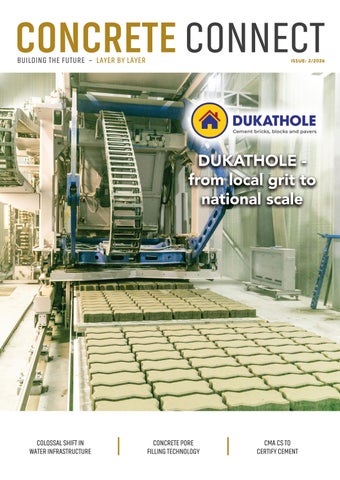
Concrete Connect April 2026

Page 1


CONCRETE CONNEC T

BUILDING THE FUTURE – LAYER BY LAYE R

I SSUE: 2/2026

DUKATHOLEfrom local

CONTENTS COVER STORY

02 Dukathole: from local grit to national scale

06 CMACS rolls out its cement certification services 07 Easy bar helps extend rotary kiln and dryer lifespan 09 The future of urbanisation in South Africa

12 Daf solutions for South Africa 13 Chemical supplier expands KZN plant

14 CSSA national roadshow on SANS 51992-1-1

15 Labour compliance by small subcontractors is critical

17 SCP P3 at the centre of concrete densification research

19 Pretoria precaster is ‘shooting the lights out

20 Why modern specs are shifting to pore-filling technology

Publisher & Advertising: Andrew Meyer (Owner)

Cell +27 (0)82 456 5175

E-mail: Andrew@concreteconnect.co.za

Editorial Director: Raymond Campling (Owner) Cell +27 (0)76 297 2775

E-mail: Raymond@concreteconnect.co.za

Production & Administration: Lynn Malcolm

Cell +27 (0)84 031 3057

Kaleido sells 50 percent on launch day 28 High-tech liquid crystalline waterproofing solution 31 Release agents for proven performance in concrete manufacturing

32 Precast expertise flows into water infrastructure upgrades

Concrete company paying it forward 36 Rollers excel where profits balance on a knife edge 37 New construction excavator 38 Economic upside from commodity price surge

40 South Africa’s top truck brand

41 More bang for the buck with tough land cruiser bakkie

42 Green shoots for South Africa’s construction sector in 2026

Announcement: Cement & Concrete SA

Members list

E-mail: Lynn@concreteconnect.co.za Design & Layout: dv8ion.creative

Technical Support: Tech Xperience Distribution: Mail Blaze

Publishing Platform: ISSUU

The views expressed in this publication does not represent those of the publishers or advertisers. While every effort has been taken to ensure the accuracy of the content, the editor, writers or publishing house can’t be held responsible for any omissions or errors or damages that might arise from the content. No part of this publication can be reproduced in any form without written permission from the publishers.

DUKATHOLE: FROM LOCAL GRIT TO NATIONAL SCALE

“We’re not chasing growth for the sake of it. We’re building a business that customers can rely on – every order, every time. The scale matters, but what matters more is that we deliver consistently. That’s where trust is built and that’s where we intend to lead.”

Dukathole’s curing chamber, maintained at 35-degree Celsius and 90% humidity, provides optimal conditions for curing and strengthening of concrete products.

There is a moment in every company’s story when it stops being a good business and starts becoming something far more formidable.

For Dukathole, South Africa’s only national cement brick manufacturer, that moment did not arrive quietly. It came with scale, speed and a clear shift in ambition. In a relatively short space of time, the company has moved from a respected regional player in the Eastern Cape to a national force, with a presence in Gauteng and the Western Cape – and the production capacity to match.

Today, Dukathole can produce up to one million bricks, 300,000 M6 blocks, or 700,000 pavers per day. These are not incremental gains. They reflect a business that has stepped decisively into Tier-1 territory, with the systems, capacity and confidence to compete and lead at the highest level.

But the real story is not just about scale. It is about how that scale was built.

Origins: a business built on instinct and community need

Dukathole’s beginnings are refreshingly simple.

In 2000, a 20-year-old Charles Kieck was working with his father, delivering sand from a mine along the Orange River. It was honest work, but it also gave him close exposure to the building trade and the challenges contractors and communities faced in sourcing reliable materials.

The turning point came through those conversations on the ground, when it became clear that there was a consistent shortage of quality bricks and blocks in the local market. Builders

and residents needed dependable supply, and Charles recognised the opportunity to meet that demand. His response was instinctive: “If I made blocks, would you buy them?” What began as a simple, practical question became the foundation of a business.

The name Dukathole was taken directly from Dukathole township in Aliwal North, the community where that need was most visible and where the business first took shape. From the outset, the name reflected more than location. It represented purpose.

Dukathole was not built around growth for its own sake, but around supplying quality bricks and blocks consistently, where they were needed most. As the business has expanded, those origins have remained a constant point of reference.

Growth followed steadily. The move into Dukathole township, upgrades in machinery and a growing customer base laid the groundwork for something bigger.

Then came validation.

In 2009, Dukathole’s expansion plan was selected by the Industrial Development Corporation as the best business plan in a national competition. Funding followed, along with the installation of more advanced machinery, including the Ultra 3000. Awards for rural development and job creation reinforced what customers already knew – this was a business that delivered.

Key retailers such as Cashbuild, BUCO, Build it, Builders Warehouse and Boxer took notice. Supply networks expanded. Capacity increased.

What began as a response to a clear

community need evolved into a reliable, scalable operation – one that has never lost sight of where it came from.

Regional strength becomes national momentum

For years, Dukathole built its reputation the hard way – through consistency, reliability and a product that performed. That foundation mattered.

When the opportunity for rapid expansion emerged, the business was not starting from scratch. It already understood production, logistics and customer expectations. What it lacked was the infrastructure and capital platform to scale.

The Chromtech shift: scale meets structure

The real inflection point came when Dukathole became part of Chromtech Holdings.

Chromtech is not a traditional corporate. It is an engineering-led, entrepreneurial business that has, over more than a decade, built scale through technical expertise, disciplined execution and a willingness to move decisively where opportunity exists. Originally rooted in chrome recovery, the group has evolved into a diversified industrial operation with interests across mining, logistics, steel trading and battery materials – always underpinned by strong engineering capability and a practical, solution-driven mindset.

That growth has been driven by an ability to identify industrial opportunities and scale them with speed, structure and precision. That same approach reshaped Dukathole.

For Craig Bennett, executive chairperson of Chromtech and an engineer himself, Dukathole represented a clear opportunity. The brick-making industry remained highly fragmented, with many operators constrained by small-business limitations – inconsistent quality, unreliable supply and limited scalability. For customers, these shortcomings had become an accepted frustration. Chromtech saw it differently.

The opportunity was to build a business with the footprint, systems and production capability to serve customers at scale – consistently, competitively and across a far broader geography.

Almost immediately, Dukathole gained access to a larger industrial platform.

The Dukathole factory, housing the PMSA Ultra 3000 machine, operates on a 24 hours / 6 days per week basis.

Procurement strengthened. Input costs improved. Maintenance became more disciplined. Production was no longer reactive, but engineered for consistency, efficiency and output. What changed was not only capacity, but capability.

With a more structured operating model in place, Dukathole moved beyond the limitations of a regional manufacturer and began establishing a stable national footprint.

Within a year, the business had expanded into Gauteng and the Western Cape, positioning itself within South Africa’s key economic corridors and laying the foundation for long-term scale.

A connected industrial platform

Dukathole no longer operates as a standalone manufacturer. It forms part of a connected industrial platform in which each component reinforces the other, with mining expertise bringing precision, discipline and efficiency, logistics capability supporting reliable distribution, integrated supply networks improving resilience, and investment in battery materials aligning the group with future industrial trends.

In practical terms, this means Dukathole’s products are backed by systems that extend far beyond brickmaking. Customers are therefore not simply buying bricks or pavers, but buying into a supply chain that is structured, supported and designed for continuity.

Capacity, control and confidence

A defining feature of Dukathole’s evolution has been the commissioning of large-scale, high-performance production capability, including advanced brickmaking technology designed for sustained, high-volume output.

This is not just about producing more. It is about producing consistently, at quality and at a cost base that remains competitive as volumes scale.

At the same time, the business is embedding technology deeper into its production processes. Specialized crushing systems allow for a more nuanced approach to material usage, including the repurposing of material to produce high-quality products.

This creates the foundation for a more efficient, circular production model – supporting both performance and intelligent resource use. With more

than 90,000 tonnes of dry-cast products produced each month across nine high-capacity machines, this approach is already shaping how the business manages scale and sustainability.

Centralised production, supported by national distribution, allows Dukathole to maintain control over quality while serving a broader market – a balance many businesses struggle to achieve.

As Group Head Schalk van Wyk explains:

“We’ve always believed technology should drive the industry forward, not hold it back. Our focus is on building smarter systems, exploring new material opportunities and strengthening the way our clients order, plan and build. Repurposed materials still have a story to tell — and with the right technology, they can become assets of real value.”

Looking ahead: setting the benchmark

Dukathole’s ambition is no longer simply to grow. It is to set the standard.

The focus is clear – to provide certainty in pricing, quality and product availability, no matter where customers find themselves in the country, while operating at the lower end of the cost curve without compromising on quality.

In a sector where delays, inconsistencies and uncertainty are often accepted as part of the process, that level of

reliability and predictability becomes a meaningful differentiator.

And it is one the company is committed to delivering.

A final word

At its core, Dukathole remains grounded in the same principle that defined its beginnings: serving a real need in the market, consistently and without compromise.

Scale has brought reach. Systems have brought efficiency. But the underlying objective has not changed.

Rooted in community, but built for national impact, Dukathole is not just supplying bricks and blocks. It is redefining what customers should be able to expect from the industry – consistent quality, dependable supply and the confidence that, wherever they are in the country, the outcome will be the same.

As Schalk van Wyk puts it: “We’re not chasing growth for the sake of it. We’re building a business that customers can rely on – every order, every time. The scale matters, but what matters more is that we deliver consistently. That’s where trust is built and that’s where we intend to lead.”

And that, ultimately, is what sets Dukathole apart.

Proud members of the Dukathole production team.

CMACS ROLLS OUT ITS CEMENT CERTIFICATION SERVICES

The certification of South Africa’s cement is set to take a step forward with the accreditation of the highly organised and respected CMA Certification Services which will act to ensure compliance with the strict standards that govern the supply of cement locally.

In an industry that is under pressure from material failures and structural collapses in the last years the accreditation of CMA Certification Services (Pty) Ltd (CMACS) by the South African National Accreditation System (SANAS) in September 2025 positions it as a new authority in the certification of cement for the South African market.

The move comes at a time when concerns around inferior construction materials both locally produced and imported have intensified scrutiny of quality control across the construction value chain. All cement sold in South Africa is subject to compulsory national standards and regulatory oversight. Certification is a critical mechanism

through which compliance is verified ensuring cement placed on the market meets strength, composition and performance requirements intended to safeguard structural integrity and public safety.

CMACS is a subsidiary of the Concrete Manufacturers Association (CMA), an industry body with long-standing involvement in quality management systems, concrete product certification and technical standards within the civil engineering and construction sectors. Its accreditation introduces an additional certification body into a space historically dominated by the South African Bureau of Standards (SABS), later joined by other SANAS-accredited entities as market conditions evolved. CMACS becomes the third certification body accredited to certify cement against compulsory South African requirements.

Cement certification in South Africa is grounded in national standards and regulatory enforcement. Common ce-

ments must comply with SANS 50197 while masonry cements fall under SANS 50413. The latter are expressly not intended for use in concrete, a distinction that remains poorly understood on many construction sites and has contributed to inappropriate material use.

In addition to compliance with South African National Standards cement products must meet the requirements of the National Regulator for Compulsory Standards (NRCS). Certification serves as independent confirmation that a manufacturer’s production processes and products are verified against these requirements.

Certified cement is identified through markings on packaging that indicate the cement’s strength class, composition and a valid Letter of Authority (LOA) issued by the NRCS. An LOA is issued for each cement type from each manufacturing source and provides assurance that the product is subject to ongoing surveillance and testing.

Henry Cockcroft is Executive Director of CMA Certification Services.

Did you know?

Cement is often incorrectly used as a catch all term to describe concrete products, but the distinction is fundamental. Cement is a fine powder and a material; concrete is the product formed when cement is mixed with aggregate and water. There is no such thing as a cement floor, cement brick or cement wall. Floors, bricks and walls made using cement are concrete products.

Cementitious materials used in concrete are finely ground mineral powders. When combined with water they react chemically through a process known as hydration forming a rigid mass that binds aggregate particles together. This reaction gives concrete its strength and durability.

Portland cement forms the basis of all common cements in South Africa. It is manufactured using limestone and shale blended in specific proportions and fired at high temperatures to produce cement clinker. Once cooled, a small quantity of gypsum is added before the clinker is ground into the fine powder supplied to the market as cement. Variations in composition, fine-

ness and manufacture have a direct impact on performance making quality control essential.

CMACS enters the certification environment with a model that differs from traditional paper based and sequential auditing practices. The organisation has adopted a cloud based electronic audit platform that enables more detailed audit execution, digital evidence collection and consistency across assessments.

Audit reporting through the system is immediately available once audits are completed allowing companies to address long standing concerns within the industry about delays between inspections, testing and the issuance of certification outcomes. Resources supporting sampling and the collection of test results are structured to improve turnaround times and data availability.

Its certification approach also places emphasis on the participation of audited manufacturers using the audit process to reinforce understanding of applicable standards to improve quality management systems and strengthen control of non conformances. All audit processes, reporting and record

keeping are conducted electronically reducing administrative burden and paper usage.

The accreditation of CMACS expands capacity within the cement certification system that will dramatically reduce delays. For manufacturers, it provides a fast and transparent route to certification. It also increases oversight capability in a sector where failures can have severe consequences.

Industry professionals, contractors and end users must ensure they continue verifying cement certification markings and LOA numbers on packaging, with the CMACS mark of approval now joining existing accredited identifiers as confirmation of compliance and consistent quality.

The CMA and CMACS continue to provide technical support and certification services related to ISO 9001 quality management systems, cement and precast concrete products. The CMA’s database of producer members remains a reference point for sourcing construction materials from manufacturers operating within formal certification and compliance frameworks.

EASY BAR HELPS EXTEND ROTARY KILN AND DRYER LIFESPAN

Rotary kilns and dryers operate under extreme heat and heavy continuous loads, often with persistent vibration. Inside the kilns, the interface between the kiln tyre and the shell is one of the most critical lubrication points on the machine. This is a key piece of machinery in cement production, lime calcining, mineral processing and chemical manufacturing and means that finding the right lubricant and application method for kilns is essential.

To help meet this need in the local market, lubrication specialists Lubrication Engineers (LE) South Africa have introduced Easy Bar which is a high-viscosity solid lubricant specifically designed for the conditions found at the kiln tyre bore and shell interface.

What Easy Bar is and how it works

Easy Bar is a solid lubricant bar that is placed directly into the gap between the kiln tyre bore and the shell. As the kiln rotates, the bar slowly melts and distributes a protective lubrication film across the contact surfaces, preventing metal-to-metal contact without leaving residue.

Application is straightforward. The bars can be manually placed into the small gaps between the tyre bore and shell typically at the 5 o’clock or 7 o’clock position along the incline of the roll. However, LE also supplies an Easy Bar Tool to make it easier to safely position the bar. The tool is an extended rod with a slotted holder and trigger-operated injection pin that allows operators to apply the bar from a safe distance.

Easy Bar contains LE’s proprietary Almasol additive which is central to how well it works in the intense conditions of a kiln. Almasol is a solid wear-reducing additive that can withstand temperatures up to 1038 oC and is formulated to cling to metal surfaces, forming a microscopic protective layer without building up or affecting clearances.

“In a kiln, the concern is always that

extreme heat and load will simply push lubrication out of the contact zone,” says Trevor Wentzel, sales representative at LE. “Almasol changes that. It allows the lubricant to stay in place and maintain a film under conditions that would displace most products.”

Dry graphite has historically been the default lubrication choice for kiln tyre applications. While graphite performs fine at high temperatures, it has limited adhesion and is easily displaced by vibration, shell movement and dust contamination. Maintenance teams typically have to reapply it multiple times in each shift. The fine particles of graphite dust that are produced can also contaminate nearby equipment and surfaces.

Easy Bar, however, sticks to the contact points and has a high film strength meaning it has much longer lubrication intervals than graphite. It also melts cleanly into a film so it doesn’t contaminate surrounding surfaces.

“A common mistake when customers first use Easy Bar is over-applying it,” says Wentzel. “Because maintenance teams are use to using graphite which needs to be reapplied constantly they think it’s the same with Easy Bar. But Easy Bar lasts much longer and doesn’t

have to be replaced nearly as often. This means far less product is used overall.”

The LE team conducted a technical assessment of the Easy Bar product at a cement production site and Wentzel says that they saw better lubricant retention, a stable and visible lubricating film, reduced evidence of metal surface distress and more consistent tyre movement behaviour when compared to the previous lubricant that was being used.

Poor lubrication at the tyre and shell interface of a rotary kiln or dryer can lead to fretting corrosion, kiln ovality growth, alignment instability and in severe cases shell cracking, all of which are expensive to repair and disruptive to operations. By maintaining a consistent lubricating film Easy Bar helps reduce these risks and extends the service life of kilns and dryers’ mechanical components.

“Easy Bar isn’t a premium product that costs more for the sake of it, it’s a product that reduces total lubrication consumption, cuts housekeeping time and keeps kilns running reliably for longer,” says Wentzel.

Easy Bar Tool makes it easier to safely position the bar

THE FUTURE OF URBANISATION IN SOUTH AFRICA

South Africa is entering a new era of urban growth. Already a predominantly urban country, it is estimated that by 2035 more than 70% of the population will live in towns and cities. This rapid shift presents both opportunities and

challenges - opportunities to unlock economic growth and improve quality of life and challenges around housing demand, transport networks, basic services and environmental sustainability.

This is according to Amit Dawneerangen, AfriSam Construction Materials Executive for Sales and Product Technical, who says that for South Africa’s construction sector, this means designing and delivering infrastructure that can handle greater density, withstand climate pressures and reduce environmental impacts.

At the heart of this transformation lies the choice of construction materials. Cement and concrete are the building blocks of urban life. In South Africa, AfriSam has emerged as a leader in providing materials that balance durability and sustainability.

Urbanisation in South Africa is no longer simply about the expansion of cities into outlying areas. Increasingly, the focus is on densification, making better use of existing urban footprints through renewal, infill and multi-storey development. This shift creates new

demands for construction materials.

Mid-rise residential blocks, affordable housing developments and rental stock require concrete that is consistent, reliable and cost effective. Transport corridors such as bridges, bus rapid transit systems and interchanges call for high performance mixes that can endure decades of service under heavy loads. Municipal services from schools and clinics to water and wastewater treatment plants must be delivered on time, often within constrained urban sites where logistics and supply certainty are critical.

Cities also face growing environmental stresses. Flooding, storm surges and rising heat are already reshaping infrastructure priorities. Urban resilience now depends on engineered solutions such as permeable pavements to manage stormwater, durable culverts and channels to reduce flood risk and concrete road surfaces designed to handle high temperatures.

Globally, there is growing recognition that construction materials especially cement and concrete hold the key to reducing embodied carbon in infra-

Amit Dawneerangen - AfriSam Construction Materials Executive for Sales and Product Technical support
Water infrastructure systems, including reservoirs, pipelines and treatment facilities, rely on durable construction materials from AfriSam that can withstand constant exposure to moisture, pressure and chemical processes.

structure. For South Africa, this is particularly relevant as the country has set ambitious climate targets while facing ongoing energy and water constraints.

AfriSam has been a pioneer in low carbon cement technology, producing blended cements that incorporate supplementary cementitious materials (SCMs) such as fly ash and slag. These substitutes reduce the clinker content in cement, directly lowering CO₂ emissions without compromising strength. AfriSam has also embraced performance-based concrete designs, where specifications focus on outcomes like strength and durability rather than rigid cement content. This approach allows for innovation, cost optimisation and carbon reduction in tandem.

“Urban growth and decarbonisation are two sides of the same challenge,”

Dawneerangen says. “Our blended cements and engineered concretes are designed to deliver the performance cities need with a measurably lower carbon footprint.”

From affordable housing to wastewater infrastructure, AfriSam’s products demonstrate that sustainable options can also be practical and cost effective. Permeable concretes are being trialled to reduce stormwater run-off in dense precincts, while high durability mixes extend the service life of bridges and marine infrastructure. Each innovation brings South Africa closer to cities that are not only larger, but smarter and more sustainable.

Another crucial component of future urbanisation is circularity. With demand for materials rising the sector cannot rely indefinitely on virgin re-

sources. AfriSam is leading efforts to recycle returned concrete waste into aggregates for selected applications reducing landfill pressure and preserving natural stone reserves.

At the quarry and plant level AfriSam continues to optimise operations to extract more usable product per tonne of raw material. Closed-loop water management systems reduce consumption and safeguard scarce water supplies, while dust control technologies protect surrounding communities and ecosystems. These efforts show that sustainability is a central requirement for long term urban growth. “The future city will not be built at the expense of the environment. It must balance demand with responsibility and that is what AfriSam is striving to achieve.”

Urban projects are uniquely complex. Construction in congested spaces, under tight deadlines and with limited access, demands absolute reliability from suppliers. In this context, AfriSam’s national footprint of plants and quarries becomes a sustainability lever in itself. Every delayed delivery or rejected batch adds wasted fuel, idle machinery time and disrupted schedules. By leveraging digital platforms, AfriSam allows contractors to place orders online, track deliveries in real time and receive automated notifications.

Highly skilled technical teams supported by AfriSam’s Centre of Product Excellence and its SANAS-accredited

Through innovation, supply reliability and a strong sustainability focus, AfriSam continues to play a foundational role in shaping the future of South Africa’s cities.
Reliable material supply from AfriSam plays a vital role in reducing waste, delays and costs on urban construction projects.

laboratories underpin the high level of service provided to support contractors by tailoring mixes to specific site conditions. Further, night time pours and staged logistics reduce disruption in high density areas, ensuring projects proceed smoothly and with minimal impact on surrounding communities.

Reliability is also about efficiency and reduced waste across the project lifecycle. For cities with constrained budgets, this translates directly into savings and better value. As municipalities face tightening budgets, long term durability has become more important than ever. AfriSam’s technical experts work closely with engineers to design concretes that resist chloride ingress, sulphate attack and carbonation - factors that typically shorten the lifespan of assets. By mitigating these risks, AfriSam helps ensure that bridges, pavements, culverts and treatment plants last longer, require less maintenance and deliver greater whole-life value.

In road infrastructure, AfriSam continues to refine mixes that resist rutting under heavy axle loads and endure repeated heat cycles. For marine and wastewater facilities, specially formulated binder systems improve resistance to aggressive environments. In emerging technologies, the company is exploring concrete mixes suitable for 3D printing and precast manufacturing, accelerating the delivery of housing and municipal infrastructure with consistent quality.

Urbanisation is also a chance to build a more inclusive construction economy. Through its community investment initiatives AfriSam invests in the growth of small and medium-sized contractors, providing training in material use, batching discipline and quality control. By enabling smaller players and expanding skills AfriSam ensures that urbanisation benefits are more widely shared. This inclusivity is critical in a country where unemployment and inequality remain pressing challenges.

The coming decade will shape South Africa’s cities for generations. The challenge is clear to deliver more housing and infrastructure at greater speed with fewer resources and lower carbon intensity. AfriSam’s strategy rests on three interlinked pillars of advancing low carbon material innovation, ensuring operational excellence and supply reliability and fostering partnerships that build skills and inclusivity.

Low-carbon cement solutions and performance-based concrete design from AfriSam are increasingly important in reducing the embodied carbon of urban infrastructure.
South Africa’s rapid urbanisation is increasing demands on infrastructure performance and resilience, with AfriSam materials playing a key role.

DAF SOLUTIONS FOR SOUTH AFRICA

Xylem, a global water technology company focused on solving complex water challenges, launched its new Dissolved Air Flotation (DAF) products and services for the South African market.

In an event hosted at Xylem Africa’s headquarters in Kempton Park the company unveiled its DAF equipment and services, delivering reliable wastewater treatment to key sectors including cement and aggregates quarries, as well as concrete plants.

DAF is a critical pre-treatment and solids-separation system within broader wastewater treatment system. It can operate as a standalone solids-separation step or complement downstream biological, filtration or reuse systems to help achieve site-specific compliance and reuse objectives. The compact and modular design enables deployment in constricted and crowded sites. Xylem also provides excellent DAF rental options that support smaller and seasonal projects.

“We are very excited to bring cutting-edge DAF solutions to our local customers. Xylem has introduced our DAF solutions to several other markets, where they have become a big hit among companies of various sizes. They appreciate the logistical benefits of DAF’s compact designs and convenient deployment, supported by our expert technicians. South African organisations in the private and public sectors can now also leverage DAF to expand their choices for water treatment and recycling,” says Chetan Mistry, strategy and marketing manager at Xylem WSS (AMETI).

What is DAF?

Xylem’s DAF systems use Hellbender pumps to release microscopic air bubbles that, following appropriate coagulation and flocculation, attach to suspended and destabilised colloidal particles, enabling their separation from the water phase which can be skimmed away.

The DAF technique efficiently removes Total Suspended Solids (TSS),

Fats, Oils and Greases (FOG), and particulate-associated biochemical oxygen demand (BOD) from wastewater streams. These systems offer an effective solution for a wide range of applications, including:

• Thickening of biosolids

• Product recovery from wastewater

• Treatment of industrial wastewater to meet site discharge limits

• Polishing of biological treatment effluent (algae and phosphorus removal)

• Pretreatment to reduce loading on downstream biological treatment systems

• Clarification of biosolids downstream of aerobic and anaerobic treatment

• Removal of fats, oils, and greases (FOG)

• Temporary treatment of biosolids during harvest seasons

• Removal of metals and fines

• Recovery of proteins from slaughterhouse wastewater

DAF systems are also remarkably compact, often requiring significantly less footprint and depth than conventional sedimentation tanks, depending on design and loading rates. Its combi-

nation of convenient sizes and broad applications makes it attractive to numerous industries that clean water for reuse, extract materials from water or prepare water for compliant discharge into the environment.

Xylem’s DAF solutions and services enable more producers to manage wastewater strategically without excessive investment in wastewater infrastructure.

As part of a phased and modular treatment strategy, DAF is often deployed as an entry point into integrated wastewater and reuse solutions, enabling future expansion with biological treatment, filtration, and advanced polishing technologies

From running pilots and proofs of concepts for wastewater management plans, to enhancing the efficiency of established treatment systems and upgrading to cutting-edge treatment methodologies Xylem Africa and its partners deliver permanent and rental DAF solutions, calibrated to a customer’s requirements and operations.

“Xylem’s expert staff and our experienced partners customise each solution as required. We deliver and manage components such as mixer tanks, weir tanks, pumps and conveyors, as well as catwalks and accessories. Our skilled technicians can support on-site staff or run the process on behalf of our customers.”

CHEMICAL SUPPLIER EXPANDS KZN PLANT

BASF has expanded production capacity for dispersions at its site in Durban, South Africa enabling it to strengthen its ability to supply customers with high-quality dispersions used in architectural coatings, construction materials and the paper industry.

The significant capacity increase ensures supply reliability and enables BASF to support customer growth plans more effectively. In addition to the expanded capacity, BASF has established a modern application laboratory on-site. This new facility enhances technical service capabilities and enables closer collaboration with customers and stronger support for formulation development.

The Durban site, which supplies customers across East, West and Southern Africa, is one of six production locations within BASF’s EMEA network. With manufacturing facilities across Europe, the Middle East and Africa, BASF wants to ensure close local proximity to customers for reliable supply and responsiveness to local market needs.

As BASF’s first and only greenfield investment in Africa since 2012, the Dispersions Plant remains the only multinational-owned dispersions plant in South Africa and highlights the site’s strategic importance to the region’s industrial future.

“Our investment in Durban underscores our strong commitment to the dynamic African region and our local customers. Together with the recent capacity expansion in Dilovasi, Türkiye and the modernization of the Ludwigshafen plant, we are strengthening our position as a leading supplier of high-quality dispersions across the region to support our customers’ growth and innovations,” says Dr. Jörg Niebergall, senior vice president for Dispersions Europe.

“This expansion in Durban will increase our supply reliability and ensure excellent product quality,” adds Ruveshen Reddy, responsible for the Durban production site. “To achieve this, we modernized our production facilities and installed a cutting-edge reactor.”

This year, BASF celebrates 60 years of presence in South Africa, demonstrating its long-standing commitment to customers, partners and regional market development.

BASF Durban Exterior View Cllr Mayor Xaba welcomed by BASF directors
Ribbon cutting ceremony at BASF’s Durban site

CSSA NATIONAL ROADSHOW ON SANS 51992-1-1

The Concrete Society of Southern Africa (CSSA) national seminar roadshow will equip engineers, consultants and contractors with the essential knowledge and practical tools to confidently implement the newly adopted SANS 51992-1-1: Design of concrete structures — Part 1-1: General rules and rules for buildings during the critical transition period.

The shift to SANS 51992-1-1 represents a significant evolution in structural concrete design across South Africa. The roadshow will address the practical application of the new code, highlight key differences from the outgoing SANS 10100-1, explore design implications and examine its broader impact on concrete practice nationwide.

Published in 2025, SANS 51992-1-1 replaces the long-standing SANS 101001 and represents a major advancement in structural concrete design across South Africa. The new standard introduces updated approaches to material properties, structural analysis, ultimate and serviceability limit states, detailing, durability and shear design – including the Variable Strut Inclination Method. A dedicated South African National Annex provides locally calibrated parameters tailored to South African materials and conditions.

As such, it brings local practice in line with international best practices. Key advancements include updated approaches to material properties, structural analysis, ultimate and serviceability limit states, detailing, durability, and shear design — notably the Variable Strut Inclination Method. A South African National Annex provides locally calibrated parameters tailored to South African materials and conditions.

Practical Insights

Dr Kim Timm, senior lecturer in Civil Engineering at Stellenbosch University, will deliver the keynote address. With over 20 years’ experience as a practising structural engineer and a strong academic focus on concrete design, structural optimisation and

sustainable infrastructure, she brings a unique blend of industry expertise and research insight. She is widely recognised for her commitment to mentorship and knowledge transfer.

She will be joined by a panel of respected local industry professionals who will share valuable technical and practical perspectives. In addition to the technical presentations, the seminars provide an excellent platform for networking and knowledge exchange among professionals across the concrete and construction value chain.

The introduction of SANS 51992-1-1 is a milestone for the South African concrete industry and the roadshow represents an opportunity to gain clarity in a rapidly evolving regulatory landscape.

The CSSA is inviting all industry stake-

The CSSA is inviting all industry stakeholders including engineers, contractors, material suppliers, consultants and academics to attend and actively participate in this important initiative.

For more information or to register, please contact: Natasja Pols Concrete Society of Southern Africa natasja. pols@concretesocietysa.org.za

The seminar series will be hosted in three major centres:

• Cape Town – Tuesday, 9 June 2026

• Durban – Thursday, 11 June 2026

• Johannesburg – Tuesday, 23 June 2026

LABOUR COMPLIANCE BY SMALL SUBCONTRACTORS

IS CRITICAL

As a labour-intensive industry civil engineering has long played a pivotal role in stimulating the growth of small businesses and subcontractors. However, while the sector creates opportunities for emerging contractors, labour compliance can present a significant barrier to entry particularly where both large and small players do not actively embrace it as a shared responsibility.

According to Lindie Fourie, operations manager at the Bargaining Council for the Civil Engineering Industry (BCCEI), many emerging contractors lack the systems and administrative capacity required to manage labour compliance effectively and may not fully understand the scope of their obligations.

“Due to their size, they often don’t have dedicated human resources to handle compliance duties,” Fourie says. “Their focus is on securing work and delivering on site, so administrative requirements can easily become secondary.”

Despite these challenges, labour compliance remains a non-negotiable pillar of the civil engineering sector, re-

gardless of company size. Importantly, it does not have to be a burden for smaller subcontractors, as structured support mechanisms are already in place.

“The sector is committed to transformation and localisation, so there is no reason for small businesses to be excluded or non-compliant,” Fourie explains. “The BCCEI provides guidance and support, and many larger contractors run supplier and enterprise development programmes that assist emerging subcontractors.”

Labour compliance includes adherence to collective agreements, minimum wages, benefits and reporting requirements. The BCCEI is mandated to regulate labour relations within the sector, providing a structured platform for organised labour and employers to negotiate collective multi-year agreements.

“The issue of minimum wages is critical to sector stability as it ensures a level playing field for all companies. Collective agreements set the minimum standards so that every employee receives a fair wage and the BCCEI

ensures compliance through its inspection processes.”

A key focus of the BCCEI’s awareness initiatives is ensuring that smaller subcontractors understand and apply these minimum wage requirements when preparing their tenders and paying their employees. On a civil engineering project, all contractors and subcontractors are expected to operate under the same rules. This protects workers across the value chain, whether they are employed by the main contractor or a subcontractor.

“Compliance is vital. Without it, companies could undercut competitors by paying unfair wages. Given how labour-intensive construction activities are, wages represent a significant portion of project costs.”

She highlights the important role that larger contractors can play in strengthening compliance through enterprise and supplier development programmes. These initiatives typically include mentoring, supervision and structured support to help emerging subcontractors build capacity, improve governance and operate sustainably.

Lindie Fourie, Operations manager at BCCEI
Supporting emerging subcontractors with compliance knowledge and systems is key to unlocking inclusive growth in civil engineering.

“If contractors raise awareness about labour compliance and the BCCEI within their subcontractor base, projects are far more likely to run smoothly. Subcontractors need to understand compliance requirements before they even submit a formal quotation so that they can budget accurately for minimum wages and related obligations.”

“Labour compliance must form part of procurement and enterprise development strategies,” Fourie says.

“Without compliance, subcontractors risk fines, back-pay liabilities and, in

severe cases, being unable to complete the work. This can lead to job abandonment and disrupt the broader project.”

Where compliance failures result in subcontractor withdrawal, the consequences can ripple through the entire project - causing delays in service delivery, additional procurement costs and reputational risk for larger contractors.

SCP P3 AT THE CENTRE OF CONCRETE DENSIFICATION RESEARCH

Spraylock Africa is revolutionising industrial floors with post-initial set applied colloidal silica, an innovative liquid densifier that strengthens concrete from within a solution that drew the attention of Talita Thesnaar, a Stellenbosch University award-winning concrete researcher.

She has remained fascinated by the wear and tear of industrial floors particularly at joints and has since dedicated her career to improving concrete performance and longevity. After earning Stellenbosch University’s award for Best Final-Year Project in Concrete, she returned to the laboratory as a master’s student, where she is currently researching innovative treatments for concrete flooring. Her work encompasses testing liquid densifiers, finishing techniques, dry-shake hardeners and experimental graphene-en-

hanced mixtures, each providing distinct insights into performance and durability.

These evaluations comprise abrasion, chloride penetration, stain resistance and other durability assessments. Among the products under investigation is SCP P3, a liquid densifier that extends beyond surface application, actively interacting with the concrete matrix.

While mechanical testing is ongoing, the product has demonstrated promising performance to date. These evaluations will further corroborate findings from other laboratory studies of colloidal silica. SCP P3 has already been applied to several landmark developments in the country, offering benefits such as reduced moisture movement, permanent surface protection, enhanced surface hardness and rapid

access to the slab following treatment. Its ease of application to freshly poured concrete further underscores its practical value in construction contexts.

“As the research continues, my objective remains consistent: to develop a deeper understanding of how these treatments influence both the performance and lifespan of concrete floors,” she states.

: Labour compliance is a shared responsibility across the civil engineering value chain, strengthening both project delivery and sector sustainability.
Strong compliance foundations enable small contractors to grow sustainably while contributing to stable, successful infrastructure delivery.

PRETORIA PRECASTER IS ‘SHOOTING THE LIGHTS OUT’

A year after officially opening the doors to its new Pretoria plant Global Precast is booming with orders bursting out of its seems and requiring the rapid expansion of its huge plant.

This growth recently prompted the company to invite stakeholders to see how the plant has grown over this short space of time and to view some of the new production lines and processes that have been implemented.

The booming site was specially select-

ed to provide enough space for large precast concrete production to take place and attendees got to experience the sheer scale of the plant with a foot tour of several kilometres through the sprawling plant.

The company’s products include pipes, jacking pipes, culverts, culvert base slabs, manholes, sewer chambers, toilet structures, security walling and a wide variety of special products among others. These are manufactured precisely and adheres to strin-

gent quality standards to ensure durability and reliability.

The company has an extensive network of local and regional agents throughout the country the sub-region including the Western Cape, Northern Cape, Free State, Eastern Cape and KwaZulu-Natal. It also extends to several Southern African Development Community (SADC) countries, including Namibia, Botswana, Zimbabwe, Mozambique, Lesotho and Eswatini.

WHY MODERN SPECS ARE SHIFTING TO PORE-FILLING TECHNOLOGY

Unlike superficial surface coatings or hydrophobic treatments such as silanes and siloxanes –which primarily modify pore walls to repel water – penetrating concrete treatments rely on two distinct mechanisms: pore blocking and pore filling.

Both approaches fall under EN 1504-2 as impregnation treatments or “pore blockage” systems. However, they differ fundamentally in action. One selectively restricts pore entrances, while the other occupies and seals the pore volume itself.

Despite this shared classification, a critical question arises in many specifications and long-term performance evaluations: which mechanism delivers superior, more durable protection against key degradation processes? These include water ingress, chloride penetration, carbonation and freeze–thaw cycling.

Delivering True, Lasting Strength

Pore blocking is like putting a cork in the neck of a bottle, while pore filling (via colloidal silica) is like turning the entire bottle into solid glass. The latter provides deeper, stronger and more reliable protection, plus added benefits to the concrete’s overall performance. This is why modern specifi-

ers favour reactive colloidal silica over older silicate-based pore blockers for floors, industrial slabs, marine structures, and other high-durability applications.

In pore blocking, materials (typically traditional liquid silicates such as sodium, potassium, or lithium silicate, or silico-fluorides) penetrate the capillary pores and react quickly with concrete’s calcium hydroxide (portlandite) or other constituents. This forms insoluble precipitates that deposit mainly near the surface or at pore entrances, blocking water, chlorides and other contaminants. It reduces porosity but often creates a more superficial seal. The fast reaction can limit deeper penetration and may leave behind salts that require scrubbing or cause minor discoloration/whiting in some cases.

By contrast, pore-filling materials penetrate more deeply and react to occupy and fill the actual volume of the pores (capillaries) throughout a thicker zone, creating new binding compounds integrated into the cement matrix. This densifies the concrete internally rather than just clogging entrances. Colloidal silica – often called a densifier or reactive colloidal silica treatment – is the prime modern example of true pore filling.

Ultrafine Pure Silica

Nanoparticles

Colloidal silica consists of ultra-fine (typically 5–8 nm, up to ~40 nm) pure silica nanoparticles suspended in a low-surface-tension liquid. These tiny particles penetrate far deeper into the hardened concrete’s capillary pore network than larger or salt-laden traditional silicates. Once inside, they react efficiently with free calcium hydroxide (and other calcium compounds) via a pozzolanic-like reaction to form additional calcium silicate hydrate (C-S-H) gel – the same binding phase that gives concrete its strength.

Key advantages of this mechanism include:

• Extremely high surface area (hundreds of m² per gram) provides far more reactive sites than conventional silicates, enabling a quick yet controlled and deep reaction.

• The new C-S-H bonds directly to existing C-S-H in the paste and even to other silica particles (a self-bonding property lacking in traditional silicates), building layered density inside the pores.

• It fills and refines the pore structure (reducing total porosity and interconnectivity) without forming

Colloidal silica used to construct durable floor slabs for Teraco’s new call centre.
* Article supplied by Carl White, Managing Director of Spraylock Africa

a separate gel barrier that could restrict further penetration.

• No significant metallic salts or byproducts, so no whiting, discoloration, or scrubbing is needed; pH is near-neutral and safer to handle.

• This integrates the treatment permanently into the concrete matrix rather than leaving a temporary plug.

Solidifying the Entire Structure

Traditional pore blocking (quick-reacting silicates) works for basic sealing and surface hardening but has limitations that pore filling overcomes:

• Deeper, more durable protection — Nano-sized colloidal silica reaches several millimetres into the slab, filling pores throughout a thicker zone. Traditional blockers tend to react at or near the surface, creating a shallower barrier that can wear or be bypassed over time.

• Actual strengthening and densification — It boosts abrasion resistance, surface hardness, compressive strength in the treated layer, and resistance to dusting, shrinkage cracking and freeze–thaw

damage. Pore blocking mainly seals without significantly improving mechanical properties.

• Better long-term performance and breathability — The integrated C-S-H fill reduces liquid permeability and chloride ingress effectively and reduces water vapour transmission to the point that even the most moisture-sensitive coatings and coverings are

protected. Despite this reduction, a small amount of water vapor is allowed to escape, leaving a “breathable” slab that does not experience near-surface water vapor build-up that can be problematic.

• Fewer drawbacks — No risk of whiting/discoloration, excellent compatibility with polishing (achieving higher gloss with less effort), and more efficient reaction (less material wasted). Traditional silicate pore blockers can be less effective at long-term water absorption reduction and may underperform in carbonated or lowlime concrete.

• Overall durability — Pore-filling colloidal silica creates a denser, more homogeneous matrix that better resists hydrostatic pressure, staining and chemical attack while becoming a structural part of the concrete rather than a separate deposit.

Choice Defines Durability

Modern reactive colloidal silica densifiers move beyond surface-level blocking to deliver comprehensive, core-level fortification. This results in harder, more resilient concrete with added benefits like faster polishing, no efflorescence risk, safer handling and sustained performance over decades. For professionals specifying long-life solutions in floors, industrial slabs, or aggressive marine settings, the smarter path forward is colloidal silica –deeper, stronger and simply superior.

Carl White, MD of Spraylock Africa
Colloidal silica technology was deployed as a curing compound for an about 600m² shotcrete application at a new Improvon commercial development in Meadowview, Linbro Park.

BUILDING THE FUTURE

Concor has commenced construction of its 11th building in the prestigious Oxford Parks Precinct in Rosebank, appointed by long-standing client Intaprop to deliver the new 211 Oxford Road development. The project, which broke ground in October 2025, will comprise a four-basement structure supporting five floors of premium of-

fice space for a single tenant.

According to Martin Muller, contract manager at Concor, the first major activity on site has been the construction of a super-basement that will not only service 211 Oxford Road but also future buildings to be developed alongside it. “Building super-basements to accommodate multiple future struc-

tures is increasingly common,” Muller says. “It is a form of future-proofing that allows developers to optimise space, manage services more efficiently and shorten the overall construction timeline of subsequent buildings.”

Concor’s scope of work includes the full base build as well as the complete tenant fit-out. With “fast track” now

Appointed by long-standing client Intaprop, Concor is delivering the full base build and tenant fit-out for the 10,500 m² premium office development at 211 Oxford Parks, with basement construction currently under way.

the defining characteristic of commercial projects, the top structure is scheduled for completion by November 2026, with the final gross leasable area expected to be 10,500 m².

Sustainable construction remains a core priority within the Oxford Parks Precinct and the new building has been designed to secure a Green Star rating. Key sustainability features include greywater harvesting systems, renewable-energy solar infrastructure, energy-efficient lighting and other environmentally responsible design elements that reduce the building’s operational footprint.

A signature architectural feature of many Oxford Parks buildings - the unitised façade - will again form part of the development. Muller explains that while the façade offers a striking visual aesthetic, it also brings substantial construction advantages. Unitised façades allow precision measurements to be done well in advance, enabling pre-manufactured panels to arrive on site ready for installation. This significantly improves quality and reduces installation time, which is invaluable on a fast track programme.

In addition to its construction expertise, Concor continues to be rec-

ognised for its commitment to health and safety. The company was recently acknowledged by the Master Builders Association North in its regional competition for excellence in safety performance. Muller emphasises that safety remains non-negotiable across all Concor projects.

“High pressure timelines make disciplined safety practices even more critical. Our focus on rigorous safety management ensures that we deliver top quality projects without compromise,” he concludes.

With a strong focus on sustainability, safety and construction efficiency, Concor continues to shape the evolving Oxford Parks Precinct, with the concrete structure progressing and lift cores nearing podium level.
Concor has commenced construction of the 211 Oxford Road development in Rosebank, a fast track future-ready commercial building within the Oxford Parks Precinct, with basement formwork, reinforcement and concrete works progressing.

NEXT PHASE OF REDEVELOPMENT UNDERWAY

Construction has formally commenced on the retail component of the landmark Golden Acre Precinct redevelopment following the successful start of the residential conversion late last year.

This next phase marks a critical step in transforming one of Cape Town’s most vital commuter hubs into a modern, 18-hour mixed-use environment. The retail upgrade is designed to evolve the center from a transient thoroughfare to a curated precinct that serves the everyday needs of both daily commuters and the city’s growing commercial and residential population.

Planned interventions will focus on ra-

tionalising the tenant mix, adding new trading areas, refreshing the existing fabric and finishes as well as significantly improving pedestrian flow and safety. “The Golden Acre has always been a gateway to Cape Town. By commencing the retail phase we are moving closer to our vision of a precinct that balances heritage and mobility with modern, dignified urban living for the working professionals who make our CBD thrive,” says Lesego Majatladi, director of Gracht Asset Managers.

This retail phase also signals a major milestone in building a safer urban environment through strategic precinct

management. By rationalising movement flows for commuters, delivery vehicles and taxis, as well as introducing enhanced lighting and surveillance infrastructure, the project aims to set a standard for public-private collaboration in the CBD. These improvements are designed specifically around the heartbeat of the precinct, the commuters who rely on the Golden Acre for movement and connection every day.

The developers have confirmed that commuter and shopper access will be maintained throughout the construction period, with the entire redevelopment project targeted for completion by early 2027.

• The Golden Acre complex, including 11 Adderley Street, was acquired by Putirex in July 2025 in one of the largest property deals in the CBD in recent years.

• The 24-storey office tower is being transformed into 414 affordable rental units aimed at the “missing middle,” with long-term rentals expected to be priced approximately 30% below current market rates.

• Improvements include refurbishment of surrounding infrastructure, improved lighting and enhanced surveillance to ensure a safer experience for the thousands of people who move through the precinct daily.

• Operating partner Neighbourgood will manage the residential tower offering tenants a lifestyle-focused experience with access to co-working spaces and community events.

• The project is being undertaken in close alignment with the City of Cape Town and the Mission for the Inner City to support broader CBD revitalisation goals.

KALEIDO SELLS 50 PERCENT ON LAUNCH DAY

Residential sales in the Upper Highway area in KwaZulu Natal surpassed a notable benchmark this weekend as Kaleido, a new development within the Westown precinct, recorded 65 homes sold on launch day the first project in the region to achieve this level of uptake on day one in nearly eight years. The launch also introduced a hybrid online sales platform developed by Rainmaker Marketing, enabling buyers to reserve homes digitally in real time and contributing to an impressive 50% sold rate within just three hours.

“These strong early sales highlight continued activity and growing confidence in the Hillcrest and Upper Highway property market, which has seen steady development over the past decade as infrastructure investment, retail expansion and mixed-use projects reshape the area’s growth trajectory thanks to the Fundamentum development team who are behind the Westown precinct”, explains Ste-

fan Botha, di-rector of award-winning agency Rainmaker Marketing.

Kaleido forms part of the broader Westown mixed-use precinct, a development that combines retail, commercial and lifestyle components centred around Westown Square. The introduction of residential units marks an important stage in the precinct’s evolution as it begins to incorporate permanent resi-dential living alongside its retail and leisure offering. For buyers, the location introduces a different model of residential living to the Upper Highway area. With homes situated within the precinct itself, residents are placed within walking distance of retail stores, restaurants, cafés, services and public spaces. This approach aligns with the “15-minute neighbourhood” planning concept that has increas-ingly shaped urban developments globally, particularly since the pandemic.

“Within the Westown environment,

the ‘15-minute neighbourhood’ concept is even more condensed with the residential component located at the centre of the precinct. We purposefully curated this to allow residents to enjoy the many daily activities available to them within just a five-minute walk from home. We have seen a growing shift toward more integrated, walkable environments and that’s why we believe the Kaleido offering has already achieved such interest just on launch day”, says Jan Jansen van Vuuren, development manager for Westown and Kaleido.

Botha believes the strong launch-day sales also highlight the evolving role of technology in property transactions. The hybrid digital platform used for the Kaleido launch allowed prospective buyers to monitor live unit availability, explore pricing and secure reservations online while the launch was un-derway. This created a more transparent and responsive purchas-

ing process compared with traditional property launches.

Botha adds, “While physical property launches remain important for engagement and site experience, digital tools are increasingly being used to streamline the purchasing journey and allow buyers to act more quickly when opportunities arise. The ability to reserve units online effectively placed the buying process directly in the hands of prospective purchasers, allowing them to participate in the launch from anywhere”.

Botha also notes that developments located within mixed-use precincts are increasingly attracting buyer attention, particularly in emerging regional nodes where retail, commercial and lifestyle infra-structure are being developed alongside residential housing.

In the Upper Highway corridor, residential growth has historically been defined by suburban estates and lower-density neighbourhoods spread across the landscape. However, developments such as Westown are gradually introducing a different urban pattern where residential, retail and

work envi-ronments exist within closer proximity.

“The early response to Kaleido suggests that this model is beginning to resonate with buyers in the re-gion, particularly as Hillcrest and surrounding areas continue to expand as a residential and commercial hub west of Durban. As the Westown precinct continues to grow, the addition of res-

idential develop-ments is expected to contribute to the creation of a more established urban node in the Hillcrest–Shongweni corridor, supporting both population growth and broader economic activity. With are op-timistic that with over half of the development already sold, interest in the remaining homes is ex-pected to continue as the precinct evolves,” Jansen van Vuuren surmises.

HIGH-TECH LIQUID CRYSTALLINE WATERPROOFING SOLUTION

Chryso says it is setting a new benchmark in concrete waterproofing across Africa as the first and only supplier of a high-performance liquid crystalline waterproofing admixture.

Its Chryso CWA Liquid 200 uses cutting-edge technology for integral waterproofing which delivers long-term protection from within the concrete itself. When added to cement the liquid chemically reacts with the cement paste to form a non-soluble crystalline structure. This process reduces pore and capillary size throughout the concrete matrix, permanently sealing the structure and preventing water ingress. As a result, the concrete is waterproofed from the inside out, eliminating the need for external membranes, joints or surface treatments.

Patrick Flannigan, Chryso general manager and product support management Africa, explains that Chryso CWA Liquid 200 represents a leap forward in integral waterproofing. “It fundamentally improves the performance and longevity of concrete infrastructure. From a safety, environmental and quality perspective the benefits over traditional powder-based solutions are significant.

Using advanced nanotechnology, the liquid admixture offers multiple performance enhancements. These include increased concrete strength and resistance to chloride and sulphate ingress as well as protection against carbonation, chemical attack and freeze-thaw damage. Its ability to self-heal micro-cracks and hairline cracks up to 0.5 mm ensures long-term resilience even in the most demanding environments.

The product is suitable for a wide range of applications including basements, water tanks, reservoirs, dams, tunnels, wastewater and water treatment plants, swimming pools, marine structures, roads and bridges. Flannigan says that because it is added directly to the concrete mix it avoids the need for costly and time-consuming surface preparation and is not constrained by weather conditions which is an important advantage for large scale or fast track construction projects.

Another key benefit of the product is its compatibility with all types of supplementary cementitious materials (SCMs), making it highly adaptable across different mix designs. It also complements Chryso’s broader range of admixture technologies providing

Chryso® CWA Liquid 200 complements a full range of admixture technologies, offering concrete producers an integrated solution for enhanced performance.
Patrick Flannigan, general manager: technical and product support management
(Concrete & Cement Division, Sub-Sahara & East Africa) at Chryso Southern Africa

concrete producers with an integrated performance solution.

“Unlike powder waterproofing products that are manually added at batching plants, our liquid solution is accurately dosed through Chryso dispensing systems,” says Flannigan. “This means improved traceability, consistent quality and reduced health and safety risks associated with powder handling.”

The liquid format also improves concrete workability and can enhance hydration, reducing the need for other admixtures and helping optimise cost control. Importantly, Chryso CWA Liquid 200 is non-toxic, contains no VOCs and is environmentally friendly aligning with modern demands for greener construction methods.

“Chryso’s commitment is to develop high performance admixtures and construction chemicals as well as support our customers throughout the construction process. We offer full technical backup, ensuring each mix design is optimised for maximum waterproofing performance,” Flannigan adds.

Chryso’s innovative admixture technology delivers waterproofing and corrosion protection that extends the life and performance of concrete structures.
The concrete slump test demonstrates the improved workability achieved with Chryso® CWA Liquid 200 admixture.

RELEASE AGENTS FOR PROVEN PERFORMANCE IN CONCRETE MANUFACTURING

Construction chemical producer

A.Shak Construction Chemicals is one of the most trusted names in the supply of high-quality mould release agents to the concrete industry.

Its products have been successfully used by concrete yards across South Africa for decades where they have helped manufacturers achieve consistent finishes and reliable demoulding of products across a wide range of applications.

A.Shak Construction mould release agents are commonly used in the production of anything from roadside concrete blocks, precast bridge sections, concrete pipes and many other precast and in-situ concrete elements. “Our comprehensive range of release oils has been developed to meet the diverse demands of modern concrete production, offering specialised formulations to suit different processes, environments and finishes.”

One of its most popular products is SuperStrip, which is specifically designed for in-situ concrete casting. Over time, it has also proven to be a highly effective general-purpose release agent delivering reliable performance across various applications. For outdoor precasting operations, AS88 is the ideal choice. It is commonly used for precast wall panels, kerb stones and similar el-

ements cast in steel pans particularly where production is exposed to external conditions.

Rocoil P in another product from the company that has been formulated for the manufacture of precast concrete pipes using centrifugal casting methods. It is especially effective in operations where pipes are steam cured at high temperatures, ensuring clean release without compromising surface quality.

Where stack casting is required or when an effective bond breaker is needed AS666 delivers outstanding results. This product is also preferred in applications where achieving an exceptionally high off-shutter finish is a priority. Similarly, for decorative and architectural concrete items that feature fine detail, Supercast provides excellent surface release and finish making it well suited to intricate moulds.

A.Shak Construction also offers specialised solutions such as AS333 and 3B Grease which are used for pipe ends, coffers or applications where a highly durable release agent is required. For cost-sensitive production environments AS118 is a cost-effective emulsion widely used in the pipe industry where steam curing is not part of the production process.

PRECAST EXPERTISE FLOWS INTO WATER INFRASTRUCTURE UPGRADES

As South Africa begins to rehabilitate and repair ageing water infrastructure, Colossal Concrete Products (CCP), Africa’s largest concrete railway sleeper manufacturer, says its comprehensive range of precast concrete products can provide meaningful solutions.

“Drawing on decades of experience in high-load, high-durability concrete manufacturing for the rail sector, CCP has the technical expertise, manufacturing precision and quality assurance to support the creation, maintenance and rehabilitation of urgently needed water systems,” says CCP Chief Operating Officer, Mmapitso Kiewiet, who welcomed commitments made during the 2026 State of the Nation Address (SONA), and allocations for water infrastructure in the 2026 Budget.

The renewed focus on water infrastructure ties in with the recent World Water Day on March 22 and underscores the universal right to safe water and sanitation.

CCP has produced prestressed concrete railway sleepers and related products for freight rail and the Gautrain. The company has already supplied large water projects in Mpumalanga and Gauteng and recently provided 1300 metres of its 2250mm diameter

pipes to divert grey water at one of South Africa’s newest power stations.

An example of cross-sector application is the SATS railway culvert originally designed for the South African railways to channel water beneath railway lines while accommodating substantial fill heights and axle loads.

CCP technical sales and service manager, Werner Booyens says that these were engineered to withstand dynamic rail loading and severe environmental conditions. “A culvert system, commonly referred to in industry as an S-Class culvert, has subsequently been developed to meet modern design requirements in accordance with SANS 986. These systems are widely used in the mining and private sectors as well as on national roads, where their enhanced structural capacity and durability make them well suited for storm water management, mine water control and municipal drainage applications,” Booyens adds.

“Culverts manage and reduce flooding by safely conveying excess water away from roads, railways, developments and natural water courses. When properly designed, installed and maintained, they minimise flood-related damage. Without them, those

structures act like dams, leading to upstream flooding, increasing the risk of buildings, foundations and infrastructure being submerged.

In addition, these culverts control flow direction, guiding water along a planned route, preventing random overland flow which can erode roads and embankments and undermine foundations. They also decrease damage to services and pavements by reducing erosion and scour,” he explains.

Products to improve water flow management

CCP has identified several products to assist with water sector upgrades:

• Large-diameter IWJ jacking pipes: Designed to form sub-surface corridors for primary steel water mains, these are installed using trenchless jacking techniques. They enable underground conduit construction beneath national roads and railways with minimal surface disruption - particularly valuable in urban environments where conventional open-trench excavation is costly and disruptive – for example in a sewage infrastructure application

• Valve chambers: These robust and lockable housing structures protect valves within major bulk water distribution networks - and have been used by entities such as Rand Water and Johannesburg Water. They provide secure access for maintenance and operations, ensure long-term structural integrity under high internal pressures and external loads, and help to prevent vandalism

• Rectangular portal culverts: Critical drainage structures in rural and urban settings, their geometry and structural capacity accommodate high-volume storm water conveyance beneath roads, embankments and rail corridors, mitigating flood risk and protecting adjacent infrastructure

• Sump rings: These large precast concrete cylinders can be stacked to form deep sumps, wet wells or manholes. They provide safe maintenance access and connect multiple pipelines, enabling pumps to collect and lift water from low-lying or flood-prone areas, temporarily store water during peak flows, and regulate discharge into downstream systems. Durability, rapid installation and customisable depth make them well suited to complex urban, mining, agricultural reservoirs and industrial drainage networks

According to Booyens, these products are manufactured in a controlled factory environment using advanced tech-

nology and purpose-built equipment. Precision moulds ensure consistent dimensions.

“High-quality raw materials are carefully selected, batched and mixed to strict specifications to ensure consistent performance. The concrete is compacted using modern vibration techniques which eliminate voids and achieves a dense, impermeable concrete product.

Steel reinforcement, where required, is accurately positioned to provide structural integrity and resistance to external loads and ground pressures. Throughout the production process, dimensional tolerances, wall thickness and surface finish are continuously monitored. The pipes are then steam cured under controlled conditions to achieve early optimal strength and long-term durability,” he advises, adding that these tightly controlled manufacturing processes produce pipes with high load-bearing capacity, low permeability and strong resistance to abrasion, chemical attack and weathering.

Kiewiet says that CCP remains committed to supporting South Africa’s drive toward universal access to safe water and resilient water infrastructure: “By leveraging our position as the region’s largest railway sleeper manufacturer and applying our precast concrete expertise to the water sector, we are contributing to the rebuilding and safeguarding one of the country’s most vital and critical public assets – its water infrastructure.”

CONCRETE COMPANY PAYING IT FORWARD

Through its considered Socio-Economic Development (SED) programmes, Concor helps deliver measurable longterm change within the construction industry, across broader society and in the communities where the company operates.

Donique de Figueiredo, senior corporate affairs manager at Concor, explains that the company’s core business is building infrastructure for the development of communities in which Concor operates.

“To do this sustainably, we need a strong pipeline of skills and talent, particularly in construction, civils and the broader

built environment,” De Figueiredo says. “However, the impact of our CSI extends well beyond our own human

resource needs. By focusing on science, technology, engineering and mathematics (STEM) disciplines, we support efforts to address South Africa’s wider skills gap.”

Concor’s approach is structured around two complementary streams: structured long-term SED programmes and more responsive Corporate Social Investment (CSI) initiatives. The SED stream focuses on carefully monitored, multi-year interventions that support early learning interventions while also addressing foundational learning gaps in senior primary and secondary school learners.

“We partner with carefully selected well established non-profit organisations with proven expertise in education which allows us to track real impact over many years,” she says. “These programmes are deliberately designed to work across the education pipeline - from early childhood development and primary school through to secondary education.”

Importantly, Concor targets learners who are often overlooked, rather than focusing only on top achievers. This includes orphans and vulnerable children as well as learners who require additional support to strengthen foundational skills and improved learning outcomes. The aim is to invest in improving foundational competence so that these learners are not excluded from further education or employment opportunities.

“Each year, pass rates are celebrated but when we examine the quality of

Concor’s SED initiatives prioritise vulnerable and often overlooked learners, helping strengthen core competencies so they can progress into further education or meaningful work.

those passes, the challenge becomes clear,” De Figueiredo notes. “Our contribution is about encouraging more learners into STEM subjects, while also strengthening their capability in those subjects so they can access tertiary institutions or meaningful work.”

Concor’s NGO partners provide structured academic support, including holiday and Saturday classes, as well as access to better-resourced learning environments. Progress is tracked against baseline assessments, with improvement targets set for individual learners rather than grades alone.

The company’s social responsibility also extends to people living with disabilities. Examples include projects which support learners with visual impairments through funding the

translation of curriculum materials into Braille and providing technology skills training. Concor also contributed to the development of “My Safety Workshop” materials, designed to enhance personal safety for children with neurodivergent learning needs.

Many CSI initiatives are closely aligned with Concor’s operational footprint and shaped by the realities of the communities surrounding its projects.

“At the start of each project, we engage with local stakeholders to understand the most pressing needs,” De Figueiredo says. “While education and skills development remain important, many communities face immediate challenges such as food security, health care and access to basic resources.”

On a remote wind farm project in the Northern Cape, for example, Concor sponsored stationery packs, early childhood development resources, medical equipment and learner transport. In other locations, the company has supported environmental rehabilitation initiatives, career guidance days and the supply, fitment and installation of containers classrooms. In a mining area in Mokopane, Limpopo, Concor’s head office and a site project jointly funded a Grade 12 support programme delivered by a respected local NGO.

“It is essential to manage community relationships at site level,” De Figueiredo concludes, “so that we build genuine, lasting connections between our project teams and the communities in which we operate.”

Concor’s Socio-Economic Development programmes focus on building long-term capability by strengthening education, skills development and access to STEM learning.
By integrating social investment into its project lifecycle, Concor ensures that infrastructure development delivers benefits that extend well beyond construction completion.

ROLLERS EXCEL WHERE PROFITS BALANCE ON A KNIFE EDGE

Polymer component specialist manufacturer igus has developed a range of lubrication-free long-life knife edge rollers designed to improve the transfer of products between conveyor belts in high-speed production environments such as cement packaging and concrete brick and block plants.

The company’s knife edge rollers are specialised guide rollers used at the transfer between conveyor belts. They allow conveyor belts to wrap around very small radius so that products can transfer smoothly from one belt to another with the smallest possible gap. This prevents snags and stops smaller items from dropping between conveyors.

Knife edge rollers are commonly used in automated production lines where seamless and efficient product transfer is required for typical applications that include the transfer of brick, blocks, tiles, cement bags and other fast-moving items among others.

According to igus product specialist, Juan-Eric Davidtz, igus uses its world-renowned tribologically optimised polymer materials for the rollers and these deliver low-friction, lubrication-free operation while enabling extremely tight belt deflection. “Machine builders and conveyor system design-

ers rely on our knife edge rollers to maintain consistent product flow while keeping conveyor layouts compact. The smaller the belt deflection radius, the smoother the transfer between conveyors which improves production efficiency and reduces product losses.

“This is what sets igus knife edge rollers apart as our iglidur materials are engineered specifically for industrial motion applications and contain embedded solid lubricants. As a result, the rollers operate completely dry with no need for grease or oil lubrication,” he says.

Juan-Eric adds that the lubrication-free design prevents contamination while reducing maintenance requirement and improving longevity of the rollers exponentially which is critical in abrasive cement and concrete plants. This means the rollers can operate reliably for extended periods and can be used in “dirty” or dusty environments.

The igus knife edge rollers are also tougher than steel alternatives. They offer higher wear and corrosion resistance as well as lower friction which allows them to operate smoothly in continuous-duty conveyor systems. Their polymer construction also provides good chemical resistance and corrosion protection in chemical pro-

cesses while the lightweight design can reduce drive loads compared with conventional metal rollers.

“We continuously communicate with equipment manufacturers who are keen to exploit these advantages in a wide range of applications. With a broad selection of standard sizes as well as customised configurations it enables OEMs and machine builders to match roller geometry and dimensions precisely to their conveyor systems. This is important in high-speed production environments where even small interruptions can lead to downtime and where the reduction downtime equates to improved profitability,” Juan-Eric concludes.

Juan-Eric Davidtz of igus

NEW CONSTRUCTION EXCAVATOR

Komatsu has expanded its medium excavator range in South Africa with the introduction of the PC200-10M0 CE hydraulic excavator, a 20-tonne class machine developed specifically for general construction and civil engineering applications.

The PC200-10M0 CE is introduced alongside Komatsu’s established PC210LC-10M0, providing customers with a clearly defined choice between a cost focused civil engineering solution and a heavier duty excavator for more demanding applications.

Designed with a focus on practical performance and cost efficiency, the PC200-10M0 CE offers a low initial acquisition cost and dependable operating performance, supporting reduced total cost of ownership. The machine is well suited to urban construction environments, including road construction, trenching, land development and light demolition.

“The PC200-10M0 CE is the result of listening closely to our customers,” says Mike Helm, general manager construction division.

“It delivers the reliability and perfor-

mance expected of Komatsu equipment, while providing a cost-effective solution tailored to the realities of civil construction in southern Africa.”

Built on Komatsu’s globally proven Dash 8 excavator platform, the PC20010M0 CE incorporates jobsite proven engine and hydraulic components to ensure durability and consistent performance. The excavator features a ROPS/OPG Level 1 compliant cab, with hydraulic and electrical systems derived from the Dash 10 M0 series and work equipment and a main pump adopted from the Dash 8 M0 range.

While the PC200-10M0 CE is optimised for general construction and civil engineering work, Komatsu will continue to offer the PC210LC-10M0 for operations requiring higher production and heavier duty capability, including mining and quarrying applications.

Together, the two models reinforce Komatsu’s approach of providing fit for purpose solutions, allowing customers to select equipment that aligns precisely with their operational requirements.

ECONOMIC UPSIDE FROM COMMODITY PRICE SURGE

The strong rally in commodities such as gold, platinum, rhodium and palladium is creating significant windfall opportunities for South Africa to support its economic turnaround.

Speaking at AfriSam’s annual Budget Breakfast event in Sandton in February, Econometrix Chief Economist Dr Azar Jammine said the exceptional surge in commodity prices could have an “absolutely enormous” impact on the South African economy.

This year marks the eighth consecutive year that AfriSam has hosted its Annual Budget Breakdown Breakfast, bringing together key stakeholders from across the construction sector. The value of the event is reflected in the steadily increasing number of attendees each year, highlighting its growing importance as a platform for industry insight and engagement.

Dr Jammine pointed to an estimated inflow of about R350 billion into the country from commodity sales, arriving just as the economy began showing signs of recovery toward the end of last year. This follows a prolonged period during which South Africa lagged behind global growth levels, resulting in a decline in living standards of between 6% and 7% over the past eight years.

He noted that the key opportunity now lies in government directing this windfall toward higher levels of fixed capital formation through targeted investment in infrastructure, thereby creating an environment in which business can thrive.

“If this can be converted into real investment in new exploration and development in the mining sector, the knock-on effects through the rest of the economy could be unbelievable,” he argued.

Dr Jammine highlighted that the third quarter of 2025 saw a modest uptick in fixed investment of 1.1% - the first positive movement in two and a half years. The Medium-Term Budget Policy Statement released in November 2025 also indicated that the Government of National Unity was beginning to produce “some positive results,” particularly through its commitment to fiscal discipline.

Higher commodity inflows have also contributed to a stronger rand against the US dollar, helping to reduce inflation to around 3.5%. This supports government’s lower inflation target of 3% and has helped shift inflation expectations downward.

“This has meant that long-term interest rates have declined, resulting in considerable savings for government in terms of interest payments on its debt,” Dr Jammine said.

Improving economic prospects have also been recognised internationally, with ratings agency S&P Global upgrading South Africa’s credit rating for the first time in 16 years.

Turning to the construction sectorwhich is closely aligned with AfriSam’s core business as a leading construction materials supplier - Dr Jammine reminded the audience that the indus-

Econometrix Chief Economist Dr Azar Jammine speaking at AfriSam’s annual Budget Breakfast event in Sandton in February.
From road construction to large infrastructure developments, the availability of high-quality cement, aggregates and readymix concrete is essential for maintaining structural integrity and long-term performance.

try remains under severe pressure due to years of underinvestment in fixed capital.

“Construction, comprising both building and civil engineering, is still about 30% below where it was in 2010,” he said. “By contrast, the agricultural sector is about 70% higher than its 2010 level.”

Employment in construction has also declined, falling by around 5% compared with 2019 levels, making it one of the weakest performing sectors in the economy. Dr Jammine attributed much of the decline in gross fixed capital formation to the deterioration of state-owned enterprises.

“They have seen the decimation of the country’s infrastructure, much of which relates to the era of state capture,” he said. “There has been a rape of our resources to benefit a handful of people interfering with procurement processes and standing in the way of proper service delivery and infrastructure investment.”

This situation is closely linked to crime and corruption, he added, noting that these challenges must be decisively addressed.

While private sector investment “has not been stellar,” Dr Jammine acknowledged that it has at least continued to grow gradually over time.

Reflecting the weak state of the construction industry, the number of residential building plans approved remains subdued, at around 40 to 50% below its peak. However, he believes there are signs that this trend may be reaching a turning point.

“Non-residential building plans passed show an even weaker trend, down about 85% from the peak a decade ago,” he said. “Arguably there was an oversupply in the middle of the last decade, and the Covid-19 pandemic then dealt the sector a further blow.”

Despite these challenges, Dr Jammine noted that renewed investment in infrastructure and mining development would provide an important boost for the construction materials sector, creating opportunities for companies such as AfriSam that play a key role in supplying cement, aggregates and readymix concrete to major infrastructure and development projects.

Strong infrastructure is built on a foundation of quality construction materials.

SOUTH AFRICA’S TOP TRUCK BRAND

Isuzu Trucks has once again secured its position as South Africa’s number one brand in the combined Medium Commercial Vehicle (MCV) and Heavy Commercial Vehicle (HCV) segments, achieving an exceptional 13 consecutive years of market leadership.

In a commercial vehicle market defined by intense competition, regulatory evolution and economic volatility, sustained leadership over more than a decade reflects operational consistency and long-term partnerships across South Africa’s key economic sectors. For the calendar period 7 January 2025 to 6 January 2026, Isuzu led the combined MCV and HCV cab-over-chassis segments with a 26.8% market share. This placed the brand 2.1 percentage points ahead of the second-ranked competitor and 7.0 percentage points ahead of the third-ranked competitor, reinforcing Isuzu’s position at the forefront of the commercial vehicle market.

“This milestone is the result of deliberate product strategy, continuous engineering refinement and an unwavering focus on customer operating requirements,” said Craig Uren, Senior Vice President: Revenue Generation (SACU), Isuzu Motors South Africa.

“Over 13 years, we have consistently invested in reliable drivetrains, application-appropriate specifications and aftersales capability that supports customers throughout the full lifecycle of their vehicles. Engineering-led performance, designed for real-world operations.

Isuzu’s sustained leadership is underpinned by a customer-centric approach to product development, combining proven engineering with practical innovation:

• Optimised total cost of ownership: Efficient powertrains, competitive cost per kilometre and strong residual values

• Reliability and durability: Robust vehicle design that’s engineered to minimise downtime and maximise uptime in demanding operating conditions

• Fuel efficiency and technology: Continuous improvements in engine efficiency, emissions management and locally relevant engineering solutions

• Comprehensive aftersales support: A nationwide parts and service network supported by expert

technical training and diagnostics capability

• Versatile product range tailored for specific industries: Configurations and applications designed to meet the needs of diverse industries within the African landscape through localized engineering

• Long-term partnerships: A business-led approach that positions Isuzu as a partner in operational continuity, not only a vehicle supplier

These fundamentals ensure the vehicles remain dependable assets that support productivity, efficiency and long-term value. As it enters its 14th year of market leadership, the focus remains on delivering transport solutions that balance performance, efficiency and sustainability in a changing operating environment.

MORE BANG FOR THE BUCK WITH TOUGH LAND CRUISER BAKKIE

Toyota South Africa Motors has announced a comprehensive update to the iconic Land Cruiser 70 Series range, headlined by the introduction of a standard service plan across the entire line-up – a significant enhancement that elevates ownership convenience and long-term value.

Renowned for its durability and go-anywhere capability, the Land Cruiser 70 Series continues to evolve to meet changing customer expectations. Building on the specification changes introduced in 2024, the latest update focuses on simplifying the range, expanding the availability of the 2.8 GD turbo-diesel powertrain and aligning the line-up with Toyota’s broader global shift to smaller, more efficient engine technologies.

A key highlight of the 2026 update is the inclusion of a standard service plan across the full Land Cruiser 70 Series range. This addition reinforces Toyota’s commitment to delivering a worry-free ownership experience, particularly for customers operating in demanding environments where reliability and cost predictability are critical.

The service plan covers up to 9 ser-

vices or 90 000 km for most derivatives, while the 4.2-litre diesel models benefit from 18 services over 90 000 km due to shorter service intervals. The range continues to be backed by a 3-year / 100 000 km warranty.

The latest update continues the strategic evolution of the Land Cruiser 70 Series line-up, with a clear focus on streamlining derivatives and enhancing accessibility to modern powertrains.

A key change is the discontinuation of the 4.5-litre V8 diesel engine in pickup models, with production having concluded last year. In its place, Toyota has expanded the offering of its proven 2.8-litre GD turbo-diesel engine –responding to customer demand for improved efficiency and refinement while maintaining the strength, reliability and capability synonymous with the Land Cruiser nameplate.

Further enhancing customer choice is the introduction of the Land Cruiser 79 2.8 GD Double Cab with manual transmission, offering a compelling combination of efficiency, control and durability. The Land Cruiser 70 Series is to be offered in three core body styles

The Land Cruiser 70 Series pricing is as follows:

Land Cruiser 79 Single Cab

• 4.0 Petrol 5MT – R840 900

• 4.2 Diesel 5MT – R910 600

• 2.8 GD-6 Diesel 5MT – R974 300

• 2.8 GD-6 Diesel 6AT – R1 007 600

• Land Cruiser 79 Double Cab

• 4.0 Petrol 5MT – R949 800

• 4.2 Diesel 5MT – R1 011 500

• 2.8 GD-6 Diesel 5MT – R1 078 000

• 2.8 GD-6 Diesel 6AT – R1 108 400

• Land Cruiser 70 Station Wagon

• 78 4.2 Diesel 5MT – R988 800

• 76 2.8 GD-6 Diesel 5MT – R1 065 300

• 76 2.8 GD-6 Diesel 6AT – R1 098 400

• 76 2.8 GD-6 VX Diesel 6AT – R1 199 000

to suit a wide range of applications: Single Cab (engineered for heavy-duty commercial and fleet use), Double Cab (combining workhorse capability with passenger versatility) and Station Wagon (the rugged off-road SUV variant).

The updated range offers a selection of dependable engines suited to diverse customer needs and operating environments. The line-up includes a 4.0-litre V6 petrol and 4.2-litre naturally aspirated diesel on select models, alongside the 2.8-litre GD turbodiesel, available with both manual and automatic transmissions.

The 2.8 GD engine delivers 150 kW of power, with torque outputs of up to 500 Nm in automatic derivatives and 450 Nm in manual variants. This ensures strong performance across a variety of use cases, from worksites to long-distance travel and challenging off-road terrain.

Transmission options include a 6-speed automatic paired with the 2.8 GD engine, as well as a 5-speed manual available across multiple derivatives.

GREEN SHOOTS FOR SOUTH AFRICA’S

CONSTRUCTION SECTOR IN 2026

Construction is building Africa’s capacity and potential, driving thousands of jobs per year. The challenge is that the industry is highly cyclical and vulnerable to economic fluctuations. In the past few years especially the industry has experienced sustained contraction with particularly slow recovery as the aftereffects of the pandemic, geopolitical instability and supply chain disruptions, tightening credit conditions and the rising costs of raw materials have all taken their toll.

The good news is that the outlook for 2026 is much stronger. The sector is set for a measured recovery driven by renewed public and private investment as more large and mega infrastructure projects move ahead supported by the public sector’s commitment to turn the country into a ‘construction zone’.

Reflecting this shift, the FNB-BER Civil Confidence Index shows that 52% of civil engineering contractors were confident about the sector at the end of last year. This continues the slow but steady rise in confidence seen since

Q1 of 2023, marking a significant recovery from the low of 9% observed in Q1 of 2022. This positive outlook is expected to build momentum across the sector, as rising certainty draws in private capital, pushes projects forward and expands job creation and SMME participation.

SA’s commitment to construction is motivating further growth

There are strong signs that the industry will experience a notable shift in 2026. Over the past few years South Africa has seen a steady build-up of infrastructure commitments across energy, transport, water, and human settlements, supported by a growing national infrastructure pipeline. These commitments are now translating into bankable projects with clear timelines and delivery structures strengthening delivery certainty across the sector.

Procurement reforms, a growing reliance on public-private partnerships (PPPs), and stronger coordination between state entities and the private sector are starting to unlock delivery, particularly as private investors are increasingly attracted to opportunities to support critical public infrastructure projects.

South Africa’s renewed focus on construction is similarly influencing investment decisions across the sector. Strong project pipelines and sustained state commitment are prompting private partners to build capacity, align funding and enter meaningful long-

term infrastructure programmes with the potential to make a profound difference in the lives of communities.

What this means for people working in the sector

Growth in construction only matters if it translates into stable work, skills retention and predictable careers. With project pipelines strengthening and activity gaining momentum, the country’s engineers, project managers, artisans and site teams can look forward to building experience across consecutive projects and enjoying steady work as the public sector fulfils its developmental ambitions.

For contractors and public partners alike, the focus now is on consistency in project allocation and delivery. Predictable work programmes encourage more people to pursue careers in construction, support smaller firms throughout value chains that in turn create local job opportunities and restore confidence among teams delivering infrastructure on the ground.

The year ahead will place sustained pressure on delivery capacity across the sector. Firms will need to retain skills and focus on managing intense and complex workloads across overlapping projects as activity increases. But if capacity is strengthened effectively, construction will consolidate its recovery and establish a more stable operating base for the years that follow.

ANNOUNCEMENT: CEMENT & CONCRETE SA

Following the closure of Cement & Concrete SA on 31 May 2024, the future of its Information Centre has been carefully considered.

Due to space constraints, limited human resources, and financial considerations, the Concrete Society of Southern Africa will unfortunately not be in a position to re-establish a physical information centre.

However, we are pleased to share that a selection of the most valuable and widely used publications from the former CCSA Information Centre has been preserved. These have been transferred to University of the Witwatersrand and University of Pretoria, where they are accessible to the public by prior arrangement.

The remaining materials — which largely consist of conference proceed-

ings, journals, and certain electronic media items — will be made available through a series of auctions.

Auctions will be held on various dates, with a list of available items shared in advance. The process will commence with conference proceedings, followed by journals, and thereafter the remaining books. The rules of each auction will be communicated prior to the event.

Olebogeng Manhe is chairman of the Gap Infrastructure Corporation (GIC)

MARKETERS MUST AVOID AI PITFALL

AI is transforming industries in ways we could only just imagine only a few short years ago with its ability to crunch massive amounts of data, write reports in seconds and even create pictures of realistic scenes and people.

Its proponents claim it can completely replace a company’s marketing team, reduce its finance team to one person, eliminate researchers and even engineers, as well as doing away with tedious legal appointees and safety officers among others.

Yet anyone in a fairly senior position in any one of these positions will immediately be able to point out many pitfalls and if they were gathered around a conference table would most likely be able to defend their position and put forwards a good case to keep their jobs.

However, in my position as editor of Concrete Connect it is abundantly clear that many companies have simply brushed aside their entire PR and marketing teams in favour of using AI to write press releases and social media content that more often than not has no positioning, is riddled with cliché language and continuously repeats the same message in different ways.

Having read hundreds of press statements and news releases this year alone it is safe for me to say that I can spot unadulterated AI material from a million miles away so to speak. The

problem for companies that use this approach to submitting content for all forms of media is that it all sounds the same. In other words, everybody is saying the same thing, only with their own names and products inserted in largely the same text.

And what it is doing to a company’s marketing message is losing its identity, making these companies about as interesting as paint drying. That’s because ChatGPT or any of the other AI resources commonly used by nontrained individuals or companies looking to save a Buck is that it has no soul. It doesn’t truly understand context, nor can it bring in any kind of nuances that your experienced PR writer uses liberally and without even thinking about it.

It is important to remember that just like the designer in a team, or the engineer in charge of a project or even the accountants in a busy finance department understands these nuances and applies “common sense” principals that are unique to each company and industry, so too do writers and content creators add value way beyond a couple of Rands saved to create compelling content.

The value of an engaging PR article is that it captivates the reader’s attention, disseminates a carefully tailored message in a clear South African way and establishes a company or brand in a positive tone that is not boastful

or self-rewarding … because that kind of brash language is the easiest way to tune out a reader or viewer. So, what is the alternative then?

Luckily there is a far better option, and that is to use AI selectively. For example, give it tasks that require data crunching and ask it to form foundations upon which people can build and apply their intrinsic knowledge to the circumstances and outcomes required. Incorporate AI briefings for your marketing and PR professionals to use when they produce material for advertising and branding purposes.

Remember, just like an engineer or an accountant studied for years to become proficient in their jobs, so did your PR and marketing team study and learn how to engage with target audiences. They have embedded knowledge and know how to tailor your messages for your requirements under your circumstances to your target audience. AI simply cannot do that.

My message is to avoid the unadulterated use of AI in your branding and marketing exercises. Avoid hiring junior staff propped up by ChatGPT to do a job that specifically trained staff or consultants can almost certainly do better and stop trying to save a few thousand Rand by replacing the very people who convey your messages and uphold your good name in a market that is becoming increasingly weary of FAKES.

Left to its own devices AI communications can make a brand obscure in a market looking for unique solutions
Raymond Campling Editor of Concrete Connect

Turn static files into dynamic content formats.

Create a flipbook
Concrete Connect April 2026 by Andrew Meyer - Issuu