Spring 2026 Spring 2026


Whether you're a seasoned gardener or just curious about growing your own food, the Seed Library is back this spring with fresh opportunities to dig in.
Thanks to our ongoing partnership with the Anderson County Soil & Water Conservation District (ACSWCD), this program continues to connect our community with tools for food and environmental sustainability.
Since its launch in 2020, the Seed Library has grown steadily and now offers more than 40 varieties of vegetables, herbs, and flowers each season. With just your valid library card, you can borrow up to five seed packets to plant at home. It’s simple, free, and fun.
Can’t make it to the Main Library? No problem. Each branch will host the Traveling Seed Library (TSL) for one week. See the TSL schedule on page 3 to find out when it will be at your closest branch.
Looking to learn more? We partner with organizations such as Clemson Extension, the ACSWCD, and local Master Gardeners to offer programs on gardening, sustainability, and more. Check out upcoming programs for adults on page 3, or browse the Event Guide and online calendar for the latest updates.
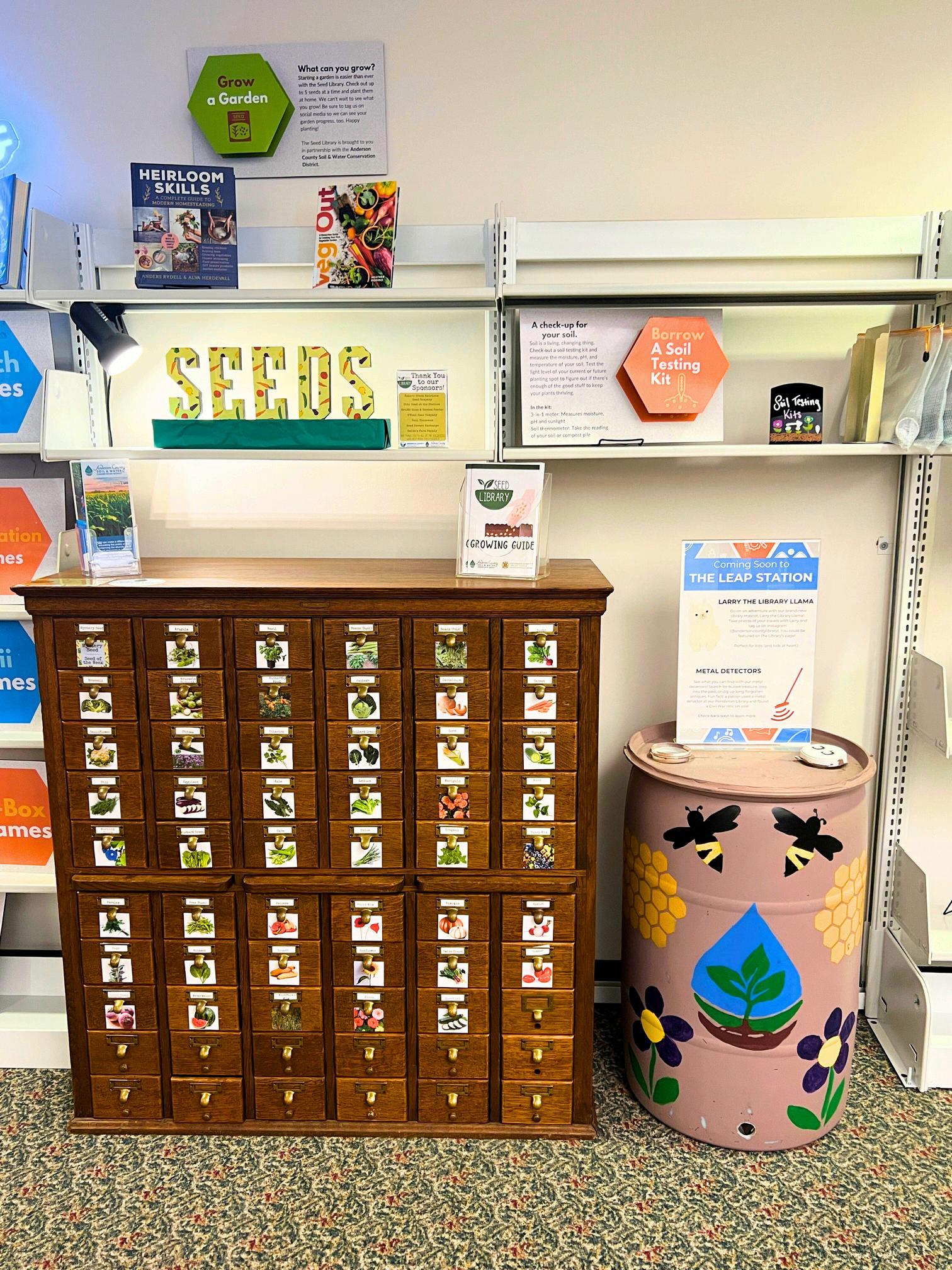
Research to see which seeds are right for you. Use the Growing Guide and other library resources to help with planning your garden this season.
Choose your seeds at the library. You can check out up to 5 packets at a time with your library card.
The moment you've been anticipating! Seek guidance from library resources for valuable tips and tricks on your gardening journey.
Plant the seeds and enjoy what grows! At the end of the growing season, save the seeds from the plants and return a portion of the seeds to the library to keep the Seed Library growing.
seed packing party @ powdersville Library
Thursday, January 15 - 4:00 PM - 6:00 PM
Fridays, February 13 & March 13 - 3:00 pm - 5:00pm
raised bed gardening @ pendleton Library Tuesday, january 27 - 6:00 PM - 7:00 PM
national seed swap day exchange @ Main Library saturday, january 31 - 10:00 aM - 12:00 PM
Seed starting 101 @ main library Thursday, February 6 - 5:30 pm - 6:30 pm
flower seed bombs @ powdersville Library tuesday, march 10 - 5:00 pM - 6:00 PM
raised bed gardening @ Main Library Thursday, March 26 - 5:30 PM - 6:30 PM
Visit our Event Calendar at www.andersonlibrary.org/events or contact branch to register.
Want to garden but don’t have a lot of space? Try container gardening. You can grow herbs, smaller varieties of tomatoes, and peppers just to name a few. news clemson edu/container-gardening-best-fruits-and-veggies-togrow-tips-for-planting-and-care Books on container gardening are in sections 635.9 and 635.986.
pick your container
Types of containers include clay, plastic, metal, and wood.
Your container must: be big enough to support fully grown plants have adequate drainage.
Choose your soil mixture
For veggies go for a loose and porous mixture. You can mix your own with one part each of peat moss, potting soil, and perlite. Also add in a slow-release complete fertilizer.
pick your seeds
Plant what you like to eat. Limit one large fruiting plant per pot. Smaller plants like herbs and lettuce can be in one container. Heavier plants like tomatoes will need a cage or stakes.
Planting time and watering
Plant after the first frost. Fill the pot with damp soil mixture leaving a gap of about a half an inch. Look up instructions on how to sow the type of seed you are planting. Due to the limited amount of soil the container, you may have to water once or twice a day, especially in full sun.
General care
Veggies will need to be fertilized throughout the growing season. Watch out for pests and disease. Be prepared to move or shelter plants during hotter days and inclement weather.

Average Last Spring Frost: April 1 - April 10
Average First Fall Frost: November 1 - November 10
A frost date marks the typical timing of the final light freeze in spring or the initial light freeze in fall.
Freeze temperatures are categorized by their impact on plants:
Light freeze: 29° to 32°F (-1.7° to 0°C) — kills tender plants.
Moderate freeze: 25° to 28°F (-3.9° to -2.2°C) — highly damaging to most vegetation.
Severe freeze: 24°F (-4.4°C) and below causes extensive damage to garden plants.
Sources: almanac com & plantmaps com
Before reaching for the fertilizer, test your soil. Soil Test Kits are available for free checkout at the Main Library and select branch LEAP Stations. Reach out to the library for availability.
Understanding your soil’s unique needs is key to growing a vibrant garden. With a simple test, you can tailor your fertilization and help your plants thrive.
For a more detailed analysis, the Anderson County Clemson Extension Office offers low-cost soil testing. Call (864) 226-1581 for more details.

Our color-coded guide is an easy way to pick the types of seeds you are interested in planting.
Choose from flowers, herbs, fruits, and vegetables. flowers fruits herbs veggies
Be sure to plant and harvest according to the guide in order to get the most out of your seeds. Pay special attention to notes on the seed envelopes for certain varieties. Some envelopes will have the general time frames below. Others will have specific months circled.
Early Spring: February - March
Late Spring: April - May
Summer: June-August
Fall: September-October
Winter: November-January
Full sun: Six or more hours a day
Partial sun: Between four and six hours a day
Partial shade: Between two and four hours a day
Shade: Less than two hours a day
According to the 2023 USDA Plant Hardiness Zone Map, Anderson County is in the 8a-8b hardiness zone. Enter your zip code in the Quick Zip Code Search box at planthardiness.ars.usda.gov to find out more.
Anderson County Library - Seed Library www.andersonlibrary.org/seed-library
Anderson County Soil & Water Conservation District - Seed Library www.andersonswcd.org/seed-library
Clemson Cooperative Extension Service www.clemson.edu/extension
Clemson cooperative Extension Home & Garden Information Center hgic.clemson.edu
South Carolina Native Plant Society www.scnps.org
The Old Farmer’s Almanac www.almanac.com
Burpee Seeds www burpee com
corn is pollinated by wind and needs to be planted in blocks of at least three rows Ears will not be pollinated if only planted in one or two rows.
Planning A Garden Factsheet hgic.clemson.edu/factsheet/planning-a-garden
Starting Seeds Indoors Factsheet hgic.clemson.edu/factsheet/starting-seeds-indoors
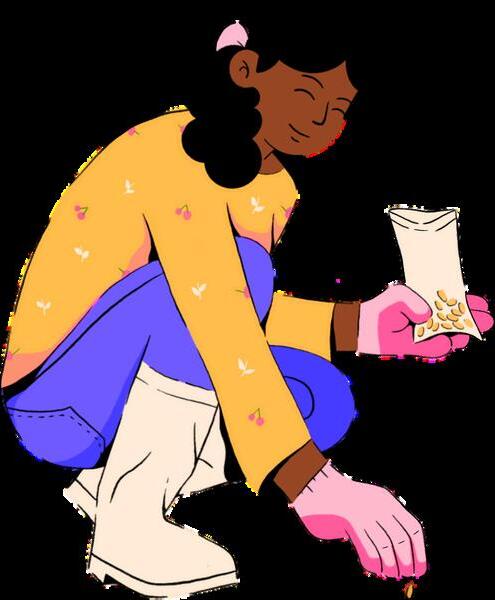
The Seed Library is happy to accept donations of your locally saved seeds in any quantity. The seeds should be collected from your healthiest plants. We also are happy to accept your unused quantities of seeds from seed packets you might have purchased commercially.
Seeds saved from grocery store produce are not suitable for the Seed Library. This is because there’s not enough information about how the plants were grown. Please put them in your compost bin instead.
Donations should be completely dried, packed, and clearly labeled. Donated seeds will be added to the Seed Library collection at the discretion of the Anderson County Soil & Water Conservation District.
You can donate seeds at any Anderson County Library Branch or at the Anderson County Soil and Water Conservation District building at 1521 Pearman Dairy Rd, Anderson, SC 29625.
We are always looking for volunteers to help pack seeds! If interested, please contact either the Anderson County Soil and Conservation District at (864) 844-8224 or the Seed Library Coordinator at the library at (864) 260-4500 ext. 108 or through email at seedlibrary@andersonlibrary.org.
For more information, visit: andersonswcd.org/seed-packing
The Seed Library exists through a partnership between the Anderson County Library System and the Anderson County Soil and Water Conservation District.
It would not be possible without the support of generous volunteers and the following businesses and organizations:
Baker Creek Heirloom Seed Company
City Seed at the Station
Griff’s Farm & home Center
O'Neal Seed Company
Paul Thuneman
In the 635 section in nonfiction, you will find a great ass of books on all aspects of gardening to help on your jou including: flowers, fruits and vegetables, herbs, orga gardening, seed saving, and more!
Seed Savers Exchange
Smith's Farm Supply
Tractor Supply on Hwy 28 Bypass