ISSUE 92 – January-March 2026 £8.95 www.trainermagazine.com
THE QUARTERLY MAGAZINE FOR THE TRAINING AND DEVELOPMENT OF THE THOROUGHBRED
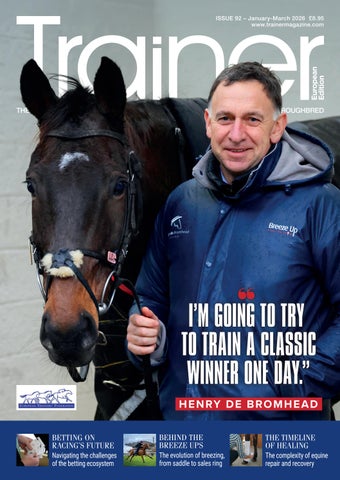
I’M GOING TO TRY TO TRAIN A CLASSIC WINNER ONE DAY.”
UROPEAN TRAINERS’ FEDERATION
H E N RY D E B RO M H E A D
AIMS and OBJECTIVES of the ETF:
a) To represent the interests of all member trainers’ associations in Europe. b) To liaise with political and administrative bodies on behalf of European trainers. c) To exchange information between members for the benefit of European trainers. d) To provide a network of contacts to assist each member to develop its policy and services to member trainers.
BETTING ON RACING’S FUTURE
ETF REPRESENTATIVES Chairmanship: Guy Heymans (Belgium) Tel: +32 (0) 495 389 140 Email: heymans1@telenet.be
Vice Chairmanship:
Nicolas Clément (France) Tel: +33 (0)3 44 57 25 39 Fax: +33 (0)3 44 57 58 85 il: entraineurs.de.galop@wanadoo.fr
Navigating the challenges of the betting ecosystem
Vice Chairmanship:
Christian von der Recke (Germany) Tel: +49 (022 54) 84 53 14 Fax: +49 (022 54) 84 53 15 Email: recke@t-online.de
Treasureship:
Michael Grassick (Ireland) Tel: +353 (0)45 522 981 Mobile: +353 (0)87 258 87 70 Fax: +353 (0)45 522 982 Email: office@irta.ie
BEHIND THE BREEZE UPS
The evolution of breezing, from saddle to sales ring
THE TIMELINE OF HEALING
The complexity of equine repair and recovery
No. 1 gastric ulcer treatment* 370 mg/g oral paste for horses
Leading the way in gastric ulcer treatment* It’s got to be GastroGard®
R
IC
M
ST
EN
GA
T*
NO. UL
CER T
A RE
T
Racehorses with gastric ulcers showed marked improvement in racing form, after treatment with GastroGard® 1
It’s got to be GastroGard® 1. Franklin, S.H., Brazil, T.J. and Allen, K.J. (2008) Poor performance associated with equine gastric ulceration syndrome in four Thoroughbred racehorses. Equine Vet. Educ. 20, 119–124. *UK and Ireland Kynetec VetTrak Data Value Sales MAT February 2025. GastroGard® 370 mg/g oral paste contains omeprazole. UK: POM-V IE: POM. Further information available in the SPC or from Boehringer Ingelheim Animal Health UK Ltd., RG12 8YS, UK. UK Tel: 01344 746960 (sales) or 01344 746957 (technical), IE Tel: 01 291 3985 (all queries). Email: vetenquiries@boehringer-ingelheim.com. GastroGard® is a registered trademark of Boehringer Ingelheim Animal Health France SCS, used under licence. ©2025 Boehringer Ingelheim Animal Health UK Ltd. All rights reserved. Date of preparation: March 2025 UI-EQU-0039-2025. Use Medicines Responsibly.
Europe’s Leading Online Sales Platform 2026 Monthly Online Sales January Online Sale January 20 – 21 Entries Close January 9
July Online Sale June 30 - July 1 Entries Close June 19
February Online Sale February 17 – 18 Entries Close February 6
August Online Sale August 10 – 11 Entries Close July 31
March Online Sale March 18 – 19 Entries Close March 6
September Online Sale September 15 – 16 Entries Close September 4
April Online Sale April 8 – 9 Entries Close March 27
October Online Sale October 21 – 22 Entries Close October 9
May Online Sale May 6 – 7 Entries Close April 24
November Online Sale November 17 - 18 Entries Close November 6
June Online Sale June 3 – 4 Entries Close May 22
December Online Sale December 9 - 10 Entries Close November 27
ALL GAVEL. NO TRAVEL.
Contact: Katherine Sheridan T: +44 1638 665931 E: tattersallsonline@tattersalls.com
www.tattersallsonline.com
| OPINION |
GILES ANDERSON PUBLISHER’S OPINION Henry de Bromhead is a trainer synonymous with National Hunt racing. Looking through his roll of honour over the last decade, it’s more of a case of listing the big races he hasn’t won rather than the ones he has. June 2025 gave us a clue to his future aspirations and goals when the aptly named Ascending won him his first Royal Ascot success in the Ascot Stakes. By the end of the year, de Bromhead had amassed seventeen winners on the level – by far his best ever tally. As he tells Daragh Ó Conchúir, “I’m going to try to train a Classic winner one day”. De Bromhead certainly has aspirations and goals for the future. And he doesn’t hold back with his thoughts on the funding of racing and racing’s inherent inability to truly capitalise on the product it sells. “I have a fairly radical view. I think we should be going pure Tote, like France, like all the richest racing nations, and I think it’s achievable. We’d need more government support than we have at the moment, but I think we could become a self-funding industry
within the next 10 to 15 years, like France, like Australia, who actually have allowed the corporates in, and they’re already starting to see a fall in their TAB turnover, which is affecting finances. “So I think it could get worse before it gets better. You listen to the likes of (HKJC CEO Winfried) Engelbrecht-Bresges, and British and Irish racing needs to move more towards pool betting. It’s more punter-friendly. Even if you’re a winner, you can get on. From what I hear, anyone who’s a successful gambler, if you win with these corporations, you get shut down, you’re not allowed to bet, which seems so fundamentally wrong to me. “I think this new form of gambling (online casinos) is going like alcohol and cigarettes. It’s getting to be a real taboo, and it’s becoming socially and politically unacceptable. And racing is associated with that now.” The subject of racing’s relationship with governments (taxation on gambling) has very much been under the spotlight over the last year. At our ETF AGM in December 2024, Birkje Hoorens Van Heyningen highlighted the situation in the Netherlands, where taxation has risen to 36.15% of Gross Gaming Revenue. This together with the prize money reductions in 2025 in France, the potential ban on gambling advertising (in Ireland) and the proposed changes in the UK to betting duty, led to us posing an editorial based on whether European governments fully recognise the economic value of racing and how can the betting landscape evolve beyond 2026? Think also about the staggering amount of bets across Europe which are now being placed through ‘black market’ websites. If governments can restrict access to ‘adult’ content platforms, then why can’t they do the same for these ‘black market’ gambling websites? Surely it would be in their (and racing’s) best interests to do so? Wherever your racing takes you this winter – good luck!
Superior machines and products for performance, recovery and rehabilitation
COMBI PRO II both PEMF and Massage
POWERMAG Targeted PEMF therapy
SALT & OXYGEN THERAPY Supporting respiratory system and skin issues
WATER TREADMILL Strength, straightness and stride
Phone: +44 (0)1494 883433 www.fmbs.co.uk
ISSUE 92 TRAINERMAGAZINE.COM
01
| CONTENTS |
08
48
20
64
ISSUE
R EGUL A R S
04 Contributors 05 ETF Members
Visit trainermagazine.com to download our current digital editions and access back issues of both European and North American Trainer.
92
CONTENTS F E AT U R E S 06 Cavalor Trainer of the Quarter 28 Biosecurity beyond the barn Francis-Henri Graffard is our Cavalor Trainer of the Quarter - having enjoyed an amazing season, capped with victories in both the Prix de l’Arc de Triomphe and the Japan Cup.
08 The de Bromhead method
Daragh Ó Conchúir profiles Henry de Bromhead - we learn about his training philosophy, performance strategy, ambitions and his views on betting.
20 Muscle matters
Caroline Loos explains how protein quality, amino acid balance and feeding timing influence muscle development, recovery and performance.
02 TRAINERMAGAZINE.COM ISSUE 92
Jackie Zions helps us understand how improved biosecurity and air-quality management can help reduce respiratory stress in horses.
36 From growth to performance
Åsa Beckman explores the crucial role of musculoskeletal and neural development in the transition from yearling to two-year-old.
42 Behind the breeze ups
Virginia Lisco explores the evolution of the breeze up sales and talks to consignors and riders about preparing horses for sale.
48 Have horse, will travel
Lissa Oliver looks at the key fixtures trainers should target - in this quarter we focus on races that close for entries / run in between January and March.
@ t ra i n e r _ m a g
58 The hidden timeline of healing
Laura Steley examines why healing in the Thoroughbred is far slower, deeper, and more complex than it appears on the surface.
64 Racing tourism
Paull Khan on why racing’s heritage and settings deserve a place in tourism.
70 The EMHF welcomes Romania Paull Khan outlines Romania’s route into EMHF membership and the steps now being taken to develop a professional racing structure.
76 Betting on racing’s future
Mark Rowntree considers racing’s betting ecosystem challenges as governments, operators, and the sport adapt to an increasingly complex environment.
/ t ra i n e r m a g a z i n e
/ t ra i n e r m a g a z i n e
CONTRIBUTORS Editorial Director/Publisher Giles Anderson
Åsa Beckman is a research-trained Equine Fascia Therapist with a background in biology and behavioural science. A former breeder and trainer of international show jumpers, she
Sub-Editor Virginia Lisco
now works with fascia-focused therapy for racehorses, combining scientific insight and intuitive hands-on methods to support performance, recovery, and sensory awareness in
Design/Production Damian Browning
equine athletes.
Advert Production Nico Jeeves
Jackie Bellamy- Zions is communications manager at Equine Guelph for the past ten years, Jackie has over 30 years of experience in the horse industry in the capacity of
Circulation/Website Nico Jeeves / Virginia Lisco Advertising Sales Giles Anderson Cover Photograph David Betts Photography
Trainer magazine is published by Anderson & Co Publishing Ltd. This magazine is distributed for free to all ETF members. Editorial views expressed are not necessarily those of the ETF. Additional copies can be purchased for £8.95 (ex P&P). No part of this publication may be reproduced in any format without the prior written permission of the publisher.
Printed in the European Union For all editorial and advertising queries please contact: Anderson & Co. Publishing Tel: +44 (0) 1380 816777 Fax: +44 (0) 1380 816778 email: info@trainermagazine.com www.trainermagazine.com Issue 92
coach, trainer, stable manager, competitor, judge and journalist. Paull Khan, PhD. is an international horseracing consultant. He is a member of the Executive Council of the International Federation of Horseracing Authorities (the global peak body for thoroughbred racing) and Chief Executive Officer of the European and Mediterranean Horseracing Federation. His other clients include the British Horseracing Authority. Previously, Dr Khan held many senior roles at Weatherbys, including Banking Director and Racing Director. Virginia Lisco, born and based in Italy and studied International and Diplomatic Sciences. She has always been passionate about horses and a few years ago discovered the world of horse racing which has since become her world. She has worked in some Italian stables, and subsequently sought to explore all areas related to racing. Her ambition is to thoroughly understand all aspects concerning the industry and the promotion of horse welfare. Dr Caroline Loos is Equine Nutritionist and Head of Research at Cavalor. Her work focuses on muscle metabolism, nutrition and performance optimization in sport horses. She has led multiple studies on protein intake and muscle metabolism in collaboration with the University of Kentucky. Daragh Ó Conchúir is a native of Rinn Ó gCuanach, Co Waterford and is a freelance media professional with more than 30 years’ experience of writing and broadcasting in sport, covering a multitude of disciplines and roles for a variety of national and regional organisations. An author of four books, nominee as HWPA Racing Writer of the Year (for Irish and UK racing writers) and reporter for TG4’s acclaimed Rásaí Beo racing coverage. Lissa Oliver lives in Co. Kildare, Ireland and is a regular contributor to The Irish Field and the Australian magazine, Racetrack. Lissa is also the author of several collections of short stories and two novels. Mark Rowntree is a Northumberland-based Freelance Sports Journalist specialising in Horse Racing. Mark contributes regularly to the Racing Post (Spotlights, Comments and Analysis), also working closely with Racing TV/Racing TV International to promote Tote World Pool to a global audience. Laura Steley BSc Hons in Equine Sports Science, is the Pedigree & Nominations Associate at Shadwell Stud in Newmarket, alongside being the regular contributor for the Equine Health Update Section in Owner Breeder magazine. She has previously gained invaluable experience within the thoroughbred pre-training and rehabilitation sector, as well as fulfilling the role of an International Racing Data Analyst. Laura has a deep-rooted passion for equine science and feels passionately about applying scientific findings to sustain and improve equine welfare standards.
04 TRAINERMAGAZINE.COM ISSUE 92
EUROPEANTRAINERS’ TRAINERS’ FEDERATION FEDERATION EUROPEAN AIMS and andOBJECTIVES OBJECTIVES of of the theETF: ETF: AIMS
a) To ofall allmember member trainers’ associations in Europe. a) represent To representthe theinterests interests of trainers’ associations in Europe. b) To liaise with political and administrative bodies on behalf of European trainers. b) To liaise with political and administrative bodies on behalf of European trainers. c) Toc)exchange information membersforfor benefit of European trainers. To exchange informationbetween between members thethe benefit of European trainers. To provide a network of contacts assist each each member its policy and and services to member trainers.trainers. d) To d) provide a network of contacts totoassist membertotodevelop develop its policy services to member
ETF REPRESENTATIVES REPRESENTATIVES ETF Chairmanship: CHAIRMANSHIP: Guy Heymans (Belgium) Gavin Hernon (France) Tel: +32 (0) 495 389 tel: +33 (0)7 87 16 02 48 email: 140 contact@aedg.fr Email: heymans1@telenet.be
Vice Chairmanship:
Nicolas Clément (France) VICE Tel: +33CHAIRMANSHIP: (0)3 44 57 25 39 Fax: +33 (0)3Johnson 44 57 58 85 Paul Email: entraineurs.de.galop@wanadoo.fr (United Kingdom)
Vice Chairmanship:
Christian von der Recke (Germany) VICE Tel: +49CHAIRMANSHIP: (022 54) 84 53 14 Fax: +49 (022 54)der 84 53 15 Christian von Recke Email: recke@t-online.de (Germany)
Treasureship:
Michael Grassick (Ireland) TREASURERSHIP: Tel: +353 (0)45 522 981 Mobile: +353Cunningham (0)87 258 87 70 Feidhlim Fax: +353 (0)45 (Ireland)522 982 Email: office@irta.ie
tel: +44 (0) 1488 71719
tel: +49 171 542 5050
email: p.johnson@racehorsetrainers.org
email: recke@t-online.de
email: office@irta.ie
HUNGARY
UNITED KINGDOM
AUSTRIA
Mrs. Živa Prunk Tel: +38640669918 Email: ziva.prunk@gmail.com
CZECH REPUBLIC
Mr. Botond Kovács Email: botond.kovacs@kincsempark.hu
FULL MEMBERS ITALY
tel: +353 (0) 45522981
Rupert Arnold Tel: +44 (0) 1488 71719 Fax: +44 (0) 1488 73005 Email: r.arnold@racehorsetrainers.org
RUSSIA
Joseph Vana ITALY Tel: +42 (0) 6024 296 29 Ottavio Di Paolo Email: horova@velka-chuchle.cz
Agostino Affe BELGIUM Email: affegaloppo@gmail.com
Olga Polushkina NETHERLANDS Email: p120186@yandex.ru Birkje Hoorens Van Heyningen
tel: +32 (0) 495389140 email: heymans1@telenet.be
tel: +31 (0) 250 930 016 email: birkjehvh@gmail.com
GREECE
NETHERLANDS
SLOVAKIA
tel: +39 328 355 95 81 email: ottaviodipaolo@gmail.com
Aggeliki Amitsis Tel: 30 229 908 1332+ Email: angieamitsis@yahoo.com
SWEDEN
GERMANY Jessica Long
Erika Mäder email: Tel: +49 (0)jplong@live.se 2151 594911 Fax: +49 (0) 2151 590542 Email: trainer-und-jockeys@netcologne.de
Geert van Kempen Mobile: +31 (0)6 204 02 830 Email: renstalvankempen@hotmail.com
Jaroslav Brecka Email: jaroslav.brecka@gmail.com
GERMANY
NORWAY SWEDEN Tom Lühnenschloss
NORWAY Erika Mäder
Are Hyldmo tel: +49+47 (0) 984 2151594911 Mobile: 16 712 Email: arehyldmo@hotmail.com
www.trainersfederation.eu
Caroline Malmborg mobile: +47 (0) 46445345 Email: caroline@stallmalmborg.se email: lynet3108@yahoo.no
ISSUE 92 TRAINERMAGAZINE.COM
05
L E A D I N G T H E WAY I N R A C E H O R S E W E L F A R E A N D N U T R I T I O N
CAVALOR TRAINER OF THE QUARTER
FRANCIS-HENRI GRAFFARD
The Cavalor Trainer of the Quarter award has been won by Francis-Henri Graffard. Graffard and his team will receive a Cavalor voucher of €1,000 for Cavalor supplements and care products as well as a consultation with one of their senior product specialists. WORDS: LISSA OLIVER PHOTOGRAPHY: GALOPPFOTO.DE
C
ongratulations to so many of Europe’s trainers who have enjoyed incredible international success in the past three months, but our Trainer of the Quarter must go to Francis-Henri Graffard. A matter of weeks after Daryz won the Prix de l’Arc de Triomphe, Calandagan capped a wonderful season for the Lamorlaye-based trainer with an historic win in the Japan Cup, the first European winner in 20 years. As Graffard tells us, “Since our first runner in Japan in 2015 (Erupt) it has remained an objective for me if a horse I’ve trained has received an invitation. It was one of Calandagan’s objectives all year long, and once he won the Grand Prix de Saint-Cloud and received an invitation we were able to build the season around it and start planning.”
06 TRAINERMAGAZINE.COM ISSUE 92
In this, the JRA were pro-active in making the journey as smooth as possible. “The JRA are exceptionally organised and proactive hosts, ably assisted by the IRB in Europe, particularly Jane George who has been involved with the JRA for as long as the Japan Cup existed. Those interlocutors are excellent and make the organisation much easier,” says Graffard. “The most difficult part of the organising is ensuring the feed is sent out early and approved by the Japanese Agricultural Ministry. Obviously, sanitation requirements are taken very seriously as Japan is highly protected by its various ministries. It is important to not leave anything until the last minute!” It helps to have the right horse and, as Graffard tells us, “Calandagan has become a good traveller with experience, and he is very straightforward now. However, as he was the only horse in
L E A D I N G T H E WAY I N R A C E H O R S E W E L F A R E A N D N U T R I T I O N
LEFT: Calandagan with (L-R) owner Princess Zahra Aga Khan, travelling head lad Antoine Creton, groom Jeremy Lobel and trainer Francis-Henri Graffard after winning the 2025 Japan Cup at Tokyo Racecourse.
quarantine we were able to take out a companion, as otherwise he would not have seen another horse for ten days. Horses are social animals and it was imperative that he had an equine company for his wellbeing. “The quarantine facilities at Tokyo racecourse are state of the art, and the JRA are highly organised, proactive and go out of their way to ensure their invited guests are well looked after.” What lies ahead for Calandagan, given that as a gelding he could be competing on the international stage for many more seasons to come? “His ABOVE: Calandagan (nearside) with Mickael Barzalona up, wins the 2025 Japan Cup at Tokyo training plan is based around him, his race targets Racecourse, making history as the first overseas runner to win the prestigious race in 20 years. and his wellbeing,” explains Graffard. “We will do our best to look after him and ensure he has a long and fruitful career. For the moment the team are the Aga Khan Studs training centre) are top class and ensure all appreciating their achievements of 2025, we haven’t started that when I am away everything runs smoothly. I’ve been an thinking about 2026 just yet! Princess Zahra, Nemone Routh and assistant, and I know what a difficult job it can be, so I am full I will no doubt discuss plans early in the New Year. of admiration for their dedication to their teams, and their “It is a team effort but particularly my two assistants, Romain devotion to their horses.” Dupasquier (Graffard Racing) and Willy Loncke (Aiglemont,
EMPOWER YOUR AMBITION
CAVALOR FREEBUTE & CAVALOR LACTATEC Cavalor FreeBute supports muscles and joints for improved mobility. FreeBute will offer relief from discomfort in the recovery process after heavy effort. Cavalor LactaTec is a complete supplement that supports muscle activity, stimulates muscle recovery and prevents stiffness, damage, and fatigue in a variety of ways.
THE WINNING COMBINATION cavalor.com/race
ISSUE 92 TRAINERMAGAZINE.COM
07
HENRY DE BROMHEAD “I’M GOING TO TRY TO TRAIN A CLASSIC WINNER ONE DAY.” WORDS: DARAGH Ó CONCHÚIR PHOTOGRAPHY: DAVID BETTS PHOTOGRAPHY, GALOPPFOTO.DE
H
enry de Bromhead has had a good day. Another one. A winner at Thurles is today’s bounty. You surmise it could have been better, with two runner-up finishes from his other pair of representatives. In trademark de Bromhead style, such notions of grandeur are rebuffed. Any visit to the track that includes a smiling debrief and a photo under the No 1 lollipop, is a good one. Especially when Messrs Mullins, Elliott and Cromwell are providing the opposition. Still, it is reflective of the rich vein of form in which the Waterford trainer’s string has been through the autumn
08 TRAINERMAGAZINE.COM ISSUE 92
and into the beginning of the winter campaign, as well as the seamless transition of Darragh O’Keeffe into the role as Knockeen’s No 1 following the retirement in May of the incomparable Rachael Blackmore, that one in three is the least we are expecting. October 2025 provided de Bromhead with his highest ever monthly tally of winners in Ireland (18) and a notably impressive strike rate (32%). His PB before that in terms of victories was 17 in September 2020 at a clip of 30%, and in terms of strike rate was 31% in November 2024, when he still managed to record 16 winners. There are clearly some strong summer months too, such as the 11 well-earned triumphs recorded in July 2024.
| HENRY DE BROMHEAD |
RIGHT: Henry de Bromhead with Captain Guinness, winner of the 2024 Queen Mother Champion Chase at Cheltenham.
ISSUE 92 TRAINERMAGAZINE.COM
09
Henry de Bromhead with 2021 Cheltenham Gold Cup winner Minella Indo.
This is not a coincidence. It is, to a considerable degree, as a result of a policy of not going the full 12 rounds with his sport’s heavyweights. The subsequent bounty from such guerilla tactics is not just about short-term gain, however. The strategy’s prime benefit is having the horses re-appear fresh and in mint condition after a mid-term break, for when the gloves must come off in the spring, particularly at Cheltenham. So our expectations are an indication too of de Bromhead’s position as one of the greatest to ever condition a national hunt horse, transforming a boutique establishment set up by his father Harry, from whence Fissure Seal won what is now the Pertemps final for a syndicate of dentists in 1993. He is the only trainer to be victorious in the Gold Cup, Champion Hurdle and Champion Chase in the one week, as achieved when Minella Indo, Honeysuckle and Put The Kettle On prevailed among six festival winners in 2021. He added the Grand National as Minella Times launched Blackmore into the stratosphere a few weeks later, repeating his Gold Cup feat of saddling the runner-up also. Stupendously, there was another 1-2 when the Gold Cup placings were reversed by A Plus Tard in 2022. Yet despite having all of Cheltenham’s championship races (2 Gold Cups, 2 Champion Hurdles, 4 Champion Chases and a Stayers’ Hurdle), the National, a total of 61 Grade 1s and 25 Cheltenham Festival winners on his vaunted CV, he chose to expand into the flat sphere to improve the profitability of his business. Being Henry de Bromhead, he has proven very astute and adept in this department. In June 2025, he registered his first Royal Ascot success thanks to Ascending and would go on to record his best tally of winners in Ireland, on the level, in the calendar year with 17. RIGHT: Head man Davy Roche with Slade Steel, winner of the Supreme Novices’ Hurdle at the 2024 Cheltenham Festival.
10 TRAINERMAGAZINE.COM ISSUE 92
| HENRY DE BROMHEAD |
RIGHT: Rachael Blackmore with stable superstar hurdler Honeysuckle, who retired in 2023 after winning seventeen of her nineteen starts.
There are six group races on the resumé now, Blackmore highlighting her versatility when steering future Group 2 winner Terms Of Endearment to victory in the Bronte Cup at York in May 2024. But peruse the variety of venues at which those prizes were plundered: Toulouse, Goodwood, York, Sandown and Cork. So imaginative. So smart. Some might find it incongruous that a man at the very top of his profession has serious concerns about the future of his sport, and industry. But, of course, his voice carries more weight for that. De Bromhead gets uncharacteristically animated when discussing the funding of horse racing, and speaks about it, mostly uninterrupted, for nearly ten minutes. He is appalled by a model he believes is inimical to the interests of the sport and all who gain a living from it. In particular, he is passionate about the need to cut the umbilical cord between racing and the giant bookmaking corporations and is lobbying to build momentum towards racing creating its own betting company, with a view to becoming self-sustainable. This is something he believes is achievable within 10-15 years of such a venture being set up. More of which, anon.
W
e have become accustomed to the de Bromhead periodical fecundity, when the ground has yet to get bottomless, his “nicer sort of winter horses” are unleashed and Closutton and Cullentra, in particular, have yet to activate their ‘Drag Reduction System’. Often, there has been a lull in January and February, and there have been a few years where pundits and punters alike have wondered about the form of the de Bromhead representatives going into March. We know better now. “It sort of worked for us over the years. We generally aim to have those festival horses ready from October onwards, depending on ground. Horses that prefer nicer ground would be earlier, horses that prefer softer ground would be a little bit later, but we generally aim to have them out by the end of October, November time. And we’d probably go to Christmas with them. “So I’m never sure then… you could call it a lull. But also, we’d put away a lot of our horses in January with a view to the spring. So it’s just worked for us over the years. I suppose you’re trying to start a little bit earlier than Willie, for example, because you know, otherwise, you’re coming up against all his big guns from now on. “It’s a case of sticking with what has worked before. I suppose we’re creatures of habit, a lot of trainers, and that has worked well for us over the years. We’d always be aiming towards Christmas, trying to have two or three runs under their belts and then try and freshen them up before the spring.” It is quite something to be setting new landmarks not long after all the great champions have retired. The Minellas Indo and Times, A Plus Tard, Champion Chase heroine Put The Kettle on and the equine queen of Knockeen, dual Champion Hurdler and four-time Cheltenham victress, Honeysuckle. But cycles conclude and you plan for the next great challenge, even after you have scaled Everest. Not that you are ever buying a horse with anything more than hope. “I’m not sure you can plan for a Honeysuckle or Indo, that they were going to go on and do what they were going to do. Put The Kettle On, we bought as a store. We were very lucky that these horses came along. These were horses you dream of having, that you might get one in a lifetime, and they suddenly came within a couple of years of each other.
“We don’t restock with as many horses as some of the bigger yards every year. I think it’s sort of comparable to football teams with transfer markets. The bigger you are, the more you have to spend, the more new horses coming into your system, and then the more likely you are to come upon these top horses. That’s what we’re all striving to get. “With what we have to spend, we wouldn’t have as many young horses coming through as some of the big yards. So maybe it’s less frequent we’re going to come upon them, but we know we have the system. When we get them, we will produce. We’ll get the best out of them and hopefully give them every chance to get to those blue riband events. “Ultimately, when any of us are buying them, none of us actually know. You have your systems that work for you, but no one knows which one is going to be the champion until you get them into your system. We had that period with all those amazing horses that we had, and we’ve still got some really nice horses and some really nice young ones coming through this year. We hope that we will bring them through to compete in those big races.” He covers the gamut of markets in terms of acquiring French stock, point-to-pointers and stores. Like everyone, he is trying to find value. “Some of our clients buy their own horses and send them in. Some of them ask us to find horses for them. So we have spotters at the point-to-points that help us source these horses. Gerry Hogan helps us. Alex Elliott has helped us, with plenty of agents that put horses to us or our clients. “That’s the way we buy stores as well, though it’s less stores. We have had more luck with form horses, but, we still had a Gold Cup horse as a store, Sizing John. We didn’t train him when he won it, but we sourced him as a store and we sourced Sizing Europe as a store, the likes of Special Tiara, Put The Kettle On. “D’you know what? The more I think of it, they nearly find you, those real ones. But once you have a system that you can produce and nurture them to be that class… once you have that, you’ve got to stick to that and hope that your policies work.” ISSUE 92 TRAINERMAGAZINE.COM
11
Henry de Bromhead with Echoing Silence.
Sticking to what work does not mean you are not constantly evaluating and re-evaluating. “If I was to criticise myself, maybe I’m not aggressive enough or proactive enough with my buying policy. I think we’ve got a good way of sourcing, and it’s worked for us very well over the years but maybe I could be more proactive. We’ve got brilliant clients who support us. We get really nice horses to train and try to get from 150 (rated) to 170, those horses are so hard to find, and they’re the ones we all want.” De Bromhead likes the way Knockeen works now, the rhythms. Expanding would change that. It goes back to the reasonable policy of not taking a scalpel to a healthy patient. If it ain’t broke, and all that. He is very comfortable with the scale of the operation. “It means we can be a bit more bespoke to horses and try and suit them, rather than them suiting a system for us. The thing for us is trying to nurture them along. Since I started training, probably one of the main things for me was… it’s so hard to get a good horse, when you get a good one, it’s trying to get that longevity. And I think we’ve proven that over the years with the likes of Honeysuckle, Envoi Allen, Bob Olinger, Minella Indo, Sizing Europe. Once you get those good horses, you’re trying to maintain them and keep them going at the highest level for as long as you can.” It speaks volumes.
12 TRAINERMAGAZINE.COM ISSUE 92
There has been one monumental alteration to the landscape though, in the ascension of O’Keeffe to the throne vacated by Blackmore. De Bromhead was well established prior to her arrival at Knockeen – Sizing Europe, Special Tiara, Sizing John, Petit Mouchoir, Identity Thief, Champagne West, Shanahan’s Turn and Days Hotel all pre-dated the Killenaule marvel. But it is inarguable that he rocketed to another level in conjunction with her. They became behemoths, growing together. Blackmore has been the pilot for 31 of his 61 Grade 1s. Andrew Lynch is the next highest provider with seven. She was in the plate for 16 of the 25 Cheltenham triumphs. They were inextricably linked as they soared to the moon. O’Keeffe had been used regularly since delivering A Plus Tard from the clouds to win the Savills Chase at Christmas in 2020. It was the teenager’s first ride in a Grade 1. He scored on Maskada in the Grand Annual a little more than two years later. Right now, the Doneraile native is miles clear of Jack Kennedy and Paul Townend in the race to add the champion jockey title to his conditional crown, though the latter pair are now in full cry with their primary employers, Elliott and Mullins. “That’s been really good,” de Bromhead concurs. “What we achieved with Rachael was incredible, and she was amazing to work with. And we had some unbelievable years. That’s a good point about how we grew with Rachael. Rachael really helped us grow as well. She was incredible, what she brought to the table. “But Darragh rode A Plus Tard in the Savills Chase and everyone said, ‘God, fair play, you’re putting up a 19-yearold.’ I didn’t even know he was 19. I had thought he was a lot older, it felt that he was around a lot longer. He’s always been working away with us, so I’m delighted to see him taking his opportunities. It’s very similar to Rachael. He’s a brilliant rider. He’s really so clued in. He wants it as much as we do. “Obviously, there was a window last autumn where Rachael was unfortunate to get that injury (broken neck), and Darragh stepped in and did really well. So it was encouraging to see that, but I didn’t know Rachael was going to retire when she did. I had no idea, to be honest, but at least we knew that Darragh had stepped into it for a while and did really well.”
nutrition New and Improved Formulations to support Performance and Recovery
For feed advice, please call our helpline team on 01270 782 223 or email helplineenquiries@dodsonandhorrell.com www.dodsonandhorrell.com
Better with
| HENRY DE BROMHEAD |
He has taken to utilising Billy Lee more in recent years too and it was the Limerick man that was on board when Ascending denied Nurburgring by a neck in the Ascot Stakes last June. “That was an incredible day for a number of reasons. I always wanted to have a winner at Royal Ascot, so it was brilliant to tick that box. We’d love to train a few more. What made it extra special was getting it for the Joneses, with Chris and Afra there and the boys. That was brilliant. Chris and Afra have always been brilliant supporters of ours. We got a real kick out of that.” Seamie Heffernan was on board Ascending with what we now know was the impossible task of attempting to overcome Ethical Diamond in the Ebor, getting only six pounds from the subsequent Breeders’ Cup Turf hero. De Bromhead saddled Magical Zoe to win the valuable prize 12 months previously. “We went into (flat racing) from a trading perspective. My view is, as a jumps trainer, I don’t like to train and trade. In my opinion, they don’t really go well, it just doesn’t suit me. I like to buy horses for jumps clients independent of us, being from point-to-points or whatever. So I never really wanted to trade jumpers.
“But we have this infrastructure, and we have a great team at home. So I think it was probably about seven or eight years ago that we said we’d just dabble in it and see, and bought a couple of fillies, and they sold really well, and it became a good trade. It started well, so we continued doing it. We got some great trades out of it and we can have a piece of the pie as well in that.” Commerce may have been the motive for dipping the toe into the summer game but the competitive juices are flowing now and a little taste of the big time in that sector has induced the germination of a much greater career goal. “This year we’ve had a good enough season. Owner-breeders have sent us some nice horses, and some clients have bought a few nice horses for us as well. So, it’s exciting. “I’m going to try to train a Classic winner one day. “You have to have ambition. It’s something we enjoy doing. Some of our clients really enjoy it, some like a bit of both. It’s people’s hobby but we want to achieve what we can.” The irony, which he acknowledges, is that the international market that has helped him land some lovely touches, has had a direct impact on the NH world, with a significant reduction in flat horses making the transition to the jumps game due, in some part at least, to the phenomenal prize money available in the likes of Hong Kong, Australia, America and the Middle East. “Oh absolutely. Now, obviously, you’d probably look more for a horse that likes a bit of soft ground off the flat, which mightn’t suit these places but yeah, it has. It’s definitely made them a lot more expensive. I’ve never bought many off the flat but it has made it harder.” LEFT: de Bromhead scored his first Royal Ascot victory when Ascending, ridden by Billy Lee, won the 2025 Ascot Stakes.
14 TRAINERMAGAZINE.COM ISSUE 92
By Appointment to His Majesty The King Manufacturer of Horse Bedding Bedmax Limited Northumberland
MAKING BEDDING EVEN BETTER
High performance purpose made
LARGE PINE SHAVINGS
FINE PINE SHAVINGS
MAXIMISING QUALITY • MINIMISING DUST
MAXIMISING QUALITY • MINIMISING DUST
M
IN
G B
E
R
TE
YEARS
IN
bedding for high performance
T
R
TE
AKIN
25
D
T
D
YEARS
BED
BED
25
G
AKIN G
M
G B
E
purpose trained horses PURPOSE MADE FOR YOUR HORSE’S...
PURPOSE MADE FOR YOUR HORSE’S...
• Respiratory health
• Respiratory health
• Hoof health & support
• Hoof health & support
• Hygiene & biosecurity
• Hygiene & biosecurity • Comfort & rest
By Appointment to His Majesty The King Equine Bedding Manufacturer Bedmax Limited Northumberland
• Joint protection
• Comfort & rest
By Appointment to His Majesty The King Equine Bedding Manufacturer Bedmax Limited Northumberland
• Joint protection
MADE in BRITAIN from renewable UK timber
MADE in BRITAIN from renewable UK timber
bedmaxshavings.com 01668 213467
bedmaxshavings.com 01668 213467
bedmaxshavings.com 01668 213467
bedmaxshavings.com 01668 213467
MADE in BRITAIN from renewable UK timber • Joint protection
Image courtesy of Perth Racecourse and Fraser Band Photography
MADE in BRITAIN from renewable UK timber • Joint protection
For full details on our beddings and our support for trainers all over the world Bedmax Limited Northumberland Equine Bedding Manufacturer His Majesty The King By Appointment to
• Comfort & rest
Bedmax Limited Northumberland Equine Bedding Manufacturer His Majesty The King By Appointment to
• Comfort & rest
• Hygiene & biosecurity
• Hygiene & biosecurity
• Hoof health & support
• Hoof health & support
• Respiratory health
• Respiratory health
PURPOSE MADE FOR YOUR HORSE’S...
PURPOSE MADE FOR YOUR HORSE’S...
please contact our International Sales Manager and Racing Specialist Brent Adamson on +44 (0) 7774 178925 G B
E
25 YEARS
M
AKIN
T
IN
G
AKIN
G
M
D
EB
EB
YEARS
D
D
25
RET
E T
G B
RET
D
IN
bedmaxshavings.com
MAXIMISING QUALITY • MINIMISING DUST
LARGE PINE SHAVINGS
MAXIMISING QUALITY • MINIMISING DUST
FINE PINE SHAVINGS
+44 (0) 1668 213467
| HENRY DE BROMHEAD |
Henry de Bromhead on the Knockeen gallops with Chasing Blue (left) and Dylan Whelan and Ma Belle Etoile (right) with Coleman Comerford. Henry de Bromhead with jockey Darragh O’Keeffe, Punchestown, 2025.
It is financial reality that has led to this trend. The same financial reality that nudged de Bromhead towards his flat racing sideshow. And the same financial reality that winds him up to 90 when queried on the biggest challenge facing the industry right now. “It’s very simple. It’s prize money. I’ve got a strong view on racing’s association with corporate gambling companies. It’s not bookmakers anymore. These are massive corporate gambling companies… the days of racing and bookmakers going hand-inhand, that’s completely different now. I think we’re used as a shop window for the corporate gambling companies to get people to their sites, to bring them across to their online gaming, which is a far more profitable part of their business than gambling on racing. “I have a fairly radical view. I think we should be going pure Tote, like France, like all the richest racing nations, and I think it’s achievable. We’d need more government support than we have at the moment, but I think we could become a self-funding industry within the next 10 to 15 years, like France, like Australia, who actually have allowed the corporates in, and they’re already starting to see a fall in their TAB turnover, which is affecting finances.
16 TRAINERMAGAZINE.COM ISSUE 92
“So I think it could get worse before it gets better. You listen to the likes of (HKJC CEO Winfried) Engelbrecht-Bresges, and British and Irish racing needs to move more towards pool betting. It’s more punter-friendly. Even if you’re a winner, you can get on. From what I hear, anyone who’s a successful gambler, if you win with these corporates, you get shut down, you’re not allowed to bet, which seems so fundamentally wrong to me. “I think this new form of gambling (online casinos) is going like alcohol and cigarettes. It’s getting to be a real taboo, and it’s becoming socially and politically unacceptable. And racing is associated with that now.” Which makes it an easy target. “And yet, you look at the addiction rates. I think you’re three or four times more likely to be addicted to online casinos than you are betting on racing. And in racing, it’s a skill. I can’t see the difference between wagering on racing and wagering on stocks and shares. I actually can’t. It’s a skill. Some people are better at it than others and these corporate gambling companies won’t allow the people that are good at it to wager. It all seems so fundamentally wrong to me. “It would be a massive change, but I think if the Irish and British racing industry got together and got behind it (it would work). Racing is so popular, it’s incredible. We sort of put ourselves down but I’m amazed, day-in, day-out, people that know about me, know what I do, that I didn’t think would have had any interest in racing, and it’s not from a betting perspective. “I think we need to improve the engagement. You look at Japan. The whole story of where this horse that you are seeing racing today is told at the racecourses. We need to look at that.” He is not talking about the midweek fixtures, when you might not find the worst sinner in attendance. “You’re gonna have to have industry days. They have those in France… but still, I think, the PMU gets something like 800 million, and the Exchequer gets 800 million. And there’s something like 13 billion wagered on French racing worldwide, which is similar to Britain and Ireland, and yet they get 800 million to run French racing. Okay, I know it’s decreased a tiny bit. But I think as an industry, we have to take ownership of that.” He is rolling now.
FUELLING FUELLINGCHAMPIONS CHAMPIONS With Witha aproven proventrack track record recordofoffeeding feedingGrade Grade 1 and 1 andGroup Group1 horses 1 horses across acrossthe theworld world it itisiseasy easytotosee seewhy why progressive progressivetrainers trainers choose chooseBluegrass. Bluegrass. Proudly Proudlypartnering partneringwith with Kentucky KentuckyEquine Equine Research, Research,we weoffer offeran an innovative innovative range rangeofofproducts, products, scientifically scientificallyproven proventoto deliver deliverresults. results. Our Ourproducts productsare are designed designedtotomaximise maximise the thewellbeing wellbeingand and athletic athleticpotential potential ofofevery everybreed breedofofhorse, horse, from fromallallcompetitive competitive HIDDENVALLEY HIDDENVALLEYLAKE, LAKE,TRAINED TRAINEDBY BYHENRY HENRYDE DEBROMHEAD BROMHEAD WINNER WINNEROF OFTHE THEGRADE GRADE1 1LIVERPOOL LIVERPOOLHURDLE HURDLEAT ATAINTREE AINTREE 2025 2025
T: T: +44 +44 (0)28 (0)28 3754 3754 8276 8276 E: E: info@bluegrasshorsefeed.com info@bluegrasshorsefeed.com www.bluegrasshorsefeed.com www.bluegrasshorsefeed.com
disciplines disciplines and totoour ourleisure leisureand companion companionhorses. horses.
| HENRY DE BROMHEAD |
Bob Olinger
Koktail Divin and Darragh O’Keeffe, at Punchestown, 2025.
BELOW: Quilixios and Darragh O’Keeffe leads the field before falling at the last in the Queen Mother Champion Chase at the 2025 Cheltenham Festival.
“These ambassadors for these corporate gambling companies. I don’t get that. I just don’t get it. It was offered to me a few times, and I thought about it, but I didn’t do it and I really wouldn’t dream of doing it now. Now I think we should all become ambassadors for our industry, for our sport. And if that’s the Tote or pool betting; it may not be the Tote. Something like the World Pool, but obviously for Ireland and Britain.” Self-sustainability should be the goal of administrators and participants alike, and de Bromhead is being proactive in attempting to build support for his idea. “There’s a few of us discussing it. That’s the dream. It’s going to take a lot of people to pull it together, and mainly the industry and all the stakeholders. That’s the reality. This thing we’re dependent on, corporate gambling companies, that bookmaker/ racing relationship is gone. They use us as a shop window to get people to convert them to their online casinos, and soon we’re gonna not be really much use to them.
18 TRAINERMAGAZINE.COM ISSUE 92
“In the previous media rights deal you were paid per race. Now it’s a percentage of turnover. So if they don’t price up a race, which they didn’t at Bath last year, they don’t have to pay us, whereas before, they had to pay seven or eight grand for that race. So I just think we need to get away from that.” It’s what everyone wants but no one is sure how to achieve it. Yet. “We need more cohesion to achieve it and more industry buyin to achieve it. But I think if you could point to people that you could be racing for a 30 grand maiden hurdle in time, I think that’s massive for the industry and makes it more sound.” It is a credit to him that he is not just exercised by the malaise but offers a possible solution and is attempting to rally people to the cause. And all the while, keeping the home fires burning, as fruitfully as ever before. Envoi Allen brought his tally of Grade 1s to ten - six under de Bromhead’s tutelage – when winning Down Royal’s Champion Chase for the third time last month. He clearly doesn’t act at Kempton so after a break, will build towards spring and probably the Cheltenham Gold Cup. Stayers’ Hurdle champ, Bob Olinger is another who works back from Cheltenham, and Hiddenvalley Lake, in the same ownership, is a Grade 1 winner in that division too. Meanwhile Quilixios was alongside Marine Nationale when falling at the last in the Champion Chase, a race de Bromhead has won four times. The former Triumph Hurdle winner is back for more. Then you have the raft of younger charges, such as July Flower, The Big Westerner, Forty Coats, Mister Pessimistic, Fruit De Mer, Slade Steel, Workahead, Gameball, Sky Lord, Tim Toe, Koktail Divin and Gomez Addams. And The Short Go and Monty’s Star are more established chasers likely to pick up their share of prize money in the coming months. On paper, the succession planning has been shrewdly implemented. “Obviously, the bubble bursts every now and again. But once you can keep the dream alive with a few nice horses, they’ll all find their level and we’ll keep trying to bring them through.”
REDWELD STABLES Leading the way in stable design
NOW TAKING ORDERS FOR SPRING 2026
For mid to large-sized projects, we offer a turnkey design & build service. One point of contact to manage and deliver your project, efficiently, on time and on budget. We are happy to offer a 5-year warranty on all our products.
W: redweld.ie E: info@redweld.ie T: +353 (0)87 9119802
Scan here to visit us
| NUTRITION |
MUSCLEMATTERS
20 TRAINERMAGAZINE.COM ISSUE 92
| M U S C LE M AT T E R S |
HOW PROTEIN QUALITY DRIVES PERFORMANCE AND RECOVERY IN RACEHORSES WORDS: DR CAROLINE LOOS
R
ecent research is reshaping our understanding of equine muscle metabolism – revealing how the quality, timing and composition of dietary protein directly affect muscle synthesis, repair and ultimately, performance.
How much protein does a racehorse really need? For racehorses, muscle isn’t just about strength – it’s about speed, stride and power. Well-developed, healthy muscles are essential not only for explosive performance on the track but also for injury prevention and long-term soundness. That’s why understanding the mechanisms behind muscle growth is so important. In a 2020 study conducted at the University of Kentucky, horses were fed graded levels of a high-quality protein supplement. The research investigated how different levels of dietary protein influence the activation of the mTOR signaling pathway - the key mechanism behind muscle protein synthesis. Their findings revealed that mTOR activation peaked at a dose of 0.25 g of crude protein per kg of body weight per meal. This equates to approximately 140-150 g of crude protein or 220-240 g of a typical protein (~ 30-35 % CP ) balancer supplement for the average 550-600 kg horse. Any intake above that threshold showed no further benefit. Concluding that there is an optimal dose of high-quality protein per meal to effectively stimulate muscle-building processes. Feeding beyond that level may offer no added benefit, while feeding below it could mean missed gains. ISSUE 92 TRAINERMAGAZINE.COM
21
| NUTRITION |
| M U S C LE M AT T E R S |
Relative degree of muscle mTOR activation (arbitrary units)
0.5 0.45 0.4 0.35 0.3 0.25 0.2 0.15 0.1 0.05 0 0
FIG 1
0.06
0.125
0.25
0.5
Protein dose (grams of crude protein/kg body weight)
Fig 1: Muscle mTOR phosphorylation (i.e. activation) in response to different doses of protein intake. Adapted from Loos et al, 2020.
Why not all protein is equal Muscle is built from amino acids – and not all horse feeds supply these building blocks in equal measure. The effectiveness of dietary protein in stimulating muscle building is dependent on its quality. The quality of a protein source is determined by its amino acid profile and digestibility. The higher the digestibility, the greater the amount of amino acids available for absorption and protein synthesis. In addition, the closer the dietary amino acid profile matches that of muscle, the higher the quality of the protein source. One amino acid in particular stands out when it comes to promoting muscle mass: leucine, which acts both as a building block and as a powerful metabolic switch that initiates muscle protein synthesis through the mTOR pathway. In a 2022 study, horses were fed meals based on alfalfa protein or a high-quality protein supplement (containing soybean meal, potato protein and alfalfa meal). While both meals contained
the same amount of crude protein, plasma levels of essential amino acids – particularly leucine – rose significantly higher and faster with the protein supplement. This difference in amino acid availability was mirrored in the muscle, with significantly greater activation of mTOR, meaning enhanced stimulation of muscle protein synthetic pathways.. Simply put: two feeds with identical crude protein levels can have vastly different effects on the horse’s body, depending on the type of protein they provide. That’s why evaluating amino acid profiles, and thus the quality of the protein, is more meaningful than comparing the quantity or percentage of crude protein in the feed. Fig 2: Plasma leucine concentrations after feeding either alfalfa pellets or protein supplement pellets. The supplement reaches ~ 30% higher peak faster. Adapted from Loos et al, 2022.
Plasma leucine concentration (µmol/L)
150 ALFALFA
140
PROTEIN SUPPLEMENT
130 120 110 100 90 80
FIG 2
0
15
30
22 TRAINERMAGAZINE.COM ISSUE 92
60
90
120
150
180
Time (min)
210
240
300
360
420
480
EMPOWER YOUR AMBITION
AT ADO MCGUINNESS R ACING:
“WE TRUST CAVALOR SUPPLEMENTS ... to help our horses perform at their peak.” Ado McGuinness Racehorse trainer Ireland
cavalor.com/race
| NUTRITION |
| M U S C LE M AT T E R S |
Timing of feeding: Key in maximizing muscle development It’s not just what you feed, but also when you feed it. We know that the magnitude of stimulation of muscle synthetic pathways and ultimately net muscle accretion over time may depend on the protein feeding pattern throughout the day. In the same 2022 study in horses, peak activation of muscle-building pathways occurred 90 minutes post feeding in horses and deactivation of these systems took about 3-5h. Work in human athletes shows that pulse protein feeding every 3h post exercise is superior for simulating muscle protein synthetic than smaller frequent meals or large meals separated by 6h. If we cautiously extrapolate this to horses, this suggests that feeding a meal of at least 0.25g CP/kg BW of high-quality protein every 3-4h after an intensive workout, would be more effective for muscle development compared to feeding 2 larger protein meals morning and evening. Secondarily, timing of feeding relative to exercise is also key for maximal muscle gains. Muscle fiber recovery is energy-intensive and amino acid-dependent. When amino acid supply is delayed or insufficient – particularly leucine – the repair mechanisms lag and muscle fibers remain vulnerable to damage. It has already been well established in other species than exercise and feeding work synergistically on muscle protein synthesis. Consumption of a small but high quality meal of protein shortly after exercise results in greater activation of muscle protein synthesis compared to that seen with exercise alone. Furthermore, this feeding strategy will mitigate exercise-induced muscle damage, thereby speeding up the recovery.
FIG 3
ABOVE: Consumption of a small but high quality meal of protein shortly after exercise results in greater activation of muscle protein synthesis compared to that seen with exercise alone.
Racehorses, like many sporthorses, are typically fed large, infrequent meals – often disconnected from training sessions. Although more specific research in horses is needed, providing smaller but high quality protein meals several times a day, with 1 meal post-exercise, will have a beneficial effect on muscle protein synthesis and recovery.
The ‘Golden Hour’ The takeaway? Protein quality and precise timing of feeding throughout the day could be the missing link in turning training effort into real muscle gain – supporting faster recovery, better adaptation, and sustained performance. This fits within the broader concept of the “Golden Hour”, the first 60 minutes post-exercise when the body’s recovery mechanisms are highly receptive to nutrients. Combining cooldown routines, rehydration and a high-quality protein meal during this window significantly enhances recovery. Beyond that, muscle recovery continues for up to 72 hours. Ensuring ongoing support through digestible protein, antioxidants and moderate movement during this period prevents stiffness, optimizes adaptation and reduces injury risk. Strategic nutrition plays a vital role in managing muscle fatigue and optimizing post-exercise recovery. By ensuring rapid availability of key amino acids – especially leucine – trainers may reduce the risk of post-exertional muscle issues while supporting overall performance.
Fig 3: A window of anabolic potential. Feeding a small, high quality protein meal after resistance exercise stimulates muscle protein synthesis (MPS) to a greater extent than exercise or feeding alone. Adapted from Churchward-Venne et al, 2012.
Small meal with high quality protein
Feeding within 2-3 h after training or race
24 TRAINERMAGAZINE.COM ISSUE 92
Extra stimulus for muscle protein synthesis (MPS)
We had one horse who was underweight and looked very dull in his coat. I was struggling to get the work in to him so I could then run him. Clinical tests all came back fine so we changed his feed and added in NUTRI-GARD. The change in the horse was extraordinary, gained condition, top line and even in depth of winter had a shine to his coat. The horse went on to win two competitive races. I could not recommend NUTRI-GARD more. PAUL NICHOLLS Trainer of Fastorslow, winner of the 2024 Ladbrokes Punchestown Gold Cup.
SCAN HERE
TO READ MORE ABOUT THIS PRODUCT
FOR
Scientifically advanced gut supplement formulated to support stomach and hindgut health and maintain overall digestive function.
Digestive health
Postbiotics to promote optimal gut and immune health Prebiotics to support a healthy hindgut microbiome Added B-vitamins to promote appetite and optimise feed utilisation Pectin helps to buffer stomach acid Formulated with amino acids, L-threonine and DL-methionine to support a healthy lining in the digestive tract Contains oat fibres, naturally rich in beta-glucans
ASK OUR EXPERTS AT www.foranequine.com UK: Adam Johnson T: +44 7860 771063 IRE: Nicole Groyer +353 83 477 3873 Email: info@foranequine.com
#OURSCIENCEYOURSUCCESS
EQUINE SUPPLEMENTS & HEALTHCARE
| NUTRITION |
Building blocks for muscle: beyond leucine alone While leucine plays a starring role in triggering muscle synthesis, it does not act alone. Other essential amino acids like lysine, methionine and valine are critical for the actual building of new muscle tissue. Muscle development can only occur when all necessary amino acids are present in sufficient amounts. That’s why feeds or supplements with balanced amino acid profiles outperform generic protein sources in supporting muscle health. Racehorses are elite athletes. They deserve nutrition that reflects that status. With the right feeding strategy, we can unlock the full potential of training, accelerate recovery and protect horses from common setbacks. The good news? These are changes you can implement immediately. Begin by evaluating your current feeding schedule. Look for opportunities to align post-exercise meals with protein intake and ensure those meals are based on high-quality, digestible proteins.
| M U S C LE M AT T E R S |
Feeds or supplements with balanced amino acid profiles outperform generic protein sources in supporting muscle health.
Practical takeaways for racehorse trainers
• Feed smarter, not just more. Focus on protein quality, not just quantity.
• Use the Golden Hour wisely: apply cool-down routines, hydration and offer a digestible protein-rich recovery feed.
• Choose protein sources rich in leucine and essential amino acids. • Avoid overfeeding: excess protein cannot be stored and takes a lot of precious energy resources to be broken down – it’s wasting nutrients and potentially stressing metabolism.
Racehorses are elite athletes. They deserve nutrition that reflects that status. With the right feeding strategy, we can unlock the full potential of training, accelerate recovery and protect horses from common setbacks.
References: • Loos et al., 2020, , Pathways regulating equine skeletal muscle protein synthesis respond in a dose-dependent manner to graded levels of protein intake Journal of Animal Science, 98(9), p.skaa268 https://doi.org/10.1093/jas/skaa268 • Loos et al., 2022, Differential effect of two dietary protein sources on time course response of muscle anabolic signaling pathways in normal and insulin dysregulated horses. Frontiers in Veterinary Science, 9, p.896220. https://doi.org/10.3389/fvets.2022.896220 • Areta, J.L., Burke, L.M., Ross, M.L., Camera, D.M., West, D.W., Broad, E.M., Jeacocke, N.A., Moore, D.R., Stellingwerff, T., Phillips, S.M. and Hawley, J.A., 2013. Timing and distribution of protein ingestion during prolonged recovery from resistance exercise alters myofibrillar protein synthesis. The Journal of physiology, 591(9), pp.2319-2331. • Churchward-Venne, T.A., Burd, N.A. and Phillips, S.M., 2012. Nutritional regulation of muscle protein synthesis with resistance exercise: strategies to enhance anabolism. Nutrition & metabolism, 9(1), p.40. https://link.springer.com/article/10.1186/1743-7075-9-40 PHOTOGRAPHY: GALOPPFOTO.DE, LAURA PALAZZOLO, MAREK RZEWUSKI, PAM MACKENZIE PHOTOS, SHUTTERSTOCK
26 TRAINERMAGAZINE.COM ISSUE 92
Golden Grade 1 Win Golden Ace winning the Grade 1 BetMGM Fighting Fifth Hurdle at Newcastle. Congratulations to trainer Jeremy Scott, owner Ian Gosden and all connections involved.
“We have fed Spillers since we have been training racehorses and have trained over 400 winners, including 4 x Grade 1’s. The horses’ coats look fantastic and they consistently perform throughout the year.”
- Jeremy Scott
Charlotte Mitchell (East) charlotte.mitchell@effem.com 07776 248 957
Karon Brown (North & Scotland) karon.brown@effem.com 07860 955 719
www.spillers-feeds.com
Kay Scriven (West & N.I) kay.scriven@effem.com 07817 132 678 ©Mars, 2025.
| INDUSTRY |
28 TRAINERMAGAZINE.COM ISSUE 92
WORDS: JACKIE BELLAMY-ZIONS INTERVIEWING: DR SCOTT WEESE
I
n the equine industry, true biosecurity is hard to achieve because horses move around a lot, and many diseases are always present,” says Ontario Veterinary College infectious disease specialist Dr Scott Weese. “However, it’s still important to try to prevent diseases from entering and to have plans in place to manage any outbreaks.” With frequent horse movements, endemic pathogens and emerging diseases, there is a need for improved understanding and motivation to adopt better infection control practices. Infection control begins in the barn and works best when the focus is pro-active rather than reactive. This includes having an access management plan, proper quarantine protocols for new and returning horses, and training EVERYONE who comes on to the property or handles the horses.
Access management Controlling how horses, humans, equipment and vehicles can move into and around your yard are all aspects of access management aimed to reduce the transmission of pathogens. Access management begins at the entrance, where a training facility may use fencing and gated entries to restrict access to the stables and training areas, ensuring only authorised personnel can enter. Procedures at controlled access points such as hand sanitising and boot cleaning help prevent the spread of infections. Both staff and service providers need to be made aware of any infection control measures in place. Clean outerwear that has not been worn to another barn are also recommended to prevent potential spread of disease. A sign in procedure can be made mandatory for visitors. A log can be helpful to help trace the problem in the event of a disease outbreak. Providing guided tours can ensure they do not enter restricted areas. Additional signage can let visitors know where they can and cannot go. Controlled access zones can designate specific areas for different activities, such as quarantine zones for new arrivals and separate zones for resident horses, with controlled access points to manage movement.
Isolation/quarantine When horses return home or new horses arrive, such as from a sale, it is a good idea to implement quarantine and/or isolation protocols. Ideally this involves housing in a separate building away from your resident horses, but it may be the end of an aisle with several empty stalls in between. New and returning horses are kept separate and monitored for at least 14 days. This involves twice daily temperature checks and health checks including watching water consumption, appetite, urination, manure and any signs of illness. Turn out paddocks should also be away from other resident equines, especially if that includes higher risk horses like broodmares and foals. Effective quarantine includes using separate equipment for isolated or quarantined horses to avoid cross-contamination. This includes water buckets, feed tubs, grooming equipment as well as wheelbarrows, brooms, pitchforks and other cleaning tools. Ideally, new and returning horses are handled by separate staff. Otherwise, quarantined horses are worked with last and hands are washed before and after each interaction. Strategically placed
alcohol-based sanitisers can also be used. If wash stations are limited, this makes it easier for staff and visitors to follow infection control protocols. Disposable gloves, disposable shoe covers and protective clothing are also best practices. Barn cats and other pets should not be allowed to enter the quarantine area. If you have a number new or returning horses in quarantine and one shows signs of illness, it should be further separated into isolation and seen by a veterinarian ASAP. Horses should remain in isolation until cleared by the vet, as the horse may have recovered from clinical signs but still be infectious. Signage once again should alert unauthorised persons at the entrance of any areas used for isolation or quarantine.
ISSUE 92 TRAINERMAGAZINE.COM
29
| INDUSTRY |
Hygiene practices Of course, those new or returning horses should be housed in a stall that has been both cleaned and disinfected prior to their arrival. Cleaning involves removing all visible manure, bedding and soil before washing the area with soap and water and then allowing it to dry. Then apply a disinfectant recommended by your veterinarian. All disinfectants have strengths and weaknesses and are best used for specific purposes. Bleach has drawbacks as hard water can affect its effectiveness, it can be inactivated by organic material, and it can be irritating to the horse. Steer clear of pressure washers as they can aerosolise certain viruses. An often-misused step, if you will pardon the pun, is the foot bath. One cannot just walk through without first going through the same routine as mentioned above, both cleaning and disinfecting. First remove debris from the footwear, including the soles using a brush or hose to get all the dirt out of the treads. Immerse the entire bottom of footwear in the disinfectant and scrub. Following the contact time on the product label is important and a dirty footbath does little in the way of boosting biosecurity. Then wash your hands. Other options include dedicated footwear and disposable shoe covers. Hand hygiene cannot be overstated as one of the most important infection control measures. Best practices on application time for the soap or alcohol-based sanitiser is 20 – 30 seconds. Everyone knows not to share communal water, but it is also important not to become blasé about biosecurity when it comes to filling or refilling water buckets. Submersing a hose from one bucket to the next or letting it touch the buckets can be a free ride for a pathogen looking for its next host. So instead of multi-tasking while filling buckets, one could be enjoying a beverage with their free hand. Not sharing should extend beyond grooming equipment to tack, pads, blankets, and of course medical supplies like syringes, needles and dewormers. More disease prevention measures include minimising the presence of rodents and insects by keeping feed secure, eliminating standing water and regular removal of manure from stalls and paddocks and as well as management of manure storage areas.
30 TRAINERMAGAZINE.COM ISSUE 92
Vaccination Vaccination is a crucial aspect of equine healthcare, but vaccines do not provide immediate protection; it can take days or weeks for a horse to develop optimal immunity after vaccination, so timing is very important. Planning ahead will allow vaccines to be given well in advance of the next stressor such as travelling or competition. While no vaccine boasts 100% immunity, horse owners can rest assured that they are taking proactive steps to maintain their horse’s health, minimising the risk of unexpected veterinary expenses. Vaccines significantly reduce the risk of disease which means if a vaccinated horses does get sick, they will generally experience milder symptoms and recover more quickly. Working closely with a veterinarian to develop and maintain a vaccination program is an important step for optimal equine health. In addition to core vaccinations, your vet will know what diseases are endemic and emerging in your region or regions you will be travelling to. The frequency of your vaccinations or
| BIOSECURITY |
IMPROVING WINTER BIOSECURITY & AIR QUALITY IN EQUINE YARDS WORDS: DR BERNARD STOFFEL
E
ABOVE: Recent developments in supramolecular chemistry include sprays that release specially designed molecules to remove viruses, pollutants, allergens, bacteria, and odours from both air and surfaces.
boosters will depend on a number of factors including special circumstances, such as an extended vector season or even a significant wound if it is incurred over 6 months after a Tetanus shot. The length of your competition season may also necessitate a booster of certain shots to maintain optimal immunity.
Emerging diseases Infection control specialist Dr Weese says, “Understanding potential mechanisms of transmission is the basis of any infection control or biosecurity program.” Most diseases in horses are caused by pathogens that mainly infect horses. They can spread continuously without needing long-term hosts (like the equine flu virus). They can remain in the horse without causing symptoms for a long time (like Strangles). Some cause infections that can come back at any time (like Equine Herpesvirus). Others may be part of the normal bacteria in horses but can cause disease if given the chance (like Staphylococci and Enterobacteriaceae). Horses can spread these germs even if they seem healthy, before showing symptoms, after recovering, or as part of their normal bacteria. This makes it hard to identify which horses are infectious. Some symptoms, like fever and diarrhoea, strongly suggest an infection, but any horse can potentially spread germs. Therefore, it’s important to have strong infection control practices to manage the risk. The most frequently reported diseases in the Northern Hemisphere are:
• Strangles: A bacterial infection caused by Streptococcus equi, leading to swollen lymph nodes and respiratory issues. It is highly contagious and spread through contact. This could be nose-to-nose between horses or via contaminated surfaces or equipment such as: shared halters, lead shanks, cross ties, feed tubs, stall walls, fencing, clothing, hands, the hair coat from other barn pets, grooming tools, water buckets, communal troughs.
ffective biosecurity in equine facilities aims to reduce the introduction and spread of pathogens, dust, allergens, and environmental irritants. During the winter stabling period, these risks increase significantly. A horse inhales over 100,000 litres of air per day up to 200,000 with exercise, and colder months typically bring 20–60% higher levels of fine particles (EEA, 2023). Reduced ventilation, increased humidity and elevated ammonia all contribute to airway stress, making horses more vulnerable to inflammation, coughing, RAO and even exercise-induced pulmonary haemorrhage (EIPH). Conventional disinfectants such as quaternary ammonium compounds (QACs), chlorine solutions and hydrogen peroxide remain important for surface hygiene, but they do not address airborne irritants, which represent the primary exposure pathway in enclosed stables. Some disinfectants can also leave persistent residues after drying. Current DEFRA and EU REACH Annex XVII guidance encourages minimising cumulative exposure to such residues in enclosed environments, especially where horses and yard staff spend extended time. This has led many yards to explore air-active, residue-free approaches as a complement to normal cleaning. Recent developments in supramolecular chemistry – specifically the use of cucurbiturils, a class of molecular inclusion compounds – offer a practical way to help manage stable air quality. These structures physically bind and neutralise airborne pollutants including dust allergens, fungal fragments, ammonia-related VOCs and odour molecules. Unlike conventional disinfectants, they do not rely on oxidative chemistry or harsh contact action. After being sprayed into the air, the molecular cages remain active when they settle, continuing to bind deposited pollutants on surfaces such as numnahs (saddle pads), rugs, partitions, bedding and stable doors. This provides an extended window of benefit during the high-risk winter months.
KEY ADVANTAGES OF THIS APPROACH INCLUDE: • Air-active mode of action in the breathing zone • C ontinued activity after drying, binding allergens and odour compounds on surfaces • Non-corrosive and non-oxidising, with minimal residue • Safe for use in occupied st ables, with no requirement to vacate animals or staff Together with routine hygiene, these innovations represent a shift from purely kill-based methods towards holistic air-quality management – supporting respiratory comfort and reducing environmental stress during the winter stabling period.
ISSUE 92 TRAINERMAGAZINE.COM
31
| INDUSTRY |
In February 2025, Equine Guelph partnered with the Equine Disease Communication Center (EDCC), to help horse owners assess and manage infectious disease risks with the relaunch of Equine Guelph’s Biosecurity Risk Calculator (TheHorsePortal. com/BiosecurityTool). The interactive free tool is full of useful information from quarantine protocols, best practices for cleaning, and easy to understand practical access management tips. In just 10 minutes, you can assess and minimise biosecurity threats for your barn. “Applying routine and basic biosecurity is the best way to prevent infectious diseases,” says Dr Nathaniel White the Director of the EDCC. “This includes isolation of new horses introduced to facilities, monitoring horses’ temperature and preventing horse to horse contact while travelling and keeping vaccinations up to date. Being aware of disease prevalence using information from the EDCC (equinediseasecc.org) and the updated “Biosecurity Risk Calculator” can help owners use management practices to decrease disease risk.”
Equine infection control measures during transport Pre-transport preparations entail more than just having your paperwork in order. Taking the time to clean and disinfect the horsebox or make sure the horsebox you have hired is always cleaned between loads is of paramount importance. If the horsebox smells like horses, it was not adequately cleaned. Perform a horse health check before you leave the property. It is not worth the gamble to stress a horse with travel when it is ‘not-quite right’. Being particular about your horses travelling companions is just as important as the cleanliness of the horsebox. Avoid travelling with horses from other locations as being in close quarters increases the risk of picking up an infectious disease. Tie the horse loosely if possible. Horses tied short have less ability to lower their head to clear mucus. Allowing freedom of After an outbreak, cleaning should involve removal of all organic material from surfaces and subsequent disinfection of water containers, feeders, fences, stalls, tack and horseboxs.
• West Nile Virus (WNV): a mosquito-borne virus leading to neurological issues such as inflammation of the brain and spinal cord. WNV can be fatal and survivors can have residual neurological deficits for a period of months to permanent disability.
• Eastern Equine Encephalitis (EEE): another virus transmitted by mosquitos. This virus is more commonplace in North America with no recently reported equine cases in Europe. Eighty to ninety percent of infected horses develop acute and fatal neurologic disease.
• Equine Infectious Anemia (EIA): is a blood-bourne virus which can be transmitted by insects, medical equipment or passed from mare to foal in utero. With no treatment or cure, horses confirmed positive by a Coggins test can be quarantined for the rest of their life but are usually euthanised.
• Equine Herpesvirus (EHV): This virus had multiple strains and can cause both abortion and neurologic symptoms. Spread via aerosol particles from nasal discharge or from contaminated surfaces. There are vaccines for respiratory and abortive strains but not the neurologic form of EHV-1 (EHM). These diseases highlight the importance of biosecurity and vaccination in managing equine health.
32 TRAINERMAGAZINE.COM ISSUE 92
| BIOSECURITY |
head movement can reduce stress and the bacterial load in the airways. Similarly, hay nets that are hung high, encouraging a high head position, and introducing dust and debris, can challenge mucous clearance. Ventilation is another important consideration as improving air exchange can reduce the dust and mold spores hanging in the air. Drafts on the other hand can blow particles around in the horsebox.
Many prefer shipping in leather halters because they will break in an emergency but there is a biosecurity benefit too as they are easier to clean. Bacteria can linger in the webbing of polyester halters. Biosecurity is just as important on the road and when visiting other venues. Disease is easily spread through equipment sharing. While visiting venues away from home be sure to bring your own broom and shovel for cleaning your horsebox and pack a thermometer along with your tack and other equipment. Clean and disinfect your equipment when you get ready to leave your off-site location. Upon returning to your stables, the cycle begins again, monitoring horses for possible delayed onset of symptoms. To ensure effective infection control, it is crucial to maintain a proactive approach starting right in the barn with a plan. Implementing access management, enforcing proper quarantine protocols for new and returning horses, and thoroughly training everyone who enters the property or handles the horses are essential steps. By taking these practical steps, we can significantly reduce the risk of infections and promote a healthier environment for all.
PHOTOGRAPHY: ADOBE STOCK, ECLIPSE SPORTSWIRE, GALOPPFOTO.DE, iSTOCKPHOTO, LAURA PALAZZOLO, MAREK RZEWUSKI, SHUTTERSTOCK
THEHORSEPORTAL.CA
Determine your horse’s risk for infectious disease with Equine Guelph’s Biosecurity Risk Calculator. It will show you how your horse’s farm (or stable) rates and provide basic information on infectious disease as well as practical prevention tips.
ISSUE 92 TRAINERMAGAZINE.COM
33
| VETERINARY |
FROM GROWTH TO PERFORMANCE THE MUSCULOSKELETAL AND NEURAL DEVELOPMENT DURING THE TRANSITION FROM YEARLING TO 2-YEAR-OLD
Nothing happens until it is experienced
We can plan, measure, and structure training down to the smallest detail. However, for the horse, reality begins the moment it passes through the horse’s consciousness. Every movement, contact, and environmental change is evaluated through the question ‘Am I safe?’ For horses, as prey animals, safety is not abstract; it is a biological necessity that determines whether the body can relax, learn, and adapt, or redirect energy toward flight and defense. Unlike humans, horses are unaware of what will happen next in their lives. Every new situation, routine, or training exercise is experienced in real time. This places the responsibility on humans to create conditions in which horses can face the unknown without losing their inner balance. Training begins here, long before the first jog on the gallops, in the mutual experience of safety, and in our capacity to see the horse’s vulnerability as an opportunity for trust and learning.
The Horse as a complex system A horse is not a machine; it is a living, self-organizing system. Billions of cells, tissues, and nerve signals interact in a continuous flow of information. There is no central conductor controlling every movement, the order emerges from the interaction.
36 TRAINERMAGAZINE.COM ISSUE 92
In a complex system, the whole is always greater than the sum of its parts. A change in one part of the body, whether physical or emotional, affects the whole body. When the horse feels safe and present, not only does its behavior change, but also its muscle tension, fascia, breathing rhythm, and heart rate will change. Therefore, training is not just about muscles, endurance, or technique. Every sensory input such as sound, smell, or the presence of a human nearby, contributes to the system’s adaptation and learning. Horses organize themselves in relation to everything they experience.
The Trainer in the system When a young horse enters training, it encounters not only a new environment but also an entire system of humans, routines, and expectations. At the centre is the trainer, who weaves together the visible and invisible, the measurable and intuitive. The horse selection process often combines explicit knowledge and tacit experience. Conformation, pedigree, and movement can be described in words, but often something intangible – a gut feeling or subtle observation – determines suitability. This is the same type of knowledge that allows an experienced trainer to sense a problem before any measurement confirms it.
WORDS: ÅSA BECKMAN
PHOTOGRAPHY: DAVID BETTS PHOTOGRAPHY, DOUG ENGLE, GALOPPFOTO.DE, MARGAUX FARM, PAM MACKENZIE PHOTOS
ISSUE 92 TRAINERMAGAZINE.COM
37
| VETERINARY |
LEFT & BELOW: Everyday stable routines such as feeding and turnout can influence the horse’s physiology and mental state. A disruption in daily flow can immediately be noticed in subtle behavioral cues.
The stable itself is a complex system, where the rhythm of routines creates security. Feeding, turnout, cleaning, and training schedules all influence the horse’s physiology and mental state. A disruption in daily flow can immediately be noticed in subtle behavioral cues, such as worried looks, changed eating patterns, or an unusual gait. The trainer’s role extends beyond planning workouts and races. It is about coordinating a network of specialists – veterinarians, farriers, equine therapists, dentists, nutritionists and owners – all viewing the horse from different angles. Every voice must harmonize in a living dialogue, with the horse’s response as the final authority.
Planning as communication When a young horse starts training, every day is an opportunity to shape both body and trust. However, training is not simply filling the schedule with time on the gallops; it is about ‘communicating with the horse’s nervous system and tissues through movement, rest, and experience’. The trainer’s plan is, in effect, a language. Each exercise, from warm-up to gallop – signals to the horse: ‘This is safe, this is a learning opportunity.’ The pace, surface, rhythm, and pauses all convey messages to the body. Daily planning must also allow for such variations. The body and fascia of a young horse respond to nuances, such as the slope of the track, rhythm of the gallop, and the impact of the hand. Combining fixed routines with thoughtful variations ensures both security and adaptive development. Planning thus becomes more than logistics – it becomes ‘a way to speak to the horse’s body’.
Body adaptation
Tacit knowledge or intuition? As an example. A trainer and work rider have just been talking about tying-up and how fortunate they’d been not to have horses affected. It was time for a colt’s first serious workout. Afterwards, the rider was reasonably satisfied, but when the horse was hosed down back at the stable, he was markedly lame in his right hind leg. Had he tied up after all? Was their discussion beforehand an intuitive knowing of what was going to happen? The veterinarian was called and found the hamstrings extremely tight.
38 TRAINERMAGAZINE.COM ISSUE 92
The horse was treated, but bloodwork ruled out tying-up. Instead, he was suffering from edema, as his body had failed to circulate extracellular fluid effectively back through the lymphatic system. This was causing swelling and resulted in lameness. Another experience was added to the trainer’s overall knowledge. During half a year the same colt’s wither and croup heights were measured. He remained slightly overbuilt – growing noticeably taller as the season went on. Measuring methods only provided an indication of growth, but initial assumptions – that the scapula and humerus, as well as the ilium and femur, would lengthen during this phase – proved incorrect. Interestingly, the scapula and ilium had roughly the same dimensions, contributing to a harmonious conformation. During this time, the horse grew approximately 3 cm at the withers and 5 cm at the croup, although identifying the precise growth zones involved remains challenging. Fascia does not simply cover the body, it envelops and integrates bones, muscles, tendons, and the nervous system forming a continuous sensory and mechanical network that both supports and communicates throughout the organism. During the first year of training, the young horse undergoes profound whole-body adaptation.
| YEARLING TO 2YO |
Far more than muscles are changing: connective tissues, cartilage, bones, and neural pathways are all being shaped by experience. Developing a future athlete (both in body and mindset) offers little margin for poorly timed mistakes. The fascial system, the body’s connective-tissue continuum, serves simultaneously as structural support and as a sensory communication pathway. Richly innervated, it perceives tension, pressure, vibration, and subtle shifts in load. It reorganizes itself according to the movement patterns the horse uses most. Training that offers variation, rhythm, balance, and emotional safety allows the fascial–neural network to ‘learn’ efficient patterns, improving coordination while reducing the risk of overload. The nervous system adapts just as dynamically as the tissues it governs. In young horses, neural circuits for balance, proprioception, arousal regulation, and motor control are still developing. Each novel experience – surfaces, environments, speed, handling – shapes synaptic pathways. When early training is predictable, calm, and well-timed, the sympathetic and parasympathetic branches learn to shift smoothly between alertness and relaxation. This supports better movement quality, quicker recovery, and a ‘trainable’ mindset. Conversely, inconsistent or overly stressful experiences can reinforce defensive patterns that later appear as tension, poor coordination, or behavioral resistance. Cartilage develops within a critical window early in life. Extensive turnout with other foals offers the varied play, loading patterns, and social engagement that cartilage needs to mature properly. This window, closing around the foal’s first year, has long-term consequences for cartilage quality and joint health. By the time a yearling enters training, that phase is already behind them. Tendons and ligaments reach near-complete development around two years of age. After this point, their capacity for adaptation is slower. Too much load too early can create microinjuries that become chronic; too little movement results in weakness and reduced elasticity. Well-designed early training – short gallops, varied surfaces, progressive strength work – encourages healthy remodeling and resilience. Bones respond actively to mechanical stress. Early, moderateintensity movement – walking, trotting, playful acceleration, short gallops – strengthens bones without overloading growth plates or joints. Throughout life, bones, muscles, fascia, and neural pathways remodel continuously in response to use. Inactivity drives loss; appropriate load drives growth, coordination, and resilience. As the body adapts to the physical demands of early training, it does so not through isolated muscle growth, but through the reorganization of the entire support system. This principle becomes clearer when viewed through the lens of biotensegrity, which refers to the body’s dynamic architecture.
bones and joints adapt not in isolation but in relation to how the entire system learns to distribute load. A small imbalance, a single-sided movement habit, or a moment of stiffness doesn’t just affect one tendon or joint, it subtly reshapes the whole pattern of support that holds the body together. Biotensegrity also offers a way to understand how the body organises through movement and learning. Each time a young horse plays, moves freely, or works under saddle, the tissues recalibrate their tension levels. The nervous system continuously reads and responds to these changes, refining coordination and timing. Training is not only about muscle strength; it is about a ‘system-wide conversation between tissue, movement, and perception’.
Biotensegrity – the body’s dynamic architecture The young horse’s body can be understood as a living structure organized according to the principle of biotensegrity, that is, biological tension and structural integrity. In this model, the body is not held up by rigid levers and hinges, but by a ‘field of continuous tension’ in which every element influences the whole. Muscles, tendons, ligaments, and fascia interact in a constantly adjusting balance between tension and compression. As the horse begins training, the tension patterns within this network shifts. Fascial fibres align along lines of force, and ISSUE 92 TRAINERMAGAZINE.COM
39
| VETERINARY |
| YEARLING TO 2YO |
This process is particularly vivid in young Thoroughbreds. The body is still growing, the connective tissues are maturing, and every training session represents a small renegotiation of internal balance. A trainer who views the horse through the lens of biotensegrity notices subtle shifts – a change in posture, a new ease in a turn, or a fleeting asymmetry – as signs of the living network reorganizing itself toward greater coherence. This constant reorganization of the body’s internal tension field is mirrored by equally fine-tuned adjustments within the nervous system. Just as the tissues learn to balance mechanical forces, the brain and autonomic system learn to balance arousal and calm – shaping how the young horse meets the world.
Arousal – the nervous system balance For a horse to learn and adapt optimally, it must be in a state of ‘arousal’ – a level of nervous system activation that is alert but not overwhelming. Arousal is the balance between the ‘sympathetic (go)’ and ‘parasympathetic (rest)’ systems. Too much arousal
→ tension, poor coordination, impaired learning, flight mode
→ low alertness, impaired learning, shut down Moderate arousal → optimal attention, readiness, adaptive learning Too little arousal
Trainers can influence arousal through environment, intensity, variation, and recovery of the training. Observing subtle cues, such as ears, posture, and sweat – helps assess whether the horse is within the functional window. Each exercise, gallop, or rest period is a signal to fascia, muscles, and the nervous system about what is safe and learnable.
Summary – building the foundation for a career The first year in training is about preparing for maximum performance – how to build a horse that wants to win, with soundness that lasts. The trainer is a coordinator, communicator, and observer within complex systems. The conductor who coordinates balance between activity and recovery. Challenges and safety are crucial. Experience, nervous system responses, fascia, and tendon adaptation together form a horse that can perform and remain healthy throughout its career. By respecting this balance and guiding the horse through safe, structured, and varied experiences, the trainer lays the foundation for a successful, sustainable, and rewarding racing career. This way training becomes a fulfilling partnership between human and horse.
References: • Clayton, H. M. (1991). ‘Conditioning sport horses’. Sport Horse Publications. • Langevin, H. M. (2006). ‘Connective tissue: A body-wide signaling network?’ Medical Hypotheses, 66(6), 1074–1077. https://doi.org/10.1016/j. mehy.2005.12.032. • Levin, S. M. (2002). ‘The tensegrity-truss as a model for spine mechanics’: Biotensegrity. Journal of Mechanics in Medicine and Biology, 2(3/4), 375–388. • Luomala, T., & Pihlman, M. (2016). ‘A practical guide to fascial manipulation: An evidence- and clinical-based approach’. Elsevier Health Sciences. • Peters, S. (n.d.). Horse Brain Science [Web resource / podcast]. • Benias, P. C., et al. (2018).’ Structure and distribution of an unrecognized interstitium in human tissues.’ Scientific Reports, 8, 4947. https://doi. org/10.1038/s41598-018-23062-6. • Theise, N. D. (2023). ‘Notes on Complexity: A Scientific Theory of Connection, Consciousness, and Being’. Spiegel & Grau.
40 TRAINERMAGAZINE.COM ISSUE 92
12624 - EHC Trainer Magazine Advert 176 x128mm Landscape v2.indd 1
12/12/2024 11:29:23
ISSUE 92 TRAINERMAGAZINE.COM
41
| INDUSTRY |
PHOTOGRAPHY: GALOPPFOTO.DE, GOFFS UK, TATTERSALLS, TATTERSALLS IRELAND, WC EQUINE
BEHIND THE BREEZE UPS
42 TRAINERMAGAZINE.COM ISSUE 92
| BEHIND THE BREEZE UPS |
WORDS: VIRGINIA LISCO
B
reeze up sales in Europe have produced incredibly high-quality performers over the past few years, turning them into top-class racehorses and stallions. Recent notable examples include Bradsell, the Gp.2 Coventry Stakes victor and Gp.1 King’s Stand Stakes winner, Vandeek, who was the juvenile sprint division champion, achieving Gp.1 Prix Morny and Gp.1 Middle Park Stakes, Sands of Mali, the Gp.1 British Champions Sprint champion. Their progression from breeze up purchases to Group 1 winners, and now to stallion careers, clearly demonstrates the depth and quality of this sector. These steady results naturally impacted the market, according to Brendan Holland, Breeze Up Consignors Association chairman. “Yes, the market has increased considerably, that’s because of the results,” he explains. “There has also been a steady influx of high-quality performers entering the industry and the result is that the consignors are heading out and shelling out more money for the yearlings, so you can speculate that there’s more quality within the industry.” Holland also notes how this evolution has altered the profile of the horses now presented at these sales: “The market has really changed, because if you go back 20 years ago the horses that were consigned in the breeze up sales were really more ‘ready to go’ 2yos, but now there is an avenue also for 3yo types and horses that run longer distances, including those with the potential to become classic-profile performers.”
A patient path to the track But in order to understand how the breeze up market has grown and changed, it is important to understand the intricate and specialised process that has formed the basis of it. The first step is to identify the appropriate individuals – using a comprehensive analysis of pedigree and physical structure, concentrating on where the horse will be in terms of future development, instead of a quick rush of precocity.
Tattersalls Craven Breeze Up Sale.
Tattersalls Ireland’s Breeze Up Sale at Fairyhouse Racecourse.
ISSUE 92 TRAINERMAGAZINE.COM
43
| INDUSTRY |
Dual Group 1 winner Vandeek was the joint top-priced horse and fastest galloper at the 2023 Tattersalls Craven Breeze Up Sale, selling for 625,000 guineas.
Sands of Mali
It then runs throughout the process of every step of a horse’s training, and demands control as the horse matures physically and mentally. As Bansha House Stables’ Con Marnane says, “It’s a hard job, it’s very balance-based, and you really do need top-class staff to get good results. Even though it’s becoming increasingly difficult to find top-class riders, their role is absolutely crucial. Many of the people involved are very experienced and very good riders, and that’s what makes these young horses into proper horses.” Then the prep process has to be carefully managed, consignors must constantly monitor the amount of age, physical maturity and conformation a horse is developing in relation to the demands of the training. As Marnane explains, the approach at Bansha House begins immediately after purchase: “We buy the yearlings and break them straight away. John Crossy, one of the best horsemen I know, breaks them for us. Two to three weeks later, when they break, we ride them for four to five days, and we turn them out into the field, where they can eat, relax, and be horses for six weeks to a month, depending on which sale they are expected to do next. We are also judging them all the time while we are working with them, and deciding where they will go.”
44 TRAINERMAGAZINE.COM ISSUE 92
Amy & Con Marnane
The slow road to soundness And it’s a deliberately slow period because of the physical and mental growth. “We want the riders to take them very slowly and so easily,” Marnane adds, “because we feel this is a really important phase where you need to go slowly, starting with the light work that builds muscle to ultimately strengthen their body and mind.” If at any stage a horse shows that the workload is too much, the response is straightforward: “If a horse shows that it’s not ready, which barely happens with us, we would just let them go back to nature.” Feeding is also a key element of the preparation. Marnane emphasises the need to develop good eating habits from the start: “We like our horses to eat a lot from the start and to get used to eating well. It’s really important to us that they understand that,” he says, noting that, when horses are turned out, we’re willing to give extra feed and “they are not depending merely on grass.” This well-regulated, step-by-step process guarantees that preparation supports soundness, not detracts from it, with the ultimate objective not just a pro breeze performance, but rather training horses to run and run well on a track.
| BEHIND THE BREEZE UPS |
ABOVE: Bradsell, purchased for £47,000 at the 2022 Goffs UK Doncaster Breeze Up Sale, won the 2023 King’s Stand Stakes at Royal Ascot.
The art of the breeze In that well-thought-out preparation, the breeze day is where everything finally converges to a certain point. This is where the perfect mix of physical fitness, mental freshness, and controlled effort produce a cool, confident horse that can deliver a smooth, professional breeze when asked to. As Marnane points out, “so much of it comes down to how the horses have been trained up front and how you slowly bring them on that day.” This is because much of the groundwork which goes into the sale, from the weeks and then the months before the fact will be critical to ensure the horse is able to deliver on the day without being over-prepared. Such an approach complements that described by breeze up rider, Gordon ‘Flash’ Power, who emphasises early involvement, progressive familiarity and an eagle-eyed view of how each individual horse interacts with its environment. “I get involved with some consignors around two weeks before Christmas and sit on a couple of them, then again in mid-January when we start to canter them a little bit,” he says. “I try to get on as many yearlings as I can so I can see where they’re at.” The work continues to build gradually towards breeze day, with horses introduced to different gallops and environments before being asked to perform more serious work, allowing both horse and rider to develop confidence together. It is done slowly, so the rider comes into breeze day with a good understanding of a horse’s physical and mental state. “It helps immensely for me to know who I am on, and that’s why I try to sit on as many horses as I can in advance so that when the day is down, I know what to expect and where the horse is at,” Power says, referring to the obligation placed on the rider at that pivotal time: “At the end of the day, consignors are placing most of their faith in me for that moment.” Power also explains that the climate surrounding the breeze can impact performance, especially due to the immaturity of these young horses. “They’re babies, it’s really about doing things right from the beginning and if you break them right, everything really becomes easier,” he says. ISSUE 92 TRAINERMAGAZINE.COM
45
| INDUSTRY |
Different tracks pose vastly different challenges: “We breeze on six different tracks. Newmarket is really good for them – the horses coming down to the start are most relaxed and chilled, and Doncaster can be a little bit more challenging, with a good bit more activity near the start of the track. The best thing is to know how to calm them and it’s crucial that they are relaxed and at rest.” The breeze up industry has also gone through a major shift, especially when it comes to how the performances of breezes are interpreted and what they are worth. When breeze up sales first started in America in the 1970s, they were essentially the strategic objective of offering a relatively more conservative approach to selling horses with less fashionable pedigrees to the track as an athletic performance option instead of using pedigree exclusively. The model has come a long way since then. The advent of more structured sales formats, individual breezes and more recently a wealth of new technologies has completely redesigned the measurement and analysis of performances. Now breeze times are measured with greater accuracy and under extensive investigation and have turned into a primary reference point for purchases. But with this new emphasis on analytics has come a recognition that a horse’s value is not measured only in time.
ABOVE: Introducing horses to different gallops and environments before breeze day allows both horse and rider to develop confidence together.
Contemporary breeze up sales are characterised by a more advanced consideration where breeze times are weighed against stride, efficiency, attitude, physical development and how much of a horse’s work is being accomplished. This mindset was evident at Fasig-Tipton and was tested in a different manner last year. As Evan Ferraro, Fasig-Tipton’s Marketing Manager, tells us: “Last year, due to the weather conditions, less relevance was given to the times the horses recorded on the breeze. It was an experiment to remove the clock, and it worked. The breezes performed very well, and everyone was pleased with them, so we decided to remove the clock again for the next sale. We are trying to bring it a little bit back to the old-school way of doing things.” He says this allowed far more emphasis on the horses themselves: “In this way we could concentrate on how the horses themselves moved. The horses overall presented really well, and the results are actually proving it.” Holland, presents a similar opinion claiming that breeze times will always be an important part of the selection process, but that their importance has become even more balanced.
BELOW: A colt sired by Havana Grey out of the dam Show Stealer sold for a Craven-record 1.75 million guineas at the 2025 Tattersalls Craven Breeze-Up Sale.
46 TRAINERMAGAZINE.COM ISSUE 92
| BEHIND THE BREEZE UPS |
A colt by Mehmas smashed the record at the 2025 Goffs UK Doncaster Breeze Up Sale when he sold to Godolphin for £1 million.
“I think time has always been part of breeze selection, and always will be,” he adds, “but the more time people spend at the process, the more they understand that it’s not the only one, and it’s not the most important.” Holland says the market has greatly matured: “The marketplace has come to appreciate that time alone isn’t enough to predict performance, and that’s why now purchasers are relying on distinct criteria, namely stride length, consignor track records and pedigrees. There’s definitely more awareness on the buying bench.”
Brendan Holland
Safeguarding the industry’s future That shared sense of responsibility and evolution also extends to the use of the whip during breeze performances, an area where both industry figures express aligned views. Holland explains that strict principles already guide its use in Europe: “At no stage are you allowed to use the whip behind the saddle, it can only be used down the shoulder, and you cannot remove your hand to use the whip unless it’s for severe safety purposes.” He adds, “We are all very mindful that everything we do is in the public eye, and we want people to understand that the way the whip is used, is acceptable and for specific reasons, certainly not to push a horse to go quicker. We are also standardising the whips and how they are used, even if it is largely confirming how we have always approached this in breeze ups.” Ferraro echoes this position, confirming that the whip’s role is strictly limited: “The whip will have just a safety role. The rider will be able to carry it, but it’s going to be a tool only to correct the horse.” Looking ahead, it is increasingly interesting to observe how the breeze up sector continues to follow a positive trajectory, not only in numerical terms, with rising turnover, growing investment, and increasingly strong results on the racecourse, but also from a broader, values-driven perspective. As the market expands, there
is an apparent and collective effort to address key challenges in a structured and responsible way, reflecting a sector that is becoming more self-aware and proactive in shaping its future. In this context, Holland highlights the importance of collaboration within the Breeze Up Consignors Association, particularly as the sector’s scale and significance continue to grow. “We are the main beneficiaries and the main drivers, so we need to take control, as far as we can, of our own destination,” he explains. “And we can only do that by discussing the main issues together, because we are responsible for around €25 million annually.” His words underline a shared commitment to safeguarding the long-term sustainability of the breeze up model, ensuring that its continued growth is matched by responsible governance, transparency, and collective decision-making. ISSUE 92 TRAINERMAGAZINE.COM
47
| RACING |
WORDS: LISSA OLIVER
HAVE HORSE, WILL TRAVEL
York Racecourse
48 TRAINERMAGAZINE.COM ISSUE 92
PHOTOGRAPHY: ABU DHABI TURF CLUB, GALOPPFOTO.DE, ECLIPSE SPORTSWIRE, JOCKEY CLUB OF SAUDI ARABIA/MATHEA KELLEY, THE HONG KONG JOCKEY CLUB
FIRST QUARTER 2026
EARLY CLOSING AUCTION RACES
Closing 13th January are the Harry’s Half Million By Goffs (Class 2) 1200m (6f ) York, Thursday 20th August, the €114,271 (£100,000) Tattersalls Somerville Auction Stakes (Class 2) 1200m (6f ) Newmarket, Saturday 22nd August, and the €171,400 (£150,000) Tattersalls October Auction Stakes (Class 2) 1400m (7f ) Newmarket, Saturday 3rd October. Closing 4th February is the €250,000 (£218,777) Tattersalls Ireland Super Auction Sale Stakes 1200m (6f ) Curragh, Sunday 13th September. Closing 24th February are the €285,700 (£250,000) Weatherbys Super Sprint Stakes (Class 2) 1000m (5f ) Newbury, Saturday 18th July, and the €262,500 (£300,000) Weatherbys Scientific Two-Year-Old Stakes (Class 2) 1200m (6f ) Doncaster, Thursday 10th September. With changes to the conditions of Royal Ascot’s Windsor Castle Stakes, Newbury’s Weatherbys Super Sprint Stakes is becoming an increasingly popular target, limited to juveniles who cost no more than €74,062 (£65,000) at the sales. Closing 4th March is the €75,000 (£65,600) EBF Median Auction 1200m (6f ) at Naas 3rd August. And entries for the €75,000 (£65,600) Three-Year-Old Median Auction 1800m (9f ) at Gowran Park close 11th March, the race itself run on Bank Holiday Monday 1st June.
EARLY CLOSING RACES - IRELAND
There are only four Flat races to be aware of up until April, closing 18th February the Irish Lincolnshire Premier Handicap 1600m (8f ) four-yearolds up, Curragh 15th March. The 2000m (10f ) Gp.1 Tattersalls Gold Cup four-year-olds up at the Curragh closes 18th March, run 24th May, and closing 25th March the 2000m (10f ) Gp.3 Alleged Stakes four-year-olds up, and 1600m (8f ) Gp.3 Park Express Stakes three-year-old up fillies and mares, both at the Curragh 19th April.
EARLY CLOSING FLAT RACES - BRITAIN
Closing 20th January, William Hill Lincoln (Heritage Handicap) (Class 2) 1600m (8f ) four-year-olds up, Doncaster Saturday 28th March. Closing 24th February, Gp.1 Betfred Derby 2400m (12f ) three-year-olds, Epsom Saturday 6th June. Closing 3rd March, Gp.1 Betfred 2000 Guineas Stakes 1600m (8f ) three-year-olds, Newmarket Saturday 2nd May. Closing 3rd March, Gp.1 Betfred 1000 Guineas Stakes 1600m (8f ) three-year-olds, Newmarket Sunday 3rd May. Closing 24th March, Virgin Bet Queen’s Cup (Class 2 Heritage Handicap) 2600m (1m5f ) four-year-olds up, Musselburgh Thursday 21st May. A busy day of entries at the end of March, when several May races close 31st March, notably York May meeting 13th to 16th May, Gp.2 1895 Duke Of York Clipper Stakes 1200m (6f ) three-year-olds up; Gp.2 Al Basti Equiworld Dubai Dante Stakes 2000m (10f ) three-year-olds; Gp.2 Al Basti Equiworld Dubai Middleton Fillies’ Stakes 2000m (10f ) four-yearolds up; Gp.2 Boodles Yorkshire Cup Stakes 2600m (13f ) four-year-olds up. And at Newbury Saturday 16th May, Gp.1 Lockinge Stakes 1600m (8f ) four-year-olds up. ISSUE 92 TRAINERMAGAZINE.COM
49
THE DERBY & SUPPORT CARD - EPSOM
Among the early closing Flat races is The Derby, which has received a significant boost in prize money for 2026. It is now worth €2.28m (£2m), alongside the King George VI & Queen Elizabeth Stakes, the joint-richest race in Britain. Prize money will now extend to the first 10 places and last year’s trial of 72-hour declarations will become permanent. The Coolmore-sponsored Coronation Cup has also been enhanced, moving to Derby Day on the Saturday and more than doubling its prize money to €1.14m (£1m). Epsom Downs General Manager, Jim Allen, says, “The ‘Original Derby’ [is] a race which is widely regarded as the most important two and a half minutes in the racing and breeding industry, shaping pedigrees, stallion careers and bloodstock markets for generations. Since the first running in 1780, The Betfred Derby has not only established itself as the definitive test of the thoroughbred, but as a race so prestigious that its name has been adopted worldwide.” Andrew Cooper, Head of Racing and Clerk of the Course at Epsom Downs, explains, “The Betfred Derby is the pinnacle of any Flat trainer or jockey’s career. It is vital that we continue to do
50 TRAINERMAGAZINE.COM ISSUE 92
everything we can to maintain its status and prestige. We want to ensure that we are hosting competitive racing, not just in our feature races, but across the two-day festival. We had clear objectives in this regard, with our key aim to produce races that suit the wide demographic of horses currently in training. We are also hugely grateful to Michael Tabor, Derrick Smith and John Magnier from Coolmore for their support of the Coronation Cup. By more than doubling its prize money and giving it a prime place on the Saturday we are demonstrating our commitment to promoting it as one of the outstanding middle-distance races for older horses.”
ROYAL ASCOT
Looking further ahead and whilst not closing until the next quarter, the Gp.2 Norfolk Stakes will move from its traditional slot on the Thursday to the Saturday of the Royal meeting. BELOW: Aidan O’Brien-trained Charles Darwin with Ryan Moore on board wins the 2025 Norfolk Stakes at Ascot Racecourse.
© THE JOCKEY CLUB
Derby Day at Epsom Downs Racecourse.
| HAVE HORSE , WILL TRAVEL |
2025 German Derby winners, Nina Baltromei & Hochkoenig.
Hippodrome Côte d’Azur, Cagnes-sur-Mer.
CAGNES-SUR-MER - FRANCE
The season at the beachside Hippodrome Côte d’Azur runs from 1st December to 24th February with both National Hunt and Flat. The Flat highlight on turf is the 1500m (7f ) Listed Prix de la Californie for three-year-olds on Sunday 22nd February, with an approximate value (tbc) of €46,000 (£40,000); while on the All Weather is the Listed Prix Saonois Finale Polytrack Challenge, 1600m (8f ) for four-year-olds up, with a similar value. The 2000m (10f ) All-Weather Prix Ace Impact (Newcomers Race) for three-year-old colts and geldings usually attracts good debutants with a view to the Classic trials and last year was worth €23,000 (£20,000).
GERMANY
Two important changes have been made in Germany for 2026, as Managing Director of Deutscher Galopp, Daniel Krüger, tells us. “Prize money for all Listed races has increased by at least 20%, to a minimum of €30,000 (£26,250) for every Listed race in Germany, with several racecourses voluntarily adding to the prize money. There will be one Listed race valued at €40,000 (£35,000) and several at €35,000 (£30,600).” The Listed races include the 2400m (12f ) Grand Prix Aufgalopp, Cologne, four-year-olds up Sunday 29th March, and on Sunday 19th April at the Hoppegarten, Berlin, the 2800m (14f ) AltanoRennen four-year-olds up, the 2000m (10f ) Preis von Dahlwitz four-year-olds up, and the 1600m (8f ) Hoppegartener Fillies Mile four-year-olds up fillies and mares. At Düsseldorf Saturday 25th April is the 1600m (8f ) Henkel Stutenpreis for three-year-old fillies, with a further seven Listed races to look out for in May, and a total of 36 throughout the season. A very positive change has also been made to the German entry system for all Group 3 races. Krüger explains, “We looked at how our colleagues elsewhere organised entries and our long-term plan for 2027 is to match France and Ireland. For our Group 3 races in 2026, with the two exceptions of our most prestigious two-year-old races the Preis des Winterfavoriten and the Preis der Winterkönigin for fillies, first entry stage will now be just five weeks before the race and second entry the week before, with only two entry stages instead of three. Entry fee will still be 2% of prize money because that income is very important and is needed
by the racecourses. The entry fee is a big part of the prize money, together with gate money from attendances, as sponsorship in Germany is very hard to obtain. But in shortening the entry date we are responding to feedback from owners and trainers and we hope our Group 3 races will be more attractive when planning entries. If it works well, we will extend this to 2027.” The popular winter season, attracting large fields, moves to the All Weather at Dortmund for six Sunday racedays up to 22nd February, with some feature handicaps worth €7,000 (£6,000). Dortmund Managing Director, Oliver Sauer, points out, “It shows that these winter racedays are of great importance.” An interesting early season opportunity is the 1600m (8f ) Gp.3 Grosser Preis der Wohnstatte Krefeld - Dr Busch-Memorial for three-year-olds at Krefeld Sunday 26th April, last year worth €50,000 (£45,000). The showcase meeting is at Hamburg in July, when the Gp.1 €650,000 (£569,000) German Derby 2400m (12f ) is run Sunday 5th July, entries for which closed 2nd December. However, there is free late entry offered to the four first placed horses in The Derby, Epsom, Prix du Jockey Club, Chantilly, Japanese Derby, Tokyo, The Oaks, Epsom, and Prix de Diane, Chantilly. Free late entry is also offered to the winners of the Dante Stakes, York, and King Edward VII Stakes, Royal Ascot. Late entry is possible until noon 29th June. On the supporting card are two €52,000 (£45,500) auction races for three-year-olds offered as yearlings at a public auction of BBAG or cooperation partners in the auction ring in 2024. The BBAG Meiler Auction Race 1600m (8f ) and the BBAG Steher-Auktionsrennen 2200m (11f ).
Grand Prix Aufgalopp
ISSUE 92 TRAINERMAGAZINE.COM
51
| RACING |
Dark Trooper and Christophe Soumillon claim victory in the 2025 HH The President Cup at the Abu Dhabi Turf Club.
HONG KONG
Hit Show with Florent Geroux up won the 2025 Dubai World Cup at Meydan.
ABU DHABI - UAE
The 2000m (10f ) right-handed turf track has a 400m (2f ) straight and has in the past mainly staged races for Purebred Arabians, but Saturday 7th February 2026 will see the inauguration of the nicelyplaced €857,000 (£750,000) Listed Abu Dhabi Gold Cup 1600m (8f ) for four-year-olds up. December’s 1400m (7f ) HH The President Cup serves as a stepping stone and Super Saturday at Meydan falls three weeks later. A partnership with Churchill Downs means that the winner of the 2026 Gr.1 Turf Classic Stakes on Kentucky Derby Day will receive an automatic invitation to the 2027 Abu Dhabi Gold Cup, which will no doubt enjoy enhanced status in the years to come.
DUBAI - UAE
The Dubai Racing Carnival opened in November at Meydan, hosting 15 meetings throughout the season, which concludes 28th March with the 30th anniversary of the €28m (£24m) Dubai World Cup meeting. The Gp.1 highlights of the €10.2m (£8.93m) World Cup supporting card are the €1.4m (£1.2m) 1200m (6f ) Al Quoz Sprint on turf, the €1.8m (£1.6m)1200m (6f ) Dubai Golden Shaheen on dirt, the €4.6m (£3.9m)1800m (9f ) Dubai Turf, and the €5.5m (£4.7m) 2410m (12f ) Dubai Sheema Classic on turf. Prior to that, Super Saturday 28th February offers an evening of ideal prep races for the World Cup. The Dubai Racing Club selection committee will only consider horses rated 105 and above for travel subsidies. Additionally, twoyear-olds of 2025 and three-year-olds of 2026 will be entitled for shipping subsidies if they finish in the first three in any Meydan pattern races or if they achieve a rating of 95 and above at the end of the Carnival.
52 TRAINERMAGAZINE.COM ISSUE 92
Champions Day is held at Sha Tin 26th April 2026, with three Gp.1 races, the €3.3m (£2.9m) QEII Cup 2000m (10f ), the €2.6m (£2.3m) Champions Mile 1600m (8f ) and the €2.6m (£2.3m) Chairman’s Sprint Prize 1200m (6f ). Connections of selected overseas horses for Hong Kong’s seven feature Group 1 races, including those in April, will enjoy travel and accommodation packages provided by the Hong Kong Jockey Club. Flights will be provided for the owner plus one, trainer plus one, and the jockey, as well as two persons per horse (groom, exercise rider, etc) and five
Tastiera, ridden by Damian Lane, won the 2025 QEII Cup at Sha Tin Racecourse.
| HAVE HORSE , WILL TRAVEL |
nights hotel accommodation for each of those listed. This also includes free transfers from the airport and transport between the official hotels and Sha Tin Racecourse for morning track work and race meetings, plus transport between the official hotels and the venues for official functions. The Club also offers shipping incentives to selected overseas horses, covering the costs of return transport by road from home stable to departure airport, and return air transport for each selected horse. The Quarantine Stables are located at Sha Tin Racecourse, 45 minutes from Hong Kong International Airport. The Club strongly recommends shipping horses at least eight days before the date of the race to allow for the recovery from, and appropriate treatment of, any potential travel-related illness. During the 90 days prior to export to Hong Kong, but not within 14 days, a horse must be administered either a primary course of approved vaccinations against equine influenza comprising at least two doses with an interval of four to six weeks (or according to the terms of vaccine registration with the relevant government authority) or a booster vaccination given within 12 months of a primary course. During the 14 days prior to export, specific disease testing is to be performed. No less than 10 days prior to a horse departing for Hong Kong, irrespective of the country in which the horse is located at the time, the trainer must submit the First Medication Declaration Form (MDF1) to the Club via the online Equine MediRecord system. Between six days (maximum) and three days (minimum) a pre-travel veterinary inspection must be performed by a Club-approved veterinary surgeon. At the time of this inspection, the inspecting veterinary surgeon must obtain
ABOVE: Red Lion (inside), with Hugh Bowman up, defeats Voyage Bubble and James McDonald to win the 2025 Champions Mile.
from the horse’s trainer a completed and signed copy of the Second Medications Declaration Form (MDF2), which records any additional medications administered to the horse since the submission of the First Medications Declaration Form (MDF1). It should be noted that nasal dilators and drop nosebands are not permitted to be used on horses in Hong Kong.
ISSUE 92 TRAINERMAGAZINE.COM
53
| RACING |
| HAVE HORSE , WILL TRAVEL |
Forever Young (left), with Ryusei Sakai up, outduels Romantic Warrior and James McDonald to win the 2025 Saudi Cup at King Abdulaziz Racetrack.
AUSTRALIA
The Sydney Autumn Racing Carnival runs from Saturday 14th March to Saturday 18th April 2026, offering six racedays worth over €26.25m (£22.9m) at Royal Randwick and Rosehill Gardens. The feature Gp.1 races at Royal Randwick are the €428,312 (£374,245) Canterbury Stakes 1300m (6f ) threeyear-olds up, 7th March, the €2.85m (£2m) Doncaster Mile 1600m (8f ) three-year-olds up, 4th April, the €2.85m (£2.5m) Queen Elizabeth Stakes 2000m (10f ) three-year-olds up, 11th April, the €1.14m (£990,000) Sydney Cup 3200m (16f ) threeyear-olds up, 11th April, and the €857,100 (£748,857) All Aged Stakes 1400m (7f ) two-year-olds up, 18th April. At Rosehill Gardens the feature Gp.1s are the €571,416 (£499,173) Coolmore Classic 1500m (7f ) fillies and mares, 14th March, the €571,416 (£499,173) George Ryder Stakes 1500m (7f ) three-year-olds up, 21st March, and the €857,100 (£748,857) H E Tancred Stakes 2400m (12f ) three-year-olds up, 28th March. Sydney’s Royal Randwick Racecourse.
54 TRAINERMAGAZINE.COM ISSUE 92
SAUDI ARABIA
In February the 41st Asian Racing Conference will be held at the Crowne Plaza Riyadh RDC Hotel and Convention Centre, Riyadh, for the first time, coinciding with the 2026 Saudi Cup meeting. With the theme “Honouring Tradition - Shaping The Future”, the Jockey Club of Saudi Arabia (JCSA) and the Asian Racing Federation will welcome delegates from all over the world between 9th and 14th February for the conference. The Saudi Cup race meeting, the JCSA’s marquee event, takes place at King Abdulaziz Racecourse on 14th February and features the world’s richest race. Saudi Arabia has been granted a number of race upgrades at Riyadh, including the country’s first top tier race on turf, with the Saudi Cup day €1.7m (£1.49m) Neom Howden Turf Cup, 2100m (10f ), granted Group 1 status for 2026. This brings the tally of topflight contests on the day to three, with an undercard including three Group 2s, one Group 3 and the newly Listed Tuwaiq Cup. In addition, the 1600m (8f ) Gp.3 Saudi Derby on The Saudi Cup undercard has been added to ‘The Road to The Kentucky Derby’ and runners in The Saudi Derby will now be eligible to collect points for the Kentucky Derby. The €1.28m Saudi Derby will have a maximum of 30 points available to the winner to try and qualify for the Gp.1 Kentucky Derby at Churchill Downs on Saturday 2nd May. The highlight remains the €17m (£14.9m) 1800m (9f ) Saudi Cup, with prize money down to 10th place, run on the King Abdulaziz dirt track, the final event of Saturday’s eight-race card. The 1351m (7f ) Turf Sprint, the 1600m (8f ) Saudi Derby, the 1200m (6f ) Riyadh Dirt Sprint and the 3000m (15f ) Red Sea Turf Handicap support the big race. Adding international flavour to the Friday card is the 2100m (10f ) €462,235 (£393,255) Saudi International Handicap confined to horses trained within the IFHA-registered Part II and III racing countries, which should be of interest to the relevant European countries. (Part II nations Bahrain, India, Italy, Korea, Malaysia, Panama, Puerto Rico, Saudi Arabia, Scandinavia, Singapore, Turkey, Uruguay, Venezuela, and Zimbabwe. Part III
CENTRAL TO RACING IN EUROPE!
RACE IN BELGIUM! TRAIN IN BELGIUM!
Belgium is at the crossroads of horse racing in Europe: UK, Netherlands, Germany, France are only a stone’s throw from our training centers! To learn more about the opportunities to train & race in Belgium this year contact Bernard Stoffel +32 475 933 457 or by email contact@bgalopf.be
bgalopf.be
£275,000 Total Prize Money (Guaranteed)
SAT 18 J UL (Class 2) (5f) (2-year-olds) Entries close: 24th Feb 2026
ISSUE 92 TRAINERMAGAZINE.COM
55
| RACING |
| HAVE HORSE , WILL TRAVEL |
AMERICAN TRIPLE CROWN
Golden Vekoma wins the 2025 Saudi Derby at King Abdulaziz Racecourse.
nations Belgium, Czech Republic, Dominican Republic, Ecuador, Hungary, Jamaica, Mauritius, Mexico, Morocco, Poland, Qatar, Slovakia, Spain, Switzerland, and Trinidad & Tobago.) Stabling, quarantine and training facilities are provided at all of the racecourses, subject to availability, and invited connections at King Abdulaziz Racecourse are provided with complimentary access to the Howden Owners & Trainers Lounge, and dining in the Al Thuraya Trackside Restaurant. The Jockey Club of Saudi Arabia can arrange transport for delegates and guests between venues, with international airports close by. Riyadh Airport Marriott Hotel is a 5-star hotel five minutes from King Khalid International Airport and ten minutes from the racecourse. The Radisson Hotel Riyadh Airport is close to the airport and 15 minutes from the racecourse. The Equine Hospital in Riyadh provides advanced care in diagnostic procedures, treatment, emergency care and hospitalisation for equine patients, open around-the-clock every day of the year for emergency and critical care cases.
The North American Triple Crown is proving to be attainable and each leg is attracting foreign attention. The 2000m (10f ) Kentucky Derby kickstarts the dream Saturday 2nd May at Churchill Downs and two weeks later 16th May the 1800m (9f ) Preakness Stakes run this year at Laurel Park in Baltimore will either keep it alive or end it. Three weeks later, 6th June, the 2000m (10f ) Belmont Stakes brings it to a close, run this year at Saratoga in upstate New York. The €4.26m (£3.74m) Gr.1 Kentucky Derby has a tiered point system in select races to determine which 20 horses qualify to run. The Road to the Kentucky Derby is a series of designated races in which points are awarded to the top five finishers. Points increase with the quality of each race. The 20 horses with the most points will earn a spot in the starting gate. The series includes the Japan Road to the Kentucky Derby and the European-Middle East Road to the Kentucky Derby. In Europe, the Beresford Stakes, Royal Lodge Stakes, Prix JeanLuc Lagardere and Futurity Stakes provided points last year, and the three-year-old races outside of America include the UAE 2000 Guineas 25th January, Saudi Derby 14th February, Dubai Road to the Kentucky Derby Stakes 20th February, Road to the Kentucky Derby Condition Stakes at Kempton Park 25th February, The Patton at Dundalk 6th March, and the UAE Derby 28th March. Horses must be nominated for the Triple Crown series by the deadline in late January of their three-year-old year, but may still be entered by paying a larger supplemental fee.
BELOW: Sovereignty ridden by Junior Alvarado wins the 2025 Kentucky Derby at Churchill Downs.
ABOVE: Journalism ridden by Umberto Rispoli wins the 2025 Preakness Stakes at Pimlico Race Course.
56 TRAINERMAGAZINE.COM ISSUE 92
We support respiratory health in racehorses
The Flexineb® E3 is a portable, silent equine nebuliser. Battery or mains-operated, it can be used for daily airway maintenance therapy prior to racing and the targeted delivery of inhaled medication for the management of equine airway disease. Nebulisation of non-prohibited substances complies with FEI General Regulations.
breatheazy.co.uk SCAN THE QR CODE FOR MORE DETAILS
For more information please contact Jon Slattery MRCVS, Sales Director T 0330 053 5056 E enquiries@breatheazy.co.uk
| VETERINARY |
THE HIDDEN TIMELINE OF HEALING WOUND & MUSCULOSKELETAL RECOVERY
58 TRAINERMAGAZINE.COM ISSUE 92
WORDS: LAURA STELEY PHOTOGRAPHY: GALOPPFOTO.DE, SHUTTERSTOCK
I
njury is an unavoidable part of life and the ability to repair is one of the most vital characteristics of any living organism continually exposed to environmental harm. Regardless of the cause, the body immediately attempts to restore tissue continuity. Being prey animals as well as finely tuned athletes, Thoroughbreds can experience a wide range of injuries throughout their lives. The three main goals of healing are: to restore tissue continuity with the best possible quality of tissue, to do so in the shortest safest time and to prevent recurrence or breakdown of the repair. In order to meet these goals to the best of our ability, a sound knowledge of the physiology of healing is necessary. Accidental wounds and musculoskeletal injuries are extremely common in horses, representing welfare, performance and financial challenges. A study of three large training yards (>100) in Newmarket between 2005–2007 found that among a population of 616 Thoroughbreds, 248 musculoskeletal injuries were recorded in 217 horses over the study period. The same study estimated that the overall injury incidence among horses in training was approximately 23–26% per year (Ramzan and Palmer, 2011). Most musculoskeletal injuries are not sudden catastrophic events, but rather the accumulation of microdamage from repetitive strain. At a certain point, the damage outpaces the body’s ability to repair.
The healing cascade The healing cascade consists of four main steps which the body must complete to become “fully healed.” Whether a horse has injured itself in the paddock causing a large open wound or succumbed to a tendon lesion, the basic principles of healing are the same.
STAGE 1: Haemostasis Haemostasis is the body’s immediate, automatic response to blood vessel injury. The sole aim is to stop the bleeding and stabilise the injury site. This is completed within a matter of hours and the effectiveness of this process is particularly crucial for open wound healing, with the following stages being highly dependent on the outcome. In both open wounds and musculoskeletal injuries, the haemostasis phase begins immediately after blood vessels are damaged.
Haemostasis is the body’s immediate, automatic response to blood vessel injury. The sole aim is to stop the bleeding and stabilise the injury site.
In an open wound, bleeding occurs externally, triggering rapid vasoconstriction for approximately 5-10 minutes. This response reduces blood loss but also temporarily deprives the surrounding tissues of oxygen and nutrients. The short, local fall in oxygen, increased glycolysis (conversion of glucose) and pH shifts help promote platelet activation and clot formation. These changes manifest clinically as the characteristic local heat, redness, and swelling. Platelets bind to exposed collagen which activates the coagulation response, leading to the formation of a stable fibrin clot that fills and covers the wound. As time passes, the surface of the clot dries, forming a scab that helps shield the wound from infection. This clot not only stops blood loss but also creates a temporary protective barrier against contamination and fluid escape while providing a scaffold that supports the inflammatory response and later granulation tissue formation. It also establishes the essential foundation for epithelialisation. In contrast, musculoskeletal injuries occur beneath intact skin, so the haemostatic response produces an internal fibrin-rich hematoma rather than a surface clot. Although vasoconstriction, platelet collection and fibrin deposition still occur, the resulting hematoma serves only as a provisional internal matrix for inflammatory cells and fibroblast (connective tissue cell) activity.
THE HEALING CASCADE STAGE 1:
STAGE 2:
STAGE 3:
STAGE 4:
Haemostasis
Inflammation
Proliferative
Remodelling
Bacteria
Scab
Fibroblast Proliferating
Freshly Healed Epidermis
Subcutaneous Fat
Freshly Healed Dermis
Blood Vessel
Platelet
Fibroblast
Macrophage
ISSUE 92 TRAINERMAGAZINE.COM
59
| VETERINARY |
STAGE 2: Inflammation The inflammatory phase is probably the most well-known bodily response to trauma. Many moons ago the general consensus was to try and reduce inflammation or more commonly called swelling, as much as possible. We now know the importance of letting it do its thing! Marked prolonged swelling does need managing but in general inflammation is friend not foe. The inflammatory response is triggered as soon as haemostasis is activated. Its main job is to prepare the injured area for healing by clearing contaminants, breaking down damaged tissue and releasing signals that set the next stages in motion. The more severe the injury, the stronger the inflammatory response and this often influences how much scarring develops later on. The inflammatory phase unfolds in two interconnected stages, a pattern which is broadly shared between open wounds and musculoskeletal injuries. In both situations, the body’s immediate goal is the same: to clear damaged tissue, prevent or control infection and create the conditions needed for repair. The key difference lies in the environment. Open wounds are exposed to the outside environment, so they carry a real risk of contamination. Because of this, they trigger a stronger and more urgent inflammatory response to help prevent infection. In contrast, bone, tendon, ligament, and muscle injuries occur in a closed, relatively sterile environment. Their inflammatory response is still essential, but it tends to be more controlled and focused on clearing damaged tissue rather than dealing with microbes.
ABOVE: In open wounds neutrophils (white blood cells) focus on removing debris and bacteria. In sterile musculoskeletal injuries, their role is more focused on clearing damaged collagen fibres and cellular debris.
These deeper tissues also have a much poorer blood supply than skin. That reduced vascularity means inflammatory cells arrive more slowly, which can delay debris clearance and sometimes allows small areas of damage, such as micro-tears, to persist longer than ideal. Overall, the difference in response reflects the nature of the tissues: skin is designed to react rapidly to protect against infection, musculoskeletal tissues are designed to bear load and resist mechanical stress, not to generate fast inflammatory responses. The first stage is dominated by neutrophils (white blood cells). Within minutes of injury, chemical signals released following haemostasis and coagulation draw circulating white blood cells toward the injured area. These signals help to slow the cells down, as well as increasing capillary permeability allowing the white blood cells to travel to the necessary area easily and quickly, usually peaking within one to two days. In open wounds, they focus on removing debris and bacteria. In sterile musculoskeletal injuries, their role is more focused on clearing damaged collagen fibres and cellular debris rather than fighting infection. Once their job is done, neutrophil activity winds down. Many are trapped in the surface clot of an open wound, while in soft tissues the cells simply die (Apoptosis). They are then cleared by macrophages (a type of WBC) or modified fibroblasts (connective tissue cell). The second stage of inflammation begins as monocytes (another type of WBC) migrate from the bloodstream and convert to macrophages. This shift happens in both open wounds and musculoskeletal tissues. Macrophages are highly adaptable and alter their behaviour as healing progresses. At first they take on a strongly pro-inflammatory role, clearing debris, presenting antigens and releasing the proteins and growth factors needed to direct the subsequent phases of repair. In musculoskeletal tissue, they also help orchestrate the removal of damaged extracellular matrix so that new collagen can be laid down in an organised way. LEFT: Open wounds are exposed to the outside environment, so they carry a real risk of contamination. Because of this, they trigger a stronger and more urgent inflammatory response to help prevent infection.
60 TRAINERMAGAZINE.COM ISSUE 92
| TIMELINE OF HEALING |
Prolonged inflammation can be problematic. In open wounds, it can drive the development of exuberant granulation tissue. In musculoskeletal injuries, ongoing low-grade inflammation promotes disorganised collagen deposition and fibrosis, weakening the tissue and significantly lengthening rehabilitation. As processes strive on, inflammatory cells gradually withdraw from the area. Resolution depends on shutting down the same pathways that initiated the response. Apoptosis removes cells that are no longer needed without reigniting inflammation. This process continues throughout the proliferative stage and ultimately produces tissue, whether skin, bone, tendon, ligament or muscle that becomes increasingly sparsely populated with cells as it matures. When resolution fails, chronic inflammation, persistent discharge (in wounds) or fibrotic thickening and stiffness (in soft tissues) can develop, all of which greatly compromise the quality of healing.
STAGE 3: Proliferative phase
• Fibroplasia
As the inflammatory phase begins to settle, the proliferative or repair stage begins. The body will do its utmost to replace the tissue which has been lost or compromised. In open wounds this stage is clearly apparent with the formation of healthy, red granulation tissue gradually filling the wound. Although the area is immediately busy at a cellular level, the wound itself remains weak at first. Over the first three to five days, fibroblasts, endothelial cells (vessel cells), and epithelial cells (skin cells) move into the site and begin laying the groundwork for repair. However, true increases in tensile strength only develop later once the extracellular matrix starts to mature and organise. Granulation tissue develops as macrophages, fibroblasts, and new capillaries move into the wound in a tightly coordinated sequence. Macrophages continue to clear remaining debris and release growth factors that draw in fibroblasts and stimulate new blood-vessel growth, gradually replacing the initial fibrin clot. Once in place, they begin producing the extracellular matrix
(collagen, proteoglycans, and other structural components) that forms a stronger and more organised tissue base. Early type III collagen is slowly traded for tougher type I collagen as the wound gain’s strength. As repair progresses, fibroblast numbers naturally decline and the granulation tissue becomes less cellular. Musculoskeletal injuries follow the same core biological principles but they play out differently dependant on tissue type. Instead of forming a granulation tissue “bed,” fibroblasts populate the torn or disrupted extracellular matrix and begin producing substantial amounts of type III collagen to bridge gaps between damaged fibres. This early repair tissue is weak and disorganised, which is why injured tendons and ligaments feel thickened and stiff during the early weeks. Muscle repair involves both fibroblasts and muscle satellite cells: the latter regenerate new muscle fibres, while fibroblasts form scar tissue between them. The balance between regeneration and fibrosis varies with injury severity and heavily influences longterm function. As in wound healing, excessive fibroblast activity, inadequate matrix remodelling, or prolonged inflammation can lead to excessive scarring and reduced performance.
• Angiogenesis
Angiogenesis is the formation of new capillaries. When a tissue is damaged the area becomes low in oxygen and full of chemical signals released by inflammatory cells. These signals “switch on” nearby endothelial cells and tell them it’s time to start building new ones. The vessel walls become compromised, the surrounding membrane softens and small sprouts begin to push outward into the injured area. These sprouts grow in a very organised way. The cells at the front act like “pathfinders,” sensing where to go, while the cells behind them multiply. As soon as these tiny new vessels are formed the body works hard to stabilise them. The endothelial cells build a fresh basement membrane and supporting cells wrap around them to strengthen the walls. This is why granulation tissue in open wounds looks so bright red: it is packed with newly formed, highly active capillaries. Once the tissue becomes better organised and the oxygen supply improves, the demand With musculoskeletal injuries, fibroblasts populate the torn or disrupted extracellular matrix for so many vessels decreases. The body then and begin producing large amounts of type III collagen to bridge gaps between damaged fibres. naturally reduces the number of capillaries and as this happens, the wound or injured tissue becomes paler and begins to look more mature. In musculoskeletal tissues angiogenesis is equally important albeit not as visually obvious. These tissues don’t normally have a rich blood supply, so new vessels are crucial to bring oxygen and nutrients for repair. This influx of vessels supports collagen deposition and cellular activity but also contributes to the thickened, nodular appearance of healing tendon lesions on ultrasound. However, too much or poorly organised vessel growth, particularly in tendons can contribute to chronic pain and impaired function. In muscle, angiogenesis supports the re-establishment of functional muscle fibre networks. In short, angiogenesis is the body’s strategic way of re-establishing blood flow to injured areas, supporting fibroblasts, supplying oxygen for collagen formation, and setting the stage for strong, healthy repair. ISSUE 92 TRAINERMAGAZINE.COM
61
| VETERINARY |
| TIMELINE OF HEALING |
• Epithelialisation
Epithelialisation is a function unique to wound healing as it involves restoring the skin’s surface. Once the provisional barrier is in place, keratinocytes (skin cells, outermost layer) start to migrate inward from the wound edges to re-cover the exposed tissue. Although this migration begins within the first 24–48 hours, the visible “pink edge” of new epidermis appears much more slowly, and its progress depends heavily on the wound’s depth, location, and the condition of the underlying tissue. In horses, full-thickness wounds cannot epithelialise until healthy granulation tissue has formed. Even once the surface is closed, the new epidermis stays thin, delicate, and easily damaged for quite some time and often lacks hair follicles and glands. Musculoskeletal tissues do not undergo epithelialisation. Instead, bones, tendons, ligaments and muscle repair themselves entirely through matrix production and cellular remodelling. Their version of “surface coverage” is the slow rebuilding of a continuous collagen scaffold, or in the case of muscle, the regeneration of fibres supported by connective tissue. Although there is no epithelial layer to migrate, the same core principles still apply: cells move into the injured area in a directed way, respond to signals from the surrounding matrix and reshape the tissue through controlled matrix breakdown. Together, these processes guide repair and influence the quality of the final tissue.
STAGE 4: Remodelling phase The remodelling, or maturation, phase marks the slow shift from fragile repair tissue to something stronger and more functional. It begins around three weeks after injury and can continue for many months. During this stage, the early, loosely arranged extracellular matrix (ECM) is gradually re-worked into a more durable structure. In skin, this involves tightening and reorganising collagen and replacing early type III fibres with stronger type I. Wound contraction helps draw the edges inward, especially in areas where the skin is loose; on the distal limbs this effect is far more limited, which can be problematic and delay closure. As tension in the wound settles, the scar continues to strengthen as collagen realigns along lines of load. Healed skin regains meaningful but incomplete tensile strength, reaching roughly 60% of pre-injury state (Theoret, 2016). A similar cycle of matrix turnover occurs in musculoskeletal tissues, but the consequences are greater because these structures depend on precise fibre alignment and elasticity.
As tension in the wound settles, the scar continues to strengthen as collagen realigns along lines of load. Healed skin regains meaningful but incomplete tensile strength, reaching roughly 60% of pre-injury state.
Early repair tissue in a tendon, for example, is rich in type III collagen and arranged in a disorganised pattern, leaving it weak and stiff. During remodelling, mechanical loading becomes a key signal. Controlled, progressive exercise helps orient new fibres, encourages a shift back toward type I collagen, and reduces the risk of dense, disorganised scar tissue that predisposes the horse to re-injury. Too much load promotes fibrosis, while too little leads to a weak, poorly aligned repair. Ultimately, the remodelling phase is about refinement. Regardless of the tissue type, the body is trying to produce the strongest, most functional tissue possible under the circumstances. Genetics, age, tissue type, mechanical forces and the duration of earlier inflammation all affect the outcome. Although improvement continues for months, healed musculoskeletal tissues never fully regain their pre-injury strength and remain mechanically inferior. This is an important consideration when managing training and racing post injury. Horses can look and feel sound, ultrasound scans can prove satisfactory, but they can still be at major risk if pushed too early.
BIG ENOUGH TO COPE SMALL ENOUGH TO CARE Through the professionalism and expertise of our staff, together with the fantastic range of facilities, our goal for rehabilitation is to return every horse to its owner/trainer with the optimum chance of fulfilling its potential.
Louise Collinson mobile +44 (0)7792 260666 email lou@lcequinerehab.co.uk
www.lcequinerehab.co.uk
62 TRAINERMAGAZINE.COM ISSUE 92
Bringing new targeted PEMF therapy to the market supported by Professionals Accelerate recovery. Optimise performance. Support your horse’s natural healing—before, after, and beyond the track. The FMBs POWERMAG, utilises pulsed electromagnetic fields to interact with cells and tissues in the horse’s body. These electromagnetic pulses stimulate cellular activity and can enhance the natural healing process post training, race or injury and for general wellness and performance. The PowerMag is the first system of it’s kind to offer: • Dual signals meaning both high intensity PEMF and lower intensity Schumann resonance at the same time • Easily portable – battery operated so you can walk around the horse with the complete system as you apply the therapy • Separate devices available for qualified physios / vets and trainers /owners • Try before you buy available • Trained and supported by industry qualified equine professionals i.e. vets, physiotherapists, chiropractors and osteopaths.
For more information:
t: +44 (0) 1494 883433 e: info@fmbs.co.uk www.fmbs.co.uk
| EMHF |
RACING TOURISM
64 TRAINERMAGAZINE.COM ISSUE 92
WORDS: DR PAULL KHAN PHOTOGRAPHY: ANDY METTLER, DAMIAN PERTOLL, GALOPPFOTO.DE, PETACA CHICO, SHUTTERSTOCK, TURKISH JOCKEY CLUB
WHY IS HORSERACING TRAVEL OVERLOOKED? I
‘White Turf’ racing at St.Moritz.
n this issue, we pay homage to the pleasures of racing-based travel and shine a light on the potential that exists to harness and amplify the oft-neglected appeal of racing tourism. Many readers of this magazine will vouch for the fact that attending race meetings around the world is one of the most exhilarating and culturally rich travel experiences available today. Certainly, the EMHF has afforded its members the opportunity to take in some fabulous trips to experience racing in wonderfully diverse, characterful and beautiful places across our region – as I hope this article will amply demonstrate. However, despite all this, racing seems to have ‘fallen between the cracks’ when it comes to tourism. If one looks to equestrian tourism, there is a specialist European Federation dedicated to its promotion – the Fédération Internationale de Tourisme Équestre. FITE is a fellow member of the European Horse Network, alongside the EMHF, and does a sterling job, but racing does not figure in its work. FITE concentrates on horseback riding holidays (treks, trail-rides, horse safaris, etc.). And, while it also promotes travel to attend sporting events, those events comprise disciplines like dressage, show jumping and eventing (reflecting its close association with the FEI (Federation Equestre Internationale)). Racing does not get a look in. OK. So if we don’t fit in there, what about sport tourism? Here again, there are active organisations banging the drum for this. United Nations Tourism actively supports sport tourism as a key sector of sustainable travel. Additionally, the International Sports Travel Agencies Association (ISTAA) represents specialised agencies in the sports travel industry. Both organisations cover a broad spectrum of sport tourism, including travel for events like the Olympics, marathons, football matches, and adventure sports. But horseracing, despite its heritage and spectacle, is absent from these conversations. Which begs the question: why has racing been overlooked? Perhaps it is partly to do with ethical concerns around animal welfare and the use of animals in sport. Perhaps it is because journeying to watch the races tends to be associated in people’s minds with luxury leisure travel (rather than an activity for the masses). It could be said to be in part because our sport lacks the global participation model of, say, football or athletics. But then the same could be said about motor racing, and that hasn’t stopped UN Tourism forming an association on sustainable sports tourism with the FIA (Federation Internationale de l’Automobile). ISSUE 92 TRAINERMAGAZINE.COM
65
| EMHF |
VELIEFENDI for ISTANBUL Istanbul has earned a reputation as one of the most exhilarating cities in the world. Its harbour, the Golden Horn, is right up there in terms of beauty – Europe’s riposte to San Francisco, Sydney or Hong Kong – and is the world’s largest natural harbour, to boot. Veliefendi is not just a racecourse; it’s Istanbul catching its breath. In the bustle of Bakırköy, on the City’s European side, the track opens like a green lung – 600 acres and home to more than 4,300 trees and plants representing 99 tree species. Founded in 1912, it has grown into a place where joggers, families and schoolchildren mingle with thoroughbreds, a reminder that racing here is woven into everyday life. In racing terms, Turkey has been one of the success stories of the EuroMed region and the sport plays a significant role in the social life of its residents, with the Gazi Derby (last Sunday of June) attracting a crowd of 65,000. You are never far away from the next meeting at Veliefendi, where they race on Wednesdays and Saturdays in the winter and Wednesdays, Fridays and Sundays in summer. September’s International Racing Festival crowns the season, when Istanbul’s cosmopolitan energy spills onto the turf.
Veliefendi by night.
SEE: Visit the Koç Museum, one of Istanbul’s most significant museums, which currently hosts the “Horse Power” exhibition featuring pieces from the Turkish Jockey Club Museum. Watch or join early-morning rowing sessions along the historic Golden Horn. Explore Chora Mosque, the Ecumenical Patriarchate, the Iron Church and the colorful streets of Balat.
STAY: The Bakırköy coastal area offers several high-quality accommodation options, including: JW Marriott Marmara Sea, Hyatt Regency Istanbul Ataköy, Sheraton Ataköy and Polat Renaissance Istanbul Hotels.
EAT & DRINK: If rooftop bars are your bag (as they are mine), there are few with finer views than 360 Istanbul. Other excellent drink and cocktail destinations include Gizia Brasserie, Ferida and Muutto. Fișekhane, a 19th-century ammunition-production complex, has recently been restored and transformed into a lifestyle destination featuring luxury residences, restaurants, bars and shops in a historic setting. The Atakoy Marina is not only a docking area for boats but also a dining destination, especially known for its seafood restaurants. Beyti is a Michelin-listed restaurant with over 50 years of history, specialising in traditional meat dishes.
ANLUCAR de BARRAMEDA and ZAHARA de S las ATUNES for SPAIN’S COSTA DE LA LUZ Regular readers of this column will have detected a passion for beach racing. Choosing an example for a racing break was a hard choice, as all would fit the bill, but I have plumped for two tracks on the Andalucian coast. If Spain can be considered the global capital of beach racing, then Sanlucar de Barrameda is its Daddy, having started way back on August 31st, 1845. Within an hour’s drive is Zahara de los Atunes. Both offer never-forgotten beach racing experiences – Sanlucar with a hint of sophistication, Zahara more homespun and raw. Your choice may be date-dependent – Sanlucar races in two three-day bursts in August, while Zahara has but a single day’s racing in late October (next year’s fixtures will be available soon at www.euromedracing.eu/beach-racing).
Istanbul’s Veliefendi hosts the Gazi Derby, attracting crowds of up to 65,000.
66 TRAINERMAGAZINE.COM ISSUE 92
At Sanlucar, expect crowds of 15,000 or so and a lively atmosphere. Basic entry is free, but there is also a paid, grandstand area at the finish, housing the betting outlets. Children run their own ‘betting stalls’, improvised and colourful, while the last race dissolves into a sunset that paints the Atlantic gold.
© VELIEFENDI IMAGE – TURKISH JOCKEY CLUB
This omission of racing is not just puzzling – it’s a missed opportunity. Horseracing travel deserves recognition as a legitimate, vibrant, culturally significant form of tourism. So what can racing do to join the party? I suggest, quite a lot. First, we need to be upbeat and unapologetic about the unique appeal and characteristics of our sport, as well as its scale and diversity. Racecourses are often set in breathtaking landscapes, steeped in local heritage, and deeply woven into the social fabric of their communities. Racing tourism is not simply about betting or sport; it is about tradition, identity and shared celebration. And when well-publicised, it brings prosperity to the regions that host it. This column will return to the theme in the future. For now, you are invited to consider planning your future leisure breaks around one or more of the following racecourses, in all of which racing and travel intertwine, and which have proved spectacular venues at which to host EMHF events. Remember – these are but a handful: beautiful racecourses in interesting places abound across our region – for inspiration, check out www.euromedracing.eu and click on an EMHF member country for a map of its racetracks.
© ZAHARA DE LOS ATUNES IMAGE – PETACA CHICO / EDUARDODELAHOZ.COM
| RACING TOURISM |
Zahara de los Atunes
SEE: Sanlucar lies on the left bank of the mouth of the River Guadalquivir, across from the Doñana National Park – one of Europe’s most beautiful and important wetlands. In addition, it has a peculiarity that makes this national park very special: in just one day you can see very different ecosystems: marshland, lagoons, pine groves, aloe vera, moving dunes, cliffs, 30 kilometres of unspoilt white beaches. The beaches are a core pull of the region and include jewels such as Bajo de Guía, La Calzada, Las Piletas and La Jara. The town’s attractions include the 15th Century Castle of Santiago, Church of Nuestra Señora de la O, Palace of the Infantes of Orleans and Borbon (City Hall), Palace of Dukes of Sidonia (municipal archives) and 16th Century Convent of Santo Domingo. Within an hour’s drive, a visit is highly recommended to the hilltop town of Vejer de la Frontera – one of the most celebrated of Andalucia’s Pueblos Blancos, famed for their dazzling white lime-washed buildings. Hotel V is a classy boutique Hotel with commanding views.
STAY: The town boats several good Hotels, such as the Albariza Boutique, Casa de la Jara, Casa Palacio, Guadalquivir, Maciá Doñana and Palacio Marqués de Arizón.
EAT & DRINK: Local cuisine is rich and largely fish- and seafoodbased. Aside from Restaurants such as Avante, Bota Punta, Casa Bigote, El Colorao and El Espejo and great tapas bars like Asa Balbino, Casa Damián, Félix, La Espuela, La Herrería de Paco, Los Aparceros, and Taberna der Guerrita, spare some time for the real local feel of the chiringuitos – beach bars/restaurants like Alfonsito, El Inesperado, La Orilla, V Centenario and Ramiro. Try the local salty manzanillo sherry in wine cellars Argüeso, Barbadillo (Barrio Alto) and La Gitana.
place where tuna was chopped up, salted and prepared. It was also the residence of visiting noblemen and kings, who came to Zahara de los Atunes to see the the labyrinthine almadraba fishing nets, designed specifically to catch Atlantic bluefin tuna – the creature that lends the town its name and that still influences its every aspect. The coastline is wild, golden and largely untouched, its long sandy beaches flanked on one side by dunes and low vegetation and, on the other, by the dramatic Atlantic Ocean. Tarifa, at the southernmost tip-tippet of Spain, within sight of Morocco, is much more than a surfer’s paradise. The racing is woven into a long weekend of culture and sport, with the Jazzahara Festival and fast and furious Horseball tournaments.
Zahara de los Atunes, Europe’s most recent beach racecourse, is to be found 100km south of Sanlucar.
STAY: It is well worth choosing a Swim Up Room at the Zahara
SEE: Far enough south, in fact, that one can sight Africa from its
EAT & DRINK: Tuna is prepared in every way possible and features
Camarinal lighthouse. The small town boasts 15th-century walls and the Palace of Las Pilas. In those days, this huge construction played three very distinct roles: it was a fortress, a palace and a
on virtually every menu, whether in Restaurants (La Taberna del Campero or Casa Blas), Tapas Bars (CerveZahara, La Taberna de Zahara) or Chiringitos (Pez Limon, El Pescador and Breeza).
Beach and Spa.
Vejer de la Frontera
ISSUE 92 TRAINERMAGAZINE.COM
67
| EMHF |
KINCSEM PARK for BUDAPEST
Bernina Express
Budapest has the easy charm of a capital that celebrates both opera and ruin bars. Hungary’s only Thoroughbred track, Kincsem Park, sits so close to Budapest’s heart that combining racing with all its other delights is easy. A frequent subway service takes you right to the track. Entry is free and booking a table at the Panorama Restaurant strongly advised. The racing season runs from late-March to late-November. In 2026, all gallop races will be held on Sundays, with Saturdays reserved for trotting and greyhounds. Key Thoroughbred racing dates in 2026: 10 May National Prize, 5 July Hungarian Derby, 6 September International Kincsem Race Day, 11 October Hungarian St. Leger, 8 November Ferenc Farkas-Jockey Club Prize. Next year happens to be the 150th anniversary year of Kisbér, the only Epsom Derby winner from Hungary. Kincsem Park is racing as Budapest itself – elegant yet unpretentious, steeped in history but alive with modern rhythm.
SEE: Hop on the funicular to Buda Castle with its panoramic views. The Fisherman’s Bastion whose stunning Romanesque terrace gazes over the Danube. On the Pest side, walk along Váci Street for shopping and cafés, explore Heroes’ Square opening onto the City Park where Vajdahunyad Castle is home to the Agricultural Museum, exhibiting Kincsem’s and Imperial’s skeleton and other horse racing mementoes. The Hungarian State Opera offers guided tours, or take in the Liszt Academy-A stunning Art Nouveau concert hall offering guided tours.
STAY: Expo Tower by Mellow Mood Hotels is a 5-minute walk to the track. Downtown, consider the elegant Matild Palace or, for iconic Art Nouveau, the Four Seasons, Gresham Palace. Hotel Clark – more boutique and for adults-only – has great views over the Chain Bridge.
EAT & DRINK: Simaliba Belvárosi Csárda for traditional Hungarian cuisine, Fausto’s Ristorante for fine-dining. A38 Ship, moored on the river, offers music lovers a unique atmosphere. For a refined take on the ruin bar, try Extra Budapest in the Jewish Quarter. Kincsem’s skeleton on display at the Museum of Hungarian Agriculture.
ST. MORITZ for the ENGADINE VALLEY St. Moritz wears its glamour lightly, as if winter itself were a couture season. The ‘White Turf ’ must be near the top of any league table of racefans’ bucket lists. On the frozen lake, White Turf unfolds like theatre: gallop races, trotting, and the surreal spectacle of skijoring, where horses tow skiers across the ice. The tented village hums with champagne chatter. The day to be there is the last of the three Sunday fixtures – in 2026, February 8th, 15th and 22nd – which features the Grand Prix. While it’s a few years since the prize went abroad, you are still likely to see some international participation.
SEE: There’s really only one way to arrive into St. Moritz – the spectacular Bernina Express, one of the world’s most dramatic mountain railways, which climbs nearly 2,000 feet from Tirano in Italy, taming steep gradients without the use of rack-and-pinion systems – just adhesion rail. From its panoramic carriages with huge windows, you’ll see fabulous scenery – glaciers, alpine lakes and the famous Lanswasser Viaduct. A paradise for skiers with three world class ski areas and 87 pistes. Corvatsch offers the longest floodlit piste and features night skiing under the early hours every Friday. The Chesa Futura is a weird and wonderful striking Norman Foster-designed building. Take the funicular up to the Photo Spot Chantarella for views back over the town and surrounding mountains. Further afield, the Engadine Valley, in which St. Moritz sits, features many beautiful villages such as Pontresina (famous for glacier access), Zuoz and Zernez for the Swiss National Park. Perched above the nearby Bregaglia Valley, the views from Soglio are stunning.
STAY: The Kulm Hotel is the oldest in town, having been founded in 1856, and is the birthplace of winter tourism in the Alps. Badrutt’s Palace Hotel, a symbol of Belle Epoque glamour with its turreted façade overlooking the lake. Carlton Hotel, more intimate and perched above the lake with panoramic views. Or, further afield, the ‘fairy-tale castle of the Alps – Suvretta House.
EAT & DRINK:Da Vittorio in the Carlton Hotel is Michelin-starred. Hauser’s for fondue or rosti. Bar Hemingway’s Club for cocktails and a literary vibe. Pavarotti Wine Bar, with its expansive décor and relaxed feel, for Italian cuisine.
68 TRAINERMAGAZINE.COM ISSUE 92
| RACING TOURISM |
The Kurhaus of Merano, South Tyrol.
© KURHAUS IMAGE – MSK / DAMIANPERTOLL.COM
St. Moritz
M AIA RACECOURSE for the SOUTH TYROL Merano feels like a threshold – Italian, yet threaded with German language and Alpine rhythm. The Maia Racecourse lies just beyond the spa town’s thermal baths. The soaring mountain backdrop rivals any racecourse in the world. This year, racing starts on Sunday 12th of April and continues every Sunday until the end of June, starting again on July 19th and culminating in the Gran Premio the 28th of June; then there will be a stop of 3 weeks until Sunday 19th of July and so on to the Gran Premio at the end of September. Outside of Britain, Ireland and France, jump racing is not exactly thriving in Europe, but the Gran Premio di Merano is a welcome exception.
SEE: The thermal baths – Terme Merano – are central in Merano, central, both geographically and culturally. Great, well-tended walks abound, and within a very short time of setting off from the
Maia Racecourse, Merano.
town, one can be high above the river, maybe en route to a nearby castle or village. Seasoned hikers may prefer the Merano 2000 hiking area, to which one can grab a cable car from the town. If there is an event at the Kurhaus, located in the heart of Merano, it is well worth checking out this striking symbol of the Belle Époque.
STAY: Art Nouveau is very much in evidence, which might sway you towards a stay in one of the iconic Hotels such as the Meranahof, Europa Splendid or Adria.
EAT & DRINK: Trattoria Flora is a stylish Italian Restaurant-bar set in a 14th century courthouse. The Schloss Rametz can be found in a historic castle, for refined cuisine and fine wines. Vicolo is popular for aperitifs and, for a riverside bar with live music and cocktails, try Gigis.
Conclusion The promotion and development of racing tourism is, of course, not only a worthwhile goal because it provides great pleasure for the participants – over and above that, each of the above racing events is a significant contributor to its local economy. Nowhere is this more evident than in the case of Zahara de los Atunes. The race meeting was established with the express intention of extending the town’s holiday season which previously petered out some weeks before the end-October/earlyNovember date chosen for the fixture. And it worked, with Restaurants and Hotels now staying open and busy throughout October. The vignettes above are not just travel notes; they are evidence. Racing tourism is heritage tourism, cultural tourism, community tourism. It is a way to enrich holiday seasons, sustain local economies, and celebrate traditions that deserve their place on the global stage. The message is clear: if well-publicised and supported, horseracing tourism can bring joy to the traveller and prosperity to the regions that host it. It is time to bring racing travel into the spotlight it deserves. ISSUE 92 TRAINERMAGAZINE.COM
69
| EMHF |
A WARM EMHF WELCOME TO
ROMANIA
Romania – or, more specifically, the Romanian Jockey Club – has become the latest member of the European and Mediterranean Horseracing Federation. The country has, for some time, harboured the ambition to join the international community. An EMHF inspection visit took place in 2019 and, two years later, the RJC was installed as the EMHF’s first Associate Member. Romania has a single racecourse for Thoroughbred racing, in Ploiesti, some 60km due north of Bucharest. It currently stages 10 meetings annually, from April to June and then resuming from September into October, following a summer break. “The development of horseracing in Romania has not been a straightforward process”, Tudor Rosca, the RJC’s VicePresident, explains. “Following the EMHF inspection, a lot of thought was given as to how to move forward. However, no-one planning in 2019 for 2020 would have expected a global lockdown which would rumble on for two years. The impact of
70 TRAINERMAGAZINE.COM ISSUE 92
COVID meant that bringing in experts from outside the country to advise was near impossible, and a lot of the work had to be done remotely. With hours spent watching footage of any race that was organised, consultants then analysed these races and reports were written to improve how races were run. Where, if someone was on the ground, little adjustments could have be made in real time, not requiring a lengthy email”. Jonathan Perrée, a consultant to the Jockey Club Roman, commented that “As an example, the Starter was, in the beginning, very nervous. He was new in the role and, thanks to COVID, coaching was near on impossible, and this meant jockeys could be a little more ‘cheeky’. Now with over a hundred starts under his belt, there is a confidence that shows through: he knows what he is about. That means there is a greater respect from the trainers and jockeys as they know the start will be done correctly and professionally. The same applies for all officials, from the Judge to the Stewards: the more hands-on practical experience one gets the better you become in the role.”
PHOTOGRAPHY: ANDREI TOMESCU / ROMANIAN JOCKEY CLUB
Rosca continues: “This in turn has meant that more owners and trainers are looking to buy horses to run, as the sport has gone from being quite amateur to what is now a high standard. The introduction of a broader ‘Rules of Racing’ and the enforcement of those rules came as a bit of a shock to some but it is all for the benefit of the sport that there is a solid rule book, with antidoping and equine welfare at its core. “Becoming a full member of the EMHF is seen as a huge milestone for racing in Romania and a recognition of all the hard work put in. Since having become an Associate member in 2021, may I acknowledge the support of my fellow Romanian Jockey Club members, without whom we would not have been able to embark on this journey to become the Recognised Racing Authority for Romania.” The scale of racing is small, with a pool of some 50 horses in training, supplemented by around three times that number which travel from neighbouring Bulgaria and the RJC undoubtedly faces many challenges in developing the sport further, such as the transition from amateur to professional of race day staff. “Up until now”, explains Rosca, “it has been volunteers from the Jockey Club Roman who have organised the race meetings, assisted by a paid consultant. Going forward, this process needs to be better managed and full time staff dedicated to the role. Within this there is the need for sponsorship and again, in the current economic climate, getting sponsors will be a challenge. A further challenge is the usage of the Hippodrome at Ploesti and securing a long-term lease for the racing surface there and its maintenance”. “The opportunities in the next five years are quite daunting. This is a blank page, so it is almost impossible to know where to begin. There is a possibility to build a new racecourse and within that, then training facilities for horse trainers, jockeys and equine veterinarians. The opportunity is to put racing in Romania on a European, if not global, stage – perhaps, in five years, knocking on the door of the European Pattern Committee asking for a ‘Black Type Race”. “We do, however, look forward to continuing our journey of integrating into European horseracing and working alongside our fellow members to uphold the highest standards of equine and rider welfare. Our voyage is just beginning in horseracing in Europe and we look forward to being an active member of the community and working to shape the future of racing in this region.”
Tudor Rosca, Vice-President, Romanian Jockey Club.
2025 Romanian Derby winner, Hand Of Eva, with jockey Valentin Atanasov. Tudor Rosca, Vice-President, Romanian Jockey Club.
ISSUE 92 TRAINERMAGAZINE.COM
71
FMBS POWERMAG ACCELERATE RECOVERY. OPTIMISE PERFORMANCE. The FMBs PowerMag is a high-intensity PEMF (pulsed electromagnetic field) therapy unit designed for horses. It uses electromagnetic pulses to interact with cells and tissues in the horse’s body, stimulating cellular activity and supporting the natural healing process. Main Functions PEMF therapy with the PowerMag helps stimulate cellular activity to support natural healing, repair, and recovery. It promotes muscle relaxation, reduces soreness and inflammation, improves circulation, and aids tissue regeneration. The therapy also supports recovery after exercise or competition, helps minimise lactic acid buildup, and contributes to maintaining overall wellness, suppleness, and healthy movement. It can be used for targeted treatment of muscular, tendon, ligament, joint, and hoof-related issues, as well as for general whole-body support.
72 TRAINERMAGAZINE.COM ISSUE 92
How to use it and when Sessions typically last between 10 and 30 minutes. The applicator loops are positioned on the area requiring therapy, or used for whole-body sessions when broader support is needed. Horses usually show signs of relaxation during use, such as licking, chewing, yawning, or lowering their head. The therapy can be applied before exercise to aid warm-up and improve muscle readiness, or after exercise or competition to support recovery and reduce lactic acid buildup. It is also used during periods of rehabilitation for muscle soreness, inflammation, tendon and ligament injuries, joint issues, or hoof-related conditions.
Benefits The major benefits are: improved overall comfort, better suppleness and mobility, and enhanced readiness.
For more information on FMBs PowerMag please visit www.fmbs.co.uk
SPILLERS FLEX: ADVANCED JOINT SUPPORT FOR ELITE RACEHORSES For trainers dedicated to maximizing performance, the integration of targeted nutritional strategies can be game changing. Equine Joint Health Joint integrity is fundamental to speed, agility, and resilience. Scientific advances in equine nutrition have identified specific nutrients that play critical roles in supporting cartilage health, synovial fluid production, and connective tissue. SPILLERS Flex is formulated to provide key components to support joint function, drawing on over 65 years of research and veterinary expertise.
Key Ingredients SPILLERS Flex combines the best of science and nature, each selected for its efficacy, safety, and traceability:
• Hyaluronic Acid, Glucosamine, and Chondroitin Sulphate: help maintain joint lubrication and support cartilage health, in turn preserve flexibility.
• MSM (Methylsulfonylmethane): MSM supports healthy soft tissue and cartilage, which is particularly important for performance horses.
• Dried Rosehips: Rich in antioxidants, rosehips support joint comfort and recovery from high-intensity training.
• Omega-3 DHA: This vital fatty acid is involved in the body’s normal inflammatory response, supporting recovery and joint health.
• Boswellia: Traditionally used for its antioxidant properties, Boswellia further supports joint function and comfort.
Pelleted for Precision and Palatability Unlike powdered supplements, SPILLERS Flex is pelleted to ensure none of the active ingredients are left stuck on the side of the bowl. Every serving provides the intended nutritional benefit, with no waste.
Comprehensive Support for All Racehorses A balanced diet – rich in amino acids, vitamins, minerals and the right energy sources – is critical for sustained athletic performance. But SPILLERS Flex offers extra targeted nutrition and is suitable for horses requiring additional joint support at all stages of their career, from developing yearlings to seasoned national hunt horses.
Trusted Expertise, Proven Results Developed following extensive trials and backed by decades of nutritional science, SPILLERS Flex is part of a specialized range designed to meet the unique needs of elite equine athletes. For trainers and owners committed to excellence, SPILLERS Flex offers a reliable solution to support joint health, maintain comfort, and optimize every stride. SPILLERS - known for efficacy, scientific research and quality. All our products carry the BETA NOPS logo and in line with our transparency, the active ingredients per daily serving are clearly listed both online and on the recyclable bag.
F or more information on SPILLERS Flex and the full supplement range, consult your equine specialist or visit www.spillers-feeds.com ISSUE 92 TRAINERMAGAZINE.COM
73
BETTER PERFORMANCE, POWER & RECOVERY WITH NEW D&H RACEPOWER NUTRITION D&H has a long association with Racing and in recent weeks, has launched three NEW D&H RacePower feeds formulated to deliver Better Performance, Power & Recovery. Horses are at the heart of everything D&H and the innovative new RacePower feeds have been developed with D&H Nutrition and Veterinary expertise alongside the application of recent advancements and research in Racehorse nutrition. D&H is synonymous with excellence in nutrition for happy healthy horses and since the brand was founded over 80 years ago, the products have built up an impressive reputation and are manufactured under the BETA NOPS Scheme in dedicated horse feed mills. Under the D&H RacePower brand, new to the market are two high energy performance feeds, Power & Perform Cubes and Muesli and one controlled energy lay off feed, Rest & Recover Cubes. All three feeds are available in 25kg bags. When developing these three new RacePower feeds, D&H Nutrition and Veterinary experts focused on delivering excellence in nutrition for a number of key areas, including energy, gastric support, hind gut health, immune support, optimal muscle function, palatability, rapid recovery and temperament.
74 TRAINERMAGAZINE.COM ISSUE 92
Power & Perform Cubes and Muesli Specifically formulated for horses in training, Power & Perform Cubes and Muesli are high energy, high protein feeds developed to promote power, performance and stamina in horses in full work. Better Performance is delivered via an optimum combination of energy sources to deliver power and stamina whilst Better Muscle Recovery is enhanced with Branched Chain Amino Acids (BCAAs), other essential amino acids and superior levels of vitamin E and chelated minerals. Power & Perform also supports Better Gut Health through optimum levels of pre and probiotics with calcified marine algae to support a healthy gastric pH and better digestive health. Better Condition is delivered through proven energy and quality protein concentrations to support condition.
Rest & Recover Cubes Specifically formulated for horses requiring a lay off diet, Rest & Recover Cubes have been developed to deliver controlled energy. Better All-Round Recovery has been enhanced with Branched Chain Amino Acids (BCAAs), other essential amino acids, superior levels of vitamin E and chelated minerals. Rest & Recover also supports Better Gut Health via optimum levels of pre and probiotics with calcified marine algae to support a healthy gastric pH and better digestive health. Better Condition is delivered via a premium blend of energy and protein sources to restore, strengthen and develop topline and condition.
Deliver Better Performance, Power & Recovery today with D&H RacePower. For more information visit www.dodsonandhorrell.com
NEW SUPPORT PACKAGE FOR THE HINDGUT MICROBIOME With recent studies highlighting the influence of the hindgut microbiome on a horse’s immune status and even performance record, the importance of supporting a healthy microbial balance, from as young an age as possible, should not be underestimated. Baileys’ new Better Biome supplement contains three effective ingredients, each shown to have positive effects on microbiome health and digestive efficiency. Prebiotics, in the form of short chain fructo-oligosaccharides (scFOS) act as a food source for beneficial bacteria, so that they can flourish at the expense of undesirable species, and have been found to help increase gastric pH as well as helping stabilise it in the hindgut. Live probiotic yeast is also included and has been shown to out-compete lactic acid producing bacteria, in the hindgut, reducing their numbers and helping further stabilise pH, reducing the risk of acidosis. Making up the trio of digestive support are yeast-derived postbiotics, which include the metabolites of fermentation, like volatile fatty acids, B vitamins and antioxidants, that are beneficial to the horse’s health. Providing an additional source of these in the daily diet helps ensure the horse has a consistent supply, regardless of any stress factors which may affect the microbiome, and has been shown to support the immune response and recovery from exertion.
When to Feed Baileys Better Biome Loose droppings, diarrhoea or really watery or foul-smelling droppings are good indications that all is not well in the horse’s digestive tract and when, stress or excitement cause more frequent droppings, beneficial microorganisms are rapidly lost
from the digestive system, leading to an imbalance and potential increased acidity and discomfort. Better Biome is designed to help improve the balance of the microbiome, helping stabilise gut pH, reducing the risk of discomfort, firming up droppings and, potentially, helping the horse feel more at ease. By definition, antibiotics are designed to kill bacteria and, even though they may not ‘target’ those friendly species in the hindgut, it’s highly likely that some will suffer a depletion in numbers, especially from oral antibiotics. Feeding Better Biome while the horse is on antibiotics and continuing for a period, once the treatment is finished, should help beneficial microbe populations recover. Supporting the mare’s microbiome, with Better Biome, throughout pregnancy and lactation supports her immune response and should help her get the full nutritional benefit from her diet, which may be reflected in milk quality. Scouring foals and those who have received antibiotics may also benefit from Better Biome, helping ensure a diverse microbiome, for immunity and digestive health. The supplement can be administered via an oral syringe to suckling foals, if necessary. Baileys Better Biome is ideally given on a daily basis but can also be reserved for known times of stress, such as weaning, travelling and yard or routine changes.
F or more information on Better Biome visit www.baileyshorsefeeds.co.uk
TRAINER EUROPEAN EDITION – ISSUE 93: APRIL TO JUNE 2026 ADVERT BOOKING DEADLINE
WED, MARCH 18, 2026
ADVERT MATERIAL DEADLINE
FRI, MARCH 20, 2026
E-ZINE PUBLISHED ONLINE
TUE, MARCH 24, 2026
PRINTED MAGAZINE MAILED
TUE, MARCH 31, 2026
TO BOOK CALL +44 1380 816777 OR EMAIL ADS@ANDERSON-CO.COM ISSUE 92 TRAINERMAGAZINE.COM
75
| INDUSTRY |
BETTING ON RACING’S FUTURE 76 TRAINERMAGAZINE.COM ISSUE 92
WORDS: MARK ROWNTREE
PHOTOGRAPHY: ECLIPSE SPORTSWIRE, GALOPPFOTO.DE, PADDY’S SPORTSBOOK / HIPPODROME CASINO, SHUTTERSTOCK
Are European governments fully recognising the economic value of racing and how can the betting landscape evolve beyond 2026? With a close-linked relationship to gambling, horse racing has been drawn into increasingly vociferous political discussions. Across Europe and beyond, the impact of ever stricter regulation, coupled with increased taxation, provides a more challenging landscape to navigate.
S
weden has some of the most draconian gambling policies in Europe, with the last land-based casino there set to close in January 2026. Meanwhile, in the United Kingdom, the Gambling Commission is clear that it views gambling “as a leisure activity that needs strict regulation to protect vulnerable people/ children from harm.” Funding for horse racing in the UK stems from levy and media rights payments, so most within the British horseracing industry breathed a huge sigh of relief in November 2025, when the Chancellor Rachel Reeves announced in her Budget that the rate of duty for betting on horse racing would remain unchanged at 15%. The British Horseracing Authority (BHA) eager to hail their “Axe The Racing Tax” campaign as a riproaring success. However, the other side is that the current Labour Government chose to focus their attention on the gambling industry instead to generate increased revenue from taxation, nominating social responsibilities as a key driver. The Remote Gaming Duty (RGD) – the tax on profits from online slots and casino games – rose from 21% to 40%, and the tax for online betting on other sports rose from 15% to 25%. With British horse racing so heavily dependent on bookmakers for sponsorship and wider exposure, and bookmakers struggling to ‘balance the books,’ the negative kickback from these decisions is immediately obvious. Nevertheless, to overcome any threat, one must be prepared to ‘think outside of the box’ and be willing to adapt to the new less familiar, or more challenging, environment. Horse Racing and the wider gambling industry must adopt similar attitudes to make progress through turbulent times. So how does the sport and the gambling industry make these positive moves? Now is the time for innovative thinkers to step forward. In many jurisdictions, betting via Tote pools is commonplace, with the World Tote Association (WoTA) stating in Martin Purbrick’s ‘Tote Betting And Horse Racing: Tax, Responsible Gambling, And The Contribution to Society’ report, that evidence from 77 jurisdictions highlights how pool betting can best help to ensure a successful future for horseracing around the globe. The World Tote Association – counting 24 tote operators representing a turnover of more than €30 billion, and 10 Associate members – is in their own words “responsible for bringing together Tote/parimutuel betting operators from around the world to promote and support the horseracing industry in a socially responsible and sustainable manner”. The key findings of that WoTA report identifying that Tote betting can make a significant contribution to society, is inherently different from fixed odds betting, and is fundamental to the economic structure of horse racing. However, Tote
ABOVE: Hong Kong Jockey Club’s innovative World Pool, aims to bring the world’s finest racing to a global audience, hosting races worldwide.
betting does suffer from some structural tax problems, and increasing the taxation rate on betting, does not inversely reduce problem gambling. The Hong Kong Jockey Club (HKJC) Chief Executive Winfried Engelbrecht-Bresges was quoted in the Racing Post (on 17th September 2025) referencing similar obstacles when discussing the growth of pool betting, principally the World Pool, “We [the HKJC] had to demonstrate in Hong Kong that the expansion in the number of gaming opportunities would not lead to gambling harm.” World Pool, self-labelled as “an innovative version of international commingling”, aims to bring the world’s finest racing to a global audience, hosting races, or fixtures worldwide, including in Hong Kong, Dubai, Saudi Arabia, South Africa, New Zealand, the United Kingdom, Ireland, and Germany. Tim Carroll, an experienced punter who works in the media as a broadcaster and writer, is a staunch advocate for Hong Kong pool betting, “The set up in Hong Kong is great for the owner, trainer, jockey, and punter. Everything you need is there, horse weights, every single piece of work is documented, vet records, barrier trial replays etc, and it’s all free. It is so positive for the punter, and, from that perspective, Hong Kong is the best place to bet in the world.” “The Hong Kong Jockey Club pools (including World Pool) are strong in terms of liquidity and cater for recreational punters, more serious individual players, and the larger highstaking syndicates.”
ISSUE 92 TRAINERMAGAZINE.COM
77
| INDUSTRY |
LEFT: Sports-style bars are far less common in the UK and Ireland, although Paddy’s Sportsbook has recently opened a sizeable facility in the Hippodrome Casino in Central London, the first of its kind in Europe.
Carroll, who also speaks positively about fixed odds betting from more traditional bookmakers in the UK, reflected on his recent visit to Australia for the Melbourne Cup when discussing the popularity of the Totalisator Agency Board (TAB). Across Australian states many pubs, bars, and hotels offer on-premises betting facilities, usually through dedicated areas known as TABs, which operate in a comparable way to the Pari-Mutuel in France. “There is a lot of racing there and if someone wants to put a large bet on a horse, the bet will be taken on the Tote. That has been the case for years. However, you do need liquidity in those pools and Australia doesn’t have the same degree of liquidity as in Hong Kong or with the World Pool. It does exist for feature races such as the Melbourne Cup, the Caulfield Cup, and the Golden Slipper, with many of those now also covered by the World Pool, but for many of the other day-to-day fixtures, a large five-figure bet can distort the true price of a horse.” “The best example of this I can think of is when the Japanese champion, Deep Impact, contested the 2006 Prix de l’Arc de Triomphe there was a weight of loyal money from Japanese punters who poured millions into the parimutuel pool which saw the horse go off at 1.5 on the French tote when he was priced up at 9-4 with the [UK] firms.” Sports-style bars are far less common in the UK and Ireland, although Paddy’s Sportsbook has recently introduced a sizeable
78 TRAINERMAGAZINE.COM ISSUE 92
facility in the Hippodrome Casino in Central London. Carroll is a massive fan of the facilities in his native Australia, highlighting their direct benefits to horse racing, “I like the fact that in Australia you see horse racing in just about every pub or club. It doesn’t matter where you go, people are watching racing, so they become accustomed to it.” “Because it is in an environment where you have Mums and Dads (and even kids), it has more of a sports club atmosphere, alongside the pool tables and dart boards. It has a nice appeal about it socially with horse racing or greyhound racing enjoyed by a sizable proportion of people.” “For example, I’ll be there with my wife, she might have a couple of bets, whereas I’ll be taking more of an interest, but later in the afternoon we’ll go and sit down and have dinner in the pub. It’s a nice environment which sells the industry. I’ve been living in the UK for so long you tend to forget but, being back there recently, I feel that the buy-in from the public for horse racing and gambling is far better over in Australia.” To some extent, the United Kingdom has been left trailing in the wake of other countries like Hong Kong, France, and Australia. The mainstream bookmakers – all left feeling incredibly deflated from tax increases on their businesses, premises overheads skyrocketing, and fees rising for various media rights packages. Meanwhile, it is also a known fact that the pub trade is struggling across the UK, with figures for the British Beer and Pub Association (BBPA) expecting to see a pub closing every single day in 2025. Acknowledging that there are likely to be significant political hurdles and perhaps even religious considerations to overcome, you can’t help but ponder the prospective added-value from the establishment of horse racing-related betting – either through pools or bookmakers – within those UK pubs and clubs which are continuing to perform above expectations.
| BETTING ON RACING’S FUTURE |
For example, the J.D. Wetherspoon chain has over 800 locations across the UK, in addition to having over fifty hotels. Their founder Tim Martin is so often an outspoken Government critic, and unafraid to challenge/question the status quo. There are other similar pub groups – i.e. Greene King – who could also feasibly be willing to enter negotiations. Such expansion, or even a simple modernisation exercise, could represent a win, win scenario for major bookmakers, or indeed for Britbet, the UK pool host and operator for 19 British racecourses. Rob Waterhouse, a bookmaker, and the husband of legendary Australian trainer Gai Waterhouse also speaks with conviction about the issues facing the horse racing industry worldwide, condemning the constant barrage of negativity towards gambling, “It’s a constant problem in this woke world, isn’t it? I suppose what I would say is that I think that it is a marvelous thing that the working man can have a bet and do the form, putting some intellectual exercise into finding a winner, which is perhaps his only opportunity in life to do so. It is very much part of the sport.” “The problem is that in this world we live in, more and more money is being spent on social welfare and, as such, that money must come from somewhere, so gambling, of all sins, is an easy target. It’s a great shame.” Although undeniable that strict regulations and major tax hikes – those taxes as high as 36.15% of Gross Gaming Revenue (GGR) in the Netherlands – are serving to punish the bookmaking industry, Waterhouse recognises that the ‘cost of living crisis’ has also had a direct impact on the habits of punters. “In addition to betting on-course at Royal Ascot, I also bet in Sydney, in Melbourne, and in other places around Australia, and there is no doubt that cash has disappeared from people’s pockets.” In stark contrast to this overall gloomy economic outlook, racecourse attendances are holding up well across Australia, with similar trends developing in the UK. Nevertheless, this doesn’t always correlate with increased turnover for the traditional on-course bookmakers, with the ‘type of customers’ attending, and the recent emergence of ‘in-house’ bookmakers’ directly impacting on the volume of business. Waterhouse has witnessed this shift of clientele stating, “as a bookmaker, I’d rather have ‘racing people’ at a meeting rather than people who are going to party and drink champagne” but he goes way further in condemning the ‘lack of value’ offered by ‘inhouse’ bookmakers.
“The UK isn’t my country, but I do think that it is wrong that racecourses are bringing in their own ‘in-house’ bookmakers, or Tote systems. These operators are charging huge overrounds, which is so mean on the punters. I think the punters get a bad deal from [some] racecourses. It is wrong that they should do it. To me, it is almost stealing from the punters, so it is very bad.” Despite these challenges, the primary focus for Waterhouse remains his profitable betting shops and on-course business, the online market now seen as being of little added value. “Our turnovers have dropped but thankfully, the taxes are quite low for on-course bookmakers in Australia, as is the case in the UK. I have been involved with three online businesses, and I’ve sold all three. They [the Government] just keep on increasing the taxes on online businesses to the point where it’s just not profitable, so that brings great sadness.” On-course bookmakers have next to nothing to fear from either black-market operators, or the ever more stringent affordability checks placed on customers by licensed and regulated online operators. Waterhouse is eager to promote the benefits of betting on track. ISSUE 92 TRAINERMAGAZINE.COM
79
| INDUSTRY |
“In Australia there has been a rise [in black-market operators], with several people advertising themselves as bookmakers but they don’t have a license and have invariably taken the lot and not paid winning punters. I don’t speak with authority, but I suspect there will be a lot of people ringing their on-course bookmakers to bet because their taxes are lower.” “As I understand it, in England, if you go into a betting shop there and want £100 on a horse, they’ll ask you to prove that you can afford it, requesting your bank records and proof of income and whatever else. It all seems very strange.” So, with every single dimension of the bookmaking industry across Europe, Australia, and beyond, under threat, and the average yearling price in Australia for 2025 around A$149,000, ownership viewed by Rob Waterhouse as being “too expensive for the average person”, where do we go for a solution? As Waterhouse correctly identifies, “Horse Racing is one of those great things where everyone can start a conversation about horses, or what have you backed here, or are you winning? It’s easy to start a conversation in relation to horse racing.” For me, as the author of this report and as an enthusiastic devotee to horse racing, it is these channels of dialogue that remain key. It is essential that those who elect to devote their working lives to bookmaking, or the wider horse racing industry, remain united to the cause for the sport to thrive. It is simple; now isn’t the time for division, or worse, for self-preservation. The key decision makers require foresight and a brave, bold new vision. There are a multitude of opportunities for horse racing and bookmaking to flourish as a collective force. Industry leaders in Britain, Ireland, France, Germany, Spain, Sweden, Australia, and wherever else, need to brace for a fierce political battle and, like their counterparts in Hong Kong, shift the narrative from a ‘risk of harm and addiction’ to focus on showcasing opportunities for growth and investment. With risk comes opportunity, and so often fortune favours the brave.
| BETTING ON RACING’S FUTURE |
RATE OF TAXATION PAID BY BETTING OPERATORS ON HORSE RACING AUSTRALIA
Based on a Point of Consumption Tax (POCT) which varies by state or territory, usually within a range of 15-20% of net state wagering.
FRANCE
15% of the Gross Gaming Revenue (GGR) for Online. 7.5% of the GGR for Physical Venues (Racecourse or a PMU outlet).
GERMANY
A 5.3% tax, for both online and land-based operators, on the stake amount for bets placed on horse racing. This is known as the Rennwettsteuer.
HONG KONG
Paid by the Hong Kong Jockey Club (HKJC) who are the monopoly operator. A progressive scale ranging from 72.5% to 75.0% of net stake receipts. A set duty of 72.5% on all nonlocal races.
IRELAND
2% of stakes (or turnover). For betting intermediaries (exchanges) the duty is 25% of the commission charged.
NETHERLANDS
36.15% of the Gross Gaming Revenue (GGR). This includes a statutory levy of 1.95% which funds the operations of the Netherlands Gambling Authority, the Kansspelautoriteit.
SPAIN
20% of the Gross Gaming Revenue (GGR). Reduced to 10% in the autonomous cities of Cueta and Melilla.
SWEDEN
22% of the Gross Gaming Revenue (GGR). This figure rose from 18% on 1st July 2024.
UNITED KINGDOM General Betting Duty is 15%, plus for those who accept bets on UK horse racing, a statutory levy of 10% of their profits on that market, is added and reinvested back into the sport. This 15% figure remained unaltered in the latest Budget (26th November 2025).
80 TRAINERMAGAZINE.COM ISSUE 92
CAPITALISE
on our industry expertise in 2026 ISSUE 88 – January-March 2025 £8.95 www.trainermagazine.com
ISSUE 77 – Summer 2025 $8.95 www.trainermagazine.com
ISSUE 91 – October-December 2025 £8.95 www.trainermagazine.com
THE QUARTERLY MAGAZINE FOR THE TRAINING AND DEVELOPMENT OF THE THOROUGHBRED
THE QUARTERLY MAGAZINE FOR THE TRAINING AND DEVELOPMENT OF THE THOROUGHBRED
THE QUARTERLY MAGAZINE FOR THE TRAINING AND DEVELOPMENT OF THE THOROUGHBRED
EUROPEAN TRAINERS’ FEDERATION AIMS and OBJECTIVES of the ETF:
a) To represent the interests of all member trainers’ associations in Europe. b) To liaise with political and administrative bodies on behalf of European trainers. c) To exchange information between members for the benefit of European trainers. d) To provide a network of contacts to assist each member to develop its policy and services to member trainers.
ETF REPRESENTATIVES Chairmanship:
IT TAKES GAVIN TEAMWORK TO MAKE A WINNER
CROMWELL
THE COUNTY NATIVE WASTHE ONCE A ARE YOUMEATH GETTING ‘FULL-TIME FARRIER & PART-TIME TRAINER’ RIGHT NOW HE’S A NUTRITIONAL FULL-TIME DUAL-PURPOSE TRAINER ENJOYING SUCCESS AT THE HIGHEST LEVEL SUPPORT?
www.trainersfederation.eu
EUROPEAN TRAINERS’ FEDERATION Email: trainer-und-jockeys@netcologne.de Fax: +49 (0) 2151 590542 Tel: +49 (0) 2151 594911 Erika Mäder
GERMANY
Email: arehyldmo@hotmail.com Mobile: +47 984 16 712 Are Hyldmo
of jump racing globally We examine the true state
The principles and it’s use
OF JUMP RACING TAKING THE PULSE
GENETIC RESEARCH NOPS training THOROUGHBRED
CROMWELL
NETHERLANDS
SLOVAKIA
Email: affegaloppo@gmail.com Agostino Affe
Email: ziva.prunk@gmail.com Tel: +38640669918 Živa Prunk ViceMrs. Chairmanship:
Email: botond.kovacs@kincsempark.hu Botond Kovács ViceMr.Chairmanship:
Tel: +33 (0)3 44 57 25 39 Fax: +33 (0)3 44 57 58 85 Email: entraineurs.de.galop@wanadoo.fr
Tel: +49 (022 54) 84 53 14 Fax: +49 (022 54) 84 53 15 Email: recke@t-online.de
Email: p120186@yandex.ru Olga Polushkina
How to feed horses prone to gastric ulcers
CZECH REPUBLIC
AUSTRIA Nicolas Clément (France)
Email: entraineurs.de.galop@wanadoo.fr Fax: +33 (0)3 44 57 58 85 Tel: +33 (0)3 44 57 25 39 Nicolas Clément (France) AUSTRIA
ITALY
Guy Heymans (Belgium) Tel: +32 (0) 495 389 140 Email: heymans1@telenet.be
ChristianHUNGARY von der Recke (Germany)
Email: recke@t-online.de Fax: +49 (022 54) 84 53 15 Tel: +49 (022 54) 84 53 14 ChristianHUNGARY von der Recke (Germany)
RUSSIA
Email: r.arnold@racehorsetrainers.org Fax: +44 (0) 1488 73005 Tel: +44 (0) 1488 71719 Rupert Arnold Treasureship:
UNITED KINGDOM Michael Grassick (Ireland) Tel: +353 (0)45 522 981 Mobile: +353 (0)87 258 87 70 Fax: +353 (0)45 522 982 Email: Email: office@irta.ie office@irta.ie Fax: +353 (0)45 522 982 Mobile: +353 (0)87 258 87 70 Tel: +353 (0)45 522 981 Michael Grassick (Ireland) UNITED KINGDOM
prone to gastric ulcers How to feed horses
ViceMrs. Chairmanship: Živa Prunk Tel: +38640669918 Email: ziva.prunk@gmail.com CZECH REPUBLIC
ViceMr.Chairmanship: Botond Kovács Email: botond.kovacs@kincsempark.hu Email: heymans1@telenet.be Tel: +32 (0) 495 389 140 Guy Heymans (Belgium)
ITALY
Treasureship: Rupert Arnold Tel: +44 (0) 1488 71719 Fax: +44 (0) 1488 73005 Email: r.arnold@racehorsetrainers.org RUSSIA
Chairmanship: –ETF FEEDING TIPS REPRESENTATIVES GASTRIC ULCERS
Joseph Vana Tel: +42 (0) 6024 296 29 Email: horova@velka-chuchle.cz
Agostino Affe Email: affegaloppo@gmail.com
GREECE
NETHERLANDS
Olga Polushkina Email: p120186@yandex.ru
SLOVAKIA
Geert van Kempen Aggeliki Amitsis Brecka d) To provide a network of contacts to assist each member to develop its policy and services toJaroslav member trainers. Mobile: +31 (0)6 204for 02the 830benefit of European Tel: 30 229 908c)1332+ Email: jaroslav.brecka@gmail.com To exchange information between members trainers. Email: Email: angieamitsis@yahoo.com b) To liaise with political and renstalvankempen@hotmail.com administrative bodies on behalf of European trainers.
Specialised feeds and supplements EUROPEAN TRAINERS’ FEDERATION ENJOYING SUCCESS AT THE HIGHEST LEVEL NOW HE’S A FULL-TIME DUAL-PURPOSE TRAINER ‘FULL-TIME FARRIER & PART-TIME TRAINER’ TOGE THER PROV IDING THE ULTIM ATE NUTRITION AL PACK AGE THE COUNTY MEATH NATIVE WAS ONCE A a) To represent the interests of all member trainers’ associations in Europe.
GERMANY
AIMS and OBJECTIVES of the ETF: NORWAY
Erika Mäder Tel: +49 (0) 2151 594911 Fax: +49 (0) 2151 590542 Email: trainer-und-jockeys@netcologne.de
Are Hyldmo Mobile: +47 984 16 712 Email: arehyldmo@hotmail.com
SWEDEN
Caroline Malmborg Email: caroline@stallmalmborg.se
www.trainersfederation.eu
FEED YOUR DESIRE TO WIN
GAVIN
To find out more about our products or nutritional services, contact our specialist equine team: IRL: Nicole Groyer +353 83 477 3873 UK: Adam Johnson +44 7860 771063 Email: info@redmills.com
IT TAKES TEAMWORK TO MAKE A WINNER
CRM Nutrition RFS 227.5x282 with Bleed.indd 1
21/10/2025 15:40
ARE YOU GETTING THE RIGHT NUTRITIONAL SUPPORT?
REDUCING THE RISK OF EASD
STILL WINNING
SALES PREP
fast learner, no regrets
sale ready has changed
Exercise-associated sudden death explained
sale ready has changed How getting yearlings
sudden death explained Exercise-associated
Chris Hartman: Early start, How getting Support from expert nutrition teamyearlings
Dietary analysis fast learner, no regrets
Chris Hartman: Early start, NOPS training
STILL WINNING STILL LEARNING,
SALES PREP YEARLING
RISK OF EASD REDUCING THE
A HORSEMAN AT HEART ANOURISH SOLDIER /BYSUPPORT DUTY, / CARE Specialised feeds and supplements
NATIONAL TRAINERS FEDERATION RACING DIARY & YEARBOOK 2027
OF THE
TOGE THER PROV IDING THE ULTIM ATE NUTRITIONMAGAZINE AL PACK AGE OFFICIAL THE
FEED YOUR DESIRE TO WIN
To find out more about our products or nutritional services, contact our specialist equine team: MARKIRL:SIMMS, Nicole GroyerJR. +353 83 477 3873 UK: Adam Johnson +44 7860 771063 Email: info@redmills.com www.redmillshorse.com
www.foranequine.com
www.carrdaymartin.com
CONTACT OUR EXPERT EQUINE TEAM: +353 599 775 800
ITPutting TAKES your horse at the centre of everything TO we doMAKE TEAMWORK A WINNER
CRM Nutrition RFS 227.5x282 with Bleed.indd 1 CRM 3B Diary Cover.indd 1
21/10/2025 15:40
06/11/2023 17:58
Connolly’s RED MILLS, together with our sister brands Foran Equine and Carr & Day & Martin, provide expert solutions to nourish, support, and care for your horse.
ARE YOU GETTING THE RIGHT NUTRITIONAL SUPPORT?
NICKY HENDERSON
Support from expert nutrition team Dietary analysis NOPS training www.trainermagazine.com ISSUE 88 – January-March 2025 £8.95
TOGE THER PROV IDING THE ULTIM ATE NUTRITION AL PACK AGE
To find out more about our products or nutritional services, contact our specialist equine team: IRL: Nicole Groyer +353 83 477 3873 UK: Adam Johnson +44 7860 771063 Email: info@redmills.com
21/10/2025 15:40
Summarising the findings of our survey
should target this winter Key races trainers
mechanics of jumping Analysing the movement
findings of our survey Summarising the
HENDERSON NICKY
NOURISH / SUPPORT / CARE
BEST PRACTICES THOROUGHBRED
BEHIND A JUMP BIOMECHANICS
SHARE HIS VISION FOR VICTORY LOYALTY, SKILL, AND A TEAM WHO RACING, HIS SUCCESS IS BUILT ON TOP TABLE OF NATIONAL HUNT ISSUE 76 – Triple Crown 2025 $8.95 FORTY-SEVEN www.trainermagazine.com SEASONS AT THE
www.carrdaymartin.com
CONTACT OUR EXPERT EQUINE TEAM: +353 599 775 800 www.trainersfederation.eu
THE QUARTERLY MAGAZINE FOR THE TRAINING AND DEVELOPMENT OF THE THOROUGHBRED
Putting your horse at the centre of everything we do
06/11/2023 17:58
NOPS training www.trainermagazine.com ISSUE 77 – Summer 2025 $8.95
Specialised feeds andTRAINERS supplementsFEDERATION NATIONAL
RACING DIARY & YEARBOOK 2027 TOGE THER PROV IDING THE ULTIM ATE NUTRITION AL PACK AGE
NOURISH / SUPPORT / CARE To find out more about our products or nutritional services, contact our specialist equine team: IRL: Nicole Groyer +353 83 477 3873 UK: Adam Johnson +44 7860 771063 Email: info@redmills.com
NOURISH / SUPPORT / CARE
www.carrdaymartin.com
CRM 3B Diary Cover.indd 1
CRM Nutrition RFS 227.5x282 with Bleed.indd 1
LONNIE BRILEY
IRISH RACEHORSE TRAINERS ASSOCIATION RACING DIARY & YEARBOOK 2027
www.redmillshorse.com
www.foranequine.com
Email: office@irta.ie Fax: +353 (0)45 522 982 Mobile: +353 (0)87 258 87 70 Tel: +353 (0)45 522 981 Michael Grassick (Ireland)
RUSSIA
Vice Chairmanship:
Treasureship:
21/10/2025 15:40
CRM 3B Diary Cover.indd 1
06/11/2023 17:58
“AND AWAY HE GOES...”
THE LEGACY OF STORM CAT The late, great sire’s huge impact on the Triple Crown
Legendary racecaller, Trevor Denman profiled
how to keep a horse fresh Tips from leading trainers on
impact on the Triple Crown The late, great sire’s huge
Trevor Denman profiled Legendary racecaller,
BRILEY LONNIE
OF STORM CAT THE LEGACY
THE TRIPLE CROWN CONDITIONING FOR
CONTACT OUR EXPERT EQUINE TEAM: +353 599 775 800
06/11/2023 17:58
www.trainermagazine.com ISSUE 91 – October-December 2025 £8.95
Tips from leading trainers on how to keep a horse fresh
HE GOES...” “AND AWAY
THE TRIPLE CROWN TRAIL FINALLY GETS A SHOT ON
EUROPEAN EDITION
AIMS and OBJECTIVES of the ETF:
ETF REPRESENTATIVES Chairmanship:
MUSCLE
Guy Heymans (Belgium) Tel: +32 (0) 495 389 140 Email: heymans1@telenet.be
AUSTRIA
HUNGARY
Mrs. Živa Prunk Tel: +38640669918 Email: ziva.prunk@gmail.com
Mr. Botond Kovács Email: botond.kovacs@kincsempark.hu
CZECH REPUBLIC
Joseph Vana Tel: +42 (0) 6024 296 29 Email: horova@velka-chuchle.cz
HENK GREWE
Vice Chairmanship:
Christian von der Recke (Germany) Tel: +49 (022 54) 84 53 14 Fax: +49 (022 54) 84 53 15 Email: recke@t-online.de
GREECE
Aggeliki Amitsis Tel: 30 229 908 1332+ Email: angieamitsis@yahoo.com
GERMANY
Erika Mäder Tel: +49 (0) 2151 594911 Fax: +49 (0) 2151 590542 Email: trainer-und-jockeys@netcologne.de
RUSSIA
NETHERLANDS
NORWAY
Olga Polushkina Email: p120186@yandex.ru
SLOVAKIA
Jaroslav Brecka Email: jaroslav.brecka@gmail.com
RESPIRATORY
GASTRIC
UNITED KINGDOM
Rupert Arnold Tel: +44 (0) 1488 71719 Fax: +44 (0) 1488 73005 Email: r.arnold@racehorsetrainers.org
ITALY
Are Hyldmo Mobile: +47 984 16 712 Email: arehyldmo@hotmail.com
CALMING
Treasureship:
Michael Grassick (Ireland) Tel: +353 (0)45 522 981 Mobile: +353 (0)87 258 87 70 Fax: +353 (0)45 522 982 Email: office@irta.ie
Agostino Affe Email: affegaloppo@gmail.com
Geert van Kempen Mobile: +31 (0)6 204 02 830 Email: renstalvankempen@hotmail.com
ALL-IN-ONE / MULTI-ACTION
MINERAL / ELECTROLYTE
a) To represent the interests of all member trainers’ associations in Europe. b) To liaise with political and administrative bodies on behalf of European trainers. c) To exchange information between members for the benefit of European trainers. d) To provide a network of contacts to assist each member to develop its policy and services to member trainers.
OF THE MAGAZINE OFFICIAL THE
DIGESTION NUTRITION
IMMUNITY
SWEDEN
Caroline Malmborg Email: caroline@stallmalmborg.se
THE QUARTERLY MAGAZINE FOR THE TRAINING AND DEVELOPMENT OF THE THOROUGHBRED
www.trainersfederation.eu
BONES
JOINTS
www.trainermagazine.com ISSUE 76 – Triple Crown 2025 $8.95
“ DO YOU WANT TO SEE THIS YEAR’S DERBY WINNER?”
THE OFFICIAL MAGAZINE OF THE
THE RACE STARTS IN THE GUT
HOW TO TREAT SPRING ALLERGIES
ACT TO GET OUR VOICES HEARD
THE STABLE ENVIRONMENT
Understanding employer and employee rights
How do stud farms determine stallion fees?
Optimizing digestive health for peak performance
Understanding the effects they have on the respiratory tract
Survey of European thoroughbred practices
Maximising your horse’s comfort and well-being
and employee rights Understanding employer
determine stallion fees? How do stud farms
for peak performance Optimizing digestive health
have on the respiratory tract Understanding the effects they
thoroughbred practices Survey of European
comfort and well-being Maximising your horse’s
SPRING ALLERGIES HOW TO TREAT
IN THE GUT THE RACE STARTS
ENVIRONMENT THE STABLE
VOICES HEARD ACT TO GET OUR
The essential guide to supplements and feeds for the thoroughbred and feeds for the thoroughbred The essential guide to supplements
GREWE O U R P U B L I C AT I O N S R E AC HHENK T R A I N E R S , OW N E R S ,
FIVE DECADES OF WINS AND WISDOM
Email: recke@t-online.de Fax: +49 (022 54) 84 53 15 Tel: +49 (022 54) 84 53 14 Christian von der Recke (Germany)
FINALLY GETS A SHOT ON THE TRIPLE CROWN TRAIL
CONDITIONING FOR THE TRIPLE CROWN
www.carrdaymartin.com
Nicolas Clément (France) Tel: +33 (0)3 44 57 25 39 Fax: +33 (0)3 44 57 58 85 Email: entraineurs.de.galop@wanadoo.fr
RUSTY ARNOLD
Email: entraineurs.de.galop@wanadoo.fr Fax: +33 (0)3 44 57 58 85 Tel: +33 (0)3 44 57 25 39 Nicolas Clément (France)
UNITED KINGDOM
THE QUARTERLY MAGAZINE FOR THE TRAINING AND DEVELOPMENT OF THE THOROUGHBRED
Dietary analysis
Vice Chairmanship:
OF BREEDING THE ECONOMICS
SWEDEN
SLOVAKIA
Email: p120186@yandex.ru Olga Polushkina
Email: r.arnold@racehorsetrainers.org Fax: +44 (0) 1488 73005 Tel: +44 (0) 1488 71719 Rupert Arnold
ITALY
HUNGARY
Chairmanship: ETF REPRESENTATIVES
EUROPEAN TRAINERS’ FEDERATION
WHEN ICE VISITS WHAT TO DO
Email: caroline@stallmalmborg.se Caroline Malmborg
Email: jaroslav.brecka@gmail.com Jaroslav Brecka
Email: botond.kovacs@kincsempark.hu Mr. Botond Kovács
Email: heymans1@telenet.be Tel: +32 (0) 495 389 140 Guy Heymans (Belgium)
THE QUARTERLY MAGAZINE FOR THE TRAINING AND DEVELOPMENT OF THE THOROUGHBRED
THE ECONOMICS OF BREEDING
NORWAY
NETHERLANDS
Email: affegaloppo@gmail.com Agostino Affe
Email: ziva.prunk@gmail.com Tel: +38640669918 Mrs. Živa Prunk
Vice Chairmanship:
THE QUARTERLY MAGAZINE FOR THE TRAINING AND DEVELOPMENT OF THE THOROUGHBRED
WHAT TO DO WHEN ICE VISITS
Email: renstalvankempen@hotmail.com Mobile: +31 (0)6 204 02 830 Geert van Kempen
GREECE
Email: horova@velka-chuchle.cz Tel: +42 (0) 6024 296 29 Joseph Vana
CZECH REPUBLIC
Connolly’s RED MILLS, together with our sister brands Foran Equine and Carr & Day & Martin, provide expert solutions to nourish, support, and care for your horse.
ISSUE 89 – April-June 2025 £8.95 www.trainermagazine.com
FIVE DECADES OF WINS AND WISDOM
Email: arehyldmo@hotmail.com Mobile: +47 984 16 712 Are Hyldmo
Email: angieamitsis@yahoo.com Tel: 30 229 908 1332+ Aggeliki Amitsis
THE OFFICIAL MAGAZINE OF THE
AUSTRIA
ISSUE 78 – Breeders’ Cup 2025 to Pegasus World Cup 2026 $8.95 www.trainermagazine.com
RUSTY ARNOLD
Email: trainer-und-jockeys@netcologne.de Fax: +49 (0) 2151 590542 Tel: +49 (0) 2151 594911 Erika Mäder
GERMANY
CRM 3B Diary Cover.indd 1
CONTACT OUR EXPERT EQUINE TEAM: +353 599 775 800
CRM Nutrition RFS 227.5x282 with Bleed.indd 1
Analysing the movement mechanics of jumping
WILL TRAVEL HAVE HORSE,
IRISH RACEHORSE TRAINERS ASSOCIATION RACING DIARY & YEARBOOK 2027
THOROUGHBRED BEST PRACTICES
Key races trainers should target this winter
AIMS and OBJECTIVES of the ETF:
Support from expert nutrition team
www.foranequine.com
SWEDEN
Caroline Malmborg Email: caroline@stallmalmborg.se
d) To provide a network of contacts to assist each member to develop its policy and services to member trainers. c) To exchange information between members for the benefit of European trainers. b) To liaise with political and administrative bodies on behalf of European trainers. a) To represent the interests of all member trainers’ associations in Europe.
Forage and pasture analysis
www.redmillshorse.com
RUSSIA
SLOVAKIA
Jaroslav Brecka Email: jaroslav.brecka@gmail.com
FORTY-SEVEN SEASONS AT THE TOP TABLE OF NATIONAL HUNT RACING, HIS SUCCESS IS BUILT ON LOYALTY, SKILL, AND A TEAM WHO SHARE HIS VISION FOR VICTORY
BIOMECHANICS BEHIND A JUMP
HAVE HORSE, WILL TRAVEL
www.foranequine.com
NORWAY
Are Hyldmo Mobile: +47 984 16 712 Email: arehyldmo@hotmail.com
Olga Polushkina Email: p120186@yandex.ru
www.trainersfederation.eu
Connolly’s RED MILLS, together with our sister brands Foran Equine and Carr & Day & Martin, provide expert solutions to nourish, support, and care for your horse.
www.redmillshorse.com
Geert van Kempen Mobile: +31 (0)6 204 02 830 Email: renstalvankempen@hotmail.com
EUROPEAN TRAINERS’ FEDERATION
AN ANDERSON & CO PUBLISHING LTD PUBLICATION
AN ANDERSON & CO PUBLISHING LTD PUBLICATION
Forage and pasture analysis
NETHERLANDS
GERMANY
Treasureship:
Michael Grassick (Ireland) Tel: +353 (0)45 522 981 Mobile: +353 (0)87 258 87 70 Fax: +353 (0)45 522 982 Email: office@irta.ie
UNITED KINGDOM
Rupert Arnold Tel: +44 (0) 1488 71719 Fax: +44 (0) 1488 73005 Email: r.arnold@racehorsetrainers.org
ITALY
Agostino Affe Email: affegaloppo@gmail.com
GREECE
Erika Mäder Tel: +49 (0) 2151 594911 Fax: +49 (0) 2151 590542 Email: trainer-und-jockeys@netcologne.de
THE QUARTERLY MAGAZINE FOR THE TRAINING AND DEVELOPMENT OF THE THOROUGHBRED
THE QUARTERLY MAGAZINE FOR THE TRAINING AND DEVELOPMENT OF THE THOROUGHBRED
Specialised feeds and supplements
Forage and pasture analysis STILL LEARNING, YEARLING
HUNGARY
Joseph Vana Tel: +42 (0) 6024 296 29 Email: horova@velka-chuchle.cz
Aggeliki Amitsis Tel: 30 229 908 1332+ Email: angieamitsis@yahoo.com
Putting your horse at the centre of everything we do
Vice Chairmanship:
Christian von der Recke (Germany) Tel: +49 (022 54) 84 53 14 Fax: +49 (022 54) 84 53 15 Email: recke@t-online.de
Mr. Botond Kovács Email: botond.kovacs@kincsempark.hu
CZECH REPUBLIC
THE OFFICIAL MAGAZINE OF THE
AN ANDERSON & CO PUBLISHING LTD PUBLICATION THE IRTA RACING DIARY & YEARBOOK 2027
Dietary analysis within the racing industry
GASTRIC ULCERS REPRESENTATIVES –ETF FEEDING TIPS Chairmanship:
GREECE
Email: horova@velka-chuchle.cz Tel: +42 (0) 6024 296 29 Joseph Vana
AUSTRIA
Mrs. Živa Prunk Tel: +38640669918 Email: ziva.prunk@gmail.com
SWEDEN
b) To liaise with political and renstalvankempen@hotmail.com administrative bodies on behalf of European trainers. Email: angieamitsis@yahoo.com Email: To exchange information between members trainers. Tel: 30 229 908c)1332+ Email: jaroslav.brecka@gmail.com Mobile: +31 (0)6 204for 02the 830benefit of European d) To provide a network of contacts to assist each member to develop its policy and services toJaroslav member trainers. Aggeliki Amitsis Brecka Geert van Kempen
AN ANDERSON & CO PUBLISHING LTD PUBLICATION THE NTF RACING DIARY & YEARBOOK 2027
TAKING THE PULSE
We examine the true state
within the racing expert industry nutritionofteam jump racing globally Support from
Connolly’s RED MILLS, together with our sister brands Foran Equine and Carr & Day & Martin, provide expert solutions to nourish, support, and care for your horse.
Vice Chairmanship:
Nicolas Clément (France) Tel: +33 (0)3 44 57 25 39 Fax: +33 (0)3 44 57 58 85 Email: entraineurs.de.galop@wanadoo.fr
Email: caroline@stallmalmborg.se Caroline Malmborg
NORWAY AIMS and OBJECTIVES of the ETF:
a) To represent the interests of all member trainers’ associations in Europe.
THOROUGHBRED
The principles and it’s use
Forage andRESEARCH pasture analysis OF JUMP RACING GENETIC
ITPutting TAKES your horse at the centre TEAMWORK of everything TO we doMAKE A WINNER
MARK SIMMS, JR.
AARE SOLDIER BY DUTY, YOU GETTING THE NUTRITIONAL ARIGHT HORSEMAN AT HEART SUPPORT?
Guy Heymans (Belgium) Tel: +32 (0) 495 389 140 Email: heymans1@telenet.be
THE IRTA RACING DIARY & YEARBOOK 2027
THE NTF RACING DIARY & YEARBOOK 2027
FEED YOUR DESIRE TO WIN
FEED YOUR DESIRE TO WIN
DERBY WINNER?” SEE THIS YEAR’S “ DO YOU WANT TO
OF THE MAGAZINE OFFICIAL THE
BONES
JOINTS
ANTI-INFLAMMATORY
www.trainersfederation.eu
Email: trainer-und-jockeys@netcologne.de Fax: +49 (0) 2151 590542 Tel: +49 (0) 2151 594911 Erika Mäder
Email: arehyldmo@hotmail.com Mobile: +47 984 16 712 Are Hyldmo
Email: angieamitsis@yahoo.com Tel: 30 229 908 1332+ Aggeliki Amitsis
Email: renstalvankempen@hotmail.com Mobile: +31 (0)6 204 02 830 Geert van Kempen
Email: horova@velka-chuchle.cz Tel: +42 (0) 6024 296 29 Joseph Vana
A N D B R E E D E R S O N B OT H S I D E S O F T H E AT L A N T I C . GERMANY
GREECE
NORWAY
NETHERLANDS
Email: caroline@stallmalmborg.se Caroline Malmborg
SWEDEN
Email: jaroslav.brecka@gmail.com Jaroslav Brecka
SLOVAKIA
Email: affegaloppo@gmail.com Agostino Affe
Email: p120186@yandex.ru Olga Polushkina
Email: ziva.prunk@gmail.com Tel: +38640669918 Mrs. Živa Prunk
Email: botond.kovacs@kincsempark.hu Mr. Botond Kovács
Email: r.arnold@racehorsetrainers.org Fax: +44 (0) 1488 73005 Tel: +44 (0) 1488 71719 Rupert Arnold
Email: entraineurs.de.galop@wanadoo.fr Fax: +33 (0)3 44 57 58 85 Tel: +33 (0)3 44 57 25 39 Nicolas Clément (France)
Email: recke@t-online.de Fax: +49 (022 54) 84 53 15 Tel: +49 (022 54) 84 53 14 Christian von der Recke (Germany)
Email: office@irta.ie Fax: +353 (0)45 522 982 Mobile: +353 (0)87 258 87 70 Tel: +353 (0)45 522 981 Michael Grassick (Ireland)
CZECH REPUBLIC
AUSTRIA
Vice Chairmanship:
ITALY
HUNGARY
Vice Chairmanship:
NUTRITION
IMMUNITY
RUSSIA
DIGESTION
GASTRIC
UNITED KINGDOM
RESPIRATORY
Treasureship:
Email: heymans1@telenet.be Tel: +32 (0) 495 389 140 Guy Heymans (Belgium)
Chairmanship: ETF REPRESENTATIVES d) To provide a network of contacts to assist each member to develop its policy and services to member trainers. c) To exchange information between members for the benefit of European trainers. b) To liaise with political and administrative bodies on behalf of European trainers. a) To represent the interests of all member trainers’ associations in Europe.
CALMING
MUSCLE MINERAL / ELECTROLYTE
AIMS and OBJECTIVES of the ETF:
EUROPEAN TRAINERS’ FEDERATION
ALL-IN-ONE / MULTI-ACTION
W E C REATE COST- EF F E C TI VE O PPO RTUN I TI E S TO GE T
THE QUARTERLY MAGAZINE FOR THE TRAINING AND DEVELOPMENT OF THE THOROUGHBRED
EDITION EUROPEAN
THE QUARTERLY MAGAZINE FOR THE TRAINING AND DEVELOPMENT OF THE THOROUGHBRED
YO U R BR A ND IN F R ONT O F K E Y PLAYE RS I N THE RAC I NG www.trainermagazine.com ISSUE 78 – Breeders’ Cup 2025 to Pegasus World Cup 2026 $8.95
www.trainermagazine.com ISSUE 89 – April-June 2025 £8.95
I N DUSTRY, A ND W E’RE JUST A PHO N E CALL AWAY. 01380 816777
|
041 971 2000
|
1 859 242 5025
| www.anderson-co.com
Putting your horse at the centre of everything we do Connolly’s RED MILLS, together with our sister brands Foran Equine and Carr & Day & Martin, provide expert solutions to nourish, support, and care for your horse.
NOURISH / SUPPORT / CARE NOURISH
NOURISH
CARE
CARE
SUPPORT
SUPPORT
www.redmillshorse.com
www.foranequine.com
www.carrdaymartin.com
CONTACT OUR EXPERT EQUINE TEAM: +353 599 775 800