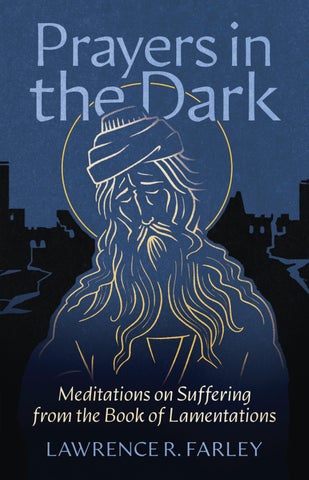
Prayers in the Dark Meditations on Suffering from the Book of Lamentations
LAWRENCE R. FARLEY
ancient faith publishing c h e s t e r t on, i n di a na
Prayers in the Dark: Meditations on Suffering from the Book of Lamentations Copyright © 2026 Lawrence R. Farley All rights reserved. No part of this publication may be reproduced by any means, electronic, mechanical, photocopying, recording, scanning, or otherwise, without the prior written permission of the publisher. Published by: Ancient Faith Publishing A Division of Ancient Faith Ministries 1050 Broadway, Suite 6 Chesterton, IN 46304 Quotations from the Lamentations of Jeremiah are the author’s paraphrase. Unless otherwise noted, additional Scripture quotations are taken from the Revised Standard Version of the Bible, copyright © 1946, 1952, and 1971 National Council of the Churches of Christ in the United States of America. Used by permission. All rights reserved worldwide. Cover art and design by Micah Peek ISBN: 978-1-955890-98-4 Library of Congress Control Number: 2025949024 Printed in the United States of America
Copyright ©2025 by Lawrence R. Farley. All Rights Reserved. Published by Ancient Faith Publishing.
Also by Lawrence R. Farley for Ancient Faith Publishing Living Faith The Orthodox Bible Study Companion Series (13 volumes) The Christian Old Testament A Song in the Furnace A Daily Calendar of Saints Unquenchable Fire Following Egeria One Flesh The Empty Throne Let Us Attend The Christian Old Testament
Sample pages only. Purchase the full book at https://store.ancientfaith.com/prayers-in-the-dark-meditations-on-suffering-from-the-book-of-lamentations/
Copyright ©2025 by Lawrence R. Farley. All Rights Reserved. Published by Ancient Faith Publishing.
For the courageous Michael and Katrina, Amy and Trevor. Proverbs 20:6
Sample pages only. Purchase the full book at https://store.ancientfaith.com/prayers-in-the-dark-meditations-on-suffering-from-the-book-of-lamentations/
Copyright ©2025 by Lawrence R. Farley. All Rights Reserved. Published by Ancient Faith Publishing.
CON T E N T S Foreword
ix
Preface
To Love Is to Suffer
1
Historical Introduction Dateline Jerusalem, July 24, 586 bc
9
Lamentations Poem One 1:1–11a No Comfort for Zion! 25 1:11b–22 “I have none to comfort me!” 36 First Meditation: The Suffering of Betrayal 45 Lamentations Poem Two 2:1–10 Yahweh’s Rage Against His People 53 2:11–19 Who Will Heal You? 60 2:20–22 Yahweh, Look and See How Terrible It Is! 66 Second Meditation: The Suffering of Poverty 69
vii Sample pages only. Purchase the full book at https://store.ancientfaith.com/prayers-in-the-dark-meditations-on-suffering-from-the-book-of-lamentations/
pr ay e r s i n t h e da r k
Lamentations Poem Three 3:1–18 The Suffering Sent to God’s Servant 77 3:19–42 Approaching the God of Mercy 82 3:43–66 Prayer for Vindication 89 Third Meditation: The Suffering of Bereavement 95 Lamentations Poem Four 4:1–11 The Horrors of the Siege 103 4:12–20 The Results of the Siege 109 4:21–22 The Vengeance on Edom 114 Fourth Meditation: The Suffering of Sickness
117
Lamentations Poem Five 5:1–18 Zion’s Plea for Help 123 5:19–22 A Final Cry 128 Fifth Meditation: The Suffering of Persecution 131 Pastoral Conclusion Dateline Today 139
viii Copyright ©2025 by Lawrence R. Farley. All Rights Reserved. Published by Ancient Faith Publishing.
FOR E WOR D
I
n our modern world, there are “experts” in every field imaginable competing for recognition and fame amid a cacophony of voices. Some become what we now call “influencers.” The religious arena is no exception to this phenomenon. Created by social media, the multitude of contributors operate with little or no accountability. So, where do we find a time-tested and reliable author who writes an exegesis of Holy Scripture that is not personal opinion? We must look for a pastor or scholar to interpret the Bible in a style that is clearly within the received Tradition of the Church. For at least four decades, the many books, articles, podcasts, blogs, and retreats associated with Archpriest Lawrence Farley have been received by faithful Christians as reliable guides.
ix Sample pages only. Purchase the full book at https://store.ancientfaith.com/prayers-in-the-dark-meditations-on-suffering-from-the-book-of-lamentations/
pr ay e r s i n t h e da r k
This is true with both his Old Testament commentaries and those on the New Testament. Father Lawrence’s familiarity with sacred Scripture speaks of his personal love for the Word of God. His scholarship is unquestioned. More important, I believe, is the influence of his many years of pastoral care for those entrusted to his priestly vocation. His work in biblical commentary has not been done in academic isolation but rather from the fields that are ripe for harvest. This may be his strongest qualifier as the author of the book you now hold in your hands. He has been there with his people in their sufferings and sorrows. He knows them as only a true shepherd can. The Book of Jeremiah is the largest single corpus found in the Old Testament canon. In this commentary on the Lamentations of Jeremiah, Fr. Lawrence takes on the history of the prophet who suffered before an unfaithful Israel. Jeremiah’s call to repentance becomes a call to each of us in our day. The Church is the New Israel, and we too must hear the words from Lamentations 4:20 (NKJV):
x Copyright ©2025 by Lawrence R. Farley. All Rights Reserved. Published by Ancient Faith Publishing.
Foreword
The breath of our nostrils, the anointed of the Lord, Was caught in their pits, Of whom we said, “Under his shadow We shall live among the nations.” In the pages of Prayers in the Dark, the words ascribed to Jeremiah are heard once again, and the words of a priest become a salve for those who suffer. Father Lawrence counts himself among the suffering, and this is why he knows the path that leads to salvation. —Archpriest Chad Hatfield President of St. Vladimir’s Seminary, Retired
xi Sample pages only. Purchase the full book at https://store.ancientfaith.com/prayers-in-the-dark-meditations-on-suffering-from-the-book-of-lamentations/
Copyright ©2025 by Lawrence R. Farley. All Rights Reserved. Published by Ancient Faith Publishing.
pr e fac e
To Love Is to Suffer
I
n what is intended to be a serious book on suffering, I would like to open, perhaps counterintuitively, with a quote from Woody Allen’s movie Love and Death, his affectionate parody of such Russian novels as War and Peace. In one of the speeches given by the widow Sonja (played by the late Diane Keaton) to another widow, Natasha, she philosophizes thus: Natasha, to love is to suffer. To avoid suffering, one must not love. But then one suffers from not loving. Therefore, to love is to suffer. Not to love is to suffer. To suffer is to suffer. To be happy is to love. To be happy, then, is to suffer, but suffering makes one unhappy.
1 Sample pages only. Purchase the full book at https://store.ancientfaith.com/prayers-in-the-dark-meditations-on-suffering-from-the-book-of-lamentations/
pr ay e r s i n t h e da r k
Therefore, to be unhappy one must love, or love to suffer, or suffer from too much happiness. . . . I hope you’re getting this down.1 It’s all farce, of course, in the spirit of the overthe-top parody that characterized most of Allen’s early films. But beneath the farcical exterior, Allen does touch on one of the universal themes of human existence: the inevitability of suffering. And he was not wrong: To love (that is, to be human) is to suffer, and since the capacity for giving and receiving love is basic to human nature, suffering will always be a part of life. Moreover, even apart from love, living has always involved suffering. In support of this, I offer three simple observations that were true throughout all history until comparatively recently, each of which tells its own story: 1. Childbirth has always been dangerous; women often died in childbirth. This was why men often married more than once. 1
Love and Death, directed by Woody Allen (MGM, 1975).
2 Copyright ©2025 by Lawrence R. Farley. All Rights Reserved. Published by Ancient Faith Publishing.
To Love Is to Suffer
2. Infant and child mortality rates were always high. In a family with ten children, it was not unusual for only half of them to reach adulthood or old age. 3. Modern anesthesia was first publicly demonstrated on October 16, 1846, which means that throughout most of human history, patients were awake during all medical treatments—including amputation. Letting these historical facts sink in can tell us much about the prevalence and intensity of human suffering. It is an intrinsic part of human e xistence—and perhaps not just a part of human existence but of all sentient existence, since animals suffer as well. Nature is famously “red in tooth and claw,”2 as the poet Alfred, Lord Tennyson wrote; animals further up the food chain kill and consume those further down the chain. Make of it what you will, death and suffering seem to be built into sentient existence.
2
Alfred, Lord Tennyson, “In Memorium A. H. H.,” Canto 56, in Selected Poems (Penguin Classics, 2008), 96.
3 Sample pages only. Purchase the full book at https://store.ancientfaith.com/prayers-in-the-dark-meditations-on-suffering-from-the-book-of-lamentations/
pr ay e r s i n t h e da r k
But, as we will see later, suffering in human beings is of a different order than suffering in the animal world. We experience different kinds of suffering than do our animal friends. We worry, we anguish, we grieve. Some people even contemplate and commit suicide—something animals never do. We rarely regard each day’s trouble as sufficient to the day (see Matt. 6:34) but insist on importing possible future troubles into the present. And we worry about practically everything. Will we get cancer? Die in a car or plane accident, have a stroke, or be maimed? Will we be able to pay our bills? Will we be happily married? Will our children suffer? Will their marriages be happy? Will they die prematurely? Will there be war, or economic collapse, or the imposition of tyranny? Will we suffer chronic pain before the end? When will we suffer bereavement or death? Will death be painful? These questions are asked by all people everywhere but not by animals. Such anguish, fear, and apprehension are uniquely human characteristics and preoccupations. That is perhaps why our fears find expression and answer in the Bible. Two
4 Copyright ©2025 by Lawrence R. Farley. All Rights Reserved. Published by Ancient Faith Publishing.
To Love Is to Suffer
entire books in it are devoted to human suffering: the Book of Job and the Lamentations of Jeremiah, also known as the Book of Lamentations. The Book of Job deals with suffering only tangentially. Despite what is often said, it is not an attempt to answer the question, “Why do the righteous suffer?” If that were the intention, it did not give much of an answer. Rather, the Book of Job deals with the question, “Why should the righteous be righteous?” That is, why should we be pious and worship God? The usual answer of its day was: If you are pious, God will bless you. The Book of Job replies, “Yes, but what if He doesn’t bless you? What if you are pious and you suffer? Should you still piously worship Him?” The Book of Job offers the lesson—revolutionary in its day—that we should worship God simply because He is God, regardless of what we “get out of it.” We are not fit judges of God’s justice and cosmic administration. We can’t even figure out the physical world around us, much less the hidden ways of God. We worship God because He is worthy. In contrast, the Book of the Lamentations of Jeremiah focuses more acutely upon suffering—in
5 Sample pages only. Purchase the full book at https://store.ancientfaith.com/prayers-in-the-dark-meditations-on-suffering-from-the-book-of-lamentations/
pr ay e r s i n t h e da r k
this case, the suffering that befell God’s people in 586 bc when the Babylonians invaded the land, slaughtered the populace, and brought about its national extinction. The book delves into suffering in lurid detail, thereby exposing the contours of the human heart. Like the rest of the Scriptures, it does not offer pat answers or neat solutions, for human existence is too rich, deep, complex, varied, and mysterious for that. But by setting aside our current concerns for a while and entering the world of God’s people in the sixth century bc, we can gain insights that help with our suffering. At the very least, we find assurance that we are not unique in our suffering and that the way home to the Kingdom brings pain as well as joy. As the conclusion will suggest, when we look at the life of the Master, suffering and glory coalesce as one before the suffering finally fades, leaving only the glory: It was His time on the Cross that Christ referred to as His being glorified, as His “hour.” I invite you to join me in this journey through suffering. Let us for a while leave our own tormented time and enter the world of Jerusalem and Judah when the smoke of their destruction
6 Copyright ©2025 by Lawrence R. Farley. All Rights Reserved. Published by Ancient Faith Publishing.
To Love Is to Suffer
still hung in the air. Let us find ourselves among blood-soaked ruins on a hot July day in 586 bc in what was arguably the nadir of Judah’s existence as the chosen people of God. These five poems of the Lamentations of Jeremiah offer us an alphabet of suffering that can perhaps help us make sense of and cope with our own miseries.
7 Sample pages only. Purchase the full book at https://store.ancientfaith.com/prayers-in-the-dark-meditations-on-suffering-from-the-book-of-lamentations/
Copyright ©2025 by Lawrence R. Farley. All Rights Reserved. Published by Ancient Faith Publishing.
H i s t or ic a l I n t roduc t ion
Dateline Jerusalem, July 24, 586 bc
I
t seemed like the end of the world. It was certainly the end of their world. After a horrific siege by the ruthless Babylonians, Jerusalem fell to the invaders, and most of the population that survived were carried away into exile. To fully understand that terrible day, we need to go back not only decades but centuries. It’s not as if it should have come as a surprise—after all, when Israel, newly liberated from Egypt, stood at the foot of Mount Sinai, Yahweh, the God of their fathers, entered into a covenant with them. In a word, He promised that He would be their national God and they would be His people.
9 Sample pages only. Purchase the full book at https://store.ancientfaith.com/prayers-in-the-dark-meditations-on-suffering-from-the-book-of-lamentations/
pr ay e r s i n t h e da r k
What that meant was spelled out in the form of what scholars call a suzerainty treaty, a treaty covenant that a powerful king made with a lesser king. It specified things like why the treaty was being made (i.e., how wonderful and gracious the big king was), what the basic stipulations of the treaty were (usually things like tribute and military support), the lawyer-like details of the basic stipulations, and then what would happen afterward. That is, if the lesser king kept the treaty, certain blessings could be expected; if they violated the treaty, certain curses and retaliation could be expected. The respective gods of the nations were then invoked, and the treaty was written down and kept in a sacred place for later consultation if needed. That in a nutshell is the form of the Book of Deuteronomy, which recapitulates the Sinai covenant—minus, of course, the invocation of the gods, since the covenant was being made by Yahweh, the only real God. In place of the invocation of the gods, Yahweh calls heaven and earth as witnesses to the covenant (see Deut. 30:19).
10 Copyright ©2025 by Lawrence R. Farley. All Rights Reserved. Published by Ancient Faith Publishing.
Dateline Jerusalem, July 24, 586 bc
Note some of the curses to be invoked against Israel should they violate the covenant: not only pestilence, drought, and famine but also invasion by a foreign enemy and exile. Thus, Deuteronomy 28:49–65, which reads in part: The Lord will bring a nation against you from afar, from the end of the earth, as swift as the eagle flies, a nation whose language you do not understand, a nation of stern countenance, who shall not regard the person of the old or show favor to the young. . . . They shall besiege you in all your towns, until your high and fortified walls, in which you trusted, come down throughout all your land . . . And you shall eat the offspring of your own body, the flesh of your sons and daughters, whom the Lord your God has given you, in the siege and in the distress with which your enemies shall distress you. . . . And the Lord will scatter you among all peoples, from one end of the earth to the other; and there you shall serve
11 Sample pages only. Purchase the full book at https://store.ancientfaith.com/prayers-in-the-dark-meditations-on-suffering-from-the-book-of-lamentations/
pr ay e r s i n t h e da r k
other gods, of wood and stone, which neither you nor your fathers have known. And among these nations you shall find no ease, and there shall be no rest for the sole of your foot; but the Lord will give you there a trembling heart, and failing eyes, and a languishing soul. There’s much more in the text, but you get the idea. All the prophets predicted and threatened Israel and Judah with this very doom if they did not repent and turn back to Yahweh. But Israel and Judah did break Yahweh’s covenant, year after year and century after century, worshipping other deities, serving idols, refusing to walk in justice, grinding the faces of the poor. All the prophets urged repentance, and all their prophetic warnings were ignored. At length, in 586 bc, the final judgment fell.
Prelude to Judgment We can look at the immediate background to this judgment by reading the Book of Jeremiah.
12 Copyright ©2025 by Lawrence R. Farley. All Rights Reserved. Published by Ancient Faith Publishing.
Dateline Jerusalem, July 24, 586 bc
There was even a foretaste of the final judgment in 597 bc when the foreign foe invaded and carried into exile the king and certain other nobles. (Read all about it in 2 Kings 24.) A puppet king, Zedekiah, was installed, who was but twenty-one years old at the time. You would’ve thought that after the invasion in 597 bc the people of Jerusalem and Judah would have gotten the message and repented. Nope—not at all. The nationalistic prophets (false prophets, as it turned out) predicted that the exile of the king and his nobles was but a temporary setback—that they would soon return, and all would be well. Let Judah carry on courageously and stay the (idolatrous) course! Sadly, the people did, with the inevitable result. The Babylonian victory in 597 bc was not ultimately rooted in Babylonian military might but in Yahweh’s plan to judge His people. Therefore, as we read: And in the ninth year of [Zedekiah’s] reign, in the tenth month, on the tenth day of the month [i.e., March 25], Nebuchadnez’zar
13 Sample pages only. Purchase the full book at https://store.ancientfaith.com/prayers-in-the-dark-meditations-on-suffering-from-the-book-of-lamentations/