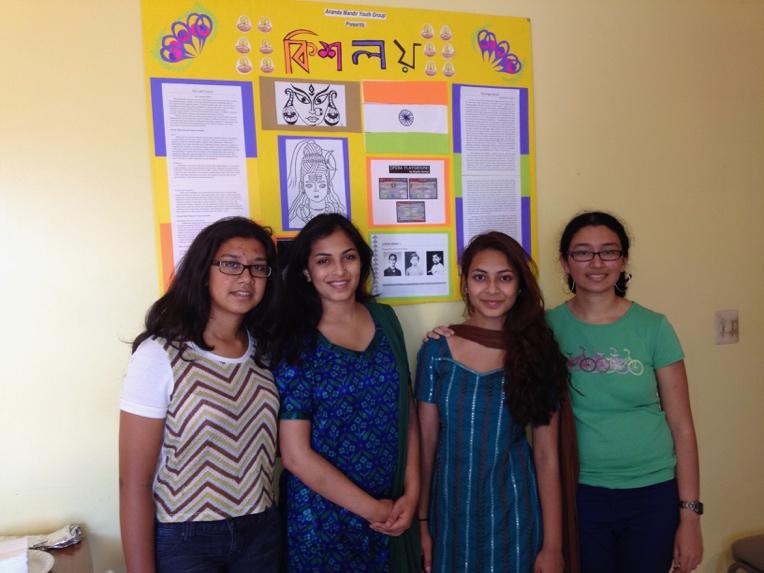
Kisholoy group is the youth group of Ananda Mandir. Any youth member of Ananda Mandir can join this group. We meet every month on the first Sunday between 1 and 3 pm at Ananda Mandir to prepare Kisholoy wall magazine. If you are interested please attend this meeting or send your articles, drawing or photographs for the magazine via email (Dipakksarkar@hotmail.com).
Saradia Kisholoy is produced by members of Ananda Mandir and is for distribution to its members only. The articles or photographs of this magazine are copyrighted and should not be reproduced in any other forms without the consents of the owners.
We would like to acknowledge the contributions of the followings:
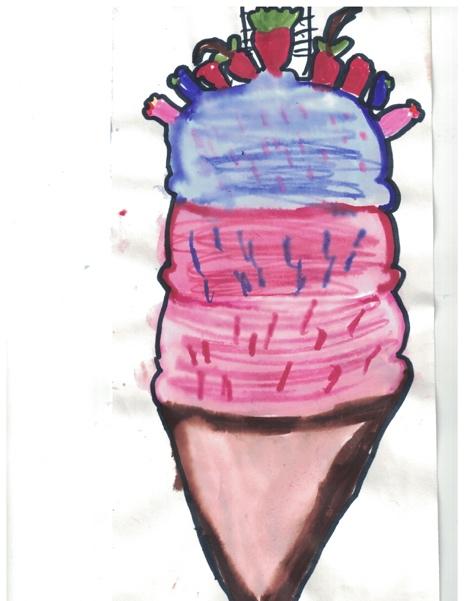
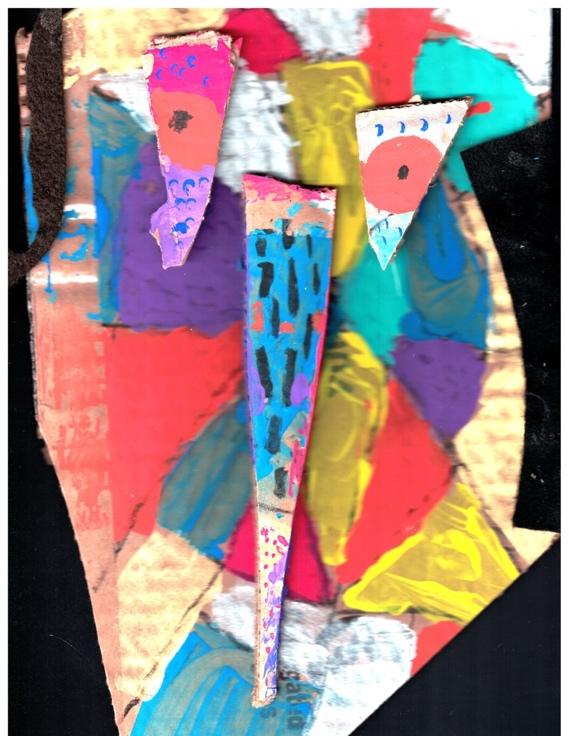
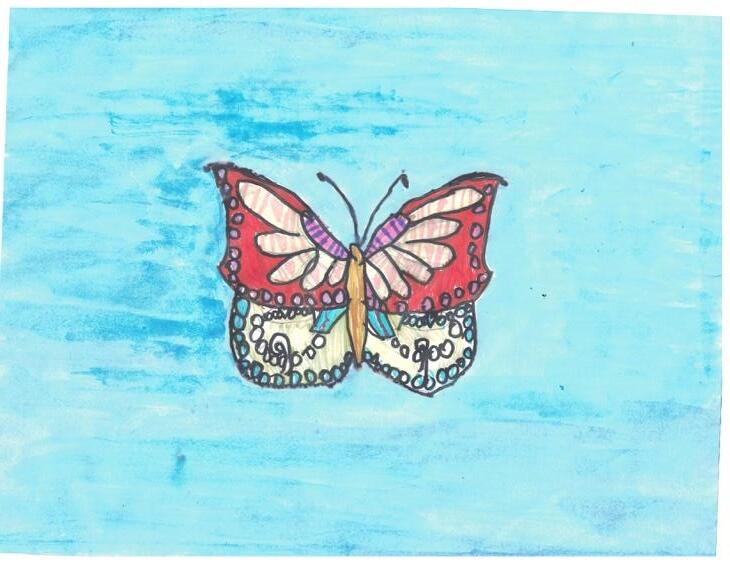
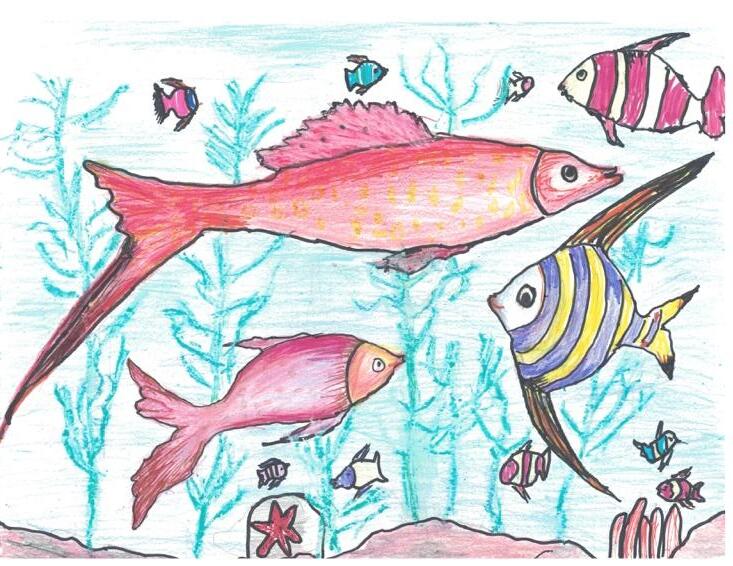
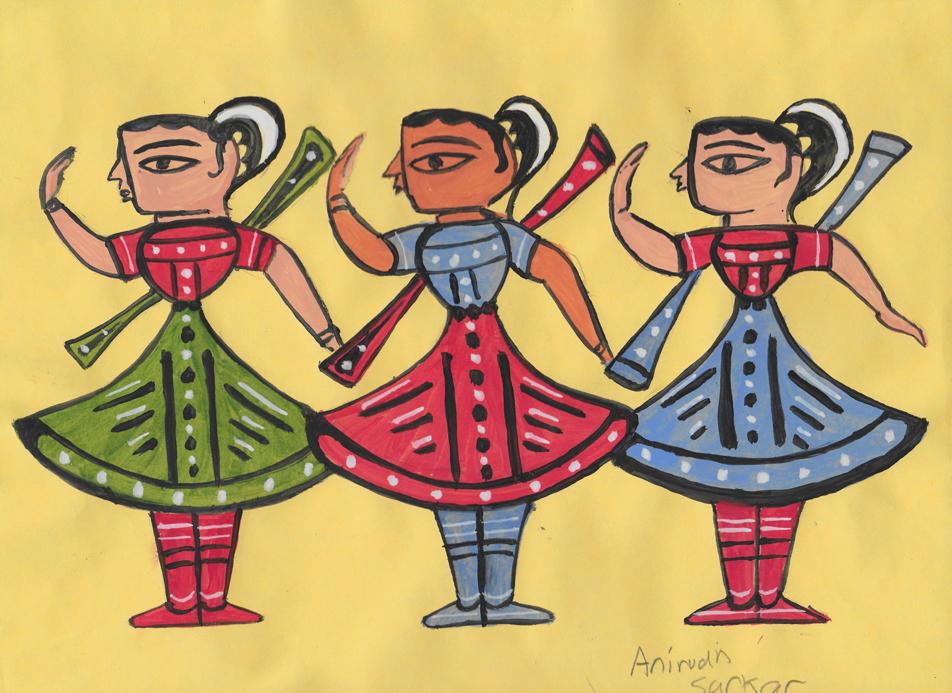
Drawing and Photographs: Anirudh Sarkar, Anooshka Ghosh, Disharee Ghosh Dastidar, Natasha Sarkar, Sophie Sarkar, Biswajit Sarkar, Girija Belavadi
Editorial: Utpal Sengupta, Dipak K. Sarkar
Magazine Composer: Dipak K. Sarkar
For information about the Kisholoy – contact Dipak K. Sarkar via email (Dipakksarkar@hotmail.com).
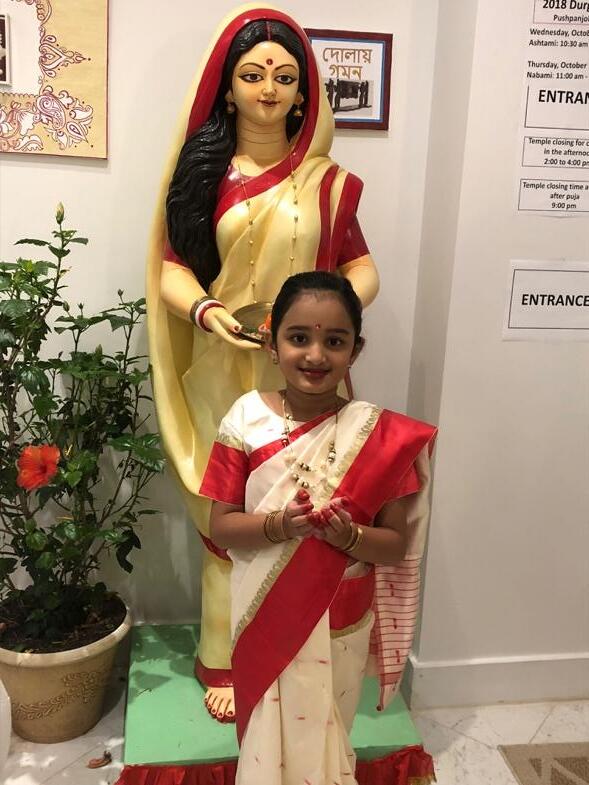
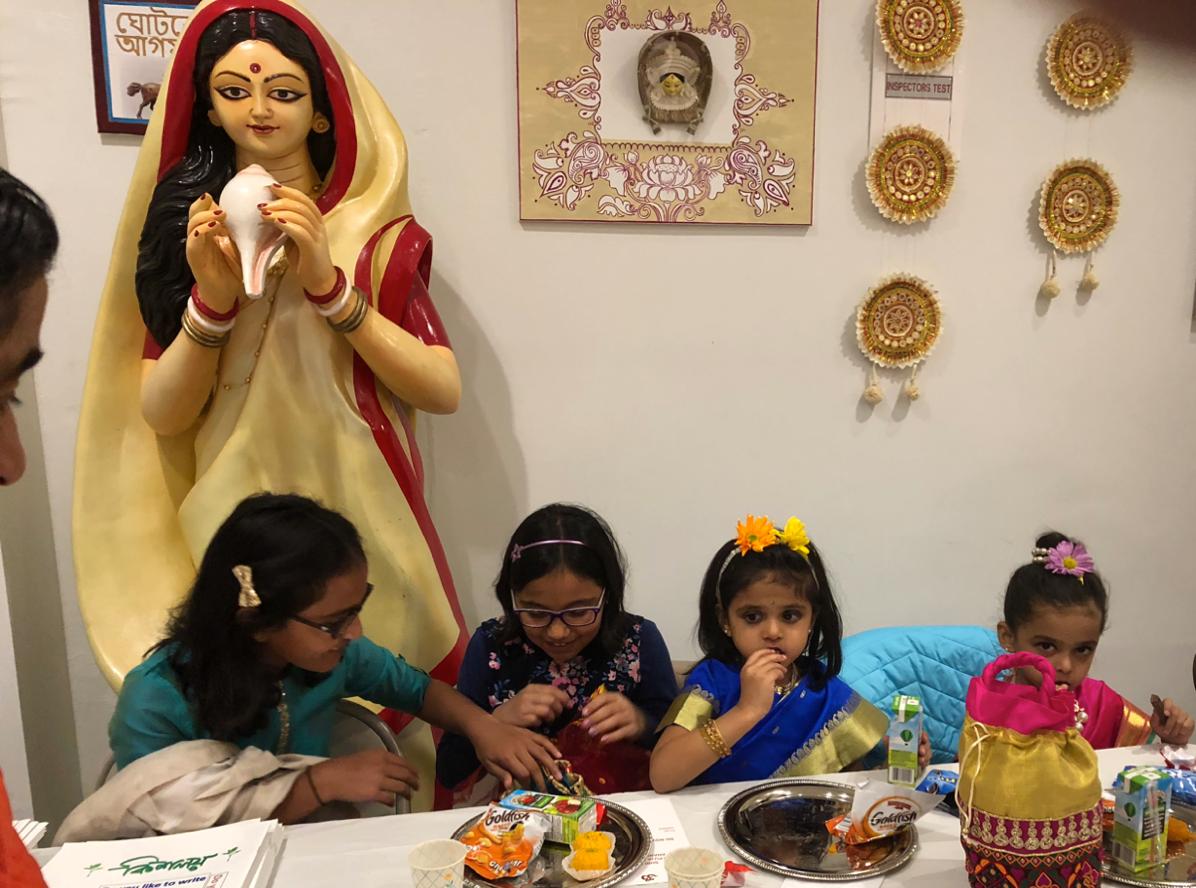
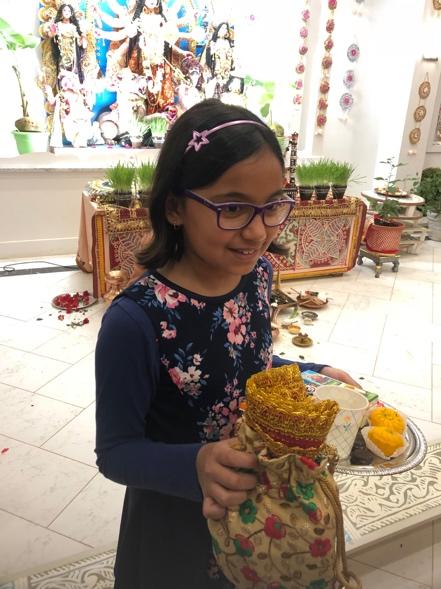
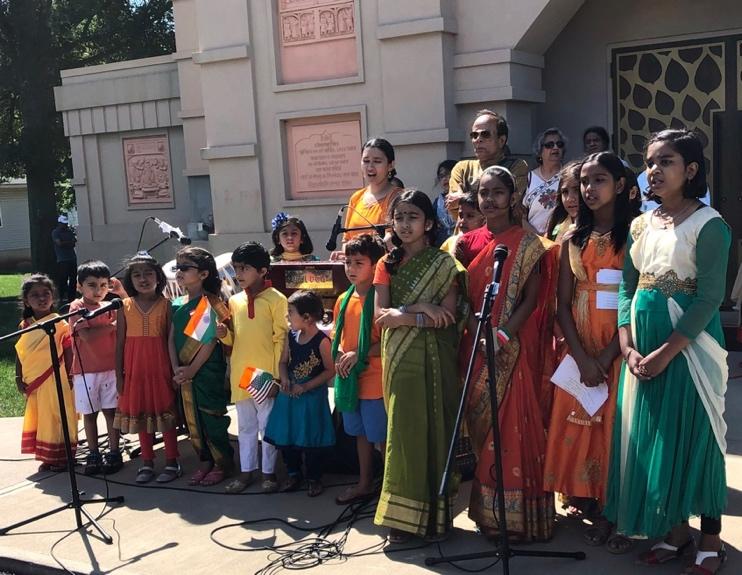
Kisholoy children gathering during Durga Puja
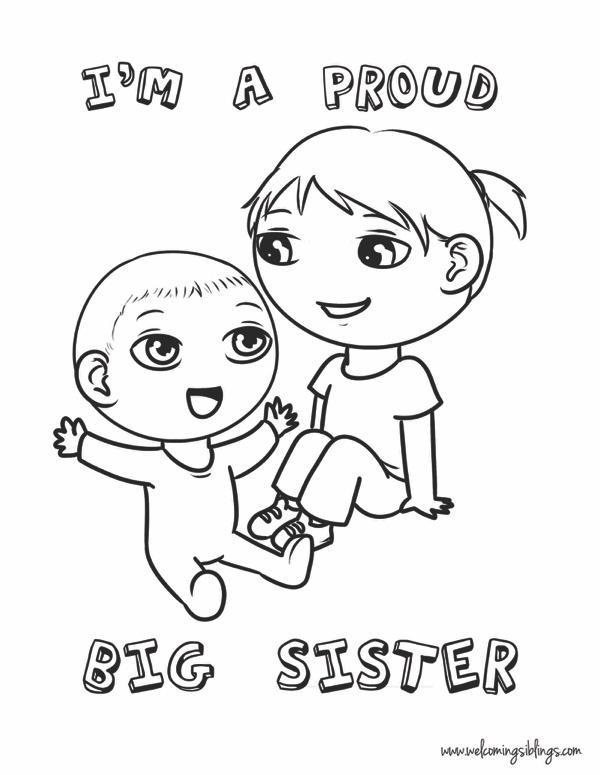
The Baby Sister
By Anshini Ghoshal Biswas (Age 8)
One cold winter morning Emma was painting a picture. “I’m going to name this one ‘snowy sight’” Emma thought. She loved painting and stroked her paintbrush on her picture. Everything was calm and peaceful. It was so calm that Emma imagined she was painting outside and it was snowing. But suddenly Emma heard rapid footsteps. They were headed to the room that Emma was in. It sounded like an elephant. Within a few seconds Emma’s dad dashed into the art room. “Phew” Emma whispered to herself, feeling relieved that it was her dad and not a real elephant. “Emma, look at the text your mom just sent me”, Emma’s dad said. Emma read the text, “We are having a new baby, her name will be Ella. I’ll be coming home with the baby”. Slowly Emma’s smile disappeared and she had her mind filled with worry. Her heart started pounding heavily. What if the baby took Emma’s spotlight? What if Emma is not able to sleep with her parents anymore, because the baby will now be sleeping with them? Emma just couldn’t accept it.
“Ding Dong”, the bell rang after a few hours. Emma's dad answered the door. Emma dragged her feet down the stairs. “Awww”, said Emma’s dad, looking at the new baby in Emma’s mommy’s hand. “Mom, can I call Kate and Olivia to our house? I want to celebrate my baby sister’s birthday”, Emma said. “Sure”, said Emma’s mom while adoring the baby. Emma’s dad dialed Kate’s number and gave the phone to Emma. “Kate, ask your mom if you can come to our house this evening. My mom just got a baby and we are going to celebrate.” said Emma. “Okay I’ll ask my mom and let you know. And thanks for the invitation.” said Kate. “Thanks!” said Emma and hung up. Next, Emma’s dad dialed Olivia’s number and gave the phone to Emma. Emma said the same thing to Olivia too and hung up.
That evening Emma's mom ordered a cake and also got some cupcakes. Emma’s dad found some old time decorations in an old attic and decorated the house with them. And before Emma knew it, guests started to arrive. Everyone got something nice for Ella. Emma’s dad even found an old tiara for Ella, that Emma got as part of a dress up set when she was 4. When guests saw Ella, they crowded her. They were all trying to pick her up. And take pictures with her. Emma felt like she was not there as no one was paying any attention to her.
Emma started feeling really dejected. She dashed to her room and started writing about her thoughts in her secret journal. Sadly a tear dripped from her eye. Then Emma heard a knock on her door. “It’s me “ Kate said through the door. “What is it?” asked Emma. “Aren’t you going to celebrate? You do sound pretty somber.” said Kate. “Everything is a problem!” Emma burst into tears. Then Olivia came in. “What’s wrong with her?” Olivia asked. “Don’t ask me” said Kate. “Come in and close the door” said Emma. “Ella gets everything and all the attention. It’s not fair. I feel like an outcast now”. “Don’t you think you are a little jealous?” asked Olivia. Before Emma could say anything, they heard Emma’s mom calling them downstairs as it was time to cut the cake and sing “happy birthday” to the baby. Emma went to the basement with Kate and Olivia. When everyone was singing “happy birthday”, Emma also joined them but in a low voice. But then Ella
started crying. One guest gave her some water, but she still cried. Then Emma picked up Ella on her lap and gently gave her a hug. To her surprise Ella stopped crying and clung onto Emma. All of a sudden, Emma started feeling good. “Maybe having a little sister isn’t just about losing the spotlight.” Emma thought. “Maybe being a big sister can also be fun. Maybe there is a bright side to it.” Emma started feeling better. She started to feel like Ella was depending on her. Emma gave Ella two big kisses on her small cheeks. And Ella’s eyes lit up, like two stars in the night sky.
Then everyone asked Ella to blow out the candle. But Ella being too small couldn't blow out the candle. So Emma helped her. And once Emma blew out the candle, Ella hugged Emma harder than ever.
!!! The End !!!
Drawings of Anooshka Ghosh (Age 6)
Alaska Trip
By Auroni Sen (Age 9)
When I first got to Alaska, I expected it to be really cold. But it wasn’t cold at all. In fact, everyone was sweating from the heat. We rented a car and we drove to the house that we rented. The owner left a note telling us about the house. We had dinner and then went to bed, tired and hot.
The next day, we woke up and left the house at 9:00 a.m. We drove along a lake which had many glaciers. We drove through a oneway tunnel that was 2 miles long. We finally stopped at a place called Whittier. There, we boarded a boat that took us to “26 Glacier Bay” on the bay of Prince William sound. We saw many glaciers and a lot of wildlife. For example, we saw porpoises, dolphins, seals and sea lions. We got lunch on the boat, too. There were forest rangers on the boat and they taught us a lot about glaciers and fish like salmon. After that, we went home.
The next day, everyone was in a rush because we had a lot to do. We took the bus back to Whittier after we gave back the car. We got the tickets for boarding the cruise ship. Our ship was called the Golden Princess. It was HUGE! It had 17 decks (floors). It looked better than a five star hotel. My parents and I had 2 adjoining rooms with 2 twin beds in each room. My grandparents had a balcony room with a queen sized bed. All of the bathrooms were small. Our rooms were on the tenth floor. My grandparent’s room was on the 11th floor. There was a plaza so we spent most of our time there because it was the heart of the ship and there was always some entertainment. We also spent a lot of time in my grandparent’s balcony room. After dinner, we went to bed.
The first day on the ship was AMAZING! We cruised along Yakutat Bay and saw the Hubbard glacier. We had breakfast at the buffet. Then we checked out of the ship. There were jewelry stores, shops, bars & lounges. There were shows everyday at the Princess Theater. There were also an ice-cream bar and an outdoor movie theater. There were three pools on the ship. We had dinner at our assigned dining room called Canaletto. The food was really good and our waiter was called Reynaldo. That night, we saw a show at the Princess Theater. It was a little bit like a Broadway musical.
On the second day, park rangers came on to our ship and told us about glaciers. My grandparents were in their balcony room when they called us. They said they had seen two whales! We rushed to their room and we did see the whale’s fin. It was a little far away but we still saw it. Then we saw puffins in the water! We had dinner at a place called Sabatini’s Italian Cuisine. The food was amazing! It was my grandpa’s birthday and they surprised us by bringing us a special cake. The cake was marvelous!
The next day, the ship docked at a place called Skagway. We arrived at 5:00 a.m. We got off the ship and learned a lot about the Klondike gold rush. We saw a lot of shops and houses there. We went back to the ship for lunch but came back again at 4:30 p.m. because we were going on a train ride. We got on the train and we went across Yukon White Pass to Canada. The tracks were very narrow, but the scenery was breathtaking.
The next day, the ship docked at a place called Juneau. We got on a bus and it took us to a salmon hatchery. There were millions of salmon! The hatchery takes newborn salmon, teaches them to swim upstream, then let them go into the ocean. Then the salmon come back later into fresh water, lay eggs and then die. Then the process starts over again. But a lot of the salmon don’t make it back because eagles and bears eat them. In the hatchery there were touch- tanks. After that, the bus took us to a place called Glacier Gardens. We got onto a truck going up the mountain. Our guide showed us plants and flowers as we went. After Glacier Gardens, our bus took us to a place called Mendenhall Glacier where we saw more glaciers. After that, we went back to the ship. We also saw a show that night.
The following day, the ship docked at a place called Ketchikan. We got off the ship and walked around. We went to a smaller salmon hatchery. Then we came back onto the ship.
The next day, we sailed. We walked around the ship and went to an art auction.
The last day, when I woke up, we had stopped moving. We had reached Vancouver in Canada. We were all sad to leave, but we’ll remember it forever!
!!! The End !!!
Drawing of Natasha Sarkar (Age 18)
Dear J ames,
The Day Mr. Blue Crayon Quit
By: Shayomiti Mitra (Age 10)
It ’s me, Blue Crayon, and I have a lot to say to you young man ! I’m the shortest crayon inside the box! You use me for giant pu ffy rain clouds, huge hum p - back whales, and blue skies. That ’s like holding a truck on one hand, an elephant in the other, and a sack of boulders on my back ! Imagine if YOU had to hold all of that ! You ’ d sag at the pressure of all of that, right? Instead of that, use me for flowers, snow, or rain ! Maybe once in a while use me for rain clouds, whales, and skies. Read that part again young man ! That is a very helpful piece of advice!!!!!!
I AM NOT A COLORING MACHINE! For hours and hours you scribble on a piece of paper for a good sky, whale, or rain cloud ! I have been so hum iliated yesterday ! Want to hear that story? One day, I saw you coloring a page in your coloring book. I wanted to see what you were coloring, and if I had to color an enormous whale or sky. Right then, I realized that I couldn ’ t see over the crayon box! When all the other crayons were busy with something else, I jumped and saw green crayon being used very carelessly. I also saw a broken grey crayon lying on the floor, completely lifeless. He wasn ’ t from our box, th ough. Our grey crayon was in the box happily chatting with friends. Anyway, let ’s get back to the story. When I landed, I made a loud thud As I got ready to jump again, I saw all the crayons laughing at me. How did they see me? I wondered. Then I saw orange crayon laughing and pointing with his budd y yellow crayon saying, “See? Told ya!” Yes, all of this had happened while you were using green crayon for that minut e. I wish that you would look inside the crayon box for a minut e!
MAYBE, just maybe, you’ve gained some sense after reading this letter and will take me to Italy for vacation for a while as a break. Anyway, for now, Ciao! I‘ll give you twenty four hours to think about it and you’ll see what happens , and I mean it !
Drawing of Sophie Sarkar (Post Grad)
Your exhausted friend (more like enemy), Mr. Blue Crayon
Thankful For…
Aishik Sen (Age14)
Do I need a day, a special one
To be thankful - for all that’s treasured under the sun? Churn my memories to count loads for Blessings, happiness, wishes galore. Little do I relate to ones deprived Guilt encompasses as thoughts thrive. To the countless hungry faces sans a home, No food, love, peace as terrors roam. Guns and shells ruin lullabies, Where prayers fall sort, ceaseless tears… Our role, mere passers-by. A smile is worth when all are in smiles -
When world issues aren’t confined in useless documented files. I’m grateful every second for a life I’m served –On a silver platter -food, clothes, shelter And the loved ones alive.
!!! The End !!!
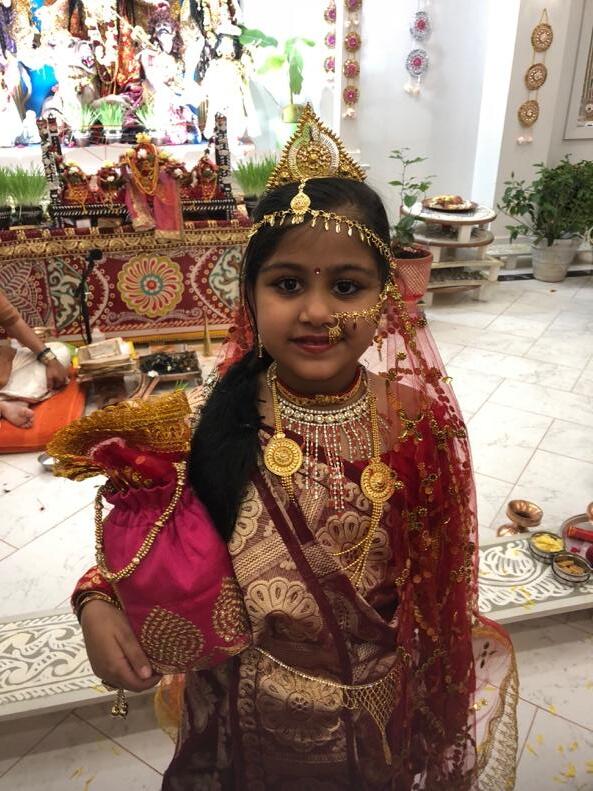
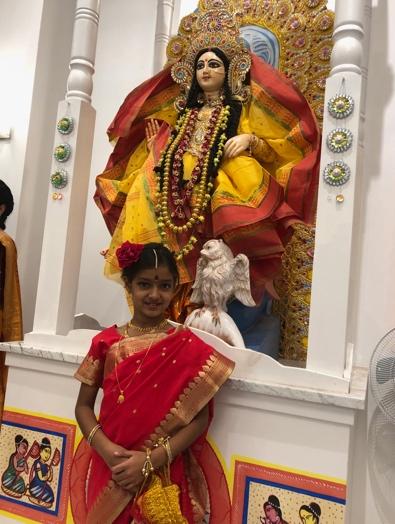
A Kisholoy member welcoming guests during Durga Puja
Drawing of Natasha Sarkar (Age 18)
Tell Me Another One
By: Ayushmaan Mukherjee (Age11)
“Tell me another one.” chirped little Molly Smith, who had just heard about a story from her grandaunt, Aceline Smith.
She was telling a lot of stories about her years as a young woman since it was Molly’s birthday (she turned 8). “It’s well past your bedtime, Molly.” replied Aceline.
“I know!” acknowledged Molly as she bounced around on her unicorn-themed bedsheets “, but please just tell me another one! You w ouldn’t want me to feel sad on my birthday, would you?”
“Oh, all right all right.” gave in Grandma, and then chuckled. “It will be a tale of adventure, fear, and family. Are you sure you won’t be scared?” asked Grandma
“I won’t!” yelled Molly playfully “I’m not scared of anything!”
“Okay then. I’m going to start. So, about when I was you’re age, World War Two happened”
“But what’s World War Two?” asked Molly.
“You’ll learn all about it soon enough, but for now all you need to know is that World War Two was a war that happened 80 years ago. It happened when one country called Germany was ruled by an evil person who made the army attack other countries.” explained Grandma. “I used to live in a country called France that was taken over by Germany.”
“Oh no!” exclaimed Molly.
“Oh no it is, for the people who defied the leader were arrested, and the people of France were treated poorly, but first Germany had to take over France, and this is the story of when Germany was taking over France. I used to live in a town called Sedan. It was a beautiful place, with stonelined streets and amazing shops. I used to play with my friends in the town square and the river all the time, then. I loved it there, and wouldn’t leave it for anything.”
“Anything?” asked Molly with wide eyes.
“Anything. Little did I know that in a few weeks, the Germans would come. It started when the Germans started bombing Sedan. I was only 15 years then. It was dreadful.” Adeleine grieved.
“But that’s older than I am.” said Molly in surprise. Molly slightly gasped.
“True, I was young, but I wasn’t an adult then. Anyway, my friend Adeleine’s house was destroyed so they had to move. I never saw them again. Oh, what I would give to revisit all the times I played with my friends.” lamented Aceline as she wiped a tear from her eye “Where was I?
Oh, yes, I remember. So, Adeleine had to relocate and I never saw her again. A lot of shops were also destroyed, so the French soldiers who were in town had to supply us with food. Bridges and roads were destroyed by German airplanes, but more French soldiers couldn’t come to help us. Then, it happened. The Germans attacked us, somehow. I don’t remember that much since this was 60 years ago [This story takes place in 2000], but I’ll try to remember from the moment the Germans invaded. Okay, so, one day my mom woke me up screaming in my ear about how there were Germans coming. I was too sleepy to understand, so I stayed asleep. Then she poured some water on me - Molly started to giggle and I got mad, but then she dragged me outside and hit me. There were about a hundred German soldiers and tanks, which are big metal vehicles that shoot bullets, shooting at the French soldiers who were in town. They tried to shoot back but they were unprepared and had to retreat, leaving the townspeople to fend for themselves. All except one actually. My dad, who would be your great-grandfather, came running to our house.”
“What does fend mean?” asked Molly sweetly. “Fend means that they had to protect themselves against the German soldiers.” explained Adeleine “Ohhh, I get it.” said Molly.
“Anyway, I grabbed my Mom and Dad’s hands and sprinted for cover behind a house as bombs blew up and destroyed houses. I made a plan to get out of the town but there was no way to do that as the Germans had surrounded the town; so, I grabbed my mom and dad again, ran back to my house and to the cellar, and prayed that the Germans soldiers would leave soon since the French soldiers already left.”
“Did they?”
“No, they didn’t. In fact, I actually took a peek upstairs and what I saw horrified me. I don’t know if I should tell you or not.”
“Tell me! You didn’t tell me something else!”
“You’re not supposed to know about the first thing but I’ll tell you about this anyway. The Germans were shooting normal French townspeople.”
Molly slightly gasped. “And that’s not all. After they killed my fellow townspeople, they went into their homes to steal things. I was absolutely shocked, and immediately realized that we would have to hide, so I went downstairs into the cellar where my mom was told her the situation. She told me to get some food and follow her, so I did, and she led me to a corner where a crate was, and opened it. It looked perfectly normal to me, but then she slipped her hand into what was a crack and pulled it, and the bottom of the crate came up. Underneath it was a small space about as large as a closet with a floor and walls of dirt, almost like someone dug a hole in our cellar. I was astounde d, and looked to my dad for an answer, and he explained that he put a fake crate and dug a hole in it in case of an emergency.”
“That’s funny.” giggled Molly.
“It was smart too, because it saved our lives. We went into the hole with the food I had and closed both layers of the crate behind us. A few minutes later we heard the German soldiers coming into our basement.”
“Did they find you.” asked Molly, who looked nervous.
“No, but my heart was pounding like a hammer, since the Germans could discover us at any time, and in fact, they did lift up the crate’s lid at one point, but, thank god, they didn’t. We still didn’t get out of the crate for another hour because we didn’t know if the Germans left. After a few hours cooped up in the hole, we finally went outside because we heard tanks moving, presumably out of town. I peeked out the door, and luckily all the Germans had moved on. It was nice to stretch after hours, but it was horrifying to see the ruins of the town that had once been my home. I started crying in my mom’s hands. Several minutes later we trudged out of town. We kept moving from town to town since my dad was part of the army, and I even joined the French resistance, since they fought against the Germans, and after the war I moved to America. I might tell you some of those stories later- oh!” she exclaimed as Molly had fallen asleep.
She smiled to herself as she walked out of the room and to her own bedroom.
!!! The End !!!
You Never Walk Alone
Adwaitaa Goswami (Age 14)
With a touch of your paintbrush
Colors will fly across
As eternal ink may on S kin.
As lasting words may on P aper.
Tangible dreams you can hold In your Heart. Though in a while, They may be Redundant, They shall never be Forgotten, A long-lasting Epiphany. Stigma, is not a label That you have Earned, It never will be. Think of your life as a Serendipity, A euphoria of Reminiscence. Your singularity Is what makes you Unique. And do not be fearful For, You never walk alone
"Masterda Surjya Sen"
Drawing by Disharee Ghosh
Dastidar (Age 16)
The Wrong Notion of Idealism
By Shama Dinesh (Age 18)
We all find ourselves looking up to someone at one point of time in our lives, wondering how we can be like them. We idolize people for different reasons. We aspire to be ideal. We all want to be somebody in this world. Somebody worth remembering. Somebody who is perfect. Somebody loved by all. But while chasing this wild notion, we lose sight of something that is just as important as our dreams, if not more- not being perfect but rather loving ourselves the way we are.
No person is born perfect. We all have our flaws. One can only seem to be perfect and confident to others if they are confident about themselves. One can only earn love and respect if they respect themselves in the first place.
And yet, we try to hide our true faces in front of others. We wear a mask that suffocates the person we truly are. We try to shut off the voices of reason within us and try to blend in with the voices echoing all around us. We lose ourselves trying to become an imitation of others.
But we all fail to realize that we were born the way we are for a reason. We have our own unique gifts. We have our own unique traits. We are all blessed in our own way. So why are we always dissatisfied with ourselves? Why do we feel the urge to pretend as someone we are not?
Loving ourselves is the key to creating our own identity. It is the one way to stand out as an individual rather than being just another nobody. And the first step towards it is acceptance. Accept the fact that you are not perfect. Accept your flaws and embrace it. Rather than shutting yourself away from your flaws, work towards overcoming them. If you are afraid of something, face your fears. Never hide or run away from your shortcomings, for we all have them. Our imperfections are what make us human.
We shouldn’t conceal our individuality to blend in. We are not perfect, which, in my opinion, is a great thing. Having faults makes us commit mistakes and mistakes help us learn. It means that you can always strive to be a better you. Every day one should be able to look back and appreciate how much they have improved as a person. The day when you can no longer be a better version of yourself is the day you have to regret because you can no longer learn from your mistakes. We all have our own ideas about life. But we do not know for certain what happens after it ends. The only thing we are sure of is the life we are experiencing. It is up to us to make it worth living. Our fears may haunt us but we can control them. We are not dictated by our demons and that is what makes us all special in our own way. That is what makes us let go of our inhibitions. That is what makes what makes this life worth living.
Poem for the Week
By Shama Dinesh (Age 18)
You may not know what is life
Filled with sorrow and strife
It is an illusion made to confuse Friend to ask and foe to refuse
It is not a happy ending to all
To rise to the top, you must fall
Seek what you want, fight for your need
But never be wavered by the sin of greed
The path you need to follow
It isn't so shallow
What you choose if it isn't right
Be true to self and fight with your might
Choose a path you wish to lead
Your choice to revolution might be a seed
Do what you want, stay as you be
But stay for the world, high to see
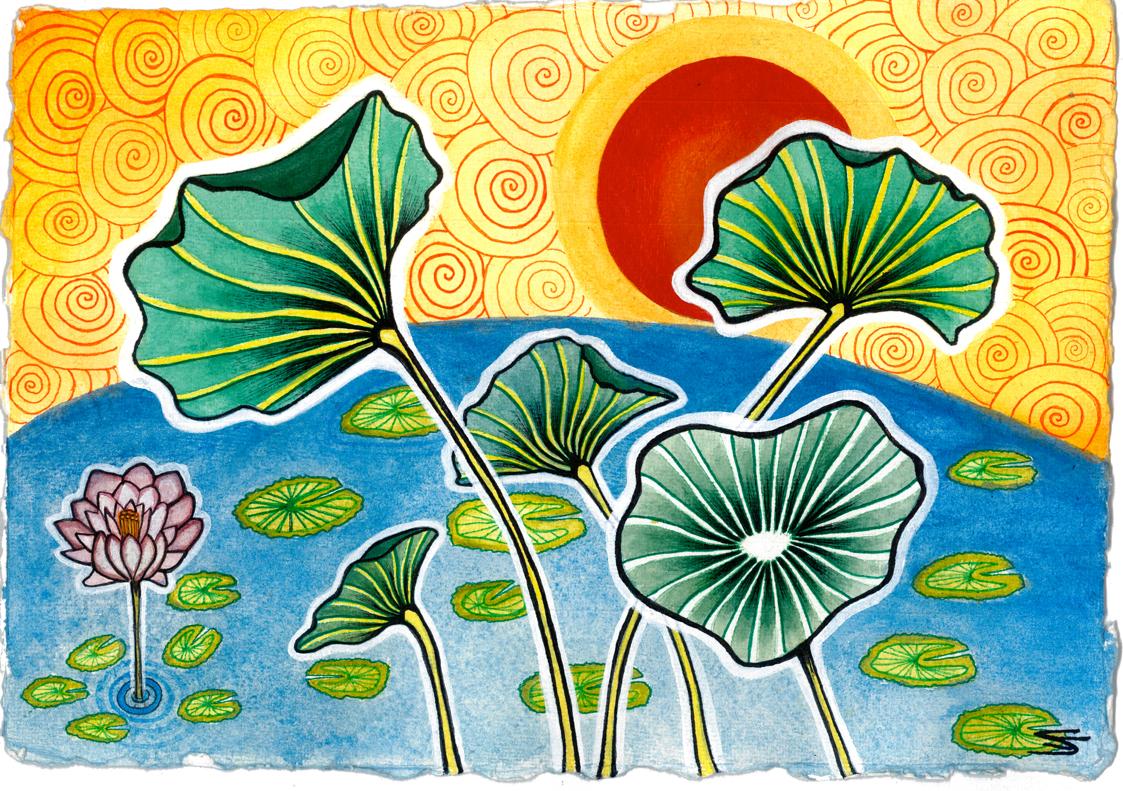
Drawing by Sophie Sarkar (Post grad)
By Adwaitaa Goswami (Age 14)
I would like to visit Nowhere
Whether it be a strange perhaps, Or a window to the soul.
I wonder what it’s like in Nowhere If it is utopian confinement, Or a realm filled with the fractions of our thoughts.
Is Nowhere like a state of meditation?
I envision it to be a place where The trees laugh, Dressed in their carnival clothes And the scent of exotic spices churning the wind.
In my peripheries, the sparkling Sea, and the rhythmic percussion of waves On sand. Paralyzed. Gaze on the steady horizon, Face aglow with the last scarlet rays, Before Twilight beckons the stars. Lips bearing the semblance of a smile. I wish Nowhere to be my ideal setting. Just being there
Brings your mind into sweet s urrender At one with nature.
Every fragrance is fresh, like the Pages of a new book. Bursts of birdsong To uplift. Thoughts and feet Wander on cool brick paths. Lungs fill, time rolls by A tangible euphoria.
Nowhere would be a picture, Etched in the fragile glass of imagination. A dome of my creativity.
Horizon
By Shama Dinesh (Age 18)
Remembering the first days
As I looked out of the window
The starlit night and the windy grace
The mesmerizing fall of the snow
The hardened rocks I gaze upon
The breeze sweeps away the night
The breathless feel at the dawn
Wresting away the dark with a fight
The lonely daylight filters in Lightening your heart
The secret nights fade within the sin
The darkness swiftly dart
The eyes I gaze upon the horizon
Shimmer with mesmerizing shine
The hues of red and blue dawn
Reassuring that I am fine
The heart turns black, eyes shut tight
As I surrender to the demon inside
I'm bound to lose, no matter the fight
Lost with no one to confide
The lonely beat of the heart
The pouring of the blood
The only anchor as it did part
The tears outside flood
The heart beats fast as I fall in the dark
Flooding inside me
The dark days of my past left a mark
As my end I see
Kisholoy members participating in Heritage day celebration
Some of the charter members of Kisholoy wall magazine
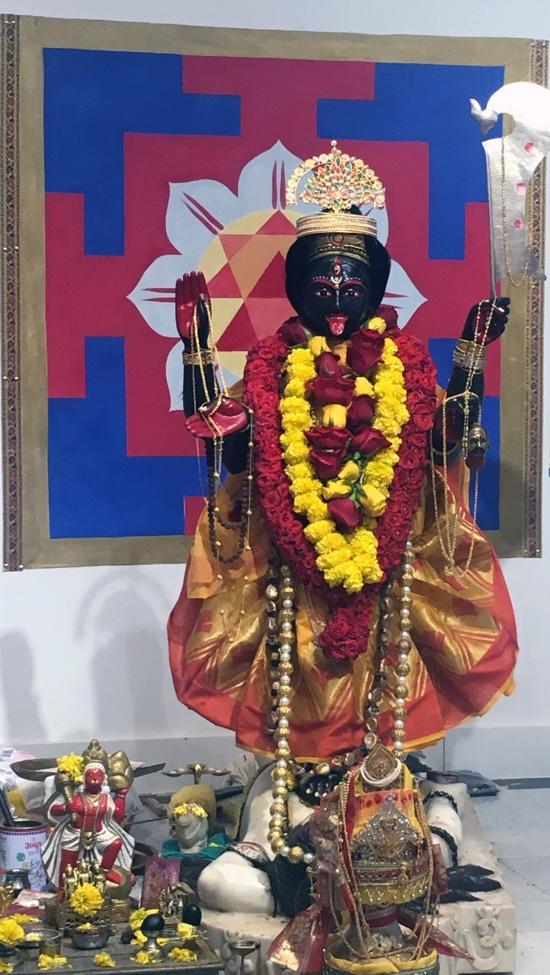
Kali's Dance
By Sophie Sarkar (Post grad)
This is the story of Kali, the fierce black goddess of power And how she used her strength and dancing to make the evil demons cower
It started with Nishumbhu and Shumbhu, two wicked demon men Who waited ten thousand years to enter the god’s den
They cast spells upon arrival, all good had been forsaken And when the dust had settled, the heavens they had taken!
So the gods fled to snowy peaks, to pray to their Ma
The unassailable goddess, the one, the only, Durga Durga was a kind goddess, and could not see them suffer so For she was born to conquer evil, as she did with the buffalo
And so she came to Earth, in the form of Ambika
The great beauty of the universe, like no other chica
The demon fiends pursued the goddess, intent on her capture To gift her to, yea you guessed it, their greedy demon masters
Goddess Ambika stood her ground…brilliant, fierce and unafraid Which enraged the demon masters, enough to send their full brigade
But Ambika responded swiftly, not needing any guidance And out of thin air she made Kali, the bold Devi with a trident
The demon armies tried to break her, but they never stood a chance Against Kali Devi’s trident and her fierce ass warrior dance
Kali danced to destroy the demons, she’d had enough of all their foolery
She ate their limbs, she drank their blood, and turned their heads into her jewelry
She warned the demons to return the heavens if they wanted her to stop
But the foolish soldiers kept on coming ‘til one-by-one they dropped
As she devoured the last demon, her dance of annihilation Turned into something beautiful, a dance of liberation
She danced for justice and for freedom from the demon patriarchs
She danced for fun and celebration, she danced through lightness and through dark
She danced for all her brave black sisters, on the frontlines of the fight
She danced for her own power for her spirit for her might
Fearing that she’d not return, her husband tried to stop her beat Shiva made his way to Earth and then he laid down at her feet
Kali noticed right away, recognizing his distinct face
But she would not stop her dancing, at this point of freedom’s pace
Instead she hoped that he might join her, so she reached out for his hand And Shiva replied without any words, just a smile, and a headstand
Drawing by Sophie Sarkar (Post grad)
Rabindranath Tagore’s Inclusive Education Among Nature
Aishik Sen (Age 14)
Rabindranath Tagore, the mystical poet, novelist famous for inspiring entire nations with his majestic musical compositions and prominent persuasive literary work, have also greatly contributed and influenced multiple educational systems of the world. Tagore’s childhood education was at odds with the normal education system of that time. Schools back then as well as modern-day schools have a ‘factory-model’ system. Students are pumped in raw materials at an early age and are expected to emerge as priceless artwork once they graduate. When students don’t come out the way they were supposed to be, the system uses the common excuse, “somewhere, something went wrong.” Rabindranath was one of the many who noticed that this relentless ‘factory system’ was creating more and more ‘defective products’ with every passing day. However, what made him stand out was that he did not wait for others to bring in change, instead implemented new methods of teaching to bring out the best in individuals, developing talents, providing effective valuable guidance to shape up the future of India. He dreamed of young Indians facing the challenges of the world with their heads held high.
“The highest education is that which does not merely give us information but enriches our life to be in harmony with all existence.”- Rabindranath Tagore. Tagore decided to try a different kind of education, an inclusive education among nature. He had seen that the way he had been educated, with family and experiences, were much more valuable than the machine called a “school”. Tagore envisioned a world where man would exist in perfect harmony with nature“ ান যথা মু “. He wanted to establish a form of education that was deeply connected with the student’s immediate surroundings as well as connected to the teachings of the world, while maintaining the interest of the students through pleasurable learning. Tagore wanted the students to come to an understanding of their own selves, instead of reading or learning the way generally kids do, they should enjoy and exercise the learning with pleasure.
Tagore’s childhood was very different from the childhood most people enjoy. Generally, kids wake up every day to go to school, get information stuffed into them, and come back just to go back again the following day. Tagore was mainly home-schooled, sometimes by Tutors, sometimes by one of his fourteen siblings. He didn’t enjoy much time with his parents, since his mother passed away when he was very young, and his father traveled a lot. However, it is clear that what he was taught from a tender age had groomed him excellently towards his brilliant future. At the age of 8, he started writing poems. Before he was 18, he published poems under the pseudonym “Bhanusimha“. He had secured his place among the top poets and singers/composers of his time at a very young age. In 1873, his father, Debendranath Tagore, took him on a trip touring India. He was immensely influenced by the spirituality and culture while visiting Amritsar. He wrote many poems and articles after that journey. He came to realize that his achievements
and success in the literary and musical fields proved that the factory model school system is not sufficient, and the inherent talent of individual students are left undiscovered, unnurtured. Tagore wanted to nurture the talent in each student, instead of forcing them all to perform the repetitively assigned routine tasks.
In 1865, Debendranath was taking a boat ride through Birbhum. He came across a place called “Bhubandanga“, named after a local dacoit, Bhuban Dakat.
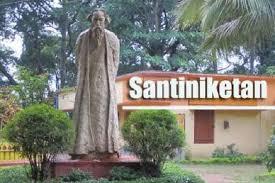
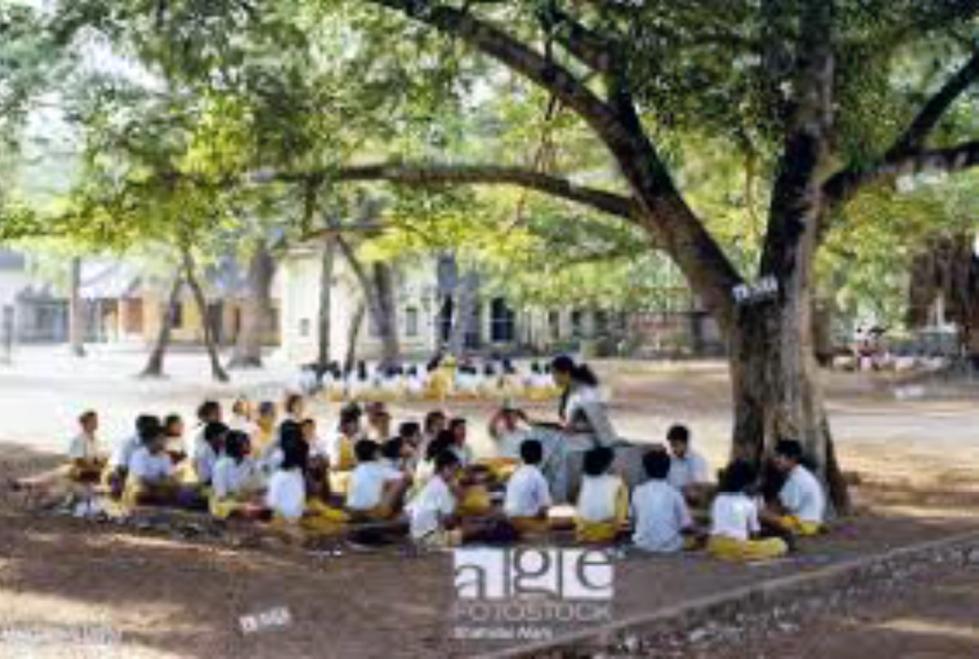
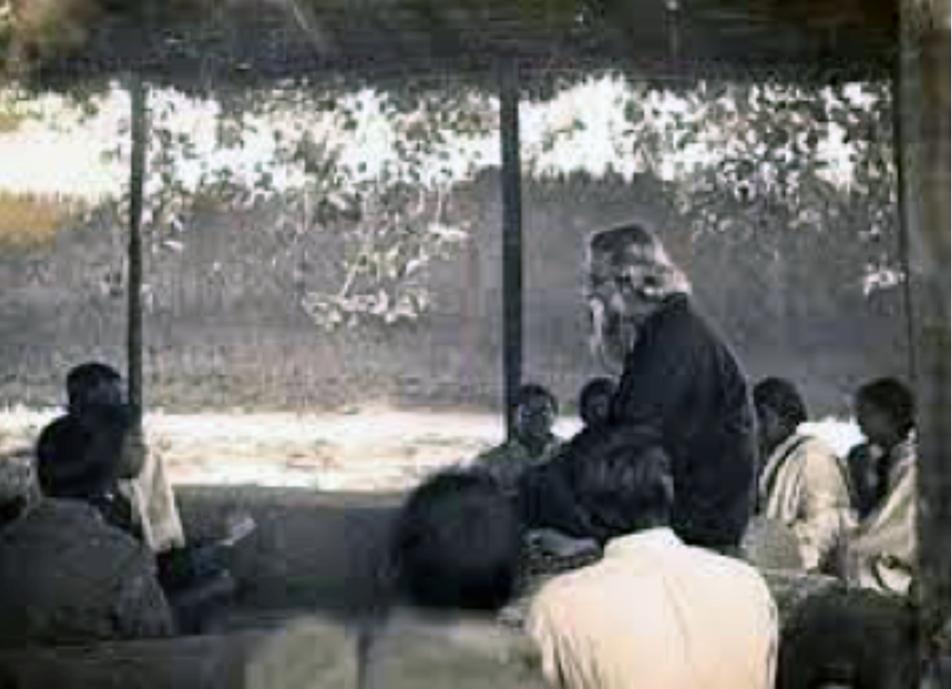
Debendranath was captivated by its beauty, with it’s pleasantly canopied chhatim trees and palm groves which offered shade in the red colored terrain. He renamed the area Santiniketan, because of the peace and serenity the area brought to his soul. He made a spiritual meditation center where people of all religions and castes could meditate. This is the neighborhood where Rabindranath built his school, Visva-Bharati, which means the “Communion of the world with India.” The lessons are a blend of the best Western and traditional Eastern teachings. Classes were mostly held in the open air, because Tagore believed that his students would feel free, even though they were still in a formal learning environment. He had himself dropped out of school because he could not focus while being confined within the four walls of a classroom. In Shantiniketan, students are allowed to run under and climb the chhatim trees during break time. They would then have scheduled classes in the same environment. Excursions in nature are a part of the curriculum. Students are also taught to pay special attention to natural phenomenon, and life cycles of birds, insects, and plants nearby. Class schedules are flexible and accommodated according to weather. Flexible schedules allow students and teachers alike to participate in several cultural programs held throughout the year amidst nature.
Tagore started the experimental school in December of 1901 with only five students, including his oldest son. The school was declared a Central university and an Institution of National importance in 1951, just 30 years after it was founded. The Institution has a number of famous alumni, such as the noted Filmmaker Satyajit Ray, former Indian Prime Minister Indira Gandhi, the great economist Dr. Amartya Sen, famous vocalists such as Kanika Banerjee and Suchitra Mitra, Giuseppe Tucci - the renowned Italian scholar of oriental cultures, Syed Mujtaba Ali- the famous author and academician -to name only a handful. Indira Gandhi - the first and only female Indian Prime Minister to date is known for her steel resolve and
willingness to eliminate poverty. Satyajit Ray, the renowned writer and filmmaker, an Oscar recipient was an alumnus of Kala Bhavan, the art section of Visva-Bharati. In Santiniketan, he developed an interest in Oriental art. What he learned at Visva-Bharati also inspired one of his documentary movies, The Inner Eye, based on the painter Benode Behari Mukherjee. Mukherjee, despite being blind, was a pioneer of Indian modern art, and had nurtured many notable alumni. One noteworthy trait that is common within these geniuses is - almost all had thought outside the box, played a pivotal role in specific spheres and immensely contributed to the society.
Creating a school that has evolved as an institution of national importance is obviously no ordinary task. Literature, Philosophy, Arts and Science are the prominent subjects at Visva-Bharati. Tagore’s teachings, songs, and poems have become prominent worldwide, giving meaningfulness to his school, and truly bringing in a communion of the world and India- an abode of peace.
Rabindranath Tagore’s contribution has not only created a niche in Indian History but in the History of the world, where he will be revered for centuries and beyond.
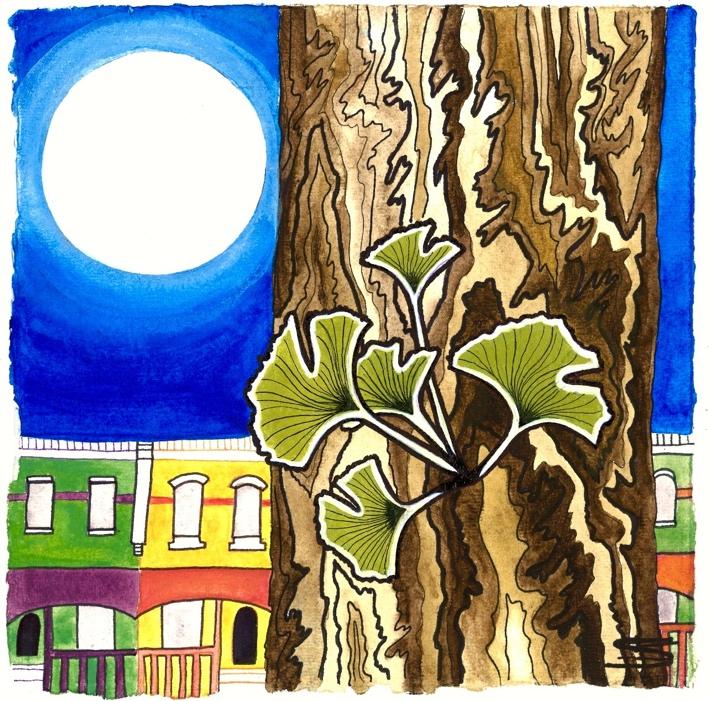
Drawing by Sophie Sarkar (Post Grad)
Do Video Games Cause Violence?
By Swayamshuvra Chakraborty (Age 16)
This idea of video games being the cause of violence is gaining quite a bit of traction in the media, of course in lieu of the morbid current events in America. My view on this matter might be quite biased. Violence has existed for centuries, way before the creation of video games. Even taking the past out of view, video games are most definitely not the cause of violence.
According to many research studies1 video games have no connection to violence. If you don’t believe me, put in a google search - I guarantee that the first 8 results at least will say the same. This idea is shared by the writers of “Violent Video Games and Aggression: Causal Relationship or Byproduct of Family Violence and Intrinsic Violence Motivation?”2. Two different studies, one linking the effects of violent videogames on overall aggression and the other highlighting other aspects like trait aggression, family violence, or even gender, concluded that “trait aggression, family violence, and male gender were predictive of violent crime, but exposure to violent games was not.”3. Human nature itself seems to be the cause of this violence; in addition, the means for committing such heinous acts are not only readily available, but are almost cheap. Furthermore, the Chinese video game industry is about $34.4 billion per year4, higher than America’s $31.54 billion per year5. China is ranked about 97th globally in gun violence and gun crime, and America is 1st, with about 18.8 times more6
The only argument I can think of that would even begin to logically refute the fact that video games do not cause violence would be the idea that constantly being around the violence from video games might normalize the violent behavior that is observed. Normalizing this observed violent behavior could cause a person to disregard human life, or suppress the appropriate response to the taking of a human life. Which is a negative, but I do think that most, if not all people, do realize that there is a difference between mindless killing while sitting in front of a screen, and seeing an actual human being damaged beyond repair, or even worse, outright dying.
I do not believe that video games cause violence, I believe that people are smarter than that. I will put the blame on something else, the fact that the weapons capable of causing this type of damage are readily available for almost anyone. I really hope that people will soon begin to realize and start to rectify the real problem at hand, instead of pinning the blame on video games.
Do you think the human race is thriving? We have mechanical paradises like self-driving cars, and thinking about space travel, however there is something in plain sight that many choose to disregard. The issue at hand now, is the fact that humans are overpopulating the Earth, and to a dangerous level. If we are not doing anything about it now, then it can spell out most likely demise of the human race. But no opposition could say, there is a lot of space that we still have uncovered that can be hospitable and well provided environment for humans to live in. That cannot be a reality given that we completely disregard the fact that there are other organisms on this Earth and we need them. we are taking their environment as much as we need them. So where does that bring us?
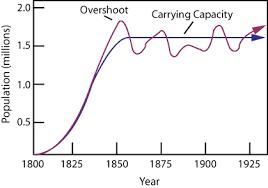
Well, it essentially means that soon, sooner than you think, we will be spread across the Earth like paint on an easel. Essentially, this is happening because our race exponentially grows throughout the Earth. Now, when I say “exponentially”, I mean to have no excessive comparison. We as a matter of fact, are growing exponentially. When a couple has kids, those kids will have even more kids and that chain will continue and continue until the environment or our Earth will be our downfall. This might be too big a map out in your mind, because it is. So, what happens when we reach a said limit? Well we will reach something that is called a 'carrying capacity'
A carrying capacity is the limit within a population which our environment can sustain. As of right now, we have approximately 7.6 billion people on Earth. The scary thing is, our estimated carrying capacity is around 10 billion so it might be calming to just think that for us to reach 2.4 billion more people would take a long time. Remember, our species grows exponentially, so we will grow much faster than you think. For example, in around the 1930s, statistically if you were 80 years old then you could see approximately 1 billion people coming into the Earth. But if you thought that was the end of the bad news there is a worse result from hitting our carrying capacity.
When we exceed our carrying capacity our population overshoots which results in our species dying in a dreadful speed. And when the environment can sustain our population again, our carrying capacity will be lower. People continue to disregard this fact because they believe that they won't be around to see our population collapse. Which is why we should be really concerned, as most of us are not. If you are concerned and want to know what we can do to stop this, I'm sorry but there is no avoiding it. Things like abortions, diseases, etc. are all things that can help reduce our growth, but you could essentially say that that's equivalent to killing your child. But I was never one to doubt the possibility of science. Be encouraged to find those ways to match the country components of science and humanities, and you might just save the human race itself.
How to Save Our Planet
By Anirudh Sarkar (Age 14)
The world undeniably has many problems worth fixing. However, one of them is more immediate than you think. Our environment is collapsing, and with it, other animals’ environments as well. We are ruining our planet as of right now. It is estimated that if we continue with our practices that increase pollution, our planet will be on the brink of collapse in nearly 12 years. Common belief is that our planet’s condition in climate will not reach its peak of urgency in their lifetime. According to many statistics, it is useless to think so. So, since the steps for the development towards a better planet need to be taken, this is how we do it.
But, do people really know how urgent it is? Most do not - no matter how many articles are published, no matter how many posters are put up on walls, no matter how many school lessons you get. So, let me tell you, how something as menial as toilet paper has come to the point where it is ruining us. America’s use of luxurious toilet paper is ruining the climate and taking a permanent toll on forests. Forests, especially the Boreal forest in Canada is being affected by it. The boreal forest covers nearly 60% of Canada and is home to over 600 indigenous communities. Big brands of toilet paper refuse to switch to environmentally healthy materials and are devastating the forests and climate. And Americans are to blame.
We make up 4 percent of the world’s population but are responsible for nearly 20% of the pollution on the earth. Methods cleaner would be what the Romans did. The Romans used a sponge on a stick and left it in vinegar. The Talmud used gravel. However, we luckily will not have to resort to vile measures. There are other, less popular alternatives. How do we know which ones? Well, we look on a scorecard system developed by officials to know which brand of toilet paper is good for us or not. The scorecard system rate brands that have the biggest environmental impact.
Most of the brands of quilted paper that score badly are brands lie Charmin Ultra Soft, Kirkland Signature, and Angel Soft all getting ‘F’ grades, given that they are little to no recyclable material. However, the brands that offer recycled paper, such as Seventh Generation and Natural Value, received an ‘A’ grade. Typically, people notice that the recycled materials are more commonly used in places away from home, such as offices and airports, where the competition for softness in toilet
paper is not so crucial. So, notice that the next time you encounter toilet paper at the departure gate, know you are saving the forests.
So now we know that something as menial as toilet paper is ruining us. Let’s fix it. The first step to even approach this environmental problem or any environmental problems for that matter, is to assess the situation. Assessment is when the information gathered relating to a said topic, helps to fully understand what is happening. In order to see it in a way that we can understand easily, a model must be constructed. To construct the said model of the ecosystem, we need to get data on the factors of the issue, and experiments must be conducted. The model will come into play to correctly analyze the effects and results of the experiments being performed. Also, it makes it possible to describe how the ecosystem will respond to the situation. After all that data is conclusively collected, it will be possible to make predictions on the future of the ecosystem once the method is in play.
The second step is one of the most difficult, but could potentially be one of the easiest, depending on situational factors. Using the collected information obtained by the scientific analysis, it is possible to predict the consequences of human intervention with the environment. Furthermore, it is essential to evaluate any negative effects associated with a certain course of action. These steps are essential because any action will have an equal and opposite reaction. What this essentially means is that any course of action will have results. The bigger the action, the more complex the potential results will be. And changing an aspect about our or any other animal’s environment can have a chain of results that is near impossible to track.
The third step is something we have, but in much short supply, reflecting on ignorant human actions: Public Education. Public education is really important, and everyone has been exposed to a decent amount of it. Be it only from school for a young adult, or a magazine you once read, public education is important. However, our state and condition on this Earth should bring much more attention through public education than what we are used to. This involves explaining actions available and explaining the probable costs and results of the different choices.
The fourth step is Political Action. The public through officials that the people elects, selects and implements the course of action derived from all the previous steps. What is really powerful about this step, is the fact it’s one of the most influential and effortless an individual can help against the environmental issues. They can be very influential at this stage by exercising their right to vote. This is powerful and shouldn’t be ignored by lazy people thinking they won’t have any part into changing the world. It’s disappointing some people don’t even want to.
My Crazy Career Choice
By Anirudh Sarkar (Age 14)
For what seemed like an eternity, I never knew what I wanted to pursue in life. That indeed might be the case for many kids of my age too when they are first asked the question. However, I idolized my parents as engineers, but I never found that to be compelling to me. I take what I like very seriously because whenever I contemplate my career choices, I always think about the future when I actually have it as my career since I want to love what I do. Furthermore, I’m well aware that a great amount of effort will be required for me to achieve what I envision myself to be, or even surmount that.
Through much doubt and self-reflection, I have chosen to pursue forensic (of or used in court of law) science. The outcome of the arguments between the men on my two shoulders, came out to be that I love helping people. I always have wanted to help people, regardless if they asked for it or not. Additionally, the state of our country recently has been filled with malicious criminals. Helping brave officers catch them in a major way would be a dream come true for me.
Career in forensic has many different paths - forensic medical, forensic engineering, forensic accounting, crime scene investigation (CSI), crime laboratory analyses, forensic toxicology, forensic veterinary, forensic odontology and many more but among all, I like to take up crime scene investigation for obvious reasons - it's thrilling and demands quick and deep thinking. I am passionate about science and this profession will allow me to use top-notch scientific techniques to solve real-life problems. Each path specializes in a particular area like forensic odontology can identify a victim by their dental records and looks for unique dental impressions of the victim. Forensic scientists collect physical evidence such as body fluids, fingerprints and take notice of the positioning of the evidence, location and catalog all information for further reference. In short, it's a multi-faceted role.
Being a CSI will allow me to help people, but more than that forensic practices of piecing together clues from the smallest places in crime scenes will be a huge challenge and yet thrilling at the same time. In my opinion, they are the backbone towards any investigation to collect essential information that can be extrapolated as evidence. From matching shell casings to the gun that fired them, to using hair samples to identify a suspect, forensic scientists help determine the facts of a legal case. Furthermore, the ways in which forensic scientists work is fascinating to me, given that they work with all sorts of advanced techniques including chemicals, biological and other interesting technology such as gel electrophoresis and computer simulation software. I’ve written an article on gel electrophoresis in detail, but essentially it allows people to match suspects with victims with DNA by moving them from left to right, using a negative charge. At the end of it, the ones that line up, are likely to be the same suspect and victim. These pieces of DNA move the same way because all of the DNA samples that forensic scientists collect contains a certain amount of base pairs (bp). To conceptualize this, one can correlate this to weight. The ones that have more “weight” or base pairs will move the same amount of distance.
In addition, forensic scientists are exposed to many situations that are very unpredictable so they have to be ready for all circumstances, but in most cases, criminals leave a pattern of traces that forensic scientists can use to their advantage. Essentially, when a crime happens, for example, a bank robbery, the criminals generally leaves behind traces of fibers. Fibers are basically remnants that people leave behind. For example, when someone drops their hair on a chair and it gets on their clothing. That clothing will soon touch other things. That potentially massive chain of locations of different fibers from different places is what is commonly used to put together as forensic evidence. So going back to the virtual bank robbery, something that belongs to the suspect and the criminal, will have to be shared from a fiber.
I dream of a day when I am carrying sophisticated instruments to crime scenes and collecting evidence invisible to bare eyes, analyzing it and being instrumental to resolving the complicated criminal cases, as that of a serial killer, and save many innocent lives.
The 50th Anniversary of the Moon Landing
By Shivan Mukherjee (Age 15)
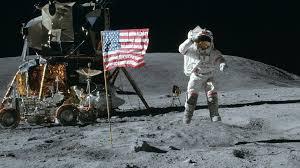
“One small step for man, one giant leap for mankind.” On July 20th 1969, the first man set foot on the moon. July 20th 2019 marks the 50th anniversary of this historic occasion. The astronauts, Commander Neil Armstrong, Lunar Module Pilot Edwin “Buzz” Aldrin, and Command Module Pilot Michael Collins were the pioneers of space exploration. The successful completion of a manned trip to the moon was a part of a National goal that was set by President John F. Kennedy. Although the entire trip lasted for only 8 days, its profound significance is never ending.
Around the time of the moon landing, America was engaged in the space race with the Soviet Union. After the Soviets launched Sputnik, it inspired not only fascination, but also fear. President Eisenhower responded to this perceived threat with the creation of NASA (National Aeronautics and Space Administration). He initiated Project Mercury, which had a goal of getting the first man into space. However, the Soviets beat the U.S. again and Yuri Gagarin became the first man in space. When John F. Kennedy came into office, he believed that it was in the best interest of the United States to advance in space exploration. As such, he was the primary proponent of the mission and was able to give NASA the funding that they required.
The Apollo 11, had 3 parts to it: a lunar module, a service module, and a command module. The lunar module was what Buzz Aldrin and Neil Armstrong used to descend and ascend from the surface of the moon. The service module was the device that supported the space craft with propulsion, electrical power, oxygen, and water. And the command module was where the cabin for the crew was held. The command module was also the only aspect of Apollo 11 that returned to Earth. Apollo 11 was launched from Cape Kennedy on July 16, 1969 into Earth’s orbit initially. After 3 hours, Apollo 11 had a second burst which launched the spacecraft into trans-lunar orbit. After this, Neil Armstrong and Buzz Aldrin both boarded the lunar module and were able to successfully descend and ascend from the surface of the moon. From this point, they returned to Earth in the command module where they ended up landing in the ocean only a few miles away from Hawaii.
To achieve all this took a massive amount of work behind the scenes. It took 400,000 people to put Apollo 11’s crew on the moon, including engineers, scientists, mechanics, and mathematicians that all worked tirelessly to achieve the historic feat. Unrecognized for many years were the “human computers” that worked in the background. These people crunched numbers and performed calculations that made the moonwalk possible. Most of them were female, and a large percentage of them were African American. And, it was through the work of not only the engineers, but all staff that the moon landing was possible to turn a dream into reality.
A Brief Narrative of Optical Tweezers
By Shivan Mukherjee (Age 15)
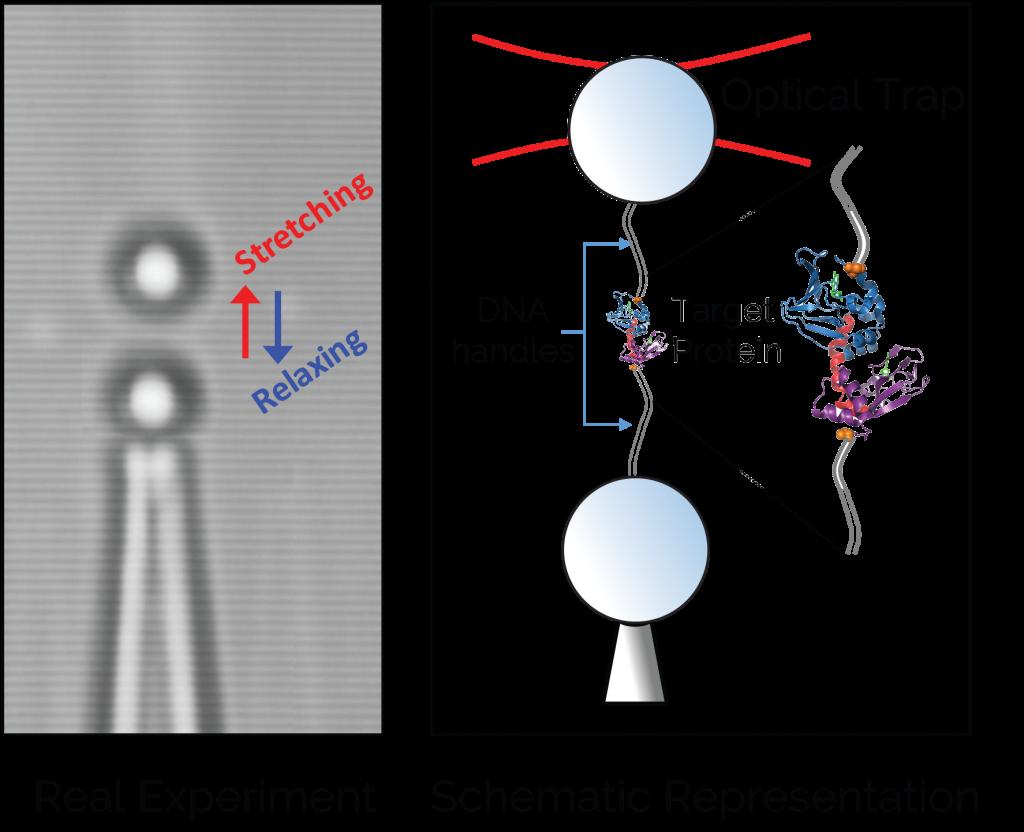
Recently the Nobel Prize for Physics was awarded to 3 individuals. These 3 individuals were Donna Strickland, Arthur Ashkin, and Gerard Morou. Half of this prize money was given to Arthur Ashkin who is now 96, for his work with optical tweezers and their application to biological systems. Optical tweezers are instruments that use light to manipulate things at a microscopic level. Askin developed the tweezers in 1986 in his work at Bell Labs in NJ. Since then the technology has advanced considerably and he was recognized for his work with the Nobel Prize. The other half of this prize was split between Gerard Morou and Donna Strickland for their method of generating high intensity ultrashort optical pulses (using lasers –Light Amplification by Stimulated Emission of Radiation). This is an important advancement in the science of optics. Although we understood how single atoms functioned and worked, we could only observe and manipulate them in groups. With optical tweezers, this can now be done with single atoms. Optical tweezers allow for the manipulation of atoms one by one. The use of a focused laser beam from a microscope produces radiation pressure that is able to trap particles as small as a single atom. It is known as an optical trap. Modern optical traps like the one that Ashkin has created are much more complex and can extensively modify commercial microscopes
What this allows for is the testing and proving of fundamental laws of physics. Optical tweezers have a great scope and future in experimental science and can help us understand atoms more than we could ever before. There is still much we don’t know about the universe and what it is made up of as well. While optical tweezers can trap things as small as the single atom it is also able to trap viruses, bacteria, living cells, organelles, small metal particles, and even strands of DNA. Living organisms can be kept alive which makes it all the more ground-breaking and it also keeps the machinery of life like DNA alive as well. The combination of optical tweezers and microscopy allows us to visualize individual molecules and apply forces at the same time that can reveal properties in a much greater detail.
The Identities that I Identify Myself with the Most
By: Parama Das (Age 20)
The three identities that I identify with the most are being an Indian-American, a woman, and a college student. I identify myself as an Indian-American because my parents are both from India and I was born here in the US. Even though I was raised here, I am very rooted in Indian culture although that was not always the case growing up. I grew up in a heavily white populated town and was the only Indian girl in my grade so instead of embracing the fact that I was different from my peers I wanted to be more like them. But as I started getting older, I became proud of who I was and my love for Indian culture continued to grow especially in today’s society where Indian culture is acknowledged more in mainstream media.
I embrace being a woman for it is a strong part of my identity even though when I was young, being a “girl” didn’t really make a difference to me. While growing up I was surrounded by boys and often played with them. As I grew up I realized that culturally, as a girl I was the one who was held responsible for what was going on in the house when my brother would not. It felt as if it was a woman’s duty to help out the family whereas while a man put in the minimal effort they were rewarded. I was exposed to these kinds of situations at a very early age with my brother.
Since school is my occupation and being a student is my priority, the last identity I identify myself with is to be a college student. It is nice to see that being a broke college student has become a relatable and mainstream identity that people can acknowledge. But as a millennial, sometimes I feel that people who are older do not take me seriously. I often see news articles that claim millennials have ruined a number of things, and it seems as though everyone puts millennials in a negative light. It got to the point where even adults speak to me in a way where they were surprised by my knowledge of a subject. And so, I feel that people forget that this generation’s youth are constantly aware and passionate of the issues surrounding them.
Mental Illness in South Asian Older Adults
By Parama Das (Age 20)
Over this past summer I had the pleasure of having an internship at the Institute of Health, Health Care Policy and Aging research at Rutgers. At the internship, I worked under researchers and worked on a project in which I conducted a literature review on the topic of mental illness in South Asian older adults. As a South Asian I was very interested in this topic because mental illness is a stigmatized topic and is under-researched especially in the elder population.
The older adult population is growing and as of 2017 the global population aged 60 years or over was 962 million which was more than twice as large as in 1980. In the future, the number of elders is expected to be double again by 2050 reaching 2.1 billion according to the United Nations. The American Psychiatric Association has said that older adults have been found to be at risk for numerous mental health problems due to the correlation with both cognitive and functional impairment. In general, older adults are less likely to receive or use mental health services. These mental health services tend to be structured around Western models which can serve as a barrier to ethnic populations. In addition, there are also cultural barriers that exist because people from this region don’t discuss personal, physical, or mental problems with anyone outside of their family.
There are numerous factors that are involved in mental illness in this population such as immigration, acculturation, stress, and social determinants. The stress that immigrants face include incorporating their host country’s culture with their own as well as acculturative stress and discrimination. Compared to Whites, South Asian elders are more likely to have a mental illness. Of those subjects that were reported, there was a higher percentage of females with mental illness compared to males. This could be due to many factors such as lack of support, education, domestic violence, and cultural beliefs. Due to cultural beliefs women are seen as care takers for the family and are overworked and underappreciated which can lead to poor mental health. The suicide rate for South Asian women was high in those who were over 65 years in age. Depression was a common psychiatric disorder that elder South Asians were diagnosed with followed by anxiety. Predictors of depression among this population include abuse and neglect, social isolation, and acculturative stress. Inter-generational differences especially in life events which resulted in stress which correlated with mental illness. A study showed that there was correlation between generation of grandparents and grandchildren in which adolescents’ depression was positively correlated with grandmother’s anxiety. The system of family care is seen as less reliable as children are not caring for their parents and as a result the parents experience fear of the future and dependence anxiety Social isolation determined by cultural or social factors is a predictor of depression and often is not treated. Aging adult South Asians also face barriers to health services such as cultural incapability. Among older patients and their doctors in this population, there was poor communication which was seen specially in ages over 75 years. Patients also had a hard time understanding the purpose of a service or what the service was and overall not knowledge about services.
The understanding of this issue in this population, will help to better understand and create interventions that will target the health needs of this population. In the future possible policy and interventions include having providers that are culturally competent and having interpreters and community members at these services. Family support plays an important role in preventing and coping with depression. For a number of South Asian older people of Hindu, Sikh and Muslim faith, ‘going to the temple’ represented a fundamental aspect of their lives. Visiting the temple, praying and meditating were considered to bring an enduring sense of peace and calm. On the whole,
more research needs to be done on this topic In order to meet the mental health needs of this population.
In about a month I will be approaching my final year in college. I vividly remember moving into my door room my first day of college and saying bye to my parents as I approached this new chapter in my life. College has been such a learning experience for me as I became more independent and started to venture into the world of adulthood. This was the first time where I was away from my parents and had to take care of myself. During this time period, I definitely grew as a person as more of my personality started to come out. When I was entering college, I did not know what to expect because it was so different from high school. But now as I am approaching my final year I know that I will miss my college days. People say that college is the best four years of your life - I don’t know if that is true yet, but I know college is definitely going to be the most memorable four years of my life. Surprisingly, I am anxious and slightly nervous for school to start even if I have already done this for three years. Senior year is when one has to start thinking about life after college which can be scary. As I see my older friends starting their jobs or furthering their education, I realize that soon that will be me. I will soon have to be real adult and not just a broke college student.
Throughout my college experience, I learned a lot academically from my professors. I became very familiar with all the libraries on campus as I have spent many nights as well as days studying for exams and writing papers. I have learned so much and actually have an interest in the classes that I chose to take. In regards to professors I realized that even sitting down and meeting with them once is very helpful so that you can learn more about the experiences that they went through. In college one has to take advantage of every opportunity that one can get which for me also includes any event that has free food.
I have made great friends throughout my time at college and have memories that will last a lifetime. I hope that the friendships that I made will continue for the rest of my life. What I have noticed is that not being on campus makes it very difficult to meet with friends. Everyone has their own schedules and lives in different areas so it is not like I can just swing by the room next door to see my friends. So, in my last year I know I will take advantage of the close proximity that I have with my friends and see them as much as I can.
Overall, I am anxious but excited to start my last year of college. I will try and make the most of my last year. I think that I know what to expect but in reality every day is a new learning experience. I hope my senior year will be successful and fulfilling, and I am excited to see what is in store for me after I graduate.
Life at Princeton University: brief insights into research, courses, extracurricular activities, and social life
By Ankush Rakhit (Post Grad)
Research
As part of the Bachelor of Arts program at Princeton a senior thesis is mandatory and considered to be the crowning achievement of your four years. Completing my senior thesis was one of the most challenging events in my life. Through my project for the neuroscience department I studied social influences on the plasticity of auditory command neurons.
My project involved conducting imaging experiments in fruit flies using a two-photon microscope to visualize activity in firing neurons. The dissection involved exposing the lateral junction of a Drosophila brain, an area that covers about 100µm2. Learning the dissection and recording activity took longer than 6 months, with an average of about 10 hours a week in lab.
Ultimately, I was able to successfully record socially-tuned auditory neurons that served as feature detectors. Collectively, the results from my study suggest social auditory exposure is not necessary to mediate auditory tuning on the level of the neuron or in behavioral responses. Rather, contrary to initial assumptions, auditory tuning may be more strongly influenced by cross-modal inputs from other sensory systems.
Courses
Although most of my courses were in the neuroscience department, one of the best courses I took at Princeton was my freshman seminar on entrepreneurship in medicine. My professor, John Danner, pushed us to develop an entire business from scratch for our final project including a prototype, a business plan, and future deployment plan. My team of three developed a tiny, wearable monitor that would replace the massive Holter monitors that are inconveniently used to measure heart arrhythmias. The project was a great introduction to courses at Princeton and entrepreneurship as it developed expectations for self-learning and interconnectedness with life outside of school.
In addition to neuroscience I also received a certificate from the Global Health and Health Policy Program. Similar to a minor, the certificate program involved a collection of courses that focused extensively on the progress of intergovernmental collaborations that have coalesced to address prevalent health problems in the last century. The history tells a story of a tumultuous battle between holistic, human rights-based approaches and cost-effective interventions that confine aid to limited and unsustainable tactics. For example, the eradication paradigm for malaria promotes the spread of a “Band-Aid” solution that presumes ending a disease can simply come through curative treatments that forsake cultural, infrastructural, and sociological differences between communities.
As a certificate student you are taught to be an advocate for humanistic, community-based approaches, and work on strategies that address the current implementation gap for holistic aid
efforts. Through my education I have studied the success of organizations that focus on community building and engaging locals in producing lasting good health in low-resource areas.
Extracurricular:
Club soccer was the first organization I joined at Princeton. From providing life-long friendships, mental and physical release, and instilling values of self-discipline and motivation, soccer has been integral to shaping the person I am today. I developed my first community on campus with the members of club soccer and it is the group I have spent the most consistent amount of time with across 4 years. I held three leadership positions, beginning with social chair my sophomore year, treasurer my junior year, and finally captain my senior year.
In addition to soccer, during my sophomore year, I along with four other classmates created an undergraduate network for the newly formed neuroscience major. Our mission for the organization was to bridge the divide between undergraduate students and research opportunities at the Princeton Neuroscience Institute (PNI). From personal experience and conversations with other underclassmen, I realized that many students were choosing projects without knowing the day-today activities that would be expected or without knowing the full range of projects available.
To fill up this gap in knowledge, I developed and advised the Research and Mentoring Committee, which aimed at providing students a better understanding of the expectations, responsibilities, and techniques involved in all of the labs in PNI. Specifically, we devised a ‘labmatch speed-dating’ event, a senior presentation event, and open office hours during course selection in order to improve underclassmen’s awareness of research and classes availability. I am proud of this organization not only because it has contributed to growing the number of neuroscience concentrators, but it has also allowed underclassman to take a more informed and active role in choosing their projects.
Lastly, I volunteered for Big Brothers and Big Sisters. On a bi-weekly basis I met with a middle school student from the Princeton area who was struggling to balance his work-load, friends, and soccer. As his situation was very analogous to mine growing up, I appreciated his struggles and was able to advise on how I personally managed similar challenges.
Social
For the most part, social life at Princeton is defined by the Eating Clubs that are located on Prospect Street. Membership to most of the eating clubs are open to all, while some require a 3day interviewing process known as ‘bicker’. While Eating Clubs mainly serve as the site where upperclassmen eat meals and spend downtime in between classes and studying, a few nights of the week each eating club opens up their doors for all of campus to enjoy.
In addition to eating clubs, there are a large host of student organizations, such as the infamous Triangle, Naacho, and Tigressions groups that put on shows ranging from Bollywood dance, improvisation, late night talk shows, theatre, and live music every Thursday through Sunday.
Growing up as an Indian American
By Rahul Rakhit (Post Grad)
Growing up, I felt that embracing my Indian heritage and living a ‘traditional’ American lifestyle were mutually exclusive. For that reason, as my parents tried to teach me about our heritage and our traditions, more often than not, I would push back because I was under the perception that being more Indian somehow made me less American. I would opt to speak English over Bengali at home and I would give my parents the biggest headache anytime they wanted me to put on traditional clothing. Even when I did dress up, I distinctly remember pairing my sherwanis with a pair of Air Jordan’s or some other pair of sneakers, partly as an act of defiance, but also partly to illustrate how ‘American’ I was. While it may seem a bit ridiculous now, at the time, I felt obligated to always wear some kind of badge that proved that I was American first and Indian second. Throughout my childhood, I felt that I constantly needed to prove my love and loyalty to the US in an effort to be accepted by those around me, because being born here didn’t always seem sufficient.
By living my life in that manner, I created a constant friction between my parents and myself. The unfortunate consequence of making those decisions was that I continuously sent my parents the message that I did not care for our family’s history or for the traditions that meant a lot to them. And while I can only now imagine how much I hurt my parents every time I closed myself off from the things that connected them to their home, I think they tolerated my choices because they had seen first-hand how difficult it can be for people in this country who are ‘different’, and I imagine they just hoped that I would come to embrace my heritage as I got older and they were right.
As I get older, I find myself becoming more aware of what it really means to be a secondgeneration immigrant and better understanding how the sacrifices my parents made to be here have afforded me the privileges that I have benefitted from all my life. I’ve also found that with a little patience and a willingness to educate those around me, I can proudly wear 2 badges, showing that I am just as American as anyone else, with the added benefit of also being very proudly Indian. But above all else, I find myself becoming increasingly aware of how my heritage has influenced the person I am today and of the responsibility I have to better understand our history and traditions to better inform who I may become in the future.
The American Dream and our Legacy
By: Tanya Roychowdhury (Post Grad)
There is a common misconception these days that immigrants and their children are a detriment to the American society. Let me tell you how immigration is paramount in this country, how it inspires the children of immigrants like myself and how we have chosen careers that have not only furthered the country, but have continued the legacy started by our forefathers. When my father first came to this country in 1977, he had no more than eight dollars in his pocket. A fresh graduate from a college in India with a Bachelor’s degree in Pharmaceutical Sciences, he made his way to a new world which he knew little about. Our nation was founded on the American Dream - by immigrants who were looking for an escape from religious persecution. Immigrants looking to find a place that supports freedom of thought and religion, a place that provides equal opportunities, and a country that embraces change for the better. It is this dream that allowed my father to succeed in providing a life for himself and our family. Both he and my mother paved the way for my sister and I to pursue our dreams and gave us the confidence to be fearless, which is why my sister and I are successful today.
As first generation Asian Americans, we have the opportunity to build upon the foundation our parents have set for us and build on our dreams. Had my father not uprooted his entire life and moved here, I would not have had the same opportunities and would not be in the same position as I am today. We are fortunate as first generation Asian Americans to be able to embrace our Bengali culture and pursue the American dream at the same time. This country provides a number of opportunities to those who wish to succeed.
Studying law was always a dream of mine from the first time I participated in a Model United Nations Conference in high school. It was the first time I truly became aware of human rights issues around the word and I quickly became aware of how beneficial it would be to pursue a law degree. However, refusing to give up on my passion for music, I pursued a double major in music and political science. Coming from a legacy of musicians in my family, I had always been encouraged to study music from an early age. I have a strong passion for music – for music allows us to communicate beyond the use of words. In college, I didn’t realize that the benefits of having pursued a Bachelors Degree in Music transcended beyond just singing and performing. The skills I learned from singing are invaluable and apply to my every day. At work, when I need to communicate with different stakeholders, I imagine I am leading a choir. Knowing when to pull the right voices in while softening others and when they’re in perfect harmony, the most beautiful sounds produced can reach and affect people both physically and emotionally without touching or speaking to them directly. Singing also gives me the confidence I need to present and communicate effectively with any audience.
Speaking of legacies, on a recent trip to discover my roots in India, I learned that my maternal great grandfather was a renowned lawyer under the British rule. In his role, he made significant contributions to family and matrimonial laws for Hindus and Muslims to enable them to coexist harmoniously. It was inspiring to discover that my great grandfather attempted to reform a system of disparity. Whether it is a coincidence or fate that I stumbled upon my great grandfathers’ narrative, I do not know. What I do know is that it served as an emotional re-affirmation about my decision to pursue a career that would allow me to make lasting contributions in a similar manner. With 2020 approaching around the corner – a century after my great grandfather published his narrative encouraging positive change and harmony, I see the similarities in the drive behind my own goals in life. I chose a career that allows me to effect positive change.
In my current role, I am the Deputy Regional Head of the Anti-Fraud, Bribery, and Corruption in the Americas at Deutsche Bank, a bank with a huge global footprint. There is news of bribery and corruption every day across the globe and almost all of us have encountered or heard of some type of fraud. In the late 1970s, President Nixon passed the Foreign Corrupt Practices Act (FCPA) in the United States (US). The Foreign Corrupt Practices Act (“FCPA”) was enacted in 1977 in the wake of the Watergate Scandal when Congress realized the need for anti-bribery legislation to protect the integrity of American business. In a review of 300 companies by US regulators, it became apparent that bribery was a necessity for companies to succeed globally. Noting that the US needed to restore integrity in American business, the Act was passed. The Act does not apply to US companies alone, but any company that has a nexus to the US. Therefore, due to the global reach of the Act, the US is able to protect American investors and ensure American businesses are able to compete on a fair playing field. Leading the way against corruption, the US set a precedent and therefore most countries have followed with the enactment of their own anti-bribery and corruption laws. It is of my strong opinion that the continuation of efforts globally to enforce antibribery and corruption laws will only benefit the world by helping to eliminate and prevent transnational bribery. I have always wanted to pursue a career that would give me the ability to impact change around the world – pursuing a career in Anti-Bribery and Corruption allows me to do just that.
In summary, I am able to pull on the legacies of my ancestors, my family, and most specifically the legacy of my parents – who have demonstrated to me what it takes to be successful and I am forever grateful for their sacrifices to give my sister and I the best opportunities possible. Today the focus is on preventing corruption in the banking industry – tomorrow is still being decided upon, but all I know is that my aim is to leave an everlasting impact on the world for the better. Everything that I have worked for this far, has led me to this point. Coming full circle, our country was founded by immigrants looking to find a better world for themselves and for those around them –the American Dream can be all of ours as long as we do not lose focus of our goals. I come from a legacy of people who changed the world for the better, fought against all odds, and acted as a moral compass to the society. I do believe that history repeats itself. In that respect, I wish to follow in the footsteps of my family and do the best I can to effect positive changes.