

Ananda Sangbad
Publication of Ananda Mandir, New Jersey
Ananda Mandir hosts India Utsav
The striking success of India Utsav hosted by Ananda Mandir in collaboration with PMG Publications from Kolkata, marked a new achievement on Ananda Mandir's char t of attained glories. In his brief thank you note to members and volunteers actively involved with the show, Ananda Mandir's president, Dipak Sarkar wrote –
“Our cultural event was a great success as we had about over 500 people joining our cultural event that featured very good cultural performances, several raffle winners, and we came out ahead of our expenses. So, we will also be able to put some money to the Ananda Mandir's construction project.” That was the goal behind organizing this s h o w, s a i d A s h o k R a k h i t , chairman of Ananda Mandir temple construction committee. And, chairman of the India Utsav committee, Surya Dutta said exuberantly “Guys, we have made it.”
A Grand and Successful Musical Show Reported by Sushmita Dutta
“ This was a collective effort of many volunteers who love Ananda Mandir.”, said Ashok Rakhit, and he went on “We planned and organized the event to give a kick-start in preparation of Ananda Mandir's building of a new cultural center Suryada and I shared the detailed logistics at the ground level. Then, we delegated various activities to different team leaders. Everyone's effort was important. It is the collective spirit and working together as a community that has delivered this joyous moment of success. I would like to convey my heart-felt thanks to everyone for their cooperation.”
The count-down for the grand evening began around 3:30 P.M., Saturday, December 1, 2012, when the performers and active members of the core committees began gathering at the
North Brunswick High School, auditorium to set the stage, lights and sounds. Vendors of clothing, jewelry and real estate from Kolkata were already at the premises with their displays in respective booths. Lovely snacks and beverages were well arranged in the dining hall across the auditorium and also, there was a special art exhibition of paintings of Jahar Rakhit, a renowned community artist, on the premises adding hues and colors to the glowing evening. The entire environment displayed a real “Utsav” (festive) mood with people filling the auditorium to almost its full capacity
Turn to page 04
Ananda Mandir Expansion – An update
Reported By Ashok Rakhit , Chair Construction Project

Shyama Puja
Satyanarayan Puja
Sahitya O Alochana
Ananda Sandhya
18, 8:00 pm (To be announced)
Ratanti Kali Puja
Friday, 08, 5:30 pm – 8:00 pm
Saraswati Puja
Friday 15, 8:30 am-11:30 am Saturday, 17, Bani-Bandana10:30 am – 11:30 am
Cultural Program 2:00 pm – 5:00 pm
Satyanarayan Puja
Sunday 24, 5:30 pm
Sahitya O Alochana
Ananda Sandhya
Friday, 22, 8:00 pm (To be announced)
Maha Shiva Ratri
Sunday, 10, 8:00 am – 9:00 pm
Shyama Puja
Monday, 11, 5:30 pm
Satyanarayan Puja
Dol Purnima
Sahitya O Alochana
Ananda Sandhya.
Sunday, 24, 5:30 pm Wednesday, 9:00 am – 12:30 pm Friday, 22, 8:00 pm Friday, 08, 8:00 pm
Shyama Puja
Tuesday, 09, 5:30 pm
Satyanarayan Puja
Sunday, 14, 10:00 am (To be announced)
Sahitya O Alochana
Ananda Sandhya
Friday, 12, 8:00 pm January February March April New Year's Day
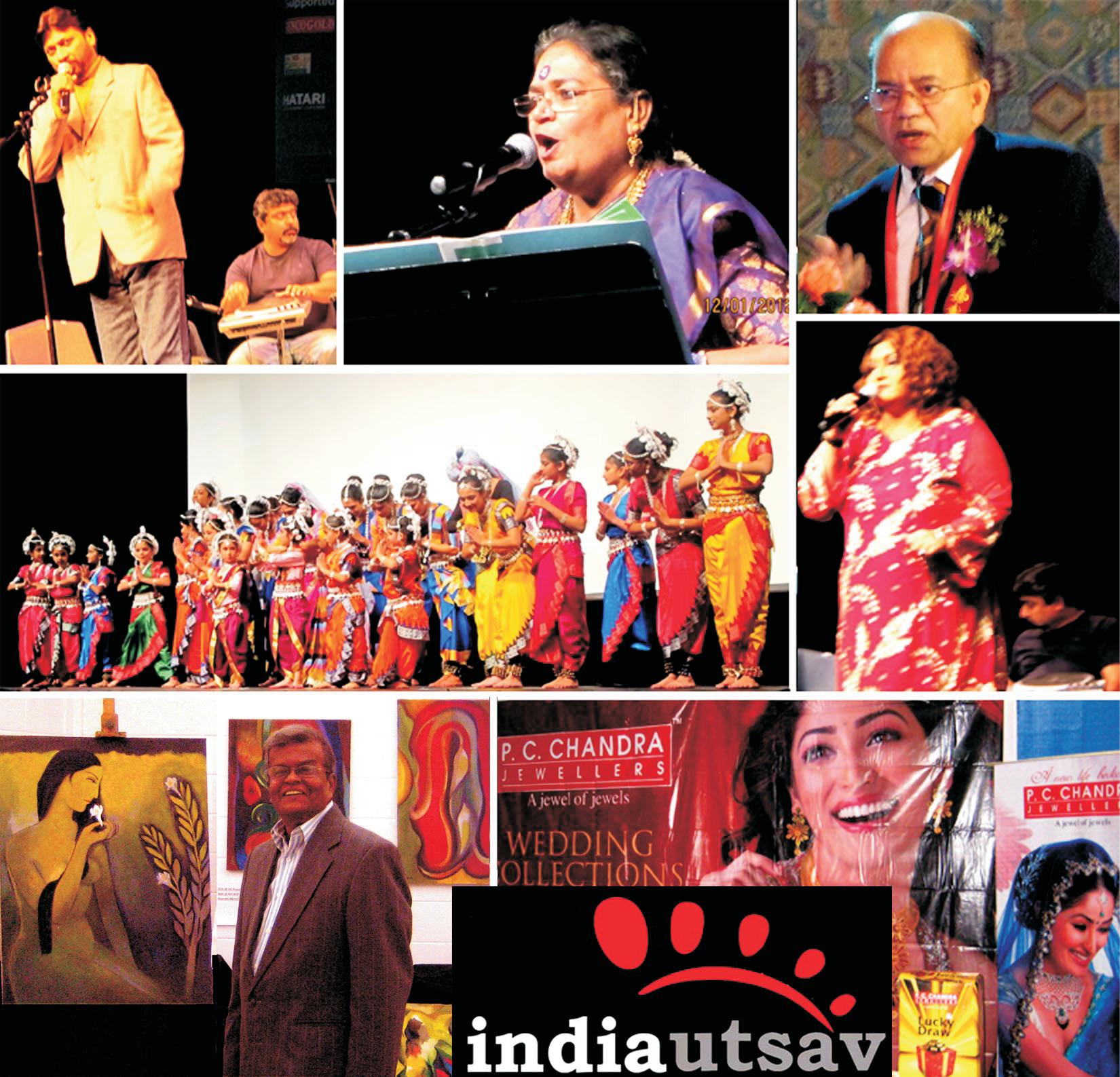
Pictures clock-wise from top left - Monomoy Bhattacharya, Usha Uthup. Ananda Mandir President - Dipak Sarkar, Rhythm of Dance and Music, Pop-singer - Jojo, Jahar Rakhit with his paintings and Vendor P.C. Chandra's stall.
Ananda Mandir Expansion
ANANDA SANGBAD
A Periodical Newsletter Published By
ANANDA MANDIR
(A Tax-Exempt, Non-Profit Organization)
269 Cedar Grove Lane Somerset, NJ 08873
E D I T O R I A L
Welcome to the readers of Ananda Sangbad with the best wishes for a happy and prosperous New Year. A great many things happened to our community during 2012, the most prominent of all being the new construction project to expand the facilities at Ananda Mandir Starting with our modest beginning in 2004, and buoyed by continued support from the community, we are ready to move forward.
Editorial Board:
Chairperson:
Pronoy Chatterjee, pkc_usa@yahoo.com
Assistant Chairperson: Debajyoti Chatterji, debsmee572@gmail.com
Editor-in-Chief:
Pronoy Chatterjee
Editor, Ananda Sangbad: Guru Chakravarty, guruchakravarty@yahoo.com
Editor, Anandalipi: Biman Bhatta, bkbnj8@gmail.com
Co-Editors:
Amitabha Bagchi, amitabhanj@gmail.com
Subrata Bhaumik, bhaumik.subrata@gmail.com
Jayashree Chatterjee, chatterjay@gmail.com
Debajyoti Chatterji, debsmee572@gmail.com
Sushmita Dutta, sushmitadutt@novel-ebiz.co
Members-at-large:
Bhaswati Bhadra
Santosh Mukherjee Ashok Rakhit
All queries, articles, news reports and letters should be directed to the Editor: Phone : 908-752-3065
E-mail: guruchakravarty@yahoo.com Or any co-editor For general information, please contact the following Executives of Ananda Mandir:
Dipak Sarkar President
Jaiprakash Biswas
Vice President
Suprasad Baidyaroy Vice President Chanu Das Treasurer
Suranjan Choudhury
Secretary
Chitra Mondal
Assistant Secretary
Ph: 732-873-9821 Website: www.anandamandir.org Designed & Printed by
Kolkata, West Bengal, India
The October-2012 issue of Ananda Sangbad was very late in reaching our readers, and although excuses can never replace the results, I need to offer some explanations for our lapse. The first and foremost reason is that the Puja season at Kolkata brings the regular work ethic to a grinding halt when the society as a whole drowns into a period of relaxation and enjoyment. So, a little delay in starting the wheel of work back to running is always expected in this season. But that is where we ran into some unexpected problems. Without bothering our readers with unnecessary details, I just want to say that whereas the papers were printed before the puja, the shipment of the printed papers from Kolkata was delayed after the puja, much beyond our expectation. The Publication Committee of Ananda Mandir will critically look into this area in the next few months and come up with better control.
The second item that I would like to bring out is the devastation caused by the killer storm Sandy, and its aftereffects.
A very large part of our community was severely affected, mainly by loss of power and the disruptions it brought to our lives. It is not the damage to the house or lack of lighting, but more
importantly, lack of heat and water was too unbearable to stay at home. But that is when a remarkable thing happened. There was an outpouring of friendly overtures by the less affected people to those who were severely affected. Many invited their friends to come and live in their houses for as long as the problems existed. That is the real purpose of building a close-knit community like Ananda Mandir We all come to this place because this gives us the opportunity to build a lasting relationship with like minded people. In this foreign land of our accepted new country, institutions like Ananda Mandir will stand tall in keeping us united and providing care in times of need.
Lastly, I would like to touch upon a happy event that just occurred last weekend. India Utsav - a grand musical show that was launched for the purpose of raising funds to support the new construction at Ananda Mandir - was held at North Brunswick High School on December 1, 2012. The show was sponsored by Ananda Mandir in collaboration with PMG group in India, featuring prominent performing artists from India - Monomoy Bhattacharya, Jojo and Usha Uthup who made sensational presentations entertaining all age groups attending the show It was a great example of many people from different groups working together to help build an institution like Ananda Mandir for our present and future generations.
Guru Chakravarty Editor, Ananda Sangbad
P R E S I D E N T ' S M E S S AG E
On behalf of the Board of Trustees of Ananda Mandir, I wish you and your family Happy Holidays and a Prosperous New Year!
I am pleased to write to give you an update of Ananda Mandir's milestone achievements this year This year, we have started our Temple Expansion and Community Hall Building project. We anticipate to complete building our new community center and expansion of our temple in two years.
We organized our fundraising event on September 23 and made it enjoyable and successful. We had more than 200 members and their families attending this event. We had beautiful weather, good food, and we collected about $280,000.
The India Utsav cultural program hosted by Ananda Mandir in collaboration with PMG Publications from Kolkata on December 1, 2012, featured top performers from India - Usha Uthup, Jojo and Monomoy Bhattacharya, and our local performers from Rhythms of Dance and Music. This cultural event was a great success as we had over 500 people join in the audience to enjoy very good cultural performances by distinguished artists. We came out ahead of our expenses, so, we will be able to put some money into the Ananda Mandir's construction project.
We continued to attract a large number of devotees in our temple during our Pujas. During the Durga Puja time, we had nearly a thousand devotees in one day During the Kali puja, we had over 500 devotees in one evening. We also organized Saraswati Puja, Shiva Puja and other religious events like Janmasthami in accordance with the Bengali panjika. We also held Satyanarayan Pujas on a monthly basis. For these Puja events as well, we have also drawn more devotees than ever
We have continued to bring in all the local musical talents for our monthly Ananda Sandhya events. The reputation of Ananda Sandhya has now spread widely, and we are attracting people from not only New Jersey but also from New York and Philadelphia Ananda Mandir presented Gayatri GaMarsh Memorial Award for Literary Excellence two years in a row This
literary award was competed for by a large number of applicants from all over this country and also from Canada and India. We continued the monthly literary discussions “Sahitya O Alochana,” which feature eminent Bengali writers as well as local authors. We have initiated “Seniors Forum” as an informal group where many seniors' issues are being discussed (e.g., retirement, life insurance, will, etc.). Classes on dance, music and Bengali language are continued to be held regularly at Ananda Mandir We continue to provide our members free of cost with two publications, Anandalipi and Ananda Sangbad. which contain many outstanding literary works of locals. Additionally, we have initiated a summer internship program for the youth this year-. We have given opportunity to four youths to work in research laboratories and at Ananda Mandir facilities. These youths conducted research at Rutgers University We also started a youth volunteering program. Please get in touch with me if your child wants to obtain volunteering credit by serving at Ananda Mandir We have also formed Youth Forum, which has about 25 members and is addressing many youth issues.
As you know, we are undertaking an ambitious project to construct a Community Center and to expand the existing temple. The budget for this expansion project exceeds four million dollars. Please donate generously to help our initiatives. Please consider becoming a life member by paying $1000 or a patron member by paying $5,000. Ananda Mandir is also run by volunteer help from our community We desperately need more volunteers. I request that if you have some time to spare, please come to Ananda Mandir and give us an extra hand to keep our organization running smoothly and staying healthy Please join me to make Ananda Mandir strong so that this organization continues to provide religious and cultural services to hundreds of Bengalis and friends of Bengalis in the tri-state area.
Dipak K. Sarkar President, Ananda Mandir
Continued from page 01
Ananda Mandir Expansion – An update
Reported By Ashok Rakhit : Chair, Construction Project
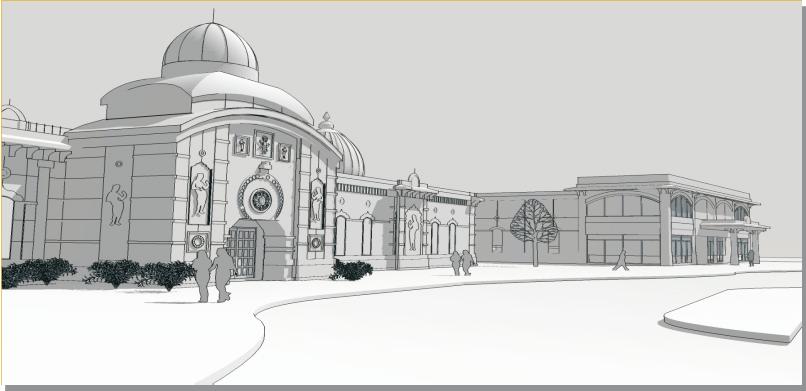
The months of October and November were busy times for most of us at Ananda Mandir celebrating Durga Puja and Kali Puja. Because of the ongoing construction, we had to make s p a ce fo r p a r k i n g o u t s i d e t h e construction fence. The site work was completed at a very short time to allow for parking of over 200 cars safely outside the fence of the construction area. We had over 500 people at any time during morning or evening hours of Durga Puja. Obviously, construction work had to be stopped intermittently during the puja times,
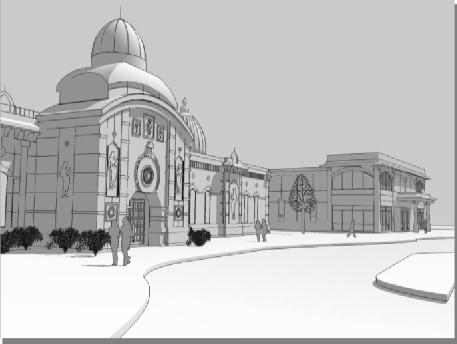
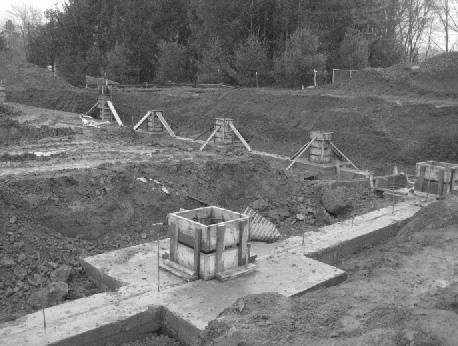
and that slowed down the progress of construction work somewhat during these two months. We also suffered from the effects of hurricane "Sandy" with power failure for several days. In spite of these obstacles, construction is moving ahead steadily We just poured concrete for the foundation of the Community Center building. If weather permits, we should complete the foundations for both buildings before the arrival of spring. We will continue to update as construction progresses in months ahead. Thank you for your continued support.
MAHALAYA – ANANDA PRABHAT
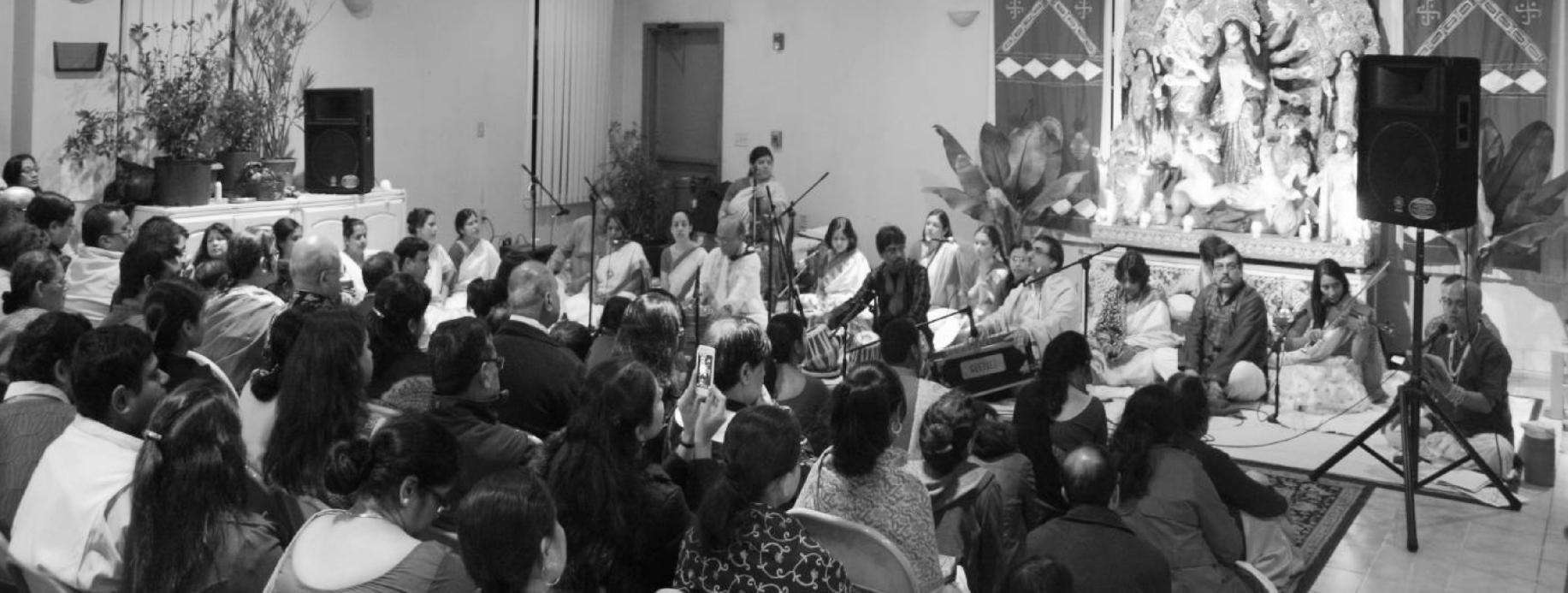
Mahalaya, also popularly known as "Ananda Prabhat" in Ananda Mandir th circles was celebrated on 14 October 2012 with the usual impressive way Early in the morning at 4:30 am, the prayer hall was filled to capacity with no room to spare. The microphones were already placed in front of the sitting performers. The musicians were tuning up their harmoniums, tablas and violins. The female singers were beautifully dressed in white saris with orange colored borders. The moortis of Mother Durga and her family were set in the back wall, ready to be welcomed to start off the puja season.
Promptly at 5 o'clock, Arun Bhowmik, the coordinating director of the entire show announced to the anxiously waiting crowd that everything was all set to start off this year's program. Amitabha Sengupta started a narration with a brief history of how this event, "Mahishasura Mardini", got started originally in 1930 by Birendra Krishna Bhadra and Bani Kumar, assembling the biggest stars of the time to perform for the All India Radio. Then the show started, following the original format, with a song, a little narration and a little Chandipath, in certain sequence. Each and every performer did his or her part superbly It was particularly appreciative to see Renee Dutta Rostad, a second generation young lady deliver her song beautifully The song "Taba achintya…. mahima", highly popularized by the legendary singer
Manabendra Mukhopadhyay, was sung by our own Patha Mukhopadhyay with no less elegance than the master himself. Biswajyoti's Bengali narration as well as the Sanskriit Chandipath left a deep feeling of flair and strength in our minds. Arindam Chakraborty was alone on tabla to support so many singers, and his untiring skill at this equipment was highly appreciated by all. The final commendation goes to the director Arun Bhowmik who has gathered this group of gifted people and bonded them together for this performance year after year, which is now regarded as the "signature" program of Ananda Mandir's cultural activities.
By the time the show ended, we were almost mesmerized by its beauty and the sanctity of the atmosphere, with Mother Durga waiting in the background flanked by her children to begin her journey from the heaven to our temple.
Here are the names of the participants:
Amitabha Sengupta, Arindam Chakraborty, Arun Bhowmik, Bhashwati Mallick , Biswajyoti Nayak (Bishwabhai), Kakali Sinha, Malika Bhowmik, Malini Ghosh, Manashi Bhowmik, Mitali Bhawmik, Partha Mukherjee, Renee Dutta Rostad, Shreya Bhanja Choudhury, Shyamal Sen, Sucharita Das, Sudipta Bhanja Choudhury, Suranjan Bhanja Choudhury, Susmita Biswas, and Zafar Billah
Announcement
Dear Members of Ananda Mandir,
As you all know by now, the cultural events presented by Ananda Mandir (musical shows during Kali Puja, Durga Puja, Live Mahalaya to name a few) have gained great popularity in our community of music lovers. One such routine event is the monthly event ANANDA SANDHYA, presented usually on second Friday evenings. This is the wonderful platform where our community musicians get a chance to showcase their talents.
Are you interested in doing an Ananda Sandhya program at Ananda Mandir as a solo artist, or presenting a group program? If you have attended any, you know that this is a 2 hour program of high quality. If you are “READY, WILLING AND ABLE”, please contact our cultural secretary Arun Bhowmik at arun.bhowmik@hamonusa.com, or call him at 908-672-1452 for details. We look forward to hearing from you.”
Ananda Mandir Expansion
Reported by Guru Chakravarty
MAHALAYA – ANANDA PRABHAT
My Encounter with the “Unknown Indian”
It was on a clear and crisp fall morning almost exactly forty years ago that a friend and I went to meet Mr Nirad C. Chaudhuri – the “Unknown Indian” of the Autobiography fame – at his temporary residence in an apartment of a high-rise lakefront building on the south side of Chicago.
I stepped into the apartment a starry-eyed acolyte of the author Before I left India, I had read the serialization of “The Continent of Circe” in a Calcutta newspaper and was blown away by Mr Chaudhuri's fervid imagination. He sought to explain many arcane Hindu customs and traditions – our reverence for rivers and cattle, for example – with reference to the Aryans' migration from Central Asia. Cattle, he reasoned, were brought to India from outside, and their survival was uncertain in the intense heat of the Indian plains. Cow worship was a clever means to ensure the survival of the species. Absent a competing theory, I accepted the author's premise and marveled at his mind's brilliance.
Later in the United States, I read “The Autobiography of an Unknown Indian” and was similarly overwhelmed by its scope and the author's erudition. I was particularly intrigued by Mr Chaudhuri's sweeping deconstruction of Indian history
By Amitabha Bagchi
He saw it as long periods of social decadence and cultural dreariness intermittently punctuated by extraordinary bursts of creativity in art and culture brought about by contact with foreign invaders – Aryans, Muslims and Europeans. I was skeptical of his persistent attempt to describe everything that we respect and value about India as being imported from outside (and possibly traceable to Europe). Nevertheless, and with evident pomposity, I wrote to my father that “the iconoclast in me reveled” in Mr Chaudhuri's assault on the glittering image of Mother India on a pedestal. My father replied tersely that my hero could construct grand theories but evinced “not a speck of self-criticism.”
Small wonder then that, given this background, I would be eager to meet Mr Chaudhuri when he came to the States to deliver a series of lectures at the invitation of the University of Chicago. I saw him a few times from a distance – a small, frail-looking man with jaunty steps walking the grounds of the university's campus in Hyde Park. But I had to depend on my friend to get an invitation to go visit him that morning.
Ananda Mandir hosts India Utsav
The show began with a welcome speech by Ananda Mandir's president Dipak Sarkar. He said, “Friends, welcome to India Utsav. We have arranged this fund raising event to support the upcoming construction of Ananda Mandir, with collaboration of PMG Publications from Kolkata who helped us to bring several celebrated artists from Kolkata. We will also have the opportunity to enjoy dance performance by our local talented dancers of Rhythm of Dance & Music - a school of dance run by Mitra Purkayastha.”
He elaborated on Ananda Mandir saying –“Ananda Mandir is a religious and cultural center serving the Bengali and Hindu communities. Because the need for the community is increasing, Ananda Mandir has undertaken a temple expansion and community hall building project. We anticipate completing building our new community center and the temple in about two years. At Ananda Mandir, we have many activities including daily religious services, major puja celebrations, monthly music programs, and many other heritage programs. We also provide grants and award for community service, we deliver Anandalipi (a literary magazine) and Ananda Sangbad (a quaterly news paper) to our members free of cost. Recently, we have given opportunity to four youth to work in research laboratories and at Ananda Mandir facilities. We have also formed Youth Forum, which is addressing many youth issues. I urge you to visit Ananda Mandir and become an active member of our growing organization.”
The lights dimmed down in the auditorium as the first performance of the evening –“Rhythms of Dance and Music” was about to begin. The spectacular dance program was well-choreographed and well-knit under a scripted plot on RadhaKrishna. The team had participating dancers from all age groups dressed in gorgeous costumes which added to the visual glamour of the show under colorful lighting effects. The director of the show, Mitra Purkayastha and the team received a huge round of applause as program host Arun Bhowmik introduced them to the audience. Mr Bhowmik then presented the first star performer of the evening, Monomoy Bhattacharya, a popular singer from Kolkata. A lean, young man with very charming looks and an extraordinarily gifted voice, Monomoy strode on to the stage with a team of live musicians.
Here is a brief account on Monomoy for Ananda Sangbad readers -
Monomoy Bhattachaya is one of the most talented and versatile singers of contemporary Bengali music. In a very short time, Monomoy, with his god-gifted voice and unique style of singing has made it to the top with release of his albums like “Moner Manush”, “Neel Dhrubo Tara”, “Din Bodoler Shopno” and the most recent one on Tagore's famous
"Chitrangada” where he has rendered his voice for the play's character Arjun. Monomoy warmed up the audience with an opening “Shyama Sangeet” offering his prayers to the Goddess of Ananda Mandir temple. He then enthralled the audience with many popular Bengali numbers including a Nazrul Geeti, Tagore song, Manna Dey's classic “Baje go Bina” and closed his performance with Hemanta Mukherjee's evergreen hit - “Shono kono ek din”, one of the best compositions (both lyric and tune) of the music maestro Salil Chowdhury. India Utsav was a thoughtfully planned, stream-lined program delivering a variety of entertainment. After Monomoy's performance, the backdrop of the stage glittered with names of top brands from Kolkata like P.C. Chandra Jewelers, EIILM, Senco Gold, Lord Group, Ruchi Realty, Bengal Ambuja, Bengal Shelter, Rupashree Jewelers, Decofur, JIS Group, Godrej, Skipper, East India Pharmaceuticals and Medica Super Specialty Hospital. Over audio/visual presentations, vendors' brands were endorsed with lucrative promotional offers. Audience participation was requested for raffles on gifts from Senco Gold and P.C. Chandra. Raffles were drawn on the stage where winners were rewarded with real gold ornaments.
At the close of vendor's presentations, EBC Radio's program director Kulraaj Anand walked on to the stage presenting a quick talk on Ananda Mandir activities and the organization's role in the community He then rolled-over to his
Reported by Sushmita Dutta
announcement to introduce the next star performer of the evening - Jojo.
Here is a brief account on Jojo for Ananda Sangbad readers – Jojo is a popular name in Kolkata, especially known for her 'pop songs,' which brought her on to the ladder of rising stars. She has sung for movies like “Rakta Charitra”, “Kya love story hain”, “Antarbas”, “Chander Bari” and “Yatra”. Jojo accompanied by live musicians, enchanted the audience with popular Hindi numbers like “Kaisi paheli zindegani”, “Ooh lala, Ooh lala”, “Sajda, tera sajda” from recent hit film “My name is Khan” and also filled the air with a medley of popular Bengali classics like “Tumi je amar, O go Tumi je amar”, “Tumi aar Ami” and R.D Burman, Asha Bhosle hit “Jete, Jete Pothe Holo Deri”.
On closing of Jojo's program, dinner break was announced. New Jersey's Chopstick restaurant had arranged both vegetarian and non-vegetarian dinner on premises at the dinning hall area. Food was good and very moderately priced. After the dinner break, Kulraaj Anand welcomed the audience back to the show and introduced the star performer of the evening, Usha Uthup for grand finale of the program.
Usha Uthup with her 43 years of singing career needs no introduction. Recently she won India's most prestigious Film Fare Award for her song “Darling” and she has multiple popular tracks to her credit both in Hindi and Bengali including the super, duper hit track “Kolkata, Kolkata, don't worry Kolkata.” Quite unexpectedly, Usha Uthup began her performance with popular western numbers like “I just called to say, I love you” written, composed and sung by Hollywood's star musician Stevie Wonder. The song was a smash hit all over the world in 1984 and even at this show got the audience tapping their feet, cheering and humming along with the singer Usha Uthup then took the audience by storm with her popular Hindi numbers like R.D Burman's compositions “Doston Se Pyaar Kiya”, “Dum Maro Dum” and Bappi Lahiri's all time hit “Hari Om Hari”. After two Bengali songs, “Didi go Didi” and “Bankura O Bankura”, she moved on with more recent Hindi film hits and got both young and adults dancing to the hit track "Why This Kolaveri, Kolaveri, Kolaveri Di " which is, in fact, a Tamil song composed on a very catchy South Indian folk rhythm. The song became an instant hit after its release over the Internet. Within a week of its official release on YouTube, there was a record of 3.5 million views and more than 1 million shares on Facebook. YouTube honored the video of this song with a “Gold Medal” for being the most popular track on Internet. Usha Uthup acknowledged the power of technology in today's music world.
Usha Uthup closed the program on a very appropriate number “Sare Jahan Se Achha” giving a touchy message to the world for peace. It brought tears to some eyes when audience lit-up their mobile lights to swing their hands in the slow rhythm of “Sa re Jahan Se Achha” gesturing to show light in support of world peace. It was a very touchy moment. Sitting in the audience, I felt a lot of respect and love for Usha Uthup and all those lovely musicians we have in India and around the globe, who are so talented that through their renderings they can touch hearts and deliver good human feelings irrespective of language, creed and color They are true musicians who simply overwhelm the audience. India Utsav audience was similarly moved by Usha Uthup's mesmerizing performance and cheered loud for the show to continue. But due to time constraints the show had to be ended over a loud round of applause and cheering of “Once more”, “Once more”…
It is pertinent to mention here that talking to the media, Usha Uthup said that she enjoyed performing for Ananda Mandir and the lovely audience she had at the India Utsav Thanks to her and all other performers. And, of course, a special thanks to the team members at Ananda Mandir for delivering such a wonderful evening, which will be remembered and cherished.
Ananda Sangbad 5
Highlights of Recent Puja Activities
The months of October and November are always busy times at Ananda Mandir, because they represent the height of the Puja Season.
Ananda Mandir celebrated the most eagerly awaited Bengali festivity of Durga Puja starting on October 20 and continuing through October 24 This was clearly the biggest Puja event of the year with upwards of 500 visitors at any time of the morning or evening hours on any Puja day As our readers know, the construction of the temple expansion and community center has begun, and that put on added strain on the puja organizers. We planned for the parking and the puja activities cautiously so as not to create any problem for our puja attendees. Even though Durga Puja was performed in the weekdays, I can gladly say that there was no shortage of attendees in any of the five days. Puja was mainly held during the mornings, and after Arati and Pushapanjali we served Prasad and Bhog everyday In the evenings after Stuti and Arati, dinner was served. We had Kumari Puja as a part of Asthomi Puja, when three little girls were worshipped as Mother Durga. Sondhi Puja was in the middle of night(after 12:00am) of Ashtomi. There were bhaktas (devotees) eagerly waiting to see this important Puja in the wee hours of the morning , and they all came back early next day to celebrate Nabami Puja They are ardently religious people who attend our Temple for each and every Puja at Ananda Mandir Puja Committee volunteers were at hand who were happy to look after the needs of attendees and to make them feel comfortable. In the evening of Bijoya Dashomi, we had a long line of people waiting to take part in Sindur Khela and that event was really enjoyable. There were a few Sari and jewelry stalls to compliment the Puja activities with fun, by giving opportunity to our lady friends to buy some of those. As the Durga Puja came to an end for this year, we are already looking forward to the next year's Puja.
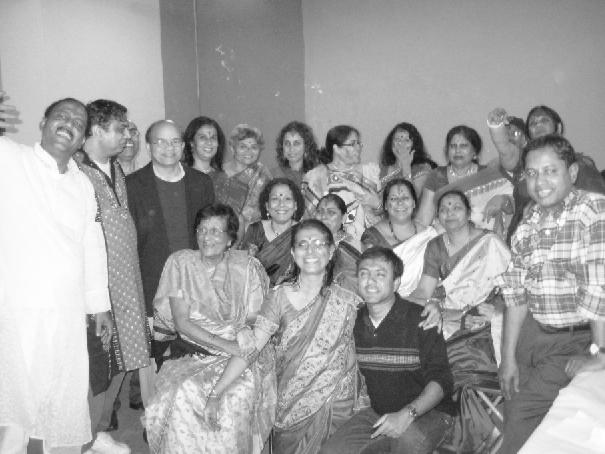
Reported By Krishna Dutta Roy : Chair, Puja Committee
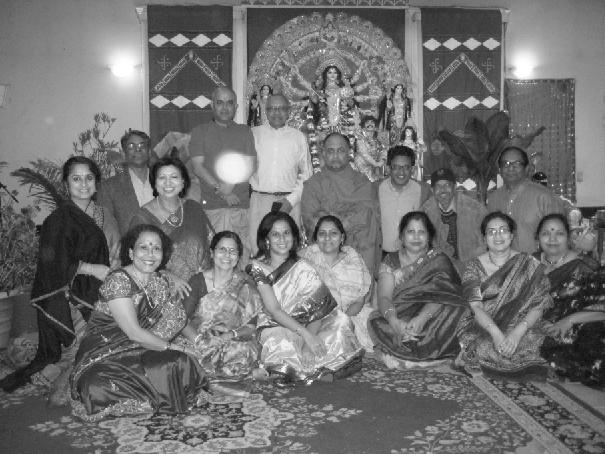
Kojagari Lakshmi Puja and Satyanarayan Puja were scheduled on t h 29 of October The d e v a s t a t i n g ly s t ro n g hurricane "Sandy" that crippled the whole state, put a damper on our Lakshmi Puja. So, the Puja was still performed on the Tithi, with a very small attendance We hope Mother Nature will be kind to us next year
The month of November kept us busy as usual. We had Maha Kali Puja on th Tuesday, 13 November It was a very cold night, but enough people showed up to worship Ma Kali. Puja started around 5:30pm, and the first batch of Puspanjali started around 8:30pm. Prasad, Bhog and dinner were served. Even on a cold night such as this, almost 500 devotees showed up.
It would be the right time to thank all the members and volunteers who worked hard:starting from making Puja arrangements to controlling the crowd, preparing food and serving it to people , managing parking area out in the cold, and those who braved the cold winter night to man the collection desk for hours. I offer my most sincere thanks to you all time and time again for making the Puja events so successful.
There were a few other events in this month – the Foundation Day th rd celebration on 14 November, Jagaddhatri Puja from 19th to 23 November, th monthly Satyanarayan Puja on 25 November Last but not the least, there was “Raas th Purnima” celebration on 29 of November.
Pujas planned for the month of December are: monthly Shyama Puja and th rd monthly Kali Puja on 12 Dec. and 23 December, respectively
DALMOOT
“You are not the child of the people you call mother and father, but their fellow-adventurer on a bright journey to understand the things that are.” Richard Bach
Like many in our Bengali community, my relationship with Dalmoot is complex. On a second thought, that is an understatement. For years, I kept a mixture of Dalmoot and Rice Crispies in a jar in my office drawers. Dalmoot is a spicy snack made up of fried peanuts, cashews, and tiny straws and balls of chickpea flours. It may contain any number of other goodies. Dalmoot is often a part of my emergency stash for days when I forget my lunch. I am not willing to admit how many times I forgot my lunch! Last Monday, my day was not going very well. Half a bowl of Dalmoot cured my blues. I feel terribly guilty, when my women friends from India complain that their husbands continue to munch on this delicious snack in spite of their sincere efforts to make their spouses eat healthy I never heard Indian men complaining about the Dalmoot addictions of their wives. That is good – it means that the scope of comparison for my Dalmoot addiction will remain restricted. To my women friends, please feel free to email me about your Dalmoot related issues. Who knows, we might start a Dalmootaholic Anonymous addiction support group? We may also have to coordinate our meetings with meetings of Surodhani, the music group or that of Unmeesh, the writing group.
I clearly remember the day my Dalmoot affliction started. In the early sixties, my father was transferred to Kolkata from his post in the city of Shillong, the idyllic place that would remain precious in my heart. In Kolkata, he was in charge of the Barobajar District office, smack in the middle of the extremely congested business center of Kolkata. The only redeeming thing about this place was local sweet shops. His commute to our home in Nagerbajar, another suburb of Kolkata, was long. He usually came home after dark. My brother and I waited for him eagerly, since it meant a short reprieve from homework under my mother's strict supervision. My wise mother made sure that we finished most of our homework before his return home.
One day, my father came home clutching his briefcase in one hand and a paper bag with small grease spots blooming at the bottom, in the other A wonderful aroma of tasty food fried in butter filled the hallway I took the paper bag made of newsprint before my brother could and peeked inside. There was a white cardboard
By Bakul Banerjee
box of sweets and a bundle of brown parchment paper Soon, both of us were examining the contents of the bag as my mother carefully poured the Dalmoot in a glass jar The delicate straws made of chickpea flour mixed with whole green lentils, all fried in pure butter and covered with tasty spices in North-Indian tradition glistened inside the jar Soon, my mother served us the sweet fudge squares made with Moong bean and decorated with silver foil, along with a portion of the Dalmoot. I tasted Dalmoot from many other stores before, but the taste of this Barobajar Dalmoot was simply sublime. I put few crumbs in the mouth of my two-year old sister I could not believe my eyes when she spat them out immediately making a disgusting face.
“Khub bhalo khete (It is very good)” I said, reaching out to touch my father's arm with my fingers covered with butter His lips curled up in a smile as he gave a knowing look toward my mother My mother gave him her kitchen towel to wipe away my greasy figure prints. Both my brother and I were in the process of adjusting to brand new schools in mid-year. The treat certainly lifted our spirits.
Throughout my childhood, my father introduced his children to new thoughts and unusual experiences to stir their senses. Much later, he never had a second thought about handing out a slim volume of Samuel Beckett's abstract play, “Waiting for Godot”, to his fifteen-year-old daughter who was studying mathematics. For three consecutive years, he correctly predicted which literary giants would win the Nobel Prize and shared his thoughts about them with me. Around the same time, all of us were undergoing some of the most tumultuous times of our lives. He encouraged his painfully shy daughter to work on watercolor painting, never hesitating to spend good money to buy expensive art supplies. Once, he bought two imported cakes of Winsor and Newton watercolors for me, a rarity in Kolkata at that time. They were exceptionally good quality watercolors. I still remember their names--Alizarin Crimson and Indigo Blue. The hue of Alizarin Crimson is essential for painting a glorious sunset. Creating a watercolor seascape without the Indigo Blue paint is a difficult task. Like seascapes and sunset I experienced during my travels, memories of my father are never far from my mind.
My father left this world fourteen long years ago. He lost his own parents at a very young age and grew up in a large joint family On this tranquil Father's Day, I remember that gentle person who urged me to go everywhere I had to go and do everything I wanted to do. I usually pack a bag of Dalmoot for my journeys.
DURGA PUJA – 2012 Pictures
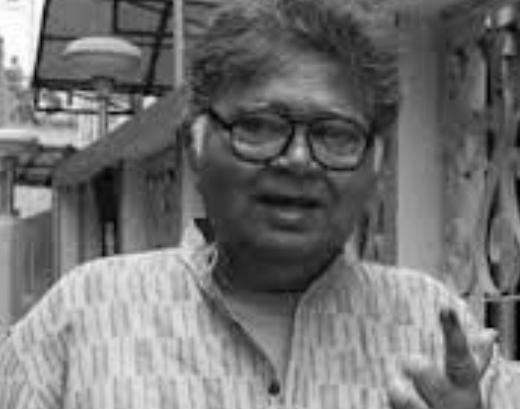
Sahitya O Alochana Pays Last Respects to Sunil Gangopadhyay
Reported by Subrata Bhaumik
S a h i t y a O
Alochana is a monthly l i t e r a r y a n d t o p i c a l discussion forum under the aegis of Ananda Mandir that endeavors to a c h i e v e i t s m o t t o “Alochana Brings Good Things to Mind.” It held several exciting sessions i n t h e S e p t e m b e r –November 2012 period. These included a follow u p o f t h e “ G i t a f o r Commuters” initially held i n M a
c h 2 0 1 2 , a commemorative session on famous Bengali poet Sunil Gangopadhyay, and one on “Rhythms and Rhymes” in Bengali poetry The Gita session was led by Gautam Goswami, while the Bengali poetry Rhythm session was led by Sudipta Bhawmik. The focus of this report is the special session in October that was held to commemorate the recently departed litterateur
Mr Gangopadhyay, one of the foremost Indian poets and novelists who almost dominated the Bengali literary scene for much of the last few decades, affectionately known as Sunilda to many of us, had a special connection with the Bengali community of New Jersey and the Northeast U.S. Over the years, he read at and presided over many literary discussions and seminars here; traveled and acted in plays with us; helped promote literary magazines, and finally enlightened and entertained us with his insights of human life and music (yes music) at numerous events and get-togethers organized in his honor
Due to the special bond that he enjoyed with the Bengali community in the New York/New Jersey area, this session was robustly attended despite the fact that it was organized only at the eleventh hour Diehard fans and longtime associates from near and afar attended the event to pay their last respects.
Some of the local writers, musicians, and literary enthusiasts joined established authors and long time associates of the litterateur to reminisce the fond memories of “Sunilda,” “Sunil Babu,” or simply “Sunil,” as they knew him. They remembered him for all the various roles that Mr. Gangopadhyay played in their respective lives: “the next door neighbor,” who effortlessly connected with the average person; the poet/novelist, who inspired countless literary minded people and budding writers; the friend who could light up any conversation, mundane or serious; and the pragmatist Turn to page 08
My Encounter with the “Unknown Indian”
Continued from page 04
Much to my dismay, our meeting started on an awkward note. The venerable gentleman seemed in no mood for a real conversation with two unknown young Bengalis. Instead he quickly launched on a lecture. “I can never live far from a body of water,” he averred, pointing through a large window at the vast expanse of Lake Michigan with a wide sweep of his hand. The tragedy of Indian Bengal, in his view, was the loss of the flood-prone, water-logged eastern part to Pakistan (now Bangladesh) at the time of Partition. Then he startled me with the statement: “All great short stories of Tagore are based on water.”
The image of Kadambini drowning in the family pond momentarily flashed through my mind. But it was immediately replaced by a counter-example; and the smart aleck in me could not resist the rejoinder, “What about Kabuliwallah?”
“You keep quiet!” said the gentleman sternly, and the acolyte in me got a rude jolt. I had grown up imagining that a quick repartee was the soul of wit, and here was my hero admonishing me for it. He reminded me then of my grand-father – who, I knew, was about the same age as Mr Chaudhuri – upbraiding his uppity grand-child. What horrors!
I kept quiet for a while, listening to the gentleman waxing nostalgic about his old home in Delhi, which was apparently protected by worshipful young men of the neighborhood. Then he launched on his art collection, especially paintings. He was proud of the way he could show off a Rembrandt bathed in the soft glow of a lamp mounted overhead for that very purpose. He was clearly basking in the glow of selfsatisfaction.
I tried to speak up at this point but found it hard to get in a word edgewise. True, I knew little of Western art when in India, but I had a decent exposure to it through friends who would take me to the Art Institute of Chicago. There I learnt to differentiate between Monet and Manet, and appreciate the charm of Renoir and the pointillism of Seurat. But Mr Chaudhuri was dismissive of the Art Institute, feeling perhaps that it couldn't hold a candle to the British Museum or the Louvre. He ignored my attempt at small talk on the interplay of light and shadow in Rembrandt. Frustrated, I blurted out that art collectors pay an exorbitant and unreasonable amount of money for paintings.
“Don't make a virtue of your poverty!” snapped the old man. I was stunned as well as wounded. I never anticipated and could hardly believe in the ferocity of his response.
For the next hour or so, I largely kept quiet as Mr. Chaudhuri declaimed on a variety of topics. I do not remember much, except for the comments about his sartorial preference. He apparently had his suits always tailored in England, most notably at Brooks Brothers. He did not think highly of the tailoring skill in America. My friend made a feeble protest that Brooks Brothers had a shop in Chicago too, but the gentleman was unpersuaded and unmoved in his views. I did not quite understand how tailoring ability could decline by a company's move across the Atlantic.
After about an hour, it was time for Mr Chaudhuri to get a suitable wine to go with the dessert his wife was making. I perked up at this thought, as I was lately exploring and getting a tad knowledgeable about wines. I promptly offered to give him a ride to the largest wine and liquor store I knew of in our part of Chicago.
On our way to the store, Mr.Chaudhuri gave us a lecture on the wine-making process and various other aspects of the vintner's trade. Finally he opined that he preferred French wines and did not much care for their California counterparts. With youthful audacity and matching indiscretion, I decided to challenge the logic of his preference.
“Why, the California grapes were brought from France for planting,” I began, trying to show off my (admittedly limited) knowledge. The names of California wines hark back to that origin – Pinot Noir, Chardonnay, and so forth. Mr Chaudhuri scoffed. “I have heard that said a million times,” he said, suggesting that he gave scant weight to my point.
Undeterred, I persisted some more. “Once, when blight destroyed much of the grape crop in France, the California varietals were re-transplanted in their country of origin.” I tried to look not too smug. Mr Chaudhuri grimaced disdainfully I could not figure out if he disbelieved my story or thought it wasn't worth a whole lot of beans.
Desperate to impress my one-time hero, I took a fateful plunge: “I too like French wine!”
“What kind?” the gentleman demanded, and I grew sweaty and nervous. My graduate student friends and I, steeped in genteel poverty, could really sample
By Amitabha Bagchi
the lower-cost and lower-rung French and Spanish reds. I didn't believe any of them would pass muster with the wizened gentleman traveling with me. I recalled a friend's father, a physician, once mention Medoc as a good name in French wine. That offered me an escape route. “Medoc,” I stammered. “Which Chateau?” The question was instant as my grilling continued. This time I felt hopelessly cornered. The no-name chateaus I was familiar with would only arouse Mr Chaudhuri's contempt. I was sure of that. There was one brand I knew that seemed a little better in class than the rest. So I took a chance. “Chateau La Tour!”
For reasons I did not understand then, the gentleman's face fell and he became quiet. I was, however, seething inside. I needed supreme self-control not to rough him up in the wine store, where he ended up buying a bottle of Sauterne.
Our remaining time together was less eventful. We were invited to taste Mrs. Chaudhuri's dessert and drink a glass of Sauterne (which was far too sweet for me). But before my friend and I left the apartment, we were treated to a final lecture-demonstration of winetasting – complete with stir, bouquet and aftertaste.
It was later that I learnt that I had inadvertently hit a home run with Mr Chaudhuri without even knowing it. When I said Chateau La Tour, my interlocutor thought I was referring to Medoc from the esteemed Chateau Latour, one of a handful of Premier Grand Cru Classe of Bordeaux vineyards. Truth be told, we were then not well-heeled enough to either know about the estate or buy and drink its produce. What I had in mind was Haut Medoc from the far lower-ranked Chateau La Tour (Carnet). Without realizing it, I had ascended several notches in Mr Chaudhuri's estimation.
When we were taking our leave, Mr Chaudhuri said with evident pride that he was maybe fifty years old when he first drank wine and maybe sixty years old when he had his first cellar (I cannot remember the exact years.) Wholly disillusioned by now, I stared at my hero in utter disbelief. I could see that the difference between us – two middle-class Bengalis domiciled in the West –was a matter of only a few years. I had left India at a younger age, and could make a similar statement to Mr Chaudhuri's, but with some twenty-five years lopped off from the specific ages mentioned by him. And attaining those “markers” in life meant absolutely nothing to me. I was deeply saddened by the fall of my hero, but cannot say that the “the iconoclast in me reveled” as his once lofty image lay in a shambles.
Sunil Gangopadhyay
Seniors Information Sourcebook
Inherited IRAs: What, Why & How
January 2013
Ananda Sangbad 7
By Debajyoti Chatterji
(Editor's Note: Ananda Mandir Seniors Forum is developing an “Information Sourcebook” for use by the elder members of the community. This article is from that Sourcebook. Please note that this article is only intended to provide useful information, not professional advice.)
Most of us know how Traditional (or Regular) IRA, Roth IRA and 401K plans work, and virtually all of us have saved some money in one or more of these plans to fund a part of our retirement. Some of the retired seniors in our community may even have started tapping into their IRA accounts either because they need the money now or because of “required minimum distribution (RMD)” rules imposed by the IRS. However, few of us have examined the following questions in depth: What will happen to the funds left unused in my IRA accounts when I die? Should I do something now to make sure that my heirs get the maximum benefits of inheriting my IRA money? To answer these questions to your satisfaction and to reflect your specific situation, you should consult a qualified financial advisor. Here I will try to alert you to some of the complex issues that you need to think about now so that your heirs may be able to stretch the benefits of inheriting your IRA over many years.
Before I delve into these complex issues, I should remind the readers of some of the critical differences between a Regular IRA and a Roth IRA. To simplify the discussion, I am assuming that if you had a 401K account with your previous employer, you have transferred (or will transfer) your 401K money into a “Rollover Regular IRA” account.
The first important difference between the two types of IRA: When you make a contribution to a Regular IRA account of, say $5000, you can deduct that amount from your “adjusted gross income” for that tax year – and you do not have to pay any tax on that $5000 of income. That $5000 grows in a “tax-deferred” manner over the years in your “Regular IRA Account” to say $9,000, until you start tapping into that $9,000. When you do so, you pay regular income taxes (Federal and State) on any amount you withdraw from that $9,000 account. On the other hand, if you make a $5000 contribution in a tax year to a Roth IRA account, you cannot take any deduction (and thus reduce the amount of income tax you owe that year) but that $5000 grows in a “tax exempt” manner forever So, if that amount grows to $9,000 when you decide to take some money from the account, you will owe no income taxes on the amount you take out. Thus the $4000 increase in your $5000 contribution will come to you in a tax-free manner Basically, you enjoy an income tax benefit at the beginning with Regular IRA whereas you get the income tax advantage at retirement with Roth IRA contributions.
The second important difference: For Regular IRA accounts, you must start taking the “required minimum distribution” per IRS regulations when you reach the age of 70-1/2 whether you need the money or not. For Roth IRA accounts, you don't have to take any money out from your account at any age until and unless you want to. And as mentioned above, when you take some money out of your Roth IRA account, you don't have to pay any income taxes at all.
There are many restrictions and limitations on Regular IRA and Roth IRA contributions and withdrawals but I must skip those to get back to my original questions regarding “inherited IRAs”.
Basically, beneficiaries of Regular IRA accounts may face significant income taxes and estate taxes when they inherit IRA money On the other hand, beneficiaries of Roth IRA accounts may face estate taxes when they inherit the money but they will not have to pay any income taxes. Unfortunately what a beneficiary can do – in either case -- to reduce tax burdens and stretch benefits of tax-deferment (for Regular IRA accounts) or tax-exemption (for Roth IRA accounts) until his/her retirement – depends on what you, the IRA account owner, do or don't do before you die!
Here is a check-list of what you should do now to make sure that you give the greatest flexibility (and tax savings potential) to the future heirs for your Regular IRA assets:
(1) Remember that the most critical document for you, the IRA account holder, is the Beneficiary Designation Form you complete and file with your IRA custodian (i.e., the financial institution where the account is being held) Your Will or Living Trust documents do not control what happens to your IRA money when you die! IRA owners often make the mistake of not designating a beneficiary or not updating the form after a beneficiary passes away Another common mistake is the heirs' misplacing or not being able to find the designation form. They have to depend on the custodian to have a current copy Custodians don't always have a copy, especially if it was filed many years ago or the original firm has merged one or more times with other firms. Keep copies of your beneficiary designation forms in a file that is easy to find (may be clipped to your Will?), and keep the designations up to date. Let your executor and heirs know where the forms are. If the designation form cannot be found, the rules of the custodian firm may prevail, and that may not to be to the best advantage of your heirs. In most cases, naming your estate or trust as the beneficiary is not a good idea (for reasons, consult a qualified advisor).
(
2) When the beneficiaries of your IRA learn that they will receive funds from your IRA, they should not rush to get their hands on the money Instead they should first learn exactly what rules apply to the particular IRA involved. For inherited IRAs, the funds must be transferred directly from the deceased's custodian institution to the heir's custodian institution (“trustee-to-trustee transfer” is the official term for this process) – and must not be received by the heir concerned in the form of a lump-sum check in his/her name. If you (say John Smith) die and your IRA goes to your son (say Bill Smith), Bill Smith should then ask his custodian institution to “title” the inherited IRA as follows: “John Smith, deceased, inherited IRA for the benefit of Bill Smith, beneficiary”. Bill should not roll over the inherited IRA into any IRA he may have established with his own funds. The titling action will allow Bill to defer withdrawal from this account until he reaches the age of 70-1/2 and thus enjoy the benefits of tax deferral for many years. (For inherited Roth IRA accounts, the IRS rules are different, so consult a qualified financial planner or estate attorney).
(3) If the heir for your Regular IRA is your wife (and she is younger than you when you die), she can roll over the money into her own IRA and postpone distributions from that IRA until she turns 70-1/2 and enjoy benefits of tax deferral for some years. There is another option available to her: she can establish a new IRA in her name with a new required minimum distribution schedule based on her own age. She can also name new beneficiaries for this new IRA if she wishes Complications can arise if your wife is under age 59-1/2, and a knowledgeable financial advisor should be consulted in that case.
(4) You should attach a copy of your Beneficiary Designation Form (and a copy of your recent IRA account statement) to your Will and keep these documents in a safe place where your heirs can find them easily Leave a note to tell them that they should consult a financial advisor before doing anything with the IRA (and 401K) account. Also attach a note for your spouse, telling him/her that he/she has several options, and the consequences can be very different. Ensure that a good advisor is available to your spouse or leave some suggestions and guidelines for the spouse to follow
(5) So far we have discussed what your IRA (or 401K) heirs should do to minimize immediate income tax hits by continuing tax-deferment for years through carefully planned actions. We have not discussed the issue of estate tax payments which also come into play when your heirs inherit your IRA (or 401K) account. However, if your total estate including the IRA amount is below the Federal estate tax threshold, then this does not become an issue. If you have a large IRA and your total estate exceeds the Federal threshold, you definitely need to consult a good financial advisor now and plan your actions carefully
January 2013
Do Plants Need Companions?
To answer your first and most obvious question, no, I don't mean human companions but other plants as companions. But like people, plants have distinct likes and dislikes when it comes to other plants. Some plants benefit from being in the company of certain plants and have distinct dislikes for others.
Many of us look at plants and simply see something that grows and provides us with food or flowers or beautiful foliage. We seldom think of them as “beings,” which require or desire other plants to be close or even locked in a loving embrace. This might seem to be a poetic or even a bizarre observation but is true in scientific fact.
The concept of companion planting is not new At least a thousand years ago in China, a type of fern (the mosquito fern) was used as a companion plant for rice. It was used for two reasons: a bacterium that it hosts (cyanobacterium) fixes nitrogen from the air (which is required by rice for optimal growth) and when planted after the rice is tall enough to stick out of the water, it blocks out light preventing other plants (or weeds) from competing for space and nutrients.
Companion planting was practiced in various forms by Native American Indians hundreds of years before the arrival of Europeans. In fact, when the European settlers arrived, the reason that many of them survived those lean few years in the beginning was due the indigenous peoples teaching the new comers the art of what was to become known as the Three Sisters Technique This consisted of planting maize (the indigenous corn) and pole beans together The cornstalk served as a trellis for the bean vines to wrap around and climb, while the beans fixed nitrogen promoting the corn's growth. Planting squash between the corn stalks helped keep down weeds by shading the area with their large leaves (and the squash benefited from the extra nitrogen). With these three plants, the basic diet of the new settlers was set as well as forming the basic foundation for the food stuffs that are fundamental parts of our diets today
Farmers throughout the past few centuries have by simple observation found that there are many combinations of plantings that work and some that do not. The following are useful in pest control: Catnip keeps away flea beetles, aphids, Japanese beetles, squash bugs and ants. Sunflowers are magnets for aphids and can be used to draw them away from other plants. Petunias repel a broad range of pests including leafhoppers, most varieties of aphids and tomato worms. And if you have a problem with rabbits, they hate Mexican Marigolds.
Since there are many flowers and vegetables that can act as “chemical barriers”, it makes sense to plant an “edible garden” by mixing ornamentals (flowers) with edible plants. I wouldn't advise planting the veggies in the ground since many are fussy and difficult to grow I mix them in with my flowers in pots that are at least 20 inches in diameter so that if one or more do not do well they can be quickly replaced with something already potted and more appropriate Remember that many herbs do well in this type of setting and have pest repelling qualities. Typical herbs filling this function such as mint, coriander, rosemary, thyme and oregano are normally found in many gardens. But not all herbs do well with certain plants. Cucumbers will not grow well with most aromatic herbs. In my experience, there are a few quick fixes for common problems. A case in point is zucchini. I always had problems with squash vine borers. The plants would grow rapidly and start producing zucchini only to wither and die. An inspection of the vine would turn up one or more vine borers. After that I would plant both radishes and nasturtiums around them. Problem solved.
By Jerry GaMarsh
Listing all of the compatible companion plantings could fill a book. In fact, there are many books on the market covering this subject. The most fertile hunting ground for this type of information is the internet.
The following are a few of the companion plantings I have found useful.
Bush beans like cucumbers and strawberries but dislike onions and garlic.
Cabbage and any cole crops of the Genus Brassica (cauliflower, brusselsprouts et al) do well with all herbs, spinach, leeks and tomatoes but do not like strawberries or pole beans. Remember that in the case of crops in the Genus Brassica, ground born diseases are a serious problem and crops must be fastidiously rotated. A minimum of three years between rotations is necessary
Carrots will prosper in the presence of peas (in the pot as well as in the ground) aromatic herbs, beans, tomatoes and lettuce. Do not plant carrots with dill and be on the lookout for that common roadside flower Queen Anne's lace; both will disrupt the carrots growth. Some of the veggies I grow every year are (of course) peppers of many different varieties most of which are hot. These standbys in the kitchen have very few (if any) growing problems but do especially well with marigolds, cosmos and herbs such as fennel and basil.
Be back shortly: have a hurricane to deal with and the lights are flickering.
After a slight pause due to hurricane Sandy (9 days without power actually) I'm back.
And to wrap up this segment may I recommend a few flowers for your house this winter? Not potted flowers but forced bulbs. Many of the bulbs that can be forced come with a small problem. They require weeks of refrigeration before forcing into bloom. There is one of the so called “paper whites” (Narcissus papyraceus,) that is popular for winter forcing and unlike other narcissus, paper whites don't require a chilling period. Forcing the bulbs to flower is easily accomplished by following the directions below The fragrant flowers bloom within about 3 weeks of planting.
Select a container that is about 3 - 4 inches deep and that has no drainage holes.
Spread an inch or two of stones, marbles or gravel, along the bottom of the container
Position the paper white bulbs, pointed end up, on top of the stone layer Pack the bulbs tightly in the container so that the bulbs will stay firmly in place. Not only will they look better in a large group, the tight fit will help keep them from toppling over as the flower stalks grow
Add another layer of stones to fill in any gaps covering the bulbs three quarters of the way up so that pointed tips are still showing.
Add water so that the level just reaches the base of the bulbs. Allowing the bottom of the bulb to sit in water will stimulate growth. Covering the entire bulb with water could cause it to rot.
The bulbs don't need light at this point and they prefer to be kept on the cool side, at about 65 degrees F (18 degrees C.)
Check your bulbs daily to see if they need more water
When you see roots developing, move the container to a sunny window The sunnier the better, but try not to let them get too warm or they'll grow leggy
Once the plants flower, they will last longer if moved out of direct sunlight, to a cool spot with indirect or diffused light.
Setting up sets of containers at one or two week intervals will assure you of a steady supply of flowers through the winter months.
Until the next time, happy gardening!
Sunil Gangopadhyay
Reported by Subrata Bhaumik
Continued from page 06
who had a passionate love for life.
Participants read his poems, discussed his novels, presented musical renditions of his poetries, and shared stories of his life. Alolika Mukherjee's recalled him as a friend, an inspiration, and a poetic idol; Nupur Lahiri's shared a voluminous collage of photographs capturing the moments and moods of her interactions with him over many years, recounting Mr. Gangopadhyay as a poet, philosopher, and a friend; and Minakhsi Datta (daughter of the famous Bengali poet Buddhdeb Bose) and her husband Jyotirmoy Datta (an established Indian writer) shared memories of the early days of their decades-long friendship with the him. Alolika Mukherjee and Nupur Lahiri also noted the debatable and gradual transformation of the poet, the strongly vocal atheist that he was, into a believer of a “supreme being.”
Other attendees also read his poems, essays and magazine articles written about him. Anirban Bhattacharya read a famous poem by the poet - “Amar Bhalobasar Jonmo Hoi Na Mrityu Hoi Na” - and a eulogy from Anandabazar entitled “Tomar Sathe Praner Khela” that summarized Mr Gangopadhaya's enormous contributions to Bengali literature and the influence of his pen names and characters (Nillohit, Sanatan Pathak, Neera, etc.) that helped define, so to speak, the thinking and the outlook of generations of Bengali youth. Bhaswati Bhadra read two articles: one by a famous Bengali poet, late Ms Mallika Sengupta, which recounted the inspirational role Mr Gangopadhaya played in her life and works, and the other by Swati Gangopadhyay, the poet's wife, in which she pined for him and longed to pair with him in the next incarnation in marked contrast to his much celebrated atheistic views. Amitabha Sengupta and Roma Das read articles on him and or recited poetries, while Subrata Bhaumik read “Keu Katha Rakheni,” one of his famous poems. Mr Gangopadhyay's love for music was also discussed in the meeting. Sushmita Dutt recalled an incident when at a private gathering of Bengali literary personalities at her house, Mr. Gangopadhyay, completely oblivious of the sumptuous dinner, was busy outpouring his repertoire of Rabindra Sangeet through the wee hours of the morning And to commemorate such passion, Suparna Guha and Bhabani Mukherjee sang a couple of famous Rabindra Sangeets. Partha Mukhopadhyay sang three beautiful songs that are musical renditions of Sunil Gangopadhyay's poems, tuned by Partha with background music by Pandit Tejendra Narayan Mazumdar This was followed by Seema Bhaumik's recital of an Assameese folk song; one that the poet had a liking for
This session was facilitated by Amitabha Bagchi and Subrata Bhaumik.
Future sessions – Quite a few interesting sessions are in the pipeline for the next few months including one devoted to readings of original works by local writers, a session on Dark Energy, a possible discussion on social media (Facebook), etc.
The friends of Sahitya O Alochana would like to thank Ananda Mandir for its continued support for the forum's contribution to the cultural enrichment of the local Bengali and Indian community
Ananda Sangbad 9 January 2013
Jyoti Rath
Every time we moved to a new town, my husband would trail his fingers through the columns of the phonebook, circling family names from our region. Finally, he gave up because in this small university town these academic people have their noses buried in their books. Hence, their calendars are not filled up with social events except one or two yearly Bengali gatherings. Since my childhood I've always enjoyed visiting temples. I remember holding my father's hand as we visited the crowded Kalighat temple. When I came to America, I always visited the local temples-Venkateshwara temple and the Vedanta Society temple in Pittsburgh, Ananda Mandir, Bharat Sevashram Sangha, the ISKCON temple and many others.
When we moved South, I got used to my solitary life, but my husband hoped that perhaps someday we would find some Indian spiritual group in our town. Fortunately, one late evening my husband parked his car at a gas station in front of the campus. He asked the attendant to “Fill her up.” The attendant, a middle-aged man with receding hair with his belly slightly wide startled my husband, “Are you from India?” My husband simply nodded. It turned out that the man was actually the Gujarati owner of the station, and he politely invited us inside to talk since he was closing up the station for the night. When we went inside, we found his wife totaling their income that day while munching on some puffed rice. In our conversation we mentioned how much we missed going to the temple. They invited us the following week to their temple - the Swami Narayan Temple – which is an hour away
When we accompanied them the following Sunday, we discovered how the Gujarati community from the area assembled in the temple every Sunday along with children of all ages. Our curiosity led us to discover more about Lord Swami Narayan who has been important to the Guajarati community since 1950. Their spiritual leader Pramukh Swami insists that young boys and girls regularly come to the temple, join all the temple activities, do voluntary work, and the men and women should sit separately in the temple. He stresses that the youth volunteer, and the Indian culture should move across the generations. Every Sunday afternoon the devotees have different sabhas, or discussion groups, for men, women, young boys and young girls. After one hour of discussion between different ages, they all gather in the dining hall to taste the Indian snacks for the day, sipping freshly brewed spiced tea, followed ny some bhajans sung only by men devotees and religious discourses. Afterward, a movie screen would emerge. On the screen they would` see the present spiritual leader, 92-year old Pramukh Swami, going around in a wheeled throne driven by devotees and blessing all the devotees who tirelessly sit hour after hour to get a glimpse of him. While watching the video, the devotees in the temple feel that they are transported to India. Now and then, I would turn back and steal glances of the devotees. The aroma of the incense sticks fill up the altar bearing the statue of Lord Swami Narayan. Every Sunday the statue is dressed up in luxurious attire. Though I could not decipher the Gujarati diction, I enjoy visiting the temple. After the arati, each devotee, some as young as four, gets a chance to hold the lamp (diya). It is breathtaking to watch how the devotees of all ages get immersed in their devotion to Lord Swami Narayan as individual lamps circulate around the congregation. With everyone holding the lamps, it feels like a Diwali every Sunday Next, the devotees huddle around the dining tables placed in a hall and enjoy the sumptuous meals prepared right there at the temple. The spiritual gathering lasts for three to four hours.
Last Saturday a new event occurred. At 7:30 AM, my husband reminded me that last week in the BAPS temple, he heard that a historical event would take place this weekend. A Jyoti Rath would arrive at the parking lot of a middle school in town. I felt little lazy that afternoon, but got curious about this Jyoti Rath. While I was taking my shower, I started to reminisce about the excitement of Rath Yatra during my childhood: I remembered how during that festival we used to go to the mela with our friends. Once there we enjoyed the savories in the midst of all the fireworks and all the stalls that were illuminated with the statues of gods and goddesses made out of clay
We would save every penny to buy our favorite dolls or other goodies during the Rath Yatra. The chariots with statues of Jagannath, Balaram, and Subhadra would arrive, and people ritually would sprinkle rice and flour as a form of Puja. The Rath was always hand drawn and pulled by the devotees. The festive excitement was enhanced by the jubilant chanting of the devotees. My mother always took me to the Rath Yatra, because the glimpses of the deities touching the rope and pulling the Rath were considered auspicious. She used to cut a lock of my hair and place it under the Rath in the belief that it would make my hair grow thicker
As I was daydreaming and getting late for the ceremony, my husband woke me up from my reverie and reminded me “It is already 8 o'clock. The ceremony would
By Mandira Chattopadhyay
start at 10, and you promised the devotees that you would bring some fruits at their house and help them prepare for the Jyoti Rath Yatra.” I got ready and enquired all about the Joti Ratha Yatra. My husband explained that for the Gujaratis there is an important goddess, considered the ancestral deity or the Kula Devi named Umiya (gujrati version of Durgamata), who was coming all the way from Macon, GA. This year is supposed to be an important one because the Jyoti Rath travels around the USA and Canada. That's interesting, I thought, and got ready to visit my devotee friend's house. As soon as we reached the place, the smell of Indian food struck my nose. I saw all the men and women diligently preparing the food in the open fire of the huge burners set in the garage. I also looked at the colors of various types of lentils placed on different thalis, the vegetables neatly chopped and cut, and the spices ready to be put in the boiling oil in the pans. I felt as if I had come to a wedding ceremony The children were joyfully moving back and forth between the kitchen and the dining room. In an adjacent room the devotees had their own temple where I could see the statue of Lord Swami Narayan placed in a gold-plated throne. The entire house was decorated with furniture imported from India. At the center of the house, a gold-plated Jhula (swing) was hanging from the ceiling. There were a fair number of devotees in the house preparing the food for the evening. These devotees had recently emigrated from India, and are now business people in America. Whenever we met, we felt that we were outsiders in this Gujarati business community, but they generously included us in the ceremony After finishing the delicious lunch and helping them for the upcoming ceremony, we went home to get ready for the evening event. In the evening we all gathered in the middle school and waited for the arrival of the goddess. As I reached there the devotees told us that in Ahmedabad a Shobha Yatra of the goddess was carried out in which the local Patidas (the Patels) participated. Now this Yatra is celebrated in cities of the USA and Canada. Soon the chariot began to creep slowly on the street and then was parked in the middle school parking lot. This was decorated with a bright colored wooden canopy Inside of the chariot was a dressed, anointed and garlanded image of Goddess Umiya. The priest with his face smeared with sandalwood paste got down first. Women with golden pitchers on their head waited in the parking lot to greet the goddess. Some women greeted her with silver plates in their hands; the silver plate had coconuts, banana, and piles of sweets. Men women and children started to circle the Rath. As we were talking, the drums began to roll, and women started sweeping the floor and decorated it with rangolis (rows or circles of color). People were saying they had come to Umiya to talk about their worries, their money and their work. The drummer began to raise their tempos gradually and men and women started to prostrate on the parking lot. Soon the goddess was taken out of the chariot and placed in the middle of the middle school gymnasium in a decorated altar Men in brightly colored sherwanis and women in an array of color danced all around a circle for two straight hours. They were chanting so fast and twisting their torsos, I wondered whether their blouses would still be fastened after the dancing. I felt the love and adoration they had for the goddess were flowing incessantly through their dances. The skin of these men and women shone under the bright lights of the gym. Their clothes announced the best cut of the fabric of the tailor The purple bows of the lehengas started flopping on the dancers narrow brown shoulders. Some women were raising their hands up to show off their frosty pink fingernails to match their lips. Some men sat slouched on their chairs, watching the show with shiny brown eyes. I was simply mesmerized to watch women dancing in brilliant colored lehengas, and saris sparkling with silver sequins all around the gymnasium. As the dances came to a halt, the delicious prasad that was cooked in the afternoon was distributed. After the celebration Goddess Umiya was placed back in the chariot. The president of the committee announced that the next morning goddess Umiya would come to the school parking lot and then the chariot would be driven to all the Patel households in the city where it would sanctify the homes, and the head of the family would offer handsome donation to the goddess.
The next day the Jyoti Rath would travel to a different city and then another around the USA and Canada and would go around all the households of the entire Patel clans scattered throughout the area. At the end of the day, I felt that goddess Umiya sitting on the chariot had come to America to look over her sovereignty. Like a queen she was watching how far the domain of her devotees extended. Umiya sat strong on the throne with folded legs and a crown on her head and numerous garlands and jewelry embracing her I could feel her beauty and power When I pictured her, coming from so many thousands of miles away, even though I was not a Patel, I bowed my head to her
January 2013
Forgotten Heroes of Bengal – Part 3
By Rajat Chanda
(Editor's Note: This is a continuing series of articles on this subject by the author. Part 1 and 2 were respectively published in April-2012 and July-2012 issues of Ananda Sangbad)
Introduction
Colonization of India by the British happened at a time when India was in a chaotic and weakened situation. The society had remained static for centuries. It was also subject to horrible oppression and tyranny by rigid caste system, unacceptably low status of women, polygamy, child marriage, prevalence of sati-daho and all sorts of cruel practices and superstitions. The exploitative motive of colonial powers is well known. However, it also ushered in a revolution in thought and th th ideas in religion and society in the late 18 and early 19 centuries, soon after the British occupied Bengal, Bihar and Orissa (1764). The elimination of the terrible practices and synthesis of desirable thoughts and deeds began to change the deplorable state dramatically, th thanks to the leaders of the 19 century Renaissance in Bengal. The pioneer of this transformation was Ram Mohan Roy (1772-1833).
In this article, I shall focus on Romesh Chandra Dutt and Rashbehari Bose
Romesh Chandra Dutt (1848 – 1909)
Romesh Chandra Dutt was born into a distinguished Bengali family from Rambagan, Calcutta, well known for its members' literary and academic achievements. Taru Dutt (1856 – 1877), a renowned poetess, was his cousin. He was a renowned historian, economist, literary figure, and administrator. His father died in a boat accident when Romesh was young. An uncle, who became his guardian, introduced him to English poets of the time. He also became acquainted with Western Classics.
Dutt was a brilliant student at Presidency College, but before completing his B.A. examination, without his family's permission, he and two friends, Beharilal Gupta and Surendranath Banerjee, left for England when he was 19. Indian Civil Service exam was recently opened to Indians, and only one Indian, Satyendranath Tagore, was qualified for the service up until that time. Romesh wanted to be the second Indian I.C.S.
At University College, London, Romesh studied British writers. He studied law at Middle Temple, attained the Bar-at-Law, and qualified for the Indian Civil Service in the open examination in 1869, securing third place. He met his goal! He was only 21. A Civil Service position presented the only opportunity to an Indian to influence the government of his own country at that time. In recognition of his exceptional administrative abilities, he received the Companionship of the Indian Empire (C.I.E.), a high honor. He was the first Indian to attain the rank of Divisional Commissioner but was not made permanent. Dutt did not always agree with official views on the causes of poverty in India or on the problems of administration, especially on land taxation policies, rights of farmers and causes of famines that periodically devastated India.
Dutt felt that he was being discriminated against as an Indian, resigned at age 49, joined the University College of London as a lecturer of History and researched in Indian history and economics, areas in which he was already an authority At the insistence of D Nauraji and W C. Banerjee he joined the political struggle for Indian freedom. In 1899 he presided over the Lucknow Congress. His address is still worth a read.
To encourage arts, crafts and cottage industries, which were strongly discouraged during the colonial era, an Indian art symposium was started in 1905 Dutt presided over this and a few more subsequent symposia as well.
First successes of Romesh Dutt as a literary figure were achieved in Bengali poems, plays, historical and social novels, treaties in history such as 'Maharashtra Jeebanprobhaat', 'Rajpoot Jibansandhya', etc. He aroused strong protests in the orthodox Bengali community by publishing a first Bengali translation of the Rig Veda in eight volumes (1885).
During his 'retirement' in London, he translated Ramayana and Mahabharata, condensed into elegant verses Published in 1899 (Temple Classics), he dedicated them to Max Muller, the noted Indologist. Although there were a number of prior translations of these epics in European languages, Dutt's work is recommended for people who do not read Sanskrit or any other Indian languages, to get a glimpse of these ancient masterpieces. It is easily available on the Web as it is in public domain.
A series of books on history and economics based on his lifelong research and administrative th service experience written in first few years of the 20 Century are among his most important works. Some of these are:
England and India – A Record of Progress during Hundred Years (1785 – 1885)
The Peasantry of Bengal- In this important volume he explored the reasons for peasant uprisings.
Famines and Land Assessments in India'- Here he strongly criticized misuses of land tax by the colonial government
Perhaps his most important works in this area are:
Economic History of India under Early British Rule'- Published in 1901, here he covers the first hundred years (1757 – 1857) where he critically examined the 'plunder of Bengal' period and the effects of the so-called 'permanent settlement' introduced by Governor General Cornwallis.
Economic History of India in the Victorian Age'- Published in 1903.
Civilization in Ancient India' -It is a carefully researched work, long before the discovery of the Indus Civilization
In the first book Dutt wrote: 'India in the eighteenth century was a great manufacturing as well as great agricultural country, and the products of the Indian loom supplied the markets of Asia and of Europe. It is, unfortunately, true that the East Indian Company and the British Parliament discouraged Indian manufactures in the early years of British rule in order to encourage the rising manufactures of England millions of Indian artisans lost their earnings; the population of India lost one great source of their wealth.'
In the second book he drew attention to the toll of recurrent devastating famines.
These two books are considered to be the foundation stone of the British period in India. Here he exposed the methods of colonial exploitations. During the Independence movements of India, long after Dutt's untimely death, an admirer wrote 'A book like this does more work than cartloads of Congress Resolutions'.
Recent works, e g 'The Corporation that Changed the World' by N. Robins, validate Dutt's insights and observations.
In the domain of Bengali culture Dutt served as the first president of 'Bangiya Sahitya Parishad (BSP)' in 1894 when Rabindranath (33) and Nabin Sen were two vice presidents. He remained a lifelong member of BSP Another important work of Dutt is 'The Literature of Bengal' where he presented a connected story of literary and intellectual progress in Bengal over eight centuries, ranging from Jayadev to Vidyasagar Dutt wrote a long essay on Vidyasagar for the Encyclopedia Britanica (1902).
Dutt considered Rammohan Roy, the great religious and social reformer, Vidyasagar and Akshay K. Datta to be the founders of Bengali prose literature.
In the final phase of his life, Romesh Dutt returned to India in 1904 as Dewan (equivalent to Chief Minister) of Baroda, a princely state, a post he had been offered before he left for Britain six years earlier His administrative skills and contributions to improvement of educational methods and institutions earned him
Ananda Sangbad
love and respect from Maharaja Gaekwad III, his family and subjects. This is why a main road of Ahmedabad is named R.C.Dutt Avenue.
Rashbehari Bose (1885 – 1945)
Rashbehari Bose (May 1885 – January 1945) was a revolutionary leader against the British colonial rule in India. He was one of the key organizers of the pan Indian Ghadar movement, a planned pan Indian revolt in the British Indian army during the First World War and later the principal leader in the formation phase of Indian National Army (INA) in Japan.
Bose was educated in Chandannagar, a French colony in Bengal. A professor there, Charu Ray, built a revolutionary group that included Rashbehari. In 1908, during the Alipur Bomb conspiracy trial, the police discovered two of his incriminating letters for which he was arrested. He was kept in a high security jail in remote Kilong, Lahul district of present day Himachal Pradesh. On being released he joined Dehradun Forest Research Institute. There, via Jatin Mukherjee (Bagha Jatin) and others, he became involved with Bengali revolutionaries and through a political disciple of Sri Arabindo he came to know revolutionaries associated with Arya Samaj in UP and Punjab. During the First World War he and his associates inspired many in the general population and in the army He attempted to organize an armed revolution in Lahore. The idea was that a large number of Indian soldiers were sent out of the country at this time and the rest could be won over to join in the movement to drive out the British. Rashbehari's association with the Lahore conspiracy came out. He was also hunted by the colonial police due to his active participation in the failed assassination attempt directed at the Governor General and Viceroy Lord Charles Hardinge in Delhi. Many of the revolutionaries were arrested but Rashbehari managed to outwit the British intelligence. He was finally tracked down to a departing ship at Calcutta He was traveling under the assumed pseudonym P.N. Tagore, a relative of Rabindranath Tagore, a recent Nobelist at the time who was also knighted by the British. His convincing acting as a cultured aristocrat saved him. He reached Tokyo in late1915.
In Tokyo, he established 'Tokyo-IndianLeague' and was associated with numerous Pan-Asian organizations. The British kept pressuring the Japanese Government for his extradition. He married a highly cultured woman, daughter of the owners of Nakamuraya, a famous Tokyo restaurant, with Pan-Asian leanings. He became a Japanese citizen in 1923, living as a journalist and writer It is also significant that he was instrumental in introducing Indian-style curry in Japan, which became quite popular, with Rashbehari becoming known as Bose of Nakamuraya. It is still one of the most popular curry restaurants in Tokyo.
Bose was indefatigable in persuading the Japanese authorities to stand by the Indian nationalists and ultimately to actively support the Indian freedom struggle from abroad. In 1942 he decided to establish the Indian Independence League. He proposed to raise an army for Indian liberation and invite Subhash C. Bose to join the League and take its command as president. The Indian prisoners of war captured by the Japanese in the war were encouraged to join the League and form 'Indian National Army' (INA). Thus on the foundations of the meticulous work of Rashbehari, Subhash Bose built his 'Azad Hind Fauj'.
The Japanese Government bestowed the high honor of 'Order of the Rising Sun' on Rashbehari Bose. Rashbehari left India by virtue of a remarkable escape when he was 30. He lived another 30 years in Japan. He could never visit his beloved India in the second half of his relatively peaceful life. He died two years before India f i n a l ly e a r n e d i n d e p e n d e n ce u n d e r t r a g i c circumstances.
Today Rashbehari Bose is a forgotten hero of Bengal. The well-known Rashbehari Avenue in Kolkata is not named after him, but after another brilliant son of Bengal renaissance, Sir Rashbehari Ghosh, a famous lawyer and twice president of Indian Congress, some 40 years older than Bose
Reference: http://en wikipedia org/wiki/Romesh
Sapta Tirtha
“ A y o d h y â
M a t h u râ M âyâ K â s i
K â ñ c h î A v a n t i k â
Purî Dvârâvatî chaiva saptaitâ moksadâyikâh
- Garuda Purân I XVI .14 ”
In these 2 lines of Sanskrit sloka from Hindu holy scripture Garuda Purana, Mathura is named as one of the “Sapta Tirtha” (seven holy places) in India;
n a m e l y, A y o d h y a ,
(A special series of reports on seven prescribed holy places in India)
By Sushmita Dutta
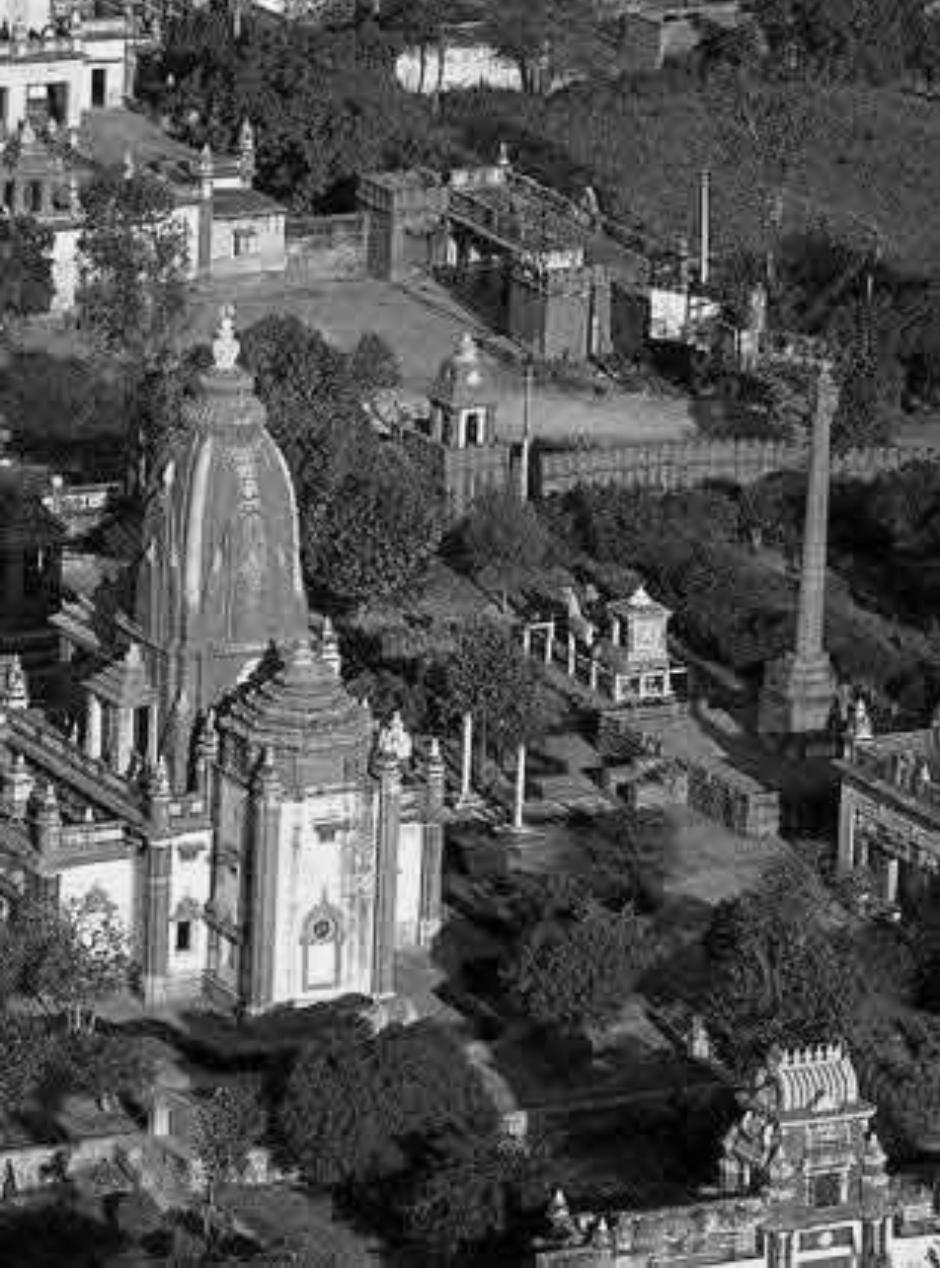
M a t h u ra , H a r i d w a r, Varanasi, Kanchipuram, Ujjain, and Puri for a t t a i n i n g s a lva t i o n (moksha). For Ananda Sangbad readers, a series of reports on these seven holy places will be covered with s t o r i e s t h a t h o l d religious and scriptural significance, and travel g u i d e s R e a d e r s interested in sharing their visits to these seven holy places may please write to the Editor of Ananda Sangbad.
Let's begin with Mathura, which is a town and also a district covering Vrindavan, another extremely famous holy city in India visited by devotees from all over the world.
Mathura, also called Braj Bhumi, is in the state of Uttar Pradesh in India. Located on the banks of river Yamuna, Mathura at present houses about 2.5 million residents who greet each other saying "Jai Sri Krishna” which displays a loving bond they maintain with Sri Krishna - the Lord of their land. In ancient times, the place was called, Madhuvan (a pleasantly wooded forest). Then, with developing townships, the place was called 'Madhupura' (pura in Sanskrit means town), which got further abbreviated into Mathura.
Sri Krishna was born in Mathura and he grew-up in Vrindavan. With over 5000 temples at this place, it is believed that, quite miraculously, one can still hear Sri Krishna's flue and him whispering the name of Radha Rani. One amongst these 5000 temples is the most famous temple of Sri Banke Bihari where Sri Krishna is worshipped as a child, named Banke Bihari. Built in 1862, the temple holds many folklores and stories, which are believed as miracles of God. Some such stories are as follows:
A sweet shop near the Sri Banke Bihari temple is always swamped with buyers because the story goes that once a small boy came to this shop asking for sweets and offered a gold bangle to pay its price. The shop owner was curious to know as to where did this child get such an expensive gold bangle, but then mesmerized by the beauty of the child, he gave him sweets and retained the bangle. Later, the priest of Sri Banke Bihari temple spread the word around that a gold bangle was missing from the temple. The sweet shop owner rushed to the temple with the gold bangle and narrated the story to temple authorities. To save the sweet shop owner from being accused of stealing, Sri Krishna appeared in person and said that he was very hungry, he found food in the temple but that food was not offered to him yet so he took his gold bangle and exchanged it to buy sweets.
Another story goes that a ticket collector working for Mathura - Vrindavan train used to run and visit Sri Banke Bihari temple to offer his prayers when the train reached Vrindavan station and halted for a while. One day when the ticket collector reached the temple, he found the altar closed. While he waited for the altar to re-open, the train left Vrindavan station. Realizing that he had lost his job for not reporting to work, he went to the station master to submit his resignation letter The astonished station master was curious to know the reason for his resignation because there were no reports of his absence from work. The ticket collector then realized that it was none other than Sri Banke Bihari himself who covered for him while he was at the temple waiting for a glimpse of the Lord. The ticket collector resigned from his mundane job and surrendered himself to the service of the Lord at the Sri Banke Bihari temple.
History has it that the image of Sri Banke Bihari was given to Swami Haridas by celestial bodies. (Swami Haridas was a famous musician and an ardent devotee of Sri Krishna). Later, Sri Krishna appeared in person to restore the black, charming image of Sri Banke Bihari that resides in the temple today (picture included in this article).The beauty of Sri Banke Bihari is overwhelmingly charming, and hence the image is regularly covered by a curtain to avoid prolonged 'darshan' (view) of the image. It is believed that one becomes unconscious by staring long into the eyes of Shri Banke Bihari.
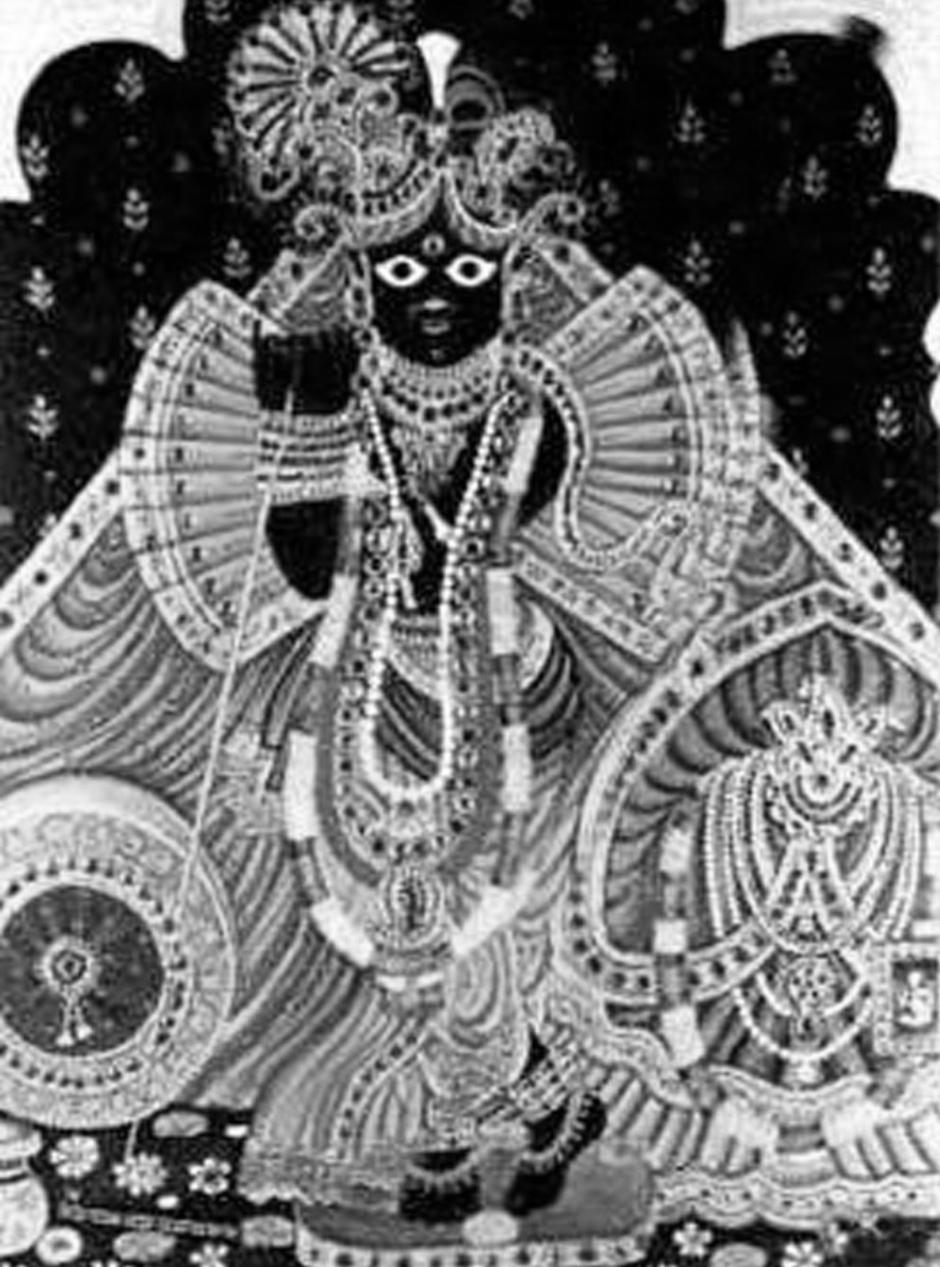
The regular, daily worship at Sri Banke Bihari temple is held in three parts - Shringar (bathing, dressing, and o r n a m e n t a t i o n ) , Rajbhog (offering of foods that the Lord l i k e s ) a n d S h a y a n (comforting the Lord to sleep). This temple is a rare Hindu place of w o r s h i p w h e r e traditional mangal arti ( e a r l y m o r n i n g awakening of God) is forbidden And the story goes like this: Once, while pulling the strings of a hand fan to co m fo r t S r i B a n ke Bihari, the temple pujari fell asleep. He woke up p a s t m
n d found that Sri Banke Bihari was missing from the temple. Around 4 in the morning, he saw Sri Banke Bihari was returning to the temple. It is believed that at every 12 mid night. Sri Banke Bihari leaves for Vrindavan's famous Nidhivan to perform Raas Lila with Radha Rani and the Gopis and he returns to the temple around 4 in the morning. Therefore, the morning mangal arti is forbidden at this temple to give some time to the Lord to sleep. Once a year, on the Janmashtami day, mangal arati is held celebrating the birth of Sri Krishna. During the festive time of Holi, the celebration of colors, Sri Banke Bihari is brought down from his altar for a full view when the temple is thronged by thousands of devotees visiting from different parts of the world.
Miracles do happen. Some call them coincidence. My visit to Mathura was a miraculous one. Over a Christmas holiday, I was planning for a trip to Mumbai with my husband for two weeks. While packing for the trip, I picked my “Bal Gopal” (Sri Krishna in child form) from my home altar in New Jersey and said quite unwittingly, “Come, this time we will visit Mathura.” In Mumbai, meeting relatives and friends and having a real vacation time, I completely forgot about my utterance to my 'Bal Gopal' and close to the end of two weeks, we were about to repack our suitcases to return to the US. On the day before our departure, we received a call from the airlines office saying that due to technical problems the carrier's flights were cancelled and we would be accommodated in a later date flight. This happened for the first time in so many years of our trips to India. I was a bit shaken-up and then I was reminded (a miraculously uncalled-for thought) that I had mentioned to my “little Krishna” that we would visit Mathura over this trip. Immediately, I called my travel agent to book tickets to Delhi. We got a late night (12:00 a.m.) Air India international flight going to Delhi after a halt in Mumbai. We reached Delhi around 2:30 a.m., got into a rented car pre-arranged by a relative of ours residing in Delhi, and reached Mathura in the wee hours of morning when the sky behind the temples and on the eastern bank of the Yamuna river was just getting painted by the rising Sun. It was a celestial feeling. We stayed in a very comfortable hotel for four days. I made sure to clean a corner table of the hotel room to create an altar with tulsi leaves and placed my 'bal gopal' in the land of his birth place, Mathura, where it is believed that one can hear Sri Krihns'a flute even today and him whispering the name of Radha Rani. In our rented car we drove around Mathura and Vrindavan greeting people with “Jai Sri Krishna'.
Travel to Mathura and Vrindavan:
Mathura city is located at a distance of 145 km south-east of Delhi, 58 km north-west of Agra, and about 10 km away from Vrindavan. Agra is the nearest airport to Mathura and easily commutable from the airport by a rented car or taxi. Mathura rail station is well connected by trains from major cities of India. For being one of the seven prescribed holy places in India, Mathura has a host of lovely hotels serving only pure vegetarian cuisine. Almost all sweet shops here sell a special kind of milk cake called “Mathura Pera” and sweet, pulpy “Peru” (guava) is the special fruit of this holy land.
In the next issue of Ananda Sangbad, we will cover Ayodhya, another prescribed place on the list of “Sapta Tirtha”. Stay tuned and stay blessed.
Remembering Her and Her Memory Loss
As you all know by now, Manju Ray, who passed away on 27 September 2012, was struck by a dreadful disease. This disease, the Alzheimer's -- a progressive form of dementia -- is a nightmare to the entire elderly population. With the increase of life expectancy with the help of modern medicine, the elderly population is more vulnerable to this neurological “non-curable” disorder We used to know Manju di as a vibrant lady, a loving wife, a mother and a grandmother As a book-keeper, she could do arithmetic by heart, without the help of a calculator But toward the end of her life, her brain stopped calculating and remembering her past. Sadly enough, she could not even recognize her own children and grandchildren! Alzheimer's has no cure and has no good medicine. Alzheimer's is a disease that attacks the brain. It is the most common form of dementia. Dementia is a general term for a decline in mental ability, severe enough to interfere with daily life. Alzheimer's is not a normal part of aging. Largely, it is one of the mysterious diseases to researchers. So far most of the theories of causes are invalid or not proven.
Ananda Mandir was almost her second home before Manju di was diagnosed with the disease and forced to move to a hospital. In the early days of Ananda Mandir, few families were as involved in its affairs as the late Mr Nirmal Ray and his wife Manju Ray, affectionately called “Manju di”. Those of us involved in the days during the conception/ideas phase of building of a Bengali temple and community center in NJ know that the Ray family's contributions are immense. Manju di was a silent partner of her tireless husband. Manju di ran a Montessori School operating from her expansive house in Livingston, NJ. Many of us attended their unconventional fundraising endeavors/events – as “Gharoa” (homely) Lakshmi Pujas, birthday parties (some of them were of Montessori School students of Manjudi's) and other events. They hosted musical concerts in the school hall featuring their talented performer friends from Kolkata.
We had seen another side of Manju di besides a loving mother and grandmother She was a protective & loving wife of her ailing husband. I recall numerous lively private parties hosted by them that included Pronoy Chatterjee, Arabinda Mukherjee, Dipen Sarker, Subir Mukherjee and others, to name but a few Those were not typical parties, but a Kolkatan variety of Bengali “Adda”. The only difference was that the usual drink of Kolkatan Adda, the tea, was replaced by more addictive drinks. No topics were out or off-limits: world and local politics, business, stock markets, and occasionally, even religion. Pronoy, Arabinda, and Subir Mukherjee would make one-sided attacks on Nirmal, often in loud & prosecutorially quizzing fashion. Manju di, in contrast, would be calm and serving food and drinks, while trying to pacify her husband. Sometimes she would ask for a “time off” with some excuses. She would romove her husband from the excitement and send him to their bedroom for a few minutes of calm and rest, without any knowledge of the guests. She would explain to my wife later. "Your Nirmal da likes "adda" but he gets agitated easily That is why I have to send him off from time to time to our bedroom and lock him up for a few minutes of calmness". She thought that the agitation would be too much for husband's ailing heart.
Nirmal Ray passed away with a sudden heart failure during a visit to India to see Manju di's mother After that, Prativa di (Prativa Hore) helped Manju di to keep her busy and get involved in Ananda Mandir's affairs. Before her husband passed away, Manju di used to take care of book keeping, helping the treasurer Dilip Chatterjee. Now she also got involved in Puja arrangements & Prasad preparation. But Prativa di wanted more from her so that she would not go into depression in living alone. She did involve her all right- almost every day Manju di would plan Puja schedules, Puja preparations and would sit through the entire puja ceremony with helping hands to the priest along the way Those of us who saw Manju di during a puja, saw that anything the presiding priest required was at her fingertips. As part of the puja requirements, Manju di would assign one person to prepare “Bhog” in a sanctified manner - she was very strict about that. In those days, food for Puja guests was prepared by assigned families in their respective homes. Manju di supervised those assignments. Like us, many of you got assignments almost every week from Manju di or from Prativa di. After pujas, Manju di collected money, always asking for extra donations. Everyone liked Manju di's brand of playing “Kansar” (cymbal), in a special way, that only she knew how Manju di had made Ananda Mandir her home and served as a very dedicated volunteer, until that debilitating disease struck her Like many patients, she was in denial. But the friends at Ananda Mandir noticed the changes in her and in her behavior They noticed that Manju di was forgetting things. Bills were neatly arranged on a table to be paid, but “Manju the bookkeeper” would forget to pay them- unusual for a normally prompt payer When the family wanted to move her, she was reluctant to move out of NJ, especially away from her beloved Ananda Mandir. At first, the family decided to put her in a Psychiatric hospital in Warren, NJ. The family had promised her that she would be back home within two weeks and back to her Ananda Mandir's "job". However, as Manju di's condition deteriorated, the weeks stretched out. She tried to come back to Ananda Mandir on her own several times. Finally, her children moved her near them in the Pacific Northwest to a type of home for Alzheimer's patients. Manju di forgot all she did for Ananda Mandir and perhaps all of her past.
As stages of the disease unfold, its progression will vary greatly from person to person. My wife and I visited her when she was in the Warren psychiatric location. She recognized my wife and said, “You are Chhabi and he is your husband,
By Bimal K. Biswas
Nirmal”. I corrected her that I am Bimal. She laughed and said, “I am forgetting things and that is why my daughter sent me here for two weeks for tests”. She went further, “Your daughter is in Stanford University in California. How is she? You know, my daughter also went there for Post Doc in Biochemistry”. Sometime back, Manju di called Bishwa Bhai from a psychiatric hospital. At that time, she almost lost her memory and forgot most of her past, yet she could retrieve the telephone number of the priest from her brain's memory storage! This is the sad story of a woman who at one time could recall hundreds of people by their first and last names. Now it seemed that someone deleted all those from the “hard disc” of her brain!!- Felt more like some unkind and irreparable viral attack on "the memory disc" of a memorable lady
A few facts (extracted from Alzheimer's Foundation and elsewhere)
5.4 million Americans are living with Alzheimer's disease.
One in eight older Americans has Alzheimer's disease.
Alzheimer's disease is the sixth-leading cause of death in the United States and the only cause of death among the top 10 in the United States that cannot be prevented, cured or even slowed.
Payments for Alzheimer's care are estimated to be $200 billion in the United States in 2012.
Alzheimer's disease: diagnosis & treatment
Diagnostic tests & tools
Alzheimer's disease often goes unrecognized or undiagnosed in the early stages because the first symptoms are often viewed as normal parts of aging. To diagnose Alzheimer's disease, doctors use a series of tests and tools to evaluate thinking, behavior and physical function because there is no single scale that can, by itself, definitively diagnose Alzheimer's disease.
Diagnostic tests may include the Clock Drawing test, the Mini-Mental Stage Examination (MMSE), and the Functional Assessment Staging test (FAST). In addition to these tests, the doctor may also take a medical and family history; do a routine physical exam, an exam that tests physical sensation controlled by the central nervous system, a brain scan, a neuropsychological evaluation, and interview family members and friends.
Currently, there is no cure for Alzheimer's disease. Acetylcholinesterase inhibitors work by helping to increase the amount of acetylcholine in the brain, a chemical that is important for memory and learning.
Three of the acetylcholinesterase inhibitors approved by the FDA to treat Alzheimer's disease are:
ARICEPT* (donepezil HCl), approved to treat all stages of Alzheimer's disease
EXELON** (rivastigmine tartrate), approved to treat mild to moderate Alzheimer's disease
EXELON PATCH (rivastigmine transdermal system), approved to treat mild to moderate Alzheimer's disease
RAZADYNE*** (galantamine HBr), approved to treat mild to moderate
Summer Internship Program
for College Students And High School Seniors
Ananda Mandir has launched Summer Internship for college students and high school seniors. This year it recruited three interns in biological science area It will continue recruiting for the internship program for the next year again. The program will include learning and helping research works in the areas of biological science, physical science and engineering at various laboratories in New Jersey. Additional internship opening will be in the area of pharmacy in New York City Some internships are paid, others are voluntary Paid interns have to be minimum 18 years old and US citizens or permanent residents. For the next year's internship, application with resume indicating the area of internship interest should be sent to Dr Pronoy Chatterjee, e-mail: pkc_usa@yahoo.com by March 31, 2013.
Ananda Sangbad 13 January 2013
Global Bengali
Entrepreneurs
Network (GBEN) Off to a Good Start
Reported by Debol Gupta
On Nov 18, the first convention of Global Bengali Entrepreneur Network (GBEN) was held at Union Hill Presbyterian Church, Denville, NJ. Around 25+ business executives, entrepreneurs, investors and well-wishers attended the meeting.
The opening remarks were delivered by Debol Gupta. He reviewed the current rate of GDP growth and other important economic data for India and discussed long term GDP predictions for the country, compared to other emerging economies. He then explained the mission of GBEN and emphasized that GBEN would like to be recognized, in time, as a practical and committed forum for business entrepreneurs involved in improving the economic well-being of West Bengal. At the end, he also discussed a couple of projects which GBEN will be executing in the next few months.
Sanjoy Nandy then got the attendees involved in a discussion of their expectations of GBEN and how their experiences may apply to GBEN objectives and activities. His focus was on “Why GBEN” and how GBEN could help align business success requirements with West Bengal's current and future economic needs and constraints. He also discussed the importance of collaboration with other business entrepreneurs on a worldwide basis. Such collaboration can provide experience-sharing and building a framework to assist business entrepreneurs from the US and India.
At the end, Pijush Chakraborty delivered his thoughts on “Where GBEN will be in the next few years.” He proposed a 3-year plan and appealed to the attendees to help develop a management approach that would make GBEN successful. The attendees suggested that the founders of GBEN should establish a structure for the organization and then recruit volunteers appropriate for specific roles. Pijush also discussed his ideas on how to sustain GBEN activities which were very well received by all the attendees. A number of interesting suggestions were offered by the participants on how to carry forward GBEN's current initiatives.
Arpita Gupta, Ajanta Roy and Mitu Chakraborty organized and served excellent snacks and drinks to all the attendees. Overall the first GBEN convention was successful and was warmly received by all the attendees.
COMMUNITY NEWS
Manjuli Ray (1938 - 2012)
, popularly known as Manjudi, a Founding Member of Ananda Mandir and recipient of “Outstanding Volunteer” award, passed away on 27 September, 2012. Ananda Mandir organized a memorial service to celebrate and honor the memory of Manjuli Ray on Saturday, October 13, 2012. It was attended by her two children with their families, and by many friends and admirers.
Manjuli Ray was born in Bihar, India on August 2nd, 1938. She came to the United States with her husband Nirmal Ray and settled down in New Jersey They were socially very active in the Bengali circles and made many friends in the community
In the mid 1990s, both the Rays became involved in plans to build a Bengali cultural center in NJ. In 1998, they had moved to North Brunswick to be closer to Ananda Mandir, which they were both very eager to support. After Nirmal Ray passed away in 1999, she chose to stay in NJ, because she wanted to continue to volunteer at Ananda Mandir Living alone, she spent almost all of her time working for Ananda Mandir at the time.
Manjudi played a major role as a Founder Member, as Chairperson of Puja Committee, and as Assistant Treasurer of Ananda Mandir She also helped out in crucial ways with rental activities by various cultural groups using Ananda Mandir's facilities. A number of times, she would be called upon to open the door of Ananda Mandir at odd hours to let people in for various activities. Many members of Ananda Mandir got assignments almost every week from Manjudi for Puja preparations. After pujas, Manjudi collected money, always asking for extra donations.
Since 2005, Manjuli Ray lived in the Pacific Northwest, where her two children are settled. Health related issues made her children bring their mother near them. There would never be a more passionate advocate than Manju di for the success of Ananda Mandir
Prof. Arup Sengupta Wins
$75,000 INTEL Environment Award for Arsenic & Fluoride Removal Innovation
Reported by Debajyoti Chatterji
Prof Arup Sengupta, PC Rossin Professor of Civil & Environmental Engineering at Lehigh University, Bethlehem, PA, has added yet another feather to his cap of honors by winning one of the 2012 Tech Laureate Awards. The recognition carries with it a cash prize of $75,000 and is named “INTEL Environment” award. Prof Sengupta received this major honor because of his scientific research and technological innovations in the area of arsenic and fluoride removal from drinking water As the readers of Ananda Sangbad know, arsenic contamination of groundwater is a widespread problem in many parts of West Bengal and neighboring states. Similarly, excessive fluoride levels in drinking water causes major health problems in several countries in Africa and Asia. World Health Organization estimates that nearly 500 million people worldwide drink arsenic and/or fluoride-contaminated water because no simple and inexpensive options exist to remove these contaminants. Prof Sengupta and his associates have developed a low-cost, reusable polymer-based filter that can be used in rural settings to make water safe to drink.
The 2012 Tech Laureate awards were presented on November 15 at the Santa Clara Convention Center in California in a gala event attended by over 1400 scientists, engineers and executives from the Silicon Valley. One of the six recipients of the 2012 Tech Laureate Awards was NR Narayana Murthy, past chairman and one of the founders of Infosys, Bangalore.
Prof Sengupta had received, in 2009, the Astellas Award from the American Chemical Society which carried with it a $30,000 grant to “continue his research efforts” in the area of arsenic removal from groundwater More recently he received a Fulbright-Nehru Fellowship to travel to India and work with scientists and engineers there on the arsenic crisis.
Prof Sengupta received his Bachelor's degree from Jadavpur University, Kolkata and his Master's and PhD degrees from the University of Houston. He holds 6 patents (and 3 more are pending) and has authored over 75 articles in peer-reviewed journals. At Lehigh, he has supervised 12 doctoral theses.
Many members of the Ananda Mandir Community know Prof Sengupta personally, and others have known him through his writings in Anandalipi. All of us at Ananda Mandir are delighted that he has won yet another prestigious award, and we congratulate him and wish him greater success in the years ahead.
Community Service Projects
aimed at helping the South Asian community in the Greater New Jersey area Project Proposals Are Welcome From Organizations and Individuals
Please visit www.anandamandir.org for program details and application requirements or Contact: Pronoy Chatterjee (pkc_usa@yahoo.com) or Debajyoti Chatterji (debsmee572@gmail.com) is pleased to announce the launch of a program to award financial grants to support
Ananda Mandir
Board of Trustees has established a program to recognize
Outstanding
If you are a Life Member and believe that someone deserves this recognition, please feel free to e-mail nomination to Pronoy Chatterjee (pkc usa@yahoo.com) Details of the program and the nomination form can be seen in our website www anandamandir org
Ananda Mandir
Manjuli Ray (1938 - 2012)
Prof. Arup Sengupta
January 2013 COMMUNITY NEWS
I C C C o r n e r
By Prabir Sarkar
Indian Community Center of Garden State (ICC-GS) is a NJ-registered nonprofit organization. The major objective of our organization is to foster cultural, social and religious traditions of the Indian community residing in the state of New Jersey in general and the Bengali community in particular One of the missions of ICC is to organize and celebrate major Hindu religious functions and important Bengali cultural events, and arrange social activities from time to time to serve the community. ICC has served the Bengali diaspora here in NJ since its inception in 1981. For many years it has been our tradition to organize the biggest event of the year, the Durga Puja. By doing so we bring the community together, create opportunities to celebrate our socio-religious festivals in America, provide experience of one of the biggest Hindu festivals to the next generation and provide a platform to the community members to showcase their cultural talents.
This year we celebrated the Durga Puja festivities on Oct 27 and 28 with enthusiastic participation of several hundred members, family members and guests. Overall the event was very successful.
Why we celebrate Durga Puja is aptly summarized in the following quote from Swami Chinmayananda:
"Man, the imperfect, the bound, the sorrowful, has a thousand enemies within. He is riddled with negative thoughts, fears, yearnings. These are selfishness, jealousy, meanness, prejudice and hatred - just to mention but a few The Sadhak must get rid of these lawless villains within. With Mother Durga's kripa, these destructive masters are to be annihilated. Invoke the Mother to help us annihilate within ourselves all negative forces; all weaknesses, - all littleness."
Durga Puja is the biggest festival in many parts of India but particularly in eastern India. It is a celebration that provides an insight into the rich cultural heritage of the Bengalis and their close bond with Mother Durga. All those Bengalis and Indians who have migrated to America and even those who are born here still cling to this festival and celebrate the puja with all the pomp and grandeur Durga Puja is celebrated by ICC members and patrons in an intimate atmosphere complete with 'prasad' and 'pushpanjali'. There are special Bengali community dinners on both days. And there are plenty of opportunities to visit stalls of sarees, jewelry, books and CD/DVDs. The biggest attraction is the cultural program with highly entertaining line-up of famous artists from India and gifted local talents.
I thank all the executive committee members, puja committee members, founding members, patrons, advertisers, ICC members and guests who have all helped us make this joyous festival and this grand event a great success.
This is my last year as ICC President. It was a pleasure to have the privilege to serve this worthy organization. The current Executive Committee, like previous ones, has worked very hard to conduct various major pujas and events. Soon there will be a new Executive Committee, and I hope you all extend your support to the new EC as you have done for the current EC.
I extend my heartfelt greetings on this festive occasion to one and all.
I pray that Ma Durga bestows her blessings on all of her children. I wish you all a “Shubho Bijoya”.
N J PA C o r n e r
By Kankana Sengupta
When Hurricane Sandy collided with NJPA's long-held tradition of Kali puja th celebration which was scheduled to be held on November 10 , there was no other alternative than to cancel it. This was just as if having to dim the Christmas lights with no Santa Claus or no holiday display at stores and a constant reminder of the fierce intensity of Mother Nature's power. There was immense damage and destruction in the neighboring areas, so the NJPA Board of Trustees and Executive Committee rightfully decided to cancel the event so that they could show a feeling of solidarity with the community and the entire state that suffered.
However, in keeping with the tradition, NJPA decided to hold a very private th Kali puja at Ananda Mandir on December 8 Though the puja missed its usual gusto and enthusiasm, a simple feeling of goodwill and harmony towards each other and the broader community made it a memorable event. Devotional songs by our very own extremely talented youngsters showed not only their love for the music from Bengal but also a love of our language, culture and traditions that is most cherished by us far away from our ancestral home.
th NJPA will be celebrating Saraswati Puja on February 9 , 2013. Details will follow soon.
Please keep checking our website at http://njpa.net for updates or connect with us on Facebook (NJPA Parivar).
Kallol Corner
Reported By Malini Banerjee
The Kallol community had a very busy and eventful past few months. After the grand success of our annual picnic in August with lots of new participants this year, the Kallol executive committee successfully conducted Durga Puja and Lakshmi Puja. In the interim period the Kallol executive committee conducted a very effective talent search to promote the “stars of tomorrow”. Kallol executive committee called it “audition”. The response to “audition” was encouraging – and we are confident of its gaining a bigger stature in the coming years. All the winners got stage time during the puja and prizes as a token of encouragement.
The audition was followed by the biggest event of Kallol – “Durga Puja”. This year it, was held on October 19 through 21 at the Ukrainian Cultural Center in Somerset, New Jersey. We are very happy to say that just like every other year, the committee this year was able to maintain Kallol's tradition of balancing the religious and the social aspects of Durga puja at the celebrations. Every department strived hard to ensure the smooth execution of the puja. Registration committee worked round the clock to set up the payment and the segmentation of benefactors, doors and the regulars. This had to be followed up with the printing of badges based on registration and the parking tags. Our very efficient puja committee members and volunteers made arrangements for the seamless puja execution. Our revered priests performed the puja services every morning with tremendous dedication and passion. They just didn't seem to tire of the endless requests of Anjali and private puja. A crowd of several hundred people enjoyed the services and offered their prayers to Ma Durga with the guidance of our priests.
Every evening we had fantastic dinner menus for both adults and children with mouthwatering dishes that were very hard to resist. And last but not the least, we had an unparalleled cultural line up that will be very hard for even us to beat next year We had performances from some of the most talented local and overseas artists every evening. They showcased both contemporary and classical forms of music and dance. Kids of Kallol put on the play “Lalkamal Neelkamal”, dance drama “Agomonir Alo”, while adults performed in the hilarious play “Tulkalam”. Our overseas artist lineup included Arnab Chakraborty, Rajyashree Ghosh, Sadhna Sargam, Pandit Tejendra Narayan Majumder and Bappi Lahiri.
This year we had a video streaming arrangement to showcase our client ads and give a glimpse of the various Kolkata pujas. This live streaming filled the air with nostalgia. This was the first time it was done and we hope to continue it every year
A week later we had “Lakshmi puja”…but the turnout was slimmer than usual because of Hurricane Sandy Kallol executive committee had to take it in their stride since not much opposition can be put forward against Mother Nature.
We are also pleased to announce that Kallol's Facebook page is very active now and all the updates of Kallol's activities can be found on both Kallol's webpage and Kallol's Facebook page. Please “like” us on Facebook to get information about every announcement of the Kallol community as well as visit us on www.kallol.us.
Our last event of 2012, the New Year's Eve party, will be held on December 31, at the Shezan Restaurant on Oak Tree Road in Edison, NJ. We are planning a fabulous night of entertainment with great food, wonderful music and lots of activities for the children. Please be there and we assure you that you will be thoroughly entertained!
We wish you all a wonderful 2013 full of happiness and good health.
Ananda Sangbad 15
NEWS YOU MAY HAVE MISSED
Reported by Debajyoti Chatterji
Smiling Faces Banned for New Jersey Drivers Licenses
When your photograph gets taken for a driver's license at a Motor Vehicles Department location in New Jersey, you can no longer look your best by wearing a big smile, according to new rules established by the administration. Apparently face detection software used to archive drivers' photos and access such photo libraries for criminal investigations “get confused” with smiling faces. (Based on a USA Today report of Sept 12, 2012)
Obama Contesting in Elections in Brazil?
Obama was a candidate for election in Brazil. No, not for election as the president of Brazil but as candidates in at least 16 municipal elections! Our president is highly popular in Brazil, and a number of candidates adopted his name with the hope of getting extra publicity and voter support. Candidates assumed names like Barat Obama, and some even took names like Bin Laden. There were no reports of Brazilian election candidates named Mitt Romney, however. (Based on a CNN report of Sept 24, 2012)
New Jersey Has the Lowest Divorce Rate of All States
Only 9% of NJ population is divorced while 52% are married. Reasons? On the average, New Jersey residents marry at a later age, have higher income – and legal cost of divorce in NJ is much higher than in the other states.(Based on a WCBS-NYC Radio report of Oct 15, 2012). Also note: NJ has the second lowest “marriage rate” as well (Huffington Post, Sept 29, 2011).
Eating Breakfast Regularly Reduces Diabetes Risk:
According to University of Minnesota researchers, “Eating something – anything – within two to three hours of rising, every day, reduces the risk of getting diabetes by 34%”. Always try to eat a healthy and balanced breakfast, the researchers say Other risk factors for getting diabetes: sleeping less than six hours at night, not eating enough fruits and vegetable, smoking, and not doing some form of regular exercise. (Based on an AARP Magazine article, Oct 2012.)
64 Mile Traffic Backup on a Highway?
You may have read (and wondered) about the 45-mile long traffic jam that the Boston area drivers had to endure recently on the Massachusetts Turnpike (Boston Globe, Oct 5, 2012). Thought that was bad? Imagine getting stuck in a traffic backup that was …64 miles long! That took place two years ago in an expressway leading to Beijing. Over 10,000 vehicles were involved in this bumper-to-bumper, stop-and-go traffic jam, and it took over 10 days for the authorities to break up this mess and restore normalcy (Based on a NY Times report of Aug 24, 2010).
85 Miles Per Hour Speed Limit on a US Highway?
If the thought of a 64-mile long traffic jam got you depressed, this factoid may get you excited. A 41-mile stretch of State Highway 130 between Austin and San Antonio in Texas has an officially approved speed limit of 85 mph. This toll road was just built by a private company and is being operated by that private company (Based on a CNN News/Erin Burnett report of Oct 24, 2012)
Air Canada Boeing 777 Helps Spot an Australian Yacht in Distress in Open Sea
After the Australian authorities learned that a yacht had lost its mast and was drifting in open sea about 270 nautical miles east of Sydney, they alerted nearby ships and airplanes to spot the vessel. The pilot of an Air Canada passenger jet in the area asked the crew and passenger to look out through windows to see if they could spot the drifting boat. Against all odds, this find-a-needlein-a-haystack task succeeded and the passengers and the crew located the yacht. The authorities then guided a nearby ship to the location and rescued the sailors. This is a first-ever report of a passenger jetliner locating a boat adrift in open sea. (Based on a USA Today report of Oct 16, 2012)
January 2013

Ananda Mandir Membership Recognition
Ananda Mandir's membership category changes for the 4th quarter of 2012
New Grand Patron - Gold (1):
Supriyo and Rik Sen
New Grand Patron - Silver (8):
Maumita and Divyendra Bajpai
Subir and Satarupa Chatterjee
Anup and Meena Dam
Chanu and Lopamudra Das
Kiron and Kamala Das
Dipak and Arundhati Mallik
Kalyan and Chitra Mondal
Prashanthi Ramarapu and Sunith Roy
New Patron (9):
Jaydip and Sutapa Bhattacharya
Sisir and Lalima Biswas
Suranjan B. and Sudipta Choudhury
Sanchoy and Rajyasri Das
Surajit and Sanjukta Mitra
Rina and Subrata Roy
A. Badal and Geeta Roychowdhury
Provat and Mita Sinha
JCMS Inc. (Jayanta Dutta)
New Life Member (20):
Tapas and Chitrita Banerjee
Manoj and Ashima Basu
Partha Sarathi and Papiya Bhattacharya
Malika Bhowmik
Saswati Bhattacharjee and Arindam Chakraborty
Christian Loeffler and Kooheli Chatterji
Satya P. and Basundhara Chattopadhyay
Dolly Choudry
George Abraham and Molly Chowdhury
Alak and Sumita Das
Tara Sankar and Tripti Das
Parna Banerjee and Kallol Ghosh
Tapan and Mitra Ghosh
Amitabha Kundu
Joyjit and Parna Kundu
Shankar and Bhaswati Mukherjee
Subhechha and Nilotpal Paul
Sushil J. Pai
Subhasis and Sangeeta Sarkar Devjoy Sengupta
Please note that you can become an Associate Member of Ananda Mandir by donating a minimum of $50. Your subsequent donations of $50 or more are credited to your account. When your total cumulative donation reaches $1000, you become a Life Member Your support small or large, are most welcome and sincerely appreciated.
Outstanding Volunteer of Ananda Mandir
Based on the deliberations of the Awards & Recognition Committee, Ananda Mandir Board of Trustees has announced Krishna Dutta Roy as an “Outstanding Volunteer”.
Krishna has been involved in a wide variety of Ananda Mandir activities since the organization's inception. She is currently the Chair of the Puja Committee (Ananda Mandir's main activity) since Prativa Hore's retirement from that position several years ago. Krishna leads this committee, which is filled with many hard-working volunteers, very efficiently She has been a member of our Board of Trustees for many years and has served the organization as its General Secretary for four years. She has single-handedly led many food drives to collect food donations from our community for the Franklin Township Food Bank and clothes donations for the needy Krishna has also organized several blood drives to involve our members in donating much-needed blood for the Red Cross. From the very beginning of Ananda Mandir, Krishna has championed the need for engaging our younger members, and to that end, has tried to organize youth activities. She is always present in events like the annual Ananda Mela and always active in activities like fund-raising, recruiting new members and selling tickets for special events.
In addition to dedicated volunteer service to Ananda Mandir, Krishna has, over the years, been involved in Kallol, a leading Bengali organization in New Jersey, as an individual member as well as an executive committee member She was also the Chair of the Youth Committee for the 2000 Banga Sammelan, organized by Kallol. Krishna has accomplished all of this while raising two brilliant daughters and holding a full-time, responsible job.
Krishna is a great role model for all volunteers, young and old. Ananda Mandir is proud to have Krishna as a dedicated member and is pleased to congratulate her for the recognition as “Outstanding Volunteer”. We wish Krishna many, many more years of active and enjoyable community and personal life.
The Board will continue to recognize one or two “Outstanding Volunteers,” every quarter selected from the nominations received from the Life Members of Ananda Mandir. The application form for nomination is available at www.anandamandir.org (see announcement elsewhere in this newsletter)

The Board of Trustees of Ananda Mandir is pleased to announce the winners of the 2012 Gayatri GaMarsh Memorial Awards for Literary Excellence. Ms. Eva Khashnobish of India was chosen as the winner in the Bengali publications category while there were two winners in the English publications category: Ms. Bakul Banerjee of Illinois and Ms. Kooheli Chatterji of New Jersey. Each winner will be honored with a $500 cash award and a plaque with an appropriate citation. Published works of these authors were judged to be the best -- among the nominations received this year --in terms of originality, creativity and presentation. Photos of the winners are attached.
The awards program was established in 2010 in memory of the late Gayatri GaMarsh, who was a well-known author, editor, artist, sculptor and a key member of the Ananda Mandir community. The underlying objective of these awards is to encourage people of Indian origin to engage in literary activities and publish their works in North America-based newspapers and magazines. The winners each year are selected by a panel of independent judges from a large number of nominations received from authors of Bengali or English works. The first set of awards was given in late 2011.
Gayatri GaMarsh Memorial Awards for Literary Excellence are believed to be the only awards of its kind in North America, and the program has earned a strong reputation and a loyal following among the people of Indian origin in the USA and Canada.
The awards are administered by the Awards & Recognition Committee of Ananda Mandir and are funded by an endowment from Jerry GaMarsh, husband of the late Gayatri GaMarsh. Members of the committee are not permitted to nominate themselves for the awards and must recuse themselves if close family members are nominated.
Our sincere congratulations go to the winners of the 2012 awards. We wish them continued success in their literary efforts in the years to come.
2013 Gayatri GaMarsh Memorial Awards For Literary Excellence
Two cash awards will be given each year to recognize outstanding works published in North America-based literary magazines within the last five years. One award will be given to an author of Bengali works, and another will be given to an author in English. Each award will consist of $500 in cash and a certificate.
Please stay tuned for application submission announcements in the next issue (April-2013)





Ms. Bakul Banerjee Ms. Kooheli Chatterjee Ms. Eva Khasnobish Winners of 2012 Gayatri GaMarsh Memorial Awards Announced