Ananda Mandir
269 Cedar Grove Lane

Ananda Mandir
269 Cedar Grove Lane
Somerset, NJ 08873 NON-PROFIT ORG US POSTAGE PAID NEW BRUNSWICK, NJ PERMIT NO. 1215

Quarterly
of
October 2017
Reported By Guru Chakravarty
The annual Fund-Raising Day was held successfully at the Tagore Hall on Sunday, July 23, 2017
Every year a call goes out to the membership to donate generously to help meet the expenses of running the organization, and like other years, the Ananda Mandir community responded enthusiastically Over a hundred people came and opened their wallets to support Ananda Mandir, as they were treated with a delicious lunch buffet supplemented by appetizers, cold drinks and hot beverages.
As the people settled down in their chairs around the round tables that were set inside the Tagore Hall, the proceedings started with an invocation by Biswajyoti, our priest As the chair of this year’s fund-raising drive, Dipak Sarkar spoke briefly to thank everyone for coming and showing their support Then Ashok Rakhit, the current President, presented the annual report, accompanied with informative slides He laid out the year-toyear progress of the “Expanded Temple and the Community Hall” project from the beginning to date, the current financial status, and the projected financial needs to keep the organization going strong
Like other years, Pronoy Chatterjee, the Chair of Awards and Recognition Committee then came to the stage to recognize the recipients of distinguished awards for 2017
After explaining the different categories of awards established by the Board of Trustees of Ananda Mandir, he announced the names
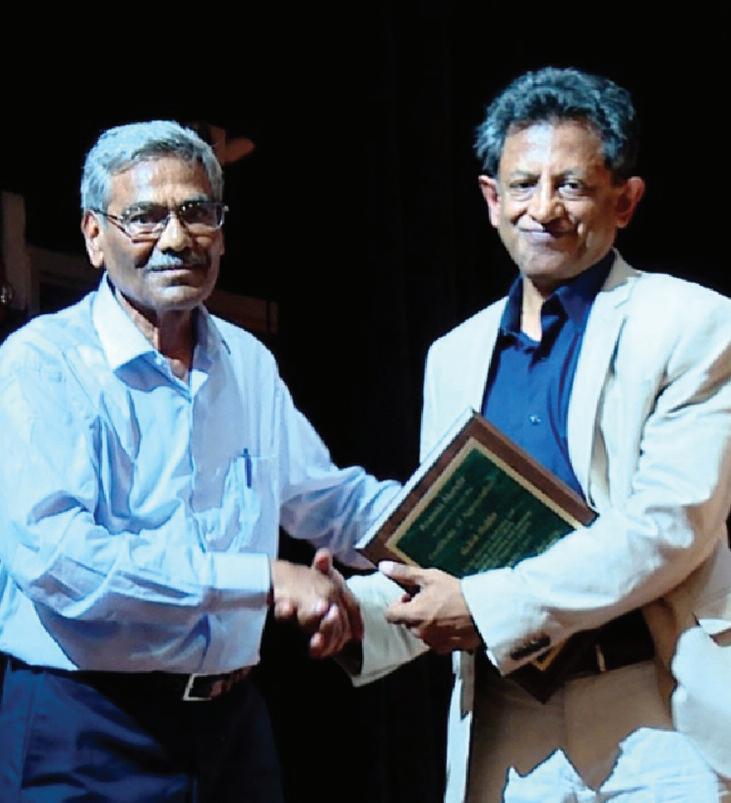
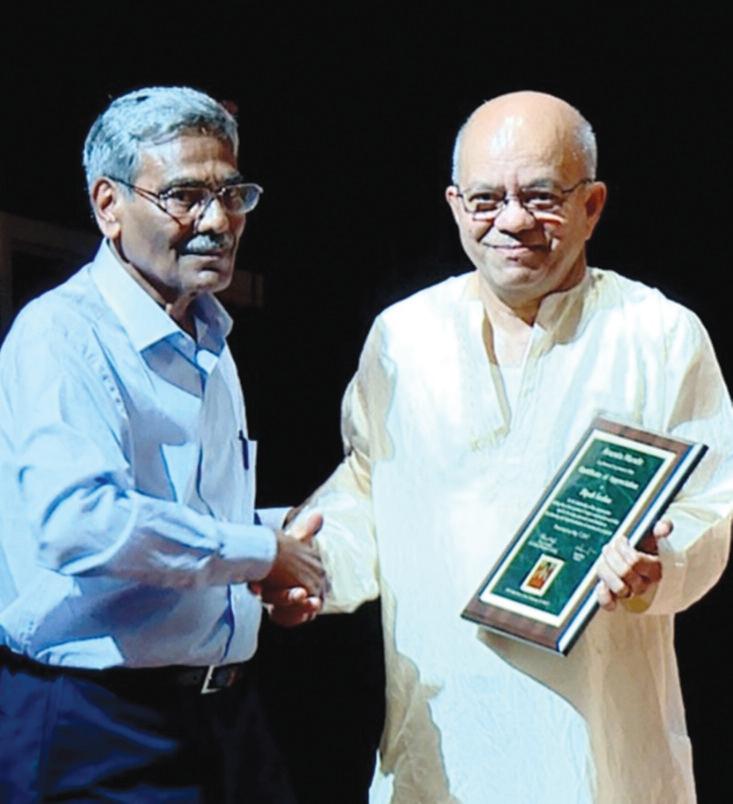
of two recipients of Outstanding Leadership Recognitions from Ananda Mandir ashok Rakhit has demonstrated outstanding leadership in planning, implementing and completing the construction of new facilities: an expanded temple, a state of the art auditorium/banquet hall, and a much larger parking lot The project that he led required raising several million dollars of funding, negotiating with township for approval, securing a hefty mortgage loan, and coordinating all aspects of the construction contract As the chairperson of the project, he assembled and led a team of dedicated and skilled volunteers to complete the project from start to finish Dipak Sarkar presided over the Board of Trustees during the entire planning and
construction phase In this role, he showed an outstanding leadership to articulate and work out all the intricate details of the project, as demanded by the Board members, individually and collectively. Without the benefits of his professional management skills, the continuation of the project would have been seriously impeded. He was also a prime mover in planning and implementing several fund raising activities which had a significant impact on reaching the goal Dipak also deserves credit for initiating “Kisholoy”, the wall-magazine by our young members
The award presentations were followed by musical performances conducted by Arun Bhowmik
The Fund Raising Day raised about $260,000 for Ananda Mandir
N o r t h Ame r ic an B e ngal i Co nfe re nc e (N AB C) o f 2018 w i l l be o rganize d by Ananda Mandir in partnership with several local Bengali/Indian cultural organizations including Kallol, Garden State Cultural Association and others at the Atlantic City Convention Center in New Jersey.
Calendar of Events (Dates are subject to Change) Please check our website frequently www anandamandir org Tel: 732-873-9821
NOTE: If a particular Puja time is not listed, please contact temple or visit our ebsite: anandamandir.org
OCTOBER (*)
Kojagori lakshmi Puja & Satyanarayan Puja
Thursday, 05, 6:00 pm – 9:00 pm
Bijoya Sammelan (Pandit Subhen Chatterjee band)
Sunday, 15, call for details
Maha Kali Puja
Thursday, 19, 5:00 pm – 11:00 pm
Musical Evening (Band from Kolkata) Thursday, 19, call for details jagaddhatri Puja
Fri-Sat-Sun, 27-28-29, call for time
Sahitya O alochana
Friday, 20, 8:00 pm
NOVEMBER (*)
Raas Yatra & Satyanarayan Puja
Friday, 03, 6:00 pm – 8:00 pm
ananda Mandir Foundation Day Tuesday, 14, call for time
Shyama Puja
Friday, 17, 6:00 pm – 8:00 pm
Sahitya O alochana Friday, 17, 8:00 pm Cultural Program (*)
DECEMBER (*)
Satyanarayan Puja
Sunday, 03, 5:30 pm – 7:00 pm
Shyama Puja
Sunday, 17, 5:30 pm – 7:30 pm
Maha Kali Puja – 2017 Thursday, Oct 19 5:00 pm – 11:00 pm

Members of the managing and individual committees of NABC 2018 were introduced at a dinner meeting in the Tagore Hall on September 10, 2017, by Soumen Roy, one of t he Co - Chair s , t o a pac ke d gat he r ing o f e nt hus ias t ic c ro w d Fo r de t ai ls abo ut e ac h committee and its members, please look up the NABC 2018 website. In a s ucc e s s ful pre - re gis t rat io n dr ive , many c o mmuni ty me mbe r s s igne d up t o attend the NABC in June 29-July 1, 2018. A 10% dis c o unt is c ur re nt ly al lo w e d fo r al l attendees signing up before October 31. Register @ www.nabc2018.com

Sahitya O alochana Friday, 22, 8:00 pm Cultural Program (*)
(*) See www anandamandir org or Call Mandir for details
Special Religious Services: Upon request, the priest of Ananda Mandir offers services such as inhouse Shraddhas, Rituals associated with Cremations (Antyesti Kriya), Shraddha Anniversaries, Pre-wedding rituals (Naandimukh, Ashirwad, etc), Upanayan (Paitey), Annaprasan, Wedding Ceremonies & Wedding Anniversaries, Griha Prabesh (Bhumi Puja), Consecrations of new cars (New Car Pujas) and others if you have needs for any of the above or more, please feel free to contact Biswabhai @ 732-873-9821
aNaNDa SaNGBaD
A Periodical Newsletter
Published By aNaNDa MaNDiR (A Tax-Exempt, Non-Profit Organization) 269 Cedar Grove Lane Somerset, NJ 08873 Ph: 732-873-9821
Website: www anandamandir org
PuBliCaTiON COMMiTTEE OF aNaNDa MaNDiR
Chairperson: Pronoy Chatterjee, pkc usa@yahoo com
Assistant Chairperson: Subrata Bhaumik, Bhaumik subrata@gmail com
Editor-in-Chief: Debajyoti Chatterji, Debsmee572@gmail com
Managing Editor, Ananda Sangbad: Guru Chakravarty, guruchakravarty@yahoo.com
Managing Editor, Anandalipi: amitabha Bagchi, amitabhanj@gmail.com
Editors:
Subrata Bhaumik, bhaumik subrata@gmail com
Subhodev Das, subhodev das@gmail com
Sushmita Dutta, sushmitadutt2@gmail com amrita Kangle, amritakangle@hotmail com Nupur lahiri, nupurlahiri@aol com
Associate Editor: Ruby Banerjea, r banerjea@yahoo com
Members-at-large: ashok Rakhit
l
All queries, articles, news reports and letters should be directed to the Managing Editor: Phone: 908-752-3065, E-mail: guruchakravarty@yahoo com
l
For general information, please contact the following executives of Ananda Mandir: ashok Rakhit, President
jaiprakash Biswas, Vice President
Suprasad Baidyaroy, Vice President
arun Bhowmik, Vice President
Sajal Mukherjee, Gen Secretary
Pradip Majumdar Treasurer
As widely publicized, the North American Bengali Conference (NABC) of 2018 will be organized by Ananda Mandir in partnership with several local Bengali/Indian cultural organizations including Kallol, Garden State Cultural Association and others at the Atlantic City Convention Center in New Jersey
It is a proud moment for the Ananda Mandir community to be part of such a memorable event Many members of the organization are enthused and are extending their helping hands to make it a hugely successful event Ananda Sangbad will not sit idly by and would like to do its part to help the mother organization
Ananda Sangbad is planning to publish a special issue on the occasion of NABC 2018 The purpose is to introduce our news magazine to the attendees of the event from outside the tristate area and to get them interested in Ananda Mandir We will showcase the literary activities of Ananda Mandir such as:
Publication of Ananda Sangbad, a quarterly newspaper;
Publication of Anandalipi, an annual literary magazine;
Gayatri Award for Literary Excellence, for writers in North America; Kishalay (Youth) Award for Writing Excellence, for school age children of Ananda Mandir community; Sahitya-O-Alochana, a monthly literary discussion forum
Although the Publication Committee of Ananda Mandir, per se, will not be directly involved in any literary effort, some of its members will be in charge of preparing the NABC Literary Magazine and the NABC Program Brochure In addition, a member of the Publication Committee will lead the literary seminar at NABC, where celebrated authors will be invited Besides, members of the Publication Committee will participate in the related editing process to ensure high quality magazine and brochure
Ananda Sangbad will soon start publishing a full page ad of NABC 2018 in every issue from now on until the successful completion of the event we call ‘the bonding of cultures between the two ends of the world’ We look forward to seeing you there
Guru Chakravarty
Managing Editor, Ananda Sangbad
Dear Sir,
“Should We Worry about Climate Change?” one of the articles in your July 2017 edition of Ananda Sangbad, piqued my interest It was penned by Basab Dasgupta
The article is certainly an opinion and a viewpoint in its own right It supports one particular view on an issue, which is good for a healthy debate However, it would not be out of place here to point out that some of the analyses and conclusions of the author’s discourse appear flawed and or biased due to the premises they are based upon Here are a few of them:
1) The article uses impressions and beliefs as opposed to hard information A case in point is the suggestion that Al Gore made up the term “Global Warming ” As a matter of fact, the term was first used by the famous geoscientist Dr Wally Broecker of the Earth Institute at Columbia University
2) It draws heavily on politicized science to make a point - the statement that global warming went into hiatus for the period 1998 - 2010 is clearly not a fact supported by the mainstream scientific community, and is solely based on a recently released report by scientists of Climate Depot - a well-known right wing environmental think tank Such assertion has been squarely refuted by researches of many venerable and independent scientific institutions including NASA, UN Panel on Global Warming, EPA, NCAR (Boulder, Colorado) and others One of such reports (MIT Report) was recently in the news - President Trump made a huge public policy and media blunder by publicly quoting it completely inaccurately Given such a huge disparity in the mainstream science and the contrarian views, one would like to believe that the contrarian position on the topic is a case of selective use of information in furtherance of one’s own agenda, which would demand willful suspension of basic comprehension on the part of the reader to decipher them
3) In terms of central logic, the article meanders a lot - sometimes contradicting some of the positions taken earlier in the exposition Loose and unfounded statements like “it's not based on good science;” “Government shouldn't intervene;” “let the market decide on the fate of so called less catastrophic phenomena;” etc are based on just one single observation (and one only), which is the divergence of scientific modeling results of the exact impact of climate change This position fails to recognize the fact that lack of universally accepted quantification of the problem doesn't squarely negate the overarching truth that carbon footprints are on significant rise and there needs to be a concerted effort to contain it.
4) Moreover, it doesn't offer any inkling of how a free market economy can deliver on the promise of controlling the climate change. It half-heartedly talks about subsidizing some new innovations and alternative energy sources. In doing so, the author becomes completely blind-sighted of the fact that free market generally favors resource allocation to the highest economic return producing opportunities, which climate change efforts may not be one in the traditional sense of the term; and the argument of subsidy in favor of clean energy is also a self-defeating and self-contradictory one in that the concept of subsidydoesn't support the idea of free market
5) Already there is a roaring debate in the scientific world on the causality between climate change and the recent ferocious hurricanes including Harvey and Irma (still developing) Amidst the chaos of the competing and contradicting views, what emerges clearly is the fact that the science establishing the relationship is sound and strong on its own feet although the exact impact is yet to be precisely quantified
6) The recent debate about the connection between the devastating hurricanes in and along the coast of US and climate change is one more example that has the potential to completely dislodge one of the major conclusions in the article that unilaterally assigns such disasters the status of “unrelated and irregular” and “less catastrophic phenomenon ”
7) Contrary to Mr Dasgupta’s reasoning, one could unerringly conclude that the underlying theme of the debate at hand is that climate change needs immediate attention
There are many other contradictory statements like the ones discussed above Reading the article certainly leaves in its wake an impression in the reader ’s mind that its building blocks are tied together by an unfettered desire to adopt contrarian views and present maverick arguments just for the sake of being nonconformist Such an exercise could very well be an intellectually stimulating one provided the arguments are well considered and based on solid research of unbiased facts
Yours truly, Subrata Bhaumik September 2017, New Jersey
If you are a Life Member or an Associate Member, but didn't
your copy of Ananda Sangbad, it may be because we do not have the correct address on file for you. Please send an email to Guru Chakravarty (guruchakravarty@yahoo.com) with your correct address, and we will send you another copy.
(Editor’s Note: In the past we have featured interviews of New Jersey-based South Asian business and community leaders such as Satish Mehtani, Chandi Maitra, Paritosh Chakrabarti and Lal Mohan Hore We are now pleased to feature Jaiprakash Biswas In the future, we hope to highlight the accomplishments of other noteworthy individuals from our community.)
By Debajyoti Chatterji
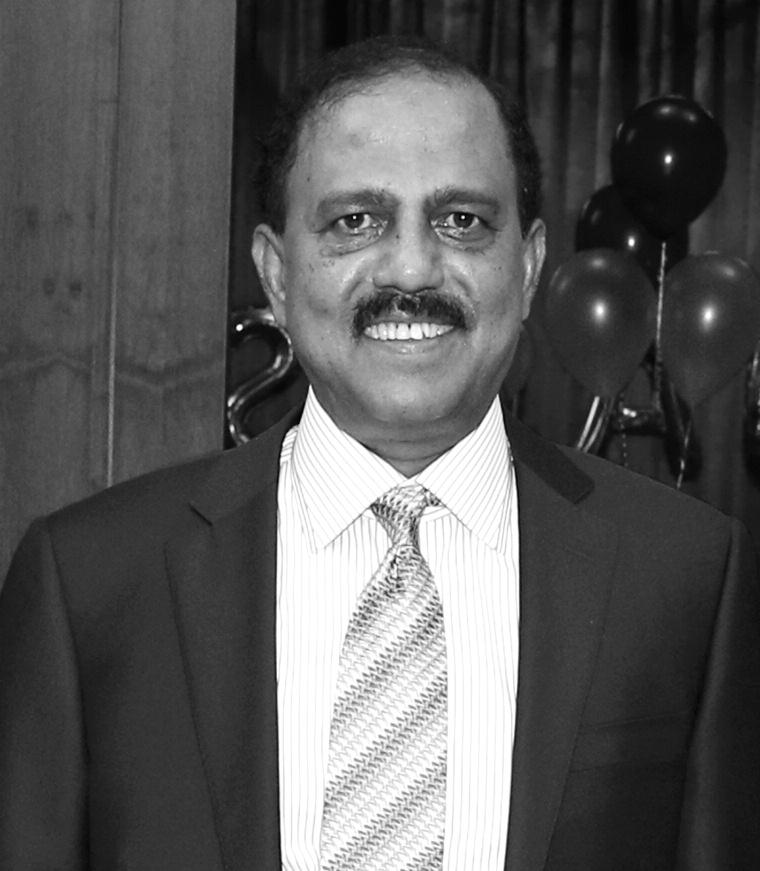
Have you ever visited the Bangladeshi shopping district in Jackson Heights, New York? If you have, you must have noticed the commercial dynamism of the community. Unfortunately, such entrepreneurial spirit and business skills are not very common among Bengali immigrants from India. We should emulate our Bangladeshi brothers and sisters and become more engaged in creating and managing businesses, small and large We have a great role model in Jaiprakash Biswas, a prominent member of the Ananda Mandir community Born and raised in Bangladesh, Jaiprakash came to America in 1998 with his wife and three small children and proceeded to expand and strengthen the garment business he had started in his home town Today he supplies over one million pieces of garment per month to major department stores in North America He is also very active in supporting a number of Bengali organizations here in the US, Bangladesh and in India The author recently met with Jaiprakash to understand the evolution of Jaiprakash as a businessman and his personal values as a family man and a philanthropist
Debajyoti (DC): Where were you born and how did you spend your early years?
jaiprakash (jB): I was born in Chittagong (Chattogram is the Bengali name), the second largest city in Bangladesh and the country ’s largest port I spent my school years there and graduated from Chittagong Engineering College as a mechanical engineer in 1983 Chittagong was not a very big city when I was growing up, and our family had many friends My father was a businessman and active in community service I had a very enjoyable early life, surrounded by family and friends. Chittagong is a nice part of Bangladesh with the Bay of Bengal on one side and the hills on the other. I loved the town. People were friendly and supported each other. They still are very warm and supportive.
DC: You were trained as a mechanical engineer, so why and how did you become a businessman?
jB: When I graduated as a mechanical engineer, Bangladesh economy was in a major recession, and the country’s president (President Ershad) had declared a wage and hiring freeze in the public sector Jobs were scarce for engineers in the private sector, and after some searching, I found a job in a small garment manufacturing company in Chittagong The company had 300 machines, and my job was to make sure that all the machines were in good working order I was very busy as the only engineer in the factory and had to spend long hours I was promoted to the position of Production Manager after a year and the work load increased even more After another six months on the job, I got so tired that I went to the company owner and told him that I wanted to leave the company and try something different
DC: What happened then? Did he offer you a promotion and you stayed on?
jB: No, what happened was totally unexpected He understood my frustrations and gave me $1200 cash (yes, in US dollars) and an airline ticket to go to Hong Kong to see if I found any interesting opportunities there, for the company and for myself! There were no strings attached, and I was very surprised But I took up the offer and went to Hong Kong The owner had a contact in Hong Kong, and I stayed with him One day this gentleman took me to a big garment factory owned and operated by a Chinese company. It was quite an impressive facility, far larger and better equipped than our small factory in Chittagong. Another thing that impressed me was the number of Americans in the factory I found out that these Americans were buyers/inspectors from large department stores in America I was intrigued and asked if I could meet with one of these American buyers I was given a slot at the end of a very long day to meet with Ricky, a buyer/inspector from K-Mart Ricky had a nice personality, and once he learned that I was the production manager of a garment factory in Bangladesh, he casually asked me if I could make T shirts and what would be the price per shirt Of course, I could make T shirts, and I gave him an estimate for the price per shirt The price I quoted was significantly lower than what he was paying in China, so he decided to place his first “trial order” (of 4000 dozen of T-shirts) in Bangladesh with our company! I returned to my hometown and completed and shipped the order on time That was a major turning point in my life My responsibilities now shifted from managing production lines to leading marketing and sales ef-
forts targeted at foreign buyers
DC: What happened next?
jB: We shipped the K-Mart order on time, on budget and with a high quality product We went on to get larger and larger orders from K-Mart and secured trial orders from other department stores in America, including Wal-Mart who also placed their first Bangladesh order through me Our company in Chittagong prospered, receiving an award as a best exporter from the Bangladesh prime minister, and I was rewarded handsomely By 1993, the number of machines at our company increased to 10,000 (from 200 in 1983)
DC: When did you decide to start your own company and why? and how has your company evolved over the years?
jB: I decided to start my own company, Prudent International LTD, in 1994 Although I was happy and well rewarded by the owner of the company, I felt that I needed to be my own boss and try out my luck as a businessman. But I decided not be a manufacturer of garments but a marketer and distributor of garments made by others to my American customers’ specifications. I started with 4 employees, and I am happy to tell you that I now have over 170 employees in various locations I now supply many kinds of finished garments to companies like Walmart and Sears, in addition to K-Mart My company now oversees the production and shipment of more than one million finished pieces of garments per month My manufacturing partners produce the garments at 10 different locations spread over a wide geographic area, from Bangladesh to Hong Kong to Kolkata to Bangalore Our company has been recognized as a top vendor in children’s wear by Kmart and Sears from 2013 onwards, and for its outstanding business performance by the Bangladesh Garments Manufacturers and Exporters Association (BGMEA)
DC: You didn’t mention mainland China but i know that you go to China fairly regularly on business
jB: Yes, I go to China several times a year All the fabric needed for the garments, and the various trims, are sourced in China I coordinate the sourcing efforts for all my manufacturing contractors I am also responsible for the logistics of shipping fabrics and trims to the manufacturing partners, and shipping finished garments to the customers
DC: looks like you began as an engineer but on your way to becoming a successful entrepreneur/manager, you acquired skills in production, marketing, sales, outsourcing, supply chain management, and so on. Was there anything in your childhood that prepared you to wear so many hats?
jB: I learned “selling” the hard way when I was 11 years old The Bangladeshi War of Independence was raging in 1971, and our family was facing very challenging times We had to move from Chittagong
in search of safety, and I decided to earn whatever I could to help out the family I started selling guavas at the local train station That was a sobering experience but it did expose me to the art of selling I learned the principles of the other functions as I progressed in my career
DC: When did you move to the uS and why?
jB: I immigrated to the US in 1998
The primary reason for my move was to give my children the best education they could possibly get At that time, the educational system in Bangladesh was not in good shape My children were quite young My daughter, Urna, was in 4th grade My son, Hrid, was about three years old, and my youngest son, Mohan, was just three months old My wife and I felt that it was better to move when they were very young, although it was quite hard to do so Another reason was the friendship and support of an American friend who repeatedly urged me to move to the US. He even took me through all the steps in the visa application process so that I would not lose patience and give up.
DC: Was this gentleman a friend from Bangladesh who had immigrated earlier?
jB: No He is a NY-based gentleman of Jewish faith whom I got to know through my business Over time he became my friend and mentor I am forever grateful to him for his advice and support on all kinds of issues
DC: in hindsight, was your decision to move the family to the uS the right one? are you happy?
jB: Yes I think we got the best of both worlds My family has flourished in this country And my business in Bangladesh and all the business and personal connections there have also prospered After finishing her college, my daughter has joined my business and has started a garment brand of her own My eldest son is a senior at Northwestern University in Chicago My youngest son just finished high school at the top of his class and is going to join his brother at Northwestern in the fall He was the class valedictorian My wife and I are proud of the good education all our children received here and feel that our coming to this country was the right move
DC: Your wife, Suparna, is a physician with some foreign training to her credit She sacrificed her professional career, moved to the uS and raised the family how does she feel?
jB: I wish you could ask her directly! I think she feels happy. Our move to the US had her full support, and she is very pleased that the children have done well. Our first goal as parents has been accomplished, thanks to her sacrifice and support
DC: You are well-known in the New jersey Bengali community not only as a successful businessman but
By amitabha Bagchi
I received an unsolicited email not too long ago that brought to mind a central question that has long intrigued me: Is Durga Puja for the Bengalis a primarily religious event or a primarily cultural one? And if the latter, as a friend of mine confidently declared some years back, is there a limit to the degree of secularization that we are willing to accept in what was originally a religious festival?
Before I get to the e-mail and what it said, let me set the stage with some personal recollections
Durga Puja used to be performed in my maternal family household when I was little I have but sketchy memories of the observance: the young goat tethered to the railing on the second-floor landing; the severed head of the kid on a platter, its eyes open, staring at the goddess as my grand-father (officiating as the priest) did arati; the little girl in a sari standing stiffly and awkwardly on a metal plate, incense smoke all around her, as my grandfather did kumari puja; and so on. I was far too young to have any sense of reverence, let alone devotion
When I was growing up, financial pressure caused my grandfather to abandon the elaborate three-day Durga Puja and opt instead for the one-day worship of Goddess Jagaddhatri By this time, the family Durga Puja was fast disappearing in Calcutta It was being replaced by the locality-based communal (or Barwari) Durga Puja But my grandfather was forever uncomfortable with it and never fully accepted the change He would insist on taking my brother and me to the few remaining Durga Pujas that were still being performed in the households of his friends We were, of course, more enamored of the size and looks of the images rather than devotion of the worshippers For me at that time, the pint-size deities in people’s homes could not hold a candle to the far larger and more gorgeous images displayed in elaborately decorated pandals of barwari pujas
In the middle-class Bengali milieu where I grew up, the chief focus of the young during the festivities was on glitz, glamor, gift and gawking: the glitz of highly decorated pandals; the glamor of artists (names prominently displayed) crafting eyepopping images; gifts from elders (mainly new articles of clothing); and gawking at pretty members of the opposite sex More attention was paid to cul-
tural and entertainment programs (musical soiree, theater) that would follow the pujas than to pious thoughts and spiritual reflections during the time of anjali
Since those days of my childhood and early youth, Durga Puja has steadily evolved into something akin to a carnival in Calcutta The biggest recent advance has been the advent of “theme pujas,” whereby a largely secular theme is adopted to guide artists and artisans in the construction and decoration of the pandal, choosing the physiognomy of the idols (of Durga and her companions), and deciding on how the deities would be arranged spatially for display
The theme can be just about anything -- my favorite example being that of the hit movie “Titanic” from some years back I saw a picture of the pandal shaped like the Titanic: I imagined Devi Durga in it with the face of Kate Winslet, and wondered if the boat (or nouka) that the Devi would use for her passage in or out was expected to founder to or from her heavenly abode
The e-mail I received referred to another e-mail, from someone I do not know, that tore into the cover of Sharadiya Patrika The cover shows a buxom Devi Durga, with a bare upper torso lightly covered by some jewelry and a diaphanous cloth The writer is livid at the magazine’s management for purveying, or at least condoning, sexual titillation involving the Hindu Bengalis’ iconic goddess in the name of art
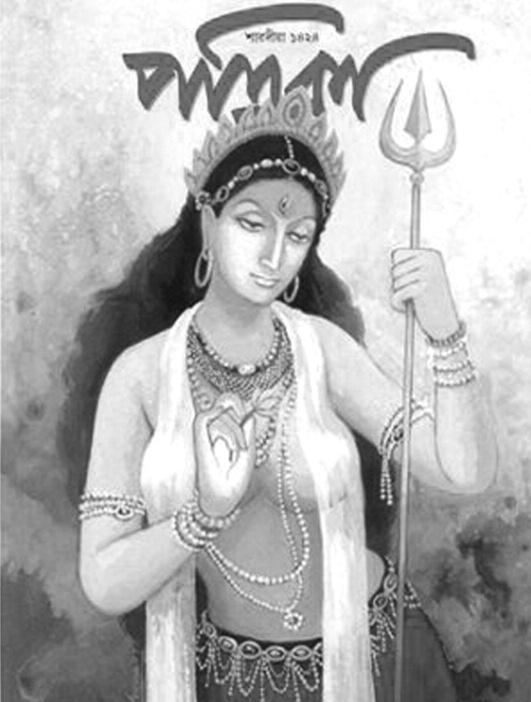
I wonder how widely shared the writer’s outrage is among his fellow middle-class Bengalis. While the cover image of Sharadiya Patrika is a tad extreme – turning the fierce goddess, the slayer of the buffalo demon, into a replica of an Ajanta cave painting – sugges-
tions of sexuality were already creeping into barwari puja deities when I was young. I remember seeing images of Devi Durga running for the kill, one foot on the lion and the other planted on Mahishasura’s chest -- her tigerskin mini-skirt flying in the air -as she impaled the demon with her trident
This conflict between religious sentiment or reverence and artistic freedom is by no means unique to Hinduism A recent example from Christianity would be the hue and cry over a 1999 exhibition in the Brooklyn Museum of Art which included Chris Ofili’s controversial painting “The Holy Virgin Mary” covered in elephant dung Further back, the great Greek novelist, Nikos Kazantzakis, was denied a proper burial by the Orthodox Church for writing “The Last Temptation of Christ ” (The 1988 movie version of the novel, directed by Martin Scorsese, had its own share of controversy as well ) The protests that erupted after the publication of Danish cartoons depicting the face of Prophet Mohammad ended in the killing of politicians and journalists Back in India, in a cross-religious dust-up, the great artist of Muslim faith, M F Hussein, was hounded out of Bombay for his nude paintings of Goddess Saraswati
But the current craze of “theme pujas” gives artists enormous latitude to let their fancy go wherever they want. The result is often what Sarat Chandra Chattopadhyay once described as the situation “when the peripherals rise up to overwhelm the central essence ” A case in point is the picture below from a recent theme Durga Puja pandal
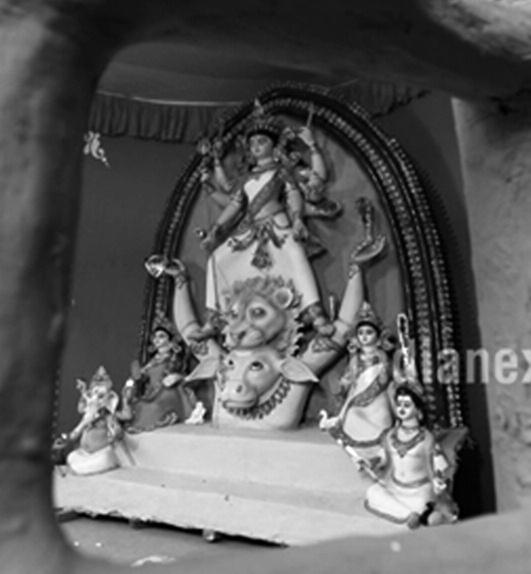
Here the viewer’s attention is naturally drawn to the unusual depiction of the buffalo demon Instead of an anthropomorphic figure emerging from the carcass of a dismembered buffalo, as is traditional, we have the demon as a buffalo-faced humanoid with elongated, upraised arms balancing his slayer goddess Durga and her lion are unexceptional in looks but appear two-dimen-
Continued to page 6
By: Tathagata Ghosh
When we were in Spain, visiting one of the most famous museums there, Reina Sofia, my wife twisted her ankle on one of the uneven floors She was immediately attended to by one of ever-present caretakers at the museum and taken to the in-house infirmary in a wheelchair despite our mild protestations She was treated by the resident nurse and had her foot wrapped up and she was given medicines for the pain and told to take rest We soon abandoned the wheelchair and my wife hobbled away and finally got to see Picasso's Guernica in the museum While researching the healthcare systems around the world, it was easy to see why Spain’s healthcare system is one of the best in the world Spain healthcare mandates that all residents, including tourists, have access to free healthcare The professional medical care that we received during that brief interlude was courteous, good and free.
Healthcare reform has been in the news with the current two presidencies. President Obama created a new system called Affordable Care Act (aka ACA or Obamacare), and President Trump wants to repeal and replace it with something better. The US spends an enormous amount of its GDP on healthcare, one of the highest in the world, and hence healthcare reform must remain a top priority The burgeoning costs of healthcare have hit every family in the USA and there must be better ways of dealing with these spiraling inflationary cost There are multiple factors contributing to this inflation of medical care costs in the US The three that are most commonly cited are: the cost of advanced technologies and quality prescription drugs; the unfortunate rise in the number of chronic diseases including heart disease, cancer and obesity; and lastly the very high administrative costs in the healthcare industry Many experts believe that the administrative costs can be trimmed; controlling the other two contributing factors is a long-term goal
Healthcare is something many countries believe is a universal right Many countries offer medical care to all people living in their borders whether they are citizens or not -- a good example being Spain The quality of medical care is of course varied; the more developed countries are able to provide much better health care on a general basis than under-developed countries Almost every country in Europe has some form of universal healthcare Interestingly though, there are many Asian countries whose universal healthcare is highly rated, notably Singapore and Japan, which are ranked above many European countries In North America, Canada and Cuba truly have universal high-quality healthcare, while United States has just managed to inch toward a more comprehensive healthcare system with the ACA (Affordable Care Act or Obamacare) An interesting note: Mexico too provides public subsidized healthcare to all its citizens and hence people crossing over the border into the US may not be doing so due to the availability of healthcare in the USA
A pertinent question in this discussion is why there is an insurance to pay for routine medical costs, e g a routine dental cleaning procedure An insurance program should be limited to serious or catastrophic events In most countries with universal healthcare, the government does enforce some sort of healthcare savings account on their residents to be able to take care of routine medical expenses. In Singapore for example, it is known as Medisave; where the government mandates a health savings account for all citizens. In the US, there are options to get a Primary Care membership to cover the costs of routine doctor visits.
The density of doctors is a very important factor as to the quality of healthcare Using WHO statistics, the highest density of doctors is in a few places in Europe, Australia and New Zealand These places have a density of more than 10 doctors per 1000 people In contrast, the US and Canada have slightly less than 10 and in India it is only at about 2 Most of Africa does not even have 1 doctor per 1000 persons
What is it that makes healthcare expenses in the US one of the highest in the world running around 20% of its GDP whereas an isolated country like Cuba spend only about 10% of their GDP on healthcare? The life expectancy of citizens in Cuba is equivalent to that of the US and their healthcare system also ranks very high by most measures It does not necessarily mean that the healthcare in Cuba is as good as that of the US but the outcomes seem to be fairly good Cuba ensures healthcare by stating the promise of universal health-
Continued to page 7
By amrita Kangle
Getting uprooted from your roots is a slightly stressful experience, at the best of times Getting uprooted for the second time when you are well into middle age, by which time your ideas are already well formed and you are prone to be a little opinionated, can be extremely traumatic I am not denying that broadening your horizons opens up the windows of your mind and lets the sun shine upon the different parts of your brain that are clogged with cobwebs But the problem is that by that time we have already made friends with the spiders in there
When I sailed onto the shores of America (actually, I flew in and landed in Newark But sailed in sounds so much more poetic), I realized what it means to be an Indian in the USA First and foremost, we are made to understand that we are not the only Indians that exist It was all thanks to the confusion of ideas between Columbus and the navigation compass that he was using The compass knew that he had not sailed west enough but Christopher Columbus thought that he had He presumed that he had discovered India and named the natives there, ‘Indians’. Now these ‘Indians’ were the native Americans because all that Christopher Columbus had managed to do was to hit the shores of America. But those Indians have remained, ever since. And we Indians have to be satisfied with sharing our name with them. At least in America, we have to get used to being known as Indian Americans or Asian Indians
Now, an American living in a remote part of this great country has no clue as to what India is all about Neither do they have the foggiest idea which part of the globe it is situated in If you say that you are going to India on a vacation, you get asked questions varying from, “Do you need to take a bus?" right up to, “Do you have elephants walking on the roads there, instead of cars?” I am not saying that every American will ask you this I am talking about an average one I console myself with the thought that our average Indian (the desi variety), say a Mantu-chacha in a small village near Jalandhar, will also not know about the Wawa Store in North Carolina So, I need not feel offended But the fact is, I do Why has India remained the land of the exotic? Why are we still identified with the mystic fakir in a tattered loin-cloth, and why are all Indians presumed to choose snake-charming as a preferred profession? That is a misconception that needs to be fought!
I will admit that we do have our share of pachyderms that are seen making their stately way down the roads making some money for their mahouts, swishing their tails and swinging their brightly patterned trunks to the delight of passersby But they are very few and far between I will also admit that we have our share of bovines sitting about on the roads, holding up traffic most nonchalantly, as if it is their birthright ..and no one does a thing to make the creature move. In fact even the traffic police are apprehensive about shooing them away since the odd passerby comes and puts a red tilak on the noble forehead of this animal and feeds it grass You see, the cow is our mother She is known as our ‘Gomata’ and we worship her Everywhere! Even in the middle of dense traffic Some Indian, just to prove how ‘progressive’ he is even in the midst of ‘regressive’ India, must have told stories about the menagerie that we have out on our streets and lo and behold, we are immediately identified as a country which has elephants walking the
streets and every citizen, a small time Maharajah sitting atop it!
I am not blaming the Americans for their attitude India is a land that is too far away for most people to put on their ‘must visit’ list So they have to rely on what is shown to them in films or communicated to them via a global platform Responsible international filmmakers who set their locations in India, choose to reinforce the beliefs of their countrymen about India, rather than painting them a proper picture They invariably show only scenes of abject poverty or exotica in the other extreme, just as a visual aphrodisiac, and these are the pictures that go on to become the ‘face’ of India Such scenes only reinforce the common person’s belief that India is just a step away from jungle law!
Another thing that India is known for and I am constantly asked about, as if my identity rests on that, is ‘The Curry ’! You literally go blue in the face trying to explain that ‘THE’ Indian curry does not exist. It is certainly not that brownish or reddish glob of junk that is sold for an exorbitant price at desi restaurants. Indian curries have different recipes, depending upon what part of the country you hail from, and I go to great lengths to explain that the curry is not a generic hash of ingredients and the red color does not always signify the amount of heat in the curry A curry is all about the fragrance of various spices and the velvety smoothness of onion and tomatoes cooked slowly and evenly along with these spices till the result is pure ambrosia Some Americans love this cuisine and gobble up a curry in any form which some unscrupulous restaurants put in front of them, in some hole in the wall eatery which appropriately has pictures of the Taj Mahal and decorated elephants (yes! Elephants again!), regardless of the authenticity in taste, but some Americans are still a little reluctant to try this ambrosia! Well, the Indian in me is equally reluctant to try out their medium/ rare steak! Not because it is beef and certainly not because the cow is a mother, but just because that raw chunk of meat is only half cooked without the benefit of being immersed in spices The Indian me, with the cobwebs in my brain, still needs some spices in my food
Talking about flesh, I must not forget to mention how I needed to adapt to the dress code of the West Okay, ‘dress code’ is too harsh a word that I used Nobody forces you to wear pants or jeans Nobody, but the weather, that is In India, I used to wear only sarees for quite a number of years. Now a saree is an extremely useful apparel with which you can hide all the parts of your anatomy that don’ t flatter you. I thus had quite a wonderful opinion about myself and if anyone had called me ‘fat’, I would have thought that the person was joking. When I started living in America, the joke turned out to be on me I needed to lose weight drastically, if I wanted to wear jeans and if I wanted to look anything like Julia Roberts, who was my dream woman There is no need for loud guffaws here I have used the word ‘dream’!
Bollywood, is the other product with which we Indians have established our identity in the world It is all thanks to the Indian film makers who produce slick and shiny movies, which portray a shiny and perfect picture which are just celluloid copies of what Hollywood produces but with a ‘desi’ flavor The music of these films are promoted on television, much before the film is released and both the young and old are to be found gyrating to these ever popular songs as soon as the music hits the stands In-
Continued to page 7
By Ruby Banerjea
In this country, watching your child grow into a teenager can be as interesting as watching Discovery Channel You just don't know what comes next!
Cheerful and hyperactive one moment, grumpy and indifferent in another It's like walking on eggshells for us parents There seems to be no logical explanation as to why they behave in the manner they do, so not to look for one is the sanest thing to do For teenagers can't be seen with their parents, and if they are caught actually listening to them, it can be downright uncool.
Talking about uncool, I have to say that it is this teen language which they so easily speak, fascinates and more often, confuse me the most. Cool was the first American expression which my daughters had picked up after coming here Needless to say that it has no relation whatsoever to the word 'temperature'–not even a distant one Anything nice, smart, weird, or even ugly can be real coool
Every time we conversed, I was learning new words For the time when I had asked my 14 year old daughter "what have you been doing after school?" Pat came the reply "just hanging around and chilling out with friends, Mom "
To my understanding of the English language, chilling out and hanging around could only be taken in their literal sense Who would have guessed they could mean spending time with friends? Another time, after watching a play she asked me, "Mom did you hear the audience cracking up?" I was at a complete loss
Cracking up? What will they crack?
"Oh my goodness! Don't you know 'cracking up' means to laugh? Now how could I? I could find no connection between the two meanings no matter how much I tried Crack means to break I tried to explain.
"Right" said my daughter.
I was happy that at least she had agreed. However my happiness was short lived. One glance at her face told me that I had no clue what she meant Now how was I to know that when they said right in a derogatory fashion, it meant wrong? My basic knowledge of English language was being threatened! "How can you say that? Right means right as in correct and wrong means wrong as in incorrect," I explained " "Not when you say it this way," she demonstrated by changing the tone of her voice way low
"Okay okay I'll be more perceptive next time "
I had more to learn There are homonyms in teen tongue too Chill out can also mean stop that, which, in turn can be synonymous to knock it off, cut that out and maybe many more Gradually I also learnt Vanilla Ice is not a drink and neither is Baby
Face, a baby
However, when I thought I had heard it all, I was in for my biggest surprise
Completing summer reading had never been a problem with my younger daughter However, she was having difficulty with one particular book It was Siddhartha It was her high school reading assignment, and I noticed her being quite lackadaisical about it She said it was too complicated and she'd get to it eventually I kept nagging, she kept warding me off Until one day she came up to me and announced she had completed the first part of the novel, asking if I would like to know how the story had progressed so far. I happily agreed to see how much she had grasped. I was in for a shock. This is exactly how she told me the story:
"Okay so, ya know it goes like this: there's this important 'dude' named Siddhartha and he lived in this really cool village with his 'peeps' He had a best friend who was his main 'homie' whose name was Govinda Siddhartha was really smart and he had the 'brain thing' going on, and one day he saw a gang of 'tough skinny dudes' walking by So he was like,' yo Pops! Govinda and I wanna go chill with those people Those are the Samanas and they do really cool stuff ' But his Pops was like 'no way! You ain't going nowhere; you are staying here with me!' So now Siddhartha didn't listen at all and he was very stubborn until his Dad gave him permission to join them Siddhartha was happy his Pops agreed and said, "Thanks Pops! Props to you, Peace out!"
By this time my elder daughter was rolling on the floor with laughter, listening and watching my expression
"What on earth are you talking about?" Needless to say both of my daughters were enjoying themselves at my expense "You can't talk like that!"
"That's kind of cool don't you think?" She replied.
After she explained the meanings of the words which I didn't even know existed, I could barely keep a straight face "But you can't write like this, your English teacher will have a fit " I pointed out
"Are you kidding me?" My daughter laughed “I’m only saying it like this, so I can remember better It helps me study "
"Yes Mom, it helps her remember and also doesn't alter the story in any way, does it?" My elder daughter piped in
It did not alter the story, I mused Who knew a strange new diction would help her study? As long as she got it though, I didn't really mind
Shakespeare was right when he had said 'A rose by any other name would smell as sweet '
By Subhodev Das

Genomic medicine, commonly known as personalized medicine, is a way to customize medical treatment to your body's unique genetic makeup
Every cell in your body contains DNA, the molecules you inherit from your parents that determine how your body looks and functions DNA is arranged like a twisted ladder, with information stored in the arrangement, or sequence, of the rungs. Sections of the DNA ladder that contain information needed to make proteins are known as genes The complete set of genes is the genome The human genome may contain 20,000 to 23,000 genes
A nearly complete map of the DNA sequence was completed in 2003, resulting in a ‘book’ of the human genome divided up into chapters and annotated in parts Since then, scientists have worked to understand how each gene functions and how it is coordinated with every other gene
It is well known that everyone responds to stress and the environment differently, and they also respond to disease and to treatments differently Although greater than 99% of a DNA sequence is identical from person to person, the last 1% helps to explain these differences
Scientists continue to discover new ways that subtle gene differences can cause large differences in health Different people may have small variations in specific genes, and some people may have genes that others do
not These may increase susceptibility to a specific disease or provide protection from that illness Understanding gene differences can lead to better ways to prevent, diagnose, and treat many types of health conditions
National Institute of Health (NIH) is funding cutting-edge research to solve the puzzle of how genes and lifestyle connect to affect our lives and health. Today, researchers can scan and compare entire genomes very quickly. These studies have already turned up disease “signatures” for type 2 diabetes, heart disorders, prostate cancer, Crohn’s disease, Parkinson’s disease, and age-related macular degeneration More disease-related gene variants are identified every few months
Although genomic medicine is early in development, there some areas where it has shown promise Based on discoveries over the past five to ten years, genomic medicine is beginning to fuel new approaches in certain medical specialties Oncology, in particular, is at the leading edge of incorporating genomics, as diagnostics for genetic and genomic markers are increasingly included in cancer screening, and to guide tailored treatment strategies
Genomic medicine is also fueling advances in the field of pharmacogenomics how individuals react differently to medicines that indicate that we are moving away from “one-size-fitsall” medicine Scientists can now
Continued from page 3
also as a passionate philanthropist. You have generously supported ananda Mandir and several other community organizations. how did you get interested in community support?
jB: My father taught me from my childhood that it is our duty to give something back to the society He truly believed in that principle and practiced it all his life He was a successful businessman but not a wealthy one, yet he tried to help the poor and the needy whenever possible When an ashram in our hometown ran into financial distress, my father made it his personal mission to raise sufficient funds to put that organization on sound financial footing He also taught us to respect honest labor – and pay all workers honest wage His principle was “pay the worker his wage before sunset ” so that he may return home satisfied and proud of his day’s work
DC: Mohan, your youngest son, briefly mentioned in his speech at the graduation party that his grandfather had decided to use the airfare you had sent him to come to the uS to benefit the ashram instead What happened?
jB: After I established myself in the US, I wanted my father to come and spend some time with us in this country He had never visited the US, and we were worried that he might not be able to undertake a lengthy trip if he waited any longer So, I sent him the airfare But at that time, the ashram suffered major damages because of torrential rain My father decided that it would be more appropriate for him to help the organization with that money He stayed back and took care of the necessary restoration Because of his advancing age he did not get another chance to come and see his grandchildren My children were sad but they learned how much their grandfather valued community work. I learned too, and I worked with my brother in Bangladesh to save an orphanage for girls in our town when their funding disappeared suddenly. That orphanage had 60 to 70 girls at that time, and now it has over 170 residents, thanks to everyone’s efforts.
identify glitches in our DNA scripts that reveal what drugs may be dangerous or completely ineffective for certain people This information will help doctors calculate precise dosages that match a person’s DNA different people, different pills Currently, more than 100 FDA-approved drugs have pharmacogenomics information in their labels, in diverse fields such as analgesics, antivirals, cardiovascular drugs, and anti-cancer therapeutics.
Cystic fibrosis, one of the most common genetic diseases, is attributed to mutations in a gene called CTFR More than 900 different such CTFR mutations have been identified to date, of which approximately four percent are caused by a mutation known as G551D A drug called Ivacaftor has been developed that is extremely effective at treating cystic fibrosis in individuals with this particular mutation
The Human Genome sequencing project, completed in 2003 cost $3B and took 15 years to conclude Now the human genome can be sequenced within a matter of days for approximately $1,000, making genetic analysis a routine part of medical care At the same time, genomic and genetic applications are not a magic wand that can cure every disease and solve every challenge in health care There is hype, as there is hope
As of today, genomic innova-
Continued to page 10
DC: Thank you, jaiprakash, and best wishes for your continued success.
Continued from page 4
sional, almost like a Rajasthani painting. The roles of the central and the peripheral have thus been neatly reversed in a rather unique artistic presentation.
I am sure my late grandfather would disagree with the current trend and be horrified by many of the results But I do not hear many protests similar to
that articulated by the writer of the unsolicited e-mail that crossed my desk The answer to the question I posed at the outset is clear Among the Bengali middle class, culture and aesthetic appreciation seem to have trumped reverence and religiosity insofar as Bengal’s biggest celebration, Durga Puja, is concerned
The food for the needy comes from generous donations made by you - our members, temple attendees and all well-wishers of the community. Will you please help? This is a year-round program, so any time is good for the donation. Al l kinds of non-perishable food and toiletries are needed No glass jars please!
Thank You,
Krishna Dutta Roy Chair, Ananda Mandir Humanitarian Activities
By Tilottama Bose
We arrive in Dakar on a Tuesday, after an almost 16-hour flight via Paris I brace myself for a hot and humid equatorial evening as I step out of the plane onto a staircase, but am pleasantly surprised at the mildness of the weather I smell the sea, or now on retrospect, I think I did -the salty freshness of oceans has draped itself in my memory as something very real After we clear customs and collect our baggage, we drive a few miles to our hotel It almost feels like a small town in Northern India -- or a Delhi suburb The feeling of home hits me, though I am kind of midway in the path connecting my two homes – in India and USA We arrive at Radisson Blu and are allowed entry after a security check -- or a peek -- into the bus The hotel by the ocean is simply magnificent I am too tired to register it fully, and happily escape to my room for a good night's rest before I wake up tomorrow to a new and exciting 2-week journey
The next morning reveals the location of the hotel, in slow motion, and caresses my senses: the pool by the sea, the fantastic view from the on-site restaurant (our daily breakfast spot), the lighthouse on a faraway cliff, and the romance of the ocean breeze seeping into my soul.
The extensive daily breakfast spread overwhelms me, and I carefully refrain from going overboard. After a sensible breakfast, our 3 days of stay are filled with seminars, a school visit, a visit to the monument, a cultural dinner, and a quick stop at the local market The days are fast paced, and I soak up the experience as much as I can
Ibrahim, an International Leaders in Education program (ILEP) fellow, introduces us to the history and culture of
Editor’s Note: The author, a high school teacher in the urban district of Trenton, New Jersey teaches History in Grades 11-12 In her quest to bring the world to her students and to expand their world-view, she earned a grant to the Teachers for Global Classrooms (TGC), a program sponsored by the International Research and Exchange Board (IREX) and the US Department of Education This grant allows her to pursue professional development activities to empower her advocacy for global education The grant provides her with the tools and resources necessary to become a facilitator for global education
For educators, and others interested in accessing pathways to global learning and global competencies, please visit her Global Education Guide at http://pathwaystoglobaled weebly com/
Senegal I have always been fascinated by ancient history and the narrative of people and nations, and learn so much from his presentation Later, we visit a local school and get our first glimpse into the Senegalese education system in action -- disciplined classrooms, engaged students, and minimal resources They have three national level exams for students to clear before they can move on to the next grade
The exams are at the end of the 4th grade, the end of 9th grade, and then the Terminal exam at end of the 12th grade Education is a top priority, without the sugarcoating that American students in K12 are used to
We also have an opportunity to sit in a Forum for African Women Educationalists (FAWE) meeting -- an organization which focuses on the empowerment of the “girl child” including education and health related issues The spacious office is in a neighborhood house The presentation is in French -- patiently translated sentence by sentence by Ibrahim and Assitou. I must admit that I do feel disengaged after a while, almost nodding off. But their purpose and grassroots level work are impressive and I make a mental note to figure out a way to help, going forward.
Over the next two days, we get a chance to visit the first museum for women in Africa and enjoy a delicious tra-
ditional dinner at a top-floor downtown restaurant The downtown once again reminds me of India and I feel that I have an old bond with this land, which is so new to me
On Wednesday, Dieynabou, the program coordinator who we call Dee, informs my co-teacher Roy and me that the Kolda trip may not work out after all -some issues having arisen with the airline reservations She has arranged for another town for our local experience -- a three-hour drive from Dakar Though Dee tries, she does not receive security clearance from the US Embassy for us to travel to Kolda by car The surrounding areas of Kolda are known for separatist attacks, and road travel by tourists is highly discouraged
We all are disappointed – Fanta, our host teacher at Kolda, Roy, Dee and I -but we take it in our stride At least the three of us do But Fanta would have none of it. She actually called all the 10 passengers one by one, requesting them to take a later flight (which happened to be 4 days later on a Tuesday) and succeeded in convincing two to give up their seats. Hail Fanta!!! Roy and I get our first glimpse of her ability to plow on, against all odds
We arrive at the airport on Friday morning for our 45-minute flight to Kolda
Continued from page 5
care in its constitution whereas this is not so in the US The US does take care of its indigent and elderly through Medicare and Medicaid. Unfortunately, sick people with catastrophic illnesses often do not have any governmental assistance in the US, the most advanced country in the world, and many families end up in bankruptcy. This cannot be the best way to manage healthcare To have an idea as to how an ideal medical insurance program should be, it is a good idea to look around and check out how other countries handle their medical liabilities
The Japanese healthcare system is arguably one of the best in the world It is extremely efficient in terms of the money spent for healthcare, much of it taken care of by the government Wait times for doctors are low and they are entitled to spend a lot more time in hospitals than in the US The doctors work long hours and do not get paid very well as compared to the US The longevity gains have been very impressive as well, a
quadrupling of people who have lived over 65, as well as very low infant mortality rates The ‘kaihoken’ system, which is the universal healthcare system in Japan, has been in place for over 50 years and has delivered great results Japan is facing looming issues in the future due a smaller workforce, low birthrate and a large elderly population
Singapore the city-state has one of the best outcomes in terms of health care It is also unique in that the insurance costs are supposed to be based on a free-market system This is the preferred path for most conservative thinkers so that the government is not in the business of subsidizing health care. The government pays only 1/7th of the cost per capita on health insurance as the US. Most of the expenses are borne by the free market system by a variety of fairly innovative health-savings accounts In truth though, most of the public health system is owned by the government and the health costs are held in check by the government by subsidizing the delivery of health care through
government hospitals alternatives
Single Payer system - This is dubbed as a Medicare-for-all solution This is a solution where there is a single not-for-profit organization managing the entire healthcare, which could be a universal healthcare This is supposed to iron out the inefficiencies in the system created by needless administrative costs This is typically a government run initiative This type of system is opposed by many strong lobbies including Big Pharma, which will lose its ability to bargain
There are also faith based alternatives like the Christian health care ministries. Here Christians who participate send monthly checks to the families who have a need instead of sending money to a company. This is obviously limited to people of the faith and cannot truly take care of major bills
The answers are not easy and many are impractical, but we can hope that some sensible form of universal healthcare will finally be available in the USA in the near future
I am a bit nervous -- given that I have motion sickness, a ride in a small plane is not something I am looking forward to I am quite relieved to see the plane isn't that small after all and start taking pictures Roy tries to tell me that it is probably not our plane I refuse to think that our plane could be any smaller
I was wrong
KOlDa: a town, a tree and a tale to cherish
I survived the flight to Kolda on the tiniest plane I have ever been on I must admit that I was nervous, especially flying along the coast -- over water But we did arrive, along with 8 other people, two pilots, and all our luggage Given the size of the plane, I found the whole idea of a smooth landing rather fascinating I was quite impressed by the pilot!!!
The airport was a one-story building, and I could see a tall lady waiting for us Fanta -- finally!
After a very warm welcome, we drove through a dusty and hot morning to our hotel. I loved it at the first sight, with its flowering trees, a pool and thatched roof cottages. Over the next 7 days, Hotel Hobbe was to become my home, a lifetime memory and so much more.
I checked out the suites ( just larger rooms) but decided on a second floor room instead
The army barrack was right across the hotel, with a couple of armed soldiers constantly on guard A community center with a courtyard shared a wall with the barracks It was nice and quiet, yet I could see the bustling market from the verandah in front of the room Perfect!
The room was more comfortable than what my pre-conceived notion had pictured There was even a mosquito net
Continued to page 10
Continued from page 5
dians and non-Indians alike are swept away by these numbers which are played not only in desi homes but also in all the night clubs in the very stylish New York City Of course I need not add that the really great films, which have been made by our film makers, films that hold true meaning are not considered ‘Bollywood’ Bollywood dance classes have sprouted all over to teach the masses all the appropriate dance steps too It is a huge industry
And because of the overdose of religion often found in these films, religion and celebration of the various festivals of our country have assumed grand proportions Far away from home and starved for the joys associated with celebrations, our Indian brethren borrow from Bollywood with gay abandon Festivals, marriages and special occasions have assumed the appearance of mini movies with all kinds of filmi paraphernalia thrown in Desi children are taught to recite the Gayatri mantra and various shlokas It is to their credit that they can recite these difficult Sanskrit mantras albeit in an American accent I very often feel that the children in the West are more Indian than the children back home because those kids back home are busy learning to ape the West!
In all this, I spot a rainbow Thanks to technology, the world has already become a small place Maybe if ordinary people like you and I and our counterparts in the different countries where we have pitched our tents, we try and understand each other’s cultures and try to inculcate the best in each into our systems maybe, just maybe we might be able to bring about the peace in the world without having to use guns
Reported by Krishna Dutta Roy, Chair, Puja Committee
juNE
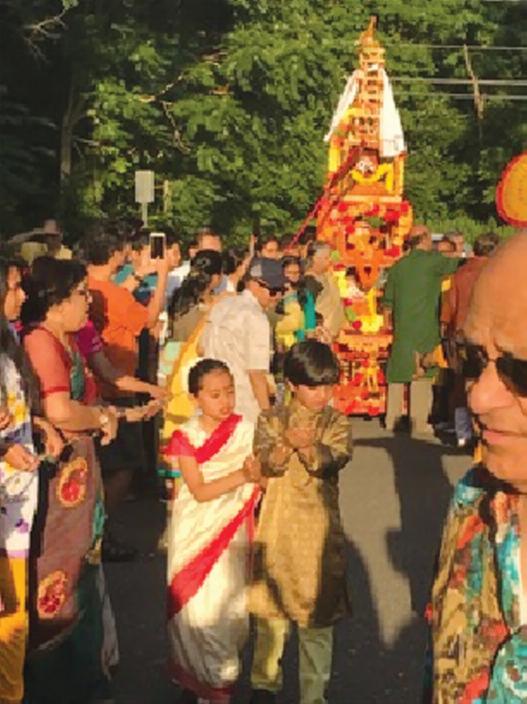
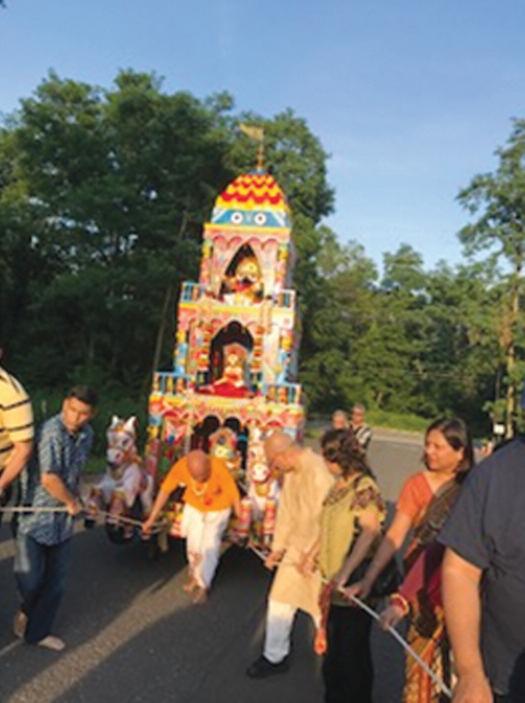
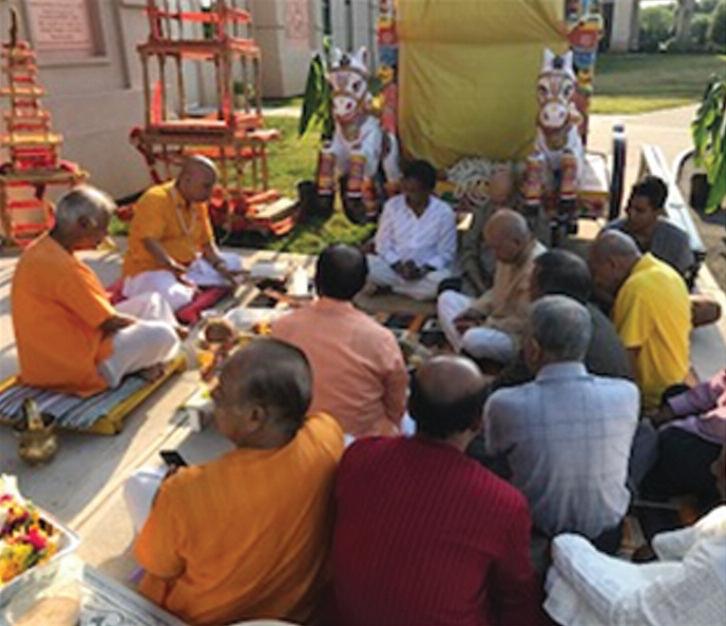
We had our monthly Satyanarayan puja and Shyama Puja as usual The big attraction of June was Sri Sri Jagannath Mahaprabhu's Rath Yatra on 25th of June The celebration started with decorating the Rath with garlands and lots of flowers Then, puja rituals were performed by Biswajyoti, the temple priest assisted by Guru Chakravarty. At around 6:30pm the deities of Jagannath, Balaram and Subhadra were placed in the Rath, and it was ready to be pulled by the waiting devotees. Two young dancers, Auroni Sen and Anuron Chakraborty, danced in front of the Rath as it was pulled. The path of the chariot was strewn with Gangajal and flowers. As the devotees were pulling the decorated chariot while chanting Hare Krishna and occasional shouts of “Jai Jagannathdev”, others were playing Dhak, Dhol, Kansar, Khanjani and other musical accompaniment This continued for several back and forth turns (Parikrama) around the driveway, for over an hour Candies were thrown around to perform the traditional “Harir Loot ” , as men, women, boys and girls merrily contested with each other to get their share of the loot After the Parikrama, the Rath was brought back along with the deities inside the temple The puja, aarati, anjali continued until 8:30pm and the festivity ended with distribution of prasad and delicious dinner
As the tradition goes, we also had a “Rather Mela” (Fair) outside on the Yard and on the deck Delicious snacks, sweets, juices, sharbat and water were served along with useful materials like tulsi plants, religious books etc
We also celebrated Bipadtarini puja on June 27 julY
We were definitely looking forward to Ulto Rath celebration on July 3rd As it is known, Jagannathdev goes to his aunt's house
Continued to page 12
“The
Review by Sushmita Dutta
author’s note: On a bright, sunny morning, I was heading for SAP Headquarters in Newtown Square, Pennsylvania The drive was from New Jersey Route 1South connecting to Pennsylvania Turnpike merging into 276 West The estimated drive time from my home was little over an hour and half I had about an hour more to drive into SAP campus when I was stuck with hundreds of cars at the toll booth of Pennsylvania Turnpike We had a 9:00 A M meeting that day and, helplessly, quite a few of us from SAP had to wait for more than two hours at the toll booth that had a failed computer system Many such computerized systems run our day to day living today We cannot function if computerized systems like highway toll booth, ATM machines, online banking, online transactions of purchase/delivery etc fail thereby crippling our planned tasks In this technology-driven society, what is there for us in future? Looking at it from none other than Microsoft’s Co-founder and former CEO Bill Gate’s point of view narrated by him in “The Road Ahead” co-authored by Nathan Myhrvold, a Microsoft executive and Peter Rinearson, a Pulitzer Prize winner journalist Read on and please feel free to share your thoughts on this book via letter to the Editor of Ananda Sangbad
The era of 1995. The information technology scenario was just getting ready for thriving personal computing systemsdesktops, arriving at almost every desk of our homes and offices “WYSIWYG” (What you see is what you get) running on Microsoft Windows operating environment was getting extremely popular Windows made Microsoft a giant in the industry When I first walked into Microsoft Corporate office in Redmond, Washington State, I entered the campus that proudly hoists three flags – The flags of United States and the Washington State and a Windows icon embossed flag that run on our desktops What a proud feeling Standing under the flag of Microsoft Windows, I felt like I was under the umbrella of the entire world’s personal computing system With the ease of personal computer usage came expanded networking and gradually we moved on to The Super Highway and the ever expanding information era of Internet. “The Road Ahead” is all about this era of information technology embracing the super highway – “An extensive electronic network such as the Internet, used for the rapid transfer of information ”
The time was perfect for a book like “The Road Ahead” It was a well thought book and was strategically placed in the market when general readers with access to Internet and multiple technology platforms wanted to know more about technology, the information highway, and of course, the personal computing system, and the technology road ahead Hence, millions copies were sold and the book became New York Times’ best seller Here are some technology predictions
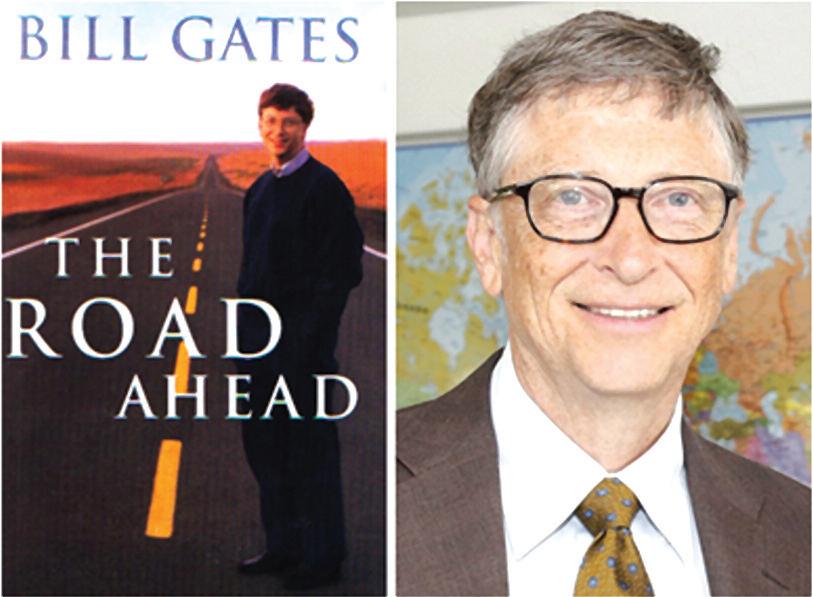
made by Bill Gates that would likely matter the most to the readers of Ananda Sangbad Of course, I have extracted some technical meat as well for technology savvy readers, but the overall review of the book is for general mass, exactly the tenor in which “The Road Ahead” has been written Some of these predictions made in 1996 have come true Let ’s explore, here are some quotes by Bill Gates published in “The Road Ahead”: Quote1: “We’ll find ourselves in a new world of friction, overhead capitalism, in which market information will be plentiful and transaction costs low it will be a shopper’s heaven" (Bill Gates, “The Road Ahead”: Page 181 ) Vey true Today, we are flooded with information on every industry vertical, every business, every product available in the market, competitive costs, customer’s reviews, availability of purchase online etc. without having to visit shops. It is indeed a “Shopper’s heaven” today with lower purchase transaction costs offered by online sellers to keep pace with competitive markets across the globe We buy from shops around the world via Internet which was predicted in “The Road Ahead ”
Quote 2: “Computers are great because when you're working with them you get immediate results that let you know if your program works. it's feedback you don't get from many other things." (Bill Gates, “The Road Ahead”: Page 2 ) This very fact that we get “immediate results” from computers has contributed to the popularity of the technology usage and created a huge mass user-base worldwide Even
a non-technical person can use a computer with multiple benefits It wasn’ t so in the 1990s Those who knew how to operate a computer then were known to be technically qualified But today even non-technical people use a desktop, a tablet, and smartphone to send and receive messages The development of user-centric computer interfaces like touch-screen and WIFI connectivity accessing Internet from anytime, anyplace has reassured the usage of computers Such mass adoption of computers was predicted in “The Road Ahead” Of course, price is another factor that has contributed to the mass adaption of the machines Today, we pay less than half of what we used to pay for a desktop in the ‘90s Also, it is ease of use that has contributed to purchase and usage of computers, and Microsoft Windows plays a huge role in the ease of computer use
Quote 3: “internet as one of the important precursors of the information highway...suggestive of [its] future" ; the "popularity of the internet is the most important single development in the world of computing since the iBM PC was introduced in 1981." “…Today's internet is not the information highway i imagine, although you can think of it as the beginning of the highway." (Bill Gates, “The Road Ahead”: Pages 89, 91and 95 ) The fact that Internet is different from the information highway was envisioned by Gates in the ‘90s Today, as we see, the Internet is just an integral part of the information highway also called the Super Highway, which is a network of
Continued to page 11
Reported by Krishna Dutta Roy
Ananda Mandir celebrated Indian Independence day on Aug. 20th, as Aug 15th was a week day.
Around 11:30 am, the Indian Flag was hoisted by Ashok Rakhit, the President of Ananda Mandir, accompanied by Dipak Sarkar, the past President, and Biswabhai, the priest, amidst chanting of "Bande Mataram” by the audience It was followed by a “Prabhat Pheri” parade by everyone, with Indian and American Flags in their hands, on the pathways of Ananda Mandir Sreya Chowdhury sang both the Indian National Anthem and the American National Anthem Anandadhwani, the singing group of Ananda Mandir, presented two patriotic songs A speech by Dipak Sarkar, our past President, was followed by a speech by Anirudh Sarkar, one of our Kisholoy group members The program continued with patriotic songs by Moumita, Shankhadeep, and Sreya Srijon and Susmita recited patriotic poems At the conclusion, a group of young ladies presented a dance along with a patriotic song The entire program was led by Arun Bhowmik and Suranjan Bhanja Chowdhury Picnic started around 1 pm Many programs were arranged for children While some of them did face painting, and played volleyball outside in the field, others sat down with crayons and papers to display
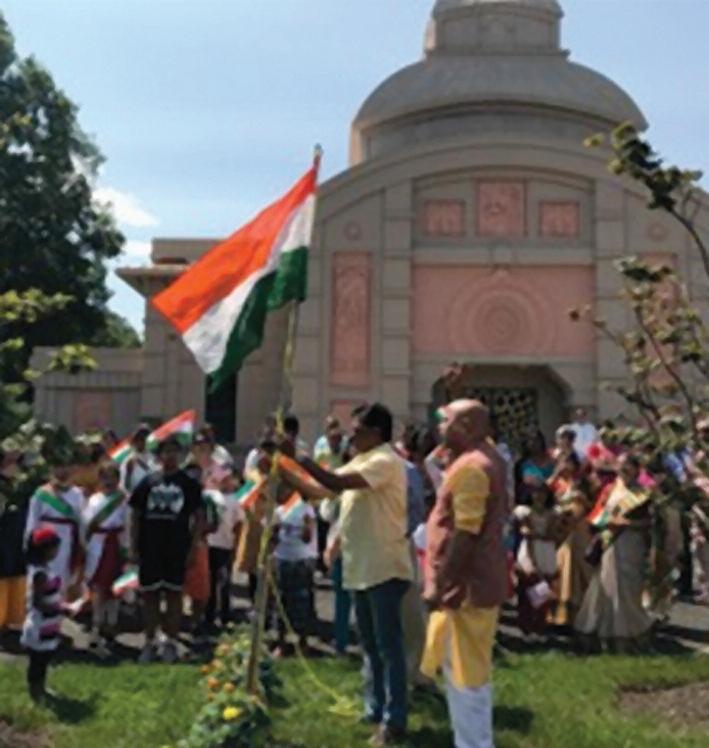
their artistic talent Prizes were given out by Dr Sarkar A few ladies showed their talents in Alpona in the basement Indeed, some of them were amazingly beautiful Prizes were awarded to them too This whole event was arranged and conducted by Indrani (Papri) Dhar and Girija Belvadi Thanks to them for their time and patience The popular “Musical Chair game for the Ladies” was enjoyed by everyone
There was plenty of delicious food for both adults and children, including snacks, fruits, juice and ice cream It was a very enjoyable day Hope to see you all next year
Ruby General Hospital, the brainchild of Dr. Kamal Dutta, a dedicated member of Ananda Mandir, is a large 300 bedded multi-specialty hospital with more than a thousand employees and 350 medical consultants. There is constant communication between Indian and US-based doctors with the continuous transfer of knowledge and technology.


Continued from page 6
tion can’ t outmaneuver market realities, and it can’ t compete with the frightening complexity of diseases like cancer – at least not yet To fully understand how life works, scientists need to decipher both the genome – the set of instructions repeated in every cell –and the epigenome, the part that varies wildly between cells
Then there’s the cost of bringing a drug to market, which often dwarfs the potential demand for the drug, a.k.a. the number of people who need it. With personalized medicine this cost may be too high to recover from a small pool of patients, particularly if the drug only works for months
The road ahead for genomic medicine is fraught with challenges Fortunately, the stakeholders in this arena are looking into new technologies to overcome some of the challenges
One such technology is artificial intelligence (AI)
AI is the branch of computer science that aims to endow computers with abilities to emulate human cognitive functions such as “learning” and “problem solving ” To better understand how DNA sequences relate to biological changes, the genomics community is turning to machine learning
In recent years, machine learning techniques are rapidly spreading from AI research to pharmacology labs as these intelligent software sift through vast amount of clinical and pharmacological data suggesting new drug compounds that humans haven’ t tried yet
One such machine learning technique is called deep learning, which has become pervasive in computing companies, such as Google (recommendations for email responses) and Facebook (face recognition in posted pictures), but is less established in the natural sciences
Deep learning software attempts to mimic the activity in layers of neurons in the neocortex, the wrinkly 80 percent of the brain where thinking occurs You give the software lots of training examples, so it can see what ’s right and what’s wrong and learn by making mistakes In the process, it learns, in a very real sense, to recognize patterns in digital representations of sounds, images, and other data The software then applies the learned pattern of understanding to a particular problem – in this instance, mapping the genome
Deep learning uses a design known as a generative model, which takes in a trove of data and uses what it learned to generate plausible new data of its own And because of the computers that run these software have many
more processors and memory modules than most people have, they can handle much larger data sets, and they can patiently learn things for hours or days or weeks
The basic idea that software can simulate the neocortex’s large array of neurons in an artificial “neural network” is decades old, and it has led to as many disappointments as breakthroughs However, recent advances in mathematical formulas and increasingly powerful computers are allowing computer scientists to model many more layers of virtual neurons than ever before Deep learning algorithms are being trained to read the mess of letters that is the language of the genome It is hoped that these techniques can pick up subtle signals from faulty genes in huge quantities of clinical data Some of these genes may be undergoing a single, well-understood duplication or deletion causing certain genetic disorders. But many other disorders, like autism, involve dozens of genes, and every patient carries a different combination of mutations. In the case of a child with an immunological disorder that doctors have never seen before, for example, deep learning is first untangling what genetic mutations might be responsible, and then predicting what is going wrong inside the child’s cells Identifying one or more genes responsible for a disease can help researchers develop a drug that addresses the behavior of these faulty genes
A new deep learning technique has been designed to help scientists learn about the connections between DNA sequences and DNA methylation – a biochemical modification of the genome sequence that can act like an off-switch for individual genes Methylation plays a key part in important biological processes, including cell development, ageing and cancer progression
The new method uses genomic and epigenomic data to make predictions about DNA methylation in single cells This is important because current technologies provide incomplete information about this With the new technique, researchers can obtain a more complete picture of DNA methylation. The model can also be used to obtain new biological insights, for example on the connection between the DNA sequence and methylation.
The emergence of these powerful machine learning algorithms and cost-effective new ways of sequencing whole genomes, the entire readout of a person’s DNA, are heralding a new era of datarich, information-based medicine Currently, pathologists in different laboratories will disagree over a particular genetic mutation up to
50 per cent of the time In five years or so, the pharmaceutical companies that are going to be successful are going to have a culture of using these AI tools On the other hand, there is a growing list of AI companies betting that their techniques can help produce powerful new drugs by scouring huge quantities of genomic data
Deep Genomics, a Canadian AI company, has focused on hardto-detect mutations that might have a causal relationship with a particular disease, such as Mendelian disorders that affect 350 million people worldwide It has also demonstrated that deep learning can help identify patterns in DNA that might contribute to diseases such as spinal muscular atrophy and nonpolyposis colorectal cancer BenevolentAI, a British AI company, is honing on diseases of inflammation and neurodegeneration, orphan diseases, and rare cancers. Calico, a subsidiary of Alphabet (Google’s parent company), is harnessing advanced technologies including machine learning to increase our understanding of the biology that controls lifespan.
Academic institutions like Stanford and UCSF are looking into deep learning to help with drug development by finding patterns in sparse pathology data combined with large genomic data sets European institutions are utilizing deep learning to better understand the epigenome –the biochemical activity around the genome Scientists at these organizations have leveraged the capacity of deep learning to fill in the gaps in single-cell genomics, an emerging technology that offers a close-up view on epigenetics
Single-cell epigenomics methods provide exciting insights into cell heterogeneity in development, ageing and disease; however if one is just dealing with two genomes in a single cell, bits of information are often lost during the experiment Deep learning recognizes patterns of the epigenome in single cells and then reconstructs lost information, returning a data-rich single cell epigenome
Using AI, deep learning algorithms, and complex data sets, the entire healthcare industry could be revolutionized from diagnostics to gene therapies to personalized medicine. By opening doors to understanding the large-scale, incredibly complex data set that makes up the human genome huge privacy implications related to mass-genomics data collection have to be addressed also the biggest disruptions in the medical, life sciences, and pharmaceutical industries may be around the corner
Continued from page 7
hanging from the ceiling, all rolled up I was ready to go!
The internet in the hotel tried its best not to be erratic Unfortunately, it did not allow me to update my blog I have notes written all over the place so that I am able to articulate my journey in that little town A multi-faceted experience indeed! I just wish I had the words to express it all I can only try and hope that I am able to convey, at least partially, what Kolda is, and how the interaction with its people changed my life forever
KOlDa: 7 days and wanting more
EDUCATION: Let's start with the most concrete part of my visit - as an educator and as a fellow of the Teachers of the Global Classroom Our host teacher, the incredible superwoman Fanta Fofana, teaches English at a high school so that's where most of our teaching experiences took place Prior to that, we toured the school and met with fellow educators, school administrators and students I felt welcome and at ease - thanks to their famous hospitality "Teranga" in full embrace!
The classes go from morning to the afternoon. The students then break for a couple of hours and go home for lunch and rest, come back at 4 and are at school till 6. All of them walk back and forth in that mind-numbing heat. They are probably used to it, but for me it would have been exhausting, except for the sheer joy of being in an inspiring place. And the constant reminders from my very able and caring co-teacher Roy to drink up as much water as I could possibly hold in
It ’s 115 F The classrooms with no fan or source of air are packed, hot and stuffy Yet, the students are focused, eager to learn, and respectful I am so very impressed!
The only resources are a blackboard and chalk -- the former, after every lesson component, has to be washed down by the teacher with a rag dipped in a pail of water The pedagogy is traditional and very structured -- it’s completely teacher-led with minimal peer-to-peer interactions The students take notes diligently, and the 12th graders prepare for their “Terminale” exams
As a teacher from the USA, I am impressed by the students' ability to speak multiple languages -- and that a small town school offers quite an array of languages for students to master, including English, Spanish and Portuguese In addition to the Lingua Franca, most students speak a few - including at least two local languages like Wolof and Pular
Our visits to the schools in the villages surrounding Kolda were truly inspiring! The students walk miles every day in the scorching sun to attend school They do it four times a day – as they have to walk back home for lunch! The makeshift classrooms have no electricity and are equipped only with basic wooden benches and tables Yet the attendance rate is high and we watch children of all ages, focused on their studies and diligently taking notes
THE PEOPLE: The folk culture that I experienced in Kolda ranged from their warm hospitality at home to the friendly and bustling marketplace Our host teacher arranged for a neighborhood dinner and cultural evening for us As the ladies whirled to the intoxicating drum beats, the dancer in me could not resist rising to the occasion We mingled around as if we knew them for a long while -- that's how open and generous the people are
THE TREE: There is a tree in the town with a neat little fable around its branches. It is said that if one goes around the tree 7 times, one stays back in Kolda. I managed to do four rounds before Fanta literally dragged me off. I guess the superstition was stronger than my amusement.
BaCK aT DaKaR: Caught between au Revoir and adieu
As I flew back from Kolda, I wish I had gone around that tree a few more times. Would it really have held me back? Who knows! But I came back with a heavy heart, thinking of ways to travel back to a town which had captured my heart over a span of just 7 days
Back in Dakar, our days flew by, alternating between debriefing sessions, shopping and a lovely visit to Goree Island We also got to wear our traditional attire for a customary farewell dinner!
The winding streets of the island told a story of human struggles and the power to overcome Goree is the port from where slaves were transported on their horrific journey across the Atlantic I asked the curator of the museum to speak to my students back home and he happily agreed to send a video recorded message to them Today the island hosts a market for local arts and craft, as well as a prestigious school for exceptional female students
As I bid farewell to Senegal, I made a promise to return In a span of a few short weeks, l had embraced so many new experiences that I have to return, to find newer avenues to connect to the land and its people
Continued from page 8
multiple connections across the globe creating a huge web of information traffic of which the World Wide Web is just an essential part In fact, after the first edition of “The Road Ahead” released in 1995, Bill Gates and his co-author Peter Rinearson added 20,000 more words to emphasize Internet and the revised version was released in 1996 Soon after the release of the second version, Bill Gates re-strategized Microsoft’s business to emphasize Internet focus Today every product from Microsoft has Internet extension
Quote 4: “We’ll find ourselves in a new world of friction…” (Bill Gates, “The Road Ahead”: Page 181 ) In today’s technology-driven systems, openness to a plethora of information also has its down side – conflicts, overlap of information and friction Cloud computing, for example, that arrived in the market much after “The Road Ahead” was written, has been adapted at a mass scale almost by all companies, which created serious problems in information overlap and information security Wirelessly connected information which is unprotected has issues with information theft over unsafe cyber zones We certainly did not have this “friction” with information by public and for public in the ‘90s era but it was very rightly envisioned and predicted in “The Road Ahead ”
Quote 5: "The obvious mathematical breakthrough would be development of an easy way to factor large prime numbers " (Bill Gates, “The Road Ahead”: Page 265) Computing has advanced mathematical calculations by leaps and bounds Today computing plays primary role in mathematical methods and symbolic computations and computer simulations help solve large scale mathematical problems. In fact, any area of scientific research where mathematical method is applied has one or the other computing software that helps in mathematical calculations and research findings. Though this was a much known prediction during 1950s when computational mathematics was introduced as a sub-discipline of applied mathematics, this was re-emphasized by Bill Gates in “The Road Ahead”
Quote 6: "Corporations will redesign their nervous systems to rely on the networks that reach every member of the organization and beyond into the world of suppliers, consultants and customers." (Bill Gates, “The Road Ahead”: Page 153) Multiple networks – WAN, LAN, VPN, Wireless network, etc , are popularly used today in small, medium and large corporations connecting employees, local departments, offices in different locations, and also branches located worldwide Connectivity via networks for sharing, sending and receiving information was a recognized need much before “The Road Ahead” was written, so, it was an obvious prediction, however, today’s enterprise networks that dynamically respond to user needs for high-performance data transfer like rich media content was ignored by Gates and co-authors Networking has come a long way Enterprises will soon deploy and manage network resources as needed on demand
“The Road Ahead” was sold all over the world and also translated in many global languages Bill Gates received an advance $2 5 million for the book All proceeds from the book have been donated to inspire the use of technology in education managed through the National Foundation for the Improvement of Education – a division created by the National Education Association in The United States
In review of “The Road Ahead”, Philadelphia Inquirer writes - “Gates demonstrates a knack for clear, simple explanations.” It is definitely a simple and easy reading book. So, please grab a copy to get an understanding of the information era we are living in. “The Road Ahead” is also fun to read. Most of the technology predictions by Bill Gates have been proven to be true. Enjoy. Happy reading!
Book information:
Publisher: Viking Penguin 286 Pages of Hardback with Companion CD ISBN: 978-0-670-77289-6 Available online at Amazon com
By Dr. Samir Kumar Dutta, M.D.
Editor’s Note: At the request of the Evergreen Club, Dr Samir Dutta gave a talk on “Medical Advice in preparation of traveling to India” His talk is documented in this article
Planning a trip to India needs a month of preparation before you want to visit your relatives or friends in India Guided tours and staying in a good hotel are convenient and safer for the tourists and the resident Indians in the USA Before Travel
Check your medical condition by your treating physician Make sure to carry all your prescription medications for two weeks more than your planned stay, just in case your return to USA is delayed If you have diseases of anemia, swelling of leg or CHF (Congestive Heart Failure), get treated prior to your departure Take necessary medications to safeguard against malaria, diarrhea, respiratory infection and problems due to dusts and pollution. Carry all your necessary medications in your carry-on bag and never in your checked-in luggage.
If you can travel by business class, it will not only be comfortable but also be less stressful to you, with the feeling of less jet lag, less fatigue, less tired and will let you avoid possibility of pulmonary embolism from prolonged sitting in an economy class
Before you board, make sure you apply some cream to your face, hands and edges for prevention of dehydration Take a good shower and keep your body hydrated with necessary fluid intake Cranberry juice before, during flight and after flight, often gives less jet lag
Carry a light handbag including a small flight bag as you may go through long walks for customs, security and checking in If your doctor advises you to take a wheelchair, which is always available when you book your flight, use it
Take adult dose of aspirin 325 mg before you arrive at the airport, if you don’ t have allergy or ulcer disease Avoid alcohol before and during flight if you have any medical condition Try to move around every two hours from your sitting position and try stretching, deep breathing, wiggling your toes and moving your extremities as often as possible.
During your flight, especially for takeoff and landing, some may have panic attack. Try to relax and take deep breath in and out and meditate if you know how to do it. Take fluids by mouth frequently during your flight and try not to eat a heavy meal at one time
People with chronic lung disease may need oxygen by nasal cannula or mask during a flight at high altitude with low saturation of oxygen, even though the cabins are pressurized to avoid that problem
Once you reach your destination you shouldn’ t exert too much If
possible take a hot shower and a full day of rest in lying position with plenty of fluid intake Adjust time difference and take your medicine for a few days based on your original time of departure and then gradually change to local time within one week
immigration/ Customs
Don’ t rush for deplaning especially if you are using wheelchair If you need assistance, ask a flight attendant or ground staff to help you for anything for your safety and comfort Make sure you keep all your documents in a small bag or purse, all in one place so that you don’ t have to search all over to find them. upon arrival
After you clear customs and collect luggage, you may or may not find somebody to receive you at the airport. When needed, use prepaid taxi service at the airport to get to your destination It is safe and economical
It is common during long distance flights for people to get jet lag symptoms like drowsiness, feeling tired, weakness, or constipation Get enough rest, hydrate, avoid a busy schedule and avoid exposure to dust and fumes in the streets as much as you can If you travel, try to use an air-conditioned car to avoid opening windows too frequently Social life is important but frequent travelling, exposure to dust and heat, polluted areas and stressful activities should be avoided Try to avoid cold drinks, instead take freshly made tea or coffee of your choice You can consume ice-cream from a reliable store
Water and Food
Drink water that is purified through boiling and a sophisticated ultrafiltration unit, which is easily available, or bottled water from a reliable source Wash your hands frequently whenever you come home before touching anything in the house which is also being touched or handled by other members of the house
Try not to eat any foods that are exposed to outside air. Only good restaurants with proper cleanliness and hygiene should be used with great caution. Home cooked, freshly made and warm foods are better than cold food exposed to outside for a long time Contaminated, not well refrigerated and unhygienic handling of food in India is common This includes food served in the aircraft especially while you return from India
Medication & Physicians
One of the most important information you should gather is your nearest medical facility This includes a hospital with reliable emergency
room service, and a physician who is friendly, reliable and willing to provide good service You can ask your friends, relatives or a local person who can recommend for such services Transport facility needs to be planned well ahead before such emergency is needed, otherwise time will be wasted during emergency
Common medicines used with advice of a physician are the following:
a For diarrhea – Sulpha meth, Trimethoprim, Bactrim DS, Metronidazole amoxicillin, Ciprofloxacin for fever with infection
b. For allergy and nasal congestion due to pollution exposurenasal irrigation with saline, 2 to 3 times a day after outside exposure to pollution is very useful .(Neti Pots, NasoGel can be used routinely)
c For sleep disorder, you can take Melatonin safely
d Malaria - Chloroquine phosphate, Mefloquine for resistant organism
e Dengue and other mosquito bite related fever, body ache - consult local doctors who are more familiar with these diseases
Bring your doctor ’s prescription or a medicine vial and literature attached to it if you need to buy medicines in India Most of the medicines are available in India although trade names may be different Pharmacists in India usually are very helpful for you to decide generic or equivalent medicine used in India Medicines you purchase in India are reliable as long as you buy them from a reputable pharmacy
When you see any physician for treatment, make sure he/she can be reached by phone and would respond to your medical care in a timely manner before your conditions deteriorate Be clear about your follow up care so that you could see him/her whenever needed and avoid a long delay for an appointment
To remain in good health, yoga, meditation or other physical activities that you are accustomed to, should be continued while you travel and enjoy your holidays.
hospitalization
If you are in I.C.U or need surgery, be aware of the outcome and complications of your hospital stay as superinfection is possible in many hospitals and health facilities Do not hesitate to talk to your treating physician about your plan of care, prognosis of your illness, outcome of emergency, and recovery period If there is any doubt consult with a second physician of your choice for
Continued to page 13
By Debajyoti Chatterji
“Self-monitoring is an integral part of diabetes management because it puts you in charge Regardless of how you manage your diabetes through diet and exercise alone or combined with oral medicines or insulin regular blood sugar monitoring provides immediate feedback on how your program is working ” (From Diabetes Self-Management website)
According to the World Health Organization (WHO), more than 420 million people around the world have diabetes China has the largest number of diabetics in the world (110 million), and India ranks second (65 million) The United States comes in third, with almost 30 million suffering from this disease
For the millions of diabetics around the world, testing blood sugar level is a daily ritual Testing is simple: you prick a finger to draw a drop of blood, and the blood is then placed on a strip of test paper that is inserted into a “blood glucose meter” The result comes out in five seconds, and the meter displays your blood glucose (meaning sugar) level in mg/dl This daily ritual is an essential part of a diabetic’s life, so it is rather fortunate that the test is not terribly painful or unpleasant Most diabetics get used to the daily pin prick within a few days I was diagnosed as a Type 2 diabetic about twenty years ago When my physician shared the diagnosis with me, he told me in a calm voice that I should be able to lead a normal life for many years if I controlled my eating habits, did regular exercise, and monitored my blood sugar level daily. Then he handed me over to a nutritionist who gave an information pamphlet on the disease and introduced me to the “blood glucose meter”. She showed me how to prick my finger and do the test, and I had to repeat the process a couple of times She advised me to do the test every morning, before eating or drinking anything My training completed, I went home with my new test meter and a supply of test strips
Until very recently, I followed that advice fairly consistently In the first 15 years or so, my fasting blood level was within the band considered satisfactory for a diabetic, and I was generally satisfied But a couple of years ago I began to notice an erratic pattern in my fasting sugar level Even if I ate the exactly the same meal on two consecutive evenings, I would see very different blood glucose levels on the following mornings! Shouldn’ t the levels be very similar since I had eaten virtually identical meals on the preceding evenings?
I asked a few of my diabetic friends and found that they were also experiencing similarly confusing results So, I decided to do some research on my own Here is what I learned
Measuring blood sugar level in the morning works well only if the diabetic (a) eats evening meals at the same time every evening, and (b) does the testing at the same time every morning Unfortunately, most of us do not follow such a regular schedule day after day If we don’ t follow such a strict regimen, we are likely to see somewhat different sugar levels in the , even if we eat the same meal every evening.
If blood sugar testing in the morning is not totally reliable, when should one do the measurement?
Some diabetics test blood sugar level just before major meals (like lunch or dinner) while some follow the “test after meals” approach Each approach has its supporters but in recent years, “test before meals” seems to have gained more support in the medical community According to Ananda Basu, MD, a professor and consultant in the Division of Endocrinology at the Mayo Clinic in Rochester, Minnesota, “This is the best time to check your blood sugar, so you know what it is before you start the meal Once you eat, your blood sugar is going to go up, but the baseline should be back to normal by the next meal ”
If you want to know more about the various testing approaches, read this article: https://www diabetesselfmanagement c om/managing-diabetes/blood-glucose-mana g e m e n t / b l o o d - g l u c o s
to-check-and-why/
For insight into the often-observed phenomenon of an unusual rise in sugar level early in the morning, known as the “dawn phenomenon”, visit this website: https://my.clevelandclinic.org/health/articles/what-causes-high-blood-sugar-levelsin-the-morning
As I got older, I noticed another phenomenon Even with roughly the same diet, my morning sugar level began to drift upwards No matter how hard I tried to adhere to a sensible, diabetes-friendly diet day after day, my glucose level started creeping up Since I am a physically inactive person (meaning I don’ t like to exercise), I figured that this upward drift was attributable to my increasing inactivity (an interesting oxymoron) When I asked my doctor, he smiled and urged me to exercise more He was pressed for time, so I did not push him harder on the subject
I decided to do some more research What I learned was more comforting, at least to my inactive lifestyle
Aging reduces the effectiveness of medications taken to control diabetes As a result, it gets harder and harder for a diabetic to achieve his/her “target sugar level” In fact, the Mayo Clinic recommends “a target level between 80 and 100 mg/dl for people aged 59 or lower who have no other underlying medical conditions” For people over the age of 60, the Mayo Clinic recommends sugar target levels “between 100 and 140 mg/dl for people age 60 and older, or those who have other medical conditions, such as heart, lung or kidney disease ” In terms of Hemoglobin A1C number (which gives a better picture of blood sugar levels averaged over a roughly two-month period but can
Reported by Subrata Bhaumik
Sahitya O Alochana (SOA) is a monthly literary and topical discussion forum under the aegis of Ananda Mandir (AM) It completed its 9th anniversary in January 2017 and will have organized ninety eight (99) sessions by the time the current edition of Ananda Sangbad goes to press These monthly sessions feature exciting and illuminating discussions on diverse subjects including literature, art, theater and movie; history, philosophy and religion; science and mathematics; economics and business; and social issues, sports, and current affairs. The following is an account of the recent sessions organized by the SOA committee of the AM june 2017
Kaushik Mitra, a well-recognized Pharma scientist, led a fascinating discussion entitled “in Search of Medicines - Successes, Failures and New Frontiers.”
Medicine has come a long way from the days of doctors and scientists in ancient history, those of Sushruta, Hippocrates, and Aristotle On one hand, we are now equipped to address deadly diseases like cancer and HIV infection, while on the other, the struggle is still on for finding the ultimate cure for one of the oldest known perpetrators, bacteria This discussion took us through a
journey of modern medicine, with stories of commonly used drugs such as aspirin to the recent discovery of immune checkpoint inhibitors that constitute the newest tools to battle cancer We also learned about serendipity and diligence in the discovery of medicines, which effectively changed the trajectory of human healthcare In addition to the review of the evolution of medicine from its early days through major milestones, it finally prognosed a sense of the new frontiers in terms of innovative solutions to fight diseases and illnesses, mere understanding of which used to be beyond human imagination even in the recent past
It was a wonderful and informative presentation, which the robust crowd in attendance loved, as evidenced by the active Q&A segment and the cheers full of gusto
A ton of thanks goes out to Kaushik from all of us in the alochana family july 2017
There was no session in July due to scheduling difficulties august 2017
In August, Raili Roy, a professor of Woman’s and South Asia Studies at Fairleigh Dickinson University led a very
Continued to page 15
Continued from page 8
with his brother and sister on the day of Rath Yatra and returns home on the day known as Ulto Rath This time our long awaited New Rath had arrived from Kolkata The Rath was inaugurated by Biswabhai, with assistance from Guru Chakravarty by performing the ritual of “Abhishek” Many members of the community participated in the process by making offerings to the Agni God The beautiful new Rath was decorated with flowers and garlands It was pulled around the driveway a few times by lots of devotees, while chanting God’s name and playing the usual musical accompaniment. Finally, the Rath was brought back, and the deities were taken inside. Along with Ulto Rath celebration, we had Satyanarayan puja on that evening also The whole festivities ended by around 9 pm
Guru Purnima was observed on 9th of July Our monthly Shyama Puja was celebrated on 22nd of July auGuST
On August 3rd, we had our monthly Satyanarayan puja The highly popular festival of Janmastomi came on the 14th As in India, here also Indian families observe this special day as the Birthday of Bal Gopal Many devotees of Lord Krishna celebrate it in their homes All temples around here celebrate Janmastomi Our celebrations started from 11am with chanting of "Krishna naam" We all took turn in chanting Lord Krishna's one hundred and
eight names and it was done a few thousand times Puja started with Bal Gopal's bathing After dressing him with new upobit (poite), he was placed on the swing As the Puja and Havan continued, a group of young kids and adults chanted the "Astattor shata naam", as Shreya Chowdhury played Tanpura Then a few of our Anandadhwani musical group sang devotional songs After Havan, Aarati, and Anjali were completed by 9:30 pm, prasad and dinner was distributed to all
We observed our monthly Shyama puja on 21st of August
Final event of the month of August was Ganesh Chaturthi on 25th On this day puja celebration was done once in the morning and again in the evening. All the attendees took part in chanting Ganesh Mantras. After prasad and dinner were served, the event concluded around 10 pm. We observed Radha Ashtomi on 29th of August in the morning
Our biggest celebration, Durga Puja, is going to be held from Monday, September 25 to Saturday, September 30 Before that, our annual program of “Mahishasura Mardini Live” will take place on Sunday, September 17, at 4:30 am The details will be provided in the next issue of Ananda Sangbad
We very much appreciate all the volunteers for their dedication and precious time they put on at our temple For detailed information check our website www anandamandir org
Continued from page 11
your own benefit and peace of mind
If you wish to return back to U S A for treatment, a decision should be made at your earliest opportunity and should be cleared by medical opinion from a physician for safety during travel and the duration
If you are a member of some professional society that has medical insurance for emergency care, consult with them immediately, so that they can decide for your safe return to U.S.A. under supervised medical care by an attendant during your travel and transfer to your choice of hospital. In case of death, they can bring your body to your residence in U.S.A.
If you are in I C U or in a floor with severe illness, don’ t hesitate to ask for private special duty nurse for your comfort and better communication with medical staff Don’ t feel shy or scared to ask any question you have in your mind to your treating physician These may be related to diagnosis, treatment and prognosis including your plans for future follow up care
At the time of discharge, try to get a copy of your medical record including all test results, report of MRI, CT scan, operative report and histopathology report so that, when you return, show it to your physician to review your medical condition for follow up care
Try not to criticize the other doctor in front of your treating physician or take side when your doctor criticizes the other doctor to show his/her superiority Make sure the physician listens to your complaints patiently and respond to your need with proper medical judgment and explain to you carefully Avoid comparing your diagnosis and treatment with other patients
Every patient may have different issues and treatments may not always be the same Describe your symptoms in order of priority and chronological order All previous illnesses, operation, use of medicines must be kept in mind and given to physician before he/she can decide on your treatment Drug interaction, allergies are frequent, and as such, your cooperation with doctors for necessary information for their evaluation is needed for your safety.
Key services of Global Emergency medical care
Key services are emergency medical consultation, evaluation and necessary referral to a specialist, hospital emergency admission with medical escort for transfer to a hospital, prescription assistance, emergency message transmission to your family members, etc Transport for designated family members including a minor child can also be arranged by the global services for medical care Emergency trauma counseling, lost luggage, document assistance and visa issues are also handled by global service agency Pre travel information which includes visa requirement, immunization, and security advice and passport validity for certain countries must be verified before you plan to go to India
Documents
For loss of US passport call 877-487-2778 or go to the nearest embassy, consulate general’s office For emergency travel assistance call 888-407-4747 Always carry photocopy of your passport and visa for foreign country and keep them in a separate luggage other than your ticket
Manuel Noriega, former President of Panama died on May 29, 2017 in a hospital in Panama City at the age of eighty-three He is one in a long list of world leaders, who at some point in their lifetime enjoyed strong backing and financial support from the United States, till they fell from grace for one reason or the other This list includes Saddam Hussain of Iraq, Ferdinand Markos of Philippines, Suharto of Indonesia, Mobutu Sese Seko of Democratic Republic of Congo, Ngo Din Diem of South Vietnam, Osama Bin Laden of Afghanistan, and scores of others. Many of these people drew wrath of the US administration by becoming too nationalistic, as in the case of Noriega discussed later, or for biting the hand that fed them End of life for several of them was less than peaceful With tacit support from America, the then government of Iraq hanged Saddam Hussain after a sham trial
During 1960-1970s Manuel Noriega was a darling of the United States and the Central Intelligent Agency (CIA) This period marks steady rise of the Soviet Union and her socialistic doctrines in the global stage Noriega, the Panamanian strongman, provided CIA with most valuable secret information on the rise of the Soviet-influence in various Latin American countries, including Chile, Mexico, and Brazil This led to the assassination of Salvadore Allende, the democratically elected President of Chile, and murder of thousands of Chileans in an army-led coup-de-ta CIA installed General Augusto Pinochet to power, and he continued the ring of murder and mayhem and suppression of democracy in Chile for almost two decades Noriega also provided CIA with invaluable information on Cuba and Sandinista Revolution in Nicaragua CIA considered Noriega the most valuable and trusted friend in its anticommunist efforts in South America, and paid him handsomely However, CIA, and the US were also fully aware of Noriega’s deep connection with narco-traffickers from Colombia (including famously notorious Pablo Escobar), Mexico and other Latin American countries. While Noriega padded his pocket with money for drug trafficking, money laundering and other such nefarious deals, the US looked the other way Manuel Antonio Noriega grew up poor in Panama City However, he had high ambitions After failing to launch a medical career due to his impoverished background, he joined a military academy in Peru After graduation, he returned to Panama, joined the army and rose through ranks in an almost unprecedented speed He (Noriega) “possessed the uncanny ability to absorb information, size up the options available to an adversary, place himself in the other person’s shoes and astutely anticipate probable courses of action ” Writes John Dinges in Our man in Panama 1 In 1981, Noriega came to the pinnacle of his ambitions after the sudden
By Rahul Ray
death of Omar Torrijos Herrera, President of Panama in a plane crash Within two years of Torrijos’s death, Noriega consolidated his power as the commander of defense forces He installed himself as the Supreme Commander He pulled his ‘supreme power’ to influence elections and installing his cronies to powerless positions of ‘President’ etc General Noriega, the head of the Panama Defense Force, and the dictator of Panama wielded his power with full knowledge and support from CIA until the middle of 1980s.
Panama Canal was built in 1914 by the US Army core of Engineers. Keeping control over this stretch of water has been an essential domestic and foreign policy of every US administration In 1970s Omar Torrijos, the then President of Panama made a treaty with the US that the control of the canal would be handed over to Panama in the year 2000 However, CIA also wanted someone in power in Panama City who would protect American interests, which included Howard Air Force Base, a jumping off point for intelligence gathering in Central America, in addition to trade through Panama Canal In other words, America and her security agencies the National Security Agency (NSA) and CIA would not tolerate any ‘independent thinking’ and ‘nationalism’ by anyone in power in Panama That is exactly what happened when General Noriega became the de facto leader of Panama He wanted Panama to be a sovereign country instead of a banana republic and full control over maritime traffic through Panama Canal 2
Talk of ‘nationalism’ from the de facto leader of Panama sent feelings of indignation and treachery through the halls of CIA Headquarters in Langley, Virginia and the White House America had little use of Noriega after CIA-led Iran-contra operation thwarted Sandinista revolution in Nicaragua. Disintegration of once-mighty Soviet Union also significantly diminished Cuban influence in Central America.2
In October 1989, CIA made a failed attempt to remove Noriega from power. Later in the same year the then-President George H W Bush ordered ‘Operation Just Cause’ and invaded Panama US forces arrested Noriega and brought him to the US In 1992, a US Federal Court in Miami tried Noriega on various charges The court found him guilty of all charges, and sentenced him to thirty years of prison in a US jail After spending seventeen years in Federal Correctional Institution in Miami, Florida, the US extradited Noriega to France where he served a three-year term for moneylaundering charges In the year, 2011 France returned Noriega to Panama to face charges for crime against humanity during his time in his homeland However, by this time his health deteriorated significantly He was transferred to a
hospital in Panama City where he was diagnosed with a brain tumor to which he succumbed in May of this year
This is definitely not the first time in recent political history of the world when an imperialist super power intervened in the sovereignty of a smaller nation, be it for natural resources, geo-political importance (as in the case of Panama), dominance of one ethnic or religious group over another, or simply for political influence
Mohammed Mosaddegh was the democratically elected Prime Minister of Iran from 1951 through 1953 until a coup-de- ta masterminded by CIA and M16, the British Intelligence Agency overthrew his government. Mr. Mosaddegh introduced many progressive reforms in Iran including several land reforms and social security for Iranian citizens, drawing fire from the political right, as well as Mohammad Reza Pahlavi, the then-monarch of Iran and his British and American backers However, the straw that broke the camel’s back was the nationalization of the vast Iranian petroleum industry, controlled by Anglo-Persian Oil Company that later became British Petroleum After the coup, plotters put Mr Mosaddegh on house arrest where he died three years later
Sheikh Mujibur Rahman, the leader of Bengali-speaking Muslims of East Pakistan won a decisive victory in the general election in Pakistan in 1970 However, Mr Yahya Khan, the Prime Minister of Pakistan, and a representative of the non-Bengali speaking Pakistani Muslims refused to give in Pakistani army arrested Mr Rahman, and put him in jail in Islamabad In the ensuing time Pakistani army, aided by fundamentalist Muslim groups like Al Badr and Al Shams began a campaign of terror The genocide that went on for months claimed lives of millions of Bengali Muslims, their sympathizers, and other minorities Hundreds of thousands of women were raped and mutilated. Ultimately, Armed Forces of neighboring India, directed by Mrs. Indira Gandhi, the then-Prime Minister of India and the emergent Bangladesh Liberation Army or Mukti-bahini halted the genocide, one of the largest in the recent history of humanity
The US, the United Kingdom and China supported Pakistan materially and looked the other way during the genocide Furthermore, the US and the UK sent naval vessels to blockade India However, they were surrounded by nuclear submarines and war ships from the then Soviet Union, and retreated Ultimately, Pakistani forces surrendered to the Indian Army, and Bangladesh, a new nation was born
While overthrow of Mr Mosaddegh was driven by oil-interest, and Bangladesh-war was propelled by the determination of ethnic Urdu-PushtuSindhi speaking Pakistani Muslims to dominate over Bengali-speaking Bangladeshi Muslims, the motive behind
Continued to page 15
Reported By Guru Chakravarty
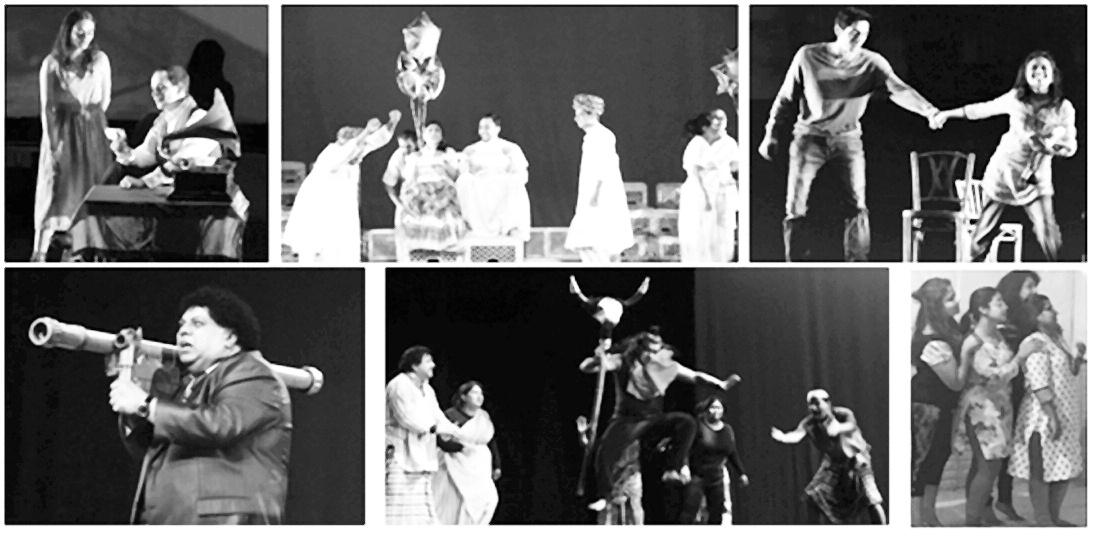
The 12th South Asian Theater Festival, popularly known in the community as SATF, was held at the Victoria J Mastrobuono Theater in New Brunswick on August 5 and 6, 2017 As in previous years, it was organized under the banner of Epic Actors’ Workshop with Dipan Ray at the helm Various theater groups from New Jersey, New York and Ohio participated in the two-day program that presented seven different plays to the delight of drama enthusiasts There were plays in English, Hindi and Bengali, with English supertitles displayed on the screen for the regional languages
The plays that were presented on the first day of the festival were:
“a Muslim in the Midst”, a play in English performed by Growing Giants theater group based in New Jersey
“The Music in My Blood”, a play in English performed by Hypokrit Theater group based in New York
“Chak de Chekov”, a Hindi adaptation of Chekov ’s stories by Mahesh Dattani, performed by ICS Theatre based in East Brunswick, New Jersey
“Manto-r Meyera” (Women of Manto), a play in Bengali, performed by Spotlight theater group based in Ohio
The plays presented on the final day were:
“The Curious Case of a Casual Terrorist”, a play in English, performed by ECTA theater group based in New Jersey
“Dhaboman”, a play in Bengali, performed jointly by Epic Actors’ Workshop and Aastha (Asian American Society for Theatrical Art), both based in New Jersey.
“The Djinns of Eidgah”, a play in English, performed by Epic Actors’ Workshop based in New Jersey,
All the plays were presented professionally with good acting, appropriate background music, proper lighting, and good sound system.
All the directors had excellent credentials, having led their theater groups for many decades Among them was Usha Ganguly from Kolkata, a well-known personality among the New Jerseyans, who presented short plays based on abused women Mahesh Dattani, the director of Chak de Chekov, has directed two feature films in his career, in addition to staging many plays Golam Sarwar Harun, who directed Dhaboman, has acted in several movies and numerous plays Sudipta Bhawmik, a well-known playwright and director in New Jersey, presented the story of an “accidental” terrorist It was the world premiere of this play by Sudipta
There were plenty of food vendors to provide delicious snacks, cold and hot beverages during the breaks to keep the audience satisfied and concentrate on the main interest
SATF 2017 was a success, as judged from the audience reaction
Continued from page 12
only be determined from a laboratory test), the target for an older person with pre-existing diabetes is closer to 7 while it is 6 5 for a younger diabetic
NOTE: Please do not think that I am implying negligence on the part of physicians! They are highly trained professionals whose primary responsibility is to diagnose and treat your ailment
They are always pressed for time and may not be able to engage in lengthy discussions on the science involved Also, as patients, we often don’ t know the right questions to ask or the right way to ask them. It is our responsibility to be “knowledgeable patients”, like “knowledgeable investors” when managing our money. This series of articles is presented in that spirit.
Reported by Pradip R. Das
arrival of New Durga Pratima
The initiative started in 2015 when a GSCA task force determined the need for a new set of “Pratimas.” Fiber glass was chosen as the material of construction, and other dimensional specifications were provided to a chosen artist at Kumartuli, Kolkata Originally the “pratima” was supposed to be delivered in time for the 2016 Durga Puja but finally things fell in place for this year ’s puja During different stages of the pratima’s construction, several members of GSCA visited Kumartuli to monitor its progress
Our “pratimas” arrived at New Jersey port in July and finally on July 29th, it was delivered to our storage facility We donated our previous set of “pratimas” to an Indian group in Secaucus, NJ Meticulous planning and coordination was done with this group so that they could come and pick up the old pratimas on the same day prior to the
arrival of the new ones. Several of our members helped out that day in unloading the craters and taking the pratimas out of them with utmost care and diligence. The members of the Secaucus group also assisted us in these tasks
The new set of pratimas will be initiated at our puja facility at Plainfield High School, NJ on September 30th and October 1st, for this year’s GSCA Durga Puja Picnic
Garden State Cultural Association hosted its Annual Picnic on August 6th at Mercer County Park, West Windsor, NJ More than 100 members and members’ friends, including young children, gathered at this beautiful site of lush green meadows surrounding the picnic spot beside the Mercer Lake With a temperature around mid-70, it was the perfect day for an outdoor event The picnickers were greeted in the morning with sumptuous authentic Bengali jalkhabar (snacks) comprising of kochuris, aloor dum, cholaar daal
and jilipi, all made and served on the spot, along with hot and cold beverages. Later in the day, typical picnic grilled food was also cooked on-site to the delight of all, especially our younger attendees.
This daylong event was filled with fun activities Kids had a fun time during the sport competitions and enjoyed the water gun fights where they were joined cheerfully by high schoolers and even college goers Besides “adda”, adults also had an activity packed day, with lots of music, games, and antakshari Some were seen playing cricket
During wrap up time, members joined in the cleaning activity so that the place was left in the same state we found it in the morning One could not help but observe the camaraderie and true sense of teamwork in every single activity The day seemed to go by fast as the attendees spent a perfect day with delightful food, great company and many outdoor activities
Reported by Nimai Ghose
“Long years ago we made a tryst with destiny, and now the time comes when we shall redeem our pledge, not wholly or in full measure, but very substantially At the stroke of the midnight hour, when the world sleeps, India will awake to life and freedom
” Those words from Jawaharlal Nehru’s speech on the eve of India’s independence continue to resonate in our minds As India celebrated her 71st independence day, we at NJPA paused to reflect for a moment how far the country has come and how far more remains for her to travel
Touches of fall is in the air. As everyone is busy wrapping up summer, we are getting ready for the season of festivities that lie ahead. So please mark your calendar for the two events that NJPA members are working hard to bring to you:
Kali Puja/DiWali
Saturday, 21 October 2017 Puja 3 PM
Dinner 6 – 7:30 PM
Cultural program 7:30 – 10 PM
Singer: Soumen Nandi – Sa re ga ma Pa Champion Venue
Wardlaw Hartridge School, Edison, NJ
NEW YEaR’S PaRTY
Welcome 2018, December 31, 2017
Venue: Royal Alberts Palace, Edison, NJ
For more information please visit NJPA’s Facebook page (NJPA Parivar) We look forward to seeing you all and thank you all for your continued support
Reported By arpita Gupta
The Indian Community Center of Garden State (ICC) welcomed the arrival of spring, by celebrating the 2017 Baishakhi on May 13th at Dennis O’Brien School, NJ This annual event provides the members and more importantly, their children with a platform to expose their talent in the fine arts – one of the critical missions of the organization
On May 20st ICC participated in Rabindra Utsav at Ananda Mandir and presented a dance program based on Bileyati B hanga gaan of Rabindranath Tagore, kids beautifully danced on Scottish and Bangla tunes. The concept and choreography was done by Arpita Gupta. Narration by Mousumi Chakraborty and Arpita Gupta. The dance participants were Ananya Mukherjee,Monalisa Hait, Dishari Ghosh Dastidar, Aishi Raychowdhury, Aishani Acharya, Aaira Chakraborty, Ruma Ghosh, Kakoli Paul, Ritisha De and Unmukta Gupta
ICC celebrated their annual picnic on July 30th at Hedden Park Members enjoyed BBQ by EC members and Goat curry cooked by Debol Gupta The hariyali chicken tikka by Nirmalda was super delicious Sidhartha Basu was always there to help with all the chores Our recreation secretary Mridul Paul arranged various games and entertainment to keep everyone engaged.
On August 20th ICC again participated in Heritage day at Ananda Mandir. ICC kids Ananya Mukherjee, Sara Deodhar, Romi Deodhar, Victor Hait and Monalisa Hait danced on patriotic song medley compiled and choreographed by Arpita Gupta.
The Executive Committee continues to look for other opportunities where the ICC members and their children get an opportunity to present and practice their Indian heritage Please stay tuned for future announcements
By Debajyoti Chatterji
I thought you might want to use a "win-win" method of making a donation where both you and Ananda Mandir can benefit Let me explain what I am talking about
Most of us make donations to Ananda Mandir several times during the year and another (usually larger) during the Annual FundRaising Day We make our donations in cash or by check Such donations benefit Ananda Mandir -- and we truly appreciate each donation, big and small, as we have to make a large mortgage payment every month. Our donors know that come tax filing time, they can get a tax benefit. They can deduct their donation amounts from their adjusted gross income as "charitable contributions". For example, if you made a cash/check donation of $3000, you would deduct $3000 from your adjusted gross income for tax purposes. If you are in a 33% tax bracket, your "net out-of-pocket expense" would be $2000 ($3000 minus $1000 in tax savings)
However, there is a way to reduce that "net out-of-pocket expense" further It is a perfectly legal, IRS-accepted way of making donations that are used by all larger non-profit organizations This is how that method works
Suppose you bought 100 shares of Company X several years ago for $1500, and now that stock has risen in value to $3000 If you sell those shares to raise $3000 cash and then donate that $3000 to Ananda Mandir, you will, of course, be allowed to take $3000 deduction against your income, and get a tax benefit of $1000 However, you will have a pay a "Capital Gains Tax" on the $1500 increase in value of the shares sold At 33% tax rate, you will be paying $500 to Uncle Sam!
On the other hand, if you donate those 100 shares of Company X directly to Ananda Mandir, you will be able to take the full deduction for $3000 -- AND avoid paying the Capital Gains Tax of $500 The key word here is "directly", meaning the shares must be transferred to Ananda Mandir either electronically through your broker/financial adviser or the actual "share certificate" must be handed over to Ananda Mandir If you cash those shares and donate the $3000 cash received, you will have to pay the $500 Capital Gains Tax Instead of appreciated shares in a company, you can also donate mutual funds shares that have increased in value over time
Ananda Mandir has now established a program to accept such "direct transfer of appreciated securities" (stocks, bonds, mutual funds, ETFs, etc ) We are, therefore, suggesting that for your future donation, you may want to think of using this technique All you have to do is tell your broker/financial adviser that you wish to donate $X to Ananda Mandir through "appreciated shares" in your portfolio He/she will find the shares that will give you the best tax benefits and directly transfer them to Ananda Mandir's own broker.
If you are interested in discussing this approach or making a donation of such “appreciated securities’, please contact
ashok Rakhit
Dr. Samir Dutta, or Debajyoti Chatterji
Continued from page 13
the invasion of Afghanistan by Soviet Union is unclear at the best One conjecture is the Soviet Union, which has a large ethnic Muslim population attempted to stem Islamic terrorism within her territory by choking the breeding grounds for these terrorists, which was then and still is Afghanistan In this attempt, Soviets tried to install puppet governments in Kabul but failed miserably Afghanistan truly became the staging ground for the proxy war between the United States and the Soviet Union CIA created a super-terrorist named Osama Bin-Laden to foil the Soviets Bin-Laden and his rag-tag army
Continued from page 12
interesting discussion that picked up the threads from a road we ambled before: women’s empowerment Two and half years ago, we had a session on a somewhat similar topic about the activities of Manavi, the New Jersey based South Asia Women’s Rights Group And in August, delivering on such tradition, Raili presented a complex and multidimensional topic that plays a pivotal role in the progress, welfare, and future of humanity, which was entitled “Women's empowerment: competing notions and the role of non-governmental organizations (NGOs) in its promotion ” The session reviewed various theories and ideas, traditional and emerging, about women’s empowerment that predominate the field of gender and feminist studies, and it also examined the ever-rising role of NGOs (over the traditional work by governments) in effectuating the Nuevo outlooks, elements of which are more encompassing than ever, and yet, simultaneously complimentary and mutually exclusive. Frontline examples of leading NGOs’ work with sex trafficking survivors in West Bengal, India were also reviewed and analyzed to articulate and distill how such notions are continuously drawn upon and challenged at the same time in the real world
A ton of thanks goes out to Raili Roy from all of us in the alochana family
Future sessions
Quite a few interesting sessions are in the pipeline for next several months They feature eclectic topics including a discussion on Global Warming, a poetic cum musical session entitled “an evening of Urdu ghazal (reading and vocal recital); and other sessions on literature
The friends of Sahitya O Alochana would like to thank Ananda Mandir for its continued support for the forum’s contribution to the cultural enrichment of the local Indian and Bengali communities
Reported by Debajyoti Chatterji
The members of the Ananda Mandir Evergreen Club welcomed the summer of 2017 with a friendly get-together at the Mirchi Restaurant (North Brunswick, NJ) on Sunday, June 4 This restaurant is a favorite for Indian food lovers in the Central New Jersey area because of its extensive offerings in both North and South Indian cuisine It boasts a lunch menu of “more than 40 delicacies”, a fact that was not overlooked by the eighteen seniors who enjoyed the grand buffet As is customary for such lunch outings, there was no formal agenda, and friendly socializing was the sole purpose
The next meeting of the Evergreen Club was held at Ananda Mandir on Sunday, July 30 This session urged all the attendees “to share something for the group's pleasure” They were free to choose “a short poem, a short story, a travelogue, or even a couple of short jokes, written by themselves or by their favorite authors” Or they could share a memorable life experience of their own! This novel approach was well received by the 25+ attendees, and lively presentations and discussions made the session a great success A delicious pot luck lunch, organized by our perennial army of volunteers, preceded the meeting and definitely contributed to the positive interactions
August was a “family vacation month” for almost all the members of the Evergreen Club, so no meetings were scheduled However, Arun & Subhra Paul and Debajyoti & Sikha Chatterji drove up to Newburgh, NY, to personally check out a 2-hour cruise of the Hudson River on a first-hand basis for a future group outing Their experience was positive, and they will present their proposal soon for a fall foliage viewing cruise in October
On Saturday, Sept 16, 25+ members of the Evergreen Club will return to the Hunterdon Hills Playhouse for another lunchtheater experience. The featured play on that date is “Come Play Your Horn”, a comedy written by Neil Simon, the famous American playwright. More about that group outing in the next issue of Ananda Sangbad!
EVERGREEN CluB OF aNaNDa MaNDiR ("Seniors helping Seniors")
Invites retirees and near-retirees to participate actively in Forum meetings and activities
Seniors Forum usually meets on the third Sunday of every month at 1:00 PM. However, the date may change because of conflict with other Ananda Mandir events. Please contact Debajyoti Chatterji (Cell: 908-507-9640) for latest updates on the meeting dates
successfully drove Soviet army out of the country after ten years of occupation However, after the war ended Bin- Laden, disenchanted with the Unites States for keeping an army base in the ‘house of Saud’, the birthplace of Prophet Mohammed turned his guns around A new variety of war against America started shortly thereafter, which continues even today
Noriega’s ‘falling from grace’ started and ran through Reganyears in the White House He was accused of narco-trafficking, money-laundering from narcoprofits, being a Cuban sympathizer, aiding M-19 leftist guerilla group in Colombia, killing Dr
Spadaphora, a Cuban émigré, and election-fixing in Panama
Many of these accusations were true, particularly narco-trafficking Noriega carried out this operation with full knowledge of CIA, but others remain simply ‘accusations without proof ’ until today This situation is strikingly similar with Saddam Hussain, the then-strongman of Iraq who was a darling of CIA until he had a fall-out over the ownership of Iraqi oil America accused him of procuring ‘yellow uranium’ from Nigeria and having huge pipes ‘that can only be used for making nuclear weapons’ Later on all these charges were found to be baseless There is little doubt
that they were ‘created’ to make a case for declaring war against Iraq, allegedly to get rid of onceimportant Saddam Hussain and obtain control over Iraqi oil The year was 2003 and George W Bush, the junior Bush was in the White House The rest is history Going back to Noriega, once the invincible man from Panama died haplessly His fate was not very different from that of Mobutu Seses Seko, the strongman of Congo/Zaire He, with the help of CIA and Belgian authorities orchestrated brutal assassination of Patrice Lumumba, the elected President of Congo before becoming the leader of this country He enjoyed on–
again, off-again relationship but steady financial support from US administrations of Nixon, Regan and George H W Bush However, at the end he died in Morocco The US turned him down for an entry for treatment of his prostate cancer Once he bitterly complained: "I am the latest victim of the cold war, no longer needed by the US The lesson is that my support for American policy counts for nothing ”
1 Our Man in Panama: How General Noriega Used the United States- And Made Millions in Drugs and Arms, February 24, 1990, by John Dinges
2 Divorcing The Dictator: America's Bungled Affair with Noriega, March 5, 1990, by Frederick Kempe
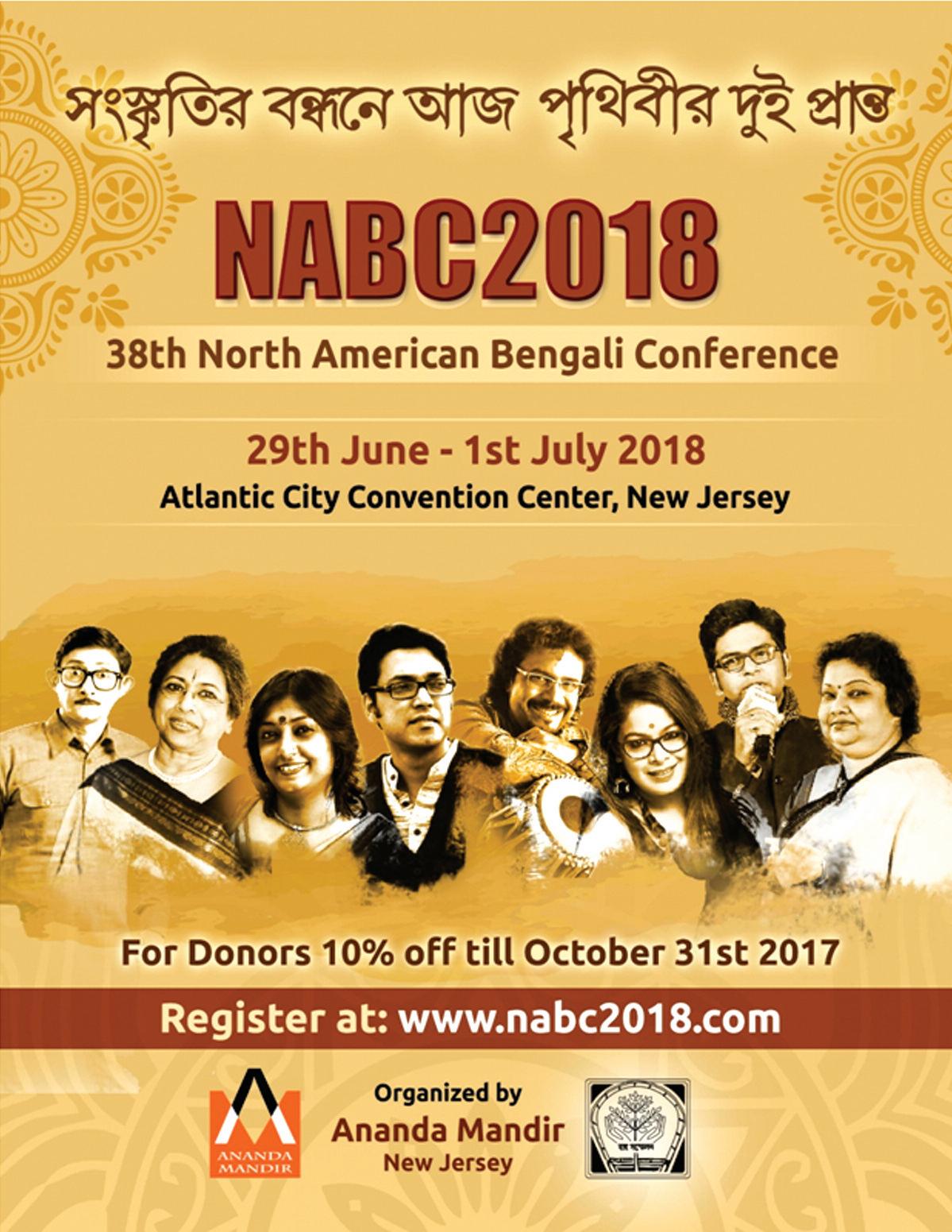
Benefactor - Diamond ($ 200,000 and up)
Ashok & Bandana Rakhit
Benefactor ($ 50,000 - $99,999)
Rajat & Devika Chakraborty
Dr Kiran & Kamala Das
Supriya & Rik Sen
Grand Patron - Gold ($ 25,000-$ 50,000)
Achintya & Dr Roopali Bhattacharjee
Anup K & Meena Dam
Grand Patron – Silver ($ 10,000 – $24,999)
Subhendu & Sipra Bagchi
Dilip & Snigdha Chakrabarti
Maumita Ghosal
Rama K. & Baruna Haldar
Arabinda & Chhabi Sinha
Provat & Mita Sinha
Patron ($ 5,000 – $9,999)
Kumarika & Chandan Banerjee
Andrew (Andy) Bose
Subrata & Indrani Dhar
Dr Samir K & Ms Sunita Dutta
Kasturi Sanyal & Anindo Dutta
life Member ($1,000 to $4,999) Alik & Sreela Basak
Abhijit & Sanghamitra Bhattacharya
Dr Ashish & Frances Bhattacharya
Swati Chakraborty & Niraj Biswas
Miabi Chatterji
Srikant & Chandrika Mukherjee
Debi P Gupta
Anjali Majumdar
Ashis B Pal
Benu & Chitra Pal
Please note that you can become an Associate Member of Ananda Mandir by donating a minimum of $50 Your subsequent donations of $50 or more are credited to your account When your total cumulative donation reaches $1000, you become a Life Member Your support, small or large, is most welcome and sincerely appreciated