Ananda Mandir


Ananda Mandir
Ashok Rakhit
Chair, Construction Project
There is one question in everybody’s mind
will the temple be ready to hold the 2015 Durga Puja festival in it? If you visited our site in recent months, you would have seen the construction activities in and around both the Temple and the Community Hall buildings We are also trying to have the entire parking lot be graded and ready with gravel for use during the upcoming major puja events We will have over 300+ parking in the allotted space
Our focus in the months of August and early September was on getting the extended temple ready and approved for temporary occupancy (TCO) so that deities can be moved to the new altar I know there is a lot of anxieties among the members whether we would have TCO before Durga Puja I can
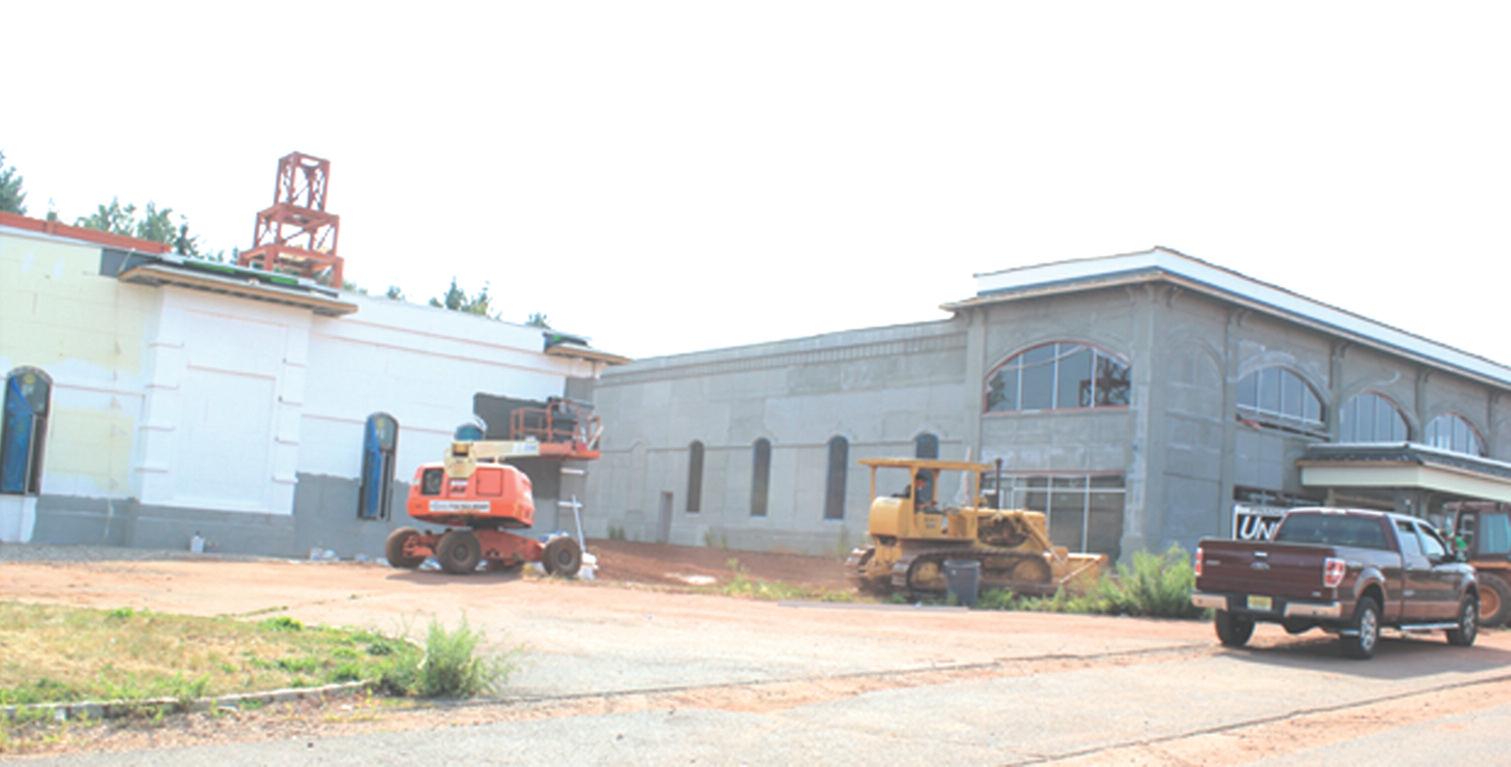
Community Hall Inside – 1

Community Hall Inside – 1
only assure you that we are leaving no stone unturned to make that happen We are expecting to get TCO by mid-September with Ma’s blessing
We have challenges on many fronts We would like to get the TCO for the Community
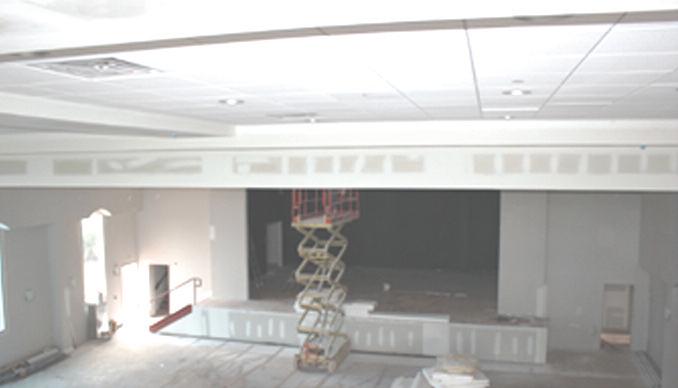
Community Hall Inside – 2
Hall also for Durga Puja so that we can have more festive space during this event to accommodate a large crowd One of the critical challenges for community hall opening is to get a new electric pole installed by PSEG from Cedar Grove Lane within next 1 - 2 weeks so that we can bring electricity through underground cables to both buildings Site work is
moving at full speed in parking area too, including installation of parking lights to the end of our property It has been an enormous challenge from the beginning to get everybody agreeing on the development plan, to raising initial capital, to bank loan approval, to selection of the contractor After the end of two upcoming major Puja events in coming months, work will start on the front entrance of the temple building around mid-November We plan to have artists from India helping us with the artwork on temple façade outside so that it properly projects our heritage We are doing everything we can to make the place functional, elegant but sim-
ple, representing us as a culturally rich ethnic community from India
Now as we are getting closer to completion, we need your continued support, excitement and unity so that we all can enjoy the fruit of this hard work and take pride showcasing our heritage center to our friends and neighbors We hope this phase of construction will be completed by the end of spring next year and will be ready for Grand Opening
We still have lot of challenges ahead! While we are working hard every day to complete this enormous task, we are also excitedly looking forward to see our long awaited dream come true It would be a beautiful heritage center for Bengalis in North America that will be able to serve our community through generations It will be our gift to our children and grandchildren, and we hope that this center will be the connection to their ancestors’ land and culture
DEBIR GHOTOKE AGOMON -O-DOLAI -GOMON
Sunday, October 18, 2015 Bodhan 6:00pm to 7:30pm
Monday, October 19, 2015 Amantran -O-Adhibas 6:00pm to 7:30pm
Tuesday, October 20, 2015
Wednesday, October 21, 2015
Saptami Puja 7:30am to 9:15 am Pushpanjal 9:20am to 9:40am
Stuti & Sandhya Aarat 6:30pm to 8:00pm
Ashtomi Puja 6:00am to 8:00am Pushpanjal 8:00am to 8:10am
Sondhi Puja 8:11am to 8:59am
Stuti & Sandhya Aarati 7:00pm to 8:30pm
Thursday, October 22, 2015 Nabami -O-Dashami puja 6:30am to 10:30am and Pushpanjali
Sindur Khela & Aarati 7:00pm to 8:30pm
Monday, October 26, 2015 Kojagori Lakshmi puja 6:30pm to 9:15pm & Satyanarayan puja
Tuesday, November 10, 2015 Maha Kali Puja 8:00pm to 11:15pm Pushpanjali 10:30pm
Ananda Mandir
Calendar of Events (Dates are subject to Change) Please check our website frequently www.anandamandir.org Tel: 732-873-9821
NOTE: If a particular Puja time is not listed, please contact temple or visit our website:anandamandir org
Mahishasura Mardini Live Event
Sunday, 11, 4:30 AM
Durga Puja
Sunday, 18 to Thursday, 22
(See Details on Front Page)
Lakshmi Puja
Monday, 26, 6:30 PM
Sahitya O Alochana
Friday, 30, 8:00 PM
Ananda Sandhya Not scheduled
Maha Kali Puja
Tuesday, 10, 8:00 PM
(See details on Front Page)
Call Mandir for Puja Schedule
Sahitya O Alochana
Friday, 20, 8:00 PM
Ananda Sandhya Not scheduled
Call Mandir for Puja Schedule
Sahitya O Alochana
Friday, 18, 8:00 PM
Ananda Sandhya Not scheduled
Special Religious Services: Upon request, the priest of Ananda Mandir offers services such as inhouse Sraddhas, Rituals associated with Cremations (Antyesti Kriya), Death Anniversaries, Pre-wedding rituals (Naandimukh, Ashirwad, etc), Upanayan (Paitey), Annaprasan, Wedding Ceremonies & Wedd ng Anniversaries, Griha Prabesh (Bhumi Puja), Consecrations of new cars (New Car Pujas) and others
If you have needs for any of the above or more, please feel free to contact Biswabhai @ 732-873-9821
2
October 2015
A Periodical Newsletter
Published By ANANDA MANDIR
(A Tax-Exempt, Non-Profit Organization)
269 Cedar Grove Lane Somerset, NJ 08873 Ph: 732-873-9821 Website: www anandamandir org
PUBLICATION COMMITTEE Of ANANDA MANDIR
Chairperson: Pronoy Chatterjee, pkc usa@yahoo com
Assistant Chairperson: Subrata Bhaumik, Bhaumik subrata@gmail com
Editor-in-Chief: Debajyoti Chatterji, Debsmee572@gmail com
Managing Editor, Ananda Sangbad: Guru Chakravarty, guruchakravarty@yahoo com
Managing Editor, Anandalipi: Amitabha Bagchi, amitabhanj@gmail com
Editors: Subrata Bhaumik, bhaumik subrata@gmail com
Subhodev Das, subhodev das@gmail com
Sushmita Dutta, sushmitadutt2@gmail.com
Nupur Lahiri, nupurlahiri@aol com
Associate Editors: Amrita Kangle, amritakangle@hotmail com Ruby Banerjea, r banerjea@yahoo com
Members-at-large: Bhaswati Bhadra Ashok Rakhit
l l
All queries, articles, news reports and letters should be directed to the Managing Editor: Phone: 908-752-3065, E-mail: guruchakravarty@yahoo com
For general information, please contact the following executives of Ananda Mandir:
Dipak Sarkar, President
Jaiprakash Biswas, Vice President
ANANDA SANGBAD Acknowledgement
Suprasad Baidyaroy, Vice President
Chanu Das, Treasurer
Arun Bhowmik, General Secretary
During my recent trip to India, I visited a girls’ high school near my village in Bankura It is a public school under the West Bengal Government There are about 650 students enrolled in grade 5 to grade 10 Another 124 students attend a 2-year higher secondary program in humanities
The school provides a Computer Orientation class I saw ten computers in the class room, five of which did not work There is no computer teacher because there are not enough students in the computer class to qualify for government funds for a full time teacher They do have access to the Internet, but use of Google or such other websites is pretty limited due to low connection speed These girls have no computers at home, and they must depend on available books for the most part There is no provision to prepare the students for the Joint Entrance Examination –the gateway to higher education in the prestigious colleges in India like the IITs, Jadavpur and such others
The only way students can successfully compete in the Joint Entrance Examination is to be educated in an urban public school or more assuredly in a private school with exorbitant fees In addition, the students must have private tutors in as many as 5 or 6 subjects and attend JE tutorial classes provided by private institutions like Rice and Pathfinder that are operated in cities only
This explains why students from rural areas have very little chance to get into prestigious colleges leading to good careers Although many private institutions for Engineering and Medical studies are now available, they are expensive with excessive fees and dormitory costs, and in many cases they demand large donations that are out of reach for average families
This is the story behind the availability of good education in rural versus urban areas According to the 2011 census, there are 8000 cities in India, and about 650,000 villages The disparity between urban and rural schools is becoming ever more conspicuous causing major divergences in subsequent career successes There are reports to indicate that the problem is more severe in West Bengal compared to many other states in India
The lack of level playing field is an everyday story here in the United States as well I had the opportunity to interview some graduating students of Plainfield High School in NJ for a scholarship offered by GSCA (Garden State Cultural Association) I didn't find applicants going into Engineering or PreMed or Ivy League colleges
A level playing field for education is needed for the Havenot families to catch up with the Haves Readers are welcome to submit their views on this matter as “Letters to the Editor”.
We are very happy to welcome two new Associate Editors to our group
Amrita Kangle writes regularly for Ananda Sangbad and is eager to take on the challenge of editing responsibilities as well
Ruby Banerjea is an experienced writer and editor, and was a frequent contributor to Sangbad Bichitra
Guru Chakravarty Managing Editor, Ananda Sangbad
On behalf of the Board of Trustees of Ananda Mandir, I wish you and your family Happy Puja Holidays! I want to thank our community for participating in our Fundraising event held in June, making the occasion enjoyable and successful We raised about $200,000, thanks to attendance of a large number of members and their families There were good food and entertainment making it an attractive event We also had a very exciting Heritage day and an Annual Picnic day at Ananda Mandir in August, where members and their families were entertained by various cultural programs, sport events and delicious food. Many of the cultural programs and sport events during Heritage and Annual Picnic day were planned and organized by the Ananda Mandir Youth Group
As you know Ananda Mandir is undergoing renovation and expansion of the temple and building a new community center In this issue of Ananda Sangbad, our construction committee chair Ashok Rakhit has provided a report on construction activities and has stated that the new temple is nearing completion We are hoping to obtain township approval for temporary occupancy (TCO) of the new temple in September so that the deities can be moved to the new altar and allow us to conduct the puja festivals in the new temple We are expecting to get TCO by mid-September. The new temple will have enough space for 300 or more devotees to watch puja at the same time inside the temple, compared to about 100 devotees in the current temple The new temple will have artwork on the outside wall so that it expresses our cultural heritage The new facility will also have the new parking lot graded and be ready with gravel for use during the upcoming major pujas There will be over 300 parking spaces available
We are planning to have our Mahalaya celebration in the new temple this year In addition we are planning to have two major cultural programs where artists from both India and the U S will participate. This is an exciting time for us. We are on the verge of completing a milestone achievement in building a key Bengali religious and cultural center in New Jersey Please join me to make Ananda Mandir strong so that this organization continues to provide religious and cultural services to hundreds of Bengalis and friends of Bengalis in the tri-states area
Dipak K. Sarkar President, Ananda Mandir
Didn't
If you are a Life Member or an Associate Member, but didn't receive your copy of Ananda Sangbad, it may be because we do not have the correct address on file for you. Please send an email to Guru Chakravarty (guruchakravarty@yahoo.com) with your correct address, and we will send you another copy.
The Board of Trustees expresses its deep appreciation to Suprasad and Rita Baidyaroy for their continued financial support to the publication of Ananadalipi
Ananda Sangbad
By Basab Dasgupta
After I received my PhD in 1976 and got a lecturer position we thought that it was time to indulge in a little luxury One of the status symbols among our friends was a Sony Trinitron color TV So we also bought a brand new KV-19 Sony 19” TV to keep up with the “Guptas” and paid something like $400 of my hardearned money Frankly speaking, I was not too impressed None of the programs we used to watch seemed any more vivid or brilliant in color compared to our old TV Coincidentally, I had to take a driver ’s license renewal test just around that time and I flunked the eye test My distant vision was poor enough that I needed glasses I remember the day I received my prescription glasses I entered our apartment, looked at the TV that my wife was watching and said “Wow! That is a good looking TV”
Apart from excellent picture quality the Trinitron TV sets stood out from the competition because of the screen shape While everyone else used a cathode ray tube (CRT) with a spherical screen, reminiscent of a large bulging eye-ball, the Trinitron CRTs had cylindrical CRTs and the screen surfaces were straight in a up and down direction This immediately gave the Sony TVs a very sleek and high tech look As a result Sony could command a significant price premium over any other sets, typically by 20% or so
While Sony TVs always got a very favorable critical review in magazines like “Consumer Reports”, their market share was stuck in the 3 to 5% range for years; the American consumers were happy to buy a RCA or Zenith set and save a good chunk of money and satisfied with the reported inferior picture quality Sony ’s much touted Betamax also lost out in rivalry with VHS format in the VCR war. Their management knew that Sony had to do something different. When I joined to work at Sony in the late eighties the economy in Japan was booming Both the Tokyo stock market and real estate market were sky rocketing Sony was riding high, making huge amounts of profits and buying out the whole world They pulled a one-two punch in the USA by buying Columbia Records and Columbia Pictures The grandiose vision of Sony was to combine their well-established hardware (audio and video equipment) business and the newly acquired software (movies and records) business in order to totally dominate the entertainment industry
However, Sony soon found out that it was not so easy to realize their vision because of the diagonally opposite cultures of the wild Hollywood crowd and the regimented Japanese management As a result, Sony lost millions of dollars during the first few years after the merger They eventually managed to get a grip of the situation and turn the profitability back to black Even then, it was not quite what Sony had in mind Then a revolution happened in the mid-nineties. It was the dawn of the digital age, which fueled the computer industry and internet commerce and started the “dot com” boom Sony already had their foot in the door of the digital world with their pioneering work with Philips on Compact Disc; but now, it was the advent of the High Definition television (HDTV) which captured everyone’s imagination.
The analog version of HDTV was actually invented in Japan in the late seventies with their broadcasting giant NHK broadcasting in HD for a few hours every day Sony was the first company to introduce HD studio broadcasting equipment as well as one of the pioneers in analog HDTV Even though the picture quality, especially the resolution was outstanding, this version of HDTV did not catch on in US or any other country, for that matter The main reason, apart from the expense involved, was the very large bandwidth required for transmission of such HD signals which would have meant a very limited number of TV channels in
HD
In USA, a consortium, called the “Grand Alliance“, was formed between several companies including General Instruments, RCA, Zenith, Philips, AT&T Bell Labs and MIT, to develop a digital version of HDTV The first digital TV broadcast was carried out by this alliance in 1996 Sony quickly caught onto this new technology
Nobuyuki Idei was the president of Sony at the time He envisioned a whole new future for Sony, well beyond the traditional video and audio equipment business and came up with the slogan “Digital Dream Kids” In his vision, all of our customers would be digital dream kids because they would be weaving their dreams with all kinds of digital equipment that Sony would provide; all the Sony engineers would be digital dream kids because they would dream of new innovative dream products using digital technology
Coincidentally, the entire color TV business in the US had become a losing proposition by
then All of the benefits of the mega cost reduction efforts by Sony every year by locally redesigning the TV systems, using local materials and manufacturing in Mexico had been negated by the continuous price reduction demanded by the market in order to maintain market share. Everyone was convinced that US market was such a cut-throat market and the consumers were so price sensitive that this price erosion would continue forever, and we had to think of new ways of cost reduction Some marketing people even had the audacity to suggest that Sony considered selling non-Trinitron sets, manufactured by other companies (in a way cheaper than Sony) and sell them under the Sony brand name
I remember sitting in a meeting addressed by Mr Suehiro Nakamura, the head of the Sony world-wide TV division and attended by most managers, engineers and even some marketing people in San Diego He said quite forcefully: “You guys are wrong when you think that Americans only want to buy cheap TV sets! American people have money and they would gladly spend that money when they see something worth spending that money on We have to offer such products”
He was already pushing the designers in Japan to design a TV set with perfectly flat screen. This would dramatically change the look of the TV Instead of a huge bulging light bulb, the TV screen will appear like a page in a book and display all the pictures and texts, free of distortion He also emphasized the fact that only Sony had the capability of designing and producing such CRTs, thanks to the Trinitron “aperture grille” technology All the CRT designers had to do was to make the face-plate thicker so that the CRT bulb could withstand the pressure difference between the vacuum inside and the atmospheric pressure outside Soon thereafter, Sony introduced the “WEGA” series of digital TVs, all with perfectly flat face, in sizes ranging from 14” to 36” This product line was consistent with Idei’s vision of digital dream Mr Nakamura was absolutely right The American customers just loved the design I recall that the Sony 36” WEGA sets were flying off the showrooms of all major electronics stores during the Christmas season of 1999 at a price of around $2500! For the next several months Sony enjoyed unparalleled profit in the US TV market Sony made one miscalculation though Sony assumed that our competitors would not be able to emulate them Not only they caught up with Sony, but it happened in a record amount of
time What the competitors did was very clever In their design, only the outside of the CRT faceplate was flat, but the inside surface was spherical so that it could be still be produced using their existing manufacturing technology Soon, copies of WEGA sets appeared in the market from just about every one of our competitors, even including the Korean companies, Samsung and LG, and at a much lower price than Sony Sony could no longer justify a price premium because the Sony set did not look any different than any of the competitor’s set This was in sharp contrast to the pre-WEGA market where Sony Trinitron with a cylindrical face always stood out from the competitors TV with a spherical face What Nakamura hoped to be a savior of Sony ’s TV business turned out to be its downfall! Consumers loved the flat screen, but they did not like the additional weight of the WEGA sets, caused by the thicker glass wall and face-plate of the WEGA CRTs Just around that time the plasma and LCD TVs started to appear in the market These newer types of TVs not only had a perfectly flat screen, they were much lighter and thinner, unlike the Sony WEGA sets However, only smaller screen-sizes, 20” and less, were available in the market at the beginning Year after year, I saw prototypes of flat panel TVs at Consumer Electronics Show – both plasma as well as LCD – and in sizes smaller than 32”, with marginal improvements every year, but always far from being commercial, mainly because of high cost and also many manufacturing glitches. Sony was a CRTbased company All the Sony engineers and managers, including myself, had the conviction that such flat panel TVs were far from being a marketable product and in any case, could not compete with the brightness and cost-competitiveness of CRTbased TV sets even if they were
So, the appearance of increasingly large number of such TVs, mainly from the Korean companies and Matsushita and Sharp, among the Japanese companies in the early years of this century was a little unsettling for us, the Sony people Nevertheless, we knew that it would be technically very difficult and production-wise very expensive to scale up the flat panel technology to larger and larger sizes. Strategically, Sony could still make decent profits in the TV business by sticking with, say, 32” and 36” WEGA sets In fact, developmental efforts were going on in Japan to build a 40” WEGA set The competitors were yet to emulate a 36” WEGA set We were all very wrong The
flat panel TVs in general, and LCD TVs in particular, made giant strides not only in extending the product line to larger and larger sizes, but also in cutting cost and their prices did not seem outrageously high
Sony had made a huge blunder in the late nineties. They assumed that they could continue the TV business around CRTs and WEGA CRTs were the future In fact, Sony’s strategy in USA was to become completely vertically integrated in TV operation Sony had purchased the old Volkswagen plant near Pittsburgh in the mid-nineties, after VW stopped production there It was a huge plant and Sony got a good incentive deal from the then governor of Pennsylvania Sony wanted to gradually start making not only the complete TV sets, CRTs and components, but also the glass parts necessary to make the CRTs, all in one location under a common manufacturing umbrella The hope was that it would reduce the overall manufacturing cost by using the synergy between all the operations and also the logistics cost, especially the freight, Pittsburgh being right in the middle of the country Sony was also optimistic that Pittsburgh area could supply the necessary skillful and stable workforce, which was always questionable in the San Diego/Tijuana area In fact, with help of a partnership with Corning, the glass factory was already in production by 1999!
The emergence of larger LCD TVs from companies like Samsung and Sharp completely shattered all that strategy Because of huge investments already made in Pittsburgh, Sony never invested in any other display technology – plasma or LCD or DLP As a result, even if Sony strategists realized that they needed a presence in the flat panel market, they simply did not have money The Korean companies, Samsung and LG, as well as Sharp, on the other hand had been slowly but surely investing in LCD and gradually improving the product and manufacturing process over many years
I left Sony in 2001 right when the flat panel TVs started to come to the market and when the CRT companies were in a disarray, not knowing quite what to do and entered what one of my colleagues called “the end game for CRT” Even though many companies were building LCD sets, there were only three companies making all the panels (i e the flat screen itself ) – Samsung, LG and Sharp Sony finally wised up and formed a joint venture with Samsung with the goal of producing these panels and also introduced a line of LCD TVs
Continued to page 15
President Barak Obama’s ruling to lift United States’ economic sanctions on Cuba in July of this year is certainly a welcome news It was nice to see the re-establishment of the US Embassy in Havana and hoisting of the American flag once again on Cuban soil by three marines who took down the flag five decades ago during President John F Kennedy ’s administration
While watching the flag hoisting ceremony at the American Embassy and listening to Secretary John Kerry ’s speech on TV, I had a flashback of an experience that I had over twenty years ago I had an opportunity to visit Cuba when traveling to Cuba was banned for US citizens Travel to Cuba was allowed only if there was a special justification for it, primarily for humanitarian cause, which needed to be approved by the US government I could however go to Cuba without the US government’s permission The way it worked out was that I had to go to Vienna to get a United Nations’ special passport with Cuban visa in it, by-passing my existing US passport and US government’s travel restriction
Once I had the United Nations’ passport and Cuban visa, I was handed a flight ticket from Vienna to Havana via Miami I was not permitted to stop at my home in New Jersey en route to Miami I had to go straight to Miami, stay in a designated hotel overnight and from the hotel to Havana directly On my return, again I had to go to Miami to Vienna and from there to New Jersey after briefing my trip report to the United Nations in Vienna and surrendering my United Nation passport. Upon landing at Newark airport, I was courteously escorted by an airline attendant to a room where I had to answer a few simple questions from an FBI agent and then I was allowed to go on my own
This weird routing from New Jersey to Vienna to Miami to Havana and back to Miami to Vienna to New Jersey to my home for a simple visit to a nearby island had nothing to do with any unusual situation, it was just an international (neutrality) protocol designed for UN delegates to overcome member countries’ internal restrictions So travelers like us had to comply with the UN protocol
I had this trip such a long time ago that I almost forgot about it, but remem-
By Pronoy Chatterjee
bered when I was watching John Kerry’s speech during the hoisting of the American flag at the US Embassy in August The memory flashed in my mind, and I am tempted to share with others some of my observations of Cuba and its people under Fidel Castro’s rule.
Cuba’s economy took a nose dive since the breakdown of Soviet Russia. Up until 1980s most of Cuba’s manufacturing facilities were run by Russian-built machineries and Russian technologies Cars and all other transportation vehicles were imported from Russia Russians were always available to consult and support the Cuban industrial projects Under Russian umbrella, Fidel Castro ruled the country and defended its economy from complete breakdown due to American economic sanctions imposed by John F Kennedy in 1960, almost two years after the collapse of the Batista’s regime in Cuba
For over 50 years Cuba remained under that economic sanction, which caused an immense suffering to the common mass The rest of the world kept their eyes shut, completely ignoring the economic destruction of this small island nation. It took over 50 years for America to come to realize the need of lifting this inhuman sanction as a continuing punishment to Cuba
When I visited Cuba in 1994 on an assignment from the United Nation’s Vienna location, I stayed at a nice “five star ” hotel, measured by the Cuban standard, in Havana within walking distance of the ocean, but inside amenities were far from my expectation The rooms had dim lights; hardly one could read anything under that light Half of the rooms in the hotel didn’ t have air conditioning in that hot summer season when I visited Restaurants inside the hotel had very limited menu and most of the meat items were available only on restricted special coupons Foreign delegates like us were given those coupons to have the choice of our own selection of dishes, but only one kind of meat item Others had to go by the government’s preselected menu that had very limited choice of non-veg items, mostly fish and miscellaneous other seafood, like clam or snail, but no meat or
is pleased to announce the program to award financial grants to support Community Service Projects aimed at helping the South Asian community in the Greater New Jersey area -----------
Project Proposals Are Welcome From Organizations and Individuals Please visit www.anandamandir.org for program details and application requirements or Contact: Pronoy Chatterjee (pkc usa@yahoo.com) or Debajyoti Chatterji (debsmee572@gmail.com)
chicken
On the streets of Havana, the capital city of Cuba, there was hardly any traffic, unlike what we see almost anywhere in the world, because of lack of functional automobiles in Cuba One could easily cross the streets without paying any attention to the traffic, because there were so few cars on the streets However, there were plenty of parked cars on both sides of the roads, but they were inoperable, had rusted body, missing parts and flat tires When Soviet Russia broke down, automobile parts ceased to come from Russia Gradually, Russian-made Cuban cars became obsolete and were junked on the road sides, and because of the American sanctions, supported by the allied countries, the cars from other countries couldn’ t get into Cuba
Cuba has a wonderful natural beauty; it is truly a scenic island In Havana, one can see many spectacular architectural buildings, which are now used as museums or for other cultural and academic purposes However, the building walls had exposed cracks, chipped plastering and worn out windows and doors
To defend Cuba from foreign invasions through coastal front, many years ago Cuban rulers built a massive wall all along the shoreline of Havana That wall also protected the island from the erosion of its shorelines due to ever encroaching sea and flood with violent waves during hurricanes That wall too had wide cracks at many places The virtually bankrupt Cuban government had no money to repair the wall One day, Havana and a large part of the island may go under the sea if the wall finally crumbles down
While riding on a car from Havana to Bayamo, the other end of the island, via Sancti Spiritus, I sat in the front seat next to the driver while in the rear seat four women squeezed in - three government officials (all Directors of different Government enterprises) and an interpreter, Aymara, who was a fresh college graduate.
It was a narrow long highway stretched through an open desert like land with coconut and palm trees frequently seen on both sides The car drove fast, the windows were open and hot air was blowing on our face Not a single gas station was visible in three hours of the ride After another hour, the car came to a halt in the middle of the road
I asked, “What happened? Did the engine break down?” The driver didn’ t speak English, so he didn’ t respond
One of the directors sitting at the back, Dr Maria J Cuesta Beretervide, who was commonly known as Ma Julia, answered my question through the interpreter She said, “The car ran out of gas, so the driver will have to fill up gas from a can that we carry in the trunk ” She paused and then finished with a smile, “We don’ t have the same luxury that you have in the United States, like gas stations in every corner of the street You may find it difficult to understand, isn’ t it? But we are used to our way of living ” I regretted that unknowingly I had touched on a sensitive issue
Facing an unbearable economic turmoil, Castro Government came up with an idea to bring US dollars into the country The Government introduced US dollar as
a standard currency in Cuba along with their own peso That change brought many investors to Cuba from other parts of Asia and Europe New shops opened up with foreign goods, but they were all sold only against dollar, and not peso Fancy restaurants opened up with international cuisine dishes, but served only against dollar.
The Cuban businesses and government enterprises, which employed most of the Cubans, were run on pesos Therefore, common people, including professionals, such as, scientists, doctors, engineers, lawyers and business consultants had pesos only, which were not acceptable in all those upper class shops and restaurants. For them, everything is rationed by government; they could buy the essentials with peso, using specified ration cards, but nothing beyond If they wanted an extra pair of shoes over and above which was allowed under a given quota, they couldn’ t However, those who had dollars they could buy and eat whatever they wanted to and get whatever they wished
The new currency system induced a dollar craze in the common mass. Some tried to get dollars as much as they could from their relatives or other sources in USA; some came up with other novel ways to fetch dollars Vast number of young women - college graduates, housewives, office workers - came out in the streets to allure foreign tourists and businessmen for earning dollars Any foreigner, walking on the streets or beeches or getting in or out of a hotel or restaurant, would encounter such women, if he was alone, not in a group
Economically, Cuba was on the verge of collapse, but it still maintained a balanced harmony in its social sphere There was no beggar or homeless person on the street Every Cuban had a place to live and food to eat They didn’ t have plenty, but enough to live in dignity All Cubans had the chance to go to college or university for higher education, free of tuition cost The socialistic setup of the government provided all with the necessary things to maintain their lives adequately and, more or less, at the same level
Unlike in most countries, the women in Cuba held a big role in management in all the government run organizations There was also a noticeable racial harmony among the blacks and whites; they lived and worked together without any bias, hatred and prejudices against each other The workers at different job levels socially felt that they were at the same level
Fidel Castro was still revered by the majority of Cubans even though it was in his regime Cuban economy drastically gone down That was because in his administration people had their most basic needs, such as, food, shelter, education and health care in spite of all those sanctions and they all lived in dignity without any discrimination of any kind Castro was indeed successful in maintaining the harmony within his own domain
We will now see how Cuba develops in a new environment free of US sanctions and with the support of other countries, including USA
(Editor’s Note: The article refers to Russia as equivalent to Soviet Union)
Ananda Sangbad
By Samar Saha
Kalyan Singh, the current Governor of Rajasthan, had recently made a provocative statement which made many, including this scribe, to revisit the lyrics of Rabindranath Tagore's famous composition ‘Jana-Gana-Mana-Adhinayaka’ (JGM) – i e , the Indian National Anthem Singh mentioned in a speech that the word 'adhinayaka' referred to the then British King and therefore must be replaced with 'mangala' Many years ago another word from the composition, 'bhagyavidhata', also faced the radar for the same reason Later, a controversial Ex-Supreme Court Justice, Dr Markendye Katju, made a similar statement in his blog Both stated that the song was written to felicitate King George V of England and the lyrics lack patriotic appeal Therefore, it should be either corrected or replaced with Vande Mataram (VM) - Indian National Song
Let ’s check back into the history of both JGM and VM and get a full insight into the charges Old Controversy
This controversy is not new - it is 104 years old Written by Nobel Laureate Poet Rabindranath Tagore for an event that makes the motive of the composition ambiguous, many have wondered even in the past if the anthem was written for the country or for King George V The 104year-old argument began in 1911, when the National Anthem was first written for the welcome ceremony of the King of England - George V and his wife Mary But whether the song was composed for the King or for the nation at large, or in a protest against the King, is still considered a matter of debate by a few Anthem Lyric
Written in highly Sanskritized (Tatsama) Bengali, it is the first of five stanzas of a Brahmo hymn composed and scored by Rabindranath Tagore The fact that the full poem has five stanzas is unknown to many To grasp the whole meaning one has to read the full poem Only the first stanza is sung
Background
Amidst all-round protests against the Bengal Partition of Viceroy Curzon in 1905 people of the country, specifically Bengal, were charged once again to fight for unity and freedom India, particularly Bengal, had just come out of one political crisisthe two Bengals were united in 1911 This was the first success of Swadeshi movement, the first major step in the modern anti-colonial movement
And then, quietly, this song JanaGana-Mana Adhinayaka Jaya Hey, was penned by Rabindranath Tagore The purely indigenous song, which has enchanted and has been saluted by billions of people, was sung on the second day of the annual conference of the Indian National Congress (INC) in Calcutta on December 27, 1911 in the presence of King George V and his wife, Mary. Two songs were sung on the same day one written by Tagore, Jana-Gana-Mana, and the other “Badshah Hamara” by Rambhuj Chaudhary, who had composed a song to felicitate the king
The English news media bungled the reporting The reports were based on understandable ignorance since the AngloIndian press had neither the linguistic abilities nor the interest to be accurate So what was reported by the British media was that Tagore song was sung in praise of George V. But a Bengali paper, Bharati, described the song as one in ‘Praise of the Dispenser of Human Destiny, who appears in every age ’ That correspondent probably came closest to capturing its spirit JGM was in ‘praise of the dispenser of human destiny ‘(Bharata Bhagya Vidhata), and not George V, as projected by the Anglo-Indian media
When the controversy arose that the poet wrote the piece to felicitate King Gerge V, Tagore claimed in a letter written in 1939: "I should only insult myself if I cared to answer those who consider me capable of such unbounded stupidity” In another letter dated November 10, 1937 to Pulin Behari Sen, Tagore later wrote, "A certain high official in His Majesty's service, who was also my friend, had requested that I write a song of felicitation towards the Emperor. The request simply amazed me It caused a great stir in my heart In response to that great mental turmoil, I pronounced the victory in Jana Gana Mana of that Bhagya Vidhata (God of Destiny) of India who has from age after age held steadfast the reins of India's chariot through rise and fall, through the straight path and the curved That Lord of Destiny, that Reader of the Collective Mind of India, that Perennial Guide, could never be George V, George VI, or any other George Even my official friend understood this about the song because, however powerful his loyalty to the king, he was not wanting in intelligence”
Other Contenders of National Anthem
There were two other patriotic songs that were contenders for the National Anthem One school opted for Vande Mataram of Bankim Chandra Chatterjee Another school believed that Sir Mohammed Iqbal’s “Sare Jahan Se Achha” would be better since it clearly understandable and easier to sing Indian National Army of Subhash Bose had chosen a Hindustani version of JGM rewritten as “Shubha Sukha Chain” as the national anthem (Qaumi Tarana) of Provisional Government of Free India (Arzi Hukumat-e-Azad Hind). But Shubha Sukha Chain” was not in contention
Controversies with Alternate Anthems
Vande Mataram (VM) – literally meaning ‘I praise Thee, Mother’ is a Sanskritized Bengali poem from Bankim Chandra Chatterjee's 1882 novel Anandamath VM became the cry of Swadeshis and Congress until 1930 even after colonial rulers banned the use of it
Bankim Chatterjee’s story of Anandamath is based on the Sanyasi-Fakir rebellion Bankim was an administrator working for the British for most of his life, and ‘continued to appease them even in his literary work’ – his critics say The last
independence After the great Partition riots of Bengal and Punjab, VM was too controversial to maintain the unity of all communities
chapter of Anandmath is cited by the critics where the sage of the story explains why the British are actually beneficial for the Hindu cause, that Hindus should support them, and oust the Muslims
The poem was put into a song in 1875 Jadunath Bhattacharya, popularly known as Jadu B hatta, was one of the early singers of VM Rabindranath Tagore composed a new tune for VM in 1885 and sang this song for the first time, in a political context, at the 1896 session of INC. Until 1930s it remained a part of the Congress-led freedom movement However, controversies broke out as some minority leaders felt that VM glorified Hindu deities, idol worship and had a regional bias The controversy became more complex in the light of Rabindranath Tagore's rejection of the song as one that would unite all communities of India In his letter to Subhash Bose (1937), Tagore wrote:
“The core of Vande Mataram is a hymn to goddess Durga: this is so plain that there can be no debate about it Of course Bankim does show Durga to be inseparably united with Bengal in the end, but no Mussulman [Muslim] can be expected patriotically to worship the ten-handed deity as "Swadesh" [the nation] “
The minorities, specifically Muslim, Sikhs, and Christians (even Dalits), found the song controversial since its invocation of the nation as a Goddess. It went against Islamic theology which forbade the worship of any God other than Allah Sikhs and Christians had similar sentiments Most disturbing thing was that VM chant was desecrated into a slogan of communal hatred by Hindu communalists and it was reported that the rioters chanted VM during communal riots, killings, and pillages.
INC and Constituent Assembly Committee Reports
On October 28, 1937 a Congress committee, comprising Mahatma Gandhi, Maulana Azad and Subhas Chandra Bose, opined that the first two stanzas of Vande Mataram could be sung (at Tagore’s initiative) since they had no religious allusions But this generosity was not feasible after
Advertisement
After independence of India in 1947, a committee was formed by the Constituent Assembly to select the National Anthem On January 24, 1950, when the Assembly met to sign the Constitution of India, President Rajendra Prasad officially presented the committee’s recommendation and declared Jana-Gana-Mana the national anthem and Vande Mataram the national song
At the time of partition in 1947, our nation was in such a flux that India’s founding leaders had to choose the least controversial things "Sare Jahan Se Achha" was written by Sir Iqbal who was a great nationalist in his earlier years Things changed with him later He was considered one of the major masterminds behind India's partition In fact, Iqbal disowned his own work that praised Hindustan in his later years as he was plotting for Pakistan Given his controversial profile in India, our founders were quite leery in allowing "Sare Jahan Se Acha" to be our national anthem
Summary
The words of Vande Mataram feature India as a homogeneous Hindu nation Vande Mataram was composed by Bankim Chandra who could only visualize the nation in Hindu terms - religious identity was the only available idiom for conceptualizing the nation then Jana-Gana-Mana envisages an India where disparate cultures, languages, races and religions have coalesced into one country. JGM evokes the country as composed of a multiplicity of regions and communities united in a prayer to a Universal Lord – King of Kings (Adhinayaka) Jana Gana Mana is a song that glorifies the entire country It is a "hymn in praise of the lord of the universe, the dispenser of human destiny" - a status not mortally possible for any human being to achieve, including any British king Barun De, a historian and Tagore National Fellow at Victoria Memorial Hall, Kolkata, summed up nicely in a recent BBC interview "While Tagore was averse towards rigid patriotism, Jana-Gana-Mana represents nationalism's broadest idea There is nothing chauvinistic about it A hundred years later, it continues to appeal to India's democratic consciousness "
A residential apartment in an old charm midrise building in the heart of Gariahat (South Kolkata) is now available for sale. The apartment comes complete with 3 bedrooms, 2 bathrooms, 1 large living/ dining room and a kitchen with a total carpet area of approx. 1000 Sf. This is a ground floor flat with SE open with plenty of natural sunlight and fresh air all through the day as well as greenery of a garden out front Very convenient location and all amenities are within walking distance There is parking, lift, security and 24 hours water supply.
Experience the “Kolkata Nostalgia” in comfort, convenience and safety of this apartment Email for more details and price. The apartment wil l be available for viewing in the month of Jan’16.
mymail 07005@yahoo.com.
Last week I visited my son’s apartment in DUMBO (short for “Down Under the Manhattan Bridge Overpass,” which encompasses the region between the Manhattan and Brooklyn Bridges) Everyone knows that New York real estate is hot, but Dumbo real estate is especially pricey Several decades ago the area was a dangerous one with drugs and gangsters, but like the rest of New York, things have changed dramatically. Now DUMBO is a cozy neighborhood, dotted with fancy restaurants and cute boutiques, without the commercialized feel of some locales in the city You can have tea and chocolate there in an outdoor café and watch young couples on the street with their nannies pulling perambulators. Or take in one of the elegant Italian or Thai restaurants.
However, what I like the best is the Brooklyn Bridge Park with Jane’s Carousel It always reminds me of the less elaborate carousels back home in India Jane’s Carousel was built in 1922 by the Philadelphia Toboggan Company and was lovingly restored to its former glory by the couple Jane and David Walentas It is open to the public throughout the year, thanks to Jean Nouvel’s sparkling glass pavilion that houses the carousel
By Mandira Chattopadhyay
Ananda Sangbad
dren De Creeft cleverly made the Mad Hatter a portrait of Delacorte while he made Alice a mixture of his daughter, Donna Maria, and Tenniel’s famous illustrations
The current carousel in Central Park replaces the one that burned down in the Fifties It’s a masterpiece of American folk-art carved by the famous Russian sculptors Solomon Stein and Harry Goldstein who were noted for their fierce and flamboyant horses The park is sometimes called a museum without walls, and a stroll through it confirms the nickname
From my childhood in Calcutta I’ve been fascinated by the humongous statues built by the British Since I grew up in Chowringhee, I saw many statues around my house and in the museums, statues like the Victoria Memorial and those in the art museum My two years stay in Egypt further stirred my love for museums and t antique statues
So I wandered all over Central Park to find its various statues but what attracted me most were the carousel and the Hans Christian Andersen and Alice in Wonderland statue Lately, I’ve been writing books for children and have been researching illustrations I knew that a popular part of the park is the children’s
The carousel is located in the Empire Fulton Ferry section of the Brooklyn Bridge Park, where you can catch the ferry to various stops along the East River for shopping, sights, and the New York skyline There is a Midtown ferry stop at 34th street Thinking of Manhattan makes me think of Central Park and its more famous carousel and statues
district I had heard that when the park planners drew up the plan there was no mention of sculptures I also knew that they had small tables and chairs for children, but as I approached I began to hear children’s cries of joy and see crowds gathered about an immense statue of Alice
My mother used to read me stories from the famous Grandma’s Sack ( Thakumar Jhuli), but I much preferred to read of Alice in Wonderland Later, on the first day of my honors class in college, the professor asked us to write an essay on our favorite books -- and encouraged us to "write from our hearts" I wrote of Alice in Wonderland, which had always inspired the child-like voice inside me I was always fascinated by this book Alice in Wonderland turns out to be one of the most popular sculptures in the Park, and was said by a New York Times reporter to be a statue that draws children as hot toast draws butter. Everyday hundreds of children are dwarfed by Alice’s huge lap as she sits cross-legged on her giant mushroom a reference to Alice’s sudden and enormous growth in her Wonderland adventures I remember in my childhood my friends and I mixed
all kinds of juice and drank them secretly to achieve a similar effect to Alice’s potions We measured each other constantly to see how much we were growing We all wanted to grow as fast as Alicebut alas, we failed We’d then wander the alleyways, pretending to have fallen in the rabbit hole like Alice and caught in its winding maze.
Placed in the park in 1959, Alice is the work of Castilian sculptor, Jose de Creeft, a friend of Picasso, whose style usually tended toward the more abstract than his Alice de Creeft worked in many media – stone, metal and wood His works are in the Metropolitan Museum of Art, the Museum of Modern Art, the Smithsonian Art Museum, and in many other public and private collections Alice’s designer was Fernando Texidor who inserted several plaques with inscriptions from the book in the terrace around the sculpture de Creeft reworked the figures originally conceived by Texidor Publisher and philanthropist George Delacorte commissioned the sculpture as a tribute to his late wife, Margarita, who loved reading Alice’s adventures in Wonderland to their children When I became a mother, I also used to read Alice in Wonderland to my chil-
I also noticed another statue nearby of a man who seemed to be telling a story to a duckling Of course the man is none other than Hans Christian Andersen I learned that has been in the park since 1956 when the beloved statue by Georg Luber, Hans Christian Andersen, was chosen for the site At the feet of the renowned storyteller, the ugly duckling from his famous story sits attentively listening Luber also secretly paid loving tribute to his spouse with an inscription in the palm of Hans’ left hand: “In appreciation of the help and encouragement my wife Nellie has always given me affectionately, Georg, 1956”
Birds enjoy the nearby Conservatory Water In the 19th century a small pool of water was constructed here In the center was Boy with Swan, a fountain that featured a spray of water from the bird’s beak In 1926 the area was selected for the Burnett fountain in which one of the figures holds a bowl intended for a bird bath
On my way back to Dumbo, I stopped at Barnes and Noble to get Hans Christian Andersen’s The Ugly Duckling and to remind myself of the classic story Back in Dumbo I saw some Vogue models posing for a fashion shoot and the supper crowds filling the neighborhood streets
Sahitya O Alochana is a monthly literary and topical discussion forum under the aegis of Ananda Mandir It completed its 7th anniversary early this year, and will have organized eighty (83) discussion sessions through September 2015 These monthly sessions feature exciting and illuminating discussions on diverse subjects including literature, theater and movie, history, philosophy and religion, science and mathematics, economics and business, social issues, sports, and current affairs The June – August 2015 period was no exception with discussions on a legendary Indian thespian, director, and playwright; contemporary Bengali literature; and “Freedom of Speech and Religious Fundamentalism ” June
In June, Sudipta B hawmik led a session that commemorated the birth centennial of Shambhu Mitra, one of the most revered names in Indian/Bengali theater and art world It’s a daunting task to adequately cover the life and works of this renaissance man not merely because of his monumental and immortal work, but also for the supreme skill he imparted to the art of acting, originality of the style he introduced to the Bengali stage, and more importantly, the overall contribution of Bohurupi, the group he founded, to the Bengali cum Indian group theater movement From Raja Oedipus to Chand Boniker Pala; from Putul Khela to Mudrarakhsash; from Raktakarobi to Dashachakra; the list of his creations is neverending
Sudipta addressed them all reviewing Shambhu Mitra’s theatrical journey including his creations, his beliefs and philosophical lineage, the frontiers he ushered in Indian and Bengali Theater, and his lesser-known work on silver screen In fact, he read from Mitra’s writings that gave the attendees a clear glimpse of Mitra’s opinions on
techniques of acting, fate of Bengali and Indian theater, and his own philosophical views about life and art Sudipta also added an interesting dimension to the discussion by sharing a few nuggets of his personal interactions with Sambhu Mitra while attending a theater camp taught by Shaoli Mitra, Shambhu Mitra’s famous daughter
July
The July session was on contemporary Bengali literature Featured speakers were Bithi Chattopadhyay and Alolika Mukhopadhyay, two famous writers from Kolkata and New Jersey, respectively
Bithi Chattopadhaya is one of the better known poets in Bengali literary scene who can be metaphorically branded as creations of Krittibas, the venerable little poetry magazine nurtured to fame by none other than Sunil Gangopadhyaya Some of her familiar publications include “Bagan Poshak,” Ekok Meyeli Mukh,” “Pranadhikeshu,” “Purbapallir Ratribash,” and “Ekdin Rate ” She also has a few collections of short stories, and novels to her credit, and is a recipient of the prestigious Sunil Gangopadhaya memorial award
Alolika Mukhopadyay is a very familiar name in the North American Bengali Literature circle For over thirty years, she has been regularly writing columns about Bengali Immigrants’ experience in North America for reputable Bengali literary and news magazine in West Bengal including Bartaman and Desh An icon of Bengali culture in New Jersey, she also claims scores of published short
stories, poems and travelogues to her credit
Bithi Chattopadhaya read some of her famous poems, while Alolika Mukhopadyay read one of her short stories that dealt with human relationships and life’s crisis induced by that in the backdrop of early South Asian immigrants in the US
August
In August, Amitabha Bagchi led a very informative and enlightening session featuring a topic that treads on the common frontiers of Individual Liberty, Faith, and Social Contract Under that broad subject, the focus of the discussion was “Freedom of Expression and Religious Fundamentalism ” From Plato to Voltaire to Rousseau, from Benjamin Franklin to John Stuart Mill, the concept of freedom of expression in the western world remained, through the ages, a bulwark against collectives’ impinging of the individuals’ right of expression Additionally, clear, but sometimes brief and indirect, references of the concept are found throughout history in eastern philosophies as well including early Hindu texts, Confucian’s teachings, and Quran. In this wide spectrum, lie various assortments of the concept – some absolute, others relative and contingent
Bagchi discussed what these concepts meant to ordinary human beings; whether they were unique and germane to a particular kind of culture and or societyhomogeneous vs heterogeneous, eastern vs western civilization; and how relevant were they in fostering peace and harmony in the present day context He also delved into the historical evolution of these apparently incompatible notions in the backdrop of the recent surge in rampant brutal killings induced by such philosophical conflict that has stunned the peace-loving people around the
Continued to page 7
Ananda Sangbad
Whoever said that cinema follows real life, may have been right As right as one can be, when living in the prehistoric ages and having dinosaurs as one’s social contacts, his means of communication were probably still the jungle drums and the distances that he travelled were all within a radius of ten miles And forget traveling in an airplane, he had just looked at a wheel with awe and wonder and thought to himself what that funny shaped object with a hole in the center could be!
What happens in real life today is actually very different Television and cinema have become such an intrinsic part of our lives that very often the demarcating lines between life and celluloid get blurred, and life starts following the moving pictures which we see on a large screen Take for example the movie called 'Zindagi Na Milegi Dobara'. This was a Bollywood blockbuster and turned out to be a trend setter of sorts
What happens in this film is essentially very simple Three childhood friends meet again after zillions of years and decide to go on a vacation together Each person has had his own share of experiences which have changed his outlook towards life and changed his reactions towards his friends Thus when they get together, they have to sort of reinvent themselves, come to terms with their own frailties and emerge as fully complete human beings, more forgiving towards their fellow beings and definitely more comfortable in their own skins
Why this film struck a chord with the public was because it coincided with the emergence of the new technology platforms such as Facebook and Twitter, the social media as these are commonly called Before this era, what used to happen was that old friends had gotten relegated to protected places, deep inside the many fragrant rooms of memory Forgotten, but never entirely, right up to the time that technology hit the human race like a giant meteor The only difference being that instead of causing utter devastation, technology brought about with it sweeping changes that caused the world and its inhabitants to wake up and take notice as if they had just been injected with a huge dose of adrenalin
Social media like Facebook and Twitter connected long lost friends and all over the world you could actually hear sprightly septuagenarians giggle like teenagers at having found their long lost friends after six decades and more WhatsApp was the next large connector. You could instantly message your friends all over the world for free After the initial euphoria of being able to connect one-to-one, large groups began to be formed Jokes were exchanged, advice given, insults
By Amrita Kangle
traded and memories and pictures exchanged within large groups
One such group was our school group After so many years of staying in different parts of the world and believing that the ‘good old days’ were truly gone, it was as if we had been given a big box of chocolates and told that we need not share The mornings had to begin with 'Good mornings' being exchanged and then the whole day continued with exchanging jokes, thoughts and so much more Advice, most of the time unasked for, was given as a matter of right if not duty and heaven help you if you had even the slightest ailment. There were at least fifty different types of remedies posted in a matter of minutes If anyone had been suffering from any feeling of loneliness earlier, it was all changed now Since, at any given point of time there were at least eighty-two messages waiting to be read, who had the time to be lonely? In fact one had to squeeze in one's daily chores in between replying to messages And you have to understand that every person belonged to at least five such different groups
It was about this time that the film ZNMD was released It affected us all very deeply The idea of going on a trip together started beckoning us like lollypops do to a kid Thus we chose the only course open and decided that it was time that we emulated what we were seeing happening on the silver screen
Most of us had seen the film and those of us who hadn't were made to see it, to get into the spirit of things The first step after this was to choose the destination. This was not as easy as it sounds You have to understand that this was a group of about twenty women who had to unanimously arrive at a common destination Does that seem easy? Each one had family responsibilities and many were professional career women so each one came with her own set of limitations Ideas and suggestions flew fast and furious in messages The first 'ting' suggested a place and in the blink of an eye there followed another 'ting' putting it down completely
The more adventurous amongst us wanted to go to a place where we could go sky diving She was immediately squashed down. I mean, it is all very well to want to emulate a film, but skydiving? Really? No Never Not happening!
"How can you think of going skydiving? What will my husband do, if I don't come back?"
"He will probably heave a sigh of relief and get married again next year Don't worry My cousin is happily separated and I will introduce them "
"Dinaz, how can you talk like that? You haven't changed a bit I remember you had started flirting with my boyfriend Chetan, when we used to go for our Math tuitions "
"You should have kept him tied to you Anyway, he had given me a chocolate first "
"You started giving him notes He had eyes only for me before that!"
Before this flared up into a virtual fist fight, we broke it up The Chetan in question was by now a contented grandfather and would have been really happy to know that he could still bring about a claw-baring between two females
The next suggestion was even more ludicrous One of our friends wanted to go river rafting
"You were scared to come for swimming classes in school and now you want to go river rafting? You know that it is not done on land, don't you?"
"There's no need to be rude At least I never failed in Physics in class "
"I never got thrown out of class because I was reading Mills & Boon during History class!"
"That was better than wearing pink nail polish with your red dress for the Christmas party!"
This too was broken up before the people concerned reached way back into KG class You must understand, that in our minds we were back in school The straight and staid images were for the rest of the world!
Finally, after two days and six hundred and seventy nine messages (I had counted) going back and forth, interspersed with random Santa-Banta jokes, Goa and the North Pole had got equal number of votes
Risking the wrath of the North Pole group, we decided upon Goa since it would be a little difficult to fit a whole trip to Alaska within a span of only seven days, with a sizeable group traveling from India. The polar bears were lovable, no doubt, but one has to be practical The baby penguin too would need to look for another adopted mother, which I am sure they would manage
The next major decision was to settle upon the mode of transport.
"Why can't we just fly down?"
"Let's take the Konkan Railway It is very picturesque "
"Hey girls, please vote for either flying down, or going by train I will book accordingly "
who listens to me, anyways?" and "How will this country progress if they cannot even run a bus properly?" we progressed really well.
Everyone unanimously voted to go by bus A private bus, which would be all ours and we could travel in comfort stopping where we wanted to take pictures, to post on Facebook The next week flew by in a whirlwind of bus and hotel bookings and cruise queries And all these through the tools of e-mail, Whatsapp and unmatched levels of not-so-passive aggression
"Girls, are we okay about sharing four rooms with three toilets?"
"Yes, Amri just do whatever's convenient "
"Okay, ladies It's done " After about six hours had gone by, "Amri, please! How can sixteen ladies share three toilets? We need at least four!"
"It's too late now to change "
"Why you even ask then, if you are going to do what you want? You didn't even wait for my answer "
Anyway, the day of travel dawned bright and clear We were supposed to start out at about seven in the evening and the journey would approximately last about twelve hours After traveling for about two hours, we started feeling really hot and asked the driver to turn up the air conditioner and that was when we got the first shock of the journey The engine dwindled down to a whimper and then died down completely. He switched off the air conditioner and the bus started up again but as soon as the AC was started up, the bus stopped It was now very evident that we had to make a choice We could either move on without the benefit of air conditioning to reach Goa or we could enjoy all the cooling that we wanted, but we would have to remain stationary right where we were The place where we were marooned was quite in the middle of nowhere so staying there did not seem to be an option We moved on, feeling like eggs on the boil
To tell you the truth, we were having so much fun that we did not really pay too much heed to the heat And apart from a few random grumblings like, "We should have flown down, but
At about eleven thirty at night, we stopped at a roadside dhaba Oh, the Tandoori Chicken and Tikka were to die for We gorged ourselves and even invited the driver to dine with us
This guy in question was a cantankerous fellow and really unworthy of all the maternal concern that we were showing He was behaving as if the clonking out of the AC was somehow the result of all our boisterous behavior Ignoring his cranky behavior we boarded the bus once again One by one we all dozed off At one point we woke up since the bus was stationary Apparently the driver had stopped to refuel We drifted off again
Suddenly there were sounds of raised voices All of us were jolted out of sleep Dinaz was very vociferously arguing with the driver and telling him that we were traveling in the wrong direction We were actually traveling back to Mumbai The driver was just as adamant that we were traveling towards Goa. The ensuing argument was enough to wake the dead.
It was the middle of the night and the road was generally quiet and lonely We did not know how to solve the problem As luck would have it, we saw headlights approaching from a distance It was through hilly terrain The whole bunch of us got down and waited for the vehicle with bated breaths Obviously seeing a whole bunch of females approaching, the car slowed down "Can you please tell us which way is Goa?" we very sheepishly asked
It turned out to be in the direction just opposite to which we were traveling Our expert driver after refueling had turned in the wrong direction and was taking us back to Mumbai He was sleepy, you see, as a result of the heavy meal
To cut a long story short, we once again turned in the right direction It was all thanks to Dinaz who couldn't sleep and felt that she was seeing familiar sights That's what had saved us! Even Dia has decided to forgive her for stealing Chetan away. And Goa! Well that's another story altogether now, for another day!
Continued from page 6
world future sessions
Quite a few interesting sessions are in the pipeline for the next several months They include a Urdu Shayari session combining poetry reading and musical recital by distinguished artists, a discussion on social stratification and the resultant
inequality in the US, and a session on Nadine Gordimer, the famous South African Nobel Laureate littérateur
The friends of Sahitya O Alochana would like to thank Ananda Mandir for its continued support for the forum’s contribution to the cultural enrichment of the local Bengali and Indian communities
By Sushmita Dutta
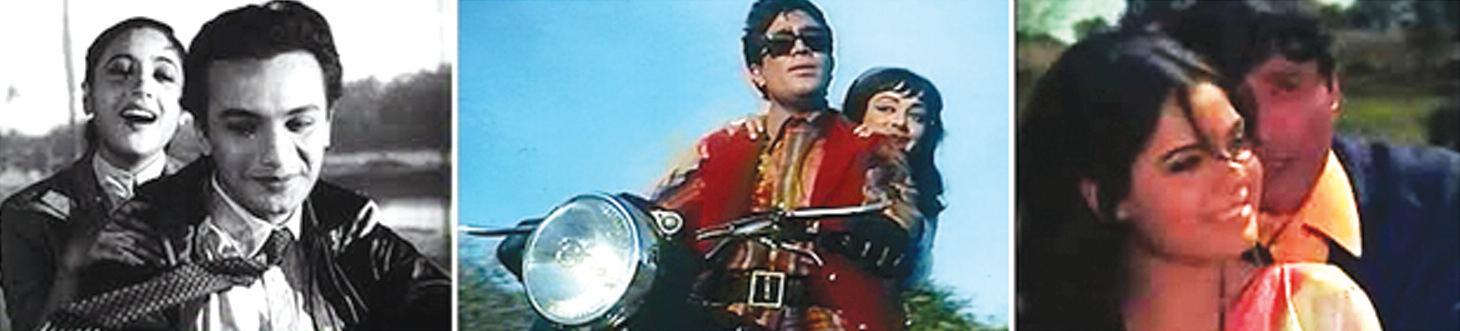
1 - Left to Right: “Ei Path Jodi Na Shesh Hoi” from Tollywood film “Saptapadi” starring Uttam Kumar and Suchitra Sen “Zindagi Ek Safar Hai Suhana” from Bollywood film “Andaz” starring Rajesh Khanna and Hema
And “Maine Kasam Li” from film “Tere Mere
to receive Honorary Academy Award in 1992 over the Oscar platform For the film Gandhi, Bhanu Athaiya won Oscar Award for best costume design, for the 2009 film “Slumdog Millionaire”, Resul Pookutty won Oscar for best sound mixing and music composer A R Rehman won the best original score award and best original song award for the lovely composition “Jai Ho” which was the first ever Indian film song played repeatedly at the Oscar Award function held in California That speaks volumes about the range of excellent talents we have in Indian cinema
starring Dev Anand and Mumtaz, had identical picturizations –lovers singing while riding on a
In the
India produces about 1,600 films each year which is about double that of Hollywood. The number includes both Hindi and Indian regional language films Among regional language films, Bengali films made in Tollywood (a portmanteau of the words Tollygunge and Hollywood) have significant contribution to the landscape of Indian cinema for delivering critically acclaimed films Seventy to hundred Tollywood films are released every year, produced on a budget of Rs 200, 0000 to Rs 15 million per movie, whereas Bollywood (derived from Bombay and Hollywood) films are usually multi-million dollar productions Some high budget films are Rs 1 billion (roughly USD 20 million) productions Recently released Shah Rukh Khan’s production “Ra One” was made at an immense budget of Rs 1 35 billion (roughly USD 27 million) making it the most expensive production in Indian cinema to date Often Tollywood is referred to Telegu films produced in South India and bear a rich heritage producing about
Mere Sapne” it was a bicycle, and hence, Mumtaz is seen sitting
263 films a year But in our series of Tollywood/Bollywood we are focusing on Bengali and Hindi films which are large money making industries based in Kolkata and
deliver unique films to Indian cinema audience worldwide
Some of these films have received international recognition, like, Bollywood
One uniqueness of Indian cinemas is utilization of musical scores especially songs scored for different sequences in the films, worked into the plot to appear natural and realistic for a character to sing Some other songs are used as externalization of a character like a thematic song supporting the story line Music being such an important facet of Indian cinema, in this series on “Tollywood/Bollywood”, we will chronicle some popular
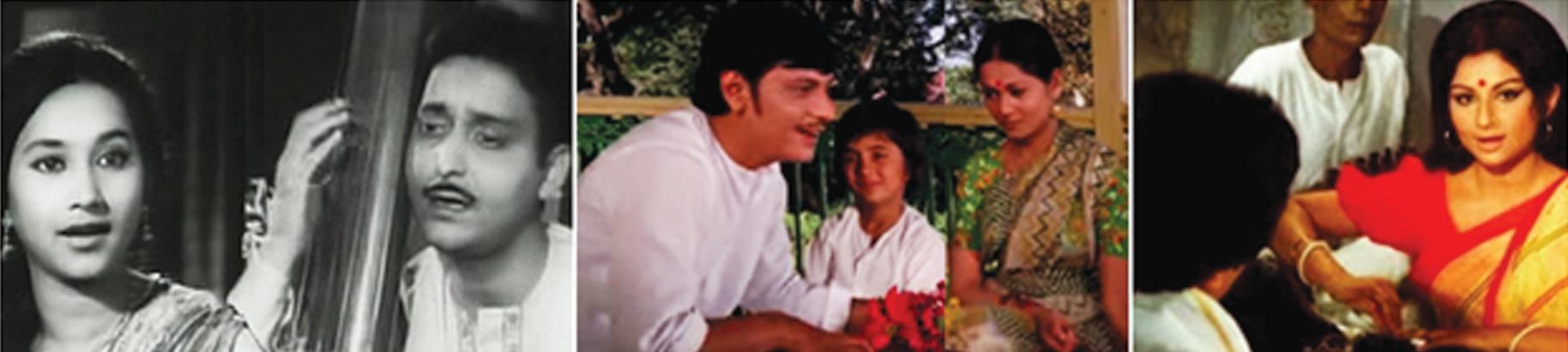
Bombay (Mumbai) supporting livelihood of hundreds of immensely talented actors, actresses, producers, directors, music directors, singers, musicians and thousands of technical staff whose collaborative work
film Mother India (1957), Salaam Bombay (1988) and Lagaan (2001) were nominated for the Oscar Award for “Best Foreign Language Film” From Tollywood, director Satyajit Ray was the first Indian
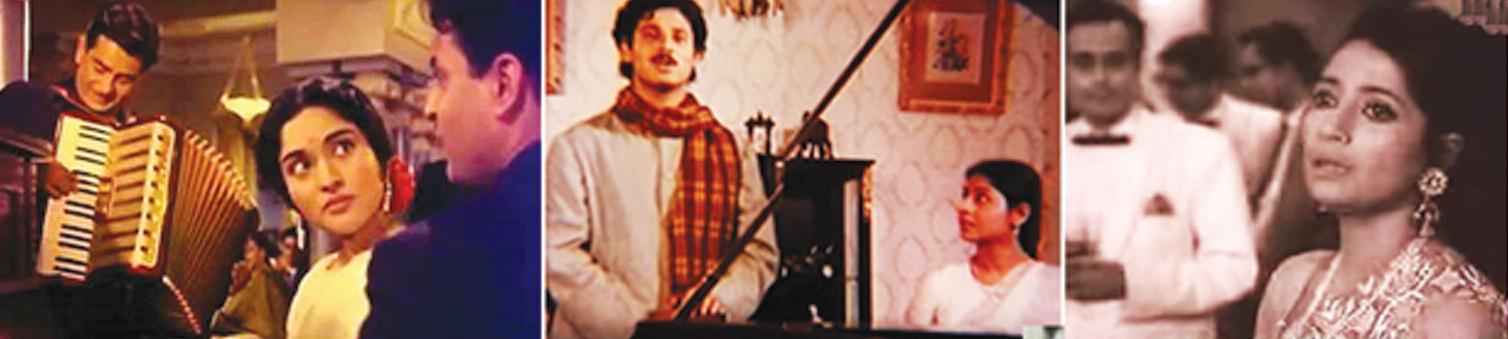
songs having commonalities between Tollywood and Bollywood song picturization patterns There are many songs under this category, I will include some popular ones
After the silent era in Indian films, Bollywood made “Alam Ara”, the first Indian talkie (having sound) in March 1931 The same year, Tollywood produced the first two Bengali talkies: “Jamai Shashthi”, a short film released in April, 1931; and fulllength feature film “Dena Paona” released in December, 1931 With that came the era of sound, songs and dance in llywood/Bollywood films Singers who were also actors and actresses like K L Saigal, Kanan Debi, Noorjahan, Ashok Kumar, Suraiya, Pahadi Sanyal were in demand as songs were sung live while shooting for
Ananda Sangbad
Reported by Subhodev Das
The 10th South Asian Theater Festival organized by the Epic Actors’ Workshop was held at George Street Playhouse in New Brunswick, New Jersey, during August 21-23, 2015
Following the inauguration, a Tribute to Sombhu Mitra was offered to mark the birth centennial of the the legendary thespian, writer and director of Bengali Theater The production was written and directed by Sharmila ‘Pinki’ Ghosal with Parathasarathi Mukhopadhyay at the helm of music direction The performance in Bengali explored Shri Mitra’s perception of “theater music” through a collage of snippets from a few of his memorable productions – “Putul Khela” (adaptation of Ibsen’s Doll’s House), “Char-Adhyay” (by Rabindranath Tagore), “Chhera Taar,” “Raja,” “Raja Oedipous” and “Chand Boniker Pala” (by Sombhu Mitra).
The Second Day ’s line-up consisted of four plays and a dance theater, all presented in English The evening opened
with Here We Are written by Dorothy Parker It was directed by Anshita Kumar and produced by the SAPAN Institute, DC, and
newlyweds aboard a train heading for New York City
The next up was Sitarrah (The Stars) originally written by Monireh Hashemi of Afghanistan It was a solo-act by Ms Hashemi and directed by Leif Persson of Sweden The production depicts
strongly male-dominated society
In the play, which may be described as ‘Witness Theater ’ , Monireh filled the stage with her storytelling Using simple props like a sheet, a colorful scarf, a golden bowl – also piles of books and papers occupy the stage –
English adaptation of Moliere’s comic masterpiece, “Tartuffe –The Imposter,” for Indian settings. Tartuffe deals with religious hypocrisy and was scandalous in its day; its universal message extends beyond religion and can be applied to most
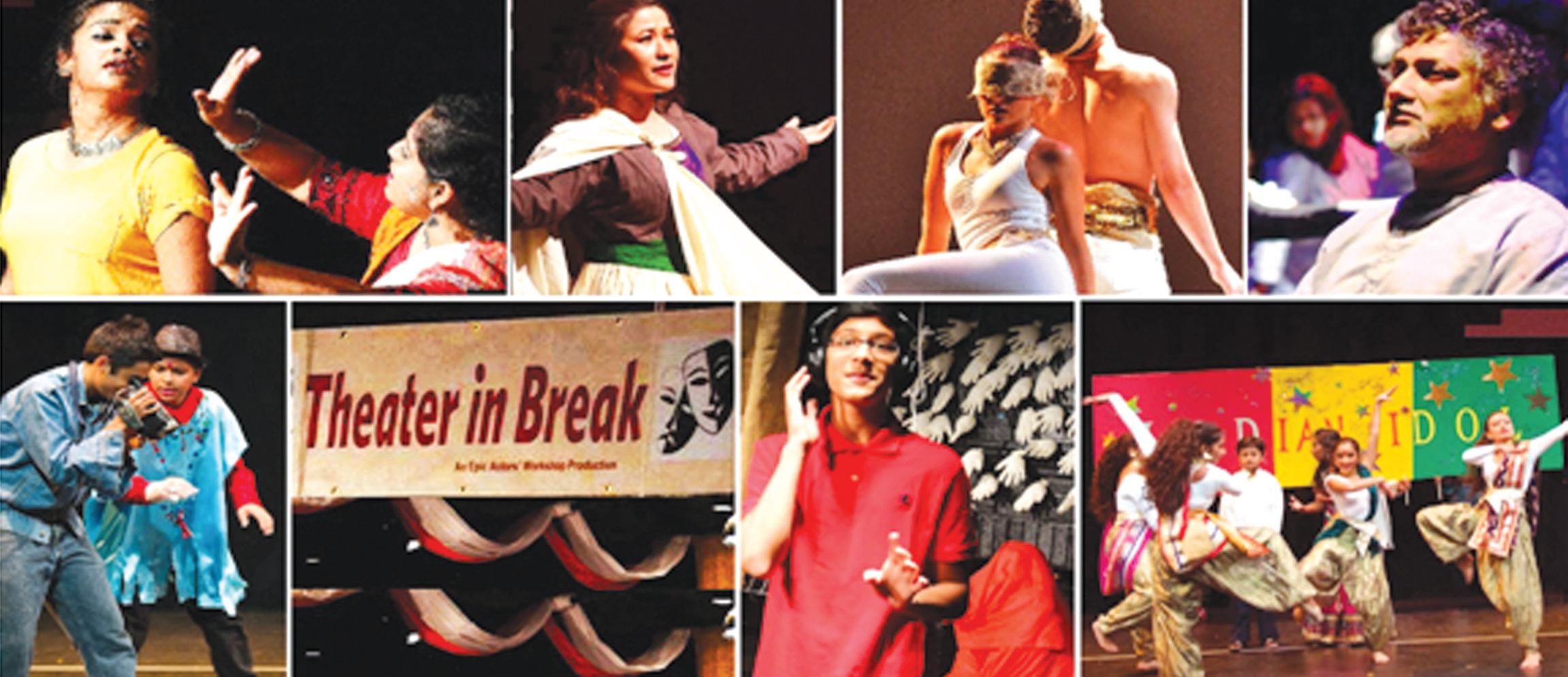
Natya B harati, Maryland The play, set in the 1930s, provides a glimpse into the lives of a couple as they begin their journey as
When Kalpana survived her battle with colon cancer chiefly due to early detection, she realized that her good fortune could be passed along to others Since 2007, the Kalpana Datta Foundation for Cancer Care (KDFCC), a registered non-profit, is raising awareness and encouraged regular screening for both cervical and breast cancer
As of December 2014 we conducted about 78 free screening medical camps About 3000 women were screened for Cervical Cancer (about 52 pre- cancerous stage were identified and cured) Breast Self-Examination was performed on about 4000 women and Clinical Breast Examination on about 82 women (about 8 women were suspected for breast cancer and were cured). We have conducted a total of about 66 Seminars in underprivileged areas in Kolkata, India We are continuing these two projects, “Breast cancer and Cervical cancer awareness and screening” in 2015 and beyond Now we want to build on this success to launch an Oral Cancer awareness program By increasing public awareness about the importance of regular oral screening or by enabling easy, free access to them, we can help increase survival chances By providing conventional visual cancer screenings, adding oral examinations to our monthly camps, and extending our seminars and door to door campaigns to include oral cancer awareness, we believe that we can help populations at risk of oral cancer.
We just launched this new Oral Cancer awareness program in April 2015 We are seeking any monetary contribution to support our effort to help underprivileged people We will keep you posted about the progress
Your donation is tax deductible Please note the foundation Tax Exempt number is 20-4751040
Please send what you can today and write your check payable to:
“Kalpana Datta Cancer Care foundation” and mail to: 498 Benito Street, East Meadow, NY 11554
Please visit www kdcancercare org or call at 1-516-538-1257 for further information
Thank you very much for your support
the stories of three women from different parts of Afghanistan who are treated as hostages in the game of power in the

she wove songs of traditional life, Pishpo dance, and gestures into her narrative
The third play was Tartuff, an

Contact: Samragnee Majumdar 732-692-4818/ 732-744-3908
"Advertisement"
SAMRAGNEE MAJUMDAR NAMED MEMBER Of MILLION DOLLAR ROUND TABLE (New York Life Leads Million Dollar Round Table for the 60th Consecutive Year)
EDISON, NJ –
Samragnee Majumdar, an agent for New York Life in New Jersey, has earned membership in the Million Dollar Round Table (MDRT) for 2014 Achieving membership in MDRT is a distinguishing life insurance career milestone, attained only by those who have demonstrated superior professional knowledge, experience and client service MDRT membership represents the top life insurance and financial service professionals worldwide MDRT is an international, independent association of the world’s best life insurance and financial services professionals In addition, this is the 60th consecutive year that New York Life has dominated the MDRT in the United States
Leading the MDRT’s membership ranks for 60 years speaks to the unwavering dedication of New York Life’s family of agents as well as to our industry leading training program Our agents are unsurpassed in providing families and businesses with extraordinary professionalism and outstanding service year after year, and in upholding the professional standards set by generations of agents before them,” said Mark Pfaff, co-president of the Insurance and Agency Group, New York Life “I am proud that we have attained this level of achievement for sixty consecutive years and I want to thank all of our agents and managers past and present for helping us reach this level of success ”
Ms Majumdar has been a New York Life agent since 2010 and is associated with New York Life’s New Jersey General Office in Edison She is actively involved with the Kallol Women’s Forum of New Jersey, a nonprofit organization supporting deprived children in India Ms Majumdar currently resides in Hillsborough, NJ with her six-year-old daughter.
Founded in 1927, the Million Dollar Round Table (MDRT), The Premier Association of Financial Professionals®, is an international, independent association of nearly 42,729 of the world’s leading life insurance and financial services professionals from more than 473 companies in 71 countries MDRT members demonstrate exceptional professional knowledge, strict ethical conduct and outstanding client service MDRT membership is recognized internationally as the standard of sales excellence in the life insurance and financial services business Please visit MDRT’s website at www mdrt org for more information
Ananda Sangbad
“The monarch currently receives £11 9 million a year from the public purse to maintain and repair her homes which include Windsor Castle and St James's Palace”The Telegraph, August 20, 2015
Castles, forts, and palaces represent the grandiose edifices that represent the confluence of engineering, strategy, and artistic endeavors Castles and forts were used for military purposes, and palaces are where kings and noblemen resided A lot of energy of humankind has been focused into the creation and maintenance of these forts and castles as defensive establishments, but often for belligerent purposes Palaces like Versailles were grandiloquent and wasteful excesses of questionable utility
Are these structures anachronisms or national treasures in the present day and age? Is it worth preserving these megalithic creations? If they are worth preserving, what is the appropriate use of these mansions other than as national treasures? Many of these castles and palaces have become the property of the state, and the state is now liable for its upkeep
One of the biggest attractions around the world and, especially, Europe are the hundreds of castles and fortresses dotted along glens and rivers Many of these castles are built on hard to reach locations, like hills or on sheer rock, so that they were impregnable The access to these places is also difficult and hence maintainability of these centuries-old castles is extremely difficult Many are in ruins, and rebuilding them can cost a fortune
The number of castles worldwide is estimated to be over 10,000 By most estimates, Europe has the most number of castles followed by Asia Africa has very few, and the Americas have a handful of recent structures that could be termed castles Australia also has quaint replicas of castles all of recent origin India has about a hundred forts and castles
In many countries, castles are available for sale to private owners There are about a thousand castles for sale in Europe and people do invest in these properties The prices on many of these places run in the range of a million euros and upward, hence are quite affordable for the well-heeled The renovations and maintenance of these castles probably would cost a small fortune, which would test the financial well-being of the buyers. Some of these properties encompass hundreds of acres and multiple physical buildings
In Germany, a Bavarian Department of state-owned palaces, gardens, and lakes, has been created specifically
By: Tathagata Ghosh
for this purpose There are similar ‘royal’ departments across Europe charged with the maintenance of these royal tenements A recent visit to a few castles in Europe showed the two different ways in which the castles were being managed. We went to the Prague castle, and that is used as fully functional government offices apart from being a tourist attraction The Hofburg palace in Vienna is used for multiple purposes It is used as a museum and a library and probably has offices and many other functions It seems a little incongruous that a grand palace like Hofburg is used as a museum to store broken Greek and Roman artifacts from a thousand years ago All these well-known palaces have a steady stream of visitors from all over the world who pay good money which must certainly also help in the upkeep of these castles They are well advertised in all important travel guides and are on the most travel itineraries There are many castles on less-travelled roads that struggle to attract visitors
In India, sadly the maintenance of these forts and castles is at best indifferent and minimal I recently visited some forts in India, and these were truly under-whelming The Red Fort was just a commercial market, and I did not even see any guides Another fort I recently chanced on was the Vellore Fort, near Chennai It was a dilapidated mess. In shady spots among the ruins, couples planned their elopement As may be expected, there were no guides here as well.
It brings us back to the issue of whether these castles and forts are worth saving Most of them have important historical significance, but their current day utility is hard to justify There are some forts in desolate areas, which probably are just uninhabitable and un-reclaimable Just because there is a fort or a castle built centuries ago does not put an implicit burden on current day inhabitants of the region to contribute to its upkeep This logic can extend to statues and other historical artifacts like ‘walls’ too Some of these are hated artifacts of oppression and domination and deservedly destroyed when an oppressive regime has been overthrown What separates these forts and castles from something like the Berlin wall is the physical enormity of the structures, which has made them permanent features in the landscape Given that it is almost impractical to get rid of those by tearing them down, it would be wise to just repurpose these structures
The best case scenario is if these are owned by private entities who then convert these mansions into hotels. This way there is a revenue stream for the maintenance of these properties In Rajasthan, there are flourishing hotels operating out of palaces It is harder to maintain a fort, mainly a battle fortification We can still come up with ideas as to how to utilize castles, forts, and palaces
Palaces that have amenities could be or have been converted into
1 High-end hotels and restaurants
2 Museums
3 Entertainment venue for concerts
Forts and Castles with few amenities can be converted into
1 Tourist destinations
2 Military bases
3 Military training facilities
4 Sports complexes
5 Used for historical recreation of battles
6 Site for religious festivals
It is possible that many of these structures may not have a current utility, but maybe sometime in the future they could be resurrected for uses hard to foresee It is not beyond the realm of possibility that some of these forts again start find utility as battle establishments again It is plausible in places that have unrest if an external force needs to find a secure place to carry out battle, these hardened fortresses may just be places to embed themselves In 2014, Syrian regime forces recaptured the famed Crusader fort ‘Krak des Chevaliers’ from rebel forces It shows us the strategic significance of these forts can never be under-estimated
Castles, forts, and palaces give us a glimpse into the enormity of power and wealth that was wielded by very few powerful people who decided the course of human history The preservation of these structures by repurposing them or turning it into a tourist attraction would be an ideal way of preserving our historical past Castles, forts, and palaces have been an active determinant of our history and hence our present We would do well to preserve these historical structures in a fashion that is sensible and financially feasible
References : http://www schloesser bayern de/englisch/aboutus/in dex htm
http://www wsj com/articles/SB10001424052748703 743504575493852817825976
July
On 15th, we celebrated monthly Shyama Puja Like other times about 40 people gathered to observe Puja, Stuti, Chandi Paath, Arati and Anjali, all done by 8:30 pm with Prasad distribution followed
On 18th, Saturday, we celebrated our eagerly awaited Rath Yatra Due to continuing construction activities, space was limited but that could not dampen the enthusiasm of the devotees Lord Jagannath’s decorated chariot was pulled through the premises of Ananda Mandir seven times This was a very hot day, but the devotees, adult and young alike, were eager to put their hands on the rope, pulling the chariot along while chanting devotional tunes Others followed along with musical accompaniments like Khol, Kartal and drums After the Parikrama (circling around),
deities of Jagannath, Balaram and Suvadra were carried inside the temple and placed on the Bedi for the preparation of puja At this time the students of RDM dance school paid their tribute to Lord Jagannath with a short dance recital Because of the reduced space inside the temple, it was difficult to accommodate the crowd Puja, Yagna, Stuti, Arati were done. After that devotees offered their Anjali, prasad was distributed Altogether approximately 80 people celebrated the event
On 25th, Bipadtarini puja was scheduled from 10am to 11:00am and to our surprise at least 30 people came to attend it
On 26th, we celebrated Ulto Rath This is believed to be Lord Jagannath’s return back to home with Balaram and Suvadra The Chariot was pulled back again few times through the premises of Ananda Mandir while chanting
devotional tunes. Harir Loot was done, meaning hard candies were thrown around the chariot Kids and adults alike, eagerly collected them After that, Puja Stuti, Arati and Anjali were done followed by prasad distribution
August
On 13th August we celebrated our monthly Shyama puja. Devotees gathered to observe Puja, Stuti, Chandi Paath and Arati Anjali was offered by devotees and prasad distribution followed On 16th, we celebrated our Heritage Day and our Annual picnic on the premises of Ananda Mandir These celebrations were planned well, like every year, and participated by youth and adults
A separate with pictures is provided separately On 17th, Lord Shiva’s "Sahasra naam” was chanted together by many devotees On 25th, Lord Krishna's Jhulan Utsav started and continued up to 29th of August This
day Radha and Krishna were placed on a decorated Jhula (swing) and were pushed slowly This is a very popular event in India as well as here in all the temples On this special day of full moon we celebrated Satyanarayan puja Dr Manisha Chakravarty read from Bhagabat Geeta and explained slokas to the devotees and sang a few devotional songs. Puja, Arati and Anjali were done followed by Prasad distribution September: On 5th, the ever popular festival of Janmastomi was celebrated as the birth day of Lord Krishna Many devotees like to worship the Lord as Baal Gopal Temple was open from 9:00 am to 9:00 pm
Devotees started coming all through the day and offered their puja All through day devotes chanted Lord Krishna's different names thousand times by taking
turn. In the evening hours Dr. Manisha Chakravarty read the fascinating story of birth of Krishna and everybody listened attentively Puja, Arati, Yagna, Anjali were completed by 8:30 pm followed by Prasad distribution About 100 people gathered for this event
Our next puja scheduled on Saturday, 12th September is Koushi Amabasya Kali puja from 6:00pm to 8:00pm Coming festivals are: Ganesh Chaturthi on 17th, and Biswakarma Puja on 18th, 10am to 11am Our monthly Satyanarayan puja is scheduled on 27th, Sunday, 6:00pm to 8:00pm Our Durga Puja festival is scheduled in October – see dates and times in the Ananda Sangbad magazine, as well as in the Ananda Mandir website Hope to see you all
Please contact Krishna Dutta Roy for volunteering at Pujas, at k dutta roy @ yahoo com
Reported by Debajyoti Chatterji
Summer is a real fun time of the year School is out, children and grandchildren are home, vacations are planned and enjoyed, picnics and backyard barbecues are frequent And there are special events like concerts, plays and movies! The list of summertime activities is almost endless -- and the days can indeed be lazy, hazy, and even crazy for the young and the adult alike For most of the seniors within the Ananda Mandir community, the summer of 2015 was such a fun season They spent time with their kids, grand-kids and other family members, yet somehow freed themselves to participate in events organized by the Seniors Forum
On June 27, more than 20 seniors gathered at Ananda Mandir to enjoy good food, good companionship and good discussions A wide range of subjects were discussed and debated in an informal setting Reeta and Amal De described their enjoyable experiences at the Andaman Islands, and Utpal Sengupta shared insights from his not-so-enjoyable (but ultimately successful) efforts to sell his apartment in Kolkata. Dhriti Bagchi presented an interesting and informative slide show on terracotta sculptures from several temples in West Bengal Nupur Lahiri read a humorous essay written by Rabindranath Tagore and led a discussion on this lighter side of Tagore's literary genius Roma Das and Utpal Sengupta amused all the attendees by performing one scene from the latest comic play written and directed by Nupur Lahiri And Roma Das entertained everyone by sharing a selection of jokes told by "Gopal Bhand", the famous 18th century Bengali court jester.
The discussions and debates were made even more enjoyable by a huge, pot-luck lunch prepared by several volunteers The lunch featured mouth-watering Bengali dishes like zucchini curry (by Chhanda Aditya), doi bara (by Dhriti Bagchi) chholar daal (by Suprasad Baidyaroy), aloo posto (by Sikha Chatterji), papri chaat (by Roma Das), bhapa doi (by Anjana Dutta), malpoa (by Suparna Guha), panch-misheli tarkari (by Prativa Hore), and chirer polao (by Nupur Lahiri), The finishing touch was provided in the form of delicious watermelon (by Mita Sinha) and jilipi and amriti (by Utpal Sengupta)!
A gathering of a very different nature was held on August 30 at the Shalimar Grill in North Brunswick We had held a very enjoyable luncheon in this restaurant a few months back, and the seniors decided to return to the restaurant for a buffet lunch and friendly adda The group of 12 seniors ate and talked about the imminent end of the "crazy summer" and shared recent experiences of all kinds Quite a few seniors had planned to attend but had to cancel at the last minute because of unplanned family events Summer is a crazy time indeed
The next big event on the Seniors Forum calendar is a special, in-depth presentation on MEDICARE, to be given by two external speakers on Sunday, September 27 (1 to 4 pm) at Ananda Mandir Please mark your calendar and plan on attending this seminar, arranged by Utpal Sengupta The speakers will cover all aspects of Medicare and Supplemental Insurance Plans and answer all your questions We will also organize a group visit to the Doris Duke Gardens, Hillsborough, in late September or early October
Continued from page 8
the films In 1932, Bollywood film “Maya Machindra” became a super musical hit and the trend was considered successful at the box office Many films were then
wood See fig 3 and fig 4 for some popular songs sung… ” in home gatherings over piano and in the next row some evergreen songs sung over public gatherings like clubs: With songs getting popular in
ples There are many more song sequences in Tollywood and Bollywood films like romantic numbers, wedding songs, songs composed as background scores to support sad occasions, temple
made in Tollywood and Bollywood having everlasting songs
See fig 1 for examples
Another common theme noticed in both Tollywood/Bollywood song picturization patterns
Tollywood/Bollywood films, dance numbers were introduced primarily modelled after popular Indian and Western dance forms In old Tollywood/Bollywood films folk dance, kathak dance and
songs, and songs for different Indian festivals like Holi, Diwali, Durga Puja and other religious events All put together, Tollywood/Bollywood films are glamour-packed, entertaining and
is music makes hero and heroine fall in love. See fig 2 for three examples
Jalsa song – singing in a gathering have been a common sequence for song picturization both in Tollywood and Bolly-
combination of other Indian dance forms added to the popularity of film songs In later years, western dance forms were adopted to match compositions of songs having western beats
See fig 5 and fig 6 for exam-
filled with very talented people In our next issue, we will bring Tollywood/Bollywood actresses who have been super hit stars in both Bengali and Hindi films So, stay tuned and stay entertained.
Invites retirees and near-retirees to participate actively in Forum meetings and activities Seniors Forum usually meets on the third Sunday of every month at 1:00 PM. However, the date may change because of conflict with other Ananda Mandir events. Please contact Debajyoti Chatterji (Cell: 908-507-9640) for latest updates on the meeting dates
By Priya Mukherjee (A Kishaloy Writer)
During the months of August and September, we welcome the arrival of the holiday of Krishna Janmashtami This holiday is a holy and auspicious day marking the birth of our Hindu deity, Krishna. As we celebrate this day, it is important to remember the impacts that Lord Krishna has made in our world and the relationships he has had with our people One such relationship is the relationship between Krishna and Draupadi
Draupadi, according to the epic, is the "fire born" daughter of Drupad, King of Panchal, and who eventually became the common wife of the five Pandavas She was the most beautiful woman of her time Draupadi had five sons; one by each of the Pandavas: Prativindhya from Yudhishthira, Sutasoma from B heema, Srutakarma from Arjuna, Satanika from Nakula, and Srutasena from Sahadeva Draupadi is considered as one of the Panch-Kanyas or Five Virgins The marriage of Draupadi with five Pandava men, i.e., polyandry, was not regarded without censure by the society spoken of in the epic The Indo-Aryan texts almost never mention or allow polyandry, although polygamy was common among men of higher social ranks Her marriage to five men was controversial However, when questioned by Kunti to give an example of polyandry, Yud-
histhira cites Gautam-clan Jatila (married to seven Saptarishis) and Hiranyaksha's sister Pracheti (married to ten brothers)
Now after understanding Draupadi's history, it is possible to understand the nature of her relationship with Krishna Lord Krishna spent much time advising and helping the Pandavas He was married to many women, and was devotionally loved by many others Krishna and Draupadi had a respectful spiritual relationship While many of the writers in their books have said that they both had feelings for each other, the truth is, each considered the other “sakha” and “sakhi” So, the love they had was nothing more than the love for friends Actually it was more like a devotee and God relationship since Draupadi was truly devoted to Lord Krishna
Once, when Krishna had hurt his
finger while beheading Shishupal, Draupadi was seen immediately rushing towards him She at once tore off her sari and bandaged Krishna’s finger For this loving act by Draupadi, Krishna had vowed to help her always For every thread which she had used to cover his wound, Lord Krishna promised to repay the cost of each thread He had promised to help Draupadi by saying, “whenever you need me I’ ll always be there ” Many people believe that the concept of Raksha Bandhan came from Draupadi and Krishna Krishna not only helped Draupadi during her “cheer haran” but also at the time when Durvasa rishi had come at the Pandavas place during their exile Whether Draupadi’s five husbands were there to help her or not, Krishna was always with her, helping her to overcome almost all the difficulties she faced
Kishaloy is a monthly wall magazine for the youth When you come to Ananda Mandir, you will see it hanging on the wall in the community building Any youth member of Ananda Mandir can submit poetries, short stories, scientific articles, artworks, and photographs for the magazine All youth group volunteers will receive official certificates from Ananda Mandir for their volunteer services For more information, contact Dipak Sarkar at email: sarkar@AESOP Rutgers edu; Phone: 609 651 1023
By-Sreya Mukherjee (A Kishaloy Writer)
Medical technology is a broad field where innovation plays a crucial role in sustaining health Areas like biotechnology, pharmaceuticals, information technology, the development of medical devices and equipment, and more have all made significant contributions to improving the health of people all around the world From “small” innovations like adhesive bandages and ankle braces, to larger, more complex technologies like MRI machines, artificial organs, and robotic prosthetic limbs, technology has undoubtedly made an incredible impact on medicine
In the healthcare industry, the dependence on medical technology cannot be overstated, and as a result of the development of these brilliant innovations, healthcare practitioners can continue to find ways to improve their practice – from better diagnosis, surgical procedures, and improved patient care.
Information technology has made significant contributions to our world in many ways that include the medical industry With the increased use of electronic medical records (EMR), telehealth services, and mobile technologies like tablets and smartphones, physicians and patients are both seeing the benefits that these new medical technologies can bring
Medical technology has evolved from introducing doctors to new equipment, to make good use of them in private practices and hospitals, to connecting patients and
doctors thousands of miles away through telecommunications It is not uncommon in today’s world for patients to hold video conferences with physicians to save time and money normally spent on traveling to another geographic location or send health information instantaneously to any specialist or doctor in the world
With more and more hospitals and practices using medical technology like mobile devices on the job, physicians can now have access to any type of information they need – drug information, research studies, patient history or records, and more – within mere seconds And, with the ability to effortlessly carry these mobile devices around with them throughout the day, they are never far from the information they need Applications that aid in identifying potential health threats and examining digital information like x-rays and CT scans also contribute to the benefits that information technology brings to medicine
IT also brings to the table an analysis of records, clinical trials, and research This helps locate addicts in need of refills and brings more perception to people with more complex problems With many of these new features health care is improving faster than our eyes will see, thus giving birth to a new era of progression in the human race
Ananda Sangbad
Continued from page 9
mond of University of Georgia, Athens, under the auspicious of Indian Cultural Society of East Brunswick
The final play of the evening was The Post Office, an English adaptation of Rabindranath Tagore’s “DaakGhar ” It is the story of a young boy, Amal, who is confined indoors due to his illness. He inspires his fellow villagers to appreciate their own “meager ” existence and in return he finds his own happiness in the fertile land of his imagination till he is ready to journey into the next world This play was directed by Hafiz Karmali and produced by Drama Wallah
The fifth event of the main stage was a dance theater Nari: Women of the World directed and choreographed by Brinda and Malabika Guha and performed by the dancers of Kalamandir Dance Company and Kalamandir of NJ Dance School In this production, epic stories were explored to touch upon major aspects of a woman’s experience Along with such characters of Mahabharata as Kunti, Draupadi and Gandhari, the recent controversial BBC documentary India’s Daughter was highlighted too
The concluding day of the festival showcased three Bengali plays on the main stage The proceedings began with a children’s play Indian Idol directed by Shri Parthapratim Deb and produced by Mrittika Inc The play is partially adapted by Dhriti Bagchi, the Founder Principal of Mrittika, from the original script written by Debshankar Haldar It highlights the venality of sham contests like Indian Idol that promote competition primarily for financial goals
The second play of the evening was the much-anticipated Ekti Rajnaitik Hatya (“A Political Assassination”) by Epic Actors’ Workshop It is a Bengali adaptation by Shri Ajitesh Bandopadhyay of Peter Weiss’ play “The Persecution and Assassination of JeanPaul Marat as Performed by the Inmates of the Asylum of Charenton under the Direction of the Marquis de Sade ” The play is set in the backdrop of the French Revolution and utilizes the technique of a play-withina-play It questions the three guiding principles of the revolution – equality, liberty and fraternity – as means to resolve class versus individual conflicts While the actors of the inner play belong to a mental institution where they face numerous challenges, the outer play intended for the visitors of the asylum (the elite of a Parisian society, in the original play) satirically traverses the boundaries of sanity and insanity The SATF production was directed by Shri Abhik Chatterjee of Kolkata
The final play of the festival was Senapoti (“The General”) written by Abdullah Al Mamun It was directed by Irene Pravin Lopa of Bangladesh and produced by AASTHA of New Jersey The satirical play focuses on a schemer and manipulator who climbs the social and economic ladder by slithering up to a patron but eventually causes downfall of both Theater in Breaks conceived and directed by Subhasis Das and produced by Epic Actors’ Workshop was a new addition to the festival lineup According to Subhasis, the concept is one that aims to open a space for theater to evolve form a single moment to a story During six breaks over two days, Subhasis and his supporting team explored different frames of performance in the format of ‘Third Theater’ popularized by his mentor Shri BadalSircar The black box space of George Street Playhouse was utilized for theatrical performances like installation, musical and storytelling The four breaks on first day presented snapshots dealing with Ignorance, Diversity and Reaction to consumerism that is bringing about a Metamorphosis of humanity, turning individuals into market commodities The first break on the second day told the story of a girl who is different in Ami Chitrangada adapted from Rabindranath Tagore’s “Chitrangada” and “Chandalika ” A combination of Rabindra nritya-natya (“theatrical dance”) and modern dance was used as the performance device Badal Sircar’s play Roop Kathar Kelenkari that satirically explores the tradition of fairytale was performed in the final break.
Ananda Sangbad
By Rahul Ray
Acharya Prafulla Chandra Ray is undoubtedly one of the most notable B angalees of all times Photographs of Acharya P C Ray, as he is commonly known, bear the image of a sage with a piercing gaze and a corpus of unkempt facial hair True to this image, he lived the life of an ascetic Yet he took the task of preaching to B angalees how to be prosperous by taking up business as a profession and a goal in life He copiously repeated the old adage Baneejye bosote lokkhee– loosely translated as entrepreneurship brings prosperity
Achraya P C Ray was not alone It may come as a surprise to many, but Rabindranath Tagore was also an embodiment of business-beautiful theme Viswabharati University, founded by Rabindranath, is emblematic of his business acumen A university, no matter which way we look at, is ultimately a business establishment and follows all the laws and stipulations of success and failure This university that boasts a Nobel laureate and an ex-Prime minister amongst its alumni is a vibrant and premier institution for learning today It also has been carrying Tagore’s unique model of learning and commerce This should not come as a great surprise. Tagore merely carried the business-lineage of his famous grand-father, Prince Dwarakanath Tagore, the most successful Indian/Bangalee businessman in his times.
At this juncture, the word ‘B angalee’ deserves a close scrutiny This word used to be reserved for the inhabitants of the land of B angla or B angadesh in chaste vernacular. In the accent of B ritish rulers of then un-divided India B angla became Bengal and its inhabitants, Bengalis It is also noteworthy that the term Bangalee or Bengali was same for Muslim majority in East Bengal (undivided India and then Pakistan after 1947) and Hindu majority in West B engal (a state in India) till 1971 when the sovereign country of B angladesh was born, and her inhabitants became known as Bangladeshis For example, I am a B angalee/B engali of Hindu heritage from India But my good friend Ahmed, a Muslim from East Bengal became a
B angladeshi after 1971 It is important to note that B angalee/Bengali and Bangladeshi people share the same ethnicity, language and culture, except religion in most cases.
The objective of this article is to trace how these two Bengali diasporas have evolved and fared over the past four decades or so, particularly in the light of Acharya P.C. Ray ’s proselytization
A few years ago I, along with my family, was returning home in Boston from Long Island, NY We stopped at Jamaica, NY on our way because our GPS suggested that Indian groceries and other merchandise were available in this town We were stunned to find blocks after blocks of B angladeshi stores with names like Padma, Meghna, Rupsa etc There was not a single store with distinct Indian or a Hindu B angalee name in sight
We stopped at a B angladeshi restaurant for a bite While we waited for food to be served I was pleasantly surprised to find stacks of newspapers in B engali language lying atop lunch tables But my biggest surprise came when I noticed three men in New York Police Department (NYPD) uniform sitting in a corner, eating lunch, reading papers, and chatting in B angla Soon the clock struck twelve and five more men in NYPD uniform came in, ordered food at the counter, and joined the other three I simply could not hold back my curiosity any longer and asked one of them about how many men like them belong to NYPD The man casually replied – ‘Oh, approximately one hundred ’ I doubt that a single Hindu B angalee belonged to NYPD force then and even today
I casually flipped through the pages of some of the Bengali language newspapers that were lying around None of them appeared to be of high journalistic value, but their pages were filled with ads of various types- lawyers, doctors, restaurants, grocery stores, travel agencies etc , all belonging to Bangladeshis with Muslim-sounding names
That was nearly ten years ago I hear that these days more than ten newspapers in B engali, which are published daily in New York City alone. They are all flourishing sup-
ported by ad-dollars from various booming Bangladeshi businesses A smattering of businesses by Indian-B engalees with Hindu-sounding names like B ose, Chatterji, Mukherji, Ghosh etc do exist, but their number is tiny compared with throngs of Bangladeshi counterparts
What is the cause of this disparity? Well, the answer is an open secret and an ugly truth B angalees, Hindu and Muslim alike, were immersed in trade and commerce prior to the arrival of British in India A wealthy ‘Babu’ class comprising almost exclusively of wealthy Hindu-B angalees already existed in B angla, and B ritish rulers coddled them to serve their own interests B ritish rulers also created new breeds of people from clerks (the infamous ‘kerani-class’) to police officers to run various administrative and security operations in India With ‘divide and rule’ policy in mind these policy makers cunningly appointed almost exclusively Hindu-B angalees for these posts leaving out Muslim-Bangalees to have a meager existence mostly as peasants, day laborers, fishermen etc They were also burdened with paying taxes to British rulers, funneled through their Hindu landlords
The grand British plan backfired when Hindu-Bangalee intelligentsia, ‘illuminated’ by Western ideals and supported by ‘liberated’ Anglos like Henry Vivian Derozio, David Hare, and several others triggered ‘Bengal renaissance’ in the late 18th through mid-20th centuries , which revolutionized every aspect of cultural, political, and social lives of B angalees
Acharya P C Ray and Rabindranath Tagore were products of this renaissance B ut much to the distaste and chagrin of the British rulers, ‘Bengal renaissance’ also gave rise to Indian nationalism and ultimately to Indian national freedom movement in which Bangalee Hindus were in forefront B ut sadly enough the Muslim Bangalee population in general was largely not touched and influenced by this renaissance As a matter of fact, they were outright apprehensive about the freedom movement, and felt that British rule would be far more desirable than Hindu domination.
Thus, when the time for In-
dian independence came in 1947 majority Muslim-B angalees happily sided with the nascent Islamic nation of Pakistan even without any ethnic, cultural, language similarities and a land connection - little did they know what awaited them in only 24 years of time But that is a different topic of discussion
It can be asked rhetorically why it is important to recount history in the context of entrepreneurship or lack of it among B angalees Well, first it provides the background how Hindu-Indian B angalees differed and continue to differ economically, culturally and socially from Muslim Bangladeshis Secondly, it sets the stage for discussion on what this difference means for the future growth and prosperity of these two communities
Traditionally Hindu-B engalees have always looked down upon running a business as a profession. My father, a small businessman often encountered his relatives and friends who did not think that he had a meaningful vocation –“wouldn’ t you be much better off by getting a ‘real job’, like a job in a bank?” The old Britishera practice of getting an office job as life’s goal permeated into my father ’s generation It is still fully valid for most Hindu Bangalee families today. Such a mentality may have emerged from certain degree of economic stability that Hindu-Bengalees enjoyed over their Muslim counterpart throughout the British era and afterwards. The ups and downs of running a business would upset that stability and hence to be avoided at all costs Such is the motto of a Hindu Bangalee even today. This explains why there are so few businesses run by Hindu Bangalees In other words, why there is such a lack of entrepreneurship among Hindu Bangalees in general
As for Muslim B angalees/ B angladeshis – they almost never enjoyed any economic stability during British rule Instead they toiled in the fields of Hindu land owners to eke out a living. It is needless to say that they were considerably less educated than Hindu Bangalees This created a two-tier society of Hindu ‘have-got’ and Muslim ‘have-not ’ in B ritish ruled B angla. While growing up in Kolkata in 1960s through 70s a
standing joke among my friends was that all our parents and ancestors were landlords in East B engal Though it was merely a joke it smacked of truth. Many of ours parents and their ancestors including mine were Hindu owners of large swaths of land, mostly in East Bengal
Therefore, generally poor Muslim Bangalees domiciled in East Pakistan after 1947 and then in Bangladesh after 1971 went into any business they could put their hands on with any amount of capital they could muster. Running businesses, domestic or otherwise, has become a key to their survival and prosperity The same trend has marched on in a distant land, in the streets of New York City where almost every third or fourth cab driver is a B angladeshi, and possibly every twentieth or so store is owned by a Bangladeshi!
It is a very important issue in today ’s world with ever-expanding influence of marketdriven forces and capitalism B ut, future generations of B angladeshis will not stop at driving a cab or running a store Mr Salman Khan of the famed Khan Academy is an example of things to come My wife, a scientist by profession, teaches Rabindrasangeet as her passion and carries on her cultural heritage She was truly amazed by two recent additions to her list of young students One of their parents drives a cab and the other works at a convenient store. It is an example of how far a little comeuppance in the economic situation can go Hindu B angalees including myself pride us about our rich cultural heritage in the halo of the renaissance icons who are overwhelmingly Hindu Bangalees It is contextual to reiterate that a Hindu B angalee shares the same ethnicity, hence the same gene-pool as his/her Muslim counterpart There is no telling what rests in the future
In summary, what Acharya P C Ray, a Hindu himself and an icon for Hindu B angalees designed for all Bangalees has largely been ignored by Hindu Bangalees but embraced wholly by their Muslim counterparts Its fallout may have far-reaching economic, cultural, and social implications
Ananda Sangbad
Reported By Manideepa Ghose
Last time NJPA came to you, we were gearing up for summer.
A blink of an eye and summer has ended, kids have their new backpacks and lunch boxes and farm stands are wrapping up Along with all of our friends, NJPA has also been busy Our annual picnic was held at a beautiful gazebo in Mercer County Park Then on Aug 15th we celebrated India’s 69th Independence Day Almost 200 people joined in a wonderful cultural program Our heartfelt thanks go out to all those who attended these events
We are now entering fall, the season of festivals Indians everywhere are getting ready for Durga Puja, Dussera, Navratri and Diwali. So is NJPA. We will celebrate Kali Puja/Deepavali Utsav on Saturday, Nov 14th at Manalapan Middle School Please mark your calendars All of us at NJPA are working hard to bring you an excellent event, rich in heritage and modern in ideas Please look for our invitation and details coming your way
But before that let’s usher in Ma Durga with her children for her annual visit to her baper bari We wish all our friends a wonderful and joyous Puja Season
Sincerely
The Executive Committee, NJPA
l Voice of Love (by Seema Banerjee-Ray & Hillol Ray):
A book of love poems by a husband-wife team Contact the authors to purchase copies of the book (Ray Hillol@epa gov)
l Bugging Cancer (by Ananda Chakrabarty): An intriguing book of fiction based on real research on the use of proteins derived from bacteria to fight cancer Available at Amazon com
l God Never Laughed (by Dev Bhattacharyya): A metaphysical thriller that follows ancient Indian terra cotta tablets through a violent history spanning many centuries. Available at Amazon com
l Stronger Than Gravity, faster Than Light (by Arnab Karmakar): A collection of short stories involving first-generation Americans Available at Amazon com
l Discovering Indian Independent Cinema: films by Girish Kasaravalli (by Sakti Sengupta): An in-depth look at the life and the works of a master of independent cinema in India
Contact the author to purchase copies of the book (asamfilmtheater@yahoo com)
Reported by Debajyoti Chatterji
Following the devastating earthquakes in Nepal, Ananda Mandir Board of Trustees, under the leadership of Pronoy Chatterjee, raised over $4500 and sent the collected amount to B harat Sevashram Sangha (BSS) in Kolkata In a letter, Swami Biswatmananda, General Secretary of BSS, thanked Ananda Mandir for this generous act of support for the earthquake victims The amount of money raised for this Nepal earthquake victims relief included $2500 donated by the members of Ananda Mandir and $2000 from its Community Service Awards Fund Readers may remember that Community Service Awards Fund is a special account established by a few members of Ananda Mandir for the purpose of supporting community service projects
The entire Ananda Mandir community is deeply saddened by the enormous tragedy of the Nepal earthquake, and we hope and pray that the lives of the citizens of Nepal affected by this terrible calamity will soon return to normalcy.
Reported by Soma Chaudhuri
With the onset of summer, families of the Indian Community Center came together for the Annual Picnic on July 26, 2015 (Sunday) at the Loantaka Brook Reservation, Madison, NJ The location was scenic, next to the Kitchell Pond with lots of trees and meandering trails The site included shelters,
picnic tables and charcoal grills along with nearby fields where one could toss a Frisbee or play cricket The seating under the shady trees offered a very relaxing place for “adda” while enjoying the fabulous medley of mouth-watering and flavorful recipes, both appetizers and entrees!
The day opened with loads of snacks and a refreshing “Aam Pora’r Sharbat” -- a signature recipe from the committee members which left everyone asking for more! The grill was set on fire through mid-day and a wide array of meat and vegetables with flavorful marinades filled the barbeque menu The list was endless – kebabs, sausage, vegetable, corn which were grabbed by everyone throughout the day Also the wide variety of food ranged from “Moori Makha” to delicious Burgers and Ice Cream!
The excitement during the day picked up energy as the children participated in very interesting games like the “cookie race” which finally culminated in the “tug of war” --- both adults and children joined hands to pull with their might and tug their opponent off their feet!
The Super Pullers who channeled all their strength and energy and strategized the other team to fall, finally won! The sweat was cooled off with the sweetest water melons! The seedless melons presented patterns that looked gorgeous as much as their juices left a refreshing taste! The audience had a great time cheering every moment!
Everyone is looking forward to the next big event of the community – The Durga Puja! This year’s Durga Puja of the ICC Garden State will be held on Oct 10th and Oct 11th Parsippany High School The main featured events on the cultural front are musical evening with Bangla Band Chandrabindu on first day followed by Sa Re Ga Ma phe-
nomena Bishakh Jyoti and Sanchari Bose on second day Also a play by Sudipta Bhawmik and a dance from Mitra Purkayastha’s group will be among other attractions!
Reported By Jaya Chatterjee
The 18th Annual Foundation Ceremony of Bharat Sevashram Sangha of New Jersey saw one of the greatest musical extravaganzas at the Bharat Sevashram Sangha temple premises on August 29, 2015 The 85 year old maestro, winner of all Padma awards – Padma Shri, Padma B hushan and Padma Bibhusan, Pandit Jasrajji gave a magnificent performance with his senior disciple Padma Shri Tripti Mukherjee, echoing a complete Gurukul on stage Panditji was accompanied on tabla by Shri Aditya Narayan Banerjee and on tanpura by Shri Suhas Joshi and Smt Lalita Mathur It was an absolute feast to the eyes when the nonagenarian Swami Purnatmananda, the leader of B harat Sevashram Sangha in the western world welcomed them
a strong ascent and modulated descent and in the sudden surprises compelling attention The master vocalist next presented a devotional Krishna Bhajan His next presentation was raag Darbari, with a song that Swami Vivekananda used to sing for Sri
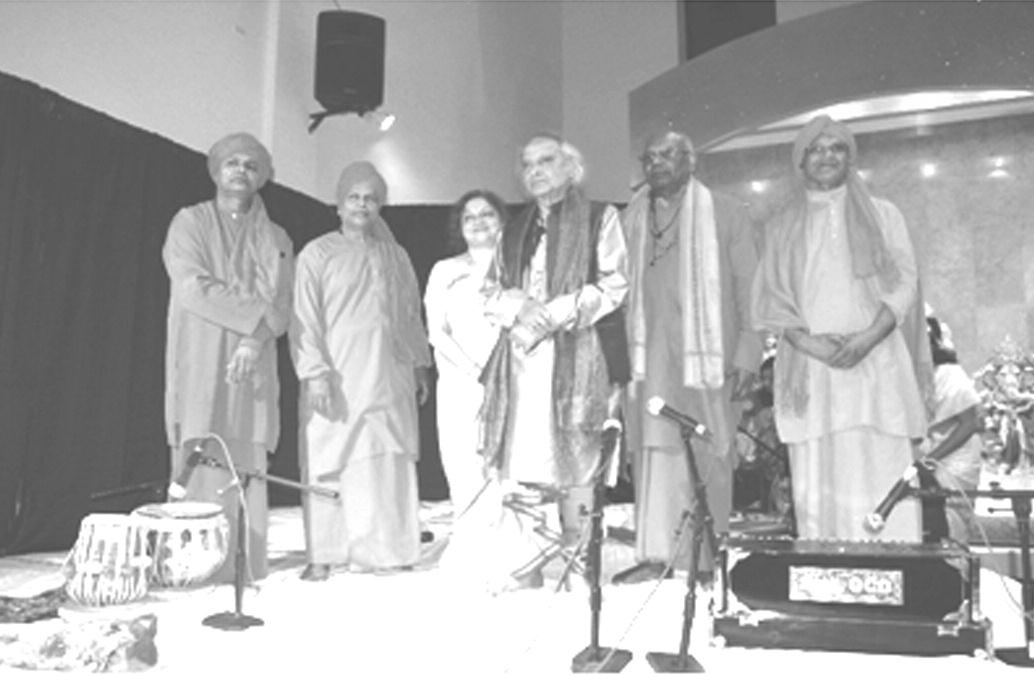
Music lovers were in for a special treat as Pandit Jasraj warmed up with a lengthy Gouri of slow vilambit phrases The Jasraj signature was unmistakable in the extremely long held notes, in the delicate handling of the panchama, in phrases with
Ramkrishna Maata Kaalika came next for the finale, bearing the stamp of Jasraj sangeet even more strikingly The ease of playing with sur and taal over a range of three and half octaves, the heart wrenching renditions of the raagas by this Maestro led the emotional audience to experience an eternal bliss, making the music fest an unforgettable one
Ananda Sangbad
Reported by Subhodev Das
On January 18, 2015, Bhashanagar literary magazine, under the editorship of poet Subodh Sarkar, conferred the ‘B hashanagar 2015’ award on Sudipta B hawmik, the noted playwright and dramatist from New Jersey The award ceremony was held at Jibanananda Sabhaghar in Kolkata to commemorate the magazine’s 25 years of service to the Bengali community. Bibhas Chakraborty, a leading Bengali theater personality, presented the award to Sudipta Poet Alakesh DuttaRoy from Massachusetts was another awardee of the evening The packed audience was treated to readings by many of the leading Bengali poets and excerpts from Sudipta’s popular play ‘Banijye Basate Lakshmi’. The noted Bengali literary personality, Binayak Bandopadhyay, was the master of ceremonies
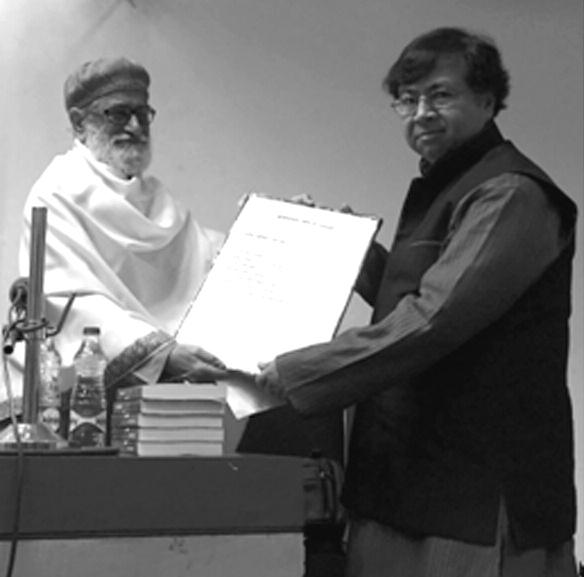
Continued from page 3
under the “Bravia” brand name
I do not know the inside story, but I heard that many Sony engineers in Japan were completely demoralized by this formation of joint venture with Samsung It was simply unthinkable because they considered the Koreans to be inherently inferior, especially when it came to innovation.
I was not surprised by the success of the Korean companies I had visited both the Samsung factories in Suwon city and the LG factories in Gumi in Korea, as a Sony representative Every time I went to Korea I was very impressed by the inquisitiveness of the Korean engineers It was obvious that they were “hungry” for knowledge and a profound desire to show the world their capability This was in sharp contrast with my visits to Sony engineering groups in Tokyo where I would face polite indifference
The Koreans had one other edge over the Japanese: they valued higher education Many of the Sony engineers I worked with did not have a college degree and almost no one had a
graduate degree The emphasis was “on the job training” The Korean engineers, on the other hand, were all college educated and many had graduate degrees It seemed that the Korean engineers were on a mission to prove that they were better than their Japanese counterparts It was no wonder that they eventually succeeded.
I am glad that I was not around to see the demise of Sony manufacturing in North America because it would have been painful to watch Sony sold both the CRT plants in USA – the ones in San Diego and in Pittsburgh The huge Mexican TV plant was also sold to a company who agreed to make some Sony products on an OEM basis. The new owner completely razed what was once a bustling manufacturing center in San Diego There is still some residual activity in San Diego including sales and marketing, product quality, some design activity and a few corporate support functions I have not kept track of what happened to all those Sony plants around the globe associated with TV business
Sometimes I go to a store like Best Buy and stroll through the aisles displaying TV sets It is obvious that the showroom floor is dominated by TVs from Samsung, LG and Vizio I do once in a while see a few very high end Sony TVs, priced at thousands of dollars I really do not know the current strategy of Sony in the TV market.
It is fair to say that Sony has essentially exited the TV business and handed over the leadership baton to Samsung I attribute this sudden, though not entirely unanticipated, fall of Sony’s color TV business to that visionary decision of Nakamura Of course, he did not foresee the way events evolved after Sony’s introduction of WEGA. No one else at Sony did It was a one-two punch: first Sony introduced a product that the competitors emulated in a way that Sony lost the market edge and secondly, Sony introduced the TVs with perfectly flat screens, which the consumers got hooked on quickly and in effect, accelerated the introduction of the flat panel technology
Please note that you can become an Associate Member of Ananda Mandir by donating a minimum of $50. Your subsequent donations of $50 or more are credited to your account When your total cumulative donation reaches $1000, you become a Life Member
Your support, small or large, is most welcome and sincerely appreciated
Reported By Arun Bhowmik Chair, Cultural Committee
Hindustani classical and contemporary music composer and violin guru Sri Ranen Sinha is the rare violin player who can play both North Indian and South Indian style music Ranen, a disciple of Padma Bhusan Dr N Rajam, Pandit Kamal Mallick, Pandit Deepak Chowdhury, Mr K K Athikesavan and Mr. Shyam Binod Ghosh; has rendered violin recitals all over India over the past 20 years. Recently he participated in various fusion concerts with German Composer and violinist Mr Peter Brayuther Ranen Sinha is presently a regular Hindustani Classical Violin player of All India Radio and Tara Muzic channel He is also the founder director of the renowned violin orchestra group VIOLINA based in Kolkata
Ranen Sinha is the featured “Artist of the Month” set to perform on friday, September 11 at 7:30 PM
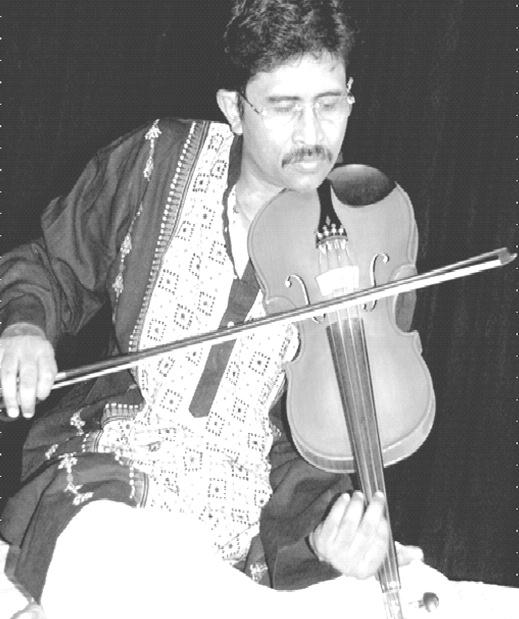
Ranen Sinha
Tabla accompaniment will be provided by Shivalik Ghosal, a highly talented musician of our ommunity
New Life Members: ($ 1,000 - $ 4,999)
l Swaati Chattopadhyay
l Debjit Roy
Patron: ($ 5,000 - $ 9,999)
l Rupak K & Bandana Raha
l Rama K & Baruna Haldar
l Ram C & Kalpana Dhara
l Kalyan K & Dr Jayati Basak
Grand Patron Silver ($ 10,000 – $ 24,999)
l Saurav & Sharmila Ghosh
l Sanjit & Soma Dutta
l Subrata & Rina Roy
l Arijit & Mitra Purkayastha
l Apurba K & Soma Basak
Grand Patron Gold ($ 25,000 – $ 49,999)
l Sajal & Sharbani Mukherjee
l Purna & Krishna Bhattacharya
Benefactor ($ 50,000 and up)
l Anup & Soma Rakhit
Due to major construction activities in our premises in connection with our temple expansion, our Ananda Sandhya events will be organized on a selective basis We will post the date of next Ananda Sandhya with all details on our web site and thru mass email Please stay tuned.
16 October 2015
By Anirudh Guha Sarkar (A Kishaloy Writer)
On August 16th, we all experienced and enjoyed the Indian Heritage Day It not only did remind us who we are, it almost felt like we were still in India
It was kicked off by the flag hoisting ceremony Children from Mrs Dhriti B hagchi’s class circled the flag, each carrying one Indian and one American flag, to demonstrate our Indian-American culture Then, the President of Ananda Mandir, Dr Dipak Sarkar, opened with a speech connecting our place in America with our heritage in India Next, AMYG (Ananda Mandir Youth Group) member Aniketh Sarkar gave a speech on how Indian independence gave us the chance to be here today Then Shreya Choudhury, Sreya Mukherjee and Priya Mukherjee sang the Indian and American national anthems Amitabha Bagchi talked about Immigration in India pre and post Independence Amitabha Sen Gupta spoke about the Ashoka Chakra in the Flag He also recited three short patriotic poems Surajit Mitra and his daughter Shilpa sang two patriotic songs Our “Ananda Dhwani" group sang two patriotic songs This was followed by Kathak dance by the members of Mitra Purkayastha’s Rhythms of Dance & Music School
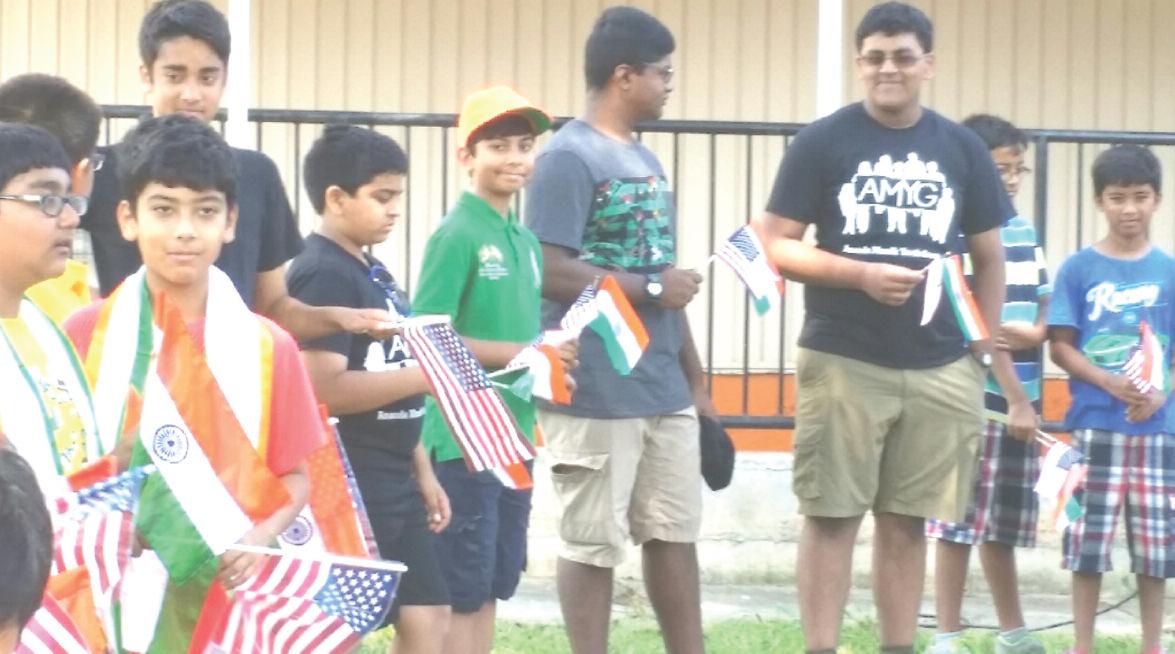
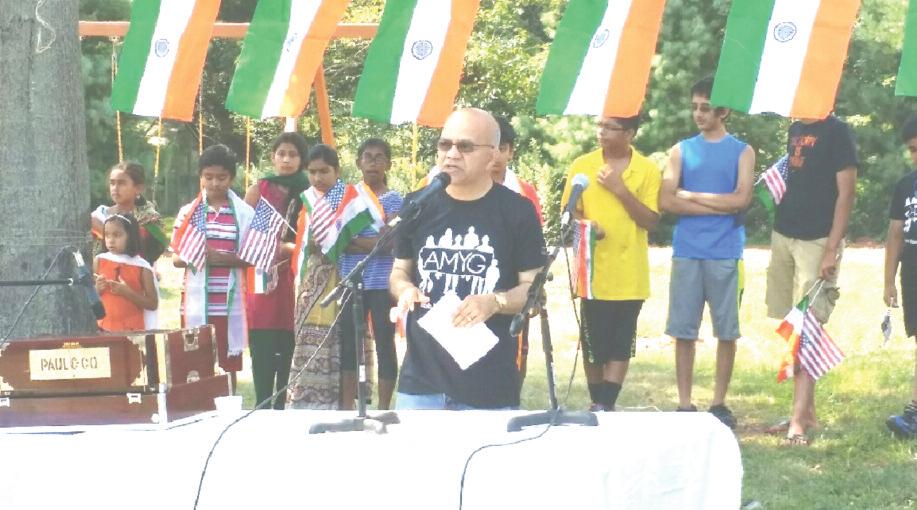
As the Heritage Day was brought to a close, the picnic was started with a lot of delicious food There was a
drawing competition directed by Paroma Das (AMYG member), which lasted for 2 hours Upon the conclusion of the competition, several people began making Alpana on the floor of the temple reception Meanwhile, a Treasure Hunt organized by Aniketh Sarkar (AMYG member) began, which was great fun to many children, with one lucky person managing to find the treasure – a $15 Amazon gift card A ladies’ musical chair game was enjoyed by the participants as well as the bystanders The last event was a musical “Antakshori”, played by highly enthusiastic men and women (The article was supplemented by Krishna Dutta Roy)
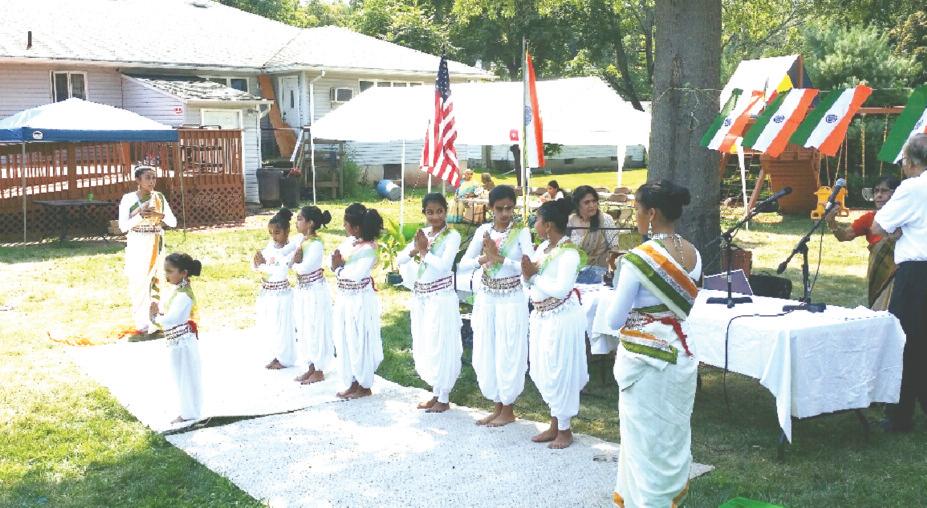
Advertisement