Ananda Mandir
Ananda Sangbad

1215
july 2017
A Quarterly Publication of Ananda Mandir, New Jersey
Rabindra utsav Celebrated in Tagore hall
Reported by Amitabha Bagchi
Ananda Mandir joined hands with the Cultural Association of Bengal (CAB) to organize and celebrate “Rabindra Utsav” – a day-long cultural festival to commemorate the 156th birth anniversary of Rabindranath Tagore It was held on Saturday, May 20, at the newly opened Tagore Hall on Ananda Mandir ’s premises in Somerset, New Jersey.
A key part of the festivities was to hold certain events outdoors and create an atmosphere reminiscent of Santiniketan and evocative of the poet’s spirit One such event was an open-air inauguration program known as Baitalik It began at 11 O’clock in the morning with a group of singers, dancers and ordinary attendees walking in a procession from the temple door to the gate of Tagore Hall while singing Tagore songs They assembled in front of the hall, sang some more songs and did a few dance numbers Baitalik was organized by Tandra Das with help from the alumni and alumna of schools founded by Tagore It culminated in the unveiling of an image of Rabindranath, followed by a Lighting Ceremony The Opening Ceremony was led by India’s Consul General in New York, Mrs Riva Ganguly Das, with help from other guests
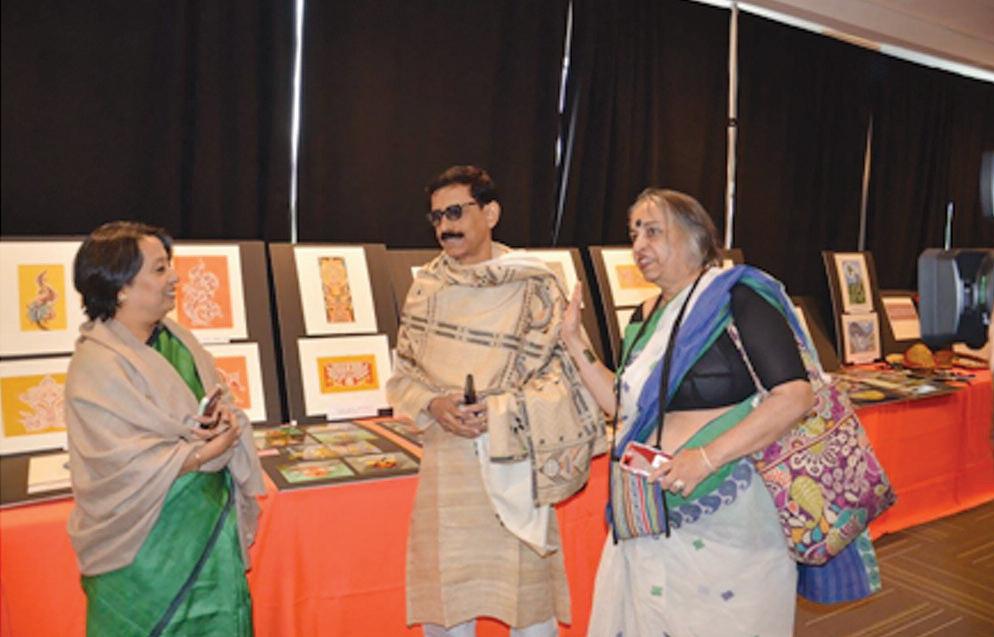
The Consul General then inaugurated an Exhibition on Alpana Art and Paintings by the invited artist, Sudhi Ranjan Mukherjee, visiting from Santiniketan Next came welcome speeches by the Presidents of Ananda Mandir (Ashok Rakhit) and CAB (Milan Awon), followed by the Consul General’s address. The stage was now set for the cultural presentations, which formed the core of the program.
The cultural presentations were a two-parter: afternoon and evening The afternoon program featured musical, dance and theatrical performances by groups of artistes representing local Bengali organizations The evening program showcased two singers visiting from India: Anindita Kazi
(granddaughter of Kazi Nazrul Islam) and Riddhi Bandopadhyay. There was a half-hour break for dinner between the two parts The entire event concluded by 11
PM
The following twelve local organizations participated in the cultural program and were recognized as associate organizers of the event: Suddhaswar (Connecticut); Garden State Cultural Association (GSCA); Ananda Dhwani of Ananda Mandir; ICC; Surosree of NJ; AASTHA Theater Group; Surer Dhara; Ranjanee Group of NYC; Srishti Academy of Performing Arts; Rhythms of Dance and Music; CAB; and Kallol of NJ Their performances were interspersed with a brief youth dance, Tagore songs on guitar, and a masterly PowerPoint presentation by Sudhi Ranjan Mukherjee on the evolution of alpana art form in Santiniketan –from Nandalal Bose to the present day
There were other touches of Santiniketan in the proceedings One was Sahitya Sabha, organized in the style of schools back there, which featured music and short readings by the youth (teens and pre-teens) of our community. Another was an elaborate lighting program outdoors to usher in the evening. In the evening program, Anindita Kazi and Riddhi Bandopadhyay entertained the audience with melodious songs of Tagore, Nazrul Islam and other lyricists of that period
To add variety to the proceedings, aside from the cultural
AnnuAL Fund RAising LunCheOn sundAY, july 23, 2017
programs, two seminars were arranged. The first one tried to explore the theme “Tagore in the International Context – Influences and Impacts ” The actual seminar was titled “Rabindranath, Yeats and the Recep-
tion of Tagore in the West ” It featured lectures on the two poets and their interaction (as well as related topics, such as performing Daak Ghar in a Polish concentration camp during World War II) by two professors from Seton Hall University – Arundhati Sanyal and Elizabeth Redwine
The second seminar tried to explore the “View of Tagore from a Contemporary Perspective ” Titled “Rabindranath’s Internationalism in the Context of Today ’s Rise in Nationalism,” it was an Open Forum discussion with spirited audience participation moderated by Amitabha Bagchi. Kudos are due to the three Co-Chairpersons of the event, Dhriti Bagchi and Tapas Sanyal (from New Jersey), and Sushmita Sarkar (from New York), for organizing an attractive and successful celebration in honor of Rabindranath Tagore
Calendar of Events (Dates are subject to Change)
Please check our website frequently www anandamandir org Tel: 732-873-9821
NOTE: If a particular Puja time is not listed, please contact temple or visit our ebsite: anandamandir.org
juLY 2017 (*)
ultoRath & satyanarayan Puja
Monday, 03, 6:30 pm – 8:30 pm
guru Purnima
Sunday, 09, 8:30 am -10:30 am shyama Puja
Saturday, 22, 6:30 pm–8:30 pm sahitya O Alochana
Friday, 21, 8:00 pm
Cultural Program
Sunday, 23, call for details
AugusT (*) janmashtomi
Monday, 14, 11:00 am – 9:00 pm sahitya O Alochana
Friday, 18, 8:00 pm
sePTeMBeR (*) Mahishasura Mardini Live
Sunday, 17, 4:30 am
duRgA PujA, LAKshMi PujA And KALi PujA – 2017

MAhishAsuRA MARdini Live Sunday, Sept 17, 4:30 am l
duRgA PujA
debir Bodhan, Evening: Monday, Sept 25, 6:30 pm
debir Amantran O Adhibas, Eve: Tuesday, Sept 26, 6:30 pm - 8:30 pm saptami, Morning: Wednesday, Sept 27, 8:30 am – 10:30 am
Ashtami, Morning: Thursday, Sept 28, 8:30 am – 11:30 am
sondhi Puja, Evening: Thursday, Sept 28, 7:06 pm – 7:54 pm nabami, Morning: Friday, Sept 29, 8:30 am – 10:30 am dashami, Morning: Saturday, Sept 30, 9:00 am – 11:30 am
sindur Khela & Arati Saturday, Sept 30, 6:30 pm – 8:30 pm l
KOjAgORi LAKshMi PujA Thursday, Oct 05, 6:00 pm – 9:00 pm l
MAhA KALi PujA Thursday, Oct 05, 5:00 pm – 11:00 pm
duRgA PujA
Tuesday, 26 to Saturday, 30
See announcement for times
Cultural Program 29, Friday, call for details
Cultural Program (haimonti shukla) 30, Saturday, call for details
sahitya O Alochana
Friday, 22, 8:00 pm OCTOBeR (*) Kojagori Lakshmi Puja & satyanarayan Puja
Thursday, 05, 6:00 pm – 9:00 pm Bijoya sammelan (Pandit Subhen Chatterjee band)
Sunday, 15, call for details
MAhA KALi PujA
Thursday, 19, 5:00 pm–11:00 pm
Musical evening (Band from Kolkata)
Thursday, 19, call for details jagaddhatri Puja
Fri-Sat-Sun, 27-28-29 call for time
sahitya O Alochana Friday, 20, 8:00 pm (*) See www anandamandir org or Call Mandir for details
special Religious services: Upon request, the priest of Ananda Mandir offers services such as inhouse Shraddhas, Rituals associated with Cremations (Antyesti Kriya), Shraddha Anniversaries, Pre-wedding rituals (Naandimukh, Ashirwad, etc), Upanayan (Paitey), Annaprasan, Wedding Ceremonies & Wedding Anniversaries, Griha Prabesh (Bhumi Puja), Consecrations of new cars (New Car Pujas) and others if you have needs for any of the above or more, please feel free to contact Biswabhai @ 732-873-9821
Ananda Mandir
Riva ganguly das, Consul general of india in new York, with sudhi Ranjan Mukherjee and dhriti Bagchi
AnAndA sAngBAd
A Periodical Newsletter
Published By AnAndA MAndiR (A Tax-Exempt, Non-Profit Organization) 269 Cedar Grove Lane Somerset, NJ 08873 Ph: 732-873-9821 Website: www anandamandir org
PuBLiCATiOn COMMiTTee OF AnAndA MAndiR
Chairperson: Pronoy Chatterjee, pkc usa@yahoo com
Assistant Chairperson: subrata Bhaumik, Bhaumik subrata@gmail com
Editor-in-Chief: debajyoti Chatterji, Debsmee572@gmail com
Managing Editor, Ananda Sangbad: guru Chakravarty, guruchakravarty@yahoo.com
Managing Editor, Anandalipi: Amitabha Bagchi, amitabhanj@gmail.com
Editors: subrata Bhaumik, bhaumik subrata@gmail com subhodev das, subhodev das@gmail com sushmita dutta, sushmitadutt2@gmail com Amrita Kangle, amritakangle@hotmail com nupur Lahiri, nupurlahiri@aol com
Associate Editor: Ruby Banerjea, r banerjea@yahoo com
Members-at-large: Bhaswati Bhadra Ashok Rakhit
ediTORiAL PResidenT's MessAge
Tagore hall – The Place to Be It is good to see many new events happening at Ananda Mandir since the inauguration of the Tagore Hall It is capturing attention of people in the community
For the first time, we had a day-long cultural event held in the Ananda Mandir campus on 30 April, 2017. It is a tall order to organize events and hold on to a respectable audience for an entire day without spending a fortune. Well, Arun Bhowmik, the multi-talented cultural coordinator of Ananda Mandir, well known in the Bengali Community for his charismatic leadership in arts and culture, pulled that off successfully, all with the help of local talents
No sooner that event was done, we had another day-long program on May 20 to observe Rabindra Jayanti, the favorite celebration by Bengalis every year This event was planned by Dhriti Bagchi, another well-known cultural leader in the Bengali community, with very able help from Tapas Sanyal and Sushmita Sarkar, under the joint banner of Ananda Mandir and Cultural Association of Bengal What’s more, many other prominent organizations in the Tri-state area participated in the event
Next, there was an event for the followers of Vedanta Philosophy A lecture was organized by Subrata and Indrani Dhar on “Living with Vedanta” by a highly revered and knowledgeable monk from Vedanta Society of New York, Swami Sarvapriyananda He charmed the audience with his mastery on the subject during the speech and in answering questions from the audience He used simple examples to explain the basics of “Kam”, “Artha”, “Dharma”, and why human mind wants to achieve something more, to get to understand the philosophy of “Advaita” or “One Consciousness”
These are a few examples of how individuals can effectively take charge in advancing the cause of Ananda Mandir Clearly, these types of events will result in attracting more and more people into the organization, through direct participation, sponsoring new events, or simply joining the membership Obviously, this would go a long way to help meet the financial obligations too. Events like these are happening at various facilities outside the Ananda Mandir campus, organized by other local associations. Many attendees in these programs comprise of Ananda Mandir well-wishers. We need to encourage these associations and individuals to consider using the Tagore Hall whenever possible
dear Members of Ananda Mandir, We opened our long-waited Cultural Center (recently named as Tagore Hall) a little over six months ago Some of the major community events celebrated to date in our hall were Rabindra Utsab commemorating 156th Birthday of Kabiguru Rabindranath Thakur on May 20th, New Jersey Cultural Festival on Sunday, April 30th and the 2017 New Year’s Eve celebration All of these events were celebrated in close partnership with various cultural schools/associations of our tri-state area, especially Cultural Association of Bengal (CAB) and Kallol of New jersey. One of Ananda Mandir mission is to integrate this Bengali Heritage Center across all sections of our community in the tri-state area. With that mission in mind, Ananda Mandir has taken on the responsibility of sponsoring 38th North American Bengali Conference, to be held at Atlantic City, NJ on June 29th to July 1st, 2018. Our NABC Leadership Team has some of the brightest and most experienced volunteers of the state of New Jersey, representing all major organizations like Kallol, NJPA, GSCA and ICC We would need your support and good wishes to make NABC2018 the most enjoyable and well-organized event in recent years
Let me quickly update the operational status of our center We have installed two beautiful spires on the temple roof last month, giving the building an architectural look reminiscent of a Bengali temple We still have a few items that need to be completed to finish the construction as planned in our 2012 application to Franklin Township This includes the addition of a private puja service room next to the temple lobby, completion of additional 117 banked parking spaces, and installation of a security gate at the driveway entrance These items needed amendment of previous approval from Township, and we are expecting to get that approval soon Both temple and community hall are now fully operational
How are we doing fiscally? This year would be a critical financial year for Ananda Mandir because a) our $3 5 million construction loan was converted to a 20-year mortgage starting last month; b) Tagore Hall will need time to be equipped fully and ready with all bells and whistles; and c) it will also need time to get full publicity for rental by the community While graduation, anniversary events are generally booked for summer and fall seasons, reservations are usually made three to six months in advance We have hired a full-time resident manager, Mr Surinder Singh, to manage the administration and operation of the hall He is working hard and is available seven days a week for a good part of the day and evening We thank him for his untiring service and request your support and cooperation so that Tagore Hall meets all our expectations and dreams of serving the large Indian community in the state
Obviously, at this time, we are far short of the revenue need for $24,000 per month of mortgage payment We are confident to close the gap as the tempo of hall reservation has started increasing Our financial model for our mortgage debt assumed that every year doing an Annual Fundraiser and savings from two major religious holidays of Durga Puja and Maha Kali Puja will meet our expense needs. This year, we are planning a Fund-raising Luncheon on july 23rd, sunday from 12 noon to 4 pm. We need your financial support to meet our obligation to the bank every month. You may have received an invitation card for the Luncheon at home. If not, please call me, our priest Biswabhai or any of the Trustees so that we could extend our invitation to you and family.
All queries, articles, news reports and letters should be directed to the Managing Editor: Phone: 908-752-3065, E-mail: guruchakravarty@yahoo com
For general information, please contact the following executives of Ananda Mandir: Ashok Rakhit, President
jaiprakash Biswas, Vice President
suprasad Baidyaroy, Vice President
Arun Bhowmik, Vice President
sajal Mukherjee, Gen Secretary
Pradip Majumdar Treasurer l l
Tagore Hall is an attractive place to organize programs to meet the community’s cultural, social and philosophical needs, while the temple next door is well placed to support all religious obligations and festivities It is nice to see that the objectives of Ananda Mandir are coming to fruition
guru Chakravarty Managing Editor, Ananda Sangbad
We have also prepared a list of special items for Sponsorship in the temple or in Tagore Hall to recognize your kind donation Please be generous with your donation so that we can meet all our financial obligations during the year
Thank you for your support of Ananda Mandir May Ma bless you all at home
Best regards,
Ashok Rakhit President, Ananda Mandir
If you are a Life Member or an Associate Member,
your copy of Ananda
LETTERS TO THE EDITOR
dARK side OF TeChnOLOgY
Editor’s Note: This is in response to the article, “Dark Side of Technology”, authored by Basab Dasgupta, in the April-2017 issue of Ananda Sangbad
Dear Sir, “Dark Side of Technology”, one of the articles in your January 2017 edition of Ananda Sangbad piqued my interest It was penned by Basab Dasgupta The article, on one hand, makes an attempt to establish a cause and effect relationship between “desperate and natural” necessity and invention, and, on the other, addresses the concept of “hyped, unnatural, (may be immoral too)” necessity of our times driven by profiteering and capitalism The latter, as the article concludes, produces more disruption, brings in unintended and harmful noises in otherwise serene human lives, and heralds unhappiness and, perhaps destruction as well May I offer a differing view? It would not be out of place here to point out that some of the conclusions of the author ’s discourse appear flawed due to the premise it is based on. The article has the flavor of suggesting that life in a Robinson Crusoe land is the ideal life, and evolution of needs is a myth. Granted, necessity precedes invention, but necessity in and itself is never a static concept. As human civilization moves along its own seemingly infinite cycle of evolution, our necessities evolve as well. What is an idea born through fanciful exercise of a fertile mind today would be a necessity tomorrow. Gutenberg's printing press was not a bare necessity for the village idiot in the 3rd century, but the need for large scale information dissemination became one in the late medieval times, and it was born Likewise, the need for instant information was not a necessity in 19th century, but it became one as other advances in 20th century changed our lives, and internet was born Same cycle would apply in most cases of necessity led inventions including mechanization of agriculture to locomotives; television to smartphone; and others
Today, GE and Phillips are making billions of dollars from Edison's light bulb, but that was necessity during his time And Edison was more concerned about making it available for mass use than the dollars GEs and Siemens’ of the world are making more than 100 years later And in this race they drastically improved the original invention of Edison In other words, like everything else in the world, capitalism has two sides as well – the positive side being the fact that it encourages competition, which innovations thrive on
Yes, the commercial aspects of inventions have some unintended consequences as the author posits, but all inventions have negative consequences including human aggression and greed But, we are more concerned about the net result Also, what's a net good for a time may not be the same at a different time Fossil fuel completely changed the trajectory of human civilization since the industrial revolution, but the net result is starting to look a bit bleaker in the centuries to come As a result, we would see proliferation in alternate energy sources, which probably wasn't a necessity even a few decades ago
Finally, the article makes a half-hearted yet compulsive conclusion, which insinuates that the society of our times, as a whole, is completely unaware of the negative sides of technologies, and is pathetically behind in addressing them Yes, there would always be a lag between reaping the benefits of inventions and cleaning the debris they leave in their wake But, isn’ t that true for everything in our lives?
Overall, Mr Dasgupta’s argument seems to be locked in a time warp and wrongly placed in the cycle of innovation Announcing that all recent technological inventions are the offspring of Gordon Grekko style greed on Wall Street is a bit over the top and is a sweeping statement Yours truly,
subrata Bhaumik
June 2017, New Jersey
MAdAM PResidenT
Editor’s Note: This is in response to “A Letter to The Editor” written by Subrata Bhowmik in the April-2017 issue of Ananda Sangbad, on the article “Madam President”, authored earlier by Tathagata Ghosh This is a rebuttal by the author to conclude the discussions on the article
This is in reference to the Letter to the Editor in the April 2017 issue of Ananda Sangbad Thanks to the reader for providing his feedback Much appreciated
To answer the questions as to why Thatcher and Aquino did not find prominent mention or any mention at all Aquino did not find a mention because the main focus was on the Indian subcontinent though mentions were made to other women leaders in Asia who are currently in power I found it interesting leaders from Asia and South America seemed to have similarities in the way they came into power through family connections Most European women political leaders, including Thatcher about whom I made a passing mention, did not have this kind of leverage
A most fascinating discussion is the primary issue raised by the reader about mentioning that Bhutto was more qualified when she entered politics more so than Indira Gandhi Benazir Bhutto’s academic bio does seem like she was the more accomplished than the rest, including stints at Harvard and Oxford Benazir Bhutto was also the first woman to preside over the Oxford Union, which I presume is prestigious Indira Gandhi also studied at Oxford but did not complete her degree at Oxford She did not have a stellar academic record nor did she hold any position of note while she was studying
An intriguing study would be about their political careers Both were turbulent and ended violently Both their lives were marked by tragedy, allegations of corruption and authoritarian tendencies
Still a case may be made that Indira Gandhi was a better leader than Bhutto despite her weaker academic credentials An analysis for another time
Tathagata Roy June 2017, New Jersey
PLeAse COnsideR LeAving A LegACY TO AnAndA MAndiR ThROugh
YOuR WiLL
Don’ t you love our beautifully expanded temple? Don’ t you feel proud of the impressive Tagore Hall that we have built for the community? Of course, you do -- and so do several hundred other Life Members of Ananda Mandir. Without your and like-minded community members’ active involvement and generous financial support, we could not have come this far from our humble beginnings
As you know, we have been able to fund a significant part of the recent construction efforts from the donations we have received from you, especially through our annual fund-raising events
However, we had to take a large bank loan to finance a significant part of the construction. As a result, we are facing a big mortgage burden on a monthly basis – and are seeking your help to pay off that large loan sooner than scheduled.
To that end, we are requesting you and other donors to consider leaving a legacy for Ananda Mandir in your Will Simply speaking, that means naming Ananda Mandir as a beneficiary in your Will for a sum of your choice Other non-profit organizations in our community have benefited from similar legacies from their members and donors, and we are hopeful that the Ananda Mandir community will come forward with equal enthusiasm
We are pleased to report that several of our members have already named Ananda Mandir in their Wills. Many of them are willing to privately discuss with you, if you are interested, the process they followed Additionally, please feel free to contact any of the following members if you have any questions or ideas:
Dr Samir Dutta
Debajyoti Chatterji
Ashok Rakhit
As a community of mostly immigrant Bengalis, many of our members have been fortunate to achieve success in their life and are enjoying retirement or planning to retire soon Their children are now adults, living on their own and pursuing their careers, so they have less family and financial obligations. And they are updating their Wills and estate plans This is the time for them to reflect on what they may leave behind for their family –and their favorite community organization. We hope you would remember Ananda Mandir when you go through such reflection
Communication Towards Perfection, As We evolve
By Pronoy Chatterjee
Effective communication is the key to solving most of the problems that we face in dealing with the world This is my second article on the subject; the first one, entitled “Perception, Communication and Consciousness,” was published in the January 2016 issue of Ananda Sangbad In this article, I have focused on the communication skills that would advance to become more effective as we progress in our evolutionary process.
While reviewing modern physics and Eastern philosophy, Professor Gary Zukav of California said, “Our path in life can be divided in two directions, horizontal and vertical. In a natural mode, our personality moves in a horizontal path and the soul moves in a vertical path More and more we are able to align the horizontal path to the vertical one as we proceed towards perfection ” - (Ref “The Dancing Wu Li Masters,” William Morrow & Co , 1979; Bantam Books Paperback, 1984)
Extending the same line of thought, the degree of alignment of the two paths of actions would also define the quality and intensity of transmission of our messages to the outside world In the communication process, our physical expression, such as, speech, language, gesture etc , would be considered as the horizontal path, and the inner feelings of our souls would be the vertical path The more we can align our physical expression (horizontal path) with the vibration of our souls (vertical path), the more effective we would be in terms of our communication process Thus, it says, “Align your ‘self ’ to your expression for communicating your message to the outside world”
There is another dimension to this complex phenomenon of communication and that is the level of our inherent sense perception Extra senses and enhanced perception would help us to understand the world and the human beings around us better We must continue to enhance our senses and try to increase self-control over our senses. We live on five senses: hearing, smell, taste, sight and touch. If these senses are ultra-sensitive we can acquire the total knowledge of our world. Superhuman beings have acquired extra senses beyond those five and therefore they have extra perception. This extra per-
ception helps them to communicate with the general mass more effectively.
To further understand the communication, we have to understand how the human mind works and interacts with its organs Human beings have various organs, such as brain, heart, lungs, kidney, stomach, ears, nose, eyes, etc The functioning of these organs is dependent on the workings of our mind-brain system
All organs are activated by some sort of command which comes from the brain The brain and the mind are not the same thing The relationship of the mind to the brain is like electricity or electrical energy to a power generator The mind is more complex and incomprehensible, whereas the brain is a sophisticated chemico-mechanical system When the mind gives a direction to the brain, the neuron complex in the brain begins to transmit electrical charges through neurotransmitters Those neurotransmitters activate specific functions of different organs that receive the neurotransmitter chemicals through receptors of their cells Specific neurotransmitters are received by specific receptors
All cells have receptors, even the cells that make up complex neurons But, who or what provides the information to the receptors of the neuron that the brain will have to act in a specific manner? We know in the case of certain insects it is the environment The environment dictates those insects what to do, how to perform certain functions Apparently, those insects do not have any choice. Nature or, in other words, the environment directly works to act as their mind.
The insect, like a moth, has a brain but it is much less sophisticated than the brains of higher animals. With that simple brain, however, a male may travel quite a distance to find a female mate Do they have a powerful mind or brain? Apparently not; their search for the female is controlled by the environment Moths have neurons in their brains, like humans Each neuron has an axon, a tail-like feature When electrical pulses are generated they come down through this axon and emit neurotransmitter chemicals These chemicals are received by specific cells through the receptors The electrical pulses, on the other hand, are generated in neurons when neuron receptors receive signals In moths, the receptors at the segment of the brain where sexual instincts are
It is once in a very rare way that the word ‘Destiny’ begins to assume gigantic proportions in life Where did we come from and where do we go to in the end? There had to be such an answer, I was quite confident about that Life couldn’ t just be about a mass of human cells just coming into being physically, growing, decaying and dying eventually What about the essence of a being? What about the ‘I’ in me?Vedanta is a topic which by its very definition, (VEDA means complete knowledge and ANTA means end), means the culmination of Vedic wisdom or the final step of our spiritual journey Ananda Mandir organized a discourse by Swami Sarvapriyanandaji on its premises on the 27th of May He is the spiritual leader of the Vedanta Society of New York Quite apart from being a very
processed protrude outside and act as antennae. When a female emits a tiny amount of a chemical known as pheromone it diffuses into the air. A male located far away receives a few molecules of pheromone through its receptors Immediately the sex stimulant of the brain gets activated and takes over the control of the male’s activity The male moves around to receive more and more pheromone and finally traces the female Thus, a living creature is controlled by nature and the environment, and not by the choice of itself What appears to be controlled by mind, in reality, is controlled by nature
Many, but not all, actions of human beings may also be controlled, more or less, the same way We do not have much control over many things we do We believe we do, but that is pure illusion The modern molecular theory of the mind indicates that every action is controlled by neurotransmitters and receptors Our suppression of pain and/or an increase of happiness are controlled by the transmission of dopamine, an opium like substance in the brain The molecular theory of the brain has advanced the medicinal treatment of depression, schizophrenia and other mental disorders Isn’ t everything then -- our mood, our behavior and our actions -- all controlled by chemicals in our system? Doesn’t it indicate that everything is materialistic? Our thoughts, our sorrows, our happiness, our behavior, our imagination -- all can be explained by chemical and physical interactions only. This raises a question, “Who are we? Are we just intricate chemical substances? Do we have any identity besides a socalled biochemical reactor system? Is there such a thing as soul? Or, is the soul a fudge factor that is often used in balancing an unbalanced phenomenon?” We don’t know, but, we can see how we differ with other parts of nature, say, a plant or grass The difference between them and us is just the degree of complexity in our bodily systems We humans are at the forefront of the current evolution of species and, therefore, a much more complex system In the evolutionary scale, as the complexity of the system increased, different functions of our living entities were organized differently, in a compartmentalized form
As the evolution from a single cell to
holy and elevated soul, he is also a very dynamic speaker This was one lecture that I was quite sure I was going to attend. I wanted to start understanding from the grass root levels... not from the elevated positions of the already knowledgeable scholars, because I was nowhere even near there.
Swamiji gave a talk on ‘Living with vedanta’. That was the topic for the day.
I now begin with what he taught.
The source texts of Vedanta are the ancient Upanishads Upanishads set forth the highest wisdom of the Vedas There are many Upanishads but about a dozen of them are central and Shankaracharya, the 7th Century sage, has commented upon them They are between thirty to forty centuries old roughly
The essence of the Upanishads is set forth in The B hagavad Gita The B hagavad Gita along with The
the modern human being took place, the body mechanism became more and more complex. A single cell had to deal with simple factors for survival. A human body had to deal with the survival of billions and billions of cells, all engaged in specific work To manage this complexity, nature had to take recourse to centralizing and departmentalizing certain vital functions, and establishing an effective communication system Thus the heart, lungs, liver, kidneys and all other organs were developed and they all have specific functions to do They also developed an ingenious process to communicate with each other so that they all can function at their highest level The fact that these identifiable organs do not exist in lower creatures or plants does not mean that those specific functions are absent in them The complexity of their structures does not call for centralizing and departmentalizing those functions and therefore they are not identifiable in their system
Getting back to the receptors, the science of the cell receptor is in an embryonic stage In living creatures, the receptors of neuron cells control the information-receiving aspect The cells respond as per the message received by the receptors, generating bodily physical functions as well as the thought process In lower living beings, the function of their receptors is not fully defined
It has also been determined that many receptors, acquired genetically, remained dormant within the cell. It is possible that as the level of evolution advances those dormant receptors would be activated. Thus, as the evolutionary process progresses, additional receptors would be active, resulting in the expansion of the brain function, i e , a higher capacity to think and understand At that stage, those advanced beings would be able to sense the space-time dimension; thus, they would sense the future and the past, along with the present, all at the same time They would have communication with their past, present and future, all instantaneously
Understanding this mind body relationship would lead us to be a better communicator, more effective in relating and communicating with our environment and living beings It is the effectiveness of
Continued to page 13
Brahma Sutras, which are the texts that summarize the philosophical and spiritual ideas in the Upanishads and The Upanishads themselves, form the philosophical basis of ADVAITA VEDANTA They form the three-fold canon of Vedanta Advaita Vedanta is the non-dual interpretation of the Vedanta
Swamiji said that the pursuit of life is the pursuit of happiness In other words, man tries to overcome misery
“Sukha prapti; Dukkha nivvritti” is the goal
Man tries to achieve happiness by following the four paths of Dharma, Artha, Kaama and Moksha.
KAAMA – means pleasure or sensual gratification
ARTHA - literally means wealth or success. Or can be stretched to mean the success that you get by being engaged in some meaningful activity that gives you success, which in turn makes you happy. For example, a doctor works hard to treat sick people and this gives him success, which in turn makes him happy Having found a good percentage of the happiness that he had been seeking by following these two paths, man quite often stops at this point and forgets about the all-important path of
Continued to page 10
Editor’s Note: "This is a report by the author on the lecture recently given by Swami Sarvapriyananda at Ananda Mandir It incorporates the author’s own reflections on Vedanta"
By Amrita Kangle
Aryan expansion and Racial Mixing in hindu epics
By Amitabha Bagchi
Historians are divided on the question of authenticity of the events described in the epics of ancient India, Ramayana and Mahabharata, especially the two major wars Archaeologists have dug for evidence of ruins, remains and artifacts to establish historicity True believers latch on to the undersea “Adam’s Bridge” to Sri Lanka, finds of the underwater city of Dwarka, and the like to support their faith in the stories narrated therein
My purpose here is not to take a stand on the subject but rather to discuss a topic that has intrigued me for quite a while I would beg the reader ’s indulgence as I share my speculative ideas about the society described in the epics While the descriptions freely mix facts with myths, I believe they give us an idea of the evolving social structure and mores of ancient India
Here is my premise Ramayana is, among other things, a metaphor for the expansion of North Indians (Aryans, in popular speech) into the southern part of the subcontinent. Mahabharata, which comes later, is replete with examples of the intermingling and racial mixing (miscegenation, in the American parlance) between Aryans and non-Aryans
Take Ramayana first Rama, Laxmana and Sita set out from Ayodhya for their exile to a forest After Sita’s abduction, the brothers search for her and travel
south all the way to the island of Lanka On their journey, they meet animals (Jatayu the Big Bird, Monkeys of the kingdom of Kishkindha) and demons (Rakshasas of Ravana’s kingdom) who speak and generally behave like humans It is but a short stretch to imagine that the animals are metaphors for the aboriginal or non-Aryan people of southern India Aryans with their sense of superiority portray these people as belonging to subhuman species Guhaka, the king of hunters, whom Rama and company meet early on in their journey, fares better and is shown as human, perhaps because he rules over a quasi-civilized tribe in a border area
But Ramayana is either mum or goes lightly over possible instances of inter-racial mixing A case in point is Rishi Rishyasringa There are conflicting stories about his birth and reason for horns on his temple Some stories refer to his mother as a deer while others hark back to the seduction of his father (a sage) by the heavenly nymph (apsara) Urvashi. Once again, inter-racial union between a high-caste Brahmin and an attractive female of a forest tribe would be a simpler explanation of Rishyasringa’s birth than a doe somehow eating the sage’s semen on grass and thus becoming pregnant
At any rate, the ambiguity of
Rishyasringa’s birth and race adds to the mystery of the racial background of Rama and his half bothers After all, he is the rishi who performed the yagna that enabled King Dasharatha’s three queens to become pregnant A deeper mystery surrounds the racial purity or otherwise of Sita She was discovered on earth as King Janaka was ploughing a field, meaning that this was a case of child abandonment, typically done by young and unwed mothers In Sita’s case, the mother is unknown, and the possibility that she was Janaka’s love child cannot be wholly discounted
Ramayana has been squeamish in discussing miscegenation There is no such reticence in Mahabharata In fact, genealogically speaking, the main story begins with the illicit sex (or virtual rape) of Satyavati, the adopted daughter of a fisherman chief, with (or by) the brahmin sage Parashara in a ferry boat Even Satyavati (née Matsyagandha) is of mixed race and caste. Her father is a kshatriya but she is somehow born out of the womb of a fish, which in turn is none other than a cursed apsara relegated from heaven Whether the womb that brought forth Satyavati belonged to a fish or a fecund female of the fisherman class may be left to the reader’s imagination Satyavati’s union with Parashara brought forth the great sage Veda Vyasa, who in turn fathered Dhritarashtra, Pandu and also Vidura This com-
plicates the caste and racial composition of the Hastinapur royal family The next generation gets deeper into the complication, as the epic summons assorted gods to father the children of the queens, Kunti and Madri
Things get clearer and unambiguous for the next generation of Pandava protagonists of the Kurukshetra War In the three instances below, virility and seduction trumps any societal squeamishness about miscegenation
The first instance is of Bhima’s marriage for a year with Hidimba, fully sanctioned by his mother Kunti The affair has an inauspicious beginning: Hidimba is sent by her brother on a scouting mission for tasty human flesh Hidimba, of course, is smitten by B hima’s virile looks and assumes the form of a beautiful female to captivate him She and her brother (slain by Bhima) belong, of course, to the Rakshasa clan of aboriginal forest tribes who might or might not have been cannibals. B hima and Hidimba’s mixed-race child, Ghatotkacha, grows up to be a mighty warrior with a real impact in Kurukshetra.
The second instance I have in mind is Arjuna’s attempted seduction by and quasi-forced marriage to Naga-Kanya (Serpent Princess) Ulupi That happened during Arjuna’s year of wandering around in forests Once more, the Serpent King has to be a non-Aryan tribal chief somewhere, denied full humanity by
the Aryan upper caste writer(s) of Mahabharata The mixed-race issue of their brief conjugal life, Iravan, gets a sympathetic treatment in the epic, however, for his bravery in the Kurukshetra War
Finally there is Arjuna’s marriage with the princess of Manipur, Chitrangada, during the same year of his lonesome wandering Manipur remains to this day a tribal land, so the racial composition of their offspring, Babhruvahana, is clear-cut He is one son of Arjuna who does not appear in the Kurukshetra War He is, however, powerful enough to kill his father in battle when Arjuna later comes to his land with the horse intended for Ashwamedha When he finds out about his patricide, he is ready to take his own life when stepmother Ulupi intercedes with a celestial gem that restores Arjuna to life
My conclusion from all this is that miscegenation became more acceptable in Indian or Aryan society in Mahabharata’s time, but the mixed-race children, while praised for their physical prowess in the book, were kept at an arm’s length and certainly away from the throne. Otherwise, a friend asks, why did the Pandava kingdom pass on to Abhimanyu’s son (Parikshit) and not to Ghatotkacha’s sons when Judhisthir et al embarked on their Final Journey (Mahaprasthan)? Ghatotkacha was arguably the eldest among the cousins, but Abhimanyu clearly had more of a purer, kshatriya lineage
SHOULD WE WORRY AB OUT CLIMATE CHANGE?
By Basab dasgupta
The unfortunate aspect of the name "climate change" is that it is a rather broad and vague term which is not precisely defined So different people interpret it different ways depending on their ideological views or hidden agenda and get very passionate either in support of or in opposition to the idea To make the matters worse it has been heavily politicized "Global warming" was the phrase used by Al Gore and he was definitely the one to raise a broad awareness of the problem especially through the movie "An Inconvenient Truth" However, it was determined that the average temperature of the earth's surface took a "hiatus" from 1998 to 2012 during which period it did not increase at all In the meantime, scientists extended and generalized the consequences of carbon dioxide emission to a variety of atmospheric phenomena and coined the word "climate change" Now any irregular phenomena such as frequent hurricanes, unusually severe winter, changes in duration of summer and winter seasons etc are all attributed to this climate change.
A few things about climate change are irrefutable facts. First and foremost the uncontrolled ever increasing amount of
carbon dioxide (and other so-called "greenhouse gases") in the atmosphere –a large part of which is the result of our use of fossil fuel- is bad Secondly warming of the atmosphere and rise of ocean levels would be inevitable consequences Thirdly there would be other changes in the weather pattern throughout the globe which are not localized in one region
The real debate is about how bad the consequences would be and what should we do about it now! There are dozens of different models that have been used by scientists all over the world to theoretically predict various catastrophic results The predictions range from huge areas of different continents going under water and affecting lives of hundreds of millions of people to a dramatic change in the weather pattern all over the world turning fertile lands into deserts, increasing the number of "hot days" etc While there is a general agreement among these models that the consequences would be disastrous there is no precise and unique projection
The reasons are not difficult to understand The science of interaction between the sun rays, the atmospheric molecules (including water vapor and carbon dioxide), wind flow, absorption and emission of radiation by earth's surface etc. is rather complicated. Any model makes
some basic simplifying assumptions about these interactions and a result there is always some uncertainty in the theoretically predicted numbers even if the calculations themselves might be very rigorous if not exact
Nonetheless a vast majority of scientists all over the world (97% according to one report) are strong advocates of being proactive in our fight against climate change, most notably the ones at the National Center for Atmospheric Research in Boulder, Colorado Very comprehensive data generated by the NASA Earth Exchange (NEX) and other similar sources are available on the internet It is important to mention that there are also wellknown scientists who do not believe in these predictions The famous British physicist Freeman Dyson pointed out that based on the data over the past decade the discrepancy between the theoretical predictions and actual observations in fact got worse John Coleman, the founder of the Weather Channel has described climate change as "the greatest scam in history"
As a reasonable approach to understanding the scope of the climate change problem one might start by examining the best and the worst case scenarios. For example, if we are concerned about the rise in ocean level the prediction is that it
would rise somewhere between 6 inches and 38 inches by the year 2100 That is a significantly large spread; (these numbers vary depending on what report you look at) I suspect that a rise by 6 inches can be handled without major investments but a rise by 38" would certainly flood many low-lying areas of the world some of which are densely populated There are even some more dire predictions of sea level rising by 20 ft assuming a complete meltdown of ice sheet over Greenland Similarly, we can ask what does the future hold for the weather in any given region of the earth under any such projection of the different models There is no question that these forecasts are worrisome
So, what should we do about it? Certainly, reduction of use of fossil fuels (through conservation measures), exploration of alternate energy sources and expansion of plant population are obvious choices But should we make fighting climate change a subject of an international treaty like the Paris agreement by making it one of our highest priorities? Should we shut down the coal mines in West Virginia by taking away the livelihood of the miners who relied on this industry for generations? Should we spend billions of dollars in research to do more in-depth study so
Continued to page 6
Continued from page 5
The nATuRe OF heALThCARe
By subhodev das
Everyone has the right to a standard of living adequate for the health and well-being of himself and of his family, including food, clothing, housing and medical care and necessary social services, and the right to security in the event of unemployment, sickness, disability, widowhood, old age or other lack of livelihood in circumstances beyond his control
Article 25, The Universal Declaration of Human Rights

The Constitution of the World Health Organization (WHO) articulated in 1946 that “ the highest attainable standard of health is one of the fundamental rights of every human being ” Since that declaration, the world has undergone transformative changes, riding on the back of technological discoveries and innovations Yet nearly every nation has been grappling with the question – is healthcare a basic human right, a privilege granted by the marketplace or simply a product?
Health care is a product when it is commoditized and sold by profit-seeking corporations It is the product of a financial industry that makes billions of dollars year after year selling people the promise of access to doctors’ services and hospitals.
Health care is a privilege when it is granted by insurance companies to people who are in good health and earning a good salary It’s a privilege that insurance companies can revoke when people need it most
Health care is a human right when people say it is, and have the courage and determination required to make it so
Irrespective of the philosophical discourse, access to healthcare is of paramount importance, and there can be no argument about it Keep in mind that what societies actually do may not coincide with what they should do as a matter of justice If, however, there is widespread belief that people owe each other access to certain kinds of care, and this belief is embodied in institutions that attempt to do that, it may give us some evidence about what people think they owe each other Of course, we find different institutional provisions of access in different settings, and the differences may not reflect differences in belief as much as differences in resources or social history
Nearly all developed countries provide their residents with access to a broad set of public health and individual medical interventions In these countries access to care is assured, despite income and wealth inequalities, through universal coverage health systems. The
SHOULD WE WORRY ABOUT CLIMATE CHANGE?
Continued from 5
that we can make more accurate predictions? Should we make deals with other countries by giving them funds and technical assistance so that they can reduce carbon emission and sign up to the Paris treaty? Should we spend $500 billion on a geoengineering project to create ice ourselves? My answer is "no" to all of the above.
The main problem with implementing any international accord is that there is no way to enforce it in other countries even if their political leaders sign up for it. This is especially true in countries like China and India who are the worst offenders simply because of their billion plus populations. Even in the USA progressive states like California and New York are falling behind in their commitment about limiting growth of carbon dioxide
Increased level of carbon dioxide in air has a more immediate, obvious and perhaps more serious impact than long term climate change It is the smog in big cities resulting in various respiratory problems and visibility issues However, these are localized pollutions So it seems more logical to expect that the countries affected by this smog problem would be the leaders in taking steps to solve their own problems which would also alleviate some of global climate change concerns In fact they probably would be forced to take such steps just for their own survival without any patronizing from USA or international communities The good news is that both China and India have initiated actions to reduce carbon dioxide emission including mass production of solar panels
method of financing these universal access systems, as well as their organizational structure, varies considerably
Some systems are funded through general tax revenues as in Canada; others through payroll taxes, as in several European countries; and others through a mix of public and private insurance schemes, as in Germany
The commitment to universal access is hardly limited to developed countries Various middle income countries have recently provided universal access or attempted to do so incrementally; there is a recent effort to include low-income countries to secure universal coverage
The WHO advocates universal coverage in low- and middle-income countries (WHO 2010). A key issue in these efforts is the comprehensiveness of the benefit package, which in some reforms is a “thin” benefit package that may not cover many needed services and that requires significant out-of-pocket payments even for covered services
However, there are ambivalences even when we espouse egalitarian views
The question is whether one can get healthcare if one doesn’ t have money to pay for it, yet gets billed and has to deal with it one way or another eventually Or does it mean that healthcare is basically free, in the sense of covered by taxes with no debt or out of pocket charge to the recipient, the way it is in some Western European countries?
How equal must our rights to health or health care be? Specifically, must everyone receive exactly the same kind of health-care services and coverage, or is fairness in health care compatible with a ‘tiered’ system?
Around the world, even countries that offer universal health insurance differ in their answers to this question In Canada, for example, no supplementary insurance is permitted Everyone is served solely by the national health-insurance schemes, though people who seek additional services or more rapid service may go elsewhere, as some Canadians do by crossing the border In Britain, supplementary private insurance
Continued to page 7
As far as long-term climate predictions are concerned my opinion is that it is futile to fight Mother Nature Mother Nature would do whatever she wants This is especially true since there are numerous natural causes other than carbon dioxide emission which are responsible for climate change that are completely beyond our control Examples are volcanic eruptions, ocean currents, changes in earth's orbital motion and solar variations We can make theoretical calculations and make projections but that would not save us especially since we would not know exactly what would happen and when An analogy with earthquake prediction comes to mind
I live in Southern California, not too far from Los Angeles Ever since I moved here I have been hearing about the "big one" coming any day In fact there was a fairly sizable earthquake in LA in 1994 There are all kinds of theoretical models and predictions about how and when this big earthquake would take place When it does happen, it can have a huge impact on a metropolis of more than ten million people causing unthinkable damage The problem is that the models cannot predict the event with any precision So even though everyone knows that it can happen anytime we do not worry about it and have left ourselves at the mercy of Mother Nature
Some precautions have been taken such as structural reinforcements of buildings and bridges and enforcements of new building codes in new constructions; but the fact is that they are not going to be of much help during a major earthquake It would probably give us a few extra seconds to run out of a building In spite of this concern I do not see any effort like a national conference, reduction of fracking and drilling activities, proposals of geoengineering projects to redirect propagation of energy from the fault line or millions of more dollars poured in earthquake research. There is certainly no evacuation plans or construction moratoriums in areas close to the fault line either. Similarly, we will have to stop worrying about climate change and should not take our resources away from other more urgent and tangible priorities. This is especially true since there is a silver lining in the dark clouds of climate change. Unlike the earthquake situation alternate energy sources such as solar and wind powers would certainly allow us to reduce use of fossil fuels However, the government should let the marketplace decide the pace of evolution of these technologies as opposed to providing heavy subsidies to start-up companies, because of the financial risk involved if case of their failures
Subsidizing the consumers in their efforts to switch over to some non-fossil fuel alternative seems more logical Use of solar panels is becoming popular in states like California, Texas, Florida and Arizona The reason is not concern about climate change but homeowners are finding out that solar power in these states could be more cost-effective Elon Musk recently introduced roof tiles which double as solar panels to make the roof more aesthetically pleasing; appearance of ugly panels on roofs has been one of the key obstacle in wide-scale acceptance of solar energy thus far Hybrid and electric cars are being introduced in increasing numbers although the price is still relatively high for most people I expect the smaller Tesla Model 3 which is expected to sell in the $3540 K range and go into production later this year to be a game-changer Not only would it be affordable to a rather large segment of the population, but other car companies would emulate Tesla's success making electric cars the automatic choice
Any new technology has a predictable growth pattern Initially it is very expensive for a number of years, even decades but once the usage reaches a critical mass, prices start to come down and consumption increases exponentially We have seen this kind of explosive growth in LCD TV and cell phone businesses We are currently in that slow initial plateau of growth both in solar technology and electric car, but it is just a matter of time for the technology to take off I cannot predict exactly when that would happen but it certainly would be much sooner than end of the century and most likely within a decade or two So I believe that we can set aside all those dire predictions of climate change models based on uncontrolled carbon dioxide emission The general population would gradually get out of fossil fuel long before end of 2100 simply because the new technologies would become affordable
We can still worry that China and India will continue to pollute the atmosphere and make it catastrophic for the whole world That may be true but population explosion in those countries is alarming enough for us to worry about, as also a host of other inevitable urgent problems such as lack of housing, food supply, healthcare, education, employment before we worry about effects of climate change. For example, since the earth's population is expected to increase to more than eleven billion by the end of the century should we not worry if the earth would even have enough resources to sustain our lives?
AnnALs OF MY TRiP TO The MOnAsTeRY OF sAinT CATheRine
By Mandira Chattopadhay
Saint Catherine Monastery lies on the Sinai Peninsula at the mouth of a gorge at the foot of Mount Sinai This monastery is one of the oldest Christian monasteries in the world
As a graduate student at the American University in Cairo, I was supposed to write a paper on the monasteries of Cairo So I took the opportunity to join the Arab Language Institute of the University that was sponsoring a group trip to the Sinai Peninsula. It immediately dawned on me that it was only a few years ago that few tourists were slaughtered in one of the attractions in Egypt, and that was a cause for some concern. I was apprehensive about joining this trip, but I decided to take this adventure I made up my mind to join in the excitement of a bus trip that would start from Cairo, stay there for three days and return
The night before the trip, I found in the map, that the Sinai Peninsula is sandwiched between Israel and Jordan Here, between the mountains and desert lies Mount Sinai Though it appears that in the midst of the stony mountains, humankind has never put its footsteps, modern civilization has made some access for the tourists to visit these holy places Hence fancy hotels like Hyatt, Marriott, and Sofitel have sprouted up I had always been late everywhere, but this time I decided not to be tardy As I dashed down the staircase of my apartment in Maadi, Hamdi the taxi driver standing in front of the building said smilingly, “Madam, good!”
I got impatient and yelled, “Please take me to Victory Square I have to take the bus to Sinai in 15 minutes ”
“Don't worry Madam! I will take you there in 10 minutes ”
This is how everything works in Cairo. There are no laws and no rules. The police has no control over the traffic. The buses and cars move in a zigzag fashion, as if they are travelling through a maze. It is so chaotic Soon all the students from the Arab Language Institute arrived It is interesting to see how the Egyptians are so particular about how to dress I also found some students carrying some snorkeling masks with them Later I heard that anybody interested in snorkeling in the Red Sea would be welcome there
Soon the bus started moving through the bright pastel colored houses, tall red-tiled roofs emerging high above the palm trees
The bus roared onward, and soon the lush palm trees of Maadi disappeared
As the bus headed towards Sinai Peninsula I could see nothing but sand No trees, no grass, only sand stretching out as far as the eye could see I could see rows upon rows of mountains standing by like sentinels There were some scattered trees here and there I did not see any roads, no signs of trees, no grass What dreadful solitude! As if we had landed on the moon. Some long series of large old stones looked just like majestic mountains. What a sight!
The Arab Language Institute had decided to bring a guide along for this trip He started narrating on the microphone about Mount Sinai “Twenty million years ago Egypt, Sinai Peninsula, and the Arabian Peninsula were one Then an earthquake separated them On the west there lies the Suez Canal with a depth of 95 meters and on the east there is Gulf of Aqaba with a depth of 180 meters
Since the earthquake, these mountains of Sinai have stood here in this crooked position Here the peaks are as high as 750 meters to 2000 meters The north side of the Sinai has a wild beauty; different sizes of stones with different colors depicting histories of thousands of years ”
The bus driver decided to take a break after quite a few hours of driving We all got off to stretch our legs Some of the passengers remained in the bus chattering in Arabic I decided to take my camera and take pictures of the barren beauty Our guide told us to stay close, but absentmindedly I wandered off Suddenly, two policemen came up from nowhere and started to interrogate and harass me I started yelling, “Help, help!” Egyptians are very loud so no one was bothered by my screaming. Soon our guide from the Arab Language Institute appeared and saved me. The reason why I had been confronted by the police instantly became clear to me I had been taking pictures of an area which was not supposed to be photographed by the order of the Egyptian authorities
As I entered the bus, all the students gave me a weird look I just ignored them Soon I fell asleep I woke up from my reverie as the guide announced that we are approaching the deep deserted lands
At a distance we saw some camels resting under rickety trees,
THE NATURE OF HEALTHCARE
Continued from page 6
some scattered tents of Bedouins all around “Since the last three hundred years, the desert remains the same,” our tourist guide interjected The Red Sea gradually came to our view It was shining under the scorching sun It looked like someone had spilled bottles and bottles of red wine all over
As the bus reached our destination, the Hotel Sofitel, I was amazed to see the landscape around It looked like a picture postcard that zooms on the beauty of flowers. The hotels have fascinating views with magnificent lawns, bloody roses, rows and rows of trees, the ivy leaves, hyacinth flowers. That evening we mingled around with each other. I looked into our itinerary for the next few days
Next morning some of us, especially the ones, like me that love to be in the water, started heading towards the swimming pool outside the hotel Interestingly the people with snorkeling gears followed us We enjoyed basking in the sun From the swimming pool we watched all kinds of fish from the deck We could hardly wait for the next day when we would go snorkeling
The following day the real excitement began The snorkelers who came with us started to give us instructions as to how far we could go into the sea and that everyone should be accompanied by a skilled snorkeler We all went down the elevator that led to the cafe where the sea comes into view We sat in the cafe and watched the gorgeous fish swimming in the Red Sea As we started snorkeling in the sea, the snorkeling experts started to inform us about the different species swimming there There were dove-fish, eel, goat-fish with yellow wings fading away. Some of the fish were hiding under the coral reef. Fish that looked like butterflies were fluttering all around. All kinds of fish flashing all the colors of the rainbow as they moved. I could also see huge fish hiding behind the stone walls, some having a race as they were flocked together There were also some angelfish, some green, some yellow, going in and out of the green coral reef I felt as if I was in “Alice in Wonderland” surrounded by all fish fairies
The next day's schedule was to visit Mount Sinai My friends who joined me on the trip were bustling about and the noise was disturbing my sleep It was three in the morning when they were taking
Continued to page 12
allows about 10 per cent of the population to gain quicker access to services for which there is extensive queuing in the public system Basing a right to health care on an obligation to protect equality of opportunity is compatible with the sort of tiering the British have, but it does not require it, and it imposes some constraints on the kind of tiering allowed
In a society that permits significant income and wealth inequalities, some people will want to buy coverage for these additional services Why not let them? After all, we allow people to use their after-tax income and wealth as they see fit to pursue the quality of life and opportunities they prefer The rich can buy special security systems for their homes They can buy safer cars. They can buy private schooling for their children. Why not allow them to buy supplementary health care for their families?
One objection to allowing a supplementary tier is that its existence might undermine the basic tier either economically or politically. It might attract better-quality providers away from the basic tier, or raise costs in the basic tier, reducing the ability of society to meet its social obligations In principle, however, it seems possible to design a system in which the supplementary tier does not undermine the basic one If that can be done, then a system that permits tiering avoids restricting liberty in ways that some find seriously objectionable
A second objection is not to tiering itself but to the structure of inequality that results Compare two scenarios In one, most people are adequately served by the basic tier and only the best-off groups in society have the means and see the need to purchase supplementary insurance That is the case in Great Britain In the other, the basic tier serves only the poorest groups in society and most other people buy supplementary insurance
If the basic tier is not undermined by higher tiers, and if the structure of the inequality that results is not objectionable, then it is difficult to see why some tiering should not be allowed There is a basic conflict here between concerns about equality and concerns about liberty, between wanting to make sure everyone is treated properly with regard to health care and wanting to give people the liberty to use their resources (after tax) to improve their lives as they see fit In practice, the crucial constraint on the liberty we allow people seems to depend on the magnitude of the benefit available in the supplementary tier and unavailable in the basic tier In spite of the objections, there appear to be some merits in tiering
Conceptualizing and measuring access to care is more complex a task than it might seem at first In part, this is because health care is non-homogeneous in its function – it does quite different things for different pools Opinions differ regarding aspects included within access and whether the emphasis should be put more on describing characteristics of the providers or the actual process of care Some view access more as an attribute of health services, noting the fact that services can be accessed or utilized by those requiring care. While most do recognize the influence of characteristics of users as well as those of providers on access, many put more emphasis on characteristics of health care resources that influence the utilization of services, acting as a mediating factor between the ability to produce services and their consumption
A number of indicators are available to measure whether or not people receive services according to perceived needs, if they know about available services, how they utilize services and the distance that they have to travel However, a true assessment of access requires the combination of all these measures to truly judge whether the characteristics of services, providers and systems are aligned with people, households and community capabilities
Finally, there continues to remain disagreement about the nature of health care as a social good: some think it is just a commodity, to be purchased in a market like other commodities; others claim it has a special moral importance that distinguishes it from some other market goods Access was a problem before Access is a problem now Americans can’ t seem to have a discussion on how to make that better If we lay claim that we owe each other equal or at least equitable access to care, then we must overcome various barriers to access to care that create inequitable access Without that, it’s hard to see how things will improve
highlights of Recent Puja Activities
MARCh
The big event in March was Holi/ Dol Purnima along with Satyanarayan puja
Like other years guests, kids and volunteers were very much involved in Holi Deities of Radha and Krishna were decorated and placed on a swing Devotees prayed as they rocked the swing and put abeer (colored powder) to the deities
Everyone including some who were dragged, played with abeer and threw it at each other The joy on the faces of the kids and the adults alike covered with color were funny to see and created a fun-filled atmosphere The rituals and traditions are kept alive at Ananda Mandir
In that evening, Satyanarayan puja was performed, with aarati, anjali and bhog all completed by 8:30 pm We also had a small cultural program that evening ushering in the spring after the harsh winter We also observed our monthly Shyama Puja on 27th March
APRiL
April was a busy month We started with our yearly Basanti puja from 2nd April to 6th April. This puja is essentially another Durga Puja although it is celebrated with less spectacle. Everyday puja was done during the day, starting from Saptami up to Dashami. We had lots of attendees even though these were weekdays. Ashtomi puja and Sondhi puja attracted
Reported by
Krishna
dutta Roy, Chair, Puja Committee
many devotees as usual People enjoyed extended period of celebrations for Raam Nabami on the 5th, and Dashami on 6th April
We celebrated our monthly Satyanarayan puja on 8th April 15th April was our Bengali New Year/ Pahela Baishakh Morning and evening pujas, aarati, anjali were done as usual We had a small cultural program to welcome the Naba barsha The day's celebration ended with a nice dinner
Our monthly Shyama Puja was observed on 25th of April The biggest and last event of April was "Raamthakur Smaran Utsav and Satyanarayan puja". That morning we observed the puja for Akshya Tritiya. Incidentally this is one of the most auspicious day in Jain religion. Raamthakur Smaran Utsav started with chanting of Radha Krishna by the "Kirtania" group from New York The audience started chanting and dancing with them It went on for more than an hour This ended with temple parikama Then Satyanarayan puja was done as usual The day ended with prasad distribution and dinner That concluded the last event of the month of April
MAY
Month of May was not that busy Monthly Satyanarayan puja was on7th of May, and Buddha Purnima/Baishkhi Purnima on the 10th Our ever popular Phalaharini Kali puja was observed on 25th May It is normally a very well attended event, however, drenching rainstorm discouraged some this time, with about 60 devotees showing up Anyway, puja was as usual enjoyable with Biswabhai's Chandi Paath The puja, anjali, aarati were done by 8:30pm, followed by bhog and dinner It was still raining when people left the temple
On 27th, a lecture was organized on “Living with Vedanta” by Swami Sarvapriyananda from Vedanta Society of New York. The learned Swamiji kept the audience spell bound with his knowledge and delivery for about one and a half hour that was followed by a question-answer session. This program was arranged by Indrani and Subrata Dhar who also provided for snacks and tea This was the last program of the month
june
Upcoming in the month of June are Satyanarayan puja on 4th, Jaggannath
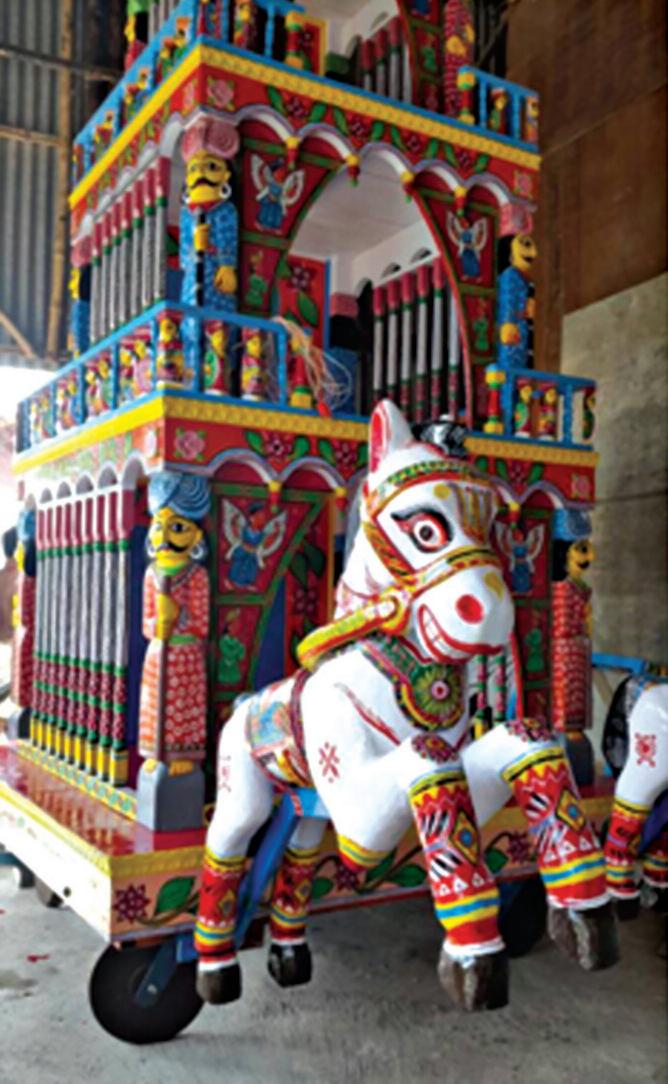
Mahaprabhu's SnanYatra on 9th, monthly Shyama Puja on 23rd, Rath Yatra on 25th and Bipad Tarini puja, the last puja of the month, on 27th
We very much appreciate all the volunteers for their dedication and precious time they put on at our temple. For detailed information check our website www.anandamandir.org
CuLTuRAL FesTivAL AT AnAndA MAndiR
Reported by Arun Bhowmik
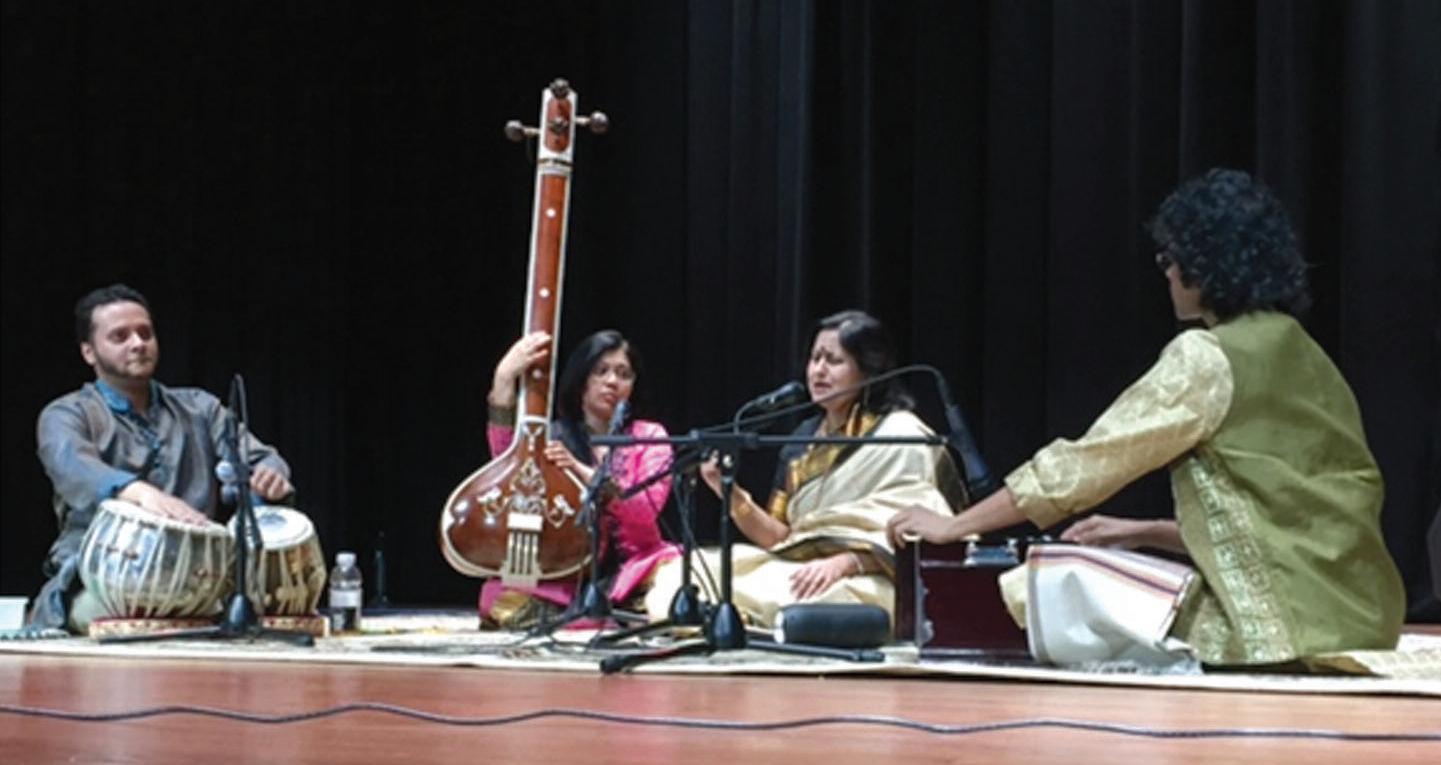
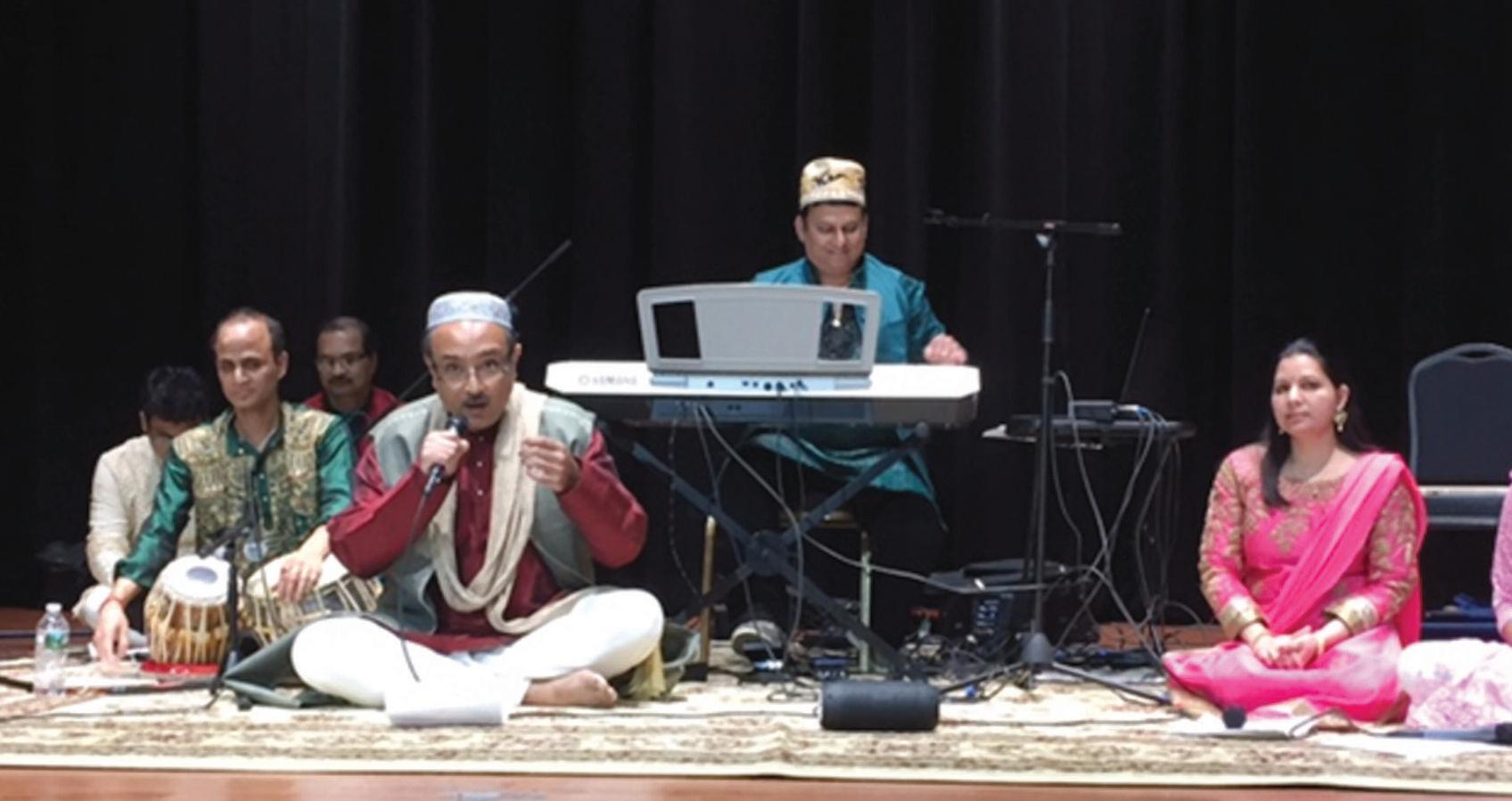
Ananda Mandir celebrated its first major Cultural Event in the new Tagore Hall auditorium on April 30th The daylong celebration was a star studded variety program featuring many talents of our community. Our community is now rich in cultural activities, and we could only accommodate a few such talented musicians, dancers, actors.
Our own group, ANANDA DHWANI, inaugurated the musical event by presenting “Ganesh Bandana”. Mitali Bhawmik and Rajesh Paranjape, two very popular vocalists presented north Indian style classical vocal music which were absolutely wonderful Bharatiya Kala Kendra, under the direction of Partha and Anindita Mukhopadhya, presented a unique musical drama that was enjoyed by all Tandra Das sang few Tagore songs, she is just a great singer of Tagore songs Another highly enjoyable event was the musical presentation by ‘Resonance Band’ led by Satyajit Bhattacharya where Suranjan BhanjaChowdhury, Gayatri Sarma, and Satyajit himself presented a few lovely songs composed by the famous Rahul DevBarman
We had a great group of classical instrumental musicians, Abhik Mukherjee on sitar, Jay Gandhi on flute, and Shivalik Ghosal on Tabla They presented few lovely tunes together to enchant the audience
Soumendu and Arpana B hattacharya presented couple of very enjoyable short “Sruti Natak”, every Bengali loves ‘Natak’, and Arpana and Soumendu served them well
As for the Dance Recitals, RDM led by Mitra Purkayastha and RITAM Academy of Dance led by Reeta BaidyaRoy presented wonderful shows with their students Their presentations were of high quality as always, and enjoyed by all A surprise to many of us was the dance presentation by the young and very talented dancer Ishita Bhattacharya She was simply superb on stage
We look forward to bringing her back on Ananda Mandir stage soon
We were very fortunate to have had two very talented musicians, Dibyarka Chatterjee ( Tabla) and Anirban Chakraborty (harmonium) who accompanied the vocal classical musicians
On the whole, this first Cultural Festival at Tagore Hall arranged by Ananda Mandir was a memorable one, full of high quality presentations, very well managed, the audience were extremely pleased, and we will look forward to the next such event.
new RATh from Kolkata
sixth sense Technology: The next iT innovation at MiT ScIEncE & TEc HnOLOgy
By sushmita dutta
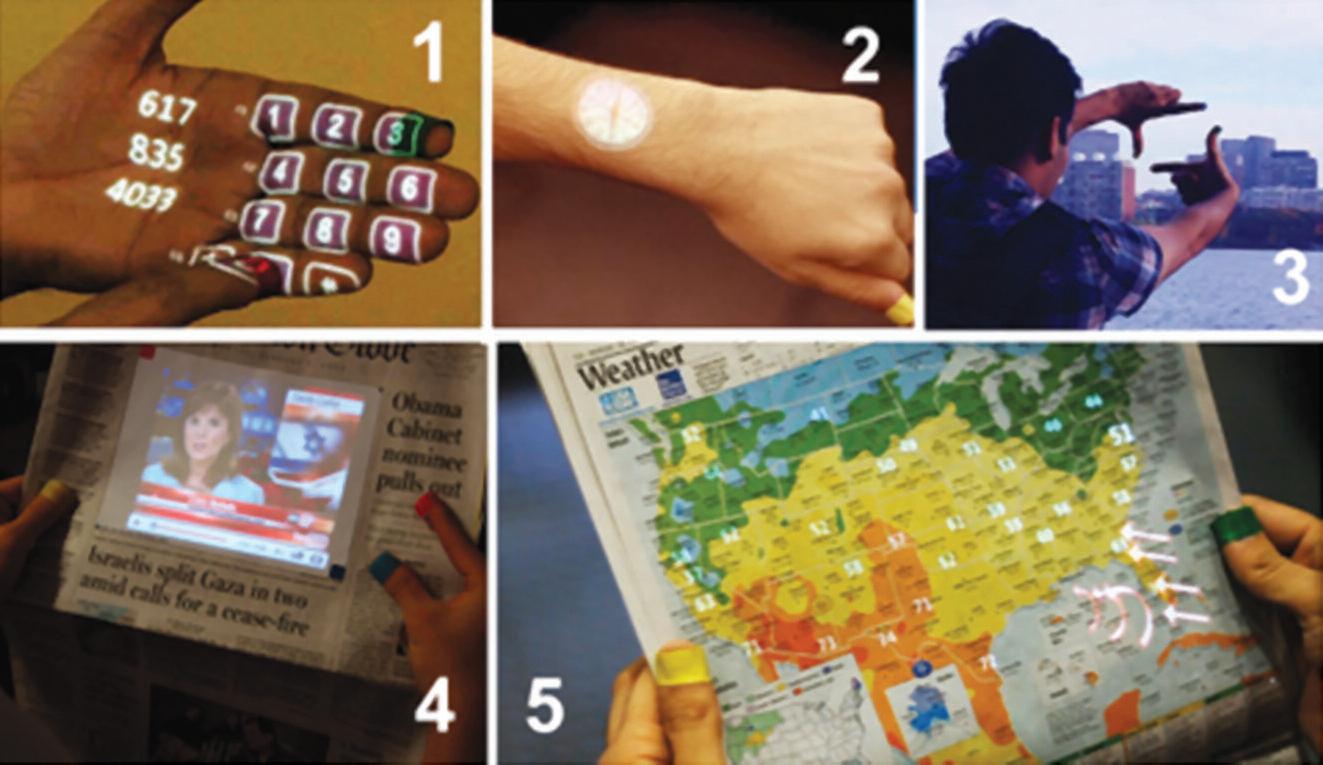
Note from Author: We've evolved over millions of years to sense the world around us with our five senses, and, here we are at the threshold of new Sixth Sense Technology, an innovation in human history of technology interface With some product information demonstrated by MIT researchers, this is a special report for Ananda Sangbad readers on the most recent mind-blowing Sixth Sense Technology innovations that will revolutionize the consumer electronics products’ market Please communicate to the editor of Ananda Sangbad your thoughts on this topic or for further information needed about Sixth Sense Technology Technology innovations have always been driving factors in introducing new consumer electronic products At MIT lab an exciting Sixth Sense Technology is being researched on with some consumer-driven product features already demonstrated and highly applauded for super simplification of technology use to benefit us in our day-to-day needs. For example, you can simply create a phone keypad
Continued to page 11
RuBY geneRAL hOsPiTAL
Ruby General Hospital, the brainchild of Dr. Kamal Dutta, a dedicated member of Ananda Mandir, is a large 300 bedded multi-specialty hospital with more than a thousand employees and 350 medical consultants. There is constant communication between Indian and US-based doctors with the continuous transfer of knowledge and technology.


CRiCKeT AnYOne?
By guru Chakravarty
My fellow alumnus of JU, Debashis of Kolkata, who is vising his son’s family in New Jersey, is in the same predicament as all parental visitors are He is here with his wife Sharmila to enjoy time with their nine month old first grandchild, to see her grow up, to see her take that wobbly first step While Sharmila keeps busy looking after the baby, Debashis is free to pursue his own interest during the enormous free time he has on hand So what does he do? He settles himself on a comfortable chair in front of the 55” TV to watch his favorite sport –what else but IPL, the Indian Premier League of cricket games
There is no one among us, the Indian men of advanced age, women included, who is not familiar with the game of cricket. However, it is much more ingrained in the recent immigrants, the young generation who experienced a phenomenal growth of cricket in India in last 25 years or so. Anyone visiting India is quite familiar with cricket dominating the social scene over there. On my last trip to India, I observed that starting from my 82 –year old elder brother to his 12-yr old grandson, both keenly aware of the cricket schedule on TV – eagerly waiting for the game to come on I, having played cricket during my teen years using tennis ball, brought a cricket bat as a gift for my 11-yr old grandson in Philadelphia That bat saw the light of day for just one day and then went to the basement to stay there with other junk It can be safely assumed that all second and third generation Indians here are in the range from unaware to uninterested about cricket
Why isn’t cricket popular in the u.s.?
Cricket was started by the English, and therefore, originally confined within England and the English Commonwealth, namely England, Australia, New Zealand, India, Pakistan, Bangladesh, Zimbabwe, South Africa, Sri Lanka and the islands of West Indies Cricket, as a game, started in the U S as in other colonies of England It was among the more popular sports in America in the mid-19th century It can be argued that baseball was easier to play than the stiff rules of cricket that restricted the game to the wealthy class Brian Palmer wrote in the Slate magazine, “When a sense of American national identity began to emerge in the decades following the Civil War, along with new communication and transportation technologies, baseball promoters recognized an opportunity They stitched together some of the existing traveling clubs into the National Association of Professional Base Ball Players in 1871, and young athletes and fans flocked to the unified league Cricket clubs, by contrast, stayed regional and let the historical moment slip Many of the top players switched to baseball, and the fans went with them” Cricket, like baseball, is a leisurely game, progressing slowly, and providing a family atmosphere in the ball park to bring the children along. They both are generally free from injuries, thereby encouraging the parents to enlist the kids starting at the preschool stage. They both are highly attractive professions with regard to money and fame. They both prospered in their separate ways. While cricket is the darling of Indian sport fans, baseball is now regarded as the national pastime in the United States
Current status of Cricket in the u.s.
Currently, cricket is on the upswing internationally, gaining new popularity on the world stage International Cricket Council (ICC) recognizes more than 125 countries that play cricket ICC has 10 Full Members, 38 Associate Members and 59 Affiliate Members That adds up to 107 countries
Not so in the U S The USA Cricket Association, which was granted associate membership in ICC in 1965, was suspended by the international body in 2015 based on concerns about the governance, finance, reputation and lack of cricketing activities at a professional level
The major strength of cricket in the USA is at the regional level It is the state and metropolitan leagues and associations that have been flourishing in the last decade There are two popular cricket leagues in New Jersey which are very much involved in playing regular
cricket They are Cricket League of NJ (CLNJ) and Millennium Cricket League (MCL) Here are excerpts from their websites:
“CLNJ has been providing opportunity for cricket enthusiasts to play competitive league cricket in NJ CLNJ was formed in 2000 with 16 teams and growing ever since Every year CLNJ teams play 15 season and playoff games The season starts in April and ends in September With over 54 teams and over 1000 players participating, CLNJ is a fairly large not-for-profit organization”
“Millennium Cricket League, founded in 2001, has developed into a fully functional organization providing recreational and competitive league fixtures for all its member clubs. MCL welcomes players from many diverse and unique cultures and prides itself on the promotion of multiculturalism within the organization. Participants hail from many different parts of the globe including Australia, India, Pakistan, SriLanka, the Caribbean and the United Kingdom”
Prodigies of Cricket
Just like in any sport, there are a few legendary figures whose arrival transformed the perspective of an entire spectrum Here are a few who are in that category: don Bradman (1908-2001) is universally regarded as the first legendary figure whose achievements and popularity helped create passion and a fan base in the cricket world Bradman's career Test batting average of 99 94 is often cited as the greatest achievement by any sportsman in any major sport For comparative statistics, Sachin Tendulkar’s average is 56 94
sachin Tendulkar (born 1973) is a commanding figure in the sports world who not only elevated the craze for cricket in India but around the entire cricket world He holds innumerable world records, a few of them being noted here:
Most number of Test centuries – 51
Most number of Test runs - 15,921
Most ODI (One Day International) runs: 18426 (ave 44 83) in 463 matches
Most ODI centuries: 49
It is no surprise that he is the only person in sports to get the prestigious Bharat Ratna, the highest civilian award in India
Wg grace (1848-1915) is regarded in some quarters as the best cricketer that ever played the game, even though the competition was not what it is now He towered over his competitors in runs scored in batting, taking wickets as a bowler, and fielding catches.
Cricket enthusiasts are familiar with many superstars with multitude of world records. Here are two such men that Bengalis are very fond of.
Pankaj Roy (1928-2001), best known for establishing the world record opening partnership of 413 runs, together with Vinoo Mankad, against New Zealand at Chennai in January, 1956, became the first Bengali superstar The record stood until 2008 when Graeme Smith and Neil McKenzie of South Africa broke the world record for the highest opening stand with 415 runs against Bangladesh
sourav ganguly (born 1972), the charismatic left handed opening batsman, popularly called “Dada”, came into prominence with a century in consecutive Test matches against England in 1996 His opening partnership with Sachin in ODI matches made the duo highly popular among all cricket fans He finished his career as India's most successful captain Although retired as a player, he is very much in the limelight at the Indian cricket scene, currently serving as the President of CAB (Cricket Association of Bengal), thereby holding formidable influence in the BCCI (Board of Control For Cricket in India)
Cricket in Olympics?
The prospect of cricket appearing at the Olympics for the first time in 124 years is inching closer New sports will be under consideration for inclusion by the International Olympic Committee in 2024 The International Cricket Council is set to make an application for that Cricket last appeared at the 1900 Paris Olympics when only two teams – Great Britain and France – were involved
Not interested in cricket? Just you wait until 2024 when the floodgates will open
LIVING WITH VEDANTA
Continued from page 4
DHARMA The only problem with the happiness that man achieves by following the paths of Kaama and Artha is that he is still left wanting more He may even fall into a pit of depravity or may end up following an immoral path in his search for joy His happiness does not reach its zenith He remains a seeker
DHARMA is the basis of Kaama and Artha and it literally puts a boundary around Kaama and Artha It reminds man that in his search for happiness it is necessary to stay within the limits of decency, integrity and religion The word ‘Dharma’ itself stems from the word ‘Dhri’ which means integrity When man follows the path of Dharma, then he finds that he is getting his happiness by making others happy or by engaging himself in activities, which involve the well-being of others His happiness now has more meaning This miraculously doubles his own happiness and makes it permanent which is quite different from the transient nature of the happiness which he got by following the path of Kaama and Artha However our Shastras say that there is something beyond this as well beyond pleasure, engagement and meaning Happiness, according to Swamiji, is related to the law of Karma. He says that if you stay within the boundaries of Dharma, you earn Punya and this leads to Sukha, or happiness. Whereas, if you follow the path of Adharma, you are committing Paapa and this can only lead to Dukkha or Sorrow. This leads to an endless cycle of birth and death where the credits and discredits of the previous births are carried forward.
After man has achieved happiness by following the paths of Dharma, Artha & Kaama, he finds himself still seeking answers His quest takes him into the realms of spirituality His pursuit is now towards achieving MOKSHA, the highest goal of life, where there is a complete transcendence of sorrow and one attains infinite bliss Because, far beyond this world of birth and death, of cause and effect, there is something else Something intangible Where the Atman is ever free Where there is infinite consciousness This state can be realized by man and by realizing this one can attain Moksha or one goes beyond sorrow to attain infinite bliss
Vedanta tells us that Divinity lies within us We just don’ t realize it Swamiji tells us that we living beings are ignorant of what we have within us and follow the same path that has been followed by man for centuries We think that we need to seek the Divine outside ourselves In our path towards seeking the ultimate freedom from pain and grief, the minute we realize that we are NOT puny creatures of flesh and blood and that we are not human beings just having a spiritual experience, but instead we are actually spiritual beings having a human experience, we will attain this freedom Vedanta proposes to show us what we actually are and what we have inside us The essence of the Upanishads is laid out in these three profound statements These are known as Mahavakyas and are taken from the Upanishads
PRAGYANAM BRAHMA – This is taken from the Aitareya Upanishad meaning ‘Knowledge is divine’
AHAM BRAHMASMI - This is taken from the Yajur Veda and means ‘I am Brahma’
TAT TVAM ASI - This is taken from the Chandogya Upanishad and means ‘You are that’
The goal of Vedanta is to realize this profound truth. The truth, that there is no demarcation between pure consciousness and oneself. When I attain Moksha “I” should understand that “I” (the physical person) have not attained freedom, but that I have got freedom from “I”, the ego
Having realized this, thousands of years ago, Adi Shankaracharya sang out these beautiful words, “Chidananda Rupah Shivoham! Shivoham!” which means, I am indeed that eternal knowledge, bliss and pure consciousness, I am Shiva! I am all auspiciousness, I am Shiva!
Man then finally acknowledges that it is his own true nature that is being worshipped as God And it is the glory of his own true self that he is worshipping This worship can be in the form of Karma yoga, B hakti yoga, Raja yoga, and Gyana Yoga All these paths see the divine in every relationship and every action becomes a worship of the Divine Or in other words worship of one’s true self The Divine is within us That is the ultimate teaching of Advaita Vedanta
Recent sahitya O Alochana sessions at Ananda Mandir
Reported by subrata Bhaumik
Sahitya O Alochana (SOA) is a monthly literary and topical discussion forum under the aegis of Ananda Mandir (AM) It completed its 9th anniversary in January 2017 and will have organized ninety eight (98) sessions by the time the current edition of Ananda Sangbad goes to press These monthly sessions feature exciting and illuminating discussions on diverse subjects including literature, art, theater and movie; history, philosophy and religion; science and mathematics; economics and business; and social issues, sports, and current affairs The following is an account of the recent sessions organized by the SOA committee of the AM March 2017
In March Mosleh Ahmed led an interesting and insightful discussion entitled “Religion, an evolutionary interpretation ” It was the ageold debate examined from a unique angle - like human beings God is also a product of evolution Yes, it might sound wrongly placed in the evolution or creation chain, but the thesis of the discussion was that more than a compelling case could be made that God is a product of biological evolution in the same way the modern human race is a result of evolution and natural selection Research shows that the influence of religion on human behavior is much stronger at our times that what the renaissance philosophers had predicted a few centuries ago, and is expected to go even higher in the next fifty years. In an effort to understand such unfolding phenomenon, many thinkers and philosophers have resorted to an evolutionary, rather than a socioeconomic, interpretation of how religious behavior evolved and how it is intertwined with biological fitness Ideas like “Animism and anthropomorphism” and related cognitive psychological treatises can probably help us understand such relationship Mosleh presented a perceptive and thought provoking analysis, which delved into an evolutionary, rather than a socioeconomic, interpretation of how religious behavior evolved and how
it is intertwined with biological fitness This was an enlighteningly wonderful session, which the attendees loved with great gusto as evidenced by unusually large crowd, live interactions, and cheers A ton of thanks goes out to Mosleh Ahmed
April 2017
There was no session in April due to scheduling difficulties
May 2017
The topic in May was “Bertolt BrechtWorks and Life.” Sudipta Bhawmik presented a very enjoyable and informative presentation on the famous 20th century German playwright, novelist, poet, and philosopher, focusing on his complete departure from the then prevailing naturalist movement in theater popularized by generations of famous European playwrights including Henrik Ibsen The discussion progressively delved into the famous Epic theater concept popularized by Brecht, which involved both the actors and audience in being more reflective with a sense of detachment (Verfremdungseffekt) from the central concept of the play and the characters in it This was contrasted with “Method Acting” (complete identification with and immersion into the character) a school of acting techniques popularized by Konstantin Stanislavsky and followed by many famous actors of our times including Marlon Brando and Dustin Hoffman. By certain accounts, Brecht is regarded as the most influential dramatists of 20th century ahead of some of the theatre luminaries of his time including Stanislavski and the more accoladed Samuel Beckett
One of the subtopics of the session included Bengali’s fixation with Brecht – reason for his popularity, i e , the prolific drama movement he ushered vs his pro-Marxist views It was also noted that growing up in theater loving Bengal, Brecht was kind of a household phenomenon to many of us There were very few socially con-
Continued to page 14
cLUB OF AnAnDA MAnDIR A Full Calendar of Events for Evergreen Club
Reported by debajyoti Chatterji
After a highly successful team outing to Hunterdon Hills Playhouse (Hampton, NJ) on Tuesday, December 20, to enjoy a lovely lunch and a festive “holiday show”, Evergreen Club members took a leave from group activities in January In February, the group assembled at Ananda Mandir on the 19th to marvel at the scenic wonders of an exotic travel destination: Iceland With the help of a collection of vivid photographs, Debajyoti and Sikha Chatterji presented a lively account of their trip to “iceland: Bleak, Barren, Blustery and Beautiful!” As is customary for Evergreen Club meetings, participation in this interactive session was facilitated by a wide variety of tasty snacks prepared by several volunteers
The March session of Evergreen Club featured a perennial favorite: a group discussion on “experiences and impressions from Recent Trips to india” With most of our “snowbird” members back from their annual winter vacations in India, we had a full house with 25 attendees Discussions covered a wide array of topics, ranging from property selling experiences in India, diagnosis and treatment of chickunguniya (a mosquito-borne viral infection), problems in converting a PIO card to an OCI card, and treatment for an unusual respiratory problem Members unanimously agreed that sharing of these experiences and insights was very helpful to all The discussions also included reviews of travel experiences, especially in Kaziranga National Park (Assam), Darjeeling and Sikkim A delicious multi-course pot-luck lunch, prepared by some of the club members, preceded the discussion session.
By popular demand, Evergreen Club members returned to Hunterdon Hills Playhouse on Saturday, April 22. This time the main attraction was “Born Yesterday”, a comedy classic that was a huge hit as an Oscarwinning movie in 1950. This dinner-theater venue is a well-known producer of Broadway-style shows and plays, and serves delicious lunches and dinners, with individual menu selection and table service And the mouth-watering “dessert buffet” never fails to make everyone happy
No event is planned for the month of May but the members are planning to enjoy a group lunch at a nearby restaurant in June evergreen Club of Ananda Mandir ("seniors helping seniors")
Invites retirees and near-retirees to participate actively in Forum meetings and activities.
Seniors Forum usually meets on the third Sunday of every month at 1:00 PM. However, the date may change because of conflict with other Ananda Mandir events. Please contact Debajyoti Chatterji (Cell: 908507-9640) for latest updates on the meeting dates.
Sixth Sense Technology: The next IT innovation at MIT
on your palm and dial a number to connect See picture 1 above
Similarly, it was demonstrated at a TED technology presentation that with Sixth Sense Technology we will be able to convert a picture in a newspaper to a digital device and connect to a video presentation of the news by converting the newspaper into a video interface See picture 4 above Also, with Sixth Sense Technology gadgets, by positioning our index fingers and thumbs into a photo framing gesture, we can take pictures
Briefly, what is sixth sense Technology? It is a unique personal Computing System that consists of wearable technical devices – “an optical camera, infrared sensor, projector and a microphone on a pod connected to a small computing console that fits into a regular sized backpack The system can be operated on the move and can use any surface as the screen be it a wall, floor, paper or even human hand ”
The IT industry has been rapidly changing since Windows came to market with WYSIWYG – What You See Is What You Get – computers for the masses We have had multiple consumer electronics items like telephone, TV, Microwave applying similar easy to use “Interactive” interfaces giving more control to consumers to “get what they want”. Smart TV and smart phones, for example, are completely user-driven. The term “User-driven” technology simply delivers what user wants to use the technology for. Smartphone innovations, for example, from
the first handheld phone to the most recent smartphone today, three factors have driven product innovation - Usefulness, Usability and Desirability
The handhelds, therefore, shrunk in size to fit better in hand and interfaces have changed from button-press to easy swipe and touch-screens However, product innovations rely on technology innovations and some technologies were long drawn, example, as seen in the generations of handheld phones Keypads with buttons had seven generations of products until we had touchscreen technology innovation and smartphones were introduced replacing buttons with “touch and swipe” Now with Sixth Sense Technology, it looks like we will need no phones or any mechanical device for that matter We will be able call from any place to any place by simply using our palm Our body parts, fingers wearing technical devices will act as the technology interface to create an interactive technology product like a telephone keypad on the palm What an innovation A multiple demonstrations of the same technology to productize any surface to create a digital interface has been demonstrated by technology innovations at MIT Lab As seen in picture 2 above, with Sixth Sense we can draw a circle on our wrist with our index finger to get a virtual watch for current time Similarly, current and updated information on weather can be obtained by simply activating a newspaper weather report. See picture 5 above.
Without getting into technical details, Sixth sense technology is defined as: A wearable gestural interface that enables physical world around us with digital infor-
mation Here is a report from MIT:
MiT Lab for Fluid interfaces reports sixth sense Technology as follows:
Source: http://fluid media mit edu/projects/sixthsense
“'Sixth Sense' is a wearable gestural interface that augments the physical world around us with digital information and lets us use natural hand gestures to interact with that information By using a camera and a tiny projector mounted in a pendant like wearable device, 'Sixth Sense' sees what you see and visually augments any surfaces or objects we are interacting with It projects information onto surfaces, walls, and physical objects around us, and lets us interact with the projected information through natural hand gestures, arm movements, or our interaction with the object itself 'Sixth Sense' attempts to free information from its confines by seamlessly integrating it with reality, and thus making the entire world your computer ”
When will the market have Sixth Sense Technology devices available as consumer items at affordable price is not known yet But it’s worth waiting for and those who are technically into experimenting on this technology can visit:
sixth sense google Code http://code.google.com/p/sixthsense/ sixth sense github Repo https://github.com/sixthsense/sixthsense. These links will let you experiment with sixth sense technology. Have fun!
EVERgREEn
ANNALS OF MY TRIP TO THE MONASTERY OF SAINT CATHERINE
Continued from page 7
sips of coffee with flickering flashlights in their hands I heard the guide telling them that they would leave from the hotel at the footsteps of Mount Sinai and follow the winding road all the way up to the summit. He warned them that despite their exhaustion they had to maintain a steady pace during their ascent. If they were not comfortable with the hike, they could rent camels for their journey The story goes that right there on the mountaintop, Moses received the Ten Commandments engraved in stone from God at sunrise So the tourists would hike all the way to the mountaintop and to reach there just before the sunrise to get that divine experience
I asked myself: “Was it necessary for me to undertake the tiring trip to the mountain?” I went back to my hotel room and sunk into the cozy bed I'd rather save all my energy for the visit to the Monastery of Saint Catherine with my group
The next day we reached the Saint Catherine Monastery Established in the sixth century, the Monastery exists at a site that is sacred to the Christians, Jews and the Muslims The holiest part of the Monastery is the Chapel of the Burning Bush, a small chamber behind the altar of the Basilica According to the Hebrew Scriptures, Moses encountered the Burning Bush from which God first revealed Himself to him The Bush or its successor sprawls over a protective stone wall that is carefully tended by the monks. The monastery also encompasses the Well of Moses. The art treasure in the Monastery includes a collection of thousands of icons. As you enter the exhibit hall, the first icon you see is that of St. Peter in an en-caustic painting (also known as hot wax painting, where colored pigments are added to heated bee wax) There is also library with a large number of ancient Christian manuscripts These manuscripts are mostly in Greek, some in Arabic, Armenian and Coptic, and just one in Latin Some of the manuscripts are exquisitely illuminated
As you walk through the several rooms of the museum dedicated to the icons of the Monastery, you are awestruck Apart from being exquisite from an artistic and historical standpoint, they exude a profound spiritual radiance
The most outstanding art treasure is an unusual mosaic of the Transfiguration of Jesus Here Jesus Christ is shown in glory in an almond-shaped panel of grays and blues, wearing a white mantle edged with gold His halo has a gold cross on a white and gold backing Around him are the prophets of Sinai: Moses and Elijah, and the disciples John, Peter and
James
Because the ground is rocky, the monks created the Monastery garden by bringing soil from elsewhere. The garden has fruit trees and grows vegetables. Nearby are the cemetery and the Channel House. When monks die, they are first buried in the cemetery After their bodies decay, their bones are exhumed and transferred to the Channel House There we could see the bones of thousands of deceased monks
Saint Catherine according to the tradition was Dorothea Catherine, a princess and a scholar who converted herself to Christianity and was beheaded by a pagan emperor in the early third century Then five hundred years passed A saint dreamt of Saint Catherine and her body was brought back unharmed Next morning they climbed up saw her golden hair hanging on the bush, and the bones of her body hanging and the body spreading sacred fragrance and constant stream of healing oil issuing from her body
The Monastery was built to commemorate her The healing oil is sold at the Monastery in bottles
Exiting the Monastery, I bought beaded necklaces, perfumes made out of the Burning Bush and the Healing Oil and went back to the bus with a sad memory of Saint Catherine On my return trip to my hotel, I could hardly wait to either jump into the swimming pool or go for snorkeling to enjoy once more the enchanting myriads of fish. But to my utter dismay, there was a great surprise waiting for me as I entered the hotel. I saw the same two weird looking policemen whom I encountered during my trip to the Monastery waiting in the hotel lobby But what for? The person at the front desk made it clear – the problem was me
They came all the way to further investigate why I was trespassing the forbidden area I started praying to Saint Catherine to get me out of this mess They grilled me for quite some time; at times I felt like punching their noses Finally, our trip guide called the Provost of the University to clarify matters, stating that I was a foreign graduate student, and that I had no evil intentions whatsoever I was set free and felt as if I was released from the jaws of an alligator Next day as I boarded the bus to return home, all the Egyptian women in their veils started giving me a strange looks, gossiping as to why I, the foreigner decide to join the trip Upon reaching our destination, Maadi, I called Deborah (whom I recently befriended) and started whimpering Deborah as usual, started to lecture me, “See I told you, my dear, this is not America! You have to be very, very careful Blah, Blah, Blah ”
HEALTH SEcTIOn
ALCOhOLisM AMOngsT sOuTh AsiAns MEnTAL
By nupur Lahiri, M.d.
Editor’s Note: The author discusses the problems arising from increasing alcohol consumption amongst South Asians
“Bipin Babur Karon Sudha Mitay Jala Mitay Khudha”
Do you remember the scene where our beloved Uttam Kumar glorified drinking of hard liquor?
A wise man declared, “If you are a man, you have to drink, you have to smoke!” Men who were “not good at drinking alcohol” were said to have a “weak neck”, while those who got intoxicated belonged to the “strong neck” class Male drinking was identified with being “hard and tough” Drinking and smoking were considered to be the attributes of masculinity
Malt-liquor drinkers drink 45 percent more than other hard-liquor drinkers. Men drink 11 1 percent more than women
Women do not drink as much as men do as custom and tradition prohibit female drinking and smoking to some extent Some second generation youths reported that living in the U S might have changed their mother’s habits, allowing the older woman to add drinking to the repertoire of social activities for herself and her circle of friends
Increased levels of drinking among South Asians are not recognized by the community, leading to a mass unawareness and to higher binge drinking among first generation South Asians.
The head of a South Asian family is expected to have a sound education, serious career prospects, a respectable job, married status, have children, own a property and provide care for the elders. Anything that disrupts this expected role playing is seen as a failure. This failure can lead to problems with alcohol The problem with alcohol is then perceived as an additional failure The stigma of shame, exposure and scandals makes one feel uncomfortable speaking openly about topics like stress and mental distress with their family members and peers There are huge expectations of second generation Indians to exhibit respectful behavior towards elders, to safe guard the ‘family name’ and behave in an acceptable manner
However, when the same second generation youth experience any difficulty in their life they feel unable to talk about it Young South Asians feel more isolated because they are answerable to the family, the extended family and the community group that they belong to For younger South Asians, being raised in a strict environment, can often lead to increased drinking once young adults enter college or become independent from their parents
And finally, alcohol is often the center of all social events Alcohol is the ultimate solace for the young and the old, for the men women and the lonely souls
Alcohol is a legal drug
One does not need a doctor’s prescription or a shady drug dealer to stock up on Glenlivet or JW Black or Remy Martin or the famous Bacardi’s Gold Liquor stores in some states are not required to check the driver’s license or the age of the buyers An underage youth can get any amount for consumption in school back lot or the nearby park secretly and profusely to get drunk over and over.
What are the health benefits associ-
ated with drinking alcohol
Studies have suggested that consuming alcohol in moderation may be associated with a reduced risk of heart attacks and stroke However, these studies are not rigorous scientific trials that prove without a doubt that alcohol reduces heart attack and stroke risk Alcohol can also cause a modest increase in HDL, the protective form of cholesterol is red wine healthier than other forms of alcohol?
It has not been proven that red wine protects the heart more than other forms of alcohol In fact, studies have shown that all types of alcohol are equally associated with decreased heart disease risk Red wine does have more antioxidants than other forms of alcohol However, no study has proven that antioxidants are protective agents against heart disease and cancer The antioxidant effects of wine are not a sufficient reason to start drinking since antioxidants can also be obtained from eating fruits and vegetables, and drinking red grape juice should one start drinking alcohol for good health?
Absolutely not There are many other strategies South Asians can implement for better health like regular exercise, eating a balanced diet and maintaining normal weight
What are some of the major health risks associated with drinking alcohol?
Unfortunately, people have a tendency to promote various health benefits while ignoring the potential risks of alcohol to justify their drinking habits. Excess alcohol consumption can worsen conditions that South Asians are already at risk for, including high triglycerides, high blood pressure, fatty liver, gout, obesity and diabetes
Studies have shown that alcohol use can also increase the risk of a condition called metabolic syndrome, which is prevalent in South Asians and may triple their risk of a heart attack In addition, heavy alcohol use may increase the risk of stroke, breast cancer, cancers of the head, neck and digestive tract, accidents and suicide
Alcoholism is a serious life-threatening disease People die from alcoholism
(Definition of Alcoholism: An addiction to the consumption of alcoholic liquor or the mental illness and compulsive behavior resulting from alcohol dependency )
Alcoholics Anonymous is the only program that has proven to be successful for millions of alcoholics and has actually kept them sober year after year Health care professionals in general have limited knowledge of and awareness of alcohol related issues Although there are some required courses in “Diversity awareness” for providers such as physicians including mental health counselors, there is limited competence in dealing with the needs of ethnic minority groups When working with South Asian clients, the counsellor or any other support worker needs to understand the family structure, the community group and the issues of conflict experienced by individuals trying to fit in with main stream culture
South Asian individuals experiencing difficulties with alcoholism must find someone to speak to who will not judge them and will hold them through recovery in the strictest confidence.
cULInARy SEcTIOn nEwS yOU MAy LIkE TO READ
Editor’s Note: We are starting a new section to bring you recipes of delectable food preparations. We would welcome comments from you with your own special family recipes
RAvA dhOKLA
By Amrita Kangle
In our household, vegetarian food does not evoke enthusiasm from the members In fact ‘Luke warm’ would be too hot a term to describe their reactions According to them, food that can walk up to the kitchen on its four feet or swim up to their plates is the only food that qualifies! Rest of it is all ‘ghaas-poos’
I am really mortified with their reaction in this new world where ‘going vegan’ is all the fad and you will notice that my lips are sealed tight whenever such a conversation is in progress So, the other day I decided that enough was enough and the family would have to eat something vegetarian as a snack Yes, even though it was the weekend. I assured them that the sky would not fall on their heads.
I zeroed in on Rava Dhokla. This, in my opinion matched all the criteria of a healthy snack. And after all, I was the BOSS around here, wasn’ t I? More importantly, I was doing the cooking! Well, what do you know? The family loved it Loved it so much that I am asked to make Rava Dhokla at least once every week!!
I am sharing the recipe here Happy cooking!!
RAvA dhOKLA

ingredients
• 1 cup rava/ sooji
• 1 cup thick curd which should be slightly sour
• ½ tsp sugar
• salt to taste
• 2 tsp grated ginger
• 2 tsp green chili paste
• 2 tsp oil
• About a ¼ cup water or a little more to make a thick batter
• 1 tsp Eno fruit salt or ¾ tsp baking soda
For the tempering:
• 3 tsp oil
• ¼ tsp hing
• 1 tsp sesame seeds/ til
• 1 tsp cumin seeds/jeera
• 1 tsp mustard seeds/rai/ shorshe
• 10-12 curry leaves
• 5 green chilies slit lengthwise
• ½ cup coriander leaves, finely chopped
MeThOd
• In a large mixing bowl take rava and add the curd.
• Add the sugar, salt, grated ginger and chili paste.
• Mix well to form a thick batter.
• Rest for an hour till you see that the rava has absorbed the moisture from the curd
• Add water till the batter is a thick pouring consistency Mix well
• Grease a steel plate with a slightly raised edge
• Now add the Eno Fruit Salt to the batter The mixture will turn frothy Mix very gently
• Transfer this to the greased plate
• Steam this Dhokla batter for 15 minutes
TeMPeRing
• Heat oil but don’ t let it burn
• Add the jeera, rai, til and hing till they splutter
• Now add the curry leaves and green chilies
• Saute for just a minute and pour this tempering over the Dhokla
• Spread the tempering evenly over the Dhokla
• Sprinkle coriander leaves
• Cut the Dhokla into diamond shaped squares
• Serve with green chutney
Communication Towards Perfection, As We Evolve
Continued from page 4
communication which distinguishes the advanced human beings from the common ones Jesus is still revered by the masses today because he and his followers were extremely effective communicators They communicated through the contact of their souls and their vibrations – and not just through verbal languages All great persons, such as Buddha, Muhammad, Socrates, Plato, Kant, Tagore, Shakespeare and Gandhi, were great because they were extremely successful in communicating their ideas and the feelings of their souls to the world
They were able to communicate to us very effectively because they were able to align their horizontal and vertical paths of communication within themselves very well, and they established a relationship with the community they wanted to communicate with Also all of this was possible, because of the extra senses they had or acquired through devotion
debasish dutta named Chancellor of Rutgers university
Debasish “Deba” Dutta – a respected academic and an experienced higher education administrator who has spearheaded change at three top national research universities – will become the next chancellor of Rutgers University-New Brunswick
President Robert Barchi announced Dutta’s appointment today at a meeting of the Rutgers Board of Governors The university conducted a national search before selecting a new leader of the Big Ten institution, which is also a member of the Association of American Universities – a group of 60 prestigious research universities across the nation Dutta will begin serving as chancellor on July 1
Dutta comes to Rutgers from Purdue University, where he serves as provost and executive
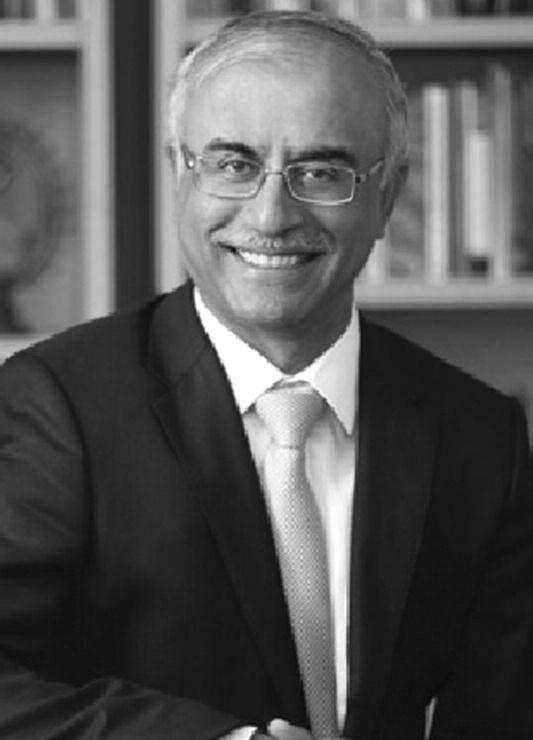
vice president for academic affairs and diversity, with a faculty appointment as a professor of mechanical engineering Previously, he worked at the University of Illinois at UrbanaChampaign and the University of Michigan, Ann Arbor
“Dr. Dutta will be an inspiring, collaborative leader and a powerful voice for Rutgers University-New Brunswick at a pivotal time in its history,” said Rutgers President Robert Barchi “He comes here with impeccable academic credentials, solid administrative leadership and deep experience at three Big Ten institutions
As chancellor of Rutgers University-New Brunswick, Dutta will oversee the largest of the three major Rutgers University campuses with more than 50,000 students, 4,000 faculty, 12 degree-granting schools, nine academic research centers, four administrative units, a premier Honors College, Douglass Residential College and the Zimmerli Art Museum
Ref News bulletin published at Rutgers University
dipak sarkar honored in Bulgaria
Dipak Sarkar, President of Ananda Mandir in the recent past, and a distinguished professor at Rutgers University, recently visited Bulgaria to give the keynote speech at the International Conference on “Metabolic Diseases: Genetics, Epigenetic and Proteomics ” His talk on May 19, 2017, was on the topic entitled "Preconception Alcohol Drinking Alters Glucose Homeostasis and Increases Diabetes Susceptibility in the Offspring ” Since this is a new discovery made by Dr Sarkar’s laboratory, Bulgarian Television held a special program to focus on his research
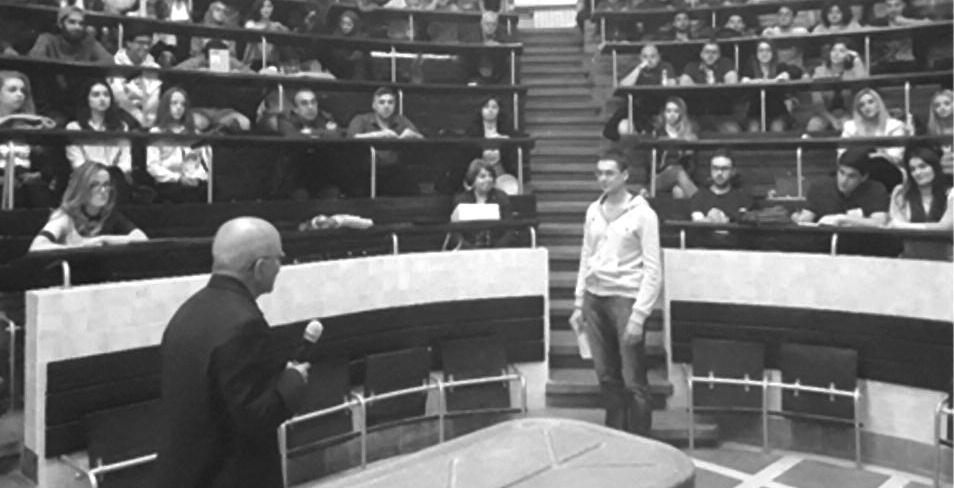
A slice of santiniketan, coming up in houston
Rabindranath Tagore's abode of peace, Santiniketan, is being replicated some 14,200km away, in Texas's largest city of Houston.
The Tagore Centre for Arts and Culture, expected to be ready by the middle of next year, has been conceived by alumni and faculty members of Indian Institute of Technology, Kharagpur, and has the full support of the Texas administration
The centre will be completed with a Chhatimtala, commonly called the scholar tree, for which a sapling will be specially flown in from Visva-Bharati. It is known as Chattim in Bengali and Saptaparni in Sanskrit It was under Chhatim (Blackboard) trees that Maharshi Debendranath Tagore, the Nobel laureate's father, came to rest on his way to Raipur in the 19th century The design of Houston's
Chhatimtala will keep the spirit of the original alive, promised Ashok De Sarkar and his wife Ruma Acharya De Sarkar, both IIT-Kgp alumni from the chemical engineering department The Sarkars are bringing this dream alive with the help of IIT-Kharagpur's architecture faculty The couple, who graduated in the late 60s, are leading industrialists in Texas today
Reported by Times of India
gay son of indian immigrant is ireland's Prime Minister

Leo Varadkar has become the youngest person to hold the office of Taoiseach since the foundation of the State Varadkar was born and raised in Dublin to mother, Miriam, a nurse originally from Waterford in Ireland's southeast and father, Ashok, a doctor from Mumbai, India The couple met while working in the UK
He was 22 when he entered Irish politics At 27, he was elected to parliament At 36, he
publicly came out as gay. And now, at 38, Leo Varadkar, the son of an Indian immigrant father and an Irish mother has become Ireland's prime minister
The young Dubliner, had announced his campaign to succeed Taoiseach Enda Kenny, prime minister since 2011 and leader of the ruling Fine Gael party since 2002, shortly after Kenny announced he would be stepping down
Some of Dipak Sarkar’s credentials are: Board of Governors Professor Director, Rutgers Endocrinology Program Distinguished Professor, Department of Animal Science Member, Rutgers Cancer Institute of New Jersey Ref. News bulletin published at Rutgers University
cOMMUnIT y nEwS SEcTIOn
south Asian Theater Festival, August 5-6, 2017

Sakti Sengupta, one of the revered members of the local community and a cultural icon, passed away on Saturday, June 10th after battling with cancer for a period of time
Sakti, was an engineer by training, but a thespian, an actor, and a director (both movie and theater) by passion. He had been very active in the Tristate South Asian cultural scene for over three decades. He made enormous contributions to the cultural life of the local community through his theater, published work on cinema and theater, and movie direction
He conceptualized and single-handedly created the annual South Asian Cinefest in New Jersey, and successfully ran it for many years providing a unique opportunity for up and coming independent movie makers from the Indian subcontinent to showcase their work and talent in the Tristate area This venture also provided the local connoisseurs of independent cinema movement a forum to view, enjoy, and discuss noncommercial films
On behalf of Ananda Mandir community, we extend our sincere condolences to his family and pray that may his soul rest in peace
NJPA Corner
Reported by Rangoli sen
The cold winter weather has finally given way to the season of hope, warmer weather and new beginnings Spring is here
To celebrate the advent of spring, members and friends of NJPA came together on April 1 at the Senior Center of Monroe Township, Monroe, NJ on the occasion of Basanta Panchami
This was NJPA’s first event of the year The festival was celebrated with much pomp and gaiety Saraswati pujo was performed in the afternoon which was followed by a mesmerizing evening of songs, dances and music
The next event was NJPA’s annual AGM which took place on May 21st at East Brunswick Public Library A new board of trustees was formed NJPA’s plan to diversify and work towards addressing the special needs of the community was also discussed at the meeting
As the weather heats up and we edge closer to summer, NJPA, in its endeavor to bring the community together, plans
to hold the 2017 picnic at Roosevelt Park in Edison on June 18. This year we have two reasons to celebrate as Father’s Day also falls on Sunday June 18, the day when families across the globe will mark the special bond between fathers and their children
So, fathers and children of all ages, come join us as we celebrate Father’s Day at our annual picnic For more information about picnic please visit NJPA’s Facebook page (NJPA parivar)
We look forward to seeing you all and making it a ‘picnic to remember’
We also welcome you to join us at all our future events including our grand Kali Pujo-Diwali celebration and our New Year’s Eve extravaganza and be a part of our beautiful ‘parivar ’ Information about our future events can be available on our Facebook page
Thank you all for your continued support Enjoy springtime and we wish you a healthy and joy filled summer
general Parking instructions at Ananda Mandir
"Ananda Mandir management urges all members and visitors to park their vehicles in the paved parking lot behind the new Community Center building Effective immediately, parking near the temple or the along the main drive is prohibited
Please help Ananda Mandir abide by Township Fire Department restrictions
Thank you for your cooperation "
Recent Sahitya O Alochana Sessions at Ananda Mandir
Continued from page 11
scious souls at the time who were not introduced to the adapted versions of his dramas – whether it ’s in Bengali, Marathi, Kanadi, or Hindi/Urdu
From Three Penny Opera to Barricade; from The Good Woman of Setzuan to Puntila and His Man Matti, from Galileo to The Caucasian Chalk, the list is endless; so are the ranks of Indian theater and new wave film directors who were influenced by him Also covered in the session were his American sojourn including his failure to break into the US drama and
movie scene, his distaste with anything American, and his final departure from the country after testifying in Congress for “Un American Activities ” A short solo performance of a few lines (translated by the famous Nandikar Theater group pf Bengal) by Arpana Bhattacharya, a renowned local theater enthusiast/actress, also added additional color and dimension thereby making the discussion even richer It was a wonderful session that the robust crowd in attendance loved and cheered with gusto A ton of thanks goes out to Sudipta Bhawmik
Future sessions
Quite a few interesting sessions are in the pipeline for next several months They feature eclectic topics including a discussion on new frontiers in Pharmaceutical research, a poetic and musical session entitled “an evening of Urdu ghazal (reading and vocal recital)”; and a discussion on Global Warming, etc
The friends of Sahitya O Alochana would like to thank Ananda Mandir for its continued support for the forum’s contribution to the cultural enrichment of the local Indian and Bengali communities
cOMMUnIT y nEwS SEcTIOn
Kishalay Awards For Writing excellence
The Kishalay Awards for Writing Excellence were established by Ananda Mandir (AM) in 2016 The 2016 awards were made possible by a donation by Abhijit Sen, a member of Ananda Mandir, to honor Gauri Sen Gupta, his late mother in law For that year, the winners were Aaryana Rajanala (first prize) and Kolinkar Roy (second prize)
Ananda Mandir has since decided to create a similar program to recognize superior writing skills of school age children and kin of AM members
Nominations are hereby invited for 2017 Kishalay Awards, which have been made possible by a donation by Ashok Rakhit, the current president of AM
Following are the basic rules that govern the award administration
1) The first place winner will earn prize of $300, and the second prize is worth $200
2) It is available for only school age children and kin of Ananda Mandir members The contestants for the awards need to reside in the US, and preferably enrolled in a high or middle school
3) A contestant will need to be nominated by a member of Ananda Mandir or be self-nominated following the nomination rules set forth herein
4) Potential contestants over 18 years of age will be automatically disqualified
5) Number of submissions is limited to two (2) per contestant per year Only English prose (essay, story, report, article, etc ) would be considered, and the length should be limited to 2,500 words
6) Submission of published article in any magazine (school or others) is highly encouraged although unpublished work will be accepted as well
7) Nominations should include short biography of the author and his/her connection to Ananda Mandir
8) Deadline for nominations (with copies of the submissions) for the 2017 awards is July 31, 2017 Awards will be announced and presented in fall 2017
9) All nominations should be made using Nomination Forms, which can be downloaded from Ananda Mandir’s website or obtained from Subrata Bhaumik and or Pronoy Chatterjee at the following email addresses Completed forms should be supported by the submitted piece(s) of work of the young author
Please send nominations (with supporting documents) to
Subrata Bhaumik
Bhaumik subrata@gmail com (preferred way) Or at 32 Scheurman Terrace Warren, NJ 07059
In case of questions, please email
Subrata Bhaumik (Bhaumik subrata @gmail com) or Pronoy Chatterjee (pkc usa@yahoo com)
GSCA’s had its Annual general Meeting at the Crown of India restaurant at Plainsboro, New Jersey on March 25th. The meeting was preceded by a sumptuous lunch buffet which included both North and South Indian delicacies The meeting’s agenda included reports by the outgoing Chairman of the Board, the General Secretary and Treasurer, approval of the current year’s budget, followed by brief reports by the coordinators of the nine GSCA committees The meeting concluded with the welcome note by Alok Mittra, the incoming Chairman, for the new members (21 enrolled this year) and call for increased communication amongst all members
“Baishakhi” was celebrated by GSCA at Linwood Middle School, North Brunswick, on May 7th
The on-stage program consisted of lively and spirited dance and song performances by our local youngsters A different feature of this year’s Baishakhi celebration was the demonstration of the art of “Alpona” (Bengali style
gsCA Corner
Reported by Pradip R. das
hand painting) This stall gathered many inquisitive onlookers The event concluded with GSCA’s in-house program of its rendition of the dance-drama adaptation of Rabindranath Tagore’s classic poem “Pujarini”
Gayatri GaMarsh Memorial Awards For Literary Excellence
The Gayatri Memorial Awards were established in 2010 by Jerry GaMarsh to honor his late wife, Gayatri GaMarsh The program is administered through the Awards & Recognition Committee of Ananda Mandir, Somerset, NJ
Two cash awards are usually given each year to recognize outstanding works published in North America-based literary magazines One award is given to an author of Bengali works, and another is given to an author in English Each award consists of $500 in cash and a commendation plaque Under certain situations, co-winners may be selected for an award category
An author may nominate himself/herself -- or may be nominated by third parties The Nomination Form can be found at http://www anandamandir org/ Fresh/docs/gayatriaward pdf Each nomination should be submitted in duplicate and supported by photocopies of one of the following:
Two (and only two) works of prose (essays, short stories or plays) published in North America-based Bengali or English print or digital magazines within the last five years The submitted articles should not be more than ten pages long Longer articles may be disqualified
In case of poetry, submission may consist of up to four poems, each of reasonable length (2 pages or shorter)
A combination of prose and poetry may be submitted as well However, please submit no more than one short story, essay or play and two poems
Please note that unpublished works of literature will not be accepted Full publication references must be given for the articles submitted with each nomination Articles published in magazines or websites outside of North America will not be considered
Nominated authors must be 18 years or older and residents of North America Whenever possible, nominations should be submitted electronically
Each nomination should include short biography of the author Judging, however, will be based primarily on the supporting publications Judges' decisions will be final
Members of the Awards & Recognition Subcommittee and the judges cannot submit nominations for themselves nor can they be nominated by third parties
Deadline for nominations (with supporting documents) for the 2017 awards is July 31, 2017 Awards will be announced and presented in the Fall of 2017
Please send nominations (with supporting documents) to
Debajyoti Chatterji 79 Mackenzie Lane South Denville, NJ 07834
In case of questions, please email Debajyoti Chatterji (debsmee572@gmail com) or Guru Chakravarty (guruchakravarty@yahoo com)
bindranath Tagore. Once again, the performing artists of GSCA presented an invigorating performance of the dance-drama “Pujarini” (see picture below)
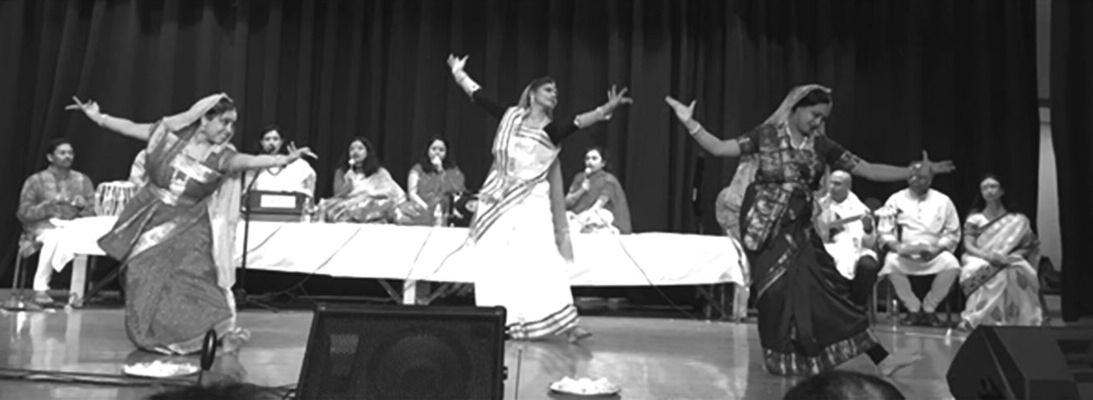
GSCA was one of the participants at “Rabindra utsav” at Ananda Mandir on May 20th, honoring the life and works of Ra-
GSCA’s philanthropic efforts for education in India got its acknowledgement with two of its supported students, Alahim Shaikh, graduating from Medical School in April 2017 and starting residency and Uzzal Mandal due to graduate in July, 2017 Heartwarming success stories like that of Uzzal, for instance, whose mother supports the family alone as a tea seller, makes such philanthropic efforts satisfying and rewarding For the current year, GSCA continues to support 15 students pursuing, amongst others, medical and nursing careers Included in this number are two graduating seniors from Plainfield High School, New Jersey, Tayannah Shumate, going to Seton Hall to major in Biology and Manuela Garcia, headed to Union County College aiming to be a Chemical Engineer
Food drive by Ananda
Mandir
The food for the needy comes from generous donations made by you - our members, temple attendees and all wellwishers of the community Will you please help? This is a year-round program, so any time is good for the donation All kinds of non-perishable food and toiletries are needed No glass jars please!
Thank You, Krishna Dutta Roy, Chair, Ananda Mandir Humanitarian Activities
Arun Paul:
An Outstanding volunteer Membership upgrade at Ananda Mandir
Based on the deliberations of the Awards and Recognition Committee, Ananda Mandir Board of Trustees has recognized Arun Paul as an outstanding volunteer of the organization
Arun Paul has been a dedicated volunteer at Ananda Mandir for over a decade He has become a permanent fixture of our kitchen. He buys groceries, chops vegetables, and lends his hands in food preparation Whenever we run short of an item in the kitchen, Arun rushes to the store and bails us out Very often he donates the item(s) he purchased. He does not mind doing tasks that are not glamorous but must be done such as cleaning up after food preparation and service. Arun makes himself available whenever the Food Committee needs help.
In addition to helping out at the kitchen, Arun has cheerfully answered our calls to help out with the mailing of Ananda Sangbad and Anandalipi on numerous occasions. He has happily pitched in tasks like sticking address labels to making bundles to bagging the publications and hauling the bundles to the bulk mailing facility He has helped with similar tasks in connection with mailing of letters and cards to our members He performs every task with a quiet smile and utmost dedication. Very few people have donated more hours to Ananda Mandir than Arun Paul.
We congratulate Arun Paul and thank him for his dedicated service to the organization.
LiFe MeMBeR
($1,000 to $4,999)
Bimal & Minati saha vikas singh & sumita Pandit
Renee dutta Rostad & egil Rostad
PATROn
($ 5,000 – $9,999)
Kowsilla Pillay & subrata sen
gRAnd PATROn – siLveR
($ 10,000 – $24,999) swati Ray Tapan Audhya
gRAnd PATROn – gOLd
($ 25,000 – $49,999) samir Banerjee
BeneFACTOR
($ 50,000 and up)
Arun & Rita Bhowmik
Please note that you can become an Associate Member of Ananda Mandir by donating a minimum of $50 Your subsequent donations of $50 or more are credited to your account When your total cumulative donation reaches $1000, you become a Life Member Your support, small or large, is most welcome and sincerely appreciated.