Ananda Mandir 269 Cedar Grove Lane Somerset, NJ 08873


Ananda Mandir 269 Cedar Grove Lane Somerset, NJ 08873
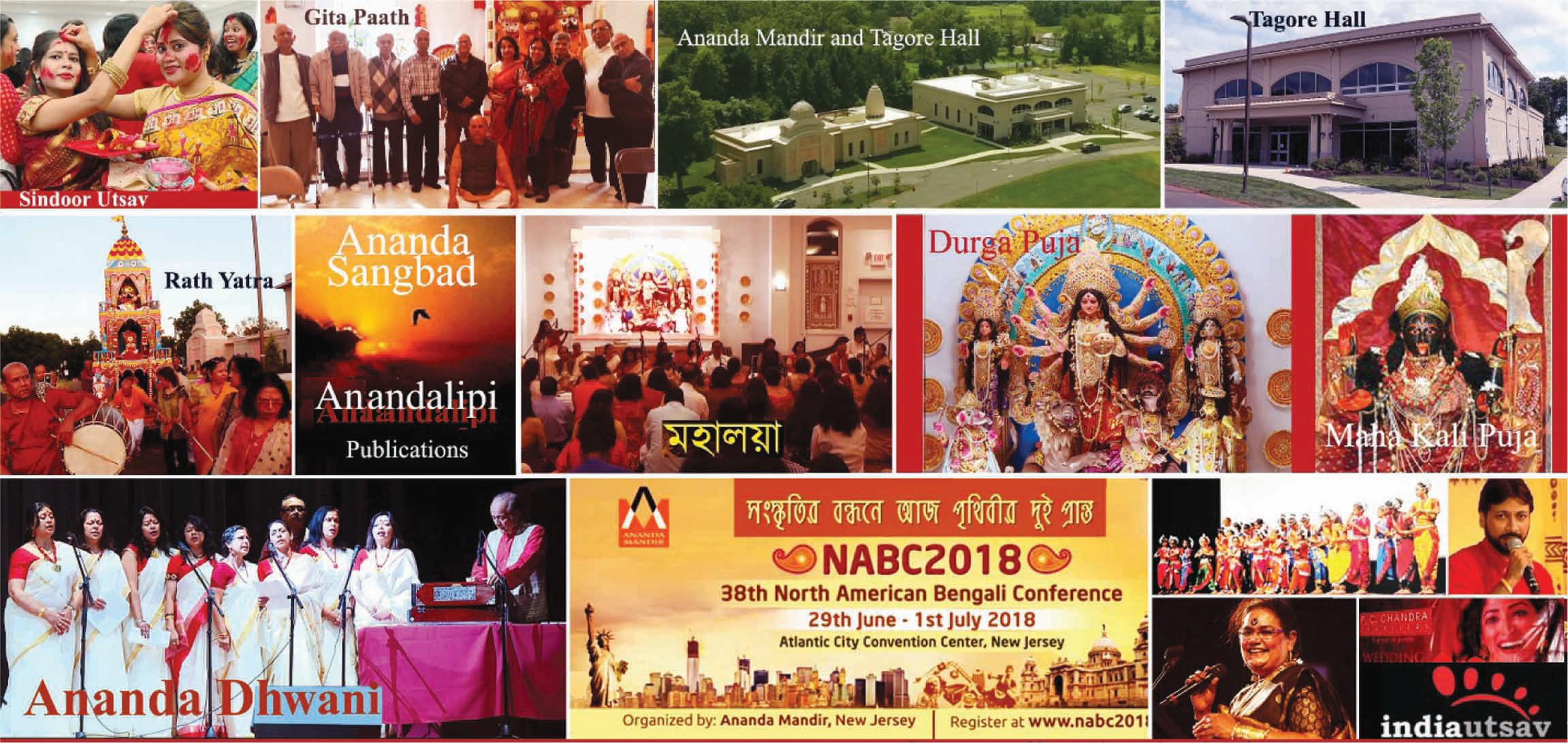
by Guru Chakravarty
Avibrant
Ananda Mandir is ready to welcome 2019. It seems that Ananda Mandir has reached the pinnacle as the place to be for all Bengalis in the community. Fresh off the enormous success at the North American Bengali Conference at Atlantic City, it has established its presence as a strong and durable organization. As a result, the membership is growing beyond expectations.
The availability of a state-of-the-art building with auditorium and provision of sumptuous food in Tagore Hall continues to attract the Indian community to get together for their personal events.
On the occasion of Durga Puja, the performance of the live Mahishasur
SaraSwati Puja and Shivaratri 2019
Saraswati Puja (and Hatekhori)
Sunday, February 10
8:00 am – 10:00 am
Bani Bandana (Children’s Program)
Sunday, February 10
12:00 pm – 6:00 pm
Maha Shivaratri
Monday, March 04
5:00 pm -5:00 am
Mardini at the early hours of 4:30 am, continue to attract spectators to fill up the temple. It brings together the best musicians in New Jersey- the singers and the instrument players. During Durga Puja, people keep pouring in because they really enjoy to watch the puja in asanctified atmosphere, as laid out in the Purana. Those who have heard the powerful chanting of slokas from Chandi by Biswabhai cannot help but get captivated by the occasion. Durga Puja and the Kali Puja prove to be the centerpiece of Ananda Mandir’s attraction for the community.
But Ananda Mandir does many more things to serve the community.
The Publication Committee of Ananda Mandir is flourishing with several publications for the enjoyment of the membership. That includes the Quarterly Ananda Sangbad - a 16-page news magazine in English, an annual literary magazine called Anandalipi containing both English and Bengali articles, and an annual children’s magazine called Kishaloy. In addition, Ananda Mandir holds two literary competitions for the residents of North America. One is for adults, called Gayatri Awards, and the other is for juniors,called Kisholoy Awards. Pronoy Chatterjee gets all the credit to have brought up the Publicationsfrom ground level to its current elite status. On a somber note, Pronoy is relinquishing his position at the helm of the Publications as the New Year dawns, although he will still be available as an advisor. A monthly Literary Seminar, where eminent speakers are invited to give talks, is organized by
Subrata Bhaumik every month.
An amazingly pleasing thing has happened for the seniors, that is gaining momentum every day.
An organized get together of the seniors called the Evergreen Forum, a brainchild of Debajyoti Chatterji, has given new strength to the elderly. They come up with their literary and culinary creations, and their stories, in a free for all “Show and Tell” environment, that is bringing out people even in their wheelchairs.
Biswabhaitirelessly keeps churning out interesting articles on spiritual matters, digging into his knowledge of Puranas and such other Vedic literature. He sends them out frequently to his large number of email recipients. Besides, he encourages members to get actively involved in doing things together. At his behest, Ananda Mandir held the 15th Foundation Day celebration on 10th November, where he led a special Havan Ceremony, assisted by Guru Chakravarty. Many devotees were at hand to offer their homage to the fire. Both Biswajyoti and Guru fondly remembered the occasion in 2004 when the first foundation day puja and havan was performed by them along with two other priests.On 05 December (18th Agrahayana), Biswabhai organized a Gita Paath seminar in observation of Sri Krishna’s advice to Arjuna (Chapter 10, Verse 35), “Of all months, I am Agrahayana…” Best Wishes for all Ananda Mandir members and the entire community in 2019.
Calendar of Events (Dates are subject to Change) Please check our website frequently www.anandamandir.org Tel: 732-873-9821
NOTE: If a particular Puja time is not listed, please contact temple or visit our ebsite: anandamandir.org
JAnuAry(*)
new year Darshan
Tuesday, 01, 9:00am-8:00pm
Shyama Puja
Saturday, 05, 5:30pm-7:30pm
Satyanarayan Puja
Sunday, 13, 5:30pm-7:30pm
Sahitya O Alochana
Friday, 18, call for time
Cultural Program(*)
FebruAry (*)
ratanti Kali Puja
Sunday, 03, 5:00pm-7:00pm
Ganesh Chaturthi
Saturday, 09, 8:00am-9:30am Saraswati Puja and bani bandana
Sunday, 10, 8:00am-6:00pm
Sahitya O Alochana
Friday, 15, call for time Cultural Program (*)
MArCh (*)
Maha Shivaratri
Monday, 04, 5:00pm-5:00am
Shyama Puja
Tuesday, 05, 6:30pm-8:30pm
Dol Jatra
Thursday, 21, 7:00am-9:00am
Satyanarayan Puja and Abir Khela
Thursday, 21, 6:00pm-8:00pm
Sahitya O Alochana
Friday, 22, call for time Cultural Program (*)
(*) See www.anandamandir.org or Call Mandir for details
Special Religious Services: Upon request, the priest of Ananda Mandir offers services such as in-house Shraddhas, Rituals associated with Cremations (Antyesti Kriya), Shraddha Anniversaries, Pre-wedding rituals (Naandimukh, Ashirwad, etc), Upanayan (Paitey), Annaprasan, Wedding Ceremonies & Wedding Anniversaries, Griha Prabesh (Bhumi Puja), Consecrations of new cars (New Car Pujas) and others. If you have needs for any of the above or more, please feel free to contact Biswabhai @ 732-873-9821
Ananda Sambad
A Periodical Newsletter
Published By AnAnDA
MAnDIr
(A Tax-Exempt, Non-Profit Organization)
269 Cedar Grove Lane Somerset, NJ 08873
Ph: 732-873-9821
Website: www.anandamandir.org
Publication Committee of Ananda Mandir
Chairperson: Debajyoti Chatterji, Debsmee572@gmail.com
Assistant Chairperson: Subrata bhaumik, Bhaumik.subrata@gmail.com
Editor-in-Chief: Amitabha bagchi, amitabhanj@gmail.com
Executive Editor, Ananda Sangbad: Guru Chakravarty, guruchakravarty@yahoo.com
Editors:
Subrata bhaumik, bhaumik.subrata@gmail.com
Subhodev Das, subhodev.das@gmail.com
Sushmita Dutta, sushmitadutt2@gmail.com
Amrita Kangle, amritakangle@hotmail.com nupur Lahiri, nupurlahiri@aol.com
Associate Editor: ruby banerjea, r_banerjea@yahoo.com
Advisors: Pronoy Chatterjee pkc_usa@yahoo.com
Ashok rakhit ashokrakhit@gmail.com
l
All queries, articles, news reports and letters should be directed to the Managing Editor
Phone: 908-752-3065
E-mail: guruchakravarty@yahoo.com
l
For general information, please contact the following executives of Ananda Mandir: Ashok rakhit, President
Jaiprakash biswas, Vice President
Suprasad baidyaroy, Vice President
Arun bhowmik, Vice President
Sajal Mukherjee, General Secretary
Pradip Majumdar Treasurer
Climate Crisis
Federal Agencies of the U.S. have published a new report, as they are mandated to do every four years, with a dire prediction of the climate of the world, which can be labeled as a crisis. This was put together with the help of 300 leading scientists that included experts from outside the government. It needs attention of our community, and the world. Here is what we should know and care about the climate crisis: happening today
1. Temperature Rise: A study by NOAA (National Oceanic and Atmospheric Administration) says, the average temperature across global land and ocean surfaces for April 2018 was 0.83°C (1.49°F) above the 20th century average of 13.7°C (56.7°F). If this does not sound very alarming, what would is that the rate of rise has more than doubled since 1980.
2. Wildfires: Wildfire seasons are longer and more devastating
3. Flooding: Rise in sea levels is threatening many coastal and low lying areas with flooding and storm surges. Sea levels have already gone up 7 to 8 inches since 1900. Almost half that rise has been since 1993.
4. Health Impact: Higher temperatures are favored by mosquitoes and waterborne viruses.
5. Sea life: Algae that deplete oxygen in the water and can kill sea life caused a state of emergency in Florida in August, 2018.
Cause
The main cause has clearly been identified as Greenhouse Emissions. These gases are capable of absorbing infrared radiation, thereby trapping and holding heat in the atmosphere.
The primary greenhouse gases in the atmosphere are water vapor, carbon dioxide, methane, nitrous oxide and ozone. Some industrial hydrocarbons are also considered greenhouse gases. CO2 remains the main problem gas because it remains in the atmosphere longer. The main causes of greenhouse emissions are fossil fuels used for transportation, electricity production and industrial use.
what can be done?
The Paris Agreement’s 1.5°C temperature limit requires a rapid reduction in greenhouse emissions by a phase-out of coal for the power production by 2050, substantial reductions in the use of oil and natural gas, mass deployment of alternate energy sources like solar, wind and hydro, and the reduction of emissions from the transportation industry so that CO2 emissions reach net zero around 2050.
Cost of doing nothing
If Paris Agreement is ignored, the Earth will reach the crucial threshold of 1.5 degrees Celsius (2.7 degrees Fahrenheit) above pre-industrial levels sooner, by as early as 2030. The effects on human lifestyle would be devastating. The worst fear is that natural calamities like wildfires and hurricanes would become more frequent and more violent. Even under less severe scenarios, the heat effects on the population, particularly on children and the elderly, would cause greater illness. There will be a loss of labor hours due to extreme heat at certain places. Farmers will face loss of quality and quantity of their crops due to higher temperatures, drought and flooding. Estimates suggest that heat stress could cause the dairy production to fall. Economic development of the third world countries would be pushed back further.
The attention needed to leaving the world safer, cleaner and healthier for the future generations just got critical more than ever before.
Guru Chakravarty
Executive Editor , Ananda Sangbad
Dear Members,
Happy New Year 2019! Year 2018 had been a challenging but successful year in many ways. I am happy to report to you that with your support, we have met both our financial and operating goals! Here is a list of our major accomplishments in the year 2018:
1. tagore hall
(a) With the help of our Hall Manager, Mr. Surinder Singh our hall was fully operational.
(b) Our website www.tagorehallnj.com as well as our advertisement in 8K radio were used to reach our members in the South Asian Community.
(c) The hall was rented out during most of the weekends in summer and fall to our members for occasions ranging from stage performance to graduations, anniversaries and weddings.
2. temple
(a) The Temple has been fully functional in the expanded facility with a large lobby area and much larger capacity for indoor seating than before.
(b) Vegetarian kitchen is fully functional in the temple basement with approved dining area.
(c) Addition of Private Service room to the current lobby has been delayed for administrative reasons and we hope to start it soon.
(d) We had almost full capacity attendance at both Durga Puja and Kali Puja. Our sincere thanks to Suprasad Baidyaroy, Ujjal Sanyal and others who had been cooking meals year after year for hundreds to thousands of attendees from smaller events to large events like Durga Puja and Kali Puja.
3. Parking
(a) We currently have 210 paved parking with an additional 110 parking spaces that have recently been approved by the Franklin Township. This additional parking should be completed with a new paved driveway early spring of 2019.
(b) An entrance gate is also planned to be installed during spring next year
4. Financial
(a) We raised almost $200,000 during our Annual Fundraiser this year – another successful fundraiser. Thanks to all our donors for their generous donations and to our dedicated members who solicited the donors.
(b) With the ongoing rental of Tagore Hall to our community and continued temple services by Biswabhai, we are close to reaching our financial target for the second year of operation of the new facility. With the help of revenues from Durga Puja/Kali Puja and the Annual Fundraiser in addition to the monthly operating revenues from buildings, we are meeting our financial obligations towards the monthly loan service to Unity Bank and other regular operating expenses.
5. Other ananda Mandir was proud to sponsor the 38th north american Bengali Conference (naBC) in atlantic City, nj on june 29th to july 1st, 2018. It was one of the most successful NABC events in recent years according to the feedback from attendees nationwide. It was possible because of our Leadership and the hard work of all our volunteers. Our mission was to work with the Cultural Association of Bengal (CAB) as well as all sister organizations in New Jersey to present a successful conference under the umbrella of Ananda Mandir. Kallol was our major partner along with the support of all other organizations in NJ/NY area. We also made substantial savings during this event that helped to add to our much-needed capital funds.
In summary, our center is fully operational and met all projected goals for the year. Our sincere thanks to all our members who have been supporting Ananda Mandir from its humble beginning to its current expansion. Your donation is the primary source for both capital investment on construction and regular operational expenses. While we are proud about having completed the construction of the beautiful heritage site with a temple and a community hall, the fiscal challenge still remains for the next twenty years. We are actively looking at alternate financing by personal loan from our members which would allow us to pay off the current $3.5 million-dollar loan in less than 10 years in place of the current bank loan for 20 years. It is critical to try and pay off the current loan over the next eight to ten years when most of the Founding and current core families are actively managing the center. This would reduce the overly long-term financial risk of paying large monthly mortgages. We hope that some of you would support us in this endeavor. Please call and talk to any of the members of BOT if you would like to know more and join us in repaying this loan. Thank you for your continued support and I pray for Ma’s blessings for your good health and happiness!
ashok rakhit President, Ananda Mandir
Traditionalby Amitabha bagchi
Hindu marriages today follow a structure enshrined in the Vedas. The groom comes to the bride’s home, seeking her hand in marriage. The bride’s father (or a surrogate, in some cases) “gives away” the girl (kanya-daan) after checking out the antecedents of both parties. The groom’s commitment to marry is solemnized by the bride and groom circumambulating the holy fire of hom and offering puffed rice (khoi) to it. This is followed up with commitments sworn while the duo takes seven steps (saptapadi) together. Wrapped around these religious rites are activities with regional customs and flavors (from barone and mala-badol to sindur daan and mangal-sutra) that make the Hindu marriage such a colorful and appealing ceremony.
Even in Vedic and postVedic times, however, not all marriages followed this script. India’s epics and mythologies are full of instances of cohabitation, elopement, abduction and what not – inspired by mutual attraction and passionate love between the sexes – that were accepted as marriage by the society at large. In a welcome display of pragmatism and moral elasticity, the ancient Hindu society deemed legal several types of marriages that were not sanctified by fire offerings and priestly incantations. In so doing, the society showed understanding and compassion as it accepted as legitimate the offspring of such unions.
According to the “Laws of Manu” (Manusmriti), there are eight types of Hindu marriages (Vivah): 1) Brahma, 2) Daiva, 3) Arsha, 4) Prajapatya, 5) Gandharva, 6) Asura, 7) Rakshasa and 8) Paishacha. They are described in detail in https://www.quora.com/ What-are-the-eight-typesof-marriage-in-hinduism. In this essay, I will summarize their similarities and differences, and then focus on two of them – Gandhava and Rakshasa – in their most celebrated appearance in Hindu epics, and the changed perspective on them in the modern Hindu society.
Brahma Vivah is the ideal form of Hindu marriage. It is between a boy and a girl of the same caste; it is initiated by the groom’s family, approved by both families, and
follows the traditional steps or script.
Daiva Vivah is similar to Brahma Vivah, except that the girl’s family initiates the search for a suitable groom. If unsuccessful after a specified period of search, the family may marry off the girl to a priest.
In Arsha Vivah, the bride’s family has limited wealth and marries off the daughter to a sage (rishi) with a modest dowry.
Prajapatya Vivah is where “an eligible groom is enticed with wealth and presents” –essentially a dowry – to marry the bride.
The context is reversed in Asura Vivah, where “the bride’s family is enticed by wealth” to bestow the daughter to the groom. The groom in this case is oftentimes of lower caste or social standing than the bride.
Gandharva Vivah, in the modern-day context, would imply the cohabitation of two individuals out of love and mutual affection, and may involve elopement.
Rakshasa Vivah is when the girl is forcibly abducted by the groom after battling the bride’s family. The girl may or may not be in love with the boy.
In Paishacha Vivah, the girl is abducted when asleep or intoxicated. The closest counterpart in today’s context would be rape and enslavement.
The last two types of marriages are not approved or condoned in Manusmriti
Let me turn now to Gandharva Vivah. The most famous example of it in Indian epics is, of course, the union of Dushyanta and Shakuntala.
Per the story in Mahabharata, King Dushyanta is out pleasure hunting (mrigaya) in a forest when he strays into the ashrama of Rishi Kanva and chances upon his ward, Shakuntala, and her two companions. (See illustration on the left.) Smitten by the good looks of each other, they instantly fall in love and exchange garlands as per the Gandharva style of marriage. (See Kannada drawing on the right.) Rishi Kanva fully assents to their cohabitation, apparently making the statement, “The marriage of a desiring woman with a desiring man, without religious ceremonies, is
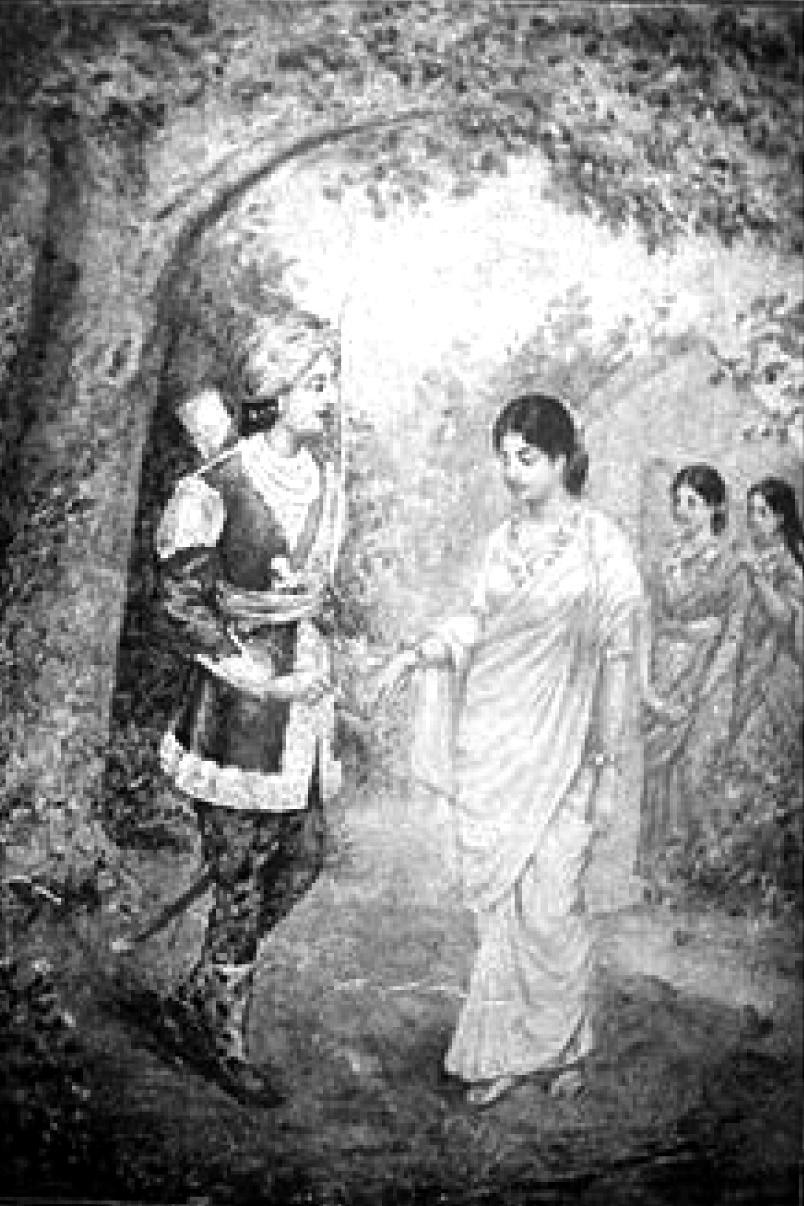
the best marriage.”
Let me not dwell on the well-known story of how they separate and eventually get re-united after Shakuntala recovers from the curse of Rishi Durbasa. The point that I wish to make is that the result of their Gandharva union is Prince Bharata, who ends up ruling a broad tract of India and creates the eponymous kingdom of Bharatabarsha. No stigma of illegitimacy is attached to him on account of the manner of his conception and birth.
How should we look at Gandharva marriage today?
There is a clear temptation to replicate it in many love marriages, but it is not accepted as legal in modern India. Wikipedia has a nice account (https://en.wikipedia.org/ wiki/Gandharva_marriage ) of the controversy surrounding Gandharva marriage in
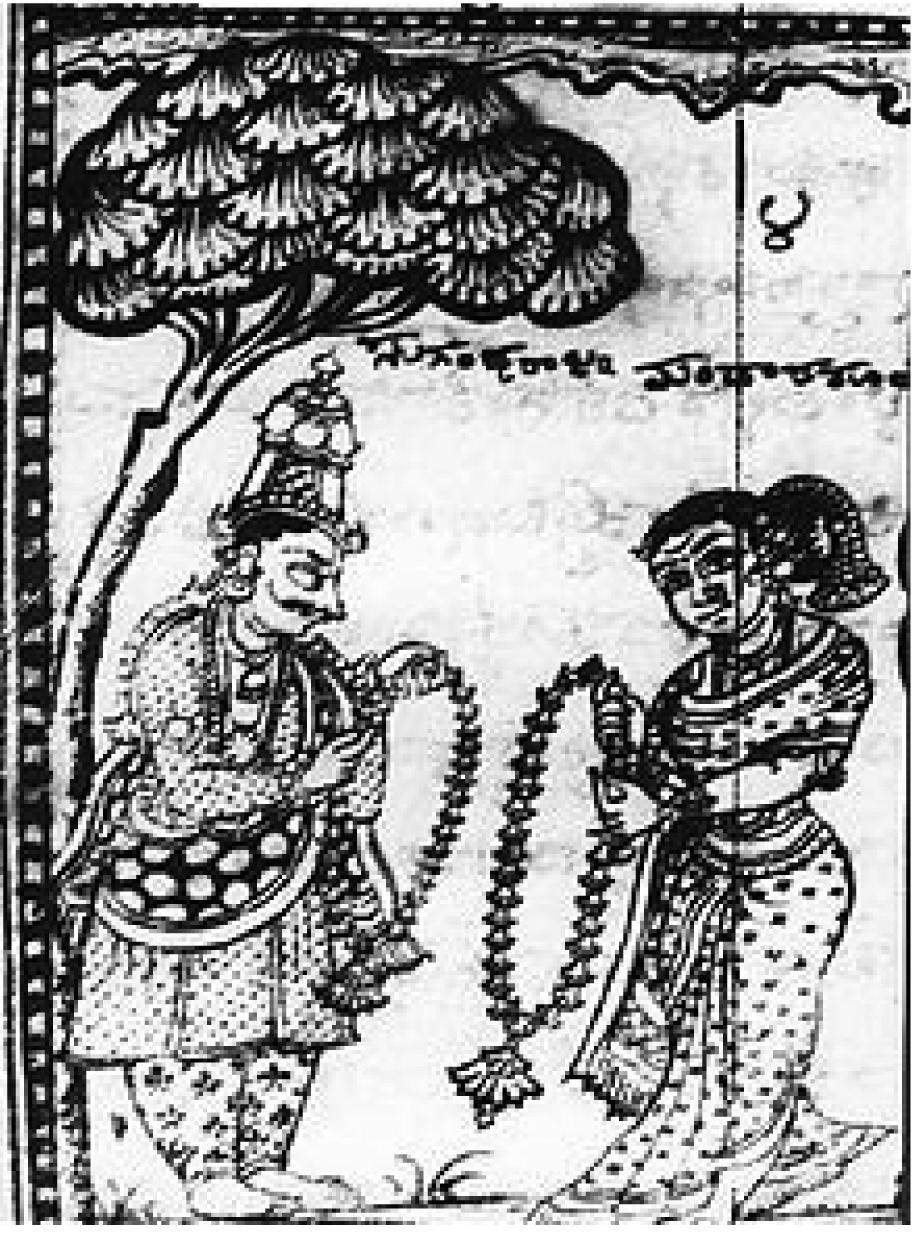
classical India, its slow decline over time, and periodic attempts at its legal resurrection. The Wikipedia author(s) slyly note that Gandharva marriage is re-emerging in India under the guise of the so-called “live-in relationship.”
Vestiges of the Gandharva style of marriage can be seen in Mala-badol (“Garland Exchange”) in Bengali marriages. In fiction, garland (or necklace) exchange plays a pivotal role in Sarat Chandra Chattopadhyay’s popular story, “Parineeta.”
Turning to Rakshasa Vivah, Hindu epics describe several instances of the abduction of a princess (or multiple princesses) from Swayamvara Sabha for the purpose of marrying her (or them) to someone else. An example is of Bhishma abducting the three daughters of the King of Kashi, Amba, Ambika and Ambalika, and presenting them for marriage to his halfbrother, Vichitravirya.
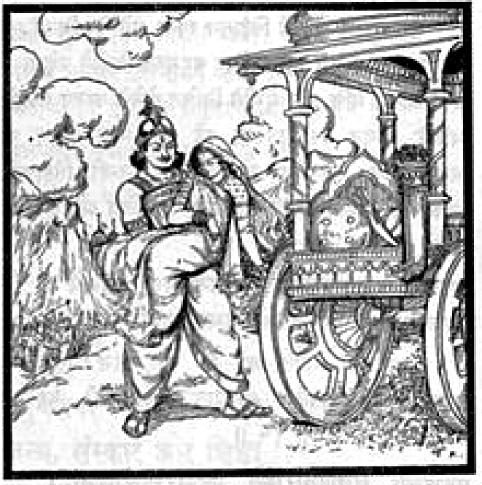
But the most famous instance by far of Rakshasa Vivah is the abduction of Krishna’s sister, Subhadra, by Arjuna. The story has got layers from many retellings, but the commonly accepted version runs something like this. During his one year of selfimposed exile and wandering, Arjuna arrives in Dwarka, the Yadava kingdom, and is smitten by the beauty of Krishna’s sister, Subhadra. Both of them are drawn to each other, but a problem arises because Krishna’s elder brother, Balarama, has promised Subhadra to Duryodhana in marriage. To circumvent the problem, Krishna advises and abets Arjuna to elope with Subhadra, but tells her to be the charioteer on their escape, to make clear her complicity in the act of her own abduction. (See the illustration below.)
The major issue troubling scholars and thinkers about this episode is whether Subhadra was indeed in love with Arjuna and willingly agreed to be abducted. The issue of feminine consent has clouded the acceptance of Rakshasa Vivah as a legitimate form of marriage in modern Hinduism. This despite the fact that the union of Arjuna and Subhadra led to the birth of Abhimanyu, whose own son Parikshit (born posthumously) became the undisputed heir to the throne of Hastinapur – i.e., of the Kuru dynasty -- in Mahabharata.
by Sunanda Ghosh
Editor’s note: Sunanda Ghosh was born in 1932, in a family which loved education and the arts. She was raised in East Bengal in Kumilla district. She has many fond memories of Dhaka where her maternal grandmother lived. The partition of Bengal, forced her family to move to Kolkata where she continued her studies and earned her first master’s degree. She eventually entered the doctoral program at Vishwabharati at Shantiniketan. She was a passionate performer in theater from an early age and acted at plays in Shantiniketan. Before she could complete her studies at Vishwabharati, she was married to Debabrata Ghosh, and they moved to Sydney, Australia. Her husband earned a doctorate in Organic Chemistry and she earned her second master’s degree. She was the first Indian teacher in Australia and acknowledged in Statesman publication of Kolkata. They both came back and settled in Chennai where Sunanda Ghosh started teaching at Stella Matutina, College of Education and was one of the pioneers of Bengali theater in Chennai. She remains connected to various Bengali organizations to this day, also writing and directing plays, health permitting. She completed her doctorate at the University of Madras, retired as the Principal of Stella Matutina and has authored several books in the field of Education. Her memoirs will be published in several parts.
Dhaka – was my paternal home and my maternal grandmother’s abode. In those early days, in the 1930’s, the city of Dhaka was part of the Dhaka district. Back then, Dhaka was spelt as “Dacca”. Maybe the foreigners could not pronounce it correctly. In my childhood, I saw Dhaka as a fun place where we used to commute by train and steamer and at the end of the journey indulged in eating a lot of goodies prepared by my didima.
The whole of East Bengal was criss-crossed by a number of water bodies, mostly rivers and rivulets, hence the need for journeying by steamers, a bigger version of steam launches or a miniature ship. The most important rivers were Padma and Meghna, which in places had the expanse of the sea. Because of the presence of other small waterbodies like canals(khal) and tanks(pukur), the land was very fertile. The trains would chug through lush vegetation, verdant meadows and corn-laden fields. The scenario was very different from the drier districts of Bihar or Orissa. These steamengine trains gurgled a lot of black sooty vapors and had a very shrill kuuu – sound. In order to mimic a train we would put our palm on our mouths and tried to sound out the kuuu-jhik-jhik. By the end of the train journey, we would be besmeared with soot as those trains used to run on coal. They had a gigantic presence engendering fear in children’s mind. Any structure nearby would be shaking. We heard that when trains were introduced, people used to kneel down and bow as though it was a natural force or a god. Its brute power and force could not be ignored. The journey by steamer was much gentler and slow.
From the jetty, some planks were laid down, they were affixed firmly with thick ropes. There also used to be strong banisters. Some sort of jute carpet would be laid on the wooden structure that formed a bridge between the jetty and the steamer. For children like us, the black water below was frightening, so we would hold on to our dad’s hand and crossed over to the safe interior of the steamer. The steamers were two-storied. Through wooden steps we would come up to the top floor. The first part of the ship was first class where a row of luxury cabins stood laced with a winding deck, strewn with cozy armchairs. The public could not enter that area. Similarly the back portion was earmarked for the second-class travelers having similar facilities of a lesser degree of comfort and similarlydebarring lesser mortals. The middle portion was open for seating or stretching barring a central rectangular gap secured with metal railings through which we could see the beating heart of the steamer. That was the engine room and there too burning coal was stoked into the fire. There were the steamer crews, the khalashis, who would run the machines, standing at a safe distance.
The crew on of the ship were like people of another planet. They were in uniforms of navy or faded blue. Brave they were, they manned the ship so valiantly. They slowed down the ship when nearing some villages on the bank and allowed the sampans or small boats(sometimes called chip nouka) to come close to the ship. The ship would be stationary at that point of time to load various merchandise from the local vegetable vendors and fish vendors. Delectable sweet pat-kheer (khoa wrapped in banana leaves),
by Amrita Kangle
cauldrons of sweet yogurt would also be loaded onto the ship. People will munch on them or take them along so that children at home could taste those delicacies. Then the crew would cook for themselves very oily and hot fish curry(chhalun in local language), the aroma of which would make the passengers on board salivate. Decades later, I was returning from Sydney after a stay for four years in Australia. We were on an ocean liner called Strathmore which was a fashionable Italian ship. I was heavily pregnant and hungry for desi food after years of western food in Sydney. I cajoled the captain of the ship to serve me the steamer crews ‘chhalun’ curry. I was granted the wish by the kindly captain.
When we arrived in Dhaka, the usual transport was horse driven coaches or rickshaws pulled by men. However we mostly used to go on foot to short distances. The roads were rough and not graveled or tarred. They were mud roads, in some cases topped with red broken bricks(khoa). On both sides of the road were open drains. They were very broad. A child could easily fall and drown in there, so we learned to be careful around them.In Dhaka and Kumilla, there used to be water trucks, which would sprinkle water on the roads so that it would not be so dusty. There were bhisties (water men) who would carry huge leather bags filled with water, collected from any roadside tank and would systematically sprinkle water.
Growing up in Dhaka we lived near mother earth and were excellent walkers. If one needed to drop a letter to a post box or buy something from Nakul dada’s store, we would walk half a mile to do the errands.
“No Ball”
The ball in the meantime had nicked the edge of the bat, risen high in the air and had been perfectly caught by the ever vigilant wicket keeper who had shouted out to the umpire. Not one to be intimidated by vociferous pleas nor at the aspect of being surrounded by ten ferocious players, the umpire stuck to his guns. The watching crowd immediately took up a chant to “Change the umpire.”
The batsman too stood her ground quite nonchalantly, supremely confident of her support system and aware that her grandson and his friends would fight her battle successfully and she would continue to bat. Her role model was Sachin Tendulkar anyway and did he not take some time to reach his century? She would too. Rules could go to the devil. You simply could not get Aaji (grandma) out so easily; she would need to get seriously out at least twice more till she declared herself out only because she would be by then feeling a little hungry. Playing cricket was tiring work. The game continued with gusto with the commentator bringing every nuance of the fight to light and the bowler continued bowling after being adequately warned to bowl slow enough so that Aaji could hit a four and complete her one-twentieth of a century.
As you must have realized by now, this was no ordinary match. It was one of the practice matches being played between the Panthers and the Eagles for the Annual Cricket Tournament in our colony. And it was every bit as serious as any IPL match. If anything, the emotions involved ran even higher with all the players being connected to each other through the strongest of ties-namely those of friendship over the past twenty-odd years.
As I stood in my fielding position at the short fine leg (given to me by the captain in deference to my advancing years, inability and reluctance to go charging after the ball madly all over the field) I allowed my mind to wander. And wander it did happily, meandering like a brook over rounded stones and green moss, bubbling over the
memories into the green and sylvan glades of years gone by. The match, the sounds and the players themselves faded into the background and in front of my eyes in very sharp focus came the tiny tads, my son and his friends, all yet to reach their teens ...... their chubby and innocent faces aglow with mischief, all peeking from the windows of my mind.
Was it only thirty three years ago that I had moved into this complex as a young bride, and this had been a newly developing colony with our house being one of the first buildings to have some occupants? The whole area had been surrounded only by trees and our car had to travel over rough roads before it could get onto the main one and at night it was the howling of the jackals that lulled us to sleep. I would imagine myself to be a part of Rudyard Kipling’s ‘The Jungle Book’ and when my son was born, I would tell him stories in which he was Mowgli and Bagheera in turn. We had our fair share of snakes as well and we had to learn to look out for those creatures. I always tried to reason with myself that it was we humans who had encroached on their territory and not the other way around. But to tell you truthfully this took a lot of doing when I found one of these creepy-crawlies snoozing right below the baby bed where my son was taking his nap! He had just crawled in looking for a cool place, I guess! Maybe this is the reason why my son loves all animals indiscriminately and his methods of feeling cheerful when things get him down are to look at animal videos! The grouch instantaneously transforms into a chirpy chipper!
Slowly the buildings around were completed and people started coming to live in them. The majority of the children were in their ‘terrible twos,’ with the older ones being no more than five. They would all be taken out to play in the huge central garden with its designated tot-lot; and here were sown the seeds of a deep and abiding friendship which had not only stood the test of time but had at times gone through roaring flames which threat-
continue to page 6 }
by Debajyoti Chatterji
Members of the Evergreen Club had an active and enjoyable 2018-- and are looking forward to similar levels of group engagement in the New Year.
We organized eight group activities during the past year. Four of these were held at Ananda Mandir, and four involved “group outings” to restaurants, theaters and sight-seeing destinations. In addition, Evergreen Club volunteers enthusiastically participated in several important Ananda Mandir events.
Looking at our activities in reverse chronological order, members organized a lovely pot-luck lunch on Saturday, December 29, to bid farewell to 2018 and to welcome the New Year. Although the “annual winter migration” to India had already started, we were delighted to see 20+ members participate in this event. The “Bijoya Sammelan”, held on Saturday, Nov 10, attracted more than 30 members, and we could barely find space for everybody in our meeting room. On both occasions, delicious, multi-course lunch was prepared and served by our evergreen volunteers, and we were entertained and engaged through a lovely program of songs, readings, recollections of childhood memories and discussions on interesting topics. The Bijoya Sammelan was made particularly joyous by an octogenarian member who took to the floor to perform a short dance routine from Tagore’s dance drama, Shyama! For this impromptu performance, she even recruited a male partner on the spot. Although stunned by the quick turn of events, the male member did an admirable job as well, and everybody loved this unrehearsed and unplanned show of spontaneity. -- The session on December 29 also featured a presentation on “Egypt: Land of Mighty Monuments and Majestic Mysteries” by Debajyoti and Sikha Chatterji.
On Thursday, October 11, a dozen members of the Evergreen Club had the opportunity to see “Color Purple” being staged at the Paper Mill Theater in Millburn, NJ. This musical version of the well-known book (and movie) was “sold out” for virtually every performance during its 3-week run, so only 12 tickets could be purchased, limiting our group size to 12.
Evergreen Club members bid farewell to the summer on Sat-
urday, August 25, by enjoying delicious south Indian dishes at a local restaurant. But rest they did not after this outing! We were proud to see many seniors actively volunteer the next day at our combined Heritage Day celebrations and Annual Fund-Raising Lunch -- and help raise funds for their beloved organization.
Our members also pitched in to make “Rather Mela” a success on Sunday, July 22. Several members brought home-made items while others donated storebought delicacies to give the occasion a festive atmosphere.
Going further backwards to the beginning of the summer, we held a lively discussion session on Saturday, June 2, where everyone was invited to “read something interesting”. This theme proved to be a winner, as evidenced by enthusiastic participation by all. The enthusiasm was in no small part attributable to the multicourse and tasty pot-luck lunch that preceded the discussion session.
April was the month for two events in quick succession. On Monday, April 30, a group of seniors drove to the town of Cream Ridge in southern New Jersey for “Tulip Festival.” A farm there is noted for a spectacular display of hundreds of thousands of tulips in all colors in full bloom for just a couple of weeks each spring. Before going to the farm, the group had a leisurely lunch to make it a full-day, fun outing. – Another group outing took place on Saturday, April 21, when we went to Hunterdon Hills Playhouse in Hampton, NJ, to see the play, “Steel Magnolias.” This lunchtheater venue is a favorite of Evergreen Club members, and every year we go there once or twice to enjoy hearty lunch and a stage play.
The session on Sunday, March 4, attracted a large attendance as it featured a presentation by Shyamal and Ruby Sarkar on their recent coast-to-coast train journey. The presentation included dramatic photographs and informative commentaries, so the session was highly successful.
January and February were difficult months for us to schedule get-togethers for two reasons: unpredictable weather and seasonal absence of a large number of seniors. We are resigned to the same fate in the first two months of 2019. We will target our first meeting of the New Year for March, 2019.
by basab Dasgupta
Iunexpectedly got an opportunity to tutor two children from the family living in a large three-story house not very far from my home in San Clemente, California: a boy in tenth grade, Mehron Sharq and his sister, Hanna in seventh grade. It was clear from their names, appearances, home décor and accents of their parents that they were Middle-Eastern and Muslim. I never questioned them about their ethnicity.
I enjoyed the tutoring sessions with them because both of them were full of life. One day they started to talk in their native tongue during a tutoring session and I sat there with a bewildered look on my face. Hanna gave me a quick glance and said “It is Farsi”. My eyes lit up because I had some exposure to the language since I had some Iranian friends.
I told them “You guys must be Iranians”. “Nope”, Hanna replied immediately “guess again”. I felt embarrassed at my poor knowledge of the languages used across the Middle-East. I knew that people from Saudi Arabia and the Arabian Peninsula spoke Arabic. “Iraqi”, I said, which was not correct either and then took a couple of more stabs “Jordanian”, “Kurdish”, “Tajik” etc.
Hanna laughed at my ignorance and then gave me the truth “my parents are from Afghanistan”. I must confess that I did not know that the Afghan people spoke Farsi. However, I later found out why. The version of Farsi spoken in Afghanistan is called “Dari” and it is one of two official languages there, the other being “Pashto”.
I felt a certain degree of closeness with them probably because Afghanistan is so close to India. However, except for a few “Kabuliwalas” that I remembered from my childhood days who sold dates and various nuts, I had met only two Afghan people until then. The first one was a guy named Masoud, who built a house next door to me (but sold it within a year) and the other was an attractive female bank teller at my bank. My impression was that Afghan people in the USA were all educated, relatively wealthy, well-mannered and trustworthy.
During another session Hanna volunteered the information that her grandfather was the number #2 guy in Afghanistan at one time. That immediately caught my attention; I was curious about the time period she was talking about and if it had anything to do with the Mujahideens or Talibans. “What is his name?” I inquired. “Mohammad Sharq” Hanna said.
I did a Google search with that name after I came home and found out that Mohammad Sharq indeed served as the Deputy Prime Minister of Afghanistan and also as the Chairman of Council of Ministers during the Soviet era of the late eighties. Another interesting aspect of his experience was his tenure as an Ambassador to India.
Much to my intrigue I learned that Mr. Sharq was not only alive and well but lived with his son right there in the
house where I was tutoring Mehron and Hanna. According to Google he was born in 1925 and therefore in his nineties! I did not know what kind of health he was in or how fluent he was in English. Nevertheless, I decided to ask Mehron’s mother, “Would be possible for me to meet Mr. Mohammad Sharq one of these days?” “Sure”, she replied. My meeting with Mr. Sharq took place a couple of weeks later after one of my tutoring sessions. What struck me as soon as I met him was how humble he was. He told me how glad he was to meet with me. “The pleasure and honor are all mine”, I responded.
It was clear that he could speak and understand English perfectly well, but it was occasionally difficult for me to understand him because his speech pattern was obviously degraded by old age. He lamented about the good old days when Afghanistan used to be a peaceful country; long before the Soviet invasion and even during the monarchy. “The children could play outside and you did not even have to lock your door” he said. I asked him many questions like a reporter. He answered candidly even though I felt that he was occasionally somewhat evasive. Here is a summary of some of those Q/A (from my best recollection).
Q: do you think that the Soviet invasion was a reluctant act on their part and it was the afghan government who invited them in?
a: I really do not know why they invaded. We had such a great relationship with them and it did not make any sense that they invaded Afghanistan.
Q: what do you think about George w. Bush’s decision to go to war in afghanistan and destroy the talibans?
a: USA really wanted to kill only two people: Osama bin Laden and Mullah Omar. So I do not understand the necessity of going to a war by forming a big coalition with a bunch of other countries and killing millions of innocent people in the process. Also, Osama and his associates were all Saudis (and Sunnis). Why kill Afghan people many of whom were not even Sunnis?
Q: Since uSa helped the Mujahideens like Osama bin Laden in their insurgency against the Soviets by giving them money and arms, why do you think Osama developed such a hatred for america?
a: I really do not know and do not understand what was in that man’s head.
Q: do you agree that invasion of iraq was a mistake as most people seem to agree now?
a: Yes, of course, it was a big mistake.
Q: do you think one of the ulterior motives of uSa is to keep a war going in some part of the world so that they can do profitable business by selling arms?
a: Yes, I fully agree.
Q: what about Obama’s policies in recent years towards afghanistan?
a: A couple of years ago, Obama decided to pull out of Afghanistan and now
continue to page 6 }
| continue from page 4
ened to engulf the threads forever, only to emerge stronger, having been purified to strong metal by those very flames.
School, College, University, Post grad - through all the different phases in life, the friends scattered but their hearts always remained here in this corner of the world. They always returned. In the meantime life continued as it always does. Many of these friends found their life partners and settled down. Their respective spouses also got integrated into the original group and in my own opinion taught these tightly bound group of friends a lesson or two in living in harmony with others apart from themselves. It also happened that new people moved into the colony and now, apart from the core group, there were a whole host of other people who made up the complex. As is bound to happen, the togetherness between families of yesteryears got stretched and at times one felt that it had reached breaking point. There were some attempts by the new residents to organize a few gettogethers but they somehow did not work out. It seemed as if our complex would become like the myriad others where one does not even know one’s neighbor.
I should have had faith. Should have known that this younger generation with their unconventional attitude and their advice to us parents to ‘chill’, were actually going to turn things around not just by a few degrees but were going to go the full semi-circle! Imagine my surprise when upon landing in Mumbai, my son, who is one of the organizers of the event, informed me that I would be playing a cricket match this year. I was so shocked that you could have knocked me down with a feather.
“How can I play cricket? I don’t even know how to hold a bat!
“Oh chill Mum! That’s not such a big issue!”
“What do you mean that it’s not an issue? Please explain how I can play cricket without knowing how to hold a bat! And have you forgotten that I can’t run because of my bad knees?”
“You will have a runner and there’s no problem. I will teach you how to hold a bat and then you just have to swing it. Will you please stop over-reacting, Mum?”
The things that your kids expect from you!! I was sup-
posed to walk into a cricket match waving my bat wildly as if I was Tendulkar incarnate, despite never having held a bat before, and I was supposed to do it as unobtrusively as if I was going to buy bread! By this time we had reached home and boy, was I in for a surprise!
Large banners announcing the Annual Cricket Match were strung everywhere across our complex. I knew that this was the third year in a row that the cricket match was taking place and I had heard about it but I had had no idea that it was done in such style. And boys being boys, my son had given me a very watered down description of this grand jamboree.
The gang of friends who had forged their friendship in the colony tot-lot had decided to use that very venue to bring the whole colony under one umbrella. They had decided to start a cricket match. This year they had had a record number of people who had registered to play. A hundred and seventy in all. The youngest player was all of ten and the eldest was Aaji, who had seen seventyone summers. Applications had been invited from people who wanted to be team owners along with an application fee and a date had been set for the grand auction. Stringent rules had been set for the auction and these had to be abided by. Since I face a mental block where understanding financial rules is concerned, I will try not to bog you down with extended explanations, but suffice to say that emotions ran high and it was an extremely well-organized event. The team owners came attired in color-coordinated clothes with their laptops and documents. There was a formal lighting of the lamp and a puja was performed of the bat and ball. Mementos were presented to the owners and then began the auction, presided over by the auctioneer and the chief accountant. The Honorable Chief Accountant sat with his laptop and a big bowl of Motichoor Laddus in front of him. You see, the team owners knew him since he was a foot tall and knew him to be a foodie, so they thought that the sweets would help him overlook a few of their accounting transgressions. The known good players sold for astronomical amounts and there was cheering enough to make one think that one was in Eden Gardens. Everything was in order and there was no discrimination except in one area- the lady players were not auctioned and they were
selected by picking chits. In order to make up for this slight, we got a whole tournament for ourselves, quite apart from being a part of the ‘Boys Team’! Now we were a part of our own teams and practice had begun with gusto. The organizers had drawn up slots for the different teams and we had practice matches at those times. The ladies had additional practice sessions in the early mornings and evenings. The whole process ran on well-oiled wheels! And did I mention that we ladies also had a coach who made us stretch-bend-run-bowl-batfield all in an effort to prove that we were not to be taken lightly?
Quite apart from the game itself, this process has had so many different advantages. It gladdens the heart. Yesterday at practice I found myself being engulfed in a bear hug by an unknown stocky and bearded gentleman. I was taken aback but did not really mind since he was so good looking. It turned out to be my son’s friend who I had not seen in the past fourteen years but had scolded and loved when they were all little tads. This tad was now a proud daddy and his little one was the spit image of him. I had a few more experiences of unexpected bear hugs and my cup of joy was full.
People across our complex now know each other, call each other up, we have impromptu pot-luck dinners and meets. It is one extended happy family with all the characters that exist in one- the benign, the docile, the vociferous, the cantankerous, the peace-loving, the trouble shooter, the administrator, the comic and the wise one. For me personally, it has been the very rewarding experience of knowing that I can take a back seat now, sanguine in the knowledge that the next generation is so very capable of doing the seemingly impossible. They could with their ‘just chill’ attitude unite a whole seemingly diverse crowd and make the whole process look like fun!
You rock, guys!
“Catch, catch, catch Aunty!” I was brought back to earth with a thud. While happily daydreaming I had forgotten that I was supposed to be fielding and had nicely dropped a catch which had come sailing into my hands. I really ought to concentrate. We need to get that trophy. How can I let either my son or my husband have victorious smiles on their faces? We are all desperate rivals for this!
Go Panthers!
| continue from page 5
he wants to go back again. Getting out, going back in –it simply does not solve any problem. I can assure you that as long as even a single foreign element is present, war would continue in Afghanistan (this statement made the most significant impression on me).
Q: the experts say that al-Qaeda was created because there was a power vacuum after the Soviets left and iSiS is growing because the americans are leaving the Middle East. that is probably Obama’s justification for going back into Afghanistan. What do you think about that logic?
a: I believe that the Afghan people are fully capable of resolving all of their issues internally without any foreign involvement. Look at India. Many people were concerned about the possibility of a total chaos when the British left India after ruling it for two hundred years; but they managed alright and now India is a great country.
Q: don’t you think that the taliban regime would again regain full control and rule the country with their fundamental Muslim ideology?
a: I am not sure which one is worse; the Taliban or the foreign armies.
Q: what about the corruption in government whether they were backed by the Soviets or the americans?
a: Unfortunately, there is a lot of corruption.
Q: what do you see as the future of the country?
a: I really do not know.
Q: i understand that you were the afghan ambassador to india. when was that?
a: From 1980 to 1986, during the rule of Indira Gandhi. I have a photograph of myself with her and I will show it to you later.
Q: did you travel within india and did you like the country?
a: Yes and I have seen the Taj Mahal. I felt that India and Afghanistan were good friends.
He came to USA twenty-three years earlier and never went back to his country. He misses Afghanistan very much. “If I ever visit Afghanistan, what places do you recommend that I visit?” I asked him. He responded with sadness “There is nothing to see in Afghanistan except the mountains. It is also not a safe place to visit at all”.
I profusely thanked him after our little chat and shook his hands several times. He said “come back anytime and we can continue our discussion. I am at your service”. He probably feels lonely and would welcome any kind of companionship. He also pointed towards a framed photograph on the wall showing him in his younger age wearing a Military uniform and surrounded by military personnel.
I realized that Afghanis are really peaceful and humble people. Their gentleness and love for their family has been immortalized in Tagore’s “Kabuliwala”. It is a shame that the country has been torn by war over more than forty years, mostly from invasions from outside.
The food for the needy comes from generous donations made by you - our members, temple attendees and all well-wishers of the community. Will you please help? This is a year-round program, so any time is good for the donation. All kinds of non-perishable food and toiletries are needed. No glass jars please!
Thank You, Krishna Dutta Roy, Chair, Ananda Mandir Humanitarian Activities
by Subhodev Das
Notlong ago, a lengthy drive on a hot day would end with scraping bug guts off a windshield. On warm summer nights, the insects could be seen swarming around streetlights. Not anymore. It appears that the splattered insects have gone the way of the Chevy Nova — you just don’t see them on the road like you used to.
Entomologists call this the windshield phenomenon. It’s a symptom, they say, of a vanishing population. The start of summer is the time of year when insects should make their fluttering presence known. But they are spectacularly failing to do so. Instead they are making themselves newsworthy through their absence.
Scientists can’t be certain about what’s happening, but possible reasons include habitat loss, insecticide use, the killing of native weeds, single-crop agriculture, invasive species, light pollution, highway traffic and climate change. The potential causes seem to lead back to the pressure we exert on the planet as captured by the latest Living Planet Index – a 60% decline in wildlife populations in just over 40 years.
The windshield phenomenon is not just a trick of Trans Am nostalgia. A small but growing number of scientific studies suggest that insects, particularly the beneficial flying ones like bees, ladybugs, fireflies and butterflies, are on the wane. A 2017 report based on 27 years’ worth of insects collected in German nature preserves has the biomass (the dry weight) of flying insects captured in these regions decreasing by a seasonal average of 76 percent. Another study involving the rain forest of Puerto Rico over a 40-year period noted a 60-fold decline in biomass.
The statistics are grim. Native ladybird populations are crashing; three quarters of butterfly species – such as the painted lady and the Glanville fritillary – have dropped significantly in numbers. Milkweeds, crucial to the beautiful monarch butterfly, are dwindling fast as their access to weeds and native plants becomes limited. Manicured lawns in the United States are so prevalent that, added together, they are as big as New England. Those landscapes are essentially dead zones for milkweeds.
The bees are also suffering major plunges in populations, with great yellow bumblebees, solitary potter flower bees and other species declining steeply in recent years. Honeybee colonies have fallen by 59 percent in North America since World War II. Other threatened insects include the New Forest cicada, the tansy beetle and the oil beetle. Samples of flies collected in a few spots in remote Greenland have demonstrated an 80 percent drop in numbers since 1996.
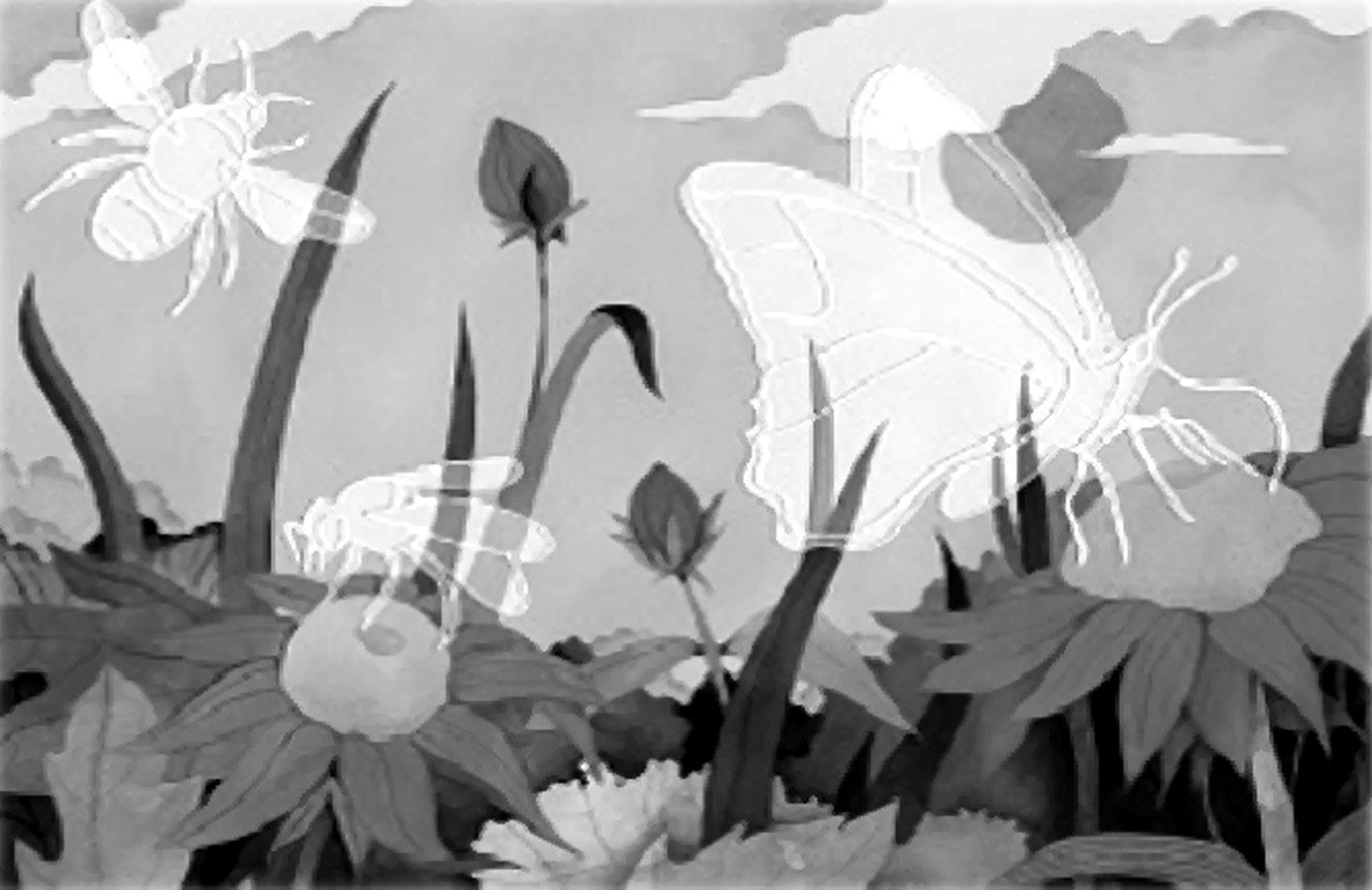
This decline is linked to warmer temperatures in the Arctic.
The picture is particularly alarming for moths. Apart from the tiger moth, which was once widespread in the UK, the V-moth (Marcaria wauaria) recorded a 99% fall in numbers between 1968 and 2007 and is now threatened with extinction. The moth populations in the northeastern United States are showing similar stress.
Light pollution is another big problem for species such as moths and fireflies, bug experts said. Insects are attracted to brightness, where they become easy prey and expend energy that they should be using to get food.
A recent analysis of climate change and insects from the University of Vermont, published in the August issue of Science, predicts a decrease in tropical insect population. The temperatures in the tropics stick to a narrow band. The invertebrates that live there, likewise, are adapted to these temperatures and fare poorly outside them; bugs cannot regulate their internal heat.
In temperate regions farther from the equator, where insects can survive a wider range of temperatures, agricultural pests will devour more food as their metabolism increases. But after a certain thermal threshold, insects will no longer lay eggs and their internal chemistry will break down.
Arthropods around the globe also have to contend with pathogens and invasive species. They are particularly vulnerable to droughts and lack of rainfall.
The most dramatic reduction over time in bug biomass appeared in summer months, when insects should be most active. Apparently, when insect densities are the highest, declines are most severe. Some estimates have placed the rate of global insect biomass loss at 50 percent or less — disturbing, but not as dismaying as the results from the German fieldwork.
The fact that insect biomass has been declining at a steady rate for almost three decades strongly suggests some profound influences must be
ticed or avoided corners. They chew up rotting wood and eat carrion. In 2006, Cornell entomologists estimated that wild insects provide $57 billion worth of custodial services in the United States each year. They bury animal dung, prey on pests and pollinate plants.
at work. Most entomologists believe habitat change lies at the heart of the problem. There have been massive alterations to the way we use the land and it is hard not to believe these are closely involved in what we are seeing.
So, why should we be concerned about the dwindling insect population?
If you like to eat nutritious fruits and vegetables, you should thank an insect. If you like hilsa, you can thank a tiny fly that the hilsa eat when they’re young. The whole fabric of our planet is built on plants and insects and the relationship between the two.
The majority of flowering plants are pollinated by insects and other animals. It has been estimated that the proportion of animal-pollinated wild plant species rises from an average of 78% in temperate-zone communities to 94% in tropical communities. Taxonomically speaking, pollinators are a diverse group, including more than 20,000 species of bees, many other types of insects (e.g. flies, butterflies, moths, wasps and beetles) and even vertebrates such as some birds and bats. Most pollinators are wild, but a few species of bees can be managed, such as honeybees, some bumblebees and a few solitary bees.
Our food production depends heavily upon these pollinators – more than 75% of the leading global food crops benefit from pollination. Some of these crops – especially fruits and vegetables – are key sources of human nutrition. High yields in largescale intensive production of crops such as apples, almonds and oilseeds depend on insect pollination, but so do the crops of smallholder farmers in the developing world, where healthy populations of wild pollinators increase yields significantly. Economically, pollination increases the global value of crop production by US$235577 billion per year to growers alone and keeps prices down for consumers by ensuring stable supplies.
But arthropods are more than just pollinators. They’re the planet’s wee custodians, toiling away in unno-
The best illustration of the ecological importance of insects is provided by our birdlife. Without insects, hundreds of species face starvation and some ornithologists believe this lack of food is already causing serious declines in bird numbers. In UK, farmland birds have more than halved in number since 1970. Some declines have been catastrophic: the spotted flycatcher, a specialist predator of aerial insects, has both declined by more than 95%, while the red-backed shrike, which feeds on big beetles, became extinct in Britain in the 1990s.
The rash of wildlife decline hits home here, too. According to the New Jersey Audubon Society, birdwatchers are encountering far fewer birds than they used to in the past.
In the same 40-year period as the arthropod crash in Puerto Rico, the average high temperature in the rain forest increased by 4 degrees Fahrenheit (2.2 degrees Celsius). The loss of insects and arthropods could further end the rain forest’s food web, causing plant species to go extinct without pollinators.
If the tropical forests go it will be yet another catastrophic failure of the whole Earth system that will feed back on human beings in an almost unimaginable way. Unfortunately, we have deaf ears in Washington and in many capitals around the world. Those ears will listen at some point, because our food supply will be in jeopardy. The question is, will it be too late to stage a complete recovery starting at the bottom of the food chain.
So, what should we do in the meantime?
The Portland-based Xerces Society, a nonprofit environmental group that promotes insect conservation, recommends planting a garden with native plants that flower throughout the year. The State of Maryland is in a three-year experiment to see if planting bee-friendly native wildflowers helps. With invertebrates not receiving the level of attention as animals, we must make every effort to avert the ecological disaster looming on the horizon.
Didn’t Receive your Copy of Ananda Sangbad?
If you are a Life Member or an Associate Member, but didn’t receive your copy of Ananda Sangbad, it may be because we do not have the correct address on file for you. Please send an email to Guru Chakravarty (guruchakravarty@ yahoo.com) with your correct address, and we will send you another copy.
Onthe 2nd of September, we celebrated Janmashtomi. The temple was open from 9:00 am to 9:00 pm. This is a very popular and well attended puja at Ananda Mandir. Our puja normally starts in the evening but the hundred and eight names of Krishna are chanted by devotees from morning until evening. Our target is to chant the hundred and eight names of Lord Krishna at least 10, 000 times in turns. This year was no exception. With so many people taking turns to chant the Lord’s name, we were able to meet our target with ease.
After the name chanting, the puja started by bathing Bal Gopal with various substances like Chandan, Ganga Jal etc. accompanied by conch blowing. Bal Gopal is then seated. The puja went on as Dr. Manisha Chakravarty read stories surrounding Lord Krishna’s birth from the Srimad Bhagavat. This is a very wellknown story, but the way Manisha reads it accompanied by songs, is always loved by the attendees. At the end of these rituals, it was time for Anjali, where each attendee offers Anjali. This was followed by Prasad and dinner. Thus ended the day’s activities.
On the 9th, we observed our monthly Shyama Puja and on the 23rd, Satyanarayan puja. We also celebrated Ganesh Chaturthi and Radha Ashtami on the 13th and 17th of September respectively.
Now we were all set to approach our Annual Sharadiya Durga Puja in October. Celebrating Mahalaya sets the tone for Durga Puja. This year, we had live Mahishasurmardini celebrations on the 7th of October. It started at 4:30 am and went on for around two hours. The number of people attending this event goes up each year and this year was no exception. People enjoyed breakfast and coffee before going back home.
reported by Krishna Dutta roy, Chair, Puja Committee
We, the volunteers of Ananda Mandir, were also preparing for the long awaited Durga Puja, but before that we also had TilTarpan. This event was scheduled for the 8th of October at around 11:00 am. Around 20 people came to pay homage to
continued to around 10 am. This being a weekday, we did not have overflowing crowds. Anjali started after 10 am and went on till around 10:30 am. Sandhya Arati and Stuti started at 7:00 pm. The arati with the sound of Dhak and Conch blowing is a spe-
to start and complete the puja within the designated auspicious timeframe.
The time, Sondhi Pujo was scheduled between 12:03 pm and 12:51 pm. So, the volunteers and priest rushed through the rituals. Finally at the exact moment Biswajyoti started the puja. All the rituals, puja, bhog, Boli, offering 108 flowers to the Ghat were completed on time. After the completion of Sondhi puja and Anjali, people
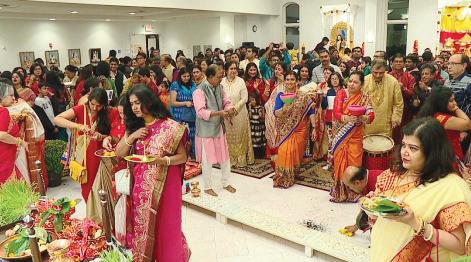
their forefathers with Til and Ganga Jal. This ceremony was presided over by Guru Chakravarty. This evening we also observed our monthly Shyama Puja.
Durga Puja started on the 14th of October and continued till the 19th of October. Bodhan was on the 14th and Debir Amantran O Adhibas fell on the 15th, in the evening hours from 6:00 pm to 8:00 pm.
16th of October was Maha Saptami. Puja started from 8:00 am and
cial attraction of each evening of Durga puja.
This event was followed by Anjali and bhog for all.
The 17th of October was the most important day of Durga puja, namely Maha Ashtomi. Puja started at 8:00 am. Anjali had to be completed by 11:30 am because that is when Sondhi puja was scheduled to start. This takes place at the cusp of Ashtomi ending and the start of Nabomi. It is a special puja, in which the priest has
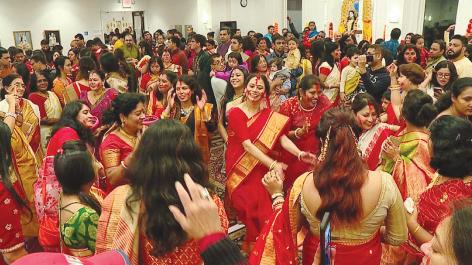
were offered bhog prasad for lunch. Once the afternoon proceedings were done with, the volunteers had to stay back to clean the temple and get it ready for the evening’s puja.
Evening Stuti and Arati started at 7 pm. After stuti and arati, Anjali was offered by everyone. Chandi paath took place after the daily puja.
In due course, Maha Nabami dawned on the 18th of October. Like the other days, the same routine was followed for puja, arati and anjali. Puja offering and bhog were all done by the scheduled time of 2:00 pm.
This evening, along with regular arati and Anjali, Ananda Mandir held a special event - the Kumari puja. We had seven young ladies (little girls) waiting anxiously, mostly with their parents who were ready with their cameras. Finally the little girls were seated on a low bench, clad in saris and adorned with jewelry, garlands and feet decorated with Alta. Santosh Mukherjee was the priest for this event. He very patiently washed their feet, offered puja, performed the arati and offered them some bhog (food). Overall, it was a very thrilling experience for the parents. The Kumaris were also given appropriate gifts. Of course, cameras were clicking at a furious pace for this memorable event. Finally, on the 19th of October, dawned the last day of Durga Puja, also known as Bijaya Dashami. Puja started at 8:30 am. Over time, a crowd

reported by Sushmita Dutta
Ayantika Karmakar, one of the associates of Star Synergy Entertainment, showcases new and hit Bengali movies every month in commercial movie theater of 8K Cinemas in New Jersey. A passiondriven venture for entertainment cinema without caring for the return on investment. I asked her over a cup of tea – “What really drives this passion?” And, I said, of course, we Bengalis are thankful to you for this service to the community and I am sure our readers would like to know as to how it all started and why?”
Ayantika responded as below:
The requirement of a common platform for the Global promotion of Bengali movie was conceptualized by us backed by a strong motivation from our great Actor Prosenjit Chat-
terjee of Tollywood. Often he shared his vision with us is to expand Bengali cinema to global scale. Some of us picked up the lead from the great actor and decided to open Star Synergy Entertainment. The primary objective is screening the Bengali movies in North America & Europe. We have now started the multicities screening of Bengali movies across US & Canada. Some of the successful or so-called box-office hit Bengali films that we have distributed in North America and Europe are –“Meghnad Badh Rahashya”, “Mayurakshi”, “Drishtikone”, and “Uma”. Our primary mission is to evolve into full house entertainment organization irrespective of language and region. The journey is on...

| continue from page 8
gathered to bid farewell to our Devi Durga and prayed for her to come back again next year. More than 50 ladies were present for this event, ready with barandalas, sindur and sweets. After the puja, Ghats were moved from their places. After the thread removal ritual, the ladies started the baran. Eventually, members put the Ghats over their heads and took them out for Bisarjan, to immerse them in water at the far end of the Mandir property at the catch basin. We all wished we had a lake nearby.
However, the event did not end there. In the evening, we had Sindur Khela. Normally, close to a hundred people attend this event. This year was no different. In the evening, there was a cultural event arranged at “Tagore Hall”, where we were entertained by a famous singer from Kolkata.
We celebrated our annual Kojagori Lakshmi puja and Satyanarayan puja on the 24th of October.
We also observed our annual Maha Kali puja on the
6th of November. The priest had to wait until evening to start the puja as Amabasya started. He performed archana at regular intervals until that time. The temple was full and on this day. The puja, archana, bhog, arati, anjali, havan were all completed well after 1:00 am.
7th Nov. was Diwali (also called Deepawali), observed between 6:00 pm and 7:30 pm.
17th Nov was Jagaddhatri puja. 22nd we observed Raas Yatra and the monthly Satyanarayan puja.
Now, with December approaching, we have a few more pujas coming up.
On the 6th of December, we have our monthly Shyama Puja with the monthly Satyanarayan Puja falling on the 22nd. As the New Year approaches, we would also like to announce the dates of the upcoming pujas in 2019.
On the 1st of January, the temple will be open between 9:00 am and 8:00 pm for darshan.
On the 10th of February, we will celebrate Saraswati puja with anjali, hatekhori,
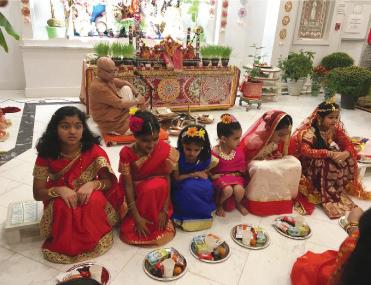
Kumari Puja
and a cultural program for children. We are looking for children aged 3 years and above for hatekhori. Please contact us if you would like your child to participate in this. On the 4th of March,
2019, we have Maha Shiva Ratri. Please check our website for the schedule.
We would like to thank all the volunteers who made these big events possible. Without their help, we would
really be lost. On behalf of all the members of Ananda Mandir, may I convey my heartfelt gratitude to all of you! Please visit our website. You can also get in touch with me at k_dutta_roy@yahoo.com.
My stay in Egypt not too many years back brings back so many memories. However, the site of Luxor remains especially vivid in my mind. I was amazed to see how the pharaohs of Egypt prepared for their burial long before their deaths. The pharaohs during their lifetime were able to furnish the materials for their worship in times to come. As I visited these tombs, I found the images of the inscription and ceremonial rites on the tomb walls. Daily life in pharaonic Egypt was radically different for individuals depending on gender, social class and the period in which one lived. During that period, the common people did not get the same royal burial. In pharaonic times people usually died young, men averaging around thirty-five and women around thirty. In this context, I would like to mention that I was amazed to see the tomb engravings of surgical instruments during that period and how closely they resemble our present ones and to see how advanced they were in science. The tourist guide mentioned that barbers used to perform the surgeries. Since they died young, the pharaohs made plans for their tombs long beforehand. They chose the burial site and filled it up with jewelry, amulets, etc. Egyptians believed that the pharaohs were really gods and should remain among their people. The building of the pyramids and the enduring worship of the dead pharaoh thus became the top priority for the ancient Egyptians. The pharaohs did not like the humiliation of being buried in an unmarked tomb. They wanted to attract visitors into their private tombs whilst they were in the occult middle period between death and rebirth.
The pyramids were built as death residences for the pharaohs-unshakable, indestructible, and eternal. When I visited the pyramid of Saqqara, I marveled at the underground portion that consisted of a burial chamber and a storeroom for
by Mandira Chattopadhyay
burial equipment. A large boat was included in the tomb, which allowed the spirit of the deceased to travel into the world beyond. Pharaonic Egyptians believed that death was a dismal process in which life-force was disrupted, but death also liberated the person in the sense that one’s soul was set free.
The discovery of many stone vessels bearing the names of the rulers of the early dynastic period in the substructure of the stepped pyramid of Saqqara denotes how the ruler prepared – unfortunately over time most of them have been plundered by thieves. In provisioning for a dead king’s tomb for eternal life, for example, the Egyptians apparently found no essential difference in placing real loaves or wooden models of bread, or paintings of loaves on the wall – all could sustain the deceased in their afterlife. The Egyptians obviously felt that they could feed the deceased and keep him or her after death.
When I went inside some of the pyramids the innumerable chambers and corridors coiled together and overwhelmed me. Writing or saying the pharaoh’s name would allow them to participate in the society of living, thus claiming immortality. The valley where the early period tomb complexes are located lies on the edge of the Nile valley.
The Egyptians wanted their identities to be remembered and cherished ensuring that they remain immortal. Deep behind the winding cliffs at Luxor, a limestone rock with a pyramid shaped peak, towers high above the western hills. To the ancient Egyptians this was the mountain of eternal life. It was within the limestone rock that vast beehives of corridors and chambers were carved out for the deceased Pharaohs. Every tomb was an entry to the Duat, the underworld. At the doorway to the
Illegal Parking in circular driveway of temple has to be STOPPED! I know it is a longer walk from parking lot but that is our parking design. There are three car parking back of the front house and few cars can be parked on front house driveway to the garage! Once these are filled, everyone (!) has to park at the parking lot!
Most often it is our own people who park illegally! I urge all of you to respect allowable parking space. If not, we are going to call police for TOWING! Let us cooperate and try to avoid this! Let us all be a good CITIZEN and follow the law! No one wants car to be TOWED! It is our community home and let us follow parking rule!
Thank you for your understanding and cooperation! Ashok Rakhit
President, Ananda Mandir
Duat stands the hawk-headed Horus, god of the western mountain awaiting the kings. As guardian of kinship Horus escorted the great pharaohs to the kingdom of his father Osiris deep under the earth and then to the afterlife.
Egyptian pharaohs were so concernedabout their afterlife that they used the entire economy of the empire to build a giant funerary complex. They spent decades constructing giant, megalithic structures – the pyramids, to ensure a safe passage into the spirit world for the pharaoh and his family. The structures once housed the graves of mummified pharaohs and their families. Although most bodies have been removed for research, some people believe there remain mummies yet to be discovered within the pyramid. The entrances to the pyramids are quite narrow, but if one can get in, one could see the stories of the burial of the pharaohs inscribed on the wall. Egyptians believed that there was just the promise of an eternal life –no heaven or hell. The proper burial of the pharaohs was a very elaborate process and was of utmost significancein Egyptian culture. Cremation was quite uncommon in the ancient Egyptian world. The Egyptian tradition, especially amongst royalty, of creating great monuments and tombs inscribed with their respective deeds was observed to make sure that the ruler would not be forgotten by the living and so would continue to exist on earth even after his death. Even after his death, the ruler had to fight for the welfare of his country in the eternal battle against chaos. Because of the ruler’s extraordinary role as god among men and the mediator between humans and the world of the gods, it was necessary to preserve his presence on the world of the living. This was the goal of mummifying the ruler’s body and worshipping him even after his death. Only in this way, the pharaoh remained forever among his people to ensure their happiness.
While visiting the Egyptians tombs, I recalled my experience in Gaya many years ago, since both entailed death. I still remember my trip to Gaya as I was traveling to Delhi along with my two grandfathers. On our way to Delhi, my grandfather and his brother (Chhoto Dadu) decided to perform the Pindadaan, since the Rajdhani Express had halted in Bodhgaya for the entire day due to a Bangla Bandh. Even today, I cannot erase from my mind the horrible experiences in Bodhgaya. I was a college freshman, and my mother had sent me off with my grandparents to visit my uncle in Delhi, presuming that I would get educated in Indian history and culture through my travels. I had not expected this sudden change in
plans and was very surprised when my grandfathers announced our upcoming trip to Gaya.
The first stop was in Bodhgaya, the most popular destination for tourists and Buddhist pilgrims, about seven miles from Gaya. The Bodhi tree under which the Buddha was enlightened over 2500 years ago became the site for the temple. My two grandfathers kept a strict vigil, since a young person kept staring at me, and followed us all the way to the Buddhist temple. As a young girl, I probably enjoyed the attention, but chuckled to myself as the young person looked at my grandfathers, stamped his feet and said, “Heck with those old people,” and left the scene.
A short visit to the gorgeous Buddha temple which resonated with all kinds of bells and charms. Most of the time, however, silence prevailed. I was reminded of the time when I along with my two best friends and a Buddhist friend used to visit the Buddhist temple in Kolkata. I do not remember how much we actually prayed, but we used to ring the bell to listen to the charming sounds and then run out of the temple.
After that peaceful visit to the Buddha temple, my tedious and tortuous journey would start. My two grandfathers held me tightly by my two hands on either side and I was completely squashed into the humongous crowd. Soon I heard all the Pandas starting to shout, “I am the Panda for your ancestors.” I shut my ears tightly and started to implore my grandfathers, “Let’s go home.”
My grandfathers started explaining how they had come to Gaya for Pindadaan (offering food to the departed ancestors in the form of round balls of rice). This ritual is performed in Gaya and some other religious sites in India after the first anniversary of the death of an ancestor. My two grandfathers both felt guilty for not performing this ceremony on time but were lucky enough to do so even after so many years. I was too young to understand the entire pandemonium. I was well aware of the Shraddha ceremony (the last rite after the cremation of a dead person), but not the Pindadaan. Gaya is one of the holiest sites in India where believers come from all over to perform Pindadaan with the conviction that the soul of a departed ancestor would receive their offering.
Upon reaching the site, several Pandas (brokers of family rituals) appeared before us and each claimed to represent our ancestral family. They all came with large bound registers containing the names of our ancestors. Finally, the Panda providing the most names of our ancestors was chosen as the proper Panda for the family. This Panda then began to haggle with us about the money he would charge for his services. Many rituals associated
continue to page 12 }
by rahul ray
Editor’s Note: Some of the events stated by the author are contrary to traditional beliefs.
In Indian tradition ‘Naranaang-matulokromo’ is an oft-uttered phrase meaning a man is fulfilled by becoming like his mama or maternal uncle. Obviously, it is used in a good sense. In other words, if that uncle is no good such a statement is of no use. Nobody knows what the origin of this much-used phrase is; it evolved in olden times. Yet, if we look back at the times of the Puranas, adisdainful uncle-character is Shakuni-mama in Mahabharata. In a traditional sense, for the reader of this epic, Shakuni is the most dreadful, crooked and conniving character of all. However, if we read the Mahabharata with a certain degree of analysis and thought we come up with an altogether different characterization of Shakunimama.
In the Mahabharata the Pandavas stood for honesty, truth and justice mirroring the Kauravas in a negative sense with their cunning and dishonesty. Therefore, there is a general tendency to jump to the conclusion that all the people who sided with the Kauravas were wicked. We promptly overlook the likes of Vishma, Dronachrya, Bidur, Gandhari, Sanjay and the likes. They, by the twist of events, sided with the Kauravas. These people were unsuccessful in their attempt to prevent the Kaurava-king Duryodhona from going to war with his Pandava brothers and depriving them of the kingdom of Pandu, which was justly theirs. In this vile game of deceit and deprivation Duryodhona found Shakuni as his compatriot who was possessed of a cunning that could only match that of himself. However, Shakuni’s acts reflect his deep penchant for justice for his family with a single-minded determination to bring down the despicable Duryodhona and his clan.
The land of Gandhar, which is present day Afghanistan, was ruled by king Subal. His daughter Gandhari was a young woman of unmatched beauty. Traders came down from the rugged and mountainous Gandhar with their wares to the warmer valleys of Hindukush. Words from their lips spread through the valley, where the river Indu or Hindu flowed down south, that, there was no one in the world as beautiful as Gandhari. This was further exaggerated bypeople on horse-back or riding on elephants. The news spread like forest fire. Hand-written notes, tucked into toes of homing pigeons carried the news of Gandhari’s beauty to Hastinapur, where Bhishma, the grand-father of Pandu and Dhritarashtra, was ruling the kingdom as a caretaker. Bhishma had marriedPandu off to the royal daughters Madri and Kunti of the
kingdoms of Madra and Kanouj. Dhritarashtra was blind at birth, but that was not reason enough for him not to be married to a princess from a royal family. Bhishma was busy sending agents of the state to find appropriate royal suitors for Dhritarashtra. The word of Gandhari’s beauty reached Bhishma’s ears, and he promptly sent an agent to king Subal with a proposal to marry off his nephew to Gandhari. At that time Hastinapur was a very mighty and expansive empire which acquired many kingdoms by force and otherwise. Therefore, common sense indicated that king Subal would be highly gratified to marry his daughter off, however beautiful she may have been, to a blind yet mighty royalty.
Moving north, leaving the mighty heights of the Himalayas to the right, the land of Gandhar was situated in the belly of the high mountain with lush green valleys. King Subal was a kind soul and took good care of his subjects. Gandhari was the apple of her father’s eye. The king was of the opinion that Gandhari’s beauty and charm would only be fitting for thegods. Instead, if the proposal from Vishma was to be accepted, Gandhari would become the wife of a blind king who would probably never be able to claim the throne of Hastinapur. Besides, he argued, if the person was blind how it would make any difference whether his wife was beautiful or ugly! Consequently, king Subal sentBhishma’s agent off with a note that he was not ready to marry off his heavenly beautiful daughter to a blind person, no matter how mighty he may be.
Bhishma was infuriated. Subal’s kingdom could be blown away in a whisper, yet he had the audacity to refuse his proposal! Bhishma called his people-in-arms. They arrived in full force with their ammunition, riding horses and elephants, and they set out for Gandhar to teach king Subal a lesson. However, the mighty army of Bhishma soon learned that conquering Gandhar was not as easy as he hadthought. This area was often covered with snow, temperatures dipped below freezing, and food was scarce. The rough terrain and the bitterly cold weather made the inhabitants of this land a hardybunch who were immune to all kinds of hardships. Consequently, Subal’s small army, which was no match for Hastinapur’s forces held back the conquering army at bay. Unable to run over the fortressed kingdom, Bhishma’s forces encircled the fort with a plan to starve the inhabitants inside to death. The people of Gandhar did not give up at first, but slowly and surely they became weaker as the days passed. Gandhari could not bear to see the hardships faced by her people and beseeched her father to accept the offer from Bhishma. King Subal, to protect his people from starvation relented.
After the wedding Gandhari went to Hastinapur with her eyes covered with a cloth that she never removed. As time moved on she gave birth to one hundred sons, the eldest of them was Duryodhana. After his birth, astrologers, palmists and wise men assembled in the court, as was the custom those days, and requested Dhritarashtra to send this newborn to a far, far-away place so that he could never come back to Hastinapur. They predicted that this son would otherwise bring death and destruction to the dynasty. However, Dhritarashtra, the probable inheritor of the throne did not pay any attention to those prophesies, and actually became very fond of Duryodhana. Bhishma counseled the two cousins, Pandu and Dhritarashtra to assume the throne of Hastinapur in some amicable way. However, Pandu suddenly died in an accident and his wife Madri burnt herself to death at the funeral pyre of her husband. Bhishma was deeply worried about how Dhritarashtra, a blind person, could take care of the kingdom. Meantime, Duryodhana and his ninety-nine brothers, and his cousins Yudhisthir, Arjuna, Bhima, Nakul and Sahadev, the five sons of Pandu started taking lessons in warfare and other princely affairs from legendary teachers like Dronacharya, Kripacharya and others. Arjuna was the best archer among them, while Duryodhana was best in club warfare, though he was beaten by Bhima on a few occasions. This was a huge source of worry for Duryodhana, because by nature he was an acutely jealous and deceitful person. He could not tolerate his cousins a bit and was always on the lookout to make their lives miserable.
Duryodhana’s nature, full ofvengeance and reprisal was not limited to his cousins. When he learned that king Subal, his maternal grand-father did not wish to marry her daughter off to Dhritarashtra, he was livid with anger and wanted to avenge this insult by teaching king Subal a lesson. Dhritarashtra was not keen on this plan, but ultimately gave in to his dear son’s idea of justice.
Duryodhana assembled a large army and went to Gandhar. By this time king Subal was an old man, and could not put up any resistance to the invading force as he had done earlier. The kingdom of Gandhar fell to Duryodhona’s army in no time. Duryodhona’s crookedness and vengeful nature knew no bounds. He cooked up a hellish plan to slowly kill off his grand-father and his sons instead of taking them prisoners. He imprisoned them and instructed the jailor that each day enough food for one person only should be given to all theprisoners*.
King Subal fully comprehended Duryodhana’s plot to starve everyone to death. He took Shakuni, the eldest and the strongest of his sons
aside and instructed him to eat all the food given to them by himself. King Subal ensured that this way Shakuni would remain alive and strong while the others would die of starvation. Shakuni followed his father’s instructions, and promised him and his brothers that one day he would avenge this ghastly act by destroying Duryodhana and his clan. King Subal and all his sons died slowly as planned. Only Shakuni remained alive.
A year later Duryodhana returned to Gandhar to savor the fruit of his cunning, and he was completely taken aback to find his uncle, Shakuni alive and strong. During this time, he was plotting to deprive his cousins from the inheritance of the throne by any means, and he was looking for a shrewd advisor who would counsel him on executing his crooked plots. Who could be better than his uncle Shakuni who had beaten all odds by staying alive and vigorous! This person would have to have unmatched intelligence and cunning. Duryodhana wasted no time in offering Shakuni the job of his chief counsellor, and Shakuni spared no time in accepting it.
Before departing from Gandhar, Shakuni stood in front of the prison where they were held captive by Duryodhana. He bowed down to salute his departed father and brothers, and took an oath: You gave away your lives to keep me alive and healthy. I promise that I will not stop at anything to annihilate the kingdom of Hastinapur and its inhabitants. My departed father and dear brothers, give me strength of body and mind that I am able to complete the task bestowed upon me before my life is extinguished.
After reaching Hastinapur, Shakuni promptly visited his sister. Within a few minutes Gandhari fully comprehended the reason for her brother’s presence in Hastinapur, and begged him to leave. Shakuni was adamant: Dear sister, our father and our brothers slowly turned into skeletons and died one after another right in front of me. Their end haunts me day and night!
Then Shakuni stopped and pulled out an object from his cloak. Dear Gandhari, can you make out what I have in my hand? Well, you can’t. It is a bone from our father’s skeleton. I never part with this as a reminder of my promise to him.
Gandhari shuddered in horror, while Shakuni went on: Only you and I are alive. Together, we will destroy this kingdom, Duryodhana and all, and avenge the murder of our kins. As flame engulfs this land they will sprinkle flowers and goodwill upon us from the heavens. We will have the last laugh when Duryodhana and his clan breathe their last. Would you not help me, dear sister?
by Asok baral
Soundspreposterous, doesn’t it? We saw, in the summer of 2018, tiny countries put up amazing displays of skill, energy, resilience, and sheer grit. And India, the second most populous country in the world, was nowhere to be seen. Nobody even expected them vying for a spot in the World Cup. According to FIFA’s June, 2018 ranking, India was at a low 97th position (China was 75th).
But it was not always like this. From 1948 to 1962, India was considered to be one of the best teams in Asia, and was in the top ranks among the nations in the game of football (called soccer in USA). This period is often called “the golden age of Indian Football”. In 1950 World Cup, India’s participation was offered on a platter. But Indian authority turned it down. What happened?
Evolution of world Cup
We need to step back and examine how the World Cup evolved. Back in 1928, FIFA (Fédération Internationale de Football Association), world’s football governing body, decided to stage their own international competition. The Summer Olympics of 1932, held in Los Angeles, did not include football due to low popularity of the game in the United States. Also, FIFA and International Olympic Committee (IOC) disagreed over the status of the amateur players, and so football was dropped from the games. Then FIFA President Jules Rimet of France planned to organize the World Cup tournament. The trophy still bears his name.
In 1930, Uruguay was the official world champion, and was also scheduled to celebrate the centenary of their independence. So FIFA awarded Uruguay the hosting rights for the inaugural tournament. A total of 13 nations participated, only four nations came from Europe. In the final, Uruguay beat Argentina 4-2 to become the first World Cup champion.
The 1934 World Cup was held in Italy, and a qualification stage was introduced. A total of 16 nations qualified. Uruguay, upset about the poor attendance of the European nations in their 1930 World Cup, did not send any team. Only Argentina
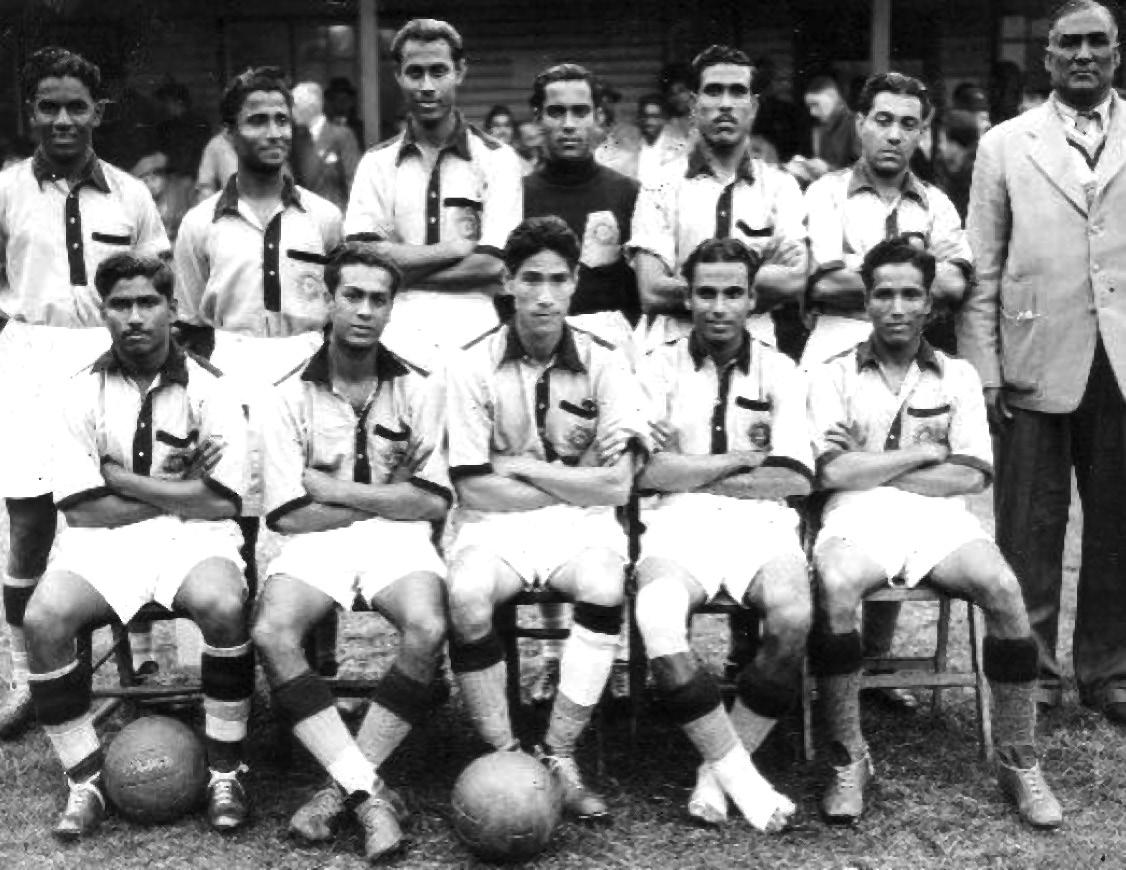
and Brazil came from South America. Italy beat Czechoslovakia 2-1 in the final to become the first European Champion.
The next World Cup in 1938 was also held in Europe, in France, much to the consternation of many South American nations. Uruguay and Argentina boycotted the event. Austria had qualified for the final round, but because of the annexation of Austria by Germany on 12th March, 1938 the Austrian national team withdrew, and some Austrian nationals were added to the German squad. Austria’s place was offered to England, but they declined, and the tournament was played with 15 nations. Italy won for the second time, beating Hungary 4-2 in the final.
For the hosting of 1942 World Cup, German officially applied to the FIFA Congress in Berlin in 1936. Brazil also applied in 1939. But when the Second World War broke out in Europe in 1939, FIFA cancelled the 1942 tournament.
During World War II, FIFA neither had the financial resource nor the personnel strength to plan a peacetime tournament. When the war ended in 1945, FIFA was in no position to organize a World Cup, and the 1946 tournament was also cancelled.
india’s Performance in 1948 Summer Olympics in London
While the FIFA world cup was in the midst of this hiatus, a newly independent India, sent a delegation to the 1948 Olympic Games in London. The Indian contingent comprised of 79 men and no
was named the host country. After the venue was fixed, FIFA went about persuading countries to send their national teams. The British team joined for the first time. They had withdrawn from FIFA in 1920 as they were unwilling to play against their former enemies in World War I.
The 1930 champions Uruguay returned, after boycotting the previous two world cups, and eventually became champions by beating Brazil 2-1 in a memorable match that was known as “Maracanzo” – a defeat well known in Brazil, and still haunts the Brazilians.
| continue from page 10
with the Pindadaan followed, like fetching water from the nearby river. However, my two grandfathers told them to make it simpler as they were too old, and I was too fidgety and restless.
women. There was not much expectation aside from the field hockey team which had been the Olympic champion since 1928. But the real surprise came from the football team. First, most team members played barefoot as they had done in India. Only few had socks or shoes when the field was soggy. Second, the team’s performance surprised everyone. Their first match against France caused lot of interest,and wasdubbed as “a shoe vs. noshoe match”.
The Indian team had many well-known players, whose names still reverberate with old-time Indian fans – Varadaraj as goalkeeper, Sailen Manna in defense, Mewalal and Ahmed Khan in offense. The French team scored first in the 30th minute and India’s Sarangapani Raman equalized in the 70th minute. The French team looked temperamental and frustrated. India was awarded a penalty, which Sailen Manna missed. Soon after, India was awarded a second penalty, which Sailen Manna delegated to a teammate to take. India missed that one too, and the game remained at 1-1. The Indians were accustomed to playing for 70 minutes in domestic games, but they hung on till the end as the clock approached 90 minutes. With only 1 minute to go, French forward, Rene Persillon, scored. The Indian team was completely heart-broken. They exited in the first round, but their performance had impressed the fans and the organizers.
1950 FiFa world Cup
After a hiatus of 12 years, the World Cup competition resumed in 1950, and Brazil
Italy was of particular interest, as they were the champions in the previous two World Cups. Just a year earlier, in May 1949, in an accident known as the Superga air disaster, the entire Gran Torino Team, which had many national players, perished. The Italian Airlines aircraft crashed into the retaining wall of the Basilica of Superga, which stood on a hill in the outskirts of Turin.
Italy first refused to attend, but eventually was persuaded, and the team came by ship, not by plane.
Germany was occupied and partitioned at that time. Their Football Association had been disbanded in 1945. Japan had been suspended from FIFA in 1945 for their failure to pay the dues. Also, they were still recovering from the ravages of war. Amongst the East European countries, Hungary, Soviet Union and Czechoslovakia refused to participate, but Yugoslavia sent their team.
FIFA, when determining the mix of teams, decided that the defending finalist and the host country, Italy and Brazil, would be guaranteed spots. That left fourteen spots to be filled. FIFA decided that seven of these spots would come from Europe, six from the Americas, and one from Asia. Four Asian countries were invited, and three of them - Philippines, Indonesia and Burma – withdrew.
That left India with an automatic spot to participate in the World Cup. This was also fitting as India was recognized by FIFA as the best Asian team after their London Olympics performance. But in the end, the All India Football Federation (AIFF) decided to withdraw, and Indian team did not come to
continue to page 13 }
In ancient India, as throughout India’s history, cremation was the usual practice. The cremation and the Pindadaan are one of the most important rituals in Hindu religion. Pindadaan, according to the Hindu belief, gives the ancestors an early relief and paves the way for departure to the ultimate world of peace. This ritual is believed to bring salvation to the departed soul, an obligation of all devout Hindus. Pindadaan is not mandatory but cremation remains universal for all Hindus. It is important to note that by Pindadaan the Hindus make sure that the spirits of their ancestors are set free. Hence, we can see some similarities of burial practices between the Hindus and the pharaonic Egyptians. The ritual of Pindadaan for the Hindus is comparable with the pharaonic Egyptian practice of placing actual loaves of bread or pictures or models of bread in the burial chambers for their ancestors to sustain their presence in this world. Like Hindus, ancient Egyptians fed their dead. It is interesting to note how after the cremation and during the Pindadaan several elaborate rituals and ceremonies follow like what takes place in the procession of burial practices of pharaonic Egyptians. Both the cultures believed in death and rebirth and in setting the spirits free but in Hindu culture the rich and poor alike, get the cremation and Pindadaan, but the details and expenses of the ceremonies differ.
A visit to the honey colored pyramids of Giza made me feel that pharaonic Egypt was a paradise, a golden Eden, an impossible fairytale. Being dead did not mean being gone for good. The spirit of the deceased could visit this world, mummified and adorned to appear as it did in life. No religion can avoid the subject of death, but the ancient Egyptians built their faith around it. This life was just a prelude to the eternal life beyond the grave.
| continue from page 12
Brazil. Thus ended India’s only chance of playing in the World Cup.
why did india withdraw?
Several reasons have been put forward for India’s withdrawal. The most common purported reason was that FIFA had categorically told India that the players would have to wear shoes. But according to Sailen Manna, who would have been the captain of the Indian team, shoes were not really an issue. Indian players could easily comply with the FIFA requirement.
The Brazilian organizers wanted to make their tournament truly representative of the world, and were keen on having a team from the land of Mahatma Gandhi. In fact, Prime Minister Nehru was supportive of India’s participation in international sports as an opportunity of projecting India’s image in international arena. But AIFF procrastinated and let the opportunity slip by.
One reason often mentioned is the financial burden of sending the players, the coaches and the manager half way around the world. When this was cited as a problem, the organizers agreed to bear a majority of the travel expenses. As Kaushik Bandyopadhyay, associate editor of the journal - Soccer and Society, put it: “A careful study showed that beneath the apparent financial difficulties as cause of withdrawal lay the AIFF’s unusual failure to appreciate the importance of participating in the World Cup, despite assurances from the organizing committee to bear a major part of the tour expenses”.
The official reason given by AIFF, according to India’s Sports Illustrated magazine, was “disagreements over team selection and insufficient practice time”. The general opinion is that the AIFF just did not take the World Cup seriously. It considered Olympic success as the ultimate goal. That impression is backed up by Sailen Manna, who told Sports Illustrated: “We had no idea about World Cup then. Had we been better informed, we would have taken the initiative ourselves. For us, the Olympics was everything, there was nothing bigger”.
It is obvious that in 1950, Indian football officials did not consider the World Cup as a big deal. The same thinking may have applied to the other three Asian nations that
withdrew. Many of the Asian countries did not even attempt to get into the tournament. As stated earlier, the football powerhouses in Europe, Hungary, Soviet Union and Czechoslovakia, did not enter. Also from Europe, Austria and Belgium withdrew. When Turkey was given one of the vacated slots, they withdrew citing financial difficulties. Portugal and Ireland also refused, when they were offered the open slots. France initially accepted, and then withdrew citing the amount of travel that would be required. So AIFF was not the only organization that did not see the value of World Cup participation.
It is also possible that AIFF had the apprehension that if India took part in the World Cup, their players would be branded as professionals and would be barred from the Olympics, which only allowed amateur sportspersons.
But that apprehension seems to be ill founded. In football, the distinction between professionals and amateurs existed only in countries like England, Spain, Italy and Brazil where organized professional leagues were played. East European countries openly defied this distinction. Their legendary players like Puskas (Hungary) and goalkeeper Yashin (Soviet Union) played in local leagues and took part in both the Olympics and the World Cup. Many of the East European players were employed in the army, only in name. The legendary Puskas was called “Galloping Major”, although he could barely handle a gun.
The top Indian players like Sailen Manna, Mewalal, and Varadaraj all worked for a living – Sailen Manna for Geological Survey of India, Mewalal in Railways and so forth. The monetary rewards they got from their respective clubs were a mere pittance.
What could have happened if India participated in 1950 World Cup?
It is a matter of speculation how India would have fared. India was placed in Group 3 along with Paraguay, Italy and Sweden. Paraguay was not a strong team and India could have fared well against them. The Italian team was demoralized after the 1949 accident, and tired after a long journey by ship. Sweden was a very good team, and eventually came third in the championship. Given the composition of the Indian team at that time, it
is conceivable that India could move into the challenge round.
The period 1948-1962 is called the “Golden years of Indian Football”. Besides the remarkable performance in the 1948 London Olympics, India won the gold medal in 1951 and 1962Asian Games, and the silver medal in 1964 Asia cup. In the 1956 Melbourne Olympics, India beat Australia, lost to Yugoslavia in the semi-finals and lost to Bulgaria in the Bronze medal match. Thus India was ranked 4thin the Olympics. Samar Banerjee (Badru) was the captain of the Indian team.In the 1964 Tokyo Olympics, under the captaincy of Chuni Goswami, India lost to Iran in round two of the qualifying games.
In this period, the Indian team was trained under a highly respected coach, Syed Abdul Rahim of Hyderabad. A superb tactician, Rahim coached Indian team until his death in 1963. Under his leadership, India was one of the first Asian countries to play in 4-2-4 formation, a novelty at that time.
After 1964, India’s football performance steadily declined. Many reasons have been cited. Besides political and other reasons that are often mentioned, one thing is obvious – the lack of appeal for football at a time when cricket became increasingly popular with the start of the IPL. Internationally, India’s Cricket World Cup victory in 1983 under Kapil Dev, and again in 2011 under M. S. Dhoni further helped to spread the game of cricket across India. Popularity of football was confined primarily to the eastern part of India, and in some of the major cities. Although football is a simple game needing few equipment and is popular all over the world, it did not cut any major appeal in India. What could have happened had India participated in the 1950 World Cup? What could have been had India not only participated but performed well? It is hard to say. But one thing is for sure, it would have etched pride in the Indian psyche, and maybe football’s popularity among the Indian youth could bring in success into the modern era. Whether there is another pivotal opportunity in Indian football around the corner remains to be seen, but the lessons of the missed opportunity of the 1950 FIFA World Cup are probably best summed up by Sailen Manna: “Indian football would have been on a different footing had we made that journey”.
Reported by Subrata Bhaumik
Sahitya O Alochana (SOA) is a monthly literary and topical discussion forum under the aegis of Ananda Mandir (AM). It completed its 10th anniversary in January 2018 and will have organized one hundred and nine (109) sessions - including the Literary Seminar at NABC 2018 - by the time this report goes to press. These monthly sessions feature exciting and illuminating discussions on diverse subjects including literature, art, theater and movie; history, philosophy and religion; science and mathematics; economics and business; and social issues, sports, and current affairs. Below is an account of the recently held sessions.
Shyamal Sarkar, a very successful Bengali entrepreneur with business building experience in healthcare, Information Technology and outsourcing, Real Estate, and Retail industries, in India and the US, and a key sponsor of our sponsor Ananda Mandir led a discussion on “Setting Up Business in India - Challenges and opportunities.” The session provided an overview of what to expect and how the economic and regulatory machine, and the culture work in the largest democracy and six largest economy of the world. This discussion addressed, among other things, a few key items that, if not addressed adequately in the planning phase, have the potential of derailing the progress of any project in India. Some of the specific issues that were discussed included:
a) Hurdles in setting up businesses
b) Differences in operational styles and mindsets of various Government Agencies
c) Onerous nature of the Indian Regulatory system and differences with regulatory framework in the western world
d) Regulatory obligations of the owners/investors that often provide disincentives for inflow of investment from across national boundaries.
e) Differences of the work culture, training and communication
It was a very received well as evidenced by the very active participation by the attendees. A ton of thanks goes out to Shyamal Sarkar for an informative session.
Due to scheduling difficulties, no session was held in September. And in November a wellplanned and organized session titled “Teaching Tabla in America” to have been led by Pandit Samir Chatterjee was canceled/postponed due to unforeseen complications involving township regulations.
Quite a few interesting sessions are in the pipeline for next several months. They feature eclectic topics including a discussion on life and works of V. S. Naipaul, the international literary stalwart who passed away recently, a session on genesis of the racial makeup of the Bengalis in the Indian subcontinent, a. discussion on Block chain, and an event showcasing local writers.
The friends of Sahitya O Alochana would like to thank Ananda Mandir for its continued support for the forum’s contribution to the cultural enrichment of the local Indian and Bengali Communities.
awarded a 2018 Macarthur Foundation Fellowship — also known as the Genius Grant.
Vijay Gupta was born in 1987 in an immigrant Bengali family. His parents, Vivek and Chandana, who emigrated from India in the 1970s, had high expectations for their two sons. Gupta was only 7 when he entered the pre-college program at the Juilliard School and 11 when he made his solo debut with the Israel Philharmonic Orchestra, marking the start of his international career. At 17, he received his undergraduate degree in biology from Marist College.

When he joined the Los Angeles Philharmonic in 2007 at the age of 19, Gupta was hailed as a prodigy. Growing up, music constantly played in his house, he says. “There was devotional Hindu spiritual music or Bengali folk music,” Gupta says. “Music was that place of respite, but it was also a place of service.”
Gupta and the other 24 winners of this year’s award have “all shown creativity, potential for future achievements — and the likelihood that $625,000, meted out over five years, will help them complete their grand designs,” as NPR’s Colin Dwyer reports.
recognized for Global Outreach Leadership for Providing Safe water
At the 2018 WEFTEC (Water Environment Federation Technology) Annual Meeting in New in October, Arup Sengupta was formally presented with the Steve Dentel Global Outreach Award by the Association of Environmental Engineering and Science Professors (AEESP) for “outstanding contributions and leadership through involvement in environmental engineering to the global community.” AEESP is made up of and serves professors and students in academic programs throughout the world providing education in environmental engineering and related fields. AEESP currently has more than 1000 members.
durga Puja 2018
reported by Pradip r. Das
October 20 & 21 witnessed one of the largest gathering in recent years at Plainfield High School to celebrate Durga Puja at GSCA. Every aspect of the two days’ festivities, the reception, the magnificent puja itself with eloquent mantras, anjali, the dhunuchi naach and sindur khela, the prasad and dinner, talent & youth activities and the evening’s cultural on-stage programs, earned much appreciation and kudos (a post puja online survey supported this overwhelmingly as well).
Debojit Saha & Sohini Mukherjee on Sunday swayed the audience and inspired several to dance to their melodious tunes.
Perhaps the most widely appreciated item this year was the dance performance by IMGE, and Urban Indian dance troupe founded by Ishita Mili. Urban Indian is a style primarily rooted in Indian classical dance and Hip Hop.
Philanthropy update
2018 saw a major expansion of GSCA’s philanthropic activities in US and in India as well. For our local community here, GSCA offered six scholarships to graduating seniors at Plainfield High School who were entering college, increasing the number of scholarships by four.
Sengupta was recognized for invention of the hybrid ion exchange-nanotechnology (HIXNano) and its application in mitigating global arsenic and fluoride crisis in drinking water in several countries including India, Bangladesh and Cambodia through international partnership for the last two decades. Sengupta has co-founded three social enterprises to improve access to safe drinking water around the world while creating employment opportunities.
| continue from page 11
Tagore-Sengupta Foundation: www.thetsfoundation.org Technology with a Human Face: www.techhumanface.org Drinkwell: www.drinkwellsystems.com
Shakuni pleaded. Gandhari was totally overwhelmed by her brother’s request. On one side were her father and brothers, but on the other were her husband, sons and other relatives. She stood still without a word, faced with a dilemma that knew no answers. At the end she took her brother’s side, promising to keep this secret to herself. She never brokethat promise.
The rest of the saga is well-known to many. But to make it contextual, Duryodhana, counseled by Shakuni invited Yudhishthira, the eldest Pandava to a game of dice, in which Yudhishthira lost everything by the cunning of Shakuni. In the end Yudhishthira pawned Draupadi, the common wife of the five Pandava brothers. Duryodhana, at the insistence of Shakuni attempted to disrobe Draupadi in the court in front of everyone. The game of dice ended with the Pandavas losing their share of
A notable and added attraction to GSCA’s puja this year was the “sharad mela”. The massive space of the high school’s gymnasium was decorated by GSCA members and set up for this purpose. An open mike, “alpona” competition, walk down the ramp “sharad sundari” competition for beautifully saree clad ladies (over 60 participated) added to the novelty of a community Durga Puja in this country
The evenings’ cultural programs included an opening ceremony with devibandana, a drama, a GSCA in-house program, “Namo Gange”, paying homage to the river Ganga and songs by Jeet Ganguli & Subhasree Debnath on Saturday and
In India, GSCA is supporting twenty nine students at various stages of their degree programs in Medicine, Engineering, Nursing, Finance and other undergraduate courses. Fourteen of these are in the MBBS program. All of these students are carefully screened and selected from a large pool of applicants.
Through GSCA’s philanthropic efforts over the last seven years, we seek to make positive changes in the lives of needy students aspiring higher education. Donations for this noble cause can always be made at www.gsca.us
NJPA celebrated Kali Puja which was well attended by people with religiosity at Wardlaw Hartridge School in Edison, NJ. It was able to show case a very successful kid’s program with Sare Ga Ma Pa North America’s finalist and Talent Hunt Participant Om Guha and Amrit Singh who gave a splendid performance on the Tabla. It also had special appearance of other celebrated artists.
As winter approaches, it is time to bid adieu to the year on a meaningful note.
People all over the world participate in numerous festivals to commemorate the spiritual and sacred. To bid goodbye to the year gone by and to ring in the New Year, NJPA has organized a New Year’s Eve event on December 31st.
Information about the upcoming event will be available on our Facebook page “NJPA Parivar.”
Till we meet again, Happy Holidays and a Happy New Year.
the throne, and were forced to move into an undisclosed place for fourteen years, with the caveat that they would serve anther fourteen years if their cover was blown. Gandhari, fully aware of her brother’s ploy pleaded with her husband, king Dhritarashtra and her son, Duryodhana to refrain fromall their misdeeds, but Duryodhanastood firm, supported by his reticent father.
After fourteen years the Pandavas returned from their ‘oggnatobaas’ or ‘living incognito’ to claim their share of the kingdom. However, they were turned away by Duryodhona with false charges again with counseling from Shakuni. This resulted in the great war of Kuruskhetra where Duryodhana and his allies fought the Pandavas and their allies for the right over the kingdom. At the end of eighteen daysof intense warfare the Pandavas defeated Duryodhana and
his allied army soundly. However, in the process, all men, young and old perished, bar the five Pandava brothers and Sri Krishna, their counselor. Observing the destruction, the Pandavas refused to reign over whatever was left of Hastinapur, and instead went on a self-exiled path to terminate their lives.
In the Mahabharata the person who gained the most from the turn of events was Shakuni. He almost single-handedly set his plans in motion, with the help of Duryodhana, and got his wish fulfilled. He achieved success through his unwavering determination to avenge Duryodhana’s cruelty, his intelligence in attaining the full confidence of Duryodhana that led him to self-destruction, and his honesty in being truthful to himself, his sister Gandhari and in a surreal way to his father and brothers.
Contrary to common belief, Shakuni was one of the most victorious characters in Mahabharata, as shown above. Therefore, if someone is blessed with ‘Naranaang-matulokromo, be like Shakunimama’, chances are this person will be highly intelligent, single-minded and determined, steadfast in his promises, and dutiful at all costs.
*It is based on tales from Mahabharata. Contrary to common belief there are many versions of this epic, particularly plots, sub-plots and events. It is the common belief that Gandhari covered her eyes to show respect to her husband, who was blind. But a different view, as depicted here also exists. Interested reader is directed to the website https:// www.quora.com/Mahabharata-Hindu-epic-Why-did-Gandhari-blindfold-herself.
by Anirudh Sarkar, Age
This could be the way the world ends.
First, a pair of cosmic protons collide at insanely fast speeds. The humongous radiation of their collision would create a miniscule, short-lived black hole, so miniscule, that it would last just a fraction of a second before evaporating. Just where the black hole is located, a part of reality with entirely different laws of physics than the universe we live in would initially start, increasing its size ever-outward at the speed of light. In its wake, atoms would fizzle into nothingness, and the universe as we know it would cease to exist.
“If you’re standing nearby when the bubble starts to expand, you don’t see it coming,” says Katie Mack, at the North Carolina State University in Raleigh. “If it’s coming at you from below, your feet stop existing before your mind realizes that.”
That terrible incident can happen only if the universe consists of another sort of dimension, on top of the existing three of space and time. So the fact that the universe hasn’t been completely wiped off due to black hole evaporation, puts limits on the size of any other sorts of dimensions, if any actually exist. Scientists have yet to find evidence of unknown, or extra dimensions, a lack that suggests that any real ones must be minuscule. But their existence could help explain mysteries like dark energy and dark matter, and point the way to new physics beyond the standard model of particle physics, so physicists are eager to probe their properties any which way they can.
Even tiny extra dimensions could have an influence on the universe, physicists suspect. For instance, gravity could leak into these extra dimensions, perhaps explaining why that force appears so much weaker than the other fundamental forces.
That leakage could also lower the bar for creating miniature black holes — at the tiny distances that the extra dimensions affect, gravity would appear much stronger. “If you have these extra dimensions, you don’t need to get as much matter in as small a space to make a black hole as you would without the extra dimensions,” Mack says.
That’s why some people thought the Large Hadron Collider at CERN near Geneva might make tiny black holes when it turned on in 2008, but so far none have appeared.
Nature can collide particles with even higher energies, though. The highest are found in ultrahigh energy cosmic rays, protons that zip between galaxies with energies higher than 8 billion-billion electron volts. That’s 100 million times as high as the energies produced by the LHC. If collisions between those particles have made any black holes, then physicists could work out the gravitational reach of any extra dimensions, or how close you have to get to an object before gravity
starts acting weird.
This scenario has a dark side. According to a theory first put forward by Stephen Hawking in the 1970s, energy radiates away from a black hole until the black hole eventually disappears. The smaller the black hole, the faster it evaporates, so any black holes made by colliding cosmic rays would fizzle almost instantaneously, or so the theory goes.
That could be bad news for the universe. In 2015, theoretical physicist Ruth Gregory of Durham University in England and her colleagues showed mathematically that when black holes evaporate, they can nudge the universe into a state in which the laws of physics are so different that atoms no longer hold together.
“No structures can exist,” Mack says. “We’d just blink out of existence.”
This catastrophe is called vacuum decay. It relies on the idea that the fundamental nature of the universe, called its vacuum state, might not be the most stable one possible. There could be another configuration of physical laws, the true vacuum that sits in a lower energy state.
Evaporating black holes could provide the bump needed to create a bubble of this true vacuum, Gregory and her colleagues argued. And once some true vacuum exists, the space around it would want to join the true vacuum. The bubble would expand outward at the speed of light, taking the known universe with it.
“The black holes are quite naughty,” Gregory says. “They really want to seed vacuum decay. It’s a very strong process, if it can proceed.”
That set of ideas leads to a paradox, Mack and McNees realized. Collisions between ultrahigh energy cosmic rays “should have happened thousands of times,” McNees says. If extra dimensions exist, and if they are large enough for ultrahigh energy cosmic rays to make mini black holes, then vacuum decay should already have happened. The fact that we are here to wonder about it means that extra dimensions, if they exist, must be even smaller than previously thought.
Mack and McNees calculated that any extra dimensions must be smaller than about 16 nanometers, or billionths of a meter. In other words, the gravitational influence of the extra dimensions would extend only that far. That’s hundreds of times smaller than the previous best estimates and rules out some of the theories that let gravity leak into extra dimensions.
The analysis is fun and thorough, says cosmologist Ian Moss of Newcastle University in England, who worked with Gregory on the 2015 paper. But he’s worried that Mack and McNees make too many assumptions about what conditions would lead to vacuum decay.
“You can’t really say that these limits are totally convincing,” he says. “There is nothing wrong, but there are so many ifs.”
“KiSHoLoy”
WeLCoMeS PARTiCiPATion oF CHiLDRen & yoUnG
Ananda Mandir’s Youth Group, known as “Kisholoy”, publishes a monthly wall magazine. During your visits to Ananda Mandir, you may have seen it prominently displayed in our Front Building. This magazine features articles, artwork, puzzles, news and other types of informational items -- all written by the community’s children and young adults. If you spend a few minutes reviewing the contents of any of the monthly postings, you will be impressed by their variety and appeal. From a travel story written by a third grader to a serious essay written by a college freshman, from a sketch drawn by a young girl to a quiz posted by a high school boy, you will find the contents interesting and creative.
During the Durga Puja season, Ananda Mandir publishes a “Sharadiya” issue of Kisholoy that is distributed free to all our Life Members. This special issue includes a selected collection of articles posted on the wall magazine during the previous twelve months. For many of the authors, these represent their “first printed publication”, a milestone in their young life!
If you have school or college-going children, please encourage them to submit their literary and artistic work to Prof Dipak Sarkar, who has conceived and organized this effort for many years. His email address is DipakSarkar@hotmail.com
Kisholoy also encourages volunteer community activities by children and young adults. Kisholoy volunteers take active interest in major events at Ananda Mandir during the year. Prof Sarkar will be happy to give you more information on such activities. He can be reached at 609651-1023.
by Shivan Mukherjee,
the Nobel Prize for Physics was awarded to three individuals jointly. These three individuals were Donna Strickland, Arthur Ashkin, and Gerard Mourou. Half of this prize was given to Arthur Ashkin who is now 96 for his work with optical tweezers and their application to biological systems. Ashkin developed the tweezers in 1986 while working at Bell Labs in NJ. Since then the technology
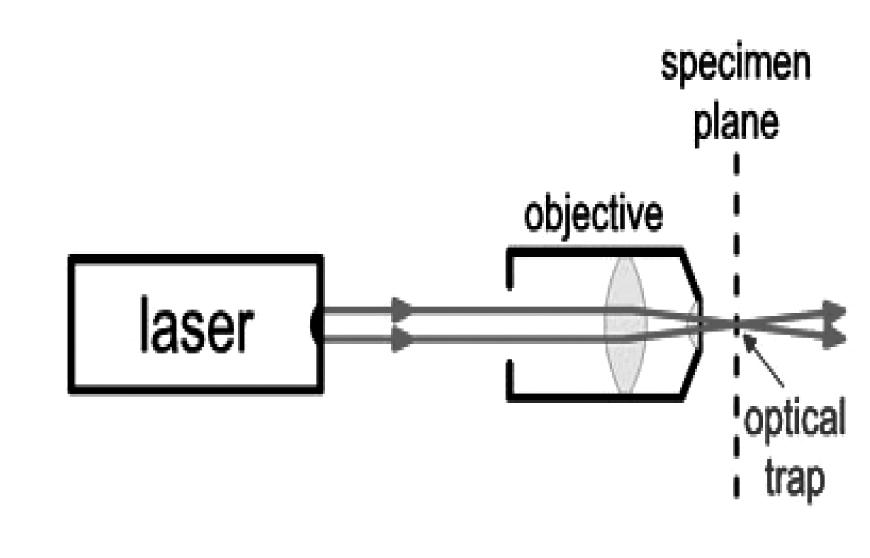
has advanced considerably and he was recognized for his work with the Nobel Prize. The other half of this prize was split between Gerard Mourou and Donna Strickland for their method of generating high intensity ultrashort optical pulses. This is an important advancement in the science of optics. Although we understood how single atoms functioned and worked, we could only observe and manipulate them in groups. With optical tweezers, this can now be done with single atoms. Optical tweezers allow for the manipulation of atoms one by one. The use of a focused laser beam from a microscope produces radiation pressure that is able to trap particles
as small as the single atom. It is known as an optical trap. Modern optical traps like the one that Ashkin has created are much more complex and extensively modify commercial microscopes What this allows for is the testing and proving of the fundamental laws of physics. Optical tweezers have a great scope and future in experimental science and can help us understand atoms more than we could ever before. There is still much we don’t know about the universe and what it is made up of as well. While optical tweezers can trap things as small as the single atom it is also able to trap viruses, bacteria, living cells, organelles, small metal particles, and even strands of DNA. Living things can be kept alive which makes it all the more groundbreaking and it also keeps the machinery of life like DNA alive as well. The combination of optical tweezers with microscopy allows us to visualize individual molecules and apply forces at the same time that can reveal properties in much greater detail.
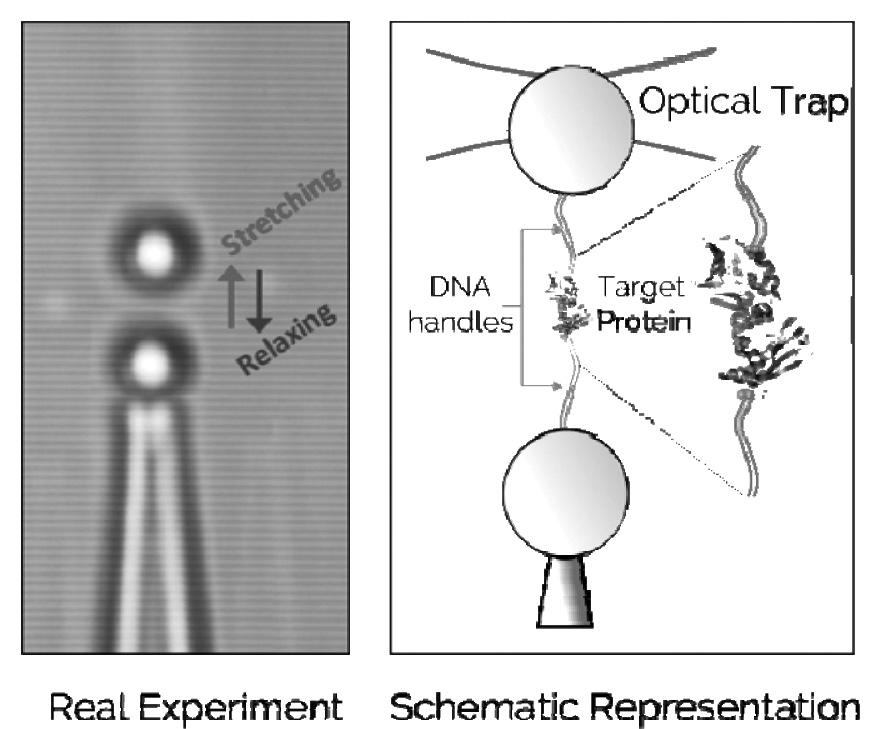
each winner received a $500 cash award and a plaque with a citation. our heartiest congratulations to the winners
jayashree Chatterjee winner, English nominations Category
Jayashree’s love for literature dates back to her childhood. Born in a family that valued education highly, her mother was an avid reader of Bengali literature and a writer of short stories. Jayashree started writing early in her life and has continued to write even with her busy family and professional life. She has published many articles and short stories in The Times of India, The Illustrated Weekly, The Statesman, The Kuwait Times and other newspapers and magazines. She has also published a novel (One Step Ahead), an anthology of short stories (Where Oleanders Don’t Grow), and essays on subjects ranging from the works of Rabindranath Tagore to perception of death among children. Jayashree received her BA degree in History from Presidency College and her Master’s degree in Library Science from the Rutgers University. A long-term resident of New Jersey, Jayashree is well-known within the Ananda Mandir community.
Subrata Kumar das winner, Bengali nominations Category
Born in the Faridpur district of Bangladesh and now a resident of Canada, Subrata is a well-known essayist, literary critic and translator of works by Bangladeshi authors. His first passion is to bring world recognition to the works of eminent Bangladeshis, and he has creatively utilized the resources of the Internet to achieve this objective. His second passion is to build bridges between the peoples and literature of Bangladesh and West Bengal through interchange and mutual respect. He has published eight books of essays, edited three anthologies and has published two works of translation. A champion of progressive and secular ideals, he is recognized in both Bangladeshi and Indian literary circles in the Toronto area as an organizer and a catalyst. He is currently the Executive Director of Toronto-based Bangladesh Literary Resource Center.