Ananda Mandir
269 Cedar Grove Lane
Somerset, NJ 08873


Ananda Mandir
269 Cedar Grove Lane
Somerset, NJ 08873
A recent burst of reports from Indian newspapers caught my attention
On the occasion of the 67th Foundation Day of IIT-Kharagpur, Kewal Kumar Sharma, a senior official of the Union Ministry of Education in India, announced a new scholarship scheme for researchers working on their PhDs in the IIT system or at the Indian Institute of Science, Bangalore
The scheme will grant monthly scholarships of 70,000 Indian rupees (INR) to 2000 meritorious students in scientific and engineering disciplines For the selected students, the central government will pay this monthly stipend for a maximum period of five years Subsequent reports indicated that the amount may be increased to 75,000 INR per month Currently the monthly stipend for PhD students at these institutions is 24,000 INR
That figure of 70,000 INR monthly stipend for PhD students simply stunned me
As a lowly undergraduate student at IIT-Kharagpur in the 1960s I was fortunate to receive a monthly scholarship of 120 INR from the Government of India. That sum was enough to cover about 85% of my expenses, including room and board. At that time the PhD students received monthly stipends of 350 INR. From 350 INR to 70,000 INR per month is a huge 200-fold increase! Granted that more than 50 years have passed since my IIT days but a 200-fold jump in that period? Has inflation in India been that high over the last five decades, I wondered?
Before digging into the question of inflation in India, I decided to reflect on my experience in America with wage and price increases over the last 50 years
Back in 1967, research assistants working on their PhDs received a monthly stipend of $250 ($3000 annually) at Purdue Uni-
By Debajyoti Chatterji
versity in West Lafayette, Indiana, my American alma mater In 2016 the average figure at the same university was around $24,000 per year That’s only an 8-fold increase, a far cry from the 200-fold increase in India for the same 50-year period
In 1973, when I joined GE’s R & D Center in Schenectady, NY, as a research scientist with two years of post-PhD experience, my starting salary was $18,000 per year Now the average figure for a similarly educated and experienced PhD in industry is about $125,000 That’s a 7-fold increase, not too far from the 8time jump in stipend for research assistants at a major American university
How about the increase in the price of a first-class postage stamp in the US over the same period? It was 5 cents in 1967, and now it stands at 49 cents.
The price increased by a factor of 9.8, in the same league as the increase in salaries for highly educated students and professionals.
Clearly, inflation has played a much bigger role in India than in the US during the last fifty years
At this point, an economist may interject and point out that I am mixing “wage inflation” with the more commonly used “price inflation” (meaning change in the Consumer Price Index) I admit being guilty of that sin However, this article attempts to present a simplified overview on both forms of inflation in India to an average reader And I am hopeful that the average reader will be interested in the general picture emerging from the article and will forgive me for not always differentiating between wage and price inflation
Inflation in India vs the US
Monday, January 22 8:30 am – 11:30 am
In India, inflation rate for the 43-year period from 1969 to 2012 averaged around 7 7% per year, quite a hefty rate Inflation rate in the country peaked during this period in September, 1974, at the painfully high level of 34% In sharp contrast, the Indian economy suffered a deep recession during 1975-1976, and the inflation rate dropped to (-) 11% Recently, inflation in India has come down to a more manageable level of 3 5%
The US has also experienced significant fluctuations in inflation rate during the comparable period but the annual averages have been much lower and the year-to-year changes more moderate For the 40-year period from 1977 to 2017, inflationary increase in the Consumer Price Index in the US averaged 3 2% per year. Inflation reached double digits twice during this period: 14.8% in 1980 and 12.3% in 1974. Even during the Great Recession of 2009, inflation rate dropped to a low of only (-) 2.0%.
How much of a difference does a few percentage points in inflation rate make to a wage earner? Let us compare the effects in India for 50 years of inflation at 7 7% average with the effects in the US at 3 2% per year
With that kind of inflation in India, a monthly stipend of 350 INR in 1967 would rise almost 64 times to 22,400 INR by 2017 And that is close to what the PhD students currently get in India (the increase to 70,000 INR per month is a planned increase, not yet implemented)
According to the USInflationCalculator com, the Consumer Price Index in the US has jumped 7 39-fold in the same 50-year period (confirming our earlier discussions on increases in PhD stipends in this country from $250/month in 1967 to about $2,000/month now) Compare that with the 64-fold increase seen in India over roughly similar time frame, and you will appreciate the effect of a few percentage point difference in inflation compounded over a long period
of time!
Inflation Effects in India on Wages and Prices
High rate of inflation has affected every aspect of the Indian economy, some to a greater extent than others Here are some anecdotal facts and figures I have collected from my friends on this subject food Items
• Cost of food items increased on the average by about 200 times during the period of 1975 to 2017 For example, mutton/goat meat used to sell for 3 00 INR/Kg in 1975, and now sells for 600 INR/Kg Bengali's favorite fish, pabda, now sells for 600 -700 INR/kg but used to sell for 2 50 to 3 00 INR/kg back then Another delicacy, hilsha fish, now sells at 1200 - 1500/Kg, an increase by a factor of 400 on the average, from its price in 1975
• Interestingly, price of one class of beverage has behaved quite differently: alcoholic products like beer, wine and spirits A bottle of beer cost about 3 INR in 1961 and 6 INR in 1975, and now sells at 125 INR, a measly 20 to 40 times increase over 50odd years. This modest increase probably reflects the huge increase in consumption of alcoholic products during this period. This has driven a very large increase in production, and that, in turn, has driven down the unit production cost Similar effects have been also seen in prices of dairy and poultry products, much to the benefit of the common man Real Estate
• Back in 1975, a nice-sized (2 or 3 bedrooms), new apartment in a good locality in Kolkata sold for 1 25 lakh INR That apartment would now sell for 3 75 to 4 00 crore INR, a 300fold increase
• In the property market, price inflation in Kolkata has been much lower than in Delhi, Bombay or Bangalore During this period of 40 years, price of real estate has increased by factors of 500 to 800 in these cities, with Bombay leading the pack
• The biggest inflation in property price occurred in the 20year period between 1992 and 2012 For example, a 3 katha
Continued to page 6
NO. 1215
Calendar of Events (Dates are subject to Change)
Please check our website frequently www anandamandir org tel: 732-873-9821
NOTE: If a particular Puja time is not listed, please contact temple or visit our ebsite: anandamandir.org
JanUaRy (*) new year Darshan
Monday, 01, 9:00 am – 9:00 pm Satyanarayan Puja
Monday, 01, 6:00 pm – 8:00 pm Ratanti Kali Puja
Monday, 15, 6:00 pm – 8:30 pm
Shyama Puja
Tuesday, 16, 6:00 pm – 8:00 pm
Ganesh Chaturthi
Sunday, 21, 9:30 am – 10:30 am Saraswati Puja & Hatekhori
Monday, 22, 8:30 am – 11:30 am
Bani Bandana
Sunday, 28, 10:00 am – 11:30 am Satyanarayan Puja
Sunday, 28, 5:30 pm – 7:30 pm
Sahitya o alochana
Friday, 19, 8:00 pm Cultural Program (*)
fEBRUaRy (*)
Shiva Ratri
Wednesday, 14, 9:00 am – 9:30 pm
Shyama Puja
Thursday, 15, 6:00 pm – 8:00 pm
Sahitya o alochana Friday, 16, 8:00 pm Cultural Program (*)
MaRCH (*)
Dol Purnima & Satyanarayan Puja
Thursday, 01, 6:00 pm – 8:00 pm
Shyama Puja
Friday, 16, 6:00 pm – 8:00 pm
Sahitya o alochana Friday, 16, 8:00 pm Cultural Program (*)
(*) See www anandamandir org or Call Mandir for details
Special Religious Services: Upon request, the priest of Ananda Mandir offers services such as inhouse Shraddhas, Rituals associated with Cremations (Antyesti Kriya), Shraddha Anniversaries, Pre-wedding rituals (Naandimukh, Ashirwad, etc), Upanayan (Paitey), Annaprasan, Wedding Ceremonies & Wedding Anniversaries, Griha Prabesh (Bhumi Puja), Consecrations of new cars (New Car Pujas) and others If you have needs for any of the above or more, please feel free to contact Biswabhai @ 732-873-9821
ananDa SanGBaD
A Periodical Newsletter
Published By ananDa ManDIR
(A Tax-Exempt, Non-Profit Organization)
269 Cedar Grove Lane Somerset, NJ 08873
Ph: 732-873-9821
Website: www anandamandir org
PUBlICatIon CoMMIttEE of ananDa ManDIR
Chairperson: Pronoy Chatterjee, pkc usa@yahoo com
Assistant Chairperson: Subrata Bhaumik, Bhaumik subrata@gmail com
Editor-in-Chief: Debajyoti Chatterji, Debsmee572@gmail com
Managing Editor, Ananda Sangbad: Guru Chakravarty, guruchakravarty@yahoo.com
Managing Editor, Anandalipi: amitabha Bagchi, amitabhanj@gmail.com
Editors: Subrata Bhaumik, bhaumik subrata@gmail com
Subhodev Das, subhodev das@gmail com
Sushmita Dutta, sushmitadutt2@gmail com amrita Kangle, amritakangle@hotmail com nupur lahiri, nupurlahiri@aol com
Associate Editor: Ruby Banerjea, r banerjea@yahoo com
Members-at-large: ashok Rakhit
l
All queries, articles, news reports and letters should be directed to the Managing Editor: Phone: 908-752-3065, E-mail: guruchakravarty@yahoo com
l
For general information, please contact the following executives of Ananda Mandir: ashok Rakhit, President
Jaiprakash Biswas, Vice President
Suprasad Baidyaroy, Vice President
arun Bhowmik, Vice President
Sajal Mukherjee, Gen Secretary
Pradip Majumdar Treasurer
We, at Ananda Sangbad, are excited to welcome the New Year with open arms There are a lot of things to be excited about, the first and foremost being the hosting of NABC (North American Bengali Conference) by Ananda Mandir at Atlantic City, New Jersey, from June 29 through July 01, 2018. For that occasion, we plan to publish a special issue of Ananda Sangbad, showcasing Ananda Mandir ’s history and activities and our news magazine. We are proud that not only has the Mandir become the focal point of most Bengali religious activities in the community, but also the Tagore Hall has become a prime venue for hosting cultural programs like musical concerts, theaters, and dance performances as well as for family celebrations It is safe to say that Ananda Mandir now has become a must-see place for the steady stream of Bengalis visiting this area from India
NABC is going to be the dominant story here for the next six months A large number of members of Ananda Mandir are involved in staging the best possible programs in the history of NABC In the process, Ananda Mandir has extended its hands to invite talented people from other local organizations An elaborate plan is being made to ensure success in every area of interest: Entertainment, Business/ Medical forums, Literary Seminars, Film Festivals, Youth Programs, Reunions, so on and so forth We will be able to see and meet, and even talk with a vast array of famed Bengali entertainers and leaders from India The event will certainly enhance the bond between the Bengalis across the ocean With very generous offers made to the performers from abroad, NABC has been able to help establish a new genre of entertainers in Bengal enriching the culture
But there are other attractions of NABC too It has now become a prime occasion to meet with close college buddies that are scattered around in the USA Some of them will just ignore the hullaballoo on the stage, and gossip away the whole time in the lobby reminiscing the old times with dear friends. Even after fifty years of the first mass immigration to this country, most Bengalis still starve to be with their own kind.
What has NABC not achieved yet to everyone’s satisfaction? It has not succeeded, to a large extent, to attract the second and third generation Bengalis. While the teenagers are nearly dragged in by the parents to these mega-events, the younger adults have not shown much interest in this Bengali thing, and are just content to stay away The born-here Bengali generation is slowly but surely getting assimilated in the American community, and is not yet interested in carrying on the NABC flag We need to, and hope to get the second and third generation Bengalis involved in NABC and other cultural activities to nurture our Bengali heritage
Guru Chakravarty Managing Editor, Ananda Sangbad
Ananda Sangbad
Dear Members, 2018 is here! Like the previous year, we again celebrated the New Year’s Eve party at Tagore Hall in partnership with Kallol Many of you joined us as we celebrated and welcomed the New Year Year 2017 had been a challenging year, and I am happy to report to you that with your support, we met most of our financial and operating goals! Here is a list of our major accomplishments in the year 2017:
New Year of 2018 is here! Like previous year, we again celebrated the New Year’s Eve party at Tagore Hall in partnership with Kallol I am sure many of you joined us as we celebrated and welcomed the New Year Year 2017 had been a challenging year and I am happy to report to you that with your support, we have met most of our financial and operating goals! Here is a list of our major accomplishments in the year 2017:
1 Tagore Hall
a Hired a full-time Manager, Mr Surinder Singh, to operate our hall He has done an excellent job to make sure our hall is fully operational
b A new website, www tagorehallnj com, was developed to help publicize and market this resource to our community
c The hall is rented almost every weekend to our members for occasions ranging from stage performances to graduations, anniversaries and weddings
2 Temple
a Temple is fully functional in the expanded facility with a large lobby area and much larger capacity for inside seating than before
b Vegetarian kitchen is fully functional in temple basement with approved dining area
c Private Service room will be added to the current lobby in early spring this year so that all private puja services could be moved to the new expanded temple
d We had almost full capacity attendance at both Durga Puja and Kali Puja
3 Parking
a We have currently 210 paved parking, and additional 110 parking spaces have recently been approved by the Franklin Township. This additional parking should be completed with a new paved driveway in early spring of 2018.
b. An entrance gate is planned to be installed in the spring this year
4. Financial
a. We raised over $300,000 at our Annual Fundraiser this year – another successful such event. Thanks to all our donors for their generous donations and to our dedicated members who solicited the donors
b With the ongoing rental of Tagore Hall and continued temple services by Biswabhai, we are close to our financial target for first year of operation of the new facility With the help of revenue from Durga Puja/Kali Puja and Annual Fundraiser in addition to monthly operating revenue from buildings, we are meeting our financial obligations on monthly loan service to Unity Bank and other regular operating expenses
5 Other
a Ananda Mandir is sponsoring 38th North American Bengali Conference (NABC) in Atlantic City, NJ on June 29th to July 1st, 2018 Our mission is to work with all sister organizations in the tristate area to present a successful conference under the umbrella of Ananda Mandir Kallol has been our major partner for the event, as we enjoy support of all the other organizations in NJ/NY area Please attend and help us in making NABC-2018 a big success!
In summary, we have now completed most of the planned construction and are now fully operational Our sincere thanks to all our members who have been supporting Ananda Mandir from its humble beginning to its current expansion Your donation is the primary source for both capital investment on construction and regular operational expenses While we should be proud completing construction of a fully functional temple and a community hall, the fiscal challenge will remain for next several years until we get more experienced both in physical operation and good fiscal management Thank you for your support and pray for Ma’s blessings for best of health and happiness!
ashok Rakhit President,
Ananda Mandir
If you are a Life Member or an Associate Member, but didn't receive your copy of ananda Sangbad, it may be because we do not have the correct address on file for you. Please send an email to Guru Chakravarty (guruchakravarty@yahoo.com) with your correct address, and we will send you another copy.
“Should
Editor’s Note: This is in response to “Letter to The Editor” written by Subrata Bhaumik in the October-2017 issue of Ananda Sangbad, on the article “Should we worry about Climate Change?”and another “Letter to the Editor” in the July-2017 issue on the article “Dark Side of Technology” both authored by Basab Dasgupta This is a rebuttal by the author to conclude the discussions on both articles Dear Sir,
I read with great interest Mr Subrata Bhaumik's "letters to the editor" about my articles on "Dark Side of Technology" as well as "Should we worry about Climate Change" As Mr Bhaumik noted both of these are opinion pieces and I certainly do not expect everyone to agree with my opinions However, what I find annoying and amusing at the same time is the fact that in both letters he distorted what I wrote and proceeded to severely criticize those distorted interpretations Secondly, he seems to have a tendency to get personal in his attacks which are of course not amusing
Instead of refuting all of his criticism point by point let me just list some unfair if not untrue comments he made in his latest letter on my climate change article
1) I did NOT write nor imply that Al Gore made up the term "Global warming" All I said was that he USED the term.
2) I never said that we should neglect problems of carbon emission as an immediate issue. Nor did I deny that carbon footprints are on significant rise. In fact, I said that reduction of fossil fuel, development of alternate energy and increased forestation are obvious things to do. My point was that fighting climate change issues should not be one of our highest priorities.
3) By his own admission there is a "roaring debate between the causality . ferocious hurricanes" implying that the connection between climate change and hurricanes is still being investigated. I have no problem in accepting the causality once it is "quantified"
4) It is amusing that he speculates that free market economy would not lead to fighting climate change because of lack of "highest economic return" It is amusing because he had argued exactly opposite in his previous letter when I asserted that new technologies are driven by money and not by necessities (He had mentioned that Edison invented light bulb to address a necessity and not for making millions of dollars; GE, Philips simply benefited from that) It is a fact that solar panels and electric cars are being used in increasing numbers and who can forget the Government's loss of $535 million of investment in "Solyndra"!
5) As far as the topic of hiatus is concerned my source is not any right wing think tank but internet To elaborate on this issue, I looked at Wikipedia again There was a general agreement that there was indeed a hiatus during the 1998-2012 period However, I acknowledge that many sources claimed that "if allowances were made for known variability the rising temperature trend continued unabated" To me this only supports my central theme that atmospheric science is not an exact science In any case my reason for even mentioning the "hiatus" was that it probably was behind the name change from "global warming" to "climate change"
6) He uses phrases and statements like "unrelated and irregular", "not based on good science", "let the market decide on the fate of so called less catastrophic phenomena", "Government shouldn't intervene" etc in quotation marks giving the impression that they were taken literally from my article The fact is that I did not write any of those He did a similar thing in his earlier letter I did say that all "irregular" weather phenomena are now attributed to climate change That is simply a statement of fact Hurricanes? It is due to climate change Forest fires? It is due to climate change Too much rainfall? It is due to climate change Hole in the Antarctica? It is due to climate change Earthquake in Mexico? It is climate change They are all irregular phenomena Are they related? I don’ t know and I did not say if they are related or unrelated Now the personal angle I am surprised that Mr Bhaumik has gone beyond the analysis of the content of my article and speculated my motivation for writing (an unfettered desire to adopt contrarian views) and the way I achieved that (by presenting maverick arguments just for the sake of being nonconformist) Let me conclude by saying that I am puzzled by this letter to the editor because Mr Bhaumik is a member of the AS editorial board and this is the first time in my experience that I have seen a letter to the editor written by an editor
I would not have been unhappy if none of these articles were published in AS because I have dozens of other articles to offer Finally, I believe that both of these articles are well-written and based on sound reasoning Of course, that is only my opinion I will let the readers be the judge
Basab Dasgupta December, 2017
“The Makings of a Bengali Entrepreneur ” “What the Doctor May Not Have Told You”
Dear Sir,
I enjoyed reading the October 2017 edition of Ananda Sangbad My kudos go to Debajyoti for bringing to light the achievements of Jaiprakash as a successful Bengali entrepreneur, a philanthropist and an ideal family man As first-generation immigrants, we can relate to his struggle to establish himself, his adaptation of new skills and his transformation from an engineer to a businessman It is remarkable that his wife, Suparna, sacrificed her career as a doctor and followed her husband to the US to provide better education for their children It is no wonder that the children met their parents’ expectations This is the story of one of our own and we share the joy at their success I would like to see more of this kind of interview
I also liked the article Debajyoti wrote about the rise in blood sugar level as we get older. I have also experienced that my blood sugar level and consequently A1C are rising as I am getting older. I suspected that age has something to do with it. Thanks to Debajyoti’s in-depth study and observation, it clarifies much of my confusion. The other health-related issue that most of us at our advanced age deal with is high blood pressure and coronary disease. It would be helpful if someone can provide some insight related to this topic.
ankuresh Ghosh December, 2017
By Sushmita Dutta

Picture: Bendable display monitor will be noteworthy new technology feature from lenovo.
(author’s note: By technologies here, I am referring to technology products for the user markets worldwide. Technologies and devices that have been listed are compiled from various sources including a peep into Gartner’s recent press report on technology forecast for 2018 Additionally, I have included a para on some fascinating technologies to come beyond 2018 )
We are now into the era of Internet connected coffee and juice makers Alex on Amazon com makes us follow our morning chores like exercise We breathe, eat, sleep and live in an age of information technology and nothing really works in our day to day lives without interfacing with one technology or the other including technology networks like social media, consumer market products and gadgets and of course, almost everything that is for entertainment The range of these includes – smartphone, smart TV, automated systems, wearable gadgets, home appliances, health watch wearables, fitness machines, automated car phones and many more Here is a list of best technologies that dominated our lives in 2017 and technologies that will rule the market in 2018 Please feel free to communicate your thoughts on this topic to the Editor of Ananda Sangbad or write to us to seek advice on bottlenecks or difficulties you may be facing in using a technology device Yes, we offer technical support to our readers for free Also, the technology world is full of “choice confusion”, there are hundreds of makes and models of a singular technology type You do not know which would be the best one for you So, please don’ t hesitate to write to us, we may be helpful in selecting the right technology device, gadget and gizmo for you
What have been best technology products in 2017? Here is the “best of the best ” list: Sources: World of techtechradar com/news/world-of-tech and Time Magazinetime com/4798400/best-technology-2017-so-far/)
● Best Smartphone: Samsung Galaxy S8
Weight: 155g. Dimensions: 148.9 x 68.1 x 8mm. OS: Android 7. Screen size: 5.8-inch Resolution: 1440 x 2960. CPU: Exynos 8895 RAM: 4GB. Storage: 64GB Battery: 3000mAh. Rear camera: 12MP Front camera: 8MP.
● Best laptop: Dell XPS 13
The Dell XPS 13 is ranked best laptop and best Ultrabook. CPU: Intel Core i3 – i7 Graphics: Intel HD Graphics 620 Screen: 13 3-inch FHD (1,920 x 1,080) – QHD+ (3,200 x 1,800) |Storage: 128GB – 512GB SSD
● Best tablet: new iPad (2017)
Weight: 469g Dimensions: 240 x 169 5 x 7 5 mm OS: iOS
10 Screen size: 9 7-inch Resolution: 1536 x 2048 pixels CPU: A9 RAM: 2GB Storage: 32GB/128GB microSD slot: No Battery: Approx 8,800mAh Rear camera: 8MP Front camera: 1 2MP
● Best Games Console: Sony's souped-up PS4 Pro
Dimensions: 29 5 x 32 7 x 5 5 cm (W x L x H) GPU: 4 20
TFLOPS, AMD Radeon™ based graphics engine RAM: 8 GB of GDDR5, 1 GB DDR3 Communication: USB 3 1, HDMI 2 0a, Ethernet, Optical Audio and PlayStation Camera ports, Dual-band 802 11ac wireless, B luetooth 4 0 |Max Resolution: 3840 × 2160 Maximum controllers: 4 Storage: 1TB
● Best Smartwatch: apple Watch 3
OS: watchOS 4 Compatibility: iOS Display: 1 53" OLED Processor: S2 dual-core Band sizes: Varies drastically per
By Guru Chakravarty
From getting up in the morning to going to bed at night, the use of plastic materials for food is a common practice: spoons and stirrers for coffee, breakfast bowls and plates, all kinds of plastic utensils in the kitchen, leftover food saved in a plastic box, milk bottles, water bottles, sandwiches wrapped in plastic, lunch bags, and so on and so forth In recent times, public health advocates have encouraged consumers to reduce the usage of plastics, particularly when it comes to heating food in plastic containers in microwaves
What is wrong with Plastic?
Plastic is a synthetic or semi-synthetic organic polymer The first completely synthetic plastic was made in 1907 by Leo Baekeland who named the product "plastics” Today, it is almost impossible to avoid using plastic products in our day-to-day lives And plastics are used to store the foods we eat and fluids we drink more than ever before Therein lies the problem Certain plastics contain BPA, a synthetic organic compound which is widely used to make a variety of common consumer goods such as water bottles and food containers, and is often linked to health concerns.
The Food and Drug Administration (FDA) has said that BPA is safe at a very low level of contamination in food, and is supporting on-going research on health effects of BPA. The European Union and Canada are more restrictive in this matter, and have banned the use of BPA-containing plastics in baby products
BPa in Plastics
BPA (Bisphenol-A) is widely used to make epoxy resins, and is used as the inner lining of canned food containers to keep the metal from corroding and breaking It should be noted that the liner containing BPA is a polymer and is not unsafe When that liner is heated or exposed to certain other conditions like warping or ageing, the polymer may break down and release the BPA from the liner A Mayo Clinic paper says: “Some research has shown that BPA can get released from the container liner and seep into food or beverages Exposure to BPA is a concern because of possible health effects of BPA on the brain, behavior and prostate gland of fetuses, infants and children Additional research suggests a possible link between BPA and increased blood pressure ”
How does BPa get into our body?
The food is by far the biggest source of BPA for humans, generally derived from packaged foods and canned foods National Institute of Environmental Health Sciences says, “BPA can leach into food from the protective internal epoxy resin coatings of canned foods and from consumer products such as polycarbonate tableware, food storage containers, water bottles, and baby bottles. The degree to which BPA leaches from polycarbonate bottles into liquid may depend more on the temperature of the liquid or bottle, than the age of the container.”
The National Institute of Environmental Health Sciences, a part of the National Institutes of Health, advises against microwaving polycarbonate plastics or putting them in the dishwasher, because the plastic may break down over time and
allow BPA to leach into foods tips to avoid heating in a microwave:
Should heating food in a plastic container in a microwave be avoided even if it says “microwave safe” on it? It is good to know that the FDA does require manufacturers to test these containers using tests that meet FDA standards and specifications, before approving a container for microwave use Here are some things to keep in mind when using the microwave, found in a Harvard Medical School report:
• If you're concerned about plastic wraps or containers in the microwave, transfer food to glass or ceramic containers labeled for use in microwave ovens
• Don't let plastic wrap touch food during microwaving because it may melt Wax paper, kitchen parchment paper, white paper towels, or a domed container that fits over a plate or bowl are better alternatives
• Most takeout containers, water bottles, and plastic tubs or jars made to hold margarine, yogurt, whipped topping, and foods such as cream cheese, mayonnaise, and mustard are not microwave-safe.
• Microwavable takeout dinner trays are formulated for one-time use only and will say so on the package.
• Old, scratched, or cracked containers, or those that have been microwaved many times, may leach out more plasticizers
• Don't microwave plastic storage bags or plastic bags from the grocery store
• Before microwaving food, be sure to vent the container: leave the lid ajar, or lift the edge of the cover
It is generally safe to not heat food in a plastic container in the microwave, or pour hot food (especially liquid) into a plastic container
Water Bottles
People often leave water bottles in the trunk of a car in summer Does any chemical leach into that water? Dr Lance Williams, Professor of Biology at the University of Texas at Tyler cites a 2014 study by the University of Florida
"They left bottles of water at 158 degrees Fahrenheit for several weeks,” Williams said “Out of 20 brands we looked at, only one in 20 had trace amounts of BPA If you’re leaving a bottle of water in a car for a day, there's really no risk of any chemicals leaching into the water,"
He also said if we are talking about weeks and months that may be a different story
"If you left it in a car for weeks at a time, then there's a small chance that some chemicals could leach into the water but it's a very small probability," Williams said.
The larger risk comes when people drink from a bottle, leave it in a hot car and then drink it again, Williams said. There, bacteria have a chance to grow, and then you may have a serious health issue
How to separate good from bad plastic?
Continued to page 6
By amitabha Bagchi
In the middle-class Bengali household where I grew up, nobody had heard the term “trash can ” Waste Paper Basket (or WPB) was known as a concept but not actualized in practice The day ’s refuse would be put in designated spots – in a kitchen corner, for example, or near the lonely tap where utensils were heaped for cleaning – and collected once or twice a day by maids for disposal outside The procedure was routine and simple
In the suburbs north of Calcutta where my parents lived, garbage that was taken out would be typically dumped into open-air sewers running by the streets Things were somewhat neater in Calcutta proper when I was little In Kalighat, for example, near the residence of my grandparents, there was a wide metal drum of corrugated iron, called “dust bin,” that was situated on a plot of land in between houses Household refuse was supposed to be deposited there, to be gathered and hauled away daily by garbage collectors of the municipality The sides of the dust bins prominently displayed this warning (in my loose translation): Touching garbage is a punishable offence. The dust bins had the virtue of keeping neighborhoods clean.
Unfortunately, this benevolent relic of the British Raj did not survive for long after independence. While there was a warning sign against touching the garbage inside the dust bin, there was no such warning about touching the wavy external wall of the metal drum The local goons must have noticed the implication of the oversight, because, by the time I was ten, all the dust bins in Calcutta were gone – stolen by the goons and sold off as scrap metal Not surprisingly, the aesthetics of city neighborhoods deteriorated sharply over the years In Kalighat, one corner of what was once a pretty, fencedoff local park became the dumping ground of household refuse For various reasons, its removal by municipal workers became sporadic, and trash often tended to accumulate into small hills, giving off an overpowering stench covering a wide area
*** *** ***
That was the Calcutta I knew and left when I came to the United States for higher studies Coming here, I was impressed by the cleanliness of neighborhoods and the ubiquity of trash cans Not only were trash cans in university offices and dorm rooms, but there were receptacles in place at many street corners Casually throwing garbage on the street was frowned upon Pretty soon I absorbed the lesson and adopted the new behavioral style. That altered frame of mind is what I had when, a few years later, I returned to India for a visit and ran into my grandmother.
One morning, soon after my return, my loving grandmother gave me some moorhi (puffed rice) to eat from a small thonga (paper cup) I ate up the contents, crumpled the thonga into a ball, and looked for a can or basket to throw it into Naturally I found none
I turned to me grandmother and
spoke gravely “I need something in which to pitch this ball ”
“Why, throw it out the window ” She spoke quite casually
I was shocked, even aghast The window she pointed to looked down on a narrow passage for people to enter or exit the house If I tossed my paper ball, it would minimally start a litter In the worst-case scenario, if I was not careful, it would land on someone’s cranium
Noticing my demurral, my grandmother offered an alternative “Throw it on the pile of unwashed utensils ” She pointed to one end of the verandah Pots, pans and plates – encrusted with dried food – were jostling with each other next to a small heap of coal ash for the maid to scrub and rinse and return them to a pristine, cleanly state To throw my paper ball there seemed unaesthetic if not revolting
My grandmother noticed my furrowed brow By now she was getting exasperated with her fastidious grandson With an irritable air, she went to a pail of water and threw its contents down a drain. She carried the pail, plunked it in front of me and huffed, “Well, now, here you have your waste paper basket.”
I instantly knew what it meant. Water was something of a precious commodity in the upper floor apartment where we were It had to be hauled from the cistern on the ground floor Sometimes, when the Corporation water supply was low, my grandparents had to pay a bhisti (water-bearer) to fetch water from a tube well on the street For her to waste so much water to humor me (and my whim) was acutely embarrassing I went to an open window and threw out my crumpled thonga *** *** ***
I was reminded of the episode with my grandmother last month when I was at a fancy hotel for a friend’s son’s wedding
The wedding ceremony had ended, and guests were filing out of the hall There were a few dry snacks on a table outside, kept there for people to kill the time between the religious rituals and the hors d’oeuvre I picked up a candy and, unwrapping its plastic cover, put it in my mouth Then I began wondering what to do with the wrapper in my hand
Like that thonga of yore in Kalighat, I looked around for a trash can and found none
This was indeed a big surprise The cleanliness of the place – the spanking white table coverings, the sparkling crystals, well-attired attendants – seemed to imply that a trash can there would be an unwelcome eyesore.
But what to do with the refuse in my hand? I walked around aimlessly for a while. Finally, in desperation, I approached a well-dressed attendant and explained my predicament
He smiled with understanding and put out his hand I deposited it on his cupped palm and thought of my grandmother ’s empty pail
By tilottama Bose
Quite taken in by the scent of incense wafting around vaguely in my friends’ homes, I once asked my mother a non –Que Sera Sera question. “What is our religion?” I asked seriously, but the unsaid challenge was more like “Why don’ t you have a Puja room and do the various rituals like most mothers do?”
It must have been an evening conversation, for I remember she answered me without missing a heartbeat, while putting on her lipstick, in an intricate swirl of hands which I found fascinating – “Humanity! সবার
|” and then off she went with my father, sashaying in her chiffon and stilettos, to some party or the other I chewed on that for a while – but was not quite convinced My knowledge of the Vedantic philosophy at that age was non-existent and I must confess, is still developing It must have been a couple of days later and she must have been in an at-home mother mode, when I cornered her once more It was in my early teenage years so the details of the day escape me now But I do recall she sat me down and explained what she meant – about how humanity in its essence unites, and religion is but man-made, a power play and hence divides She spoke to me about the difference between spirituality and rituals, and how she believes in a higher power, but not a manmade form of it. I listened to all of it attentively, absorbed only some of it but knew instinctively that most of it may be true –for this woman walked her talk in her service to others She opened up her home to one and all, shared her belongings without hesitation and had a clear sense of duty unto others No one who came to her for help or advice was ever turned away She had the mental strength to bear the burden of the world on her shoulders while taking care of everything at home
The whole idea that there are many paths to the Truth, commonplace in a secular conversation, “Ekam Sat, Viprah Bahudha Vadanti” is a Rig Vedic proclamation that we have heard often times in regular and non-cerebral discussions Am I tolerant on intolerant? An academic discussion on the subject is well beyond my intellectual reach – a state possibly quite similar to the knowledge base of a significant majority of the world population Based on my
limited knowledge, I have understood Dharma in Hinduism to be a spiritual framework that guides our lives, not a list of rituals. Swami Vivekananda does view religion as having three components – philosophy, mythology and rituals. As a person of ordinary intellect, this is how I look at it The common person’s behavior towards each other is not guided by high philosophy It is possibly the manifestation of his or her interpretation of mythology and rituals Religious based violence or discrimination by one average human towards another is not rooted in a difference or discussion emerging out of a difference in philosophy, but a more commonplace belief system and actions emerging from it
Rituals are as important as the philosophy of spirituality – it gives a sense of structure to our belief system and is a set of actionable items Swami Vivekananda has described rituals as concretized philosophy, where the abstract ideas are transformed into symbols, which are easier to grasp and follow Possibly therein lies their importance I pray in front of my idol of Ganesha every morning before I leave for work It starts my day off with a positive frame of my mind Is it different from the extensive rituals that are forced on people who follow them blindly and out of fear of Divine repercussions, ingrained in their psyche by the self-proclaimed representatives of all things religious? Is my simple and private ritual different from those that are the result of the very long and arduous history of power play? When Catholicism became over-burdened by such impositions, Martin Luther nailed his 99 Theses on a cathedral door to protest
Though an academic discourse is stimulating, the concept of secularism that defines our behavior towards one another and that which will lend itself to the concept of a peaceful co-existence may well be discussed in simple and practical terms It’s our action that defines our behavior and everyday life To a mind such as mine, with minimal knowledge of the great books on world religion, my goal in practical secularism is simple– to reflect on my own attitude and actions Are my actions contributing to divisiveness or diluting it? To understand that, I must first under-
Continued to page 7
By amrita Kangle
.. And so we gave thanks. For all those things that we take so much for granted. For the bird that sings, for the sun that shines, for the blue sky and the green leaves. For the turkey that we were about to devour with gusto. Here, I paused for a moment and thought about life from the turkey’s point of view I am quite sure that we did not share the same perspective But I did not allow that particular train of thought to prey upon my mind for too long This was a turkey and turkeys are meant to be eaten I closed my eyes tightly once again, sang a lullaby to my conscience and thanked the Almighty for not making me a turkey As you might have guessed, it was Thanksgiving a few days ago and I am just reminiscing
What is this connection that we humans have with food? And by humans I mean all humans All around the world This is just about the only thing that the human race has in common with each other Whether he comes from the far West or the mystic East If man is happy, he eats to celebrate If he is sad, then he eats to assuage his grief He eats before sleeping and eats upon waking There is never a time nor an occasion that does not include food
Men do not see eye to eye on any matter and in fact most of the time countries are plotting to annihilate each other but the minute it is time to eat, we forget all our differences Food becomes the greatest unifier! I will give you an example Of my country of birth It is no secret that we are not on good terms with our neighbor The one to the West Most of the times, especially at the border, we are in a state of conflict But talk about food, and we are ready to forget all our differences and go into raptures over each other ’s culinary outputs We start enumerating all the different kinds of Kebabs and Biryanis and their merits, and they go into raptures over our various sweets and desserts, quite forgetting from where they did originate.
But why even travel so far? Just look at all the different states in my country, India. We have gone from being one whole undivided land being ruled by one major Emperor to a land which is now divided into 29 States and 7 Union Territories (Yes! I just made sure at the time of going to Press, this is the latest tally) And we fight over everything from sharing the waters of a river to practically the crows that should be allowed to fly from one State to another BUT mention anything consisting of the item ‘food’ and we are all ready to sing the National Anthem in unison
A Bengali will not tire of praising ‘the bhery good Dosas’ that are available in Sarvannah Bhavan, a Maharashtrian will make special trips to go and eat that ‘masta’ Machher Chop and Mishti Doi and a South Indian will take special pains to go and grab a Gujarati Thaali with Aamras Gone then are the very derogatory terms that are used to describe the persons behind the food Like ‘Khotta’, ‘Bangali’, ‘Madrasi’, ‘Gujju’ etc Wouldn’ t it be a wonderful idea to turn the whole world into a kitchen? I mean, trading recipes is so much better than shedding blood and planning defense budgets!
Now I have been caught in a crossfire I hail from the East and have gone over to the West As we all know, Bengalis are not fans of vegetarian food Give a Bengali a seven-course vegetarian meal and after eating it all, he will ask you what’s for dinner We do not consider that we have eaten until we have some non-vegetarian food in our bellies Maharashtrians on the other hand, are quite happy with a vegetarian meal. No, make that ‘very happy’. In fact, after
following the different ‘vaars’, i.e. Somvaar(Monday), Mangalvaar(Tuesday), Guruvaar(Thursday and Shanivaar(Saturday), when most orthodox Maharashtrians are strictly vegetarian, you come to the conclusion that there are only four days in a week that one can, with a clear conscience, eat non-vegetarian food And I am not even counting the various religious days that can fall in a week
My father, never really well known for his diplomacy in matters, always complained to my mother-in-law that she had once again invited him over to eat ‘Ghaas-Phoos’ which literally means ‘grass’ By the grace of all my guardian angels, she never took umbrage, and disaster was always averted but not before it had given me oodles of heartburn! There were many things which my mother-in-law cooked that were absolute favorites with my father One of them was Prawn Pulao or to give it it’s Marathi name, ‘Kolambi Pulao’ Here’s the recipe!
KolaMBI PUlao
l 30 de-shelled and de-veined fresh prawnsmedium sized
Marinate these in:
½ tsp Turmeric + 1 tsp salt+ 1 tsp Chili powder + a pinch of Hing + ½ tsp garlic paste + lime juice
l 2 cups Basmati Rice, soaked for 15 minutes and then drained
l 6 black peppercorns
l 4 cloves
l 1 pod green cardamom
l 1 tsp cumin seeds
l 2 tsp ginger-garlic-green chili- coriander leaves paste (ground together)
l 3 green chillies slit lengthwise
l (1tsp coriander seeds + ½ tsp cumin seeds + 2” cinnamon stick + 2 dry red chillies + 3 tsp dried and grated coconut) roasted and ground
l Oil
l 1 large onion chopped
l Salt to taste
l Coriander leaves for garnishing
l Fresh grated coconut for garnishing
MEtHoD
Heat oil in a pan
When heated, add the peppercorn, cloves, cardamom and cumin seeds till they are fragrant
Add the chopped onions and fry till light brown
Now add the ginger-garlic-green chili and coriander paste and sauté till the raw flavor is gone
Now add the roasted and ground dry masala and the slit green chillies Sauté till the spices get cooked and the oil separates
Add the marinated prawns, mix well and cook for five minutes Do not overcook
Add the drained Basmati rice Mix well Reduce the flame and sauté slowly over medium flame till all the rice gets nicely coated with the masala and a wonderful aroma comes from the mixture
Add salt to taste
Heat 4 cups of water and add to the mixture
Stir Turn up the heat and allow the rice to come to a boil
When the water is almost all absorbed, cover the pan and lower the heat to minimum
Allow to cook for ten minutes and then turn off the flame Let the rice rest for 5-10 minutes
Garnish with the chopped coriander and fresh grated coconut.
Serve with a slice of lime or an onion raita.
Continued from page 1
plot of land in Gurgaon (a suburb of Delhi) purchased for 75,000 INR in 1993 was reportedly sold in 2012 for 9 crores INR The last 5 years have seen a moderation in real estate prices, and some cities have even experienced a slight decline
• At present, the cost of living in big cities for a family of 3 or 4 is at least 1 20 lakh INR/month, with housing alone costing 20 to 40 thousand INR/month
Salaries of Scientists, Engineers & other Professionals
Salaries of professionals depend on many factors such as field of expertise, level of education, and type of employer At present, a software engineer with a bachelor’s degree can expect a monthly salary of about 3 lakh INR but highly qualified individuals are reportedly earning 10 to 20 lakh/month Research scientists with PhDs can command salaries in the 3 to 30 lakh range, depending on their field of research and whether they are in top-tier manufacturing companies or in universities Assistant and Associate Professors in universities are likely to be paid in the 3 to 15 lakh range, the higher figures being applicable to technological field at premier universities. average Wages for the Country
Let us look beyond the professionals and see how the average wage of all workers in India have increased over the years. The website, Trading Economics, says that “Wages in India averaged 146 00 INR/Day from 1965 until 2014, reaching an all-time high of 272 19 INR/Day in 2014 and a record low of 3 87 INR/Day in 1965 ” Exchange Rate Effects?
For NRIs like us, the effects of the high rates of inflation in India have been tempered somewhat by the ex-
change rate movements in favor of the dollar Back in 1967 when I came to the US, one dollar was worth 7 50 INR Now one dollar fetches 65 INR So, the shock from the increased prices of everything in India is softened a bit but there is a shock nevertheless for NRIs visiting India or purchasing property there However, for Indians living in India, this benefit from exchange rate movement in favor of the dollar did not mean anything They had to live with the high rate of inflation and the resulting pressure on everyday prices Also, the drastic reduction in the value of rupee was one of the consequence of India’s high inflation rate over a long period of time
Investing in Science & technology
Getting back to what got me started in the first place: the new price tag of 70,000 INR/month for PhD researchers at the IITs and the IISc Is it wise to give such hefty scholarships to students? The answer to that question is a resounding “Yes!” If India wishes to be a world power economically, it must train more scientists and engineers and invest in research and development. If good students are not attracted to research careers because of economic hardship, they are likely to join highpaying jobs in the commercial sector immediately after their bachelor ’s degree. The government is doing the right thing to attract bright students to do quality research at premier institutions in the country acknowledgments
I wish to thank Sankar Sengupta (for inflation information on food items and real estate), Amar Mishra (for figures on salaries of professionals), and Subhodev Das, Subrata Bhaumik, Amitabha Bagchi, Alok Chakraborty and Kamalesh Sirkar for many helpful discussions
Continued from page 4
Many plastic products, especially used for food storage containers and packaging, have a number – 1 to 7surrounded by a chasing arrows symbol and marked in or on the container Although this system of coding was developed by the U S -based Society of the Plastics Industry for recycling purpose, it can be used to determine safe usage for food by the type of plastic used Here is the list of such numbered plastic compounds:
1 – Polyethylene terepthalate (PET or PETE or Polyester)
2 – High Density Polyethylene (HDPE)
3 – Polyvinyl chloride (PVC or Vinyl)
4 – Low Density Polyethylene (LDPE)
5 – Polypropylene (PP)
6 – Polystyrene (PS)
7 – Other (O) for all other plastics
Continued from page 3
watch size | Onboard storage: 8GB / 16GB (Non-LTE and LTE respectively) Battery: 18 hours Charging method: Wireless IP rating: IPX7 Connectivity: Wi-Fi, Bluetooth, NFC
● Best fitness tracker: Moov now Screen: No Heart rate tracker: No Waterproof: Yes Activity tracking: Yes GPS: Yes, through phone Battery life: Six months Compatibility: Android/iOS
● Best tv: lG C7 olED Series (2017)
Screen sizes available: 55-inch, 65-inch Tuner: Freeview Play 4K: Yes, HDR: Yes (HDR10, HLG, Dolby Vision) Panel technology: OLED Smart TV: WebOS 3 5 Curved: No Dimensions: 1230 x 750 x 217mm (W x H x D) 3D: No Inputs: Four HDMIs, three USBs, 2 x RF input, Ethernet port, optical digital audio output, PCMCIA slot, Wi-Fi, Bluetooth
● Best vR Headset: HtC vive
Screen resolution: 2160 x 1200 Compatibility: Windows Field of View: 110 degrees
Play-space: 13 x 13 feet Controllers included: Yes Weight: 470g
● Best Headphones: Sennheiser
Acoustic design: Closed Weight: N/A
Cable length: 4 6 feet Frequency response: 16-22,000Hz. Drivers: N/A Driver type: Dynamic. Sensitivity: N/A Impedance: 28 ohms. Battery life: 25+ hours. Wireless range: 30+ feet. NFC: Yes.
● Best Camera: nikon D850
High resolution meets high speed. Type: DSLR. Sensor size: Full-frame CMOS. Resolution: 45 4MP Lens: Nikon F mount Viewfinder: Optical Screen type: 3 2-inch tilting touchscreen, 2,359,000 dots Maximum continuous shooting speed: 7fps Movies: 4K User level: Intermediate/expert time (time.com) has listed some additional technology products as top-line items to keep an eye on:
● Windows 10 S
“Life without Plastic”, an activist organization, suggests types 2, 4 and 5 are ok for limited use, and 1, 3, 6 and 7 for avoidance Users are advised to check out each type of plastic and their ill effects
In light of the evidence found so far, it certainly looks like a good idea to heed to the warnings and limit your BPA exposure In particular, pregnant women may benefit from making an effort to avoid BPA as much as possible. As for average people, occasionally drinking from a plastic bottle or eating from a can is probably not a reason to discard them completely. Still, looking for non- plastic containers instead of BPA-laden or even BPA-free ones seems like a safer thing to do Clearly, glass, ceramic and stainless steel are the choice material, especially for heating food
Reference: Much of the information is gathered from the Internet
“Microsoft’s new Surface Laptop is a first for the Windows maker: a conventional laptop that runs a battery-efficient operating system called Windows 10 S The company is to go toe-to-toe with Apple’s entry-level MacBook Air Other hardware makers, meanwhile, will offer Windows 10 S on far cheaper devices that will compete with Google’s Chromebooks Together, the Surface Laptop and the new version of Windows show Microsoft is willing to mix things up in the notebook world to consumers’ benefit”
● Robotic Bike
“Super-pedestrian’s robotic bike wheel augments cyclists’ oomph by powering their ride up to 20 miles per hour for over 30 miles Though it looks like a simple bike wheel, the Copenhagen packs impressive technology inside ”
What technologies will make these gadgets smarter in 2018? Here are some extracts from industry’s top notch technical report"Gartner's top 10 strategic technology trends for 2018 ” . We live in a digital world. So, all innovations in digital technology will impact technology product enhancements in 2018 and beyond. The topmost one on this list is innovations in AI - Artificial Intelligence which will dramatically change our interactions with technology especially the mobile phone applications we deal with
● artificial Intelligence applied to intelligent applications (mobile aps) will add
to enhanced features of smartphones in 2018 Artificial intelligence will help create intelligent apps augmenting human activity replacing human manual interactions and decision making processes, re-invent business models and customer interfacing process
● Digital twin, this technology refers to digital re-creation of a real-world scenarios Augmented Reality (AR) and Virtual Reality (VR) are predicted to grow with more advanced technologies to customer’s benefits
● Cloud to the Edge which relates to advanced computing topology for information processing, content creation and delivery will impact product innovation, especially our interactions with Facebook, Twitter and other social media platforms
● Conversational Platforms will drive the next big paradigm shift in how we interact or converse with the digital world. Our conversational platforms (sending/receiving voice and text messaging) via smartphones and tablets will have enhanced features.
● Blockchain technology advancements will impact transactions via digital devices Those of you are into Bitcoin and similar ones will have technologies that will be more customer-centric to facilitate digital transactions
● Event Brokers Businesses will have event-driven customer centricity With a series of other technologies that on fast lanes for innovation - event brokers, cloud computing, blockchain, in-memory data management and artificial intelligence, will help detect business events faster and analyzed in greater detail for enhanced sales, customer services
● Continuous adaptive Risk and trust will ensure advanced security in the digital world, enable digital business initiatives with larger safety
With all that technology advancements, we can expect a whole gamut of smarter technology products in 2018
At my technology firm website, I have included a section on future technologies ( w w w n o v e l e b i z c o m / i n n o v a t i o n s h t m l ) where the list of technology innovations include – “Internet of Things”, “Eye-tracking Technology”, “iPhone for Healthcare”, “Emotionally Intelligent Technology” and “Augmented Reality” In the future, beyond 2018, we will have augmented reality ruling the technology space We will then be able to interact with any surface, anywhere, to initiate a technology interaction, for example, to find out if the flight is delayed sitting in your car, without actually using a smartphone or any gadget, you will use any surface, like the wrist of your hand which will be digitally activated to capture information from the airport and display it on the wrist itself Also, in the future technology world of augmented reality, you can simply gesture a picture frame on a real estate property that you are passing by and say “give me information on this property” and within that imaginary picture frame drawn in the air, you will receive information on the property without having to visit the place or calling a real estate agent These are some “WOW” factors of technologies that we will be having soon So, stepping into newer technologies in 2018, be prepared to plunge into the era of much more advanced technologies coming in the years ahead Stay informed Stay tech savvy!
Continued from page 5
stand the purpose of the rituals we follow and whether they lend themselves to my core beliefs Or am I following them blindly, without questioning their essence and what it truly means for us as individuals? Do blindly following a set of rituals counter-productive to the idea of secularism, by moving the mind away from critically thinking about our behaviors? The common ground of all religion is their belief in humanity, love and unity. So what aspects of religion hammer in the differences?
Coming from a very traditional family, my grandfather expected his daughters to take care of his daily Puja rituals. So she (my mom) knew what it entailed but chose not to pursue it in her independent years. She did not oppose those who did, and respected the sanctity of that space and practice in other people’s homes But she always taught me to question it and to find my own answers My father had no religion affiliations either He identified himself as a Hindu but had been to church more times than he had been inside a temple He had no deep thoughts about his choices except that he simply found the churches cleaner, the services to be in a language he understood, and more peaceful than the local temples Having spent much of his formative years in a Catholic boarding school at a hill station, may have had something to do with it
Growing up in an environment where my daily living experiences were woven around the fusion of two cultures and religions, practical secularism was a way of life Our home was the gathering place for all family celebrations throughout the year– from পৌষ পারবণ and my Mother ’s Day in the kitchen making her delicious array of পিঠে to serve to the extended family, to Christmas Eve and her showing me how to make canapés after we had spent the afternoon decorating our tree and home, for the evening party While celebrating Durga Pujo or Christmas, my scope of understanding of all socio-religious events stemmed from a tapestry of spoken words - of a cross weave of traditional interpretations of mythology and rituals Though my interest in the topic developed much later, I was never exposed to just one handed-down frame of reference Neither was I exposed to one way of thinking nor did my parents shy away from any challenge my inquisitive adolescent mind posed to them As I grew older, I was fortunate enough to freely interact with people from a wide range of social backgrounds. I remember having long and intense conversations with my housekeeper, who was a Muslim married to a Hindu. She had spent her childhood working for an AngloIndian family. Her perspective on rituals and religion were obviously quite different from the ones that my Economics professor had. The pedestrian view of the human condition and the scholarly perspective of it, though articulated using different vocabulary, magically intersected at many points There were intense discussions, admonitions, exasperations and the occasional meeting of minds Amidst such dialectics, I was allowed to develop a secular and independent mind in spite of the social trappings my parents found themselves in
Most of my peers growing up in the liberal environment of Kolkata have had the great fortune of being raised with such day-to-day secularism The practice of it was undefined, was a matter of course and did not often veer towards a theoretical discourse Our minds were shaped by reveling in our most tolerant city, bedecked with the lighted garlands of Pujo and Christmas, watching Dashami Bhashan and Muhurram processions and sub-consciously absorbing the presence of Kalighat, St Paul’s and Nakhoda Masjid
We have the fundamental freedom to choose who we are and what we practice As I stand amidst the ruins of a world trapped in fundamentalism, I wish more children were blessed with homes and a city like ours, which freed us from the mental trappings of fixed domains Secularism is how we process our differences and find common ground As our own children under go their own metamorphoses, all we can do is provide a safe haven for them to fully cultivate their minds and emerge as true global citizens
That morning, the crisp sunshine bathed the white snow blanketing the backyard Remnants of snow still lingering on the old fenceposts gave the illusion of a decorative sequence of mortises that had no practical use. A few bird‘s nests were still clinging to the bare branches of mature mulberry trees.
I remembered my first visit to the nearby Arbor Day Fair with my daughters where I bought them a copy of the book, ‘50 Simple Things Kids Can Do to Save the Earth’ It was probably 1991 We also learned how to attract birds and bees to backyards Returning home, I recognized several mulberry saplings growing in the flower bed at the edge of the yard Over the years two of them matured into tall trees giving shelter and food to numerous birds, chipmunks, and other small creatures
The blanket of snow never grew thick in northern Illinois last winter I noticed the crumpled piece of sticky aluminum foil in my hand I was trying to talk myself out of throwing it in the kitchen trash I did not want to go to the freezing garage to ditch it in the recycle bin, but I had to My daughter wouldn't approve of not recycling It was uncanny how a simple paperback book can influence a child’s philosophy of life for good I recalled the arguments she had with her sister about the environment Like me, her sister often tried to take shortcuts in the quest for conserving the world
My first-born found her mate, a young man who shared similar interests. On a dark autumn night, he took her out to show her the ringshaped Messier 57 or the Ring Nebula through his telescope and proposed to her. The picture of the nebula arrived in my Inbox immediately without much explanation
The picture of the diamond ring came a few days later with the disclaimer that it was a conflict-free diamond I smiled as I remembered her years of anguish over blood diamonds mined in Africa I have been waiting for this good news for years but kept my mouth shut as she went through her education, job searches, and career development
The photo of my daughter driving a large Caterpillar Dozer with operating weight of eighty-seven thousand pounds is one of my prize possessions However, I was certainly happier with the Ring Nebula
“Ma, can you get us married?”
My daughter ’s request came soon after I was surprised They wanted to have a Vedic marriage ceremony I was delighted but apprehensive at the same time It would be my fifteenth wedding to co-officiate With the blessings of my spiritual elders,
By Bakul Banerjee
I also led numerous worships and sacramental rituals over the years including the five day-long rituals for of the Goddess Durga However, the apprehension was not about my capabilities. It was about the skepticism of others in the community. Although I knew that the State of Illinois, like most states in the US, does not require any formal ordination of the person officiating a wedding or any affiliations to a formal religious organization, three of us, my daughter, her fiancé and I, made sure that we followed every rule of the law In the Bengali community, the presence of the bride’s mother during the wedding is frowned upon, let alone the mother actually officiating it as the priest Then, I remembered many young men and women with bright faces who expressed their appreciation of my worship services
The next order of business was to decide on the outfits for the bride and groom I am a die-hard planner
During my last visit to Kolkata twelve years ago, I bought three Benarasi silk saris for my two daughters and stored them away in a cedar chest About eight years ago, I asked my daughter again to buy another wedding outfit of her choosing during her travel to India She bought a beautiful outfit fit for a Rajasthani princess My father, before his passing, gave both my daughters their wedding jewelry At first, her Caucasian fiancé had minimal interests in finding a suitable wedding outfit, but his network of Indian friends and colleagues came to the rescue. With some contributions from my husband’s neverworn stash of clothes, they assembled an outfit complete with a princely turban. My request to visit Devon Avenue, the Indian market in Chicago for additional outfits, was rejected I could assemble everything needed for the elaborate Vedic ceremony from my own treasures that I brought back from India over many years -- complemented by items from the local shops My well-thumbed religious texts also came from Kolkata While taking out pristine silk saris from the chest, I mused on the total carbon footprint for the wedding and hoped that my tree-hugger daughter would be pleased
“Don’ t expect me to get married in a hotel ” For years, my daughter expressed her disapproval of hotel/banquet hall weddings, in spite of my protests She was fascinated by garden weddings Her friend’s backyard was perfect for her taste – a green hill gently sloping down to a clear pond However, she planned to get married in May, a time for unpredictable weather in
central Illinois This was my turn to balk I refused to conduct the fire ceremony outdoors during that season Finally, they found a newly developed event center, a repurposed bicycle factory. Once the owners saw the picture of the fire pit and the BTU specification for the coconut fire, they got the permission for the indoor fire ceremony from the authorities The potential for many big fat Indian weddings at such venues is not unknown even in small-town USA!
It was time to create a harmonious script for the Vedic ceremony Setting aside what I had learned from the marriages I organized before, I started with studying the texts based on three main Vedas, namely Rig, Sama, and Yajur Veda, in detail I decided to follow the text of my favorite Sama Veda It was amazing to note how ancient sages, living in their humble cottages in pristine forests, understood complex human thoughts and their relationships with the elemental nature In clear terms, they cautioned us against nurturing feelings that can lead us to ruins while encouraging cultivation of those that can lead us to bliss
While the core text for the wedding, associated with the fire ceremony, is fairly brief, regional customizations differ widely
“Can you explain why in your community a wife always sits by her husband during worships? In Bengal, women are not allowed to do that,” I asked a Rajasthani gentleman a while ago.
“Isn’ t that the right thing to do?
According to Ramayana, when Lord Rama was performing Ashwamedha Yagna, his queen Sita was in exile. He placed a statue of Sita made of gold to assure the sanctity of the ritual,” he answered It made sense I compiled the Sanskrit script and the English summary translation based on the core Vedic wedding hymns that would be acceptable to both the bride and the groom A significant part of the ritual is associated with prayers to the ancestors, gods, and goddess Then, there are various purification ceremonies, also customized regionally These long preambles could be done up to twelve days ahead, thus keeping the actual wedding ritual short for modern guests We completed the preamble ceremony the day before
After preparing the script, I sent the draft program brochure to the bride and groom for their comments and approvals The groom, an avid astronomy buff, was impressed by the wisdom of ancient sages In particular, the hymn urging the hus-
Continued to page 11
September
This year again the Mahishasura Mardini program at Ananda Mandir on 17th September, set the tone for our Sharadiya Durgotsav Conducted every year by Arun B howmik, in-charge of Ananda Mandir ’s cultural programs, this has become his signature event and highly popular in the community Like every year, the program started early in the morning at 5:00am
Reported by Krishna Dutta Roy, Chair, Puja Committee
puja committee members We had to clean up the temple floor and get ready for the Sondhi Puja, the time between Ashtomi and Nabami Sondhi puja started around 7:06 pm and ended by 7:54 pm
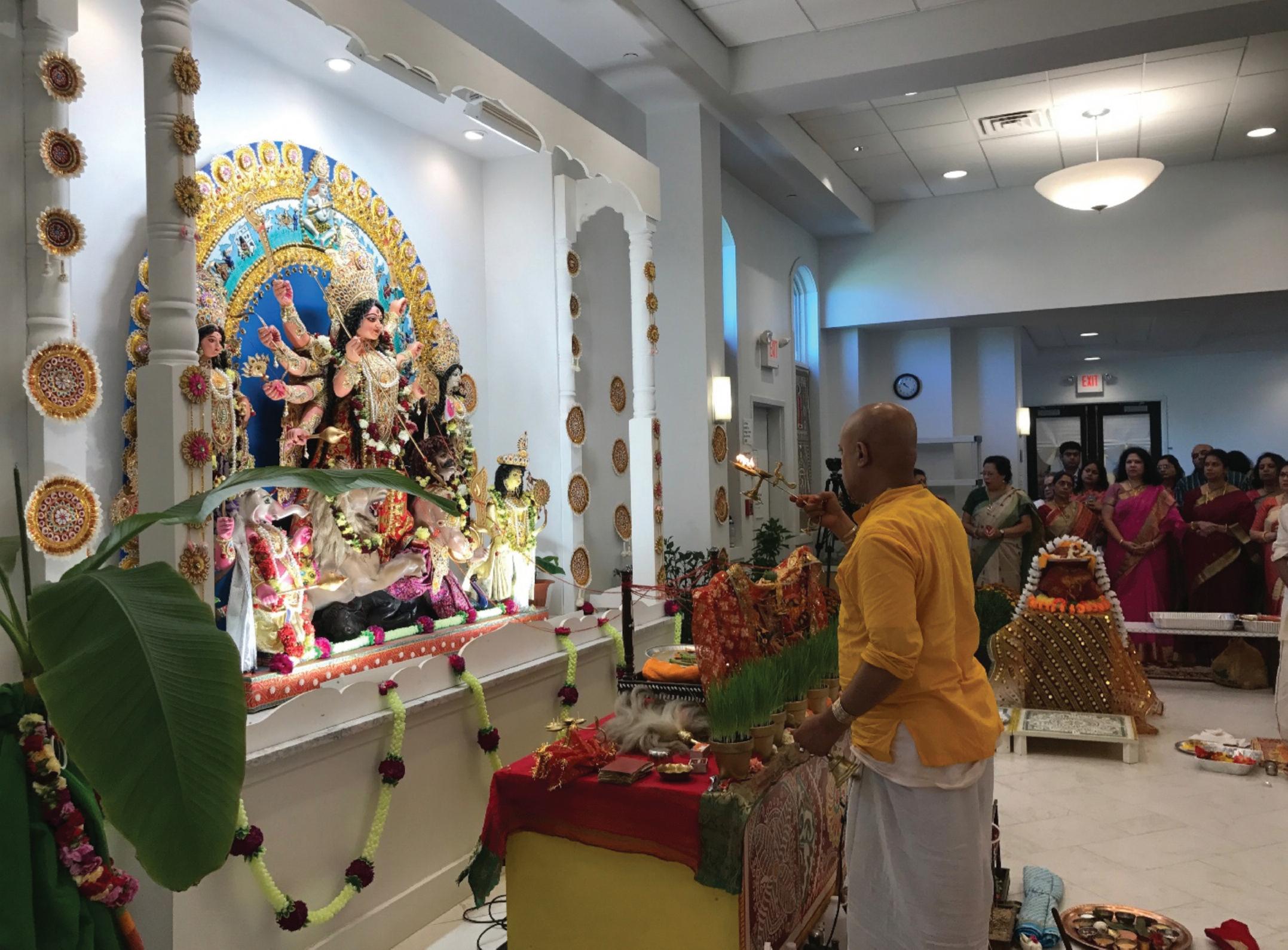
ple got in We really could not keep the count Almost 800 people came that day to participate in the puja and offer anjali After the devotees were serves prasad, lunch and dinner, the volunteers got busy
and ended by 6:30am with more than 250 people attending in the packed temple premises
Later, from 10:00 am to 11:00 am, Biswabhai performed Biswakarma Puja
On 19th September, Pitri Tarpan was performed by many devotees during 11:30 am to 1:00 pm under the guidance of Amitabha Bagchi, one of our veteran priests. Around 15 /20 people came to offer their homage to their ancestors.
That brought us to our biggest festival of the year - Durga Puja. This year Durga Puja was scheduled from Sept 25 thru Sept 30th.
On 25th evening, “Debir Bodhan” started around 6:30 pm ending with aarati and Chandi Paath by 8 pm “Adhibas and Amamtran” was scheduled on 26th, along with Sosthi puja from 6:30pm to 8:30pm
On the 27th Maha Saptami puja was done from 8:30 am to 10:30am During evening hours we saw more people came to be a part of this holy time
On the 28th we had Maha Ashtomi Puja This being the most auspicious day more than 400 devotees came to observe the morning puja and offer anjali Pushpanjali was organized in many batches to accommodate everyone who came to offer flowers to the Mother After prasad was distributed, people went over to the Tagore Hall where vendors displayed their goods of new supplies and new styles It was a busy day for all of us, especially the
The temple was really full to the brim
Many people had to wait outside until some from inside left to make space As soon as the first group of people offered their anjali and left, another batch of peo-
with cleanup and other related works to help Biswabhai prepare for next day's puja
On 29th September, Nabami puja started around 8:30 am and continued
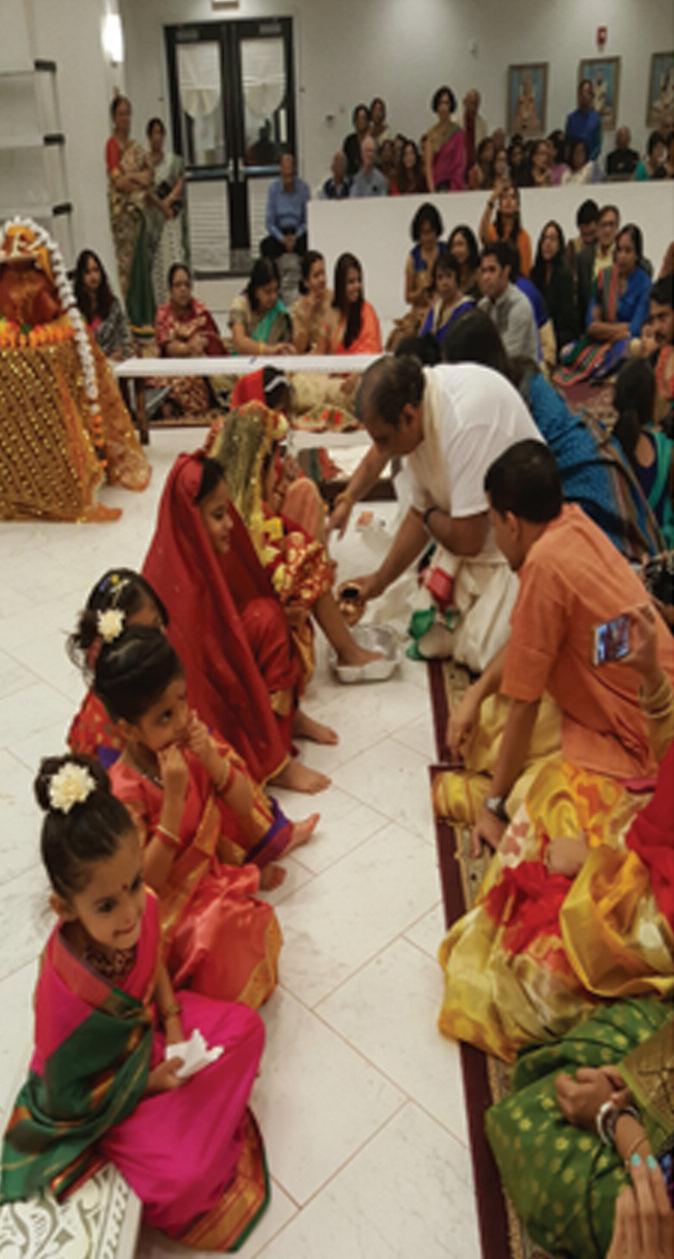
dividually Aarati was done for each one amidst continuous conch blowing that made the atmosphere quite sanctified Each kumari was offered bhog and suitable gifts Just as this Kumari Puja is a tradition in many places in India, we have made it a tradition at Ananda Mandir It really brings joy to the children, their parents and the bystanders as well As expected, photo session continued for a while after the event, because it really is a memorable occasion for all the young girls' lives After aarati, anjali, prasad and dinner were served, people hurried to the Tagore Hall to enjoy a cultural event that included children’s programs as well as regular programs
Next day, we rolled into the Dashami puja, also known as Vijaya Dashami. Puja started at 9:30 am with about 50 people present for this pratima Bisarjan. This event, marking the end of Durga Puja, naturally brings a feeling of sorrow. According to our mythological faith, we are sending our daughter back to her husband’s home after her short annual visit with us After" Debi Baran" and looking at "Debi's Charan” in water, the Ghats were carried by a few devotees over their heads for immersing them in the catch basin pond at the end of our property Wish we had a lake nearby! Thus our Durga Puja ended for this year After regular evening puja, the Sindur Khela got started Ladies performed this event by putting sindur (red powder) on the main Ghat and on each other Sweets were given out to each other in abundance After a while, when aarati started, a Dhaki from India started playing on his Dhak That initiated the Dhunuchi Dance People gathered around and started dancing with the tune of Dhak that continued until 8:30pm Thus all the festivities of Durga Puja came to an end After dinner people strolled over to the Tagore Hall for the cultural program, as the vendors waited in the lobby for the last-minute shoppers
All of us appreciate the good planning by the core members and the various committees, and participation by all the volunteers that was required to bring this
until 10:30 am This being a weekday, crowd was somewhat small, around 150 or so After puja and aarati were performed, prasad and lunch were served Then it was time for the next big eventKumari puja for Nabami evening After regular evening puja was done, this special event got started About 10 kumaris (young girls), all dressed up in red sarees and jewelry, were seated to receive the puja Dr Santosh Mukherjee presided over this puja Each kumari was worshiped in-
huge event to its successful completion Support provided by Amitabha Bagchi, Prabir Biswas, Santosh Mukherjee, Subrata Banerjee and Chanchal Banerjee to Biswabhai during puja was notable Without their help it would be difficult for Biswabhai to handle the things properly october
On Oct 5th Thursday, Kojagori Lakshmi puja was scheduled Like other
Continued from page 8
years, more than 100 people attended to observe this event Satyanarayan puja also celebrated this evening
Our very important Maha Kali Puja was scheduled on 19th October The Puja started at 5:00pm and concluded around 11:00pm This was in the middle of week, but it did not matter Hundreds of people came that evening to celebrate the puja and offer anjali At some point, the temple was so filled up that volun-
Biswabhai patiently waited until everyone was able to offer anjali Yagna continued until after 11 pm as many devotees stayed on Over 600people came on this one evening of Kali Puja
As usual, October is always a busy month We celebrated Jagaddhatri puja from 27th through 29th november
For November, we had Raas Yatra and monthly Satyanarayan puja on 3rd November On 17th we observed monthly Shyama Puja
teers had to hold the crowd outside until some people got out Thanks to the understanding attendees, they heeded the instructions Our puja committee volunteers went through the whole temple to give out rose petals for anjali so that it could continue without any delay
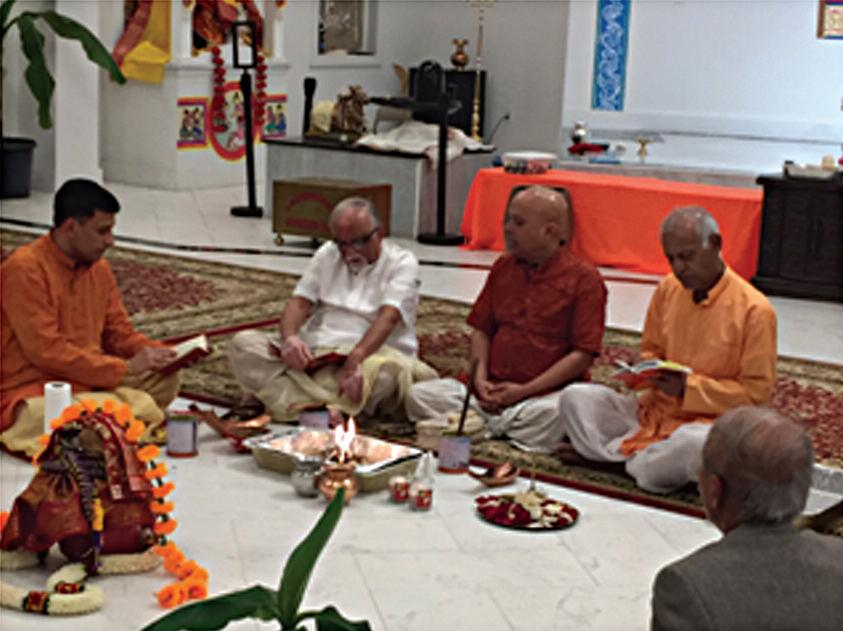
Like every year, the annual Foundation Day Celebration was observed on Tuesday, November 14 to mark the 14th anniversary of the foundation of Ananda Mandir Biswabhai invited four pujaris to perform Yagna with him The assembled devotees offered ghee, havan samagree and flowers into the Agni fire god. Then Biswabhai led the Chandi Paath by four pujaris chanting together.
We had monthly Satyanarayan puja on 3rd December and Shyama puja on the 17th
We thank all our volunteers for their selfless work and time It would be impossible to take care of these huge events all through the year without their help Our heartfelt thanks to all of them Please check our website for all upcoming puja events

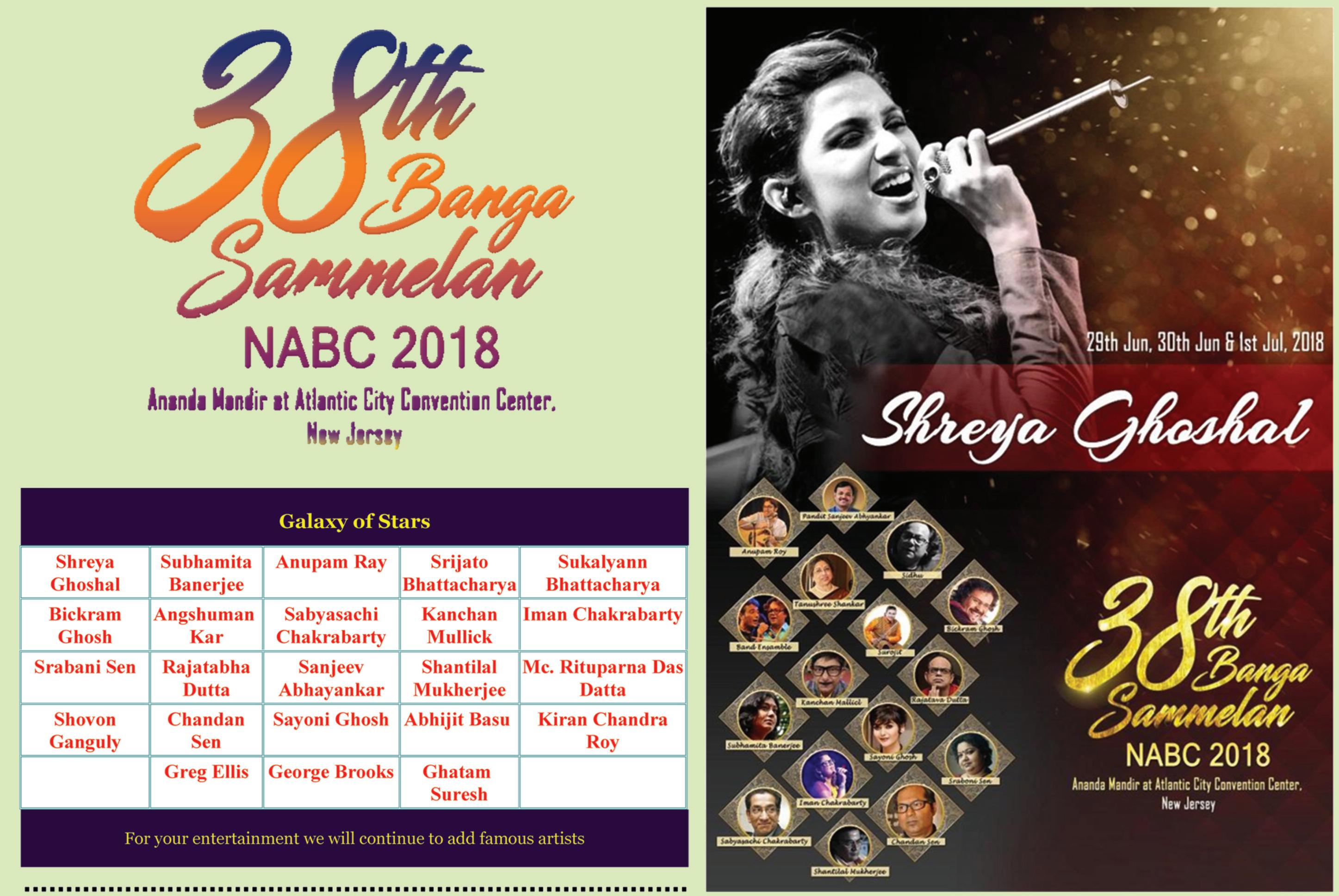
Marie Skłodowska Curie (1867 -1934) was an epitome of ‘firsts’ It is doubtful that any person under the sun has ever bagged so many ‘firsts’, and ever will She is the first woman to win a Nobel Prize, first to win two Nobel Prizes, first to win Nobel Prizes in two different subjects (Physics and Chemistry), first to discover two new elements (Radium and Polonium), first woman to be entombed (along with her husband, Pierre Curie, also a Nobelist) in the famed Pantheon Mausoleum in Paris
She received so many prizes, recognitions and accolades that it is meaningless to list them. Her name is immortalized by the term ‘radioactivity ’ coined by her to designate radioactive emanation, the unit of radioactivity is ‘Curie’, ‘Curium’ is the ninety sixth element in the Periodic of Table of Elements, 7000 Curie, and an asteroid is named after her In addition, numerous institutions in various countries bear her name
Maria Skłodowska was born in 1867 in Warsaw, Poland, an enclave in the then Russian, Austrian and Prussian empires She hailed from a wealthy and respected family Her paternal grandfather was a well-known literary figure, and her father, Władysław Skłodowski was a notable academic, teaching Physics and Mathematics, and director of two schools (gymnasia) He was also a Polish nationalist and active in freeing Poland from foreign occupation As a result, he lost his family fortune and livelihood Therefore, Maria and her four siblings faced enormous financial and other battles throughout their childhood and young-adult days
After passing the gymnasium, Maria could not get into any university in Poland because women could not obtain higher education as per norm of the society However, Maria and her sister Bronislawa or Bronia had an indomitable thirst for knowledge As a result, they joined ‘Flying University ’ , a clandestine institution of higher learning to study science
Their determination paid off, and Bronia got a chance to study medicine at University of Paris. However, who would pay for tuition and other expenses! Maria took up the job of a governess with one of their wealthy relatives. Soon Maria got a different taste of life. She fell in love with Kazimierz Żorawski, the son of her relatives, and a future highly reputed mathematician However, that love affair had to end quickly because Maria’s rich relatives did not want their son to have an affair with a penniless girl Many years later, Kazimierz, an old man and a professor at Krakow Polytechnic would sit contemplatively in front of the statue of Marie Curie erected in front of the Radium Institute founded by Marie Curie
Two years later, in 1891 Maria also got a chance to study Physics and Mathematics at the University of Paris By this time, she had amassed enough money partly by teaching at Flying University and partly from her father who badly wanted her to succeed in life to enter the University of Paris However, that sum of money was
By Rahul Ray
barely enough to pay for her tuition and room and board She would study in the morning and do private tutoring in the evening to pay her way for a university education, but often she went hungry or shivered in cold for not having enough clothes However, no amount of hardship could dampen her love for knowledge
In 1894, Maria’s life took a highly significant turn She met Pierre Curie, a physicist and a researcher Soon they fell in love They married in the next year, and the Polish ‘Maria’ became Marie Curie, the name that made her famous world over However, she never relinquished her Polish origin She refused to accept Pierre’s first proposal to marriage because she wanted to go back to Poland, but she was unable to find a job there. She always signed her name as Marie Skłodowska Curie. She named the second element she discovered as ‘Polonium’ to show love for her country, particularly when Russian-Prussian-Austrian conglomerate was still the rulers of Poland Before coming to France Maria learned the rudiments of laboratory –science from an internship in a chemistry laboratory directed by Jozef Boguski, her cousin and an associate of famous Russian chemist, Dimitri Mendeleev In Paris, Marie and Pierre’s deep love for science worked as a catalyst to accelerate their joint effort in seeking scientific knowledge through research
In the year that Marie and Pierre were married, Wilhelm Rontgen from Germany discovered X-ray In the following year Henri Becquerel, a Frenchman discovered Uranium, an element that spontaneously emanated radiation Electrical and magnetic fields failed to influence this radiation, but Becquerel was unable to characterize this phenomenon Pierre and Marie took up the task of investigating this ‘mysterious radiation’ Result of was far-reaching. Soon, and in rapid succession they discovered two new elements, both radioactive. First came Polonium and then Radium. In 1903 Marie Curie, along with her husband Pierre Curie and Henri Becquerel were awarded Nobel Prize in physics for their fundamental work in understanding the phenomenon called ‘radiation’, which Marie Curie termed ‘radioactivity ’ Ten years later, in 1913, Marie Curie received another Nobel Prize in chemistry for discovering Polonium and Radium By this time Pierre Curie, Marie’s husband and comrade-in-arms was no more, victim of a traffic accident Marie Curie became a widow with two daughters, Irene and Eve
Madam Curie was a true believer in progress through science She never took a patent on the discovery of Radium and Polonium lest such a patent hinders research by other scientists She and Pierre distributed their prize monies to various research institutes and other scientists Both of them disliked limelight so much so that they initially refused to go to Stockholm to accept the Nobel Prize Albert Einstein famously said-“Pierre and Marie Curie are only people who are not corrupted by fame ” The World War I started in 1911 engulfing all of Europe and bringing all endeavors learning and research to a halt Madam Curie supported French war effort and offered her Nobel Prizes made of gold to the government, although the government did not accept her offer.
Madam Curie could not continue her
An estimated million wounded soldiers received treatment from her X-ray units
Thus, she saved lives of hundreds of thousands of wounded soldiers who otherwise would have perished It is noteworthy that nobody dictated her to do this dangerous work; not even the French government officially recognized her heroic work to alleviate human suffering
Another remarkable side of Madam Curie’s character is she ‘sat on her Laurels’ She received accolades and fame beyond anyone can imagine, but she never stopped her research, except three years during the War. She continuously pushed on to find new applications of her discovery.
Madam Curie discovered that radium gives out a radioactive gas that sterilizes wounds From this discovery, she created ‘hollow needles’ to sterilize wounds of innumerable soldiers and save lives Discovery of penicillin was still a few years away, and most soldiers would have died due to bacterial infection of their wounds without sterilization by ‘Curie needles’ Discovery of penicillin in 1928 by Alexander Fleming put ‘Curie needles’ to rest However, she had discovered yet another remarkable application of radiation She observed that exposing human cells to radiation for a prolonged period kill the cells Even more remarkable finding was that cells taken from a tumor of a human dies at a significantly faster rate than healthy cells taken from the same human At the time of Madam Curie, there was practically no effective treatment for cancer, and her discovery brought a revolution in cancer-therapy
research during the war, but she took up an entirely different responsibility. She spent her own money to buy several X-ray machines, portable generators and trucks to create several ‘Mobile Radiography Units’. She also trained several women to run such units. For entire three years of the war she, along with her entourage moved from front to front to provide X-ray service to wounded soldiers and quickly come up with a prognosis She also became the Director of the Radiology Services of the Red Cross Irene, her seventeen-year old daughter joined her mother in this effort It is noteworthy that in the future Irene and her husband Joliot were to receive Noble Prize in Physics sep-
For the past hundred years or so progress of science and technology, particularly in Medical Science is no less than magical. Modern therapies have tamed or eradicated many killer diseases. Treatment of many other diseases have become commonplace and easily available. However, cancer therapy remains an enigma With all advances in Medical Science radiation therapy, particularly coupled with chemotherapy and drug-therapy remains the only choice for cancer patients today This is how Madam Curie and her invention have remained alive among us
Human history comprises of several example of people who drew fire on themselves for standing firm on their beliefs They encountered persecution, and in some cases faced violent death In Europe, the tormentors were mostly people related religious institutions, while tor-
Continued to page 12
Donkeys Jailed for What Donkeys Do Best
Six donkeys were jailed for four days in Orai, Uttar Pradesh (India) for eating what they probably thought was wild vegetation. Unfortunately for them, these were expensive saplings (worth about $1000) in a neighbor’s property The owner of the donkeys had to seek intervention by a high-level politician of the ruling party Then only he could secure the release of the jailed culprits because a high-level crime was involved! (NY Times, Nov 28, 2017)
a Photo Purchased from a flea Market for $10 is Worth
Millions
At a flea market six years ago, a North Carolina lawyer named Frank Abrams unknowingly bought a rare photograph that experts say shows Billy the Kid, one of the best-known outlaws in American history Mr Abrams bought this “tinplate” photo (so named because photos at that time were printed on thin tin plates, not photo paper) Recently Mr Abrams became curious about the age of this photo and showed it to a number of experts on Billy the Kid memorabilia The experts agree that the tinplate is authentic and was taken between 1875 and 1880 A similar photo sold for over $5 million in 2015, so Mr Abrams is likely to fetch a multimillion dollar price for his flea market purchase (NY Times, Nov 16, 2017)
Homemade Rocket to be launched to Prove Earth is flat?
A believer in the flat-earth theory is getting ready to launch his homemade rocket to “prove once and for all that earth is not round but flat”. Mike Hughes A resident of California, has built his rocket from scrap
By Debajyoti Chatterji
metal, and is planning a test launch that will soar to 1800 feet His future launches are much more ambitious and will take him to far greater altitudes. Mr. Hughes is a limo driver but is not a totally unproven engineer. He holds a Guinness World Record for a “limousine ramp jump”. He built his first manned rocket in 2014 and managed to fly a quarter mile over the town of Winkelman, AZ Keep a watch for his rocket launch! (Washington Post, Nov 21, 2017)
Dinner table that Seats 101
Guests
You are probably aware of the reception given by Narendra Modi to Ivanka Trump in connection with the Global Entrepreneurship Conference recently held in Hyderabad, Telengana But did you know that the dining table used for the dinner is one of the largest (if not the largest) dining tables in the world? Located in the opulent dining hall of the Faluknama Palace on a hill near Hyderabad, the dining table seats 101 guests The palace was built by the uncle of a late Nizam of Hyderabad and is now a luxury hotel by the Taj Group (Based on various sources) a Meal for Rs 5/- at Indira Canteens in Bangalore
The ruling Congress Party in the state of Karnataka has set up several “Indira Canteens” in the Bangalore area that serve hot meals for a mere 5 rupees More than 200,000 meals are served daily to mostly low-income people but there are no restrictions on who can enjoy these very inexpensive offerings. A breakfast typically consists of South Indian staples such as idli, pongal and coconut chutney. This program seems to be modeled after the hugely popular (but slightly more
expensive) “Amma Canteens”, launched earlier in Tamil Nadu by Jayalalitha, then chief minister of that state. (BBC.com, Nov 20, 2017)
52 Million new toilets but Many are not Being Used Since the beginning of Narendra Modi’s “Clean India” campaign, 52 million new toilets have been built all across the country Unfortunately, a very large fraction of these newly built toilets is not being used by the people for whom they were built Open defecation continues to remain a huge problem because of resistance from people who are long used to this practice To tackle this problem, the campaign is recruiting teams of government employees and volunteer “motivators” to publicly shame those who defecate in the open These “good morning squads” seem to be getting positive results (Washington Post, Nov 3, 2017)
Mahindra to Build a vehicle factory near Detroit, MI
Mahindra & Mahindra, one of the largest vehicle makers in India, recently announced a $230 million investment in a new facility to build off-road SUVs for the American market It is expected to manufacture only about 5000 specialized 4wheelers annually for off-roading enthusiasts Although quite small by auto manufacturing standards, this is a first for two reasons This is the first new vehicle factory in the Detroit area in 25 years, and it is the first factory in America by a non-European/non-Japanese auto manufacturer. Residents of Detroit have welcomed this vote of confidence in the city, and we wish the company every success in America (NY Times, Nov 20, 2017)
Continued from page 7
band and wife to follow the example of the twin stars Arundhati and Vashistha (Alcor and Mizar in astronomical terms) These stars move in synchrony, unlike one around another which is true with most twin stars Precious approvals from them came after a few iterations
On a beautiful afternoon, surrounded by old and new friends and family, we began the ceremony My artistic daughter and her groom decorated the venue in a celestial theme Handmade artworks of planets, zodiacs, and stars mingled with bouquets of blue irises and other spring flowers From my seat, I noticed rays of golden afternoon sun streaming in through the large windows set on the exposed brick walls. I understood the muchlauded magic of Godhuli Lagna, the Bengali term for the time when cows return home from the pasture In Bengal, this time, just before the
twilight is considered to be the most auspicious for a wedding. We may migrate thousands of miles, but traditions followed, intentionally or not, often result in some unanticipated joy As ancient Sanskrit hymns played in the background, the bride and groom exchanged promises of keeping each other in their hearts forever with the fire as their witness When a longtime friend showered rose petals on them, it seemed that they fell in slow motion cherishing each loving moment
"May we be as steady as the North Star and complement each other as Arundhati and Vashistha did?" I was reciting the Sanskrit words, but my thoughts traveled to the far away stars and the time of the wise sages They crafted a poetic marriage ceremony more than three thousand years ago, that remained relevant through ages and would remain so for years to come It is up to us to keep it relevant
Reported by Subrata Bhaumik
Sahitya O Alochana (SOA) is a monthly literary and topical discussion forum under the aegis of Ananda Mandir (AM). It will complete its 10th anniversary in January 2018 and will have organized one hundred (100) sessions by the time this report goes to press. These monthly sessions feature exciting and illuminating discussions on diverse subjects including literature, art, theater and movie; history, philosophy and religion; science and mathematics; economics and business; and social issues, sports, and current affairs Below is an account of the recently held sessions november 2017
After a short hiatus of couple of months, our discussion sessions reemerged in November 2017 It was a session on international literature, which was kind of a homecoming session for us in the Alochana family In this session, Amitabha Bagchi led a discussion on Kazuo Ishiguro, the newly minted British Nobel Laureate in literature, his literary career, and major works with a special focus on his famous Booker Prize winning book “Remains of the Day ”
He presented an overview of Ishiguro’s life: Ishiguro was born in Japan and grew up in the UK Spending the initial few years of his life in the remnants of Atomic explosion in Nagasaki, he seemed to have carried a sense of surrealism with a dose of restlessness that is reflected in his journey from his not so successful ventures early in his life to become a song writer and musician to writing some of his best works A self-professed fan of Bob Dylan and Leonard Cohen, Kazuo still plays the guitar and continues to try an occasional hand in his early love - song writing And his penchant and knack for writing novels that attract popular attention from the movie world are reflected in many of his books being adapted into films – some with international accolades
stripping away non-essentials. Additional artifacts that accumulated around the wedding ceremonies were probably due to economic reasons
After the exchange of rings ceremony, there was a cake depicting the solar system for them to cut The live band started playing music for the couple’s dance Before sitting down for dinner, I visited the guest tables It was wonderful to see my daughter ’s childhood friends Many came with their little children They were running around in a space that had been made sacred, if only for a few hours I recalled my own wedding during a simpler time Both my parents were indoctrinated by Mahatma Gandhi and did not believe in excesses Their grand-daughter succeeded in carrying on their principles
The aluminum foil lining the fire pit was still cooling outside I hoped somebody would remove it and throw it in a recycling bin!
With regard to his famous Booker Prize winning book, Bagchi presented the summary of the story; read excerpts; and explained the main themes including honor, propriety, restraint, etc. The story is based in the mid1950s, and Mr. Stevens, the protagonist, is a prim and proper Englishman who works as a butler at an English stately home. He is so obsessed with his sense of honor and propriety that he is either completely oblivious of his own earthly human emotions or stifles them before they engulf the afflictions of his righteousness. Even in the grayer part of his life when he secures a tryst with his former subordinate cum potentially love of life who herself is going through relationship issues, his honor and propriety take over and normal human emotions evade him like the water would do to Tantalus in Greek mythology
A movie based on the novel and bearing the same name was produced in 1993 by Ivory Merchant productions starring Anthony Hopkins as the butler and Emma Thompson as the coworker/subordinate It was nominated for 8 Academy Awards A short discussion on the movie was also a part of the session
It was a great session, and a ton of thanks goes out to Amitabha Bagchi
future sessions
Quite a few interesting sessions are in the pipeline for next several months They feature eclectic topics including a discussion on Arundhati Roy, the famous Indian writer who won the Booker Prize on her debut novel, a session on Quantum Computing Global, “Globalization a social and economic review” and other sessions on literature
The friends of Sahitya O Alochana would like to thank Ananda Mandir for its continued support for the forum’s contribution to the cultural enrichment of the local Indian and Bengali communities
By Debajyoti Chatterji
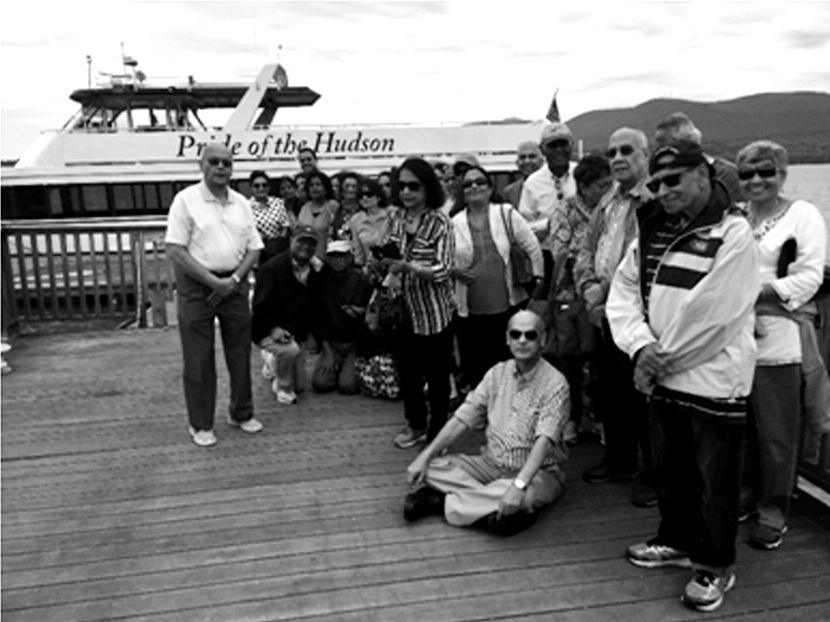
The reporting period started on a happy note with a group outing to Hunterdon Hills Playhouse on Sunday, September 16 for a delightful lunch-theater experience “Come Blow Your Horn”, a well-known comedy written by Neil Simon, was the featured play It was a highly enjoyable event for the 25 participating seniors This was the third visit to Hunterdon Hills Playhouse by Evergreen Club members This venue has become a favorite for many of the seniors from the Ananda Mandir community
October was a “double header” month, a first for Evergreen Club!
On Wednesday, October 11, a group of 30 men and women (an all-time high for the Evergreen Club) enjoyed a leisurely, sightseeing cruise on the boat, “Pride of the Hudson”. We had to settle for a weekday for this group outing because the boat was fully booked for all weekend days in October for fall foliage viewing We left from and returned to the scenic town of Newburgh on the western shore of the Hudson River The weather was nice, and although the fall color had not reached peak level, we had a very enjoyable cruise Some members also had a leisurely lunch at river-front restaurants in Newburgh before or after the cruise
“Bijaya Sammelan” was our second event in the month of October Held on Saturday, October 21, and featuring a pot-luck lunch prepared by volunteers,
this event celebrated the successful completion of the Bengali “pujo season” through sharing of childhood memories of Durga Pujo Twenty-three seniors happily recollected their personal stories to the enjoyment of all A few made the occasion more festive by singing songs and hymns Last but not the least, Mrs Banani Mukherjee performed a “shruti natok” to everyone’s delight
We took a very different approach in the following month
On Sunday, November 11, we heard an interesting and informative presentation by Amrita Pal (daughter of Achintya Pal and Sangeeta Chakraborty) on her and family ’s recent visit to the Yellowstone, Bryce and Zion National Parks. Although she is only a 9th grader, she planned and organized many details of this extensive trip. The 20 seniors attending the event were impressed by Amrita’s planning and presentation skills This was the first time the seniors had an opportunity to enjoy a formal presentation by a young member of the community, and everyone agreed to seek out future opportunities to interact with younger members of Ananda Mandir Sweets and snacks brought by members enhanced the spirit of this session
At the time of writing this report, a “dosa day” is planned for Tuesday, December 12 More about that in the April, 2018, issue of Ananda Sangbad We wish everyone a very happy, healthy and peaceful New Year!
By Shivan Mukherjee, age 14
Within New Jersey itself, a battle between two of the greatest minds was waged over electricity Thomas Edison was already immensely popular and wealthy after his multitude of inventions Once Edison had perfected his lightbulb, he now needed to create a system and an industry based around it so that electricity could be available to the general public To power his electricity grid he decided to rely on direct current otherwise known as DC power which although safe, could only power areas within a half mile radius. This caused power to only come in densely populated areas and those in rural areas were automatically excluded.
Prior to moving to the United States, Nikola Tesla worked for Thomas Edison’s electric company in Paris He had an idea to control AC power which was the original and much more powerful form of DC power However, it had never been controlled before and was unsafe To present his ideas Tesla came to the U S and visited Edison in his lab in New Jersey However, so much work and money had been already poured into the DC systems, Tesla’s ideas for the AC were not welcome He was instead told to
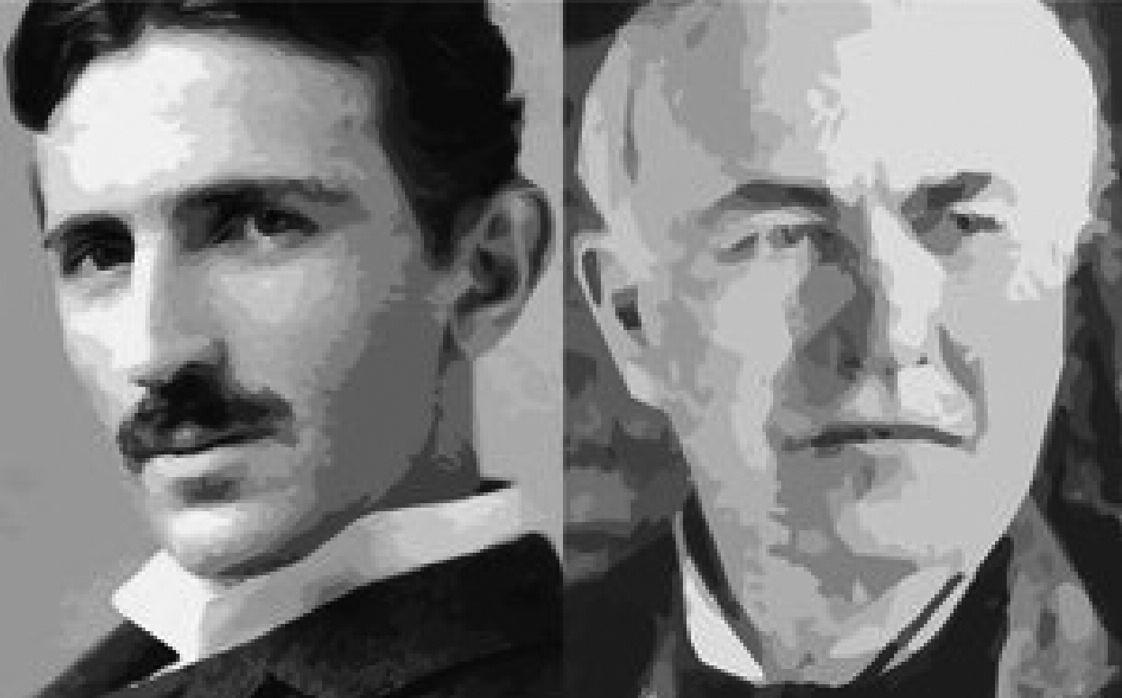
improve the current system for a prize The prize was a joke but Tesla not knowing English well took it seriously This caused a falling out between the two when he did improve Edison’s system. Enraged Tesla quit his job but there were not many jobs for inventors and electricians during that time. He began working to dig ditches for Edison’s system when he met a man who believed in him and had connections with an investor Tesla perfected his system and started his own company His AC power could not only power over 5 miles but over 50 miles making power not only available to the elite but to
This began a battle between the two geniuses Edison was determined to present Tesla’s system as dangerous and volatile while his system was safe and reliable. He even went as far as to recommend Tesla’s company to make the first electric chair which showed the power and danger of his system to the public But Tesla wouldn’ t back down and soon the investors of Edison had stopped believing in him and made the decision to switch to the AC system behind his back In the end, Tesla proved to be correct and his system electrified the world
Maria Skłodowska Curie (Marie Curie), a pioneer in science and social consciousness:
Continued from page 10
mented were often philosophers, scientists and polymaths
Galileo Galilei, the Italian astronomer, physicist, mathematician, philosopher, engineer and technologist is considered the father of modern science In the seventeenth century AD, he supported ‘heliocentrism’ model of the universe in which the sun is in the core of the galactic system The earth and other planets rotate around the sun and in their own orbits It was not an entirely new idea The Greek astronomer Aristarkas in the third century BC first proposed the idea of a heliocenric universe However, the Roman Catholic Church considered Galileo’s idea a heresy, and placed him under house arrest until his death In the sixteenth century AD Giordano Bruno, an Italian astronomer, mathematician, philosopher and poet supported heliocentric model and drew the wrath of the Church. He refused
to back down His tormentors tied him to a stake and burned him alive
The European society has progressed enough since the days of Galileo and Bruno so that Madam Curie did not have to face the whim and wrath of the Church or society However, in a peculiar twist of justice the scientific discovery that brought her fame took away her life
In present time, the ill effects of radiation on human body are well known It is also a common knowledge that prolonged exposure to high- energy radiation can cause cancer This important information was not available to scientists in Madam Curies’ time, and scientist working with radioactivity used bare hands without any precaution! However, it is nearly impossible that she did not know anything about the danger of radioactivity, because she is the one who discovered the killer effect of radiation on human cells
The presence of sufficient
*Wikipedia on Madam Curie and references cited therein
number of healthy blood cells in our body is essential for our survival because these blood cells carry all the nutrients from the food we eat, and oxygen that we breathe to different parts of the body Our bone marrow produces these blood cells Madam Curie handled radioactive materials without any protection for years Hence, her bone marrow cells failed to produce sufficient healthy blood cells, and in 1934, she ultimately succumbed to aplastic anemia After her death, all her belongings including her clothes, her lab notebooks, and even her cookbooks were highly radioactive and dangerous There is no doubt she was aware, at least partially of the danger of radioactivity Yet, she never stopped In other words, she gave away her life for the advancement of science
“Nothing in life is to be feared, it is only to be understood Now is the time to understand more, so that we may fear less.” Marie Skłodowska Curie.*
Reported by Pradip R. Das
This is the time of the year, irrespective of whatever challenges and difficulties we faced this past year, our spirits are lifted by the joyous festivities and cheers that the season brings. We strive to re-create and relive that nostalgia surrounding Durga Puja back in India, here in our adopted homeland and pass it onto our next generation. We all participate wholeheartedly in this endearing process
On September 30th and October 1st, Garden State Cultural Association of NJ celebrated its 26th annual Durga Puja in the traditional style and splendor We initiated a new protima from Kumartuli this year This year’s puja generated such overwhelming response, especially for Saturday, that it compelled us to stop registration 10 days before Puja with no gate registration either It was one of the largest attendance in recent years All patrons enjoyed the whole experience (as revealed in a postpuja online survey), the reception, puja, prasad, dinner and the evening’s cultural events - the whole ambience This year ’s cultural program included a wide variety of songs, dances, cultural programs by GSCA’s inhouse production, instrumental medley, a drama, and the two main attractions from Kolkata - Anupam Roy (Saturday) and Anik Dhar (Sunday) The two evenings of cultural programs were composed in a manner in which patrons of all demographics remained interested to the end and left satisfied in both days Moreover, GSCA’s hallmark of timely management of all events including the cultural programs remained intact this year as well
GSCA’s objective of bringing communities together and propagating goodwill and brotherhood towards all through such social gatherings was truly met in all aspects
Till next year
appreciation lunch
The GSCA board hosted an appreciation lunch on Sunday, October 22nd at Mughlai Durbar, Monmouth Junction The invitation was extended to all the committee members and volunteers to recognize their hard work and dedication which culminated in a very successful Durga Puja this year Sixty people attended this luncheon at this relatively new Indian restaurant Everyone had a wonderful time at this celebratory gathering savoring delightful delicacies amongst great company
Philanthropy Update
GSCA has been making concerted efforts to expand its philanthropic activities in ways that are having greater impact on communities and individuals. We have contributed to humanitarian and disaster relief programs around the globe in the past and continue to do so. We also support, through GSCA’s scholarship fund, meritorious but needy students both here and in India. We are happy to report that four students graduated in 2017 in India with our financial support, two with MBBS, one with BSc (Nursing) and one with Cost Accounting (ICWAI) degrees GSCA also added three new students to its scholarship program this year - two in MBBS and one in Nursing program The students that are selected are supported through their entire curriculum until they graduate successfully GSCA’s philanthropy wing is indeed doing a wonderful job in making differences in individuals’ lives and to their families
Reported by anshula Sarkar
Happy New Year! We at NJPA wish everyone a peaceful, healthy and joyous 2018
We hope that the resolutions you have made for this year be fulfilled and accomplishing your goals bring peace into your lives New Year is destiny’s gift to us to start again fresh or pick up where we left of We are looking forward to hosting and celebrating festivals and holidays with you again this year In 2017 NJPA celebrated Kali Pujo and Diwali at a beautiful new venue of Wardlaw Hartridge School at Edison
This year again our little NJPAns raised money for St Jude Children’s Research Hospital by doing a bake sale NJPA is going to contribute to the fund raised by our young children and will keep the spirit of giving alive We are humbled by the warmth and love that our guests, participants and volunteers have shared with us in all our events
Our new year’s party was again a success. We enjoyed ringing in the New Year with those of you who attended our 31st eve gala celebration. We are looking forward to seeing you at our 2018 events and celebrations. Follow our Facebook page NJPA Parivar for updates on events. Have a blessed 2018
Reported by arpita Gupta, President
ICC Garden State celebrated its biggest event, the 25th year of Durga Pujo, on the weekend of September 23rd at the conveniently located Parsippany High School. I, on behalf of the rest of the ICC Executive Committee, take this opportunity to thank all members, patrons and sponsors who helped in making this a grand success.
ICC maintained its tradition of holding the Durga Pujas in a homely and cordial environment, with active participation of all its members, all coming together and making it one huge extended family event For many, the event actually started on Friday evening, when they gathered to setup the Protima, stage and the adjoining areas The hallway and the entrance were beautifully decorated with flowers Special Sola artwork from Kolkata was used to decorate the hall and was a point of attraction for many families to take pictures using it as background
Another attraction was the authentic Dhaaki from Kolkata who played Dhaak throughout the pujo It was a super hit among all the ladies who danced on the beats of Dhaak
The event was well attended, all dressed in their best attire, and making the best of the festive mood They were treated to two days of solemn pujas, sumptuous food and entertainment A large number of vendors also attended offering everything from dresses, jewelry, books, periodicals and CD/DVDs, which provided the attendees with ample choices to complete their puja shopping There were also a couple of snack bars selling authentic Bengali cuisine and refreshments
The Maha Saptami and Maha Ashtami Pujas were observed on the 27th, with devotees offering their Pushpanjali and then treated to Prasad at its conclusion A delicious Bengali dinner which
included traditional vegetarian dishes, goat curry and Rosogolla - was served prior to the commencement of the cultural programs.
Cultural program was opened by traditional Dhaak played by the Dhaaki from Kolkata amidst Conch shell blowing, a very traditional way of beginning the program. A tribute to some legendary music composers of West Bengal was then presented, directed by Sangrami Lahiri. This was followed by a very high-quality ICC presentation of a dance program “Bibidha- Different dance forms of India”, directed by Arpita Gupta, choreographed by Kakoli Paul and Arpita Gupta Another highlight of the evening was a drama presented by ICC, directed by Chandra Sekhar
The main attraction for the day was a musical program by renowned Raghab Chatterjee and band from Kolkata The program left everyone in such an awe that the show had to be extended for one hour on audience demand
Maha Nabami and Dashami were observed the following day, which was followed by ‘Sindur Khela’ and dinner with sumptuous egg biriyani and chicken korma, vegetable curry and mishti The second day’s program was a dance program by Tilottama Bose The main attraction for the evening was legendary Haimonti Shukla who mesmerized the audience with her voice
ICC also observed Lakshmi Puja on October 14th It was attended by a number of members, who also used this occasion as ‘Bijoya Sammelani’ A light dinner of khichuri, bandhakopi and chutney cooked by Debol Gupta and Nirmal Kundu was served at the conclusion
The Annual General Meeting (AGM) of ICC is scheduled on December 10th
ICC wishes all readers Season’s Greetings and a Happy, Healthy and Prosperous New Year
Prof. Kamalesh K. Sirkar, Department of Chemical, Biological and Pharmaceutical Engineering of the New Jersey Institute of Technology (NJIT ), received the Alan S Michaels Award for his long and distinguished career that has included making fundamental contributions to the field of Membrane Science and Engineering from membrane fabrication to transport processes and performance of membrane systems and his lifelong service to the membrane separations community
His seminal contributions to membrane science are cumulated in two books that serve as references to the community He co-edited with Winston Ho the “Membrane Handbook” in 1992, which has been the standard for membrane separations; he also recently wrote the more general book, “Separation of Molecules, Macromolecules and Particles: Principles, Phenomena and Processes” in which he integrates membranes
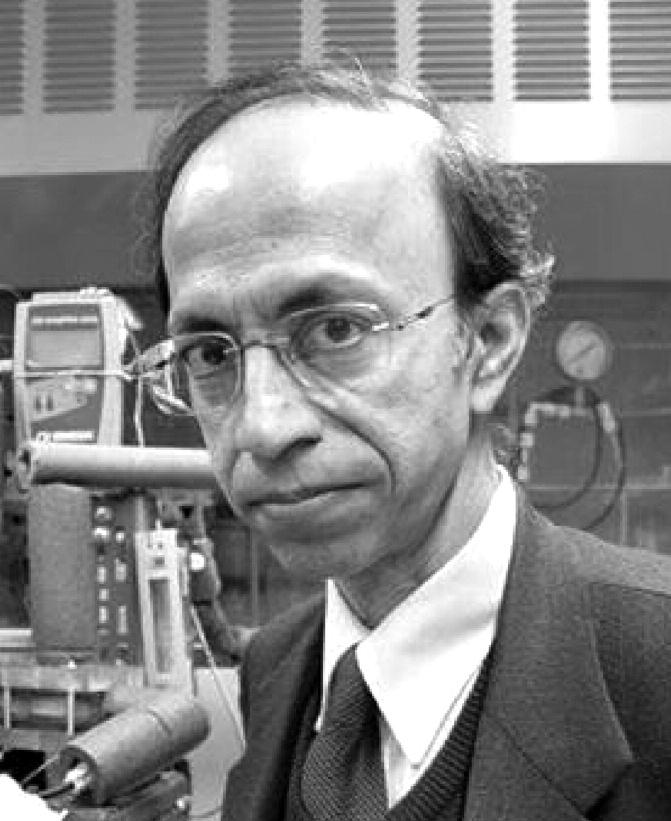
with classical chemical engineering processes. Kamalesh’s service to the membrane community is exemplary He has served in NAMS as a Director from 1996 -2001 including serving as President in 1998-1999; he has also been a major contributor to the Separations Division of AIChE He has been on the Editorial Board of the Journal of Membrane Science since 1989 and he is the founding Editor-in-Chief of “Current Opinion in Chemical Engineering” since 2011 He has published close to 200 articles in international peer-reviewed journals and has been cited over 10,000 times, demonstrating his impact on membrane science
The Alan S Michaels Award for Innovation in Membrane Science and Technology, consists of a $10,000 prize and lifetime membership in the North American Membrane Society (NAMS) It is given to individuals who have made breakthrough contributions to the membrane field
PMC Group International, based in Mount Laurel, NJ, has recentll announced two acquisitions:
and CEO
yegna Manojavam Drugs and Chemicals ltd (yMDCl) of Hyderabad, India.
The cGMP manufacturing facility of YMDCL is one of the largest Fluoroquinolone drug manufacturers in India and prides itself on its
Zero-discharge effluent management system
“This acquisition begins our journey toward building a global pharmaceutical business,” says Dr Raj Chakrabarti, Vice President and Chief Strategy Officer of PMC Group International
the pharma business of Isochem SaS of france
This is a fully integrated business comprised of research, product/process development, regulatory approvals, pilot scale and full plant-scale production of drug intermediates and active pharma ingredients (APIs) for major pharmaceutical companies worldwide to serve the needs of Oncology, Cardiovascular, Infectious, Gastro-Intestinal, Neurology and rare diseases
Raj Chakrabarti Exec Vice President
“This acquisition, coming within two months of the acquisition of the Hyderabad, India-based pharma company YM Drugs and Chemicals by PMC Group International, puts the latter in a solid position to serve all the regulated pharma markets around the world with cost-effective drug offerings of proprietary drugs, drug intermediates, and custom research & manufacturing services for a wide range of disease categories” said Dr Raj Chakrabarti, Executive Vice President of PMC Group International
Invites retirees and near-retirees to participate actively in Forum meetings and activities
Seniors Forum usually meets on the third Sunday of every month at 1:00 PM However, the date may change because of conflict with other Ananda Mandir events Please contact Debajyoti Chatterji (Cell: 908-507-9640) for latest updates on the meeting dates
By Debajyoti Chatterji
I thought you might want to use a "win-win" method of making a donation where both you and Ananda Mandir can benefit. Let me explain what I am talking about
Most of us make donations to Ananda Mandir several times during the year and another (usually larger) during the Annual Fund-Raising Day. We make our donations in cash or by check. Such donations benefit Ananda Mandir -- and we truly appreciate each donation, big and small, as we have to make a large mortgage payment every month Our donors know that come tax filing time, they can get a tax benefit. They can deduct their donation amounts from their adjusted gross income as "charitable contributions". For example, if you made a cash/check donation of $3000, you would deduct $3000 from your adjusted gross income for tax purposes If you are in a 33% tax bracket, your "net out-of-pocket expense" would be $2000 ($3000 minus $1000 in tax savings).
However, there is a way to reduce that "net out-of-pocket expense" further. It is a perfectly legal, IRS-accepted way of making donations that are used by all larger non-profit organizations This is how that method works
Suppose you bought 100 shares of Company X several years ago for $1500, and now that stock has risen in value to $3000. If you sell those shares to raise $3000 cash and then donate that $3000 to Ananda Mandir, you will, of course, be allowed to take $3000 deduction against your income, and get a tax benefit of $1000. However, you will have a pay a "Capital Gains Tax" on the $1500 increase in value of the shares sold At 33% tax rate, you will be paying $500 to Uncle Sam!
On the other hand, if you donate those 100 shares of Company X directly to Ananda Mandir, you will be able to take the full deduction for $3000 -- AND avoid paying the Capital Gains Tax of $500 The key word here is "directly", meaning the shares must be transferred to Ananda Mandir either electronically through your broker/financial adviser or the actual "share certificate" must be handed over to Ananda Mandir. If you cash those shares and donate the $3000 cash received, you will have to pay the $500 Capital Gains Tax Instead of appreciated shares in a company, you can also donate mutual funds shares that have increased in value over time
Ananda Mandir has now established a program to accept such "direct transfer of appreciated securities" (stocks, bonds, mutual funds, ETFs, etc ) We are, therefore, suggesting that for your future donation, you may want to think of using this technique. All you have to do is tell your broker/financial adviser that you wish to donate $X to Ananda Mandir through "appreciated shares" in your portfolio He/she will find the shares that will give you the best tax benefits and directly transfer them to Ananda Mandir's own broker If you are interested in discussing this approach or making a donation of such “appreciated securities’, please contact
ashok Rakhit, Dr. Samir Dutta, or Debajyoti Chatterji
Rani Chatterjee passed away on Friday, December 22, 2017 at the age of 89 She was the widow of the late Dr Khagendra Nath Chatterjee, a prominent physician and member of the Bengali community in New Jersey and at large. They were life members of Ananda Mandir since its inception, and also founding members of Garden State Cultural Association Ranidi, as she was fondly called, was born in Kerala, India, and was trained as a nurse She met her husband in Calcutta and they had been married for 57 years at the time of his death in January, 2009 She was the ever supportive spouse, dedicated mother and devoted grandmother to Chris and Eric. She enjoyed travel and entertaining friends and family. She had a quiet presence that we will miss. We pray for her soul to rest in peace
Arabinda Mukherjee, an esteemed member of the local community, passed away on Thursday, December 28, 2017 An engineer from IIT Kharagpur, where he excelled in sports in addition to academics, Arabinda came to the U.S. in the early 70’s. He and his wife Bandana have always been active members of the Bengali community, participating in varieties of socio-religiousevents. Besides being life members of Ananda Mandir since its early stage, they have been long time members of New Jersey Puja Association, and Bharat Sevashram Sangha Lately, they both volunteered much of their time at Bharat Sevashram during pujas, planning events, and preparing food for the devotees
We very much regret Arabinda’s untimely death and extend our sincere condolences to his wife Bandana, his two children, Romi and Ritu, and his grandson, Arjun. May his soul rest in peace.
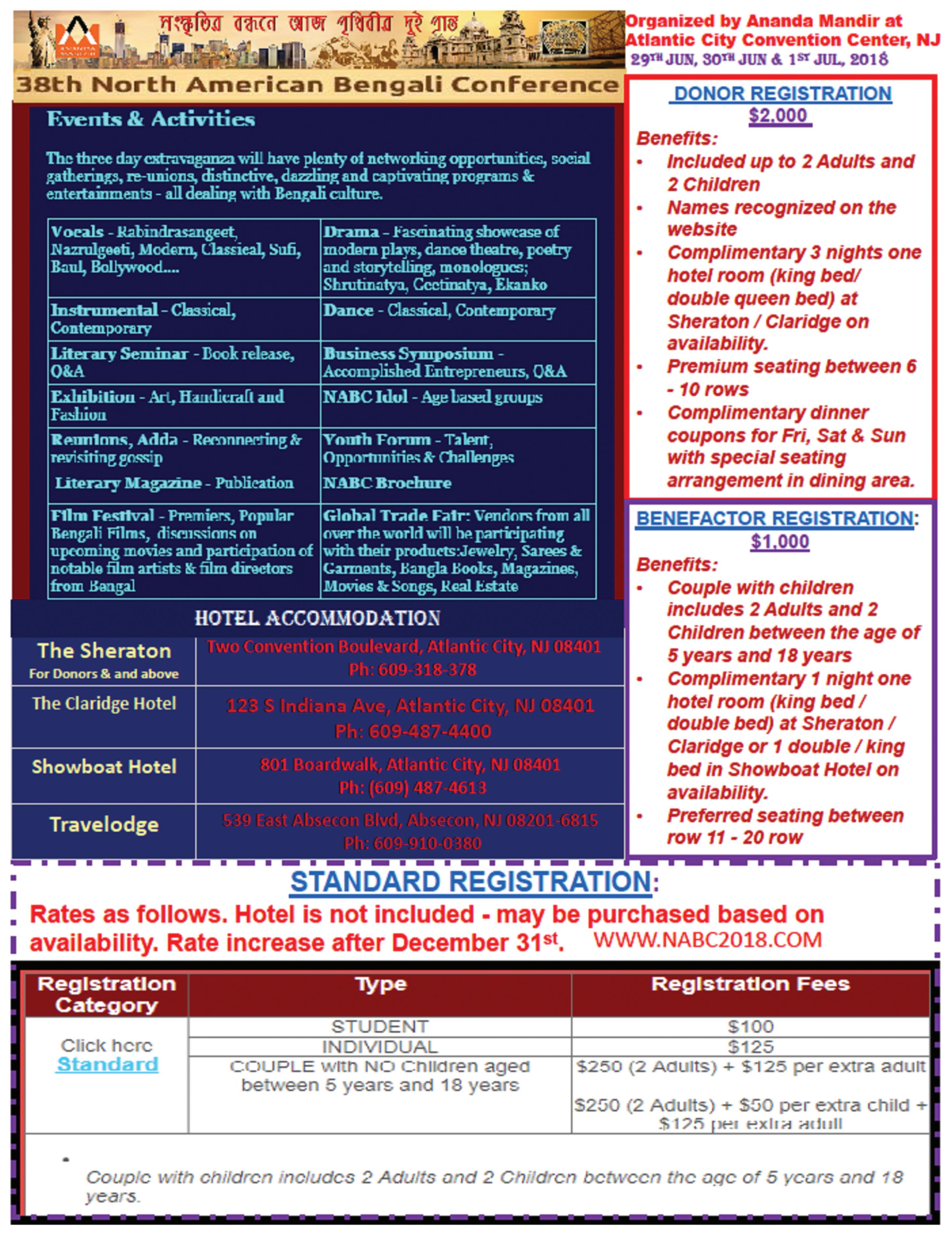
Ananda Mandir has announced the following winners of this year ’s contest:
In the Bengali Nominations Category :
Uddalak Bharadwaj (Houston, TX), and Suvro Datta (Seattle, WA)
In the English Nominations Category: Satya Jeet (Sparta, NJ)
Each winner has received a cash award of $500 and a plaque with a citation.
Congratulations to all the winners!
Uddalak received his high school and college education in West Bengal and his PhD degree from Lucknow, Uttar Pradesh As an Assistant Professor at the University of Texas, MD Anderson Cancer Center, he is busy with his research on anti-cancer drugs However, he still finds time to write poems (and translate poems from other languages to Bengali) He has published many poems in Bengali publications such as DuKool, Sharad Arghya, Orchid, Prothom Alo, and Bhashabandhan Uddalak’s poems mainly dwell on love in its varied forms – and the frictions and upheavals it often causes The award recognizes him for his imaginative and heartfelt rendering of human emotions.
Suvro was born and brought up in Kolkata, and came to the States for higher studies in the mid-eighties He received his MS degree from CarnegieMellon University, and his PhD degree from the University of Washington Although trained as a physicist, he has changed profession several times He has worked as a space scientist, a camera merchant, a biomedical engineer and a robotics engineer. But he has always loved to write. He has written short stories and poems in Bengali whenever he has found free time in his busy life Suvro has published short stories in DuKool and other magazines and is the founder/editor of a popular website dedicated solely to limericks in the Bengali language. The award recognizes Suvro for his short stories that focus on the rich textures and values of family life and social interactions
Satya Jeet was born in Kolkata and received his early education there Following a year at IIT-Kharagpur as an Architecture major, Satya Jeet came to the US to complete his undergraduate studies. Moving on to graduate studies in film, he joined the TV industry Honing his photographic skill across the US at small television stations, he was picked by CBS Television in New York as a cameraman for their documentary and news division Satya Jeet shot numerous episodes of the CBS news magazine ’60 Minutes’ He was awarded an Emmy for cinematography for Public Service Programming As an author, satya Jeet has published a seven-part series of narratives, My Life in Media, that has artfully captured the intoxicating conflicts between restlessness and determination, between ambition and indifference, between life and the images one creates of that life on TV The award recognizes Satya Jeet’s unusual abilities to write about life’s ups and downs with grace, humility and candor