Ananda Mandir
269 Cedar Grove Lane Somerset, NJ 08873


Ananda Mandir
269 Cedar Grove Lane Somerset, NJ 08873
January 2016
Reported by Subrata Bhaumik
In October, Ananda Mandir (AM) celebrated, with much fanfare, the Bengali Hindu festive season of “Devipakhha ” It began with live “Mahalaya,” followed by Durga puja, the most important event in Hindu Bengali religious and social calendar, and ended with the “Bijoya Sammeloni”, which AM presented to the local Bengali community as a token of appreciation for its support for this “one and only” one-stop center for all religious and cul-
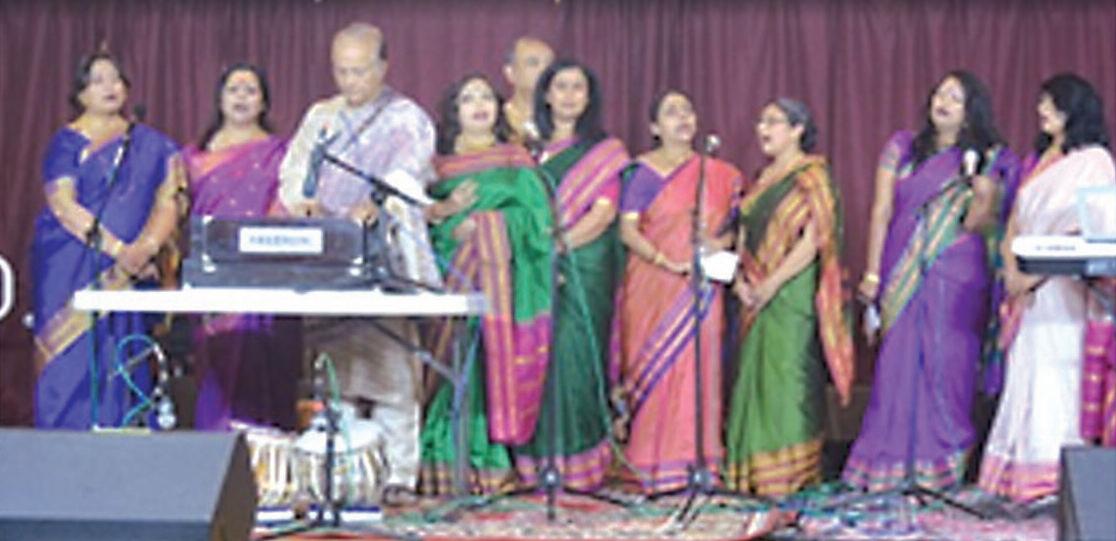
presentation, Arun Bhowmick, director of the choir, and its members including Rik Sen, Susmita Biswas, Lopa Das, Soma Rakhit, Soma Dutta, Ambalika Mukherjee, Ranjana Sanyal, and Sarbani Mukherjee, gave a glimpse into the musical bonanza that was awaiting the audience.
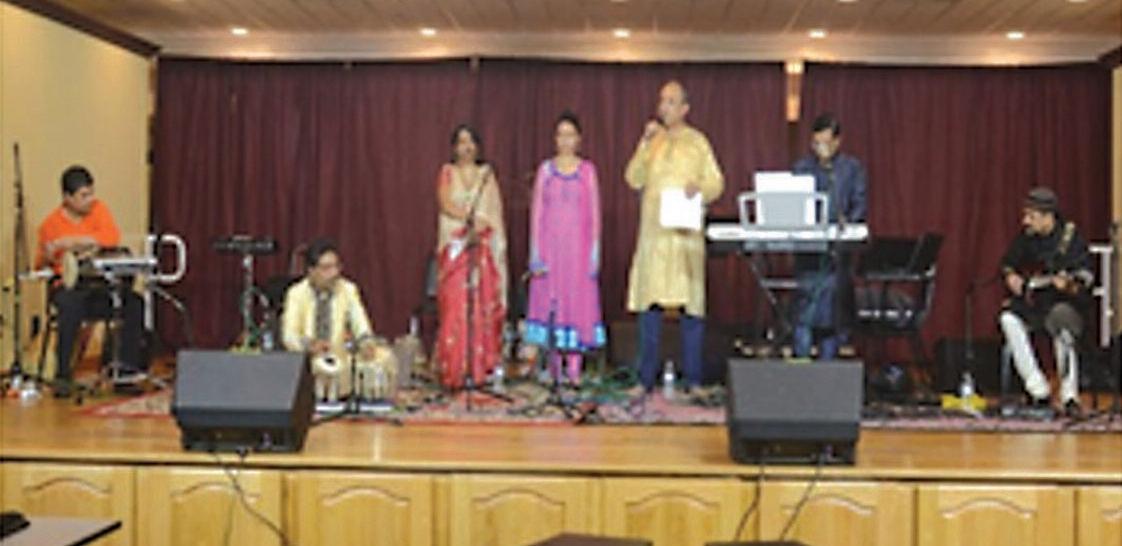
The first major segment was a medley of Bengali songs of yesteryears presented by the Resonance Band, a NJ musical group
tural needs in the tristate area
While Mahalaya and the puja have been separately reported in this edition of the news magazine, this report focuses on the Bijoya Sammeloni that was held on Saturday, October 31, at Krishna temple in Morganville, NJ. It was a beautiful afternoon, and the sprawling venue with its religiously curated compound and facilities provided the perfect set up for this kind of Indian cultural events Early evening, Dipak Sarkar, AM’s president, inaugurated it with a welcome address to the robust audience This was followed by a Children’s’ Halloween parade celebrating the day dedicated to “All Hallows” and pacifying the dead evils, which, as the tradition goes, invisibly roam around the environs
The event began with a welcome by “Ananda Dhwani,” AM’s choir, presenting a small offering of Rabindra Sangeet featuring “Ananda Dhara Bohichhe Bhubone” and “Ei Lobhinu Shongo Tobo ” Through the excellent
Performers included several local talents including Suranjan Bhanja Chowdhury, Sreya B hanja Chowdhury, and Sucharita Das in vocal; Satyajit Bhattacharya (vocal and keyboard) and Ranjan Chowdhury in guitar/vocal; and Arindam Chatterjee and Jayanta Das in percussion. This was a tribute to the popular musicians who enchanted the ears and hearts of millions of Bengalis in the 50s through the 90s, and included household names like Manna Dey, Hemanta Mukherjee, Manobendra Mukherjee, Shyamal Mitra, Sandhya Mukherjee, Pratima Bannerjee, Nirmolendu Chowdhury, S D Burman, and, more recently, Runa Laila, Subhamita Bannjerjee and Raghab Chatterjee. The music exhibited the rich tapestry of various genres of Bengali music including light classical, popular (Adhunik), and the folk tunes It included famous numbers like Coffee Houser Shei Addata Ar Nei, Mone Noi Bone Mor Pakhira, Ekta Gaan Likho Amar Janyo, Thikana Amar
Checho Bondhu, and many others gems The pieces on light classical and folk songs also followed a similar pattern, and included Bhubono Mono Mohini (Rabindra Sangeet), Mohan Bashi Baje, Sadher Lau, Shohag Chand Badhoni, Tak Dum Tak Dum Baje, etc
The next segment was the main attraction of the evening featuring a duet between the much famed Sarod Maestro Rajiv Chakraborty and Monomoy B hattacharya, one of popular Bengali singers of recent times In support was a team of high caliber percussionist and pianist that typically plays with this Duo including Soumen Chowdhury It was an excellent segment with two parts that straddled a dinner break
The first item focused on vocal rendition by Monomoy of several famous Bengali light classical songs that were respectively followed by Rajiv Chakraborty’s playing a bit of the base raga or the related dhun, complemented at times by the whole related musical arrangements Songs presented in this format included some famous Najrulgeeti, Rabindra Sangeets, and Adhuniks like Arunkanti Ke Go Jogi Bhikhari, Eki Labonye Purno Pran, Esho Shyamalo Shundaro, Jhanana Jhanana Baje, and others followed by the various ragas including Ahir Bhairav, Carnatak raga, Desh, Chaya Nat, etc
The second part was a medley of old songs and was presented in a similar format with alternating leads by vocal and Sarod In the style of any other popular concert, the musicians encouraged the audience to sing along, which they were more than happy to comply with These songs ranged from famous numbers from old films to Rabindra Sangeet to popular numbers (non-movie) from the period that spanned from the 50s to 70s and the present – originally sung by legendary singers of the time including Manobendra Mukhopadhaya, Manna Dey, Jatileshwar Mukhopadhaya, Dhanonjoy Bhattacharya, and more recently Monomoy Bhattacharya Notable pieces included B henge Mor Gharer Chabi, Amra Shobai Raja, Jodi Tor Daak Shune Keu, Pagla Haowar Badol Dine, Ghorete B hromor Elo Gun Guniye - all Rabindra Sangeets; film numbers included Khotiki Na Hoi Aji Porbe Meteria Medicar Kabyo (Maya Mrigo), Jibone Ki Pabona (Tin B huboner Pare), Hajar Takar Jhar Batita (Stree), Ekhon Bujhili To (Jatiswar), etc ; and old popular (Adhunik) gems including Lolita Go Oke Aj Chole Jete, Bodhua Amar Chokhe Jaal Enenchhe, Jhanana Jhanana Baje, and others
It was a spectacular event effusively dotted with the audience bursting in cheering glee, never-ending applauses, and singing and dancing to the tunes of the performers The musicians were very appreciative of the audience as well, and the program ended on a very high note Under the leadership of Arun Bhowmick and Ashok Rakhit, this event was yet another shiny feather in AM’s cap that showcased its organizational strength and cultural prowess
Calendar of Events (Dates are subject to Change) Please check our website frequently www.anandamandir.org Tel: 732-873-9821
NOTE: If a particular Puja time is not listed, please contact temple or visit our website:anandamandir org
New Year’s DayMorning Darshan
Friday, 01, 9 AM-12 PM New Year ’s Day-Evening Darshan
Friday, 01, 4 PM-8:30 PM
Shyama Puja
Saturday, 09, 5:30 PM-7:30 PM Pous Sankranti
Friday, 15, 9AM-11AM
Satyanarayan Puja
Saturday, 23, 5:30 PM7:30 PM
Sahitya O Alochana
Friday, 15, 8:00 PM
Ananda Sandhya Not scheduled
Ratanti Kali Puja
Sunday, 07, 5:30 PM-8 PM
Ganesh Chaturthi
Friday, 12, 10 AM-11 AM
Saraswati Puja
Saturday, 13, 8AM-11AM
Sahitya O Alochana
Friday, 19, 8:00 PM
Ananda Sandhya Not scheduled
Call Mandir for Puja
Schedule Sahitya O Alochana
Friday, 18, 8:00 PM
Ananda Sandhya Not scheduled
Special Religious Services: Upon request, the priest of Ananda Mandir offers services such as inhouse Shraddhas, Rituals associated with Cremations (Antyesti Kriya), Shraddha Anniversaries, Pre-wedding rituals (Naandimukh, Ashirwad, etc), Upanayan (Paitey), Annaprasan, Wedding Ceremonies & Wedd ng Anniversaries, Griha Prabesh (Bhumi Puja), Consecrations of new cars (New Car Pujas) and others
If you have needs for any of the above or more, please feel free to contact Biswabhai @ 732-873-9821
2
January 2016
A Periodical Newsletter
Published By ANANDA MANDIR
(A Tax-Exempt, Non-Profit Organization)
269 Cedar Grove Lane Somerset, NJ 08873
Ph: 732-873-9821 Website: www anandamandir org
PUBlICATION COMMITTEE OF ANANDA MANDIR
Chairperson: Pronoy Chatterjee, pkc usa@yahoo com
Assistant Chairperson: Subrata Bhaumik, Bhaumik subrata@gmail com
Editor-in-Chief: Debajyoti Chatterji, Debsmee572@gmail com
Managing Editor : Ananda Sangbad: Guru Chakravarty, guruchakravarty@yahoo com
Managing Editor, Anandalipi: Amitabha Bagchi, amitabhanj@gmail com
Editors: Subrata Bhaumik, bhaumik subrata@gmail com
Subhodev Das, subhodev das@gmail com
Sushmita Dutta, sushmitadutt2@gmail.com
Nupur lahiri, nupurlahiri@aol com
Associate Editors: Amrita Kangle, amritakangle@hotmail com
Ruby Banerjea, r banerjea@yahoo com
Members-at-large: Bhaswati Bhadra Ashok Rakhit
All queries, articles, news reports and letters should be directed to the Managing Editor: Phone: 908-752-3065, E-mail: guruchakravarty@yahoo com
For general information, please contact the following executives of Ananda Mandir:
Dipak Sarkar, President
Jaiprakash Biswas, Vice President
Suprasad Baidyaroy, Vice President
Chanu Das, Treasurer
Arun Bhowmik, General Secretary
What ’s New in the New Year?
There are many new things on our plate as we step in to the New Year There is our lovely new temple, albeit not completed in all aspects yet, but the deities are located and worshipped on a new spacious altar The community center building next to the temple is near completion
Ananda Sangbad is fortified with two new associate editors as we continue our march to solidify our position as one of the premier news magazines by Indians in this country. It is a news magazine that is enriched with innovative articles on all aspects of social, philosophical and literary subjects that affect our community It expands our horizon on science and technology, deals with medical and mental health matters, experiments with new style of creative literature, and helps to create a new genre of talented writers The editors will continue to listen to your suggestions to get Ananda Sangbad to a higher level
The New Year brings with it the usual chore of responsibilities in our lives– health insurance plans to be renewed, tax documents to be gathered for filing, physical exercise plans to be changed from outdoor to indoor New Year brings the old man winter for which preparations have to be made winterize home, clean snow on the driveway, check the home heating system, prepare to drive through snow all the while wishing that we were rather in Kolkata Still, there are other people, especially children, who look forward to the winter, excited to ski and participate in other winter sports, and enjoy the sight of falling snow
This New Year imposes an undesirable element in our lives called terrorism Although the memory of 9/11 will always remain fresh as the most notorious example of terrorism in this country, gun violence has erupted lately as a routine matter According to the media reports, there is at least one terrorism event every day in the USA The entire media is now consumed by it, so much so that the big political fight for the 2016 presidential race could be decided on this point So, are the Indians worried about it? We have been through our share of living amidst terrorism The Naxalbari movement was a real threat to Kolkata people during the 70s. Terror in Mumbai was a horrific incident that we can never forget Until recently, Maoists dominated much of the Jharkhand area where bombs were used routinely to terrorize people Even now, no election can be conducted in West Bengal without bombing incidents near election booths Are people worried about it at Kolkata – not really! We will go through this period of terrorism in the USA living our lives as we must
Wish you all a safe and peaceful New Year !
Guru Chakravarty
Managing
Editor, Ananda Sangbad
On behalf of the Board of Trustees of Ananda Mandir, I wish you and your family A Happy New Year 2016! I also want to thank the community for participating in our religious, cultural, fundraising and other events in 2015; and for continuing to support Ananda Mandir’s mission and growth
Two thousand fifteen was in general a good year for Ananda Mandir We have increased the number of life members to more than 400 and the number of associate members to more than 2000 We have continued our activities in the areas of religious programs, cultural programs, literary activities, senior forum and youth programs, donation to food bank, literary awards, financial grant award for community services, etc During Annual Durga puja and Kali puja festivals, despite the crowd restriction imposed by the township due to our ongoing construction, hundreds of devotees visited Ananda Mandir temple Our annual fundraising event was quite successful Over 100 supporters attended the event and donated funds We were able to raise over 300 thousand dollars from both fundraising and our puja events This fund will greatly help in covering our expenses, which are gradually increasing due to temple expansion and community center construction projects
As you know Ananda Mandir is undergoing construction and renovation for the expansion of the temple and building a new community center We are expecting our construction project to be completed by the middle of 2016 The expanded temple after completion will have three times more space than the current temple The new community center will be able to host small and large parties for wedding, birthday, retirement, graduation, anniversary and shradha, just to name a few Also, it will be good for small or large size cultural programs, movie shows, plays and many other events. Additionally, we will have several office spaces for renting, for art, dance, language and religious classes.
As I wrote to you before, I am requesting all our life members to take more active roles in running our organization following the completion of our community center and expanded temple This will be necessary to upkeep the new larger facilities with more human use and increased vehicular traffic We will also need more revenues to cover additional expenses For this, I ask our members to utilize the available facilities more frequently, for a modest charge Please encourage all your friends to use our religious facility and the community center more often
We will also need financial support to furnish the expanded temple and to complete the community center with a stage, offices, vegetarian and non-vegetarian kitchens and multitude of enhancements Please become a Life Member, a Patron Member or a Grand Patron Member and donate generously for our cause Please join the Ananda Mandir team as a volunteer to help with temple work, office work, and training our youth in Indian art, literature and religion
Please join me to make Ananda Mandir strong so that this organization continues to provide religious and cultural services to all Bengalis and friends of Bengalis in the tristate area
Dipak K. Sarkar President, Ananda Mandir
email. Please stay tuned.
If you are a Life Member or an Associate Member, but didn't receive your copy of Ananda Sangbad, it may be because we do not have the correct address on file for you. Please send an email to Guru Chakravarty (guruchakravarty@yahoo.com) with your correct address, and we will send you another copy.
Ananda Sangbad
By Amrita Kangle
Getting married is very stressful business Not only do I say this,just ask any affected party and they will all agree with what I am saying Why, what about you? Those of you who are married, don't you agree with my point of view?
There are so many angles to this marriage thing You are picking up a whole human being from the atmosphere that she has been used to all her life, and transplanting her to a wholly new atmosphere and expecting her to hit the ground running It is grossly unfair and the path is fraught with difficulties I am not being biased here and talking about only the female of the species The males have their own problems, I am sure They can no longer throw the wet towel on the bed and expect it to go away by itself and neither can they step out of their trousers, leaving them as is, till it is time to step into them again the next day Why, even plants have their own opinions about these changes If they don't like a change, they just up and die Of course I agree that what they do is a bit drastic Die? I mean, that's carrying things too far, isn't it? I remember I had a banana plant in a smallish container. She was thriving there very nicely Apart from not giving bananas, she was not doing anything wrong A point came where she seemed to have thrived a little too well At this point, I decided to transplant her to a bigger pot all for her well-being, you see I had nothing to gain in this It's not as if she would start supplying me with bananas! So, I got a real big pot and filled it with soil and manure and repotted Ms Banana Let her grow as much as she wants, I thought Now what do you think happened? She went and died!! Wasn't it the height of bad manners? I later heard that you must not transplant a tree into a very large container from a small one It should be done in stages From small to medium to big to bigger
Now humans show no such concern for their fellow humans At least not in our times No, I am not saying that I belong to the Dinosaurian era but then neither do I belong to the present generation where the meaning of the word 'marriage' has to be looked up in Webster's
In my case the problems were a bit more complex I come from the eastern part of India and my husband hails from the western regions So, though our hearts beat together as one, geographically we were poles apart. No, no not in terms of distance but in terms of all the values that made us what we were as humans Our way of thinking was different, our approach to solving a problem was different just for example, if I was confronted with a problem, my approach was to take it by the horns and blindly rush in with all guns blazing My husband's way was to grow calm and think it out and then react with a perfect strategy in place Now this very calm had an extremely 'uncalming' effect on me The logic of it totally eluded me No, I agree that his way works better, but I still cannot think of just calmly thinking about a solution while the problem is ticking away like a time bomb I must kick my hands and legs around and make enough noise to wake the neighborhood at least. This does not solve the problem, I know, but I am left with a very satisfied feeling that I did my best
It did not end there The biggest difference was in our food habits As things stood, I had been my father's pampered princess Cooking and marketing were for lesser beings Reading, writing poetry, painting were my things to do I had no idea what the inside of a fish market looked like And all those fishy smells yucccks! Fish should only be the nice fried pieces, or drenched in mustard sauce served at lunchtime I was not interested in any piscine facts beyond that That they actually were creatures which had to be worked upon before they turned into heavenly fish fries was a thing of wonder for me
Unfortunately, after getting married I had to face a very real fact of life and it was that poetry does not fill the stomach So I had to enter the kitchen But then, after that, what? What else, but that saver of lives, Maggi Noodles! So Maggi Noodles became our staple food MN for lunch and MN for dinner To his credit, the H took it very well He even said that I cook very well What a nice man I have married, I used to congratulate myself Now this same man refuses to sit at the same table where noodles is being served and says some really rude things about the whole species of noodles Even far off cousins of the nice and convenient Noodle, like Pasta are forbidden from appearing at our table What happened to that nice man that I had married, I wonder!
The most important ingredient in a Bengali wedding is the food As it is in any Bengali function Fish fries, mutton, humongous prawns, large pieces of fish in a delectable gravy are all the main attractions of a Bengali wedding An all vegetarian fare is not even a nightmare that we Bengalis allow to invade our dreams Now, Maharashtrian weddings essentially have to have vegetarian food MarContinued to page 5
Our world, as we see or perceive, is being created based on our wishes in our subconscious minds by conscious and fleeting thoughts In other words, we are the creator of our own world, and we created it with our thoughts
We stand in the midst of our own creation, which is an animation of our own thoughts. This animated world, however, is ever changing as our thoughts are changing Thus our world is dynamic - changing, reshaping as we gain experience and float in our thoughts We see it as a pattern of transient imagery, but nothing permanent, nothing absolute.
Those images are being shaped in our mind to link and communicate with the Nature and to express and manifest our apparent self They are not exactly the way we feel them in our conscious mind They are simply the transformation of our own thoughts They represent a visible illusion of images, shapes and forms that help us to emancipate as an individual and link and communicate to the Nature In order to transmit our ideas to link with others we use verbal languages, symbols and gestures, but they are all external tools for communicating between different personalities They are not the direct transmission media of inner souls They only help to convey the limited messages of our perception of the world that we experience through our sensory organs Articulate expression using verbal or written languages is just one of several means to externally communicate our gross feelings
Transmission of thoughts through language gets modulated along its path of motion, and often results in misleading or distorted perception to a receiver on the other end Thoughts float in our mind; we grab them, throw away some, and put them in a sequence of words in an attempt to communicate our feelings The receiver takes some of it, throws away some and rearranges the sequence of words, which get further modulated as it interacts with the thoughts of the receiver at the time No matter how rich those words are or how well they are crafted in sentences, the exact perception of one’s own experience of an event cannot be fully represented or communicated in its entirety to another, as intended
Our feelings, such as sorrows, happiness, love and hatred, could hardly be expressed by language alone or by means of other codes that had been cre-
ated for the purpose of communication A simple touch or a benign look could be a more effective means of communication of inner feelings To express love, compassion or hatred there is no need to have language; it can be totally and more effectively expressed in complete silence, through the inner interaction of souls, since we are all connected to each other
Everything in this world, living and non-living, is a part of a continuum We see them differently, because of our illusion or lack of sensitivity to realize the true form of Nature It is all in one, only manifested differently in our elusive mind.
If we accept this truth, there is no need to have any language or other special communication tools to send or receive messages from one part of the continuum to another part It is spontaneous and instantaneous In reality, every part of this continuum is constantly sending and receiving the messages from the other parts. We belong to this continuum, but to comprehend this reality we must get to a higher level in the evolutionary ladder, and one day we might get there It ’s a matter of how and when we transcend the evolutionary time scale
Feelings and actions of everyone, every day and every moment, are dependent on the actions and reactions of the society in which they live(d) in - now and the past, and they are all interconnected in this universe All the elements that are perceived through senses and minds are constantly sending signals to each other at all times We may or may not recognize the signals; it all depends upon our level of consciousness Many, who are recognized as having extra-sensory perception, are in fact further advanced in the evolutionary process, reaching to a point where they can receive and decode the communication signals of the past, present, and future Thus, they can see past, present, and future at any instant.
Everything in this universe, or that belongs to the universe beyond, is an element of a vast network structure, which includes not only so called material objects but abstract senses and thoughts too All the ripples of senses that originate at or perceived by one element in this abstract vast network structure would cause an effect on all other elements in the universe, since all belong to the same continuum They are not separate The abstract feelings that one el-
ement in this grand structure experiences cause a ripple effect on all others Thus the transmission of one’s own feelings to others happens spontaneously; it does not require any external communication vehicle
Two different persons or two different entities, as we perceive at our level of mental perception, are not separate from each other In reality, they are not two different entities either We see one is different from the other because of our perception of the existence of the other This perception is an illusion.
The world, as we see, is a relative perception All phenomena in this world are just the perceptions relative to one another Life wouldn’ t have any existence, if deaths were not perceived in our thought If there was no darkness, light could not have been perceived by eyes. Love would not have any value if hate did not exist in human society The existence of a person is not real to us unless we perceive our existence as real It’s all the magical illusion of perception
We can experience the ability to communicate our feelings to others without any external means, language or otherwise We do not have to talk or even look to communicate our feelings to others All could be transmitted internally and spontaneously We could also receive and feel others’ feelings, without any external means However, to achieve it, our sensual perception must attain to a higher level than what it is at now The more we are able to raise the level of our sensual perception, the more we would be advancing in our ability to achieve the communication internally and spontaneously It all depends upon the development of our sensitivity, intellectuality and spirituality This is true for every individual
The more sensitive we are, in terms of our perceptibility, the more effective communicators we would be. Thus, one must strive to advance his/ her perception of senses to be an effective communicator As we evolve to a higher and higher level we develop more and more sensitivity, which in turn would raise our ability to receive and communicate more effectively
According to some, listening to classical music or engaging in fine arts would help tuning the mind Thus, it would raise the level of perception in mind and hence the internal communication skills Meditation certainly helps awakening our dormant sense receptors and thus it may raise the level of perception the same way However, these claims remain to be verified
Ananda Sangbad
It is a generally accepted idea that “compatibility” between partners is a very important aspect of a lasting, if not an ideal relationship, and your ideal mate or “soul-mate” is someone who is compatible with you in every way The tradition of arranged marriages in countries like India was established with this compatibility in mind In Western cultures, the custom of dating is supposed to be the vehicle for
their mates, if nothing else, by being sensitive and communicative. It is not an easy task and most couples learn to live with this basic incompatibility! Sexual compatibility is, of course, highly desirable, and if the physical needs of both partners are high then the relationship could be very intense Unfortunately, the passion experienced during the period of courtship and early years of marriage eventually

people to learn about the personalities and various traits of the person they are dating in order to establish an acceptable level of compatibility In this article, I would like to assert three points: a) while a strong compatibility of various traits is certainly desirable in order to develop common interests for the couple, it has very little to do with a long and stable relationship b) the requirements for a long relationship are rather basic and more practical than romantic, and c) the concept of a “soul-mate” is a myth.
Let us examine each compatibility criterion in order to understand my first point Basically there are four aspects in an interpersonal interaction where compatibility matters: emotional, physical, intellectual and financial It is widely believed that women are more emotional than men This fundamental difference can be overcome only by having men learning to express their emotions more openly and accept the emotional reactions of
starts to fade As many books and therapies have advocated, it is important for both partners to make deliberate efforts to keep the “fire burning” and be open to various suggestions to entice their mates Unfortunately, for a variety of reasons, especially time and energy devoted to children, jobs and just the routine chores of a domestic life, making such efforts turn out to be very difficult for most couples Even though physical compatibility might have ignited the romance, it becomes irrelevant in the long run.
There are different types of intellectual differences between partners One is simply a difference in basic intelligence, and the other one is what I would call a “left brain/right brain” issue Even if both partners are college educated with professional careers that does not assure that they are equally smart They can only satisfy each other’s need for intellectual satisfaction if both are intelligent to a similar degree Otherwise, it is inevitable that
By Basab Dasgupta
the smarter partner will find out that he/she is the smarter one and could become the controlling partner, and that is certainly not good Secondly, most people are either right-brained or leftbrained; former group of people likes art, music, literature, spirituality etc , while the other group likes technology, math, accounting, business etc Even if both the partners are equally “intelligent” in their respective areas of passion they may not click because of lack of a common area that turns both of them on
Finally, there is financial compatibility Even though people tend to find their mates in similar financial stratum there is a definite tendency for the would-be bride and/or their parents to seek out a man with wealth and/or a high-paying job This is true both in arranged marriages and also in dating scenes where such guys are considered as “good catches” Sometimes opposite can also be true when a man who is not on solid financial ground searches for a wealthy woman In my opinion, this disparity in financial situation can be a cause of potential problems because the partner with access to more resources often tends to play a more dominating role If both partners come from a wealthy background and they both give high priority to making money, then chances are that they would have a lavish and an apparently happy lifestyle, at least for a while, but it might be somewhat superficial. Also, there could be conflicts based on how the money should be spent even if there is no shortage of it!
In fact, a couple can probably be very happy together if both partners come from poor backgrounds and do not consider their financial needs to be of high priority, because poverty would be a unifying bond
Other kinds of compatibilities such as spiritual and political compatibility or lack thereof usually do not pose a huge problem but could occasionally become significant, especially during a political turmoil in the country, such as war or major social changes (acceptance of legal abortion and gay marriage, for example)
Contrary to popular belief, a relationship lasts a long time based on some rather mundane practical needs: need for companionship and need to live in a well-organized household No one really likes to live alone The benefit of so-called “freedom” of being able to do whatever one wants to do and whenever one pleases, is over-rated There is also considerable synergy in two people living together This is
probably the main reason why many couples remain married for a very long time in spite of significant differences in their personalities and view-points Just having another person around gives one the feeling of a cocoon, even if the two persons have nothing in common and seldom talk to each other A disciplined domestic life is also important for a long lasting relationship. This discipline includes cooking, cleaning, washing clothes, grocery shopping, taking the trash out etc on a regular schedule If a couple can share the chores and keep a clean organized home, it goes a long way towards a lasting and happy life together
One final point: In order to have a lasting relationship, a couple must be able to communicate candidly no matter what the subject on hand is This is not an issue of compatibility; it is an absolute requirement for a long happy partnership Lack of candid communication breeds suspicion, mistrust, isolation, etc Establishing open communication is a lot harder than it seems While many couples can talk freely about many things, they simple freeze when discussing certain topics such as in-laws or some irrational thoughts or certain sexual subjects
Whether a relationship is a happy or long-lasting one I am fairly certain that most people wonder at one time or another if there is someone more compatible than their present partner who could make their life even better You have probably heard the saying that “for every person there is an ideal mate somewhere in the world but the challenge is to find that person” It definitely sounds optimistic and reassuring, but what does an “ideal mate” really mean and would finding this ideal mate mean a perfect blissful life together?
In my opinion this concept of a soul-mate, perfectly compatible with one in every respect is a myth; it is really just a “reflection” of one’s personality in the opposite gender In other words, if you are a man, your ideal mate is a female version of you, and if you are a woman, your soulmate is your male counter-part It is similar to the concept of Radha and Krishna in Hindu religion So, unfortunately, when people are searching for their soul-mates, they are really looking for themselves Why do people do that? I believe that, deep down inside, we are all looking for someone who would love and admire us completely; someone who would appreciate every single aspect of our personality and
appearance – and that would, of course, be possible if that person himself/herself has exactly the same traits However that person, just like one’s reflection in a mirror, is not real and exists only in one’s imagination and wishful thoughts
Without this realization one can search for that ideal partner forever In fact, in many cases, someone may intensely desire a person of opposite gender believing that person to be the soulmate and finally even unite with him/her but only to realize that the person was not really what one thought or expected A blissful domestic life always seems elusive The reason is very simple The search for this fictitious soul-mate is, in fact, the quest for God. Unless and until one surrenders completely to God, one would always feel a void in one’s life, no matter who the partner is
Once one truly believes and accepts this concept then the hankering for finding this ideal mate subsides and one becomes “whole” In other words, together with our reflection in opposite gender we manifest completeness or God! God is Radha and Krishna together It is a part of our self-realization i e determination of who we really are! We are really a part of God What is missing or the other part is our complimentary piece It is not really our opposite In fact, there is another conventional wisdom that "opposites attracts" which is also a myth. The complimentary part consists of what is lacking in us but is still an image of us: what we could perhaps be if we were of opposite gender
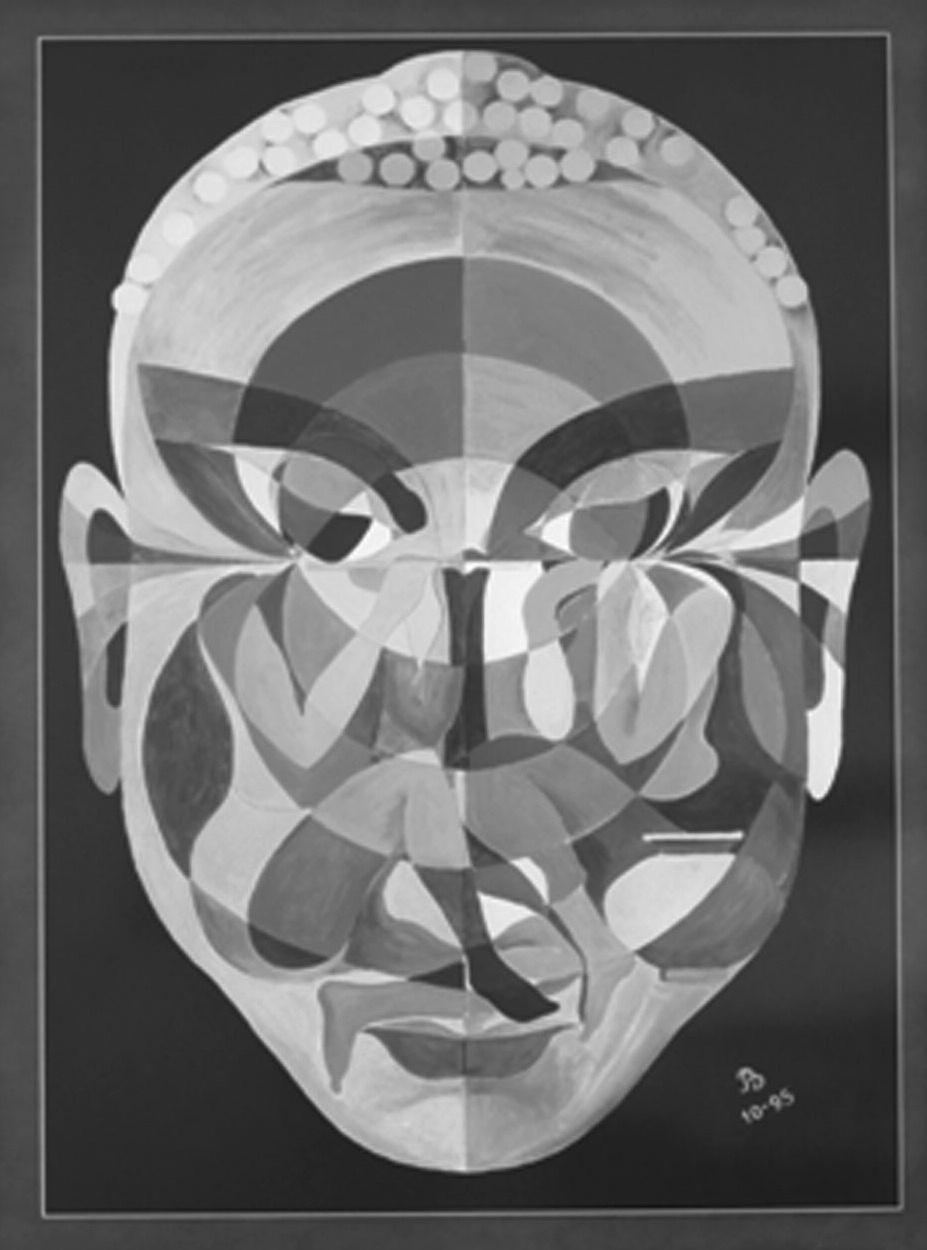
While this may seem like an abstract concept, perhaps a visual representation could help to explain it better In my accompanying painting I have tried to illustrate this concept You will see a male figure on the left, playing flute (symbolizing “Krishna”) and a female figure on the right listening to the sound of flute with utmost attention (symbolizing “Radha”)
The vertical dividing line at the center represents the crosssection of a reflecting mirror plane implying that the female figure is really just the reflection of the male figure The readers, who have studied physics, would recognize the curved lines as “lines of force” between two opposite charges (or two opposite magnetic poles) – the “real” charge and its “image” charge
Also note that the two figures are painted in complimentary colors
The two figures together form a complete face – what I call the “Face of God”!
Ananda Sangbad
Continued from page 3
riages are treated as religious functions and where there is religion, no fish can come swimming in and neither can a goat appear bleating on its four legs
The Maharashtrian faction was horrified that the unmentionable word 'non-veg' was being allowed to be uttered in the same breath as the wedding and the Bengali faction was equally scandalized that a wedding was about to occur, where the possibilities were, that the food served would be Shudder! Shudder!! 'nirmish' Happily, I can inform you, that the east prevailed and the west were not too unhappy that they had had to give in In fact, I remember that they had all dug into the fish fries with gusto and our wedding was the talk of the town in Maharashtrian circles for a long time to come.
The difficulties came in later When I had to enter the kitchen The MN dream had lasted for a very short time, as I have told you After that, I faced formidable competition in the persons of my mom-in-law and her sisters who were all superlative cooks It had to be impressed upon the H, that I was no less The first dish that I learnt to cook was Pomfret Curry
This one is a Maharashtrian dish and originates in Kolhapur Kolhapur is a city in Maharashtra and used to be a princely state of the Maratha Empire Kolhapuri cuisine is rather well known not only for its spicy components but because of its unique taste which comes from the homemade fresh spices used and its Onion Garlic chutney
I felt that this was the easiest amongst all the other complicated recipes So there I was, with a bag in my hand, H in tow, flip-flops on my feet.... off to the fish market! What did you say? Smell? What smell? That is the fragrant smell of fresh fish!
KOLHAPURI POMFRET CURRY
Ingredients:
6 small Pomfret fish
1/2 cup tomato purée
2 cups thick coconut milk
1 onion cut small
1 tablespoon coriander seeds, 10 whole black pepper
1 inch ginger piece
10 cloves garlic
2 tbsp oil
Juice of 3 lemons
1/2 tsp turmeric
Paste of 15 red chilies ( throw the seeds away)
Method:
- Wash and dry the Pomfret and slice into pieces
- Apply lemon juice, turmeric, salt, red chilli paste and keep for 15 minutes
- Make a paste of onion, coriander seeds, ginger, garlic in the wet grinder
- Pour oil in a flattish vessel and after it is hot, add 3 slit green chilies
- Add the spice paste and fry till the oil floats on top
- Add the tomato purée Add 2 cups water Allow it to come to a boil
- Add the fish pieces
- After the fish is cooked (it gets done really fast) add the coconut milk and salt.
- Let it come to a boil Add fresh coriander leaves cut
Having once got my cooking act together, I came to the conclusion that I quite like the kitchen Cooking is extremely de stressing, if I may say so Also, it is quite like solving a Math problem And I also stumbled upon the fact that singing while cooking not only made the food taste better, but had an added advantage. It kept the H out of the kitchen, looking over my shoulder and giving me helpful (?) suggestions! Try it out, if you don't want to take my word for it
By Rahul Ray
It was one of those bright Sunday mornings when you don’ t have to run multiple chores I was relaxing on the bed, half-asleep, when my wife’s shrill cry from downstairs pulled me out of my daydreams with a jolt.
“Cheni was licking urine from bathroom floor What an abomination!” She was clearly very distressed
“We feed him nice food, and now he has to ingest excrement Disgraceful!”
Her cry was clearly directed towards me to come down and take charge of the situation. So, I grudgingly got up from my late-morning slumber and went down quickly
Cheni, our pooch is always hungry Anything that you eat, you have to give him a share Even when you are drinking coffee, he wants his cut to be poured into his bowl Incidentally, he prefers coffee with cream and sugar, over black You just need to spill food on the kitchen floor and he will lick it right off. Obviously, last night someone had a rim-shot in the bathroom and Cheni had happily done the job of mopping it up
My wife accuses me of spoiling Cheni by throwing food scraps at him Therefore, the mere sight of me infuriated her further
“Have I not told you a million times not to treat him with our food? Now can you see the results? Have you ever heard of a pet, licking pee?”
I tried to calm her down promising that I would stop giving Cheni our food She was still fuming –“You have promised such things many times in the past, and broken it each time
She left the scene still fuming Cheni was nowhere to be found He had possibly got wind that he had done something seriously wrong. After a short search, I found him hiding in a closet. He didn’ t make eye contact with me His floppy ears drooped like dead leaves He was clearly worried I patted him on his back to calm him down Soon we were engaged in our father-and-son conversation
“Do you know why Ma is so cross with you?”
“I suppose I do ”
“Then why did you do it? Drinking piss is nasty ”
“I know but it didn’ t taste so bad ”
Cheni’s remark got me into thinking Didn’ t somebody drink his own urine? Yes, late Morarji Desai, the exprime minister of India! Soon, an old video tape started rolling inside my head I remembered his contentious debate with Dan Rather, in 60 Minutes, during his visit to Washington several years ago. The Hon. prime minister argued that drinking one’s own urine was a kind of nature therapy ‘Nature therapy?’ Hah! At the outset it felt as if Mother Nature had provided us with this nourishing and bountiful food which we were wasting, by flushing it down the toilet! But piss? And your own urine?
I felt like puking, but my curiosity got the better of me Could there be any truth behind it? I looked at Cheni He was staring at me with a twinkle in his large brown eyes
“Well, I can’ t really be too harsh on you If our ex-PM can do it, I suppose you can do it too ” I exclaimed
My remark made him very happy, and he started twisting and rolling on the floor, with a howling sound, as has been his practice to display happiness Soon he got up
“I told you so Ma got upset with me for no reason.”
I didn’ t reply because I had to put a stop to our conversation and find more about this obnoxious issue
Typing ‘urine therapy’ in the search engine pulled up such an amazing amount of information that I felt kind of stupid, not to know about it earlier It turned out, that drinking urine has been around for literally thousands of years among many civilizations - Egyptian, Greek, Roman, and many more. Apparently, ‘drinking waters out of thine own cistern’, was known since biblical times However, the first recorded history of urine as a ‘fountain of youth’, comes from Shivambu Kalpa Vidhi, a nearly 5,000 year old Indian text written in Sanskrit Urine therapy is also cited in Sushruta Samhita, an ancient Indian text
I was glued to the computer screen, often scratching my head as has been my practice when I am deeply engaged in reading, while Cheni looked on He knew my habits well and couldn’ t hold back his curiosity long
“Dad, what do you find so interesting?”
“Well, what I am reading is truly amazing Your mother shouldn’ t have scolded you so hard for licking piss. Actually, if I believe everything that I am reading, you should drink it regularly to keep yourself healthy ”
At this, Cheni made a loud hya, hya noise from his mouth which sounded much like he was laughing Do dogs laugh, I wondered Actually it sounded more like ‘ha, ha, I told you so!’ But at this point I had better things to do in my mind than parsing canine behavior Therefore, I quickly got back into reading more about urine therapy
I kept on reading and soon memories came back in droves Mr Morarji Desai, in his milk white cap, dark hornrimmed glasses and sharp features appeared to be a reasonable man How could he drink his own urine? I remembered that in those days in India, it was all hush-hush till the issue exploded onto the world scene, when Mr Prime Minister was interviewed by Dan Rather in that infamous segment of ‘60 Minutes’ I continued reading Soon, I learned that Mr Desai was not the only celebrity to cherish this despicable habit Sarah Miles, the noted British actress drank her urine routinely J D Salinger, the famous American writer was also known to adhere to this prac-
tice
I stared at Cheni He was taking a late morning nap in his familiar pose, with his paws spread out and his droopy ears covering half of his face Good, let me read without intervention. There are wild claims about the benefits of urine, administered orally or topically ranging from dermatological diseases to cancer In one quirky episode, pop-diva Madonna allegedly told David Letterman that she routinely urinates on her feet to keep her athlete’s foot in check In many other claims drinking urine is linked to better prognosis of several malignancies
When I was just about to be overwhelmed by the projected benefits of urine therapy, the scientist in me winked – was there any validity to those claims? Could they be verified in a large cohort study?
Unfortunately my exhaustive search of references and cross-references in Wikipedia failed to provide definitive answers to these important questions. Instead, I learned that present day scientific establishment flatly denies any therapeutic benefit of urine, because urine is 95% water and other constituents have no known therapeutic values! Well, then how do urine therapy believers make such tall claims?
I looked at Cheni, who was happily snoring away But I threw a question at him nonetheless
“Hei Chen, what do you think of this quandary?”
He continued snoring without paying any attention to me
I read on Here is something which may be of interest Urine contains a molecule called Urokinase which has clinical applications as an anti-blood clotting agent Voila, urine therapy believers may be at least partially correct after all! But a quick search revealed that natural abundance of Urokinase is far lower than the required therapeutic dose
Back to square one! But, what about toxicity? Urine often turns yellow after we take medications I knew that break-down products of drugs are excreted in urine Could they be toxic? Actually, kidney failure in patients leads to whole-body toxicity because this sieve-like organ fails to filter out toxic materials from the body, leaving kidney dialysis as the only solution to this grave medical problem
Therefore, our urine can contain toxic by-products from our body, and drinking it can cause toxicity! I was puzzled! Then how do urine therapy believers answer this question? I searched the web with a fine toothed comb, but again failed to obtain any plausible answer Actually I got a little worried, that if Cheni keeps on licking urine it may cause him harm!
Cheni seemed to be in deep sleep His nostrils were emitting soft purring sound But, almost like telepathy he
Continued fto page 10
IIn the immediate post-Independent India where I grew up, cultural borrowing from the West without attribution was commonplace It took me years to realize that the spell-binding fairy-tales of Sukhalata Rao that I so enjoyed as a child were often Bengali transcriptions of Western stories: Sundari, for example, was Beauty and the Beast; and Ram-Khel-Tilak-Singh (note the alliterative title!) really came from Rumpelstiltskin I had been humming Salil Chowdhury’s tune of “Itna Na Mujhse Tu Pyar Badha” for some ten years before stumbling onto its unacknowledged source (Mozart’s Symphony No 40)
There are two ways of looking at this phenomenon The charitable view would posit that the borrower assumed great familiarity of the readers (or listeners) with Western culture, and thus thought any attribution would be superfluous. In this view, the problem lay with me not knowing the original folk tales (or tunes) at the time I first read (or heard) them The uncharitable view would say that plagiarism was not a word known at the time in the Indian dictionary
I will return later to the key question: Does the absence of an explicit acknowledgement or attribution really matter? Let me for the moment turn to a different medium, namely movies, and describe my puzzlement and confusion as I encountered and tried to process two instances of unacknowledged borrowing in Bengali cinema
Bollywood has a long history of rampant borrowing of concepts – from story-lines to stunts and special effects – from Hollywood Sushmita Dutta drew my attention to a website that lists 121 (and presumably counting) instances of “Hollywood Remakes in Bollywood ” I have mixed feelings about the list: Chachi 420 is clearly a remake of Mrs Doubtfire; but to call Mohabbatein a remake of Dead Poets Society is quite a stretch, in my view It is really the stunt scenes that I love There are few parallels to the absurd hilarity of Jugnu (1973), where Dharmendra in a helicopter employs a giant horse-shoe magnet to lift up the car carrying some villains and drops the cargo on the ocean I saw the scene in a Calcutta movie theater in shocked disbelief: the scene was lifted straight out of James Bond (You Only Live Twice 1967) Here is a helpful explanation of the physics involved from the web: Tiger Tanaka uses this twin bladed helicopter with a massive electro-magnet as a unique way of removing his enemies Whilst being pursued, Aki calls for assistance from Tiger to remove Mr Osato's henchmen following in a car The helicopter centers over the car, activates the magnet and lifts it clean into the air Tiger’s helicopter then proceeds to fly over the sea where the magnet is switched off dropping the car into the sea from a great height While I generally took in stride such
By Amitabha Bagchi
shenanigans from Bollywood as par for the course, I was wholly unprepared for what was in store for me when I began watching Uttam Kumar and Suchitra Sen in Chawa Pawa (1959) a few years ago. (I was in high school when the movie originally came out and forbidden from watching romantic films )
I was surprised to see Uttam Kumar cast as a relatively incompetent newspaperman; I was puzzled when Suchitra Sen tried to escape a proposed loveless match by leaving the train with her father at a station and walking across the platform to
Krishna Mukhopadhyay A Bengali affair, through and through!
III
Even more surprise was in store for me when I quite accidentally started watching the movie Jiban Mrityu (1967), starring Uttam Kumar and Supriya Chowdhury a few months back
The story, in a nutshell, has Uttam Kumar as a newly installed bank manager being framed by envious and scheming colleagues for stealing a lot of cash from the vault The bank goes under, and the
I went back later to see the movie again, to find out if there was any attribution of any kind. The author’s name was given as one Bishwanath Ray Alexandre Dumas is nowhere mentioned
IV
Let me return now to the key question: Does the absence of an explicit acknowledgement or attribution really matter? The answer is not exactly clear, and may depend on the circumstances The issue of attribution has a legal aspect and a moral aspect. The legal aspect really concerns copyright violation, which is a non-issue in the cases I quoted early in this essay Neither Jeanne-Marie Leprince de Beaumont (Beauty and the Beast) nor Brothers Grimm (Rumpelstiltskin) nor Mozart (Symphony No 40) has any copyright protection for their works, and people may be free to translate, transcribe and otherwise crib from them The moral aspect, though, is broader and ultimately harks back to the writer ’s (or musician’s or moviemaker ’s) own sense of fairness and rectitude This is where I find that the Indian artists of a previous generation occasionally fall short

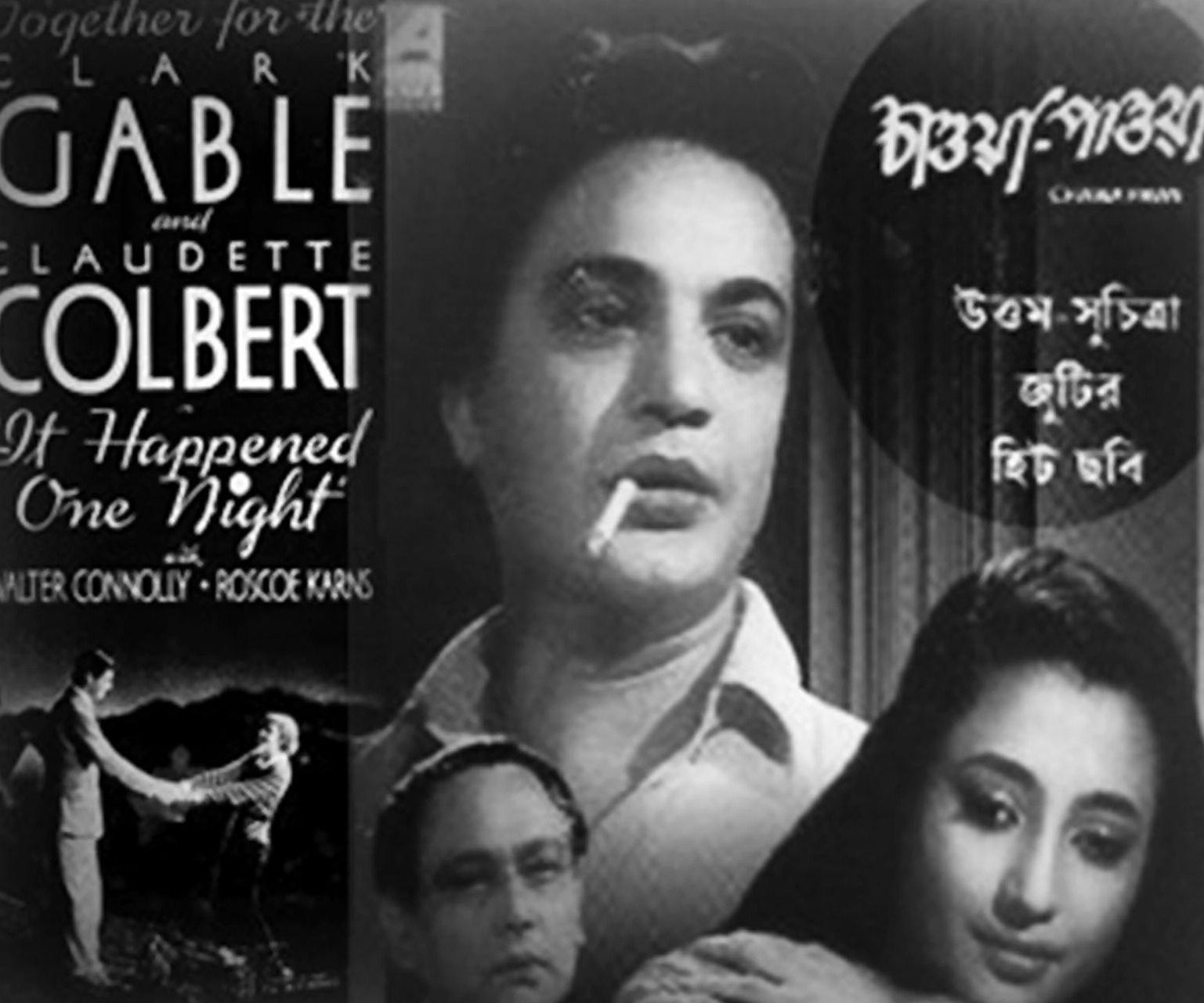
board another one traveling in the opposite direction. I sensed a vague familiarity with the script But the moment Uttam Kumar found an advertisement in the morning paper the next day, promising a rich reward for the return of the escaping young woman, it came to me in a flash I was looking at a remake of Clark Gable and Claudette Colbert in It Happened One Night – the Oscar winning flick of 1938! There was, however, nary an attribution When Uttam Kumar hung a sheet across their beds at an inn in Patna, much as Clark Gable had done in the earlier movie to show righteousness with a nod to chastity, I half expected the Bengali hero to mumble a counterpart to Gable’s quip about erecting the Wall of Jericho (He didn’ t!) With minor local alterations, the Bengali movie followed the script of the original, and the hero snatched the heroine from a potentially loveless union
I went back to look at the movie more closely recently, to see if it ever acknowledged its debt to Hollywood I saw no such thing The story and script, it claimed, were written by one Nripendra
hero is sentenced as the thief to several years of rigorous imprisonment just days before his prospective marriage When he is released, he finds out that his mother had died, friends had gone away, and the fiancée moved to a place unknown Through accidental circumstances, he is pronounced dead in the papers, while at the same time he gets the financial support of a very rich man to create an alternate persona (a Sikh businessman of Calcutta) and plot his revenge
As the plot of revenge unfolded, a light bulb went off in my brain and I had an “Aha!” moment Here was the Bengali transcription of perhaps the world’s greatest novel of revenge, The Count of Monte Cristo Uttam Kumar as Ashok Mukherjee was the new embodiment of Edmond Dantes; Supriya Chowdhury was Mercedes; the betraying bank colleague Bidyut Ghose was clearly Danglars; and the greedy barrister Subrata Bose (N Vishwanathan) trying to woo Supriya was Fernand Mondego Even the number of villains was about the same between the original story and its shadow
But I also have a personal dilemma that is more emotional than rational When, as a teenager, I first saw a performance of NaTyakerer Sondhane ChhoTi Choritro, I thought it was an original Bengali play; I had a hard time believing that it was actually a transcription in the Bengali context of a play (Six Characters in Search of an Author) originally written in Italian Many similar transcriptions by the Nandikar group (Sher Afghan, Tin Paisar Pala) read like real original works in Bengali Does it matter if the audience knows their origin or not?
The answer coming from the younger artists of India in recent years seems to be a resounding YES A good example is the 2004 Hindi film, Raincoat, where the director, Rituparno Ghosh, openly acknowledges his conceptual debt to the short story by O’Henry, The Gift of the Magi This may be the result of the now greater familiarity of Indians with Western mores, thanks to globalization, and also their heightened sensitivity to copyright rules from international agreements I am guardedly hopeful that, over time, Bollywood and Tollywood would be more up front in acknowledging debts to sources as a moral imperative Movies have always been remade from one language and culture to another: for example, The Magnificent Seven (1960) is an Old West remake of the Japanese film Seven Samurai (1954); and Three Men and a Baby (1985) is a comedy based on the script of the French original Trois hommes et un couffin (1985) While it may not matter much to the average Indian in the audience, it is nevertheless desirable if Bollywood and Tollywood acknowledge the specific sources of their inspiration in the making of films based on foreign templates
Ananda Sangbad
By Bakul Banerjee
It was a perfect evening for the annual worship of Lord Shiva, the deity of death and renunciation Like Lord Shiva’s abode in the Himalayas, Chicago area was covered by a thick blanket of pristine snow, rather typical of February The lock on the main temple was frozen shut and we could not enter. We moved the worship location to the nearby temple guesthouse Consequently, I was forced to skip the elaborate preparations that we had already made in the main temple I had my basic kit for worship with me My cohort and the keeper of the temple was present with her two children who were busy clearing the walkway to the door Two other members of the congregation helped me to clear the space in front of the fireplace arranging few fruits and flowers on paper plates I filled a Styrofoam bowl with fresh milk, yogurt, honey, clarified butter and water, assembling the most auspicious of all offering Before beginning the worship, I glanced at others and noticed deep disappointment on their faces By the time I held the bowl between my palms and raised it in meditation reciting the Gayatri Mantra, the four thousand yearold Vedic hymn, the bowl felt as if it were made of pure gold About half an hour later, when I began the hymn to Lord Shiva, I was surprised by the unexpectedly large number of voices joining mine Many braved the snow to come to the temporary location What a thrill it was!
I often wondered why Bengalis prefer to have their own worships instead of participating in those conducted in major Indian temples in the area I began paying close attention to the Bengali versions of scriptural texts and noticed how regional changes came about slowly but steadily in India I continue to explore the influence of worship on spiritual life of the Bengali Diaspora In this essay I present my reflections on Bengali style performance of rituals honoring the divine in visible forms crafted out of stone, metal, clay etc Why do we worship? Since thousands of years ago, gatherings of tribes remained important to humanity to reinforce moral and cultural values Other than mobilizations for war, communal worships played key roles along with associated sacramental rituals like weddings and last rites I helped with Pujas since my preteen years and became involved with the organization of major
worships soon after landing in Baltimore, Maryland Over the past forty years, I had the privilege of organizing and leading many Hindu sacraments and worships Learning Sanskrit in my youth helped as well
Although I am familiar with Sanskrit, the language in which scripture used in worships are written, I need to study the scriptures for hours I strive to execute this glorious duty to the best of my capabilities Since January 1, 2014, I took the assignment, albeit a temporary one, of the B harat Sevashram Sangha, Chicago, a non-profit international order of Hindu monks. This assignment gave me the incentive to discover new meanings and interpretations of the worship that I could not have imagined before
What is worship? Because of difference of opinions among Hindus, any definition that I may offer may be vigorously debated Instead, let me explain the meaning by describing the components of worship I will explain only three components: Puja or the ritual worship of Bigrahas or symbolic icons celebrated by performing a series of actions accompanied by the recitation of scriptures or Stotras The general outline of Puja consists of purification ceremonies, invocations and adorations of the deity and offerings of ornamentations, food and drinks as used by Bengalis in India in their daily life Homa or the fire ceremony is more complex and has its roots in ancient Vedas The third aspect of worship is Vratakatha or readings of morality tales customized for each deity The pattern of these tales is same throughout India, but the narratives often vary based on the region. Music and singing as the adoration of the divine is important However, music is certainly not my forte I do feel moved occasionally and participate in sing-along of hymns, but I am never comfortable with it Fortunately, there are many good singers who are always willing to take charge. Puja of a primary deity begins with a series of standard purification ceremonies for earth, water, flowers and other objects used in the worship It is followed by invocations to Vedic gods and goddesses, often representing various aspects of nature Invocations and specific adorations of the primary deity are accompanied by specific prayers It is interesting that even in this new country we try
to find specific foods and flowers supposed to be preferred by each deity Many years ago, quite by accident, I grew some Dhatura (Angle Trumpet) flowers, considered to be a favorite of Lord Shiva The plant continues to reseed and bloom occasionally in late fall I am always pleased when I am able to take those blooms to the temple In few days, I will be running around my garden and around town gathering plants and fruits favored by Devi Durga
The ritual of Pushpanjali or the offering of scented flowers is performed by all devotees accompanied by prayer hymns of the deity Puja ends with the Aarti or Aratrika in Sanskrit which means the removal of darkness With the accompaniment of music and prayer songs, the deity is celebrated with glowing lamps, incense and fragrant flowers Lit by the clarified butter (Ghee) lamps, faces of many deities glow in the shrine As I move the air around the deities and devotees alike with the giant red fan, it seems that an ethereal bond is established amongst us
The Aarti ceremony has a root which may be traced to other ancient traditions,including those in the Catholic Church
Homa or Yajna, the fire ceremony, may be performed independently, in association with any sacramental ritual like wedding, or in conjunction with the worship of a major deity Procedures for Homa are based on early Vedic scriptural texts and sensibilities Vedic gods and goddesses like Indra, the king of the sky and Grahas or planets, play significant roles in Homa A mandatory Homa is performed for gods and goddesses with Vedic origin. During the Durga Puja or Navaratri ceremony, it is done as prescribed in the text of Devi Mahatmya, a definitive scripture During Homa, a sustained fire is lit and various offerings are placed in the fire pit to be totally consumed by Agni, the fire god Ancient Hindu sages used to perform Homa under the open sky Homa is an essential part of the worship of Devi Durga which is performed on the ninth day of the two week-long celebration It is worth pointing out the interesting regional differences here While Bengali Durga Puja is done over five days, Navaratri is celebrated for nine days in most part of India North Indians worship the goddess Lakshmi on the Deepavali day while Bengalis
in general worship the goddess Kali on that day
Vratakatha or the readings of morality tales associated with a deity is the last but certainly not the least part of a communal worship Vratakatha is often called Paanchali in Bengali Most of these stories illustrate the essential nature of the deity along with instructions about how humans, mostly women, should behave to receive the grace of the deity They are read aloud by the priest or one of the devotees while everybody is supposed to listen carefully For example, the story of Lord Shiva illustrates his compassion. I must confess that these stories sometimes conflict with modern sensibilities, especially for women Several women pointed out to me that the Paanchali for goddess Lakshmi is somewhat meaningless in modern life I must admit that many of them slip away during the reading
My most labor intensive duty is still the organization of the worship All Hindu worships are associated with elaborate preparations written down in thick books I have organized many of them for male priests Although I have become the worship leader, I still do most of the organizational work, spending days cleaning, washing vessels, shopping, and making sure of the details before I can take the priestly seat The simple joy of preparing fragrant rice with ghee, peas, and dry fruits, making a small pile of it on a shiny plate, decorating it with red rose petals, and offering it to Devi Durga is difficult to describe These efforts are labors of love These days, men from younger generations are often willing to assist It is a delight when professional men bring cooked food offerings for the goddess with great humility
Worship procedures that we are most familiar with, began during Vedic times but changed as they were adopted by Bengalis Vedic scriptural texts and procedures were modified to fit the Bengali life style. Sensibilities of post-Vedic or Samhita era were included at that time Characteristics of gods and goddesses also changed to suit the local environment When I was young, in Kolkata, I never heard of any major celebration for Lord Ganesh However, as Bengalis migrated to other parts of the country, they brought Ganesh Puja to Bengal. Minor deities became major ones and some important deities, like goddess
Monosha, the queen of snakes, lost popularity There is an urban legend that the worship of Viswakarma, the god of engineering, started at the behest of a British businessman Now, this deity is routinely worshipped by engineering and technology students Most immigrant Hindu Bengalis who arrived in North America during past fifty years, brought with them their belief systems that are often modified by the quintessential Bengali ethos, often influenced by reformist leaders like Sri Ramakrishna, Swami Vivekananda, Sri Aurobindo, Rabindranath Thakur, and others. Cultural programs gained significant emphasis in Bengali religious festivals Such modifications are certainly not new The Bengali Ramayana, penned by Sri Krittibas, probably had a great influence on how we celebrate the five-day long festival for Devi Durga
Unlike many other Hindu communities, Bengalis do not build big temples often We prefer small-scale centers for worship We do not visit temples every week either Most of us have personal shrines in our homes where we spend some time in prayers throughout the year Yet, we need to fulfill the primal need of tribes to gather for festivals worshiping deities or celebrating major sacraments of life Often, we rent schools and hotels for larger festivals Bengalis from smaller towns travel hundreds of miles to reach larger cities to attend such events Like the worship venues, Bengalis retained their distinct ways of worship from other Hindu immigrant communities Bengali sacramental ceremonies, like the wedding, the first rice eating ceremony etc are also somewhat different from other Hindu communities It is not unusual for Bengalis to consume meat and fish during festivals which is considered a sacrilege for most Hindus
In this spiritual journey, I do witness small coincidences, which some may call miracle Before leaving home on that wintery evening described in the introduction, I took along my mother ’s stone Shivalinga from my home shrine on a whim Later, I felt fortunate that we could at least pour milk on the little Shivalinga even though we could not access the one in the main temple and other offerings were sparse
By Sushmita Dutta
It’s fun It's easy to use And, it’s an engagingly entertaining media. Mobile Gaming delivering interactive mobile videos anytime, anywhere via wireless devices is re-defining people's mind set for entertainment With a Smartphone device in hand, 52 percent men and 48 percent women in North America get engaged in Mobile Gaming for fun at leisure At global level, the Mobile gaming industry generated $7 8 billion revenue in 2012 and the figure is expected to grow to 23 9 billion U.S. dollars by 2016. In 2013, there were 909 million mobile gamers worldwide, nearly half of which resided in the Asia Pacific region North America became second, with 146 million mobile gaming enthusiasts spanning over variety of backgrounds, ages, genders and socioeconomic standards
There is a misconception that Mobile Game users are young teenagers and kids 27% of mobile gamers in North America are between the age group of 35 to 50 years and 10% are over 50 years Mobile gaming industry is growing, and here is a brief coverage specially written for Ananda Sangbad readers on Mobile Gaming
What is a Mobile Game?
A mobile game is simply a video game played on a mobile device like phone, smartphone, PDA, tablet computer, portable media player or calculator. Games played on other computer devices like PC, Laptop, handheld systems like Nintendo 3DS or PlayStation Vita are categorized as video games There are many video games which are mobile compatible and can be played on both mobile and non-mobile platforms having different ways built into the program for user interaction
Mobile gaming technology:
There are many Mobile Game development tools available in the market, for example, Unity, a game development tool from Unity Technologies, offers everything needed for mobile game development
There are many SDK (Software Development Kit) which enable cross platform game development – PC, Smartphone, iPOD etc SDKs help writing cross-platform gaming graphics applications also has library of commonly used functionalities for 3D graphics applications, rendering of simple shapes to complex scenes having numerous objects, animations and special effects For readers interested in getting into Mobile Gaming, here is a list of technology tools and devices that my company uses:
iPhone Game Development: ● Unity 3D Game Engine ● Unreal Game Engine ● iPhone SDK 9Xcode) ● Objective C Game Development ● Open GL ● Cocos - 2D.
Android Game Development: ●
Android SDK ● Java ● HTML5 ● AndEngine, ● Libgdx.
iPad Game Development: Unity 3D game Engine, iPad SDK, Objective C, Open GL, Cocos - 2D, Cocoa Mobile gaming development can be broadly categorized into three segments: (A) Concept development, storyline creation (B) Character development and 2D, 3D animation (C) Interactive design and programming While A and B require creative input and concepts of dramatizations, C includes logical algorithm, programing and computing A major chunk of success of a mobile gaming program lies on how developers of the game can perceive user’s engagement in interacting with the game The interest from user’s perspective should be retained Like every video movie has a defined storyline structured around beginning, climax and conclusion, video games also begin with a storyline concept that defines a gaming structure which is Interactive - that is viewer gets into action by interacting with the story This interactivity makes users responsible for creating a climax situation where users either win or lose a game
Technically, development of a mobile game begins with mapping user mental model for a specific storyline which is then developed into an interactive storyboard for testing user’s comfort level in ease of use of the game Then a prototype or simulation of the game is created for user interaction and testing One of the major development works in gaming software is
Gaming
visualization and animation of characters
One game has multiple characters which are animated to deliver a complete storyline User interaction and interactivity are also built into the game program In case of the game being exclusively designed for mobile, user interactions programmed for touch screen technicalities like “touch” and “swipe” which are different from other general video games for non-mobile computer devices Mobile games also deviate from the path of regular video games which are played on stationed devices like PC, Nintendo etc Two
most popular mobile games – Angry Birds and Candy Crush, for instance, can be played in pieces while the user is waiting for a train or waiting at doctor’s office or at lunch break There are many such mobile games available for free download from the internet
Here are some basic facts on Mobile Gaming:
Why We Play Video/Mobile Games?
There is a “competitive spirit ” which makes 57% of US gamers play mobile games and 43% play for fun and excitement 510 million people worldwide play social games, an increase of 71% since 2010 Social games are played online like cards having multiple partners’ interactions via internet Our time spent on tablets playing games has overtaken time spent watching videos, listening to music, and reading magazines 60% of tablet owners play mobile games as part of entertainment.
Who Are We?
We, mobile game users are scattered over a variety of socio economic standards and age groups 2/3 of mobile gamers are less than 45 years old 87% of boys with access to mobile devices play games, compared 80% of girls Average age of a mobile gamer is 28 2 years And, an average age of social gamer is 39 years 54% of social gamers are male vs 46% are female.
When We Play?
Unbelievably, highest percentage of
mobile games are played in bedrooms
People spend an average of 7.8 hours a month gaming on their phones Games account for 67% of time spent using tablets, vs 39% for smartphones Each day we spend more than an hour playing games 53% of smartphone owners play mobile games daily vs 66% of tablet owners play social games daily 67% of all time spent on tablets is time spent on mobile games
How We Play?
We download free games from internet and we also buy games There are
many free mobile games available for download. The average tablet gamer downloaded 20+ games in 2011 Also, we purchase games to live-up to competition 23% of tablet gamers pay for virtual goods, with an average of $62 dollars per spender Purchase of free premium games makes $12 92 dollars a month per user
What We Play
10 million monthly active users play “Hidden Objects” social games 13 24 million monthly active users play “Casino Related Games” social games 2 5 million monthly active users play “Role-Playing Games” social games Over 100 million people play games on social networks 61% on Facebook
Which games are popular?
● Tiny Tower made $3 million dollars in its first year from in-app purchases alone
● Angry Birds with 700 million downloads, makes $6 million per month from ads
● Zynga’s games have a combined total of 48 million daily active users
● Zynga’s mobile gaming division alone brings in more than $10 billion dollars
● Over the course of 50 days, Draw Something was downloaded 50 million times Users of Draw Something have created drawings at a rate of 3,000 per second
● Rovio’s revenue was 10 million in 2010 - and 100 million in 2011
● Rovio makes $6 million dollars per month just from ads alone
Update: State of the Mobile Gaming industry:
Recently, Mobile Gaming Systems have been introduced example, Moga Pro controller for Android phones has dual analog sticks, directional pad, shoulder buttons, triggers, full-sized grips and illuminated action buttons with a built-in rechargeable battery for you to play whenever you want There are 100+ million U S mobile gamers (almost 1/3 of the nation’s population) and the number is growing Mobile games are the most popular among mobile application category 93% of app downloaders who pay for an application, also pay for a mobile game. The smartphone gaming industry is expected to double by 2016
With that wishing all readers entertaining interactions with mobile games Though, the prediction is that we will soon have many wearable devices in the market which will change the face of mobile games, but the fun will remain with more game controlling features given to us, the users of mobile games So, Cheers to that! Get hooked to some mobile gaming Truly, it’s fun
Ananda Sangbad
By Subhodev Das
Have you ever wondered how we, the thinking organisms, came into being?
The most popular theory of our Universe's origin postulates a cosmic cataclysm unmatched in all of history the Big Bang According to the proponents of the theory, the massive blast that occurred 10-20 billion years ago allowed the Universe's known matter and energy

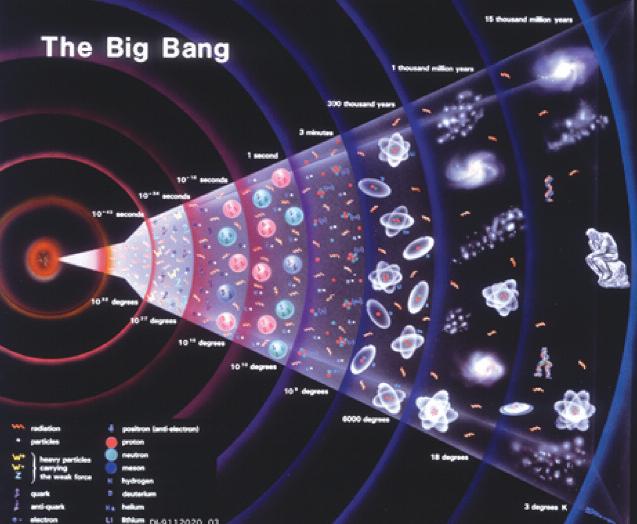
even space and time themselves to spring from some ancient and unknown type of energy In those initial moments only the heavy particles mediating weak nuclear interaction came into being in a background field of radiation or photons (see accompanying graphics) With that, our journey commenced, in some primordial soup!
As the Universe rapidly cooled, particles such as proton, neutron and
meson emerged around 10-10 seconds By the third minute, when the temperature was down to 109K (0 K =273 15°C), atomic clusters of these particles began to form The laws of the Universe were solely under the purview of Physics The Universe had to cool down to 6000K over a period of 300,000 years before the atoms could bond into molecules, ushering the dawn of Chemistry Finally, Biology took hold when life, based on DNA double helix, emerged on Earth about 3 5 billion years ago The march of the Universe has been towards matter of increasing complexity, from fundamental particles to thinking organisms from divided and disordered building blocks, matter became condensed, organized, living and thinking. What is the driving force behind this evolution?
Even though we understand perfectly the laws governing the interaction of atoms, we cannot directly extrapolate these laws to explain the beginning of life, or the auto-catalysis of complex molecular networks, or why we have brains that can contemplate the world around us Due to the overwhelming unlikeliness of random events leading to complex systems like ourselves, it seems as if an organizing agent or “God” must be invoked who puts the
Continued to page 10


Ananda Sangbad
Continued from page 9
building blocks together
It turns out that the answer lies in the most basic of all features, the most fundamental concept: self-organization. Under the pressure of information, systems assume greater complexity through self-organization towards more and more complex forms of matter, up to the generation of life and thought
To this end, a complex system can be thought of as a collection of interacting agents, representing components as diverse as people, cells or molecules Because of the non-linearity of the interactions, the overall system evolution is to an important degree unpredictable and uncontrollable. However, because of self-organization, the local interactions eventually produce global coordination and synergy.
The processes of self-organization literally create “order out of disorder ” They are responsible for most of the patterns, structures and orderly arrangements seen in the natural world, e g , crystallization, thermal convection of fluids, chemical oscillation, and animal swarming
Many phenomena in the realms of mind, society and culture are also due to self-organization The network effect, where the more users use a product the greater its value becomes, such as the telephone and Facebook, is an example of self-organization through positive feedback
Complex systems are able to strike a balance between rigidity and turbulence or stay on the “edge of chaos” because of these processes A number of theorists have proposed that this precarious balance is precisely what is necessary for adaptation, self-organization, and life to occur, and that complex systems tend to spontaneously evolve towards this “edge ”
How does self-organization work?
It is the very first question that comes to anybody’s mind: Does every individual system in nature have to be probed on a case-by-case basis? Indeed, such a “stamp collection” approach has prevailed in sciences, such as in geophysics and biology, and attempts to look for a unifying description have been met with strong skepticism among the practitioners of those sciences, although there have been a handful of exceptions
Perhaps nature does not need to invent a multitude of mechanisms, one for each system Indeed the regularities observed in statistical description of complex systems support the view that only a limited number of mechanisms, or principles, contribute to complexity in all its manifestations – from the galactic or universal to the molecular
For example, rivers, mountain ranges, etc exhibit scaling behavior, both in spatial and temporal domains, where sediment deposits or landslides interrupt the quiet steady state The landslides are scale-free so are the earthquakes The distribution of energy released during earthquakes is a simple power law, despite the enormous
complexity of the underlying system, involving a multitude of geological structures. Forest fires have a similar behavior, as do the volcanic activities Black holes are surrounded by accretion disks, from which the materials collapse into the black hole in intermittent, earthquake-like events, which interrupt the otherwise steady evolution and occur over a wide range of scales
Biological evolution is also marked by regularities in the form of long periods of little activity punctuated by extinction events of all sizes where many species disappeared, and other species emerged About 50 million years ago the dinosaurs vanished during such an event, but this is far from the biggest. 200 million years ago we had the Permian mass extinction, and 500 million years ago the Cambrian explosion took place Paleontologists have coined the term “punctuated equilibrium” to describe the pace of evolution
Scientific community asserts that punctuated equilibrium dynamics is the essential dynamical process for everything that evolves and becomes complex, with a specific behavior that is strongly contingent on its history The periods of stasis allow the system to remember its past, the punctuations allow change in response to accumulated forcing factors over long time scales, and the criticality assures that even minor perturbations can have dramatic effects on the specific outcome of a particular system
These dynamics allow complex systems to have distinct individual histories and forms For example, the extinction of many species is attributed to seemingly minor accidents If the tape of the history of life were to be rerun, an entirely different set of species would emerge
How do complex systems emerge through selforganization?
Complex systems are delicately balanced between order and disorder in a self-organized critical state In the ordered state, every place looks like every other place In the disordered state, there are no correlations between events that are separated in time or space It is only in the critical state that very large correlations exist, so the individual degrees of freedom cannot be isolated The infinite degrees of freedom interacting with one another cannot be reduced to a few This irreducibility is what makes critical systems complex.
Thus, self-organized criticality (SOC) provides a general mechanism for the emergence of complex behavior in nature from spontaneous simple local interactions It has been proposed that the crust of the earth, river networks, superconductors in a magnetic field, traffic, etc , all operate in self-organized criticality
SOC is commonly illustrated conceptually with avalanches in a pile of grains The grains are dropped onto a pile one by one, and the pile ultimately reaches a stationary “critical” state in which its slope fluctuates about a constant angle of repose that the sand pile cannot exceed no matter how much sand is added Thus, each new grain is capable of inducing an avalanche on any of the
relevant size scales The mechanism of the local avalanches is to decrease the local slopes whenever they become too steep
Complexity is a hierarchical phenomenon, where each level of complexity leads to the next: astrophysics, with its own hierarchy of scales, leads to geophysics, which is the prerequisite for chemistry, biology, and ultimately the social sciences Although the origin of the hierarchy is not understood, we do have the rudiments of a theory for the emergence of one level out of the previous one Due to this hierarchy of emergence, it isn’ t necessary to understand the mechanism of the Big Bang in order to understand the dynamics of earthquakes
A common feature of the systems mentioned thus far, and perhaps of all complex systems, is that they are driven by slow pumping of energy from a lower level of the hierarchy For instance, biological life is driven by the input of energy from the sun The energy is stored and later dissipated in an avalanche process like an earthquake
Even a small increment in energy can trigger a large catastrophe, making these systems strongly contingent on previous history They operate far from equilibrium, which is necessary since systems in equilibrium tend to become more and more disordered (rather than becoming complex) over time, according to the second law of thermodynamics Actually, there are some striking statistical regularities indicating that the mass extinctions are part of a self-organized critical process
Where is the evolution of complex matter heading?
The emergence of thinking organisms is the most recent episode in the evolution saga To this end, the development of the brain among species is perhaps the strongest evidence that the Universe is evolving towards complex organization and collective operation from small size and individual addressing. The brain is the most complex object known to us and builds up by self-organization It is also self-wired and self-integrated, as well as self-connected through the sensory pathways
The emergence of the brain should come as no surprise In a sub-critical world everything would be simple and uniform – there would be nothing to learn In a supercritical world, everything would be changing all the time in a chaotic way – it would be impossible to learn The brain is necessary for us in order to navigate in a complex, critical world
The only remaining question: what other and what higher forms of complex matter can there be to evolve or be created? Whatever evolves or is created, will likely have novel features unseen thus far Supramolecular science operating beyond the realm of molecules is trying to unravel the complexification of matter through self-organization
Together with the corresponding areas in physics and biology, supramolecular chemistry is leading towards a science of complex matter, of informed, self-organized, evolutive matter The goal is to progressively discover, understand, and implement the rules that govern its evolution from inanimate to animate and beyond, to ultimately acquire the ability to create new forms of complex matter
Continued from page 5
gently waved his floppy ear momentarily to assure me – don’ t worry Dad, I will be fine Well, urine therapy may not be exactly based on hard facts, but there must be something in urine that must be beneficial, in order to make such tall claims Here you go! I found several articles describing how high ureacontent in urine can make it useful as a fertilizer More claims in favor - there is an ongoing project in Nepal where people are ‘paid to pee’, and collected urine is used to grow vegetables Growing vegetables! I re-
membered my childhood days in Kolkata when there were still households without sanitary toilets An image of ‘Mathors’ (toilet cleaners in India), carrying tall canisters of human excrement flashed in my mind I was told that the ‘stuff ’ was hauled to Dhapar Maath on the outskirts of the city to be used as fertilizer for growing vegetables
Well, in an impoverished society, like in most Asian countries, anything is possible, I mused But what about those sophisticated Europeans?
I learned that in a project dubbed ‘From piss to pilsner ’ in 2015, urine from nearly 100,000
concert goers were collected in the largest European music festival in Roskilde, Denmark, to be used as fertilizer to grow barley for making beer! More Connoisseurs, hold your noses – James Gilpin, an Irish entrepreneur makes high-end single-malt whiskey from high sugar-containing pee of elderly diabetic volunteers, including his own grandmother!
Therefore, while claims about therapeutic use of urine in cancer and what not may be controversial, it has at least one useful purpose I was further relieved, that my take on this subject would not draw fire from current
Indian politicians in power, who claim to find scientific basis for every ancient Indian practice, myth and folk lore Cheni yawned but continued sleeping
I kept on thinking Ninety five percent of urine is water Hmm! Can that be turned into something useful? Well, if possible, it can potentially be an important solution for projected serious water shortage that the world is about to face Then collecting urine and turning it into water make sense My train of thought led me to astronauts who spend months in space Do they throw out their excrements
in orbits as space junk? Should we cover our head going outside to protect ourselves from ‘poop and pee showers’? Again, the web came to my rescue It turns out that urine from astronauts is purified and used for drinking and other purposes, and thus recycled But what happens to the poop? There was no answer! Suddenly Cheni stretched his legs, yawned loudly and he was about to wake up I was mortified He would now ask those piercing questions for which I had no answers! I patted him on his head and whispered on his ear, “Go back to sleep, my boy ”
Ananda Sangbad
By Jayashree Chatterjee
For the past year, people in many parts of the globe have marked the centenary of the beginning of World War One by remembering the men who took part in that cataclysmic event Five decades ago, when the 50th anniversary of this war was commemorated, almost no one in any part of the world, including India, spoke of the over 1 4 million Indians who participated in the Great War It is heartening that now, after all this time, the lives and exploits of the Indian soldiers of the First World War are being studied by both Indian and British scholars
The reason why these soldiers were forgotten, especially by their own countrymen, is probably because they did not fight for their own country They fought in distant lands that local Indians knew very little about, and took part in a conflict whose hostilities were not India’s own Worst of all, at the end of the war, India was not granted the progressive self-rule and Dominion Status that some of her leaders had hoped for Had this happened, these soldiers would have been remembered as men who helped bring about some measure of freedom in India Instead, in 1919, India was faced the horrors of the Rowlatt Act and everything that it brought in its wake So, history swiftly relegated these Indian sepoys to the position of people who had merely fought to serve their foreign masters
But in August 1914, when Lord Hardinge announced to the Indians that they were at war, most Indian leaders supported Britain “with a spontaneous loyalty which stirred even the British pulse ” , writes Fred B Fisher Tilak, who had been released from jail in Mandalay in June 1914, cabled the king-emperor declaring his support, and so helped recruitment to the army He explained his reasons a little more explicitly on 27 August 1914 when he wrote, “We are trying in India .for a reform of the system of administration ” Gandhi, who had just arrived in Britain from South Africa in August 1914, exhorted his fellow men to “think imperially ” He said India’s “duty is clear: to do our best to support the British, fight with our life and property ” Gandhi raised an Indian field ambulance corps, which went on to treat wounded Indian soldiers who saw action in France Again, in April 1918, when the viceroy felt that more Indian troops were needed because the war was in a critical stage, even though Gandhi was heading the Kheda Patidars’ fight against the Indian government, he tried to recruit men for the Indian army in contradiction of his belief in nonviolence “ in the hour of its danger we must give ungrudging and unequivocal support to the empire of which we aspire in the near future to be partners in the same sense as the dominions overseas,” he wrote to the viceroy, and in the same letter he added, “But it is the simple truth that our response is due to the expectation that our goal will be reached all the more speedily ”
Sadly, neither Gandhi nor Tilak’s hopes of self-government in return for this aid materialized
The soldiers that India sent to the First World War included over 621,224 combatants and 474,789 non-combatants These were all men of the Indian army, though
one princely state sent a regiment as well - the Jodhpur Lancers A conservative estimate is that over 53,000 died, in the war, over 64,000 were wounded, and over 4,500 were either missing or taken prisoner So there were over 101,000 casualties
India’s support of the imperial war effort was in kind as well In 1914, India gave Britain an outright gift of 100 million pounds sterling for the war The next year, the Government of India gave Britain a loan of another 100 million pounds, followed by 65 million pounds two years later. India also supplied Britain with much-needed goods such as munitions (which included about 555 million bullets and over 1,000,000 shells), shoes, tents, blankets, khaki, foodstuff, cotton, jute, and wheat These were manufactured by Indian factories
Indian soldiers fought in many different arenas: European, Mediterranean, Mesopotamian, North African and East African When, in September and October 1914, two Indian divisions landed in Marseilles they were welcomed by crowds shouting “Vivent les Hindous” For the next four years, about 140,000 Indians fought in some of the bloodiest battles on the Western Front at Ypres, Givenchy, Neuve Chapelle, Festubert, and Loos In the war, Khudadad Khan, a young Indian soldier, was awarded the first Victoria Cross, the highest military award for gallantry in the British Army, that was given to a South Asian soldier
There is some controversy about the performance of the Indian soldiers who fought on the Western Front Military historian Jeffrey Greenhut says that their performance was not up-to-the mark He points out that the Indian army was trained to deal with internal and frontier wars, and so was unready for trench and industrial warfare, and for long European winters It is interesting to note that in “The Ravi Lancers,” John Masters’ (an English officer in Indian Army turned novelist) fictional account of a make-belief regiment from a princely states that takes part in the war, Masters deals with all these issues from the point of view of the ‘Yuvraj’ of Ravi and his British commanding officer Mulk Raj Anand, the famous India writer, in “Beyond the Black Waters,” gives the sepoys’ point of view of the battles in France In his opinion, the most “tragic element” in what the sepoys faced was that though they stood “face to face with death,”, they could not ”stare at one of the myriad faces of their French and English comrades with the impunity of human beings ” They were always treated as racially inferior
Other scholars like George MortonJack, however, argue otherwise, and write about the high competence of the Indian soldiers on the Western Front In his The First World War: A Complete History, another historian of World War One, Martin Gilbert cites numerous instances of the bravery and ability of the Indian Army soldiers He writes of the happenings on 25 October 1914 when Indian troops went into action for the first time on the Western Front, two months after their arrival in Europe The troops faced the Germans south of Ypres between Wytschaete and Messines, and gave a very good account
of themselves. Sepoy Usman Khan was wounded severely in that encounter but refused to leave his position Later, he was awarded the Indian Distinguished Service Medal On October 28, at Neuve Chapelle, many Indian soldiers acted with great courage, and Subadar Malla Singh was awarded the Military Cross, the first Indian officer to be awarded it during this war On November 24, in fierce fighting at Festubert France, Indian corporal Darwan Singh Nedi, fought with great vigor despite being wounded twice in the head He was awarded the Victoria Cross as well And the list goes on So many Indian soldiers really did give a very good account of themselves, despite having to fight in hostile conditions And the conditions were truly hostile By December, the firesteps in many trenches were washed away, thus making it impossible for men to stand up high enough to fire over the parapet, and the trenches themselves were sometimes knee-deep, and often waist-deep, in mud and icy water which clogged the rifles and made movement difficult for the soldiers
Modern scholars like Dr Santanu Das say both Greenhut and Morton-Jack’s views could be correct In October and early November 1914, due to the reasons cited by Greenhut, it is quite likely that there was a keen loss of morale, and there probably were cases of self-wounding by Indian soldiers so that they could leave the war which aroused neither any moral or emotional response in them But after that, as they got used to the hostile conditions, they performed very well Half the British attacking force at Neuve Chapelle was made up of Indians, and some Indian forces were kept in France till 1919, though after 1916, many of the soldiers were sent to Mesopotamia
One wishes we could know more about the human side of the experiences of these soldiers We know that Tagore’s poetry brought solace to Britain’s First World War poet Wilfred Owen When he was killed in November 1918, Owen’s mother found lines from the English translation of Gitanjali copied out in her son’s handwriting in his diary:
“When I go from hence let this be my parting word
That what I have seen is unsurpassable -------“
But what about the Indian soldiers? What did they feel about the war and what gave them the emotional courage to carry on?
Kazi Nazrul Islam joined the Indian Army, the 49th Bengali Regiment, in 1917, and spent most of the war in Karachi and Mesopotamia. But the regiment saw little action, and, according to some sources, did not give a very good account of itself Nazrul, in his novel, Badhonhara, gives some pictures of the war
Unfortunately, few of the sepoys who really saw action during the war wrote diaries or poetry about their experiences or thoughts Most of them were illiterate and had to dictate letters to scribes when they wanted to communicate with their families. Some extracts from a few of these letters survive
Unfortunately, few of the sepoys who really saw action during the war wrote diaries or poetry about their experiences or thoughts Most of them were illiterate and had to dictate letters to scribes when they wanted to communicate with their fami-
lies. Some extracts from a few of these letters survive
One sepoy writes, “The shells are pouring like rain in the monsoon :” Another comments, “The corpses cover the country like sheaves of harvested corn ”
Since letters from the front were censored, bugler Mausa Ram used code to convey a message to his friends: “The state of affairs is as follows: the black pepper is finished Now the red pepper is being used, but occasionally the black pepper proves useful The black pepper is very pungent and the red pepper is not so strong ”
The black pepper is the Indian troops and the red, the European The message, scholars say, is, stop further recruitment
Another excerpt reads: “As tired bullocks and bull buffaloes lie down at the end of monsoons, so lies the weary world
Our hearts are breaking ”
Naturally, the war affected the sepoys’ families as well, and in 1915, when soldiers from the Punjab went to war, the women of the village sang: "War destroys towns and ports, it destroys huts / Graves devour our flesh and blood "
About 2000 sound recordings were made in German prisoner of war camps by the Prussian Phonographic Commission One, made in December 1916, is by Mall Singh, who had this to say:
“There was once a man. He used to eat butter in his native Hindustan
This man then came into the European war Germany captured this man He wishes to return to India
If God has mercy, he will make peace soon ”
Some artifacts exist as well Dr Santanu Das found a pair of bloodstained glasses belonging to Jogendra Sen in an archive in Chandanagore Sen was the only non-white member of the Leeds Pals battalion
Of the photographs that exist, Shashi Tharoor’s favorite is that of a Sikh soldier in Mesopotamia The soldier is on horseback, and is bending over sideways to give his ration of food to a starving young Arab girl
Did the sepoys who came back to India talk about the liberty and freedom they had seen in Europe, and so implant these feelings in the minds of their fellowmen? We need to examine the literature of the different regions of India for an answer to this question India, did, of course, see a few attempts at revolution during the war years, but they were not successful In 1914, Germany (and some in Britain) had fully expected an uprising in India like the one in Ireland. Two important events did take place but eventually they did not affect the war in any major way
The first was the Ghadr Movement of the Sikhs It was crushed by the British government and particularly by Sir Michael O’Dwyer The government did not want any kind of unrest in the Punjab which supplied large quantities of wheat to Britain and gave the Indian army about one-third of its soldiers. The second was pan-Islamism When Turkey joined Germany and the Central Powers in the war, there were fears about the loyalty of the Muslims in the Indian Army
It is interesting to note that a large
Continued to page 12
Reported by Subrata Bhaumik
Sahitya O Alochana is a monthly literary and topical discussion forum under the aegis of Ananda Mandir It completed its 7th anniversary early 2015, and organized eighty three (83) sessions through September of this year These monthly sessions feature exciting and illuminating discussions on diverse subjects including literature, theater and movie, history, philosophy and religion, science and mathematics, economics and business, social issues, sports, and current affairs
Sessions in September – November 2015
Due to scheduling difficulties in the Hindu festive season during October and November, no sessions were held in those months The lone session held in this period was in September 2015, which is discussed below
In September, Ms Kasturi Dasgupta, a professor of Sociology at Georgian Court University in New Jersey, discussed her extensive research on a very interesting social topic that examined causal relationship between Social Stratification and Inequality in the United States She also introduced her recently published book on the subject
History tells us social stratification – albeit at differing levels – has been a fact of life in all the economic and political systems that human beings have thus far experimented with Inequalities existed in the “Old World,” and continue to exist in the proverbial “New World ” Ms Dasgupta presented solid research evidence to show how the United States, the land that once represented the “Beacon of Hope” to the increasingly stratified and stagnant social orders around the world in the late medieval and early modern periods, and the conceptual guarantor of inalienable rights of basic of human existence – right to life, property, liberty, and pursuit of happiness - has turned itself into a seriously stratified society She also spoke at length about how some markers of social stratifications including race, gender, immigration, education, incarceration, etc , and other issues like globalization and political decision making, impact inequality Finally, she analyzed how does the basic economic divide interact with exclusionary ideologies of racism, sexism, and nativism to create systems of chronic disadvantage and oppression, and what structural processes obstruct attempts to fundamentally change the inequitable systems. It was a wonderful session, and we look forward to organizing sessions on similar topics in the future Future sessions
Quite a few interesting sessions are in the pipeline for the next several months They include sessions on eclectic topics including growing social intolerance in India and the world; review of Kamel Daoud’s (a young and famous French Algerian writer) novel “The Meursault Investigation,” which is a revisit of the theme (absurdity of life) in Camus’ famous novel “The Stranger” and its examination from the angle of post war colonialism and fundamentalism in the French dominated Algeria; and a session on Nadine Gordimer, the famous South African Nobel Laureate littérateur
The friends of Sahitya O Alochana would like to thank Ananda Mandir for its continued support for the forum’s contribution to the cultural enrichment of the local Bengali and Indian communities
Continued from page 11
percentage of the troops in Mesopotamia were Muslim But these soldiers remained loyal to the British and marched right up to Kut-el-Amara, where the Turks asked local mullahs to address the advancing soldiers across the front-line trenches They were able to win over some soldiers, but most of the rest remained loyal to the British
So these were the Indian sepoys who fought for the British in World War One All of them were not heroes Also, it is true that they were professional soldiers and so were only fulfilling the requirements of their jobs But they represented the Indian Army, and therefore India, in a global conflict of overwhelming dimensions They deserve to be remembered
Reported by Debajyoti Chatterji
The last quarter of the year is the busiest festive season for the Bengalis in this country First comes Durga Puja (in September or October), followed by Laxmi Puja and then Kali Puja As the puja season winds down with Jagatdhatri Puja around mid-November, Bengali families in the US happily join their American counterparts in preparing for the annual Thanksgiving Day (and the big feast that goes with it). Soon arrives Christmas, the granddaddy of all festivities in America Not surprisingly, finding free weekend dates during this busy last quarter for events like Seniors Forum meetings becomes a daunting task We were lucky, however, to be able to squeeze in one meeting on Sunday, November 1, to address a topic that has been high on our list for some time: MEDICARE
If you are not yet 65 years of age, you may be forgiven for not knowing that in the US, virtually every man and woman in the country has to join Medicare, the Federally operated health insurance program, in one form or another, on his or her 65th birthday – or face subsequent financial consequences Medicare subscribers generally agree that it is a very good program but most will also admit that it is complex and rigid Most will also remember that they were confused by the program rules and bewildered by the many “plan choices” they had to shift through at the time of signing up The situation was probably made more complicated by the bar-
rage of television commercials they saw and the thick envelopes of unsolicited mail they received from competing insurance companies for “supplemental” programs and “low premium” Advantage plans I certainly remember those days and the first few stumbling blocks I had to suffer before I got on the correct course.
With that in mind, Seniors Forum invited an outside professional knowledgeable about all aspects of Medicare (and the many supplemental insurance options) to talk to the members – in plain English – and answer their questions through an intensive Q&A session The session was a huge success Because the size of the audience exceeded the capacity of our Boardroom, we had to move the meeting to the more spacious Community Room in the basement Our invited speaker, Gary Mistry, did a great job with the wide ranging topic that could be best described as “Everything you wanted to know about Medicare but were afraid to ask ” Our thanks go to Mr Mistry for his expert presentation and to Utpal Sengupta who organized and led this very informative session Another presentation by Mr Mistry on long-term care insurance (and alternatives available) is being planned for January/February The meeting date will be announced soon If you are interested but currently not receiving Seniors Forum announcements, please write to. debsmee572@gmail.com.
("Seniors Helping Seniors")
Invites retirees and near-retirees to participate actively in Forum meetings and activities Seniors Forum usually meets on the third Sunday of every month at 1:00 PM. However, the date may change because of conflict with other Ananda Mandir events.
Please contact Debajyoti Chatterji (Cell: 908-507-9640) for latest updates on the meeting dates.
The Board of Trustees of Ananda Mandir recognizes “Outstanding Volunteers,” selected from the nominations received from the Life Members of Ananda Mandir. The application form for nomination is available at www.anandamandir.org.
If you are a Life Member and believe that someone deserves this recognition, please feel free to e-mail nomination to Pronoy Chatterjee (pkc usa@yahoo.com)
Ananda Sangbad
Reported By Krishna Dutta Roy, Chair, Puja Committee
September 2015
In my last report I talked about Janmashtomi celebration on 5th September Now here are the other events of the month
On 12th September, we celebrated monthly Shyama Puja which is also known as Koushi Amabasya. Puja started around 6:00pm and went through 8:00pm At the end of Puja, Archana, Stuti and Aarati, devotees offered Anjali to Ma Kali
On 17th September, we celebrated Ganesh Chaturthi At that point our new temple was not officially inaugurated but all the deities were moved inside the new temple The transition of deities from our old temple to the new was accomplished with proper religious procedure
Ganesh Chaturthi was the first Puja celebrated in our new and extended temple Even though it was a weekday, many devotees came to celebrate this popular Puja
On the 18th, Biswakarma Puja was observed Since Biswakarma is regarded as the God of architectural and engineering creations, lunch was served to all construction workers at the site
On 27th September, we celebrated Satyanarayan Puja A group of Kirtanias were invited from New York to perform Krishna-Kirtan for over an hour. Many devotees in attendance joined them in chanting and dancing together around the Temple This was a total Lunar Eclipse night, so we had to finish everything including prasad distribution right before the Eclipse started October 2015
We had monthly Shyama puja and Satyanarayan puja as usual Then the much-awaited Durga Puja festivities arrived
On 11th October, we celebrated the highly popular live Mahishasurmardini program This year, everyone looked forward to it with excitement because it was planned inside the new Temple
We had over 150 people before 4:30 am and by starting time 5:00 am, it grew to over 230 people Mahishasurmardini started exactly at the scheduled time and ended around 6:30am
whelms all of us in satisfaction Breakfast was served and everyone went home in good spirit with the thought that Durga Puja is finally here!
Next day on 12th September, like other years, Pitri Tarpan was arranged Every year, people gather at Ananda Mandir in the morning to pay homage to their ancestors This year Amitabha Bagchi presided as the priest to
, Chandi Paath were done and Pushpanjali was offered by those devotees who missed the puja in the morning
On October 21st, Ashtomi Puja started around 6:00 am and completed by 8:00 am Time,was really short, because Sondhi Puja was scheduled to start at 8:11 am However, within the 10 minutes, every one could offer their Anjali Puja committee
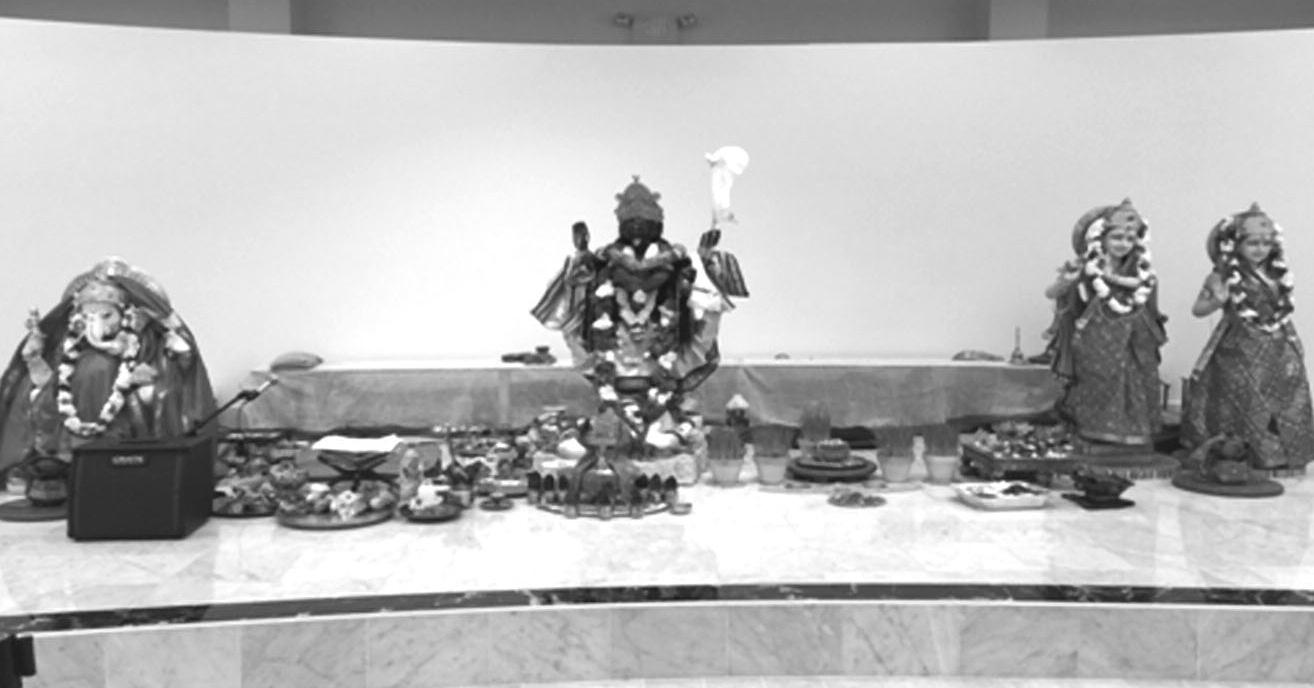
Arun B howmik, the director of the program did a great job as usual in gathering up the best performers in the community in vocal and instrumental music All singers were simply superb in their individual and group performances Biswabhai’s reading from Birendra Krishna B hadra’s write up and, of course, his special way of Chandi Paath sounded heavenly With deep appreciation, the audience congratulated the musicians, especially Arun, who has conducted this program for over ten years Year after year, Arun does the required planning as and ends up presenting a flawless program that over-
conduct this event The event continued until 12:30pm Then, in the evening about 40 people participated in our monthly Shyama Puja
Durga Puja started on 18th October evening with Soshthi Puja and continued until 22nd October when Dashami Puja was performed Amantran and Adhibas were performed on the 19th
On October 20th, Saptami Puja was celebrated Puja started around 6:00 am and continued for about three hours After Aarati, Pushpanjali was offered by the devotees at around 9:30 am In the evening, Stuti, Aarati
members had done an excellent job of cleaning up the Puja area so that the Sondhi Puja could start on time (8:11 am) and be completed on time (8:59 am) Then devotees offered their Sondhi Puja Anjali In the evening session, as expected, there was a large crowd About 400 people gathered to offer Anjali after Puja, Chandi Paath and Aarati Fortunately, Puja Committee volunteers were prepared, and everything went smoothly On 22nd October, Nabami Puja as well as Bijaya Dashami were scheduled. After the Nabami puja, a special event, Kumari Puja started Five young
ladies, all dressed up ceremoniously, were worshipped as Devi Durga, according to the tradition
The girls got an unforgettable experience, as Santosh Mukherjee performed the Kumari Puja At the end, each Kumari got a bagful of gifts Then the Dashami Puja started followed by Bisarjan. That marked the end of our most favorite Puja of the year
During all this time, attendees got the opportunity to look at sarees and jewelry at the shops set up by traders Our second generation kids added fun by selling coke, candy and also Paan for the adults.
On 26th October we celebrated Kojagori Lakshmi puja and Satyanarayan puja That ended the October puja events
November 2015
The main deity of Ananda Mandir is Ma Kali Her puja was scheduled on the 10th This year, due to construction related activities, gathering of people at one time, and the time the temple could remain open was restricted Still, puja was conducted timely, till midnight Over 500 devotees got the opportunity to see the puja and offer Pushpanjali to Ma kali
Next day, 11thNovember, Deepavali was celebrated Candles were lit all around the Bedi 14th November is Ananda Mandir's Foundation Day. Biswabhai along with our veteran priest Guru Chakravarty performed Puja, Stuti and Chandipaath to commemorate the occasion The upcoming Pujas of this month is Jagaddhatri Puja from 17th to 20th November The last puja of this month is Raas Purnima and Satyanarayan puja on 25th of November
Please contact Krishna Dutta Roy for volunteering at Pujas, at k dutta roy @ yahoo com
Growing up, reading books and rereading them, was my favorite pastime I can even say, my only pastime In the absence of cable TV, (or even regular TV) cell phones, and all the innumerable gadgets that have mushroomed now, reading was the only option Reading for fun somehow was the norm I couldn't wait for the ‘Library’ period in my school, where I could pick and choose my all-time favorite Enid Blyton adventures The feel of a book in my hands, the eager anticipation of the exciting contents, made my heart race and it was more often than not, that I devoured the contents on my bus ride home And that's when I re-read them
A new book would be a treat A Birthday gift, or a 'Pujo Shankha' (a special edition, which would come up for the Durga Puja) would make me so happy, that I now think how easy it must have been for my parents to choose a gift for me Opening a new book was (and still is) like a rit-
By Ruby Banerjea
ual I would carefully unwrap it; no tearing off the wrapper for me The smooth glossy cover was the first thing which I would almost caress with reverence and I still do that It is like paying respect I would hold it with both hands, open it and smell the new- book smell which never fails to elate me I would slowly just go through the pages, turning them ever so carefully so as not to dog-ear them and close it again, just to savor its presence \ "What's the big deal? You can always read a book on an electronic device You just have to download it " Our younger generation and even almost all of our tech-savvy friends might say The pros are numerous: inexpensive to download once you know how to, easy to carry, very convenient to read on a commute (an airplane or a crowded bus) a variety of choices, so on and so forth The Nook, The Kindle,
the even more convenient Paper White version, I Pad and countless other options that have flooded the market have supposedly made reading easier and more hip I still miss Borders, where our love for sitting down and reading as many books as we wanted, had begun. Even though buying a book was not mandatory, it would be almost always that we would leave with a bag of books My children grew up, with me reading Dr Seuss to them at bedtime, every night Even when they did not read, the pictures would fascinate them and both of them took turns to turn the pages of the book, as they knew the book by heart I hardly see anyone opening a book in the bus or the train when I travel. It's always an electronic device with its somewhat ominous blue glow that I see on people's laps For me the clicking of an arrow can never be the
same as the turning of a page, flagging it, can never take the place of the favorite stylish bookmarks I use and my best defense, “where is that wonderful old-book, new-book smell?” I might sound really old fashioned, but I am a die-hard fan of the old fashioned book Sad to say, even my book-worm husband has started to cross over to the other side. Our daughters have been gifting him the devices and he has become quite a fan His defense is that he has to commute a lot and the I Pad is definitely lighter, but I will never be convinced Not that I did not try; I just don't enjoy it It's too much of a distraction for me to be always aware and careful not to press the wrong button, so the entire page disappears I just can’ t deal with that I'd much rather take a good novel in my hands, curl up in my favorite armchair with a cup of tea and just savor it to my heart's content
(Editor’s Note: We are pleased to bring this important column in Ananda Sangbad The author can be reached at her email address, lahirimd@aol com)
Do you remember Dustin Hoffman in Rain man?
Do you remember Shah Rukh Khan in My name is Khan?
Raymond has autism and adheres to strict routines such as always watching The People's Court, which he refers to as "Wapner" after the judge who presides over the show He has superb recall but he shows little emotional expression except when in distress Raymond refuses to fly to Los Angeles because he remembers every airline crash and is worried He is a mental calculator with the ability to instantly count hundreds of objects at once, and make nearly instant calculations on the exponential level, far beyond the normal range for humans.
Rizvan Khan, is originally a Muslim from India He is a gentle person who endures the difficulties caused by Asperger’s Syndrome Until that fateful day, Rizvan lives a somewhat normal life in America He meets and marries a Hindu woman
My Name Is Khan sends a message of open-mindedness to the world and sheds some light on understanding both the difficulties of Asperger’s and the sometimes ominous Muslim ways
What Is Autism Spectrum Disorder?
Autism spectrum disorder (ASD) is characterized by:
Persistent deficits in social communication and social interaction across multiple contexts; Restricted, repetitive patterns of behavior, interests, or activities; Symptoms must be present in the early developmental period (typically recognized in the first two years of life); and, Symptoms cause clinically significant impairment in social, occupational, or other important areas of current functioning
The term “spectrum” refers to the wide range of symptoms, skills, and levels of impairment or disability that children with ASD can have. Some children are mildly impaired by their symptoms, while others are severely disabled Autism spectrum disorder (ASD) is a developmental disability that can cause significant social, communication and behavioral challenges The learning, thinking, and problem-solving abilities of people with ASD can range from gifted to severely challenged Some people with ASD need a lot of help in their daily lives; others need less A diagnosis of ASD now includes several conditions that used to be diagnosed separately: autistic disorder, pervasive developmental disorder not otherwise specified (PDD-NOS), and Asperger syndrome
Signs and Symptoms
People with ASD often have problems with social, emotional, and communication skills They might repeat certain behaviors and might not want change in their daily activities Many people with ASD also have different ways of learning, paying attention, or reacting to things Signs of ASD begin during early childhood and typically last throughout a person’s life
Children or adults with ASD might: not point at objects to show interest (for example, not point at an airplane flying over) not look at objects when another person points at them have trouble relating to others or not have an interest in other people at all avoid eye contact and want to be alone have trouble understanding other people’s feelings or talking about their own feelings prefer not to be held or cuddled, or might cuddle only when they want to appear to be unaware when people talk to them, but
respond to other sounds be very interested in people, but not know how to talk, play, or relate to them repeat or echo words or phrases said to them in place of normal language have trouble expressing their needs using typical words or motions not play “pretend” games (for example, not pretend to “feed” a doll) repeat actions over and over again have trouble adapting when a routine changes have unusual reactions to the way things smell, taste, look, feel, or sound lose skills they once had (for example, stop saying words they were using)
More Signs & Symptoms of Autism in early childhood
No big smiles or other warm, joyful expressions by six months or thereafter
No back-and-forth sharing of sounds, smiles or other facial expressions by nine months
No babbling by 12 months
No back-and-forth gestures such as pointing, showing, reaching or waving by 12 months
No words by 16 months
No meaningful, two-word phrases (not including imitating or repeating) by 24 months
Any loss of speech, babbling or social skills at any age
Diagnosis
Diagnosing ASD can be difficult since there is no medical test, like a blood test, to diagnose the disorders. Doctors look at the child’s behavior and development to make a diagnosis
ASD can sometimes be detected at 18 months or younger By age 2, a diagnosis by an experienced professional can be considered very reliable However, many children do not receive a final diagnosis until much older This delay means that children with ASD might not get the early help they need
Causes and Risk Factors
We do not know all of the causes of ASD However, we have learned that there are likely many causes for multiple types of ASD There may be many different factors that make a child more likely to have an ASD, including environmental, biologic and genetic factors
Most scientists agree that genes are one of the risk factors in developing ASD
Children who have a sibling with ASD are at a higher risk of also having ASD
ASD tends to occur more often in people who have certain genetic or chromosomal conditions.
When taken during pregnancy, the prescription drugs Valproic acid and Thalidomide have been linked with a higher risk of ASD There is some evidence that the critical period for developing ASD occurs before, during, and immediately after birth Children born to older parents are at greater risk for having ASD
Who is affected?
ASD occurs in all racial, ethnic, and socioeconomic groups, but is almost five times more common among boys than among girls CDC estimates that about 1 in 68 children has been identified with autism spectrum disorder (ASD)
More people than ever before are being diagnosed with ASD It is unclear exactly how much of this increase is due to a broader definition of ASD and better efforts in diagnosis However, a true increase in the number of people with an ASD cannot be ruled out We believe the increase in ASD diagnosis is likely due to a combination of these factors
Why is it called the “Autism spectrum”?
Many with ASD’s have exceptional visual and memorization skills, who excel in music, technology and academics About 46 percent have average to above average intellectual abilities Many persons on the spectrum take deserved pride in their unique abilities and “atypical”
ways of learning Others with autism have significant disability and are unable to live independently About 25 percent of individuals with ASD are nonverbal or have very limited verbal language proficiency but can learn to communicate using augmentative communication
Treatment
There is currently no cure for ASD However, research shows that early intervention treatment services can improve a child’s development Early intervention services help children from birth to 3 years old (36 months) learn important skills Services can include therapy to help the child talk, walk, and interact with others
Therefore, it is important to talk to the child’s doctor as soon as possible if one thinks the child has ASD or other developmental problem
Even if the child has not been diagnosed with an ASD, he or she may be eligible for early intervention treatment services
How does having a child with ASD affect families?
As mentioned above, ASD brings numerous challenges for families Between the challenges of finding qualified professionals to help, securing coverage for treatment from reluctant insurers, and balancing the imposing daily needs of the ASD child with their other children, parenting a child with ASD is extremely difficult But when it comes to addressing these challenges, families are largely on their own. These obstacles can often put a terrific strain on marriages, out of home placement of children with Autism and related disabilities, and the divorce rate in families of children with Autism is over 86%
An Autism Story
He was diagnosed as “Autistic” and as having a “nonverbal learning disorder ” Along with these diagnoses his parents were given a frightening prognosis
When he was born, he was pale and had respiratory problems immediately after birth Doctors found that his lungs were filled with fluid, and he had difficulty breathing for the first hour of life as his doctors worked to clear his lungs He needed to be medicated at birth He had poor muscle tone and was a colicky baby While the first months of his life were not easy, his condition appeared to improve, and his parents believed he was developing normally, like any other child However, when he started school, he had difficulty keeping up with other children By the fourth grade, his teacher told his parents that he was disorganized and was having difficulty with school assignments He was also having difficulty dealing with the social aspects of the classroom Reading and writing were very difficult for him, and he just was not able to keep up
The parents sought treatment for the child in a specialized school for Autistic children
The boy who used to have reading problems was now a bookworm He was reading 75 to 100 pages daily with ease His reading speed and comprehension were at age level His math and writing had greatly improved as well He also became independent in all aspects of daily life He planned and prepared his daily meals, did all of his own laundry, and helped care for his younger siblings He was now 12 years old and had more responsibility and maturity than other kids his age Parents felt that he was ready to return to regular school at the age of 12 years This was an important transition, to see if he could succeed where he once had great difficulty just keeping up with the other kids
Since returning to school, he has done superb academic work He is now in the tenth grade and scores all A’s and B’s on his exams He has been on the Dean’s List twice. He has now become a successful competitive swimmer
For the boy and his family, it has been an amazing journey – he has gone from being the boy who could not make it in school no matter how hard he tried to being the student at the top of his class today
Ananda Sangbad
Reported By Manideepa Ghose
On Nov 14th, NJPA celebrated the only ‘Sarbojonin Kali Puja’ in the tristate area at the Manalapan Englishtown middle school premises The attendance was lower than expected but the members and volunteers more than made up for it with enthusiasm and engagement Puja was conducted by the veteran priest Guru Chakravarty in a cozy atmosphere enjoyed by all the attendees Havan was performed and all devotees got a chance to offer ghee on to the fire in the name of Ma Kali After Aarati, Pushpanjali was offered to the Mother Dinner was delicious The goat curry, served with dinner was home cooked and was unparalleled in taste The evening entertainment was enchanting with some of the best local talents The star performer of the evening, Bishakh Jyoti of Sa Re Ga Ma fame, came from India Satisfied audiences left with a happy note
NJPA has saved it’s best for the last We will ring in the New Year with music, dance, food and fun on Dec 31st, at Royal Albert’s Palace (Hall - Mandap) at Fords, NJ Bring your family and friends and enjoy the special moment, have a glass of champagne and welcome 2016 Tickets are available at Sulekha com For more information please visit NJPA net Thank you and see you all at Royal Albert’s Palace (Hall - Mandap) on Thursday, Dec 31st
The Executive Committee, NJPA
Reported by Soma Chaudhuri
The last quarter had taken the vitality of ICC Garden State Community to a different level It was time for the most favorite celebration of the Bengalis, the Durga Puja
The ICC Durga Puja 2015 was held in Parsippany High School on the 10th and 11th of October. The ceremonial worship of the mother goddess from Saptami, Ashtami, Navami through Dashami took place with much gaiety and grandeur and it also marked the reunion and rejuvenation of all ages of the community
The cultural evenings were filled with variety of attractions - the biggest crowd puller being the Chandrabindoo! The famous Bangla Band set the stage on fire with their satirical, colloquial lyrics, full of references to current affairs and cultural phenomena Then the very talented Sa Re Ga Ma phenomenon Bishakh Jyoti, mesmerized all with his deep and melodious voice while his partnering with exuberant Sanchari Bose set the audience tapping with every song Sudipta B howmick’s play, “Dance Pe Chance” created an excellent rendition of few wannabe dancers who decide to participate in a competition leading to a laugh riot as portrayed by an outstanding ensemble cast There has been an ensemble of dance recitals by Mitra Purkayastha An outstanding collage of dance was also presented by Tilottama Bose’s troupe paying homage to women who seek Ma Durga’s shakti
and resilience in their struggle for equality and respect "Rumeli & Rhythm” performed "Shoroter Anandadhara" with a team of talented & motivated dancers from NJ
The creative genre of members in the Community have conceived and presented some unique and memorable shows this year which has brought the talent in every age group to the limelight The first evening was opened with “Durga Bandana” - an enchanting composition of music and recitation from the scriptural verses inspired by the “Mahishasuramardini” The second day opened with the instrumental ensemble “East Meets West ” presenting a talented pool of ICC kids who improvised sound and melody transcending instrumental forms and giving an awakening call to the festivity In “Uma Menaka Katha, Uma’s (Goddess Durga) mother Menaka's emotions are uniquely captured in a folk-inspired genre of ‘Agamani’songs The histrionic talent of the ICC kids came to the forefront with the drama ‘Becharam Kenaram' adapted from the work of Upendrakishore Ray Chowdhury where a poor servant triumphs over his mean-spirited master. And the talented children of Aagomoni Bangla School presented Sukumar Ray ’s Abak Jolpaan and presented by eloquence in Bangla and its traditions
Overall, the celebrations left lasting memories still talked about in the community and beyond
New Associate Members
($ 50 - $ 999)
• Nandita & Jagdish Parelkar
• Munmun & Ashis Dut
• Vikas Singh
• Patrali Chatterjee & Amit Mukhopadhay
• Deb Kumar Majumdar
• Nihir & Leena Paul
• Dipankar K Sarkar
• Elitech Inc – Payroll Account
New life Members: ($ 1,000 - $ 4,999)
• Arindam & Arunima Kulia
Patron: ($ 5,000 - $ 9,999)
• Ashish & Sucheta Banerjee
Grand Patron Gold ($ 25,000 – $ 49,999)
• Dr. Kiran & Kamala Das
Please note that you can become an Associate Member of Ananda Mandir by donating a minimum of $50 Your subsequent donations of $50 or more are credited to your account When your total cumulative donation reaches $1000, you become a Life Member Your support, small or large, is most welcome and sincerely appreciated
By-
Throughout human history, various nations have exerted varying levels of dominance over their respective regions, continents, or even the world From the city-states of ancient Greece to the nuclear-armed Soviet Union, the history of the rise and fall of the Great Powers managed to affect every other nation of their time.
Although several civilizations came before them, such as the Mesopotamian, the first regional hegemony was the city-state of Athens At that time, Greece was divided into several city-states isolated by surrounding mountain ranges Through careful diplomacy and trade, Athens established an alliance of the most powerful city-states of Greece, opposing the Peloponnesian League led by the militaristic Sparta Athens, on the other hand, was primarily focused on science and culture During the Persian invasion of Greece, Athens managed to forge a temporary alliance with Sparta to repel the invaders, memorialized
in the movie “300” In the following years, however, a series of plagues and military setbacks caused Athens to be overrun by Sparta
Although having finally emerged victorious over its longtime enemy, Sparta was in a precarious position They were overstretched, and vulnerable to rebellions. Over the course of a century, the various city-states under Spartan rule either rebelled or defected, banding together under the newly-resurgent Athenian leadership The two sides met at the Battle of Mantinea, meant to decide once and for all whether Greece would be dominated by Athens or Sparta The Spartans were decisively defeated, but the leader of Thebes (ally of Athens) was killed, along with a huge number of Athenian troops, resulting in merely a Pyrrhic victory for the Athenians The end result of the battle was that neither side was able to gain enough power due to the widespread devastation, putting an end to
the hegemony of ancient Greece, paving the way for someone else to fill the vacuum of power
The next power to fill this void was the Macedonian Empire under Alexander the Great Upon his father ’s death, he seized power and swept down into Greece, occupying it Next, he carved a path down the Levant to Egypt, seized it and renamed its capital as Alexandria, after himself His next target was the Persian Empire, stretching from India to Turkey Within the next few years, not only did he destroy the Persian Empire, he was able to march past the Indus River, occupying northwestern India His troops, homesick after twelve years of constant military campaigns, convinced him to return to Macedon, from where he planned to launch an invasion on the rising powers of Carthage and Rome However, during a stopover in Babylon, he caught the flu and died Soon after, his empire crumbled. Although his empire was short-lived, Alexander the Great (the only general to ever hold that title) was arguably the best general of all of human history, rallying an outnumbered
group of soldiers to take down the most powerful empires of the time, all without losing a single battle His death allowed for the rise of an empire that was supposed to be his next victim: Carthage. Founded by refugees from the Phoenician city of Tyre, Carthage became the dominant maritime trading power of the Mediterranean, until they crossed swords with the rising Romans The series of wars between the Carthaginian Empire and the Roman Republic were known as the Punic Wars
The First Punic War, fought between a navally dominant Carthage and a terrestrially dominant Rome, initially played out in Carthage’s favor The Romans later developed a technique for boarding Carthaginian ships In this manner they made use of their superior infantry to win the war In reality, the war was a long-term victory for Carthage, as the war spurred their government into action. Carthage expanded rapidly along the coast of North Africa, obliterating any kingdoms that stood in their way with the use of their signature war elephants They used North
African forest elephants, which are now extinct In addition, they seized control of Hispaniola, now the Iberian Peninsula Upon the beginning of the Second Punic War, Carthage unleashed upon Rome, Hannibal Barca, one of the greatest generals of history Gathering his army in Hispaniola, Hannibal decided to invade Rome using an unorthodox method Instead of launching an amphibious assault over the Mediterranean and moving on to the Italian Peninsula, as the Romans expected, Hannibal, atop his massive war elephant Surus, and his army, crossed the Alps to invade Rome In warfare, up to the advent of planes, and even after that, mountains were the ultimate defense against invading armies The armies had to put up with severe cold, lack of food and water, very little light, avalanches, steep cliffs, and a host of other hazards, which took a massive toll on them Somehow, Hannibal managed to cross the mountains (with his elephants), and emerged onto the land of Northern Italy ( To be continued)
January 2016
Ananda Sangbad
Ananda Mandir has announced the following winners of this year's contest: In the Bengali Nominations Category
Parom Bandopadhyay (Michigan, USA) and Rahul Ray (Massachussetts, USA)
In the English Nominations Category: Vinita Agrawal (Mumbai, India)
Each winner received a cash award of $500 and plaque with a citation.
Congratulations to all the winners!
Parom Bandopadhyay is known t o mo s t B e ngal i l i t e rat ure love r s l iv ing in t he Uni t e d S t at e s by name, if not personally. A prolific w r i t e r, he has w r i tt e n nume ro us s ho r t s t o r ie s , po e ms and s o ngs , and has aut ho re d a unique “rhyming dictionary” for the benef i t o f as pir ing po e t s . H is pac e o f c re at ive w r i t ing c o nt inue d ful l speed even when he turned 90 but has s t o ppe d re c e nt ly be c aus e o f health issues. We wish him speedy re c ove r y and lo o k fo r ward t o his c o nt inue d l i t e rar y ac t iv i t ie s . T he award s pe c i f ic al ly re c o gnize s Parom Bandopadhyay for his skillful c raf t ing o f int e re s t ing, o f t e n humorous, short stories
Rahul Ray has written numerous e s s ay s , po e ms and s ho r t s t o r ie s (of many types) and has published in many magaz ine s in India and Ame r ic a (s uc h as D e s h, Kr i tt ibas and N aba Kal lo l in India and Utsab, Aamra, Parabas and Anandalipi in America). Rahul writes in B engali as wel l as in English and has authored or co-authored three books and edited an anthology of e s s ay s Al t ho ugh a s c ie nt is t by profession, Rahul received training in art and classical Western music and is a musician by choice. He is an ac t ive me mbe r o f a w r i t e r s gro up in t he B o s t o n are a. T he award recognizes Rahul Ray for his stylized and creative story-telling

Vinita Agrawal is the author of two books of poems and has published in Asiancha, Constellations, The Fox Chase Review, Pea River Jo ur nal, Ope n Ro ad Re v ie w, Stockholm Literary Review, Poetry Pacific and numerous other international poetry journals. She has re c e ive d a numbe r o f l i t e rar y awards of distinction (such as First Prize in the Wordweavers Contest in 2014 and Commendation Prize in Al l India Po e t r y Co mpe t i t io n, also in 2014) and has been invited to give poetry readings at literary e ve nt s . H e r poe ms have found a plac e in s igni f ic ant nat io nal ant ho lo gie s l ike S uvar nare k ha and D anc e w i t h t he Pe ac o c k s T he award re c o gnize s Vini t a Agrawal fo r he r e xc e l le nc e in c raf t ing poems of high caliber.