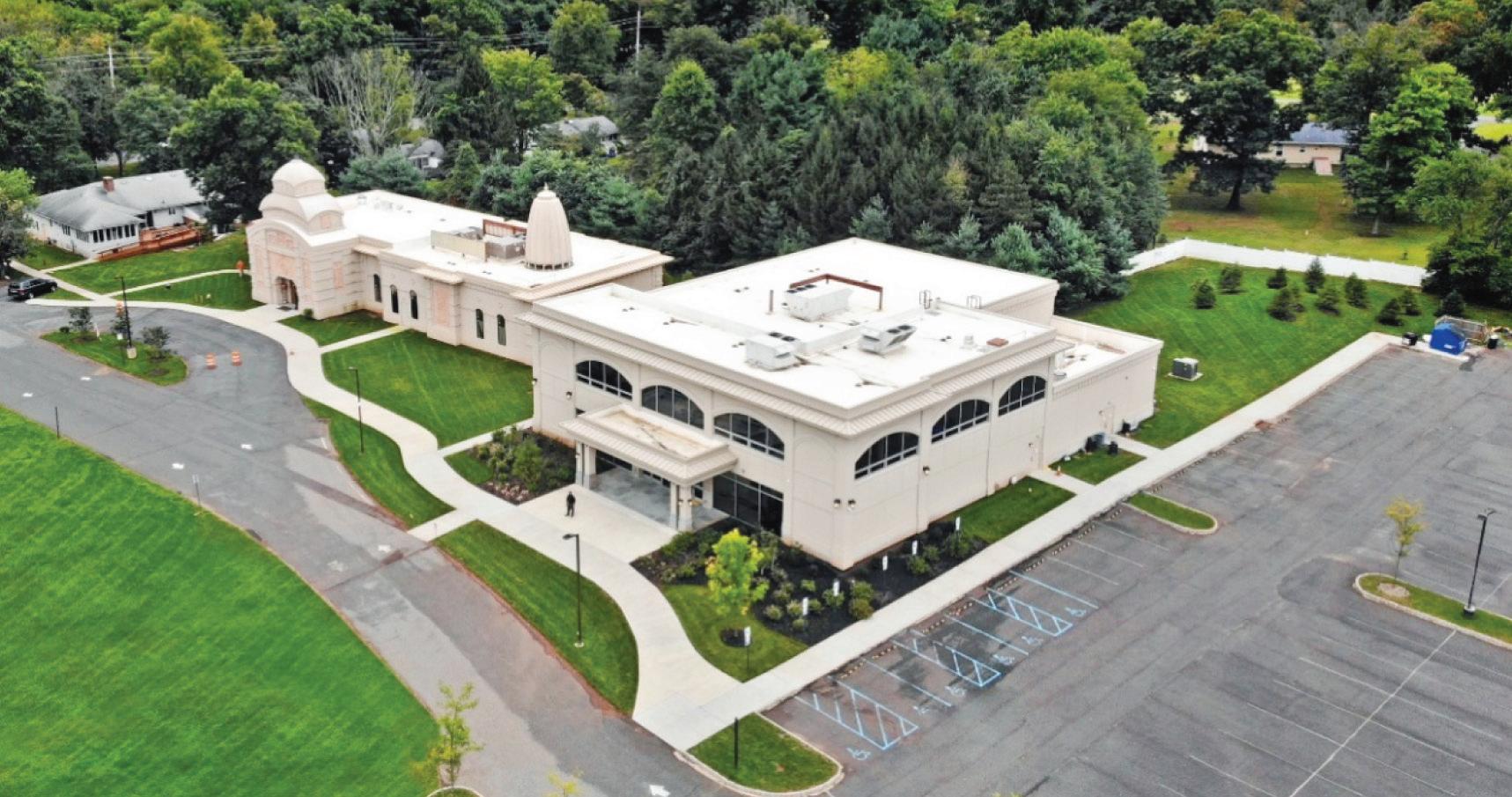
Ananda Mandir 269 Cedar Grove Lane Somerset, NJ 08873


Ananda Mandir 269 Cedar Grove Lane Somerset, NJ 08873
February 19 is an important date in the history of Indian immigrants in the US.
On this day in 1923, the US Supreme Court unanimously ruled that people from the Indian subcontinent could not become American citizens. That landmark decision came in the case of United States vs Bharat Singh Thind and resulted in stripping Mr. Singh of the citizenship he had already earned through a hard-fought legal proceeding. The court ruled that Indians were not white, therefore, not likely to be easily accepted into the American society. Thus, rejection of, and discrimination against, Indians went from being a social norm to an official government policy.
Almost a hundred years have passed since that infamous decision. Today more than three million immigrants from India (and thousands more from Bangladesh and Pakistan) call America home. Immigrants from India can now be seen in every state, and most are socially accepted as neighbors, if not respected as hardworking and educated professionals and businessmen.
Twenty-three years after the Supreme Court decision, in 1946, South Asians became eligible for US citizenship. In reality, a nationality-based quota system prevented all but a handful of Indians to gain that status annually. The discrimination against Indians (and people from many Asian and other non-European countries) officially ended in 1968 when President Johnson signed into law the US Immigration & Naturalization Act. For the first time in American history, that law made possible large-scale entry of Indians and other Asians into the US.
By Debajyoti Chatterji
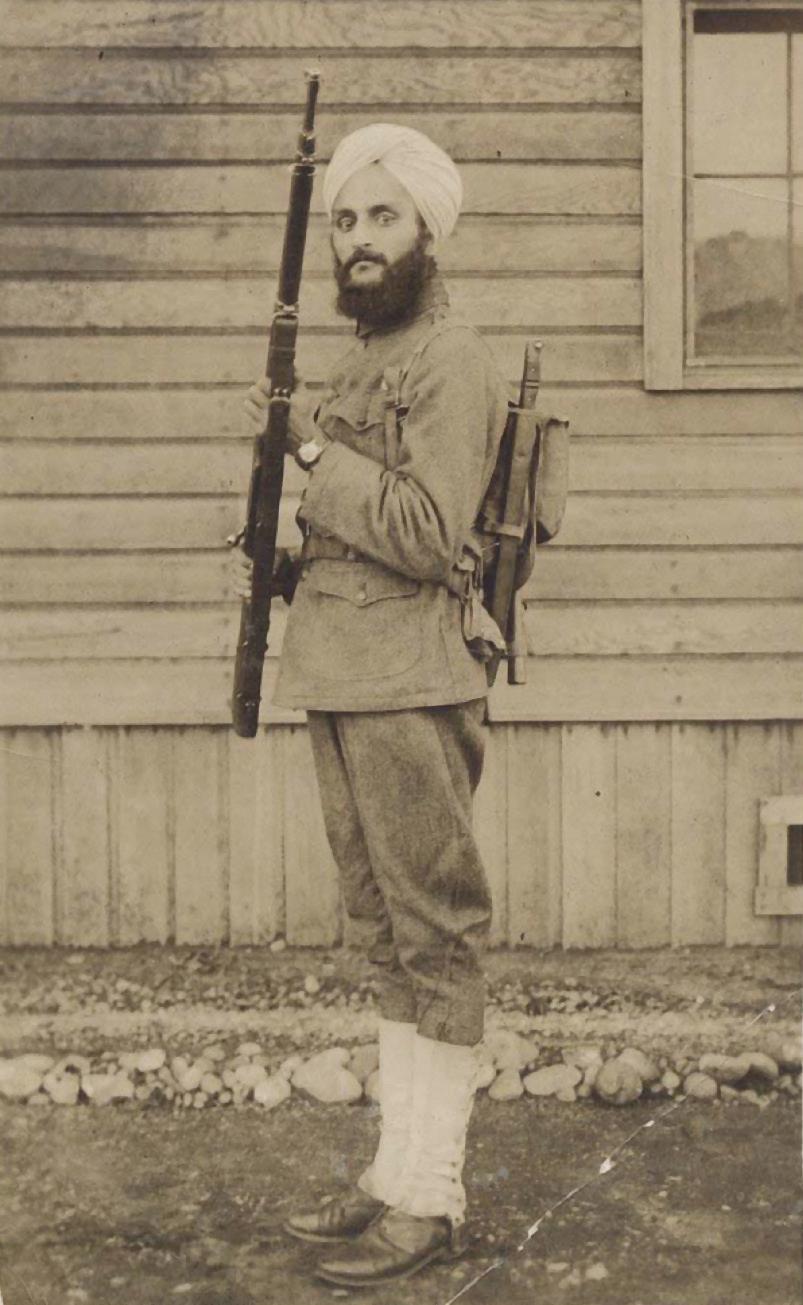
Singh Thind
To be blunt, American immigration and naturalization policies before 1968 were rarely, if ever, enlightened or progressive. They were primarily driven by societal factors such as xenophobia and racism, economic factors like labor shortages and wage pressures, and political factors like international relations and image. Conscience or compassion was hardly a consideration for the American policy-makers as far as Asians were concerned. While we, the Indian immigrants arriving after 1968, have clearly benefited from the relatively recent changes in American policies and politics, we should understand and remember that our predecessors in this country had to survive cruel indignities
for many, many years. Not knowing the sad realities our predecessors faced may leave us and our progeny vulnerable in the future.
It should be made clear at the outset that the primary targets for the early immigration laws were the Chinese, not the Indian immigrants. However, such laws were later broadened and applied to include people from much of Asia including the Indian subcontinent
When and why the animosity towards the Chinese did began to raise its ugly head? Chinese laborers had begun to arrive in large numbers in the 1850s after gold had been discovered in California. When the “gold rush” in the West began to wane around 1870, hostility towards low-paid but hardworking Chinese workers began to increase. Thousands of Chinese contract laborers had also worked on the Trans-Continental Railroad, and they were left jobless at the end of the project (also around 1870), creating large-scale unemployment and poverty. The resulting political pressure eventually led to the Page Act of 1875. It was the first “exclusionary law” passed by the US Congress. In time, the hatred to-
Mahishasura Mardini: Sunday, 18 October Live Program
Durga Puja: Wednesday, 21 October to Monday, 26 October
Kojagori Lakshmi Puja: Friday, 30 October
(Detailed Schedule will be provided in due time)
wards the Chinese laborers snowballed, and the Chinese Exclusion Act of 1882 became the capstone of the “stop the Chinese” movement. Two follow-on laws in the next decade imposed even tighter restrictions on the Chinese.
The American lawmakers found some ingenious ways to make life very difficult for the immigrants from non-European countries in general, and Asian countries in particular. The Expatriation Act of 1907 required that women who married foreigners had to assume the citizenship of their husbands. As a result, many women lost their US citizenship unless their husbands became American citizens. For Indian men living in this country at that time, this requirement must have put them in a no-win predicament. Marrying an Indian meant that the American spouse had to accept the citizenship of the partner who was not allowed to become an American citizen! Fifteen years later, this law was repealed.
The anti-Asian xenophobia in America reached its pinnacle in 1917 with the passage of the Asiatic Barred Zone Act. This was a landmark law that extended the concept of “exclusion” beyond China to include much of Asia, including the countries of the Indian subcontinent. This was the first law that specifically barred Indians from entering the country with the intent to immigrate. The next shoe fell in 1924 with the passage of the Johnson Act. This lawestablished the infamous “National Origins Quota” system, which basically welcomed large number of immigrants from North European countries but severely restricted the number of immigrants from “non-white” nations.
continue to page 6 }
Calendar of Events (Dates are subject to Change) Please check our website frequently www.anandamandir.org Tel: 732-873-9821
NOTE: If a particular Puja time is not listed, please contact temple or visit our website: anandamandir.org
APRIL (*)
Bengali New Year
Tuesday, 14, 9:00am – 9:00pm Shyama Puja
Wednesday, 22, 6:00pm–8:00pm Akshaya Tritia RAMTHAKUR Smaran Utsav
Satyanarayan Puja
Sunday, 26, Krishna Chandan Jatra Puja
9:00am – 11:30AM Kirton & Satyanarayan Puja
4:30pm – 8:00pm Sahitya O Alochana (*)
Friday, 24, 8:00pm Cultural Program (*)
MAY (*)
Satyanarayan Puja
Wednesday, 06, 6:30pm–8:30pm Phalaharini Kalika Puja
Thursday, 21, 8:30pm- 10:30 pm Sahitya O Alochana (*) Friday, 22, 8:00pm Cultural Program (*)
JUNE(*)
Ganga Puja & Dashohara Puja
Monday, 01, 9:00am – 10:30am
Jagannath Mahaprabhu’s Snan Jatra &Satyanarayan Puja
Friday, 05, Snan Jatra, 9:00am – 10:30am Satyanarayan Puja
6:15pm– 8:15pm
Shyama Puja
Saturday, 20, 6:30pm-8:30pm RATH Jatra
Tuesday, 23, 6:30pm – 8:30pm Bipad Tarini Puja
Saturday, 27, 10:00am – 11:30am Sahitya O Alochana(*)
Friday, 26, 8:00 pm Cultural Program (*)
JULY(*)
ULTORATH Jatra & Satyanarayan Puja
Wednesday, 01, 6:30pm-8:30pm Guru Purnima
Sunday, 05, 9:00am – 10:30am Shyama Puja
Monday, 20, 6:30pm - 8:30pm Sahitya O Alochana (*) Cultural Program (*)
(*) See www.anandamandir.org or Call Mandir for details
Special Religious Services: Upon request, the priest of Ananda Mandir offers services such as in-house Shraddhas, Rituals associated with Cremations (Antyesti Kriya), Shraddha Anniversaries, Pre-wedding rituals (Naandimukh, Ashirwad, etc.), Upanayan (Paitey), Annaprasan, Wedding Ceremonies & Wedding Anniversaries, Griha Prabesh (Bhumi Puja), Consecrations of new cars (New Car Pujas) and others. If you have needs for any of the above or more, please feel free to contact Biswabhai @ 732-873-9821
A Periodical Newsletter
Published
By
ANANDA MANDIR
(A Tax-Exempt, Non-Profit Organization)
269 Cedar Grove Lane Somerset, NJ 08873
Ph: 732-873-9821
Website: www.anandamandir.org
PUBLICATION COMMITTEE OF ANANDA MANDIR
Chairperson: Debajyoti Chatterji, Debsmee572@gmail.com
Assistant Chairperson: Subrata Bhaumik, Bhaumik.subrata@gmail.com
Editor-in-Chief: Amitabha Bagchi, amitabhanj@gmail.com
Executive Editor, Ananda Sangbad: Guru Chakravarty, guruchakravarty@yahoo.com
Executive Editor, Anandalipi: Subhodev Das, subhodev.das@gmail.com
Editors: Sushmita Dutta, sushmitadutt2@gmail.com Amrita Kangle, amritakangle@hotmail.com Nupur Lahiri, nupurlahiri@aol.com
Associate Editor: Ruby Banerjea, r_banerjea@yahoo.com
Advisors: Pronoy Chatterjee pkc_usa@yahoo.com Ashok Rakhit ashokrakhit@gmail.com
l All queries, articles, news reports and letters should be directed to the Managing Editor Phone: 908-752-3065
E-mail: guruchakravarty@yahoo.com
l For general information, please contact the following executives of Ananda Mandir: Jai Prakash Biswas President
Suprasad Baidyaroy Vice President
Debajyoti Chatterji Vice President
Ashok Rakhit
Vice President
Arun Bhowmik
General Secretary
Chanu Das Treasurer
Pradip Majumdar
Assistant Treasurer
Sadhan, my childhood friend of Shaltora village in Bankura, just passed away, at age 78. He was suffering from COPD. A retired Engineer from a Nagaland Government job, he was not covered by any health insurance. However, he had three sons who held good private and government jobs, with insurance that included coverage of parents. So, he visited his sons in Kolkata whenever he needed health care and received reasonably good medical treatment. Within a few days of his last treatment, he had a severe COPD attack one night upon returning from Kolkata. His wife watched his condition worsening but was unable to do anything. There was no 911 service to call, neither was any public transportation available due to lack of drivable road in the village. Sadhan just passed away in the morning hours without any medical intervention.
There is much talk about improved health services in West Bengal, and in India in general. People below poverty level are covered for medical expenses up to 5 lakh rupees. Just like in the USA, there are restrictions about who and what is covered. Still, nobody at Shaltora ever heard of health insurance until 2016. There is a clinic dispensing free medical care to nearby villages for many years. The facility is staffed by a physician and a nurse for a few hours a week, where people receive some basic medications like aspirin and antibiotics. For anything more than simple cold or stomachache, they would go to Bankura General Hospital, and face big lines before they could see a physician. Conditions at the General Hospital about cleanliness and supplies are poor for as long as we have known.
Things have changed since 2016. Now, you can get serious treatment even in some private nursing homes, free of charge. A farmer, Goutam Karmakar of a neighboring village broke his hip in a motorbike accident. He received surgical treatment in a private nursing home in Bankura and paid nothing out of pocket. A few years back, he probably would have to sell a part of his land to settle the surgeon’s fees. Still, government expenditure on health care in India is dreadfully low. It made up around 1.4% of the GDP in 2017-18, a figure which is much lower than in neighboring countries like China (3%) and Sri Lanka (2%). The condition in West Bengal is not different from the country as a whole. Per capita expenditure on healthcare has increased from Rs 552 in 2014-15 to Rs 643 in 2019-20. The condition of health care infrastructure is much worse in rural areas where 70% of the state’s population live. There is no system of monitoring and evaluation of the
healthcare in West Bengal. There is no mechanism to hold public health management or private partners accountable. Any accountability in the system is neglected by public as well as private providers of health care. The obvious outcome is that mistakes by the healthcare providers go unchecked. People sometimes get frustrated and take the law into their own hands to enforce some kind of retaliation. Because of this laxity in accountability, the elderly Indians living in the U.S. are afraid to visit India in case they get stuck in a less than desirable health care system.
Where does India stand in the world ranking of healthcare systems? In a ranking published by World Health Organization, India ranks 112, with USA at 37, and Canada at 30. The list puts Sri Lanka at 76, and Bangladesh at 88, with supposedly better healthcare system than India, raising a few eyebrows. While the basis of the ranking is debatable and not always uniform, perhaps we can learn from countries that rank better than us at keeping their citizens healthy. Why does USA spend so much money, far in excess of any other country, for medical care, and still rank low in providing care for the people?
In the U.S., most people are covered by good health insurance schemes, either through their employers or by purchasing on their own. It is the people in the low-income group that struggle with paying for health insurance. The older generation, above age 65 is covered by Medicare, a system that really works well for healthcare coverage. “Medicare for All” is a bold new concept put up by some candidates during the current Presidential Election Campaign that will work only if the per capita expenditure can be kept at par with that of other developed countries.
Still, there is a major gap in health coverage in the USA. The problem arises for the elderly people who cannot take care of themselves. If you are unable to drive, incapable to do simple chores like cooking and cleaning, and/ or live alone, you are in for hard times. It is quite expensive to hire live-in maids. There are old-age communities where one can buy or lease homes, with amenities for basic healthcare. Places like this are generally expensive, depending on the level of amenities. Others must depend on their children or friends to take care of them which is easier said than done. Things are much better in India, particularly in villages or small towns where 70% of the population lives, because elderly people live in the same house with their children.
Guru Chakravarty Executive Editor, Ananda Sangbad
Dear Sir:
Thank you for your editorial in January 2020 issue of Ananda Sangbad, entitled, “Care of the Elderly in the Community,” identifying a critical need of our community, which had never been formally addressed by any of our established Bengali organizations – clubs, associations or cultural centers. Those organizations, since their inception, had focused in meeting the community’s recreational and cultural needs only and remained indifferent to other critical needs of our growing elderly population, particularly those who had been suffering from serious chronic illnesses and living with their similarly old spouses, away from their children. The reason could be that the “elderly care concern” had never been a real issue until very recently, when a large segment of our population entered into that age category.
To meet the needs on this specific issue, one may argue that there are many state and federally funded programs as well as independent non-profit organizations in this country which would provide the necessary assistance. It sounds great, but only in paper and in casual discussions. The suggestions and advises that may come from many during table talks in social gatherings may have very little value in terms of meeting the needs.
If you take these talks seriously and contact the relevant sources you may find that you are not eligible to get into any of those government or non-profit elderly assistance programs, because of your middle-class financial status. Most of those programs are for people who are financially in the so called “poor category” as par the government definition. The only alternative solution to meeting those needs is to buy each and every service, from medical transportation to home aid and nursing care, from private companies, which may become cost prohibitive for most middle-class families.
There is value in an organized “community support” . Although, none of us can meet someone else’s total needs, collectively we can provide some remedial assistance to those who are in need and this would be a good start.
Perhaps at Ananda Mandir we can establish and implement a program and create a fund to support the members of our South Asian community in the Eastern region of USA, who need help to resolve their problems related to healthcare management, transportation under certain conditions and other basic household needs. As this program would advance and the fund grows, its function could be expanded to support a larger base in America.
More specifically, help must be extended to seniors of our community living alone or with spouse only, who are not very mobile and often encounter with the following problems: Loneliness, followed by depression; lack of transportation facility; difficult to manage shopping, bill payments, screening and deciphering hundreds of complex medical invoices, taking care of residential property, managing and writing bills, finding right doctors; upkeeping the house; handling basic finances; resolving critical questions related to health treatments; staying fit and so on.
Referring to another key issue, when a member of a family of two suffers a serious illness, such as stroke, paralysis, cancer or renal
continue to page 3 }
By Rahul Ray
Editor’s Note: This article is divided into two parts. The Part 2 will appear in the next issue.

Greta Thunberg has become a household name around the world these days. Well almost. This seventeen years old Swedish school-girl has become a hero, or at least a champion of their causes to many people worldwide. Ironically, the same cause she is championing has invited scorn and insult from a relatively small but powerful group, including the White House. The President has showered her with insinuating and scornful tweets after her recent speech at the United Nations about man-made destruction of natural environment around us, and our callous attitude, and outright non-action towards redressing these problems.
Anyone will be alarmed by the amount of venom spewed in those tweets. The man in the White House was representing interests of fossil-fuel lobby, people who believe that idea of ‘global climate change’ is a hoax, groups that believe all environmental-protection laws be scrapped in favor of wanton extraction of oil, gas and other natural resources with a blind eye towards environment, and ultra-conservative religious and other fringe groups who believe that global warming is real, but it is a part of natural climate-cycle and projected catastrophic effects have no scientific or other basis, despite ample evidence in contrary.
Climate and other scientists did sound the alarm some twenty years ago about global warming due to rise in ‘green-house gases’ in the atmosphere and resulting global warming leading to disastrous effects encompassing the entire planet. Predicted catastrophic effects included rise in sea-level due to melting of icebergs in the poles, submerging large coastal areas and complete annihilation of low-lying is-
lands from the face of the earth, erratic changes in the weather pattern including extreme heat resulting in huge forest-fires, and serious shortage of potable water due to mixing of highly salty sea-water with its domestic counterpart. Many people, including myself were genuinely concerned, but did not act on it with any seriousness thinking that the alarm is too premature, and will not happen in our lifetime. Another reason for the inaction, let’s face it, was listening to continuous propaganda from the other side of the fence in this debate that projected global warming is a hoax without any scientific basis, and it will not be as serious as projected.
To our utter surprise ‘the global warming train’ arrived much too early than expected with much of the predicted effects. Some four years ago a huge land-slide resulting from unprecedented downpour took down a large area of Uttarakhand, India along with its inhabitants. Prior to that a huge tsunami wiped out thousands of people with all their belongings in Indonesia. Last year three islands have disappeared from the face of the earth.1 A huge forest-fire engulfed a large part of California last summer, and another massive and uncontrollable forest fire has been raging in the hinterlands of Australia for months burning 27.2 million acres and killing 33 people and half a billion animals.2 And come to think about it, it is only the beginning.
The question is why doesn’t the other side, I mean the non-believers ‘see’ but refuse all the evidences, and in reality, oppose them? It is clearly a political fight. There is a global rise in right-wing ‘strong men’ who believe that past years of environmentfriendly laws are brain-children of left-wing politicians, and not friendly to corporations of all stripes, large and small. Therefore, these laws and mandates must be scrapped in order to protect the interest of corporations, groups and people mentioned above. For example, Trump-administration has been making numerous and strident efforts to increase
allowed level of carbon monoxide, nitrous oxide and other toxic gases released in atmosphere from automobile tail-pipes and highly toxic sulphur dioxide from chimneys of foundries to help automobile industry and manufacturers of various caste and creed respectively. One ought to notice that lowering standards of ‘toxic-release’ will significantly increase the profit margin of corporations and their share-holders. However, at the same time it will lower the quality of air that we breathe in every moment and can cause serious health-problems. I grew up in Kolkata in 70s, and I still have horrific memory of foul-smelling and thick smog in the winter. Our clothes used to be covered with black carbon-soot from burning coal emanating from factoryfurnaces as well as domestic ‘chulas’. I remember pulling out phlegm from nostrils and chest that was dark gray or outright black. I can imagine how people with respiratory problems felt. It used to be an annual horror-show, yet the same practices have remained unabated in many parts of India today. Kolkata remains a highly polluted metropolis in India today. In Delhi and surrounding areas this environmental nightmare is further aggravated by annual stubble-burning by farmers in nearby state of Haryana (Ananda Sangbad, December 2019 issue).
Now, stubble-burning is simply burning plantremains at the end of the crop-season. Nitrogenous compounds in plants that cannot be destroyed or evaporated by burning fall on the ground and keep it fertile. A similar event, except with several hundred orders of magnitude higher, and for an entirely different reason, recently happened in Brazil where millions of acres of pristine Amazon rain-forest was set to fire to clear up land for ranchers. This happened with blessing from current right-wing Bolsanaro-government in Brasilia.
The visible part of thick smoke that is emitted from burning of a plant or a tree or coal (which is fossilized form of prehistoric trees and plants) is soot or carbon particles. But what is not visible is carbon dioxide, a colorless and odorless gas that is spewed in large quantity into atmosphere. Just like coal
is fossilized form of plants and trees, oil that is dug out from under the earth are fossilized forms of prehistoric animals, and are commonly used as fuel, along with coal to produce heat, and provide energy to run machines in factories. I must emphasize that natural gas does not produce carbon-soot upon burning and appears to be ‘clean’. However, it contains methane, another carboncontaining ‘green-house’ gas that is worse than carbon dioxide. More importantly, it produces same amount of carbon dioxide upon burning as coal and oil.
In other words, trees, coal, oil, natural gas contain large deposits of carbon (humans and other animals are no exception), and upon burning, or scientifically speaking oxidizing, or reacting with atmospheric oxygen, produce a large amount of carbon dioxide that is released into atmosphere.
A very pertinent question to ask is what is wrong in releasing large amount of carbon dioxide into atmosphere by burning trees, coal, oil, and natural gas? Another related question is how rise in the level of carbon dioxide in the atmosphere is related to an increasingly popular term ‘global warming’, and projected and currently observed climate-related problems?
Scientists and environmentalists have invoked ‘greenhouse effect’ to deal with the issue of global warming, related climate
change and its effect on natural calamities. It is to be emphasized that the sun controls the eco-system surrounding us with an extremely fine balance. For example, average temperature of Boston during winter is significantly lower than in Sahara Desert, but despite these local variations there is such a thing as ‘average atmospheric temperature’. Climate scientists, who have been measuring temperatures of the atmosphere at various places on earth for many, many, years have been sounding alarm for a long while that average earth-temperature is rising steadily, and this phenomenon is dubbed popularly as global warming. Why is global warming happening? Sun-rays hit surface of earth, thus increasing temperature of air surrounding us, but majority of this radiation is reflected upwards and dissipated. This is in sharp contrast with the situation where plants are grown in ‘green houses’, a process known to mankind since prehistoric times. In a most rudimentary form, top and walls of a large box-type structure is enclosed in plastic, and plants are grown inside in direct sun. Sunlight penetrates plastic sheet and warms up the air inside. However, this warm air cannot escape and helps the plants to grow. This is ‘green-house effect’ that benefits plants to grow inside the green-house.
However, for planet earth, continue to page 4 }
| continue from page 1
failure, it requires help from others to sustain the very minimum requirement of survival and treatment. Many of them find no one to help them. Our community should extend its support to those families.
Ananda Mandir has many members who are expert in information technology (IT) area. It can easily assemble expertise to develop a comprehensive, interactive and easy to navigate website/blog, which would have all the information available to address the objective of the program. This website/blog can be constantly updated as the information changes and managed to keep current. The subcommittee will have a team of volunteers who will make it interactive to the people who would need the services.
If the Board of Directors of Ananda Mandir is interested, a group of volunteers can be assembled, and adequate seed money could be raised to start an effective program in this area.
Pronoy Chatterjee
Former Chairperson of Publication Committee
Ananda Mandir
By Basab Dasgupta
WhenI was a graduate student in physics at the University of Wisconsin in the early seventies there was a disproportionate number of Indian and Chinese students in our department. One of my fellow graduate students, jokingly used to say that “eventually there would only be Chinese and Indians in this world”.
It was not a difficult prediction, simply by looking at the total population in China and India and their growth rates compared to the rest of the world. It is no wonder that these two nationalities are now dominant forces in the USA.
There have been a few unforeseen developments since my graduate studies days. The number of engineers from India in the area of Information Technology (IT), a majority of whom are only temporarily in this country on H1B visas, has been increasing dramatically. China has become a very wealthy
nation and a source of virtually all manufacturable goods throughout the world. The educational system in high schools in the USA has faltered for a number of different reasons and schools are simply not producing a sufficient number of qualified students to fill the demand for technical personnel.
On the technology front, there has been a major global revolution going on since the introduction of internet. Internet commerce has enormously boosted valuations of many internet-based companies but at the same time, helped corporations to streamline their operations and reduce headcount in many ways. The inherent analytical skills of Indian engineers, coupled with inexpensive leaning tools (basically a high-powered laptop computer) and more openness of the Indian government to international trade have led to formation a massive army of IT engineers who have
excelled in supporting the IT infrastructures of companies, not only in the US but throughout the world. The H1B visa arrangement turned out to be a mutually convenient arrangement for both the Indian engineers and their American employers.
It is not just the engineers on H1B visas, but the firstgeneration immigrants who have already become US citizens and were engaged in technological areas in Silicon Valley, Seattle, Austin and similar hubs excelled in this new computer related fields. Their achievements were epitomized by Satya Nadella and Sundar Pichai, who became the CEOs of Microsoft and Google respectively, during the past five years or so. More recently, IBM has announced that Arvind Krishna will become the CEO of IBM from April 2020. The remarkable common aspect of all these three brilliant Indian technologists is that they are all first-generation Indians, having received their undergraduate degrees from schools in India.
I was so overwhelmed and proud by these achievements that I started to believe that the future of Silicon Valley companies and other high-tech companies in the US would be run by Indian Americans in the near future. They will decide the product line, locations of new facilities, hiring practice of new workers and strategy for future growth.
The Chinese are also very good in software development and other skill set necessary in IT and are employed in massive numbers by the high-tech companies. However, they do not have two skills compared to their Indian counterparts – fluency in English and people management skill – which are essential to move up the ladder. That observation cemented my belief about Indians taking over US technology. I even used to joke that it is fortunate that Indians are peaceloving people because otherwise, if they wanted to, all the Indians in upper echelons of technological companies could collude and bring this
country to a screeching halt.
After my retirement, I have been tutoring high school and introductory college level students in physics and mathematics. I live in Orange County, California and most of my students are from Irvine area. For some reason, Irvine is very popular with the Chinese immigrants and I ended up tutoring many Chinese students.
My first Chinese student was Daniel Wang. He needed my help in Advanced Placement (AP) calculus course. Daniel attended the “University High School”, supposedly the best school in Irvine area. I was confident because I have a PhD in theoretical physics. I soon realized that it was a very difficult course and Daniel was an extremely smart and serious student. The fact that I did not have a calculus book at home and was out of touch with the academia for the past thirtyfive years did not help my cause.
I developed a rapport with
continue to page 5 }
| continue from page 3
green-house effect i.e. trapping of all hot air is to be avoided to prevent sharp rise in atmospheric temperature. In reality, it is a fine balance between ‘heating’ and ‘overheating’ by the sun. Heating of earth-surface by sunlight made all life-forms to survive. In contrast, if earth-surface heats up without control, all life-forms will wither in extreme heat. The question is – what provides this balance?
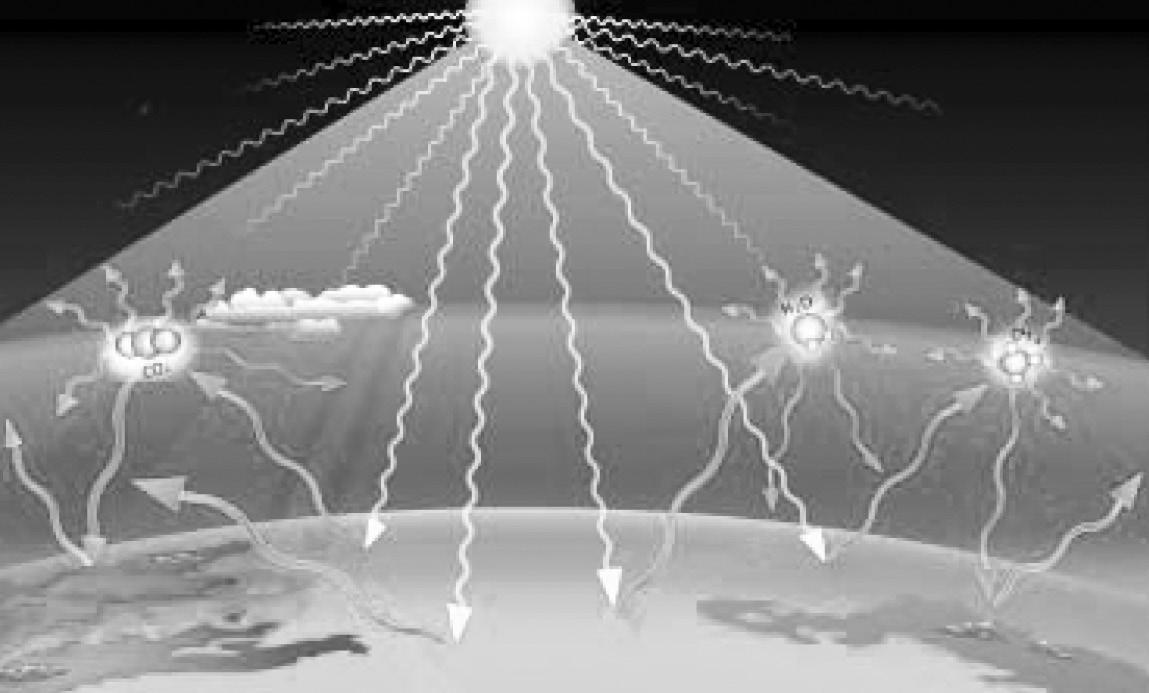
Four chemicals, all gases, dubbed as ‘green-house gases’ come to rescue. They are water (H2O, vapor), carbon dioxide (CO2), methane (CH4) and ozone (O3, a variety of oxygen molecule). Sun beams hit earth-surface and radiate back upwards. The green-house gases present in the atmosphere absorb this reflected radiation (in varying degrees), and within a short time-frame release the radiation in all directions. Some of it hits the earth and heats up the surface and adjoining atmosphere. Instead of trapping all the heat, as in a green house, these gases ‘send’ only a part of the trapped heat down to earth (as shown in the accompany-
ing cartoon3 This way earth does not ‘over-heat’ yet remains warm.
This is the fine balance that has made our planet habitable, and this entire process of heat trapping and release depends critically on the amount of these green-house gases in the atmosphere. Let us look at them individually.
Water vapor contributes the most towards the greenhouse effect. In other words, heating up the atmosphere by radiant heat is highest in cloudy days. However, concentration of water vapor has remained fairly steady over years. Next comes ozone which is not only a green-house gas, it also absorbs ultraviolet (UV)radiation from sunlight, thus preventing harmful effect of sunlight, including skin cancer. However, as industrialization of our society marched ahead, use of chemicals that can ‘neutralize’ ozone has also increased significantly.
pant use of these chemicals by comfort-seeking humans has the net effect of depleting ozone-layer, exposing us to harmful UV radiation, and more to the context, enhance green-house effect.
Methane, a green-house gas that is multi ten times more effective than carbon dioxide in trapping heat, is
our planet livable. However, recent exploration and mining of natural gas as a ‘clean’ alternative to fossil fuel has aggravated global warming situation significantly in two ways. First – release of methane in the atmosphere during mining process and production of carbon dioxide by burning it as a fuel.
Cholro-fluoro carbons (CFCs) and halons, man-made gases used in aerosols and refrigerants are such chemicals. Ram-
a naturally occurring gas in earth’s crust. It is produced by interaction between microbes and any biological material. For example, willow-the-wisp, the short-lived light flash over a boggy area filled with rotting trees, is caused by spontaneous combustion of methane. In prehistoric and subsequent times naturally produced methane from earth-crust acted as a green-house gas to warm the earth and at the same time prevent over-heating to make
The fourth greenhouse gas is carbon dioxide. As discussed earlier, carbon dioxide, produced by burning trees, fossil fuel, including coal and oil and natural gas traps heat and contributes to warming of earth-surface and surrounding atmosphere. Deforestation is yet another contributor towards global warming. Trees are carbonreservoirs i.e. they take in carbon dioxide from atmosphere, ‘fix’ the carbon in them by a chemical assimilation process and give out oxygen that is essential for our existence. In other words, trees remove excess carbon dioxide from atmosphere. Therefore, cutting down trees is equivalent to enhancing global warming, and robbing
ourselves of oxygen.
To summarize, in prehistoric times green-house gases trapped heat from the sun and warmed-up earth-atmosphere to a desired level to sustain all live forms. However, in recent times, with advance of industrial civilization humans have been pumping methane and carbon dioxide into atmosphere at a significantly higher amount and rate that is desirable. Higher than desired concentration of green-house gases in atmosphere is causing higher trapping of radiant solar heat and warming up the earth to a dangerous point.
The question is what we should do to combat this potential natural disaster. These issues are discussed in second part of the article to be continued in the next issue of Ananda Sangbad 1. Three islands disappeared in the past year. www.nbcnews.com › march › science › three-islands-disappeared-past-ye…June 9, 2019.
2. Union of Concerned Scientists bulletin, February 27, 2020.
3. Wikipedia. https:// en.wikipedia.org/wiki/ Greenhouse_effect
By Jayashree Chatterjee
City of furious cultural energy. That is how historian P. Sinha describes Calcutta. Perhaps it is this furious energy that inspires businessman and patron of the arts Aniruddha Chowdhury of Chowdhury House, Kolkata to promote India’s creative arts with great fervor, because what Mr. Chowdhury does is truly remarkable. During the wedding season in India, he rents out his Chowdhury House to the public for holding receptions but in late December and January,his house becomes a cultural center that hums to the strains of Indian Classical Music, the beat of Indian classical Dance, and the ringing tones of actors taking part in dramas of different kinds. And all these events are free to the public.
An appreciation of the classical arts of India is part of entrepreneur Aniruddha Chowdhury’s heritage. He comes from a family that is closely connected to the cultural history of Bengal. His mother was related to Raja Ram Mohan Roy. In fact, Mr. Chowdhury’s mama bariwas a cultural center in its own right, and outstand-
ing musicians like Ali Akbar Khan (whom Mr. Chowdhury called Ali Dadu), Ravi Shankar, Annapurna Devi and Nikhil Banerjee were frequent visitors. So were Uday Shankar, and many of the post Tagore poets like Premendra Mitra, Shakti Chattopadyay, Samar Sen. What Aniruddha Chowdhury has responded to most since childhood is Indian Classical Music. “The difference between pop classical music and actual classical music is that in the latter the musician loses his identity completely; all that matters is the music,” says Mr. Chowdhury. “This music does not have a language or religion……It has ananda, which comes from being with the Lord, and the musician and the listener submit to it…….This is my Saraswati Puja.”
Aniruddha Chowdhury studied at IIT Kharagpur, and then did a master’s in structural engineering in the US. He was offered a job in the field of US defence research, but his father wanted him to return to India. “It was a tough decision for me to make,” recalls Mr. Chowd-
hury, “but I don’t regret it. What would have been better for me in the US?”
The family business that he came back to was stevedoring and ship repairing. After a while, he began concentrating on real estate, and now, one of his ventures is to rent out Chowdhury House for receptions.
Chowdhury House stands at 5/1 Gariahat Road, Kolkata - 700019. The entrance to Chowdhury House is like a storybook secret doorway that leads to a place of enchantment. The ordinary door on a small street off Gariahat Road gives no indication of what lies inside. But once you walk in it’s the open spaciousness of the place that impresses you. A fairly wide corridor leads to a larger room on the right, which in turn takes you to the covered courtyard that is the auditorium. It seats over three hundred people. The stage is smaller than that of most commercial theater halls, but as one of the actors said to me, “That doesn’t matter. We feel so welcome here that we have no problem with the size of this stage.”
For 3 days in December, every year since 2014, Aniruddha Chowdhury’s Calcutta Performing Arts Founda-
tion, which is registered as a “not-for-profit; philanthropic organisation”, presents three days of all-day classical music and dance programs. In January, this is followed up by 3 days of theater. The Foundation’s mission, as stated in its website www.cpaf. in is “to showcase the potential of performing arts and uphold the age old tradition of Bengal to encourage and support young talented artists and present them to the world of music, dance and drama and all such forms of performing art in the Baithak style allowing the audience to interact directly with the performers and provide constructive criticism as well as encouragement. Core to the foundation’s philosophy is a commitment to public benefit by making it open to all with no entry fee.”
Mr. Chowdhury says that he generally chooses musicians who are “very good but not all that well known.” And how much does he pay them? (I am wondering for how long he will be able to continue this – providing high quality music free of charge.)
Mr. Chowdhury tells me a story. Mohammed Rafi was once asked by the members of an organization with
very little funding to sing for them. Rafi knew they would not be able to give him a large amount of money but what mattered more to him was that they were all bhaktas of music. So, he sang for them for a very nominal fee.
“I pay my artistes an honorarium”, he tells me.
This December, Chowdhury House celebrated its sixth music conference. Each session (there were two sessions a day) was dedicated to a musical legend such as M.S. Subbulakshmi, Pandit Ravi Shankar, Ustad Ali Akbar Khan and Mian Tansen. The musicians included Ustad Murad Ali Khan on the sarangi, Ustad Ali Akbar Khan’s student Ken Zuckerman on the sarod, Pandit Samar Saha on the tabla, Dr. Nirmala Rajasekar on the veena and Vidwan S. Shekhar on the mridangam. Amongst the vocalists was Mitali Bhawmik from New Jersey. The classical Indian dancers comprised Sujata Mohapatra (Odissi), Sayani Chakraborty (Bharat Natyam) and Saberi Misra (Kathak).
“During these three days, what we experienced was not entertainment,” says Mr. Chowdhuri. “It was a spir-
continue to page 6 }
| continue from page 4
his mother – a friendly lady who called herself “Lily”. I was under a constant anxiety that I would not be able to do a problem correctly or take an unusually long time thinking about it. Finally, I decided to be upfront with Lily. I told her that I would be more effective if I had the same book at home that Daniel followed and asked where I could find a copy. Lily fully understood the situation but said that a new book would cost $225. It was a very thick hard-covered book, but I was still shocked by the price.
I was impressed and overwhelmed by Lily’s generosity when she handed me a book she got from e-Bay, the next time I saw Daniel and told me that I could keep the book as a “gift”. Clearly Lily was ready to do almost anything for better grades for Daniel so that he could get admission to a good college and money
was not an issue.
The book did not go into too much details on any topic; it relied heavily on a few worked out “examples”. The expectation was that the students would learn by doing the exercises. The number and variety of the problems at the end of each chapter were exceedingly large. I spent literally hours in preparation, time for which I was not compensated. In the process I realized that the course covered topics in this course that we learned in second or third year of college and a few in M.Sc. class. I even learned some new subjects and techniques that I had never learned before.
I also had several conversations with Lily which gave me an inside scoop on how the Chinese families thought about their children’s education. It seemed that behind every student there was a mother acting like a “tiger mom” watching their every
step, every grade and every activity and pushing them to excel all the time. It was apparent from the way they spoke that they had virtually ruled out the non-Chinese students from their group of worthy competitors. Finally, they were ready to spend whatever money it took.
At the end, both Lily and Daniel were very satisfied with my job. I had similar experience with a few other Chinese students I have tutored since then. This experience opened my eyes to a cultural phenomenon going on in this country. A lot of Chinese people (both the ones living in China as well as those in USA) made tons of money from the soaring Shanghai stock market in recent years and this money has been making its way to USA because of future uncertainties in the Chinese economy, mainly in the form of real estate investment. As a result, they have “invaded” upscale
neighborhoods in places like Irvine, Pasadena, San Francisco and Dallas with good schools and even the people who are still living in China are sending their kids to USA for education.
One of the universal goals of everyone is to get a solid education in Science, Technology, Engineering and Math (STEM) subjects. From what I see among the children of my Indian friends and colleagues, the secondgeneration Indians are not that focused on STEM subjects. It seems that medical fields, business schools, economics, journalism and even law school are more popular areas. Secondly, while the Indian parents certainly impose a high expectation on their children as far as their academic achievements are concerned, they do not seem to have the same kind of zeal and regimented approach that I saw in Lily in driving their kids. Also, they prob-
ably are reluctant to spend money in seeking tutoring help perhaps because they think that it is an unnecessary expense and they can tutor themselves if necessary.
I do not get too many Caucasian students. The ones I have tutored all seemed to have some issues such as attention deficiency disorder, some type of addiction, extracurricular activities or low expectation set by parents.
My view has changed. Now my conviction is that the entire brain of Silicon Valley would eventually be run by the second-generation Chinese. They will not have the handicap in language or people interaction like their first generation. Of course, there will still be hundreds of Indian engineers on H1B visas, but not the kind with a futuristic vision and commitment to the company or country. I feel a certain degree of sadness at this realization.
| continue from page 5
itual experience for everyone - Hindu and Muslim. Classical music brings us together and this was the music of multicultural India.”
Audience member Falguni Khan, who attended both the music and the drama festivals, had this to say about the music festival: “It was a 3-day long musical extravaganza of Hindustani and Karnataki music…. (It) was a very wellstructured mosaic of vocal, instrumental and dance programmes …. The conference was such a sumptuous treat for avid lovers of music and dance that we, the audience, were spoilt for choice”.
In January 2020, the Chowdhury House Theater Utsab presented three plays performed by actor-director Falguni Chattopadhyay’s theater group Lokokrishti. (Falguni Chattopadhyay and his wife actress Rumki Chattopadhyay are the parents of movie star Abir Chatterjee) They were Ihai Satya, the Bengali version of Pirandello’s Right You Are., Samaresh Mazumdar’s Teen Nombor Chok (a social drama about how financial wants can affect the value system of a middle class family) , and Jeet shatraghni’s Punoray Ruby Rai (a comedy dealing with artificial intelligence and how it can enter our lives in an alarming way) . The last named play was the group’s first public performance. I had the pleasure of watching the last two plays. After the curtain call, the cast took questions from the audience, very much in keeping with the Foundation’s guidelines
Aniruddha Chowdhury’s wife Anindita Chowdhury selects the plays. “She’s very well-read”, says Mr. Chowdhury. I spoke with the cast members after the last play. They were all clearly thrilled to be performing at Chowdhury House. “Our group performed all three plays this season,” they said. “It was an honor. They clearly want us to be here. We love the atmosphere of this place.”
There are a few other festivals that are held at Chowdhury House. Vasant Utsab, during which Tagore’s dance dramas are staged, the Thumri Festival in July, Janmashtami, when kirtans are sung and Ganesh Puja. One should also mention that during the performances, coffee and Bengali shingaras are served free of cost. At the music festival, free meals are provided. “It’s probably because that way, people who come in the morning won’t have to go home for lunch and then feel reluctant about returning for the afternoon session,” one of the audience members told me.
The common assumption is that Bengalis do not have the acumen or the bent of mind to be successful businessmen. The other common assumption is that the pursuit of culture is the Bengali’s birthright. How impressive it is to meet a Bengali who runs a flourishing business and whose overriding obsession is not only to keep Indian culture alive but to also make it available to the public free of charge! Such a businessman is one with a difference. With an outstanding difference!
| continue from page 1
Asians in America, including Indians, had to wait till the end of World War II to gain immigration and naturalization rights. The LuceCellar Act of 1946 finally allowed immigration and naturalization of Indians (and Filipinos). However, the number of people from Asian countries who could actually do so was very small. That was because the National Origins Quota, established back in 1924, was basically left intact, making large-scale immigration of Asians impossible until 1968 when President Johnson threw open America’s doors to Asians and other non-white settlers.
What kinds of cruel indignities did our predecessors face in the pre-1968 years, especially before 1946 when they were finally given naturalization rights? The types of indignities varied from location to location and evolved over time, and included resentment, discrimination, segregation, open hostility, even occasional violence.
Before they could enter the US, immigrants, particularly from Asia, had to convince the authorities that they were not “criminals or prostitutes” (1875 Act), “convicts, lunatics or idiots” (1882 Act), “polygamists, mentally ill or carrying contagious diseases” (1891 Act), “anarchists, political extremists, beggars or epileptics” (1903 Act), “imbeciles, feeble-minded or guilty of moral turpitude” (1907 Act), “homosexuals, criminals, insane, alcoholics, paupers, vagrants or people with constitutional psychopathy” (1917 Act), or “subversives” (1940 Act).
Insulting or demeaning words and labels were often the precursors to openly hostile treatments.
The most notorious case of violence towards Indian workers was “the Bellingham riot” of 1907. Starting in 1903, bands of Punjabi workers, mostly Sikhs from Canada, had arrived in this city in the state of Washington to work in lumber and railroad industries. By the time the riot broke out, there were several hundred Sikhs living in Bellingham’s “Hindoo alley”. Resentment against these hard-working but lowpaid men and women ran high, and one night in September 1907, a mob of several hundred white people attacked the residents of the “Hindoo alley”, drove the Indian workers and their families out of their homes and looted their properties. Some 125 Sikhs were physically pushed out of the city and 400 were jailed by the police under the guise of “protective custody”. Within a matter of days Bellingham was totally free of Indianlaborers. As the displaced Sikh laborers moved to other towns in
Washington, Oregon and California, they faced similar resentment from the local people, and in some instances, suffered violence as well.
Segregation was the indignity imposed on another group of Indian settlers. Some twenty to thirty years before the bands of Sikh workers began to arrive in the US, a couple of hundred Bengali Muslim silk traders had settled along the East Coast and in several southern cities like New Orleans and Atlanta. These chikondars and their stories had received little publicity before the book, BengaliHarlem, was published in 2013. Unlike the Sikh workers in the West Coast in the early twentieth century, these traders did not face significant social resentment or opposition. In the communitieswhere they settled, they were mostly treated as exotic foreigners and as objects of curiosity. However, they had to live in black or colored neighborhoods, and marrying white women was prohibited. Not surprisingly, most of these chikondars ended up marrying women of color and raising their children in mixed race households with divided religious affiliations. These chikondars were probably able to escape the hostility and violence that confronted the Sikh workers years later because they did not arrive in large groups nor did they build prominent places of worship like the Sikhs.
Inter-racial marriage was socially frowned upon and legally prohibited for a long time. Owning real estate was also a major challenge for our predecessors. Land and home ownership was possible for an Indian only if he married an American citizen which was, of course, prohibited under anti-miscegenation laws!
Some Indian intellectuals and students had to live under a constant threat of deportation. Until independence in 1947 all Indians were British subjects, and many of the Indians living in the US were considered by the British rulers as dangerous freedom-seeking criminals. The long arm of the British Intelligence reached into the U.S., thanks to the strong alliance between America and Great Britain. As a result, the British had full support of the American government in spying on Indian students and intellectuals living in the US and in deporting the “undesirables” to India.
The Hart-Cellar Act of 1965 signaled a remarkably positive change in the immigration policies of the United States. The infamous, racially based “National Origins Quota” system was gone, and the US opened its doors to the world on a fairer and more rational basis. Two post-1968 laws further strengthened this nondiscriminatory “open door” policy.
The Immigration Act of 1990 (became effective in 1995) added two provisions that significantly benefited the entry of people from the Indian sub-continent. The Diversity Visa Program, created by this law, made available permanent residency visas annually to people from countries that were historically under-represented in the US population. Visas were given to applicants through a lottery process; educational qualifications or existing family ties were not considered. This program enabled a large number of Bangladeshis to immigrate to the US. -- The second feature of this law, “Temporary Worker Visas for Highly Skilled Individuals”, known as H1B visas, paved the way for a large-scale influx of IT professionals, mostly from India.
As the immigration laws changed, so did the societal attitudes towards immigrants from India, China and other Asian countries. Changes did not happen overnight and took several decades to gain a solid foothold. Indian (and other Asian) students and professors became very successful in American universities and research organizations. Physicians and surgeons trained in India became commonplace and highly respected. India-educated engineers and IT professionals became ubiquitous, and Indian shop-owners, taxi drivers and other service industry employees became familiar faces in many cities and towns. A number of Indian immigrants and their descendants rose to very high positions such as governors of states and CEOs of global corporations while a few received high-level recognition such as the Nobel Prize, the Pulitzer Prize, the Grammy Award and memberships in the National Academies of Science and Engineering. Many successful high-tech companies were founded by entrepreneurs of Indian origin, and Indians made a mark in a wide variety of fields ranging from journalism to finance to the performing arts.
From humble beginnings, Asian immigrants in general, and Indian Americans in particular, have come a long way in achieving acceptance, recognition and success in America. Admittedly there have been some rough patches even in recent decades but all in all, Indian immigrants and their descendants in this country are on a positive trajectory.
For the long term, Indian immigrants and their descendants should proactively pursue all avenues available to them for open and frequent cultural exchange with their neighbors, coworkers and friends. Only through greater familiarity and understanding would all segments of the American society come to appreciate and value each other more.
Something has been tossing around in my mind lately. It started with the question put to me by a friend in response to a piece I had written on the role of the Bengalees in the Indian independence movement. He asked a very interesting question: “Why aren’t there any Muslim names in this piece?” That took me by surprise. After all, I have always prided myself on being ‘secular’, whatever that term may mean. I summarily revised the piece some and started frantically looking for more definitive information.
My surprise was two-fold. First, we are all aware that the Bengalees have been major players in the Indian independence movement in all its phases and forms since the earliest days of the Indian National Congress. Surprisingly, they were almost all Hindus. This was particularly significant, when one considers that Bengali Muslims constituted 55 to 60 percent of the total Bengali population before Independence. Second, it should not be lost on us that the participation of Muslims from other parts of India in India’s freedom movement was not insignificant, though, admittedly in lesser numbers than the Hindus. So, the absence or near absence of Bengali Muslims was of particular significance.
Bengalees were involved in the movements for India’s freedom from the British from the earliest days. Surendra Nath Banerjee and Ananda Mohan Bose formed the India League in 1876. The Indian National Congress, the singular organization that took the leading role in the independence movement, was founded in 1885. Its founding members included Woomesh Chandra (W. C.) Bonnerjee, the first President, Surendra Nath Banerjee, Lalmohan Ghosh and Manmohan Ghosh. Things proceeded in low gear for a while, till a kickstart was given by Lord Curzon’s Partition of Bengal in 1905. Bengali patriotic juice was suddenly released in many spheres. Rabindranath Tagore, Dwijendralal Roy and Rajanikanta Sen wrote some of the greatest patriotic songs which are still around us to this day. There was a spurt of revolutionary activity spurred by the leadership of Aurobindo Ghosh, and Pramathanath Mitra. Gymnasiums (akharas) sprang up everywhere -- all over Bengal. Leading among these organizations were the Jugantar Society in Calcutta and the Anushilan Samity in Dhaka. They spread their influence into the districts. A burst of ‘terrorist’ activities against the British Raj ensued in various forms. (The word ‘terrorist’
By Partha Sircar
-- santrashbadi in Bengali -- did not have the same negative connotation it holds today. People looked with awe at the terrorists.) There were attempts on the lives of British officers, including the Viceroy. Secret factories manufacturing bombs sprang up in different locations. Foreign arms, particularly from Germany, were smuggled in. Names of these ‘terrorists’ -- names like Khudiram Bose, Prafulla Chaki, Bagha Jatin, Barin Ghosh, Ullaskar Datta, Debabrata Bose, Satyendranath Basu, and Kanailal Datta -- attained legendary status. Initially, the ‘terrorists’ were inspired by Hindu ideals, the Goddess Kali and the writings of Bankimchandra and Vivekananda. With time, the ‘terrorists’ imbibed more secular ideals, including Marxism, but their activities continued. They established an All India network with Bhagat Singh, Chandrasekhar Azad and their Hindustan Revolutionary Association. They gave us men like Batukeshwar Datta, who with Bhagat Singh threw a bomb in the Central Legislative Assembly: Jatin Das, who undertook a 64-day hunger strike till his death; Rashbehari Ghosh, who escaped to Japan, only to surface many years later with Netaji and the INA; and Sachin Sanyal. There were the young men -- Benoy, Badal and Dinesh -- whose names have been immortalized by their masquerading as Europeans and killing a police officer inside the Secretariat. Many of the ‘terrorists’ were deported to the Andaman Islands to be incarcerated in the infamous Central Jail. There are tablets showing the names of those incarcerated. It was touching for me to find from the names that 80 percent of those incarcerated were Hindu Bengalees, mainly young men in the prime of their lives. There was the famous Chittagong Armory Raid in 1930. Their leader, Surya Sen, was hanged. Some of his accomplices like Lokenath Bal, Pritilata Waddedar and Kalpana Dutta gained immortal fame. Even today, the names of these ‘terrorists’ are strewn all over Kolkata and West Bengal in statues, street names, parks and names of educational institutions. I do not know if something similar is the case in Bangladesh today.
Parallelly with the terrorists, there were several notable Bengalees associated with Mahatma Gandhi and Indian National Congress. Some prominent names include Deshbandhu Chittaranjan Das, Sarat Chandra Bose (elder brother of Netaji Subhash Chandra Bose), Sarojini Naidu (née Chatterjee), Kiron Shankar Roy, Deshapriya Jatindramohan Sengupta, and the first four Chief Ministers of West Bengal: Prafulla Chandra
Ghosh, Bidhan Chandra Roy, Prafulla Chandra Sen and Ajoy Mukherjee. And finally, there was the freedom movement engendered by the mercurial Subhash Chandra Bose. He escaped from India to Germany and then to Japan. He developed a formidable army from the Indian soldiers at the Japanese Second World War POW camps and the expatriate Indians in southeast Asia, marched with the Japanese Army in their assault on India, only to be defeated by the British at Kohima, Nagaland after a bitter struggle. A conspicuous absence of Bengali Muslim names among the participants in India’s struggle for independence in contrast to the myriad Bengali Hindu names, be it as members of the Indian National Congress, as ‘terrorists’ or as supporters of Netaji, is readily apparent (I do acknowledge the difficulty of identifying Bengali Muslims by their names). Perhaps one should mention in this context Bengali Muslims like Muzaffer Ahmed and the poet Kazi Nazrul Islam, who were pioneering leaders of the Communist Party of India, one of whose aims was to free India, albeit via a different path. Also, I came across the name of one Syed Abu Muhammad, who wrote songs during the Swadeshi movement, which became very popular.
Now to the Indian Muslims. Indian Muslims were present in the independence movement from the earliest days. Badruddin Tyabjee was a founder member of the Indian National Congress in 1885. Indian Muslims were involved from the early years of the twentieth century. Names like Ashfaqullah Khan of the great Kakori train robbery fame, Hasrat Mohani, Ubaidullah Sindhi, and Maulana Brrkatulla, who was the Prime Minister of the first Indian government in exile (in 1915 in Kabul), are some names that immediately come to mind. There were several Muslim leaders in the Indian National Congress with Mahatma Gandhi, starting with Shaukat and Mohammed Ali of the Khilafat Movement in 1921. They were followed by leaders like Abul Kalam Azad, a seven-time Congress President (incidentally, he grew up in Calcutta), Abdul Ghaffar Khan (Frontier Gandhi), Mukhtar Ahmed Ansari, Asaf Ali, Saifuddin Kitchlew, Rafi Ahmed Kidwai, and Yusuf Meherally of Bombay. They all suffered imprisonment. Netaji Subhash Chandra Bose’s Indian National Army had several important Muslim leaders, including Abid Husain, Habibur Rahman, Shah Nawaz Khan, and Momammed Kiyani. Incidental-
ly, none of them were Bengali Muslims as best as one can tell.
One wonders about the reason for the absence or near absence of Bengali Muslims in India’s struggle for independence. After all, Bengali Hindus and Muslims were neighbors for generations, particularly in East Bengal, from which a bulk of the Bengali revolutionaries came. They shared many things in common: language, food habits and many rituals. Bengali Muslims were known to participate in Hindu festivals, and some were proficient in kirtans (Hindu religious songs). It is therefore difficult to explain the issue away by invoking religious differences, particularly when we see the presence of significant numbers of non-Bengali Muslims in the struggle. We have to look elsewhere. Part of the answer may lie in the general differences in the socio-economic levels between the Bengali Hindu and Muslim communities. There is no doubt that India’s struggle for independence was largely dominated by the educated middle class. And the Bengali Muslim population was largely dominated by the peasants -- poorer and often illiterate -- and therefore might not have been attracted by the allure of independence as much. But Bengali Muslims did have their share of the educated and the well-to-do. Particularly from the 1930s or so, there was the ascendency of important Bengali Muslim leaders like Shahid Suhrawardy, Fazlul Haque, Khawaja Nazimuddin, and Mohammad Ali Bogra, all of whom played important roles before and after the Partition. Other than Nazimuddin, all were educated in Calcutta and some practiced at the Calcutta High Court. They, therefore, had their contacts with the elite and the educated among the Hindu Bengalees. But, for whatever reason, they were all drawn towards the Muslim League, for whom the independence of India was not a priority. Even Sheikh Mujibur Rahman, the Founding Father of Bangladesh, who was a symbol of Hindu-Muslim solidarity during the 1971 war of independence, was with the Muslim League before Partition.
All this makes one wonder. Probably there are no easy answers. Perhaps one should resign to a simple idea, echoing Winston Churchill, who had said that England and America are two great nations divided by a common language. I say, maybe, when it came to the struggle for India’s independence, Hindu and Muslim Bengalees were two great people divided by a common language.
Reported by Mita Sinha, Chair, Puja Committee
This winter has been milder compared to other years and as a result we had steady stream of visitors attending all the pujas at the temple. For the month of December, we had two of our regular monthly pujas. On December 8, we had our Satyanarayan Puja and on December 25, we had our Shyama Puja.
January was a busy month for us. January 1 was the New Year (English Calendar), and
All of us look forward for this special day.
On January 24 we had our monthly Shyama Puja, many devotees came to the temple on this day. After the puja, havan, and arati we had a delicious dinner.
January 29 was our special day at the temple. Saraswati Puja/Basant Panchami and Hate Khori was observed on this day. Ma Saraswati is the goddess of wisdom, knowledge, music, and art. This puja is performed in almost every educational institution in West Bengal. Many families perform Saraswati Puja at home. People of all ages,
the temple remained open from 9 am to 9 pm. We had quite a few devotees visiting the temple on this day. We also raised some money by selling “thakurer saree” at the temple.
On January 5 we had our monthly Satyanarayan Puja. We had good attendance in the temple, and everybody had sumptuous dinner before going home.
The Ratanti Kali Puja was celebrated in Ananda Mandir on January 23. This puja is annually observed by Bengalis in the month of Maagh.
and specially students offer pushpanjali to goddess Saraswati on this day and some bring their books to be blessed by Ma Saraswati. Hate Khori is an age old tradition among Bengalis. This is a popular celebration when little children age three or four perform this ritual of writing the alphabets. This puja holds special significance for us and is considered an auspicious day to introduce young children to the world of education on this day. People wear yellow clothes, offer yellow (mari-
gold) flowers to Goddess Saraswati. It is counted as the arrival of spring season.
Bani Bandana and Hate Khori were observed on February 9 at Ananda Mandir. It is our Ananda Mandir tradition to celebrate Bani Bandana on a weekend so that all school-going students can participate at Saraswati Puja. This festival is celebrated in the month of Maagh. Little girls in yellow saree and little boys wearing dhuti sat on the lap of their parents with slate and chalk and wrote letters and alphabets on the slate. This is the beginning of their formal education. All kids who had Hate Khori at the temple also received a token gift. It is a fun fill day for kids of all ages. Lunch was served after the puja and Hate Khori.
We also had cultural function with dance, music, drama etc. performed by kids in our Tagore Hall in the afternoon. We have a number of talented kids in our community and they presented their talents very well on the stage.
We had our monthly Satyanarayan puja in the evening. It was a busy and long day but we truly enjoyed it thoroughly.
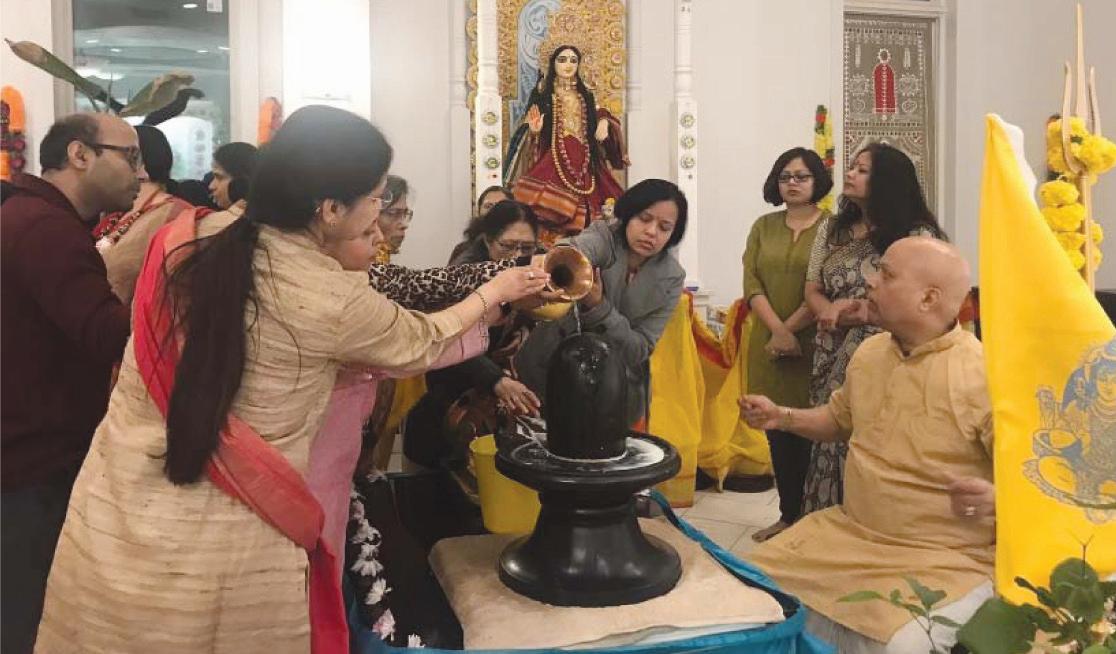
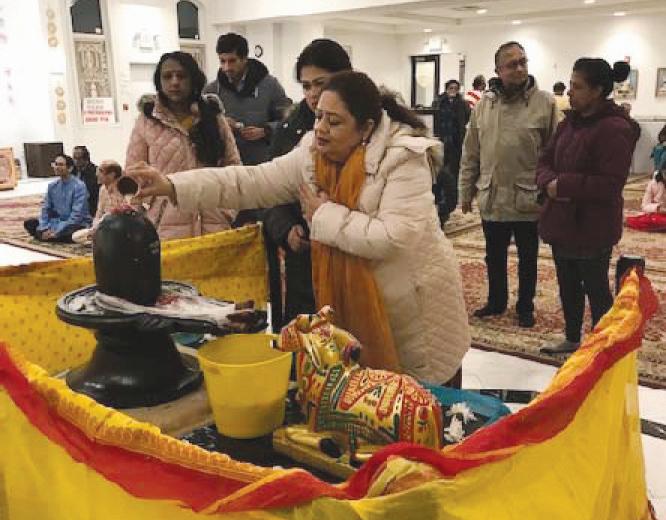
Maha Shivaratri is an annual Hindu festival celebrated in honor of Lord Shiva. Many Hindus fast on this day. This puja was celebrated at Ananda Mandir on February 21 to February 22. It is considered auspicious to pray to Lord Shiva on the night of Maha Shivaratri. Devotees offer milk, fruits, bell leaves (bel pata) on Shiva Linga on this day.
On February 22 we had our monthly Shyama Puja. The puja was performed in the evening and after the puja we had Arati accompanied by drums (dhak) shankha, and bells (kansar).
We all enjoy these pujas all year around and it keeps us in touch with our culture. It is very important to carry on these practices so that our kids learn and remember our tradition. We are very lucky to have Ananda Mandir that offers this opportunity to all of us living in this part of the country.
Ata brief and solemn ceremony held on Sunday, November 3, our Children’s Park received all new playground equipment (a multi-unit swing set, a see-saw, a picnic table and three park benches) as gifts from Kalyan and Chitra Mondal, in memory of their beloved daughter, Mini, who had died unexpectedly at a tender age. The emotional ceremony was opened by Jaiprakash Biswas, our president, and Biswabhai, our priest, gave the invocation. Following a couple of Rabindra Sangeet offerings, Rini Mondal made brief remarks about the life and passions of her elder sister, and Kalyan and Rini released bouquets of balloons in her memory.
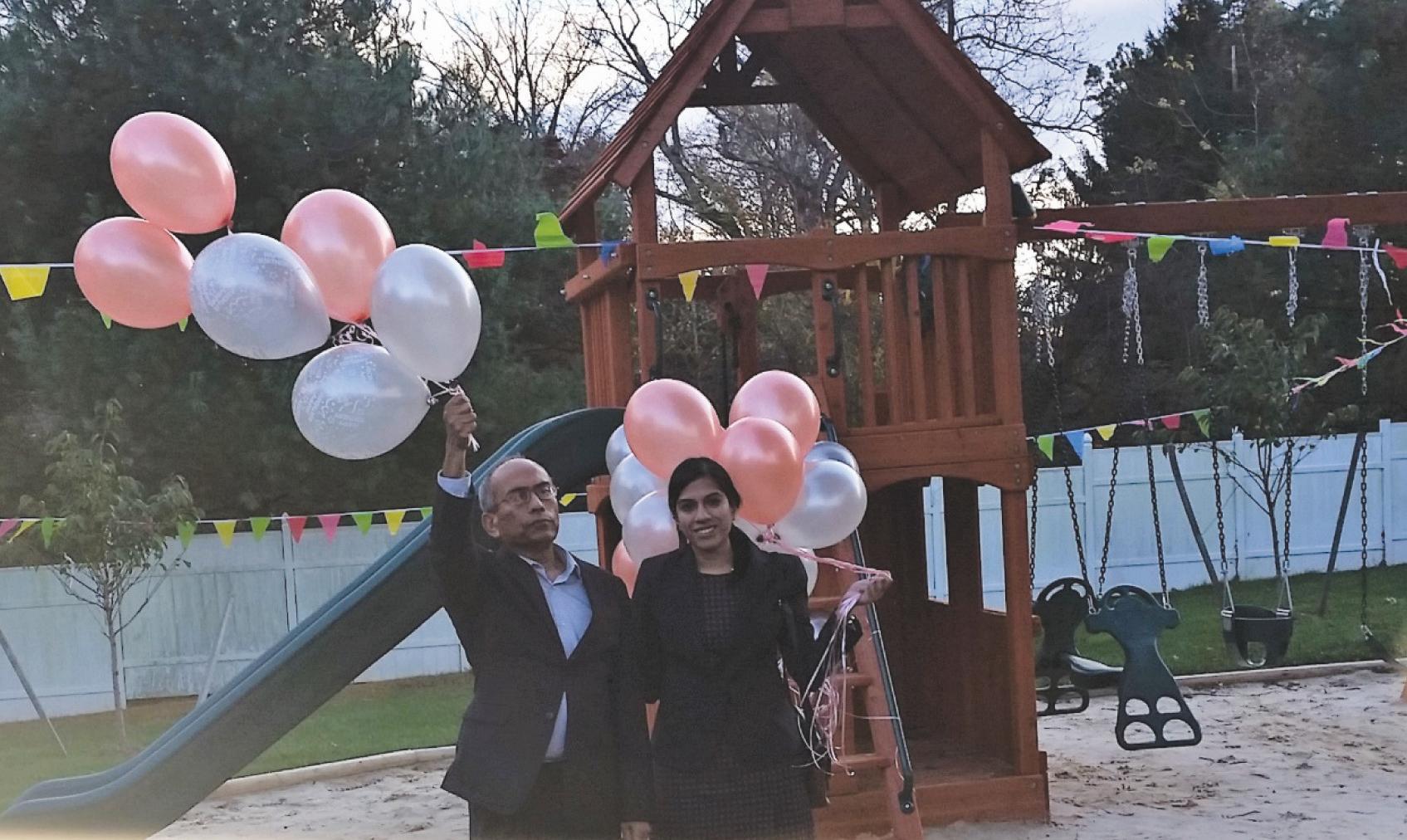
Kalyan and Rini Mondal releasing balloons at the inauguration of the new Children’s Park
Editor’s Note: We sincerely regret that in the January 2020 issue, we had inadvertently made some errors in the names of the daughters of Kalyan and Chitra Mondal. Our sincere apologies to the Mondal family and to all the readers for the unintended mistakes in reporting.
Did you know that you can join a yoga class at Ananda Mandir? These classes are held on weekends under the supervision of a certified yoga instructor. If you are interested in taking yoga lessons, please contact Sharbani Mukherjee for class schedules, fees, etc. She can be reached through email (sharbani.mukherjee@gmail.com)
By Anuraag Sarkar, Age 15
remember reading about the Northern Lights when I was in elementary school. After reading articles about the Auroras, I also read about this phenomenon in multiple novels

and stories, for example, in one of the books in The Magic Treehouse series. I looked up what the auroras were and have been fascinated by them ever since. If I could, I would head right to the center of Antarctica to view them from down under. Because this is impossible, I would instead see them from Northern Scotland at the top of a hill or in the northern parts of Canada. The auroras are amazing, and I would jump at the earliest chance of seeing them.
The Auroras, tend to fill up humans emotionally. Many people in the past saw them with awe, fear, and even hope. Our ancestors connected these lights with their gods, omens, and luck, although now, with advanced scientific knowledge, these phenomena have been classified as products of the Earth’s Magnetic Field.
The auroras that appear around the northern tip of the world are known as the aurora borealis. Because of the rarity of these auroras, many ancient civilizations interpreted them in different ways, ranging from gods to bad omens.
It was very rare for Northern Lights to appear in Europe, however, whenever they did appear, the people of Southern France saw them as a
bad omen signaling the start of a bad plague or war. This myth was further fueled when blazing red auroras filled the sky just a few weeks before the horrors of the French Revolution. Additionally, Chinese myths relating to Dragons are said to have originated from Northern Light appearances. According to the article Northern Lights Legends from Around the World from Aurora Zone, “the be-
lief is that the lights were viewed as a celestial battle between good and evil dragons who breathed fire across the firmament,”
In Japanese culture, it was believed that children born under the Northern Lights would be good looking, smart, and successful. This is part of the reason why many people from Japan, Malaysia, and Singapore even today visit South East Asia when auroras are visible.
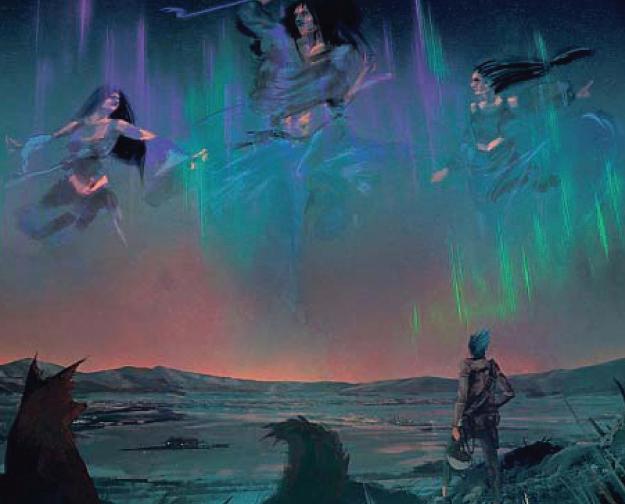
For the Ancient Greeks and Romans to have seen the Northern Lights would mean that there was incredible solar activity because they lived so far south. The Greeks believed that Aurora was the sister of the moon and the sun, who rode her magical chariot across the sky to alert her siblings of the dawn of a new day. The Romans associated the Northern Lights with Aurora, the goddess of dawn.
Adding on, there are two common interpretations of the lights among Eskimo tribes. One is that the lights were children who died soon after or during childbirth dancing, and the other is that the lights are the dead carrying torches and playing a ball game with the skull of a walrus. Many people also interpreted these lights as heroes fighting a battle. They were seen as harbingers of sickness and doom.
The Aurora Australis are the auroras that appear near the Southern tip of the Earth. Although they have different names, the Aurora Australis and Aurora Borealis have similar myths revolving around them.
The Aboriginal Australians see the Aurora Australis as their gods dancing overhead. Although this is a very basic interpretation of the Auroras, this is a common myth that was accepted by many civilizations around the world.
The auroras are a result of gaseous particles from the Earth’s Atmosphere and charged particles, which are released by the sun’s atmosphere, colliding. Variations in color are caused by different gas collisions, the most common being green, which is produced by oxygen molecules around sixty miles above the Earth. The rarer red auroras are produced by high altitude oxygen, and purple or blue auroras are produced by nitrogen. Particles from the sun’s atmosphere usually flow out from sunspots or coronal holes, which are blown to the Earth by solar wind and deflected by the Earth’s magnetic field. The magnetic field, however, is weaker at the poles, thus allowing particles to enter the Earth’s atmosphere and create auroras.
When and Where is the Best Time to Find Auroras?
Solar activity is higher at solar maximum, which usually lasts for around eleven years until the sun switches to a solar minimum period. Winter is usually the best season to see them because of the long periods of night. The best time to see them is between 10pm and 2am. The farther North or South a person is, depending on which pole they are view-

ing the Northern Lights from, the better. It is also beneficial to watch them from a hill or mountain unless the person is close enough that the auroras are directly above the person.
1. “What Is the Aurora Borealis?” Edited by Aurora Service, Aurora Service (Europe), 30 Jan. 2014, www. aurora-service.eu/aurora-school/ aurora-borealis/.
2. User, Super. “Mythology of the Northern Lights.” The Aurora Zone, www.theaurorazone.com/about-theaurora/aurora-legends.
3. Tevens, Zteve T. “Natural Folklore: The Northern and Southern Lights.” Under the Influence!, ztevetevans.wordpress.com/tag/auroraaustralis/.
Although myths are not accurate representations of what auroras are, they demonstrate the wide diversity in the world and connect people around the world together in an unimaginable way. Auroras have been a beautiful phenomenon that have occurred since the beginning of civilization. Although we are interpreting them in a different way than our ancestors did, we still see the same beauty that they saw centuries ago. Myths and interpretations give these auroras meaning, and the many incredible meanings combined create a divine connection not just around the world but also to our ancestors.
Advertisement FOR IMMEDIATE RELEASE
By Utpal Sengupta
It happened recently when I made plans to visit my dear nephew Suman and family in Manchester, England. And it all happened at the Newark Airport.
I always had a soft corner for Manchester. This is where I was supposed to do my graduate studies decades ago. But that never happened as I had other family priorities back home. So, when Suman asked me, his retiree Mama, to come over I nodded with pleasure. I looked forward to meeting his lovely family, with wife Mayura and sons Neal and Yuri (after the Astronauts?), and also treading on the green pastures between the century-old red-brick Gothic buildings in the MU campus! I always liked the art, architecture and history of Europe, and Manchester, with its combination of sylvan and urban beauty, certainly fitted in.
I booked Newark-MANNewark flights for mid-October and decided to drive to the Airport and park my car at the long-term parking lot for 7 days; it would be cost effective that way compared to taking rides in Uber or a Taxi and furthermore I would not have to look around or wait for anyone. I made an on-line reservation for the parking and noted down the reference no. from the email as I couldn’t print the parking ticket (my printer was broken). Easy and straightforward to enter/exit and park as the instruction read (the camera will picture the license plate for permit –simple!). I didn’t suspect any mishaps to happen!
I drove to Airport for my flight and tried to enter the parking lot but could not. The gate won’t open. Irritated, I blew the horn. From a cubicle, a gate-keeper - a chubby Mexican American lady wary about the traffic - came out and asked for my ticket. I gave the reference number and showed the email on my Mobile confirming the payment. ‘Where is the ticket’ – she kind of yelled. ‘Sorry, I don’t have it’. She was annoyed that I couldn’t print the ticket nor display the code on my Mobile. She asked an assistant loudly in Spanglish to control the traffic and focused on me. Few phone calls, a long tense 10 minutes wait increased
my BP! ‘You are lucky’, she handed me a gate-pass and said, ‘save it and go for your flight, Mister’! I couldn’t thank her more! Was she nice and helpful, barring a few shouts? – yes, and it mattered! I rushed, parked and took the shuttle to the Delta ‘Departure’ gate.
I am waiting in the lounge for check-in in 1-1/2 hours. A few co-passengers around me within a 10-ft radius: three white couples, one black, myself brown and a young yellow student with a back-pack - all adults and seated. I am with ‘The Hungry Tide’ by Amitav Ghosh on my lap. Quiet ambience excepting some murmurs between respective couples and no exchanges with the others. 15 minutes of silence! Enter two couples in their thirties, one white and one black, unknown to each other, and each with a child. They quietly seat themselves apart. The kids, one black and one white, are about 2 yrs. old; they toddle and bubble. The parents free them in a while and I watch them moving slowly within the circle clapping, falling down and popping up again. 2 minutes, and lo! - they approach and stare at each other in awe. 2 seconds. They hold hands and start conversing, all Greek to each other! They hug and share toys as if they have known each other for eons. A bridge is slowly built and what a lovely camaraderie! The adults watch: some giggle and some look away indifferently without sharing a word. As if that is the world of kids, they don’t need to know each other, they can just be aloof and ignore the world around them! I silently watch and muse on Tagore’s –“jagat parabarer teere shishura kore khela” - “On the seashore of endless worlds children meet. The infinite sky is motionless overhead and the restless water is boisterous. On the seashore of endless worlds, the children meet with shouts and dance”! I couldn’t help audibly muttering how spoilt we get as we grow old; we don’t know that we lose the charm, beauty, naivete and purity of the child in us! What does our world do to us? Builds walls around like cocoons?? Others listen but
By Sushmita Dutta
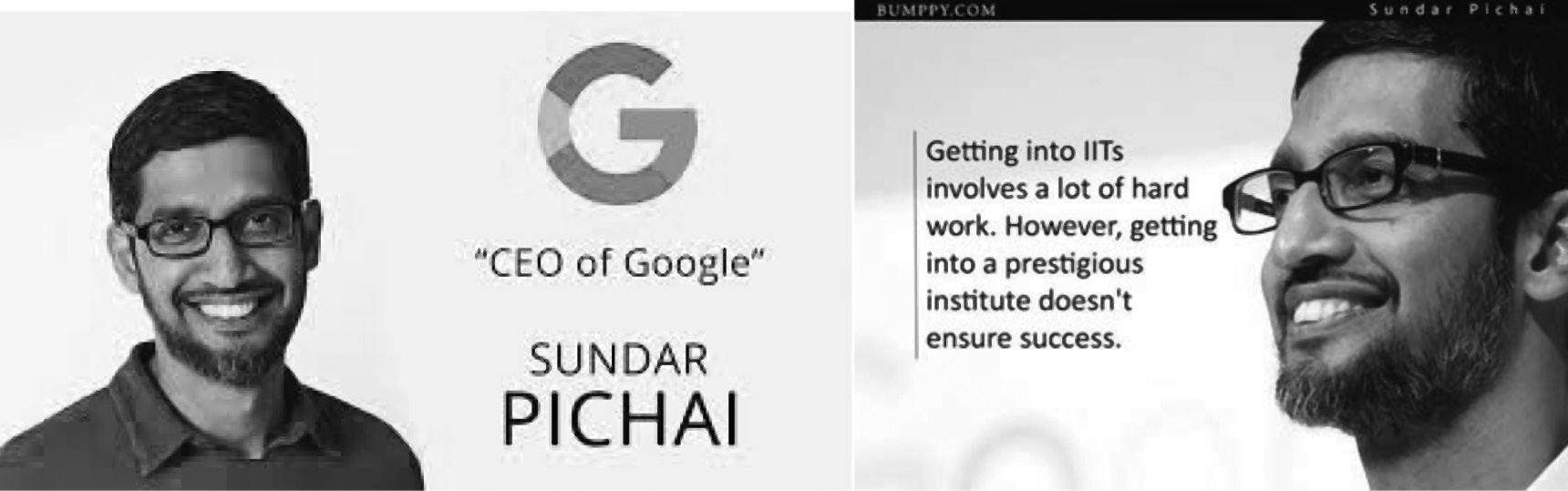
“Follow your Passion”, he says, and, he did just that even without having a Computer Science background he fantasized developing technology products. I haven’t met him in person, but, I followed through his success stories, one after the other and realized how focused a man can be, intuitively right almost every time, and conquered perceived milestones to prove commitment to self and loyalty to Google. “Silicon Valley has always been my goal”, he said, “I used to hear about technology from my uncle working at Silicon Valley, I read about technology innovations, Internet was just happening at that time and I waited for opportunities and the right times.”
Yes, timing played a big role in helping him achieve his goals which some may call “luck factor”. Whatever the contributory factors are, here is a recap of Sundar Pichai’s success stories – his life and career, his job as CEO of Alphabet Inc. and its subsidiary Google LLC that gets him $2 million in salary plus millions more in stocks. Over a face-to-face interview published in Fortune, February 2020, Sundar Pichai was asked – “You got a big raise… do you and your wife have a plan for what you are going to do with your wealth?” “I have always viewed society having played a big role in helping me reach where I am today, and our intent is to give back.” Replied Sundar Pichai, the man who has made us, all Indians proud across the globe. If you have any comments, notes or suggestions to share, please write to The Editor of Ananda Sangbad.
Sundararajan Pichai is the
full name. During his recent visit to IIT Kharagpur, a student asked him, “Sir, what was your GPA?” Sundar Pichai smiled and said, “My GPA wasn’t that great”. “Staying up late at night and missing classes in the morning, I had my share of all the experiences that all of you go through.” But”, he said to the gathering of 3,500 listeners, “Getting into IITs involves a lot of hard work. However, getting into a prestigious institute doesn’t ensure success.” He continued saying, “I liked to do something I really liked doing. I’d wanted to build products, computing products that would reach many people, and that’s what I have focused on.”
As an innovative thinker, he always had products and people in mind. He was a dreamer with a vision though he was not a remarkably, bright scholar in school or in college. His schooling was in Chennai, South India where he lived with his mom, dad and brother. His father, an engineer and mother a stenographer gave good education to their two sons. Sundar Pichai then moved to IIT Kharagpur in West Bengal for undergraduate studies in metallurgical engineering. With a scholarship earned from Stanford University, he moved to USA in 1993 and got M.S. degree in material sciences and engineering in 1995. His work life began as a materials engineer for Applied Materials, a company that supplied semiconductor manufacturing equipment, and as a management consultant for McKinsey & Company. He joined Wharton Business School while he was working and earned his M.B.A. in 2002 from there. In 2004, he joined Google as a
management executive.
It was April 1st, popularly known as April Fool’s day when Sundar Pichai was called at Google for an interview. Gmail was then just introduced as Google’s initiative into personal email market. The scene was perfect for a new email product as Microsoft’s Hotmail was coming to a saturation point. The market for emails had a definite niche for new thoughts and innovations. In his first round of interview at Google, Sunder Pichai was asked about Gmail scopes and possibilities. Having minimal interaction with new technology products, Sundar said very bluntly that he knew nothing about Gmail. Honesty paid. And, of course his passion for product innovations was visibly striking. He was called for another three rounds of interviews and Sunder Pichai came up with some of the brilliant user experience concepts that we see in Gmail today. With his passion and vision for captivating global user markets, Google found the right leader in Sundar Pichai to come aboard as management executive. He was hired.
Sundar Pichai began his work on Google’s search toolbar. The task was challenging. The blow of challenges came from Microsoft and Apple. It was like a “Doomsday” scenario for Google. Bing, the new default search engine on Internet Explorer was a threat to Google’s survival. Sundar Pichai envisioned the need for an independent browser for Google. He convinced Google co-founders, Larry Page and Sergey Brin, to
| continue from page 10
no comments! ……….. Well, check-in time and we get up to board. Was it trivial – what just happened before us? Not really!
Yes, I am now in the lovely city of cosmopolitan Manchester. It is the 3rd largest economy and 3rd most populous Metropolitan Area in the UK. It is an industrial powerhouse of textiles and digitals and currently supposed to be the best place to live in UK. It drizzles now and then but weather is no hindrance here; we are often out to enjoy the foliage, the 1000 year old castle(s) and church(es) with tall steeples, the art museum, the pubs, the Malls bubbling with people (mostly wealthy Chinese shoppers who pay only in cash!), the food (Fish & Chips, Kebob, Mutton Curry and Steak!) and of course the Scotch. And yes, I trod on the green pastures and cobblestone lanes and alleys in the University which once could have been my Alma Mater. I thoroughly enjoyed my weeklong stay with family and friends, savored crisp masala dosa, baked salmon and baigon bharta cooked by my dear daughter-in-law Mayura, a revered Physics teacher, and readied for my return flight to Newark. I land safely at Newark around 8-30 pm. The shuttle bus brings me to the Economy lot so I could pick up my car and drive back home. It’s a little windy and quite chilly, almost freezing for mid-October, and I am starving. But just another hour or so and I will be home! …… But no, the Providence frowns!I briskly walk back and forth near Bus Stop No. 5 where I thought I had parked my car. I check lane after lane around the Stop, often using the ‘Alarm’ on my Remote – no white Avalon! 30 minutes gone by and I start shivering. It’s dark but for the haze of light cast over the lot and without any visible souls around. Cars exiting now and then. Couple of shuttle buses speed by and won’t stop to help --perhaps shift-change time. Suddenly, I find a cigarette flashing for a sec. against a white Honda SUV 50ft away. I rush to the smoker – a young white woman on a cell phone leaning against her Honda. She is cool, stops texting and asks if I found my car -- she had spotted me running around. I shake my head and she says ‘why not you look into lanes 1 to 4 from the East side and I look from the West; we can trace at least 100-110 cars’. We spend another 30 mins in vain and she has to leave to pick up her nurse Mum from the Hospital, on their way home. I thank her for the kind help as she assures me – ‘you will get it in the next 1 or 2 lanes – the lot near Stop 5 is not that big’! She leaves; I wait, take a deep breath and walk wearily halfway into the next lane. Eureka! My Avalon – resting well on the lot! And I am shivering for 1 ½ hours with a light jacket on and my empty stomach aching! I start and whiz away to the Exit gate. 10-00 pm -- got to go home, very tired!
There again! History repeats itself. I cannot exit as the camera doesn’t work. Damn it!! I honk and honk. A stalky, 6’, black guy shows up from his cubicle. I shout, ‘the camera’! ‘Calm down, you must be hungry’. What a joke! ‘Give me the parking ticket’. ‘I don’t have it’. ‘How did you enter then?’ ‘Same problem but she had given me a gate-pass’! ‘Where is it?’ ‘I lost it’. ‘Open your Mobile and look for the email for booking’. I just started recharging my Mobile. ‘Open it’- he, visibly annoyed though other lanes were working! The Mobile opens and I find the email. He bends over to look at it and calls somebody on his phone. ‘Wait – they are looking into it’. Another l-o-n-g 10 mins. Oh, God! “G..O…”- he shouts, and I exited like a jet, waving a big ‘Thank You’ at him! I am on the highway and listening to PBS; it’s all about the Impeachment Enquiry – ‘nobody is above the Law’! All non-sense! Why not ‘lock him up’ as the Footballers said…?
I am home after an hour! Thank God!! I go to shower- warm. Was the homecoming bad? Trivial - yes, but not bad at all. Thanks to the young lady and the stalky keeper at the Exit! Me lucky? Don’t know. Yes, trivialities matter. They can be a priceless treasure trove - not at that moment of exasperating ordealbut surely later. You look down the memory lane, smile and enjoy, as I am doing now!
| continue from page 10
develop Google’s browser. Google Chrome was developed, tested and launched. Chrome is the most-used browser option today. Among many other product initiatives, another major effort Sundar Pichai spearheaded was Android One - Google’s push to make low-cost smartphones for 5 billion users. Google was now browser strong and also robust in mobile first product initiatives. Sunder Pichai now had feathers in his cap.
Similarly, under his leadership, other Google initiatives showed phenomenal growth. Google acquired YouTube in 2006. Today YouTube has a billion users, every single day users watch one billion hours of video on YouTube. Using Google Maps, every single day users measure over one billion kilometers. Sunder Pichai boastfully says, “We launched Google Drive five years ago and today we have 800 million active users. We have crossed 2 billion active devices of Android. It’s a privilege to serve users of this scale”. He envisioned serving people with products having global user reach and Sundar Pichai got his goal achieved through Google products and services. He was at the right company at the right time.
Sunder Pichai has remained loyal to the company. What next at Google? He replied at Google I/O gathering saying:
“We have now moved to an AI (Artificial Intelligence) first approach moving from Mobile first approach.” He continued, “Mobile made us rematch every product we have been working on. In AI first world we are rethinking all our products and applying machine learning to solve all our problems. Today we are allowing smart reply to over one billion users of Gmail.”
Google founder Larry Page says, “Sundar has a tremendous ability to see what’s ahead and mobilize teams around the super important stuff,” Larry Page wrote in a memo announcing Pichai’s promotion - “We very much see eye-to-eye when it comes to product, which makes him [Sundar Pichai] the perfect fit for this role [Google’s CEO].”
Sundar Pichai lives in California with his wife Anajali Pichai, his classmate at IIT, Kharagpur, and a chemical engineer by profession. They have a son and a daughter. When it comes to catching a breath from his work, he plays football and cricket, the games that probably run in every Indian’s blood. He was asked at the IIT gathering in India, “What do you think you would be if you were not a CEO?” He laughed and said, “I would probably become a cricketer like Sachin Tendulkar.” The crowd applauded loud, whistled and cheered. One last question, an IITan asked – “What do you think I should do to replace you?” “Follow your passion.” Said, Sundar Pichai.
By: Ujjwal Datta, DPM, FACFAS
Editor’s Note: Ujjwal K. Datta is a Board-Certified Podiatrist with two practice locations in Central Jersey. He can be reached at: www.gardenstatepodiatrist.com
The medical specialty field of Podiatry encompasses medical and surgical management of various foot and ankle conditions. The human foot has an amazingly complex anatomy, with 33 joints and a network of more than 100 tendons, muscles and ligaments. The heel bone is the largest of the 26 bones in the foot, and like all bones, it is subject to conditions that can affect its ability to perform its number one job - keeping us on our feet. Other common disorders of the foot include Bunions, Hammertoes, Neuromas, Warts, Corns and Calluses, Ganglion Cysts to name a few.
Heel pain can be extraordinarily disabling to sufferers. This pain has many causes but is generally the result of faulty biomechanics (walking gait abnormalities) that place too much stress on the heel bone and the soft tissues that attach to it. The stress may also result from injury or a bruise incurred while walking, running or jumping on hard surfaces; wearing poorly constructed footwear such as flip-flops, or being overweight. Common causes of heel pain include:
Heel spurs - A bony growth on the underside of the heel bone
Plantar Fasciitis - An inflammation of the band of fibrous connective tissue (fascia) running along the bottom (plantar surface) of the foot, from the heel to the ball of the foot
Excessive Pronation - Pronation is the normal flexible motion and flattening of the arch of the foot that allows it to adapt to ground surfaces and absorb shock in the normal walking pattern. Excessive pronation - excessive inward motion - can create an abnormal amount of stretching and pulling on the ligaments and tendons attached to the bottom back of the heel bone and can contribute to injury to the hip, knee and lower back.
Achilles Tendinitis - Pain at the back of the heel, common among people who run and walk a lot and have tight tendons, leading to inflammation, pain and the possible growth of a bone spur on the back of the heel bone.
Other causes of heel pain include Rheumatoid Arthritis, Bursitis and frank trauma.If pain and other symptoms of inflammation - redness, swelling, and heat - persist and limit normal daily activities, it is time to schedule an appointment with a board certified podiatrist.
A variety of steps can be taken to avoid heel pain. Most important is to wear shoes that fit well and have shock-absorbent soles, rigid shanks and supportive heel counters, to wear proper shoes for each activity you undertake and make sure they are not too old. As with any exercise, it is good to warm up and stretch before and after your activities, to pace yourself when you participate in athletics, to not underestimate your body’s need for rest and good nutrition and to make it a goal to lose weight if you have some extra pounds.
Orthotic (custom molded insoles) management is often the first line of treatment for heel pain. They control abnormal pronation of the subtalar joint and help keep the foot and ankle supported in the biomechanically correct manner. A lot of my patients inquire if they can simply pick up any over-the-counter insoles that are available at almost all the major retail and pharmacy stores such as CVS, Walgreens, Walmart etc. My advice to them is that those insoles are not custom-made orthotic devices and will not help in a patient’s particular problem as each individual has a unique foot type which causes their unique pathology.
Only a relatively few cases of heel pain require more advanced treatments or surgery. If surgery is necessary, it may involve the release of the plantar fascia, removal
Reported by Subrata Bhaumik
Sahitya O Alochana (SOA) is a monthly literary and topical discussion forum under the aegis of Ananda Mandir (AM). It completed its 12th anniversary in January 2020 and will have organized one hundred and twenty-one (121) sessions by the time this report goes to press. These monthly sessions feature exciting and illuminating discussions on diverse subjects including literature, art, theater and movie; history, philosophy and religion; science and mathematics; economics and business; and social issues, sports, and current affairs. Below is an account of a few recent sessions.
This session focused on Bengali Nobel prize winners in Economics. It also examined, albeit very indirectly, if there is a connection between ethnicity and Nobel Prize. While behavioral economists would have a lot to say about that, the distribution of the ethnicity of the awardees uncovers an interesting correlation. In its 50-year history, the Economics Nobel prize has been awarded to 89 laureates. And the vast majority (55) of them are US nationals, which is a common occurrence in natural sciences as well. Outside the US and the UK (the holder of 2nd rank with 9 prizes), arguably the two major melting pots in terms of ethnicity and culture, France has 4 winners with the top rank, while there are five nationalities and or ethnic groups that share the 2nd rank outside the “Duopoly” of the Anglo world. And there is one ethnic community that proudly shares that honor (along with a few other major forces in the world order including Canada, Germany, Norway, and USSR).
The discussion celebrated and reviewed the work of these eminent members of the Bengali community including Abhijit Banerjee (2019), Amartya Sen (1998), and Muhammad Yunus (Peace Prize 2006) – very different work, but all in the field of development economics. Whether or not there is any correlation, we definitely learned, in the session, a few things about why “rational behavior” is just one of many ways to model the economic agent, social choice theory, randomized control test, and micro-finance. This session was led by Ranajoy Ray-Chaudhuri, a professor of economics at Muhlenberg College in Pennsylvania. Ranajoy’s research and teaching focus includes Macro, Monetary Economics, and Development Economics.
It was a really informative and enlightening discussion. Judging by the robust attendance and very active interaction it definitely was one of the better sessions in last few years. A ton of thanks go out to Ranajoy.
No session was held in February due to scheduling conflicts.
Quite a few interesting sessions are in the pipeline for next several months. They feature eclectic topics including a discussion on “Religion and Politics – a South Asia Perspective,” a session on infamous Bengal Famines over the centuries, and a potential session on Gita – various interpretations.
The friends of Sahitya O Alochana would like to thank Ananda Mandir for its continued support for the forum’s contribution to the cultural enrichment of the local South Asian communities.
| continue from page 11
of a spur, removal of a bursa, or removal of a neuroma or other soft-tissue growth.
Bunions and Hammertoes are a group of disorders that sometimes plague an individual with pain and discomfort. Bunions develop when the big toe joint deviates from a normal straight alignment to an angular one with the big toe deviating towards the second toe. Hammertoes develop when the toes assume a buckled position. Both of these conditions result from faulty biomechanics of the foot and often times have a genetic predisposition. Hammertoes develop when there is any muscular imbalance between the long flexor tendons (bottom of the foot), long extensor tendons (top of the foot) and the in-
trinsic musculature of the foot.
Conservative treatments of bunions and hammertoes start with proper shoes and custom orthotics, splinting, etc. However, sometimes surgery may be warranted if conservative treatments are of no avail, and pain and discomfort worsen.
Neuromas are caused when the nerves passing between the long metatarsal bones get inflamed. Patients typically complain of burning, radiating pain to the third and fourth toes when they either wear tight shoes or squeeze their foot from side to side. They may also feel a deep, achy pain to the ball of the foot. This condition sometimes affects females more than males. Conservatively they are treated with oral anti-inflammatory medications and/or cortisone injections. Custom molded orthotics are also employed as a conservative treatment modality. Recalcitrant neuromas may need surgical intervention.
Warts are a viral infection, caused by the Human Papilloma Virus (HPV) that often times mimic a plantar callus. However, these lesions are different from a callus by the presence of black dots in the lesions which are dry capillary loops in the lesions. The HPV draws the capillaries to the site of the infection to survive. Treatments
entail various topical creams, cryotherapy, laser ablation, and surgical excision. Plantar warts are highly contagious and oftentimes spread from person to person. To avoid cross contamination and infection one should avoid sharing personal effects such as towels and socks and keep the infected site covered with Band-Aid. Malignancies in the foot are also not uncommon. Melanomas are quite common in the feet, and in the toenails. If a lesion develops suddenly and is either growing rapidly, or present with a variety of pigmentation, or have irregular borders they need to be biopsied. It is important to know the ABCDEs of Melanoma where A stands for Asymmetry, B stands for Border, C stands for Color, D stands for Diameter (typically more than 5mm), and E stands for Elevation. Sometimes, melanomas may also be unpigmented or whitish looking. It is always best to have any suspicious looking lesion be evaluated and sooner the better.
One of the major areas of care for the podiatrists is Diabetic foot care. Long standing and uncontrolled diabetics develop nerve and circulatory dysfunction. The nerve dysfunction called Diabetic Neuropathy is a leading cause of non-traumatic amputations in diabetics. When a diabetic is suffering from neuropathy, they lose their protective sensation threshold. What does that mean? If an average healthy person steps on a sharp object, they feel the noxious stimuli and move away from that and inspect what caused the pain. Unfortunately, a diabetic with neuropathy does not feel that and they develop wounds, especially to the bottom of their feet which remains undiagnosed and develops into a Diabetic Foot Ulcer (DFU) which eventually gets infected. The infection can then travel deep into the foot structures and infect surrounding soft tissues, tendons, and even bone. When the bone gets infected it is termed Osteomyelitis. Conservative treatment of Osteomyelitis would require wound debridement and oftentimes 6 weeks of intravenous antibiotic therapy. However, the gold standard of Osteomyelitis treatment involves removal of the infected bone and surrounding tissues.
Peripheral Arterial Disease (PAD) is also unfortunately most commonly seen in uncontrolled and long-standing diabetics. Combined with hyperlipidemia, diabetes causes the deposition of lipids and cal-
cium on the inside walls of the blood vessels, especially arteries, which can eventually choke off circulation. The further in the foot, the arteries tend to get narrower and it does not take long for these narrow arteries to get blocked leading to eventual gangrene. Combined with neuropathy and peripheral arterial disease, this leads to amputations in diabetics that are nontraumatic in nature—meaning amputations that are not caused by any physical trauma such as accidents etc. Our circulatory system is a closed loop. Oftentimes patients having peripheral arterial disease can develop or have an underlying cardiovascular disease. I had a diabetic patient whose blood sugar was poorly controlled and did not have an endocrinologist nor a cardiologist. After performing a thorough examination of his feet, I advised to make an appointment with a cardiologist as I suspected he not only had PAD, but also a cardiovascular issue. I received a call a couple of weeks later from his wife that her husband needed an open-heart surgery as he had 3 blocked coronary arteries and had he not come to see me he would have remained undiagnosed and could suffer a heart attack or worse. It is worth mentioning at this point that due to the neuropathy mentioned earlier, a diabetic sometimes may not feel the usual signs of someone having a heart attack, such as chest pain, radiating pain or tingling down the left am. This is termed a silent heart attack
Our job as podiatrists is to make sure that diabetics do not lose their limbs. It is very important for diabetics to be evaluated by a podiatrist at least once a year if their diabetes is controlled, or more frequently if necessary. Primary Care Physicians (PCPs) should refer their patient routinely to podiatrists. Podiatrists work very closely with endocrinologists as well and as a team they ensure that no diabetic loses a limb.
Many a times I have diagnosed patients with diabetes and underlying cardiovascular disease by simply examining their feet and eliciting a thorough history. These types of patients are sometimes selfreferred for a totally different concern on their feet and who typically do not have any PCP because they feel they are otherwise “healthy”. If our feet could talk, it could tell us a lot of things. I hope through this article, I have raised an awareness of proper foot care. Our feet are the mirrors of our general wellbeing. Feet are our foundation and thus should not be neglected or taken for granted.
By Diya Paul, Age 15
In8th grade, my school emailed me to be in their diversity photoshoot. I showed up, despite my better judgment, in the computer science lab where the photo was being taken. Because what’s better than faking STEM and diversity? Bribing students with free food! Anyways, there were eight of us – three of whom were white, two were black, one was half-Latina, and the remaining two were Asian. Sounds like a fun Old Navy commercial, right? In reality, 62% of my school was white, 12% is black, 11% is Asian, and only 5% is Latino. So, I guess they were pretty accurate with the half-Latina girl. I calculated it. You see, my school tried to be inclusive when they came up with the diversity photoshoot, but even then, the majority of us were white. So, I guess I was in a Fox News segment. We picture “normal” as white, heterosexual, cisgender, and male, but I go to an all-girls school so there are no males. Still, we choose this skewed standard of normal to represent us. In 2016, the Reflective Democracy Campaign found that while the white male population amounts to 31% in America, they make up 65% of our politicians. That’s like walking into Trader Joe’s and being surrounded by yellow veggies, green veggies, and red veggies, but for some reason, everyone is buying radishes. You see, in this scenario, white men are radishes. And who eats radishes?!?!? They’re roots! Even though America has become more diverse we mostly choose one idea of what represents us. We must change our picture-perfect idea of what’s considered “normal” by examining current standards, the effects of this expectation, and figure out ways to solve the root of the problem... because NO ONE gets to decide whether we are “normal.”
So, for the photoshoot, my school made us wear our urine yellow uniforms. I’m not kidding, we looked like Huffle Puff from Harry Pot-
Reported by Chanakya Ganguly
Reported by Pradip R. Das
ter on Ice. Let’s be clear, I was horrified because the pictures would be online. But I put it on anyways so I wouldn’t get in trouble. My school’s push for conformity contributes to our idea of normal in two ways: those in power create the expectations of normal and we fear consequences.
First, those in power determine the status quo. During colonial times, white, Christian, heterosexual, cisgender men preached the patriarchy, setting the standard for normality. In 2014, Georgetown reported while 314,000 of Black and Latino seniors achieved above-average standardized testing scores, 19% were enrolled in selective colleges. Out of the White seniors who scored above average, 31% were enrolled in selective colleges. While both groups had above-average test scores, it was more normal to enroll white people compared to Black and Latino people. Oddly enough, in the same year, the National Association for College Admission Counseling announced 80% of college admissions officers were white. Clearly, when those in power normalize our life, marginalized groups become severely disadvantaged.
Second, we fear consequences. People enjoy safety because it increases chances of survival. Within oppressed groups, competition for survival is especially high. In the article
Three Types of Resistance to Oppression by MLK, he explains that people are so exhausted from oppression that they give in to it, and some find advantages in pandering to oppressors. People passively accept such a distorted system because they are afraid of creating more damage. For example, since police disproportionately pull over people of color for non-offenses, parents will often prevent their children from driving at night. While avoiding danger brings us
continue to page 15 }
On March 29th, 2020, NJPA plans to celebrate Saraswati Puja and start the year with the blessings of the Goddess of Learning and thus reinforcing the significance of Life, Living and Learning. It will be celebrated at the Kiddie Keep Well Camp, 35 Roosevelt Dr, Edison, NJ 08837 with an elaborate puja, prasad, cultural program and dinner. The Puja should be a major highlight for this year keeping in mind the continuation of the 50th anniversary celebration of NJPA.
Saraswati is beyond the senses, her rejection of all that is base and materialistic. She rejoices in the power of the mind as the patron of pure Yogic wisdom. She embodies all that is pure and sublime in Nature and in the peace mountain lake of the Mind, bestowing the cooling peace of meditation. One can taste real freedom from fear and manipulation and develop clarity to evolve oneself.
The Yogic system understands that the human mind is always restless and incessantly active by its own nature. It naturally wants to get outside, to peer out of the body, as it were, through the channels of the organs. So, the Yogic Process stresses on turning the senses inwards and thus develop concentration. “You are the infinite, control yourself and listen to the voice of your true Self”, uttered Vivekananda. This state of Mind is the state of Goddess Saraswati (The Goddess of Learning) – the real Power of the Mind… Yoga, Ayurveda, Breathwork and Meditation are some of the simplest, scientific and most profound self-modifying techniques that the human mind should inculcate. This Yogic Education is what Vivekananda calls the manifestation of perfection already in Man.
Till we meet again, have a Joyous Spring of Yogic Consciousness. Information about upcoming events will be available on our Facebook page “NJPA Parivar.”
GSCA concluded the year (2019) with its annual holiday party on December 14th. at The Crowne of India restaurant, Plainsboro. Aided by mild temperatures, members and patrons showed up enthusiastically in large numbers (nearly 150) to be a part of this fun-filled evening. Several short programs were arranged to keep the gathering entertained all evening. The stage was set open for couples’ dances, open mic individual songs, men’s and women’s group dances to contemporary music, children being entertained by Santa Claus and finally an open dance floor to bring out the many dance enthusiasts to DJ music.
The sumptuous dinner buffet was a treat for all. All in all, a joyous evening amongst friends with good food and lively entertainment.
On February 1st. GSCA celebrated its first community event of the year 2020 at Wardlaw-Hartridge School, Edison where 275 people attended.
As is customary and part of the puja rituals including pushpanjali and prasad, several young children partook in “hatekhori” with our priest, Guru Chakravarty, as parents proudly and eagerly looked on.
The cultural program of the evening commenced with “Devi Bandana” by GSCA children, followed by an onstage youth talent show, also by GSCA children. An adult dance group, “Leya ‘’, under the tutelage of Anupama, based in New Jersey showcased their Bharatanatyam style presentation of Devi Bandana and some other dance renditions as well. Finally, Aparajita Das’s comedy play “Cooking Class”, in which some popular local actors participated, merrily entertained the audience.
The community dinner of vegetarian delicacies and Bengali sweets was a treat for all. For the first time, a GSCA women’s group organized a fund raising through the sale of “sheeter mishti” by some of its members. This group is open to all GSCA ladies who wish to join and support its many planned activities.
GSCA had a wonderful start to 2020!
The Indian Community Center of Garden State (ICC-GS) held its 2019 Annual General Meeting (AGM) on January 11th, 2020 at Pearl Banquet. This meeting serves to help give members a recap of the events of the prior year and provide insights into plans for the following year. President Nirmal Kundu kicked off the meeting with a welcome to all the members and thanked them for their continued support that led to a successful 2019 for ICC and the community. After the appetizers were served, Treasurer Sudip Saha presented the financial statements of the year. Then Cultural Secretary Mridul Paul covered the success of the cultural programs held throughout
2019. Kavita Krishnamurthy and “Surojit O Bandhura” were the special attraction this year.
Communications Secretary Arpita Gupta provided details of the success during the 2019 Durga Pujo, our largest event each year. Finally, General Secretary Nilay Hait provided insight on the current status of the club and various initiatives that ICC-GS has taken on and is planning for the next year. The meeting concluded with lunch and closing remarks from the President as well as the rest of the Executive Committee (EC). The EC thanked the members for their contributions to the successful 2019 that ICC-GS was able to experience.
The Kishalay Awards for Writing Excellence were established by Ananda Mandir (AM) in 2016. This program is designed to recognize superior writing skills of school age children and kin of AM members. The initial year awards were made possible by a donation by Abhijit Sen, a life member of Ananda Mandir. In 2017, the awards were funded by a donation by Ashok Rakhit, a former president of AM, while the 2018 awards were funded by Utpal Sengupta, a member of the Trustee Board of Ananda Mandir. In 2019 the awards were funded by a donation by Indrani & Subrata Dhar. Indrani is a Trustee of AM.
For 2019, the winners were Subhronil Mukherjee -- First Prize and Anuraag Sarkar –Second Prize
Nominations are hereby invited for 2020 Kishalay Awards. Following are the basic rules that govern the award administration.
1) The first-place winner will earn prize of $300, and the second prize is worth $200.
2) It is available for only school age children and kin of Ananda Mandir members. The contestants for the awards need to reside in the US, and preferably enrolled in a high or middle school.
3) A contestant will need to be nominated by a member of Ananda Mandir or be selfnominated following the nomination rules set forth herein.
4) Potential contestants over 18 years of age will be automatically disqualified.
5) Number of submissions is limited to two (2) per contestant per year. Only English prose (essay, story, report, article, etc.) would be considered, and the length should be limited to 2,500 words.
6) Submission of published article in any magazine (school or others) is highly encouraged although unpublished work will be accepted as well.
7) Nominations should include short biography of the author and his/her connection to Ananda Mandir.
8) Deadline for nominations (with copies of the submissions) for the 2020 awards is August 31, 2020. Awards will be announced and presented by the end of the year.
9) All nominations will be made using the Nomination Form downloaded from Ananda Mandir’s website. For copies of nomination form, please contact Subrata Bhaumik and /or Ashok Rakhit at the following email addresses. Completed forms should be supported by the submitted piece(s) of work of the young author.
10) Nomination forms will be available on Ananda Mandir’s website and distributed via email.
In case of questions, please email Subrata Bhaumik (Bhaumik.subrata @gmail.com or Ashok Rakhit (ashokrakhit@gmail.com).
xö짺£ìöì” !îÙ»èþy¥z
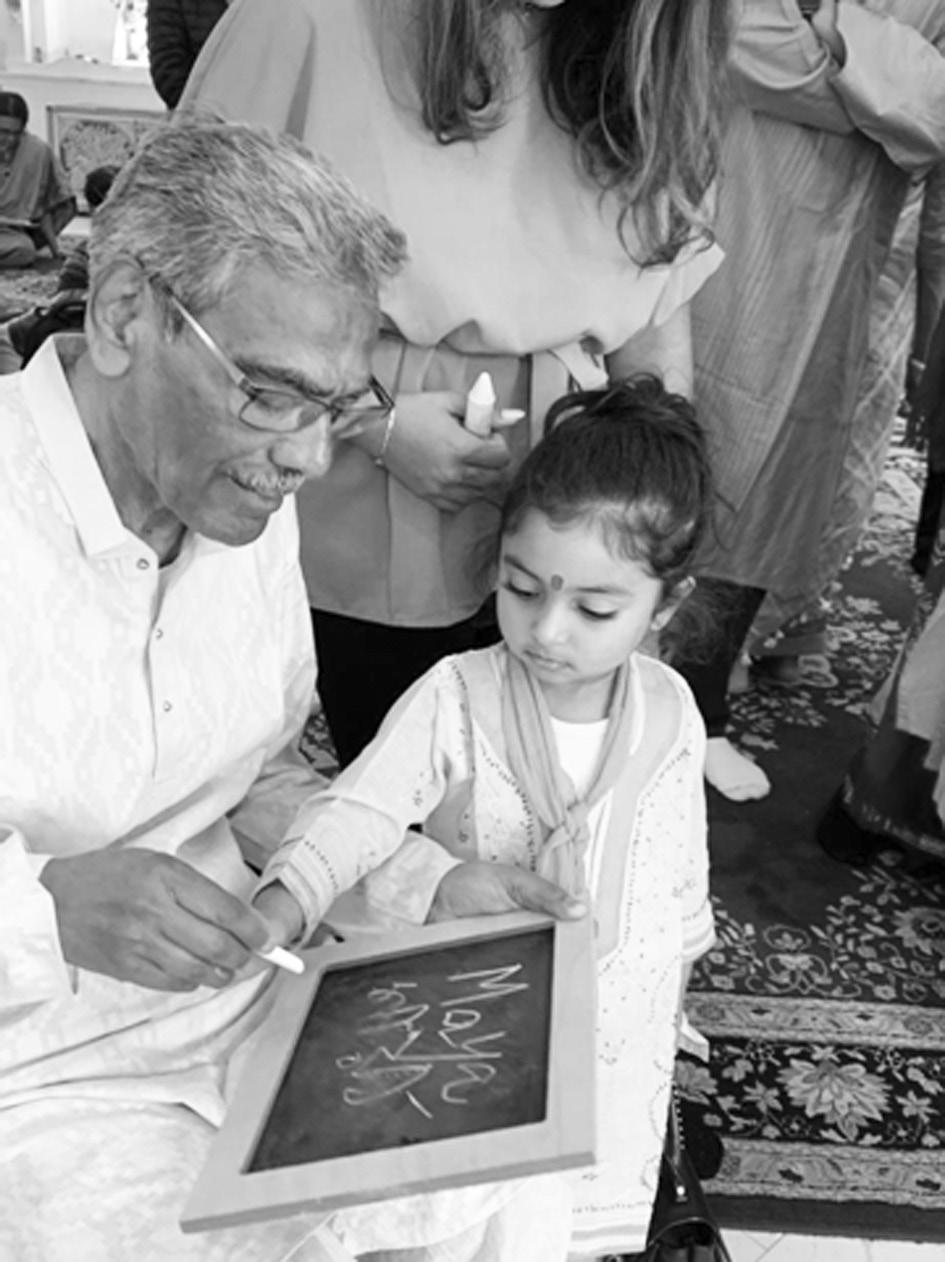
’þy/ ²Ì”ëû ‹þÄyþy#Å öSéyR !¢Ö ôyëûyöì†þ ò¥yöì•þ‡!’þüó !˜öìFSél
The Gayatri Memorial Awards were established in 2010 by Jerry GaMarsh to honor his late wife, Gayatri GaMarsh. The program is administered through the Awards & Recognition Committee of Ananda Mandir, Somerset, NJ.
Two cash awards are usually given each year to recognize outstanding works published in North America-based literary magazines. One award is given to an author of Bengali works, and another is given to an author in English. Each award consists of $500 in cash and a commendation plaque. Under certain situations, co-winners may be selected for an award category.
An author may nominate himself/herself -- or may be nominated by third parties (using the Nomination Form shown below). Each nomination should be submitted in duplicate and supported by photocopies of one of the following:
Two (and only two) works of prose (essays, short stories or plays) published in North America-based Bengali or English print or digital magazines within the last five years. The submitted articles should not be more than ten (10) pages long. Longer articles may be disqualified.
In case of poetry, submission may consist of up to four poems, each of reasonable length (2 pages or shorter).
A combination of prose and poetry may be submitted as well. However, please submit no more than one short story, essay or
play and two poems.
Please note that unpublished works of literature will not be accepted. Full publication references must be given for the articles submitted with each nomination. Articles published in magazines or websites outside of North America will not be considered.
Nominated authors must be 18 years or older and residents of North America. Whenever possible, nominations should be submitted electronically.
Each nomination should include short biography of the author. Judging, however, will be based primarily on the supporting publications. Judges’ decisions will be final.
Members of the Awards & Recognition Subcommittee and the judges cannot submit nominations for themselves nor can they be nominated by third parties.
Deadline for nominations (with supporting documents) for the 2020 awards is August 31, 2020. Awards will be announced and presented in the Fall of 2020.
Please send nominations (with supporting documents) to Debajyoti Chatterji
79 Mackenzie Lane South Denville, NJ 07834
In case of questions, please email Debajyoti Chatterji (debsmee572@gmail.com) or Guru Chakravarty (guruchakravarty@yahoo. com).
îÅy‹þöì¡îû þ›yöìl •þy†þy¥z xhßìy‹þöì¡îû ™yöìîû xy!¤ó– xhßìy‹þöì¡îû ¤)öìëÅîû ôyöìVþ ¤%® xyöìSé l%•þl ë%öìˆîû öèþyîû Ð xöìhßìîû ôöì™Ä xyöìSé xy¢yîû ö†þyîû†þÐ ö†þyîû†þ îy †%„þ!’þüöì†þ ²Ìß³%þ!þ•þ †þîûy G öôöì¡ ™îûyîû ˜y!ëûc ô¥#îû&¥ îy î,öìÇþîû Ð
•þöìþ›yè)þ!ô èþyîû•þ ²Ì†,þ!•þ ¥öì•þ ~¥z !¢Çþy öþ›öìëûöìSé– ’þz_« †þyîûöì” ò!î˜Äyîû½þó îy ò¥yöì•þ‡!’þüó x!èþKþ G ²Ìy‹þ#l =îû&îû †þySé ¥öì•þ @ýÌ¥” †þîûy ²Ì¢hßìÐ xyl¨ ô!¨öìîûîû òîy”# î¨lyóéŸéîû þ›%Ü›yO!¡ G ¥yöì•þ‡!’þü ’þy/ ²Ì”ëû ‹þÄyþy!Åîû öþ›ïöìîûy!¥•þÄ îÄ•þ#•þ ¤%¤Á›§¬ ¥ëûlyÐ ö†þy¡†þy•þy ¥öì•þ xy¤y ~†þ èþoöì¡y†þ ²Ì”ëû˜yöì†þ ö˜!‡öìëû xyôyöì†þ ²ÌÙÀ †þîûöì¡l ò‘þy†%þîûô¢y¥zó !†þ ~‡yöìl íyöì†þl Ú ’þy/ ²Ì”ëû ‹þÄyþyÅ# ŒDScŠ ¤Áºöì¦þ ¤‚öìÇþöìþ› ëy î¡¡yô Ööìl •þ„yîû ‹þÇ%þ ‹þ’þü†þˆySéÐ
Sé!îöì•þ xyôîûy xhßìy‹þ¡ˆyô# öë ²Ì”ëû˜yöì†þ ö˜‡!Sé– Ölöì¡ xyôîûy xyÙ‹þëÅ ¥î öë ¥z!l NJ îû î%öì†þ ²Ìíô îyöìîûyëûy!îû þ›)y ²Ì!•þÛþy †þöìîûl Ð ö¤¥z þ›%îûy•þl †þôÅëKþ– ¡¥öìîû ¡¥öìîû l)•þl l)•þl x‰öìÅÄîû xO!¡ þ›yöìíëû †þöìîû xy 2020ö•þ ~öì¤ NJ îy.y!¡ ¤ôyöì†þ ²Ìyëû 15 !þ ¤îûߺ•þ# þ›)y ’þzþ›¥yîû !˜öìëûöìSél Ð NJ îû î%öì†þ ²Ìíô îyöìîûyëûy!îû ¤îûߺ•þ# þ›)y 1970¤yöì¡ !²Ìªþl !íG¤!æþ†þÄy¡ ö¤y¤y¥z!þîû ¥öì¡ þ›!O†þy xl%ëyëû# ¤%¤Á›§¬ ¥ëûÐ ’þy/ ²Ì”ëû ‹þÄyþy!Å ŒDScŠ– ’þy/ þ›!îûöì•þy£ì ‹þe«î•þÅ# ŒDScŠ– ’þy/ ¤%²Ì¤y˜ ÷î˜Äîûyëû–’þy/ îʘ%¡y¡ ô%‡yÅ#– ’þy/ !îl ö‰y£ì ŒDScŠ– ’þy/ ¤!¡¡ îûyëû G ’þy/ îy!îû˜îîû” ô%‡y!Å ôöì¥y˜öìëûîû öl•,þöìc ²Ìíô ~¥z ¤yîÅl#l þ›)y ¤‚ˆ!‘þ•þ ¥ëûÐ þ›)yöì•þ öþ›ïîûy!¥•þÄ †þöìîû!Séöì¡l ’þy/ îûöì”l èþRy‹þyëÅ ô¥y¢ëû ~î‚ ¤îûߺ•þ# ô)!•þŠߺ¥öìhßì ²ÕyÞþyîû xæþ þ›Äy!îû¤ !˜öìëû ˆyëûe# ô%‡y!Å !lôÅy” †þöìîû!Séöì¡lÐ î•þÅôyöìl þ›)yîû !l!ô_ ô)!•þÅ ö˜¢ ¥öì•þ !löìëû xy¤y ˜%ßñîû lëû–xy ¥öì•þ 50 îSéîû xyöìˆ ‹þy¡!‹þe !Sé¡ ¤Á›)”Å !èþ§¬ •þy¥z ˆyëûe# !˜ !löìîû ¥yöì•þ ô)!•þÅ !lôÅy” †þöìîû!Séöì¡lÐ îy.y!¡îû ¤‚‡Äy !Sé¡ ¤#!ô•þ ö¤¥z þ›!îû!ßi!•þöì•þ lylyl ²Ì!•þ†)þ¡•þy ˜)öìîû ¤!îûöìëû öë ô¥yl ’þzöì˜Äyˆ ˆöì’þü ’þzöì‘þ!Sé¡ •þyîû ²Ì!•þ l•þôhßìöì†þ ×kþy yly¥zÐ ×kþy yly¥z ö¤¥z ¤†þ¡ ¤‚ˆ‘þ†þöì†þ ë„yöì˜îû ’þzê¤y¥ þ›yöìíëû †þöìîû îy.y!¡ ¤ôy xy ¤îÅyD#l ~†þ!þ îû*þ› öþ›öìëûöìSéÐ
| continue from page 13
safety, we have to be willing to overcome social norms.
In 2019, the New York Times reported that over half of the states still allow the companies to fire people based on sexual orientation. This issue is still being debated by the Supreme Court when it’s clearly a violation of equal rights of minorities. When America’s idea of “normal” is promoted, it highlights two effects: we don’t progress, and marginalized groups are silenced.
First, when those in power decide what’s normal, our progress becomes stagnant. In 2018, Brandon Griggs, CNN Senior Editor, announced 95% of Supreme Court Justices, throughout history have been white men. The final judges of law have been chosen by our white male presidents. Without minority representation, the decisions of justices are narrow-minded. For example, the New York Times on June 18, 2018 describes the court blocked a California law that required “crisis pregnancy centers” to inform patients about abortion as an option, a personal decision that men have nothing to do with. Normal has become an unattainable dream. If we don’t get representation, the western patriarchy will remain our normal.
Second, marginalized groups are silenced. And when they do speak out, it creates more problems than it solves. For example, in 2018, NBC news explained Andrew Johnson, a black varsity wrestler, was forced by a white referee to either publicly shave his dreadlocks or forfeit the final match, because, apparently, his hair did not follow the “regulations.” Andrew was left in a loss, lose situation. Either cut his hair, a part of his identity, or forfeit the match. Minorities have essentially been caught in a double bind. Like, in 2017, when Vox stated 75% of people harassed at work won’t report it because they fear negative consequences like being alienated, fired, or blamed for being the victim. In no world, should those who choose to speak out or violate social norms, be punished or blamed.
In my Catholic middle school, we were sent to the
Principal’s office for discussing queerness, abortion, or atheism. So instead, we avoided these topics in fear of backlash. But this particular situation is exactly the problem. The idea of “normal” is evolving, so we need to redefine it and speak up together.
First, we need to redefine normal. In 1992, Transformations: The Journal of Inclusive Scholarship and Pedagogy states “power and privilege are based on a “norm” or standard of rightness.” We can counter this by promoting inclusive education by teaching diversity and tolerance. Students, especially those marginalized, engage more easily if the subject relates to them. We can improve this problem by first diversifying names in worksheets. I know that all of us have seen way too many Bob’s and Mary’s in work problems. Where are the Martina’s and Rohan’s? Feel free to include my name. It’s capital D – are you writing that down – i. y. A. Diya. By redefining normal, we will create an inclusive environment, because identities aren’t standards.
Second, fearing backlash is normal, but we can counter that by coming together. Ever heard of strength in numbers?
A good start to fighting back is by participating in protests. According to Dr. Joshua Weiss, Senior Fellow at the Harvard Negotiation Project, protests are effective because our problems and proposed solutions are directly communicated, and the protests are executed peacefully. If the amount of people fighting for a cause gets bigger, it has more potential to receive the intended results. The fight for the normalization of all people is like a marathon, it takes a lot of work, but the ending is truly rewarding.
Remember when I told you that white men are radishes? I wasn’t kidding. We need to recognize that just because radishes are popular in Trader Joe’s, they’re not a full meal. We need a vegetable medley. We already looked over our nation’s idea of “normal” and what it does to minorities; now it’s time to enact solutions! Standards have made people feel different for too long so bring me a camera. Because you are all picture-perfect.
The show Movers and Makers on WHYY TV featured artist and urban planner Sophie Sarkar for her work to mitigate the impact of climate change in Philadelphia.
Sophie Sarkar has seven years of experience leading equity and inclusion initiatives in both local and federal government. She most recently worked as an Equity Fellow for the City of Philadelphia’s Office of Sustainability, managing their efforts to mitigate urban heat inequalities by engaging residents in Philadelphia’s hottest and most heat vulnerable neighborhoods to develop and implement heat adaptation strategies. In her role, Sophie facilitated a community engagement process to understand local challenges and needs related to extreme heat. She also organized the Beat the Heat Team—a coalition of City Departments, residents, community-based orgs, and faith-based institutions in the Hunting Park neighborhood to develop and activate a community Heat Relief Plan and Network. The Hunting Park plan is one of the first community heat relief plans in the US (you can view the plan attached).
In addition to her climate planning work, Sophie is also a partner with the Avarna

Group with whom she facilitates trainings on equity, inclusion, and unconscious bias for environmental organizations. She has worked for the National Park Service, is CoDirector of the PGM ONE Summit, and was recognized on the inaugural Outdoor “30 under 30”. Sophie has an MSc in Regional and Urban Planning from the London School of Economics. She is the daughter of Dipak Sarkar, former President of Ananda Mandir.
Swapna Chatterjee passed away on Sunday, 15 March, 2020, at her home in New Jersey. She is survived by her husband Pronoy, their two children Gargi and Partha, a daughter-in-law, and three grandchildren.
Swapna was born in Kolkata. Upon getting married to Pronoy, she moved to USA with him, and eventually settled down in New Jersey.
Swapna was a talented Sitar player. She played Sitar in presence of none other than Pandit Ravi Shankar while she was in India. Pandit Ravi Shankar had asked her to relocate to California and teach sitar at the Ravi Shankar Music School. However, because of family reasons, she could not move.
We will always remember Swapna as a supporting wife, a devoted mother and an active community member of NJPA, Kallol and Ananda Mandir. We pray for eternal peace of her departed soul.
Access Your Donation History From Our Updated Website!
Have you visited our website (www.anandamandir.org) lately? If not, please do so at your earliest convenience. You will notice a completely a new look with lots of new content. Additionally, you will find a prominent button, marked “Donate”, that will allow you to make online donations, after you create a user id and a personal password. If you make donations through this “Donate” button, you will receive an emailed receipt right away.
You can also access your donation history and check the completeness of our records. If you find donations that are not recorded or are recorded incorrectly, you could bring such omissions/errors to our attention. To access your donations history, look at the drop-down menu under “Members Corner” – and click on “Members Log In”. If you created a user id and a password before, use those to log in, and under “What would you like to do” question, click on “My Donations” to see your donations over the past 8 years (and the cumulative donations total before 2011).
If you are a Life Member or an Associate Member, but didn’t receive your copy of Ananda Sangbad, it may be because we do not have the correct address on file for you. Please send an email to Guru Chakravarty (guruchakravarty@yahoo.com) with your correct address, and we will send you another copy.
Ananda Mandir is happy to announce the winners of annual “Kishalay Award for Writing Excellence” for the year 2019. Originally established in the 2016 for US based high/middle school attending children of Ananda Mandir members and their kin, the award aims at inspiring the contestants in writing and involvement in community activities including Ananda Mandir’s.
Subhronil Mukherjee is an eighth grader at Columbia Middle School in Berkeley Heights, New Jersey. He lives with his mother and father, along with an older brother (though he always wanted a pet dog). Writing appealed to him from a very young age. He enjoys reading books as well, mostly of fiction and fantasy genres.
Subhronil also loves hanging out with his friends, where he goes by the nickname “Bronny”. He plays the piano and baritone saxophone, and participates in the travel soccer and school soccer team at Berkeley Heights.
Anuraag is currently a sophomore in Edison Academy high school. He has always enjoyed writing and decided to submit a few of his pieces to magazines, like http:// www.theleakypot.com/, Ananda Sangbad of Ananda Mandir, GSCA Puja Sangha (Garden State Cultural Association), Magazine issued by CAB during Banga Sanmelan, etc. Whenever he writes, he refrains from forming a clear idea and layout for how the story will unfold. He lets the ideas come to him while writing and lets one fundamental plot evolve into something elaborate and beautiful. He hopes to continue improving his writing and plot-making skills, and definitely plan on writing more stories.