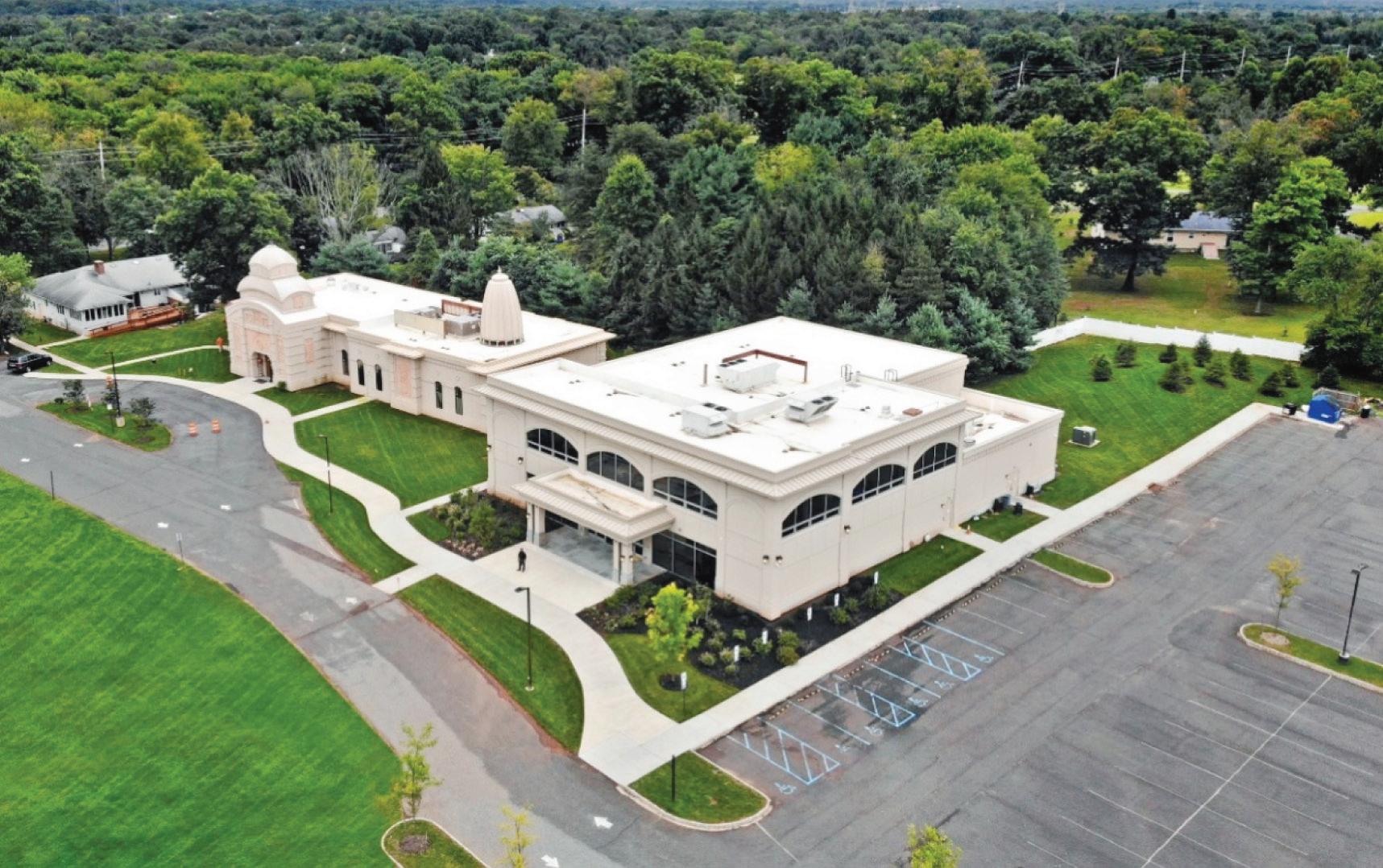
Ananda Mandir 269 Cedar Grove Lane Somerset, NJ 08873


Ananda Mandir 269 Cedar Grove Lane Somerset, NJ 08873
By Debajyoti Chatterji
“Areal surprise awaited me on the evening of Friday, October 26, 2018.”
A fund-raising event was scheduled to be held in Tagore Hall, a favorite venue for NJ-based Bengali families and cultural organizations. The hall had been reserved for that evening by Medha USA, “a sub-committee of Kallol of New Jersey, involved in charitable ventures for the education of underprivileged children in India.” Medha was originally known as Kallol Women’s Forum and founded by a small group of women who wanted to make a difference in the lives of needy children in India.
I had followed Medha’s activities for several years with interest and attended many of their fund-raisers. These were traditionally held in a commercial banquet facility with multiple events being held simultaneously. And these fund-raisers were informal and fun gatherings, with modest cultural programs without the ben-
efit of a formal stage with adequate lighting or sound system. I would estimate that the events typically attracted close to 200 participants.
For the evening of October 26, I had expected a similar set-up, except that Medha had the full use of Tagore Hall, with no other organization or event competing for space or attention. When I entered the Tagore Hall auditorium, I was simply stunned. Rows and rows of chairs were carefully organized, with wide aisles. By my estimate, there were over 400 chairs. Was Medha expecting a ticket-buying audience of such a size, I wondered.
I soon learned the answer from a key member of the Medha team. The event was “sold out”, and they had stopped selling tickets two weeks ago! In fact, the organizers were turning away people who were coming in that evening, expecting ready availability of tickets, which is the norm for Bengali fundraisers for charitable causes.
As the evening pro-
gressed, I understood why this Medha fund-raiser was a “sold out” event. First, the cultural program featured the famous Kolkatabased band, Chandrabindu. That was a huge draw for the young and the old alike. Second, the Medha team of 18 highly dedicated women worked tirelessly for almost two months to plan every detail for the event AND sell tickets and find sponsors.
The Medha fund-raiser was a huge success by every measure. The audience loved Chandrabindu’s concert, the food service worked well for the huge crowd, and the short video showcasing Medha’s activities was interesting and informative. Most significantly, the event raised over $12,000 (after all expenses), probably a record for the local Bengali community for a charity fund-raiser. ***
Medha USA is a perfect example of the saying, “From a tiny acorn grows a mighty tree”, – if the right conditions prevail, I might add.
Medha began in 2006 as Kallol Women’s Forum, a
Shri Shri Phalaharini Kali Puja 2019 Sunday, June 02, 6:00 PM – 8:00 PM
tiny group of volunteers with a big heart. This team began to raise tiny sums of money through sale of home-cooked snacks at Kallol events and other community gatherings with the ambitious objective to help educate underprivileged kids in West Bengal and other parts of India. Their first “snack sale” raised $300. Undeterred, they continued – and expanded – their fundraising activities and financial support of educational charities in India (and to a limited extent, in the US). By 2017, their annual revenue had increased to over $15,000, and they were supporting educational initiatives in India and NJ to the tune of about $12,000/per year. Currently, Medha is providing financial assistance to 8 educational initiatives in West Bengal and 2 in New Jersey. Details about each of this initiative can be found on Medha’s website: www.medhausa.org.
Medha is not a passive organization that simply sends checks to these educational initiatives. Medha members visit these institutions whenever they travel to Kolkata and personally review the work being done there with the funds contributed by Medha.
continue to page 6 }
Calendar of Events (Dates are subject to Change) Please check our website frequently www.anandamandir.org Tel: 732-873-9821
NOTE: If a particular Puja time is not listed, please contact temple or visit our ebsite: anandamandir.org
April(*)
New Year
Monday, 15, 9:00am-9:00pm
Sahitya O Alochana(*) Cultural program(*)
MAY (*)
Shyama puja
Saturday, 04, 6:30pm-8:30pm
Akkhay Tritia Jagannath Mahaprabhu’s Chandanyatra
Tuesday, 07, 9:00am-10:30am
Shri Shri ramthakur Kirtan Satyanarayan puja
Saturday, 18, 5:00pm-8:00pm
Sahitya O Alochana (*) Cultural program (*)
JuNe (*)
Shri Shri Falaharini Kali puja
Sunday, 02, 6:00pm-8:00pm Dashahara & Ganga puja
Wednesday, 12, 9:30am-10:30am
Satyanarayan puja
Sunday, 16, 6:21pm-7:57pm
Shri Shri Jagannath Mahaprabhu’s Snanyatra
Monday, 17, 9:30am-10:30am
Sahitya O Alochana(*) Cultural program (*)
(*) See www.anandamandir.org or Call Mandir for details
Special Religious Services: Upon request, the priest of Ananda Mandir offers services such as in-house Shraddhas, Rituals associated with Cremations (Antyesti Kriya), Shraddha Anniversaries, Pre-wedding rituals (Naandimukh, Ashirwad, etc), Upanayan (Paitey), Annaprasan, Wedding Ceremonies & Wedding Anniversaries, Griha Prabesh (Bhumi Puja), Consecrations of new cars (New Car Pujas) and others. If you have needs for any of the above or more, please feel free to contact Biswabhai @ 732-873-9821
Ananda Sangbad
A Periodical Newsletter
Published
By
ANANDA MANDir
(A Tax-Exempt, Non-Profit Organization)
269 Cedar Grove Lane Somerset, NJ 08873
Ph: 732-873-9821
Website: www.anandamandir.org
puBliCATiON COMMiTTee OF ANANDA MANDir
Chairperson: Debajyoti Chatterji, Debsmee572@gmail.com
Assistant Chairperson: Subrata Bhaumik, Bhaumik.subrata@gmail.com
Editor-in-Chief: Amitabha Bagchi, amitabhanj@gmail.com
Executive Editor, Ananda Sangbad: Guru Chakravarty, guruchakravarty@yahoo.com
Executive Editor, Anandalipi: Subhodev Das, subhodev.das@gmail.com
Editors: Subrata Bhaumik, bhaumik.subrata@gmail.com
Sushmita Dutta, sushmitadutt2@gmail.com
Amrita Kangle, amritakangle@hotmail.com Nupur lahiri, nupurlahiri@aol.com
Associate Editor: ruby Banerjea, r_banerjea@yahoo.com
Advisors: pronoy Chatterjee pkc_usa@yahoo.com Ashok rakhit ashokrakhit@gmail.com
l
All queries, articles, news reports and letters should be directed to the Managing Editor
Phone: 908-752-3065
E-mail: guruchakravarty@yahoo.com
l For general information, please contact the following executives of Ananda Mandir: Ashok rakhit, President
Jaiprakash Biswas, Vice President
Suprasad Baidyaroy, Vice President
Arun Bhowmik, Vice President
Sajal Mukherjee, General Secretary
pradip Majumdar Treasurer
Nearly 40 personnel of Indian Central Reserve Police Force, stationed in Jammu & Kashmir (J&K), were killed and 40 more injured as a van loaded with 350 kg of explosives rammed a bus in a convoy in the Pulwama district on February 14. Pakistan-based terror group Jaish-e-Mohammad claimed responsibility for the attack, the worst in decades. Calling the attack “despicable and dastardly” Prime Minister Narendra Modi said, “The sacrifices of our brave security personnel shall not go in vain.”
The announcement was followed by a surgical strike on the terrorists in Balakot, Pakistan, by the Indian Air Force. The success of that strike is still not quite known, however, it led to air skirmish between the two countries resulting in the capture of an Indian Air Force commander, Abhinandan Varthaman, after his MIG-21 was shot down by the Pak jets on 27 February. Before this event could escalate into a full scale war, the wing commander was quickly released on Friday, 01 March, and handed over to India. The fear of a fullscale war (with nuclear capability adding a deadly dimension), coupled with pressure from the U.S. and other nations for de-escalation may have prevailed in both countries.
Terrorism in J&K is nothing new, continuing almost uninterrupted for many decades despite strong preventive actions enforced in the state by the Central Government of India. The terrorist actions are carried out by many splintered groups working from Pakistan, most fierce among them being Lashkar- e-Taiba. One of the pivotal actions by the terrorists in which Hindus were targeted was the Wandhama massacre in January 1998, when 24 Kashmiri Hindu pundits in the village of Wandhama were killed.Over a half a million of Hindus fled the Muslim dominated Kashmir Valley for the Hindu-majority region of Jammu after this event, as Islamic militancy continued.
More recently, as India began patrolling the Kargil region of Ladakh in May, 1999, it found that many key posts were taken over by infiltrators. An Indian patrol group was ambushed that started off one of the deadliest wars with the insurgents. The official number of Indian troops lost in Kargil was around 500, with almost double that number of infiltrators killed.
India has control of 45% of the area of the former Princely State of Jammu and Kashmir (Jammu, Kashmir Valley, and Ladakh). Pakistan controls 35% of the region (Gilgit–Baltistan and Azad Kashmir). China administers 20% (Aksai Chin and Trans-Karakoram Tract) of the state since 1962.
Jammu and Kashmir is the only Indian state with a majority of Muslim population. In a 2011 survey, Muslim population was found to be about 68%, while 28.4% were Hindus, with Sikhs, Buddhists and Christians in small fractions comprising the rest. Around 97% of the population in the Kashmir valley is Muslim. Hindus are a majority in Jammu comprising 62% of the population, while Muslims constitute 33%.
India is in a continuous struggle to prove it is not the religion rather the terrorism that it is fighting.
Kashmir, which was once known as the Paradise on Earth, attracted a major share of all Indian travelers. Many films were shot here during the heydays of Bollywood’s rise. Posters of beautiful houseboats in lakes were used to lure thousands of visitors. But that was all in the past. According to government statistics, Kashmir had a bad tourism year in 2018 with only 850,000 domestic and foreign visitors, a figure lowest in last seven years and showing a decline of 23 percent from 2017. Every time something like the Pulwama attack happens, it sinks the tourism industry into a deeper hole, and puts the economy in jeopardy. That makes the unemployed Kashmiri youth vulnerable to remunerative coaxing by the terrorist groups. This vicious cycle leaves the people of J&K with no chance to have a decent life.
Guru Chakravarty
Executive
Editor,
Ananda Sangbad

ANANDA MANDIR, Inc
269 Cedar Grove Lane, Somerset, NJ 07059
Tel: 732 873 9821
Mr. Sandeep Chakravorty
Consul General of India
3 East 64th Street, New York, NY 10064
February 21, 2019
Dear Mr. Chakravorty,
The members of Ananda Mandir strongly condemn the heinous crimes committed by terrorists in Pulwama, Kashmir, on February 14. This attack killed 40 members of India’s Central Reserve Police Force (CRPF) and injured scores of others, including some civilians. We stand in support of all the young men and women who are defending and protecting our country. We salute them for their gallant efforts to defeat all criminal terrorists who are attempting to destroy the solidarity and peace of the community in this wonderful land of Jammu and Kashmir.
On behalf of the membership and the Board of Trustees of Ananda Mandir, I would like to extend our deep condolences to the families of the soldiers killed in this terrorist act and pray for the speedy recovery of those who are injured. The Board, at its official monthly meeting on February 18, observed a moment of silence to pray for eternal peace for the souls of our young soldiers, our heroes, who sacrificed their lives defending the community.
Ananda Mandir is a Hindu temple and a Bengali cultural organization, located in Somerset, NJ, with over 2000 members and associates. We fondly remember your past visits and look forward to welcoming you again soon.
Regards,
Ashok Rakhit President
Didn’t Receive Your Copy of Ananda Sangbad? If you are a Life Member or an Associate Member, but didn’t receive your copy of Ananda Sangbad, it may be because we do not have the correct address on file for you. Please send an email to Guru Chakravarty (guruchakravarty@yahoo.com) with your correct address, and we will send you another copy.
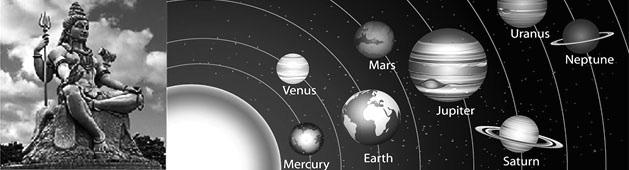
In Hinduism, 108 names chanted to worship Lord Shiva includes two dialectically opposite prayer lines in Sanskrit – “Om Shukshma Tanave Namaha” meaning salutation to the Lord who is the minutest body, and, “Om Jagad Vyapine Namaha” meaning salutation to the Lord who is spread all over the worlds. That is the perception of God amongst Hindus - he is everywhere in every form. He is “Sakar” (having a form) and he is also “Nirakar” (formless) spread all over the universe.
Hindus believe that the universe has no beginning it always existed and will exist. Sri Krishna said in Bhagavat Gita - “Never was there a time when I did not exist, nor you, nor all these kings; nor in the future shall any of us cease to be”. (Chapter 2/12). Srila Prabhupada in “Bhagavat Gita As It Is” clarifies - “In the Vedas, in the Katha Upanisad as well as in the Svetasvatara Upanisad, it is said that the Supreme Personality of Godhead is the maintainer of innumerable living entities [in this universe]. That Supreme Personality of Godhead is also alive, by His plenary [unlimited] portions, in the heart of every living entity.”
Similarly, in the ancient Greece, the term universe is defined by philosophers as “all things” – both matter and space.In today’s modern resources like the Wikipedia, the universe is defined as “The totality of existence” - all that exists, all that existed, and all that will exist.
But then, “nothing comes from nothing”, what is that first thing which caused the birth of this universe having detailed and calculated movements of all celestial bodies like stars, planets with multiple lives within? Everything co-exist in an exceptional disciplined measure. If there is a change in the celestial body, for example, a star falls-off, all other elements immediately adjust their positions to fill the void created in the space. Who orchestrated these planned routines, these accurate mathematical calculations that never fail? God? Swami Vivekananda says, “The intellect that drives this
By Sushmita Dutta
Introduction: How do we perceive God and Universe?The topic made me get through some heavy reading, but, here I have made it as simple as possible extracting concepts about God and the Universe from 18 references including Bhagavat Gita, Ishopanishad, Vedanta, Bible, other religions, scientific findings like the Big Bang and Black hole, and Dr. Deepak Chopra’s views on human consciousness which is now believed to be the driving force behind our perception of God and the universe. The 18 references will be made available to readers interested. Please send your request and comments to the editor of Ananda Sangbad.
universe is God” How did that intellect come about? We do not know. It continues to be a mystery even today.
Hinduism also has two distinctly different school of thoughts on perception of Universe and God – Advaita and Dvaita principles Advaitatrust proposes that - an individual soul is Brahman (universe) and we are destined to merge back into that [universe]; our birth is just an illusion, there is no difference between us and the universe. In contrast, the Dvaita school of thought preaches that our soul is different from Brahman – the universe that has a form and personality. The Advaita belief that the universe is formless is similar to the concept of universe being a formless spirit in other religions like Judaism, Christianity and Islam – a formless Spirit from which everything originate. Where did that spirit come from, nobody knows.
Our perceptions have driven different images of God, different religions have defined God and visualized God based on individual beliefs, but no religion and not even science have a clear definition of who God is. Yet, we spend good portions of our lives in worshipping God. Among world religious groups in order of ranks, Christians are the largest - 2.2 billion, followed by Muslims - 1.8 billion, Hindus - 1.08 billion, and Buddhists - 535 million. Perceptions of so many human minds, through so many human civilizations, eras after eras, have shaped Gods creating comfort zones in our minds which makes us believe that we are connected to a superior being which uplifts our consciousness.
Dr. Deepak Chopra says, based on modern discoveries, that the universe is a reflection of our inner entity – the
consciousness that drives and perceives Godjust the way we want to see him. Here is a line from Tagore that fits in very well here, in Bengali – “Amar Chetonar Ronge Panna Holo Shobuj, Chuni Uthlo Ranga Hoye. Ami Chokh Mellam Akashe Jole Uthlo Alo.” Meaning, it is my consciousness that gives color to the gem stones, I see light in the sky when I open my eyes. This relationship between our perception and consciousness is mentioned in Vidanta as the basis of everything that manifests in the universe including Gods.
Vedanta emphasizes that the progressive growth into higher consciousness is the pipeline of evolution of mind, perception and body – higher the consciousness, higher is the physical birth on species ladder. The diagram included here from Vedanta, exemplifies this process of shift in consciousness that actually drives birth of a body:
ceptions of God and we aim to attain that perceived God through prayers and religious rituals which are practiced in all religions worldwide. Most rituals performed to establish a linkage with God are scientific principlesbased, and here are some examples: In Hinduism, sound energy is utilized through mantra chanting performed to connect with Gods, for example, reciting “Durga Kavacham” seeks protection from Goddess Durga pursuing sustenance of every human cell, organs and adverse environments.Another example of a ritual which is uniquely scientific is offering of flowers with prayers – a living entity (prana) like the flowers are held in palms transmitting our physical energy to the flowers, with that we blend mantras (sound energy) and devotion (mind energy). All combined the energized flowers carry wishful thoughts to the deity we pray to. In the process, our minds get re-wired to make faith stronger and a circuitry is created that strengthens our wishful thoughts. Swami Vivekananda says, it is our strong wishful thought that makes our wish come true. In some occasions, Hindus offer 108 or even more number of flowers to a deity repeatedly chanting mantras which simply follows the process of intensifying the combined forces of mind, body and sound energies (Hin-
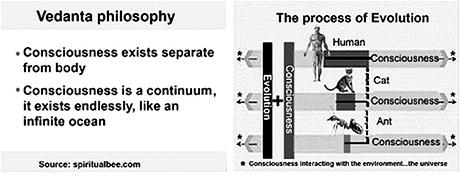
In sync with the diagram from Vedanta, I want to quote Rishi Aurobindo: “Human life is a progress from Asura to Deva stage” where Asura relates to births as animals and Deva is Gods.Our consciousness holds both Godly and animal qualitative values. These qualitative values in our human minds actually shape our per-
dus call it Kaya, Mon, Bakya) in seeking intervention of God in fulfilling a perceived desire. So, a self-driven act like a ritual is initiated to communicate with an external entity called God and re-direct the communication to self again for betterment in life. That is the key to every human communi-
By Jayashree Chatterjee
She stands there before me, over five feet tall, in a bright green sari. Because of her height and the way she looks, she dominates over everything around her. I savor her dokkhina kali expression, her very presence, and most of all, what she stands for. She is the Kali Murti at the Feringee Kali Bari, and what makes her special for me is the fact that someone from a minority community in Bengal who was trying to be part of the place of his adoption, had her installed in this temple.
I ask the temple priest to tell me more about the history of this mandir, and he directs me to a member of the Banerjee family, the traditional mandir sevaks, who have taken care of this place since its inauguration.
Though this temple is called the Feringee Kali Mandir, I am told, it was actually built as a Shiv temple, and not by Anthony Feringee. “Look at the linga”, the mandir sevak tells me. “It is in the middle of the temple, towards the back, the way statues of gods or goddesses to whom a temple is dedicated usually are. Anthony Feringee used to come here to meditate, and he was a devotee of Kali. So he requested my forefathers to permit him to install a small statue of Kali in the mandir. They gave him their permission, and the statue was placed to the right of the linga.”
“Did anyone object to someone who was not Bengali doing all this?” I ask.
“Well at that time, the people who lived here were mainly Muslim or Anglo-Indian. Also, at that time, the Ganges flowed where what is now Chittarajan Avenue is located. So this was a small community by itself. No one objected.”
“And is this the statue that Anthony placed here? It does not look small to me.”
“No. Anthony’s statue was destroyed during the 1947 riots. This one was installed after the unrest died down.”
I stand there for a few minutes, looking at the stature in silence. I want to do so in memory of Anthony who loved the Bengali language and became a Bengali Kobiyal. His wife was burned to death; some say it was because she was a widow whom he rescued from having to commit sati; others say that he wanted to celebrate Durga Puja and this incensed the local people who burned down the pandal and that his wife died in the flames. I am glad our priests let him place his statue of Kali in this temple, and that the statue was replaced after rioters destroyed it. I am glad we call this the Feringee Kali Bari even though it was not built by Antony.
And when thinking of Antony Feringee, how can I not think of the writer of Bengali origin who tried to find a place for himself in English literature by writing in English. He did not get that place and so wrote in Bengali (and how successfully!) instead. I make my way to the grave of Michael Madhusudan at the Christian Cemetery on AJC Bose Road. A large sign directs me to this grave, and there are other signs that point to the graves of some other well known people of the time – C.F. Andrews, Bethune etc. I think of the complaints of some friends
about how Bengal has not honored Michael with the enthusiasm that it has Tagore. Other friends, including a professor of Sanskrit and Linguistics feel that both writers helped make the Bengali language what it is today, but that Tagore’s contribution was way more than Michael’s. Be that as it may, this is Michael’s resting place and I want to honor him. I read the well-known inscription in verse that adorns his grave – “Darao Pathikbar ----.” I think of some of my favorite lines from “Meghnad Badh Kabya.” Then I turn to leave.
*********
My thoughts move to Henry Louis Vivian Derozio, the teacher of European origin who had a powerful impact on the students of Hindu College.
The pictures on the Internet of his house on AJC Bose Road look impressive but when I actually go there, a wave of sadness overcomes me. The house is in a dilapidated condition. A big heap of rubbish is on one side. This is really strange because the building is being used as a nursing home, and is bustling with activity. I go inside. Within the building the maintenance is much better, and I wonder why more attention cannot be given to the outside. I recall the first lines of one of Derozio’s poems: To India - My Native Land
My country! in thy day of glory past A beauteous halo circled round thy brow,
And worshipped as a deity thou wast. Where is that glory, where that reverence now
There is one place where Henry Derozio is remembered in a more welcoming way. That is at Presidency University. There is a hall at the end of the cricket grounds that is named Derozio Hall. A bust of Derozio is on the right hand side of the entrance. I am so glad that Presidency University has made it a point to remember the teacher who had such an impact on the students of the then Hindu College. *********
The reason why I am at Presidency University is because this year, in January 2019, for the first time since I graduated from Presidency College, I am attending the college reunion.
Though I am a life member of the alumni association, I cannot recall my alumni membership number, and so I expect to face a lot of problems regarding attendance of the festivities. But the person at the desk asks me for my name. I give it to her, and then tell her what my last name was when I was in college. “We’re doing this by first names,” she says. “How do you spell your first name? Ja or Jo?” She finds my number in a few seconds.
There are about four people from my year, and it’s wonderful to see them all. We spend some time catching up with one another. Then, after the inaugural address and a few other welcome speeches, one of which is given by Nabanita Sen, we go outside and have lunch. I look at the new buildings that have been built, and visit the new alumni
continue to page 5 }
| continue from page 3
cation with God in all religions.
Christianity: I was in conversation with a pastor of a local church in New Jersey, a very learned lady and a wonderful speaker. She asked me to read Bible, the chapter on John. I read and I asked – God asked John to tell people that he has seen the light. John heard God’s voice and relayed to the people that he has seen the light. My question to Pastor, where did that voice of God come from? Logically, a verbal instruction is a sound energy wrapped in some kind of spoken language. This has to have some source, an existing entity who speaks, if that entity is God, where is he and in what form? In almost all books of world religion, we have examples of voices coming from the sky as verbal instructions from God. Where is this speaking God? I asked. Reverend Pastor said, which all Christians believe, that there is a Spirit which has created everything. Christians believe in the Trinity principle –“God has shown himself to the world in three different forms – The Father, The Son and The Holy Spirit.” So, in Christian hierarchy, God is above the three identified forms of God – Father, Son, and Holy Spirit. In Jehovah’s Witness theology, the Father (Jehovah) is the only one true almighty God. His Son is Jesus Christ, and the Holy Spirit is God›s active force or projected energy. In John’s Gospel, Jesus calls the Holy Spirit the ‘guide and the comforter.’
Buddhist view on universe go through manifestations of Expansion, Collapse, and Nonexistence states.Hindus call this cyclic manifestations of Srishti (creation), Shiti (static state) and Proloy (evolution). In scientific terms this means that this universe always exists in a state of “potentiality”- manifested or non-manifested. Buddhists believe when a new universe comes about, multiple beings are born including Gods. Hindus and Buddhists believe that we are reborn according to our unrealized karmas (actions). This thought is comprehended in the theory of re-incarnation by which nothing is lost in this universe. Every death causes a rebirth.Everythingwithin this universe is always in a state of manifestation. This religious philosophy blends perfectly well with what science says about the universe, here it is, very briefly:
Scientific views:
Hindu scripture (Rig Veda: 1700–1100 BCE, one of world’s oldest texts) describes universe in the beginning as a completely dark space similar to Black Hole described in science. NASA definition of black hole is - “A black hole is a place in space where gravity pulls so much that even light cannot get out. The gravity is so strong because matter has been squeezed into a tiny space.” Everything that we see in the space was manifested with the Big Bang.
The theory of “Big Bang” relates to the principle of ever existing manifestations. Every time there is a Big Bang, there is new manifestation of a new universe, new world, and new material, non-material beings. Big Bang theory suggests that about 15,000 million years ago there was a massive explosion which caused manifestation of all matters in the universe. These manifested matters are constantly changing and so is the universe.
Big Bang begins in a singularity and then expands and finally as inflation reaches its limit, the entire structure collapses under the force of gravity. It is believed that there are many such universes where multiple Big Bangs are taking place to create, sustain and destroy hundreds and thousands of material and non-material beings and the one ultimate universe is the space within which all smaller universes, galaxies, stars, planets and multiple beings are created, destroyed and re-created again and again and again from time infinite.
Having said all that, the question “Who is God” remains unanswered. If he is a formless spirit, where did this spirit come from? If he has a form then where did that form come from and if he is, by scientific definition an atomic element, then where did that first atom come from? In a publication on “Einstein’s search for God”, Albert Einestein was asked “Do you believe in God?” Einsteinreplied - “I’m not an atheist. I don’t think I can call myself a pantheist. The problem involved is too vast for our limited minds…” And, that’s true. We need higher level of consciousness to understand God and his origin. The universe is constantly changing so is our consciousness and built-in intellect. May be one day, in some universe, with lot higher intellect, we will be face to face with God and ask him “What is your origin?” Nothing can come from nothing, logically, scientifically and spiritually. We will have to upgrade ourselves to that world of superior consciousness with higher wisdom to know who is God.
By Basab Dasgupta
WhenI talk to the Americans about the custom of an arranged marriage, they do not get it. How can one spend the rest of one’s life with a person of the opposite sex whom one has never met before – a total stranger – just because the parents and/or relatives on both sides seem to think that it is a good match?
Even though I had spent most of my youth in pursuit of my “dream girl” who I was obsessed with and whom I eventually married, I am actually a defender of the traditional arranged marriages. I have two strong reasons for that.
i) I believe that a marriage will be peaceful if not happy and long-lasting if the values and priorities of both the husband and wife are similar. This commonality of values and priorities can be achieved more easily if both spouses come from similar socio-economic backgrounds, which is the main goal in an arranged marriage.
ii) A more important reason is the fact that it is virtually impossible for a man to really know a woman in a relatively short period of time when they are “dating”, lasting for months or even years, even if he feels that he understands her! So, it does not matter, at least, from the man’s perspective, if the woman happens to be a total stranger because the man really does not know the woman in any case.
Ultimately it is the intimate cohabitation over a rather long period of time that leads to a mutual understanding and a lasting relationship. From the woman’s point of view, it is probably almost opposite. Whether the woman knows the man for a while or just met him, it does not take much time for her to figure him out. So, once again it does not matter if it is an arranged marriage to a stranger or a marriage after a long courtship.
I must confess that I was probably in my mid-fifties before I felt that I was starting to understand women. This realization came only after my divorce and after I had the opportunity to socially interact with several women from different nationalities and professions. Even then my understanding is probably very superficial and
overly simplistic. As part of this knowledge, I have concluded that ALL women share some common traits. The realization of this commonality is a key to understanding women and being happy in a marriage regardless of the nationality of the woman or whether the marriage is an arranged marriage or not.Here is my top ten list of most common traits of all women:
1) Women want attention.
2) Women like gentleness.
3) Women fear loneliness.
4) Women like to talk.
5) Women like to shop and hunt for bargains.
6) Women are indecisive.
7) Women are not passionate about politics or sports.
8) Women are jealous of other women.
9) Women are very secretive about their personal information including age, weight and spending habits.
10) Women like to nest.
I am sure that women also generalize common traits among men. Men seem to be satisfied if they get their usual dose of food and sex and are allowed to be in apparent control of major decision makings.
The other stated reason for dating is that it allows the couple to find out their common interest. In my opinion the significance of common interest is over-rated. The fact is that most people are looking for themselves in a mate without realizing it. An ideal mate or soul-mate for a man would be a female version of himself and vice-versa. Of course, in that case, one’s interests are automatically identical to those of the soulmate. Most people try to do the opposite - find a soulmate by first seeking common interests. During the pre-marital dating period, once the couple finds some items of common interests in music, food, books, travel destinations etc. they think that they have found their soulmate. It is only a few years later that they realize that the person was not really the one he/she was looking for.
I also believe that divorce is less likely in an arranged marriage. The reason is that going into an arranged marriage with a total stranger indicates a flexibility on part of both spouses and a willingness to compromise. So, it is
difficult for them to end the marriage no matter what the reasons are. There is probably an unspoken mindset that “we did not arrange this marriage; so, who are we to end it?” Those who chose their spouses, on the other hand, may feel that it is their responsibility to end the marriage if they see something going wrong in their lives. After all, there is no such thing as an arranged divorce!
Many young couples marry because they think that they are in love and cannot live without their romantic partners. In my opinion, no one really knows what love is. Each person has his/ her own definition of love which also changes with maturity. The mutual caring that evolves after a long cohabitation in an arranged marriage is probably as good an interpretation of love as the obsessive infatuation of younger years. Ultimately, love for God is the only true love. Everything else is just a mutually convenient arrangement.
The most significant drawback of an arranged marriage is that it does not give an opportunity for physical intimacy before the wedding. This is certainly important to people who are seeking pleasure in a marriage in a strictly physical sense. It is similar to test driving a new car before one buys it or sampling some food before one sits down for the actual dinner. On the other hand, there might also be a sense of adventure and anticipation in building intimacy with a total stranger after an arranged marriage and it is a satisfying experience because one knows that one’s efforts would have a happy ending.
One might worry that the families of the bride and/or the groom can hide all kinds of unfavorable information about health, finance, family feud etc. about their respective family members during the premarital negotiations in arranging a marriage which can later haunt the couple when they come to light. However, same thing can happen even when the couple know each other very well before the marriage. Who would want to wash their dirty linen to a potential partner during a dating ritual?
The other undesirable aspect of an arranged marriage
continue to page 6 }
Illegal Parking in circular driveway of temple has to be STOPPED! I know it is a longer walk from parking lot but that is our parking design. There are three car parking back of the front house and few cars can be parked on front house driveway to the garage! Once these are filled, everyone (!) has to park at the parking lot!
Most often it is our own people who park illegally! I urge all of you to respect allowable parking space. If not, we are going to call police for TOWING! Let us cooperate and try to avoid this! Let us all be a good CITIZEN and follow the law! No one wants car to be TOWED! It is our community home and let us follow parking rule!
Thank you for your understanding and cooperation!
Ashok Rakhit
President, Ananda Mandir
| continue from page 4
office outside Baker Lab. Though the buildings look different – to begin with, they have been repainted in a different color – and though I do not know any of the many ex-students who are sitting or standing around us, I feel this is my college.
January in Kolkata is the month for reunions. I get a sudden call from Muhammad da, one of the two friends of my late sister. I try to call these friends whenever I visit Kolkata. My sister’s batch from Calcutta Medical College is holding its annual reunion, he tells me. Would I like to attend? I am touched by his request, but say I will not know anyone else at the reunion. I decide to attend for about an hour.
I end up staying for the whole reunion. People go out of their way to welcome me and tell me what they remember about my sister. One of them uses the pronoun tui when talking with me, and that makes me feel truly welcome. Midway, we go inside a large room for a short cultural program. Some people sing, some dance, and others tell jokes. There’s one joke I know I am going to share with my friends: Why is Saraswati puja held in the morning and Lakshmi puja in the evening?
Because Lakshmi is attended to by her bahon who is an owl and who sleeps all day; Saraswati, on the other hand, travels with a swan, and swans are awake during the day!
*********
The other thing that stands out during my visit to Kolkata, is the prominence given to women in the TV shows that I watch with my relatives. There’s Rani Rashmoni, which shows how a woman, in the early nineteenth century in Bengal, was able to take charge of a situation and command the respect of the men around her. Prafulla is the story of Devi Choudhury Rani. Bakul Kotha and Aami Sirajer Begum are great favorites, and most people like watching Didi No. 1 where present-day women talk about the problems they have faced and how they have dealt with them, and who then compete in a variety of games.
One morning I get a call from the woman who cooks for me in Kolkata. “I want to take the day off”, she tells me in a voice full of excitement. “I want to try to participate in Didi No. 1. People from the show are coming to my neighborhood today to look for participants.” I cannot help smiling. “Then take the day off,” I tell her. “The very best of luck!”
| continue from page 1
If you are interested in providing help to Medha, financial or otherwise, please visit their website or contact Sumana Samanta (kallolwomensforum@gmail.com or medhausa.org@ gmail.com). ***
A similar yet different kind of charitable program is in place at Garden State Cultural Association (GSCA). The primary mission of their “GSCA Philanthropy” initiative is to provide financial support (in the form of scholarships) to needy and meritorious students who are pursuing higher professional studies in India or the US. Their second mission is to provide support for various natural disaster relief, both in the US and elsewhere.
The GSCA Scholarship Program started in 2012 when a medical student was sponsored. Since then GSCA has increased the number of scholarship recipients every year in India, and has added seniors graduating from Plainfield High School, NJ. In 2018, GSCA was supporting 35 students pursuing programs in engineering, medical sciences and nursing – with 14 students enrolled in MBBS programs. Included among these recipients of support are 6 students graduating from Plainfield High School. In 2017, three GSCAsupported students in West Bengal completed their MBBS degree (one completed in 2018, to be accurate), one completed his studies in Cost Accounting, and one earned her BS in Nursing.
If you are interested in supporting the GSCA Philanthropy initiative, please visit http://gsca.us/?page_ id=47 or contact their coordinator Bimal Saha (908-578-1808) or his email: bimalsaha@hotmail.com for more information.
Unlike Medha and GSCA, Calcutta Rescue is a large, Kolkata-based NGO that was founded by Dr Jack Preger, a British physician, who made Kolkata his home for many decades and started this initiative in 1980. For
| continue from page 5
is the dowry system which simply does not make any sense - legally or morally and is almost inhumane. I do not know to what extent it is still practiced in India but clearly it needs to be completely abolished.
Unless one is looking for a partner through online dating websites finding a suitable date is also not that easy in this country for the Indian immigrants. It requires some bold moves, typically on part of the male, such as showering with suggestive
historical reasons, Calcutta Rescue has a strong financial support base in the UK and many well-wishers and volunteers in Kolkata. Recently, under the leadership of Asok Baral, awareness of Calcutta Rescue’s programs is getting a significant boost among NJ-based Bengalis.
Calcutta Rescue, according to Wikipedia, “runs medical, educational and support services to disadvantaged people in West Bengal. It also trains people to make and sell handicrafts.” Specifically, it offers free treatment for a range of diseases including tuberculosis, leprosy and diabetes, -- Calcutta Rescue also “manages a clinic for people marginalized by HIV/AIDS and has established relationships with the Calcutta School of Tropical Medicine and the Medical College Hospital for referrals including counselling, diagnosis, treatment and institution based care. The charity also runs targeted initiatives to deal with medical conditions which are often present in slum communities including treatment for scabies, worms, lice infestation and Vitamin A deficiency.” Over 50,000 people from the poorer sections of Kolkata are treated annually at the clinics run by Calcutta Rescue, and two primary schools in slum neighborhoods are also run by this organization.
To raise Calcutta Rescue’s visibility across the USA, a country known for its philanthropy, World Health & Education Network (WHEN) has become “its official support group” in this country. Encouraged by this move, Asok Baral organized a fund-raiser at a local restaurant on December 1, 2018. The event featured the well-known literary figure, Amitav Ghosh, author of works such as Hungry Tides, The Glass Palace, and Sea of Poppies. Mr. Ghosh engaged the audience through a thoughtful analysis of the causes and consequences of climate change. - The fund-raiser generated a net collection of over $5000, a good result for the start of a campaign to get NJ-based Bengalis interested and involved in supporting Calcutta Rescue.
For more information, please contact Asok Baral (609 213 6908) or visit the websites, www.CalcuttaRescue. org or www.worldhealthonline.org.
***
On the opposite end of scale is a young initiative, Kolkata Foundation, (conceived and launched in New Jersey by Dhritiman Banerjee), which seeks to unite Calcuttans globally to fight poverty in Kolkata.
Many Calcuttans have done well in life, and they want to “give back” to the city that they love. But they don’t know how to do so in a systematic, synchronized manner (as opposed to an ad-hoc, individual, disorganized effort), so as to truly make an impact. Kolkata Foundation aims to create a world-wide platform that would not only raise funds but also channel the right sums of funds (and management resources) to carefully selected NGOs in Kolkata that have a long track record of helping the poor through innovative, low-cost programs. Their goal is “to maximize the impact of donations” by finding excellent non-profits working in Kolkata, and helping these non-profits scale their impact by supporting them with funds, helping improve governance, providing management guidance, and connecting them with world-class peers.
After interviewing more than 200 NGOs, Kolkata Foundation has chosen three “partner NGOs” with an exceptional track record. In 2018, the organization supported the education of 1250 children living in slums near Howrah and in the red-light areas of Bowbazar and Sonagachi.
Come learn about their work at their first fundraiser at Tagore Hall, Ananda Mandir, on June 15th.
To learn more about the organization, visit http://kolkatafoundation. org/, or follow them at http://www. facebook.com/KolkataFoundation, or email info@kolkatafoundation.org.
It is heartening to see that motivation to support charities is spreading beyond organizations to the Bengali youth in New Jersey. One such example was the fund-raiser held on February 2, 2019, by Sohini Bhattacharjee. After learning classical (and modern) dancing for 10 years, Sohini
was expected to present an arangetram to signify the formal completion of her dance education. Instead of arranging such an event at considerable expense, she decided, with the consent of her parents, Rishi and Shampa, to organize a fund-raiser for Doctors Without Borders. At that event, she and her friends presented an impressive program that featured both classical and modern dances, all choreographed by Sohini, who is just finishing her high school. The event was well-attended and raised a net of $6000 for Doctors Without Borders. A great accomplishment for a young member of the community! ***
To be fair, Bengalis living in New Jersey are not the only ones giving a helping hand to the poor and underprivileged in West Bengal and other parts of India. Bengalis in many other states are also engaged in similar support activities. Let me end this article with one such example.
Varosha is an Illinois-based nonprofit organization that was established in 2004 with a simple idea: “Give a man a fish, and you feed him for a day. Teach a man to fish, and he will feed himself for a lifetime.” Working with their partners in various parts of West Bengal, Varosha runs a number of training and vocational schools on tailoring, pasta making, embroidery, fish farming, mushroom cultivation, beautician training, computer service, vegetable farming, and other hands-on skill development. The hope is that these training schools will prepare generations of skilled people who would be able to start their own small business and earn enough to survive – and hopefully prosper in time.
The organization has an excellent record in imparting vocational skills to a large number of people who have gone on to earn good living. In some instances, Varosha has even loaned funds to graduates to launch their businesses such as tailoring.
Please visit Varosha’s website (http://varosha.org/about.html) to learn more about their programs or send an email to contact@vaosha.org with your questions or interest.
compliments, gifts and asking out for dinner etc. What is happening in this country in view of the so-called “Me Too” movement must have put a chill on men’s flirtatious activities. Men would certainly think twice from now on before making any kind of advances towards a potential partner especially ones with sexual connotations. I wonder if now is the right time to introduce the concept of arranged marriage in the American society.
A more philosophical question is why we even need to get married. A disciple of Paramhansa Yogananda once asked him this very question.
“If our ultimate purpose is to seek God and self-realization why not jump into that quest from our childhood? Why look for a mate, get married, have children, raise children and go through all the miseries of life for decades in the process?”
Yogananda said that we have to learn how to love everyone unconditionally
if we want to achieve God. Most people only love their own children unconditionally. So, the purpose of getting married and having children is to experience that unconditional love. The hope is that once one knows what unconditional love is by loving one’s own children, perhaps one can start to love everyone else unconditionally.
This implies that if a person already feels a divinity and a connection with God then there is no reason for
him/her to get married. Another implication is that any marriage where the couple does not want to have children for whatever reason is meaningless. Married couples who have difficulty in having children deserve our sincere compassion. I hope that the medical community can help them in every possible way by providing the right counseling and tools. It might be a great idea to relay Yogananda’s message to both the bride and the groom during every arranged marriage!
By Mandira Chattopadhyay
During my recent visit to Prague, I witnessed how the history of the present and the past unite. Over the years a lot of historic events have marched through the paths of Prague. Our tourist guide took us to the monastery complex. When the war broke out, these monasteries were affected greatly. The monasteries had changed hands many times and went through a lot of upheaval.
The goldsmith’s works at Strahov monastery and church are outstanding testimonies to the illustrious tradition of goldsmith’s craft in Prague.While strolling around the Prague Castle, the guide mentioned that we should not miss its most enchanting spot (the golden lane). Compared to the grand palaces nearby, the golden lane looks like a row of doll’s houses. It is a picturesque fairytale lane. For over a hundred years, the poorest inhabitants of the castle lived in these miniature houses. Our first impressions in the cramped space were of the pastel colors, low roofs, small windows. We felt as if we were transported to another world, the atmosphere being powerful and unique. It spoke to us of the days when House Number 22 was inhabited by Franz Kafka who wrote most of his short stories here.
The fairy tale beauty of this spot was, in sharp contrast to the castle’s aloof, majestic look. In the small towns and villages, where so many Czechs still live, however, we could feel the creeping sensations of melancholy and neglect – but we also enjoyed the slower, more relaxed atmosphere there. The peculiar melancholy of Central Europe still lurks in narrow streets and forgotten quarters. Crumbling facades, dilapidated palaces and treacherous cobble streets both shock and enchant us. The arrival of designer boutiques, chain restaurants and cyber cafes have spruced up the place for tourists.
We were amazed to see The Charles Bridge, a 14th century stoned bridge over the Vltava River linking the two sides of the city. This magnificent structure is the main pedestrian route connecting the Old Town with the Lesser Town and the Prague Castle.
The most memorable thing happened as we approached the cemetery of Prague – we were shocked to see how in the Jewish cemetery the tombs were jumbled together, as if even after death the bodies had been dumped together. I felt a distinct contrast between this sight and the graveyards I had seen in Concord, Massachusetts. There, the graveyard stands in the center of the town and includes the graves of Thoreau and Emerson. One gets the feeling that they are a part of life and are still breathing in the fresh air. While visiting the Jewish cemetery in Prague I noticed one lady in our group sobbing. She was the wife of one of my husband’s friends who like him had come to attend a conference in Prague and had brought her along. In a matter of two days at the conference, this lady and I had become close friends.
She said to the tourist guide, “Enough is enough! It reminds me of the holocaust, a bitter experience that my parents and grandparents had. I cannot take it anymore!”
I stepped out and started to comfort her – We decided to go back to the hotel and relax. Upon reaching the hotel, closeted in our room in candlelight, she unfolded her story. I observed her Jewish features, her sharp nose; Very softly I told her that I was attending a class on the holocaust and had to write a project report upon my return, pretending I was a holocaust survivor. I also mentioned to her that it was tough for me to do this assignment, since I had found very little information on the plight of the holocaust survivors.
Then she started narrating in detail how during the ghetto period the Jews were haunted like dogs. When Hitler came to power, the bureaucratic machinery, operating with accelerated speed and ever-widening effect proceeded to annihilate the European Jews. When the German army moved into Poland in September 1939, where her parents were, the process of destruction was already rampant with its concentration camps.
I remarked, “I remember reading as early as the begin-
By Bakul Banerjee
“Have a great Thanksgiving, or whichever way you spend the day,” our Yoga teacher said, as we were taking leave after the last class before 2018 Thanksgiving.I noticed the subtle acknowledgment the Yoga teacher –seventy-something years old –made to her students, some of whom were different by either skin color or religion.
“I embrace many celebrations. Along with Hindu festivals, equinoxes, solstices, and Christmas, I love Thanksgiving,” I commented. The thought made me a little sad and happy at the same time. I was relieved that, after about twenty-five years of hosting elaborate Thanksgiving dinners, I had decided not to do it this year. Although I will prepare a fancy dinner for my immediate family, it will be a much smaller affair.
I had only a vague knowledge about Thanksgiving when I migrated to the United States in the mid-1970s. I learned more about it with my children during their preschool and elementary years. For the first few years after my arrival, we got together with Bengali families and had traditional Bengali feasts on that day. Occasional overcooked pasta dishes with bottled spaghetti sauce were the only mainstream dishes served to young children. My daughters, raised on spicy cooking, refused to touch them. Roasted turkeys did not appear in these feasts. As they reached their teens, my daughters started grumbling about this. In the early nineties, after attending one of the traditional Thanksgiving meals prepared by an adventurous older teenager, I decided to host the annual festivity with special invitations to the children of our friends.
and cumin powder took time and a lot of hand-washing. However, many other immigrant women who strived to give their children a rich identity melding both old country and American traditions were doing the same at that moment. I stuffed fresh cut oranges into the bird’s cavity as regular bread stuffing would not do for me. The silence of those cold pre-dawn hours was sometimes broken by the honking of small groups of geese, late for their flight southward.
Unfortunately, in spite of scrubbing my hands throughout the day, I could not get rid of the foul smell of the raw turkey fat. Hours later, when the golden brown turkey came out of the oven, I forgot about the odor. I had a turkey disaster only once. That year, I was fooled by the Reynolds Company advertisement of their oven bags. In the oven, the beautifully dressed bird turned into mush. It is no wonder that the bags practically disappeared from the market.
would announce to his friends every year while admiring the entire spread. Invariably, young adults within earshot would roll their eyes in response while piling up turkey and gravy on their plates. Over the years, we tried different appetizers from different countries. As children grew up, they started bringing their latest dessert creations along with those created by their accompanying boyfriends and girlfriends.
The invitee list often included people who were by themselves. Since I worked at National Laboratories, newly arrived post-graduate students and scientists from India and other countries often joined us to celebrate this unique and non-religious American festival. Occasionally, I would be intrigued that many Bengalis, even after living in the US for many years, never had an opportunity to attend a traditional Thanksgiving dinner. I cherished my guests.
During the early years, I used to curve the turkey. Soon, I gave that honor to the oldest male young adult in the crowd and enjoyed their unforgettable enthusiasm and collective banter of other kids around the big fat turkey. Another important Thanksgiving ritual was to give public thanks. Everybody would stand around the table brimming with food and say a few words about what they were most thankful for. Together, we navigated through our lives celebrating good things like graduations, new jobs, marriages, or the birth of a child. We took comfort in our togetherness as we survived terrible losses.
In the early years, cooking the turkey properly required a combination of research and my own culinary experience. However, time management of this task seemed most daunting. What did I do when my boss from the international collaboration demanded that a last-minute analysis must be ready by Thursday noon? I remember working on it at my kitchen table and processing a twenty-two-pound turkey while gathering my thoughts. Lifting the skin of the turkey and spreading a mixture of butter, oregano, ginger, garlic,
The rest of the menu varied over the years. In my younger days, I made pumpkin and pecan pies. I learned from experience that canned pumpkins and Karo syrup in those two kinds of pies worked the best. I ignored others who claimed the glory of fresh pumpkins and brown sugar. Later on, I bought giant and delicious pies from my favorite big-box store. I alternated Bengali-style cheesecakes and sweet yogurt pudding every year. Another favorite was my Christmas fruit cake. Although the children of the second generation wanted traditional Thanksgiving fares like mashed potatoes, green bean casseroles, salads, and cranberry jelly, any meal at my home could not be complete without Indian food. A table half laden with a perfectly roasted turkey and the usual complementary items would not please the palette of most Bengali adults. One half of the serving table would be filled with Biriyani, several curries, fish or shrimp, lentils, and homemade fruit chutneys – a mandatory item. Trusted girlfriends brought many of these dishes. Each of them had her own specialty.
“I am thankful for the global warming resulting in a mild Chicago winter,” a woman, who is known for her minimalist lifestyle, announced. It was followed by giggles from others. I was always grateful for the affections of so many people, young and old. The video recordings and pictures I took became precious to me.
At the end of the evening, my women friends buzzed around cleaning up, packing away leftovers, and distributing them as requested. I supplied plastic bags, aluminum foil, and empty yogurt containers. No respectable Bengali hostess – a first generation immigrant – could be without these items.
The task of hosting such
continue to page 12 } continue to page 12 }
“Oh, you don’t have to eat turkey and all that. Just come over to the Indian side of the table and dig in,” my husband
By Subhodev Das
Human species is an African one: Africa is where our species first evolved, and it is where we spent most of our time on Earth.
The earliest fossils of recognizably modern Homo sapiens appear in the paleontological record at Omo Kibish in Ethiopia, around 200,000 years ago. Our evolution at that time ran parallel to Neanderthals in Europe and in the Levant and to Homo erectus in Asia. Then major climatic shifts began to happen — a sudden cooling in the Earth’s climate triggered by the onset of one of the worst periods of the last Ice Age — that would have made life difficult for our African ancestors. The genetic evidence points to a sharp decline in population around this time. In fact, the human population likely dropped to fewer than 10,000. We were holding on by a thread.
Once the climate started to improve, about 70,000 years ago, we came back from this near-extinction event. The population expanded, and some intrepid explorers started to leave Africa between 60,000 and 70,000 years ago. As they ventured out of Africa, these explorers left genetic footprints still visible today. By mapping the appearance and frequency of genetic markers in modern people, scientists have created a picture of when and where ancient humans moved around the world (see above).
The earliest people to colonize the Eurasian landmass likely did so across the Bab-al-Mandab Strait separating present-day Yemen from Djibouti. Once these people were out of Africa, a brief period of interbreeding with Neanderthals occurred, helping to explain why individuals of European and Asian heritage today retain traces of Neanderthal DNA. These early beachcombers expanded rapidly along the coast to India and reached Southeast Asia and Australia some 50,000 years ago. The first great foray of our species beyond Africa had led us all the way across the globe.
Somewhat later, a little after 50,000 years ago, a second group appears to have set out on an inland trek, leaving behind the certainties of life in the tropics to head out into the Middle East and Southern Central Asia. From these base camps, they were poised to colonize the northern latitudes of Asia, Europe, and beyond.
Around 20,000 years ago, a small group of these Asian hunters headed into the face of the storm, entering the East Asian Arctic during the Last Glacial Maximum. This era witnessed great ice sheets covering the far north that had literally sucked up much of the Earth’s moisture in their vast expanses of white wasteland, dropping sea levels by more than 300 feet. This exposed a land bridge that connected the Old World to the New, joining Asia to the Americas. In crossing it, the hunters had made the final great leap of the human journey. By 15,000 years ago, they had penetrated the land south of the ice, and within 1,000 years they had made it all the way to the tip of South America. Some might have even made the journey by sea. These great
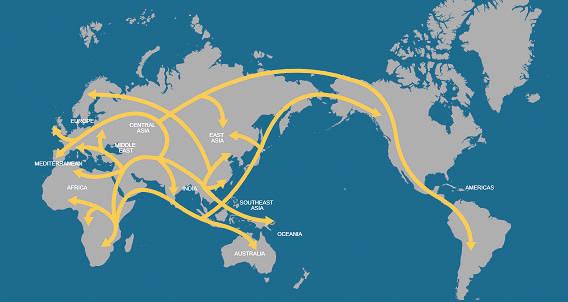
The story doesn’t end there, of course. The rise of agriculture around 10,000 years ago — and the population explosion it created — has left a dramatic impact on the human gene pool. The rise of empires, the astounding oceangoing voyages of the Polynesians, even the extraordinary increase in global migration over the past 500 years could all leave traces in our DNA. There are many human journey questions waiting to be asked and answered.
Have you ever wondered if you would want to test your DNA, perhaps after watching TV commercials

Source: National Geographic
migrations over a 50,000-year period eventually led the descendants of a small group of Africans to occupy even the farthest reaches of the Earth.
Durga Puja/Kali Puja at Ananda Mandir
Durga Puja: 03 October – 08 October, 2019
Lakshmi Puja: 13 October, 2019
Kali Puja: 27 October, 2019
like 23andMe or Ancestry? What would a DNA test tell you about your ancestors? What would it mean to you and how would it help your genealogy? Human genomics has made significant progress in the recent years to address our ancestral migration and in a way our own genealogical questions.
Population geneticists
Source: National Geographic Genographic Project
tend to focus on human mitochondrial DNA (mtDNA) haplogroup — mitochondria, which is located outside the nucleus, is the powerhouse of a cell — to seek answers to these questions. Mitochondrial DNA not only tells us about people we match who are currently living, who share ancestors with us at some point in time, but it also reaches back beyond the range of what genealogy in the traditional sense can tell us — past the time when surnames were adopted, peering into the misty veil of the past!
A haplogroup is a combination of alleles (a variant form of a given gene) at different chromosome regions that are closely linked and that tend to be inherited together. Think of a haplogroup as your genetic clan. Haplogroups have a history and a pedigree chart, just like people do. Those are commonly depicted as the mitochondrial phylogenetic tree. Haplogroups and their branches can identify certain groups of people, such as people of African descent, European, Asian, Jewish and Native American.
Haplogroups are labelled A through Z in the order of their discovery. Mitochondrial DNA haplogroup is a haplogroup defined by differences in human mtDNA. Haplogroups pertain to a single line of descent and are used to represent the major branch points on the mitochondrial phylogenetic tree. Every single one of your ancestors has their own individual story to tell – and if you really want to know who you are and where each ancestral line came from, mtDNA is the insider story on your mother’s matrilineal line. Only females pass mtDNA
on to their children, so all children carry their mother’s mtDNA.
While the matrilineal DNA is passed intact with no admixture from the father, occasionally mutations do happen — the rate at which mtDNA mutates is known as the mitochondrial molecular clock, which is an area of ongoing research with one study reporting one mutation per 8000 years — and it’s those historical mutations that form clans and branches of clans as generation after generation is born and continues to migrate to new areas. Understanding the evolutionary path of the female lineage has helped population geneticists trace the matrilineal inheritance of modern humans back to human origins in Africa and the subsequent spread around the globe.
The hypothetical woman at the root of all the mtDNA haplogroups on the mitochondrial phylogenetic tree is the matrilineal most recent common ancestor (MRCA) for all currently living humans. This is the most recent woman from whom all living humans descend in an unbroken line purely through their mothers, and through the mothers of those mothers, back until all lines converge on one woman. She is commonly called Mitochondrial Eve (mtEve).
In terms of mitochondrial haplogroups, mtEve is situated at the divergence of macro-haplogroup L into L0 and L1–6. As of 2013, estimates on the age of this split ranged at around 150,000 years ago in East Africa. This analysis is consistent with a date later than the speciation of Homo
continue to page 9 }
reported by Krishna Dutta roy, Chair, Puja Committee
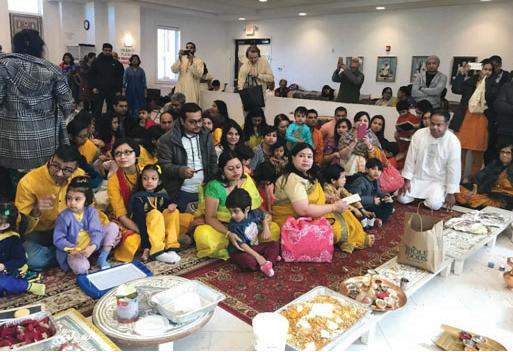
Likeevery year, the 1st January 2019 arrived amidst freezing temperatures and some snow. The temple was open from 9:00am to 8:00pm. Devotees thronged the temple all through the day to get blessings for the New Year. In the evening we had a small program of devotional songs. Puja, Aarati and Anjali were performed as usual and the day’s event concluded with Prasad distribution and dinner.
We observed our monthly Shyama Puja on the 5th of January and our monthly Satyanarayan Puja was observed on Sunday, 13th January. February was a very busy month.
The first puja was Ratanti Kali puja on Sunday, 3rd February. This is a very popular puja in India as well as at Ananda Mandir. This is held on an auspicious day once a year. On this day we had a lot of devotees here at the temple to witness the puja. The puja started at 5:00 pm and ended by 7:30pm. Each and every devotee had the chance to offer puja and anjali. Prasad and dinner were served after the puja. Ratanti Kali puja is observed on “Chaturdashi”. On the very next day, the 4th, monthly Shyama Pujawas held on Amabasya day. As usual, puja, arati, anjali was offered and Prasad and dinner was
distributed.
On 9th February we celebrated Ganesh Chaturthi during the day from 8:00am to 9:30am.
On Sunday, the 10th of February, we celebrated our annual Saraswati puja. This year since the Sri Panchami Tithi was on a Sunday, we had the Saraswati puja combined with Bani Bandana, which is designed for school children to participate. This being a Sunday, allowed the parents to come to see their children perform.
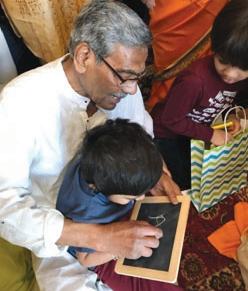
This year’s puja was from 8:00 am to 10:30am. After puja and Anjali were completed at their scheduled times, we started the Bani Bandana event. One special attraction of this puja is the ‘Hate Khori’. Hate Khori marks the day on which a child begins his/her writing skills. About (25) children took part in the Hate Khori ceremony. Pronoy Chatterjee graciously presided over this event. Every year we give the kids a goodiebag after they have completed their Hate Khori and also supply the slate and chalk to those who don’t have it.
It is a great joy to see the smiles on the faces of the children’s parents. Our pushpanjali continued while Hate Khori was in progress. Prasad and lunch were served at the Tagore Hall and kids got ready to showcase their talents in music, dance etc. The children’s cultural show continued up to 4:00pm in Tagore Hall. This evening we also observed our monthly Satyanarayan puja. This was the last puja of this month.
Our upcoming pujas in the month of March are:
Maha Shiva Ratri on 4th, Shyama Puja on the 5th, and Dol Yatra on the 21st. In the evening of 21st March we will observe the monthly Satyanarayan puja. Please look up times on the front page.
Please visit our website for these pujas and all other pujas throughout the year.

| continue from page 8
sapiens but earlier than the recent Out-of-Africa dispersal.
One common misconception surrounding mtEve is that since all women alive today descended in a direct unbroken female line from her, she must have been the only woman alive at the time. However, nuclear DNA studies indicate that the size of the ancient human population never dropped below tens of thousands. Other women living during Eve’s time may have descendants alive today but not in a direct female line.
The definition of mtEve is fixed, but the woman in prehistory who fits this definition can change. Because mtDNA mapping of humans is very incomplete, the discovery of living mtDNA lines which predate our current concept of “Mitochondrial Eve” could result in the title moving to an earlier woman.
Of the lineages of macro-haplogroup L originating in mtEve, haplogroup L3 represents the most common parent maternal lineage of all people outside Africa, and for many individuals within the continent as well. The time to MRCA for the L3 lineage has recently been estimated to date to between 58,900 and 70,200 years ago. This is around the time of and associated with the Out-of-Africa expansion of the ancestors of non-African modern humans from Eastern Africa into Eurasia and with a similar
expansion within Africa also from the East of the continent.
The descendants of haplogroup L3 outside Africa largely coalesce into macro-haplogroup M and its sibling macro-haplogroup N. The latter is found in Eurasia and parts of Africa due to back-migration. Haplogroup M, an enormous haplogroup spanning all the continents, represents more than 60% of South Asian mtDNA. The origin of macro-haplogroup M is estimated to be around 60,000 years ago. A sub-haplogroup M2, which is prevalent among the Bengalis of India and Bangladesh (also in Andhra Pradesh, coastal Tamil Nadu and Sri Lanka), is reported to be the oldest lineage of macro-haplogroup M on the Indian sub-continent. Its age is between 30,200 and 42,400 years.
If you test your mtDNA using ancestry DNA kit like National Geographic’s Geno 2.0, Family Tree DNA or AncestaryDNA, you’ll receive a haplogroup assignment. If you opt for the entry level mtPlus test, which only tests about 6% of the available mitochondrial markers, those most likely to mutate, you will receive a macro-haplogroup like M, because that’s all that can be determined by those markers. If you take the mtFull Sequence test, which tests all the 16,569 mitochondrial locations, you will receive a full haplogroup designation like M2a’b, plus a lot more.
What stories are waiting to be told in your own DNA?
By rahul ray
With aging, our organs, much like parts of machines wear out, malfunction and even stop functioning. Debashish, my sixty-ish friend went for a routine check-up, and ended up having stents put on his heart. It turned out that he had serious blockage of the cardiac-arteries, but it was completely asymptomatic. In other words, he was a perfectly fit gentleman, and had no prior issues with his heart, but ended up with a serious problem that had to be looked at immediately. Tales like this are not uncommon at all. As a matter of fact, Debashish is lucky that his heart-problem was detected, accidentally or not, because people dropping dead with sudden heart-failure is not at all rare.
I am a generally a healthy person with usual problems of advancing age, nothing extraordinary, so much so that my primary care physicians over many years never felt that I needed a ‘stress test’ to check out my cardiac health.
However, my wife always felt that all these years I have been living on the edge. I tried to dispel her perceived fear by pointing at (out) results of various clinical tests that I have gone through over the years, but she is not to be consoled. ‘You are not a young chap’, she contends. ‘How do you know that something very bad has not been going undetected? How are you so sure that something like what caused the sudden demise of so many people will not happen to you?’
It is needless to say that she is the ultra-worrying type. I once saw a cartoon in New Yorker magazine where a huge grand piano is accidentally dropped from a
balcony while an unsuspecting person calmly walks on the path below. I described it to her with a twinkle in my eye. I also joked with her about the common Bengali tale about the sky falling on someone’s head. I teased her, ‘the sky is not likely to fall on your head, and even it does for any unforeseen reason, you will not be able do anything’. However, she did not get my wit, and got irritated by my nonchalant attitude.
a nearby hospital at the designated time. The place had a very comfortable setting. I undressed from waist up and chatted heartily with the elderly nurse while she placed
By Sajal Mukherjee
At the recently concluded South Asian Theatre Festival, Gargi Mukherjee, the co-director of Epic Actors’ Workshop production Nirastra, commented on the balancing act that every amateur theatre enthusiast in the US has to go through - juggling between the roles of a spouse, parent, child, professional while continuing to meet the demands posed by any serious attempt to put up a good production. This creates a lot of pressure on the individuals and their family members.
Take the example of Kanjaz, one of our co-actors in Nirastra. He lives in Philly and works in Virginia. He had to commute from Philly every weekend to rehearse and could not make it during the week-days. His absence was felt during the weekdays as our rehearsals demanded all actors to be around all the time. One weekend, Kanjaz had to take time off from rehearsals to honor a family commitment and he had to face intense pressure from all of us to consider cancelling his plans which had been made months back. Soumendu, Production Coordinator for all productions in SATF, had to work late nights and early mornings on several days to avoid travel in the week prior to the festival. Manoj Shahane, the director of another play recounted how Seema, his wife and the lead actress in the play, drove to Boston and back to pick up their son from a summer camp on Friday before the festival, reported for rehearsal at 9:30 pm in the night and rehearsed till well past 2 am.
My own situation gets even more complicated as my profession demands regular travels that are often planned at the last minute. During the making of Nirastra I tried to curtail my travels but could not avoid all of them and I remember at least three occasions when I reported for rehearsals straight from the airport.
Finally, I gave in, and insisted that my primary care physician that I should get a cardiac stress -test to determine a clean bill of health for my heart. He resisted for a while that I don’t need one, but finally relented. As a result, one fine morning I appeared at a cardiac clinic of
rows of electrode- patches onmy chest, wrapped a blood pressure cuff on my upper arm, and finally connected me to the EKG machine with numerous wires attached to my chest. After a short while I was lead to a treadmill while those wires dangled from my chest like a dolphin snagged with a million of harpoons! It was a routine job. I ‘walked’ on the treadmill holding hand rails while the rolling base under my feet speeded up and eventually slowed down to a stop. I passed the test with flying colors as the attending physician, who was standing nearby asserted. Then the nurse
continue to page 12 }

Why we still continue with our theatre pursuits in spite of these challenges is the topic of another discussion. Today, I would like to highlight an experience that is probably unique to traveling professionals like me who aspire to perform on the stage.
As our rehearsals picked up momentum, the onus shifted on me to keep current, even if I missed rehearsals on some days due to my travel schedule. I was under pressure not to lose grip on my character, and to continue memorizing my lines. The only time I could have done this was during the long waits at airports, while flying, while driving or being driven, and when I was alone in my hotel room. The last one sounds most logical but is actually most impractical as my days are longer when I travel. I get back to my room totally exhausted after a long day and immediately hit the bed.
So I had no option but to use the other opportunities. A small detail about myself - I cannot memorize or rehearse silently without making any gestures. This meant that I treated my co-passengers to some interesting experiences, where I muttered under mybreath, made weird faces or shook my head in frustration when I mixed up my lines. Given the character I was portraying in the play, my expressions were not very benign. I often sensed people were looking at me suspiciously. . On one occasion while I was flying back to Newark, my co-passenger noticed my behavior and asked if I was preparing for a play. It turned out that the gentleman was a part time actor in London. I was so delighted to meet him that I engaged in a two hour conversation with him, discussing my passion for theatre and the South Asian Theatre Festival in particular. I had to pay the price that night upon my return as I missed my lines during the rehearsal!
Probably it was divine intervention that kept me from being dragged away for interrogation during my travels. My wife often reminds me that if I have a strong and genuine desire to get something and I pursue that with dogged determination, the Universe will help make it happen. I think she is right, else there is no explanation for not getting pulled up as a suspected lunatic.
Next time you find someone acting crazy in a public place, please find out if he is a travelling salesman rehearsing for his next play before you press the SOS button!
ning of 1936 Jews at the age of 12 were forced to wear a white armband with a Jewish star.”
My friend said, “Maybe you should know more in depth. A number of small Jewish communities were turned into ghetto wall towns altogether unlike the larger ghettos, which were cities within cities - surrounded by walls near Warsaw.”
She continued: “The ghetto was a captive city state in which territorial confinement was combined with absolute subjugation to the German authorities. On October 16, 1939 the first transports began to arrive. By November 4, twenty transports had dumped 20 000 Jews into the ghettos, 5,000 from Vienna, 5000 from Prague, 4000 from Berlin, 2000 from Cologne and 1000 from Frankfurt. As the Jews moved in ghettos, they left most of their property behind.”
When asked about the situation of food, she said that the survival of the ghetto population depended in the first instance, upon the supply of the food and fuel. By decreasing and choking these commodities off , the Germans were able to turn the ghettos into death traps. The killing of the Jews was regarded as a historical necessity. Many were of the opinion that the Jews were bad for society.
I then asked her, whether her family had experienced a similar ordeal.
“Of course!” she replied, “Many Jews had to stay behind because of the physical difficulties of flight. They were the old people and women and the children. There were people who failed to understand what was going on. The remaining Jews were physically and psychologically immobilized.”
She paused and then after taking a sip of water, followed by a few heavy sighs, she started telling her parents’ story. Sometimes in between her story
By Amrita Kangle
reported by Subrata Bhaumik
she would moan and choke herself. For a long time, she gazed at me, almost blankly. Her face by then had the composure of someone perfectly at peace with herself. She started to narrate how when the war broke out her parents were separated from one another. The Germans were trying to get the men first. Her grandmother and her mother decided not to leave because her mother had a small child and did not want to go to the concentration camp. Her mother changed her passport and started working in different restaurants. When the Germans raided, she hid in the paddy fields; in one incident she claimed that her grandmother was just a corpse and this way she was able to save her grandmother.
One day when her mother returned, the place was empty and only the dentures of my grandmother remained. She started to panic and asked what had happened. She came to know that grandma and the infant were put in a train carrying Jews and were thrown out of the widow along with the pigs. After the war was over, she returned and recognized her house, so did her father. It was such a sorrowful story but one which had a nice-ending like a love story.
After they were reunited, my friend was born. As she grew up, her mother told her all about her experiences with the German soldiers. But she also told her that she could not describe everything, so the rest of the story would go with her to her grave.
The she said to me, “I wish you success in your project and some day you will come across somebody else like me.”
As she said this, she kept her eyes down poking at the food on the side table, subdued to the point of silence.
We held hands together as if afraid to let go – perhaps the story did not end.
December 2018
Sahitya O Alochana (SOA) is a monthly literary and topical discussion forum under the aegis of Ananda Mandir (AM). It completed its 11th anniversary in January 2019 and will have organized one hundred and eleven (111) sessions by the time this report goes to press. These monthly sessions feature exciting and illuminating discussions on diverse subjects including literature, art, theater and movie; history, philosophy and religion; science and mathematics; economics and business; and social issues, sports, and current affairs. Below is an account of the recently held sessions.
The December “alochana” was kind of a Tribute to V.S. Naipaul who passed away in 2018. Subrata Bhaumik made a presentation that covered Naipaul’s life and works. He reviewed Naipaul’s journey towards claiming the stature of probably the most famous, though very controversial at times, writer of Indian lineage who made indelible and towering contributions to the English literature and is considered as the best English prose writers of last sixty years. Couple of YouTube videos featuring Naipaul’s talks at the famous Jaipur Literary Festival and Yale University Literary forum were also parts of the presentation. Amitabha Bagchi read an article he penned about his own initiation to
| continue from page 7 continue to page 14 }
Ineach of us there exists a budding writer waiting to bud and flower. So also with me.
I had for a very long time been thinking about how I would start my first electronic journal entry. Obviously I wanted it to be something grand, heralded by trumpets and drums. Something along the lines of the picture of Julius Caesar in the much loved comic ‘Asterix & Cleopatra’, complete with dancing girls and much fanfare!
There have been previous attempts to start my own blog. Color schemes decided upon, rejected, changed. Themes pondered upon and many grand announcements made to the family as to how I would soon be a writer to be reckoned with. To his credit, my son, my biggest cheer leader has always made me feel that this would be just another task that I would conquer with ease. My husband has, well let’s say, not been so confident. Please note that when I state this, my tone is very mild and not seething with any of the emotions bubbling in my heart.
I was not to know then that my first literary attempt would begin with me sitting on my bed with my feet elevated on a pillow (placed by a solicitously hovering husband)..... the said foot bandaged by an even more worried son. I fractured my toe last night. For the fifth time, I wish to add. The same toe.
There are those (and there have been many) who have asked me, how I have managed this particular feat. I don’t blame them. They are lesser mortals who will not be able to match my actions. I have been reprimanded by my brother, and my son. Both younger than me by eons and thus they feel morally obliged to give me lessons on life. In fact they consider it their duty and never miss even half an opportunity to carry it out!
But, here is the (what is the word that I am looking for?) I have been happier today, than I have been in years. The human mind is really unfathomable. Here I am in serious pain, unable to get up, unable to do my gardening, which I had serious plans for, unable to go to the Niagara which had been planned and here I am again, beaming from ear to ear, despite all these adversities.
It all started when last night. I banged my foot and it swelled up like a nice hot bagel. The care and love that has come my way since that moment is indescribable. I would gladly, willingly break my foot ten times over to be the recipient of this love. The family went crazy to make me feel better. My son immediately applied a cold compress and then father and son
went out to buy the appropriate bandages and pain killers.
Upon their return the offspring set about bandaging my foot. As I mentioned earlier, this was my fifth time so he knew exactly what to do. His touch is so gentle that I felt it was an angel from heaven who had come down to heal me.
My mother had been a very strong willed lady and she had brought us up with a very firm hand. She had very definite ideas about what was good conduct and what was not and heaven help us if we chose to transgress! But her touch had been that of a butterfly... very very gentle. It took just her touch to make the pain go away. Even when I had been in labor, it was my mother who stood near my head, with her hands on my forehead. For ten whole hours. It has been 27 years but I can still feel the pain and her hands. Now it has been twelve years already since I have felt my mother’s gentle, healing touch and had put the memory away like a shrine to be worshipped but never experienced again. But last night, it was as if my mother was bandaging my foot and taking my hurt away. My boy’s touch is softer than a whisper... So is his care!! My son managed to make me feel that I was his small baby. I could not stop my tears as they fell fast and furious.
The magic continued today morning. The husband brought my tea to the garden. His laptop lay unopened and so did his IPad. He actually focused on me. Yessssss!! And those of you who are thinking, ‘what is so special about this’?, allow me to explain. My husband thinks that I am invincible and I just get over problems like a bulldozer going over rubble. Minor fractures here and there are not even worth considering. Are you getting the picture?
So there I was in my garden. Surrounded by my plants. Strawberries and tomatoes ripening on the vines. The sky, blue with lazy clouds flitting across. The birds chirping merrily. The squirrels playing about. The canine next door going crazy seeing them. The Bumblebees going lazily about their business. The lawns fresh from their early morning watering (given by husband, Hallelujah!!!). I got gourmet breakfast served to me with endless cups of tea. I did not have to lift a finger!! It was as they say, God was in his Heaven and all was right with the world.
I was so touched, so moved that the first electronic blog just flowed out of me onto paper and I did not even think about being Caesar’s Cleopatra anymore!!! I was queen in my own world!!
By Debajyoti Chatterji
According to a report in The Washington Post (January 4, 2019), 19 million people applied for 63,000 job openings posted by the Indian Railways. The jobs were for low-paying positions such as “helper, porter, cleaner, gateman, track maintainer, assistant switchman”. Many college graduates competed for such jobs.
Another report in The Washington Post (January 5, 2019) reported that “a bluefin tuna sold for a record $3.1 million at the first auction of the year at Tokyo’s new fish market”. The tuna weighed 613 lbs., and the selling price was “nearly 10 times higher than the price paid at last year’s auction — albeit for a considerably smaller fish — and roughly double the previous record.”
New York Times reported on December 2, 2018 that a British tourist presented an engagement ring to his girlfriend while visiting New York City. She put it on her finger but the ring was a bit too big and slipped off her finger and fell into the abyss of a Times Square sidewalk grate. The couple left for England, and assuming that the ring was lost forever, bought another ring. But a passer-by had called the police who came afterwards and retrieved the ring. The police tracked the couple through social media, and the ring was happily reunited with the British lovebirds.
Elevator Drops 84 Floors in a Chicago Skyscraper
Without any warming, an elevator in a 100-storey Chicago skyscraper fell 84 floors, requiring a dramatic rescue of 6 people (Washington Post, November 19, 2018). “I believed we were going to die,” one of the elevator riders confessed to CBS reporters after the rescue. The trapped passengers had to wait for over two and one- half hours for fire fighters to cut access openings into the elevator shaft.
104 Years Old Barber Still at Work
“The World’s Oldest Barber Is 107 and Still Cutting Hair Full Time,” is the headline of a New York Times report (October 7, 2018). Anthony Mancinelli of New Windsor, NY, has been cutting hair since he was 12. He dropped out of high school and started earning money, cutting men’s hair at 25 cents a clip. He is recognized in the Guinness Book of Records as the oldest living and working barber.
An Indonesian Villager is Swallowed Whole by a 23-foot Long Python
Wa Tiba, 54, left her home on Muna Island, Indonesia, to visit her cornfield one evening and did not return. According to Washington Post (June 16, 2018), the field was about a half mile from her house, surrounded by cliffs, caves and a certain number of reticulated pythons, the longest snakes in the world. The villages found the snake resting, with a huge mid-section, and cut open its stomach to find the woman, intact, but dead.
A family in a small German town could not pay their bills, so the authorities went looks for assets to seize. The only thing that was valuable was their family dog, a pure-bred pug, named Edda, so they took possession of the dog. Then the township sold the dog on eBay for slightly less than $850. The dog was subsequently found to have health problems, and the new owner has sued the township for insurance costs.
(Washington Post, February 28,2019)
NJ Realtor’s “For Sale” Sign found on a French Beach After
When Hurricane Sandy hit in October, 2012, many objects got washed away from the New Jersey shore. One such object was a “For Sale” sign from a property in Brielle, a seaside town. Almost six years later, on May 14, 2018, that sign was found, 3595 miles away, on a beach near Bordeaux, France. The partially damaged sign was still legible, and it was re-united with the real estate company named on the sign.
(NY Times, May 31, 2018)
| continue from page 10
took out the electrodes and wires one by one while continuing to monitor my blood pressure and heart rate.
Unsure about the duration of the test I took a recent issue of ‘Desh’ magazine with me. My intention was to finish up reading an article entitled ‘Elem notun deshey’ by Sudhir Chakrabarty, a renowned musicologist, and a musicresearcher of the highest acclaim. It is a serial on the musical genius of Rabindranath Tagore. The serialized article, though at times it contains highly Sanskrtized words of yesteryears, has been a delectable treat. Over several issues the author has been describing how Tagore’s music-training, his command of (on) writing poetry and prose nurtured him as a virtuoso music composer and lyricist. It is a subject that is very dear to me, and each time I read about it I become extremely emotional.
The nurse declared that the test was over. However, I had to lie on the bed for a short while till my racing heart, after the exercise comes down to a normalcy. ‘You can relax now’ – she beamed. At that sign I picked up the magazine which was lying next to me, and started reading that half-finished article. Within a few seconds the nurse almost came running to me – ‘What is happening?’ she spoke alarmingly. ‘Your blood pressure and heart-rate were normal, but what did you do? Your heart is suddenly racing! ‘
In bewilderment I dropped the magazine, and within seconds the nurse excitedly declared that my heart-rate was dropping. It soon came to a base level and stayed there. My test was over. At my insistence the nurse posited pointed out that something I did sent my heart pounding. However, she could not pinpoint what exactly I did that may have caused it. I smiled and left.
It must be emphasized that rise in the heart-rate under stress, physical or emotional is nothing new. Actually, this was the basis of the ‘stress test’ that I underwent. In this case physical stress was
brought in by walking on the treadmill. The nurse constantly monitored heart rate and blood pressure, in the case my blood pressure changed suddenly or I have an irregular heart-beat, called arrhythmia. In addition, she repeatedly asked me whether I had (have) a chestpain, which I did not.
Increased heart-rate can be fatal for people with heart-problems. A physician-friend of mine once in a chatty mood told me that internet can sometimes be a nuisance. ‘How so?’ was my question? ‘Well, these days some of my elderly patients come to me demanding, ‘Doc, can you prescribe me Viagra. I learned from the net that it will be good for my sex-drive.’ ‘Some of these patients have heart-problems.’ – stated my friend, ‘and, increased heart-rate brought in by the act of sex and stimulated by Viagra can kill them!’
Emotional stress can also cause a rise in heart-rate, be it joy, love or grief. There is nothing new about it, but the big surprise for me was reading a favorite piece of article, and getting emotionally attached to it can increase the heart-rate so rapidly and significantly to raise a serious alarm, as voiced by the nurse. Well, Rabindranath Tagore, with whom I am so emotionally attached to, was the culprit in this case!
My wife was disappointed that I came out clean, because she always feels that I am bad too carefree with my happy-go-lucky attitude towards life, and something must be wrong with me. Obviously, it is an expression of her love and caring. However, she pulled an even longer face when I told her about the incident of increased heart-rate and Rabindranath connection. She simply did not believe it. ‘You are making up stories again’, she exclaimed in frustration.
I received the report in two weeks, which stated “Negative stress-test”. Then, the detailed section of the report specified that “Brief non-sustained atrial tachycardia in recovery, asymptomatic”. I smiled to myself with satisfaction.
| continue from page 7
dinners for a large number of people, twenty-five to thirty-five of them, was challenging for a working mother, but it was certainly a labor of love. Most men planted themselves on the family room sofas and chairs watching football or talking politics. In the living room, women caught up with the news about the community. Children who grew up together sat around the tables in multiple rooms chatting away. Their plates would be filled with their favorite items. As I flitted through the rooms, I would admire sparkles on young faces lit by festive lights. I tried to put up the Christmas decorations before Thanksgiving. At some point, the boyfriend of my good friend’s daughter gave me the nickname of Thanksgiving Mashi (or aunt in Bengali). I embraced it proudly. Recently, young adults became couples. They
have to fulfill the obligation of visiting their in-law families during Thanksgiving. Others moved away from Chicago or traveled on vacations. As people retired, they flew south to India and other places. My guest list for Thanksgiving became short. My own health is not the best either. After twenty-five years, I decided not to have the party in 2018. As I walked out of the Yoga class, I pondered on the Saraswati Stotra the Yoga teacher was playing. I am sure that she was not aware of the significance of the two-thousand-year-old Sanskrit hymn to the goddess of knowledge and arts. Every moment, the world is changing around me. After hosting many years of the dinner I felt that I had done my small part as a change agent. I looked forward to playing with my glorious baby grandson during Thanksgiving. Perhaps, I will restart the dinner in the future for his sake.
Ananda Mandir’s Youth Group, known as “Kisholoy”, publishes a monthly wall magazine. During your visits to Ananda Mandir, you may have seen it prominently displayed in our Front Building. This magazine features articles, artwork, puzzles, news and other types of informational items -- all written by the community’s children and young adults. If you spend a few minutes reviewing the contents of any of the monthly postings, you will be impressed by their variety and appeal. From a travel story written by a third grader to a serious essay written by a college freshman, from a sketch drawn by a young girl to a quiz posted by a high school boy, you will find the contents interesting and creative.
During the Durga Puja season, Ananda Mandir publishes a “Sharadiya” issue of Kisholoy that is distributed free to all our Life Members. This special issue includes a selected collection of articles posted on the wall magazine during the previous twelve months. For many of the authors, these represent their “first printed publication”, a milestone in their young life!
If you have school or college-going children, please encourage them to submit their literary and artistic work to Prof Dipak Sarkar, who has conceived and organized this effort for many years. His email address is DipakSarkar@hotmail.com
Kisholoy also encourages volunteer community activities by children and young adults. Kisholoy volunteers take active interest in major events at Ananda Mandir during the year. Prof Sarkar will be happy to give you more information on such activities. He can be reached at 609-651-1023.
By Shivan Mukherjee, Age 14
From the flip phone to smartphones like the iPhone, there have been many changes in the size and make up of our phones. This incremental progress that we have witnessed follows Moore’s Law. It says that the number of transistors in an integrated circuit would double every 2 years, but would also be lower in price. This means that integrated circuits would lead the path to cheaper hardware. However, this exponential increase cannot be maintained forever. Intel has publicly stated that maintaining this trend was becoming difficult. There are already millions of transistors in a single circuit which means that the distance between transistors would need to become even more miniscule. This is not possible, which is why it is said that Moore’s Law is ending. In order to compensate for this and in an attempt to continue this law, there are various new methods that are being used to advance technology. Included in these ventures are Neuromorphic computing and 3D Chip-Stacking.
In traditional computing, the computer processes information and stores memory separately and data flows between them. Neuromorphic computing follows a different approach where each neuron will have to be able to process and store memory at the same time. The data will flow between
the neurons in a gradient. This is similar to the function of our brain where information flows in synapses between neurons. Computers have traditionally been programmed with a binary code where an electrical signal either means 1 or 0. By transferring a differing amount of energy based on a situation, neuromorphic computing provides a much wider range of options than simply binary 1s and 0s. As such, it also opens up the possibilities of what can be done with it. There are many possible uses of this system where a robot will be able to make decisions by itself based on the situation or identify changes in its environment.
A neuron can combine the outputs of many neurons and generate its own output. The overall strength and polarity of these synapses can make up memories which can change over time. This changing gradient in power is not possible with the hardware in traditional computers. Silicon cannot control the power as well as adapted materials like Silicon Germanium. Despite this, neuromorphic computing is not meant to replace traditional systems but rather complement the number crunching computers with its applications in artificial intelligence where the neuromorphic system may be more efficient than the other.

By parama Das, Age 21
For one of my classes this semester Gender, Culture, and Representation I had the opportunity to examine a Rabindranath Tagore book and compare it to the English novel Mrs. Dalloway. I used the article “Transgressive Gender Identity as a Marker of Cultural Crisis in Tagore and Woolf” by Julie Rajan who is my professor to examine how the characters in the novels of Mrs. Dalloway by Virginia Woolf and The Home and the World by Rabindranath Tagore are seen as markers for the cultural crisis that occurs at that time. In the time period that the two novels take place India and Great Britain are going through an intense cultural crisis which involves the challenge of gender norms. This association between gender norms and culture suggests that if you control the woman then you control the culture as woman are the ones that endorse cultural traditions. Both countries were rooted in patriarchal culture but a new shift towards Modernism threatened these existing traditional institutions. The main characters of Clarissa and Bimala in the texts are navigating through the new social climate by gaining their own transgressive identities.
Superficially the character of Clarissa in Mrs. Dalloway is seen as an example of the ideal British woman. Clarissa is an upperclass British wife who is married to a businessman Richard Dalloway. She is totally involved in the social activities of her class and the whole premise of the novel is her preparing for the party which she is throwing. She supports the British imperialism which is seen when she is shocked that her friend Peter has fallen in love with a British woman in India. This confirms the hierarchy dominance that the white man has over the British woman and the Indian man and Indian woman. Clarissa thinks that she is above all the British women who live in India and sees them as being silly and thus is appalled when Peter tells her he has fallen in love with this woman. In this case the woman that Peter has fallen in love with is the “other” woman. Clarissa separates herself from the other woman by establishing her superiority over this woman. She is jealous that the “other” woman is able to indulge her desires freely while she, Clarissa is unable to.
The character of Bimala in The Home and the World by Rabindranath Tagore transgresses her gender identity and is able to move from the private to public spaces. The novel takes place during the Indian freedom movement as the Swadeshi movement is sweeping the nation. The identity of Indians under British rule is changing as there was a need to establish an Indian identity separate from that accorded to them under the British rule. The characters of Nikhil and Sandip represent the chaos and instability versus the morality and stability paradigm. Bimala gains her own identity by gaining a political voice and supporting the Swadeshi movement while her husband did not. She thus enters the public space. Through the mental affair she has with Sandip she is transgressing by rejecting her husband and falling for another man. In the novel Bimala is associated with the Hindu female deities of Shakti and Sita. Through this association it is implied that Bimala has divine powers that would go against the ideas of a patriarchal society. Bimala is similar to Sita in the sense that she moves between locations like Sita is moved by her husband and by the demon, but Bimala moves by her own agency. Bimala’s character represents how old traditions are being changed by new traditions that transgress gender norms by giving females their own sense of identity. The reason that Bimala was able to transgress is because of the cultural crisis that was going on in India at the time as gender roles are associated with culture. In these two novels, the characters of Mrs. Dalloway and Bimala are able to transgress the typical gender identity of a woman of that time and become their own person. Even today there are some women who are not given their own identity. The only way to let women transgress and discover their own identity is to put the decision in their hands of deciding who they want to be.
reported by pradip r. Das
The annual December Holiday Party on December 8th at The Crowne Of India restaurant, Plainsboro, concluded GSCA’s events for 2018. Over 100, adults and children, participated in this fun-filled gathering. The sumptuous buffet of North Indian delicacies was a savory treat for all. A member appropriately donned a Santa Claus costume to entertain the gleeful children and give them gifts. A choreographed dance routine by some GSCA ladies set the mood for the evening and the open dance floor brought out the enthusiasts, dancing to the beat of contemporary music. Overall, a delightful evening of company amongst friends, good food and lively entertainment.
GSCA ended the year with a bang! Saraswati Puja
On a sunny day on February 10th at Wardlaw & Hartridge School, Edison, nearly 250 people came to celebrate GSCA’s first community event for 2019. Besides the traditional puja, pushpanjali and prasad, several very young children had their “haathekhori” with our priest, as parents eagerly looked on. The cultural program began with ‘Devi Bandana” by GSCA children. Individual song and instrumental performances were also served by youngsters. The dance group “Nrityalina” staged some wonderful semi-classical Indian dances. The final item of the evening, a Natok, “Military Sinduk”, adapted from a hilarious short story written by Sanjib Chattopadhyay and directed by Soumendu Bhattacharya amused and entertained all. The Arts & Crafts competition, which took place earlier in the afternoon, drew 25 children in different age groups. The winners were all felicitated on stage. The dinner, with several vegetarian items, and the accompanying “adda” was not missed by anyone present.
GSCA had a wonderful start to 2019!
reported by Chanakya Ganguly
NJPA welcomed the 2019 New Year with great pomp and splendor at the Indian Hut restaurant in Plainsboro, New Jersey. Around 65 people attended the event which boasted a live DJ.
On February 23rd, NJPA celebrated Saraswati Puja with new zeal and enthusiasm. Guru
Chakravarty conducted the Puja and Anjali, followed by Prasad that consisted of Khichuri, Aloor dum, Labra, sweets, and a spiritual cultural program of Indian music and dance. It was held at the Monroe Township Senior Citizen Center, Halsey Reed Road, Monroe Township, NJ.
The guests of honor were Tej Hazarika, son of late Dr. Bhupen Hazarika who talked on multi-culturalism and Rhea Alathur, Special Olympics Gold Winner who demonstrated health benefits of daily Yoga. Around 98 people attended the event, and it was well appreciated by attendees and organizers.
Basant Panchami brings forth the end of winter and the arrival of Spring. Saraswati symbolizes the purpose of Life, Living and Learning. Saraswati is the river of consciousness that enlivens creation; she is the dawn-goddess whose rays dispel the darkness of ignorance. Without her there is only chaos and confusion. To realize her one must go beyond sense pleasures and rejoice in the serenity of the spirit. She wears no jewels nor paints herself with bright colors. The white sari which she wears, adorns her essential purity which is beyond the senses and symbolizes her rejection of all that is base and materialistic. She rejoices in the power of the mind as the patron of pure Yogic wisdom. She embodies all that is pure and sublime in nature.
Saraswati rides her swan, a symbol of beauty, on the peace mountain lake of the mind, bestowing the cooling peace of meditation. She represents the feminine principle of art and music, allowing it to fully express itself without fear and manipulation. At a personal level it requires honoring speech – speaking with beauty, clarity and truth and thus merge with the Divine. Her Veena symbolizes the cosmic vibratory forces beyond time and space breaking our inertia.
Till we meet again, have a joyous Spring and an introspective New Year of Yogic Consciousness.
Information about the upcoming event will be available on our Facebook page “NJPA Parivar.”
stage was set for the next phase of the celebrations.
Please note that you can become an Associate Member of Ananda Mandir by donating a minimum of $100. Your subsequent donations of $50 or more are credited to your account. When your total cumulative donation reaches $1000, you become a Life Member. Your support, small or large, is most welcome and sincerely appreciated.
| continue from page 11
Naipaul’s work and a tepid but interestingly critical review of some of Naipaul’s work including the famous “A House for Mr. Biswas.”. Attendance was relatively thin due the holidays, interactions and exchanges were very lively nonetheless. A ton of thanks goes out to Amitabha and Subrata.
reported by Arpita Gupta
The year began for Indian Community Center of Garden State (ICC), with the hosting of the Sarawati Pujo on February 9th. The new committee welcomed everyone. The committee members are: Nirmal Kundu – President, Tara Sinha – VP, Nilay Hait – General Secretary, Arpita Gupta – Communications Secretary, Mridul Paul – Cultural Secretary, Sudip Saha –Treasurer, Ruma Ghosh – Social Secretary, Mousumi Chakraborty – Recreation Secretary, and Purnima Chakraborty – Member at large.
This year’s celebrations were held in a warm and homely atmosphere and both members and patrons joined in very large numbers to make it a memorable experience.
This year we saw some new faces in our Saraswati Pujo. We had record breaking attendance.
The event started around 3:00PM, at the Randolph Community Center, with a group of members setting up the Deity, stage and Puja samagri. The rituals were solemnized by Suddasatta Acharya and witnessed by ladies and girls dressed in their beautiful costumes and jewelry, accompanied by the men and boys also in their best attire. Pushpanjali, the showering of the Shanti Jal and ‘Hathe Khori’ marked the conclusion of the Pujas. As the guests proceeded to enjoy the Prosad and Puja Bhog, the
The cultural programs started around 6:00PM, by a welcome note and introduction of the new EC members, by Nilay Hait, General Secretary. The rest of the evening was conducted by children of the ICC: Arunima Paul, Monalisa Hait and Sumontro Chattopadhyay who set the stage for the evening with a very beautiful composition. ICC children started the program, with a Saraswati Bandana, sung by Sara, Monalisa, and Arunima. ICC children continued to enthrall the packed hall with a lively performance, dressed in their beautiful costumes which were handmade by Arpita and Unmukt Gupta and was conceptualized by Mousumi Chakraborty.
This was followed by the program Madhuro Dhwani Baaje organized by Nilay Hait and script by Shangomitra Bhattacharya.
Mridul Paul had provided very high quality audio and lighting support, while Nirmalya Chowdhuri captured the moments on still and video photography. A sumptuous Bengali dinner consisting of Radha Ballabi, Chanar Daalna, Phoolkopir Torkari, Peas Pulao, Aloor Chop, Papad Bhaja, Pasta for kids, Chutney and Rasagulla marked the end of this year’s Saraswati Puja.
Once again, on behalf of myself and the rest of the Executive Committee members, I take this opportunity to thank all members and patrons who attended, for their help and support in making this a grand success. Please stay tuned for announcements for upcoming events at our website www.icc-gs.org
In January, Mosleh Ahmed, a veteran of our Alochana Group led a session entitled “Evolution of Islamic Dominance in Eastern Bengal in Pre-independent India.” This discussion examined an important piece of the overall social evolution in the Indian subcontinent – more specifically - it analyzed the forces - social, geographical, political, and economic – that helped shape the dominance of Islam as a religion in the eastern part of undivided Bengal in preindependent India. It reviewed various prevailing theories of this historic transformation and offered a view that is a bit unorthodox in approach and seeks to explain the phenomenon through additional lenses (geographical and economic) that the other theories do not directly address. Attendance was pretty decent, and Mosleh very effectively engaged the crowd in a meaningful and enlightening exchange as evidenced by the highly animated and interruptive nature of the discussion. A ton of thanks goes out to Mosleh.
February 2019
Due to scheduling difficulties no session was scheduled in February.
Future sessions
Quite a few interesting sessions are in the pipeline for next several months. They feature eclectic topics including a discussion on technology and new horizons, a. session on Block chain, and an event showcasing local writers.
The friends of Sahitya O Alochana would like to thank Ananda Mandir for its continued support for the forum’s contribution to the cultural enrichment of the local Indian and Bengali communities.
reported By Dipan ray
Epic Actors’ Workshop is proud to announce the 14th South Asian Theater Festival on Aug 3 and 4, 2019 at George Street Playhouse (New facility): 103 College Farm Rd., New Brunswick, NJ-08901.
We thank you for your patronage in the past and we hope you will join us this year to celebrate our 14th anniversary. We put together an exciting line-up of quality theater in English, Hindi and Bengali, with shows from communities belonging to different South Asian countries.
The Lineup of the shows:
• Megh (Bengali)--Epic Actors Workshop, NJ
Written by Utpal Dutta
Directed by Pinaki Dutta
• Anton Chekhov Returns (Hindi/English)--ICS Theatre, NJ
Written by Anton Chekhov
Directed by Mahesh Dattani
• Kamala (Bengali)--Spotlight Theater, Ohio
From Myman Shingha Geetika
Directed by Gautam Haldar
• Rani Kamalapati (Hindi) –Prayog, NJ
Written by Indira Dangi
Directed by Ameeya Mehta
• Stories of Jackson Heights (English)--Dhaka Drama, New York
Written by Golam Sarwar Harun
Concept and translation by Gargi Mukherjee
Directed by Golam Sarwar Harun
• Makkhee Choos (Hindi)-Bravo Arts, Boston
Written by Moliere
Adapted from: Avare
Directed by Jayashree Shahane
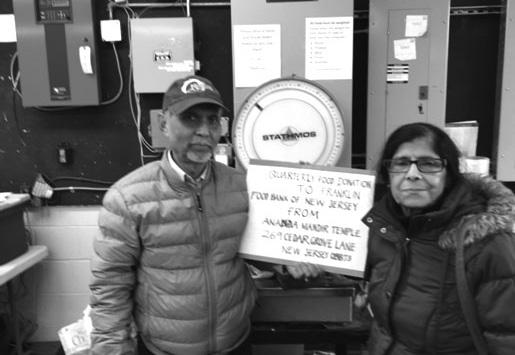
We have seen the announcement of “Food Drive by Ananda Mandir” in every issue of Ananda Sangbad for years. It is a dedicated endeavor by Krishna Dutta Roy, Chair, Ananda Mandir Humanitarian Activities. Here is a brief narrative of what she does together with her dear husband Pranab.
Krishna and Pranab enjoy their self-assigned responsibility of serving area Food banks for decades. Additionally, they donate money, buy groceries, add to food donation collected from other Ananda Mandir members and deliver the food to the Somerset and a few NJ coastal Food banks.
A few Ananda Mandir members, especially Biswajyoti, have been quite helpful in this effort. Pranab and Krishna urge promotion and support of AM Board of Directors and all AM members. As ways to promote, they suggest to actively talk to your children, grandchildren, friends, neighbors, and other AM members for support operations like cooking and catering. Currently the food drive may be a meager operation, but with active support from others, it could diverge into many other worthwhile issues like Blood Donation Drive which we all could be proud of.
To help, please reach out to Krishna at k_dutta_roy@yahoo.com
By Smita Guha
Some of us have come into this world with a lot but some of us have not! In my opinion eyesight is the most important of all the senses. The person who is deprived of eyesight is the most deprived person in the world. Although I have been singing publicly to raise funds for visually impaired children since 2013 to buy sewing machines for them, this was one time I got an opportunity to raise more funds for them.
On Sept. 9, 2018 Blueberry Children, NY arranged a musical program for the children who are visually impaired. Blueberry Children, NY is a program for children. It is mainly an enriched summer or afterschool program. This was founded by the Guha family (Amit and Smita Guha) in 2007.
To keep the tradition of Indian music alive and abiding by acculturation, the program was conceptualized by Smita. The program demonstrated the Guru
raise awareness for this noble cause and explained how important it is to support children who are visually impaired to become independent as musicians as they have a lot of potential and all they need is our helping hand. Jointly we can make a difference in the lives of all these children.
My sincere thanks to the audience who attended the program and showed their support for this humanitarian cause. (Picture 4). Partial funds were given to VISIONS, NY to buy an app for the children for their education. They were very thankful. Attached letter. (Picture 9, 10)
Partial funds were also given to the Calcutta Blind School to buy a keyboard to help children realize their musical proficiency. The Principal as well as the other administrators were very grateful for the keyboard. The children were excited to learn the keyboard from their principal. (Picture 11, 12).
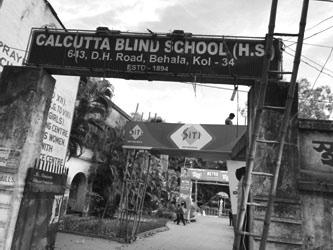
Shishya Parampara, a rich Indian heritage where students learn from the Guru and show respect by touching the Guru’s feet. Dr. Smita Guha is a disciple of Pt. Ajoy Chakrabarty. The program started with Ganesh Vandana by Smita’s daughter, Anandita who danced in accompaniment to Pandit ji’s song.
Smita with her students performed Guru Vandana (worshipping Guru) followed by a song. After a few songs by Smita, her Guru Pt. Ajoy Chakrabarty took the stage. Pandit ji mesmerized the audience with his music. It was an excellent program where Pandit ji explained raga music as he showed the pathway to musical perfection.
Pt. Ajoy Chakrabarty whole heartedly supported this noble endeavor. He even made a speech to
This program, as mentioned, was to support children who are visually impaired. By keeping alive our rich tradition and raising funds, this program indeed helped those children. They are already possessed of a strong auditory sense and music will only help them to become professionals and sustain themselves. Let us hope that all our blessings continue to be showered on these children. In future, programs like this one would also help other children who are impaired in some way and hopefully all children could go to school. They would never have to beg on the streets. Blueberry Children supported this program and hope to continue to do so.
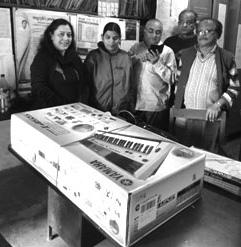
Ananda Mandir is happy to announce the winners of annual “Kishalay Award for Writing Excellence” for the year 2018. Originally established in the 2016 for US based high/middle school attending children of Ananda Mandir members and their kin, the award aims at inspiring the contestants in writing and involvement in community activities including Ananda Mandir’s.
In 2018, the following prizes have been awarded:

Annesha Ghosh
First Prize
Annesha is a High Honors Junior at Chatham High School in Chatham, NJ While writing remains as one of her core passions, she also counts Hindustani classical music, painting, and various sports activities as her favorite pursuits. She is interested in a STEM career and is focusing on Mathematics or Environment engineering as majors in college.

Aishi Raychoudhury
Second Prize
Aishi is a 9th grader at Livingston High School, in Livingston, NJ. A passionate writer and reader, her writing has been used as kind of a model for incoming grade students at her school. A high performing student, her other pursuits include painting and Indian classical dance (Odissi). She has been learning painting at Visual Arts Center in Summit, NJ and has given many dance recitals at various forums including one at Ananda Mandir and another for a charitable cause – fundraiser for street children in Kolkata.