Ananda Mandir
269 Cedar Grove Lane
Somerset, NJ 08873


Ananda Mandir
269 Cedar Grove Lane
Somerset, NJ 08873
Ashok Rakhit Chair, Construction Committee
To all the members and friends of Ananda Mandir:
Our construction project is slowly but surely coming to completion, hopefully it will be finished by the middle of this year It has been a long journey for many of us to move from the planning stage to start of construction and now to the completion phase In addition to giving a routine update on construction status, I would like to share with you my personal thoughts on the next phase of challenges we will be facing in running a heritage center of this size.
On the construction end, we moved the deities to the new prayer hall of the temple while completing the transformation of the original temple area into the new lobby (and other facilities) for the expanded temple The temple basement will now have a vegetarian kitchen to serve its members during religious services, and work on this kitchen is progressing well We have been working with artists from Kolkata to decorate the temple façade with traditional Bengali religious themes We are in the final stages of fabricating two fiberglass spires by a local subcontractor as designed by our architect In the community cen-
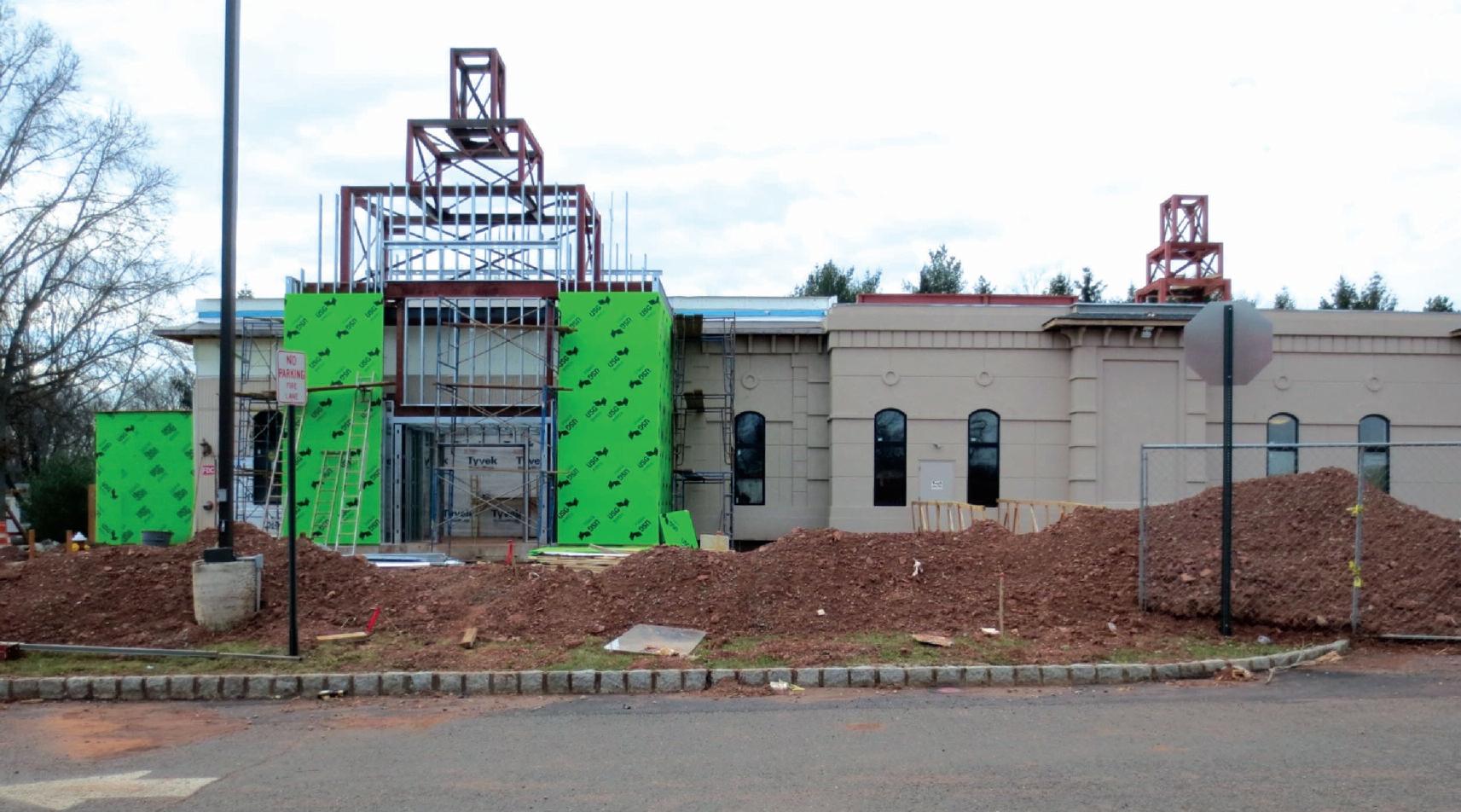
for the “Certificate of Occupancy” around July of this year. While we are working hard to complete all construction work and present to you the new facilities by midyear, there could remain unforeseen obstacles to solve before they are fully operational As Yogi Bera said “It ain’ t over until it ’s over”! We need your support, cooperation and patience as we go to the finish line
Here are some of my personal thoughts on challenges ahead once construction is completed and the facility is fully functional First and foremost is meeting our fiscal obligations, i e , paying our monthly mort-

ter auditorium, we will start internal finish work shortly as we expect to get PSEG connections done soon for both electricity and gas. We are hoping to complete both the buildings by the end of April Once weather gets warmer, we will plant evergreen trees surrounding the property, complete all landscape work and the parking areas We expect to be ready
gage to the bank towards $3.5 million construction loan. While we have planned to cover negative balance for first few months after inauguration of the facility, we all have to help to achieve optimal usage of the new facility
The expanded temple can provide more services to the community Towards that end, we are working to hire an additional
young priest as an assistant to Biswabhai, our Head Priest. This should allow us to provide more religious services both in the temple and in the homes of our members We will also have a large private puja room attached to the temple lobby to increase our on-site private religious services The vegetarian kitchen in temple basement would allow serving vegetarian meals to your friends and families after religious services Our other source of revenue should be from the community auditorium/banquet hall rental Once completed, this would be a fully equipped auditorium/banquet hall for dinner parties, musical/dance programs, dramas and other cultural events This facility has a nonvegetarian commercial kitchen to allow serving non-vegetarian Hindu meals in the hall There are also class rooms and open carpeted floor area in the mezzanine level for classes We will have about 300 parking spaces with several handicapped parking slots next to the community hall
Now that we are very close to seeing our long-awaited dream for a Heritage Center for our community come true, we all need to work together to make sure we love and take care of our community home by fulfilling our obligations both individually as well as collectively. We urge all sister organizations in the community to join and become Corporate Members of Ananda Mandir Unlike back home in India, we do not have zamindars, maharajas (e g , Rani Rashmoni) or billionaire businessman (e g , Birla) to build the temples or heritage centers for the community;
this has been built 100% with support from our members. Towards this construction, we raised one million dollars through your support but still needed a construction loan of $3 5 million to build a facility that suits our needs for both religious and cultural activities and educational classes for the next generation of children
This is the time for all of us in the community to come forward and offer our financial support as well as our voluntary services to help with the facility’s daily operations Please come and visit the site Our resident priest, Biswabhai would be happy to show you around and take note of your interest to serve the center This center belongs to every member of the community, irrespective of the size of your donation Your time and skilled service could be equally important to help run the center The Board of Trustees (BOT ) welcomes each of you who wants to serve the center, –and in turn, each of us individually needs to show our selfless desire to contribute and help the organization The success of this center depends on both an able management by the Board of Trustees to ensure harmony and fiscal stability and YOU as a community member to help the center thrive and grow.
At the end, the goodwill from all sides of the community is critical to help the center grow and prosper If we all work together for common good, we will fulfill the dreams of the community and especially some of our elders who worked hard to start this project but left us early with their dreams Thank you
Ananda Mandir
Calendar of Events (Dates are subject to Change)
Please check our website frequently www.anandamandir.org Tel: 732-873-9821
NOTE: If a particular Puja time is not listed, please contact temple or visit our website:anandamandir org
Shyama Puja
Wednesday, 06, 7:00 PM-9:00 PM
Basanti Puja
Tuesday, 12 to Saturday, 16 (*)
Nil Sosthi Puja
Tuesday, 12, 10:30 PM-1:00 PM
Bangla Naba Barsha
Thursday, 14 (*)
Ram Nabani Friday, 15 (*)
Satyanarayan Puja
Sunday, 17 (*)
Sahitya O Alochana
Friday, 22, 8:00 PM
Ananda Sandhya Not scheduled
MAY
Shyama Puja Friday, 06 (*)
Akshya Tritia / Chandan
Yatra Monday, 09 (*)
Ram Thakur Smaran Utsav
Sunday, 15, (*)
Baisakhi Purnima
Saturday, 21 (*)
Sahitya O Alochana
Friday, 20, 8:00 PM
Ananda Sandhya Not scheduled
JUNE
Phalaharini Kali Puja
Saturday, 04 (*)
Dashohara
Wednesday, 15 (*)
Satyanarayan Puja
Sunday, 19 (*)
Sahitya O Alochana
Friday, 17, 8:00 PM
Ananda Sandhya Not scheduled
JULY
Ratha Yatra
Wednesday, 06 (*)
Bipad Tarini Puja
Tuesday, 12 (*)
Ulto Ratha Yatra
Thursday, 14 (*)
Satyanarayan Puja
Sunday, 17 (*)
Sahitya O Alochana
Friday, 15, 8:00 PM
Ananda Sandhya Not scheduled (*) Call Mandir for Puja Schedule
Special Religious Services: Upon request, the priest of Ananda Mandir offers services such as inhouse Shraddhas, Rituals associated with Cremations (Antyesti Kriya), Shraddha Anniversaries, Pre-wedding rituals (Naandimukh, Ashirwad, etc), Upanayan (Paitey), Annaprasan, Wedding Ceremonies & Wedding Anniversaries, Griha Prabesh (Bhumi Puja), Consecrations of new cars (New Car Pujas) and others If you have needs for any of the above or more, please feel free to contact Biswabhai @ 732-873-9821
ANANDA SANGBAD
A Periodical Newsletter
Published By ANANDA MANDIR
(A Tax-Exempt, Non-Profit Organization)
269 Cedar Grove Lane Somerset, NJ 08873
Ph: 732-873-9821
Website: www anandamandir org
PUBLICATION COMMITTEE Of ANANDA MANDIR
Chairperson: Pronoy Chatterjee, pkc usa@yahoo com
Assistant Chairperson: Subrata Bhaumik, Bhaumik subrata@gmail com
Editor-in-Chief: Debajyoti Chatterji, Debsmee572@gmail com
Managing Editor : Ananda Sangbad: Guru Chakravarty, guruchakravarty@yahoo.com
Managing Editor, Anandalipi: Amitabha Bagchi, amitabhanj@gmail.com
Editors:
Subrata Bhaumik, bhaumik subrata@gmail com
Subhodev Das, subhodev das@gmail com
Sushmita Dutta, sushmitadutt2@gmail com Nupur Lahiri, nupurlahiri@aol com
Associate Editors: Amrita Kangle, amritakangle@hotmail com Ruby Banerjea, r banerjea@yahoo com
Members-at-large: Bhaswati Bhadra Ashok Rakhit
You have seen the front page article, “Ananda Mandir and You!” where Ashok Rakhit, Chair of the Construction Project, shares his thoughts on how to engage the community for the best usage of the expanded temple and the community auditorium/ banquet hall Now that Ananda Mandir expansion is nearing completion, it is good to review how Ananda Sangbad can be more useful to its members
As you know, Ananda Sangbad has been the main vehicle to bring all construction status updates to you since the beginning of these projects Additionall, Ananda Sangbad publishes a quarterly calendar of all puja activities at Ananda Mandir for the benefit of the community It showcases the performances by our youngsters, who participate in the cultural presentations during the pujas, to encourage them to keep up with our culture It publishes reports on the monthly musical events, “Ananda Sandhya”, to encourage community participation It reports on the monthly literary discussion events, “Sahitya O Alochana,” with critical reviews for the serious readers
The articles in Ananda Sangbad cover an entire gamut of subjects like philosophy, entertainment, science and technology, medicine and travel Some of these can be quite useful, besides being enjoyable, in our daily lives The publication has a youth section that features articles of our school-age children as encouragement to hone their writing skills
Ananda Sangbad reaches about 1400 households who are members and associate members of Ananda Mandir As such this news magazine can be used to publicize the availability of rental spaces – the auditorium, the banquet hall, and rooms for music/ dance/ language classes Instructors can benefit from advertising their schools in Ananda Sangbad for a small fee Additional advertisements from various community businesses like insurance companies, banks, doctors, lawyers and other professionals, can be placed to attract customers. A space can be set aside to “Appeal for Donations” for the temple. Ananda Sangbad may also be used to announce big events like Durga Puja, Kali Puja and the Annual General Meeting, thus saving on mailing costs.
Ananda Mandir has been a beacon of hope, determination and inspiration for Bengali communities all over the USA. Ananda Sangbad is the right vehicle to convey the messages of the organization to its readers
Guru Chakravarty Managing Editor, Ananda Sangbad
On behalf of the Board of Trustees of Ananda Mandir, I wish you and your family Shuvo Nababarsha! May the Bengali New Year bring you health, happiness and prosperity
I want to thank all our members and friends for giving financial help to Ananda Mandir throughout the past year, volunteering services for our many programs and joining in Ananda Mandir activities With your help, Ananda Mandir has now become a leading Bengali Religious and Cultural center in this country
When I joined as a trustee in 2000, Ananda Mandir only comprised of the community center building and a small temple, and the organization had a few dozens of members who were working diligently towards building a Bengali Heritage Center where Bengalis could join to fulfill their religious needs and celebrate their cultural heritage I have witnessed a remarkable progression of this Bengali Heritage Center during my tenure I have witnessed more than fifty folds increase in membership and substantial growth in the financial strength of this organization Most importantly this organization has now become a household name in the tri-state Bengali community
In early 2000, Ananda Mandir built a temple with about 95person seating capacity prayer hall and brought in an extraordinarily knowledgeable priest, Biswabhai, whose religious performances not only impress devotes but bring Hindu customs all the way from India to New Jersey and to our home. Also, importantly Biswabhai has been an important foot soldier in promoting Ananda Mandir's growth by providing best religious performances, financial supports, voluntary work beyond his duties – and being a great host to our devotees
Now, Ananda Mandir has an expanded temple where daily puja is performed This expanded beautiful temple can now hold 300 or more people The outside of the expanded temple is currently awaiting external finishes such as sculptural artwork When completed, the temple will proudly carry a Bengali heritage look We are also building a vastly increased parking facility, which will have allow parking of over 300 cars We are nearing the completion of our new Community Center, which will be able to host small and large parties for wedding, birthday, retirement, graduation, anniversary and shradha events The community center will also be able to hold small or large size cultural programs, movie shows, plays and many other events Additionally, we will have several rooms for rental for art, dance, language and religious classes
l l
All queries, articles, news reports and letters should be directed to the Managing Editor: Phone: 908-752-3065, E-mail: guruchakravarty@yahoo com
For general information, please contact the following executives of Ananda Mandir: Dipak Sarkar, President
Jaiprakash Biswas, Vice President
Suprasad Baidyaroy, Vice President
Chanu Das, Treasurer
Arun Bhowmik, General Secretary
If you are a Life Member or an Associate Member, but didn't receive your copy of Ananda Sangbad, it may be because we do not have the correct address on file for you. Please send an email to Guru Chakravarty (guruchakravarty@yahoo.com) with your correct address, and we will send you another copy.
Ananda Mandir has created an Youth Forum to promote youth activities Under this Youth Forum, we have offered internship program in research laboratories and at Ananda Mandir facilities Some youth members are also involved in maintaining a monthly wall magazine, Kishaloy, that is proudly displayed on the wall of Ananda Mandir Community Building Our younger members write short stories, scientific article, and submit art and photograph for this wall magazine We also have started a Seniors Forum to address in a systematic and coordinated way the many issues faced by Ananda Mandir members who are nearing retirement or have already retired We have continued to support and encourage our local musical talents through our monthly Ananda Sandhya events The reputation of Ananda Sandhya has now spread widely, and we are attracting people from not only New Jersey but also from New York and Philadelphia Ananda Mandir also created Gayatri GaMarsh Memorial Award for Literary Excellence to recognize literary works in Bengali and English languages. We have sustained a monthly literary discussion group, Sahitya O Alochana, for over seven years. These sessions feature eminent Bengali s as well as local prominent writers. We recently provided a community service grant of $2000 to Manavi (to refurbish Manavi's safe home, Ashiana) and $2000 for Fund for Relief of Nepal’s Earthquake Victims. We also are providing our members free of cost with Anadalipi and Ananda Sangbad containing many outstanding literary works of local authors
Since my joining Ananda Mandir as a trustee, I have served as Chair of Constitution Committee, General Secretary, Vice President – and finally, as the President for the past six years I am happy with the progress I have been able to make by working with an incredible group of trustees and non-trustee volunteers I am now looking forward to hand over my responsibilities to a new President later this month
Ananda Mandir is a leading religious and cultural center for Bengalis in this country Please support Ananda Mandir and become an active volunteer to keep this Heritage Center strong so that this organization continues to provide religious and cultural services to thousands of Bengalis and friends of Bengalis in the tri-state area
Dipak Sarkar President, Ananda Mandir
By Basab Dasgupta
One of the main characteristics that distinguishes the human species from all other living beings is their ability to communicate among themselves, both verbally as well as in writing, in addition to using body language and facial expressions which some other animals also do. The humans interact using a specific language which has well-defined vocabulary, grammar and compositions It would be interesting to examine what advantages we gain from this ability and what could be an ideal means of communication
There are really only three reasons for communication among humans: 1) to share and exchange information; 2) to share and exchange emotions, and 3) to preach and teach Any other reason is either a subset of one of these reasons or a combination of them For example, when a salesman is making a forceful sales pitch, he is combining emotion with information It also becomes obvious that while the first and third purposes can be served simply by exchanging written notes, it is more difficult to share and exchange emotions through writing Even spoken words seem inadequate to truly express what we really think and feel
Our thought processes regarding emotions are very complex For example we think of many things in parallel We think simultaneously in the past, present and future. Our emotions are always a combination of many different feelings. We also have a hidden agenda, so to speak, when we are talking to express our emotions. For example, we might want to know the reactions of the other party or may want to provoke them into giving their opinion on some issue It is impossible to correctly express all of these in the very limited vocabulary and grammar of any language So, the next logical question is, why is it so important to interject emotions into our communication?
If all of our actions were based on logical and rational thinking, then there would be no need foran emotional spin Fortunately or unfortunately, an overwhelmingly large percentage of our decisions are based on emotions These emotions could be love, anger, fear, jealousy, joy, pride, humility and basically the entire spectrum of stimulations of our minds This is a part of human nature! I do not know if the world would have been a better place if all actions were in-
deed well thought-out and based on solid reasoning The fact is that it is our emotions that run the world and perhaps the world would have been a very cold robotic place without it. This human nature of living an emotion-based life makes it imperative that we are able to correctly convey these emotions when we communicate. There is no language on earth which allows us to do that The consequence is that our expressions are only incomplete or distorted versions of our true ideas I believe that this failure in our communication is the main cause of all conflicts in the world including war between Nations, marital problems, political fights, religious differences and inter-personal clashes
Two other factors contribute to this inadequacy: 1) Most of the time in our verbal communication, whether it is formal or informal, we really do not spend that much time to think before we speak We do not want to appear to be “slow” or “stupid”, so we give a response in a relatively short period of time 2) There are social and political norms which dictate that certain things should not be said, even if we feel like saying them, because they might be inappropriate or offensive or perhaps even be revealing too much private information
When we learn a foreign language, we do not learn how to color our conversations with our emotions We learn to do that in our native language, from our very childhood, by watching our parents, relatives, friends, colleagues and also from movies, speeches etc. This is why it is so difficult to communicate in a foreign language at the beginning because, even though we learned the language, we did not learn the expressions that go with it
There is an entire gamut of means of communication in the world The American culture and the Japanese culture are probably two extreme examples The Americans put a very high value on the ability to articulate clearly and concisely If you think of any business meeting or sales presentation or a technical conference, if the speaker makes his points in a very rational and convincing way, we are always impressed We do not like speakers fumbling with words, talking too long and incoherently or becoming too passionate in his speech Even in our informal discussions, the one who gets his point across in a rational way, seems to be correct, no matter what the sub-
ject matter is The English language itself facilitates this articulation Many different words and compositions are readily available to describe any given situation or express a particular thought On one hand, there is a plain narrative using simple everyday word, while on the other hand, one can also give it a very scholarly or intellectual flavor by using more sophisticated and less frequently used words. There is also an abundance of words available to describe our emotions. Take the feeling of a young man for an attractive woman, for example. We can use words like “loves”, “lusts after”, “likes”, “is enamored by”, “is infatuated with”, “is obsessed with”, “ is head over heels”, “has a thing for”, “has a crush on”, and probably a dozen more to give it different shades Americans also love to talk Even if you meet a total stranger, whether at a social gathering or public place, you will find out fairly soon about his or her profession, details of their marital status, names of their children and pets, their financial situation , their political views and probably a host of other information that you really do not care for I often wonder what motivates them to share all these personal details with people they have just met It is probably the individualistic American life style which does not provide too many opportunities just to share one’s personal information as an emotional outlet
The Japanese, on the other hand, always seem to be a little awkward with words, even when they are speaking in their own language. They rely heavily on non-verbal communication. This is certainly true in informal conversations between colleagues, but also in formal presentations. These non-verbal interactions take place not just by body language, but also in many other subtle ways A Japanese gentleman once told me “When you are talking to a Japanese person, what is not said is just as important as what is being said” He also said that “When you are talking to someone, you have to read their eyes If you look deep into their eyes, you would know what they are really thinking!”
Then there is a whole range of communication styles between these two extremes In many cultures, including in the Indian society, male domination sets the tone It is the men who have the final say; they have the right to interrupt the women and correct them In many cultures, women are not even considered worthy
Continued to page 4
By Amitabha Bagchi
“Did you see the London Tower?” a relative asked me the day after I reached Calcutta (now Kolkata) “As you were coming from the airport?”
“What tower?” I asked in bewilderment I had flown into the city around midnight, dog-tired, and did not recall seeing anything resembling the formidable Tower of London What I had seen instead were long rows of lamp posts, on both sides of the airport access road (aka Nazrul Islam Sarani), wrapped around by strings of multi-colored tiny (“toony”) bulbs – blue, green, white – creating an eerie luminescence to welcome visitors to the city
The mystery of the London Tower was resolved a few days later when I was riding a cab on the same road in daytime Mamata Banerjee, popularly known as Didi, has erected a replica of the Big Ben, the iconic clock tower of the British Parliament in London, next to the airport access road It seemed to be the most prominent example of her resolve to turn “Calcutta into London,” a pledge she made after taking the oath of office as West Bengal’s Chief Minister
“Why this obsession with London?” I asked a friend. “Isn’ t it obvious?” was the reply. Calcutta is, after all, a British creation, and was once the Second City of the Empire. Doesn’t it make sense that it aspires to emulate the First City?
No matter what her other faults are – and they are legion – I have to compliment Didi on a certain sense of aesthetics that was lacking in her male predecessors Shortly after attaining power, she cleaned up city streets, painted parks, road dividers and many government buildings in blue and white, and installed shapely trident lamps on many city streets Nearly five years into her reign, the paint is coated in dust, my neighborhood streets are continually dug up and imperfectly repaired, and wags point out that much of the state contract for visual improvement was awarded to her relatives Nevertheless, the attempt to give the city a face-lift is welcome and was long overdue My brother-in-law, no Mamata fan, waxed poetic about the upkeep of the pretty park, called Mohar Kunj, right next to Nandan and facing the Victoria Memorial, where he went daily for his evening walk
2. Computer-Aided Efficiency in Unlikely Places
In olden days, whenever I went somewhere in Calcutta to get some work done – say fixing a dead telephone line or making changes to a bank account – I would inevitably hear the same refrain, “Please come back tomorrow ” The reasons might be different, but the prescription was always the same I began to refer to the operating style as the “eternal timelessness of India ”
I am happy to report that I saw significant changes in this regard – changes by and large brought about by computerization It began some years back with the introduction of computerized booking for railway travel This time around, I saw welcome examples of such efficiency in the post office and the office of land records and resource management
India Post (Bharatiya Dak) has introduced a service similar to Priority Mail of USPS that is called Speed Post I had my first exposure to it on this trip After some initial hiccup, when I struggled to figure out the right post office and the right window to go to within the right time frame for the service, I finally mailed out some ten packages to various parts of India – Jamshedpur, Noida, Pune as well as Calcutta suburbs (Rahara, Konnagar) The young lady at Kalighat post office was computer savvy and very efficient. I was pleasantly surprised to get a receipt with tracking numbers. But a far bigger and pleasanter surprise was to see the postman return two of my packages as being undeliverable due to incomplete or incorrect address. I honestly had not expected this level of service from India Post!
The experience at the land records office of Karimpur – a small town in the northern Nadia district near the Bangladesh border -was equally uplifting I went there to do some legal work related to agricultural land holdings of my ancestors that I now partially own My first surprise was to learn that the land records are now accessible on the web – written in Bengali (both letters and numbers), no less Then my transaction also went through smoothly, and at the end I had to put my thumb on the glass surface of a small, very modern machine which digitally recorded my thumbprint My
Continued to page 4
By Ruby Banerjea
The curtains fluttered in the soft early morning breeze as I sighed deeply, hugging my covers and trying to go back to sleep No sooner had I closed my eyes than a strong waft of fried puris came floating inside the room It was inevitably followed by the smell of fried eggplants, which of course are the perfect accompaniment to fried puris! It is not that I don't like a typically Bengali breakfast, but at six in the morning? I was too lazy to get up and close the window, so I turned the other side and buried my nose in the pillow It was not that easy A loud clanking of pots and pans followed, and I could distinctly hear the fish being lowered into the hot mustard oil! I crinkled my nose, as all of these aromas caused havoc to my olfactory senses. There was no chance of sleep, that was for sure.
This is Kolkata where the sights and sounds, not to forget the smells, hit you the moment you set foot in the airport As I set out of the airport, which is mostly in nighttime for me, the air is heavy with smoke and humidity in summer or smog in winter However these are the smells I know and have gotten used to, so much so that I will definitely miss it, if otherwise As the taxi takes me through the late night streets, all the familiar sights greet my eyes; in winter it is men and women huddling around poorly lit fires and children clinging to their mothers in a vain attempt to keep warm In summer, however, the streets are quite alive with people; the municipal taps which are on at full force, have water gushing out of them, and children playing in and around them to keep cool Their laughter and excitement bring a smile to my lips as I realize how little it takes to make them happy! It is kind of comforting to come back to the same sights every time I'm here. The medical shop, just around the corner, the sweet shop right next to the convenience store and the flower vendor who sits right on the steps, are there as always The narrow lane is lined with shops and stores of all kinds; a few new ones catch my eye Boutiques seem to have mushroomed everywhere! The rude blare of horns forces me to almost flatten myself against one of
the lamp posts to allow a rickshaw to pass A cyclist speeds through, merrily ringing his bell, followed by a noisy taxi which bumped along It amazes me how the pedestrians manage to walk at all Walking along the streets of Kolkata makes one an expert at dodging obstacles, at least I became one It is not only the traffic; there are stray cats and dogs almost at every corner, which become an utter nuisance at night when they decide to exercise their vocal chords One bark leads to another sharp response which turns into a full blown howl The entire neighborhood canine population comes alive, and it is invariably at night I had to calm one of my daughters when she was very young, as she wanted to go outside to see why they were barking.
"They sound as if they are in pain, Mummy. Can I go out and see?"
I had to try hard to convince her otherwise and force her to go to sleep She had taken upon herself to feed all the neighborhood dogs with whatever she had in hand She had even offered one of them an egg-roll
I used to be always quite surprised to note that whenever my younger daughter was in Kolkata,she never complained of getting bored while riding in a car In the US she drove us crazy with her "Are we there yet?" But, surprisingly in Kolkata, she used to watch outside the car pressing her nose to the window When asked she said "there is so much going on outside, it is so entertaining!" Well, can't argue with that!
My husband, however, dreads to sit in a car at all He constantly holds his breath and jams on the imaginary brakes as the drivers weave their way through the interminable traffic He prefers sitting in the back seat where he does not have to watch the traffic. He just closes his eyes and grits his teeth. However, the noise can hardly be blocked out. It is interesting how everyone in Kolkata has gotten used to a high pitch noise level There are road blocks where on a make-shift platform some very enthusiastic person is trying to prove his point by shouting into a loudspeaker His wildly gesticulating arms, and a very serious expression has attracted
a curious crowd around. My daughters had once asked, "Mummy, what is he saying and who is listening to him?" I had no answer to that Watching television is the favorite pastime of most of my folks back home, with which I do not have a problem, but what bothers me the most is that the volume is almost always turned up to a point where making a conversation is impossible Trying to turn it a notch down would be met with angry protests from my family It makes me wonder if all the surrounding noise pollution is taking a toll on everybody's nerves It certainly seems so when the next-door baby wails at the top of her tiny lungs and her equally frazzled mom's frantic efforts to calm her down The adjacent neighbor's daughter comes back from school in the afternoon and we all brace ourselves for the invariable argument that ensues between mother and daughter, the latter trying to convince her mom where she should sit and do her homework. It usually spoiled my much coveted siesta as I could hear every word, but surprisingly my folks sleep through all of that as if they hear nothing! It has become such a routine that it actually serves as a lullaby
This time when I was in Kolkata I happened to be there during Saraswati Puja There were panadals of every size and shape dotting our neighborhood It was very interesting how among the narrowest of lanes a large pandal would spring up, and the most beautiful idol, complete with all its finery, would be gracing it Little children running around, their chaperones engaged in animated conversations, the cultural programs being held with such enthusiastic energy, all in one of the lanes which bear no resemblance to their former selves Lights and music fill the night air and everybody seems to revel in the festivities I loved to be in the midst of it all, for once not caring about the chaos around me
Back here, outside my house in New Jersey, I look around and take a deep breath It is a clear crispy day with a nip in the air As I take a deep breath I smell nothing, and that is when I miss the aroma of fried puris, the road side phuchkas (pani-puris), the cacophony of traffic and even the humid, smoke-filled air of Kolkata.
The silence is deafening
Continued from page 3
of a healthy debate In academic circles, there is an inherent competitiveness based on intellectual ego Everyone wants to show how literate and knowledgeable they are The British are known for their unique “stiff upper lip” style of proper conversation while many “Asians” (excluding the Japanese) seem to think that how loudly they speak is an indication of the importance of their subject or position. Most Mexicans tend to be very basic and simple in their communications, though not quite as minimalistic as the Japanese Then there is also the combative style where one deliberately and selectively says words or phrases which one knows would be just the right provocation to invoke the desired emotion from the listener
While being able to articulate one’s thoughts is a challenge, the listener also contributes to the ambiguity of the interaction by doing his/her own interpretations in different ways He factors in the facial expressions and body language of the speaker, the tone of voice, any pause or emphasis on certain words etc and adds his own spin on the story How much attention he spends also depends on his frame of mind and other thoughts he is preoccupied with Sometimes, the listener “hears what he wants to hear” by selectively tuning in his attention On top of all these, the speaker might simply fail to convey what he is really trying to say because of his poor use of composition, words, etc
Of course, diplomacy in conversations is warranted for personal interactions in a civilized society. If everyone spoke his mind out, there would be immediate problems and total chaos. In politics, the political leaders understand what needs to be said, whether they believe in them or not, and what is better left out. The
desire to appear polite or charming is inherent in almost everyone and so there is a façade that everyone presents to others, which may or may not be a true indicator of their personality Intelligent people often make communications even more complicated by using tools like “reverse psychology” and playing “mind games”, for the purpose of extracting specific information to help their causes
The world of communication between remote parties has been changing from phone conversation to texting. Texting has several advantages: it allows one to relay just the bare minimum of needed information without wasting one’s time in exchanging pleasantries and discussing a whole array of other issues not relevant to the subject on hand It also allows a person to avoid people he does not desire to converse with at a given point of time for whatever reason One can send numeric information such as telephone number, house address and time for a meeting without having the other party write it down on a piece of paper One does not have to face emotional reactions from the other party based on the information transmitted This last aspect is precisely also what the downside of texting is In fact, the very reason we want to even talk is to share our emotions It is interesting to note that those little symbols like a smiley face or a frown (“emojis”) that one can attach to an E-mail are attempts to serve this purpose of conveying the emotions in addition to the written content
So, if neither the writing nor speaking of words in any language allows us to completely express ourselves then how should we communicate? Is it preferable not to say anything at all? Just use body language and facial expressions like animals and perhaps some ESP?
Continued from page 3
nephew who accompanied me to the office commented that if either the computer or the data link had been down, we would have had to spend several hours on the job. Nevertheless, the efficiency I encountered was truly commendable.
3. Some Traditions that Refuse to Change
There were examples of course of unchanging traditions The ugly bamboo-and-tarpaulin shacks disfiguring Gariahat More and the neighboring Rashbehari Avenue were very much there, a testament to Didi’s populist stance and the courting of a reliable vote bank So were makeshift eateries with permanent cooking facilities affixed to footpaths near the Kalighat tram depot that served full vegetarian meals for Rs 20 /and non-veg stuff at slightly higher prices All of these cater to distinctly satisfied clientele
Because of my advancing age, I found it touching that there is still some residual respect shown to seniors. All cars of the Calcutta Metro have reserved seats for not just ladies but also senior citizens and handicapped people. It was mildly embarrassing to find young girls vacating their seats for me. But the inability of Indians to fall in a single file to approach a desired point (entrance gate, ticket window, food buffet) still endures I remembered Mark Tully’s book, “No Full Stop in India,” and wondered whether a sequel titled “No Straight Line in India” might be appropriate To be fair, people in a line generally observe the order of their position, even while straying sideways, but occasionally people blandly and nonchalantly cut in if they can locate an accommodating friend Such behavior, of course, is what makes India essentially India!
By Rahul Ray
First, Nishi-Padma in Bengali was released in 1970, and then came Amar Prem in Hindi in 1972 Both movies, based on a short story, “Hinger Kachuri” by Bibhutibhusan Bandopadhyay, were instantaneous sensations Uttam Kumar, the veteran Bengali matinee idol was flawless as a Bangalee Babu rejoining his childhood love Pushpa, who had taken up the world’s oldest profession due to failing family circumstances In the Hindi version, Rajesh Khanna, with his flawless and chiseled face donning a


charming smile stole the heart of every cinema-goer who saw the movie But, the real show-stoppers were the songs in both movies Manna De received a national award for the song ‘Ja khushi ora bolay boluk ” I saw Amar Prem when I was a mere adolescent But closing my eyes I still can see Rajesh Khanna, in a drunken stupor singing “Kuchh to logo kahenge ” Even today, when these kinds of movies are no longer in vogue and consi soggy by most discrimin movie-goers, both songs are to drench their hearts and m with sadness And yet, they most certainly leave the movi ers with a palpable sense o manticism
Debdas, by Sarat Chan Chattopadhyay, is another s classic This novel, again ab a well-to-do man falling in lo with a prostitute has be made and re-made in movies several Indian languages La year, I was in a literary confe ence in a suburb of Bosto where an Indian person, ap parently of non-Bengali orig nal, spoke in glowing term about this novel. His voice trembled with emotion, and tears welled up in his eyes Such is the draw of the story in this novel! Actually numerous stories, novels have been written, scores of movies have been made on this theme – the storyline is a y – a boy and a girl, childhood lovers get separated by twist of events The boy becomes a man when he finds his old flame raped by a relative had become a prostitute The man would almost inevitably belong to a very well-
to-do family, and in particular with movies he should have a fine taste for music This has been a staple for Indian readers and movie-goers, particularly the latter for generations
However, a more gritty and down-to-earth treatment of these women has also evolved, although with significantly less frequency In the early 1940s, during the infamous ‘famine of Bengal’ millions of people lost their livelihood and innumerable families were shattered Villages were drained of people who poured into big cities like Kolkata begging for food, and ultimately died like flies on the streets and back alleys of the city A similar situation arose a few years before the independence of India in 1947, which might have contributed to the partition of the erstwhile Bengal province of British India A large section of people from the then East Bengal lost all their possessions and streamed into Kolkata for shelter and livelihood On both occasions, there were no jobs in the city to provide for the families that survived the famine or the partition Thus it became a question of survival by any means
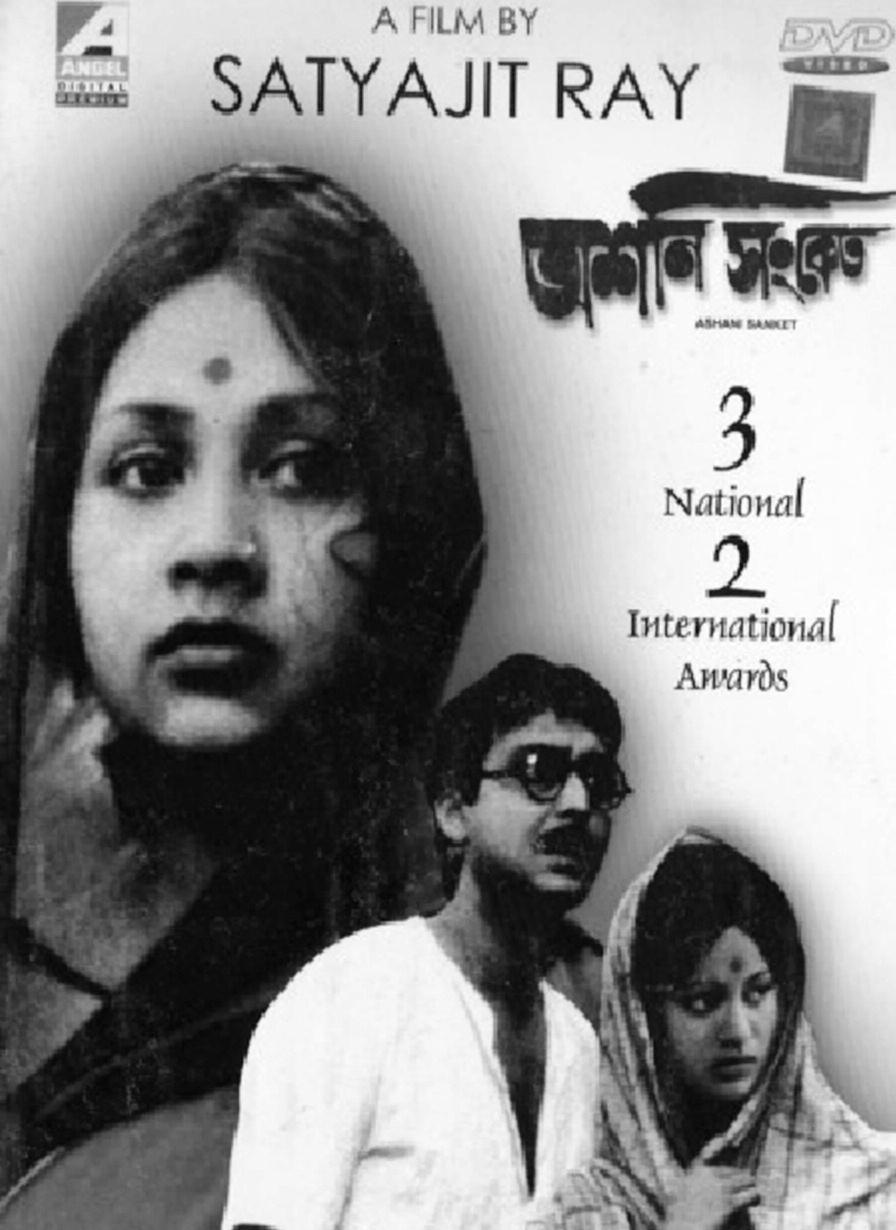
Under such dire conditions “when men in the family could not provide food and shelter for their families” many women took up prostitution as a means to provide for their families. Plight of these women have been depicted in many literary works of that period. In the celluloid medium, Satyajit Ray portrayed the predicament of Chhutki, one such girl in a famine-stricken village in his movie depiction of Ashani Sanket by Bibhutibhusan Bandopadhyay. On the other hand, Ritwik Ghatak sketched the character of Sita, a victim of post-partitioned Bengal who turned to prostitution in his epic film, Subarnarekha In all these novels and films sympathy for these out of luck women is palpable But, in stark contrast, the Indian society in general has been outright hostile towards these hapless females By and large, the social norm would tacitly accept the use of these women for sensual pleasure while openly and actively obstructing their resettlement into the society, thereby denying them the very basic human right of enjoying a family life Throughout the nineteenth till early twentieth century it was a common custom amongst the wealthy Bengali Babus in Kolkata to “keep” multiple concubines, in addition to their legally married wives But, none of those women, dubbed “Baranganas” were ever given a chance to have a normal a woman The life of Binodini Dasi, commonly known as Nati Binodini, the famous actress and consort of Girish Chandra Ghosh, the most famous Bengali theater personality of the twentieth entury, is a typical case bout the treatment of women in the outskirts of the ociety ” It should come as no urprise that Nati Binodini, deite her unwavering devotion r Girish Ghosh was ultimately ld to a merchant in the name establishing the Bengal Ther Company.

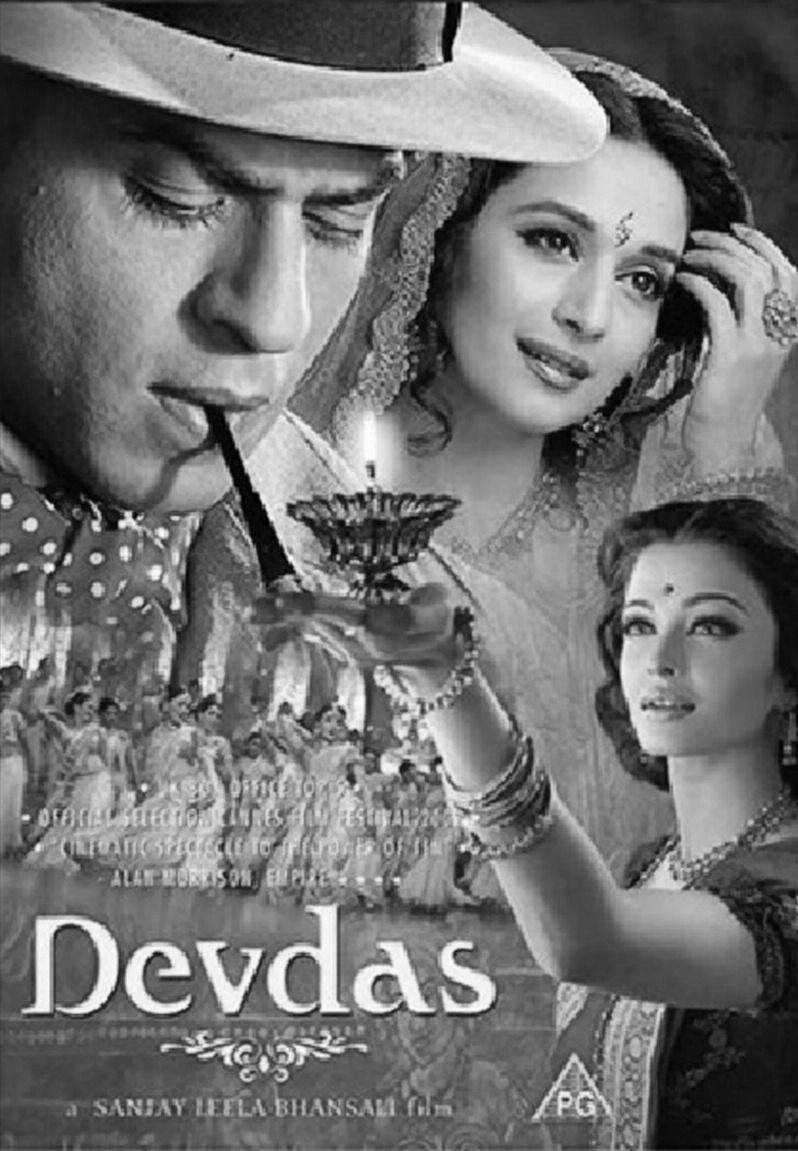
The women’s rights groups India have long advocated inst the mistreatment of se women, but the doubledard has continued. Even y these women, who are n victims of rape and incest ot return to normal family life o strict moral codes imposed hem by the male-dominant n society But, strangely gh movie-making about prostitutes and romanticism continues to thrive The last movie-version of Debdas (Devdas) was made in the year 2002 with the biggest stars of Bollywood including Shah Rukh Khan, Madhuri Dixit and Aisharya Rai It instantly
became a national and international superhit and one of the top-grossing Indian movies ever made! Then there are scores of others on the same theme, like Umrao Jaan, Pakeezah, Dev D, etc
Recently, attempts have been made to de-romanticize prostitution’ by categorizing these out-of-luck women as “sex workers ” Apparently, the underlying idea seems to be that calling these women “workers” in a trade may have dual effects of reducing social stigma as well as recognizing prostitution as a profession, much like any other professionals in various sections of the society Such cat-

egorization may even give them access to benefits that are common to other trades such as paid leave, health care, collective bargaining etc It is fair to say that these expectations have largely remained unfulfilled But such a scenario can potentially change
The attempt to classify prostitutes as “sex workers” is similar to the effort by Mohandas Karamchand Gandhi to categorize “untouchables” as “harijans”(people of god) During and prior to Gandhi’s period, India had a very rudimentary system of sanitation People responded to nature’s calls in the most primitive way possible For generations, Harijans, residing at the very bottom rung of the much dreaded Indian caste system have maintained cleanliness and hygiene for the entire population The other Harijans, dubbed as Doms (or Dowms) have cremated bodies of deceased as a profession for time immemorial, and prevented spread of diseases But, in the process these people have become ‘untouchables’ to the society at large
The Indian social history for the past half a century demonstrates that Gandhi’s attempt has produced mixed results. Constitutional changes have been made to improve the lot of the Harijans by bringing them into the fold of Scheduled Caste and Tribe category, thereby providing them with quotas in getting education and jobs. Such efforts are bearing fruit by lifting many of them out of dire poverty and darkness of illiteracy. Yet majority of harijans are still reviled and segregated in the castebound Indian society
Categorization of prostitutes as sex-workers has produced some positive results also Sonagachi, arguably the largest brothel in the world situated in the outskirt of Kolkata and a leftover of the Babu culture in British India used to be the breeding ground for sexually transmitted diseases (STD) A concerted effort by several non-governmental organizations and a few individuals who have stayed above the stigma has significantly reduced the
Continued to page 7
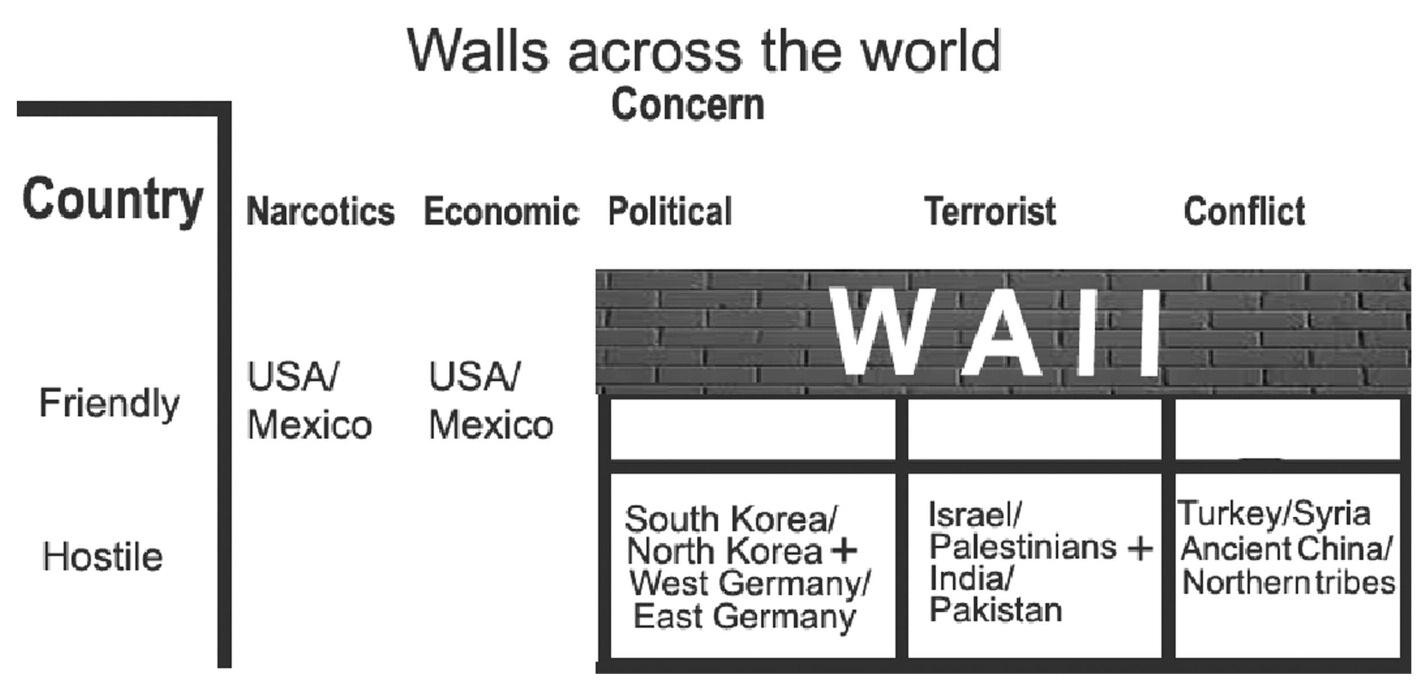
A growing concern gaining traction in the recent years is that illegal immigrants are pouring into the US Many conservative voices in the US lately believe that a wall is required to prevent the influx of illegal immigrants from the south of the US There is a fear that they are taking over jobs, burdening the social services and changing the very character of the country They are also blamed for violence and bringing narcotics into the country According to some people, a good way to prevent the illegals to come into the country is to build a fence along the border with Mexico
This problem of border control is not unique to the US and many parts of the world have implemented solutions and it would be good to evaluate some of the border controls that are in place. To analyze the situation we can explore by evaluating the following questions.
1. Where else do walls and borders exist?
2 Are they effective?
3 Are they appropriate?
4 Are there alternate methods of containment?
Existence of fences or walls
Let’s look at one of the borders in the world which is serving as a gateway for refugees into Europe The border between Syria and Turkey has been one of the most heavily used in recent times for refugees escaping from ISIS, the Syrian government of Assad and a variety of ethnic groups Any country in the situation Turkey has been placed in, with a hint of humanitarianism, would allow refugees into the country Jordan, another neighbor of Syria has also seen a mass influx of refugees at various times during the conflict
Initially there were minimal border controls but finally the Turkish government is building walls and fences to control this incessant refugee crisis Prior to these fences
By Tathagata Ghosh
cost of the building the wall was presumably distributed over many centuries too
The primary purpose of the wall was security, to prevent the nomads from Eurasia from attacking the country It also served for immigration control and to levy tariffs
The other infamous barrier was the Berlin Wall built post World War II and divided a country for about 30 years The unspoken reason was that the Eastern communist bloc wanted to prevent mass emigration of people to the West The wall did succeed in preventing the defection though about 5000 people attempted to escape and about a hundred died doing so.
The fencing between India and Pakistan is some of the most advanced in the world. There is about 500 km of fencing built by India primarily to deter the infiltration of terrorists along this area. In addition to fencing, it is electrified and there are a liberal sprinkling of landmines for hardening the defense
A model for the proposed US-Mexican wall is the Israeli West Bank barrier Its main purpose is to prevent terrorist attacks Though very controversial, this has seen as a very successful barrier in achieving this primary objective
The US would need about 2000 miles of wall with each mile costing about $16 million per some estimates Hence the taxpayers are on the hook for a few billions of dollars just to build the wall An interesting fact though is that over 500 miles of this border wall has already been built The wall or fence is of varying quality across its entire length Some places the wall is so low that it serves as a volleyball net Creative attempts have been made to breach the wall, including an abortive attempt of laying

being installed, thousands of Syrian refugees had already migrated to Turkey and are frequently seen in places like Istanbul Many of the refugees have even been reduced to begging on the streets
Throughout Europe, impromptu fences are being built to keep out the mass exodus from war-torn Syria and Libya Fences are going up all over Europe to keep the waves of migrants and refugees out Austria built its fence along the border with Slovenia, beginning the dissolution of the free-movement pact between Schengen countries
One of the most formidable walls in history was the Great Wall of China Though colloquially called the 10,000 mile wall, the actual wall construction was about 3000 miles It was built along China’s northern borders and built over many centuries The
a segmented and articulated track and attempting to drive over the fence
So have these barriers been successful in preventing infiltration?
These fences are effective in different degrees The fences are more effective in places of higher population The Berlin Wall, one of the more reviled barriers, was breached many times, and many of these escapes have been captured on film People cut the barbed wire and ran through it
Some flew over the barrier, dug under the barrier and sometimes drove cars through barriers Unless barriers are patrolled they will be breached The barriers built along the West Bank has been effective in minimizing terrorist attacks per most accounts
The barriers between India and Pakistan has been fairly effective in preventing ter-
rorist infiltration The existing barriers in the US-Mexico border can be and have been breached by climbing over, by digging tunnels under and simply by walking through any fault in the fence There have even been attempts by cars to drive over the barriers by ingenious track systems It is a fact that most borders are hard to protect without continuous patrolling or surveillance and apprehension in case of a breach
When are barriers an appropriate response?
If there is clear and imminent danger of people who are entering though the border, it is an imperative to control the borders. The protection is important against threats to security and economic stability. In the case where there are people flocking through borders due to an existential threat, there is a moral reason to take them in; just as one would help somebody in distress fleeing from a burning building If the numbers of people flocking through the borders is unmanageable and lead to a collapse of support mechanisms, a country may have no choice but to shut its borders the best they can Emotion aside, building a barrier is a natural choice for a country when the borders are hostile or troubled
Is this appropriate in the case of the US?
It is a complicated question which gets even more convoluted because USA is a country of immigrants If the people who come across the border are going to contribute to the society as a whole they are welcome If they are a menace to society and bring in drugs and violence they should be the interdicted at the border and never allowed in If they are inside, they should be deported The urgency to enter is as strong for a desperate family looking for a better life as it is for a criminal looking to bring drugs into the US
In the case of US and Mexico it is debatable whether a wall is an appropriate response As mentioned earlier, it is very expensive, both the building of the wall and the monitoring The crisis is not with Mexican people crossing the border in droves but people from the south of Mexico, from places like Guatemala and El Salvador, who are coming through the borders. The narco-traffic, in any case, will never be slowed down by walls, so the prevention of drug-trafficking can never be a convincing argument.
What are the alternatives?
A good standard of living, freedom and jobs in Mexico seems to be one of the ways in which the migration can be stopped Fences and border are deterrents but if people are desperate they will force their way in
With rising economic standards in Mexico and jobs being created there, there is less of an incentive to migrate to the US So it is in the best interests of the US to help the economic revival of Mexico in particular and South America in general Extending this argument, it may be worth investing in the economic revival of places like Cuba and other South American nations so that the incentive to migrate diminishes
On the other hand, if any of the economies in Latin America collapses and if there is massive migration, the walling of America may be an unfortunate and unpleasant reality
By Amrita Kangle
Deep at night, under a heavy blanket pulled up over my head, my reading lamp pulled alongside to help me in my endeavors, I was lost in the adventures of Pat and Isabel, the inseparable twins They were having a midnight feast in their dormitory at St Clare’s and I was as good as there with them, in my bedroom in Mumbai Of course, the whole exercise was forbidden to them and their friends, so it was that much sweeter; as was my nocturnal adventure. I was not supposed to be reading in the dark and definitely not late into the night. And just as the twins were caught out on their adventure in their boarding school, so was I I think mothers have an extra olfactory sense when it comes to smelling out the misdeeds of their offspring and mine was no different The light was suddenly switched on in the room and I will just say that my virtual midnight feast came to a very abrupt end along with the threat looming large over my head, that all my story books would be confiscated for a month I was all of ten years old
All through my growing years, Enid Blyton had a very strong impact on my life I lived, breathed and dreamt in the world of Enid Blyton Darrell Rivers from Mallory Towers, The Five Find-Outers with Fatty, Bets and the rest, The Secret Seven, The O’Sullivan Twins from St Clare’s were my role models in life In my waking hours, I dreamt of them and in my dreams, I lived their life
It was not just Enid B lyton All through my growing years, Alice in Wonderland, Winnie-the Pooh, The Wind in the Willows, Peter Pan, The Hobbit, The Lord of the Rings and the stories of Roald Dahl each had a profound effect on my mind When I was a little older, it was P G Wodehouse who took over my life. I started trying to talk and write like him. In my opinion, he was one of the most stylish writers of the English language. He was my absolute shining hero and remains so to this very day And just when I had started inculcating the reading habit in my offspring and was bemoaning the fact that there were no good English authors anymore like in my childhood, then BAM along came Harry Potter with his magic wand His magic wand was for real, I can tell you that, since even I, a fully grown ‘Mommy ’ was swept away on a broom stick trying to capture the golden snitch in Hogwarts My son and I would have serious fights as to who would get to read the new Harry Potter first, every time a new one was in the market Needless to add that I would stand in a queue to pre-book the new arrival, for hours at a time, with as much enthusiasm as a twelve year old! And no, I did not allow my son to win the
Continued to page 7
Jayashree Chatterjee
Culture and language are intimately intertwined Francesca Marciano demonstrates this in her collection of memorable short stories The Other Language (Pantheon Books, NY 2014), where the other language is also the mindset of the culture that every language brings in its wake.
Marciano is very much in her element when she writes about looking at the world through a different set of lenses. Not only has she lived in many different countries, but she writes in two major languages as well. Her films scripts are mostly in Italian, and her novels, in English Her travels, in this connection, began at the age of twenty one when she left Rome to live in New York City, where she worked for a television network, and eventually wrote a film script with a friend She was in NYC for ten years Then she went to Zanzibar and Kenya, and in the latter country she wrote Rules of the Wild, interesting not just for its subject matter but also for the fact that she wrote it in English Marciano says she began by writing the novel in Italian but it didn’ t feel right A suggestion from a friend made her switch to writing it in English, and that made the novel work because “the characters were speaking English ” She has been writing her novels in English since then In 2004, she went to Afghanistan to do research for a film script, and her novel The End of Manners is set in that country Marciano also visits India, where she goes to a writers’ colony near Bangalore “There’s always something to learn in India,” she is quoted as saying
The title story in The Other Language sets the tone of the collection A young Italian girl goes to a Greek island, and there she learns to speak English because of the close friendship that she forms with two English brothers This move towards English continues when, years later, she chooses to settle in the US. Then, on a trip to Rome, she comes across one of the brothers but now feels that she has nothing in common with him. Yet, later in the US, when on a car trip with her American husband, she says “ I wouldn’ t be who I am today if it wasn’ t for those two. I wouldn’ t even speak English I doubt I would have married you ---“
Marciano’s stories are mostly set in Rome and Africa, though the Italian couple in one of them, An Indian Soiree, decides to visit Rajasthan, India The husband has holidayed in India before, and on that earlier trip, he was charmed by everything he saw; now the all-pervading commercialism annoys him For the wife, this is her first visit, and for her, everything is novel and wonderful They stay at a hotel that is a four-centuries-old palace of a maharaja, whom they meet for breakfast every morning This adds to the exotic ambience of the place But in these new surroundings, the wife starts dreaming of an old love, and the husband, a writer, decides that India is not “conducive to creativity” He is distracted by its “too many layers, its multiple souls, by the myriad messages it sen(ds) ” Then things change The wife recon-
nects with her ex-lover, and the husband finds himself mesmerized by an Odissi dancer They agree on a divorce and go their separate ways But a few weeks later, when they meet to determine the details of their separation, they are not sure what really happened. They tell their friends that the reason was “dreams of unusual intensity” that seemed real while they lasted.
In this story, there is also an interesting term that the husband comes across: indonostagics. He is told it refers to writers of Indian origin who live in the West and write in English about their Indian roots!
The Club is the other story with an Indian connection The main character is a Scotswoman, Anne Munro Years before the story begins, Anne marries a Goan doctor whom she meets as a student in the fifties in Edinburgh, and with whom she lives happily for more than forty years in Mombasa, Kenya The story opens when the newly widowed Anne leaves Mombasa to settle down in a remote place down the coast There, Anne meets another British expatriate couple who once lived in Mombasa, and it soon becomes obvious that Anne’s life in Mombasa was very different from theirs At first this is puzzling; then the clues scattered along the path that the story takes begin to make sense, and, in a moment of terrible clarity, the reader guesses at the reason which is revealed right at the end
The last story, Roman Romance, has elements that resonate with most people There is a certain rivalry between the young Italian heroine, Elsa, and an American art student who comes to Rome to study the work of an Italian Renaissance painter Elsa visits the Capodimonte museum to look at the art of the Italian Baroque and Renaissance periods There she feels that she has regained “stature in the face of those foreigners who came from nowhere, assuming they could simply absorb by osmosis her culture and history, and transform themselves into someone else by grabbing, using and then spitting out whatever came their way.” How often has one felt like this about one’s profession or culture!
But of course, there is always a flip side to everything In the story The Italian System, a woman from Rome who has settled in New York, writes a treatise on things quintessentially Italian At times, the implication seems to be that they are superior to things American Then, after seven years, she goes back to Rome to visit her mother She is shocked to find that attitudes in Italy are no more the way they once were In fact, they follow the customs and habits she has described in her treatise as being American!
So Marciano’s stories are bound to strike a familiar chord with most people Elsewhere, Jhumpa Lahiri, who is now writing in Italian, has quoted the Italian author Domenico Starnone as saying, “A new language (makes) you slip into another logic and another sensibility ” In Marciano’s short stories this thought comes to life
Continued from page 6
race every time
Of course, I loved reading American authors too The adventures of Huckleberry Finn, Little Women and its sequels, The Adventures of Tom Sawyer were all dearly loved possessions and were dog-eared from being read many times over However, it was the books written by the British authors that showed a maximum amount of wear and tear in my library Many a tear had been shed over the pages when my favorites had been caught in impossible situations which had seemed to be the end of the road for them At least when I was twelve years old!
British history is rooted in fantastical myths and legends The small island of Great Britain has produced giant epics in children’s literature All the tales that have come out of that country are fantasies On the other hand, American children’s literature is noted for its realistic portrait of day-to-day life While British children gathered around the glowing fireplace in a cozy kitchen to drink in the stories of wizards and mythical creatures, their American counterparts gathered around their mother ’s skirts to listen to stories which contained moral messages about living a life which was hard and the children set about righting it. Morality and obedience were valued above all else. Each style had its virtues and each style had its diehard followers but I will not be very wrong if I say that the stories that came out of the pens of the British authors definitely appealed more to the imagination of children who more often than not drink in with wide-eyed wonder, fantastic tales where fire-breathing dragons abound, where witches and wizards are your friends next door, where Unicorns come traipsing into your backyard and where you can just wave a wand to make your obstacles disappear! The power of the writing is such that even I had started believing that if I pointed my pencil towards a glass of water and said ‘Accio’, the glass would rise up by itself and come sailing towards me! Harry Potter lives!
The reason for this is not so difficult to understand if you go all the way back to each country ’s distinct cultural heritage The stories of Britain’s origins are
about a young king who was tutored by a wizard. Royal destiny was discovered when King Arthur pulled out a sword from a stone. And since then, they have never lost touch with their pagan origins and the folklore associated with them. Legends have taken on the face of history and magic has become their reality. Americans on the other hand are too pragmatic and are deeply rooted in reality Their stories are just like the scenes that they have seen being enacted all their lives Very proper, very correct and carrying a very deep moral thread
We all know that man is a product of his upbringing It holds true even when we are talking about the breed of writers They write most passionately about cases that they can identify with Now, Britain’s antique countryside is dotted with cozy little farms and is extremely fairy-tale like! You can easily believe that you could be talking to a bunny in the hedge if he started a conversation with you or have Harry Potter ’s teachers moving from one picture-frame to another as their mood dictated Not only was a parallel universe possible but one could very easily hop over to it America’s vast landscapes on the other hand had always had wide vistas, totally devoid of ghosts and spirits The characters were all for real Even though the African slaves had brought over a lot of folktales to the plantations where they lived and the native Indians had with them a history rich in mythology, none of these could survive the test of time. The American children had no stories about dragons breathing fire and definitely no Mary Poppins had ever come sailing in with her umbrella.
Children today need to be practical since the world is changing at a very rapid pace At the same time they need a healthy dose of magic to handle their anxieties that may be trivial but that take on such gigantic proportions in their minds Children need their own tiny worlds into which they can retreat, a world that is peopled with not only monsters and dragons but also talking animals and witches and wizards who can solve problems and slay these dragons just by pointing a magic wand
Repello Muggletum!!
Riddikulus!!
Continued from page 5
number of incidence of STDs Children of many inhabitants of Sonagachi, including female offsprings, have started going to school on a regular basis with the hope of breaking the bondage of generational prostitution Their story was featured in an Oscar-winning documentary (“Born into Brothels”) by Zana Briski and Ross Kaufmann in 2004 Going back to our original theme, a question can be asked: will categorization of prostitutes as sex-workers pro-
duce the desired effect of deromanticizing the flesh trade as seen through the eyes of Indian men, and may even bring these women in the fold of mainstream Indian society? The answer is complex and uncertain because it requires a change in the mindset and double standard of men that has developed over thousands of years But the success with Harijans, albeit limited, and some positive developments with sex workers mentioned above, suggest that more success may be forthcoming Only time will only tell
By Subhodev Das
"Spacetime tells matter how to move; Matter tells Spacetime how to curve " – John Wheeler
The “chirp” rose to the note of middle C before abruptly stopping To trained listeners, the interstellar ring tone signaled a major breakthrough that could change the shape of scientific inquiry over the next century
On February 11, scientists announced the evidence of gravitational waves to a packed audience at the National Press Club in Washington D C After decades of effort, they have succeeded in converting the gravitational waves from two coalescing distant black holes – 1 3 billion light years (1 light year is approximately 6 trillion miles) from our spot in the Universe –to sound waves The discovery was held as a triumph for a controversial, exquisitely crafted, billion-dollar physics experiment and as a confirmation of a key prediction of Albert Einstein's General Theory of Relativity
Einstein's mathematics showed that massive accelerating objects (such as neutron stars or black holes orbiting each other) would disrupt spacetime in such a
way that 'waves' of distorted space would radiate from the source Furthermore, these ripples would travel at the speed of light through the Universe, carrying with them information about their cataclysmic origins, as well as invaluable clues to the nature of gravity itself
mensions of space
General Theory of Relativity says that gravity is caused by heavy objects distorting spacetime And when massive accelerating objects collide, their immense gravity causes spacetime to stretch or compress The way to think of this is to

What exactly is spacetime? Spacetime is a mind-bending, four-dimensional way astronomers see the Universe The concept, attributed to Einstein’s mentor Hermann Minkowski, melds the one-way flow of time with the more familiar three di-
imagine a mesh net and visualize pulling on its ends Those kinks are sort of like what a gravitational wave does to the fabric of spacetime (Compare this to the Newtonian notion of "gravity" that preaches the existence of gravitational pull
between two bodies but does not offer any explanation on the origin of the gravity )
The scientists have been on the trail of "hearing" cosmos for quite some time When these space hunters use the term "hear," they mean gravitational waves, and the data do, in fact, lend to audio form Though gravitational waves were predicted to exist in 1916, actual proof of their existence wouldn't arrive until 1974, nearly 20 years after Einstein's death In that year, two astronomers working at the Arecibo Radio Observatory in Puerto Rico discovered a binary pulsar – two extremely dense and heavy neutron stars in orbit around each other – that led to their Nobel Prize in Physics in 1993. This binary pulsar was exactly the type of system that, according to general relativity, should radiate gravitational waves
Knowing that this discovery could be used to finally test Einstein's audacious prediction, astronomers began measuring how the period of the stars' orbits changed over time After eight years of observations, it was determined that the stars were getting closer to each other at precisely the rate predicted by general relativity This system has now been moni-
Continued to page 10
By Sushmita Dutta
Hindu Vedic scriptures that date back at least 5000 years had mentioned virtual connectivity with elements of the universe including Gods, stars, planets, and other elements of this cosmos Some computer scientists believe that foundation of today’s networking technology (Internet, Intranet etc ) was laid by Hindus of the Vedic era But, I am positive, that the super intellectual Hindu sages of the Vedic era never perceived the growth of networking to the extent that would deliver ‘digital site and sound’ of deities, temples and mantras over a long distance car-
travelling The business of online Hindu pujas is growing There are multiple sites for online Hindu pujas It has become a moneymaking opportunity for many
Kashi Vishwanath temple in Varanasi, and, then there are sites that bring live Kali Puja online on special occasions from Dakshineswar Kali temple in West Bengal Another category of online puja web sites offers multiple Hindu ritualistic services
Hindu sages and Kings for a cause like fulfilling desire for a material gain and wellness of a kingdom or winning a war in favor of a king or ushering peace to the world (Shanti Yagna) etc
The Hom service offered over the Internet initially gathers partici-
Kalighat temple for an online puja
2 As you visit the site, you select the puja of your choice and respond to questions related to your specific puja details (name, gotra, purpose etc ) and mention day/time/hour of the puja that has been advised by the online priest or an auspicious day that you have chosen


rier like the Internet Many Hindus across the globe today, yes, even in India, find it convenient to offer pujas over the Internet for a fee to avoid long distance
Hindu temples delivering a variety of traditional Hindu ritualistic acts ranging from special occasion pujas to seeking blessings from a specific deity for a cause. Here is an exclusive report for Ananda Sangbad readers on Online Pujas covering which Internet sites offer what pujas from which temples and at what cost
There are two main categories of online Hindu puja sites – one that are singularly dedicated to a specific Indian temple deity like online darshan (view) of Siddhi Vinayak Ganesh temple in Mumbai, Balaji temple in Tirupathi, Jagannath temple in Puri,
with connections to large groups of temples for specific causes like puja for health, wealth, child birth, education, business, jobs etc There are also dedicated priests and advisers available online for puja related guidance
Also, these sites offer Hom (sacrificial fire) services online for a fixed fee – Rs 751 on an average
The term Hom or Homa, also known as Homam, Yagna or Agnihotra is derived from Sanskrit word “Havan” which Hindus have been performing since the Vedic era There are mentions of prolonged Homas or Yagnas in Hindu scriptures initiated by
pant’s details like name, gotra (a Sanskrit word meaning a clan), desired wish etc , and then, on a given auspicious day and muhurt (a specific division of time) when Yagna is performed by the priest of the temple where the online Yagna has been booked
How to book a puja online?
Here are the steps:
1 You visit a site for online puja after doing a bit of a research on which online puja site offers the specific deity puja or puja for a specific cause For example, search for a Kali Puja at Saranam com brings-up link to
3. Select payment type to book the puja online.
4. Get confirmation on your payment and puja details.
5. A dedicated temple priest performs puja for you, and you receive a confirmation through email
6 Puja blessings and Prasad are mailed to your address at any global location
Online Puja sites have standard web site structures for products and services There are lists of puja services with pictures of famous deities and temples Then, there are free search facilities for puja related search by of Gods, puja events, days, specific puja occasion etc Some sites also offer online connection with puja guides and priests for any advice you may need on how to participate in the puja and on list
Continued to page 11
All of us know that ongoing construction and winter weather restricted any big gathering at the Mandir So, as the construction comes to an end and better weather sets in, we will be resuming our normal activities with much larger crowd Still, our puja activities continued as usual following the usual schedule
Last puja in November was Raas Purnima and Satyanarayan Puja In December we had our monthly Shyama Puja and Satyanarayan Puja.
Geeta Paath Recital
On the auspicious day of the last day of Agrahayan (December 17th), Biswajyoti organized a Geeta Paath recital by a few friends who consistently visit him almost every week Under the direction of Biswajyoti, Madhu Ma-
Reported By Krishna Dutta Roy Chair, Puja Committee
and attended the Puja Puja was performed as usual with Stuti, Aarati, Chandi Paath and Anjali As usual food and prasad were distributed Monthly Kali Puja was observed on 8th February Ganesh Chaturthi was celebrated on 12th February
Saraswati Puja
The much awaited Saraswati Puja was celebrated on Saturday, the 13th of February Unlike other years, we had only one day of Saraswati puja this time as it was on the weekend, allowing the school children to attend the event This was a bitterly cold day and snow was everywhere on the grounds Puja started at
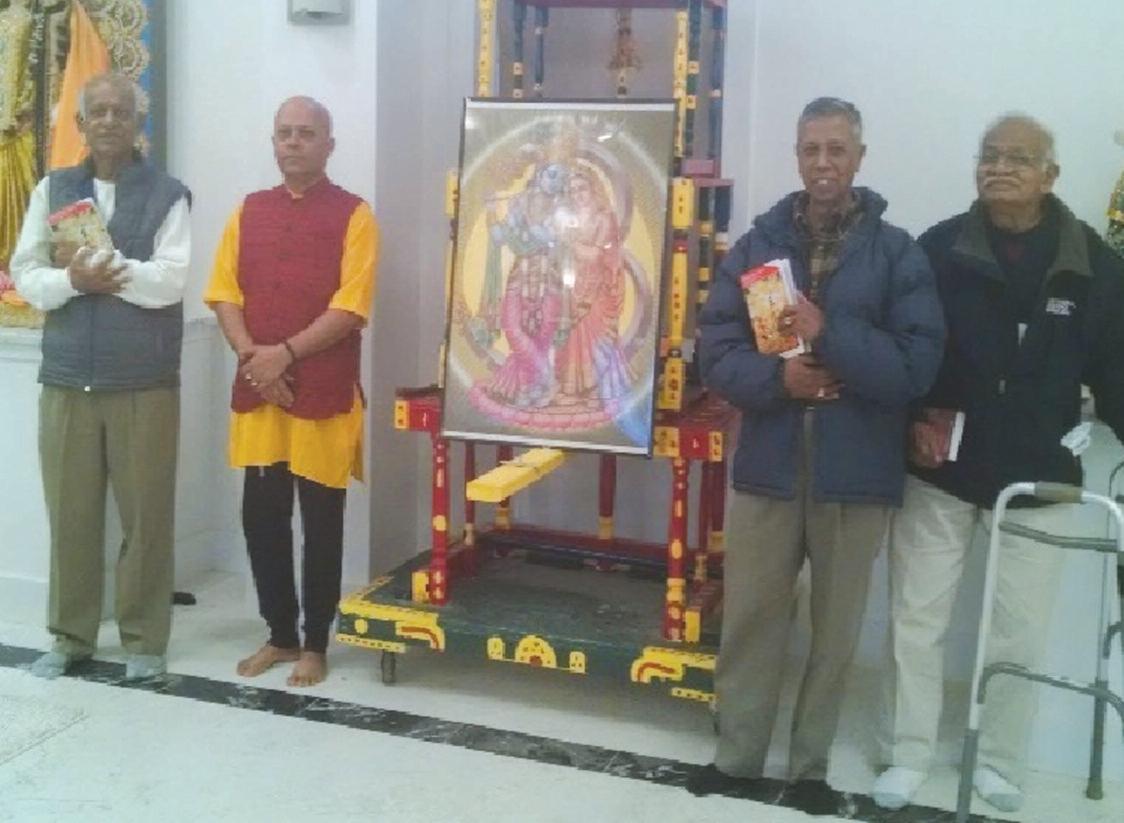
jumdar, Ankuresh Ghosh, Ananda Sircar and Guru Chakravarty, all together, read the entire Geeta New Year’s Day
On January 1st, the Temple was closed only for a few hours Like other years, people continued to come in all throughout the day During the morning Darshan, puja ,archana was done like any other day. During the evening puja, Sandhya arati and Chandi Paath were done. The evening was graced with devotional songs by our own Anusua Roy. Our monthly Shyama Puja was observed on 9th January, Poush Sankranti on 15th January and monthly Satyanarayan puja on 23rd January
In the month of February, the first big event was Ratanti Kali puja on 7th February, Sunday Due to severe cold and inclement weather the gathering was not that big Still, more than forty brave souls dared this weather
8:00 am in the morning, as people started coming in, despite severe cold weather, with their children for puja and Bidyarambha/Hate Khori After puja and prayers, Biswabhai offered Ahuti for each and every child whose Hate Khori was scheduled Then other assigned priests started helping the kids write for the first time in their lives There were eight very attentive children, but none more intent than their mothers Later they received drawing books and crayons from Ananda Mandir See a few Hate Khori pictures below Young and adults alike brought their books, pens etc for blessings by Mother Saraswati Biswabhai made sure that each and every one who came to the temple, had a chance to offer Pushpanjali
Children’s Cultural Program
Every year at Saraswati Puja,
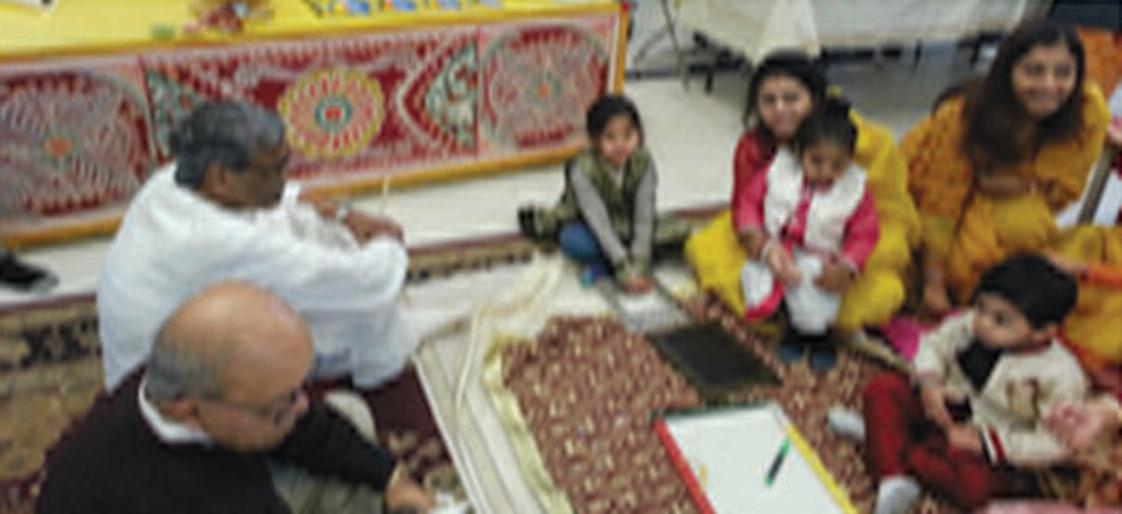
children showcase their talents in art and culture in front of Ma Saraswati, the goddess of knowledge, music and the arts This
fantastic performance of Odissi dance Students of Mrittika, the Bengali school presented a program with Rabindrasangeet and
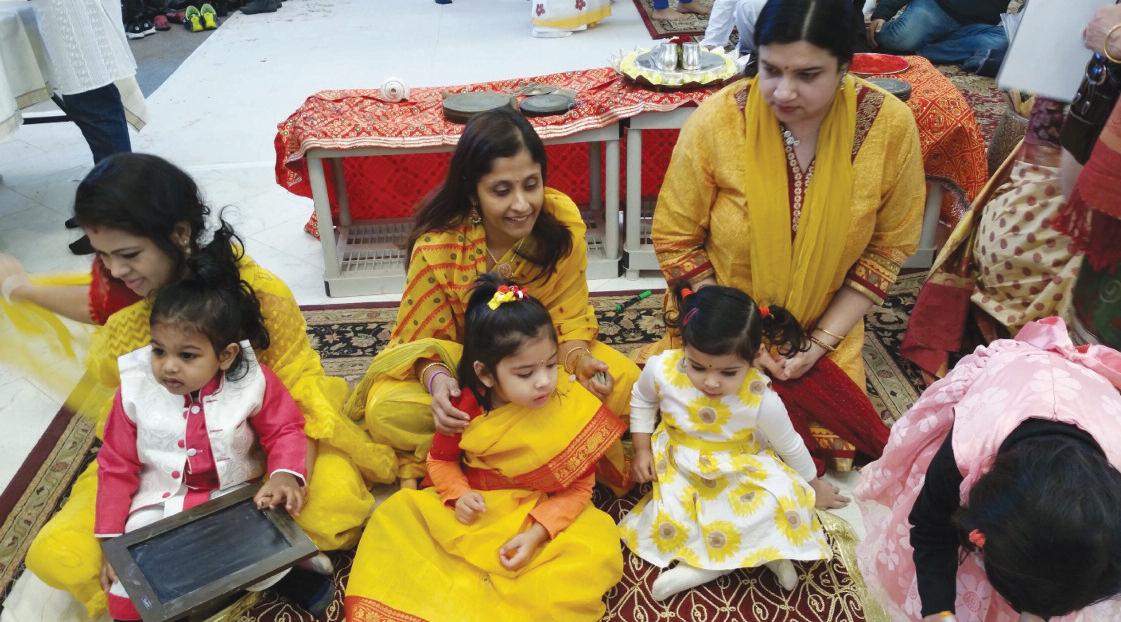
year also, children and adults gathered to enjoy such a program Altogether we had more than 100 devotees including kids participating in the event
Shivan Mukherjee started the program with Saraswati Stotram in perfect Sanskrit pronunciation. The program continued on with Rajasi Basu singing Rajanikanta Sangeet and Meera B hajans. Sunaya Das Gupta Mueler, a student of Rhythms of Dance and Music school delighted us with a

recital of Bengali poems Participants were Kirin Dasgupta Mueler, Sunaya Dasgupta Mueler, Swangsuvra and Sayansuvra Chakraborty A young participant, Auroni Sen, told us a story from Thakumar Jhuli. Her story was about "Bang Rajkumar" meaning Frog Prince. Holding the microphone with a smiling face she told the story like a real story teller, slowly and clearly. Ayan Ganguly
recited a Bengali poem Nikhil Kundu, like other years, delighted us with two songs in welcoming Ma Saraswati and also a famous song Jago Durga Swagata Goswami presented a group of songs with her very young students and her daughter This was a very delightful program, because of their sweet melodious voices and the songs that were appropriate for the occasion Mitali B howmik's students, Sankhadip, Roshmi and Aratrika, need no introduction. These talented young adults, like other years, sang beautiful medly of beautiful songs.
The last participant of the day was Shreya B hanja Chowdhury. This young lady always keeps us spell bound with her music She sang one Nazrulgeeti and one B hajan with Arun B howmik ac-
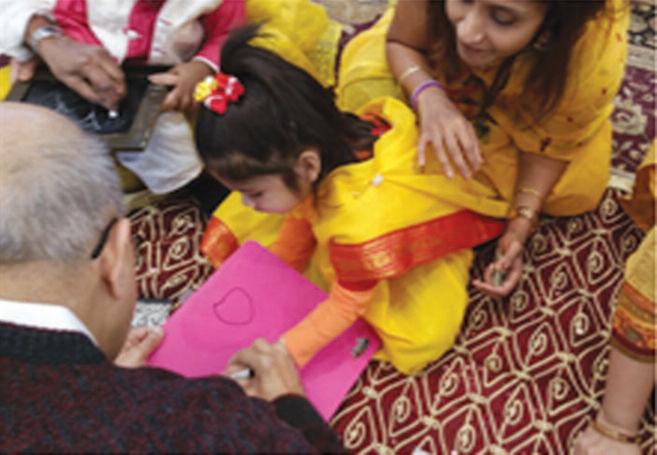

Samragnee Majumdar is a
• MBA from Maharishi Arvind Institution Of Science And Management , India with Marketing Major and HR minor
• Worked for Xerox Modi Corp , India as Sales Executive ( B2B Sales)
• Internship from Pepsi Co , India as Market Research Executive for Aquafina ( bottled water lauch)
• Worked for Idearc Media ( Verizon Yellow Pages) NY,NY as an Advertisement Consultant and have been one of the top performer and won award trips
• Presently working for New York Life as an agent for 6 yrs Personal:
• Mother of a 6 year old daughter
• Reside in Hillsborough, NJ with her family
• Actively involved with a community club Kallol OF NJ and a comity member of Kallol Women’s Forum (supporting deprived kids of India for funding their education and food)
New York Life Insurance Company, a Fortune 100 company founded in 1845, is the largest mutual life insurance company in the United States* and one of the largest life insurers in the world New York Life has the highest possible financial strength ratings currently awarded to any life insurer from all four of the major credit rating agencies: A M Best (A++), Fitch (AAA), Moody's Investors Service (Aaa), Standard & Poor's (AA+) ** Headquartered in New York City, New York Life's family of companies offers life insurance, retirement income, investments and long-term care insurance New York Life Investments*** provides institutional asset management and retirement plan services Other New York Life affiliates provide an array of securities products and services, as well as retail mutual funds
Please visit New York Life's Web
By Guru Chakravarty
We love to reminisce about games we played during our childhood days in India Oh, what a multitude of games were available for us to play I am talking about games that were played in the streets or on a playground next to our homes You come home from the school, have a quick snack and run out to the field where a bunch of your buddies are waiting for you – that kind of games Of course, there were games like football and cricket that anybody could come in and join at any time as the game was in progress But here I like to talk about those indigenous games like Kabaddi, Hadudu, Kith Kith, Ekka Dokka, Lattu, Kite-flying, Guli-danda, Marbles, Rumalchor, Kho-Kho, Carom, so on and so forth In some cases, a club was available in the neighborhood with supervising adults, where you could learn things like lathi-khela, skills with twirling a lathi with fire balls at both ends of the lathi, skills with knife, roller-balance, etc.things that you performed at the annual show of the club.
Spending leisurely time with Biswajyoti is always a pleasure because he has mastery of many subjects aside from mythological stories This time, I was amused to hear about all kinds of indigenous games that he used to play The topic became very interesting because I too played many of those games in my childhood We combed through our memory bank to reminisce those games, many of which are now fallen out of favor with the young children of the video generation and will probably soon be extinct I will be a fool to think that the new generation will show any interest in these games, so these are for us, the old-timers!
Kabaddi Kabaddi, also known as Hadudu in some areas, is established as a National Sport in India There is now a Pro Kabaddi League (PKL) in India, in the format of the IPL T20 cricket tournament Two teams are formed of equal number of boys or girls A boundary is marked with a centerline in the middle to mark the home of each team.
Team A sends a "raider" who enters the opponents' half of the court chanting "kabaddikabaddi" repeatedly. The raider's aim is to touch as many players as he can on the opposing side and return to his court in one breath The persons
whom the raider touches will then be out of the game
The aim of the Team B, all together, will be to hold the raider, and stop him from returning to his own court If the raider cannot return to his court in the same breath, he is out of the game
Then it is the turn of Team B Each team alternates in sending a player into the opponents' half of the court The team wins when all players of the opposing team are out
Kith Kith
Kith Kith (also called Ekka Dokka) is an individual sport, mostly played by girls Numbered squares are drawn within a rectangular space A player tosses a small object into a numbered space on the ground and then hops or jumps through the spaces to retrieve the object and come back to the base in one breath, chanting kith kith (or choo kith kith) repeatedly. It is similar to hopscotch played by girls in the United States.
Lattu
The lattu or the spinning top is a popular game among young boys that is played in many parts of India even today It is a game that simply involves spinning a wooden lattu which has grooves in its lower half and a nail at the bottom to spin on A cotton string is wrapped around the grooves on the lower half and deploying it makes it spin The child whose top rotates for the longer period is the winner In another version of the game, a child will have a lattu with sharpened nail and spin it on over a stationery lattu to damage it Then the other child will get his turn The boy with the less-damaged lattu is the winner In one show-off version of the game the swirling top is kind of snatched upward via backward pull of the string and made to land on the player's palm Kite flying
Kites (we called them ghuddi) are a popular choice for kids in many parts of the world
Children in rural India make their own kites and fly them There are festivals that involve flying of colorful and specially shaped kites Some tournaments are also organized for kite flying in many parts of the country. Kite flying duels are a common thing with children. I remember how we made a paste of powdered glass and starch and apply it to the thread (a process called Manza) that
Continued to page 12
Continued from page 8
tored for over 40 years and the observed changes in the orbit agree so well with general relativity, there is no doubt that it is emitting gravitational waves
Since then, more astronomers have studied the timing of pulsar radio emissions and found similar effects, further confirming the existence of gravitational waves But these confirmations have come indirectly and mathematically and not through actual 'physical' contact Scientists wanted to build interferometers that could 'feel’ gravitational waves
With an investment of $1 1B from National Science Foundation (NSF) over several decades, scientists and engineers have built and operated the Laser Interferometer Gravitational-wave Observatory (LIGO) spanning two facilities, in Livingston, Louisiana, and Hanford, Washington The observatory is described as "the most precise measuring device ever built "
Each facility, located 2,000 miles apart, has two tunnels that are 2 5 miles (4 km) long each, arranged in an “L” shape; they serve as detector arms A laser beam is fired down each arm in near vacuum, and reflected by a mirror, in order to measure the length of the tunnel A passing gravitational wave will stretch spacetime in one direction and compress it in another, causing an inconceivably small change in the length of the detectors’ arms, which is measured by the laser Each fluctuation only changes the length by about 10-19 m (about 10,000 times smaller than a proton)! For a gravitational wave signal to be counted as real, it must show up in both detectors.
Why does one need such a precise instrument? Although their origins can be extremely violent, by the time gravitational waves reach the Earth they are millions of times smaller and less disruptive. Even at this precise scale, detection and analysis of the information carried by gravitational waves will allow us to observe the Universe in a way never before possible
Historically, scientists have relied primarily on observations with electromagnetic radiation (visible light, x-rays, radio waves, microwaves, etc ) to learn about and understand objects and phenomena in the Universe (In recent years, subatomic particles called neutrinos have also been used to study aspects of the heavens ) Each of these sources of information provides scientists with a different and complementary view of the Universe, with exciting new discoveries occurring as each new 'window' is introduced and utilized
Gravitational waves are completely different phenomena, carrying information about cosmic objects and events that is not carried by electromagnetic radiation Colliding black holes, for example, emit little or no electromagnetic radiation, but the gravitational waves they emit will cause them to "shine brightly" like beacons on an utterly dark cosmic sea More importantly, since gravitational waves don't interact with matter (unlike electromagnetic radiation), they travel through the Universe completely unimpeded giving us a crystal clear view of the gravitational-wave Universe
In theory, any object with mass that accelerates (which in science means changes position at a variable rate, and includes spinning and orbiting objects) produces gravitational waves, including humans, cars, airplanes, etc. But the gravitational waves made by us here on Earth are much too small to detect. In fact, it isn’ t even remotely possible to build a machine that can spin an object fast enough to produce a detectable gravitational wave – even the world’s strongest materials would fly apart at the rotation speeds such a machine would require
Since we can’t generate detectable gravitational waves on Earth, the only way to study them is to look at the places in the Universe where they are generated by nature Fortunately, the Universe is filled with incredibly massive objects that undergo
rapid accelerations such as black holes, neutron stars, and stars at the ends of their lives LIGO provided an ‘eye’ into the “dark side” of the Universe
LIGO survived years of management and funding turmoil before beginning operations in 2002 Throughout the first observational run, lasting until 2010, the Universe declined to cooperate LIGO detected nothing
Then came a major upgrade of the detectors LIGO became more sensitive and it was further insulated against interfering noise On September 14, 2015, the signal arrived
What the observatory picked up was a minute gravitational distortion as the wave tripped the ribbon of laser light within LIGO’s vast tunnels – the two in Louisiana, and the two in Washington –seven milliseconds apart It only lasted for 20 milliseconds, and the frequencies of gravitational wave-induced flicker of the interference patterns were measured with a precision equal to the width of a human hair over four light years The result was a pulse that was so short and weak it needed to be exaggerated in order to be properly heard
The frequencies of gravitational waves are typically within human hearing range Unlike light waves, which propagate wavelengths that are smaller than the object that emits them, gravitational ripples produce wavelengths larger than the objects that produce them In that way, they are more analogous to acoustic energy than electromagnetic energy, so recording them is usually considered akin to audio recording rather than light The received LIGO signal was “shifted a bit in frequency.”
The resulting audio was a clear, compelling sound of the merging of two black holes, each about the size of a major metropolis and one with 36 times the mass of our sun and the other with 29. With each revolution, the accelerating masses emit gravitational waves These waves carry away some of the system's orbital energy – meaning that the objects in the system lose some of the energy they need to maintain the distance between them Each revolution removes a little more energy so that over eons, the objects inch closer and closer together Unfortunately, moving closer means orbiting faster, which means emitting more gravitational waves, which causes the pair to lose more orbital energy, move ever closer, orbit faster, lose more energy, move closer, orbit faster etc The stars are now doomed, inescapably locked in a runaway accelerating spiraling embrace
The faint rising tone from the incredibly powerful event, which released 50 times more energy than all the stars in the observable Universe, captured, for the very first time, the endgame of two black holes spiraling together They orbited one another at a furious pace towards the very end, speeding to about 75 orbits per second – warping the space around them like a blender cranked to infinity – until finally they became one with 62 times the mass of sun
Scientists feel that the discovery of gravitational waves may inaugurate a new era of astronomy in which the gravitational waves are tools for studying the mysterious and exotic objects in the Universe They will carry information about their origins that is free of the distortion or alteration suffered by electromagnetic radiation as it travels through millions of light years of intergalactic space The information will provide astronomers and other scientists with their first glimpses of previously unseen and unseeable wonders, and greatly adding to our understanding of the nature of space and time itself.
According to David Reitze, the Executive Director of LIGO, who broke the news of the discovery, "This was truly a scientific moonshot We landed on the moon " And that “chirp” – it seems destined to rank among the greatest sound bites of science, alongside Alexander Graham Bell’s “Mr Watson -come here” and Sputnik’s first beeps from orbit
Continued from page 8
of materials that you may need prior to the online puja For booking of a puja online, most sites accept major global currencies
A popular site epuja co in says –“Offer a puja at your favorite temple in India Seek Discover Get Blessed ” This online puja site delivers links to multiple famous Indian temples and mails free prasad to any global location The fee that the site charges for each puja online takes care of the cost for prasad delivery Another site, Saranam com claims to be World’s first and most trusted online Hindu Puja services site since 1999 when online Internet services were fairly new This site offers links to temples and pujas for specific causes like: Ashta Lakshmi Puja, Devi Shakti Puja, Ganesh Puja, Hanuman Puja and other deity pujas at famous Indian temples Saranam com also offers special pujas for fasting days, health, wealth, peace, marriage and conceiving child, special Hom/Yagna online for Shiva, Devi/Shakti, Ganesh, Kubera and Navagraha There are monthly group Hom/Yagna services for peace, health, wealth and prosperity where each participant pays for $9 99 and gets puja materials mailed in advance with instructions given in a video.
Kashi Vishwanath Temple, Benaras, India
Priests of famous Kashi Vishwanath Temple perform online puja per Vedic rituals based on birth details of the participant. The online instruction says – Please mention your birth details (name, date, place, time) and Sankalp (your wish) at checkout of the puja booking online One can perform this puja on individual name or include family members and near and dear ones with names and gotras The site says, you will be provided with contact telephone number of a priest for help and guidance Another site onlinelivedarshan com running specially to connect Lord Shiva to online devotees, allows live darshan with an elaborate video on Lord Shiva Jagannath Temple: Orissa, India
One of the most revered temples in India, Sri Jagannath Temple (Jagannath literally means The Lord of this world) is also one of the Char Dhams (four most coveted Hindu pilgrimage destinations), mentioned in Indian scriptures like Skanda-Purana, Brahma Purana and other Puranas and even in the Ramayana and the Mahabharata, offers Brahmin Bhoj service online Conducting a Brahman Bhoj at Jagannath temple is considered very meritorious, Hindus believe that Bramhan B hoj is a good religious practice and should be performed on several occasions to get blessings from the Brahmans Jagannath Temple delivers Brahman B hoj services online for a cost of Rs. 5,050 ($77.34) to feed 21 Brahmans, and Rs.2,650 ($40.58) to feed 11 Brahmans.
Special Announcement Pujas: Online sites publicize special puja events to attract devotees. The site saranam.com announced a featured event on this year’s Maha Shiva Ratri saying - “Participate for the Hindu festival of
Maha Shiva Ratri celebrated on the 14th day of the dark fortnight of the Magh month, as per the Hindu lunar calendar. The Shiva principle is most active on this day of the year.” Such special announcements are what most devotees get attracted to and get that good feeling of participating in a special Hindu puja online for a special deity on a special day
So, even if you are far from a famous temple in India that you have known for your beloved God or Goddess, you can offer prayers to the temple deity via Internet When online pujas are getting so popular, and, devotees feel good about it (there are multiple good testimonials online), where is the connection with God online that we get when we visit a temple for a puja? I have gathered a brief note on what is a puja and how it evolved amongst Hindus
The Significance of a Puja: Puja ceremonies in Hinduism in its present form evolved gradually and was practiced differently in the Vedic eras Pujas in the Vedic eras included physical and ritual sacrifices (like horse sacrifice in Ashwamedha Yagna) chanting of mantras, hymns over prolonged period of time accompanied by prayers, invocation to deities and offerings of various material substances fruits, flowers, cooked foods and special drinks like “panchamrit” (five natural ingredients combinedmilk, yogurt, honey, ghee and sugar) Agni (Fire God) was considered the main deity in most of the Vedic rituals and was considered the divine messenger between Gods and humans. So, conceptually, energies of the higher plane (Gods and Goddesses) were invoked through physical human energy (ritualistic acts), sound energy (chanting of mantras and hymns) and mind energy (dhyan/meditation and devotion). It was believed that together these three human energies reached out and touched Gods for fulfillment of a desire A material connection in-between was the fire (Agni) that acted as a radar or transmitter
Present day puja evolved gradually to be an act of showing reverence to a God, a spirit, or another aspect of the divine through invocations, prayers, mantras and rituals held in a temple or at one’s home In its traditional form today, a puja ceremony in a temple or home brings worshippers face to face with God in a personal, touching way There is a sense of communication, a sense of participation in a divine ambience How much of that association with God is achieved online via Internet is yet to be measured Yes, there is definitely a sense of devotional satisfaction by offering puja online to Kashi Vishwanath or Sri Jagannath when one is unable to travel that far to these temples The rituals are delivered, mantras are chanted and material substances like flowers, fruits, clothes etc all are offered online If there is a connectivity of all energies within this universe, as Hindus believed in the Vedic era, then, may be Gods are reachable online via the Internet It all depends on our love and mental connection to the divine we want to communicate to. Just keep the faith alive!
Reported by Subrata Bhaumik
Sahitya O Alochana (SOA) is a monthly literary and topical discussion forum under the aegis of Ananda Mandir (AM) It completed its 8th anniversary in January 2016, and will have organized eighty seven (87) sessions by the time the current edition of Ananda Sangbad goes to press These monthly sessions feature exciting and illuminating discussions on diverse subjects including literature, theater and movie, history, philosophy and religion, science and mathematics, economics and business, social issues, sports, and current affairs The following is an account of the recent sessions organized by the SOA committee of AM
In December, we presented a discussion that is a part a series we launched some time ago, which examined the interconnections between Individual Liberty, Faith, and Pluralism The first session entitled "Freedom of Expression and Religious Fundamentalism" was held in August 2015 December was the second one of that series, and presented a hotly debated subject, especially in light of the recent happenings around the world. It was entitled Rising Intolerance in the World. Though thinly attended due to the holidays, it was a very good session.
We ushered the New Year with a very fine session in one of the strong areas in our repertoire: international literature It was titled “Through the Looking Glass: Kamel Daoud's Re-Telling of Albert Camus's The Stranger from the Arab Viewpoint ” While Camus needs no introduction, Kamel Daoud is a young and famous Algerian writer His debut novel “The Meursault Investigation,” retells the story in Camus’ famous novel “The Stranger ” from the angle of post war cultural colonialism and fundamentalism in Algeria Amongst many other issues, it deals with the basic human need of the colonized people – identity - that Camus famously (infamously?) ignored in his masterpiece In the words of Amitabha Bagchi, the discussion leader, the background and the content of this session were as follows: “The Stranger -- one of the most talked about novels of post-war Europe -- was written by Albert Camus and published in 1942 It traces the life of an extraordinarily unfeeling and apathetic Frenchman in Algiers, Meursault, from his mother's death and funeral to his soulless reaction that culminates in his killing "An Arab" on the beach for no clear reason except sunlight and heatstroke, and finally his trial and execution -- more for inhuman heartlessness than the crime of murder The novel is often cited as an expression of the absurdity of life and existentialist philosophy. In The Meursault Investigation, Kamel Daoud retells the story from the recollection and viewpoint of the slain and unnamed Arab's only living brother. It became a bestseller in France when the book came out in 2013. The Alochana session will compare and contrast the two novels with selected
readings from both ”
It was a wonderful session indeed! Amitabha Bagchi presented a marvelous analysis contrasting two great masterpieces
fEBRUARY 2016
The February discussion topic was intriguing and vexed at the same time It has for centuries eluded any complete understanding and resolution in the minds of great thinkers of our world including scientist and philosophers The title of the session was “Free Will – real or myth” Free Will occupies a space in philosophical, religious and scientific discourses, and has been a popular topic since the time of Plato, then through the Renaissance and forward The discussion focused on some of the basic questions of metaphysics including “Are We in Control of Ourselves?” Do we make choices based on rational consideration of the probable outcomes? Are we predisposed to make the choices we make? Conventional scientific wisdom may have a deterministic answer to these questions: we are very complex machines honed by billions of years of evolution. Given that each state of the universe is determined by a previous state by the laws of Physics going all the way to the Big Bang, there is no room for choice. But then again, the basics of “Mind Body Dualism,” another cornerstone of modern philosophy, postulates that mind may not be a physical phenomenon like brain and the body And our choices are significantly influenced by mind as well
Abhijit Gupta, a veteran member of our alochana community, presented a thorough introduction, albeit high level, on the topic covering available knowledge and arguments both for and against the existence of “Free Will ” It was another fine session that only deepened the depth and broadened the breadth of the variety and the character of the discussions that we present to the local community A ton of thanks goes out to Abhijit for leading the session
Quite a few interesting sessions are in the pipeline for the next several months They include eclectic topics including one on Nadine Gordimer, the South African Nobel Laureate littérateur who famously wrote on apartheid and other related issues, another on the changing U S landscape surrounding policies and social attitudes towards non-white immigration, (especially relevant now with Trump and Ben Carson competing for the White House), a session by fine local authors, and a multimedia presentation on the evolution of “The Art of Story Telling,” – a repeat of one of our better and highly acclaimed sessions brought back by popular demand.
The friends of Sahitya O Alochana would like to thank Ananda Mandir for its continued support for the forum’s contribution to the cultural enrichment of the local Bengali and Indian communities
Reported by Debajyoti Chatterji
Someone said a long time ago, “If you try and fail, try again!”
The organizers of Seniors Forum had to keep reminding themselves of this adage as they struggled during the months of December and January to schedule a meeting. Their persistence paid off on February 28 when a large group of seniors enthusiastically participated in an informal get-together over a sumptuous pot-luck lunch.
So, what caused this see-saw in the participants' enthusiasm level?
This winter, more than in past years, a large number of seniors from the Ananda Mandir community became snowbirds, sought refuge from the frigid New Jersey weather and flew to warmer destinations in India, especially Kolkata, the quintessential favorite for NRI Bengalis Some went to other balmy countries like Australia for fun and adventure These snowbirds started trickling back around the middle of February, and by the end of the month, a good fraction had returned to New Jersey, making a Seniors Forum get-together possible Thus ended the unplanned winter hibernation for Seniors Forum
The discussions on February 28 covered a wide range of topics Amitabha Bagchi, Utpal Sengupta, Anjana Dutta, Prativa Hore, Dr Nupur Lahiri and Ira Ganguly talked about their memorable experiences during recent visits to Kolkata and other parts of West Bengal Some of these experiences were humorous, some were reflective of progress being made in the country, while a few were reminders of continuing problems of inefficiency and corruption Roma Das and Nupur Lahiri shared the highlights of their tour of Australia and New Zealand Last but not the least, Dr Samir Dutta led an informative and constructive discussion on the need to plan ahead for sudden illnesses and other medical emergencies while vacationing in Kolkata, and shared several useful pointers Two important action items emerged from these discussions: (1) the April Meeting of the Seniors forum will feature Dr Dutta as the speaker on “how to plan ahead for medical contingencies while vacationing in Kolkata”, and (2) in the meantime, Debajyoti Chatterji promised to work with Dr Nupur Lahiri, Utpal Sengupta and others to develop a “directory of useful medical resources in Kolkata ” Such a directory will contain names of reputable pharmacies, nursing homes and physicians in the city
The multi-course pot-luck lunch was a great success, thanks to the many dishes brought by the team of volunteers: Amitabha Bagchi, Suprasad Baidyaroy, Sikha Chatterji, Haimonti Chaudhuri, Lopa Das, Anjana Dutta, Samir Dutta, Krishna Dutta Roy, Reba Sarkar and Utpal Sengupta. And Surya Dutta took on the responsibility for arranging a steady supply of hot tea.
Upcoming events are as follows:
1) Sunday, March 27: A special session on “Long Term Care: Insurance Options and Other Alternatives”, featuring an invited professional (arranged by Utpal Sengupta)
2) Sunday, April 24: A presentation by Dr Samir Dutta on how to plan ahead for medical emergencies while vacationing in Kolkata
3) May: A cruise around Manhattan is being planned for the group
4) June: A group visit to Paper Mill Playhouse (Millburn, NJ) is being planned to see the musical, “West Side Story ”
Invites retirees and near-retirees to participate actively in Forum meetings and activities
Seniors Forum usually meets on the third Sunday of every mon that 1:00 PM However, the date may change because of conflict with other Ananda Mandir events. Please contact Debajyoti Chatterji (Cell: 908-507-9640) for latest updates on the meeting dates
Continued from page 10
would be used to cut off the thread of my opponent When a kite flew off after its thread was cut (popularly called Bho Katta) it was a thrill to compete with others to catch that kite
Guli Danda
Guli danda (also called Dangguli) is one of the most well-known childhood games played in rural India The game is played with a small piece of wood tapered on both sides known as guli and a larger piece of wood that is used to strike the guli known as danda The object of the game is to get the guli as far away from the home base as possible In one version of the game, the striker runs between two bases (like cricket) and points are scored accordingly.
Marble
This is a game that is well known to kids in rural India. This game involves the use of round glass marbles that are easily available at the neighborhood shops The object of playing marble is to collect as many as you can by striking the opponent ’s marbles Many different marble games exist and children make up their own versions as they go too Rumal Chor
Children form a concentric circle in sitting position with anyone available to play One of them starts the game with a rumal (handkerchief ) running behind all those who are sitting, surreptitiously dropping it off behind any one child and keeps running This child must be alert to pick up the rumal and starts running to drop it off behind an-
other child. The starter will sit down in empty space vacated by the second child. If a child is not alert when a rumal is dropped behind him/her, and the running child touches him/her after completing the circle, he/she will be out of the game
It is also played in another version Two teams will line up in straight lines at opposite ends of a field Each team member will be numbered, for example 1 – 10 A rumal will be placed in the center of the field At the call of a referee, who will announce a number, a child of each team with that number, will run to get the rumal and back to his position before the other child can tag him Kho-Kho
This is one of the most popular traditional sports in India, and is considered a national sport It is a team sport with a chasing team and a defense team Each side alternates between chasing and defense Kho-Kho can be played by men, women, and children of all ages In its simplest form it involves chasing and touching a person Members of the chasing team have to put their opponent out, touching them with their palms Lagori
This game can be played by teams of boys or girls. Two teams lined up on opposite sides. In the center, a tower was made of seven stones (flattish ones). This stone tower was to be hit with a tennis ball. The stones got scattered The team that broke it had to rebuild the tower while the opposite team tried to get them out by hitting them with the tennis ball All in an effort to block them from re-
building the tower! Carrom
Carrom is a highly popular board game in India not just with kids but also with grownups. I include this game here because it was particularly popular during rainy days when we could not play outside It is a game that families play at home and there are many variations of this game Carrom can be played with two to four players It involves pocketing coin pieces using a larger piece, and there are different ways in which that can be done There was college-level carom competitions during our times, and it was a pleasure to spend hours watching the best of them play
Ludo
This is a popular family board game played by several players, in which the players race their tokens from start to finish according to rolls of a dice There are some ladders on the way which can help you climb up towards the finish or down towards the start line In one popular version of the game, called “Snake Ludo” snakes replace the ladders The game and its variants are popular in many countries and under various names
These games, along with other variations of them, were generally played by Bengali children. Some of them were co-ed games, for example, “Kana Machhi”, “Lukochuri” etc. Some were exclusively for girls like “Putuler Biye” I am sure, there are many other regional games that people played in their nooks
So, what games did you play? NOMINATIONS ARE INVITED FOR
Cash awards of $500 each will be given to recognize two writers of excellence (one in Bengali, one in English) who have authored essays, poems, short stories or plays in magazines published in North America within the last five years
Gayatri Memorial Awards have been made possible through a contribution made by Jerry GaMarsh to honor his late wife
Please visit our website for further details on nomination eligibility and submission requirements including nomination form
Submission Deadline for 2016 Awards: July 31, 2016
269 Cedar Grove Lane, Somerset, NJ 08873
For Further Information
Please Visit www anandamandir org/gayatriaward html or
Contact: Debajyoti Chatterji (debsmee572@gmail com) or Guru Chakravarty (guruchakravarty@yahoo com)
Kishaloy is a monthly wall magazine for the youth When you come to Ananda Mandir, you will see it hanging on the wall in the community building Any youth member of Ananda Mandir can submit poetries, short stories, scientific articles, artworks, and photographs for the magazine All youth group volunteers will receive official certificates from Ananda Mandir for their volunteer services For more information, contact Dipak Sarkar at email: sarkar@AESOP Rutgers edu; Phone: 609 651 1023
By Sreya Mukherjee (Age 19)
1 Krim:
This mantra will protect you from evil forces.
2. Om Krim Kali: KRIM- K stands for full knowledge R means that she is auspicious I means that she bestows boons M is that she gives freedom.
3. Om Kring Kalikayai Namah:
A simple mantra that transforms the devotee to a state of pure consciousness
4 Om Sri Maha Kalikayai Namah: A more elaborate mantra of mother Kali
5 Om Klim Kalikayai Namah: Believed to bring relief from all kinds of problems
6 Om Hrim Klim Adya Kalika Parameshwari Swaha: Brings rapid growth to one's spirituality with chanting swaha (means offering) to mother Kali
7 Kring Kring Kring Hung Hung Hring Hring Dakshina Kalikayai Kring Kring Kring Hung Hung Hring Hring Swaha:
This mantra consists of three seeds, Krim, Hung, and Hring as well as the name Dakshina Kalika and Swaha which signify offering Used by the devotees of goddess Kali who saves us all from any ignorance and fear of death
8 Om Maha Kalyai Vidmahe Smasana Vasinyai Dhimahi Tanno Kali Prachodayat:
Om great goddess Kali, the one and only one, who resides in the Ocean of Life and in the Cremation Grounds, that dissolve the world We focus our energies on you May you grant us boons and blessings
9 Ananda Ma Ananda Ma Kali Ananda Ma Ananda Ma Kali Ananda Ma Ananda Ma Kali Om Kali Ma! Simple chant to please Ma Kali
10 Om Karala- Badanam Ghoram Mukta-Keshim Chaturbhujam Kalikam Dakshinam Divyam Munda-Mala Bibhushitam Sadya-Chinna Shira Kharga Bama-Dhordha Karambujam Abhayam Baradam-chaiba DakshinaDhordha Panikam:
Om fierce face she is dark with flowing hair and four armed Dakshina Kalika divine adorned with a garland of heads In her lotus hands on the left, a severed head and sword. She bestows sanctuary and blessing with her right hand.
Ananda Mandir is launching a Food Drive to help Somerset Food Bank to stock up food before the summer starts We normally donate non-perishable foods twice a year, once in summer and once around Thanksgiving /Christmas time This is to help needy families around Somerset County where Ananda Mandir is situated.
The food for the needy comes from generous donations made by you - our members, temple attendees and by all the well-wishers of Ananda Mandir Will you please help? This is a year round program, so any time is good for the donation All kinds of non-perishable food and toiletries are needed No glass jars please!
We are looking forward to your help.
Thank You, Krishna Dutta Roy Chair, Ananda Mandir Puja Committee
Reported
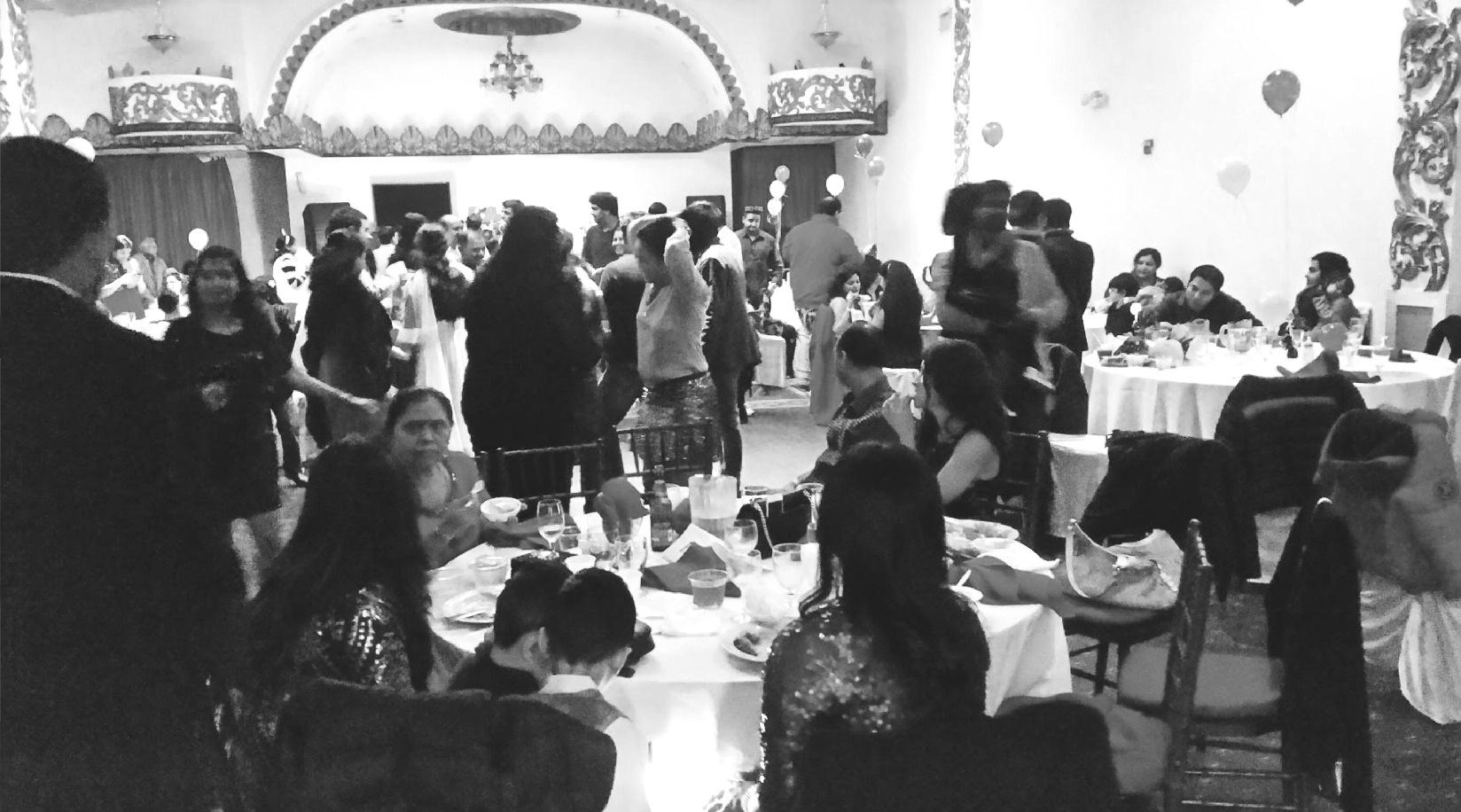
2016: a new beginning, new plans, new dreams New Jersey Puja Association members welcomed the New Year on Dec 31, 2015, with a Holiday Party, our traditional yearend gala And what a gala it was! Close to 200 people packed the Mandap Ballroom at Royal Albert’s Palace Music, dancing, food, drinks and most of all merriment were in abundance. The room was large enough for everyone to spread out, find their own niche by the food tables or the bar – and then came together again to dance up a storm. It was a successful event at all levels
Now we are in 2016 with new plans and new events To start off the year, NJPA will hold the Saraswati Puja on Saturday, March 19th The venue is the beautiful Monroe Township Senior Center, 12 Halsey Reed Road, Monroe Twp NJ 08831 Please come and join us
The next event will be NJPA’s Annual General Meeting on Saturday, April 23rd We will be mailing out the letters and self-nomination forms soon. We are looking forward to seeing all of our members on that day. As always, AGM is the best platform for the members to share their questions,
comments and suggestions about the organization A new executive committee will be chosen on this day It will be immensely important for the new Executive Committee to listen and understand what the community is looking for We invite all NJPA members to attend this important event
On behalf of the Executive Committee, I wish a very happy and prosperous 2016 to Ananda Mandir and NJPA members and friends!
Thank you and looking forward to seeing everyone in all of our future events.
ICC concluded the year 2015 on a cheerful note with the traditional holiday party at Ashirwad Palace on December 18th 2015 We arranged fun games, ramp-walks, DJ, coupledance and of course, mouth-watering food Santa visi kids and gave them gifts Adults and kids had loads of fun All participating members were at their fullest spirit and enjoyed the evening before the Holidays set in
ICC AGM was held on January 31st 2016 to review financial details and overall performance in 2015 The current President and the Executive Committee continue through 2016 Treasurer’s report was discussed in the meeting indicating that ICC is on a solid financial base. The Executive Committee took pleasure in welcoming quite a few new ICC member families. AGM was not all about dry financial data though - all members enjoyed sumptuous appetizers and lunch
Prasad ICC has started the tradition of a quiz contest on the day of Saraswati Puja since last year Children participated in the quiz with great excitement and their parents enjoyed the event with equal enthusiasm The evening was ready to entertain everyone with a vibrant cultural program ICC members, both adults and kids, shared the stage and sang Saraswati Vandana and other songs A number of dance items and recitations added color to the event Guest vo-
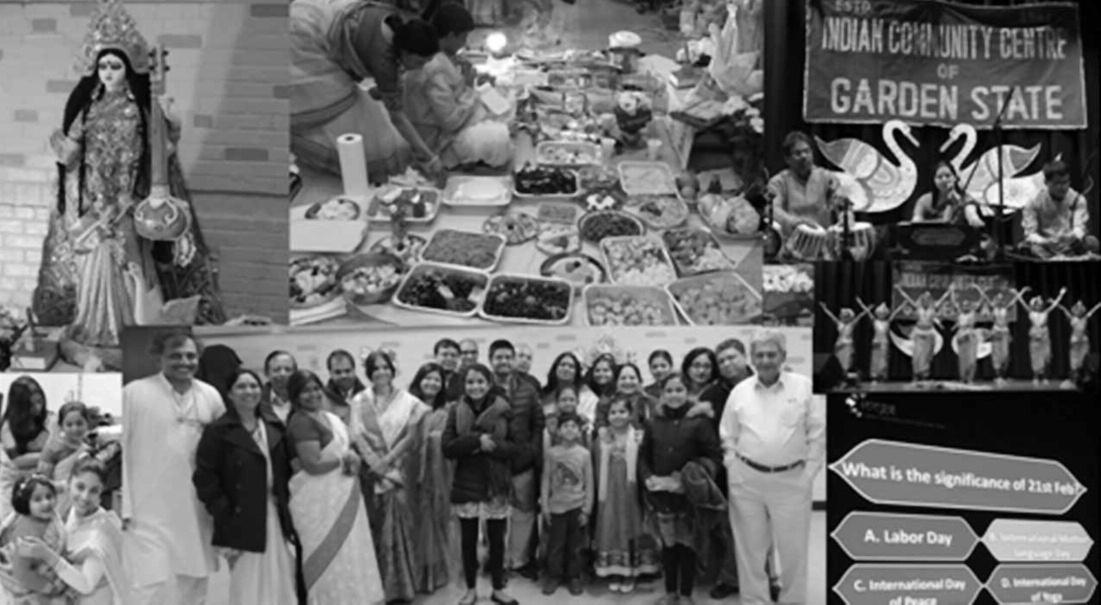
ICC started the 2016 calendar of events with a devotional observance of Saraswati Puja at Dennis O’Brien Elementary School, Rockaway Township, on February 20th 2016 A quiz contest on ‘Bangla O Bangalee’ followed the
and
By Kankana Sengupta
On December 13, 2015, Dr Paritosh and Mrs Srimati Chakrabarti organized a social gathering to honor two distinguished members of our community, Dr Sanat Mandal and Mr Purna B hattachary,a for their outstanding contributions to the Bengali and Indian community and to the society at large The event took place at the prestigious Indian Cultural Center, Marlton, New Jersey
At the ceremony, Dr Chakrabarti guided the audience through a “journey through history” for which there was a specific purpose “It was an in-
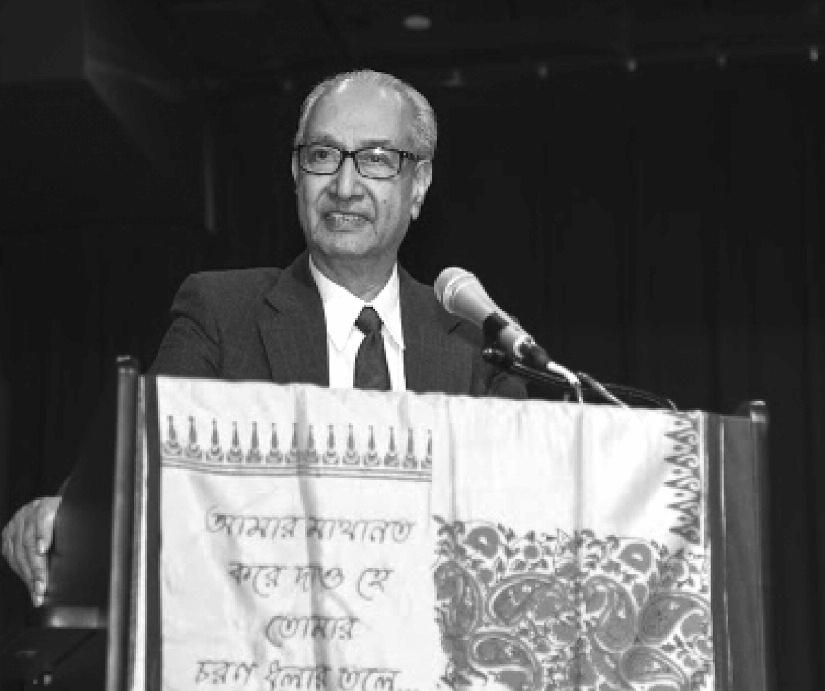
tegral part of a narrative in which the history and its interpretation were juxtaposed against the life stories of the honorees to help fulfill the purpose of the event,” said Dr Chakrabarti
The first honoree for the event was Dr Sanat Mandal – a successful and eminent physician, recipient of many honors and recognition He is the Director of the Cardiac Care Unit at the Pennsylvania Hospital, PA, a position that he has held for al-
most 20 years As a Cardiologist and a physician par excellence, he is an exceptional humanitarian whose commitment to helping others has advanced cardiovascular care both in the U S and around the world His efforts to deliver world-class health care to rural communities in India have had an immeasurable impact on the health of numerous families
The second honoree of the event was Mr Purna B hattacharya who came to the USA in 1971 Mr Bhattacharya got his political acumen and indoctrination for social work from his father who was an active politician and a freedom fighter. It was kind of granted that young Purna will grow-up with the belief that we humans are all bound by moral val-
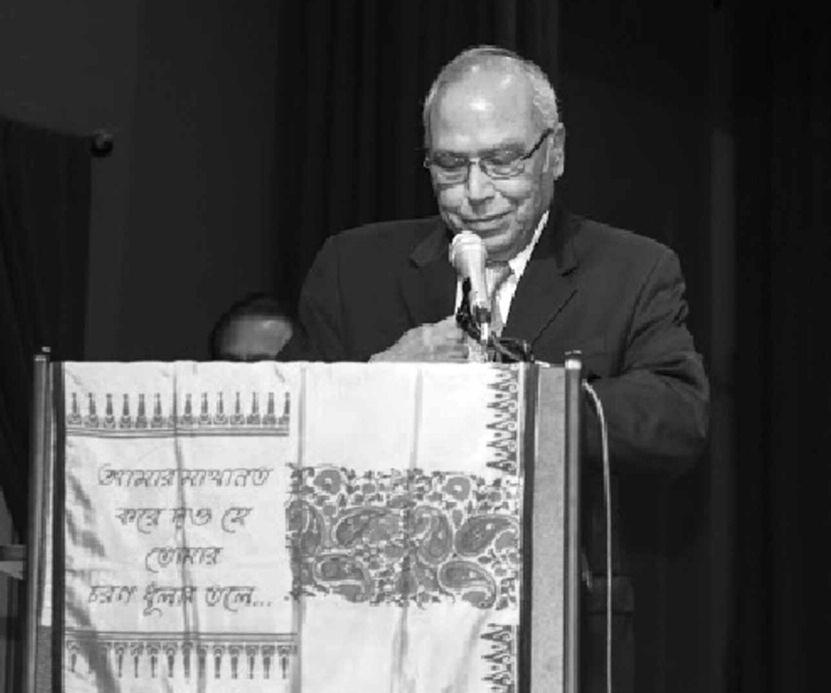
ues and beliefs that account for certain amount of personal sacrifice for the benefit of others Today, he is actively involved in promoting Bengali culture and is the President of Cultural Association of Bengal, the most prominent Bengali Organization in the USA His future goal is to motivate the younger generation to take up leadership positions in Bengali community events He has an MBA and is a successful banker by profession
Due to major construction activities in our premises in connection with our temple expansion, our Ananda Sandhya events will be organized on a selective basis We will post the date of next Ananda Sandhya with all details on our web site and thru mass email Please stay tuned
Continued from page 9
This program was put together by Rita Bhowmik and conducted by Arun Bhowmik We hope to see you all soon at Ananda Mandir's next event
Our last puja event of this month was Satyanarayan Puja on 21st of February Our next big event will be Maha Shiva Ratri on Monday, the 7th of March Puja will be from 11:30am to 11:30pm The temple will open for Darshan on that day at 11:00am
Please join us for this auspicious event On 8th March we will observe our monthly Shyama Puja
Please check our website for upcoming puja schedules and other upcoming events Please contact Krishna Dutta Roy to volunteer for temple related work at k dutta roy @yahoo com
NEW GRAND PATRONS – GOLD
Sunil & Suman Bagaria
Rajat & Devika Chakraborty
NEW PATRONS
Arun & Namita Chattopadhyay
Tapas & Anuradha Chaudhuri
Panna L Dutta
Swapan & Sanjukta Gayen
Rajat Bannerji & Rachna Gupta
Sangeeta Bhattacharya & Krishnendu Mukhopadhyay
NEW LIfE MEMBERS
Tapan Audhya
Debica Bhattacharya
Ranjan & Ruma Chattopadhyay
Arijit & Baishali Chatterjee
Debashis Chakraborty & Moushumi Choudhury
Arunava & Mahua De
Subrata & Dalia Ghosal
Arun & Sreeparna Kurdikar
Prabir & Nila Majumdar
Ranajit & Anita Mitra
Shankar & Bhaswati Mukherjee
Supriya Sanyal
Moyukh & Prakash Sen
Prodip & Sharmila (Kumkum) Sen
Santanu & Tania Sen
Subhas C. Sen
Please note that you can become an Associate Member of Ananda Mandir by donating a minimum of $50. Your subsequent donations of $50 or more are credited to your account When your total cumulative donation reaches $1000, you become a Life Member Your support, small or large, is most welcome and sincerely appreciated
Shri Shri Durga Puja: 2016 Calendar
Debir Ghatoke Agoman O Ghatoke Gaman
l Thursday, Oct 6: 6:30 pm to 8:00 pm: Debir Bodhon.
l Friday, Oct 7: 6:30 pm to 8:00 pm: Debir Amantran O Odhibas.
l Saturday, Oct 8: Saptomi Puja: 7:30 am to 9:30 am; Pushpanjali at 9:45 am.
l Sunday, Oct 9: Ashtomi Puja: 9:00 am to 11:30 am; Pushpanjali at 11:45 am; Sandhi Puja: 5:10 pm to 5:58 pm.
l Monday, Oct 10: Nabomi Puja: 9:00 am to 11:00 am; Pushpanjali 11:15 am.
l Tuesday, Oct 11: Bijaya Dashomi: 9:30 am to 11:00 am; Sindur Kela in the Evening.
By Subrata Bhaumik
As we usher in another Bengali New Year (1423 in the Bengali calendar), I am reminded one more time that the world is really small and its peoples are united in one way or another
based on local customs. The first recorded observation dates back to 2000 BC in Mesopotamia, the present day Iraq. It used to be celebrated at the time of vernal equinox, which happens around late March. Various other ancient civilizations rang in the New Year according to their own local and people specific calendars
Gregorian calendar. The early Romans used to embrace the New Year on March 1, although in 153 BC they changed it to January 1, while ancient Grecians observed it on the summer solstice. Younger civilizations have their own unique New Year celebrations as well; “Ras as-Sana”, the Islamic New Year, is ob-
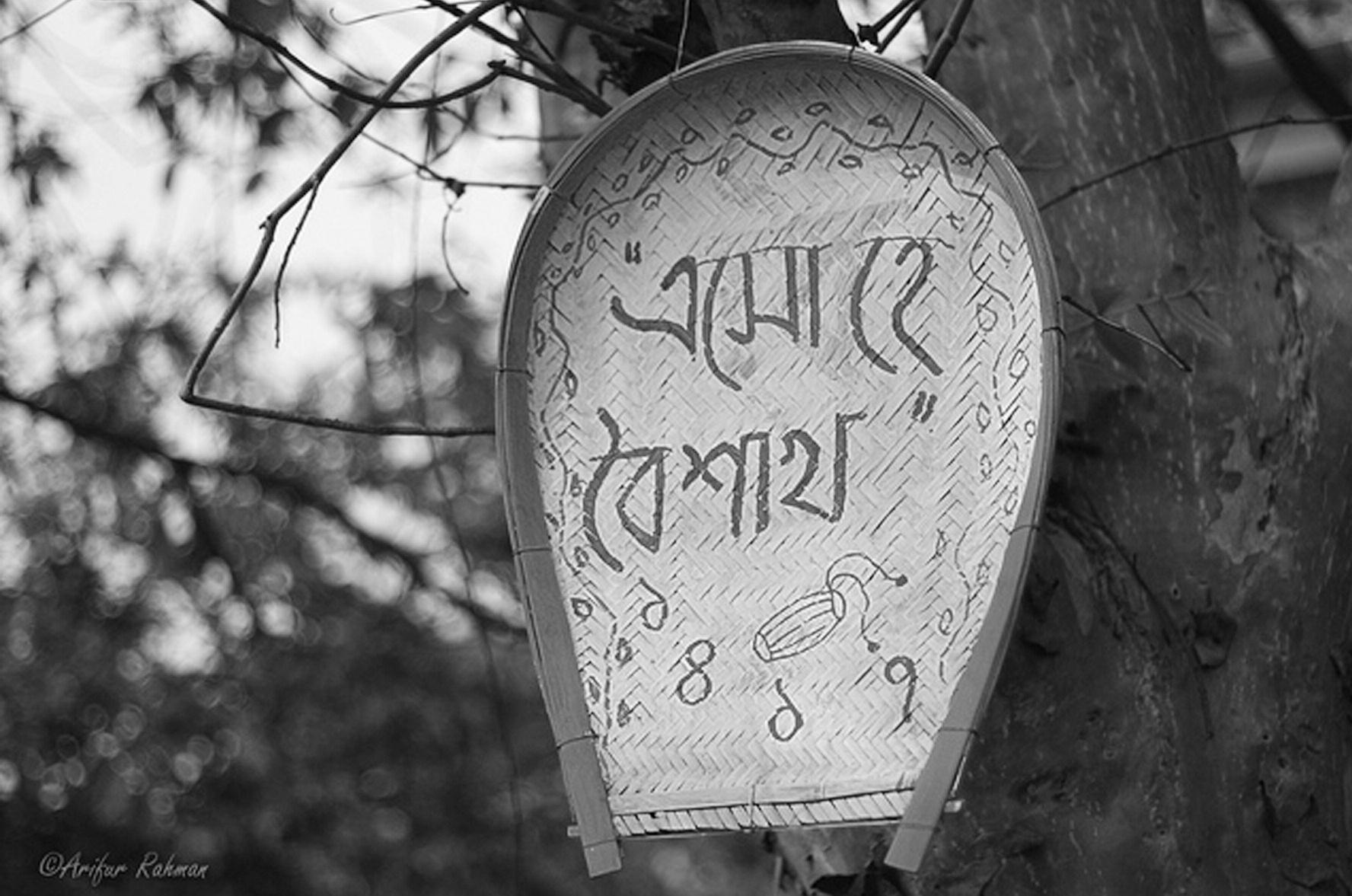
Before the advent of the Internet and other modes of instant communication, our world was not as small as we think it is today Or maybe it was; we just didn’ t see it that way Revolution in Science and Technology has only made it obvious Through unbridled flow of information beyond the synthetic geographical and cultural borders, hearts and minds from around the world came together to unify further despite their apparent diversity perceived by mortal senses. With all the differences that exist among human beings in culture, race, ethnicity, religion, custom, and economic wealth; there have always been enormous and palpable similarities across countries, regions and peoples Whether you are a Hun, a Caucasian, an Arab, or a Latino, you are a human And life’s basic values had been and continue to be no different for an Anatolian from antiquity, a medieval trader in the Urals, a tribal in Ulan Bator, a Zulu from Natal, or a modern New Yorker
Nowhere is it more evident than in the way we celebrate the New Year It is our zest for life and our inherent adaptability to change that help us welcome the new order with vigor, hope, and a sense of purpose; and bid fond adieu to the old In welcoming the New Year, what we really display is our love for life: we decorate our houses, buy new clothes, exchange gifts, pray to the almighty, and wish happiness for all New Year celebrations have been around for thousands of years although the time of observation varied widely
Even today, many of them continue to follow the old customs: Persians/Iranians observe “NoRuz” at the time of vernal equinox; Egyptians commemorate “Wep Renpet ” around middle of June; Mayans observe “wajxaqib' b'atz” in June as well; Chinese celebrate “Xīnnián” between late January and middle of February; and Hindu New Year with all its regional variants is observed between March and April or, in case of “Deepavali”, in November Jewish Rosh Hashanah is observed on the first day of the seventh month of the Jewish calendar - late September as per the
served on the first day of Muharram, which is based on lunar calendar and changes every year; while Christians celebrate it on January 1, which is also the New Year as per the Gregorian calendar And that is most widely embraced New Year around the globe in modern times Celebration of life is the basic theme of the myths and traditions surrounding New Year festivities of various regions of the world In ancient Greece, babies (new life) were used to signify the New Year The Grecians, at the time, celebrated their god of wine, Dionysus, by parading a baby
in a basket, representing the annual rebirth of that god as the spirit of fertility. Despite initial dismissals of such Hellenistic and pagan traditions by the increasingly influential and all too powerful Christian Church of the ancient Greco Roman Empire, they gained slow and steady acceptance, and the babies came to symbolize the birth of Jesus
Celebrating the prevalence of good over evil also marked the beginning of a new order in many cultures around the world According to Chinese myth, people would decorate houses with red posters, light them up brightly, and burn fire crackers to raise huge and loud noise on the New Year’s Eve so that they can keep the evil away Legend has it that Nian, a ferocious beast, would devour countless humans while on the prowl for prey on the last day of the year Similarly, Deepavali in Hindu tradition also signifies the prevalence of good over evil
Other variations of Indian New Year generally coincide with agricultural harvests So does the old Egyptian New Year, which was timed with the swelling of Nile River and the end of the harvesting season Such celebrations of yearly harvests are another display of love for life On the other hand, Jewish people mark the day as the “time for judgment” – wiping out old sins and cleansing the soul to welcome the new – starting the new order with a clean slate
As paradoxical as it may sound, the New Year celebrations are one more example of a united world Peoples across our planet are now a part of a global community as they ring in the “universally accepted New Year” - January 1 that is. On regional level, many still and will continue to observe both: the old and the new. In keeping with the spirit of unity in diversity, let us all greet each other in some of the world’s major voices: Xin Nian Kuai Le (Chinese), Happy New Year (English), Feliz Ano Nuevo (Spanish), Naye Varsha Ki Shubhkamanyen/Naya Saal Mubbarak Ho (Hindi/Urdu), Antum Salimoun (Arabic), Saleh now Mobarak (Iranian/Persian), Bonne Annee (French), Prosit Neujahr (German), S Novim Godom (Russian), and finally, Shubho Nabo Barsho (Bengali)
Based on the deliberations of the Awards and Recognition Committee, Ananda Mandir Board of Trustees has recognized Bandana Rakhit as an outstanding volunteer of the organization Bandana has been involved in Ananda Mandir activities since its inception. She has actively participated in many functions and rituals that are critical for the organization for all these years. Due to her tireless efforts and passion to raise revenue for Ananda Mandir, she has become an integral part of al l major fund-raising events She has also been chairing the revenue collection committee for many years, where she has been highly successful in raising thousands of dollars due to her pleasant personality and skills to get other volunteers to join with her. During most major puja events she is usually the first person to arrive at the premises and the last one to leave while constantly keeping herself busy not only doing the gate collection but performing various other tasks As a member of the Puja Committee, she takes an active role in buying flowers, groceries and other supplies; she has even brought many items all the way from India that are necessary for puja rituals. She often volunteers to cook food for the temple’s various monthly events It is indeed amazing that she has been able to spend so many hours for Ananda Mandir in spite of her busy schedule She is always ready to volunteer her time, no matter whether it’s for a big job or a small one and always does it with a smiling face. Her presence is inspiring to all other volunteers at Ananda Mandir.