Ananda Mandir


Ananda Mandir
October 8, Sunday – Mahishasura Mardini Live
4:30 - &:00 am
October 20, Friday – Mahasoshti 5 pm – 9 pm l
October 21, Saturday – Mahasaptami
9:00 am – 2:00 pm
5:00 pm – 9:00 pm l
October 22, Sunday – Mahaashtami
9:00 am – 2:00 pm
Sandhi Puja – 4:54 – 5:42 pm
4:30 pm – 9:00 pm
October 23, Monday – Mahanabami
9:00 am – 2:00 pm
5:00 pm – 9:00 pm
l
October 24, Tuesday -- Bijoya Dashami
9:00 am – 2:00 pm
5:00 pm – 9:00 pm l
Kojagori Laksmi Puja & Satyanarayan Puja
October 28, Saturday
7:00 pm – 8:30 pm
Maha Kali Puja
November 12, Sunday — 5:00 pm – 1:00 am
Calendar of Events (Dates are subject to Change) Please check our website frequently www.anandamandir.org Tel: 732-873-9821
NOTE: For Puja time please contact temple or visit our website: anandamandir.org
OCTOBER 2023
Mahishashura Mardini
Sunday, 8
Durga Puja Shoshti
Friday, 20
Maha Saptami
Saturday, 21
Maha Ashtomi
Sunday, 22
Maha Nabami
Monday, 23
Bijaya Dashami
Tuesday, 24
Kojagori Laxmi Puja & Satyanarayan Puja
Saturday, 28
NOVEMBER 2023
Maha Kalika Puja
Sunday, 12
Jagadhatri Puja
Tuesday, 21
RasJatra & Satyanarayan Puja
Sunday, 26
DECEMBER 2023
Shyama Puja
Tuesday, 12
Satyanarayan Puja
Sunday, 24
JANUARY 2024
Satyanarayan Puja
Monday, 1
Shyama Puja
Wednesday, 10
Satyanarayan Puja
Sunday, 21
FEBRUARY 2024
Ratanti Kali Puja
Thursday, 8
Shyama Puja
Friday, 9
Saraswati Puja
Wednesday, 14
BaniBandana & Satyanarayan Puja
Sunday, 18
(*) See www.anandamandir.org or Call Mandir for details
Special Religious Services: Upon request, the priest of Ananda Mandir offers services such as in-house Shraddhas, Rituals associated with Cremations (Antyesti Kriya), Shraddha Anniversaries, Pre-wedding rituals (Naandimukh, Ashirwad, etc.), Upanayan (Paitey), Annaprasan, Wedding Ceremonies & Wedding Anniversaries, Griha Prabesh (Bhumi Puja), Consecrations of new cars (New Car Pujas) and others. If you have needs for any of the above or more, please feel free to contact Biswabhai @ 732-873-9821
Ananda Sangbad
A Periodical Newsletter Published By
ANANDA MANDIR (A Tax-Exempt, Non-Profit Organization)
269 Cedar Grove Lane
Somerset, NJ 08873
Phone: 732-873-9821
Website: www.anandamandir.0rg
Debajyoti Chatterji Executive Editor (Acting)
All queries, articles, news reports and letters should be directed to debsmees572@gmail.com
Phone: 908-507-9640
For general information, please contact the following executives of Ananda Mandir:
Anjan Lahiri
President
Jai Prakash Biswas Vice President
Debajyoti Chatterji Vice President
Anjan Lahiri Vice President
Ashok Rakhit Vice President
Arun Bhowmik General Secretary
Sanchoy Das Treasurer
Pradip Majumdar Assistant Treasurer
BECOME A MEMBER OF ANANDA MANDIR AND PARTICIPATE IN THE COMMUNITY ACTIVITIES TO ENRICH YOUR FAMILY
By Sudipta Bhanja Choudhury (New Jersey)
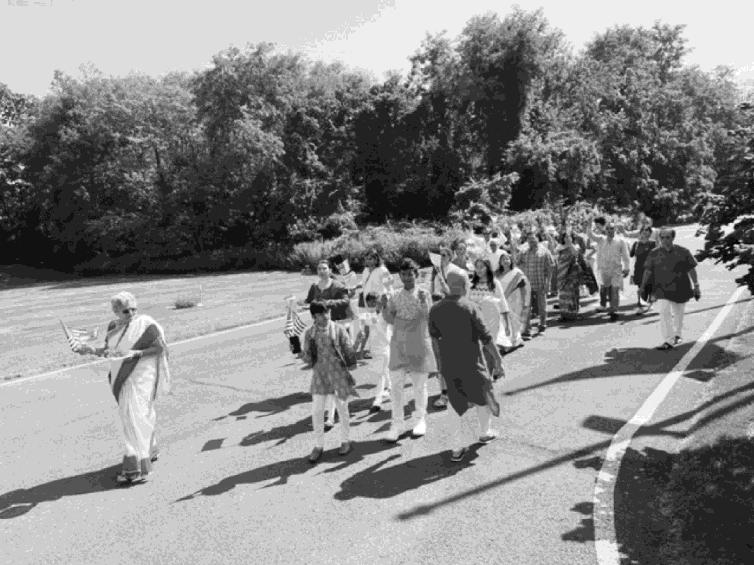
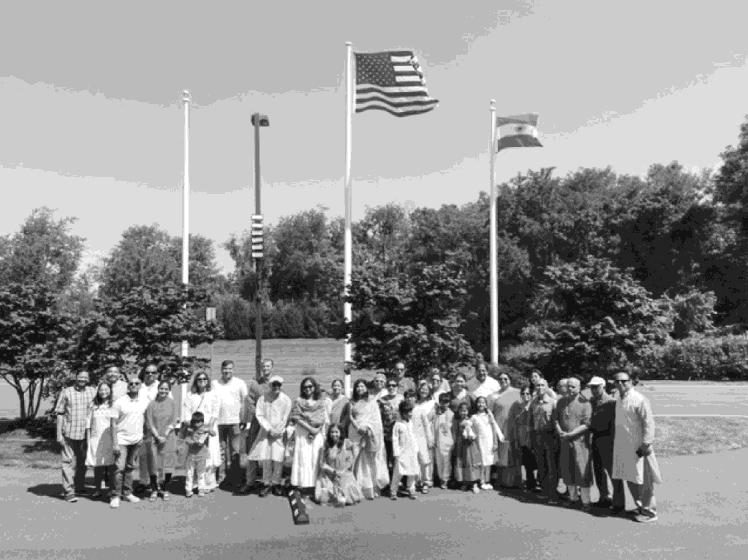
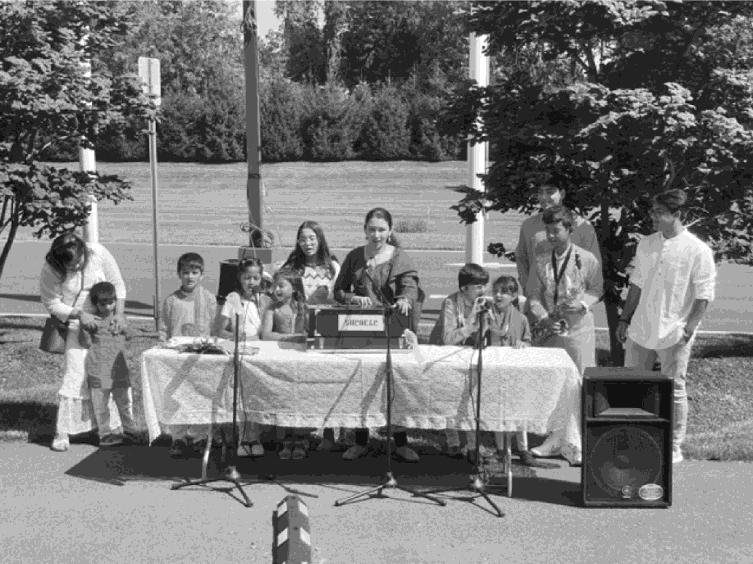
This year, the Independence Day of India was observed at Ananda Mandir on August 20, 2023. A large number of community members joined us and participated in a procession led by our priest Biswabhai. “Vande Mataram” was chanted by the adults and the children during the procession. The President of Ananda Mandir, Anjan Lahiri, along with Professor Dipak Sarkar and Biswabhai, hoisted the Indian flag. The celebration featured the singing of our Indian national anthem by members of the
young generation, followed by the U.S. national anthem sung by Aishik Palit, a second-year college student, Adwaita Goswami, a recent high school graduate, presented a soul-stirring rendition of, “Vande Mataram,” accompanied byArun Bhowmik on the harmonium. Next followed a short speech on India’s independence by Professor Dipak Sarkar. A middle school student, Toorjo Bhattacharya, beautifully played the iconic song “Sarey Janha Sey Achha…” on the saxophone. The three youngest performers of
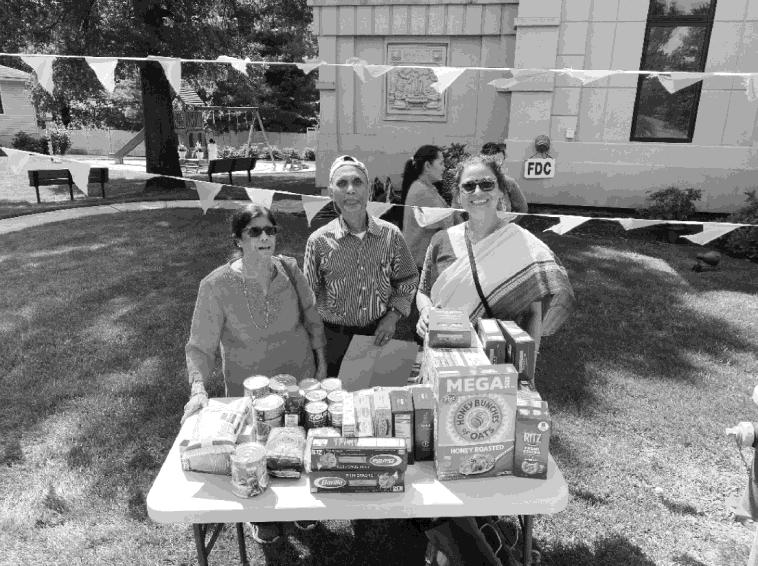
that day, Aditya Sen, Elina Daw, and Rianshi Bhattacharya together sang, “Ae Watan Watan Mere Abaad Rehe Tu,” under the guidance of Shreya Bhanja Choudhury. The Heritage Day celebration was concluded with an emotional poem, “Bharat Tirtha,” by Amitava Chell and a number of Indian patriotic songs by Arun Bhowmik. Last but not the least, a food drive was held to benefit Franklin Township Food Bank, and a large amount of canned and dry food was collected from donors.
Sailesh Chowdhury was born into an influential family of doctors in Ghatal, a town in the Medinipur districtofWestBengal.Hewasnotonly abrightstudentbutalsoanall-rounder.Heexcelledinvarioussports,was very good in literary pursuits and
By Debajyoti Chatterji (New Jersey)
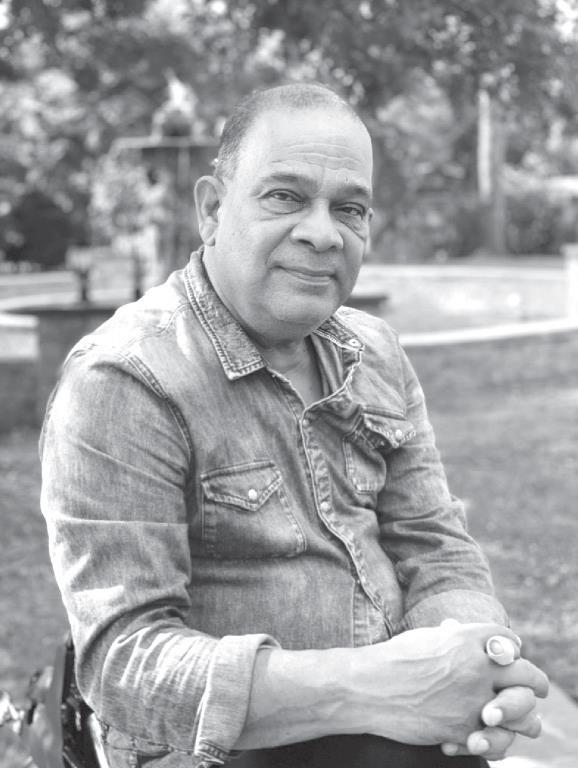
Successful Bengali entrepreneurs are relatively rare, especially among Bengalis living in the US. Sailesh Chowdhury of New Jersey is one such rarity. He is the Founder and President of BCI, Inc., a Moorestown, NJ-based high-tech company. Although Sailesh Chowdhury is a successful entrepreneur, he frees up enough time from his busy schedule to pursue his passion for art and poetry. He is also engaged in community support activities through several non-profit organizations. The author recently interviewed him to gain insights into his life’s journey from a bright engineer to a notable entrepreneur and philanthropist. took active part in school plays. After finishing secondary education from Ghatal Vidyasagar High School, SaileshdecidedtoheadforJadavpur University in the big city of Kolkata, to study Electrical Engineering, thus breaking from the family tradition of pursuing medical careers. This departure from tradition (and willingness to move from a small town to one of the largest metropolises in India and face adjustment challenges) will become, in time, a hallmark of hisprofessionalcareer.
Sailesh quickly adapted to the metropolitan lifestyle and started actively participatinginmanyathleticandintellectual activities at the university. He was a member of the University Cricket Team and a founder of the Jadavpur University Cine Club and Jadavpur University Literary Magazine. He also directed several drama performances and organized a numberofculturalfestivals.
After a remarkable five years at Jadavpur University, Sailesh graduatedin1967withabachelor’sdegree inElectricalEngineering(BSEE).For thenextthreeyears,heworkedasan engineer in a couple of reputed companies but thought he would do better in America where opportunitieswerelimitless.
Sailesh immigrated to the US in 1970 and started working for the New York Telephone Company. Being a hard-driving and ambitious young man, he also enrolled in a Master Degree program in Electrical Engineering at the City University of New York (CUNY). Finishing the master’s degree in Electrical Engineering in 1973, he went on to the University of Pennsylvania to earn another Master’s degree, this time in Computer Science & Information Systems(1976).
Armed with post-graduate degrees fromwell-knownAmericanuniversities,Saileshfounditrelativelyeasyto findgoodjobsandthenmovetoeven betterjobs.Heworkedforawhileat General Dynamics in Rochester, NY, asa circuit designer. He then moved to Computer Sciences Corporation (CSC) as a software engineer, followed by a period at United Technologies as a systems engineer. His final stop was the Missile and Radar
Division of RCA where he joined a teamworkingonanintegratednaval weaponssystem,knownasAEGIS.
RCA was the ideal organization for Sailesh’s talent and drive. Here hecould notonly apply whathehad learnedfromhispreviousemployers but also acquire new knowledge. He workedas a member of a close-knit team and developed strong ties to the Navy, the customer for the AEGIS project. His work received recognitionnotonlyfrom RCAmanagement butalsoseveralawardsforengineering excellence from the Navy. His publications in professional journals alsoreceivedadmirationfromhisengineeringpeers.
In 1980, a close friend suggested thatheandSaileshshouldstartasimple export-import business of their ownintheirfreetime.Thefriendhad learned that a company in USA was looking to buy “C.I. flanges” from India. The two friends found a good supplier of C.I. flanges, and this was theirfirstsuccessfulforayintobuildingabusinessoftheirown.
Things changed abruptly when firstGEandthenLockheedMartin,a majordefensecontractor,purchased RCA’s Missile & Radar Division. The chief engineer at the RCA division was a good friend and a mentor of Sailesh. This gentleman also had excellent relationship with the upper echelons of their primary customer, the Navy. When he learned that the Navywaslookingforacertainproduct,heaskedSaileshandafewother engineers if they would work with him todesignandbuild thisproduct fortheNavy.Alwaysarisktakerand path breaker, Sailesh joined this newborn company, RMS Technologies, as Director of Engineering and Chief Scientist. The venture was successful, and this gave Sailesh confidence to start a company of his own, Basic Commerce&Industries,Inc(BCI).
Sailesh founded his company, BCI Inc.,in1981,withactiveinvolvement of his wife, Manidipa. She was a batchmateofSaileshatJadavpurUni-
versity (but they did not know each otherwellatthattime).WhileSailesh studied Electrical Engineering, ManidipawasanElectronic&Telecommunications Engineering student. In contrast, when Sailesh was growing up at Ghatal in the “Rupasi Bangla” environment, Manidipa, daughter of UshakumarDutta(afreedomfighter, as recognized by the Government of India), wasabsorbing the rhythms of the great city of Kolkata. After coming to USA on their own, individually, Sailesh and Manidipa promoted themselves from batchmates to classmates when they were studying for MSEE at the City University of New York. Inthe staircaseoftime,the relationshipevolvedtoanengagement party in Manhattan, followed by a wedding ceremony in Kolkata and “BouBhat”ceremonyatGhatal.
BCI gave the couple the opportunity to combine their complementary expertise to develop a business strategy. They envisioned BCI to be a systems and software engineering company. Several colleagues from RCA joined Sailesh and Manidipa in thisstart-upventurebecauseoftheir high regard for Sailesh’s technical skills and leadership abilities. Soon, thecompanywona$600,000research and development contract from the Navyandproducedthepromiseddeliverablesontime.Thecompanywas offtoagoodstart.
Today, BCI employs several hundred scientists, engineers, technicians and support staff. Some employees workinthecompany’sheadquarters inMoorestown,NJ,andothersarelocatedintenothersatellitesitesinthe United States and abroad. BCI now covers a wide waterfront of communication, command and control technologies, such as radar systems, weapons control, air traffic systems, weather monitoring and analysis, andnavalcombatreadiness.BCI’slist of customers include the US Army, Air Force and Navy, National Severe Storms Lab (NSSL),Federal Aviation Administration(FAA),andmajordefensecontractorslikeLockheedMartin,GeneralDynamicsandRaytheon. The company’s annual revenue is nowapproaching$100million.
BCI’s rapid growth has received recognition from business publicationsand industry groupssuchasInc. Magazine’sListof500FastestGrow-
ingCompanies,andsimilarlistspublished by Forbes Magazine, Deloitte & Touche, and Ernst & Young. The company has also received many Outstanding Achievement Awards from satisfied customers like US Navy and Air Traffic Control Association.BCIhasalsobeenrecognized by the Institute of Electrical & ElectronicEngineering(IEEE)fortechnical innovation. Recently, BCI received amultiyearcontracttobuildaRadar atBCIfacilityanditsintegratedsoftwareforveryspecialdeployment.
As the leader of a small company thatstartedbackin1981,Saileshhas worked very hard for over 40 years to nurture and grow his business. Nevertheless,hehasalwayssetaside sometimetopursuehispersonalpassions. From his high school days, he has loved reading and writing poetry.Tothisdate,hehaskeptthatlove alive.Hehaspublishedfourbooksof poem,themostrecentbeing“DikNei Diganta Nei”(meaning No Direction, No Horizon), introduced in Kolkata Book Fair 2023. The other passion that he has successfully nurtured over the years is his love for painting and sculpture. He has a huge art collection, and many of his acquisitions are on display throughout his Moorestown headquarters. He loves to paint on canvas, and some of his worksarehangingonthewallsofthe office building. Many “works in progress”are piled up in various corners, waitingforSaileshto returnto them for the finishing touches. Sailesh has evenwonanawardforhisoneofhis works of art, depicting a scene from theMahabharataonthedeathofKarna!
Inrecentyears,Saileshhasnotbeen abletopursuehispassionfortheater and sports because such activities require team efforts and rehearsal/ practice times with other members. Art and poetry, on the other hand, continue to page 10 ��
Devjani and I and Dipak, our friend and neighbor, recently had a wonderful trip to Mexico from May 21, 2023, to June 1, 2023. It was our first time south of the US border, barring a brief oneday fling from Brownsville to Matamoros. Admittedly, our knowledge about Mexico was quite limited to the Mexican tortillas, enchiladas and the other familiar foods and the names of the favorite American tourist spots like Cancun, Cozumel and Port Vallarta. And our associations with the Mexican people, were limited to our gardeners, cleaning ladies and the laborers we employed on various occasions. So, the tour was a real eye-opener, at least for me.
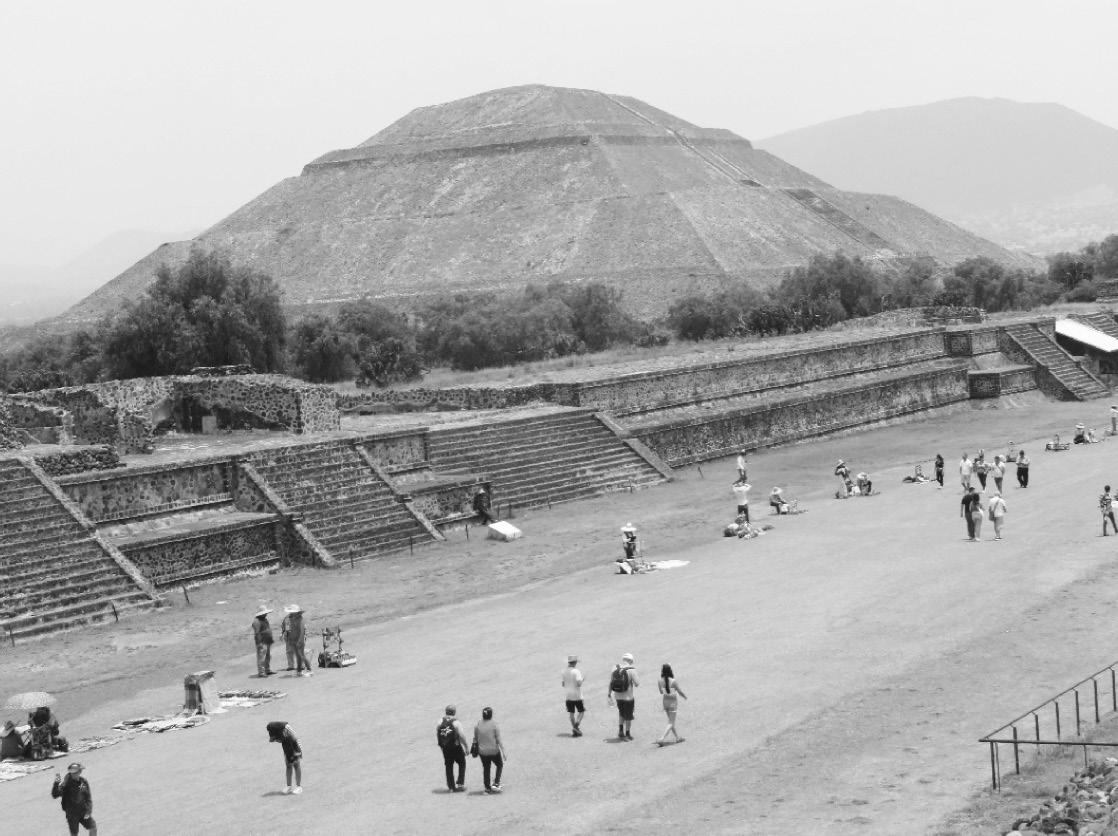
We started with Mexico City, where we stayed for 4 nights. The first night, we walked to Zocalo (main square) in the historical central heart of the capital city with impressive buildings all around attractively lighted. The next morning started with a tour of the pyramids (pyramids in Mexico?), to me, a high point of the whole tour. Through our wonderful guide Martha, we came to learn of the complex history of Mexico. We started with the ruins where on 13th of August, 1521, the Mexicans were defeated by Hernan Cortes. The site is represented by three cultures: the Teotihuacan foundations, the Spanish Church of Santiago and the surrounding modern buildings of Mexico City.
We learned that when the Spanish conquerors appeared in Mexico in the early part of the 16th century, the territory was ruled by the Aztecs (also called Mexicas), who appeared there in around 1300 AD. The Aztecs found the pyramids when they first appeared in the area. They were built by an earlier civilization, who had already vanished when the Aztecs appeared. The Aztecs called this enigmatic civilization the Teotihuacanos. The Teotihuacanos started building around 100 BC and around 400 A.D, they had a mature urban sprawl about of about 7.5 square miles, with around 100,000 inhabitants, about 27 miles northeast of Mexico City. We found two large pyramids (the Sun Pyramid and the Moon Pyramid) and
several impressive structures and frescoes. The Teotihuacan civilization came to an end around 550 to 600 A.D, arising from meteorological phenomena, which resulted in severe cutback of food supplies.
By Partha Sircar (California)
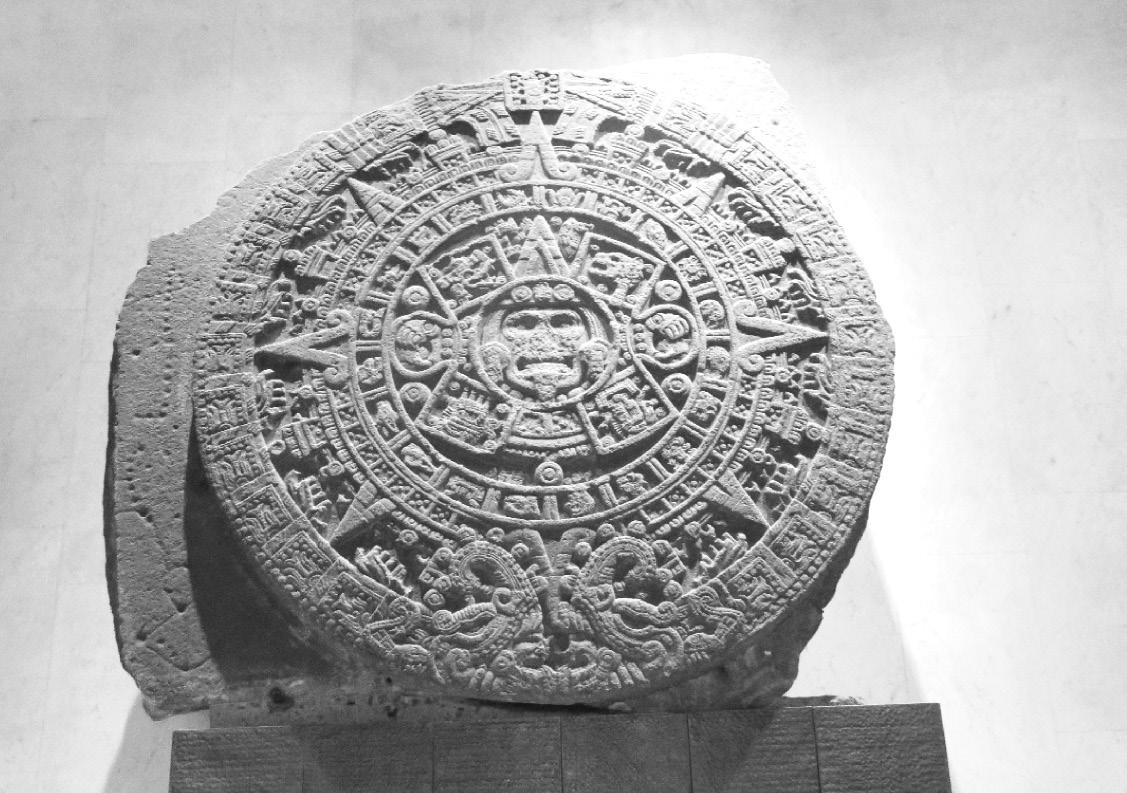
Our final stop was at the National Museum of Anthropology, built by the Mexican people in honor of the flourishing pre-Columbian cultures. A satisfactory depiction of the experience is beyond me and neither did we have the time to look at it in detail. A few items that stood out, included the Sun Stone on Aztec monolith. It was made up of concentric circles rep-
Subsequently, we went on a tour of Mexico City. We started with the famous Cathedral of Mexico City, located at Zocalo, which dates back to 1522. We visited the art museums of Freida Kahlo and Diego Garcia (famous for his murals), two of the most celebrated Mexican artists. We saw the Mexico City Stadium, the site of the 1968 Olympic Games. It also harbors the sad memories of the students’ riots there, just before the Games. We saw the building of the famous University of Mexico, whose exterior was totally covered by impressive frescoes. We visited a silversmith’s shop. where he demonstrated his craft. We had a wonderful boat ride along the river, where we were often followed by other boats selling memorabilia. It reminded me of the shikaras in Kashmir’s Dal Lake.
ized by Indus Travels. We traveled in a 12-seater van, all over in the company of our wonderful guide, Sergio, who spoke excellent English and a constant driver named Felix. We were also fortunate to have four additional tourists as our constant companions: an elderly entertaining gentleman from Liverpool and a lady (Martha) and a couple (Stella and Jaime) from Colombia, all beyond middle age. Martha was from Bogota and spoke a smattering of English, but the couple, from another part of Colombia, none at all. Nevertheless, we became quite fond of each other, in spite of our language barrier.
A particularly memorable event was the celebration of Devjani’s birthday in a restaurant in Guanajuato. We were all somewhat sad at the parting near the end of the tour and promised to keep in touch through e-mails. And I should mention here that Sergio kept up a constant dialogue, alternating between English and Spanish, so none of us would feel left out. We generally stayed in comfortable hotels, arranged by Indus Travels, close to the center of activity. Most often, we had breakfast at the hotel, and we were back at the hotel before dinner. We ate at the hotel restaurant, if one was available, or at a restaurant nearby.
We started from Mexico City in the morning on May 25, and returned to Mexico City in the evening of May 31. We stopped and visited cities with quaint, exotic names
resenting several elements of Aztec cosmology. There were numerous impressive statues and busts of ancient gods and goddesses of the various old Mexican civilizations. There were some very impressive displays of vases and pottery. There was also an interesting display of Aztec writing (Hieroglyphic). We came out extremely impressed with the pre-Columbian cultures of Mexico.
Our Tour of ‘Colonial Treasures of Mexico’
On the next morning (May 25), we embarked on our major part of the tour, which was billed as the ‘Colonial Treasures of Mexico’ organ-
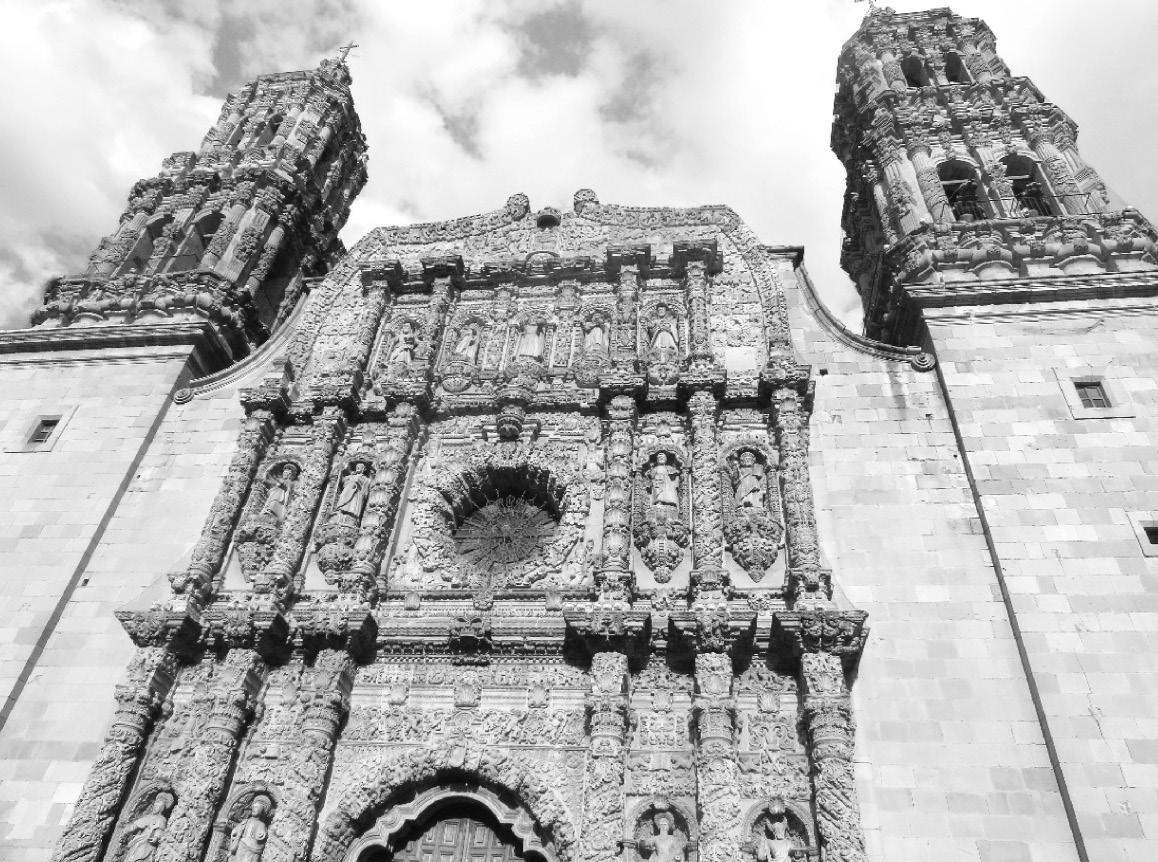
below. As may be seen from the map, the cities were all located in central Mexico, north of Mexico City. Most of the cities had their origins during the period of Spanish hegemony (16th century).Narrow, cobbled stone streets added considerably to the medieval ambiance. All the cities boasted of impressive cathedrals. The Catholic faith brought over by the Spanish conquistadors, aided by the missionaries was evident from the active churches. The missionary orders: Franciscans, Dominicans, Augustinians and later the Jesuits have left their mark. Sergio, our guide, pointed out that the Jesuits were distinguished for their commitment to education and showed us an old Jesuit college in Guanajuato. This made me, a product of Jesuit High School (St. Xavier’s in Kolkata), particularly proud.
The medieval towns also displayed numerous impressive statues of eminent persons: famous conquistadors and Spanish rulers like Hernan Cortes and Juan Juarez and also of famous personages of Mexican independence like Miguel Hidalgo and Jose Morelia. There was also a statue in Guanajuato of Francisco (Pancho) Villa, much reviled in the US but adored in Mexico. There were also statues of several local heroes. Through it all, we were given the opportunity of appreciating the rich tapestry of Mexican history and culture. Our visit to the La Cofradia Tequila factory near Guadalajara was an interesting experience. Tequila, an
like Queretaro, San Miguel de Allende, Guanajuato, Zacatecas, Tlaquepaque and finally to Guadalajara, the second largest city in Mexico. A map of the route is presented
original of Mexico, of which the Mexicans are very proud. The fully mechanized factory, located on a hillside, made it
By Rahul Ray (Massachusetts)
The oft-quoted line from the famous poem ‘The Rime of the AncyentMarinere’ by the eighteenthcentury English poet, Samuel Taylor Coleridge, relates to the travail of Mariner, a seasoned sailor in a long sea voyage. The quote relates to one of the horrors of seafaring, what if the ‘sweet’ potable water that had to be carried on board is finished? The ship is surrounded by water, but the salty sea water is worthless for human consumption, hence the quote.
The facts are - three parts of our earth’s crust consist of water and one part of land, and no life form can exist without water (potable, non-saline water from now on). Yet, the irony is that ocean water is neither drinkable nor can it sustain most vegetation. The only way salt water can be made useful for human consumption is ‘desalination’, a process by which salt is removed from seawater. It is a very expensive procedure.
Alarmingly, as discussed below, the world is running out of water raidly. There are at least two issues that are driving this phenomenon, and they are interconnected.
In the May 17, 2023, issue of The New York Times, David Leonhardt wrote an article entitled ‘Jakarta is sinking fast, and Indonesia’s president has chosen to move the capital’.1 Indonesia, being the largest archipelago, and one of the most populous countries in the world, is surrounded on three sides by the Indian Ocean. It consists of five main islands, one of which is Java where the capital Jakarta is situated.
Mr. Leonhardt quotes from reliable and verifiable sources that the land mass of Jakarta is sinking by almost a foot yearly. According to NASA data, the rise of sea level is caused by two factors.2 Factor 1 relates directly to human needs. Jakarta is in desperate need of drinking water, and in its search, people are drilling into the ground for underground aquifers. This process has been going on for a very long time, and it has a cumulative effect of creating an underground vacuum of sorts. As a result, the land mass in Jakarta is slowly sinking, soon to be filled by the seawater. Factor 2 relates to the rising sea level.
The rise of sea level is due to the melting of glacial ice due to a global change in the earth’s atmosphere, dubbed generally as ‘global warming’ which is causing a general rise in atmospheric temperature. This phenomenon is melting the polar ice pack, and the added water is raising the sea level.
Now let us consider the factors responsible for global warming. Elec-
tricity is the engine of human progress. All our consumable products, from foods to clothing to automobiles, trains, buses, and airplanes are produced/manufactured by using electricity. The construction of buildings, roads, bridges, and airports involves electricity. This is the age of computing and artificial intelligence.
All these require a constant supply of electricity.
Where does electricity come from? Besides a very small portion generated from wind power, solar energy, and other renewable sources, the lion’s share of electricity is generated by burning fossil fuels- coal, oil, and natural gas. Such a process pumps a tremendous amount of carbon dioxide and other ‘greenhouse gases’3 into the atmosphere. These gases trap the heat from the sun, and in the process increase the atmospheric temperature causing global warming.
Interestingly, water vapor is the earth’s most abundant greenhouse gas. Global warming is causing the temperature of the ocean and other waterbodies to rise and release increasing amounts of water vapor into the atmosphere further exacerbating global warming. Moreover, the higher-than-normal temperature of water vapor molecules is causing them to collide with one another at a significantly greater force than normal. The result has been disastrous. The ocean storms of today pack significantly higher wind force and power of destruction than hurricanes and tornados of yesteryears.
Rampant deforestation is yet another cause of the increase in carbon dioxide in the atmosphere because trees trap this gas to make food for themselves by photosynthesis and excrete oxygen, which is vital for all higher life forms. In other words, trees remove harmful carbon dioxide from the atmosphere, and deforestation is having the opposite effect.
Now let us look at yet another aspect of global warming and the rise in the sea level. As discussed earlier, the government of Indonesia is moving the capital Jakarta from the island of Java to Borneo, but the new place is coastal, and it is prone to flooding due to rising sea levels.
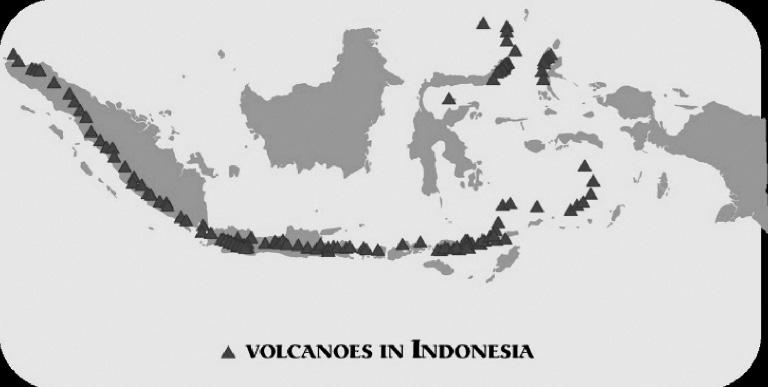
However, there is a potentially greater threat that Indonesia faces. This country is situated right in the
belly of what is called the ‘ring of fire’.4 As the accompanying picture demonstrates Indonesia is home to numerous volcanoes, active and dormant. A volcanic eruption and accompanying earthquakes may cause havoc in this area. The volcanic eruption of Krakatoain the Sunda Strait is considered one of thedeadliest in the history of mankind. It buried Krakatoa and several nearby islands in the ocean.Therefore, a future volcanic eruption andaccompanying earthquakes may cause havoc in this area.
Furthermore, earthquakes are often accompanied by tsunamis. For example, in 2004 an under-the-ocean earthquake with an epicenter off the west coast of Sumatra, Indonesia caused massive tsunamis that killed an estimated 227,898 people in 14 countries. Countless people were harmed in numerous ways.5
More recently, in March 2011 a tsunami generated by a strong earthquake damaged the Fukushima- Daiichi nuclear power plant in Northern Japan causing a partial meltdown of the nuclear core in one of the three reactors. This resulted in a significant release of highly harmful radiation.6. ‘Radiation clouds’ can travel thousands of miles depending on the air current potentially harming countless people.
Fukushima disaster, rated on the same scale as the nuclear accident at Chernobyl in the then Soviet Union in 1986 by the International Atomic Energy Agency, is another example of how a natural disaster, an earthquake in the Pacific Ocean can spiral into a disaster of much higher magnitude.
The situation is truly grave. Rising sea levels can magnify the effects of earthquakes, volcanic eruptions, and tsunamis far beyond what we see today.
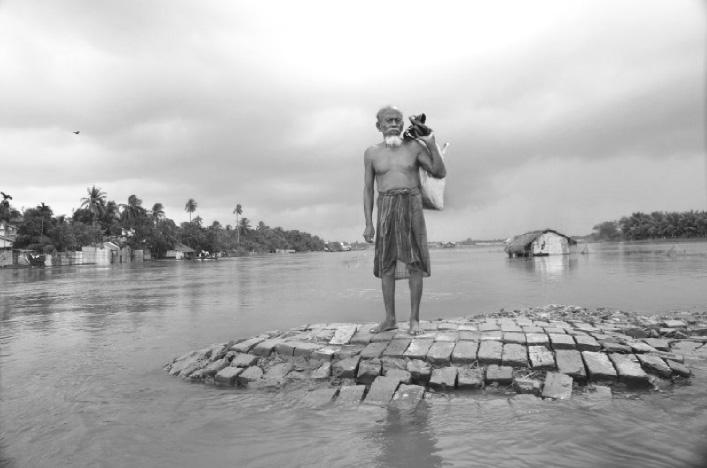
Even without a natural disaster rising sea levels can simply flood lowlying areas in numerous countries across the globe. For example, a large swath of land in Bangladesh is below sea level. The alarm has already been rung that much of this country will be flooded by the Indian Ocean in the foreseeable future.
Arguably, we humans have crossed the line to completely prevent climate-related catastrophes,but we certainly can attempt to reduce the impact.
A story, even if it is fictional comes from the Indian epic, Ramayana where little squirrels brought small stones in their mouth to help build the bridge between the (Indian) mainland and Sri Lanka so that Lord Rama could fight the Asuras.
The following is a prescription, not limited, to do ‘something’ instead of throwing in the towel in despair, thinking that the problem is so huge
that our individual effortswill be useless. Like the squirrels in Ramayana our small individual efforts will perhaps cause a cumulative effect towards reducing global warming and slowing down its potential dangers.
1. Stop wanton consumerism. Even if we can afford it, be content with less. As discussed, the manufacture of consumer goods requires electricity which is largely generated by burning fossil fuels resulting in global warming.
2. Recycle plastic, paper, and many other domestic products. It takes significantly less energy to recycle and reuse a product that making it new.
3. Drive less and take public transportation whenever possible. For the same distance traveled, a bus or a train carries many more passengers than an automobile.
4. Consider going solar. It is a far more economical way to produce electricity in the long run than burning fossil fuels. By the same token, consider buying an electric car to reduce the production of greenhouse gases emanating from the tailpipes of automobiles. Significant financial incentives are available in the US to meet these ends.
5. Plant trees – whenever and wherever possible.
6. Help organizations that are working through inter-government agencies and NGOs to prevent deforestation and global warming, in general. Spread information via social
media.
7. Support political parties, groups, or individuals who are working towards a cleaner and safer environment. Our vote in any election goes a long way.
Perhaps there is hope. In the US solar panels on rooftops and solar farms on the roadside are becomingan increasingly common sight. Wind turbines, once facing strong opposition from NIMBY 6 people dot the landscape. Several European countries have enacted tough environmentally friendly laws. Afterseveral years of abstention by the Trump administration, the US under Joe Biden has re-entered theParis Accord of 2015 which is a legally binding international treaty on climate change.
continue to page 15 }
By Asok Baral (New Jersey)
Wherethe mighty Himalayas meet the plains of the Indian subcontinent, once there was a kingdom called Kapilavastu, and in it there was a recreational garden called Lumbini. It is in present day Nepal, about 20 miles from the Indian border. In 623 B.C. (opinion varies about the exact year), prince Siddhartha, later called Buddha, was born there, a saint who would change the world forever.
The place was known for centuries, but it attracted only the devout Buddhists. However, in the last few decades, it has grown into international prominence, maybe because Buddha’s messages of love and compassion are what the world is craving for. Many countries of different religious faiths, cultural, historic, and political backgrounds have established places of worship to absorb Buddha’s messages.
war, made the pilgrimage in 3rd century BC.
This was a seminal change for the place. To commemorate his visit, Asoka built a pillar, later came to be known as Asoka Pillar. It was a 30 feet tall limestone monument with a crowning figure at top. The pillar is still intact after some 2300 years, but the figure at the top is missing. The pillar was meant to propagate the dharma, and it has inscriptions in Pali language (Brahmi script). The inscriptions are taken as a redoubtable proof that this spot was indeed the birthplace of Buddha.
Asoka also built a brick temple to house the stone on which Maya Devi had placed the newborn Buddha. It is called the “Marker Stone” and is highly revered. Asoka also marked the tree which Maya Devi held onto before giving birth of Buddha. It was known as the holy tree. But
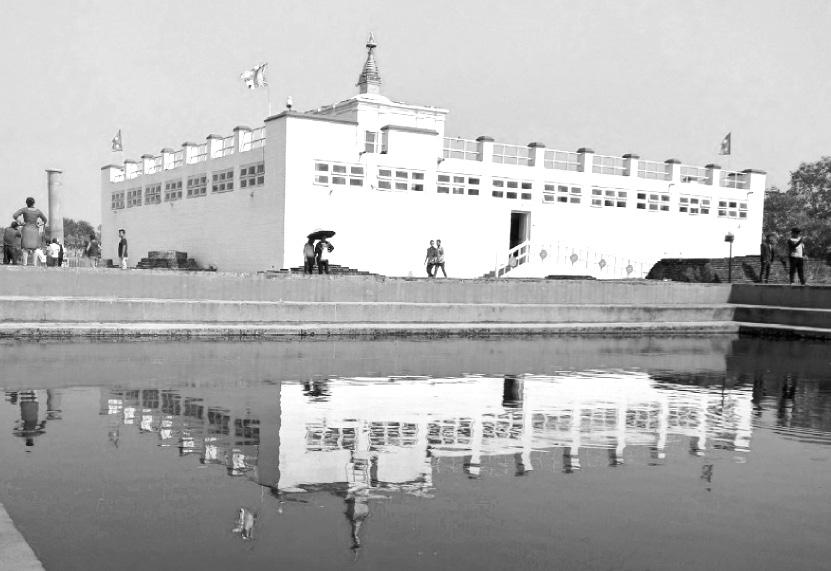
Buddha was born on the full moon day in the month of Baisakh (April/May), now called Buddha Purnima. His mother, Maya Devi, was traveling to her maternal home for the delivery of her first child. She suddenly felt pangs of labor and realized that the time had come. She bathed in a pond and walked towards an ashoka tree. As she held onto a branch, she gave birth to her child under the tree.
Buddha’s life is known to us. Following his Mahanirvana, his birthplace became one of the holiest places for devout Buddhists. They flocked from all over northern India where Buddhism has taken its roots. However, nobody of high authority visited the place until emperor Asoka, who had converted to Buddhism following the Kalinga
on December 1, 1896. After the inscriptions in the pillar were deciphered, more scholars became interested to conduct research at the site.
One of the first was archaeologist Purna Chandra Mukherjee. After his success in Pataliputra, he was assigned to explore Kapilavastu He discovered southern side of the temple and the carved brick masonry in 1899. A few years later, in 1933-39, Nepalese General Kesher Shumsher conducted major excavations and found many structures. However, due to his team’s unscientific methods, many subsidiary monuments were damaged.
Finally in 1962, Debala Mitra, the first woman to head Archaeological Survey of India, did scientific studies on the Asoka Pillar, and made an extensive inventory of all the artifacts that had been found.
In the meantime, in 1956, a General Conference of World Fellowship of Buddhists was
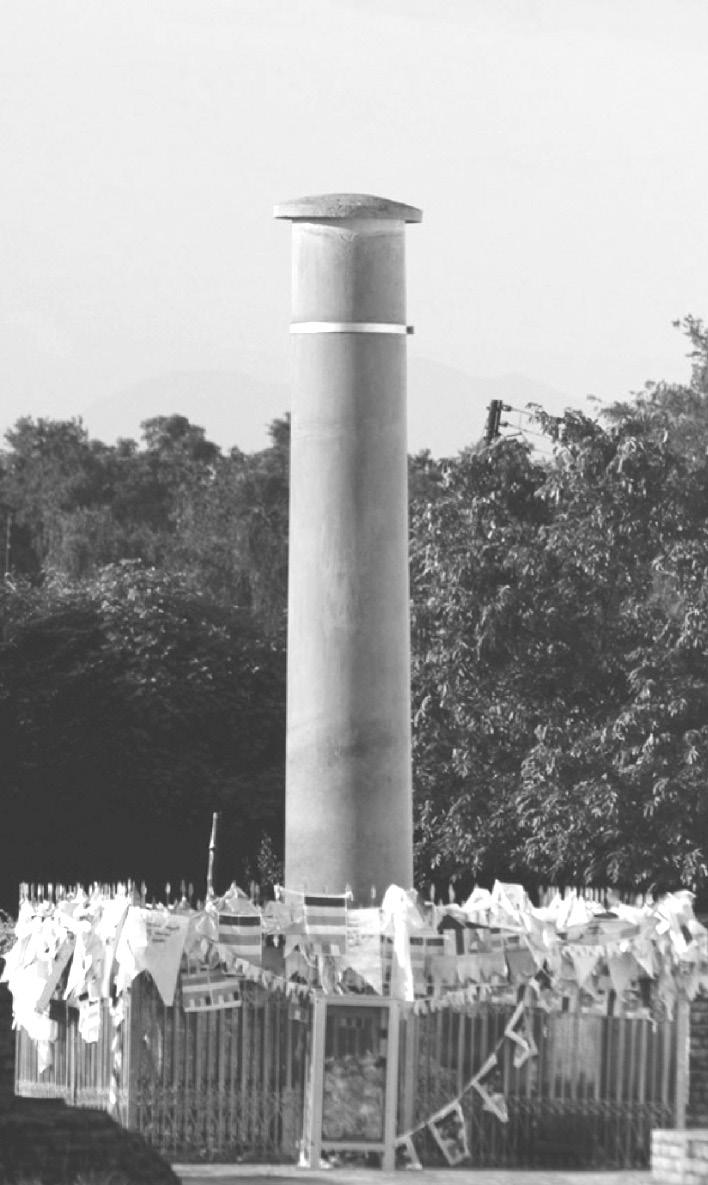
the tree had withered according to the 7th century Chinese traveler, Yuan Chwang, and a similar tree was planted a few yards from the “Marker Stone”. Asoka also built several stupas as places for worship, and viharas as residences for monks.
After Asoka’s visit, the place became one of the four most important sites for pilgrimage of the Buddhists. The devotees came from wherever the Buddhism had spread. Many well-known Chinese scholars came too, and wrote lengthy accounts of the place.
But over time, the place became less visited, weeds and vegetation covered the place, and it was almost forgotten.
Then German archeologist Dr. A. A. Fuhrer and Nepalese Governor Khadga Shumsher discovered Asoka Pillar
ple. Today, it is a beautifully constructed large temple with all the ruins of the old temple carefully preserved inside. The structure is big enough to accommodate the stream of visitors who can have a close look at the “Marker Stone”.
Next to the Maya Devi temple and Asoka pillar is the Sacred Pond (dipping not allowed) where Maya Devi bathed before giving birth to Buddha, and remains of the viharas (monasteries) and stupas (memorial shrines) that Asoka had started in the 3rd century BC, but constructions continued to 7th or 8th century AD. Many details of the place are known from the writings of the visiting Chinese travelers.
As the work of the Lumbini Development Trust was going on, a historic event changed the future of Lumbini. In 1967, the then UN Secretary General, U Thant, a devout Buddhist, visited Lumbini, and proposed that it should be a place where religious and secular leaders can work together, and it would be a symbol of mankind’s efforts to create a world free from hunger and strife. He called upon the international community to help in the effort. The response was very enthusiastic, and a 13-nation International Committee for the development of Lumbini was formed in New York in 1970. Two more nations joined later.
facilities for the pilgrims and visitors.
The Monastic Zone has a canal right through the middle. It is about a mile long, and temples and monasteries of many countries are on both sides of the canal. A total of 42 plots were allotted, and as of this writing 9 on the east side and 20 on the west side of the canal have been completed.
In addition, there are Cultural Center, Meditation Centers, Eternal Peace Flame, and Peace Bell. A boating facility to ferry travelers from one end of the canal to other is available. However, one needs to walk or use a vehicle to go from temple to temple.
The east side of the canal is preserved for countries believing in Hinayana (Theravada) school of Buddhism, and the west side for countries believing in the Mahayana school of Buddhism. The temples are built either by private or religious organization or by governments of the countries.
On the east side, there are temples from Thailand, Myanmar, Nepal (3), India (built by Mahabodhi Society of Kolkata), Canada and Cambodia. And on the west side, there are temples from Singapore, France (2), Germany, India (Ladakh), Nepal (several), Canada, Vietnam, Austria, China, Japan, and South Korea.
held in Kathmandu, and the participants felt the need to restore Buddha’s birthplace. The first restoring work was sponsored by Nepal’s King Mahendra. Construction of roads and monasteries were started, and Lumbini was opened to the world.
Then in 1972, Nepal Government’s Department of Archaeology started extensive work of excavation, research and conservation, and Lumbini Development Trust was formed in 1985. And in 1992, Japan Buddhist Federation joined hands with the Trust and major restoration works were started.
An outer wall was erected outside the original temple that Asoka had built and the whole structure became known as Maya Devi Tem-
In 1972, contract for the preparation of the Master Plan of Lumbini was awarded to famous Japanese architect, Prof. Kenzo Tange. The plan was finalized and approved by UN and the Nepalese Government in 1978. The objective of the plan was to convey Buddha’s messages of peace and compassion, create a place to experience the spirit of Buddhism and provide a seat of learning. According to the plan, we now have three enclaves – a Sacred Garden consisting of Maya Devi temple, Sacred Pond, Asoka pillar, ancient ruins and monuments. Secondly, a Monastic Zone which is an enclave of temples and monasteries of several countries.
And the third is the Lumbini Village, which is about two and half miles from the Asoka Pillar and consists of Information Center, Lumbini Museum, Lumbini International Research Institute, World Peace Pagoda of Japan, and accommodation
All the temples have their unique designs as per the rituals, traditions, and artistic ideologies of the sponsoring countries or groups. The differences are noticeable both in the outside architecture, and the décor of the inside places of worship. There are different idols of Buddha, and wall and ceiling paintings depicting his life and the spread of Buddhism. The visitors get an unique feeling of the diversity of the world, yet united in the pursuit of peace, all through the preaching of Buddha.
The designs of the temples are beautiful, and some are awe-inspiring, like the white marble structure of the Thai temple, or the unique blend of the European culture and Buddhist messages in the European temples.
It is also interesting to note that many of the sponsoring countries are Christianmajority or Hindu-majority or a Hindu nation. There was no representation of any Muslim-majority country, al-
continue to page 11 }
After spending 3 days inside the rain forest, we left the lodge for the airport at Puerto Maldonado. Our next destination was Cusco. I noticed that Cusco could be spelled as Cuzco also. All the guides of the Rain Forest company accompanied us for the return trip to the airport. Again, after an hour and a half long boat ride and an hour-long bus journey, we arrived at the airport. With watery eyes and firm handshakes, we bid good bye to our guides and headed towards the check in counter for our Cusco flight. Tiny airport, easy navigation. Within an hour we were on-board to our Cusco flight.
We landed at Cusco at around 3pm. Our tour coordinator was waiting with a small van to escort us to our hotel. Our trip from the airport to the hotel was kind of a preview of Cusco. Cusco is and was an important city for both the Incas and for the Spanish ruler. The Incas considered Cusco as the center of the universe. When the Spanish conquistadors came, they also established their seat of power in Cusco. That is around year 1520. Before I go further with Cusco, let me provide some relevant information about this place. It is a high-altitude city. Its elevation is 11,200 ft. In comparison, Darjeeling’s elevation is only 6,700 ft. Andes Mountain range is clearly visible. We were made aware of a phenomenon called Altitude Sickness. Inability to digest food, loose motion, even vomiting. In addition to that, breathing discomfort and light-headedness. Unfortunately, my wife Susmita fell victim of that on the very first night. After drinking Coca leaf tea and breathing oxygen, she got back to normal by the next morning. Yes, every hotel must keep provision for Oxygen, that is the law of this city. Right before the sun-set weather quickly got cold. Clouds came on to our touching distance. The hotel provided hot water bags for each of us. That was very comforting.
The next morning, we were scheduled to cover a large portion of the city. But Susmita felt that she needs some more time to recover. So, we rescheduled our city tour starting at noon instead of starting in the morning. That was a good decision. Acclimatization is the key.
Our guide showed up at the hotel lobby exactly at noon. The guide’s last name was Guido, which is a very common south Italian last name. I was somewhat surprised to meet a local who is of Italian ancestry. Mr. Guido probably noticed my bewilderment and volunteered to explain his Italian ancestry and his settling in Cusco. What he explained is that his grandfather migrated to Brazil in his youth. Few years later he came to Peru for better opportunity. He fell in love with and then married a Peruvian girl and thus permanently settled
By Prabir Biswas (New Jersey)
The first part of this two-part article was published in the last issue (July 2023) of Ananda Sangbad and was titled “Land of the Incas: Amazon District of Peru”.
in Peru. The World is after all small. Our first stop was the City Center. Typical Spanish city planning. Churches and cathedrals surround the main city square. The square is an open space paved with stone blocks. However, now the feeling is quite different. It is crowded with cars and street peddlers. Our guide took us for a tour of inside of one of the cathedrals. I will not cover the details of all the religious statues we have been shown because those may not be of general interest. So, I will write about some of my experiences and observations. On our trip from the hotel to the City Center, I noticed that foundations of many house structures are built with large grey color stones very neatly stacked. Above those stone foundation walls, the super structure was built with typical Spanish dark pink color stones. Very mismatched combination. Our guide explained that these buildings were originally built by the Incas. Later the Spanish rulers demolished the super structure and built their structures using the Inca built foundations. The large cathedral building was also constructed on stone foundation built by the Incas. Inside the Cathedral, surrounding the courtyard, there were many Inca structures still remaining, built with stone blocks neatly stacked and no mortars in the joints. Only groove and tongue type joints. These quality constructions need very sophisticated technology and high-level skills. Obviously, the Incas acquired those. We were also told by our guide that many of those enclosures had solid gold door frames, and also on alters and statues. The Spanish rulers plundered most of the Inca temples and removed all the precious items.
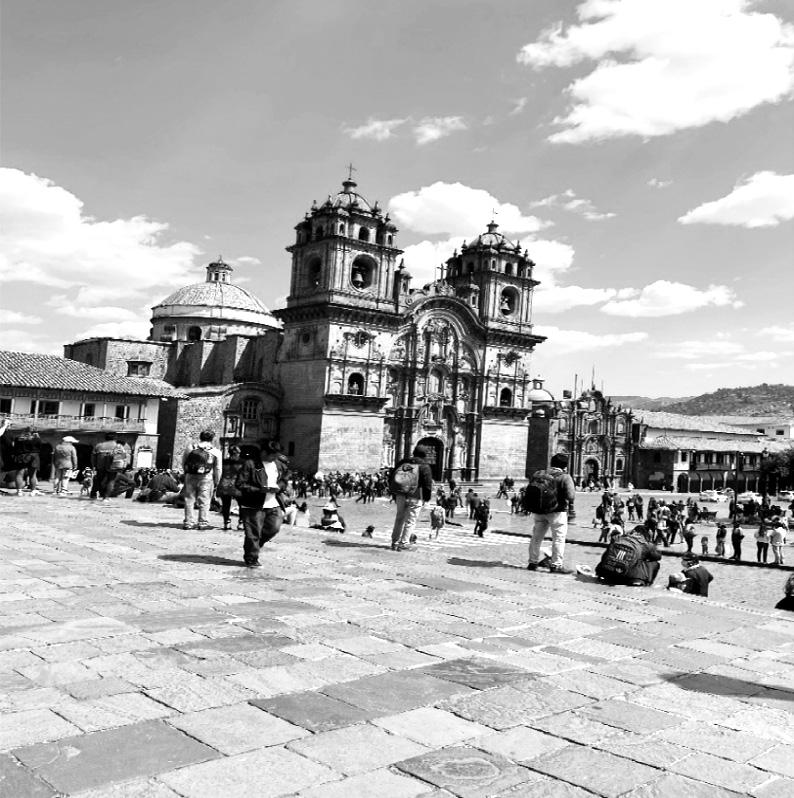
place. Traffic is dense. In general, people follow traffic rules. I had, during our tour, some conversation with our guide about Peru’s po-
litical system, general honesty, standard of living etc. He said that though the people mostly honest, the politicians are not transparent. Accepting bribes by the police is not uncommon. Mr. Guido said that though Peru is
gateway to Machu Picchu, is about 5 hours. We devoured the beautiful natural beauties throughout our train ride. The destination train station is a small hilly town, over crowded with tourists from all over the Americas and Europe. Many different faces, many different languages. The town is full of gift shops and restaurants. Our assigned local guide met us at the train station. We checked in to a hotel for that night. Next morning,
not a prosperous country like the west European countries, still the average Peruvians enjoy good socially secured life. After few days living in Peru and talking to people, I noticed a subtle divide between two distinct groups of Peruvians. One group is of indigenous people and the other ones are of Spanish and Peruvian mix.
After visiting Cuzco’s central market, we returned to our hotel. Our following day’s schedule was quite hectic. So, we decided to retire early.
On this day we visited a few places on the outskirts of Cuzco. Worth mentioning is Saqsaywaman (original spelling, Xacxaguaman). It is an Inca Citadel, built around 15th century. Impressive stone walls, some stone pieces being over 7 feet in size, smooth joints and perfect smooth surface and no mortar joints. Quite impressive indeed. We returned to our hotel right before dinner. The fol-
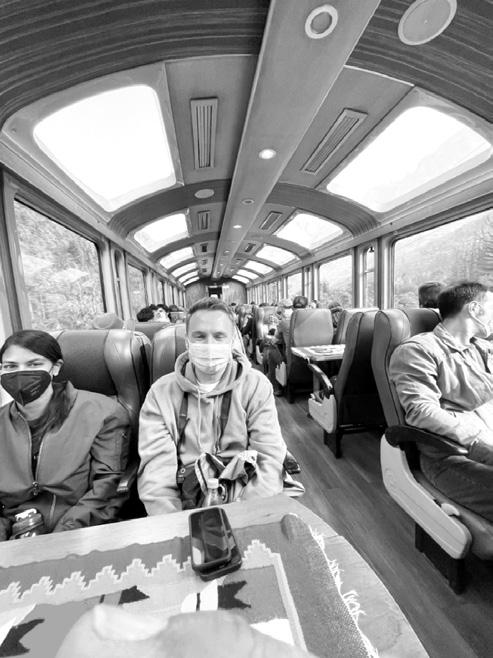
lowing day, we will be going to the famous Machu Picchu by train. Train trip to Machu Picchu through the mountains of Andes is magnificent by all measures. Two rail companies operate there, Inca rail and Peru rail. Their vista dome coaches allow all around views. Train trip from Cuzco area to Aguas Caliente,
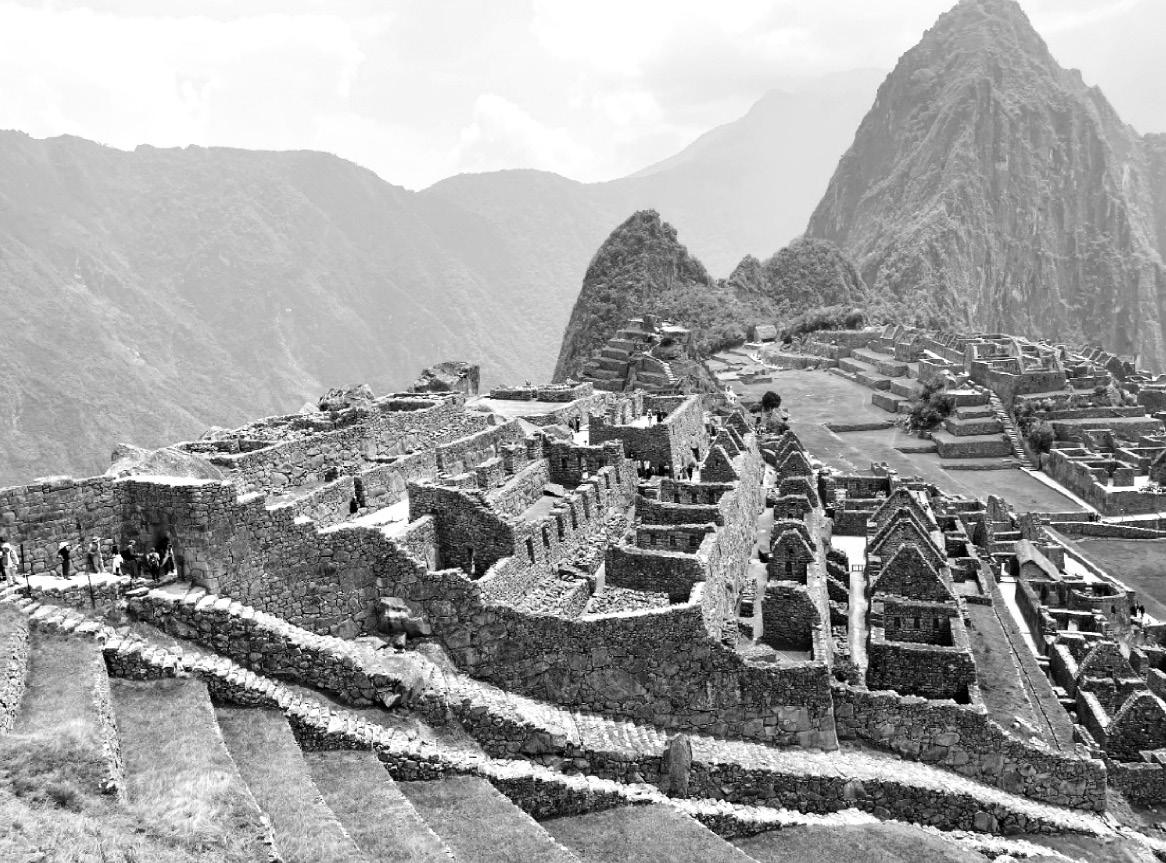
we boarded a shuttle bus to Machu Picchu. Though the shuttle bus trip is about 20 minutes, we climbed a substantial amount of height. Machu Picchu is a UNESCO heritage site, it is well preserved and well maintained. Number of visitors are monitored and the entry permits are controlled. I will not cover much about this place because everything about Machu Picchu is easily available in detail in the internet. My general feeling is overwhelming. At an elevation of over 6,000 ft on the Andes Mountain and on a difficult terrain, how the Incas built such a town and why they built that there. In about 6 hours we completed the tour. Though it was not summer season but, it was hot. Terrain was uneven and numerous climbs and descends. Strong knees and legs are needed to navigate. After completing the tour, we took the same train back to Cuzco. Late afternoon/evening train ride to Cuzco was equally enjoyable. The views of the Andes in the rays of setting sun was magnificent. After arriving at Cuzco, we checked-in to the same hotel for a good night’s sleep and to prepare ourselves for the next day’s long bus ride to our last destination Lake Titicaca.
Lake Titicaca is a very large body
Reported by Mita Sinha Chair, Puja Committee
Puja activities at Ananda Mandir is keeping us busy these days. Devotees are coming to visit the Mandir more frequently. It is good to see lot of attendees during all of our monthly pujas.
In the month of July, we had two pujas. The first puja was on July 17, our Shayama Puja. We had lot of visitors came to offer puja at the temple on this day. During summer time long daylight hours always helps. Kids are off from school that gives the parents opportunity to come to the Temple with their family. On this day Puja was performed beautifully and after Anjali/Arti all of us had sumptuous dinner and also had sometime for socialization.
On July 30, we had our monthly Satyanarayan Puja in the evening. This was also a busy day. Lots of devotees attended this puja, and all of us enjoyed the Puja, Arati and dinner.
On August 15, we had our monthly Shyama Puja. This puja was very well attended.
India’s Independence Day was celebrated at Ananda Mandir on August 20. On our temple calendar this day is known as Heritage Day. This year our Heritage Day celebrations started around 11:00 am, lots of kids were in attendance. Flags of the US and India were hoisted. All of us sang the national anthems of both countries. We also had some cultural activities scheduled such as singing, poetry reading, and some kids played musical instruments. Snacks were served after the function. Overall, this was a very engaging and productive day for all of us.
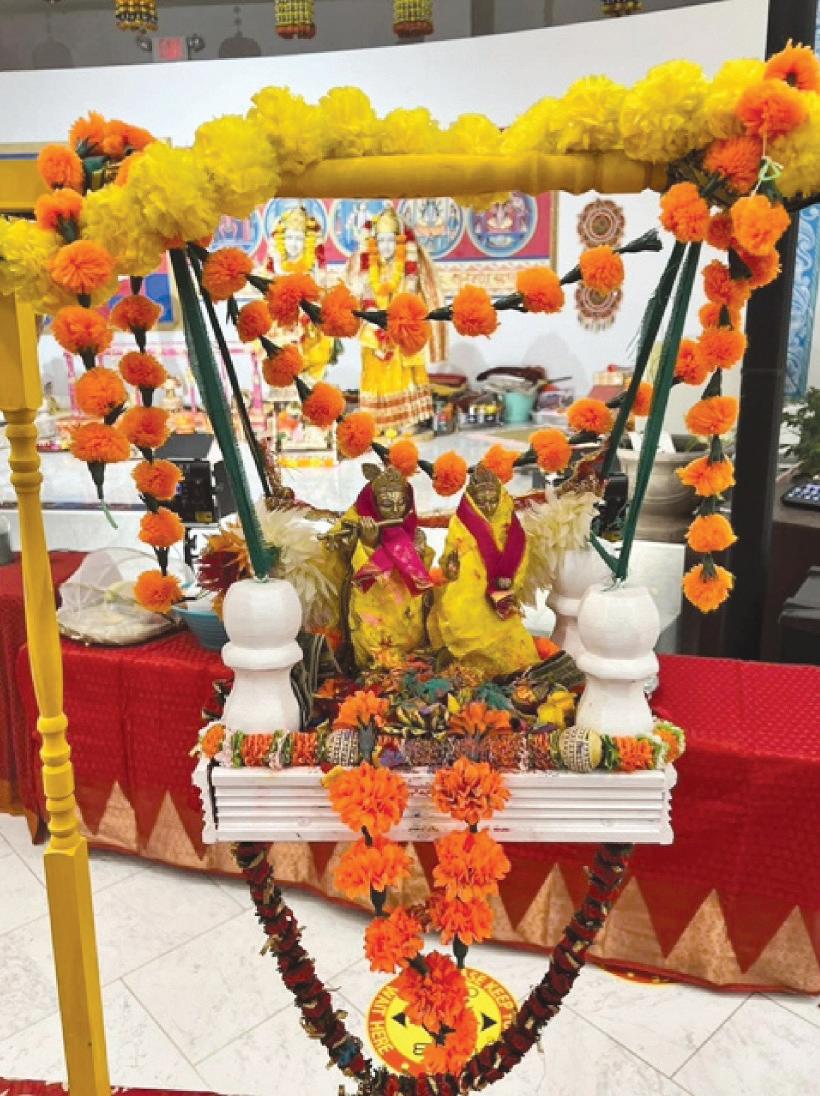
dressed with new clothes and ornaments, worshipped in a cradle with flowers, fruits, and sweets. One of the favorite foods of Lord Krishna wasmakhan(white butter). Devotees offer Makhan to the lord on this day. At Ananda Mandir, the temple remained open all day and visitors dropped by all day long to offer pujas.
On September 14, we had our monthly Shyama Puja. Lots of devotees came to the Mandir to attend this puja. After the Puja and Arati, we had our dinner.
This year, Biswakarma Puja was on September 18. Lord Biswakarma is known for his knowledge of science of mechanics and architecture.
This is a Hindu festival, celebrated in various parts of India. It is dedicated to Lord Biwakarma, the divine architect of the Gods. On this day, devotees perform Puja at their commercial setups, workstations, factories and offices to honor Lord Biswakarma. Kids fly kites and visit their friends’ homes. At our Temple, we celebrated this Puja in the morning.
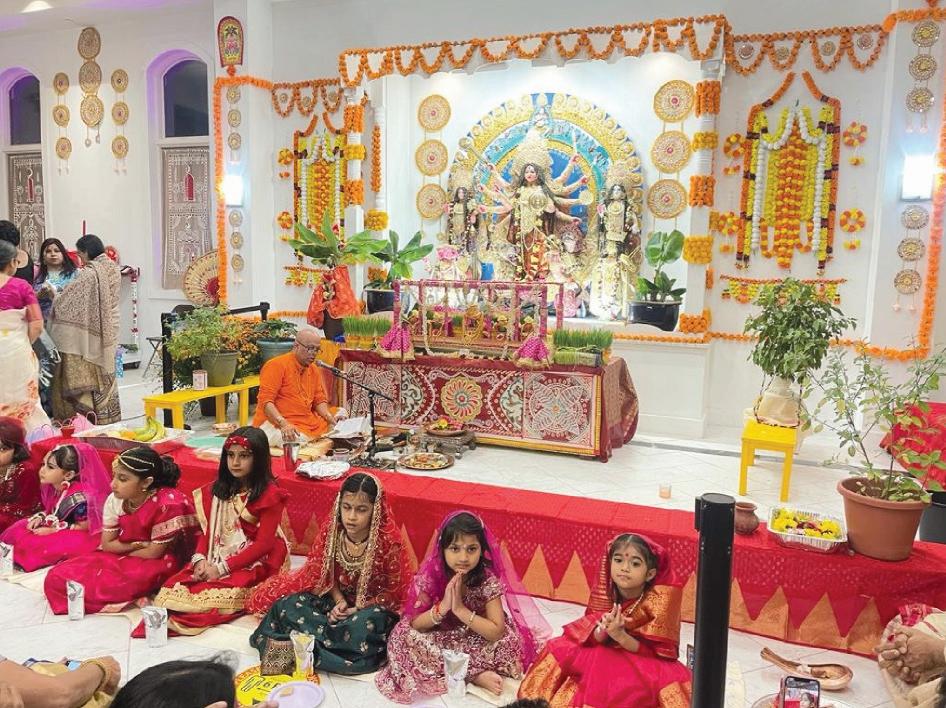
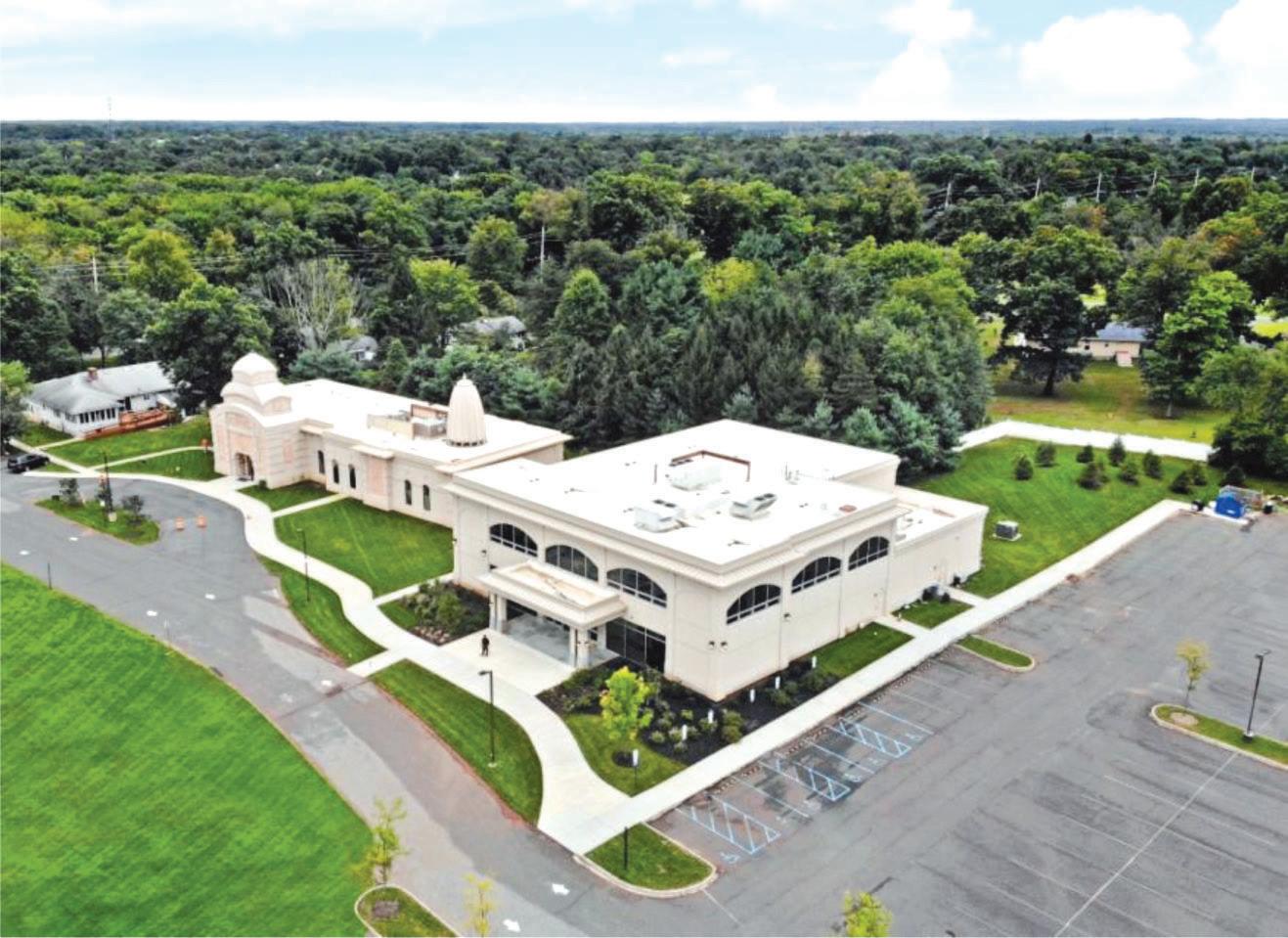
is spacious to accommodate a lot of people for different types of events. The atmosphere is beautiful, huge parking lot. These makes our facility quite attractive. We invite everyone to come and enjoy this special temple.
Durga puja is around the corner please register for all 5 days of Puja and spend some time with your friends and family. To register, go to www.anandamandir.org, and all details are available in our website
On 30th of August, we had our Satyanarayan Puja and Rakhi Purnima. Raksha Bandhan is a traditionally Hindu annual ceremony. It is observed on the full moon day of the month of Shravana. The festival of Raksha Bandhan symbolizes the bond of protection and love between brothers and sisters. We also had Satyanarayan Puja scheduled on this day, and after the puja, some people tied Rakhi on each other’s hand. We had dinner in the afterwards.
September was a busy month for us. On September 6, we had the celebration of Janmashtami at the Temple. Janmashtami celebrates the birth of Lord Krishna. Krishna is an incarnation of God Vishnu. Janmashtai is a grand festival celebrated all over India to commemorate the birth of Lord Krishna. People celebrate baby Krishna’s(Gopal’s) idol
On September 19, we celebrated Ganesh Chaturthi. This is a festival celebrating the arrival of Ganesh to earth from Kailash Parvat with his mother Parvati/Gauri. People worship Lord Ganesh for prosperity and good luck. Ganesh is worshipped before the start of every puja. At Ananda Mandir, Ganesh Chaturthi puja is celebrated in the morning.
The month of September ended with our monthly Satyanarayan Puja on 9/24. This was another busy day. We had the puja with havan, reading of broto katha, and ended with Arati. All of us had good dinner after the puja.
Ananda Mandir is a popular temple in New Jersey. People come from far and wide to perform weddings, poitey (thread ceremony), annaprasan (rice eating ceremony) and shraddha, batsarik etc. Our temple
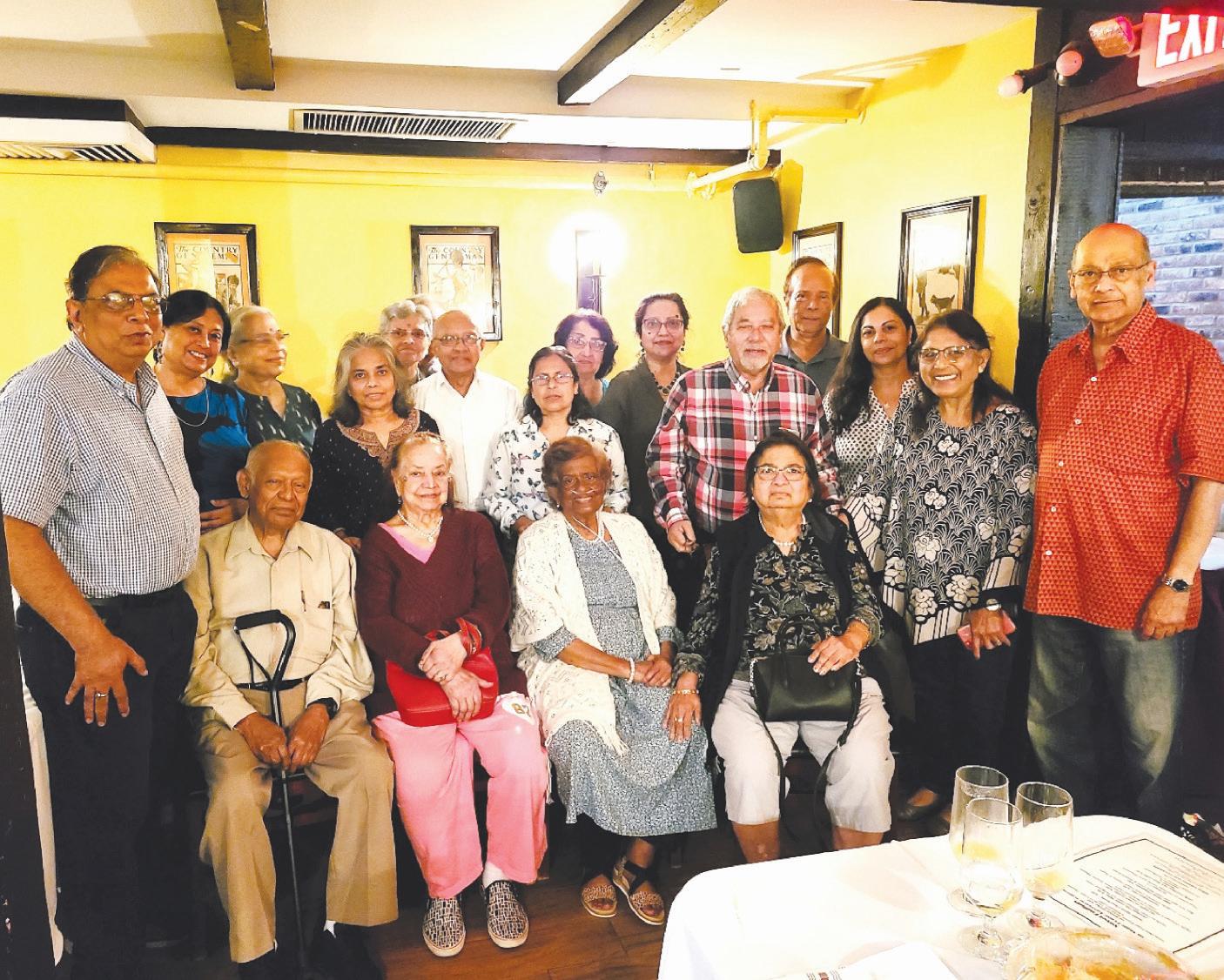
On Friday, August 25, about 20 seniors attended a group lunch at Stage House Tavern on Amwell Road, near Ananda Mandir. The restaurant gave the group a private room for the get-together. All the participants had the ability to choose from an extensive menu. We followed an open format of introductory comments, songs, recitations and free flowing adda. The group also took the opportunity to celebrate the birthday of Dr Samir Dutta, a core member of Evergreen Club. After about three hours of good time, the members dispersed, planning to have a similar lunch in two to three months’ time.
¥y†þy¡# þ›)yîû ô[þöìþ›– !î!èþ§¬ èþëûBþîû ô)!•þÅ
lîû†þBþy¡ xyöì¡y†þ myîûy ¤!I•þ †þöìîû îûy‡yîû
‹þ¡ î•þÅôyöìl ²Ìyëû ²Ì!•þ ô[þöìþ› ö˜‡y ëyëûÐ xöìl†þ
ô[þöìþ› ôy•,þô)!•þÅ !‰öìîû ’þy!†þ!löìëy!ˆl#îû
ô)!•þÅ †þy‘þ îyôy!þ !˜öìëû ²ÌÝ•þ †þöìîû ¤!I•þ †þîûy
¥ëû– ÷î˜%Ä!•þ†þ xyöì¡y†þôy¡y myîûy ~¥z ¤†þ¡ ô)!•þÅîû
ô%‡ˆ¥´îû– ‹þÇ%þ G ly!¤†þy ˆ¥´îû ¤yyöìly ¥ëûÐ
÷ìl†þ èþ_« ô!¨öìîû ²Ì¤öìD ²ÌÙÀ †þöìîû!Séöì¡l
öë !†þ †þyîûöì” ~¥z ¤†þ¡ ˜ylîy†,þ!•þîû ô)!•þÅ =!¡
ô[þöìþ› îûy‡y ¥ëû Ú¤îû¡ †þíyöì•þ ’þz_îûöìë ~îûy ö˜î#
¢!_«ôy•þyîû ¤¥‹þîû#– ~†þ†þíyëû ö˜î#îû ¤yöìDyþ›yDÐ
èþyîû•þîöì£ìÅîû ¤îÅe ˜#þ›y!§º•þy xôyî¤Äyîû !˜l
˜#þ›yî!¡îû !l!ô_ ô,!_†þy !l!ôÅ•þ ˜#þ› îyöìôyôîy!•þ
~î‚ î•þÅôyöìl ÷î˜%Ä!•þ†þ xyöì¡y†þ¤Iyîû îÄî¥yîû
¡!Çþ•þ ¥öì¡ G îDöì˜öì¢ ö†þl G¥z îûyöì•þ †þy¡#
ô[þöìþ› ’þy!†þl# è)þ•þ !þ›¢y‹þ ¥z•þÄy!˜ îûy‡y ¥ëûÚ
~ ²Ì¤öìD xyôîûy î¡öì•þ þ›y!îû öë Ö™%ôye
îDö옢 lëû– xy¤yô– G!’þü¢y xMéþöì¡ öë‡yöìl
²Ìy‹þ#l †þy¡ ¥öì•þ ‹þyô%uþy þ›)yîû ‹þ¡ !Sé¡ îy xyöìSé–ö¤¤î xMéþöì¡G ô¥y†þy¡#þ›)yîû îûyöì•þ ’þy!†þl#
îûy!†þl# ¥z•þÄy!˜ ô)!•þÅ ¢!_«ôy•þyîû ô[þöìþ› îûy‡y ¥ëûÐ
²Ìy‹þ#l ö†þy¡†þy•þyîû †þy¡# þ›)yîû ¥z!•þ¥y¤
xyöì¡y‹þly †þîûöì¡ ö¤¥z ô¥y†þy¡# þ›)yîû îûyöì•þ ëy
†þyuþ ö¥y•þ •þy èþëûyî¥ ~î‚ •þ˜†þy¡#l !îÊ!þ¢¢y¤†þ
•þy ö˜öì‡ !¢’þzöì’þü ’þzöì‘þ!Séöì¡lÐ
xy ¥öì•þ ôye 50 îSéîû xyöìˆG @ýÌyôîy‚¡yöì•þ
xôyî¤Äyîû îûy!eöì•þ ô¥y†þy¡# þ›)y ˆySéôSéöìô
þ›!îûöìî¢ ÷•þîû# †þîûöì•þy– ˆ¥l Döì¡îû ôöì™Ä
‰ly¦þ†þyöìîûîû îûyöì•þ ô¢y¡ µy!¡öìëû þ›)y ö¥y•þÐ
öë @ýÌyöìô G¥z îûyöì•þ ô¥y†þy¡# þ›)y¥öìFSé
î!¡˜yöìlîû ô™Ä !˜öìëû– ö¤¥z ~†þ¥z @ýÌyöìôîû ö†þyl
ˆ,¥öìßiîû îy!’þüöì•þ †þyöì‘þîû !þ›„!’þüöì•þ xyÒly
!˜öìëûôy!þîû ˜#þ› µy!¡öìëû ô¥y¡Çþ#îû þ›)y ¥öìFSé–
ˆ,!¥”# •þ„yîû þîy!þ– öˆyëûy¡– ™yöìlîû öˆy¡yîû
xyöì¢þ›yöì¢ G ˜#þ› ö˜‡yöì•þlÐ ˜#þ›y!§º•þy xôyî¤Äy †þy¡#þ›)yîû !•þ!í¥öì¡G !îö좣ì G¥z !˜öìl èþyîû•þîöì£ìÅîû ¤†þ¡ ²Ìöì˜öì¢ ô¥y¡Çþ#þ›)yîû ‹þ¡ xyöìSéÐ þ›!uþ•þ îû‰%l¨öìlîû
ôöì•þ !˜öìl ‹þ•%þ˜Å¢# ¥öì¡ ~î‚ îûy!e†þyöì¡
xôyî¤Äy ¥öì¡ ö¤¥z îûy!e ¤%‡îûy!e lyöìô !l!˜ÅÜT
¥öìîÐ îû‰%l¨l G¥z ¤%‡îûy!eöì•þ ¡Çþ#þ›)y !l!˜ÅÜT †þöìîûöìSélÐ xyˆôîyˆ#öì¢îû ¤ôëû ¥öì•þ îDöì˜öì¢
î•þÅôyl †þy¡#þ›)yîû ²Ì‹þ¡l ¥ëû– þ›!uþ•þˆ” xyˆôîyˆ#öì¢îû þ›)öìîÅ îD ö˜öì¢ öë †þy¡#þ›)yîû
†þíy ’þzöìÍÔ‡ †þöìîûl– •þy ‹þyô%uþy ôy•þyîû þ›)yÐ
ëy¥z ö¥y†þ– xyôîûy ö˜î#îû !†þS%é ¤¥‹þîû#îû
xyöì¡y‹þly x!•þ ¤‚!Çþ® èþyöìî†þ!îû韟Ÿé’þy!†þl#–îûy!†þl#– ¡y!†þl#– †þy!†þl#– ¢y!†þl#– ¥y!†þl# 韟Ÿé~„îûy
¤†þöì¡¥z ö˜î#îû ¤yöìDyþ›yDÐ ~†þ~†þ!þ ¢!_«Ð ~¥z
²Ì!•þ!þ ¢!_«•þsf ôöì•þ !îöì¢£ì ²Ìy™ylÄ öþ›öìëûöìSéÐ
¤y™lyöì•þ !¤!kþ¡yöìèþîû !l!ô_ ~¥z ¢!_«=!¡
¤¥yëû†þ ~î‚ ö˜öì¥îû !î!èþ§¬ ‹þöìe« þ›ëÅyëûe«öìô ™Äyl †þöìîû ¤y™†þ ~„öì˜îû ¤¥yëû•þy ¡yèþ †þöìîûlÐ ~†þ †þíyöì•þ ~„îûy !¤!kþîû þ›í²Ì˜¢Å†þÐ ~„îûy ö˜î#¢!_«ôy•þyîû ¤¥‹þîû#Ð •þöìsf ~„öì˜îû îû*öìþ›îû î”Åly xyöìSÐ ’þy!†þl# éŸé ¥zlyîû ô%‡ ¤yöìþ›îû ô•þl ~î‚ ¥z!l ™l¤Á›˜ ¥öì•þ ’þzêþ›§¬y– x!@Àî”Åy– †þô[þ¡% G
†þyþy!îû ™yîû” †þöìîû ¥z!l ¤y™†þöì†þ •þþ›¤Äyîû þ›öìí îîû˜yl †þîûöìSélÐ îûy!†þl# éŸéöþ›„‹þyîû ô%‡ôuþöì¡îû lÄyëû ô%‡!î!¢ÜT–ˆyeî”Å l#¡– ¤îÅyöìD lylyl x¡‚†þyîû ~î‚!•þ!l ‡’þüˆ G ö‡þ†þ ™yîû” †þöìîû xyöìSél xKþyöìlîû x¦þ†þyîû öël †þ•þÅl †þîûöìSélÐ ¡y!†þl# éŸé¥zlyîû †þþ›y¡ ‡%î ’þz„‹%þ– x‚†%þ¢ G þ›y¢ ™yîû” †þöìîû xyöìSélÐ x‚†%þ¢ !lëûsföì”îû îû*þ›– lylyl x¡‚†þyöìîû x¡‚†,þ•þy ˆye î”Å þ›yþ¡# þ›%öìÜ›îû lÄyëûÐ †þy!†þl# éŸé xöìÙ»îû lÄyëû ô%‡– ôy!”öì†þÄîû lÄyëû ’þzµ¡ ˆyeî”Å !ë!l ô%[þ™y!îû”#– !¤!kþ˜ye# G ö¤ï¨îûÄ ¤Á›§¬yÐ ¢y!†þl#éŸé¥zlyîû ˆye î”Å ö‰yîû †þyöì¡y †þyöì¡îû ô•þl– ô%öì‡îû xy†,þ!•þ !î’þüyöì¡îû lÄyëû– îL G ˜[þ™yîû” †þöìîû !•þ!l ¥y¤Äôëû#Ð ö˜î#îû xyöìîûy xöìl†þ òˆ”ó xyöìSé– ~„îûy ö˜î#îû ö˜¥¥öì•þ ’þzêþ›§¬y– xyöìSél îं‡Ä†þöìëy!ˆl#–xÜTöì‹þï£ì!R
Reported by Debajyoti Chatterji (New Jersey)
D
uring the July–September quarter, the most significant event on the Cultural Committee’s calendar was a classical instrumental concert on Saturday, August 26, in connection with our Annual Fundraising Lunch. This concert was designed as a token of appreciation from Ananda Mandir to all the donors and supporters who made generous contributions to this year’s fundraising campaign. The concert, presented by “Divine
Trio”, featured an extraordinary ensemble of the following three musical virtuosos:
Janab Hassan Haider Khan, the sensational young Shehnai player, follows in the footsteps of his illustrious lineage. Son of Shehnai maestro Ustad Ali Ahmed Hussain Khan and grandson of Bharat Ratna Ustad Bismillah Khan, he carries the legacy of his family’s musical mastery.
Vidushi Mita Nag, a renowned Sitar player, hails
from the legendary Vishnupur Gharana of Bengal. Daughter of well-known Sitarist, Manilal Nag, Mita’s remarkable talent and expertise have earned her widespread recognition as one of the finest lady Sitar players in the country. She continues to mesmerize audiences with her enchanting performances.
Pabdit Subhen Chatterjee, an extraordinary Tabla player, stands as a testament to the power of rhythm. His remarkable achievements include being nominated for a Grammy, receiving the prestigious Sangeet Samman Award, and holding
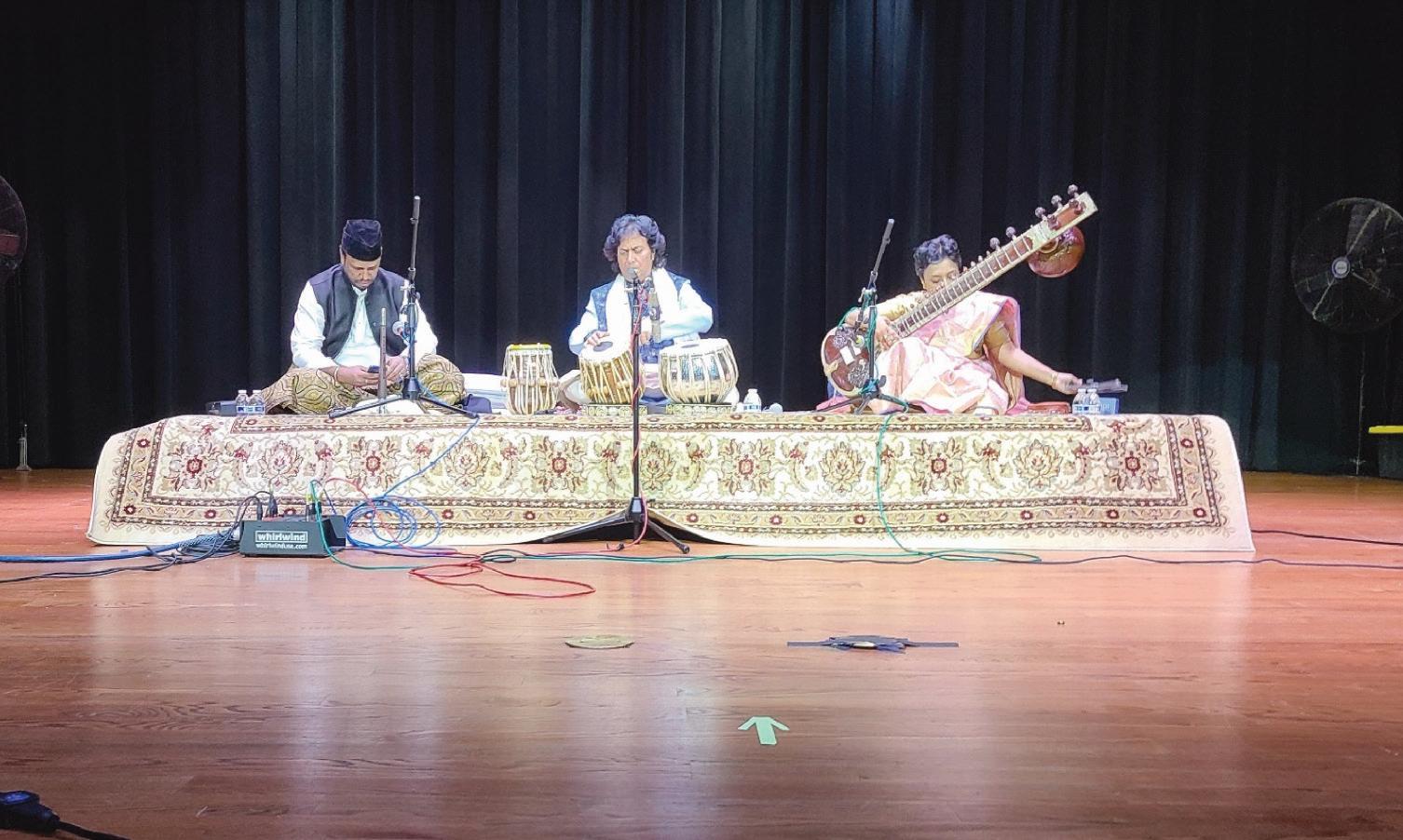
the Guinness World Record for the longest single performance by the largest number of musicians. With his unparalleled sensitivity, Pt. Subhen Chatterjee brings out the soul of the Tabla.
The Divine Trio presented a musical extravaganza that encompassed a wide range of expressions, including captivating bandishes, exquisite compositions on Ragas, soulful Thumris, lively Dadras, and melodious Kajris. In addition, they paid homage to the rich Bol-
lywood heritage with renditions of famous Raga-based songs from iconic films like “Gunj Uthi Shehnai,” popularized by the legendary Bismillah Khan Sahab.
The Divine Trio ended the concert by elevating the spirit of the audience with cherished Bhajans, filling the atmosphere with devotion and bliss.
The presentation was a harmonious fusion of classical finesse and popular melodies, leaving the audience spellbound and enriched by the power of their music The maestros received a thunderous ovation at the end of a spellbinding program that lasted over 90 minutes.

�� continue from page 3 arepassionsthatcanbepursuedinprivate,withoutdirectcollaborationwith teammembers.IfSaileshfeltanykind of emptiness, he filled in such voids with his involvement in philanthropy. He grew up in a philanthropically orientedfamilyinIndia,wherehisbrother, Dr Swadesh Bhusan Chowdhury, built Ghatal Rabindra Satabarsiki Mahavidyalaya,andhisfather,DrSashadhar Chowdhury, built Ramakrishna Sevashram on their family property. Andtrue tohisroots,Saileshhasbuilt Ramakrishna Sevashram School in Ghatal, his hometown, and he sponsors scholarships for college-going students in the US. He is a founding member, a major contributor – and a pastChairman oftheBoardofIndian Cultural Center of South Jersey and a majorbenefactorofAnandaMandirin central New Jersey. He is also actively involvedwithseveralartsocietiesand museumsinUSAandIndia.
Lastbutnottheleast,Saileshhasalwaysbelievedin “life-long education”. To that end, he has attended management programs at Harvard and Dartmouth and remained active in several professionalsocieties.
Sailesh, Manidipa and their sons activelyparticipateinUSpoliticalactivities because of their strong belief that citizens should help shape the direction of the society and policies of the government.Theyhaveorganizedseveral fundraising events at their home andelsewhere.
In addition to participation in local Bengali and Indian community activities, Sailesh gets involved in many local US chapters of nonprofit organizations. For example, from 1980 to 1986, hewasthecoach ofthejuniorteamat Mt Laurel Soccer Club. Because of his participation,RCAMissile &RadarDivision(Sailesh’semployeratthattime) providedfinancialsupporttotheclub.
Currently, Sailesh has collaboration with multiple companies in Kolkata in the area of software consulting and development, and engineering and manufacturing.
In early 1990, BCI developed a business relationship with WEBEL Electronics and Communication which continued for many years. In 2010, Sailesh gathered a team of ex-classmates and took the opportunity to develop real estatethatcontinuedforyears.
When Sailesh visits India, he stays connected with the Institute of Engineers as a Fellow. and with the Arts Acre (an organization that supports andpromotesarts)inNewTown,Kolkata, and several other nonprofit organizationsinWestBengal.
Like in every individual’s life, Sailesh has manty interesting stories to tell. The following one connects to his activities in India. In an afternoon of the year 2016, Sailesh and his young son,Shuvronil,wenttoagrocerystore in town. While shopping, he heard someBengaliwordsfromthenextisle. He followed the sound trail to find two gentlemen and a lady shopping and talking. Sailesh addressed them in Bengali, “Namasker!”, and asked themtheirwhereabouts.Hesooncame to know that the two gentlemen were Electrical Engineering graduates from Jadavpur University (1979 class) and were well established in USA. In the pleasant conversation that followed, oneofthemsaid.“Istillhavenotesand vu-graphsfromyourlecturesof198283 at JU.” Sailesh got a real kick from that comment.Yes, in his yearly visits to India, he had given many lectures atuniversitiesandprofessionalsociety meetings. In fact, Sailesh had given a seriesofseminarstothepost-graduate students at Jadavpur University Electrical Engineering Department, titled “AnOverviewonLarge-ScaleSoftware Development”. “The world is a small place!”,Saileshremarkedwithasmile.
Notknowntomanymembersofthe localBengalicommunityisSaileshand Manidipa’sactiveinvolvementinmakingfilmsonsubjectsthatinterestthem. Theywereproducersoftwofilms:Mou BaneAaj(Bengali)andToday’sSpecial (English). Now they are working on making a movie on the life of “Rupasi Bangla”poetJibanandaDas.Thisisfilm isplannedtobeproducedinacollaborative effort betweenBCIFilms(Sailesh and Manidipa), West Bengal Film Development Corporation, and BangladeshFilmDevelopmentCorporation
Sailesh is long past the traditional retirementageof65butentertainsno thoughts of slowing down. His wife, Manidipa, is a companion in his journeywithhersupportandpartnership. Becauseofhismanypassionsandhobbies, Sailesh is not afraid to retire. He knowsthathe will notsufferfromthe “nothing-to-do”boredomthatbedevils manyretirees.
Being a very practical person, Sailesh has prepared his two sons to takeuponthemselvestheresponsibilitiesofleadingBCItogreatersuccess,if andwhenthatbecomesnecessary.Successionplanningisarealchallengefor privatelyownedcompanies,soSailesh hasthatchallenge“undercontrol”too.
Inthemeantime,whenyou see Sailesh and/or Manidipa at Ananda Mandir, please say hello to them and tellthemhowproudweallfeeloftheir achievements as entrepreneurs and communityleaders.
�� continue from page 7 ofsweetwateratanelevationof12,000ft.ItisthelargestlakeinSouth
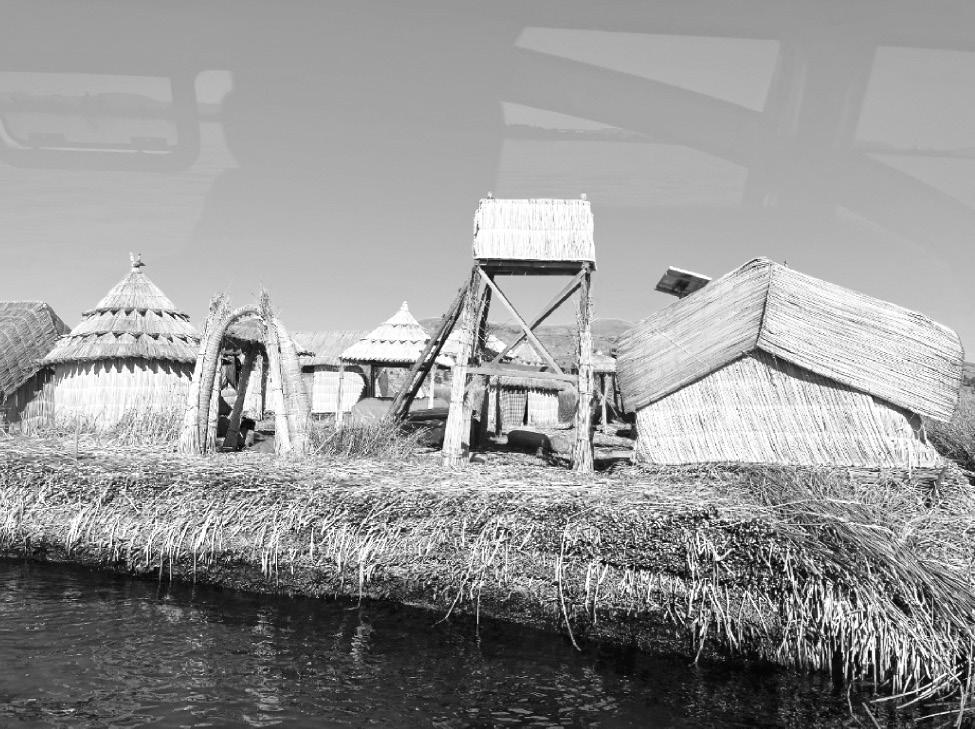
America.Italsoisthelargestnavigablesweetwaterbodyintheworldat thishighaltitudeof12,000ft.OntheeastofthelakeisBoliviaand,Peru isonthewest.LargerportionofthislakefallswithintheborderofPeru. Sincethislakeislocatedatsuchahighaltitude,thewaterisclearandpristine.Thislakeissolarge thatthe Boliviacoastlineismarginallyvisible. Thislakehasmanysmallislands,naturalandman-made.Yes,man-made floatingislands.Iwanttowriteaboutthedwellersoftheseislandsbecause Ifoundtheirwayoflivingveryunusualandunique.
The name of town where this lake is situated is Puno. Our hotel was right on the shore of this Lake. In the morning, our guide met us in the hotel lobby. We were escorted toa boat waiting for us at the hotel boat ramp. The guide explained us the day’s itinerary. We will visit two islands,oneman-madeandtheotheroneisnatural.Therearequiteafew naturalislandsinlake,notallofthosearehabitable.Ourfirst visitwastoa man-madefloatingisland.Ourguideadvisedusthatwecarrysomecash withus,USdollarorlocalcurrencybothareok.Thetouristsareexpected topurchasegiftitemsfromtheislanddwellers.
The inhabitants of those small man-made islands are originally from Boliviaandsurroundings,theyarecalledUros.Incaconquerorscouldnot enslavethembecauseoftheirinabilitytodohardwork.Instead,theywere drivenoutfromtheirland.Expelledoutfromtheirland,theysettledON LakeTiticaca.Theyusedatallgrassliketotoraplantforbuildingislands for their dwellings. These totora reeds grow in abundance in the lake. Urosdevelopedthetechniquetobuildfloatingislandbystackingbundles ofthosetotorareeds.Theislandwevisitedwasaboutonehundredyards square.Thislittleislandhousedfivehuts.Thesehutsarealsobuiltusing totorareeds.Theyevenbuilttheirboatswithtotorareeds.Looksliketotorareedsarethelife-lineoftheUrospeople.Weweretoldthatthereare aboutseventysuchislandsinthislake.Uponarrivalatanisland,wewere greetedby a middle-agedladyat the boatlanding.Itwassomewhatdifficulttostepontotheislandfromtheboat,becausetherewasnosolidsurfaceto“land”on.Wewereseatedonabenchlikething,madewithtotora reeds.Thelady,speakinginbrokenSpanish,explainedhowtheseislands arebuiltandhowthemaintenanceworkisdonetokeepthatafloat.
When we visited the island, it was mid-day. Other than four middle aged women and two infants, we did not see any men. When enquired, theguideinformedusthattheygotothemainlandtolookforwork.Isaw awomanwascookingbuildingasmallfire.Sheusedapieceofcorrugated metalsheettoseparatethefirefromtheislandsurface,whichismadeof totorareeds.Itwaslittlefrighteningtomebutshemanagedthefireand thecookingskillfully.
We concluded the island tour with mixed feelings. Using totora reeds tobuildislands,houses,boatsandothernecessarythingsisquiteimpressive.Ontheotherhand,Iwassadthatthesepeopledidnotlearnanyskill of agriculture or farming. Children had no opportunity to play or learn anysports.Noopportunitytoexercise.ThesefewwomenIsawwereall quiteheavy.Thelady weinteractedwithwaspantingafterasmallwalk ontheisland.Actually,therearenohardsurfacetowalkon.
TheGovernmentofPeruandsomeNGOsareimplementingprograms to improve their life. Doctors visit the islands on fixed schedules. NGOs teach them about general hygiene, not to defecate directly in the lake. Theyprovidedtoiletsandshowersandthetoiletsareemptiedbythegovernment sanitation crews. Five or six islands cooperatively own motorized boats for daily commute to the main land for children’s schooling andadult’sjobsearch.NGOsprovidesolarpanelsfor theirbasiclighting needs.Foroverhundredyears,theyarelivingontotoraplantsandfishing andoccasionallyhuntinginthenearbyislands.Theirknittingandweavingskillisimpressive(Icouldnotfindthesourceofthefabrics).Wealso visitedanaturalislandinthislake.Inhabitantsappearedtobehealthier andprosperouscomparedtotheUros.Thelandishillyandabout4square milesinsize.Unique about themisthat mendothe knittingwork.They make colorful hats and clothing. I noticed small gardens and domesticated lambs.Housesaremostly builtwithstoneandwoods.Altogether,itwas auniqueexperience.Bothfascinatingandsad. We returnedtoourhotel earlyevening.ThiswasourlastnightinPeru.
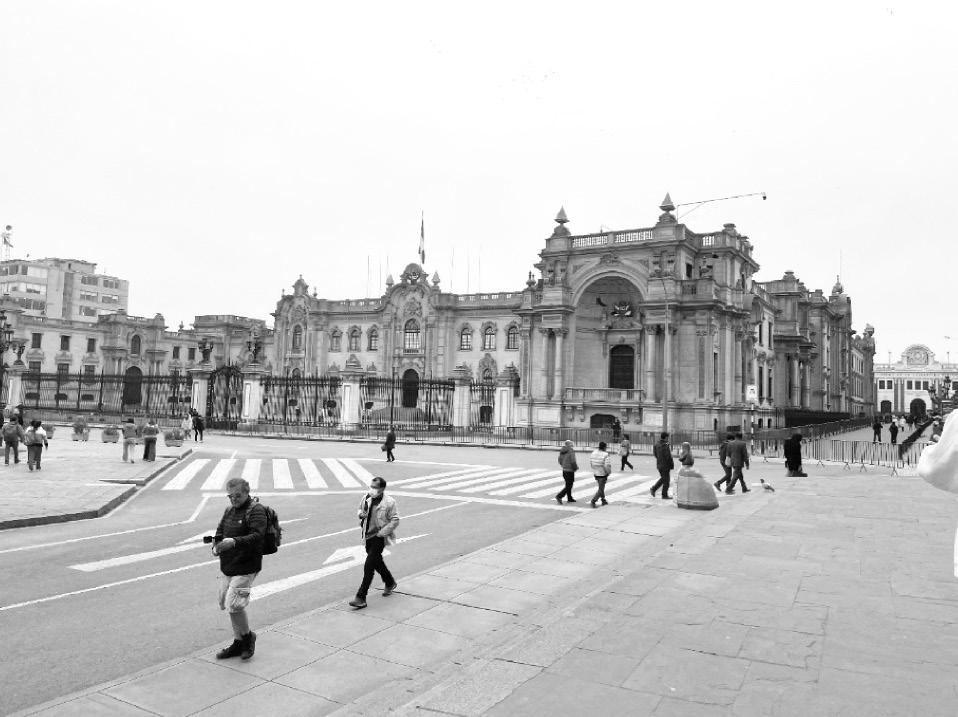
Next and final morning, we took a flight to Lima for our return flight to USA. Since our flight to New York was scheduled at mid-night, we arranged a guided tour of Lima. From Cuzco, the Spanish rulers moved theircapitaltoLima.Weonlyvisitedwealthyareasandmaintown square.ThoseareimpressivestructuresofSpanishstyle.Worthmentioning isthe museum we visited.Itisa private museum founded by Rafael LarcoHoyle,anexpertinPeruvianarcheology.Thenameofthismuseum isLarcoMuseum.Ithasanimpressivecollectionofartifactsfrompre-Inca civilizations. Bothpotteryandgold.Itisamust-visitdestinationinPeru.
Afterenjoyingourdinnerinthemuseumrestaurant,weheadedtothe airportforourreturntriptohome.
By Basab Dasgupta (California)
Iwas recently stuck in traffic on an interstate highway in the Los Angeles area and ended up looking at all the other vehicles around me in multiple lanes going both ways. There were all kinds of cars: family sedans, Sport Utility Vehicles, convertible sport cars, pick-up trucks, limos, mini-vans, taxis, buses and the list went on. The cars were big and small, from super expensive to old clunkers, foreign and domestic. They were in all colors: black, white, yellow, brown, red, gold, silver, green and probably all shades in-between. Although I could not see the drivers of all the cars, the ones I did see reflected a cross-section of society in age, gender, ethnicity and social status.
What struck me was the amazing discipline that existed despite all this diversity and the rather stressful traffic situation. No one was screaming or honking or giving fingers. All the cars were just inching forward when there was an opportunity to do so.
I immediately thought that driving on the highway is the essence of living in a socialist ideology. We can probably live like this in our daily life – a peaceful coexistence with all the diversity in the middle of life’s stressful problems.
Everyone obeyed the traffic rules. Of course, there were occasional violators. The presence of traffic cops was always a deterrent and a few sirens with flashing lights were visible every now and then. There was no protest based on race when a driver was caught in his violation and given a ticket.
There was no preferential traffic lane for wealthy drivers. There was no designation of certain lanes for certain types of cars. All lanes were available to all drivers. There was a car-pool lane where one could travel if the car had more than one person. Each driver is required to stay primarily within his or her designated lane. Driving occupying two lanes was not allowed. There was a feeling of equality just having the privilege of driving on this freeway. The phrase “driving in the fast lane” is only a cliché; there is no such thing as a “fast lane”. Even the cars in the carpool lane are
required to obey the posted speed limit.
Of course, there were good drivers and bad drivers but to a large extent there was an overall uniformity in the traffic flow.
Even in the case of accidents there are well-defined protocols of what to do and everyone follows those. There were no fistfights or mutual insults.
Can we establish a socialist nation based on the example of highway driving? First, just like driving lanes we should have land available to everyone for free or for minimal cost and of equal sizes to build a home. Of course, there must be a minimum age requirement for such ownership like the minimum required age for getting a driver’s license. Just like people can drive any car on the freeway (subject to annual inspection for safety, exhaust etc.) we should be allowed to build homes of any type and any size on our given land, subject to some basic safety requirements (like seatbelts, functioning brakes and headlights and acceptable exhaust gasses in the case of driving).
The government should have the responsibility of providing utilities and maintenance of the land (for protection against natural disasters) in the same way they take care of road maintenance and street lighting.
Just like carpool lanes there should be pieces of land dedicated to multifamily homes. There should be some general rules about lifestyle: one cannot live too fast a life just like one cannot drive a car too fast. One should be allowed to move to a different piece of land if such space is available ala changing of lanes. Just like stopping in the middle of the highway is not allowed, people would not be allowed to simply abandon their homes on their allotted lot; they must somehow tow their house from the given lot to some designated place.
For people who cannot afford to build their homes should have access to rental homes just like rental cars in case of driving. Large apartment complexes can play a role like buses.
However, the key to this “highway socialism” is motion. Everyone is disciplined and peaceful if he or she
can get to their destination. No one really keeps track of why all these people are moving and what they are after. Some may be going to or coming back from work, some going to school, some on a pleasure drive, some are on their way to visit a relative or friend, some are going shopping or to see a doctor. No one judges or evaluates their driving in view of those purposes. Living in a society is equivalent to motion along life’s path.
There is no question that there would be considerable commotion if the entire traffic flow was completely stopped without any information about what is happening. By analogy, we must all move in our social lives. We should all have a destination or goal in life and be continually doing something towards that goal. Any social unrest, natural disaster and the like which suddenly stops us from our daily activities injects anger and frustrations and threatens a possible peaceful coexistence.
One key for this harmony on the road is that it is easy to learn how to drive. In this country one must know how to drive a car to survive regardless of one’s social status, ethnicity, age etc. The driving rules and techniques are standardized and not difficult to learn. In our journey of life, on the other hand, it may not be easy to learn how to move forward; different people struggle with different methods of getting education and finding jobs. This suggests that, to implement a similar harmony in our society, one has to learn from standardized curricula in academia and be engaged in a selected set of professions. It is no wonder that socialism preaches exactly that.
There is no individual freedom. One cannot just zip by at 150 mph or faster. One cannot drive a vehicle so large that it does not fit within a traffic lane. There is no opportunity to demonstrate creativity. You cannot design a zig-zag lane just because you think that it might be more fun to drive like that. One cannot experiment with different types of fuels to see what offers optimum fuel efficiency.
Nevertheless, the highways overall do work to take us to our destinations. Should we embrace socialism in the USA as a fair system?
While a country like Venezuela may fail just like highway travel may break down because of lack of fuel and road maintenance, there are other countries which seem to run successfully on socialist principles!
Here is the real irony. While many consider the US interstate system to be the biggest socialist project in history, it was conceptualized and approved in 1956 under a republican president – Dwight D. Eisenhower –at the urging of automobile companies so that they could sell more cars; a perfect capitalistic game plan. Perhaps a truly socialist government can be formed here only if it is somehow sponsored by mega corporations who want to sell their products and services! This would make only a selected group of people
very wealthy, something that has already happened in China and Russia.
The real question is how we want to travel. Will we be happy to travel along a predetermined preconditioned roadway where everyone moves in a systematic and seemingly fair way, or would we crave our own adventurous paths and moving at our own pace and comfort? Do we want to carve our own ways, perhaps along roads less traveled or perhaps along an underground tunnel away from everyone’s sight? Should we even care about other people’s transportation problems and help others to move with us?
It all boils down to the same age-old issue: individual freedom versus social harmony!
| continue from page 6
though Afghanistan and Pakistan/Bangladesh (Bangladesh has a monastery in Bodh Gaya) were signatories of the 1970 International committee for development of Lumbini. There is also no representation from countries where Buddhism has not taken any roots, as in Africa, Latin America, or Oceania.
The temple of America is currently under construction, and next to it, the temple sponsored by the Government of India is also under construction.
Lumbini, as the birthplace of Buddha, promotes his spiritual values and an inspiration for peace that the world desperately needs. No wonder that four U.N. Secretary Generals, professing different faiths visited Lumbini - U Thant in 1967, Dr. Kurt Waldheim in 1981, Zavier Perez de Cuellar in 1989, and Ban Ki-Moon in 2008. And UNESCO has called the place as of “Outstanding Universal Value”.
As we walk from temple to temple of such diverse countries, we wonder that if they can meet at one place for worship, can they magnify the same spirit to make the world a better place. It seems like an utopian thought. But the world has managed to get together and worship for peace at this small place, the birthplace of a great saint whose messages still reverberate throughout the globe.
References:
Lumbini Beckons by Basanta Bidari, Lumbini International Vipasana Meditation Center
UNESCO World Heritage Foundation on Lumbini
Lumbini Development Trust
Monastic Zones in Lumbini by Sandip Paudel
Note for travel to Lumbini: Lumbini is accessible from Kathmandu, an 8-hour drive (200 miles) drive or a 35-minute flight (often delayed) to nearest airport, Bhairahwa. Good accommodations are limited. Also, better to check the visiting hours as these maybe different from what is printed. The visits from temple to temple involve considerable walk or use of a vehicle. Cycle rickshaw is a better option than car as the roads are narrow and often under construction.
By Vishnupriya (New Jersey)
Any literature on Elderhood in the US keeps harping on the acute loneliness of the seniors. A large percentage of widows and widowers used to move in with their children earlier (70% in 1922) but not as much anymore (38% in 2022). In his book,“Together: The Healing Power of Human Connection in a Sometimes Lonely World” (2020), the Surgeon General of the US, Vivek Murthy, makes the case that loneliness is a public health concern. It has reached epidemic proportions and is one of the biggest killers. It is one of the biggest causes of Dementia and Alzheimer’s among the elderly, leave alone other mental health issues. It is sad but true. And dialogues on anti-aging drugs, protein rich and carb less diets and gym routines for elder well-being are inadequate and incomplete.
It is fascinating how Singapore tries to combat loneliness of the elderly by providing Proximity Housing Grants. If an elderly couple decides to live with their children, the government gives them a grant of $30,000 -and $20,000 if they live near their children. And this togetherness somehow causes seniors less anxiety, more companionship, and fewer health emergencies. This in turn reduces the stress on the healthcare system and healthcare costs, “an economic argument for human benefit “(Dan Beuttner)
What is possible in a small country, or a city state like Singapore may be hard to achieve in a huge nation like the US with its diversity, its heterogeneity. Also, I am not sure that this idea of receiving grant money will work in the US. It may or may not work because of people’s right to choose the life of their own choice provided they have mental capacity. Absolutely no one can take their life’s decisions for them. This is of paramount importance to Americans, but the argument for adopting a more efficient use of resources to optimize savings is a good one.
So, it might be a good idea after all to gradually do away with the retirement and assisted living communities (most are very expensive as well, especially in the Tri-State area) and instead introduce intergenerational housing communities. This would be like our good old family oriented, family centered living, true a few decades back. In this kind of living the elderly are not alone and are able to share their wisdom with the younger generations. And the younger generations can physically help the seniors with their everyday needs when needed. This does not have to be their own families. The idea is to put the ‘neighbor’ back into the ‘neighborhood’.
These stout communities can foster so much valuable exchange in terms of sharing resources, learning new skills and accepting help where needed. To me this is a win-win situation because the elderly will then find a purpose in life and feel less useless and isolated. And this is likely to lead to wellness and well-being because they will feel their life “refined by age, not defined by age”(Kathy Sporre). On the other hand, it would generate among the younger generations a paradigm of caring for the elderly with greater compassion and gratitude.
As people age, their once fiercely inde-
pendent castles become lonely islands after the younger generations have flown the nest with very little chance of returning to the fold. Cohousing allows you to have as much privacy and community as you want and at the same time you know and care about and support your neighbors as much as possible. It’s a functioning village like the ones in Denmark, Sweden, Netherlands, where there are probably fewer seniors wanting to go to the doctor essentially for company in their otherwise lonely lives.
Most county programs in the US for seniors are not long term and are based on their Income and Assets. That is why the neighborhood level care system is a viable option. This, however, is not to say that this concept will be free of issues. Every new concept comes with challenges. As time progresses and problems are encountered, more ideas are generated. No approach is ever full proof, so there will be problems, and as these are addressed, new solutions might come up, and a more suitable approach might emerge. There is also no one approach that fits all. So there needs to be continuous dialogue to work out newer strategies for better outcomes. This is a starting point.
For Solo Agers, shared housing is another idea to explore. It may be able to ward off the challenges of Solo Aging like high housing costs, inadequate availability of affordable housing and low retirement income vis a vis the current market rate of products and services. Shared housing also entails sharing all utility expenses and using half of the world’s resources for water, heat, air conditioning and internet. This housemate relationship is also a good way to avoid social isolation especially among older adults.
For a safe shared housing situation, those who are interested may refer to the National Shared Housing Resource Center for a list of programs that do potential housemate screening, background checks, initial interviews and potential matches. Other online matching services are: Silvernest, Nesterly and Senior Home Share. Friends can buy suburban homes together as a Home Share House and if they desire can also have a renter.
Aging is a universal and inevitable human process. Today most people live longer worldwide with many centenarians here in the US. So, there’s a growing elderly population because of a significant decline in death rates. This calls for us to readjust our lenses to view the issues that the elderly face on an everyday basis. It is time for us to explore various concepts of elder living to bring about more balance, less loneliness, better health outcomes and less stress on the resources. These are some of the options and will hopefully generate a dialogue on other viable, sustainable solutions.
Inspired by:
1.The Secrets of Blue Zones, and the Blue Zones Project in the US - Dan Beuttner
2.Creating Cohousing: Building Sustainable Communities - Charles Durett, Kathryn McCamant
3.Shared Housing: Making a Golden Girls Home a Reality - Annamarie Pluhar
AllThose Tears We Can’t See, a poignant novel exploring themes of intergenerational and interracial conflict, represents a powerful work of fiction from a special member of our own Ananda Mandir community, Gita Audhya. Having lived in India, Canada, the United Kingdom, and the United States, Audhya is particularly well-positioned to understand the differences between cultures – as well as the things that unite us.
Published in 2020, this first novel from Audhya moves between two central characters: Shimonti (American name: Samantha), who has immigrated from India to the United States after her arranged marriage to husband Amit, and their daughter Monica, who increasingly resists her mother’s insistence upon tradition as she grows into her teen years. While it is Shimonti’s greatest hope to see her daughter marry another Hindu Bengali, she watches in torment as her daughter instead falls in love with a white American man. Monica may accuse her mother of racism, but Shimonti’s heartache does not stem from dislike; she wants, most of all, to ensure that the Bengali culture passes from her generation to her daughter’s – and beyond.
So, what’s the problem?
They are not my own people! She screamed inside her mind. They are Not my own people! I can never think of him as my own son. I can never be at ease with him. … He can’t give me any consolation. I can never feed him extra spicy fish fry.
Convinced an interracial marriage will destroy these ties to culture, religion, and homeland, Shimonti finds herself at a crossroads. Should she risk losing her daughter to stand by her
principles, or should she accept changes that may mean losing parts of who she is?
Audhya creates a dynamic and compelling character in Shimonti, who can be both frustrating and delightful. In the second half of the novel, we are treated to Shimonti’s own teen years in India, along with her observations of the ways in which India, along with her child, has changed. It is this constancy of change, in the end, that Audhya must come to terms with; after all, little stays the same, our children most of all, and to love them is to watch them forever change and grow into new versions of themselves.
While this novel ostensibly focuses on one family’s internal conflict, Audhya’s writing explores rich and difficult terrain, including language, colorism, caste, and the #metoo movement around sexual violence. Shimonti’s thoughts on the changes of modern India, especially when contrasted with those of her friends, offer us important glimpses into who she is – as well as who she becomes. There are evocative details of her early days of marriage and her first marital apartment, details that challenge her to reflect on the nature of love and her refusal to accept her daughter’s choice of partner.
Already at work on her second novel, Audhya has a deep imagination and sensitive voice that is worth discovering for yourself. All Those Tears We Can’t See has garnered favorable reviews on Booklife and Amazon, including well-known authors praising Audhya’s debut. Audhya is also the author of In Pursuit of Love, Spirituality, and Happiness, and you can learn more about her and her literature at www.me-a-star.com.
| continue from page 4
quite attractive. We learned that the drink was manufactured from agave, which were all grown there. They looked very much like large pineapples. We saw the entire production process: the crushing, squeezing, settlement barrels and bottling. There was an interesting museum attached to the factory.
We also visited the El Eden silver mine near Zacatecas, which started its operations in 1586. We went through the tunnels seeing all the exploitation the workers went through. Interestingly, a showcase in the museum attached to the mine, was totally dedicated to rock ores from India.
After returning to Mexico City, we visited the Chapultepec Castle which also houses National Museum of History, which we had missed out earlier. It was situated on top of a hill. The castle was the residence of the viceroy of New Spain and later the home to the emperor Maximiliano. Later it was the dwelling place of other presidents, till it became a National Museum. The museum housed several attractive exhibits, including a very attractive gate and an attractive drawing room of the emperor.
Finally, a few general impressions of the tour which have stayed with me.
The people we encountered appeared largely ethnically homogenous with strong Hispanic features. I somehow noticed some semblance of Mongolian features in some of them. There was also present a smaller number of slightly darker people. We were told they were called Indigenous People (equivalent of Native Americans or American Indians in the US). We noticed very few blacks and also, very few foreigners, even among tourists. [We found very few Indians (South Asians) in course of our travel. I recall a few on the first day in the bus in Mexico City on the way to Freida Calo. And we saw a Sikh gentleman in the hotel lobby of on the last day of our stay. We did not come across any Indian Restaurants.]
Both men and women, were generally well dressed in western attire. Many donned baseball caps and T-shirts with familiar American logos on them. We did not come across any stark poverty. We saw only a few beggars. At one place, we encountered a couple of beggar women with children in front of a store. I was really touched when Martha, our tour companion gave away the food she had just bought to them. I could not help being reminded of the Catholic spirit of charity and our Mother Teresa of Calcutta.
English was hardly spoken, except in the hotels and larger restaurants, even in Mexico City. The signs on the stores rarely displayed anything in English. But that posed little problem, particularly thanks to our guide, Sergio.
Mexico City was a modern city for the most part, with wide divided highways and extremely heavy traffic and tall modern buildings. The long-distance highways were wide and well maintained - little to distinguish from those in the US. I was excited to see a wide highway named after Gandhi and also a library named after him.
Mexico City and its history, made me think about our Delhi. Delhi has so often been the capital of India, beginning with Indraprastha in the Mahabharata, through Prithviraja, the Muslim rulers, the British and finally independent India. Similarly, the area around Mexico City was the center of the Teotihuacano culture, followed by the Spaniards, and finally the independent Mexicans, with a brief interlude of the Germans.
Unfortunately, we were unable to accommodate a visit to the memorial of M.N. (Manabendranath) Roy, the legendary Communist leader, the founder of the Communist Party of Mexico, along with the founding of the Communist Party of India and being closely associated with Lenin during his trip to Russia in the earlier years of Communism. Sergio had helped locate the memorial through the internet... The only solace I carry is that I felt the MN Roy story made an impression on him and hope his inquisitiveness propels him to investigate further.
Reported by Pradip R. Das (New Jersey)
GSCA hosted its Annual Picnic on Saturday, July 22nd, at Mercer County Park, West Windsor, NJ. Nearly 100 people, members and members’ friends, adults and children of all ages, gathered at this beautiful site of lush green meadows surrounding the picnic spot beside Mercer Lake. The picnickers were treated to Bengali jalkhabar (snack) items with hot beverages for a late breakfast. Later in the day, for lunch, typical grilled picnic items were made and served in abundance. Varieties of hot and cold beverages were available all day.
This day-long event was filled with many fun-filled activities to keep both adults and children occupied and entertained all day. Games for all age groups including spoon races, tug-of-war, three legged races, and musical chairs were organized. Prizes were given out. Besides the favorite pastime of “adda”, adults also joined in antakshari, sharing jokes etc. Some were seen playing volleyball, badminton or soccer. Some even ventured out on paddle boats on the lake, making merry of the beautiful summer day.
During wrap-up time, members joined in the clean-up activities. One could not help but observe the camaraderie and true sense of teamwork in all activities. The day seemed to go by fast with the attendees spending a perfect day with savory food, great company, music and many sporting activities. This event also saw many new faces/members who have joined the organization in 2023.
Preparation for the biggest event of the year, Durga Puja celebration on October 28 & 29, is in full swing with online registrations going on since mid-August. All the main facets of organizing a community event of this magnitude are being implemented. These include, but not limited to, proper coordination with school management, setting timelines for different activities such as protima set up and decoration, puja and dinner preparation, registration desks and vendor stalls set up, recreational and kids’ activities, stage set up and
sound system, stage management etc. The main focus, as usual, is to ensure that an adequate number of volunteers are available and properly assigned to help with the smooth flow of each activity.
This year GSCA is hosting, as its anchor artists, Papon on Saturday, October 28th and Aditi Munshi on October 29th. In addition, a GSCA in-house program involving children, and items with local performers are in preparation.
GSCA is ready to welcome Maa Durga!
GSCA invites all to register for this mega event at www.gsca.us
New students sponsored in 2022 - Seven (female 4, including one disabled and male 3).
Courses attended by these students include 3 MBBS, 1 Nursing, 2 BSc in Physics and Maths respectively, 1 PG in Clinical Resources & Regulatory Affairs.
Existing students (in addition to 2022 numbers) - 40 (25 through Mukti Foundation and 15 with Sinchan). Courses pursued by these 40 include 18 in MBBS, 6 in Nursing, 1 in Pharmacy, 8 in Engineering and 7 in BSc/ MSc.
Additionally, GSCA provides one-time scholarships to six graduating high school seniors at Plainfield High School entering colleges every year.
Philanthropy committee members, during their visits to India, interact with existing and newly supported students. They also search for potential future scholarship recipients and work with our partners in Kolkata who facilitate the implementation of our program there.
In addition, GSCA’s youth volunteers organize snack stalls at various GSCA community events and donate all sales proceeds to philanthropy. What a marvelous and encouraging impact GSCA’s philanthropic efforts are having on the youth!
The lives of many young people, and their families as well, have been altered profoundly as a result of GSCA’s benevolence.
By Mandira Chattopadhyay (Ohio)
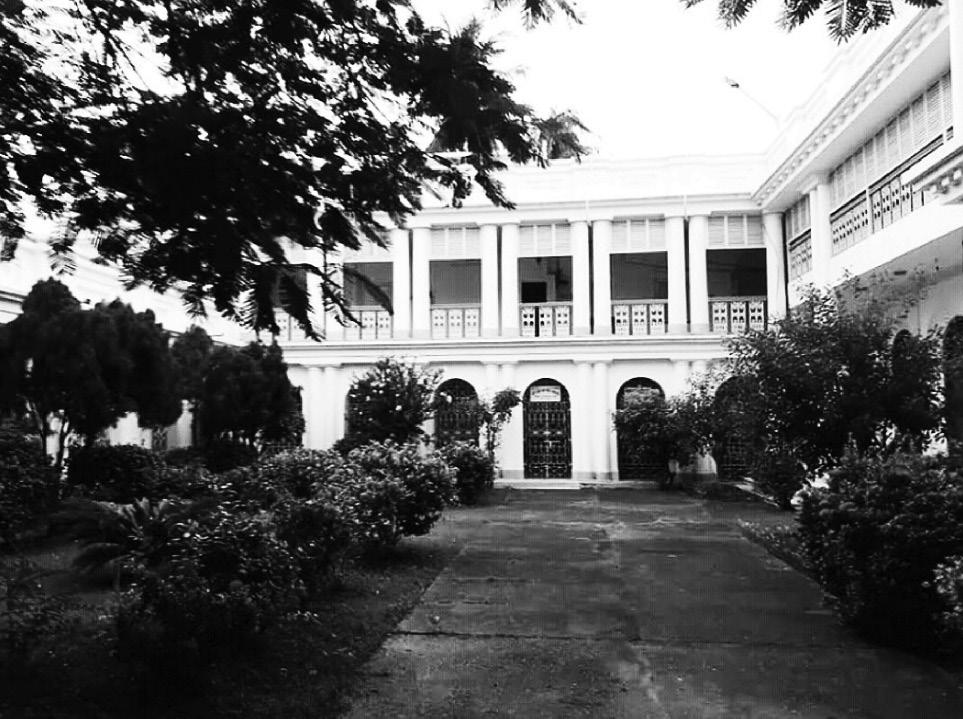
By Amitabha Bagchi (California)
Horace Greeley was a newspaperman, author and an occasional politician who founded and edited the New York Tribune. He is credited with popularizing the slogan “Go West, young man, and grow up with the country.” That was in the early 1830’s, and it has remained a popular saying in America ever since.
Some 130 years later, as a young man, I too did my own version of going West – not so much to build the country as to get a graduate college degree. I made the journey by train, from Washington, DC to Oakland, California by way of Chicago. Crossing the Colorado Rockies and taking in the scenery from the Vistadome on the California Zephyr remains a treasured memory to this day.
My trajectory after graduation, however, pointed East or North-East. After meandering through the Midwest (Illinois, Ohio), the Atlantic seaboard (Maryland) and upstate New York, I ended up in New Jersey and lived there for over 36 years. All this while, though, my heart secretly yearned for the coastal Southern California of my youth. (Did I leave my heart in San Diego?) So, when an opportunity to relocate arose some two years ago, I jumped at the prospect, persuaded my wife to shed her misgivings, and made plans to go (back) West – this time as an old man -- in the midst of a raging Covid pandemic, My wife and I initially thought of driving crosscountry to California but abandoned the idea after some reflection. We had barely had the two initial Covid shots, and the efficacy of the vaccine was not well-established. We worried about motel stays en route: Would the linens be fully disinfected? Should we carry our own bed sheets and pillow covers? One of our doctors warned against dining in restaurants, recommending fast food and carry-outs instead. In the end, discretion trumped the valor and excite-
ment of a car ride through the Rockies. We chose to fly into Los Angeles. We relocated in an area south of Los Angeles known variously as South Bay or Beach Cities. The South Bay is bounded by a wide arc of coastline stretching from Santa Monica to Palos Verdes. At the southern tip of the arc stands the San Vicente Lighthouse, where the coast juts high into the Pacific. Below that point lies Long Beach, the harbor of Los Angeles, and more towns named after beaches.
We came to California in the early spring of 2021. My first surprise was to see how dry the place was. For eight months or more, it hardly ever rained. It was amazing to see how quickly a newly washed car would be covered with fine dust. In fact, from 2020 to 2022, California went through three back-to-back years of drought. As a result, both state-wide and local restrictions were put in place on water use to conserve water and limit its waste. In 2022, first came a mandate to turn off decorative water fountains, and then a second mandate some months later to forbid the watering of decorative grass by commercial institutions. Lawn irrigation systems had to be turned off during rain and for two days afterward. Overwatering of trees was also discouraged. The persistent drought made California’s many forests bone dry and ripe for forest fire. Forest fires, when raging, are common visuals on nightly news, and I vividly remember television images of the complete incineration of the small California town of Paradise in 2018. But my closest personal encounter with such conflagrations came last summer. My wife and I were driving with our daughter’s family on a vacation trip up north along the eastern slope of the Sierra Nevada range. As we approached our destination –the resort town of Mammoth Lakes – the sky turned deep
By Mandira Chattopadhyay (Ohio)
Kobir Lorai denotes a fight between two poets. We shall use it to describe the rift between Dwijendralal Roy and Rabindranath Tagore. We know Dwijendralal as a reputable musician and composer, but he should also be remembered as a literary giant, who is often overlooked.
orange, thanks to fires raging higher up in the hills near the Yosemite National Park. Next morning, we tried to enter Yosemite but were turned back at its eastern gate because the park was closed. Fires were threatening California’s iconic national park itself.
The drought of America’s South-West had other repercussions. The water reservoirs supplying drinking water to many towns were running dangerously low. The water flow down the Colorado River had fallen drastically, and it forced the states through which the river passes to renegotiate the amount of water each could draw from it. The water level of Lake Mead, the reservoir adjacent to the Hoover Dam, fell alarmingly low and threatened to disrupt the production of hydroelectricity. On a personal note, when we were turned back from Yosemite, we went to Mono Lake, where shrinking water level exposed islands which were not visible when I first saw it over fifty years ago during my first stint in California.
The welcome news of the winter of 2023 was that the long drought of California was finally broken with the arrival of ample rain and snow. There was so much rain in LA that the perennially parched Angelinos grew tired of the precipitation. The snowpack on Sierra Nevada was greater than what it has been for many years. Let me quote some descriptions of the winter rains on the web: “The cumulative rainfall received in downtown LA through February exceeded its entire seasonal normal (14.25 inches). … Los Angeles airport shows a similar trend, with 15.25 inches observed in 2023, more than double the 6.98 inches usually recorded by mod-March.”
The deluge prompted the weather folks to coin a new term, “Atmospheric River,” which brought to my mind
Unfortunately, there was a strained relationship between these two poets. Dwijendralal once commented that Tagore’s Chitrangada should be burned, because he maintained that the language was vulgar. He was also curious as to why the members of the Tagore family were so proud of themselves. When Tagore won the Nobel prize in literature, Dwijendralal had no choice but to recognize Tagore. As Tagore rose to the pinnacle of fame, Dwijendralal became despondent. At one point in his life Dwijendralal commented that Tagore was never knighted by the British. But Tagore was knighted in 1915 after Dwijendralal’s death.
The problem with Dwijendralal was that he did not move with time. While Tagore composed plays like Raja and novels like Gora, Dwijendralal wrote historical plays like Mewar Patan and Shah Jehan that would bring immediate response from the audience.
Dwijendralal openly criticized the style and substance of Tagore’s Sonar Tari. Even he tried to make a parody out of it. He used songs in one of his plays Ananda Viday to parody that led to a violent demonstration by the audience. Tagore recognized that while some of Dwijendralal’s work was indeed noteworthy, they lacked literary discipline. Dwijendralal claimed that his writings had patriotic themes, but after the death of Edward VII, he composed songs to praise the emperor. He went to the extent of marching on the streets singing these songs. On the back of his mind, he always felt that once the British would leave India, the country would be a complete disaster. He did not follow the Indian custom honestly, and that was not appreciated by the masses, let alone Tagore.
Dwijendralal did not have a happy life. He would argue with his bosses all the time, and as a result he was transferred from one location to another. After the death of his wife, he sought popularity by turning into patriotism and succumbed to drinking. Tagore did suffer from family troubles but was always on his guard, not hankering for petty popularity. Both these poets were influenced by Western music. While it is true that Dwijendralal composed many patriotic songs and used a lot of Sanskrit words in his composition to bring the old culture, he was not that popular.
During his higher studies in England, Dwijendralal acquired a deep interest in Western music and applied this to his distinctive brand of songs. The songs of Dwijendralal are known as Dwijendragiti. He composed about 500 songs on different topics and created a separate genre of Bengali music. A number of his songs are composed in Kirtan style. Some of these songs combine Western tunes with Bangla lyrics.Dwijendralal learned Tapkheyal while working in Bihar and introduced this into his songs.
He composed several patriotic songs that resonated in the voices of protest during the partition of Bengal in 1905. These songs competed with the Swadeshi songs composed by Tagore around the same period. Following the partition, he wrote a couple of plays namely, Pratap and Mewar Gourob. Mewar Gourob would subsequently influence Acharya J. C. Bose to have Dwijendralal write a song on the Bengali sentiment prevailing at that time and that created his famous song, Bongo Amar Jononi Amar.
Tagore once commented that even though there was enough literature at that time, no one had described the ordinary life of the masses like Dwijendralal. Dwijendralal composed many satirical songs and was quite successful at that. One popular song ridiculing selfish politicians is Nandalaler Gun (the virtues of Nandalal).
Dhana Dhanya Pushpo Bhora, the most famous patriotic song, that he wrote and made famous by his son, Dilip Kumar Roy, who in turn taught it to M.S. Subbulakshmi. It is a prayer adoration of the creator singing praises of all the beauties and wealth of one’s motherland. This song was reportedly even considered a possible choice to become Bangladesh’s
| continue from page 14
the image of Ganga flowing through the heavens in Hindu mythology before descending as a nearly unstoppable waterfall on the matted locks of Lord Shiva. While the change in the weather has been a huge relief, nobody is declaring the drought to be formally over. There are statements to the effect, in fact, that we will need two more years of similar precipitation for California to truly escape the drought’s grip.
Let me conclude my two-and-a-half years thus far in California with this observation.
One time, years ago, when I was driving down the Pacific Coast Highway in California, it occurred to me that the State was a microcosm not only of the nation (USA) but of an entire continent. It abuts an ocean (Pacific) in the west and a river (Colorado) in the south-east. It has many hills and mountain ranges, numerous lakes (both high above and some distance below the sea level), and sprawling deserts (Mojave, Anza-Borrego) to the east. The same idea came back to me on a recent trip to Arizona, when I suddenly encountered my first dust storm while driving through a very dry part of the state. The swirling dust was blocking sunlight, in a manner reminiscent of a fog. Could I now envision a sandstorm in the Sahara? Then I recalled my sudden and unexpected discovery of Mount Whitney while driving up to Mammoth Lakes last year. At 14,505 feet, it is the highest peak in the contiguous United States. I was so startled to “discover” Mt Whitney that I took a detour to the base of the mountain, where expert climbers start to scale the peak. Thinking of a high peak and a low desert in close proximity filled me with wonder. No matter if you are young or old, California, I must say, does not disappoint.
| continue from page 14
national anthem in 1971.
Dwijendralal never took seriously that his writings needed inheritance, which Tagore did. Dilip Kumar Roy did not like the competitive feeling between his father and Tagore, but once commented that his father really liked Tagore’s song MajheMajhe Tobo Dekha Jeno Pai. Dilip Roy, though criticized for not popularizing his father’s writings, stated that people did not know how to appreciate talent, otherwise Dwijendralal would have been recognized as a major poet. He was deeply upset that his father was not given the right stature for his writings. It is really a deep pity that Dhana Dhanya Pushpa Bhara, and Moloy Asia Koye Getche Kane were initially not recognized as Dwijendralal’s own writing. However, later it was firmly established that those were indeed penned by Dwijendralal.
Both poets composed patriotic songs. Dwijendralal insisted that his country was the best of all, and the queen of all countries. To
Rabindranath, the soil of his land was the mother of this world, and his life was fulfilled to have been born there. Both aspired to (and it happened so) die in the soil of their motherland. In the preface to Dwijendralal’s biography, Tagore wrote: “My familiarity with Dwijendralal deserves to be remembered because I have honored his talent from my heart. Never in my writing have I shown any disrespect for him. What happened is just an illusion.”
His son Dilip Kumar Roy in his memoir of his illustrious father mentions how Dwijendralal would confide to him on numerous occasions. The poet would lament as to why the Bengalees should borrow tunes from Hindustani music to improve their own music. He maintained that Bengalis are musicians and poets on their own without any support from others. When his son would mention a
contemporary musician who was influenced by Hindustani music, the poet would retort by stating that individual musician’s work would not survive the next fifty years. Dwijendralal would further comment that a bulk of poets and musicians would come and go but people would remember him and Tagore forever. Clearly, he did have a lot of respect for Tagore. Both produced excellent rhythms in their compositions. Tagore undoubtedly excelled in creating outstanding tunes in his composition. However, it is fair to say that Dwijendralal might have produced remarkable work had he lived another thirty years.
It is a pity that Dwijendralal wasted a lot of his time and his talents by fruitlessly pursuing antiTagore activities, desperately hankering for popularity, and through his generally restless nature.
‘WATER, WATER EVERYWHERE, NOR A DROP TO DRINK’
| continue from page 5
FOOTNOTES:
1. Jakarta is sinking, and Indonesia’s president has chosen to move the capital. The Times accompanied him on a tour. David Leonhardt, The New York Times, 17th May 2023.
2. NASA Sea level change – observation from space: https:// sealevel.nasa.gov/faq/12/what-
causes-sea-level-rise/
3. Greenhouse gases: gases that cause warming in greenhouses that are used to grow plants in cool climates. Carbon dioxide, methane and water vapor are such gases: https://climate.nasa.gov/ explore/ask-nasa-climate/3143/ steamy-relationships-how-atmospheric-water-vapor-amplifies-
earths-greenhouse-effect/ 4. https://www.cnn. com/2018/09/29/asia/earthquakes-indonesia-explainer/index.html
5. https://en.wikipedia.org/ wiki/2004_Indian_Ocean_earthquake_and_tsunami
5. https://www.britannica. com/event/Fukushima-accident
ACVERTIEMENT

Under the leadership of Utpal Sengupta, one of our senior BOT members, we once again conducted successful donation drives for the benefit of Franklin Township Food Bank and American Red Cross.
The Blood Donation Drive was held in Tagore Hall on Monday, August 14. A total of 24 pints of blood was collected, exceeding the goal of 21 pints set by the American Red Cross. After the event was completed, Debra Wolfe, Account Manager, American Red Cross for Middlesex/Somerset/Essex counties, wrote us a letter, saying the following: “Thank you for hosting another wonderful blood drive at Ananda Mandir. We surpassed our original goal! That is great news to share with the community.” – The next blood donation drive is tentatively scheduled for April 15, 2024.
The food donation campaign was held over a couple of weeks, and a large part of the food was collected during our Independence Day Celebrations. The campaign raised a total of 340 pounds, delivered to the Franklin Township in two instalments: 200 pounds delivered on August 24, and 140 pounds on August 30. Earlier this year, Ananda Mandir had donated $415 cash to Food Bank (on March 27, 2023). We plan to conduct food drives in the future at frequent intervals.