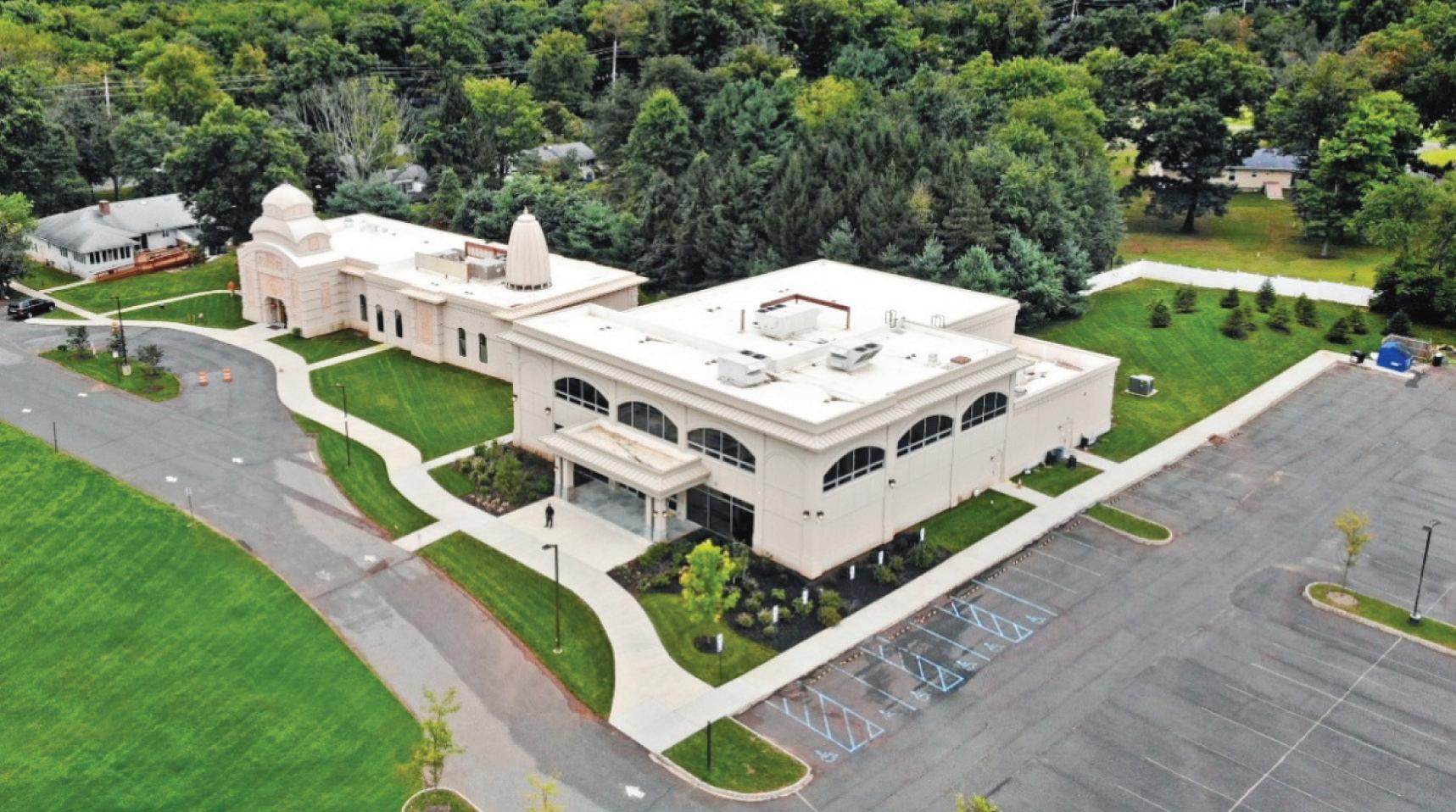
Ananda


Ananda
reported By guru chakravarty
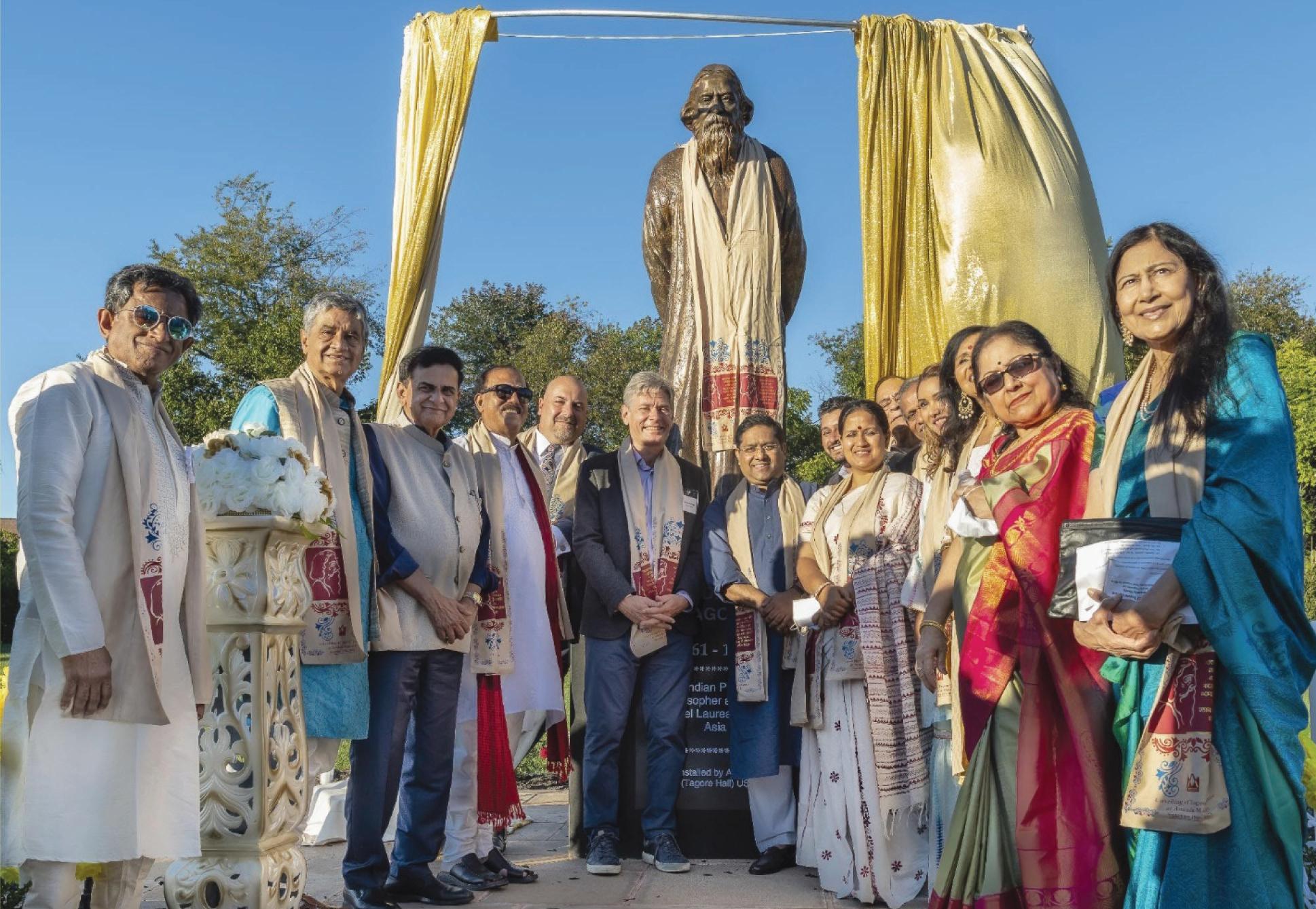
Amuch anticipated 7-ft tall bronze statue of Rabindranath Tagore was installed in front of the Tagore Hall on 19th September, 2021 in the premises of Ananda Mandir. The occasion was graced by dignitaries and well-known people in the community. The statue, which was covered with a gold colored fabric, was unveiled by Mr. Randhir Jaiswal, Consul General of India, New York, and U.S. Congressman Tom Malinowski, 7th district of New Jersey, in presence of many distinguished guests, namely, Mr. Joe Danielson, NJ Assemblyman from Somerset; Mr. Raj Mukherjee, NJ Assemblyman from Jersey City; Ms. Shanel Robinson, Director, Somerset County Commissioner; Mr. Sivaraman Anbarasan, Council-At-Large, Franklin Township; Ms. Shepa Uddin, Councilwoman, Ward 2, Franklin Township; Mr. Rajiv Prasad, South Asian Caucus Chair; Ms. Neena Singh, Committeewoman, Montgomery Township, NJ.
The event started with a meet and greet session at 4 PM with members and invited guests of Ananda Mandir in the foyer of Tagore Hall. Then, Arun Bhowmik, the General Secretary of Ananda Mandir invited everybody in-
side the banquet hall to start the proceedings. Biswabhai, the resident priest said a prayer to bring a feeling of solemnity in the hall. That was followed by National Anthems of U.S. and India beautifully sung by Shreya Bhanja Choudhury. Subarna Majumdar and Jafar Billah sang the National Anthem of Bangladesh. Interestingly, the
National Anthems of both India and Bangladesh are composed by Rabindranath himself. Then Jaiprakash Biswas, President of Ananda Mandir, presented a video of the history and purpose of Ananda
Sosthi Monday October 11
Saptami Tuesday October 12
Ashtami & Wednesday October 13
Sondhi Puja
Nabami Thursday October 14
Dashami Friday October 15
Kojagori Lakshmi Puja Wednesday October 20
& Satyanarayan Puja
*For Timing and other details, please visit our Website
The first speaker amongst the prominent guests was the Consul General, Mr. Jaiswal, who declared this event as truly a historic occasion. He admired Tagore as a multitalented figure, a Biswakabi (poet of the world), who bridged the East with the West. He said that Tagore was truly ahead of our time,
and connected India with the world.
Tom Malinowski was invited to speak next, who was well versed about Tagore’s work. He mentioned about his discovery of Tagore some twenty years ago, when India-US relations were going through a restructuring to bring the two countries closer. He read some of Tagore’s writing, and was very much interested in dialogues between Tagore and Einstein. He said that today’s event is a celebration of strength through diversity for our nation.
Mr. Danielson said he has known Ananda Mandir for the past 20 years and is pleased to see it grow. He spoke highly of other dis-
tinguished guests and announced, “Franklin Township welcomes you all.” Raj Mukherjee, son of a Bengali immigrant, was highly gratified that Ananda Mandir did such a wonderful thing. Mr. Anbarasan, another Franklin Township official, said that he is pleased with the growth of Ananda Mandir in the past twenty years. Shepa Uddin, a Bangladeshi American, enthusiastically talked about how her mother respected Tagore’s work and tried to teach her the language. Neena Singh loved to be present at the event.
It was ribbon-cutting ceremony after that. All attendees came out to see Mr. Jaiswal and Mr. Malinowski, surrounded by other distinguished guests, to unveil the statue. Over three hundred people were at hand to witness this historic event. Special recognition is due to Bandana and Ashok Rakhit to have thought of the idea of the statue and actually make it happen. Their efforts to get the statue made and bring it here is chronicled in a separate article (see page 9) by Ashok himself.
Calendar of Events (Dates are subject to Change) Please check our website frequently www.anandamandir.org Tel: 732-873-9821
NOTE: If a particular Puja time is not listed, please contact temple or visit our website: anandamandir.org
OctOBer (*)
MAhIshAsur MArdInI LIve
Sunday, 03
shyAMA PujA
Tuesday, 05 tIL tArPAn
Wednesday, 06
durgA PujA
Monday – Friday, 11-15
KOjAgOrI LAKshMI PujA & sAtyAnArAyAn PujA
Wednesday, 20
sAhItyA O ALOchAnA (*)
Saturday, 02
cuLturAL PrOgrAM (*)
nOveMBer(*)
KALI PujA
Thursday, 04
jAgAddhAtrI PujA
Saturday, 13
rAAs PurnIMA & sAtyAnArAyAn PujA
Friday, 19
sAhItyA O ALOchAnA (*)
Saturday, 20
cuLturAL PrOgrAM (*)
deceMBer (*)
shyAMA PujA
Friday, 03
sAtyAnArAyAn PujA
Saturday, 18
sAhItyA O ALOchAnA (*)
Saturday, 18
cuLturAL PrOgrAM (*)
jAnuAry, 2022
new yeAr’s dAy
Saturday, 01
(*) See www.anandamandir.org or Call Mandir for details
Special Religious Services: Upon request, the priest of Ananda Mandir offers services such as in-house Shraddhas, Rituals associated with Cremations (Antyesti Kriya), Shraddha Anniversaries, Pre-wedding rituals (Naandimukh, Ashirwad, etc.), Upanayan (Paitey), Annaprasan, Wedding Ceremonies & Wedding Anniversaries, Griha Prabesh (Bhumi Puja), Consecrations of new cars (New Car Pujas) and others. If you have needs for any of the above or more, please feel free to contact Biswabhai @ 732-873-9821
Ananda sangbad
A Periodical Newsletter Published By
AnAndA MAndIr
(A Tax-Exempt, Non-Profit Organization)
269 Cedar Grove Lane Somerset, NJ 08873
Phone: 732-873-9821
Website: www.anandamandir.0rg
guru chakravarty Executive Editor
All queries, articles, news reports and letters should be directed to guruchakravarty@yahoo.com Phone: 908-752-3065
For general information, please contact the following executives of Ananda Mandir:
jai Prakash Biswas President
debajyoti chatterji Vice President
Anjan Lahiri Vice President
Ashok rakhit Vice President
Arun Bhowmik General Secretary
chanu das Treasurer
Pradip Majumdar Assistant Treasurer
BECOME A MEMBER OF ANANDA
MANDIR
AND PARTICIPATE IN THE COMMUNITY ACTIVITIES TO ENRICH YOUR FAMILY
If you are driving through your neighborhood shopping mall, the most visible signs are “Help Wanted”. As the economy is getting better, probably in a little wobbly way, the signs clearly indicate that businesses are looking for workers. The recovery is still behind the prepandemic numbers in terms of unemployment, currently at 5.4% compared to 3.5% in the pre-pandemic era. It is clear that employers are getting desperate for workers in the United States. So why is the job market struggling to get the people to come back to work? Experts offer many reasons for it. Here are some of them.
One of the prevalent beliefs is that the problem has to do with overly generous pandemic-era unemployment compensation. True, the state unemployment weekly benefits were extended, and the Federal Government helped out with an additional amount of $300 per week that helped people
manage their family budget without having to work. And when that happened, many undoubtedly had time to realize that their jobs were not worth the pay they offered. So, now they got time to look around to see what else is out there. This may have affected more people in the lower end of the spectrum, which is prompting them to explore unionized jobs. A rising tide of workers have used the pandemic as a stimulus to alter their careers.
Another factor contributing to the current labor shortage is the growing demand by workers for better working conditions. Staying at home helped people to do things socially and within the family they could not do before. They got used to a better life and they would not go back to their previous demanding jobs. Businesses are recognizing that things aren’t going to go back to their prepandemic norms, at least not immediately. Right now, workers have the advantage,
and they are utilizing the situation.
Compensation level is certainly an important factor as to why there is a worker shortage. There has been a constant clamor for quite some time to increase minimum wage to $15 per hour. Many businesses have complied with that practice even before the pandemics. And now, it is driving the rest of them to accept the inevitable with no other choice.
Then there is the flexibility in working from home instead of having to show up at the office, spending hours to commute. Before the pandemic, it was customary and required to go into the office for work. The pandemic changed that forever. Now that many are doing a fine job working from home, it is not going to be easy for the employers to woo them back to office on a regular basis. This may not cause a complete shift from office work to remote work, but a compromise of a work-life balance
Editor’s Note: We received one short letter from a person who is referenced in the
may ensue, resulting in a few extra days at home.
There are others who want to return to the workforce but can’t because they have a child or family member to care for. They want a job that allows them the flexibility to take time away from work to care for a child or a family member. And if this isn’t possible, they need schools or daycares to open so that they can go to work while their children are properly supervised.
COVID-19 has caused death and distress in our lives and has not released its grip yet to allow us to get back to pre-pandemic status. It has changed our living conditions in many ways forever. One of the good things it created is the higher wages for the ground level jobs, and it also opened up the opportunity for many to have a balance between work and family.
Guru Chakravarty Executive Editor
world of music”.
Dear Sir, I think Basab Dasgupta’s article on “The Unsung Hero” was one of the finest published in Ananda Sangbad. Keep up the good work!
Amal (not my real name)
(Refer to the “Meet Sunil Bagaria” article on Page 3)
• Headquartered in New Brunswick, NJ, with operations at 5 locations in the US.
• Established by Sunil Bagaria in 1993. He is the Chairman, and Sanjeev Bagaria, his younger brother, is the CEO.
• Annual revenue in the $100-$200 million range.
• Employs approximately 200 workers and uses over 2 million sq ft of floor space for warehousing, production, R&D and marketing.
• Generates and markets recycled products, including waste plastic films and recycled resin pellets, overstocked paints, metals and paper, to customers in more than 65 countries. Company has become one of the leading proponents of conservation of natural resources by encouraging companies to recycle their waste and scrap.
• Initial business focus was on collecting, sorting, bailing and shipping plastic film products to China and other countries. Focus broadened later to include recycling of overstocked paints, paper rolls and metal sheets. In recent years, the company has moved to in-house, value-added recycling of plastic film waste and producing and marketing of PCR (post-consumer recycled) polyethylene pellets to buyers in the US and abroad.
• Paint recycling capacity is 160 million pounds/year. Polyethylene PCR production capacity is approaching 60 million pounds/year.
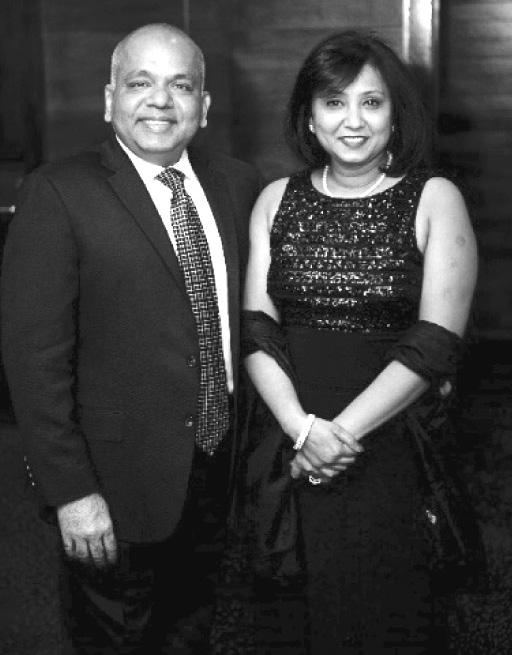
Sunil Bagaria was born in Jharia, near Dhanbad (now in Jharkhand) and raised in a large, joint family with almost two dozen members. Originally from Haryana, Sunil’s ancestors had been involved in stocking and trading of food grains for over 110 years. In the 1970s, Sunil’s father, Brij Mohan Bagaria, began to realize that he needed to move out of Jharia and start a new line of business with better prospects. The family decided to move to Kolkata and “get into plastics” – an industry that was booming in India at that time. Even as Sunil’s father was facing the challenges associated with starting a new business, he was constantly supported by Sunil’s mother who was a person of great ambition, determination and encouragement. With her strong support, Sunil’s father and Sunil’s eldest brother, Santosh Bagaria, set up a Polypropylene film factory in Howrah, a completely new line of business for them. His family moved to Kolkata, and in time, came to love the city. Sunil learned to speak Bengali fluently (and his wife, Suman, a Kolkata girl, also speaks Bengali with ease.) The business prospered, and Sunil and his three brothers received excellent education. In 1991, Sunil and younger brother, Sanjeev, came to the US as graduate students. Their elder brother, Dr. Surendra Bagaria, had already arrived in 1984 and had established himself as a renowned cardiologist paved the way for the two younger
By debajyoti chatterji
Sunil Bagaria is an energetic, driven man with great people skills, sharp business acumen and a sincere desire to do good for the society and the environment. He and his family members own and operate a company that makes money while addressing some of the most pressing environmental issues of the day. The author and Jai Prakash Biswas, President of Ananda Mandir, spent several hours visiting the headquarters of his company in New Brunswick, NJ. This article will give our readers an opportunity to learn about the origin of his company, GDB International, and how it has evolved over time. The readers will also learn about his concerns about the pollution caused by waste products of all kinds and his community activities.
brothers to migrate to US. Sunil studied Polymer Engineering at Brooklyn Polytechnic while Sanjeev joined Wharton Business School for the MBA program. Their eldest brother, Santosh, who was a Chartered Accountant in Kolkata, had decided to stay back with the parents. Sunil’s mother, Gayatri Devi Bagaria, was the “guiding angel” in the lives of all the four brothers and a constant source of inspiration and support.
After finishing his master’s degree, Sunil worked in a chemicals company. But “business was in our blood” (his words), so a company job made him restless. While working in the lab, he would explore various business options in his spare time, and soon he hit upon an export-import business idea, He started buying modest amounts of plastic scrap from plastic processors that were hard to find in India and ship them to interested buyers back home in India. Surendra, his physician brother, was happy to put up funds so Sunil could purchase the scrap polymers and meet his working capital requirements. In 1993, this part-time business endeavor became big enough for Sunil to give up his company job and start a new company, GDB International Inc. (named in honor of their mother, Gayatri Devi Bagaria). In 1994, Sunil moved to New Jersey and got married to Suman. They have been NJ residents ever since. In Sunil’s words, “Suman has been a constant source of encouragement and support for me. She always encouraged me to take on new
challenges and risks in my business endeavors,” Later on, the Bagarias were blessed with two sons; Raj and Rishi. Sunil adds, “The sons have brought immense joy in our lives and made the family complete. Raj graduated from the Huntsman Program at Wharton Business School in 2021 while Rishi is currently pursuing his dreams at Georgetown University.” -- Sanjeev joined the company later and became the CEO, with Sunil remaining as Chairman and President.
GDB International has grown in size over the years and has expanded its business horizon. While Sunil admits that a lot of hard work on his and his brother’s part has gone into the business, he is most grateful to his mother for being the “guiding angel” and to the whole extended family for their constant support and encouragement.
Evolution of GDB International
The early focus of GDB International was on the recycling of plastic bags and films – the great “miracles of convenience” for the consumer society that were fast becoming huge environmental menaces. The company’s business was relatively straightforward. It involved collecting, sorting, bailing waste plastic and shipping the bales to China where Chinese companies recycled them into PCR (Post-Consumer Resin) pellets. It was an easy way of handing over our environmental headache to China – and getting paid in the process!
In time, the company
expanded its focus to include recycling of paints and chemicals, waste/overstock paper and metal scrap. GDB acquired businesses in these fields and established operations in many parts of the country. Sunil and Sanjeev were happy to see their business grow rapidly and successfully – and to know that their business was directly helping the environment and the society. Few businesses can honestly claim that while making money, they are also helping the environmental cause. GDB was a remarkable exception to that norm and was succeeding in business while protecting the environment. The company faced an existential challenge in 2018 when the Chinese government suddenly announced that it would “ban all imported plastic waste” (and scrap paper). Until that time, China used to buy almost 50% of all plastic scrap produced in the world. Faced with this sudden move by China, the Bagaria brothers turned the crisis into an opportunity. They decided to set up manufacturing facilities in the US to convert the waste plastic films and bags into PCR (Post-Consumer Resin) pellets. Next year GDB’s capacity to produce Polyethylene PCR pellets will reach 80 million pounds/year.
While recycling of plastics, paper, metal and glass is highly beneficial to society, the recycling industry itself faces many challenges. Firstly, the operations are labor intensive and require expensive machinery (especially in converting waste plastics to their PCR versions). Secondly, consumers often don’t take enough care in cleaning and sorting plastic products after its use, thus making these “recyclables” virtually useless. Better education of consumers is needed – and that task falls on the schools, the colleges and various governmental agencies and administrators responsible for reducing pollution. Buyers of virgin plastic resins tend
to shy away from using recycled plastics in their products because of economic and aesthetic reasons. The only way this economic disadvantage of PCRs can be removed is by legislative mandates and self-imposed policies and practices by big corporations. Because of Federal regulations, gasoline producers are required to mix corn-based ethanol up to 10% before selling the product to the public. If similar requirements are required by law, plasticware manufacturers will have to mix some recycled plastic pellets with virgin pellets for producing their products. This would breathe new life into the recycling industry by creating more demand for recycled plastic while reducing the amounts of waste plastics going into landfills. We should note that only 9% of plastic products sold in the US are recycled today, meaning 91% find their way to landfills or street-side litters or even worse, the oceans. So, recycling more plastics is not an option but a dire necessity for the American society. As consumers, we have a role to play as well. We must encourage buying plastic products made from recycled plastic, refrain from using single-use disposable plastic products -and recycle plastic products and packaging to the extent possible after proper cleaning and rinsing.
Philanthropist
Sunil Bagaria is not just a businessman but also an avid champion for the recycling industry and a tireless advocate for reducing environmental pollution. In his capacity as the Chairman of the Plastics Division of the Institute of Scrap Recycling Industries (ISRI), he takes every opportunity to speak on the need for more recycling, teaching the public about the right way to recycling, and the need for governmental action on promoting the use of recycled plastics by manu-
By tathagata ghosh
TheOlympics is a four-year soulsearching exercise for most countries including India. The lion’s share of medals being garnered by a few powerhouse nations on the top as if by dredging nets, the other nations can only hope for a few stray medals due to some extraordinary feats by their athletes. There is much handwringing in many countries including India as to why their athletes seem sub-par on an international stage. There is endless discussion as to why the medals do not reflect the potential based on the size of the population.
The first individual athlete who gave hope to a fledgling nation of India, that an Olympic medal could be a tangible dream was Milkha Singh, the Flying Sikh. He was naturally talented and his stint in the army shaped his running career helped him to become one of the very best in his time at the 400m. It is one of the toughest events in sport, which is essentially a sprint for 400m. Though he was a favorite leading upto the 1960 Olympics, he missed out on a medal by a whisker.
After Milkha Singh, there was the proverbial dearth of talent in track and field. Indians and most of the people from Asia were not fast enough in the short distances, did not have enough stamina and speed for the longer distances and did not jump further or higher than the rest of the world. Of all the traditional events that were introduced in Greece 2000 years ago, javelin throw was one of the ancient sports and it is a proud moment to have an Indian, Neeraj Chandra, win the gold in that.
Though the fact has faded into obscurity, India was a feared competitor in a team sport. That was field hockey. In the early part of the 20th century, India had won six straight gold medals, pre and post-independence. We had a gift, we had the physical abilities, stamina and skills to bamboozle the mostly European competitors and were the first country from Asia to win a medal in the Olympics. It is worth mentioning that the USA was beaten 24-1.
Nations specialized in certain sports and won many medals in those sports. It could be attributed to better facilities or state-facilitated training. The other trend was a grass-roots training for certain sports which was a national pastime or sport. All the communist countries spent money on facilities and grooming of athletes from very early age and it seemed inevitable that they would fare better than the poorer countries. It was also said that protein based diets helped the athletes and hence athletic medals started being harvested by the richer countries or the communist countries with limitless state support.
The question as to why India can-
not produce Olympic medal winning athletes is repeatedly asked every four years. Some of the answers seem straightforward and some are very nebulous. The average height of world-class sprinters is a little over six feet and most of the medal winners are black. Can somebody who is not six feet and not black even hope of contesting in the sprints and having a chance at a medal? It does seem improbable, and it certainly does not look like there is any value in spending money and effort in this direction. There is always the odd Chinese athlete or even a Milkha Singh who seem to indicate maybe the answer is not that facile.
Facilities: Better facilities is a catalyst for better athletes.
The spirit of the Olympics needs to be to cultivate health amongst the general populace. The improvement of running facilities should be a goal for every school for the health of the students. Speed, stamina and technique and health should be the objective of athletics. It begins by small things; improve the high jump results by having a high jump pit filled with something more than sand to prevent injury. Maybe in certain private schools they can even afford mattresses to break the fall. I was fortunate to grow up in campuses with abundant amount of space for every possible sports activity. Most city schools are not so fortunate, but creative ideas can transform cramped school grounds into interesting play areas.
Schools have limited funds to invest in sports but the community and also the state needs to definitely do more to develop good athletes. I was always impressed by my cousins playing at ‘Rakhi Sangha’ at Chetla, Kolkata and I could see how in this small public space, groomed talent to produce fine basketball players through the years.
Competition: Healthy competition is one of the best ways to create top athletes. It is interesting to make a comparison between the US and India in tennis. In the US, public tennis courts and school tennis courts are common. In India, there is an elitist aspect to play tennis and it is played mainly in exclusive clubs and certain company campuses. Most of India has exceptional weather, where tennis could be played year-round, unlike US and Europe where it is just a summer sport or an indoor sport. India has had champions in the sport of tennis who were world-class but far and few in-between. On the other hand, USA has dominated the sport for the longest time. One difference that is apparent, is the grass-roots availability of public courts and involvement of the parents in the sport in the US. I have taken my kids from a very young age
to play at the public courts and then enrolled them for coaching for the longest time. There are a huge number of parents who go through the same route. There are tennis teams in every school including varsity and junior varsity. Teams in every school district play in organized tournaments through the year.
In contrast, I have not seen any tennis teams in schools in India. It is a sport played only by rich kids or people with access to a campus environment where they may have invested in a court. I do believe that Indian kids are as talented as the kids from the rest of the world, but they just do not have the well-developed tournament system to be able to improve. With the world-class players like Leander Paes, Mahesh Bhupati and Sania Mirza leading the way, I hope they invest in creating world-class tennis training academies which are an absolute must to be able to create world class athletes. More world-class tournaments also need to be organized to draw talent to India. The Indian players who cannot travel are then able to play with international talent.
Tradition: An inspiring win can create a grass-roots movement.
Another individual sport that has become popular and promising in India, with even medal-winning prospects, is badminton. It was in our time, Deepika Padukone’s father, Prakash Padukone, thrilled us with a win at the All-England club. His brilliance and his achievements, inspired generations of players to take up the sport. It is not surprising that many people have reached the very top of the game including bronze-medal winning P.V. Sindhu. There seems to be a good number of players who have excelled in this sport since Padukone. Wrestling is another sport that seems to have a tradition tucked into the villages and the wresting akhadas in North India.
The factory: Get them young, groom them to be champions
The obsession of the Communist state like erstwhile East Germany, Russia and China for medals led them to create a medal factory. They scouted for little kids with potential and then groomed them with the sole focus of winning medals. The psychological downside was completely ignored as they separated the children from their families and put them in a regimented training session. The medals came in abundance but is that worth it? It is a path that really cannot be taken by non-communist countries.
The lonely toiler: Don on the wings of a dream and soar
It does seem glaringly evident that other Indian winners like a boxer,
weightlifter or a shooter are doing so entirely on their own, counter to expectations, traditions and completely under-funded. The nation is starving for medals and these lone athletes are feted if they win but do not merit a second-glance if they lose. In a strange way, they are like many American athletes in obscure sports, who carve a lone path to medals supported only by dreams. Many American athletes in non-commercialized sports for most parts are under tremendous financial strain, working multiple jobs to be able to afford rent and to train.
The path forward: The copper medal
I believe there is a missing medal that has not been handed out in Olympic Games which is a logically missing award. There is often a bronze medal contest but only one medal is handed out at the end of the contest. If there was a fourth place medal, a copper medal, it would complete the meal ceremony. There would be many more medallists including Milkha Singh. Does it dilute the Games and its traditions? I do not think so.
In conclusion, there is no easy path to get Olympic medals. Those countries who are at the very top of a sport are there because there is normally help and facilities to get to that point. Talent, training and facilities are the bedrock of grooming medalworthy talents but then there is so much more. Every individual writes his or her own story with the proverbial blood, sweat tears and sometimes politics and almost always with some luck.
| continue from page 1
The second part of the event was cultural in nature and continued after a recess. The opening chorus were sung by the Ananda Dhwani, a group of highly talented singers from Ananda Mandir. It was followed by a brilliant presentation of a fusion of American Classical Music and Rabindra Sangeet by Birsa Chatterjee Quartet from New York. There were other beautiful presentations by Sreeshti of New Jersey; a recital collage by Creative Mind Mirror of New Jersey; “Jiboner Anginay Rabindranath” by Somerset Bengali Association; “Robi O Ragini” by Ananda Mandir.
By sudipta Bhawmik
Seldom do human beings become legends in their lifetimes. But Sambhu Mitra was such a person. When I had my first encounter with Sambhu Mitra, he was already a legend. I grew up in a small town, Kharagpur, and didn’t have the luxury of watching any of Sambhu Mitra’s plays during my childhood. I only experienced his voice on the radio through his radio dramas, which mesmerized me. I sat still in front of our antiquated Murphy radio and savored every syllable he uttered in plays like “Evam Indrajit” or “Tahar Namti Ranjana.” My first visual experience of his talent was much later, in the mid-seventies. I was visiting my uncle in Kolkata during one of my vacations. My uncle knew about my love for theater. One afternoon, he called me and said, “Come on, let’s go and watch Sambhu Mitra.” I was ecstatic to say the least. He accompanied me to the Academy of Fine Arts, and we watched Bohurupee’s production of “Dashachakra”, a Bengali adaptation of Ibsen’s “The Enemy of the People.” Sambhu Mitra was performing the role of Dr. Purnendu Guha, an uncompromising doctor who fought with all he had to stand up for “the truth.” All the townsfolks vilified him. The people, whom he loved and trusted, betrayed him. He was declared the enemy of the people. But he didn’t budge. With his wife and only daughter by his side, the man continued his fight. The uncanny resemblance of the play with Sambhu Mitra’s real life family intrigued me, and it blurred the difference between stage and reality. I watched him on stage and thought, who is acting whom? Was this Purnendu Guha acting as Sambhu Mitra or Sambhu Mitra as Purnendu Guha? What I didn’t know was that a storm was already brewing in Bohurupee.
Within a year or two, Sambhu Mitra quit Bohurupee, the theatre group he founded in 1948. To the theater folks of the time, Sambhu Mitra and Bohurupee were synonymous. With Bohurupee, Sambhu Mitra and his compatriots redefined Bengali theater forever, and group theatre movement swept the drama landscape of
Bengal. Sambhu Mitra’s decision to quit his group came as a shock to many a theater lover. But when I heard this news, I knew what had happened. Dr. Purnendu Guha did not compromise. Theater is a collaborative art. Democratic principles govern the execution of the group’s policies. Individual opinions matter less. But to people like Purnendu Guha, the truth always stands above any “ism” or any “cacy”. And to defend the truth, he’d sacrifice even his most beloved Bohurupi, the group that was his baby.
After this incident, Sambhu Mitra went into a partial retirement. But he did not quit theater altogether. So, when I heard that Chenamukh (then a new theater group) is reviving Tagore’s play “Char Adhyay” with Sambhu Mitra and Tripti Mitra playing their usual roles of Antu and Ela, I thought I couldn’t miss it. I hopped on a train and arrived in Kolkata, straight to the Kalamandir auditorium.
I was lucky to get a ticket. With great anticipation, I went inside the theater where the usher showed me my seat. And soon the magic began. Sambhu Mitra and Tripti Mitra, swayed the audience off their feet with their stage presence and their amazing performance. We sat mesmerized while Antu wooed Ela with the famous lines, “prohor shesher ranga aloy shedin chaitromash tomar chokhedekhecilam amar shorbonash.”
But in Kolkata, the dust and pollution often become a cause for irritation, both to the audience and the actors. Few in the audience couldn’t control the irritation in their trachea and began coughing. They tried to muffle the unpleasant sound as much as possible, but still it was quite disturbing. One person, who possibly had bronchial problems, was often breaking into loud coughs. Sambhu Mitra was on stage with Tripti Mitra. The loud coughing often broke his concentration. He glanced couple of times to the direction of the sound to show his disapproval. But the coughing grew louder. Suddenly, Sambhu Mitra couldn’t take it anymore. He stood up, looked at the audience with glaring eyes and left the stage. Tripti Mitra gave a helpless look, and she
too left the stage. We were all dumbfounded. I looked at the empty stage and thought, “Compromise… Compromise… Only a little compromise Dr. Purnendu Guha. That’s all we ask of you. Can’t you sacrifice your ‘moment of truth’ on stage for the sake of your audience?”
The audience soon became impatient. They hurled angry insults at the poor man who was coughing. Some expressed their displeasure at the haughty attitude of the actors. A pandemonium ensued. The organizers soon came out and requested the audience to stay calm. Little later, we received the good news. Sambhu Mitra has agreed to resume the show for his audience. We were relieved.
After this show, Sambhu Mitra acted in few more productions, mostly for charitable causes. The most significant amongst them was Bertolt Brecht’s “The Life of Galileo” directed by Fritz Benowitz and produced by Calcutta Repertory Theatre, which was a joint venture of several theater groups of Kolkata. His wanted the funds collected from the shows to be used to build a theater for the theater people. “If people come to see my theater, then use me, exploit me to build a theater of your own,” he said. I missed this production, and till date I repent for my misfortune. The theater he wanted was also never built.
But in 1983, when I was working in Kolkata, I saw this advertisement in a newspaper that “Panchamved Charyashram” a theater school founded by Shaoli Mitra was recruiting its first batch of students. Sambhu Mitra was the chief advisor of this school. I jumped on the opportunity and applied to become a student of the first batch. After a grueling interview session, I got selected along with a bunch of talented young men and women. I was excited to get this rare opportunity to study from the greats like Tripti Mitra, Shaoli Mitra and Sambhu Mitra himself. But when the classes began, I was disappointed to learn that Sambhu Mitra wouldn’t be teaching us. But still I enjoyed my classes, since the training methods followed were based on Sambhu Mitra’s philosophy and style. He believed that an actor should not limit his training to acting only, but also on all aspects of theater. We were
not only given vocal training, character analysis, music, pantomime, and dance lessons, but also were taught how to put on make-up, the details of lighting design, stage-craft and theater administration. Sambhu Mitra believed that an actor must be a keen observer and must acquire a variety of knowledge, including science and technology. He used to often come to the school, chat with us, and sometimes comment on our newly acquired skills. Like one time, during a test of our make-up class, he looked at my make-up of a grumpy old man and said, “That’s nice. How about adding couple of lines at the base of your eyebrows? That’d bring out the grumpiness.” I did that, and in an instant I was a different person.
In the following semester we were pleasantly surprised to hear that Sambhu Mitra would be giving us a lecture on text analysis with Rabindranath Tagore’s play “Rakta Karabi.” We were excited to say the least. Bahurupi’s production of “Rakta Karabi” directed by Sambhu Mitra, was a legend. To hear about that production from the director himself was an opportunity of a lifetime. For the next six weeks, Sambhu Mitra went through each and every page of Rakta Karabi with us. He told us, how from each line in the text, he constructed the characters, their motivation, their attitude, even their costume and make-up. We could see how the master director created his legend from a text which many at the time thought was unproducible. His twelve-hour long lectures were recorded for posterity’s sake. Many years later, these lectures were published in a book form.
The following year, Panchamvaidik (Shaoli Mitra’s theater group) decided to revive “Dashachakra”. The play was directed by Sambhu Mitra, and once again he played Dr. Purnendu Guha. By that time, I had left Charyashram and went back to my alma-mater to pursue my Ph.D. But I attended few of the rehearsals during the weekends. I watched with awe how this giant of Indian theater worked with his junior colleagues, some of whom were almost newcomers. He talked to them with deep respect even when they failed to raise up to his expectations.
The staging of this play was another landmark in Bengali theater. People queued up in front of the box office two days before they opened. Police had to be called in to control the frenzy. I, as a member of the team, attended all the shows to help with bits and pieces of the productions – ushering in the audience, helping in the backstage, etc. It was indeed a proud moment for me, and till date I fondly cherish those memories.
Sambhu Mitra, for his seemingly uncompromising attitude, had to experience a lot of criticism. People whom he loved and trusted the most, went against him. But he always stood for the truth he believed in. He was a great star of his time, but he never sought public admiration, which would have required him to compromise his beliefs. He was a firm believer in democracy, but to him democracy didn’t mean to always ride with the majority. Democracy gave him the right to express his thoughts and beliefs even in the face of strong opposition. We must agree to disagree –that’s what a democratic organization’s mantra should be. And that is the best lesson I learned from him – and from Dr. Purnendu Guha, the enemy of the people.
facturers. He has given expert testimonies to various legislative committees at the NJ State and the US Congressional levels on these matters. He and his company have been featured on various television programs, including 60 Minutes (CBS, August 5, 2018). Unlike most Indian Americans, Sunil does not shy away from politics because he believes that to be a good citizen, one must be politically aware and engage in major issues facing the country and the community. Sunil and Suman are also involved in many community organizations, not just as benefactors but also as critical thinkers and strategists. Ananda Mandir and many other Indian American organizations are fortunate to count Sunil and Suman Bagaria as close friends, major benefactors and trusted advisors. Meet Sunil Bagaria | continue from page 3
By Basab dasgupta
Many believe that the quest for God is same as the quest for the highest, the best, and the ultimate. It is similar to climbing a mountain to reach the top. There might be many different winding paths to get there but the goal is the same. At some point one may feel that one has climbed as high as one could and that is close enough to being with God. One of those myriad paths is the obsessive pursuit of beauty.
Beauty can be the natural beauty of mountains, oceans, forests, falls, and desertssomething photographers can understand. It can be the beauty of an animal; many of us are obsessed with the beauty of our pets. Beauty of a statue (think of “Pieta” by Michelangelo) or beauty in a complex pattern (like “Mandelbrot” patterns in chaos theory) or a building such as the Taj Mahal can also invoke this mesmerizing admiration. Absolute beauty means that once you have experienced it, you do not want or need to watch anything else. In some cases, you may feel that even though it is not quite THE absolute beauty, there is nothing better on this earth.
Unknowingly for me, my quest started with the beauty of a woman. My “dream woman” was the famous Bollywood star Saira Banu when she was young (during the sixties and seventies). My obsession began with her first movie “Junglee”, which I saw when I was about fourteen years old. There was a scene in the movie where she was stranded in a log cabin with the hero (Shammi Kapoor) during a snow-storm and was sleeping with a red blanket over her. She looked so beautiful I could have just sat there and watched her all my life.
Everything about her physical appearance was perfect: her eyes and eyebrows, her lips, her hair, shapes of her face, nose and neck, her skin color, her overall figure - especially the waistline and long limbs, and I could go on and on. On top of her beauty,
she had a mixture of childish innocence and the appeal of a temptress which was a rare combination. Her smile was simply mesmerizing, and her voice was sweet melody to my ears! She appeared to be someone who was loving, nurturing and playful, all at same time. She seemed inviting and approachable unlike some other Bollywood beauties of her time like Waheeda Rehman, Nargis and Suchitra Sen.
My friends ridiculed me for this obsession. In their opinion, there were many other comparable beauties in both Bollywood and Hollywood, and I just had some continuing adolescent fetish about Saira. As I thought about it over the years, I realized that my joy in watching young Saira Banu was the joy of seeing absolute beauty, from the point of view of a man, an artist, a poet and most importantly, a man on a quest to see the ultimate beauty. My emotion was not a craving for love or lust when I watched her; it was “awe” and “bliss”. If God is the ultimate beauty, Saira Banu seemed to be a close approximation! Yes, she is my Goddess. Her dance to the song “Tumhe aur Kya” in the film “Ayee Milanki Bela” reminds me of Goddess Saraswati. Her appearance in the bhajan “Kanha Kanha” from the movie “Shagird” can only be attributed to an Urvashi who came down to earth from heaven.
I now believe that this is true for all of our other senses. Take hearing as an example. We all crave for that most melodic music that touches our soul and takes us to a state of bliss. We listen to some songs over and over again and they seem to permeate through our entire existence. They make us happy. The tunes enter into our head, and we end up humming them for no reason at all. This is also a quest for God. Many musical genii have explicitly said so. Once again, musical genre can be different. For some, it might be classical music,
jazz for others, Tagore songs for some and just instrumental sounds of sitar, guitar or piano can also lead us along such a path. It does not have to be music. A single word like “Om” can take us to a state of bliss.
The relentless uttering of “Hare Krishna Hare Rama” in kirtans in a Vaishnav tradition puts disciples into a trance. Gospel singing by a choir is an integral part of worshipping in a church. I still remember the calming effect of the chant “Buddham sharanam gacchami” from the Buddhist temple in Dhakuria where I used to live.
Same is true for smell. Whether we realize it or not, we are all seeking that perfect aroma all the time. Our fascination for flowers is more related to the smell than their colorful looks. It is no wonder then that cosmetic companies spend billions of dollars in research and development every year to come up with that new fragrance which is even better than what they had offered the previous year. Selling air Fresheners is big business. We know that aroma associated with presence of God has to be something beyond these smells which is pure, pleasant and refreshing. We burn incense on all religious occasions in an efforts to create that divine atmosphere and we know that this smell is as good as it gets. I wonder if drug addicts snorting Cocaine are on a distorted path in order to reach that “high” by inhaling the smell of the drug and they get addicted because of their desire to experience a higher high.
“Amrita” or Nectar is considered to be the ultimate in area of tasting that would give us immortality and an eternal life. The goal of the entire culinary art is to create that unique exotic taste. French restaurants are typically very expensive compared to other restaurants simply because French cuisine offers that incredible experience to our taste buds. Chefs are constantly engaged in competing with others and making their output
By Asok Baral
The year was 1757, a year that lives in infamy in the history of Bengal and India. This was the year when Sirajud-Daula, the last Nawab of Bengal, was defeated by Robert Clive of East India Company, aided by a conspiracy with Mir Jafar, Siraj’s own army general. Many people consider this Battle of Plassey as the beginning of the British Raj in India. But Mir Jafar was not alone, there were others complicit in this conspiracy. Notable among them were Jagat Seth - the richest banker in Asia at that time, businessman Umichand, Roy Durlav and Nabakrishna Deb. Nabakrishna Deb lost his father at a young age and his mother, a strong believer in education, made Nabakrishna learn many languages, including Urdu, Persian, Arabic and English. With his knowledge of languages, Nabakrishna got a job to teachPersian to Warren Hastings, then Chief of the Kasimbazaar trading post of the East India Company. He exhibited efficiency and extreme loyalty to the British and was promoted to the job of munshi (clerk-cum-interpreter) of Roger Drake, the then head of Fort William. It is believed that he was responsible for the Company’s ‘foreign relations’, and his advice based on the knowledge of local customs and culturebecame an invaluable asset to the British. He became the middleman between the Company and the group of Siraj’s royal court members who were hatching a plot to overthrow Siraj. The court members alleged that Siraj had instituted an unbearable misrule andhad his eyes on young women making lives of many families miserable. These allegations have been refuted by others.
On June 23, 1757, when Clive attacked Siraj’s army in Plassey, the conspiracy of Mir Jafar and his cohorts was in full display. The soldiers under Mir Jafar’s command simply stood by and offered no resistance, as Clive’s army of 3,000 (two-thirds of which were Indians) defeated Siraj’s army of 50,000 soldiers, 40
canons and 10 war elephants. The Battle of Plassey was over in a few hours, the battle that was a major turning point in India’s history was a complete sham.
After his victory, Clive wanted to have a ‘thanks-giving ceremony’. But the only church in Calcutta had been demolishedtwo years earlier by Siraj’s army in a previous war. When Nabakrishna came to know about Clive’s wish, he volunteered that the ‘thanks’could be offered at the feet of Goddess Durga in his place of worship.
Clive was reported to have said, “But I am a Christian”, to which Nabakrishna replied, “That can be managed”.
In another unscrupulous twist, Nabakrishna had the orthodox Sanskrit pundits agree to bring in Clive, a ‘firinghee’, as a chief guest to the biggest religious event of Durga Puja. According to historian, Abanti Kumar Sanyal, Clive’s Sanskrit teacher, Jagannath Tarkapanchannan, was offered a handsome pension, and after that there was no clamor from the pundits of Bhatpara.
The Durga Puja was held in October of 1757 at the ‘thakurdalan’ of Nabakrishna’s newly built palace. Nabakrishna employed a large labor force to finish the palace in time for the Puja. The palace had a courtyard, on one side was the thakurdalan where the idol of Ma Durga was placed. Clive drove his carriage from his residence all the way to the thakurdalan where he was accorded a welcome fit for a king.
On the other side of the courtyard was the ‘naachghar, or dance room, meant for entertaining the guests. The entertainment was a bizarre event of dances performed by nautch girls of a Muslim Gharana. And there was an opulent feast. For the new rulers of Bengal, huge amounts of beef and ham were brought in from Wilson’s hotel, and there were unlimited alcoholic drinks, enough to inebriate many of the guests. Deb’s ceremony of 1757 set up a pattern of
continue to page 12 }
Adolf Hitler, leader of Germany, had a master plan to colonize Europe. He started with Poland in the East and was progressing towards the western countries of Europe. The German army marched into Paris unopposed on June 14, 1940. Prime Minister Churchill was disappointed to know that the British forces were in retreat. After the French surrendered on June 22nd, 1940, it was obvious that Britain would be invaded next by Germany.
Churchill realized that he needed the help of USA in order to have any success against Germany. He repeatedly requested President Roosevelt for a meeting to discuss the German invasion and the need for USA to help them. Roosevelt kept avoiding the meeting because he realized that after the exhaustion of the First World War, he would not succeed in convincing Americans to participate in another war. In August 1941, President Roosevelt agreed to meet Churchill in Newfoundland, a Canadian island near Quebec.
On August 3, 1941, Roosevelt left Washington by train for New London, Connecticut, where he was to board the yacht Potomac for a tenday fishing holiday, or so the press was informed. It was actually a cover story for the president’s voyage on the USS cruiser Augustus for his meeting with Churchill in Placenta Bay off Newfoundland in Canadian waters. ”Even in my old age I feel a thrill in making a getaway—especially from the American press”, he wrote to Daisy, the one person with whom he felt free to share his secret journey. Roosevelt had hidden the true nature of the trip even from Eleanor and his mother.
For his part Churchill also enjoyed the subterfuge. He was about to meet the man who he believed held the key to British success in the war, and they were engaged in history-making events on a world stage. Churchill had already demonstrated his regard for Roosevelt, praising him as the soul of “resistance to aggression and oppression and undoubted champion of justice and of freedom, and of the victims of wrongdoing wherever they may dwell”.
While overt cordiality was the principal public impression conveyed by the two men, each had a grand design he hoped to advance. Churchill’s highest priorities were cementing arrangements for aid from the Americans and drawing them ever closer to involvement in the war. For Roosevelt, a joint declaration on war aims that would quiet isolationist rumblings about secret agree-
By Partha s. ganguli
In this article, I describe the history around the Second World War that led to the independence of British colonies including INDIA. The purpose of this short article is to reveal who the main architect was behind their independence.
ments to involve the United States in the conflict to rescue Britain’s Empire was essential to the management of America’s divisive politics. He wanted a statement explicitly denying any commitments other than what Congress had authorized under the Lend-Lease law. He wanted it made clear that he and the prime minister “had discussed certain principles relating to the civilization of the world and had agreed on a statement of them”. Churchill cabled his war Cabinet that the president attached great “importance to the Joint Declaration, which he believes will affect the whole movement of United States opinion.”
Roosevelt’s top priority was formulating a declaration of shared principles that he hoped would make war more palatable to Americans. The final document they agreed to release at the end of conference required some spirited negotiations.
Roosevelt wanted it to avoid revealing the existence of any future commitments they made, but Churchill convinced him that doing so would give comfort to Hitler and “would be a source of profound discouragement to the neutrals and the vanquished.”
Roosevelt agreed to emphasize providing aid to the democracies instead. Roosevelt could scarcely believe that their two nations were fighting a war against fascism but would not also try to free the world of colonialism, as he remarked to Winston Churchill in August 1941. The comment made Churchill apoplectic. Churchill had travelled to Placentia Bay in Newfoundland in order to woo his benefactor and inform him of the United Kingdom’s vital needs. For Roosevelt, the Atlantic conference was a chance to size up his ally-----and to impose his own democratic views.
Also present was Elliott Roosevelt, the president’s fourth son, who later published a controversial account of his father’s wartime conferences.
“The cigars were burned to ashes, the brandy disappeared steadily,” he wrote of Churchill after one dinner. But the tongue remained lucid, and the president provoked it by bringing up the empire’s economics. No stable peace was possible, he suggested, if the (British) colonies remained poor---and outdated methods of taking out raw materials and giving nothing back, made progress impossible.
According to the younger Roosevelt, Churchill’s neck reddened, and his sentences lengthened into paragraphs----and the president, having said his piece, let him talk. After 2 A.M. Elliott was finally able to help his wheel-chair bound father to his cabin and sit awhile to share a smoke. The prime-minister was an old-fashioned Tory, the president said, but they would be able to work together just fine.
Understanding that the president would be greatly distressed at the failure in issuing b a joint statement, Churchill signed off on an eight-part declaration they dubbed “The Atlantic Charter”.
In brief, it was an updated statement of the ideals President Woodrow Wilson had proposed at the end of World War I. While it seemed calculated to strike resonant chords with most Americans, it also promised to agitate isolationists, who were bound to view it not only as a declaration of war on Germany but as a commitment to join a postwar community of nations in preserving the peace.
In summary, the meeting resulted in a treaty named The Atlantic Charter (also Newfoundland Treaty) signed by President Roosevelt and Prime Minister Churchill. The Atlantic Charter is the basis for fighting against colonization war by Nazi Germany and decolonization (or independence) of existing British colonies.
The Atlantic Charter in brief: self-determination, democratically elected governments, free speech, free trade among nations, freedom of the seas, reduced armaments, the final destruction of Nazi tyranny, and a lasting peace facilitated by collective security. The Charter offered the first hint of the president’s goal of a United Nations to police the postwar peace. It also asserted that the United States and the United Kingdom would “respect the rights of all peoples to choose the form of government under which they will live; and that they wish to see sovereign rights and self-government restored to those who have been forcibly deprived of them”. Leopold Amery--who worried that the Americans would use the war to undermine the British Empire and turn it into “a lebensraum for their exports”-----was disgusted by the Atlantic Charter.
On December 7, 1941, Japanese bombers devastated the American fleet in Pearl Harbor, Hawaii. President Roosevelt declared war against Japan; United Kingdom joined the war against Japan. Germany declared war in Europe. Allied powers, consisting of USA, UK, USSR and China declared war against Axis of Powers consisting of Germany, Japan and Italy and thereby starting the World War II.
On May 8, 1945, General Alfred Jodl of German high command signed unconditional surrender of all German forces to Allied Supreme Commander Dwight Eisenhower in Rheims, France thereby ending the war in Europe.
USA detonated two nuclear weapons over the Japanese cities of Hiroshima and Nagasaki on August 6 and August 9, 1945. US Army General Douglas McArthur accepted Japan’s unconditional surrender on September 2, 1945 thereby ending World War II.
Now UK leaders were required to abide by the Atlantic Charter signed by President Roosevelt and Prime Minister Churchill to execute the independence of British colonies. President Roosevelt died on April 12, 1945, few months before the end of World War II. In 1945, the conservative party in UK lost in election. As a result, Churchill lost the position of prime minister to the winner labor party leader Clement Attlee till 1951.
Prime Minister Attlee oversaw the partition and independence of India, the independence of Burma and Ceylon, and the dissolution of the British mandates of Palestine and Transjordan.
The list below is a partial list of the British colonies and their dates of independence.
Jordan 25 May, 1946
Pakistan 14 August, 1947
India 15 August, 1947
Burma (Myanmar) 04 January, 1948
Ceylon (Sri Lanka) 04 February, 1948
Palestine 14 May, 1948
Israel 14 May, 1948
Egypt 23 Jul, 1952
Libya 24 December, 1951
Ghana 06 March, 1957
Malaysia 31 August, 1957
Singapore 03 June, 1959
Kuwait 19 June, 1961
Kenya 12 December, 1963
In conclusion, President Franklin D. Roosevelt’s efforts catalyzed the independence of all the British colonies including INDIA. This great leader strived for freedom and democracy for all.
reported by Mita sinha, Chair, Puja Committee
Autumn is in the air. For any Bengali family the beginning of autumn heralds the arrival of Durga Puja. This time of the year is very special for all of us. COVID-19 is somewhat under control, at least in New Jersey for now. Although, we are still using masks, we do have some freedom to hold gatheringsand see friends mainly because most of us are now vaccinated except kids under 12.
Ananda Mandir is open to devotees. In general, most of our members wear masks when they come to the temple and that is what keeps keeping all of us safe.
The month of July was busy at Ananda Mandir. July started with our monthly
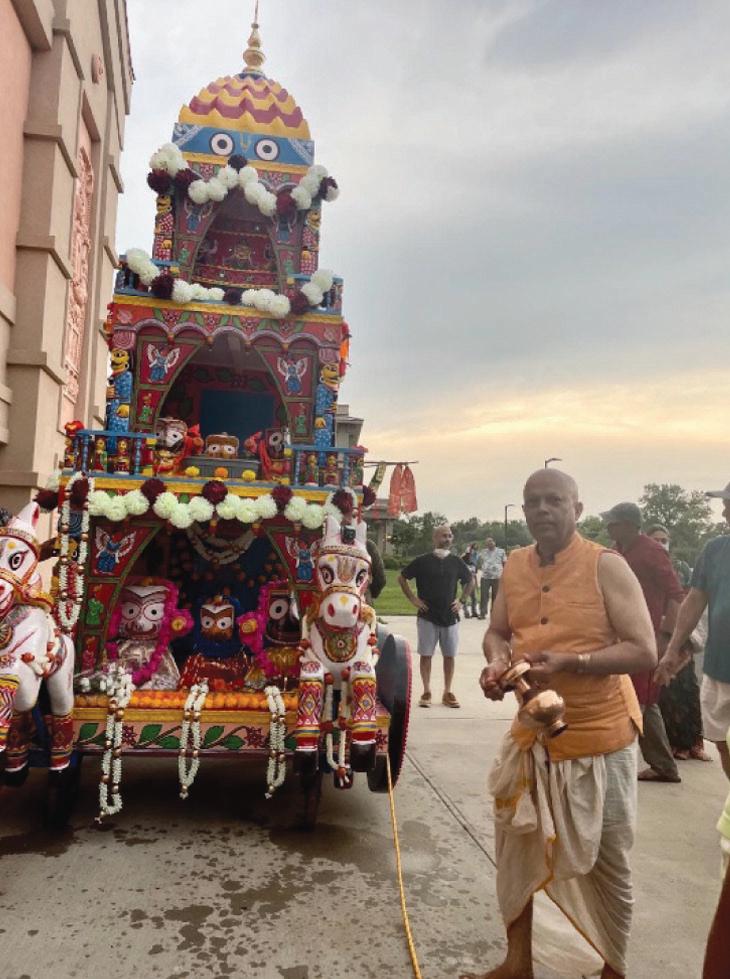
tees. Alongside the procession, we had Dhak, Sankha and Kansar playing. We also had a dance performance by the kids on the temple floor. It was a delightful evening for all.
After this we had the Bipadtarini Puja at the temple on July 13. Then came Punorjatra and our monthly Satyanarayan Puja. The Punorjatra is a return journey of Lord Jagannath, Balaram, and Subhadra.
The month of August started with our monthly Shyama Puja. Next, we had Rakhi Purnima and Satyanarayan Puja. Rakhi Purnima is also known as Raksha Bandhan, and this is a popular Hindu festival. On this occasion a sister ties
Shyama Puja. It was on a Friday so quite a number of people attended the puja. Everybody enjoyed the puja and each other’s company. After that we all had dinner and went home.
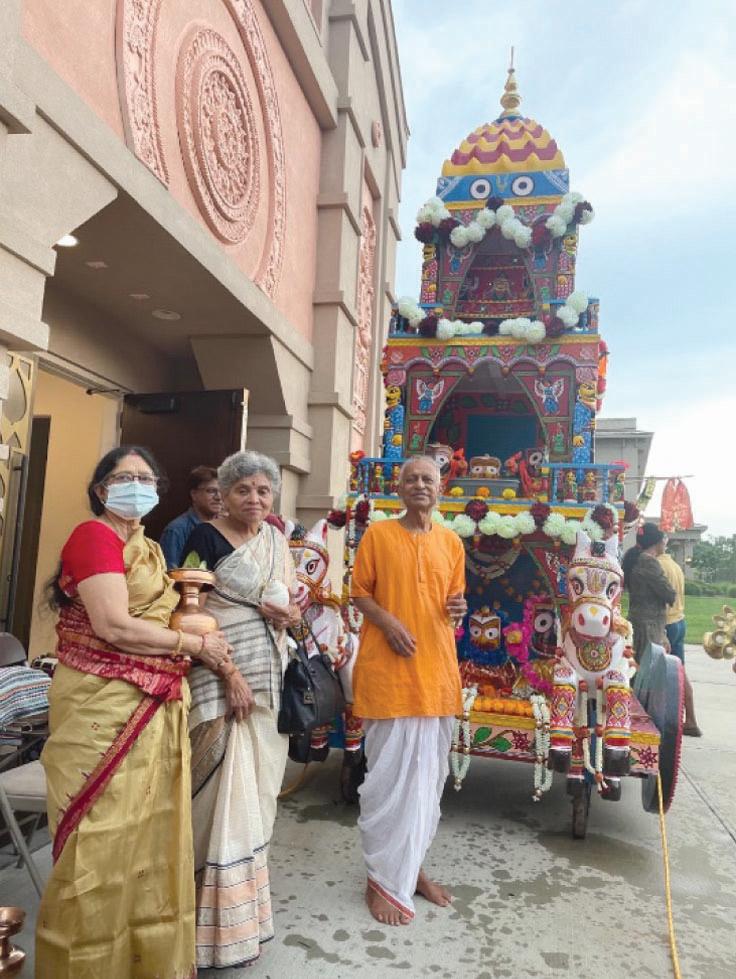
The next event was Ratha Jatra. This was a special occasion for our devotees. Lord Jagannath is one of the avatars of Lord Krishna. The individual deities of Jagannath, Balaram, and Subhadra were brought out of the temple and were put on a hand drawn wooden chariot. The chariot was pulled up and down the whole length of our temple grounds by our devo-
tively. This year also we maintained the tradition. In the evening one of our senior members did Geeta Path for an hour inside the temple. The Temple was open all day from 9 am to 9 pm. Devotees came in and out all day long.
The month of September started with the monthly Shyama Puja. The next puja for this month was Ganesh Chaturthi. This remains one of the most widely celebrated festival in India. Ganesh is known as the giver of fortune and one who can help to avoid natural calamities. Ganesh is the son of Lord Shiva and Goddess Parvati.
Then came our Biswakarma Puja. Bengalis say special prayers, and pujas are held in shops, factories, offices and workplaces. In some regions there is a tradition of flying kites on this day. This day
a Holy thread on the wrist of her brother symbolizing the strong bond between siblings. We had the Rakhi Purnima celebration in the morning at the temple. We had the monthly Satyanarayan Puja in the evening. It was a busy day.
The last celebration of the month was Janmastomi. This is a celebration of the birth of Lord Krishna. His birth is celebrated across India as Janmastomi. The Krishna idol is decorated with flowers and put on a swing. It is our tradition at the temple that we chant lord Krishna’s names 10,000 times collec-
reported By sudipta choudhury
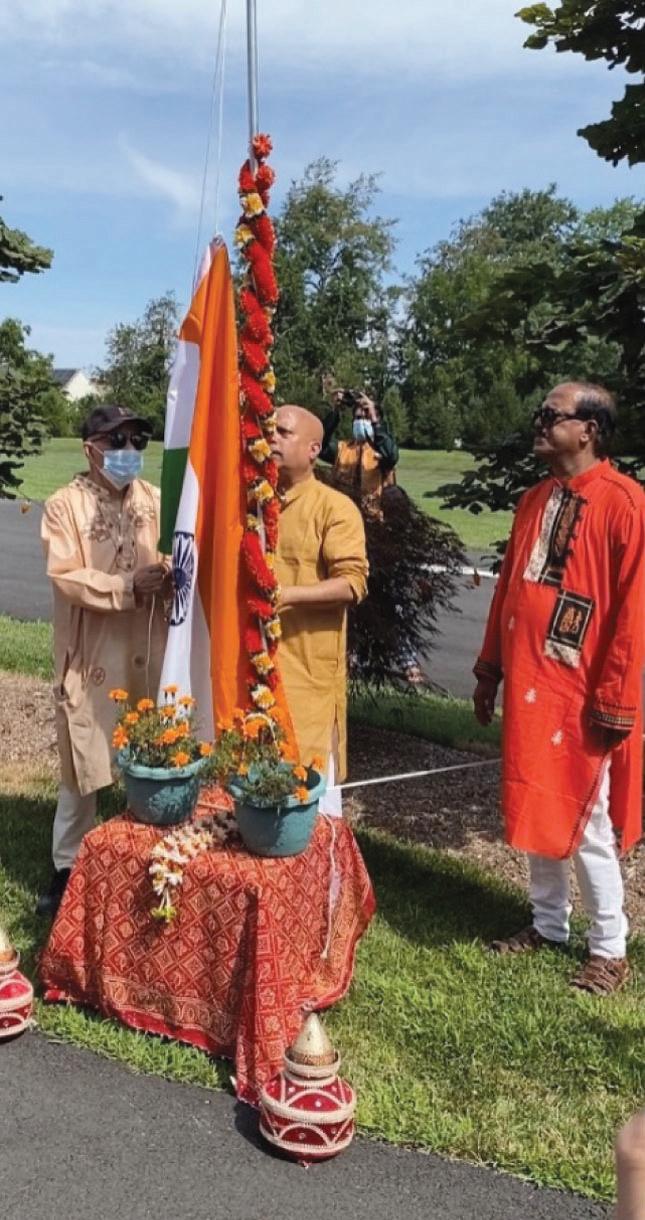
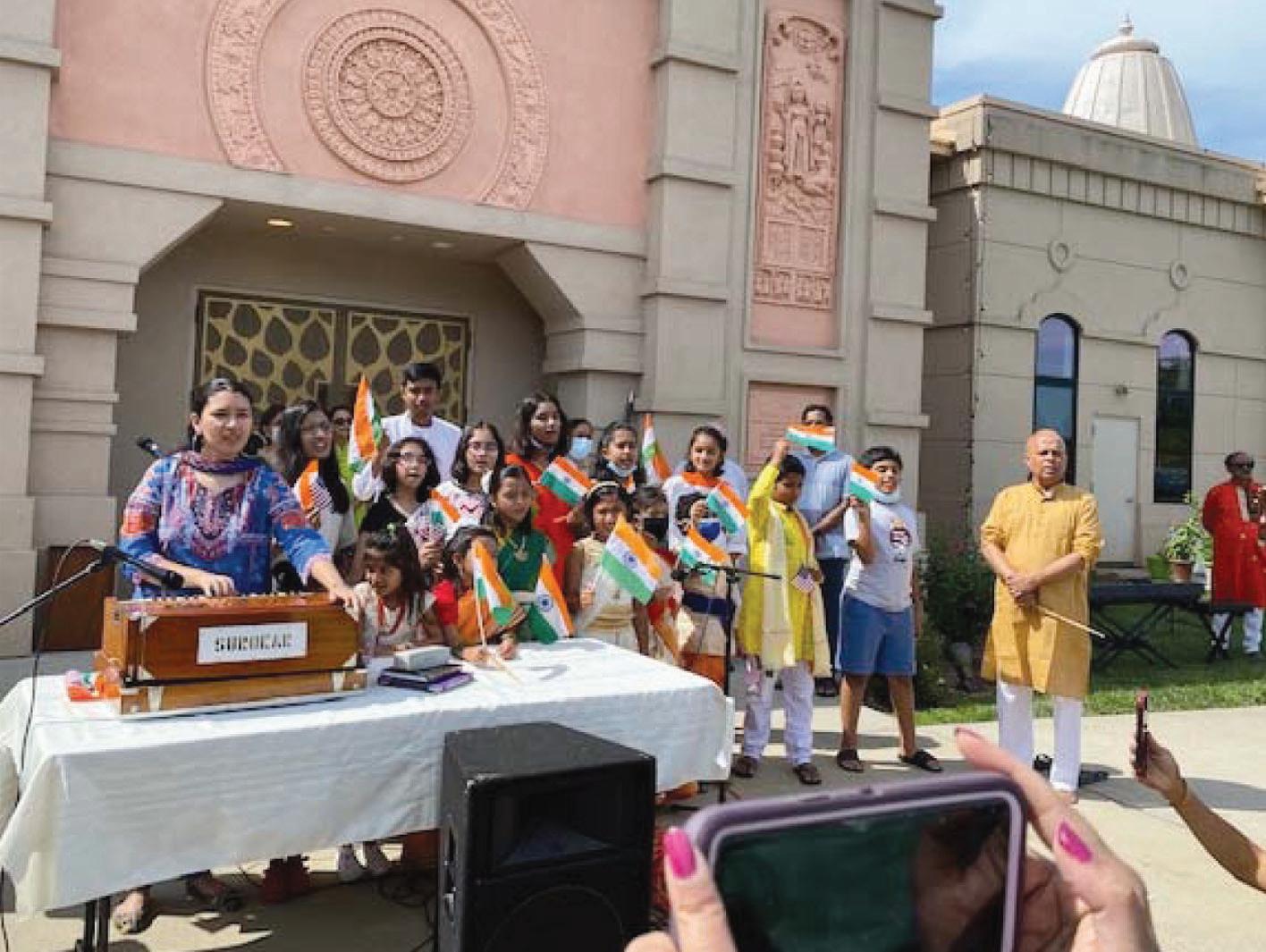
Ananda Mandir celebrated the 75th year of the Indian independence on its premises. After a long hiatusl due to the pandemic, this was our first attempt to conduct an event outdoors. Nearly 70 people joined us enthusiastically on that day in the morning to celebrate the day. The young adults and the very young children of our community presented a cultural show.
The program started with a procession around the flag led by Bishwabhai the respected priest of Ananda Mandir. The Indian National Anthem was sung in chorus followed by the US national anthem. Dr. Dipak Sarkar presented an enlightened speech to us all. The soul stirring song, Bandemataram was sung by Adwaita Goswami. Ruhani Sarkar shared her unique memories of Independence Day celebrations when she was a little girl in India and also shared how she sees it now as she is growing up in the US.
‘America, the beautiful’ was sung by Ronit Chakraborty in his soulful voice. Ishaana Banerjee, the 5-year-old girl, caught everyone’s attention by reciting Bharat Tirtha by Rabindranath Tagore. Her pronunciation and intonation at this age were remarkable. The youngest group of children, Ritika and Kavya Sarkar, Anooshka Sen, Boidurjyo Bandyopadhyay danced to the very popular Brotochari song ‘Chol Kodal Chalai’ while it was sung by Arohee Dhara
nil Jana
and Ayush Mukherjee (Keyboard). This instrumental program was directed by Shreya Bhanja Choudhury.The program ended with the song ‘Janagana’ played by Ishani Goswami on the keyboard. She did her own improvisation of this tune. The whole program was efficiently hosted by Rohan Dutta- a high schooler, who helped us transition through each program smoothly.
Besides the cultural event, we had the humanitarian mission of collecting food for the Somerset County food bank. The Ananda Mandir Community was able to collect healthy food on that day which was donated to the food bank.
is celebrated in the honor of Biswakarma, the divine carpenter and architect of this universe. He is also the son of Lord Brahma. This day is very important for the worker community.
The last Puja of this month will be our monthly Satyanarayan Puja. Now the preparation starts for our annual Durga Puja. It is one of the busiest times of the year for us and a special time for all Bengalis living anywhere in the world. We hope and pray that COVID situation improves and all of us can enjoy this year’s Durga Puja.
Atul Prasad Sen’s iconic song, ‘Utho Go Bharata Lokkhi’ was played by Soumya-
The day was mainly led by our teen volunteers who did all the set up for the entire event - right from setting up the tables and the music system for the cultural event,
continue to page 10 }
By Ashok rakhit
Rome was not built in a day, and building a Bengali Heritage Center, ‘Ananda Mandir,’ in North America has also been a dream for our community in the tristate area of NJ/NY/PA for over 25 years! Some of the original visionaries of Ananda Mandir are not with us anymore but their dream and passion to build this heritage home continues through today! American Bengalis truly represent the core values of India with its secular and rich heritage and traditions that mix religion, art, literature, and music.
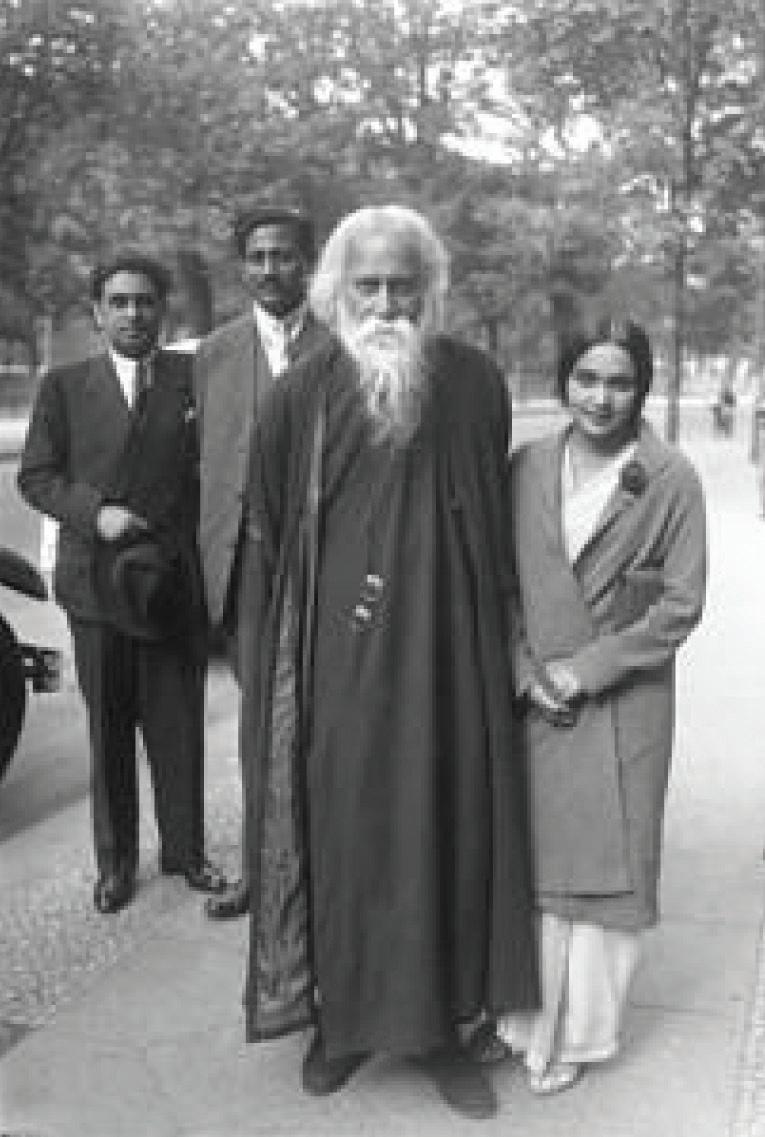
Rabindranath Tagore (1861-1941), a poet, philosopher, novelist, playwright, and composer, is proclaimed as the greatest poet India has ever produced. Three South Asian countries (India, Bangladesh and Sri Lanka) adopted their national anthems from Tagore’s work. He was Asia’s first Nobel Laureate and a cultural icon of late.
“My Reminiscences” was written and published shortly before he began a trip to Europe and the United States due to his failing health in 1912. It was during this trip
I ask for a moment’s indulgence to sit by thy side. The works that I have in hand I will finish afterwards. Away from the sight of thy face my heart knows no rest nor respite, and my work becomes an endless toil in a shoreless sea of toil.
Today the summer has come at my window with its sighs and murmurs; and the bees are plying their minstrelsy at the court of the flowering grove.
Now it is time to sit quiet, face to face with thee, and to sing dedication of life in this silent and overflowing leisure. Tagore, Gitanjali # 5 https://sites.udmercy.edu/poetry/2019/10/08/iask-for-a-moment-to-sit-by-thy-side-rabindranathtagore/#:~:text=Posted%20on%20October%208%2C%20 2019%20by%20poetry
that he wrote and published in the English language for the first time. He wrote “Gitanjali” in 1912.
Ananda Mandir was planned as a Bengali Heritage Center for our community with its two wings: that of a Hindu Temple and the other, a Cultural Center for Bengali
art, literature and music. Our cultural center was named Tagore Hall because, as one of the young musicians in our community, Birsa Chatterjee, wrote in his tribute to Tagore, “He (Tagore) is a figure who has greatly impacted the fabric of my life in both conscious and subconscious
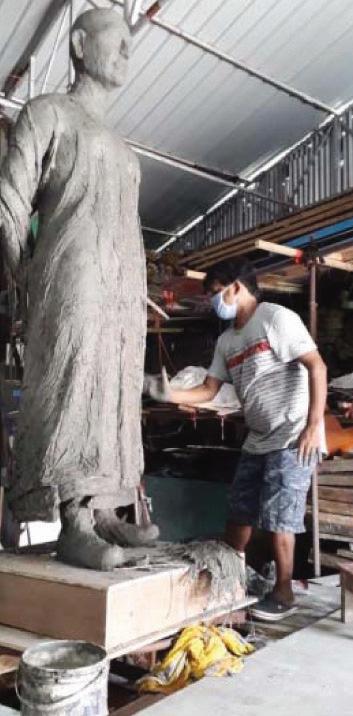
Step 1: Make an original sculpture made of clay built over an armature or an internal support structure of wood.
Step 2: Make a mold of the original sculpture. To make the wax sculpture, artist had to make a mold from the clay sculpture using fiberglass or soft rubber. The mold had to capture the fine textures of the whole body in the original sculpture. It was therefore, made in three sections: head to chest, chest to lower abdomen and the lower part to the end of the sculpture including the shoe. This hard mold is called the ‘Mother Mold’ that can be used later for reproduction of bronze statue. Step 3. Now the mold is used to create the wax sculpture. Hot wax was allowed to pour into the hollow mold and allowed to cool. This step was repeated until about 1/4th inch thick of wax is lined around the sculpture mold. Now as the mold was removed and more chasing was done to the wax copy to restore details and line up the textures between three sections. At that point, they had the exact replica of the original clay sculpture in a hollow wax model.
Step 4. Make a mold for the Bronze using the wax copy of the sculpture. Then the artists coated the wax with ceramic clay and fired the clay encased wax in a kiln, which burnt out the wax and left the extremely hard hollow ceramic shell that could withstand temperature of molten bronze. This step was called “lost wax” because wax was melted away or lost during the process. The fired mold was white in color. The mold was filled with water to test for leaks. The holes were plugged and mold was fired again. In the end, we had a shell with a hollow space of the exact size, shape and thickness of the wax sculpture.
Step 5. Make the Bronze Sculpture.
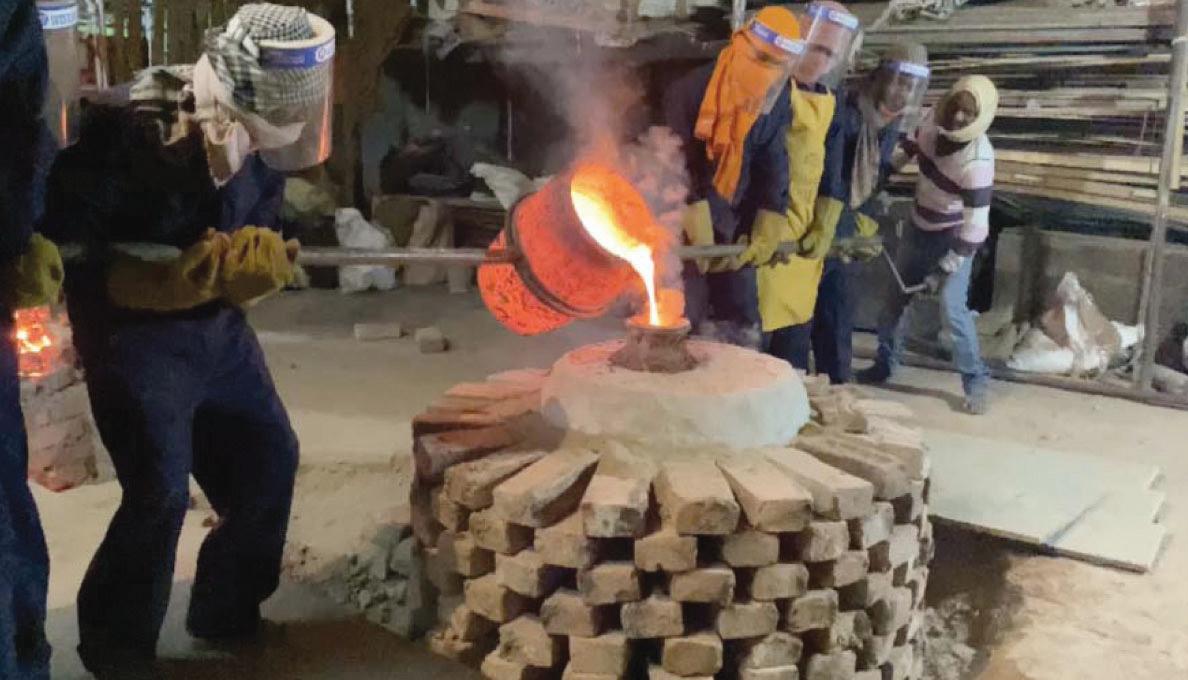
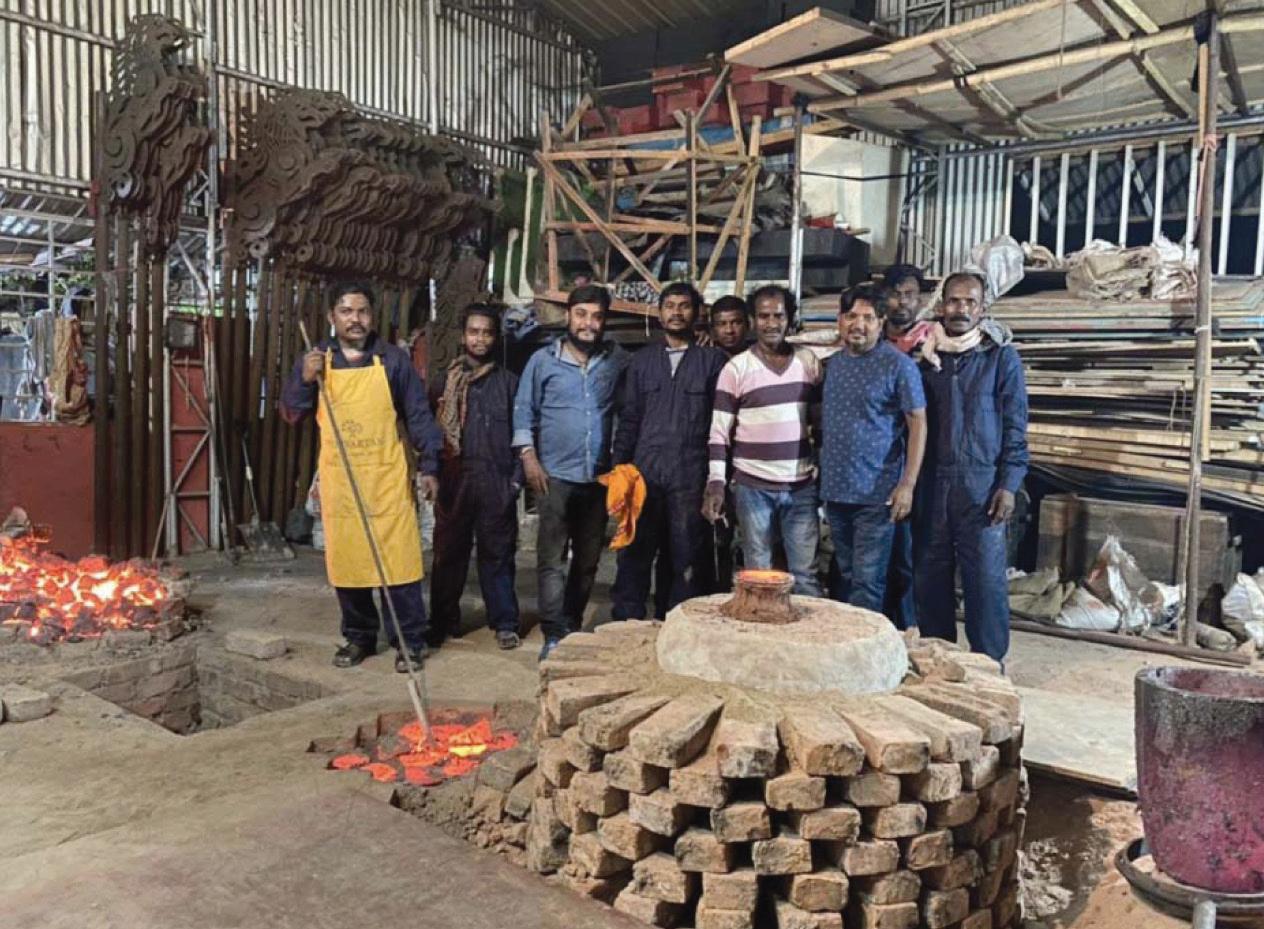
Now the mold was put back into the kiln to get hot before pouring molten bronze (copper and tin) into it. Standing next to the kiln required protective gear. The hot molds were set open side up in a sand-pit and a crucible filled with liquid metal was poured into the mold. Once the metal got cold, the ceramic mold was smashed and broken away with hammers, chisels and other tools. Once the metal was free of the mold, the metal workers soldered, welded, ground whatever was necessary to reassemble the three sections of the sculpture to make the life size Tagore bronze statue!
Step 6: Patina
Patina was the term for how the surface of the bronze was finished. It is then sealed with varnish or wax to protect it from weather.
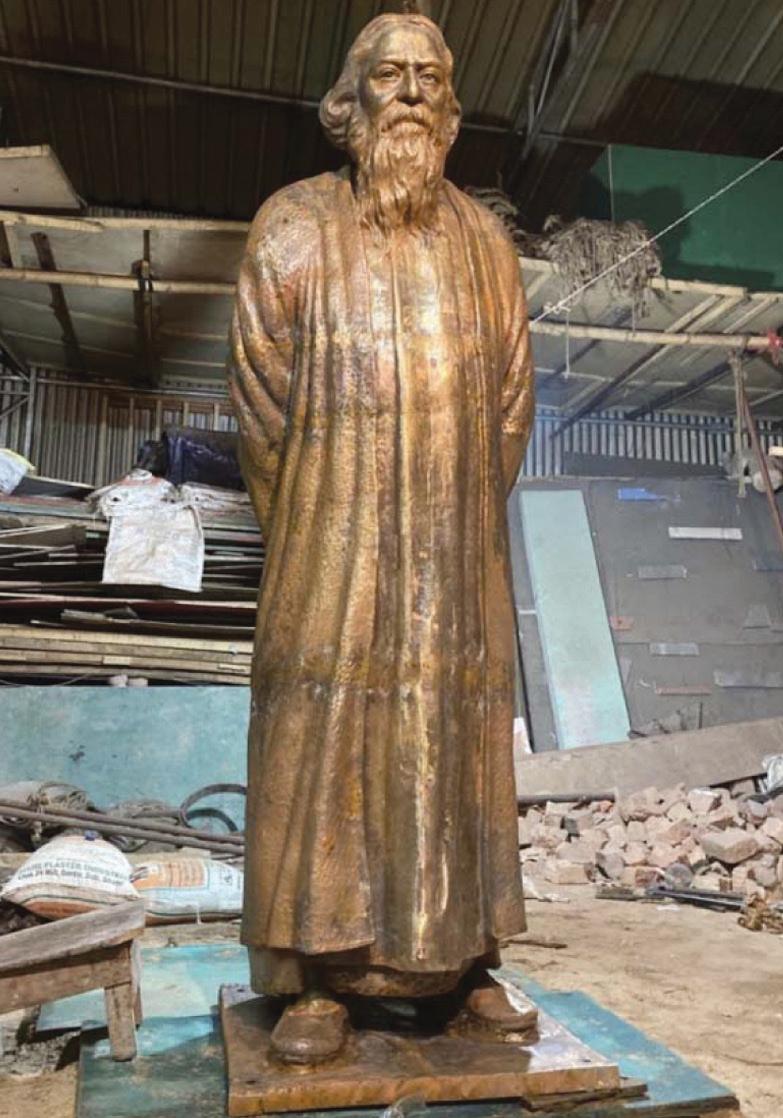
ways. To ignore Tagore’s influence on my artistry would be criminal’.
The idea of memorializing Rabindranath Tagore precipitated the construction of a life-size bronze statue on our green lawn overlooking Tagore Hall! We wanted our future generational diaspora to see him when they visit the site and learn about his work in Bengali literature and music. We hope our next gen-
| continue from page 6
the best. Then there are, of course, many other cuisines for different tastes. In the Hindu tradition, one’s way to reach God is by tasting His “charanamrita”.
When it comes to touching and physical pleasure, the feeling one experiences right after one reaches his/ her climax is said to be similar to a divine experience because at that moment the person is completely satisfied and does not want anything else. Unfortunately, the feeling does not last long. It is no wonder that people have sought out the ultimate pleasure through sexual experience. The entire area of Tantric sex is based on this premise. The Tantric techniques have focused on how to intensify and prolong the sexual pleasure. In this context sex is regarded as holy. Then there are some experiences which engage more than one of our senses. Watching a musical dance routine or a music video requires exercising both our eyes and ears. Taking drugs involves multiple senses and some even combine it with sex for that ultimate “high”.
It seems to me that God has given us five senses to explore and experience everything around us to the fullest. He is smiling in the background because he knows that he is the ultimate in any experience. Even if someone does not believe in God and/ or does not practice any ritual regularly but only follows his basic animalistic senses to find out the most extremely delightful items he will soon realize that it is a never-ending process and would understand that there is an ultimate experience that he would most likely never reach. That experience is God!
It makes sense to me that once we die and lose all of our physical senses, we would be at a different level to experience true divine power. Perhaps there would be new “senses”, more emotion-based, more meditative and more intellectual to help us continue our quest for that ultimate experience. After thousands of reincarnations our souls become free, and we truly experience that ultimate experience or God –that is “nirvana”!
Editor’s Note: This is a column of factual stories of “Unexpected Kindness from Strangers” as experienced by the writers. Our readers are encouraged to participate in this column to share their own factual stories.
By rahul ray
t was the very first time I was driving in the New York City. A few months prior to that we moved to Boston from Pullman. Even in the state of Washington with very sparse population Pullman is almost a complete non-entity in the middle of rolling hills and wheatfields, and oh, yes – the home of Washington State University where I completed my Ph.D. I was born and grew up in Kolkata, one of the largest metropolises in the world. Therefore, living in Pullman was one of the greatest existential shocks I ever had and, coming to Boston, a large city was truly a relief for me. However, that was before I came to NYC. What a joy that was. Parts of the city was dingy, litter-strewn and teeming with people. It reminded me the beloved city of my childhood, dirty, dusty, and congested but, full of life.
We were three people in our party, Swapna, my wife and my mother who was visiting us from Kolkata. We drove around the city to our heart’s content and filled our AMC Hornet station wagon with Indian groceries. It was mid 1980s and there was only a single Indian grocery store in the Boston area. Therefore, it was customary for all Indians to come to NYC and load up with months of Indian groceries. We also had a wonderful Indian lunch at a very decent cost. I just finished my studentlife of living hand-to-mouth and could ill-afford an expensive fare. We were boundless in joy.
It was late afternoon and time to hit the road to take on nearly five hours drive back to Boston. We were in the East side and saw a sign for the UN Headquarters. The UN Building! I almost screamed in excitement. It houses the famous stained-glass mural entitled ‘The kiss of peace’ by Marc Chagal, one of my favorite modern artists. I am a bit artsy type therefore this mural was a must see for me.
We managed to drive to the building, but where to park? It was late Sunday afternoon, but there was not a single spot in sight to park our car. I considered parking in a garage but the prohibitive cost posted outside made me cringe inside. I drove around the block, but was unsuccessful. I was about to leave disappointed when I discovered an empty slot a little farther up on a street across the UN building. However, a ‘No Parking anytime’ sign was posted on a pole.
I contemplated - it was not a residential area, therefore, why would a cop patrol this area this late on a Sunday, and ticket my car. Armed with this reasoning I parked my car there and, we happily marched towards the United Nations Building.
The building was closed, but the
magnificent stained-glass window by Chagal stood in front of the chapel for everyone to see. It was a feast of our eyes.
Soon after, we walked back to the street where we parked our car, but, ‘where is our car’? The parking spot sat empty with the red and white ‘No Parking’ sign glistening in the setting sun-light. My heart dropped in horror. We were some two hundred miles away from home in an unknown city with little money in our pocket.
We heard so much about how common car-theft is in NYC. Therefore, our first notion was that our car was stolen. Soon we noticed a person was staring at us from a store-front nearby. I asked him whether he had seen a cream-colored station wagon in that ‘No Parking’ spot. He nodded.
- Yes, yes, that is our car. Somebody must have stolen it.
- I don’t think so. It was towed by the police some fifteen minutes ago.
It was a bit of a relief for us, at least it was not stolen. However, how to know where it has been towed to? Again, the stranger came to our rescue.
- Just call the police, and they will tell you which garage it has been towed to.
We thanked him profusely and asked him about a telephone-booth. There was one nearby.
It was pre-cell phone era. I dialed 911 and, after some talking-around got connected to the NY Traffic Police Department. The person on the other side was very friendly. After getting the details of our car he quickly located it in the towing garage in the West side of the city.
My heart leapt in joy. I had to pay for the ticket and towing, but it was not stolen and, above all we would be able to go home. However, my jubilation soon evaporated.
I knew very little about the public transportation to go there, therefore I decided on getting a cab. However, each time a cabbie would stop, roll-down the window and ask where we wanted to go, he would nod in negative and drive away. We were panic-stricken and did not know what to do.
Finally, a black taxi driver rolled down the window and asked where we wanted to go. Upon hearing about our destination, he took a deep look at us and exclaimed.
- That is not a very nice place to be, especially at night with two women. However, I fully understand that you need to get your car to go home.
- Yes, otherwise we are stuck here tonight.
- I understand. However, I will take you there with the condition that you must obey everything I tell you to do, without exception.
We looked at one another in bewilderment. Are we going to get into a
larger trouble than what we were already in? However, we had no choice but to take his offer. It was getting darker, and who knew when the next taxi-driver would agree to take us to the West side. After a little contemplation I limply said ‘yes’.
The man opened the door and sat Swapna and my mother in the back seat and me in the front. He locked all doors shut and rolled up the windows. It was warm and the taxi did not have air conditioning. However, he demanded‘Do not roll down the windows or try to open the door under any circumstance’.
The driver clearly understood that I did not know much about the West side of the city. Therefore, he illuminated me with information such as it is a very dangerous area, murder, rape, gang violence is common, nobody in right mind will go there at night etc. increasing my boundless anxiety. He also asked me where we were coming from, what we were doing in NYC, etc.
Our taxi passed through mid-town tunnel to reach Madison Square Garden area teeming with people, vendors, much like my childhood city of Kolkata. Soon we passed through a ‘black area’ where almost everyone in sight was a black person. Then we drove into a Latino area where all writings on storefronts and other advertisements were in Spanish.
The driver announced that we were almost there and, everything we promised to do must be adhered to. Soon he parked in front of a large yard with cars parked everywhere. A little office like structure was visible at a distance. He turned towards me and said, “You go ahead, pay the fees and get the car. I will stay here with the ladies”.
I was in mortal fear. How could I leave my loved ones with a total stranger in a dangerous and violent place? What if he decides to drive away?
The man read my mind. “Trust me, they will be in good hands. It is too dangerous for them to come out of the car and go with you. Trust me.”
Then he turned towards me.
- These guys only take cash. Do you have enough cash to pay for the ticket, towing fee, and then pay me?
- I think so. I uttered haltingly, hesitant to inform him that I was carrying quite a bit of cash with me.
Then he said something that was totally unthinkable.
- Well, if you do not have enough, I can loan you the rest. You can mail me a check after getting back home.
It was dark everywhere. A total stranger, a black person was offering me a loan standing in a near-desolate area of the West-side in NYC. My genetically ingrained racist Indian-self recoiled inside me in total disbelief. I was so bewildered that I couldn’t utter anything
Gettingmarried, by itself is a very stressful affair. My married readers put your hands on your heart, close your eyes and ears, become oblivious to the dangerous looks being sent your way by your significant other half and tell me truthfully whether I am right or wrong. Readers who have yet to take the drastic step, I would request you all to think long and deep before you take the plunge and inevitably join the mass majority. But if you think that, THAT is the end of the story and the rest of your life is going to be one chirpy birdsong, then all I can say is that you don’t know what is about to hit you when it is time for you to get your offspring into the state of holy matrimony.
It all begins with them finally deciding that it is time for them to settle down. The youth of today do not believe in the term “settle down”. They take it as an affront and a comment upon their current life styles.
“What do you mean settle down? Do I look unsettled to you? All my friends are having fun. And do you see the married ones? They are always at the beck and call of their partners; they can’t lead an independent life.”
As a clincher, my son gave me the example of his best friend from college who had ‘unfortunately’ agreed to get married. His words- not mine! After that, the poor, unfortunate boy had had to give up playing computer games right up to the wee hours of the night. That is, right till he hit upon a brilliant plan. He devised a plan whereby he could put his wife to sleep and then get up slowly and go to his computer and he and his band of friends could resume their game. Gaming, as I was made to understand, is extremely big. Far bigger than mundane matters like getting married and settling down.
I don’t know how it happened and what exactly I did, but I must have done something good, for the day finally dawned when my son said the magic ‘Y’ word. To say that I was ecstatic would be a very mild understatement. I got down to the planning and execution stage right away, without missing a beat. I did not want to give him even
By Amrita Kangle
half a chance to change his mind and his answer from a ‘yes’ to a ‘no’. How we decided upon his future bride is a story which would take up a few voluminous tomes and the memories would make me start tearing my hair off once again, so I will keep it for another day. Let me just say that he found the perfect girl and from that point on there was no looking back. Planning, cards, invitations, trousseau shopping, gift shopping, jewelry shopping, caterers, transport companies, hotel bookings- you name it and it was on my todo list.
There is a saying that goes, ‘Man proposes, God disposes’ and this is exactly what happened with us at that point of time. As it did with hundreds of others like me. The pandemic took a turn for the worse. There was a total lockdown in the country and the wedding was a mere fifteen days away. This was the second time that this was happening, and we were determined not to give in. The situation could not have been more complicated. I was in Mumbai with my sonthe groom, my husband was on his way to Newark airport to board his flight to Mumbai, the bride was in her parents’ home in Jamshedpur with her parents and family members and the wedding was to be held in Jabalpur!
The groom’s family with an entourage of 45 people from Mumbai and assorted places around the world and the bride’s family of 75 people from Jamshedpur and the rest of the world again, were to converge there for the ceremony. The whole gang was to then move over to Mumbai where we were to throw a reception. The whole affair was a parents’ dream and a logistical nightmare. Everything had to be cancelled! Everything, except the ceremony that is. Ideas were tossed around faster than a child tosses toys. The wedding venue got changed from Jabalpur to Kolkata to Mumbai to Jamshedpur as one place after the other was placed under strict lockdown with strict injunctions of no more than 5 people being allowed to assemble. Tickets
had to be cancelled en masse. Hotel bookings cancelled. Caterers cancelled. Shopping unfinished. In short, we were hit by a meteorite and did not know how to put the next foot forward. Because the country had been under a semi-lockdown since the past year and everything had been in a state of flux, we had not really known what to do as far as shopping was concerned. There was a nebulous hope in the back of my mind that all the pieces would fall together like pieces of a jigsaw and the final completed picture would be set before me. But the time had arrived, and the pieces of the jig-saw remained scattered as ever before. In fact, the pieces had been picked up and thrown far and wide.
All the shops were closed. There was no chance of my being able to shop as had been my dream. The groom’s Sherwani being ready on time seemed further than a far-away dream. I told my son that he could now get married in his shorts. He would be starting a trend of sorts and henceforth we would be seeing hordes of bridegrooms sallying forth on their wedding day clad in their most comfortable shorts and a well-worn tee. My friends were horrified by my calm acceptance of the circumstances and one of them even offered to send her son’s wedding Sherwani as a last resort. The fact that my son was a hefty 6’-4” tall giant and would not be able to get into the garment stopped her in her well-meaning tracks! This is where the Almighty in the shape of a designer stepped in. He was the friend of a friend and was designing the outfits for a television show and instead of going to get married in his shorts my son was able to sashay forward in style. He had got his gorgeous Sherwani which surpassed even my dreams!
There was another lesson that life taught us. When all doors close, there is always a window that remains open. In this case what opened for us was another door-a back door. We realized that every shop, as it has a front door, always but always has a back door. It is mainly unsung and not given any impor-
continue to page 13 }
| continue from page 6
Durga Puja amongst the rich merchants of Calcutta. It became a status symbol to invite the Britishers, greater the number, greater the prestige.
Nabakrishna Deb was later conferred the title of ‘Raja’ by Warren Hastings for his unflinching loyalty and services to the East India Company. The palace where the 1757 Durga Puja was held is at 33 Raja Nabakrishna Street and is commonly known as ‘Choto Shovabazar Rajbari’. A subsequent palace built on the other side at 36 Raja Nabakrishna Street is known as ‘Baro Shovabazar Rajbari’. Both palaces were huge, since money was not a problem. It is believed that from Siraj’s treasury that was looted by the British, jewelry and other valuables, worth about 8 crore rupees (approximately 600 million dollars in today’s value), were distributed among Mir Jafar, Amir Beg, Nabakrishna Deb, and Ramchand Roy.
Over the years, many notable personalities were honored at the Rajbari. There were not only leaders of the British power like Governor General Hastings, but also the stalwarts of our religion and culture, like Ramakrishna Paramhansa, Swami Vivekananda, Rabindranath Tagore and Sadhak Ramprosad Sen. Also, there were conferences of learned men and cultural patronage of musicians like Harekrishna Dirghangi and many kabials
The tradition of Durga Puja at Sovabazaar Rajbari continues even today. In the old days, the celebration used to start a month before the Puja. There were cultural programs like kabi gaan, tarja, as well as khemta
naach (dance) for locals and baiji naach for the important guests. A huge mela around the palace brought in throngs of people from far and near. The idol of Ma Durga was different from the idol we are accustomed to. . The body of the lion was more like a horse and the same traditional mold is continued. It is to be noted that there was a different version of the idol in Vaishnab families who abhor any display of violence. In these places, there are no asuras or lions or even armaments in Durga’s ten hands, but Durga, with two hands, is seated on the lap of Lord Shiba accompanied by her four children. Of course, in today’s Bengal, the idols are given many different shapes and forms, some artistic, and some to display the contemporary themes.
Durga Puja is not just a religious event for Bengalis. It is a confluence of our religious, social, and cultural values and traditions, and it defines our Bengali identity. Even when the society is mired in various malfunctions, the Durga Puja remains the outlet for our energy and creativity. In a unique Bengali and Indian way, Durga is not just a distant Goddess, but the symbol of the closest member of our family, as an ever-caring mother. This personification has given us an inseparable connection to the almighty and a pulpit where all our aspirations and dreams find a place, and our thirst for justice and solace seeks fulfilment in various puja proceedings. But the puja of 1757 is marked in history as a display of greed and vanity, and a servitude to an oncoming foreign power.
References: https://www.dnaindia.com/lifestyle/report-durga-puja-scolonial-roots-1754517
https://en.wikipedia.org/wiki/Nabakrishna_Deb https://www.flickr.com/photos/56819064@ N05/10381058383
http://timesofindia.indiatimes.com/articleshow/2047696.cms?utm_source=contentofinterest&utm_ medium=text&utm_campaign=cppst https://www.whatshot.in/kolkata/this-400-years-old-durga-puja-must-be-on-your-travel-list-this-october-c-16964
| continue from page 11
in response.
I opened the door of the taxi, walked to the towing office, paid the bills and drove my car back where the taxi was waiting. I transferred the passengers to my car and paid the taxi-bill.
Before I could shake the hand of the taxi-driver in gratitude he rolled up the window and drove away.
reported by subrata Bhaumik
Sahitya O Alochana (SOA) is a monthly literary and topical discussion forum under the aegis of Ananda Mandir (AM). It has completed its 13th anniversary in January 2021 and will have organized one hundred and twentyseven (127) sessions by the time this report goes to press. These monthly sessions feature exciting and illuminating discussions on diverse subjects including literature, art, theater, and movie; history, philosophy, and religion; science and mathematics; economics and business; and social issues, sports, and current affairs.
Last 18 months have been the leanest in terms of the “SOA” activity volume primarily due to the Pandemic fallout. Nonetheless, quite a few eclectic and very interesting sessions were organized during the period. Given below is an account of the most recent ones.
June 2021
The topic of this session is the life and works of Nabaneeta Dev Sen, one of the most celebrated and prolific writers of post-independence Indian literature. For our generation who grew up in the last few decades of twentieth century she epitomized the crusade of feminist writing in Bengali literature. She passed away in 2019, and this event is dedicated to the celebration her life and work. The “discussion leader” is Nandana Dev Sen, Nabaneeta Dev Sen’s daughter who is also a writer, actor, and child-
rights activist. The event will have a special focus on the Nandana’s translation of her mother’s work especially “Acrobat,” the recently published book of poems. The session would be moderated by Debali Mookerjea Leonard, a professor of World Literature at James Madison University and a student of Nabaneeta Dev Sen.
July 2021
No session was held in July due to scheduling conflicts.
August 2021
In August we rediscovered the works of some of the gems in our own backyard. It was a poetry reading cum discussion session by two eminent poets (Goutam Datta and Mouman Mitra) from amongst us who have made their marks in contemporary Bengali literature. Both of them are from New Jersey, have been very active as overseas Bengali poets for many years, and have numerous publications to their credit. Subrata Bhaumik, was the moderator of the session. Mouman read her own poems some of which featured noticeable contrast between bold imageries of life and subtle delivery of related allegories. Goutam shuffled back and forth between reading his own poems from over last thirty years and presenting some of them through recorded poetry recitation by established voice artists and or thespians from the contemporary Bengali art & culture world. Finally, Subrata
read two of Goutam’s early poems that helped define and shape his poetic expressions at a young age.
Following the poetry reading, there was a Q&A session that focused on the evolution of Bengali poetry over last 30 years contrasting the style, grammar, and symbolism as they came to define the poets of different eras during this period. Some of it also touched upon American poets, and Subrata read one of the famous poems of Langston Hughes (The Negro Speaks of Rivers) in celebration of the recent “Black Lives Matter movement.”
The session also marked the return to “in person event” form our recent practice of remote “Zoom” meetings. The robust attending crowd appreciated the comeback, thoroughly enjoyed the reading, and actively engaged in the discussion that followed. A ton of thanks goes out to Goutam, Mouman and the organizer.
Future sessions - Quite a few interesting sessions are in the pipeline for the next several months. They include an Urdu Ghazal event, another multimedia poetry reading session (poems of Eliot and Yeats) adorned by music, “Gender Fluidity – an Evolutionary Perspective”. and finally, another philosophical session on the age-old human quest of knowing the “Who am I” through the angle of Vedanta.
The friends of Sahitya O Alochana would like to thank Ananda Mandir for its continued support for the forum’s contribution to the cultural enrichment of the local South Asian communities.
| continue from page 12
tance like its celebrated brother the front entrance, but this back door is what kept the traders alive during the lockdown. While to all intents and purposes the shops and trading establishments were closed to business following government orders, in actual fact they were running their business through their back doors. This helped both parties-the harassed customer as well as the tradesman. All the sarees that I needed to purchase at that point, I got them by entering one of the largest Saree shops in Mumbai through the back door. It helped that one of our relatives knew the owner of the shop and this made it possible to carry out the deal and all 170 sarees were delivered to my home the very next day totally complete and ready to be worn. In all this commotion it had totally slipped my mind that I had not yet got the Mangalsutra made. I fell in my own eyes. I mean my mother-in-law had been so perfect. I could never imagine that she would forget this all important object, but I had! My dreams of being an all- powerful, fully capable mother-in-law, who had her act well under control were shattering to dust! Once again, the back door and my husband’s uncle came to the rescue. I was saved.
All the functions like Haldi etc. were carried out, thankfully according to tradition in spite of all the craziness, albeit with no more than 10 people at any given point of time and finally the day dawned when we left for the airport to go to Jamshedpur. Far from the boisterous crowd of 45 as planned, it was a determined bunch of 6 people that set forth. We were determined to get this done. As we sat in the aircraft, my husband made a call to the bride’s father. When that harassed gentleman picked up the phone, my husband told him that we would not be able to make it since the flight was cancelled. The marriage was the next day! I cannot even begin describing that poor man’s reaction. Before this could go further, I took the phone away from the prankster and told him that we were on our way, and everything was under control. His relief was palpable. Actually, everyone was so high-strung that even a joke came under the heading of a potential catastrophe.
By the grace of God and the good wishes of everyone, the wedding took place in a wonderful fashion. The bride’s family more than made up for our lack of numbers and acted as ‘borjatri’ as well. There was happiness all around. As the saying goes, God was in His heaven, and all was right with the world. However, all the tension that we had to go through seems to have affected people strangely. My husband for one. Back in New Jersey, he was following the GPS and suddenly when asked to stay in the right two lanes, he instantly moved to the left. When I gently pointed out his mistake, his answer left me baffled. He said, “Oh my son is married now. I can do what I like. I don’t have to listen to anybody.”
It has been almost four months and I am still trying to establish the connection. Can you?
Benefactors-Diamond
Debajyoti & Smee Chatterji
Benefactors-Gold
Achintya & Roopali Bhattacharjee
Chhanda & Kamal Aditya
Rajat & Debika Chakraborty
Rik & Supriya Kumar Sen
Samir K Dutta
Suprasad & Reeta Baidyaroy
Benefactors
Amitabha & Dhriti Bagchi
Biswajyoti Nayak
Mitrajit & Rashmi Mukherjee
Grand Patrons-Diamond
Anjan & Purba Lahiri
Dhiraj & Chitrita Chanda
Sumit Ganguli
Sunith & Prashanthi Roy
(For the period September 1, 2020 to August 31, 2021)
Grand Patrons-Gold
Arka Mukherjee & Mita Ganguly
Arun & Subhra Paul
Ashis & Sucheta Banerjee
Jayadratha & Tandra Bhowmick
Jayanta Pal & Champakali Sinha Roy
Nilotpal & Subhechha Paul
Pradip & Nandia Ghosh Dastidar
Rupak & Bandana Raha
Sanat & Indrani Chattopadhyay
Shyamal & Sunanda Ghosh
Sris Chatterjee
Patrons
Aleek Dutta
Amitabha & Koeli Chatterjee
Anand & Manjulika Sircar
Ananya Chatterji
Asok & Mitu Baral
Biswajit & Girija Guha Sarkar
Colgate Foundation
Debi P. & Soma Gupta
Indrajit Giri & Sucharita Bhattacharya
Mihir K. & Amala Sen
Padmini & Sudeep Bagchee
Partha & Mamata Ganguli
Pradip & Rekha Paul
Pradip (Peter) Mukerjee
Rahul Rakhit
Rajesh & Arpita Ghosh
Rama Das
Saikrishna & Anupama Gangeddula
Samir & Reba Sarkar
Sankha & Monali Ghosh
Satyapriya & Edha Majumdar
Sayanti & Soumya Basu Roy
Shakuntala & Tanmoy Basu
Subarna & Reba Samanta
Tathagata & Achira Ghosh
Members
Abhinaba Rakhit
Alokesh Dey
Amar & Kabita Mishra
Amit K. Banerjee
Arpan Sengupta
Bayer Co (Chandrajit Bhattacharya)
Bhaskardipta Bhattacharjee
Biswajit Roy
Debaprasad Chaudhuri
Ivy Gupta
Jayati Basak
Kankan Bhattacharyya
Kirit & Usha Dalal
Madhumita Dey
Mahuas Collection
Manoshi Bhowmik
Mausumi Dasgupta
New York Life - Samragnee Majumdar
Poli Gupta
Poushali Mukherjea
Pradip Banerjee
Priti Ghosh
Raju Patel
Sanjay K Sanyal
Sanjit Ray
Sheuli Gupta
Sheuli Majumdar
Shourik Basu
Shubhra Dutta
Siddhartha Basu
Somnath & Mandira Chattopadhyay
Srikanth Velaga
Subha Sarkar
Subhrojit Dutta
Sudip Bhattacharya
TheAnnual General Meeting was held on August 8, 2021, in person at Ananda Mandir premises. Approximately 50 life members were present at the meeting, which satisfied the quorum requirement. All attendees were greeted with light snacks and tea before the meeting.
General Secretary Arun Bhowmik started the meeting at 12:30 pm with a short welcome address to all attendees, followed by Biswabhai’s prayer. Our President Jai Prakash Biswas then presented a brief overview of various activities and our performance during the pandemic. Jai mentioned that even under the challenging circumstances, we did well in the areas of fund raising, major Pujas, all routine activities of Ananda Mandir. He thanked all that worked tirelessly throughout the year.
Financial overview was presented by Chanu Das. It could be seen from Chanu’s report that financially we did reasonably well during the pandemic year since our last AGM. We had a healthy net revenue of about $380K for 2020 (before taking into account the loan repayment amounts).
Our financial report has been duly reviewed and certified by an external auditor.
Jai Prakash presented the overview on Tagore Hall. We had practically no income from Tagore Hall last year due to the pandemic. We managed the expenses as well as possible. Things are improving this year, we already have $67K booking for this
reported By Arun Bhowmik, General Secretary
year, and we may meet our target of $100K for the year.
Regarding Trustee election, Kamalesh Sirkar mentioned that there was no need for an election since there were 4 vacancies, and 4 nominations were received. As a result, the following 4 candidates were elected to the Board:
Arun Bhowmik, Nimai Ghosh, Anup Rakhit, Shyamal Sarkar
Mita Sinha presented the Puja Committee report. All major Pujas and the monthly routine pujas were held properly following the regulatory pandemic guidelines. It was quite remarkable that all puja activities were conducted efficiently without shutting the temple even for a day. Our Puja committee provided an exemplary service to the community during the challenging times.
Construction update was presented by Ashok Rakhit. The front gate has been installed to secure the property. A 7 ft tall bronze statue of Rabindra Nath Tagore is now in our premises. Construction of the statue support pedestal and access walkway is in progress. The inauguration of the statue in presence of few dignitaries and general public is scheduled for September 19th.
Sajal Mukherjee presented an update of cultural committee activities. Ananda Mandir has established itself in the digital platform with nu-
merous cultural programs presented throughout the year with famous artists, like Kaushiki Chakraborty, Anup Jalota, Sagnik Sen, Raghab Chatterjee, Acharya Sanjay Chakraborty, and many more musicians from India and local talents. Our cultural committee presented virtually nine episodes of e-jalsha with Creative Mind Mirror group, and other programs jointly with other local organizations like Kallol, DRSA, etc.
Loan Givers Repayment Plan –This important topic was discussed in detail by Anjan Lahiri who is involved in Planning, Budget and Expense activities for Ananda Mandir. The total revenue for 2020 ($700K), and operating expense of about $300K, gave us a net profit of about $400K, which was truly outstanding considering the tough times last year. We were successful in lowering our expenses more than the budget amount, we were able to have an excellent fund raising event, and our major pujas also generated funds as expected. Anjan thanked many loan givers for foregoing their loan interest which helped our bottom line. Based on our current status, we are confident that we will be able to fulfil our commitment regarding repayment to loan givers.
Other Committees, Accomplishments, Challenges, and Issues were discussed by Debajyoti Chatterjee.
The Kishalay Awards for Writing Excellence were established by Ananda Mandir (AM) in 2016. This annual program is designed to recognize superior writing skills of school age children and kin of AM members. Since its inception, the sponsors of the award included life members, presidents, and trustees of AM. The initial year awards were made possible by a donation by Abhijit Sen, a life member of AM. The awards of the following years were funded by Ashok Rakhit (2017), Utpal Sengupta (2018), Indrani Dhar (2019), and collective contributions by certain sponsors (2020).
Over last several years, many young talents have been recognized through this program. The most recent (2020) winners were Anshini Biswas (1st prize) and Diya Paul (2nd prize).
Nominations are hereby invited for 2021 Kishalay Awards, which have been made possible by collective donations by anonymous AM member(s).
Following are the basic rules that govern the award administration.
1) The first-place winner will earn prize of $300, and the second prize is worth $200.
2) “Honorable Mention” candidate(s) will be recognized.
3) It is available for only school age children and kin of Ananda Mandir members. The contestants for the awards need to reside in the US, and preferably enrolled in a high or middle school.
4) A contestant will need to be nominated by a member of Ananda Mandir or be selfnominated following the nomination rules set forth herein.
5) Potential contestants over 18 years of age will be automatically disqualified.
6) Number of submissions is limited to two (2) per contestant per year. Only English prose (essay, story, report, article, etc.) would be considered, and the length is limited to 2,500 words.
7) Submission of published article in any magazine (school or others) is highly encouraged although unpublished work will be accepted as well.
8) Nominations should include short biography of the author and his/her connection to AM.
9) Deadline for nominations (with copies of the submissions) for the 2021 awards is November 30, 2021. Awards will be announced and presented by the end of the year.
10) All nominations will be made using the Nomination Form downloaded from Ananda Mandir’s website. Completed forms should be supported by the submitted piece(s) of work of the young author.
11) Nomination forms will be available on Ananda Mandir’s website and distributed via email.
In case of questions, please email Subrata Bhaumik (bhaumik.subrata @gmail.com) or Ashok Rakhit (ashokrakhit@gmail.com).
He stated that there about 25 other committees with about 100 volunteers who work behind the scenes 24/7 to keep the institution functional, clean, make sure the place runs like a welloiled machine. Fund-raising Committee, Food committee, Maintenance committee, Publications committee, (Public) Community Relations committee, and more, are some of the committees whose work is not always directly visible, but these committees play a huge part in the overall performance of the institution. He mentioned about the big contributions, donations, loan forgiveness of some individuals and organizations which again helped us in a big way for our bottom line.
Open Floor Q & A – One member suggested additional priest as Biswabhai’s back up when needed. Few senior Trustees responded by stating that we do have Guru Chakravarty, Debashish Mukherjee, Suman Banerjee who are available to support us when Biswabhai is unavailable, which is very rare.
Another member suggested to install a few AC units in the basement windows to keep the place cool when needed. The Board will look into that.
Arun Bhowmik ended the meeting at 2 pm with concluding remarks, thanked everyone for their participation. The meeting ended with a happy note with all feeling comfortable about how the institution is being run and managed. Boxed lunch was served to all attendees.
Annual Fundraising campaign A Great Success once Again!
Thanks to the remarkable generosity of hundreds of loyal members and the outstanding efforts of a core group of dedicated volunteers, our fundraising campaign this year raised almost $310,000, a sum larger than our expectations. We thank each and every donor, large and small, for their financial support for another financially challenging year for the organization.
Success in Annual Fundraising Campaigns is critically important to Ananda Mandir’s financial health. In 2020, the funds raised through this campaign paid for 53% of the total expenses incurred by Ananda Mandir during the entire year!
As in last year, we could not mark the finale of the campaign with a community lunch in Tagore Hall because of the pandemic. Instead, we offered a first-rate cultural program through our digital platform on Sunday, June 27 that attracted a large number of viewers from across the US, Canada, India and several other countries.
reported by Pradip r. das
A certificate of partnership was presented to GSCA by MUKTI Foundation in recognition of its generous support for Covid-19 relief efforts for affected families in West Bengal.
GSCA’s participation in this year’s virtual NABC event consisted of a GSCA in-house production of“Kallolini Kolkata”. Our nostalgia of the city is enlivened by the buzz of the marketplace blending with the lull of the Hoogly, the raggle-taggle confluence of architecture, people, cuisines and the colors of the red brick buildings and yellow taxis. With songs, narration and landmark visual effects, viewers were transported to the many familiar sights and sounds of Kolkata which evoked our longing for the city. All the performers, who contributed to this program, were GSCA members.
In its inaugural attempt this year, GSCA was amongst the top three performers in this thrilling contest. Ten Bengali organizations from this country competed in this virtual quiz show covering a wide array of topics including Sports & Games, Science & Technology, Current Affairs, Politics, Movies & Music, Computer Games, Travel & Nature and Mythology.
Kudos to our team of quiz participants: Debdatta Das, Nilanjan Mitra Thakur, Shubho Sen and Tanzim Dasgupta.
GSCA hosted its Annual Picnic on Sunday, August 29th at Mercer County Park, West Windsor, NJ. After a covid caused absence for a year, members welcomed wholeheartedly this outdoors event. More than
125 people, members and members’ friends, adults and children of all ages, gathered at this beautiful site of lush green meadows surrounding the picnic spot besides Mercer Lake. The picnickers were treated to Bengali jalkhabar (snack) items with some prepared on site. Later in the day, for lunch, typical grilled picnic items were made and served in abundance. Varieties of hot and cold beverages were available all day.
This day-long event was filled with many fun-filled activities to keep both adults and children occupied and entertained all day. Games for all age groups including sack races, spoon races, frog races, tug-ofwar, three legged races, and musical chairs were organized. Prizes were given out. Besides the favorite pastime of “adda”, adults also joined in antakshari, sharing jokes etc. Some were seen playing volleyball or cricket. Everyone found out something to keep them merry.
During wrap up time, members joined in the clean-up activities. One could not help but observe the camaraderie and true sense of teamwork in all activities. The day seemed to go by fast with the attendees spending a perfect day with savory food, great company, music and many sporting activities. All CDC and state mandated safety guidelines were adhered to in this outdoor event.
On August 13th, the board members met, virtually, with all the respective committee coordinators to plan for Durga puja this year. GSCA will be hosting Durga puja at the Swaminarayan Temple, 1667 Amwell Road, Somerset, NJon October 9 and 10. However, the maximum number of attendees will be much restricted as compared to other years in the past. The details, including registration for this event, will be made available in due time.
Ananda Mandir gratefully acknowledges the receipt of a generous donation of $100,000 from Merck & Co, the NJ-based pharmaceutical giant well-known for developing, manufacturing and marketing innovative new drugs and for supporting non-profit organizations. The donation is in recognition of various community service initiatives undertaken by Ananda Mandir in recent years, especially during the COVID-19 pandemic.
We take this opportunity to express our sincere gratitude to Mr. Sanat Chattopadhyay (Executive Vice President and President – Merck Manufacturing Division, Merck & Co.) for enthusiastically supporting our approach to the company for a donation. He is a member of Merck’s Executive Committee and is responsible for manufacturing and supply chain operations of the company on a worldwide basis. Mr. & Mrs. Chattopadhyay have been respected members of the Ananda Mandir community for many years.
reported by chanakya ganguly
Asthe pandemic takes its twists and turns with the Delta variants, and controversy rages in the US and elsewhere on the definition of freedom, former California Gov. Arnold Schwarzenegger had a message for people who say they are against having to wear a mask because it encroaches upon their freedom. He said with freedom comes obligations and responsibilities. In Yogic Science, the greatest responsibility we have is to ourselves, to build character, mind, health. With mask and vaccination mandates, restricted access to public places, some NJPA members had an informal outdoor gathering at Colonial Park (behind Ananda Mandir) to catch up with each other.
Like many other secular cultureoriented books, on freedom, liberal democracy without a spiritual underpinning, Louis Menand writes in the book, The Free World: Art and Thought in Cold War, “freedom was the slogan of the times -- beyond its usual associations with foreign policy and presidential muscle. Free in the sense of more leisure time and fewer social conventions; and, most important, free in the sense of creativity and self-expression”. Menand’s freedom is externally generated rather than creatively induced; it is ultimately a product of international relations — more realpolitik and elitist, than a revolution. Thus, the question remains why freedom seems so expansive, and yet so elusive at the same time. Deepak Chopra writes,
war, discontent, rebellion, unrest lies inside us. He suggests Yogic Practice to be a unit of Peace within, then just vent it all out as Art and Free Speech. Hence, the Buddha stressed on Mindful Speech.
The Yogic concept of freedom is developing Mind Power, through spiritual enlightenment, and expressing the same in various activities, and connecting with people who espouse similar values, and put in safeguards to tackle people who undermine those values. Hence, the first step of Yogic Education is Bramhacharya or sense-control. Thus, it is a process to develop sense and sensibility.
Yogic culture understands that human beings are born as animals and need reform to mature oneself through Yogic Practice to neutralize the ego, stabilize the emotions and thus have nerves of steel. Success is about transforming one’s inner instincts to a calm divine one and expressing it in Life, work and Art. In Yoga, such art is called Objective Art, which elevates character, mind, and health. Else the regular Art is called Subjective Art, which is not very mindful. Hence, keep building the fort (Durg) within, to remove the ego, as we move towards divinity, to be both kind and tough to face situations, and be prepared to welcome the Goddess, over the coming months. Information about our upcoming events will be available on our Facebook page “NJPA Parivar.”
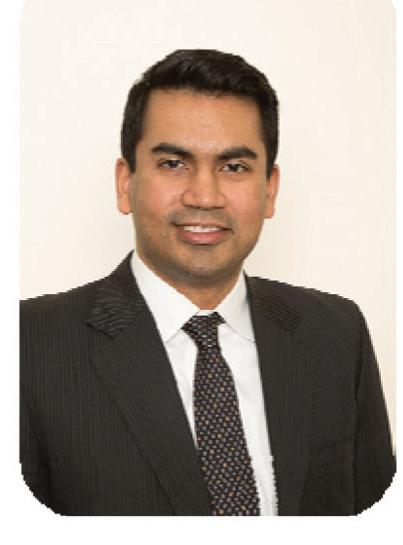
Shiva Bhashyam, McM, cFP®, AeP®, APMA® Private Wealth Advisor

Bhashyam Wealth Management Associates
A private wealth advisory practice of Ameriprise Financial Services, llc 399 Knollwood Road, Suite G-10, White Plains, NY lo6o3 914.468.2001 www.bhashyamwealthmanagementassociates.com