Ananda Mandir
269 Cedar Grove Lane Somerset, NJ 08873
Return Service Requested

Ananda Mandir
269 Cedar Grove Lane Somerset, NJ 08873
Return Service Requested
July 2013
Reported By Ashok Rakhit, Chair, Construction Committee
I am sure that if you visited Ananda Mandir in recent times, you have seen the metal fence around the construction area covering both the new community center and the expanded area of current temple. We have completed foundation for community center and have started the foundation work for temple expansion. After months of cold winter and several rainy days of spring, we are trying to push construction as much possible through the summer days this year. Over the next few months, you should see erection of structural steel for both buildings. It is an exciting moment for our community after long periods of planning during last 2 to 3 years. The bank loan will be used along with our own committed funds to pay for this construction. We have raised about $700,000 in last two years, and will
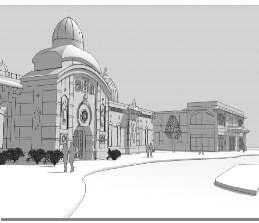
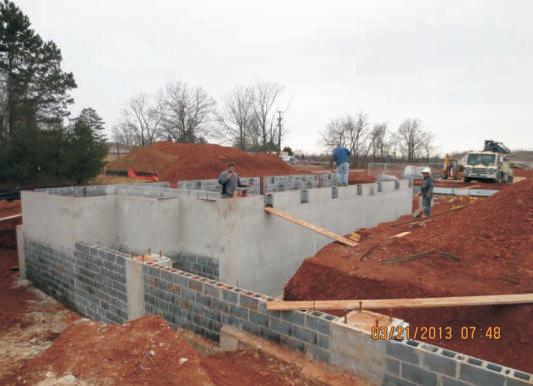
need to raise another $300,000 this year to meet our contribution of one million dollar as part of our commitment to the bank.
In preparation of our Annual Fund Raising Luncheon on Sunday, June 30, at Ananda Mandir, members of the Board of Trustees have started calling friends and families to support our fund Turn to page 2
I am lying down on a thick cushioned bed, attached to an alarm system all around. If I step down from the bed to the floor or even hang my legs from the side of the bed, the alarm will sound and a nurse will rush in. The bed can be moved up and down, and the shoulder and the leg sections can be moved separately.
I am listening to a solo flute performance by a beautiful Chinese girl on channel 13 on a modern flat TV screen on my left side; the right has multiple tubes attached to my arm. My laptop is placed comfortably on my lap, attached to a charger on the right.
I try to compose a short email, but doze off and fall into a soft sleep, don't know for how long, with my fingers placed on the keyboard. Next, I see a mumbo jumbo of letters, printed haphazardly, with my forefinger involuntarily tapping on to the keyboard while I was dozing or sleeping. I delete the entire e-mail and start over to compose a fresh one, but I lose my train of thoughts. In the next thirty minutes, I collect my thoughts again and rewrite the e-mail, with several interruptions for hospital routines and my frequent stomach spasms. But, I feel good that after trying for two and half hours I could send a short but useful message to my associates at our non-profit organization. I have a euphoric pleasure at the thoughts that I could write again –and that I have a laptop that is my friend, my resource, and my
By Pronoy Chatterjee
connection to the network of my world at large.
For almost a month now, my wife and daughter regularly visit me in turn. They keep looking at me with blank expressions on their faces, hoping that I would say, “I am well, I will go home soon,” but I can't, my whole internal body was cooked up with an overdose radiation and toxic chemical. Yes, it was an overdose but they had signed me up to proceed, overdose or not, to follow the protocol of pancreatic cancer treatment developed at John Hopkins Laboratory I keep seeing the helplessly blank faces of my family gazing at me, seeking an answer to a question, “Why us?”
I turn my face and look at a picture of a vase topped with white flowers hanging on the wall on my side. I don't have the answer to “why or how.”
Leaving aside all these stray thoughts, I now search for a path to remain active and productive. I draw the energy and inspiration from my close friends, young or old, men or women, who come frequently to see me, their old friend, who has been confined to a bed with alarm attached to monitor his movement at every step and turn, like a criminal, though he is not a criminal.
But, I am too tired to work on my laptop when I get some free time, so I hold my laptop tightly to my chest and whisper
to it, “Please let me have my ability to write again, my friend. I want to write about my d r e a m s a n d m y l i f e experiences.”
At night, at the pressing of an assigned calling bell, a nurse rushes to my bedside, holds my hand gingerly, supporting me to get up on my feet. She not only helps me to walk down to the bathroom but also shares her Christian believes that she learned from her church to give me spiritual strength. I listen to her, not interfering with my thoughts, and she enjoys that.
She asks me to show the pictures of my grandchildren. I struggle to search in my computer and finally succeed at well past midnight. We laugh together seeing their playful pictures and I forget my agonies momentarily. Her help and compassion touch my heart deeply in a unique way. Next day, I get a new nurse and get her help and compassion in yet another unique way, but all focused to my well-being, physically and mentally It's a memorable experience in my life, which I would have missed if I had not been in the hospital for such a long time. It is as if I have an extended family at the hospital. They talk to me about their Biblical stories and I discuss with them the mystery of creation.
A few months ago, I stayed in the same hospital for ten days
for a surgery and a few weeks before that in another hospital in North Jersey for an endoscopic ultrasound procedure. There, for the first time, I heard from Dr. Ben Menachem who said in a steady and sound voice, “Sorry, you have pancreatic cancer,” I looked at my son who was sitting by my side and who had been with me all along through all the tests and consultations with a variety of doctors. I saw his jaws stiffened. I stretched my hand to hold his.
The doctor's words, “You have cancer,” reverberated in me for days, echoing from one corner of my heart to the other.
The words rang in my ears camouflaged as a verdict of death. I asked the doctor, “How many months do you think that I would live?”
No one had the answer, except the typical response in statistical probabilities, a technical jargon to hedge the reality, I guess.
The battle begins shortly after that, a Whipple surgery by Dr. August, followed by chemotherapy by Dr. Reid, then chemo plus radiation by Dr. Jabbour, ending in chemo again for a period of six months total, at least.
The battle challenges me physically and mentally. I talk, I argue, and I stress on the
Ananda Mandir Calendar of Events (Dates are subject to Change) Please check our website frequently www.anandamandir.org) Tel: 732-873-9821
NOTE: If a particular Puja time is not listed, please contact temple or visit our website:anandamandir.org
July
Shyama Puja
Sunday, 07, 6:30 pm
Jagannath Prabhur Ratha Yatra
Wednesday, 10, 10 -11 am; 7 pm
Bipad Tarini Puja
Tuesday, 16, 9:30 am Thursday, 18, 6:30 pm
Jagannath Prabhur Punar Yatra
Satyanarayan Puja
Sahitya O Alochana
Ananda Sandhya
Shyama Puja
Heritage Day Celebration & Picnic
JhulanYatra & Satyanarayan Puja
Rakhi Purnima
Tuesday, 06, 6:30 pm Sunday, 18, 11 am – 5 pm Sunday, 18, 6:30 pm
Thursday, 20, Call for time
Janmastomi
Wednesday, 28, Call for time
Sahitya O Alochana
Friday, 16, 8:00 pm
Ananda Sandhya
Friday, 9, 8:00 pm
September
Aghor Chaturdoshi
Tuesday, 3, 6:30 pm
Shyama Puja
Wednesday, 04, 8:00 pm
Ganesh Chaturthi
Monday, 09, 9:00 am
Satyanarayan Puja
Sunday, 15, 6:00 pm
Biswakarma Puja
Tuesday, 17, 10:00 am
Sahitya O Alochana
Friday, 20, 8:00 pm
Ananda Sandhya
Friday, 13, 8:00 pm
Til Tarpan
Shyama Puja
October
Friday, 04, 10:00 – 12:30 pm Friday, 04, 8:00 pm
Mahishasura Mardini/ Ananda Prabhat
Sunday, 06, 4:30 am
Durga Puja
center page
Lakshmi Puja/ Satyanarayan Puja
Thurs-Mon, 10-14, See details in Friday, 18, 5:30 – 9 pm
Sahitya O Alochana To be announced
Ananda Sandhya/ Bijoya Sammelan To be announced August
Upon request, the priest of Ananda Mandir offers services such as in-house Sraddhas, Rituals associated with Cremations (Antyesti Kriya), Death Anniversaries, Pre-wedding rituals (Naandimukh, Ashirwad, etc), Upanayan (Paitey), Annaprasan, Wedding Ceremonies & Wedding Anniversaries, Griha Prabesh (Bhumi Puja), Consecrations of new cars (New Car Pujas) and others.
ANANDA SANGBAD
A Periodical Newsletter Published By ANANDA MANDIR
(A Tax-Exempt, Non-Profit Organization)
269 Cedar Grove LaneSomerset, NJ 08873
Ph: 732-873-9821
Website: www.anandamandir.org
Publications of Ananda Mandir
Editorial Board :
Chairperson:
Pronoy Chatterjee, pkc_usa@yahoo.com
Assistant Chairperson:
Debajyoti Chatterji, debsmee572@gmail.com
Editor-in-Chief:
Pronoy Chatterjee , pkc_usa@yahoo.com
Editor, Ananda Sangbad: Guru Chakravarty, guruchakravarty@yahoo.com
Editor, Anandalipi: Amitabha Bagchi, amitabhanj@gmail.com
Co-Editors:
Subrata Bhaumik, bhaumik.subrata@gmail.com
Jayashree Chatterjee, chatterjay@gmail.com
Debajyoti Chatterji, debsmee572@gmail.com
Sushmita Dutta, sushmitadutt@novel-ebiz.co
Members-at-large:
Bhaswati Bhadra Santosh Mukherjee Ashok Rakhit
All queries, articles, news reports and letters should be directed to the Editorial Board: Phone/Fax : 732-651-8802, E-mail: pkc_usa@yahoo.com.
For general information, please contact the following executives of Ananda Mandir: Dipak Sarkar, President
Jaiprakash Biswas, Vice President
Suprasad Baidyaroy, Vice President Chanu Das, Treasurer
Suranjan Bhanja Choudhury, Secretary Chitra Mondal, Assistant Secretary
Ananda Sangbad was born out of Ananda Mandir some ten years ago when a need was felt to provide news of its activities to the members of the organization.. It was envisioned to be a vehicle to pull the community together through sharing of news and views with other local Bengali organizations. Ananda Mandir would be a place where all Bengalis of the community would come together for cultural programs, recreational activities, and for Pujas, the most cherished of all activities for Bengalees. And Ananda Sangbad would bring the people all the news of all activities as well as feed the creative minds of Bengalees to do what they love to do: gossip and write. So far, the idea has worked. This news magazine carries the news of all Puja activities, the enchanting “Ananda Sandhya”, the literary soiree of “Sahitya O Alochana” and the ongoing activities from three of the largest cultural organizations in the community. We have attracted many new writers, of both the old and new generations. We carry news about notable achievements of people, young and old, generally from the local community. Expanding on that thought, can we become the centerpiece of all news about Bengalees in America? Whereas CAB, the principal Bengali Organization in America has been able to create and sustain programs to bring together Bengalees from all corners of America and Canada, it’s news outlet - Sangbad Bichitra has pursued a very limited mission. People in New Jersey would like to know what is happening at Houston Durga Bari, or the Bengali Associations in San Jose, Illinois, Boston or Canada in an on-going basis. People are interested to know about notable achievements of Bengalees in the entire country. There is an opportunity in this area, waiting for some news organization to come forward. Ananda Sangbad could fill that vacancy. Then it would be the news magazine for all Bengalees in America.
Ananda
Continued from page 1
raising campaign. We are looking forward to providing updates on the construction status and answering your questions during the luncheon. We plan to walk you around the construction site and share the detail design of the buildings and the site with you. We earnestly request for your generous donation at the same level as last year so that we can meet our financial obligation to the bank by the end of this year. Please help!
I am proud of our Bengali community that has shown the strength that it can also build a heritage center like other Indian communities. This is an investment for our future, and the future of our children and grandchildren. We all came with empty hands to this new country with big hopes and dreams just like people of every other immigrant community in America. We established ourselves, prospered in our careers, raised children; now it is time to build our own heritage center to celebrate our religious
and cultural activities freely, without any limitations from a landlord of different culture. We want to enhance our schools with better facilities so that our children and grandchildren can learn the language, music and arts of our rich heritage. It will be our contribution to this mosaic society so that our culture will not be forgotten as new generations come.
While we are excited to see the beginning of our dream of a fully functional heritage center come true, we have many challenges ahead. Please talk to the President, Chairs of various committees and the members of BOT. Come forward with your ideas; let us know how you can help and which committees you like to join. Please get involved. The future of the center depends on your engagement to make sure that we are on a path that serves the community at large and helps us grow. Please send your comments and suggestions to our Chief Editor Pronoy Chatterjee or the President Dipak Sarkar.
Congratulations are due to two Bengali organizations in achieving the 25th year milestone of their existence.
Epic Actors Workshop is the brainchild of Dipan Ray, a PhD in pharmacy. He has devoted all of his free time, outside of his profession to earn his livelihood, to promoting Bengali theater in America. He has staged many dramas, both here and in India, to high acclaim. Lately, he has produced dramas in English, in collaboration with American directors. Some of his famous productions in English are: “Sacrifice” adapted from Rabindranath’s Bisarjan, and “Bhopal”, depicting the most devastating chemical accident in history. Ray’s greatest contribution to the Indian Theater has been the creation of South Asian Theater Festival in 2006.
Mrittika, a South Asian Center for Language and Heritage was started by Dhriti Bagchi in the basement of her home in Manalapan, New Jersey, to teach Bengali to a handful of children. Starting from that modest beginning, Mrittika has grown in popularity and size, and has expanded into other areas of Bengali culture – music, drama, puppetry and the exhibition of arts and craft. As Dhriti says – “The alumni of this institution now shine in many professions – medicine, engineering, business management, art and so on, while carrying with them the knowledge of their linguistic and cultural roots and spreading the awareness of that wealth in the country…”.The students of the center and their parents agree and so do we.
Guru Chakravarty Editor, Ananda Sangbad Announcement
The Editorial Board welcomes the news of completion of 25th year milestone from any Bengali Organizations in the USA for publication in Ananda Sangbad
Didn’t Receive Your Copy of Ananda Sangbad?
If you are a Life Member or an Associate Member, but didn't receive your copy of Ananda Sangbad, it may be because we do not have the correct address on file for you.
Please send an email to
Guru Chakravarty (guruchakravarty@yahoo.com) with your correct address, and we will send you another copy.
The article, "Periodicals Published by Bengalis in North America: Quo Vadis?", published in our April 2013 issue, contained a mistake. The article described a certain website as a "treasure trove of little-known facts and helpful notes on all the songs written by Rabindranath Tagore". The correct address for that website is www.Gitabitan.net. The author regrets that the web address was shown incorrectly in the article.
The Board of Trustees of Ananda Mandir expresses its appreciation to Suprasad and Reeta Baidyaroy for financially supporting the publication of the July issue of Ananda Sangbad and for continuing financial assistance with the publication of our annual magazine, Anandalipi.
Editor's Note - Sanjoy Nandyhasoverfifteenyears of experience with real estate investments in India.
Facing the challenges of managing real estate in India,in2008,Sanjoyinitiated apropertymanagementservice in Kolkata to primarily serve select NRI friends and family.Sanjoyisanavidfollower of real estate investmentopportunitiesinIndia. Sanjoy can be reached at sanjoy_nandy@yahoo.com.
Owning real estate in India is a dream nurtured by almost every first generation immigrant family in the US who emigrated from India. Often the decision to own a piece of real estate in India is based more on emotional than financial considerations.
Real estate in various form or shape - an apartment, an inherited house or a vacant piece of land acts as a root to one's motherland, a nostalgic connection with the country of origin, an umbilical cord - also popularly known as "naarir taan" in Bengali.
Since the economic liberalization of India in early 1990's, as middle class income increased and credit became more easily available, real estate in India became a lucrative investment. In the last two decades, for many investors, Indian real estate market has provided handsome returns in form of capital appreciation and income generation. In this same period, for many NRIs, real estate in India has become established as a critical component of their investment portfolio.
In spite of a spurt in real estate investments in India in last two decades, owning real estate in India by NRIs has proven to be challenging due to the lack of infrastructure and absence of proper transparency. This article would attempt to address some of the common best practices that can be followed to avoid pitfalls.
Near-Term Potential for Real Estate Investment in India as Investment:
Real estate in India continues to be an appealing investment opportunity and will likely remain so in the near future. India is blessed with one of the fastest growing economies in the world, the effects of which is compounded with the emerging middle class with growing income and a huge deficit in affordable housing. In last 10 years, high returns from real estate have attracted significant NRI investments in this sector.
According to current estimates, in the next 5-10 years, real estate will continue to provide lucrative returns. Some of the factors that will help the real estate sector as an investment are - (a) increased initiatives by government to introduce regulations in real estate sector to reduce fraudulent transactions (b) increased investment in infrastructure - highways, mass transit etc. (c) higher rental yield potential for residential and commercial properties and (d) highly favorable foreign exchange rates (USD vs. INR), providing higher purchasing power for NRIs.
Buying Real Estate in India:
Buying residential real estate in India is a major decision and will be one of your most high value transactions. Certain due diligence will be extremely helpful for you to enjoy the fruits of your large investment.
• First and foremost, as a buyer you have to be 100% clear about the purpose of the investment e.g. are you planning to use this property for your own use or do you plan to generate income by renting.
• Identify location and neighborhood where you intend to buy e.g., get some reference from your friends and family who lived in that area. Does the location/neighborhood fit your needs for amenities e.g. easy access to mass transit, etc.
• Research developers and check their credentials, track records and current projects. This is a critical step that you should do with utmost care. You need to find a reputable builder and a project that meets your needs with clear timelines of deliverables. Ensure that you understand what is included in cost per sq. feet (is it carpet area, super built area?) Verify if there are any hidden costs by asking questions (what extra payments are needed, if any?) There is no dearth of good projects, so take your time to make your decision. DO NOT RUSH.
• Budget - Ensure that you include additional expenses e.g. lawyer's fee, brokerage (if any), registration fee as you prepare your budget for the purchase. For future maintenance, please factor in a high maintenance cost that you will pay annually or quarterly. This is the right time to decide if you need to apply for a home loan.
• Transaction - Once you have finalized the location, developer, project and funding, it is time to secure the service of an attorney who is conversant
By Sanjoy Nandy
with real estate transactions in your city and state. Document verification is an important step before you finalize the purchase and an experienced attorney is invaluable.
• Document Verification - Below is a general guideline but I strongly advice that services of a reliable and experienced attorney are sought. NOTE: Legal documents to considerbefore you enter into a purchase agreement are: (a) Land ownership structure where the project is built (b) Is there any dispute or are there multiple owners claiming the same property (title search?) (c) Clean agreement between developer and land owner to allowdevelopment.
• Clearances and verification necessary before you make final payment or take possession: (a) Ensure all clearance certificates are received from authorities (b) Clearance of back taxes on the property (if any) are obtained by the developer (c) Post-purchase property is registered in local Municipality or Corporation
Managing Real Estate in India
Managing real estate in India is challenging. Certain maintenance services are needed when you purchase a property e.g. (a) complete all post-purchase formalities like mutation, (B) conduct routine maintenance like deep cleaning, pest control and property tax payment, and (c) need -based services e.g. plumbing repairs, electrical maintenance, renovation (if any), etc.
There are limited infrastructure for property management services in India and a lack of trained professionals in this field. NRIs are generally overcharged for regular maintenance services and still have to deal with shabby work. Counting on friends and family is often tricky and sometimes unreliable.
Renting is a traditional way to bump up return on your investment and also generate an income. But renting out in India is not risk-free. It is imperative to follow a few best practices to minimize the risk. First and foremost, consult an attorney to draft a Power of Attorney to secure the services of any third party (resident Indian citizen) for lease management and rent collection. Having someone locally present is always convenient.
Biggest hurdles of lease management in India are the lack of credentials on tenants and extremely slow judiciary to resolve a conflict. Securing the services of an attorney to prepare the
lease is always advised. As a landlord, use your due diligence to check credibility of the prospective tenant (employment, reference from last landlord, any other reference, etc.). It is always suggested that the lease agreement have a strong termination clause for the tenant in case of any breach of terms. In order to mitigate financial risk, it is always advised to collect considerable refundable deposit from tenant. Selling Real Estate in India
If you are a seller, you may find the following comments useful:
• The seller can demand the best value if there is clean documentation for the property
• In absence of a MLS listing, estimating value of the property is based on unofficial price per square feet in the area
• Brokerage service in India is often not certified/regulated.
Seller has to use own due diligence before engaging any broker for the transaction. Sales commission varies between 7 to 10% of transaction cost.
• Online advertisement for sales is the best way to market your property. Other marketing channels have limited reach for sales.
• Profits earned from real estate sales are subject to Capital Gains tax. Short term rates apply if the sale is within 3 years of acquisition of property. For above 3 years, long term capital gains taxes will be applied.
• Engage an experienced tax attorney to get advice on repatriation of sales proceeds to US and any tax obligation to be satisfied.
• Engage an experienced attorney to oversee transaction and guide the seller throughout the process.
By Debajyoti Chatterji
Most individuals who are US citizens and are 65 years old or older qualify for participation in the Medicare program. But what about foreign nationals who are permanent residents ("green card holders")? When and how do they become eligible for Medicare benefits? Families who are thinking of sponsoring their elderly parents or other relatives for green cards should understand Medicare eligibility criteria for foreign nationals before beginning their visa sponsorship processes.
Medicare eligibility for permanent residents depends on many factors and is situation-specific, so it is best to contact Medicare by phone (1-800-772-1213) or visit the nearest Social Security office. This article will attempt to give a broad overview only and is NOT meant to be professional advice. Please consult an elder care attorney to get expert advice
Let us look at a relatively straight-forward case first. If a permanent resident lived and worked in the US for at least 40 quarters before turning 65 - and paid Medicare taxes for those quarters -- he
will be eligible for Medicare benefits. That means he will get "basic Medicare" (meaning "Part A" which covers hospitalization) without cost. For "Part B" coverage which pays 80% of costs of physician visits, diagnostic tests, outpatient care, medical equipment, etc., the individual will have to pay a premium (currently $104.90 per month). Premium could be higher if the individual was in a higher income bracket. The spouse of such an individual will also get Medicare benefits, beginning at age 65, even if he/she did not work or pay Medicare taxes.
What if the permanent resident did not work in the US for the required 40 quarters and did not pay Medicare taxes? He will qualify for Medicare when he turns 65 - and has lived in the US for at least five years -- but he will have to pay a fairly steep premium for Part A coverage (currently over $441 per month). There is no increase in premium for Part B coverage, however.
What if the green card holder has not reached the age of 65 and Turn to page 4
Invites retirees and near-retirees to participate actively in Forum meetings and activities.
Future Meeting Dates: Sunday, July 21
Sunday, August 25
Sunday, September 22
Meetings usually start at 1:00 PM. However, dates and times can change for reasons beyond control. So, please check with Debajyoti Chatterji (973-586-2505) prior to each meeting.
The incident of gun violence to leave the deepest and most lasting impression on me was the murder of Senator Robert F, (Bobby) Kennedy in the summer of 1968. It was by no means my first exposure to gun violence in America. It is true that I was in India when President John F. Kennedy was assassinated in November 1963. But I was very much in this country in 1966 when Charles Whitman went on a rampage from the observation deck of the Tower at the Austin campus of the University of Texas, spraying bullets at random from an assortment of rifles and shotguns until over a dozen people were dead and nearly three dozen wounded. Only two months before Kennedy's death, the Rev. Martin Luther King, Jr. was felled by a sniper's bullet on his motel balcony in Tennessee. That assassination was followed by days of inner-city rioting in several major US cities.
The Bobby Kennedy assassination was different for me because he was the last politician that I was really infatuated with. In the spring of 1968, he was running hard for the Democratic presidential nomination. He was not necessarily well-liked among my friends in graduate school, many of whom regarded him as a Johnny-come-lately contender to wrest the nomination away from the true anti-Vietnam War hero, Eugene McCarthy. Kennedy's candidacy was in some difficulties when he lost to McCarthy in the Oregon primary. So when my hero won the Democratic primary in California, I was elated and watched his victory speech live from the Ambassador Hotel in Los Angeles.
But then disaster struck. Kennedy was gunned down shortly after midnight in the hotel pantry - his victory celebration cut short by the bullets of Sirhan B. Sirhan. After my initial shock and sadness, I was certain of one thing: something had to be done to curb gun violence in America. I became a fervent advocate of gun control, and went around loudly proclaiming my views, until I ran into my friend George.
George was a fellow post-doc of physics at the University of Illinois in the early 1970s. He was mild-mannered and extremely polite. He was also a sensitive man who would later quit physics to study medicine to go into oncology research after the un-
By Amitabha Bagchi
timely death of a dear relative from cancer. So he surprised me one day by stopping my usual rant on the need for gun control by pointedly asking me how I wanted to handle the case of hunters. It quickly became clear to me that I had not reflected deeply on the precise nature of gun control I was advocating. First, the nature of the gun varied in the cases I have described: Charles Whitman and James Earl Ray used high-power rifles with scopes, whereas Sirhan B. Sirhan employed only a revolver. Second, I was not opposed to the sports of game hunting (with license) or skeet-shooting per se. (While I did not grow up in India in a household with guns, my grandmother came from a landowning family that proudly displayed a double-barreled rifle in a glass case and an antler trophy on the wall.) I was, in a way, flummoxed.
My encounter with George forced me to think through the precise nature of gun control that I should be advocating. At the same time, I became more aware of the sweep and ambiguous wording of the Second Amendment on the "right to keep and bear arms." The tension between the two has informed and continues to affect my views on the subject of gun control to this day, even as gun violence - both political and random - continues unabated in America.
Efforts to enact modest pieces of legislation in the US Congress to control or curb the easy availability of guns have generally foundered on the twin rocks of America's deep-seated libertarianism and starry-eyed respect for power. The libertarian streak - derived from the sense of one's home being one's castle - posits somewhat naively that an armed citizenry is the perfect counterpoise to the evil designs of a tyrannical government. Taken to the extreme, this mind-set would make guns as readily available for purchase as a toothbrush or fishing tackle. The deference to power comes from the nation's history of expanding frontiers through wars, and a romanticized cultural narrative of a Wild West with its fast-drawing gunslingers and good ultimately triumphing over evil. That respect is only heightened by the American ingenuity to make top-notch firearms: from Eliphalet Remington (rifles and shotguns) and Samuel Colt
(revolvers) to the present-day M16 machine guns, the list is long indeed.
This national affection and oftentimes craving for firearms has been naturally exploited by the weapons industry for financial gain. They have suppressed any moral qualms about the collateral harm caused by their product, and steadfastly opposed any curb on their manufacture, sale or improvement in lethality. In this quest, they have been ably supported by the strident voice of the National Rifle Association (NRA) championing the Second Amendment rights. Advocates of gun control have had a tough time devising an effective and persistent strategy to advance their goal in the face of such absolutism. Here, from memory, is a quick re-cap of that effort over the past forty years.
The early effort, culminating in the Gun Control Act of 1968, focused on banning the import of the so-called Saturday Night Specials - cheap handguns used by criminals (and often also their intended victims) in low-income and high-crime neighborhoods. The problems with the act were twofold. It was difficult to define precisely the banned "junk guns;" and manufacturers could change their product to circumvent the ban. The two problems continue to plague any gun control legislation to this day.
The opposition to serious gun control cuts across ideological or party lines. In 1972, George Wallace was shot in Maryland while campaigning as a Democratic Presidential contender and was paralyzed from waist down. It is unclear if it changed his views on gun control. In 1981, President Ronald Reagan (a Republican), his press secretary James Brady and two others were shot outside a Washington hotel. This led eventually to the Brady Handgun Violence Prevention Act of 1993, which instituted federal (FBI) background checks on firearm purchasers from "federally licensed dealers, manufacturers and importers" but left behind many loopholes. For example, private firearm sales among family members or friends, where the sellers are not "engaged in the business" of dealing firearms, are not covered by the Brady Act. (Supporters of such loopholes probably view these actions as similar to trading tools or artifacts!)
The Federal Assault Weapons Ban (AWB) was the subtitle of an Act of 1994 that prohibited the manufacture for civilian use of certain semi-automatic firearms, the so-called "assault weapons." Because of the law's sunset provision, it expired after 10 years in 2004. The effect of the ban on law enforcement has been hotly contested. The Columbine High School Massacre (1999) happened when AWB was in force; the young gunmen used a semi-automatic handgun, a carbine rifle and two sawed-off shotguns. The law was not in force, however, in 2012 when James Eagan Holmes opened fire at a movie theater in Aurora, CO using an assault-style rifle with a 100-round drum magazine aside from a shotgun and a handgun. Over a dozen people were killed in both instances.
The most recent and one of the ghastliest mass murders occurred at the Sandy Hook Elementary School in Newtown, Connecticut days before Christmas in 2012. The slaughter of young children drew universal outrage and led to gun law changes and restrictions in several states. But the effort to legislate expanded federal background checks on gun purchases failed in the Senate because it could not muster a filibusterproof majority. This was so in spite of intense lobbying by President Obama, family members of the Newton shooting victims, and ex-Congresswoman Gabrielle Giffords - herself a permanently scarred victim of gun violence in Arizona in 2011.
The future of any new federal gun control law is murky at best. It is often claimed that over 90% of Americans approve of Universal Background Check for gun purchases. But such support is not evident at the polls and seems to wilt in the face of a barrage of contrary advertisements by the NRA. One has to accept the fact that the Second Amendment has wide support in the US population. The real question revolves around how absolute the rights enshrined there truly are, and how far they may be circumscribed for the society's greater good. I have no clear answer to that question. I tend to agree with the father of an accidental gun violence victim at a Massachusetts university who tried unsuccessfully to have gun control laws enacted
Continued from page 3
does not have the necessary "40 quarter service" credit or is not likely to work and earn service credits? He can buy and maintain health insurance from private companies until he reaches age 65 and qualifies for Medicare (at a higher premium, as explained above). However, premiums for such private insurance depend on many factors (such as age, amount of coverage, amount of deductible/copay, etc.) and can be quite high.
It should be clear from the above discussion that individuals who immigrate to the US at an older age (and are not likely to be gainfully employed in this country for at least 10 years before reaching age 65) will face significant financial costs before and after reaching the "Medicare age" of 65. Families sponsoring immigration of such elderly relatives should recognize the additional financial burdens they are likely to face in the future.
Individual green card holders who have low (or no) income and little or no assets may qualify for Medicaid. However, Medicaid rules vary from state to state and are quite complex, so professional advice and help are necessary to navigate through the complex Medicaid maze. However, the US government and the state governments expect the families that sponsored the low-income immigrant to share a significant part of the health care cost burden.
and later expressed his views this way in a recent New York Times op-ed piece (I am paraphrasing here): As long as the [American] society believes that loss of life at a certain level is an acceptable price to pay for the pursuit of liberty, enacting serious gun control legislation would be elusive.
My current interest is to see what the future holds for Michael Bloomberg and his group, Mayors Against Illegal Guns, in their political fight against the NRA. The group may notch some successes in the near term, like unseating or repositioning New Hampshire's Republican Senator, Kelly Ayotte. Or its effort may just fizzle out and the group may dissolve in a few years from irrelevance. Either way, the central question I have on whether a majority of Americans supports the NRA's uncompromising and absolutist stand on gun control and the Second Amendment will have been answered.
By Kumar Som
(Editor’s Note : This article is divided into two parts. The second part will appear in the next issue of Ananda Sangbad)
PART I
Man has tremendous power to dream. For centuries, dreams of travel into space has been the topic for dreamers, fantasists, discoverers and a few speculative scientists, but it was the twentieth century that brought about a quantum jump in space discovery when Rockets were for the first time accepted as the one and only practical means of space travel. A series of design advances peaked in Rocket design from fireworks to Intercontinental Ballistic Missile rockets like Titan, Atlas and Saturn in the 1950s and 1960s. The timeline of the space age is a complex one. It was the nineteenth century novelists and Collier Magazine articles that influenced rocket theorists such as Konstantin Tsiolkovoskii in Russia and an American physics professor Robert Goddard (who experimented with the first liquid propelled rocket) and Herman Oberth in Germany. There were many parallel discoveries but each one had their own contributions .These pioneers who had written papers on rocket science influenced the next generation -- most noticeably in Russia and in Germany during the war. It was V2 -- the deadly and venomous German Rocket invented during the Second World War -- that ushered the people into learning the intricacies of the most powerful rocket produced. In the post World War II era the rival superpowers competed to learn and adapt the secrets of V2 German rocketry. But throughout this exciting period the engineers and scientists had one and only one dream -- the dream of spaceflight.
In USA Rockets like Redstone, Titan and Atlas were designed in incremental improvements by Werner Von Braun and then finally Redstone was used to launch Gemini spacecraft and thus started the prelude of the promise made by President Kennedy in front of the Congress on March 25,1961: "To land a man in Moon and bring him back to Earth". It was a long and arduous task of designing and building spacecraft and lastly training astronauts in those spacecraft and flying them to space. This had to be achieved in "Military Precision" in the time frame of a decade and with no chance of complacency or accident by the USA (NASA). The challenge of a lunar landing was the ultimate aim of the entire Space Race-the target lay at the extreme limits of 1960s technology, stretching the engineering skills of both superpowers while remaining fantastically achievable. The journey of NASA started with the launching of Mercury-Redstone-3 with Alan Shepard on board on a twenty-two-minute suborbital flight. Journey to the Moon was on in incremental advancements in Mercury, Gemini and finally Apollo flights in launching, docking and rendezvous of two spacecraft in space, injection to Lunar Orbit, leaving and joining Lunar and Earth Orbit with help of Mercury, Gemini and finally the Apollo Rockets (consisting of Mother craft and a Lunar Lander).Thus started the Journey by NASA keeping up President Kennedy's promise by practically achieving the goal of "Landing on the Moon". But one must consider the magnitude that Kennedy asked for. At that time of challenge America had ventured into the space frontier with only a single sub-orbital flight lasting only twentytwo minutes covering a mere 120 miles. That single voyage was only a fraction compared to the million miles of travel to the Moon negotiating piloting through interplanetary gravitational forces many, many miles.
The group of astronauts known as "The Mercury Seven" was formed with experienced ex- military pilots. NASA's first manned spacecraft was just one third the weight of Soviet Vostok -it had to be ordered to be launched by weaker US Rockets at that point of time. Both the vehicles -- the Vostok of the Russians and the US vehicle Mercury -- had to face similar experiences and problems of life support in orbit, reorientation in space and reentry into the atmosphere and the like. NASA knew the spacecraft had to be a conical, cylindrical shaped capsule that would reenter the atmosphere in a ballistic trajectory. McDonell Aircraft Corporation was given the contract. The Mercury Capsule had a custom made pilot's seat .The Mercury pilots frequently used a hand held controller that was able to adjust the spacecraft's yaw, pitch and roll either simultaneously or independently. The Mercury was tested with a series of unmanned launches and with a number of flights with primate passengers like chimpanzees.
The first manned Mercury spacecraft was launched on May 5, 1961 at 9:34 am lifting off from Mercury-Redstone-3 and completed a 15 minute 22 seconds sub-orbital flight. It was on May 25, 1961 when, confident of reaching orbit, President Kennedy made his famous speech in front of the Congress; he vowed that an American would walk on the Moon before the decade was over. He said "…….before this decade is out, of landing a man on the Moon and safely returning him to the Earth….. and none will be so difficult to accomplish".
Subsequently more Mercury missions were launched one after another, piloted by John Glenn, Scott Carpenter. Walter Shirra etc. Each Mercury Mission was a learning step entering space in the first staggering steps, with malfunction of automatic altitude control and other similar incidents like 'sparks and fireflies visible' etc. All Mercury Cap-
Turn to page 7
Reported By Krishna Dutta Roy, Chair, Puja Committee
Since the last report three months have gone by and we are happy to report that Ananda Mandir is bustling with people for various puja activities. Besides celebrating the usual monthly Shyama Pujas and Satyanarayan Pujas, the popular annual events attracted a lot of community members.
In the month of March, the biggest event was "Maha Shiva Ratri" on Sunday, March 10. The temple was open from early morning until 9:30 pm. Devotees started coming in since morning for puja and for bathing Lord Shiva with milk. Some also used other popular bathing items like honey, yogurt and coconut water. People kept coming and going during the whole day, however, they poured in during the evening hours at the time of Rajbesh. More than 250 people visited the temple in the evening. Prasad and bhog were served during the lunch and evening hours.
The highly popular "Dol Yatra" was also celebrated in March. "Holi" was celebrated with much gusto applying plenty of Abeer, the red colored powder, on everyone in sight, young or old. Enthu-
siastic women danced while playing with the colored powder. Our own Ananda Mandir chorus group, "Anandadhwani", sang a few songs, selected for the occasion. Arati & Stuti were performed by Biswabhai as usual. The joyous day ended with prasad and bhog.
In April, the main event was Basanti Durga Puja, celebrated over five days from April 16 to April 20. A lot of devotees showed up on each day of Durga Puja, religiously observing Biswabhai performing the rituals. Temple was open all day long during this time. Kumari Puja was performed on the18th. The "lagna" (specific time according to puja calendar) for Sondhi Puja happened to fall in at an awakard time of 2:53 am to 3:41am. But that did not deter devotees from attending it. The "Dashomi" was celebrated on Saturday, the 20th. On that occasion our young members presented a program to celebrate the end of "Nava Ratri". The participants wereParomita Hore, Tanya Roy chowdhury, Malika Bhowmik, Adam Sadowski, Sudipto Mallik, Andrew Shantz and Bhaswati Mallik. The program wad led by Bhaswati Mallik.
"Poila Baishakh" ( Bengali new year) was celebrated on April 15,
We had two big events in May"Akshaya Tritia" and "Sri Sri Ram Thakur Utsav".
Akshaya Tritia was celebrated on May 13. Jagannath Mahaprabhu's Chandan yatra was also celebrated on this day.
On May 19, "Sri Sri Ram Thakur Utsav" celebration was highlighted by a Kirtan group from New York. More than one hour of kirtan and chanting spontaneously attracted the attending devotees to sing and dance with the group. The day was also marked for "Sita Nabomi". Dr. Manisha Chakravorty talked about Sita from Ramayana, and read a few slokas from Bhagabat Gita. The evening ended with Satyanrayan Puja followed by prasad and bhog. Phalaharini Kali Puja was celebrated on Friday, June 7. In spite of a heavy downpour, hundreds of devotees showed up to see Biswabhai perform Kali Puja in his usual graceful manner. Please visit our website : www.anandamandir.org or read Ananda Sangbad for all upcoming events.
Gayatri Memorial Awards have been established by Ananda Mandir (Somerset, NJ) to recognize authors who have demonstrated excellence in writing through their published essays, poems, short stories or plays. The awards have been made possible through a significant contribution from Jerry GaMarsh, husband of late Gayatri GaMarsh. Gayatri was an accomplished author and artist, and a key member of the editorial team of Ananda Sangbad and Anandalipi, publications of Ananda Mandir. The Gayatri Award is administered through the Awards & Recognition Subcommittee of Ananda Mandir.
Two cash awards will be given each year to recognize outstanding works published in North America-based literary magazines within the last five years. One award will be given to an author of Bengali works, and another will be given to an author in English. Each award will consist of $500 in cash and a certificate.
An author may nominate himself/herself -- or may be nominated by third parties (using the Nomination Form shown below). The nomination must be supported by photocopies of two (and only two) essays, poems, short stories or plays published in North Americabased Bengali or English magazines. The two supporting publications can be of the same type or of different types (e.g.., one poem and one short story). Unpublished works of literature will not be accepted. Full publication references must be submitted for the articles submitted with each nomination. Articles published in magazines outside of North America will not be considered. Nominated authors must be 18 years or older. Each of their published articles (prose or poems), submitted with their nominations, should be relatively short (no more than 5 or 6 printed pages in length).
Nominations should include short biographies of the authors.
Judging, however, will be based primarily on the two supporting publications. Judges' decisions will be final.
Members of the Awards & Recognition Subcommittee and the judges cannot submit nominations for themselves nor can they be nominated by third parties.
Deadline for nominations (with supporting documents) for the 2013 awards: July 31, 2013. Awards will be announced and presented in the Fall of 2013.
Please send nominations (with supporting documents) to : Debajyoti Chatterji 77 Mackenzie Lane South Denville, NJ 07834
In case of questions, please email Debajyoti Chatterji (debsmee572@gmail.com) or Guru Chakravarty (guruchakravarty@yahoo.com).
Hurt no living thing; Ladybird, nor butterfly, Nor moth with dusty wing, Not cricket chirping cheerily, Nor grasshopper so light of leap,
Nor dancing gnat, nor beetle fat, Nor harmless worms that creep.
- Christina Rossetti
I would guess that the scientists at the major food and grain producers would not agree with this little bit of poetry since what they were hired to do is to dispense with certain bugs that interfere with the growth of many grains and vegetables by contaminating their food source with substances toxic to insects. But as fate (or perhaps Mother Nature) would have it, their plans to produce "bug proof" crops hit a snag. But more about that later.
I've often questioned why the most intelligent of animals on earth would continually try to change the scheme of things in nature by altering genes with no idea of what the long term results of these alterations might be.
The commercial sale of genetically modified foods began in 1994, when a company first marketed the delayed ripening tomato. Transgenic products are genetically modified foods such as soybean, corn, canola, and cotton seed oil. Typically they are engineered for faster growth, resistance to pathogens, or the production of extra nutrients. The genetically modified foods controversy is a dispute over the relative advantages and disadvantages of food derived from GMOs (genetically modified organisms).
Many of the key issues are: risk of harm from GM food, should GM food be labeled as to source and possible risk upon consumption, should government regulators control the distribution and scope of GMs, will GM crops have an effect on the environment, and will GMs actually resolve the problem of world hunger.
Currently, most scientists agree that food on the market derived from GM crops pose no greater risk than conventional food. Although no ill effects have been documented from the consumption of GM food, there could be a flaw in that data. How is genetically modified food digested by the human gastrointestinal tract? Is there a possibility that hundreds of generations from now, the human GI tract will be unalterably changed by exposure to GMs? Groups such as Greenpeace and the World Wildlife Fund have concerns that risks of GM food have not been ad-
By Jerry GaMarsh
equately identified and managed. Another factor is that a major chemical company produced a seed line that allows the use of weed killers which farmers can use for weed control, but how does that affect crops for human consumption?
Which prompts another question: how does that affect the average American? According to the Environmental Working Group, each one of us consumes 193 pounds of genetically engineered food per year.
And to make matters worse, there is now evidence that the most widely planted GM crop, a corn crop capable of making its own insecticide, is losing its effectiveness because a major pest appears to be developing resistance. Already, Illinois, Iowa, Minnesota and Nebraska are showing signs of this problem.
The GM question has many pros and cons.
Pros:
• GM corn and soybeans are genetically engineered to last longer and be in better condition for harvesting than regular crops which can result in bringing down the price of corn and other crops.
• GM corn and soybeans are genetically engineered to resist harsh conditions like weed killers (Roundup) and weather, allowing more of the crops to survive.
• Since corn and soybeans are used in so many products as well as feeding livestock (both are huge building blocks of the food industry), the extra GM corn and soybeans produced can be used to help feed the impoverished.
Cons:
• Farmers are free to use chemically-rich weed killers to kill all other plants except the GM corn and soybeans, leaving these chemicals on the surface of the crops.
• GM corn and soybeans mate just like all other natural strains of corn and soybeans, with other strains and types of corn and soybeans. This causes problems by widely spreading the GM corn and soybean DNA before we know its effects on the environment and human health.
• GMs are patented, so it affects small farms that don't have the budget to buy the rights to the GM seeds. It can easily be naturally introduced into their normal corn crops (again a problem with the widespread pollination of corn and soybeans). Companies, like Monsanto could come after small farms and sue them for more than they could pay if they were found to be using even a small portion of the GM crops
in their fields, even by accident.
• And as to the last "con", consider the fact that Mexico has been fighting with the United States for years because Mexico does not allow GM corn to be grown there and yet 70% of the wild maize that Mexico uses as its major food source now contains genetically altered genes. They were carried into the country on southerly winds from as far away as Canada and the USA. Feelings concerning GM crops run deep. Even more striking are the cases of Zaire and India. Zaire, where over half the population is starving, refuses GM crops because they don't want the genes even entering their country! And in India, activists have set fire to fields of crops suspected of being used for testing.
This controversy will last for years, perhaps decades, but one fact will always be undeniable. We have no way of knowing how GMs will affect not only agriculture but also the human body in the centuries to come.
As noted in my previous articles, bees have an extremely important role in agriculture. And just as important is the fact that bees have been suffering from a hive disease that has killed millions of bees. Back in February, in California almond orchards, bee inspectors were opening buzzing hives and pulling out frames to see if they were at least twothirds covered with bees. Fewer working bees to pollinate the almond bloom would mean a smaller crop and that has almond growers worried. Most almond trees depend on bees to transfer pollen from the flower of one tree variety to the flower of another variety before fertilization, which leads to the development of seeds.
But it is a daunting task. California's orchards provide about 80 percent of the global almond supply. And with almond acreage increasing steadily in recent years, the bees must now pollinate 760,000 acres of trees. The number of bees needed is expected to increase as almond demand grows and orchards continue to expand. More than half of the country's honeybees are brought to California at the end of February for almond pollination, which requires about 1.5 million hives from out of state, and another 500,000 from elsewhere in the state.
Since it was recognized in 2006, colony collapse disorder has destroyed colonies at a rate of about 30 percent a year. Before that, losses were about 15 percent a year from pests and dis-
eases. No one has determined its cause, but most researchers point to a combination of factors including pesticide contamination, drought, poor nutrition, and bee diseases.
This year, experts say, the dieoff has been as high as 40 to 50 percent for some beekeepers.
So be aware. The prices for almonds will be going up for the foreseeable future.
As an interesting sidelight, a new study has shown that bee venom can kill the HIV virus. The study published in the journal "Antiviral Therapy" found the technique not only destroys the virus but also leaves the surrounding cells intact. Just as interesting is the fact that a relatively new method of delivery, the
use of microscopic nanoparticles, is used to deliver the bee venom (a small protein named melittin), which is able to poke holes in the protective coating of HIV and other viruses.
The study was carried out at Washington University in St. Louis, Missouri. According to Dr. Joshua Hood, a research instructor in medicine at that facility, "We are attacking an inherent physical property of HIV. Theoretically, there isn't any way for the virus to adapt to that."
So maybe there are some reasons to "interfere" with Mother Nature. Let us hope that reason and common sense prevail and guide us lest we reap the whirlwind.
By Rahul Ray

Last year while I was visiting Kolkata, the government of West Bengal declared that the day of Chhawt Puja would be celebrated as a holiday from then on. This announcement set the news and other media on fire. There were copious heated discussions about pandering to migrant people, mostly from Bihar and Uttar Pradesh, particularly in the wake of the alleged appeasement of Muslim minorities by the functionaries at the Writer's Building, and particularly their leader, the chief arbiter of the state. But there was a more practical reason for this concern also - 138 days out of 365 were already counted as 'government holidays' and this would add one more day to an
already long list*. There were talks about 'Shaaker opor anti'r bojha', transliterated as 'one more load on the camel's back' or 'why go to work at all' etc.
However, my take in this discussion will concentrate on the appropriateness of Chhawt pujo to be considered a bona fide religious holiday. The word 'Chhawt' can conceivably be derived in the way of 'Chhoot' to arrive at 'Chhutee'. On the other hand, the word 'Chhutee' is possibly rooted in the tongue-twisting of 'Chhoot' meaning closed or nowork - in other words, 'Chhutee on the day of Chhawt'. However, it is not known whether these derivations were considered in arriving at the decree for a holiday or not.
In reality, the word 'Chhawt' is a derivation of 'Shoshthee'.
From time immemorial, in various parts of India, the sun-god has been worshipped on the sixth day (Shoshthee) of the month of Kartik. In people's lips Shoshthee is transformed via 'Chhou' to 'Chhout' to finally, 'Chhawt'. Chhawt Puja possibly started in the days of Vedic sages, because there is reference to 'Sun god worshipping' in Rhikveda. In the age of Dwapar (Dwapar -jug) there are numerous examples of sun-worshipping. Dhoumyo, the head priest of the Pandava-clan, arranged for sun-worshipping prior to the great war of Kurukhhetra. Karna, the warrior of warriors in Mahabharata worshipped the sun-god regularly.
Therefore, among all 'pujas' Chhawt Puja which in reality is sun- worshipping belongs to the class of 'Kulins' or the highest of the high classes. But, Bengalis Turn to page 13
Continued from page 5
sules splashed 40 miles to 250 miles away from the intended splashdown point, but all were successful missions, recovered by Mission Control with lessons learnt at the end. Mercury craft's objective was to evaluate all the firsts in space: weightless condition, orbiting in space, various tasks such as space photography, using stars for navigation, practicing tracking of small objects released from capsule and basically practicing of being in a simple orbit and evaluating the effects of space flight and human adaptation thereof.
Gemini flights were the next to go after the completion of Mercury Flights. Gemini's main objective was the ability to accurately maneuver a spacecraft in orbit while in space.. Mercury had the ability to only change the orientation of the capsule in space. Engineers designed the Gemini craft with rocket thrusters to enable it to move forward, backward, and sideways in its orbital path to change orbits. The complexity of orbital change maneuvers, along with rendezvous and docking need, meant that two pilots were required to fly Gemini spacecraft. Gemini looked like an enlarged version of Mercury spacecraft. Unlike Mercury, Gemini was planned for one to two weeks of space time; hence it needed a lot of electricity to run all flight instruments, so that although Mercury was operated by batteries Gemini needed a new device known as fuel cells. Gemini weighed more than 3700 kilograms (8157 pounds) and hence needed powerful Titan Rockets.
Gemini's journey in the space race took place in a remarkably fast track. The first test launch of a Gemini flight took its wings on April 8, 1964. Gemini after its first launch had two and a half years to go in to complete its role of transition from Gemini Flights to Apollo Missions in 1967. Gemini 1 in 1964 was not for recovery. The second Gemini Capsule was sent on a brief sub-orbital hop in 1965. It was Gemini 3 that was first launched in an orbital mission; the crew were Virgil Grissom and John Young. Astronauts were able to fly three orbits, check their engines and change their orbits for the first time. The second manned flight Gemini 4 was in space for four days and was more exciting. James McDivitt and Ed White stayed in orbit. White became the first American to walk in space -- so very essential for future flights. Gemini 4 astronauts tried unsuccessfully to rendezvous with used upper of Titan Rocket. Gemini 5 launched in August 1965 was for
Continued from page 1
a longer stay. The new fuel cells permitted Pete Conrad and Gordon Cooper to remain in orbit for eight days, conducting various experiments in space that were called for. Next plan was to rendezvous with unmanned Agena as target or an adapted rocket stage that had already been launched into orbit. When Frank Borman and Jim Lovell were intended for a two week program in space for an endurance test there was another practical suggestion: why not Schirra and Strafford rendezvous with them? Eventually Gemini 7 was launched on December 4 and a renamed Gemini 6A following 7 days of the Gemini 7 launch. Later Schirra very skillfully piloted his spacecraft within 1 feet (30 cm) of the waiting target when the crews waived at each other. This was a grand achievement of later Gemini flight practicing docking and EVA so very essential later. The final phase of Gemini program witnessed a series of more complex tasks, dockings and EVAs (Extra Vehicular Activities) gearing the astronauts up for the forthcoming Apollo Missions. Any practical attempt to reach the Moon would entail rendezvous and docking in space. Gemini maneuvers were so planned that the astronauts kept on practicing docking, re-docking and EVAs so very essential in the final phases of Apollo mission that was coming up. After Gemini 8, Gemini 10 & 11 with a crew of John Young, Michael Collins of Gemini 10 achieved successful double rendezvous..Gemini 11 launched on September 12, 1966 was also a success. Pete Conrad and Richard Gordon could dock with the help of booster jets just 85 minutes after their launch..Gordon could make a spacewalk to attach a tether between Gemini Capsule and Agena, They flew themselves to a new height of 854 miles (1374 km). As they returned to a lower orbit, they undocked.
Though the Gemini missions were not ever Moon bound, their ten missions provided NASA the technical know-how and necessary experience to successfully launch astronauts on the journey to the Moon and back. Gemini 8 to Gemini 12 demonstrated the ability of maneuvering two different spacecraft from two different orbits to a safe docking. By then American astronauts had logged 2000 hours in space while their Russian counterparts amounted to 500 hours of space time. But still after project Gemini was done with on November 15th, 1966, the race to the Moon was yet to be over.
unpredictability of this lethal disease, pancreatic cancer, to prepare my family to face the reality of the situation, subliming their illusionary denial phase. This is the most difficult battle that I have ever faced. It is difficult, but I have the support of my son who shares the burden of dealing with it in a pragmatic manner as against the rest of the family's denial.
Then the battle renews with new vigor when I receive an overdose of simultaneous chemo and radiation treatment that chars a portion of my small intestine, creating a blockage. And that locks me to a hospital bed for this latest month-long phase of my battle with cancer.
My battle of cancer is multifaceted. It begins with the task of dealing with the psychology of not only myself, the patient, but patient's family members as well as close friends. Redirecting their thinking from hopes for a quick remission (or cure) or a complete denial of the stark realities of the disease is a very difficult task. Changing life style and priorities, while managing pains and aches, regimens of medicines and treatments, and making constant decisions on unpredictable parameters of the disease, are the other painful aspects of this fight. But overall, the determination to win the battle in all its facets and phases is the key to getting back to a path of near-normalcy.
Sixty one years ago I had seen my mother fight a hard battle with cancer in Benaras, an ancient city in the northern region of India. She had cancer of the gall bladder. At that time, there were no advanced chemotherapy regimen, no radiation technology, so the doctor gave her a chance to die peacefully at home while administering morphine, as needed for pain. My father then had her on an Ayurvedic medicine, “Sarna Patpati,” a plant derivative discovered through an ancient medical technology. However, by that time her cancer had metastasized. Her body began to dry up, her complexion turned from fair to dark, eyes turned yellow and sunk in deep holes. On the last day, suddenly she screamed for more morphine. My father gave the permission to the doctor who gave her a heavy dosage of morphine. But nothing saved her; she sat up with an immense pain in her stomach, vomited blood mixed with yellow bile fluid. Her head stooped and she slumped to the bed. She looked only once with wide open eyes, as if searching for something and then her pupils rolled up. My father pulled her eyelids down. It was the end of my loving mother. I was fifteen years old at the time. That was the doctor's definition of peaceful death at home. Was it peaceful? Maybe it was. At least, she didn't have to go through
the toxic side effects of chemotherapy, nor did she get hospitalized for weeks and months for charred intestine due to an overdose of radiation.
I am going through this battle, but I am not sure of the status of my war strategy. I still may have to struggle with my cancer in five years' time, because statistically my treatment regimens may have reduced the probability for the return of the disease by only 33% -or may be none at all. So, I must get ready to follow my mother's foot steps within a few years from now, even though I have successfully fought the disease through a coveted Whipple surgery that took out certain vital organs from my stomach, tainted my blood with drastic toxic chemical, charred my digestive track and burned the skin of my palms, feet and belly with radiation overdose. What benefit did all the modern technology gives me over my mother who had it sixty one years ago and died without pre-cooking herself with the toxic chemicals and radiation? Yes, I know the benefit: increasing the probability of extending my life by a small percentage - maybe or maybe not. Do I really need it?
My physical therapist comes every day to take me for a walk on a leash (alarm). I go around the central hub area twice and then stop at the window with a view of the long road that cuts through New Brunswick. Both sides are lined up with modern stores, and beyond Hyatt Hotel stands a tower building, the modern headquarters of Johnson & Johnson. I remember the days when the downtown area of New Brunswick was run down – and Johnson & Johnson occupied an old Victorian style building, repaired and extended it numerous times on all four sides.
The executives of Johnson & Johnson threatened to move their headquarters out of New Brunswick if the municipality did not make an effort to renovate the city. Then the process of re-building New Brunswick started with the formation of New Brunswick Development Corporation, incorporating members from Johnson & Johnson staff and officials of the county and the municipality.
Hyatt came as the first investor in this re-building project and pledged to open a hotel on a property owned by Jonson & Johnson. Then a collaboration of corporations and government organizations began to form that enhanced the renovation process. New buildings for Rutgers University, new venture startups, and real estate investments popped up all over the town. The hospital acquired grants from several pharmaceutical companies and built a world class teaching medical center, renamed from Middlesex Hospital to Robert Wood Johnson Memorial Hospital.
Standing at a hallway next to
the window and gazing at the landscape of New Brunswick of today, I reminisce my days at Johnson & Johnson Research, where my creativity bloomed and I saw many successes of my efforts. Life was not easy at that time and it is not easy now, but there is one difference. Back then I had the passion, imagination and enthusiasm for creativity. I have lost that dream now as the words of the doctor's final statement still reverberate in me: “You have cancer.”
I look through the window of my hospital hallway and see the landscape of attractive architecture of New Brunswick downtown. On the top of a building there are two gray eagles. They fly and fly in circles. The sun is bright - and it looks like a nice warm day outside. Suddenly I feel a change in me, a desire to go out and jog. I raise my both hands; gather my palms in reverence to whom I don't know. All turns vague. The doctor's verdict, “You have cancer,” shatters into pieces and floats in the air - and finally vanishes. Then I hear a whisper in my ears: “You have won the battle, you don't have cancer, you are free to come outside and jog with me.” I throw my hands forward, hitting the glass of the window with a euphoric pleasure. I hear a big bang of sound; my physical therapist holds me tight. I laugh and whisper, “I am free. Cancer can take my body, but not my soul and my love for life. I have all, I didn't loose anything and I won't lose anything” Tears roll down my cheeks and I quickly wipe it with the back of my left palm, clenching my jaws hard in determination. The bell still rings in my ears, “You have won the battle, you are free.”
I will leave behind my legacy of battling with cancer. My three grandchildren when they grow up will ask my son, “Baba, how did our Thakurda (grandfather) die?” My son will reply, “Because there was no vaccine for cancer in those days, he had to fight a hard battle against cancer. Now, of course, battle against cancer is over, we use targeted stem cell-based vaccine that works like a warhead missile, chasing and attacking the cancer cells only. Now no one will die of cancer anymore, it has been eradicated from the earth.”
I see that bright light is approaching but at a snail's pace. I hear the conch shell blowing, welcoming the vaccine that would save millions of people around the world from battling with cancer and eventually dying a few years later. I bow my head in reverence to those who dedicate their lives to developing targeted medicines through stem cell research to save people from the deadly disease. They are our hopes, they are our heroes. Let's applaud them for their dedication to mankind.
Report by Sushmita Dutta
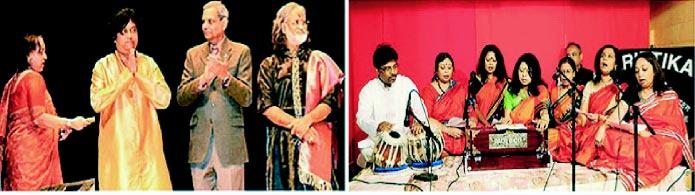
"Anondo-loke Mongala-loke, Birajo, Satya Sundaro"- a Tagore song emphasizing a happy and pious world where the Lord lives assuring peace and harmony, was one of the many touchy renderings that were presented in a grand musical program delivered on May 19, 2013 at the auditorium of the Marlboro Middle School to celebrate New Jersey based Mrittika Inc.'s journey for 25 years promoting South Asian Culture and Heritage. To a jampacked audience, Mrittika hosted a band of local performing artists and also renowned Pandit Viswa Mohan Bhatt and Pandit Subhen Chatterjee.
Presenting Music and Rhythm of South Asia, the program began when a Vedic chant filled the air with "Shrinwantu Vishwe Amritasya Putra." It is a non-denominational chant from Svetasvatara Upanishad proclaiming that man attains immortality with good deeds and
karmas. This was followed immediately by the Tagore song noted above, sung by the students of the Manjari School of Performing Arts under the direction of Pinki Ghoshal. The song was accompanied by a Lighting Ceremony where 25 lamps were lit with dance steps performed by seven profoundly gifted young performers . The dance segment of the show was wonderfully directed and choreographed by Reeta Baidyaroy, the director of the Ritam Dance Academy.
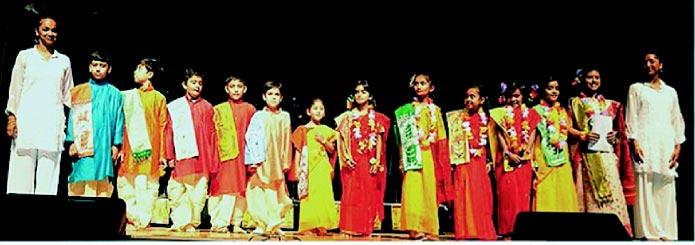
Recapping the changes that we witness in nature through her six seasons, a unique program was next presented by Mrittika's students enrolled at the organization's Bengali language school. Under the training of Suranjan Bhanja Choudhury, students of the school sang Tagore songs that echo six seasons. Brinda Guha and Ariana Dasgupta under the guidance of
Malabika Guha, the founder and artistic director of Kalamandir Dance Company, preceded each song with uniquely choreographed and evocative movements to the narration of the lyric in English translation.
Another wonderful program, Tarana, also directed by Suranjan Bhanja Choudhury, included young singing talentsPunyaha Mukherjee, Rahul Palnitkar, Sankhadeep Chakraborty and Shreya Bhanja Choudhury. They are the accomplished students of local music schools including Raag Rang and Bharatiya Kala Kendra. This program was a special homage tp Pandit Ravi Shankar.
The prelude to the main event was Trinity, a superior program of instrumental music featuring three well-known young stars of the local Indian classical music scene: Abhik Mukherjee on Sitar, Jay Gandhi on Flute and Shivalik Ghoshal on
Tabla. The performers paid tribute to Pandits Bhatt and Chatterjee through their instrumental renderings.
The program climaxed to a breath taking performance by the Grammy award winner musician, Pandit Viswa Mohan Bhatt, playing the enchanting Mohan Veena (modified sliding guitar). It has been a privilege for us, especially our next generation, to see Panditji in person and hear him perform on this unique instrument developed by himself. Pandit Subhen Chatterjee accompanied him on tabla presenting Indian classical and fusion music.
Glimpses of Mrittika's 25year journey were presented in the form of a photographic collage in the main lobby in front of the auditorium. The "silent auction" of a beautiful brass lamp-stand capable of holding 108 lamps was also conducted in the lobby. The lamp-stand is
part of Mrittika's large collection of objets d'art and artifacts from India, collected and curated by Mrittika's overseas coordinator, Sanjiban Guha.
Mrittika has grown over the years as a center for cultural heritage. It educates its students in cultural matters through a variety of means, and periodically stages exhibitions and student productions of dramas and puppet shows in local schools, libraries and museums.
Pandit Viswa Mohan Bhatt, an enormously devoted musician, said that every time he performs he thinks in his mind that he is worshipping Goddesses Saraswati, the symbol of knowledge and wisdom, and he prays that the Goddess be with him so that he can create good music. Similar dedicated thoughts are visible in Dhriti Bagchi's dedication in running Mrittika benefitting many members and children of our community.
(A special series of reports on seven prescribed holy places in India )
By Sushmita Dutta
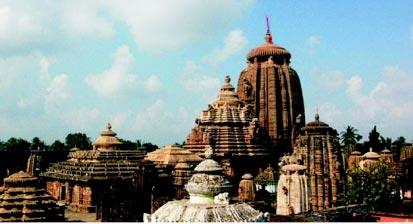
Puri is one of the most ancient, largest and well-architected
The temple courtyard has several blocks of structures, as seen in the picture, which includes a
where daily"bhogs"are cooked for the Lord. It is believed that architectural designs of Hindu
ing room because as I opened the balcony door, the huge monumental temple of Shri Jagannath was right in front of my eyes. Three days of my stay in that room looking at Shri Jagannath temple day and night were probably the best days of my life. Especially in the darkness of night, the temple "Shikhar" lights glow creating an illusion of celestial beauty. I was mesmerized. Several times in the middle of the night I would wake up to meditate upon Lord Jagannath and pray looking at the temple from my room. Of-course, I would wake-up every morning having a glimpse of the temple, what a feeling. With that feeling stored
were developed by craftsmen and artisans working for Lord Vishwakarma. Bhubaneshwar, the name that laterally means BhubanerIshwar (God of this World), is a city in the state of Orissa in the east-central India. Over a short trip to India this summer, I took a two hour flight from Mumbai to Bhubaneshwar and then a rented car from the airport to reach Puri in about an hour and half. As we reached the outskirts of Puri, the "shikar" (head) of Shri Jagannath temple was visible, dominating the skyline of Puri, the holy city that is considered one of the holiest Hindu Char Dhams (four divine cities) namely, Rameshwaram, Badrinath, Puri and Dwarka, and also one of the Sapta Tirthasseven prescribed holy places namely, Ayodhya, Mathura, Haridwar, Varanasi, Kanchipuram, Ujjain and Puri. I rolled down the window of my car to inhale the holiness of the place. The salty breeze of Bay of Bengal blew across my face wiping away the summer heat. The ocean neck lacing the city creates a serene beauty and lets one stretch his mind and vision to endless boundaries. Series of tall coconut trees in the horizon, nodding their heads in the wind probably to signal a warm and overwhelming welcome to the city of tourists from all over the world.
My hotel named "Puri Hotel" was right on the ocean shore. I had requested for a reservation over the internet before leaving Mumbai, but the manager at the reception said, all sea facing rooms were booked two months in advance, so, I could get a room at the back side of the hotel. I did not have a choice, so I booked a room on the fifth floor and felt that I was blessed by God by not having a sea fac-
within, here is a special report for Ananda Sangbad readers with as much detail possible on this ancient holy pilgrim. Enjoy! And, yes, if any one of you want to share your experience visiting Puri, please write to our Editor. Puri is known for Shri Jagannath temple. Derived from the Sanskrit terms "Jagat" and "Nath", Jagannath means the "Lord of this universe". Indeed, the lord, Shri Kridhna of Jagannath temple is singularly beautiful having an iconography which is completely different from all other Hindu temple deities. Built in the 11th century, the idols of this temple, Shri Krishna, his elder brother Shri Balabhadra, and their sister Subhadra in the
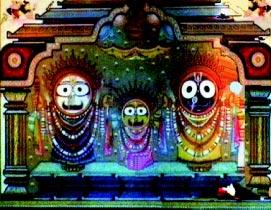
middle, are seen on a huge, raised platform called "Ratnavedi" meaning a jewelled platform. Having large eyes and unfinished bodies, it is believed that the temple idols were created in the Vedic era out of a wooden log which symbolizes growth, procreation and tolerance.
Krishna would re-incarnate and he was instructed by the Lord to build a temple in Puri. The king immediately began the temple construction and asked his court Brahmins to find reincarnated Shri Krishna. A sage named Viswavasu, residing in a village in Orissa, was an ardent devotee of Shri Krishna and worshipped the Lord everyday as "Nilamadhava", hiding in a forest cave in the outskirts of Puri. A brahmin from the king's court, Vidyapati was married to sage Viswavasu's daughter Lalita. Vidyapati narrated the story of Shri Krishna appearing in the form of Nilamadhava to the king. The king then accompanied by Vidyapati visited the cave and found the place empty. Sage Viswavasu pleaded the Lord to appear. Then voice of the Lord was heard saying that he would appear in the temple of Puri that the king was instructed to build and his image together with his brother Balabhadra and sister Subhdra would be made of wood.
Having heard that the king asked Viswakarma to mould the images out of a huge wooden log found floating in the ocean of Puri. Viswakarma agreed to create the images in twentyone un-interrupted days. He said that if he was interrupted by anyone, even the king
humself, he would leave the job incomplete. As time passed, the king and his wife became impatient and knocked on the temple door where Viswakarma was carving-out the idols. Viswakarma immediately left the temple leaving the three idols incomplete as we see them. However, the incomplete idols of Jagannath temple have been worshipped for over nine hundred years for many miraculous boons signifying the fact every material body is incomplete, it is the true love and devotion that matter in God and human relationship.
The day I arrived Puri, I wanted to visit the temple just for a glimpse of the deities because I had planned for a "ritualistic puja" the next day which was incidentally auspicious Chaitra Purnima- "full moon" day. Surrounded by walls, the temple complex has four gates facing four directions. As I entered the courtyard, I found people standing in a line to get special ticket for entry to the very core temple. With Rs.25 ticket I entered the core temple and stood facing the idols. This inner core of the temple has very large oil lamps creating a moderately low light that adds to the mystic ambience and elevates such devotional feelings that cannot be explained. One
Mahishasura Mardini / Ananda Prabhat: 4:30 am ,Sunday, October 06
Maha Soshthi Puja, 5:30pm – 8:30 pm,Thursday, October 10
Maha Saptami Puja, 8 am – 11 am,Friday, October 11 Pushpanjali, 11:45 am Stuti & Sandhya Arati, 6:30 pm – 8:30 pm
Maha Astami, Puja, 8:30 am – 11:30 am Saturday, October 12, Pushpanjali, 11:45 am Stuti & Sandhya Arati, 7:30 pm – 9 pm Maha Sondhi Puja, 3:48 pm – 4:36 pm
Maha Nabami Puja, 9:30 am – 11:30 am Sunday, October 13 Pushpanjali, 11:45 am Stuti & sandhya Arati, 6:30 pm – 8 pm
Bijoya Dashami Puja, 10 am – 11:30 am Monday, October 14 Sindoor Khela & Sandhya Arati, 7 pm
The Legend behind the incomplete idols:
The history of Jagannath temple dates back to old Hindu scriptures like Rig Veda, Skanda Puran, Brahma Puran and Narada Puran. Legend has it that King Indradyumna of Orissa had a dream that Shri
Lakshmi Puja & Satyanarayan Puja, 5:30 pm – 9 pm,Friday, October 18
• Mobile payments market to reach $670 billion by 2015.
• Indians outrun U.S. Smart Phone users in Mobile Browsing.
The other day at a local grocery store, an elderly man was trying hard to push his overloaded cart, and I volunteered to help - "Do you need help, Sir?", I asked. Raising her eyebrows he said, "No, I know I am getting old, but I guess I can handle this." Then winking at me with a naughty smile he said, "As I can handle my smart phone, my grand-son's iPad and uploading of pictures for my girl friends on my Facebook account." I took a closer look at this man's wrinkled face showing his age, probably in his eighties, and yet, he was so much into the digital world that we live in today.
That same week, at a social gathering, a high school senior pulled out his electronic gadget (a tablet) from his pocket to read a self-composed poem. Even today, I write my own compositions in my hard copy diary and I feel great holding a nice flowing pen to write, but for many others in today's society, everything is computing. A colleague of mine, much older than I am, keeps an iPad next to his desktop to scribble down key points from meetings and emails. I see his unused regular pen and writing tablet on his desk gazing at him like a piece of antique. What is
By Sushmita Dutta
the advantage? The iPad notes can be saved as softcopy and merged into sharable documents, while points written down in paper will have to be typed. So, from consumer's point of view, the two key factors that are dominating the digital technology market and will also influence future growth are speed and share of information - how fast one can create, access and save a piece of information, and the relative level of ease with which the information
can be distributed and shared. These two factors have contributed to the phenomenal rise of social network usage like Facebook. View the chart below (Source: InsideFacebook). Facebook dominates the market, worldwide, with easy social networking privileges given to users for "free". We humans love to communicate and say "Hey, see what I have got to share"thoughts, pictures, news, views and, of-course, gossips:

Here, in the US, irrespective of age, socio-economic standards, and education levels, almost every hand has a Smart phone, an iPad and a social network account like Facebook. In India, use of mobile phones is unbelievably high and it beats the US number for Smart phone users in Mobile Internet Browsing. See the chart below: (Source SiliconIndia)
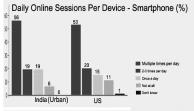
The India scene, both in urban and rural locales, is truly dominated by mobile phone usage. In Mumbai, my sister-in law calls a local vegetable shop owner on her mobile phone to place an order and in about 15 minutes a bag full of vegetables is delivered to our door. You will find a local Pan Shop owner, somewhere in a semi-urban place in India using his mobile phone to send SMS. Last year, I wanted to be a part of the down-to earth, lowermiddle class people in India, so I took an over-crowded local train from Sealdah, Kolkata to Krishna Nagar, in the rural outskirts of West Bengal. It was a hilarious experience for me to hear witty ring tones on the local train's copassengers' mobile phones like "Janina Kothay Tumi hariye
gechho", "Chokhe chokhe kotha bolo, Mukhe kichhu bolona" and many such popular Bengali hit numbers including a Tagore song, probably the best ring tone I have heard so far -
"Amaro porano jaha chay, tumi tai, tumi tai go," indicating that whoever is on the incoming call is a true soul-mate. In contrast, a Marwari friend of mine, a business man in Kolkata, has his ring tone set to a spiritual number"Om Jai Jagadish Hare", as if praying that the incoming call brings in good fortune and money.
Of-course we can download songs that we like onto our mobile phones. Apple store offers a downloadable application which will enable free tuning-in to any radio station over your mobile phone. EBC radio in New Jersey also has a free application that you can download to tune-in to the Indian radio from your mobile phone. Loading smart phones
By Shipra Chaudhury, Toronto
(Author's Note: This is a story of an artistic lady who creates wonderful things from literally junk) ters grown up and working, I don't need to assist them. So I have the time to indulge in my creative instinct."
She loves creating new things, making innovative items from what others may think of as junk. Gray newspapers, empty plastic and perfume bottles, juice containers and cartons, tissue and foil boxes, dead tree branches and leaves, paper plates and glasses…you name it, Swapna Rakshit has a use for it.
"Art to me is as necessary as breathing. It should be simple, significant and something that can be attempted by just about anybody with a little imagination and an abiding love for color," says the talented artist.
A resident of Toronto, Canada, the home-maker who migrated from Dubai, says that the short summer here is her favorite time of the year. The harsh cold winter leaves very little time for outside activity. So she redirects her energy during the winter months inside her bright and cheerful home, creating works of art from things that others would normally throw out.
Not only does she radiate with pleasure at being able to create something new from old, she also feels elated at being able to save the environment and not having to dump another object in the black garbage bag!
Says she, "While living in Dubai I made a lot of things for my daughter's school projects and dancing programs. But those were things I had to make. Here in Toronto, with both my daugh-
with downloadable applications for music, games, businesses, real estates and other utilities is a common trend, and the number is growing. In April 2013, Flurry, a mobile analytics vendor, reported that "It's an App World" as mobile users all over the world love to spend time with applications. However, in US, smart phone users prefer using the internet browser as opposed to applications. (source: Keynote/ Adobe). US smart phone users' topmost activities are:
1.Accessing maps and directions
2.Social networking
3.Accessing local information
4.Reading news.
Another mobile user activity which is predicted to be intensely dominating the mobile market is "m-commerce" - engaging users into monetary transactions and purchasing of goods and merchandise using mobile phones. Technology trends report says that "Transaction value of mobile payments for digital and physical goods, money transfers and NFC (Near Field Communications) transactions will reach $670 billion by 2015, up from $240 billion this year. Digital goods payments will account for nearly 40%
of the market in 2015". East Asia, Western Europe and North America will be the top 3 regions representing 75% of the world market for mobile commerce. (Source: Juniper Research). It is most likely that we will see emergence of more online payment service companies like PayPal and Square to benefit from this growing market of mobile commerce.
2015 is not too far. By then, probably, we will be using the digital world for almost everything we do. Are we becoming a completely digital society? Probably not. We will live in a collaborative space of physical and digital worlds. As humans of this age called "Information Era", we will get accustomed to all the goodies that the digital world offers and yet, we will continue to be humans desiring the touch of warmth from our loved ones - a caring hug, a mere handshake and a face to face smile, all those human emotions that cannot be transmitted digitally via Facebook or any element of the digital world. And, my thumbs up to that world of human caring, touch and feel, and love. Live on.
"I don't like throwing out things at all. I have always felt that I can make something new with anything, find a new use for something that has outgrown its use."
Even the branches of a dead tree don't go into yard bins because she finds ways of beautifying her huge garden and decorating her house with them.
"You must come to my house to see what I do with them," Ms. Rakshit says, with a shy smile. I accept her invitation, and find that she paints those tree branches with funky colors and groups them to create beautiful arrangements.
"I love to paint," Rakshit says with passion. "What I enjoy most is trying to capture the mood, movement and definitely, the happiness of special moments. I feel if you really enjoy painting, you become one with your subject."
There is no preliminary sketching, drawing or planning, when she sits down to paint. "It is just yielding to a force from within to express myself with free use of flowing colors, and playing with shapes that emerge during that process," she says.
Since she came to know that the oil generally used for oil-painting is not environment friendly, she has switched to acrylic. But water color is her choice of medium, because it dries pretty quickly - she confesses she is too impatient to sit, waiting for the paint to dry!
Her paintings lovingly recreate landscapes of both the scorching summers of Dubai and the bone-chilling Canadian winters. She also loves to paint Indian women in vibrant flowing dresses, maharajas riding on elephant backs, and many more. Of late, the partly concealing expressions of shy brides appeal to her. She has even donated her portraits to various charity centers. You can see paintings all over her house, including a mural on her garage door.
"The paint on my garage door was peeling," she explains. "It needed a new coat of paint. Well, I always wanted to do something uncommon. I asked a person at the art store, learned why the paint was chipped and peeling, what was best for the job, and accordingly changed my strokes and medium."
Having spent many years in the Middle East, she looks back nostalgically at dreamy sunsets over the sands, the azure sky throughout the year, and mirages
Reported by Subrata Bhaumik
Sahitya O Alochana is a monthly literary and topical discussion forum under the aegis of Ananda Mandir that endeavors to achieve its motto "Alochana Brings Good Things to Mind." It held several exciting sessions in the March - May 2013 period. Discussion topics included "Gender Empowerment and Women's Rights as Human Rights", "Diabetes: the Disease and its Impacts on Our Lives and The Society", and "Cases for and Against Gun Control in America."
It is interesting to note that the scope and the reach of the discussions at the forum are ever widening and deepening. Over the last several years, these sessions covered some very exciting and illuminating discussions on a wide variety of topics including literature, theater and movie, history, philosophy and religion, science and mathematics, and finally, economics and social issues. And the sessions in the March - May period further expanded the forum's horizon by addressing some of the burning public policy and social issues of our time.
In the March session on Women's rights, Rekha Datta of Monmouth University led a discussion about a perennial malady of the Indian society. The session addressed the recent rise of violence against women in India, gender empowerment as a global issue, and the universal acceptance of women's rights as
Continued from page 10
in the distance on a long stretch of road. She captures those memories in paintings with an Arab theme.
Does it mean she still misses that city? "Not really, not any more, for there are a lot of good things here to look forward to. One of them is the availability of various art courses and the access to various artistic facilities in order to pursue any hobby."
When she is not painting, Ms.
Continued from page 9
human rights. Rekha shared some her research on the issue and observations from her affiliations with organizations and virtual groups that are active promoters of the cause. She also spoke about her experience from the recent United Nations (UN) panel debate on sexual violence in the third world that she participated in. It was a robustly attended and interactive session that ended at a high note infused by the playing of a very famous song "One Woman", composed and performed by musicians from all over the world under the auspices of the UN.
The April session featured a presentation by Poushali Mukherjee of Bristol-Myers Squib on a very common and a silently killer illness that many of us have to learn to live with: Diabetes. In addition to the physiological aspects of the illness, Poushali discussed the impacts genetics, economic growth, and social development bear on the disease by examining the case of modern India. Note that India is the 2nd diabetes capital of the world (next to China) with 62 million patients. Consequently, the discussion had a clear Indian inflexion although it reviewed the history of the disease both in Indian and universal contexts. Also presented was a focused examination of the public policy aspects of the disease and some research results in the context of lifestyle changes embraced by the Indian population
Rakshit enjoys gardening. Not only does she have an exquisite rose garden, but also a lush vegetable garden. "Summer is so short, I maximize it. I keep myself very busy, working from sunrise to sunset, attending to each and every need of my garden. Gardening is another outlet for my creativity."
She has many plans up her sleeve, many creative projects that she would like to give shape
as a result of the rapid economic growth in recent times. It was a very informative event for the alochana community.
In the May session, Subhodev Das of SRI International, the famous scientific research organization, led a discussion on Gun Control. Attendees of the session participated in this passionate debate that shapes some of the basic tenets of our society including individual freedom vs. collective welfare. It also examined whether gun control or the lack of it are absolute and mutually exclusive concepts, or there is a compromise that the society can accept. It was a very informative session that clarified many myths about the issue; presented some very interesting and striking facts; and explored the various implications of the public policy debate around the issue.
Future sessions - Quite a few interesting sessions are in the pipeline for the next few months including a memorial session for the internationally acclaimed Indian movie director Rituparno Ghosh, a movie screening and discussion of a new film by a New York based young director of Indian descent, works of Stephen King, Ramanujan, the math genius, etc.
The friends of Sahitya O Alochana would like to thank Ananda Mandir for its continued support for the forum's contribution to the cultural enrichment of the local Bengali and Indian community.
to. On top of the list is a play area for kids in her garden with mini swings, castles and cartoon mannequins. "A lot of kids come to play in our community, and they would love to see this," she tweeted.
"Next on her agenda? "A series of paintings that represents Canada. Perhaps a painting of Santa Claus with his reindeers flying across the starlit sky on my garage door, just in time for next Christmas!".
has to visit the temple to experience the feeling.
So, do plan a visit to Puri Jagannath temple. There are trains and special bus services from Kolkata to Puri. Flights from all major cities in India fly to Bhubaneshwar where ample road transportations are available for destination Puri. The most celebrated time to visit Puri is during "Ratha Yatra." Among many festivals that the temple celebrates, Ratha Yatra is the biggest festival where Lord Jagannath's cart, fifty feet tall and thirty-six feet wide, rolls on sixteen giant wheels along with carts of Balabhadra and Subhadra. Millions of devotees attending this festival, repeatedly chanting "Jai Jagannath", "Jai Subhadra", and "Jai Balabhadra" create an ambiance of un-matched love and devotion for "Jagater Nath", Jagannath - the Lord of this universe.
In the next issue of Ananda Sangbad, we will cover Ayodhya, another prescribed place on the list of "Sapta Tirtha". Stay tuned and stay blessed.
By Mandira Chattopadhyay
Consider a world where beauty floats and where time stops its tiring feet. This is the magical Siwa oasis in Egypt. Here the beautiful girls hide their faces with a netted veil. As they sit on the donkey go-carts, they take a mischievous look at you behind the curtain, but they will not let your eyes pierce them. The journey - by camel, across sand, with no water, with the sun - will be unbearably hot, day after day after day.
My experience of Siwa from a decade ago still remains very much in my mind. At that time, I was pursuing graduate study in Teaching English as a Second Language at the American University in Cairo. As soon as the message flickered into the computer that the Arab Language Institute of the University was arranging a trip to the oasis, I immediately made a plan to join the caravan of tourists.
Before we left for Siwa, the guide gave us an overview. He showed us on a map of Eygpt that how isolated it was. Looking at the tracings on the map, we realized that we would be heading to a rugged location where history made a major impact. He told us that Siwa still remained self-contained and remote. Originally in the olden days, its fame rested on the success of its famous oracle, the temple of Amun. Such was the oracle's reputation that Athenian ships would carry pilgrims between Greece and the port of Mersa Matruh, the beginning of the desert trek to Siwa. By the time Alexander visited the oracle, the temple boasted over eighty priests and its predictions had caused it to become famous throughout the ancient world.
Our guide continued that modern civilization had made its impact on the present but if one leaves Cairo and takes a tiring six hour bus ride to Siwa Oasis, it becomes obvious that time has really stopped. Though the administration in Cairo had complete control of this beautiful resort, the natives have their own little empire with the local government that had been around for a long time. The electricity had already arrived in Siwa, and with it came television. The mobile phones were sprouting gradually in Siwa, but the local government ruled out that the airplanes could not set their wheels down in Siwa and make the oasis lose its charm.
Our guide described Mersa Matruh as a modern town, but noted that the terrain will change dramatically around Siwa. Under the British occupation of Egypt, Siwa attracted a large number of tourists. Today travel is much less strenuous and the modern visitor is treated with utmost cour-
tesy. It is however important to remember that Siwan society is extremely conservative. Women have always led a secluded life in Siwa, and although the visitor will encounter the occasional covered figure scurrying down the street or riding in a donkey cart, sensibilities must be respected. In the center of the market place in Shali the inhabitants have erected a sign. It reads: "Welcome to Siwa. We ask the women to respect our customs and traditions by keeping their legs and upper arms covered."
Siwans are very proud of the fortress they built in Shali. Built on a hillside inside protective walls, this fortress is really a landmark of Siwa. It withstood numerous assaults by marauding Bedouins. Today, the fortress is structurally unsound for no one bothers to make repairs to the mostly uninhabited building, yet it remains a majestic sight; and it is still possible to roam around the exterior walls, enter the gate, and explore the narrow passageways. Filling most of the space in the square below the fortress is the market. Though busy all week, Friday is traditionally the market day when vendors and customers, loaded with produce, flood into Shali from the surrounding areas.
As we readied ourselves for the journey, the women covered themselves accordingly. We also knew we would need protection from the sun. Everyone was instructed to take enough water to keep us cool and well hydrated. We left Cairo and made our way to Mersa Matruh, where we spent the night. I expected a rugged town, but found instead modern high-rise buildings sprouting by the magical Mediterranean Sea. The following morning we visited some art galleries there, and we noticed their culture and way of life.
What attracted me most were the baskets made for the bride. The baskets are manufactured largely by women, and once married each new bride takes a collection of them with her to her new home. Of the domestic baskets, the most prized one is perhaps the agnin en tankult. Lidded and handled, this is the basket in which the Siwans store their jewelry. It is the only item that a bride takes to the groom's house on the first night of her wedding. Wearing the traditional dress of the first night together with all her jewelry the bride enters the home of her new spouse carrying the empty basket which is slowly refilled with the jewelry as the groom removes it piece by piece. My eyes caught the eyes of the Siwan dresses that are used on
By Himansu Mukerjee
The intellectual roots of secularism came from the early Greek and Roman philosophers. In the eighteenth century, Mr. George Holyoake, the British writer who coined the term secularism, stated that secularism is the principle of separation between government institutions and persons mandated to represent the state from religious institutions and religious dignitaries. This did not mean that we had to reject the religious faith and its practice in a secular state. What he actually meant was that political discourse and structure should be separate from religious discourse and structure.
In modern times, the origin of secularism may be traced to the necessity of harmonizing the immigrants of diverse cultures and traditions with the original peoples of the host country.
From time immemorial, migration of people from one part of the world to another has been taking place. Sometimes the people migrate to seek fortune and better life. Millenniums ago, the Aryan tribes from central Asia migrated to India and settled in the Indo-Gangetic valley. They developed one of the earliest civilizations of the world. Later lured by the wealth and riches of India, other central Asian tribes namely Scythians and Huns forced their way into India and settled there. The migrating hordes gradually assimilated the culture and traditions of the host country, and social and ethnic differences disappeared.
Sometimes people leave their homeland for safer asylum just to avoid torture, threat and humiliation that they are subjected to in their coutries of origin. A historic example was the mass migration of Jews from Israel. When the Jews were driven out of their homeland by the Egyptian rulers as a part of ethnic cleansing, they migrated to different parts of Europe, Asia, and Africa.
When Moslems became very powerful, they set out to conquer the Middle East and the surrounding territories. Conversion to Islam swept the conquered territories. Those who refused to accept Islam were either perished or had to leave their homeland.
The religious fanaticism was so strong in Islamic followers that they wanted to uproot the Christians from Jerusalem, the birthplace of Christ. Soon the crusades started and finally Jerusalem was saved from Moslem occupation.
In the sixteenth century, Catholics from England migrated to the New World to avoid religious discrimination and humiliation. Even today the religious intolerance of Islam is very strong. In Egypt, the Coptic Christians have been living for thousands of years but they have been consistently
denied their basic rights including repair of their churches. The basic human rights were trampled because of religious discrimination.
In sixty years of theocracy, the majorities in Pakistan and Bangladesh are slowly and surely on their way to thoroughly cleanse out the minorities. Most recently the Kashmiri Brahmins were uprooted from their 5000 years old habitat by the Islamic fanatics in the name of ethnic cleansing. All these misfortunes and sufferings that befell the minorities are due to the absence of secularism in the ruling class.
The two World Wars brought enormous changes in social and political structures of many countries. The Second World Wars especially established contacts with many hitherto unknown nations. The globalization process began and people began to migrate from one country to the other. After the Second World War there was an acute shortage of labor in Europe and European governments welcomed the migrants from many countries. To safeguard equality, justice, and freedom, and to deter any humiliation and discrimination, many European governments embraced secularism. Australia and America followed suit.
Indian constitution guaranteed secularism. But sometimes religious tension between two major communities (Hindus and Moslems) creates obstacles to secularism. To appease the minority community, the politicians deviate from the path of secularism. But this politics of pseudo secularism may fragment India into vote enclaves of other minorities. The government is very much concerned with these problems and taking measures to correct them. Indian constitution guarantees complete freedom to every citizen to practice his or her religion, but not to mix religion with politics. Religion should be harnessed to improve the moral fabric of the people. Incidentally it may be mentioned that Gandhiji, the father of the nation, was a man of faith, and he promoted that all religions should be treated equally by the State.
Middle Eastern countries and the Moslem world elsewhere are marked by the absence of secularism. The religious feuds between Shias and Sunnies, Moslems and non-Moslems disturb the peace and progress of these countries.
Mustafa Kamal Ataturk, creator of modern Turkey realized that religious discrimination hindered the progress of the country. It is a social evil. He declared Turkey to be a secular republic. After the recent uprisings in Tunisia, Egypt, Libya, Yemen and Bahrain, it remains to be seen if the new governments renounce theocracy and move towards
secularism. Non-Moslems in these countries expect equality like the Moslems enjoy in Europe, USA, Australia and India.
Secularism creates unity among different people. It is the source of strength in the modern world. As a result of migration, host country loses its homogeneity to some extent but it is benefited to a greater extent for future development. Imported talents bring new ideas for new development; and transmission of new ideas and new culture of the immigrants infuse new life into the people. World would have been different today without the migration of people from different lands.
In conclusion, secularism is indispensable in today's world for peace, progress, growth and stability. We are all destined to live in a world free of discrimination, poverty and hunger.
Reported By Debajyoti Chatterji
Ponusamhita O Anyanyo Akatha(Author: Sumit Roy):
Published in 2012, this book was released at the Kolkata Boi Mela of that year. It is a collection of eighteen articles on a wide variety of topics, ranging from the author’s memories of the life and works of Bikash Roy, his famous actor father, to his foreign travel experiences and observations to his critical analysis of the controversy surrounding Viswabharati’s decision to embrace teaching in English medium. For copies, please contact the author (sumitroy@optonline.net).
Ajo Kahini O Onyanyo (Author: Sudipta Bhawmik):
This is the second book by the New Jersey-based playwright, Published in 2012, it presents five short plays, all dealing with immigrant Bengalis in situations that are imbued with equal doses of humor and pathos. For copies, please contact the author (bhawmik@gmail.com).
Upanishad, Volume 1 (Author: Kumud R. Roy):
Published this year, this book focuses on the five most popular of the 108 Upanishads: Isha, Kena, Katha, Prasna and Mandukya. Bengali and English translations are given for each verse, and a summary is included for each Upanishad. The complete list of the 108 Upanishads is included at the end of the book. For copies, please contact the author (kumudroy@hotmail.com).
Continued from page 11
the wedding ceremonies. These dresses are made of green material with red and white stripes, and embroidered with red, orange and black designs.
The guide loaded us on to the bus because we were headed to the legendary springs. Though the place had many springs around, the tourist guide told us that the best known spring in the oasis is the Spring of the Sun, or the Cleopatra's Bath. Local legend insists that Cleopatra swam here when she visited the oasis, as did the others of the ancient world, including Alexander the Great, and of course Herodotus himself. On our way to Cleopatra's Bath, the tour guide mentioned about another spring named Ain Tamousi, that had no mention in the history of the ancient world, but it is famous because of the interesting customs that go around it. It is to Ain Tamousi that a young bride would come on the evening before her wedding, accompanied by her friends. Removing the adrim, the virgin's silver disc, from her neck, the bride passes it to a younger sister before immersing herself in the waters of the pool.
As we came closer to the spring, guide told us that we were heading towards the Cleopatra's Bath. My heart began throbbing fast. As we got off the bus, the long walk took us near the site, but the muddy roads slowed us down. We had to take very careful steps to reach our destination. At a distance, I saw the emerald
and turquoise sea welcoming us; what a beautiful sight. Time has really stopped here. The dark black slabs, the coral reefs all around the Cleopatra's Bath really makes you stop and reflect the past. The Greek epic of Odysseus immediately flashed into my mind. I started putting all around the Cleopatra's Bath, and became completely awestruck by its beauty. With the help of the guide, I somehow managed to step into the cave of the Cleopatra's Bath. The guide started narrating the romantic love story of Antony and Cleopatra. The legend goes that Queen Cleopatra used to take off all her trinkets and take plunge into the bubbly bath. The sounds of bubbles are still there.
I imagined Cleopatra's maids rubbing her with velvety towels, putting almond and olive oil all over her body, and dressing her up for her evening rendezvous with Antony. She would then embark on her boat and sail through the cave tunnels into the sea, with Antony holding her hand gently and starting their journey into the moonlit night. I reflected on my childhood stories of the princes and princesses sailing their way to the dreamland. The silence prevailed all over the land. I could hear the splish-splash of the oars and the whispering of the moon. Before we left the Cleopatra's Bath I prayed that
the modern technology does not put its hands on this beautiful land.
Our guide then took us around the ruins where the mummies were excavated. We learned the art of preserving the mummies. The guide also took us to Shali, where we watched the fortress from a distance and listened to its history. We also did not miss the historical site where the guide described the history of the famous oracle we had heard of and how it correctly foretold the future, and answered all questions.
Our sightseeing had tired us and finally the guide took us to the rustic Siwa Restaurant to have our supper. The guide mentioned that most Siwans are Berber although a few are of black African origin, brought to the oasis during the trafficking days when Siwa was one of the major markets. We could not take off our eyes from the beautiful oasis guarded by the date and palm trees. The guide mentioned how the Siwans utilized every part of date and palm trees for furniture. We sat on the matted furniture at the restaurant to have our candle light dinner and listened to the music played by the Nubian musicians strumming their instruments. We drank the wine the Siwans made from the fermented sap of the date tree. These Nubians wore long white robes to protect them from the scorching sun. As I sat there, almost drowsing, I felt like the Siwans were telling us, "What's your hurry. There's time. Sit here. Wait."
Continued from page 6
have traditionally held their nose at the mention of Chhawt Pujo. Thus, the announcement of a holiday on Chhawt Puja drew an expected reaction from my friends and relatives alike - 'Can you imagine a holiday on Chhawt Pujo! Kaley kaley aar koto dekhbo!' etc. But, these people did not object to a recent enactment of an eight-day holiday for government employees during Durga Puja. Kali or Shyama Puja is not enshrined in Vedic roots. But for the Bengalis a holiday on Kali Puja constitutes a 'right'. Bhatree-dwitiyaa came shortly after Kali puja. On that day it took me less than half an hour to reach College Street from Lansdowne Road in a car, which normally takes more than an hour. I had some purchases to do, but to my utter dismay all the book-stalls were closed for the day. I was told that the day of Bhatree-dwitiyaa had also been included in the list of government holidays. 'How can we not celebrate the holy institution of brotherhood only for a day in the entire year by having a holiday!'this sentiment rang time and again among my friends and acquaintances. But Chhawt Pujo! - it is for Chhoto-loks or it is reserved for lower class people only!
In my childhood days, the sound of dhaak and a vocal chorus of a certain serpentine nature used to fill cool autumn mornings, heralding the beginning of 'Hindustani-der parab' or Chhawt Pujo after a
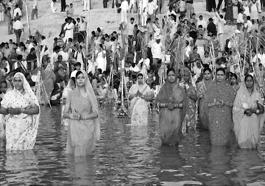
short break from pomp and noise, decoration with lights and mad-cap traffic jams of Durga and Kali Pujas. There were no deities to be worshipped in Chhawt Pujo. Therefore, there was no need for the construction of pandals and blocking traffic for days. There was no decoration with lights, except in every early morning for almost a week or two a chorus of female singers punctuated the crisp morning air with soulful songs. The lyric of the singing was undecipherable to me, but little that I knew at that time that they were worshipping the sun. Yet another imagery comes to my mind - a procession of barefeet women with veils drawn on their faces, and men wearing white genjees (T shirts) beating drums and cymbals and dragging a thyaalagarree (push-cart) laden with huge stalks filled with yellow bananas and other fruits. These were pre-TV days, and I read in the newspaper that they were heading towards the river Ganges. I had also seen pictures of men and women half-sunk in the water and worshipping the sun with their hands closed in a pronam.
That was the Chhawt Pujo of my childhood. In these days Chhawt Pujo has been elevated to other accredited and mainstream pujas. Thus, last year I found numerous pandals in Kolkata, and particularly in Howrah celebrating Chhawt Pujo. I was curious to find what they were worshipping inside those enclosures. There were no deities, except people were simply milling around. It was heartening to find 'Jawl-satro' or 'drinking water-for-all' in many places. All these activities were taking place in the backdrop of Bollywood music blaring from loudspeakers almost at deafening decibels. I had an impulse to try to stop the noise much like that billy-goat in Sukumar Roy's limerick where it rammed Bheeshmolochon Sharma in the back with its horns to put an end to Bheeshmolochon's deafening vocal calisthenics. But, soon I was ashamed of my own hypocrisy of not remembering the same corrective measure during mainstream Durga and KaliPujas!
I am in the dual trade of teaching and doing science. In the latter pursuit I have to espouse the health and therapeutic benefits of a natural stuff called vitamin D that is produced in our body catalyzed by sun-light. In my childhood days my grandmother used to place us, the little children, in the sun to soak up the free benefit from Helios, the Greek sun-god. By all accounts our ancestors in all corners of the globe were aware of this benefit, and worshipped the sun. I wonder whether our beloved Chief Minister made a concoction of scientific knowledge and politics to declare a holiday on the day of Chhawt Pujo!
*Editorial, The Anadabazar Patrika, November 15, 2012
Editor's Note: Dr. Sandesh Jain is board certified in Internal Medicine, Nephrology and Clinical Hypertesion. He finished his medicalresidencyatRobertWood Johnson University Hospital in 2003 and Nephrology fellowship at the same hospital in 2005. He has been in private practice for the past 8 years. He has an office in Somerset, NJ, and a second one in Somerville, NJ, providing medical care for patients at Robert Wood Johnson University hospital, St. Peters University Hospital and Somerset hospital.
The kidneys are bean-shaped organs, each approximately the size of a fist. They are located near the middle of the back, just below the rib cage, one on each side of the spine. They are sophisticated filters. Every day, a person's kidneys process about 200 liters (or 52 gallons) of blood to sift out about 2 liters of waste products and excess water in the form of urine. Waste matter in the blood comes from the normal breakdown of active tissues such as muscle, and from food. If the kidneys do not remove this waste matter, it would build up in the blood and damage the body. In addition to removing waste and excess water, the kidneys also release three important hormones: Erythropoietin which stimulates the bone marrow to make red blood cells; Renin, which regulates blood pressure; and Calcitriol (the active form of Vitamin D), which helps maintain calcium balance for the body.
The Measurement of Kidney Function
Kidney function is a term used by doctors to describe the kidneys' ability to filter blood. The glomerular filtration rate (GFR), which is reported as "eGFR" (or estimated GFR) on a blood report (sheet), is obtained from a simple blood test (and) which reliably assesses kidney function. GFR is the volume of blood per unit time that is cleared of excess waste and water by the kidneys and is reported in mL/min or milliliters per minute.
Chronic Kidney Disease and Kidney Failure
Chronic kidney disease (CKD) is defined by either eGFR < 60 mL)/min and/or the presence of protein in the urine. Many patients have CKD without major symptoms or health problems, but their kidney function must be measured regularly and certain medications must be avoided or reduced. Unfortunately, CKD can sometimes progress to end-stage renal disease (ESRD), which occurs when kidney function falls below 10-15% (eGFR 10-15 mL/
By Sandesh Jain, MD
min). At this point, waste products and water cannot be effectively removed from the body and patients need dialysis. The symptoms of severe kidney failure can include, among other things, loss of appetite, extreme lack of energy and confusion. Sometimes, a person may develop leg swelling because the kidneys can no longer effectively remove salt and water from the body.
The two most common causes of ESRD in the United States are diabetes and hypertension (high blood pressure). These account for 70% of all cases. Other less common causes are polycystic kidney disease (a genetically inherited disease in which there is uncontrollable growth of multiple cysts in both kidneys resulting in kidney failure; this usually happens when such people are in their 60s), and glomerulonephritis (a group of diseases in which the body's own immune system attacks the kidneys). Kidney failure can also develop as a result of allergic reaction to medications, or as a result of infection.
Kidney failure may or may not be reversible depending on its cause. When kidney failure is due to chronic medical conditions such as diabetes and hypertension, there is usually a steady decline in kidney function over the years, ultimately leading to ESRD and dialysis. This form of kidney failure is not reversible, but the progression to ESRD can be delayed by many months, and even years, with proper treatment strategies aimed at optimizing control of the diabetes and hypertension. Less frequently, the kidneys fail due to a reaction to medication (e.g. an antibiotic), an infection or an immune-mediated disease. In these circumstances, the kidney failure may be completely reversible with proper treatment.
The risk of kidney failure can be reduced by following a healthy lifestyle with dietary modification and exercise. This includes a low salt, low cholesterol and low fat diet, along with regular cardiovascular exercise (at least 30 minutes, 5 times per week). These lifestyle changes help to prevent high blood pressure, elevated blood glucose and high cholesterol, all of which cause damage to blood vessels, resulting not only in kidney failure but also heart disease and stroke. Treatment of ESRD Regardless of the cause, once a patient has reached ESRD there are only two options, dialysis or kidney transplantation. On rare occasions, dialysis can be avoided
completely if there is a living kidney donor available to the patient. More commonly a patient will begin dialysis while being placed on the list for a cadaveric kidney (harvested from someone who died of non kidney-related illness) transplant. The average waiting time for a kidney in New Jersey is about 3-4 years.
In the absence of a transplant, dialysis must be performed. Dialysis is a blood cleansing procedure that is able to perform the function of a person's failed kidneys. There are two different dialysis modalities: hemodialysis and peritoneal dialysis. Although performed in very different ways, studies have shown that both are equally effective and have equal patient survival outcomes. The choice between the two modalities is based mostly on patient preference, and other factors including patient age, body habitus (size and shape), and family support system.
In hemodialysis, blood is removed from a person via a catheter and pumped through a machine containing a filter that is able to remove waste products and excess water from the patient's blood stream. The "cleansed" blood is then returned to the patient's body via a second catheter. Hemodialysis can either be done at home or a dialysis facility. The majority of patients prefer having dialysis done at an outside facility, where the patient is required to go three days a week. A dialysis facility can usually be found near the person's home. There are currently more than 5000 free-standing dialysis centers in the USA. Each dialysis treatment is typically between 3.5 to 4 hours. While at the facility, the patients are placed in recliner chairs and all duties are performed by the dialysis nurse. In "home hemodialysis," the patients are given portable dialysis machines to keep in their home. There is no nurse involved, so all the duties are performed by the patient or family members. Dialysis treatments are shorter but as a result need to be performed more frequently. Typically, patients are required to do dialysis daily for 2 hours, six days a week. Although more labor intensive, home hemodialysis allows for more flexibility with daily activities of living than does incenter hemodialysis.
In peritoneal dialysis, there is no artificial filter used. A small flexible catheter (PD catheter) is inserted into the patient's abdominal cavity. The other end of the catheter is attached to a bag
In the temple-town of Tarakeshwar, flanked on one side by rice fields and a winding country lane on the other, is a twostoried school for underprivileged children, children whose parents are too busy trying to make ends meet to worry about the education of their offspring. Supporting this school financially is one of the aims of Love & Care Mission of America. Its others are helping to deal with environmental and medical problems, including cancer. In fact it has sponsored several cancer detection camps in rural West Bengal.
On May 4 of this year, Love & Care held a fundraiser in the form
By Jayashree Chatterjee
of a variety entertainment program at Bharat Sevasram Sangha. It proved to be an evening that the audience talked about for weeks. The program started with Love & Care members speaking about the work that the organization is doing in India. Dilip Bhattacharya described what he saw during a recent visit to the school, Bhasha Mukhopadhyay, who has been a member since she was schoolgirl, gave a PowerPoint presentation of the different activities of the organization, and I had the task of giving the welcome address, and also the pleasure of thanking the organization's supporters
Continued from page 13 of clean fluid. A small machine (kept on top of a side table) automatically infuses the fluid into the person's abdominal cavity. Here the peritoneal membrane (the membrane lining the organs in the abdomen) acts as a filter. The toxins and excess fluid in the person's blood stream diffuses across this membrane into the abdominal fluid, which is then drained out through the same dialysis catheter. The infusion and removal of the abdominal fluid is carried out in intervals automatically by the machine. This is performed every night (typically 8-9 hours treatment time) while the person is sleeping. People are able to start and restart therapy if they need to use the restroom during the night. Peritoneal dialysis offers the most flexibility and least change in quality of life. It is the preferred modality for most young patients who are still working and have an active lifestyle. Compared to hemodialysis, peritoneal dialysis requires more patient education and training.
All patients, regardless of age, on dialysis qualify for Medicare coverage if they meet the eligibility criteria (i.e. if they have worked the required amount of time under social security or if the patient is the spouse of a person who meets the criteria). Medicare covers 80% of the cost. The remainder is covered by a secondary health insurance that the person must obtain individually. Pa-
tients may also qualify for secondary health insurance through the NKF (National Kidney Fund) if they cannot afford it because of financial hardship. Medicaid may be available for those not eligible for Medicare. To receive Medicaid health insurance, the value of a person's assets and annual income must be below a certain level. Medicaid may also pay the 20 percent that Medicare doesn't cover.
Kidney failure has become a worldwide public health problem.
In the U.S, the prevalence of ESRD is rising, increasing the burden of health care costs. In 2010 there were 415,000 patients on dialysis and another 178,000 patients with kidney transplants. The cost of caring for patients with ESRD in 2010 was 25 billion dollars. This was 7.5% of total medicare spending (343 billion).
The annual cost for a patient on hemodialysis is $85,000 ($65,000 for PD patient), while the annual cost of a patient with kidney transplant is $30,000.
The thought of having to start dialysis treatments can be understandably overwhelming to most people. It is indeed a life changing experience. However, dialysis can have a very positive impact in improving how patients feel and on their quality of life, and I have seen this first hand in many of my patients.
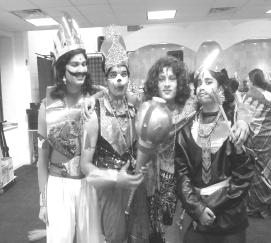
for their faith in our work.
The entertainment started with a performance of Bharat Natyam items by the students of Rita Baidyaray's Ritam Dance Academy, and the dancers exhibited all the grace and skill that their guru has instilled in them. This was followed by Lakshmaner Shakti Shel, Sukumar Roy's amusing and light-hearted retelling of goings-on in Rama's camp, when
saves Lakshman's life by bringing him life-saving herbs. The young performers who brought the story to life were trained by Baruna Haldar and Bidia Sarkar, and one feels sure that later on in their lives, these young actors will look back on the rehearsals and the performance with a certain fondness. This drama was organized by Lili Dutta, a long-time Love & Care
This is a chicken recipe which I love to cook for my friends, and they seem to love it! Give it a try and I am sure you will like it too. It is called Balti Chicken in Tamarind Sauce. I found a similar recipe in a Pakistani cookbook and adapted it in my own way. Balti cooking is very famous in the U.K. The precise origin of the Balti cooking style cooking is uncertain. Some believe it originated in the Northern Pakistani region of Baltistan. Balti cooking is adapted from a Pakistani style of cooking that involves the fast cooking of marinated meat and spices over a light flame. For this recipe you will need:
1 lb boneless chicken breast cut into one inch pieces
1 tbsp tamarind paste
4 tbsp tomato ketchup
4 tbsp water
1 1/2 tsp chilli powder
2 tsp ginger paste
1 1/2 tsp garlic paste
1 tbsp sugar
2 tbsp desiccated (shredded) coconut
2 tbsp sesame seeds
1 tsp poppy seeds
1 tsp cumin powder
1 tsp coriander powder
3 sprigs of curry leaves
1/2 tsp kalonji (onion seeds)
3 dry red chilies
1/2 tsp fenugreek seeds (methi)
1/2 cup cherry or grape tomatoes
1 cup chopped coriander leaves
2 green chilies chopped
Salt to taste
Oil to cook
In a bowl mix together the tamarind, ketchup and the water.
Add everything from chili powder to the coriander powder.
Add the chicken pieces and stir to coat. Set aside for half an hour.
Heat the oil in a deep bottomed
supporter. Tapasi Seal's melodious rendition of songs from bygone days came next. The final performance was by Dr. Ritwik Roychaudhuri, who lives, and practices medicine, in the North of England. His outstanding presentation of Bengali and Hindi songs enchanted the audience. But what won people's hearts was the fact that he came all the way to New Jersey to perform for Love
& Care solely because he believes in the work that it does - Love & Care could not pay him a fee or even reimburse him for his air fare.
It is truly heartening to know that people like Dr. Roychaudhuri and all our supporters in New Jersey are there for us. They make our work for the disadvantaged in India possible.
By Bhaswati Bhadra
frying pan or a karahi.
Add the curry leaves (be careful, they'll splatter) kalonji, dry red chilies and fenugreek seeds and stir for a minute.
Now add the chicken along with the marinade.
Stir well and simmer until the chicken is thoroughly cooked, about 15 minutes.
Finally add the tomatoes, fresh coriander and the green chilies. Serve with rice or a bread of your choice. Enjoy!

Reported By Debahuti Roy
One more year is over for Kallol's calendar year . Kallol is a year older, standing tall at 38 years. It makes us all so proud that Kallol has moved forward in every which way, and today it is considered as one of the premier Bengali organizations of USA.
On March 31, 2013, Kallol had its Annual General Meeting. A series of presentations were made about the activities of last year, mixed with interactive sessions. As a part of the tradition, early questions and comments were floated in from the first benchers, but there was no heated arguments or discussions this time, that sometimes are witnessed in this event. At the conclusion of the AGM we moved ahead with the planning for next year.
Our summer program was planned for June 1. Kaushiki Chakraborty was invited as the star performer of the show. Tickets were on sale, and the planning was on in full swing. However, a googly emerged in the form of "Kaushiki's visa problem" which made us cancel the program. It was indeed heart breaking but we have to take things in our stride as we move on.
Our next event is town hall meeting on June 15 and the picnic on August 3. Please join us for the picnic and help us make it a great event.
Let's keep Kallol going!
NJPA's Saraswati puja was the place to be on Saturday, March 9th. The event originally planned much earlier was rescheduled due to inclement weather. Devotees assembled to seek the blessings of Goddess Saraswati, the divine personification of knowledge, arts, science and crafts. She represents power, creativity and inspiration and presents herself as our loving mother. The festivities concluded with fanfare, food, cultural events and the like.
NJPA's new fiscal year is in full swing and several events have already been planned during the year. Coming in 2013 are a number of exciting events that will offer you the opportunity to meet our members and actively participate and embrace in a social and entertaining experience. Some of our upcoming events are our annual picnic to be held on August 10th at Colonial Park in Somerset; Leheren, a unique musical competition showcasing our local talents; Kali Puja and more.
NJPA mourns the loss of one of our founders, Dr. Jyotirmoy Dutta Chowdhury, who passed away in December 2012. Our beloved Jyotida helped start NJPA and build it into the great organization it is today. His opinions and advice were always helpful. He will forever be cherished in our hearts.
Check out our website at http://njpa.net for updates or connect with us on Facebook (NJPA Parivar).
Ananda Mandir is pleased to announce the launch of a program to award financial grants to support Community Service Projects aimed at helping the South Asian community in the Greater New Jersey area
Project Proposals Are Welcome From Organizations and Individuals
Please visit www.anandamandir.org for program details and application requirements or Contact: Pronoy Chatterjee (pkc_usa@yahoo.com) or Debajyoti Chatterji (debsmee572@gmail.com)
Reported By Soumyendra Seal
The Indian Community Center of Garden State (ICC) welcomed the arrival of spring, by celebrating the 2013 Baishakhi on April 21st at The Church of Jesus Christ of Latter-Day Saints, in Flanders, NJ. This annual event provides the members and more importantly, their children with a platform to showcase their talents in the fine arts - one of the critical missions of the organization.
The event started around 3:00pm with a snack of Bengali 'muri' and 'cha' as the attendees co-mingled and engaged in 'Adda', while the volunteers prepared the stage and the auditorium.
ICC President, Chitrali Ray Choudhuri and General Secretary, Arpita Gupta, welcomed the assembled gathering and ushered the start of the cultural program. This event began with the presentation of Rabindra sangeet - 'Baishakho He Mouni Tapos' and 'Dokhin Haoa Jaago Jaag', directed by Tapasi Seal and sung by Arpita Gupta, Arundhati Banerjee, Sobha Basu, Soma Chattopadhya, Sanchita Deb, and Moushumi Chakrabarti.
This was followed by various dance, poetry, songs, drama and Instrumental music recitals, performed by the little stars of ICC - Khushi Sinha , Kunal Deb, Monisha Nath, , Nitant and Unmukt Gupta, Prithivir and Portia Sarkar, Sameer Saha , Shrishti Nandy, Sumantra Chattopadhya , Sourin Seal, and Sourav Seal.
Jayshree Pain presented a poetry recital while Manjistha Dasgupta danced to the tune of Rabindranath's 'Aaji Dokhino Duar Khola'. The cultural program concluded with a musical concert presented by the local New Jersey group "Pratidhhani" and their band. The entire program was beautifully conducted by the Master of Ceremony - Sonali (Sumi) Nath, while Sougato Chatterjee once again provided and manned his excellent sound system. A light dinner of 'biryani' and sweets was distributed at the end of the program.
The event also started a fund drive for a new Durga Protima for ICC. Details for the same are still being finalized, and announcements to this effect are forthcoming. ICC also participated in a charitable fund drive organized by the Love and Care Foundation of North America, held at the Bharat Sevashram Auditorium in Kendal Park, NJ on May 4th. ICC Kids presented Sukumar Ray's Lakshmaner Shaktishel directed by Baruna Haldar; while Tapasi Seal presented a mix of Bengali and Hindi songs. Both programs were highly appreciated.
The Executive Committee continues to look for other opportunities where the ICC members and their children get an opportunity to present and practice their Indian heritage. Please stay tuned for announcements of upcoming events at our website www.icc-gs.org
Raj Sarkar Appointed Head of Marketing for FORD in India
(Editor's Note: Raj is a second generation Indian American, son of Dwipen and Nandita Sarkar, NJ)
Raj Sarkar, who has grown up in New Jersey, has recently accepted an international assignment to head up Marketing for Ford of India. This will be a 2 year term based in Gurgaon (just outside of Delhi). Raj says: "It will be opportunity to contribute to growth in a key global market that's obviously close to our hearts. This will be an adventure for sure, with inevitable ups and downs, but one that we're certainly looking forward to."
Source: Pronoy Chatterjee
Bobby Ghosh Appointed Editor of Time International
Eminent Indian journalist Bobby Ghosh has been named the new editor of TIME International. Bobby joined TIME in 1998 after 10 years as a journalist in India He became a senior editor at TIME Asia, where he wrote a weekly TIME.com column called Sub-continental Drift. Bobby then moved to London to become a senior editor at TIME Europe and in 2007. He has become the first non-American World editor in TIME's Magazine.
Bobby wrote two of the most unforgettable cover stories: Life in Hell, and Sunnis vs. Shias.
Source: Internet
Celebrates its 25th year of pioneering Theater performance
At the Crossroads Theater, New Brunswick 8th South Asian Theater Festival, 2013 September 27- 29
The Editorial Board welcomes the news of any outstanding accomplishments by members of our local community as well as from Bengalees all over USA.
Please write to: guruchakravarty@yahoo.com
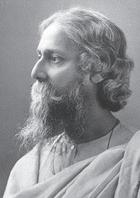
Reported by Arun Bhowmik
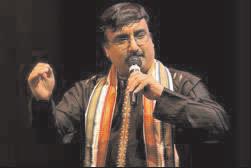
It was a memorable evening for those who love “Bhajans.” Set in the background of “moorties” of Gods and Goddesses inside the temple, the biggest stars of the community gathered together on April 12, to sing bhajans of Meera, Kabir, Surdas, and some wellknown compositions by others. It needed great efforts to pull the likes of artists: Partha M u k h o p a d h y a y, M o h a n Deshpande, Suranjan Bhanja Choudhury, Arundhati Mallik and Gayatree Sarma together, each one of them having performed previously as the “Artist of the Month.” Not to be outdone by the
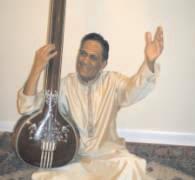
singers, there were the talented tabla players around to create a superb harmonious musical experience for the audience: Dr. Arindam Chakrabarty and Anirban Roy Chowdhury. It was an occasion to remember for ages. This evening was highlighted by the presence of the famous singer from India Pandit
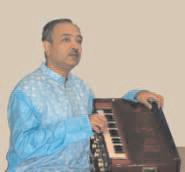
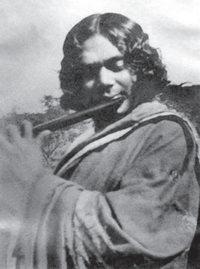
Kaivalya Kumar Gurav, who sang for over an hour to the extreme delight of the audience.
th On May 10 , we celebrated the “Kabi Jayanti”. This event centered around the birth anniversary of Kabiguru Rabindranath when we took time to honor the other revered poets too of that golden era of Bengali literature
Arundhati Mallik
Some of our very well k n o w n community musicians presented a delightful evening of Dwijendra
G e e t i , R a b i n d r a S a n g e e t ,
Najrul Geeti, songs of Atul Prasad, and compositions of other great Bengali Poets. This was a well organized program participated by Mahua Bose, Anindita Bhowmick, Suranjan Chowdhury, Suparna Guha, Amitabha Sengupta, Keya Parveen, Roshni Banerjee, Sucharita Das, Jhumpa Mallik, Zafar Billah, and Arun Bhowmik. Tabla accompaniment was provided by our own Dr. Arindam Chakrabarty, a highly talented tabalchi who performs regularly at Ananda Sandhya.
Indradeep Ghosh was our artist of th the month on the June 14 Ananda Sandhya. One of the front
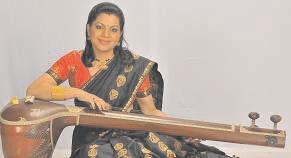
ranked young violinist of India and a torch bearer of Seni –Maihar gharana, Indradeep was initiated in the art of playing Violin at the tender age of six under the able guidance of Sri Anamitra Mustafi. From the year 1991, he has been training under the tutelage of Professor Sisirkana Dhar Chowdhury. He also has the privilege of getting occasional “talim” from other maestros of Indian instrumental music like Pandit V.G. Jog and Pandit Kumar Bose. Besides
Based on the deliberations of the Awards & Recognition Committee, Ananda Mandir Board of Trustees has announced Pradip Majumdar as an “Outstanding Volunteer” of the organization.
Pradip is one of the few members of Ananda Mandir w h o h a s s e r v e d t h e organization as a volunteer virtually from the day we bought our property and began our operations. Our newer members may not be fully aware of the numerous ways we have benefited from his help and support. When we started our operations, he single-handedly took care of many maintenance needs, ranging from arranging lawnmowing and snow-cleaning to g a r b a g e r e m o v a l b y contractors. He was always willing to find the best contractor for the job, keeping in mind the financial c o n s t r a i n t s o f t h e organization. He found a contractor who demolished a large shed and other temporary structures on our property for a very nominal cost. He attended to many maintenance issues at all odd hours when urgent calls came through. He pitched in as a cook on many occasions -and literally helped us pitch tents for many special events. For many years, he took care
Indian classical music, Indradeep is fond of Western Classical Music too. He has received western style violin lessons from late Sri Samir Sil.
Born with gifted talent of creativity and having received guidance and t ra i n i n g fro m h i g h l y recognized gurus, his performance has naturally blossomed into sweet, soothing, fascinating, and yet a thrilling melody He is blessed with creative
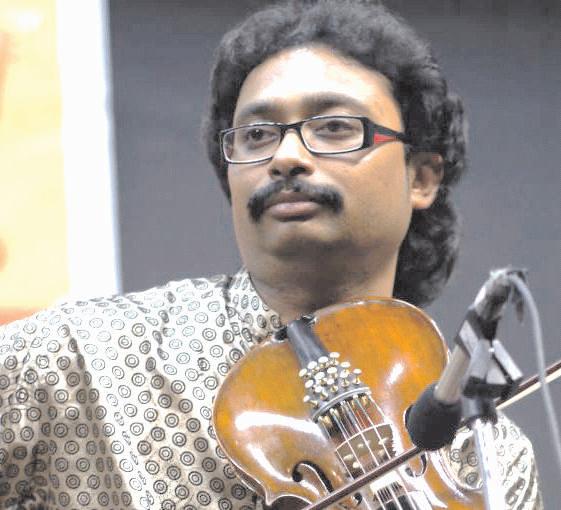
intelligence and excellent bowing technique. His style of playing is a blend of 'gayaki' and 'tantrakari,' and his forte are 'taan' and 'jhala.' He was ably supported on tabla by a familiar face, the highly popular tabalchi Anirban Roy Choudhury.
of the task of invoicing external users of our facilities for rent and collecting rent from them. He and two other members of Ananda Mandir devoted several months of their time to produce an extensive "address and phone directory" of over 5000 Bengalis in the NJ/NY/PA area. He was instrumental in making this project a great success -- and in thus raising
$10,000 for Ananda Mandir (which was a large sum of money for us in 2000-2001 when this project was completed). He was the first person responsible for creating and maintaining Ananda Mandir website -- and even to this date, he is critical to timely distribution of Ananda Sangbad, Anandalipi and all major mailings from Ananda Mandir
Overall, Pradip has been a wonderfully versatile volunteer who has helped the organization in many ways over more than 10 years. In recognizing him as an Outstanding Volunteer, Ananda Mandir has brought honor to itself and has established a great role model for other volunteers to follow in the future.
The Board will continue to recognize “Outstanding Volunteers,” selected from the nominations received from the Life Members of Ananda Mandir. The application form for nomination is available at www.anandamandir.org. If you are a Life Member and believe that someone deserves this recognition, please feel free to e-mail nomination toPronoy Chatterjee(pkc_usa@yahoo.com)
Dear Members of Ananda Mandir,
arun.bhowmik@hamonusa.com
As you all know by now, the cultural events presented by Ananda Mandir (musical shows during Kali Puja, Durga Puja, Live Mahalaya to name a few) have gained great popularity in our community of music lovers. One such routine event is the monthly ANANDA SANDHYA, presented usually on second Friday evening of the month. This is a wonderful platform where our community musicians get a chance to showcase their talents. Are you interested in doing an Ananda Sandhya program at Ananda Mandir as a solo artist, or presenting a group program? If you have attended any, you know that this is a 2 hour program of high quality. If you are “READY, WILLING AND ABLE”, please contact our cultural secretary Arun Bhowmik at , or call him at 908-672-1452 for details. We look forward to hearing from you.