Ananda Mandir
269 Cedar Grove Lane Somerset, NJ 08873

Ananda Mandir
269 Cedar Grove Lane Somerset, NJ 08873
NJ
NO. 1215
In the late 1940s, amid the social and political upheaval following the Partition of India, many families migrated in search of stability and livelihoods. Among them were my parents, who moved from Rangpur, East Pakistan,to Kolkata and settled in a rented space at the back portion of Darjipara’s iconic house—37 Hari Ghosh Street, popularly known as Nandibati. This was not just a house; it was a landmark, known for its large structure and the well-established Nandi family that lived in the front section. Growing up alongside the Nandi family, we shared not just spacebut culture, tradition, and everyday stories.
On the ground floor of Nandibati, there were garages and small business outlets. In the right-hand corner of the house stood a unique room with two doors. One side opened to a PaanBiri-cigarette shop, while the other door led to a tea stall. These shops were operated by two brothers, Mohan and Ajoy Singh, immigrants from Bihar. Their humble signboard read:
“Bengali Paan and Bengali Chaiya – Proprietors: Mohan & Ajoy Singh.”
Initially searching for work to support their families back in Bihar, the brothers received a lucky break when Bipinbihari Nandy suggested they open a small business in the available room. What followed was a tale of dedication, grit, and quiet success. The paan (Betttle leaf) and tea shop became a staple in the locality—people came not just for the products but for the warmth, stories, and fa-
By Alok Bandyopadhyay (Pennsylvania)
miliarity the brothers offered. By the time I left for the United States in the 1970s, Mohan and Ajoy were still running their shop, albeit with greyhair and decades of experience. In my last conversation with Mohan, he proudly told me that his son had graduated from Patna University and was exploring ways to apply his education. That seed of ambition would soon blossom in unexpected ways.
Fast-forward to 2019, just before the pandemic changed the world, I revisited Hari Ghosh Street. To my astonishment, the once modest pan and chai shop had been transformed into a sleek, modern digital store. One of the garages had been merged into the original shop, expanding the space. I was curious—who was behind this transformation? To my delight, it was run by Mohan’s grandsons—now qualified IT engineers and budding digital entrepreneurs. This transformation— from a traditional pan shop to a modern digital startup—is more than just a family’s success story. It represents the evolution of entrepreneurship in developing countries. It encapsulates how technology has become the great leveler, enabling people from even the most modest backgrounds to enter the digital age and thrive.
Rewriting the Rules of Business
A few decades ago, starting
a business required capital, location, and considerable hope. Entrepreneurs needed physical space, managed inventory, and relied heavily on local foot traffic. Marketing was done by word of mouth or physical posters. Risk was high, margins were thin, and scalability was a dream reserved for the elite.
Today, the rules have changed. Modern entrepreneurs do not need a storefront—they need a strong Wi-Fi signal, a smartphone, and a killer idea. A tea seller can become a food blogger. A tailor can start a global boutique on Instagram. A chai shop, like Mohan’s, can turn into a tech startup led by engineers.
The Rise of the Digital Shopfront!
In the new economy, Instagram feed is the store window, Facebook page is the community center, and WhatsApp is the customer service desk. And YouTube? That is the stage.
The beauty of digital entrepreneurship is that it drastically lowers the entry barrier. One does not need Rs. 10 lakhs (rupees) to open a store anymore. He can start with Rs. 0 and some hustle.
Like Mohan’s son inherited the small Paan shop from his father. Business was okay, but nothing exceptional. One day, he started posting videos of his colorful, artistic Paan creations on Instagram. People were captivated. He then launched a YouTube channel
featuring street food reviews and behind-the-scenes clips. His charm, humor, and authenticity drew thousands of followers.
Modern tools such as dropshipping, print-ondemand, and e-commerce platforms (Shopify, Meesho, Amazon, etc.) enable anyone to become a seller without stocking a single item. One does not need a warehouse, a supplier network, or delivery boys. He just needs creativity and hard work.
While running the Paan shop on a slow afternoon, Mohon’s son designed a tshirt on his phone that read, “Life’s better with Paan.” He uploaded it to a print-ondemand website. Someone ordered it the next day. The site printed and shipped the product directly to the buyer. He kept the profit. Simple. Efficient. Scalable.
Not long ago, running a small business meant wrestling with wrinkled currency, chasing exact change, and praying every note was not a forgery. Fast-forward to now, and we are sipping coffee while tapping our phones to pay. Welcome to the age of UPI, Google Pay, PhonePe, and Paytm—where even your neighborhood tea vendor runs smoother than a swanky café.
In this digital era, authenticity matters more than perfection. People connect with real stories, raw emotions, and everyday struggles. This is why entrepreneurs like Mohan’s grandsons are
continue
Ananda Mandir
Calendar of Events (Dates are subject to Change) Please check our website frequently www.anandamandir.org Tel: 732-873-9821
NOTE: For Puja time please contact temple or visit our website: anandamandir.org
JANUARY 2026
New Year Darshan (Morning), Thursday, January 1
Satyanarayan Puja, Thursday, January 1
Ratanti Kalika Puja, Saturday, January 17
Shyama Puja, Sunday, January 18
Saraswati Puja, Friday, January 23
FEBRUARY 2026
Maghi Purnima, Sunday, February 1
Satyanarayan Puja, Sunday, February 1
Maha Shivaratri, Sunday, February 15
Shyama Puja, Monday, February 16
MARCH 2026
Dol Purnima, Tuesday, March 3
Satyanarayan Puja, Tuesday, March 3
Shyama Puja, Wednesday, March 18
Debir Basatakalin
Batsarik Puja, Tuesday, March 24 –Friday, March 27
Ramanavami, Friday, March 27
Satyanarayan Puja, March 27
(*) See www.anandamandir.org or Call Mandir for details
Special Religious Services: Upon request, the priest of Ananda Mandir offers services such as in-house Shraddhas, Rituals associated with Cremations (Antyesti Kriya), Shraddha Anniversaries, Pre-wedding rituals (Naandimukh, Ashirwad, etc.), Upanayan (Paitey), Annaprasan, Wedding Ceremonies & Wedding Anniversaries, Griha Prabesh (Bhumi Puja), Consecrations of new cars (New Car Pujas) and others. If you have needs for any of the above or more, please feel free to contact Biswabhai @ 732-873-9821
Ananda Sangbad
A Periodical Newsletter
Published By ANANDA MANDIR
(A Tax-Exempt, Non-Profit Organization)
269 Cedar Grove Lane Somerset, NJ 08873
Phone: 732-873-9821
Website: www.anandamandir.0rg
PUBLICATION COMMITTEE
Chairperson
Debajyoti Chatterji
Assistant Chair
Subrata Bhaumik
Editor-in Chief Asok Baral
Editors
Pradip Das
Subhodev Das
Tathagata Ghosh
Sophia Mitra
Rahul Ray
All queries, articles, news reports and letters should be directed to AsokBaral@hotmail.com
For general information, please contact the following executives of Ananda Mandir:
Anjan Lahiri President
Jai Prakash Biswas Vice President
Debajyoti Chatterji Vice President
Ashok Rakhit Vice President
Arun Bhowmik General Secretary
Sanchoy Das Treasurer
Pradip Majumdar Assistant Treasurer
BECOME A MEMBER OF ANANDA MANDIR AND PARTICIPATE IN THE COMMUNITY ACTIVITIES TO ENRICH YOUR FAMILY
Ananda Sangbad
Dear Readers,
Ananda Sangbad has been in circulation for over two decades. During this period, we reported on significant events and developments of interest to the Ananda Mandir community and published thoughtful essays by distinguished writers. We hope these articles informed you, entertained you, and enlightened you.
The responsibility of bringing Ananda Sangbad has been carried out by competent men like our beloved and sorely missed Guruda (Guru Chakrabarty) and, more recently,by our universally revered Debajyotida (Debajyoti Chatterji). Now, Debajyotida has decided to pass the baton on to me. His confidence in me humbles me, and I am fully aware of the challenge ahead to earn your confidence. All I can promise is that I will do my best to maintain the tradition of excellence that Guruda, Debajyotida, and others before him had established.
However, maintaining that excellence depends solely on the quality of articles we receive from our thoughtful readers across the country. I urge you to continue sending these articles so you can share your thoughts with our broader, coast-to-coast reading community.
The articles may concern unique experiences that cannot be forgotten or memorable journeys to distant parts of the globe. The articles can cover events from the past that have not been well documented in history books, unknown occurrences affecting our lives today, or advancements across many fronts that will shape our future. The articles may not address current political, religious, or controversial issues.
I look forward to your articles and to our collaboration.
Dear Mr. Mitra:
With Warm Regards, Asok
Baral
Thank you very much for liking my article and for raising several important questions in your letter to the Editor
At the outset, my article is a hypothesis, and, as with any hypothesis, all background information is considered before the hypothesis itself, which appears at the very end. Obviously, it is an open-ended question. Whether it is correct or not, time will only tell.
Relationship between China and Russia: China and the Soviet Union, two Communist countries ideologically separated in the early 1960s (in India, CPI, CPIM, and CPIML evolved in the wake of this split). Later, the Soviet Union fell apart, and Russia emerged. Despite being neighbors, these two countries have never fought a war with each other, nor have they engaged in a trade war. Time will only tell what will happen between these two countries if the once-mighty US falls.
Relationship between India and Russia: After India’s independence in 1947, Jawaharlal Nehru, the first Prime Minister of India, came to Washington to request financial aid for a nascent country in a desperate situation. President Dwight Eisenhower soundly rebuffed him. Nehru contacted Moscow and received immediate moral and financial support. This relationship has continued. The Soviet Union and Russia steadfastly stood by India in all foreign and domestic crises and at the UN. A massive majority of India’s military hardware is made in Russia. Therefore, in any military crisis, India must turn to Russia for material and technical help.
Relationship between India and the US: As mentioned earlier, it has not been good from the outset. India repeatedly requested military aid from the US and has been soundly rejected, even after the end of the Cold War. The strongest reason is the unwavering US support for Pakistan, an archenemy of India. We all know what happened in East Pakistan in 1971. Last year’s insurrection in Bangladesh was fomented by the US, with a decisive motive to destabilize India. The most recent hefty tariff imposed on India by the US is another example of ongoing hostility.
Relationship between India and China: The détente (Hindi-Chini bhai-bhai) between India and China was shattered in the early 1960s by a sudden and puzzling attack by China. The relationship between the two countries has not improved since then, and skirmishes persist.
Pakistan has been a confounder in this political theater- it is supported militarily and otherwise by both China and the US. This leaves Russia as the only superpower on India’s side, as projected in my article.
The last paragraph in Mr. Mitra’s letter about India solving its own problems: As former Indian citizens, we are all smitten by the nationalistic fervor as elaborated in the famous libretto by Dwijendralal Roy – ‘Bharat abarjagatosobhaishresthoasonolobay’. India has made significant strides across almost every front, including the design and manufacture of its own military hardware. But so have many other countries. China was a desperately poor country in the 1940s; Bangladesh’s GDP was higher than India’sthe year before the revolution. With a better economy, many countries project their might beyond their borders.
India has a huge problem. It is surrounded by hostile neighbors from almost all sides. This mandates that India MUST do all it can to defend its borders. It may appear surprising that lately India is befriending staunchly Islamic Afghanistan in its war against Pakistan. It is necessary. The recent revolution in Bangladesh has exposed the seven northeastern states (the Seven Sisters) to constant instability. It will require considerable resources to defend the border against terrorists and other miscreants. This money must come from the same pool, retarding the development of the country. Currently, the US dollar is pushing INR to nearly 90 with no end in sight. It is a severe impediment to Indian economic growth.
Russia has been a friend of India in this bleak situation. The recent sale of low-priced Russian crude oil to India has been a thorn in Washington’s side. However, India has steadfastly rejected the U.S. demand because cheap Russian crude has been a lifeline for Indian economic growth.
I rest my case. Thank you again,
Rahul Ray
Wealways had insults in public life. From Anglo-Saxon flyting duels to sword duels among American elites, provocation has long been part of the political playbook.
In the early Republic, being called a “scoundrel” or “coward” could lead to a pistol duel. Dueling was not just about personal honor; it was a public ritual of status, often reserved for the upper class.
As historian Joanne Freeman documents in The Field of Blood, members of Congress once settled disputes with canes, threats, and bloodshed, all in the name of defending their reputations. Insults were not merely words; they were weapons.
Yet something has shifted.
Insults today are no longer occasional outbursts. They have become the main act. What once punctuated debate now replaces it. Across podiums, platforms, and comment sections, the goal is no longer to persuade. It is to perform. And the performance often resembles a roast.
What was once a rhetorical flourish has become a digital strategy. We have built a culture where trading insults is not just common; it is currency. And the market never closes.
Consider the headlines that dominate our feeds. They do more than inform; they provoke. One leader “obliterates” critics in a fiery speech. Another “blunder” into disaster. A movement is branded “dangerous” before its ideas are even heard. These headlines do not merely report events; they frame them as confrontations. The language mimics insult, designed to humiliate, inflame, and polarize.
Research on media headlines has found consistent bias across outlets, with emotionally charged phrasing replacing neutral reporting. Even lifestyle media plays the game, turning everyday choices into battlegrounds. Your breakfast might be “killing you.” A celebrity’s comment is “shocking.” The tone is combative, the structure adversarial. Insult becomes the architecture of attention. This shift is not just edi-
By Sajal Mukherjee (New Jersey)
torial. It is neurological. As smartphones became our primary window to the world, our habits changed. We scroll more than we read. We skim headlines instead of engaging with nuance. In this environment, provocation is efficient. It cuts through the noise. It satisfies the need to be noticed. And soon enough, insult becomes the default language of engagement.
Social media platforms reward emotional intensity over reasoned dialogue. The result is a feedback loop where the loudest voices drown out the thoughtful ones. It is like giving a megaphone to whoever is yelling the most in a library.
This shift is not just visible online. It is personal. Growing up, profanity was taboo. It invited punishment, not applause. Over time, norms shifted. Butaround 2015, something changed. Profanity was no longer casual. It became weaponized. It was aimed at opponents, embedded in political speech, and normalized across platforms. What was once a breach of etiquette has become a badge of authenticity.
This shift was not just bottom-up. It was top-down. A prominent political figure recently shared a digitally altered video depicting himself in a fighter jet, dumping waste on protesters. The clip targeted young activists and used a popular 1980s soundtrack to amplify its bravado. The artist whose music was used publicly condemned the video, calling for unity and rejecting divisiveness. Yet senior officials defended the video as satire and even praised it as a masterstroke of digital communication. Another video showed the exact figure cloaked and crowned, unsheathing a sword as opposition leaders knelt before him. It was a stylized reference to a past moment of political solidarity. The message was clear: dominance, not dialogue. As linguist Cornelia Ilie observes in her study of par-
liamentary discourse, such language is not merely emotional. It is ideological. Insults in institutional settings are cognitive forms of confrontation, designed to destabilize norms and reposition the speaker’s power. In this light, digital provocation is not just crude. It is calculated.
This problem is not limited to a few politicians. Across the aisle, elected officials have used profanity in public remarks, urged supporters to confront opponents in public spaces, and hurled personal insults at tech leaders and judicial figures. Cultural influencers have joined in, joking about assassinating presidents or posing with grotesque political imagery. These moments were not just expressions of anger. They were performances. Designed to provoke and engineered to trend.
Academic research shows that insults are far more complex than mere rudeness. Sociolinguists identify several distinct types, each engineered for a specific social function. Some attacks target identity – race, gender, religion – and are the most socially corrosive because they activate tribal instincts. Others deploy hostile humor disguised as play. Churchill excelled at this. When Lady Astor said, “If you were my husband, I’d poison your tea,” he replied, “Madam, if I were your husband, I’d drink it.” The insult stung, but the craftsmanship softened the blow. Most concerning today are strategic institutional insults – provocations deployed in parliament, hearings, or press conferencesto shift power, disrupt norms, or rally a base. In our digital age, these forms have merged into something broader and more destructive: verbal vandalism. If traditional insults were interpersonal barbs, today’s insults are environmental pollutants. Their goal is not merely to wound a rival but to degrade the entire informational ecosystem.
Social media has transformed
interpersonal aggression into a public spectacle. Insults now function as performative, algorithm-powered events designed to trigger engagement, not reflection. Their lifecycle is predictable: Emotion → Engagement → Algorithmic Reward → Imitation → Escalation.
A witty jab that once lived in a smoky pub now becomes a viral “own.” A disagreement that once unfolded in a newspaper column has now escalated into a multi-day meme war. Platforms reward provocation because provocation keeps us scrolling.This is the essence of verbal or social media vandalism. Social media platforms are defaced not by graffiti artists but by digital pugilists who paint the walls with outrage.And
unlike graffiti, you cannot power-wash a timeline.
Of course, none of this is new. As mentioned earlier, from duels over honor to parliamentary put-downs, insult has long been a tool of power. Legal scholar Ruth Colker traces how elites have used verbal attacks to maintain dominance and deflect reform, ranging from slavery to civil rights. But today’s insult culture is different in three ways:it is amplified, accelerated, and algorithmically rewarded. Social media turns every jab into a global spectacle. Outrage spreads faster
continue to page 14 }

(October 6, 1952 – September 6, 2025)
On September 2, the Ananda Mandir community mourned the loss of a core member, Swapan Roychowdhury. He was 72 years old.
Swapan was born in Kolkata. He graduated from Jadavpur University with a degree in pharmaceutical sciences before moving to the US in 1977. Here, while working full-time, he completed the Executive MBA program. He achieved much success and recognition within the pharmaceutical community for his work ethic, interpersonal skills, and management abilities.
Just before moving to the US, Swapan married Uma Goswami, the love of his life, and the mother of two highly accomplished daughters, Moulakshi and Tanya. Above all, Swapan was a family man devoted to his wife and daughters.
We will sorely miss Swapan and his kindness, wisdom, sense of humor, and zest for life. We express our sincere condolences to Uma (a long-time member of the Ananda Mandir Board of Trustees) and her family. Om Shanti.
“My country! in thy day of glory past A beauteous halo circled round thy brow, And worshipped as a deity thou wast—
Where is that glory, where that reverence now?”
The poem titled “To India - My Native Land”, written by Henry Louis Vivian Derozio, is often cited as one of the first written examples of Indian nationalism, as the poem was lamenting India’s glorious past and extolling patriotism. Indeed, Derozio is credited with instilling rational thinking in a generation of Bengalee students, collectively known as Derozians or Young Bengal. They would become enablers of significant changes in Bengal’s social and cultural life in the early 19th century. Their individual and collective fights for change, and the progress created, are often described by historians as ‘Indian’ or ‘Bengal Renaissance’.
Derozio was born on April 18, 1809, in what is now Padmapukur, Kolkata, to a father of mixed Portuguese descent and a mother of English descent (his stepmother, who raised him, was also of English descent). The area where he grew up was not considered part of the ‘White Town’, and his family was not wellconnected. In fact, they were considered East Indians or part of an Indian community that had converted to Christianity and were thus inferior to the ‘white’ population. They were neither accepted by the British nor by Hindu and Muslim societies.
Derozio received his early schooling at ‘Dharmatala Academy’ or ‘Drummond’s Academy’, where the teachings of David Drummond left a lasting impression on him and shaped much of his thinking, which in turn influenced a generation of his students. Derozio was a child prodigy, and even at an early age, he assimilated the philosophical teachings of the West and the ideas of the English and French Revolutions. But his family was in financial distress, and Derozio left school at 14 to work for James Scott and Company, where his father was an accountant. He left that work after two years to work in his uncle’s indigo factory in Bhagalpur. Here, he blossomed into a poet and wrote the poem cited above. Many of his poems were published in leading magazines such as the India Gazette and the Calcutta Journal.
Derozio became known as a talented East Indian, and at the age of 17, he secured a position at Hindu College in May 1826 on the recommendation of David Hare, the founder of many educational institutions and the donor of the land for Hindu College. It is also possible that, as an East Indian, Derozio cost the College a fraction
By Asok Baral (New Jersey)
of what would have cost them for a ‘white’ teacher.
The British East India Company was having a flourishing business with Calcutta as its center, and an elite, wealthy and middle class were emerging. At the same time, the Western ideas of analysis and reasoning were flowing in, and with the advent of the printing press, books, periodicals and newspapers were being churned out at a hectic pace. People were either resisting those ideas or wondering how to contextualize these with their lives and traditions.
Around that time, Raja Rammohan Roy brought in a new light of rational thinking. He questioned the idolatry, campaigned against the age-old practice of ‘Sati’ and child marriage, and was trying to create a bridge between modernity and the traditions of the Upanishads. His creation of Brahmo Sava, which later became Brahmo Samaj, was opposed by many in the elite and middle classes. But they found value in Western education as it would further their business interests and their children’s careers. The Hindu College was established with British aid and support from several pillars of society, including Radhakanta Deb and reformers such as Raja Rammohan Roy (though his name was not listed as a promoter to appease other promoters who were ideologically opposed to him).
In this era of the old giving way to the new, young Derozio stepped in with a forceful message of free thinking and dispassionate analysis of the past, using these as the basis to shape the future. His message was never to take anything for granted but to analyze with a rational mind. Rudrangshu Mukherjee gave a summary of what Derozio was teaching his students:
- “They should think for themselves, that was their ‘sacred duty”
- “They should have a free exchange of ideas, and everyone should express their thinking clearly.”
- “They were encouraged to read books that were not part of the curriculum.”
- “They must understand and honor the importance of truth and virtue”
- “They were encouraged to meet him outside the classroom and speak to him freely”
One can argue that Derozio’s teachings were no different from what a meaningful education should be, but they were revolutionary in early1800s Bengal, where conformity was the norm. Derozio’s own ambition to teach the students was explained in this beautiful poem:
“Expanding, like the petals of young flowers,
I watch the opening of your infant minds,
And the loosening of the spell that binds
Your intellectual energies and powers”
Derrozio’s new thinking brought in a burst of fresh air to the adolescent students who were mostly from upper caste Hindu families. Their home culture emphasized traditional practices and religious and caste rules. Now, they are questioning and often defying the old practices. These stirred up traditionalists like Radhakanta Deb, who wrote that some students’ conduct was highly disorderly and inconsistent with the laws and practices of Bengalee society.
Derozio was singled out as the man responsible for this disorderly conduct. The specific charges brought against him are best understood from his letter to Horace Hayman Wilson, Vice-President of the Hindu College Managing Committee. Derozio responded to three charges:
“Did he believe in God?”
“Did he think respect and obedience to parents no part of moral duty?”
“Did he think intermarriage of brothers and sisters to be innocent and allowable?”
Derozio replied at great length about the second and third questions. He squarely rejected the accusation that he encouraged students to disrespect or disobey their parents and cited specific instances in which he had required his students to do the opposite. He also made clear that he “condemned the feigned respect that some children evince. Being hypocritical and injurious to the moral character”.
He was extremely forceful in denying the accusation of advocating marriage between brothers and sisters. It was blatantly false, and he went on to write about individuals who had been spreading the most absurd and groundless stories about him and his family. For example, some were telling people that his daughter was going to marry a young Hindu man when he didn’t have a daughter. He attributed most of these false and scandalous rumors to a Brahmin named Brindaban Ghosal, who spread them to entertain anyone willing to listen.
But on the first question about the belief in God, he did not give a direct answer, instead, he brought in the question of what should be an educator’s fundamental duty. He analyzed the question as a pretext to lay out the elements of an enlightened inquiry. He talked about the doubts and uncertainties of an inquiring
mind. Derozio quoted Bacon, whom he had cited as a significant influence on him: “beginning with certainties will lead to a contended ignorance”.
Even before his letter reached the Managing Committee, they had a special meeting on April 23, 1831, and decided that Derozio “was the root of all evils and the cause of public alarm, and he should be discharged”.
After college, Derozio remained active and established a daily newspaper called the East Indian. But unfortunately, he contracted cholera that was rampant in Calcutta and died on December 26, 1831, at the young age of 22.
Derozio taught at Hindu College for only 6 years, but in that short time, he had a strong influence over his students, a relationship not seen before or since his day. He was a trailblazer, and the movement he set in motion had an impact that lasted for decades after his death. What he created is often called the “Public Sphere,” where individuals could gather to identify and discuss societal ills and, through these discussions, drive action and possible change.
In 1828, Derozio, along with 20 students, formed a debating society called the “Academic Association”. They first met at Derozio’s place, then at various locations. According to Nitish Sengupta, the debating subjects were varied but similar in nature: “Free will, free ordination, fate, faith, the sacredness of truth, the high duty of cultivating virtue, the meanness of vice, the nobility of patriotism, the arguments for and against the existence of the deity… the hollowness of idolatry and the shames of priesthood.”
The Academic Association opened the debating arena well beyond Hindu College, inviting others to join and submit their arguments. The participants included prominent members of society and academia like David Hare, Colonel Benson (Governor General’s private secretary) and Dr. Mills, Principal of Bishop’s College. The Association also featured brilliant speakers such asRasik Krishna Mallick, Krishna Mohan Banerjee, Ramgopal Ghosh, Radhanath Sikdar, Dakshinaranjan Mukherjee, and Hara Chandra Ghosh. The young students were known as ‘Derozians’, and later as ‘Young Bengal’. David Hare became president after Derozio died in 1831, and the Association continued till the late 1830s.
In 1838, the Young Bengal move-
continue to page 6 }
Part 1 – The rise of the East India Company and prelude to war in Bengal
Throughout human history, major battles between opposing military forces have had profound effects on the future course of nations and the world. These include the Battle of Hastings, the Battle of Waterloo, the Battle of Stalingrad, D-Day in Normandy, and the naval battle at Midway.
But few had the lasting impact like the battle of Plassey, which not only gave the East India Company (EIC/ “Company”) a military foothold on the Indian peninsula, but heralded its eventual conquest of the provinces and the kingdoms and into the formation of India as a nation. India was ruled, first by the Company, and then by the British Crown, for almost 200 years. It also enabled Britain to use the resources gained from the exploitation of India, along with the technologies from its Industrial Revolution, to become a world superpower; a role that lasted till the end of the Second World War.
It was the year 1599. A group of eminent people had assembled in an old Tudor building on London’s Leadenhall Street. They aimed to form the world’s first joint-stock company and to petition the aging Queen Elizabeth I to grant them a charter to trade in the East Indies. Britain was, at the time, an agrarian, impoverished country, mostly cut off from Europe. It encouraged its pirate-like naval freelancers, such as Francis Drake, to seek out and plunder other nations’ ships, bringing looted treasures back home. Within a year, the EIC not only got permission to trade tax-free in the Indies but to raise armies, conquer territories, build fortifications, mint money, make laws, and be a sovereign force in itself in the name of, and with help from, the British Crown. The world’s first common stock, multinational company,was formed, with enormous powers. [Reference – “The Anarchy” by William Dalrymple]
The EIC began trading in the Indies, and ships returned laden with spices, from which the shareholders made substantial profits. But competition for such trade was fierce, and the EIC was totally outmaneuvered by the far better-financed Dutch East Indies Company. The EIC decided to focus on India, then under the Great Moghuls, one of the wealthiest and most powerful countries in the world.
In 1615, the Company persuaded the Court of St. James to dispatch a royal mission led by Sir Thomas
By Ranajit Mitra (New Jersey)
Roe to India. Roe met the Emperor Jahangir, a refined and curious man who was perpetually inebriated with Aarak and opium. Sir Thomas impressed him with gifts of jewels and miniature portraits, and with the stories about England. Over several visits, he further ingratiated himself with the emperor and his noblemen. Eventually, Jahangir gave the EIC the title of ‘Kampani Bahadur’ and permission to start a settlement and a factory in Surat. In the decades that followed, the Company established other settlements and factories in Madras, Bombay, and many other sites. In 1690, a Company agent named Job Charnock founded one by the Hooghly River by purchasing land between the villages of Kalikat and Sutanuti and named it Calcutta, the eventual capital city of India for the Company and the Crown.
By the time the EIC traded for almost 100 years, mainly in spices, precious stones, cotton and silk fabrics, and other commodities, it had made enormous profits. That made its English shareholders very rich, and the Company became highly influential in British politics. It was also raising small armies in its settlements in India using British officers and mostly Indian soldiers, aided by the Royal Navy ships and their crews. Forts were built in Bombay, Madras, and later in Calcutta.
The last great Mughal emperor Aurangzeb died in 1707 at the age of 88. Aurangzeb was a religious zealot whose extreme actions against his predominantly Hindu subjects, from the destruction of temples to taxing non-Muslims, fractured the empire that Akbar had built and his successors had nourished. Aurangzeb spent most of his life attempting to conquer the Deccan, fighting the Marathas, and suppressing rebellions.
After his death, the empire started to disintegrate and regional Governors, Nawabs and Kings began to assert control over different provinces in India. The EIC, adapting to the times, began to form alliances with some of these ruling houses, both to situate themselves better and to drive out their competitors - the French, the Dutch, and the Portuguese. These European powers were doing the same with the Indian rulers. Pretty soon, the proxy fights between the British and the French erupted in several
principalities and these continued for decades.
By the mid-1700s, Calcutta had become the single most important settlement of the Company, andthe majority of its trade and revenues flowed through this city. The Company invested heavily in developing the city, making it the second most important British city after London. Fort William overlooked the city, and it was the Company’s seat of power.
Into this city stepped Robert Clive
Clive was born in 1725 in Shropshire, England, to an impoverished gentry family. At the age of 17, his father found him a job with the EIC as a ‘Writer’ (clerk), and he was sent to work in Madras. (In Calcutta, the clerks toiled at the ‘Writers Building’).
Young Clive was an aloof, shy, and undisciplined man, sometimes violent and cruel, but he was very ambitious and hardworking. In a few years, he became a company trader/ merchant. By his late twenties, he had made a small fortune. He was also distinguishing himself in another way, as an army man.
The British and the French were engaging in skirmishes, and these engagements were becoming more frequent as local rulers and their armies also took sides. Cliv wasinvolvedin several small wars and soon became recognized as a brilliant military leader who fearlessly led his men, withoutregard for his own personal safety. He made a name for himself in the Carnatic wars and after some aggressive forays and victorious skirmishes, he fell ill and came to Calcutta to recuperate.
The city now had almost 200,000 people, with elegant British homes and the dingy and teeming ‘Blacktown’ where the Indians lived. Clive began to enjoy himself in both quarters but a year later, after he married an Englishwoman, he went back to England.
The Directors of the Company though, had other plans for him. After Clive’s failed attempt to win a seat in Parliament, they offered to promote him to Deputy Governor of Madras. Clive had no love for India, but he saw this as an opportunity to become rich. [Reference – “The Anarchy” by William Dalrymple]. He
accepted the offer and returned to India in 1756 with a military commission, accompanied by British soldiers and Royal Navy ships. He got an informal command of the army there.
At this time, Bengal was the most prosperous province in the Mughal Empire, or what remained of it. With its textile weaving centers in Dhaka, its agricultural bounties, and its trading hub and markets in Calcutta, Bengal was the envy of all.
The ruler of Bengal was Nawab Aliverdi Khan. He was of Arab and Turkish descent and had ruled Bengal since a 1740 coup, partly financed by the Jagat Seths. This Marwari family was a vibrant banking house with an India-wide financial network. The Jagat Seths lent money to Kings and Nawabs in India and thereby controlled the politics and finances of many provinces and kingdoms.
Aliverdi Khan was a cultured man and an effective administrator who cared for his subjects. He had also established a sizeable army that kept the Marathi bandits at bay while they plundered and destroyed large tracts of the country. During Aliverdi’s reign, Bengal was peaceful and very prosperous. Murshidabad, the capital, was about 120 miles upstream from Kolkata, and the Nawab had created a dazzling Shia court there. [Reference –“The Anarchy” by William Dalrymple]
But the Nawab’s health was failing and all eyes turned to his grandson and heir apparent, Siraj ud-Daula. This young man, aged 25, had become notorious for his wanton cruelty and debauchery. He had no talent for government, was stubborn, immature, and bad-tempered. He was widely feared and hated by all, as his cousin Ghulam Hussain Khan, a contemporary historian, wrote. [Reference – “The Anarchy]
At this very juncture, Drake, the Company’s governor of Calcutta, decided to repair and rebuild the defense of Fort William. Despite instructions from England, he did not ask for the Nawab’s permission.
Upon hearing this news, Aliverdi Khan was furious and summoned Siraj. They decided that it was time to teach these foreign merchants a lesson.
The course of Indian history was about to change.
----To be continued
References:
The Anarchy - by William Dalrymple Clive - by Robert Harvey
The Great Moghuls- by Bamber Gascoigne
| continue from page 1
thriving. They carry forward their grandfather’s legacy of honest business but are not afraid to remix it with digital tools. They have upgraded the menu, the model, and the mindset. It is not about survival anymore.It is about scale, impact, and innovation.
But digital payments benefit not only the buyer. For the seller, it is a game-changer. Accepting online payments says, “I am credible. I am current. I mean business.” It instantly boosts their trust factor and widens their customer base. No wallet? No excuse. They have you covered.
What is more? These platforms provide income records, support tax calculations, and improve loan eligibility. Financial clarity— once only accessible to corporate giants—is now available to your friendly roadside vendor. That is not just evolution. That is revolution.
This digital shift does not just empower individuals; it reshapes communities. When
small-town creators go viral, they attract attention (and revenue) to their localities. As artisans promote their work on Etsy or Instagram, they ensure that traditional crafts remain relevant and continue to flourish. When podcasters speak in regional languages, they give voice to stories that might otherwise be lost. In this new world, a phone is not just a communication device; it is a launchpad. With the right content, a sense of identity, and a bit of digital literacy, anyone can turn a passion into a profit.And this is just the beginning. The story from Pan Shop to podcast is one of ambition meeting access. And it is happening everywhere.
Modern entrepreneurship often begins in the humblest of places: a kitchen, a garage, or a quiet bedroom corner. What starts as a passion project—a way to pass the time or express creativity—can quickly become a profitable enterprise. Today, the journey from hobby to hustle has become a well-trodden path, enabled by access to digital
tools and online platforms, and by a mindset that says, “Why not me?”
Meena, a schoolteacherand Mohan’s daughterin-law, had a habit of telling moral stories to her children before bedtime. With encouragement from her family, she began recording these stories and uploading them to a podcast platform. Initially, it was just a fun way to stay connected with her teaching roots. But soon, she attracted a loyal following: young children, nostalgic parents, and even educators who used her stories in classrooms. Her podcast gained traction, generating ad revenue and sponsorships from educational brands. Meena did not set out to be an entrepreneur—but the digital world recognized her value and rewarded her for it.
Baking, handmade crafts, soap-making, painting, caricature drawing, and gardening tips—these hobbies are being reimagined as microbusinesses. Sellers market their products on social media, receive orders through direct messages, and accept payments via QR codes. Platforms like Etsy and Insta-
gram enable anyone with a creative spark to become an entrepreneur.
Podcasts: The New Corner Shop
Podcasts have emerged as one of the most accessible and intimate forms of modern communication. They are the new adda—the digital space where people gather to share ideas, seek advice, or enjoy a delightful story.
Entrepreneurs use podcasts to build authority, connect with audiences, and explore niche topics. Whether it is a local chef discussing recipes, a psychologist sharing mental health tips in vernacular languages, or a young professional breaking down finance in plain English, there is a podcast for everyone. Starting a podcast today is as easy as recording on your phone. With apps like Anchor or Spotify for Podcasters, distribution is seamless. Editing tools are free. Hosting is affordable. What matters is the content and consistency.
Podcasts also offer monetization opportunities through sponsorships, brand collaborations, premium content
subscriptions, and affiliate marketing.
What is incredible about stories like Mohan’s family is how they blend tradition and transformation. Mohan started with the hope of feeding his family. His grandson builds software solutions, runs a digital shop, even a podcast, and servescommunities of people—just in a different format.
But there are challenges, such as working long hours. Algorithms are wild. Fraud happens. Reviews sting. But this generation of entrepreneurs does not fold. They pivot. They learn. They adapt. And they often do it while editing a Reel, answering a customer query, and planning their next launch before breakfast.
The new wave of technology has transformed paan shops into podcasts and tea stalls into technology ventures—proving that entrepreneurs in developing countries are redefining success through sheer resilience, creativity, and unstoppable adaptability.
| continue from page 4
ment established a second society, the Society for the Acquisition of General Knowledge,to focus on areas requiring justice. For example, Ramgopal Ghosh wrote about the British ‘Black Acts’ to bring judicial treatments of Indians at par with the Europeans, something that the Europeans vociferously opposed. He was among the first to advocate for Indian eligibility for the Indian Civil Service (ICS). Dakshinaranjan Mukherjee brought to light the abuses of the British government and its police. Peary Chand Mitra wrote ‘The Zamindar and the Ryots” in support of the ‘ryots’ or tenant farmers. By 1843, the society had grown to about 200 members, and all its transactions were later published in three volumes.
Young Bengal members were also seriously committed to women’s education. Hara Chandra Ghosh and Ramgopal Ghosh provided muchneeded assistance to John Bethune in securing students for the first institution for women’s education. Sib Chandra Deb opened another girls’ school in his own home.
Historian Andrew Santori summed up what ‘Young Bengal’ stood for:
– “More representational govern-
ment.”
– “More native appointments in the government services.”
– “A more equitable, more efficient and less corrupt administration of justice.”
– “An end to the conflation of governmental and commercial functions of the Company.”
– “The promotion of education throughout Hindu society (including women).”
– “The universal protection of rights and promotion of general social utility.”
Surendranath Banerjee, one of the founding members of the Indian National Congress and son of Derozian Durga Charan Banerjee, wrote that Young Bengal members “were the pioneers of the modern civilization of Bengal, the conscript fathers of our race”.
Derozians’ accomplishments are too numerous to list, and only a few are listed here. Radhanad Sikdar, a brilliant mathematician, invented his own geodetic process and calculated the height of Mount Everest. Peary Chand Mitra, a prominent literary figure of the time, wrote AlalerGharer Dulal in colloquial language, along with works like Jat Thakar ki Upay, and was called at the time the ‘Dickens of Bengal’. He co-ran two influential papers: Jnananveshan with Rasik
Krishna Mallick and Masik Patrika with Radhanath Sikdar.
However, the Derozians could not expand their movement into a political party; doing so was nearly impossible at the time. Most of the Young Bengal members came from middleclass families and had to earn a living. Their energy was diverted, and there was never a follow-up generation. But their impact on Bengalee culture, rational thinking, and so-
cial practices cannot be denied. By the 1850s, most of the firebrands of Young Bengal had petered out, and the 1857 sepoy movement ushered in a new chapter in the history of Bengal and India.
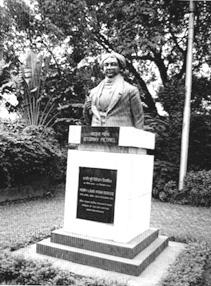
On a personal note, I was a student at Hindu School, an offshoot of Hindu College (along with Presidency College, established in 1855, which became Presidency University in 2010). A few years ago, I was walking past my school and, out of curiosity, entered the building. Right near the front gate, there was a bust of Henry Louis Vivian Derozio, not of one of the many luminaries who had passed through Hindu School and Hindu College, but of Henry Louis Vivian Derozio. I found it interesting that they chose to celebrate a man whose tenure was a short 6 years, but whose influence was farreaching.
References: Indian History Collective – The Derozians’ India
The Bengalees: Glimpses of History and Culture by Samaren Roy Nitish Sengupta: History of the Bengali Speaking People and others
Ananda Mandir, situated in the heart of Somerset County, is a special place for the Bengali community of New Jersey. We have all pujas performed here as per the Bengali calendar, and that is one of the reasons that people from New York, Pennsylvania and other states visit our temple. We also perform private pujas at Ananda Mandir or at our devotees’ homes. The temple’s beauty and ample parking make it attractive to everyone.
Autumn is in the air, the fall foliage in Somerset County typically begins in October, and so does our Durga Puja. It is the most important festival of the Bengali community. Durga Puja festivities started with theMahishasura Mardini program. A musical program depicting Ma Durga’s slaying of the asuras (demons) was held on September 14.It began at 4:30 am and ended at 7:00 am. The story was narrated during the program, accompanied by songs and the Chandi path, and concluded with the Arati of Ma Durga. After the program ended, we had our special breakfast.
On September 21, we had Mahalaya Til Tarpan. It is a Hindu ritual in which water mixed with black sesame seeds (til) is offered to appease deceased ancestors. This was a busy day for our Mandir. The ritual started at 9 am and continued for more than four hours.
This year Durga Puja started on September 27 and ended on October 2. Ma Durga symbolizes the divine force known as Shakti, which is used against the opposing forces of evil. According to the Hindu calendar, it falls during the Shukla Paksha of the month of Ashwin. On Sep 27, we had Debir Bodhobn, the first day of the main Durga Puja festival, marking the arrival of Goddess Durga on Earth. It included the rituals like Debir Bodhon (Awakening), Amantran (Invitation) and on Sep 28, we had Debir Amantranand Adhibas. Adhibas is the unveiling of the idol’s face. It marks the beginning of the main festival.
Durga Saptami was on Sep 29; it is celebrated with Kala Bou Snan and Pran Pratishtha. This day symbolizes the beginning of the Goddess’s battle against the demon. The next day, Maha Ashtami, is one of the most auspicious
Reported by Mita Sinha, Chair, Puja Committee
days of the festival and it ends with Sandhi Puja. A special ritual is performed during the transition from Ashtami to Navami believed to be an extremely auspicious moment.
Maha Navami, also known as Navaratri, is the ninth day of the Durga Puja celebration. We also celebrated the Kumari Puja in the evening
of Navami. Little girls aged 4 to 11 were worshipped on the Navami evening. On the day of Bijoya Dashami, we had Thakur boron, sindurkhela and dance with dhak, shankha and ghanta. All of us enjoyed every day of the puja.
We had thousands of devotees visiting the temple on these days. Tagore Hall was
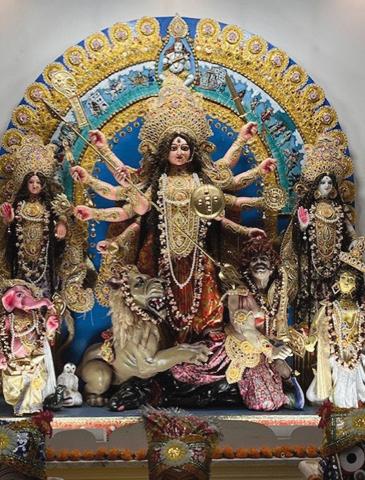
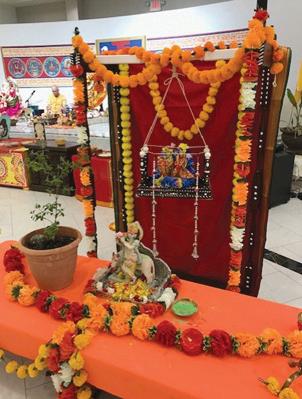
open to the public during Durga Puja. Food was distributed daily in the morning and evening. Beautiful music was performed, which created a holiday atmosphere.
We had multiple vendors inside the Tagore Hall selling sarees,CDs and other handcrafted items. The weather was perfect and that made the
celebration more enjoyable for everyone. As always, all our volunteers worked hard to make the Puja celebration a success. We cannot do a celebration of this large scale without the help of hundreds of our dedicated volunteers. They worked tirelessly from morning to evening to ensure its success. We also did live streaming of Durga Puja on Facebook, Twitter and You-
continue to page 9 }
| continue from page 8
Tube.
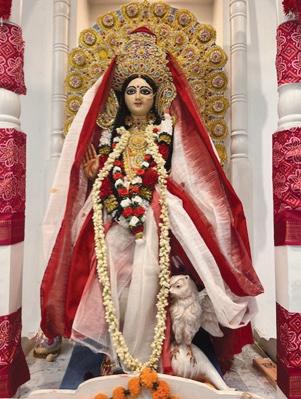
Next, we had the Kojagori Lakshmi Puja celebration on Oct 6 in the evening. Ma Lakshmi is known to be the “Goddess of Prosperity”. This puja falls on a full moon day, “Purnima”, in the month of Ashwin. This Purnima is also known as Sharad Purnima in most parts of India. People believe that on this day, the Goddess Lakshmi descends on earth to bless all of us with prosperity and good health. We had our Satyanarayan puja in the evening. Both pu-
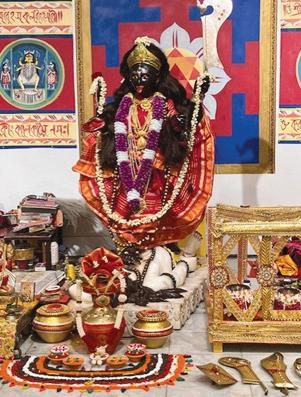
jas were performed beautifully. We had a delicious dinner after the puja. This year, we had our Maha Kali Puja on Oct 20th. Kali Puja honors the Hindu goddess Kali and is observed during Diwali in the month of Kartik Ma Kali symbolizes the triumph of good over evil. It also signifies the attainment of spiritual enlightenment by removing ignorance. Goddess Kali is the ultimate manifestation of Shakti. She is the Adi Shakti. This puja is always done at midnight, and the goddess is
offered flowers, sweets, seasonal fruits and a garland of red hibiscus flowers. All our buildings were illuminated with beautiful colored lights, and the night echoed with fireworks lighting up the sky. This puja is always performed at night, so most of our members stayed on until midnight to see the puja and we had dinner after the Puja.
The last puja of this month was Jagadhatri Puja. A festival dedicated to Goddess Jagadhatri, the Divine Mother, who sustains and protects the entire universe. We per-
formed this puja in the morning at Ananda Mandir.
The first puja for November was Raas Purnima & Satyanarayan Puja in the evening of November 5. This day commemorates Lord Krishna’s Raas Leela with the gopis. This puja was also celebrated in the evening.
Our monthly Shyama Pujas were held on November 19 and December 19, with a large attendance.
The year 2025 was a successful year for us. All our major pujas, such as Durga Puja and Kali Puja, were well
attended. Ananda Mandir is a special place for our community. Please join us to experience the beautiful puja and friendly atmosphere of our Temple.
Our website is www.anandamandir.org, and you can find details of our puja dates, temple timings and information on all other cultural activities on our website as well as on Facebook and Twitter.
To schedule a private puja at your home or at the Temple, please call (732) 873-9821 and leave a message; someone will get back to you.
By Mandira Chattopadhyay (New Jersey)
(Editor’s Note:” There are Rivers in the Sky” is a “Sunday Times Bestseller” and has been widely praised as one of the best books of 2025. It won several awards, including the Edward Stanford Travel Winning Award, Gordon Bowler Volcano Prize from the Society of Authors, and many nominations and commendations, including the Orwell Prize for Political Fiction. Here is the author’s commentary on the book.
Elif Shafak takes the readers on a magical literary ride across history in her latest novel, “There are Rivers in the Sky” (Vintage Books, 2025). Like a river, the book promises to take the readers on a journey. It is, at its heart, the journey of a single drop of water as it falls and regenerates, as it is consumed and transformed across time and continents. This novel illuminates the complexities of human experience against a backdrop defined by water. Each character navigates his/her own challenges, resonating deeply with the themes of connection and longing that flow throughout the novel. One of the bold statements we come across as an ominous warning is: “Water remembers. It is humans who forget.”
“H2O,” she tells us, “Water. The strangest chemical, the great mystery - with two hydrogen atoms at the tips, each bonded to a single oxygen at the center, it is a bent molecule, not linear. If it were linear, there would be no life on earth…no stories to tell.”
The three atoms (H, H, and O) represents the novel’s three protagonists: (1) Arthur, a nineteenth-century British linguist, (2) Narin, a modern day Turkish Yazidi girl being taken by her grandmother to Iraqthrough the land controlled by ISIS to receive a blessing to heal Narin’s encroaching deafness and (3) Zaleekhah, a contemporary British hydrologist who is suddenly depressed following her divorce and living in the Thames in a houseboat.
The central idea that runs through the novel is that a single drop of water can travel across time and countries as a unifying force. The characters have a personal connection with rivers, and their stories are interconnected. The single drop of water that connected them also underlines the cyclical nature of life. Water evaporates, condenses, precipitates, and eventually falls on Earth before repeating the same cycle. The characters’ lives and their interconnections are the same. Water has the power to give life and bind people together; this can also be gleaned from how rivers birthed great civilizations.
Beyond the cyclical nature of life, the novel also explores the intricacies of memory, ‘There Are Rivers in the Sky’ revolving around the memory of water. Zaleekhah was fascinated by the notion that water might have memory. Her mentor posits a theory of “aquatic memory,” that water retains evidence, or memory, of the solute particles that had dissolved in it, no matter how many times it was diluted or purified.
The controversy over the “memory of water” that burst in 1988 continues toovershadowthe whole story of Benveniste’s experiments. Admittedly,
reminder of the strife her people endure.
these claims were anything but insignificant. The fact that this study could support homeopathy, which is also highly controversial, was another reason for this strong opposition.
Shafak describes it lyrically in her novel as: “Rivers are fluid bridges— channels of communication between separate worlds. They link one bank to the other, the past to the future, the spring to the delta, earthlings to celestial beings, the visible to the invisible, and, ultimately, the living to the dead. They carry the spirits of the departed into the netherworld and occasionally bring them back. In the sweeping currents and tidal pools shelter the secrets of foregone ages. The ripples on the surface of water are the scars of a river. There are wounds in its shadowy depths that even time cannot heal.”
‘There Are Rivers in the Sky’ opens in Mesopotamia around 640 BCE. A raindrop falls onto the head of Assyrian King Ashurbanipal. A millennium later, this raindrop transforms into a snowflake as it slowly falls on the tongue of Arthur as his mother gives birth to him in 1840 by the River Thames. Born in abject poverty, Arthur has the memory of a savant and an affinity for languages. These skills and talents helped him acquire a part-time job at the British Museum. Arthur’s life in London is marked by an internal struggle influenced by historical injustices and personal relationships. The River Thames serves as a metaphor for Arthur’s journey. It is a symbol of both the flow of time and the weight of memory. His dreams often reflect a desire to reclaim a sense of belonging, driving him to seek answers about his family ties and the past that has shaped him.
The story then moves forward to 2014 to southeastern Turkey, where a nine-year-old Yazidi girl, Narin, is about to be baptized on the banks of the River Tigris. The ceremony, however, is disrupted by men working on a dam. Her grandmother, Besma, a renowned healer, then decided to take her to the holiest of Yazidi sites located in neighboring Iraq, which was ravaged by war. With their journey riddled with danger, will they be able to complete their mission? Narin embodies the complexities of identity and cultural belonging as she navigates her life in Iraq. Growing up intertwined with the currents of the Tigris, she personifies resilience in the face of political turmoil and personal loss. Narin’s dreams encompass a longing for peace and understanding, echoing her desire to connect with her heritage while also yearning for a brighter future. The impact of water on her life is profound, as it serves as both a source of sustenance and a
The third central character is Zaleekhah, a thirty-one-year-old female hydrologist of Turkish descent living in London in 2018. Following separation from her husband, Zaleekhah decides to move into a houseboat on the Chelsea Embankment of London’s River Thames. This move catches Zaleekhah’s uncle Malek, her adopted father, off guard. Zaleekhah was orphaned when she was just seven; her parents were swept by a flash flood while camping by the River Tigris. In her new community, Zaleekhah befriends “Nen”, an Irish woman who owns Zaleekhah’s houseboat. Nen owns a tattoo shop where she tattoos customers in cuneiform (an ancient writing system that used wedge-shaped marks).
Zaleekhah encapsulates the theme of transformation. Her experiences are steeped in spirituality and connection to the natural world. Throughout her journey, the rivers serve as a medium that symbolizes not only physical space but also an emotional landscape. Zaleekhah’s story reflects the interconnectedness of all three characters, illustrating how their lives are shaped by the historical and cultural currents of their respective environments. This rich tapestry of narratives reveals how Arthur, Narin, and Zaleekhah are linked, not only by their personal struggles but also by the rivers that thread through their lives.
While the three characters are separated by time and physical boundaries, they are linked by coincidence. For one, they all have connections to Mesopotamia, albeit some more superficial. Arthur’s fascination with Mesopotamia and cuneiform – the region’s ancient form of writing – eventually opens an opportunity for him to travel to the region and pursue his research on cuneiform. Nen shares Arthur’s childhood fascination with Mesopotamia. When she puts up her own tattoo shop, her tattoo art is inspired by cuneiform. Lalish, located in the Nineveh Plains, is part of ancient Mesopotamia, the very same region that took Zaleekha’s parents’ lives. Interestingly, it is in this region that the main protagonists’ paths would cross by accident, by being at the right place at the right moment.
What forges the characters’ destinies together, however, is water; a single drop of water serves as a witness to the momentous events in the lives of the characters. One facet of the story that immediately floats to the surface is the characters’ proximity to rivers. Arthur was born on the River Thames. It was on the River Thames’ embankment that Zaleekhah chose to rebuild her life. The River Tigris of the Mesopotamian region also played a germane role in the characters’ lives. The River Seine of Paris was also featured in the novel. This subtly underscores how some of the world’s greatest and most powerful civilizations
and cities sprouted and flourished along great rivers and, by extension, bodies of water. These three rivers are just some of the many examples
The motif of rivers is notably significant as it highlights the interplay between personal and collective histories. Just as rivers carve their way through landscapes, so do memories that shape our lives. The water ‘remembers’ the journeys it has traversed, carrying traces of the past while nurturing new beginnings along its banks. This concept resonates with the characters in the novel, who often confront their stories and seek connections with others. The rivers serve as a reminder that one’s experiences are interconnected, weaving together separate lives into a larger tapestry of human existence.
Moreover, the symbolism of water reflects the fluidity of time. The passage of water can be likened to the passage of time itself, providing a backdrop against which the narrative unfolds. It mirrors the inevitability of change and underscores the transient nature of life. Through the recurring presence of rivers, Shafak invites readers to contemplate the enduring impact of memories and the bonds formed between individuals, despite the distances that separate them. The rivers, thus, become a powerful emblem of both personal reflection and collective understanding, echoing the universal search for connection amidst the currents.
Memory plays an integral role in Shafak’s storytelling, as characters grapple with their past while seeking to establish a sense of self in an increasingly fragmented world. Through poignant recollections and evocative flashbacks, readers are invited to experience the intricate weaving of memories that shape the identities of each character. Shafak illustrates how memory serves as both a refuge and a burden, offering moments of solace, yet also confronting the unresolved pain and trauma. The interplay between memory and identity emphasizes the importance of recognizing one’s heritage, suggesting that embracing the past can facilitate healing and understanding.
Amidst the exploration of displacement and memory, Shafak interplays messages of resilience and hope throughout her narrative. Her characters exemplify the endurance of the human spirit, demonstrating that even in the face of adversity, there exists an unwavering capacity for connection and compassion. By encouraging readers to reflect on their own roots and shared experiences, Shafak reinforces the notion that hope can emerge from the intertwining of individual and collective histories. Ultimately, through her rich and multifaceted portrayal, ‘There Are Rivers in the Sky’ inspires a deeper appreciation for the ties that bind us, emphasizing the importance of solidarity and understanding in overcoming the challenges of displacement and loss.
By Rahul Ray (Massachusetts)
Isigned the form for an oil change for my Toyota Prius, handed the key to the man standing at the counter, and took a seat in the waiting area. This is the Midas automotive store in Acton, Massachusetts. I like this store. Unlike other garages, the staff at the front desk here are consistently friendly and courteous, and the services are performed punctually and well.
In many other garages, I almost inevitably wait for the oncoming ‘bad news’. For example, I went for an oil change, but soon a mechanic would come out of the shop to give me the bad news – ‘brake pads are really low and need immediate replacement’, or ‘your tires are almost bald. We sell tires at a discounted price.’ Several times, I fell for such ‘pressure’ and ended up paying hundreds of dollars instead of a relatively small sum for an oil change. Here, one gets a text message on the mobile phone about ‘Inspection points’ where infractions are listed for you to decide on a later visit, unless it is an emergency.
In addition, the waiting area is clean, and surprisingly, a few magazines are left on the tables for people to browse. In this day and time! A coffee machine sits in a corner with a variety of coffee pods and tea bags, along with different munchies. Oh, I forgot to mention - the price here is also fair.
While I waited for the service, I started reading a recent issue of Desh magazine I had brought along to pass the time. However, my attention was drawn to a young man in the waiting room, who was conversing loudly and excitedly with the middle-aged man standing at the counter. Soon, I realized that they were discussing films, about making films. I was surprised to say the least. A Midas store is certainly not a place where I expected such a discussion. I write and stage plays. Therefore, I perked up my ears to eavesdrop on their conversation. To my utter surprise, they were talking about art films– in a most unexpected place! I could not hold my curiosity any longer and raised my head and joined the conversation. I asked the man at the counter, “Are you a playwright or a cinematographer?” He smiled and replied, “Well, both. This is my day job, and film is my hobby.” He paused, “Every person needs a hobby, you know.” I nodded, “Yes, I do.”
Suddenly, a lady came through the door, looking extremely worried. “My rear tire is almost flat. I pumped it up at a gas station and drove on it for approximately thirty miles to arrive in this town for an appointment. But I don’t think it is a good idea to continue. I need a new tire to go home.”
“Where is home?”
“About a hundred miles away. I do have a doughnut tire, but I don’t think it is advisable to drive on it for such a distance. Is it?”
“No, certainly not.” The man replied and then used his computer to find an appropriate tire for the woman’s car.
I went back to reading an interesting story in Desh. I was quickly absorbed in it and paid no attention to the woman’s automotive problem. Approximately half an hour later, I got a call from the man at the counter, “Sir, your car is ready.” Then he hesitated – “Mr. Ray, do you know anybody named Satyajit Ray?” It was a tongue-twister for him, and it took me a minute or two to figure out what he was saying. He was asking me about ‘Satyajit Ray’. I could not hold back my surprise.
“Of course, I know of him.”
“I saw your last name on the paper. You two are not related, are you?”
“Oh no, we are not, but I wish we were. But, how do you know of him?”
“Well, I am a film buff, and who would not know about Mr. Ray and his films?”
We got into a conversation. He twisted his tongue again to pronounce ‘Pather Panchali’ and enthusiastically discussed how much he loved the film. We also discussed his later films, such asGanashatru (The enemy of people) and Agontuk (The stranger). Again, he painfully twisted his tongue to pronounce the titles. He noted that Ray’s style in these films differed markedly from that in Pather Panchali and earlier films.
Given his deep knowledge of Satyajit Ray’s films, I asked him the eternal question that had dogged the Bengali psyche and pride for decades: whether he knew that the seed story of Steven Spielberg’s highly successful film E.T. was very similar to a short story written by Ray in the early 1960s. He was surprised to hear

this, but he argued that such practices are not uncommon in the film industry.
In the meantime, another person entered the room, and we had to terminate our conversation. I paid for the service, picked up the key, and was about to get out when he hesitantly asked me, “I see a lot of Indian people here. But none of them seem to know about Ray, except you.” I fumbled for an answer.
He went on, “He is known world over for his filmmaking, but most Indians seem to be oblivious about him.” He asked me point-blank, “Why?” I mumbled something like, “I don’t know. Perhaps Indian people do not like art films. Perhaps they like song-and-dance routines more. Isn’t that true for people anywhere? I truly don’t know.” And I walked out of the store.
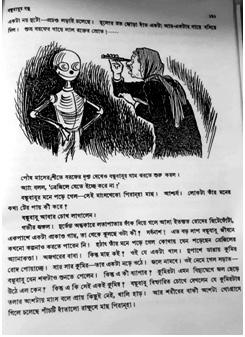
I came home, but the controversy surrounding E.T. stayed with me. I remembered Banku Babur Bondhu, a fiction I read as a boy in Sandesh magazine. Memories came back in droves – besides the story, didn’t some of the illustrations, drawn by Ray, closely match images from Spielberg’s E.T.? I called my friend Pradeep in Kolkata, who is a curator of old Bengali magazines, and, within a very short time, he sent me images of Banku Babur Bondhu from his collection of old Sandesh magazines via WhatsApp. Similarities are striking.
I decided to dig deeper. Satyajit Ray, a prolific writer, had a penchant for the abnormal, the paranormal, and the surreal. Banku Babur Bondhu was among his first published works in this genre. Banku Babu, a schoolteacher in a village in Bengal, chanced upon a strange creature in a remote area in the middle of the night. This creature befriended Banku Babu, and told him that it was from outer space, and soon left in its eerily lit, orb-like spacecraft. This story appeared in the 10th issue of the first year of the Bengali magazine Sandesh in February 1962 with illustrations by Ray.1
Satyajit Ray wrote many stories in the paranormal genre, but he was confident that he had something spe-
cial in Banku Babur Bondhu. In 1967, he wrote a screenplay in English titled “The Alien,” with a boy, Haba, and a space alien, Ang, as the central characters. Columbia Pictures agreed to produce a film based on this story as an Indo-US joint venture with Ray as director and Marlon Brando and Peter Sellers playing the lead roles. However, when Ray arrived in Hollywood, he learned, to his utter surprise and dismay, that the story was copyrighted to Michael Wilson, Ray’s representative there as a cowriter, and that Columbia refused to produce the film. Attempts were made in the 1970s and early 80s to reopen the case without luck. And, in 1982, E.T., the Extra-Terrestrial - the film that broke all box-office records - was released.
A quick search on the internet and AI (Gemini) brought out a truckload of information. Similarities between E.T. and The Alien (unproduced) are strikingly evident. Although the settings were different, rural Bengal and suburban America, the central characters, Haba and Eliot, are innocent and lonely boys who chanced upon these creatures from outer space. Similarities between these creatures, Ang, and E.T. are even more striking in their looks and nature. Satyajit Ray described the outer-space creature in the screenplay of The Alien as ‘a cross between a gnome and a famished refugee child: large head, spindly limbs, a lean torso.’2,3 Both creatures were gentle and were not particularly interested in staying in the man’s world, hence the famous line, ‘E.T., go home.’ Even a scene, similar to E.T., where Eliot is riding a bike with E.T., speeding through the air to escape capture, is described in The Alien screenplay.
It is noteworthy that Ray, an exceptionally talented artist, wrote screenplays for all his films in longhand, along with detailed sketches of all the characters, situations, and scenarios. It is also important to note that the copies (mimeographs) of the screenplay for The Alien were freely available among the film-making community in Hollywood from the late 1960s.
So, the question arises - was it a theft of grand order? I leave this question for the reader to mull over and decide. I remembered what the man at the Midas store, a genuine film buff, told me- “these kinds of things are not unheard of in the film industry.”
References:
1Sandesh, An illustrated magazine for children, Year 1, Issue 10, February 1962, Calcutta
2https://en.wikipedia.org/ wiki/The_Alien_(unproduced_ film)#Production
3https://timesofindia.indiatimes. com/close-encounters-with-native-et-finally-
June–December, 2025
Reported by Debajyoti Chatterji (New Jersey)
During the reporting period, Writers Club members met three times over Zoom.
Zoom continues to be the meeting mode preferred by the majority of members for two reasons: (a) avoiding tiring and time-consuming travel to Ananda Mandir on Friday evenings, and (b) allowing members from out-ofstate locations to participate.
The first meeting of the reporting period took place on Friday, June 20. Four members presented their writings and received constructive feedback from their peers: Ranajit Mitra began the session with a short story (The Girl from Ipanema), after explaining that it was the first part of a planned three-part novella. Rahul Ray followed with two poems, one on Alzheimer’s patients and the other on the crucifixion of Jesus. Next on the agenda was a poem by Adrita Mukhopadhyay – a powerful commentary on current political and social situations. The final presentation by Soumi Jana was an intense poem (Tabula Rasa), lamenting the death of a child in Gaza,
The meeting on Friday, September 12, attracted eighteen participants (including three first-timers). The session began with Ranajit Mitra presenting a personal reflection (Sunday by the Lake), followed by two poems. Adrita Mukhopadhyay then celebrated the 100th anniversary of Rabindranath Tagore’s famous play, Rakta Karabi, by presenting an imaginary dialogue between Nandini and Ranjan. Next was an impressive short story (The English Teacher) presented by Anandita Chowdhury. Urmi Dutta Gupta followed with the first part of a two-part story and promised to present the second part at a future meeting. Tathagata Ghosh ended the session by sharing a forceful poem, titled “Agency”.
The final meeting of the reporting period took place on Friday, October 24. The session followed our “open format”, so the presenters were able to read their writings in any form, from poetry to short story to essays and narratives. Six members presented their writings: Reena Nag (a humorous narrative on her attempt to buy an undergarment from Amazon for an elderly relative), Arup Sengupta (two poems, one on kite flying and rich with symbolism, and another on Rabindranath Tagore), Banani Mukherjee (performed a srutinatok, written by her), Tripti Ray (a well-researched essay on gamchha, the inexpensive substitute for towels in India and many other countries), Shamita Das Dasgupta (a short story with an intriguing plot) and Rahul Ray (a narrative about a chance encounter with a fan of Satyajit Ray in an auto service shop).
By Basab Dasgupta (California)
Since childhood, I have had a light, humorous side. I like to tell jokes, pull pranks, and make up absurd stories just to get a laugh. However, I kept this aspect of my personality under wraps because I did not want to be known as the class clown.
After I came to the US, I loved the Americans’ sense of humor. If you are talking to any American about anything at any time, it seems that they invariably interject some humor in the conversation. Even on formal occasions, such as a political speech or a conference presentation, the speaker always starts with a joke.
I soon became addicted to situation comedies (sitcoms) and Johnny Carson’s monologues on American TV. I have followed most of the sitcoms in the US throughout my life, starting with “I Love Lucy”. These sitcoms feature cleverly imagined events at the core of each episode and witty dialogue, thanks to creative writers, whichmakesthem so entertaining.
However, my favorite sitcom of all time was “Seinfeld,” a self-proclaimed “show about nothing.” Unlike other shows with a specific plot for each episode, Seinfeld revolved around mundane, trivial stuff from the daily lives of four friends (Jerry, George, Kramer and Elaine) living in New York City. Each episode was a random collection of meaningless encounters for the characters across different, disconnected topics. There was no central plot, and typically multiple storylines were interwoven.
The show was conceived by the comedians Larry David and Jerry Seinfeld. The audience loved it because they could identify with the circumstances and behavior of all the characters, whether it was a long wait to be seated at a Chinese restaurant or being embarrassed by “shrinkage” after a dip in cold water.
Plots in other sitcoms seem to be somewhat superficial, as these do not happen in real life and are written to provoke slapstick humor. I especially liked a clip from one of the Seinfeld episodes where George and Jerry were trying to sell their script for a TV show to an NBC executive named Russell as “a show about nothing”. Russell was flabbergasted, “What do you mean by nothing? It must be about something”. George asked him, “Tell me what you did this morning”. Russell responded, “I got up, had breakfast and came to work”. George enthusiastically told him, “There is a show right there”. Russell was still skeptical, “Why
would anyone watch it?” George said with equal enthusiasm, “Because it is on TV”.
On a separate front, I also like reading the opinion pieces in newspapers and analytical essays in magazines like “The Atlantic” and “New Yorker”. It intrigues me to see how the same set of events in our world can be viewed in different ways by different people. Sometimes I even find some rationale in the views I do not necessarily agree with. I do not find inconsistency in my dual interest in comedy and opinion pieces. Comedy is, after all, a funny way of telling a viewpoint that an opinion piece tells seriously.
Sometimes I read just to keep up with my scholarly friends who regularly read “The New York Times” and “The Washington Post” and forward interesting articles to me. The satisfaction of sharing my opinion with others has rubbed off on me. Since my retirement, I have become a prolific author of such pieces, and many of my essays have been published in newspapers, including the Statesman in India.
However, I find it surprising that opinion pieces written by most authors are rather serious, dealing with one major crisis or another: war, climate change, economic downturn, diseases, political instability and so on. It almost seems that the writers love to project gloom and doom. Indian writers seem to be especially gleeful when writing about the demise of Pakistan. I do not mind reading about gloom and doom if the pieces are written by an expert providing a valid analysis. But most often, unknown authors like me write them, and the essays lack context or justification.
It surprises me that so many people read these when we are already getting enough depressing information from the regular news. I have seldom seen humorous pieces focused on the lighter side of life. Even when there is a light-hearted piece, the editor puts it under a special category like “Laughter is the best medicine” or “Comedy Corner”.
The authors seem to use the opinion pieces as showcases of their knowledge, intellectual capacity and command of the English language. I also do not know whether they are writing what is really on their minds or whether their material has been filtered through the editors’ biased lens. This is especially true in the current hyperpartisan political environment. I also wonder how many authors obtain their material from
sources such as Wikipedia or the internet.
I believe that such an essay or opinion piece should neither be a research paper nor be artificially constructed from others’ ideas. An opinion should be candid, direct and based on some personal involvement to make it sound passionate and sincere. When an author writes about the misery of soldiers on a battlefield or starvation in a poor country, the reader immediately sees that he is not writing from his personal experience. Opinion pieces should be thought-provoking and/ or entertaining,as they can spark social conversations and help sell more newspapers. I firmly believe that humorous opinion pieces and satires should be promoted by the editors just as strongly as a serious, wellresearched analysis.
As in Seinfeld episodes, I would also like to see unexpected twists and controversies in an opinion piece rather than a straightforward narrative. Once, an experienced author gave me the following advice on writing a good essay: “First tell the readers what you are going to tell them, then tell them, and finally tell them what you just told them.” I did not follow his advice because it seemed to be a prescription for a repetitive essay that could appear dull. I would not hesitate to offer more than one opinion, perhaps in the form of a dialogue, to keep the reader interested and entertained. If it is a flat repetitive narrative, he might as well read the actual news.
I pause here. Can what I have written so far qualify as an “opinion piece about nothing” in the same spirit as George? It will be an opinion piece about opinion pieces, like Kramer’s idea in one of the Seinfeld episodes about a coffee table book about coffee tables; or George and Jerry lobbying for the “Seinfeld” show to NBC in another Seinfeld episode. Will any editor of a newsletter or magazine publish it? Well, there is only one way to find out; I am going to submit the manuscript to the editors of Ananda Sangbad who seem to like my writings. If you are reading this, then you know that my gamble has paid off. As George said, the only reason you are reading it is that it is in a popular newsletter like Ananda Sangbad. On a more optimistic front, perhaps I am on the brink of starting a new genre in essays which would become very enjoyable to the readers.
Reported by Pradip R. Das (New Jersey)
On behalf of all its members, Garden State Cultural Association wishes a joyous and Happy New Year to all the readers of Ananda Sangbad.
Durga Puja, October 4 & 5, 2025
For the first time in many years, GSCA celebrated Durga Puja at a different venue, namely East Windsor Middle School. Every aspect of the two days’ festivities: the reception, the decoration, the magnificent puja itself with eloquent mantras, anjali& prasad, and puja concluding dhunuchinaach contest to the rhythm of the dhaak, a sankhbajano contest and sindurkhela, dinner, talent & youth activities and the evening’s cultural on-stage programs earned much appreciation and kudos. Stalls by jewelers, vendors of sarees and other clothing items, insurance companies, and food stalls drew onlookers and buyers throughout the day. They created a mela-like atmosphere to enhance the puja. On-stage presentations were also made on behalf of GSCA’s philanthropy committee and the Women’s Forum.
Cultural Program Synopsis: Saturday, October 4
A musical in-house program, “Tobu Bihongo, Ore Bihongo Mor”, a metaphorical representation of “bird” in songs and poems, a timeless symbol of freedom, hope, longing, and transcendence, drew wide applause.
A drama called “Hillolito Karaoke”, a light comedy written by Sudipta Bhawmik and directed by Aparajita Das, had the audience rolling on the floor.
A vocal performance by Shreyansh Singh, a 10-year-old student of Hindustani classical music under the tutelage of Mitali Bhawmik, captivated the audiencewith his mellifluous voice.
A unique audio drama, “Striyascharitram”, showed with a mixture of humor and satire how unconscious gender bias crept into our classic literature, depicting women as symbols of sacrifice, endurance and virtue, but rarely giving them the freedom to flourish their own personality.
The evening’s leading artist was the renowned Bengali singerJayati Chakraborty. It was a treat to hear her live on-stage performance. Her voice is blessed with a rare gift; her renditions have earned widespread acclaim and
mesmerized audiences globally. With an impressive collection of over ten solo albums and numerous other albums, her dedication and passion for music have earned her wide acclaim. The audience had a memorable experience during hertwo-hour performance.
Cultural Program Synop-
sis: Sunday, October 5
Bengali Band “Ghore Ferar Gaan” is a group of local musicians who performold-time, nostalgic songs.
Nrityalina Dance Academy made a dance presentation. This institution, founded and guided by Paromita Chakravarty,is dedicated to nurturing young talents and inspiring creativity through the timeless traditions of Indian classical dance. A remarkable confluence of culture, expression and joy was displayed on stage.
An audio Drama, or “shruti natok”, “Krishnakaya”, presented the story of the courage and grit of a dark-skinned girl. In today’s society, educated individuals denounce caste discrimination. Still, when it comes to marriageswithin their own family, fair and beautiful partners are often sought, perpetuatinga long-standing bias. The protagonist girl, Krishna, boldly questions and challenges this bias in Subhasish Mukherjee’s story “Krishnakaya”.
Our final attraction for the evening waslive performances by Shreyasi Bhattacharjee and Avishek Sinha.
GSCA’s objective of bringing communities together and promoting goodwill and brotherhood for all through such social gatherings was fully met.
Formed in 2021 to serve women and the community, the following were some of the activities for 2025:
Fight Against Poverty : The Women’s Forum donated and packed 1000 meals for children and families facing hunger worldwide. Their objective of exploring how to make the world a better place by extending a helping hand was, to some extent, achieved.
Health and wellness webinar: “How to detect and prevent premature heart attacks in Indians”. Heart disease remains one of the prime causes of mortality worldwide. Indians in particular are
susceptible to premature heart attacks due to genetic predispositions, lifestyle factors, and dietary habits. The webinar highlighted this vital health concern within our community and provided valuable insights into early detection and prevention strategies.
Senior care Services: Lack of transportation and social isolation are problems faced by seniors, which the women’s forum members addressed. Transportation to and from the doctor’s office, 2. Grocery shopping help, 3. Spending time with seniors at their homes with home-cooked meals, adda, and games.
Fundraising: Forum members prepared homemade Bengali sweets to sell at GSCA’s annual picnic in August. Members also donated new and gently used sarees and costume jewelry for the cause.
GSCA provides financial support to meritorious students pursuing undergraduate and graduate studies through the GSCA Talented Student Sponsorship Program (TSS) to create a brighter future for many individuals and their families.To date, GSCA has supported 46 students since 2012, both in India and the US.With over 12 years of service, GSCA’s philanthropic impact continues to grow through generous donations from members, patrons, and well-wishers.
Five of the seven Board positions being vacated on January 1, 2026, were filled by members’ secretballot election in November/ December 2024. However, since there were only five nominees, no election was required. The new board takes office on January 1, 2026, with Archita Roy as the new Chairperson.GSCA congratulates the new board and looks forward to a successful and enjoyable year.
GSCA Holiday Party, December 6, 2025
The annual fun-filled extravaganza will take place at St. Stephen’s Church in South Plainfield, NJ this year. This is a dinner event for both members and non-members, and cultural programs to entertain all attendees. (Details will be provided in the April 2026 issue.)
Reported by Arundhati Sanyal
Maitree Association of America (MAA) celebrated Durga Puja on the weekend of October 11 and 12 at the East Brunswick Hammarskjold School, with approximately 700 attendees. The famous musicians Lopamudra Mitra and Joy Sarkar from Kolkata were the main attractions on Saturday, and Albert Kabo (Champion of the 2023 Sa Re Ga Ma competition) with a team of musicians were the leading artists on Sunday. Several programs by local artists were also captivating.
Attendees participated in puja and pushpanjali on both days, and prasad was served. They also enjoyed dinners which had sumptuous menus.Maitree Youth Committee volunteers providedall necessary support for this significant event.
There were other events: the “Next Gen Banga” youth group presented a workshop on Mahisashur Mardini for children. And there were Sankhadhwani and Dhunuchi dance contests. This two-day event attracted exhibitors selling collections of clothing, jewelry, and handicrafts.
Lakshmi Puja was celebrated at Bharat Sevashram Sangha on October 18, with approximately 100 members and their families.
Maitree Team participated in the Quiz Contest organized by Kallol on November 15. There were more than a dozen teams from all over the world. To the credit of the Maitree team, they have moved to the final round,which will take place on December 13.
Maitree also made a generous donation to Elijah Promise of New Brunswick during the Federal Government shutdown in November. It will be used to provide food tounderprivileged members of the community.
Maitree Youth Committee is conducting a “Winter Coat Drive” for donations to local charitable institutions. They will also collect nonperishable food items during the Holidays and donate them to the South Brunswick Township Food Pantry.
Maitree Women’s Forum will donate a generous check at the Holiday Gathering on December 13 to “Manvi”, an organization that supports women in New Jersey.
For our Holiday Gathering on December 13, more than 100 people have registered, and we look forward to a wonderful time. Maitree is also planning for Saraswati Puja on February 7, 2026,at the Tagore Hall in Ananda Mandir.
(July – December, 2025)
Reported by Prabir Biswas (New Jersey)
In September, our youngest member, Amitabha Sen Gupta, passed away. It was sudden and shocking. He was well known and well-
| continue from page 16
just as Psyche had done, but fell to her death. Psyche did the same to the other sister, and she died too. So, Psyche moved on and finally found the place where Eros was staying.
Somehow, wordshad leaked that a mortal girl had broken Eros’ heart. So,Eros’ mother, Aphrodite, rushed to him to ask who the girl was, and He told her the truth. At first, Aphrodite was mad, but thenshe calmed down when she realized that Eros was hurt. A while later, Psyche reached Aphrodite’s house, and Aphrodite told her that if she completed Aphrodite’s challenges, she could see Eros.
Challenge 1: Aphrodite made her servants spill all types of grains and spices onto the floor, and Psyche was ordered to organize these before the day’s end. This was an impossible task, but she started anyway. Days earlier, when Psyche was looking for Aphrodite, she had come across the temple of Demeter, which was dirty. She had cleaned it and pleased Demeter. When Demeter heard about the challenge, she decided to help Psyche and asked some ants to assist her. With their assistance, Psyche completed the task before the day’s end. Aphrodite was sure that Psyche had cheated, so she gave Psycheonly a slight crust of bread for the next day’s breakfast.
Challenge 2: The next day, Psyche was tasked withcollecting wool from specific rams. It seemed easy, but Aphrodite did not mention that the rams had golden wool and would kill anyone who went near them. Just like Psyche had cleaned Demeter’s temple, she had also cleaned the shrine of Goddess Hera, and when Hera came
to know about Psyche’s challenge, she wanted to help her. So, Hera told reeds (it is like a grass) on the bank of a river to help Psyche. The reeds told Psyche, “If you go near those rams, they will kill you. But see that thorn bush they are rubbing their wool off. At noon, they will sleep, and you can get the wool from the bush. Also, Queen Hera sent me”. A grateful Psyche thanked the reeds and thanked Hera. Then she waited till noon, and when the rams were asleep, she gathered the wool. When she brought these to Aphrodite, she immediately gave her the next task.
Challenge 3: Psyche’s third challenge was to collect water from the top of a river or waterfall that was connected to the River Styx. It was a river that ran through the underworld, and people often swore unbreakable oaths on the river. Breaking their oathsalways resulted in severe punishment, but humans could not get water from the top. But Psyche went there anyway. Back at Aphrodite’s place, Eros had heard about Psyche and Aphrodite. He was too weak to do anything. So, he asked Zeus to help Psyche. Zeus sent an eagle (His symbol) to help Psyche. The eagle took a jar and filled it from the top and returned it to Psyche. When Psyche got back to Aphrodite, she couldn’t find a flaw, but she knew that Psyche had help. Butshe couldn’t deny that Psyche had completed the task.
You may think that Psyche’s trials would beover because everything came in a group of3, like three heads of Cerberus (the monstrous hound that guarded the gates of the underworld),or 3 Gorgons (mon-
strous sisters who could turn anyone into stone), or three fates (sisters who could cut the thread of life of every mortal being). Aphrodite either didn’t know or didn’t care, so she put Psyche to one last challenge. Challenge 4: Psychewas to go to the underworld and ask Persephone (the Goddess of spring) for beauty cream and get it before the day’s end. Eros overheard this too, but he was too weak to move, so he sent his consignees. Psyche climbed a tower to get a better view when she heard a voice, the voice of Eros. The tower spoke, “Psyche, it’s me, the tower. You need to go straight, and you will be able to enter the underworld, but a warning, my mom, Aphrodite, will try to distract you, but don’t get distracted”. Psyche had a feeling that Eros was trying to help her, and that gave her the courage to move on. She ignored all distractions and eventually approached Cerberus and gave him 1 of the 2 rice cakes she had.
I must add that most people who went to the underworld weretrained men. However, Psyche was never trained and was pregnant. When Psyche met Persephone, she wanted to kill her. But hearing her story, Persephone gave Psyche a box of beauty cream with a dire warning, “Do not open this, this is only for Aphrodite”. Psyche was returning to Aphrodite to give her the box. When she was almost there, she began to have doubts. In Greek mythology, all heroes have a fatal flaw, and Psyche’s fatal flaw was her insecurity. After all the trials, she was worn out and no longer as beautiful. So, she thought that Eros wouldn’t like her anymore. She opened the box of beauty cream. But
| continue from page 3
than facts. Attention is the prize, and insult is the shortcut. Freedom of speech is sacred. But it is not a license for verbal vandalism. Increasingly, it is invoked to justify the right to say anything, no matter how outrageous or harmful. Colker’s study of disability rights litigation shows how public insults are used to deflect attention from structural issues and weaken reform efforts. In one case, a journalist with a congenital condition was mocked by a political candidate during a rally. The media focused on the mockery, not the false claim about national security that triggered it. The insult hijacked the narrative.
We have built a culture where attention is the prize and provocation is the path. But trading insults does not just degrade our discourse. It corrodes our democracy. When outrage becomes the default, we lose the ability to deliberate, to compromise, to listen.
This is not just about politicians or influencers. It is about us. When we accept insult as argument, we teach the next generation that volume matters more than reason. When we reward provocation, we silence nuance. And when we confuse free speech with verbal warfare, we risk turning civic engagement into combat.Civility is not weakness. In a culture addicted to outrage, it is resistance.
Reclaiming the conversation means choosing depth over drama, substance over spectacle. It means asking not just what was said, but what was understood.
So how do we fix this?
Let us start with what we can control: how people learn to think, speak, and listen. Education may not erase insult culture overnight, but it is where resistance begins. Without media literacy, we are vulnerable to manipulation. Without
Persephone didn’t fill the box with beauty cream; instead filled it with stygian sleep. It is deadly to humans, but a God exposed to this would only get a coma. So, Psyche began to die. Eros could sense what was happening, so he flew to Psyche and healed her wound. He also flew to Zeus, the King of Gods, and explained the situation. Just then, Aphrodite walked in. Zeus called a vote, and Aphrodite was outvoted. Psyche became the Goddess of the human soul. Shewas also given butterfly wings. When
Psyche was going through this, she was pregnant. She eventually gave birth to Hedon, the Goddess of Pleasure. After all that Psyche had been through, she deserved a bit of pleasure in her life.
There are numerous Greek mythologies about heroes, many with different variations. So, you may read or hear a different version, but they usually have one thing in common. There isalways a hero (in this case, a heroine) or Gods and Goddesses.
Editor’s Note:Psyche and Eros have been the subjects of many famous paintings and sculptures. A few examples are: The Abduction of Psyche (Bouguereau, 1895), The Wedding Feast of Cupid and Psyche (Raphael, 1517), Psyche Revived by Cupid’s Kiss (Antonio Canova, 1787) (in Louvre Museum)
critical thinking, we fall for emotional bait. Without dialogue skills, we mistake shouting for debate.
Insult culture thrives in the absence of these tools. If citizens cannot recognize deflection, they become part of the distraction. That is why education matters—not as a cure, but as a counterweight. It is the difference between reacting and reflecting, between being provoked and being prepared.
Of course, education alone will not save us. We also need platform accountability, leadership modeling, and cultural shifts. But without education, we are left shouting into the void.
In the age of dueling, a misplaced word could cost you your life. Today, misplaced words cost us something subtler but no less vital: our capacity to listen, to deliberate, to change our minds. If we do not reclaim that capacity, we may find that the duel never really ended - it simply moved online.
| continue from page 13
loved within the Ananda Mandir Community. For my family, it was a personal loss. We knew Amitabha as our family friend for over thirty-five years. I always admired him for his interest in a variety of subjects and his unique style of presenting them to us. His absence will be deeply felt.
In 2025, six sessions were held. Five meetings were held via Zoom, and one was in person at the Ananda Mandir front building. Weather permitting, an in-person session is planned for December.
As usual, all sessions were filled with literary discussions, members’ presentations of their writing, humor, and current affairs. It is also worth mentioning that in the July Zoom session, we invited a guest speaker who talked about “Role of a Mechanical Engineer in Jewelry Making Process”. The presentation was highly engaging and drew the interest of all attendees. There were many queries and the speaker responded to them patiently.
All our virtual sessions start and end with songs presented by the attendees and these sessions were no exception.
Last January, during my trip to India, I made it a priority to visit the Dhauli Shanti Stupa near Bhubaneswar, Odisha. The stupa marks the spot of the Kalinga War and the subsequent conversion of the Emperor Ashoka to Buddhism. This visit sat high on my bucket list.
I left Kolkata on a very comfortable, air-conditioned train from the Howrah station. I sat glued to the window, staring at the quaint villages of South Bengal: thatched huts, small ponds surrounded by green shrubs, and the ever-present little children stopping their play to stare at the Vande Bharat Express whistling by.
Surprisingly, the view from the train window changed drastically as we entered Odisha. A broad highway was being built, adjacent and parallel to the railway tracks. Heavy earth movers and construction vehicles dotted the landscape. The latest technology was being implemented to build a highway through rural India. This was a totally new,unexpected view for me.
As we charged by the mile
upon mile of construction, the next rational thought of my engineering mind came into focus. Who are driving the heavy earth movers and planers in these villages? As we whizzed by, I spotted computer screens on the construction vehicles’ dashboards. Having left India more than 50 years ago, I still held that mindset. The sophisticated, computerized heavy machinery seemed to me a total mismatch in rural India.
What I saw at the Bhubaneshwar Train Station was another anomaly. A large poster depicted what the station’s main hall would look like when construction is completed. The architect’s rendering could just as well be the new Penn Station in Manhattan.
Fast forward to October of this year. My friend Rothin Banerjee from Chennai recommended that I read “The Day the Chariot Moved” by Subroto Bagchi. I took up my friend’s suggestion, and many of my questions about Odissa were answered.
Subroto Bagchi may be a familiar name to many of
you. He is the founder ofMindtree, the software giant. Previously, he served as the Chief Executive of Wipro’s Global R&D division.
The book The Day the Chariot Moved chronicles a lesserknown chapter of Subroto Bagchi’s life that, I believe, continuesto influence the lives of many people in Odisha. In fact, he has brought about a sea change in the lives of the rural population in Odisha.
The Bagchi family, through an intragenerational process, had moved from Bengal to Bihar and finally to Odisha. Subroto was born in Odisha and speaks the language fluently. He had attended a government school and university in the state. After dropping out of a master’s program at Utkal University, he worked as a lower-division clerk in the state government. In keeping up with the times and in seeking a better life for himself and his family, he jumped into the computer industry. He joined DCM as a management trainee.
Following a very successful career in the computer industry, Subroto planned on a life of writing and travel for himself and his wife. But that was not to be.
Subroto was invited to deliver a leadership lecture tosenior officials of the Odisha government. As chance would have it, Chief Minister Naveen Patnaik listened in through a live feed delivered to his office.
The chief minister was moved by his talk. Subroto was invited to serve as Chairman of the Odisha Skill Development Authority
Subroto had to wrestle with his deep misgivings about what might prove to be a foolhardy foray. Ultimately, he overcame his doubts and made his well-known crossover to begin working with the state government. He was afforded all the trappings of a cabinet minister, yet he settled for an annual salary of only Rs 1.
“Skill development…is truly about human development,” Subroto says, and the book really is a tale about India growing at the grassroots. Subroto traveled all over the state, to every district, to build a trust with people who had till recently been the ‘unheard from’ people.
The Day the Chariot Moved is a fast and excellent read. It is about the aspirations, achievements, failures, frustrations, and the eternal hope
that nestles in the hearts of ordinary people. This was not an easy leap. It was a fight every step of the way from old ways to a new world of possibilities. The book documents their escape from hardship and deprivation.
Trained local labor is available in Odisha. Thanks to the Odisha Skill Development Authority, thousands of midlevel skilled workers have received training at numerous polytechnics across the state. Within a generation, children of villagers and tribal people are working in modern plants, earning wages that have improved their lives and expectations. Their perceptions of themselves have improved. In fact, mid-level skilled labor from Odisha has earned a strong reputation in distant places such as Bangalore and Noida. They are in high demand. My questions regarding highway construction along the railway tracks or at the Bhubaneswar station were answered in this book. I am looking forward to my next trip to Odisha. I am confident I will see a beautiful highway along the railway tracks. I expect to alight from the train in Bhubaneshwar into a modern, first-world station.

Greek Mythology is full of ancient stories ranging from Gods like Apollo to heroes like Hercules and Psyche, who was indeed a brave woman. Let’s start with the gods. In Greek Mythology, the major gods were the 12 Olympians, whose pictures are shown below.
They all had equal power, but Zeus was the King.Demeter was the Goddess of harvest. In many depictions of the Olympians, you will see Demeter’s daughter, Persephone, sitting on her lap. Artemis was the Goddess of the moon and hunt, and Athena was the Goddess of wisdom and warfare. Aphrodite was the Goddess of love and Dionysus the God of wine. Hera was the Goddess of marriage and motherhood and the Queen of the Gods. Her husband, Zeus, was not only the king, but also the God of lightning. Poseidon was the God of the sea, and Hephaestus was the God of fire and blacksmiths. Apollo was the God of the sun, prophecy, music and he, along with his sister Artemis, was the God of the bow and arrow. Ares was the god of war, and Hermes was the God of travel, thieves, tricksters, and much more. He was also the herald of the gods.
But gods are one part of the Greek mythology; there are also many heroes.Most of them weremen who had been trained and, at times, were demigods (half-gods, halfhuman, meaning they were mortal). The well-known heroes are Hercules, Odysseus, Achilles, Jason and many others. We don’t often hear about women such as Atalanta (raised by a bear and killed a large boar), Cyrene (who did many things, such as pushing a lion), Otrera, and Psyche, who had no training and did not know how to fight (unlike Atalanta and Cyrene). I will describe Psyche’s remarkable journey.
Psyche was super gorgeous. Her parents were the king and queen of a Greek city. She had two older sisters, so there was no pressure to marry.In Greece, parents decidedwhom a girl would
By Aarohee Dhara (Age 10) (New Jersey)
marry, and the groom would provide gifts as compensation for marrying their daughter.
Psyche should have enjoyed the life of a baby princess,but she was terrific and not just human-level beautiful. She was so lovely that she couldn’t open her window without people applauding and throwing flowers at her. But she didn’t let it go to her head. She wished that she were a normal girl with normal looks. The older she became, the harder it became to maintain friendships. And her sisters? They were the worst. They pretended to be nice, but behind her back, they were horrible. In fact, Psyche was so beautiful and so intimidatingly gorgeous that no one offered to marry her. Psyche’s parents kept waiting for marriage offers to arrive, but they did not. Her sistersmarried wealthy kings from other towns. The townsfolk made a life-sized marble statue of Psyche in the center of
the city. People began saying that she was not even human but a god from Mount Olympus – a new and better Aphrodite. She tried to discourage this, but to little avail. She was smart and always said her prayers and left offerings at the temples for the gods. But soon people began visiting her rather than going to the temple of Aphrodite.
One day,Aphrodite looked down from Mount Olympus, expecting to see mortals praying for her and offering food, but it was empty. After some searching, she learned about Psyche. She called her son Eros and told him to find the girl and hit her with an arrow to make her fall in love with the most horrible and disgusting man in the world. So, Eros flew off with his wings to find her. He found her, but he himself fell in love with her.
Back in the palace,Psyche’s father had just returned from the Oracle of Delphi. The Oracle had said that she
would marry such a nonmortal monster that even the gods would fear. The verdict was that she had to jump off a rock dressed in funeral clothes. So, she got ready and jumped. But instead of falling and crashing to the ground, she was caught by Zephyrus, the god of the west wind, and he brought Psyche to a mansion. It was huge with amazing closets full of gold, emeralds, and rubies. She also met her invisible servants.
Finally, her husband arrived after dark. He seemed nice and lived happily for a while, but she could never learn her husband’s name or look at him. Psyche missed her family, but her husband wouldn’t let them come; eventually, she convinced him. Also, she was pregnant at this time. Her sisters came. At first, they were happy to see her alive, but thenthey became jealous and returned home and lied to their parents that Psyche was dead. After a short period, the par-
ents died of sadness.The sisters returned to Psyche, and finally She told them everything. The sisters convinced her to observe her husband while he was asleep. And she did and realized that her husband was Eros. At this moment, Eros woke up, and a drop of hot oil fell on his shoulder.“Wow,” he screamed, then flew away, telling Psyche, “You foolish Psyche, I warned you. I disobeyed my mother for you, and look at what you have done.”
As Eros spread his wings and flew away, leaving Psyche behind, the palace started to crumble. Psyche was utterlyheartbroken. She was pregnant and all alone. Then Psyche found her two sisters and told them everything. Ultimately, she said that Eros called one of her sisters by name and statedthat he wanted to marry her. So, the sister ran to the rock and jumped,