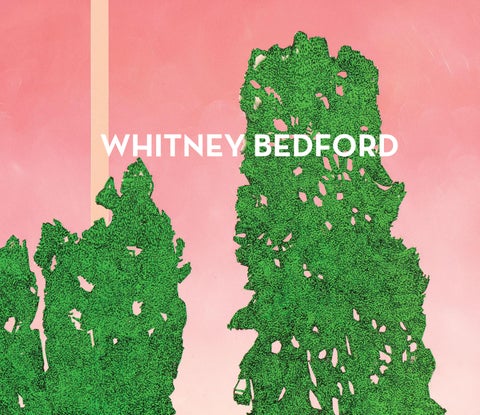
WHITNEY BEDFORD


WHITNEY BEDFORD’S RELOCATIONS
By Barry Schwabsky
The works of Whitney Bedford’s that I’d seen in person before undertaking this essay were seascapes, o en featuring sailing ships tossed about on crashing waves. While the vessels themselves were depicted with an almost illustrational concision, the stormy weather was mainly a ma er of nondescriptive mark making, reminiscent of Abstract Expressionism or Color Field painting, as well as more recent (and more overtly reflexive or systematic) modes of abstraction. In the wake of a somewhat older generation of painters, such as Karen Kilimnik and Elizabeth Peyton, Bedford seemed bent on reclaiming imagery that one might have thought was fatally mired in kitsch and, by strategically detaching the “what” and the “how” of the painting (i.e., the subject and style), investing it with new energy.
Bedford succeeded in doing this, in the first place, because her paint handling and dra smanship were equal to the task—a ma er not only of skill but of sensitivity and daring. More than that, the paintings worked because her parallax view of subject and style, and her evident deployment of them in a dynamically critical relationship to each other, allowed her to eschew the manipulative emotionality of kitsch without eschewing feeling itself, while her analytical fascination with her material ensured that irony never curdled into superciliousness or sarcasm.
I knew, thanks to the internet, that over the last decade or so Bedford had turned from sea to dry land for her imagery—that landscape had become a primary subject. What I hadn’t realized until delving into her website was that she has explored many other
genres over the years, including what might be called historical portraiture (for example, a series of 2007 works depicting the renowned early twentieth century escape artist and debunker of the occult Harry Houdini) and still life (in 2012, a group of paintings of art books). In 2013–14, there was a group of works that, at least in reproduction, I read as abstract, all titled either Love Le er or Lovenote. This is all to say that while Bedford has pursued certain subjects in a persistent way for many years—she made some seascapes as recently as 2018, some fi een years a er she first took up the genre—she is not a specialist or a dogmatic exponent of any one type of painting. On the contrary, she is, you might say, a painter of painting, one who explores the full complexity of the art (including its history) by encompassing as many of its internal di#erences or disparities as possible. She’s a painter for whom both subject ma er and style are essentially vehicles for this exploration, rather than ends in themselves.
Bedford’s recent “Veduta” paintings share a three-layered structure that is clear and readily described, though the e#ects the artist produces within it are varied and sometimes disorienting. Straight, monochromatic lines divide the canvas into three, or sometimes four, zones of unequal size, their geometry implying an interior space with a corner, or sometimes two corners. The zone at the bo om of the canvas is painted in a di#erent single color, opaque and uninflected: a floor plane. Geometrically, the plane appears to be a schematic representation in the perspective of an architectural interior—in short, a room. But instead of walls, the remaining two or three sections of the rectangle are occupied by a landscape—or rather, by a landscape painting, for what one sees is not a view o# into a distance as though one were looking out from a room with glass walls. The landscape image, rendered in a di#erent, historically specific style in each painting, has been made synonymous with the plane of the painting (and not with the implied planes of the imagined “walls”). And finally—and perhaps most puzzling—each painting includes a second representation of “nature,” though in a distinctly abstract way. Each painting
also includes silhoue ed images—again monochromatic though o en with added linear markings—of trees or shrubs. In some cases, these—unlike the more elaborate landscape imagery—do follow the angled perspectival planes of the imaginary room’s walls. In others, they parallel the plane of the painting surface itself, in which case, intersecting the bo om of the canvas, they represent a plane between the viewer and everything else seen in the painting—an extreme foreground.
What this cursory structural description should make clear is that these paintings are concerned with how multiple perspectives or viewpoints can be coherently maintained by a single complex or synthetic image (and implicitly, by a single consciousness). It’s no accident that, here, “perspective” and “viewpoint” are words that have both very general meanings (a itude, a way of looking at things) and quite specific meanings having to do with image construction (respectively, the linear construction of representations of solid objects so as to convey their dimensionality and position in space, and the particular position in relation to which such three-dimensional representations make sense). This congruence between two dimensions of meaning should remind us that seeing has always been a metonymy for knowing, and that picturing corresponds with the artifice of giving what one knows a stable and communicable structure.
Remember the opening words of Aristotle’s Metaphysics:
All men by nature desire to know. An indication of this is the delight we take in our senses; for even apart from their usefulness they are loved for themselves; and above all others the sense of sight. For not only with a view to action, but even when we are not going to do anything, we prefer seeing (one might say) to everything else. The reason is that this, most of all the senses, makes us know and brings to light many di#erences between things.1
Throughout the last century, it’s true, there were concerted e#orts on the part of many thinkers to dismantle or at least complicate the equation between seeing and knowing.2 But the result has never been to eliminate the connection. Exposing its intricacies, ambiguities, and obscurities has mainly served to render it more fascinating. Paintings such as Bedford’s are prime examples of how complexity and contradiction—to borrow the famous phrase with which Robert Venturi launched, arguably, the postmodern sensibility in architecture and beyond—can fuel a curious kind of cognitive and perceptual bemusement that, at least to certain sensibilities, a#ords a pleasure more intense than simpler and more evidently self-consistent representations can a#ord. That is because it is a pleasure founded on a fuller grasp of the complexity of things as they are than an apparently straightforward picture usually gives us.
Part of any understanding of the world’s complexity is a sense of the equivocal nature of one’s own relationship to it. We look at the world as if from outside it—as if it were o#ering itself to our view like a picture—even though we know very well that we are not outside it but within, and that it surrounds us with things seen and unseen, seeable and unseeable. And there’s much more of the unseen and unseeable than of the seen or the seeable. But knowing the limitations of knowledge is in itself a valuable form of knowledge; likewise, so is seeing how one form of knowledge—one form of picturing—can be nested inside others or can contain them in turn.
When did it become possible and interesting for a painter to represent other painters’ styles of painting in his or her own paintings? Maybe it began with Francis Picabia. But he was a painter of corrosive humor, one who gloried in subverting his sources. In Bedford’s paintings, I see the citations of Pierre Bonnard or Paul Gauguin, Milton Avery or Charles Burchfield as neither parodic nor reverent, neither nostalgic nor critical. And they are not copies, but free inventions of Bedford’s, albeit inventions based on existing images.
They remind us, however, that the apparently free-flowing nature of vision out in the open is always implicitly contained by an architecture that is of a pictorial construct conceived with its implicit architectural location in mind. I am tempted to borrow a term from literary theory and call them imitations—as long as this word is understood in its proper sense: “Imitation depends on a relocation of authorial and textual models, and it seeks to create not replicas but counterparts responsive to changed historical contexts.”3
To appreciate Bedford’s “Veduta” paintings, it is not necessary to compare them against their sources. But doing so, I’ve found, does enable a deeper appreciation of how, precisely, her relocation of existing painting strategies enables a dialectical viewpoint on them, one that sees them both as distant—products and symptoms of other times—and as full of possibility for the present.
Barry Schwabsky is the art critic for The Nation and co-editor of international reviews for Artforum His recent books include Landscape Painting Now: From Pop Abstraction to New Romanticism (New York: D.A.P., 2019) and The Observer Effect: On Contemporary Painting (Berlin: Sternberg Press, 2020). Forthcoming is his fourth book of poetry, Feelings of And (New York: Black Square Editions, 2021).
Endnotes
1. Aristotle, Metaphysics, translated by W.D. Ross, h p://classics.mit.edu/Aristotle/metaphysics.1.i.html.
2. For an account of some modern critiques of the dominance of vision in western epistemology, see Martin Jay, Downcast Eyes: The Denigration of Vision in Twentieth-Century French Thought (Berkeley: University of California Press, 1993).
3. R.R. Edwards, “Imitation,” The Princeton Encyclopedia of Poetry and Poetics, fourth edition (Princeton: Princeton University Press, 2021), p. 679.
24 3⁄8 x 31 1⁄2 inches
61.9 x 80 cm
Veduta (Avery Tree), 2020
Ink and oil on linen on hybrid panel

Ink and oil on linen on hybrid panel
45 x 35 inches
114.3 x 88.9 cm
Veduta (Amiet Baumgarten), 2021

oil
18 x 24 inches
45.7 x 61 cm
Veduta (Bonnard Normandy), 2021
Ink and
on linen on hybrid panel

Ink and oil
79 1⁄2 x 100 inches
201.9 x 254 cm
Veduta (Bonnard Summer), 2021
on linen on hybrid panel

18 x 24 inches
45.7 x 61 cm
Veduta (Bruegel), 2021
Ink and oil on linen on hybrid panel

Ink and oil on linen on hybrid panel
32 1⁄2 x 39 3⁄4 inches
82.6 x 101 cm
Veduta (Burchfield Dream), 2021

Ink and oil on linen on hybrid panel
72 x 120 inches
182.9 x 304.8 cm
Veduta (Friedrich Summer), 2021

Ink and oil on linen on hybrid panel
21 1⁄4 x 29 7⁄8 inches
54 x 75.9 cm
Veduta (de Stael Landscape), 2021

Ink and oil on linen on hybrid panel
28 1⁄2 x 36 inches
72.4 x 91.4 cm
Veduta (Gauguin Coming and Going), 2021

oil on linen on hybrid panel
32 x 40 inches
81.3 x 101.6 cm
Veduta (Matisse Bois), 2021
Ink and

Ink and oil on linen on hybrid panel
26 x 35 inches
66 x 88.9 cm
Veduta (Munch Field), 2021

59 x 46 inches
149.9 x 116.8 cm
Veduta (Rothko), 2021
Ink and oil on linen on hybrid panel

oil
31 x 49 inches
78.7 x 124.5 cm
Veduta (Rousseau Spring), 2021
Ink and
on linen on hybrid panel

22 x 26 inches
55.9 x 66 cm
Veduta (Storm), 2021
Ink and oil on linen on hybrid panel

WHITNEY BEDFORD
Born in Baltimore, MD in 1976
Lives and works in Los Angeles, CA
EDUCATION
2003
MFA, University of California, Los Angeles, Los Angeles, CA
2000
Fulbright Visiting Artist under Professor Wolfgang Petrick, Hochschule der Künste, Berlin, Germany
1998
BA, Rhode Island School of Design, Providence, RI
RISD European Honors Program, Palazzo Cenci, Rome, Italy
1996
Pont-Aven School of Art, Pont-Aven, France
Edinburgh College of Art, Edinburgh, Scotland
1993
Maryland Institute College of Art, Baltimore, MD
SOLO EXHIBITIONS
2021
Miles McEnery Gallery, New York, NY
“Whitney Bedford: Veduta (Vuillard Vineyard),” Vielme er, Los Angeles, CA
2020
“Whitney Bedford: Reflections on the Anthropocene,” Vielme er, Los Angeles, CA
“Nevertheless…” (online exhibition), Vielme er Los Angeles, Los Angeles, CA
“Nevertheless…” (online exhibition), Carrie Secrist Gallery, Chicago, IL
“Nevertheless…” (online exhibition), Starkwhite, Auckland, New Zealand
“Whitney Bedford: Reflections on the Anthropocene,” Vielme er Los Angeles, Los Angeles, CA
2018
“Numinous,” Carrie Secrist Gallery, Chicago, IL
“Bohemia,” Starkwhite, Auckland, New Zealand
2017
“The Le Coast,” Susanne Vielme er Los Angeles Projects, Culver City, CA
“Bardo Parade,” Art: Concept, Paris, France
2016
“East of Eden,” Carrie Secrist, Chicago, IL
“Lost and Found,” Starkwhite, Auckland, New Zealand
2015
“Night and Day,” Taymour Grahne, New York, NY
“West of Eden,” Susanne Vielme er Los Angeles Projects, Culver City, CA
2014
Carrie Secrist Gallery, Chicago, IL
2013
“This for That,” Starkwhite, Auckland, New Zealand
2011
Susanne Vielme er Los Angeles Projects, Culver City, CA
2010
“Whitney Bedford (Here and There),” Starkwhite, Auckland, New Zealand
2009
Susanne Vielme er Los Angeles Projects, Los Angeles, CA
2008
Art: Concept, Paris, France
2007
“Whitney Bedford: The Escape Artist Series,” Cherry and Martin, Los Angeles, CA
2006
Art: Concept, Paris, France
2005
D’Amelio Terras, New York, NY
cherrydelosreyes, Los Angeles, CA
2004
Art: Concept, Paris, France
2000
Hôtel de Ville, Biot, France
1999
The German-American Fulbright Commission, Berlin, Germany
1998
BEB Gallery, Providence, RI
GROUP EXHIBITIONS
2020
“Do You Think It Needs A Cloud?,” Miles McEnery Gallery, New York, NY
“Slippery Painting,” Starkwhite, Auckland, New Zealand
“20 Years,” Vielme er Los Angeles, Los Angeles, CA
2019
“Shall we go, you and I while we can,” Carrie Secrist Gallery, Chicago, IL
“Kaleidoscope,” Saatchi Gallery, London, United Kingdom
2018
“How They Ran,” Over the Influence, Los Angeles, CA
“Evolver,” LA Louver, Los Angeles, CA
“New on the Wall (N.O.W.),” Pizzuti Collection, Columbus, OH
“C’est Comme Vous Voulez – As You Like It,” Praz-Delavallade, Paris, France
2017
“Anniversary Show,” Carrie Secrist Gallery, Chicago, IL
2016
“A Verdant Summer,” Taymour Grahne Gallery, New York, NY
“Painting: A Transitive Space,” ST PAUL St Gallery, Auckland, New Zealand
2015
“La femme de trente ans,” Art: Concept, Paris, France
2014
“Lovers,” Starkwhite, Auckland, New Zealand
2013
“Summer Group Show,” Susanne Vielme er Los Angeles Projects, Culver City, CA
2012
“Facing the Sublime in Water, CA,” Armory Center for the Arts, Pasadena, CA
2011
“Everything Must Go” (organized by Jose Noe Suro and Eduardo Sarabia), Cerámica Suro, Guadalajara, Mexico and Casey Kaplan, New York, NY
2010
“The Gleaners: Works from the Sarah and Jim Taylor Collection,” Vicki Myhren Gallery, University of Denver, Denver, CO
“Five from LA,” Galerie Lelong, New York, NY
“Bagna Cauda,” Art: Concept, Paris, France
“Houdini: Art and Magic, 1919-1949,” The Jewish Museum, New York, NY; Skirball Cultural Center, Los Angeles, CA; Contemporary Jewish Museum, San Francisco, CA and Madison Museum of Contemporary Art, Madison, WI
2009
“This is Killing Me,” Massachuse s Museum of Contemporary Art, North Adams, MA
2007
“PX – Snow Falls in the Mountains” (curated by Jan Bryant), St. Paul’s Gallery, University of Auckland, Auckland, New Zealand
“Poker,” Galleria Monica de Cardenas, Milan, Italy
2006
“Melancholy in Contemporary Art,” Sommer Contemporary Art, Tel-Aviv, Israel
“Step Into Liquid,” Museum of Contemporary Art, Denver, CO
“Peindre des images,” Galerie de l’Ecole des Beaux-Arts de Quimper, France
2005
“CUT,” Susanne Vielme er Los Angeles Projects, Los Angeles, CA
“Evidence,” Inman Gallery, Houston, TX
“The Third Peak,” Art:Concept, Paris, France
“Rogue Wave,” LA Louver, Venice, CA
“Wunderkammer2,” Nina Menocal, Mexico City, Mexico
“Sad Songs,” University Galleries, Illinois State University, Normal, IL
“Project Room: A Show Without Works” (curated by Daniele Perra), Spazio Lima, Milan, Italy
2004
“summer group show,” cherrydelosreyes, Los Angeles, CA
“Carpet Bag and Cozyspace,” Healing Arts Gallery, New York, NY
“Rimbaud,” Palais des Beaux Arts, Brussels, Belgium
2003
Black Dragon Gallery, Los Angeles, CA
Track 16 Gallery, Los Angeles, CA
“MFA Exhibitions Show #1,” UCLA New Wight Gallery/Kinross, Los Angeles, CA
1998
“New England Connection,” Lanning Gallery, Columbus, OH
“Woods-Gerry Invitational Exhibition,” Woods-Gerry Gallery, Providence, RI
1997
“Inagurative Show,” Space 1026 Space, Philadelphia, PA
1996
“L’ecole Nouveau de Pont-Aven,” Hôtel de Ville, Pont-Aven, France
“Salon de Refuses,” Gallerie M, Pont-Aven, France
1995
“Common Threads,” Rites and Reasons Gallery, Providence, RI
TEACHING
2021
Adjunct Professor, Chapman University, Orange, CA
2020
Visiting Artist, University of Texas, Austin, TX
2019
Adjunct Professor, Chapman University, Orange, CA
Visiting Artist, University of Nevada, Last Vegas, NV
Adjunct Professor, University of California, Riverside, Riverside, CA
2017
Adjunct Professor, University of California, San Diego, San Diego, CA
2016
Visiting Artist, Otis College of Design, Los Angeles, CA
Adjunct Professor, University of California, San Diego, San Diego, CA
2014
Visiting Artist, University of California, Los Angeles, Los Angeles, CA
2012
Visiting Artist, Art Center College of Design, Pasadena, CA
AWARDS
2015
Pollock-Krasner Award, The Pollock-Krasner Foundation, New York, NY
2003
D’Arcy Hayman Endowment, University of California Los Angeles, Los Angeles, CA
2001
UCLA Hammer Museum Drawing Biennial Winner, University of California Los Angeles, Los Angeles, CA
2000
Fulbright Graduate Fellowship, Hoschule der Künste, Berlin, Germany
1999
Karl-Hofer Gesellscha Atelier, Künstlerwerksta Bahnhof Westend, Berlin, Germany
1997
Peggy Guggenheim Collection Studentship, Venice, Italy
Eric Decelle, Brussels, Belgium
Francois Pinault Collection, Paris, France
Gine e Moulin and Guillaume Houze Contemporary Art Collection, Paris, France
Hammer Museum, Los Angeles, CA
Colección Jumex, Mexico City, Mexico
Marciano Art Foundation, Los Angeles, CA
Pizzuti Collection, Columbus, OH
Rosa and Carlos de la Cruz, Miami, FL
Saatchi Gallery, London, United Kingdom
Published on the occasion of the exhibition
WHITNEY BEDFORD
9 September – 16 October 2021
Miles McEnery Gallery
520 West 21st Street
New York NY 10011
tel +1 212 445 0051 www.milesmcenery.com
Publication © 2021 Miles McEnery Gallery
All rights reserved Essay © 2021 Barry Schwabsky
Director of Publications
Anastasija Jevtovic, New York, NY
Photography by Evan Bedford, Los Angeles, CA
Color separations by Echelon, Santa Monica, CA
Catalogue designed by McCall Associates, New York, NY
ISBN: 978-1-949327-52-6
Cover: Veduta (Friedrich Summer), (detail), 2021