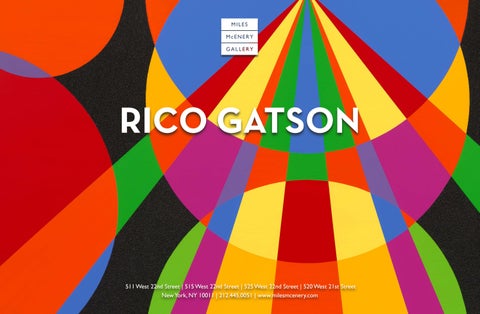
RICO GATSON (b. 1966 in Augusta, GA) received his Bachelor of Fine Arts from Bethel College in 1989 and his Master of Fine Arts from Yale School of Art in 1991.
Gatson has been the subject of recent solo exhibitions at the Riverside Art Museum, Riverside, CA; USF Contemporary Art Museum, Tampa, FL; Miles McEnery Gallery, New York, NY; Birmingham Museum of Art, Birmingham, AL; Children’s Museum of the Arts, New York, NY; Metropolitan Transportation Authority, New York, NY; Ronald Feldman Gallery, New York, NY; The Studio Museum in Harlem, New York, NY; Samsøñ Projects, Boston, MA; Studio 10, Brooklyn, NY; and the Wright Museum of Art, Beloit College, Beloit, WI.
His work has been included in group exhibitions at numerous international institutions including the Birmingham Museum of Art, Birmingham, AL; Brooklyn Museum of Art, Brooklyn, NY; Charles H. Wright Museum of African American History, Detroit, MI; Denver Art Museum, Denver, CO; Essl Museum, Vienna, Austria; Jewish Museum, New York, NY; Los Angeles County Museum of Art, Los Angeles, CA; Museo Nacional Centro de Arte Reina Sofía, Madrid, Spain; Museum moderner Kunst Stiftung Ludwig Wien, Vienna, Austria; New Museum of Contemporary Art, New York, NY; Santa Monica Museum of Art, Santa Monica, CA; Spelman College Museum of Fine Art, Atlanta, GA; The Studio Museum in Harlem, New York, NY; and La Vieille Charité, Marseille, France.
His work may be found in the collections of the Birmingham Museum of Art, Birmingham, AL; Cheekwood Museum of Art, Nashville, TN; Denver Art Museum, Denver, CO; Kemper Museum of Contemporary Art, Kansas City, MO; Los Angeles County Museum of Art, Los Angeles, CA; Malcolm X Institute, Wabash College, Crawfordsville, IN; Mead Art Museum, Amherst, MA; Minneapolis Institute of Arts, Minneapolis, MN; Nasher Museum of Art, Duke University, Durham, NC; National Museum of African American History and Culture, Washington, D.C.; North Dakota Museum of Art, Grand Forks, ND; Peter Norton Family Foundation, Santa Monica, CA; Smithsonian American Art Museum, Washington, D.C.; The Studio Museum in Harlem, New York, NY; and the Yale University Art Gallery, New Haven, CT.
He is the recipient of the Louis Comfort Tiffany Foundation Biennial Award for Visual Artists; Prized Pieces Video Award from the National Black Programming Consortium; Oil Bar Ltd. Award for Excellence in Sculpture from Yale School of Art; and The Pew Charitable Trusts Graduate Fellowship.
Gatson is also a faculty member at the School of Visual Arts and New York University, and a SoVA Anderson Lecturer at The Pennsylvania State University.
The artist lives and works in Brooklyn, NY.

RICO GATSON
Born in 1966 in Augusta, GA
Lives and works in Brooklyn, NY
EDUCATION
2013 Ginsberg Artist in Residence, Wright Museum of Art, Beloit College, Beloit, WI
1998 Artist Residency, Franconia Sculpture Park, Shafer, MN
1991 MFA, Yale University, New Haven, CT
1989 BFA, Bethel College, St. Paul, MN
SOLO EXHIBITIONS
2024 “Above and Below,” Miles McEnery Gallery, New York, NY
“Untitled (Collective Light Transfer),” Art at Amtrak, Penn Station, New York, NY
2023 “Icons,” Riverside Art Museum, Riverside, CA
“Visible Time,” USF Contemporary Art Museum, Tampa, FL
2022 “Spectral Visions,” Miles McEnery Gallery, New York, NY
“Wall to Wall,” Birmingham Museum of Art, Birmingham, AL
“Recent Work,” Scott Miller Projects, Birmingham, AL
2020 “Ghosts,” Miles McEnery Gallery, New York, NY
“Power Portraits,” Highpoint Center for Printmaking, Minneapolis, MN
2019 “Bridge Projects: You are Light,” Children’s Museum of the Arts, New York, NY
“Smelling the Wind,” Metropolitan Transportation Authority, New York, NY
2018
“My Eyes Have Seen,” Ronald Feldman Gallery, New York, NY
2017 “Rico Gatson: 2007-2017,” Studio Museum in Harlem, New York, NY
2016 “Power Lines,” Samsøñ Projects, Boston, MA
2014 “When She Speaks,” Studio 10, Brooklyn, NY
2013 “The Promise of Light,” Ronald Feldman Gallery, New York, NY
“2013 Ginsberg Artist in Residence,” Wright Museum of Art, Beloit College, Beloit, WI
2005 “Meditations on Race and Religion,” Olson Gallery, Bethel University, St. Paul, MN
2004 “History Lessons/Clandestine,” Ronald Feldman Gallery, New York, NY
2003 “Recent Works,” Franklin Art Works, Minneapolis, MN
GROUP EXHIBITIONS
2026 “Big Tent” (curated by Kevin Moore), FotoFocus, Cincinnati, OH
2025 “Interisland (New Paintings from New York & Hawai’i),” John Young Museum of Art, University of Hawai’i at M ā noa, Honolulu, HI
“Earthbound” (curated by Theresa Daddezio), DC Moore Gallery, New York, NY
2024 “All Bangers, All The Time: 25th Anniversary Exhibition,” Miles McEnery Gallery, New York, NY
“30th Anniversary,” Pierogi Gallery, New York, NY
“Vote,” Rudenstine Gallery, Harvard University, Cambridge, MA
2023 “The Alchemists” (curated by Seph Rodney and Donovan Johnson), Johnson Lowe Gallery, Atlanta, GA
“5 YEARS: An ART FOR CHANGE Survey,” ART FOR CHANGE in collaboration with Kravets Wehby Gallery, New York, NY
“Black American Portraits” (curated by Liz Andrews and Christine Y. Kim), Spelman College Museum of Fine Art, Atlanta, GA
“Poor People’s Art: A (Short) Visual History of Poverty in the United States,” USF Contemporary Art Museum,Tampa, FL
2022 “Rico Gatson & Cydne Jasmin Coleby,” Galerie Julien Cadet, Paris, France
“Color Code,” McEvoy Foundation for the Arts, San Francisco, CA
“Summer Drift,” Miles McEnery Gallery, New York, NY
“Light Play,” Birmingham Museum of Art, Birmingham, AL
“The Grid and the Curve,” JTT, New York, NY
“Pattern Recognition” (curated by Amy Lincoln), Sperone Westwater, New York, NY
“GEOMETRIES” (curated by Damien Davis), Sugar Hill Children’s Museum of Art & Storytelling, New York, NY
2011
“Three Trips Around the Block,” Exit Art, New York, NY
“History Lessons,” Suzanne Lemberg Usdan Gallery, Bennington College, Bennington, VT
2009 “Dark Matter,” Ronald Feldman Gallery, New York, NY
2008 “Black Magic/Black Power,” Steve Turner Contemporary, Los Angeles, CA
Pocket Utopia, Brooklyn, NY
Minneapolis College of Art and Design, Minneapolis, MN
2006 “African Fractals,” Cheekwood Museum of Art, Nashville, TN; traveled to Ronald Feldman Gallery, New York, NY
“Singing in Unison” (curated by Phong Bui), Rail Curatorial Projects, New York, NY
“Cosmic Geometries,” The Elizabeth Foundation for the Arts Project Space, New York, NY
2021 “Annotations & Improvisations” (curated by Kristen Becker), Miles McEnery Gallery, New York, NY
“Black American Portraits” (curated by Christine Y. Kim), Los Angeles County Museum of Art, Los Angeles, CA
“RE: REPRESENTATION,” Jonathan Ferrara Gallery, New Orleans, LA
“Sacred Spaces: Art and Spirituality at the Fourth Universalist Society in the City of New York,” Fourth Universalist Society in the City of New York, New York, NY
2020
“Recognition & Response: Rico Gatson & David Huffman,” Miles McEnery Gallery at The Armory Show, New York, NY
“Dialogues in African American Abstract Painting,” Duke Hall Gallery of Fine Art, James Madison
University, Harrisonburg, VA
“Visions and Nightmares,” Simone Subal Gallery, New York, NY
“Naked in Brooklyn,” Pierogi Gallery, Brooklyn, NY
“Wood Works: Raw, Cut, Carved, Covered,” Sperone Westwater, New York, NY
“Light” (curated by Rico Gatson), Miles McEnery Gallery, New York, NY
“Re:Growth: A Celebration of Art, Riverside Park and the New York Spirit” (curated by Karin Bravin), Riverside Park Conservancy, New York, NY
“True Lines,” Over the Influence, Los Angeles, CA
“All Things Bright and Beautiful,” Birmingham Museum of Art, Birmingham, AL
“We Fight to Build a Free World: An Exhibition by Jonathan Horowitz,” Jewish Museum, New York, NY
2019
“New Symphony of Time,” Mississippi Museum of Art, Jackson, MS
“Historicity,” Ochi Projects, Los Angeles, CA
“Summer 2019,” Ronald Feldman Gallery, New York, NY
“Rico Gatson and Baseera Khan: Free to Be,” Jenkins Johnson Projects, New York, NY
2018
“Win Sourced Scribes,” Mother Gallery, Brooklyn, NY
“Art + Activism: Drawing the Line,” Children’s Museum of Art, New York, NY
“Jazz and Love,” La Vieille Charité, Marseille, France
“The Art of Protest,” Arete Gallery, Brooklyn, NY
“Isness,” Morgan Lehman Gallery, New York, NY
“#UNLOAD: Guns in the Hands of Artists,” Walsh Gallery of the Fairfield University Art Museum, Fairfield, CT
“Accumulations: 5000 Years of Objects, Fictions, and Conversations,” Mead Art Museum, Amherst College, Amherst, MA
“Every Five Minutes,” Columbus State University, Columbus, GA
“Language Product,” Boston Arts Academy, Boston, MA
2015 “Devotion,” Catinca Tabacaru Gallery, New York, NY
“The Raft,” The Boiler, Pierogi Gallery, Brooklyn, NY
“When Artists Speak Truth...,” The 8th Floor, New York, NY
“All Killer No Filler,” Eric Firestone Gallery, East Hampton, NY
“Magic Objects” (curated by Rico Gatson), 99 Cent Plus Gallery, New York, NY
“Make Their Gold Teeth Ache,” Moberg Gallery, Des Moines, IA
“between a place and candy: new works in pattern + repetition + motif,” 1285 Avenue of the Americas Gallery, New York, NY
“Painting is Dead?!,” Figure One Gallery, University of Illinois, Champaign, IL
“RESPOND,” Smack Mellon, Brooklyn, NY
“Pay to Play,” ODETTA Gallery, Brooklyn, NY
2014 “CEMETARIUM” (presented by Regina Rex), Emerson Dorsch, Miami, FL
“Guns in the Hands of Artists,” Jonathan Ferrara Gallery, New Orleans, LA
“Pierogi XX: Twentieth Anniversary Exhibition,” Pierogi, Brooklyn, NY
“SEVEN/VIDEO,” The Boiler, Pierogi Gallery, Brooklyn, NY
2013 “15 Artists in Black & White,” Outlet Fine Arts, Brooklyn, NY
“The Ceiling Should Be Green,” P!, New York, NY
“American Beauty,” Susan Inglett Gallery, New York, NY
2012 “New. New York,” Essl Museum, Vienna, Austria
“Bigger Than Shadows,” Dodge Gallery, New York, NY
“Rico Gatson and Christ Larson,” Trinity Christian College, Palos Heights, IL
2017
“Identity Document,” Gallery Bergen, Bergen Community College, Paramus, NJ
“We the People,” Minnesota Museum of American Art, St. Paul, MN
“1967: Parallels in Black Art and Rebellion,” Charles H. Wright Museum of African American History, Detroit, MI
“Sharper Image,” Present Company, Brooklyn, NY
“Art on the Front Lines,” Ronald Feldman Gallery, New York, NY
“Spielplatz” (curated by William Corwin and David Goodman), Geary Contemporary, New York, NY
2016
“Moving Image,” The Tunnel, New York, NY
“Phantom,” OSMOS, New York, NY
“Jameco Exchange,” No Longer Empty, New York, NY
“Lyrical Color,” Pocket Utopia, Brooklyn, NY
“Paper Variables,” Dieu Donné, New York, NY
“Rico Gatson and Angela Dufresne,” Barbara Walters Gallery, Sarah Lawrence College, Bronxville, NY
“Every Exit is an Entrance: 30 Years of Exit Art,” Exit Art, New York, NY
“The Bearden Project,” Studio Museum in Harlem, New York, NY
“What I Know” (curated by Jason Andrew), New York Center for Art and Media Studies, New York, NY
2011 “Per-son-age,” Famous Accountants Gallery, Brooklyn, NY
“Taking Shape,” Ronald Feldman Gallery, New York, NY
“It’s All in the Peripherals,” Mellwood Art Center, Louisville, KY
2010
2009
“Blink! Light, Sound and the Moving Image,” Denver Art Museum, Denver, CO
“Geometric Days,” Exit Art, New York, NY
“En-Garde II: omg,” Ronald Feldman Gallery, New York, NY
“The Jewel Thief,” Tang Teaching Museum, Skidmore College, Saratoga Springs, NY
“Divide & Conquer,” Spirol Art Gallery, Quinebaug Valley Community College, Danielson, CT
“Resurrectine,” Ronald Feldman Gallery, New York, NY
“Ocketopia,” Lesley Heller Workspace, New York, NY
“Global/National,” Exit Art, New York, NY
“NEW year, NEW work, NEW space,” Storefront for Art and Architecture, Brooklyn, NY
“Incarnational Aesthetics,” New York Center for Art and Media Studies, New York, NY
“Reduced Visibility,” Glassell School of Art at the Museum of Fine Arts, Houston, TX
“You Killed My Pretty Things,” U.N.O. St. Claude Gallery, University of New Orleans, New Orleans, LA
“2009 Bushwick Biennial: Finally Utopic,” Pocket Utopia, Brooklyn, NY
“BLACK&WHITEWORKS,” Ronald Feldman Gallery, New York, NY
“Art and Text: Images, Concepts, and Insights,” Dadian Gallery, Wesley Theological Seminary, Washington, D.C.
2008
“The Labyrinth Wall: From Mythology to Reality,” Exit Art, New York, NY
“Drawing Review: 37 Years of Works on Paper,” Ronald Feldman Gallery, New York, NY
“Filmic,” Studio Museum in Harlem, New York, NY
“Prospect 1,” Prospect, New Orleans, LA
“intransit,” Moti Hassan Gallery, Brooklyn, NY
“ALONE/TOGETHER,” Talman + Monroe, New York, NY
2007
“Red Badge of Courage,” Newark Arts Council, Newark, NJ
“System Failure,” Cynthia Broan Gallery, New York, NY
“death & love in MODERN TIMES,” Dinter Fine Art, New York, NY
“STAND,” New York Center for Art and Media Studies, New York, NY
“En Perfecto Desorden,” Museo Nacional Centro de Arte Reina Sofía, Madrid, Spain
“Most Humans Do Not Know Better,” Brooke Alexander Editions, New York, NY
“Digital Political Time Lapse,” Long Island University, Brooklyn, NY
“Unfathom,” Max Protech Gallery, New York, NY
“Heco en Bushwick,” Norte Maar, Brooklyn, NY
“Double-Edged Abstraction,” g-module, Paris, France
“Multiples,” Suzanne Lemberg Usdan Gallery, Bennington College, Bennington, VT
“Silhouette,” Studio Museum in Harlem, New York, NY
“Intelligent Design,” Momenta Art, Brooklyn, NY
“M*A*S*H,” The Helena, New York, NY
2006 “Drift,” Bronx River Arts Center, Bronx, NY
“The Studio Visit,” Exit Art, New York, NY
2005 “Greater New York 2005,” P.S.1 Contemporary Art Center, Long Island City, NY
“African Queen,” Studio Museum in Harlem, New York, NY
“About Face: a selection of artists’ videos,” Todd Madigan Gallery, California State University, Bakersfield, CA
2004 “Black Belt,” Santa Monica Museum of Art, Santa Monica, CA
“Fight or Flight,” Whitney Museum of American Art at Altria, New York, NY
“FACE OFF,” Ronald Feldman Gallery, New York, NY
“Open House: Working in Brooklyn,” Brooklyn Museum of Art, Brooklyn, NY
“Video X: 10 Years of Video with Momenta Art,” Momenta Art, Brooklyn, NY
2003 “Only Skin Deep: Changing Visions of the American Self,” International Center of Photography, New York, NY
“Black Belt,” Studio Museum in Harlem, New York, NY
“The 3rd Photo-Media Festival,” Gana Art Center, Seoul, South Korea
“Living Units,” Triple Candie, New York, NY
“Decade,” Schroeder Romero, Brooklyn, NY
“Ameri©an Dre@m,” Ronald Feldman Gallery, New York, NY
“Living Inside the Grid,” New Museum of Contemporary Art, New York, NY
“Veni Vidi Video,” Studio Museum in Harlem, New York, NY
2002 “Spinning,” MIT List Visual Arts Center, Cambridge, MA
“Knockout Fairground,” Washington Square East Galleries, New York, NY
“Americas Remixed,” Comune di Milano, Milan, Italy
“Season Review: Fall ‘01 - Spring ‘02,” Ronald Feldman Gallery, New York, NY
“Paris Exchange,” Momenta Art, Brooklyn, NY
“Enough About Me,” Momenta Art, Brooklyn, NY
“Race in Digital Space,” Studio Museum in Harlem, New York, NY
2001 “A Painting for Over the Sofa (That’s Not Necessarily a Painting),” Bernice Steinbaum Gallery, Miami, FL; traveled to the Knoxville Museum of Art, Knoxville, TN; Walton Arts Center, Fayetteville, AR; William Patterson University, Wayne, NJ; Fuller Museum, Brockton, MA; Huntington Museum of Art, Huntington, WV; Lakeview Museum, Peoria, IL; and the University of Nebraska, Lincoln, NE
“Masking: Rico Gatson (Kindred) & Andres Serrano (Klansman),” Atlanta Contemporary Art Center, Atlanta, GA
“Brooklyn!,” Palm Beach Institute of Contemporary Art, Lake Worth, FL
2000
“Cold Blood,” Samuel Dorsky Museum of Art, SUNY New Paltz, New Paltz, NY
“Race in Digital Space,” MIT List Visual Arts Center, Boston, MA
“FREESTYLE,” Studio Musuem in Harlem, New York, NY; traveled to Santa Monica Museum of Art, Santa Monica, CA
“Light x Eight: The Hanukkah Project 2000,” Jewish Museum, New York, NY
“Videotheque Kunst Zürich 2000,” Serge Ziegler Galerie, Zürich, Switzerland
“Never Never Land,” University Galleries, Florida Atlantic University, Boca Raton, FL; traveled to USF Contemporary Art Museum, Tampa, FL; and Rutgers-Camden Center for the Arts, Camden, NJ
“The Light Show,” Gale Gates, Brooklyn, NY
1999
“The Flat Files,” University of the Arts, Philadelphia, PA
“Group Exhibition,” Soap Factory, Minneapolis, MN
“Working In Brooklyn: Beyond Technology,” Brooklyn Museum of Art, Brooklyn, NY
“Rage for Art,” Pierogi Gallery, Brooklyn, NY
“Video Program,” Cynthia Broan Gallery, New York, NY
1998 “Hybro Video,” Exit Art, New York, NY
“Current Undercurrent: Working in Brooklyn,” Brooklyn Museum of Art, Brooklyn, NY
“Artists Respond to 2001: Space Odyssey,” Williamsburg Art & Historical Society, Brooklyn, NY
“The View from Denver,” Museum moderner Kunst Stiftung Ludwig Wien, Vienna, Austria
“Gramercy International Art Fair,” Gramercy Park Hotel, New York, NY
1996 “Video Faz,” Art&Idea, Mexico City, Mexico
“Cadmium-Cathode,” Sauce, Brooklyn, NY
“Benefit Show,” Momenta Art, Brooklyn, NY
“Constriction,” Pierogi Gallery, Brooklyn, NY
1995 “Presence,” Real Art Ways, Hartford, CT
“On the Lam,” Thicket Gallery, New York, NY
“Other Rooms,” Ronald Feldman Gallery, New York, NY
“Options 2,” Denver Art Museum, Denver, CO
1994 “Faux,” Ronald Feldman Gallery, New York, NY
“FIRED-A Late-Nite Comedy Show,” No Bias Space, North Bennington, VT; traveled to Thicket Gallery, New York, NY
“Benefit Show,” Momenta Art, Brooklyn, NY
1993 “Group Exhibition,” Art Space, New Haven, CT
SELECT COLLECTIONS
Bethel College, St. Paul, MN
Birmingham Museum of Art, Birmingham, AL
Cheekwood Museum of Art, Nashville, TN
Denver Art Museum, Denver, CO
Kemper Museum of Contemporary Art, Kansas City, MO
Los Angeles County Museum of Art, Los Angeles, CA
Malcolm X Institute, Wabash College, Crawfordsville, IN
Mead Art Museum, Amherst College, Amherst, MA
Minneapolis Institute of Arts, Minneapolis, MN
Nasher Museum of Art, Duke University, Durham, NC
National Museum of African American History and Culture, Washington, D.C.
North Dakota Museum of Art, Grand Forks, ND
Peter Norton Family Foundation, Santa Monica, CA
Smithsonian American Art Museum, Washington, D.C.
Studio Museum in Harlem, New York, NY
University of San Diego, San Diego, CA
Weisman Art Museum, Minneapolis, MN
Yale University Art Gallery, New Haven, CT
SELECT COMMISSIONS
MTA Arts & Design Program, Subway Mosaic, 167th Street Station, New York, NY
Penn Station, New York, NY
Woolworth’s Luncheonette, Bakersfield, CA
SELECT LECTURES
2025 “John M. Anderson Endowed Lecture Series: Rico Gatson,” School of Visual Arts, Penn State College of Arts and Architecture, University Park, PA
2022 “Guest Faculty Lecture: Shoko Teruyama and Rico Gatson,” Anderson Ranch Arts Center, Snowmass Village, CO
“Artist-led Art Exploration with Chris Bogia and Rico Gatson,” Morningside Area Alliance, New York, NY
Sugar Hill Children’s Museum of Art & Storytelling, New York, NY
2021 Children’s Museum of the Arts, New York, NY
2020 “Rico Gatson Virtual Studio Tour,” Children’s Museum of the Arts, New York, NY
“Rico Gatson: Power Portraits,” Delaware County Community College, Media, PA
2018 “Fine Arts Visiting Artists Lecture Series: Rico Gatson,” Pratt Institute, New York, NY
Pratt Institute, Brooklyn, NY, 30 January
2015 Artist lecture, University of California, Davis, Davis, CA Artist lecture, School of Visual Arts, New York, NY
2014 Artist lecture, University of California, Davis, Davis, CA
2013 Ginsberg Artist-in-Residence Keynote Lecture, Beloit College, Beloit, WI
2005 Whitney Museum of American Art at Altria, New York, NY, 25 January
2001 School of Fine & Performing Arts, SUNY New Paltz, New Paltz, NY, 12 September
SELECT PUBLICATIONS
2025 Revelation: A Journey Into Abstraction ,” New York: National Museum of African American History and Culture / Rizzoli Books.
2024 Rico Gatson: Above and Below , New York: Miles McEnery Gallery
2022 Rico Gatson: Spectral Visions , New York: Miles McEnery Gallery.
Eshun, Ekow, In the Black Fantastic , London: Thames & Hudson, 107.
2020 Rico Gatson: Ghosts , New York: Miles McEnery Gallery.
2016 Unfinished Memories: 30 Years of Exit Art , Göttingen, Germany: Steidl, 35, 65.
2014 The Jewel Thief , Cleveland, OH: Museum of Contemporary Art Cleveland, 67.
2009 Bushwick Biennial , Brooklyn: NURTURE Art, 46.
2004 Open House: Working in Brooklyn , Brooklyn: Brooklyn Museum.
2003 Ameri©an Dre@m , New York: Ronald Feldman Gallery.
Cameron, Dan, Living Inside the Grid , New York: New Museum of Contemporary Art.
Forbidden: Photo Festival 2003 , Seoul, South Korea: Gana Art Center.
Freestyle (essay by Thelma Golden), New York: Studio Museum in Harlem.
1995 On & Off the Wall , Denver, CO: Denver Art Museum.
1994 Odita, Odili Donald, Fire At Will , New York.


January 2023.

January 2023.


3 April - 23 April 2023,

“OVERRIDE
| A Billboard Project,” 3 April - 23 April 2023, EXPO


RICO GATSON, ABOVE AND BELOW
September 2024 | By
Erica N. Cardwell
One of the many standout paintings in Rico Gatson’s exhibition, “Above and Below,” is Untitled (Mother Star) . The prismatic element of the bullseye, incorporating shades of yellow, blue, and pink set apart by the strips of black and white in the background, could readily be attributed to the emotional pulse of the exhibition, specifically for the movement it portrays. Much of Gatson’s recent career celebrates Black iconography, notably featuring jazz musician Cecil Taylor, Black feminist theorist bell hooks, and queer author James Baldwin. Each figure is represented with a black and white photo transfer in a classic rendering, with bright colorways stretching outwards like rays of the sun. For Gatson’s latest series, “Above and Below,” the artist has taken a more visionary approach to his connections to iconography and developed what he describes as “utopic landscapes.”1 In these works, the artist revisits his primary-colored palette by introducing complex surrealist compositions, and the direct intent to heal.
“Above and Below” contains fourteen new works, painted with acrylic on large hollow core doors, several spanning over six feet in length. Still inspired by Black icons, but instead honing into a metaphysical mentality or transcendent approach to the world. Afrofuturist artist and musician, SUN RA, in particular, is a long-time inspiration for Gatson, who is known for his performance art and belief in space travel as a means of Black people obtaining liberation beyond this world. Gatson’s concept of “utopic landscapes” directly aligns with SUN RA’s visionary philosophy, insisting that not only is another world possible, but it is already available within the Black imagination. “Above and Below” is a collection of works elevated beyond metaphysical concept and more deeply intertwined with a forward-thinking mentality invested in collective healing.
Gatson studied sculpture at Yale and graduated in 1991, beginning his painting practice in the early 2000s. By 2016 Gatson became involved with public art installations, and other large-scale projects. As a self-described, “sculptor who paints,” Gaston’s work is exemplary of hard-edge abstraction, a category that initially connotes contrast—edges or lines and geometric forms are often considered counterintuitive to abstract formation. However, within the legacy of Black abstraction—specifcally artists in the Washington School, such as Sam Gilliam, Kenneth V. Young, and Emma Amos—the presence of opacity needn’t ameliorate a capacity of focused vision. In a memorable public project, Gatson’s work was featured on various walls and columns throughout New York Penn Station under the title Untitled (Collective Light Transfer). Gatson’s signature infusion of geometric compositions, primary colors and overall tone of movement creates a vibrant display.
The artist will “essentially work on several paintings at a time,” allowing his process to reveal itself. With this series, we encounter the artist situated within a quieter and directed process, something more deeply concerned with felt experience—his and his audience’s—a concept undeniable in the school of hard-edge abstraction. In a virtual studio visit, Gatson ruminated early on, “Even though it’s this literal thing, it’s felt. Did that make any sense?”3 The latter sentiment of “does that make sense”—is a frequent, colloquial phrasing, a comment that typically conveys a desire for reassurance from an interlocutor. However, rather than seeking affrmation, Gatson appeared quite assured by this description of his intuitive process. “Felt experience” is diffcult to put into words, descriptions will distill an internal relationship into heavy handed phrasing. While “felt experience” is beyond language, the fourteen paintings in Above and Below deliver a synesthetic pulse, Gatson’s desired “environment” for the paintings, is one in which an experience is generated individually rather than prescribed.
While also intuitive and open to aspects of interpretation, Gatson is deeply invested in care, similar to the approach of surrealist painters Hilma AF Klimt and Georgina Houghton.These artists often used a method called “automatism” or “drawing the invisible” to connect with the metaphysical and subconscious process of painting. The artist Emma Kunz pioneered automatism as an important technique in her defnition of spiritual art. Art historian, Yasmin Afschar, describes Kunz as a researcher and a healer and that the artist “only became an artist posthumously,” referencing how the artist’s visual practice dictated her primary identity.4 Healing was also Kunz’ intention; this is conveyed through her use of the hypnotic symbol of the mandala, as a central motif. The mandala is attributed to religious iconography, specifcally Buddhist and some Catholic sects. As an appropriated symbol, the depiction of the circle in motion is meant to inspire and transform.
Similarly, Gatson, has incorporated a “bullseye” into the “Above and Below” series. The bullseye is represented by a fxed, primary-colored pinwheel. This effect can be observed in Untitled (After the Storm) through the placement of the bullseye within an oceanic seascape with several diagonal lightning bolts stacked on either side. Viewers may experience the center shape as a light source or deity. The winding circle leading into infnitude—nowhere and everywhere—is a consistent symbol on the handmade album covers of SUN RA and his bandmates.5 The black and white cover for SUN RA and the Myth Science Arkestra depicts a circle swirling with hand drawn staircases in a meditative spiral. Another version of the album cover shows SUN RA holding an orb-like sun fgure above his head, appearing to examine it on all sides.
Gatson considered, “The idea that someone could assign their work to healing. This was a desire for the work. This was something that spoke to me. I like the concept of trying to make something related to healing as art. I approach the making that way. A transference. It’s rooted in care and love.” In his Brooklyn studio, Gatson has the tendency to develop his works “in conversation.”
Untitled (Astral Black I) and Untitled (Astral Black II), display the bullseye with a softer affect, converging at the center with angular, path-like core in the upper portion of the painting. The symmetry in Untitled (Afro-Utopia I) of even lines and measured strips of red, green, and blue, manage the hypnotic dimension of the Astral Black series. Beyond the black and white, this hybrid pink, cast on with a smudge like affect, introduces a dialectical infuence noticeable in Untitled (Afro-Utopia II). It is in this series that viewers will connect with the work’s thesis, a consciousness shared within the work, and Gatson’s attempt at conveying the mysteries of space into the environment of the exhibition.
Much of this thinking aligns with Gatson’s use of the color black, a connection with the expansive, constellation flled cosmos. Surprising within these works is the provocative opacity, the sense of convenance between Gatson and the works, suggesting a world, a galaxy far beyond.
While SUN RA is an early infuence, jazz trumpeter, Chief Xian aTunde Adjuah, formerly Christian Scott, is often considered a SUN RA contemporary, and another inspiration for Gatson. This transition into a nuanced approach reveals itself in the works. Untitled (Circle Theory I) continues to work with the same concept from the “Astral Black” series but introduces a slight departure in the use of multiple, overlapping concentric shapes as primary focal points.
Untitled (CircleTheory Small) is half the size of most of the other paintings but is situated as a continuation of Untitled (Circle Theory I). And Untitled (Four Vibrations) splits the bullseye, disrupting this forward version by shifting to a more active and internal dimension.
Concepts of healing are periodically disregarded in contemporary art perspectives; certain schools of thought insist that art isn’t meant to do anything to or for viewers.This idea is a seminal debate among art critics and writers mainly because the topic of interpretation or meaning from art infers a sense of responsibility. For Gatson, his career has centered around elevating Black iconography to a place of purposeful and intentional homage. “Above and Below” touches more specifcally on the relationship that such reverie can have on the psyche of the viewer, how it can heal us.
“Above and Below” is a dazzling series of works by a visionary painter. Gatson’s devotion to futuristic and calming tones is a refreshing approach both to Black abstraction and an offering to our community, motivating us to continue moving.
UNDENIABLE ENERGY
December 2022 | By Siddhartha Mitter
Daylight dances in Rico Gatson’s studio. Several panes of the old industrial window carry a green or gold tint that animates the space, shifting with the weather and the time of day. The rays spark alchemies with Gatson’s paintings in progress—with the polyrhythmic, geometric patterns that organize them, and with their vibrant palette. Lately, the studio has grown ever more vibrant.
It’s high summer, and Gatson is working on the new paintings for this exhibition. The stereo plays Coltrane— John today, but Alice is also a favorite. The space is compact—not crowded so much as full, with works set close to one another. Those nearer to completion hang or rest against the wall. Those in earlier stages lay flat on tables and trestles. He has identified the form they will take and established the lines of the composition, but the colors are still hypotheses, some simply tentative letter codes jotted on the surface. They will find their values in the making.
“There is a system,” Gatson begins, then demurs, “but I don’t want it to seem too tight.” He needn’t worry. The variety in these works—the patterns that contrast and segment and overlap; the complex, bravura coloration—brim with the intuitive confidence of a brilliant and experienced improviser. Gatson’s latest paintings underscore how method—in art as in science—is a gateway, not a result. It succeeds when it opens new directions inside the work, when the revealed possibilities confound expectation.
It is a seeker’s approach, and Gatson holds a stated affinity for modern art’s mystics, like Emma Kunz and Hilma af Klint. He is equally guided by the history of Black geometry in Africa and its diasporic expressions. African Fractals: Modern Computing and Indigenous Design , by the scholar Ron Eglash, is a staple reference on his bookcase. Pattern, rhythm, and geometry organize textiles, hair design, architecture, music, and cosmology in the Black world. They are spiritual and socially constitutive. They emerge in the quilts of Gee’s Bend, and in W. E. B. Du Bois’ data visualizations of Black economics and social life.
But Gatson’s process is also that of a sculptor; after all, sculpture was the focus of his Yale graduate training. Even as he has found greater success in two dimensions, the third has remained present and active. It’s suggested in his predilection for working on hard surfaces—doors and fabricated boards, robust to the touch, conveying resilience and the symbolism of passageways. Sculpture manifests in the room as a kind of force field, governed by the boundless interplay of his compositions and that shifting, shimmering light.
This work is energy work. It is why Gatson holds fast to this modest studio in Bushwick, Brooklyn, which he has kept for years, with its window that he likens to a readymade. It is why he composes multiple paintings at once, not as a series but as an organism, a whole. “I want there to be dialogue between things in space,” he
says. “There is a vibration.”
I ask Gatson where he locates risk in his practice, these days.
The risk, he answers, is not rooted in a move, in artistic or conceptual gesture applied to a particular artwork. “The risk-taking is more in establishing this way of working,” he says. “I want there to be this undeniable energy within each piece.”
Abstraction, as a category or language, never quite captures what Gatson is up to. For one thing, his art can be explicitly fgural, even bordering on narrative. Operating since the 1990s in sculpture, video, drawing, and beyond, he has taken on not just symbolic language but specifc images from Black and American history, notably by employing collage or the transfer of archival materials.
He has dealt this way, in the past, with sinister American information—lynchings, the Ku Klux Klan, the killers Roy Bryant and J.W. Milam who executed Emmett Till.
His work that has enjoyed the broadest public reach is his long-running Icons series, which he initiated in 2007. It is celebratory—a contrast to his more somber subject matter, on one level, but also a response to it, attentive to the dialectics of history. These luminous pieces in pencil, each honoring a major fgure in Black culture, music, politics, or social history, are less portraits than, again, energy studies. He renders each by appropriation of a black-and-white archival photograph that he places near the paper’s edge, and from which impeccable beams of color radiate across the page. In his permanent installation for the 167th Street subway station (located at 167th Street and Grand Concourse), eight of these Icons, all with ties to the Bronx, grace the platform wall in glass mosaic.
Now come paintings that unlock worlds. In Gatson’s new works, we experience a kind of interstellar rush as the patterns and forms that he has long explored in his painting practice seem to accelerate toward some sort of transcendent exit velocity. They are buzzing.
Triangles and inverted triangles, circles of various diameters, vertical or horizontal stripes in negative space, aligned segments, remain his favored graphical tactics to organize the feld. But new things are happening. The overlaps have grown more intense, their geometries more involved. The color decisions are intuitive and irregular. New forms are birthed in the vortex. Some are implicit, relying for their manifestation on the play of optics, the mind’s eye. Others are right there in the design. They break and tumble across the surface. Getting loose. Getting free.
clear, but it’s a tangent connection, like two lines that touch then separate again. For Gatson brings to these paintings the whole corpus of Black philosophy and engagement that animates what came before. The information, the archive, are wrenching and indelible. Therefore, there is a prospect as well: liberation.
Gatson’s studio shorthand makes the references plain. “We’ve been calling the paintings with triangles and circles the ‘council paintings,’” he tells me. “Because it’s like a group of forms, loosely figurative in my mind.”
An alignment of tall, pointed triangles carries, of course, a jarring connotation in American history, and in one work, Untitled (Luminous Bodies I) , two areas in a particular pink—a new entrant in his palette—propose an explicit nod to Philip Guston’s Klan paintings.
“Guston is someone I think about a lot, in terms of painting, though I’m working in purely geometrical forms,” Gatson says. I ask him to elaborate. “Because he was flawed, human and radical in how he changed,” Gatson answers. “He made his best work in those last ten years. He was shunned for it, ostracized—and it’s indelible. It’s powerful and poignant work. It’s loose, it’s poetry. I’m not saying that’s happening for me, but there are these forms.”
Other motifs also track to histories of violence and resistance—concentric circles have their origin in the idea of the target, for instance. Now they are cosmic targets, Gatson says, set loose by the fractal release in their overlapping rings. “I’m usually responding to something real and actually in the world,” he says, “but on a subconscious level.” The central paired elements that mirror but never quite touch in Untitled (Spectral Visions) appeared to him in a half-waking state one morning, holding back just short of a direct reference. They seemed to allude to islands in space, he says, or to keys—again the doors of perception—again passage and gateway. In the studio, the work was not yet finished, those core elements installed but the background still in play.
The “totems” are another element of shorthand for Gatson’s striking tall board works, which in past expressions divided into segments inspired by, among other sources, the patterning of social and ritual information in textile traditions such as kente. They have grown wilder, whether deepening within the pattern—notice the layering, the subtle shifting in density—or escaping it, like these jagged irregular forms in green, blue, purple, and orange that seem to tumble down the darkened plane. In the studio, seven of these planks rest close together against the wall, where they simultaneously clash and harmonize. He views them as an ensemble, he says, and invites them to switch places, mutable and alignable in any sequence.
Here is where Gatson’s project takes leave of its affnities with, notably, Sol LeWitt’s wall drawings, which that artist postulated as advanced studies in form, as expressed in the conceit of their instruction-like titles. The inspiration is
In the past year and a half, Gatson traveled several times to Birmingham, Alabama, where he was developing works for an atrium commission at the Birmingham Museum of Art. For one wall, he produced a painting in the Icons vein honoring the city’s Civil Rights movement hero, the Reverend Fred Shuttlesworth, with members of the community assisting in its completion. Opposite is a vinyl mural work that is all geometric forms. It is nonfgural
but also an homage to a scion of Birmingham—the jazz composer and band leader Sun Ra, whose contributions, no less crucial, operated on astral planes.
With his own deep roots in Georgia, Gatson feels the South on a visceral level, but in Birmingham the research was local and specifc, rhythmed by exchange with those who remember the struggle or carry on in its legacy. Visiting the 16th Street Baptist Church, site of the terrible 1963 bombing, he was deeply affected. It had inspired a work that he had newly begun, he says, but he came away from Birmingham with something more—a kind of confrmation of purpose, ever-deepening the dimensions of the work that escape any art criticism or art history parameters: the spiritual aspect, to give it language.
In the living presence of the freedom struggle, the stakes clarifed. Spirit. Transformation. “It’s the possibility for transcendence,” he says. “The transference of my energy as a being, hopefully a spiritual being. I have to believe in that power, the potential for healing.”