Phillip Allen 2020

Page 1


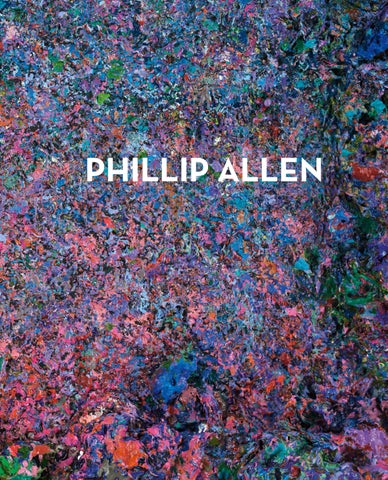
PHILLIP ALLEN

ON LISTENING TO PHILLIP ALLEN’S PAINTINGS

Phillip Allen’s paintings include their noise and are not content to sit obediently as mute ‘figures’ to be read on and against a wall ‘ground’. While they obviously don’t make actual noise, they don’t tune anything out. And they seem to resist not just singular contexts and categories, but also exclusive digital accounting in general. In this, they remind us of the power of static, of old television sets hissing when they are le on far into the early hours...a lost memory between channels. Static combines noise and impossible visuals in a marginal, best occluded, moment. Where it used to be a sort of night-bound unconsciousness, visible a er broadcasting hours, it is now something lost to digital clarity and 24-hour broadcasting; it is a slated-to-be forgo en artifact, a confusion of sound and vision deleted from ever-more-streamlined existences.

Current digitalized forms of a ention work not by simply tuning out such unwanted noise; they gain authority from the fact that, for them, unwanted noise simply doesn’t count. Usually, something to be tuned out distracts a ention and is preferably unnoticed; now, it simply falls obsolete, unaccounted for between the digits that make everything accountable. Overwhelmed by a sheer quantity of visual material and commentary, by too much confusing static, we o en rely on clear forceful narratives to guarantee some kind of agency and place in the world. We count on legible figures to make sense of the complex ground of messy and untuned general experience. We might prefer and pretend

that numerate clarity is what guarantees art and our investments in it, and yet...

Faced with a title such as DeepDrippings (Upper Maze Version), we find that it is le to the stuff of paint itself to remind us that art can stand against all kinds of baited allures, and that this is a painting that stands up to the logical clarity of its title – we discover that the paint itself revolts from any intended and presupposed program. The paint in the actual painting allows a sensation of dappled light to be loosely created, a sensation created out of a sense of excavation in which we do not know what we will find. We are faced with the very thing that tight-lipped investment cults tune out in obedience to the demands of clear discourse and measurable identities. Voluminous paint is presented as a kind of protest against implicit injunctions to ‘not notice’ and to ‘keep to pious silence’. It hangs resistant and noticeable on the wall. These sometimes sinuous paintings are their own wayward devices le for us to pitch headlong into, devices in key with dominant entropic out-of-tune realities, in tune with a basic, underlying, bodily disorganization. This body is impossible to identify, an unknown that, while not wholly comprehensible, is very real, impressive, and at the very limit of audio/visual imagination. If there are figures that appear and insist – and each painting can be grasped as such a figure, stark and grounded against a wall –these insistent appearances all feel part of a resonant sanguine realism, a chain of meanings in which artistic perfection and life’s imperfection operate as one pragmatic thing. Beauty and ugliness act together, and art and life are a single, all-inclusive, manifold discovery, along with the old and the new that we vainly try to choose between. Clarity and waste cohere as one out-of-tune note, or rather sound, dug back up as a singular, moving evocative outline in each painting – a serpentine offering in

which everything counts without measure, but in which everything also trips itself up.

Sometimes it’s hard to remember that painting can be the enemy of painting, but when we do remember this, things can make a lot more sense, and not just for painters. Through his paintings, Phillip Allen reminds us, and I suspect himself, that painting’s actual power is to be an enemy of painting. There is painting, and there is painting against painting. Perhaps it is in this paradoxical realization that art’s necessary unity with anti-art can be best experienced. There is a kind of suspense – of opposing forces holding each other hostage...stumbling out of time.

Painting and its own worst, deadly, anti-pictorial, anti-idealistic, anti-artistic enemy are reconciled again and again. What each painting is comprised of is at one with what it excludes...literally, this painter includes what he has scraped off, so what has been scraped from each painting brings new life into the old art school truism: “What’s not there (in a painting) is as important as what is.” What has been removed from the painting is the painting, and what we’re le with is that endlessly noisy stuff that appeals to all our senses at once: paint.

And what is paint but color? But to realize this simple, obvious fact, we must discard a lot of what we think about color. We must realize that color is a material force in and of itself—free of both science and romance.

Phillip Allen’s paintings seem able to present color as a kind of le over reality that somehow has the power to insist—with tremendous force and compressed intensity. When we view his paintings in groups, experiencing them laid out in exhibitions, a sense of different self-contained

intensities—lined up and insistent, waiting together—is created. To reach for a legible art historical precedent, I am tempted to dig up Jean Fautrier’s Hostage paintings, which were painted during World War II. They are a chain of unique modest-size paintings that are connected in the bones of their material nature to the traumas of the French occupation and to atrocities carried out by Nazis in the woods near ChâtenayMalabry and heard by Fautrier as he hid terrified in a house nearby. The current stakes, obviously, are not so grimly life and death, but there is a sense of something existentially serious in Allen’s work. And there is a sensation that he is tapping into an incongruously sensuous elegance that is also an incongruous part of Fautrier’s own bleak painterly sensibility. Both painters offer us paint as “cooked” material working to create and embody the nature of color and light in intractable “stuff.” This is painting as beautiful, tempting appearance despite the literal ma er of fact presentation of its basic ingredients. This is painting as imaginative, lumpen body of work, as an experience in which haunting old sounds synesthetically flicker. It is my feeling that, in his paintings, Allen excavates such visions, scrapes away their figures in order to leave his paint and colour with the ability to echo and hiss.

Insistent waiting speaks to a generally hard-to-quantify quality-of-art experience. Allen’s paintings as a group give us art as a form of deferral in which meaning is imprisoned in paint itself (and its color). They immediately claim the power and ability to put us in “art time” and experience its longing. While there is a sense of a measured output, there is also a sense that this measure does not adequately convey the nature of the paintings themselves, that they escape being organized to a set schedule. They are at one with “another time” combining as an entropic new form whose sanguine horizon somehow beats the clock and escapes its

representations. This deep time is measured by a kind of pulse of resistant actuality – one both visceral and mundane. Here are paintings that beat to the tempo of an uncoordinated beat rather than the metronomic regularity that counts our waking seconds and the moments of our professionalized lives. Senses themselves become confused within an event in which fugitive shapes (waveforms, and even figures) have a life (color and brightness) that appears and, just as importantly, disappears. Phillip Allen scrapes and discovers, until all is but a persistent trace. That forgo en sounds can infect the fading rhythms within his compelling visual horizons appears as a continual surprise.

Phil King is co-editor at Turps Magazine and works in both the United Kingdom and France. He has wri en numerous catalogue essays on contemporary artists and he also translated The Studio of Giacome i by Jean Genet. He graduated from Bath Academy of Art in 1987 and received an MA from Goldsmiths College of the University of London in 1993.

12 1⁄4 x 10 1⁄2 inches

x 26.7 cm

DeepDrippings (HissOvian Version), 2020
Oil on board
31.1

1⁄4 x 10 1⁄2 inches

DeepDrippings (Canary of the Mind), 2020
Oil on board
12
31.1 x 26.7 cm

16 1⁄2 x 14 1⁄2 inches

41.9 x 36.8 cm

DeepDrippings (Flied and Focsu Version), 2019
Oil on board

1⁄2 x 14 1⁄2 inches

41.9 x 36.8 cm

DeepDrippings (Steam Room Version), 2019
Oil on board
16
DeepDrippings (Hiss Mystique Deep North Version), 2019
Oil on board
16 1⁄2 x 14 1⁄2 inches
41.9 x 36.8 cm
DeepDrippings (Hiss Mystique Mireovian Version), 2019
Oil on board
16 1⁄2 x 14 1⁄2 inches
41.9 x 36.8 cm

20 1⁄2 x 18 3⁄4 inches

52.1 x 47.6 cm

DeepDrippings (Upper Maze Version), 2020
Oil on board

20 1⁄2 x 18 3⁄4 inches

52.1 x 47.6 cm

DeepDrippings (International Hiss Version), 2019
Oil on board

20 1⁄2 x 18 3⁄4 inches

52.1 x 47.6 cm

DeepDrippings (Studio Hiss Version), 2020 Oil on board

20 1⁄2 x 18 3⁄4 inches

x 47.6 cm

DeepDrippings (HissJovian Vision Version), 2020
Oil on board
52.1
DeepDrippings (Midnight Austin Laze Version), 2020
Oil on board
25 1⁄2 x 21 inches
64.8 x 53.3 cm

25 1⁄2 x 21 inches

64.8 x 53.3 cm

DeepDrippings (Lovejouvian Version Version), 2020
Oil on board

25 1⁄2 x 21 inches

64.8 x 53.3 cm

DeepDrippings (LoveJovian Hiss Version), 2020
Oil on board
DeepDrippings (Revenge of the Surface Version 2), 2020
Oil on board
42 x 32 inches
106.7 x 81.3 cm

Born in 1967 in London, United Kingdom

Lives and works in London, United Kingdom

EDUCATION

1990–1992

MA Fine Art, Royal College of Art, London, United Kingdom

1987–1990

BA Fine Art, Kingston University, London, United Kingdom

SOLO EXHIBITIONS

2020

Miles McEnery Gallery, New York, NY

2019

“Deepdrippings,” Approach Gallery, London, United Kingdom

“Deepdrippings,” Luca Tommasi Arte Contemporanea, Milan, Italy

2017

“Deepdrippings,” Kerlin Gallery, Dublin, Ireland

2016

DOLPH Projects, London, United Kingdom

2014

“Tonic for Choice,” The Approach, London, United Kingdom

2013

“Oxblood,” Kerlin Gallery, Dublin, Ireland

39 Mitchell Street, London, United Kingdom

2011

“Capital P,” The Approach, London, United Kingdom

2010

“…The Urgent Hang Around,” Bernier/Eliades Gallery, Athens, Greece

2009

Kerlin Gallery, Dublin, Ireland

2008

“Sloppy Cuts No Ice,” The Approach W1, London, United Kingdom

2007

“Paintings & Drawings,” Xavier Hu ens, Brussels, Belgium

2006

Milton Keynes Gallery, Milton Keynes, United Kingdom

2005

Kerlin Gallery, Dublin, Ireland

“One Man Show,” Xavier Hu ens, Brussels, Belgium

2004

The Approach, London, United Kingdom

2003

Xavier Hu ens, Brussels, Belgium

“Phillip Allen: Recent Paintings,”

P.S.1 Contemporary Art Center, Long Island City, NY

2002

The Approach, London, United Kingdom

1999

The Approach, London, United Kingdom

GROUP EXHIBITIONS

2019

“The Aerodrome,” Ikon Gallery, Birmingham, United Kingdom

2017

“20 Years,” The Approach, London, United Kingdom

“Fully Awake,” Blip Blip Blip Gallery, Leeds, United Kingdom

2016

“The Good, the Bad and the Ugly,” Charlie Smith, London, United Kingdom

“Permeable Edge,” University of Chichester, West Sussex, United Kingdom

2015

“From a Fly on the Wall, to Fly in my Soup,” Galerie Dukan, Paris, France

“Ghe o Anglaise,” Observer Building, Hastings, United Kingdom

2014

“Nanjing International Art Exhibition,” International Exhibition Centre, Nanjing, China

“Head To Head: 4 Questions 8 Paintings,” Standpoint Gallery, London, United Kingdom

2012

“Courtship of the Peoples,” Simon Oldfield Gallery, London, United Kingdom

“The Perfect Nude,” Charlie Smith, London, United Kingdom

“The Perfect Nude,” Phoenix Gallery, Exeter, United Kingdom

2011

“From London:,” Art Nueve, Murcia, Spain

“The Royal Academy Summer Exhibition 2011,” Royal Academy of Arts, London, United Kingdom

2010

Fabio Tiboni Arte Contemporanea, Bologna, Italy

2009

“Classified: Contemporary British art at Tate Britain,” Tate Britain, London, United Kingdom

“Kaleidoscopic Revolver,” Total Museum of Contemporary Art, Seoul, Korea and Hanjiyun Contemporary Space, Beijing, China

“Pa ern Recognition,” The City Gallery, Leicester, United Kingdom

2008

“M25: Around London” (curated by Barry Schwabsky), Centro Cultural Andratx, Mallorca, Spain

2007

“Layer Cake” (curated by Martin Holman), Fabio Tiboni Arte Contemporanea, Bologna, Italy

“Hope and Despair” (curated by Bob Ma hews), Cell Project Space, London, United Kingdom

“Summer Group Show,” Kerlin Gallery, Dublin, Ireland

2006

“Archipeinture: Painters Build Architecture in London,” Camden Arts Centre, London, United Kingdom and Le Plateau, Frac Île-de France, Paris, France

“When Forms Become A itude,” AR / Contemporary Gallery, Milan, Italy

2005

“British Art Show 6” (organized by the Hayward Gallery and the British Council), BALTIC Centre for Contemporary Art, Gateshead, United Kingdom, traveled to Manchester; No ingham; Bristol; City Art Gallery, Prague; Vilnius, Lithuania; Tallinn, Estonia and Krakow, Poland

“Fantasy Island,” Metropole Galleries, Folkestone, United Kingdom

2004

“Stay Positive,” Marella Arte Contemporanea, Milan, Italy

“Candyland Zoo,” Herbert Read Gallery, University for the Creative Arts, Canterbury, Kent, United Kingdom

“Reflections,” Atuatuca Art Festival, Tongeren, Belgium

“Painting-04,” Kerlin Gallery, Dublin, Ireland

2003

“Cristian Ward, Phillip Allen, Varda Caivano,” Millefiori Art Space, Athens, Greece

“Allen, Cooper, McDevi ,” Kerlin Gallery, Dublin, Ireland

“Dirty Pictures,” The Approach, London, United Kingdom

“Post Flat: New Art from London,” Locks Gallery, Philadelphia, PA

“The Drawing Show,” Keith Talent Gallery, London, United Kingdom

2002

“Another Shi y Day in Paradise,” Bart Wells Institute, London, United Kingdom

“The Galleries Show: Contemporary Art in London,” Royal Academy of Arts, London, United Kingdom

1997

“Cardboard Box and Tape,” Norwich Gallery, Norwich School of Art and Design, Norwich, United Kingdom

“Still Things,” The Approach, London, United Kingdom

“Multiple Choice,” Cubi Gallery, London, United Kingdom

1996

“Grin and Bear It, Gasworks, London, United Kingdom

Abbey Scholar, British School of Rome, Rome, Italy

SELECT COLLECTIONS

Arts Council England, London, United Kingdom

British Council, London, United Kingdom

Tate Collection, London, United Kingdom

UK Government Art Collection, London, United Kingdom

Published on the occasion of the exhibition

PHILLIP ALLEN

21 May – 11 July 2020

Miles McEnery Gallery

520 West 21st Street

New York NY 10011

tel +1 212 445 0051 www.milesmcenery.com

Publication © 2020 Miles McEnery Gallery

All rights reserved Essay © 2020 Phil King

Director of Publications

Anastasija Jevtovic, New York, NY

Photography by Christopher Burke Studio, New York, NY

Color separations by Echelon, Santa Monica, CA

Catalogue layout by McCall Associates, New York, NY

ISBN: 978-1-949327-30-4

Cover: DeepDrippings (Studio Hiss Version), (detail), 2020

Turn static files into dynamic content formats.
Create a flipbook
Issuu converts static files into: digital portfolios, online yearbooks, online catalogs, digital photo albums and more. Sign up and create your flipbook.
Phillip Allen 2020 by Miles McEnery Gallery - Issuu