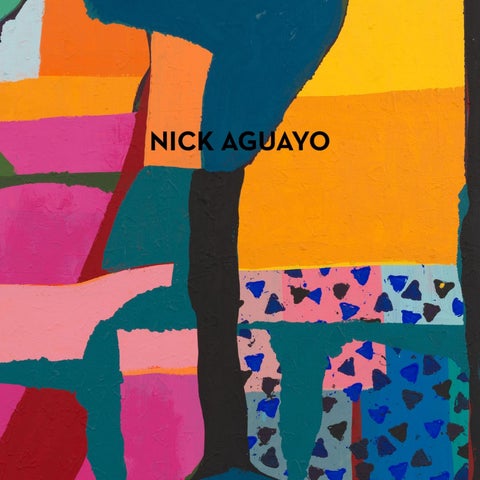
NICK AGUAYO
511 West 22nd Street
515 West 22nd Street
525 West 22nd Street
520 West 21st Street
New York NY 10011
New York NY 10011
New York NY 10011
New York NY 10011
2
ABSTRACT PAINTER AGUAYO Benjamin Weissman 3:15 A.M. At John F. Kennedy Memorial Hospital in Indio, California, Nicholas Daniel Aguayo was born. But the name Nicholas always felt foreign, overly formal, a shoe that never fit. When people call him Nicholas, he assumes that he’s in trouble. Members of his family, including his mother, Nancy—whose close associates called her Ginger (derived from her middle name, Virginia)—call him Nicky. Friends and colleagues call him Nick. Abstract Painter Aguayo’s father’s name is Daniel. Patriarch Aguayo does not have a middle name. FIRST CHILDHOOD MEMORY Falling asleep on a couch and his parents carrying him to bed. He remembers thinking, this won’t last forever. IN HIGH SCHOOL Abstract Painter Aguayo painted R. Crumb-inspired images and was also moved by the usual suspects of modern art. For one assignment, he had to copy an artwork; he chose Arshile Gorky’s The Liver Is the Cock’s Comb (1944). Cubism/surrealism from the 1940s has always interested him. In college and even in grad school, there were times when he incorporated figurative elements into his work. They impressed no one, so he took his professors’ advice and joined the church of abstraction. ADORNMENT Abstract Painter Aguayo does not wear jewelry. The closest things to jewelry he has ever worn were so-called friendship bracelets a college girlfriend made for him. He likes the idea of adornment, but he finds jewelry physically uncomfortable. In some ways, he has given up on style, which has led him to a playful and garish understated look. Occasionally, he appears in public straight from his studio in paint-splattered work clothes—his shirts, pants, and shoes looking like a detail from a Jackson Pollock painting. In an October 11 Instagram post, he wrote, “In the final stretch painting a show. Painting so much I’m kind of turning into one.”
3
Francis Picabia, Tarentelle, January-early June 1912, Oil on canvas, 29 1/2 x 36 1/2 inches (74.9 x 92.7 cm). The Museum of Modern Art / New York, NY, Mary Sisler Bequest.
Sigmar Polke, Untitled (DDR-Emblem), 1978, Acrylic on canvas, 59 x 51 1/4 inches (150 x 130 cm). Sprengel Museum, Hanover, Germany.
SWIMMING, WALKING, TEACHING
4
Abstract Painter Aguayo likes to go swimming, but he rarely swims. He would like to do it more. “Iggy Pop is a passionate swimmer,” Aguayo said. “That’s inspiring.” Every morning, he walks a mile from his Los Angeles apartment next to the Red Lion on Glendale Boulevard to a Silverlake Boulevard coffee shop. He also takes a walk right before the sun goes down. This necessary ritual clears his head and helps him paint. If he doesn’t walk regularly, he feels unwell. Last year, he had an extreme case of insomnia, regularly staying awake until 5 a.m. More recently, he was successful at falling asleep before midnight and waking up no later than 10 a.m. This semester, though, an early morning painting class at Pasadena City College forced him to rise at 6:30 a.m., and he successfully switched to the earlier schedule. He enjoys teaching. He finds trying to understand someone else’s point of view—their interests, their language, and their ways of doing things—illuminating. This also makes him think about his own language and the need to expand his thinking and vocabulary. Sometimes when he teaches, he feels as if he doesn’t know anything, and he enjoys seeing students give themselves permission to experiment and make mistakes. He does his best to bring a similar sense of exploration to his own work. ABSTRACT PAINTER AGUAYO “I showed one of my classes an interview with Francis Bacon, and he said something about how when you paint a wall the first mark is totally alive but as the wall becomes covered that quality is lost. (The feeling of the first mark preserved is what he was after.) … It struck me because I sometimes think of my paintings as becoming walls … Saturated in time and touch, like a piece of dirty glass covered in fingerprints. In a lot of my new paintings, I’ve tried to preserve that feeling of the first mark. Restraint?
Ellen Berkenblit, Wild Tulips, 2022, Oil on linen, 102 x 76 inches (259.1 x 193 cm).
Donald Baechler, Brown Hat, 1993, Screenprint and collage, 35 15/16 x 28 1/8 inches (91.3 x 71.4 cm). Whitney Museum of American Art, New York, NY, Gift of Altria Group, Inc.
Something in it brings an uneasiness, a doubt. I wanna live there for a while, if I can (painter’s palette emoji and apple). PS: I was surprised that my students didn’t like Bacon. I think of him as being such a gateway artist.” SUSTENANCE Abstract Painter Aguayo usually skips breakfast or eats something that he defines as terrible, like an oatmeal cookie with iced tea. He had his gallbladder removed a few years ago, and more and more he prefers bland food. Chicken soup has been his favorite dinner lately. WHAT IF? Abstract Painter Aguayo wondered what his work would have been like if he had never gone to art school. Lately, he has been painting ferocious dogs based on a cartoon that caught his attention. He liked how vicious they looked. He regularly collects images and shapes he finds arresting, building an archive of stuff to steal. Abstract Painter Aguayo’s parents were worried about him when the major ICE raids were happening in Los Angeles. He was breaking up with his longtime girlfriend, arguing a lot, thinking of using images overlayed upon more painterly elements. He loves how Francis Picabia and Sigmar Polke do that. He’s also fond of Ellen Berkenblit and Donald Baechler, who often use simple figuration on abstract grounds. In a note on Instagram, he wrote about splashes of color feeling like dialogue bubbles in comics—utterances from the unknown. His earliest childhood paintings were of Native Americans, whom he favored over the cowboys, from movie westerns.
5
BETWEEN A TAMALE SHOP AND A THRIFT STORE Does Abstract Painter Aguayo enjoy cleaning his brushes? No, he does not. He genuinely hates the task. He soaks his brushes in old gesso buckets filled with water, “water,” he says, “that acquires a grotesque quality.” He likes the smells his paintings make, bad smells to be sure, kind of tart and rancid, but that is how a painting should smell. Not a romantic oil painting reek, but an acrylic stench. His studio, sandwiched between a tamale shop and a thrift store that sells a lot of good books and records, was originally a post office, and it is a petri dish of rank smells. Outside, he hears the constant drone of cars, the mumbled repartee of drug deals, and a vigorous rooster. Abstract Painter Aguayo has been there for 13 years. He enjoys mixing paint, but he also likes the idea of using paint directly out of a jar. He’s no purist, but he respects the purist’s instinct and sees the virtue in pursuing purity, even if there is also something confining about it. He is not a fan of a canvas’s tooth; he always has the urge to make canvas feel like something else. He’s interested in smoother surfaces. Last year, he painted on muslin. ON BEING SLIGHTED 6
The author of this essay, who also makes drawings, confided in Abstract Painter Aguayo that someone recently told him one of his new drawings was nothing more than an image that belonged on a T-shirt. The author refrained from pushing his bottom lip forward in an act of petulant annoyance and pretended to be unperturbed. Abstract Painter Aguayo said that remark would irk him also. He is sensitive, and he gets insulted easily. He can’t deny that he, too, is insecure, and he hangs on to harsh comments too long. He wants to let them go, but he often can’t. Increasingly, he takes the art world less seriously, and that’s kind of freeing. He feels a lot more freedom to do things like make shirts— things that might be looked down upon, because the whole landscape feels increasingly less serious. But there’s liberation in that. EL SERENO MEANS ‘THE SERENE ONE’ Anxiety is probably the most dominant sensation Abstract Painter Aguayo has in his life. He rarely remembers his dreams. His day-to-day life is a constant battle against feeling freaked out. He has had panic attacks all his adult life. They started in high school—full disassociation, the feeling of falling out of his body. He was born with a chest deformity, and he had two reconstructive surgeries, one at age 5 and one at age 6. This affected his ability to breathe. (He has the lung capacity of a person with one
lung.) This malady was part of what formed his nervous disposition, and this fundamental anxiety has something to do with the need to make art—not in terms of therapy but in terms of needing to use up a certain kind of nervous energy. THE ANXIOUS OBJECT The life of Abstract Painter Aguayo consists of more than pacing back and forth across a 600-squarefoot studio in the neighborhood of El Sereno, staring at a blank canvas, opening jars and tubes of paint, and waving horsehair brushes around like a conductor of a nightmare. Nor does it consist of identifying friendly bodies at museum openings and figuring out ways to engage them enough so as not to appear antisocial. Nor is it simply hosting so-called studio visits where he generously offers freshly baked gluten-free scones and croissants, crème brûlée donuts, and organically sourced blueberries to collectors, gallerists, and curators, that usually go uneaten, or answers bland, lazy questions like “So, tell us about this?” or “What’s going on here?” or “Do you have a spiel, a means of persuasion?” Being Abstract Painter Aguayo consists of more than worrying about sales, remembering to go to the doctor or the gym; getting some form of exercise, a swim perhaps; getting enough sleep; eating lunch; attending openings; going to quasi-fun, claustrophobic parties, horrific formal dinners, and afterparties; keeping a close eye on the galleries that represent him; and praying that they actually put in a day’s work. The life of Abstract Painter Aguayo is composed of more than nodding his head at curators’ pronouncements, letting them blather on, and doing his best not to laugh at inappropriate moments. OOPS Abstract Painter Aguayo is clumsy, frequently knocking over jars and cans of paint and quickly sopping up the spillage and using it in a painting. Most of his accidents guide his decisions; he assumes that he will react well to the unexpected addition and solve the new problem. Maybe this isn’t odd, but he often blots a kind of monoprint with black gesso then uses a paint roller to distort it a bit. He loves doing this. (The effect is Wunderbar.) Abstract Painter Aguayo is a terrible joke teller and storyteller. He always mixes up the narratives. Even when he attempts to recount the plot of a movie, he will botch the telling. Occasionally, he will tell a joke, but his jokes are more like accidents. He is more of a physical comedian. When he was a kid, he would do goofy stuff that made his mother laugh. “You are like Jerry Lewis,” she said.
7
LINEAGE When he is asked about artists he admires, the ones he carries around in his head who won’t go away, a geyser of names bursts forth: Willem de Kooning, Raoul De Keyser, Piet Mondrian, Frank Stella, Robert Rauschenberg, Jean-Michel Basquiat, A.R. Penck, Georg Baselitz, Helen Frankenthaler, Andy Warhol, Franz West (for his collages), René Daniëls, Henri Matisse, Pablo Picasso, Fernand Léger, Paul Klee, Arshile Gorky, Forrest Bess, Blinky Palermo, Charline von Heyl, Amy Sillman, Philip Guston, Chris Martin. After a brief pause, he adds Dan Levenson, Allison Miller, Heather Brown, Tomory Dodge, and Bill Traylor (for his figures). DELIBERATE
8
Abstract Painter Aguayo said he liked the elusiveness of intentionality—intentionality being elastic. He said he always arrived at intentionality late in the process of a painting rather than at the start. His best paintings are a surprise, and he always hopes that the outcome is unexpected and fresh. He is skeptical of paintings if they don’t appear somewhat lost, although he is trying to challenge this feeling. SEQUENCES & SOUNDTRACKS Pattern is something Abstract Painter Aguayo has always loved in the world, but until the pandemic he resisted it in his paintings. He said it has something to do with the opening and closing of the space of a drawing, including the space between the components of the pattern itself. He went through a period of loving minimal composers like Steve Reich and Terry Riley. He hears Reich’s and Riley’s music in relation to a beat or a metronome, as well as in relation to his body’s repetitive patterns: breathing, pulse, the pitter-patter of his heart. Lately, he has been listening to Nirvana’s Unplugged, one of the first albums he bought as a kid. He said it has been comforting to him lately: “I guess it’s kind of a part of me at this point.” Scaling up notebook drawings appealed to him in terms of creating a field to stand in. Mark Rothko talked about the large scale of his work providing a kind of intimacy. Abstract Painter Aguayo doesn’t think in terms of intimacy, but rather of being enveloped. THEY EVENTUALLY SPEAK UP His paintings start in a very arbitrary way, often with a color grid emerging over time. Some paintings have a flash of recognition, like something falling into place. As a painting develops, the desire to paint
slower grows. The paintings sit for a while in a state of repose. After Abstract Painter Aguayo lives with them for a period that varies, they eventually speak up and tell him they do not need anything else. His painting New High Street developed very slowly over the course of a year. At a certain point, he decided to stop. There was a feeling that although the painting might not be completely resolved there was something in it to keep and it should live as it was. He often takes pictures of his paintings as they’re being made. In retrospect, he said, he could have stopped many paintings in earlier incarnations, and they might have been more interesting in their less finished states. He thinks about this a lot these days: How much does a painting need? Errors are an important part of Abstract Painter Aguayo’s work: a guiding force, a stepping stone. It is all part of an improvisational process. So-called mistakes open the door to the more curious, mischievous marks. A painting is finished when he has figured out how to use all the persnickety blunders. On Instagram, Abstract Painter Aguayo wrote: “Today I painted these large black forms over something I wasn’t happy with, turning them into shapes that felt much more exciting and accidental and true to my moment. For me, some of the best moments in painting are like this.” THE SOCIAL WHIRL Abstract Painter Aguayo often feels that art making can be a convenient way of hiding from life. He wonders about this when he feels a need to avoid humans. But painting shouldn’t be blamed. His need to paint and the time he spends away from people often feel alienating. He doesn’t put the blame on art, though. GASOLINE In his last exhibition, Abstract Painter Aguayo was finishing 15 large paintings a month after the death of a close friend’s wife. Her death hit him deeply, and he finished those paintings in a state of desperation. One painting, Gasoline, was made by superimposing large shapes over many layers of underpainting. He used black gesso to push everything back in one gesture. The underpainting read as being looked through but also contained within the shapes. This harkens back to his thinking of shapes acting as containers of information, like the word balloons in comic books. In the past, he thought of shapes and how they were distributed throughout the context of a painting in terms of composition, and how each shape may contain a disparate piece of information or a kind of language unto itself.
Benjamin Weissman is a writer of fiction, plays, poems, and non-fiction. He teaches Graduate Studios at Otis College of Art and Design.
9
10
11
12
Green Thumb, 2025
Acrylic and marble dust on canvas 80 x 70 inches 203 x 178 cm
14
Life Lessons, 2025 Acrylic and marble dust on canvas 48 x 36 inches 122 x 91 cm
16
Long Division, 2025 Acrylic and marble dust on canvas 80 x 86 inches 203 x 218 cm
18
Outside Looking In, 2025 Acrylic and marble dust on canvas 48 x 36 inches 122 x 91 cm
20
Palm Desert (I can hear the grass grow), 2025 Acrylic and marble dust on canvas 72 x 60 inches 183 x 152 cm
22
Punch Drunk Love, 2025 Acrylic and marble dust on canvas 72 x 60 inches 183 x 152 cm
24
Slow Burn Sun, 2025 Acrylic and marble dust on canvas 78 x 78 inches 198 x 198 cm
26
Snakes Crawl, 2025 Acrylic and marble dust on canvas 72 x 60 inches 183 x 152 cm
28
Talking, 2025
Acrylic and marble dust on canvas 60 x 48 inches 152 x 122 cm
30
The Blue Window, 2025 Acrylic and marble dust on canvas 86 x 80 inches 218 x 203 cm
32
The Edge Of The Edge, 2025 Acrylic and marble dust on canvas 60 x 48 inches 152 x 122 cm
34
The Letter, 2025 Acrylic and marble dust on canvas 30 x 24 inches 76 x 61 cm
36
The Midnighters, 2025
Acrylic and marble dust on canvas 60 x 48 inches 152 x 122 cm
38
Transmuted Matter, 2025
Acrylic and marble dust on canvas 83 x 84 inches 211 x 213 cm
40
Vicious, 2025
Acrylic and marble dust on canvas 80 x 70 inches 203 x 178 cm
Published on the occasion of the exhibition
NICK AGUAYO 8 January – 14 February 2026 Miles McEnery Gallery 515 West 22nd Street New York NY 10011 tel +1 212 445 0051 www.milesmcenery.com Publication © 2026 Miles McEnery Gallery All rights reserved Essay © 2025 Benjamin Weissman Photo Credits p. 4: © 2025 Artists Rights Society (ARS), New York, NY / Digital Image © The Museum of Modern Art / Licensed by SCALA / Art Resource, New York, NY p. 4: © The Estate of Sigmar Polke, Cologne, Germany / Artists Rights Society (ARS), New York, NY / Digital image courtesy bpk Bildagentur / Sprengel Museum, Hanover, Germany, photo by Michael Herling p. 5: © Ellen Berkenblit / Image courtesy of the artist and Anton Kern Gallery, New York, NY p. 5: © 2025 Donald Baechler / Artists Rights Society (ARS), New York, NY / Digital image © Whitney Museum of American Art / Licensed by Scala / Art Resource, New York, NY Associate Director Julia Schlank, New York, NY Photography by Dan Bradica, New York, NY Christopher Burke Studios, Los Angeles, CA Catalogue layout by Allison Leung ISBN: 979-8-3507-5930-3 Cover: Life Lessons, (detail), 2025