MICHAEL REAFSNYDER
MICHAEL REAFSNYDER
WILD COMBINATIONS
Jonathan Griffin
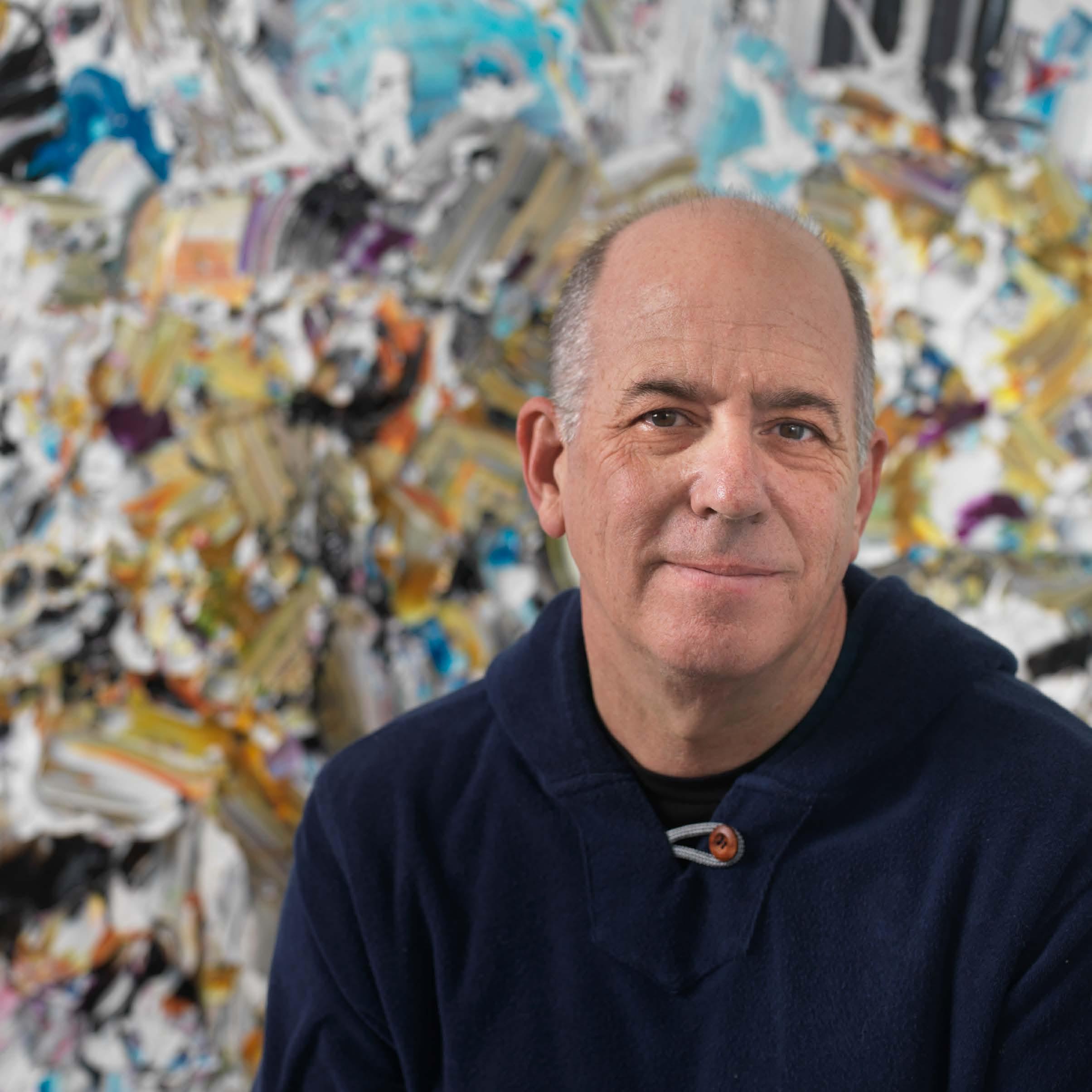
From the outside of Michael Reafsnyder’s family home, situated on a quiet suburban cul-de-sac in Orange, California, there is no hint of anything unusual. Nothing about it declares that this is the dwelling, and also the workplace, of an artist. Quite the opposite, in fact.
Perhaps this is appropriate. Reafsnyder’s paintings, which he makes in the house’s two-car garage, refitted as his studio, are both conventional (in that they belong to the conventions of abstraction that were established in the mid-twentieth century and, indeed, to a tradition of painting that stretches back centuries) and wildly outlandish. His work is an entrancing conundrum hiding in plain sight.
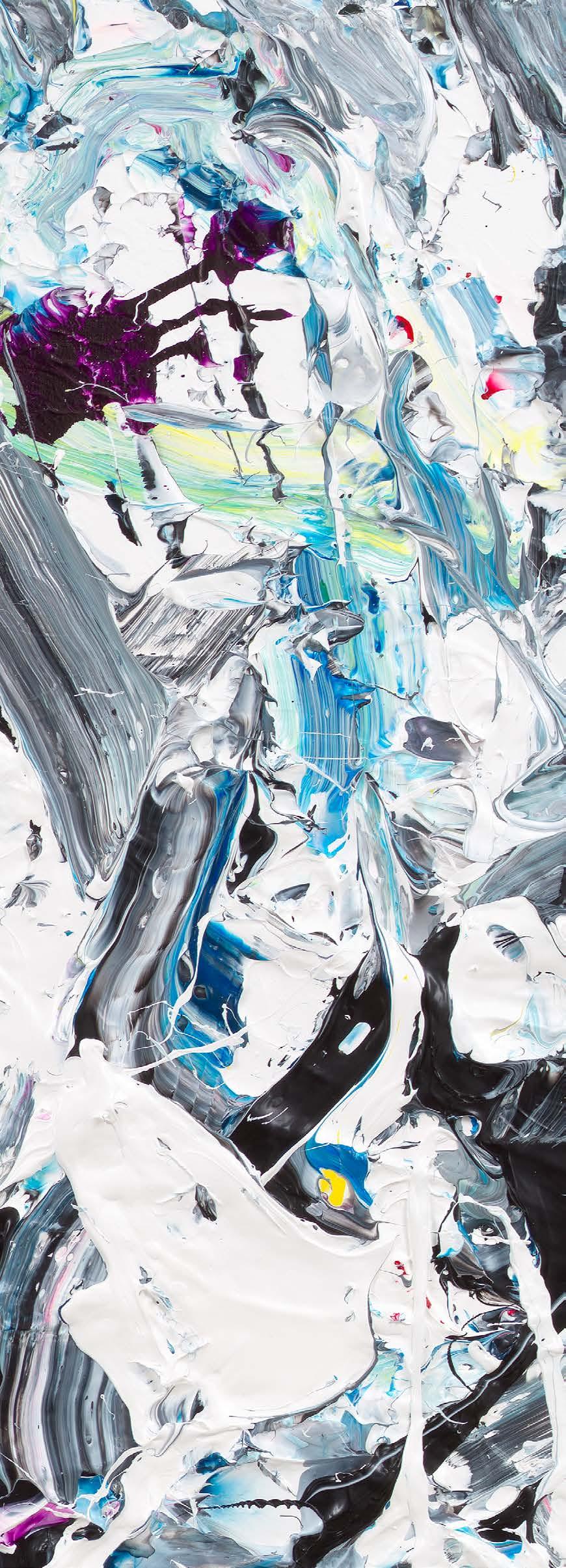
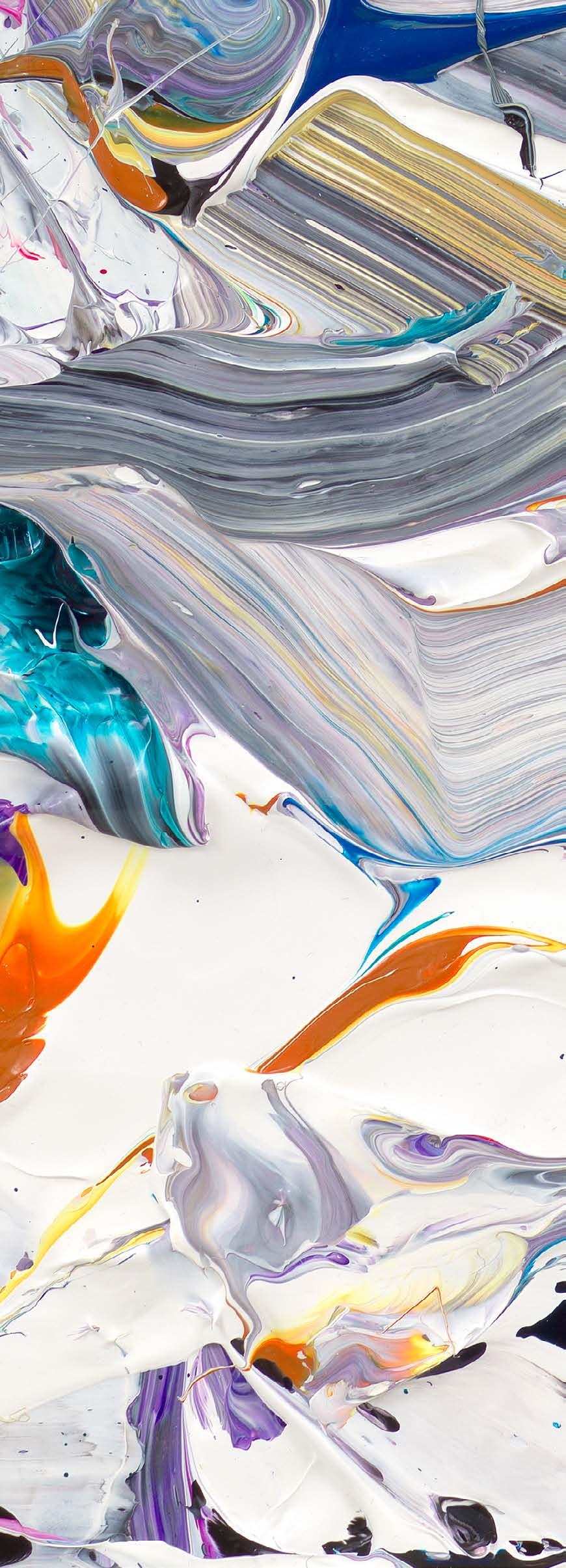
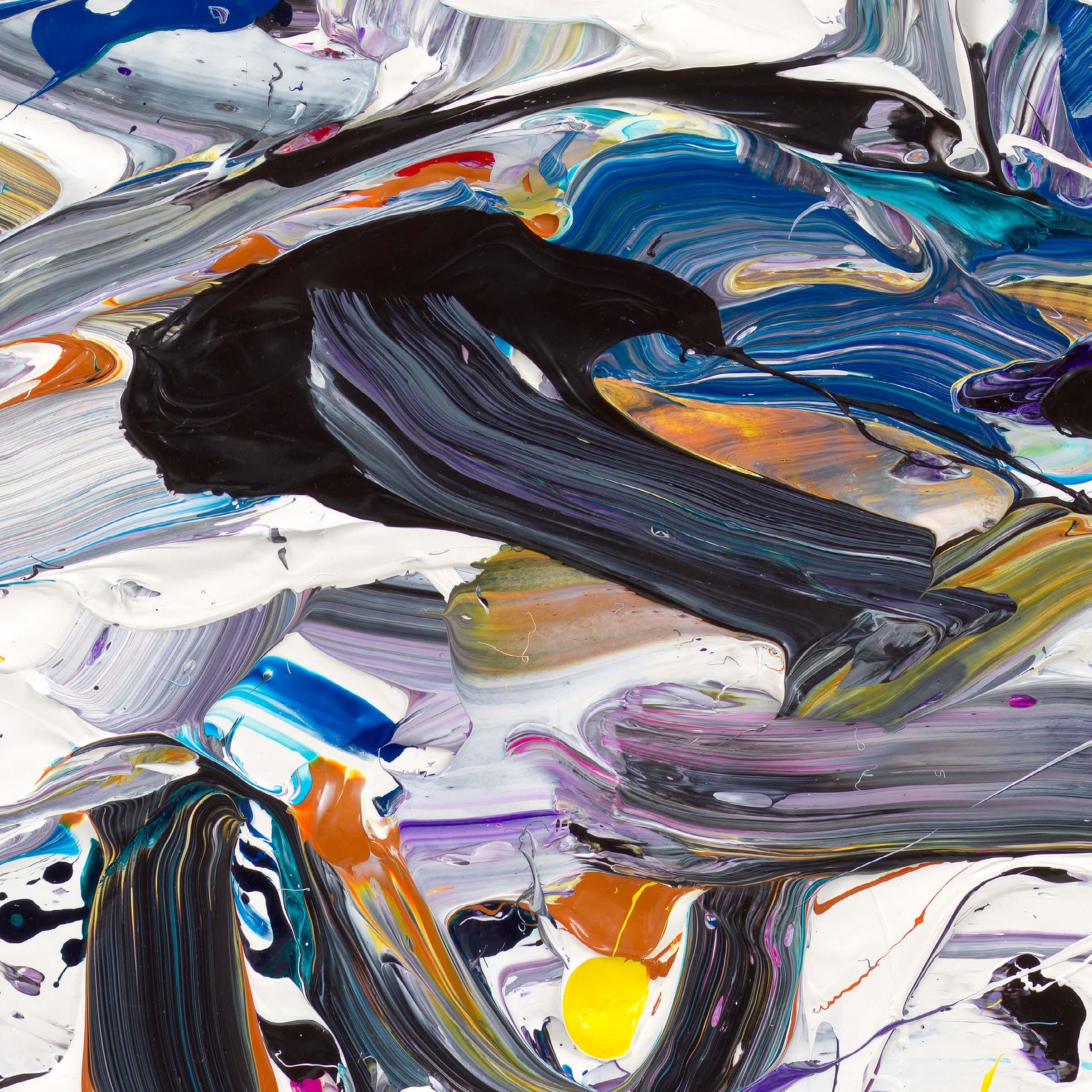
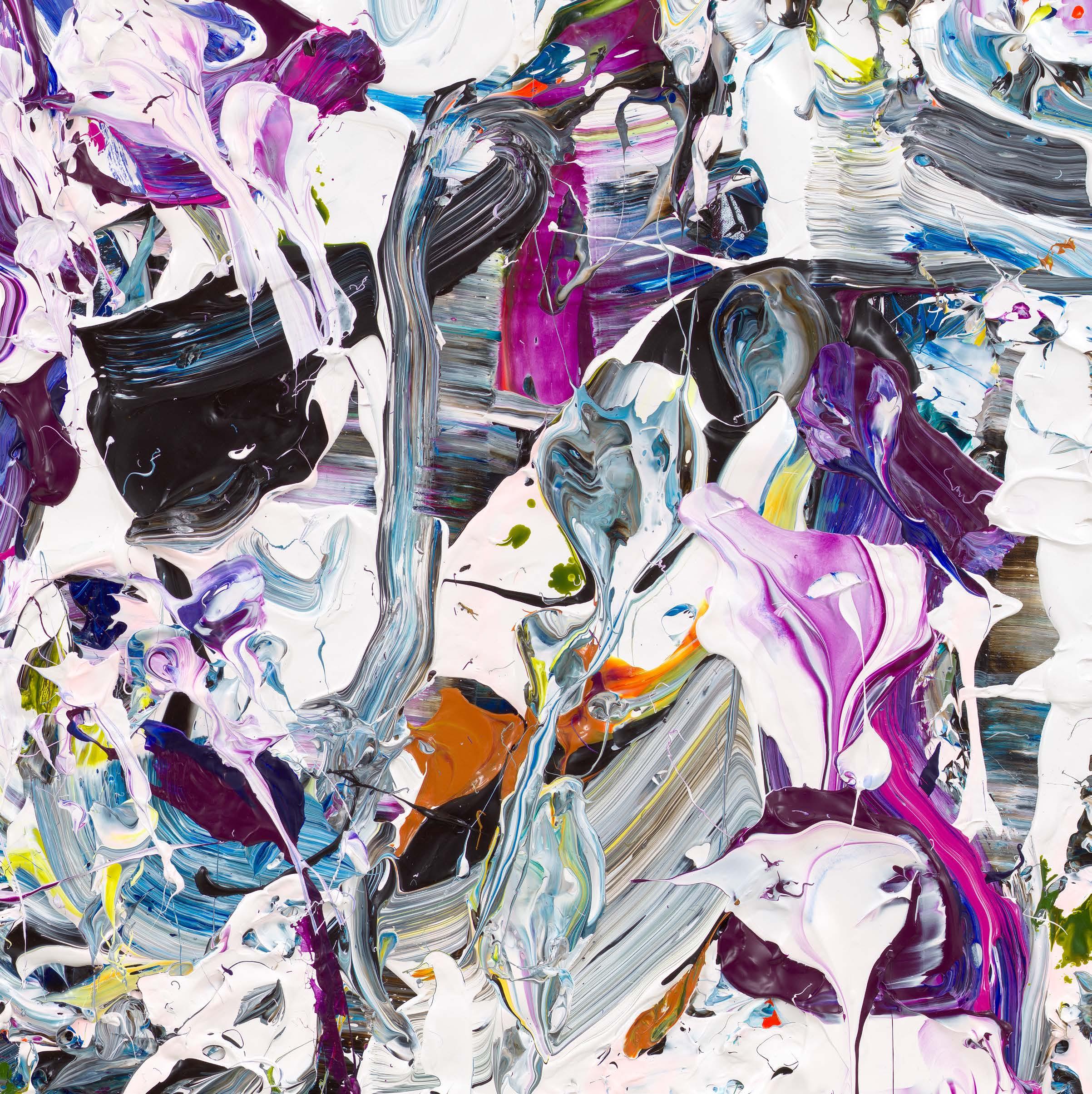
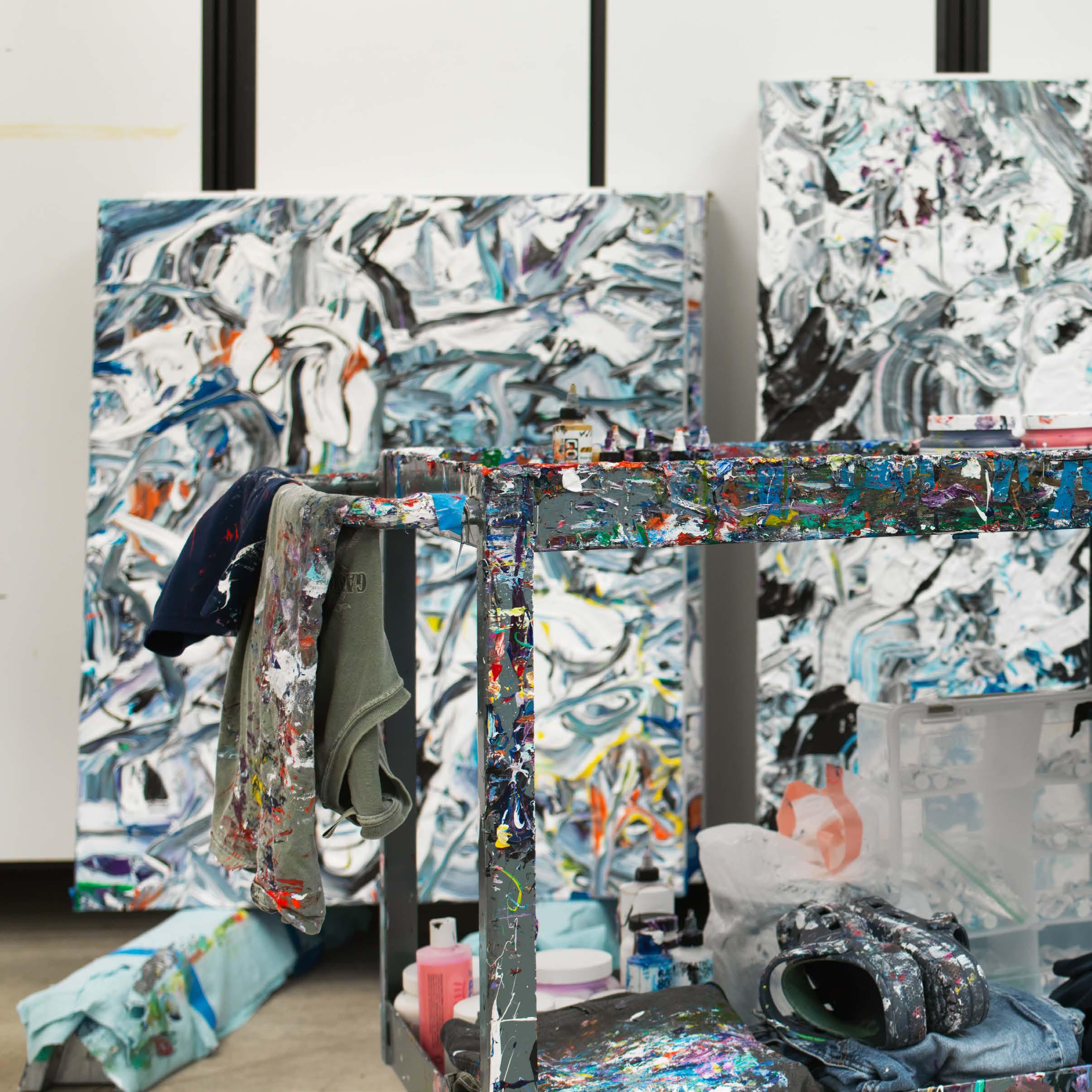
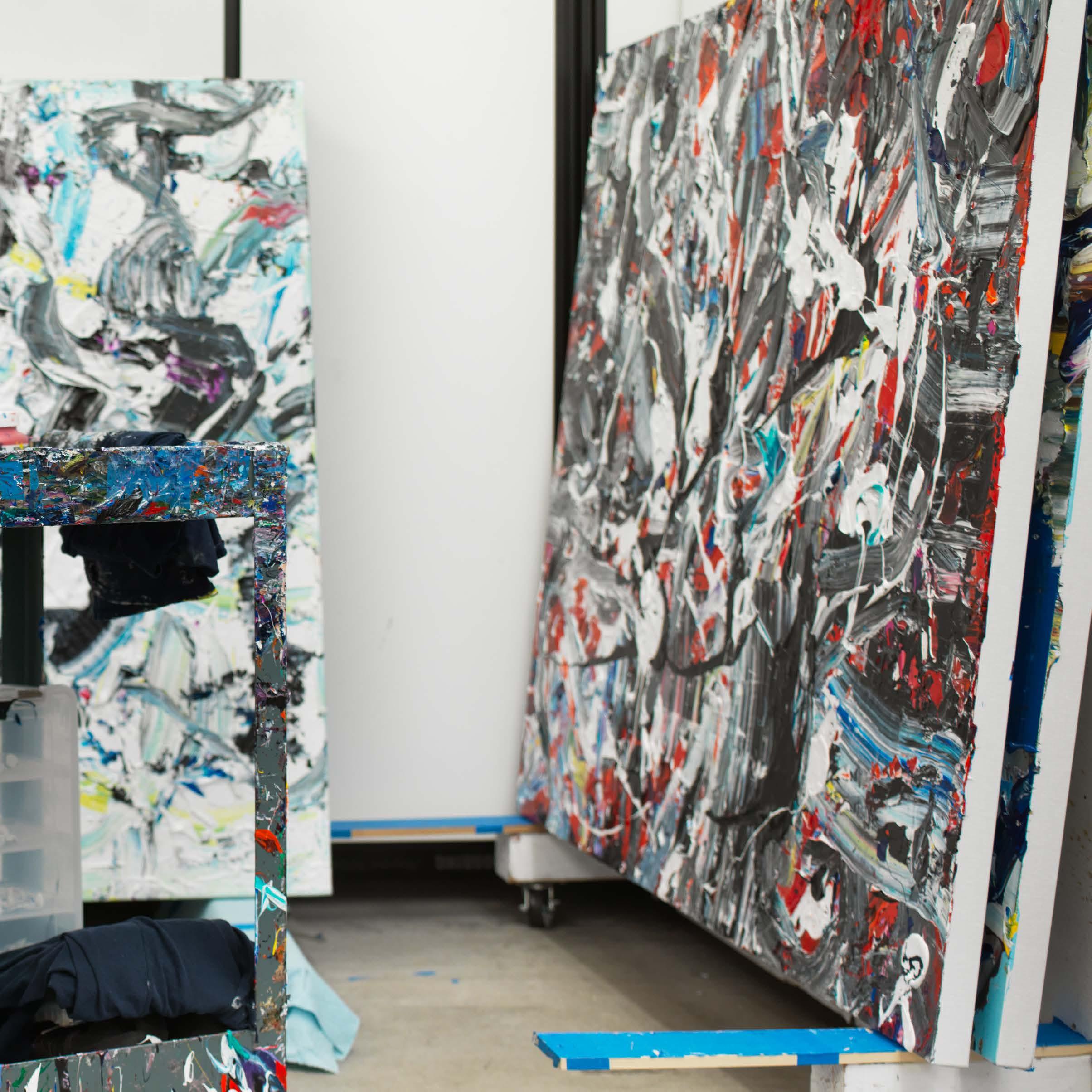
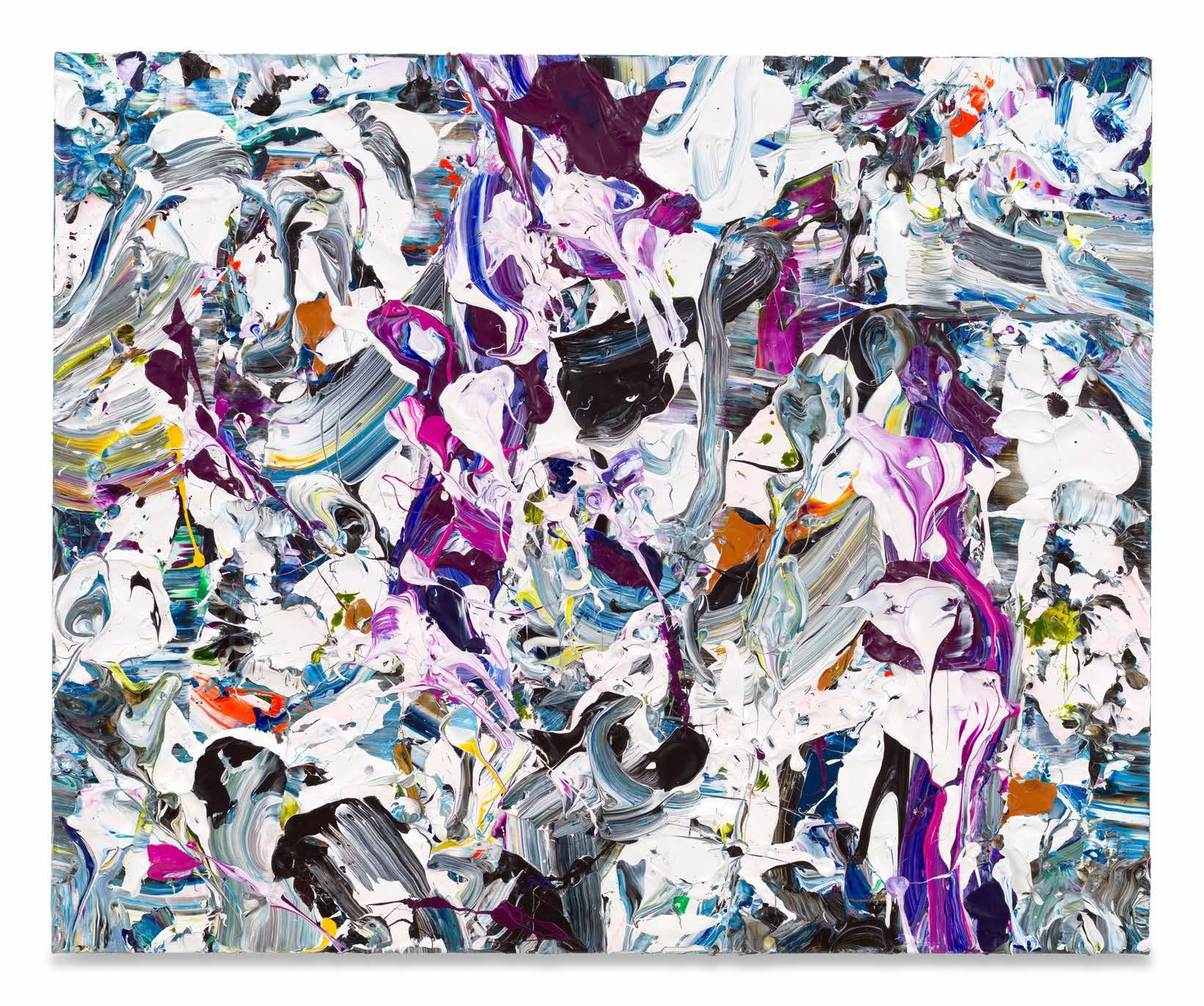
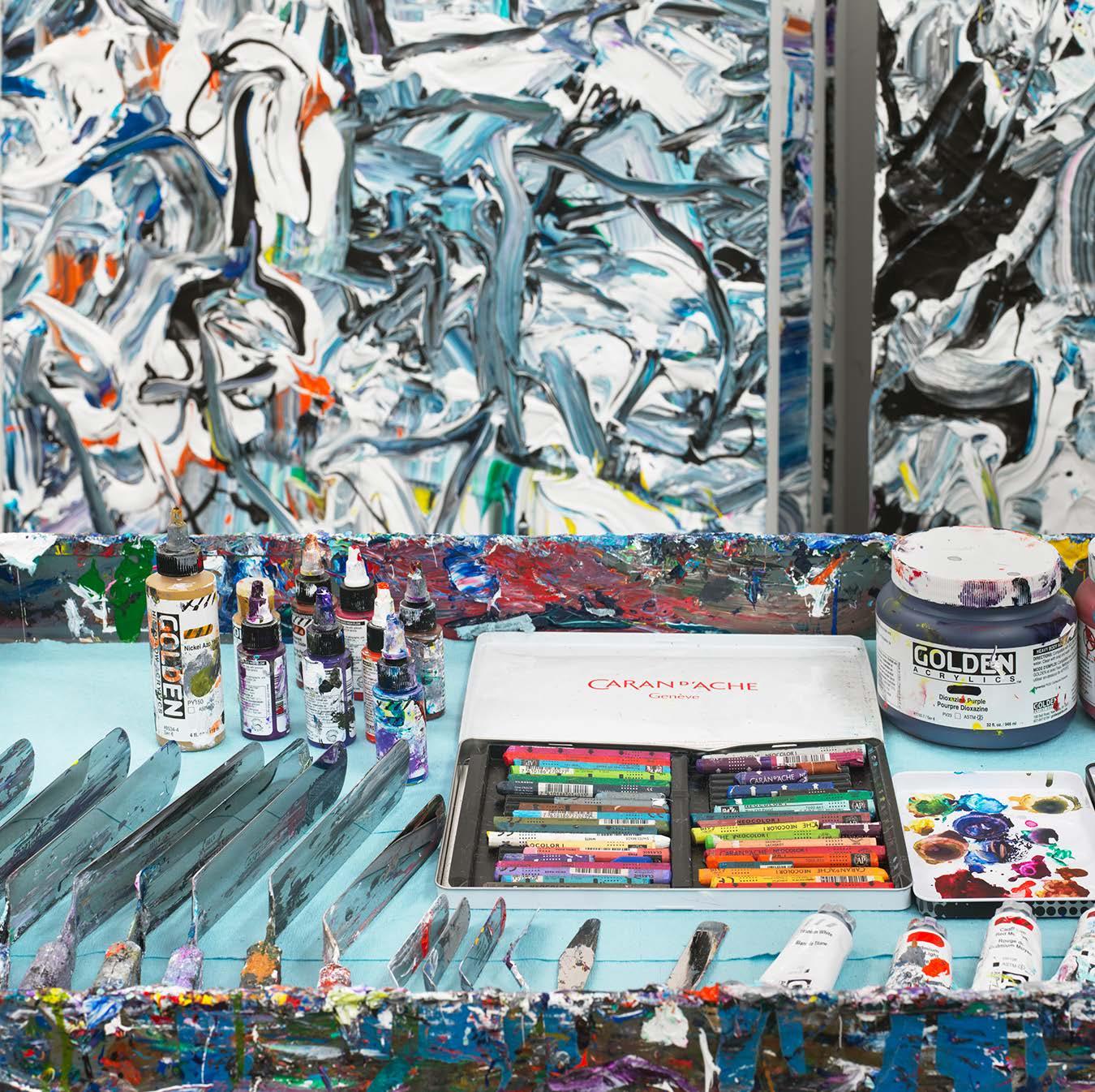
Photographs cannot do justice to Reafsnyder’s paintings, which are thickly and vigorously dimensional. He uses a variety of tools—which include brushes, but also squeegees, trowels, and sheets of Plexiglas—to apply and manipulate heroic quantities of acrylic paint. In his latest works, he typically premixes his colors, but they also blend, smear, and curdle together on the surface of the canvas. (His paintings are laid flat on sawhorses when he executes them, to keep the acrylic from sagging or dripping.) Reafsnyder’s undeniable technical virtuosity, which allows him to deftly deliver flicks and swoops of wet paint, can nevertheless come off as expressive chaos.
Admittedly, this latest body of work might be considered less outlandish than his prior output. Reafsnyder has long been recognized for his use of caustically bright and often clashing unmixed acrylic colors. But since around 2020, he has gradually shifted to a more restrained palette. White and (to a lesser extent) black now predominate, though I have yet to see a true grisaille, with greys glazed in the traditional manner. Reafsnyder is a restless colorist, and even when the chromatic range of a painting is reduced, color plays an essential and active role.
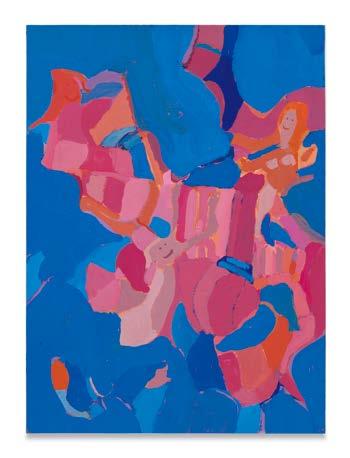
Michael Reafsnyder, Mermaid Play, 2024, Gouache on paper, 15 x 11 inches (38 x 28 cm).
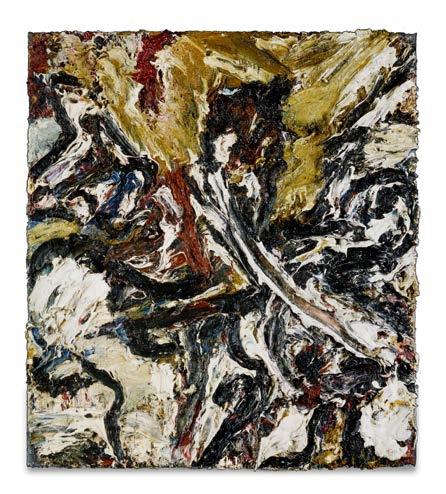
Frank Auerbach, Study after Titian II, 1965, Oil paint on canvas, 26 x 24 1/2 inches (67.3 x 62 cm). Tate Britain, London, United Kingdom.
Gone, too, are the smiley faces that, for many years, adorned and complicated Reafsnyder’s otherwise abstract (de)compositions. These embellishments were applied straight from the tube, interrupting the assumed solemnity of (what looks like) abstract expressionism with the levity and irreverence of graffiti. As the art historian Michael Schreyach has written, these faces pique “the formal problem of pictorial address” in Reafsnyder’s work, intervening in the various triangles of inference and understanding between the viewer, the painting, and the artist.
Those cartoonish smiling faces still appear, by the way, in the gouaches Reafsnyder paints of mermaids, an eccentric side project that he has maintained for many years, though his mermaids have yet to be exhibited publicly. These modestly scaled works are, above all, astonishing color studies, with milky-flat panels of gouache abutting each other and generating gorgeous chromatic complexity. The mermaids wallow in this immersive depth and invite us to join them. Sometimes, as with pictures like Mermaid Play (2024), the figures of the inanely smiling mermaids are almost illegible—literally subsumed by tone and color. These mermaids also appear often in the early underpainting of Reafsnyder’s canvases, before they are sunk beneath choppy layers of thick acrylic.
So … in his garage, a middle-aged man paints pictures of mermaids and creates abstractions so thick with paint that they can be difficult to lift. The material density of these works puts me immediately in mind of the London School painters Frank Auerbach and (to a lesser extent) Leon Kossoff, whose impasto mired their subjects within surfaces as scruffy and glum as the urban scenes they usually
portrayed. Auerbach’s studio, which he took over from Kossoff in 1954, was described by the art critic Robert Hughes as a “brown cave,” located in the working-class neighborhood of Camden Town “between a liver-brick Victorian semidetached villa on the left and on the right a decayed block of sixties maisonettes.” He painted the urban landscape that surrounded him throughout his life. Reafsnyder’s work, however, contains none of these artists’ lugubrious miserabilism (a mood born from the grim economic, architectural, and climatic atmosphere of postwar Britain). By contrast, Reafsnyder gives his paintings poppy titles like Root Beer, Wonder Roll, Groovy, and Electric Putty phrases that hark back to the relatively carefree ease and optimism of postwar California. (Reafsnyder was born in Orange in 1969, so he makes such references with a degree of personal removal.) His palettes, even at their most restrained, are characterized by the plastic colors of fresh acrylic rather than the terrestrial hues of traditional oil.
The ostensible absence of angst in Reafsnyder’s paintings is, to me, related to the sense of permission I detect in them—the permission the artist grants to himself to make such works and the permission the paintings grant to us, the viewers, to approach them easily, without intimidation or expectations of any correlation to private trauma. Permission is granted for fun, for pleasure, for freedom of interpretation, but permission is also granted to take the paintings seriously. At this point in time, the self-indulgent pathos of first-generation abstract expressionism has become an almost comical cliché, and the formalism of second-generation abstract expressionism seems limited and academically solipsistic. Reafsnyder’s paintings observe no such limits. They rise above their context; they belong to the city of Orange, to the state of California, to America, and to their moment in art history and world history, but they are also somehow removed—out of time and place. The family home is of this world; the garage is apart from it.
Whether Reafsnyder’s work strikes you as familiar or bizarre will depend less on your grasp of tendencies in Western abstract painting since 1940 and more on your preparedness to look carefully and patiently. His paintings, which are undeniably exciting, can be taxing on the eye, despite their embrace of visual pleasure. A work such as Royal Rumble (2025) does not direct one’s gaze so much as frenetically distract it. While brush strokes or paint drips may entice the eye along certain channels, there is always another moment of painterly incident to draw us in another direction. In this particular
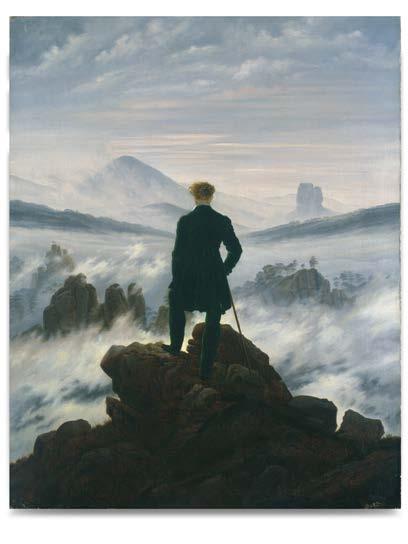
Caspar David Friedrich, Wanderer above the Sea of Fog, ca. 1817, Oil on canvas, 37 1/4 x 29 1/2 inches (94.8 cm x 74.8 cm). Hamburger Kunsthalle, Hamburg, Germany.
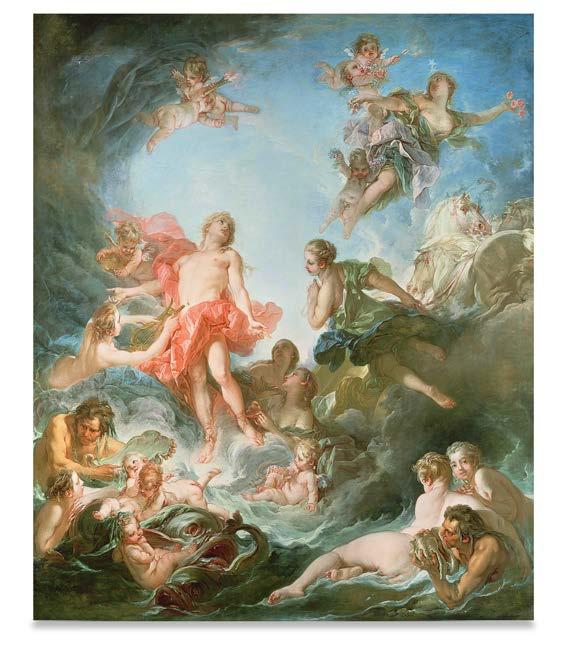
François Boucher, The Rising of the Sun, 1753, Oil on canvas, 125 x 102 7/8 inches (318 x 261 cm). The Wallace Collection, London, United Kingdom.
8 large work—probably the most chromatically restrained in the exhibition—dabs of crimson, yellow, blue, and rich purple enliven the field. Vibrating scrapes and thrilling multicolor swooshes, such as the near-rainbow brushstroke on the painting’s lower left edge, add to the melee.
Confetti (2025) is unusual in that it provides a simplified central figure for us to relate to—and to mediate our perception of the space of the painting. I think of Caspar David Friedrich’s Wanderer above the Sea of Fog (ca. 1817), in that the figure both demonstrates a way of being in the painting and obstructs our access to it. As with Reafsnyder’s mermaids, this abstracted form is fully immersed in the miasma of color around it. François Boucher’s paintings The Rising of the Sun (1753) and The Setting of the Sun (1752) were also influential on this new body of work, with their sublime entanglement of pale pink flesh with soft blue peaks of water and cloud.
“It’s 2026, you’re an artist, you can do anything … Why paint?” This facetious question was recently posed—in apparent sincerity—by the anonymous Instagram art-troll Divacorp. It’s a question I can’t help thinking about when I look at Reafsnyder’s work. There is a moment in his painting Haystack
(2025) that, perhaps, contains all the answers I need. Perhaps you see it too. A little above the painting’s center, at about 1 o’clock, there is a geological-chromatic feature that I can only describe by making a slurping sound with my mouth. There are no words I know of for this formation. It is a concave scoop of subtly gradating color hemmed by sharp crests; I imagine it was made with one of the plexiglass tools Reafsnyder uses to apply and squelch acrylic paint across his canvases.
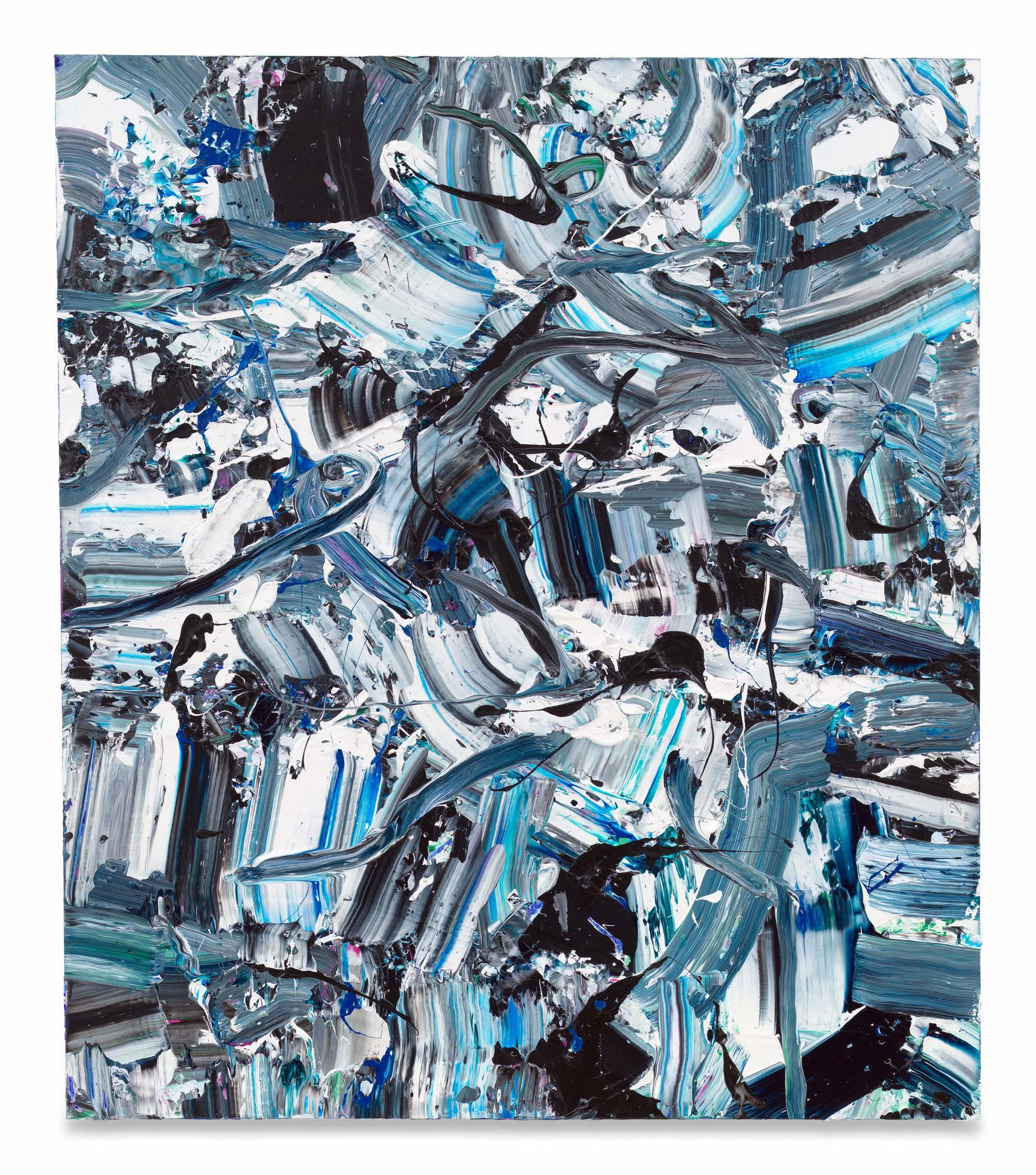
“What can you get from a painting that you can’t get from anything else in the world?” Reafsnyder asked, when I visited him in Orange. That’s what he asks himself, and that’s what guides the decisions in his work. Despite his sometimes evocative titles, he is not concerned with representing or replicating things that already exist. Paint, for him, is a realm unto itself. Reafsnyder spoke of “trying to get color to do something it shouldn’t”—that is, to work against the “push and pull” theorization of Hans Hofmann, in which cooler colors like blue recede and hot colors like red push forward. In Reafsnyder’s Hot Love (2025), red is the base layer, while in Confetti and Wonder Roll (2025), blue marks emerge above all else. Ultimately, his paintings seem to struggle against any obvious indication of pictorial depth, and this tension girds them with barely contained potential energy. They align less with the structure of Hofmann and more with the philosopher Georges Bataille’s conception of “l’informe,” or the formless, as it was related by the art critics Rosalind Krauss and Yve-Alain Bois to the paintings, for example, of Jackson Pollock or Cy Twombly. Reafsnyder’s paintings do not direct us toward any forms outside of their own tempestuous surfaces. There is nothing hidden in them— unlike the crepuscular scenes secreted in Auerbach’s brushwork—but they nevertheless take time to reveal themselves.
1 Michael Schreyach, “What Painting Can Do,” Michael Reafsnyder, exhibition catalog (New York: Miles McEnery, 2020).
2 Robert Hughes, “The Art of Frank Auerbach,” The New York Review of Books, October 11, 1990. ..https://www.instagram.com/p/DUOfitIko06/ accessed February 2026.
3 Hans Hofmann, Search for the Real and Other Essays, ed. Sara T. Weeks and Bartlett H. Hayes Jr. (Cambridge, MA: MIT ..Press, 1967).
4Yve-Alain Bois and Rosalind Krauss, Formless: A User’s Guide (New York: Zone Books, 1997).
Jonathan Griffin is a critic and writer based in Los Angeles. He is a regular contributor to frieze magazine, The New York Times, the Financial Times, Art Review, Apollo and others. He has written for monographs and exhibition catalogues on artists including William N. Copley, Andy Warhol, Derek Boshier, Damien Hirst, Armin Boehm, Liam Everett, Hernan Bas, Ragen Moss and Alice Tippitt. He is the author of On Fire (Paper Monument, 2016).
Blooming, 2025
Acrylic on linen
36 x 44 inches
91 x 112 cm
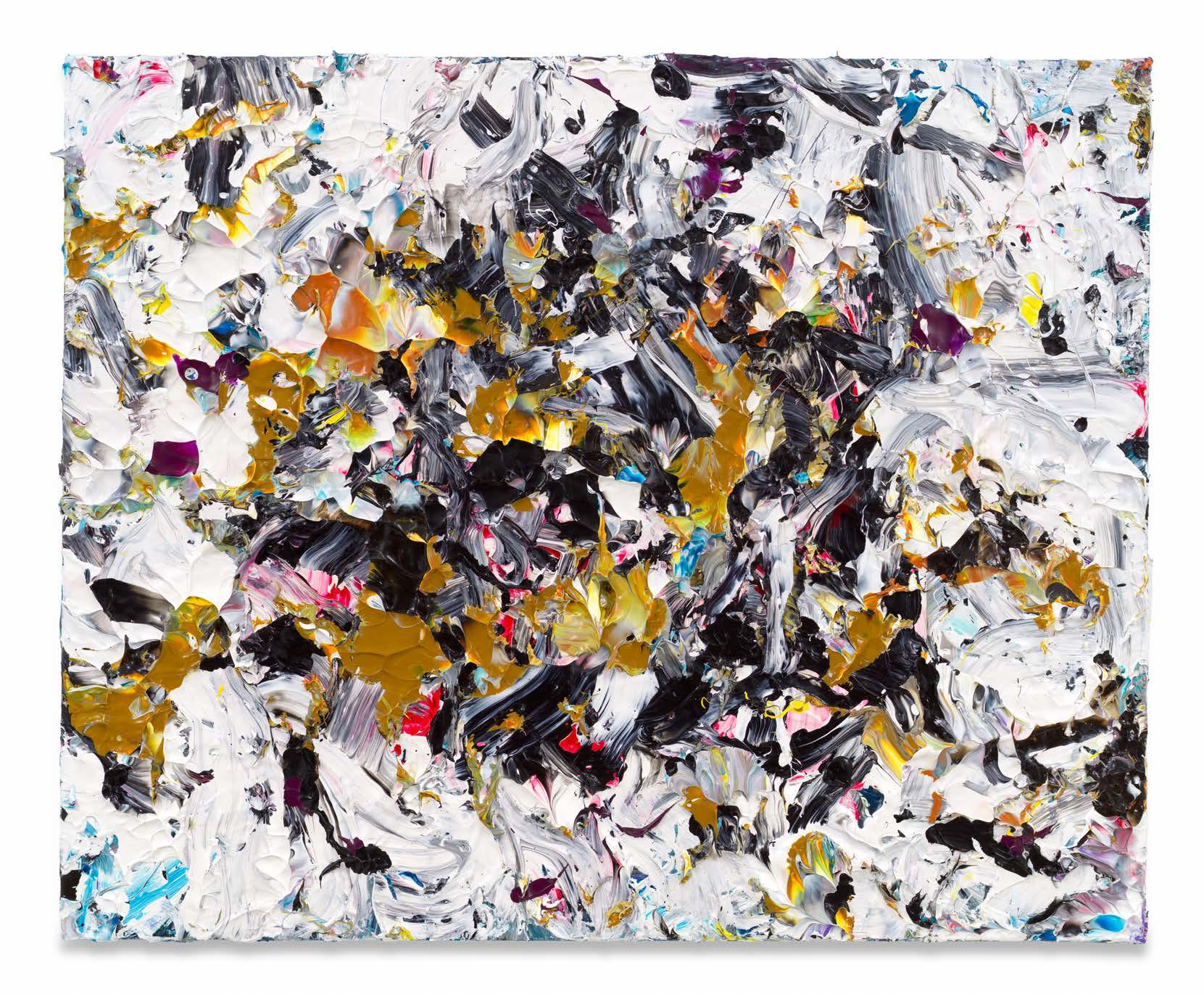
48 1/4 x 60 inches
123 x 152 cm
Chirpy’s Garden, 2025
Acrylic on linen
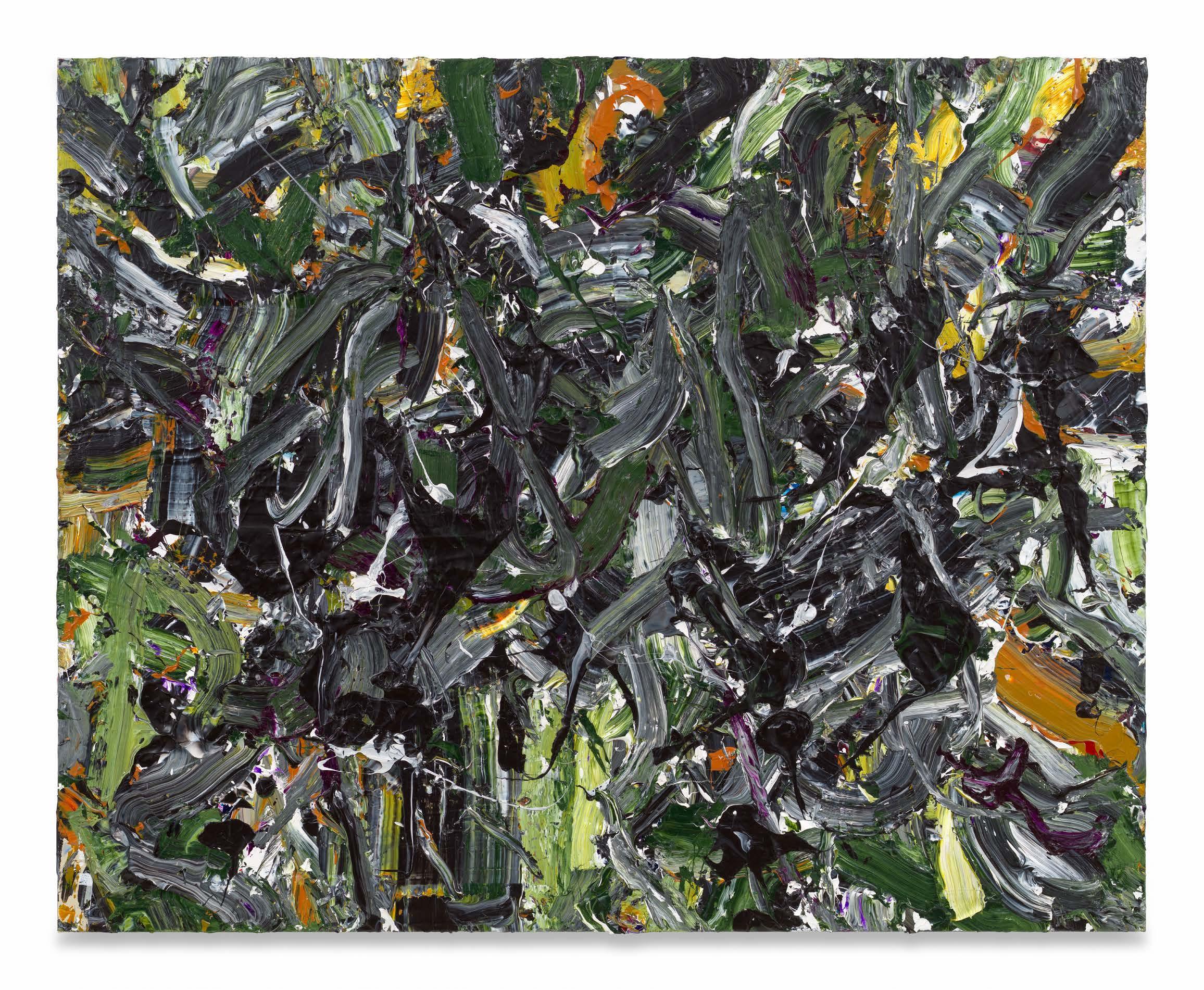
Confetti, 2025
Acrylic on linen
40 1/4 x 52 inches
102 x 132 cm
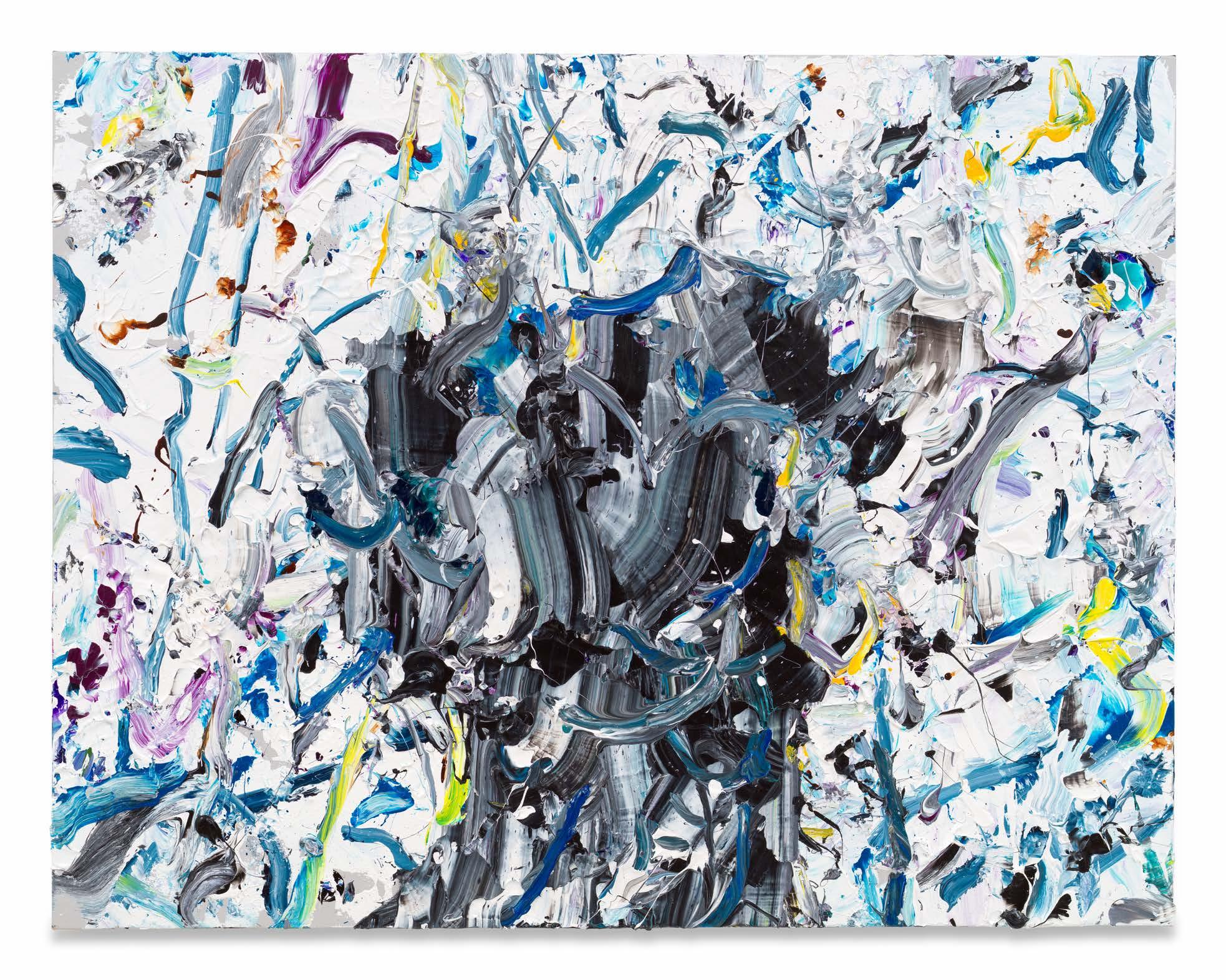
132 x 154 cm
Day Drifter, 2025
Acrylic on linen
52 x 60 1/2 inches
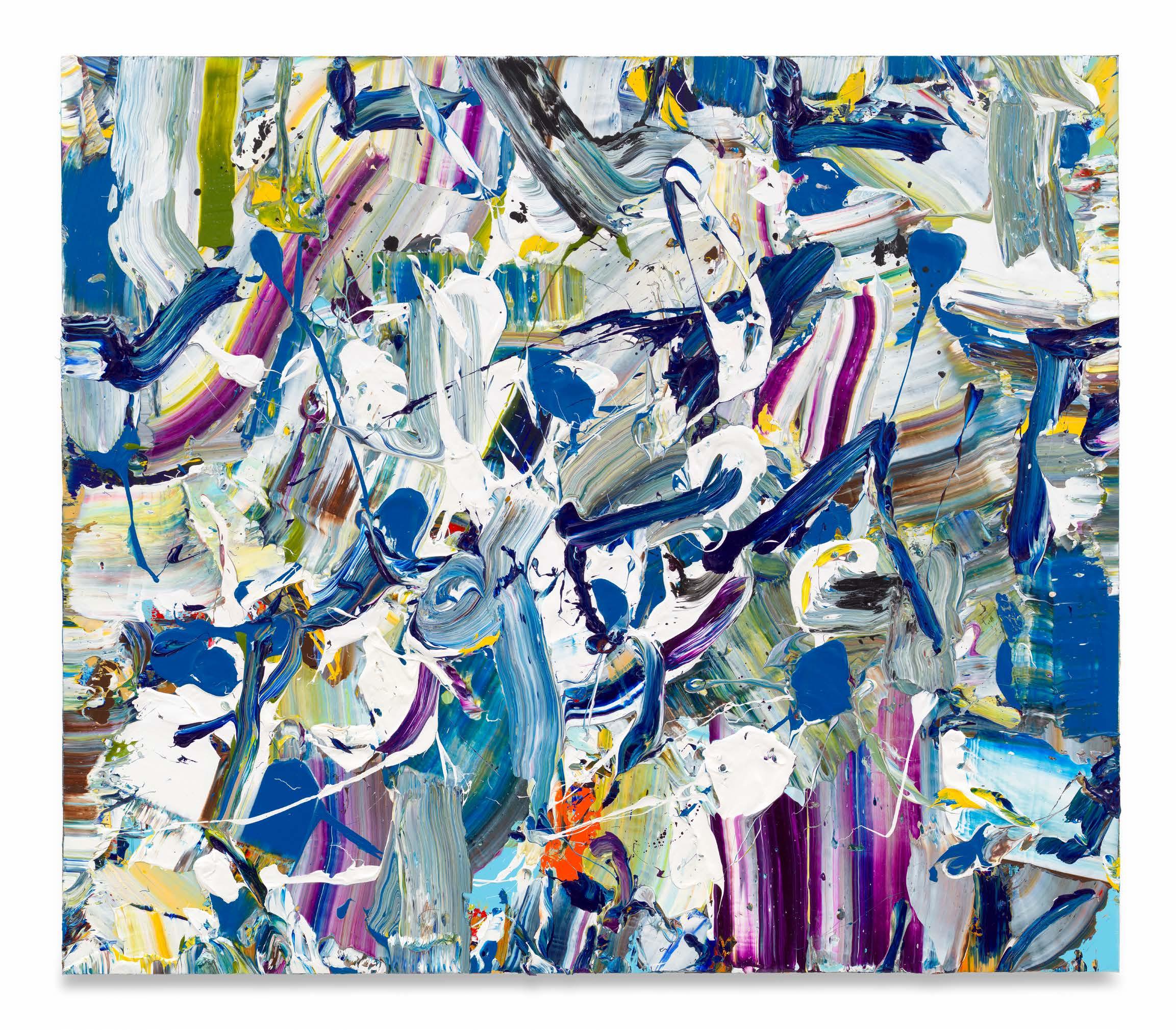
91
Electric Putty, 2025
Acrylic on linen
36 x 44 inches
x 112 cm
Groovy, 2025
Acrylic on linen
44 x 36 inches
112 x 91 cm
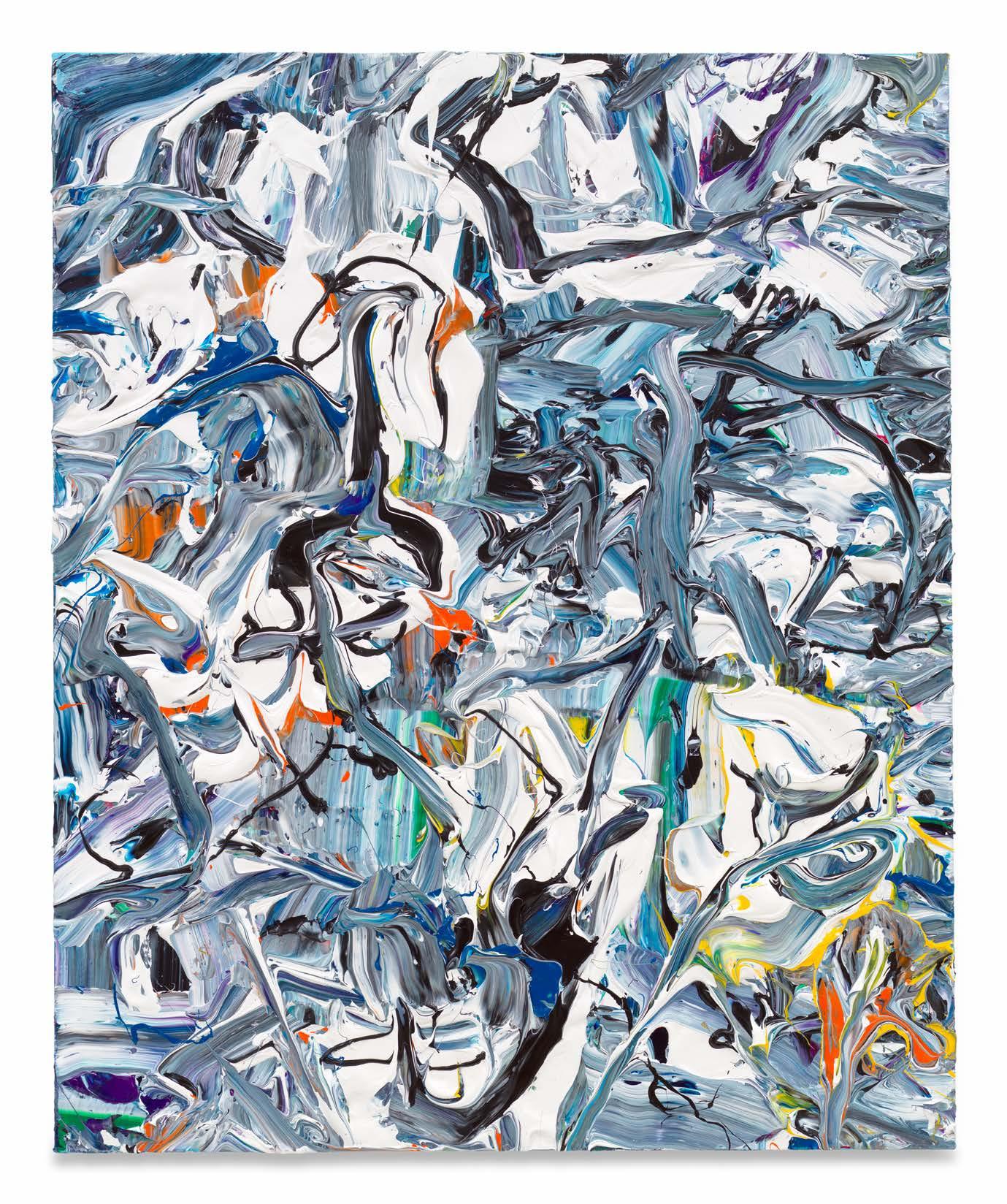
Haystack, 2025
Acrylic on linen
48 x 60 inches
122 x 152 cm
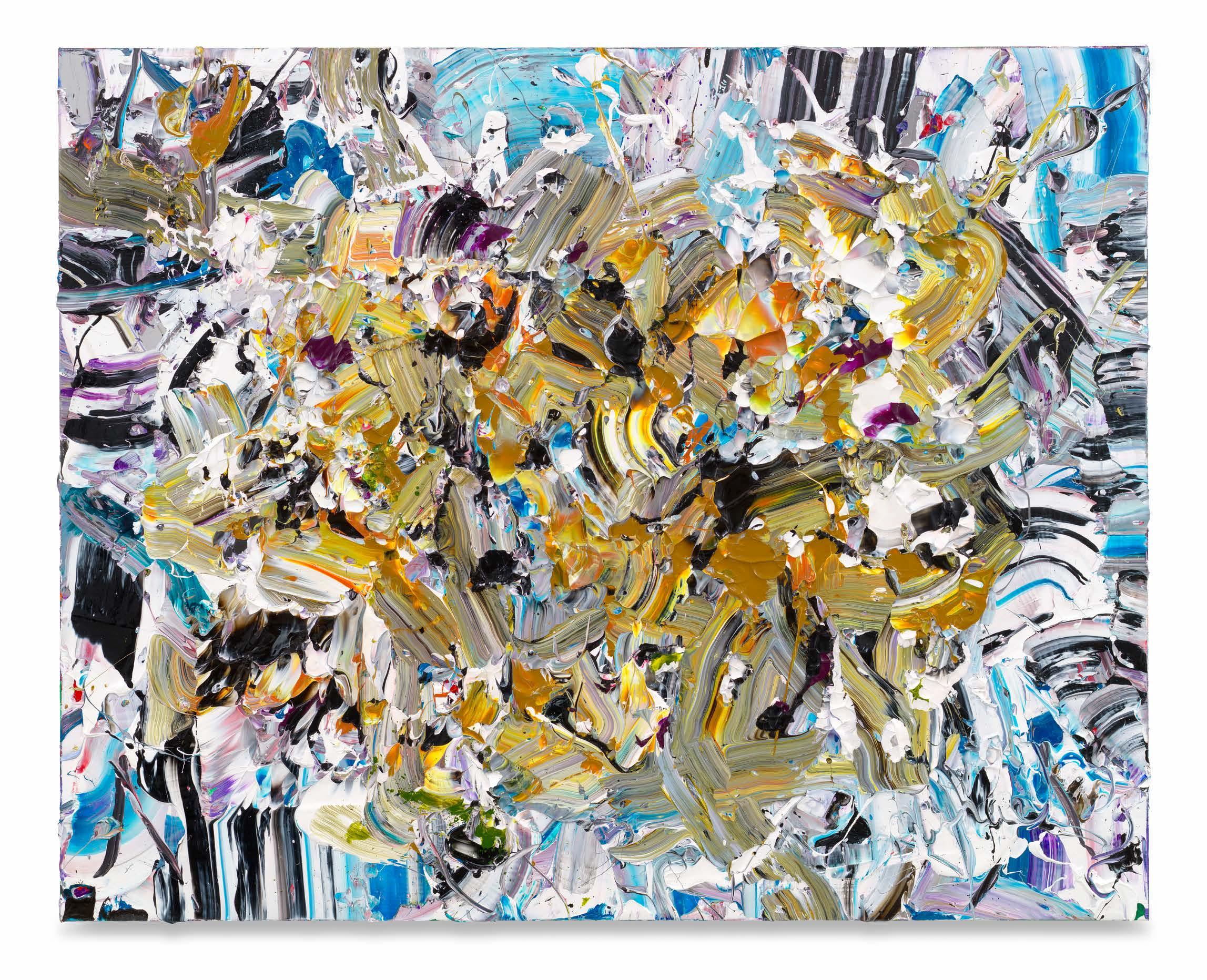
Hot Love, 2025
Acrylic on linen
52 x 60 inches
132 x 152 cm
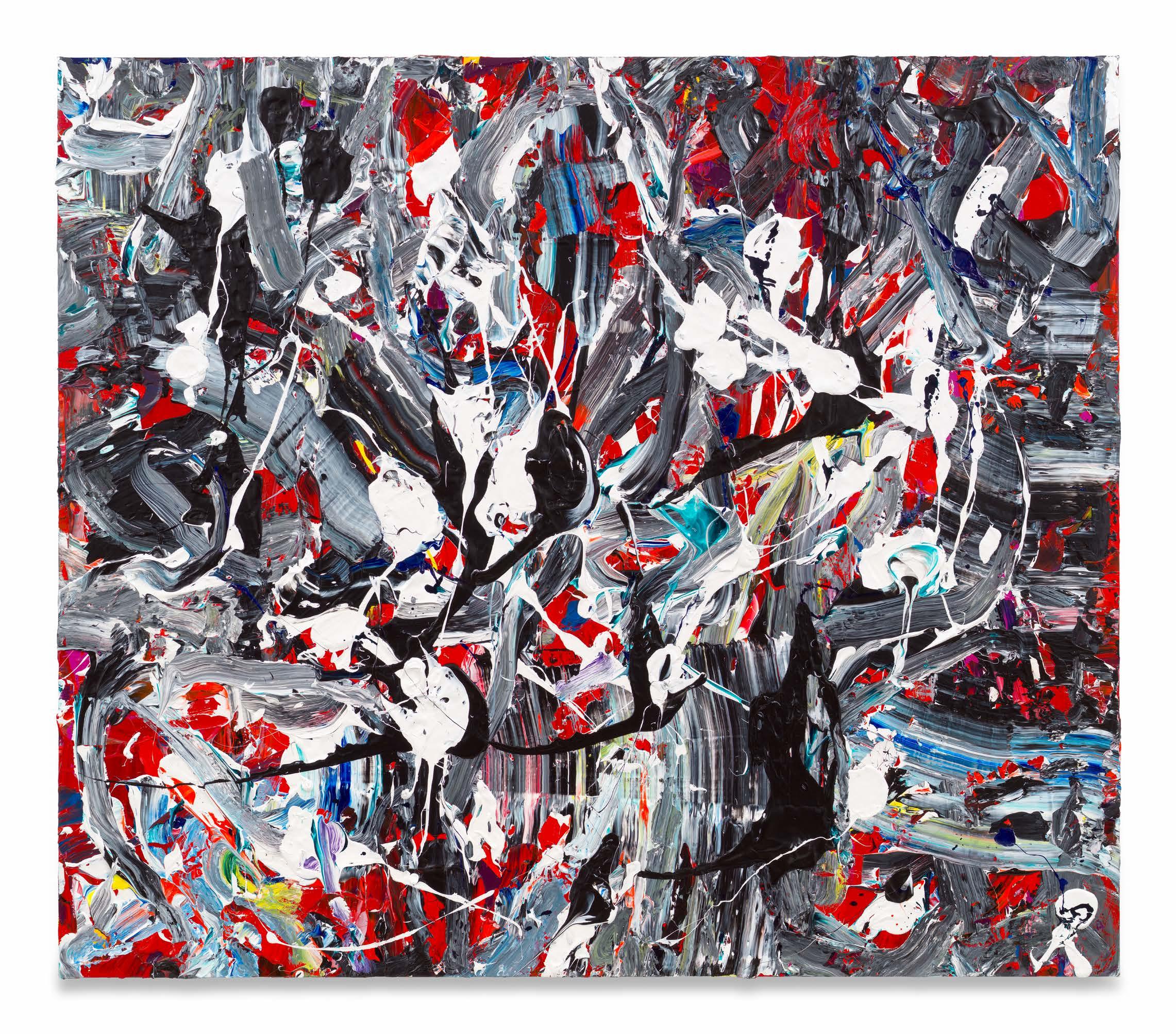
Root Beer Float, 2025
Acrylic on linen
30 x 36 inches
76 x 91.4 cm
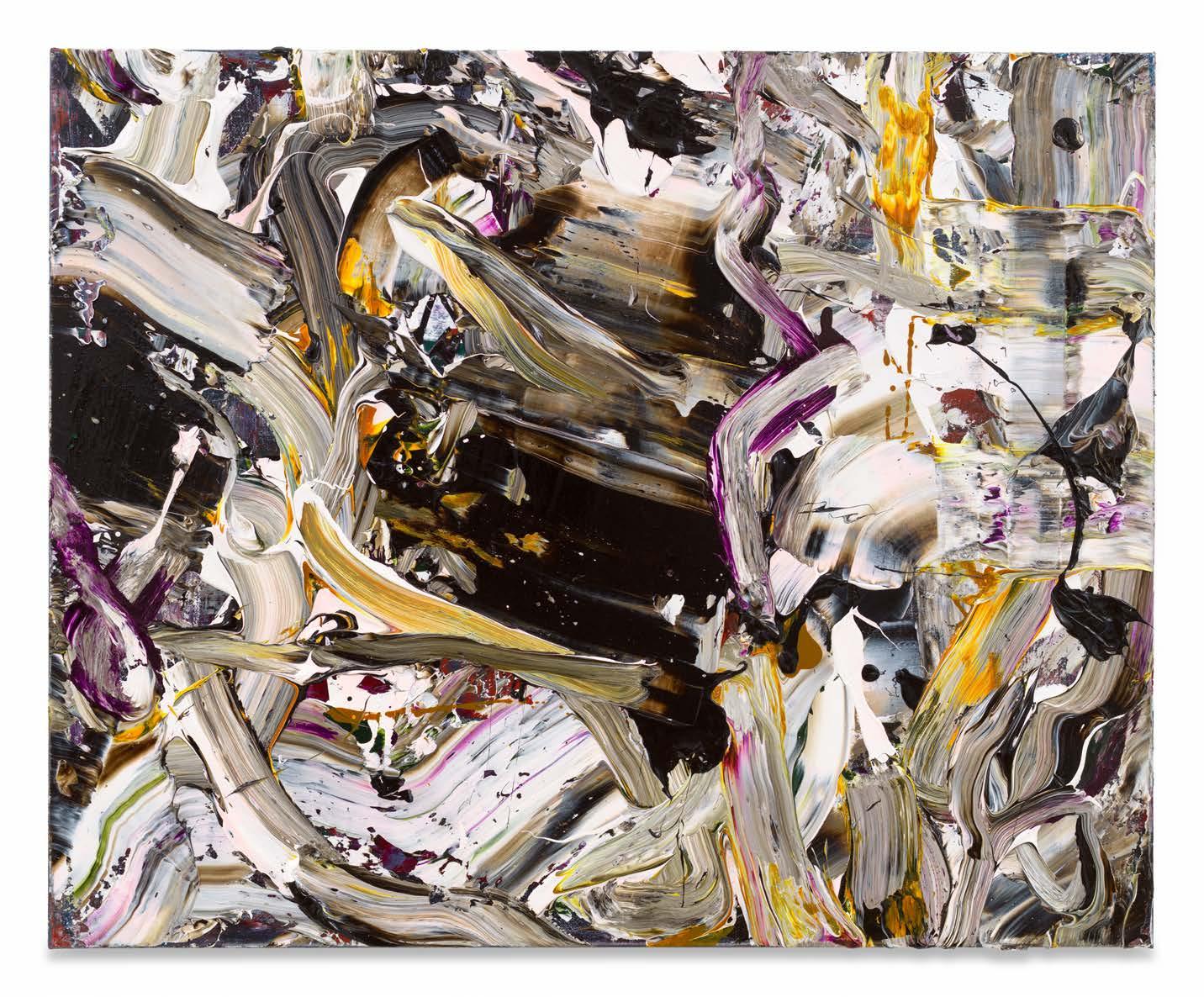
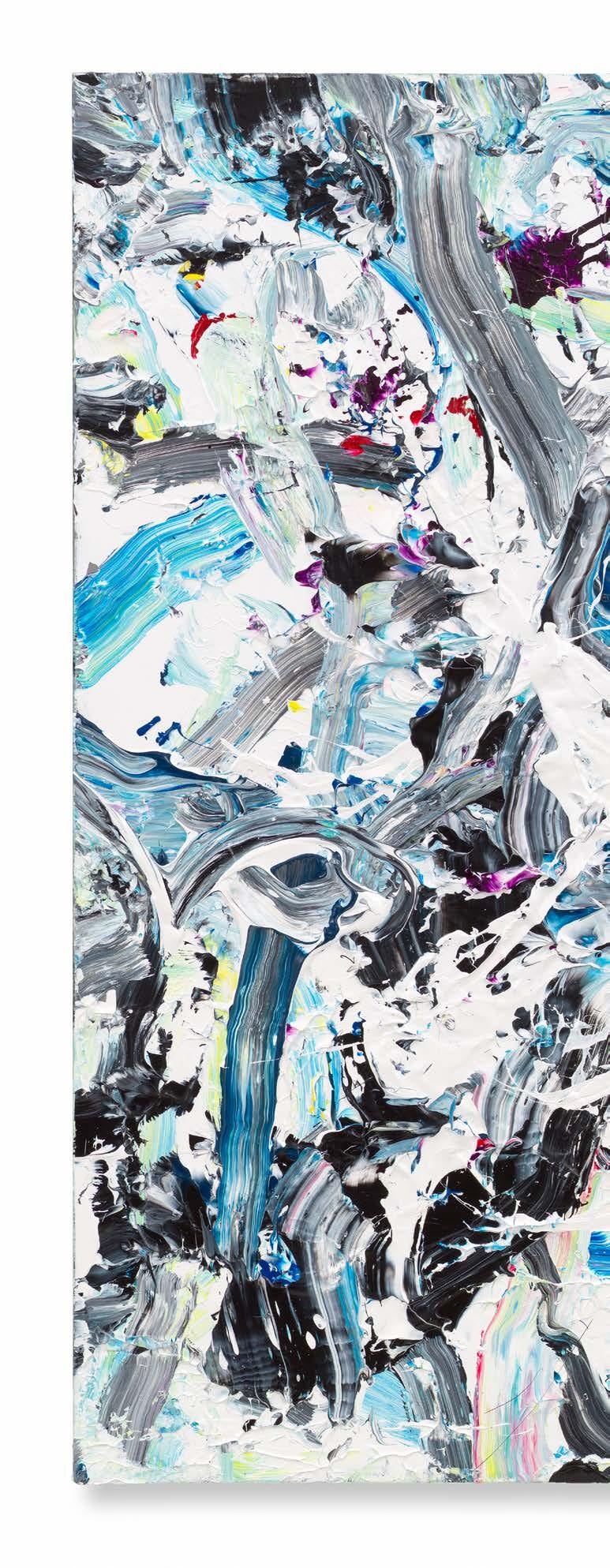
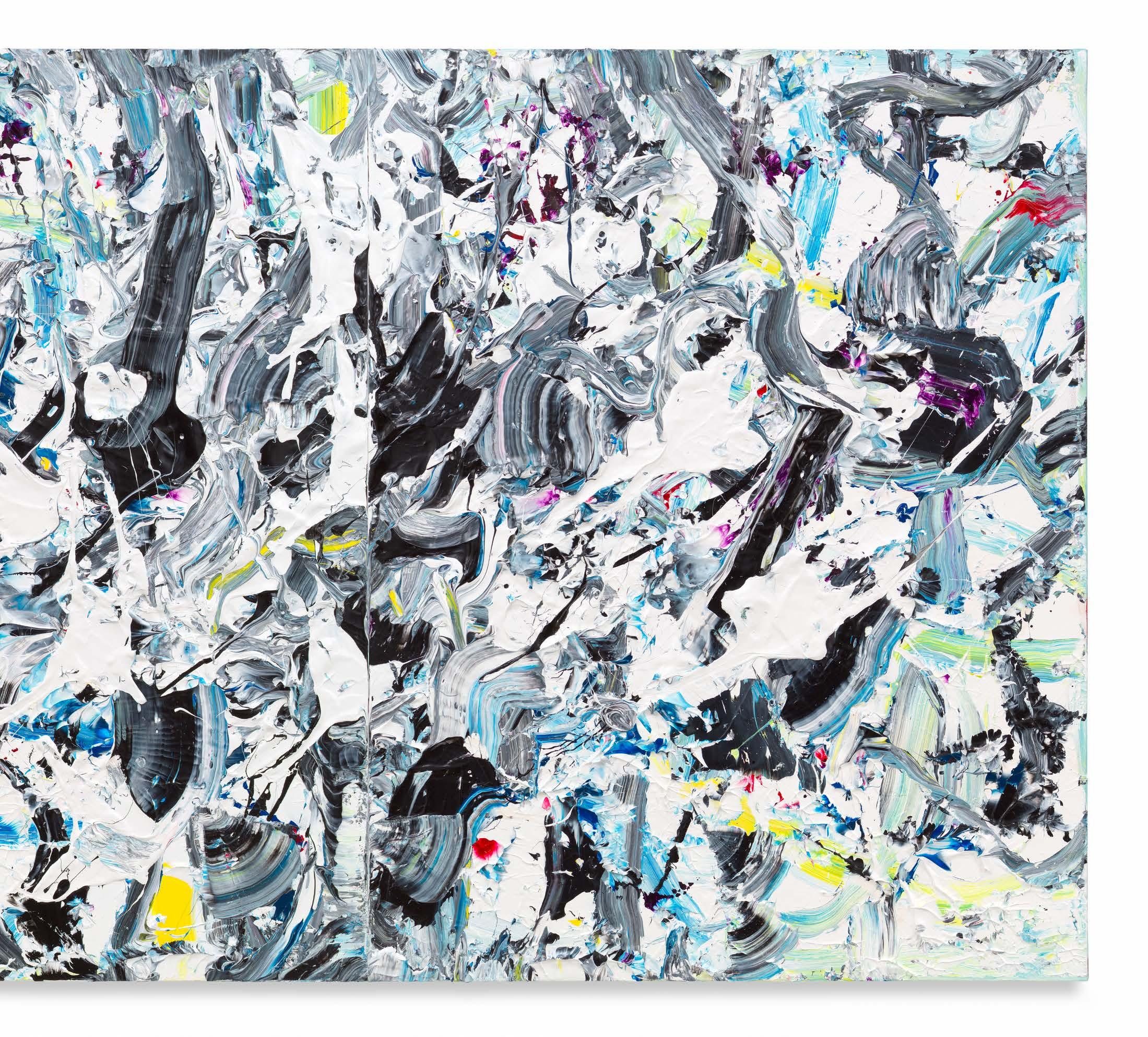
Royal Rumble, 2025
Acrylic on linen
52 x 80 inches
132 x 203 cm
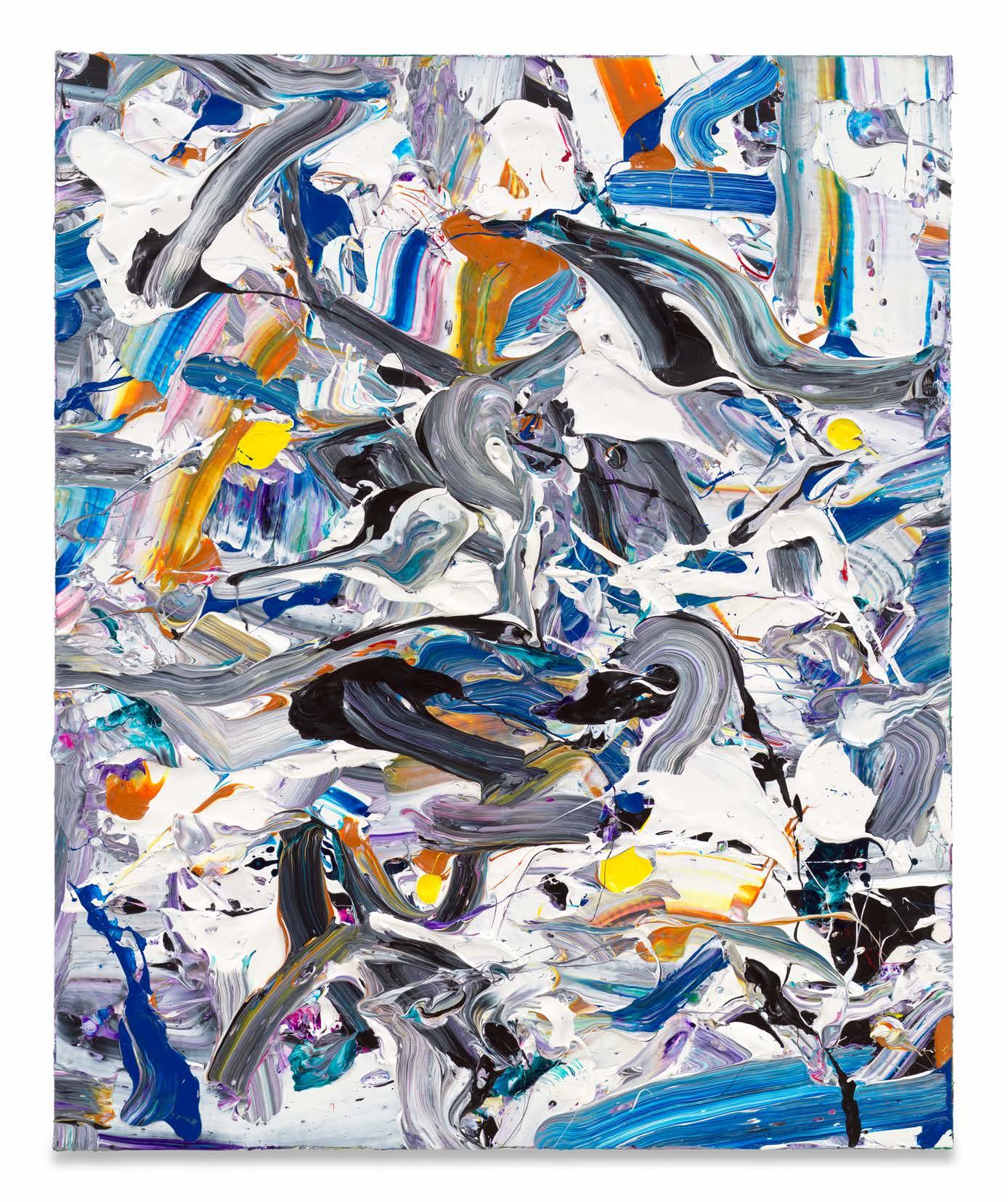
Swishy, 2025
Acrylic on linen
44 x 36 inches
112 x 91 cm
Wonder Roll, 2025
Acrylic on linen
60 x 52 inches
152 x 132 cm
Michael Reafsnyder
Born in 1969 in Orange, CA
Lives and works in Orange, CA
EDUCATION
1996
MFA, ArtCenter College of Design, Pasadena, CA
1992
BA, Chapman University, Orange, CA
SOLO EXHIBITIONS
2026
Miles McEnery Gallery, New York, NY
2025
“Summer Jam,” Scott Richards Contemporary Art, San Francisco, CA
2024
Miles McEnery Gallery, New York, NY
2023
Weber Fine Art, Greenwich, CT
2022
Miles McEnery Gallery, New York, NY
2020
Miles McEnery Gallery, New York, NY
2017
Ameringer | McEnery | Yohe, New York, NY
2016
“In Bloom,” R.B. Stevenson Gallery, La Jolla, CA
2015
Ameringer | McEnery | Yohe, New York, NY
2014
“Sunday Best,” Susanne Vielmetter Los Angeles Projects, Los Angeles, CA
2013
“We Ate The House,” Ameringer | McEnery | Yohe, New York, NY
2012
“Gleam,” R.B. Stevenson Gallery, La Jolla, CA
2011
“Feast,” Ameringer | McEnery | Yohe, New York, NY “Delight,” Marty Walker Gallery, Dallas, TX
2010
“Sweetness,” Rebecca Ibel Gallery, Columbus, OH “Put it There: New Paintings and Ceramics,” Western Project, Culver City, CA
2009
“Undone,” R.B. Stevenson Gallery, La Jolla, CA Western Project, Culver City, CA
2007
“Aqualala,” Western Project, Culver City, CA “Fresh,” W.C.C.A., Singapore “Whirl,” R.B. Stevenson Gallery, La Jolla, CA
2005
“More: Paintings and Sculpture from 2002-2005” (curated by Libby Lumpkin), Las Vegas Art Museum, Las Vegas, NV
2004
“Yum-Yum,” Uplands Gallery, Melbourne, Australia
2003
“Paintings,” Mark Moore Gallery, Culver City, CA
2002
“Paintings,” Galería Marta Cervera, Madrid, Spain
“Paintings,” Finesilver, San Antonio, TX
2001
“Paintings,” Mark Moore Gallery, Culver City, CA
“Present/Future,” Artissima, Turin, Italy
1999
“Paintings,” Mark Moore Gallery, Culver City, CA
“Monotypes/Paintings,” Cheryl Pelavin Fine Art, New York, NY
1997
“Paintings,” Blum & Poe, Santa Monica, CA
1996
“Paintings,” ArtCenter College of Design, Pasadena, CA
GROUP EXHIBITIONS
2026
“Excite,” Peter Mendenhall Gallery, Pasadena, CA
2025
“Summer Hang,” Miles McEnery Gallery, New York, NY
“Michael Reafsnyder & Patrick Wilson,” Weber Fine Art, Greenwich, CT
“California Dreaming,” Contemporary Art Matters, Columbus, OH
2024
“All Bangers, All The Time: 25th Anniversary Exhibition,” Miles McEnery Gallery, New York, NY
“Summer Selections,” Weber Fine Art, Greenwich, CT
2023
“Two of Us: Dion Johnson and Michael Reafsnyder,” Contemporary Art Matters, Columbus, OH
2022 “Summer Drift,” Miles McEnery Gallery, New York, NY
2021
“Flying Colors,” Contemporary Art Matters, Columbus, OH
“Return of the Dragons,” Blossom Market, Los Angeles, CA
2020
“Do You Think it Needs a Cloud?,” Miles McEnery Gallery, New York, NY
“Little Gems,” Telluride Gallery of Fine Art, Telluride, CO
2019
“Combo Platter: Collaborative Works by Michael Reafsnyder and David Kiddie,” Harris Art Gallery, University of La Verne, La Verne, CA
2018
“Abstract Thinking,” R.B. Stevenson Gallery, La Jolla, CA
“Michael Reafsnyder & Patrick Wilson,” Miles McEnery Gallery, New York, NY
“Belief in Giants,” Miles McEnery Gallery, New York, NY
2017
“Non-Objective” (curated by James Hayward), Telluride
Fine Art, Telluride, CO
“Painters Room,” R.B. Stevenson Gallery, La Jolla, CA
2015
“Works of Paper II,” ACME., Los Angeles, CA
“Recent Acquisitions,” Marjorie Barrick Museum of Art, University of Nevada, Las Vegas, Las Vegas, NV
“Paths and Edges,” Guggenheim Gallery, Chapman University, Orange, CA
2014
“Floor Flowers,” East and Peggy Phelps Gallery, Claremont Graduate University, Claremont, CA
2012
“Into the Light,” Marjorie Barrick Museum of Art, University of Nevada, Las Vegas, Las Vegas, NV
2011
“Los Angeles Museum of Ceramic Art,” ACME., Los Angeles, CA
“Summer Selections,” Ameringer | McEnery | Yohe, New York, NY
2010
“Forever Now: A Group Exhibition,” East and Peggy Phelps Gallery, Claremont Graduate University, Claremont, CA
“Just Enough,” R.B. Stevenson Gallery, La Jolla, CA
“Keramik,” Pacific Design Center, Los Angeles, CA
2009
“Good Ship Lollipop,” CTRL Gallery, Houston, TX
“Selected Works from Pilliod Records,” Morgan Lehman Gallery, New York, NY
“Way Out West,” Donna Beam Art Gallery, University of Nevada, Las Vegas, NV
“Collecting California,” Laguna Art Museum, Laguna Beach, CA
“The First Six Years,” Western Project, Culver City, CA
“Well Tempered,” R.B. Stevenson Gallery, La Jolla, CA
“Electric Mud” (curated by David Pagel), Blaffer Gallery, University of Houston, Houston, TX
2008
“Like Lifelike” (curated by Brad Spence), Sweeney Art Gallery, University of California, Riverside, Riverside, CA
“iCandy: Current Abstraction in Southern California,” Cypress College Art Gallery, Cypress College, Cypress, CA
“Splash,” Rebecca Ibel Gallery, Columbus, OH
“Luscious Abstraction,” Frank M. Doyle Arts Pavilion, Orange Coast College, Costa Mesa, CA
“Black Dragon Society,” Black Dragon Society, Los Angeles, CA
2007
“Summer Selections,” Rebecca Ibel Gallery, Columbus, OH
“Abstract,” R.B. Stevenson Gallery, La Jolla, CA
2006
“Too Many Tear Drops,” David Reed Studio, New York, NY
“A Little So Cal Abstraction,” Mandarin Gallery, Los Angeles, CA
“Discovery,” West Coast Contemporary Art, Singapore
2005
“Step Into Liquid” (curated by Dave Hickey), Ben Maltz Gallery, Otis College of Art and Design, Los Angeles, CA
“In Bloom,” Mark Moore Gallery, Culver City, CA
Black Dragon Society, Los Angeles, CA
2004
“Fresh Paint,” Glerie Eugen Lendl, Graz, Austria
“Painting and Sculpture,” Mark Moore Gallery, Culver City, CA
“Funny Business: Humor in Art from the Permanent Collection,” Laguna Art Museum, Laguna Beach, CA
“The O Scene,” Laguna Art Museum, Laguna Beach, CA
“Now and Then Some,” Claremont Graduate University, Claremont, CA
2003
“LA TAP,” Uplands Gallery, Melbourne, Australia
“Not the Usual Suspects” (curated by James Hayward),
Manny Silverman Gallery, Los Angeles, CA
“Pfat and Sassy,” Charlotte Jackson Fine Art, Santa Fe, NM
“Extreme Paint,” Peter Blake Gallery, Laguna Beach, CA
2002
“Five Times Four,” Modernism, San Francisco, CA
“Trade Show,” Guggenheim Gallery, Chapman University, Orange, CA
“New in Town” (curated by Bruce Guenther), Portland Art Museum, Portland, OR
“Western States,” Mark Moore Gallery, Culver City, CA
2001
“Cal’s Art, Sampling California Painting,” University of North Texas, Denton, TX
“One Minute of Your Time: A Brief Survey of Southern California Art from 1835 to 2001” (curated by Tyler Stallings), Laguna Art Museum, Laguna Beach, CA
“The Stuff Dreams are Made From,” Art Frankfurt, Frankfurt, Germany
2000
“New Work: Abstract Painting,” Todd Hosfelt Gallery, San Francisco, CA
“New American Paintings 15” (curated by David Pagel), The Jones Center for Contemporary Art, Austin, TX
“Paint, American Style,” Mark Moore Gallery, Culver City, CA
“Radar Love (with Gajin Fujita, Andrea Bowers and Linda Stark),” Galleria Marabini, Bologna, Italy
1999
“Under 500: Intimate Abstract Paintings,” Black Dragon Society, Los Angeles, CA
“LA/New York Abstract,” Cheryl Pelavin Fine Art, New York, NY
1996
“Risk,” The Loft, Laguna Beach, CA
1995
“Gander Mountain High, Ride ‘Um Hunter” (curated by Daniel Mendel-Black), Pasadena, CA
AWARDS
2022
Pollock-Krasner Foundation Grant, New York, NY
SELECT COLLECTIONS
Columbus Museum of Art, Columbus, OH
Frederick R. Weisman Museum of Art, Los Angeles, CA
Harvard University, Cambridge, MA
Laguna Art Museum, Laguna, CA
Las Vegas Art Museum, Las Vegas, NV
Los Angeles County Museum of Art, Los Angeles, CA
Minneapolis Institute of Art, Minneapolis, MN
Museum of Contemporary Art San Diego, San Diego, CA
North Dakota Museum of Art, University of North Dakota, Grand Forks, ND
UC Irvine Langson Orange County Museum of Art, Costa Mesa, CA
Portland Art Museum, Portland, OR
Progressive Corporation, Mayfield Village, OH
Published on the occasion of the exhibition
MICHAEL REAFSNYDER
14 May – 20 June 2026
Miles McEnery Gallery 525 West 22nd Street New York NY 10011
tel +1 212 445 0051 www.milesmcenery.com
Publication © 2026 Miles McEnery Gallery All rights reserved
Essay © 2026 Jonathan Griffin
Photo Credits
p. 6: © The Estate of Frank Auerbach / Digital image courtesy of Frankie Rossi Art Projects, London, United Kingdom
p. 8: Digital Image courtesy of bpk Bildagentur / Hamburger Kunsthalle, Hamburg, Germany / Art Resource, New York, NY, photo by Elke Walford p. 8: Digital image © Wallace Collection, London, United Kingdom / Bridgeman Images
Associate Director
Julia Schlank, New York, NY
Photography by Dan Bradica, New York, NY
Christopher Burke Studios, Los Angeles, CA
ISBN: 979-8-3507-6401-7
Cover: Swishy, (detail), 2025