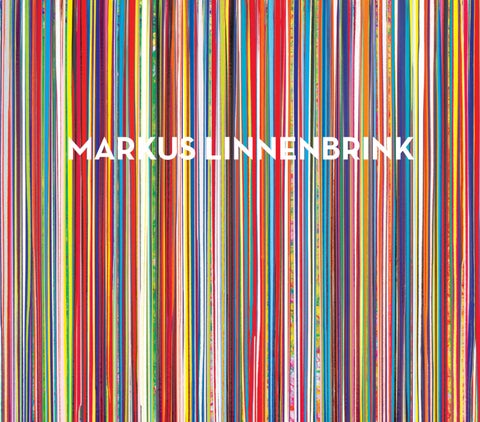
MARKUS LINNENBRINK

BEYOND WALLS
MARKUS LINNENBRINK
LETMETELLYOUWHATTHERIVERSGONNADO
Time
The statement may seem abrupt to anyone who discovers the colorful and bright works of Markus Linnenbrink, but letās risk it: Linnenbrinkās art is, above all, about passing time. In order to fathom this idea, an examination of the formal characteristics of the artistās production over the last 20 years is imperative. Linnenbrink has mainly been using two types of formal patterns: his renowned epoxy resin drips and his multicolor glossy strata. And both of those patterns talk to passing time.
The drips areāas per the artistās own wordsāāthe curtain of timeā over things. They cover underlying abstract watercolor compositions (in the drip paintings series) or run over old photographs from his fatherās archives (in the photo drip series). Family memories are allowed to dimly ļ¬lter through the translucent resin, but they are mostly eclipsed by the life that Markus Linnenbrink is living today: his shiny and colorful resin, his signature drips. The Skulls series moves beyond the artistās family circle and reaches deeper into the past. In that series, skulls epitomize the lost identities and forgotten existences of those who lived before our times. The highly chromatic drips that ļ¬ood the skulls can be seen as an attempt by the artist to draw attention to those who lack remembrance, to provide them with individual characteristics, however artiļ¬cial and incongruous they may seem. But time is unforgiving, the shiny hues are already starting to melt away, and this newly acquired identity is bound to fade once again in passing time.
The strataāwhich are present in many of Linnenbrinkās paintings (the drills, the reverse, and the cuts), as well as in most of his sculptures (linear, organic, or spherical)āare also directly evocative of extinct memories that got buried below new layers of time. The geological metaphor is operating, and the cuts and drills in the resin act like rivers carving out canyons or like scientists sampling ice cores, revealing a history that would otherwise remain out of reach. There is a paradoxical strength in Linnenbrinkās strata works: The exposure of fragments of buried colors and objects reveals that most of them are actually inaccessible, lost for good in the volume of the resin. The approach is symbolic, but it is also reļ¬exive, as the artist archives, layer after layer, the elements of their own making within his works.
But letās not misapprehend the spirit of Linnenbrinkās art. Despite its emphasis on lost memories, it should not be seen as nostalgia, but as a celebration. A celebration of life, of its inner mechanisms, of its ability to learn from history but also of its tendency to repeat the same mistakes, to regenerate, to grow on its own ashes...Linnenbrink rejuvenates memories, brings life back into dead skulls and makes ancient pottery look less outdated by deluging it with ļ¬ashy resin. This very contrastābetween the earnest and the joyfulāis at the core of his practice.
A body of work in Linnenbrinkās practice stands apart in its singularity: the Wall Paintings. They are the only major pieces, up to today, in which his two signature patternsāthe drips and the strataāare used together. One could argue that the Wall Paintings are three-dimensional works, because they are painted on architectural elements. But they can also be seen as ļ¬at, since the paint is applied, with no thickness, on plane walls. Unlike Linnenbrinkās other works, the Wall Paintings do not take the form of concrete and volumetric objects; they are rather a representation, a decor that creates a powerful and enveloping illusion. They are transversal sketches of his strata works, like educational plates in a book. Unlike in his other works, everything is visually
accessible, nothing is buried within a mass of resin, nor is anything fully hidden below a drips curtain. For once, the present (symbolized by the drips) is not overshadowing the past (represented by the strata). Time is abolished. The Wall Paintings oļ¬er a sort of utopia, which solves the questions of passing time and lost memories. But like all utopias, the Wall Paintings do not last and cannot be reproduced: They are site-speciļ¬c installations and are mostly temporary.
Breaking new grounds
Heading into 2019, Markus Linnenbrink seems to be on the verge of substantial breakthroughs. Two of the pieces created for LETMETELLYOUWHATTHERIVERSGONNADO, his 2019 exhibition at the Miles McEnery Gallery, are building on the concepts developed in the Wall Paintings and are pushing them further.
His ļ¬rst audacious move has been to keep on exploring the combination of drips and strata into a single piece, which this time takes the form of an objective artwork, OPENMELODYFOLDS, a ļ¬rst-of-its-kind drip sculpture. The base of this piece is what the artist calls a linear sculpture, made up of those chromatic and orthogonal blocks of recovered resins. Color remnants from several years of studio activityāsometimes mixed with discarded objectsāform an archaeological account of the artistic creation over this period of time. The linear sculpture is visually enhanced by drips that, driven by gravity, run perpendicular to the stratiļ¬ed layers. Linnenbrink updates the grid pattern of the Wall Paintings, letting outside forces play a deļ¬ning role in his work. This is typical of the artistās philosophy: Be permeable, accept the world as it is, abandon full control, let things happen in conļ¬dence, see the value in all things, exert diļ¬erent points of view...It is the approach of a wise man, who takes his time developing ideas and letting them materialize (ļ¬ve years for some of his sculptures). The reward can be considerable, as it is in OPENMELODYFOLDS,
a stunning allegory of destiny. The same elementāa small lump of pigmented epoxy resin dribbling from a paintingātakes a diļ¬erent shape, a drip or a strata, based on the geometry of the surface on which it is falling (horizontal or vertical). Same origin, diļ¬erent fates.
The second breakthrough work is the masterpiece of the show, DAYLIGHTTEARSTOMYEYES, a new type of mobile Wall Painting. It is made on a series of articulated panels, painted on both sides: black and white on the outside and in colors on the inside. The palette is unconventional for Markus Linnenbrink. It is reminiscent of the delicate and stunning pastel hue assortments of Jean Dubuļ¬et; blush and salmon tones resonate with shades of turquoise, mauve, lavender and green beryl. But pastel is not in this instance a synonym for undertone. The color intensity of DAYLIGHTTEARSTOMYEYES is maximal, fueled by the deep contrasts with the black lines and by the luxurious density of the ļ¬uid drips. Unlike the walls of āclassicalā Wall Paintings, the panels of the ānon-site-speciļ¬cā Wall Painting are now entirely embedded into the artwork, making it a full-blown three-dimensional work. The mobile Wall Painting is freed from the main limitations of its predecessors, which were restricted in time or in space. It is now an autonomous and evolutionary piece that can concurrently be the same and change in its diļ¬erent environments.
A room within a room, DAYLIGHTTEARSTOMYEYES constitutes a layer of a new type, vertical rather than horizontal. It is placed at a small distance from the room walls, creating a narrow oppressing black-and-white corridor and optical layer in the space between the actual walls and the panels, and reinforcing the sublime ļ¬oating eļ¬ects of the central colored environment.
Another strength of the panel Wall Painting is that it boostsāby its very constitutionāone of the main features of the site-speciļ¬c Wall Paintings: the way perspective is deļ¬ected by the inclined color lines, which do not strictly follow horizontals. With the panels, lines not only bear the break points drawn by the artist, but also those given by the angles between the panels. This sharpens the sensation of being in a diļ¬erent place, like a haven that escapes gravity and obeys
diļ¬erent laws. DAYLIGHTTEARSTOMYEYES establishes Linnenbrink as a master of organic Op art, a genre that addresses our contemporary demand for visual stimulation and our yearning for benevolence.
It is hard these days to make art that is not rooted in our world, that does not address, denounce, talk to, illustrate, or question our times. Even abstractionāwith Markus Linnenbrink at its forefrontāhas succeeded in repositioning itself at the core of this battle, freeing itself from the dead end, disconnected from reality, that it was stuck in for years. But sometimes contemporary abstraction forgets the basics of the game. Expressive power. Pictorial quality. Emotions. Markus Linnenbrink does not. He feeds us with radiant and fascinating art. And he keeps going. Looking forward to his next show.
FrĆ©dĆ©ric Caillard is an artist, critic, and curator. He is the artistic director of Abstract Room, a nonproļ¬t organization dedicated to contemporary art.
WESHAREADREAMLETSSTEPOUTSIDE/TRUSTTHEWORDSOFSTEVIE, 2017
72 x 96 inches
182.9 x 243.8 cm
Epoxy resin and pigments on wood


YOUDONTQUITYESTERDAYTODAYANDTOMORROW, 2017
resin and pigments on wood
24 x 108 inches
61 x 274.3 cm
Epoxy


HELLOWORLDYOULAYITDOWN, 2017
Epoxy resin and pigments on wood
24 x 108 inches
61 x 274.3 cm

MEANTWELLBUTDIDNOTKNOWHOW, 2018
48 x 60 inches
121.9 x 152.4 cm
Epoxy resin and pigments on wood

WEREWEASKEDIFWEWANTEDTOLIVEORNOT(BLUMFELD), 2018
24 x 96 inches
61 x 243.8 cm

Epoxy resin and pigments on wood

Epoxy resin and pigments on wood
24 x 24 inches
61 x 61 cm
FROMETERNALGREY, 2018


CROSSINGTROMPELāOEILS, 2018
Epoxy resin and pigments on wood
24 x 96 inches
61 x 243.8 cm

HEREWESTANDTWOFOOLSINLOVE, 2018
Epoxy resin and pigments on wood
60 x 60 inches
152.4 x 152.4 cm

TIMEISASOCIALINSTITUTION, 2018
Epoxy resin and pigments on wood
48 x 96 inches
121.9 x 243.8 cm


INTOTHERAINBOWVEIN(CYCLESOFOPPOSITION), 2018
Epoxy resin and pigments on wood
48 x 120 inches
121.9 x 304.8 cm


RAINBOWDRIFTER, 2018
Epoxy resin and pigments on wood
17 x 17 inches
43.2 x 43.2 cm

STANDMEUP, 2018
resin and pigments on wood
17 x 17 inches
43.2 x 43.2 cm
Epoxy

Epoxy resin and pigments on wood
60 x 96 inches
152.4 x 243.8 cm
ONLYINAMERICA, 2018

HENRIROUSSEAUSDREAM, 2018
Epoxy resin and pigments on wood
60 x 60 inches
152.4 x 152.4 cm

BADGIRLS, 2018
Epoxy resin and pigments on wood
24 x 24 inches
61 x 61 cm

POCKETS(YOUCOULDFEELTHESKIES), 2018
resin and pigments on wood
96 x 48 inches
243.8 x 121.9 cm
Epoxy

MITDIRINDERGEGEND, 2018
Epoxy resin and pigments on wood
24 x 48 inches
61 x 121.9 cm

JUSTINCASEHARDCOREGUTS, 2018
Epoxy resin and pigments on wood
24 x 24 inches
61 x 61 cm


BASICVOCABULARY, 2018
Epoxy resin and pigments on wood
24 x 108 inches
61 x 274.3 cm

EXPANDEDCONTROVERSIES, 2018
Epoxy resin, c-print, and pigments on wood
60 x 90 inches
152.4 x 228.6 cm

LESJOUERSDESCARTES, 2018
resin, c-print, and pigments on wood
60 x 90 inches
152.4 x 228.6 cm
Epoxy

BOOGIEWOOGIEFEVERDREAM, 2018
36 x 48 inches
91.4 x 121.9 cm
Epoxy resin and pigments on wood

UPSTAIRSANDBACKTOBASICS, 2018
resin and pigments on wood
24 x 48 inches
61 x 121.9 cm
Epoxy

BECAUSEFINALLYALLAGREE(YES), 2018
Epoxy resin and pigments on wood
48 x 120 inches
121.9 x 304.8 cm


THEDEVILSGOTMYNUMBER, 2018
72 x 72 inches
182.9 x 182.9 cm
Epoxy resin and pigments on wood

UNDERTHECOKESIGN, 2018
resin and pigments on wood
24 x 48 inches
61 x 121.9 cm
Epoxy

ASECRETLIFE, 2018
resin and pigments on wood
24 x 36 inches
61 x 91.4 cm
Epoxy

Epoxy resin, foam and pigments on wood
45 x 39 x 36 inches
114.3 x 99.1 x 91.4 cm
SANDEDMOON, 2017/18

OPENMELODYFOLDS, 2013/18
Epoxy resin and pigments on wood
18 x 61 x 6 inches
45.7 x 154.9 x 15.2 cm


resin and pigments on wood
17 x 14 inches
43.2 x 35.6 cm
DORAMAAR, 2018
Epoxy

CYCLOPS(THESECONDFACE), 2018
Epoxy resin and pigments on wood
60 x 60 inches
152.4 x 152.4 cm


DAYLIGHTTEARSTOMYEYES, 2018
Acrylic binder, pigments and sumi ink on wood and aluminum core
104 x 396 x 1 inches
264.2 x 1005.8 x 2.5 cm

Published on the occasion of the exhibition
MARKUS LINNENBRINK
7 February ā 9 March 2019
Miles McEnery Gallery
525 West 22nd Street
New York NY 10011
tel +1 212 445 0051 www.milesmcenery.com
Publication Ā© 2019 Miles McEnery Gallery
All rights reserved Essay © 2018 Frédéric Caillard
Photography by Christopher Burke Studio, New York, NY
Catalogue layout by McCall Associates, New York, NY
ISBN: 978-1-949327-06-9
Cover: TIMEISASOCIALINSTITUTION, (detail), 2018
MILES GALLERY
McENERY