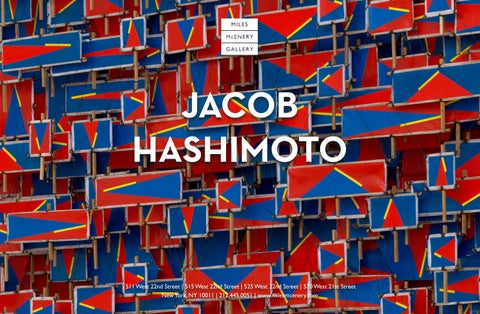
JACOB HASHIMOTO (b. 1973 in Greeley, CO) studied at Carleton College and received his Bachelor of Fine Arts degree from the School of the Art Institute of Chicago in 1996.
Hashimoto has presented solo exhibitions and installations at the Boise Art Museum, Boise, ID; Crow Museum of Asian Art, Dallas, TX; Governors Island, New York, NY; Museo d’Arte Contemporanea di Roma (MACRO), Rome, Italy; Museum of Contemporary Art Chicago, Chicago, IL; Museum of Contemporary Art Pacific Design Center, Los Angeles, CA; San Jose Museum of Art, San Jose, CA; Santa Maria della Scala Museum, Siena, Italy; SITE Santa Fe, Santa Fe, NM; Studio la Città, Verona, Italy; Tacoma Art Museum, Tacoma, WA; Tampa Museum of Art, Tampa, FL; and Wäinö Aaltonen Museum of Art, Turku, Finland, among others.
His work has been featured in group exhibitions at numerous institutions internationally such as The Courtauld Institute of Art, London, United Kingdom; Es Baluard Museu d’Art Contemporani de Palma, Palma de Mallorca, Spain; Galleria Nazionale d’Arte Moderna di Roma, Rome, Italy; International Print Center New York, New York, NY; Knoxville Museum of Art, Knoxville, TN; Kunsthallen Brandts, Odense, Denmark; Nevada Museum of Art, Reno, NV; Palazzo Fortuny, Venice, Italy; Phoenix Art Museum, Phoenix, AZ; Saatchi Gallery, London, United Kingdom; and Science Museum Oklahoma, Oklahoma City, OK.
Hashimoto’s work may be found in the collections of Art in Embassies, U.S. Department of State; The California Endowment, Los Angeles, CA; Capital One, McLean, VA; Fondation Carmignac, Porquerolles, France; Cornell Tech Art Collection, New York, NY; Los Angeles County Museum of Art, Los Angeles, CA; McDonald’s Corporation, Chicago, IL; The Metropolitan Museum of Art, New York, NY; Microsoft Corporation, Redmond, WA; Oak Park Public Library, Oak Park, IL; Saastamoinen Foundation, EMMAEspoo Museum of Modern Art, Espoo, Finland; Tacoma Art Museum, Tacoma, WA; Tokiwabashi Tower Art Collection, Tokyo, Japan, and elsewhere.
The artist lives and works in Ossining, NY.

JACOB HASHIMOTO
Born in 1973 in Greeley, CO
Lives and works in Ossining, NY
EDUCATION
1996
BFA, School of the Art Institute of Chicago, Chicago, IL
1993 Carleton College, Northfield, MN
SOLO EXHIBITIONS
2025 Miles McEnery Gallery, New York, NY
“a lowercase sky,” Burlington City Arts, Burlington, VT
“Path to the Sky,” Santa Maria della Scala Museum, Siena, Italy
“Analog Death, etc.,” Ronchini Gallery, London, United Kingdom
2024
“Not After a Million Years,” Talley Dunn Gallery, Dallas, TX
Miles McEnery Gallery, New York, NY
“Dreams No Dreams,” Galerie Forsblom, Helsinki, Finland
“Fables,” Rhona Hoffman Gallery, Chicago, IL
2023
“The Disappointment Engine,” Miles McEnery Gallery, New York, NY
“Noise,” Studio la Città, Verona, Italy
“Silence in Fragments,” Makasiini Contemporary, Turku, Finland
“Generations,” Clavé Fine Art, Paris, France
2022
“Fractured Giants,” Boise Art Museum, Boise, ID
“This Particle of Dust,” Tampa Museum of Art, Tampa, FL
“The Burn Out Sun,” Studio la Città, Verona, Italy
2021
“In this time and space,” Ronchini Gallery, London, United Kingdom
“Misunderstandings,” Rhona Hoffman Gallery, Chicago, IL
“The Necessary Invention of the Mind,” Elizabeth Leach Gallery, Portland, OR
“The Other Sun,” University of Mississippi Museum, Oxford, MS
“Jacob Hashimoto: Works,” Makasiini Contemporary, Turku, Finland
“Progress,” Galerie Forsblom, Helsinki, Finland
2020
“Jacob Hashimoto: 1999-2005,” Studio la Città, Verona, Italy
“Histories,” Mixografia, Los Angeles, CA
“Hashimoto,” Galerie Italienne, Paris, France
2019
“Work,” Rhona Hoffman Gallery, Chicago, IL
“The Heartbeat of Irreducible Curves Part II,” Studio la Città, Verona, Italy
“The Heartbeat of Irreducible Curves,” Studio la Città, Verona, Italy
“The Infinite Curve,” Makasiini Contemporary, Turku, Finland
“Clouds and Chaos,” Crow Museum of Asian Art, The University of Texas at Dallas, Dallas, TX
“The Eclipse and Never Comes Tomorrow,” Governors Island, New York, NY
“Deep in the Gravity Well,” Galerie Forsblom, Stockholm, Sweden
2017 “The Eclipse,” Leila Heller Gallery, Dubai, United Arab Emirates
“The Dark Isn’t The Thing To Worry About,” Rhona Hoffman Gallery, Chicago, IL
“Giants and Uncertain Atmospheres,” Wäinö Aaltonen Museum of Art, Turku, Finland
“The End of Utopia,” Studio la Città at Palazzo Flangini, Venice, Italy
“My Own Lost Romance,” Anglim Gilbert Gallery at Minnesota Street Project, San Francisco, CA
“Another Cautionary Tale Comes to Mind (but immediately vanishes),” Mixografia, Los Angeles, CA
2016
“The First Known Map of the Moon,” Mary Boone Gallery, New York, NY
“Gas Giant Fragments and Silence,” Sheehan Gallery, Whitman College, Walla Walla, WA
“Through the Lens of Gravity,” Galerie Forsblom, Helsinki, Finland
2015 “In the Cosmic Fugue,” Rhona Hoffman Gallery, Chicago, IL
“16.05.2015,” Studio la Città, Verona, Italy
2014 “Skyfarm Fortress,” Mary Boone Gallery, New York, NY
“Gas Giant” (curated by Alma Ruiz), Museum of Contemporary Art Pacific Design Center, Los Angeles, CA
“Gas Giant Studies,” Martha Otero Gallery, Los Angeles, CA
2013 “Sky Columns,” Schauwerk Foundation, Sindelfingen, Germany
“Armada,” Galerie Forsblom, Helsinki, Finland
“Jacob Hashimoto: Foundational Work,” Studio la Città, Verona, Italy
“Gas Giant,” Fondazione Querini Stampalia, Venice, Italy
“Superabundant Atmosphere,” Bildmuseet, Umeå University, Umeå, Sweden
2012 “The Other Sun,” Ronchini Gallery, London, United Kingdom
“Super-Elastic Collisions (origins, and distant derivations),” Rhona Hoffman Gallery, Chicago, IL
2011 “Silence Still Governs Our Consciousness,” Galerie Forsblom, Helsinki, Finland
“Armada,” Studio la Città, Verona, Italy
“The End of Gravity,” Mary Boone Gallery, New York, NY
2010 “Silence Still Governs Our Consciousness,” Museo d’Arte Contemporanea di Roma, Rome, Italy
“Here in Sleep, a World, Muted to a Whisper,” Nevada Museum of Art, Reno, NV
2009 “Forests Collapsed Upon Forests,” Martha Otero Gallery, Los Angeles, CA
Mary Boone Gallery, New York, NY
2008 “Jacob Hashimoto V,” Studio la Città, Verona, Italy
2007 “Plumes and The Landscape Omnibus,” Rhona Hoffman Gallery, Chicago, IL
Mary Boone Gallery, New York, NY
2006 Studio la Città, Verona, Italy
2005
“Skip Skitter Start Trip Vault Bounce – and Other Attempts at Flight,” Rhona Hoffman Gallery, Chicago, IL
“Superabundant Atmosphere,” Rice Gallery, Rice University, Houston, TX
2004 “Bloom,” San José Museum of Art, San José, CA
“Alta Dena,” Tacoma Art Museum, Tacoma, WA
2003
“The Nature of Objects,” Studio la Città, Verona, Italy
2002 Studio la Città, Verona, Italy
“Silent Rhythm,” Galleria Traghetto, Venice, Italy
“Jacob Hashimoto: New Work,” Finesilver Gallery, San Antonio, TX
2001 “Giant Yellow,” Patricia Faure Gallery, Santa Monica, CA
“Big Mountain,” Patricia Faure Gallery, Santa Monica, CA
2000 “Project Room,” Patricia Faure Gallery, Santa Monica, CA
“Giant Yellow and Other Structures,” Galerie Lucien Durand-Le Gaillard, Paris, France
1999 “Armada,” Chicago Cultural Center, Chicago, IL
“Infinite Lightness” with Thom Barth, Studio la Città, Verona, Italy
Galleria La Nuova Pesa, Rome, Italy
1998 “Infinite Expanse of Sky,” Museum of Contemporary Art Chicago, Chicago, IL
“Jacob Hashimoto – sky fragment,” Patricia Faure Gallery, Santa Monica, CA
1997 “Perennial,” Boliou Hall Carleton College Art Gallery, Northfield, MN
Ann Nathan Gallery, Chicago, IL
1996 “Sky Canopy Installation,” Ann Nathan Gallery, Chicago, IL
GROUP EXHIBITIONS
2025 “Summer Hang,” Miles McEnery Gallery, New York, NY
“World of Pattern,” Nordiska Akvarellmuseet, Skärhamn, Sweden
“Hokusai & Ukiyo-e: The Floating World,” Cleve Carney Museum of Art, Glen Ellyn, IL
“The Sublime Nature of Being,” Impeccable Imagination at ICD Brookfield Place, Dubai, United Arab Emirates
2024 “All Bangers, All The Time: 25th Anniversary Exhibition,” Miles McEnery Gallery, New York, NY
“Torn Curtain” (curated by Luca Massimo Barbero and Hélène de Franchis), Studio la Città, Verona, Italy
2023 “Rossori Dell’Arte,” Ronchini Gallery, London, United Kingdom
“Pattern and Process,” Krannert Art Museum, Champaign, IL
2022 “Now and Ever: Pattern and Decoration,” Antonio Colombo Arte Contemporanea, Milan, Italy
“50 years, a Day. Studio la Città, a Story.,” Piero Atchugarry Gallery, Miami, FL
“The Sublime Nature of Being,” Impeccable Imagination, Dubai, United Arab Emirates
“Love Stories,” Schauwerk Sindelfingen, Sindelfingen, Germany
2021
“OUT OF THE FRAME,” Studio la Città, Verona, Italy
“Global Asias: Contemporary Asian and Asian American Art from the Collections of Jordan D. Schnitzer and His Family Foundation,” Palmer Museum of Art, State College, PA; traveled to the Knoxville Museum of Art, Knoxville, TN; Heckscher Museum of Art, Huntington, NY; Yellowstone Art Museum, Billings, MT; USC Pacific Asia Museum, Pasadena, and CA; Pendleton Center for the Arts, Pendleton, OR
“Today I Would Like to be a Tree,” Studio la Città, Venice, Italy
2020 ‘‘The World Stage: Contemporary Art from the Collections of Jordan D. Schnitzer and His Family Foundation,” Nevada Museum of Art, Reno, NV
“Color & Complexity: 30 Years at Durham Press,” Allentown Art Museum, Allentown, PA
“Jacob Hashimoto and Mildred Howard,” Anglim Gilbert Gallery at ADAA The Art Show, New York, NY
2019
“What I Did Not Sell…50 Years. A Story.,” Studio la Città, Verona, Italy
“Cosmic Culture: Intersections of Art and Outer Space,” Science Museum Oklahoma, Oklahoma City, OK
“Recursions and Mutations,” Studio la Città, Verona, Italy
“Paintings: Ross Bleckner, Francesco Clemente, Will Cotton, Tomoo Gokita, Peter Halley, Jacob Hashimoto, Olivier Mosset, Laurie Simmons, Julia Wachtel,” Mary Boone Gallery, New York, NY
2018 “Witness: Themes of Social Justice in Contemporary Printmaking and Photography,” Melvin Henderson-Rubio Gallery, Hallie Ford Museum of Art, Salem, OR
“I Say Yesterday, You Hear Tomorrow,” Gallerie delle Prigioni, Treviso, Italy
“Paper/Print: American Hand Papermaking, 1960s to Today,” International Print Center New York, New York, NY
“Places of the Mind: 20 Years of Contemporary Art,” Galleria d’Arte Moderna Achille Forti, Verona, Italy
2017 “Over and Over,” Glass Curtain Gallery, Columbia College Chicago, Chicago, IL
“Summer Show,” Studio la Città, Verona, Italy
“The Bike Connection,” Studio la Città, Verona, Italy
2016 “Artificial Realities,” East Wing Biennial: Courtauld Institute of Art, London, United Kingdom
“Un racconto in sei stanze” (curated by Angela Madesani), Studio la Città, Palazzo Barbò, Torre Pallavicina, Italy
“Inaugural Show,” Makasiini Contemporary, Turku, Finland
“A Story in Six Rooms,” Studio la Città, Verona, Italy
2015 “Quiet Works,” Temple Contemporary, Tyler School of Art, Temple University, Philadelphia, PA
2014 “NOW-ISM: Abstraction Today,” The Pizzuti Collection, Columbus, OH
“HAVET: DET ANDET LANDSKAB (The Sea: The Other Landscape),” Kunstmuseum Brandts, Odense, Denmark
“Ad Naturam,” Museo Civico di Storia Naturale, Verona, Italy
“De Rerum Natura” (curated by Angela Madesani, in collaboration with Andrea Lerda), Studio la Città, Verona, Italy
2013 “Black/White,” LaMontagne Gallery, Boston, MA
“Vitruvius,” Martha Otero Gallery, Los Angeles, CA
“Rosa Piero, Rosa Tiepolo, Rosa Spalletti, Rosa...,” Studio la Città, Verona, Italy
2012
“Off-Screen,” Studio la Città, Verona, Italy
2011 “Toward the Third Dimension,” David Floria Gallery, Aspen, CO
2010
2009
2008
“Let There Be Geo,” A + D Gallery, Columbia College, Chicago, IL
“Art on Paper,” The Weatherspoon Art Museum, University of North Carolina, Greensboro, NC
“IN – FINITUM,” Palazzo Fortuny, Venice, Italy
“Abstract America,” Saatchi Gallery, London, United Kingdom
“A Tribute to Ron Warren,” Mary Boone Gallery, New York, NY
“Not Just A Pretty Face,” Hyde Park Art Center, Chicago, IL
2007 “…e ricomincio da tre” (curated by Luca Massimo Barbero), Studio la Città, Verona, Italy
2006 “Take Over,” Hyde Park Art Center, Chicago, IL
2005 “XIV Quadrennial in Rome,” Galleria Nazionale d’Arte Moderna di Roma, Rome, Italy
2004 “White,” Patricia Faure Gallery, Santa Monica, CA
“Artseasons” (curated by Cas Pellers), Es Baluard Museu d’Art Contemporani de Palma, Palma de Mallorca, Spain
“Je ne regrette rien: 35th Anniversary of the Gallery,” Studio la Città, Verona, Italy
2003 “Structure,” Patricia Faure Gallery, Santa Monica, CA
2002 “Officina America: ReteEmiliaRomagna” (curated by R. Barili), Palazzo dell’Arengo, Rimini, Italy
“Intermezzo,” Studio la Città, Verona, Italy
2000 “Carte Blanche” (curated by Hélène de Franchis), Galerie Lucien Durand - Le Gaillard, Paris, France
1999 “Phoenix Triennial,” Phoenix Art Museum, Phoenix, AZ
“Conceptual Color: In Albers’ Afterimage,” San Francisco State University, San Francisco, CA
1997 “Headless: William Cordova and Jacob Hashimoto,” Lineage Gallery, Chicago, IL
1996 “Thesis Exhibition,” School of the Art Institute of Chicago, Chicago, IL
SELECT COLLECTIONS
Art in Embassies, U.S. Department of State
The California Endowment, Los Angeles, CA
Capital One, McLean, VA
City of West Hollywood, Los Angeles, CA
Cornell Tech Art Collection, New York, NY
Fondation Carmignac, Porquerolles, France
General Services Administration, United States Federal Government, Washington, D.C.
Jones Day, Los Angeles, CA
Jordan Schnitzer Family Foundation, Portland, OR
Kennedy Wilson, Beverly Hills, CA
Los Angeles County Museum of Art, Los Angeles, CA
McDonald’s Corporation, Chicago, IL
The Metropolitan Museum of Art, New York, NY
Microsoft Corporation, Redmond, WA
Oak Park Public Library, Oak Park, IL
Royal Caribbean, Allure of the Seas
Saastamoinen Foundation, EMMA - Espoo Museum of Modern Art, Espoo, Finland
Schauwerk Sindelfingen, Sindelfingen, Germany
Swiss Re, San Francisco, CA
Tacoma Art Museum, Tacoma, WA
Tod’s, Sant’Elpidio a Mare, Italy
Tokiwabashi Tower Art Collection, Tokyo, Japan
University of Chicago, Chicago, IL
University of Houston, Houston, TX
Wellington Management, Boston, MA
Whitman College, Walla Walla, WA
SELECT COMMISSIONS
Alexandria Equities, New York, NY
Andaz West Hollywood, Los Angeles, CA
Capital One, McLean, VA
Cornell Tech, New York, NY
Fondation Carmignac, Porquerolles, France
Grand Hyatt SFO, San Francisco, CA
Kennedy Wilson, Beverly Hills, CA
McDonald’s Corporation, Chicago, IL
Montage Health Foundation, Ohana Center, Monterey, CA
Nashville International Airport, Nashville, TN
LA Metro, Los Angeles, CA
Olympia Dumbo, Brooklyn, NY
Penrose Library, Whitman College, Walla Walla, WA
Portland International Airport, Portland, OR
Ritz-Carlton Lake Club, Lake Tahoe, CA
Royal Caribbean, Allure of the Seas
San Francisco Arts Commission, San Francisco, CA
Tokiwabashi Tower, Tokyo, Japan
Trammell Crow Center, Dallas, TX
University of Houston, Houston, TX
US Embassy, Windhoek, Namibia
Wichita Falls Museum of Art, Wichita Falls, TX
Willis Tower, Chicago, IL
SELECT PUBLICATIONS
2025 Jacob Hashimoto (essay by David Pagel) , New York: Miles McEnery Gallery.
2023 Jacob Hashimoto: The Disappointment Engine , New York: Miles McEnery Gallery.
2021 Global Asias: Contemporary Asian & Asian American Art ( essay by Chang Tan, forward by Erin Coe), Eugene, OR: Jordan Schnitzer Family Foundation.
2020 Color & Complexity: 30 Years at Durham Press (essay by Elaine Mehalakes Lucks), Allentown, PA: Allentown Art Museum.
2019 Bilyeau, Elizabeth, Witness: Themes of Social Justice in Contemporary Printmaking and Photography (foreword by John Olbrantz, introduction by LeRonn Brooks, text by Jordan D. Schnitzer), Eugene, OR: Jordan Schnitzer Family Foundation.
Jacob Hashimoto: Selected Works (text by Luca Massimo Barbero and Stefano Moriggi), Turku, Finland: Makasiini Contemporary.
2018 Jacob Hashimoto: The Eclipse , Dubai: Leila Heller Gallery.
Jacob Hashimoto: Giants and Uncertain Atmospheres (text by Dawn Chan and Erik Morse), Wäinö
Aaltonen Museum, Galerie Forsblom: Helsinki, Finland.
2017 The End of Utopia: Jacob Hashimoto Emil Lukas (text by Luca Massimo Barbero & Stefano Moriggi), Verona, Italy: Studio la Città.
2015 Jacob Hashimoto (text by Erik Morse and Jana Grcevich), Verona, Italy: Studio la Città.
2014 Madesani, Angela, De Rerum Natura , Verona, Italy: Studio la Città.
2013 Johansson, Hanna, Jacob Hashimoto , Helsinki, Finland: Galerie Forsblom. Barbero, Luca Massimo, Jacob Hashimoto: Superabundant Atmospheres , Venice, Italy: Marsilio.
2012 The Other Sun ( interview with Laura Bushell), London: Ronchini Gallery. Off-Screen , Verona, Italy: Studio la Città.
2011 Ollman, Leah, Armada , Verona, Italy: Studio la Città.
Jacob Hashimoto: Silence Still Governs Our Consciousness, Rome: Marsilio (in collaboration with Museum of Contemporary Art of Rome).
Cassidy, Victor M., Sculptors at Work: Interviews About the Creative Process , Jefferson, NC: McFarland.
2009 Abstract America , New York: Rizzoli.
2008 Jacob Hashimoto V , Verona, Italy: Studio la Città.
2007 Collins, Judith, Sculpture Today , New York: Phaidon Press.
2006 Barbero, Luca Massimo, Jacob Hashimoto , Verona, Italy: Studio la Città.
2005 Jacob Hashimoto: Superabundant Atmosphere , Houston: Rice Gallery, Rice University.
2003 Jacob Hashimoto: The Nature of Objects (interview with Luca Massimo Barbero), Verona, Italy: Studio la Città.
2002 Jacob Hashimoto (text by Irvin Y. Hashimoto and Angela Vettese), Verona, Italy: Studio la Città.
Officina America (edited and curated by R. Barili), Rome: ReteEmiliaRomagna.
1999 Infinite Lightness (text by M. Bertoni), Verona, Italy: Studio la Città.
BIBLIOGRAPHY
2025 “Jacob Hashimoto’s Sculptural Installations Are a Riot of Color and Form,” Artnet, 24 November.
Mothes, Kate, “Paper Discs Stand In for Brushstrokes in Jacob Hashimoto’s Structural, Layered Works,” Colossal, 28 October.
Pagel, David, “Bicycling Around Jacob Hashimoto’s Art,” e ssay in Jacob Hashimoto , New York: Miles McEnery Gallery.
Perterkin, Oliver “ Art Installation inspires curiosity and creativity in education,” Stanford Report, October 14.
“Two Transformative Installations Fill Italy’s Historic Spaces With Color and Light,” Artnet News, 2 August.
Dodge, Alice, “Jacob Hashimoto’s Airy Art Installation at BCA Center”, sevendaysvt.com , July 2.
Westhall, Mark “Analog, Death, Etc., New Works by Jacob Hashimoto”, fadmagazine.com, May 21.
Ivanauskas, Giedrius “Exploring Jacob Hashimoto’s Abstract Worlds in Analog Death, etc.”, madeinshoreditch.co.uk, May 27.
Rabb, Maxwell, “5 Standout Shows to See at Small Galleries this June”, Artsy.net, June 6.
2024 Delaney, Barbara, “Creating Complex Worlds.”, Fiber Arts Now, Fall 2024 Issue
Lima, Benjamin, “Jacob Hashimoto’s Talley Dunn Show Needs to be Seen to be Appreciated”, dallasnews.com, December 13.
Behringer, David, “The 6 Most Intriguing Sculptures at Art Basel Miami 2024,” Design Milk, 24 December.
Bertoli, Rosa, “Maharam’s latest textiles interpret Jacob Hashimoto’s sculptural work,” Wallpaper, 3 March.
Rathore, Rupal, “Hanging by Many Threads” [Objects in Review], Disegno: The Journal of Design #37, 9 April.
2023
Cole, Margherita, “Suspended Paper Kite Installations Explore Artist’s East Asian and Western
Identities in the Digital Age,” My Modern Met, 6 December.
Shiner, Eric, “Swipe Theory and Pixelism; Jacob Hashimoto on a New Trajectory,” e ssay in Jacob Hashimoto , New York: Miles McEnery Gallery.
Behringer, David, “Beautiful Glitches: Jacob Hashimoto’s New ‘Kite’ Works,” Design Milk, 19 August.
“Spotlight: Multimedia Artist Jacob Hashimoto, Celebrated for His Colorful Installations, Turns to Painting in His Latest Show,” Artnet News, 22 June.
Tirlet, André, “Clavé Fine Art présente Générations de Jacob Hashimoto,” Luxe Infinity, 16 May.
Heckel, Jodi, “Krannert Art Museum Exhibition Examines How Pattern Helps Make Sense of the World,” Illinois University News, 13 February.
2022 Hashimoto, Jacob and Dawn Chan, “History Sickness: Jacob Hashimoto on ‘No Monument: In the Wake of the Japanese American Incarceration,’” Artforum, September.
Mothes, Kate, “Jacob Hashimoto Relates How Narrative and Landscape Abstraction Inform How He Thinks About Space,” Colossal, 23 August.
“Art that Makes You Feel Seen: Jacob Hashimoto Transports Visitors to Fantastic Landscapes,” The Oxford Eagle, 16 April.
2021 Jones, Will, “Artist Jacob Hashimoto brings ‘The Other Sun’ to Oxford,” The Daily Mississippian, 7 October.
Fuller, Jordan, “T Process | Jacob Hashimoto,” video, The New York Times Style Magazine, 29 September.
Brara, Noor, “ The Ancient History and Enduring Appeal of Flying a Kite,” The New York Times Style Magazine, 29 September.
Park, Nari, “Jacob Hashimoto,” Craft & Design, no. 49, Summer.
Ebert, Grace, “Thousands of Discs Are Suspended in Immense Cloud-Like Formations in Jacob Hashimoto’s Installations,” Colossal, 10 May.
Azarello, Nina, “jacob hashimoto on his richly-layered compositions and creating complex cultural landscapes,” designboom, 4 May.
Vaughan, Carolyn, ed., Global Asias: Contemporary Asian & Asian American Art , foreword by Erin Coe, text by Chang Tan, Portland, OR: Jordan Schnitzer Family Foundation.
Valjakka, Timo, “Kites Bring Hope in Difficult Times,” Helsingin Sanomat, 16 January.
Korpak, Helen, “Characteristic Technique Makes Jacob Hashimoto’s Art Unique,” Hufvudstadsbladet, 16 January.
2020 Chiara, Maria, “Wind: Jacob Hashimoto,” Some Magazine, October.
Gallivan, Joseph, “PDX: The Great Reopening,” Portland Tribune, 21 July.
Seller, Margaret, “Expanded Concourse E Opens at Portland International Airport,” Portland Monthly, 18 July.
Loh, Chris, “Portland International Airport Opens First New Gates In 20 Years,” 18 July.
Schwendener, Martha, “The Art Show at the Armory: Blue Chip Brands Show Their Best,” The New York Times, 27 February.
Color & Complexity: 30 Years at Durham Press , text by Elaine Mehalakes Lucks, Allentown, PA: Allentown Art Museum.
2019 Davis, Ben, “The 100 Works of Art That Defined the Decade, Ranked: Part 2,” Artnet, 30 December. Williamson, Carolyn, “A Peek Inside McDonald’s New Chicago Headquarters,” Design Milk, 7 August.
Weather, Kathi, “Art You Can’t Miss at San Francisco International Airport,” San Francisco Travel, 29 July.
Koziarz, Jay, “Cloud-like sculpture of 7,000 hanging disks floats above Willis Tower lobby,” Curbed Chicago, 16 July.
Shapiro, Elise, “Willis Tower Celebrates Opening Of New Lobby with Specially Commissioned Art,” Work Design Magazine, July.
Pakarinen, Jaana, “Million Kite Man,” Turun Sanomat, 15 June.
Stevens, Phillip, “mcdonald’s chicago headquarters features a fast food museum and a giant jacob hashimoto installation,” designboom, 18 March.
Renzi, Jen, “IA Interior Architects and Studio O+A Collaborate on McDonald’s New Chicago Headquarters,” Interior Design, 28 February.
Witness:Themes of Social Justice in Contemporary Printmaking and Photography, foreword by John Olbrantz, introduction by LeRonn Brooks, texts by Jordan D. Schnitzer and Elizabeth Bilyeu, Portland, OR: Jordan Schitzer Family Foundation.
Jacob Hashimoto: Selected Works, text by Lars Saari, Turku, Finland: Makasiini Contemporary.
2018 Cassidy, Victor M., “Components of Human Folly,” Sculpture Magazine, December.
Abatemarco, Michael, “Don’t be afraid of the dark: Jacob Hashimoto,” Pasatiempo, 5 October.
Bennett, Megan, “Evoking joy, playfulness,” Albuquerque Journal, 5 October.
Sierzputowski, Kate, “Over Fifteen Thousand Paper Kites Create a Two-Toned Cloud Inside New York’s St. Cornelius Chapel,” Colossal, 21 August.
Barandy, Kat, “jacob hashimoto transforms Governors Island chapel into a tangible cloud with ‘The Eclipse,’” designboom, 16 August.
Wood, Betty, “Jacob Hashimoto creates a paper cloud in a chapel on Governors Island,” The Spaces, 16 August.
Izon, Juliet, “Why all of New York is Headed to Governors Island This Summer,” Architectual Digest, 11 June.
Picht, Jennnifer, “An Incredible New Art Installation Debuts on Governors Island this Weekend,” Time Out, 1 June.
Backman, Dan, “Hokusai, ‘A Japanese Icon’ Japanese Art Sweeps Over Stockholm,” Svenska Dagbladet, 30 May.
McDermon, Daniel, “8 Outdoor Installations in New York to Get Excited About,” The New York Times, 25 May.
Carlson, Jen, “Your Guide to Governors Island 2018,” Gothamist, 1 May.
Rim, Tina, “Jacob Hashimoto’s Complex Worlds,” The Artling, 27 April.
Laster, Paul, “Gallery Going in Dubai‘s Askeral Avenue,” White Hot Magazine, February.
Davies, Cassie, “Jacob Hashimoto: ‘The history of art is full of cultural appropriators. I’m one, too,’”
Studio International, 8 January.
Jacob Hashimoto: The Eclipse , Dubai: Leila Heller Gallery.
Jacob Hashimoto: Giants and Uncertain Atmospheres , text by Dawn Chan and Erik Morse, Helsinki: Wäinö
Aaltonen Museum and Galerie Forsblom.
2017 Egerton, Laura, “An Ever-Changing Evocation,” Selections, 19 December.
Hawbaker, KT, “Rhona Hoffman follows Jacob Hashimoto into the dark,” Chicago Tribune, 2 November.
Kalsi, Jyoti, “ A Utopian Dream,” Gulf News, 1 November.
Kufer, Katrina, “Critic’s Pick: Jacob Hashimoto, Leila Heller Gallery - Dubai,” Artforum, 10 October.
Kaukovirta, Kaisa, “Ilmavaien väripyörteiden Hashimoto,” Turin Sansomat, 7 June.
Mussolini, Alessandro, “10 cose da vedere a Venezia fuori dalla Biennale,” Living Corriere, 16 May.
Tantucci, Enrico, “Incontro con gli artisti nei palazzo di Venezia,” Corriere delle Alpi, 13 May: 35.
Maggi, Nicola, “Jacob Hashimoto – Emil Lukas, The End of Utopia,” Collezione da Tiffany, 13 May.
Ducci, Carlo, “Biennale d’arte 2017 a Venezia: 11 cose da non perdere,” Vogue Italy, 12 May.
Biglia, Gabriele, “Studio la Città porta l’Utopia in laguna con Hashimoto e Lukas,” Il Sole 24 Ore, 12 May.
Gusella, Enrico, “Hashimoto e Lukas, dove finisce l’utopia, L’arte si interroga sul destino del planeta,” L’Arena,11 May: 49.
Tuzil, Veronica, “La Grande arte dal mondo,” Corriere del Veneto, 7 May: 21.
Vankin, Deborah, “Flights of Vivid Fancy,” Los Angeles Times, 29 January.
Vankin, Deborah, “Jacob Hashimoto‘s Work Takes Flight at Mixografia,” Los Angeles Times, 27 January.
The End of Utopia: Jacob Hashimoto & Emil Lukas , text by Luca Massimo Barbero and Stefano Moriggi, Verona, Italy: Studio la Città.
2016 Shomura, Aya, “Jacob Hashimoto,” Shift Online Magazine, 6 November.
Mota Margain, Carlos M., “El Rol Trascendente del Poder en las Organizaciones de Hoy,” Capitel Magazine of Universidad Humanitas Mexico, July: 147.
2015 Rebora, Simone, “Jacob Hashimoto, Con La Galassia In Una Stanza,” Espoarte: Annual XV11 Trimestre, no. 3: 52-56.
Reinhold, Valerie, “Colour and Material,” Selections, September: 62, 81.
Pola, Francesca, “Critic’s Picks: Jacob Hashimoto, Studio la Città,” Artforum, May.
2015 Rebora, Simone, “Jacob Hashimoto, Con La Galassia In Una Stanza,” Espoarte: Annual XV11
Trimestre, no. 3: 52-56.
Reinhold, Valerie, “Colour and Material,” Selections, September: 62, 81.
Pola, Francesca, “Critic’s Picks: Jacob Hashimoto, Studio la Città,” Artforum, May.
Johansson, Hanna, Jacob Hashimoto , Helsinki: Galerie Forsblom.
Berbaro, Luca Massimo, Jacob Hashimoto: Superabundant Atmospheres , Venice, Italy: Marsilio.
2012 Apfelbaum, Sue, “A Wallpaper That’s Anything but Flat,” Surface, September/October: 136-141.
Sherwin, Skye, “Artist of the Week 201: Jacob Hashimoto,” The Guardian, 2 August.
Tylevich, Katya, “How to Fly Thousands of Kites, Simultaneously, Indoors: The Art of Jacob Hashimoto,” Elephant, Summer.
Fallai, P., “700 barche di Hashimoto si rilancia Bologna Arte Fiera,” Il Corriere della Sera, January.
2011 Meneguzzo, Marco, “Jacob Hashimoto/Studio la Città,” Artforum, November: 286.
Fricke, Christiane, “Neuerwerbungen kommenerst mal unters Bet,” Handelsblatt, no. 75, 16 April.
Sansom, Anna, “Panoramic Paper,” Frame Magazine, March-April.
2010 “Stagione dei Musei Dopo il Maxxi Roma Rifa’ il Macro,” L’Arena, 2 June.
Romana Morelli, Francesca, “Avanti MACRO,” Il Giornale dell’Arte,1 June.
“Giorni a Roma,” Dove, 1 June.
“Roma, La grande estate del MACRO,” Corriere dello Sport - ed., 30 May.
“Un’Esplosione di Arte Contemporanea,” Il Messaggero, 28 May.
Di Forti, M., “Roma, Regina dell’Arte Del XXI Secolo,” Il Messaggero, 25 May.
Filippi, M., “Foyer a Sorpresa e Una Permanente,” Il Messaggero, 24 May.
Irace, Fulvio, “Il MACRO Adesso e’ al Massimo,” Il Sole 24 Ore, 23 May.
“Il MACRO in Volo con gli Aquiloni,” Il Messaggero, 28 April.
“E al Macro Arrivano i Settemila Aquiloni di Hashimoto,” Il Tempo, 28 April.
2009 Knight, Christopher, “Art Review: Jacob Hashimoto at Otero/Plassart,” Los Angeles Times, 15 October.
Wilson, Michael, “Critics Picks: Jacob Hashimoto/Mary Boone,” Artforum, June.
Finkel, Jori, “In Los Angeles, Art That’s Worth the Detour,” The New York Times, 3 May.
Ollman, Leah, “Reviews: Jacob Hashimoto/Otero Plassart,” Art in America, January.
Abstract America , New York: Rizzoli.
2008 Zanchetta, A., “Jacob Hashimoto. Studio la Città-Verona,” Flash Art, December-January.
“What you see, is not what you think,” ASIANA Magazine, November.
Mojana, M., “Sol Levante per palati fini,” Il Sole 24 Ore, November.
“Studio la Città, suggestioni in mostra,” Il Corriere della Sera, October.
Diez, R., “Il Cacciatore di aquiloni. Jacob Hashimoto.,” ARTE, October.
Mojana, M., “Minimalismo e pittura analitica, da valori estetici a beni di rifugio,” Il Sole 24 Ore, March.
2007
Sheets, Hilary M., “Critic’s Pick: Jacob Hashimoto,” Art News, October: 240.
Novo, A., “Cultural Fusion,” Attitude, January-February.
Grosz, David, “Walls of Wings and Stone,” The New York Sun, 11 January: 13, 17.
Meneguzzo, Marco “Jacob Hashimoto,” Artforum, January.
Collins, Judith, Sculpture Today , London: Phaidon.
2006 Sanson, Anna, “Of the Wind and Sky,” Sleek Magazine, Autumn.
Pertoni, Camilla, “Review: Jacob Hashimoto/Studio la Città,” 2 October.
Foschini, Sabrina, “Jacob Hashimoto. L’arte di fermare il vento,” ARTE, October.
Siviero, Viviana, “Jacob Hashimoto,” Espoarte, October-November.
2005 Hogan, Erin/Northcutt, Rod, “Jacob Hashimoto,” Chicago Reader, 9 December.
Weinberg, Lauren, “Jacob Hashimoto: skip skitter start trip vault bounce and other attempts at fight,”
Time Out Chicago, December.
A. Quattordio, “Come sipari fluttuanti,” Architectural Digest, May.
“XIV Esposizione Quadriennale d’Arte,” Flash Art, April-May.
Klaasmeyer, Kelly, “Capsule Review: Jacob Hashimoto: Super Abundant Atmosphere,” Houston Press, 14-20 April.
Steinecker, Dawn, “Review,” ArtsHouston, April.
Johnson, Patricia C., “Shiffting patterns of light and air,” Houston Chronicle, 19 March.
Jacob Hashimoto: Superabundant Atmosphere , Houston: Rice University.
2004 Meneghelli, Luigi, L’Arena, 9 September.
“Le installazioni zen di Hashimoto,” Carnet Arte, June-July.
“Studio la Città,” Carnet Arte, January-February.
Granuzzo, E., “Jacob Hashimoto, Studio La Città, Verona,” Images Art & Life, Winter.
“Lo spazio di Hashimoto... si forma, si percorre e si ascolta: conversation with Luca Massimo Barbero & Jacob Hashimoto,” Titolo, Winter.
Vola, G., “Jacob Hashimoto,” Juliet, December-January.
2003 “Die Welt der Kunst,” Kölner Stadt-Anzeiger, 29 October.
“Studio la Città con Jacob Hashimoto,” Verona Manager, September-October.
Meneghelli, Luigi, “Hashimoto concilia velocità e pensiero,” L’Arena, 18 September.
“Luca Barbero presenta il catalogo della mostra di Hashimoto,” L’Arena, 11 September.
2002 Di Martino, E., “Hashimoto,” Il Gazzettino, September.
Meneghelli, Luigi, “Hashimoto, un’opera sospesa tra tradizione e contemporaneità,” L’Arena, March.
2001 Zellen, Jody, D’art international, Autumn.
Irvin, Steve, Art Issues, September/October.
Pagel, David, “Review: Jacob Hashimoto/Patricia Faure,” Los Angeles Times, 8 June.
Frances, Richard, “Critics Picks: Jacob Hashimoto/Patricia Faure,” Artforum, June.
Poli, Francesco, “Jacob Hashimoto,” Tema Celest, January-February.
2000 Ollman, Leah, “Review: Jacob Hashimoto/Patricia Faure,” Art in America, November.
Freudenheim, Susan, “Like Kids in a Candy Store,” Los Angeles Times, 7 September.
Ollman, Leah, “Hashimoto Fashions Air, Light and Space,” Los Angeles Times, 23 June.
Meneghelli, Luigi, “Thom Barth, Jacob Hashimoto,” Flash Art, April-May.
Capasso, Angelo, “Review: Jacob Hashimoto/Studio la Città,” Tema Celeste, March-April.
Meneghelli, Luigi, “Barth e Hashimoto - Levità infinita,” L’Arena di Verona, 24 January.
1998 Ollman, Leah, “Seven Artists Follow the Money at Bergamot Station,” Los Angeles Times, 25 December.
1997 Ollman, Leah, “Pulling Strings,” Los Angeles Times, 25 December.
Frank, Peter, “Color Fields: Craig Kauffman, Jacob Hashimoto,” LA Weekly, 8-14 January.


October - 20 December 2025.

31 October - 7 December 2024.


BICYCLING AROUND JACOB HASHIMOTO’S ART
October 2025 | By
David Pagel
Sometimes a bicycle is just a bicycle—and not a symbol of anything more. But even when a bike is just a bike, it’s a pretty special thing. The most rudimentary two-wheeler gets you across town faster, more easily, and more efficiently than your feet can. And it does so less expensively, in the long run, than public transport or private vehicles—owned, leased, or rented. Plus, you never have to pay for parking, and you can park your bike just about anywhere, locking it to trees, street signs, parking me-ters—or other bikes, if you happen to travel in packs. Most important, any bike you ride gives you the freedom to create your own route as you spin through the city or ramble through the countryside, turning in any direction at any intersection or following any fork in the road, depending on traffic, stop lights, wind, hills, and whatever whims move you.
Some of the decisions that determine your route result from carefully thought-out plans, especially if you’re commuting or meeting someone at a certain time and place. At other times, though, these decisions—if they can even be called decisions—are more like impulses: raw, too-fast-to-think reac-tions that happen in an instant. Such seat-of-the-pants, shoot-from-the-hip responses occur in real time, or IRL, as you ride down the road or zigzag across streets and avenues, cutting from one lane to another as you slice through rows of slowmoving vehicles, each of which weighs about 200 times as much as your bicycle. The balance of power between bikes and cars is so crazily skewed toward motorized vehicles that all cyclists know, in their bones, what it’s like to be vulnerable—perhaps not quite powerless, but certainly on the low end of an uneven playing field.
Even so, being at the mercy of drivers and their behemoth vehicles doesn’t get in the way of the power and the pleasure of saddling up and heading out to wherever the road might take you. The feeling of unfettered freedom that comes with riding a bike is better than just about anything out there: It’s the sort of thing Thomas Jefferson might have had in mind when he penned those lines in the Declaration of Independence about life, liberty, and the pursuit of happiness—describing the nation the founding fathers wanted everyone, yes everyone, to live in. That freewheeling feeling of being unconstrained by your surroundings and uncontained by the rules that make business as usual nothing more than business as usual doesn’t just involve the feeling that anything is possible; it’s accompanied by the feeling that nothing is better than the current moment. Wherever you might be on your ride, the world, and your place in it, seem perfect.
That’s one of the beauties of bicycling: It lets you live in a world that’s part of the real one but is not overrun by the power relationships that define—and delimit—that reality. Riding a bike gives you ac-cess to a reality that unspools more swiftly than your brain can process your perceptions, much less send messages back to your torso and limbs so that you can react to whatever set of perceptions are coming at you. Bicycling lets you get out ahead of rationality, deliberation, and logical argumentation. It takes you to the edge of all that—and beyond—putting you in a time and a place that not only makes a virtue of improvisation (by making room for
all manner of intuitions) but puts you in touch with im-pulses that link you to a reality that is bigger, better, and more thrilling than any inclinations in which egos—and the individuals that accompany them—dominate the ways we think about human identity and, generally, live our lives.
Jacob Hashimoto makes art that taps into those impulses. And he does it without requiring us to take our lives into our hands by setting off on journeys along roads anywhere around the globe where we’re forced to rub shoulders with cars, trucks, and buses—not to mention motorcycles and trac-tor-trailers. While standing still, in the comfort of a gallery, a museum, or your own home, Hashimoto invites us to embark on journeys filled with more intersections and forks in the road than just about any bike ride might include. The imaginative transport that his indescribably dense fields of frac-tured, infinitely rearrangeable pattern-fragments induce goes beyond anything you might experience on a bike, taking you, via your imagination, on even speedier trips, each filled with more rapid-fire turns and swift twists than can be had on the road. In addition to these thrilling, never-the-same-way-twice forays through time and space, Hashimoto’s works deliver more soul-expanding, scale-defying high jinks than can be had just about anywhere—whether on a bike (in real time, in real life) or in front of any other work of art (whether it was made recently or long ago).
To stand before any one of Hashimoto’s wall-mounted works and scan its multipart, multilayered surfaces is not to be lured into a complex web of myriad nooks-and-crannies so much as it is to be catapulted on a vertiginous, gravity-defying ride through a world of vivid, super-saturated colors and crisp, laser-sharp shapes, which are repeated in such a way that they allow you to see some pat-terns (defined, as patterns are, by repetition and regularity); to see what you imagine might be parts of other, larger patterns, infinite or otherwise; and to see something that might very well be chaos itself—a randomized mishmash of renegade shapes and colors, none settling into anything regular or repeated. It is kind of like pi or any other irrational number: unique to itself and impossible to quan-tify precisely or to translate accurately into another system— numerical or linguistic, measurable or representable.
But even those parts or portions of Hashimoto’s devilishly complex compositions make you feel that they might be arranged in ways that form patterns that you would be able to recognize if only your perceptions were a bit more acute, your cognitive capacities were a bit sharper, or your thinking was a bit more flexible. Or maybe if you could see them from another perspective (or two or eleven). Or if you could get a bit more distance from the immersive, intensely absorptive experience and take in a bird’s-eye—or surveillance drone’s—view of the whole. Experience and reflection dance around one another like nobody’s business, catching you in a whirlwind of synergy that might be impossible to explain but is also impossible to deny. Perception, purged of willfulness, leaves no room for ma-nipulation: Without the chance to micromanage your experience, you’re left face-to-face with the onrush of reality. Neither in control of what comes at you nor overwhelmed by its power, you inhabit the sweet spot between acceptance and exuberance. That experience may not be miraculous, nor is it unique to bicycling, but once you’ve had it there’s no looking back: You’ll want
to feel it again, and you’ll go to great lengths to do so.
That kind of mind-blowing beauty is Hashimoto’s bread and butter. What he does in the studio, and what his art does for viewers when it leaves the studio and goes out in the wider world, echoes the experience of riding a bike. You feel, simultaneously, both infinite possibility and instant perfection. Hashimoto serves up that experience in abundance, in works that are made of the simplest materi-als but that don’t fit into any of the categories we conventionally use to describe works of art, such as paintings, sculptures, installations, drawings, prints, collages, or assemblages. His low-tech wall works, DIY misfits all the way through, make our eyes and minds move swiftly and fluidly, in hot pur-suit of happiness, which happens upon us when we let go of the need to know—and control—what’s going on and instead go with the flow, getting lost in the process and finding ourselves somewhere else. We are not only down the road, but we are transformed; our identities are different from what they were when we began.
My own experience of Hashimoto’s art is tangled up with my love of riding bicycles. And my insights into what he has done as an artist probably would not exist if not for my lifelong passion for bikes and what they do for me. I also believe that what Hashimoto experiences on a bicycle and what he does in the studio are not only intimately linked, but that the former both informs and elucidates the latter. I believe that Hashimoto’s life on a bike and his life in the studio share poetic connections, especially in what he describes as “the immediacy, the pleasure, the delight, [and] the obliteration of the rest of the world for a moment”—consistently, mysteriously, and unlike just about anything else out there. That experience is life-defining. Even better is finding others who share it.
In a sense, Hashimoto’s uncategorizable works are both vehicles and landscapes. Structurally, they are a lot like bicycles. A bicycle is not a singular object, uniform all the way through. It’s an array of parts, clustered together, each designed to do one thing and one thing only: The seat is for sitting; the handlebars are for steering; the pedals are for turning the cranks; the chain is for transferring that energy to the rear wheel; the tires are for inflating and making your ride smoother, more ef-ficient, and more comfortable whenever the rubber hits the road. As Philip Fisher points out in “Hand-Made Space,” chapter eight of Making and Effacing Art: Modern American Art in a Culture of Museums (New York: Oxford University Press, 1991), pp. 227-229, bicycles are unlike preindustrial objects because they are assembled, part by part, and not made—as a carpenter might craft a table, a blacksmith might forge a horseshoe, or a sculptor might carve a stone bust.
and easily replaced, whenever upgrades are desired or repairs are needed. This makes bicycles germane to discussions about identity and intersectionality, both literally and metaphorically. For example, no cyclist would think that changing a tube after a puncture or changing a tire after a few thousand miles would mean that they were suddenly riding a different bike. The same is true of replacing the brakes or upgrading the drive train. But at a cer-tain point, things get confusing: Is a bike a different bike when it gets new wheels? A new cockpit? A new gruppo? Most cyclists, but not all, agree that a bike’s frame is integral to its identity but they also agree that the frame isn’t sufficient to entirely determine the bike’s identity. In any case, these questions about identity and the ways it drifts, clusters, and congeals are not unique to machines that are arrays of components. They also arise with other industrial and postindustrial objects, both functional and aesthetic.
And they play an important role in Hashimoto’s art, which is built on the same principles as bicycles. All of his works, whether arranged in rectangles near a wall, like paintings, or hanging from the ceil-ing, like airborne installations that might be the descendants of mobiles, wind chimes, and kites, are arrays of components, each of which does one thing and one thing only: the ink delivering color and shape; the Dacron preventing those colors and shapes from fading or bleeding; the paper, cut in circles, functioning as idiosyncratic sketchbook pages; the string securing each piece of paper to its own bamboo frame, and also suspending that frame from other frames, all strung between two rows of stout wood dowels, one at the top and one at the bottom of Hashimoto’s labor-intensive array of insistently analog parts. Nothing is hidden. Everything is visible. And each carefully arranged con-stellation of components has been designed—and assembled—to drive your eye around the abstract composition.
Hashimoto has set up his works to create situations in which freedom happens by accident. You can’t help but go your own way when you are gazing at any one of his works. That’s because there’s too much going on for Hashimoto to control every relationship, whether between color and shape, size and placement, repetition and interruption, design and surprise. He has shattered and stacked the picture plane, transforming a person’s ordinarily unified field of vision into a stimulating expanse of eye-popping, pixel-style tondos: Each is a world unto itself—a member of a group of similarly tinted and configured components. Each is also a part of an even more expansive pattern, some of whose members may belong to the smaller group while others do not.
Fisher further distinguishes bicycles, noting their differences from other industrial objects, such as cars, trucks, refrigerators, and skyscrapers, whose distinct, constitutive parts are hidden beneath smooth, skin-like wrappings or sleek, minimalist-style surfaces. With bikes, every component is visi-ble. Its form and function are there to see: transparent, as we say today. Plus, because bicycles are assembled, their parts are interchangeable
One of the best things about Hashimoto’s complex works is that they invite you to arrange, in your mind’s eye, different parts of his pieces into different wholes, and then to rearrange various parts of those wholes into other parts of other wholes. Schools of fish come to mind, swimming in unison as they whip through other schools of fish, not one single fish bumping into another. Hashimoto’s works also recall the improvised dances that take place on crowded sidewalks in urban centers all over the world: those unscripted moments when every individual manages, as if magically, to tap into the intuited rhythm and to flow around everyone else, fluidly and beautifully, without missing a step. That poetry of motion is even better—and more exciting—with bicycles. I experienced it in China, riding around the sprawling city of Tianjin amid throngs of other cyclists,
our collective motion given form by the traffic lights and a myriad of motor vehicles, whose pace and power exceeded ours and added to the exhilarating beauty of the massive, ever-changing dance.
Hashimoto’s works are similarly charged landscapes. Whether you choose to zoom in on a partic-ularly delicious detail, to follow a path or a pattern across a larger field of components, or to take everything in from a distance, surveying the whole as if it were an expanse of enlarged pixels, his art puts your eyes in motion. Your mind follows. As imaginative bike rides, his works take you through overpasses, tunnels, cloverleafs, exits, on-ramps, back alleys, side roads, and paths rarely traveled—everything, it seems, except one-way streets, cul-de-sacs, and dead ends. And the incessant left-to-right, back-and-forth, and up-and-down movement his works generate is multiplied and intensified by the layers in which he has arranged the components of his works. You can’t see everything at the same time. It is always possible to peek around any part of any layer and see more. The point is that no single perspective lets you see all, much less know all. Contingency is built in. The same goes for the need to look again—and again, and again. Hashimoto describes his works as “jumbled portraits of my brain,” saying that “they are meaningful but not depictive—suggestive rather than narrative nor representational. They are about staying in motion, about not getting stuck.” For Hashimoto, repe-tition is generative: “I think of repetition,” he says, “as the physical component of thinking.” Doing something over again doesn’t mean that it comes out the same way each time. Even when you ride the same bike route, every ride is different.
Hashimoto’s love of bicycles goes back to his childhood, when he’d whoosh out of the driveway of his family’s home and head off on his own. As an adult, he bought an 8:30 a.m., a rare, aluminum-framed bike designed and built by the legendary frame-builder Dario Pegoretti, of Verona, Italy, that was named after the time Pegoretti liked to start work every day. Frames, like bicycles, are arrays of com-ponents. There are always tubes, brackets, and stays. There are sometimes lugs. Although all bikes have forks, there is no consensus about whether forks are part of the frame. In any case, artisans like Pegoretti are referred to as frame-builders, not frame-makers, because of the industrial nature of what they do: They assemble diverse, single-purpose components into functional objects.
A few years after Hashimoto cracked the head tube of his 8:30 a.m., he flew to Verona to install an ex-hibition at Hélène de Franchis’s renowned gallery, Studio la Città. The preparator, Doriano Saturnia, met him at the airport, and during their two-hour drive to the gallery the two got to talking about bikes. Hashimoto learned that a frame builder had moved his shop into a building behind the gallery. Then he learned that the framebuilder was Pegoretti. Later that week, Hashimoto asked de Franchis to introduce him to Pegoretti. The two met, hit it off, and fell to talking about Hashimoto’s broken frame. Pegoretti suggested that he would build a frame and that, when he was finished, Hashimoto should come back and paint it. Pegoretti then upped the stakes, shifting from aluminum to stainless steel. Hashimoto came back to paint the frame. He worked with Pegoretti every day for a week, starting with coffee at 8 a.m. and continuing until the end of each day.
Their collab-oration initiated a friendship that lasted until Pegoretti’s sudden death in 2017, while they were working on another bike. The first one they produced turned out to be a breathtakingly beautiful masterpiece: Whether leaning against a wall or flying down the road, it looks magnificent, like a landscape within a landscape or a fleeting image of the earth and sky whooshing by. Their one-of-a-kind Responsorium has been exhibited around the world, and it now occupies pride of place in Hashimoto’s New York studio.
Riding a bike is as close to flight as an earthbound human can get. After all, when one is on a moving bike, the only point of contact with terra firma consists of a few square centimeters, half in front and half in back, where the rubber meets the road. The physical sensation of graceful weightlessness that this delivers is angelic, perhaps divine. That same sense of soaring is configured and conveyed by Hashimoto’s works, which simultaneously tip their hats to the artist’s dad, Irvin Hashimoto, who flew tiny, homemade kites out his fourth-floor office window when he was finishing up his dissertation and teaching writing as a first-year faculty member at Idaho State University, in Pocatello, Idaho. To me, there’s something wonderful about flying a tiny kite out of an office window. It’s similar to taking a cigarette break on a fire-escape—a relaxing interlude for someone too busy to leave the building, find an open space, unspool some thread, and take a proper break. And kites, when aloft, connect the people holding the other end of the string to something big and invisible—the world and the wind. Without wind, whether gusting or steady, a kite goes nowhere. But when a kite takes off, it comes alive, tugging you upward, sometimes slightly, sometimes strongly, and always with a sense of joyous uplift. The extension of one’s self that follows is refreshing. It can also be transformative in the same way that riding a bicycle can be.
And the fact that Hashimoto’s dad made and flew miniature kites sweetens the story. The elder Hashimoto’s pint-size kites, more like toys or dollhouse-size playthings than the kites used in competitions, emphasize the innocence at the heart of what he was up to: taking a break from business as usual to find a moment of grace, right outside his window.
His son brings similar impulses to his art and finds similar satisfactions in it. But unlike his dad, who was flying kites privately for personal pleasure, the younger Hashimoto flies kites publicly for viewers of all stripes to enjoy. To emphasize the public nature of his endeavor, Hashimoto flies hundreds of kites simultaneously, laying them out in neat rows and columns, and then stacking those rectangular arrays atop additional arrays. It doesn’t take a great leap to imagine that the sky is a traffic jam of kites, all waiting for your eyes to swoop and glide through them. The abundance of kites Hashimoto presents in a single, wall-mounted work does not compel viewers to dig like archaeologists beneath their beautiful, brightly colored, and elaborately patterned surfaces to get to the truth buried there. On the contrary, Hashimoto’s neatly arranged cornucopias of minikites are all about getting us going and keeping us in motion: joyously and freely, unburdened by the past or the future, simply and per-fectly content with the fullness of the present.
None of us is so clueless as to think that history doesn’t figure into this or that the future doesn’t matter. It’s simply that the presence of the moments that made up the past and will make up the future do not diminish
the power and the pleasure of the present. You can only go on one bike ride at a time. Likewise, you can only look at one Hashimoto—sometimes only one part of one Hashimo-to—at a time. Knowing that others are out there doesn’t take anything away from your experience of the one you’re looking at. What’s in front of you is sufficient, precisely because its generous array of components has been brought together by Hashimoto in such a way that you want—even need—to rearrange those components in your mind’s eye, discovering patterns within patterns, worlds within worlds, thoughts within thoughts, and so on and so forth, with no end in sight. That’s just about as close to infinity as any human can get—with or without a bicycle.