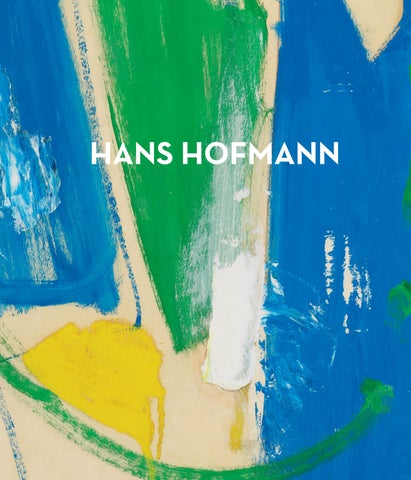
HANS HOFMANN
HANS HOFMANN

Hans Hofmann was one of the most pioneering painters of the twentieth century. He was the living link between American and European art, and the first and second halves of the century. His practice of “push and pull” to create pictorial space was widely influential, guiding some of the most important artists of his era and continuing to inspire artists today.
Hofmann’s revolutionary approach harmonized the brilliant pale e of Fauvism, the structure of Cubism, the playful automatic drawing of Surrealism, and the immediate heroic gesture of Abstract Expressionism.
This came into full bloom in 1950, when, at age 70, Hofmann was invited to collaborate on a series of major mural studies for a never-realized large-scale mosaic mural project in the Peruvian city of Chimbote. The resulting “Chimbote Murals” were among the most ambitious paintings Hofmann had created to that date, and they heralded the glorious rise of his late mature work.
These paintings have not been publicly exhibited in New York since they were shown at the André Emmerich Gallery from 20 December 1990 to 26 January 1991.
Historians define a generation as the passing of 22 to 33 years. It is with equal parts honor and joy we present these nine paintings almost 31 years to the day since they were last exhibited in New York, in an effort to expand the appreciation and understanding of the development of this extraordinary artist’s work for future generations.
Many thanks to Dr. David Anfam and Alexandra Thorold for their deep knowledge and scholarship, and for lending their insightful voices to the accompanying publication. The exhibition would not be possible without the enthusiastic encouragement and unwavering support of Patricia A. Gallagher and John J. Powers of The Renate, Hans and Maria Hofmann Trust, to whom we all owe a debt of gratitude.
It is a great privilege to carry on in the rich tradition of the legendary gallerists who came before and to be entrusted to play a role in representing Hofmann’s celebrated legacy.
—Miles McEnery

PLANE PERFECTION
By David Anfam
“Drawing is of the Spirit and color of the Senses.”
—Henri Matisse1
“The duality is at once the dialogue of the artist and his canvas, the artist and his nature.”
—Fritz Bultman2
For the United States, 1950 marked an eventful start to the decade. At home and abroad, the Cold War escalated. On January 31, 1950, in response to the shocking news that the Soviet Union had detonated an A-bomb, President Harry S. Truman announced that the Atomic Energy Commission would next develop an H-bomb.3
By early July, American ground forces had entered Korea, initiating a real war that in 1953 would end in a difficult stalemate. On the domestic front, Senator Joseph McCarthy spread the silly scare story that 205 Communists had infiltrated the State Department. Anxiety fueled further political and cultural turmoil. As in life, so in the art world—except that the la er’s turbulence led to a year that was more happening than dystopian.
Not least for Hans Hofmann. He had already been alarmed by nuclear warfare; in 1945 he dedicated Cataclysm (Homage to Howard Putzel) [P516] to the critic/gallerist who died in the brief interregnum between the Hiroshima and Nagasaki a acks.4
Flash forward to 1950, and Hofmann’s Chimbote Project starts to fall into place. In fact, an explosive or cataclysmic quality continued to inform the heaviest impasto passages in the more agitated compositions among the nine mural studies that comprise this fragmentary yet fundamental series.
Also in 1950, another defining moment came when an eighteen-strong group wrote an open le er to the Metropolitan Museum of Art protesting its dowdy exhibition, American Painting Today—1950. 5 Among the artist signatories was Hofmann, though he was absent from the now-iconic photograph—taken by Nina Leen on November 24
for Life magazine—that captured these so-called “Irascibles.” Hofmann was elsewhere, busy (if not too irascible) in Provincetown, Massachuse s, distanced from Manha an’s concrete canyons and closer to his perennial muse, nature. There, from 1941 onward, Hofmann supplemented his New York art school with a summer satellite. He bought the Provincetown property as a residence in 1945 and taught there until 1958. To recount this well-known scenario would be redundant were it not the matrix for the Chimbote Project’s monumental studies. Although the project was not completed, it proved a turning point for Hofmann.6
The dealer Samuel Kootz jump-started ma ers in 1950. The plan was to pair various figures in his gallery’s roster with architects in a show, The Muralist and the Modern Architect 7 For example, Kootz linked Adolph Go lieb with Marcel Breuer, William Baziotes with Philip Johnson, and the sculptor David Hare with Frederick Kiesler. Hofmann’s partners were Josep Lluís Sert i López and Paul Lester Wiener. The objective was to transform Chimbote, Peru—260 miles north of Lima and as late as 1940 still a small fishing port—into a modernist site. Whether any Cold War factor lay behind this undertaking is doubtful, and beside the point.8
A more likely motive was Kootz’s urge to expand his businessman’s reach, from New York to a footprint in South America and from easel picture to mural scale. Be y Parsons was Kootz’s main rival—a er Peggy Guggenheim, who gave Hofmann his first solo American exhibit in March 1944,9 returned to Europe in 1947.10 Now Kootz perhaps sniffed a golden opportunity to outdo Parsons. Equally relevant is that Wiener hailed from Leipzig, Germany, a good match for the Bavarian-born Hofmann. Similarly, Hofmann cannot have missed how Sert’s native Catalonia had an indelible association with Joan Miró.11 In a serendipitous twist, Sert was subsequently the architect for Harvard’s Holyoke Center (now Smith Campus Center)—for which Mark Rothko painted his second mural series in 1962.
Significantly, Miróesque fla ened or subdivided forms and other stylistic traits occur in the Chimbote murals and their small studies.12 They include suns and snaking motifs, not to mention bold bright colors, such as yellow versus blue and red against green, that Miró favored. Above all, the idea of bright new beginnings way south of the border, so to speak, must have stirred Hofmann’s imagination. For unlike his
fellow Abstract Expressionists, who famously espoused the tragic and timeless, Hofmann’s vision had an essentially joyous tenor geared to the immediacy of pigment.
A personal digression may be in order. As a student, I fell in love with Hofmann’s work, a passion that deepened a er I visited the Berkeley Art Museum in December 1977. Yet over the decades, I sometimes vacillated. Why? In hindsight, it was because Hofmann bucked the core Abstract Expressionist sensibility: crudely put, utmost control (even Jackson Pollock stated that he could control his paint’s flow), interiority, complex symbolism or metaphors, absolutes (think Ad Reinhardt), urban gri iness (think Franz Kline), angst (Willem de Kooning), and so forth.13 This singularity has cut both ways, sharply dividing Hofmann’s detractors from his admirers.
On the one hand, the academic T.J. Clark said: “Then there is the problem of Hans Hofmann.... A good Hofmann is tasteless to the core....‘Feeling’ has to be fetishized, made dreadfully (obscenely) exterior, if painting is to continue.”14 On the other hand, Hofmann’s “Irascibles” co-signatory, the still-underrated Fritz Bultman, opined the opposite: “In the most geometric paintings [by Hofmann] there is an emphasis on the fugitive memories of color. For in these paintings there is no a empt at a psychologically overwhelming expression, but rather a persuasion through balance and movement and the glow of human warmth.”15 Now is not the time to choose sides in this contested area. Rather, suffice it to observe that it took a painter to understand a painter. The Chimbote paintings and the rest of Hofmann’s output from 1950 stand on a cusp, a watershed. The war-related iconographic strands involving tragic mythology, world-historical cataclysm, phantasmagoric personages, and the like began to segue to new ground, once and for all.
In the same year (1963) that Bultman eulogized Hofmann, he also hit a special nail on the head that merits quoting at some length: “The duality is at once the dialogue of the artist and his canvas, the artist and his nature. It is the duality of flatness and depth; of the fullness of volume and the two-dimensionality of the canvas; of the concentration and dispersal of both the image and the plastic means simultaneously.... That this duality should also remain in the final work is also important for the beholder. It is only through the possibility of multiple readings that pictorial freedom is possible.”16
At his finest, Hofmann is about le ing go—albeit the le ing go is tinctured, as it were, with a certain discipline. A late title catches the precarious equilibrium, In Sober Ecstasy (1963; [P1596]). In the Chimbote nexus, we can see both the dualisms and their burgeoning dialectic. (Sometimes, I suspect that artists think more dialectically than most of us, perhaps because their antipodes are, well, Reality and Art.)
Regarding the effervescent, freewheeling buzz that erupts in at least three murals [P801, 802, and 803] and helps animate all but one of the rest—the stately Fragment of Part I [P794]—scholarship may have overlooked a potential stimulus. Namely, Walt Disney’s groundbreaking film Fantasia (1940). At its premiere, Fantasia caused a sensation. The New York Times declared that it had made motion picture history, while The Chicago Tribune’s Mae Tinee wrote that it is “beautiful...but it is also bewildering. It is stupendous. It is colossal. It is an overwhelmingly ambitious orgy of color, sound, and imagination.”17 She could as well have been writing about Hofmann. Furthermore, the very nature of Disney’s fantastical animated sequences—packed with ebullient synesthesia, whirls, movement, and energy could have struck a chord in the painter’s imagination.
In three murals and several pencil sketches,18 Hofmann’s cross also springs to life with an animation comparable to the magic that propels the objects in Fantasia’s “The Sorcerer’s Apprentice” episode. We might almost say that Hofmann conjured a radical version of the Stations of the Cross (images depicting Jesus on the day of his crucifixion, with accompanying prayers). In turn, Hofmann’s style pivots on synesthesia— the murals change, so to speak, from presto to adagio, tranquillo to agitato. In a similar vein, at one stage Disney translated the sound track into a straight white line that morphs into shapes and tints based on the sounds played (shades of the white outline that runs amok in the Preliminary Sketch for Chimbote Mural No. I [P801], where a sunburst crowns a deep pink cross-cum-presence). Lastly, Fantasia had a “Rite of Spring” scene.19 Around the same time, Hofmann painted Spring [P309]20 and soon a erward... Fantasia [P46]. Enough said.
What of 1950 overall? In terms of Hofmann’s oeuvre, it counts as something of an annus mirabilis. That year, he produced no less than sixty-nine paintings—many, such as the imposing The Window [P750], far more substantial than the small pieces that

Table with Teake le Green Vase and Red Flowers (Still Life—Two Green Vases), 1936, oil on panel, 54 1⁄2 x 40 1⁄8 inches, 138.4 x 101.9 cm University of California, Berkeley Art Museum and Pacific Film Archive. Gi of the artist.
had accumulated annually in the past. Indeed, The Window manifests strong diagonal vectors, plus circular ones, and both configurations recur throughout the murals. The Window’s subject recalls a favorite theme that Henri Matisse explored, particularly in his earlier period. Its appeal to both Matisse and Hofmann is easy to discern. Windows draw the eye into and out of space. Enter the second artist’s storied “push and pull” doctrine.
Hofmann had already put “push and pull” into operation during the 1930s. For instance, Table with Teake le, Green Vase, Red Flowers is his answer to Matisse’s Goldfish and Sculpture (1912) and similar pictures such as the two Nasturtiums with the Painting “Dance” (also 1912). Significantly, Matisse remarked in this context: “To be noted: the color was proportioned to the form. Form was modified according to the reaction of the adjacent areas of color. For expression comes from the colored surface that the spectator perceives as a whole.”21 These words represent the embryo for Hofmann’s spatial ethos to which he subsequently a ached its storied catchphrase. It burgeons in the aforementioned 1936 still life. There, rich orange-yellows on the le in the actual room play a tug of war with blue and red in Hofmann’s own paintingwithin-the-painting on the right. The corollary is that Hofmann’s composition is indeed an answer to the three Matisses from 1912 that set the artist’s own paintings within their arrangement.
Come 1950, Hofmann flatly (excuse the incipient double entendre) titled a trio of canvases Push and Pull—the last further identified in the catalogue raisonné as a Study for Chimbote Mural. And rightly so, because its very stark red, yellow, and

Sir Jacob Epstein, Torso in Metal from ‘The Rock Drill’, 1913–15, bronze,
27 3⁄4 x 23 x 17 1⁄2 inches, 70.5 x 58.5 x 44.5 cm
Tate Collection, London, United Kingdom
© The estate of Sir Jacob Epstein
green planes lead straight to the most architectonic Mural Fragment [P794). Shortly beforehand, Hofmann noted in his veritable manifesto, The Search for the Real (1948), that the most important carriers of push and pull were planes; other carriers included lines and points. To echo the name that Wassily Kandinsky gave to his enormously influential book wri en in 1926, the visual scenario that Hofmann strove to perfect throughout 1950 and rendered architectonic in the Chimbote Murals hung upon a trajectory that went from point and line to plane. All three motifs populate the series.
Thus, repeated diagonals/triangles end in sharp points; lineation twists in the upper le of at least one mural [P796] as well as in a study for the mosaic that was to be in Chimbote’s plaza;22 and planes hover, twist, and slice into each other. The mystery of the Chimbote project is that, because it never came to fruition, we cannot identify for sure precisely where each composition would stand on the city’s bell tower and in the plaza.23 Likewise, scholarship suggests that the iconography alludes to Quetzalcoatl, the Aztec serpent-bird deity, alongside a conquistador-like humanoid.24 The la er [P798]—surely akin to Jacob Epstein’s sinister torso that straddled his Rock Drill (ca. 1913-15)—harks back to the darkness that Hofmann had invoked in his pictures dating from the end of the Second World War and its a ermath.25
In contrast, Hofmann’s core agenda for sunny Chimbote was moving into other realms, the abstract dualities of color and spirit (see the twin epigraphs to this essay) that henceforth became the linchpins cementing his ultimate radiant achievements.
David Anfam’s Abstract Expressionism (2016–17, Royal Academy of Arts, London) was the largest survey of its kind ever mounted in Europe.
Endnotes
In preparing this essay, my special thanks go to Tina Dickey, Anastasija Jevtovic, James Yohe, and, of course, The Renate, Hans and Maria Hofmann Trust.
1. Matisse, “Le er to Henry Clifford” (February 14, 1948), Matisse on Art, Jack D. Flam, ed., (New York: E. P. Du on, 1978), p. 121.
2. Fritz Bultman, “The Achievement of Hans Hofmann,” ArtNews 62 (September 1963), p. 44.
3. Indeed, this abbreviation came into coinage in 1950.
4. For a detailed chronology, see Suzi Villiger, ed., Hans Hofmann: Catalogue Raisonné of Paintings. Volume I: Essays and References (Farnham, Surrey; Burlington, VT: Lund Humphries, 2014), pp. 62–73. Henceforth, the designation “[P]” plus a number references works in Volume II (1901–1951) of the catalogue raisonné.
5. The fullest account is Bradford R. Collins, Manuel Fontán del Junco, Inés Vallejo and Beatrix Cordero, eds., The Irascibles: Painters against the Museum, 1950 (Madrid: Fundación Juan March, 2020). Almost as if to stress the end of an era, Max Beckmann died while walking across Central Park en route to see the Metropolitan’s exhibition.
6. For a broad overview of this juncture, see April Kingsley, The Turning Point: The Abstract Expressionists and the Transformation of American Art (New York: Simon & Schuster, 1992).
7. See Michael Rush, ed., Hans Hofmann: Circa 1950 (Waltham, MA: The Rose Art Museum, Brandeis University, 2009).
8. On Kootz’s ambitions in the context of the Cold War, see Serge Guilbaut, How New York Stole the Idea of Modern Art: Abstract Expressionism, Freedom, and the Cold War, trans. Arthur Goldhammer (Chicago & London: University of Chicago Press, 1983). If any specific evidence exists to connect Kootz and Cold War warriors such as the CIA on the Chimbote front, it has not surfaced.
9. Guggenheim commissioned Jackson Pollock’s Mural (1943), which set the gold standard for the Abstract Expressionist transition from the easel picture to an epic scale. See David Anfam, Jackson Pollock’s “Mural”: Energy Made Visible (London: Thames & Hudson, 2015).
10. A comprehensive account of Guggenheim’s activities is in Susan Davidson and Philip Rylands, eds., Peggy Guggenheim & Frederick Kiesler: The Story of Art of This Century (Venice & Vienna: Peggy Guggenheim Collection, Venice, and Austrian Frederick and Lillian Kiesler Private Foundation, 2004).
11. Sert went on to design Miró’s studio in Palma de Majorca, Spain, in 1955.
12. Tina Dickey, “Emblema para una nuevo ciudad: Los estudios de Hofmann sobre Chimbote,” in Xavier Costa, ed., Hans Hofmann: El Proyecto Chimbote (Barcelona: Museu d’Art Contemporani, 2004), pp. 15–35, analyzes the iconography and other elements.
13. A good, succinct recent take on Hofmann’s exceptionalism is Andrew Russeth, “The Case for Loving Hans Hofmann, Pioneering Teacher to the Abstract Expressionists,” ArtNews.com (June 16, 2020) <h ps://www.artnews.com/art-news/ artists/why-is-hans-hofmann-important-abstractexpressionism-1202691320/>.
14. T.J. Clark, Farewell to an Idea: Episodes from a History of Modernism (New Haven, CT: Yale University Press, 1999), p. 397.
15. Bultman 1963, p. 55. 16. Ibid.
17. David Presco , “The Film That Saved Mickey,” The Chicago Tribune (February 8, 1985). <h ps:// www.chicagotribune.com/news/ct-xpm-1985-02-088501080333-story.html>. Retrieved September 28, 2021.
18. For example, the three untitled drawings in Costa 2004, pp. 119–21.
19. As a nature boy, Hofmann’s heart might also have warmed to Fantasia’s set piece based on Ludwig van Beethoven’s Symphony No. 6 “Pastoral.”
20. Spring’s date has been disputed. The catalogue raisonné assigns it to 1940.
21. Matisse, “Statements to Tériade” (1929–30), in Flam (1973), p. 58.
22. Costa 2004, p. 47.
23. James Yohe, email to the author, September 29, 2021.
24. Dickey, in Costa 2004, passim
25. David Anfam, “Beyond Fury and Fear,” in Hans Hofmann: Fury: Painting A er the War (London: Bastian, 2020), pp. 12–21.
FORMULATING A LANGUAGE OF ABSTRACTION
VISUAL
SEMIOTICS IN HANS HOFMANN’S CHIMBOTE MURAL STUDIES
By Alexandra Thorold
“Every creative artist works continually to … develop to the point where he can say what he has to say and [say it] in his own language. This language is of course not always at once understood. It makes people furious when you speak your own language.”
— Hans Hofmann1
Hans Hofmann illustrated his fervent position on creating his own distinct language of expression through his work in this final remark at a lecture he delivered in 1941 at the American Abstract Artists Symposium. The Chimbote Murals, painted nine years later, exemplify the artist’s ongoing pursuit of formulating his own visual language, rich in meaning and demarcating a space between the spiritual and the material realms.
In 1950, the Kootz Gallery presented an exhibition entitled The Muralist and the Modern Architect, for which the gallery invited creative collaborations between painters and architects.2 Hofmann was paired with the architect Josep Lluís Sert, known for designing the Spanish pavilion, for which Picasso painted his seminal Guernica, at the 1937 World’s Fair in Paris.3 Hofmann was tasked with creating a public mural for the plaza and bell tower in the proposed civic center in Chimbote, a port city in the Ancash region of Northern Peru. For the project, Hofmann painted a series of nine large panels, one-half the size of the intended murals. It was Hofmann’s intention to arrange the separate images into a mosaic-like composition, which would cover one side of the bell tower.4
1. Schreyach, “Re-created Flatness,” 51.
2. Landau, “Hans Hofmann: The Nature of Abstraction,” 35.
3. Vitiello, “Mural, Interrupted,” 18.
4. Yohe, “The 1950 Mural Project.”

Push and Pull [Study for Chimbote Mural], 1950
Oil on canvas, 36 x 48 inches, 91.4 x 124.5 cm
Although the mural was never realized, the nine paintings that formed a study for the project offered a captivating insight into Hofmann’s distinct theoretical approach to painting. The artist’s work was configured by an innovative theoretical syntax, foregrounding the significance of the material surface while utilizing his own unique theories to develop dynamism, to experiment with his approach to color, and to increase the intellectual depth of his work.
Hofmann’s oeuvre is set within a matrix of avant-garde influence. His early years in Paris and Munich laid the foundations of his practice, a potent synthesis of Cubism, Gestural Abstraction, and Abstract Expressionism, which he encountered upon moving to New York. His involvement with the avant-garde in this era later evolved into his role as a “crucial disseminator”5 of his own conceptual and theoretical ideas on pictorial creation. Teaching at his own school in New York and Provincetown, Massachuse s, from the 1930s to the 1950s, Hofmann taught a generation of modernists that included Lee Krasner, Helen Frankenthaler, and Joan Mitchell.6 This demonstrated his capacity not only to teach and inspire a generation of painters, but also to intrinsically mold and shape the trajectory of modernist painting itself.
5. Schreyach, “Re-created Flatness,” 46. 6. Adams, “The Art of the Teacher.”

While the nine mural studies are heterogeneous and each painting is stylistically distinct, the mural studies are also symptomatic of the development of Hofmann’s own unique visual semiotics and corresponding theorems, which he consistently refined over his long career. The murals demonstrate Hofmann’s preoccupation with transforming “painting’s material limits into a medium of expression,”7 the “push-pull”8 necessary to create a dynamic pictorial surface, and the visceral expression and emotional depth that lay at the heart of all his work.
Hofmann’s practice embodied the modernist sensibility of simultaneously foregrounding the material limits of the picture plane and drawing a ention to its flatness while also utilizing the surface as a powerful site of creative expression that conveyed pictorial content. “A consciousness of limitation,” Hofmann wrote in his Search for the Real, “is paramount for expression.”9
Michael Schreyach elucidates Hofmann’s ideas on the importance of working within the limits of the medium when he states that Hofmann’s awareness, “and particularly the ontological distinction it allows us to discern between the raw materials of expression and the expression of meaning—underpins modernist art.”10
7. Schreyach, “Re-created Flatness,” 52.
8. Vitiello, “Mural, Interrupted,” 18.
9. Schreyach, “Re-created Flatness,” 60.
10. Schreyach, “Re-created Flatness,” 60.
Push and Pull III, 1950
Oil on canvas, 36 x 48 inches, 91.4 x 124.5 cm
Layered, sharp azure blue and yellow geometric forms in Chimbote Mural Fragment of Part 1 [Study for Chimbote Mural], appear to self-referentially draw a ention to the flat surface of the work and the slick materiality of the board onto which Hofmann painted. In this way, he employed a quintessential modernist strategy in alerting the viewer to the materiality of the work itself while simultaneously alluding to the materiality’s illusionistic potential.
This distinctly Greenbergian, modernist ideal wasn’t limited to the material confines of the pictorial plane, but also extended to the intended architectural site of the murals themselves.
By 1950, Hofmann had developed a self-proclaimed “lifelong fascination with the transformative effect of art on architecture.”11 Hofmann’s emphasis on the significance of spatial awareness and composition in his subsequent works was emphasized in his aspiration that they “could be viewed in their entirety at a proper distance in the plaza or glimpsed in fragments from myriad other vistas.”12 The expressive, energetic style and vibrant pale e used in the works would ensure the visibility of the murals and provide “aesthetic enjoyment”13 from a distance. More significantly, however, Hofmann appeared to echo the fragmented, myriad viewpoints in the compositions themselves.
In Chimbote Mural (Fragment of Part 1), Chimbote Red Yellow Blue Black [Study for Chimbote Mural], the pictorial surface is itself constructed through a fractured, geometric form. A shard of saturated yellow intersects with painterly crimson, blue, and black. Hofmann conveys his awareness of the architectural site for which these works were intended, but he also evokes the fragmented and fractured mode of seeing the works that the viewers would have experienced from multiple viewpoints within the architectural site of Chimbote.
An integral part of the fascinating, new visual language Hofmann was formulating within the landscape of abstraction was his concept of push-pull, which is conveyed in the
11. Dickey, “Color Creates Light,” 256.
12. Dickey, “Color Creates Light,” 257.
13. Dickey, “Color Creates Light,” 257.
dynamic composition and experimental approach to color in the mural series. Hofmann’s push-pull theory was predicated on the concept that adjacent colors and forms on the pictorial plane could imply movement, depth, and dynamism within an artwork.
Hofmann was fascinated with the concept of creating pictorial movement through expanding and contracting forces, and placing receding and protruding colors in close proximity. The juxtaposition between deep cobalt blue and vibrant scarlet red that runs through several of the studies, including most notably his Study for Chimbote Mural [1950], in which a backdrop of blue frames the suggestion of a bright crimson cross, exemplifies this technique. The depth of the blue recedes in the work, while the red boldly confronts the viewer as it protrudes out of the picture plane, creating tension and movement in the work. The role of color in abstract painting, Hofmann wrote, “serves simultaneously a plastic and psychological purpose...color in itself is light. In nature, light creates the color; in the picture, color creates light.”14
The movement created in the glowing golden yellow, green, and fuchsia pink in the expressive study Preliminary Sketches for Chimbote Mural No. 1 [Study for Chimbote Mural] conveys the importance of luminosity in Hofmann’s work. His push-pull theory, therefore, was rooted not only in the strategic juxtaposition of colors, but also the way in which those colors created luminosity, depth, and tension. This led Hofmann to configure a form of abstraction that psychologically transcended the confines of the picture plane through the projection of oscillating movement and radiating light. As Hofmann himself articulated, he aimed for the picture plane to work as an “actified space” that has “the quality of flesh—it pulsates, it has sensation.”15 This innovative and profound strategy demanded not merely to be observed but to be experienced.
“It’s not really what you say, see; it’s always how you say what you have to say,”16 Hofmann said in an interview with Artforum a month before his death, in 1966, underscoring his belief in creating his own visual language. Hofmann developed a rich visual vocabulary within the bounds of abstraction that was underpinned by the notion of creating an experience for the viewer. This experience interwove the visual and the material with the psychological, the emotional, and, at times, the spiritual. Hofmann was o en noted as an artist on a “spiritual quest.”17 However, his definition
14. Landau, “Hans Hofmann: The Nature of Abstraction,” 35.
15. Schreyach, “Re-created Flatness,” 51.
16. Hofmann, Artforum interview.
17. Landau, “Space and Pictorial Life,” 314.
18. Hofmann, Artforum interview.
of spirituality was more distinct and specific than was understood in the predominant discourse surrounding his work. He viewed spirituality as “the result of a sixth sense, the sense of sensibility, the ability to...look into things in depth, to discover the inner life, we only see the surface of things, but our sensibility explores the inner life of everything.”18
Spirituality in the context of Hofmann’s artistic practice, therefore, was centered around creating a visceral experience that engaged the aesthetic sensibility of the viewer. As a result, his own visual language, developed through modernist strategy and demonstrated in the kaleidoscopic and diverse Chimbote Murals, occupies a unique space between the aesthetic, the material and the spiritual realms.
Alexandra Thorold is a London-based curator and art critic whose research focuses on post-war and contemporary art. She was a fellow in the Painting and Sculpture department at The Museum of Modern Art.
Endnotes
Alexander Adams. “The Art of the Teacher: On the Work of Hans Hofmann.” The Art Newspaper, June 1, 2015. h ps://www.theartnewspaper.com/ news/the-art-of-the-teacher-on-the-work-of-hanshofmann
Tina Dickey, Color Creates Light: Studies with Hans Hofmann. Berkeley, CA: Trillistar Books, 2012.
Hans Hofmann. “A Conversation with Hans Hofmann,” interviewed by Irma B. Jaffe. Artforum, January 17, 1966. h ps://www.artforum. com/print/197101/a-conversation-with-hanshofmann-37533
Ellen G. Landau. “Space and Pictorial Life.” The Bulletin of the Cleveland Museum of Art 72, no. 5 (September 1985): 310- 322. h ps://www.jstor.org/ stable/25159910
Ellen G. Landau and Michael Schreyach. Hans Hofmann: The Nature of Abstraction. Oakland: University of California Press, 2019.
Michael Schreyach. “Re-created Flatness: Hans Hofmann’s Concept of the Picture Plane as a Medium of Expression.” The Journal of Aesthetic Education 49, no. 1 (Spring 2015): 44-67. h ps://www. jstor.org/stable/10.5406/jaesteduc.49.1.0044
Chris Vitiello. “Mural, Interrupted: The Populist Punch of Hans Hofmann’s Painting Teaches Us How to Read Abstract Art.” Indy Week, February 2, 2016.
James Yohe. Hans Hofmann: The 1950 Chimbote Mural Project. New York: André Emmerich Gallery, 1990.


Chimbote Mural Fragment of Part 1 [Study for Chimbote Mural], 1950
Oil on board
84 x 36 1⁄2 inches
213.4 x 92.7 cm
Verso upper right: “Chimbote / mural / fragment of part I / 50 / hans hofmann”; center strainer bar [MH]: “Cat. 1115-1950 / oil on comb. Board / Chimbote Part I / Mural / 84 x 36”
HH cat. no. 1115-1950
Estate no. M-1121-01
HH CR no. P794
Renate, Hans and Maria Hofmann Trust (acquired 1996)
Provenance
Estate of the artist (1966-1996)
Exhibitions
1950 Kootz, New York (3 - 23 October; group),* ill. n.p.
1990 Emmerich, New York (20 December 1990 – 26 January 1991; solo),* color, ill. n.p., cat. no. 3
1992 Fiat-Lingo o, Turin, Italy (group),* color ill. p. 171
1996 Emmerich/Sotheby’s, New York (solo)*
1997 Museu d’Art Contemporani de Barcelona (group),* color ill. p. 18, as Proyecto del mural de Chimbote. Mural de Chimbote, Fragmento de Parte I
1999 Museu d’Art Contemporani de Barcelona (group)
2000 Museu d’Art Contemporani de Barcelona (group)
2001 Museu d’Art Contemporani de Barcelona (group)
2002 Museu d’Art Contemporani de Barcelona (group)
2003 Museu d’Art Contemporani de Barcelona (group)
2009 The Rose Art Museum, Brandeis University, Waltham, MA (solo, traveled),* color ill. pp. 15, 34, 75, 76-79 (details), p. 142 (thumbnail), comm. p. 15
2015 Bruce Museum, Greenwich, CT (solo, traveled)*, color ill. p. 31, cat. no. 10, comm. p. 30, 81
2016 The Kunsthalle Bielefeld, Bielefeld, Germany (solo, traveled),* color ill. p. 103, p. 184 (thumbnail)
2019 Berkeley Art Museum and Pacific Film Archives, Berkeley, CA (solo, traveled),* color ill. p. 106, comm. p. 35
2021 Miles McEnery Gallery, New York, “Hans Hofmann,” 9 December 2021 - 29 January 2022 (solo),* color ill., pl. 21.
2022 Musee Pfalzgalerie Kaiserslautern, Kaiserslautern, Germany (solo, traveled)
Literature
1950 Louchheim, New York Times (group exh. rev.). comm. p. 117
1951 Arts & Architecture (group exh. rev.), ill. p. 19
1963 Hunter, Hans Hofmann, ill., pl. 34 (le ), as Chimbote bell tower project
2002 Borja-Villel, MACBA Collection: Itinerary, color ill. p. 45 Yohe, ed., Hans Hofmann, color ill., p. 138
2004 Costa, ed., Hans Hofmann: The Chimbote Project: The Synergistic Promise of Modern Art and Architecture, color ill. p. 45, fig. no. 16, comm. pp. 28, 32
2009 Merjian, Modern Painters (solo exh. rev.), comm. p. 68
2011 Dickey, Color Creates Light: Studies with Hans Hofmann, color ill. p. 229, comm. pp. 228-29
2012 Lovisa, Die Rheinpfalz (solo exh. rev.; not in exhibition), color ill.
2014 Villiger, ed., Hans Hofmann: A Catalogue Raisonné of Paintings, Vol. 2, color ill., cat no. P794
2015 Smith, The New York Times (solo exh. rev.), comm. p. 19
2015 Dunlap, The New York Times (solo exh. rev.), comm. p. 24


Chimbote Mural (Fragment of Part 1), Chimbote Red Yellow Blue Black [Study for Chimbote Mural], 1950
Oil on panel mounted on board
84 x 48 inches
213.4 x 121.9 cm
Verso upper right: “Chimbote / mural (Fragment / of Part I) / hans hofmann / 50”
HH cat. no. 311-1950
Estate no. M-0143
HH CR no. P795
Renate, Hans and Maria Hofmann Trust (acquired 1996)
Provenance
Estate of the artist (1966-1996)
Exhibitions
1950 Kootz, New York (3 - 23 October; group),* ill. n.p.
2001 Museu d’Art Contemporani de Barcelona (group)
2009 The Rose Art Museum, Brandeis University, Waltham, MA (solo, traveled),* color ill. pp. 34, 81, 82-85 (details), p. 142 (thumbnail), comm. p. 15
2015 Bruce Museum, Greenwich, CT (solo, traveled),* color ill. pp. 31, 70 (detail) cat. no. 11, comm. pp. 30, 81 as Chimbote Mural (Fragment of Part I)
2016 The Kunsthalle Bielefeld, Bielefeld, Germany (solo, traveled),* color ill. p. 107, p. 184 (thumbnail)
2021 Miles McEnery Gallery, New York, “Hans Hofmann,” 9 December 2021 - 29 January 2022 (solo),* color ill., pl. 25.
2022 Musee Pfalzgalerie Kaiserslautern, Kaiserslautern, Germany (solo, traveled)
Literature
1950 Louchheim, New York Times (group exh. rev.). comm. p. 117
1951 Arts & Architecture (group exh. rev.), ill. p. 19
1963 Hunter, Hans Hofmann, ill., pl. 34 (center), as Chimbote bell tower project
1983 Seitz, Abstract Expressionist Painting in America, ill., fig. no. 139A, comm. pp. 34-35, as Chimbote Mural (Middle Section)
2002 Yohe, ed., Hans Hofmann, color ill. p. 138, comm. p. 28, as Sketch for Chimbote Mural Fragment
2004 Costa, ed., Hans Hofmann: The Chimbote Project: The Synergistic Promise of Modern Art and Architecture, color ill. p. 46, fig. no. 17, comm. pp. 32, as Sketch for Chimbote Mural. Fragment of Part I
2009 Merjian, Modern Painters (solo exh. rev.), comm. p. 68
2014 Villiger, ed., Hans Hofmann: A Catalogue Raisonné of Paintings, Vol. 2, color ill., cat no. P795
2015 Smith, The New York Times (solo exh. rev.), comm. p. 19
2015 Dunlap, The New York Times (solo exh. rev.), comm. p. 24


Chimbote Mural Fragment of Part II [Study for Chimbote Mural], 1950
Oil on board
84 1⁄4 x 36 1⁄4 inches
214 x 92.1 cm
Lower right: “50 / hans hofmann”
Verso upper right: “Chimbote / mural / fragment of / part II / hans hofmann / 50”
HH cat. no. 1116-1950
Estate no. M-1121-04
HH CR no. P796
Renate, Hans and Maria Hofmann Trust (acquired 1996)
Provenance
Estate of the artist (1966-1996)
Exhibitions
1990 Emmerich, New York (20 December 1990 – 26 January 1991; solo), * color ill. n. p., cat. no. 4, as Chimbote Mural
1992 The Dayton Art Institute, OH (group, traveled),* color ill. p. 203, cat. no. 38, pl. 79 as Chimbote Mural
1999 Museu d’Art Contemporani de Barcelona (group)
2000 Museu d’Art Contemporani de Barcelona (group)
2001 Museu d’Art Contemporani de Barcelona (group)
2002 Museu d’Art Contemporani de Barcelona (group)
2003 Museu d’Art Contemporani de Barcelona (group)
2009 The Rose Art Museum, Brandeis University, Waltham, MA (solo, traveled),* color ill. pp. 6, 88-91 (details), pp. 34, 87, 142 (thumbnail), as Chimbote Mural
2015 Bruce Museum, Greenwich, CT (solo, traveled),* color ill. p. 38, cat. no. 17, comm. p. 34
2021 Miles McEnery Gallery, New York, “Hans Hofmann,” 9 December 2021 - 29 January 2022 (solo),* color ill., pl. 29.
2022 Musee Pfalzgalerie Kaiserslautern, Kaiserslautern, Germany (solo, traveled)
Literature
1963 Hunter, Hans Hofmann, ill., pl. 34 (right), as Cimbote bell tower project
1983 Seitz, Abstract Expressionist Painting in America, ill., fig. no. 139B, as Chimbote Mural (Le Section)
2002 Borja-Villel, MACBA Collection: Itinerary, color ill. p. 45 Yohe, ed., Hans Hofmann, color ill. p. 139 as Chimbote Mural
2004 Costa, ed., Hans Hofmann: The Chimbote Project: The Synergistic Promise of Modern Art and Architecture, color ill. p. 32,42 (fig. no. 8), comm. pp. 32, as Chimbote Mural
2009 Boulanger, Art New England (solo exh. rev.), color ill. p. 35, comm. p. 35 as Chimbote Mural Merjian, Modern Painters (solo exh. Rev.), comm. p. 68
2014 Villiger, ed., Hans Hofmann: A Catalogue Raisonné of Paintings, Vol. 2, color ill., cat no. P796
2015 Smith, The New York Times (solo exh. rev.), comm. p. 19
2015 Dunlap, The New York Times (solo exh. rev.), comm. p. 24


[Study for Chimbote Mural], 1950
Oil on paper mounted on board
84 1⁄8 x 36 1⁄4 inches
213.7 x 92.1 cm
No inscriptions
Estate no. M-0429
HH CR no. P797
Renate, Hans and Maria Hofmann Trust (acquired 1996)
Provenance
Estate of the artist (1966-1996)
Exhibitions
1990 Emmerich, New York (20 December 1990 – 26 January 1991; solo),* color ill. cover, cat. no. 1, as Untitled
1997 Museu d’Art Contemporani de Barcelona (group),* color ill. p. 19, as Proyecto del mural de Chimbote. Mural de Chimbote
2001 Museu d’Art Contemporani de Barcelona (group)
2002 Musei Civici di Venezia, Italy (group),* color ill. p. 163, cat. no. 79, as Chimbote Mural Project
2003 Museu d’Art Contemporani de Barcelona (group)
2009 The Rose Art Museum, Brandeis University, Waltham, MA (solo, traveled),* color ill. pp. 34, 57, 58-61 (details), p. 142 (thumbnail), as Chimbote Mural
2015 Bruce Museum, Greenwich, CT (solo, traveled),* color ill. p. 36, cat. no. 15, comm. p. 34
2021 Miles McEnery Gallery, New York, “Hans Hofmann,” 9 December 2021 - 29 January 2022 (solo),* color ill., pl. 33.
2022 Musee Pfalzgalerie Kaiserslautern, Kaiserslautern, Germany (solo, traveled)
Literature
1951 New Paintings by Hans Hofmann (solo exh. brochure; not in exhibition), ill. n.p (in situ view with Hofmann at his studio)
1991 André Emmerich Gallery, New York. Ad for exhibition. Art in America 79, no. 1 (January 1991): color ill. p. 30, as Untitled
2002 Kinzer, New York Times (solo exh. rev; not in exhibition), ill. p. E2 (in situ view with Hofmann at his studio) Yohe, ed., Hans Hofmann, color ill. p. 136 (reproduced with incorrect orientation), p. 56 (b/w, in situ view with Hofmann at his studio), as Chimbote Mural
2004 Costa, ed., Hans Hofmann: The Chimbote Project: The Synergistic Promise of Modern Art and Architecture, color ill. p. 41, fig. no. 13, comm. p. 32, as Study for Chimbote Mosaic
2008 Feinstein, Sam Feinstein, ill. p. 77 (in situ view with Hofmann at his studio)
2009 Boulanger, Art New England (solo exh. rev.), comm. p. 35
Howards, Ellen. “Cu ing off the Rose: Brandeis Not Smelling So Sweet.” Art New England (April–May 2009): color ill. p. 12, as Untitled (Chimbote Mural)
Merjian, Modern Painters (solo exh. rev.), comm. p. 68
2011 Forman, Perspectives on the Provincetown Artist Colony, vol. 1, ill. p. 131 (in situ view with Hofmann at his studio)
2014 Villiger, ed., Hans Hofmann: A Catalogue Raisonné of Paintings, Vol. 2, color ill., cat no. P797
2015 Smith, The New York Times (solo exh. rev.), comm. p. 19
2015 Dunlap, The New York Times (solo exh. rev.), comm. p. 24


Study for Mosaic—Chimbote [Study for Chimbote Mural], 1950
Oil on paper mounted on canvas
83 3⁄4 x 36 1⁄2 inches
212.7 x 92.7 cm
No inscriptions
HH cat. no. 1137-1950
Estate no. M-0428
HH CR no. P798
Renate, Hans and Maria Hofmann Trust (acquired 1996)
Provenance
Estate of the artist (1966-1996)
Exhibitions
1990 Emmerich, New York (20 December 1990 – 26 January 1991; solo),* color ill. n.p., cat. no. 9, as Untitled
1999 Museu d’Art Contemporani de Barcelona (group)
2000 Museu d’Art Contemporani de Barcelona (group)
2001 Museu d’Art Contemporani de Barcelona (group)
2002 Museu d’Art Contemporani de Barcelona (group)
2003 Museu d’Art Contemporani de Barcelona (group)
2009 The Rose Art Museum, Brandeis University, Waltham, MA (solo, traveled),* color ill. pp. 34, 51, 52-55 (details), p. 142 (thumbnail) as Chimbote Mural
2015 Bruce Museum, Greenwich, CT (solo, traveled),* color ill. p. 33, cat. no. 13, comm. P. 34
2021 Miles McEnery Gallery, New York, “Hans Hofmann,” 9 December 2021 - 29 January 2022 (solo),* color ill., pl. 37.
2022 Musee Pfalzgalerie Kaiserslautern, Kaiserslautern, Germany (solo, traveled)
Literature
1951 New Paintings by Hans Hofmann (solo exh. brochure; not in exhibition), ill. n.p (in situ view with Hofmann at his studio)
1980 Kinkead, ARTnews, ill. p. 90 (in situ view with Hofmann at his studio)
2002 Borja-Villel, MACBA Collection: Itinerary, color ill. p. 45, as Untitled Kinzer, New York Times (solo exh. rev; not in exhibition), ill. p. E2 (in situ view with Hofmann at his studio) Yohe, ed., Hans Hofmann, color ill. p. 136 (reproduced with incorrect orientation), p. 56 (b / w, in situ view with Hofmann at his studio), as Chimbote Mural
2004 Costa, ed., Hans Hofmann: The Chimbote Project: The Synergistic Promise of Modern Art and Architecture, color ill. p. 43, fig. no. 14, comm. p. 32, as Study for Mosaic
2008 Feinstein, Sam Feinstein, ill. p. 71 (in situ view with Hofmann at his studio)
2009 Merjian, Modern Painters (solo exh. rev.), comm. p. 68
2014 Villiger, ed., Hans Hofmann: A Catalogue Raisonné of Paintings, Vol. 2, color ill., cat no. P798
2015 Smith, The New York Times (solo exh. rev.), comm. p. 19
2015 Dunlap, The New York Times (solo exh. rev.), comm. p. 24


[Study for Mosaic Cross] [Study for Chimbote Mural], 1950
Oil on paper mounted on board
84 x 36 1⁄2 inches
213.4 x 92.7 cm
No inscriptions
Estate no. M-0427
HH CR no. P799
Renate, Hans and Maria Hofmann Trust (acquired 1996)
Provenance
Estate of the artist (1966-1996)
Exhibitions
1990 Emmerich, New York (20 December 1990 – 26 January 1991; solo),* color ill. n.p., cat. no. 8
1995 Stedelijk Museum, Amsterdam (group)
2000 PAAM, Provincetown, MA (solo)*
2001 Museu d’Art Contemporani de Barcelona (group)
2009 The Rose Art Museum, Brandeis University, Waltham, MA (solo, traveled),* color ill. pp. 16, 34, 63, 64-67 (details), p. 142 (thumbnail) comm. p. 16, as Study for Mosaic Cross (Chimbote)
2015 Bruce Museum, Greenwich, CT (solo, traveled),* color ill. p. 29, cat. no. 8, comm. p. 28
2021 Miles McEnery Gallery, New York, “Hans Hofmann,” 9 December 2021 - 29 January 2022 (solo),* color ill., pl. 41.
2022 Musee Pfalzgalerie Kaiserslautern, Kaiserslautern, Germany (solo, traveled)
Literature
2002 Borja-Villel, MACBA Collection: Itinerary, color ill. p. 44
Yohe, ed., Hans Hofmann, color ill. p. 137, as Sketch—Chimbote Mosaic Cross
2004 Costa, ed., Hans Hofmann: The Chimbote Project: The Synergistic Promise of Modern Art and Architecture, color ill. p. 40, fig. no. 12, comm. p. 32
2009 Boulanger, Art New England (solo exh. rev.), comm. p. 35
Merjian, Modern Painters (solo exh. rev.), comm. p. 68
2011 Dickey, Color Creates Light: Studies with Hans Hofmann, color ill. p. 228
2014 Villiger, ed., Hans Hofmann: A Catalogue Raisonné of Paintings, Vol. 2, color ill., cat no. P799
2015 Smith, The New York Times (solo exh. rev.), comm. p. 19
2015 Dunlap, The New York Times (solo exh. rev.), comm. p. 24


The Cross (Sketch for Mosaic) [Study for Chimbote Mural], 1950
Oil on paper mounted on board
84 x 35 1⁄2 inches
213.4 x 90.2 cm
Lower right: “50. / hans hofmann”
Verso center [MH]: “Cat 310-1950”
HH cat. no. 310-1950
Estate no. M-0116
HH CR no. P800
Renate, Hans and Maria Hofmann Trust (acquired 1996)
Provenance
Estate of the artist (1966-1996)
Exhibitions
1990 Emmerich, New York (20 December 1990 – 26 January 1991; solo),* color ill. n.p., cat. no. 5, as Sketch— Chimbote Mosaic Cross
1995 Stedelijk Museum, Amsterdam (group), as Sketch Chimbote Mosaic Cross
2000 PAAM, Provincetown, MA (solo),* color ill. p. 25, as Sketch—Chimbote Mosaic Cross
2009 The Rose Art Museum, Brandeis University, Waltham, MA (solo, traveled),* color ill. frontispiece, pp. 34, 69, 70-73 (details), p. 142 (thumbnail), comm. p. 16, as Sketch—Chimbote Mosaic Cross
2015 Bruce Museum, Greenwich, CT (solo, traveled),* color ill. p. 29, fig. no. 9, comm. p. 28
2021 Miles McEnery Gallery, New York, “Hans Hofmann,” 9 December 2021 - 29 January 2022 (solo),* color ill., pl. 45.
2022 Musee Pfalzgalerie Kaiserslautern, Kaiserslautern, Germany (solo, traveled)
Literature
1995 Bloem, Stedelijk Museum Bulletin (group exh. rev.), color ill. p. 42, as Schets voor kruis in mozaïek voor Chimbote
2002 Yohe, ed., Hans Hofmann, color ill. p. 137, as Study for Mosaic Cross Chimbote
2004 Costa, ed., Hans Hofmann: The Chimbote Project: The Synergistic Promise of Modern Art and Architecture, color ill. p. 44, fig. no. 15, comm. p. 32, as Study for Mosaic Cross
2009 Boulanger, Art New England (solo exh. rev.), comm. p. 35 Merjian, Modern Painters (solo exh. rev. ), comm. p. 68
2014 Villiger, ed., Hans Hofmann: A Catalogue Raisonné of Paintings, Vol. 2, color ill., cat no. P800
2015 Smith, The New York Times (solo exh. rev.), comm. p. 19
2015 Dunlap, The New York Times (solo exh. rev.), comm. p. 24


Preliminary Sketches for Chimbote Mural No. 1 [Study for Chimbote Mural], 1950
Oil on paper mounted on board
83 3⁄4 x 36 inches
212.7 x 91.4 cm
Verso upper right: “Preliminary sketches for Chimbote Mural 1950 / No. 1 / 83 1⁄2 x 36”
HH cat. no. 1118-1950
Estate no. M-1121-02
HH CR no. P801
Renate, Hans and Maria Hofmann Trust (acquired 1996)
Provenance
Estate of the artist (1966–1996)
Exhibitions
1990 Emmerich, New York (20 December 1990 – 26 January 1991; solo),* color ill. n.p., cat. no. 6, as Chimbote Mural
1995 Stedelijk Museum, Amsterdam (group), as Chimbote Mural
2009 The Rose Art Museum, Brandeis University, Waltham, MA (solo, traveled),* color ill. pp. 34, 39, 40-43 (details), p. 142 (thumbnail), as Chimbote Mural
2015 Bruce Museum, Greenwich, CT (solo, traveled),* color ill. p. 35, cat. no. 14, comm. p. 34
2021 Miles McEnery Gallery, New York, “Hans Hofmann,” 9 December 2021 – 29 January 2022 (solo),* color ill., pl. 49.
2022 Musee Pfalzgalerie Kaiserslautern, Kaiserslautern, Germany (solo, traveled)
Literature
1992 Kingsley, The Turning Point, ill. p. 262, comm. p. 261, as Chimbote Mural
2002 Yohe, ed., Hans Hofmann, color ill. p. 135, as Chimbote Mural
2004 Costa, ed., Hans Hofmann: The Chimbote Project: The Synergistic Promise of Modern Art and Architecture, color ill. p. 39, fig. no. 11, comm. p. 32, as Study for Chimbote Mural
2009 Merjian, Modern Painters (solo exh. rev.), comm. p. 68
2014 Villiger, ed., Hans Hofmann: A Catalogue Raisonné of Paintings, Vol. 2, color ill., cat no. P801
2015 Smith, The New York Times (solo exh. rev.), comm. p. 19
2015 Dunlap, The New York Times (solo exh. rev.), comm. p. 24


Mural Fragment (Chimbote) [Study for Chimbote Mural], 1950
Oil on panel mounted on board
83 7⁄8 x 35 3⁄4 inches
213 x 90.8 cm
Verso upper right: “Mural Fragment / (Chimbote) / hans hofmann / 50”
HH cat. no. 1136-1950
Estate no. M-1121-03
HH CR no. P802
Renate, Hans and Maria Hofmann Trust (acquired 1996)
Provenance
Estate of the artist (1966-1996)
Exhibitions
1990 Emmerich, New York (20 December 1990 – 26 January 1991; solo),* color ill. n.p., cat. no. 7, as Chimbote Mural
1995 Stedelijk Museum, Amsterdam (group), as Chimbote Mural
2000 PAAM, Provincetown, MA (solo),* color ill. p. 23, as Chimbote Mural
2002 Musei Civici di Venezia, Italy (group),* color ill. p. 164, cat. no. 80, as Chimbote Mural Project
2003 Museo de Arte Contemporáneo Esteban Vicente, Segovia, Spain (group),* color ill. p. 75, as Proyecto Chimbote. Mural
2009 The Rose Art Museum, Brandeis University, Waltham, MA (solo, traveled),* color ill. pp. 34, 45, 46-49 (details), p. 142 (thumbnail), as Chimbote Mural
2015 Bruce Museum, Greenwich, CT (solo, traveled),* color ill. p. 37, cat. no. 16
2021 Miles McEnery Gallery, New York, “Hans Hofmann,” 9 December 2021 - 29 January 2022 (solo),* color ill., pl. 53.
2022 Musee Pfalzgalerie Kaiserslautern, Kaiserslautern, Germany (solo, traveled)
Literature
2002 Yohe, ed., Hans Hofmann, color ill., p. 135, as Chimbote Mural
2004 Costa, ed., Hans Hofmann: The Chimbote Project: The Synergistic Promise of Modern Art and Architecture, color ill. p. 38, fig. no. 10, comm. p. 32, as Chimbote Mural
2009 Merjian, Modern Painters (solo exh. rev.), comm. p. 68
2014 Villiger, ed., Hans Hofmann: A Catalogue Raisonné of Paintings, Vol. 2, color ill., cat no. P802
2015 Smith, The New York Times (solo exh. rev.), comm. p. 19
2015 Dunlap, The New York Times (solo exh. rev.), comm. p. 24

CHRONOLOGY
1880
Hans Hofmann is born in Weissenburg in Bavaria, Germany, on 21 March. His father Theodor Hofmann, a government official, and his mother Franciska, the daughter of a prominent brewer and wine producer, have three sons and two daughters. Hans is the second son.
1886
The family moves to Munich. Hofmann a ends public schools and develops special interests in mathematics, science and music. He plays the violin, piano and organ, and begins to draw.
1896
With his father’s help, he finds a position as assistant to the director of public works of the state of Bavaria. He patents several scientific inventions.
1898
Hofmann begins painting with Willi Schwarz, who introduces him to Impressionism, at Moritz Heymann’s art school in Munich.
1900
Hofmann meets Maria “Miz” Wolfegg, his future wife.
1903
Through Willi Schwarz, Hofmann meets Phillip Freudenberg, the nephew of a Berlin collector, who becomes his patron from 1904 to 1914 and enables him to live in Paris (though he o en spends his summers in Germany).
1904
Hofmann frequents Café du Dome, a haunt of artists and writers, with Jules Pascin, a friend from Mortiz Heymann’s school. Miz joins him in Paris. Hofmann a ends evening sketch classes at the École Colarossi, where he meets Picasso, Braque and Matisse.
1908
Hofmann exhibits with the Neue Sezession in Berlin, and again in 1909.
1910
Hofmann’s first solo exhibition is held at Paul Cassirer Gallery, Berlin. He meets and befriends Robert Delaunay, who co-founded the Orphism art movement, known for its use of color and geometric shapes.
1914
Hofmann and Miz leave Paris for Corsica, where Hofmann recuperates from tuberculosis. An illness of Hofmann’s sister leads them to return to Germany. The outbreak of World War I forces them to remain there. Financial assistance from Phillip Freudenberg ends.
1915
Ineligible for the army due to the a ereffects of his lung condition, Hofmann opens the Schule für Bildene Kunst in Munich.
1918
A er the war, Hofmann’s school becomes known abroad. Between 1922 and 1929, he holds summer sessions in Bavaria, Yugoslavia, Italy, and France. He makes trips to Paris. He has li le time to paint, but draws continually.
1924
Hofmann marries Miz Wolfegg.
1930
At the invitation of former student Worth Ryder, Hofmann teaches a summer session at the University of California, Berkeley, where Ryder is an Associate Professor in the Department of Art. He returns to Munich for the winter.
1931
In the spring, he teaches at the Chouinard School of Art, Los Angeles, and again at Berkeley in the summer. He exhibits drawings at the California Palace of the Legion of Honor, San Francisco—his first solo exhibition in the United States.
1932
He returns to the Chouinard School of Art in the summer. Advised by Miz not to return to Munich because of growing political hostility toward intellectuals in Germany, Hofmann se les in New York. Former student Vaclav
Vytlacil helps arrange a teaching position at The Art Students League of New York.
1933
Hofmann spends the summer as a guest instructor at the Thurn School of Art in Gloucester, Massachuse s. In the fall, he opens a school in New York at 444 Madison Avenue and begins to paint again.
1934
Hofmann travels to Bermuda, where he stays for several months before returning to the United States with a permanent visa. He teaches again at the Thurn School of Art and opens the Hans Hofmann School of Fine Arts at 137 East 57th Street in New York.
1935
Hofmann opens a summer school in Provincetown, MA.
1936
Hofmann moves his school to 52 West 9th Street in New York.
1938
The Hofmann School moves again, to 52 West 8th Street, its permanent home in New York until 1958. Hofmann’s lecture series at the school in the winter of 1938-39 is a ended by such figures as Arshile Gorky and Clement Greenberg.
1939
Miz Hofmann arrives in America and joins her husband. From that year on, they spend five months each summer in Provincetown and the rest of the year in New York.
1941
Hofmann becomes an American citizen. He delivers an address at the annual meeting of American Abstract Artists at the Riverside Museum and has a solo exhibition at the Isaac Delgado Museum of Art, New Orleans.
1942
Lee Krasner, formerly a Hofmann student, introduces him to Jackson Pollock.
1944
Hofmann has his first exhibition in New York at Peggy Guggenheim’s The Art of This Century Gallery. Hans Hofmann,
Paintings 1941-1944 opens at The Arts Club of Chicago and travels to the Milwaukee Art Institute. Hofmann’s paintings are included in Forty American Moderns at 67 Gallery and Abstract and Surrealist Art in America at the Mortimer Brandt Gallery (arranged by Sidney Janis in conjunction with the publication of Janis’ book of the same title) in New York. Hofmann meets the critic Clement Greenberg, and his close friendship with the author and critic Harold Rosenberg begins.
1945
Hofmann is included in Contemporary American Painting at the Whitney Museum of American Art, New York. He is included in all subsequent Whitney painting annuals during his lifetime.
1947
Hofmann exhibits at the Be y Parsons Gallery in New York and the Dallas Museum of Fine Arts. He begins to exhibit with the Kootz Gallery, New York, which would hold a solo show of Hofmann’s work each year (except 1948 and 1956) until the artist’s death.
1948
There is a retrospective exhibition of Hofmann’s work at the Addison Gallery of American Art in Andover, MA in conjunction with the publication of his book The Search for the Real and Other Essays.
1949
Hofmann travels to Paris to a end the opening of his exhibition at the Galerie Maeght and visits the studios of Picasso, Braque, Brancusi and Miró. He helps Fritz Bultman and Weldon Kees organize Forum 49, a summer series of lectures and exhibitions at Gallery 200 in Provincetown.
1950
Hofmann participates in a symposium at Studio 35 with William Baziotes, James Brooks, Willem de Kooning, Herbert Ferber, Theodoros Stamos, David Smith and Bradley Walker Tomlin. He joins the “Irascibles,” a group of Abstract Expressionist artists in an open le er protesting the exclusion of the avant-garde from an upcoming exhibition of American Art at The Metropolitan Museum of Art, New York.
1951
Hofmann juries the 60th Annual American Exhibition at the Art Institute of Chicago with Aline Louchheim and Peter Blume.
1954
Hofmann has a solo exhibition at the Baltimore Museum of Art.
1955
Clement Greenberg organizes a small retrospective of Hofmann’s paintings at Bennington College in Vermont.
1956
Hofmann designs mosaic murals for the lobby of the William Kaufmann Building, 711 Third Avenue, New York. A retrospective is held at the Art Alliance in Philadelphia.
1957
A retrospective exhibition is held at the Whitney Museum of American Art, New York. It travels to Des Moines, San Francisco, Los Angeles, Sea le, Minneapolis, Utica and Baltimore.
1958
Hofmann ceases teaching to devote himself to painting. He moves his studios into his former New York and Provincetown schools. He completes a mosaic mural for the New York School of Printing at 439 West 49th Street.
1960
Hofmann represents the United States, with Philip Guston, Franz Kline, and Theodore Roszac, at the Venice Biennale.
1962
A retrospective exhibition opens at the Fränkische Galerie am Marientor, Nuremburg, Germany, and travels to Cologne, Berlin and Munich. The exhibition Oils on Paper 1961-1962 opens in Munich. Hofmann is awarded honorary membership in the Akademie der Bildende Kunst in Nuremberg and an honorary Doctor of Fine Arts degree by Dartmouth College.
1963
Miz Hofmann dies. A retrospective exhibition, Hans Hofmann and His Students, organized by William Seitz under the auspices of The Museum of Modern Art, travels throughout the United States, South America, and Europe. Hofmann
signs an agreement to donate forty-five paintings to the University of California, Berkeley, to fund the construction of a gallery in his honor.
1964
Hofmann receives an honorary Doctor of Fine Arts degree from the University of California, Berkeley, and the Solomon R. Guggenheim International Award. He becomes a member of the National Institute of Arts and Le ers, New York. Renate Schmitz inspires “The Renate Series.”
1965
Hofmann is awarded an honorary Doctor of Fine Arts degree by Pra Institute, New York. He marries Renate Schmitz and completes “The Renate Series.”
1966
Hofmann’s final exhibition at the Kootz Gallery, New York, opens on 1 February. He dies on 17 February in New York. His exhibition at Kootz closes 26 February.
Courtesy, the Hans Hofmann Catalogue Raisonné Project
SELECTED EXHIBITIONS
1908
Berlin: Neue Sezession
1909
Berlin: Neue Sezession
1910
Berlin: Paul Cassirer Galerie, Hofmann—Kokoschka.
1931
Berkeley: University of California, Doctor of Fine Arts (July). San Francisco: California Palace of the Legion of Honor (August).
1941
New Orleans: Isaac Delgado Museum of Art, Hans Hofmann (March).
1944
Cincinnati: Cincinnati Art Museum, Abstract and Surrealist Art in the United States (8 February–12 March). Organized by the San Francisco Museum of Art. Traveled to Denver Art Museum (26 March–23 April), Sea le Art Museum (7 May–10 June), Santa Barbara Museum of Art, (8 June–23 July), San Francisco Museum of Art (6-24 September).
New York: Art of This Century Gallery, First Exhibition: Hans Hofmann (7 March–8 April). Chicago: The Arts Club of Chicago, Hans Hofmann, Paintings 1941–1944 (3–25 November). New York: Mortimer Brandt Gallery, Abstract and Surrealist Art in America (29 November–30 December). New York: 67 Gallery, Forty American Moderns (December). 1945 Milwaukee: Milwaukee Art Institute, Hans Hofmann (1–14 January).
New York: 67 Gallery, Hans Hofmann: Abstract Paintings (2 – 21 April). San Francisco: California Palace of the Legion of Honor, Contemporary American Paintings (17 May–17 June). New York: Whitney Museum of American Art, 1945 Annual Exhibition of Contemporary American Painting (27 November–10 January 1946).
1946
Hollywood: American Contemporary Gallery, Hans Hofmann (14 May–10 June). Traveled to San Francisco Museum of Art (17 September–6 October).
1947
Andover: Addison Gallery of American Art, Seeing the Unseeable (3 January–3 March). Dallas: Dallas Museum of Fine Arts, Hans Hofmann: Space Paintings (February). Traveled to the Art Department of the Texas State College for Women, Denton (6 March–3 April), University of Oklahoma, Norman (15–30 April), Memphis Academy of Arts, Memphis (May–June). New York: Be y Parsons Gallery, Hans Hofmann (24 March–12 April). Chicago: The Art Institute of Chicago, 58th Annual Exhibition of American Paintings and Sculpture (6 November–11 January 1948). New York: Kootz Gallery, Hans Hofmann (23 November–13 December). New York: Whitney Museum of American Art, 1947 Annual Exhibition of Contemporary Painting (6 December–25 January 1948).
1948
Andover: Addison Gallery of American Art, Hans Hofmann: Painter and Teacher (2 January–23 February).
1949
Paris: Galerie Maeght, Hans Hofmann, Peintures (7 January–9 February). New York: Kootz Gallery, Hans Hofmann (14 September–3 October). New York: Kootz Gallery, The Intrasubjectives (14 September–3 October). New York: Kootz Gallery, Recent Paintings by Hans Hofmann (15 November–5 December).
1950
New York: Kootz Gallery, The Muralist and the Modern Architect (3–23 October).
New York: Kootz Gallery, Hans Hofmann: New Paintings (24 October–13 November).
1951
Philadelphia: Pennsylvania Academy of the Fine Arts, 146th Annual Exhibition of Painting and Sculpture (21 January-25 February).
New York: The Museum of Modern Art, Abstract Painting and Sculpture in America (23 January–25 March).
New York: 60 East 9th Street, 9th Street Exhibition of Paintings and Sculpture (21 May–10 June).
Minneapolis: University of Minnesota, 40 American Painters, 1940–1950 (4 June–30 August).
New York: Kootz Gallery, New Paintings by Hans Hofmann (13 November–1 December).
New York: Sidney Janis Gallery, American Vanguard Art for Paris Exhibition (26 December–5 January 1952).
Traveled to the Galerie de France, Paris (26 February–15 March 1952).
1952
Buffalo: Albright Art Gallery, Expressionism in American Painting (10 May–29 June).
New York: Kootz Gallery, Hans Hofmann: Recent Paintings (28 October–22 November).
1953
New York: Kootz Gallery, Hans Hofmann: The First Showing of Landscapes Created From 1936–39 (27 April–20 May).
New York: Kootz Gallery, Hans Hofmann: New Paintings Created in 1953 (16 November–12 December).
1954
New York: Sidney Janis Gallery, Nine American Painters Today (4–23 January).
Baltimore: Baltimore Museum of Art, Paintings by Hans Hofmann (5 October–21 November).
Chicago: The Art Institute of Chicago, Sixty-first American Exhibition Paintings and Sculpture (21 October-5 December).
New York: Kootz Gallery, Hofmann New Paintings (15 November–11 December).
1955
Bennington: Bennington College, A Retrospective Exhibi- tion of the Paintings of Hans Hofmann (May).
New York: Kootz Gallery, Hans Hofmann: New Paintings (7 November–3 December).
1957
New York: Kootz Gallery, Hans Hofmann: New Paintings (7–26 January).
New York: Whitney Museum of American Art, A Retrospective Exhibition of Hans Hofmann (24 April–16 June). Traveled to Des Moines Art Center, (4 July–4 August), San Francisco Museum of Art (21 August–22 September), Art Galleries of the University of California, Los Angeles (6 October–4 November), Sea le Art Museum (11 December–12 January 1958), Walker Art Center, Minneapolis (7 February–11 March 1958), Munson-WilliamsProctor Arts Institute, Utica, (28 March–30 April 1958), Baltimore Museum of Art (16 May–17 June 1958).
1958
New York: Kootz Gallery, New Paintings by Hans Hofmann (7–25 January).
Venice: Venice Biennale, XXIV Esposizione Biennale Internazionale d’Arte Venezia (1958).
New York: Whitney Museum of American Art, Nature in Abstraction: The Relation of Abstract Painting and Sculpture to Nature in Twentieth Century American Art, 14 January–16 March. Traveled to The Phillips Gallery, Washington, D.C. (2 April–4 May), Fort Worth Art Center (2–29 June), Los Angeles County Museum of Art (16 July–24 August), San Francisco Museum of Art (10 September–12 October), Walker Art Center, Minneapolis (29 October–14 December), City Art Museum of St. Louis (7 January 1959–8 February 1959).
1959
New York: Kootz Gallery, Hans Hofmann: Paintings of 1958 (6–17 January).
New York: Kootz Gallery, Hans Hofmann: Early Paintings curated by Clement Greenberg (20–31 January).
Kassel: Museum Fridericianum, Dokumenta II (11 July–11 October).
1960
New York: Kootz Gallery, Hans Hofmann, Paintings of 1959 (5–23 January).
Munich: Städtische Galerie, Neue Malerei: Form, Struktur, Bedeutung (10 June–28 August).
Venice: XXX Venice Biennale, Stati Uniti d’AmericaQua ro Artisti Americani: Guston, Hofmann, Kline, Roszak (15 June–15 October).
Mexico City: Museo Nacional de Arte Moderna, Instituto Nacional de Bella Artes, Segunda Bienal Interamericana de Mexico (5 September–5 November).
1961
New York: Kootz Gallery, Hans Hofmann (7–25 March).
New York: Solomon R. Guggenheim Museum, American Abstract Expressionists and Imagists (13 October–31 December).
1962
Caracas: Museo de Bellas Artes, Dibujos acuarelas abstractos USA (January). Traveled under the aus- pices of the International Council of The Museum of Modern Art to Museu de Arte Moderna do Rio de Janeiro (March).
New York: Kootz Gallery, Hans Hofmann: New Paintings (2–20 January).
Munich: Neue Galerie im Kunstlerhaus, Oils on Paper, 1961–1962 (March).
New York: Whitney Museum of American Art, Geometric Abstraction in America (20 March–13 May).
Nuremberg: Fränkische Galerie am Marientor, Hans Hofmann (March). Traveled to Kunstverein, Cologne; Kongresshalle, Berlin; and Städtische Galerie, Munich.
Hanover: Hopkins Center, Dartmouth College, Paintings by Hans Hofmann (8–30 November).
1963
Chicago: The Art Institute of Chicago, 66th Annual American Exhibition: Directions in Contemporary Painting and Sculpture (11 January–10 February).
Santa Barbara: Santa Barbara Museum of Art, Paintings by Hans Hofmann (1–24 February).
New York: Kootz Gallery, Hans Hofmann (5–23 March).
Paris: Galerie Anderson-Mayer, Oils on Paper (23 April–18 May).
Denver: International House, Hans Hofmann and His Students (6 May–May 27). Organized under the auspices of The Museum of Modern Art and traveled to Michigan State University (1–22 July), Akron Art Institute (2–28 September), Indiana University, Bloomington (11 October– 2 November), Auburn University (18 November–9 December), Hunter Gallery of Art, Cha anooga (2–23 January 1964), Richmond Artists Association (9 February–1 March 1964), University of North Carolina, Greensboro (17 March–7 April 1964), Ohio University, Athens (21 April–12 May 1964), University of South Florida, Tampa (1–22 June 1964), Portland Museum of Art, Portland, Maine (18 September–13 October 1964), State University College, Oswego (26 October–16 November 1964), Ackland Memorial Art Center, Chapel Hill (5–26 January 1965), Goucher College, Towson (8 February–1 March 1965), Joe and Emily Lowe Art Gallery, University of Florida, Coral Gables (17 March–7 April 1965).
New York: Solomon R. Guggenheim Museum, TwentiethCentury Master Drawings (6 November–5 January 1964). Traveled to University Gallery, University of Minnesota, Minneapolis (3 February–15 March), and Fogg Museum, Harvard University, Cambridge (6 April–24 May).
1964
New York: Kootz Gallery, Hans Hofmann: Paintings, 1963 (18 February–7 March).
Berkeley: University Art Museum, University of California, Recent Gi s and Loan of Paintings by Hans Hofmann (2 April–3 May).
Copenhagen: American Art Gallery, Hans Hofmann: Oils (18 April–9 May).
London: Tate Gallery, Painting and Sculpture of a Decade, 1954/1964 (22 April–28 June).
Washington, D.C.: Art: USA: The Johnson Collection of Contemporary American Painting (29 December–17
January 1965). Traveled to Philadelphia Museum of Art (1 February–7 March 1965), Whitney Museum of American Art, New York (23 March–18 April 1965), Rhode Island School of Design, Providence (30 April–23 May 1965), Museum of Fine Arts, Boston (4–27 June 1965), Detroit Institute of Arts (9 July–1 August 1965), Minneapolis Institute of Arts (10 August–5 September 1965), Krannert Art Museum, University of Illinois, Urbana (17 September–10 October 1965), City Art Museum of St. Louis (22 October–14 November 1965), Contemporary Arts Center, Cincinnati (22 November–16 December 1965), Joslyn Art Museum, Omaha, (28 January–20 February 1966), Denver Art Museum (4–27 March 1966), Sea le Art Museum (8 April–1 May 1966), California Palace of the Legion of Honor, San Francisco (13 May–5 June 1966), Fine Arts Gallery, San Diego (17 June–July 1966), Fort Worth Art Center (22 July–14 August 1966), Des Moines Art Center (1–22 September 1966), Tennessee Fine Arts Center, Nashville, (30 September–23 October 1966), Birmingham Museum of Arts (4 November–27 November 1966), Art Gallery of Toronto (December 1966), Cornell University, Ithaca, (January–February 1967), Ringling Museum of Art, Sarasota, (7 March–9 April 1967), Columbia Museum of Art (21 April–14 May 1967).
1965
New York: Kootz Gallery, Hans Hofmann, 85th Anniversary: Paintings of 1964 (16 February–6 March).
San Francisco: San Francisco Museum of Art, Colorists 1950–1965 (15 October–21 November).
1966
New York: Kootz Gallery, Hans Hofmann at Kootz (1–26 February).
Stanford: Stanford Art Museum, Hans Hofmann: 21 Paintings From the Collection of the University of California, Berkeley (22 June–11 September).
Tokyo: National Museum of Modern Art, Two Decades of American Painting (15 October–27 November).
Traveled to Lalit Kala Akademi, New Delhi (28 March–16 April).
1967
New York: André Emmerich Gallery, Hans Hofmann (21 January–9 February).
1968
New York: André Emmerich Gallery, Hans Hofmann (6–31 January).
Chicago: Richard Gray Gallery, Hans Hofmann, Paintings (31 January–2 March).
New York: Martha Jackson Gallery, New Acquisitions and Hans Hofmann Works on Paper From the 40’s and 50’s (October).
1969
Syracuse: Everson Museum, Hans Hofmann (20 February–7 April).
Toronto: David Mirvish Gallery, Hans Hofmann (22 March–15 April).
1970
New York: André Emmerich Gallery, Hans Hofmann: Paintings of the 40’s, 50’s and 60’s (3–29 January).
New York: The Metropolitan Museum of Art, Masterpieces of Fi y Centuries (13 November–February 1971).
London: Waddington Galleries, Hans Hofmann Paintings (9 June–4 July 1970)
1971
New York: André Emmerich Gallery, Hans Hofmann (9 January–3 February).
Montreal: Galerie Godard Lefort, Hans Hofmann (Fall).
1972
New York: André Emmerich Gallery, Hans Hofmann (8–27 January).
Chicago: Richard Gray Gallery, Hans Hofmann: Paintings (February).
Cologne: Onnash Gallery, Hans Hofmann (Spring).
New York: André Emmerich Gallery, Hans Hofmann (21 October–16 November).
New York: The Metropolitan Museum of Art, The Renate Series (16–31 October).
1973
New York: André Emmerich Gallery, Hans Hofmann: 10 Major Works (6–24 January).
Washington, D.C.: The Corcoran Gallery of Art, Hans Hofmann: A Colorist in Black and White (2 June–15 July).
Traveled under the auspices of the International
Exhibitions Foundation to Museum of Art, University of Michigan, Ann Arbor; University Art Museum, University of California, Berkeley; Arkansas Art Center, Li le Rock; Tyler Museum of Art; Palm Springs Desert Museum and Wichita State University.
London: Waddington Galleries III, Hans Hofmann Watercolors (10 July–4 August).
New York: André Emmerich Gallery, Hans Hofmann Works on Paper (15 September–11 October).
1974
New York: André Emmerich Gallery, Hans Hofmann Paintings, 1936–40 (5–24 January).
New York: André Emmerich Gallery, Hans Hofmann: Architectural Projects and Other Works on Paper (9 November–31 December).
1975
Santa Ana: Bowers Museum, Hans Hofmann: 108 Paintings (15 April–15 May).
New York: André Emmerich Gallery, Hans Hofmann: A Selection of Late Paintings (17 May–27 June).
1976
New York: André Emmerich Gallery, Hans Hofmann: The Years 1947–1952 (3–28 April).
New York: André Emmerich Gallery, Hans Hofmann (25 May–30 June).
Washington, D.C.: Hirshhorn Museum and Sculpture Garden, Hans Hofmann: A Retrospective Exhibition (14 October–2 January 1977). Traveled to The Museum of Fine Arts, Houston (4 February–3 April 1977).
1977
New York: André Emmerich Gallery, Provincetown Landscapes, 1934–1945 (8–26 January).
Oxford: Museum of Modern Art, Hans Hofmann: The American Years (23 April–29 May). Traveled under the auspices of the United States Information Agency to Museum of Fine Arts, Valle a, Malta (May–June).
New York: André Emmerich Gallery, Hans Hofmann: Drawings 1930–1944 (10 December–11 January 1978).
1978
Zurich: Galerie André Emmerich, Hans Hofmann: Bilder und Werke auf Papier (3 February–23 March).
1979
New York: André Emmerich Gallery, Hans Hofmann: Provincetown Landscapes 1941–1943 (6–31 January).
New York: The Metropolitan Museum of Art, Hans Hofmann as Teacher: Drawings by His Students (23 January–4 March). Traveled to Provincetown Art Association (1 August–12 October 1980).
Bern: Kunstmuseum, Amerikanische Kunst des 20. Jahrhunderts (16 February–16 April). Traveled under the auspices of The Museum of Modern Art to Museum Ludwig, Cologne (19 May–16 July).
1980
New York: André Emmerich Gallery, Hans Hofmann: Private–Scale Paintings (12 January–6 February). New York: André Emmerich Gallery, Hans Hofmann, Centennial Celebration, Part I: Major Paintings (13 December–13 January 1981).
New York: The Metropolitan Museum of Art, Hans Hofmann: The Renate Series (December–January 1981).
1981
New York: André Emmerich Gallery, Hans Hofmann, Centennial Celebration, Part II: Works on Paper (17 January–14 February).
Munich: Haus der Kunst, Amerikanische Malerei: 1930–1980 (14 November–31 January 1982).
1982
New York: André Emmerich Gallery, Hans Hofmann: The Late Small Paintings (7–30 January).
Houston: Museum of Fine Arts, Miró in America, (21 April–27 June.
Edmonton: Edmonton Art Gallery, Hans Hofmann, 1880–1966: An Introduction to His Paintings (9 July–5 September).
1983
Washington: B.R. Kornbla Gallery, Hans Hofmann (20 September–26 October).
1984
New York: André Emmerich Gallery, Hans Hofmann: Explorations of Major Themes: Pictures on Paper, 1940–1950 (7 January–4 February).
Sco sdale: Yares Gallery, Hans Hofmann: Small Scale Paintings (5–29 February).
1985
New York: André Emmerich Gallery, Major Paintings, 1954–1965 (5–26 January).
Fort Worth: The Fort Worth Art Museum, Hans Hofmann: Provincetown Paintings and Drawings (15 September–17 November).
Fort Worth: The Fort Worth Art Museum, Hans Hofmann: The Renate Series (15 September–17 November).
1986
New York: André Emmerich Gallery, Hans Hofmann, Pictures of Summer: Provincetown, 1941–42 (8 January–8 February).
Baltimore: C. Grimaldis Gallery, Hans Hofmann: Works on Canvas and Paper (5–29 March).
Toronto: Marianne Friedland Gallery, Hans Hofmann: Major Paintings, 1934–1944 (19 April–30 May).
Venice: XLII Esposizione Biennale Internazionale d’Arte Venezia, Art e Scienza—Sezione ‘Colore’ (25 June-8 September 1986).
Cologne: Museum Ludwig, Europe/America (6 September–30 November).
New York: Lever/Meyerson Galleries, Hans Hofmann and His Legacy (15 October–12 December).
Berkeley: University Art Museum, University of California, Berkeley, Hans Hofmann (15 October–15 December).
1987
New York: André Emmerich Gallery, Hans Hofmann: The Pre-War Years in America (9 January–7 February).
Baltimore: C. Grimaldis Gallery, Hans Hofmann: Works on Paper (5–28 February).
New York: André Emmerich Gallery, Hans Hofmann: The Push and Pull of Cubism (23 December–23 January 1988).
1988
London: Tate Gallery, Hans Hofmann: Late Paintings (2 March–1 May).
Toronto: Marianne Friedland Gallery, Hans Hofmann: Important Paintings and Works on Paper (5–24 November).
1989
New York: André Emmerich Gallery, The Post-War Years: 1945–1949 (12 January–18 February).
1990
New York: André Emmerich Gallery, Hans Hofmann: Paintings on Paper From the 1940s (6–27 January).
Munich: Galerie Thomas, Hans Hofmann: Gemalde und Aquarelle (10 May–21 July).
New York: André Emmerich Gallery, Hans Hofmann: Works on Paper From the Summer of 1941 (31 May–29 June).
London: Crane Kalman Gallery, Hans Hofmann: A Selection of Paintings and Watercolors (13 June–25 July). Traveled to Galerie Michael Haas, Berlin (September–October) and Galerie Zwirner, Cologne (November–December).
New York: Whitney Museum of American Art, Hans Hofmann: Retrospective Exhibition (20 June–16 September). Traveled to The Center for the Fine Arts, Miami (23 November–20 January 1991) and the Chrysler Museum of Art, Norfolk (17 February–14 April).
New York: André Emmerich Gallery, Hans Hofmann: The 1950 Chimbote Mural Project (20 December–26 January 1991).
1991
New York: André Emmerich Gallery, Projects for Mosaic Walls (19 October–16 November).
1992
Washington, D.C.: The Phillips Collection, Theme & Improvisation: Kandinsky and the American Avant- Garde, 1912–1950 (19 September–29 November). Traveled to Dayton Art Institute, Dayton (12 December–31 January 1993), Terra Museum of American Art, Chicago (13 February–25 April 1993), Amon Carter Museum, Fort Worth (14 May–1 August 1993).
1993
New York: André Emmerich Gallery, Hans Hofmann: Selected Works (7 January–10 February).
1994
Boston: Boston University Art Gallery, Provincetown Prospects: The Work of Hans Hofmann and His Students (22 January–27 February).
1995
Amsterdam: Stedelijk Museum, Tanzenden Mädchen
Toronto: Drabinsky & Friedland Galleries, Hans Hofmann: The Provincetown Paintings (October–November).
1996
Tokyo: Sezon Museum of Art, Abstract Expressionism (6 June–14 July). Traveled to Aichi Prefectural Museum of Art, Nagoya (26 July–16 September) and Hiroshima City Museum of Contemporary Art (29 September–17 November).
New York: André Emmerich Gallery, Push-Pull (14 November–7 December).
1997
Munich: Städtisches Galerie im Lenbachhaus, Hans Hofmann: Wunder des Rhythmus und Schonheit des Raumes (23 April–29 June). Traveled to Schirn Kunsthalle Frankfurt (12 September–2 November).
Santa Fe: Riva Yares Gallery, Hans Hofmann: Selected Paintings (27 June–30 July).
Berlin: Galerie Haas & Fuchs, Hans Hofmann: Das Spätwerk (1 October–1 November).
Barcelona: Museu d’Art Contemporani, Josep Lluis Sert, (3 April–29 June).
1998
Leverkusen: Städtisches Museum Leverkusen Schloss Morsbroich, Das Informel im Internationalen Kontext (12 January–22 November).
New York: André Emmerich Gallery, Painting in Provincetown: Milton Avery, Hans Hofmann, Jack Tworkov (June–July).
London: Crane Kalman Gallery, Summer Exhibition (2 July–30 August).
1999
Barcelona: Fundación “la Caixa,” Made in USA, 1940–1970: From Abstract Expressionism to Pop Art (21 January–28 March). Traveled to Schirn Kunsthalle Frankfurt under the title Between Art & Life: From Expressionism to Pop Art (21 April–4 July).
Sea le: Sea le Art Museum, The Virginia and Bagley Wright Collection of Modern Art (4 March–9 May).
New York: Ameringer/Howard Fine Art, Hans Hofmann: Late Paintings From the Estate (18 March–28 May).
New York: The Metropolitan Museum of Art, Hans Hofmann in the Metropolitan (13 April–17 October).
New York: Pierpont Morgan Library, New York Collects: Drawings and Watercolors 1900–1950 (20 May–29 August).
Roslyn: Nassau County Museum of Art, Contemporary American Masters: The 1960s (13 June–12 September).
Montpellier: Musée Fabre, Abstractions Américaines, 1940–1960 (3 July–3 October).
Salzburg: Galeria Academia Salzburg Residenz, Hans Hofmann: The American Years, Retrospective (July–September 1999).
New York: Spring Studio, Hans Hofmann, Instructional Drawings From 1938 (8 August–30 September).
Livorno: Galleria Peccolo, Hans Hofmann: Opere da una Collezione, dipinti su carta 1959–1962 (11 September–2 October).
Los Angeles: Manny Silverman Gallery, Hans Hofmann: Works on Paper 1933–1965 (16 September–30 October).
Boca Raton: Ameringer/Howard Fine Art, Hans Hofmann: A Retrospective Exhibition (11 November–4 December).
New York: Ameringer/Howard Fine Art, Icons (9 December 22 January 2000).
Madrid: Museo Nacional Centro de Arte Reina Sofia, Los Surrealistas en el Exilio y los Inicios de la Escuela de Nueva York (14 December–27 February 2000).
Traveled to Musée d’Art Moderne et Contemporain, Strasbourg, France.
2000
New York: Ameringer/Howard Fine Art, Hans Hofmann: The Summer Studio (27 April–10 June).
Provincetown: Berta Walker Gallery, Hans Hofmann, The Summer Studio: Provincetown Drawings (21 July–21 August).
Provincetown: Provincetown Art Association and Museum, Hans Hofmann: Four Decades in Provincetown (28 July–1 October).
London: Crane Kalman Gallery, Hans Hofmann (7–30 November).
2001
San Francisco: John Berggruen Gallery, Hans Hofmann: Paintings (1 February–3 March).
Boca Raton: Ameringer/Howard/Yohe Fine Art, Hans Hofmann: The Summer Studio (8 February–3 March).
New York: Ameringer/Howard/Yohe Fine Art, Hans Hofmann: Retrospective on Paper (26 April–9 June).
Newark: The Newark Museum, Picturing America: American Art From the Museum’s Permanent Collection (10 May–10 October).
Portland: Portland Art Museum, The Clement Greenberg Collection (14 July–16 September).
Lugano: Museo Cantonale d’Arte, Da Kandinsky a Pollock: La vertigine della non-forma (29 September–6 January 2002).
Roslyn: Nassau County Museum of Art, Twentieth Century Exiles: Artists Fleeing Hitler’s Oppression (18 November–3 February 2002).
2002
Venice: Centro Culturale Caniani, Jackson Pollock in America/The “Irascibles” and the New York School, a project by Giandomenico Romanelli, Daniela Ferre i and Vicenzo Sanfo (23 March–30 June).
Champaign: Krannert Art Museum, University of Illinois at Urbana-Champaign, 1940 to 1950: The Breakthrough of American Painting (25 April–4 August).
San Francisco: Hacke -Freedman Modern, Hans Hofmann: Evolution/Revolution (2 May–29 June).
San Antonio: Marion Koogler McNay Art Museum, Hans Hofmann: Paintings From the 1960s, The Berkeley Museum Collection (10 June–15 September). Traveled to Sco sdale Museum of Contemporary Art (5 October–19 January 2003), Akron Art Museum (20 September 2003–3 January 2004), Des Moines Art Center (21 August 2004–31 October 2004).
Sco sdale: Riva Yares Gallery, Hans Hofmann: A Retrospective View, Paintings 1935–1965 (12 October–31 December).
2003
New York: The Bertha and Karl Leubsdorf Art Gallery, Hunter College, Seeing Red: International Exhibition of Nonobjective Painting (30 January–3 May).
New York: Ameringer & Yohe Fine Art, Hans Hofmann: Selected Paintings From the University of California, Berkeley Art Museum and the Estate of the Artist (11 February–15 March).
Boca Raton: Ameringer & Yohe Fine Art, Hans Hofmann’s Provincetown: Paintings and Works on Paper (13 March–5 April).
Miami: Galerie d’Arts Decoratifs, Hans Hofmann Works on Paper (June–August).
Greenwich: The Bruce Museum, JFK and Art (20 September–4 January). Traveled to the Norton Museum of Art, West Palm Beach (7 February–2 May 2004).
Naples: Naples Museum of Art, Hans Hofmann: A Retrospective, curated by Karen Wilkin (1 November–21 March 2004).
2004
West Palm Beach: International Pavilion of the Palm Beaches, Palm Beach Classic (29 January–8 February).
Rockford: Rockford Art Museum, Reuniting an Era: Abstract Expressionists of the 1950s (12 November–25 January 2005).
Modena: Foro Boario, Action Painting. Arte Americana 1940–1970: Dal disengno all’opera, (curated by Luca Massimo Barbero) (21 November–27 February 2005).
2005
New York: Ameringer & Yohe Fine Art, Hans Hofmann: Search for the Real (6 January–12 February).
Beverly Hills: Gagosian Gallery, A Time & Place: East and West Coast Abstraction From the ’60s and ’70s (21 July–27 August).
New York: The Painting Center, Hans Hofmann: The Legacy (1 November–24 December).
Nice: Musée d’Art Moderne et d’Art Contemporain, École de New York: Expressionnisme abstrait américain oeuvres sur papier (The New York School: Abstract Expressionism) (8 December–5 March 2006).
2006
New York: Ameringer & Yohe Fine Art, The Unabashed Unconscious: Refiections on Hofmann and Surrealism (30 March–29 April).
Berkeley: Berkeley Art Museum & Pacific Film Archive, The Making of a Modernist: Hans Hofmann (13 October–30 June).
Munich: American Contemporary Art Gallery, Hans Hofmann (December–February 2007).
2007
Chicago: KN Gallery, Hans Hofmann: Exuberant Eye (10 May–June 30).
Denver: Denver Art Museum, Color as Field: American Painting 1950–1975 (9 November–3 February 2008).
Organized by the American Federation of Arts and curated by Karen Wilkin. Traveled to Smithsonian American Art Museum, Washington, D.C. (29 February–26 May 2008) and Frist Center for the Visual Arts, Nashville (20 June–21 September 2008).
2008
Basel: Fondation Beyeler, Action Painting: Jackson Pollock (27 January–12 May).
New York: Ameringer & Yohe Fine Art, Hans Hofmann: Poems & Paintings on Paper (10 April–23 May).
New York: Robert Miller Gallery, Beyond the Canon: Small Scale American Abstraction 1945–1965 (20 November–3 January 2009).
Vercelli: Guggenheim a Vercelli, former Church of San Marco, Peggy Guggenheim la Nuova Pi ura Americana (21 November–1 March 2009).
2009
Waltham: The Rose Art Museum of Brandeis University, Hans Hofmann: Circa 1956 (14 January–5 April). Traveled to The Philbrook Museum, Tulsa, (21 February–9 May 2010) and The Weatherspoon Art Museum of The University of North Carolina, Greensboro (3 July–17 October 2010).
Reykjavik: Reykjavik Art Museum, From Unuhús to West 8th Street (15 May–30 August).
Boston: Acme Fine Art and Design, Days Lumberyard Studios, Provincetown 1915–1972 (15 May–22 August 2009).
2010
New York: Ameringer | McEnery | Yohe, Hans Hofmann: Sketching Along the Road (11 March–17 April).
New York: Ameringer | McEnery | Yohe, Hans Hofmann, Lee Krasner, Jackson Pollock, Neighbors in a Great Experiment (11 March–17 April).
Düsseldorf: Museum Kunstpalast, From Pollock to Schumacher: Le Grand Gest’ (9 April–1 August).
Wiesbaden: Museum Wiesbaden, Das Geistige in der Kunst— Vom Blauen Reiter zum Abstrakten Expressionismun (31 October–4 February 2011).
New York: Ameringer | McEnery | Yohe, Hans Hofmann: Pictures of Summer: Paintings & Works on Paper (9 December–29 January 2011).
2011
New Britain: New Britain Museum of American Art, The Tides of Provincetown: Pivotal Years in America’s Oldest Continuous Art Colony (15 July–16 October).
Traveled to The Westmoreland Museum of American Art, Greensburg, (30 October 1–22 January, 2012), The Wichita Art Museum, (5 February–29 April 2012), and The Cape Cod Museum of Art, Dennis, (18 May–26 August 2012).
New York: The Morgan Library & Museum, Mannerism and Modernism: The Kasper Collection of Drawings and Photographs (21 January–1 May).
New Britain: New Britain Museum of American Art, The Tides of Provincetown: Pivotal Years in America’s Oldest Continuous Art Colony (1899–2011) (15 July 2011–26 August 2012). Traveled to Museum of American Art, Greensburg (30 October 2011–22 January 2012); Wichita Art Museum (5 February–29 April); Cape Cod Museum of Art, Dennis (18 May–26 August).
New York: Ameringer | McEnery | Yohe, Summer Group Show (19 July–19 August).
New York: Michael Rosenfeld Gallery, Evolution in Action (10 September–29 October).
Provincetown: Provincetown Art Association and Museum, Selections from the PAAM Collection (30 September 2011–29 April 2012).
New York: Hollis Taggart Galleries, Gesture and Abstraction: AbEx Gallery Selections (17 October–12 November).
2012
New York: Ameringer | McEnery | Yohe, Hans Hofmann: Art Like Life Is Real (15 March–21 April).
Washington, D.C., American Ambassador’s Residence Luxembourg, ART in Embassies Program
New York: Solomon R. Guggenheim Museum, Art of Another Kind: International Abstraction and the Guggenheim, 1949–1960, (8 June–12 September).
Canberra: National Gallery of Australia, Abstract Expressionism: The National Gallery of Australia Celebrates the Centenaries of Jackson Pollock and Morris Louis, (14 July 2012–3 March 2013).
2013
Kaiserslautern: Museum Pfalzgalerie, Hans Hofmann: Magnum Opus, (9 March–16 June).
New York: Ameringer | McEnery | Yohe, Hans Hofmann, (5 December 2013–25 January 2014).
Sea le: Sea le Art Museum, From Abstract Expression to Colored Planes, (16 March 2013–9 November 2014).
Munich: American Contemporary Art Gallery, Between Art and Life, (22 March–31 May).
Los Angeles: Los Angeles County Museum of Art, Art across America, (5 February–1 September). Traveled to The Museum of Fine Arts, Houston; Philadelphia Museum of Art; Terra Foundation for American Art, Chicago; National Museum of Korea, Seoul, and Daejeon Museum of Art.
New York: Whitney Museum of American Art, Pollock and the Triumph of American Painting, (1 March 2013–31 July 2014).
2014
Munich: Galerie Thomas Modern, Hans Hofmann—Joan Mitchell—Sam Francis, (21 March–17 May).
New York: The Metropolitan Museum of Art, Hans Hofmann: Selected Paintings, (18 November 2014–5 July 2015).
Princeton: Princeton University Art Museum, Rothko to Richter: Mark-Making in Abstract Painting from the Collection of Preston H. Haskell, (24 May– 5 October). Traveled to Cummer Museum of Art, Jacksonville, (31 January–26 April 2015).
New York: Hollis Taggart Galleries, Why Nature? Hofmann, Mitchell, Pouse e-Dart, Stamos, (30 October–6 December).
2015
New York: Paul Kasmin Gallery, The New York School, 1969: Henry Geldzahler at the Metropolitan Museum of Art, (13 January–14 March).
Berlin: Berliner Festspiele, Jahrhundertzeichen: Tel Aviv Museum of Art Visits Berlin/The Century Mark, (27 March–21 June).
New York: Ameringer | McEnery | Yohe, Black/White, (9 July–14 August).
2016
New York: Ameringer | McEnery | Yohe, Hans Hofmann: The Summer Studio, (7 July - 12 August).
2017
New York: Ameringer | McEnery | Yohe, Hans Hofmann: The Post-War Years, (23 March - 22 April).
New York: Yares Art, Hans Hofmann: The Last Decade - Major Paintings, 1955-1965, (6 May–1 July).
Bielefeld: Kunstalle Bielefeld, Creation in Form and Color: Hans Hofmann, (5 November 2016 – 5 March 2017).
Traveled to Musée National d’Histoire et d’Art, Luxembourg (28 September 2017–14 January 2018).
2018
Kaiserslautern: Museum Pfalzgalerie,Hofmann’s Ways: early drawings 1898-1934, (May 4 – September 9).
New York: Yares Projects, Fields of Color, (13 January–17 February).
2019
New York: Miles McEnery Gallery, Hans Hofmann, (4 January – 2 February).
New York: Bertha and Karl Leubsorf Gallery, Hunter College, The Drawing Master: Hans Hofmann in the Bay Area, 1931, (28 February – 5 May).
Provincetown: Provincetown Art Association and Museum, Color Beyond Description: The Watercolors of Charles Hawthorne, Hans Hofmann, and Paul Resika, (24 July –13 November).
Berkeley: Berkeley Art Museum and Pacific Film Archives, Hans Hofmann: The Nature of Abstraction, (25 February –21 July). Traveling to Peabody Essex Museum, Salem, (27 September 2019 – 6 January 2020).
2020
Munich: American Contemporary Art Gallery, Hans Hofmann: Color and Form, (15 September 2019 – March 2020).
New York: Bookstein Projects, Hans Hofmann: On Paper, (20 February – 28 March).
London: Bastian. Hans Hofmann: Fury - Painting a er the War, (21 February - 23 May).
Madrid: Fundación Juan March, The Irascibles: Painters Against the Museum (New York, 1950). (6 March – 7 June).
2021
Jackson Hole: Taylor Piggo Gallery, Hans Hofmann: Works on Paper, (18 June – 25 July).
New York: Miles McEnery Gallery, Hans Hofmann, (9 December 2021 – 29 January 2022).
2022
Kaiserslautern: Musee Pfalzgalerie Kaiserslautern, Hans Hofmann, (18 April – 18 September). Traveling to Museum Lothar Fischer, Neumarkt.
Courtesy, the Hans Hofmann Catalogue Raisonné Project
SELECT COLLECTIONS
Ackland Art Museum, Chapel Hill, NC
Addison Gallery of American Art, Andover, MA
Albright-Knox Art Gallery, Buffalo, NY
Art Gallery of Ontario, Toronto, Canada
Art Institute of Chicago, Chicago, IL
Art Museum of South Texas, Corpus Christi, TX
Aspen Art Museum, Aspen, CO
Auckland Art Gallery, Auckland, New Zealand
Baltimore Museum of Art, Baltimore, MD
Berkeley Art Museum, Berkeley, CA
Blanton Museum of Art, Austin, TX
Brooklyn Museum, Brooklyn, NY
Carnegie Museum of Art, Pi sburgh, PA
Centre Georges Pompidou, Paris, France
Chazen Museum of Art, Madison, WI
Chrysler Museum of Art, Norfolk, VA
Chrystal Bridges Museum of American Art, Bentonville, AK
Cincinnati Art Museum, Cincinnati, OH
Cleveland Museum of Art, Cleveland, OH
Currier Museum of Art, Manchester, NH
Dallas Museum of Art, Dallas, TX
Davis Museum and Cultural Center, Wellesley, MA
deCordova Museum and Sculpture Park, Lincoln, MA
Delaware Art Museum, Wilmington, DE
Fundación Juan March, Madrid, Spain
Germanisches Nationalmuseum, Nuremberg, Germany
Greenville County Museum of Art, Greenville, SC
Herbert F. Johnson Museum of Art, Ithaca, NY
High Museum of Art, Atlanta, GA
Hirshhorn Museum and Sculpture Garden, Smithsonian Institution, Washington, D.C.
Honolulu Academy of Arts, Honolulu, HI
Hood Museum of Art, Hanover, NH
Hunter Museum of American Art, Cha anooga, TN
Indianapolis Museum of Art, Indianapolis, IN
Krannert Art Museum, Champaign, IL
Kunsthaus Hamburg, Hamburg, Germany
Los Angeles County Museum of Art, Los Angeles, CA
Lowe Art Museum, Coral Gables, FL
Mead Art Museum, Amherst, MA
The Metropolitan Museum of Art, New York, NY
Mildred Lane Kemper Art Museum, St. Louis, MO
Milwaukee Art Museum, Milwaukee, WI
Mint Museum, Charlo e, NC
Modern Art Museum of Fort Worth, Fort Worth, TX
Montreal Museum of Fine Arts, Montreal, Canada
Munson-Williams-Proctor Arts Institute, Utica, NY
Muscarelle Museum of Art, Williamsburg, VA
Musée de Grenoble, Grenoble, France
Museo Thyssen-Bornemisza, Madrid, Spain
Museum Ludwig, Cologne, Germany
Museum of Contemporary Art, Chicago, IL
Museum of Contemporary Art, Los Angeles, CA
Museum of Fine Arts, Boston, MA
Museum of Fine Arts, Houston, TX
The Museum of Modern Art, New York, NY
National Gallery of Art, Washington, D.C.
National Gallery of Australia, Canberra, Australia
Newark Museum of Art, Newark, NJ
Palm Springs Art Museum, Palm Springs, CA
Philadelphia Museum of Art, Philadelphia, PA
Philip and Muriel Berman Museum of Art, Collegeville, PA
Portland Art Museum, Portland, OR
San Francisco Museum of Modern Art, San Francisco, CA
Sco sdale Museum of Contemporary Art, Sco sdale, AZ
Sheldon Memorial Art Gallery, Lincoln, NE
Smith College Museum of Art, Northampton, MA
Solomon R. Guggenheim Museum, New York, NY
Speed Art Museum, Louisville, KY
Spencer Museum of Art, Lawrence, KS
Städel Museum, Frankfurt am Main, Germany
Städtische Galerie im Lenbachhaus, Munich, Germany
Tate Collection, London, United Kingdom
Tel Aviv Museum of Art, Tel Aviv, Israel
Toledo Museum of Art, Toledo, OH
Ulrich Museum of Art, Wichita, KA
University of Michigan Museum of Art, Ann Arbor, MI
Utah Museum of Fine Arts, Salt Lake City, UT
Walker Art Center, Minneapolis, MN
Whitney Museum of American Art, New York, NY
Williams College Museum of Art, Williamstown, MA
Yale University Art Gallery, New Haven, CT
Published on the occasion of the exhibition
HANS HOFMANN
9 December 2021 – 29 January 2022
Miles McEnery Gallery
520 West 21st Street
New York NY 10011
tel +1 212 445 0051 www.milesmcenery.com
Publication © 2021 Miles McEnery Gallery
All rights reserved
Introduction © 2021 Miles McEnery
Essay © 2021 Art Ex Ltd
Essay © 2021 Alexandra Thorold
Page 2: © 2021 Estate of Rudy Burckhardt / Artists Rights Society (ARS), New York, NY
Artwork Images
With permission of the Renate, Hans & Maria Hofmann Trust / Artists Rights Society (ARS), New York
Director of Publications
Anastasija Jevtovic, New York, NY
Photography by Christopher Burke Studio, New York, NY
Color separations by Echelon, Santa Monica, CA
Catalogue designed by McCall Associates, New York, NY
ISBN: 978-1-949327-60-1
Cover: [Study for Chimbote Mural], (detail), 1950