The opinions expressed within AMT Magazine from editorial staff, contributors or advertisers are not necessarily those of AMTIL. The publisher reserves the right to amend the listed editorial features published in the AMT Magazine Media Kit for content or production purposes.
AMT Magazine is dedicated to Australia’s machining, tooling and sheet-metal working industries and is published four times per year. Subscription to AMT Magazine (and other benefits) is available upon application.Contact AMTIL on 03 9800 3666 for further information.
2026AMTV26.N2APRIL
100%
Locally
Quality
Local
Repair
Excellent
National
Free
Attracting and Training 3,000 CNC Operators
When 40 manufacturing organisations gathered in Canberra last year, to make an action plan to attract and train 3,000 CNC Operators, the mood was all about collaboration.
While there is a view that technology is taking over jobs, there is absolutely no sign of it in precision manufacturing. Latest jobs vacancy figures show a trend of more and more vacancies over time, and skills shortages still biting.
For many years, AMTIL has advocated for a consolidated and collaborative approach to addressing the industry’s need for new talent, including apprentices and engineers. However, as the outlook gets tighter, the need to address it is becoming more shrill.
The 2025 National Manufacturing Technology Skills Summit took a unique approach, by specificity sticking to a defined skill set. In doing so, the Summit facilitated a highly-tailored discussion designed to translate into a specific strategy and work plan, in turn facilitating a system to measure the impact of related efforts.
The Summit was hosted by AMTIL, facilitated by Owen Chapman, Senior Skills Advisor at the Victorian Skills Authority, and attended by ecosystem experts.
While demand outweighs supply for many skillsets required by the manufacturing industry, the lack of CNC professionals stands out as a particularly urgent issue. AMTIL estimates that the shortage currently sees 1,000 roles unfilled, a figure projected to exceed 3,000 within two years without deliberate intervention.
The reasons behind the shortage are multifaceted. Training to competency takes time, with a Certificate IV typically requiring several years of vocational education, followed by extensive on-the-job training. Given the high cost of CNC machinery and materials, operators must be adequately skilled to avoid costly errors and ensure consistent quality. Yet, despite the technical sophistication and stability of the role, CNC operation remains under-recognised as a stepping-stone in a career path.
“A lot of Australians still associate manufacturing with the historical closure of large manufacturing plants, or with outdated images of dirty, dangerous assembly lines,” said one Summit participant. “In reality, today’s manufacturing is predominantly clean, safe, and highly technical—one of the most advanced industries in the country.”
Workshop participants were asked to vote for the three identified strategies and interventions that they believed were most likely to succeed. The results were near-unanimous, identifying the following three initiatives as broadly supported and high-priority for implementation.
National PR Campaign to Rebrand Manufacturing
Australia is experiencing significant transformations in its economic and technological landscape, leading to evolving skills requirements across various sectors. Educating and encouraging Australians to pursue careers in manufacturing has emerged as a significant challenge – and reputation matters.
The most popular idea was to launch a coordinated, industrydriven public relations campaign to reposition manufacturing as innovative, exciting, and essential—highlighting so-called “wow” sectors like F1, space, and defence.
While the idea was popular, it is enormous in scope. Many organisations are already doing great things, and it might be a matter of stitching efforts together for impact rather than ‘reinventing the wheel’.
For example, at the time of the Summit, the Manufacturing Industry Skills Alliance (MISA) had just launched Make It ManuFACTuring, a new pilot campaign in three states, designed to show young Australians that manufacturing is a modern, innovative and future focused career choice.
Rolling out across television, radio, outdoor advertising, social media, and a new dedicated website, Make It ManuFACTuring, the campaign aims to challenge outdated stereotypes about the sector and replace them with authentic stories, showcasing real people thriving in a wide range of manufacturing roles.
Activities like these offer a great opportunity for collaboration and leveraging of efforts.
Establish Occupational Standards for CNC Roles
The second most popular idea was to create a nationallyrecognised occupational standard for CNC roles to improve clarity, mobility, and training relevance.
This includes aspects such as ANZSCO/OSCA code registration, skills checklists led by industry, coordinating with jobs and skills councils for CNC training coordination and international qualification transfer frameworks.
Build a CNC Community of Practice
The third idea was to develop a regionally focused, industryled community to share knowledge, showcase work, and support learners and professionals.
The next steps are to develop an action plan, by mobilising the collective to: Conduct a consultation on the Report; Convene a steering group/s to finalise the action plan, slated for March 2026; Communicate about and broadly promote the plan; Initiate the action plan and evaluate progress.
The full Report can be found at: amtil.com.au
LORRAINE MAXWELL Chief Executive Officer at
Gladstone Alumina a Stellar Example for Australia’s Industrial Future
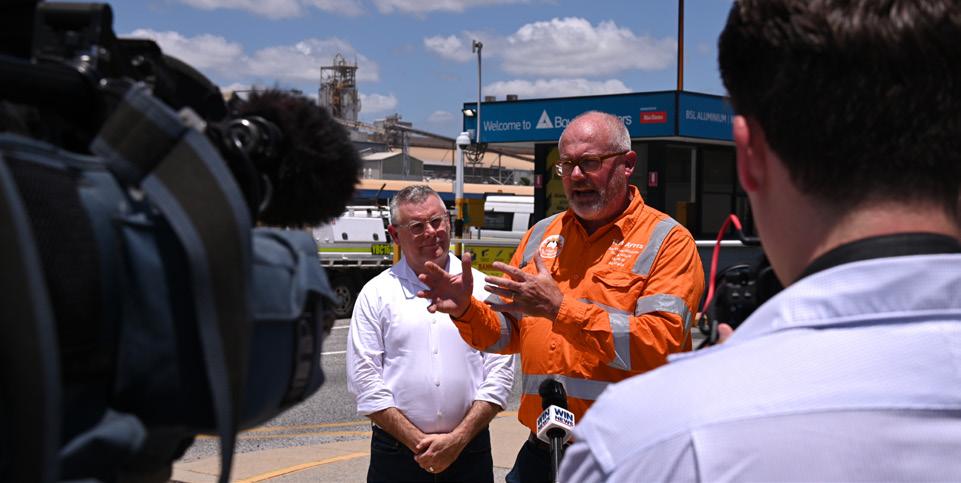
The story of economic development in Gladstone is the story of Australian development in miniature according the Senator the Hon Tim Ayres, Minister for Industry and Innovation and Minister for Science
This vital port city in Central Queensland has been, at various times, a convict colony, pastoral frontier, manufacturing hub and globally significant producer of resources. It has earned its reputation as the economic engine room of the sunshine state.
Technological developments in Gladstone hold the key to unlocking Australia’s future economic competitiveness in a more contested world. Global manufacturing firms are looking to reduce emissions in their supply chains without compromising on performance. Governments are looking to inoculate their communities against strategic vulnerabilities and supply chain disruptions. The Albanese Government is focused on boosting advanced manufacturing and critical mineral processing capabilities to strengthen Australia’s economic resilience.
The Albanese Labor Government’s $15 billion National Reconstruction Fund is giving Australia’s industrial regions and technologically innovative firms the confidence they need to drive forward these national interest objectives. In January, I was delighted to see the Fund make a $75 million investment in Alpha HPA, a firm that aims to deliver a high-purity alumina processing facility in Gladstone in the next two years.
High-purity alumina is a critical mineral Australia needs in order to strengthen its modern manufacturing and technological supply chains. It is used in semiconductors, lithium-ion batteries, LED lighting, data centres, and a wide array of other advanced industrial and defence applications. Global demand for clean energy capabilities and digital technologies provides Australia an important opportunity to process minerals like high-purity alumina onshore.
Gladstone, and Australia, have exactly what it takes to make a success of the new high-purity alumina refining. Australia is home to some of the world’s largest reserves of bauxite, the primary feedstock for alumina.1 Australia also has the skilled workers, reliable infrastructure, the cutting-edge ideas and technological development that new firms like Alpha HPA need in order to turn industrial potential into economic progress.
An interconnected industrial system in Gladstone gives Alpha HPA a strong foundation. Alpha’s use of aluminium hydroxide from the nearby Rio Tinto refinery, and chemical byproducts from Orica’s upstream facility, means that the local aluminium supply chain will be mutually reinforcing and more efficient than ever before.
High-purity alumina is a first-rate example of what Australians can achieve when separate parts of the national research and development system work effectively together to solve important, shared objectives.2 That is exactly the kind of collaboration between government, research, and industry Australia needs in order to lift its industrial capability and ensure our own economic resilience in the coming decades. Australia also has the patient capital that new projects like this one require. The National Reconstruction Fund’s $75 million cornerstone commitment was a catalyst for an additional “crowding in” of a further $150 million in private investment. This is long-term capital with a clear purpose: backing an Australian company, engaged in hard but vital work, through the difficult
phase between proven science and established output. That phase is where many projects falter. It is also where public investment, used carefully, can make the biggest difference.
With the backing of the National Reconstruction Fund and private sector partners, Alpha HPA will be able to complete Stage Two of its expansion program. That will see the world’s largest single manufacturing facility for HPA built in Gladstone, producing 10,000 tonnes of high-purity alumina each year. The project will support 500 jobs, including 420 during construction and 80 permanent blue-collar, technical and trades jobs for Gladstone.3
Building a brand new industrial and technological capability for Australia is never easy. There are risks involved. But Alpha HPA is a clear example of why the National Reconstruction Fund exists: to crowd in finance that transforms and modernises Australian industry, that supports the development of market-leading enterprises in priority sectors of our economy and creates good blue-collar and engineering jobs in our industrial regions.
The National Reconstruction Fund’s investment in Alpha HPA backs Australian ingenuity, Australian workers, and Australian regions to do the hard but essential work of turning research into capability. Not for the first time, Gladstone is showing Australia what can be achieved when scientific, technological and entrepreneurial efforts are directed at a shared goal.
• Whitelaw Engineering Machinery – Premium European lathes and milling machines
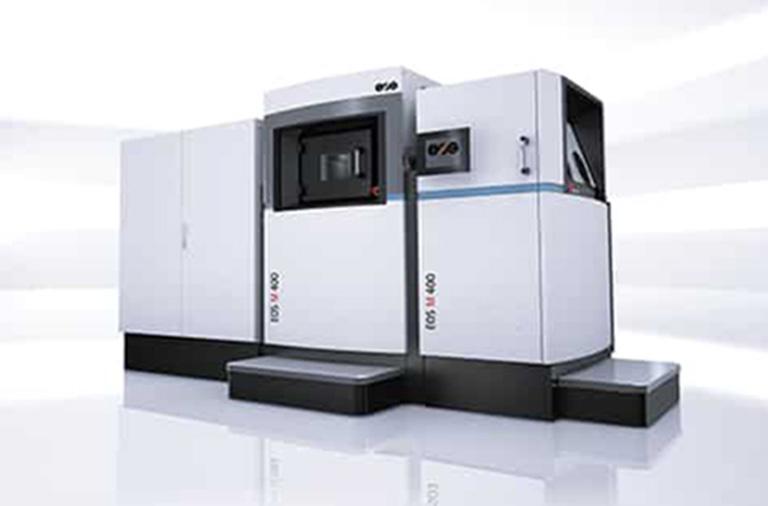
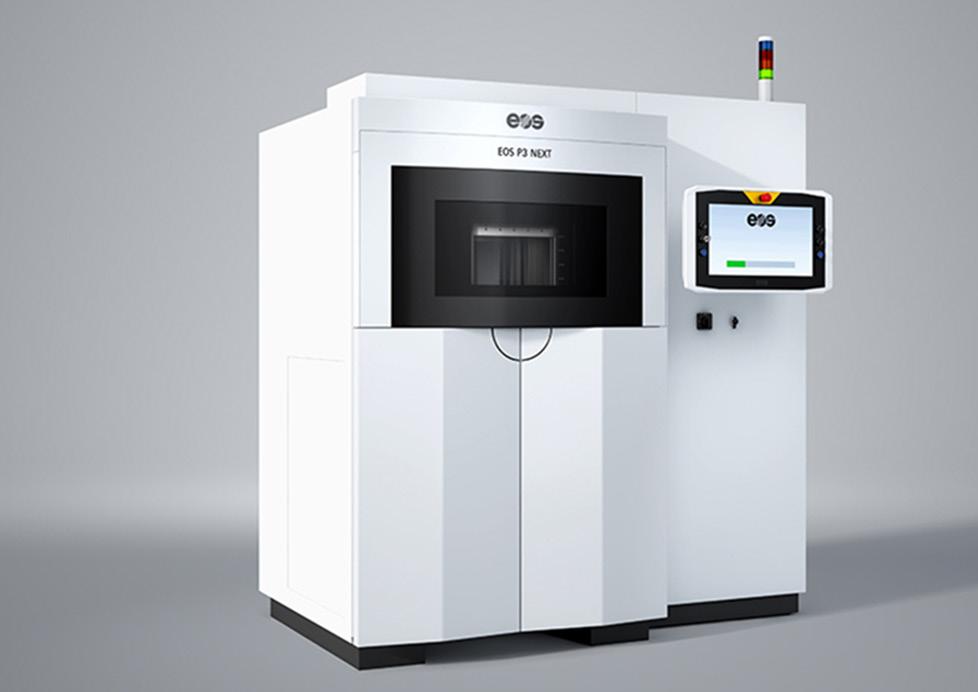
• MetalTech – Industrial metal 3D printing specialists
• Wood Tech – National supplier of CNC and woodworking equipment
• PPE Tech – ISO-certified, TGA-listed P2 face masks made in Australia
Certified quality, local capability, and industry-leading solutions.
ISO 9001 ISO 13485
Registered Australian Made
CMI Certified TT10061
AS/AZS 1716:2012
ARTG 352290
Skilled Migration Vital for Australia
Australia has always been a migrant nation. With more than one in three of our workers being migrants, it’s something we need to remember, says Innes Willox, Chief Executive, Australian Industry Group.
Racism has no part in the debate about the future of our migration settings.
We are in the midst of the worst skills shortages the country has ever seen and skilled migrant human capital is an important part of the solution.
Three million permanent migrants have come to this country in the past quarter of a century and 59% of them have arrived through the skilled stream.
They perform diverse roles across the economy and actually outperform the rest of our population on a range of indicators. Eighty-one per cent are employed, compared to 61.5% – this 20 per cent differential actually translates directly into productivity. Some 15.1% are not in the labour force, compared with 35.2% of the broader population – indicating a stronger workforce attachment.
Only seven per cent of migrants are on unemployment benefits, compared to 12.5% for the broader population, which shows they are faster returning to work after displacement.
They are almost twice as likely to hold a diploma or bachelor degree and three times more likely to hold a postgraduate degree. This education premium delivers a productivity premium through more innovation, enhanced ability to adapt to technological change and a higher value economic contribution.
So, our skilled migrants are providing exactly what the economy needs at the moment – higher productivity that will lift the living standards and wages of every single Australian, regardless of where they were born.
The Federal Treasury has, in fact, modelled their financial contribution to be $198,000 each to the government bottom line – meaning they help build roads, schools and hospitals.
The cohort also use Medicare and pharmaceutical benefits less than Australian born workers – reflecting its younger profile, higher education attainment and the health requirements placed on them before they come into the country.
Australians all benefit from the skills we need to import into the country.
Without them, it would be harder to build the housing stock we so desperately need – with 85% of construction companies already struggling to find workers. The construction sector workforce of 240,000 already faces a shortage of 141,000.
Every occupation required to build a house is on the critical shortages list – carpenters, bricklayers, steel fixers, truck drivers, electricians and plumbers.
The ambition of building an extra 1.2 million homes by 2029 is under serious pressure due to the workforce shortages already felt.
Domestic training for apprentices and trainees continues to decline – in the year to June 2025, trade occupations commencements fell 15.3% or more than 13,000 compared to the previous year.
It is not just the building sector that faces critical shortages. Healthcare will become more and more critical as the Australian population ages, and we are already facing a critical shortage of nurses. Without them, often provided by skilled migration, the Australian College of Nursing says the entire system will collapse.
The Department of Health a decade ago said the country faced a shortfall of 85,000 nurses this year and 123,000 by 2030. Despite these early warnings, the shortfall remains largely unchanged. The Committee for Economic Development of Australia (CEDA) estimates a shortfall of 110,000 by 2030.
The Aged Care Labour Agreement, introduced in 2023 as a tripartite solution, has proven incapable to meet this demand. Engineering is also experiencing a critical shortage – more than 50,000 are needed to help assist the country achieve its net zero ambition.
One of the sectors that is important to both our housing and net zero ambitions is manufacturing, which also faces critical workforce shortages. It means projects will take longer and will be a critical factor in whether the country can, in fact, achieve these goals.
While there is a direct relationship between manufacturing and our ambitions as a country, it is also the source of many of the goods consumers buy.
As well as needing migrant workers, we also need a system that adequately supports both the worker and the employer. While the government has set a target of seven days for the administration of the specialist skills pathway and 21 days for the core skills pathway, migration practitioners are reporting that processing times are fluctuating between 13-38 days for specialist skills and 41-61 days for core skills. Of equal concern is the processing timeframe for the National Employer Nomination Scheme (subclass 186) Direct Entry stream.
Beyond the employment and educational metrics, skilled migration actually helps us become the country we want to be – globally competitive for investment, culturally diverse and highly skilled.
It is also key to us being able to build more homes and meet net zero, on top of the roads, schools and hospitals needed across the economy. Let’s have the debate for sure but leave skilled migration and migrants out of it.
INNES WILLOX Chief Executive Officer at the Australian Industry Group
BRAND NEW TECH CENTRE
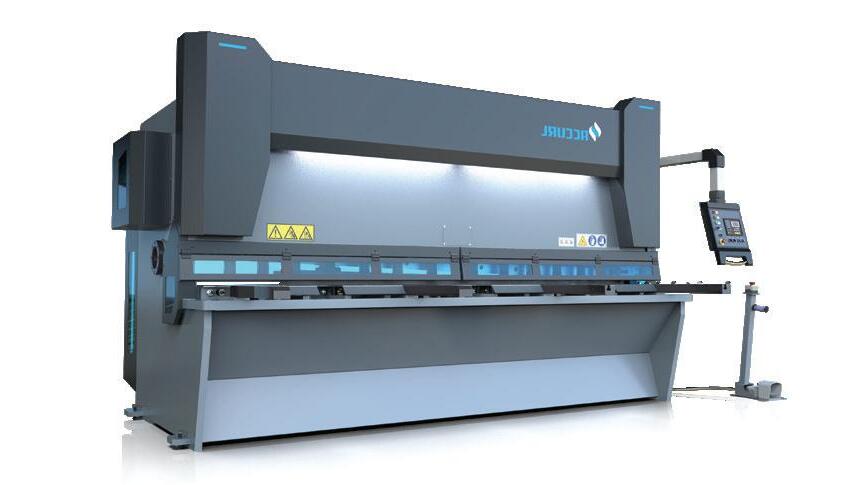
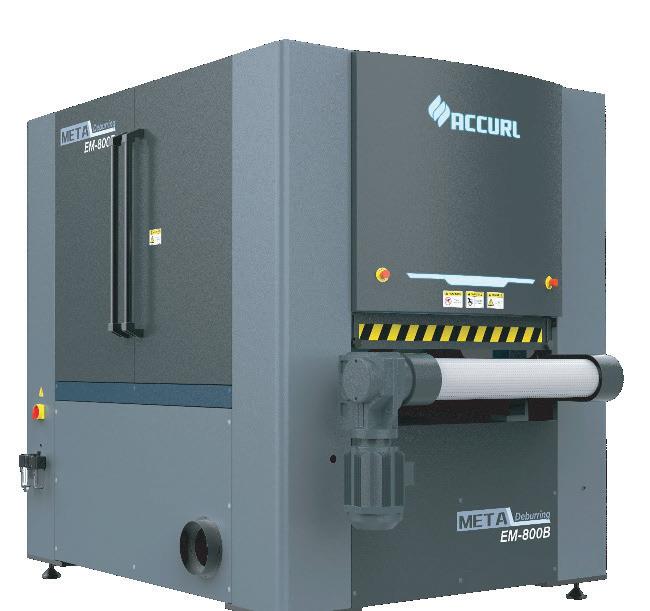
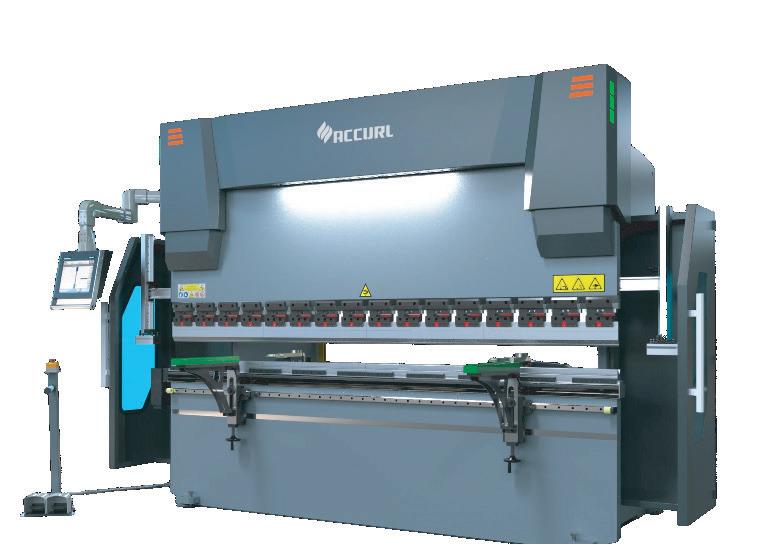
The all new Accurl Tech centre has been established in our Qld headquarters. We are excited to share that we will have these Accurl machines operational with Industry 4.0 capability. Come and experience it for yourself at our stand
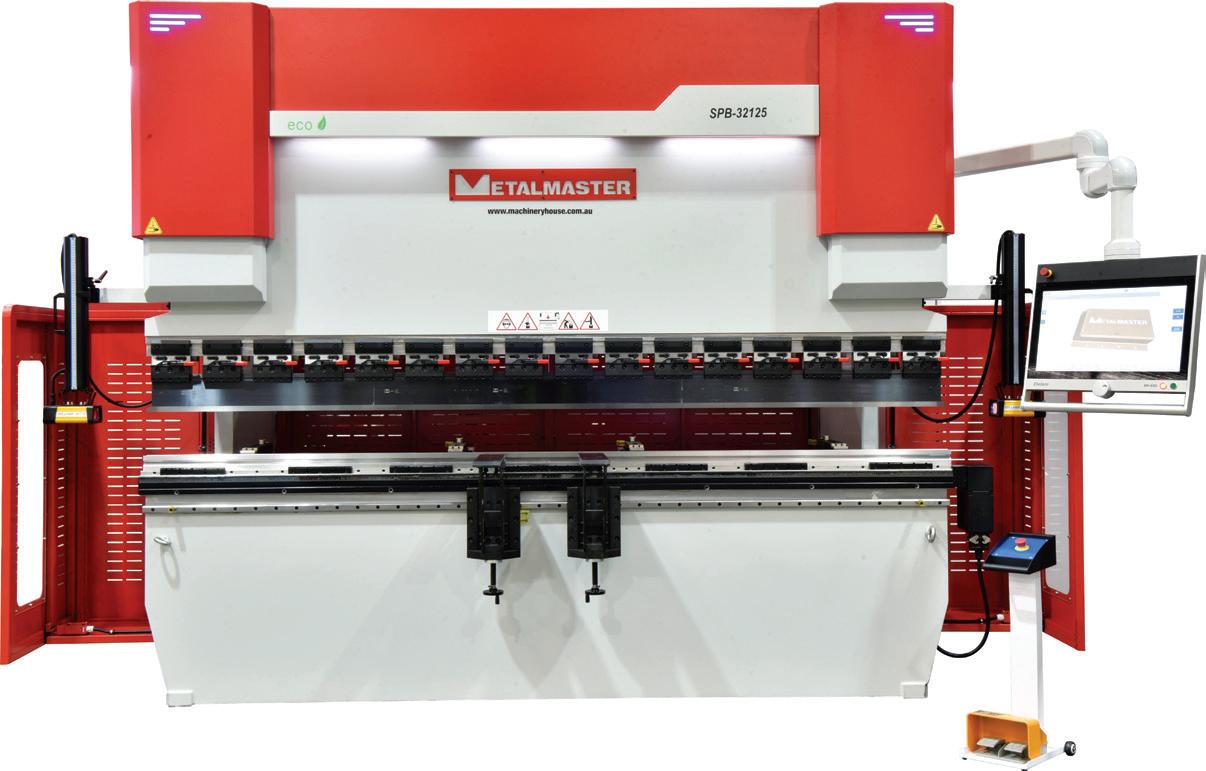
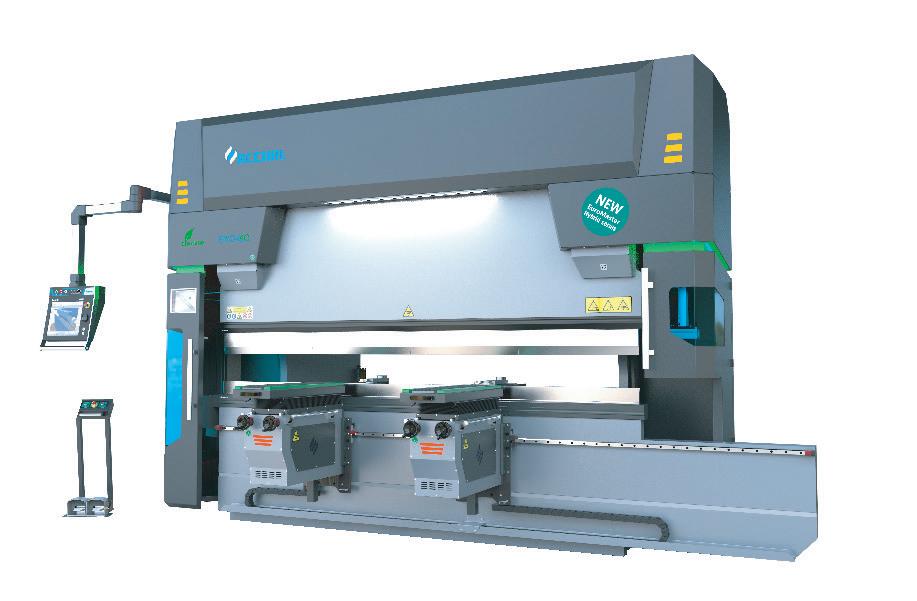
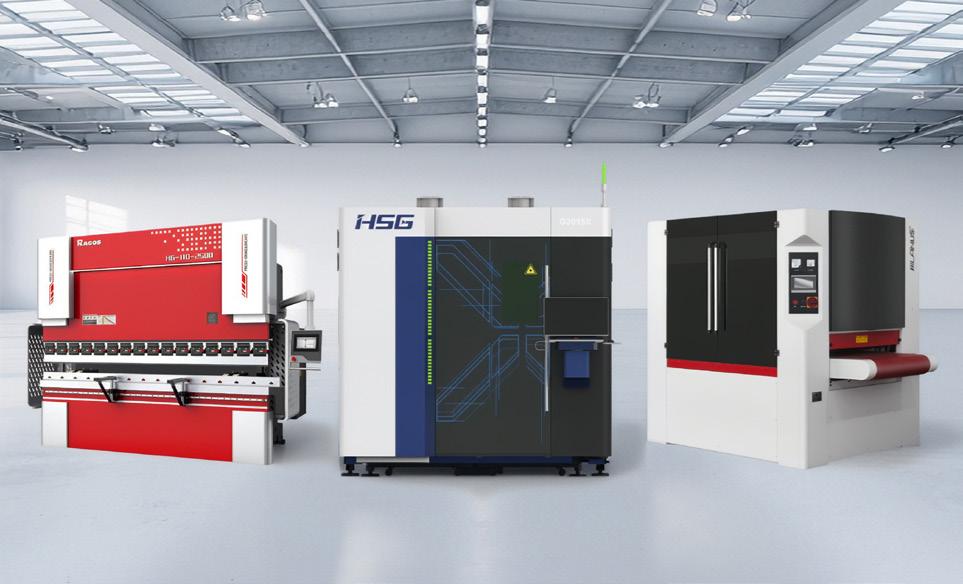
Accurl Euro Master 135 ton x 3m Press Brake (True Hybrid)
Accurl Euro Pro 135 ton x 3m Press Brake (Eco Hybrid)
Accurl Euro Pro 40 ton x 1.25m Press Brake (Eco Hybrid)
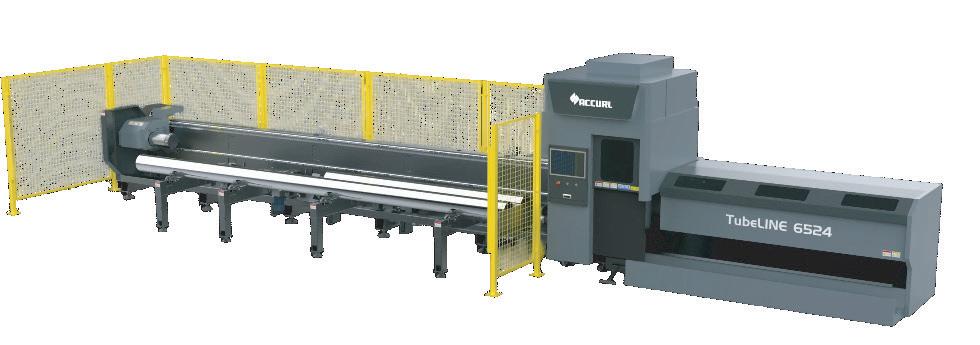
Accurl TubeLine A Series Tube Laser 6524 with Semi-Auto loading
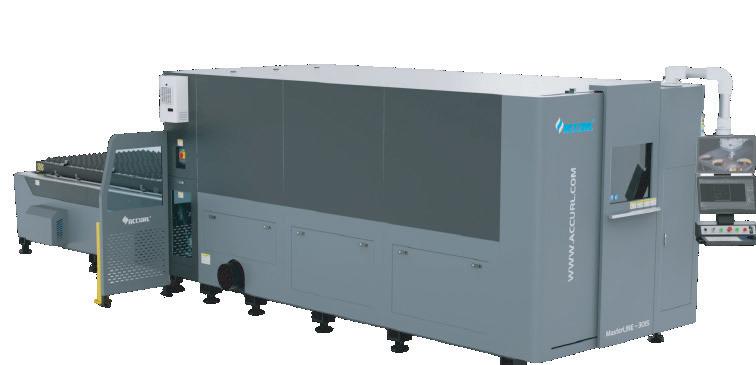
Accurl Masterline 1.5 x 3m / 6kW Flat Bed Laser
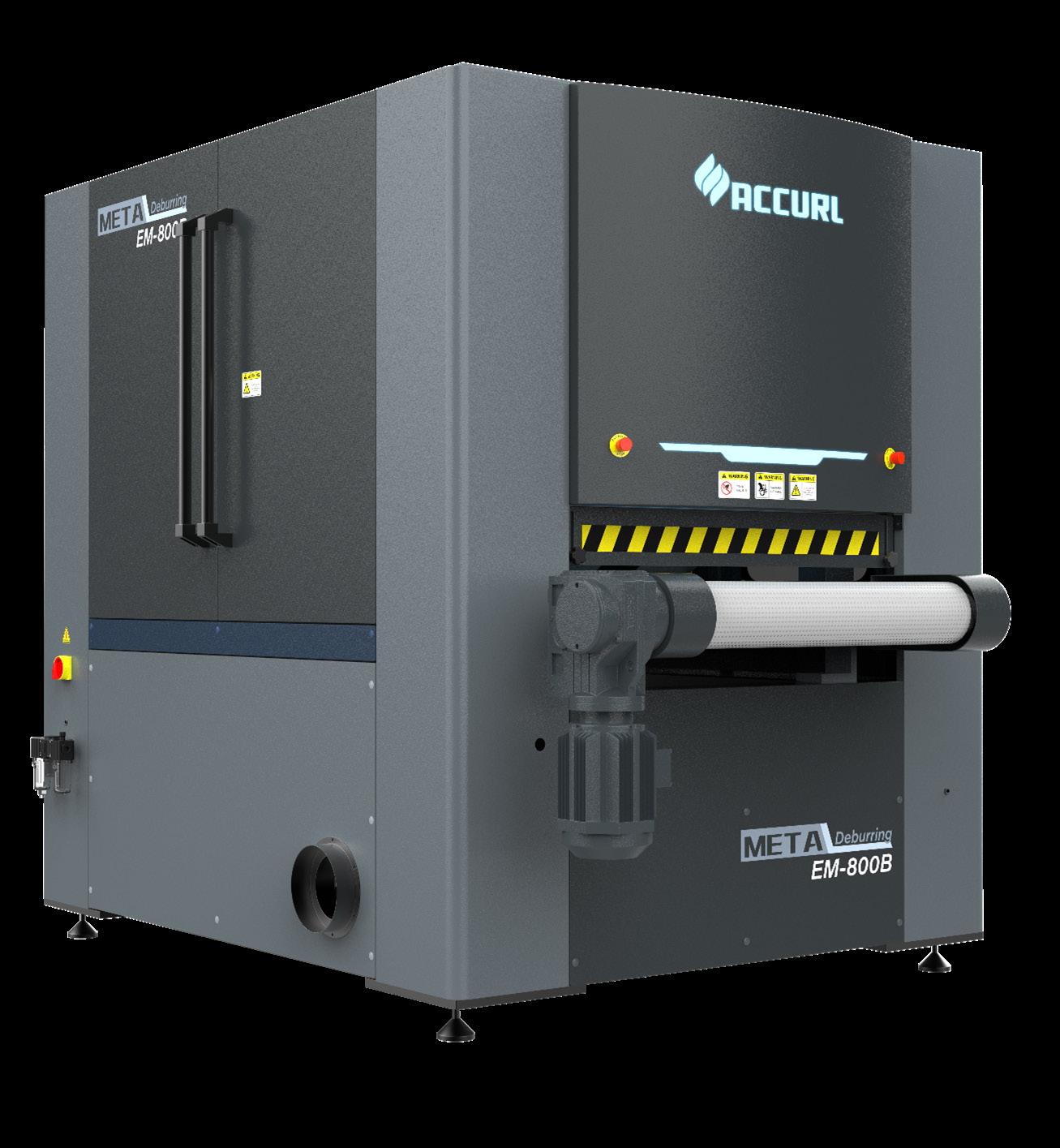
Accurl EM-1000 Automatic Deburring Machine
Accurl 6mm x 3.2m Overdriven Guillotine with Pneumatic Sheet Supports
AUSTRALIAN MANUFACTURING
From shop floor to strategy, explore where Australian manufacturing is heading
next.
16 Australian Manufacturing Week 2026 - precision technology takes the stage in Brisbane.
18 Transforming Queensland Manufacturing – grant programs supporting defence, energy, skills and exports.
20 No Time for Half Measures – how to lead Australian manufacturing into a high-value future
22 The Long Road – building a successful company over the long term
24 Compliance to Capability – early lessons from the first year of compulsory sustainability reporting
26 Making a Match - RJS Tech Group is adding the Leuco range to its inventory
28 Charging Ahead with Battery Storage – manufacturers’ new opportunity to participate in the energy market
30 Precision Partnerships – how partnerships have helped Ronson Gears stay out in front
32 Home Run for Construction – prefab construction steps into the mainstream
34 Casting Around – the quiet resurgence of Australia’s metal casting industry
Australian Manufacturing Week 2026
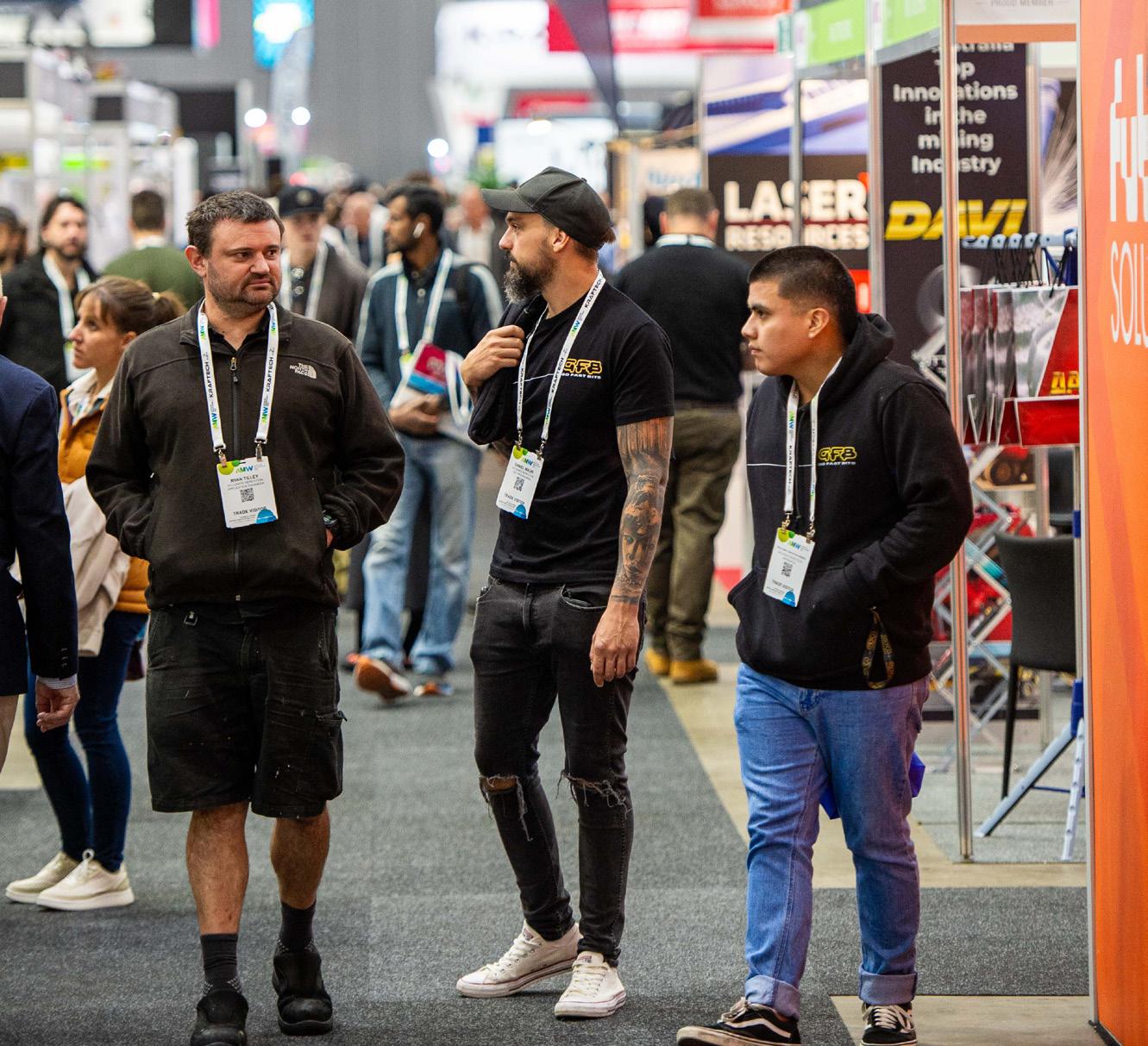
Precision technology takes the stage in Brisbane, as Australian Manufacturing Week (AMW) arrives in Brisbane from 12 to 14 May 2026.
Marking a milestone moment for Australia’s premier event for precision manufacturers and hosted by AMTIL with support from the Queensland Government, AMW brings together the nation’s most comprehensive display of advanced manufacturing technology. With a sold-out exhibition floor and a program designed to help Australian industry move faster, build capability, grow and diversify, AMW is expected to impress.
Over more than 25 years, AMW has evolved into the definitive platform for evaluating world-leading equipment, gaining practical insight and making high-value connections. The 2026 edition extends that legacy to Queensland for the first time, reflecting the State’s growing prominence across defence, resources, aerospace, clean energy technologies and precision engineering.
“Manufacturing is evolving rapidly across Australia, and Queensland is no exception,” said Lorraine Maxwell, CEO of AMTIL. “Queensland is home to a growing number of innovative manufacturers. AMW 2026 will highlight the strength of this local industry while continuing to serve as a national platform for showcasing excellence in advanced manufacturing.”
A national event in a growing manufacturing hub Brisbane offers a timely setting for AMW’s first Queensland edition. The city sits at the heart of a state with expanding capability in defence, aerospace, advanced materials and clean energy technologies. Hosting AMW in Brisbane puts national attention on that momentum and gives Queensland businesses direct access to suppliers, knowledge and networks from across Australia and beyond.
“Hosting AMW in Brisbane underscores the confidence and momentum within Queensland’s manufacturing sector,” said Dale Last MP, Queensland Government’s Minister for Manufacturing. “It will bring national attention to local capability and give Queensland businesses direct access to the suppliers and know how that accelerate growth.”
A show floor built for decisions
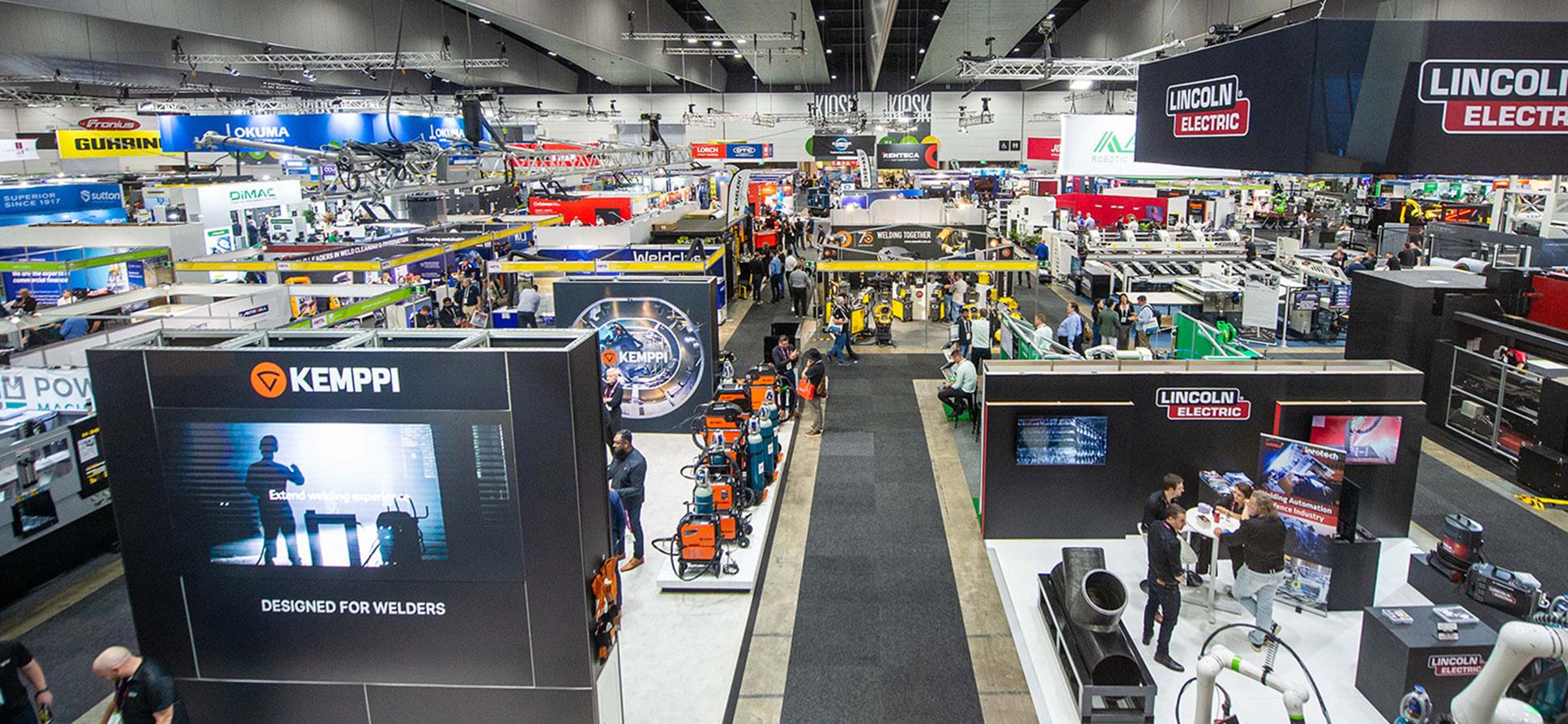
AMW 2026 will feature more than 220 exhibitors, with exhibitor space completely sold out. The exhibition is structured across six focused product zones to streamline discovery and help visitors get ‘hands on’ with the technologies that matter most to their operations:
• Machine tools
• Additive manufacturing
• Robotics and automation
• Welding and air technology
• Manufacturing solutions
• Australian Manufacturers’ Pavilion
Across the show floor, visitors can expect live demonstrations spanning CNC machining and precision engineering, robotics cells and cobots, automated handling and inspection, additive manufacturing solutions, industrial software and data, and integrated automation platforms. The emphasis is on capability
that can be evaluated in person, compared side-by-side and mapped to current business priorities.
“There is no substitute for being there in person,” said Paul Phillips, Managing Director of Benson Machines and AMTIL Board Member. “With all the videos and digital tools available, you still cannot replicate the experience of seeing a machine running on the floor, asking technical questions and comparing options side by side. AMW is where those decisions get made.”
Future Solutions Speaker Series
Running alongside the exhibition, the Future Solutions Speaker Series will explore the forces reshaping Australian manufacturing and provide practical guidance for leaders and teams. Sessions will address innovation pathways, operational excellence, digital transformation, workforce development, and strategies for competing in fast changing markets. The program is designed to give attendees the context, case studies and confidence to act.
“The Future Solutions Program focuses on real decisions manufacturers are making now,” said Kim Banks, Exhibition Director of AMTIL. “From adopting automation to building skills and lifting competitiveness, it will help visitors connect technology choices with business outcomes.”
The power of AMW lies in pairing working technology on the floor with expert insights from expert speakers. Attendees can evaluate equipment in action, then deepen the conversation by exploring implementation, change management and return on investment within the speaker program.
Network with Australia’s manufacturing community
AMW remains the country’s largest opportunity to connect with peers on a scale. Thousands of engineers, production specialists, educators and executives will converge in Brisbane to compare notes, share lessons and find partners. That includes informal touchpoints across the floor and through surrounding events, where conversations often translate into projects, pilots and long-term relationships.
Phil Bowles, AMTIL Board Member, says AMW’s networking dimension is essential. “If visitors leave AMW with only a shopping list, they have missed half the value. Partnerships, capability building, digital literacy and workforce conversations are part of the experience. You can research equipment online, but you cannot replace the conversations you have here.”
Showcasing sovereign capability
As Queensland expands its industrial footprint across defence, aerospace, critical minerals and emerging energy technologies, the strategic importance of building resilient, highskill manufacturing capability continues to grow. AMW provides a national platform for that discussion, helping accelerate the development and adoption of the technologies that underpin Australia’s future competitiveness.
“Events like AMW help strengthen the foundations of our sovereign industrial capability,” said Minister Last. “By
connecting Queensland manufacturers with national and international expertise, the exhibition supports the growth of secure, skilled and futurefocused industry across the State.”
First time collaboration with the Endeavour Awards
For the first time, AMW will collaborate with the Endeavour Awards, held on Wednesday 13 May during the week of the show. The awards recognise excellence across Australian manufacturing, including innovation, sustainability, leadership and skills development. The timing creates a concentrated celebration of success while visitors are in Brisbane to experience the technology and capability that enable it.
Plan your visit and register early
AMW 2026 is set to be a landmark gathering for the manufacturing community. Registration is free, and attendees are strongly encouraged to pre-register. Doing so speeds badge collection and gets visitors onto the floor faster, ensuring more time with exhibitors and within the Future Solutions Program.
To explore all that AMW has to offer, and to register for event access, visit www.australianmanufacturingweek.com.au.
Transforming Queensland Manufacturing
Queensland is creating ample opportunity for manufacturers across defence, energy, skills and exports to transform, with a range of grant programs.
For manufacturers nation-wide who are willing to build capability in Queensland or plug into the state’s supply chain offering, the State has created a suite of new programs and initiatives.
At the top end of Queensland’s recent industry push is the Transforming Queensland Manufacturing Grant Program (TQMGP), a three-year, $79.1 million initiative offering up to $1.5 million in matched funding per recipient, with half of the allocation reserved for regional manufacturers. The first round, which closes in mid-April, set aside $12.5 million for small to medium enterprises pursuing innovation, productivity improvements and international market reach.
Minister for Manufacturing, Dale Last MP, highlighted the regional carve-out as a deliberate effort to support jobs, reinforce supply chains and grow the sector beyond its current economic footprint. For manufacturers outside Queensland, that regional focus presents potential openings for joint ventures with in-state partners—whether to localise sub-assemblies, establish new production cells or broaden east-coast fulfilment capacity.
Another major capital mechanism in operation was the first round of the $180.6 million Sovereign Industry Development Fund (SIDF), which closed in February. The fund was established to back “feasible, investment-ready projects” capable of either creating or significantly expanding sovereign manufacturing or service capacity in the state, with a focus on defence, biomedical and biofuels products.
As Deputy Premier and Minister for State Development, Infrastructure and Planning Jarrod Bleijie said at the time, Queensland aims to develop industry policy that is more targeted and credible, adding that the state was “open for business” and encouraging companies nationwide to engage.
Capability was also addressed through a skills push in February, with the launch of “Apprenticeships Deliver”, including $40 million in 2025-26 for trades training (part of $270 million total) and $19 million for a Small Business Apprenticeship Pilot to subsidise wages during off-site training.
The government also funded a $201 million for four new TAFE Centres of Excellence in priority industries including manufacturing, and Free Apprenticeships for Under 25s across 130 priority qualifications, with more than 16,100 places already taken up in 2024-25.
Queensland is also signalling near-term opportunities for SMEs through the Business Growth Fund, which offered grants of $50,000–$75,000 for equipment on a 50 per cent co-contribution basis.
While industry-agnostic, the fund explicitly lists production equipment, advanced manufacturing or digital systems and logistics equipment—pragmatic upgrades that can remove bottlenecks, lift capacity and improve the delivered in full, on time benchmark for suppliers integrating into Queensland programs.
Minister for Small Business, Steve Minnikin says “We are supporting small and family businesses across the state and, importantly in our regions, with grants to help their growth so they can continue to drive Queensland’s economy.”
On the export side, recent national awards underline capability already present in the State’s shop floors and design offices. Gold Coast-based PWR Advanced Cooling Technology won the Manufacturing and Advanced Materials category at the Australian Exporter of the Year awards, with Mineral Technologies Highly Commended in Resources and Energy.
For national manufacturers, these wins flag potential collaboration partners in thermal systems, advanced composites and high-spec consumer goods, along with regional hubs with proven export readiness.
Finally, Queensland’s performance at the 2025 Australian Training Awards offers a read-through on workforce quality: Riviera Australia (Gold Coast) was named Australian Apprentice Employer of the Year for its Academy of Excellence, achieving a 95 per cent apprentice completion rate.
Taken together, Queensland’s current mix of co-investment, grants, skills funding, regional studies and export momentum creates a broad set of entry points for manufacturers across Australia.
Whether the objective is to localise defence sub-systems, scale biomedical devices, pilot biofuels process equipment, secure copper-linked opportunities, or simply add a regional cell to balance national capacity, the State is openly courting projects that are “investment ready and capable of delivering real sovereign capability.”
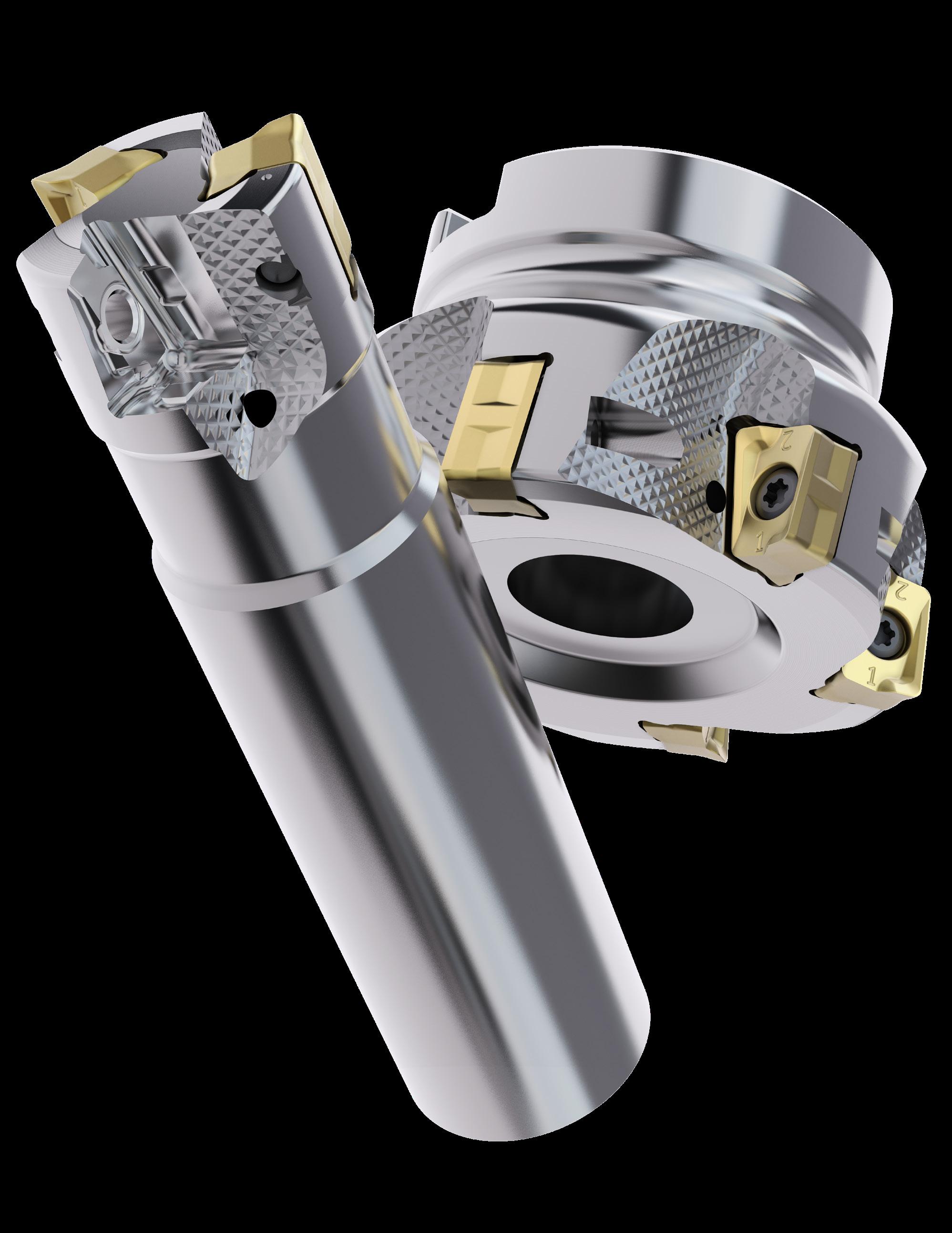
Double Turbo 11
Proven Versatility
Now in a Smaller Insert Size.
Boost reliability with an innovative support face design.
Cost efficient machining with double sided inserts and four cutting edges.
Maximize precision with smooth cutting geometries for 90º shoulders and a maximum of 10mm depth of cut.
Track wear and simplify indexing with numbered cutting edges.
No Time for Half Measures
David Martin, Director – Emerging Industries & Innovation, Australian Industry Group – discusses ways to lead Australian manufacturing into a high-value future.
Australian manufacturing is a sector built for this moment. The challenges are real, the pressures are well documented, but so is the opportunity, and it is bigger than many people recognise. Let’s start with the fundamentals. Australian manufacturing is our sixth-largest industry, contributing $137 billion in valueadded output and employing 930,000 people. It generates 12.4% of our exports and accounts for 7.9% of national capital expenditure – outsized contributions for a sector representing just 5.1% of GDP. Critically, it is also Australia’s most R&D-intensive industry, reinvesting 4.1% of value-added back into research and development. These are the numbers of a sector with genuine strength, deep capability, and a proven capacity to innovate.
Yes, 2024 was a difficult year. After a strong post-pandemic rebound, conditions tightened as a sluggish domestic economy weighed on demand and global supply chains normalised. But the sector has navigated far harder periods than this, and the transformation underway is one we should be energised by, not anxious about.
The composition of manufacturing is shifting in exactly the right direction. Food and beverage processing and metals production have grown strongly, capitalising on Australia’s reputation for quality, safety and provenance. The trend is toward higher-value, more innovation-driven activities and away from commodity-based operations that were always going to face margin pressure. This is not a crisis; it is a sector repositioning itself for long-term competitiveness. The question is whether we accelerate that transition with intent or simply drift through it.
Moving up the value chain requires investment in commercialisation, workforce development, and technology adoption. This is where the national conversation needs to sharpen. As Australian Industry Group chief executive Innes Willox recently noted, productivity growth averaged 1.2% a year in the decade before the pandemic, since 2020 it has run at just 0.2%.
That gap represents forgone wages, forgone investment, and forgone opportunity. The causes are known: regulatory burden, an effective company tax rate that is the second highest in the OECD, fragmented workplace relations, and underinvestment in technology.
These are solvable problems and solving them is what unlocks manufacturing’s next chapter. For our sector specifically, that means embracing Industry 5.0 technologies, accelerating AI adoption on the factory floor, and ensuring capital flows to SME manufacturers who are ready to grow.
On skills, the pipeline is being built. Manufacturers are partnering with TAFEs and universities to shape industryrelevant curricula and investing in upskilling their existing workforces.
Recruitment remains tight in technical and engineering roles, but the effort being made by businesses and training providers alike is producing results. Government needs to match that effort with sustained funding, and the momentum is there to make it happen.
The energy transition, for all its complexity, represents one of the most significant competitive opportunities Australian manufacturing has seen in a generation.
Our abundant renewable resources, combined with our worldclass minerals endowment, position Australia to become a preferred global supplier of clean energy economy critical minerals, battery components, hydrogen electrolysers and other renewable energy equipment. Manufacturers who move early to lock in affordable renewable energy and build capability in these supply chains will find themselves on the right side of a very large structural shift.
The growth frontiers extend further still. AUKUS and related defence commitments are creating a generational pipeline of advanced manufacturing work in areas like submarines, aerospace components and sovereign capability. Australia’s food and agribusiness sector has enormous headroom to capture more value through processing and premium branding.
And the global reconfiguration of supply chains, driven by geopolitical realignment and a renewed focus on resilience, is creating genuine openings for manufacturers who can demonstrate quality, reliability and proximity.
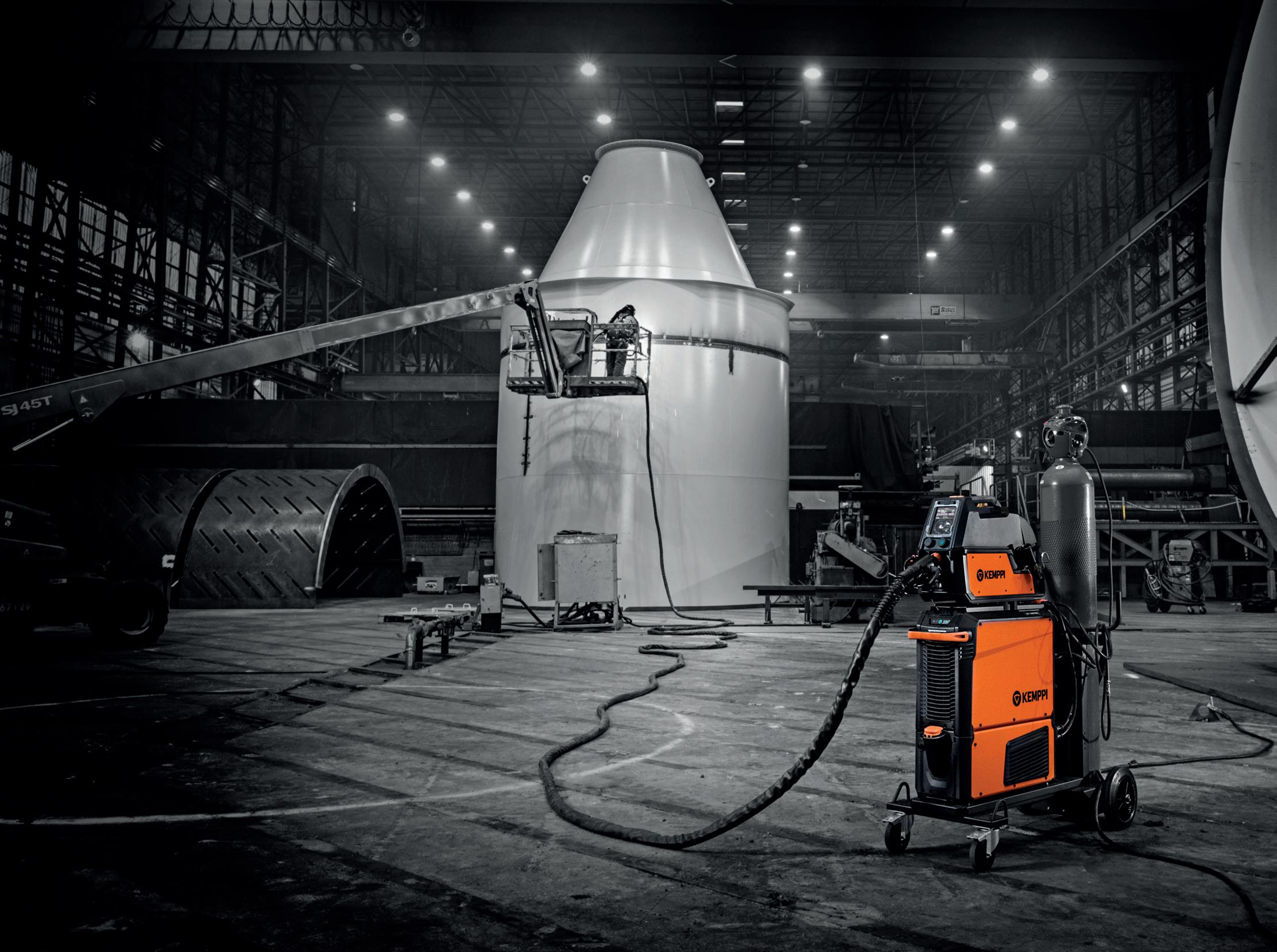
X5 FASTMIG PULSE + WELDEYE PUT YOU IN CONTROL
For businesses navigating today’s environment, the opportunity lies in being proactive. That means investing in productivity improvements such as process efficiency, technology adoption and energy management even when margins are under pressure.
It means building workforce capability now, so you are ready to scale when demand lifts. And it means engaging with the programs and policy settings that exist precisely to support manufacturers making the move to higher-value activity.
The relationship between industry and government has never been more important. The policy levers that will unlock productivity — regulatory reform, tax settings, skills investment, technology diffusion — require both sides to be pulling in the same direction. Australian Industry Group is committed to making that case, relentlessly and with evidence.
Australian manufacturing’s best years could be ahead of it, if the sector emerges from this period of transformation more innovative, competitive, and firmly anchored at the highvalue end of global supply chains. The work to build it starts now.
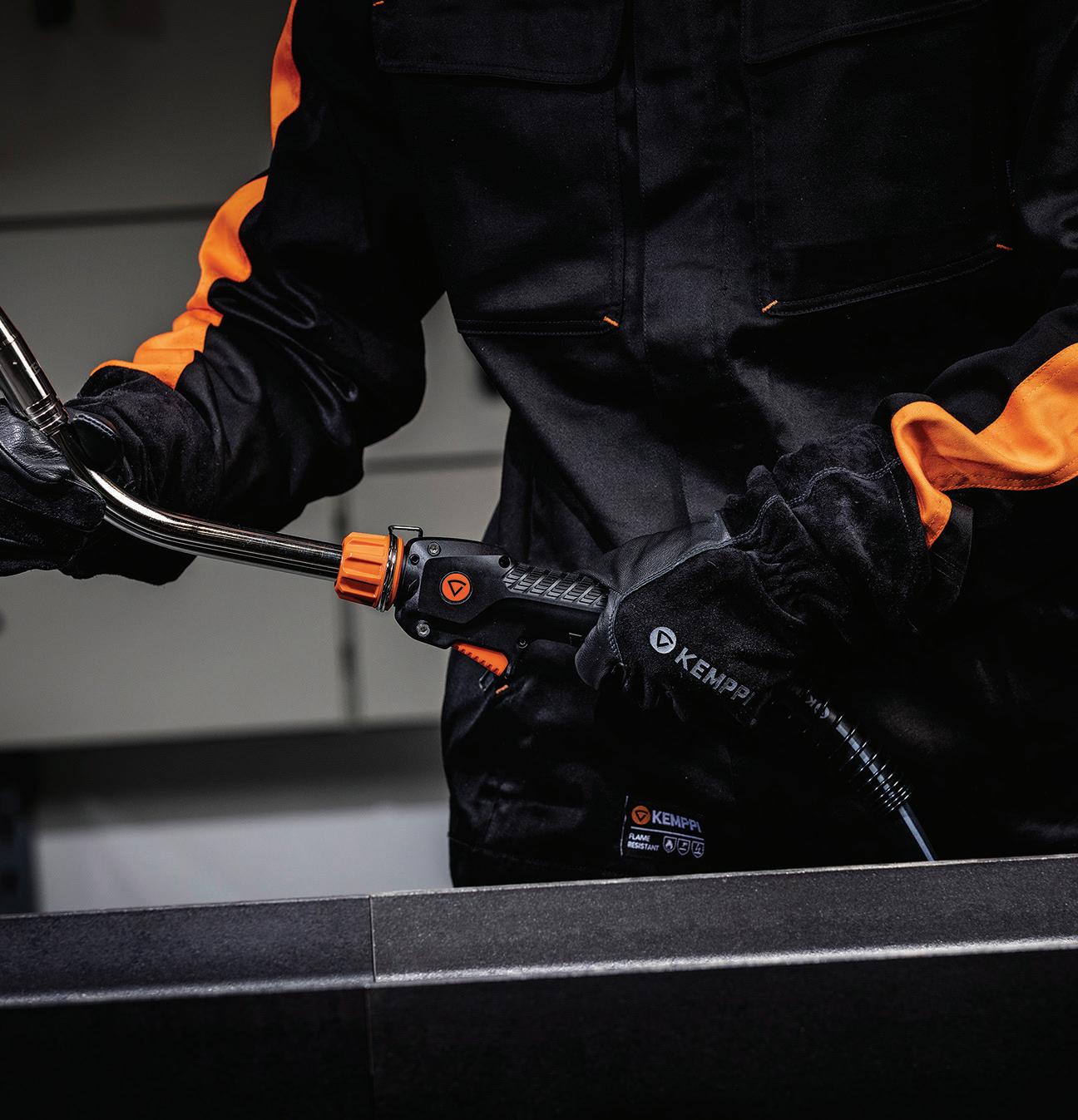
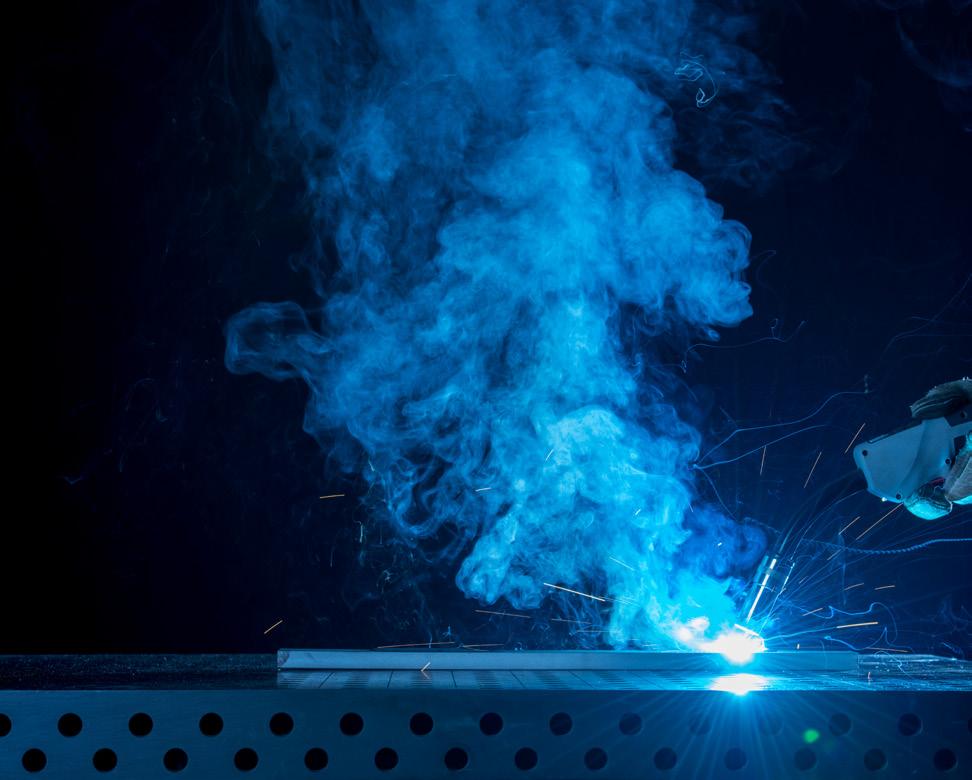
Optimise your welding operations with the X5 FastMig Pulse workhorse and optional WeldEye software solution. Together they deliver faster, quality welds that can be managed in real-time. WeldEye lets you effectively oversee your welding production. It fits any size and type of organisation that performs welding within the requirements of international welding standards like ISO, ASME, and AWS. WeldEye provides control in all processes - including welding procedures, welder and inspector qualifications, documentation, reporting, and administration. Most importantly, you get 100% traceability to any weld you ever make.
Knowledge is power. Insight creates value. Find out more at www.weldeye.com
Call: (02) 8785 2000
The Long Road
Building a successful company over the long term is a combined effort – not just one set of transactions after another, say William Buck principals Berrin Daricili and Jeremy Raniti.
Manufacturers tend to see their biggest financial calls as separate moments—a research and development (R&D) application here, a capital expenditure decision there, a restructure when succession becomes unavoidable.
But for William Buck business advisory principal Jeremy Raniti and R&D Tax Incentives & Grants principal Berrin Daricili, these choices should not be made in isolation.
Ahead of the Australian Manufacturing Week workshop entitled “Manufacturing Growth Engine: Funding, Forecasting & Future Wealth”, which they will host alongside William Buck wealth advisory partner Scott Montefiore, the principals say they aim to help businesses structure themselves for the long term.
“We’re not just focusing on the present moment – there’s so much happening, and the economy is dynamic, the landscape is always changing,” Raniti says.
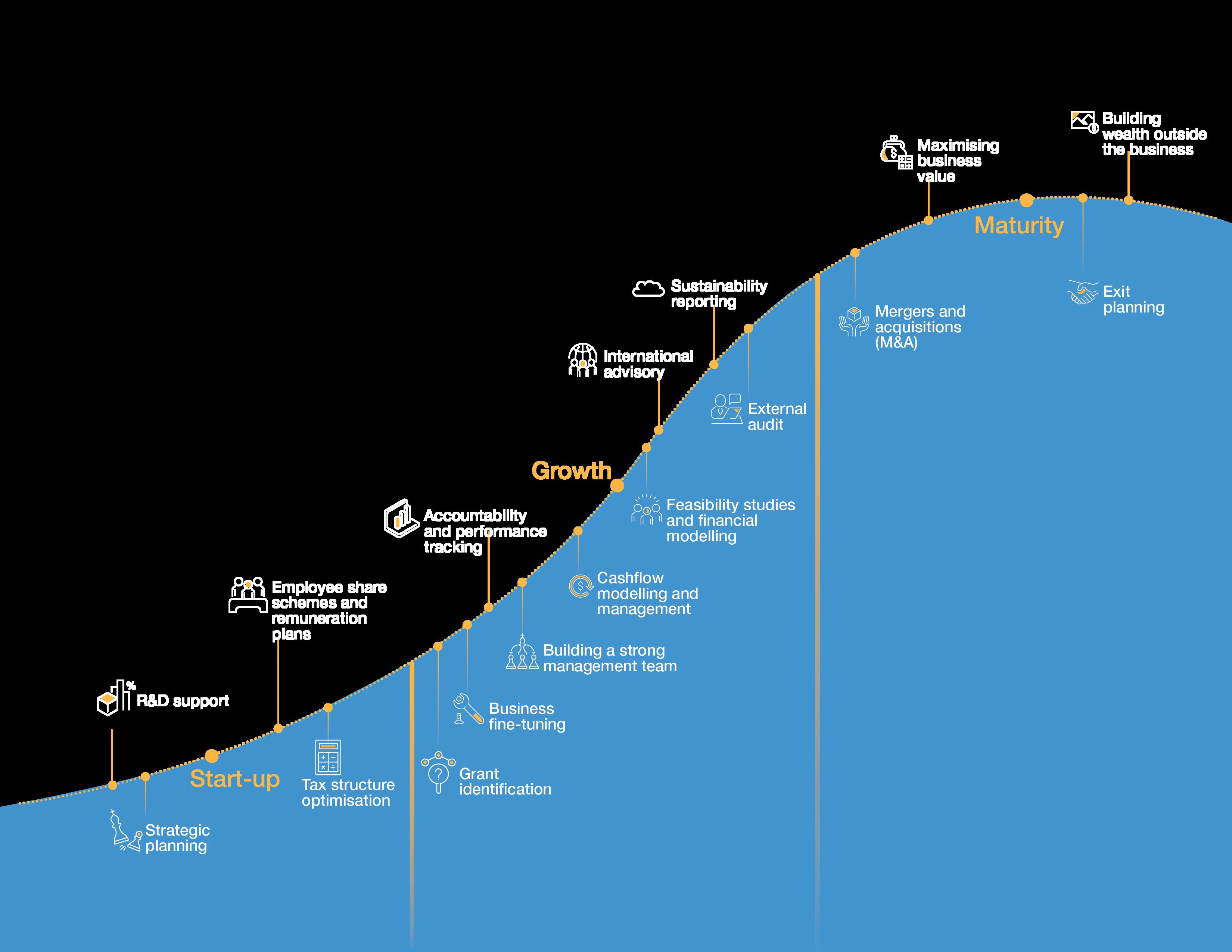
“Whether businesses are in that startup phase, in growth, or they’re mature – at each of those steps, there’s a different set of support and advisory work that comes with that.”
A good example of this need for process is any large piece of capital expenditure, Raniti says – with companies assessing the return on investment and their ability to service a debt.
“If we’re looking to replace machinery with newer, more efficient pieces of equipment, we need to model that out –saying how much can we save, either in time or performance improvements?” he says.
“What’s the cost benefit in doing so? The tax and depreciation, write offs? It’s there as a consideration. But we don’t normally tell people to spend $1 to save 25 cents. We look at things more specifically and ask, do we need this? Is buying it the better option?”
When automation does increase throughput, the same model can be used to understand staffing and scheduling effects before committing, he says.
“You do want to ask why you are making this investment, by coming back to your business strategy or your business goals – and how this piece of machinery will help you achieve that goal,” Raniti says.
“Just because we have a new piece of equipment, doesn’t mean that we need less staff. Do we need someone on hand to supervise it? Will we be saving downtime against our existing piece of equipment? There’s a lot of things that come into play when assessing that.”
Raniti says the William Buck business advisory team gets involved when business owners begin developing their own live business models, rather than treating forecasting as a one-off reporting exercise.
“It’s about getting to that client, making sure they’re working on their business. Through that, we’ll go through business planning –forecasting and basically planning for the future. How does that fit in? What does that look like at a practical level?” he says.
“What we get at the end is a product and an output which can be used for reporting purposes. But taking clients through that process, which I view as an educational one, is getting them to stop and reflect on the business and to understand why things work.”
Background checks
Daricili, of William Buck’s R&D Tax Incentives (R&DTI) & Grants team, says an increase in scrutiny of grant applications has necessitated paying closer attention to them.
While little has changed from a legislative framework perspective, increasing scrutiny from the Department of Science, Industry and Resources as well as the Australian Tax Office is changing expectations.
“The main thing that we’ve seen is more scrutiny around the descriptions of R&D activities and why they’re eligible. They’re really looking at defined hypotheses, understanding experimental methodologies and the distinction between core and supporting activities,” she says.
Changes to the application form made in August 2025 require applicants to provide extra detail of any specialist plant, facilities or equipment that will be used during a project.
A new query has also been included around whether the R&D claimant owns or has the rights to exploit the intellectual property they use, whether they bear the financial risk and control the R&D activities being conducted – which they would need to do to be the appropriate R&D claimant.
Any previous questions with a limit of 1,000 characters (which included the project objectives, new knowledge and supporting activity descriptions) have been increased to 4,000 characters, allowing for greater detail to be provided upfront.
Daricili says this is evidence of how a new focus on experimentation —hypotheses, uncertainty, and systematic testing—has flowed straight into the application process.
“I think that’s really bridging the gap between what the regulator was seeing in terms of how R&D is described and what their expectations are,” she says.
While the program’s self-assessment model hasn’t changed, the way reviews are handled has, she adds.
“They don’t have a discourse with the company first, if they pick up a claim and they think it’s ineligible, they’ll pretty much assess it as such, without giving the company an opportunity to explain. It’s getting a bit more stringent,” she says.
Daricili says that for manufacturers, this heightens the importance of contemporaneous documentation and internal discipline—both to demonstrate eligibility and to remove uncertainty from cashflow planning. “It’s really important to get the documentation right… [that shows] why an R&D project was required.”
Claims that show significant fluctuations in costs from one year to another and a heavy reliance on contractor expenses often attract review, Daricili adds.
“They need to get the documentation in order. It’s all about being able to substantiate the claims that are being made in the R&D application forms,” she says.
“Photos and videos showing R&D out on the factory floor, any kind of plans or specifications, iterations and note taking” can be helpful.
“I think AI is going to be a lot more helpful for businesses that are a bit time poor and not used to taking such notes, to have that around and help with that compliance aspect,” Daricili says.
“Being able to press record on your phone, to be able to record such things, I think is going to be where tech can come in handy for businesses that are usually just physical on the shop floor and not documenting anything as they go.”
Future Bound
For forecasting and governance, Raniti expects forward-looking advisory to become the norm as data quality and timeliness improve.
“I think in the next couple of years we’ll see another toolkit with an AI perspective around collecting data and reporting
it... We’ll have that actual data at our fingertips a lot quicker, and the depth in which we can analyse that data will go further,” he says.
“It’s going to be about interpreting it and making sure you have the right people in the room to assist.”
Raniti says that many of the manufacturers he has worked with over the past couple of years are focused on ensuring their employees are cared for in the business.
“That’s not specifically financial modelling, but the business strategy part of it, making sure that the organisation has a clear vision and goal, and then making sure that each employee feels a part of that – that they’re along for the journey,” he says.
“It gives a sense of commitment to the cause, but then also at an individual level, they can assess how their involvement in the process is leading to a bigger goal.”
Raniti adds that he is also seeing several Australian companies working with international partners – which comes with obligations that stretch beyond tax to corporate secretarial matters, director settings and more.
“When it comes to defence, there’s a whole bunch of clearances, guidelines, policies that need to be taken into consideration. So, working with someone that knows that industry well will pay dividends to set up correctly,” he says.
“There are hosts of things that we are navigating through, and we see that becoming more and more prevalent.”
Another issue Raniti says the business advisory team is often facing is one of succession — both in the absence of obvious successors and in an opportunity set for buyers.
“We’ve seen a couple instances where it’s been successful, where staff have bought into the business. You need to have staff there that are committed to the process and have come through the ranks and understand it,” he says.
“If not, what we’re seeing on a succession basis is a really good opportunity for people looking to buy businesses and bring them together, because there will be a point in time where there’s a lot of older manufacturers with either small to medium run businesses with no one going to take them over,” Raniti says.
Even short of a sale, the combination of documentation discipline and rolling forecasts can remove unpleasant surprises when the time comes – and the structure of a deal becomes a strategy question, not a scramble.
As Raniti puts it: “Is it indoor finance? Do they get a part now and a part later? Do you want a clean break in the future? There’re multiple ways to look at it, and there’s the deal and there’s a structuring and tax that goes alongside it.”
“There’s a whole bunch of things that come out of the process of building a financial model… but the process itself is probably the most important part, and making time within a business to actually do that is where we’re going to get the best results,” he says.
Compliance to Capability
Samantha Zebrowski, principal, business advisory for William Buck, outlines some of the early lessons from Australia’s first year of compulsory sustainability reporting.
With changes to the Corporations Act enforcing mandatory sustainability reporting coming into effect last year, the question for many is how to build a report that stands up to stakeholder scrutiny and actually improves the business.
That’s the focus of William Buck principal, business advisory, Samantha Zebrowski, who will lead a session at Australian Manufacturing Week session titled Navigating Mandatory Climate Reporting and Your First Sustainability Report.
The rollout of the new sustainability reporting framework began on January 1, 2025, affecting companies with two of three of either a consolidated revenue of $500 million, consolidated gross assets of over $1 billion or over 500 employees.
The second stage of the rollout – to companies with two of three of either $200 million in revenue, $500 million in assets or 250+ employees – is set to start from 1 July this year.
A third group, earning $50 million or more, with assets of $25 million or more and with 100 or more employees, will start their reporting obligations on 1 July 2027.
With that in mind, Zebrowski says the biggest shock for many organisations has been the breadth of new information required and the systems required to collect it.
“The new climate reporting rules were quite onerous on businesses, because it’s a completely new role of reporting,” she says.
“One of the hardest parts was actually working out what businesses needed to do. It’s asking for a lot of information that businesses haven’t historically had access to or haven’t necessarily had a reason to track.”
Zebrowski says for manufacturers, first-year readiness has often hinged on the development of the data infrastructure behind the disclosures.
“A lot of processes had to be put in place to be able to collect the data, to be able to do the reporting,” she says.
“It impacted so many elements of the business, so it was finding someone to own it and really drive it… It was quite a compliance burden in terms of resourcing and costs as well.”
The standards themselves are clear on what belongs in scope: Preparing climate-related financial statements requires disclosure of climate-related risks and opportunities that could reasonably be expected to affect cash flows, access to finance, or cost of capital over the short, medium or long term—structured around governance, strategy, risk management, and metrics and targets.
Zebrowski says that while companies “at the top end of town” have already started their climate reporting, supply-chain effects mean many smaller firms will feel the pull sooner than they expect.
The fact that the second stage of the rollout is to take place in July means it’s important to start getting recording processes in place now, she adds.
“You’ve got to capture the data for 12 months. So, if you don’t know what data you need to capture, you’re going to miss the start of the year,” Zebrowski says.
A theme Zebrowski has observed in early adopters is the shift from tick-box compliance to using the process to sharpen their own operations.
“Some people have been able to make some really good improvements within their business in terms of efficiencies with machinery and energy efficiencies,” she says.
“They’ve been using another way to get ahead, as opposed to just: ‘I need to do this and I’m going to tick a box.’”
A practical approach for first-time preparers starts with leadership and literacy, she adds.
“What we’re recommending… is to really educate themselves and align their leadership,” Zebrowski says. “That can be with the support of an advisor or someone that they trust, because we don’t expect them to know it all. It’s very new. It’s very complicated.”
From there, she advocates a classic readiness sequence: gap analysis against the four pillars, mapping the current state to the requirements; a roadmap with sequencing and resourcing; data and technology decisions; and a pilot or dry run before the start of the first in-scope year.
“Some pilot testing—does this actually work? Is it giving us the data that we need before 1 July? If it is, great; if it’s not, reassess, adjust,” she says.
Many plants already measure throughput, quality and uptime at fine resolution; but the challenge is that climate-reporting data cuts differently across facilities, fleets and suppliers, Zebrowski says.
“Manufacturers are usually good at collecting data. It’s just that this kind of data is quite different from anything that they’ve been required to collect in the past,” she says.
She points to company vehicle fleets as a relatable example – saying there will need to be a high level of specificity: “Work out what the standards require you to report on and through that process identify gaps…”
“If we need to collect data on a supply chain fleet, we’re going to need some tracking mechanisms, or we’re going to have to keep fuel receipts per car, and if we weren’t doing that before, so we’re going to have to create a new process,” she says.
For manufacturers not directly in scope, the reality is they may still be asked—repeatedly—to supply data, even if they will never be large enough to be compelled to report.
“You might be in neither of group one, two or three, but you might be in the supply chain of a group one, two or three, and they’re coming to you saying, I need this information because you’re in my supply chain and I have an obligation to report about you,” Zebrowski says.
In practice, many suppliers will receive templated data requests from multiple customers, each aligned to the customer’s reporting calendar and assurance needs and broadly sitting within the annual report ecosystem – and being prepared to those standards. The implication for suppliers is straightforward: prepare once, reuse often—but ensure consistency and an audit trail.
“It’s going to be really interesting to see what the finished
product actually looks like, kind of across the board, and compare and see how that changes—potentially—the approach for group two companies,” she says.
As ASX-listed companies publish their first sustainability reports on the new timetable, the market will quickly form a view on best practice, clarity of methods, and the level of integration with strategy and capital planning.
So, what does a practical first-year plan look like for a manufacturer about to begin?
First, educate and align leadership—board, executive and operational. Directors are already being briefed that this is the most significant change to corporate reporting in a generation and that early preparation is essential. Treat it as a capability build, not a one-off compliance sprint.
Second, run a gap analysis against the four pillars. Map current governance oversight; inventory climate risks and opportunities specific to your footprint and supply chain; define processes for identifying, assessing and managing those risks; and catalogue metrics, targets and data sources. Include scenario analysis planning—requirements expect disclosure of the analytical basis, and guidance indicates at least two scenarios.
Third, design a 12-month data plan that can withstand assurance. Clarify organisational boundaries, facilities, fleets and suppliers; select methodologies and factors; implement controls; and ensure evidence is captured contemporaneously.
Decide what you will estimate and how you will improve precision over time. Build a single source of truth to answer multiple customer requests as supply-chain asks escalate.
Fourth, pilot. Before your first in-scope year starts, conduct a dry run of the processes, from data capture on the shop floor through consolidation, review, and draft disclosures. Use the pilot to identify missing data, ambiguous ownership, process bottlenecks and control gaps—then remediate before the first day of reporting.
Finally, plan for assurance and liability settings. Understand what will be subject to limited assurance initially and what will step up to reasonable assurance; brief directors on the transitional declaration and modified liability framework for specific forward-looking disclosures; and ensure legal, finance and sustainability are aligned on wording and evidence.
Zebrowski’s message to manufacturers is intentionally pragmatic: The focus will be on getting started, Zebrowski says, adding that she expects the first cycle to be the steepest, after which processes will stabilise and capability compound.
Making a Match
RJS Tech Group is adding the Leuco range to its inventory of manufacturing products as it prepares for a local showcase.
RJS Tech Group prides itself on the diversity of its product offering for Australian businesses in manufacturing and construction.
“The overall goal is to connect world-class technology with local expertise and supporting Australian manufacturers so they can invest and have confidence in the products and equipment they use to manufacture their goods,” marketing manager Chris Rowe explains.
The company’s precision tooling solutions arm Prestige Precision Tools (PP Tools) has advanced this goal in 2026, with its appointment as the authorised distributor across Oceania for carbide and diamond tooling developer Leuco.
The move secures the long-term availability for Leuco products, following the collapse of its previous Australian distributor, and gives local manufacturers a supplier that can offer technical support, sharpening services and reliable stock levels.
“Seeing the need and the market and what Leuco actually represented, PP Tools started talks with Leuco… we’ll be able to push ahead and open new doors for Luco and also continue supporting and nurturing our customer base in Australia,” Rowe says.
“In addition to compression cutters and cutters for woodworking, Leuco also supplies panel saw blades, collets, and anything and everything you think of, from little diamond cutters to little teeth for all sorts of different cutting devices. They have an extremely extensive range.” he says.
The partnership marks an important development for the region’s tooling landscape. Manufacturers will now have access not only to Leuco’s extensive product library but also to PP Tools’ sharpening capability, support services and local engineering expertise.
But the appeal of the Leuco range is not just its size. “They don’t just supply a widget for the sake of supplying a widget,” Rowe says.
“They think about, what the customer wants, the best way to manufacture this product and they actually then deliver very purpose-driven tools.”
“The companies have always worked closely together anyway, so… when the opportunity arose, it just made further sense to not let a good thing disappear but bring it into the inner circle and just apply further strength, and through that further support,” he says.
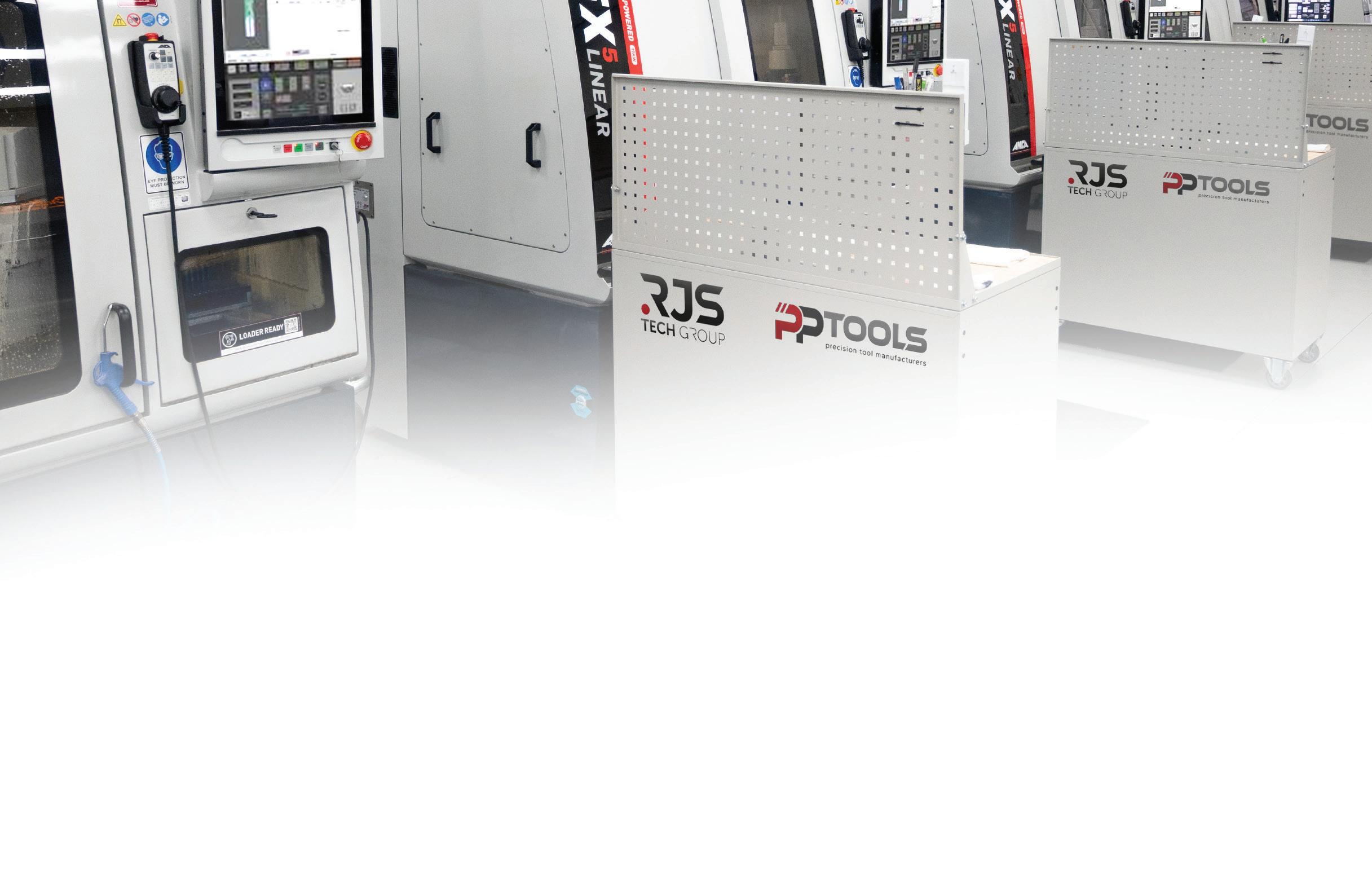
For RJS Technology, the Leuco appointment will help set the tone of its presence at Australian Manufacturing Week (AMW), where PP Tools will exhibit alongside RJS’ metalworking group Whitelaw Engineering Machinery and advanced tool coating company NanoTech.
Rowe adds that while the company has bases nation-wide, the headquarters for these businesses are all in Brisbane – which he says makes AMW’s Brisbane debut even more exciting.
“We want to showcase not only to the Australian community but also to Queenslanders that you’ve got all this in your own
backyard… We’re not talking about importing, we are creating the tools here.”
NanoTech’s coating plant is the only one in the southern hemisphere to provide coatings of its style, Rowe says, noting that they add longevity and durability to tools.
“It keeps the tool running at a cooler temperature, keeps the results and lasts longer… when metal meets metal it heats up, and that can cause distortion. This protects the tool, so it gives you a longer lifespan,” he says.
The broader RJS Technology group consists of interconnected subsidiaries whose capabilities reinforce one another. Wood Tech provides machinery for the woodworking industry; Rogers Industries offers plastics and aluminium injection moulding in large batch quantities and PPETech specialises in local respirator production.
“It’s still Australia’s best kept secret that we’re more than just Wood Tech. We’re now everything. And I think over the next 12 to 48 months, we’re going to see a lot more cross-formation between the other groups just to strengthen that unity right across Australia,” Rowe says.
He adds that the different companies provide a synergy when to comes to using and testing tools developed by PP Tools.
“You’ve got these two sister entities which are reporting back, showing ‘This is how the tool’s performing’. This is what we can maybe push it a little bit further. We can do this so the tools that PP Tools manufactures themselves are really an industry step above everything else,” he says.
Throughout all these developments, Rowe says the group maintains a consistent approach to customer support.
“We’ve always followed the mantra… of making sure that we do everything to match the right equipment, through the right tool, with the customer’s need,” he says.
He adds that an increasing number of customers are seeking out solutions online and approaching RJS with an outline of what they think will address their problem.
“Sometimes they’re right on the money, and other times… We try and understand what the customer’s real needs are, and say…we could do X, Y, Z – but from the sound of it, what you’re looking for is A, B, C,” he says.
“It’s always a case of trying to understand from the customer what their actual needs are, so we can offer a few different solutions to them and they can cherry pick.”
“There seems to be greater needs for precision tooling… everyone’s really pushing now for the quality, perhaps because the demand is greater, again, having to do more with less,” he says.
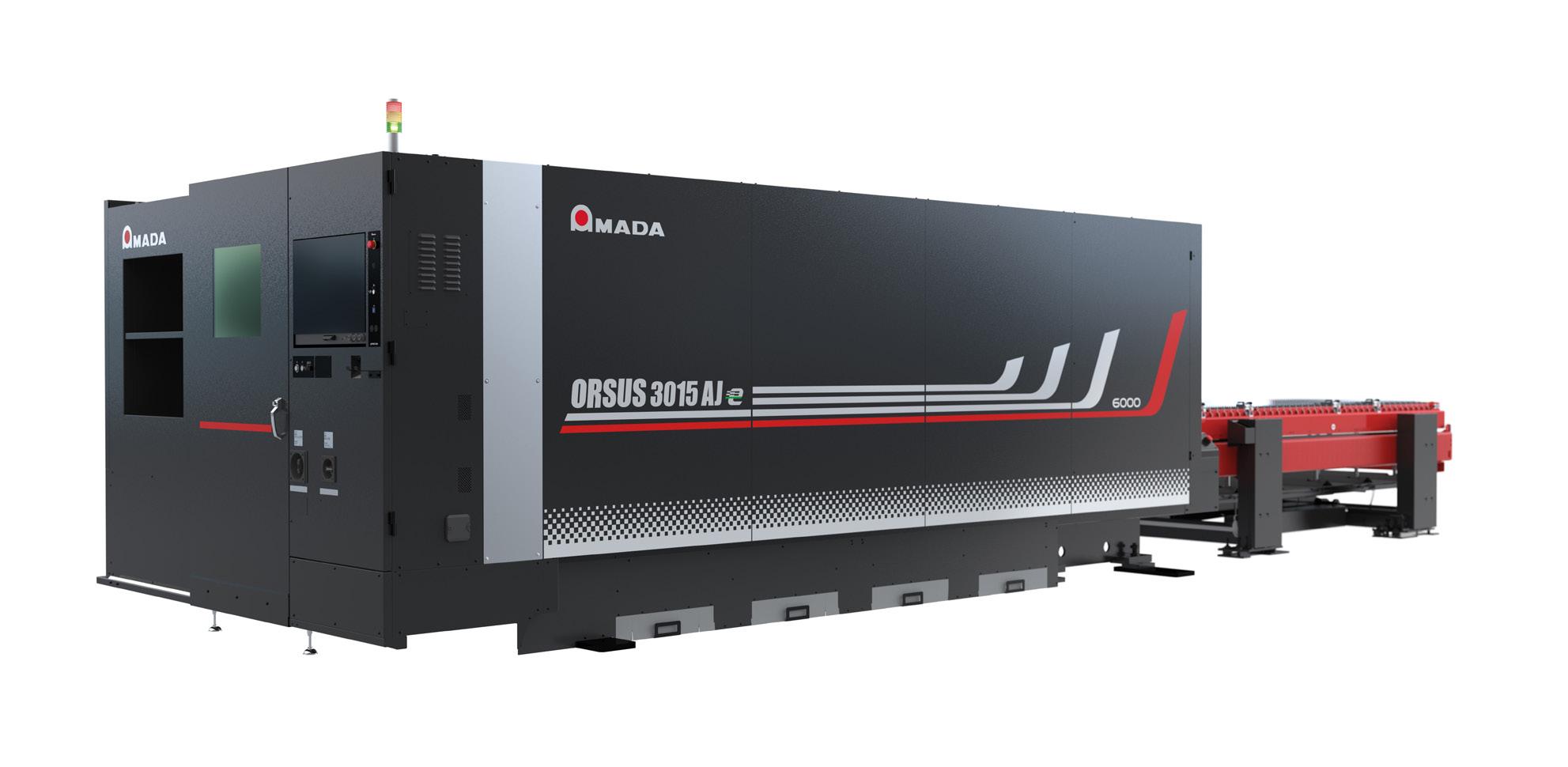
High dynamic adaptive fiber laser
AUTOMATION BRINGING EFFICIENCY AND FLEXIBILITY
RAPID AND EFFICIENT AUTOMATION ADAPTABLE CUTTING FUNCTIONS
UNMANNED OPERATION
COMPACT AUTOMATION SOLUTIONS
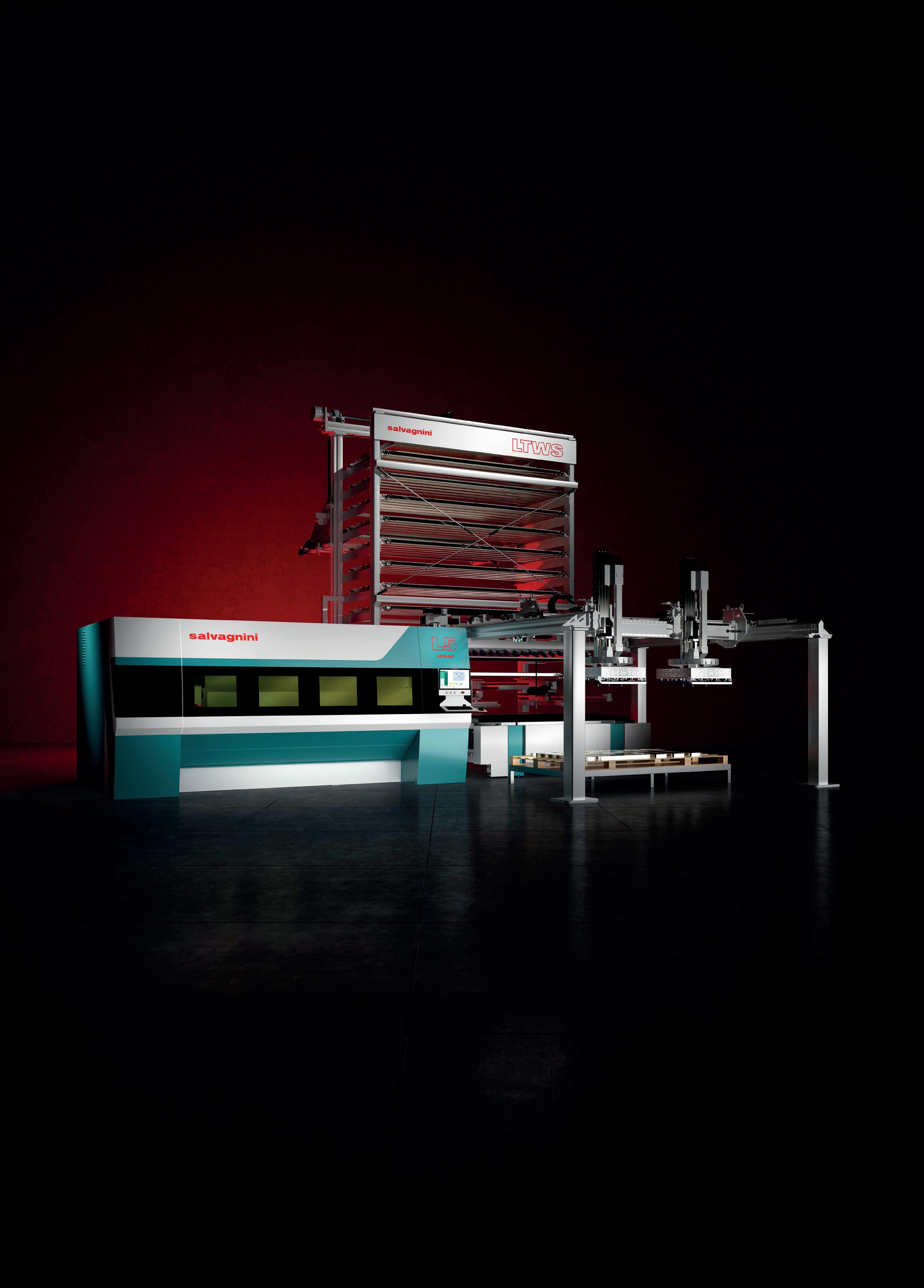
The L5 can be configured with a wide range of automatic devices for loading/unloading sheet metal and sorting manufactured parts. Automation is the keystone to shorten the return on investment time and provide greater efficiency and autonomy for your laser.
Charging Ahead with Battery Storage
With Battery Energy Storage Systems becoming more prevalent, manufacturers now have a new opportunity to participate in the energy market.
The Australian manufacturing sector is approaching a significant energy transition as the economics and capabilities of battery storage continue to evolve.
According to Paul Morrissy, Senior Manager, Renewable Solutions at RACV Commercial Energy Solutions, the shift has become noticeable in enquiries from businesses. “Two years ago, the vast majority of our sales activity was solar only. Today, battery storage features in a growing proportion of discussions, either as part of new solar projects or as retrofits to existing sites,” he says.
This trend, he says, reflects wider momentum across the industry. “Businesses are no longer asking if batteries make sense, but how and when to deploy them. As economics continue to improve and operational use cases expand, RACV expects battery storage to become a standard feature of commercial and industrial energy systems over the next five years.”
This move comes as falling system prices, regulatory changes and shifting energy pricing patterns converge to reshape the economics of storage.
“The most significant has been the rapid decline in costs of battery energy storage systems (BESS) — roughly a 30 per cent reduction over the past two years,” Morrissy says.
“At the same time, regulatory changes have enabled commercial batteries to access multiple value streams.”
He adds that pricing dynamics have moved away from the traditional midday peak.
“We’ve moved from a traditional midday peak to higher evening and shoulder peak prices, largely driven by increased solar penetration. That creates stronger incentives for load shifting and energy arbitrage.”
“When you combine lower capital costs, expanded revenue opportunities, and more favourable price signals, battery business cases are now stacking up with much greater certainty.”
Morrissy says the result is a clearer and more compelling business case for BESS – and manufacturing businesses with high energy loads — including advanced manufacturing and materials handling — are among those best situated to take advantage.
A growing part of RACV’s work involves integrating commercial batteries into virtual power plants (VPPs), an integrated system of energy assets including batteries, solar, and controllable loads.
A battery capable of participating in a VPP does more than operate as a standalone asset, Morrissy says.
“In addition to solar soak up and load shifting, it can respond dynamically to market signals, providing services such as frequency control and wholesale price arbitrage,” he says.
“The system makes real time decisions to maximise the overall value of the battery, rather than just minimising a site’s energy bill.”
One outcome that has surprised Morrissy is how quickly the economics of battery duration have shifted.
“Three years ago, one-hour batteries typically delivered the strongest business case for commercial sites, based on payback and upfront cost,” he says.
“Today, two-hour batteries are delivering better overall economics, and based on current trends, RACV expects fourhour batteries to become commercially compelling within the next two to four years.”
He says this reflects both falling costs and “the growing importance of longer duration services in the market.”
Morrissy adds that tor manufacturers, participating in energy markets presents a new revenue opportunity.
“Many businesses manage risk by contracting their energy under fixed price arrangements,” he says.
“By joining RACV’s Virtual Power Plant, batteries can earn additional revenue by providing grid services, such as Frequency Control Ancillary Services (FCAS), as well as participating in wholesale energy arbitrage,” he says.
“This allows businesses to unlock value that simply isn’t accessible through a standalone, behind the meter approach.”
But Morrissy cautions against viewing storage as a standalone investment instead of a broader energy strategy, adding that considering future electrification, EV charging, staged rollouts or additional capacity early on can “prevent unnecessary infrastructure upgrades later.”
Technology choices also matter.
“As systems become more integrated and digitised, the wrong hardware or control architecture can limit interoperability and prevent businesses from maximising returns,” he says.
“We’ve seen cases where poor upfront decisions have materially constrained asset performance.”
Integration between solar, storage, demand management and efficiency upgrades is another area requiring careful planning, Morrissy says.
“Different suppliers use different control systems, communication protocols, and architectures,” he says.
“Selecting compatible hardware — and planning how new assets will integrate with existing solar, demand management systems, and efficiency upgrades — has a significant impact on what the overall system can achieve. When designed correctly, these assets work together as a single, coordinated energy system rather than a collection of standalone components.”
The regulatory environment has become more supportive, but complexities remain, he adds.
“Manufacturers need to manage distribution network connection approvals, fire safety requirements, building codes, and compliance obligations, all of which vary by jurisdiction and network service provider. While these processes are manageable, they do add time and complexity to projects.”
Looking ahead, Morrissy identifies two changes that would speed up adoption.
“First, hardware procurement lead times can still exceed six months. As the market matures, RACV would like to see
suppliers holding more local stock to reduce deployment timelines,” he says.
“Second, distribution networks operate under different connection rules and approval processes. Greater consistency and clearer timelines across networks would materially improve project certainty and speed to market.”
For manufacturers planning the next decade, he sees energy management becoming increasingly integrated and digital.
“Best practice will involve highly-integrated, digitally managed energy systems. Manufacturers will combine on-site generation, battery storage, flexible loads, and market participation to actively manage cost, risk, and resilience,” he says.
His core advice for those considering storage today is to think ahead. “The Australian energy market is one of the most volatile in the world, and having a reliable, controllable energy system is increasingly critical to business operations.”
With solar and batteries working together, he says businesses
can secure long-term certainty.
“As operations electrify further, it’s essential to think long term and design futureproofed solutions,” he says.
“A battery paired with solar provides long term energy certainty and acts as a natural hedge against grid volatility — supporting both operational resilience and commercial performance.”
RACV
Precision Partnerships
Partnerships with its customers, with its own team and with industry, here and abroad have helped Ronson Gears stay out in front
While many exhibitors at Australian Manufacturing Week will be showing off the complex machines they make and sell, Ronson Gears managing director Gavin New says the company will have a much more specific focus.
“We specialise in the precision manufacturing of open gearing. In most cases, we produce the gears and our customers integrate them into their own gearboxes or application-specific assemblies,” he explains.
“We also undertake a significant amount of subassembly work inhouse, and it’s a capability we are actively promoting. Wherever we can enhance the value and efficiency of our customers’ projects, we are committed to doing so.”
New adds that Ronson is constantly investing in new equipment, having recently commissioned two new machines to support capacity and to uphold their reputation as precision gear manufacturers.
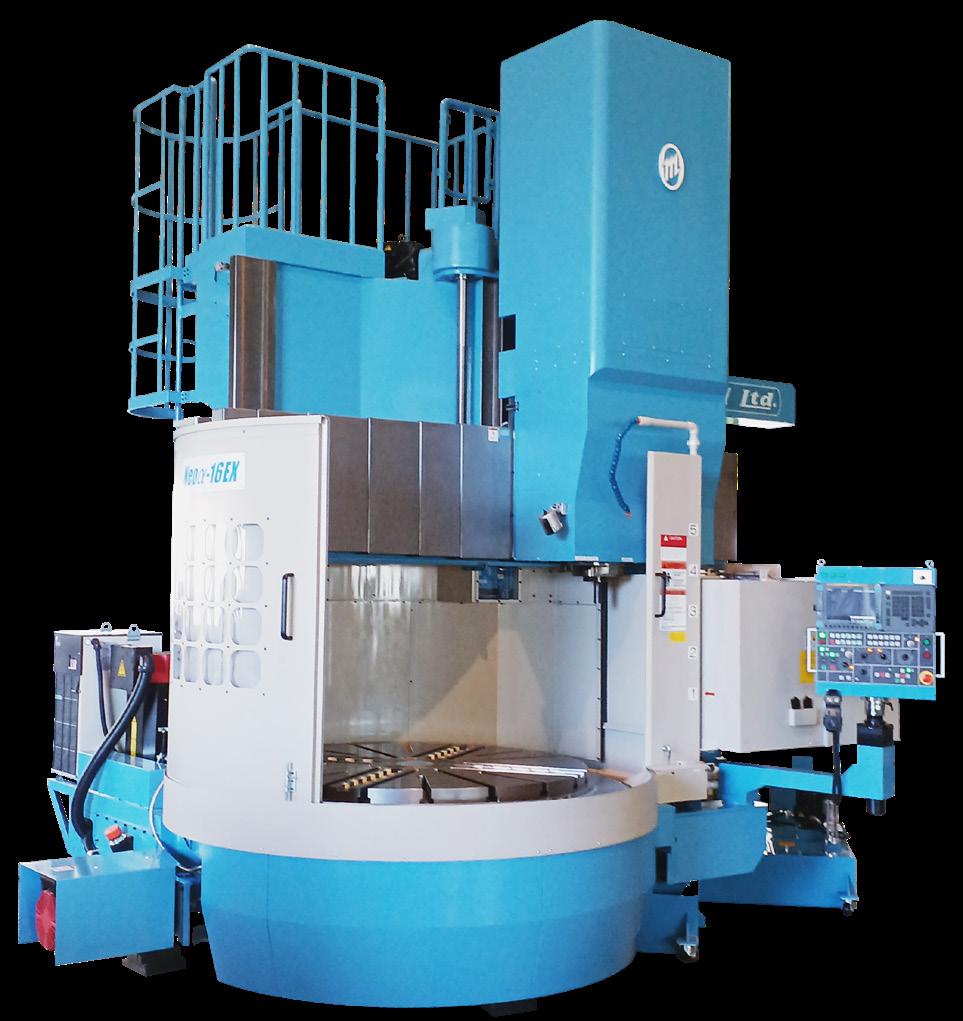
“They’re a Studer S31 cylindrical grinding machine and a SMEC SLV 1000 vertical lathe. They do not produce gears but they support our ability to supply quality gears,” New says.
“A gear is only as precise as the machined blank it’s built from. That’s why we keep the majority of our turning and milling operations inhouse, supported by stringent quality controls over every stage of blank production. Our new machines further reinforce this commitment, ensuring even greater consistency and accuracy.”
The new Studer S31 cylindrical grinder will open new doors:
“Our new Studer, which complements our Studer S145, is going to give us the ability to do things in our grinding process that we haven’t been able to do before. This includes longer work pieces and thread grinding, so that’s giving us some added capability. We’ll be promoting that capability at Australian Manufacturing Week.”
One of the things that sets Ronson Gears apart from other machine shops is its ability to cut and grind gear teeth onto a machined blank, New says.
That capability underpins a wide range of gear types and sub-assemblies, but the technical story is always wrapped in a customer-first mentality.
“We see things as a partnership internally and externally, and that’s where we’ve garnered a lot of success over the years,” New says.
For Ronson Gears, technology and capability matter – but long-term trust is what keeps customers coming back. New says many of their relationships span decades.
“We work with many longstanding customers, and in many cases the same people have been involved on both sides for years. Over time, they’ve learned how we operate, and we’ve gained a deep understanding of their needs. That mutual familiarity has created a strong foundation for collaboration — and that collaboration is a key driver of our ongoing success,” he says.
“We’re really good at listening at the pain points of our customers and working with them to meet the requirements of their customers, whether it’s technical, quality or delivery. We
do our very best to support them so they can support their customers.”
One example, he highlights, is a working partnership with a New South Wales mining products supplier where their American headquarters unexpectedly went global for gear supply as they could no longer keep up with demand.
“The Americans reached out to their teams across the world and asked whether those satellite facilities had any experience with other gear manufacturers in their region. Thankfully, our Australian counterpart put their hand up and said, ‘Yep, hey, we use Ronson Gears, they might be in a position to help us,’” New says.
“Over the course of two and a half years — through ongoing discussions, meetings, and detailed quotations — we were able to help them significantly overcome their supply challenges until their operations in the United States opened up some capacity again. That opportunity only emerged because the Australian team had the confidence to put our name forward, knowing our reputation for quality, reliability, and our willingness to collaborate to achieve a shared goal.”
These new opportunities are coming at a time of ongoing supply and capacity pressures around the world, New says, with delivery an ongoing challenge.
“Many retired off the back of COVID. A lot of people changed jobs off the back of COVID. Therefore, gear manufacturers around the world have found it extremely challenging to replace these people,” he says.
“We consistently hear from customers that our reliability and honesty set us apart. A number of overseas companies came to us after being let down by their previous gear suppliers — whether through missed delivery commitments, poor communication, or inconsistent performance. One recent example was a US-based space company that turned to us after growing increasingly frustrated with ongoing delays and a lack of transparency. What resonated most with them was our commitment to clear communication, dependable delivery, and a straightforward, honest approach.”
Today, Ronson Gears is onto its 30th contract with their space customer after they, too, reached out to an Australian colleague for support.
“Their requirements are extremely precise and very demanding…But also, they have delivery pressures, and at the time, we had the capacity to support them, which we still do,” New says.
Ronson Gears also offers an extensive stock range of gears. “We offer gears of all types, and where we can’t support a product, we will look to offer something out of our stock gear range through our association with KHK Stock Gears,” New says.
Japanese company KHK offers Ronson Gears a new way to work with customers when its custom work isn’t the right fit, New says, giving the company access to over 18,000 different line items.
“If we’re unable to help someone with a smaller inquiry that
they were looking to get a custom gear made, we can go down this path of taking something out of our stock range and possibly modifying it to meet the requirements of that customer,” he says.
“But it also means we can help customers with breakdown situations. We can help customers with R&D assignments that they’re working on. But we can also help the backyarder who wants to fix his barbecue rotisserie. And more often than not, we can, through this range out of Japan.”
New adds that the changing times have meant that he’s had more of a need to be present for the large global companies with which Ronson Gears works.
“We have been renowned for ‘being seen’ so I’ve continued down that path of local and international travel but to be able to do that, I’ve had to ensure that I’ve got a great team around me, which I do, and a team that can support our staff to the level that everyone would expect in a workplace like ours,” he says.
New, himself, has run the company for the past four years, continuing a family business that began with his grandfather in 1954 in a markedly different time.
“The business has undergone significant transformation since then, obviously, but in the last four years we have seen changes in the markets we serve and ownership. I’ve taken over the company alongside an existing management team who are now also shareholders, marking a shift in our ownership structure,” New says.
“I’ve got a lot of trust in my leadership team. I don’t micromanage the business as closely as it once was, so that’s different. And I’ve had to do that in order to release that focus on every intricate part of the business. We have experienced considerable growth in the last five years and with that, other areas of the business has required my attention. I believe we are on the right track but that has only been possible by having a workforce that is a team, that’s happy to be here and who are wanting to get the best out of themselves, which ultimately benefits the customer.”
Home Run for Construction
Prefab construction steps into the mainstream as finance and factory-first methods reshape Australia’s build future with pre-fabricated construction.
Prefab construction is moving from the margins into the centre of Australia’s building market, as CommBank signs on to help a growing number of homebuyers seeking speed, predictability and better cashflow in residential construction.
While Australia is widely acknowledged to have a dire need for more homes, the average construction worker is now building less in Australia than their counterpart did 35 years ago, with this stagnation costing the economy an estimated $62 billion every year.
With the Federal Government announcing a target of building 1.2 million new welllocated homes by 2029, prefab construction – building part (or all) of a home off-site – is increasingly viewed as viable a way to shift the dial.
As Jess Berry, managing director of PIQUE and Fox Modular, puts it, “The pressures of labour shortages, supply chain delays and rising build costs prompted government, industry and consumers to look for more reliable and efficient building methods.
“PIQUE, which specialises in high-end and custom homes, has seen increasing interest from clients seeking greater certainty around quality, timelines and cost, without compromising on architectural ambition.
“The use of modular construction is expanding well beyond its traditional applications, with the strongest growth now in retail, education, agriculture, healthcare, local government, social and affordable housing, and the residential market.
Berry notes that advances in design and manufacturing mean modular construction is no longer limited to simple or standardised buildings. It is increasingly being used to deliver beautiful, bespoke homes as well as complex commercial assets, combining design flexibility with precision and improved project efficiency.
Berry, who also sits on the board of industry body prefabAUS, says demand is not limited to traditional regional markets but is also growing in cities.
Jason Sjoland, managing director of fellow Western Australian company Modular WA, agrees the majority of his work is in housing with the Perth-based builder installing homes “anywhere from Esperance to Derby, and we have done so over the past ten years.”
“Housing is driving our demand at the moment, especially in those rural areas where there is not a local builder – where it is too expensive to build on site and it takes too long.”
For both Berry and Sjoland, the appeal of prefab construction is the productivity and predictability of manufacturing, with everything at one assembly point, rather than a team orchestrating multiple deliveries and long runs to remote sites. These efficiencies can help cut build times from 12–18 months down to as little as 12 weeks, with a recent McKinsey report suggesting that industrialised prefab will be one of the best ways to help meet global construction demand.
Sjoland says at his company’s worksites in Wangara and Landsdale, WA, if the necessary supplies for one component of a task are not available, teams can easily move to the next one without impacting the entire build.
“So, we haven’t lost that time, at a time when labour is scarce,” he says.
Berry says these parallel workstreams and conditions that allow for better quality control result in “faster construction timelines, often less than half that of traditional builds,” and “greater predictability, with fewer delays caused by weather, labour shortages or material variability and the ability to stockpile,” she says.
But while this financial benefit is obvious, Sjoland says
financing has long been a stubborn friction point for modular builders, where lenders historically paid only at completion of the project, forcing builders to bankroll months of offsite progress with what was traditionally only a 6.5% advance of the loan.
“Now as you can imagine, that has a massive cash flow drain effect on our business… we’re talking hundreds of thousands over a period of five to six months,” he says.
Both Pique and Modular WA are now CommBank Assessed Manufacturers under its new prefab policy, which allows for a modular home to be progressively funded even while it is being built offsite.
If a home buyer is building with a CommBank Assessed Manufacturer, they can access up to 80% of the build contract price while the home is being built offsite, rather than needing to provide the funding upfront themselves. This also increases cash flow for the builder to pay contractors and suppliers.
As the first major bank in Australia to offer financing during offsite construction, CommBank is helping to make prefab and modular construction more accessible mainstream options, its Executive Manager for Construction Finance Andrey Shipulin says.
“We certainly have the appetite to finance modular and prefab construction…It’s becoming more and more prevalent,” he says – noting that increasing numbers of proposals spanning housing and commercial sectors are coming across his desk.
“Developers do not have the balance sheet to carry the cost of construction until it’s on site, it has to be funded by the banks…I think eventually the whole banking industry will have to come on board and treat it as any other form of construction.”
For builders like Modular WA, the effect on cash flow is “monumental,” Sjoland says.
“Having that finance facility available…it all helps. That’s why this has been so important to us to get on board, and we’ll be encouraging people to fund their builds with this option as much as we can,” he says.
“We all need to work together – and that includes other organisations and our competitors as well to make sure that the reputation, the quality and the image of the industry continues to move forward.”
Next Gen Work Holding Has Arrived.
Casting Around
Australia’s metal casting industry is undergoing a quiet resurgence driven by innovation, investment, and new global opportunities, after a period of consolidation, according to the Australian Foundry Institute (AFI).
Once challenged by a decline in domestic demand — a trend that forced many foundries to close — the sector’s remaining operators have emerged leaner, more advanced, and increasingly outward-looking.
Companies across the country are now targeting international markets and adopting cutting-edge technologies such as automation, robotics, AI-enabled inspection and predictive maintenance to strengthen their competitiveness.
AFI leaders say this shift has allowed Australian foundries to overcome long-standing hurdles such as higher labour and transport costs.
“Today, the Australian metal casting industry is a mature, hightech domestic industry embracing cutting edge technologies and supplying to markets including mining, energy, engineering, marine, aeronautical, automotive, rail, agricultural, irrigation, art and defence,” the AFI says.
“To meet customer demands, the Australian metal casting industry utilises the latest advancements in metallurgical and casting technologies.
“The development of new materials and high-performance alloys has greatly enhanced the performance and durability of cast products,” the AFI adds.
Modern mould-making techniques have significantly improved the precision and quality of cast products, while additive manufacturing — including 3D-printed sand moulds and wax or plastic patterns — has enabled far more complex geometries than were possible through traditional methods.
Digital tools now play an essential role in production.
Computer simulation and modelling technologies such as Computational Fluid Dynamics (CFD) and Finite Difference (FD) calculations allow foundries to predict defects, simulate mould
filling and optimise solidification processes long before metal is poured.
The industry is also embracing Industry 4.0, with smart sensors, Internet of Things (IoT) devices, machine learning and big-data analytics helping businesses monitor equipment in real time, streamline processes and boost sustainability. These technologies are reducing waste, improving energy efficiency and lowering production costs — key advantages in a globally competitive market.
With global supply chain uncertainty once again on the rise, AFI is urging Australian manufacturers to consider sourcing cast components locally. Domestic foundries, it argues, are now better equipped than ever to provide high-quality, reliable solutions close to home.
AFI
Secure the future of your manufacturing business with expert guidance at every stage
W illiam Buck specialise in providing accounting and advisory services specifically designed for the manufacturing industry. W ith our expertise and tailored approach, we can help your business navigate through various stages, from start up to growth and maturity, ensuring financial success and sustainability at every step.
Visit us at Australian Manufacturing Week Scan the QR code for more information
EMERGING TECHNOLOGIES
Insights into the tools, systems and skills defining the next phase of industrial innovation.
38 From Pilot to Production – where cobots fit in the modern workplace
40 No Time to Wait – how automation can lift safety and throughput for shops of all sizes
42 Robots to Rail – the first locally built iron ore rails cars in the Pilbara
44 Showing the Way - M.A.P Services to demonstrate LowSpatter and Collaborative Welding solutions at AMW
45 Moving Forward – How Additive Engineering is scaling materials, skills and sovereign manufacturing
46 Solar Flair – QUT’s Centre for Materials Science is driving Australian manufacturing forward
48 Cutting Through the Hype – the reality of AI on the factory floor
50 Fix the Data First – why AI adoption starts with data, not tools
52 Come Together – breaking data silos to ride the AI wave
From Pilot to Production
Graham Williams of Vectis Automation looks at where cobots fit in the modern workplace.
Of all the benefits that collaborative robots, or cobots, bring to the modern workplace, increased productivity tends to be the main driver, Graham Williams, regional manager for Vectis Automation says.
“We have a three-to-four times typical increase in production output if we’re going from manual welding to robotic welding – and that can be as high as 10-12 times if I’m going from manual TIG Welding to cobot MIG welding,” he says.
“We had a customer that was doing about a 4m long weld, and it would normally take them about eight hours manually – and they trimmed that down to about 45 minutes with the cobot.”
But almost more important than this, Williams says, is the morale boost it offers to the workforce – the possibility of a robot taking on the least comfortable and most repetitive tasks.
“If I can have a cobot start with that, it’s going to increase my satisfaction coming into work every day – because I don’t have to do that thing I used to hate doing; the cobot does it now.”
Ultimately, he says, a cobot is designed to work safely alongside humans – rather than being a high-speed, highvolume robot kept away from humans in a large, fenced cell, or an automation system designed to operate into the night after all the workforce has gone home.
“We’re well outside the guinea pig phase,” Williams says. “There are now hundreds of systems out there in real fabrication shops, boosting quality and productivity and helping customers win more work.”
Aside from the additional safety structures and weeks of on-site commissioning and programming needed for regular industrial robots, Williams says cobots offer the additional benefit of flexibility – able to be used on a wide range of jobs.
A big part of that versatility comes from how the robot is deployed, he adds. Early cobot welding systems typically sat on fixed, gridded welding tables – limiting them largely to smaller components.
Since then, reach has increased and deployment methods have evolved, Williams says, saying the latest generation of the Universal Robots UR8L that the company uses equipped with a 2100mm reach – 450mm more than the prior generation.
Paired with a mobile Rover platform, the cobot can be rolled along a structural beam, a trailer chassis or other large fabrications – bringing the robot to the part rather than forcing the shop to bring every part to a fixed cell.
Another configuration uses a pivoting “diving board” extension to reach over large assemblies or into multiple zones, enabling the company to move beyond 1.5mm sheets into structural steel with thicknesses up to 150mm.
Greater reach, Williams adds, means “we can reach a greater number of parts, if you’re nesting a bunch of small parts, or it opens it up for doing larger parts themselves, where the actual assemblies are bigger.”
Perfect Partner
Williams notes that while cobots have become more popular and more accessible to small and medium sized businesses, they are neither interchangeable nor created equal.
“It’s a tool, and there may be different styles of that tool to make sense for different jobs,” he says.
“The interface can be the same, but then you may have one that’s dedicated for smaller work, and you may have a different one that has a different look and feel to the mechanical structure, but it’s the same software able to do a larger assembly.”
The same, he says, is true of cobot integrators – professionals or engineering firms that design, program, install and configure cobots to operate safely alongside human workers.
“Your more nuanced processes like welding or plasma cutting… where we’ve got some complex motion and the process and integration amongst the robot and the auxiliary equipment…makes it where you do want that skilled integrator,” he says.
The first question to ask of a potential integrator, Williams adds, is to ensure they are genuinely safety-minded – having both researched local regulations and developed cobot working arrangements that are safe collaboratively.
“We happened to see a newcomer integrator that had a saw on the end of the cobot. The cobot was safe, but the saw was not necessarily safe – they have to think about those kinds of things,” he says.
“Is that safe, or can it be made safe with some backend auxiliary safety systems that might be running in the background… [or are you] responsible for adding those elements yourself, and in the interim have you exposed your
employees and created an unsafe condition? These are all key questions that a certified, experience integrator solves so that manufacturers don’t have to worry about it – they can focus on putting the system to work in production.”
Williams’ second recommendation for selecting an integrator is choosing one that can grow alongside your business.
“We always look at the repeat order rate of a customer, and as that customer grows, do they go back to that integrator to grow with them?” he asks.
“Do they have the technology to have what the next phase looks like? Do they have other options either from a process standpoint or a deployment method standpoint to be able to scale with your business?”
Williams adds that a key part of the process of introducing cobots to a workplace is consulting with the customer to assess their existing upstream processes.
“Automation is going to shine a spotlight on the weakest points of your fabrication process,” he says.
“Loose upstream processes and improvised jigs that a skilled welder can ‘make work’ will trip up the repeatable paths that a cobot follows. It doesn’t have to be necessarily a precision engineered and machined fixture, but if it’s hammered into position, that might be a red flag.”
He cites an example where a customer was making fans –with staff shaping the product by hammering the fan blades over a barrel.
“If he hit it more times today than he did yesterday, the parts wouldn’t work in an automated cell. So, the recommendation was, actually, don’t get the cobot but rather focus on improving upstream processes first so that welding automation can be successful down the road,” he says.
The trick, he says, is identifying where the bottlenecks and pain points in the production process really are – before judging whether cobots or other automation processes are the solution.
For companies wondering whether cobots are right for them, Williams recommends first considering the type of parts manufactured, the common material thicknesses and the working envelope that is needed.
“I think sometimes there’s a natural tendency to pick the biggest, baddest, most complex part in the shop and say, that’s where I need to throw the technology – but maybe it makes more sense to pick something simpler – the ‘crawl, walk, run’ approach.”
“Don’t be afraid to reach out to an integrator… see how the technology has changed since maybe the last time you looked… It really seems like in the past few years, the answer has changed from a no to a yes for many of the folks we work with.”
No Time To Wait
Autoa Robot Welding managing director Matthew Fisher outlines how automation can lift safety and throughput, and why even one-person shops can benefit.
For Fisher, efficient manufacturing automation is not something one would want to establish urgently. “We’ve got to be able to build what matters, when it matters, without being held to ransom with events or decisions.”
The COVID-19 pandemic, and subsequent disruptive events, exposed the fragility of moving goods around the world when passenger flights cease and airfreight collapses.
Fisher’s focus is how automation, robotics, and increasingly AI can help Australia and New Zealand rebuild local capability with competitiveness and confidence—without displacing people.
“Absolutely not,” he says when asked if automation reduces headcount. “In our experience, we probably see the opposite… It doesn’t replace skilled people. It multiplies what good people can produce.”
The precondition, he argues, is culture: “You won’t find automation in a company with bad culture…the automation won’t be successful. It’s relying on the people making it work.”
That cultural point runs through his observations about Asia’s manufacturing ascent. He cites Japan and China as examples where embedded, long-tenured knowledge has compounded over time.
“Someone that’s been there for 15 years, 20 years…there’s just so much knowledge that’s irreplaceable,” he says.
By contrast, transient employment patterns can erode process memory, he says, and automation becomes a tool that formalises and scales what experienced people already know—provided organisations bring shopfloor teams into decisions early and align incentives.
He recalls walking a customer’s floor where a workplace was introducing automation to a workplace, where staff were paid on a piece-rate. The fix was slow and human: involve the team, explain objectives, and remove the fear that the machine is there to take wages away.
“You’ve got to have a good work culture. You’ve got to have the floor wanting it as much as management wants it – and they see it as empowerment,” he says.
Asked what skills rise in importance as robots take on dull, dirty and dangerous tasks, Fisher points to process science and systems thinking around the core application—in his world, welding. “You are detached from it… you lose the human touch,” he notes, so operators need a firmer grasp of parameters and quality, and an “eye for process and production.”
Technicians who understand setups, sequencing, and data will remain central. For workers anticipating change, his advice is direct: “Look upstream and downstream, find improvements, and embrace the change, because then you’ll be part of it.”
If culture and capability are foundations, the pitfalls of implementation are familiar. Fisher sees three common mistakes. First, buying equipment before understanding workflow: “We’re going to get this machine, it’s going to fix all our problems… but if upstream is not right, or downstream is not right, the piece in the middle won’t necessarily fix that problem,” he says.
Second, underestimating training and support—changing mindsets and processes is difficult, and “going alone will likely just become expensive,” he says.
Third, diffusing responsibility across too many suppliers: “You’re not actually just buying a machine. You’re buying a production process,” he says. A single accountable partner, he argues, reduces risk.
Fisher is equally firm about what he says are the misconceptions some entities have around automation.
“Lots of people say ‘We’re too small. It’s only for high volume...’ That was the case 10 years ago…but it’s not the case now,” he says, pointing to advances in software and systems that suit high-mix, low-volume environments.
“We’ve put systems into companies that are literally just one man. It may not be going 40 hours a week, but it saves him having to employ extra staff,” Fisher says.
“Look beyond how much it’s being used,” he says of ROI. “Focus on throughput… reduction in injury…capability.”
Fisher’s success stories are less about the robot count and more about the operating model around them.
He cites a New Zealand livestock manufacturer with seven robots and a furniture maker supplying schools. Neither runs every robot all day, every day, but both “have their process dialled,” know their costs, and keep reinvesting.
“It’s not just the equipment we’ve provided them; it’s the culture… They’ve got capital to reinvest…training their people the whole time.”
Crucially, these companies plan ahead and buy technology
that is upgradable and locally supported. Training is as much a risk hedge as an enabler: “Keep training your team, so that they own the knowledge, not a supplier,” he says.
The sovereignty angle is broader than equipment. Data and digital systems underpin continuous improvement: “If you’re not measuring something, you don’t know what to improve,” Fisher says.
Partnerships fill gaps in expertise, much like using accountants or HR specialists. The marker of maturity is a willingness to let processes be challenged.
“Just because we’ve done it one way for 30 years doesn’t mean it’s the best way today,” he says, encouraging companies to inspect working systems and ask how they might apply to your products.
Looking ahead five years, Fisher expects automation to be “normal”—across small, medium and large firms—and he sees AI accelerating the shift, from adaptive process control to more capable mobile and humanoid systems.
While popular videos of AI and robot stumbles draw laughs today, he cautions that capability is compounding.
Meanwhile, global competitors are not standing still. “We have to catch up,” he says of China’s sustained robotics investment.
The message to local industry is not alarmism but urgency: use the tools that already work, build teams and partners who can keep them working, and design for measurement and iteration from day one.
As for Autoa, Fisher is clear about the niche: “We do robotic welding. That is our sweet spot,” he says—process improvement, standardisation, and consistency.
The company is small by headcount but focused on making the hard work of manual fabrication safer and more repeatable.
His final takeaway is also the simplest: don’t wait. “Waiting to adopt will be the most expensive decision a manufacturer can make,” he says.
Robots to Rail
Robotic Automation system supports first locally-built iron ore rail cars in the Pilbara
A large-scale Motoman Yaskawa robotic welding system has played a crucial role at Gemco Rail’s purpose-built Karratha facility, as the region’s first locally-built rail wagons go into service.
Supplied and commissioned by local distributor Robotic Automation, the welding system sits within a $150 million local manufacturing partnership between Rio Tinto, Gemco Rail and CRRC Qiqihar Rolling Stock Co. Ltd, aimed at delivering 100 heavy-duty iron ore wagons to projects in the region.
The investment is designed to strengthen regional supply chains, expand domestic fabrication capability and reduce reliance on overseas wagon manufacturing.
Robotic Automation says the advanced welding system was engineered specifically to meet the scale and demands of rail-car production in one of the most challenging industrial environments in the country.
“By enabling local production of high-quality iron ore rail wagons, robotic welding improves weld consistency, enhances safety and supports sustainable regional growth,” the company says.
Gemco Rail required a system capable of producing large, fatigue-critical structural components with absolute repeatability — a task traditional manual welding could no longer meet at the required volume or precision.
The company needed to maintain weld integrity on load-bearing wagon structures and improve safety by reducing reliance on manual welding for critical joints, while helping with broader aims of supporting reliable production in the remote Pilbara region of Western Australia.
The Motoman Yaskawa robotic welding system has been optimised for heavy fabrication, enabling precise, repeatable welding across large steel assemblies, lifting overall production capacity and ensuring a high baseline of quality across all units.
The broader regional impact has been just as significant. With the robotic system in operation, the Karratha facility has become the first in the Pilbara to manufacture iron ore rail cars locally — a breakthrough that has created up to 25 skilled jobs and strengthened long-term supply chain resilience in the north-west of WA. The wagons are already in active service hauling ore from Pilbara mines to port.
Robotic Automation says that the system has not only delivered consistent, high-quality welds across all wagon builds, it has also helped increase throughput and process efficiency.
“By enabling local production of high-quality iron ore rail wagons, robotic welding improves weld consistency, enhances safety and supports sustainable regional growth,” the company says.
Robotic Automation
Robotic Automation
Moving Forward: How Additive Engineering is Scaling Materials, Skills and Sovereign Manufacturing
As demand grows for faster, lighter and more complex components, additive manufacturing is transitioning from a niche prototyping tool into a production-critical technology.
Melbourne-based metal 3D printing company Additive Engineering is at the front of this change, with its recent investments in advanced equipment, materials capability and workforce development part of an ongoing lift in Australia’s industrial additive manufacturing maturity.
For many years, metal additive manufacturing in Australia was characterised by experimentation rather than scale. While early adopters proved the technology’s potential, broader industry uptake was limited by machine capability, material qualification, and a shortage of skilled practitioners. Today, that equation is changing.
Additive Engineering says its installation of the EOS M400 and EOS P3 Next 3D printers represents a deliberate move toward production-grade additive manufacturing. These systems are not incremental upgrades; they reflect a shift toward high-throughput, digitally integrated manufacturing platforms capable of meeting defence, aerospace and industrial production requirements, the company says.
The M400 enables large-format metal components with repeatability and process stability, supporting applications where traditional manufacturing would struggle with complexity, lead times or cost.
In parallel, the P3 Next extends additive manufacturing into advanced polymer production, unlocking lightweight, functional parts suitable for aerospace, tooling and end-use industrial components.
Additive Engineering says that together, these platforms help it address both metal and polymer production under a single digital manufacturing ecosystem — a critical enabler for industrial scalability.
Advanced machines alone do not create advanced manufacturing outcomes, the company says. Materials knowledge — from powder selection and process parameters to post-processing and qualification — remains one of the most significant barriers to additive manufacturing adoption.
Additive Engineering has focused heavily on building in-house materials expertise, particularly in high-performance alloys and engineering polymers. This capability allows the company to work closely with customers to select appropriate materials, optimise designs for additive manufacturing, and ensure repeatable mechanical performance.
For sectors such as defence and aerospace, where traceability, validation and performance consistency are non-negotiable, this materials-led approach is essential. It also supports Australia’s broader push toward sovereign manufacturing capability by reducing reliance on offshore prototyping, testing and production.
A defining characteristic of industrial additive manufacturing is its digital foundation. From design optimisation and simulation through to build monitoring and quality assurance, additive manufacturing demands a digitally fluent workforce and infrastructure.
Additive Engineering has embedded digital manufacturing principles across its operations, using data-driven workflows to improve part quality, reduce iteration cycles and support scalable production. This digital maturity enables faster transition from design to manufacture — a key advantage for industries operating under compressed development timelines.
Importantly, digital manufacturing also supports sustainability objectives. By producing components closer to their point of use, minimising material waste, and enabling lightweight, highperformance designs, additive manufacturing contributes to reduced lifecycle emissions across multiple industries.
One of the most significant challenges facing Australia’s manufacturing sector is skills availability. Additive manufacturing requires a blend of engineering, materials science, software literacy and hands-on production experience — a skillset not traditionally found within a single role.
Additive Engineering has invested heavily in developing multidisciplinary teams capable of operating advanced additive systems at an industrial level. This focus on workforce capability ensures that technology investments translate into real production outcomes, rather than underutilised assets.
Additive Engineering
Additive Engineering
By cultivating local expertise, the company is helping build a sustainable additive manufacturing workforce — one that can support long-term industry growth rather than short-term project demand.
The strategic importance of additive manufacturing to defence and aerospace is now widely recognised. The ability to rapidly produce complex, high-performance components domestically enhances supply chain resilience and operational readiness.
Additive Engineering’s production-scale capability positions it to support these sectors with qualified components, rapid iteration and secure local manufacturing. This aligns closely with national priorities around sovereign capability, particularly as demand grows for flexible manufacturing solutions capable of responding to evolving requirements.
At Australian Manufacturing Week, Additive Engineering will be
Showing the Way
exhibiting physical sample components produced on its EOS M400 and EOS P3 Next systems, providing attendees with tangible examples of production-grade additive manufacturing.
These will include large-format metal components, highperformance polymer parts and examples of design for additive principles translated into real-world outcomes.
By presenting finished components rather than concepts, Additive Engineering aims to shift the conversation from “what’s possible” to “what’s already being manufactured in Australia today”.
As additive manufacturing continues its transition into mainstream production, the companies that succeed will be those that combine advanced technology with materials expertise, digital integration and skilled people, the company says.
M.A.P Services to demonstrate Low-Spatter and Collaborative Welding solutions at AMW
M.A.P Services will showcase the latest developments in OTC Daihen robotic welding technology at Australian Manufacturing Week (AMW), showcasing its method for increasing efficiency in the Australian fabrication sector.
The company will be running live demonstrations of the OTC SynchroFeed welding system, mounted on a B-Series arc welding robot, from Booth 2436, throughout the event.
The SynchroFeed system utilises a high-speed wire retraction mechanism (up to 100Hz) to synchronise with the current waveform.
This precise mechanical control creates an ultra-low spatter weld, even at high travel speeds, M.A.P says – reducing post-weld cleanup and consumable costs.
Crucially, the process significantly reduces heat input, enabling the high-speed welding of ultra-thin gauge materials without the burn-through or distortion associated with standard CV welding.
This technology significantly reduces, and in many cases eliminates, the need for post-weld grinding and cleanup, allowing for immediate painting or coating, the company adds.
Alongside the industrial cell, the FD-VC4 Collaborative Robot will be on display.
The FD-VC4 is designed for high-mix, low-volume production environments. It operates without safety fencing and features direct-teach capabilities, allowing operators to program weld paths by manually guiding the robot arm.
M.A.P says it is the only purpose built welding cobot model on the market, built on the same platform as
their industrial counterparts.
Company director Shane Gallagher says the M.A.P Services is focusing on providing practical solutions to the skilled labour shortage.
“By demonstrating the SynchroFeed system live, we aim to show how minimising spatter can reduce processing time,” he says.
“Additionally, the FD-VC4 Cobot demonstrates that robotic automation is becoming more accessible for workshops that may not have dedicated programming staff.”
M.A.P Services is the exclusive Australian partner for OTC Daihen, a global leader in arc welding robots and power sources.
Based in Victoria, M.A.P Services provides sales, technical support, and integration for automation systems nationwide.
Solar Flair
Working with Queensland University of Technology’s Centre for Materials Science, A/Prof Prashant Sonar is helping to drive Australian manufacturing forward
Associate Professor Prashant Sonar, a chemist by training and founder of QUT’s Organic and Printed Electronics Research Group, describes his field in deceptively simple terms: Creating printable inks. But it’s much more complicated than that.
A/Prof Sonar is working on developing soft, carbon-based semiconductors to go into those inks, with the aim is to replace the inorganic semiconductors that make up the lion’s share of circuits and computer chips today – which give Silicon Valley its name.
The first conducting polymer capable of this was discovered in 1977, and is currently in the market in Organic Light Emitting Diode (OLED) television screens, but Sonar’s research team aims to take them much further.
“We can make viscous inks, and then the devices can be on flexible prototypes, or can be on clothes or on wearables and smart electronic tattoos,” he says.
They can also be integrated into transparent displays – such as glasses and windscreens, built into printable logic circuits and printed as next-generation solar cells on plastic film in rollto-roll processes.
Sonar’s research program spans molecular design through to device prototyping.
“Being a chemist, we try to do the molecular engineering of these organic semiconductors…whether we want to capture the solar light from the entire solar spectrum…or make the next generation of brighter materials [for] transparent display,” he says.
His group works on charge-transport layers for solar cells, organic transistors for flexible backplanes, and printable circuits for wearables and IoT.
The ambition is clear: “Currently, the world record number for solar efficiency, for example, in an organic solar cell, is 20%. How [can we] take this 20% to 25% and what are the theoretical limitations? What are the practical limitations? What kind of AI, molecular engineering, chemical constituent or backbone engineering is needed?” he asks.
These questions are among many being asked by researchers at QUT, through its research centres including the Centre for Materials Science – enabling the university’s researchers to collaborate with industry.
One project takes biomedical-grade chitosan extracted from seafood waste to create biodegradable substrates for health monitoring – developing a polymer for an application designed to detect dopamine in elderly patients suffering from Alzheimer’s disease and Parkinson’s disease.
The prototypes are designed to be wearable, remotely monitored and, when spent, safely degradable—“instead of putting them in our environment, they can dispose it off in water or soil without having impact.”
Another thread tackles cost: working with Singaporean company Sun Connect to take commodity pigments— diketopyrrolopyrrole (DPP) and quinacridone among them— and turning them into high-performing functional inks for solar
devices through what Sonar calls “green synthesis.”
“People used to tease me – DPP standing for Dr Prashant’s Polymer” he laughs. But the Ferrari-red DPP pigment is no laughing matter, offering the opportunity to create an affordable energy solution not only for Australia but also the developing world.”
Equally emblematic is a project that transforms human hair waste into carbon quantum dots that can be deposited on a plastic prototype for low-light displays and for sensing chloroform in chlorine swimming pools.
If the science is ambitious, the message to manufacturers is pragmatic.
Sonar sees the Centre for Materials Science (CMS) as a bridge between lab and line, with programs structured to de-risk ideas alongside companies, and with government grants on offer to support the research.
The centre brings chemists, physicists, engineers and data scientists together—“this multidisciplinary approach is absolutely critical,” he adds—and pairs discovery with prototyping and characterisation.
There is also a patient note about timelines.
“Any product…does not come overnight…from concept to the product,” he says, recalling early OLED devices that “died within a few seconds” before a decade of incremental progress delivered today’s thin, bright panels.
The lesson for Australia’s sovereign capability push is to set up an ecosystem—“state level to national level”—that allows spin-outs, joint programs and pilot manufacturing to move in concert.
Sonar will be at Australian Manufacturing Week with colleagues from QUT’s Centre for Materials Science, keen to meet companies looking to co-develop next-generation devices and materials – and helping to create an opportunity to support sovereign capability and Australia’s manufacturing future.
QUT
NEW GENERATION OF PANEL BENDERS
More productive than a traditional press brake
Ideal for medium-to-high volumes
Fully CE compliant, designed with safety and reliability in mind
Metevo introduces a new generation of panel benders, a cost-effective solution designed to boost productivity, reduce labour costs and the need for press brakes in standard panel production.
Cutting Through the Hype
Digital transformations and artificial intelligence are hot topics, but does the discussion reflect reality on the factory floor? Mikhail Golovnya, senior data advisory scientist for Minitab, has some of the answers.
Part of the problem in truly understanding and acting upon artificial intelligence (AI) lies in defining the term, data scientist Mikhail Golovnya says.
He tells AMT that ‘artificial intelligence’ has become “a highly overloaded term,” a catch-all explanation for almost any digital change – and his first move is to narrow its definition.
“What we name today as AI is usually generative AI, which is a narrow part of AI… but in the broader terms, especially in manufacturing context…AI simply means effective use of modern data analytics and machine learning techniques to address specific manufacturing and business needs,” he says.
For him, the most recent inflection point is large language models (LLMs) and the transformer architecture that finally let people ‘talk’ to machines.
“We have experienced the ability to communicate with machines using human language,” Golovnya says.
“Here comes the revolutionary part, and [here] also comes the entrapment. Some people are being fooled into thinking that we’ve somehow discovered the secret of intelligence.”
Under the surface, he adds, it remains number-crunching at scale: GPUs, vectorised representations, and massive datasets. “Yes, it is a revolution, but it’s just another development in computer science.”
While some companies are trying to use generative AI in marketing and administrative roles, Golovnya says he doesn’t see a role for generative AI in manufacturing beyond some project management work.
“I still see a lot of potential to conventional, traditional machine learning…to unleash the power of digital transformation there,” he says.
To bring the conversation back to shop-floor realities, Golovnya describes a layered model of digital transformation that manufacturers can put into action.
“We all need to start at level zero,” he says. That means clarifying the needs of a business and establishing a data foundation that directly supports it.
From there, “we go to level one. We have the data, we describe it. Then…level two. Okay, let’s diagnose, and apply our own intelligence and domain expertise to understand what conclusions we can draw from the data. Why did that machine fail?…Why did that thing go out of spec?”
Level three is predictive analytics: “Can we use [the past] to build models to predict what will happen in the future?” Then comes level four: “We apply human intelligence trying to decide, okay, what do we learn from this? What changes do we introduce into our business to optimise the outcomes?”
In practice, he sees many organisations – including Australian businesses – still at the foundation level, where others are trying to use data to develop control charts and carry out process control.
His caution is simple: don’t get trapped either collecting data for its own sake or “introducing innovations for the sake of innovation,” such as installing sensors that do not create durable value.
“We do need to start collecting the right data to address business [needs] – because if we don’t collect the right data then the whole digital transformation is irrelevant,” he says.
“We also need to properly invest into reliable sensors… they need to be utilised a lot more, because right now, they are underutilised, and that’s where the real business impact comes in.”
When considering whether to invest in an innovation or introduce a novel digital transformation technique, Golovnya advises manufacturers to ask themselves two questions.
“Number one, what is the long-term impact on the bottom line, the revenue – ‘long-term’ being the key word…Number two, what is the impact on customer satisfaction and the reputation of us as a company?” Reputation, he stresses, compounds slowly and can be lost in a day.
“We want something that will satisfy our customers instead of causing an unnecessary annoyance, [otherwise] eventually… they’ll start thinking we are scamming them for money, and we don’t care about them anymore,” he says.
To ensure that the right data is collected, Golovnya advocates for the building of operational models—digital twins—that mirror the real process and can be experimented with safely.
“Some associate it with AI, I do not. To me a digital twin is simply use of a computer simulation that mimics what is going on in your actual business.
“They need time to set up the system, but once it’s up and running, the benefits will start flowing in – so it’s this type of mentality that I would love to see more and more on the industrial side, as opposed to this nebulous idea of agentic AI and job cuts and eliminations, which in my view isn’t going to happen.”
That will require a workforce that has become AI literate, he says, with an understanding of what the technology can and cannot do.
Around that literacy, he sees new roles: technicians to install and maintain sensors, specialists in data security and data fidelity, digital twin managers, and troubleshooters who can clean up failed automations.
“Sometimes…AI may save us 100 hours of work and create 1,000 hours of cleaning up the mess…I’m not worried about [jobs in future], it’s just shifting,” he says.
Once manufacturers fully understand the data needs of their businesses and implement collection procedures for that data – whether it is real-time monitoring or the inputs needed to build a digital twin – Golovnya says there is more to do.
“Once you have that data available, don’t stop there. Go do the actual data analytics… and then create a loop, a feedback loop… Work with the data to see what you need or don’t need, adjusting strategies, adjusting processes,” he says.
The institution of a fully autonomous or “agentic AI” that makes its own decisions – is where he becomes sceptical.
“I’m personally not very keen on that, because there’s a lot of conceptual issues there… that’s kind of like a holy grail… I just don’t see it happening anytime soon.”
Golovnya says that he sees a lot of industry interest in adopting agentic AI systems as soon as they possibly can –but he instead urges caution.
“And I would say, that’s the last thing you want to do… There’s a lot of great potential with conventional machine learning and predictive analytics and all of that doesn’t have to go to the level of an agent. You may not even need that,” he says.
That is to say nothing of the regulatory and ethical challenges that an agentic AI system would create.
While Golovnya says “the genie’s out of the bottle” when it comes to AI regulation, he urges authorities to concentrate effort where the downside risk is catastrophic.
“It would be foolish to put an autonomous agent into a system responsible for nuclear response, or ICBMs, or anything of that nature…They can make a mistake. You can make an error. And then there are certain areas where a cost of even a single error is unacceptable,” he says.
“If you study the history, you’ll discover how many times having a human in the loop prevented an actual nuclear disaster…It’s fascinating when it’s a human intelligence overrode that final move.”
“So, we have to be very careful not to put that in place. It has nothing to do with intelligence, AI and all of that. It’s just how we put automation, or its modern, agentic form of automation, into these vital systems.”
“For manufacturing the biggest warning is to make sure that we protect trade secrets, that we do the data security and that we also guard against adversarial attacks,” he says.
“Because the agentic AI could be a good thing, or it could be a clever way to unleash a computer virus that pretends to be an agent to get that type of stuff.”
Golovnya also mentions emerging ethical concerns with large language models (LLMs) including potential “biases
or imbalances” in analytical systems, and the training of the model on existing, copyrighted data and potentially untrustworthy sources from the wider internet.
“When the LLM model has no mind of its own…it may give you hallucinations that may sneak into the area of knowledge as if it’s actually real.
It’s for that reason Golovnya predicts that within the next five years the industry will shift focus onto what he calls “amplification of intelligence” – an understanding that AI systems empower or amplify human intelligence, but do not replace it.
“In 2030 people will say we underestimated complexity, we overestimated speed, and we forgot accountability. And because of that, we only moved the cost instead of eliminating it,” he says.
“I honestly believe agentic AI as a hot topic will disappear and it will yield to something like responsible AI, and the human intelligence will come back in vogue.”
Golovnya says that a part of that, as wider industry moves to adopt AI gather steam, is to collaborate with industry peers for future planning.
“Be human. Do not be afraid, but also do not be a fool… there’s no free lunch, and we need to know each other. We need to help each other navigate these treacherous streams of AI,” he says.
“For so many years people have been worried about machines outsmarting us, but in reality it seems to me that sometimes we are degenerating to the level of mindless machines.”
“I don’t want us to sell our intelligence cheap, ever… let’s be masters of it, and not turn ourselves into slaves,” he says.
Minitab
Fix the Data First: Your AI Pilot Didn’t Fail Because of AI
ARM Hub’s Professor Cori Stewart on why AI adoption starts with data, not tools.
Australian manufacturers are curious about AI. Dabbling with chatbots, adding plug-ins to familiar software and experimenting with prompts. What most of them haven’t done is make it work.
The reason, says ARM Hub founder and chief executive Professor Cori Stewart, is almost never the technology.
“You can create an AI agent in an hour,” she says. “The problem is, if it’s not connected to data that works, it’s meaningless. People get to a proof of concept, roll it out across the organisation, and inevitably it falls over because it hasn’t been set up for success.”
Stewart leads one of four government-backed AI Adopt Centres in Australia, helping manufacturers and SMEs move from curiosity to commercial deployment. She’s seen the pattern repeat: companies invest in AI tools while ignoring the data infrastructure those tools depend on.
“What really matters to an organisation is to start to see itself as a data organisation,” she says. “We can harvest that data brain to work harder for the company.”
The spaghetti problem
Most manufacturers Stewart works with have the same issue. Their data lives everywhere: multiple SharePoints, a cloud system here, an ERP there, a CRM, an HR platform, safety software. None of them talk to each other.
“They might send it up for a report to the executive, but you’re not able to do deep science between one lot of data and the other if they’re in different systems,” she says.
Her prescription is to migrate to a modern Lakehouse environment, combining the flexible, low-cost storage of a data lake with the structured querying and data management capabilities of a data warehouse. The economics, she says, have shifted dramatically.
“It used to be you wouldn’t do this work for under a million dollars,” Stewart says. “Now you can migrate depending on your aspirations. Data is cheaper, but the systems are more sophisticated. Now there’s both the talent and the capability available to manufacturers to do this.”
What good looks like
Two ARM Hub portfolio companies show what happens when unified data meets a clear problem.
Microbio, a Brisbane diagnostics company, is building rapid tests for infectious disease, including a technology that detects 26 sepsis-causing pathogens from blood. The gold standard for detection was 24 hours. By pulling clinical, patient and hospital data into a single AI-enabled platform, they’ve cut that to three hours.
“Through unifying the data and overlying AI so it can report, they’re giving doctors and clinicians lifesaving support today,” Stewart says. The data infrastructure is also accelerating regulatory approval, replacing a manual FDA process with an automated one. Microbio now operates across five countries.
Urban Art Projects (UAP), which fabricates large-scale public art, faced a different problem: scheduling. Complex, bespoke projects drove around 3,000 different parameters, and pulling together a production schedule took more than two weeks.
Working with ARM Hub, UAP unified its scheduling data, trained a company-wide intelligence layer, and built a natural language interface on top. Now a scheduler inputs
parameters, reviews scenarios, and presses enter.
“It saves them immediately about 10 days every time they schedule,” Stewart says, “and creates the confidence to take on new work.”
Who to trust, and who not to
When it comes to building a data environment, Stewart has a counterintuitive view on suppliers. She urges manufacturers to look beyond established CRM and SaaS providers, and to be wary of AI systems built for international markets.
“I’m actually encouraging, perhaps controversially, that companies look outside their established manufacturing providers,” she says. “All your systems must be accessible through API, so you don’t need them to access your data. They’re not overlords. Your data has been democratised. You are in charge of it.”
She’s also cautious about handing the project to internal IT teams.
“They are often quite wedded to that spaghetti, because they created it and they know how to use it. They may be quite fearful of what a modern data environment is.”
Speed matters
Looking across Australian industry, Stewart sees about 20% of manufacturers experimenting with AI, 30 to 40% actively investigating, and the rest not engaging at all.
“That’s something I think we should be concerned about,” she says. “It’s technology that’s moving faster than anything we’ve seen in the modern world.”
Her advice is simple: don’t wait.
“There’s no second mover advantage. You are slowing your learning, and you have to learn as an organisation. You can’t just adopt it from somewhere else. You have to go through what your company does, and you have to do it. There are no shortcuts.”
Come Together
Breaking the data silos and bringing all the relevant information together is vital for riding the AI wave. Here’s how SQiBLE’s Ty Osborne is getting the work done.
Manufacturers won’t get far with artificial intelligence until they fix the “data tax” from spreadsheets and bolt-on tools, SQiBLE chief technology officer Ty Osborne says.
This “data tax” is evident in disconnected systems: enterprise resource plans (ERPs) that don’t talk to customer relationship management systems, quality records parked in spreadsheets, and e-commerce data living elsewhere.
Osborne says this roadblock slows decision-making and makes even the most basic analytics systems stumble – let alone any attempts to use an artificial intelligence platform.
One of the most common failure modes is the humble spreadsheet. Osborne cites quality checks as a typical example: a team receives parts, records pass/fail results in Excel, and never feeds that back into the ERP.
“That data is actually really valuable,” he says. “If that data [were] in your ERP, and you could marry it up with how much stock is coming from a particular supplier, then we can all of a sudden detect [issues]… but when they create this isolated quality system… the rest of the business just has no idea.”
The information never reaches purchasing, planning, or leadership, and opportunities to improve supplier performance are missed.
If silos are the first barrier, slow and brittle ERP change can be the second. Osborne sees three reasons upgrades often disappoint. First, organisations try to lift-and-shift old processes into new systems, “speed[ing] up something that’s a little bit broken.”
Second, customising ERP cores—even in cloud environments—turns routine updates into 12-month rebuilds.
Third, the pace of change means a 12 to 24-month rollout can land already behind the market. “People just want it now,” he says. “By the time they receive the system… it’s a little bit outdated.”
As Osborne puts it, the best thing to do is work backwards: first a single source of truth (central intelligence), then trustworthy business intelligence (BI), and only then effective artificial intelligence (AI).
SQiBLE’s answer to that problem is BRAiN, which Osborne describes as a central intelligence and rapid application development (RAD) environment that lives alongside, not inside, the ERP.
RAD software development methodologies such as BRAiN emphasise rapid prototyping and deployment of functional software—often replacing a spreadsheet “in a matter of hours.”
“The BRAiN platform is designed to work alongside an ERP to offer the agility, the flexibility, the integration… and we tightly integrate it with the ERP’s core,” he says.
The goal is to consolidate and cleanse data for a single source of truth, generate BI from that core, and then layer AI use-cases on top—without long sync cycles or brittle customisations.
The platform also embeds AI services: for example, pulling product data from ERP to “generate marketing descriptions…
all conforming to the company’s standard,” and pushing clean outputs back to ERP or out to e-commerce partners— removing “countless hours of manual labour,” Osborne says.
The pitch rests on outcomes. Osborne points to a quoting process that once consumed 15 minutes per request across multiple systems.
BRAiN automated the flow end-to-end—from capturing the incoming request to writing back the quote—freeing staff and lifting throughput. The impact, he says, was “nothing short of amazing… an additional $20 million a year of revenue for our first client that adopted that process,” while “15 staff were repurposed into outbound sales roles.”
In another case, putting immediate BI prompts in front of sales teams helped double revenue from $30 million to $60 million over a few years, with the company “constantly” crediting the visibility as a key driver.
Cultural adoption remains the hard part. “People who perceive the technology as a threat… are the people who will be left behind,” Osborne says.
He urges teams to treat AI as a collaborator, and as a tool to create better results.
Looking ahead five years, he expects AI agents to move from assistive to autonomous in defined domains, such as purchasing.
“I see no reason AI won’t be making decisions that currently are only trusted in humans… down to an AI agent and an overseer, perhaps.” The enabler, again, is data—clean, connected and available.
If there’s a starting playbook, Osborne suggests opening the P&L. “Look at the drivers of profit and loss… wherever you’ve got high cost—very likely staff—drill into those areas and look at the most tedious manual processes.” Targeting small improvements across large cohorts compounds quickly and builds momentum for wider change, he says.
Underpinning everything is access. SQiBLE avoids per-user licensing to encourage broad participation. “Otherwise, we start to restrict people, and more silos get created… We want to remove those barriers,” Osborne says. Bring more people into the same system, retire the spreadsheets, and let the data do its work.
For Osborne, the thesis is simple: unify first, measure second, then automate. Do that, and AI and RAD stop being buzzwords and start becoming the mechanics of everyday manufacturing improvement.
SOLUTIONS
Proven technologies
and services helping manufacturers solve today’s operational challenges.
56 New Tricks - how a Queensland mining manufacturer used digital engineering to reinvent its ACE and ERX hammerless screening systems
58 Stage Management – compressed air solutions help Kaeser’s customers take centre stage
59 Digital Age – new welding equipment meeting demands of the digital age
60 Gassed Up – industrial gases and welding technologies are reshaping Australian manufacturing
61 Resilience in Focus – how early involvement in projects turns challenges into advantages
62 Fix Up, Look Sharp - Kutavar high-precision CNC plasma cutting to be displayed at AMW
63 Brush with Fame - stainless steel weld cleaning system manufacturer Ensitech to showcase TIG Brush innovation at AMW
64 A New Perspective – the practical benefits of virtual reality and immersive technologies
66 Sweet 19 - Odoo’s Latest Innovations Reinforce Its Appeal for Growing Australian SMEs
67 Go With It - new simulation tools paving the way for advanced manufacturing
68 Making Manufacturing Smarter – why data matters now more than ever
New Tricks
How a Queensland mining manufacturer used digital engineering to reinvent its ACE and ERX hammerless screening systems.
“Everything on this planet, at one point or another, has been screened… we’ve been doing screen media for well over 50 years as a business,” Multotec Australia VP sales and service Grahame Hopkins says.
Whether it’s for the purposes of accurate product sizing or removing impurities or other undesirable materials, the creation of screens to filter food, extracted materials and other material is a well-established component of materials processing.
With that broad experience comes a clear view of the persistent risks faced by operators working on screen decks, particularly when it comes to panel change-outs.
“One of the biggest problems with screen media is potential risk or damage to product and people,” Hopkins explains.
Most screening decks use screening panels that are traditionally bolted or hammered into place, or installed using either a clip or pin system, and have to be prised out using a screwdriver.
“So everything’s working on lever and pinch points, fingers, hands, etc, and then obviously the striking from the hammer causes injury to wrist, elbows and shoulders,” he says.
“The fact that these guys are always hunched over on their hands and knees and crawling around a deck that just adds more stress to their bodies as well. So, we’re trying to reduce the amount of time that they’re on their hands and knees, but at the same time taking away those objects that can cause them injury.”
In a bid to help reduce injury risk and the potential for damage to screening membranes when using a screwdriver, Multotec Australia had long explored the use of different fastening systems, including bolted panels and later pin-style clips, but each introduced new forms of manual effort, downtime or tool-related injury risk.
The ACE and ERX systems were originally developed around 2016 as a hammerless alternative, but the early iterations didn’t fully resolve the usability challenges.
It wasn’t until 2022 when Hopkins brought together Multotec’s R&D team, product team and service technicians together to reset the approach.
Research and Development
Real-world feedback from those technicians, captured across multiple iterations, became the foundation for a major redesign, resulting in a relaunch of the hammerless system, built around simpler mechanics and supported by digital engineering tools.
“That’s where David’s team comes into it, because a lot of computer-aided design (CAD) was used in this development work,” Hopkins says.
David Graham, marketing manager at Leap Australia, said the work his team did drew on its full suite of digital engineering practices.
The company is the local technology partner for Creo 3D CAD, Windchill product lifecycle management system (PLM) and Ansys engineering simulation tools – all of which it uses
to understand the physics of what is happening in a screening system.
Graham says the Multotec service technicians he spoke with had a vision of a hammerless system and ways to incorporate these ideas into the finished product.
“But then, how do you actually redesign your product to achieve that?” he asks.
Using Creo 3D CAD, the teams were able to work collaboratively across disciplines and explore multiple concepts with speed.
“Ultimately it means that a local tight-knit design team like Multotec is able to redesign it and get it to market very rapidly, compared to 10-15 years ago, and you’re able to really quantify the benefits that you’re targeting in your initial requirements.”
Graham adds the PLM system provided structure and traceability, tying together design data, bills of materials, documentation and change management.
“CAD is more for the engineers and the product designers. PLM is more at the business level, making sure you’ve got a single source of the truth for all your product related data,” Graham says.
Simulation, meanwhile, provided deep insights into fatigue behaviour, stresses and rock-on-panel dynamics — all crucial in an application involving vibration, high G-forces and abrasive material.
“You’re able to really quantify the benefits… and once you bring simulation into the fold, you’re able to quantify that in a
Multotec
meaningful way, so that you can compare designs, not just arrive at your best guess,” Graham says.
Hopkins said simulation allowed the company to address fatigue challenges and match the expected wear life of the steel frame to the failure point of the media itself.
“[We] used the modelling to be able to determine when that fatigue analysis worked, when it’s going to break. So, what do you need to change in the design so that it doesn’t break quickly?”
The mechanical redesign also extended to the tools used during change-outs. Rather than rely on impact force or leverage, Multotec developed a proprietary “nose gear” that attaches to common power tools, enabling operators to quickly disengage the panel without hammers or screwdrivers.
“We developed the Milwaukee tools, or mechanical tools, to remove the panels, rather than using hammers… Our service teams, they no longer have the hammers to do these sorts of clip systems,” Hopkins says.
The system has also been adapted internationally, in response to client demand from Brazil, where Multotec developed the nose gear for Bosch equipment.
In the Field
Where ACE and ERX are deployed depends largely on the application and material density. ERX, the heavier-duty system, is suited to iron ore and run-of-mine screening.
“ERX was developed for iron ore, so large particles… the density being closer to seven,” Hopkins says. “The ERX system holds about 1,800kg of pull force.”
ACE, the lighter system, is used more commonly in coal, gold and copper, with a capacity closer to 500–600 kg.
The combined relaunch of the two systems in 2023–24 was
accompanied by a wider push to convert existing customers from traditional fastening approaches.
Feedback has been positive. “A lot of our peers have jumped on because we called it hammerless from the get-go, and we truly are — no hammer is required on the deck,” Hopkins said. Safety outcomes have reinforced the value of the redesign.
“Last year, my service team had zero missed time injuries,” Hopkins said, compared with 2.4 the previous year.
With KPIs tied directly to safety outcomes, he sees the system as a meaningful improvement not only for Multotec staff but for operators on customer sites as well.
Both Hopkins and Graham emphasise the engineering principles behind the redesign applied well beyond screening.
Graham pointed out that the technologies Multotec used are the same ones adopted by aerospace, automotive and space exploration leaders.
“The same technology that Boeing’s using… the same technologies in digital engineering broadly are available right now to any engineers in Australia,” he says.
Hopkins says the broader message for other manufacturers was to remain open to new ideas, rather than staying with tried-and-true methods.
“Just because you’ve been doing it that way, it doesn’t necessarily mean it’s right or wrong, but you need to have your eyes open to new concepts,” he says.
He encourages his team to ask why, embrace different perspectives and use digital tools to de-risk experimentation.
“You’ve got to take a leap… Use the tools that are available to you, but don’t be closed-minded,” he says.
Multotec
Stage Management
With a new line of low-pressure blowers, new control technology and upgraded support, Kaeser Compressors can manage compressed air while its customers take centre stage
Kaeser Compressors national marketing manager Bronwyn Slagter says that for most of her company’s clientele, compressed air is an afterthought at best.
Because it isn’t the core business of most plants, she explains, customers are happy to leave it to specialists to run the plant at the back of a factory.
“They don’t need to be compressed air experts. That’s our job,” Slagter says. “They’re the experts in the thing that they’re making, or doing, or adding value to. We worry about the compressed air for them.”
That philosophy influences how Kaeser approaches system design. Sales engineers don’t simply replace like-for-like machines based on what a customer bought decades earlier. They run detailed assessments, gather data, consult in-house engineers and prepare reports that show what the system requires today. Slagter notes that improvements in motor efficiency alone can change the equation.
“You might have had a 22-kilowatt machine 15 years ago. Now, because we’re using the most efficient IE4 and IE5 motors, you can get the same output of air from an 18-kilowatt machine. And that’s cost saving for the customer,” she says.
This long-term, analytical approach continues into service and support. Customers’ plants evolve, workloads change, and compressed-air demand changes with them.
Kaeser’s role, Slagter says, is to keep systems efficient and reliable as environments shift – and to do so in an ongoing partnership with the customer.
She notes the company has made significant internal improvements in recent years to ensure that customer support keeps pace.
“No one has ever questioned the quality of our compressors,” she says. “But at some stage, some people did say it was a little bit hard to book a service. We’ve really sharpened our game and employed a lot more people in customer service.
We’ve got a full contingent of sales and service people nationwide, so we can confidently say we can look after people Australia-wide.”
Kaeser’s long-term outlook is also reflected in its investments. The company’s new facility in Dandenong South was deliberately built larger than current needs.
“Most people just build a building to meet their needs with a little bit of nudge room,” Slagter says. “But Kaeser head office in Germany is happy to fork out for a massive office, warehouse and workshop so that we wouldn’t have to revisit this in 10 years. We’re going to be here for a long time, so let’s do it properly.”
Compressed air itself remains essential to an enormous range of manufacturing processes, from blow-moulding to actuation to conveying, aeration and even laboratory work.
But at this year’s Australian Manufacturing Week, Kaeser will also place new emphasis on low-pressure blowers, a product range many customers may not realise the company offers.
“For the first time in a very long time, we’re talking about a low-pressure range,” Slagter says. “That’s when the pressure is lower, but the flow rate is much higher—for things like bulk material conveying or aerating water.”
The company will also showcase the newest generation of its control technology. The Sigma Control 3 system and the fourth-generation Sigma Air Manager allow networked compressors, dryers and filtration systems to operate together efficiently, minimise idle running time and give customers real-time visibility into performance.
“People are getting a lot more switched on with managing their operations,” Slagter says. “You can’t manage anything if you’re not measuring it.”
Even something as small as a filter can now signal when it needs changing—avoiding both waste and risk.
With electricity costs rising nationwide, Kaeser has also invested in advanced leak-detection tools from Germany’s CS Instruments.
Air leaks, Slagter notes, can burn through thousands of dollars in wasted energy. “We’ve just invested in top-of-the-line units and trained our service technicians,” she says.
“They can pinpoint where the worst leaks are and fix those to make the most improvement with the least effort and cost.”
Kaeser’s ability to support customers also rests on a depth of technical knowledge that has accumulated over decades.
Slagter cites the company’s service support team—two specialists with around 60 years of experience between them—as an irreplaceable asset.
“What they know and how they can help anyone anywhere is mind-boggling,” she says.
“With that sort of backup, we can offer the kind of support you’d expect from a German engineering company.”
“We’re not trying to sell something that’s just useful for a couple of years. That is not our deal,” she says.
Kaeser Compressors
Digital Age
With a new range of welding equipment, Kemppi is keeping ahead of the changing demands of the digital age.
For Emil De La Cruz, regional sales manager NSW for Kemppi Australia, digitalisation and automation are reshaping demand for welding across Australia.
“We don’t have any model now that is analogue, so 100% of our models are digital,” Emil says, noting that the shift began around 2017–18 as Industry 4.0 began influencing manufacturing workflows.
“Knowing that Industry 4.0 is digitalisation, Kemppi has actually been well ahead in the performance of developing programs, software and the welding curve software.”
This progression has positioned Kemppi as a technology leader, he says.
“We deliver high quality welding with high standards, but we continue developing different type of technologies to solve different market requirements,” he says.
“We’re not just targeting precision engineering, we target the entire market in welding, from a small car panel beater to small workshop, up to a big corporate company that requires welding,” he says.
“Kemppi is not just a box, it’s not just a welding machine. We deliver the solutions that people need. So pretty much, it’s a combination of computer and machine, with the software to deliver the precise welding arc characteristic.”
“We actually just celebrated 25 years in October in Australia, helping the Australian manufacturing industry,” he says.
Among the products Kemppi will be presenting at this year’s Australian Manufacturing Week is the MasterT Premium series of TIG welders, launched earlier this year.
De La Cruz says that the new range has the same chassis as the existing Master T TIG welding range but lifts the technology to a different level.
The welders will be available in 230 amp, 300 amp, and later 500 amp versions, he says, with the range devised to meet the diverse needs of users.
“The 230 amps is mainly a single-phase machine… it’s portable, so you can take it anywhere,” he explains.
“The 300 amps is most common in the market for welding thicker material, and the 500 is for extremely thick material where more heavy-duty welding is required.”
The MasterT Premium series also boasts an electrolytic weld cleaning mode and a demagnetisation mode, which along with Kemppi’s new Weld Assist system will help to increase accuracy.
“We know that we have few and fewer skilled welders in the market, so the Master T is full of technology that can actually help welding fabrication businesses,” De La Cruz says.
“Weld Assist is a speed parameter setup… all you need to do is select the material, the join type, the plate thickness and the position of the weld and the machine itself will give you a recommendation of parameters.”
Kemppi also offers the double pulse TIG technology, a combination of two welding parameters that enables a switch from high and low in the rapid speed up to about 300 hertz.
Australia
De La Cruz says this is particularly useful for welds going onto stainless steel, which helps avoid high temperatures that could see the metal distort.
Kemppi will also relaunch its GXP torches at AMW – a MIG torch with a swivelable switch that De La Cruz says is unique globally and currently exclusive to Australia.
“You won’t see this one [elsewhere] in the world,” he says.
Kemppi will also display its well-established X5 FastMig and X3 FastMig MIG platforms. The X3 is an entry-level model with a non-lingual symbol-based interface “so it’s easy for the welder to understand,” De La Cruz says.
Meanwhile the X5 offers advanced modular software capabilities and can connect to WeldEye, Kemppi’s management system, allowing customers to “actually monitor your welding even if you’re sitting in your office… or on the other side of the world,” he adds.
With WeldEye and ArcVision, Emil says customers can track “amps, volts, wire consumption, gas consumption, power consumption, heat input… from point A to point Z of your project.”
The shift to automation and digital monitoring is accelerating alongside these trends, he adds, with one Kemppi partner to demonstrate a system where the user scans a model, transfers that scan to the system and allowing a cobot to adapt and start welding.
“Pretty much in the next 5–10 years, it’s going to be majority of the manufacturing will be on digitalisation,” De La Cruz says.
“We can probably see more artificial technology in the future. But you can’t remove the human being. The human being is still there.”
Kemppi
Gassed Up
Changing industrial gases, welding technologies and the rise of automation are reshaping Australian manufacturing, and BOC is setting out to assist.
With a long history as an industrial gas supplier to Australian businesses, BOC and its parent company Linde are investing in new technologies to help lift productivity and improve safety.
Richard Fowles, manufacturing gases application manager for BOC South Pacific, says that recent changes to Australian welding fume exposure standards has put a focus on new technologies.
“We released a range of prevention line shielding gases that are proven to lower fume emission rates for gas metal arc welding (GMAW), flux cored arc welding (FCAW) and metal cored arc welding (MCAW) of carbon and low alloy steels,” he says.
“We are also using advanced gas mixing and analysis to enable doping of shielding gases to ppm levels, and facilitating the continuous analysis of these on-site gas mixes to ensure compliance with AS/NZS ISO 14175.”
Fowles adds that BOC has been investing in research and development to drive improvements in both productivity and health and safety.
“This includes the use of alternative fuel gases for heating and cutting applications, welding fume emission rate studies for flux cored arc welding (FCAW) and metal cored arc welding (MCAW),” he says.
“We have also developed a shielding gases range that reduces welding fume exposure for welding operators and co-workers, and supported development of doped shielding gases that offer advantages over traditional shielding gases for wire arc additive manufacturing (WAAM) and tungsten inert gas (TIG) welding applications on certain stainless-steel grades.”
Delivered through BOC’s DigiGas mixing and analysis systems, the WAAM gases offer applicators the possibility of improved quality and faster achievement of near final dimension with a more stable arc, Fowles says.
“Hydrogen, from the perspective of welding and cutting used in fabrication, offers some interesting possibilities, such as hydrogen doped argon for the TIG welding process on austenitic stainless steels and its use as a forming/backing gas,” he says.
“This offers less distortion and less oxidation of the fabricated component. Hydrogen has a definite role to play in oxyfuel cutting applications and is an interesting alternative to LPG and acetylene under the right conditions provided the customer can properly analyse the cost and environmental benefits.”
“BOC is developing a user-friendly tool to aid a customer’s decision-making process to enable the choice of fuel gas that offers the best outcome for that customer’s needs,” he adds.
The WAAM gases will be on display at this year’s Australian Manufacturing Week, with BOC also demonstrating high speed MIG/MAG welding of thin gauge stainless steel and aluminium alloys using industrial and cobot automation, coupled with the React waveform-controlled metal transfer technology developed by German welding giant EWM.
“Through our long-term partnership with EWM, we offer digital
welding monitoring and control including the Xnet welding management software and latest waveform-controlled metal transfer processes such as EWM React,” Fowles says.
“These solutions help any fabrication business implement Industry 5.0 principles to improve productivity and quality.”
Fowles says that there has been a strong shift in the focus on new technologies following a change to the workplace exposure standard for welding, while global competition continues to challenge local manufacturers.
The rise of collaborative robots has been a bright spot, but Fowles stresses that manufacturers need to keep evolving.
“Businesses need to keep adapting by finding smarter and more efficient ways to fabricate, inspect, and commission welded products to stay in the game in Australia,” he says.
Fowles adds that succeeding locally against global competition is the most significant challenge the industry faces today.
“The reasons are complex but businesses can prepare themselves by investing in training of new industry entrants, building the availability of skilled labour, and being open to new technologies that can create productivity,” he says.
Looking ahead, Fowles expects demand to evolve rapidly as Industry 5.0 principles, intelligent gas management and AIassisted workflows become more mainstream.
He anticipates significant breakthroughs in humanoid robotics capable of learning from human operators to take on hazardous tasks, though trained welding professionals will remain essential.
In the nearer term, he sees wider adoption of cobot technology and continued growth in controlled waveform welding.
“These advancements and innovations also require the ongoing evolution of our standards and health and safety management systems because they are here to stay,” he says.
BOC
Resilience in Focus
How Elexon’s moves to get involved in projects at the design phase has seen the company add value, turning challenges into advantages
When a lithium battery fire tore through Elexon Group’s Brisbane facility in the early hours of 12 August 2023, it did more than gut the building.
Tilt-slab walls leaned, a hole was burned through the roof, and heavy steel girders softened and twisted in the heat after a fire that took 17 fire trucks to put out.
As company co-founder and managing director Pieter Kuiper recalls, it was less than a year prior that Elexon Electronics had won the Defence Teaming Centre’s Resilience Award 2022, for its valuable contributions to the defence sector.
“We’d won the award in advance,” he says. “After the fire, we proved we really did deserve it.”
Within six weeks, and with the support of several of its peers in the industry, Elexon was producing its first circuit boards again – operating from a new facility that Kuiper describes as a “unicorn” match for the company’s unusual mix of warehouse, parking and manufacturing needs.
Elexon was founded in 2006 and has retained many of the same customers some 20 years after the company’s creation – thanks in no small part to its ongoing collaboration with customers.
“It’s not rocket science,” Kuiper says. “You’ve got to listen to your customer and add value. But listening, truly probing and understanding, is actually very rare… If you go that extra mile to actually deeply understand, often you can come up with a better answer.”
He offers several examples where Elexon went beyond the initial brief.
One large analytical equipment company approached them for a new generation of autosampler. Instead of simply quoting to spec, Kuiper flew to Melbourne and spent a day asking questions.
On the lab floor he noticed that most autosamplers were paired with a separate, complex auto-diluter system. When he learned that around 65% of autosamplers shipped with these add-ons, the opportunity became clear.
Elexon proposed not just an autosampler, but an integrated autosampler-plus-diluter system designed as a whole. Decades later, that platform still underpins thousands of units sold annually.
“Don’t just do whatever’s obvious, go that extra mile and ask the questions and you never know when you’ll find a nugget –a way to make things more efficient,” Kuiper says.
Today, Elexon Group and its subsidiaries Elexon Electronics, Elexon Mining, Titley Scientific, TPS and Ambler Systems are based in Brendale in suburban Brisbane, continuing the legacy and business of Elexon predecessor IEDEC, founded in 1992.
All are under common ownership and share a deep pool of IP and expertise – but the different sectors can focus on their own niches.
Elexon Electronics, for example, can draw on proven technologies in sensing, magnetometers, motor control and IoT developed for other group businesses and apply them to new industrial or defence projects.
Titley Scientific, Kuiper reflects, is the world’s second largest manufacturer of ultrasonic bat detectors, while TPS manufactures water quality measurement instruments.
“You’re dealing with a relatively small and lean company, but behind it is all of this know-how and all of this IP and expertise that can be reused to solve another problem,” Kuiper says.
On the factory floor, the company has invested heavily in Industry 4.0-ready manufacturing: a surface-mount line roughly 20m long that takes blank printed circuit boards at one end and outputs fully assembled, optically inspected boards at the other.
“You put a stack of blank circuit boards at one end, and you get a finished product at the other end… with no human hands touching it along the way—but a lot of human hands overseeing it,” Kuiper says.
That’s in addition to a flying probe tester; a 3D X-ray CT system used to inspect dense ball grid arrays and potted assemblies; and a series of smart feeders, barcoded reels and robotic component warehouses that provide real-time stock awareness and traceability down to individual component placements.
These capabilities have been central to the company’s recent success, but they also underpin its positioning for the future and its growing work in defence and exports.
But Kuiper maintains that the value remains in what Elexon can do for its customers – no matter what field they’re in.
“If there’s a competitor who happens to have exactly that expertise, despite everything we’ve got, they’re probably the ones to win that job,” he says.
“But we do have an ever-growing cupboard full of Lego Blocks of IP, so the likelihood of a customer having a problem that we can deliver a solution to is quite high, because there’s a lot we’ve got in our back pocket.”
Elexon
Fix Up, Look Sharp
Kutavar high-precision CNC plasma cutting to be displayed at Australian Manufacturing Week.
Alphaweld Supply Group will present Kutavar’s CNC plasma cutting technology, which it says delivers high-definition results at a cost of up to five times lower than traditional cutting methods, at Australian Manufacturing Week 2026.
The British-designed and manufactured systems are engineered to significantly enhance cutting efficiency, capable of achieving up to 10x productivity improvements in demanding fabrication environments, Alphaweld says.
Recognised for its performance and reliability, Kutavar CNC
Plasma Cutting Technology offers local fabricators direct access to advanced CNC cutting technology paired with Hypertherm plasma systems, backed by local knowledge and support tailored to the needs of Australian fabricators.
The plasma cutting machine is designed to push boundaries by introducing component design and tolerances usually only present in larger-scale machinery sectors.
Designed to micron (µm) tolerances, components are precision machined from graded aluminium alloy tooling plate, guaranteeing mechanical strength, corrosion resistance, and dimensional stability.
The machine bed is applied with a powder coated surface, ensuring a durable and long-lasting coating, allowing it to perform in the most severe of environments.
The machine gantry is surface anodised, allowing a high adhesion with the aluminium alloy without compromise to the dimensional tolerance of components.
As Kutavar’s exclusive Australian distributor, Alphaweld says growing demand for proven, high precision cutting technologies underscores the importance of Kutavar CNC plasma cutting technology to the Australian market.
Offering an extended consumable life and consistently high cut quality, Kutavar systems help manufacturers manage capital expenditure and maximise output while demonstrating strong long-term cost efficiency for customers around the globe.
Fabricators and industry professionals are invited to experience Kutavar CNC Plasma Cutting Technology firsthand at Australian Manufacturing Week 2026 in Brisbane.
Visit Alphaweld at Booth #2560 in the Weld and Air Solutions Zone from 12–14 May or contact the Alphaweld team on (08) 9456 8000 to learn more about how these systems.
Alphaweld Supply Group
Brush with Fame
Australian stainless steel weld cleaning system manufacturer Ensitech to showcase TIG Brush innovation at AMW 2026
Ensitech, the Australian manufacturer of the TIG Brush Stainless Steel Weld Cleaning System, will be exhibiting and conducting live demonstrations of its full product range at Australian Manufacturing Week (AMW) 2026, held 12–14 May at the Brisbane Convention and Exhibition Centre in Brisbane.
Trusted by stainless steel fabricators across industries including metal fabrication, construction, automotive, marine, and food-grade manufacturing, the TIG Brush offers an alternative Ensitech is faster and safer than traditional weldcleaning methods such as pickling paste.
The system helps businesses improve productivity, reduce chemical hazards, and meet workplace safety requirements, it says, all while delivering a superior surface finish.
Using a controlled electrolytic process and low-voltage direct current, TIG Brush quickly removes oxidation, heat tint and discoloration that can compromise weld integrity and corrosion resistance.
In the same step, the process passivates the stainless-steel surface, restoring its natural protective layer and enhancing long-term durability.
Renowned worldwide for its speed, reliability and ease of use, the TIG Brush range continues to evolve, Ensitech adds.
Visitors to AMW will have the opportunity to experience Ensitech’s latest application tools and accessories designed to improve operator comfort, reach tight spaces and increase overall cleaning efficiency, helping fabricators get more done in less time.
Ensitech will also showcase its advanced fluid range, certified under the NSF Non-Food Compounds Registration Program,
offering safe and effective solutions for cleaning, passivation and stainless-steel finishing across hygienic and industrial environments.
Beyond weld cleaning, TIG Brush systems can also be used for permanent marking and identification. With dedicated branding fluids and stencils, users can print or engrave logos, serial numbers, part codes and barcodes directly onto stainless steel, ideal for traceability and compliance.
Whether you’re new to TIG Brush or looking to expand your existing setup, the Ensitech team will be on hand to provide advice, live demonstrations and practical solutions tailored to your fabrication challenges.
Visit TIG Brush at Stand 2630 at AMW to see the system in action and discover a faster, safer way to clean, passivate and mark stainless steel.
Ensitech
Ensitech
A New Perspective
The world of virtual reality and immersive technologies have reached critical maturity — and manufacturers have something practical to gain, Composit director Ben Breitenstein says.
Virtual and augmented reality offerings, now more commonly called immersive technologies or extended reality (XR), have long sat in the background of industrial innovation but rarely at the centre of manufacturing workflows.
Instead, the clunky headsets have long been a stable at trade shows, used for a virtual tour of an offshore platform or production facility, or to play a quick game guiding a golf ball into a hole.
But industrial designer and Composit director Ben Breitenstein says that play time is over, and it’s time for manufacturers to reassess what extended reality (XR) and other immersive technologies can offer to the workplace.
“VR is the best tool for some jobs,” he says. “It’s just not the best tool for every job. The issue is most people only ever saw the gimmicks.”
When consumer virtual reality (VR) headsets first hit the shelves between 2014-2016, gamers, businesses and every willing tech-head was promised a revolution that never quite arrived.
Part of the problem, Breitenstein says, was the state of the hardware – those clunky headsets powered by smartphones slotted into a plastic shell, which only had the impact of making the user dizzy.
“The fidelity in terms of movement tracking and visuals just wasn’t there. Roller coaster demos and similar flashy experiences made a lot of people sick – and that stuck.” When those same people are offered a headset today, the instinctive response is still, “No thanks, that stuff makes me dizzy.”
At the same time, public attention moved on – first through the COVID-19 pandemic, then to AI and other trends.
But while this was happening, XR was not standing still, Breitenstein says, with improvements in optics, tracking, processing power and software making today’s XR, VR and augmented reality (AR) offering significantly different to previous versions.
“Hardware is cheaper, more comfortable, and doesn’t need a high-end PC,” he says.
“Development tools have matured. Open standards like OpenXR and WebXR mean you don’t have to build a different app for every single headset. All those little friction points are getting ironed out.”
To clarify the difference between VR and AR, Breitenstein says that VR typically involves the creation of a complete synthetic environment.
“You can’t see anything but what’s in the headset. It’s good for selling the idea that you’re somewhere you’re not, basically interacting with a fully virtual environment,” he says.
“With augmented reality, you have vision of what’s right in front of you with some sort of overlay or augmentation. People often forget that can be audio as well,” he adds.
These can be seen in the recently launched Meta AI glasses, which come equipped not with a display, but an AI assistant that communicates with the user through speakers.
If that sounds familiar, Breitenstein argues the context has changed. XR is no longer a siloed novelty; it is quietly merging with the web.
“The internet is slowly going to become more and more three-dimensional,” he says. He points to mainstream cases.
“In January, Toyota released their new HiLux. If you go on their website you can spec it out with every option, tap a button, and hold your phone up to see it parked in your driveway,” he says.
Today, spectacles retailers have normalised virtual try-on tools, brands use 3D product models in browsers and even modern video games like Roblox and Fortnite are designed to be played on almost anything from a tablet to a desktop computer – optimising uptake and encouraging brands to develop a presence on the platform.
But none of this explains why manufacturers—typically cautious adopters—should take XR seriously now. For Breitenstein, the answer is maturity. “When the current wave of
Composit
Composit
VR sprung up again ten years ago, companies could charge an arm and a leg to develop this stuff because it was so specialised,” he says.
“The pipeline of development has just become so much easier and smoother and quicker.”
Hardware has improved across the board, reducing nausea, streamlining setup, and letting standalone VR headsets run experiences without a high-powered PC, he says. But equally important is standardisation. “There are collaborative open standards that enable things like VR experiences you can run in a browser,” he says. “As long as the players adhere to those standards, you get interoperability.”
In practical terms, this means developers no longer need to build separate versions of an experience for each headset. Device-agnostic formats also fold XR into existing software ecosystems.
“If you’re a computer aided design (CAD) or computer aided manufacturing (CAM) guy drawing things in SolidWorks all day, SolidWorks has its own built-in VR mode. If you have the hardware, you can view your parts at the right scale in 3D in front of you. It lets you skip the step of having to 3D-print the thing just to get a sense of true scale.”
That immediacy is the shift manufacturers often underestimate, Breitenstein adds.
“Until you’ve tried it, it’s really hard to understand what I’m talking about,” he says. “It’s a real level-up in terms of understanding 3D design and spatial technology.”
With the technology stabilised, Breitenstein sees three core use cases manufacturers can exploit immediately: design, training, and sales.
Design is the clearest, he says, with the immersive tools helping remove the abstraction inherent in computer aided design.
“Anything that’s spatial in nature, anything three-dimensional— it’s just a no-brainer to view it at accurate scale and move through it,” he says.
“Anybody who’s used CAD knows you spend your time zooming in, zooming out, rotating, trying to get a sense of detail. Through a stereoscopic display, it’s instant.”
Breitenstein looks back on some work his company, Composit, did with the University of Queensland to illustrate the point.
“They were designing medical tech for people with artificial hearts. They sent us a handful of their CAD models and within a couple of hours we dropped them into the engine. We sent back an experience where they could pick up the parts, snap them together, and connect and disconnect cables. If you took the cable out it would say, ‘Cable disconnected’,” he says.
Beyond visualisation, the designers could feel assembly logic: how many parts they needed to hold at once, whether something made ergonomic sense, and how components related, Breitenstein adds.
“When you see it in the correct scale, you know instantly. You can’t see the forest for the trees in CAD,” he says.
Instead, the CAD models and other 3D data have a lot of potential in the world of XR.
“That 3D data lends itself to VR and AR. Most of the time currently it’s not used beyond CAM programming and renders. But it’s essentially a digital twin, and it has a lot of different use that’s not being utilised,” he says.
For training, Breitenstein says XR offers a real opportunity for training in hazardous environments and in working on anything that requires some muscle memory, citing his own memories of working on laser cutters and brake presses.
“I wish we’d had something that could teach somebody in a practical way—walk them through the checks for being inducted to use that machinery. Being able to stand there, use your hands, practice the thing, maybe get it wrong a few times, and run through it again—it’s a much better way to learn than reading a manual or clicking through a PowerPoint,” he says.
Breitenstein is enthusiastic about the Meta AI glasses and similar smart glasses as a tool for training.
“I bought a set of the Meta Oakley smart glasses and within a couple of months I was using them practically a lot more than I thought,” he says.
“It’s liberating to tap the button, start recording, and explain what you’re doing with your hands free.”
For industries with ageing workforces and tacit knowledge, the implications are obvious.
He imagines pairing recordings with a workflow tool that enables quick documentation. “The difference between holding a phone and doing it with glasses is a quantum leap.”
Sales, meanwhile, benefits from virtualising the un-transportable. “It’s easiest to justify when you have products you can’t just throw in a van,” he says. Composit built a virtual showroom for a client selling large architectural lighting – allowing a client to see the potential size of a light fitting in relation to the room.
Breitenstein stresses that XR does not replace fundamentals— it simply removes an abstraction layer. “Any other medium is highly abstracted,” he says. “We’re trying to remove those layers and get people closer to doing the thing one-to-one.”
Define the problem first, he says, and the pathway becomes obvious. “Otherwise you end up like a hammer looking for a nail.” For those wanting to explore, he offers a simple step: “Just get yourself in a headset. Something modern. Not a phone from 10 years ago.”
At AMW, that’s exactly what he plans to demonstrate. “We’ll have a series of headsets showing different experiences— design, training, sales… It comes back to figuring out what your problem is. Then we can figure out how to solve it.”
Sweet 19
Odoo’s Latest Innovations Reinforce Its Appeal for Growing Australian SMEs
As small and medium enterprises look for smarter ways to scale without increasing overheads, integrated business management platforms are becoming increasingly important.
Odoo, an all-in-one suite of business applications, has gained strong traction among Australian SMEs thanks to its emphasis on usability, automation, and continual product improvement.
The release of Odoo 19 highlights how far the platform has evolved — and why companies like Corematic are using it to streamline operations and accelerate growth.
Odoo 19 introduces a series of enhancements built around AI, mobility, and improved user experience.
Sales teams can now build structured, professional quotes faster, with automated shipping calculations and instant online approval.
Lead management receives a boost through AI-powered scanning and probability scoring, while conversation summaries and drafting assistance help teams stay on top of customer relationships.
Document handling gets smarter too, with AI-driven sorting rules ensuring files land in the right place automatically.
A redesigned signing interface simplifies multi-party approvals, and project teams benefit from templates, drag-and-drop scheduling, and new AI automations that remove repetitive administrative tasks.
For Australian engineering consultancy Corematic, these capabilities build on advantages they already see in Odoo.
The company adopted the platform in 2023 to replace a patchwork of separate tools and now operates with integrated CRM, sales, project, accounting, manufacturing, HR, and more.
Corematic reports workflow efficiency improvements of up to threefold, driven by single-entry data, automated procurement steps, and unified project management.
Odoo’s financial tools also play a central role. Automated invoicing, OCR-based expense processing, and AI-supported bank reconciliation have reduced manual effort while increasing visibility across the business.
Custom dashboards allow managers to generate real-time reports, from cash flow to monthly performance, without exporting data to external systems.
Human resources teams benefit from standardized onboarding, skills tracking, and performance management, while operational teams use Odoo’s Knowledge app to maintain internal documentation accessible across the organisation.
The ongoing development of Odoo — with new features, industry-specific modules, and a continually expanding ecosystem — reinforces its suitability for SMEs seeking long-term digital capability.
Whether through enhanced website design, eCommerce improvements, or regulatory tools such as the new ESG app, Odoo continues to broaden its value for organisations aiming to modernise without complexity.
Odoo
Go With It
Three new simulation tools are to pave the way for advanced manufacturing going forward.
Flow Science has added additive manufacturing and laser welding process modelling packages, named Flow-3D AM and Flow-3D Weld respectively, to its Flow-3D family of products.
The company has also improved its Flow-3D CFD simulation capabilities and will show these off alongside a fully integrated discrete element method model to visitors at this year’s Australian Manufacturing Week 2026.
This release includes several significant additions to FLOW-3D CFD simulation capabilities, which bring powerful functionality, full HPC support, and increased ease of use to all FLOW-3D users.
Flow Science President John Wendelbo says the company is putting advanced manufacturing simulation tools into the hands of practicing engineers with this software package. “These are highly accessible but also extremely accurate solutions. And with scalability and automation capabilities, you have something truly state-of-the-art.”
The broader Flow-3D suite has enhanced its particle modelling ability with its new discrete element method (DEM) modelextending particle-particle interaction capabilities for use cases such as granular material handling, slurry mixing, and particleladen flows.
Flow Science says the Flow-3D AM package represents a breakthrough in additive manufacturing simulation technology for accelerated material and technology commercialisation.
The package brings a new, fully integrated simulation platform for laser-based additive manufacturing processes such as powder bed fusion and directed energy deposition, enabling engineers to deliver cutting-edge manufactured products to the market.
It also introduces a new, unified user interface and preloaded process templates that simplify complex simulation setup. Users can easily move between steps in their process simulations while maintaining complete project continuity.
Flow Science says additive manufacturing simulations on high performance computing platforms are now about nine times
faster as compared to standard workstation configurations thanks to the Flow-3D AM support package.
This means that additive manufacturing professionals can accelerate time-to-market for critical additive manufacturing applications by leveraging high-powered computational resources for faster simulation runtimes.
Meanwhile, the Flow-3D Weld system delivers what Flow Science says is an “unprecedented ease-of-use in precision welding simulation.”
This release introduces improved workflows with simulation templates, new process automation and analysis capabilities, and significant performance improvements including a unified user interface.
Flow-3D Weld’s brand-new user interface allows users to enable all the relevant physics models within a single application as well as define all required material properties for single or dissimilar metal welding applications.
A new pre-loaded laser welding template makes simulation setup easier than ever, the company adds, with its HPC compatibility boosting simulation speeds, while a dedicated Flow-3D (x) node means faster time-to-market.
The Flow-3D Cast metal casting simulation modelling platform enables casting engineers to manufacture complex nonferrous castings, making improvements to its solidification and shrinkage, shot sleeve, and valve models.
An improved solidification and shrinkage model with revised porosity outputs in the new Exodus format allows users to simplify the analysis and interpretation of porosity, while an enhanced valve model allows users to more accurately predict the final location of defects by specifying a target volume of metal allowed to exit valves and vents.
In the FLOW-3D Cast high-pressure die casting (HPDC) workspace, users can now capture the movement of solidified metal in the shot sleeve with the porosity-based solidification model, providing a much more accurate thermal profile during fill.
Making Manufacturing Smarter
Lime Intelligence on why data matters now more than ever, and the ways to ready for a new, AI-driven shift
Australian manufacturers are operating in an increasingly demanding environment marked by higher costs, tighter margins, supply chain uncertainty, labour shortages and growing operational complexity.
Amid these pressures, one persistent issue continues to stand out: the difficulty of working with data, Lime Intelligence says.
The challenge is not a lack of information but the fragmentation of it — scattered systems, inconsistent reporting methods and limited visibility make it hard for organisations to trust and use the information they already produce.
“Many companies find that their data sits in separate systems such as ERP and MES platforms, finance tools, sensor networks, scheduling software and supply chain portals,” the company says.
Each plays an important role but often functions independently, resulting in a landscape where information is siloed and comparisons become difficult. Because reporting cycles rely heavily on manual work and spreadsheet consolidation, the outputs are frequently slow and already outdated by the time they are reviewed.
This lack of synchronised information means different teams may be working from different numbers or interpreting situations differently, which complicates decision-making.
Although artificial intelligence (AI) has enormous potential, many AI projects do not deliver the intended benefits simply because the data foundation beneath them is incomplete or inconsistent. Lime Intelligence works to remove some of the barriers that make business intelligence systems difficult or stressful for teams to adopt.
“Our aim has been to make data easier to access, understand and apply in day-to-day operations without requiring specialised technical expertise,” the company says.
To do this, Lime Intelligence has developed a platform designed to simplify these tasks and has expanded it with AI capabilities built on Snowflake technologies under the name LimeGO+AI.
Unlike systems that require organisations to extract and restructure data before using AI tools, LimeGO+AI is designed to bring AI functions directly into the secure environment where the data already resides.
This avoids the need to transfer information into external locations and helps organisations keep full control over how their operational knowledge is stored and used.
Because the AI operates within the business’s own environment, it can interpret information in context. Rather than relying on generic assumptions, it can generate insights based on the organisation’s actual workflows, business rules and operational structure.
In practice, it can assist with tasks such as analysing performance patterns, identifying maintenance needs, supporting production decisions, informing commercial planning and monitoring quality trends.
AI programs implemented internally often struggle for several recurring reasons. Some begin without a solid data foundation,
while others lack clear governance or validation structures that ensure the system is using accurate information.
In certain cases, AI tools produce unreliable conclusions due to gaps or inconsistencies in the data they receive. Adoption can also be uneven across teams, particularly when the systems are complex or place extra burdens on IT staff.
Some AI tools gather information from online sources by default, which may not always be suitable or relevant for a specific manufacturing environment.
Lime’s approach includes incorporating validation checks, governance mechanisms, defined thresholds, business logic and other guardrails directly within the AI process to help ensure that its outputs reflect the organisation’s operational reality.
As manufacturing operations change — through new product introductions, shift adjustments, supply chain developments, customer expectations or cost pressures — their data and AI systems need to evolve as well.
Lime works alongside organisations over time to adjust and refine their intelligence frameworks rather than treating them as one-off deployments. This ongoing work is supported by a technology stack that integrates tools for warehousing, transformation, integration, visualisation and AI into a unified environment.
The intent is to provide robust capability while limiting complexity, enabling the intelligence layer to scale as the organisation grows.
Manufacturers using this combined business intelligence (BI) and AI environment report several kinds of improvements. Many find that time previously spent on manual reporting is significantly reduced. With less reliance on spreadsheets, operations staff can access up-to-date information more easily, helping them make decisions more quickly.
Early detection of issues contributes to better control over margins and operational performance. Inventory management becomes more predictable, and teams often find it easier to work together when they are drawing from a consistent set of data.
Lime Intelligence says that looking ahead, the manufacturers most likely to succeed are those that consolidate their data environments, use AI responsibly, maintain clarity in their operations, and ensure their teams have access to meaningful insights.
Many will also choose to work with specialists who can support them as their systems evolve, allowing them to focus on their core strengths while leveraging external expertise in BI and AI.
MACHINE TOOLS
Tools, systems and knowhow supporting precision, productivity and repeatability on the shop floor.
72 Beyond the Grind - Benson Machines’ care and concern for its customers is helping it grow a long future
74 Tap Into Knowledge- Sutton Tools’ new tap range and training programs for third parties
75 Passing the Torch – Sutton Tools takes over as Australian distributor of Mitutoyo products
76 Rising Sun – affordable entry points foundational for mutual success, says Amada
78 Child’s Play – Complete Machine Tools’ modern equipment and take on Industry 4.0
80 Walking the Talk – Impact Machinery helping companies embrace automation at their pace
82 Brining it Home – Hare & Forbes brings attainable technologies to Australian manufacturers
84 Metal Work – Biesse maintains focus on useability and flexibility with new machinery working with metals
85 Cut Through – Laser Machines’ focus on high quality and competitive prices
86 The Daily Grind - Teqram’s EasyGrinder frees up time normally delayed by surface preparation
87 Within Reach – Salvagnini’s new line of affordable panel benders
88 A Whole New World – Bystronic’s sheet metal benders rise to the challenge
89 Made to Measure – Oz Metrology makes its AMW debut
Beyond the Grind
With a long history, Benson Machines’ care and concern for its customers is helping it grow a long future.
Benson Machines is a testament to longevity in Australian manufacturing — a 118-year-old example of how deep expertise, long-term relationships and technical innovation can keep a business alive.
Managing director Paul Philips believes Benson holds a unique place in the local industrial landscape.
“I believe it’s the oldest continuous name of machine tool suppliers in Australia… established in 1908, so we’re getting closer to 120 years,” he says.
Philips is only the third owner in the company’s history, having taken ownership in 1988 after Benson had a stint as a public company. Since then, Benson has evolved from an automotive-heavy supplier into a broad-based precision machine tools supplier for advanced manufacturers.
“We’ve really supplied the who’s who of business in Australia — every major government department, every major manufacturer in the automotive industry… we’ve made a significant impact on the automotive industry and major machines that were supplied to Ford and Holden, to a lesser extent, Toyota,” he says.
The end of local automotive production was a seismic shock to Australia’s industrial base — and to companies like Benson that had grown up alongside it.
“The exit of the automotive industry has had a huge effect on Australia, more than any politician could imagine. And we’re not going to resurrect that. You know, it will not come back,” he says.
Rather than lament, Benson pivoted.
“We’ve diversified away from automotive and we’re as busy as we’ve ever been.”
Today, the company’s machines are embedded across the defence, space, government and resources sectors, including the equipment the company will exhibit at Australian Manufacturing Week in Brisbane, including a CNC vertical boring machine from Japanese company O-M and a CNC cylindrical grinder from Shigiya – the first time a Shigiya machine of this size has been shown in Australia.
“Our machines continue to go everywhere. Anybody who is involved in precision engineering will use our equipment, from people like ANSTO and the CSIRO and research and universities… through to people who make musical instruments. And… in medical there’s all kinds of medical devices that are made that need to be precise,” Philips says. Benson is known across the country for a very specific expertise: grinding.
“We are the pre-eminent specialists of grinding in Australia. Like everybody in Australia, if they want to buy a grinder, they come to us.”
Philips is quick to explain that grinding isn’t just about surface finish — it’s about micron-level accuracy that underpins modern manufacturing.
“Very often there are parts that are turned or milled… Those parts can often be heat treated and hardened, and once they’re hardened, the only way you can improve the accuracy
of the parts is by grinding,” he says.
“That means that you not only improve the smoothness of the surface, but also the precision — the relationship of the parts, the size of the part, the length of the part… It can be much more accurately controlled with a grinder than with milling or turning.”
“We talk in microns, which are thousandths of a millimetre. To give you an idea, a human hair is about 100 microns in diameter, and we’re able to grind to within one micron and better,” he says.
That said, Benson sets out not to stock a model of every machine, but to match the right machine to the right customer – a process that demands judgment and the willingness to turn down a sale.
“We just had a situation yesterday where a customer wanted to buy a particular machine… and we contacted the manufacturer and said, ‘Look, this is what the customer wants to do.’ And the manufacturers came back and just said, ‘No, that’s just totally the wrong machine,’” Philips says.
“And we’ve now offered a very, very different solution from what the buyer wanted… It’s a case of matching up the buyer’s requirements and, you know, being honest and telling somebody when something’s not right.”
One of the clearest trends Philips sees is that Australian manufacturers are becoming more sophisticated — and less tempted by the apparent bargains of buying direct from overseas.
“Customers in Australia are becoming more sophisticated. The basic, simple machines have been commodified… but I think more and more manufacturers are realising the contribution that we as a machine tool supplier make… we add value,” he says.
Benson Machines
“I’ve got several instances where manufacturers have gone direct overseas and purchased equipment overseas and had no end of headaches. They’ve changed their policy… I can name three or four companies now that say they will not buy a machine unless it is represented in Australia, for the technical support that can be provided.”
“Somebody bought 30 little machines from, let’s just say, Southeast Asia… They bought them directly. They were not compliant with Australian standards. They needed to rewire them all completely. They actually spent more than the purchase price of the 30 machines on redoing the electrics on all of them… If they had come through us and bought the equipment through us, they would have been complying with Australian standards when they left the factory,” he says.
For Philips, the real product Benson sells isn’t a machine — it’s a whole-of-life partnership.
“We do a whole-of-life approach, and we sit down with the customer, ask the customer what they need, work through and offer them all the various options… help them with selecting what they need, and say, ‘Yes, that will work, but no, that won’t work,’ guiding them to a decision.”
BUILD PARTS BIGGER,
FASTER & GREENER
Unleash new manufacturing capabilities with AML3D’s ARCEMY® Systems.
From sovereign defence readiness to energy infrastructure resilience, ARCEMY® Systems enable:
• Agile, scalable production of complex metal parts;
• On-site manufacturing readiness;
• Reduced lead times, lower carbon emissions, and enhanced performance.
• Four standard systems available, customised to suit manufacturing needs. Visit aml3d.com/aml3d-arcemy-build-the-future
If there is one piece of advice Philips would give to a manufacturer at the start of their investment journey, it’s to treat the purchase of machine tools as a business decision, not a shopping exercise.
“These are business decisions, and it’s [about] the level of professionalism that they employ in their evaluation process… I would say, do your homework and understand that the cheapest initial purchase price most often does not give you the best financial result.”
Cut-price machines can come with hidden costs, Philips says. “Yes, you buy a cheap machine, and then a) you’re spending a whole lot of money fixing it up. b) It’s not as productive as the alternative… If you’d taken the other path and bought the more expensive machine, output would be better,” he says.
“You need to do your homework. You need to talk to various people to get input and advice as to what you should do and approach it in a methodical, logical, thought-through process.”
Tap Into Knowledge
Aiming to be a complete solutions provider for Australian customers, Sutton Tools has launched a new tap range and is looking into new training programs for third parties
Sutton Tools has been a fixture of Australian manufacturing for more than a century and in 2026, the company is positioning itself as not only a cutting tool producer, but as a broad-based technical partner.
Peter Rollauer, who leads the company’s High Performance Solutions (HPS) Division, says the company has worked to give the customer a complete solution for all their engineering supplies.
“From where I sit, what I feel we do is we provide an Australian-made alternative to what our customer base would be buying from international supply,” he says.
“Whether it’s tooling or tool holding or work holding or coolant and fluids and metrology products, they can all be sourced from Sutton Tools… and no other competing brand has the depth of product range that Sutton Tools is offering the CNC manufacturing market in Australia.”
While Sutton has long been known for drills, taps and end mills, the HPS Division was created to bring a wide range of products and services under one umbrella for the precision machining sector.
Among these, and set to be exhibited at Australian Manufacturing Week this year, is Sutton’s NH Plus tapping range, developed and manufactured in Melbourne.
Rollauer says it is a “whole new tapping range, new geometries that has been created and extensively tested against all of our competitor products.”
The project began during the pandemic and involved extensive benchmarking against global Japanese and German brands.
Sutton global key accounts manager Jeff Boyd explains that the NH Plus range of taps was launched in 2025 to fill a longstanding performance gap between steel hardness ranges.
The previous NH taps reached up to 35 on the Rockwell C Scale (HRC), while the next-hardest range started at 42 HRC.
“From 35 HRC to 42 HRC we had this gap. We didn’t want to introduce another tap range. We wanted to go back and basically look at a way to close that gap… and that’s what NH Plus resulted in,” he says.
A new powdered-metallurgy high-speed steel grade with refined geometries and improved chip flow combine to deliver better process reliability—something Boyd says is critical to ensuring that the tap does not fail.
“It’s probably the most emotional operation for our customer, because they can make this beautiful precision part, they’ve done all the machining, they put hours and big dollars into that part – and if the tap fails they get very upset.”
Rollauer emphasises that the taps remain competitively priced, and that customer feedback has been overwhelmingly positive.
“These NH plus taps… are performing equally to better than the competitors… They’re made in Australia, they’re stocked in Melbourne, but most importantly, they offer a stable process and productivity gain to the end user.”
Export volume plays a major role in that. As Boyd says, “If we make 1,000 taps, then the cost per part comes down, which makes us more competitive.”
Beyond tooling, both Rollauer and Boyd say one of the most pressing challenges facing manufacturers is a decline in deep machining expertise. “There is a lack of competency at the spindle,” Rollauer says.
“They can get someone to operate a machine, but has that person got the necessary competencies to really drive that machine to its best?”
In response, Sutton has been developing an expanded applications-engineering and machining-strategy service.
“Rather than just sell a cutting tool… we’re actually coming up with strategies to ensure the tooling and machine is performing at its optimal best, a service that is becoming increasingly more difficult to find in-house.”
Early testing with customers revealed unexpectedly strong demand. Companies were willing to pre-purchase blocks of technical support hours, prompting Sutton to pause and consider how to scale the service sustainably.
Boyd believes this kind of support will be increasingly essential in the years ahead, particularly as machine shops aim to shorten cycle times and push small-batch production further.
“The SME doesn’t necessarily have that resource, and we’re looking to offer that resource,” he says.
While Sutton considers how it might offer this going forward, for Rollauer, the message to engineers and workshop managers is that tooling should be evaluated as part of a wider capability package.
“They shouldn’t just focus on the tool to be evaluated but should focus on the complete package the tooling supplier may or may not offer,” he says. “What is the true cost of the service and the true value adding that any tooling supplier gives?”
He also notes that correct tool application and machining strategy can deliver far greater cost reductions than cheaper tools ever could.
“We can give the customer 20% savings in productivity… far, far greater than just making the tool cheaper.”
As for the long-term outlook, Rollauer says the company’s direction is clear. “We’ve been here for over 100 years, and we’re planning to be here for another 100 years… offering that total solution to the customer.”
Passing the Torch
Sutton Tools is continuing a tradition of dedication to customer service as the new Australian distributor of Mitutoyo metrology products, taking over from long-time partner MTI Qualos
Sutton Tools’ commitment to Australian manufacturers will be on show at this year’s Australian Manufacturing Week, where it will feature a dedicated display of Mitutoyo’s metrology products alongside the best new products of Sutton Tools and its agency partners.
For Matt Smith, who spent a decade with previous distributor MTI Qualos and today represents the third generation of his family to continue to work with Mitutoyo in Australia, the transition is both a practical shift and a deeply personal one.
“It was my grandfather that actually started bringing Mitutoyo into the country in 1968,” he says. “To continue the family legacy, selling Mitutoyo, I think is sort of a proud moment for myself.”
Smith, now the Mitutoyo product manager for Sutton Tools, says the July 2025 acquisition is a clear sign that the business built by his grandfather and father had long been on the right track.
“When an iconic Australian brand like Sutton Tools approaches a family business like we had, it’s a pat on the back… you know you’re doing something right if a brand wants to take the reins,” he says.
“I was happy with the decision. It’s exciting times, and we’re looking forward to the journey it presents.”
Customers can feel secure in the fact that metrology experience in the Australian market has been retained, with the majority of the MTI Qualos metrology team incorporated into the Sutton Tools team.
“Basically, everything has stayed the same. The support is still the same. The customer service is still the same. The distribution is still the same. It’s just a different banner with the Sutton’s banner,” he says.
The acquisition has also delivered immediate benefits for customers who already rely on Sutton’s cutting-tool catalogue, he adds – with these customers now able to buy Mitutoyo products through the same supplier.
“When you drill, when you cut, when you manufacture something, you need to measure it,” he says.
“So I think the icing on the cake was the Mitutoyo brand for Sutton Tools… it’s a complete package. You can have a meeting and offer cutting tools and measuring equipment as well. It’s a great fit.”
“Time is a very precious thing these days, and if you can buy different brands from the one place—and quality brands— that’s great for everyone,” Smith adds.
At AMW, attendees will see this alignment on display, with Mitutoyo showcasing several systems under the Sutton banner for the first time. The standout is the MiStar 555 coordinate measuring machine (CMM), which Smith says is generating strong interest because of its practicality in Australian conditions.
“It’s an airless CMM. It’s a shop-floor CMM. It can be moved with a pallet truck around the factory,” he explains. “It doesn’t need to be in a temperature-controlled room, which I think for the Australian market is great.”
The machine’s working range—suited to parts around 450 millimetres—makes it suitable for manufacturers wanting high accuracy without the infrastructure demands of larger, high-end systems.
“People don’t like to be locked down,” Smith says. “Things seem to shift a lot in the Australian market at the moment. So having that flexibility… I think it’s really great for the Mitutoyo brand.”
Another focus product at AMW will be the 518-series linear height gauge, which Smith says has recently seen a strong uptake among customers.
“We’re getting great feedback,” he says.
The gauge will be demonstrated alongside Mitutoyo’s U-Wave wireless data-management system, which Smith says is becoming more popular as manufacturers turn to it as a way of reducing exposure to human error.
“We’ve been having a lot of meetings with facilities about getting the U-Wave system into their whole plants,” he says.
“If we can get the whole plant using Mitutoyo products with data management, I think that’s going to be the way of the future.”
Yet despite the emphasis on advanced systems, Smith says the company’s traditional tools remain as popular as ever.
“Micrometers, callipers, dial test indicators—people love them,” he says. “They’re the things people’s grandfathers showed them how to use,” he says.
These foundational tools continue to play a role in introducing customers to Mitutoyo’s broader capabilities.
“Sometimes people think we just do callipers or micrometers,” he says. “But the range goes from a basic indicator to a complex CMM.”
“The most common thing we hear is: ‘Why didn’t I know about this sooner?’”
Training remains central to ensuring customers get the most from that range. Sutton’s Smart Centre now houses multiple Mitutoyo systems, and Smith says the aim is to provide ongoing education rather than one-off sales.
“If we can do hands-on training, I think that face-to-face experience is something you can’t replicate,” he says.
“We don’t just sell the machine and let you go. There’s always constant training, constant support days where you can sharpen your skills.”
“Let’s have a chat. Let’s see what we can do to make your manufacturing experience better—that’s what we love to hear,” he says.
And as for the Sutton–Mitutoyo partnership, Smith sees it as a boost not just for the companies but for the industry. “Having such an iconic Australian brand join forces with one of the world’s best precision-measuring equipment makers—I just think it’s exciting times for Australia,” he says.
**To strengthen its presence in Australia, Mitutoyo Oceania will appear at AMW, at stand 1710. The expanded Sutton Tools display is at stand 2300.
Rising Sun
Allowing an affordable entry point for customers sets the foundation for mutual future success, Amada’s local representatives say.
Amada Oceania national sales manager Jan Halfar has seen a healthy dose of growth among his customer base over the time he’s been with the company.
“I joined Amada 15 years ago, and over the 15 years, we’ve quadrupled in everything. In staff numbers, in revenue, in units sold… in everything,” he says.
“We’ve been growing, and this growth was only allowed by, obviously, us doing the right things by our customers –supporting them and encouraging them … we’ve been growing consistently since we opened locally, since 1998.”
The reason behind that? Halfar says it’s down to a long-term commitment – both to customers and the future of local manufacturing.
“Our company ethos or motto is ‘growing together with our customers’,” he says.
“You will find it all over our products and websites and social media and everywhere you look. And it’s not an empty slogan. It’s something that we really live by.”
One example he shares is a small business that started with one second hand Amada machine for $80,000, just before the COVID-19 pandemic began in 2020.
“Obviously, we looked after him, cherished him, helped him, and he spent well over $2 million with us buying highly automated equipment with more on the horizon,” Halfar says.
“So, in five years, he went from budget conscious, secondhand machinery to spending millions on high end equipment, and his business is continuously growing.”
For Halfar, that story encapsulates Amada’s long-term approach — one that extends even to customers who first encounter the brand through the second-hand market.
“Some of our competitors prefer not to deal with the secondhand market. So, if someone calls them up, saying ‘I bought your second-hand machine. Can you help me out?’ They will just go ‘no’, which is very short sighted,” he says.
“You never quite know how a business will evolve — it might take time to grow, or it could become something truly significant over the years.”
“We don’t turn our nose up at them because, ‘Oh, you bought some cheap second-hand Amada.’ We look after them even when they do so. And the hope there is that they will recognise and appreciate the support we’ve given them, and when the time is right and they mature, they will buy new equipment from us… and the growth will continue.”
Amada Oceania also plays an active role in connecting buyers and sellers when customers upgrade, Halfar says, facilitating the sale of appropriate second-hand equipment from existing clients – and helping when other sellers leave their buyers high and dry.
“There are the other third parties that either import or domestically find old Amadas, and they sell them on their own, and they usually don’t treat people as well as one would hope,” Halfar says.
“That’s where we come in and fix the machine and make it operational again so they can start making some profit and pay for it all.”
“Sales is not rocket science. Look after your clients, and the reward will come. You know, it’s that simple,” he says. Machines imported to Australia by the Japanese machinery manufacturer are hard at work making products for construction, mining, transport and telecommunications industries, he adds.
“Jobbing is still a big part of it… Basically companies that can cater to just about any requirement from any industry,” he says.
At this year’s Australian Manufacturing Week (AMW), Amada will showcase two key technologies – the CR-010B collaborative bending robot and the new ORSUS-3015AJe fibre laser cutting machine.
The collaborative robot – or cobot – can be bought with a press brake or on its own and retrofitted to an existing machine, Halfar says.
The cobot makes it possible to switch between human and robotic control of a press brake, as well as an external force detection function and scanner that monitors for individuals in proximity.
“When you need it, you literally wheel it in, connect to the machine, give it material, and walk away, and it does all your bending for you,” he says.
“When you don’t need it, or you’re doing one-off batches… it’s more efficient if a human does it. But if it’s a longer batch, longer run, or it’s afternoon, overnight, when there is no one
Amada Oceania
there, use the cobot, plug it into the machine and run through it.”
“It gives you the flexibility to, during the day, run the press brake with an operator and after hours, you can plug in the cobot. It takes eight minutes to connect it, and you have unmanned operation.”
The Orsus-3015AJe laser cutter, meanwhile, is Amada’s answer to a rapidly changing competitive landscape — particularly the rise of low-cost brands now available in Australia.
Halfar says the company chose not to chase the absolute bottom on price, but to build it to a cost cap, removing some of the unnecessary functions and features from the machine.
“It’s still made in Japan… but it’s the high-end features that were basically removed,” Halfar says.
“There are tasks that are meant to be performed every day –checking the optics, changing nozzles, monitoring the cutting process… the machine does it for you, and it does it 10 times faster and better because the human error factor is completely removed from the equation.”
The Orsus-3015AJe has a working range up to 3,070mm by 1,550mm and oscillator outputs of 3kW, 6kW and 8kW.
“We’ve sold more than a couple of them since their launch in September last year, which is great… basically, it does everything people need it to do, and it doesn’t cost a bomb,” he says.
Looking ahead, Halfar says that some of the biggest untapped opportunities for Australian manufacturers are in the better use of data – saying Amada is working on developing machines that can slot into a smart factory network.
“I always say that I would like us to be extremely data driven business, instead of doing the good old gut feel and guess work, … and I encourage our customers to do the same.”
But adoption is uneven, especially among smaller firms, Halfar says, with many saying they are too small to need it.
“I’m like, ‘Well, yes, you do.’ It doesn’t matter if you have 10 employees or 10,000, you still need to make decision based on something.”
On the production side, the shift away from big, long runs is only intensifying.
“Australia has never been about volume production… But that number is shrinking,” Halfar says. “We commonly hear, ‘I’m doing one of, five of, 20 of… 50, that’s a big batch.’
“You still do 100 sheets of material, but out of the 100 sheets of material, you are not doing two products. You’re doing 2000… There’s a high mix of different shapes that you are producing out of the same volume of material.”
“We have products that can help with that, because we shifted the design of machines from high volume, low mix to high volume, high mix.”
Before the COVID-19 pandemic, Halfar says, many in the industry felt manufacturing was being taken for granted – and enthusiasm for an Australian manufacturing industry was waning.
The pandemic changed that — at least temporarily.
“Suddenly we had to produce air filtration systems, masks… and we realised no one can actually make it here… So suddenly, more money was found, was pumped into the manufacturing, and everyone had so much work that they didn’t know what to do with it,” he says.
“My hope is that people will never forget this,” he adds.
The day-to-day reality of growth at Amada Oceania is enough to give Halfar a dose of optimism, he says.
“We are getting busier, and busier. We are hiring more people, expanding our reach, opening more offices and technical centres,” he says.
“There is hope, right? If something [is] allowing us to grow, it means that things are growing… not just our customers, but the whole manufacturing sector.”
“If we all succeed, it’s a win-win situation for everyone involved,” Halfar says. “They have their dream business with the dream equipment, and we have a good partnership that will continue hopefully for decades to come.”
Amada Oceania
Child’s Play
Complete Machine Tools is looking to the future – with its approach to Industry 4.0, its modern equipment and its connection to customers.
Connectivity is key for Complete Machine Tools managing director Enzo Salerno – and customers have his daughter to thank.
“I bought a 3D printer for my daughter. This was two years ago – and I connected the printer to my Wi-Fi, and on my phone I could see everything… I could see where it was at in terms of percentage of how much it had done, how much filament it had used, the heat of the table – all of that,” he says.
“This was something that cost me less than $1,000 and it is essentially Industry 4.0 – it’s everything at your fingertips… If something so small and cheap incorporates this, someone spending up to $500,000 should have this available to them –it’s a no-brainer.”
Salerno is on a mission to see that Industry 4.0 philosophy adopted more widely across Australia.
“For manufacturing as a whole in Australia, we are far, far behind the rest of the world – and that’s something that needs to change.”
Established 26 years ago in Queensland, CMT branched out into New South Wales three years ago – with Salerno ensuring that a solid stock inventory is maintained in both states to help the company maintain its reputation for reliability and stock availability.
Against a market divided between high-priced European machinery and low-cost imports, CMT positions itself firmly in the mid-tier, where buyers want reliability, technology and value without overspending.
“I want to sit not with the high-end expensive machines, not with a cheap and nasty… They want something middle ground, and that’s where I sit,” Salerno says.
“Even 10 years ago, the buying pattern was completely different… cheaper… entry level, whereas now the buying pattern is higher technology.”
Older-style mechanical press brakes that once “sold hand over fist” now struggle to move, even at discount, while CNC machines dominate interest among the newer generation that sees automation as an essential, rather than an optional extra.
With those factors in mind, Salerno is currently reading the next phase of the business: a fully-fledged Accurl Tech Centre showroom, built around live demonstrations and integrated software for the company’s flagship distributed brand.
“I will have all of their different machines there set up running. I’m going to have the software to run them operationally, show customers all the different machines, how the machines integrate the industry, 4.0 set up and everything,” Salerno says.
The goal is to give customers a real-world view of how modern machines and software connect, communicate and generate data.
At Australian Manufacturing Week (AMW), CMT will showcase a lineup that reflects where Salerno believes the industry is heading: toward integrated, end-to-end workflow solutions. The display will include the Accurl TubeLINE 6524 3D pipe
laser, the EuroMaster hybrid servo press brake, the EM-X 100D deburring machine, a Euro flatbed MasterLine laser cutting system and a selection of saws.
Rather than presenting them as standalone products, the company will demonstrate how they fit into a connected production flow—cutting, bending, deburring and data visualisation—supported by integrated software, Salerno says.
“It’s the same way I’m approaching my showroom. You start with cutting, bending, deburring, you go through that process,” Salerno says, noting that the software layer is essential for showing customers what Industry 4.0 looks like in practice.
A large freestanding screen will visually map the entire workflow both at the show and in the revamped showroom.
“I’ve got a really large screen… to showcase how this all works.”
CMT’s approach extends far beyond selling equipment. Many of its customers have been with the company for decades, including one national steel merchant Salerno has supported for more than 20 years.
“I’ve sold them… over 100 machines… from the basic machines to the more technology driven machines” Salerno says.
When that customer recently struggled to use its new machines effectively in one state, Salerno responded by bringing in engineers from the overseas manufacturer and sending his own technician to provide hands-on, on-site training.
“It’s moving through that transition with them… to best utilise the newer technology,” he says, describing it as “a proactive way to keep them moving the right direction.”
Complete Machine Tools
It follows, then, that one of Salerno’s strongest concerns is the proliferation of machinery with even less technology than is acceptable in Australia – non-compliant machinery being sold into Australian workshops by small operators with limited accountability.
“The number of one-man-bands that are popping up at the moment trying to sell sheet metal machinery… they’re putting a lot of machines that are non-compliant into the country, and they are selling it for dirt cheap,” he says.
“It hurts the people who are trying to do the right thing, who are compliant, who are trying to the right thing by the customers and keep the workers safe.”
Salerno says that he refused to sell open-table lasers himself for years, despite high demand, as he knew that a class four laser wasn’t compliant in Australia unless it was fully covered. Only once he had checked Australian safety laws and was satisfied that a design could be enclosed safely did CMT begin offering such systems.
“I know that I’m selling something that’s safe for customers, so I’m fine, but there’s a lot of these machines that go in that are not – and that’s not only affecting the safety of these businesses but it’s going to come to a point where…. somebody gets badly, badly hurt.”
When it comes to dealing with the global pressures facing Australian manufacturers, Salerno says that competing with China on price is unachievable, which means it is essential for Australia to compete on intelligence, automation and efficiency.
“If people start doing more automation and start doing things smarter, it’ll make them more competitive… The only way… companies in Australia are going to be more competitive worldwide, is doing it smarter,” he says.
Data visibility is central to this, Salerno adds, saying that even
the managers who spend limited time on the factory floor can use their connected systems to understand machine utilisation, downtime and workflow bottlenecks.
“If you’ve got that data in front of you, and you can physically see that machine set idle for an hour and a half… you’ve got data driven information… you’re going to be able to better control your production.”
For all the technology and investment, Salerno believes the real differentiator is education—helping customers understand what modern machinery can do, how to get the most from it and why it matters for their long-term competitiveness.
Five to 10 years ago, Salerno says he’d sell roughly 10 of the cheaper, entry-level style machines for every two or three of the more advanced models.
“Now it’s gone the other way around – so the uptake has increased with technology, and I see that progressing,” he says.
“I’ve got customers where the guys have only been in business a few years – and traditionally they would have bought cheaper machines. But now they are financing more expensive machines with better technology in order to get better products out… they want to future-proof instead of just buying as cheap as possible.”
In that context, both the revamped showroom and the AMW display are less about selling machines and more about demonstrating what is possible—and increasingly necessary— for Australian workshops that want to remain competitive in a global environment.
“It’s showcasing what we offer… to show people what they should have… what they can achieve… making companies more competitive overseas… I see it as something that it just needs to happen. And that’s why I’m pushing it,” he says.
Walking the talk
Queensland’s own Impact Machinery helps companies embrace automation – but set out to work at the customer’s pace
For the team at Brisbane-based Impact Machinery, the journey to advancing automation begins with a conversation.
“We’ve aligned our business to be the machine tool and service providers for structural and miscellaneous steel fabrication customers across Australia and New Zealand,” company co-founder Darren Harmsworth says.
“We still find that a lot of our competitors just have one specific product and are looking for everybody to fit… Our preference is to visit our customers, walk their fabrication floor, visit their construction sites, see exactly what they’re doing so we can tailor the correct solutions for them.”
Harmsworth and his co-founder Robby Clark have built a business on the back of these conversations—often with workshop owners who have spent decades doing things the same way.
“They’re building anything from your house to the local Bunnings Warehouse, to the hospital or the airport… and traditionally, these guys have worked on the workshop for themselves and evolved to be running their own businesses.”
Harmsworth says he and Clark have often made several approaches to these companies over the years before they are ever invited to present any new equipment to them – saying many of these fabricators have preferred to stay with longestablished systems rather than branching out into something new.
“We spend a lot of time finding the technologies that are useful for manufacturers in Australia, so they don’t have to do all the legwork,” Clark says.
“We filter out the manufacturers that are hard to deal with –that don’t support their products – we find the ones that are good and we bring those to market.”
When they started Impact Machinery about 13 years ago, Harmsworth says he and Clark decided to set up base in Brisbane – avoiding the boom phase Melbourne and Sydney were going through at the time.
“Of course, now Brisbane is going through that boom – so it is an advantage having an office in Brisbane leading to the (Rugby) World Cup and the Olympics and, of course, a lot of migration to Queensland,” he says.
Today, the company supplies companies around Australia, with spare parts available as a next-day delivery to every Australian capital city.
Impact’s longest lasting partnership is with US-based structural steel machinery specialist Peddinghaus, which he says sets the benchmark for their pre-installation processes and after-sales support.
Impact will be supporting a Peddinghaus stand at this year’s Australian Manufacturing Week, with the company to present its PeddiM3 laser CNC plate processor.
Powered by a 12kW fibre laser and equipped with automated material handling, the PeddiM3 is suited for structural fabrication, heavy plate processing and high-throughput steel cutting applications.
But these larger machines form part of a series of products that Impact will have available during the event, with Harmsworth saying the company has set out to avoid a singleproduct approach.
“We’re wanting to make sure that we still cater for the small to medium range. So, on the Impact stand, we’ll have complementing brands to Peddinghaus – being Vectis welding automation, which is a welding robot suitable for a two man shop right the way through to a 200-man shop,” he says.
“So many manufacturing businesses in Australia assume that they need to have this huge facility and huge turnover and hundreds of staff before they can afford to invest in CNC technology,” Harmsworth says.
“While we do supply that, we want to make sure that we offer them a clear delineation between large scall and equipment you could possibly start to invest in that would give you the same processing results, but on a slightly smaller production
Impact Machinery
Impact Machinery
scale and a significantly smaller capital cost,” he adds.
Clark says he often advises customers to buy equipment that is going to make the immediate difference to their businesses bottom line then stage further investments capitalising on the gains from their first process adoption.
“Now that’s going to give you a fast return on your investment, so you’re going to be better than you were before you had it –and then when you start making money, you’ve got to decide where automation kicks in,” he says.
“Like most things in life, it’s crawl, walk and run, just do something safe, like learn some things, and make some mistakes that aren’t going to be too expensive,” Clark says.
Clark adds that Impact has an aim of making sophisticated automation services both useable and attractive to the next generation of workers.
“Current new entries into the workforce, those guys were born with iPads and iPhones in their hands, and then we go into a fab shop and expect them to grind with an angle grinder or clean steel with a wire brush, and then people wonder why they don’t want to work with metal,” he says.
“We find in the shops that have incorporated robot welding especially, the average age on the shop floor is significantly younger… they’re actually able to get younger staff wanting to do the work because it is not as backbreaking and it’s more interesting.”
“Even when you go to places like Southeast Asia where we assume that labour is cheaper, They’re cheaper than us because they’re automated. You go to their shops, and the guys are running machines rather than hand tools. It just goes through the machines,” he says.
That said, both Harmsworth and Clark caution against the hype that surrounds automation today, with Clark saying that companies that offer “lights-out automation” are often redefining the term to qualify.
“That’s part of where we filter out the noise from the from the sound, because we find automations that work, and have been doing it for a while, and they actually do what they say,” he says.
Clark says that some of Impact’s more sophisticated machines can take a 3D model’s plan and use the file to determine what needs to be processed on a particular part using artificial
intelligence.
“Then you don’t need to manually program welds because the machines know what they can do… and it just takes out the bits that it can do and then tells the machine to do that,” Clark says.
“This model information has been around for a while, but Automation Software is moving in leaps and bounds, especially with Robotic Fitting and Welding because of the simulation software evolving rapidly – so we’ve got the right information to work with.”
Harmsworth describes the experience of one Melbournebased customer who has their machine operated during the day by a highly skilled person.
“At nighttime, they have the painters loading and unloading same machine. All they need to do is load a push start, and it sounds crazy, but the software makes its own decisions on how the part is going to be processed,” he says.
“So during the day the guy lines up a bunch of steel in the sequence that he wants it done,” Clark says.
“When the machine finishes, the light comes on, the painter comes over and takes the completed piece out, puts a new piece in, goes back to painting, and by the end of the shift, they’ve done a whole bunch of work that would have taken five or six guys to do, overnight.”
Harmsworth adds that in his work with suppliers, he finds that Australia and New Zealand are among the largest adopters of these automation technologies in the world.
“Why?... We have some of the most expensive labour rates in the world and some of the highest shortages in the world, so especially in our industry it’s almost a no brainer scenario to look at the technology that would assist you to expand production or reduce the cost of manufacturing, and this sort of level of AI automation, specifically in robotic welding, has been a huge boon to those that have been able to adopt that,” he says.
For Harmsworth, the way that businesses change using new equipment – be it through lower stress or increased profitability – is very exciting.
“The fact that we have a direct connection to effect positive change in businesses just makes you feel good day to day… You feel super proud of being just a tenth of the part of the process that they’ve taken to grow that,” he says.
For Clark, it’s also about seeing the physical impact of their work on the built environment.
“You’ll be driving around the city and go, ‘One of my customers built that airport. One of my customers built that building’… That’s always really cool,” he says.
Bringing it Home
Hare & Forbes Machineryhouse continues a tradition of bringing attainable technologies to an evolving Australian manufacturing sector
For Hare & Forbes Machineryhouse, the story of its growth mirrors the story of modern Australian manufacturing: a steady shift toward machinery that is more capable, more automated, and—crucially—more attainable for a wide range of businesses.
As marketing manager Joseph Lenthall puts it, the company has always focused on “setting the standard for quality and value,” a mindset that dates to its early days in second-hand machinery in the 1960s, before the company began imports to Australia during the 1970s.
“We get once out of reach products, or previously unattainable products, and make them attainable for Australian manufacturing,” he says.
That principle drives the choices Hare & Forbes Machineryhouse will make at Australian Manufacturing Week 2026, where the company intends to showcase some of the 4,000 products it provides that speak to what the industry wants today. Not the rarest or most exotic technologies, but the machines with the widest relevance across real Australian workshops.
Much of that relevance now centres on fibre lasers, for which demand has accelerated sharply in recent years – with Hare & Forbes Machineryhouse to show off the new Bodor A3CE series of laser cutters, with high positioning accuracy, speed and an easy-load table it’s a must see at Australian Manufacturing Week
Hare & Forbes Machineryhouse product manager for Bodor Lasers Brad Werner says the company has begun expanding its laser range because customers are shifting toward faster production, cleaner finish and increasingly affordable cutting technology.
“That’s where the industry is going and that’s why Hare & Forbes Machineryhouse imports a range of industrial fibre lasers, that suit the market’s needs,” he says. “Our laser range complements the other machines that we also stock.”
Price is a major part of that shift. Where a fibre laser was once a million-dollar proposition, customers now react with surprise at how accessible they have become.
“Lasers were previously a million-dollar purchase and out of reach for most Australians business, and now they start from around $70,000,” Lenthall says.
That shift has opened the door for businesses that previously relied on outside suppliers, only to find subcontracting timelines and costs stacking up.
“Businesses look at the cost of outsourcing over a year and can see that this kind of production machine is affordable to have inside their workplace and do the work when they want, bringing the workflow control back to them.” Werner says.
Speed and accuracy are just as important. Manufacturers who have used plasma cutters for years are realising the efficiency uplift that lasers can provide.
Software improvements are also reshaping the labour challenge. Advanced interfaces, automated optimisation and built-in guidance systems are removing barriers that once
required years of experience.
Hare & Forbes Machineyhouse will also display the latest offerings from DN Solutions, including their DVF Series, 5 axis machining centre and DNX Series, Multi Tasking CNC Turning Centre. These will sit alongside the Swift-Cut CNC plasma cutters and MetalMaster’s recently upgraded CNC pressbrakes.
“The new software on the press brakes is incredible, you can draw the path with your finger on the touchscreen, and the controller works most of it out for you” Lenthall says.
Laser systems are adopting similar innovations.
“BodorThinker’s Cut Parameter Automatch allows you to compare your cut sample on the screen, to help automatically update your settings and improve your cut quality at the click of a button,” Werner says. “You don’t even have to think about it.”
Looking further ahead, automation in loading and unloading is likely to become the next big thing, with Lenthall saying some customers are already operating their CNC machines in lights-out mode, checking on progress with overnight cameras.
Safety is another topic the company is pushing into the industry spotlight, particularly around open-frame fibre lasers entering the country.
Werner cautions that these Class 4 lasers pose real risks due to invisible infrared wavelengths and the potential for reflections to travel significant distances.
“They can cause permanent eye damage or skin burns,” Werner says. “That’s why they have to be enclosed.”
To get around this, Hare & Forbes Machineryhouse worked with its supplier to produce fully enclosed machines built to Australian requirements at the point of manufacture, rather than retrofitting enclosures after import.
“It’s a much neater option,” Lenthall says. “And it’s safer for everyone in the workshop.”
Across all these developments, the company sees a clear pattern: customers are trying to improve productivity, reduce bottlenecks and bring more capability in-house.
“[Our customers] must produce product in Australia efficiently and cost effectively in order to compete with overseas suppliers”, Lenthall says.
“If we can help them with that efficiency via automated technology or machinery, then that is what our customers are asking for.”
For Hare & Forbes Machineryhouse, the mission remains the same as it has been for decades: keeping advanced manufacturing technology within reach for Australian companies, whatever size they may be and wherever they may be in their journey.
Why am I a member of AMTIL?
Aside from supporting our industry through membership of our peak body, I find the developed network of like-minded companies and individuals invaluable. As an engineering and manufacturing group we all face similar challenges. Often when issues arise I am able to pick up the phone and discuss a problem or get advice from other members who all share our common values and goals of seeing Australian manufacturing prosper. Peter Sutton, Sutton Tools
Since 1999, AMTIL has been connecting business, informing of opportunities and growing the manufacturing community.
To learn more and become an AMTIL member, visit amtil.com.au/joinamtil, contact us at 03 9800 3666 or email info@amtil.com.au.
amtil.com.au
Metal Work
Useability and flexibility are key for Biesse equipment – and the tradition continues, as the company makes a move to metal
Biesse has been in Australia since 2000, distributing a range of equipment built for the processing of wood, glass, stone, plastics and composites.
But this year Biesse Technology Sales and Applications manager Marco Sigismondi says the company will bring something totally different to Australian Manufacturing Week –a machine working with metal.
Sigismondi says the move follows Biesse’s acquisition of Techni Waterjet last year, complementing the roughly 5,000 machines that Biesse currently has in the Australian market.
Biesse will use AMW to show off a flagship model of the company range – the Tekni Cut JCT5 – a full interpolating five axis water jet, designed to enable the user to achieve straight and bevel cuts in virtually any material with minimal setup and maintenance.
“The advantage of the water jet compared to plasma laser is, it’s a cold cut – so it doesn’t cause any chemical modification to the material. No heat distortion,” Sigismondi says.
“It can also cut thicker material and it’s safer for the environment – there’s no fumes or need for fume extraction… It’s a great machine for us to have at the show.”
Featuring alongside the water jet is the Explora Multi Up N A, one of Biesse’s most successful platforms for advanced materials.
“It’s a flatbed CNC machining centre with a full interpolating five axis head and it’s also very flexible in terms of set up – it’s a flatbed but you can put the pod on the table and use 100% of the axis, raising the materials on the table,” Sigismondi says.
“This machine comes with knife, so it doesn’t only use the spindle to cut… We have a drag knife, high frequency oscillating knife, long stroke oscillating knife, or like a wheel… depending on the material.”
Customer feedback strongly shapes Biesse’s approach, particularly around usability and flexibility—critical factors for Australian manufacturers who typically run low-volume, high-variety production.
“What the customers really like is the fact that it’s easy to use,” Sigismondi says, noting that the larger machine has something to offer most users doing cutting more complex than on flat panels.
“When you move from a three to a five-axis machine, the most difficult part for us is to make them realise how much time they save,” he says.
A major part of that ease comes from B_Solid, the company’s OEM CAD/CAM platform which operates off an actual 3D model of the machine, Sigismondi says – a trait that helps the machine predict when a collision might occur and inform the operator before work begins.
“We’ve also had very good feedback about the flexibility of the cutting unit – especially in Australia, where there is not big production but more variety of production… in one machine, the customer can actually cut a lot of different materials across the range,” Sigismondi says.
“There are obviously a lot of cheaper machines in the market, but because our machine is a bit more robust, you can increase productivity – more speed, you can go and work with the material without having to be worried about vibration, or parts moving and things like that.”
To help customers get the most out of their machines, Biesse has started running structured training programs from its Sydney headquarters, where it also has an operating facility to test the machines on advanced materials, Sigismondi says.
“We do a lot of testing on different material, new applications…We don’t only sell the machine, but when a customer comes to us and says, “I want to machine this” we try to give them a bit of a package with complete solutions for machine and tools as well.”
“We also run masterclasses on machine use, machine maintenance, and also on B_Solid… we do a basic, so threeaxis, and more advanced, so five-axis, masterclass, and we do a masterclass on B_Nest, which is our nesting software.”
Aside from the remotely-run software training, all sessions are run twice yearly in half-day blocks from Biesse’s Sydney facility – which has 20 machines operating in a testing centre, demonstration environment and learning hub.
Alongside human training, Biesse also leans on automation to help customers cope with labour shortages and free up existing staff from low-value tasks.
“You can buy the machine as a standalone or you can buy the machine with an automatic loading system,” Sigismondi says. For more complex factories, robots and integrated storage systems can be added to manage inventory and feed machines automatically.
“We can combine machines with automatic loading and loading robots, or we have our own storage system… it can be used just as a storage system, so to manage the inventory, but also be combined with machines – allowing users to load the machine and have it go automatically into the storage system.”
“We don’t only sell the machine… we try to give [customers] a bit of a package with complete solutions,” Sigismondi says.
Cut Through
Laser Machines makes a point of working closely with customers and factories to ensure delivery of the highest quality machines at the most competitive prices.
Laser Machines is preparing for its next growth phase with a new Brisbane office based in Yalata, Queensland.
“We’ve just received the keys to our new building… it will be our premises providing local support and service as well as having a demonstration centre to showcase our equipment in Brisbane,” says Steve Calderone, sales manager at Laser Machines.
“We’ve also taken on a partnership with local service engineer Tony Yeoman, who has many years’ experience in machine tool industries … further demonstrating our commitment to the Queensland market.”
He adds that while the company already carries out many installations across Queensland, “we want to have a bigger presence in the state … it’s an emerging market, it seems buoyant, and we want to be part of that.”
The Brisbane expansion caps off several years of branchbuilding beyond the company’s Melbourne roots. As Calderone explains, the business “formally started as a service company in 1996,” and moved into selling machines in 2018.
“We expanded into Sydney in 2023, followed by Perth in 2025, and this year, it’s Brisbane,” he says. The strategy reflects a customer expectation for faster, local support.
“We are fulfilling customer expectations and realised that… people are wanting more local support… and the assurance that they can get someone quickly,” he says.
On the product side, Calderone says that fibre laser cutting machines for both plates, tubes and profiles are Laser Machines’ core business, supported by sales of other laserrelated equipment, such as CNC press brakes and deburring systems.
“We offer a complete range of solutions based around laser cutting machines,” Calderone says, from dust collectors and slat cleaners to compressors.
“We have customers who’ve bought a laser cutting machine off us, then six months down the track, purchased a press brake… and then… a deburring machine… hence why we’ve chosen those products to ensure our customers have all they need to keep their operations running smoothly.”
Competition has intensified, particularly from overseas factories selling direct.
“We’re facing considerably more competition, both locally and from overseas,” Calderone says.
“As customers consider buying direct from China, they often overlook the additional costs, service requirements, and compliance issues involved in completing a successful installation.”
“Machines are frequently not compliant with Australian standards, creating significant risk for such a large investment. By investing with us, customers gain local support and the assurance that their machine is complaint, protected from unexpected costs, and backed to minimise downtime and ongoing issues,” he says.
In response, Laser Machines has doubled down on its value proposition: “We’ve had to really emphasise our service,
backup and support,” Calderone says, noting that direct quotes from overseas suppliers rarely include local delivery, installation and compliance costs: “They’re saving the money initially, but all the hidden costs add up quickly.”
The company is also pushing further into automation. “We’re now offering more options… automatic loaders, automatic unloaders, stackers,” he says. “We haven’t moved into robotics yet, but it’s a natural progression we’re working towards.”
While much of the portfolio is sourced from established factories, when Calderone and the Laser Machines team are ordering for customers, they can exert tighter control over specifications.
“Approximately 80% of our business is for machines to order. We will specify certain components specifically for our market,” he says. “When customers are buying direct… they don’t realise that they’re normally getting offered the cheapest product with compromised quality, and they end up getting caught out.”
Recent engineering upgrades target realworld performance and accessibility – reducing power consumption and, through revised machine parameters and mixed gas optimisation, achieving a better balance of speed and cut quality.”
Safety and compliance have become central themes, he adds, with Laser Machines recently hiring a new safety officer, Peter Knox, to manage and assist the company with compliance, meeting requirements and improving safety.
That expertise, he adds, helps “avoid a lot of headaches for the customers.”
Behind the scenes, a dedicated product manager scouts factories to source equipment and validate quality. “He goes directly to the factories to ensure that what we’re receiving is something we’re confident selling,” Calderone says.
“For some of the equipment, our engineers will attend the factory to check and test the machines prior to leaving the factory. This is definitely something that’s not offered by others.”
“We are certainly committed to providing… the best support we can locally,” he says. “Why go elsewhere when they can come to us?”
Laser Machines
The Daily Grind
Now available in Australia and New Zealand through ProTube Engineering, Teqram’s EasyGrinder promises to free up time for workers normally delayed by surface preparation.
Grinding and deburring have a reputation for delaying delivery times – tedious, physically punishing and hard to staff.
Teqram co-founder Frans Tollenaar says this is the pain point his company is targeting with its EasyGrinder robotic grinding cell – now heading for the Australian and New Zealand market through ProTube Engineering.
“In Europe, and I’m sure it will be the same in Australia and New Zealand, nobody wants to do this job anymore,” he says.
“Sometimes you come to customers, and they have 75 welders and they don’t have a separate grinding department… how much time do the welders spend grinding? Usually, it’s somewhere between 20 or 25%, depending on what type of parts they do.”
“If you can take that work out, you have something like 10 or 15 people you can free up.”
The EasyGrinder is designed to replace several manual grinders, doing work including chiselling heavy slag, breaking edges, removal of oxide and scale layers and burn-in and lead-in burrs, as well as creating chamfers for weld preparation.
Tollenaar explains the EasyGrinder can also round edges to a radius of two or three millimetres for coating requirements –meeting the PC preparation grade standard for offshore works in Europe.
“It’s mandatory to process the edges in a certain way, and humans aren’t consistent enough, so they have a lot of quality issues afterwards, because the coating doesn’t hold,” Tollenaar says.
“If you do it with a robot, you have such consistent output that your quality issues are reduced massively.”
All of this work is done using Teqram’s automation systems – without the need for point-by-point programming, operator experience or the availability of skilled personnel.
Instead, the operator simply selects the desired processing quality – and the software determines which tools and grippers are required and changes them fully automatically.
“If you only want the chisel and to grind, then that’s a basic recipe. If you want to get the edge round, then you need different tools as well,” Tollenaar says.
Once the preferred method is selected, the system scans the part with 3D vision, recognises the contours, selects the tool and magnetic gripper, and plans a safe path.
For heavier components, it integrates directly with Teqram’s EasyFlipper, which flips plates and profiles safely and repeatably for processing on both sides.
Tollenaar says the EasyGrinder offers advantages for working on parts heavier than 15kg, because the robot is able to handle the parts itself, whereas a human would have to stop to use a crane to move it.
For smaller and mid-sized job shops, the biggest benefit often isn’t just labour saving but finally being able to grow, Tollenaar says.
“The deburring department is frequently a bottleneck in the
entire company,” says Tollenaar. “It determines their delivery times as well. If those grinders are ill, then suddenly you have to shift your delivery date.”
“The really happy ones say, ‘Okay, so I can finally grow again,’ because they cannot find the right people to do the job… [Instead] they can accept bigger orders with bigger batches to help the company grow.”
Teqram
Teqram
He recalls a 40-person customer in the US:
“They didn’t have enough grinding work to fill up the robot. And they said, we don’t care… if our grinder doesn’t show up, the owners have to do the grinding themselves. So they were one of those cases where the customer… was really happy by the fact that they could now grow and accept shorter lead times because [there was] more throughput.”
Tollenaar adds that unlike many conventional machines, the robot itself is a long-term asset - with the machine likely to last about 20 years.
“Their electricity consumption is minimal. The abrasive usage is minimal. So your variable running costs are super low… A human costs 30, 40, 50 dollars per hour… the robot costs you, let’s say, two dollars per hour. So that’s a permanent saving.”
When companies first buy the equipment, Tollenaar says Teqram works with the customer for two days of intensive training before they take the machine home, for another two days on site and then another two days of training three months later.
In Australia, this work will be done through local distributors ProTube Engineering, which already supports complex welding and cutting installations nationwide.
ProTube general manager Anton Resch says company staff have been undergoing thorough training ahead of time.
“If there’s any issues during [Australian] production hours, we can help immediately, locally, on the phone or in person – and on all complicated issues we have the background,” he says.
“Our role isn’t just to supply the equipment. We work closely
Within Reach
with customers to integrate it into their existing workflow, whether that means pairing it with plate processing systems, welding cells or material handling,” he adds.
“As the local engineering partner, Protube Engineering closes the time-zone and distance gap between global OEM technology and Australian manufacturers, keeping projects moving, machines running and production on schedule. Our goal is always to make the technology work in the real world of Australian manufacturing.”
Teqram, for its part, ensures that remote customers are protected against downtime.
“When we sell to customers far away, we make sure that they have a redundant toolkit,” Tollenaar says. “We sell them all the tools twice… it means that the most important spare parts –your tools – you always have them redundant. ProTube will have, let’s say, extra spare parts. But that’s not a very massive list.”
With EasyGrinder already in use across Europe, the US and Canada, and EasyFlipper making its Australian debut, Teqram and ProTube see significant potential here.
“I think Australia should have a lot of potential for us as well,” says Tollenaar. “ProTube is very, very proactive in also understanding the technology, which is very important, and then getting it to the right type of customers,” he says.
Salvagnini presents Metevo MX, its new line of affordable panel benders
Metevo. a new brand of affordable panel benders designed for manufacturers looking to boost efficiency and productivity with low investment, is set for display at Australian Manufacturing Week, Salvagnini says.
For the first time in Australia, the Metevo MX panel bender will be showcased at Booth 2820, with live demonstrations throughout the exhibition.
Developed within a cooperation agreement between Salvagnini and Lanhao Intelligent Technology, the Metevo MX bridges the gap between traditional press brakes and highend panel benders.
It combines a four-tool bending unit to handle many geometries with minimal tool changes, while an integrated manipulator automatically manages movements and rotations to deliver positive and negative bends in sequence. Operators only load and unload sheets instead of managing punches, dies and repeated setup checks.
The result is a predictable, continuous bending flow with consistent quality and less reliance on scarce specialist skills.
The aim is to automate repetitive work and free up resources, helping make panel bending an enabling factor for growth and for automating production.
The Metevo MX series is designed for medium to large batches and simple, standard parts, where repeatability and speed come first. It is available in three models, with bending lengths from 1400mm to 2500 mm and a maximum bending height of 170 mm.
Available options include those for asymmetric partial bends, PL panel lifters for extracting panels with a final negative bend of up to 60mm and HMI 3DCam for 3D programming with direct import of STEP files.
The Metevo range is currently being distributed across Australia.
A Whole New World
Bystronic says the sheet metal sector stands at a pivotal moment – and aims for its Xpert Pro series of sheet metal benders to rise to the challenge.
Manufacturers are under increasing pressure to boost efficiency, reduce waste and stay competitive amid rapid technological and economic change, Bystronic’s head of division systems Alberto Martinez says.
Long-standing traditions and manual processes have created a strong foundation, but “the demands of today’s world require a new approach—one that prioritises speed, precision, and adaptability,” he says.
Martinez likens the industry’s current state to navigating with a paper map: workable, but far from optimal. Digitalisation and automation, he says, are the GPS of modern manufacturing — tools that provide real-time updates, seamless adjustments, and greater visibility across every production stage.
This shift is not merely about upgrading a single machine. Rather, it’s about transforming entire production ecosystems, so they function as connected, self-optimising environments. When hardware, software, and data converge, manufacturers gain the agility needed to respond to fluctuating demand, supply chain disruptions, and tightening competition.
Bystronic says this vision is realised in its Xpert Pro 150 press brake, one of the flagship innovations the company is bringing to this year’s Australian Manufacturing Week.
Weighing between 100 and 320 tonnes with bending lengths of 3100–4300 mm, the Xpert Pro series is built on years of engineering experience coupled with advanced, future-ready technology.
Among the new features of the press brake are a sliding table, offering greater flexibility and the fast, precise, and effortless positioning of tools, especially for flat bending.
The press brake also has a handwheel for manual control, which Bystronic says enables operators to adjust the angle exactly, offering maximum control over every bending process.
A second screen extension allows CAD models to be opened directly on the bending machine without any detours and its Servo Dynamic drive system also shortens cycle times and increases part output per shift without compromising quality, Bystronic says.
Bystronic representatives note that the company has invested “a tremendous amount of development effort” into the Xpert Pro platform, underlining its commitment to long-term, future-proof technology.
Martinez emphasises that no two manufacturing operations share the same needs, which makes adaptability central to any future-focused production system. “Solutions cannot be one-size-fits-all; they need to be configured to meet the specific needs of each customer,” he says, highlighting the importance of scalable, flexible implementations across the industry.
The Xpert Pro series reflects this philosophy. Every model is fully prepared for automation and can be paired with Bystronic’s Modular Tool Changer or integrated into a Bending Cell. This enables businesses to build workflows that range from manual single-piece production to fully automated, high-volume manufacturing.
Martinez adds that while historically, manufacturers relied on static, retrospective information, connected systems now offer continuous intelligence.
“Today, sheet metal businesses can make informed decisions based on live analytics… this level of visibility is a game changer,” he says.
Martinez adds that adopting new technology is only part of the journey. “Transitioning to digital manufacturing is about more than adopting new technologies—it’s about leadership,” he says, with guidance, structured support and strong collaboration across the value chain all vital.
Looking to the future, he argues that the companies willing to embrace continuous innovation and resilience will set the pace, to “leave the paper maps behind and embrace a smarter, more connected world.”
“By moving beyond traditional methods and adopting innovative solutions, sheet metal businesses can unlock new levels of efficiency, precision, and adaptability,” he says.
Bystronic
Made to Measure
With a suite of training programs and of CMM equipment ready for display, Oz Metrology is ready for its debut at Australian Manufacturing Week.
Practical work is the focus of Oz Metrology — the kind that solves day-to-day inspection and design problems rather than adding another layer of theory.
So says company director of operations Prasanna Vemanna, ahead of the company’s debut appearance at Australian Manufacturing Week, where the group will shine a spotlight on its training and customisation services and its deep domain experience to deliver measurement systems and courses that work in the design office and on the shop floor.
Vemanna says training will be central to its AMW showcase, particularly its training in Geometric Dimensioning and Tolerancing (GD&T), for which it is certified by the American Society of Mechanical Engineers.
Boasting a comprehensive structure that spans foundations to advanced application, course modules cover size tolerances, datums and the datum reference frame, position tolerancing, orientation for axes and midplanes, material modifiers, surface profiles, orientation for surfaces, form controls (straightness, flatness, circularity, cylindricity), runout and derived elements including concentricity and symmetry.
The program also emphasises live examples and practical application so participants can move beyond definitions to the decisions that make parts assemble and function correctly.
In addition to these courses, Oz Metrology also offers training in CMM-Manager and advanced metrology software packages PC-DMIS and QUINDOS, the latter both produced by measurement technologies company Hexagon.
Vemanna spent more than two decades with Hexagon and has trained application engineers globally, bringing a “train-the-trainer” mindset to engagements that often start at the machine rather than in a PowerPoint deck.
Oz Metrology is also positioning itself as an alternative provider — “another option to go for, not the only one” — with an emphasis on practical demonstrations rather than classroom theory.
A striking differentiator is the company’s software and programming service. Oz Metrology develops custom macros and add-on controllers to extend machine capabilities beyond what OEM software supports, a service pitched to industries that need specialised routines or integration with existing processes.
Vemanna says instructors design parts and run measurements in front of trainees so they can see how GD&T choices affect fit and function, and how software adaptations handle edge cases.
The company also provides pathways to certify metrology engineers — a suite designed to align measurement practice, software capability and engineering design.
Vemanna describes the training cadence as one day for operators through to five days for engineers, progressing from basics to advanced levels with machine-based exercises and software customisation demonstrations woven into the curriculum.
Beyond this, Oz Metrology plans to show off a compact
dual arm Coordinate Measuring machine (CMM) alongside 3D industrial scanners, other portable CMMs and vision measuring systems sourced from PMT and TZTEK at this year’s Australian Manufacturing Week.
PMT’s CMM family are presented as high-precision, high-stability, high-efficiency systems used across production sites, R&D centres and metrology labs in automotive, mouldmaking, machining, precision manufacturing and aerospace.
The PMT product page outlines multiple CMM series — bridge, shop-floor and gantry configurations — all geared to complex geometric measurement and 3D inspection workflows.
This establishes a technical baseline for Oz Metrology’s compact launch model within a recognised, industrial CMM architecture, and complements the company’s distribution of vision measuring systems from TZTEK.
The package will, Vemanna says, position the company’s range as ideal for manufacturers seeking precision control without a large footprint or steep learning curve.
Oz Metrology will also debut what it describes as the world’s first AI-based statistical process control platform, “iNDEQS,” a closed-loop system that applies patented non-linear mathematical analysis to diagnose process variation in CNC machining.
Designed to meet the latest VDA and ISO statistical standards, the software covers core requirements such as Gage R&R, measurement uncertainty and the identification of statistical significance.
Vemanna says the approach addresses day-to-day manufacturing issues by pinpointing root causes more quickly than traditional linear methods, providing engineers with data that is both actionable and compliant with emerging quality frameworks.
Ultimately, Vemanna says Oz Metrology offers three classes of CMM: the fixed bridge CMM, the portable arm-style system, and non-contact vision CMMs that use camera-based inspection to measure small, intricate parts.
In his words, the vision approach suits “medical customers, like Nanosonics out there in Sydney, and then for a Siemens, for Schneider,” as well as injection moulding businesses where fast, high-fidelity inspection of small features is critical.
He adds that the team intends to show vision technology at AMW and to explain how the company’s services tie the equipment into everyday workflows.
• 3 Full Days
• 15000 sqm
• 230 Exhibitors
• Practical Sessions
• Industry Experts
• Technology
• Innovation
• Onsite Machinery
• Face to Face
• Live Demonstrations
Experience
12-14 May 2026
AMTIL Event Wrap-up
As Australia’s peak membership body for the advanced manufacturing and precision engineering industry, AMTIL is committed to offering members informative and engaging events nationwide. Here’s an overview of what’s been happening so far this year, what’s coming soon, and more opportunities to get the most of your AMTIL membership.
AMTIL Charity Golf Day
Our annual Charity Golf Day took saw more than 100 members of the AMTIL community meet up to have some fun, network with peers, and support a great cause. This year’s charity partner was MATES in Manufacturing, an organisation helping to advance conversations around and programming to support mental health efforts within our industry. Thank you to everyone who participated and to the member organisations who sponsored the day to make it such a successful event. We look forward to early 2027 for the next charity golf day.
Biesse Tour
Biesse kindly opened the doors of their state-of-the-art facility for AMTIL members in late February. Attendees were treated to a tour highlighting the technology and solutions available.
Kuka Robotics
Kuka hosted the first of a our AMTIL Speaker Series events at its headquarters in Melbourne. Attendees saw robotic technology in action and learned about Kuka’s very successful internship program, which is run in partnership with Monash University.
University of Sydney Advanced Manufacturing (AAMN)
The Australian Additive Manufacturing Network (AAMN) hosted a guided tour of the Sydney Manufacturing Hub.
Participants gained insights into simulationled design, digital twin integration, and engaged with leading researchers and specialists.
Participation in the AAMN is included in an AMTIL membership at no additional cost. Whether your organisation already leverages additive manufacturing, or is evaluating opportunities, AAMN events create unparalleled opportunities to explore technologies and connect with leading voices in the space.
AMTIL Charity Golf Day
Biesse Tour
Upcoming Events
AMTIL has many events occurring across Australia over the coming months. To learn more about any of the events listed below, or to see what else is coming soon, visit amtil.com.au/events.
Capral – VIC 15 Apr
Join fellow members and step inside Capral Aluminium to see how capability is central to Capral’s success. Since 1936, Capral has been Australia’s largest provider of aluminium products, offering a range of services including powder coating, local warehousing, prefabrication, machining, and low-carbon aluminium solutions.
Objective 3D – VIC 23 Apr (AAMN)
Join us for an exclusive behind-the-scenes tour of Objective 3D’s advanced manufacturing centre, where more than 300,000 parts are produced each year using additive manufacturing technologies.
This immersive site visit will showcase eight different 3D printing technologies and over 100 material options, giving participants a unique opportunity to see how additive manufacturing is integrated into real production workflows.
Australian Manufacturing Week (AMW) – QLD 12-14 May
Australia’s premier event for advanced manufacturing and precision engineering is headed to Queensland for the first time. Join thousands of manufacturers from across Australia and the world for a unique opportunity to explore and compare existing and emerging technologies within the industry. With parallel programming including the Future Solutions Speaker Series, the Endeavour Awards, and more, AMW should not be missed.
It is free to attend, and pre-registration is highly recommended. Secure your spot today at australianmanufacturingweek.com.au.
Endeavour Awards – QLD 13 May
AMW and the Endeavour Awards are collaborating to collocate both events in Brisbane this May. It’s a rare opportunity for
the sector to pause, reflect and celebrate success. Leaders, innovators and emerging talent from across the country gather under one roof to share stories, strengthen networks and acknowledge the achievements shaping Australia’s industrial future.
Tickets are available at endeavourawards.com.au.
Flinders Factory of the Future – SA 28 May
Discover the new ‘Flinders Factory of the Future’ space at Tonsley. An unconventional learning factory for Australia’s small to medium manufacturing businesses who want access to the latest technology and the brightest minds.
Hear from speakers from Flinders Factory of the Future on operations and current projects and local and federal Government representatives on Industry programs, grants and initiatives.
New events to drive value for our members and connect Australia’s advanced manufacturing community are consistently in development. Be sure to check the AMTIL website regularly, keep up with us on LinkedIn, and monitor your email inbox for the newest opportunities to connect and learn.
Nominees
AMTIL has rolled out the nominee structure for its members. While AMTIL memberships are handled at the business levels, member organisations are encouraged to designate key employees as nominees to ensure they are made aware of upcoming events, breaking news, and all available benefits. To learn more about the nominee program, or to designate nominees for your member organisation, visit amtil.com. au/join-amtil or contact Ash Mulder, Membership Officer, at amulder@amtil.com.au.
AMW
Provides nationwide automation support with specialised fibrelaser technicians, offering fast turnaround, tailored maintenance, and performance optimisation for diverse Australian manufacturing businesses.
360 AUTOMATION PTY LTD
Cranbourne West, VIC 360automation.com.au
Founded to solve integrator frustrations, Elite Oceania partners with customers to deliver practical, affordable automation solutions tailored specifically for Australian industry
ELITE OCEANIA PTY LTD
Wilsonton, QLD eliteoceania.com
Delivers advanced security software protecting organisations of all sizes, using extensive threat intelligence to reduce risk and provide defencegrade, custom cybersecurity solutions.
GUARDWARE AUSTRALIA
Sydney, NSW guardware.com.au
Designs and delivers robotic, automation, and visionsystem solutions, backed by 30+ years’ experience in manufacturing, welding automation, and system programming.
M.A.P SERVICES
Ravenhall, VIC mapserv.com.au
Developer of Wayahead MES, providing comprehensive, regulatorycompliant manufacturing software that streamlines production, reduces errors, and integrates seamlessly across ERP and shopfloor systems.
WAYAHEAD SYSTEMS
Sydney, NSW wayaheadsystems.com
Offers an affordable allinone platform for manufacturers and fabricators to track job costs, manage inventory, and streamline operations without unnecessary complexity.
WORKGURU PTY LTD
Salisbury, QLD workguru.io
Supplies modular, highprecision Swiss digital cutting systems designed to deliver flexible, highperformance production for a wide range of materials and industries.
ZÜND AUSTRALIA
Cheltenham, VIC zund.com
Readers are advised to check with all event organisers for the latest information. For the latest international travel advice, please visit smartraveller.gov.au For more events, please visit amtil.com.au/events
MANUFACTURING WORLD NAGOYA
JAPAN, Nagoya
8-10 April 2026 manufacturing-world.jp/Nagoya
SIMTOS
SOUTH KOREA, Goyang 13-17 April 2026 simtos.org
INTERMOLD ASIA
JAPAN, Osaka 20-22 April 2026 Intermold.jp
MACH 2026
UK, Birmingham 20-24 April 2026 machexhibition.com
HANNOVER MESSE
GERMANY, Hannover 20-24 April, 2026 hannovermesse.de
TAIWAN INTERNATIONAL FASTENER SHOW
TAIWAN, Kaohsiung City 22-24 April, 2026 fastenertaiwan.com.tw
AISTECH
USA, Pittsburgh 4-6 May 2026 aist.org/conferences-expositions/aistech/ home
ITM METALFORUM POZNAN POLAND, Poznan 26-29 May 2026 https://itm-europe.pl/en/ INTERPLAS UK, Birmingham 2-4 June 2026 interplasuk.com
3D PRINT CONGRESS & EXHIBITION FRANCE, Lyon 2-4 June 2026 3dprint-exhibition-lyon.com/en/
ALL ABOUT AUTOMATION
GERMANY, Messe Straubing 10-11 June 2026 allaboutautomation.de
WIN EURASIA
TÜRKIYE, ISTANBUL 10-13 June 2026 win-eurasia.org
MANUFACTURING EXPO 2026
THAILAND, Bangkok 17-20 June 2026 manufacturing-expo.com
MACHTECH SAUDI ARABIA
SAUDI ARABIA, Jeddah 7-9 September 2026 mactech-ksa.com
IMTS
USA, Chicago 14-19 September 2026 Imts.com
35.BI-MU 2026
ITALY, Milan 13-16 October 2026 bimu.it
FABTECH
USA, Las Vegas 21-23 October, fabtechexpo.com
EUROBLECH 2026
GERMANY, Hannover 20-23 October 2026 euroblech.com
JIMTOF 2026
JAPAN, Tokyo 26-31 October 2026 jimtof.org
PLAST IMAGEN
MEXICO, Mexico City 10-13 November 2026 plastimagen.com.mx
ADVANCED DESIGN & MANUFACTURING EXPO
CANADA, Montreal 11-12 November 2026 admmontreal.com
WORLD STAINLESS STEEL
NETHERLANDS, Maastricht 18-20 November 2025 stainless-steel-world-event.com
METEC INDIA
INDIA, Mumbai 30 Nov – 2 Dec 2026 metec-india.com
2027
NPE
USA, Orlando 3-7 May 2027 npe.org
CONTROL 2027
GERMANY, Stuttgart 11-14 May 2027 control-messe.de/en
EAST MANUFACTURING TECHNOLOGY SERIES
USA, West Springfield 11-13 May 2027 east.mtseries.com
The ONE event that showcases the latest innovations, technologies and equipment in the advanced manufacturing sector. Explore new opportunities, meet and network with industry leaders and technology experts, all under ONE roof at ONE show.
australianmanufacturingweek.com.au
AUSTRALIAN AUTO AFTERMARKET EXPO
MELBOURNE CONVENTION & EXHIBITION CENTRE
14-16 MAY 2026
The auto aftermarket expo is Australia’s largest Auto Aftermarket event. Organised by the industry to ensure technicians, business owners, suppliers and parts manufacturers have one place to see the latest tech, network and learn. autoaftermarketexpo.com.au
CEMAT AUSTRALIA
MELBOURNE CONVENTION & EXHIBITION CENTRE
23-25 JUNE 2026
A leading trade show for Intralogistics, Robotics and Automation, Warehousing, Supply Chain Management and Materials Handling cemat.com.au
QME
MACKAY SHOWGROUNDS
21-23 JULY 2026
The Queensland Mining & Engineering Exhibition is the largest mining event in Queensland, featuring more than 300 suppliers and attracting more than 5,000 visitors in 2024. The event showcases supplier innovation and excellence and will illustrate the world class capabilities of Mackay and the broader Central Queensland region.
queenslandminingexpo.com.au
REGEN EXPO
SYDNEY, ICC
22-23 JULY 2026
Previously known as the Australasian Waste Recycling Expo (AWRE) and Circularity, ReGen is Australia’s only event connecting the full circular resource supply chain - from design to recovery to second life.
LAND FORCES
PERTH CONVENTION & EXHIBITION CENTRE
6-8 OCTOBER 2026
The Land Forces International Land Defence Exposition is the region’s premier event for the land defence sector, featuring a comprehensive international industry exhibition, a specialist conference program with presentations and symposia from leading defence institutions, and extensive networking opportunities. landforces.com.au/
NEXT ISSUE
V26.N3 JUNE 2026
• ARTIFICIAL INTELLIGENCE IN MANUFACTURING
• MINING AND RESOURCES MANUFACTURING
• YOUR BUSINESS TOPICS INCLUDING: - WORKFORCE - LEADERSHIP -
Walking Away from Fiat
Sir Laurence Hartnett explains why foreign control was a price Australia could not afford to pay.
The next stop was the Fiat Company, of Turin, Italy. They were very keen to talk Australian manufacturing. Several of their directors travelled long distances to attend the meeting, and they made a proposition similar to Renault’s. They wanted to manufacture progressively in Australia, and they would help get the project under way, but again the design must be followed in detail and any changes made in Italy must be followed in Australia, regardless of the economics. I bade a courteous farewell to the directors of Fiat and thanked them for the hospitality of their boardroom where we had conferred for two days.
If money had been my only motive, either the Renault or the Fiat proposition would have without doubt made me a personal fortune, introduced as I was by the Government of Australia with a build-up from the Prime Minister himself, but my self-imposed mission was to give Australia a self-contained national product unencumbered by overseas direction, influence or pressure.
Around about the same time I was refusing Fiat’s offer, I had a cable from J.J. Dedman, Australia’s Minister for Post-war Reconstruction, who was attending a conference in Geneva. Dedman’s cable said the British and Americans had both been offered the Volkswagen plant as war reparations, and both had turned the offer down. Why shouldn’t Australia pick it up and make the VW in Australia? I tried to contact Dedman in Geneva to discuss the proposal, but I missed him. I returned to London to find more cables about the VW proposition. The prospect had caused some excitement in Canberra, and I was asked to go to Germany to inspect the VW set-up to decide if it was worth Australia’s while to try to get it.
The idea had much merit. I learned that the British and Americans, racing after the fleeing German troops in the war’s closing weeks, had come to the Volkswagen factory at Wolfsburg, a village built specially to house the factory’s employees.
If Australia wanted the plant, it seemed she could have it and every little beetle car in it. What made it an open go was the fact that the factory was owned outright by the Nazi Party.
Hitler saw the political value of mass-producing a low-priced “people’s car” and the party built the factory to produce it.
The war started before production for the civilian population began, but some of the cars had been made for the German Army. Some were captured in North Africa during the desert war, and one of them ended up in Australia while the war was still on.
The only way I could get into Germany was as an officer of the British Occupation Forces. Australia House arranged for me to be given the rank of brigadier. With all the papers impressively stamped, I flew off in a military plane from the same Northolt airport where I had learned to fly during another war so long ago. We landed not far from Hanover.
The British met me and gave me the VIP treatment: a car, a driver, and an officer as a guide. I was taken to a beautiful old house that had once been the home of a cigar manufacturer. A German lad of about sixteen carried my bags from the car to the front door, and I automatically reached into my pocket for a tip.
A colonel who’d come out to meet me said, “Oh, no, don’t give him money. You’ll spoil the system. Give him half a cigarette.”
“Half a cigarette?” I echoed. “What’s the use of half a cigarette to anyone? I’ll give him a packet. I’ve got plenty.”
“No. Cigarettes are the currency here. Half a cigarette is the correct tip for him”.
I gave the lad a whole cigarette – nothing could have made me break it in half – and watched him place it reverently in a tobacco tin nearly filled with half and even quarter cigarettes. That was Germany when her tide was really out.