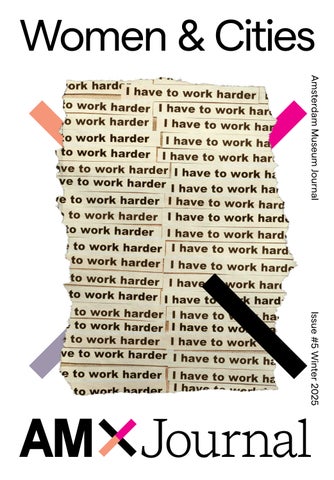
Women & Cities
Amsterdam Museum Journal
Issue #5 Winter 2025
Journal
Table of Contents About AMJournal
4
Cover image: Aukje Dekker
5
Interventions
6
Editors’ Note — Margriet Schavemaker, Emma van Bijnen 8 The Essays 14 Hermeneutical Resistance Against Street Harassment 16 Berlin as a Woman
34
Caroline May
Regulations, Transgressions and Female Spaces
54
Annick Gossen
Invisible Urban Belonging in Moscow
72
Liya Chechik
Rethinking Urban Space
96
Amsterdam Museum Journal
Annick Backelandt
Bahar Sakızlıoğlu and Ceren Lordoğlu
The Visual Essay 125 A Visual Essay on The Women of Amsterdam: An Ode Margriet Schavemaker and Mila Ernst
The Empirical Papers Silencing of Feminist Protest in Mexico City
150 152
Jorge Durán Solórzano
178
Issue #5 Winter 2025
Everyday Geographies of Girlhood Elpida Stratopoulou
The Polyphonic Object
206
Aynouk Tan, Eliza Steinbock, Roberto Luis Martins
The Polylogue
218
Margriet Schavemaker, Simon(e) van Saarloos, Nourhan Bassam, Katerina Gregos, Poornima Sukumar, Matylda Taszycka
244
Editorial Board
247
Special Thanks
248
For More on…
250
Upcoming Editions
252
Amsterdam Museum Journal
About the Contributors
Issue #5 Winter 2025
About AMJournal Amsterdam Museum Journal (AMJournal) is a (diamond) open access, peer reviewed research journal that is published twice per year on the Amsterdam Museum website (AMJournal | Amsterdam Museum). As the city museum of the eclectic capital of the Netherlands, the art and objects we show, the stories we host, and the societal issues that occupy us are complex by nature. This complexity requires a polyphonic approach; not one field or research can, or indeed should, tell the whole story. As such, rather than disciplinary, AMJournal is thematically oriented. Each calendar year, we publish editions that center on themes relevant to the cultural domain, public discourse and urban spaces, such as War, Conflict and the City (edition 1; October 2023), Deconstructing Gentrification (edition 2; Summer 2024), (Re)production (edition 3; Winter 2024), Co-creating our Cities (edition 4; Summer 2025), and Women and Cities (edition 5; Winter 2025 – current edition). Whilst AMJournal strictly publishes contri butions that meet its high standards, the aim is to make research publications accessible for both readers and authors. AMJournal therefore publishes peer reviewed con tributions by scholars in all stages of their research careers, from outstanding master students to the most lauded full professor (and anyone in between). In addition, we publish essays and research papers by authors from all disciplines, from legal scholars to sociologists and from historians to economists. By centering on a theme rather than a discipline, complex issues are approached from various angles; demonstrating that it is through a polyphony of perspectives that we advance academic discourses. In short, multidisciplinary research is not merely encouraged, it is at the core of the Amsterdam Museum Journal.
To support scientific multivocality and offer a platform for various disciplines, AMJournal is modular, meaning each edition may include a combination of the following contribution types: 1. The Short Essays: short form texts in which authors succinctly defend topical thesis statements with proofs. 2. The Long Essays: long(er) texts in which authors defend topical thesis statements with proofs. 3. The Empirical Papers: qualitative and/or quantitative data analyses, or research papers. 4. The Dialogue: a conversation between the guest editor and another renowned scholar in their field on questions relevant to the edition theme. 5. The Polylogue: a thematic roundtable con versation with expert voices from various fields, from academic to artists, and from journalists to activists. 6. The Polyphonic Object: short complemen tary analyses by scholars from different disciplines of a single thematic object from the Amsterdam Museum collection. 7. The Visual Essay: a printed exhibition in which the analyses are based on images, which are then analyzed empirically and/ or by means of a theoretical framework. All contributions are published in English and written according to strict author guidelines with the broader academic- and expert community in mind. Each AMJournal edition and each separate contribution is freely downloadable and shareable as a PDF-file (amsterdammuseum.nl/journals). To further aid accessibility, for both authors and readers, AMJournal does not charge readers any subscription- or access fees, nor does it charge authors Article Processing Charges (APCs).
Cover image
5
Amsterdam Museum Journal
Aukje Dekker (1983) Woman on Top, 2022 Amsterdam Museum, purchased 2022
Issue #5 Winter 2025
Since 1917, women in the Netherlands have been able to stand for election. Yet it was not until a century later that Amsterdam got its first female mayor, Femke Halsema. Artist Aukje Dekker pasted thousands of paper strips onto a large photo collage of portraits of Amsterdam mayors, until the men behind them disappeared. The words “I have to work harder” appear on the strips. Does Halsema need to work harder than the men who preceded her? And does this declaration also refer to a society that is moving ever faster, or to a self-critical view of one’s own perfor mance?
Interventions
6
In this journal edition, selected commissioned artworks serve as interventions to refresh readers as they navigate the content. Whether reading front to back, reverse, or browsing for eye-catching pieces, this edition aims to captivate through these artistic interventions. The edition's colors and textures draw directly from these artworks, creating an immersive experience for academically exploring Women and Cities. Flip to each artwork for its contents, motivation, and background.
Mounira Al Solh
p. 10
Charlott Markus
p. 12
Tyna Adebowale
p. 120
Jan Hoek & Duran Lantink
p. 122
Amsterdam Museum Journal
The Amsterdam Museum's exhibition Vrouwen van Amsterdam – een ode (December 2024– June 2025) presented artworks challenging societal ideals and women's representation. From tapestries depicting rights demon strations to light-reflecting pieces, these works encouraged visitors to reflect on untold stories of women—broadly defined—locally and globally. The exhibition included thematic cabinets featuring contemporary artists' specially commissioned works.
Issue #5 Winter 2025
Interventions
7
p. 148
Mounira Al Solh
p. 204
Danielle Alhassid
p. 216
Çiğdem Yüksel
p. 240
Amsterdam Museum Journal
Sarah van Sonsbeeck
Issue #5 Winter 2025
Yamuna Forzani p. 242 & Céline Hurka
Editors’ Note
8
Dear Readers,
Issue #5 Winter 2025
Furthermore, this edition features voices from peers and professionals in the cultural sector. The above mentioned multidisciplinary studies are supplemented by an international round table on the relationship
Amsterdam Museum Journal
We are proud to present the fifth edition of the Amsterdam Museum Journal (AMJournal) ‘Women and Cities’. Women have always shaped the way cities are formed and how they function. From the visible shaping of urban spaces by artists and architects to the more hidden impact by community builders, mothers and writers. Although women have been essential in creating urban landscapes, as well as communities and meanings, the stories and studies about cities still often (solely) focus on male influences and experiences. Edition #5 of the AMJournal, focuses on women’s relationships with urban environments through the diverse ways in which women influence cities and, in turn, how cities shape their lives. The result is a layered and multidisciplinary polyphony that examines women’s opportunities, traumas and accomplishments through essays, papers, object analyses, and more. As this theme is truly universal, the contributions to this issue reflect this prevalence: from invisible urban belonging in Moscow to adolescent girls’ spatial appropriation in Stockholm; from Berlin as a women in 20th century German poetry to street harassment in the 21st century; from female spaces in late medieval Amsterdam to the silencing of women’s protests in Mexico City following the glitter revolution.
Editors' Note
9
between women, cities and art; multiple object analyses of an object by Aynouk Tan; as well as a visual essay on the project ‘Women of Amsterdam – an Ode’, in which the stories of women were collected and added to the Amsterdam Museum collection.
Yours sincerely, Prof. dr. Margriet Schavemaker Edition Guest Editor
Amsterdam Museum Journal
We would like to thank our contributors and readership for their continued engagement. AMJournal is a growing platform and network of likeminded scholars, who understand the need to move beyond a single discipline or perspective when trying to deconstruct complex themes such as ‘women and cities’. Your involvement continues to inspire.
Dr. Emma van Bijnen Editor-in-Chief
Issue #5 Winter 2025
Those who are not scared, 2024
Mounira Al Solh This textile artwork honors the women who protested against the Lebanese government on Amsterdam’s Dam Square in 2020. The demonstration occurred 100 days after Lebanon’s 17 October Revolution began in 2019. Protesters demanded fundamental changes to the economic and political system, challenging corruption and gender-based harassment. At the time, women in Iraq and Chile were staging similar protests. Mounira Al Solh (1978) created a series of stitched works after participating in the Lebanese Revolution. The protests in Lebanon were met with repression, and many dem onstrators were shot, prosecuted, or subject to violent arrests. During her time in Amsterdam, Al Solh observed a powerful sense of solidarity among protesters from the Netherlands, Lebanon, Iraq, and Chile. The artwork incorporates protest slogans in Arabic, including “From Holland to Lebanon” and “Those who are scared, can’t create freedom.” It particularly highlights the role of women, who stood at the forefront of the revolution. Photo credits: Gert Jan van Rooij
Partition #9 (Sphere for Thea), 2024
Charlott Markus The installation Partition #9 (Sphere for Thea), by visual artist Charlott Markus (1974), evolved out of her friendship with Thea Bakker, an Amsterdam local since 1970. The chair is the same as Thea’s beloved chair where she would sit while listening to music at her home in Amsterdam West. That spot holds significance in Markus’s memories of her friend. The chair symbolizes a safe space to listen and reflect. Surrounded by soft tapestries, the installation invites you to sit down and listen to a sound piece with stories and thoughts of the artist and Thea’s loved ones, including her best friend Ans, brother Bart, sister Gerda, niece Floor, and life partner Ella. Thea, born Theodore, underwent a long journey toward self-acceptance. In the 1970s she was active in the Transvestism and Transsexuality Working Group. In this installation, Markus contemplates topics such as loss, identity, equality, kindness, and truly seeing one another. Photo credits: Peter Tijhuis
The Essays
14
Amsterdam Museum Journal
Issue #5 Winter 2025
Index
Hermeneutical Resistance Against Street Harassment
15
16
Annick Backelandt
Berlin as a Woman
34
Regulations, Transgressions and Female Spaces
54
Annick Gossen
Invisible Urban Belonging in Moscow
Amsterdam Museum Journal
Caroline May
72
Liya Chechik
Rethinking Urban Space
96
Bahar Sakızlıoğlu and Ceren Lordoğlu Issue #5 Winter 2025
The Essays
Amsterdam Museum Journal
Filling the Gaps: Hermeneutical Resistance Against Street Harassment
16
Authors Annick Backelandt
Discipline Philosophy
Keywords
Doi doi.org/10.61299/aS1408rekvl
Issue #5 Winter 2025
Hermeneutical Injustice / Hermeneutical Resistance / Street Harassment / Sexism / Racism
Hermeneutical Resistance Against Street Harassment
17
Abstract
Amsterdam Museum Journal
This essay explores hermeneutical resistance against street harassment. Street harassment is among those significant harms that impact the lives of many women in urban areas worldwide. I employ the framework of hermeneutical injustice to examine how women resist hegemonic interpretations of street harassment that obscure its normative properties. I argue that the dominant understanding of street harassment trivialises its harm and neglects its racial dimension. In turn, I explore various acts of hermeneutical resistance by women who have worked to make this harm intelligible in its manifestation as both a gendered and a racialised harm. In particular, I highlight #YouOkSis as an online act of hermeneutical resistance that theorises the meaning of street harassment on the intersection of race and gender. Through hermeneutical resistance, women protest how street harassment is understood and legitimised and, in doing so, reclaim their right to the public space.
Issue #5 Winter 2025
Hermeneutical Resistance Against Street Harassment
Amsterdam Museum Journal Issue #5 Winter 2025
Introduction A significant part of the lives of many people unfolds in cities. As such, urban spaces constitute a societal unit that influences many aspects of our lived experiences. However, by design, cities are not neutral spaces. Instead, they are shaped by, and reflective of, social power relations present in society at large (Jarvis 2014). This realises that the urban operates as a site where systems of power are continuously enacted, shaping perceptions on who belongs and who does not. Among such manifestations of power is street harassment, a significant harm that impacts the lives of many women worldwide. In the Netherlands alone, two in three women between the age of 12 and 25 report having experienced street harassment (CBS 2022). Internationally, this number may be significantly higher. In 2015, a survey across forty-two cities on various continents found that 84% of women experienced harassment before reaching adulthood (Livingston 2015). Fortunately, this type of harassment has received momentum in the last two decades, sparking anti-harassment initiatives to improve the safety of women in the public space.1 In this essay, I focus on the epistemic aspect of this resistance. Taking street harassment as a key example, I explore the various ways in which women engage in narrating practices that challenge the hegemonic white and patriarchal epistemic frameworks through which life in the city is understood. By sharing experiences of street harassment, women not only protest the explicit harm of being harassed in the public space but also protest how street harassment is understood and legitimised, in turn shaping the meaning of street harassment in the broader epistemic framework. In this essay, I employ the hermeneutical injustice framework to set out how women resist hegemonic interpretations of street harassment that obscure its normative properties. While the hermeneutical injustice literature offers substantial work on sexual harassment, which is a canonical example of hermeneutical injustice following Fricker’s analysis of the harassment of Carmita Wood, the topic of street harassment remains underdeveloped (2007). This is in line with broader academic attention for gender violence, in which street harassment is often subdued in the issue of sexual harassment (Logan 2015). While sexual harassment rightly commands significant scholarly interest, treating street harassment as a mere subset of sexual harassment risks overlooking the particular spatial nature of street harassment that is central to the experiences of women who live it. This essay adds to the literature by offering normative scrutiny of street harassment through the lens of hermeneutical injustice, with a particular
18
Hermeneutical Resistance Against Street Harassment
“Unwanted comments, gestures, and actions forced on a stranger in a public place without his or her consent that are directed at the person because of his or her actual or perceived sex, gender, gender expression, or sexual orientation.” (2015, 2).
Issue #5 Winter 2025
A Spatial Manifestation of Power Relations The term street harassment is an umbrella term referring to various types of public harassment on the spectrum of gender-based violence. While definitions of street harassment differ, it is commonly understood as a type of gender-based public sexual harassment against women by male perpetrators (Fileborn & O’Neill 2023). For this study, I rely on the slightly more nuanced definition of street harassment as proposed by Holly Kearl, who defines street harassment as:
Amsterdam Museum Journal
focus on women’s acts of hermeneutical resistance. In this essay, I argue that hegemonic systems of meaning promote a skewed interpretation of street harassment that trivialises its harm and limits intersectional under standing. In turn, I explore acts of hermeneutical resistance by women who have worked to make this harm intelligible in its manifestations as both a gendered and a racialised harm. The examples analysed in this essay focus on an Anglophone context and draw primarily from anti-harassment initiatives of United States-based communities. However, it is crucial to acknowledge that women all over the world are engaging in initiatives to challenge street harassment. Take, for instance, Blank Noise in India. Founded by Jasmeen Patheja, Blank Noise is fighting street harassment and victim-blaming in India since 2003. Similarly, HarassMap offers victims of street harassment in Egypt a platform for sharing testimonies on an interactive map. These are but two examples of the many acts of resistance that are currently working to address street harassment globally. Together, these initiatives reinterpret street harassment and empower women to reclaim the public space. This essay proceeds as follows. First, I focus on street harassment as a harm particular to urban life. Second, I employ the hermeneutical injustice framework to explore the interpretative challenge that victims of street harassment may face. Third, I argue that despite improved language for expressing street harassment, dominant interpretations of street harass ment remain shaped by hegemonic frameworks that centre whiteness. Finally, I explore #YouOkSis as an act of hermeneutical resistance against the white-centred epistemic framework of the street harassment discourse.
19
Hermeneutical Resistance Against Street Harassment
Amsterdam Museum Journal
“Street harassment is tied to imbalances of power between the victim and the harasser that result from broader oppressive systems such as patriarchy, racism, heteronormativity, and cisnormativity.”
20
Issue #5 Winter 2025
Hermeneutical Resistance Against Street Harassment
Amsterdam Museum Journal Issue #5 Winter 2025
In turn, street harassment can take on multiple forms, including verbal harassment (e.g. unsolicited sexual remarks, unwanted conversation), non-verbal harassment (e.g. honk-horning or staring) or physical harassment (e.g. touching, blocking someone’s path, or assault). As the focus of this study is women’s hermeneutical resistance against street harassment, I focus on street harassment that targets women. However, it is important to note that street harassment does not always manifest as a gender-based harm and can, and in fact does, affect people of all genders. Moreover, it is important to note that while street harassment is often sexual, street harassment is not about sexual attraction. In the words of Hawley Fogg-Davis; “just as rape is not about sex, street harassment is not about flirtation or courtship” (2006, 65). Instead, street harassment must be understood as a way of asserting power and dominance (Kearl 2015; Fogg-Davis 2006; Hutson & Krueger 2018). Street harassment is tied to imbalances of power between the victim and the harasser that result from broader oppressive systems such as patriarchy, racism, heteronormativity, and cisnormativity. Laura Logan (2015) has argued that street harassment is a mechanism to assert male dominance of the public space and of the bodies of women and other marginalised identities who exist in it. In this light, street harassment is a way for an aggressor to exercise a degree of power over their victims and over the public space, shaping who belongs in the urban and to whom the urban belongs. While street harassment is not restricted to the urban arena, certain conditions of urban life allow street harassment to occur structurally. One of these conditions is simply that cities offer more opportunities for street harassment by virtue of high demographic density (Kearl 2015). Another reason is women’s relation to the public space and the centrality of this public space in urban life. Women have traditionally suffered formal and social exclusion from the public space. This exclusion is both spatial (e.g. being denied access to parliamentary galleries) and discursive (e.g. being denied the right to engage in public deliberation) (Fraser 1990). Even with formal restrictions lifted in many cultures, gendered social exclusion remains embedded in the idea of the public space as a male-dominated terrain. Women, and especially women marginalised along multiple identity axis, have a higher visibility in public spaces, which creates a vulnerability to harassment. What adds to this is the central place that public spaces inhabit in urban life. The urban fabric comes together through a network of public spaces. These public spaces (e.g. sidewalks, parks, and soccer fields) fulfil important social functions for people in urban areas
21
Hermeneutical Resistance Against Street Harassment
The Harm without a Name In the introduction of her influential book about street harassment, Holly Kearl expresses a tension between her experience with harassment in public spaces and the socially dominant meaning of that experience. She writes:
Amsterdam Museum Journal
(Latham & Layton 2019). The accessibility of public spaces realises limited regulation over behaviour and a degree of anonymity, which allows public spaces to become the site of street harassment. Another urban condition impacting street harassment is urban mobility. Many forms of street harassment require physical proximity of the harasser to the victim, where the harasser can enjoy a degree of anonymity. In this regard, the city offers many sites of transit where proximity occurs daily. For instance, many reports of street harassment attest to victims being on buses, subways, or trains (Hutson & Krueger 2019). In addition to sites of public transportation, street harassment often occurs in highly walkable areas (ELSherief & Belding 2015), where harassers may follow their victim throughout the city (Hutson & Krueger 2019). It follows that while street harassment does not only occur in cities, certain conditions of urban life allow street harassment to occur regularly. In turn, the city becomes the background against which this harm impacts the lives of many women.
22
“Growing up, I rarely talked about street harassment with anyone. I did not even know the term. Like many young women, I had been told by family members, friends, and society in general that this behaviour was ‘‘a compliment.’’ I did not see my experiences in the larger context of women’s inequality in society or piece together how many of us can’t go about our daily lives without men objectifying, insulting, or threatening us. I didn’t realize that so many of us restrict our access to public spaces in an attempt to stay safe and free from harassment”. (2010, xx). Issue #5 Winter 2025
The tension described here shows a dissonance between the normative significance of experiencing street harassment and the resources available for interpretation. Here, the concept compliment does not seem fitting as it does not adequately express Kearl’s experience as harmful. This dissonance thus seems to stem from a particular inability to express the experience of street harassment in a way that makes sense to her: not as a trivial remark
23
or a compliment but as a serious harm that structurally impacts the safety of women in public spaces. What is lacking in these available interpretative resources is the normative judgement that street harassment is wrong. As a result, an interlocutor is impaired in linguistically expressing the harm done to her. This is what Miranda Fricker has called a ‘hermeneutical injustice’ (2007). Hermeneutical injustice is among the two paradigm cases of ‘epistemic injustice’ that Fricker identified in the context of hegemonic speech. 2 Hermeneutical injustice occurs when a person has “some significant area of one’s social experience obscured from collective understanding owing to hermeneutical marginalization” (Fricker 2007, 158). This impairment results from unfair access and contribution of marginalised knowers to the collective interpretive resources, which are biased towards the interpretation of those situated in a position of privilege. This encourages a skewed interpretation of reality, for instance, when sexual harassment is described as flirting (Fricker 2007), or when, in the case of Kearl, street harassment is described as a compliment. The upshot of such bias in the available interpretative resources is that marginalised knowers are impaired in expressing reality in a meaningful way. In turn, harms that are obscured through hermeneutical injustice risk going uncontested. To protest street harassment and consequently have that speech act recognised as an act of protest, a normatively fitting concept referring to street harassment has to be accessible to an interlocutor and be accepted by society as a recognised interpretative resource. Importantly, marginalised knowers engage in various acts of shaping and sharing meanings to challenge this interpretative bias. This type of resistance has been defined by José Medina as ‘hermeneutical resistance’, referring to “the phenomenon in which a dissident voice rebels against mainstream voices” (2012, 209). This type of interpretative action overcomes communicative disablement by bringing obscured experiences into the light, in turn making them recognisable as having been obscured from the collective meaning. In what follows, I examine how women engage in hermeneutical resistance by challenging dominant interpretations of street harassment, thereby claiming interpretive authority, and reshaping the meaning of street harassment.
Amsterdam Museum Journal
Resistance through Naming As recognised by Fricker (2007), naming constitutes an important act in which marginalised knowers contribute to the understanding of obscured experiences. Coining the term sexual harassment allowed victims of sexual
Issue #5 Winter 2025
Hermeneutical Resistance Against Street Harassment
Hermeneutical Resistance Against Street Harassment
Amsterdam Museum Journal Issue #5 Winter 2025
harassment to make sense of their shared experiences, in turn opening up the possibility of legal redress. The importance of naming street harassment has been noted by several scholars writing on the topic. Deirdre Davis (1994) stresses the importance of naming street harassment in legitimising its harm. Without a name, a harm risks going uncontested. Moreover, without a name with the right normative properties, street harassment risks being trivialised. For instance, terms like ‘street remarks’ or ‘hassling’ trivialise the harmful nature of street harassment (Laniya 2005). As such, naming helps reveal street harassment as a collective harm that can be placed in broader systems of gender oppression, in turn contributing to social and legal recognition (Fileborn 2014). Before naming can be a proxy for recognition, it has to receive uptake in the broader speech community. In the last two decades, street harassment has received significant momentum. However, before this, the term street harassment, first formally used by Michaela di Leonardo in 1981, remained largely confined to academic and activist discourse with limited circulation beyond those spheres (Kearl 2015). As such, while the term street harassment existed, it was not readily available in the broader epistemic framework. Therefore, many victims of street harassment lacked access to the term for articulating their experiences. It is important to note that while naming a harm can indeed be an important proxy for social recognition, the absence of an established term does not wholly keep those affected from understanding their experience (Mason 2011). While Fricker has argued that hermeneutical injustice undermines the marginalised knower in understanding her own experiences, others have challenged this view, suggesting that the primary harm lies instead in not being able to make her understandings intelligible to dominant knowers (e.g. Mason 2011; Pohlhaus 2012; Medina 2012). This self-understanding of the marginalised knower is crucial to acknowledge, as it forms the basis for the acts of hermeneutical resistance discussed below. As such, even when dominant interpretative resources do not facilitate the interpretation of street harassment as harmful, women have long been trying to make this meaning intelligible. This is underscored by the many acts of protest against street harassment that happened long before di Leonardo coined the term. For instance, in the United States, the ‘antiflirt club’ was active in Washington D.C, around 1920, and in 1970, women working on Wall Street staged the ‘Wall Street Ogle-In’, where they directed sexualized comments at men as a means of protest (Kearl 2015).
24
Hermeneutical Resistance Against Street Harassment
Amsterdam Museum Journal
“Theorising misogynoir is an important act of hermeneutical resistance that provides a concept for violence on the intersection of race and gender.”
25
Issue #5 Winter 2025
Hermeneutical Resistance Against Street Harassment
26
The uptake of the term street harassment by scholars, activists and organisations suggests that there is at least some acceptance of the term street harassment as a common interpretative resource. This growing recognition of street harassment is, in part, due to the many women who have shared their experiences on platforms such as Right To Be and Stop Street Harassment. 3 While this uptake can rightly be perceived as an important step in protesting street harassment, part of the ongoing struggle for meaning is not just developing new terms but also demanding the recognition of interpretations that lie outside of the dominant narrative. In the next section, I argue that the single-axis interpretation of street harassment as a gendered harm obscures how race impacts street harassment.
Amsterdam Museum Journal Issue #5 Winter 2025
Street Harassment as a Racialised Harm While street harassment affects women of all demographics, discussions on this topic often centre around white women as the victims of harassment (Johnson 2019). For instance, media reportages often frame victims of street harassment as “attractive, young, white, straight women in big cities who wear high heels and short skirts” (Kearl 2015, 18). This framing is not limited to mainstream media reportage. The street harassment awareness video 10 Hours of Walking in NYC as a Woman which aired in collaboration with Hollaback! in 2014, shows a white woman being harassed almost exclusively by men of colour. This framing feeds into pervasive stereotypes about race and sexual violence by perpetuating the stereotype that men of colour prey on white women. This exemplifies how whiteness is centred as the point of reference in anti-street harassment narratives. Relying on a solely gendered interpretation of street harassment disregards the impact of race on lived experiences of street harassment. It obscures the fact that for many women, street harassment manifests as both a gendered and a racialised harm. Women of colour are sexualized along both their racial and their gender identity, realising persistent stereotypes about sexual availability that underly violence towards women of colour (Fogg-Davis 2006; Clark 2024). For instance, the Jezebel stereotype forms an archetype that portrays Black women as promiscuous, immoral, and manipulative. This archetype, as well as spin-offs such as ‘hood rat’ or ‘hoochie mama’, promote a hypersexualised image heavily rooted in the colonial objectification and othering of Black women (Coley 2024). These stereotypes realise that street harassment may occur as a racialised harm in ways implicit (e.g. when sexualized racist stereotypes shape a harasser’s perception of women of colour), or explicit (e.g. when sexualized racist slurs are uttered). Moya Bailey (2021) coined the term misogynoir
Hermeneutical Resistance Against Street Harassment
Issue #5 Winter 2025
#YouOkSis as Hermeneutical Resistance The aftermath of Feminista Jones’ viral 2014 tweet about street harassment offers a compelling case of hermeneutical resistance in practice. While witnessing a man harassing a Black woman on the street in New York, Jones intervened by asking the woman if she was okay. After sharing this moment on Twitter, the hashtag YouOkSis received significant uptake. What initially started as a conversation between Jones and her followers soon grew into an online movement where women theorised street harassment on the intersection of race and gender. For instance, Jones tweeted “A natl study on SH barely involved urban BW. It did not reflect OUR experiences & conflicts with cultural affinity and police. #YouOkSis?” (Feminista Jones 2014, cited in Rentschler 2017). Additionally, @TheTrudz, who played a crucial role in amplifying the movement, tweeted “When others harass me as a BW, it’s anti-Blackness/misogynoir. Non-Black communities have to face their own misogyny as well. #YouOkSis?” (TheTrudz 2014, cited in Rentschler 2017). Importantly, #YouOkSis transcended the single-axis focus of the dominant anti-street harassment narrative by fostering an online space for the retelling of street harassment that centres the voices of women of colour. In doing so, it enabled a collective narrating practice of resistance in which the meaning of street harassment was renegotiated to include the impact of race. By theorising street harassment on the intersection of race
Amsterdam Museum Journal
in 2008 to refer to the particular violence on the intersection of sexism and anti-Black racism. As Bailey argues, misogynoir combines anti-Black racism with sexism to devalue Black women along both their racial and their gender identity. Misogynoir, particularly in a United States context, manifests in various ways, including stereotypical representations in the media, demonisation in welfare campaigns, and a structural vulnerability to healthcare abuse (Bailey 2021). Theorising misogynoir is an important act of hermeneutical resistance that provides a concept for violence on the intersection of race and gender. As in the cases described by Bailey, harassers target women of colour because of their combined racial and gender identity. However, the dominant interpretation of street harassment as a gendered harm does not reflect this meaning. This continues to shape the understanding of street harassment along hegemonic systems of meaning, which neglect the impact of race and the theorisation of intersectional violence by women of colour. In the next section, I take the Twitter-based YouOkSis movement as an example of how women of colour challenge this narrative.
27
Hermeneutical Resistance Against Street Harassment
Amsterdam Museum Journal
“#YouOkSis constitutes a speech act that protests both street harassment in the public space and the white-centred framework through which that experience is dominantly interpreted.”
28
Issue #5 Winter 2025
Hermeneutical Resistance Against Street Harassment
Amsterdam Museum Journal Issue #5 Winter 2025
and gender, #YouOkSis revealed the interpretative bias embedded in the dominant anti-street harassment narrative that obscures the fact that street harassment is racialised, as well as gendered. As such, by engaging in collective online discussion, women participating in the YouOkSis movement challenged the hegemonic interpretation of street harassment, which perpetuates an understanding of the world rooted in whiteness. In addition to renegotiating meaning through discussion, #YouOkSis provides a hermeneutical tool to articulate street harassment as impacted by race. Hashtags can be a way of performing speech acts without having to rely on dominant meanings that are attached to existing conceptual resources. This may foster uptake of marginalised meanings, akin to how metaphors may contribute to hermeneutical resistance by articulating meaning without having to engage in the full linguistic articulation of that meaning (Ney 2024). In turn, hashtags constitute a way of meaning-sharing that goes beyond existing conceptual resources. An example that has shown this in global magnitude is the MeToo movement. MeToo, initiated by Tarana Burke, has been used to protest sexual harassment in response to the viral uptake of #MeToo. Where this hashtag initially underscored testimonies of victims of sexual harassment, the hashtag has arguably become an interpretive resource in and of itself. When proclaiming ‘MeToo’, an interlocutor shows solidarity with other victims while also sharing in a broader narrative of surviving and protesting sexual harassment. This way, the hashtag has become a ‘narrative signifier’, which symbolises the total of individual testimonies of victims of sexual harassment (Dawson 2020). #MeToo illustrates that hashtags can constitute acts of hermeneutical resistance by providing people with a conceptual resource for expressing marginalised experiences. While not enjoying the global uptake of #MeToo, #YouOkSis offers a hermeneutical tool that women of colour can build their narratives about street harassment with. This also applies to offline contexts where #YouOkSis offers a script for bystanders to intervene in street harassment, as exemplified by this tweet “Shout out to the chick and two dudes who #YouOKSis’d me tonight when a dude wouldn’t leave me alone downtown ATL tonight”(@Dammit_Woman 2017, cited in Johnson 2019). In this sense, online narrating practices such as #YouOkSis challenge dominant epistemic frameworks by creating space to shape and share discussions with marginalised meanings. This creates friction, which exposes limitations in the dominant interpretations of street harassment. As such, #YouOkSis constitutes a speech act that protests both street harassment in the public space and the white-centred framework through which that experience is dominantly interpreted.
29
Hermeneutical Resistance Against Street Harassment
Amsterdam Museum Journal
Conclusion In this essay, I have explored women’s hermeneutical resistance against street harassment. Street harassment is a harm regularly occurring in urban environments, which constitutes a mechanism through which power over the public sphere is asserted. Despite being a serious harm, street harassment often remains understood through hegemonic systems of meaning that support patriarchal interpretations. Even when trivialization and victim-blaming are fought, for instance by anti-street harassment campaigns, the dominant interpretation of street harassment as a gender-based harm obscures how other identity axis impact street harassment. A purely gender-based interpretation neglects the structural impact of racism on violence against women of colour. Throughout this essay, I have highlighted several acts of hermeneutical resistance in which women shape, reinterpret and share meanings of street harassment. In doing so, women protest both street harassment as a harm impacting urban life and the hegemonic frameworks through which that harm is interpreted. In particular, I have highlighted the YouOkSis movement as an act of hermeneutical resistance in which women of colour engaged in an online collective narrating practice to reshape the meaning of street harassment to include experiences on the intersection of race and gender. This resistance is crucial, as it challenges dominant interpretations that obscure street harassment and its normative properties. By resisting hegemonic interpretations, women protest how street harassment is understood and legitimised and, in doing so, reclaim their right to the public space.
30
Issue #5 Winter 2025
Hermeneutical Resistance Against Street Harassment
Amsterdam Museum Journal
“‘Shout out to the chick and two dudes who #YouOKSis’d me tonight when a dude wouldn’t leave me alone downtown ATL tonight’ (@Dammit_Woman 2017, cited in Johnson 2019).”
31
Issue #5 Winter 2025
Hermeneutical Resistance Against Street Harassment
References
Amsterdam Museum Journal Issue #5 Winter 2025
Bacharach, Sondra. “Finding Your Voice in the Streets: Street Art and Epistemic Injustice.” The Monist, vol. 10, no. 1, 2018, pp. 31–43, doi.org/10.1093/monist/ onx033. Bailey, Moya. Misogynoir Transformed: Black Women’s Digital Resistance, New York University Press, 2021. Clark, Meredith. We Tried to Tell Y’All: Black Twitter and the Rise of Digital Counternarratives, Oxford University Press, 2025. Coley, Jagniah. “Death of the Jezebel: Black Women’s Resistance to the Jezebel Archetype within Media.” The Sociological Imagination: Undergraduate Journal, vol. 9, no. 1. 2024, pp 1-5. Davis, Deirdre. “The Harm That Has No Name: Street Harassment, Embodiment, and African American Women.” UCLA Women’s Law Journal, vol. 4, no. 2, 1993, pp. 133-178. Dawson, Paul. “Hashtag narrative: Emergent storytelling and affective publics in the digital age.” International Journal of Cultural Studies, vol. 23, no. 6, 2020, pp. 968–983. doi.org/10.1177/1367877920921417. ElSherief, Mai, and Belding, Elisabeth. “The Urban Characteristics of Street Harassment: A First Look.” Proceedings of the 1st International ACM SIGSPATIAL Workshop on Smart Cities and Urban Analytics, 2015, pp. 28–31. doi.org/10.1145/2835022.2835027. Fileborn, Bianca, and O’Neill, Tilly. “From “Ghettoization” to a Field of Its Own: A Comprehensive Review of Street Harassment Research.” Trauma, Violence, & Abuse, vol. 24, no. 1, 2023, pp. 125–138, doi.org/10.1177/15248380211021608. Fileborn, Bianca. “ONLINE ACTIVISM AND STREET HARASSMENT: DIGITAL JUSTICE OR SHOUTING INTO THE ETHER?” Griffith Journal of Law & Human Dignity, vol. 2, no. 1, 2014, pp. 32-51, doi. org/10.69970/gjlhd.v2i1.569. Fogg-Davis, Hawley G. “Theorizing Black Lesbians within Black Feminism: A Critique of SameRace Street Harassment.” Politics & Gender, vol. 2, no. 1, 2006, pp 57-76, doi.org/10.1017/ S1743923X06060028. Fraser, Nancy. “Rethinking the Public Sphere: A Contribution to the Critique of Actually Existing Democracy.” Social Text, no. 25/26, 1990, pp 56–80. doi.org/10.2307/466240. Fricker, Miranda. Epistemic Injustice, Oxford University Press, 2007. Hutson, Ashley Colleen Feely, and Krueger, Julie Christine. “The Harasser’s Toolbox: Investigating the Role of Mobility in Street Harassment.” Violence
Against Women, vol. 25, no. 7, 2019, pp. 767–791, doi.org/10.1177/1077801218804100. Jarvis, Helen. “Transforming the Sexist City: Non-Sexist Communities of Practice.” AnALize: Journal of Gender and Feminist Studies, vol. 3, no. 17, 2014, pp. 7–27. Johnson, Paige.” “You Ok Sis?” Black Vernacular, Community Formation, and the Innate Tensions of the Hashtag.” In Feldman, K., ad De Kosnik, A. (eds), # identity: Hashtagging Race, Gender, Sexuality, and Nation, pp. 57-67, University of Michigan Press, 2019. Kearl, Holly. Stop Street Harassment: Making Public Places Safe and Welcoming for Women, Bloomsbury Publishing USA, 2010. Kearl, Holly. Stop Global Street Harassment, Praegar, 2015. Laniya, Olatokunbo Olukemi. “Street Smut: Gender, Media, and the Legal Power Dynamics of Street Harassment, or Hey Sexy and Other Verbal Ejaculations.” Columbia Journal of Gender and Law, vol. 14, no. 91, 2005, pp. 91-131. Latham, Alan & Layton, Jack. “Social infrastructure and the public life of cities: Studying urban sociality and public spaces.” Geography Compass, vol. 13, no. 7, 2019, pp. 1-15, doi.org/10.1111/gec3.12444. Livingston, Beth. “ILR and Hollaback! Release Largest Analysis of Street Harassment to Date.” The ILR School, 10 June. 2015, ilr.cornell.edu/workerinstitute/blog/publications-0/ilr-and-hollabackrelease-largest-analysis-street-harassment-date. Logan, Laura. S. “Street Harassment: Current and Promising Avenues for Researchers and Activists.” Sociology Compass, vol. 9, no. 3, 2015, pp. 196–211, doi.org/10.1111/soc4.12248. Mason, Rebecca. “Two Kinds of Unknowing.” Hypatia, vol. 26, no. 2, 2011, pp. 294–307, doi.org/10.1111/ j.1527-2001.2011.01175.x. Medina, José. “Hermeneutical Injustice and Polyphonic Contextualism: Social Silences and Shared Hermeneutical Responsibilities.” Social Epistemology, vol. 26, no. 2, 2012, pp. 201–220, doi.org/10.1080/02691728.2011.652214. Ney, Milan. “Metaphors and hermeneutical resistance.” European Journal of Philosophy, vol. 32, no.1, 2024, pp. 159–178, doi.org/10.1111/ejop.12839. Pohlhaus, Gaile. “Relational Knowing and Epistemic Injustice: Toward a Theory of Willful Hermeneutical Ignorance.” Hypatia, vol. 27, no. 4, 2012, pp. 715–735, doi.org/10.1111/j.1527-2001.2011.01222.x. Reep, Carin., Akkermans, Math., & Kloosterman, Rianne. “Straatintimidatie van jongeren.” Centraal Bureau voor de Statistiek, 1 Feb. 2022, cbs.nl/nl-nl/longread/ statistische-trends/2022/straatintimidatie-vanjongeren.
32
Hermeneutical Resistance Against Street Harassment
Rentschler, Carrie A. “Bystander intervention, feminist hashtag activism, and the anti-carceral politics of care.” Feminist Media Studies, vol. 17, no. 4, 2017, pp. 565–584. doi.org/10.1080/14680777.2017.1326556.
33
Endnotes For instance, see the work of Stop Street Harassment, Right To Be (formerly Hollaback!) and HarassMap.
2
Since the topic of this essay is hermeneutical resistance, I will bypass the concept of testimonial injustice in this discussion, which happens when a speaker is not given warranted credibility due to a hearer’s identity prejudice (Fricker 2007). This does not mean that testimonial injustice does not occur in the context of street harassment, for instance, see Bacharach 2018.
3
Hollaback! had city-specific platforms based in 84 western cities before its centralisation in 2022, including Hollaback! Amsterdam, Hollaback! Melbourne, Hollaback! London and Hollaback! Berlin. These sites allowed victims of street harassment to share city-specific testimonies of street harassment. Currently existing alternatives on the level of the city include StreetSafe (London) and Safer for Girls (Barcelona, Madrid & Seville).
Amsterdam Museum Journal
1
Issue #5 Winter 2025
The Essays
Amsterdam Museum Journal
“Berlin, du deutsche deutsche Frau” Berlin as a Woman in Twentieth-Century German Poetry
34
Authors Caroline May
Discipline German Literary Studies
Keywords
Doi doi.org/10.61299/tre1938Rkt8
Issue #5 Winter 2025
Berlin / Poetry / Gender / Feminization / Personification
Berlin as a Woman
35
Abstract
Amsterdam Museum Journal
This article examines the feminization of Berlin in twentiethcentury German poetry, exploring how gendered personifications of the city negotiate historical change and emotional attachment. While Berlin’s literary representations have received extensive critical attention, their gendered dimensions remain under– explored. Through close readings of Gertrud Kolmar’s Wappen von Berlin (1927/28), Hildegard Knef ’s “Berlin, dein Gesicht hat Sommersprossen” (1966), and Wolf Biermann’s Berlin, du deutsche deutsche Frau (1962) and Mein Kiez (1998), the analysis demonstrates that feminization serves as a recurring but historically adaptable strategy through which writers articulate the city’s conflicting identities as maternal, domestic, eroticized, or violated. Spanning the Weimar period, postwar reconstruction, and Cold War division, these texts reveal how Berlin’s poetic imagination binds urban history to gendered embodiment and translates political upheaval and social transformation into affective experience.
Issue #5 Winter 2025
Berlin as a Woman
Amsterdam Museum Journal Issue #5 Winter 2025
Throughout the twentieth century, Berlin has served as both a backdrop and a protagonist in German literature.1 Prose texts such as “Berlin Alexanderplatz” by Alfred Döblin, “Das kunstseidene Mädchen” by Irmgard Keun, “Fabian. Die Geschichte eines Moralisten” by Erich Kästner, and “Wir Kinder vom Bahnhof Zoo” by Christiane Felscherinow portray the city in its shifting political and social registers. Poetry, too, has long engaged with Berlin, particularly in the early twentieth-century genre of Großstadtlyrik, or metropolitan poetry, as seen in Morgenstern’s “Berlin”, Heym’s “Berlin I/II/III”, and Boldt's “Auf der Terrasse des Café Josty”. Each of these texts emphasizes different aspects of Berlin: “as a centre of prosperity, as the birthplace of Modernism, as the home of a knowledge society and, at the same time, as a dark location in the political history of Europe” (Berendse 2017, 246). Yet beyond these shifting depictions, Berlin’s literary presence also emerges as a gendered figure, a motif that this article examines across twentieth-century poetry. In recent scholarship on the literary representation of Berlin in the twentieth century, the human dimension of the city has emerged as one central focus that is also highlighted in Katharina Gerstenberger's study Writing the New Berlin (2008). One key aspect she identifies is the portrayal of Berlin as an erotic site. Within this thematic lens, she describes a development across the century. In literature of the Weimar period (1920s–30s), Berlin is frequently associated with sex work, which serves as a motif for the commodification of desire and the moral anxieties of the modern metropolis (Gerstenberger 2008, 26). In the 1960s, literary representations diverge along the lines of divided Germany: East German literature often stages romantic relationships across ideological boundaries, while West German texts imagine Berlin as a space of “political and sexual utopia” (Gerstenberger, 2008, 26). In the 1990s, following reunification, the city continues to be associated with eroticism, but now functions as a symbolic landscape through which to process historical rupture. Gerstenberger notes that these post-wall texts frequently employ “sexual imagery” (2008, 27) to negotiate the aftermath of division and the complexities of national transformation. However, Berlin remains a site in which characters engage in intimate or erotic relationships; a background to human experience. Gerstenberger also addresses how the city itself is imagined through bodily metaphors. She points to figurative language such as “traffic arteries” and “green lungs” (2008, 53) as examples of how the urban landscape is mapped onto the human body. This corporeal framing becomes particularly charged in post-unification literature, where representations of the deformed or fragmented body often serve as metaphors for the city’s own ruptured past. In this context, Berlin is described as “an ‘extraordinary’ urban body with
36
Berlin as a Woman
Amsterdam Museum Journal Issue #5 Winter 2025
a norm-defying history” (ibid., 55). Building on Gerstenberger’s reading of Berlin as an erotic site, this study shifts the focus from eroticism itself to its gendered configurations, asking how feminized personifications of the city articulate political and emotional meaning across historical contexts. In his chapter “Twentieth-Century Poetry,” Gerrit-Jan Berendse identifies the themes of “war, death and destruction” as “key ingredients in the history and identity of Berlin” (2017, 246). He highlights how poets such as Benn, Brecht, Braun, and Müller approach the city through aesthetic strategies that foreground disintegration and loss. These include grotesque corporeality, spectral imagery, intertextual dialogue with the dead, and the destabilization of ideological binaries. By transforming political violence and social change into poetic experience, the poems he analyzes construct what he calls “alternative histories of Berlin” (ibid., 247). While Berendse does not use the term himself, his discussion suggests an image of Berlin poetry as a palimpsest of memory and loss. While the literary representation of Berlin in twentieth-century poetry has been widely studied (see also Arnold 1999; Beutin et al. 2013; Benthien & Gestring 2023; Ishida 2025), the role of gender, particularly the feminized portrayal of the city, remains underexamined. This article addresses that gap by offering a comparative analysis of how feminized personifications of Berlin are constructed across different historical moments and lyrical voices. It examines four texts in chronological order: Kolmar’s Wappen von Berlin (1927/28), Knef ’s “Berlin, dein Gesicht hat Sommersprossen” (1962), and Biermann’s Berlin, du deutsche deutsche Frau (1962) and Mein Kiez (1998). This selection unites authors whose ambivalent relationships with Berlin were shaped by distinct political circumstances. Kolmar, born and raised in Berlin, was persecuted and murdered under National Socialism; Knef, who sought artistic opportunities abroad, repeatedly returned to a city marked by postwar reconstruction; and Biermann, who settled in the GDR, was later expelled from it. Their works thus provide complementary yet divergent perspectives on how the feminization of Berlin functions across historical and artistic boundaries. Through close readings, the article explores which traits are attributed to the gendered city, how agency is distributed, and how these representations intersect with memory, politics, and voice. By linking gendered figuration to poetic form and socio-political context, the analysis shows how these portrayals shape cultural understandings of Berlin as an emotional, historical, and ideological space. Ultimately, the article contributes to current debates in German literary studies by tracing how lyrical constructions of the feminized urban space offer relational models of identity and belonging.
37
Berlin as a Woman
Amsterdam Museum Journal Issue #5 Winter 2025
Kolmar (1894–1943), born Gertrud Käthe Chodziesner, was a Jewish poet who spent her early life in Berlin and was murdered in Auschwitz in 1943 (Czech 1989). As National Socialist policies increasingly excluded Jewish authors from public life, Kolmar’s work remained largely unpublished (Jäger 1998); only three of her collections appeared in print during her lifetime, among them Wappen von Berlin [Coat of Arms of Berlin2] which is part of the lyrical cycle Preußische Wappen [Prussian Coats of Arms], written in the winter of 1927/28 and published in 1934 (Kolmar 1991). The cycle reflects Kolmar’s idiosyncratic engagement with medieval Prussian city emblems, many of which were then circulating as commercial prints on coffee packaging (Schumann 2002). Her work is especially relevant for its deep connection to Berlin and its poetic voice emerging from historical marginalization. The poem begins with a heraldic description that directly reproduces Berlin’s traditional coat of arms: “In Silber, aufgerichtet, ein schwarzer Bär” [On silver, a black bear rampant] (Kolmar 1955, 262). This framing initially establishes the Wappenbär as an emblematic, static figure. But immediately, the text destabilizes this convention with a personified feminization: the bear begins to speak, and more crucially, becomes a female bear, a “Bärin”. This shift from symbolic animal to gendered narrator is subtle but profound. By combining animal and human-feminine traits, the poem constructs a hybrid figure that resists both heraldic abstraction and human identification. The feminized bear thus marks Berlin as radically other, a being situated between nature and civilization. The “Bärin” declares: “Ich habe sie getragen, / Die Stadt in meinem Schoße, Höhlenbrut.” [I carried her, / The city in my womb, cave-born.]. Here, the city of Berlin is not merely protected or represented by the bear but gestated by her, becoming biologically her offspring. The “Bärin” thus claims affective authorship over the city’s origins. The term “Höhlenbrut” [cave-brood] evokes multiple associations. It may reference the Höhlenbär [cave bear], an extinct species linked to hibernation and prehistoric life, situating the city’s emergence within a deep natural temporality. At the same time, its phonetic proximity to Höllenbrut [brood of hell] introduces a second, more threatening register. In German, Höllenbrut refers to demonic offspring, a term often used to describe forces of chaos or moral decay. This resonance subtly shifts the metaphor: Berlin’s origin is now also associated with latent danger, suggesting that beneath the surface of maternal care lies the potential for violence or disorder. But more importantly, Wappen von Berlin structures its poetics around a dual figuration of the city: the maternal “Bärin” and the cub she carries
38
Berlin as a Woman
Amsterdam Museum Journal
“In this context, Berlin is described as an ‘extraordinary’ urban body with a norm-defying history.”
39
Issue #5 Winter 2025
Berlin as a Woman
Amsterdam Museum Journal Issue #5 Winter 2025
and raises. Berlin is thus not simply feminized but configured through a maternal relation characterized by care and conflict, as will be shown in the analysis. This relational model of femininity extends beyond the mother figure and unfolds through the cub, who allegorically embodies the city’s growth. The consistent use of feminine pronouns such as “ihre Pranke” [her paw] may reflect the grammatical gender of die Stadt but also reinforces the poem’s logic of feminization. Kolmar’s decision to recast the heraldic bear as a female figure grounds Berlin’s emergence in a maternal body, making feminization as a structural condition of how the city enters poetic form. This gendered figuration of the city deepens as the poem shifts focus from the maternal “Bärin” to the cub she raises. From the outset, Berlin is cast not as an abstract idea but as a physical presence. The earlier image of the city carried “im Schoße” frames Berlin as a living being shaped through embodied and relational processes. The “Bärin[’s]” care is expressed through sensory detail: she rocks the cub with a “tiefen Brummen” [deep growl] and provides “Honigwachs” [honeywax] and “süßes Kraut” [sweet herbs]. These images evoke a mode of nurturing grounded in physical sustenance and environmental closeness. As the cub grows, she begins to act with increasing independence and force. Her paw now “scherzt mit blanken Schienen” [plays with shiny rails], and she chases insects across industrial surfaces. Annegret Schumann observes that in these later stanzas, two image worlds overlap: the playful cub becomes inseparable from the expanding city and its encroachment on rural life (Schumann 2002). The gesture of “scherzen” [to joke/play] may still suggest innocence, but the poem quickly reveals its violent undertone: “Sie droht und lockt. Die Forste hallen wider. / Das Singen unterm Bauerndach verstummt” [She threatens and entices. The forests echo. / The singing beneath the farmhouse roof falls silent]. What has begun as childlike play becomes a metaphor for the city’s disruptive expansion and the silencing of its rural surroundings. In the poem’s closing stanza, the focus shifts again to the “Bärin”, who now reappears as a cosmic figure, standing upright with limbs reaching toward the sky. She moves the “Wolkenblock, der überm Haupt ihr kracht” [cloud tower, which crashes above her head], a line that has led to controversial interpretations: while some critics read this action as another act of maternal protection (Woltmann, in Schumann 2002), Schumann argues that it may just as plausibly be read as an act of destruction directed towards the child who has become dangerous, the city that threatens its own environment (Schumann 2002). This ambiguity introduces a deeply
40
Berlin as a Woman
Amsterdam Museum Journal Issue #5 Winter 2025
conflicted maternal gesture: is the mother saving her child or punishing it for straying too far from nature? The final image introduces a visual and symbolic complexity: the snowflakes, “silbern eisige Gestirne” [silver icy stars], that melt onto the black fur of the “Bärin” suggest not renewal, but dissolution. As Schumann shows, this closing image may be read as a metaphor for self-fragmentation; the maternal Ich is both protector and destroyer, bound to the city by origin and endangered by its transformation (Schumann 2002). This double function of care and loss is intimately linked to a poetics of memory. The “Bärin” recounts moments of shelter and nurturing: “Ich habe sie getragen, / Die Stadt in meinem Schoße”, “Ich wiegte sie” [I rocked her], “Ich leerte Honigwachs” [I poured out honey-wax]. These are acts of remembering, written in past tense. The poem inscribes memory as an embodied, maternal knowledge that evokes a lost intimacy with a now unrecognizable city. The child, Berlin, becomes a projection of civilizational anxiety, both nurtured and threatened by the very forces that made her possible. Kolmar’s poem thus stages a double becoming: the “Bärin” grows into a cosmic figure, and the young city-bear into a dangerously autonomous force. Feminization here allows Berlin to be imagined not simply as a place, but as a body with a history that ultimately becomes estranged. The poem’s urban critique is not built on a binary opposition between nature and civilization, but on their interconnection. Through the overlay of maternal and urban imagery, the poem explores what it means for a city to grow up and for its growth to carry both memory and loss. In doing so, the poem reflects Weimar-era anxieties about the impact of urban growth and modernization, capturing a cultural climate marked by uncertainty about Berlin’s rapid transformation into a modern city. In contrast to Kolmar’s metaphorical transformation of Berlin into a she-bear, Knef ’s well-known song “Berlin, dein Gesicht hat Sommersprossen” (1966) [Berlin, your face has freckles] presents the city as a human figure from the outset. Knef (1925–2002) was a German star who “managed to transgress societal norms or expectations” (Bach 2022, 122). Raised in Berlin, she began her career during the war as a graphic designer in UFA’s special effects department while taking acting lessons (Bach 2022). She became “West Germany’s first postwar movie star” with her role in Die Mörder sind unter uns (1946) (Bach 2022,115). In the 1960s, Knef reinvented herself as a singer and later as a bestselling author. Her stage presence and lyrical sensibility were closely tied to her identification with West Berlin: “Like no other German actress [...] Knef has captured the imagination of West Berlin, and no other city captured her like Berlin” (Bach 2022, 123). Her
41
Berlin as a Woman
Amsterdam Museum Journal
“However, Berlin remains a site in which characters engage in intimate or erotic relationships; a background to human experience.”
42
Issue #5 Winter 2025
Berlin as a Woman
Amsterdam Museum Journal Issue #5 Winter 2025
song “Berlin, dein Gesicht hat Sommersprossen”, co-written with Charly Niessen in 1966, even reached the top of the charts. Given Knef ’s unique status as a cultural figure so closely tied to Berlin, the text of her song is a relevant case for examining the representation of Berlin in poetry of the 20th century. From the first stanza onward, Berlin is anthropomorphized through visual imagery. Physical features, especially those of the face, are emphasized: “dein Gesicht hat Sommersprossen”, “dein Mund ist viel zu groß” [your mouth is much too big], “deine Stirn hat Dackelfalten” [your forehead has dachshund wrinkles]. These images render the city as a concrete, bodily figure. More importantly, freckles, a large mouth, and facial wrinkles may suggest character, age, or emotional expression, but they do not clearly signal femininity or masculinity. Rather than beginning with an idealized or typified urban figure, the song presents Berlin as a visibly embodied entity marked by irregular features and recognizable physical human traits. In the third stanza, however, the speaker does introduce a clear gender marker: “Berlin, du bist die Frau mit der Schürze, an der wir unser Leben lang zieh'n.” [Berlin, you are the woman with the apron that we tug on all our lives.]. Addressing Berlin as “Frau mit der Schürze” marks a decisive shift. Berlin is no longer just a face, but a gendered figure. Yet this feminization is not abstract or allegorical. The image evokes a specific socio-cultural milieu. It links the city to working-class domesticity. In her study of women's clothing published in 2002, Elke Gaugele notes that the apron became symbolically charged as a visual expression of a bourgeois and petty-bourgeois ideal: “eine Ästhetik der Schlichtheit und Funktionalität insbesondere als Ausdruck von Moral, Fleiß und Tugendhaftigkeit” [an aesthetic of simplicity and functionality, especially as an expression of morality, diligence, and virtue] (Gaugele 2002, 186f). In this context, the apron functions as a metonym for care work, social reliability, and emotional labor. The feminization of Berlin, then, constructs the city as a sustaining and resilient presence within everyday life. The second half of the line “an der wir unser Leben lang zieh'n” further develops this feminization by adding a physical gesture of dependence and familiarity. It is children who mostly tug on a woman’s apron, whether out of affection, need, or habit. Read in this light, the image introduces a maternal dimension to Berlin’s personification. The city becomes a figure to which one remains attached, not through admiration, but through everyday reliance. This gesture evokes affective intimacy and embodied dependence, making the feminized city a site of continuity and security.
43
Berlin as a Woman
Amsterdam Museum Journal Issue #5 Winter 2025
In the song, Berlin is not glamorized or stylized; rather, it is framed through persistence and care. This becomes clear in the following lines: “du bist nicht schön, Berlin, nach Metermaßen, / doch wenn man dich liebt, dann liebt man dich sehr” [you are not beautiful, Berlin, by yardstick standards / but if one loves you, then one loves you deeply]. Knef ’s Berlin resists the logic of standardization and aesthetic judgment. The city is loved not despite her flaws, but because of them. This aesthetic of worn familiarity constructs Berlin not as a monumental or heroic figure, but as a lived-in urban subject, one whose value lies in endurance, not exceptionality. The feminization of the city not only shapes the portrayal of Berlin, but also the affective position of the lyric speaker. The lines “mein Gemüt kriegt Kinderaugen” [my spirit gets children’s eyes] and “mein Puls geht viel zu schnell” [my pulse beats far too fast] signal a physiological reaction. The city is not reflected upon from a distance but felt with the body. Through Berlin, the speaker experiences a form of emotional regression or a state of childlike perception. The feminization of Berlin thus enables a poetic logic of affective re-subjectification: the speaker becomes someone else in relation to the city. While Knef ’s feminization avoids eroticization and resists masculinist tropes, it remains bound to a traditional model of femininity. As Michaela Kuhnhenne has shown in her study of postwar gender norms, women’s roles in mid-century Germany were often determined by essentialist conceptions of gender. Emotionality, care, and self-sacrifice were seen as inherently feminine, while rationality and productivity were coded as masculine (Kuhnhenne 2005). In this light, the figure of the woman with the apron can be read as a poetic extension of postwar gender ideology: Berlin as a reliable and modest maternal figure whose value lies in being there for others. This complexity is heightened in the final lines of the song, where the speaker says: “nimmst du mich voller Selbstvertrauen / an dein verknautschtes Bärenfell” [you draw me with full confidence / against your crumpled bear fur]. The image of Berlin’s “Bärenfell” reintroduces the heraldic symbol of the city, linking Knef ’s song back to Kolmar’s she-bear figure. Here, the personified Berlin is rendered as both woman and bear, combining human tenderness with animal rawness. Both Kolmar and Knef employ maternal imagery to construct a feminized Berlin, yet they do so in markedly different ways. Kolmar’s “Bärin” is not a figure of unconditional nurture but one of ambivalent authority. While she gives life and watches over the city’s development, her relation to the Berlin cub also contains the threat of destruction, suggesting a maternal force that protects by delimiting or even extinguishing. Knef ’s portrayal,
44
Berlin as a Woman
Amsterdam Museum Journal Issue #5 Winter 2025
by contrast, draws on a softer domestic register. The image of “die Frau mit der Schürze” and the gesture of tugging at the apron evoke emotional labor and everyday attachment, hinting at a maternal role grounded in care and reliability. This reading is further supported by the speaker’s childlike response to the city, which casts Berlin as an anchor of affective security. In both lyrical texts, maternal personification plays a central role, yet its emotional and narrative functions diverge significantly. Born in Hamburg to Jewish communist parents, Biermann moved to the GDR in 1953 to attend a socialist boarding school (Biermann 2017). His father, an anti-fascist resistance fighter, had been murdered in Auschwitz (Steding 2023). While Biermann remained a committed socialist, his growing criticism of the GDR dictatorship and its distortion of socialist ideals led to severe censorship. As early as 1963, his performances were banned, and by 1965 he was officially prohibited from publishing or performing in the GDR (Biermann 2017). His songs and poems nonetheless circulated widely in West Germany, where he gained popularity among leftist audiences. In 1976, while on a concert tour in the West, Biermann was stripped of his GDR citizenship and forced into exile (Steding 2023). Therefore, his position as a voluntary East German citizen who was ultimately expelled grants his work a complex perspective on both East and West Berlin. Biermann’s poem Berlin, du deutsche deutsche Frau (1962) [Berlin, you German German woman], also released as a song, opens his poem collection of the same title published in 2008, a work that engages directly with the political and emotional fault lines of postwar Berlin. In the collec tion’s preface, Biermann describes Berlin not as a city in a geographical sense but as a shifting poetic object. While Biermann, like Knef, configures Berlin as a female human figure, his portrayal diverges from the maternal relationships evoked by Kolmar and Knef. Instead, he casts the city in the role of a romantic partner: “Berlin ist nun mal meine erste Liebe seit 1955,” he writes in the preface, “und die Stadt wurde meine alte Liebe, weil ich mich immer wieder neu in sie verliebt habe. Ach! solch eine kapriziöse Dauergeliebte muss der Poet bei mancher Gelegenheit neu besingen, verdichten und im Streit auch zerdichten” (Biermann 2008, 9). [Berlin has always been my first love since 1955 and the city became my old love because I kept falling in love with her all over again. Ah! such a capricious lifelong lover the poet must sing of anew, turn into poetry, and at times also dismantle through poetry.]
45
Berlin as a Woman
Amsterdam Museum Journal Issue #5 Winter 2025
Biermann thus frames lyric writing as both an act of attachment and resistance. The verb besingen, translated here as “to sing of,” does more than denote poetic description. It evokes the lyrical mode of praise, and carries connotations of 'Minnesang', the medieval tradition of courtly love poetry in which the poet sings to a distant, idealized noble beloved. But even though the speaker’s relationship to Berlin is initially framed within that register of admiration, the poem itself sharply diverges from such expectations. Rather than offering a poetic homage, it constructs a relationship marked by tension and contradiction. What begins as a gesture of intimacy becomes a site of unresolved conflict, where poetic language no longer idealizes but rather questions the very possibility of lyrical praise. The title of the poem itself establishes the foundation for a complex and conflicted relationship between the lyric subject and the city by employing feminized personification. Yet this is not done by attributing character traits to the city; rather, Berlin is anthropomorphized relationally. The city is addressed as a “du”, a second-person personal pronoun that places it in a dialogic position and gives the impression of intimacy and immediacy. However, Berlin does not respond. She is not granted agency but instead becomes a silent counterpart in a lyrical monologue that displays the speaker’s projections: desire, frustration, and ultimately dependence. The doubling of the adjective “deutsche deutsche Frau” (ibid, 11) is a subtle indicator of Berlin’s fragmented identity. The absence of a comma between the two adjectives suggests not emphasis but internal division. On a political and historical level, the phrase condenses Berlin’s unique position during the Cold War: a city claimed simultaneously by the Federal Republic of Germany (FRG) and the German Democratic Republic (GDR). The doubled “deutsche” signals a compound national identity and conflicting ideological affiliations, pointing to the tensions embedded within the German state itself. This linguistic doubling functions as a compressed metaphor for the Cold War condition of Berlin: not simply two halves of one whole, but two versions of Germanness colliding in a single urban space. While the poem anticipates the reader’s expectation of affectionate expression, it systematically undermines it. Rather than celebrating Berlin’s beauty, the speaker catalogs her physical shortcomings: “Ach, deine Hände sind so rauh” [oh, your hands are so rough], “Ach, deine Hüften sind so schmal” [oh, your hips are so narrow], “Ach, deine Küsse sind so schal” [oh, your kisses are so bland]. These descriptions, introduced by exclamations, would typically serve to heighten emotional intensity. Yet here, they signal rejection rather than admiration. The choice of adjectives - rough, narrow, bland - conveys physical unattractiveness, even repulsion. Berlin is neither
46
Berlin as a Woman
Amsterdam Museum Journal
“The city is loved not despite her flaws, but because of them. This aesthetic of worn familiarity constructs Berlin not as a monumental or heroic figure, but as a lived-in urban subject, one whose value lies in endurance, not exceptionality.”
47
Issue #5 Winter 2025
Berlin as a Woman
Amsterdam Museum Journal Issue #5 Winter 2025
idealized nor eroticized. This inversion of idealizing conventions can already be found in Renaissance love poetry, for instance in Shakespeare’s Sonnet 130, and belongs to the (anti-)Petrarchan tradition. As Heather Dubrow points out, Petrarchism and its counter-discourses are not merely about love but also about power and politics (Dubrow 2018,10). Biermann’s poem reactivates this intersection, transforming the rhetoric of desire into a critique of social and political disillusionment. The text thus not only mocks the traditional poetic mode of besingen but turns that mode into a vehicle of social and emotional critique. What emerges is a parody of love poetry, and by extension, a critique of Berlin itself. This emotional dissonance is mirrored structurally and thematically through a pattern of Berlin as a place of contrasts: wide streets and narrow hips (Biermann 2008, 11), ice and fire (ibid), and consequently desire and rejection. Despite the consistent criticism and lack of romantic idealization, the speaker ultimately confesses: “Ich kann nicht weg mehr von dir gehn” [I can’t leave you anymore]. This declaration demonstrates the poem’s central paradox. Berlin, though unattractive and estranged, retains an emotional hold on the speaker. At the same time, the statement resonates literally in the historical context of 1962, when the recently erected Berlin Wall rendered physical departure impossible. Biermann thus stages attachment as both emotional dependency and material constraint, fusing personal and political captivity. One phrase in particular captures this dynamic: the speaker calls himself a “kühler Freier” [a cool suitor]. This oxymoron gestures toward emotional detachment within the rhetorical framework of love. The “Freier" suggests someone who courts, but the adjective “kühl” implies distance, perhaps even bitterness. The speaker enacts a role that is conventionally associated with longing but empties it of warmth. This friction between emotional posture and emotional content is mirrored in the poem’s language itself, which oscillates between lyrical intensity and blunt dismissal. Ultimately, the feminized personification of Berlin in Biermann’s poem has a critical function: it allows the speaker to address the city as an intimate counterpart shaped by historical and emotional forces. This move draws on a long literary tradition of feminizing nations such as Marianne as the symbol of the French Republic, or Germania in nineteenth-century German nationalist iconography. In Biermann’s version, however, the feminized city is neither glorified nor romanticized. Similar to Knef 's portrait, Berlin is portrayed as worn down and unattractive, yet she remains emotionally charged. The gendered framing introduces a dynamic of uneven intimacy: the city is addressed, criticized, even desired, but she has no
48
Berlin as a Woman
Amsterdam Museum Journal Issue #5 Winter 2025
voice of her own. This asymmetry reflects both the speaker’s conflicted attachment and the broader tensions of Cold War Berlin, a city caught between ideologies and identities. Through the figure of the “deutsche deutsche Frau,” Biermann captures Berlin as a site of divided belonging and unresolved emotional ties. In contrast to the feminization of Berlin as a “deutsche deutsche Frau,” Biermann’s poem Mein Kiez [My Neighborhood] constructs the city in relation to a specific historical moment. Although published in 1998, the poem retrospectively situates its first stanza in the immediate postwar period, during the Allied occupation. This historical setting is not described from a distance but rendered through the intensity of poetic language. The first stanza opens with a fourfold invocation: “Berlin Berlin Berlin Berlin” (Biermann 2008, 94). This repetition of Berlin reflects the postwar division of the city among the four Allied powers: Soviet, American, British, and French. Each “Berlin” functions as a synecdoche for a sector, underscoring the geographical fraction of the city as well as its identity shaped by occupying forces. Contrary to Berlin as “deutsche deutsche Frau”, the terms of Berlin's gendering have shifted drastically. In Biermann's earlier poem, Berlin is addressed by a “Hochzeitsfreier”, a suitor seeking her hand in marriage. The “Freier” is the lyric speaker himself, who approaches the city. In Mein Kiez, by contrast, the same term returns in its other sense: “Freier” as the client of a prostitute. This time, Berlin is not courted but labeled “das Hitlerflittchen” [Hitler’s tart] and sexually assaulted by the four Allied powers who occupy the city. In this context, the term “Hitlerflittchen” operates as a provocative neologism that fuses two contrasting registers: political association and sexualized degradation. The word Flittchen is a derogatory term for a promiscuous woman, suggesting moral looseness and social disgrace. In this compound with the reference to Hitler, the term positions Berlin as a woman who had entered into a disreputable relationship, thus implicating the city in the ideological and moral corruption that enabled the atrocities of the Nazi regime. The formulation does not suggest active political agency, but rather a tainted intimacy; Berlin as a city seduced by or willingly complicit in fascism. This configuration echoes broader cultural metaphorizations of German history. In Das Sexuelle in der deutsch-deutschen Vereinigung (1991), Konrad Weller uses a similarly gendered and sexualized metaphor to describe reunification: “die Braut, einst DDR-Volk geheissen,” is “ein bisschen verführt, ein bisschen gewaltsam in Besitz genommen” [the bride, once called the GDR people, is somewhat seduced, somewhat violently taken possession of] (Weller 1991, 8). He describes their relationship as “halb zog er sie, halb sank sie hin” [half he pulled her, half she sank down], which conveys a dynamic of reluctant
49
Berlin as a Woman
Amsterdam Museum Journal Issue #5 Winter 2025
submission and ambiguous complicity (ibid.). While not referring to Berlin directly, Weller’s image highlights how national transformation is repeatedly cast in terms of feminized vulnerability. Biermann’s “Hitlerflittchen”, though emerging from a different historical moment, similarly reflects this fusion of national history with the tropes of seduction and ambiguous complicity. The following imagery in Mein Kiez is deliberately graphic. Berlin is “gevierteilt” [quartered], “gefesselt” [tied up], and sexually assaulted: “Auch sie rissen der zerrissnen Stadt / Den Rock hoch und runter die Hosen” [They too yanked up the torn city’s skirt and yanked down its trousers]. Biermann employs poetic devices that heighten this brutality. The chiasmus “Den Rock hoch und runter die Hosen” intensifies the gesture’s obscenity; the polyptoton “rissen der zerrissnen Stadt” doubles the violence through sound and syntax; and enjambement accelerates the pace, mimicking the force of the act itself. Even ironic phrases like “manierliche Sitten” [polite manners] and “elegante Franzosen” [elegant Frenchmen] add a layer of bitter sarcasm. Between the two Biermann poems, the “Freier” as Berlin's counterpart has shifted from lyric speaker to aggressor. This semantic inversion mirrors the transformation of Berlin itself: no longer an object of conflicted affection, she becomes the site of coercion and conquest. Through this reversal, Biermann translates the collapse of postwar ideals into an image of sexualized domination, turning Berlin’s feminization into a metaphor for collective violation and the loss of political agency. As Katharina Graßmann (2002) notes, the metaphor of the raped woman, while not unique to this period, takes on a particular cultural function in the postwar imaginary. She identifies it as a “zeittypische Erfahrung” [typical experience of the time] and a “Massenschicksal” [collective fate] that shaped literary representations of the 1950s (Graßmann 2002, 88). Biermann draws on this topos not to document historical events but to convert them into aesthetic experience. In addition, Graßmann argues that postwar depictions of sexual violence were often used to reframe German women as collective victims and, by extension, to position the German people themselves in a narrative of victimhood: “In diesem Sinne wurden [...] die Massenvergewaltigungen instrumentalisiert zu einem Gewaltverbrechen an der gesamten deutschen Bevölkerung” [In this sense, the mass rapes were instrumentalized as a crime against the entire German population] (Graßmann 2002, 88). Berlin in Biermann's Mein Kiez embodies this transference from individual trauma to national allegory. This rhetorical move distinguishes Mein Kiez from other literary engagements with rape in the urban context of Berlin. Gerstenberger (2008), in her reading of Inka Parei’s novel Die Schattenboxerin (1999), examines a nar-
50
Berlin as a Woman
51
rative in which the violation of a woman, occurring in West Berlin shortly before the fall of the Wall, becomes entangled with the changing cityscape. While the novel closely links personal trauma with the transforming urban environment, the city itself remains a setting, not the subject of violation. As Gerstenberger writes,
Issue #5 Winter 2025
In Mein Kiez, by contrast, the metaphor is pushed further: the feminized city becomes the violated figure itself. This transformation from backdrop to embodied poetic subject marks a shift in how sexual violence is used to allegorize national experience. In Berlin, du deutsche deutsche Frau, the lyric subject actively engages with Berlin as their addressee. In Mein Kiez, however, the lyric subject withdraws from direct identification. Instead of speaking to or for the city, the speaker adopts a critical and distanced perspective. Rather than expressing empathy or mourning, the speaker uses stark and graphic language depicting its sexual violation by the occupying powers to expose the brutal consequences of war and political domination. The tone is deliberately unsentimental; there is no idealization of the victim or glorification of the victors. Instead, the speaker uses irony and linguistic compression to underscore the violence of Hitler's regime and the Allies’ postwar occupation. Terms such as “manierliche Sitten” and “elegante Franzosen” are deployed ironically to highlight the dissonance between civilized appearance and violent action. The poem does not position the speaker as a defender of Berlin, but as a voice that critically reflects on both the city’s complicity and the external aggression it suffers. This ambivalent position neither romanticizes nor absolves; it instead renders visible the moral contradictions of postwar power structures and the symbolic violence embedded in Berlin’s division. Thus, the feminization of Berlin in Mein Kiez functions as a rhetorical strategy to expose political violence and historical trauma. By depicting the city as a prostituted and violated woman, Biermann translates the geopolitical fragmentation of Berlin into a bodily experience. This metaphor draws on a broader postwar discourse that, as Graßmann notes, recasts real and
Amsterdam Museum Journal
“Parei responds to the semantic construction of the city as female from the perspective of the violated woman,” but “her novel […] is not a political allegory of Berlin’s division and unification but the story of a woman who draws on the urban landscape to narrate her experience of violation and recovery” (Gerstenberger 2008, 36).
Berlin as a Woman
Amsterdam Museum Journal Issue #5 Winter 2025
often silenced experiences of rape into a symbol of collective suffering. Biermann's use of feminization does not offer resolution or redemption; instead, it creates a poetic space where the tension between political responsibility and lived experience becomes perceptible. Viewed comparatively, all four texts illustrate how feminized personifications of Berlin serve distinct poetic functions, shaped by historical context and the affective positioning of the speaker. Kolmar constructs Berlin as a she-bear with a maternal presence that both embodies and exceeds normative femininity. Her “Bärin” enacts care and protection, yet these gestures carry an ambivalent force, merging nurture with authority and potential destruction. She shelters, nourishes, and watches over the city’s development, ultimately persisting beyond its transformation. In Knef ’s poem on the other hand, Berlin becomes not an abstract or mythic figure, but a domestic one. Feminization here grants the city an affective reliability, linking it to a postwar ideal of care and familiarity, even as this image remains ideologically conservative. In Biermann’s Berlin, du deutsche deutsche Frau, the feminized Berlin takes on the role of a lover that is estranged, yet impossible to abandon. Whereas in Mein Kiez, feminization takes the form of violent sexualization: Berlin appears as a prostituted woman subjected to domination by the Allied powers. While the former mobilizes gendered imagery to express conflicted belonging, the latter employs it to expose the structural violence of occupation. Although the analyzed corpus is limited, it spans different historical moments across the twentieth century and includes both poetry and song, revealing how gendered figuration serves as one means of articulating Berlin’s changing identity. In the texts by Kolmar and Knef, both female authors, the city is cast in maternal or domestic terms that foreground care and resilience, while in Biermann’s work, feminization becomes a medium for expressing desire, estrangement, and political critique. Taken together, these examples show how Berlin’s literary imagination draws on conventional models of femininity yet adapts them to register specific historical conditions, from Weimar modernity to postwar reconstruction and the Cold War divide. Read against the broader tradition of Berlin poetry, these works demonstrate how twentieth-century (song-)writers use feminization to translate political upheaval and social transformation into affective experience.
52
Berlin as a Woman
References
der westdeutschen Nachkriegszeit, VS Verlag für Sozialwissenschaften, 2005, pp. 163–287, doi.org/10.1007/978-3-322-80742-7_5. Parei, Inka. Die Schattenboxerin, Schöffling, 1999. Schumann, Annegret. „Bilderrätsel“ statt Heimatlyrik: Bild und Identität in Gertrud Kolmars Gedichtsammlung Das Preußische Wappenbuch, Iudicium, 2002. Steding, Elizabeth Priester. “Reading (About) Wolf Biermann.” GDR Literature in German Curricula and Textbooks, Springer Nature Switzerland, 2023, pp. 101–27, doi.org/10.1007/978-3-031-39051-7_5. Webber, Andrew, editor. The Cambridge Companion to the Literature of Berlin / Edited by Andrew J. Webber, University of Cambridge, Cambridge University Press, 2017. Weller, Konrad. Das Sexuelle in der deutsch-deutschen Vereinigung: Resumée und Ausblick, Forum Verlag, 1991.
Endnotes 1
2
The quotation “Berlin, du deutsche deutsche Frau” (“Berlin, you German German woman”) is the title of the poetry collection by Wolf Biermann (2008) and the titular poem (1962) that will be discussed in this article. All translations from German are my own unless otherwise noted.
Amsterdam Museum Journal Issue #5 Winter 2025
Arnold, Heinz Ludwig. Lyrik des 20. Jahrhunderts, Ed. Text + Kritik, 1999. Bach, Ulrich. “The Woman Between: Hildegard Knef ’s Movies in Cold War Berlin.” Berlin Divided City, 1945-1989, edited by Sabine Hake and Philip Broadbent, vol. 6, Berghahn Books, 2022, pp. 115–24, doi.org/10.1515/9781845456573-013. Benthien, Claudia, und Norbert Gestring. Public Poetry : Lyrik Im Urbanen Raum, 1st ed., Walter de Gruyter GmbH, 2023, doi.org/10.1515/9783110784701. Berendse, Gerrit-Jan. “Twentieth-Century Poetry.” The Cambridge Companion to the Literature of Berlin, Cambridge University Press, 2017, pp. 245–63, doi.org/10.1017/9781107449466.015. Beutin, Wolfgang, u. a. Deutsche Literaturgeschichte. Achte, Aktualisierte und Erweiterte Auflage, J.B. Metzler, 2013, doi.org/10.1007/978-3-476-00813-8. Biermann, Wolf. Berlin, du deutsche deutsche Frau Gedichte, 1st ed., Hoffmann und Campe, 2008. Biermann, Wolf. Warte nicht auf bessre Zeiten! Die Autobiographie. Ullstein, 2017. Czech, Danuta. Kalendarium der Ereignisse im Konzentrationslager Auschwitz-Birkenau 1939 - 1945. 1. Aufl., Rowohlt, 1989. Dubrow, Heather. Echoes of Desire : English Petrarchism and Its Counterdiscourses Heather Dubrow, Cornell University Press, 2018, doi.org/10.7591/9781501722844. Gaugele, Elke. Schurz und Schürze Kleidung als Medium der Geschlechterkonstruktion, Böhlau, 2002. Gerstenberger, Katharina. Writing the New Berlin: The German Capital in Post-Wall Literature. 1st ed., vol. 21, Boydell & Brewer, 2008, doi.org/10.1515/9781571138101. Graßmann, Ellen. Frauenbilder im deutschen Roman der fünfziger Jahre, Peter Lang, 2004. Imenes Ishida, Lia. Vor und nach dem Weltende Ich, Masse und Mensch in der expressionistischen Lyrik. 1st ed. 2025, Springer Berlin Heidelberg, 2025, doi.org/10.1007/978-3-662-70676-3. Jaeger, Gudrun. Gertrud Kolmar Publikations- und Rezeptionsgeschichte, Campus-Verl., 1998. Knef, Hildegard. & Niessen, Charly. Berlin, dein Gesicht hat Sommersprossen. Musikverlag Johann Michel GmbH & Co. KG, 1966. hildegardknef.de/Texte/ berlindeingesicht.htm Kolmar, Gertrud. Das lyrische Werk. Schneider, 1955. Kolmar, Gertrud. “Zwei Briefe an Walter Benjamin.” Sinn und Form, 43(1), 1991, pp. 122–24. Kuhnhenne, Michaela. “Frauenleitbilder der Nachkriegszeit.” Frauenleitbilder und Bildung in
53
The Essays
54
Best e Paper Priz Edition #5
Amsterdam Museum Journal
Regulations, Trans gressions and Female Spaces: Women in the Urban Environment of Late Medieval Amsterdam (1413-1512) Authors Annick Gossen
Discipline History
Regulation / Resistance / Medieval / Amsterdam / Female Spaces
Doi doi.org/10.61299/Fko1302mItt
Issue #5 Winter 2025
Keywords
Regulations, Transgressions and Female Spaces
55
Abstract
Amsterdam Museum Journal
Women in late medieval Amsterdam had a significant presence in and left their mark on the city’s urban environment. Yet, medieval society’s gendered thinking and moral anxieties greatly affected how and where women existed in public space. Women’s public presence was a constant source of tension for urban authorities. Using ‘keurboeken’ (law books) for the period of 1413 to 1512, I explore this tension and the city council’s attempted spatial regulation of women in Amsterdam’s streets, markets and (semi-) public spaces. I utilize the ‘corrections’ women received upon violating spatial regulations to show how they resisted and asserted themselves to exist in the city’s space. Finally, I analyze the Amsterdam’s ‘female spaces’: a remarkably close concentration of women’s religious houses. I ultimately argue that the city council’s desired spatial control was never absolute and that Amsterdam’s medieval female spaces shaped the cityscape in ways that can still be felt today.
Issue #5 Winter 2025
Regulations, Transgressions and Female Spaces
Issue #5 Winter 2025
Women and Gender in Medieval Urban Space Medieval urban societies produced their own public spaces, created and shaped by the ideas and social activities of their inhabitants. These spaces, in turn, influenced medieval people’s behaviour. Many different factors contributed to their production, with ideas and activities surrounding gender being just one of those, but it was a factor with significant influence on how women’s public lives could play out (Ardener 1981; Lefebvre 1991; Hanawalt & Kobialka 2000; Spain 2006). Daphne Spain (1992), for example, has argued that status differences between women and men create certain types of gendered spaces. Spatial segregation, in her view, is a mechanism enabling a group with greater power (men) to maintain its advantage over a group with lesser power (women)—a theory that can be applied to late medieval cities.
Amsterdam Museum Journal
Introduction1 When the canals froze during fifteenth-century Amsterdam’s harshest winters, the city council saw fit to combat this. Armed with axes, hooks and other destructive gear at the authorities’ behest, the people organized in groups and set out to communally break the ice in their own neighbourhoods. This activity did not, however, involve the entire urban community. It was the duty of eighteen- to sixty-year-old men. All townswomen were conspicuously absent. Their exclusion was not total, as rich widows and well-off women from female-headed households were expected to compensate their neighbourhood’s group leader monetarily. Nevertheless, women were unquestionably denied a presence within this public workspace on the basis of their sex (Breen 1902, 113-116, 210).2 The situation described above is indicative of the way gender relations played out in late medieval Amsterdam’s public spaces, as well as the city council’s need to regulate how women existed in urban space. Although the city council attempted to regulate the public behaviour of both sexes, its legislation often targeted women as a group and tried to restrict, constrain and control their presence in streets, market squares and public buildings. In this essay, I trace the gendered spatial regulation carried out by Amsterdam’s city council between 1413 and 1512, meandering through its cityscape to shed light on its varied regulatory practices. I also examine women’s resistance to the exclusionary measures aimed at them—which I call their ‘spatial transgressions’—and how women created ‘female spaces’ despite having their environment’s cards stacked against them. I ultimately argue that the city council’s desired spatial control was never as absolute as it would have liked and that Amsterdam’s medieval female spaces shaped the cityscape in ways that can still be felt today.
56
57
The realm where medieval urban spaces were formally, institutionally regulated—in civic offices and positions of urban authority—was often closed to women, although women most certainly participated and were visible in urban public life, in different ways depending on time and place. In general, the urban spaces medieval societies produced were influenced by dominant ideas and discourses regarding gender and women. They reflected contemporary beliefs and ideals of how men and women should behave in public. Men commonly designed and regulated public spaces without women’s formal involvement. Their moral anxieties about women’s independent activities in city streets subsequently affected how women were ‘allowed’ to exist in public, leading to explicit gendering of city space. For instance, medieval city councils across Europe, fuelled by religious convictions, often worried women’s presence in certain city spaces would lead to undesirable sexual contact and sought to prevent this. Urban legislators hoped to contain the ‘risks’ women posed to individual citizens and their city’s reputation. Medieval women’s behaviour in public space was therefore at least partially influenced by formal legislation, although their use of space undoubtedly also reflected personal motives and considerations: for example, awareness of vulnerability to rape and the loss of reputation they could suffer (Ardener 1981; Rees Jones 2013; Rubin 2020). The primary source material I use to study late medieval Amsterdam, law books and criminal sentences, are flawed windows into the urban-spatial considerations of medieval women themselves. What they best make visible is how the city council thought: who and what had to be regulated, why, and how should it happen? (Groen 2010). These sources are therefore great for tracing how Amsterdam’s city council attempted to regulate women spatially and what (gender-related) anxieties compelled it to undertake action. In some cases, women’s spatial transgressions—how they resisted measures against them—also become visible. As the ‘gendering’ of space was subtle and varied by time and place (Rees Jones 2013), a closer look at source material from Amsterdam itself is needed to shed light on the situation there. I will proceed to examine a variety of public spaces within late medieval Amsterdam to show male authorities’ spatial regulation of women and women’s spatial transgressions in response.
Amsterdam Museum Journal
From the Streets… Throughout the fifteenth century, Amsterdam’s urban authorities took measures to keep women off the streets when they found their ubiquitous presence undesirable. Occasionally, this seems to have been motivated by legitimate concerns for women’s physical safety. When urban legislators ordered
Issue #5 Winter 2025
Regulations, Transgressions and Female Spaces
Regulations, Transgressions and Female Spaces
Amsterdam Museum Journal Issue #5 Winter 2025
women, children and strangers away from the streets while male citizens geared up to defend against attacks (Breen 1902, 4463), it is hard to imagine a good reputation was all they felt was at stake. The city council also seems to have been aware of the threats women might face in the streets, like unwanted attention from shady individuals. A law passed in 1478 mentions that women in the streets at night, alone or with a male chaperone, risked being attacked by drunken strangers (Breen 1902, 1354). Legislators attempted to end this by prescribing stricter punishments for offenders rather than trying to curtail women’s nocturnal movements or emphasizing increased supervision by male chaperones. This implies it was infeasible to expect women to vacate the streets entirely at night and that there were valid reasons for them to be out and about at late hours, even unsupervised. There were also, however, situations where the city council clearly did view curtailing women’s street presence as feasible and necessary, despite there being no clear indications they faced more risks than men. As I have shown at the start of this essay, women were excluded from physically contributing to the communal de-icing of the canals. Similarly, in 1504, the city council decided women and children were no longer allowed to help douse the flames when fires tore through Amsterdam—a common occurrence at the time. Disobeying this order could result in punishment. The fact that this law was repeated in 1510 suggests it was not dutifully followed since its first passing; yet, the attempt at spatially regulating women is significant. As with the de-icing, no explicit rationale for it is provided, but the sudden change must have been brought on by increased gendered moral anxieties rather than threats to women’s safety posed by fires themselves, as it is most unlikely those burned hotter than in the fifteenth century (Breen 1902, 411, 481;5 Van Tussenbroek 2023). The attempted restrictions of women’s activity in Amsterdam’s public battles against fire and ice seem more aimed at limiting male-female contact in irregular, potentially chaotic situations. Despite spatially regulating the roles women could play in the city’s service, the city council pushed women into alternative contributions to maintaining urban order and safety. After all, female-headed households incapable of providing men for canal de-icing were expected to provide monetary compensations. Widows and single women, unable to send husbands who could fulfill city guard duties, had to find men to send in lieu of them. And when the 1510 restriction of women’s firefighting rolled about, the city council ordered every female religious community to make two dozen water buckets and keep them in their convents for emergency use in the same breath. In a slightly different vein, the city council also ‘encouraged’ women’s efforts in keeping Amsterdam immaculate: maidservants who did
58
Regulations, Transgressions and Female Spaces
59
“Men commonly designed and regulated public spaces without women’s formal involvement.” Amsterdam Museum Journal Issue #5 Winter 2025
Regulations, Transgressions and Female Spaces
60
not properly clean the streets and gutters surrounding their households on Saturdays and holy days could be fined (Breen 1902, 340, 440, 478, 487, 5006). Amsterdam’s urban authorities, then, recognized and encouraged female contribution to maintaining the city’s public spaces. Yet, concerns for women’s physical safety, but more importantly, gendered moral anxieties attached to public male-female intermingling, fed their desire to regulate this contribution spatially where feasible, with varying degrees of success.
Amsterdam Museum Journal Issue #5 Winter 2025
...To Market Spaces... Even if the city council would have liked to maximally restrict women’s public presence, there existed areas in town where it simply could not. Women’s labour was an important part of late medieval Amsterdam’s urban economy and often took place in the streets. When the city council tried to restrict women’s right to merchant trade in 1492, it notably exempted women working in the cloth, hospitality and food industries. E. Tas (1938) even suggested a food industry without women’s labour would have been unthinkable in premodern Amsterdam. The city housed a considerable amount of avid saleswomen and hucksters. It therefore seems women already had the ineradicable urban presence as street sellers they have been shown to have in early modern times (Breen 1902, 262-263; Van den Heuvel 2016). Market spaces in general were highly spatially regulated, as Danielle van den Heuvel (2016) has shown in her book chapter on the premodern markets of Holland and England. While she draws primarily on early modern material, factors of time, space and gender will not only have become relevant post-1500, as the copious amounts of late medieval market regulations included in Breen (1902) illustrate. Concerns about food shortages, quality problems and challenges to public order posed by large crowds will have harried late medieval and early modern authorities alike. Because of women’s omnipresence in Amsterdam’s market spaces, restrictions on street-selling disproportionately affected them. They subsequently racked up many economic-spatial transgressions, which accounted for the majority of female-committed crime: the amount of women corrected for such offenses numbered almost thrice that of men (Boomgaard 1992). Female fishmongers and food retailers, for example, regularly bought fish and other foodstuffs for resale before it was officially allowed at nine A.M. This constituted a temporal transgression, but also their trespassing into a space they were not meant to be in at that time. Similarly, women got fined for setting up shop outside of permitted spatial boundaries, like in the streets rather than in front of their home (Van Dillen 1929).
Regulations, Transgressions and Female Spaces
Amsterdam Museum Journal Issue #5 Winter 2025
Whether these spatial restrictions were intentionally gendered is up for debate. Van den Heuvel raises the question if temporal-spatial regulations like the ones mentioned deliberately targeted women and the poor, but formulates no clear answer. Johannes Boomgaard (1992) states that these regulations do not seem to be targeting on a gendered basis, nor aimed at pushing women out of the public sphere. He argues that both men and women were corrected for these transgressions and that the punishments meted out show no discernable differences, also citing the absence of laws targeting female street sellers specifically. It does seem likely that these restrictions and transgressions were gendered in the sense of disproportionately affecting women incidentally—the nature of the problems market regulation addressed suggest the majority of this legislation would still have been passed had men been primarily affected. Furthermore, it has already become apparent Amsterdam’s city council need not employ such subtlety regarding women’s spatial restriction. This becomes especially clear when considering the fate of the women in Amsterdam’s meat industry. While women had been allowed to work with and sell meat during the fifteenth century, a law passed in 1502 dictated that the butchers’ trade ought to be practiced by men alone. Half a year later, former female butchers even had to swear oaths that they nor girls they employed had worked with meat since the law’s passing. The only rationale the city council gave for this restrictive measure was that it was common practice in ‘all good cities’, which indicates concerns connecting women’s presence to the city’s good reputation (Breen 1902, 387). The city council may have found curtailing women’s presence as (street) saleswomen impractical and even undesirable, but within this economic branch, it clearly saw a ban on women as necessary and feasible. Women themselves did not take kindly to the decree. Between 1502 and 1507, they stubbornly continued working with meat. The year 1504 especially saw a correction of fifteen female butchers who had all tried to work with and sell meat publicly in the meat hall (Van Dillen 1929). Since this took place a few years after the initial decree, Boomgaard’s (1992) suggestion that it was likely a deliberate, organized rule violation holds water. Amsterdam’s women may have been pragmatically tolerated in the city’s market spaces overall, but they met the occasional gendered spatial regulation like this one with resistance— resistance culminating in attempts to reclaim spaces they saw as theirs to share in.
61
Regulations, Transgressions and Female Spaces
Amsterdam Museum Journal
“Despite spatially regulating the roles women could play in the city’s service, the city council pushed women into alternative contributions to maintaining urban order and safety.”
62
Issue #5 Winter 2025
Regulations, Transgressions and Female Spaces
Issue #5 Winter 2025
Figure 1. The locations of the Pijlsteeg and Hallesteeg, marked on a cropped version of Gezicht op Amsterdam in vogelvlucht, 1538. Painting by Cornelis Anthonisz. The markings are my own.
Amsterdam Museum Journal
...To Back-alleys... Another ‘female’ profession subject to substantial gendered spatial regulation was prostitution. In medieval Europe, ‘common women’, designated as such for their public selling of sexual services, were often constrained to marginal locations in town. While Amsterdam’s prostitution regulations notably constrained them within the city’s very center (Groen 2010), the city proves no different in its desire to spatially regulate local sex work. While its urban authorities did not go as far as requiring prostitutes to dress a certain way to make them publicly recognizable, as happened in cities like London and Buda, they sought to regulate prostitution by confining it to two alleys: the Pijlsteeg and Hallesteeg, which ran parallel next to each other from the Warmoesstraat near the Dam (Groen 2010; Rees Jones 2013; Rubin 2020; Breen 1902, 101-102, 125-127). This was decreed in 1478, in a law that specified only brothels run by the schoutsknechten (official authorities) were allowed to exist solely in these particular spaces—the schoutsknechten had already possessed the monopoly on running brothels before, but the appointed location was a new addition. Running an illicit brothel, as well as the housing of and renting to prostitutes, became expressly forbidden. Prostitutes working elsewhere in town would be summoned to move to the two mentioned alleys and, if they refused, faced banishment and the loss of their best clothes.
63
Regulations, Transgressions and Female Spaces
Amsterdam Museum Journal Issue #5 Winter 2025
Underlying the new spatial confinement of prostitution was the suspicion urban authorities usually afforded prostitutes throughout Europe, which Jasper Groen and Lotte van de Pol respectively have already shown as present in Amsterdam as well. In fact, the Amsterdam prostitution regulations are among the ones in the medieval Northern Netherlands where the considerations of lawmakers show through most clearly. (Groen 2010; Rees Jones 2013; Mazo Karras 2018; Rubin 2020; Van de Pol 1996). While the city council, in accordance with common interpretations of canon law as shown by James Brundage (1976), regarded prostitution as a necessary evil to be tolerated in order to prevent rape, it experienced significant anxieties about the city’s reputation to outsiders—which might negatively affect trade—and, most importantly, prostitutes’ influence on the ‘good’ women of Amsterdam. The city council feared ‘evil women’ would coerce wives, widows and girls into prostitution and assigned the trade to the Pijlsteeg and Hallesteeg specifically so women living nearby could easily avoid it on their common walking routes to the market, without being subjected to ‘bad examples’. It also encouraged communal oversight of private spaces: good men and women ought to report female neighbors they suspected of prostituting themselves so these women could be moved to the alleys they supposedly belonged in. From 1509 onwards, this forced moving could even involve a humiliating public march if the city council deemed it appropriate (Groen 2010; Van de Pol 1996; Breen 1902). Theoretically, these measures significantly influenced how not only prostitutes, but Amsterdam’s women at large existed in public space. ‘Good’ women and girls were expected to avoid associating with prostitution in the streets, which may have affected their chosen walking routes and their preferred company, even in their own homes. The prostitutes themselves faced obvious restrictions in their living and workspaces. In practice, however, the situation was not as clear-cut as the law makes it look. The fact that the 1478 law was reiterated in 1492 and 1509 shows that Amsterdam’s populace apparently needed somewhat regular reminders of the rules. This is further supported by corrections issued during this period: although prostitutes themselves were rarely formally corrected, often being banished or moved to the alleys without getting written up, a variety of illicit (female) brothel keepers were punished for not adhering to the spatial regulations (Boomgaard 1992; Groen 2010; Breen 1902, 125, 460; Van Dillen 1929, 735-736, 765, 774). Additionally, a 1500 attempt to remove the brothels and inns from the Pijlsteeg and Hallesteeg in order to found a school ultimately failed. This failure likely occurred due to popular resistance, showing the city council was unable to exert the full spatial control it so desperately
64
Regulations, Transgressions and Female Spaces
65
desired (Breen 1902, 302-3037; Van Tussenbroek 2023). Although Amsterdam’s women, prostitutes and brothel keepers may have internalized and followed some of these regulations, prostitution likely remained widespread throughout the city, women’s movements never coming completely under outside control. Amsterdam’s prostitutes may still have operated from their houses, in the streets, or even around the church, where they were not to be seen with any man except their own husband (Breen 1902, 9).
Amsterdam Museum Journal Issue #5 Winter 2025
...To Female Spaces? Even in Amsterdam’s variety of (semi-)public buildings, gendered spatial regulation always remained present. Women’s banishment from the meat hall already showed as much, but regulation did not stop there. In schools, boys and girls sat in different rooms and attended at different times to keep the sexes separate. Women cared for male and female patients in the St. Peter’s Hospital, but the sick and elderly were kept in gender-segregated wards. Even in church, the bustling heart of medieval society, men were not to bring along women and crying children if they came at night—that this rule mentions women and noisy children in the same breath implies both may have been seen as disturbing presences in that space, at that time (Breen 1902, 31, 4658; Van Zetten 1988). Yet, despite all this gendered spatial regulation, Amsterdam also contained spaces—buildings, land—that can be characterized as ‘female’. Over the course of the Late Middle Ages, Amsterdam acquired sixteen convents and a beguinage (Van Eeghen 1941). The city’s religious houses, four monasteries for men included, were located close together and took up some twenty percent of the space between the city walls by the early sixteenth century (Van Tussenbroek 2023). Gerrit Vermeer and Willemijn van den Bos (1997) identified significant spatial differences between this sizable religious quarter and the rest of the city. As the religious houses were meant to be separated from the rest of the world, the complexes had high walls and few entrances, closing them off from the streets. Located on the edge of town and away from the city gates, Amsterdam’s laypeople had little to do here, which must have given the religious quarter a somewhat isolated atmosphere. This isolation is further reinforced by the fact that the urban authorities could not exert as much (spatial) control over this quarter as the city council might have liked: the religious houses owned swathes of land and property, but were exempt by law from paying taxes. Even when Count William IV of Holland tried to forbid the sale of urban land to religious houses and the city council passed a law loosely based on his decree, this was hardly if ever obeyed in practice and mostly functioned as a formally written-up power play (De Melker 2021).
Regulations, Transgressions and Female Spaces
Issue #5 Winter 2025
Figure 2. The locations of the convents and beguinage marked on Gezicht op Amsterdam in vogelvlucht, 1538. Painting by Cornelis Anthonisz. The markings are my own.
Amsterdam Museum Journal
When viewed in the context of women in medieval Amsterdam’s city space, the religious quarter takes on new significance. The vast majority of its inhabitants were women. The average female religious house in the late medieval Low Countries had between twenty to forty members, although the numbers could vary, as Amsterdam’s Sisterhouse of Mary Magdalen of Bethany housed a staggering 210 sisters in 1462 and 1493 (Simons 2010; Van Tussenbroek 2023). These women not only lived together in female communities, but also founded these communities themselves, as Bas de Melker (2021) has shown in his research on Amsterdam’s late medieval religious institutions. Once these female religious communities had acquired spaces for themselves, they even facilitated the formation of other female communities around them. The convent of the Oude Nonnen, the first female religious house in town, sold parts of its own lands to the Convents of St. Agnes and St. Catherine when they were first founded, thereby allowing them the space they needed. The close proximity of the many female religious houses meant they regularly had to settle matters of space amongst themselves (Van Eeghen 1941; De Melker 2021; Van Tussenbroek 2023). That is not to say this sharing of space always carried on harmoniously. The neighbouring convents of St. Mary Magdalen and St. Barbara squab-
66
Regulations, Transgressions and Female Spaces
Amsterdam Museum Journal
“The religious quarter can be called a decidedly female space in a society hellbent on controlling women’s rights to exist in public.”
67
Issue #5 Winter 2025
Regulations, Transgressions and Female Spaces
68
bled endlessly over the boundaries of their properties and each other’s use of space: The Magdalenes were steadfast in their complaints about the building projects of the nuns of St. Barbara, which threatened the lighting in their chapel, were initiated without permission or encroached on their property (De Melker 2021; Van Tussenbroek 2023). Neither were such female communities completely free of male influence and the wishes of urban authorities. Men, such as Gijsbert Dou in Amsterdam, assisted in the communities’ foundation, acted as spiritual authorities and helped conduct worldly affairs like transfers of property (Tibbets Schulenburg 2005; Ward 2016; De Melker 2021). The city council, meanwhile, afforded the communities their formal right to exist and tried to assert its authority by demanding they contribute to the upkeep and welfare of urban space. This can be seen in its ordering the female religious houses to keep buckets in case of fires and the religious houses’ payments for bridge maintenance (Breen 1902, 242-243; Van Eeghen 1941). The women occupying the religious quarter were therefore not entirely cut loose from urban society and its thoroughly gendered spatial regulation. Yet, they exercised control over and successfully demanded a presence in the (religious) landscape of their city like few other women at the time could. The religious quarter can be called a decidedly female space in a society hellbent on controlling women’s rights to exist in public.
Amsterdam Museum Journal
Conclusion Virtually every space in late medieval Amsterdam was, to some extent, regulated. This regulation was frequently gendered in every facet of society. Ideas and anxieties about women and gender bled into the minds of urban authorities, resulting in significant attempts at curtailing women’s public presence where the powers that be deemed it feasible and desirable. Women had to contribute to the upkeep of urban spaces and welfare, yet could not always physically and legally partake in men’s maintenance activities. They could be banned from public places on the basis of their sex, as was the case with the meat hall, or confined to specific locations because of their highly gendered sex work. Public buildings like schools and hospitals maintained strict gendered segregation, at least in the image described by the city council’s ordinances. Ordinances that occasionally went as far as hoping to control women’s very walking routes through the streets. Yet, Amsterdam’s women engaged in acts of resistance, consciously or not. Women’s activity as street sellers was never threatened due to their importance to the city’s economy. The city’s female butchers protested their exclusion from the meat hall through organized rule-breaking. Prostitutes
Issue #5 Winter 2025
Regulations, Transgressions and Female Spaces
69
and pimps never let themselves be fully confined to the alleys they were assigned, while simultaneously defending the space as theirs when threatened with removal. The city council’s (gendered) spatial control was hardly as absolute as it would have liked. Finally, women had a significant hand in spatially shaping the landscape of a sizable chunk of the city: its religious quarter. Traces of what were once these female spaces, like the Begijnhof and the Agnietenkapel, can still be seen today. They are lasting testaments to women’s undeniable public presence in an often hostile medieval urban environment.
Amsterdam Museum Journal Issue #5 Winter 2025
Regulations, Transgressions and Female Spaces
References
Amsterdam Museum Journal Issue #5 Winter 2025
Ardener, Shirley, editor. Women and Space. Ground Rules and Social Maps, St. Martin’s Press New York, 1981. Breen, Johannes Christiaan. Rechtsbronnen der Stad Amsterdam, Martinus Nijhoff, 1902, resolver.kb.nl/resolve?urn=MMSFUBA02:000010558. Brundage, James. “Prostitution in the Medieval Canon Law.” Signs, vol. 1, no. 4, 1976, pp. 825-845. Boomgaard, Johannes. Misdaad en Straf in Amsterdam: Een Onderzoek naar de Strafrechtspleging van de Amsterdamse Schepenbank 1490-1552, Zwolle Waanders, 1992. De Melker, Bas, author. Callenbach et al., editors. Metamorfose van Stad en Devotie: Ontstaan en Conjunctuur van Kerkelijke, Religieuze en Charitatieve Instellingen in Amsterdam in het Licht van de Stedelijke Ontwikkeling, 1385-1435, Uitgeverij Verloren, 2021. Groen, Jasper. “Lichte wijven in de Lage Landen. Regulering van prostitutie in Holland (ca. 14001500).” Leidschrift: Priesters, prostituees en procreatie. Seksuele normen en praktijken in de middeleeuwen en de vroegmoderne tijd, vol. 5, 2010, pp. 39-62. Hanawalt, Barbara and Michal Kobialka, editors, Medieval Practices of Space. University of Minnesota Press, 2000. Lefebvre, Henri. The Production of Space, Basil Blackwell, 1991. Mazo Karras, Ruth. “Sexuality in the Middle Ages.” The Medieval World, edited by Peter Linehan, Janet Nelson and Marios Costambeys, 2018, pp. 313-328. Rees Jones, Sarah, “Public and Private Space and Gender in Medieval Europe.” The Oxford Handbook of Women and Gender in Medieval Europe, edited by Judith M. Bennett and Ruth Mazo Karras, 2013, pp. 246-261, doi.org/10.1093/oxfordhb/9780199582174.001.0001. Rubin, Miri. Cities of Strangers: Making Lives in Medieval Europe, Cambridge University Press, 2020, doi-org/10.1017/9781108666510. Simons, Walter. Cities of Ladies: Beguine Communities in the Medieval Low Countries, 1200-1565, University of Pennsylvania Press, 2010, doiorg/10.9783/9780812200126. Spain, Daphne. Gendered Spaces, University of North Carolina Press, 1992. Spain, Daphne. “The Importance of Urban Gendered Spaces for the Public Realm.” Urbanism and Gender: A Necessary Vision for All, edited by Diputacio de Barcelona, 2006, pp. 31-39. Tas, Eva. Vrouwenarbeid in Amsterdam tot 1700: De Vrouw in het Economisch Leven, Doctoral thesis, University of Amsterdam, 1938.
Tibbets Schulenburg, Jane. “Gender, Celibacy and Proscriptions of Sacred Space: Symbol and Practice.” Women’s Space: Patronage, Place, and Gender in the Medieval Church, edited by Virginia Chieffo Raguin and Sarah Stanbury, 2005, pp. 185-206, doi. org/10.2307/jj.18253716. Van Dillen, Johannes Gerard. Bronnen tot de Geschiedenis van het Bedrijfsleven en het Gildewezen van Amsterdam 1510-1672, Martinus Nijhoff, 1929, resources.huygens.knaw.nl/retroboeken/ ildewezen/#page=0&accessor=toc&view=homePane. Van den Heuvel, Danielle. “Food, Markets and People: Selling Perishables in Urban Markets in Preindustrial Holland and England.” Food Hawkers: Selling in the Streets from Antiquity to the Present, edited by Melissa Calaresu and Danielle van den Heuvel, 2016, pp. 84-106, doi.org/10.4324/9781315582665. Van de Pol, Lotte. Het Amsterdams hoerdom: Prostitutie in de zeventiende en achttiende eeuw, Uitgeverij Wereldbibliotheek bv, 1996. Van Eeghen, Isabella Henriette. Vrouwenkloosters en Begijnhof in Amsterdam: Van de 14e tot het Eind der 16e eeuw, Amsterdam Paris, 1941. Van Tussenbroek, Gabri. De Houten Eeuw van Amsterdam: Bouwen, Werken en Wonen in de Middeleeuwse Stad (1275-1578), Prometheus, 2023. Vermeer, Gerrit (with cooperation of Willemijn van den Bos). “De Amsterdamse Kloosters Stedebouwkundig en Architectuurhistorisch Belicht.” Amsterdamse Kloosters in de Middeleeuwen, edited by Marian Schilder, 1997, pp. 21-46. Ward, Jennifer. Women in Medieval Europe, 1200-1500, Routledge, 2016, doi.org/10.4324/9781315629803.
70
Regulations, Transgressions and Female Spaces
Endnotes 1
The ideas, concepts and contents in this essay are strongly indebted to discussions and collaborations within the ‘Female Spaces in Medieval Amsterdam’ project led by Prof. dr. Serena Ferente. She, as well as Fleur van Aalst, Isabelle Cox and Ravelle Veth all have my sincerest thanks for their useful feedback and the fruitful exchanging of ideas.
2
When I cite Breen 1902 or Van Dillen 1929, I am not referring to academic ideas formulated by them, but to primary sources (Amsterdam’s medieval law books and criminal sentences) as transcribed in their source publications on these materials. I will also be including select excerpts of their original quotations and their translations in these endnotes.
4
“…off als dair vrouwenpersoonen comen gaen by der straten, tzy alleen off mijt een man, wijllen zy die vrouwen nemen ende dwijngen die mijt hem te gaen, dair hem belyeft; ende indien die man die vrouwe hem niet nemen en will laten, soe steken ende quetsen sy die man, ende dicwijl beyde man ende wijff…” [Translation: or when womenfolk come and go through the streets, either alone of with a man, they want to take the women and force them to come with them at their will and if the man does not want to let him take the woman, they stab and hurt the man and often both man and woman].
5
“Ordineren voirtmeer ende bevelen, dat van nu voirtan geen vrouwenpersonen noch kijnderen te brant sullen rnoghen comen, op die pene van ghecorrigeert te worden…” [Translation: [We] order that from now on no womenfolk nor children may come to [fight] the fire or they may be punished; Breen, p. 411].
7
“…soe gebiedt den heer ende gerecht, ende dat by consent ende goetduncken van de XXXVI, dat alle gemeen vrouwen, mitgaders die waerden ende waerdinnen, wonende in de Pijlsteghe of Halfvesteghe, ende alle andere, wair die in enighen steghen of straten deser stede wonen mogen, hem vandaen vertrecken zullen tusschen dit ende Beloken Paeschen of te langeste Meyeavondt eerstcommende…” [Translation: So orders the lord and justice, and by consent and approval of the XXXVI, that all common women as well ans the innkeepers and innkeepsters living in the Pijlsteeg and Hallesteeg and all others wherever they may live in other alleys or streets of this city, will leave between now and Beloken Paeschen or the upcoming longest May night; Breen, P. 303].
8 “…dat hy geenen maechden en zal mogen houden, omme die te leren lesen, scriven ende rekenen, dan mits die settende in een andere camere dan daer de knechtgens in sitten; dat oick de knechtgens een halfif ure voor de meyskens ter schole comen zullen ende een halff ure vroeger weder uuytgaen oft anders, te weten dat zy altijt op verscheyden tyden ende nyet tesamen op een ure en zullen ter schole comen…” [Translation: That he may not keep girls to teach them to read, write and do math unless they are seated in a room different from that of the boys; that also the boys will come to school half an hour earlier than the girls and will also leave it half an hour earlier or else, as long as they are always coming to school at different times and not together in an hour; Breen, p. 465].
Issue #5 Winter 2025
“Bevelen voert, dat alle die vrouwenpersonen, kijnderen ende vremde luyden van der strate blyven zullen ; ende dat alle die poirteren ende ingesetenen hair harnasch ende andere weren by hun reede houden zullen; ende die schutteren te staen gereede ende all bereyt in heuren harnasch ende andere instrumenten van wapenen.” [Translation: Ordering henceforth that all womenfolk, children and strangers stay off the streets and that all citizens and inhabitants keep their armour and defensive gear in a state of readiness and that the archers be prepared in their armour and with their weapons].
6 “…dat elck susterencloester binnen deser stede ende tronde Beghynenhoff voor twe gerekent sullen doen maken twe douzijn leeren emmeren ende die houden in heuren conventen omme te bezighen alst noot wesen sal.” [Translation: that every convent and the beguinage counting for two will make two dozen of leather buckets and keep them in their convents in case of emergency; Breen, p. 478]; “Van gelijcken zullen alle weduwen, diet vermogen, gehouden wesen in waken ende byten eenen man in heuren plaetse te seynden.” [Translation: Similarly all widows who are capable must send a man in their stead to keep watch or break the ice; Breen, p. 487].
Amsterdam Museum Journal
3
71
The Essays
72
Whose City Is It? Migrant Women, Domestic Labour, and Invisible Urban Belonging in Moscow Amsterdam Museum Journal
Invisible Urban Belonging in Moscow Authors Liya Chechik
Discipline Cultural Analysis
Keywords
Doi doi.org/10.61299/Yy7247Oakdl
Issue #5 Winter 2025
Migration / Domestic Labour / Urban Belonging / Moscow / Pamiri women
Invisible Urban Belonging in Moscow
73
Abstract
Amsterdam Museum Journal
This essay explores the invisible infrastructures of migrant women’s labour that underpin everyday life in Moscow. Focusing on Pamiri women from Tajikistan who work as domestic care givers for the city’s cultural middle class, it traces how their presence shapes urban belonging and challenges post-Soviet hierarchies of visibility. Through a situated, reflexive approach informed by feminist and decolonial methodologies, the essay weaves together personal narrative and ethnographic observation to reveal how care networks, emotional reciprocity, and informal solidarities sustain both migrant families and Moscow’s creative economy. It argues that these women are not passive participants in global precarity but active agents who quietly remake the city through their daily practices. In doing so, the essay reconsiders what it means to “belong” in a postcolonial metropolis where the boundaries between insider and outsider, host and guest, employer and employee remain fluid yet deeply consequential.
Issue #5 Winter 2025
Invisible Urban Belonging in Moscow
74
The author extends heartfelt thanks to her friends and colleagues Dmitry Oparin, Olga Grinkrug, Ksenia Diodorova, Yulia Tarnavskaya and Ilya Utehin for their generous support and thoughtful contributions to this article.
Issue #5 Winter 2025
Figure 1: Project In the Cold by Ksenia Diodorova, 2013
Amsterdam Museum Journal
Introduction Since the early 1990s, Russia has become one of the major destinations for labour migrants from Central Asian countries (Uzbekistan, Kyrgyzstan, and Tajikistan). This post-Soviet migration process has a complex and multilayered structure: from the early waves of forced resettlement in the 1990s, due to local conflicts resulting from the fall of the Soviet empire, to the economically motivated migration of the 2000s and 2010s. Russian anthropologist Sergey Abashin views this trend as part of a broader demographic transformation tied to a postcolonial shift, when former peripheries begin to supply labour to the centre of the former empire (Abashin 2021). Simplified visa procedures, shared Soviet legacy, and cultural proximity have turned migration into a widespread and even routine practice.
Invisible Urban Belonging in Moscow
Amsterdam Museum Journal Issue #5 Winter 2025
In Russian society, migration occupies a paradoxical position. It forms part of the state agenda, which controls the narrative and turns it into a trigger for public discontent. At the same time, the liberal agenda, which in other countries traditionally advocates for migrants’ rights, barely touches on that topic. Even intellectual circles that position themselves as progressive and civic-minded rarely engage seriously with migration or with the hostility it provokes as a subject of reflection. The few voices that do speak out belong to individual activists, yet they are easily drowned out by the broader, turbulent information landscape. The one NGO that did advocate for migrants’ rights, the Civic Assistance Committee led by Svetlana Gannushkina, was among the first ones to be declared “foreign agent” by the Russian government in 2015. Against this silence, levels of xenophobia and racism remain alarmingly high (Mukomel 2013; Levada 2019). In the context of the current foreign policy climate, domestic migration issues are often perceived as secondary, ‘not urgent enough’, or simply irrelevant. And yet, these seemingly ‘invisible’” issues have a profound impact on everyday life, shaping how labour is organised, how cities function, and how social relations are reproduced. To ignore migration is, in effect, to ignore the very structure of contemporary Russia. Migrant labour not only transforms the lives of the migrants themselves, but also reshapes the urban fabric wherever they settle. Moscow and Saint Petersburg witnessed the emergence of inexpensive cafés and upscale restaurants serving Uzbek cuisine, the rise of migrant neighbourhoods, and the development of new forms of urban coexistence where economic interests, cultural practices, and conflicts of belonging intersect. As a result, the lives of those residing in these areas, migrants and non-migrants alike, are subject to transformation. Even though academic texts on migration from Central Asia to Russia increasingly address women’s experiences, this focus remains limited compared to the broader scholarship on migrant transnationalism. Sherzod Eraliev and Anna-Liisa Heusala (2021) note that women’s stories remain marginalised in migration studies and list the main ways they are typically framed in the literature. To their inventory, I can add that the growing number of women migrants is often interpreted as a by-product of the expanding service sector and the rising demand for nannies, caregivers, and domestic workers (Tyuryukanova 2011; Gorina, Agadjanian & Zotova 2017; Kozlova, Bedrin & Neklyudova 2024). This shift is usually described as a transformation from purely labour-driven to family-oriented migration and accompanied by an emphasis on the female cohort’s dual vulnerability,
75
Invisible Urban Belonging in Moscow
76
as both migrants and women (Rocheva&Varshaver, 2017). They constitute only 17–19% of the migration flow from Tajikistan and Uzbekistan and often find themselves in especially precarious situations, both in domestic life and on the labour market (Florinskaya, 2021). The Central Asian-Russian experience is situated within the wider academic discourse on female migration, a discourse which often reproduces a rhetoric of deficit, dependency, and marginality. Women’s migration is frequently portrayed as a secondary, reactive phenomenon, a ‘forced’ consequence of external demand and the cultural conservatism of sending countries. Such narratives emphasise the painful dimensions of migration, highlighting women’s experiences of discrimination, low labour-market participation, and lack of institutional recognition (Norman & Reiling 2024). Amsterdam Museum Journal Issue #5 Winter 2025
Between Insider and Outsider: A Situated Approach My essay reflects on the experiences of a group of Pamiri women migrants who have been living in Moscow since the mid-2000s and examines their impact on the everyday lives of the urban middle class. Particularly, women working in the cultural sector during the 2010s and early 2020s, a period marked by intense cultural initiatives and debates in the city. Focusing on the story of one family, I trace how their daily labour and care practices weave an unseen yet durable fabric of Moscow’s social life. I argue that women migrants are not merely passive recipients of these transformations but active participants in remaking Moscow, thereby challenging dominant narratives that cast them solely in terms of vulnerability, passivity, or victimhood. I am less concerned with questions of legal status or formal adaptation strategies, areas already extensively explored in the scholarly literature (see Dave 2014; Abashin 2017; Kubal 2019), and more focused on these women’s ability to sustain families, build relationships with children and employers, and create informal yet remarkably effective systems of support and care. This represents a distinct form of female migration that falls outside conventional legal categories and therefore calls for a different analytical language that has yet to be fully developed. These women are not simply family members of labour migrants accompanying their husbands, nor are they marginal domestic workers passively absorbed by the service economy (Rahmonova-Schwarz, 2012). They are autonomous actors who support their families, both in Russia and back home, and construct stable, if often invisible, forms of social infrastructure. I am not an anthropologist. My academic background is in art history, where I was trained to work with visual sources and representations of the past. Yet, through personal circumstances, I became entangled in an
Invisible Urban Belonging in Moscow
Amsterdam Museum Journal
“Women’s migration is frequently portrayed as a secondary, reactive phenomenon, a ‘forced’ consequence of external demand and the cultural conservatism of sending countries.”
77
Issue #5 Winter 2025
Invisible Urban Belonging in Moscow
Issue #5 Winter 2025
From Hiring a Nanny to Entering the Field In Russia women are officially eligible for maternity leave that can last up to three years. Many take advantage of this policy, especially when the second parent is able to provide financial support. However, a significant number of mothers, either by choice or necessity, return to work much earlier. In such cases, childcare is typically taken over by relatives, most often grandmothers, or, if the family can afford it, delegated to a nanny. Social stratification becomes particularly visible in the context of finding a nanny. I have repeatedly encountered the notion that a nanny should be ‘Russian’, whatever this may mean: striking expressions of everyday racism often surface in hiring domestic workers, renting out apartments, or other similar situations. Classified ads specifying that housing is only available to individuals “of Slavic appearance” remain widespread and deeply troubling. The phrase ‘Slavic appearance’ (‘slavyanskaya vneshnost’) is a racialised category common in Russian everyday discourse. It signals a preference for light skin, European facial features, and often lighter hair and eye colour, markers implicitly contrasted with Central Asian or Caucasian phenotypes. This terminology functions as a form of coded exclusion: a way of policing access to housing and employment without explicitly naming ethnicity or nationality.
Amsterdam Museum Journal
unexpected web of relationships with one particular Pamiri family. Guided by curiosity and a habit of close observation, I found myself reflecting constantly on what I saw and learned through our communication and shared experiences. I had no intention of ‘entering the field’, yet I realised that I had. In this sense, I became a kind of post-facto anthropologist: the field emerged the moment involvement and shared life took hold. Where does ‘the field’ actually begin? Can one refrain from formal fieldwork and still be inside it? This positionality—part insider, part outsider—shapes my voice throughout this essay. My approach is informed by feminist and decolonial methodologies that value situated knowledge (Haraway 1988) and autoethnographic reflection (Hemer 2023), recognising that knowledge is produced through embodied, relational, and ethically charged encounters. Later, I return to this reflexive stance to consider what it means to ‘be in the field’ unintentionally, and how personal entanglement can become a source of critical insight. To protect the privacy of my interlocutors, I have changed all the names of the Pamiri protagonists.
78
Invisible Urban Belonging in Moscow
Amsterdam Museum Journal Issue #5 Winter 2025
The wealthiest families tend to hire nannies through agencies: childminders from the Philippines are considered especially chic, so that children can be exposed to English from the earliest age. But far more often, caregivers are women from former Soviet republics who come to major Russian cities looking for work. The search for a nanny is always stressful: entrusting your infant to a stranger feels nearly unnatural. Every mother has her own set of criteria, anxieties, and parenting strategies (Macdonald 2011; Souralova 2015). At this point, I shift from observer to participant: my own family circumstances brought me directly into the networks of migrant women I now describe. When my daughter Kira was just three months old, I was offered the position of Head of Education at one of the major museums in Moscow, an opportunity I could not pass up. My family supported the decision, and I returned to work. After ten interviews with different candidates, we chose a calm, mature woman, an Ossetian from Tbilisi, Georgia. We connected immediately (I, too, am from Tbilisi), and soon my daughter had another significant adult figure in her life. Two and a half years later our Ossetian nanny decided to return home, not to Tbilisi this time, but to Ossetia itself, a region straddling the border of Russia and Georgia, divided between the two states and the arena of the 2008 war. That meant we had to start the search again. By then, Kira had become a toddler, and she needed a different kind of care: more play, movement, and imagination. I wanted someone young and energetic, able to keep up with a hyperactive three-year-old. Through a friend’s recommendation, I interviewed a 27-year-old woman from the Pamirs. At the time, I knew almost nothing about the region. This encounter, seemingly ordinary, marked the beginning of a five-year immersion into Pamiri life in Moscow, where my roles as employer, later friend, and eventually a researcher gradually overlapped. Shahzoda spoke little Russian, but she was remarkably kind, charming, and, most importantly, immediately pulled Kira into play. And what more does an almost three-year-old need? We quickly agreed on the terms, and soon Shahzoda began working with us. With her arrival, Kira gained not just a caregiver, but a true friend, ally, and companion. For my part, I found myself becoming part of an extensive, quietly functioning network of mutual support and solidarity that I had not even known existed. As I learned later, many of Shahzoda’s sisters also worked as nannies for my friends and colleagues.
79
Invisible Urban Belonging in Moscow
Issue #5 Winter 2025
At first, it was just two colleagues and two siblings. Shahzoda’s closest sister, Gulfiya, began working as a caregiver for the child of Natasha, a designer we collaborated with on various exhibitions. But over time, more and more unexpected connections emerged: there were many more sisters and cousins and all of them worked with families of colleagues, friends of friends, professional acquaintances, and even people I had only heard about. What began as an individual hiring decision gradually revealed itself as an entry point into a dense, informal social ecosystem that sustained much more than just my family. More than once, I found myself at gatherings with unfamiliar people, where during the evening I would learn, for instance, that our nannies were actually sisters. At some point, I realised that Pamiri women had become the invisible infrastructure of Moscow’s cultural scene. Their labour enabled curators, architects, and designers to launch projects, open exhibitions, reimagine urban spaces, while their own presence remained largely unacknowledged. This invisibility has several layers. Middle-class women active in Moscow’s cultural sector, including myself, were often asked how we managed to raise children while constantly launching new projects. The answer was that at the core, our success lay a support system of Pamiri nannies. These women are also largely invisible to anthropologists and
Amsterdam Museum Journal
Figure 2. Kira, 2017. Photograph by Liya Chechik.
80
Invisible Urban Belonging in Moscow
Issue #5 Winter 2025
Negotiating Identity in a Postcolonial City The Pamirs are a mountainous region in the northeast of Tajikistan, bordering Afghanistan. In everyday Russian discourse, Pamiris are often lumped together with the broader Tajik migrant population. However, they represent a distinct ethnic group with their own culture, language, and religious identity. Most notably, Pamiris are Shi'a Ismailis, whereas the majority of Tajikistan's population adheres to Sunni Islam. This religious difference has made Pamiris a marginalised community even within their own country, where they frequently face discrimination (Zotova & Cohen 2019; Mostowlansky 2024). The story of Shahzoda’s family illustrates a range of diverse migration strategies. Shahzoda’s own experience is emblematic of her branch of the clan. This part stayed in their native Badakhshan Autonomous Region until very recently. Shahzoda’s parents still live there, while all her five sisters have already moved to Moscow. The daughters left for Moscow to earn money and support their parents. The departure had been postponed for a long time. The head of the family would not allow the girls to move to the big city. But when it became clear that there was no other way to provide for the elders and solve financial problems, the girls were finally allowed to go. Gradually, the sisters moved to Moscow, each finding work as a nanny. Part of their income was sent back to their parents, while the rest was spent on their everyday costs. By the time Shahzoda’s branch of the family relocated to Moscow, another clan was already living in Russia’s capital, specifically, the children of her mother’s sister. Unlike Shahzoda’s immediate family, her mother’s sister had been a celebrity, a famous dancer who headed a Pamiri national
Amsterdam Museum Journal
demographers as I already mentioned earlier; there is very little literature on their lives or labour. Academic studies often focus instead on migrants’ interactions with law enforcement, framing migration through the lens of raids, police harassment, and legal precarity (Round & Kuznetsova, 2021). Women, however, are rarely the focus of this attention: they are stopped by police less frequently, nor are they targeted in anti-migrant raids on construction sites and markets. Thanks to their domestic labour, they dissolve into Moscow’s middle class (Gorina, Agadjanian & Zotova 2018). Yet even within this context, they remain visible only as ‘functions’, as domestic workers, and are rarely acknowledged beyond those roles. Their invisibility is instrumental, tied to the care work that sustains middle-class families. This paradox, being indispensable yet socially erased, highlights the selective visibility through which racialised and feminised labour operates in Moscow.
81
Invisible Urban Belonging in Moscow
Issue #5 Winter 2025
dance company. Her children (Shahzoda’s cousins) had moved to urban centres, first to Dushanbe, the capital of Tajikistan. Yet even there, life soon became economically unsustainable: having a job at all was considered a blessing, and salaries were meagre. Starting from 2006, these cousins, one by one went to live in Moscow, setting the stage for the arrival of Shahzoda and her sisters. They spoke fluent Russian, thanks to the Sovietisation of the region, and had professional training. As one of them, Firuza, put it, they didn’t feel like they were moving to a “foreign” country—Russian was their common language, often more fluent than their Tajik, and Moscow still felt like their capital. In the geopolitical context of 2025, it may sound strange or even absurd, but it’s a perspective that must be acknowledged when engaging with the post-Soviet experiences of people from remote regions of the former “empire” and their relationship to its capital city. The Pamiri experience in Moscow reflects both postcolonial conditions and Soviet legacies. Postcolonial, because labour continues to flow from former peripheries to the metropolitan centre in a pattern of dependency and racialised hierarchy. Soviet, because linguistic Russification and hierarchical distinctions between “Slavic” and “non-Slavic” groups persistently shape inclusion and exclusion. The paradox is that Soviet universalism promised equality, yet its legacy entrenched categories of difference that continue to mark Pamiris as peripheral in the twenty-first century (Tlostanova 2012).
Amsterdam Museum Journal
Figure 3. Project In the Cold by Ksenia Diodorova, 2013.
82
Invisible Urban Belonging in Moscow
Amsterdam Museum Journal
“At some point, I realised that Pamiri women had become the invisible infra structure of Moscow’s cultural scene. Their labour enabled curators, architects, and designers to launch projects, open exhibitions, reimagine urban spaces, while their own presence remained largely unacknowledged.”
83
Issue #5 Winter 2025
Invisible Urban Belonging in Moscow
Amsterdam Museum Journal Issue #5 Winter 2025
One of the first to move to Moscow was Zulfiya. Upon arriving at the home of her first employer, she introduced herself as Lily. At the time, it seemed that Muscovites would not understand their real names. But very soon, their actual names were brought back into everyday use. This resonates with what Madina Tlostanova calls the ‘flexible change of identities’ among Soviet generations of central Asian women: “from mimicry to strategic positioning at the border, giving a double vision and a multidimensional understanding and perception of oneself in the world” (Tlostanova 2010, 143). This statement can be applied as well to the generation born under the Soviet regime, but which grew up during the first post-Soviet decades. The temporary adoption of Russian names such as “Lily” illustrates how Pamiri women navigated cultural expectations and urban stigma. To pass as less ‘foreign’, they initially suppressed their given names, anticipating rejection or incomprehension from Muscovites. Yet the swift reappearance of their real names suggests both a pragmatic flexibility and a refusal to efface their identities entirely. This shift reveals migrant women’s agency in negotiating visibility: they could adapt to linguistic and cultural norms, but also insisted on recognition of their own cultural selves once relationships deepened. Another example of revealing cultural identity can be found in an episode from our shared life with Shahzoda. Shahzoda had taken ill, and her elder sister called me to say that she would not be able to work for the next few days, that she was lying down, not eating, too weak, and barely speaking. In a calm voice, the sister explained that they would take her to a doctor and would let me know if anything else was needed. Aware of various exorcistic healing practices among Muslim labour migrants, I carefully asked whether they had invited a mullah. After a short pause, which might have signaled surprise at my question, the sister, now with a much more emotional intonation and a rapid, agitated flow of speech, began telling me that yes, a mullah had come the day before, that he had instructed them to recite specific surahs from the Qur’an, and that this should help her recover within a week. It was clear that she had not expected to share this kind of information with me, and she seemed relieved and even pleased that I listened with acceptance and no judgement. Tim Gold (2018) suggests that the role of anthropology is not to interpret or explain the ways of others, but rather taking others seriously, learning from their life experience and commonly finding a way to live. I think that is what happened at that moment. My question, simple as it was, signalled that I was ready to take her world seriously — not as an exotic curiosity, but as a valid framework for making sense of illness and
84
Invisible Urban Belonging in Moscow
Informal Architectures: Networks of Care in Moscow
Issue #5 Winter 2025
healing. This shift in our communication felt like a crossing of a threshold: we moved from a strictly transactional relationship (employer–employee) toward something closer to mutual recognition. The sister’s animated response, her willingness to narrate the process in detail, was a sign of trust — and perhaps of pride. It reminded me that sharing knowledge is not only about conveying information but also about affirming one’s identity and claiming a space in the shared conversation. My acceptance created a space where such knowledge could be shared. As Pugh and Mosseri (2023) note, trust in ethnography is built gradually and step by step, through reflexive engagement and the slow construction of ethnographic intimacy. In that moment, her religiosity was no longer a private matter to be hidden from a secular employer, but a legitimate part of the story we were co-creating. Taken together, these moments show that cultural identity is neither hidden nor lost in migration; it is constantly renegotiated. Whether through the reclaiming of given names or the intimate sharing of spiritual healing rituals, Pamiri women quietly assert their presence and agency. In doing so, they carve out spaces of recognition within an often hostile urban landscape, reminding us that belonging is not only a matter of legal status or public discourse but also of everyday acts of self-disclosure and mutual acknowledgment.
Amsterdam Museum Journal
Figure 4. Project In the Cold by Ksenia Diodorova, 2013.
85
Invisible Urban Belonging in Moscow
Amsterdam Museum Journal Issue #5 Winter 2025
But to return to the beginning of the family’s story in Moscow: Zulfiya was fortunate. Through word of mouth, she received a job offer and began working for Olga, a Moscow-based editor and cultural officer. This seemingly ordinary arrangement illustrates how informal networks operated as crucial mechanisms of entry for Pamiri women into the urban economy. What might appear as an individual success story in fact opened a pathway for the broader integration of her extended family into Moscow’s ‘creative class’. Through Olga, Zulfiya’s sisters and later her cousins were also able to find employment, revealing how personal connections, trust, and reputation substituted for formal institutional channels and quietly reconfigured the boundaries of cultural labour in the city. In our case, Pamiri women became informal conduits for horizontal ties within the professional community of Moscow’s cultural sector. The children of editors, publishers, media managers, museum curators, architects, designers, and urbanists were being raised by Pamiri sisters. They covered for one another, coordinated schedules, and took children for walks together. Through the kids cared for by our nanny’s sisters, my own daughter unexpectedly formed bonds with families I had long hoped to meet myself. Nannies became the connective tissue between our families, our projects, and the daily lives of our children, building closed-loop but transparent circles of trust. It was a parallel reality—unofficial, yet entirely reliable. The state was a background presence, sometimes obstructive, but rarely involved. Everything that truly functioned, we built ourselves. Not through formal systems and regulations, but through word of mouth, personal referrals, and shared experiences. It was a kind of unspoken social contract. We entrusted our children not to institutions or the state but to the nannies, and their labour made the work of Moscow’s cultural sector possible. In turn, this very community unknowingly helped to lay the basis for the flourishing of the Pamiri diaspora in Moscow. It created a paradoxical foundation, both cultural and economic, that enabled these women to build lives and networks of their own. My own position within these relationships is complex and contradictory. On the one hand, I operated as part of a capitalist system, hiring a woman from an economically vulnerable region to care for my child. On the other hand, I was and still am inevitably embedded in a postcolonial structure, where former ‘peripheries’ continue to supply labour to the centre, not by mandate, but out of
86
Invisible Urban Belonging in Moscow
Issue #5 Winter 2025
Figure 5. Sunday crowd at the Jewish Museum and Tolerance Center, 2017. Photo by Liya Chechik.
Amsterdam Museum Journal
necessity. But layered over these visible structures is a more subtle element of interpersonal relations. It is not friendship, not partnership, not ‘family’ in any contemporary sense, but rather a specific kind of bond marked by mutual need and recognition. I would agree with Adéla Souralová who identifies “emotional recognition” as a key concept for characterizing the ties between nanny and mother (Souralová 2015, 132). At the same time, my growing anthropological curiosity about this entanglement made it even more special. And, here, it is important to note that this relationship was profoundly reciprocal. Shahzoda and I were both invested in the connection, emotionally as well as practically, which is rare in traditional ethnographic settings where the researcher often seeks knowledge more than the interlocutors seek engagement (Han 2010). My fellow mothers and I provided Shahzoda’s family not only with income and safe working conditions; many of us also helped with legal paperwork, registrations, work permits, and housing. Moreover, we became their guides to life in Moscow, just as Shahzoda’s family was always open and generous in sharing their own culture with us. Many of us have already travelled to Pamir and stayed with Shahzoda’s family in their house. The situation of the sisters in Moscow varied. Some arrived with their husbands, others with husbands and children. Some left their children
87
Invisible Urban Belonging in Moscow
Amsterdam Museum Journal Issue #5 Winter 2025
“Yet even within this context, they remain visible only as ‘functions’, as domestic workers, and are rarely acknowledged beyond those roles. Their invisibility is instrumental, tied to the care work that sustains middle-class families. This paradox, being indispensable yet socially erased, high lights the selective visibility through which racialised and feminised labour operates in Moscow.”
88
Invisible Urban Belonging in Moscow
Issue #5 Winter 2025
Conclusion In 2017, the courtyard of the Museum of Moscow hosted a festival titled Pamir–Moscow: A Festival of Cultures, organised, in essence, by my nanny’s sisters with the support of my fellow mothers. The announcement read: “Life in a metropolis is impossible without interaction in its many forms, the interweaving of traditions and cultures, the overcoming of stereotypes, and an open conversation about social interconnections in today’s contradictory world.” But this interweaving didn’t happen at diplomatic forums, it happened in Moscow’s kitchens and on its playgrounds. It was driven by women, labour migrants, who, with care, patience, and quiet strength, surrounded the children of those shaping Moscow’s cultural landscape. In 2022, many of the families who had employed Pamiri nannies left Russia. The children who had been raised by migrant caregivers now became migrants themselves. Maybe not all of them faced the same level of financial difficulties, but the existential issues of belonging and identity were essentially the same.
Amsterdam Museum Journal
behind in the Pamirs with their grandparents. A few were unmarried, which meant their responsibilities in Moscow were doubled: not only did they have to support themselves and their families back home, but they also needed to find a husband within the diaspora. This was the case with Shahzoda, and gradually I became involved in the process. The year when my daughter grew up enough to no longer need Shahzoda’s help, she got married and gave birth to her first child. A year later, the entire family received the much-coveted Russian citizenship. Her wedding took place in early February 2022, just before our collective sense of normality collapsed, was held in a large banquet hall on the Moscow Ring Road, a vast highway that once marked the Soviet-era borders of the city. Lining the beltway are dozens of banquet halls and restaurants, each catering to a different national diaspora. For an average Muscovite, these spaces remain almost entirely outside everyday experience. Being welcomed into one of them made me suddenly aware of this parallel urban world. Our presence at the wedding felt ambivalent. Kira and I were genuinely happy for Shahzoda, our dear friend, yet at first, I wondered if we had been invited mostly out of politeness or obligation, because of all the ways her family had depended on us. It was only later in the evening that I realized our presence was understood as an honour, that they were proud we had found the time to attend. For me, too, it was an honour: for a moment, the question of belonging shifted. I was happy to belong to this community, to be part of such an important milestone in their lives.
89
Invisible Urban Belonging in Moscow
90
Yet they have absorbed a vision of the world built on trust, where the line between ‘us’ and ‘them’ is permeable. From an early age, they developed a sensitivity to the diversities and subtle nuances of the world. And for them, this difference is not a source of fear, but of curiosity. They have learned to distinguish and to understand. Over the past three turbulent years, many intellectuals, especially those who remained in Moscow, have been preoccupied with how the urban landscape has changed, not just externally, but internally. On the surface, the
Amsterdam Museum Journal Issue #5 Winter 2025
Invisible Urban Belonging in Moscow
Issue #5 Winter 2025
city appears much the same vibrant metropolis: polished façades, crowded restaurants, creative spaces, festivals, and exhibitions. But this outward image of stability and prosperity feels increasingly disconnected from our economic or emotional reality. For many of us, the metropolis no longer offers a sense of emotional security. We increasingly experience it as a city on autopilot: beautiful, convenient, but stripped of a sense of future. And at the same time, as this internal sense of alienation deepens, I find myself thinking more often about others: about my Pamiri friends and their families. Over the past four years, many of them have received Russian citizenship. It is the culmination of years of labour, uncertainty, and attempts at integration. It is a path they have followed for a long time, and now they finally feel like full members of society. When I called one of them during the writing of this essay and said I was working on a piece about migration, she replied, “But I’m no longer a migrant”. The pride in this achievement of integration was not diminished even by the fact that, since 2022, Russian citizenship has come to carry new burdens, among them the military obligations imposed on the young men, the grown sons of the Pamiri sisters. While some of us live with a sense of loss for the Moscow we once knew, others are making their dreams come true in the very same city. This doesn’t invalidate either experience, but it reveals how differently the city is felt from different vantage points—social, ethnic, emotional.
Amsterdam Museum Journal
Figure 7,8,9. Pamir-Moscow. A Festival of Cultures. Photograph by Yunna Bakal.
91
Invisible Urban Belonging in Moscow
92
Moscow remains a compelling place. In spite of the government’s increasingly anti-migrant policies and rhetoric, it continues to offer opportunities, especially for those who arrived from the margins, without privileges, but with an immense will to survive. And this, too, is one of the city’s paradoxes: what for some has become a space of loss, for others has become a space of gain. The Moscow we inherited and eventually left was a city where these so-called “outsiders” quietly and persistently built new forms of togetherness, making the city their own.
Amsterdam Museum Journal
Figure 10. Moscow, 2024. Photograph by Alexander Gronsky.
Issue #5 Winter 2025
Invisible Urban Belonging in Moscow
Amsterdam Museum Journal
“It reminded me that sharing knowledge is not only about conveying information but also about affirming one’s identity and claiming a space in the shared conversation.”
93
Issue #5 Winter 2025
Invisible Urban Belonging in Moscow
References
Amsterdam Museum Journal Issue #5 Winter 2025
Abashin, Sergey. “Post-Soviet Labour Migration from Central Asian Countries to Russia.” To Live in Two Worlds: Rethinking Transnationalism and Translocation, edited by Olga Brednikova and Sergey Abashin, 2021. Abashin, Sergey. “Migration Policies in Russia: Laws and Debates.” Migrant Workers in Russia: Global Challenge, edited by Anna-Liisa Heusala and Kaarina Aitamurto, Routledge, 2017. Anthias, Floya, and Gabriella Lazaridis, editors. Gender and Migration in Southern Europe: Women on the Move. Routledge, 2020. Bull, Lindsay. “Lost in a Sea of Subjectivity: The Subject Position of the Researcher in the Anthropology of Islam.” Contemporary Islam, vol. 1, 2007, pp. 173–192, doi.org/10.1007/s11562-007-0015-7. Burikova, Zuzana S. “Decolonising Demand for Paid Domestic Work and Childcare: Beyond Dyadic Relationships and Western Models.” European Journal of Women’s Studies, vol. 30, no. 4, 2023, pp. 410–454, doi.org/10.1177/13505068231159734. Dave, Bhavna. “Becoming ‘Legal’ through ‘Illegal’ Procedures: The Precarious Status of Migrant Workers in Russia.” Russian Analytical Digest, no. 159, 2014, pp. 2–6. Florinskaya, Yulia F. “Female Labor Migration to Russia: Numbers, Donor Countries, Niches in the Labor Market.” Problemy Prognozirovaniia, vol. 33, no. 1, 2022, pp. 55–64. Eraliev, Sherzod, and Anna-Liisa Heusala. “Central Asian Female Migrants’ Transnational Social Spaces: Straddling Illegality and Tradition.” Mobility and Informal Practices in Russia, Central Asia and Eastern Europe: Power, Institutions and Mobile Actors in Transnational Space, edited by Rano Turaeva and Rustamjon Urinboyev, Routledge, 2021, pp. 114–132. Gorina, Evgenia, Victor Agadjanian, and Natalia Zotova. “Migrant Women’s Economic Success in Russia: Objective Reality and Subjective Assessment.” Journal of Ethnic and Migration Studies, vol. 44, no. 9, 2018, pp. 1584–1603, doi.org/10.1080/1369183X.2017.1354156. Han, Ju Hui Judy. “Neither Friends nor Foes: Thoughts on Ethnographic Distance.” Geoforum, vol. 41, no. 1, 2010, pp. 11–14, doi.org/10.1016/j. geoforum.2009.02.005. Haraway, Donna. “Situated Knowledges: The Science Question in Feminism and the Privilege of Partial Perspectives.” Feminist Studies, vol. 14, no. 3, 1988, pp. 575–599, doi.org/10.2307/3178066. Hemer, Susan R. “The Ethics and Obligations of Long-
Term Ethnographic Relationships: Revelatory Moments and the Concept of Solidarity.” Journal of the Royal Anthropological Institute, vol. 29, 2023, pp. 631–647, doi.org/10.1111/1467-9655.13963. Hoffman, Eva T. “Who Goes to Russia? Understanding Gendered Migration Patterns.” Eurasian Geography and Economics, vol. 58, no. 1, 2017, pp. 1–22, doi.org/10.1080/15387216.2017.1333226. Gold, Tim. Anthropology: Why It Matters. Polity Press, 2018. Kubal, Agnieszka. Immigration and Refugee Law in Russia. Cambridge University Press, 2019, doi.org/10.1017/9781316676678. Kozlova, Olga A., Elena B. Bedrina, and Natalia P. Neklyudova. “Migrant Women from Central Asian Countries in the Regional Labor Market: Behavioral Patterns.” Women in Russian Society, no. 3, 2024, pp. 83–100. Levada Center. “Xenophobia in Russia Grows Second Year Round”. Levada Centre, 2019, levada. ru/2019/09/18/ksenofobskie-nastroeniya-v-rossiirastut-vtoroj-god-podryad/. Macdonald, Cameron Lynne. Shadow Mothers: Nannies, Au Pairs, and the Micropolitics of Mothering. University of California Press, 2011. Mostowlansky, Till. “Diasporas of Empire: Ismaili Networks and Pamiri Migration.” The Central Asian World, edited by Jeanne Féaux de la Croix and Madeleine Reeves, Routledge, 2024, pp. 591–607. Mukomel, Vladimir. “Xenophobia and Migrant-Phobias in Russia: Origins and Challenges.” Migration Policy Centre, 2013, migrationpolicycentre.eu/docs/ Mukomel.pdf. Norman, Kelsey P., and Carrie Reiling. “The ‘Inherent Vulnerability’ of Women on the Move: A Gendered Analysis of Morocco’s Migration Reform.” Journal of Refugee Studies, vol. 37, no. 3, 2024, pp. 631–644, doi.org/10.1093/jrs/feac030. de Oliveira Assis, Gláucia. “Gender and Migration from Invisibility to Agency: The Routes of Brazilian Women from Transnational Towns to the United States.” Women’s Studies International Forum, vol. 46, 2014, pp. 33–44, doi.org/10.1016/j.wsif.2014.01.001. Parreñas, Rhacel Salazar. Servants of Globalization: Women, Migration and Domestic Work. Stanford University Press, 2021. Poletaev, Dmitry. “Female Labour Migration from Tajikistan and Kyrgyzstan to Russia.” Narodonaselenie, vol. 21, no. 4, 2018, pp. 68–78. Rahmonova-Schwarz, Delia. Family and Transnational Mobility in Post-Soviet Central Asia. Nomos, 2012. Rocheva, Anna, and Evgeny Varshaver. “Gender Dimension of Migration from Central Asia to the
94
Invisible Urban Belonging in Moscow
Amsterdam Museum Journal
Russian Federation.” Asia-Pacific Population Journal, vol. 32, no. 2, 2017, pp. 87–136. Round, John, and Irina Kuznetsova. “The Struggle for Formal Work: Everyday Experiences of Russia’s Central Asian Labour Migrants.” Labour, Mobility and Informal Practices in Russia, Central Asia and Eastern Europe: Power, Institutions and Mobile Actors in Transnational Space, edited by Rano Turaeva and Rustamjon Urinboyev, Routledge, 2021, pp. 19–35. Souralová, Adéla. New Perspectives on Mutual Dependency in Care-Giving. Ashgate, 2015. Turaeva, Rano, and Rustamjon Urinboyev, editors. Labour, Mobility and Informal Practices in Russia, Central Asia and Eastern Europe: Power, Institutions and Mobile Actors in Transnational Space. Routledge, 2021. Tyuryukanova, Elena, editor. Female Migrants from the CIS States in Russia. MAX Press, 2011. Zotova, Natalia, and Jeffrey H. Cohen. “Class Dynamics in Tajikistan: Development of Urban Middle Class at the Intersection of Migration and Capital.” Population, Space and Place, vol. 25, no. 6, 2019, e2251, doi.org/10.1002/psp.2251. Pugh, Allison J., and Sarah Mosseri. “Trust Building vs. ‘Just Trust Me’: Reflexivity and Resonance in Ethnography.” Frontiers in Sociology, vol. 8, 2023, 1069305, doi.org/10.3389/fsoc.2023.1069305. Zhang, Chen, and Y. Zhan. “Taking Distinction Practices Seriously: Methodological Reflections on Ethnographic Distance in Field Work with Marginalized People.” American Anthropologist, vol. 127, 2025, pp. 308–318, doi.org/10.1111/aman.28067. Tlostanova, Madina. Gender Epistemologies and Eurasian Borderlands. Palgrave Macmillan, 2010.
95
Issue #5 Winter 2025
The Essays
Amsterdam Museum Journal
Rethinking Urban Space Through Feminist Care and Solidarity Networks
96
Authors Bahar Sakızlıoğlu and Ceren Lordoğlu
Discipline Sociology
Keywords
Doi doi.org/10.61299/AE3245vok7k
Issue #5 Winter 2025
Feminist Urban Geography / Care Work / Women’s Solidarity Networks / Reproductive Commons / Caring Cities
Rethinking Urban Space
97
Abstract Women’s care responsibilities often limit their participation in urban life, a condition reinforced by patriarchal norms and urban policies that overlook the realities of care work. In response, women form solidarity networks to share, redistribute, and collectivize care, creating new ways of engaging with urban space. These networks range from informal, everyday practices such as mutual aid, shared childcare, and neighborhood support, to more formal initiatives like community kitchens, cooperatives, and housing collectives. Amsterdam Museum Journal
This paper categorizes women’s solidarity practices into informal, alternative yet formalized, and institutionalized forms. Drawing on feminist scholarship and case studies from different geographical contexts, it examines how these networks function and how they reshape women’s spatial practices and political agency. The analysis highlights their transformative potential in building caring cities and reproductive commons that redistribute and politicize care, advancing feminist visions of urban justice.
Issue #5 Winter 2025
Rethinking Urban Space
Amsterdam Museum Journal Issue #5 Winter 2025
1. Introduction Many feminist urban geographers have analysed diverse experiences of women in urban environments, the impact of various structures of inequality on urban processes, and the implications of these dynamics for feminist urban theory. Scholars have focused on how intersecting structures and relations of inequality are mutually constructed, produce new articulations, and manifest spatially. One critical process in this context is care labor (Gilbert 1997). Care labor is essential to sustaining life, yet remains invisibilized, undervalued, and largely confined to the private sphere (Federici 2018). This burden of care falls disproportionately on women and marginalised groups, limiting their ability to participate fully in urban life and shapes their relationships with urban spaces. The design of urban policies reinforces these dynamics: by maintaining a rigid separation between public and private realms and between residential, commercial and industrial areas and by neglecting care infrastructure etc. (Morrow and Parker 2020). In the face of these constraints, women across diverse contexts engage in solidarity practices to share, redistribute and collectivize care and enable new forms of urban engagement (Yaman 2020). Some of these practices and networks are more informal and rooted in everyday life, including mutual support among neighbors, shared childcare arrangements, or emotional and practical support networks (Soytemel 2013). Others take formalized shapes, such as community kitchens, childcare cooperatives, and housing collectives and operate as spaces where care is collectivized and shared. By bringing care into the public sphere, they create new physical, social, economic, and political spaces as spaces of connection, support, empowerment and resistance (Federíci 2018). They challenge the isolation of care and create alternative forms of connection, belonging, and presence in the city (Federici 2018; Levy and Belingardi 2025). The literature on women’s solidarity practices and networks in the city is extensive but dispersed across studies on urban poverty, the solidarity economy, commons, feminist solidarity, and feminist politics. There is a need to bridge these literatures to map the forms and functions of solidarity practices among women. Moreover, spatiality of these solidarities receives insufficient attention in the literature (Soytemel 2013). Key questions remain unanswered: how do women’s solidarity practices redistribute and politicize care? How do these practices produce new urban spaces of care and belonging? How do different forms of solidarity (informal, alternative yet formalized, institutionalized) vary in their transformative potential? This essay explores and categorizes the diverse forms of solidarity practices that emerge in response to the burden of care in times of crisis.
98
Rethinking Urban Space
Issue #5 Winter 2025
2. Conceptual Foundations: Care, Urban Space, and Solidarity This section outlines the conceptual foundations of our analysis. It reviews how feminist scholars have theorized the relationships among care, solidarity and urban space, providing the foundations through which women’s solidarity practices can be understood.
Amsterdam Museum Journal
Through a review of existing literature and illustrative cases from different geographical contexts, it investigates how these networks function, how they shape women’s engagement with urban space, and how they open possibilities for more caring cities. The case examples discussed are based on existing studies in the literature rather than empirical research. The selection of cases presented in this paper is grounded in insights from the literature review, which revealed that women’s solidarity networks emerge from intersecting crises that exacerbate the burden of care and trigger collective responses. Accordingly, we prioritized case studies situated in countries and urban areas marked by acute or chronic crises, including contexts of austerity, conflict, forced migration, and climate-related disasters. Our case studies were chosen not only for their diversity in location and form but also for the richness of empirical detail that the existing literature offers on the strategies women use to negotiate urban spaces and mobilize around care. This paper does not undertake a systematic literature review and is therefore not exhaustive. Rather than providing a comprehensive typology of care-related solidarity practices among women, it seeks to develop a conceptual framework for understanding their diversity and to highlight their transformative potential through the new spaces of social reproduction and political agency they generate. The next section, Section 2, develops the conceptual foundations of the paper by examining how feminist scholars link care, social reproduction, solidarity and urban space. It situates care as a form of resistance and solidarity, outlining why these conceptual discussions are necessary before turning to the analysis of solidarity networks. Section 3 then builds on this conceptual foundation by categorizing and discussing different types of women’s solidarity networks, their functions, and their intersectional dynamics. It draws on case studies to illustrate how these networks create caring spaces and transform urban life. The conclusion wraps up the discussion and argues that women’s solidarity networks engage in spatial practices of collective care, which not only redistribute and politicize care work. These practices also empower women to reclaim public space and demand their right to the city.
99
Rethinking Urban Space
Amsterdam Museum Journal Issue #5 Winter 2025
2.1. Care as a Form of Resistance and Solidarity in the City Feminist geographers have long emphasized the mutual constitution of gender and urban space, showing how inequalities are embedded in everyday geographies (McDowell and Sharp 1997; Massey 1994). Since the 1970s, they have documented how women’s unequal access to workplaces, services, and urban opportunities reflects a broader gendered division of labour, where paid production and unpaid reproduction are inseparable (Peake 2020). Women reformers, through initiatives such as “municipal housekeeping” sought to transform urban environments by improving housing, sanitation, and social services, underscoring the centrality of care to urban life. Building on these early insights, materialist feminists further highlighted the persistent interconnections between home, care, and urban space that are often overlooked in mainstream urban theory (Morrow and Parker 2020). Nearly four decades ago, Dolores Hayden (1982) critically examined the gendered division of labor, and how design and planning practices sustain and contextualize these labour dynamics within domestic, community, and urban contexts. Hayden’s (1982) critique of design and planning practices sustaining gendered labour dynamics remains a key reminder of how deeply care is spatialized. Social reproduction, which can be described as the daily and generational work of sustaining human and non-human life, is essential to the functioning of any society, of any city. In the era of financialized capitalism, this crucial labour faces what Fraser (2017) terms a ‘crisis of care’. On the one hand, the burden of care is increasingly left to households and communities as the state retreats from public provisioning of care. On the other hand, capitalism depletes the conditions and capacities for social reproduction (Fraser 2017). The crisis of care is tackled through purchase of commodified paid care by the ones who can afford, whereas for the ones who cannot afford, the care gap becomes a matter of survival and the manifestation of their dispossession (Fraser 2017; Katz 2001). Because it is gendered, classed, and racialised, caring practices and who provides care in the society continue to be highly politicised (Barnes et al. 2015; Tronto 1993). The present situation reflects a broader global pattern: public care provision is in decline, divestment from public services continues, and care is increasingly commodified, particularly in countries affected by austerity and other unjust neoliberal policies (Williams 2020, 1). According to UN reports, the care crisis is part of the multidimensional global catastrophe that we are currently experiencing (Orozco 2009). The report highlights the invisibility of care, which only becomes a public issue when needs are not addressed. Given that no part of the socioeconomic system operates in
100
Rethinking Urban Space
Amsterdam Museum Journal
“In this sense, care and reproductive commons are not only social relations but also spatial practices that connect home, community, and city.”
101
Issue #5 Winter 2025
Rethinking Urban Space
Amsterdam Museum Journal Issue #5 Winter 2025
isolation or can be fully understood within national borders, it is essential to approach the politics of care from an international perspective. Silvia Federici (2012) traces this global crisis to capitalism’s historic enclosure of reproductive labour, which renders care invisible, unpaid, and undervalued despite its essential role in sustaining life. Care labor, in Federici’s understanding, should be treated as a commons, as it is a collective resource necessary for societal well-being and survival (Federici 2018). Opposing the treatment of care as an individual responsibility relegated to the private space, Federici calls for the collectivization of care, the social provision of care, and the valuing of reproductive work. She advocates for reclaiming the material means of reproduction, such as housing, childcare, and healthcare as public goods (Federici 2012). Federici foregrounds social reproduction at the center of life and ‘point zero’ of revolution, which means that without reclaiming reproductive commons there can be no real transformative change (ibid). Building on the work of Fraser, Federici, and other feminists, a growing body of feminist scholarship insists on placing care and social reproduction at the heart of how we understand urban space, commons and justice. Scholars call for frameworks like “care full justice” (Power 2017, 821), “cities of care” (Power & Williams 2020, 1), “caring city” (Kussy et al 2023, 2036), “geographies of care” (Lawson 2009, 1), and “social reproduction as a feminist theory of our time” (Peake 2020, 1). These approaches underline the need to rethink urban development through the lens of care, reclaiming and building reproductive commons in urban spaces. Drawing on Tronto’s (1993) principles of radical care, namely caring-about, taking-care-of, care-giving, care-receiving, and caring-with, feminist scholars argue that the caring city materializes precisely through the production of commons (Zechner 2021; Kussy et al. 2023; Levy and Belingardi 2025). Feminist urban commons, as spatial and social practices, both embed care into the everyday organization of urban life and transform urban space itself (Federici 2018; Levy and Belingardi 2025). Despite this rich conceptual framing, there remains little empirical research mapping and analyzing what caring spaces and cities look like in practice, what is required to sustain them, and how reproductive commons function in building and maintaining caring cities (Kussy et al. 2023; Cayuela and Garcia-Lamarca 2023). More recently, some scholars have discussed the link between reproductive commons, urban space and care showing how they form crucial social and spatial infrastructures that make transformative alternatives possible (Cayuela and Garcia-Lamarca 2023; Sanchez 2023; Zechner 2021). These studies highlight how practices of commoning in housing and care
102
Rethinking Urban Space
Issue #5 Winter 2025
2.2. Women’s Solidarity As Care, Resistance, And Empowerment: Forms, Functions, Spatial Politics Women take on the burden of care, both individually and collectively, to sustain their families, communities, and environments during times of crisis (Federici 2018; Fraser 2017; Peake & Rieker 2013). In response to dispossession, deepening poverty, and violence caused by multiple intersecting crises, women develop survival strategies to sustain social reproduction. They build solidarity networks to reorganize, collectivize, and redistribute care in ways that help their households and communities survive the ongoing care crisis. These networks create informal infrastructures of care, which were especially visible during the pandemic, when women organized community-based care (Cavallero et al. 2024; Rania et al. 2022). The spatial dimension of solidarity networks is evident in the importance of neighborhood-based solidarities for women to meet daily needs (Soytemel 2013). These solidarities are grounded in but never limited to the local, neighborhood scale. They are co-shaped by national welfare regimes, urban restructuring policies and transnational processes such as migration and financialization (Fraser 2017). Solidarity networks are not only social formations but also spatial practices that extend across and connect multiple sites, scales, and geographies. These networks help address challenges like economic hardship, care responsibilities, and housing insecurity. Women mobilize these relationships to collectively solve problems such as finding affordable housing, sharing food and finding jobs (Soytemel 2013). Beyond meeting immediate needs, they also provide each other with emotional and material support as they
Amsterdam Museum Journal
create reproductive commons that support collective survival while also reshaping urban space. In this sense, care and reproductive commons are not only social relations but also spatial practices that connect home, community, and city. They also lay the groundwork for alternative forms of political engagement and collective imagination. According to de la Bellacasa (2017), a feminist ethics of care calls on us to cultivate “as well as possible” worlds and share the responsibilities of care. Examining the role of care in urban space necessitates broadening our understanding of the political and geographical contexts affecting care practices. This approach seeks to bring attention to the overlooked aspects, neglects, and the often “invisible labours of care” (de la Bellacasa 2017, 57). In sum, it is clear that feminist scholars underline the need to rethink urban development through the lens of care, reclaiming and building reproductive commons in urban spaces.
103
Rethinking Urban Space
Amsterdam Museum Journal
“Nonetheless, solidarity networks empower women by building their confidence to reclaim public spaces and strengthen their capacity for collective action. What begins as survival strategies can evolve into political agency and activism, gradually transforming everyday life (Cavallero et al. 2024).”
104
Issue #5 Winter 2025
Rethinking Urban Space
Amsterdam Museum Journal Issue #5 Winter 2025
navigate overlapping crises. These networks share strategies for accessing care infrastructures, such as municipal assistance or housing programs, bringing care into the public sphere, bridging households, and breaking the isolation of care work—thereby empowering women (ibid). Other scholars emphasize that gentrification and displacement disrupt these essential networks, worsening women’s burdens by dispersing care relationships and eroding both formal and informal support systems (Erman and Hatiboğlu 2017; Curran 2017; Kern 2021; Sakızlıoğlu 2014; Nussbaum-Barbarena & Rosete 2021, Hatiboğlu Eren 2015). Urban restructuring often pushes care back into private spaces, isolating women and marginalized communities (Erman and Hatiboğlu 2017; Sakızlıoğlu 2024). Yet marginalized residents, including refugees, resist by creating communal houses, social centers, and collective kitchens to assert their right to the city and rebuild the community (Tsavdaroglou 2020). Lees et al. (2018) introduce the concept of ‘survivability’ to describe everyday acts of resistance that help residents remain in gentrifying neighborhoods. Staying put becomes a collective effort to preserve infrastructures of care that support entire communities (Luke and Kaika 2019). In this sense, care itself becomes a form of resistance, as informal care networks counter the isolating effects of gentrification. These discussions reveal how solidarity is deeply spatial, threatened by capitalist urbanism and in relation with care responsibilities of women. Scholars also highlight the different functions and transformative potential of women’s solidarity networks. While survival is central, these networks go beyond mere survival by transforming care into a collective activity (Yaman 2020). This collectivization of care fosters belonging, empowerment, and healing from intersecting oppressions, while also creating spaces for joy and celebrating resilience (hooks 1986). These practices make care labor visible (Kouki and Chatzilakis 2021) and can raise public awareness about its value. However, they often leave the gendered division of care labor intact, as redistribution of care usually remains among women themselves (Yaman 2020). Nonetheless, solidarity networks empower women by building their confidence to reclaim public spaces and strengthen their capacity for collective action. What begins as survival strategies can evolve into political agency and activism, gradually transforming everyday life (Cavallero et al. 2024). This political agency has emancipatory potential not only for individual women but also for broader social movements, as feminist care and solidarity become central to the struggles (Kouki and Chatzilakis 2021). For example, during Greece’s economic crisis, activists organized neighborhood-based initiatives to meet daily needs such as food, healthcare, education, and housing instead of focusing solely on
105
Rethinking Urban Space
106
street protests. These practices made care visible, disrupted gendered labor divisions, and redefined how movements organized. Feminist solidarities transformed both daily life and political engagement (ibid).
Amsterdam Museum Journal Issue #5 Winter 2025
2.3. Intersectionality and the Politics of Care, Commons and Solidarity in the City The possibilities and challenges of reproductive commons, caring cities, and urban women’s solidarity cannot be understood apart from intersectionality. The burdens of care and the capacities to collectivize it are distributed unevenly along lines of gender, race, class, age, sexuality, and migration status, and these inequalities are materialized in the spatial organization of the city. Intersectionality, which conceptualizes the complicated interactions among many social categories, including gender, race, class, and sexuality (Dias and Blecha 2008, 6; Gilbert 1997, 168–169), is rooted in Black feminist thought (Crenshaw 1989). It helps expose how overlapping systems of power shape both care responsibilities and access to commons, as well as who has a voice in shaping urban infrastructures of care. It highlights how women and gender minorities, migrants and racialized groups, and low-income households often bear the heaviest burdens of the care crisis and are excluded from decision-making around housing, public space, and neighborhood resources. Intersectional analysis also illuminates how women’s solidarity networks are shaped by differences that influence who participates, whose labour is recognized, and whose voices are heard. hooks (1986) reminds us that solidarity is only meaningful when it actively engages with these differences. Without incorporating such an approach, practices of solidarity risk reproducing exclusions rather than dismantling them. Mollett and Faria (2018) underline the importance of remembering the Black feminist roots of intersectionality as a tool for political alliance. They argue that engaging with differences in solidarity can redefine the grounds for collaboration, which provides another critical reason to embrace intersectionality (ibid., 571). Intersectionality also pushes solidarity beyond narrow Western framings of collective action. Decolonial scholars argue for recognizing contextual, quiet, and hidden forms of resistance that equally challenge injustice (Alkhaled 2021). In this sense, an intersectional perspective allows us to see care, commons, and solidarity not only as practices of survival but also as transformative political projects. It helps explain why caring practices must be understood simultaneously as social relations and urban spatial practices, and why their emancipatory potential depends on embracing difference.
Rethinking Urban Space
107
3. Bridging the Care Gap: Women's Solidarity Networks and the Making of Caring Cities The literature on women’s solidarity practices and networks is extensive but scattered across studies on poverty, the solidarity economy, commons, feminist solidarity, and feminist politics. It is useful to categorize women’s solidarity practices into three broad types. First, informal solidarity networks among women involve self-organized, community-based mutual aid practices such as food sharing, collective childcare, or the collectivization of household chores, which operate outside formal systems in response to the care burdens on women. Second, alternative yet formalized solidarity networks refer to grassroots or community-driven initiatives with legal recognition and organizational structures, such as care cooperatives and housing cooperatives, that seek to build more sustainable care infrastructures and commons. Third, state-led or institutionalized care networks and commons encompass public care programs inspired by principles of care commons, such as local care centers. Below we examine these different types through case studies based on a review of existing literature. Understanding how solidarity practices emerge across different regions is crucial for both sharing knowledge about feminist urban policies and deriving inspiration from them. For this reason, we believe it is critical to provide these examples from diverse aspects in this section of the essay.
Amsterdam Museum Journal
3.1. Informal Care Networks: Women’s Solidarity and Spatial Empowerment Informal care networks frequently involve child and elderly care, kitchen communities, migrant solidarity, and cooperative organisations. Studies examine how these solidarity networks influence women's relationships with space, empowerment, and the changes they bring about in their lives. This section examines common findings from research on informal care networks, their impacts on women's lives, and the associated weaknesses. Community kitchens, which emerged particularly in Latin American countries in response to the 1980s’ economic crisis, provide good examples for women's solidarity practices. We can draw on various sources to understand how these communities have transformed women’s lives and the broader community over time (Schroeder 2006). Schroeder (2006) comments on her many years of work and observations on community kitchens in Peru and Bolivia, that women can overcome economic crises by collaborating through community labour. They can save money by pooling their resources and purchasing food in bulk. As state and non-governmental organisations recognised the impact of these kitchens, they began providing food subsidies and contributions. Also, according to Schroeder (2006),
Issue #5 Winter 2025
Rethinking Urban Space
Issue #5 Winter 2025
Informal Solidarity Networks Among Migrant Women in Ecuador The Critical Geography Collective of Ecuador (el Colectivo), a group that exemplifies contemporary feminist collective geography praxis in Latin America, operates across various countries, bringing distinct geographical epistemologies, ontologies, methodologies, and activist praxis into dialogue (Zaragocin 2019). According to their study, which focuses on migrant women as politically varied people with agency and knowledge, the bodies and emotions of migrants are central to their analysis. Solidarity and care networks have an important role in the survival, resilience, and advocacy of migrant women and also, they are critical for migrant women's survival and well-being, both on their journey and in their destination countries. These networks often emerge spontaneously and informally, resulting in 'collective inventions' for survival characterised by solidarity among family members, friends, and acquaintances (Zaragocin et al. 2023). Care networks cross borders, with migrant women staying in touch with and supporting their relatives in their home countries. Migrant women use these networks to advocate for their rights, share information, and support one another in the face of harsh immigration regulations and difficult living conditions. Digital platforms and technologies play an important role in sustaining international care and solidarity networks. These solidarity and care
Amsterdam Museum Journal
community kitchen was a successful model as a way of women’s empowerment. These kitchens not only serve nutritious meals to economically disadvantaged individuals but also offer a safe space for socialising. Women, on the other hand, gain fundamental organisational skills by managing a community kitchen. Women's gathering spaces can also be used for other training activities, such as getting training tailored to their requirements. Political leaders also visit these community kitchens before elections and recognise the influence of community kitchen activists and tailor their campaign speeches to appeal to these voters. Women who participate in community kitchens are often well-connected and active in community activities. Similar findings have been observed in cases related to women's cooperatives in Turkey (Işıl and Değirmenci 2020). Various studies indicate that informal solidarity networks are not confined to rural or urban areas; rather, they can be established in diverse ways across city and country scales, and even within transnational geographies. It is essential to address this issue through an intersectional analysis and a transnational spatiality. The case of informal solidarity networks among migrant women in Ecuador serves as an important example for discussion at this point.
108
Rethinking Urban Space
109
networks, both formal and informal, are critical to understanding migrant women's agency and resilience. They represent a type of collective action that rejects the idea of migrants as passive victims and instead shows them as active participants in creating their lives and communities. According to the authors, solidarity and care networks are more than just coping strategies; they are strong vehicles for social and political transformation, encapsulating the concept of transnational feminist praxis, which the Critical Geography Collective of Ecuador strives to emphasise and support (Zaragocin et al. 2023).
Amsterdam Museum Journal Issue #5 Winter 2025
3.2. Alternative Yet Formalized Solidarity Networks: Cooperatives for Empowerment As discussed in the previous section, the care gap is often filled by women’s informal solidarity networks, which organize, collectivize, and redistribute care to help communities survive amid the ongoing care crisis. Sometimes, these informal networks evolve into formalized care spaces and structures that support communities lacking adequate care or seeking to organize it differently. In urban contexts, this need becomes even more pressing, as women’s participation in the labor force, struggles to secure livelihoods, and other basic challenges make the visibility and urgency of care more pronounced. One formal alternative for organizing care infrastructures is the cooperative model. Women-led cooperatives respond to the multiple crises women face in areas such as labor, care, ecology, and housing. They are often seen as vehicles for empowerment, enabling women to form collectives, practice mutual aid, improve working conditions, and access employment opportunities (Yaman 2020). Women's cooperatives can focus on different activities and fields. In Turkey, for example, a recent study showed that most women’s cooperatives are either enterprise or agricultural cooperatives, with others operating in areas like crafts, consumer goods, and manufacturing (Duguid et al. 2015; Çınar et al. 2019). Research on women’s cooperatives reveals their significant impact on women’s empowerment, the solidarity they foster among women, and how this solidarity reshapes women’s relationships with and claims to public spaces. Değirmenci (2018) describes cooperatives as frameworks that foster solidarity, non-hierarchical relationships, and collective workspaces while providing social rights and security. These factors help to explain why many women continue to support and advocate for the cooperative model. Women’s cooperatives offer flexible working hours, access to social security, increased independence, and enhanced social status within the community. Empowerment in this context extends
Rethinking Urban Space
Amsterdam Museum Journal
“Research on women’s cooperatives reveals their significant impact on women’s empowerment, the solidarity they foster among women, and how this solidarity reshapes women’s relationships with and claims to public spaces.”
110
Issue #5 Winter 2025
Rethinking Urban Space
Issue #5 Winter 2025
From housing commons to reproductive commons?: The Case of housing cooperative La Borda, Barcelona: Feminist scholars approach housing as an infrastructure of care (Power and Mee 2020), the basis where life can be sustained and reproduced. Decommodified forms of housing such as housing cooperatives serve to form such infrastructure in affordable and inclusive ways. While decommodifying housing, many of the cooperatives also take steps to reorganize and redistribute care work within their communities. A good example is La Borda, a cooperative housing project in Barcelona located in Sants neighborhood. Built on a public land of social housing, with a leasehold of 75 years, it is based on a non-speculative tenancy model (La Borda/Lacol 2019). The houses are built with participatory design principles emphasizing community involvement, sustainability, and inclusivity. The housing cooperative incorporates feminist principles such as “the collectivisation of social reproduction, intergenerational relationships, and community life” (del Rio 2025, 21). La Borda recognizes, values and collectivizes social reproduction both spatially and socially. The communal courtyard, kitchen, and washing room function not only as a space for social interaction but as a shared infrastructure for everyday care practices. The housing community shares some of the reproductive work to be done in collective spaces through tasks organized by established working groups. As del Rio (2025) discusses, La Borda decommodifies housing as well as sharing and collectivizing repro-
Amsterdam Museum Journal
beyond earning income to include gaining visibility and recognition in the public sphere (ibid). However, critical literature notes that many women’s cooperatives remain concentrated in sectors traditionally associated with women’s labor, such as food preparation, food sales, or cleaning (Değirmenci 2023). This can lead to the commercialization of care work, where women effectively assume other women’s care responsibilities through paid services (Ugur-Çınar et al. 2024). Additionally, despite their participation in cooperatives, women often continue to bear the burden of unpaid care work at home, which can be a significant barrier to sustained involvement in cooperative activities (ibid). As a result, even when cooperatives provide forms of empowerment, they rarely challenge the traditional gendered division of labor in care work (Yaman 2020). In the following section, we turn our attention to housing cooperatives and commons to illustrate how these alternatives can create collective care spaces and reproductive commons while potentially contesting entrenched gendered divisions of labor.
111
Rethinking Urban Space
3.3. Institutionalized/ State-led Care Networks: Feminist Urban Policy Experiments Beyond the examples of attempts to collectivize care by grassroots, there are cities such as Bogota and Barcelona, where care has been integrated into public policy with the aim of reducing and redistributing unpaid care work. Here we will discuss the Care Blocks in Bogota as an example.
Issue #5 Winter 2025
Bogota’s System of Care: From care infrastructure to care commons? Bogotá’s Manzanas del Cuidado (Care Blocks) and Sistema de Cuidado (System of Care) are examples of how care can be integrated in urban planning and policy. Care Blocks aim to support unpaid care givers by offering local services of care such as childcare, healthcare, and educational services integrated within the housing blocks (Guevara-Aladino et al 2024; Alvarez Rivadulla et al. 2024). Care Buses serve as mobile units to increase the accessibility of care services in remote areas (Opsi 2020; Bogota 2023). By locating care close to where people live and on transportation routes, the policy aims to eliminate the barriers in front of access to care (Mahon 2024; Sanchez De Madariaga and Arvizu Machado 2025). Care Blocks are located in areas where care gaps exist and they do not only offer care services but also offer skill trainings, leisure activities for women while their dependents are taken care of through the care services available during the trainings (Alvarez Rivadulla et al. 2024). Scholars discuss that the Care Blocks also have a transformative role as they make visible and redistribute unpaid gendered care labor (Rodriguez Gustá et al. 2023; Mahon 2024). In Bogota, there has been a strong feminist mobilization, which over time was able to influence care policies and translate demands that were
Amsterdam Museum Journal
ductive labor. Yet the latter comes with its own challenges. Del Rio (2025) discusses that there are two challenges: first of all, traditional gender and intergenerational roles around care often persist in housing collectives. For instance, in La Borda, sharing childcare was less desirable. Older members of the community were asked to take care of the children simply because they had more free time (ibid). Secondly, the scale of the housing cooperative stays limited as a scale for organizing care. Care must be organized on broader and more systemic levels (ibid). As the example of La Borda demonstrates, housing commons can serve as an infrastructure for reproductive commons, yet they do not automatically ensure a just redistribution of care across different groups or scales. Achieving justice within reproductive commons requires transforming gender and intergenerational norms around care.
112
Rethinking Urban Space
Issue #5 Winter 2025
Conclusion This essay investigates and classifies the various forms of solidarity initiatives, which arise in response to women’s caregiving burdens, especially during times of crises. Besides, it explores the capacities of solidarity networks, their influence on women's engagement in urban space, and their potential to foster more caring cities through a non-exhaustive review of existing research and illustrative case studies from various geographical contexts. Although present literature examines poverty, the solidarity economy, commons, feminist solidarity, and feminist politics, it is crucial to integrate these literatures to establish a connection between urban space and women's solidarity practices and networks, particularly concerning care labour. The spatial dimensions of these solidarities are insufficiently explored in the current literature. This paper seeks to offer an understanding of the variety of solidarity networks and highlight their transformative potential through the new spaces of social reproduction and political agency they generate. Solidarity networks challenge the isolation of care by establishing new forms of connection, belonging, and presence in urban spaces (Federici 2018, Levy and Belingardi 2025). They encourage and empower women
Amsterdam Museum Journal
previously addressed by informal solidarity networks into formal institutional frameworks. As Rivadulla et al. (2024) discuss, the dedication of feminist activists and political commitment of the local governors are key contextual factors that make such a care policy work. The same contextual factors constitute the vulnerabilities in such care systems (Sanchez De Madariaga and Arvizu Machado 2025). Dedication of activists can lead to burnout as they work too hard to compensate for the care gap while the political commitment can fade as governments are bound to change (ibid.). While the Care Blocks have been celebrated for redistributing unpaid care work and making it more visible, the institutionalization of the commons also raises concerns. As Federici (2018) warns, when commons become absorbed into state frameworks, their transformative potential can be diluted, shifting from empowering communities to reinforcing existing hierarchies. Institutionalized care networks raise questions about their democratic and autonomous character, as they risk being co-opted to reinforce existing systems of social reproduction rather than transforming them (ibid). In Bogotá, this tension emerges in the balance between community-driven demands and the risk of care becoming aligned with bureaucratic logics or political cycles rather than remaining rooted in grassroots solidarity (see Shelby 2021 for a discussion in the Thai case).
113
Rethinking Urban Space
Amsterdam Museum Journal Issue #5 Winter 2025
to seek out their rights in the city and assert their presence, while also examining barriers to accessing public spaces. The effectiveness of these practices in constructing infrastructures and spaces of care, and so fostering specific social relations and types of care, varies greatly depending on their social, economic, and political settings (Levy and Belingardi 2025). They also redistribute and politicize care, making visible how responsibility for care is shaped by gender, class, and race. On the one hand, care can become a burden, limiting women's ability to fully participate in urban life and shaping their relationship with urban settings; on the other hand, care can become a form of resistance, or an informal care network to counteract the isolating effects of gentrification. These discussions illustrate how solidarity is inherently geographical, threatened by capitalist urbanism, and related to women's caregiving responsibilities. In this paper, we classify women's solidarity practices into three categories: informal solidarity networks, such as food sharing, collective childcare, or the collectivisation of household chores; alternative yet formalised solidarity networks, such as care cooperatives and housing cooperatives, which aim to build more sustainable care infrastructures and commons; and state-led or institutionalised care networks, which include public care programs. We show that these forms differ in their transformative potential. Informal networks provide immediate survival but are fragile. Alternative yet formalised networks experiment with more durable commons and cooperative infrastructures. Institutionalised care extends reach but risks becoming bureaucratic or detached from grassroots needs. Our discussion shows that both informal and formal solidarity networks risk reproducing exclusions and inequalities if they do not adopt an intersectional lens on care needs, the division of care labor, care infra structures, and control over care work. As seen in examples from Bogotá, building care commons and integrating feminist care into policy frameworks are critical steps. Institutionalizing care through policy can help address needs previously met only by informal networks. Yet, this formalization carries tensions: without democratic control and intersectional feminist principles, it risks depoliticizing, bureaucratizing, or co-opting grassroots struggles. This paper has demonstrated how feminist practices of care and solidarity contest the crisis of care and fill the care gap left by state neglect. From women’s cooperatives in Turkey to migrant solidarity networks in Ecuador, the cases we explored show that this contestation is transnational, linking struggles across borders and diverse contexts.
114
Rethinking Urban Space
Amsterdam Museum Journal
Finally, a politics of care grounded in feminist solidarity not only supports survival but also holds the potential for radical transformation, planting the seeds of what Williams (2017, 821) calls “care-full justice” and advancing the vision of “cities of care” (Power & Williams 2020, 1). Although the spatiality of care labour, particularly in relation to urban space, does not appear prominently on the agendas of feminist or urban policies in current literature, strategies of ensuring care labour through solidarity networks must be sought during periods of crisis. In our understanding, women’s solidarity extends beyond cis-normative definitions to include trans, queer, and non-binary experiences of care and solidarity. However, the cases we discussed did not directly address queer, trans, and non-binary solidarities, which is an important limitation and calls for further research. A second limitation is that this paper does not present a systematic literature review but instead offers a non-exhaustive typology based on existing research. The regions and cases we cover are limited and cannot represent the full diversity of solidarity practices worldwide. A systematic literature review could address these limitations and explore more fully how solidarity can be sustained in different urban contexts under conditions of austerity, migration, and climate crisis. To conclude with a policy recommendation, debates on the institutionalisation of care commons need to give more attention to feminist and grassroots models of care infrastructure, so that formalisation strengthens rather than weakens collective autonomy.
115
Issue #5 Winter 2025
Rethinking Urban Space
Amsterdam Museum Journal Issue #5 Winter 2025
“Additionally, despite their participation in cooperatives, women often continue to bear the burden of unpaid care work at home, which can be a significant barrier to sustained involvement in cooperative activities (ibid). As a result, even when cooperatives provide forms of empowerment, they rarely challenge the traditional gendered division of labor in care work (Yaman 2020).”
116
Rethinking Urban Space
References
Issue #5 Winter 2025
provoking desire: Women and home in squatter/slum renewal projects in the Turkish context.” Gender, Place & Culture, Vol. 24(9), 2017, pp. 1283-1302. Federici, S. Caliban and the witch: Women, the body and primitive accumulation, Autonomedia, 2004. Federici, S. “Feminism and the politics of the commons.” In D. Bollier & S. Helfrich (Eds.), The wealth of the commons: A world beyond market and state, The Commons Strategies Group, 2012, pp. 45–54. Federici, S. Re-enchanting the world: Feminism and the politics of the commons, PM Press, 2018. Fraser, N. “Crisis of care? On the social-reproductive contradictions of contemporary capitalism.” In T. Bhattacharya (Ed.), Social reproduction theory: Remapping class, recentering oppression, 2017, pp. 21–36. Gilbert, M. R. “Feminism and difference in urban geography.” Urban Geography, Vol.18(2), 1997, pp. 166–179. Guevara-Aladino, P., Sarmiento, O. L., Rubio, M. A., G’mez-García, L. M., Doueiri, Z. N., Martínez, D., King, A.C, Hurtado-Tarazona, A. Banchoff, A., Guzman, L.A., Álvarez-Rivadulla M. J., Palencia, L. “Urban care for unpaid caregivers: community voices in the care block program, in Bogotá, Colombia”. Journal of Urban Health, Vol. 101(6), 2024, pp.1113-1127. Hatiboğlu Eren, B. “Kent içi yoksul alanların dönüşümüne feminist bakış: Ankara-Aktaş mahallesi örneğinde imkansız medeniyet:TOKİ.” Dergi ,Vol. 7 (1), 2015, pp. 1-15. Hayden, D. The grand domestic revolution: A history of feminist designs for American homes, neighborhoods, and cities, MIT Press, 1982. hooks, b. “Sisterhood: Political solidarity between women.” Feminist Review, Vol. 23, 1986, pp. 125–138. Hopkins, P. “Feminist geographies and intersectionality.” Gender, Place & Culture, Vol. 25(4), 2018, pp. 585–590. Inostroza-Correa, M. A., Miranda, P., & Araya Arcos, L. A. “Feminist economy and care cooperatives from a gender perspective: The experience of three Latin American countries.”, Annals of Public and Cooperative Economics, 2025, pp. 1–18. Işıl Ö. S., Değirmenci S. Yaşamı Örgütleyen Deneyimler Kadınların Dayanışma Ekonomilerini ve Kooperatifleri Tartışıyor. Nota Bene, 2020. Johnson, L. C. “Feminism/feminist geography.” In R. Kitchin & N. Thrift (Eds.), International encyclopedia of human geography, 2009, pp. 44-58. Katz, C. “Vagabond capitalism and the necessity of social reproduction.” Antipode, Vol. 33(4), 2001, pp. 709728. Kern, L. Feminist city: Claiming space in a man-made
Amsterdam Museum Journal
Alkhaled, S. “Women's entrepreneurship in Saudi Arabia: Feminist solidarity and political activism in disguise?”, Gender, Work & Organization, Vol. 28(3), 2021, pp. 950–972. Alvarez Rivadulla, M. J., Fleischer, F., & HurtadoTarazona, A. “Making the state care: the role of political willingness and brokerage in Bogota’s new feminist care policy.” City, Vol. 28(5-6), 2024, pp. 637-658. Barnes, M., Brannelly, T., Ward, L., & Ward, N. “Introduction: the critical significance of care.” In M. Barnes, T. Brannelly, L. Ward, & N. Ward (Eds.). Ethics of care: Critical advances in international perspective, 2015, pp. 3–19. Bhattacharya, T. Social reproduction theory: Remapping class, recentering oppression. Pluto Press. 2017. Bogota. “Care Blocks: recognized by the OECD as a global example of social innovation”, 2023. Cahuas, M. C. “Building a holistic intersectional feminist praxis in geography: Lessons from community.” The Professional Geographer, Vol. 75(4), 2023, pp. 648–654. Cavallero, L., Gago, M. V., & Mason Deese, L. The home as a laboratory: Finance, housing, and feminist struggle, Common Notions, 2024. Cayuela, S. R., & García-Lamarca, M. “From the squat to the neighbourhood: Popular infrastructures as reproductive urban commons” Geoforum, Vol. 144, 2023, 103807. Curran, W. Gender and gentrification, Routledge, 2017. Cheshmehzangi, A., You, N., Allam, Z., He, BJ. “Bogotá Care Blocks: How a City is Reorganizing Itself for Women and Achieving the SDGs” in Bogotá, Colombia. In: People-Centered Innovation. Urban Sustainability. Springer, 2025. Değirmenci, S. “Örgütlenme modeli olarak kadın kooperatifleri: Patriyarkal kapitalizmde başarı kriterlerinin eleştirisi”. Fe Dergi, Vol. 15(1), 2023, pp. 210–231. de la Bellacasa, M. P. Matters of care, University of Minnesota Press, 2017. del Río, S. “Sharing social reproduction in housing commons: the case of La Borda in Barcelona”. City, Vol. 29(1-2), 2025, pp. 7-27. Dias, K., & Blecha, J. “Feminism and social theory in geography: An introduction.” The Professional Geographer, Vol. 59(1), 2008, pp. 1–9. Duguid, F., Duguid, F., Durutas, G., & Wodzicki, M. The current state of women's co-operatives in Turkey, World Bank, 2015. Erman, T., & Hatiboğlu, B. “Rendering responsible,
117
Rethinking Urban Space
Issue #5 Winter 2025
encyclopedia of human geography, Vol. 5, 2020, pp. 281–292. Peake, L., & Rieker, M. Rethinking feminist interventions into the urban. In Rethinking feminist interventions into the urban, 2013, pp. 1–22. Routledge. Pestana Lages, J. “Spatial practices of care among women facing housing precarity: a study in greater Lisbon during the pandemic.” Gender, Place & Culture, Vol. 31(12), 2024, pp. 1797-1817. Power, E. R., & Mee, K. J. “Housing: An infrastructure of care.” Housing Studies, Vol. 35(3), 2020, pp. 484–505. Power, E. R., & Williams, M. J. “Cities of care: A platform for urban geographical care research.” Geography Compass, Vol. 14(1), 2020, 14:e12474. Rania, N., Coppola, I., Lagomarsino, F., & Parisi, R. “Family well being during the COVID 19 lockdown in Italy: Gender differences and solidarity networks of care.” Child & Family Social Work, Vol 27(1), 2022, pp. 1–10. Rigkos-Zitthen, I., & Kapitsinis, N. “Studying a women’s collective from a politics of commoning perspective: The case of Skouries, Greece.” Journal of Cultural Geography, Vol. 41(3), 2024, pp. 256–282. Rodriguez Gustá, A. L. ; Levy, C., Rainero, L. ; Dalmazzo, M. ; Czytajlo, N. P., Wiggle J., Zarate, L. Feminist Interventions in Barrios Populares in Latin America. New Democratic Initiatives in Authoritarian TwentyFirst Century Latin America, 2023, pp. 581-587. Sánchez De Madariaga, I., & Arvizu Machado, C. “Putting care on the map: gender mainstreaming, a policy approach to reduce inequalities in Latin American cities.”, Frontiers in Sustainable Cities, Vol. 7, 2025, pp. 1-20. Sakızlıoğlu, B. “Inserting temporality into the analysis of displacement: Living under the threat of displacement.”, Tijdschrift Voor Economische En Sociale Geografie, Vol 105(2), 2014, pp.206–220. Sakızlıoğlu, B. “Unveiling urban dispossessions through a feminist lens: Social reproduction, gentrification and authoritarian neoliberal urbanism.”, International Journal of Urban and Regional Research, Vol. 48(4), 2024, pp. 721–728. Schroeder, K. “A feminist examination of community kitchens in Peru and Bolivia.” Gender, Place and Culture, Vol. 13(6), 2006, pp. 663–668. Shelby, H. “Empowerment or responsibility? Collective finance for slum upgrading in Thailand.” International Journal of Housing Policy, Vol. 21(4), 2021, pp. 505-533. Soytemel, E. “The power of the powerless: Neighbourhood-based self-help networks of the poor in Istanbul.” Women's Studies International Forum, Vol.41, 2013, pp. 76–87.
Amsterdam Museum Journal
world, Verso Books, 2021. Kouki, H., & Chatzidakis, A. “Implicit feminist solidarity(ies)? The role of gender in the social movements of the Greek crisis.” Gender, Work & Organization, Vol. 28(3), 2021, pp. 878–897. Kussy, A., Palomera, D., & Silver, D. “The caring city? A critical reflection on Barcelona’s municipal experiments in care and the commons.” Urban Studies, Vol. 60(11), 2023, pp. 2036–2053. La Borda/Lacol, ArchDaily, 2019, archdaily.com/922184/ la-borda-lacol> ISSN 0719-8884. Lawson, V. “Instead of radical geography, how about caring geography?” Antipode, Vol. 41(1), 2009, pp. 210–213. Lees, L., Annunziata, S., & Rivas-Alonso, C. “Resisting planetary gentrification: The value of survivability in the fight to stay put.” Annals of the American Association of Geographers, Vol. 108(2), 2018, pp. 346–355. Levy, C., & Belingardi, C. “Care and feminist urban commons: the cases of Las Pioneras in Montevideo and Lucha y Siesta in Rome.” Social Politics: International Studies in Gender, State & Society, 2025. Pp. 1-23. Littler, J., & Rottenberg, C. “Feminist solidarities: Theoretical and practical complexities.”, Gender, Work & Organization, Vol. 28 (3), 2021, pp. 864–877. Luke, N., & Kaika, M. “Ripping the heart out of Ancoats: Collective action to defend infrastructures of social reproduction against gentrification.” Antipode, Vol. 51(2), 2019, pp. 579-600. Mahon, R. “The Care Economy al América Latina: A Multi-scalar Feminist Project’’, Social Politics: International Studies in Gender, State & Society, Volume 31(4), 2024, pp. 710–733. Massey, D. Space, place and gender. Polity Press, 1994. McDowell, L., & Sharp, J. Space, gender, knowledge: Feminist readings. Routledge, 1997. Mollett, S., & Faria, C. “The spatialities of intersectional thinking: Fashioning feminist geographic futures.” Gender, Place & Culture, Vol. 25(4), 2018, pp. 565–577. Morrow, O., & Parker, B. “Care, commoning and collectivity: From grand domestic revolution to urban transformation.” Urban Geography, Vol. 41(4), 2020, pp. 607–624. Nussbaum-Barbarena, L., & Rosete, A. R. “Gentrification and care.” American Review of Political Economy, Vol. 16(1), 2021, pp. 1-17. OPSI. Bogota Care Blocks, 2020. Orozco, A. P. Global perspectives on the social organization of care in times of crisis: Assessing the situation (UN-INSTRAW Working Paper No. 5), 2009. Peake, L. “Gender and the city.” In International
118
Rethinking Urban Space
Amsterdam Museum Journal
Tronto, J. Moral boundaries, A political argument for an ethic of care. New York and London: Routledge, 1993. Tsavdaroglou, C. “The refugees’ right to the center of the city and spatial justice: Gentrification vs commoning practices in Tarlabaşı-Istanbul.” Urban Planning, Vol. 5(3), 2020, pp. 230–240. Williams, M. J. “Care full justice in the city.” Antipode, Vol. 49(3), 2017, pp. 821–839. Williams, M. J. “The possibility of care-full cities.” Cities, Vol. 98, 2020, pp. 1-7. doi.org/10.1016/j. cities.2019.102591 Ugur-Çınar, M., Çınar, K., Öncüler-Yayalar, E., & Akyüz, S. “The political economy of women's cooperatives in Turkey: A social reproduction perspective.” Gender, Work & Organization, Vol. 31(4), 2024, pp. 1268– 1289. Valentine, G. “Theorizing and researching intersectionality: A challenge for feminist geography.” The Professional Geographer, Vol. 59(1), 2007, pp.10–21. Yaman, M. “Kooperatifler ve dayanışma ekonomileri ataerkil ilişkilere alternatif mi? Toplumsal cinsiyet perspektifinden bir değerlendirme.” In I. Özlem S. & S. Değirmenci (Eds.), Yaşamı örgütleyen deneyimler: Kadınlar dayanışma ekonomilerini ve kooperatifleri tartışıyor, 2020, pp.13–35. Zaragocin, S. “Feminist geography in Ecuador.”, Gender, Place & Culture, Vol. 26(7-9), 2019, pp. 1032-1038. Zaragocín, S., Velasco, S. Á., Falanga, G., Yépez, A., & Ruales, G. “Critical geography collective of Ecuador as feminist geography collective praxis.” In Activist feminist geographies. Bristol University Press, 2023, pp. 55–72. Zechner, M. Commoning care & collective power: Childcare commons and the micropolitics of municipalism in Barcelona. Transversal Texts, 2021.
119
Issue #5 Winter 2025
#MOTHERWOMB project | Chapters 1-3, Mama Niidezedo, 2024
Tyna Adebowale Visual artist Tyna Adebowale (1982) explores motherhood, and the choice – or lack thereof – to be a mother in any form. She grew up in Nigeria, where Mama Niidezedo was a strong matriarchal figure in her community, serving the people of Uneme as a healer, mediator, and midwife until her passing in 2015. Still, she was not traditionally commemorated. The fact that she did not have biological children played a role in this. The frustration and anger that Adebowale felt about this, was a starting point for #MOTHERWOMBproject. The sound installation is an interaction between two places. It features music from Adebowale's birthplace, performed by women who contributed to their communities but did not have biological children. This is blended with voices recorded on Dam Square, Amsterdam – a location where many different mother tongues are spoken. It is a nod to the theme of “mother” that is central to Adebowale's work. She incorporates dolls in her work that refer to fertility rituals from precolonial African cultures, such as the Ashanti, Yoruba, and Ndebele. The installation also gives mama Niidezedo the memorial that she deserved, to celebrate her life and legacy. Photo credits: Gert Jan van Rooij
Teenage Room, 2024
Jan Hoek & Duran Lantink This work by artist and writer Jan Hoek (1984) and fashion designer Duran Lantink (1988) is an ode to the women of Amsterdam who dare to be outspoken. Hoek and Lantink have routinely collaborated for about ten years. Portraying people who must fight for acceptance is a recurring theme in their work. For instance, they photographed queer and trans persons, homeless sex workers who make their own clothes, a former heroin addict who dreams of a career as a supermodel, Jan’s mother, and individuals on the neurodiverse spectrum. What all these people have in common is that they do not hold themselves to existing rules. In fact, they are the ones, according to Hoek and Lantink, who make the city. For this exhibition, the duo created several new works, like the ones portraying feminist “power bimbo” Nelly, whose role model is Pamela Anderson, and singer and crip (a shortening of “cripple”) activist Mira Thompson. Photo credits: Gert Jan van Rooij
The Visual Essay
124
Amsterdam Museum Journal
Issue #5 Winter 2025
Visual Essay
Amsterdam Museum Journal
A Visual Essay on The Women of Amsterdam: An Ode
125
Issue #5 Winter 2025
The Visual Essay
Amsterdam Museum Journal
Crossmedia & Co-Creational Rewritings of the History of the City
126
Author Margriet Schavemaker and Mila Ernst
Keywords
Doi doi.org/10.61299/Ov4679Lik3p
Issue #5 Winter 2025
Co-creation, Women, Historiography, Museum Studies, Transmedia
A Visual Essay on The Women of Amsterdam: An Ode
127
Abstract
Amsterdam Museum Journal
This visual essay explores the cocreational en cross-media approach of the exhibition Women of Amsterdam – an Ode (14 Dec 2024 – 1 Jun 2025). The exhibition was held as part of the year-long celebration of Amsterdam’s 750th anniversary. It was born from a critical examination the city’s historiography being predominantly white and male. The city museum has the unique position to challenge the way we understand the history of the city, and to approach it in a broad and inclusive manner. This is particularly relevant now as museums seek to navigate the ever-changing landscape of culture. The main aim of this paper is to situate the exhibition in the tradition of co-creation and thus to explore a communal approach to both history and exhibition strategies. Key frameworks for this research are visual and formal analyses of the exhibition and the extensive programming around it. This is explored through historical and cultural context. The project probes our understanding of Amsterdam through its history and how this can change though a participatory and transmedia approach.
Issue #5 Winter 2025
A Visual Essay on The Women of Amsterdam: An Ode
128
Amsterdam Museum Journal Issue #5 Winter 2025
A selection of women for which we have received odes: Sylvana Simons, de Stedenmaagd, Aaïcha Bergamin, Tante Leen, Maybeline Akua, Mathilde Willink, a member of De Wilde Chefs, Sophia Lopez Suasso-de Bruijn, Carla Lont.
A Visual Essay on The Women of Amsterdam: An Ode
129
Introduction The 750th anniversary of Amsterdam on 27 October, 2025, was the perfect moment to rewrite the history of the city from a female perspective. For decades, men have determined what we consider important – which means that, even today, we still view history primarily from a male and Eurocentric perspective. How can we rewrite that dominant history?
In this visual essay, we discuss the context, concept and interpretation of this cross-media co-creation project through a visual lens.
Amsterdam Museum Journal
Rather than writing a book to counterbalance the existing literature, the exhibition Women of Amsterdam: an Ode took a cross-media approach to rewrite, visualise and thus supplement history from female perspectives (Ode). This approach was in line with previous projects organised by the Amster dam Museum, the city museum that has organized a long series of projects focusing on co-creation and critical re-reading of history since its foundation in 1926. To understand the history of women in all its extensions, the exhibition interprets ‘women’ in the broadest sense. In using an inclusive approach, the exhibition and surrounding co-creation projects include anyone who identifies as a woman, a gender-diverse variant or has played a role in the emancipation of women. In that sense, the subject of the project is what is often referred to, intersectionally, as womxn.
Issue #5 Winter 2025
A Visual Essay on The Women of Amsterdam: An Ode
130
Context In 2022, Dictionary.com named “woman” the word of the year in the United States. Cause for the selection was the increased interest in the definition of the word during the confirmation hearing of U.S. supreme court Justice Ketanji Brown Jackson, in which she had been asked to define the word ‘woman’ and had responded that she could not (‘Word’; Salam). The increased interest in the definition of ‘woman’ can be understood as ‘evidence-based misogyny’: “a discursive strategy, whereby members of the manosphere refer to (and misin terpret) knowledge in the form of statistics, studies, news items and pop-culture and mimic accepted methods of knowledge presentation to support their essentializing, polarizing views about gender relations in society,” (Rothermel 2023). Online misogyny is followed by offline consequences: increased attacks on womxn, restriction of abortion rights in the U.S., and an erasure of transrights (Rothermel 2023; Liptak ; Quinan 2025). Despite decades of feminist work and womxn-led revolutions, equity between men and womxn is still under pressure.
Issue #5 Winter 2025
The historiography of and by women has its own history. During various feminist waves and generations, the history of women and the female role in history has been emphasised, researched and expanded. Recently and currently, all kinds of academic and museum projects are taking place to give women a more equal place in history. Between 2014 and 2022, Els Kloek wrote thousands of biographical entries about leading women in Dutch history. Women are also an important subject in art history. Since 2021, the University of Amsterdam has been running the NWO project ‘The Female Impact’ for the early modern period and ‘De Andere Helft’ (in collaboration with the RKD – Netherlands Institute for Art History, Rijksmuseum and Stedelijk Museum Amsterdam) for the period 1780-1980. Between 2021 and 2024, the Rijksmuseum investigated the role women have played in Dutch history and how this is reflected in the Rijksmuseum collection as part of ‘Women of the Rijksmuseum’. These projects are related to and overlap with our research area, women in Amsterdam
Amsterdam Museum Journal
This is reflected in the art world as well: our museum collections and archives are also extremely unbalanced when it comes to the male-female ratio (Topaz 2019). In the Amsterdam Museum, only 9% of the collection was created by women. When we turn our attention to the historiography of the city of Amsterdam, gender balance is also hard to find. From esteemed historians such as Geert Mak to Russell Shorto: these are histories in which all kinds of power structures have formed an ingrained historical path that many perceive as objective. Their biographies of Amsterdam contain stories of the city's beginnings and its highs and lows: from a powerful trading nation in the 17th century; a regent city in the 18th century; an innovative city in the 19th century; and the enormous impact that the Second World War had in the 20th century. Yet, these events were described from the perspective of men and with men as the celebrated centre of attention.
A Visual Essay on The Women of Amsterdam: An Ode
131
Amsterdam Museum Journal Issue #5 Winter 2025
2629/ 86 Overzicht Vrouwen van Amsterdam, april 2025, foto Amsterdam Museum, Monique Vermeulen
A Visual Essay on The Women of Amsterdam: An Ode
132
Amsterdam Museum Journal
Below: Civic, Noordse Vrouwen, in the Tolhuis. Workshop Ode writing for Women of Amsterdam, photo: Bobbie Wagenaar
Issue #5 Winter 2025
Above: Workshop ode writing for Women of Amsterdam during Museumnacht Amsterdam, 2 November 2024, photo: Françoise Bolechowski
A Visual Essay on The Women of Amsterdam: An Ode
In addition, the Amsterdam Museum has extensive experience with online par ticipation and co-creation and has been working with digital participation for many years. We have launched several successful interactive digital platforms. The oldest and still vibrant platform, ‘Geheugen van Oost’ (Memory of East), has been in existence for more than 20 years. The Amsterdam Museum now facilitates several “memory websites” with networks in various neighbourhoods of Amsterdam. In 2011, the museum collaborated with Amsterdam residents on the platform and the resulting exhibition Buurtwinkels (Neighbourhood Shops).
Amsterdam Museum Journal
Amsterdam Museum & Co-Creation The Amsterdam Museum has been working successfully for some time to generate more attention for the perspective of women in the city. In 2018, the museum realised the exhibition 1001 Women in the 20th Century, together with the afore mentioned Els Kloek as guest curator. Between 2018 and 2021, the museum organ ised the successful co-creation project ‘Women of Nieuw-West’ in collaboration with Pakhuis de Zwijger, which resulted in numerous exhibitions and presentations in the neighbourhood and ultimately in the museum. The project was continued with ‘Women of Zuidoost Amsterdam’ and ‘Women of Noord Amsterdam’. The Amsterdam Museum is unique in its participatory methodology by directly involving the public in supplementing knowledge and the collection. In 2021, the Amsterdam Museum published Collecting the City: Co-Creation: A work in progress. With this book, the Amsterdam Museum reflects on past co-creation projects that the museum has facilitated and presents a toolkit for other cultural organisations to use when working in co-creation. In the publication, the museum proposes four core values in co-creating: equity, reciprocity, empowerment, and belonging.
133
The museum also realised the project ‘De Digitale Stad herleeft’ (The Digital City Revived), a collaborative project between the Amsterdam Museum, the Netherlands Institute for Sound and Vision, Waag Society and the University of Amsterdam. The Digital City project, which Marleen Stikker started in the 1990s, formed the basis for this and was recently included in the Memory of the World (UNESCO) register as the first fully digital heritage site. This project is also included in the Amsterdam Museum's collection. The Digital City Revived project won the prestigious Digital Preservation Award (2023).
Issue #5 Winter 2025
During the coronavirus pandemic, the museum collected more than 3,000 digital stories with the successful project Corona in de Stad (Corona in the City). Thousands of Amsterdammers and Amsterdam organisations shared their photos, videos, texts and audio clips about the impact of COVID-19 on the city of Amsterdam and its residents via this digital platform. Corona in the City was a living, growing exhibition and listening platform where anyone could submit their story. Every week, a team of guest curators and museum staff published a selection from the many submissions on the platform. In addition to stories from Amsterdam residents, Corona in the City also focused on providing space and collaborating with institutions. The Amsterdam Museum is also the initiator of the Modemuze platform and is still closely involved with the platform and knowledge community as its spokesperson.
A Visual Essay on The Women of Amsterdam: An Ode
134
Methodology The decision to write not about, but to women in Amsterdam in co-creation was inspired by the way in which the genre of the letter has been intertwined with the theme of womanhood for centuries: from the Dutch epistolary novel by Betje Wolff and Aagje Deken (The History of Miss Sara Burgerhart 1782) to the diary letters of Anne Frank. And recently, the publication Why I Love Simone de Beauvoir, edited by Regine Dugardyn, gave the genre another boost (mirroring Beauvoir's letters to Sartre).
Approaching the other, but not quite coinciding with it, also goes hand in hand with a mixture of fact and fiction. Precisely because there is not always a rich archive on which to base our joint research, there is room for imagination and speculation. This has critical significance. It is a method that originated in the academic world from decolonial theory and is known today as ‘critical fabulation’. Saidiya V. Hartman, who first used the term in 2021, argues that it is about restoring “history's omissions” through “storytelling to imagine not only what was, but also what could be” (Hartman 2021).
Amsterdam Museum Journal
Yra van Dijk, professor of Dutch Language and Literature at Leiden University and member of the sounding board group we had assembled for the project, argued in one of the sessions that writing a letter requires imagination, a movement towards the other that does not lead to a fusion but remains visibly no more than a rapprochement. The distance remains between the present and the past, between the writer and the addressee. Van Dijk: “Writing a letter, choosing a medium that has almost become history, is a gesture of rapprochement towards the strangeness that the past is by definition. It is also a form of critical citizenship that we are so eager to find in our society; actively putting yourself in the other person's shoes in order to understand them or at least to identify the differences. That does not happen automatically; you have to make an effort.”
Issue #5 Winter 2025
A Visual Essay on The Women of Amsterdam: An Ode
135
Amsterdam Museum Journal Issue #5 Winter 2025
Above: International Women's Day at Amsterdam Museum, 8 March 2025, photo: Françoise Bolechowski. Below: AM Late, 23 May 2025, photo: Françoise Bolechowski
A Visual Essay on The Women of Amsterdam: An Ode
136
Amsterdam Museum Journal
Above and below: Vrouwen van Amsterdam website platform
Issue #5 Winter 2025
A Visual Essay on The Women of Amsterdam: An Ode
137
Digital Platform The digital platform for Women of Amsterdam – an Ode was built as a so-called ‘multisite’ of the Amsterdam Museum website. With this infrastructure, the museum opted for a growth model, with the possibility of various thematic sub-sites in the future that can also be continuously supplemented for other narrative projects. The platform offers various features that encourage engagement with and sharing of stories. In addition to reading, listening and watching, visitors are encouraged at various levels to contribute themselves, by drawing inspiration, expressing appreciation (an ‘ode’) for someone else's contribution, or by submitting their own ‘ode.’
In order to align with an intersectional and decolonial approach to women's history, it was decided to work with a specially compiled glossary. Although limited to twenty-five contemporary terms – ranging from ‘jack-of-all-trades’ and ‘connoisseur’ to ‘healthcare provider’ and ‘troublemaker’ – the list offers a thematic framework in which odes are clustered across different periods. The glossary thus functions not only as a tool for classification, but also as a methodological means of questioning current definitions of feminism and women's history. For example, under the term community builders, Mayor Femke Halsema is joined by many women who have voluntarily devoted a large part of their lives to their neighbourhood or city.
Amsterdam Museum Journal
In order to define the role of women in the city, the platform uses its own glossary. Early on in the project, the question arose as to which terms the museum would use to define and describe the role and impact of women on the history of the city. How do you make visible the informal power of women, as volunteers, connectors, and supporters of others? Or the collective impact of women, as community builders, networkers, and resistance fighters? Or the knowledge and skills of women – even in the period when women officially had no access to science?
Issue #5 Winter 2025
A Visual Essay on The Women of Amsterdam: An Ode
Amsterdam Museum Journal
“Precisely because there is not always a rich archive on which to base our joint research, there is room for imagination and speculation.”
138
Issue #5 Winter 2025
A Visual Essay on The Women of Amsterdam: An Ode
Invisibility and the challenges of making the stories tangible were also central themes, as in a gallery dedicated to “The (In)visible City”, which included an ode to Francisca, a free Black woman who lived with other free Black people in a basement flat in Sint Antoniebreestraat in 1632. There is no portrait of this woman, but curator Maren de Wit searched the Amsterdam Museum's collection and found an image of a Black woman whose identity, date of creation, and creator are unknown, and placed it alongside the tribute to Francisca. On the one hand, this gives her a face, and also shows that the story of this past is not complete and that there will always be gaps.
Amsterdam Museum Journal
The Exhibition Following the first tranche of more than 400 odes submitted, the Amsterdam Museum programmed an exhibition at the Amsterdam Museum on the Amstel (13 December, 2024, to 31 August, 2025) with gallery spaces in which 100 odes were highlighted and linked. Entries were clustered according to themes such as “The Artistic City”, “The Powerful City” and “The Combative City”, giving the stories of women a physical and tangible form in the museum's exhibition rooms. In the museum, the public could get to know a wide range of women, from inspiring artists to influential entrepreneurs; from tireless activists to dedicated key figures in working-class neighbourhoods. Women who have all contributed or meant something to the city of Amsterdam were put in the spotlight through an object from the Amsterdam Museum's collection or a personal item on loan. QR codes accompanying each object allowed the public to read or listen to the digital tribute. By linking the tributes on the platform to corresponding objects in the exhibition, the platform took on extra meaning for visitors to the museum as a living and participatory archive.
139
On the other hand, ten contemporary artists and designers were invited to create an ode to iconic women: Mina Abouzahra, Tyna Adebowale, Danielle Alhassid, Mounira Al Solh, Yamuna Forzani and Céline Hurka, Jan Hoek and Duran Lantink, Çiğdem Yüksel, Charlott Markus, Sarah van Sonsbeeck, Studio L A, and Hedy Tjin all created new work especially for this exhibition, drawing inspiration from women who have had an impact on them – and thus on Amsterdam – through immersive installations to compensate for the lack of objects in the museum's collection.
Issue #5 Winter 2025
A Visual Essay on The Women of Amsterdam: An Ode
140
Amsterdam Museum Journal Issue #5 Winter 2025
A Visual Essay on The Women of Amsterdam: An Ode
141
Amsterdam Museum Journal Issue #5 Winter 2025
Top left and bottom right: Overview Women of Amsterdam exhibition, photo: Gert Jan van Rooij. Bottom left and top right: International Women's Day at Amsterdam Museum, photo: Françoise Bolechowski.
A Visual Essay on The Women of Amsterdam: An Ode
142
“A total of more than 4,599 digital and analogue odes have been collected (to date).” Amsterdam Museum Journal Issue #5 Winter 2025
Museumnacht Amsterdam at Amsterdam Museum on the Amstel, 2 November 2024, photo: Francoise Bolechowski
A Visual Essay on The Women of Amsterdam: An Ode
Issue #5 Winter 2025
Amsterdam Museum during Festival op de Ring: Ode readings and workshops, 21 June 2025, photo Françoise Bolechowski
Amsterdam Museum Journal
Co-Creation in the City Women of Amsterdam: An Ode was firmly embedded in an activation line with events and workshops at various locations throughout the city, in collaboration with various organisations, networks and communities. From sociology students to visitors to the Saarein women’s café; from visitors to the Women of the Southeast exhibition at OSCAM to volunteers from the Memory of East. Pupils from the Sint Jansschool and MBO students also contributed odes. In consultation with organisations or individual creators, the odes collected were clustered on the platform in the form of collection pages. This resulted in growing collections; for example, in collaboration with networks such as the Pan Asian Collective and Zaak Muurbloem. Photographer and creator Handan Tufan presented 41 odes in word and image to women from her immediate surroundings. This participatory public programme concluded in June during the grand celebration of Amsterdam 750 on the ring road around Amsterdam. Despite the heat, revellers took the time to pay tribute to women of Amsterdam at a long writing table.
143
A Visual Essay on The Women of Amsterdam: An Ode
144
Participation, Collection & Connectivity A total of more than 4,599 digital and analogue odes have been collected (to date). A large proportion of these come from the last room of the exhibition, where visitors could spontaneously leave odes to Amsterdam women by simply leaving a handwritten ode on a piece of paper. Never before has such a large number of substantive contributions been left on a ‘participation wall’ in the museum. There were odes to women featured in the exhibition, but also to other, as yet unknown women who deserve a place in the story of Amsterdam. All odes have been officially included in the museum collection and/or documentation of the project. By collecting, documenting, presenting and discussing odes with a wide range of people, awareness of women's history was both activated and actively shaped. Even after the end of the exhibition, the digital platform is open for the publication of new contributions.
During various events in the context of this project, we made this dynamic visible by having each contributor wear a sticker. In this way, individual involve ment was not only recognised, but also visualised in physical space. This simple action translated the often invisible, digital logic of connectivity into a tangible, collective experience: where algorithms usually determine who is visible, the stickers created a shared visibility in which personal contributions came together in the larger collective of Women of Amsterdam.
Amsterdam Museum Journal
In the current transmedial era, we are increasingly embedded in what José van Dijck calls a ‘culture of connectivity’: a digital ecosystem that largely deter mines how we communicate with each other in the public sphere. Within this ecosystem, commercial algorithms guide our contact by filtering who we feel connected to and who we do not. Against this backdrop, the many odes left behind can be read as an attempt to break through these digital bubbles and actively contribute to a socially urgent theme: the representation of women in the public domain.
Issue #5 Winter 2025
A Visual Essay on The Women of Amsterdam: An Ode
145
Amsterdam Museum Journal Issue #5 Winter 2025
Opening exhibition Women of Amsterdam, photo: Janiek Dam
A Visual Essay on The Women of Amsterdam: An Ode
146
Preliminary Conclusions The cross- or transmedia nature of the Women of Amsterdam – an ode project encouraged participation in a variety of contexts, both digital and physical, with the platform as the central virtual location and the (temporary) exhibition as an analogue physical meeting point. By giving individual odes a place in the exhibition, on the platform and highlighting them on social media, the museum was able to connect diverse stories and position them within the broader history of Amsterdam. The digital platform functioned as a living archive: a dynamic space that could be continuously expanded with other voices and stories.
Women of Amsterdam: an Ode has thus not only contributed to diversifying the general narrative about a city like Amsterdam, but also shows how media technology, art and co-creation can stimulate reflection and, in conjunction, make a meaningful contribution to new ways of making our centuries-old museums relevant to a more diverse audience.
Issue #5 Winter 2025
Whereas the individual ode is an intimate expression of appreciation or remem brance, its inclusion in the larger context of the project and its permanent addition to the Amsterdam Museum's collection also gives it new meaning. It transformed into part of a collective living archive that celebrated the city's 750th anniversary in its own unique way by rewriting its history. In other words, the transmedial approach of Women of Amsterdam – an ode, with different locations and forms of presentation – exhibition, online platform, podcast and a concluding book that appeared after the exhibition with highlights and interpretations of the odes – offered and offers participants the opportunity to connect very personal histories to the larger, collective narrative of the history of a city that turned out to have a different past than we traditionally imagined from the available literature and our museum collections.
Amsterdam Museum Journal
The ode as a form stimulated a multitude of forms of expression. Contributions ranged from handwritten texts to painted, pasted and drawn odes; from photographs and videos to sung or spoken audio fragments. Some odes are extensive and narrative, others concise but powerful. The ode as a form offers people of various ages and backgrounds the opportunity to have a voice within the project and contribute to a larger whole. The large number of odes to (great)grandmothers and mothers was surprising. Many participants seized the opportunity to bring family stories of foremothers out of the shadows of history and connect them to the story of the city. These are often moving testi monies of the creator's reflection on the role of social continuity and change within which the life of the woman in question took shape. This can be seen as a form of making the past present, a term used by Sharon MacDonald to describe how people draw on personal experiences in their daily lives, thereby constantly reshaping and reinterpreting the past. As a form, the tribute clearly stimulates people's need for this kind of meaning-making.
A Visual Essay on The Women of Amsterdam: An Ode
147
References
Amsterdam Museum Journal Issue #5 Winter 2025
Betje Wolff, Aagje Deken, The History of Miss Sara Burgerhart, 1782 “Dictionary.Com’s 2022 Word of the Year Is...” Dictionary. Com, Dictionary.com, 11 Dec. 2022, dictionary.com/e/word-of-the-year-2022. Els Kloek, 1001 Vrouwen uit de Nederlandse geschiedenis, Vantilt 2013 Geert Mak, Een kleine geschiedenis van Amsterdam, Atlas 1995 Joost Nikkessen, Gonca Yalçıner, Femke Awater, Kübra Terzi, Collecting the City: Co-creation: A work in progress, Amsterdam Museum 2023 José van Dijck, The Culture of Connectivity: A Critical History of Social Media, Oxford University Press, 2013 Margriet Schavemaker, Dies Natalis 2025 (Over de jarige stad, de universiteit en de kracht van de ode), 16 januari 2025 (zie uva.nl/content/nieuws/ nieuwsberichten/2025/1/uva-viert-393e-verjaardagmet-uitreiking-eredoctoraten-aan-steven-mcqueenbianca-stigter-en-liesbet-geris.html)Russell Shorto, Amsterdam: A History of the World's Most Liberal City, Doubleday 2014 M. Ernst ‘East Amsterdam, an outreach project’ in: R. Kistemaker (red) City Museums as centres of civic dialoque? uitgave Amsterdams Historisch Museum 2006, pag 107-112. Regine Dugardyn (ed.), Waarom ik van Simone de Beauvoir houd, Ten Have 2020 Rothermel, Ann-Kathrin. “The Role of Evidence-Based Misogyny in Antifeminist Online Communities of the ‘Manosphere.’” Big Data & Society, vol. 10, no. 1, 2023, doi.org/10.1177/20539517221145671. Saidiya Hartman. Gallery 214: Critical Fabulations, MoMa 2021 (listen to moma.org/audio/playlist/298/4088) Salam, Erum. “Dictionary.Com Announces Word of the Year: ‘Woman.’” The Guardian, Guardian News and Media, 14 Dec. 2022, theguardian.com/us-news/2022/dec/13/ dictionarycom-word-of-the-year-woman. Schavemaker, Margriet, Schoutens, Esmee, Stol, Rowan, “(Un)Curating COVID: Lessons from Corona in the City”, in: Journal of Curatorial Studies, Volume 11, Number 1, 1 April 2022, pp. 72-92(21) Sharon MacDonald, Memorylands: Heritage and Identity in Europe Today, Routlegde 2013 The exhibition Women of Amsterdam: an Ode ran from 14 Dec.-1 June. 2024-25, Amsterdam Museum, Amsterdam Topaz CM, Klingenberg B, Turek D, Heggeseth B, Harris PE, Blackwood JC, et al. (2019) Diversity of artists in major U.S. museums. PLoS ONE 14(3): e0212852.doi.org/10.1371/journal.pone.0212852 Quinan, CQ. “From Criminalization to Erasure: Project 2025 and Anti-Trans Legislation in the US.” Crime, Media, Culture, vol. 21, no. 4, 2025, pp. 529–47, doi.org/10.1177/17416590241312149.
Moment of Bliss – For Lau, 2024
148
Sarah van Sonsbeeck Amsterdam Museum Journal
Photo credits: Gert Jan van Rooij
Issue #5 Winter 2025
In the stairwell it seems as if light is falling through a window. This artwork, Moment of Bliss – For Lau, by Sarah van Sonsbeeck (1976), is an ode to Lau Mazirel (1904–1974). Mazirel was an Amsterdam lawyer, as well as an early advocate of gay and women’s rights. She was also closely involved in the 1943 attack on the Amsterdam population register by members of the resistance during the Second World War. The light projection recreates the sunlight as it once shone through the window in Mazirel’s office at Prinsengracht 466. Van Sonsbeeck plays with the concept of “shining light on something.” In this case, the role of women in the resistance, which has long been neglected, or the right to be yourself, for which Mazirel fought.
149
Issue #5 Winter 2025
The Empirical Papers
150
Amsterdam Museum Journal
Issue #5 Winter 2025
Index
Silencing of Feminist Protest in Mexico City
151
152
Jorge Durán Solórzano
Everyday Geographies of Girlhood
178
Elpida Stratopoulou Amsterdam Museum Journal Issue #5 Winter 2025
The Empirical Papers
Amsterdam Museum Journal
Shrill, Emotional and Uncivil: Rhetorical Vehemence and the Silencing of Feminist Protest in Mexico City’s Glitter Revolution
152
Authors Jorge Durán Solórzano
Discipline Argumentation studies, Rhetoric, and Critical Discourse Studies.
Keywords
Doi doi.org/10.61299/smO9026Mk16
Issue #5 Winter 2025
Rhetorical Vehemence / Civility / Counter Publics / Argumentation / Social Movement Protest
Silencing of Feminist Protest in Mexico City
153
Abstract
Amsterdam Museum Journal
This article examines how rhetorical vehemence, while often dismissed as ‘uncivil,’ functions as a resource for counterpublic discourse to intervene in public discussions. Drawing on scholar ship in civility, counterpublic theory, and argumentation studies, the article argues that norms of civility, though framed as neutral procedures enhancing deliberation, can function to police rhetorical style and delegitimize dissenting voices. Through analysis of the Glitter Revolution in Mexico City—where feminist collectives inscribed graffiti on the Angel of Independence monu ment to protest femicides—the article shows how confrontational protest was dismissed based on its rhetorical style rather than on the reasons that motivated the protests. High-ranking officials, media outlets, and public opinion converged in defining the protest as ‘uncivil’ thereby shifting attention from structural gender-based violence to the way the protests were expressed. The article discusses the consequences of this dismissal in terms of counterpublics and argumentation studies.
Issue #5 Winter 2025
Silencing of Feminist Protest in Mexico City
Amsterdam Museum Journal Issue #5 Winter 2025
Introduction The Glitter Revolution took place in Mexico City in August 2019. During these events, feminist collectives intervened on the Angel of Independence—one of the most iconic monuments in the city— with graffiti messages demanding justice for gender-based violence. The protests were called in response to the rape of a teenage girl by police officers earlier that month. The demonstrations were met with criticism that focused on the affective dimension of the protests and the perceived misconduct of the protesters rather than on the substance of their claims. Criticism came from both high-ranking officials and civil society. On social media, the hashtags #As’No [Yes, but not like that] and #NoMeRepresentan [They do not represent me]1 gained popularity and were used to denounce the protest as ‘uncivilized’ and to appeal to a supposedly correct way of demonstrating, while delegitimizing the act of inscribing protest through graffiti in public space. In the media, coverage centered on the actions of the protesters, while only a few outlets mentioned the structural causes that led to the demonstrations (Salas SigŸenza 2021). High-ranking officials, public opinion, and the media thus converged in defining the Glitter Revolution as an act of uncivil protest. Against these criticisms, feminist collectives responded by redefining the intervention on the Angel, shifting attention from the act of defacing monuments to the ongoing crisis of femicides in the country. Although social protest is regarded as an essential practice in liberal democratic societies through which people can participate in public discussion, when it becomes too confrontational it is often censored and called into question (Butler 2020). Actions that breach the norms of protest are usually defined by the media and other actors as ‘unreasonable’ delegitimizing parti cipants on the basis of how the protest is expressed rather than on what it demands. This tension highlights a normative dimension that regulates both protest and public discussion. One such set of norms is civility. While civility is often said to enhance deliberative public discussion, it can also function as a gatekeeping mechanism (Chick 2020; Thiranagama et al. 2018; Lozano-Reich & Cloud 2009). On the one hand, civility is commonly invoked as an expectation that the public exchange of ideas should remain respectful, peaceful, neutral, and orderly, where the best argument is assumed to be the only valid authority. Though these elements can contribute to public deliberation and opinion formation, they may also prevent some people from participating in public debates. This is particularly the case for marginalized groups who lack the material and symbolic resources—such as access to media, legitimacy, or power—to enter public debate. As an alternative, they may resort to other forms of expressing
154
Silencing of Feminist Protest in Mexico City
Amsterdam Museum Journal Issue #5 Winter 2025
political claims that sometimes break norms of civility in order to place issues on the public agenda. Such groups have been theorized as counterpublics (e.g., Asen 2000; Fraser 1992), which constitute parallel arenas of discourse where marginalized actors cultivate practices that contest the dominant publics. Because these practices often disrupt prevailing norms of style and expression, they are frequently labeled as ‘uncivil’. Rhetorical vehemence is one such practice. Scholars in argumentation studies have identified three levels of norms that regulate contributions to public argumentation at a micro, meso, and macro level (Zenker et al. 2024). At the macro level, norms regulate interactions between individuals and institutions, setting expectations such as fairness and openness in public debate. At the meso level, they guide how arguments are advanced and evaluated, emphasizing coherence, persuasiveness, and the attitudes of arguers. At the micro level, they secure intelligibility and communicative effectiveness through linguistic and conversational conventions. Although this framework offers a valuable way of understanding the layered operation of norms in public argumentation, the role of protest and counterpublics remains underexplored. In fact, counterpublics have been mentioned only as a special case of collective opinion formation by marginalized groups who hold, express, or push for a common idea against the prevailing public opinion (Zenker et al. 2020). This contribution highlights this theoretical gap. This essay argues that rhetorical vehemence, while often dismissed as ‘uncivil’, functions as a resource for counterpublics to intervene in public discussions. While norms of civility are often framed as neutral procedures that enhance public deliberation, this work shows that those norms are also exploited to police rhetorical style and delegitimize dissenting voices. To defend this thesis, the essay draws on the concept of textual vehemence (Tomlinson 2010, 1998, 1996) to examine how unauthorized and confrontational rhetoric is often rendered as ‘uncivil’. Drawing on the case of the Glitter Revolution in Mexico City, the analysis shows how feminist collectives employed rhetorically vehement protest, particularly through graffiti on the Angel of Independence, to force the crisis of femicides onto the public agenda. In doing so, this contribution builds upon the idea of rhetorical vehemence as a legitimate mode of counterpublic discourse that, while breaking civility norms at the meso level, opens spaces for subaltern voices at the macro level. To develop this argument, the essay first situates rhetorical vehemence within debates on civility and argumentation, highlighting how conventional norms of civility often delegitimize affective forms of expres-
155
Silencing of Feminist Protest in Mexico City
Amsterdam Museum Journal
“Because not everyone has the material and symbolic means to access media, alternative political perspectives struggle to be publicized and circulated.”
156
Issue #5 Winter 2025
Silencing of Feminist Protest in Mexico City
157
sion by deeming them ‘unreasonable’. Then it turns to the case of the Glitter Revolution and the graffiti on the Angel of Independence, analyzing how inscriptions in symbolic public spaces function rhetorically to raise the tone of political claims. Finally, this work considers the broader implications for public discourse, showing how the censorship of vehement modes of inscribing protest not only veils the structural problems that give rise to demonstrations but also perpetuates the status quo.
Amsterdam Museum Journal Issue #5 Winter 2025
Civility, Rhetorical Vehemence, and the Ideology of Reasonable Protest Scholars from different disciplines have shown that standards of civility are historically tied to dominant cultural expectations, which means they often privilege certain communicative styles while marginalizing others (Chick 2020; Thiranagama et al. 2018; Lozano-Reich & Cloud 2009). The concept of civility has many faces, ranging from moral norms that appeal to civic engagement, good manners, courtesy, and etiquette, to norms that regulate public discussion. The latter has been seen as an important component of liberal democracies. Civility, understood as a rational, respectful, and orderly exchange of ideas, is frequently framed as a set of procedural norms that can, in principle, enhance political deliberation. However, civility is also employed to enforce specific racial, gender, and class norms in the public sphere, thereby reaffirming the status quo (Thiranagama et al. 2018). In this sense, civility is invoked to block discussions and to keep people in place (Thiranagama et al. 2018; Bone et al. 2008; Lozano-Reich & Cloud 2009). For instance, dominant groups have historically called upon civilizing tropes to silence and discipline marginalized groups such as women, people of color, LGBTQ communities, indigenous peoples, workers, migrants, and, in general, the dispossessed for employing alternative political and rhetorical practices considered confrontational, angry, or illiterate (Lozano-Reich & Cloud 2009). Notions of property and civility were also used as normative ideals to impose legal, political, and physical restrictions on women, confining them to the private sphere (Lozano-Reich & Cloud 2009). Looking at these various connotations, civility touches on two aspects that are central for this essay: civility as an ordered procedure to structure public discussion, and civility as a code of etiquette and style. In both cases, civility can function as an exclusionary norm that privileges dominant groups. In The Structural Transformation of the Public Sphere, Habermas (1991) shows how public opinion emerged in bourgeois circles as a normative ideal of rational-critical debate grounded in formal equality, though in practice it was restricted to propertied men. This model aimed at consensus as the democratic potential of public discussion, but it was historically
Silencing of Feminist Protest in Mexico City
Amsterdam Museum Journal Issue #5 Winter 2025
exclusive and later distorted by commercialization and mass media. Fraser (1992) critiques Habermas for idealizing the bourgeois public sphere on the basis of accessibility, rationality, and the suspension of status and hierarchies. For Fraser, Habermas’s model overlooks crucial aspects of the relationship between publicity and social status. In particular, it assumes the existence of a single homogeneous public sphere where participants pursue the public good, thereby conflating ‘the public good’ with bourgeois interests. Because of this blind spot, Fraser argues, Habermas fails to account for other nonliberal, nonbourgeois, competing publics that emerged contemporaneously with the bourgeois public sphere. Fraser thus shows that marginalized groups contested their exclusion from official public life and carved access routes to participation in public debate at the same time that the bourgeois public sphere was forming. From the outset, such counterpublics contested the norms of the bourgeois public sphere and developed their own alternative styles of political behavior and norms of public speech. Counterpublics, understood in this way, are discursive entities that articulate explicit alternatives to dominant publics, which often exclude the interests of potential participants in the public sphere. In this sense, counterpublic theory seeks to disclose the power relations that inform public discourse indirectly, while at the same time revealing how participants engage in potentially emancipatory practices aimed at reconfiguring those relations (Asen 2000). Counterpublics look at collective or individual discourse that emerges through the recognition of exclusions from wider publics, discourse topics, speaking styles, and through the intention of overcoming those exclusions (Asen 2000). These speaking styles could also include more confrontational and affective rhetoric. Fraser (1992) calls into question four assumptions in Habermas’s idea of the bourgeois public sphere, one of which is particularly relevant to this essay. Fraser challenges the assumption that interlocutors in a public sphere can bracket their status differences and argue as if they were social equals. One problem that emerges from this is that, even when formal exclusions based on gender, race, or property have been abolished in some places, social inequalities continue to hinder deliberative processes. Fraser argues that the bourgeois expectation of bracketing such differences is not only unrealistic but also works to the advantage of dominant groups and to the disadvantage of subordinate groups. Unequal access to major media outlets is one of many examples. Because not everyone has the material and symbolic means to access media, alternative political perspectives struggle to be publicized and circulated. In the case of actors such as feminist groups, this dynamic plays a crucial role in shaping the way protest events like the Glitter Revolution
158
Silencing of Feminist Protest in Mexico City
Amsterdam Museum Journal Issue #5 Winter 2025
are signified. This lack of access to media is reinforced by the fact that media outlets tend to reproduce the bourgeois values that govern the public sphere (see Hall et al. 1978). Instead of assuming equality by bracketing differences, Fraser suggests that a better approach is to highlight them and bring them into public discussion, thereby exposing the mechanisms that exclude people from full participation in the public sphere. A second problem regarding the assumption of bracketing inequalities is that it presumes the possibility of engaging in discussion in a culture-neutral space. This view, according to Fraser (1992), assumes that the public sphere is, or can be, completely free of any particular cultural ethos and capable of accommodating expressions from all cultural backgrounds. However, in class-stratified and unequally empowered societies, groups usually develop distinct cultural styles that can rarely be suspended. As a result, participation understood as speaking in one’s own voice and in one’s collective cultural identity—through idiom and style—is hindered (Fraser 1992). From a different perspective than Habermas, argumentation scholars have argued that a dialectical approach to public deliberation—one focused on procedurally testing the acceptability of standpoints—can contribute to democratic practices (e.g. van Eemeren 2015; Zenker et al. 2024). Unlike Habermas’s model, which privileges consensus, the dialectical vein of this approach emphasizes managing disagreement through argumentation. Within this tradition, the pragma-dialectical code of conduct for an ideal critical discussion is one of the most influential theories (van Eemeren & Grootendorst 2004). This model requires that participants possess the skills to reason validly, to weigh competing considerations, and to adopt the right attitude, while also presupposing a sociopolitical context of equality in which freedom of speech and intellectual pluralism are institutionally guaranteed (van Eemeren et al. 1993; van Eemeren 2015). In this sense, the resolution of disagreement is incompatible with privileging a standpoint simply because it is associated with the status quo or with a particular social position (van Eemeren 2014). While more open to participatory democracy than Habermas’s account, this approach places considerable trust in liberal institutions to secure procedures that counteract the inequalities that characterize real-life argumentative practices. Like Habermas’s ideal model of communication, the pragmadialectical ideal critical discussion is acknowledged as a theoretical construct for analyzing and evaluating argumentation in real contexts, treating practices as if they occur under ideal conditions in order to identify fallacies and procedural flaws (van Eemeren et al. 1993). However, even if never fully realized, these ideal models remain consequential in shaping expectations
159
Silencing of Feminist Protest in Mexico City
Amsterdam Museum Journal Issue #5 Winter 2025
of how arguers should behave. In effect, they carry a moral dimension whereby, for instance, ordinary people hold one another responsible for adopting certain attitudes (van Eemeren et al. 1993). Much like the norms of civility, the rules that constitute those ideal models prescribe not only how arguments ought to be advanced but also who counts as a good arguer, shaping the ethos of a reasonable critic. In this sense, the ethos required for the ideal model of a critical discussion resembles the neutral ethos of the bourgeois public sphere that Habermas describes: an ethos that, while potentially beneficial for democracy in theory, can also be mobilized to silence dissent in practice.2 Like bracketing social inequalities, the idea of neutrality overlooks the fact that those very inequalities are translated into material capacities such as reading, analyzing, and producing reasons to justify political views. As Tomlinson (1998; 2010) shows, these practices are never neutral but rather saturated with ideologies of legitimacy and propriety. In this sense, civility as a respectful, rational exchange of ideas may already exclude some subaltern counterpublics, since it implies both suspending behaviors that can be considered confrontational and affective and that could be instrumental for counterpublic discourse. In turn, and in connection with the neutralization of cultural differences, Fraser (1992) points out that the protocols of style and decorum governing the bourgeois public sphere were closely bound to markers of status inequality, functioning to informally marginalize women and plebeian classes and thereby foreclose their participation in public life. Such protocols can take on a rhetorical dimension, becoming what Tomlinson (2010) terms an ‘ideology of style’. Both the idea of bracketing social status and of neutralizing cultural differences are embedded in the significations of civility mentioned earlier. As a procedural norm, civility presupposes that participants can enter the same process of reason exchange as equals, or even further, that they can afford to participate from a position of dialogue. Bracketing those differences in order to participate in an ordered exchange of ideas often leads to renouncing the confrontational rhetoric that is part of the cultural and communicative repertoire of some social movements and other subaltern counterpublics. Della Porta and Diani (2006, 175) point out that one of the dilemmas of social movements and protests in liberal democracies is, on the one hand, to be disruptive enough to attract attention to their claims and demands, while on the other, to avoid stigmatization by public opinion. Similarly, Tomlinson (1996, 110), discussing textual vehemence in two texts denouncing gender-based violence, notes that both in academia and in other contexts,
160
Silencing of Feminist Protest in Mexico City
“Graffiti, as a transgressive and rhetorically vehement mode of inscription, exemplifies this tension by making political claims visible through precisely the styles that civility condemns.”
Preprints, 2020, doi.org/10.31235/osf.io/ezub8.
Amsterdam Museum Journal Issue #5 Winter 2025
2019, signalab.iteso.mx/informes/reporte_colorrabia_01.html. Thiranagama, Sharika, Kelly, Tobias, and Forment, Carlos. ‘Introduction: Whose Civility?’ Anthropological Theory, vol. 18, no. 2–3, pp. 153–174, 2018, doi.org/10.1177/1463499618780870. Tomlinson, Barbara. ‘The politics of textual vehemence, or go to your room until you learn how to act.’ Signs: Journal of Women in Culture and Society, vol. 22, no. 1, pp. 86–114, 1996, doi.org/10.1086/495137. Tomlinson, Barbara. ‘Tough babies or anger in the superior position.’ Cultural Critique, vol. 39, pp. 151–188, 1998, doi.org/10.2307/1354554. Tomlinson, Barbara. Feminism and Affect at the Scene of Argument: Beyond the Trope of the Angry Feminist. Temple University Press, 2010. UN Women Mexico. ‘Violencia Feminicida en MŽxico.’ ONU Mujeres MŽxico, 2019, mexico.unwomen.org/es/ digiteca/publicaciones/2019/05/infografia-violenciafeminicida-en-mexico. van Eemeren, Frans H. ‘Democracy and argumentation.’ In Reasonableness and Effectiveness in Argumentative Discourse: Fifty Contributions to the Development of Pragma-Dialectics, pp. 829–843. Springer International Publishing, 2015. van Eemeren, Frans H., and Grootendorst, Rob. A Systematic Theory of Argumentation: The PragmaDialectical Approach. Cambridge University Press, 2004. van Eemeren, Frans H., Grootendorst, Rob, Jacobs, Scott, and Jackson, Sally A. Reconstructing Argumentative Discourse. Tuscaloosa: The University of Alabama Press, 1993. Zenker, Frank, van Laar, Jan Albert, Cepollaro, Bianca, G‰ţă, Anca, Hinton, Martin, King, Colin Guthrie, Larson, Brian, Lewiński, Marcin, Lumer, Christoph, Oswald, Steve, Pichlak, Maciej, Scott, Blake D., Stojanovic, Isidora, Tindale, Christopher, Urbański, Mariusz, and Wagemans, Jean H.M, ‘Norms of public argumentation and the ideals of correctness and participation.’ Argumentation, vol. 38, no. 1, pp. 7–40, 2024, doi.org/10.1007/s10503-023-09598-6. Zenker, Frank, van Laar, Jan Albert, de Abreu, Pedro Henrique, Bengtsson, Mette, Castro, Diego, Cooke, Maeve, Danka, Istv‡n, De Cock, Bart, Dutilh Novaes, Catarina, Farine, Lilianna, G‰ță, Anca, Greco, Sarah, Grossi, Dima, Jolić, Tvrtko, Lanius, David, Lewiński, Marcin, Lumer, Christoph, Łupkowski, Paweł, Mohammed, Dima, Oswald, Steve, Pichlak, Maciej, Rast, Erik H., Ritola, Juho, çlvarez, JosŽ Francisco, Scott, Blake, Stojanovic, Isidora, Tindale, Christopher, Urbański, Mariusz, and Wagemans, Jean H. M. ‘Goals and functions of public argumentation.’ SocArXiv
161
Silencing of Feminist Protest in Mexico City
Issue #5 Winter 2025
Rhetorical Vehemence in the Glitter Revolution The Glitter Revolution emerged as a response to gender-based violence in Mexico. According to UN Women Mexico (2019), the country has experienced an alarming increase in femicides, with more than ten women murdered every day. The protests arose from feminists’ exhaustion and their urgent demand to confront gender violence. The event that catalyzed the mobilization leading to the Glitter Revolution was the sexual abuse against a teenage girl in August 2019, in which police officers were implicated. Among the slogans that circulated on social media were No me cuidan, me violan [They do not protect me, they rape me] and Me cuidan mis amigas, no la polic’a [My friends protect me, not the police]. The first march was held in Mexico City on August 12. During this demonstration, protesters showered purple glitter on Security Secretary Jesœs Orta when he was being questioned about gender-based violence in the city. While this act was symbolic and nonviolent, several media outlets quickly referred to the glitter showering as an ‘attack’ (Salas SigŸenza 2021). The mayor of Mexico City, Claudia Sheinbaum, fueled anger among feminist protesters
Amsterdam Museum Journal
employing vehemence is often a discursive strategy depending on rhetorical goals and desired effects. She poses a similar dilemma: the problems described may be overlooked if not expressed vehemently, yet if expressed too vehemently, writers risk alienating their audience. The stigmatization of discursive style often takes the form of affective disqualification, whereby vehement expressions of subordinate groups are dismissed as too shrill, too emotional, or too irrational (Tomlinson 1996, 87). The tension between being loud enough and being stigmatized highlights one of the risks that counterpublics, such as feminist protesters during the Glitter Revolution, face when employing confrontational discourse and transgressive protest as alternative political behaviors to enable their participation in the public sphere. Examining the formation of counterpublic discourse, which cultivates alternative spaces where affective and rhetorical vehemence become resources for making public claims, suggests how such rhetorical practices, while capable of conveying urgency and importance on matters of practical public concern, run the risk of being dismissed in dominant publics as ‘uncivil’. This paradox reveals that democratic participation may sometimes depend on precisely the forms of expression that civility norms seek to censor (Chick 2020). Graffiti, as a transgressive and rhetorically vehement mode of inscription, exemplifies this tension by making political claims visible through precisely the styles that civility condemns. With this theoretical framework in mind, I now turn to the case of the Glitter Revolution.
162
Silencing of Feminist Protest in Mexico City
163
by defining their initial demonstration—which included the breaking of the attorney general’s office glass entrance—as ‘a provocation’ (Phillips 2019). With these statements, Mexico City’s government legitimized a wave of online abuse and threats against feminists. Sheinbaum also announced that she would open investigations against the protesters for damages caused to public buildings, a move that prompted feminist collectives to organize another demonstration on August 16. It was during this second march that feminist collectives intervened on the Angel of Independence with graffiti denouncing gender-based violence.
Amsterdam Museum Journal
Figure 1. çngel de la Independencia [Independence Angel] intervened during the demonstration on August 16, 2019. Photograph by EneasMx.
Issue #5 Winter 2025
The Angel of Independence is positioned at a roundabout where three major avenues converge in downtown Mexico City. The Monument to Independence plays a central role in the collective representation of national symbols, and it is one of the few places in the capital where members of different social classes gather to celebrate individual, collective, and historical events. For instance, people gather at El çngel to celebrate the national football team’s victories, quincea–eras, and graduations (Islas Weinstein 2024, 313). It is an iconic monument that forms part of the symbolic construction of the Mexican nation-state through foundational myths. Through social use and appropriation, it has remained a site of memory in the city (Salas SigŸenza 2021, 60).
Silencing of Feminist Protest in Mexico City
164
The monument consists of a column set upon a pedestal featuring four statues representing Justice, Peace, War, and Law. Crowning the column is a statue of the Greek victory goddess, NikŽ. The Angel has served to consolidate national identity and has become both a site of celebration and of resistance. Commissioned by Porfirio D’az to architect Antonio Rivas Mercado, engineer Roberto Moreno, and sculptor Enrique Alciati, it was established that the monument would house the remains of the men who gave Mexico its nationhood, with the sole exception of one woman, Leona Vicario. According to Beltr‡n Garc’a (2019), the Angel is a monument that honors men who gave Mexico a homeland identity. In his words,
This material and symbolic disproportion underscores why the feminist intervention at the Angel carried particular rhetorical force: graffiti inscribed by women on a monument for men by men disrupted not only a physical space but also a masculinist narrative of national memory and identity. The slogans that feminist collectives wrote on the base of the monument appealed to various themes related to justice, solidarity, mourning, femicides, state violence, resistance, and memory. The following table shows some of these slogans.3
Amsterdam Museum Journal
‘it is a monument made by and for men. The women depicted in the work are abstractions of values such as victory, the homeland, and history, women who, through their bodies, represent ideas, but not themselves as individuals with agency and participation in the commemorated social struggle’. (Beltrán García 2019).
Issue #5 Winter 2025
Silencing of Feminist Protest in Mexico City
Slogans
Condemnation and State Violence
Crimen de Estado [State crime] Estado feminicida [Feminicidal state] Estado feminicida, patrimonio nacional [Feminicidal state, national heritage] La patria me mata [The homeland kills me] La polic’a viola [The police rape] MŽxico es un pa’s feminicida [Mexico is a feminicidal country] MŽxico Feminicida [Feminicidal Mexico] No me cuidan me violan [They don’t protect me, they rape me] No m‡s Estado feminicida [No more feminicidal State] Patria asesina [Murderous homeland] Polic’a violadores [Police rapists] Quien me cuida de polic’a [Who protects me from the police?] Violadores [Rapists] Violic’a [A blend of ‘rapist’ and ‘police’]
Anger and Justice
El piso tiene m‡s derechos. YA BASTA [The floor has more rights (than us). ENOUGH] En silencio no hay justicia [There is no justice in silence] Estamos hartas [We are sick and tired] Fuimos todas [We all did it (referring to the graffiti)] JUSTICIA [Justice] La impunidad se ve peor [Impunity looks worse (than graffiti)] Los maldecimos [We curse you all] ÁMujer ‡rmate! [Woman, arm yourself!] Nunca m‡s tendr‡n la comodidad de silenciarnos [They will never again have the comfort of silencing us] Queremos JUSTICIA no venganza [We want JUSTICE, not vengeance] Ya no tenemos miedo [We are no longer afraid]
Mourning and Memory
Ni una m‡s [Not one woman more] Ni una menos [Not one women less] Por las que no volvieron [For the women who never came back] Viva que te quiero viva [Alive, because I love you alive] Vivas nos queremos [We want ourselves alive]
Table 1: Some slogans painted on the base of the monument.
Issue #5 Winter 2025
The slogans painted on El çngel can be read as part of a multi-modal text. In combination with the march itself and other expressive acts of the Glitter Revolution, the graffiti forms a composite rhetorical event that can be reconstructed as an argument demanding justice and an end to gender-based violence. The slogans inscribed in the monument express rhetorical vehemence on two levels: through the medium or form of inscription used to convey the political message and through the tone employed in the text. Regarding the first, rhetorical vehemence as a form of textual tempering that produces rhetorical effect by adapting pitch, intensity, tone, or volume is relative to the space in which it is employed (Tomlinson 2010, 22). In the same way that the same sound will be louder in a quiet room than in a noisy one, the rhetorical vehemence of the textual inscription on the Angel can be compared to banners carried during the demonstration that conveyed similar messages. The textual vehemence of those banners is not equivalent to the rhetorical force conveyed when the same message is inscribed through graffiti on a space that enshrines a patriarchal national identity. Likewise, these graffiti statements can be contrasted with similar ones in other public spaces. For instance, the rhetorical effect of graffiti
Amsterdam Museum Journal
Category
165
Silencing of Feminist Protest in Mexico City
166
“No me cuidan, me violan [They do not protect me, they rape me].” Amsterdam Museum Journal Issue #5 Winter 2025
Silencing of Feminist Protest in Mexico City
Amsterdam Museum Journal Issue #5 Winter 2025
with the same text painted on a random wall in the city is not the same as when it is inscribed on a symbolically loaded monument. Thus rhetorical vehemence is produced by the transgressive performance of inscribing a text in that specific public space. Graffiti as a form of inscription is generally regarded as unauthorized, disruptive, and outside the bounds of what is textually considered civilized and neutral in public discourse. Restauradoras con Glitter [Glitter Restorers], a collective of approximately 50 professional conservators that emerged shortly after the intervention at el çngel, responded to the poor media coverage and stated in a communiquŽ that while they did not promote graffiti on cultural heritage sites, they recognized the social and transgressive importance of those inscriptions. Recognizing this transgressive value, the collective called on Mexican authorities to leave the graffiti intact, asserting that ‘due to their wide-ranging social, historic, and symbolic relevance, the paintings should be meticulously documented by professionals in order to emphasize and maintain the collective memory of this event and its causes’ (Restauradoras con Glitter 2019, 2). They further argued that the graffiti should not be removed until the federal government had taken concrete steps to guarantee the safety of women in Mexico. The second level of rhetorical vehemence is evident in the tone employed at the textual level. The way the slogans are articulated produces a confrontational effect that contrasts with the idea of civility as a peaceful, neutral, and orderly exchange of ideas in the public sphere. An epideictic blaming rhetoric is employed to impute responsibility to the state and to Mexican society at large for acquiescing to gender-based violence. The accusation is backed by unexpressed premises regarding the high rates of femicides and gender-based violence in the country, making it unnecessary to state those reasons explicitly and giving the slogans a direct, bold, and defiant tone, contributing to this rhetorical force. The readers of those slogans are positioned as knowing about gender violence in the country and therefore complicit through inaction or silence. Evoking the police as rapists, the text portrays an image of the state and its institutions as responsible for committing those same crimes, which further enhances the boldly confrontational tone of the slogans. Furthermore, the enthymematic nature of those unexpressed premises overrides a deliberative civil process where typically evidence would be presented and then debated to reach a decision. The bold statements then bypass that process and call directly for urgent action to stop femicides and for justice. Additionally, an affective tone is expressed by enunciating the anger that leads them to break the silence and put an end to the impunity. By
167
Silencing of Feminist Protest in Mexico City
168
evoking a fearless voice, the slogans call to break with the complicity that allows gender-based violence. These expressions dislocate the idea of neutrality in the deliberative sense of entertaining competing claims (which here would mean considering whether a femicide crisis exists at all), as well as neutrality as in the sense of having a calm voice tone. Furthermore, slogans that call for action on behalf of those women who did not return home, increase the rhetorical force that seeks to build up urgency around the ongoing and accumulating violence against women. The same slogans also invoke a sense of solidarity and call to resist a patriarchal state that not only has failed to protect women but is also responsible for the crisis of violence in the country. Together, the vehemence expressed in the text of the slogans and their unauthorized inscription on the monument build a performative voice that breaks with the idea of the ‘civilized’ ethos. The vehemence in both levels had a disqualifying effect in public discussion. When high-ranking officials and mainstream public disqualified the feminists’ discourse based on its performance rather than its content, they effectively shifted the debate to a meta-level concerning proper modes of public engagement. This displacement prevents counterpublic arguments from even being considered, thereby disenfranchising them for refusing rhetorical norms of neutrality in the public sphere. In what follows, I will deal with this point.
Amsterdam Museum Journal
Policing Vehemence in the Glitter Revolution The graffiti on the Angel of Independence sparked reactions from both society and the state. From the state, the Head of Government of Mexico City, Claudia Sheinbaum (2019), characterized the first protest in a press conference as a provocation against the government, asserting that the forms of protest were designed to provoke a violent response from the authorities. At his morning press conference, the president of Mexico, AndrŽs Manuel L—pez Obrador (AMLO), clarified that although the government would not repress the protests, it would seek to persuade and convince people to avoid the use of violence. Quoting former president Benito Ju‡rez, who in Mexican history personifies liberalism and the rule of law, AMLO emphasized that nothing should be done by force, but rather ‘everything through reason and law’ (AMLO 2019). Aligning his stance with that of Gandhi, Martin Luther King Jr., and Nelson Mandela, AMLO asserted that violence should be met with justice and dialogue, not further violence. He urged protesters to act peacefully and responsibly, to respect public heritage, and to avoid vandalism, arguing that the feminist cause should not involve the destruction of monuments. While he acknowledged the struggle
Issue #5 Winter 2025
Silencing of Feminist Protest in Mexico City
169
“Me cuidan mis amigas, no la policía [My friends protect me, not the police].” Amsterdam Museum Journal Issue #5 Winter 2025
Silencing of Feminist Protest in Mexico City
Amsterdam Museum Journal Issue #5 Winter 2025
‘in defense of women’, he clarified that ‘the right to protest is guaranteed, as is the freedom of expression and the right to dissent.’ Furthermore, using an inclusive we, he called on feminist collectives to ‘avoid violence, refrain from aggression, exercise self-restraint, and behave properly’ (AMLO 2019). Both AMLO and Sheinbaum framed the protests by focusing not on the demands but on the way they were expressed. By invoking binaries such as ‘violence/nonviolence’, ‘good/evil’, ‘reason/emotion’, and ‘legal/illegal’, and by aligning legitimate social change with figures who personify nonviolent protest such as Gandhi, King Jr., and Mandela, AMLO positioned the feminist protest in opposition to those nonviolent, reasonable, ‘well-behaved’ men and on the negative side of those binaries. By emphasizing the alleged wrongdoing of the feminists, attention was redirected to the affective style of the protests and the medium of dissent, labeled as ‘violent’, ‘vandalistic’, and ‘destructive’. In doing so, the protests were defined as uncivilized expression rather than as legitimate political claims. In the media, the protests sparked both support and opposition. Those who opposed them framed the intervention at the monument as expressions of rage without justification, as mere explosions of anger that emphasized an element of random causality (Salas SigŸenza 2021, 65). Both national and international press defined the event primarily in terms of the way the claims were expressed, with only occasional references to gender-based violence in the country. As Salas SigŸenza (2021) notes, Mexican newspapers presented testimonies only from male public officials and thus the very subjects of feminist denunciations and demands. On social media, the protest was widely discredited as irrational. As Signa_Lab (2019) points out in their report El Color de la Rabia [The Color of Rage], although the event included various forms of expressing anger and social demands against systemic gender violence, ‘some of the arguments that gained traction on social networks were the persistent disqualification of the march and the suggestion of other, ‘non-violent’ forms of participation’ (Signa_Lab 2019). As a result, the public debate largely shifted away from the root causes of the protest to focus instead on its form and tone. Hashtags such as #EllasNoMeRepresentan [They do not represent me], #As’No [Yes, but not like that], and #As’NoMujeres [Not like this, women] gathered tweets from users who disapproved of the demonstration, many of which included misogynistic and violent rhetoric aimed at vilifying feminists. Other hashtags used to delegitimize the protest included #FemiTerroristas [FemiTerrorists], #MarchaFeminazi [Feminazi march], #TrapoVerdeEsBasura [The Green Scarf is Trash]4, and #TrapoVerdeEsViolencia [The Green Scarf is Violence]. According to Signa_
170
Silencing of Feminist Protest in Mexico City
171
Lab, these hashtags ‘reflect the prevailing tendency to disregard the women’s movement, prioritizing monuments and painted walls over the reasons behind the marches’ (Signa_Lab 2019). An example of such reactions can be found in the following tweets: J - @jorgegaratevj - Aug 17, 2019 #YesButNotLikeThis It’s fine that they want to be heard by raising their voices and marching, but this is a lack of respect for their country. Our cultural heritage should not be affected by their movement. We must prioritize values and education. #FeministMarch.
El rey azul - @javipons - Aug 18, 2019 #TheyDoNotRepresentMe! Freedom is one thing, but libertinism is something entirely different, ladies. #Feminazis, respect our historical monuments. Respected @Claudiashein, please take action and proceed against these CRIMINALS.
Issue #5 Winter 2025
These examples help illustrate that one of the implicit rules governing public discussion is shaped by a remnant idea of a bourgeois public sphere. They reveal how critics of the intervention at El çngel recognized dissent only insofar as it was expressed within conventionally accepted norms of civility. The hashtags gather messages that acknowledge protest as long as it is non-disruptive. A direct consequence of this is that the feminist counterpublic discourse in the Glitter Revolution is dismissed on the basis of performing alternative political behavior that is expressed by inscribing their message into the public space with confrontational rhetoric through unauthorized means. Alongside the disqualifications issued by officials such as AMLO and Sheinbaum, messages in both traditional media and online platforms reveal how technologies of power function to exclude women’s voices from the public sphere. As Tomlinson (2010, 54) observes, these technologies ‘operate by reducing to personal improprieties what are manifestly political arguments; this move then allows ideologically authorized moral condemnations
Amsterdam Museum Journal
LaGenerala - @MexArzate - Aug 17, 2019 I agree with the reason behind the protest and I applaud it, but I reject the violence and condemn the destruction of our monuments. I am saddened by the inability to maintain calm. #NotOurBuildings #TheyDoNotRepresentMe.
Silencing of Feminist Protest in Mexico City
Amsterdam Museum Journal
to replace considerations of arguments about social injustice’. Moreover, such technologies ‘serve to deny intersectional knowledge of injury and to dismiss the challenges by and on behalf of those damaged through the mythology of the liberal-citizen-subject’. In the case of the Glitter Revolution, the vehement tone and graffiti become the personal impropriety that allows critics to dismiss the demands for justice and accountability regarding femicides. What the reactions of these critics reflect is the belief that individuals are entitled to voice their concerns, provided that such expressions adhere to an ordered, respectful, and civilized procedure. However, as mentioned earlier, whether subaltern counterpublics can enter into a public discussion from a position of dialogue by pretending equal status is precisely what is at issue. In response to the tropes deployed to police vehemence, various expressions emerged in defense of the Glitter Revolution aimed at reclaiming the conversation by redefining the problem at hand. If the issue was initially framed around the unauthorized means of expressing demands, feminist collectives sought to redefine it as a problem of structural violence and justice. For example, the hashtag #PrimeroLasMujeresLuegoLasParedes [First women, then walls] aimed to define the terms of the discussion by shifting the focus from the means of protest to Mexico’s crisis of gender-based violence. The communiquŽ of Restauradoras con Glitter (2019, 3) captures the spirit of this response with clarity: ‘Cultural heritage can be restored; however, women who have been violated, sexually abused, and tortured will never be the same, the disappeared will continue to be awaited by their grieving loved ones, and the murdered will never return home. Lost lives cannot be restored—social fabric can’. Social media messages reinforced this discursive move:
172
Pauli de tu coraz—n - @paulidetucora - Aug 17, 2019 #TheyDoRepresentMe because if I am ever raped, beaten, or killed, I want people to make a scandal about it. Because all women deserve to be heard, and because rape should never be ignored. If the government won’t defend us, then we must defend each other. Issue #5 Winter 2025
In the context of the Glitter Revolution, the attempt to police vehemence functioned precisely to inhibit the reading of claims against gender-based violence by shifting attention to the style in which those claims and reasons were inscribed. In this sense, Tomlinson (2010, 45) points out that ‘in some ways what is unfortunate (even ‘unreasonable’) is for readers to shift attention away from the content of arguments to unconventionalities of rhetorical form
Silencing of Feminist Protest in Mexico City
Issue #5 Winter 2025
Conclusion This essay has sought to show how rhetorical vehemence, while often dismissed as ‘uncivil’, can function as a resource of counterpublic discourse to intervene and participate in public discussions. Drawing on scholarship in civility, counterpublic theory, and argumentation studies, this essay has argued that counterpublic discourse plays an important role in opening discussions about problems of public interest that are often relegated to the private sphere. The essay has shown how the idea of civility operates both as a cultural and unspoken norm for conducting public discussion. In both cases, neutrality is deeply rooted in the notion of civility and in a bourgeois idea of the public sphere, which assumes that people can engage in discussions as if they were equals and as long as they comply with procedural norms. While civility in contexts of equality could foster better discussions, in contexts of inequality it may be disarming for the subalterns. By looking at the case of the Glitter Revolution, the essay has shown how unauthorized and confrontational rhetoric, while dismissed as ‘uncivil’ and ‘unreasonable’, nonetheless managed to open a public debate about femicides in Mexico. What this case further demonstrates is that the policing of vehemence not only silences dissent but also restricts participation in public discussion. For argumentation studies, this raises the question of the extent to which models that privilege a strict procedural approach and neutrality in liberal democracies can take counterpublics seriously, given their alternative forms of political expression. This research could be
Amsterdam Museum Journal
or to the purported character failings of agonists’. Indeed, shifting attention from the crisis of femicides in Mexico to the norms of public discussion misses the reasons behind the feminists’ decision to inscribe their claims in that specific public space. In fact, such critics can be evaluated as unreasonable for requiring protesters to submit to the neutral ethos of the public sphere in a situation that demands urgency. A few days after the protests and while discussion on social media was still heated, the mayor of Mexico City met with representatives of feminist collectives and promised a month of discussions to address the problem of gender-based violence (Phillips 2019). Likewise, she also met with the collective Restauradoras con Glitter to document the inscriptions on the monument (Mu–iz 2019). Despite the widespread condemnation and civilizing remarks made by critics of the Glitter Revolution, the transgressive and confrontational rhetoric managed to open a space to discuss gender-based violence and to bring counterpublic discourse into the discussion.
173
Silencing of Feminist Protest in Mexico City
Amsterdam Museum Journal
expanded by examining how the exclusion of rhetorical vehemence from marginalized counterpublics constitutes a form of argumentative exclusion (e.g. Anttila & Dom’nguez-Armas 2025). A separate but related question concerns distinguishing between vehemence that challenges oppression and vehemence that reinforces it. For democratic practices, this essay highlights the paradox that public opinion sometimes advances not through orderly consensus but through disruptive acts that break with norms of civility. Counterpublics, in this sense, remind us that democracy cannot be sustained by reason alone, but also requires discursive expressions of affect and rhetorical vehemence. Following Tomlinson’s (2010) call, we need to question our ways of reading vehemence and recognize that when counterpublics resort to vehement forms of dissent, they often have very good reasons for doing so. When counterpublics employ vehement rhetoric—whether feminist movements challenging gender violence, anti-racist movements confronting systemic oppression, or campus protesters addressing the ongoing genocide in Gaza—it usually calls attention to the structural causes that give people reasons to perform rhetorical vehemence. Counterpublics often resort to vehemence precisely because other forms of engagement have been foreclosed.
174
Issue #5 Winter 2025
Silencing of Feminist Protest in Mexico City
Amsterdam Museum Journal
“In fact, such critics can be evaluated as unreasonable for requiring protesters to submit to the neutral ethos of the public sphere in a situation that demands urgency.”
175
Issue #5 Winter 2025
Silencing of Feminist Protest in Mexico City
References
Amsterdam Museum Journal Issue #5 Winter 2025
Anttila, Solmu, and Dom’nguez-Armas, çlvaro. ‘Argumentative Exclusion and the Case of Online Hate Speech.’ Topoi, 2025, pp. 1-11, doi.org/10.1007/s11245-025-10165-9. AMLO. ‘Conferencia Matutina de AMLO, 19 de agosto de 2019.’ Milenio, 19 Aug. 2019, youtube.com/watch?v=ZtMqk6OS-ZA&t=13s. Asen, Robert. ‘Seeking the ‘counter’ in counterpublics.’ Communication Theory, vol. 10, no. 4, pp. 424–446, 2000, doi.org/10.1111/j.1468-2885.2000.tb00201.x. Beltr‡n Garc’a, Sergio. ‘La p‡tina de la memoria: Sobre las protestas feministas y el çngel de la Independencia.’ Nexos, 19 Aug. 2019, labrujula.nexos.com.mx/lapatina-de-la-memoria-sobre-las-protestas-feministasy-el-angel-de-la-independencia/. Bone, Jennifer Emerling, Griffin, Cindy L., and Scholz, TM Linda. ‘Beyond traditional conceptualizations of rhetoric: Invitational rhetoric and a move toward civility.’ Western Journal of Communication, vol. 72, no. 4, pp. 434–462, 2008, doi.org/10.1080/10570310802446098. Butler, Judith. The force of nonviolence: An ethicopolitical bind. Verso Books, 2020. Chick, Daniel. ‘#ActsOfCivility: Implicit Arguments for the Role of Civility and the Paradox of Confrontation.’ Journal of Contemporary Rhetoric, vol. 10, 2020. Christiansen, Mar’a Luj‡n. ‘Violencia interpersonal y arrogancia neutralista. Un abordaje Žtico-epistemol— gico sobre la argumentaci—n y la objetividad.’ INTERthesis: Revista Internacional Interdisciplinar, vol. 16, no. 1, pp. 91–107, 2019, doi.org/10.5007/1807-1384.2019v16n1p91. Della Porta, Donatella, and Diani, Mario. Social Movements: An Introduction. 2nd ed., Blackwell Publishing, 2006. El rey azul [@javipons]. ‘##EllasNoMeRepresentan!’ Twitter/X, 18 Aug. 2019, x.com/javipons/ status/1163109617188126720. EneasMx. ‘Detalle del Monumento a la Independencia con las pintas realizadas durante la marcha del 16 de agosto 2019.’ Wikimedia Commons, 16 Aug. 2019, commons.wikimedia.org/wiki/File:Detalle_ del_Monumento_a_la_Independencia_con_las_ pintas_realizadas_durante_la_marcha_del_16_de_ agosto_2019_-_32.jpg. Fraser, Nancy. ‘Rethinking the Public Sphere: A Contribution to the Critique of Actually Existing Democracy.’ Social Text, no. 25/26, pp. 56–80, 1992, jstor.org/stable/466240. Gieling, Didi. ‘Mexicanas al Glitter de Guerra: ÀViolencia o di‡logo entre el movimiento feminista y el Estado en
la Brillantada (2019)?’ Research Master Thesis, Latin American Studies, Leiden University, 2023. Hall, Stuart, Critcher, Chas, Jefferson, Tony, Clarke, John, and Roberts, Brian. Policing the Crisis: Mugging, the State and Law and Order. Bloomsbury Publishing, 1978. Islas Weinstein, Tania. ‘Glitter and Graffiti: Labour, Expertise and the Feminist Remaking of Mexican National Heritage.’ Journal of Latin American Studies, vol. 56, no. 2, pp. 305–328, 2024, doi.org/10.1017/S0022216X24000300. J [@jorgegaratevj]. ‘#As’No.’ Twitter/X, 17 Aug. 2019, x.com/jorgegaratevj/status/1162844685662076933. LaGenerala [@MexArzate]. ‘#Nuestrosedificiosno #EllasNoMeRepresentan.’ Twitter/X, 17 Aug. 2019, x.com/MexArzate/status/1162749823818391553. Lozano-Reich, Nina, and Cloud, Dana L. ‘The uncivil tongue: Invitational rhetoric and the problem of inequality.’ Western Journal of Communication, vol. 73, no. 2, pp. 220–226, 2009, doi.org/10.1080/10570310902856105. Mu–iz, Nora, ‘Restauradoras con glitter: ‘Que no se remuevan las pintas hasta que se dŽ soluci—n a la violencia de gŽnero.’’ Plumas At—micas, 22 Aug. 2019, plumasatomicas.com/feminismo/restauradorasglitter-angel-pintas. Pauli de tu coraz—n [@paulidetucora]. ‘#EllasSiMeRepresentan.’ Twitter/X, 17 Aug. 2019, x.com/paulidetucora/status/1162694864976453632. Phillips, Tom. ‘Mexico’s ‘glitter revolution’ targets violence against women.’ The Guardian, 26 Aug. 2019, theguardian.com/world/2019/aug/26/ desperation-and-rage-mexican-women-take-tostreets-to-protest-unabated-sexual-violence-glitterrevolution. Restauradoras con Glitter. ‘Denuncias-pintas en la Victoria Alada, CDMX 2019, 3D Model.’ Sketchfab, 29 Aug. 2020, sketchfab.com/3d-models/ denuncias-pintas-en-la-victoria-alada-cdmx-2019a071186f9cb24933b7b83434c1f73c9f. Restauradoras con Glitter. ‘16A: Primero las mujeres, luego las paredes.’ Restauradoras con Glitter, 21 Aug. 2019, restauradorasconglitter.home.blog. Salas SigŸenza, Irma. ‘Cuando la revoluci—n es en femenino, es vandalismo. La Revoluci—n de la Brillantina y la pugna por la memoria.’ Sociolog’a y Tecnociencia: Revista Digital de Sociolog’a del Sistema Tecnocient’fico, vol. 11, no. 1, pp. 55–77, 2021, doi.org/10.24197/st.1.2021.56-77. Sheinbaum, Claudia. ‘Provocaci—n, protesta de mujeres en la PGJ-CDMX: Sheinbaum.’ N+, 13 Aug. 2019, youtube.com/watch?v=LhGwnxLgGGw&t=6s. Signa_Lab. ‘El Color de la Rabia.’ Signa_Lab, 30 Aug.
176
Silencing of Feminist Protest in Mexico City
177
Endnotes Unless otherwise indicated, all translations from Spanish to English are my own.
2
Van Eemeren and others (1993, 35, n. 9) recognize that although the ideal model of critical discussion is, to a certain extent, similar to Habermas’s ideal of consensus, the pragma-dialectical model adopts a Popperian conception of intellectual doubt and criticism as ‘the driving forces of progress.’ The two approaches differ in that the former aims at consensus, while the latter aims at a continual flow of improved opinions.
3
For an extended list, see Gieling (2023). A threedimensional model of the base of the Angel is also available in Restauradoras con Glitter (2020). This model documents the protest graffiti from the feminist demonstration of August 16, 2019, which formed part of the #NoMeCuidanMeViolan movement. It was produced through collaborative photographic documentation along with other recording techniques.
4
The green scarf became a symbol of the feminist struggle for the right to abortion in Argentina in 2003 and later was popularized in 2018 in Latin America and other parts of the world.
Amsterdam Museum Journal
1
Issue #5 Winter 2025
The Empirical Papers
veryday Geographies of Girlhood
Amsterdam Museum Journal
Understanding Adolescent Women’s Spatial Appropriation in Stockholm
178
Authors Elpida Stratopoulou
Discipline Urban Planning
Keywords
Doi doi.org/10.61299/NA1632itkg3
Issue #5 Winter 2025
Public Space / Appropriation / Adolescent women / Walk-along Interviews / Safety Perception
Everyday Geographies of Girlhood
179
Abstract
Amsterdam Museum Journal
This study explores how adolescent girls in Stockholm engage with and claim public spaces, highlighting the social and environmental factors that shape their experiences. Using a qualitative, multimethod approach grounded in environmental psychology and feminist geography, guided and go-along interviews with 22 girls aged 13–18 employed participatory tools such as photo elicitation and emotion wheels to capture spatial patterns. Findings reveal that girls construct expanding networks of appropriated spaces—from neighborhoods to transport hubs, malls, and parks—reflecting growing autonomy influenced by peers, family, and familiarity. Safety emerged as relational condition, negotiated through companionship, mobility, and selective visibility, while private spaces like bedrooms offered contrastive zones of security and selfexpression. The study argues that girls’ spatial appropriation is dynamic and relational, linking identity, safety, and belonging. Recognizing these everyday negotiations is vital for gendersensitive urban planning that values adolescent girls as active co-producers of an inclusive city life.
Issue #5 Winter 2025
Everyday Geographies of Girlhood
Amsterdam Museum Journal
Introduction In the context of rapid urbanization, globalization and population growth, Western cities and their planning are assigned with the pressing challenge of ensuring environmental and social sustainability. In the pursuit of just, inclusive, and liveable cities, the well-being lens as well as participatory approaches to urban planning are gaining ground. However, urban planning efforts often struggle to incorporate underrepresented voices due to rigid structures and lack of planners' knowledge (Cele & Van Der Burgt 2015). Children and adolescents, despite being a significant urban demographic, are particularly overlooked. They experience decreased outdoor life and spaces, which are tied to significant social skills building through unscripted play time. Girls, in specific, start withdrawing from public spaces around ages 9–12 (Helleman et al. 2023), which may have long-term effects on both their personal well-being and societal cohesion (Tonucci 2001; Listerborn 2015; Gehl 2010). While this age-related withdrawal is documented in several European contexts (ibid.), the extent and timing likely vary across cultural and planning traditions. Trends of neglect are widespread across Western contexts, but certain variations exist. For example, Scandinavian counties strive to encourage child-friendly planning traditions vs. Southern European contexts with more intergenerational streetscapes (Skelton & Gough 2013). However, adolescents are rarely explicitly addressed in planning processes. The growing overlap of physical and virtual spaces has also raised concerns about youth’s mental health, especially among adolescent girls (Karolinska Institutet 2023).
180
Figure 1: Table showing the numerical and percentage differences among children who play outdoors by Helleman et al. 2023.
Issue #5 Winter 2025
Everyday Geographies of Girlhood
Amsterdam Museum Journal Issue #5 Winter 2025
The adult gaze often perceives adolescents as disruptive or inappropriate users of public space, viewing their presence through a lens of control and exclusion rather than understanding that adolescents' spatial behaviour contributes to their identity development (Matthews et al. 2000; Travlou et al. 2008). Research usually focuses either on formal play spaces or safety concerns such as crime and traffic (Van Der Burgt 2015), rather than informal spaces or everyday behaviours (Helleman et al. 2023). Thus, adolescents’ developmental and emotional connections to space are often overlooked or treated reductively within a childhood frame (Cele 2013). While adolescents are still legally minors, they are spatially granted increased autonomy, and are expected to navigate spaces that often do not accommodate or welcome them (Childress 2004; Loebach 2020). Despite negative adult perceptions, unsupervised exploration of space can support adolescents’ self-regulation and creativity (Wales et al. 2022; Cele 2013). The lack of designated adolescent spaces reflects a research gap and a societal discomfort with this demographic (Valentine & McKendrick 1997). Public space, nevertheless, plays a crucial role in identity development. It serves as a social arena and a stage for political presence (Valentine et al. 2009; Cele 2013). However, with its increasing commodification, adolescents often rely on semi-public or consumer-oriented spaces like malls or cafes, especially frequented by young women (Matthews et al. 2000; Thomas 2005). These environments both shape and constrain identity, often along racial and class lines (Bettie 2014). Technology and media further complicate adolescents' spatial engagement. Social media contributes to body image issues and reduces time spent on physically and socially engaging activities that typically occur in public spaces (Tiggemann & Slater 2014; Primack et al. 2009; Morris et al. 2021). Protective experiences such as team sports, civic involvement, or having close friends are deeply tied to public spaces and critical for healthy development (Loebach 2020). Despite the rise of digital environments and ‘non-places’ (Augé 2006), adolescents still form strong attachments to traditional spaces, underlining their developmental significance (Gustafson 2002). Planning that considers adolescents’ emotional, social, and spatial experiences can enhance well-being and identity (Owens 2002; Bonnes 2003). In Sweden however, gender-indifferent policy frames and a fear of reinforcing stereotypes have slowed gender-responsive planning (Listerborn 2007; Valentine 2019b), as illustrated by inequitable investments in youth infrastructure (Bäckström & Nairn 2018). For example, the emergence of skate parks as a space for activity and play among youth, has proven challenging for young females
181
Everyday Geographies of Girlhood
The research addresses two main questions: • RQ1: How do adolescent women establish and expand a network of appropriated places across the city of Stockholm? • RQ2: What social and environmental conditions enable or obstruct movement between nodes in that network?
Amsterdam Museum Journal
to appropriate, even if they already know how to skateboard (ibid.). One potential alternative approach proposed by environmental psychologists is for research to shift its focus from places to their meanings and interpretations (Lewicka 2011) focusing less on where and more on why and how. This way we may better understand how to plan and design places where girls feel comfortable to skate rather than spaces we call ‘skateparks for girls’. Our interest is not in pinpointing locations, but in understanding the conditions under which girls appropriate space. Environmental psychology and children's geographies have highlighted adolescence as a key phase where identity, autonomy, and spatial connection are shaped (Dahl et al. 2018; Cele 2013; Wales et al. 2022). In Sweden, there is a recognized gap in gender-sensitive planning, particularly regarding adolescent girls' spatial needs (Strategy for Public Spaces 2021). Thus, the purpose of this study is to identify the networks of adolescent women’s appropriation of public space and gain insights on the factors that shape them.
182
The focus on social aspects of appropriation results from the knowledge that psychological changes (perception, attitude) can transform an environment more profoundly than physical changes (Tuan 1991a).
Appropriation Appropriation involves claiming space through presence or behaviour, often without formal permission (Moles & Rohmer 1978). Youth frequently engage in ‘voiceless politics’ by informally asserting their right to space, sometimes by defying restrictions e.g., graffiti (Kallio & Häkli 2011). Such
Issue #5 Winter 2025
Theoretical Framework The study adopts an interdisciplinary approach to explore how adolescents engage with public space, focusing on concepts of space appropriation and the spatial dimensions of identity. Rather than adhering to one theoretical model, we borrow from urban studies, geography, sociology, and environmental psychology to analyse how young people navigate and shape their appropriated urban environments.
Everyday Geographies of Girlhood
Amsterdam Museum Journal
“These accounts align with Guite et al. (2006) and Birch et al. (2020), showing how urban green spaces serve metaphorical escapes not only from urbanity but from rules, routines, and technologies.”
183
Issue #5 Winter 2025
Everyday Geographies of Girlhood
184
acts challenge design-led exclusion and underscore that public space is contested and socially produced rather than neutral (Mitchell 1996; Lefebvre 1991). Appropriation is therefore not an isolated act but part of a broader network of appropriated places, continually shaped by social and material conditions.
Issue #5 Winter 2025
Spatial identity Spatial identity is here understood as an intersection of personal and social identity shaped by place (Proshansky 1978; Hauge 2007). Hauge (2007) argues that all aspects of identity have place-related implications, while Casey (2001) emphasises that identity forms through bodily and emotional engagement with space. Processes such as familiarity, attachment, and symbolism link place with self-concept (Tuan 1991; Dixon & Durrheim 2004). For adolescents, both external perceptions and lived experience influence how they see themselves and imagine their future (Prince 2014). We therefore conceptualise the link between appropriation and identity as a feedback loop: appropriated places shape identity and evolving identifications in turn enable the expansion of the network of appropriated territories.
Amsterdam Museum Journal
Relational Conditions of Appropriation The ability to claim and sustain space depends on relational dynamics that make some sites accessible while restricting others. Massey (2005) describes place as constituted by ‘articulated moments’ of social interaction, meaning that access depends on who else is present, when, and how spaces are perceived. For young people, belonging and the capacity to ‘make space one’s own’ are contingent on these dynamics. Dixon & Durrheim (2004) show how encounters with others co-construct identity and place, while Kallio and Häkli (2011) highlight the informal politics of youth presence shaped by adult surveillance. Urban design research similarly notes that visibility, density, and rhythms of occupation influence whether spaces can be collectively claimed (Gehl 2010; Carmona 2010). In this study, we therefore treat conditions such as companionship, crowd composition, and temporal cycles not as peripheral, but as integral to the network of appropriation: they regulate whether particular nodes are activated and how links between them can be sustained.
Everyday Geographies of Girlhood
Issue #5 Winter 2025
Figure 2: Simplified template emotions wheel, Source: Anya Dvornikova, Edited by author
Amsterdam Museum Journal
Methodology Research Design and Rationale This study employed a qualitative, multimethod design to explore how adolescent girls engage with and appropriate public spaces in Stockholm. A combination of site observations, semi-structured walk-along interviews, and participatory tools was chosen to capture both the situated practices of presence in space and the narratives through which participants described connections to personal and social identifications. Initial observations of central Stockholm sites revealed a striking absence of adolescent girls, prompting the focus of the interviews. Guided walk-along interviews in central public spaces provided a first overview of how girls navigate everyday environments, while longer go-along interviews in suburban and central areas enabled more in-depth exploration of habits and situated perspectives in participant-chosen sites. Participatory tools such as photo elicitation and an emotion wheel were incorporated to externalize perceptions and to encourage active involvement. Together, this design offered complementary perspectives that addressed the research questions while also testing the effectiveness of different methods.
185
Everyday Geographies of Girlhood
186
Sites and Participants A total of 22 girls aged 13–18 took part in the study. Nineteen were recruited opportunistically in central Stockholm for short, guided walk-along interviews at Odenplan square and Vanadislunden park, and three were recruited through a local tennis club in the suburban area of Vega for longer go-along interviews. All participants were interviewed in their friendship groups (2–4 members per group) to reflect the social nature of adolescents’ use of space and to ensure feelings of comfort. Although Swedish was the participants’ first language, all reported confidence in conducting the interviews in English, which was necessary since the researcher did not speak Swedish. Informed consent was obtained from all participants, and parental consent was secured for the group we recruited for longer interviews. Amsterdam Museum Journal Issue #5 Winter 2025
Walk-Along Interview Variations Two variations of walk-along interviewing were employed: guided walks and go-alongs. Guided walks were conducted in two central locations, Odenplan square (a major mobility hub) and Vanadislunden park. Groups of girls passing through these sites who met the inclusion criteria and identified as girls were invited to join a 15-20-minute walk with predetermined stops. A semi-structured interview guide ensured consistency while allowing space for participants to discuss their own routines and preferred places. At each stop, girls completed a simplified emotion wheel and elaborated on the feelings it elicited in relation to their surroundings. At the end of the walk, they were presented with a role-play scenario e.g., If you were waiting 15 minutes for a friend, where would you choose to stand or sit? and asked to photograph the chosen spot. These prompts provided concrete anchors for discussion about visibility, crowding, and other situational conditions. The second method consisted of longer go-along interviews with one suburban friendship group of three girls, aged 15–16. In line with Kusenbach’s (2003) approach, the participants determined the routes and sites, which included their local train station and parts of central Stockholm. Each walk lasted approximately two hours, and the group met twice over the course of a week. This longer format allowed for rapport building and the inclusion of autobiographical narratives as girls reflected on how particular places related to their routines, memories, and identities. As with the guided walks, emotion wheels and role-play prompts were used, but the additional time made it possible to explore themes in greater depth.
Everyday Geographies of Girlhood
187
A comparative table outlines the two interview versions: ` Guided walking interview
Go-along interview
Sampling
Randomised sampling of groups fitting the age and gender criteria. (Living or attending school in city centre)
Preselected group of friends recruited through their local tennis club. (Sub-urban residents)
Location
Interviewer familiar with area Preselected central public spaces (Odenplan square and Vanadislunden park)
Interviewees familiar with area Participant-chosen locations within their neighbourhood and places they visit in the city (Vega and city centre)
Duration
15-20 min. Once
4 hours. Meeting twice for 2 hours/ walk
Walk-along typology
Guided walks (Paulos & Goodman 2004; Reed 2002) Interviewer guides the group on a walk with predetermined stops
Natural go-alongs (Kusenbach 2003) Interviewer follows along the group in a route of their choice
Interactive Tools
Photo elicitation (Russell 2007) and emotions wheel
Photo elicitation (Russell 2007) and emotions wheel
Group Composition
Groups of 2-4 friends Age: 13-18
Group of 3 friends Age: 15-16
Issue #5 Winter 2025
Participatory Tools Several participatory methods were integrated across both interview types. Participants first completed a short survey, either digitally or in print, that captured age, mobility to the site, familiarity, and characterizations of the location e.g., calm/busy, meeting spot/destination. This ensured basic demographic comparability and provided prompts for discussion. Role-play scenarios encouraged participants to consider concrete practices of spatial appropriation e.g., waiting for a friend, choosing a picnic spot, while photo elicitation allowed them to capture elements visually and reflect on their significance (Russell 2007). The simplified emotion wheel served to link environmental features to affective states, encouraging non-verbal expression before group discussion. These tools were chosen to be age-appropriate, engaging, and to provide multiple entry points into the conversation, following research that stresses the value of child-friendly, multimodal elicitation in urban and planning studies (Glenn et al. 2013).
Amsterdam Museum Journal
Aspect
Everyday Geographies of Girlhood
Amsterdam Museum Journal
“In public spaces, adolescents negotiate visibility and exposure, often seeking design features or social contexts that mitigate judgmental audiences, while in private spaces they assert dominance through ownership and exclusion of others.”
188
Issue #5 Winter 2025
Everyday Geographies of Girlhood
189
Data Analysis Interviews were audio-recorded, transcribed verbatim, and anonymized through pseudonyms chosen by the participants themselves. Analysis combined inductive and deductive strategies. First, transcripts were coded thematically to identify emergent categories of attachment/belonging, avoidance/safety, and habits/patterns. These were then mapped conceptually onto the theoretical framework, focusing on appropriation, relational conditions, and spatial identity. This reflexive thematic analysis (Braun & Clarke 2006) was iterative, with comparisons made across guided and go-along datasets to identify both commonalities and contextual differences. The approach ensured that analysis remained grounded in participants’ own accounts while also engaging with the conceptual lens.
Issue #5 Winter 2025
Analysis The findings are organized into three interrelated themes aligned with the research questions: (1) Territories Appropriated; (2) Relational Factors; and (3) Negotiating Safety. Although the third theme includes mentions of bedrooms and friends’ rooms—spaces not typically considered public—we include them here because they were repeatedly invoked by participants as meaningful reference points for how they navigate and compare public space.
Amsterdam Museum Journal
Ethical Considerations and Positionality Ethical approval followed principles of informed consent, anonymity, and voluntary participation. Parental consent was obtained for minors where required. When a sensitive topic emerged, it was handled by pausing the recording, issuing a content warning, and reminding participants of their right to skip questions or stop. No participant showed ongoing distress, and discussions resumed smoothly. Reflexivity was central to the research process. The researcher’s positionality as a young woman shaped both access and interpretation. Shared gender and age proximity likely facilitated rapport and candid discussion, while conducting interviews in English (rather than the participants’ native Swedish) may have limited nuance in expression. This limitation is acknowledged as both a constraint and a reflection of the researcher’s situated knowledge. More broadly, the study followed a feminist approach that treats participants as active collaborators rather than passive informants, for example by allowing them to choose routes and co-construct data through visual and affective tools.
Everyday Geographies of Girlhood
Issue #5 Winter 2025
Figure 4 a,b,c: Diagrammatic map showing the fragmented appropriation and how it grows, Google Earth, edited by author, 2024.
Amsterdam Museum Journal
1. Territories Appropriated Adolescence is a developmental phase marked by expanding autonomy and mobility, providing opportunities for place attachment and unscripted social interactions that are essential for well-being (Wales et al. 2022). The girls in our study described how they gradually expanded their ‘territories’, ranging from immediate neighbourhoods to transport nodes, shopping malls, and central city spaces. This expansion was rarely linear; rather, it was mediated by parental restrictions, peer networks, and their own confidence. Some participants described dual living environments due to parental separation, highlighting how identity formation is embedded in multiple geographies. One noted: “I ride my bike to my summer job when I stay at my dad’s”. The sense of ‘home’ thus extended across more than one neighbourhood, each carrying distinct habits and modes of appropriation. Such cases illustrate what Lalli (1992) describes as “appropriating settlements as living environments”, a process foundational to positive self-definition and congruity (Moser 2009). Mobility was often narrated as a sequence of thresholds, each station or centrum acting as an entry point into new appropriated territories. Dia recalled: “When I was 6, I started exploring Vega, walking alone… later at 9, I could go to central Handen… at 11 we could go to Farsta centrum… we started going to the city centre around 12”. This expanding cognitive map exemplifies how familiarity, gained through repeated use, embeds spatial connections into identity (Prince 2014).
190
Everyday Geographies of Girlhood
Issue #5 Winter 2025
2. Relational Factors Across groups, participants consistently described natural environments as meaningful spaces, often in response to questions about favourite places or where they go to calm down. Water in particular, held restorative value:
Amsterdam Museum Journal
Transport hubs such as T-Centralen were repeatedly mentioned as strategic meeting points: “I have one friend that I always meet here because we don’t meet very often, so we just like to walk and walk and walk so we can talk as much as we can”. Here, the station was not only a mobility node but also a symbolic space of social maintenance. Consistent with Matthews et al. (2000), participants highlighted how increased independence from parental surveillance was experienced through mobility, with former appropriated spaces like school playgrounds taking on new meanings when visited at night: “more carefree”, nostalgic, and explicitly independent. Shopping malls emerged as particularly significant nodes of appropriation. For suburban participants, malls functioned as safe, weather-protected ‘winter versions of the public square’, conveniently located near transport hubs. As one explained: “When I think of the city in winter, I mostly think of slask [slippery snow] everywhere so it’s not very nice… then I like being inside”. Shopping was not only a social activity— “we also like shopping, usually with friends”—but also a medium of personal identity exploration: “I like a lot of second-hand stores because clothing is a big interest of mine… it brings out my creativity!” This echoes Pyyry’s (2016) argument that ‘hanging out’ in malls enables creative encounters with things and spaces. For urban residents, local parks often played a similar role to malls for suburban peers, providing nearby social spaces embedded with meanings of both sociability and ‘escape’. Lili described “Rosenlundsparken, a park near our school” as her favourite place, while Latvia emphasized the sense of discovery in a garden area that “doesn’t feel like you’re in the city but you’re still very central”. These accounts align with Guite et al. (2006) and Birch et al. (2020), showing how urban green spaces serve metaphorical escapes not only from urbanity but from rules, routines, and technologies. Overall, adolescents appropriate territories in ways that are deeply entangled with their identities. Suburban participants viewed malls as social and creative nodes, while urban participants described parks as dual spaces of sociability and restoration. In both contexts, mobility thresholds (stations, centrums) structured the cognitive maps of familiar territories. Appropriation, then, is not only about claiming physical ground but about embedding places into identity through familiarity, habit, and social practice (Rose 2012).
191
Everyday Geographies of Girlhood
192
“I would say, where water is. I don’t know why, there’s something that makes you calm… if I want to be alone or with my thoughts I would go where there’s sea or water”. Such statements resonate with Van Den Berg et al. (2007) and White et al. (2013), who found that blue spaces have especially positive effects on emotional state.
Issue #5 Winter 2025
Yet these restorative meanings were often tied to familiarity. Emelie described a forest near her neighbourhood with ponds and ducks, where she walked her dog: “It feels like home next to my home… even if you want and like to be alone, it feels bad to be seen by yourself”. Familiarity here accelerates comfort and calm, not only through positive memories but also through a sense of appropriated presence (Kaplan & Kaplan 1983; Dixon & Durrheim 2004). Animals also mediated appropriation. Walking a dog, for example, provided both companionship and legitimacy: “With my dog I can be alone without being alone you know?” This resonates with Johansson et al. (2012), who noted how such practices counter the gendered image of vulnerability. Similarly, rural participants highlighted spontaneous encounters with wildlife— “at night there are usually bats flying!”—linking appropriation to observation of the life cycle (Lutz et al. 1999). However, when discussing public space more broadly, participants repeatedly emphasized that ‘people matter more than place’. Sofia explained her favourite park was such because “there are teenagers, like us, our age”. Emelie stressed: “We always hang out in places where there’s people. If you’re out late it’s more comfortable to know there’s people there”. The surrounding crowd thus emerged as a decisive factor in whether a space could be appropriated. Two dimensions of crowd mattered: scale and composition. Participants preferred medium-sized crowds, avoiding both deserted areas and overwhelming gatherings. Lotta summarized: “Generally, you want to be around people but not big crowds either, because they can get messy. So somewhere in the middle”. Composition was equally critical: spaces frequented by
Amsterdam Museum Journal
Figure 5 a,b,c: Interactive play with water in urban fountain - making of temporal hand imprints, Kungsträdgården, Images captured and edited by author, 2024.
Everyday Geographies of Girlhood
Amsterdam Museum Journal
“Appropriation, in this sense, is both a practice of autonomy and a relational negotiation, deeply embedded in the spatial dimensions of identity.”
193
Issue #5 Winter 2025
Everyday Geographies of Girlhood
194
peers were favoured, while those dominated by older men or “weird people” were avoided. Josefine stressed: “We stick to our familiar places since we know what kind of people are going to be there”. These findings illustrate how familiarity operates at multiple levels: habitual familiarity with place, emotional-cognitive familiarity through memories, and social familiarity with companions or crowds. Together, these forms of familiarity condition whether nature and public spaces are appropriated. As Tuan (1991a) observed, warm interactions can make a place itself feel warm, while hostile encounters can destroy a place’s reputation. For adolescents, then, familiarity is not only about knowing a space but also about knowing who will be there and under what conditions.
Amsterdam Museum Journal Issue #5 Winter 2025
3. Negotiating Safety Although our study did not explicitly foreground safety in its research questions, participants’ narratives made clear that perceptions of safety— and the strategies developed in response—were deeply interwoven with their appropriation of space. Carr’s (1992) principles of democratic space are helpful here: presence of peers underscores the girls’ right to a space, while the composition of crowds can either affirm or undermine that right. Many participants described spaces they avoided, often at night: “Sometimes I avoid subways because they feel creepy” (Nora); “I normally don’t go somewhere enclosed… lonely roads or if I’m alone and see a man, then I would switch sidewalks” (Latvia). Such accounts echo feminist geographies documenting gendered perceptions of insecurity (Koskela 1997; Riley et al. 2016). Precautionary strategies were common. Emelie explained: “When you see someone suspicious or scary… a group of boys standing in the middle of the road, you don’t usually go by them”. Sofia noted in response to a scenario given, that benches arranged in groups were preferable so as not to “look like you’re sitting alone inviting someone to talk to you”. Conversely, mobility itself was seen as protective: “With one of my friends, we just walk and talk… it feels comforting to walk. No one can come up to me and make me uncomfortable”. These practices demonstrate how adolescents negotiate the tension between claiming space and avoiding unwanted attention, often appropriating ‘by proxy’ through group presence. Crucially, safety was not only an external condition but negotiable through social familiarity. When a group of young men approached three girls on a public staircase at night, Josefine reflected: “It’s good that we had each other”. Alone, the same space would not have been appropriable. This highlights safety as both a satisfier of the need for security and a facilitator of the right to access space, constantly recalibrated in relation to group dynamics.
Everyday Geographies of Girlhood
Issue #5 Winter 2025
In addition to public places, participants repeatedly mentioned their own or friends’ bedrooms as spaces of refuge, relaxation, and self-expression. Although not public, these rooms serve as important comparators for understanding appropriation. Yllen explained: “I would go to my room. Because you can be alone then. It’s my comfort place. If I go out in public even if it’s nice, I would always see a person, and I don’t want anyone to see me upset”. Privacy, here, was central. Finally, the go-along interviews ended on a conceptual note when the participants were asked to imagine the design of a public space specifically for adolescent girls. Their ideas encapsulated many of the themes identified in this study, including accessibility, restorative environments, playfulness, and the negotiation of visibility. Drawing inspiration from women-only gym spaces, they proposed spaces that “only girls would want to go”, stressing the need for gender-specific places in contrast to football fields, which they felt excluded them: “Boys have places where only boys go… but girls don’t have that, and I think we should also have these spaces”. In this imagined design, accessibility was to be regulated either by policy or by the nature of the activities offered, suggesting a reversal of existing gendered power dynamics in public space (Koskela 1997). Nature—and especially blue space—was central to their vision. They described “a bathing place close to nature” with opportunities for kayaking and stand-up paddling, highlighting water’s restorative and playful qualities (White et al. 2013). Place memories were woven into the design: artifi-
Amsterdam Museum Journal
Figures 6 a,b: Pictures taken by participants for their scenario answers: Odenplan square 2024, Photographs by: anonymous participant
195
Everyday Geographies of Girlhood
Issue #5 Winter 2025
Synthesis Across these themes, we see that adolescent women’s appropriation of space is shaped by a complex interplay of mobility, familiarity, social dynamics, and perceptions of safety. Territories expand through mobility but are anchored in familiar nodes. Nature and crowds provide both restorative and social meanings, but only under certain relational conditions. Safety and privacy, though often framed as barriers, are in fact integral to the processes by which adolescents claim and negotiate their right to space. Consistent with Mitchell’s (1996) view of public space as contested and socially produced, our findings show adolescents are not merely present in the city but actively co-construct its meanings (Skelton & Gough 2013). Appropriation, in this sense, is both a practice of autonomy and a relational negotiation, deeply embedded in the spatial dimensions of identity.
Amsterdam Museum Journal
cial grass and hammocks were associated with childhood play and holiday relaxation, illustrating how spatial characteristics evoke familiarity and encourage appropriation through past positive experiences (Tuan 1991; Dixon & Durrheim 2004). A small stage was imagined for dancing and choreography, but crucially “not very open and exposed to judges”. This reflected concerns with situational body image (James 2001), whereby confidence in physical expression is contingent on audience and design. To control crowd presence, they emphasized that the space should be “hidden and cozier”, provoking a sense of discovery and enchantment (Pyyry 2016b). Finally, interactive musical elements— “so anyone can connect and play their own music”—were envisioned as ways to personalize the sensory experience. Through these conceptualizations, we see how adolescent girls aspire to spaces that balance sociability with privacy, foster creative expression without exposure to judgment, and allow multisensory engagement with the environment. These imaginaries not only reveal unmet needs in existing provision but also highlight how privacy and control are fundamental dimensions of appropriation. In public spaces, adolescents negotiate visibility and exposure, often seeking design features or social contexts that mitigate judgmental audiences, while in private spaces they assert dominance through ownership and exclusion of others. Both realms are connected: the bedroom functions as a ‘control case’, helping us interpret what is lacking in public space design and clarifying why girls imagine alternative environments where they can appropriate space on their own terms.
196
Everyday Geographies of Girlhood
Amsterdam Museum Journal
“Drawing inspiration from women-only gym spaces, they proposed spaces that ‘only girls would want to go’, stressing the need for gender-specific places in contrast to football fields, which they felt excluded them: ‘Boys have places where only boys go… but girls don’t have that, and I think we should also have these spaces’.”
197
Issue #5 Winter 2025
Everyday Geographies of Girlhood
Amsterdam Museum Journal Issue #5 Winter 2025
Conclusions This study set out with the purpose of identifying the networks of adolescent women’s appropriation of public space and gaining insights on the factors that shape them. Building on concepts of appropriation, relational conditions, and spatial identity, we have shown how adolescent girls in Stockholm construct, expand, and negotiate their spatial networks. Our integrated analysis demonstrates that their experiences of public space are not reducible to safety concerns, nor to simplistic narratives of exclusion. Instead, appropriation unfolds as a dynamic interplay between mobility, familiarity, crowd composition, and social identifications. First, we find that adolescents expand their networks of appropriated spaces through sequences of thresholds and nodes—playgrounds, transport hubs, malls, and parks. These nodes provide the scaffolding for a layered geography of appropriation, stretching from hyperlocal sites of routine familiarity to metropolitan centres of sociability and consumption. The process is neither linear nor uniform, but deeply entangled with parental arrangements, residential mobility, and peer companionship. In line with Matthews et al. (2000) and Skelton & Gough (2013), we show that adolescents are not merely in the city but are actively of the city, constructing spatial biographies that shape both present practices and future imaginaries. Second, our findings highlight that relational conditions are central to appropriation. Accessibility and meaning are never properties of the built environment alone but emerge from encounters between individuals, companions, and surrounding crowds. Familiarity functions on several levels: habitual routines, affective associations, and social predictability. Whether a park, mall, or transport node can be appropriated depends on who else is present, when, and how they behave. This reinforces Lefebvre’s (1991) and Massey’s (2005) insistence that space is relationally produced, as well as Dixon & Durrheim’s (2004) argument that identity and place are co-constructed through encounters with others. Third, we demonstrate how spatial identity is both produced through appropriation and productive of it. Appropriated places provide adolescents with resources for experimenting with self-expression—through clothing, creative uses of malls, or rituals of hanging out. Conversely, particular identifications e.g., gendered vulnerability or peer solidarity, regulate which spaces can be claimed and under what conditions. The imagined ‘girls’ space’ articulated by participants underscores a perceived lack of safe and expressive environments for adolescent women, echoing feminist scholarship on the gendered exclusions embedded in urban design (Koskela 1997; Riley et al. 2016).
198
Everyday Geographies of Girlhood
199
Together, these contributions complicate reductionist framings of young women’s urban experience as defined by ‘safety versus danger’. Safety is indeed an important satisfier of needs, but more fundamentally, it is a relational condition that mediates appropriation and identity formation. By tracing the interweaving of territories, relational dynamics, and self-concepts, this study adds empirical depth to debates on youth geographies and contributes to urban studies by foregrounding how adolescent women co-produce the city through everyday practices of negotiation.
Amsterdam Museum Journal Issue #5 Winter 2025
Limitations While our findings shed new light on adolescent women’s spatial practices in Stockholm, several limitations must be acknowledged. First, the study is based on a relatively small, qualitative sample drawn from Stockholm and its suburbs, and the findings should not be generalized to all urban adolescents. The aim was not representativeness but depth of understanding. The sampling method of both versions of the methodology sets further limitation for the results since it did not control socioeconomic background and other categories of identification e.g. ethnic, gender. Further research could shed light into how diverse groups within this category appropriate spaces differently. Although some results hint to differences between sub-urban and urban residents’ perceptions, they should also not be generalized for these populations. Second, the use of English for interviews—a necessity since the researcher did not speak Swedish—may have limited the nuance of participants’ expressions. Although adolescents were fluent, linguistic choices in a second language may not fully capture their emotional registers. Third, while the insights gathered are valuable for our understanding of adolescent girls’ appropriation, they should be interpreted with caution when considering their applicability to other e.g. non-Swedish or rural contexts. Context is relevant in perceptions of police, crowds, and urban fabric as well as weather conditions. Further research could therefore explore the impact of more contextual characteristics that affect the perceived safety or inclusion to public spaces. Finally, our focus on adolescent women foregrounds gendered experiences but does not allow for comparative claims across genders. Including boys, non-binary, or mixed groups could illuminate additional dynamics of appropriation and identity.
Everyday Geographies of Girlhood
Amsterdam Museum Journal
Concluding Reflections Adolescent women’s experiences of public space cannot be reduced to simple dichotomies of safe versus unsafe, public versus private. Their narratives reveal a complex network of appropriation, grounded in layered territories, relational conditions, and evolving identities. In these everyday negotiations, young women are not passive users but active producers of urban life. Recognizing their practices of appropriation—whether in walking together through city centres, inventing rituals in parks, or imagining alternative futures—is crucial for creating inclusive cities. By situating these practices within the theoretical framework of space as relational and contested (Lefebvre 1991; Massey 2005; Mitchell 1996), we contribute to understanding how the city is not simply a backdrop for adolescent life but a co-produced environment shaped by and shaping young people’s identities. Ultimately, to support adolescent women’s right to the city is to acknowledge their everyday politics of presence, creativity, and belonging.
200
Issue #5 Winter 2025
Everyday Geographies of Girlhood
References
Amsterdam Museum Journal Issue #5 Winter 2025
Augé, Marc. Non-Places: Introduction to an Anthropology of Supermodernity, Verso, 2006. Bäckström, Åsa, and Nairn, Karen. “Skateboarding beyond the limits of gender? Strategic interventions in Sweden.” Leisure Studies, vol. 37, no. 4, 2018, pp. 424–439, doi.org/10.1080/02614367.2018.1462397. Bettie, Julie. Women without Class: Girls, Race, and Identity, University of California Press, 2014. Birch, Joanna, Rishbeth, Clare, and Payne, Sarah R. “Nature doesn’t judge you – how urban nature supports young people’s mental health and wellbeing in a diverse UK city.” Health & Place, vol. 62, 2020, p. 102296, doi.org/10.1016/j.healthplace.2020.102296. Bonnes, Mirilia. “Identity Theories and Environmental Psychology.” Psychological Theories for Environmental Issues, Routledge, 2003, pp. 213–244. Braun, Virginia, and Victoria Clarke. “Using Thematic Analysis in Psychology.” Qualitative Research in Psychology 3 (2): 77–101, 2006. Carmona, Matthew. “Contemporary Public Space, Part Two: Classification.” Journal of Urban Design, vol. 15, no. 2, 2010, pp. 157–173. Carr, Stephen. Public Space, Cambridge University Press, 1992. Casey, Edward. "Body, self, and landscape." Textures of place: Exploring humanist geographies, 2001, pp. 403425. Cele, Sofia. “Performing the Political through Public Space: Teenage Girls’ Everyday Use of a City Park.” Space and Polity, vol. 17, no. 1, 2013, pp. 74–87. Cele, Sofia, and Van Der Burgt, Danielle. “Participation, consultation, confusion: Professionals’ understandings of children’s participation in physical planning.” Children’s Geographies, vol. 13, no. 1, 2015, pp. 14–29. Childress, Herb. “Teenagers, Territory and the Appropriation of Space.” Childhood, vol. 11, no. 2, 2004, pp. 195–205. Dahl, Ronald E., Allen, Nicholas B., Wilbrecht, Linda, and Suleiman, Ahmed B. “Importance of investing in adolescence from a developmental science perspective.” Nature, vol. 554, no. 7693, 2018, pp. 441–450. Dixon, John, and Durrheim, Kevin. “Dislocating identity: Desegregation and the transformation of place.” Journal of Environmental Psychology, vol. 24, no. 4, 2004, pp. 455–473. Evans, James, and Jones, Phil. “The walking interview: Methodology, mobility and place.” Applied Geography, vol. 31, no. 2, 2011, pp. 849–858. Gehl, Jan. Life Between Buildings: Using Public Space,
The Danish Architectural Press, 2010. Gehl, Jan, and Svarre, Birgitte. How to Study Public Life, Island Press, 2013. Glenn, Nicole, Knight, Camilla, Holt, Nicholas and Spence, John. “Meanings of play among children.” Childhood. Vol. 20, 2013, pp. 185-199. Guite, HF, Clark, C and Ackrill G. “The impact of the physical and urban environment on mental wellbeing.” Public Health. 2006, vol. 120(12), pp.11171126. Gustafson, Per. Place, Place Attachment and Mobility: Three Sociological Studies, Department of Sociology, University of Gothenburg, 2002. Hauge, Åshild Lappegard. “Identity and Place: A Critical Comparison of Three Identity Theories.” Architectural Science Review, vol. 50, no. 1, 2007, pp. 44–51. Helleman, Gijs, Nio, Ineke, and De Vries, S. I. “Playing outdoors: What do children do, where and with whom?” Journal of Childhood, Education & Society, vol. 4, no. 3, 2023, pp. 322–337. James, Katharine. “I Just Gotta Have My Own Space!: The Bedroom as a Leisure Site for Adolescent Girls.” Journal of Leisure Research, vol. 33, no. 1, 2001, pp. 71–90. Johansson, Katarina, Laflamme, Lucie, and Eliasson, Marie. “Adolescents’ Perceived Safety and Security in Public Space—A Swedish Focus Group Study with a Gender Perspective.” YOUNG, vol. 20, no. 1, 2012, pp. 69–88. Kallio, Kirsi Pauliina, and Häkli, Jouni. “Young people’s voiceless politics in the struggle over urban space.” Geografiska Annaler: Series B, Human Geography, vol. 93, no. 3, 2011, pp. 257–270. Kaplan, Rachel, and Kaplan, Stephen. The Experience of Nature: A Psychological Perspective, Cambridge University Press, 1983. Karolinska Institutet, National Centre for Suicide Research and Prevention (NASP). “Suicides in Sweden” Karolinska Institutet, accessed 2023. Koskela, Hille. “‘Bold Walk and Breakings’: Women’s Spatial Confidence versus Fear of Violence.” Gender, Place & Culture, vol. 4 (3), 1997, pp. 301–20. Kusenbach, Margarethe. “Street Phenomenology: The Go-Along as Ethnographic Research Tool.” Ethnography, vol. 4, no. 3, 2003, pp. 455–485. Lalli, Marco. “Urban-related identity: Theory, measurement, and empirical findings” Journal of Environmental Psychology, vol. 12, Issue 4, 1992, pp. 285-303. Lefebvre, Henri. The production of space, Blackwell, 1991. Lewicka, Maria. “Place attachment: How far have we come in the last 40 years?” Journal of Environmental
201
Everyday Geographies of Girlhood
Issue #5 Winter 2025
possible selves.” Journal of Youth Studies, vol. 17, no. 6, 2014, pp. 697–716. Proshansky, Harold M. “The City and Self-Identity.” Environment and Behavior, vol. 10, no. 2, 1978, pp. 147–169. Pyyry, Noora. “Participation by being: Teenage girls’ hanging out at the shopping mall as ‘dwelling with’ the world.” Emotion, Space and Society, vol. 18, 2016, pp. 9–16. Reed, Adam. “City of Details: Interpreting the Personality of London.” Journal of the Royal Anthropological Institute, vol. 8, no. 1, 2002, pp. 127–141. Riley, Sarah, Evans, Adrienne, and Mackiewicz, Agata. “It’s just between girls: Negotiating the postfeminist gaze in women’s ‘looking talk’.” Feminism & Psychology, vol. 26, no. 1, 2016, pp. 94–113. Rose, Mitch. “Dwelling as Marking and Claiming.” Environment and Planning D: Society and Space, vol. 30, no. 5, 2012, pp. 757–771. Russell, Lynne. “Visual methods in researching the arts and inclusion: Possibilities and dilemmas.” Ethnography and Education, vol. 2, no. 1, 2007, pp. 39–55. Skelton, Tracey, and Gough, Katherine V. “Introduction: Young People’s Im/Mobile Urban Geographies.” Urban Studies, vol. 50, no. 3, 2013, pp. 455–466. Stockholm City. Strategy for public spaces, City of Stockholm online report, 2021, start.stockholm/ globalassets/start/om-stockholms-stad/sa-arbetarstaden/offentliga-rum/strategy-for-public-spaces.pdf Thomas, Mary E. “Girls, consumption space and the contradictions of hanging out in the city.” Social & Cultural Geography, vol. 6, no. 4, 2005, pp. 587–605. Tiggemann, Marika, and Slater, Amy. “NetTweens: The Internet and Body Image Concerns in Preteenage Girls.” The Journal of Early Adolescence, vol. 34, no. 5, 2014, pp. 606–620. Travlou, Penny, Owens, Patricia E., Thompson, Catharine Ward, and Maxwell, Lorraine. “Place mapping with teenagers: Locating their territories and documenting their experience of the public realm.” Children’s Geographies, vol. 6, no. 3, 2008, pp. 309–326. Tonucci, Francesco and Rissotto, Antonella. “Why do we need children's participation? The importance of children's participation in changing the city.” Journal Community and Applied Social Psychology. Vol. 11, 2001, pp.407-419. Tuan, Yi-Fu. “Language and the Making of Place: A Narrative-Descriptive Approach.” Annals of the Association of American Geographers, vol. 81, no. 4, 1991, pp. 684–696. Valentine, Gill. “Geographies of youth – a generational perspective.” Children’s Geographies, vol. 17, no. 1,
Amsterdam Museum Journal
Psychology, vol. 31, no. 3, 2011, pp. 207–230. Listerborn, Carina. “Feminist struggle over urban safety and the politics of space.” European Journal of Women’s Studies, vol. 23(3), 2015, pp. 251-264. Listerborn, Carina. “Who speaks? And who listens? The relationship between planners and women’s participation in local planning in a multi-cultural urban environment.” GeoJournal vol. 70, 2007, pp. 61–74. Loebach, Janet, editor. The Routledge Handbook of Designing Public Spaces for Young People: Processes, Practices and Policies for Youth Inclusion, Routledge, 2020. Lutz, Rahel, Smaldone, David, and others. “Encountering wildlife: Observing nature and the life cycle as experiential learning.” Journal of Environmental Education, vol. 30, no. 4, 1999, pp. 15–22. Massey, Doreen B. For Space, Sage, 2005. Matthews, Hugh, Taylor, Mark, Percy-Smith, Barry, and Limb, Melanie. “The Unacceptable Flâneur: The Shopping Mall as a Teenage Hangout.” Childhood, vol. 7, no. 3, 2000, pp. 279–294. Mitchell, Don. “Public Space and the City.” Urban Geography, vol. 17, no. 2, 1996, pp. 127–131. Moles, Abraham A., and Rohmer, Évelyne. Psychologie de l’espace, Casterman, 1978. Morris, Amanda S., Hays-Grudo, Jeanne, Zapata, Maria I., Treat, Amanda, and Kerr, K. L. “Adverse and protective childhood experiences and parenting attitudes: The role of cumulative protection in understanding resilience.” Adversity and Resilience Science, vol. 2, no. 3, 2021, pp. 181–192, doi. org/10.1007/s42844-021-00036-8. Moser, Gabriel. “Quality of life and sustainability: Toward person–environment congruity.” Journal of Environmental Psychology, vol. 29, no. 3, 2009, pp. 351–357. Owens, Patricia E. “No Teens Allowed: The Exclusion of Adolescents from Public Spaces.” Landscape Journal, vol. 21, no. 1, 2002, pp. 156–163. Paulos, Eric, and Goodman, Elizabeth. “The familiar stranger: Anxiety, comfort, and play in public places.” Proceedings of the SIGCHI Conference on Human Factors in Computing Systems, 2004, pp. 223–230, doi.org/10.1145/985692.985721. Primack, Brian A., Swanier, Beth, Georgiopoulos, Andrea M., Land, Stephen R., and Fine, Michael J. “Association Between Media Use in Adolescence and Depression in Young Adulthood: A Longitudinal Study.” Archives of General Psychiatry, vol. 66, no. 2, 2009, pp. 181–188. Prince, Dana. “What about place? Considering the role of physical environment on youth imagining of future
202
Everyday Geographies of Girlhood
Amsterdam Museum Journal
2019, pp. 28–31. Valentine, Gill and McKendrck, John. “Children's outdoor play: Exploring parental concerns about children's safety and the changing nature of childhood” Geoforum, Vol. 28, Issue 2, 1997, pp. 219-235 Valentine, Gill and Sporton, Deborah. “How Other People See You, It’s Like Nothing That’s Inside: The Impact of Processes of Disidentification and Disavowal on Young People’s Subjectivities.” Sociology, vol. 43, no.4, 2009, pp. 735–751. Van Der Burgt, Danielle. “Spatial avoidance or spatial confidence? Young people’s agency in the active negotiation of risk and safety in public space.” Children’s Geographies, vol. 13, no. 2, 2015, pp. 181–195. Wales, Marie, Mårtensson, Fredrika, Hoff, Erik, and Jansson, Märit. “Elevating the Role of the Outdoor Environment for Adolescent Wellbeing in Everyday Life.” Frontiers in Psychology, vol. 13, 2022, p. 774592, doi.org/10.3389/fpsyg.2022.774592. White, Matew P., Pahl, Sabine, Ashbullby, Kate, Herbert, Simon, and Depledge, Michael H. “Feelings of restoration from recent nature visits.” Journal of Environmental Psychology, vol. 35, 2013, pp. 40–51.
203
Issue #5 Winter 2025
1,5 woman, 2024
Mina Abouzahra Designer Mina Abouzahra (1977) created this wall tapestry in collaboration with Amazigh women from a weaving coopera tive in Morocco. Each tapestry is unique and utilizes traditional weaving techniques with characteristic colors and symbols. Mothers and daughters communicate through these weaving techniques, passing messages and stories to one another. The craft of knotting carpets is hard work, with little financial reward. As a Moroccan Dutch woman in Amsterdam, Abouzahra still feels how the (weaving) experiences of her ancestors live on within her. With this work, Abouzahra celebrates the craft of weaving, symbolizing the connection of women across generations. The installation 1,5 woman also includes the Hieja chair (2023), the sofa Goity (2012) and the tryptich Fruits of the Loom (2023). The title stands for a strong woman, a term referred to in Moroccan Arabic as “one and a half woman” or 1,5 tamghart in Tamazight. Photo credits: Gert Jan van Rooij
The Polyphonic Object
206
Amsterdam Museum Journal
Issue #5 Winter 2025
Participants
Aynouk Tan Wearer of Ensemble
Transgender Studies, Art, and Cultural Activism
Roberto Luis Martins Curator Fashion and Popular Culture
doi.org/10.61299/oA5523Atk76
Professor Eliza Steinbock (they/them) holds the Chair in Transgender Studies, Art and Cultural Activism and directs the research-focused Centre for Gender and Diversity at Maastricht University's Faculty of Arts and Social Sciences. See their recent edited volume The Critical Visitor: Changing Heritage Practices (open access in English and Dutch, 2023).
Roberto Luis Martins is Curator Fashion and Popular Culture at the Amsterdam Museum. Roberto focuses on researching, collecting and exhibiting fashion and its affiliated popular culture through a sociopolitical perspective. Examples are the exhibitions 'Continue This Thread' on the power of handicrafts, and 'Grand March' on the artistic voices of the Dutch ballroom house, House of Vineyard. In the past, Roberto has worked as a curator in cultural institutions such as Het Noordbrabants Museum, Wereldmuseum Rotterdam, and fashion heritage platform Modemuze.
Issue #5 Winter 2025
Doi
Aynouk Tan (she/they) is a writer, curator, moderator, advisor, and public speaker on gender, decolonization, (queer) identity, and appearance. In the cultural sector, she works as an exhibition curator and public program organizer. She is also a policy advisor on rainbow issues and works as a senior trainer in Diversity, Equity, and Inclusion (DEI). She is a board member at RITA (Report it Always) — the reporting platform for (LGBTQ+) discrimination — and a committee member at Fonds 21 and the Amsterdam City Archives.
Amsterdam Museum Journal
Eliza Steinbock
207
The Polyphonic Object
208
Ensemble Amsterdam Museum Journal Issue #5 Winter 2025
In ‘The Polyphonic Object’, three analyses by experts from different perspectives and (academic) fields show the layers of complexity a single object can hold. Through their practical and theoretical analyses, they uncover the different stories behind Ensemble, an outfit curated and worn by Aynouk Tan. Tan is a (fashion) journalist, curator, lecturer, and advisor, specialized in the relationships between appearance, gender, and identity. In the context of this Amsterdam Museum Journal edition about women and cities, Ensemble addresses questions about what the concept of a woman might mean.
The Polyphonic Object
209
Amsterdam Museum Journal
Aynouk Tan (they/them) (1982) Ensemble, 2021 Amsterdam Museum, purchased from the artist, 2024
Issue #5 Winter 2025
This outfit was assembled and worn by fashion journalist, curator, speaker, and advisor Aynouk Tan (1982). Through their outfits, Tan seeks to extend the notion of who a person can be, exploring a new identity every day. Playing with fashion can help you invent a new version of yourself. According to Tan, many identities are waiting to be discovered, especially when letting go of how a man or woman “should” dress. They view gender as a spectrum. In 2025, Ensemble was exhibited in Women of Amsterdam – an ode in a space where different visualizations and symbolizations of the city as a woman were featured. Amsterdam is often described as a female, but what does that mean? Could this outfit perhaps reflect the city maiden’s new identity?
The Polyphonic Object
Aynouk Tan (Wearer of Ensemble)
Amsterdam Museum Journal Issue #5 Winter 2025
On the high roof of the psychiatric institution Metrum on the Bilderdijkstraat, there stands a figure on a ladder. His feet balance on the last steps, his arms reach out to the heavens. The name of the artwork is, How to Meet an Angel. A title that nuances the association with the darkness and despair of suicide, as well as emphasising the potential for salvation, surrender and freedom. The statue, just like all the other many ‘crazies’ that Amsterdam has and still sees, was important during the creation of my Ensemble. The arms of my figure also extend upwards. Yet now shrouded in a euphoric flower bouquet – with a tiara as a torch she carries this frenzy with pride, like a pamphlet that screams it out. I don’t think I would have learnt anywhere else that this could be: defying reality with the absurdity. That could only happen in the Magical Centre of Amsterdam. The title was thought of by provo Robbert Jasper Grootveld, who in the 1960s sin gle-handedly transformed himself into an
anti-smoking magician and, acting as a guru, complete with a sooty face and a cigarette cloud, performed so-called ‘happenings’ around the statue of the Lieverdje. A statue that was once gifted to the city by a tabaco factory. This was his way of ritualising his own and large societal addictions, like those to con sumerism, and calling attention to the power of advertisements and media within this. The list is long in terms of interventions, interactions and performances that spot, confuse and disrupt the public social order – as a form of political action. The greater lesson they taught me was that the public space, the daily existence being lived happens according to self-evident norms and values, seen as a spectacle. Artists and collectives like provo challenged and provoked this self-evi dent neutrality with their own imagination. Mathilde Willink followed in the 1970s: the Netherlands’ most famous muse, living art and fashion-icon. She was famous for her flamboyant outfits made by designer Fong Leng – just like me, with Chinese roots, where decoration anchors a piece more in the culture than in that of the Dutch. “If people cannot notice you, you might as well not exist,” Willink once said. She did not hide the fact that her parents had given her up early and that that had wounded her. That yearning for affirmation and love is something that I recognise. The arms of the figure carrying Ensemble reach up, like a toddler looking longingly at their mom, looking and longing to be picked up. Sometimes pomp and circumstance are façades. A way to guard yourself, to not have to be vulnerable. Or to escape reality, away from insecurity the pain. Ensemble is, apart from a political work, also a queer work: a drag Ensemble, and that way rooted in fear and rejection. No one understands the role play that has to be played in the theatre that is daily life as good as us queers. In the town
210
The Polyphonic Object – Aynouk Tan
and sadness of a fundamentally unfair system where a bank director will always be valued higher than a psychiatric patient, and a tribute to those who feel the same way and cannot tolerate it. “In a mad world, only the mad are sane,” a character
Citations Beauvoir, Simone de. Le Deuxième Sexe. Gallimard, 1949, p. 13. Translated as The Second Sex, translated by H. M. Parshley, Vintage, 1997, p. 295. Butler, Judith. Gender Trouble: Feminism and the Subversion of Identity. Routledge, 1990, pp. 34–35. Foucault, Michel. Surveiller et punir: Naissance de la prison. Gallimard, 1975, pp. 138–39. Translated as Discipline and Punish: The Birth of the Prison, translated by Alan Sheridan, Vintage Books, 1977, pp. 194–95. Preciado, Paul B. Testo Junkie: Sex, Drugs, and Biopolitics in the Pharmacopornographic Era. Translated by Bruce Benderson, The Feminist Press, 2013. Originally published as Testo Yonqui, Espasa Calpe, 2008. Sontag, Susan. “Notes on ‘Camp.’” Against Interpretation and Other Essays, Farrar, Straus and Giroux, 1966, pp. 275–292. Translated by Rosanne van Ballegooijen
Amsterdam Museum Journal Issue #5 Winter 2025
where we grew up, we learnt to wear the mask of normality, to discipline ourselves. In Amsterdam it was finally safe enough for us to take off the mask – so that we could create space for all the sides of us that had not been allowed to exist for so long. In that sense Ensemble is a necessity: an emotional matter that screams it out. Look at me, love me, accept me, pick me up mom. But also: fuck you all and your oppressive (beauty) ideals, this (drama) queen will do it auton omously and only on a high queenly tower, there where I (supposedly) don’t need anyone. I found solace in the words of the great thinkers. Foucault, Butler, Preciado (2008), Sontag (1966) and many others. I read about man as a political subject, as something that is produced through the political fictions of a specific era and culture. In that sense, we can only see in broad lines the result of a specific narrative; a discourse. Or, as Simone de Beauvoir said: “You aren’t born a woman, but you are made a woman” (1997, 295). Later, Butler added: ‘The pressure exerted on a body to conform to the historical idea of ‘gender’, is not only a condition for intelligibility, but also a mechanism of power – a violent production. Foucault extended by understanding of identity to society: “Disciplinary power exercises itself by manufacturing individuals; it tames them and makes them normal” (1977, 194-5). These ideas not only gave me something to hold on to, but predominantly space. As, if your identity exists by the grace of a fictional social norm created through violence and power, what would stop me from completely ignoring that? Ensemble is a subversion of what is right and especially the toxicity for those that cannot or will not comply. It is also an ode to Patsy and Eddy, and Amsterdam’s Fabiola, to Priscilla Queen of the Desert, and to the self-mockery and the madness. But perhaps even more so it is the expression of my anger
211
The Polyphonic Object
Eliza Steinbock (Transgender Studies)
Amsterdam Museum Journal Issue #5 Winter 2025
How can we hold all the contradictory, complex parts of ourselves at the same time? Is the self a fragile union or more like an exploding fragmentation of these pieces? Why is this drama queen shouting or calling to me? I’m arrested by the call out, I can’t take my eyes off the screaming colors, the airy textures that seem to float towards me. I can’t get to the bottom of the layers of the funky, patterned textiles, no they are flowers, wait everything is plastic, hold on, feathers too? Hard colors clash, the light bouncing off the glittery surfaces hurt my pupils. And yet, I’m entranced and challenged to take in all of THIS. All the parts together, all at once, it is too much. Trying to do so makes me smile and open my eyes all the wider. The displayed outfit on the shimmery gold mannequin pulls together the too muchness of a high hard femme; a show-off suit created of layered armor cas cading over hir tender softness that comes from loving beauty. To pull off an ensemble like this is hard-won labor. It evidences fem/me labor (Duggan & McHugh 2008). Their bursting
bouquets remind me that the righteous should receive their flowers in recognition of standing up for the LGBTIA+ community while their heart still beats. The piles of crowns gracing their bald head are indicative of their regal status, a “Queen” amongst us. They offer a crown to you too – will you accept the benediction, join the court and house of drama? Do you agree to live under the contradictory motto of Fuck Love your Oppressive Beauty Standards? How can we both love and hate that which oppresses us? What can this Drama Queen figure teach us about living out contradictions, too-muchness, labor, and holding tight and reworking that which hurts us? Generically named Ensemble by the Amsterdam Museum fashion curator, Roberto Luis Martins, Aynouk Tan’s creation is, I wish to explicate, an object lesson. It holds space for a lesson on what first Judith Butler (1993, 219) and then José Esteban Muñoz (1999) have termed “disidenti fication,” that is, the active working on, along, and pushing against the hegemonic cultural categories available for self-identification.1 Love or hate those standards: you and I are caught up in them as the structuring forces in our lives. For those not aligned with majority cultures, who experience them as exclusion ary ideologies, disidentificatory performances are a means to transform the terms of a lopsided relation. Disidentifying requires one to get intimate and bite back by using the very forms, symbols, and materials of oppression to spark if not fuel the engine of activism. Further, Muñoz has shown how trans and queer of color artists and cultural producers create disidentificatory performances that have the power to propagate new queer/trans worlds. Drama Queen hails me to join their more vivid, livid, and loving world. The silver rhinestone-encrusted crown on the ground to their left is there for the taking, should I dare cross the line and stand up on the Queen’s
212
The Polyphonic Object – Eliza Steinbock
of fashion and feminism, but also of the trans and queer articulations of fierce queendom and femdom. Tan crafts this ensemble from the trash bins and strewn debris of cishet eropatriarchy manifested in colonial and capitalist orders. My eyes and itchy fingers keep returning to the loose threads of the pink tulle, signs of fraying edges and a dress very much “in the fray” of highly political debates on gender, sexuality, precarity and survival (Bryan-Wilson 2017). The muck stains along the petticoat edges attest to how this ensemble has been worn on streets, mobilized in public where the Drama Queen has met hir people. This Ensemble is embodied and grounded in lived experience that the shimmery mannequin does little to match. Nonetheless, their breath ing, shouty contagious spirit reverberates from the podium to take on all onlookers. References Bryan-Wilson, Julia. Fray: Art and Textile Politics. The University of Chicago Press, 2017. Butler, Judith. Bodies that Matter: On the Discursive Limits of “Sex”. Routledge, 1993. Duggan, Lisa, & McHugh, Kathleen. “A fem(me)inist manifesto.” Women & Performance: A Journal of Feminist Theory, vol. 8, no. 2, 1996, pp. 153–159. doi.org/10.1080/07407709608571236 Ensemble (n). etymonline.com/search?q=ensemble Muñoz, José Esteban. Disidentifications. Queers of Color And The Performance of Politics. University of Minnesota Press, 1999.
Amsterdam Museum Journal
Endnotes 1
Muñoz discusses this key term throughout this book and in returns to it in later publication. One useful definition I can point to is: “Disidentification is about recycling and rethinking encoded meaning. The process of disidentification scrambles and reconstructs the encoded message of a cultural text in a fashion that both exposes the encoded message’s universalizing and exclusionary machinations and recircuits its workings to account for, include, and empower minority identities and identifications. Thus, disidentification is a step further than cracking open the code of the majority; it proceeds to use this code as raw material for representing a disempowered politics or positionality that has been rendered unthinkable by the dominant culture” (1999, 31).
Issue #5 Winter 2025
podium. Be warned, with their lip sticked mouth open, the Queen of Drama is ready to kiss or nip you when you get closer. The single term for this outfit, I deem a work of art, is “Ensemble,” which has multiple resonances, depending on how it is used in a context. Etymologically the French word ensemble has expanded meanings over time, while retaining the general meaning of a multiplicity of parts considered at once (www.etymonline.com, ensemble). Since the mid-15th century ensemble has meant “together, at the same time,” which could refer to people, instruments, or fashion. Since 1844 it has had a musical sense in English: “union of all parts of a performance.” Similarly in fashion, but only since 1927 has it referred to the put togetherness of a woman’s dress and accessories. Shifting between scales from performers and instruments in musical ensemble, to the elements that come together to form and perform a fashionable ensemble, the word refers to the practice of curating an aesthetic look and feel as well as the aesthetic experience of perceiving and feeling the togetherness of a thing, however momentarily it hangs together. Gender expression too refers to how one curates your ensemble, or the “all together ness” of disparate parts. Terminology like man and woman, or boy and girl, falls woefully short in capturing the nuances of the aesthetic look and feel of one’s gender expression. Gender attribution by others, being the aesthetic expe rience of perceiving and categorizing someone else’s gender identity, usually falls back on the same basic terms that lack the subtle differentiations between genders. Like artistic aesthetics, so much about gender aesthetics is ineffable. But we can lean hard on other vocabularies to develop modes to communi cate our manifold and multiplying meanings and perceptions. Tan’s ensemble draws on the vocabularies of queer performances of drag,
213
The Polyphonic Object
Roberto Luis Martins (Fashion Curator)
Amsterdam Museum Journal Issue #5 Winter 2025
In 2023, the Dutch newspaper Het Parool launched a podcast episode called: “How the Bird of Paradise Disappears from the Streets of Amsterdam” (Het Parool 2023). The episode honored the passing of Henri Pronker, Amsterdam’s so-called Stringskater: a well-known figure in the city, who cycled through Amsterdam while wearing nothing but a thong (string in Dutch). In a figurative sense, a bird of paradise refers to someone who stands out because of their appearance, behavior, or style (ANW 1994). The episode reflected on several figures who once shaped Amsterdam’s eccentric visual culture—such as Mathilde Willink and Fabiola—and con cluded that these birds of paradise are slowly disappearing. As a curator of fashion and popular culture, this statement resonates with me. My position gives me the opportunity to give important elements of the city of Amsterdam a (somewhat) permanent home. Hearing this, I wonder: What does it mean to archive a life that was lived through dress, performance, and public appearance? How
do we preserve the presence of people who shaped the city through style? And how do we honour and archive a life while it is still being lived, rather than waiting until it ends?In 2021, I met what may be Amsterdam’s perhaps most famous living bird of paradise: (fashion) jour nalist and activist Aynouk Tan. However, I must say that calling Aynouk Tan a bird of paradise also detracts from the meaning behind the stylish creations they wear. Aynouk Tan’s story is about so much more than just an eccentric clothing style. This became clear when I attended a lecture in which Tan explained how, for years, they have deliberately used clothing to challenge social norms related to gender, age, and class. Why shouldn’t someone buy groceries in a princess dress? Who is stopping you from celebrating your imperfections by wearing a tiara? Clothing enables self-expression and allows for the embodiment of multiple versions of oneself. The work in question emerged from conversations Aynouk and I had while pre paring the mini-exhibition Unboxing: Fashion from the Archives. I invited them to create an outfit not solely for this exhibition, but particularly one to archive in the collection of Amsterdam Museum.1 This collection comprises around 10,000 fashion-related objects: historical garments, accessories, and designs by notable fashion houses and artists such as Fong Leng, Puck & Hans, Daily Paper, and Mohamed Benchellal. The Amsterdam Museum distinguishes itself in the Dutch museum landscape through its long-standing commitment to collecting pieces worn by “wearers”: individuals whose clothing visibly communicates identity, lifestyle, or person ality. Among them are the aforementioned Mathilde Willink, Henri Pronker, but also punk poet Diana Ozon, living artwork Fabiola, and drag artist Miss Milly (Onno van Dijk). These wearers caught attention not only because of what they wore, but
214
The Polyphonic Object – Roberto Luis Martins
Tan’s work continues this lineage and affirms that style is not only an aesthetic layer but an archive of identity and lived experiences: a record of how Amsterdammers imagine themselves, resist simplification, and create new possibilities of being. Translated by Sigi Samwel
References Black Style, Carrol Tulloch, 2004, V&A Publications. Het Parool, “Hoe de paradijsvogel uit de Amsterdamse straten verdwijnt”, Het Parool, June 2023. parool.nl/ podcasts/hoe-de-paradijsvogel-uit-de-amsterdamsestraten-verdwijnt~b08cf1e0/ Paradijsvogel - ANW (Algemeen Nederlands Woordenboek). 1994, paradijsvogel - ANW (Algemeen Nederlands Woordenboek) The Birth of Cool: Style Narratives of the African Diaspora, Carrol Tulloch, 2020, Bloomsbury Publishing. Endnotes 1
One version of this ensemble had been seen in the exhibition Maison Amsterdam (2021-2022) presented in De Nieuwe Kerk.
Amsterdam Museum Journal Issue #5 Winter 2025
because of their style — clothing as a form of self-fashioning that made their lives visible in the public sphere (Tulloch 2004). Through clothing, they assemble meaning and express what cultural theorist Carol Tulloch calls a narrative practice: a way of shaping and communicating identity through choices that are at once personal and historically informed (Tulloch 2020). Their ensembles turn dress into a form of cultural agency — a means to negotiate belonging, defy expectations, or carve out space within the city. For a city museum like the Amsterdam Museum, collecting style means archiving these acts of agency, these lived narratives. It allows us to preserve how Amsterdammers use dress to shape identity, resist norms, build communi ties, and leave visual traces of their presence in the city’s evolving cultural landscape. The ensemble (read: outfit) Aynouk Tan created, builds on one that they had previ ously worn and expends it through added layers: plastic crowns, a stuffed toy suggest ing genitals, layers of colorful polyester tulle, pink press-on nails, and a train consisting of pieces from fashion house Maison the Faux. With a sign saying ‘Love Fuck your oppressing beauty standards’, Tan clearly articulates the work’s intent: to challenge the politics of expression through bodies. According to Tan, the ensemble brings together both material and immaterial layers—memories, inspira tions, and references to birds of paradise such as Mathilde Willink, Fabiola, and Bas Kosters, figures who shaped Tan’s own visual language. In this sense, the piece functions as a stylistic assemblage, an embodied narrative that illuminates the social, cultural, and affective forces informing Tan’s practice. By acquiring this work, we acknowledge style as a vital form of storytelling. The legacy of Amsterdam’s birds of paradise shows that the city has long been shaped by individuals who dress beyond convention. Collecting
215
Go Forth O Daughters, 2024
Danielle Alhassid The installation Go Forth O Daughters by multidisciplinary artist Danielle Alhassid (1991) examines a significant moment in the history of Jewish women: their emergence as potential consumers in a new market, made possible by developments in printing technology and religious freedom in 17th-century Amsterdam. The Tsenerene—a 16th-century Yiddish-language work known as the “Women’s Bible”—engaged these women by depicting feminist interpretations of biblical figures. Through stop-motion animation displayed on five screens, the work explores how the printing press gave female readers new opportunities to expand their knowledge. Go Forth O Daughters combines history, literature, and moving image to reveal a new perspective on women’s roles in Jewish cultural life. In collaboration with Dr. Elazar Elhanan (City College of New York) Supported by Asylum Arts at The Neighborhood: An Urban Center for Jewish Life, & the Naomi Anolic Visual Arts Award. Photo credits: Gert Jan van Rooij
The Polylogue
218
Amsterdam Museum Journal
Issue #5 Winter 2025
Participants
Margriet Schavemaker
Nourhan Bassam
Simon(e) van Saarloos
Poornima Sukumar
Matylda Taszycka
doi.org/10.61299/Bfr2247nK89h
Asst. Prof. Dr. Nourhan Bassam (NB) is recognized as the first feminist urbanist. She is an architect and educator working at the intersection of gender, design, and urban transformation. Her work focuses on the intersection of feminist theory and the built environment through placemaking, participatory design methodologies, and urban policy frameworks. She is the author of The Gendered City and Women After Dark.
Katerina Gregos (KG) is a curator, lecturer and writer originally from Athens, based in Brussels since 2006. Since the summer of 2021 she is artistic director of the National Museum of Contemporary Art (EMST), Athens.
Simon(e) van Saarloos (SS) is the author of Against Ageism. A Queer Manifesto (2023); Take ‘Em Down. Scattered Monuments and Queer Forgetting (2021) and Playing Monogamy (2019) as well as several books in Dutch. Van Saarloos works as an independent curator of public programming and artistic collaborations.
Poornima Sukumar (PS) is a creative director, part-time artist, illustrator, and thinker with a deep commitment to community-driven art. She is the founder of the Aravani Art Project, an initiative dedicated to creating safe, inclusive spaces for transgender individuals, fostering self-expression and bridging societal divides.
Matylda Taszycka (MT) is a researcher and art historian, who uses her knowledge to improve female representation in the art world. She is able to pursue this mission as the Head of Research Programmes at AWARE, a nonprofit organization working to make women artists visible through research, programmes and archival work. In 2026, AWARE will become part of the Centre Pompidou.
Issue #5 Winter 2025
Doi
Prof. dr. Margriet Schavemaker (MS) received her education as an art historian and philosopher at the University of Amsterdam. In June 2024 Schavemaker started as General Director at the Kunstmuseum Den Haag. In this capacity she is also responsible for the Fotomuseum Den Haag, KM21 and the Escher Museum.
Amsterdam Museum Journal
Katerina Gregos
219
A polylogue on women, cities and art
220
A polylogue on women, cities and art
During the conversation they explore how cities are gendered spaces, how designing out fear can designing in fear for other people. They touch upon the intricacies of representation and solidarity. Drawing on their diverse experience in artistic and academic practice, they explore varying methodologies and strategies to make the city to befit the needs of different city-dwellers.
Issue #5 Winter 2025
In the conversation, Imogen Mills (editor of the Polylogue) and Rosanne van Ballegooijen (editorial support) invited the speakers to explore a broad range of themes: the right to the city, artistic practices and feminist strategies to navigating the city, how representation comes into the fold, how it affects the position of women in the city, and equally how the representation of queer and gender nonconforming people is appropriated by female representation by a using ‘women’ as a catch-all term. Finally, they discuss the return to the topic of placemaking and playmaking as a strategy for changing the city for your needs.
Amsterdam Museum Journal
In this roundtable, our guest editor Margriet Schavemaker comes together with Nourhan Bassam, Katerina Gregos, Simon(e) van Saarloos, Poornima Sukumar and Matylda Taszycka to discuss the relationship between women, cities and art.
A polylogue on women, cities and art
221
Who has the right to the city?
is what the relationship between women—women in the broadest sense, including trans, intersex, non-binary people—and your cities is like right now? It is a relevant question, fueled by your own experiences, but also by what is happening in your cities. Especially now in Amsterdam, the past months have been intense. There was the femicide of a young girl1, that made people aware of the position of women in public spaces. So, what does the relationship between women and your city look like? NB: I have a diverse sense of urban belong
Recent events in Amsterdam have reminded us how urgent these issues are. Safety is at the forefront of discus sions about women and cities: the right to the night, the right to linger, and the broader right to the city. Not long ago, women in public spaces were often seen as transgressive; a “public woman” was a label no woman wanted to carry. That legacy continues to shape inequities for anyone who does not fit into dominant norms. As urbanists and designers, we must ask ourselves: How can we create urban spaces where everyone, regardless of gender or identity, belongs and moves safely? Designing out fear is a responsi bility we carry as urbanists, planners, and citizens committed to equity. PS: I can relate to this situation from
India, where safety has deteriorated drastically. There are streets where we are scared to walk, and our gov ernment is not acting on this. This is
Issue #5 Winter 2025
ing, having lived for many years in cities around the world, from Amsterdam, Milan, Paris, and Dubai to Utrecht, Copenhagen, and Cairo. Growing up while constantly shifting my spatial surroundings and being perceived differently in each of these places made me deeply aware of how my positionality changes across contexts. I see that gen erally cities have historically been built on patriarchal values that determine who feels entitled to space and who is marginalized. Women and anyone who does not conform to traditional gender norms inherit these systemic inequities
in the built environment. Safety, access, and freedom of movement are not equally distributed; they are constantly negotiated in public spaces.
Amsterdam Museum Journal
MS: The question I want to start with
A polylogue on women, cities and art
what our collective is reacting to: we walk together, out front, so people can follow in safety. Aravani is collective that embraces transwomen and people from the LGBTQIA+ community. There is one crucial difference here between what we do and what Nourhan has noted. Initially, all our meetings happened in the evening, because it was only at night that people felt safe to come out.
different phases at different hours: nighttime versus daytime. Simon(e), could you touch upon how you relate to the night? SS: Yes, In Amsterdam, we have seen
cruising bushes become heavily lit, open spaces for the sake safety, but cruising exists by the virtue of obscurity. For me, this is an important question: Which women are being considered here? So, with that I would like to take up the point Poornima is making and relate it to what you were saying, Nourhan, about ‘designing out’ fear. The ‘Take Back the Night’ campaign was taken up after the femicide that took place in Amsterdam. But the idea of ‘taking back the night’ begs the question: Who gets caught in the crossfire? Who feels safe in the night, because the day is not safe? What we see with the Take Back the Night campaign is that it is idealistically white, cis, and middle class. So, when you say, ‘Take Back the Night’, who are you taking it away from? This is where I think ‘designing out’ fear intersects with ‘designing in’ more fear for other people.
Amsterdam Museum Journal
There are several ways to approach the goal of making the city safe for all women: allowing sex workers and trans gender individuals to be visible during the day and guaranteeing equal rights to access public spaces. For example, the government and the civic bodies must be willing to collaborate with artists and thinkers, who are already trying to make the city a better place and have new and innovative practices to achieve this. Apart from painting the spaces, the civic and development bodies can work with local artists and cultural practi tioners to involve the local vendors, street hawkers, everyday women, and marginalized voices to create a space to share histories, happenings, lived expe riences, interactive dialogues between the various communities that use that space.
222
MT: I would like to return to the idea,
MS: I am looking at Simon(e), because it
rhymes with the work you were referring to with ‘cruising the night’. The city has
mentioned earlier, that we do not all belong to the city in the same way. I have been living in Paris for more than twenty years, but I was born and raised in Poland, which is still, as you may know, one of the most conservative countries in Europe. When I think about the relationship between women and the city, three images come to mind. The first is the disappearance, in 2015, of Tęcza (The Rainbow), an installation by the Polish woman artist Julita Wójcik on Plac Zbawiciela in Warsaw. This public
Issue #5 Winter 2025
Giving the city an identity based on its past, present and future will also make it more inclusive and the need to keep the space respected and safe. This is one of my approaches as well. But the challenges here are many; to start with finances to execute the work, funders and government bodies expect quick results, which is not always possible.
A polylogue on women, cities and art
NB:
So, when I started writing The Gendered City, I began with a questionnaire on
In my research, I received intersectional responses from people of different ages, sexualities, migration backgrounds, and social positions, which highlighted how experiences of urban space are deeply uneven. Safety, accessibility, and belong ing are not universal; they are filtered through gender, race, age, ability, and other social factors. SS: When we talk about designing cities,
some debates get picked up more than others. For example, public remem brance through statues is something that is constantly being negotiated. I talk about commemoration in my book Take Em Down: Scattered Monuments and Queer Forgetting, where the idea of taking down monuments, the male statues, throughout the city, is not to replace them with female statues, but it is to take down the statues, let the rubble remain, and have the rubble be a form of disruption. René Boer’s book Smooth City [Against Urban Perfection, Towards Collective Alternatives]2 calls to disrupt the smoothness and smoothen ing of the city which often happens through the commodification of deco lonial and feminist movements. It is a strategy where it is not about cleaning up the city, which often happens when we feminize the city and is often about adding names and still using the statue as a strategy. Instead, we opt for a new strategy for the city: leave the mess and live in its messy state.
Issue #5 Winter 2025
or those of us in urban design, archi F tecture, and city planning, it is clear that patriarchal ideals are ingrained in the layout of streets, neighborhoods, and public spaces. What Simon(e) says of the ‘Take back the Night’ campaign is true for cities too. They have inherited a white, patriarchal structure. These inherited structures perpetuate a cycle of inequality, and it is our responsibility to question them and design cities that work for a broader spectrum of bodies and lives. But the first hurdle is to chal lenge these default prototypes.
"How Cities Keep Failing Women." I quickly realized that cities are largely male and patriarchal in their design, much like broader societal structures. This framework shapes how different bodies navigate urban spaces, privileg ing a masculine prototype.
Amsterdam Museum Journal
sculpture, repeatedly set on fire and reconstructed, became a focal point of the culture war in the city and, more broadly, embodied the growing polar ization of society. The second memory is that of the so-called “LGBT-free zones”: municipalities and areas that officially declared themselves hostile to LGBTQ rights and banned events such as equality marches. These zones were abolished by the Polish courts in 2025, but the damage they caused remains. Yet they have also been reappropriated by a new generation of artists and activists, becoming an impulse to create tools and structures that support queer communities. The third image is that of Polish women and their allies occu pying city centers during the massive protests against the anti-abortion law in 2020–2021, commonly known as the Women’s Strike. In some situations, hostile public space can be reclaimed: not by negotiating it, but simply by taking it, by numbers. And yet, five years later, the restrictive abortion law is still in force.
223
A polylogue on women, cities and art
ourhan, as a designer, how do you read N that? Do you want more mess? Do you want to make the detournement more than smoothing out to make everything clear and accessible?
NB:
I second Simon(e)’s stance. Feminist urbanism is not about radical steps or about making something nicer or aesthetic. Rather, it is about making incremental steps and reclamation, listening to communities, and designing from these principles. I want to go back to night life: in Women after Dark, I write about negotiating between the after dark city and migrant street vendors, sex workers, domestic workers, commuters, queer performers, and other marginal ized groups. It is about the negotiation between positions of privilege and those without in the city. For example, surveillance is often used as a method for safety when it often makes different groups of people feel less safe. The research we do through the Gendered City focuses on diverse representations, and this method is about incremental steps that piece together to have a huge impact.
Amsterdam Museum Journal
MS:
224
Issue #5 Winter 2025
A polylogue on women, cities and art
Amsterdam Museum Journal
“Giving the city an identity based on its past, present and future will make it more inclusive.”
225
Poornima Sukumar
Issue #5 Winter 2025
A polylogue on women, cities and art
226
Artistic practices and feminist strategies strategies can be deployed to change the system and change the role of women and gender nonconforming people in the city? MT:
SS:
I n the way I approach artistic practices, I try not to think about this from system atic change, but instead from insurgency in a particular moment. An example that I am thinking about is the calling cards that I made that address a queer intimacy. I write about intergenerational intimacies and being seen as a parent and child instead of two lovers with a large age gap. I made these calling cards inspired by Adrian Pipers’ practice. They say, for example: “Dear friend, you have just misidentified my lover as my parent/ child. Please reconsider that you do not understand everybody’s intimacies.” It is a very small moment of insurgency where I am not trying to change every body’s thinking or a large architectural perspective about intimacy; it is only that specific moment.
MS: Poornima, you make a very specific
claim to use public architecture as a canvas to enable activist insurgence. Would you talk about this relationship between women and cities from your perspective and how art or design can change things?
Issue #5 Winter 2025
I am thinking about the city, the public sphere, not only as a physical space composed of streets, squares, and public or private buildings, but also as a digital space that increasingly shapes our imaginaries and our political views. At AWARE we publish online content on women artists–and I insist on the fact that women are understood in the broadest sense. AWARE is an platform and recently, we opened it to a broader idea of what visual culture is, including architecture, design and applied arts. It allows us to deconstruct the idea of hierarchies in artistic and architectural practices, so that we can see names of women artists reappear through a process of décloisonnement—the breaking down of categories. By opening these domains, we can enlarge the idea we have of women’s contributions in the cultural field. Obviously, adding names is like building new statues, not enough; it will not change anything politically in the long run if we do just this. However, it can be seen as the beginning of a process. I prefer to think of the immate rial engraving of these names as a way of creating a pedestal of role models. This does not mean that these creative
Amsterdam Museum Journal
women were exemplary in their lives or work. Rather, it provides a basis for an international and an intergenerational dialogue, in the sense that it allows for a dialogue with the dead who have been forgotten.
MS: What artistic practices and feminist
A polylogue on women, cities and art
PS:
rt has been a very important way to A occupy a space we were not yet present in. We realized the openness that people are willing to show for their community, only because of art. If there was no art, I do not know if we would have been as accepted as we are now as a collective. To be in a space where we are looked at for our social cause and our artistic collective has been very rewarding; to view nongendered, transgender and sex-workers as artists. We have a long way to go.
MS: I think the point that you are making
I call this approach correctional histo riography: a renegotiation of problem atic histories and entrenched beliefs. As a public museum, we have the privilege of having a platform free from political interference and private interest. This gives us the rare opportunity to generate discourse of our choosing that will ripple out into broader society. We are a democratic museum: there are nearly no barriers for entry, our entrance fee is low, all our public programming is free, we are in the center of the city, open and accessible. This means we have a large flow of visitors that enables an intersectional approach. So, what do we do with this power and this diverse visitor base? We launched a year-long program entirely dedicated to women’s voices. For an entire year, we focused exclusively on women’s dis course, women’s art and women’s film. We went all out, engaging the public in every possible way. Rehanging the collection with works by female artists was just one part. More importantly, we acknowledged a diversity of feminist perspectives, not just the Greek or Southern European female experience.
Issue #5 Winter 2025
is very clear: This idea of a collective being in the urban sphere and not being allowed in the museum. Just like the city has different phases at different hours, the city has different levels of accessible spaces. In a museum, it is very inter esting how it can be an institution of exclusion versus something that should be open to everyone.
es, we do not occupy a marginal space Y in the city because a museum is, by definition, an institution that exercises power. Even if you garner that power into civic engagement, it remains power, nonetheless. We try to harness that power responsibly. And what is urgently needed is an attempt at unlearning problematic attitudes towards women and queer people.
Amsterdam Museum Journal
We began the collective at a time when art was not considered an option for marginalized people. When we began the collective, it was mostly self-funded because people could not understand the concept and the intention behind it. Slowly we started receiving interaction, opportunities, grants and commissioned projects within our own city, state and country. The progress was gradual, but very fulfilling, soon the collective was part of several projects, and it became a source of livelihood for the transgender artists who were otherwise depending on sex work and begging. The art world has its own values, but overall, it has been interesting for us to see the support that we have received as a collective.
KG:
227
A polylogue on women, cities and art
Issue #5 Winter 2025
Matylda Taszycka
Amsterdam Museum Journal
“In some situations, hostile public space can be reclaimed: not by negotiating it, but simply by taking it, by numbers.”
228
A polylogue on women, cities and art
229
Representation and perception of women MT: At AWARE, we have discussed represen
In this sense, the numbers are important because it gives us a history to refer to. This is especially important at the moment where we are in the middle of the battle of (political) imaginaries, providing images and occupying the public sphere and imaginary with these topics is important.
because in the visual arts there is a paradoxical situation whereby all the directors of museums are women, their teams are made up of women, but in the history of arts, female underrepre
MS: Wonderful, I think that is a beautiful
bridge: we started with urban repre sentation, but media representation is obviously extremely dominant. Matylda, how does your project relate to that? MT: The online platform is about occupying
space for all these names of women artists and a demonstration of numbers. The idea of AWARE, which was created in 2014 by Camille Morineau, was that one day we would achieve this ‘critical number’ when it would not be possible to use the argument that ‘there were not enough woman’ to tell the story
Issue #5 Winter 2025
KG: Matylda, I relate to what you are saying
One of the main problems we face is representation of Greek women in the media. It is extremely sexist and anach ronistic. There is a lack of awareness of how we read these images, and that education is what we are trying to do.
Amsterdam Museum Journal
tation with many women artists born in the 1930s and 1940s who had no female or queer references when they began their careers. Instead, they had to construct their own genealogies from the fragments of information they could find. Finding other women in art history was not easy. The French feminist philosopher Geneviève Fraisse would call these lignées, lineages, to describe the ways in which we actively build, rather than passively endure, our political and artistic descent. A repertoire of names is also a way to give people the opportu nity to create and understand the stories of women otherwise lost to history.
sentation is sweeping. This is why we did the ‘Women Rule the World’ series, dedicated only to women or to people who identify as female. Although the city is a gendered space, these spaces are not being claimed by feminist and queer organizations. As a museum we are an open space for this. But still, there are many paradoxes: advances and entrenched prejudices at the same time.
A polylogue on women, cities and art
of an artistic movement, architecture, design, media or generally any field. The digital tools are allowing us to broaden the access as it is free and bilingual (and soon trilingual, because we are translating contents to Japanese). It is also accessible in the sense that we pay attention to the language on the website: the content is not too hermetic and is addressed to professionals in the art field as well as to children. MS: This ties into representation and being
provide the right kind of support, so we constantly have to maneuver around these barriers. What I am observing more and more, unfortunately, is a split: some women support other women, while others gatekeep opportunities. These are real experiences. Our collective does not function the way the art world expects a collective to function–we break a lot of the established rules. There are predefined norms and labels that we refuse to follow, and that makes people uncomfortable. Many still want to go by the book.
Amsterdam Museum Journal
able to get a mass of imagery and monuments, if they are digital, virtual or real. This also ties in with what Katerina said. It is also about representation, and how women are represented. It is an interesting part of the discussion we have entered now. Do you create obscure places in the city that are permeable or non-permeable, or do you create open transparent spaces? Do you use the same language to counter the hegemonic voice? That is the question we are touching upon right now.
230
PS: It interesting to apply this conversation
to India (which is challenging because of our current political climate and rightwing dominance). We are trying to keep up with the work, but it is not easy.
Issue #5 Winter 2025
In terms of laws, there are small provi sions. But, when it comes to people’s attitudes, we have faced major setbacks, especially around acceptance and creating space. That said, we are in a better place now than before. Currently, the bigger challenge is how gender is perceived in a country that is now the most populous in the world. Art is just one aspect of this struggle, and unfor tunately, the art world in India is highly gatekept and extremely capitalistic. Museums and institutions often fail to
A polylogue on women, cities and art
Issue #5 Winter 2025
Nourhan Bassam
Amsterdam Museum Journal
“Safety, accessibility, and belonging are not universal; they are filtered through gender, race, age, ability, and other social factors.”
231
A polylogue on women, cities and art
232
What if women ruled the world? KG: I would like to pose a question to the
MT: What if women ruled the world? I think
there is a problem in the question and that has to do with the idea of ‘ruling’. To me, the issue is not about gender but about the use and expression of power. After all, we have female leaders like Giorgia Meloni and Marine Le Pen, both on the far right, which shows that simply having women in power does not guarantee progressive change.
SS: I love Katerina’s proposition and Matyl
da’s complication of ‘ruling’. I would like to further complicate it, by complicating
This also ties into the category of woman. In the U.S., being at an exhi bition celebrating women would, in that context, signal solidarity. Not in a gendered sense, but in a political sense. In the Netherlands, where institutional access has historically been broad, the attitude is different: showing up does not necessarily signify solidarity because everyone is assumed to have access. That difference matters. For me, the question becomes: how do we think through political solidarity rather than through fixed gender categories? Instead of asking, “Is this a man or a woman?” we should ask, “What does solidarity look like here?” Finally, I want to raise a caution about inclusive language. Throughout this conversation, we’ve said “women,” and of course we mean to include trans women, non-binary, and intersex people. But we need to be careful that inclusivity doesn’t collapse important distinctions. When do we aim for differentiation rather than conflation? That’s a question
Issue #5 Winter 2025
This is why I believe feminism, queer studies, and decolonial studies are so important. They offer frameworks for imagining alternative ways of distributing power; ways that dismantle the very notion of dominating a domain. Inter sectional approaches allow us to think about new methodologies, alliances, and communities that move beyond hierar chical models of control.
the concept of world, and the universal ism that hides within that. I am thinking through more disintegrated, temporal strategies rather than system-based approaches. This is something I explored in the calling cards, for example: these small temporal interventions instead of overarching structures.
Amsterdam Museum Journal
panel. It was also the title of our yearlong series: What if women ruled the world? I meet extraordinary women every day and I am constantly amazed by their capacity to operate on intellectual and emotional levels simultaneously. But this question lingers: Would we do it better? And if so, how would we do it better, especially politically?
A polylogue on women, cities and art
I would like to leave on the table. MS: Thank you for bringing that up. We also need to talk about internalized patriar chy. Many of us have experienced power abuse and misogyny not only from men but also from women, non-binary, and queer people.
I am always reminded of Chimamanda Ngozi Adichie’s claim that ‘we should all be feminists’. She connects feminism to a broader, intersectional struggle that also connects to men. In my view, that means connecting feminism to decolo nial practices, queer studies, to a broad understanding of struggle and progress. NB: I come from a male-dominated pro
fession, and something I have noticed is that it thrives on what the Dutch call the krabbenmand mentaliteit (the crab bucket mentality): when someone tries to climb up, others pull them back down. This dynamic is especially evident among women, who are often pitted against each other and feel pressured to adopt “male” traits to succeed.
The devaluation of feminine traits and feminist policies persists, making it easier for women to distance themselves from them. It is a cycle that reinforces the existing system. KG: Nourhan’s point is crucial: internalized
misogyny and the lack of female solidar ity go hand in hand. The most dangerous aspect of this is that patriarchy has remained so strong because it excels at maintaining unshakable male networks. That solidarity is a given. Women’s solidarity, on the other hand, is not. It is something we constantly have to claim, discuss, and remind ourselves to uphold. At all times, we need to be vigilant about not undermining ourselves. SS: I have been thinking through gossip and
the informal communication flows that are reminiscent of power–,the kinds of non-respectable communication that we are not supposed to have. In relation to the internalized patriarchy, which Katerina was also referring to, this idea of being non-respectable together as women can support political solidarity. How can we move the way we support and hold space for each other to profes sional spheres?
Issue #5 Winter 2025
This has contributed to a stigma around the word feminist. Being labeled a feminist is often synonymous with being difficult or being told to “tone things down.” In my workshops and lectures, ninety percent of participants are women, because feminist urban design is still perceived as a women’s issue
rather than a societal one.
Amsterdam Museum Journal
I have spoken publicly about this before: over the past 10 years, I have gone through a major shift. I returned to the feminist roots I was raised with, after spending a long period trying to “be one of the guys.” I eventually flipped that mindset, and I think internalized patriar chy is something we absolutely need to address.
233
A polylogue on women, cities and art
Amsterdam Museum Journal
“Feminism as an inter sectional struggle means connecting it to decolonial practices, queer studies, and to a broad understanding of struggle and progress.”
234
Margriet Schavemaker
Issue #5 Winter 2025
A polylogue on women, cities and art
235
Playmaking the city MS: The context for this discussion is
The project was about placemaking and creating a monument to all the forgotten and invisible women in the city, who are absent from our collections. We designed it to be participatory and playful: people could write odes and letters to women they felt should be included in the city’s history.
MT: AWARE has been interested in works
by women artists in public space in Paris. Although many people assume they do not exist, they are in fact quite numerous, yet often poorly preserved and in bad condition. For many women sculptors (frequently rejected or ignored by the art market and museums), public commissions were a way to make a living. Some of them are very well known today, such as Niki de Saint Phalle, for whom working on a monumental scale was essential, and whose Stravinsky Fountain, created with Jean Tinguely, remains a landmark. Others are more familiar to art historians, such as Élis abeth Ballet or Marta Pan, and, unfor tunately, many today seem completely forgotten. AWARE has organized guided walks (sometimes performed in collaboration with living artists) through the city to draw attention to these treasures, including highly historical ones by sculp tors such as Hélène Bertaux, Claude Vignon, and Marie-Louise Lefèvre-De umier, who participated in the ‘Nouveau Louvre’ project (1851–1936). It is also important not to overlook more
Issue #5 Winter 2025
Accessibility is a question that is central to the Amsterdam Museum. As a network museum, it is important to engage with communities outside of the city center. So, the museum works with communities in Noord, Nieuw-West, and Zuidoost. For this project we worked with the existing women’s networks in these boroughs. Instead of working from the city center and assuming relevance we asked: What do you need? How can we open up? This approach has led to 4.000+ odes.
I am interested to more about all of your placemaking and playmaking strategies, Matylda, maybe we can start with you.
Amsterdam Museum Journal
‘Women of Amsterdam: An Ode’. The entire project consists of a digital platform, a letter writing campaign, an exhibition, publication, and this journal. Our methodology for this project is co-creation. The starting point was the larger narrative of Amsterdam’s 750th anniversary, in 2025. Within the Amster dam Museum this raised the question: How do we participate in a way that is relevant? How do we raise our voice?
A polylogue on women, cities and art
PS: We initially focused on street spaces like
MS: I hear you echoing Matylda and Simon(e)
MS: Thank you, Matylda. Poornima, I have
the red-light districts and the ghettos where the transgender community lives. We paint murals in these places and use proverbs that are used to tease and discriminate against transgender people. We use these moments of anger in a fun way to make the younger generation of transgender people feel they do not have to remain silent if they are discrimi nated against. We make gifs and graphic novels and use history and methodology related to the community. We often go back to the past, because before we were colonized, transgender people were very much part of our society.
Being mindful of this brings us back to co-creation, which I really value. It also connects to Simon(e)’s point about solidarity: it starts from recognizing that diversity exists on multiple levels, which makes things complex. For instance, when we talk about femininity or “the female,” it can imply a single, unified group. Yet what we keep circling back to is that this is not the case, and we need to grapple with that. It involves power imbalances and, at the same time, cele brating diversity. The question becomes: how do we navigate this paradox? NB: In the Gendered City we started a
In terms of placemaking and our practice, it all relates to our everyday life. Our art practice is about honoring our everyday lives, and see how we can put those stories into the work we do. We work with so many different commu
feminist placemaking program which rejects the idea of simply “add women and stir”, as if that were a magic recipe. Instead, it focuses on changing the process itself. We ask: What is participa tion? Who is participating?I believe play
Issue #5 Winter 2025
The Aravani Art Project has provided a space for them to discuss their lives. That can vary from the violence they experience the night before, and the way they exercise self-determination.
in emphasizing that these communities are not monolithic, they consist of diverse contexts and positionalities. You arere highlighting, as they did, that it’s not just one unified world but many overlapping and distinct realities.
Amsterdam Museum Journal
become fascinated by your strategies because they are so playful. Could you tell us more about your placemaking and playmaking strategies?
nities that span India, and it is beautiful to visualize these stories according to the culture and the themes they connect with. That is what is necessary in a process of collaboration. Too often we see transgender people are not acknowledged. But when we collaborate with them or put them in touch, more weight is given to their knowledge. We make them part of the process and that enables them to lead projects of their own, which was always the point of the project. We want to enable them to sustain themselves and have the option to continue or quit at any point.
ephemeral and activist approaches, with artists such as Tania Mouraud or Jenny Holzer, to name only two examples, or the various collective campaigns against sexual violence and femicide. AWARE has also published several texts on this topic, extending its focus to other geographical contexts such as Mexico or Colombia.
236
A polylogue on women, cities and art
is feminist because it refuses a single, rigid way of doing things. It creates feedback loops and affirms joy, care, and urban experiences. It also asks who is missing from participation and why.
We know these communities are extremely diverse. That is why we are launching the Feminist Design Academy for feminist placemaking in Mexico City. This approach is not one-size-fits-all. It involves exploring with communities through mapping, walking, and feminist night walks to understand emotional and sensory experiences of public life from different perspectives.
think this extends to what we do: instead of answering our questions, issues and paradoxes with a progressive devel opmental impulse of trying to create a better city or a better institution, we should dwell on the despair. It is hard, perhaps even impossible to achieve these ideals. This connects to another idea: there is already an abundance of knowledge in the world, as Poornima noted. There is a wealth of knowledge embedded in trans people’s lives, yet it is often not recognized as knowledge. Living with impossibility is already part of these experiences.
Amsterdam Museum Journal
The goal is to diversify how participation happens and how communities engage. This includes a mix of activism and art that champions the creativity and innovation of people and communities in ways that have not been heard before. It means taking off our architect and urban designer “hats” and letting go of prejudices and assumptions. It is about creating safe conversational spaces grounded in feminist values. This is the essence of the feminist discussions we have been developing to work with diverse communities.
237
SS: I love the idea that if play is a feminist
practice, then it does not have to succeed. This is the idea that I have been working with, that it does not have to have systematic effect. Issue #5 Winter 2025
Recently, I have been thinking about Fumi Okiji’s theory on despair, which she writes about in Billie’s Bent Elbow. She argues that despair should not trigger a response of resolution, but instead we should stay with the despair. This is why I love Katerina’s proposition and the frustration of it not being answerable. I
A polylogue on women, cities and art
Issue #5 Winter 2025
Simon(e) van Saarloos
Amsterdam Museum Journal
“Instead of answering our questions, issues and paradoxes with a progressive developmental impulse of trying to create a better city or a better institution, we should dwell on the despair. It is hard, perhaps even impossible to achieve these ideals.”
238
A polylogue on women, cities and art
239
Endnotes 1
In the early morning of August 20th, 2025, a young girl was violently murdered by an attacker as she cycled home to a suburb of Amsterdam after a night out in the capital. The case received widespread coverage and sparked a debate about the safety of women in public spaces. nytimes.com/2025/08/27/ world/europe/amsterdam-murder-lisa.html
2
René Boer took part in the polylogue A Poly logue on Deconstructing Gentrification for the second edition of Amsterdam Museum Journal, where he discussed themes from his Smooth City. assets.amsterdammuseum.nl/downloads/ The-Polylogue-on-Gentrification-1753812634. pdf?_gl=1*nlgmx4*_up*MQ..*_ga*OTc0MzM4MjUx LjE3NjM0NzUzMzg.*_ga_8079F9V0J7*czE3N jM0NzUzMzckbzEkZzAkdDE3NjM0NzUzMzckajYw JGwwJGgyMzgyMDYxOTg.
Amsterdam Museum Journal Issue #5 Winter 2025
Freedom, equality, sisterhood, 2024
Çiğdem Yüksel With this work, Çiğdem Yüksel (1989) pays tribute to the HTKB (Hollanda Türkiye Kadınlar Birliği), the first association of women from Turkey in the Netherlands, established in 1975. The association’s members worked to defend the rights of women. Yüksel’s creation reflects on the collective visual memory of the Netherlands. She saw that first-generation women from Turkey were often stereotyped and lacked a layered image more in line with the women she knew. Yüksel therefore creates new images through installations that include photography, video, audio, and textiles. The work is about Maviye Karaman, co-founder of the HTKB, and Hadiye Keşmer, a HTKB board member. The women of the HTKB organized a variety of activities, such as literacy classes, sewing classes, health education and bicycle lessons. The HTKB also stood up for their rights, such as the right to education in their own language and the independent right of residence – the right to reside in the Netherlands independent of your spouse's residence permit. The work is part of the project If Only You Knew (2024) in collaboration with Prospektor (producer) and Frederiek Biemans (co-curator). Photo credits: Gert Jan van Rooij
Symbols of Utopia – Dreams, 2024
Amsterdam Museum Journal
Yamuna Forzani & Céline Hurka Typography and textile are combine in this artwork. The large canvas is interwoven with symbolic characters and snippets of text. These are derived from odes on the digital platform of Women of Amsterdam. The work is part of a large-scale artistic research project by artist duo Yamuna Forzani (1993) and Celine Hurka (1995). In her work, multidisciplinary artist and queer acti vist Forzani focuses on envisioning a queer utopia, where textiles and social initiatives are key. Hurka is a typographic designer who investigates the cultural significance behind letterforms.
Photo credits: Gert Jan van Rooij
Issue #5 Winter 2025
Together they sifted through archives and museum collections, including that of the Amsterdam Museum, and sought out works and symbolism by female makers. This research led them to his torical objects such as needlework samplers and banners, which they used as sources of inspiration for new, inclusive typefaces. Symbols of Utopia is a celebration of dreams, gender, and queer identity through letterforms, large wall hangings, and installations. The work also invites contemplation on the absence of female makers in typography and asks: How can we make them visible?
Amsterdam Museum Journal
Issue #5 Winter 2025
About the Contributors
Annick Backelandt Annick Backelandt is a junior researcher trained in philosophy and the humanities. Her work explores issues of justice on the intersection of language, power and knowledge production.
Liya Chechik Dr Liya Chechik has been Director of the School of Arts and Cultural Heritage at the European University in Saint Petersburg since 2021. She holds an MA
a
Jorge Durán Solórzano Jorge Durán Solórzano is a Ph.D. candidate at the Leiden University Center for the Arts in Society. His research examines the argumentative and rhetorical dimensions of social movements, particularly armed struggles. His dissertation analyzes guerrilla communiqués in 1960s-1970s Mexico, focusing on revolutionary ethos construction amid state criminalization.
Elpida Stratopoulou Elpida Stratopoulou is an Urban Planner with a Master’s in Sustainable Urban Planning and Design from KTH Royal Institute of Technology. Based in Stockholm, she teaches sustainable transitions, focusing on how sociotechnical systems and innovative participatory methods can guide urban transformation.
Issue #5 Winter 2025
Caroline May Caroline May is a postgraduate researcher in German Literary Studies at the Universities of St Andrews and Bonn. Her research focuses on authorship and queer storytelling in contemporary German literature. As a research assistant, she is affiliated with the St Andrews Institute for Cultural Identity and Memory Studies.
Ceren Lordoğlu Ceren Lordoğlu is an Associate Professor in the Sociology Department at Mimar Sinan Fine Arts University. She gives seminars and conducts research on feminist geography, gender and women's studies, urban space, and everyday life. In recent years, her studies focused on home, homemaking, and public space from a feminist perspective.
from the University of Warwick (2012) and a PhD in Art History from Ca’ Foscari University of Venice (2017). Before joining the University, she served as Head of Public Programs and later Chief Curator at the Jewish Museum and Tolerance Center in Moscow, where she curated major exhibitions and public programs on contested history and modern art. The School of Arts and Cultural Heritage, a joint project with the State Hermitage Museum, offers graduate and professional programs in art history, museum studies, and curatorship, and conducts interdisciplinary research projects, including those exploring AI applications in visual studies.
Amsterdam Museum Journal
Annick Gossen Annick Gossen has recently completed a Research Master’s degree in History at the University of Amsterdam. Her research interests include urban and gender history of the late Middle Ages and the early modern period, as well as public history. She currently serves as editor-in-chief of Skript Historisch Tijdschrift.
Bahar Sakızlıoğlu Bahar is an Assistant Professor at the Institute for Housing and Urban Development Studies, Erasmus University Rotterdam. As an urban sociologist, her research explores housing injustice, displacement, and feminist urbanism. Her work examines intersectional dispossession, social reproduction, and the politics of care in cities through a feminist and comparative lens
244
About the Contributors
245
at Claudia Rankine’s For Real For Real exhibition at DAADGalerie Berlin, and dramaturgy for performance duo Cardellini & Gonzalez.
Aynouk Tan Aynouk Tan (she/they) is a writer, curator, moderator, advisor, and public speaker on gender, decolonization, (queer) identity, and appearance. In the cultural sector, she works as an exhibition curator and public program organizer. She is also a policy advisor on rainbow issues and works as a senior trainer in Diversity, Equity, and Inclusion (DEI). She is a board member at RITA (Report it Always) — the reporting platform for (LGBTQ+) discrimination — and a committee member at Fonds 21 and the Amsterdam City Archives. Photo credits: Oof Verschuren
Roberto Luis Martins Roberto Luis Martins is Curator Fashion and Popular Culture at the Amsterdam Museum. Roberto focuses on researching, collecting and exhibiting fashion and its affiliated popular culture through a sociopolitical perspective. Examples are the exhibitions 'Continue This Thread' on the power of handicrafts, and 'Grand March' on the artistic voices of the Dutch ballroom house, House of Vineyard. In the past, Roberto has worked as a curator in cultural institutions such as Het Noordbrabants Museum, Wereldmuseum Rotterdam, and fashion heritage platform Modemuze. Photographer: Monique Vermeulen
Van Saarloos works as an independent curator of public programming and artistic collaborations. Recent projects include curating the queer programming for the International Documentary Film Festival Amsterdam, contributing an artist book, GIVE PISS A CHANCE. A Willing Suspension of Consequences,
Nourhan Bassam Nourhan Bassam is the first-ever feminist urbanist. She is an architect and scholar working at the intersection of design, gender, and urban transformation. Her research and practice explore how cities
Issue #5 Winter 2025
Simon(e) van Saarloos Simon(e) van Saarloos is the author of Against Ageism. A Queer Manifesto (2023); Take ‘Em Down. Scattered Monuments and Queer Forgetting (2021) and Playing Monogamy (2019) as well as several books in Dutch. Their writing has appeared in co-edited volumes and academic journals, and they also write fiction and theater. They are currently writing a new book for AK Press, titled Trans Despair: Staying Unrelated and Insecure.
Poornima Sukumar Poornima Sukumar is a creative director, part-time artist, illustrator, and thinker with a deep commitment to community-driven art. For over a decade, she has worked as a community artist, collaborating with diverse groups across the world. Her journey has taken her from painting with children of sex workers and transforming remote villages in Uttarakhand to working with children in East Africa, engaging with the Maasai community in their centers, juvenile prison inmates, individuals with disabilities, and members of the transgender community. She is the founder of the Aravani Art Project, an initiative dedicated to creating safe, inclusive spaces for transgender individuals, fostering self-expression and bridging societal divides. Through vibrant mural-painting events across India, the project unites transgender participants and volunteers to celebrate identity, diversity, and acceptance— transforming public spaces into powerful expressions of collective stories and social change.
Amsterdam Museum Journal
Eliza Steinbock Professor Eliza Steinbock (they/them) holds the Chair in Transgender Studies, Art and Cultural Activism and directs the research-focused Centre for Gender and Diversity at Maastricht University's Faculty of Arts and Social Sciences. See their recent edited volume The Critical Visitor: Changing Heritage Practices (Open access in English and Dutch, 2023: The Critical Visitor | Wereldmuseum Amsterdam)
About the Contributors
246
can embody feminist values, care, safety, representation, and equity through participatory design and feminist policy frameworks.She is the author of The Gendered City and Women After Dark: The Feminist Reimagining of the After Dark City, exploring and examining how urban systems can be redefined through feminist perspectives on space, work, and care.As the founder of The Gendered City, which is an urban design firm based in Amsterdam, and the FEM.DES Global Network in 35 cities around the world, Dr. Bassam leads interdisciplinary collaborations connecting academia, municipalities, and grassroots organizations to advance feminist placemaking worldwide.
Issue #5 Winter 2025
Matylda Taszycka Matylda Taszycka (MT) is a researcher and art historian, who uses her knowledge to improve female representation in the art world. She is able to pursue this mission as the Head of Research Programmes at AWARE, a nonprofit organization working to make women artists visible through research, programmes and archival work. In 2026, AWARE will become part of the Centre Pompidou.
Amsterdam Museum Journal
Katerina Gregos Katarina Gregos (KG) is a curator, lecturer and writer originally from Athens, based in Brussels since 2006. Since the summer of 2021 she is artistic director of the National Museum of Contemporary Art (EMST), Athens.
Editorial Board
Vanessa Vroon-Najem Dr. Vanessa Vroon-Najem is a researcher, curator, writer, lecturer, and moderator. She obtained a doctorate in anthropology at the Amsterdam Institute for Social Science Research, and is currently a member of the Academic Staff, Educator Co-Creation, as well as post-doc Researcher at the University of Amsterdam. In addition, she is Director of Diversity and Inclusion at the Amsterdam Museum.
Tom van der Molen Dr. Tom van der Molen has a PhD in art history, and a specialist in Govert Flinck. Tom is senior curator at the Amsterdam Museum and coordinator of the research stream on ‘storytelling and collection’ at the AMResearch Center. He specializes in unveiling the untold stories of history and historical artifacts, focusing on migration, identity, and social change to show how these forces have shaped Amsterdam's evolving urban landscape. He is a favored writer and guest lecturer at universities and cultural insitutions.
Norbert Middelkoop Dr. Norbert Middelkoop is an experienced art historian and Senior Curator of paintings, prints, and drawings. In addition to portrait painting, Middelkoop's research and curatorial practices focus on the painted cityscape. He often recurs as a guest lecturer on Amsterdam-related issues, such as portraiture and city views.
Issue #5 Winter 2025
Emma van Bijnen Dr. Emma van Bijnen is the research and publications coordinator at Amsterdam Museum, and Editor-inChief of Amsterdam Museum Journal, as well as the general coordinator of the AMResearch Center and head of the research stream on ‘Societal Impact’. She is an independent researcher with a doctorate in discourse and argumentation (Università della Svizzera italiana), for which she was awarded the grade Summa Cum Laude (2020). She specialises in multidisciplinary research with a focus on common ground, in/ exclusion and multimodality.
Judith van Gent Dr. Judith van Gent is an experienced Dutch art historian, curator and author. On top of her broad knowledge of art history, she specializes in the Dutch painter Bartholomeus van der Helst. She is the Head of Collections and Research at Amsterdam Museum.
Amsterdam Museum Journal
Margriet Schavemaker Prof. dr. Margriet Schavemaker (MS) received her education as an art historian and philosopher at the University of Amsterdam. In June 2024 Schavemaker started as General Director at the Kunstmuseum Den Haag. In this capacity she is also responsible for the Fotomuseum Den Haag, KM21 and the Escher Museum.
247
Special Thanks Margriet Schavemaker Who, as the brain behind Vrouwen van Amsterdam – the project that prompted an exposition, a book, this journal as well as over 1000 responses on an open call for odes to women in Amsterdam – never ceases to push, challenge and inspire academic practices.
Sigi Samwel Who as the permanent visual editor of AMJournal has demonstrated, once again, her keen eye for detail, talent for critical thinking and ability to forefront topics that question and inspire. Moreover, she helped set up this edition of AMJournal and played a key role in its formation. Rosanne van Ballegooijen Who as the lead editorial support for this issue has shown her talent for editorial work. Her critical feedback and dedication to author– and content management was exemplary. Jari Lemmers Who assisted in setting up this journal edition and contributed to the smooth sailing of the organizational steps in that.
Patrick de Bruin Who has provided valuable input on the overal look and feel of all AMJournal editions. He works dillegently and always seems to make an edition look even better than what we could have imagined. Katharina Klockau Who managed our budget and always makes herself available when needed. Finally, the internal board of editors would like to thank the external board of editors for their continued support and involvement in this special thematic journal: External Board of Editors Pablo Ampuero Ruiz; Rowan Arundel; Sruti Bala; Markus Balkenhol; Ellinoor Bergvelt; Sophie Berrebi; Stephan Besser; Carolyn Birdsall; Cristobal Bonelli; Pepijn Brandon; Benedetta Bronzini; Petra Brouwer; Fabiola Camuti; Thorsten Carstensen; Chiara de Cesari; Debbie Cole; Leonie Cornips; Annet Dekker; Christine Delhaye; Brian Doornenbal; Menno Dudok Heel; David Duindam; Jorge Duran Solorzano; Karwan Fatah-Black; Maaike Feitsma; Mark Fenemore; Gaston Franssen; Maartje van Gelder; Wouter van Gent; Marike Geurts; Javier Gimeno Martinez; Sara Greco; Suzette van Haaren; Laura van Hasselt; GL Hernandez; Danielle van den Heuvel; Hilde Heynen; Pim Huijnen; Katy Hull; Julian Isenia; Steve Oswald; Paul Knevel; Linda Kopitz; Gregor Langfeld; Mia LermHayes; Geertje Mak; Virginie Mamadouh; Michiel van Meeteren; Miguel Mira; Anna Nikolaeva; Julia Noordegraaf; Suleiman Osman; Asli Özgen; Marrigje Paijmans; Manon
Issue #5 Winter 2025
Jules Rosier Who in the final stages of the journal helped smooth over the rough edges by copy-editing this edition.
Isabelle Vaverka Who continues to be the creative force behind every edition of AMJournal. She is ever flexible, clever and innovative. On top of that she is a joy to work with.
Amsterdam Museum Journal
Imogen Mills Who as the permanent editor of ‘The Polylogue’ continues to strive for quality and depth in both her discussions and relations. She is a joy to work with, allowing tedious tasks like transcribing or editing to become fruitful, collaborative experiences.
248
Special Thanks
Amsterdam Museum Journal
Parry; Esther Peeren; Shialoh Phillips; Bob Pierik; Fenne Pinkster; Gertjan Plets; Pieter du Plessis; Menno Reijven; Jan Rock; Noa Roei; Bert van de Roemer; Aafje de Roest; Margriet Schavemaker; Dorine Schellens; Michael Scherer-Rath; Britta Schilling; Natalie Scholz; Steven Schouten; Gabriel Schwake; Dimitris Serafis; Fenna Smits; Tamara Soukotta; Isabella Steenbergen; Irene Stengs; Eliza Steinbock; Colin Sterling; Sanjukta Sunderason; Kirsztina Varró; Rebecca Venema; Tim Verlaan; Janessa Vleghert; Jean Wagemans; Anna Weinreich; Daan Wesselman; Karen de Wild; Janina Wildfeuer; Lise Woensdregt; Rixt Woudstra; meLê yamomo; Mia You; Marielle Zill; Emilio Zucchetti.
249
Issue #5 Winter 2025
For more on...
250
...women in Amsterdam Ongekend Talent: Vrouwen van de Amsterdamse School
For more on how women in Amsterdam lived and moved in the city, follow the I Amsterdam’s walking route in the footsteps of these women. Designed by guide Yvonne Kroon, the route takes you through Amsterdam’s history to visit Café ‘t Mandje, the statue of Majoor Bosshardt, the first house of Aletta Jacobs and the Atria for more information on the emancipation and history of women (in Amsterdam).
Noordse Vrouwen For more on female networks in Amsterdam, turn to Noordse Vrouwen, one of the many organizations that work with women in Amsterdam. It is a network for women in the North area of Amsterdam to meet with, share stories and skills with, ask for help, and participate in community building activities. The organization invigorates and inspires, and hosts various events for the broader community like dance classes, Mother-Daughter parties, and more.
...reading material Men Explain Things to Me
We Should All Be Feminists
For more on the exhibition presented in the visual essay, read Vrouwen van Amsterdam, a book that considers odes written to women of Amsterdam. Sectioned into 14 themes, the book shows the multifaceted nature of women, and how they have contributed to fundamental aspects of Amsterdam – from its education, politics and healthcare to its architectural design and community building. With both informative texts and beautiful odes, it celebrates the contributions of women to the city and inspires food for thought on the current role of women in Amsterdam.
For more on texts on the women and gender, read Rebecca Solnit’s essay collection Men Explain Things to Me, published on International Women’s Day in 2014. The work contains seven pieces, written over the span of various years, on various aspects of the world of women under patriarchy. The titular essay considers the idea that, no matter what a woman says, a man knows better – later termed mansplaining, which, according to The New Republic, is a term catalyzed into modern discourse by this essay.
For more on feminism in the twentyfirst century, read Chimamanda Ngozi Adichi’s We Should All Be Feminists – a text adapted from her TEDx talk on the beliefs and gender stereotypes that perpetuate inequalities between men and women. Despite the plethora of feminist and queer authors worth reading, Ngozi Adichie’s text is worth a look due to its global, intersectional approach about how narrative and stories can lead to the development of prejudiced ideas.
Issue #5 Winter 2025
Vrouwen Van Amsterdam
Amsterdam Museum Journal
For more on the underlit stories about women in Amsterdam, visit the exhibition by Museum ‘t Schip. It focuses on the contribution of women like Tine Baanders (graphic design), Louise Beijerman (sculpture), Margaret Kropholler (architecture) Marie Kuyken and Cathrien Bogtman (textile and cloisonné) who all went to the Amsterdamse School during the interwar period. The exhibition offers a multidisciplinary experience, from workshops to exhibitions.
Wandelroute in de voetsporen van vrouwen
For more on...
251
...the Polylogue Smooth City Against Urban Perfection, Towards Collective Alternatives by René Boer
Take Em Down: Scattered Monuments and Queer Forgetting
by Fumi Okiji
For more on Simon(e)’s reference to commemoration in the Polylogue, read their book Take Em Down. This work considers public remembrance – who is remembered and commemorated, and why? Inspired by the historically invisibilized lives of LGBT people and queers, and the treatment of different (hi) stories as self-evident, van Saarloos reflects that rather than replacing monuments of males with female statues as a way to advocate for representation, we can let the statues remain in the rubble and work to disrupt our curated cities.
For more on the book suggested by Simon(e) van Saarloos in the Polylogue, and the notion of despair the participant referenced, read Billie’s Bent Elbow. Published early in 2025, and extending on work done in Okiji’s first book, Jazz as Critique, this text uses jazz music and philosophical thought to base explorations on the nonsensical and nonsensuous in black radical thought and expression.
by Simon(e) van Saarloos
...platforms Vrouwen Van
For more on Matylda Taszycka’s work at AWARE, visit awarewomenartists.com. The platform houses a large index, sorted by list or through a visual map, of biographies of female and non-binary artists born between 1664 and 1974 from across the globe. A key component of the platform is accessibility of quality information. The platform is currently freely offered in French, English and Japanese, and written by over 500 international researchers, curators, feminist art historians, art critics and activists.
For more on the digital platform referenced by Schavemaker and Ernst in this edition’s visual essay, visit the Amsterdam Museum’s platform, Vrouwen Van, to read the hundreds upon hundreds of odes written to women. The odes, similar to the written publication Vrouwen van Amsterdam (2025), are thematically tagged, to allow viewers to easily navigate between women in different fields. Despite the exhibition already being closed, the digital ode platform is still open for submissions, and online visitors are encouraged to share their stories about fundamental women in Amsterdam.
The Gendered City For more on Nourhan Bassam’s work on how cities are gendered, visit genderedcity.org. There, you can find various indexes grounded in quantitative and qualitative research that consider how design is gendered. The platform offers a multi-dimensional tool to measure the extent of gender sensitivity and inclusivity in urban environments. For instance, one can consider the walkability of a city as well as the transport patterns and policies of a city, and how that affects women and gender-diverse groups.
Issue #5 Winter 2025
AWARE
Amsterdam Museum Journal
For more on the topics mentioned by Simon(e) van Saarloos in the Polylogue, read Smooth City. This book challenges the urban notions of perfection: elements like efficiency, control, and the control of ‘alternative’ design. Among other things, it offers places to challenge the obsession with conformity and perfection, and discusses how the rise of the smooth city undermines the democratic nature and emancipatory potential of cities. For more information on René Boer and this work, read the Polylogue in AMJournal Edition 2: Deconstructing Gentrification.
Billie’s Bent Elbow: Exorbitance, Intimacy and a Nonsensuous Standard
Upcoming Editions AMJournal #7: Fashion and Cities We express ourselves daily by the way we dress. We show people our heritage, the sub cultures we ascribe to, the causes we stand for. We weave our grief into veils and proudly celebrate our identities through statement shirts. Fashion has always been a part of our cultures. In the seventh AMJournal edition, we will consider a range of questions to understand: How are cities shaped by fashion choices? What role does politics, history, identity and social change play in our fashion? How is fashion used for inclusion/exclusion mechanisms? What is the relation between personal identity and collective identity? How can clothes act as symbols or metaphors, and how can they perpetuate caricatures? And what about the tensions between cultural (re) appropriation and cultural inspiration? The guest editor is still to be determined. To be published in Winter 2026, abstract applica tions in late spring 2026.
Amsterdam Museum Journal
AMJournal #6: Future Cities Looking back at a city's history to learn from it and create a better present is a common narrative, especially in museums. But the necessity to imagine a future is not limited to cultural institutions. How will we inhabit urban spaces in the future? What does it mean to look at the future? What role does religion play? What does looking at the past tell us about the future? What can we learn from science fiction? What will city economies look like? Will there be more green or more concrete? What will the differences be between, for example, Norway versus Nigeria? AMJournal #5 will feature investigations into the possibilities and struggles of our future urban spaces, including projections, progno ses, hypotheses, as well as hopes and fears. Guest edited by Frances Gene-Rowe and Wouter Pocornie To be published in Summer 2026
252
Want to keep in touch with AMJournal?
Send an e-mail to journal@amsterdammuseum.nl
Issue #5 Winter 2025
Want to be the first to receive the new journal editions?
Upcoming Editions
253
Open Invite: AMResearch Conference If you have enjoyed reading this and previous journals, you will without a doubt enjoy our first annual AMResearch Conference. We gladly welcome you to attend this event on the 6th of February, 2026, in the heart of Amsterdam at the Felix Meritus house. Amsterdam Museum Journal
Our first annual research conference aims to bring together different researchers from various disciplines to strengthen and build on the Amsterdam Museum research network. The aim is to connect, exchange insights and platform multi disciplinary research on upcoming Amsterdam Museum research themes, as well as methods of research for the new museum. The day will be filled with enlightening panel discussions, surprising PechaKucha-style presentations and enough time to discuss the research you are doing or are seeking to do. Key information: 6th of February, 2026, 10.00 – 17.00 Felix Meritus, Amsterdam Attendance fees: €25 general admission, €12,50 student
We look forward to seeing you there!
Issue #5 Winter 2025
Buy tickets: ticket.amsterdammuseum.nl/en/amresearch-conference/
Amsterdam Museum Journal
e-ISSN 3050-8665
Print on demand
p.ISSN 3050-9467
Doi
doi.org/10.61299/vt45f6Ag88G2J
Issue #5 Winter 2025
Online
Journal