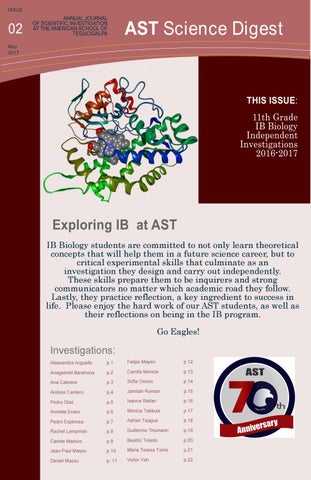
IB Biology students are committed to not only learn theoretical concepts that will help them in a future science career, but to critical experimental skills that culminate as an investigation they design and carry out independently. These skills prepare them to be inquirers and strong communicators no matter which academic road they follow. Lastly, they practice reflection, a key ingredient to success in life. Please enjoy the hard work of our AST students, as well as their reflections on being in the IB program. Go Eagles!
Investigations: Alessandra Arguello
p.1
Felipe Mayen
p.12
Anagabriel Barahona
p.2
Camila Mencia
p.13
Ana Cabrera
p.3
Sofia Osorio
p.14
Andrea Cantero
p.4
Jamilah Roman
p.15
Pedro Diaz
p.5
Ivanna Stefan
p.16
Annette Erazo
p.6
Monica Takkula
p.17
Pedro Espinosa
p.7
Adrian Teague
p.18
Rachel Lampman
p.8
Guillermo Thumann
p.19
Camila Maduro
p.9
Beatriz Toledo
p.20
Jean Paul Masso
p.10
Maria Teresa Tome
p.21
Daniel Massu
p. 11
Victor Yeh
p.22
Being an IB student has definitely made me much more knowledgeable, as I’ve been exposed to a lot of information presented in several different ways. All the information has made me, in turn, inquire more about the world around me and seek even more information. I’ve had to learn to balance my time wisely and be open to new points of view I was not aware of before. IB is highly time consuming, so it's very important to be organized if you want to succeed. However, the hard work it requires creates a very strong work ethic, something that is necessary in order to be successful in all areas of life.
1
How does temperature affect the enzyme reaction rate of amylase on starch?
Starch is made up of polymers linked together by glycosidic bonds, which the amylase can break apart and form glucose molecules, which the body can then absorb for energy. The breaking down of starch into glucose by amylase is a highly useful reaction, not just for the body but for industrial purposes as well. Fructose syrup, used in most packed food items to sweeten them, relies highly on this process, as well as the preservation of baked goods so that they have a longer shelf life, the efficiency of detergents and dishwashers in removing starchy stains, and the pretreatment of animal food to make it more easily digestible.
Because starch breaks down into the simple sugar of glucose, it is ideal to measure the reaction rate by using an iodine solution, which provides an indirect and qualitative measure by changing from its original color of a brownish-yellow to a dark, inky blue when exposed to a solution with high glucose content. These results were then quantified by placing the solution in cuvettes and measuring their light absorption using a spectrophotometer. The results of my study showed a directly proportional relationship between the temperature and the percent transmittance measured by the spectrophotometer, indicating a very clear relationship between temperature in degrees Celsius and enzyme efficiency in breaking down starch.
Being a full IB-Diploma student is not easy at all. All your hard work and dedication is sooner or later reflected in the final project you present.
Your heart starts beating before you are born and keeps right on going through your whole life. Keeping your heart healthy means eating right, not smoking, and getting regular exercise. (Olson 2014) To some extent there are multiple factors that affect heart rate such as body temperature, eating, exercise, age, gender, or caffeine and other drugs. (Collora 2013)In this experiment the aim was to determine to what extent and which of the different types of exercise affect the heart rate of individuals ranging from ages 16-18. A roster of student from the American School of Tegucigalpa whose age vary from 16-18 years were tested. The experiment consisted on five trials where each student ran one mile,
jumped 25 jumping jacks, and did 25 weights lifting of 10 lbs . Extraneous variables were controlled such as having the same speed/ intensity as the other peers. The results showed that exercise causes and increases of an individual's heart rate. Running one mile increases and individuals heart rate by 36.1%, 25 jumping jacks makes an individuals heart rate increase a 33.2% and 25 weight lifting increases the heart rate by a 30.8%. Therefore it can be deducted that Running is the exercise that will cause and bigger increases of heart rate, and weightlifting is the exercise that will cause the least increase of heart rate.
An IB students learned how to be a thinker, I learned how to communicate, how to accept others ideas and be open minded, how to be caring, how to be knowledgeable how to be principled and be inquirer. Those traits I learned them through this year as I had to apply each and one of them to my project, papers, experiments and activities. To younger students who will go into IB course I advice you all to enjoy it to take the best of it and most important to learn from it, although sometimes I get stressed I know the life lesson I learn on how to organize myself and have time for every single task has helped shape my character. So always learn, put attention and NEVER GIVE UP! Everyone can be able to finish their goals you just have to be persistent. After high school I plan to go to college and study business and entrepreneurship, be able to graduate and become successful to show how my dedication and hard work I once put lead me to where I will be standing 7 years from now.
2
My name is Ana Socorro Cabrera and I would like to study medicine, and become a specialist in cardiology. I am proud to say that as an IB student, I have been able to reinforce my IB learner traits as well as include new ones into my life. The challenges I have faced in balancing the extracurriculars I am involved in and my school work, has engulfed the traits of balance, communicators and caring by devoting my time to beneficial activities in a smart and compassionate way. Therefore, I would like to encourage younger students to follow this path of shaping who you are and who you will become in the future in a positive and rewarding way by choosing the IB courses. Furthermore, through these courses, one becomes more knowledgeable, openminded, reflective and thinker by further applying the taught material in real life situations as well as thinking about other applications it might have.
3
Beta vulgaris, known as beet root, is mostly known for its distinct red pigment which is given by Betalain and its multiple benefits regarding its use in scientific experiments. When the membrane tonoplast is disrupted, the water-soluble, red pigment in the vacuole will be released based on the extent of damage (Gurtovenko 2). As a result, depending on the amount of damage in the membrane, the intensity and concentration of the red pigment will increase. By reaching a conclusion to this question, the effect of alcoholic beverage consumption such as beer, wine, etc., can be directly inferred to the extent of damage to the cells. Since plant cells and animal cells are both eukaryotic, a similar relationship in the effects of ethanol can be mimicked by relating the extent of damage to a certain alcohol concentration.
The experiment involved the use of latex gloves at all times, preparation of the ethanol solutions, cutting the beet root strips with the dimensions, calibrating the colorimeter and placing the strips in the concentrations for 10 minutes in order to calculate the intensity of the red pigment later on. Based on the data collected, as the concentration of ethanol increases, the intensity and concentration of the red-pigment (produced by Betanin) will increase. This is evidenced in the scatter plot made using the mean of each of the ethanol concentrations in the five trials. A trendline showing increasing intensity of the pigment when the strips were submerged in a higher ethanol concentration can be seen.
Measuring the effect of different CO2 concentrations in the rate of photosynthesis in a Ceratophyllum demersum plant
For my IA I decided to measure the effect of different CO2 concentrations in the rate of photosynthesis in a Ceratophyllum, demersum plant. I chose this research question because I was interested in learning through my personal observations to what extent is carbon dioxide important in the process of photosynthesis and how significant is the amount of co2 concentration a plant is exposed to, to the rate of photosynthesis of the plant. Therefore, I created an experiment in which I tested 8 cm coontail plants in 5 different co2 concentrations (use baking soda as my source of carbon dioxide) and left the plants to photosynthesis under 180 watts of
I calculated the effect of co2 concentration in the rate of photosynthesis of the plant by measuring the amount of water absorbed inside the test tube where the plant was enclosed. This was a good way to measure the rate of photosynthesis because the more a plant photosynthesizes the more H2O it needs, thus it would absorb more water. I tested my experiment 5 times in order to compare my trials and find the mean amount of absorbed water per co2 concentration. The results indicated that as the concentration of co2 to which the plant was exposed to increased the amount of absorbed water increased as well, thus supporting my hypothesis.
My name in Andrea Cantero and I am a high school student, currently in my junior year. I have lived in Honduras all my life and after college I hope to come back and help my country progress. This school year has been challenging because of the IB program. Taking 6 advanced classes is time consuming, especially if you want to maintain a high average. Nonetheless, the program has help me in positive ways. My writing and analytical skills have improved, my level of commitment to school and clubs has increased, and now I am more organized and punctual. Biology and Math are my favorite classes. Due to this I am constantly debating whether or not I should study business or something related to sciences. Whatever I decide, however, I am sure it will be great.
4
I aspire to study some kind of engineering in the future and pursue further education in a masters or PhD. The IB courses have made me acquire many learner traits. Learning helps you to be open-minded about new and extraordinary things the world has to offer, and to learn on different perspectives on world issues. You acquire a great deal of knowledge in these few months, and is a new step towards university-level knowledge. The International Baccalaureate encourages you to think by yourself and complete challenging assignments and tests. My advice for students who enroll in IB courses is do not procrastinate on assignments. It is probably the single most stress-building activity somebody can do.
5
What is the effect of paclitaxel, a growth factor inhibitor, on the growth rate of cancer cells?
The research question was based on curiosity about cancer treatments in a modern world where cancer is a prevalent disease which must be regulated and addressed to accordingly. Paclitaxel, sold under the brand name Taxol, is a molecule which is used as an anti-cancer drug. Evaluating how effective this molecule is for treatment is worth investigating.
This effect was assessed using an online simulation, which has controllable factors such as growth factor concentration, growth receptor amount, and taxol amount. It simulated cancer cells growing in a petri dish for 100 hours. The results were that if Taxol concentration was increased, then the cancer cells’ growth rate decreased. This means that Taxol in fact is an effective inhibitor for cancer growth.
My name is Annette Erazo.
What is the effect of increasing light intensity on the rate of photosynthesis of Elodea canadensis? In my Internal Assessment for IB Biology, I analyzed and evaluated how the distance (millimeters) between the elodea canadensis and the light source affect the rate of photosynthesis (BPM, bubbles per minute) . The rate of photosynthesis was measured through the bubbles released per minute. I used a very accurate and useful virtual simulation that helped me get my results easily. To collect my data, I moved the slider in the simulation to control the distances from the plant to the light source.
Then, started the process and counted the amount of bubbles released in each light intensity. The final results supported my hypothesis, which stated that if the light intensity increased, then the rate of photosynthesis in elodea canadensis would increase. The light intensity affected the amount of bubbles of oxygen released from the plant. After performing five trials, the results showed that the closer the light source was from the plant, the faster the rate of photosynthesis went.
I am currently an IB student in the American School of Tegucigalpa. I have embodied the IB learner traits in many ways throughout the year. For example, I have been a risk-taker. The IB program is a big challenge, which requires a responsible and disciplined student. My advice for students who would like to start the IB courses is to organize your time. The IB classes require a lot of organization and responsibility. After graduating high school, I have a few aspirations. My dream profession is to be a pastry chef, and study Baking and Pastry Arts in a good university. I am really into culinary arts, I have been my entire life and I aspire to succeed with it.
6
This year as part of the Full IB experience I believe I have embodied and improved in some of the IB Learner traits. The best of these are; balanced, open-minded, reflective, and knowledgeable. Throughout the junior year I have discovered the importance of maintaining and using these learner traits fully and responsibly. For future Full IB students, it would be wise for them to not be worried. If you are confident that you are capable of being a full IB student, then you should go for it without a doubt. After high school, I would like to study a major in engineering. Probably in Northeastern University, Boston. I hope I am successful when completing my goals.
7
° The question that I have chosen to explore upon was created because of the curiosity caused when studying this topic in class. Although the results were already mentioned in class, I wanted to see for myself the true effect that pH would have on the activity of enzymes. Also, testing this theory seemed interesting as I would be able to see how much substances had been broken down at what time and establish a correlation by myself. These experiment also has a valuable implication in real life as well.
It will demonstrate what pH is the most effective to create lactose-free milk faster. I was one of the few from my fellow IB biology peers to do a virtual simulation. I chose this because it would make the data collection much easier as I would not be present at school for sport activities. I manipulated the variables in the simulation to my liking to see the effects that occurred when pH values were change. The temperature and substrate amount maintained the same. As expected, the activity of the enzyme increased as it was closer to the optimum pH.
Hi! My name is Rachel Lampman. I am currently in 11th grade and I am a full IB student at the American School of Tegucigalpa.
Since I like baking and family owns a bakery, I am always trying to find ways to improve the quality of the products. When creating my research question, I wanted to focus on how the different types of sugars affect the height of dough and the consistency in order to provide clients the best products. To be able to make sure that the height and consistency of our products were the same, I used the different types of sugar that are used in my bakery, such as dark brown sugar, light brown sugar, granulated sugar, powdered sugar, and lactose. After gathering my materials I started testing the different sugars. First, I dissolved yeast in water and while this was happening, I measured the flour that was going to be used.
Once the yeast was dissolved, I added it to the flour in order to create dough, making sure that everything was completely mixed together. When the dough could be shaped into a ball, I added the type of sugar according to the label and made sura that everything was mixed accordingly. I measured the height of each dough and recorded it. After this, I placed the different cups with dough in an incubator at 40 degrees Celsius for 20 minutes. Finally, I took them out of the incubator, measured the final height, recorded it, and later found the difference in height. By doing this, I was able to conclude that the light brown sugar was the most effect one since it was the one that made the dough rise the most.
Whenever I have free time, which is very rare, I bake in order to relieve my stress and improve products that are sold in my parents’ bakery. Once I graduate from high school, I am planning to major in business in the United States. After completing my studies, I am thinking about coming back to Honduras to work in my family’s businesses. I am looking forward to gain knowledge on the different companies owned by my family in order to be able to improve them.
8
I have embodied several IB Learner traits throughout this year. I consider myself as a very knowledgeable and principled, caring person with a very open mind. The IB program has challenged my abilities in so many ways. This year I consider my self more as a thinker and find myself constantly asking questions in order to complete my work accordingly. The most important advice I would give to younger students who decide in the future to go into IB courses, is to be organized and complete the work on time. Procrastinating assignments is not the best choice if full IB is what you want. My experience with taking IB courses has taught me many lessons that will serve me in the future.
9
What is the change from the initial to final height in water uptake/ transpiration and photosynthesis after the plant is reflected by different colors of light?
For the IB Biology 11th grade course I was required to complete a internal assessment. I decided to research on the effect different colors has on the rate of photosynthesis of plant. I performed an experiment that would answer my research question and would either support or refute my hypothesis. The purpose of this investigation was to find out if the photosynthetic rate of plants was affected by different colors of light. I tested out this experiment by using an apparatus known as a potometer. The potometer included a calibrated pipette and a tube in which the plant was inserted in an sealed with Vaseline and play dough. I decided to demonstrate the data of the experiment through five trials, each with five sets of information.
The whole aim of this experiment was to measure the initial height of the water on the pipette and the final height. The final height measurement would be demonstrated after the plant was set for two hours under the heat lamp with the color light in a pitch dark room. Then, I would calculate the change in height by subtracting the initial height by the final height. After I obtained my results, I analyzed them and created one pie chart and a bar graph. The results supported my hypothesis. The white light increased the rate of photosynthesis as well as blue and red, but mostly white. Green light was only reflected because of the pigment chlorophyll in the plant. The experiment answered the research question with the data and analysis presented.
What is the effect of different pH levels on amylase enzyme and the rate of starch hydrolysis by using a starch-iodine mixture measured in seconds taken for a change in color of the mixture? Amylase is an enzyme that contributes in the digestion of carbohydrates. In the oral cavity, salivary amylase is secreted by the salivary glands. This type of amylase digests starch, a complex carbohydrate, into maltose, to facilitate the absorption and assimilation of glucose into the body. Amylase, alike all enzymes, works differently in specific conditions, including levels of pH, temperature, and substrate concentration. Levels of pH determine the acidity and alkalinity of the environment in a scale from 0-14. If the environment in which amylase works is too acid or too alkaline, the enzyme will reduce the rate of function and probably stop working. The experiment tests the levels of pH in which amylase works at its maximum rate. This was tested by mixing amylase
The iodine reacts with the starch and creates a blue color. The experiment measures the time taken (in seconds) for the solution to turn completely transparent. When it turns transparent, the starch would have been digested by the amylase. The time taken for digestion depends on the pH buffer level (1, 4, 7, 10, and 14) of the solution. After conducting the experiment, I found that the starch was never digested when the mixture was in pH 1. This was caused by the acidity of the solution. In pH 4, the starch took a longer time to get digested, because of the acidity. The amylase had its highest rate of digestion between pH 7 and pH 14, concluding that
I have an interest in biology and chemistry, which is why I decided to pursue the IB Biology and IB Chemistry courses. I believe that I have embodied various IB Learner Traits. Among those are: Principled, because I fulfill my duties with honesty, integrity, and fairness, and thinker, because I advance in my studies and take on new challenges by using critical thinking and problem solving. The program’s dedication towards the sciences has aided me in deciding that a career in medicine is the right choice for my future. The International Baccalaureate is a program that encourages students to pursue new and challenging goals. Therefore, I advise future IB candidates to organize their time and prioritize their tasks to fulfill a successful and educational academic year.
10
What is the rate of Photosynthesis in Elodea throughout different Carbon Dioxide Concentrations?
My research question is developed with the idea of calculating the rate of photosynthesis in Elodea throughout different Carbon Dioxide Concentrations. The greater the amount of Co2, the faster the rate in exchange of oxygen the plant will have. This is because Carbon dioxide. forms part of the process of photosynthesis and is the byproduct of oxygen respired by humans and other animals. While testing the IA, i found that the rate of photosynthesis in this case the rate in exchange of oxygen between the plant and the different carbon dioxide concentrations had a correlation.
When designing my experiment, I used a respirometer in order to measure the different amounts of oxygen produced by tenth of a millimeter. Using a 150 watts light source energy to substitute the energy of the sun worked completely well. My results supported my hypothesis since my hypothesis states that by the use of a respirometer, we will be able to test the rate of photosynthesis by using 5 different carbon dioxide concentrations being 0.5%,1%,1.5%,2%,2.5%. For each carbon dioxide concentration, we must be able to analyze the information leading to an incline in rise of rate of ex-
I am an 11th grade IB student, aiming towards the full IB Diploma. Being part of all the IB classes is a challenge but it is not near of being impossible. A lot of time has to be dedicated to the classes and such a good organization is needed. The advice that I would advise younger students who will go into IB courses is that you should always do your HW, study for tests, be organized, and never overload yourself with extra curricular activities that will affect your outcome at school. If you really desire to have full IB, then you can.
10
How does different colored affect the height and mass of a (Phaseolus vulgaris) stalk plant grown in 7 days ?
My research question relates to the effect of different colored lights and how they affect plant growth rate. It is important to acknowledge how the different kinds of light impact plants because one has to determine which would be the best light in order to grow the plants.
I placed 1 bean plant per cup into each of the boxes and regularly watered the plants. My results for this experiments where very surprising and contrary to what I expected the green plant and the no light plants both had a very high height and dry biomass weight.
In order to accomplish this with the least amount of variables affecting the experiment i designed 5 boxes that are isolated from any exterior light, each having their own light sources from yellow light to no light.
The no light plant and the green light plants were supposed to be the ones that where the least to grow as they are unable to process this light color as extensively as others.
I am a student in my junior year at the American School of Tegucigalpa taking the IB biology standard level course. Through the course of the IB year I have embodied many I’m traits in order to adapt to the new working environment. I have learned to become balanced in order to better manage my time through all the homework left by the IB course. I have also learned to become more open minded and take different approaches to projects and homework in order to develop a more creative assignment. My ambitions after finishing high school is to study entrepreneurship and open up my own business , preferably one with food . I advise new students who are coming into the IB course to be better organized in order to deal with the homework that are relatively easy but time consuming. People who are repeated procrastinators should get back to their homework and studying as leaving it for last minute will prove to be hard.
10
Is there a difference between the expiratory reserve volume of athletes and non-athletes of Latin-American students ages 16-18? The purpose of this experiment was to investigate if there was a difference in the expiratory reserve volume (ERV) of students ages 16-18 who are either athletes or non-athletes.
This research was done by measuring the expiratory reserve volume of 12 participants, in which 6 were athletes (3 male, 3 female) and 6 were non-athletes (3 male, 3 female).
This investigation was commenced because of the results of Everett Murphy’s study in the Medical Center in Olathe, Kansas which suggest that athletes have a greater expiratory reserve volume than non-athletes because through physical activity they exercise and further develop their diaphragm which is essential to the process of respiration.
Each of them was tested in a total of three trials, in which they had to deliver their maximum expiration onto a balloon, it was measured using string, the string was measured using a yardstick, and the results were recorded.
The research question explored in this external assessment is relevant because it would significantly contribute to all investigation on respiration regarding athletes, which form a large part of the world’s population.
Although there was a difference between the mean expiratory reserve volumes between athletes and non-athletes, in which the athletes ERV resulted to be greater than the non-athletes, the difference was not statistically significant.
My name is Camila Mencia and during my Junior Year I joined the International Baccalaureate program. I believe I fulfill the IB learner profile because I am a principled, balanced, caring, open-minded, reflective, knowledgeable student, as well as a risktaker, inquirer, thinker, and communicator. Being part of the IB program has further developed my skills in these areas, but there is always room for improvement. Regardless, IB requires time, dedication, punctuality, and organization. Therefore, you have to be prepared to endure such endeavor, or be willing to face a challenge. After graduating High School, my ambition is to attend a college education and complete a Master's degree program. I am still undecided on what I am going to study, but am inclining towards the multiple fields of business and considering law.
10
What acne product is the most effective on the prevention of growth of E. coli bacteria?
This IA has the scope of finding which acne product is the most effective in preventing the growth of the bacteria E-Coli. The results found with this experiment intends to be helpful to people when choosing what acne product to use in order to effectively prevent the growth of propionibacterium in the face and thus, avoid acne. Each product had a different active ingredient and thus prevented bacterial growth in a different way. The five acne products tested were Dalacin, Freeacne, Clarifex, Sebamed and Asepxia.The effectiveness of the five products was tested through the performance of five trials which consisted of petri dishes with E.Coli, nutrient agar and the respective product. The hypothesis for the experiment was that Clarifex would show the least bacterial growth because of the mechanism it uses to inhibit bacterial.
Clarifex uses Chlorhexidine Digluconate which bursts the cell wall of the bacteria and results in all of its contents of falling from within. The other products have active components which focus in disturbing one cellular function of the bacteria and, thus, work differently from Clarifex, which allows for this hypothesis. The petri dishes were then kept for three days on an incubator and then bacterial growth was measured using 0.6 by 0.6 cm squares. The results showed that Freeacne was the least effective and Clarifex was the most effective in E.Coli prevention. Thus, Clarifex would be the the most recommendable product to use for the prevention of propionibacterium making the hypothesis for the experiment supported by such results.
My name is Sofia Osorio and I’m from Honduras. I am a Full-IB diploma student. After I graduate High School, I would like to study Chemical Engineering. I believe I embody the IB Learner Traits because I often take risks, I am caring, open-minded and always willing to share my ideas. I am always willing to share or explain what I know to people in order to help them succeed. I am never quick to judge a person or a place by the first impression I get of them for I know first impressions are not everything. I consider myself a risktaker since I challenge myself constantly. For example, last year I decided to take a risk and go on exchange to Italy where I was not sure how I would perform at school or what I would find once I got there. It was a great experience, though, and it allowed me to grow as a person as well as making me more openminded in my train of thought. The advice which I would give to future IB students is to use your time wisely. Never procrastinate and use any free moment you have to work so that you do not have to limit your social life later.
10
My IA for the IB Biology SL course involves increasing levels of pancreatin (1%,1.5%,2%,2.5%,3%, a type of enzyme, and analyze its effect on the pH levels of coconut oil. In order to make this process possible, I had to first create my enzyme concentrations by adding the desired amount in grams to 100 mL of water. After that, I added 10 mL of coconut oil to such increasing pancreatin concentration solutions in 5 cups, and put such 5 cups in an incubator in order to make the digestion process a lot faster. Then, with a pH sensor, I measure the pH level of each cup containing the different interval and the 10 mL of coconut oil, and then I repeated this same methodology for five trials.
After further analysis, my results ended up supporting my hypothesis that as the pancreatin concentrations increase, the pH levels decrease, and that as the enzyme concentrations increase, the digestion of coconut oil increases as well. The pH decreased due to the fact that the more fatty acids of the oil are broken down, the more acidic the pH level becomes, and this also adds support to my other hypothesis since as the intervals increased the levels of pH decreased, thus indicating that the digestion of coconut oil was quite large.
My name is Jamilah Roman, and I am a full IB diploma student at AST. Throughout my first year as an IB student, I have slowly developed and improved upon various IB traits, these being balanced, reflective, a thinker, and so on. I have embodied such traits due to my hard work, resilience and passion for every single thing that I do throughout my IB classes, no matter its level of difficulty. Due to the fact that the IB programme is a serious and high-quality programme, I advice for younger students to focus in class, be responsible, a hard worker, and most of all, like the IB courses they want to be in, because if you don't like them to an extent, you might not have such a fun junior year. My ambitions after high school would be to got to college, and maybe study either Journalism or Neurobiology as a major, and to succeed and have good times in my college experience. My ultimate goal in life is to be happy no matter where life takes me.
10
I am an IB student, aiming for the full IB diploma. As an IB student the biggest challenge I have faced is organizing my time wisely so that work does not pile up.
For my internal assessment I decided to investigate photosynthesis in an aquatic plant called coontail. I was trying to see if photosynthesis rate would increase if light intensity was also increased. 5 intervals of light intensity were used and photosynthesis rate was measured in regards to the Co2 bubbles emitted by the aquatic plant. The plants were placed inside a beaker filled with water and the initial mL was recorder and as the plant photosynthesized the Co2 bubbles would go to the top of the beaker the mL would decrease.
The results did not support my hypothesis since there was no significant change in photosynthesis rate as light intensity increased. This could have happened because at the lowest light intensity it is very likely that the plant had already reached optimum light intensity and the enzymes were working at their fastest possible rate with the amount of oxygen available.
It has helped me to become a more organized person and I feel like I have developed habits that will be helpful in the future. I have learned to manage heavy loads of work and still maintain a social life. I think IB will be very helpful in my future studies, and will be beneficial when applying for college. I highly encourage everyone to participate in this program offered by our school.
10
This year as an IB student, I have embodied a few IB learner traits, such as being a thinker and being open-minded.
My IA was about how different levels of pH would prevent the growth of E coli. The relevance of testing this, is that for example many people use vinegar when cooking because they say it is very acidic so it would kill all the bacteria on the food that they were cooking like meat. I wanted to test if this was true and see at what pH does bacteria grow the most and where does it grow the least. I tested 5 different pHs and I had 5 trials for each pH, to make sure that the data I was going to collect was reliable. I used agar as the nutrition for the bacteria instead of a broth, because it was better and easier to use. I then used an inoculation loop to take some E coli and trace an ‘M’ shape on the top of each petri dish with agar. I tried to trace the same shape on all petri dishes, to make it as controlled as possible.
I waited 3 days and measured the thickest line on each petri dish and recorded the data on a white board. Then I found the mean for each pH to see the data more clearly and to make sure that the data supported my hypothesis. The results showed that the bacteria grew the most in the neutral pH, which was pH 6. It grew the least in pH 2 and pH 10, which were the most acidic and basic solutions. The data supported my hypothesis, because as I found in doing some research, the bacteria grows the least in very basic and acidic environments because it becomes denatured and is unable to reproduce.
There have been many projects and discussions where I had to be a thinker and try to find ways on how to counter argue to a person in the opposing group and I have had to try solving problems with the knowledge I had from my research, like the Group IV Project. There has been so much information this year that I have learned, so I have been open minded about everything, in order to understand the topic better, and the arguments for and against it. Advice for future IB students, would be that they should try to stay as balanced as possible, because it is a lot of work they have to handle, and if they are not organized, work will just keep piling up. After high school, I would like to go back to Europe and study business, but I am not sure yet about what I want to do in my future.
10
Will a rise of temperature in milk lead to a higher enzyme reaction rate for the enzyme lactase?
My research question is relevant to my project because I will be raising the temperature of milk and adding lactase to see how much glucose is present afterwards. My method was to have milk at 5 different intervals and measuring how much Glucose was present after 3 minutes. The temperature where 10, 20, 25, 30 and 40 degrees Celsius. For the higher temperature I would put milk cups in water baths to heat it up and for the low temperature I just put it in the fridge. The 20 C I just left it outside for a while until it got to room temperature.
Then I would add lactase and wait three minutes. Then to measure the amount of glucose present in each cup I would use the glucose strips that I Fed Exed here. After this I would record the data. The results were pretty much what I expected. At 10 degrees Celsius the milk contained less glucose than the milk at 20 and so on. The higher the temperature the larger the concentration of glucose was when I measured it.
My name is Adrian Teague and I have repeatedly challenged myself to improve by taking the full IB course and the projects that corresponds to it. I have embodied the ideal IB students by possessing the traits of and IB learner. The ones that apply to me are risk taker, inquirer, being knowledgeable and an inquirer. My recommendations for future IB students is to do things with time and put in effort into the things you do. That's pretty much all you need to get good grades. My future ambition are too get into a good university and major in international economics and then get a good job in a large company like Merrill Lynch.
10
I decided to explore the different colored lights in which common household beans grow taller and heavier. This could help the production of beans, by knowing which type of colored light grows the fastest, and healthier bean plants. I tried to model my experiment as close to real life as it could be. The number of hours the light bulbs were left turned on was almost the same as the amount of hours the sun was up and with the best light rays. Every day recording were seen, more results were gotten than the day before.
After planting each seed to its corresponding cup and pouring water into the cotton the only function that was left was the turning on and off the lights. After the seven days had past the final step had to be done, measure each plant that surpassed the germination stage and letting them dry for further weighing. After each plant got measured and weighed, the final result was stated. The blue light bulb showed the average of plants with a higher measurement (tallest) and the red light bulb was the light bulb that grew with the greatest average weight.
Throughout this year different obstacle have crossed my path, some more time consuming than others, but I was able to overcome them by the different traits that the IB program has left me. Going over the IB learner traits two specific traits catch my attention, balance and risk taker. In order to make it through the rigorous course of IB Biology you have to be a balanced risk-taker; meaning that every step you take has to be calculated with a high level of precision, don’t try to focus on just one thing as the rest of activities will gather up and end up messing your whole schedule.
10
How will the mass of cucumber change by osmosis when being submerged into different concentrations?
My name is Beatriz Toledo. As an IB learner, I have embodied many traits that have been helpful in order to fulfill the IB requirements.
For this experiment I observed how osmosis reacts. I specifically tested osmosis in hypertonic solutions, meaning that the cell is inside of a high solute concentration. For the cell I used cucumber slices, and salt was for the solute.
Within this traits the most important ones have been being an open-minded, knowledgeable and reflective student. These traits are not only helpful in school but in life. Fellow IB future students, I recommend to always have an open-mind, otherwise you will stress too much and believe that IB is impossible.
The different concentrations used were be 0%,5%,10%, 15%, 20%, 25% and 30% . In order to have varied data for my experiment I ran five trials. In each trial eight cups were used, each one of them belonging to the concentration levels mentioned before. Other than having different concentrations of salt , each cup also contained 100 ml of water. The water and salt were dissolved and afterwards one cucumber was inserted in each cup.
I collected the initial mass of the cucumber before being inserted into the water and the final mass which was taken 48 hours after being inserted. After collecting my data I used a bar graph, scatter plot and the ANOVA test in order to test the reliability of my data and hypothesis. The experiment did not result in the way it was supposed to, a pattern should have been followed but due to systematic and random errors it failed. The more solute concentration the cucumber had the lower their mass should have been. In some cases this did happen but not completely.
At the beginning i was filled with stress and fear but opening my mind made it all easier. After high school my goals are becoming a businesswoman.
10
Every enzyme has an optimum temperature (at which the enzyme’s rate of reaction peaks), and at the same time temperature will denature the enzyme in extremes. Overall, temperature increases an enzyme’s rate of reactions because it increases the kinetic energy and thus the chance of collision between enzymesubstrate, increasing the rate of reactions. Extreme or high temperatures will denature enzymes because intra and intermolecular bonds will begin breaking due to the increasing heat gain of the enzyme. My lab focuses on investigating the research question: what are the effects of temperature (°C) change in the enzyme lactase during lactose hydrolysis? It investigates this question through a virtual simulation. Moreover, lactase is the enzyme that catalyzes the breakdown of lactose, lactose hydrolysis.
Lactose is a disaccharide sugar found in milk and milk-derived products. Lactase is needed in order to break down lactose into glucose; the lack of this enzyme causes lactose intolerance. The simulation manipulates the temperature during lactose hydrolysis to observe the effect it has on glucose production. Moreover, I found that a certain range of temperature will maximize glucose production during lactose hydrolysis, and that the more the temperature exceeds that range the more likely it is to denature and produce as much as 40 times less glucose. My results supported my hypothesis that the optimum temperature for the enzyme lactase this optimum temperature is around human average body temperature(30-40°C).
My name is Maria Teresa Tome and I am an IB SL Biology student at the American School of Tegucigalpa. I am a full diploma candidate and hope to major in Mathematics after I finish my high school career. I am 17 years old and as my first year as an IB student I have felt myself reflect and understand more deeply the IB Learner Traits. Moreover, I have felt myself grow as an individual through the IB program and recommend all students who wish to excel to take the IB challenge and advise them to not get behind work.
10
I am a 16 year old Taiwanese studying in Honduras; the few years that I have been here have provided me with a unique experience, especially with the IB courses.
In Honduras, the red bean has been one of the most important crops that is almost always included in the daily diet, beaten in consumption only by corn. 150 thousand acres should be more than enough to cover the consumption of all the Hondurans, yet there are still bags of beans being imported in the supermarkets. This sparked my curiosity and made me wonder what factors could affect the proficiency of the production of red beans. Therefore, I designed a question that would focus on examining the effect of different pH levels of water sources on the growth (biomass in grams) of Phaseolus vulgaris, commonly known as the red bean. In an effort to demonstrate the correlation, plants were watered with different intervals of ph buffers (pH of 1, 3, 5, 7, 9, and 11) diluted in pure water (as I did not want data points with 0).
After their biomasses were measured, it was determined that photosynthesis occurs best at a pH of 7 because the enzymes that process bicarbonate and sunlight are working at the most efficient rate they can. However, surprisingly, the average of the biomass of the red bean plants watered with pH of 3 and 5 were not far behind. This may suggest that the plants may have slowly adapted to the environmental factors in the country. In this case, since rainwater in Tegucigalpa, the capital of Honduras, has a pH of 5.84, the red bean plants may have adapted to a slightly more acidic water source. The final results demonstrated a parabolic trend peaking at a pH of 7 for the biomasses of the plants watered with different pH buffers.
What really interested me was the IB Biology course, resulting in my inclination towards studying medicine after graduating from high school. Furthermore, as a full IB Diploma Candidate, I feel the need to share some advice with future candidates. First of all, IB courses are definitely going to be an uphill challenge for everyone. Taking that into account, never become overambitious. This concept was what brought me to where I am today. I am in no way telling anyone to not challenge themselves, but what I am saying is that one should not try to do something they believe is impossible to achieve; at the end, he/she will just disappoint himself/herself.
10
Acknowledgments
The Science Department would like to acknowledge:
IB Coordinator-Daniel Dobbe High School Principal-Maria Francisca Motz High School and Middle School Science Teachers AST Faculty
For their continuous support in providing the necessary skills and abilities that enable our students to succeed.
“Somewhere, something incredible is waiting to be known” - Carl Sagan
AST Science Digest Issue 02 May 2017