

AFTER ICE COMES TO TOWN
EMMA JANSSEN TRAVELS TO RURAL MINNESOTA
TAP NEEDS CHAMPIONS
Join the Prospect Legacy Society
e American Prospect needs champions who believe in an optimistic future for America and the world, and in TAP’s mission to connect progressive policy with viable majority politics.
You can provide enduring nancial support in the form of bequests, stock donations, retirement account distributions and other instruments, many with immediate tax bene ts.
Is this right for you? To learn more about ways to share your wealth with e American Prospect, check out Prospect.org/LegacySociety

CULTURE
As the surge in Minneapolis winds down, small communities in Minnesota (like Willmar) fend off more arrests and lasting impacts.
rivalries among the leaders of the United Auto Workers are sapping the momentum from its historic victories.
There’s money in bigotry, and specialized crowdfunding platforms are where to get it.
The industry bought companies for too much money and made a bunch of bad loans. Now they’re scrambling to avoid the reckoning.
How the Republican Party Forgot It Was Conservative
Mom, Kids, and Nowhere to Go
54 ROBERT KUTTNER on Capitalism: A Global History and Capitalism and Its Critics: A History: From the Industrial Revolution to AI
58 MICHAEL FRIEDRICH on Fear and Fury: The Reagan Eighties, the Bernie Goetz Shootings, and the Rebirth of White Rage and Five Bullets: The Story of Bernie Goetz, New York’s Explosive ’80s, and the Subway Vigilante Trial That Divided the Nation
61 JAROD FACUNDO on Chains of Command: The Rise and Cruel Reign of the Franchise Economy
64 PARTING SHOT Finally, an Anti-Woke War BY FRANCESCA FIORENTINI
For weeks, we watched in horror the coverage from Minneapolis: two high-profile deaths, people being pulled out of cars, young children used as bait for their immigrant parents, mayhem on the streets. The nation’s finest broadcast, print, and magazine journalists trucked up to the Twin Cities, found an organizer to ride along with, reported from outside the federal building where detainees were kept. The coverage mattered; it really changed the way Donald Trump’s mass deportations were perceived, to the extent that the White House doesn’t want to call it mass deportation anymore.
But the press never got past the city limits. We did.
Our cover story comes from emma janssen . She visited Minnesota towns like Albert Lea and Northfield and Willmar, which rarely if ever get the spotlight in national magazines. But the residents of these cities, just like their counterparts in Minneapolis and St. Paul, have seen wave after wave of ice agents terrorizing their cities, hunting migrant workers in meat and poultry processing plants, or service workers in restaurants, or their children when they simply try to go to school. And the same spirit of defiance and basic neighborliness among the majority-white population followed these raids, albeit with fewer organizers and more subtle touches than the whistles and mass protests that characterized the big cities.
Reading the piece, I thought about community, a word that has been tarnished somewhat in the minds of those who think of it as roving gangs of anonymous commenters online. We’ve all heard about the loneliness epidemic, the loss of
interpersonal relations, the phenomenon of “bowling alone,” the atomization of the American public without a mass culture, and the real harm that can be done when affinity groups rile themselves up collectively behind computer screens. But Emma’s story got me back to what community is actually all about: helping the family across the street and down the block when they need help, pitching in even when it’s hard, even when you don’t think you have the strength. The ice invasions have actually brought back a spirit of American community, and while nobody would welcome such a trigger, it’s restoring something vital to the human condition that we were foolish to let slip away.
The darker side of people helping people comes through in naomi ,et.une ’s story on the right-wing networks funding controversial figures who use racial slurs or even kill their neighbors. Crowdfunding campaigns for Jonathan Ross, the ice agent who killed Renee Good in Minneapolis, have raised $1.1 million online, even as a campaign for Good’s family raised $1 & million. This is a community spirit anchored in tribalism and fueled online, which consists largely of sending messages about where you stand in the culture wars. Having both these pieces in the same issue demonstrates how nothing about 21st-century community is clear-cut, and how a helping hand can be both a beautiful and dangerous thing. -1 av i1 1 ay en
EXECUTIVE EDITOR DAVID DAYEN
FOUNDING CO - EDITORS
ROBERT KUTTNER, PAUL STARR
CO - FOUNDER ROBERT B. REICH
EXECUTIVE EDITOR David Dayen
EDITOR AT LARGE HAROLD MEYERSON
SENIOR EDITORS GABRIELLE GURLEY, RYAN COOPER
FOUNDING CO-EDITORS Robert Kuttner, Paul Starr
CO-FOUNDER Robert B. Reich
MANAGING EDITOR AND DIRECTOR OF EDITORIAL OPERATIONS
EDITOR AT LARGE Harold Meyerson
CAITLIN PENZEYMOOG
SENIOR EDITOR Gabrielle Gurley
ART DIRECTOR LINDSAY BALLANT
MANAGING EDITOR Ryan Cooper
ASSOCIATE EDITOR SUSANNA BEISER
ART DIRECTOR Jandos Rothstein
STAFF WRITER WHITNEY WIMBISH
ASSOCIATE EDITOR Susanna Beiser
STAFF WRITER Hassan Kanu
WRITING FELLOWS EMMA JANSSEN, JAMES BARATTA, NAOMI BETHUNE
WRITING FELLOW Luke Goldstein
INTERNS LOGAN CHAPMAN, NATALIE NOTE, THOMAS RILEY
INTERNS Thomas Balmat, Lia Chien, Gerard Edic, Katie Farthing
Thank You, Reader, for Your Support!
CONTRIBUTING EDITORS AUSTIN AHLMAN, MARCIA ANGELL, GABRIEL ARANA, DAVID BACON, JAMELLE BOUIE, JONATHAN COHN, ANN CRITTENDEN, GARRETT EPPS, JEFF FAUX, FRANCESCA FIORENTINI, MICHELLE GOLDBERG, GERSHOM GORENBERG, E.J. GRAFF, JONATHAN GUYER, BOB HERBERT, ARLIE HOCHSCHILD, CHRISTOPHER
JENCKS, JOHN B. JUDIS, RANDALL KENNEDY, BOB MOSER, KAREN PAGET, SARAH POSNER, JEDEDIAH PURDY, ROBERT D. PUTNAM, RICHARD ROTHSTEIN, ADELE M. STAN, DEBORAH A. STONE, MAUREEN TKACIK, MICHAEL TOMASKY, PAUL WALDMAN, SAM WANG, WILLIAM JULIUS WILSON, JULIAN ZELIZER
CONTRIBUTING EDITORS Austin Ahlman, Marcia Angell, Gabriel Arana, David Bacon, Jamelle Bouie, Jonathan Cohn, Ann Crittenden, Garrett Epps, Je Faux, Francesca Fiorentini, Michelle Goldberg, Gershom Gorenberg, E.J. Gra , Jonathan Guyer, Bob Herbert, Arlie Hochschild, Christopher Jencks, John B. Judis, Randall Kennedy, Bob Moser, Karen Paget, Sarah Posner, Jedediah Purdy, Robert D. Putnam, Richard Rothstein, Adele M. Stan, Deborah A. Stone, Maureen Tkacik, Michael Tomasky, Paul Waldman, Sam Wang, William Julius Wilson, Matthew Yglesias, Julian Zelizer
Every digital membership level includes the option to receive our print magazine by mail, or a renewal of your current print subscription. Plus, you’ll have your choice of newsle ers, discounts on Prospect merchandise, access to Prospect events, and much more. Find out more at prospect.org/membership
PUBLISHER MITCHELL GRUMMON
PUBLISHER Ellen J. Meany
ASSOCIATE PUBLISHER MAX HORTEN OPERATIONS AND MARKETING MANAGER LAUREN PFEIL
PUBLIC RELATIONS SPECIALIST Tisya Mavuram
ADMINISTRATIVE COORDINATOR Lauren Pfeil
BOARD OF DIRECTORS David Dayen, Rebecca Dixon, Shanti Fry, Stanley B. Greenberg, Jacob S. Hacker, Amy Hanauer, Jonathan Hart, Derrick Jackson, Randall Kennedy, Robert Kuttner, Ellen J. Meany, Javier Morillo, Miles Rapoport, Janet Shenk, Adele Simmons, Ganesh Sitaraman, Paul Starr, Michael Stern, Valerie Wilson
BOARD OF DIRECTORS DAN CANTOR, DAVID DAYEN, REBECCA DIXON, SHANTI FRY, STANLEY B. GREENBERG, MITCHELL GRUMMON, JACOB S. HACKER, AMY HANAUER, JONATHAN HART, DERRICK JACKSON, RANDALL KENNEDY, ROBERT KUTTNER, ELI LUBEROFF, LINDSAY OWENS, MILES RAPOPORT, ADELE SIMMONS, GANESH SITARAMAN, PAUL STARR, MICHAEL STERN, VALERIE WILSON
PRINT SUBSCRIPTION RATES $60 (U.S. ONLY) $72 (CANADA AND OTHER INTERNATIONAL) CUSTOMER SERVICE 202-776-0730 OR info@prospect.org
MEMBERSHIPS prospect.org/membership REPRINTS prospect.org/permissions
PRINT SUBSCRIPTION RATES $60 (U.S. ONLY 6 $72 (CANADA AND OTHER INTERNATIONAL 6 CUSTOMER SERVICE 202 776 0730 OR INFO@PROSPECT.ORG MEMBERSHIPS PROSPECT.ORG/MEMBERSHIP REPRINTS PROSPECT.ORG/PERMISSIONS
VOL. 37, NO. 2. The American Prospect ( ISSN 1049 -7285) Published bimonthly by American Prospect, Inc., 1225 Eye Street NW Suite 600, Washington, D.C. 20005. Periodicals postage paid at Washington, D.C., and additional mailing offices. Copyright ©2026 by American Prospect, Inc. All rights reserved. No part of this periodical may be reproduced without consent. The American Prospect® is a registered trademark of American Prospect, Inc.
POSTMASTER: Please send address changes to American Prospect, 1225 Eye St. NW, Ste. 600, Washington, D.C. 20005. PRINTED IN THE U.S.A.
Vol. 35, No. 3. The American Prospect (ISSN 1049 -7285) Published bimonthly by American Prospect, Inc., 1225 Eye Street NW, Suite 600, Washington, D.C. 20005. Periodicals postage paid at Washington, D.C., and additional mailing offices. Copyright ©2024 by American Prospect, Inc. All rights reserved. No part of this periodical may be reproduced without consent. The American Prospect ® is a registered trademark of American Prospect, Inc. POSTMASTER: Please send address changes to American Prospect, 1225 Eye St. NW, Ste. 600, Washington, D.C. 20005. PRINTED IN THE U.S.A.
Your Current Print Subscrip on prospect.org/my-TAP
You may log in to your account to renew, or for a change of address, to give a gi or purchase back issues, or to manage your payments. You will need your account number and zip-code from the label:
ACCOUNT NUMBER ZIP-CODE
EXPIRATION DATE & MEMBER LEVEL, IF APPLICABLE
To renew your subscription by mail, please send your mailing address along with a check or money order for $60 (U.S. only) or $72 (Canada and other international) to: The American Prospect 1225 Eye Street NW, Suite 600, Washington, D.C. 20005 info@prospect.org | 1-202-776-0730
PROSPECTS
HOW THE REPUBLICAN PARTY FORGOT IT WAS CONSERVATIVE
BY PAUL STARR
And why, apparently, most Republicans don’t care

the main theme in much writing on contemporary politics is how ideologically polarized Democrats and Republicans have become. But the truly consequential change is that Republicans have broken with their own past. Under Donald Trump, the party hasn’t just reversed its positions on speci$c policies. It has routinely betrayed basic tenets of the conservative philosophy that Republicans have long claimed was the bedrock of their party. No one is shocked by Trump’s betrayals. What is more surprising is that most Republicans haven’t seemed to care.
I’ve been thinking about the Republican betrayal of the party’s own tradition because of a comment about my work by Glenn Loury, the conservative Black economist. When I was on The Glenn Show in December, he criticized my new book American Contradiction because of my “apparent disregard for the positive contributions of conservative thought and policy to American life.”
Loury and I could probably agree about many historical contributions of principled conservatism, including respect for America’s constitutional tradition and rule of law, skepticism about concentrated governmental power, and support for the independence of civil society and private initiative. I’m sure we’d agree about the importance of patriotism, civility, tolerance, and other values that have been part of a democratic conservatism—democratic in the sense of upholding the democratic “rules of the game,” including free speech and fair elections.
But as Trump has acted with reckless disregard for those principles, Republican leaders, major donors, and corporate supporters have either fallen silent or actively enabled his lawlessness and corruption. That complicity makes you wonder: Were they ever serious about those conservative principles? And since they don’t speak up for them now, what do they stand for?
Since when, for example, was it a conservative principle to concentrate all federal power in the president and deny Congress its constitutional role? How does a party that ostensibly opposes centralized state power square that opposition with the centralization of power in one man?
Some crises do require more latitude for executive power, but this is not one of those moments. It’s only “wartime” because Trump,
of his own volition and without provocation, has undertaken a war with Iran that Congress didn’t authorize in the face of strong public disapproval and that the administration even refuses to call a “war.” We do not face any other kind of national emergency, except insofar as Trump instigates or fabricates emergencies as a pretext to free himself of restraints. Yet Republicans claiming to be conservative have accepted Trump’s seizure of powers, including powers over the economy that run diametrically contrary to their professed devotion to limited government.
Consider the Republican turn from free-market conservatism to Trump’s “state corporatism.” Trump has repeatedly squeezed or lured corporations into doing his bidding. Eleven companies have given the federal government a stake in their ownership, making the government in most cases their largest shareholder and giving the president leverage over them. Imagine the outrage among Republicans if a Democrat had done that.
This past year, in exchange for an export license needed to sell advanced AI chips to China—a license previously denied on national-security grounds—Nvidia secured Trump’s approval by agreeing to pay the government !5 percent of the proceeds. As Aziz Huq and Vanessa Williamson point out, “Federal export law bars any such license fee, but paradoxically, that works in Mr. Trump’s favor: Since Congress banned the collection of that money, there’s also no statute directing how the funds can be spent.”
The money from Venezuela’s oil is an even more stunning example of Trump’s power grab and the breakdown of congressional control of the public purse. More than a billion dollars has gone into an o shore account in a Qatari bank that Trump has claimed the
right to control, though the funds are supposed to go to Venezuela. Sen. Elizabeth Warren points out: “There is no basis in law for a president to set up an o shore account that he controls so that he can sell assets seized by the American military.”
Conservatives once stood for gradualism and a defense of institutions slowly developed over centuries, designed to ensure a government of laws and to uphold principles like due process. Yet the subversion of those institutions is happening on their watch. Trump has sought to politicize the entire government, including institutions with nonpartisan traditions like the armed forces and the I&S. The party of conservatives raises no objection when Trump dispenses presidential pardons to enrich himself and acts as if the Constitution had no emoluments clause. Conservatism did not have to be associated with corruption. But it has that association now.
The right-wing majority on the Supreme Court bears a large part of the responsibility for this development. Their decision on presidential immunity invited abuses. Under that ruling, no court can even consider evidence about a president’s motives for o(cial actions such as federal prosecutions and the issuing of pardons. The Court seems likely to extend the president’s unfettered power further in a decision ending the independence of independent agencies, except for the Federal Reserve.
In February, the Court did overturn the global tari s that Trump imposed under the International Emergency Economic Powers Act. But he immediately began circumventing the Court’s decision by exploiting provisions in other laws. Trump loves tari s partly because companies come begging him for relief, and he can then exact more tribute from them. Both the tari s and the jockeying for special favors ought to be abhorrent to the party that holds itself up as the defender of the free market. But nearly all Republicans have fallen in line.
HOW DID REPUBLICANS COME to betray their own philosophy?
A key factor has been the party’s weakness, the fear that it was only getting weaker, and a consequent openness to desperate measures that could enable it to entrench itself in power while it could.
In his !)*7 book Conservative Parties and the Birth of Democracy, Daniel Ziblatt argues that the strength of conservative parties in the *,th and early !)th centuries determined whether a country followed a stable, settled path to democracy or an unsettled path with authoritarian reversals. Britain’s history is an example of the $rst; Italy’s, the second. Although Ziblatt’s book is about Europe, the political process he identi$es seems to be playing out now in the United States.
“Strong conservative political parties,” Ziblatt argues, “led to a stable long-run path of democratization” for several reasons. Conservatives had “a realistic basis for assuming electoral success” and “the resources that allowed them to sideline their own radicals.” They accepted the “rules of the game” in a democracy because they believed they could win that game or at least keep radicals on the left out of power. But when conservative parties saw themselves as likely to lose, they often turned against democracy. That has been the story of recent American politics. In this case, Republicans have also turned against their old leadership and many of the de$ ning elements in the conservative tradition.
Snowballing demographic and cultural changes since the *,,)s have created a rising sense of danger on the right. A high rate of non-European immigration, a falling proportion of Americans identifying as Christian, and increased numbers self-identifying as -./TQ led many on the right to believe they were irretrievably
losing cultural hegemony and political power. Barack Obama’s victories in !))8 and !)*! intensi $ed the feelings of desperation, and conservative $gures in politics and the media stoked those emotions until the Republican Party was ablaze with catastrophism. In !)*6, while the Democratic establishment kept Bernie Sanders from winning the party’s presidential nomination, Republican elites were unable to “sideline their own radicals.”
That year, a viral article by Michael Anton of the Claremont Institute epitomized the right-wing state of mind: “!)*6,” Anton wrote, “is the Flight ,3 election: charge the cockpit or you die.” Flight ,3 was the ight on September **, !))*, where passengers tried to seize control from the terrorists, only for the plane to go down. A Hillary Clinton presidency, Anton suggested, would mean “certain” death, but if voters charged the cockpit by choosing Trump, at least they would have a chance of survival.
In every election in which Trump has run, he has warned that this is Americans’ last chance and that they won’t have a country unless they elect him. If you’ve agreed that America is in extreme danger, it has made perfect sense to repudiate a conservatism that didn’t just fail to prevent the dire trends wrecking the country but contributed to them through its support of pro-immigration and free-trade measures.
Republican elites haven’t cared all that much about Trump’s betrayal of conservatism because of what he hasn’t betrayed: the party’s corporate and class allegiances. Trump’s populism is all in the rhetoric and the scapegoating, not the substance of government. His tax legislation in !)*7 and again in !)!5 has redistributed income upward; his government appointees side with corporations over workers. Pro-business policy is what many Republicans mean by free-market policy. They are not bothered if the “invisible hand” is replaced by a “conspicuous $ st,” as long as that $ st generally comes down on their enemies.
Republicans go along with the betrayal of conservatism also because they care more about results than rules, whether those are the rule of law, the rules-based international order, or the rules of civility and decency that Trump routinely outs. They admire that Trump gets things done and look the other way at how he does it. Although they must know he is corrupt, because he hardly makes a secret of it, he is also delivering the result that matters most to them: power for “us” over “them.”
What Stephen Miller famously said about international politics— “we live in a world, in the real world … that is governed by strength, that is governed by force, that is governed by power”—re ects the mentality now dominating the Republican Party. Some analysts make the mistake of intellectualizing Trump and taking seriously the ideas of the various schools of right-wing thought that compete to provide $g leaves for the worship of power. But as Jan-Werner Müeller has suggested, it’s an error to assume that right-wing political leaders today are “inspired by comprehensive worldviews” or “that far-right parties succeed because voters $ nd their philosophies attractive,” when the leaders are opportunistic and self-interested and “most citizens have no clue” about what right-wing intellectuals are saying.
The driving impulses on the right are old and primitive. As Never Trump conservative intellectuals discovered to their horror, ideas and principles don’t much matter in the party that Trump took over. It’s a world where, as Miller says, strength governs, power governs, force governs—and conservative thought is expected to be loyal and submit. n
IDEAS, POLITICS &POWER

MOM, KIDS, AND NOWHERE TO GO
Family homelessness is spiking just as the Trump administration rolls back social services.
By Casey Quinlan
Families are one of the fastest-growing segments of the homeless population, but they are rarely acknowledged in the larger policy conversation about homelessness in the U.S. Instead of living on the street, they’re often out of sight, staying with other family members or living in their cars. People don’t truly notice them the way they see chronically homeless individuals living on the street, people who work with homeless families say.
“You often see the chronic street homeless who su er from mental illness because it
is more in your face … [Families] end up doubled up in situations and we just don’t end up counting them as homeless,” said Peter Jacob, executive director of Family Promise Union County in New Jersey.
Unhoused families, like everyone else who is unhoused, are facing renewed $ nancial pressures as social programs and housing support that was already woefully insuf$cient is stripped down under the Trump administration and wages fail to keep up with the hefty cost of apartments. But they also have to contend with the higher costs of
NOTEBOOK
supporting kids, like $ nding an apartment with more bedrooms or paying for child care. Families who can’t a ord child care are often penalized with underemployment and $nancial instability that also puts them at risk of eviction, workers at groups serving homeless families explained.
Jacob said it’s time that policymakers prioritize family homelessness as much as other forms of individual chronic homelessness.
During the !)!!-!)!3 school year, public schools identi $ed nearly * 4 million homeless students, which was a *4 percent rise from the previous school year. But schools are likely under-identifying the number of kids who are homeless. From !)!3 to !)!4, families with children had the biggest year-over-year increase in homelessness compared to any other group.
Research completed in !)!3 from the Eviction Lab at Princeton University, which used Census Bureau data from between !))7 and !)*6, found that kids represent 4 out of every *) people who face eviction each year. More than *) percent of kids under 5 who live in rental housing are threatened with eviction annually, and 5.7 percent actually get evicted from their homes.
Juan Pablo Garnham, communication and policy engagement manager at Eviction Lab, said that evictions fall disproportionately on Black single mothers and that the data on eviction characteristics tends to be pretty stubborn. “Even though in New York City and Philadelphia we’re seeing positive changes, in general, this data from a few years ago is likely to stay the same,” he said.
Homelessness appeared to fall in the $nal year of the Biden administration, based on samples of the January !)!5 homeless count. But while the Trump economy is not cratering, it has been stagnant, particularly at the lower end of the income scale. The economy added very few jobs last year, electricity prices are out of control, and .DP growth in the $ rst half of the year was driven almost entirely by data centers and information technology.
In the longer run, homelessness remains historically high, as Americans have been watching the dream of even a modest life slip away in recent years. The median age of a $ rst-time homebuyer rose to 4), an alltime high since the National Association of Realtors began its annual survey. Nearly half of the 4! 5 million renter households spent more than 3) percent of their income

on housing costs in !)!3. And the growth in health care spending from !)!3 to !)!4 has outpaced the growth rate of the !)*)s. The cost of child care is more expensive than rent for many families.
Families are also being hit by cuts to poverty programs. Expanded work requirements for the Supplemental Nutrition Assistance Program (SN:P) enacted by Trump’s One Big Beautiful Bill Act, which was signed into law last year, will put * in 8 SN:P recipients at risk for losing at least some of their bene$ts. The law also expanded restrictions to parents whose youngest child is at least *4. The bill also contained $* trillion in Medicaid cuts.
Melita Corselli, a mother of four kids living in North Salem, New York, experienced homelessness $ve years ago. She clawed her way out with housing assistance and a lot of hard work, but she is worried she and her family could lose housing again.
After her children’s father went to prison, she lost the additional income. She had a job that paid $5),))) a year, but it wasn’t enough to support her kids and pay the rent. She doubled up for several months with her mother, but said that once one of her children started walking, one of the neighbors made noise complaints and racist comments about the family staying there. Her mother’s landlord eventually found out and Corselli made the tough decision to leave.
It’s a familiar story for many caseworkers the Prospect spoke to. When families double up in rented apartments, they risk not just
one but two families becoming homeless.
Corselli went to a family shelter in Westchester County, but was told that her income was too high. If they let her stay for longer, she would have to pay a bigger monthly fee than her previous rent. She said the conditions of the shelter were very poor.
“I held my kids, trying not to let them be on the mattress. The mice were running all over across the oor,” she said.
Corselli eventually went through the P:T; intake center in New York City and received temporary placement in an apartment for 56 days, with far better living conditions than the shelter, until she was able to $ nd a new apartment back in North Salem. She had her rent, which was $*,!)), paid for the $ rst year. She’s been there ever since.
But Corselli and her family’s struggles are not over. After years of smaller rent increases, her landlord is increasing the rent to $*,7)) a month, and Corselli is scared of having to potentially $ght a return to homelessness again.
“I’m still the sole provider for my children,” she said. “I don’t make that much more money than I was back then and so there’s a fear of going back into shelter because everything has to get paid, and families start running out of ways.”
Steve Berg, chief policy officer at the National Alliance to End Homelessness, said he’s concerned about the impact of the Trump administration’s policy shifts on people who are housing insecure,
Families with children had the biggest year-over-year rise in homelessness in 2024.
including the e ects of the expansion of work requirements in poverty programs. In February, the Department of Housing and Urban Development (;UD) proposed a time limit and work requirements for rental assistance for many adults, and a rule that would prohibit families with undocumented household family members from being able to live in subsidized housing.
“One of the things that coincided with family homelessness going up was the welfare reform bill that passed back in the *,,)s, and there’s a lot fewer families that are getting support from state welfare programs that are funded by the federal government, which has made it di (cult too,” Berg said. “I think that coincides with an increase in family homelessness, particularly in the states where the work requirements were most stringently enforced.”
There were hundreds of layo s at ;UD last year, including of investigators who work with people who believe they have experienced housing discrimination, which adds insult to injury. Tara K. Ramchandani, co-managing partner at Relman Colfax, who works on civil rights litigation in housing, told the Prospect that ;UD consolidating its fair housing enforcement o(ce represents a “pretty bleak moment for civil rights protections in our country.” She hopes that a network of fair housing groups will help $ll the gap.
Landlords often practice familial discrimination with subtle approaches, such as occupancy restrictions per bedroom. Parents struggling to balance child care and other responsibilities may not have the energy to take on housing discrimination, so it’s important that they have assistance, Ramchandani said. “When you are grappling with the day-to-day of having young families and young kids, being able to step back and realize there is discrimination happening is tough.”
Brandi Tuck, executive director of Path Home in Portland, Oregon, said the high
cost of child care and rent make it untenable for many parents to support their families on just the minimum wage. In Portland, it is higher than in many areas of the country at $*6.3) an hour, but it still doesn’t begin to cover expenses.
“A lot of the families that we work with at Path Home are employed or highly employable but the employed people are either working minimum-wage jobs at places like Taco Bell and gas stations and are hotel housekeepers … They don’t have any paid time o ,” she said.
Tuck gave the example of a mom she works with, a hotel housekeeper, who can’t a ord child care, so whenever there is a school break, she has to take her kids with her to work. “She told us … ‘I take the kids to work until I get $ red and then I stay home with them until they go back to school and get a new housekeeper job,’” Tuck said. “This woman who could be working 5! weeks a year full-time [who] ends up working less than 4) weeks a year because she has no child care and child care is about $*,*)) per month, per kid … The math doesn’t add up for these families.”
Directors of shelters across the country said that it’s essential to get families housed as soon as possible after they’ve lost housing, when they haven’t yet exhausted their support networks. It’s very di (cult for people who have been $ghting for survival every day to take on the kind of work required of most people to regain housing, explained formerly unhoused people and people who work in rehousing programs and within family shelters.
Faithfully executing a “housing first” model, they said, where unhoused people are brought back into housing quickly, with rental assistance and long-term case management relationships to make sure they have everything they need to stay housed, helps keep people housed over the long term.
DIRECTORS OF SHELTERS SAID THAT IT’S ESSENTIAL TO GET FAMILIES HOUSED AS SOON AS POSSIBLE AFTER THEY’VE LOST HOUSING.
But the Trump administration took aim at housing $ rst through an executive order last July that directed the Department of Health and Human Services and ;UD to “increase accountability” for the provision and awarding of grants of assistance to unhoused people, which includes “ending support for ‘housing $rst’ policies that deprioritize accountability and fail to promote treatment, recovery, and self-su (ciency.”
Johnnetta Mack, a mother who ed with her four kids from an abusive partner during the pandemic, said it was very hard for her to get back into housing because of the mental health impacts of homelessness. Once she received comprehensive services from Housing Up in Washington, D.C., and went through a rapid rehousing program, she could make real plans for her and her family’s future.
“They were open for those crisis resources I needed that a ected my decision-making. I’m reacting when I’m not in survival mode. I’m not worrying about whether I’ll be able to $ nd a peaceful and restful night … They will help me in that plan instead of being in panic mode,” she said.
Mack is now a full-time student at Howard University, where she is studying social work. Although “a ordability” is expected to be a big campaign buzzword for Democrats this year, for people like Mack, Corselli, and their families, a ordability is the di erence between cycles of poverty and generational trauma and a life that’s free of the mental distress of living in constant survival mode. Corselli and Mack emphasized the need for more truly a ordable housing to prevent homelessness in the $ rst place.
Corselli said that today, average families are being hit by the double whammy of high expenses and little government support.
“I think the ridiculous rise in utility costs is criminal,” she said. “We’re seeing the doubling of our bills on an already tight budget. The quali $cations to receive SN:P sti es people who are trying to work and have an income. It’s really hard unless you make it to a six-$gure [salary] because you’re not poor enough to receive services but you’re also too poor to really survive on your own.” n
Casey Quinlan is based in the D.C. area and has reported on politics and economic news for more than a decade. Her work has appeared in the Colorado Times Recorder, HEATED, The New Republic , States Newsroom, Community Sentinel, and others.

NEPA AND ITS DISCONTENTS
What’s missing from the
political conversation around America’s embattled environmental law?
By Hannah Story Brown
For over half a century, the National Environmental Policy Act (NEP:) has required the federal government to analyze the environmental impacts of its actions, and the actions it permits. In the last few years, the law has become a ashpoint in broader political fights over who should
have a say in how land is used and how landscapes are reshaped. Now, a series of blows have cast its future into doubt.
It’s rare to see a bedrock law undergo such a quick succession of changes after decades of relative stability, and rarer still that the political appetite for reform remains
Threats to the National Environmental Policy Act would lock in dirty-energy production.
undiminished. The last three administrations have rewritten NEP:’s implementing regulations, and the last two Congresses have modi $ed its statutory text. The **8th Congress set time and page limits for environmental impact statements in !)!3, and forced through approval of a contested fracked gas pipeline in West Virginia; last year’s Big Beautiful Bill amended NEP: to allow permit applicants to pay for faster environmental review.
Multiple bills proposing changes to NEP: continue to move in Congress, including two from Rep. Bruce Westerman (&-:&): the SPEED Act, which would shrink the scope of the NEP: process (and court challenges to it) for projects of all sorts, from pipelines to highways to clear-cuts; and the Fix Our Forests Act, which seeks to expand what forest management actions are exempted from NEP:
The SPEED Act passed the House last December, with ** Democrats in support. “It would be more honest for them to just say they want to repeal NEP: , because the SPEED Act constrains it so much,” said Ana Unruh Cohen, former senior director of NEP: , infrastructure, and clean energy
under President Biden. Unruh Cohen is currently sta director for the House Natural Resources Democratic Committee. “To adapt a phrase from Grover Norquist, they want to shrink NEP: so that they can drown it in a bathtub.”
Two recent court decisions have also unsettled the status quo, including a !)!5 Supreme Court decision aiming to limit lawsuits challenging how agencies implement NEP: . But a wild-card !)!5 opinion from the D.C. Circuit, revoking the Council on Environmental Quality’s decades-old authority to guide NEP: implementation across federal agencies, quickly reinforced by a Trump executive order, caused more immediate disruption. Without the Council coordinating implementation, the orchestra has lost its conductor. Individual federal agencies have rolled out their own inconsistent NEP: regulations, sowing new uncertainty.
Claiming that “ NEP: has been twisted into a weapon to block American energy, infrastructure, and conservation projects,” Interior Secretary Doug Burgum rescinded more than 8) percent of the department’s NEP: regulations and compressed environmental review of major fossil fuel and mining projects down to !8 days. The administration has also gutted permitting sta , issued executive orders on permitting that expressly privilege fossil fuel infrastructure, and emboldened agency personnel to transform the environmental review process into a rubber stamp, but only when politically desired.
Amidst all this disorder, converging pressures from a beleaguered clean-energy industry seeking regulatory certainty and a fossil fuel industry looking to silence public opposition to its infrastructure have kept permitting reform on the legislative agenda. The White House’s suspension of alreadypermitted o shore wind projects led top Senate Democrats to pull out of SPEED Act talks in January. But the issue continues to percolate, even as the Trump administration disembowels U.S. climate regulation and climate science.
Deregulatory proposals would lock in dirty-energy production by undermining future administrations’ ability to rescind permits. This pursuit of what is politically feasible is increasingly coming at the cost of considering what is necessary for our planet’s future, as well as what communities deserve.
NO WAY OUT BUT THROUGH
The political $ xation on expediting approvals of energy infrastructure is increasingly tied to the idea of meeting the AI industry’s skyrocketing electricity demands. This justi $cation, typically presented with nods toward national security and winning the AI race avoids answering some hard questions: What don’t we want built? What do we want built, how, and by whom? In an engaged democracy, these would be topics that communities as well as capital have a role in answering.
The push to accelerate cross-partisan momentum for an America that builds “at speed and scale” obscures deep material rifts at the heart of our energy debates. Conversely, the push for a just energy transition is preoccupied with managing those rifts: How to build out clean energy without damaging ecosystems. How to phase out fossil fuels without leaving some workers and consumers behind. How to fund the transition. How to handle local opposition to clean-energy infrastructure. How to handle the fossil fuel industry’s opposition to its own necessary obsolescence.
The politically influential abundance movement, which wants to eliminate regulatory obstacles to major infrastructure projects, would prefer to muscle through these conflicts. They urge more leeway for government and developers and less opportunity for consultation and litigation, rather than distinguishing between di erent kinds of inputs, acknowledging the inevitable messiness of democratic processes, and working to improve them. Many, though not all, of the permitting reform bills introduced in Congress align with this thinking: Better to let projects get built faster, even if it means bulldozing through public opposition.
In a democracy, not everyone will get
what they want. But the job of government is, in part, the process of grappling with complicated questions, and coming up with an answer that best serves the public interest. This $ts with one of the original goals of NEP:: to inform government decisionmaking by requiring the reporting and consideration of all sorts of “reasonably foreseeable environmental e ects.”
For all of the desire to move fast and break things, NEP:’s critics have avoided discussion of what the law was and is intended to accomplish. With so much unsettled, I asked experts who have litigated, studied, and guided the law’s implementation to understand what the political conversation was missing.
INFORMATION VS. MISSION
The National Environmental Policy Act is an idealistic statute, according to Dinah Bear, longtime former counsel for the Council on Environmental Quality, in that it’s “premised on the basis that information actually matters; that people will act in a rational way upon getting that information.” But it is also pragmatic, in that the environmental review process is intended to expose risks to natural resources, community well-being, and even the developer’s reputation or bottom line, and to create an opportunity to mitigate those risks.
“One thing NEP: has usefully done is push mitigation,” said Dan Farber, Sho Sato Professor of Law at the University of California, Berkeley. “Even though it doesn’t stop the basic project, maybe they do somewhat less environmental damage.” One hurdle to this, Farber noted, is that there isn’t enough research into whether mitigation measures actually achieve their goals of reducing harm and protecting species. “We make a lot of predictions about how mitigation will work. We don’t
FOR ALL OF THE DESIRE TO MOVE FAST AND BREAK THINGS, NEPA’S CRITICS HAVE AVOIDED DISCUSSION OF WHAT THE LAW WAS INTENDED TO ACCOMPLISH.
follow this up to see what happened, and certainly not in any systematic way.” He suggested that more investment on the back end to ascertain how well mitigation measures actually work would improve the NEP: process.
Agencies aren’t the only ones who bene$t from getting information from NEP: needed to make decisions. “I think it’s important from the environmental side, but I also think it’s fundamental to our democracy … for people to know what the government is doing,” Unruh Cohen said, noting that civil rights and environmental concerns both propelled the creation of NEP: . “It’s an environmental statute, but it’s bigger than that as well.”
Many critics of NEP: today view the legal challenges brought under the law as more of a bug than a feature. But complaints about too much process or too many lawyers tend to avoid discussion of outcomes: why opponents of a government action use available procedural tools to get at more substantive issues, and what the consequences of taking away that legal recourse could be.
“Litigation is fueled by opposition and legal ambiguity,” said Jamie Pleune, associate research law professor at the University of Utah. “If you deal with people’s concerns in an up-front manner that makes them feel they have been heard, or in a transparent manner where they feel the decision was resolved in a fair process, you are going to at least reduce opposition.”
Whatever its justi $cation, limiting the public’s ability to sue when the executive branch operates outside of the laws passed by elected o(cials is an anti-democratic reform, particularly as the Trump administration has basically stopped enforcing environmental laws against polluters altogether.
Plus, as Erik Schlenker-Goodrich, executive director of the Western Environmental Law Center, observed, the “contested politics over a particular project would not go away in the absence of NEP: .” Schlenker-Goodrich said that in the absence of a clear mission, or when agencies have to balance con icting priorities, as with the Bureau of Land Management’s multiple use mandate for managing public lands, agencies tend to be risk-averse. “They don’t want to be perceived as taking sides.” With contested projects, “they try to make everybody happy and in the process make no one happy.” Schlenker-Goodrich suggested that “mission clari $cation, real
INADEQUATE STAFFING IS ONE OF THE MAIN PROBLEMS THAT
HAS UNDERMINED NEPA’S IMPLEMENTATION.
leadership, and real resources brought to the table can address much of that.”
PERSONNEL IS POLICY
Throwing out the law and depriving the public of information are not the only ways to make the NEP: process move faster. Another option is giving underfunded agencies the resources they need to fully perform their duties.
When Dinah Bear joined the Council on Environmental Quality in *,8*, she recalled that several departments had “small but somewhat robust interdisciplinary o(ces” to inform the NEP: process. The Forest Service had “professional sociologists and economists on sta to assist in analyzing the related social effects of the agency’s decision-making.”
One of NEP:’s latent value-adds comes from language requiring that the government “utilize a systematic, interdisciplinary approach which will ensure the integrated use of the natural and social sciences and the environmental design arts in planning and in decision.” But much of that interdisciplinary expertise has been eroded by decades of underfunding. A brief bright spot came in !)!!, when the In ation Reduction Act provided $* billion to support agency capacity for environmental reviews, but in !)!5 Congress rescinded any of that funding yet to be spent.
Unruh Cohen said that specialist hires were an underrecognized obstacle in speeding up the permitting process. “When I was in the Biden administration, we were checking with agencies, what people do you need to hire? How can we help you hire those people? And one example from the Bureau of Land Management, when they were looking at what the choke points were for them, was archaeologists.”
Bear likewise identi$ed inadequate staing as one of the main problems that has undermined NEP:’s implementation over the
years, a $nding backed by a study of 4*,))) Forest Service NEP: decisions. As responsibility for producing environmental analyses has shifted from agency sta to third-party contractors, con icts of interest have increased, and institutional knowledge has su ered. “ NEP: was intended to infuse agencies themselves with an understanding of the environmental e ects of what they were proposing to do,” Bear explained. “I think much of the value of wrestling with the NEP: process … gets lost when it’s contracted out.”
As private-sector priorities like reducing costs have taken prominence in our government, reducing harm and promoting democratic decision-making has been deprioritized. Both recent amendments to NEP:—allowing project developers to draft their own environmental impact statements and to pay for expedited permitting—vest further power in the hands of corporations. Once whittled down, it becomes easier to justify whittling NEP: down further: the classic playbook of starving public programs of the resources they need to succeed in order to justify their privatization.
There are always trade-o s between conicting interests. Without a clear vision for which interests must be prioritized, more powerful interests win. The work of breathing new life into the National Environmental Policy Act will require our leaders getting comfortable with the con icts and trade-o s required to protect the land and those that live here, now and for generations to come. n
Hannah Story Brown is the deputy research director on climate and governance issues at the Revolving Door Project. Her writing has appeared in The New Republic , The Nation , The Lever, Washington Monthly, Talking Points Memo, and elsewhere. She holds a degree in English from Columbia University.

LIVE TAX-FREE AND DIE
After mining out state budgets for 50 years, conservative lawmakers across the country are now turning their pickaxes to local governments’ largest source of revenue: property taxes.
By Whitney Curry Wimbish
Late last year, the godfather of supplyside economics dropped in on a Georgia state Senate special committee hearing. He spoke of the urgent need to dump their income tax, a “killer, killer, killer,” akin to “a nuclear weapon,” that has destroyed the ** states that have instituted it as of *,6): Connecticut, Illinois, Indiana, Maine, Michigan, Nebraska, New Jersey, Ohio, Pennsylvania, Rhode Island, and West Virginia.
“Each and every one of those states in population has had a cataclysmic decline relative to the rest of the nation. It’s just amazing,” said Arthur La er, inventor of the “La er curve,” the discredited theory that claims lowering taxes raises tax revenue. Georgia could avoid the same fate if they got rid of their income tax, which funds nearly 6) percent of the state’s entire $34 .8 billion budget.
This was a familiar refrain from a conservative anti-tax champion. But before Laffer left, he asked to make one more point, something that staked out new territory for his movement.
“I know I’m pushing on my time on you, but I got one thing else I’d like to mention, and it’s very important in Georgia, and in all the states except for one,” he said.
“You have a big, big, big … big property tax problem.” That’s the real policy holding the state back from prospering. But it doesn’t have to be that way. Freezing those property taxes would bring Georgia all the way back, La er counseled.
“You could really do it,” he told the lawmakers. “You wouldn’t believe what would happen to Georgia. Florida wouldn’t have a chance. Everyone in Florida would move to Georgia. Not that you want everyone there, by the way.”
This is maga ’s new front in the war on working people, falsely packaged as a boon to the poor and an answer to the a ordability crisis. It expands the .?P’s half-centurylong project to reduce taxes of all kinds to deprive governments of raising money to pay for services, saddling citizens with unsafe roads, tra (c congestion, canceled tra (c projects, lower teacher pay, higher teacher turnover, larger class sizes, ruined parks, and people losing their health insurance. Twenty-six states have cut their personal and/or corporate income taxes since !)!* , and four intend to reduce them to zero: Kentucky, Mississippi, Oklahoma, and West Virginia.
But every single state in the union, red, blue, or purple, has a property tax. And reducing or eliminating them will erode services further by cutting o the source of revenue for local governments. Municipalities collect the tax and spend the proceeds primarily on schools, as well as roads, park upkeep, and numerous other municipal services.
Even just a few years ago, killing property taxes entirely would have been dismissed as a radical libertarian fantasy. A whopping 7) percent of local government revenue comes from them. But conservatives are like sharks, and if they don’t keep $ nding new taxes to promise voters to cut, they die. A new group of hard-right extremists—familiar names like Ron DeSantis and Elon Musk—has blithely decided that cities and towns can make do with next to nothing to fund their activities, and they may even succeed somewhere with this insane experiment.
The rebellion is being driven by a gift bestowed on property owners: rising home prices, which translate into higher taxes. Property taxes are typically levied as a percentage of assessed property value, so those with the highest-value properties pay the most, including mansions, vacation homes,
EVEN JUST A FEW YEARS AGO, KILLING PROPERTY TAXES ENTIRELY WOULD HAVE BEEN DISMISSED AS A
RADICAL LIBERTARIAN FANTASY.
and businesses. Our historic housing shortage is driving these values up, and therefore the property taxes people pay. It’s sparked anger, and demagogues are capitalizing on this, similar to the tax revolt in *,78, when California passed Proposition *3. But while that initiative prevented reassessments of home values after a sale, the new and preferred conservative property tax reform is simply abolition.
The wealthiest property owners would bene $t the most from this latest anti-tax crusade, said Anna Phillips, policy analyst at the Center on Budget and Policy Priorities. State lawmakers would also bene $t, though in a di erent way, she said. Local o(cials typically turn to state o(cials for help making up funding shortfalls, giving them greater power over how much municipalities spend and on what. “The state becomes more powerful in that local governments are disempowered,” Phillips said. “You’ll see the state put its thumb on the scales on how the money is used.”
Some lawmakers lean heavily on that dynamic in their pitch to constituents, economists said, as a way to soften how much the loss of property taxes will hit the community. But when states themselves are also cutting their own revenue streams to cope with federal funding cuts, as they are now due to $* trillion in Medicaid cuts and hundreds of billions in food assistance reductions in last year’s One Big Beautiful Bill Act, back $ lling a severe local government loss from eliminating property tax is not a sure thing.
Other advocates say they’ll make up the difference with sales taxes. But if taxed goods are una ordable and residents spend less, that funding eats away at itself. Most of the actual proposals are darkly honest: They o er no explanation for how the lost revenue would be recouped.
“There’s not a model for doing this,” said
Carl Davis, research director at the Institute on Taxation and Economic Policy.
La er said Georgia would have no need to raise sales taxes after cutting property and income taxes, because scores of people would move to the state and start spending their money.
“To envision even theoretically that working we would have to multiply the state population several times over, going from an ** 5 million person state to a 3) million person state,” said Daniel Kanso, vice president of public policy at the Georgia Budget and Policy Institute. “It de$es logic.”
In addition to Georgia, lawmakers in Florida, Maine, Michigan, Missouri, Nebraska, and Ohio also want to eliminate property taxes.
With the support of Republican Gov. DeSantis, Florida state representatives voted 8) -3) along party lines in February to include a measure on this year’s generalelection ballot asking voters to wipe out all nonschool taxes for properties with a homestead exemption. State economists expect doing so would cost cities, counties, and other tax districts, such as waste management districts, nearly $*5 billion a year. House Democrats say cutting the tax will force local governments to raise fees and sales taxes. But Republicans say they want to encourage “a culture of thrift throughout the state.”
Michigan has two attacks under way on its property tax, which draws between $*7 billion and $*, billion for local governments and accounts for about *5 percent of every local school district’s budget. In December, Republican legislator Steve Carra proposed cutting property taxes for families without kids in public schools. His HB 5376 says anyone who “has no dependent utilizing public school or receiving publicly funded educational services”
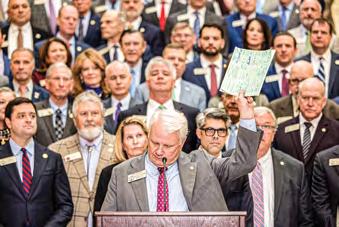

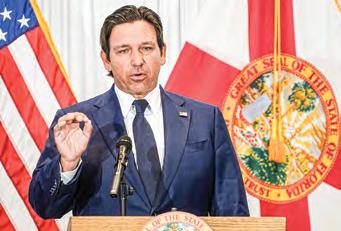
Georgia lawmakers (top) proposed phasing out property taxes this year. North Dakota voters (center) rejected property tax abolition in 2024. But Florida (bottom) has advanced its own abolition initiative.
would not have to pay any school-related property taxes by !)3*, a project that would cost school districts $7 billion.
“Michigan taxpayers deserve fairness in how their hard-earned money is spent,” Carra said in a press release about the exemption, which people who homeschool their kids could claim.
The exemption would be phased in, starting with a 4) percent reduction in taxes in !)!7 and then an increase of *5 percentage points every year until !)3*
The group Ax @IT ax is also trying to eliminate property taxes entirely through a ballot measure in this November’s general election, led by Republican gubernatorial candidate Karla Wagner. As of early February, Wagner said they had collected the necessary 446,*,8 signatures.
A similar dynamic is playing out in Ohio. As activists collect signatures for a ballot measure to eliminate property taxes across the state, Republican state Sen. Bill Blessing proposed a measure to reform the tax. Under his Joint Resolution 7, Ohio would tax the land, but not the property or any improvements. “If we’re going to tax improvements, we get less of them,” he reportedly said in February, adding that the “likely” outcome of his reform would be “more money in the aggregate, while lowering tax bills for the individual and reducing housing costs due to the added supply.”
Any state that eliminates its property tax will be the first; North Dakota voters rejected the idea in !)!4 , when they voted 63 percent against a measure that would have banned property taxes based on assessed property value.
Peter Gess, economic policy director for Arkansas Advocates for Children and Families, said the reasoning anti-tax crusaders give can sound convincing to those who haven’t given it much thought. He’s been hearing the same arguments as the one in Michigan, as well as one that argues that paying property tax is the equivalent of paying rent for something you own. But without that money, communities wouldn’t have the schools, roads, sewage treatment, parks, sanitation, and trash services they need to survive.
“You really wouldn’t have a community without it,” he said. “It’s hard to think about ways of overcoming a loss of income tax and property tax, and both of those together just really doesn’t make sense … It is hard to think about how you can make up all of
that with sales tax without making sales tax astronomically high.”
Shortly after Art Laffer appeared on a Zoom screen in Georgia, state senators voted to cut the income tax to the bone. “We can, and will, eliminate the ENTI&E T:A /U&DEN on individual taxpayers making less than $5),))) (or $*)),))) for married couples $ ling jointly) :ND, at the same time reduce the tax liability for every other family and business in Georgia,” the committee wrote. Senate Bill 476 lowers the at personal income tax rate from 5.*, percent to 4 .,, percent and increases the standard deduction from $!4 ,))) to $*)),))) for joint filers. Bill 477 lowers the personal income tax rate to 3 ,, percent by !)!8 and boosts the standard deduction to $3!,))) and $*6,))). If approved by the lower house, that would wipe out $*6 billion of the state’s overall budget, $*! billion of which would go to those earning more than $*)),))), Kanso said. It would barely make a di erence to everyone else; Georgians pay average total taxes of just $3,))) total, Kanso said, making it the seventh-least expensive in the country. They’d feel it in other ways, though. The only way to make up that revenue would be to reduce funding to public schools, whose funding is constitutionally protected, or to Medicaid, which is already on a starvation diet of $5 5 billion annually to insure two million people, Kanso said.
Not long after, Georgia lawmakers voted down House Resolution ***4 , which would have reduced property taxes to zero by !)3!, by a ,,-73 margin. The proposal would have cut well over half of local spending, Kanso said. As of !)!3, property tax in Georgia composed $*7 billion of a total $!5.8 billion worth of municipal spending statewide.
The discrepancy shows that abolishing property taxes, while an emerging red-meat issue for the anti-government crowd, still doesn’t quite have the buy-in needed from the average Republican. But these are early days, and the noise for sacri$cing yet another tool of functional government will grow louder. A few more centibillionaires shrieking that property tax “means that your house is a de facto lease from the government” and the base might just warm to the idea.
These choices about what to tax “fundamentally have real human costs, in terms of lives,” said Kanso. “It’s just a very bleak prospect to imagine.” n

WHEN ICE BLOWS THROUGH RURAL AMERICA
AS THE SURGE IN MINNEAPOLIS WINDS DOWN, SMALL COMMUNITIES IN MINNESOTA ( LIKE WILLMAR ) FEND OFF MORE ARRESTS AND LASTING IMPACTS.
BY EMMA JANSSEN

PHOTOGRAPHS BY JENN ACKERMAN AND TIM GRUBER
albert lea, minnesota—
It’s afternoon and I’m riding shotgun in Theron Gjersvik’s pickup, patrolling the town to look for any sign of IBE. A camouage pair of binoculars sits on the middle console and a camera is at the ready in the backseat. It’s blisteringly cold, and he drives with gloves on. We pass a lake with a blue plastic tent on it, and after I ask what it’s doing out there and Gjersvik tells me it’s for ice $shing, I feel like the city dweller I am.
Gjersvik is patient with me as he explains all the little details of life in Albert Lea that an outsider might not immediately understand. When we stop for a train to cross through town, he tells me that its cars are likely $ lled with corn and soy on their way to the Gulf of Mexico to be exported. He explains that there has long been a Latino community in the town, but only in the last decade or two has the population of Karen immigrants grown. A minority ethnic group from Myanmar, many Karen have settled in Minnesota as refugees.
Gjersvik was born and raised in this southern Minnesota town and has no plans to leave, even though his farming business is, in a word, “horrible.” (He had to downsize his farm by some !)) acres in recent years just to break even.) Like many farmers in the country, he grows the corn and soy that is fed to livestock before they’re butchered and processed into the pork loins or turkey legs that $ ll our dining tables. Some of that meat processing, he explained, happens right here in southern Minnesota, in freezing cold plants where a largely immigrant workforce cuts and shapes the animal carcasses and sends the best parts o to be packaged and sold.
Though it’s become harder to be a farmer, Gjersvik has found one niche and booming market—goats—that has proven pro$table. He sells most of his goats to a company in the Twin Cities, where they might end up spiced and stewed as part of an iftar feast in a Somali community. Every so often, a local Karen family will come directly to the farm to painstakingly examine all the caprine options, pick a favorite, and have Gjersvik shoot it himself so they can cook it up and share it at a wedding.
You could be forgiven if you thought Gjersvik, a white farmer with a massive truck, was a conservative. But there we were, rolling through town looking for any sign of IBE, and talking about how Gjersvik’s white privilege is exactly what allows him to show up at the scene of an arrest, document what he sees, and leave again with impunity.
Gjersvik is just one of an informal, quiet, and multiracial network of locals who have mobilized in the past two months as IBE swarmed into Albert Lea. These residents balance their day jobs with going to the Mexican grocery store to pick up food for families, patrolling the town’s poorer streets where IBE agents tend to pop up, and preparing to show up to an active raid or abduction at the drop of a hat.
The same work is being undertaken in rural communities all across Minnesota, from the charming college town of North$eld to snow-covered Willmar. It’s happening in the larger St. Cloud region and in the other meat-processing towns like Albert Lea’s neighbor Austin.
You can’t always tell who is part of these networks, and that’s what makes them powerful. They’re fresh out of college—and retirees. They’re longtime protesters—and “apolitical” people who suddenly realized they couldn’t sit idly by any longer. They’re pastors and imams, brewery owners and teachers.
A few things are universal: They are scared, exhausted, and they say that the news of a drawdown just isn’t their reality.
ON FEBRUARY 4 , PRESIDENT Donald Trump’s border czar, Tom Homan, who has led the Minnesota IBE surge since Border Patrol o(cer Gregory Bovino was sent home, announced a drawdown of 7)) IBE agents from Minnesota after weeks of heightened violence and enforcement.
Homan said that would bring the number of federal agents in the state to around !,))), down from an estimated 4 ,))) at the peak of the surge. The following week, Homan reported that he had sent more agents home and claimed that the number of federal o(cers in the state will “get back to the original footprint,” which hovers
somewhere around *5)
Despite this, reports kept surfacing of continued IBE enforcement in what’s known as Greater Minnesota, the parts of the state that lie outside of the Twin Cities. These exurban, suburban, and rural communities often receive less media attention and have fewer advocacy organizations. So I decided to go and see for myself what Minnesotans have been seeing.
I asked every community member I spoke to if they noticed less IBE enforcement since the drawdown had been announced. Their answers, across three vastly di erent towns, were all an emphatic “no.” A few observers noted that they had been seeing fewer agents than they had during the surge weeks in January and early February. But most attributed that to a change in tactics, not an actual retreat.
“I’ll believe it when I see it,” Lauren Baske Davis, a pastor at the First United Church of Christ in North $eld, told me about the news of a drawdown. And according to Gina Washburn, an IBE observer with North $eld Supporting Neighbors (NSN), three di erent IBE cars had been spotted across the city (including two outside of medical facilities) just the day before I arrived.
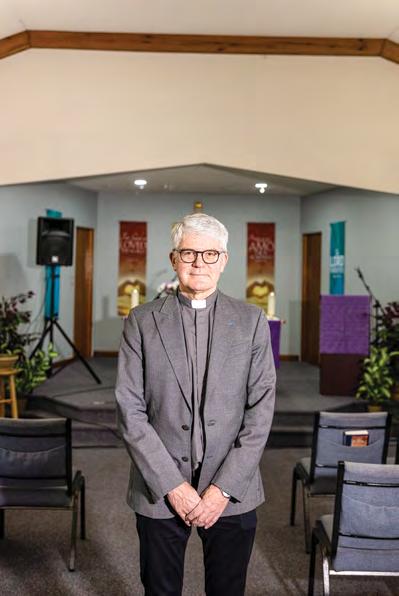
I met Baske Davis and Washburn in the cozy, wood-paneled community room of St. John’s Lutheran Church, which is led by Pastor Pam Fickenscher. We were joined by Anika Rychner, who runs the town’s Community Action Center (B:B), a wellestablished nonpro$t that provides housing and food assistance, and Pastor Paul Graham, another faith leader who has been outspoken in his support for immigrants.
Even before Operation Metro Surge (the name for IBE and Customs and Border Protection’s operation in Minnesota) o(cially began in December, residents of North$eld, a picturesque Midwest town that is home to Carleton College, had a startling wakeup call. In November, federal agents violently detained a local man out of his car. They smashed the car window and arrested the man in front of his son, who can be heard yelling, “That’s my dad!” on videos taken by bystanders. Hundreds of North$eld residents
gathered for a prayer vigil $ve days later.
“That very violent event really woke the community up in advance of the larger surge,” said Fickenscher, “and made it very clear that this was not just about the metro, but something that was going to be happening all over our state.”
Perhaps that early violence is part of why North$eld residents were ready to jump into action against IBE when its presence surged in January and February, as Baske Davis told me. “I had folks in my congregation saying: ‘What do we do?’”
She gathered those congregants for a meeting with the B:B, local leaders, and NSN members to discuss how they would support their immigrant neighbors. That meeting has since become a weekly occurrence.
“There’s this term, ‘neighborism,’ that’s coming out of this time,” Baske Davis said. After that initial meeting, “all of our members were plugged in. They were like: ‘I’m already making sure that kids are getting rides to school. I’m already tied into my local PT:.’”
As neighbors found ways to help, preexisting groups like the B:B and NSN were content to work in the background. Since the B:B has existed since before the surge, a large portion of North $eld’s immigrant population is already tapped into their services, said Rychner, and the group didn’t want to risk that.
“That was one of the reasons that we chose to be quiet,” she said. “If we stood up and were really loud about what we’re doing, it could potentially become an unsafe space for people who needed us.”
The pastors and community advocates I spoke to in Northfield described their approach as more subtle and understated than has been seen in Minneapolis and St. Paul. Rychner described relying heavily on bonds between neighbors, leveraging the connections that already exist between congregants at the same church or parents whose kids are in the same class. “You can’t just send strange cars into neighborhoods of people who are already sheltering in place and terri$ed of any strange vehicle,” she said.
I saw this interpersonal philosophy of organizing on display in all the rural towns I visited. Residents consistently told me that the kinds of mass protests seen in the Twin Cities just wouldn’t translate to their communities and wouldn’t meaningfully help their immigrant neighbors. In fact, as Rychner mentioned, highly public actions and communications could have the opposite
e ect, drawing too much attention toward important community resources.
“In the Twin Cities, you saw the whistles and the reporting and the observation, which is all great and super powerful,” Graham said. “Here in North $eld, I think the reaction was quieter. It was more like neighbors helping neighbors.”
Even the IBE patrols and observers take a more restrained approach, to protect both themselves and the immigrants whom IBE targets. Washburn, who helps train the volunteers who observe and follow IBE vehicles, says that new members have to sign a set of written rules, which they call their “guardrails,” dictating that they won’t be directly confrontational with agents, won’t be disruptive, and won’t try to interfere.
Early on, Washburn said, she tended to get more in agents’ faces, making clear that she was following and observing them. But after Renee Good and Alex Pretti were shot and killed by immigration o(cers in Minneapolis in January, she re-evaluated her strategies to keep herself and her fellow patrollers safe. This approach also protects IBE’s targets, she said. In her experience, agents tend to act more aggressively with their targets when they see a commotion around them. Washburn and other observers have also developed a “philosophy of noise and confrontation” that is conscious of the mental well-being of their neighbors.
Chaos, whistleblowing, and yelling “[affect] individuals within the community that we’re trying to serve,” she said. “We think about things like children being frightened by all that commotion. We think about elderly persons with disabilities … being triggered by the sounds of sirens, the sounds of horns.”
Early on during the surge, the observers had a dispatching system to track and verify IBE sightings. Bilingual members of the group would be on call !4/7 to receive reports of IBE in town. They would then send out an alert to a pool of veri $ed observers, and the $ rst two people to respond would head out to verify the report. If they con$ rmed that it was, in fact, IBE, they would send a report to a public WhatsApp channel with license plate information, location, and other crucial details. Vulnerable community members in the WhatsApp channel use the alerts to avoid the area or shelter in place until observers can give an “all clear.”
But, Washburn explained, the observers realized they needed to adjust their strat-
egies as IBE became more secretive. The group pivoted to a patrol system, while still keeping the dispatchers on duty.
“We have a map of the city, and we have specific key target locations where IBE predominates,” she explained. Places like a local mobile home park and certain apartment complexes have been consistent IBE hot spots. “We send veri $ers, at least two per location, starting at about 6 a.m. So we have at least anywhere from six to eight individuals out in locations.”
Washburn’s phone buzzed in her lap as she explained the system. It was one of her observer group chats. She said that her phone is almost constantly ringing with information from on-duty patrollers. The dispatchers have it worse, she said, “$elding calls all through the night.”
When observers notice a suspicious vehicle—out-of-state plates, or someone loitering outside a hot spot for a long time—a designated “tra (c controller” cross-checks the license plate numbers with a database the group has created of known IBE vehicles. If the car is con$rmed to be IBE, observers keep their eyes on it, following it throughout town. “It’s not unusual that in a day we will have multiple IBE vehicles in multiple locations,” she said. They tend to play what she calls a cat-and-mouse game, leading observers from location to location. “They’ll switch, and then they’ll switch again, and then they’ll hide, and then they’ll pop back out. And we’ll do that for hours and hours,” until suddenly all the IBE vehicles converge on one location and attempt to make an arrest.
The week before I got there, the day that Homan announced the drawdown, Washburn said it felt like the town was swarming with IBE cars.
When someone is arrested by IBE, a welloiled legal machine kicks into gear. Family members or friends of the detained person call NSN and give their name and Alien Registration Number. The NSN volunteer taking the call tries to gather as much information as they can. When did they enter the U.S.? How long have they been in North $eld? Armed with that information, they turn to a Rolodex of lawyers who take their call and spring into action.
Washburn says that these lawyers typically $le a petition for habeas corpus within just hours of the arrest. These petitions allow detainees to challenge their detention in front of a judge and can help them be released more quickly. The legal fees can be

expensive, but a group of North$eld “angels,” as Washburn calls them, step up immediately and put the costs on their credit card.
This speedy legal response is critical, because IBE has made a habit of transporting detainees immediately to Texas to get them out of the Minnesota jurisdiction, making it harder to $ le for habeas corpus. The infrastructure is “really glorious work,” Washburn said, “because every single case in which we have assisted in a habeas, the person has been released.”
Everyone in the room, myself included, gasped or whispered solemnly: “Wow.”
Rychner shared another staggering success: “We have people who now have March rent coming up who haven’t worked. We’ve been able to help everybody who’s asked for help [with rent].”
Despite the $nancial support for individuals, many North$eld businesses are struggling profoundly under the occupation. IBE has initiated a number of I-, audits against North$eld businesses, which require owners to produce immigration and payroll docu-
mentation for their employees. One small business in town was audited and has since shut its doors, at least temporarily. Its windows are darkened, with paper taped up to keep people from looking in. Some restaurants, like a Mexican place named El Triunfo, are still open but keep their doors locked. Customers must knock to be let in for a meal.
On January 8, Washburn brought in a group of attorneys to give a training to local businesses. The lawyers instructed employers to put up signs in their buildings to keep IBE out of private spaces and gave them a script to use if agents come to the door.
North $eld is lucky to have groups like the B:B and NSN, a large and liberal enough population that supports their e orts, and a sympathetic city government. Just three days before I visited, Northfield’s city council and Housing and Redevelopment Authority approved a $5),))) donation to the B:B to provide rental assistance for immigrant residents.
“You messed with us, and you messed with our kids and our families and our
community. We’re not gonna tolerate this anymore,” Washburn said. “It’s pretty cool. North $eld’s cooking.”
NOT EVERY AREA HAS THE SAME institutional support and deep ranks of willing volunteers as North $eld. In some communities, advocates are working against their local governments and making do with only a fraction of the manpower. That’s what I found in Willmar, a city of !*,))) almost three hours northwest of North $eld.
The drive to Willmar was on one- and two-lane roads that cut through vast $elds of snow, occasionally passing through towns that were often not much more than an antiques shop, a dive bar, a massive grain silo, and an American Legion center. Approaching Willmar, I started to see signs of a small city: motels, drive-through co ee chains, and a regional big-box home improvement store called Menards.
Downtown Willmar is all brick, with a small street grid and red “Season’s Greetings!” banners lingering on the lampposts. I made the mistake of walking around without gloves and a hat, and froze as I checked out the shopping district. There’s a brewery and a local theater, but also the Somali Star restaurant and a boba shop with a Karen owner. I ducked into one of the Somali grocery stores, which smelled like incense and sold everything from clothing to camel milk.
The Somali community has strong roots in Willmar. Many immigrants work at the local Jennie-O turkey processing plant, which has been the target of at least one IBE raid. Their Muslim faith restricts them from working in pork processing plants in other parts of the state.
Willmar has been lauded for its multicultural population; in !)*,, New York Times columnist Thomas L. Friedman wrote a piece called “President Trump, Come to Willmar,” and deemed the town a “modern, successful American melting pot.”
Now, that success is at risk. As I wandered through the downtown, IBE’s impacts were visible to the naked eye. Multiple storefronts were dark and locked, even at midday on a Saturday. The town felt quiet, even more than expected because of the cold.
I was grateful to $nally duck into Azteca, a Mexican restaurant where a small lunch rush was $ nishing up. There, I sat down with three community organizers over chips and horchata. Pastor Andrés Albertsen, an Argentinian immigrant who leads Willmar’s
Sarah Kretschmann (left) and Pastor Andrés Albertsen are among many members of the clergy working to protect immigrant neighbors.
Iglesia Luterana Paz y Esperanza and serves as visitation pastor for Vinje Lutheran Church, came in wearing a knit gray sweater with an alpaca design. He chatted with the cashier in Spanish before introducing me to Sarah Kretschmann, a deacon in the Evangelical Lutheran Church in America, and Willie Gonzalez, a local business owner and advocate for the town’s Latino community.
Gonzalez told me that one of those darkened storefronts was his. He shut down his restaurant, Spurs Bar and Grill, until at least May. Too many of his customers were staying home because of the surge, and he couldn’t afford the overhead. In the darkened windows of Spurs I saw two signs reading: “Stand with our families” and “Build Minnesota together.”
I asked the three how IBE’s presence in Willmar has been di erent than what has been seen in the Twin Cities, and Kretschmann re ected on Willmar’s small size.
“There’s not a bench to pull from in the same way that there might be in an urban setting,” Kretschmann said. Along with other volunteers, she’s been bringing groceries and medication to some 3)) families, an e ort that has quickly become overwhelming and unsustainable.
Willmar also has a strong conservative streak, they told me. Trump won the city with around 56 percent of the vote in !)!4 . The county sheri signed a !87 (g) agreement with IBE, a memorandum that allows local law enforcement to assist with immigration enforcement. There are four county jails in Minnesota that serve as IBE detention facilities, and one of them is in Willmar. Of the jail’s *,) beds, *5) are designated for federal detainees.
“This jail … was intentionally built bigger than the needs of the county so that the county jail could pro$t from hosting other kinds of inmates,” Albertsen explained. That strategy has worked; according to a county budget report, the county received around $4 .3 million a year from the jail in recent years.
“There were times when, in order to have room for more IBE detainees, they sent their own regular inmates to a neighboring county,” Albertsen said.
On the ground, IBE’s presence has been unbearable. Kretschmann and Gonzalez recalled one day when six arrests were happening seemingly all at once, with multiple IBE agents at each scene. One of the arrests happened right outside of Azteca, Gonzalez
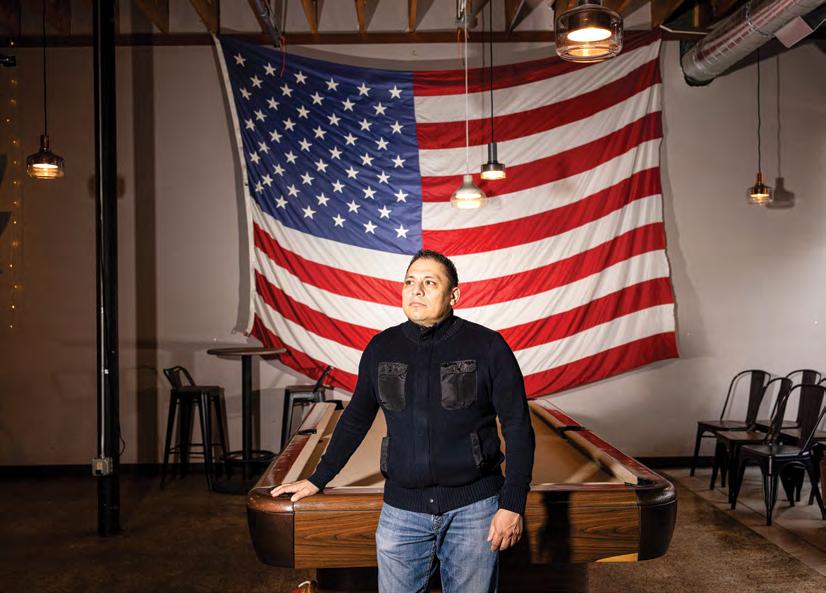
explained, pointing out the front window.
That day, January *!, IBE agents violently arrested a *,-year-old Somali high schooler on the sidewalk in front of Azteca, dragging her into their unmarked vehicle as residents shouted and took videos. For days, IBE didn’t list her location online, and her family received no communications from her or the government. Though she was eventually released, the damage had been done. The day after the young woman’s arrest, about ,) percent of Somali students stayed home from school, according to Sha $a Abdullahi, the cultural liaison at Willmar Public Schools.
“The tactic that they’re doing is just military. Just shock, shock, shock,” Gonzalez said. Kretschmann nodded. “There are just so many more o(cers than I think even I was expecting out in rural Minnesota,” she said.
Despite the dominant feelings of terror and shock, there have been some bright spots of solidarity. Gonzalez looked down at his leather motorcycle jacket, which was emblazoned with bright-blue lettering reading, “St. Michael’s Legion.” He explained
that he was a member of the group, a motorcycle club for $ rst responders, police officers, and ex-military. In December, before he shut down Spurs, Gonzalez hosted a Christmas fundraising event there, and his fellow Legion members o ered to guard the business to prevent IBE from entering.
“This group is really red. Really red,” he said. “But they know who I am, what I stand for, and they said: ‘They’re not going to come in here to your place.’” The Legion members stood guard in a two-block radius around the restaurant, and the fundraiser went o without a hitch.
“It’s been fascinating to see some minds and hearts starting to change a little bit,” said Kretschmann, re ecting on how conservative neighbors like Gonzalez’s Legion brothers have been processing IBE’s presence. “There have been some folks showing up to protest that I’ve talked to that are like: ‘This is the $ rst protest I’ve ever been to, I voted Republican, but I’m really disappointed with what’s happening.’ It’s been surprising to me in a positive way.”
Willie Gonzalez, a local business owner and advocate, had to close down his bar because his customers were staying home, fearing ICE raids.







Mexican and Somali restaurants and an Islamic center line the streets of Willmar. Shopkeepers and parishioners have expressed solidarity with immigrant communities.





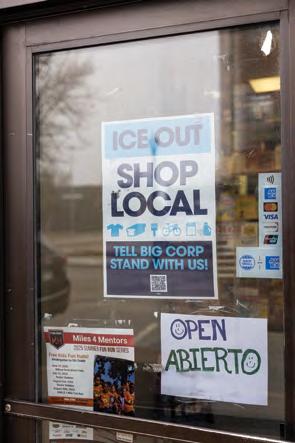
Just two days after the Somali high schooler was arrested, another IBE arrest in Willmar made national news. At a di erent Mexican restaurant in town, El Tapatio, the owner noticed what appeared to be IBE vehicles loitering outside the restaurant. Word eventually reached Gonzalez through the grapevine, and he called the restaurant owner, urging him to close the restaurant for the rest of the day.
It was too late—six IBE agents were already inside, eating lunch.
Worried, Gonzalez drove over and sat down in the restaurant. He half-jokingly told one of the agents to take an AlkaSeltzer if the spicy food was too much for them. Nothing happened, and the agents left without incident.
But when the restaurant closed later that day, IBE appeared. They arrested the restaurant’s two owners (a previously married couple) and a dishwasher.
“It just felt like such a violation of our hospitality as a community,” Kretschmann said.
The day after the arrest, the owners’ !) -year-old son reopened the restaurant and managed it until his father was eventually released. According to Albertsen, Gonzalez, and Kretschmann, the man’s mother was deported.
When I expressed shock that the owner had already returned home and was back to running the restaurant as though nothing had happened, Kretschmann nodded.
“Why put people through this? They’re back and having gone through the incredible trauma of this arrest and assault. It is just such a waste of human energy and resources, and it shows that it has a broader intention of intimidation,” she said. “And it’s working, unfortunately.”
Kretschmann says she knows people who have seriously considered self-deporting, a policy that the Trump administration has pushed aggressively to meet its deportation targets. Albertsen has a Peruvian friend who was arrested and o ered the chance to apply for asylum. But his friend decided it was better to just leave the country.
Another Willmar resident, who asked to remain anonymous due to safety concerns, has been sheltering a family of four in their home for the past three weeks. The parents, along with their seven- and **-year-olds, are too afraid to stay at their home, since they believe IBE could target them there.
“That’s what neighbors do,” the resident who opened their home said. “That’s what
people who love their community do.”
THAT NIGHT, I WENT TO THE Islamic Society of Willmar for a community iftar, the evening meal that breaks the fast during Ramadan. Dozens of non-Muslims, including members of the city government, took o their shoes and sat on the mosque’s red-carpeted oor to share a meal with the mosque’s Somali members. We ate sambusas stu ed with ground beef, fried potatoes with yogurt and a biting green chili sauce, stewed goat, and fruit. Babies cooed and little kids played together, running barefoot around the maze of people eating.
After the Maghrib prayer and everyone’s $ rst plate of food, the mosque’s liaison o(cer, Sheikh Mohamed Bulhan, spoke and expressed his gratitude.
“Looking at what’s happening in our country, Ramadan is an opportunity to come together for the common good. It strengthens unity, shared values, community, neighborhood,” he said. “Ramadan is not an individual exercise. It is a communal thing. We need to support one another and stand for one another.”
Later, he told me that members of the community had been sheltering at home out of fear of IBE. During the holiest month of the year for Muslims, he said, this social isolation is particularly tragic.
He also emphasized what other advocates across Greater Minnesota had told me: “The disadvantage of living in a small town is [that] you don’t have what we call ‘strategic depth,’ meaning you don’t have a lot of space to maneuver or $ght back.”
“We’re talking about a generational trauma,” he said. “IBE has attacked our trust in government. IBE has attacked our humanity.” Gonzalez, who never considered himself very political, said IBE’s presence in Willmar has fundamentally altered how he sees himself, his community, and the country.
He had been supporting his immigrant neighbors since IBE came to town, but things became personal on February 6. Gonzalez helps take care of a friend’s property in town, along with a woman who only speaks Spanish. The woman called him after seeing suspicious cars in the area, so he drove over to check it out. He didn’t notice anything, so he started to back out of the driveway, looking out the back window. When he faced forward again, he saw that his car was surrounded by eight agents. He immediately sent a text to the network of

observers he works with: “I need help.”
“I get out of the car, and the $ rst thing they say is: ‘Give me your papers,’” he recounted. He refused and asked why they wanted his papers in the $ rst place.
“You’re an illegal,” one of the agents said.
“I’m an illegal?” replied Gonzalez, who was born to a Lakota father and Mexican mother. “I’m more legal than all you guys put together … I’m Native!”
The IBE agents didn’t like that remark. Things escalated, and they pushed Gonzalez to the ground, which loosened two teeth and left him bleeding from a scratch by his lip.
“They put my face in the snow. I kept telling them: ‘It’s burning.’ My face was burning because they had my head shoved down, and I believe they had their knees on my neck and my back,” he said. He remembers lying there, not believing how incompetent the o(cers were as they tried multiple times to handcu him. (It has been widely reported that IBE agents receive only rudimentary training.)
Eventually, the o(cers let him go.
Though the arrest was violent and shocking, the most di (cult reckoning came after the incident, when Gonzalez realized that not everybody in Willmar would have his back. He says that very few people reached out to reassure him. He $ led a police report but found himself being questioned by an investigator instead.
“I don’t feel safe. I don’t feel backed [by] this county. People are supposed to protect me,” he said. “And that goes to show that if they’re doing it to me, [and] I’m a citizen …” he trailed o .
“Now I know where I stand. I have a big ag in my place. I look at my ag, and I’m like: ‘Wow. You failed me.’”
MY NEXT STOP AFTER WILLMAR was Albert Lea, a town of *8,))) just north of the Iowa border. I met four Albert Lea residents—Theron Gjersvik, Irasema Hernandez, Therese Salazar, and Mary Hinnenkamp—in the basement of the United Food and Commercial Workers union hall.
We stayed bundled in our coats as we spoke for hours around a plastic folding table.
We began with the history of Albert Lea, and it felt apt to be discussing it in a union hall. This is a town that has been de$ned by industry and organized labor.
When Hinnenkamp moved to town in *,7,, she said, “it was kind of a bustling town with great expectations of growing because of the cross of the freeway.” I-,), which runs east-west, and I-35, which runs north-south, cross here.
But those big hopes haven’t been realized, Hinnenkamp explained. During the Reagan era, unions struggled for relevance. An ill-fated *,85 strike at a nearby Hormel meatpacking plant, one of the signature labor actions of the *,8)s, lasted nearly a year, leading to violent confrontations with scabs and eventually a total surrender with 8) percent of workers being replaced, as chronicled in the *,,) Academy Awardwinning documentary American Dream In the early !)))s, a major meatpacking
At El Tapatio restaurant in Willmar, six ICE agents ate lunch and later returned to arrest the restaurant’s owners. One was deported.
plant in town burned down, and workers lost their jobs. The town has long had a Latino community, but in recent decades, their share of the population has grown, along with a community of Karen immigrants. Now, the town has an aging white population and growing immigrant populations.
In !)*7, the town lost its hospital, and residents now must make the 3) -minute drive to Austin for advanced medical care. Gjersvik went to a recent school board meeting and is worried that they are preparing to close a school to balance their budget.
“You see a town that’s losing retail, wages have fallen, lost [its] hospital, and then [has] a lot more diversity. And you kind of wonder, how does somebody like Trump get elected? I think there’s some of the ingredients there,” Hinnenkamp said.
As I drove through Albert Lea later that afternoon with Gjersvik, he showed me some of the town’s major meat and food plants. These are hulking, windowless concrete buildings, with in some cases tall chain-link fences around the perimeter that were erected during past strikes. Select Foods, which processes pork, is one of the biggest in the area, with a large immigrant workforce.
“It used to be full, that parking lot,” Hernandez had said earlier. “Not anymore.”
According to Gjersvik, IBE patrols the area constantly, and has arrested a number of employees. Others are staying home out of fear.
“If they take a lot more [workers],” Salazar theorized, “Select Foods won’t be able to operate.”
Since the Latino and Karen communities in Albert Lea are so tight-knit, one family leaving their job and moving away could start a domino e ect, Salazar said. The risk that families will start self-deporting is real.
“I’ve heard people say they are going back because they moved here because of a sense of security. But if they’re gonna live in fear, they’re like: ‘Might as well just go back to my country,’” she said.
But Gjersvik worries that some Albert Lea residents and companies are too worried about the economic consequences of IBE enforcement, and not worried enough about the lives of their immigrant neighbors. “It’s this idea of $ nding our heart for our neighbors because of economics and not $ nding our heart for our neighbors because of human rights,” he said, to nods from the others in the group.
Like in Willmar and North $eld, businesses have been forced to shut their doors—at least temporarily. Salazar told me that the local Mexican grocery store had been nearly empty for weeks, but only recently started to $ ll up again after the announcement of the drawdown.
As we spoke about how IBE’s presence was threatening the town’s already tenuous economy, Salazar and Hernandez, both mothers, understood the severity of the country’s political climate by how it a ects their children.
Salazar thought back to Trump’s first election in !)*6, when her daughter was in middle school. She came home one day and told her mom that white kids had been telling their Hispanic classmates: “You guys better pack up your bags, because you need to go back to your country. So hopefully you have your luggage ready.”
Salazar’s daughter is now in college, but Hernandez shared that little has changed in the town’s middle schools. Once IBE started to appear in December, her daughter came home and reported that white students had said: “All the brown kids, line up! They’re here for you.”
Dealing with the racism of their white neighbors is nothing new for Salazar and Hernandez; both women have had the police called on them for simply existing. Salazar’s neighbors called the police for having Christmas lights they deemed too bright, and for letting her dogs outside. Someone called the police on Hernandez for being outside in a neighborhood, trying to $ nd the right address for a work assignment.
The cumulative e ects of racism and fear of IBE can be traumatizing for students, which deeply concerns educators like Christoph Dundas, a high school band teacher in nearby Austin. Like Albert Lea, Austin is a meat-processing industry town. Austin is the headquarters of Hormel Foods, the makers of Spam and Applegate. Dundas and I talked over Mexican food, just a block away from Hormel’s Spam Museum, which has a statue of a farmer and two hogs out in front.
Dundas told me how his students have been faring. One student was late to a music lesson because he had been on the phone with his mom. Earlier that day, Dundas said, IBE had arrested three high school students in Austin’s downtown. The student’s mom was calling to make sure her son wasn’t one of them, and that he was carrying his passport.
“It a ects education, because what am I supposed to say? ‘Oh, that’s di (cult … can you play me a G-sharp?’” Dundas joked. “It takes over energy and focus and impacts the learning environment for students when they are worried about life and family.”
Dundas said that his fellow teachers are working hard to help their students, but it doesn’t seem to be enough. His colleagues have noticed class sizes decline as students stay home, and advocates worry that it will cause long-term damage both educationally and emotionally.
“I know at least a few kids who have been home already for a month, and they’re in elementary school,” said Hernandez. “I do work with some teachers, I’ve dropped [o ] homework for some of them, but I don’t know if it’s even getting done because I’ve never picked it back up.”
Gjersvik mentioned that there’s a scarcity of mental health resources in their town. Salazar and Hernandez worry that children and adults in the Hispanic and Karen communities aren’t culturally encouraged to process their emotions.
Salazar herself had always been told by family members to hide her emotions and keep her head down. Despite this, she couldn’t help but cry at an Albert Lea City Council meeting on February ,, when she gave a public statement about how IBE was a ecting her family.
“Both my daughters are carrying their passports,” she said, wiping a tear away. “I shouldn’t have to send my kids that are U.S. citizens with their passports because I don’t know if they’re going to be detained.” Her voice hitched. “I can’t even allow my mom to go outside during the day when I am not home.”
She described to me her work organizing Cinco de Mayo and Mexican Independence Day celebrations for city residents, which she has done for years.
“Everybody loves the music, the food, the parties,” she said. “But are you saying you just love our music? You just love our food? But you don’t love us enough to $ght for us to stay here?”
We left the union hall late that afternoon and spread out in di erent directions across town. Hernandez would deliver more groceries. Gjersvik and I would patrol through the town’s most vulnerable neighborhoods. That night, I would drive for hours through freezing farm towns, back to Minneapolis, as snow urried across the highway. n
A HOUSE OF LABOR DIVIDED
TO MANY SUPPORTERS OF AMERICAN UNIONS— indeed, to many in the meeting room—the con icting accounts, palpable animosities, and vituperative attacks launched during the February !)!4 meeting of the United Auto Workers’ International Executive Board (IE/)—the union’s topmost policymaking body between its quadrennial conventions— came as a shock. That this rift persists, and that it may lead to a bitterly contested election campaign for the union’s top posts later this year, only deepens those supporters’ confusion and dismay, particularly since the union has, from the outside, amassed a stellar record of victories in bargaining and organizing of late.
At stake is the future of the union that did more to build the broadly shared prosperity of mid-!)th-century America than any other. At stake is the future of the union that was the anchor tenant in the house of postwar American liberalism, providing
Internal rivalries among the leaders of the UNITED AUTO WORKERS are sapping the momentum from its historic victories.
By HAROLD MEYERSON
Illustration by LUCY JONES
crucial funding to the civil rights movement and early iterations of the women’s and environmental movements. At stake is the future of a union that for the past 4) years has borne the brunt of the downsizing of American manufacturing, of the foreign competition and hostile trade policy that both winnowed its ranks and compelled its members to give back some of the gains their predecessors had won.
But also at stake is the historic revival that the union has experienced under its new leadership in the past three years, and its ability to build on this dynamic success, which depends in part on the union—its leaders and sta ers most particularly—ceasing to act as a house divided against itself.
When the IE/ convened in early !)!4 , an outsider might have expected the meeting to be both celebratory and focused on organizing strategies. It had been only four months since the union had waged its inno -
vative “Stand Up” strikes and bargaining campaigns against General Motors, Ford, and Stellantis (formerly Chrysler), winning members their $ rst decisive victory since the *,8) s. The strikes, which saw selected U:C locals walk out of crucially important plants on a timetable that the Big Three automakers could not plan for, befuddled and alarmed the companies. The campaign also built member excitement (and, crucially, public excitement) through social media, where rank-and-$lers attested to their struggles and demands, and the U:C ’s new president, Shawn Fain, broke with tradition by continually updating the progress of negotiations, which had previously always been closely guarded secrets until settlements were announced.
What’s more, the February meeting took place amid what would become a landmark organizing victory, not just for the U:C but for the entire labor movement. Less than two
months later, the U:C would win the right to represent workers at Volkswagen’s Chattanooga, Tennessee, factory by a 73 percent to !7 percent margin. For decades, European, Japanese, and South Korean automakers had been opening factories in the right-towork states of the American South, where the power elite’s mobilization of long-standing anti-union sentiment had doomed nearly all the labor movement’s e orts to persuade workers to go union. But on the heels of the record contracts with the Big Three, which had been so widely publicized that many of the South’s non-union factories immediately announced major wage increases lest their workers take it into their heads to unionize, the U:C was throwing everything it had into the Chattanooga campaign, among several other plants in the South.
Finally, the union’s campaigns to organize university graduate students employed as teaching and research assistants, as well as
postdocs and adjunct professors, had swelled U:C ranks in recent years by roughly *)),))) members. Academic workers now constituted roughly one-quarter of union membership.
But the February meeting of the IE/ didn’t dwell on any of this. To be sure, the leaders expressed excitement about their new and anticipated triumphs after 4) years of plant closings, wage cuts, reduced bene$ts, and lower living standards for their members. But the meeting was dominated by divisions among key leaders and sta members. Accusations of failure to perform necessary duties ew; charges of o(cials targeting sta members because of their factional alignment were levied; allegations of handicapping vital campaigns due to internal rifts were made. Even as Fain and his supporters documented what they saw as malfeasances in the union’s highest ranks, other IE/ members labeled their charges an ambush that could have been
avoided if Fain wasn’t dead set on e ectively purging his opponents.
Even more confusingly, the dispute was chie y between the two leading members of the insurgent slate that won control of the U:C in late !)!!, in the $rst-ever rank-and$le election to pick the union’s top o(cers: President Fain and Secretary-Treasurer Margaret Mock. (Previously, union o(cers had been chosen solely by delegates to the U:C ’s quadrennial conventions.) It was Mock whom the Fain forces were accusing of having obstructed the union’s ability to wage the Stand Up Strike and the speedy campaign at the Chattanooga VW plant. It was Fain whom the Mock forces were accusing of having replaced many longtime o(cials and activists with new sta ers who weren’t U:C members and who behaved as if they possessed a secret formula for union revival that union veterans failed to understand.
Those divisions persist to this day, and
At stake is the future of the institution that did more to build the broadly shared prosperity of mid-20th-century America than any other.
as Fain seeks re-election as president in the member vote to be held later this year, he may well be opposed by a challenger who’ll run on a slate with Mock in her re-election campaign for secretary-treasurer. The faction that won control of the union in !)!! has now become two factions, bitterly opposed.
As if that weren’t divisive enough, there’s a third very powerful player in—though not of—the U:C today: Neil Barofsky, a New York attorney appointed by a federal court in the wake of the $nancial crimes of the last decade that shook the historically squeaky-clean U:C to its core. (Fain, Mock, and Barofsky all declined to be interviewed for this article.)
In !)!*, the two most recent former U:C presidents were convicted and sentenced to prison for misappropriating union funds for their own lavish lifestyles, spent chie y in Palm Springs. (A sharper contrast with the conduct of the U:C ’s Walter Reuther, who presided over the union from *,46 until *,7), is unimaginable. At Reuther’s insistence, U:C leaders’ salaries were kept well below those of the leaders of comparable unions, and he routinely objected to holding the union presidents’ winter meetings of the :D-- BI? in tony Florida hotels, while chiding his colleagues for wanting to “wallow in luxury like a bunch of capitalists!”) The U:C, in a settlement with federal district court, agreed to accept a federal monitor, who could compel the union leadership to relinquish control of o(cer selection at its conventions by holding rank-and-file elections, while also overseeing $ nances and operations to root out other corrupt or undemocratic practices.
Such a system had been in place at the Teamsters from the early *,,)s until just a few years ago, and as corrupt practices were also a feature of more than a few Teamster locals in those years, that monitor didn’t lack for work. No such corruption has been a feature of U:C locals, but a bitter dispute between monitor Barofsky and Fain broke out nonetheless, connected initially to the U:C ’s late- !)!3 statement condemning both Hamas’s October 7 th massacre and Israel’s subsequent war on Gaza, for which the union demanded a cease-$ re.
That issue and its follow-up became the subject of an angry exchange between Fain and Barofsky at the February !)!4 meeting, whereby Fain would eventually challenge Barofsky to a $ght. One week later, Barofsky began investigating some members of Fain’s sta for their e orts to undermine Mock, and eventually compelled Fain’s chief of sta , Chris Brooks, to resign. In a series of monitor reports after that meeting, Barofsky stated he’d found some of Mock’s allegations to be legitimate, even as he completely failed to acknowledge the serious nature of Fain’s claims.
How did the U:C—once the greatest of American unions, now showing signs, after decades of decline, of at least provisional revival—get into this mess? That requires going back to !)!!.
GIVEN THE TEAMSTERS’ RICH HISTORY OF corruption and mob domination, it’s no surprise that an internal reform movement called Teamsters for a Democratic Union formed in *,76 and has been in existence ever since. Given the absence of corruption in the U:C until the miscreant leaders of the late !)*)s, it’s no surprise that the U:C had no such organization until Unite All Workers for Democracy (U:CD) formed in !)*,, and grew large enough to be a force within the union only in !)!*, with the indictments and convictions of its past presidents.
That didn’t give U:CD much time to get its act together before, at the newly appointed monitor’s suggestion, the union held an election to see if the rank and $le wanted to elect their leaders. They did. And so U:CD scrambled to build a slate of candidates for the o(cer election, scheduled for December !)!!.
“The slate was pieced together,” one activist involved in the subsequent campaign recalls. “It wasn’t really based on sharing a common ideology or approach to key questions that unions deal with. It was based on whoever raised their hand.” Fain, who has since emerged as one of the most innovative leaders in American labor, had been a sta member, not previously involved in U:CD or other reform activities. “Both Fain and Mock came out of the sta that worked at
[the U:C ’s] Stellantis [division],” one former U:C o(cial says. “They sometimes campaigned together, but they were never close.”
Their abrupt ascendance bore scant resemblance to what had historically been a stepladder approach to union leadership. “Normally, incoming U:C leaders have a good deal of experience,” a Mock supporter told me. “The way the conventions worked, you’d come up from heading a regional o(ce. I can’t imagine coming into o(ce like Margaret or Shawn did”—that is, without a background in leadership.
The U:CD was able to $eld candidates for only roughly half of the IE/ member slots, so several supporters of the existing regime remained on the board. Mock and other U:CD slate members won their posts outright in December. Fain, however, was forced into a !)!3 runo against the incumbent president, Ray Curry, who’d had no involvement in the misdeeds that landed his predecessors in prison, but who was the candidate of the ancien régime . (A third candidate in the December presidential race kept Fain or Curry from winning the required 5) percent plus one.) Fain prevailed over Curry by just a few hundred votes in the runo , taking o(ce in March !)!3.
During Fain’s campaign, a number of U:C veterans appeared poised to sta him if he won. Shortly after his victory, however, Fain told them he’d decided to dispense with their services. His actual plans were made clear in a memo written by Chris Brooks, the head of his transition team, who would shortly become his chief of sta .
“ U:C members elected Shawn and the other reformers to the union’s highest o(ces to enact real, clear, and substantive change,” the memo began. “Everything we do, at every stage, must be reinforcing the message: there is a new sheri in town, something di erent is happening. This starts with who is appointed to what, who does and does not get $ red, and by demonstrating the willingness of the new leadership to embrace new ideas and new practices.”
The appetite for confrontation was front and center in the memo. “The mantra of the counter-revolution is going to be ‘we’ve never
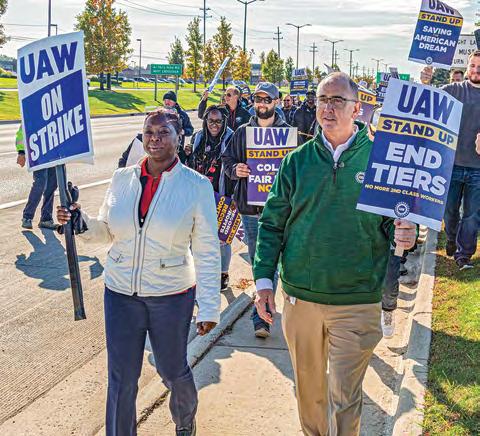
UAW President Shawn Fain and Secretary-Treasurer Margaret Mock weren’t close before becoming the highest-ranking officers in the union.
A triumphant Big Three contract, an election victory at Volkswagen in Tennessee, and several wins for graduate students have boosted the UAW’s fortunes.
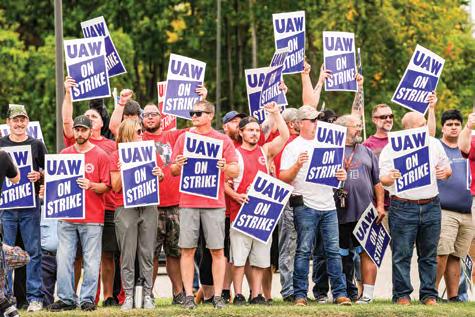
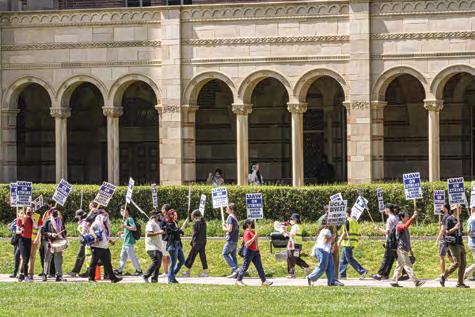
done it this way,’” Brooks continued. “Our response must be clear, consistent, and unrelenting: ‘We know. Now do it anyway.’ If we do this well, then heads are going to be spinning with how fast things are going to change. People will be upset because their jobs are going to change and because new things are being expected of them. Some people will leave and we should make that as easy as possible for them.”
Brooks had honed the perspective he brought to this memo, and to Fain’s administration, while working at Labor Notes, an organization of union radicals with a foundational skepticism about the capacity of bureaucratized unions to make signi$cant change. More recently, he’d been the $eld director of the New York local of the News Guild, the union of print media employees. He’d also been a labor and community organizer in East Tennessee, where he’d been involved in rallying support for the U:C ’s failed !)*4 campaign to unionize Chattanooga’s VW plant.
Fain bought into the revolutionary approach, and became intensely loyal to Brooks and his confreres. At one sta meeting, he pointed to his Labor Notes crew and said that if anyone messed with them, he would “slit [their] fucking throats.”
“Fain’s done a great job, but he surrounded himself with ideologues,” one longtime union consigliere told me. “Arrogance doesn’t work in an institution like [the U:C]. Labor Notes blames the decline of American unions on the bureaucratic structure of unions and the per $dy of their leaders … But this wholesale denunciation of, say, past U:C leaders is wrong. [Former president Bob] King was devotedly pro-worker, as were so many secondary leaders.”
On the other hand, in the assessment of a noted labor historian, “There’s lots of deadwood on the U:C sta ; many old sta ers should be fearful.”
Perhaps the key to understanding the U:C ’s internal travails is that both those assessments are right.
SOME VICTORIOUS UNION INSURGENT
CAMPAIGNS HAVE TAKEN POWER BY discharging many sta ers from the previous regime; that’s certainly what Teamster President Sean O’Brien did when he took o(ce in !)!*. Nothing like that had happened at the U:C, however, since *,47, when Walter Reuther’s slate, dominated by socialists and social democrats, ousted some incumbent regime o(cials and sta members, chie y members and supporters of the Communist Party. But if the axe-swinging zeal of Brooks and his Labor Notes associates raised understandable anxiety among many U:C sta ers of !)!3, the fact that many of them—most particularly Brooks and Communications Director Jonah Furman—weren’t even U:C members at the time kindled anger among some U:C longtime o(cials and employees.
Going back to the union’s origins, the U:C had almost always $ lled key sta positions with members who’d actually once worked on assembly lines. Such was the importance of the U:C to the progressive remaking of America during the *,3)s and ’4)s that some of those assembly-line workers were among the nation’s most talented leftists. Reuther’s lieutenants included onetime autoworkers who rose in the union’s hierarchy and eventually became architects of American liberalism, including Jack Conway, who devised many of the War on Poverty programs for Lyndon Johnson and eventually became the president of Common Cause; Leonard Woodcock, who became U.S. ambassador to China during Jimmy Carter’s presidency; and federal judge George Edwards. The Communist Party’s arsenal of autoworkers included Clancy Sigal, whose subsequent career included writing a great novel of the American left (Going Away) and a stint as Humphrey Bogart’s agent.
Even Reuther reached outside the U:C ’s ranks, however, for talented
Mock was plainly seething at Fain’s lieutenants, whose contempt for much of the UAW’s o cers and sta was palpable.
specialists, most notably chief economist Nat Weinberg, who played a key role in helping Reuther develop the speci $ cs of how to create income stability, health insurance, and adequate pensions within one union when the federal government shunned those commitments.
But the cachet that the U:C, and the labor movement generally, had enjoyed in the Reuther years had become a dim memory long before Fain and Mock took o(ce. Major unions had long since been hiring sta ers and consultants in messaging, polling, and politics who’d never been members. What the U:C had been able to draw from its ranks 8) years ago no longer existed; that some of its o (cers insisted on retaining the promote-from-within rule was a sign of organizational inertia.
The one o(cer who insisted on that most was Margaret Mock. At the outset of the February !)!4 IE/ meeting, Fain asked the board to approve the hiring of some nonmembers for specialized positions on the union’s communications sta . Only one board member objected: Mock, who argued, “We have hundreds of thousands of members, and surely there must be someone that’s within the U:C that’s quali$ed to take these jobs. So, I take o ense that our people aren’t quali$ed.”
In fact, Mock was plainly seething at Fain’s lieutenants, whose contempt—I don’t think that’s too strong a word—for much of the U:C ’s o(cers and sta was palpable. Mock’s own sta , in the assessment of one former U:C o(cial, was similarly indignant. Unlike Fain, the o(cial notes, Mock brought no sta members with her; rather, she inherited holdovers from the Curry regime. Her sta , he says, “resisted much of what Shawn wanted to do,” seeing themselves as a check on Fain and his Labor Notes revolutions. “Fain’s sta ,” he continues, “was very smart, but very new and very overzealous.”
According to one of Mock’s defenders, “I’ve never seen politics like this—the lack of institutional understanding. It’s not all that infrequent when a union’s officials don’t speak to each other, but their sta s serve as guardrails. This time they didn’t. They threw Molotov cocktails.”
AT THE FEBRUARY 2024 IEB MEETING, THE FAIN forces accused Mock of actions both trivial and critical. On the trivial side, she had denied reimbursement to three Fain aides: one for a taxi fare where the driver had failed to send the email receipt; one for a plane fare that the union had mistakenly charged to an aide’s personal credit card; and one for $*5! in pizzas Brooks bought for a meeting of organizers on the Chattanooga campaign. She had also refused to create cards with greater lines of credit for Fain’s top aides. Mock argued that she was following union rules under the shadow of the federal monitor; Fain’s defenders responded that their people had also followed union rules in $ling exception forms, which Mock rejected.
On the critical side, she had held up the union’s $5)),))) agreement with a new D.C.-based media buying $ rm named Conexion in the ongoing Chattanooga campaign, insisting that the o er should be bid out to three $ rms despite the additional time this would entail. Mock also allegedly delayed another sole-source vendor, a PR contract with Feldman Strategies, which works with several unions (though this particular issue didn’t come up during the meeting). The U:C ’s consent decree stated explicitly that all “major” contracts had to go through multiple bids.
Fain and Brooks had argued that Chattanooga’s business establishment had already started to buy anti-U:C billboards in the city, and that any leak about the campaign (made more likely with multiple bids) would prompt that establishment to buy all the city’s billboards, just as a leak about renting an o(ce for the union’s campaign there had successfully brought pressure on the building owner to cancel the o er. The concern was rooted in the understanding that the union’s victory in the Stand Up Strike created a greater receptivity to unionization among autoworkers, and that a ruling from the Biden National Labor Relations Board would compel Volkswagen to submit to an election within just two weeks of the union requesting a vote. The longer a vote was delayed, the greater the odds that worker support for unionization would wane, a fact
of life that labor scholars had documented and that the vast majority of union organizers and o(cials understood all too well.
The other crucial intervention that Mock had made was to delay authorization for the production of picket signs at the outset of the Stand Up Strike, in the belief that there were usable signs in many a local’s basement, even if such signs weren’t emblazoned with the message speci $c to this strike. For the $ rst week of the strike, accordingly, pickets marched without signs.
The remedy available to Fain was to have the IE/ reverse these denials at the February !)!4 meeting. The board duly reversed them, and members—including members who still had reservations about Fain and Brooks—expressed incredulity that such questions even had to come before them.
Rich Boyer, the U:C vice president in charge of its Stellantis division, whose relationship with Fain has been rocky at best (indeed, he may challenge Fain for the presidency later this year), called it “terrible that we spend this much time with something like this … I don’t think anybody in this room gets up in the morning and says, how am I going to steal $5 from this international union. If somebody loses a receipt or the cab driver says he’s going to email it and doesn’t email it, Jesus Christ, we’ve got to trust the people that we work with. [And] we spend a lot of time talking about President Fain trying to get some money to help organize down south. Come on, you guys, that’s a no-fucking-brainer.”
The meeting then moved to a motion from Fain’s supporters to strip Mock of her duties overseeing particular U:C departments, while retaining those fiduciary duties assigned to the secretary-treasurer by the U:C ’s constitution. Mock was blindsided; she had received no advance notice that such a motion would come before the board. (For that matter, Mock had not been invited to the planning meetings for the Stand Up Strike or the VW campaign, which may make her dilatory actions more understandable.) Following the presentation of Mock’s decisions, the optics of the motion itself reinforced how the entire day
was a well-plotted ploy by Fain’s forces: The two IE/ members making the motion were, like Mock, Black women. (It would later come out that Fain asked one of the women to issue the motion, because “it would be better coming from her than me, a white guy.”)
The board’s senior member, Ford division vice president Chuck Browning, reminded his fellow members that U:C presidents could reassign any o(cer or sta er without having to go to the board for approval, and that past presidents had frequently done so. The motion passed on an **-to-! vote, with Boyer abstaining. Not all the members who voted aye were enamored of Brooks or of Fain’s very evident ire at Mock. But they clearly admired the smarts that had gone into the Stand Up Strike, which augured well for the upcoming vote at Volkswagen. Even more, the prospect that the union could be hindered by divisions in its topmost ranks appalled them, and even if Brooks and company were as responsible for those divisions as Mock, they understood that the union’s campaigns— which Fain set in motion—must not be subverted from within.
WHEN WALTER REUTHER WON THE UAW PRESIDENCY IN 1946, HIS OPPONENTS still controlled a majority on the IE/; Reuther’s forces weren’t able to win a majority until the *,47 convention. Nat Weinberg, whom Reuther had brought on as a researcher during that yearlong interval, once told me that when he had a paper he needed to be typed, he had to $ nd a secretary aligned with the Reuther faction to type it; secretaries aligned with the Communist-dominated faction refused to do it.
That division, at least, was rooted in ideology. The divisions in today’s U:C aren’t so neatly explained, nor is it clear that they extend beyond the higher stratum of o(cials and sta into the rank and $ le. One factor that hasn’t risen to the level of an articulated issue, I suspect, is the changing composition of that rank and $le—speci$cally, the roughly *)),))) academic workers who have joined the union in the past couple of decades, at least half of them in the past three years. There’s no question that the push for the union’s December !)!3 call for a cease-$ re in Israel’s war on Gaza came from those members.
While all U:C o(cials certainly welcome the union’s recent growth, which has preponderantly come from university campuses, those grad students may be forgiven if they think some in the union view them as an exogenous body. During the February !)!4 meeting, West Coast regional director Mike Miller cited the *)),))) academics who’ve voted to join the U:C; Mock interjected that only 47,))) of them were paying dues. (That was almost entirely due to delays in securing $rst contracts.) Miller and Northeastern regional director Brandon Mancilla had been trying for four successive IE/ meetings to persuade the board to create a division of the union to speci$cally represent academic workers (who are concentrated in their two regions), like the divisions that represent the workers at GM, Ford, and Stellantis. The board rebu ed them. That the U:C ’s academic members disproportionately supported Fain, and that the Labor Notes crew represented some kind of distillation of the academic workers’ alien sensibilities and preference for revolution, portends a future that some in the old guard—not a majority, but not an inconsiderable number—don’t want to be around for.
The U:C ’s Gaza cease-$ re resolution also initiated the ancillary but very real con ict currently imperiling the union’s leadership: that between Fain and federal monitor Neil Barofsky.
A New York–based attorney with the $ rm of Jenner & Block, Barofsky served as the special inspector general overseeing the federal bailouts following the $ nancial collapse of !))8, during which time he tangled with Treasury Secretary Timothy Geithner over the government’s unwillingness to assist homeowners with foreclosures

In the days when Walter Reuther ran the UAW, talented leftists came from the shop floor and the union was quick to back economic and social movements.
Fain’s o ce felt that its campaign to unionize Volkswagen required the kind of quick and decisive action that Mock disallowed.
even as it was tending to the needs of big banks. He was also hired by Credit Suisse to oversee its investigation into its own history of assistance to Nazi Germany.
Barofsky was in Switzerland working the Credit Suisse case when he learned of the U:C ’s resolution. He almost immediately put in a call to Fain, which he began by noting that he was not calling in his capacity as the union’s monitor. To Fain’s astonishment, he said he was calling about the resolution, and that he happened right then to be with Barack Obama’s former special envoy on antisemitism, who could provide another perspective on issues that the resolution raised. (Barofsky added that he didn’t ask for any particular action to be taken, and apologized if it was perceived otherwise.)
At least, that’s how Barofsky characterized the call when he spoke to the IE/ on the second day of its February !)!4 meeting. Fain said he remembered the call di erently: “The $ rst thing you said to me was that you were calling me because you had concerns about my comments and they could be, you knew what I meant, but my comments could be misconstrued as being antisemitic. That’s what you said to me. And when I started explaining to you what I meant by my comment, then your comment was, well, I guess it is antisemitic.” Fain concluded, “For anybody to ever fucking say I’m antisemitic, brother, I’ll $ght your ass in front of this building in a heartbeat.”
Barofsky denied calling Fain antisemitic and added that he had “no reason to think that.” But pressed by Fain to reveal more about their phone call, Barofsky told the IE/ that “I shared the anecdote about the fact that my kids have been harassed since October 7 th with antisemitic language. And, yes, it described that protest with people holding U:C signs chanting hateful comments.”
The whole issue was before the board because Barofsky had passed along a letter to the IE/ that he’d received from the AntiDefamation League, claiming that a resolution on Israel and Palestine from a U:C local of New York–based public defenders was antisemitic. Ben Dictor, the U:C ’s attorney, had responded with a letter to Barofsky
noting that the U:C had a history of resolutions and actions that many, including U:C members, had found o ensive, such as calling for U.S. divestment from apartheid South Africa—and he certainly could have added such U:C e orts as providing crucial support for both the *,63 March on Washington and the *,6, Vietnam Moratorium.
Barofsky insisted he wasn’t demanding that the U:C do something about the letter; he said he had forwarded it because “we took it very seriously, in part because who it was that was making the allegation: the AntiDefamation League … it is an important civil rights organization in this country.” He added, “Just because I described the allegation as serious, of course, doesn’t mean that I agree with it.” (In recent years, previous :D- leaders such as Abe Foxman have criticized the organization for becoming a mouthpiece for Israel’s right-wing nationalist government; a number of longtime :Demployees have quit for that reason.)
Fain’s response—the gist of which was “I couldn’t give a damn what the :D- says”— underlined his belief that Barofsky’s interventions were about union policies with which he disagreed, and coming as they did from a federal monitor with the power to investigate and recommend prosecution of U:C o(cials for criminal o enses, was a boundary-crossing extension of the monitor’s mission and power.
JUST ONE WEEK AFTER THE IEB MEETING,
Barofsky began an investigation of Fain’s staff for its role in curtailing Mock’s responsibilities and instilling fear into some of the union’s o(cials and sta . In a report issued in July of !)!4 , he wrote that Mock’s reassignments “risk diluting the role of the Secretary-Treasurer as a potential independent check on actions that pertain to financial approvals and oversight of expenditures.” In a subsequent report, he wrote that “the Monitor’s investigation found that Mock consistently and strictly applied Union policy, guided by a commitment to accountability in the wake of the U:C ’s past $ nancial scandals. Her removal was not the result of dereliction
of duty or dishonesty, but rather a consequence of her refusal to grant exceptions to the strict policy restrictions governing the expenditure of Union resources, including to those within Fain’s inner circle.”
Fain’s office felt that its campaign to unionize Volkswagen required the kind of quick and decisive action that Mock disallowed; though this was the centerpiece of their case against Mock, Barofsky’s reports do not address this at all, though it surely weighed on the IE/ members’ decision to strip Mock of her control of some of the union’s departments. They grasped, as Barofsky did not, what the VW campaign meant to the union’s future, and what the passage of time meant to the U:C ’s prospects at Volkswagen. His failure to consider the exigencies confronting union campaigns leaves the impression that had he been in a position similar to that of federal monitor to the U:C in *,36, he would have disallowed the historic sit-down strikes, which marked a turning point in American unionism.
The monitor’s reports also include episodes demonstrating Fain’s ill temper, recounting one incident in detail: “Fain had heard from Furman that Mock wanted her photo included alongside Fain’s on the back of a publication outlining a tentative contract between the Union and a company. Fain reportedly confronted the Head of the Print Shop in a tirade, demanding, among other things, that she tell him, ‘Who told you to put [Mock’s] motherfucking photo on there? This is my motherfucking membership.’ Witnesses stated that the interaction, during which Fain admitted he ‘got shitty,’ was aggressive and left sta in tears.”
While demonstrating that Fain can be the boss from hell and a palpable threat to sta morale, it’s not clear what legal issues arise here.
Barofsky has the power to recommend that the Justice Department start an investigation of the U:C, something that Donald Trump’s administration would dearly love to do. To forestall that threat, the U:C agreed last December to give back to Mock and Vice President Rich Boyer the authority they had lost over particular departments of
had a history
the union, and Brooks announced he was resigning as chief of sta
In a message announcing the changes, Fain wrote, “In addition to our work in bargaining and organizing, it is also crucial that we build an internal culture of accountability, fairness, transparency, and collaboration. Our union is committed to building a culture of compliance, where sta can speak freely without any fear of retaliation.”
“Is there really a legal issue raised by the Fain-Mock $ght?” one union attorney who’s known Barofsky for years asked me. “Looks more like internal politics.”
In the course of his investigation, Barofsky found that *!3 text messages between Fain and Brooks on the subject of Margaret Mock had been erased; other texts between Brooks and Furman openly discussed and gloried in removing Mock from her duties. But what made those messages any more illegal than, say, the phone calls between U:C President Leonard Woodcock and his allies when they were working to ensure the defeat at an upcoming convention of IE/ member Paul Schrade, a Woodcock critic, in the early *,7)s?
Barofsky’s reports contain both anecdotal and survey evidence that a number of U:C o(cers and sta ers are scared of antagonizing Fain, but it’s questionable whether that is of any concern to rank-and-$le U:C members. To the union’s autoworkers, Fain’s success at winning contracts with the Big Three and Volkswagen that increase wages and end the two-tier system of paying new hires less surely matters more. To the union’s academic employees, the union’s stance on Israel-Palestine and its general political orientation—at its annual political conference in Washington, D.C., this January, the two main outside speakers were Bernie Sanders and :?B—surely matter more.
Yet what may concern U:C members more is that the union’s internal strife is a major reason why, at least for now, the union’s run of momentum has stalled out.
After the VW win, the U:C lost an election at a Mercedes plant in Vance, Alabama, after $ ling with cards signed by 7) percent of the workers. Unionization e orts at the other plants in the Southern campaign have not moved forward or gone public, in part due to the di (culties of organizing in the South. The union did win an election at a Ford BlueOval SK battery plant in Kentucky, but by a narrow vote that involved challenged ballots and has yet to be resolved; Ford laid o *,6)) workers at the plant in February. A casino worker election in Rockford, Illinois, was a blowout loss. In January, by contrast, hundreds of curators, designers, and historians at New York’s Metropolitan Museum of Art voted to join the U:C—con $ rming the grim reality for today’s labor movement that the only workers who can unionize without fear of being $red are workers whose specialized talents make them hard to replace.
There’s no question that Fain’s demeanor and his aides’ war on the sta did the U:C no favors; many talented organizers and other staers have left, some voluntarily, some not. The U:C has big ambitions, including something close to a general strike in May !)!8; Fain has been encouraging other unions to align their contract expirations with those of the U:C ’s Big Three contracts. Major progress on labor in the age of Donald Trump is unlikely. But the U:C ’s energy and attention inward has thrown its ambitions into some question, at a time when it was a main source of hope in organized labor.
Fain has a new chief of sta now who previously worked for Chuck Browning, one of the union’s most highly regarded leaders. The union’s revival, wherever it may lead, remains a work in progress. That it’s been reviving at all, despite the Sturm und Drang, is no small achievement. n
Fain’s demand for a cease-fire in Gaza fit with the union’s anti-war legacy, even if its statements were controversial.
The UAW
of opining on foreign affairs, including calling for divestment from apartheid South Africa.

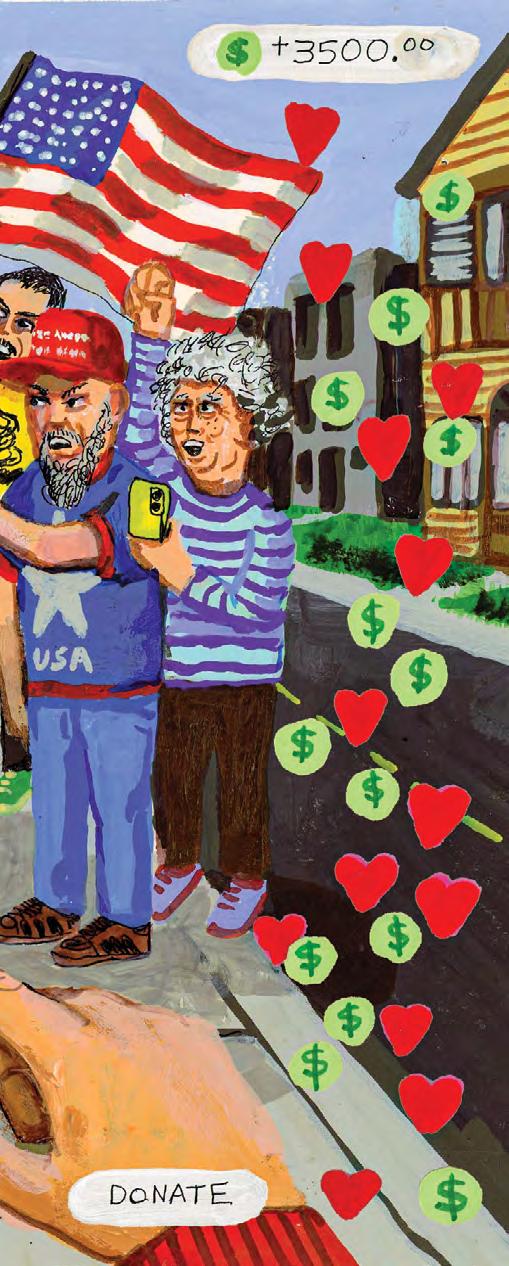
THE FAR - RIGHT CASH MACHINE
THERE’S MONEY
IN BIGOTRY, AND SPECIALIZED CROWDFUNDING PLATFORMS ARE WHERE TO GET IT.
BY NAOMI BETHUNE ILLUSTRATION BY BRANDON CELI
LAST APRIL, ON A PLAYGROUND IN ROCHESTER, Minnesota, a mother named Shiloh Hendrix reportedly called an autistic, $ve-year-old Black child a racial slur. In a video taken by a bystander named Sharmake Omar, Hendrix is accused of calling the child the N-word, which she does not deny. Claiming that the child took something of her son’s from her diaper bag, Hendrix, when asked by Omar why she doesn’t “have the balls to say it again,” replies by saying, “Fuck you, [N-word].”
The clip shows Hendrix repeating the slur at least three times. When asked by Omar if the child “digging” through her bag justi$es calling him the slur, Hendrix’s response is “if that’s what he’s going to act like.” Both Omar and the child were Black and of Somali heritage. Shortly after the video of the confrontation went viral online, Hendrix set up a campaign on the crowdfunding platform GiveSendGo. “I recently had a kid steal from my *8-month-old son’s diaper bag at a park. I called the kid out for what he was,” the description reads. It goes on to claim that Hendrix has been doxed, her family members are being attacked, and that her “eldest child may not be going back to school.”

SHILOH HENDRIX called an autistic Black child a racial slur.
AMOUNT RAISED: $850,000.
“I am asking for your help to assist in protecting my family. I fear that we must relocate. I have two small children who do not deserve this. We have been threatened to the extreme by people online. Anything will help! We cannot, and will not live in fear!” Since then, over 3),))) people have donated to the campaign. Hendrix set a goal of raising $* million, and at the time of this story’s production, the total amount raised is just shy of $85),))).
Hendrix’s story isn’t unique. Crowdfunding campaigns created by individuals who have publicly committed bigoted, discriminatory, and even violent actions have seen a rise in popularity. Over the past decade, as crowdfunding platforms have increased in popularity, campaigns like Hendrix’s have, too.
Websites that allow grassroots solicitations for fundraising have become a one-stop shop for individuals and organizations. They have become associated in the public consciousness with raising money for medical care or sudden emergencies, helping many who otherwise wouldn’t be able to a ord assistance. GoFundMe is the largest crowdfunding site, with over $4) billion raised since !)*), and in !)*7 an estimated one-third of all money raised on the platform was for medical purposes.
Donating to a crowdfunding campaign is relatively simple and accessible. After a few clicks and a quick entering of your payment method, the site does the rest. Another click and you can share a link to the campaign over text or on your social media. It’s this ease of use, and the ability to spread a campaign until it goes viral, that has led to thousands of people and organizations achieving their fundraising e orts.

RITTENHOUSE shot and killed Black Lives Matter protesters in Wisconsin.
AMOUNT RAISED: $500,000.
GoFundMe prohibits fundraisers that support illegal activities (e.g., the purchase of narcotics or weapons that will be used in con ict), campaigns that impersonate organizations, and anything that lacks transparency about use of donated funds. Most of its competitors— Kickstarter, Patreon, Givebutter, and others—have similar guidelines. But GiveSendGo, a Christian fundraising site, is both more and less restrictive. It disallows campaigns that “promote or fund” gender reassignment surgeries for minors or abortions. But in total, it only explicitly bans about one-third of the types of campaigns that GoFundMe prohibits.
This disparity has led to GiveSendGo’s popularity among individuals and groups whose campaigns do not meet GoFundMe’s guidelines, or who have tried GoFundMe and failed. GiveSendGo’s courting of controversial campaigns has solidi $ed its status as an “alt-tech” platform, joining other services that prioritize free speech, individual liberty, and personal privacy. Unlike other platforms, GiveSendGo’s founders have consistently argued that there’s a need for their mostly noninterventional approach to moderating what campaigns use their site.
“GiveSendGo argues their approach is a humbly deferential stance relative to other platforms, who have
appointed themselves as ‘arbiters of truth’ in determining what causes are ‘worthy,’” says Matthew Wade, senior lecturer in social inquiry at La Trobe University in Australia. “Instead, GiveSendGo frame themselves as defenders of individual freedom and liberty, and claim that their willingness to host controversial campaigns is simply a re ection of their nonjudgmental Christian accommodation and patriotic duty to protect fundamental rights, such as freedom of expression.”
In !)!), after Kyle Rittenhouse shot three people during a Black Lives Matter protest in Kenosha, Wisconsin (two of whom died), multiple fundraisers were set up on GoFundMe to cover his legal fees. They were subsequently removed, with the company pointing to its terms of service, which “prohibit raising money for the legal defense of an alleged violent crime.”
GiveSendGo did not have the same regulations. In a few weeks, a campaign sponsored by “Friends of the Rittenhouse Family” had raised over $5)),))) to reportedly cover Rittenhouse’s legal fees.
Rittenhouse was acquitted of all charges stemming from the shooting in !)!*. Since then, he’s become a .?P darling, depicted as a champion of the Second Amendment, a martyr for the conservative cause. Rittenhouse has appeared at multiple Turning Point US: events, spoken on podcasts, and even released a book titled Acquitted . His political advocacy led multiple Republican members of Congress to publicly consider o ering him internships, and several pieces of proposed legislation were named for him.
Arguably, Rittenhouse was the $ rst to perfect the right-wing grift by tapping into the strength of crowdfunding. He was not the last.
GOING VIRAL ONLINE
opens the door for others to follow in Rittenhouse’s footsteps. Coverage by news organizations, circulation on social media, and recognition by in uential political $gures can boost donations to crowdfunding campaigns. After Hendrix’s racist tirade began to make waves on social media, dozens of right-wing accounts posted about the video, portraying her as an antihero. X (formerly known as Twitter) is a prominent landing space for these kinds of scenarios; studies indicate that the website has seen an increase in hate speech and misinformation after Elon Musk’s acquisition in !)!! and the elimination of most content moderation.
It was on X that Hendrix’s status as a free-speech martyr propagated. High-pro$ le right-wing $gures took notice of her unashamed racial harassment. Daily Wire contributor Matt Walsh endorsed Hendrix’s GiveSendGo, saying in a YouTube video shared via X that the only way to put an end to the “outrage mob” is to “reward the person being targeted” for exhibiting hateful behavior. Eric Daugherty, the chief content o(cer for RightLine News, who has nearly one million followers, posted about Hendrix at least four times As her campaign neared $7)),))), he said, “I kind of
KYLE
think the left opened the bag with this one. Maybe stop making everyone you want to ‘cancel’ famous next time, or you may make them rich. We’re at this point now, whether anyone likes it or not.”
The reactions of Walsh, Daugherty, and others re ect a shift in the right-wing political ecosystem. They now understand that crowdfunding can be weaponized against wokeness, and that propping up individuals like Hendrix as victims of cancel culture can garner signi$cant pro$t. Powering this change is “rage giving,” a phenomenon that popped up in !)*6.
“Rage giving” means exactly that: A person donates to a crowdfunding campaign or charity as an emotional response to perceived injustice. It’s not only seen on the right; in fact, rage giving was $ rst identi $ed due to an increase in donations to “progressive organizations” (like Planned Parenthood, the :B-U, or civil rights groups) after Donald Trump won the !)*6 election. It has re-emerged time and time again, on both sides of the aisle, in the wake of major political events. Starting a fundraiser has become the expected next step after going viral, whether you’re a woman $ red from Cinnabon for harassing a Somali couple or an autoworker who shouted at the president.
Today, rage giving on the right has been underscored by the unique political environment created by Trump and his allies. “It’s not an accident that these sorts of crowdsourcing campaigns emerge when you have the most prominent political $gure in the land espousing explicitly racially hostile rhetoric and pursuing policies involved in dismantling diversity, equity, inclusion e orts,” says Jennifer Chudy, an associate professor of political science at Wellesley College. “To me, that’s very congruent with the broader political platform, agenda, and debate that has Trump at the forefront.”
When people like Hendrix are revered as antiheroes, or martyrs in the $ght against wokeness, it re ects a top-down commitment to honoring individuals and groups that should instead be penalized. Trump’s blanket pardon of “J6ers,” or people charged with or convicted of crimes related to the attempted insurrection at the U.S. Capitol on January 6, !)!*, is an example of this commitment. (A !)!4 policy brief found !55 crowdfunding campaigns by January 6th participants collectively earning over $5 3 million, with over ,5 percent of the fundraisers on GiveSendGo.)
“We are unfortunately in a place where our political leadership has raised up the worst of us as an example and has made it pretty clear that they don’t think that these folks should be held accountable,” says Melissa Ryan, BE? and founding partner of Inviolable. “It makes sense that supporters of our current leadership, of our president, are rallying around these same people, and the idea that they not only shouldn’t face accountability but should be rewarded for their hate.”
A GOOD EXAMPLE for how the right-wing crowdfunding ecosystem works is the case of Jonathan Ross,
GIVESENDGO’S COURTING OF CONTROVERSIAL CAMPAIGNS HAS SOLIDIFIED ITS STATUS AS AN “ALT-TECH” PLATFORM.
the IBE agent who shot and killed an unarmed U.S. citizen named Renee Good in Minnesota this January. Overwhelming video evidence and testimonials from bystanders show that Ross was not in danger of being struck by Good’s vehicle when he shot her three times; after the killing, Ross can be heard on videos calling her a “fucking bitch.” Ross was put on administrative leave but has yet to be disciplined or charged with a crime related to Good’s death.
On January 7, right after Good was killed, a campaign on GoFundMe called “Support for Renee Good’s Widow and Family” saw a massive in ux of donations. Within two days, the campaign raised almost $*.5 million, at which point donations were paused. In response to its success, another GoFundMe was established to support Ross (which was in line with the site’s terms of service), with the description reading, “After seeing all the media bs about a domestic terrorist getting go fund me. I feel that the o(cer that was *))) percent justi$ed in the shooting deserves to have a go fund me.”
It has raised a little less than $8)),))). Simultaneously, a campaign on GiveSendGo called “ Stand With Our Brave IBE Hero ” raised almost $3)),))). Its description was more thorough than that of the GoFundMe, and the organizer, Tom Hennessey, quite clearly explained his inspiration for creating it: “Donate today to send a message that we back the men removing illegals and invaders from our soil, no matter the sabotage from mayors [e.g., Mayor Jacob Frey of Minneapolis] who put foreigners over Americans. No apologies, no retreat—Mass Deportations Now!”
According to Clyde Emmons, the organizer of the GoFundMe for Ross, they were unable to get in contact with Ross’s family. But in an update posted on January **, Emmons claimed that the organizer of the

JONATHAN ROSS
ICE agent who killed Renee Good in Minneapolis. AMOUNT RAISED: nearly $1.1 million.
MONETARILY SUPPORTING A PERSON WHO WAS UNAPOLOGETICALLY RACIST IS A WAY TO SIGNAL ALLEGIANCE TO ONE’S POLITICAL COMMUNITY.
GiveSendGo campaign was in touch with Ross. “I am in contact with him [Hennessey],” and “he said he would pass it onto John himself.”

Hennessey has a track record of raising money for people on the right who have publicly demonstrated bigoted, discriminatory, and even violent behavior.
A coalition of right-wing X accounts that worked to circulate Hendrix’s fundraiser included Hennessey, whose account highlights links to several other similar crowdfunding campaigns.
A video created by Hendrix and posted by @Make_ EuropaSnow (an X account that focuses on spreading white supremacist and pro-eugenic content) emerged on May !), !)!5, about a month after Hendrix went viral. In it, Hendrix a (rms that she received assistance from a group of X accounts, led by @Make_EuropaSnow, that all promote xenophobic, pro-eugenicist, white supremacist, and nationalist rhetoric.
In Hendrix’s own words, early on, she reached out to @AngloSaxonGirl_ (who claims to run the account @Make_EuropaSnow) after they posted the video of her calling a child a racial slur, “just kind of needing someone like-minded to talk to.” @AngloSaxonGirl_ requested that Hendrix prove her identity by sending a photo of herself, along with a piece of paper with the @AngloSaxonGirl_ username and the N-word. Hendrix obliged.
@AngloSaxonGirl_ then assisted Hendrix in promoting her GiveSendGo, which originally set a goal of $!),))). Through collaborating with @Tomhennessey 6, (i.e., Tom Hennessey of “Stand With Our
Brave IBE Hero”), Paul Miller (aka Gypsy Crusader, a white supremacist in uencer), and others, @AngloSaxonGirl_ supported and shared Hendrix’s campaign. It worked: As the campaign progressed, Hendrix increased her goal multiple times, $ nally landing on $* million, which she has nearly achieved.
While the campaign rocketed around far-right X with Hendrix’s blessing, it also found its way onto sites and communities that are harbingers of similar extremist ideologies. Many of those who donated were listed as anonymous or used pseudonyms, but even with their identities concealed, their messages revealed their reasoning for contributing and/or where they found the fundraiser.
A person who forked over $*),))), the largest onetime donation, simply commented, “Enough.” Some of the donations did include names, like “Dr. E Micheal Frens,” which mirrors the name of an X account that’s full of racist and antisemitic posts. Someone listed as Manfred von Richtofen (a misspelling of the famed “Red Baron,” Germany’s leading aviator during World War I) left a comment after their $!,))* donation with the single letter “R.” Previous donors left single letters in an attempt to spell out the N-word.
An anonymous donor contributed $!,))) and included a version of one of Martin Luther King Jr.’s most notable quotes: “I have a dream that my children will one day live in a nation where they will not be judged by the color of their skin but of the content of their character.” A separate anonymous giver said on their $*,776 donation, “Thank you for noticing the content of his [the child’s] character.”
A contribution of $*,488 from “Average White Man” included a comment saying, “You did the right thing, standing up for your son! … Hopefully you can move to a nicer neighborhood, one free of these savages. Shoutout to goyimtv.” GoyimTV is an online video website operated by the Goyim Defense League, an American neo-Nazi group. A feature on GiveSendGo allows users to “like” a donation. This one got over *8,))) likes.
“I want to say how proud I am of everybody, just showing what can happen if we tribe up, and if we stick together and if we keep $ghting back. Our future, our existence, depends on standing up for ourselves and not backing down,” Hendrix said in the video posted by @Make_EuropaSnow. “You can’t be afraid of the people who are so fragile to a word.”
Smiling, Hendrix expressed gratitude for her supporters and said that she received “every dime of my money.”
THE POSITIVE REACTIONS
Hendrix’s campaign has received does display what she called “tribing up.” Monetarily supporting a person who was and continues to be unapologetically racist is a way to signal allegiance to one’s political community. While there are large contributions, many are given $7 or $*) or $*5 at a time. Donation by donation, thousands of people wish to align themselves with the likes of Hendrix, people
MICHAEL
DANIEL PENNY killed a homeless man on the NYC subway.
AMOUNT RAISED: over $3 million.
who see themselves in her, or at least the martyr $gure she is presenting to the world.
“Each donation and appended comment is an unequivocal signaling mechanism not just to the bene$ciary, or fellow supporters, but for everyone regarding who should be seen as upright citizens ‘deserving’ of our support,” says Wade.
Updates posted by Hendrix on GiveSendGo a ( rm that she has been able to access and spend the money sent to her by her supporters. “I have used the donation money to buy my family a home with plenty of land. We are now living in a place with excellent demographics.” Unlike other right-wing martyrs, Hendrix does not currently plan to become an in uencer or make media appearances, but she admits that could change.
Yet Hendrix hasn’t been able to completely pull o her celebrity status without consequences. She was charged with three misdemeanor counts of disorderly conduct in connection with her actions. It appears that she’s used money from her GiveSendGo to hire Brian Karalus, a prominent defense attorney, who has already $ led a motion to dismiss the charges against her. The Prospect reached out to Karalus’s o(ce for comment but hasn’t received a response.
“We are hoping all of this will be resolved by Summer !)!6. I’m excited to show the other side how silly they look,” Hendrix said in November.
GiveSendGo will also most likely come away with a signi $cant chunk of cash from the wild success of Hendrix’s campaign. Although the organization does not change platform fees, the site bene$ts from “gift” donations. Users are given the option to send an optional “tip” to GiveSendGo whenever they donate to a campaign, which led to the site receiving almost $! 6 million between !)*7 and !)!!
The company’s history shows how lucrative rightwing crowdfunding can become. In !)!!, a series of protests against B?EID -*, vaccine mandates occurred across Canada, in a movement known as the “Freedom Convoy.” A campaign assisting anti-vaccine Canadian truckers failed on GoFundMe, so it migrated to GiveSendGo, where supporters reportedly raised more than $, million. According to an analysis of leaked data shared by DDoSecrets, a whistleblower nonpro$t, GiveSendGo received more than $64),))) in “gift” donations from two related campaigns.
From !)!3 onward, GiveSendGo has become the go-to crowdfunding source for the online right. The lawyers for Daniel Penny, a white man who killed Jordan Neely, a homeless, mentally ill Black man, on a New York City subway in !)!3, raised over $3 million. :-P Pouches, Tucker Carlson and Turning Point Brands’ nicotine pouch company, has raised nearly $5.5 million to “support the Kirk family,” a reference to assassinated right-wing provocateur Charlie Kirk.
It’s not clear how much GiveSendGo has been “gifted” in the past four years, or how much Hendrix’s supporters have shared, but based on past experience, it is likely
to be a substantial amount. Jacob Wells, the co-founder of GiveSendGo, has said that website donations are enough to sustain a sta of 4)
CROWDFUNDING
HAS LONG been used to help people or groups who have experienced harm or injustice. But when victimhood has been rede$ ned by the dimensions of a current political moment, platforms allow people who have harmed others to claim that title, and pro$t from it. And there’s little that can be done to stop it.
Even though GiveSendGo and GoFundMe both have clauses in their terms of use that prohibit campaigns that promote discrimination or hate, such guidelines are not consistently enforced. GiveSendGo especially has consistently displayed an unwillingness to regulate campaigns that are in violation. “It’s not realistic that we can just sort of rely on these platforms to police themselves,” says Jeremy Snyder, a professor of health sciences at Simon Fraser University. GiveSendGo cofounder Wells has defended his site’s light-touch regulations on multiple occasions, most recently in response to Hendrix’s campaign, by citing the importance of $ghting back against cancel culture. Fundraising through mutual aid or community-based strategies instead is a worthwhile option for some, particularly when it comes to campaigns related to medical expenses. This is especially noteworthy when studies have shown that crowdfunding campaigns for Black and brown people are typically less successful than those set up by whites. Access to resources like media contacts and a wealthy, expansive donor pool directly contributes to a campaign’s success. “Racialized minorities, immigrants who are new to a community, people who aren’t uent in the dominant language, or have lower educational attainments, may not be able to craft as e ective a message,” says Snyder. “All these things seem to have a role to play in who does well or not.”
Case in point: The family of the boy whom Hendrix racially harassed also created a GoFundMe. Out of their goal of $!5),))), they’ve raised around $,,))). However, this was bolstered by a campaign set up by the local branch of the N::BP in Rochester, which got around $35),))) in donations before it was closed.
Ultimately, the rising number of right-wing crowdfunding campaigns represents more than just the power of rage giving, tribalism, or the end of cancel culture. It re ects how the growing reliance on charitable giving can be corrupted, in service of sticking it to the political opposition.
“As more and more of our wealth gets concentrated, grassroots fundraising is one of the last barriers we have to create funding systems that are truly accountable to people,” says Ryan. “Whether we’re talking about these right-wing crowdfunding campaigns, whether we’re talking about scam P:Bs, it’s just depressing, because all it’s going to do is reduce trust for one of the few sources of revenue that doesn’t come from billionaires.” n

CRYSTAL WILSEY Cinnabon employee fired for alleged racial comments.
AMOUNT RAISED: over $100,000.
JANUARY 6TH RIOTERS stormed Capitol and caused a riot.
AMOUNT RAISED: over $5.3 million from 255 crowdfunding campaigns.
Private Equity’s Great Escape

By David Dayen and Maureen Tkacik

The industry bought companies for too much money and made a bunch of bad loans. Now they’re scrambling to avoid the reckoning.
Illustration by Arif Qazi
For 14 years, the Abu Dhabi Investment Council (ADIC) remained silent about John Raymond’s woefully underperforming Houston private equity firm Energy & Minerals Group (EMG). The $330 billion sovereign wealth fund’s leadership made no public pronouncements when Raymond, son of the iconic Exxon chief executive who masterminded the merger with Mobil, agreed to invest some $3 billion in the new venture of extravagant fracking mogul Aubrey McClendon, who’d just been forced out of the company he’d founded for looting corporate coffers, including siphoning $12 million for a personal collection of rare maps.
They raised no alarm bells when McClendon and his new company American Energy Partners were sued a few years later for stealing trade secrets, or when the next year he was indicted for orchestrating a vast bid-rigging conspiracy, or when following his spectacular death the day after the indictment by driving 75 miles per hour into an overpass wall, E@.’s investments were themselves set ablaze. And they said nothing as E@. hired top-shelf bankruptcy lawyers to put other chunks of McClendon’s fracking empire—White Star Petroleum, Sable Permian Resources—into Chapter **, wiping out so much investor cash Raymond lost most of his fees with it.
But last October !3, Raymond’s $rm sent :DIB and other members of an investor advisory board a cursory “announcement” that would break the proverbial camel’s back. The good news was that E@. had found a buyer for Ascent Resources Group, the natural gas supplier formed from the wreckage of McClendon’s fracking empire. The bad news was that the buyer was … E@.. Speci $cally, the $ rm had set up a “continuation fund,” an increasingly common tactic to transfer portfolio companies into new vehicles and restart the clock on what is traditionally a short-term investment. E@. o ered to buy Ascent from itself for $5.5 billion; existing investors could either cash out or roll their money into the new fund.
The advisory board had to approve the deal before it was presented to all investors. E@. called a board vote for October 3), just $ve business days after the announcement, and for reasons unspeci $ed claimed it could not be delayed. When members asked what the urgency was about, or why E@. could not simply put Ascent up for sale, they were met with a Thatcherian response: “There was no feasible alternative path to liquidity.” Ascent had no viable buyers, and an initial public o ering was deemed “inactionable.” This was reinforced in a follow-up presentation by a third-party adviser known as a “fairness opinion,” and a D:Q delivered just hours before the vote. The company was underperforming compared to its peers, E@. claimed, justifying an exit price that would have hit investors with a loss.
Yet the pessimism didn’t make sense, given that E@. was proposing to invest more
of its own capital into Ascent. And why was E@. warning advisory board members not to discuss the situation with one another? “We are the only ones that truly have the facts and all relevant and accurate information,” one email from E@. to board members read.
At the October 3) virtual meeting, E@. gave the advisory board just !) minutes for questions and then called a vote. Only three of the 43 members agreed to approve the continuation fund, with :DIB and the rest demanding more time to consider the facts. One board member requested an internal discussion without E@. in the Zoom room; E@. incredulously said that would be “technologically impossible,” because it couldn’t transfer the meeting host to someone else.
The meeting broke up, but the vote was never closed. E@. started contacting board members individually to encourage a yes vote. After nine days of :DIB requests, on November 8 E@. $nally granted access to a “virtual data room” with more information about the sale. That’s where board members discovered
that E@. was giving prospective investors in the continuation fund a vastly di erent story: Ascent was doing great, it had much more natural gas reserves in the Ohio shale formation than the board was told, an IP? or merger was quite possible—the “expected case” by one estimate—and E@. would reap a fortune from the deal, by imposing new fees on legacy investors and earning carried interest from the transaction.
Before advisory board members could make sense of the discrepancies, on November **, three days after opening the virtual data room, E@. announced that it had received enough votes to approve the sale, adding that it would “circulate full minutes of the meeting shortly.” Those minutes would eventually be sent at **:3) at night two weeks later, showing only the three positive votes from the October 3) meeting, with no indication of when it obtained the subsequent approvals. By November !), all investors in E@.’s funds received an election form, asking whether they wanted to exit their Ascent investment or join the continuation fund. They had !) business days to decide.
All of the above information comes from a lawsuit :DIB $led in Delaware Chancery Court, one of the first cases by a limited partner to challenge what has become an epidemic of private equity funds selling portfolio companies to themselves. In !)!5, nearly * out of every 5 private equity asset sales was to a continuation fund, which have been criticized for lacking transparency and enabling potential self-dealing. While experts have told the Prospect that the :DIB complaint is a long shot, it does o er a window into the sweaty desperation at the heart of these circular arrangements. The real question is: Why are private equity $rms going to such great lengths to make them?
OVER THE PAST FIVE YEARS, AMERICA HAS reached Peak Rollup. Price-gouging, headcount-slashing firms in the $7 trillion private equity industry had long since consolidated the small businesses that once operated cheerleading gyms, ran dermatology clinics, and supplied clean napkins and tablecloths to restaurants. Then they moved into ice supply, font licensing, and the yarn wholesalers that supply craft shops and knitting clubs and the now-defunct JoAnn Fabrics. This inexorable death march can create the impression that private equity is
not only ruthless but unstoppable, destined to slurp up every company in the country and bleed them dry, leaving customers exhausted, workers on the unemployment line, and everybody but private jet manufacturers unhappy.
But under the surface, the masters of the universe seem a bit frantic.
The problems started with a generationde$ning bet. It’s hard to remember now, but as the pandemic began, the nation’s $nancial elites broadly assumed it would unleash a tsunami of corporate bankruptcies, not because anyone knew lockdowns would last years, but because the balance sheets of American companies had never been more burdened with unsustainable debt after two decades of private equity looting and stock buybacks. The B?EID recession worsened this as retailers, restaurant chains, and anything relying on foot tra (c struggled to survive. The Federal Reserve took two consequential actions to stanch the bleeding: cranking interest rates back to zero and bailing out equity investors by announcing major buys of corporate debt. Instantly and shockingly, the stock market popped 3) percent, increasing asset values across the economy.
It was a perfect opportunity for private equity. Their existing slate of companies could swell their debt load and delay any reckoning insolvency should have brought. And they could choose among all the distressed assets available, drawing upon their record $,76 billion in “dry powder” capital committed by investors but unallocated to any investment. Vultures like carrion, and !)!) was a carcass-rich environment. Deal count soared in the second half of !)!), after being subdued in the bottomed-out months of April and May. In !)!*, total deals hit $*.* trillion, setting a new record. And for the $ rst time ever, average deal size was over $* billion, as souped-up demand and stock market increases caused valuations to soar.
High valuations don’t faze fund managers, who derive most of their income from management fees paid by investors and companies, along with other wealthstripping activities like selling o company real estate. It was easy to exit investments at a surplus, with IP?s and mergers peaking in !)!*. And there was so much money available that nobody really cared how much they were paying. But if the portfolio companies don’t thrive and exits cannot be secured, new money won’t continue to pour in to keep the cycle repeating.
That became precisely the situation in !)!!, when the S&P 5)) fell by almost !) percent and pandemic in ation forced the Fed to raise interest rates, increasing debt service costs. Eileen Appelbaum, co-director of the Center for Economic and Policy Research and co-author of Private Equity at Work, thinks fund managers miscalculated when, instead of adjusting in concert with public markets, they deemed their portfolio companies properly valued. “My basic thesis is that the industry shot itself in the foot in !)!! when it failed to mark its companies to market,” Appelbaum said.
The downturn caused portfolio company exits to collapse. Of the 354 startup companies that received valuations over $* billion in !)!*—signi $ed by the label “unicorns”—only six had held initial public o erings over the next four years. A handful of others were sold for less than $* billion or merged with special-purpose companies looking to go public. But most lingered as “zombie unicorns,” businesses that hadn’t closed a funding round since the Obama administration, no longer grow, strain to service the debt that PE $ rms put on their balance sheets, and have no buyers in the marketplace. Overall, private equity has more than 3*,))) unsold companies on its balance sheets, with more than half of them held for more than four years, the highest level ever recorded according to McKinsey. For decades, the typical holding period for portfolio companies has been around $ve years; now the hold cycle is up to seven, with more from the !)!* gold rush coming due every day. “They totally bought too high and they can’t $gure out how to unload these things when they want out,” said Brendan Ballou, former Justice Department lawyer and author of a critical book about private equity called Plunder.
Without exits, limited partners (as private equity fund investors are often called) can’t recover their returns, or roll the proceeds from initial investments into new ones. Combine this with the fact that PE $ rms have performed no better than the public markets for the past !) years (and are often signi $cantly worse), and you have a distinctly unattractive investment. The biggest private equity $ rms traded on stock markets have fallen in value by at least 3) percent since the beginning of last year. Ivy League endowments are scaling back contributions, and total fundraising has fallen every year since !)!!. Realizing
losses in zombie companies would diminish fund performance and lead to even more investor ight. “It’s not like the industry is getting no money, but it’s not the money they expected or were hoping for,” Appelbaum said. “Everyone can see this big overhang of aging portfolio companies that have to be gotten rid of.”
The few revaluations that have occurred reveal this disconnect with reality: In February, two $rms dropped the Swiss watchmaker Breitling to half of its prior value. A large proportion, likely the vast majority, of those 3*,))) unsold portfolio companies owe more money than they are worth. Private equity overlords used borrowed money to buy them at in ated prices, and/or subsequently forced them to take out billions of dollars in loans to pay ownership “dividends” with no basis in $ nancial reality, and they’re now saddled with overin ated payments.
In sum, the big private equity $ rms are anxious to keep a delusion alive, locked in a race between their creative $ nancial engineering and an economic reckoning. During the $ nancial crisis, this kind of thing was sardonically described as “extend and pretend”; a better phrase would be “denial of reality.” And a key part of the quest involves a side business that has increasingly become the main event, bringing back yet another buzzword from the financial crisis era: shadow banking.
SINCE THE MID -2010 S, WHEN VENTURE capitalists soured on the software-as-aservice (SaaS) products businesses use to manage operations, it has become a robust private equity target, with $rms like Thoma Bravo, Vista Equity, and Permira leading the way. According to Bloomberg data, PE firms bought more than * , ,)) software companies between !)*5 and !)!5, a $44) billion investment smorgasbord; Bain & Company estimates that tech deals made up roughly * in 5 portfolio purchases since the pandemic. The deals were mostly ironed out by enterprise software specialists who loaded the transactions with enormous sums of debt, with little regard for whether revenues would be able to $ nance the interest payments. The idea was that new cash ows could be easily manifested by converting to a subscription model and hiking the fees. Anyway, as Ed Zitron has explained, SaaS was thought to be “sticky,” in economic parlance; no company reliant on SaaS for
payroll, HR, and scheduling was likely to replace its system wholesale.
Some of these deals were obvious busts from day one—Citrix Systems ran out of cash in !)!! before the rst interest payment on a $*5 .5 billion debt deal—but because the underlying companies no longer had to disclose $ nancial numbers, they fell out of the headlines. Now, with the great iron door slammed shut on exits, private equity is stuck with a portfolio that has recently su ered from the perception that it is replaceable, actually, since anyone with Claude can vibecode their own software. It’s been called the SaaSpocalypse, with equity indexes of public software companies down 3) percent since last fall despite a bull market. Roughly $* 6 trillion in market value evaporated in the $ rst two months of !)!6. (Somehow Thoma Bravo hasn’t been fazed, acquiring Dayforce for $*!.3 billion last year and raising a $!4 billion fund as the mass sell-o was playing out, even while co-founder Orlando Bravo told BN/B in February that most publicly traded software companies “don’t have enough pro$ts.”)
Every private equity big shot—Thoma Bravo and Vista included—ran to investor conferences and TV cameras in February to downplay SaaS fears as overblown, which is probably correct; Salesforce and Intuit aren’t going to be re-engineered by AI overnight. Yet PE managers were maybe the worst messengers for this reassurance. Despite what he acknowledged as “a very violent technology cycle,” John Zito, copresident of Apollo Asset Management, told BN/B that “none of us at Apollo think that software is going away,” which was not as soothing as he might have thought, especially given that a few months earlier in Toronto, he stunned an investor crowd by posing the question: “Is software dead?”
Yet the biggest risk from the SaaSpocalypse is not forced write-downs on private equity portfolio companies, but defaults on the junk bonds they can’t service. That’s because direct lending to software companies makes up at least !) percent, and maybe more, of the debt exposure of the private credit industry, the new name $ nance bros have given to the practice of private equity $ rms becoming lenders.
As Je rey Hooke, a former private equity director who teaches at the Johns Hopkins Carey Business School, explained, between 8) and ,) percent of the loans go into leveraged buyout deals and private equity–owned
companies. Those largely unregulated loans were made at the point of a proverbial gun: Piled-on debt can keep companies a oat for another year of management fees, while secondarily extracting lucrative interest and dividends for hungry investors.
In the past five years, private credit has grown into a $3 trillion juggernaut, as fund managers promise large returns, the long-sought “alpha.” But in a recent research paper, Hooke and two colleagues found that if you do a proper comparison between private credit funds and a basket of leveraged loans, you get roughly the same returns. The di erence is that when a loan goes bad in the public markets, the losses get recognized; with private credit, they don’t. “If a loan goes sour, they paper it over … they’re deferring all the problems to later,” Hooke told the Prospect.
His paper showed that many private credit funds, which after ten years should be mostly paid down, were only partially liquidated, with lots of deferred payments. This gives fund managers wiggle room to de$ ne returns on the unrealized residual value. “It’s all based on what the private equity manager says it is,” Hooke said. And one way to mask this is through—wait for it—continuation funds, which recycle old loans into new instruments. “I was pretty stunned … I didn’t think limited partners would put up with it,” Hooke said. But the promise of alpha is a hell of a drug.
What this means is that private credit balance sheets are potentially a nuclear bomb waiting to detonate. And last fall, the $rst bits of radiation started to seep out.
BACK IN 2006 , THE CARLYLE GROUP
FORCED its portfolio company United Components, Inc., maker of oil $lters, water pumps, and transmission components purchased with $585 million in debt three years earlier, to oat an additional $!35 million in “payment in kind,” or PIF , certi$cates—bonds so junky they can’t legally call them bonds—which would in turn $nance a $!6) million “dividend” for themselves and investors. Auto parts companies would randomly become a collector’s item for private equity. Apollo had a lighting supplier called Lumileds before bankrupting the company and passing it to Cerberus; Torque Capital Group had Illinoisbased Brake Parts, Inc.; and the Michiganbased inventor of windshield wiper blade manufacturer Trico passed to a small but


In 2025, nearly 1 out of every 5 private equity asset sales was to a continuation fund, which have been criticized for enabling potential self-dealing.

prestigious private equity $rm called Kohlberg & Co., founded by the estranged cofounder of private equity giant FF&. By !)!4 , all these disparate auto parts firms, and !) others, had been strung together into an entity called First Brands, owned by a little-known $nancial engineering veteran who lived in an unspeakably palatial compound in Chagrin Falls, Ohio, and was so elusive that private investigators charged with probing his fortune concluded he’d hired professionals to scrub the internet of every photograph ever snapped of him. Patrick L. James had moved from Kuala Lumpur to Ohio as a teenager to attend the College of Wooster, then began to buy and ip local automotive suppliers in the mid-*,,)s, eventually acquiring more than a dozen with two partners during the Bush administration, nearly all of which closed up shop by !)),. A series of articles in the Columbus Republic, the daily newspaper of the southern Indiana town where the crew had shuttered a factory formerly owned by Arvin Industries, documented a distinctive pattern across the trio’s businesses: making drastic cuts, paying vendors late if at all, and leaving town with a pile of lawsuits and broken promises.
By !)**, the group had been sued by the state of New York, a regional commercial bank, a massive private equity $ rm, and a constellation of other creditors for extracting tens of thousands of dollars a month in “management” and “consulting” fees and facilitating dubious asset transfers out of companies they had $ nanced. Somehow, none of these documented legal problems stopped the investment bank Jefferies from lending James $455 million in !)*4
to acquire Trico, which Kohlberg & Co. had acquired just seven years earlier for $,5 million cash and a $*6 million loan. Almost quintupling the initial investment would usually suggest that there wasn’t much juice left to squeeze.
A unique feature of the term loan that $ nanced Kohlberg’s exit is $ led with the U.S. Patent and Trademark O (ce: an agreement signed by James and Je eries banker Brian Buoye that assigns to the investment bank 7) of Trico’s brand names and taglines (“The foremost in wiper technology”; “Wiper blades that just click on easy”) as part of the “trademark collateral” securing the loan. Such an agreement is rare but not unprecedented; a few years later, J. Crew’s second round of private equity owners would use “intellectual property” to secure a $3)) million loan they then used to pay dividends, in a gambit famously nicknamed the “J. Screw.” In this case, either Trico already had creditors it might need to screw by signing away the rights to the company’s most irreplaceable asset, or the bankers were concerned James might try to screw them $ rst.
In !)*8, James rapidly snapped up other private equity automotive rollups and bolted them onto Trico, thus constructing First Brands. This is when a federal indictment handed down in January claims his elaborate conspiracy to defraud lenders began, though there is vital exculpatory context on the third page: First Brands’ customers (the Big Four auto parts retailers, including stock market darling AutoZone, controlled for years by a succession of private equity $rms and hedge funds) “routinely negotiated extended payment terms—at times permitting payment
up to a year after delivery.” That time lag literally required vendors to master the dark arts of $nancial engineering.
To make up the cash shortfall and build capital for more acquisitions, James and Co. took out billions of dollars in private credit loans. Many were never placed on the company’s books; First Brands would borrow from private credit against one invoice, and then borrow again against the same invoice, a scheme known as double-pledging collateral. There were loans secured by its inventory from an out $t called Evolution Credit, loans secured by invoices from a high- ying SoftBank-backed “supply chain” $nancier called Greensill Capital (and after that collapsed in !)!* , another $ nancier called Raistone, founded by one of Greensill’s founding employees), and $! 3 billion worth of sale-leaseback agreements on various First Brands factory equipment with Utah $nancier Onset Financial that were so predatory the $rm reported internal rates of return as high as 3)) percent. Greensill and Raistone sold the loans primarily to Credit Suisse and U/S , respectively; Evolution pooled its loans into a hedge fund marketed to endowments and public pension funds; and Onset sold a chunk of one deal to Patrick James’s brother Edward, who secretly invested $*5) million in a sale-leaseback hoping to quickly double his money “before the house of cards came crashing down,” according to one lawsuit.
The companies brought into First Brands were just tools for extraction. As a longtime employee posted on a Reddit thread on the company’s bankruptcy: “I worked for a company for !) years, then First Brands purchased them and immediately made big cuts and @:SSIEE price hikes (like 3-5 x). Employees jumped ship. Customers (?E@s) ran away to other suppliers. Buildings have been shuttered … We had been owned by 4 di erent private equity groups over the !) years I was there … [First Brands is] 5)X worse than the previous worst ownership.” It was abundantly clear to insiders that First Brands was a Ponzi scheme; Patrick James was lavishing the $7)) million he sucked out of the company on conspicuous extravagances—*7 “exotic” cars, two houses in Malibu, a mansion in the Hamptons and a townhouse in Manhattan, a private jet and a massive security detail—while his brother was loan-sharking the company alongside its biggest lender. The private equity $ rm that triggered the company’s ultimate
demise, Apollo, was so certain First Brands was a goner that it began buying “synthetic” credit protection on the company’s loans a year before any trouble hit.
First Brands term loans traded at par throughout summer !)!5, until a routine e ort to re$ nance $6 billion failed to $ nd enough buyers and the market panicked. When the company filed for Chapter ** in September, its attorneys were wholly unprepared to contend with a collection of creditors suddenly interested in seizing assets, clawing back interest income, unearthing the truth, and sending fat cats to jail. Once the feds began sni(ng around, their BD? wasted little time admitting guilt and negotiating a plea.
Through a spokesperson, Patrick James “unequivocally denies all allegations and charges against him,” while adding that “the strategy of relentlessly attacking Mr. James and the Company’s $ nancing arrangements has led to a loss of revenues and customers as well as factory closures that cost employees their jobs.”
Week after week, new revelations about the escapades of Patrick James and his gilded menagerie of yes-men $ lled The Wall Street Journal and the Financial Times, as though this was not just how large swaths of post–private equity corporate America functions these days. As JPMorgan Chase BE? Jamie Dimon said after charging o $*7) million from the First Brands debacle, “when you see one cockroach, there are probably more.”
Inevitably, new cockroaches began $lling the headlines: the London mortgage lender linked to a disgraced Bangladeshi $ nance minister that had triple-pledged most of its assets, the BlackRock-backed lender to cellular tower operators that was actually just an industrial-scale manufacturer of forged invoices. Blue Owl Capital, an upstart private lender that amassed a portfolio worth $3)) billion in a few short years, saw its stock fall more than two-thirds since it went public last year, due to those pesky software loans; after liquidating $*.4 billion in assets to pay o investors who wanted out, it halted redemptions entirely in one fund.
The biggest funds keep reporting upticks in troubled loans, from BlackRock to FF& to Apollo. The default rate has hit , ! percent, and U/S has pitched a worst-case scenario of *5 percent. And the fallout isn’t limited to fund managers, as Dimon’s charge-o con $ rms; Moody’s


Continuation funds are designed not primarily to shed debt but to recharge investor funding liquidity, while maintaining high valuations.

estimates that U.S. banks, which have been restricted from these exotic loans since Dodd-Frank and want the high yield, have $3)) billion in exposure to private credit, meaning the impact could cascade out to the broader $ nancial system. You know this could be bad because Goldman Sachs is running a sequel to The Big Short , helping hedge funds structure derivative short bets against collapsing private credit loans. Good thing derivatives have never magni$ed a crisis before!
PRIVATE EQUITY USING ARCANE FINANCIAL
mechanisms to escape trouble has a long tradition. Dividend recapitalizations force portfolio companies to borrow more (usually from private credit) so funds can pay out investors; they approached a record high last year. Net asset value loans, which also distribute cash to investors, are taken out on the whole fund, so if they go bad, every portfolio company in the fund su ers. Private credit facilitates this lending, but as we’ve seen, this can catch up to the lenders. Even recirculation is an old story. As Ballou explains in Plunder, when restaurant chain and children’s birthday party fave Friendly’s $ led for bankruptcy in !)**, its owner Sun Capital was also, through a private credit subsidiary, its largest lender. The $rm o ered to forgive Friendly’s debt if it could buy the company from itself. It won an “auction” of exactly one bidder, in the process pushing o $**5 million in pension liabilities to the Pension Bene$t Guaranty Corporation, which objected to the sale but was denied by a corporate-friendly Delaware judge. The ice cream merchant fell

back into bankruptcy nine years later, and now is part of a multi-brand investment group. But Sun Capital emerged unscathed, having sold the company in !)*6. Continuation funds solve a di erent problem, designed not primarily to shed debts but to recharge investor funding liquidity, while maintaining the high valuations that have the industry so stuck. The fund manager can e ectively pick their sale price, rather than nod to reality. Just 5 percent of private equity exits were continuation funds in !)!*, but that number rose to *3 percent in !)!4 and around !) percent in !)!5. In July, French $ rm P:I spun the parent company of ice cream maker Häagen-Dazs into its second continuation fund, something the industry calls “CV-squared” (“CV” is short for “continuation vehicle”).
The deals have been sold as an opportunity for investors to earn back pro$ts on invested capital. But fund managers have incentives to lowball them, while presenting self-serving information and o ering limited time—usually just !) business days—for due diligence. Rosy claims of future growth to entice new investors are also a concern: The story of Wheel Pros, which went from a continuation fund to a bankruptcy that wiped out the investment entirely in just two years, is a cautionary tale. “I’ve said to limited partners, you aren’t sure if you’re getting shortchanged or if the limited partners in the continuation fund are,” said Hooke. “Are they cheating people in the $ rst or second fund?”
General partners can also benefit by imposing transaction fees on old investors, management fees on new investors, and potential performance fees on aging
companies. In addition, Appelbaum writes, exit sales trigger the full !) percent carried interest for the general partner, even though these are not real transactions but circular deals. “Right away they’re cheating the LPs,” Appelbaum said.
Private equity $ rms argue that independent evaluations from third-party fairness opinions, as well as a sign-o procedure from advisory boards made up of the largest investors, protect limited partners’ interests. But the investment banks who create the fairness opinions are paid by the private equity $ rm, putting their objectivity in question. And the allegations by the Abu Dhabi Investment Council in its lawsuit against E@. reinforce that advisory boards may not be a meaningful check.
:DIB is not the $ rst limited partner to complain about continuation funds. Last spring, Dailane Investments Limited sued H.I.G. Capital, known for its rollup of prison service monopolies, over a sale of Maillis Group to itself in !)!! for *57 5 million euros. Dailane claimed that H.I.G. overstated the company’s pension obligations to make the company seem less valuable, and dismissed a third-party bid at a higher sale price. H.I.G. has denied wrongdoing, and the case was dismissed on jurisdictional grounds, though it is now under appeal at the **th Circuit. :DIB had similar troubles getting heard. As the lawsuit notes, under the agreements of the E@. fund, parties must take disputes to mandatory arbitration; :DIB $ led the lawsuit to seek “a preliminary injunction in aid of that ::: Arbitration.” The lawsuit cites as counts things like “Breach of the Implied Covenant of Good Faith and Fair Dealing,” which Ballou said is “sort of what you do when you don’t have anything else to argue.” By March, the arbitrator had ruled in E@.’s favor, allowing the continuation fund vote to proceed. Lawyers for :DIB declined to comment to the Prospect Nevertheless, :DIB was able to postpone the sale for a few months. In the meantime, two $ rms have made bids for Ascent well above the $5 .5 billion valuation E@. targeted in the continuation fund deal. The Ascent board—which is currently stacked with E@. surrogates—never responded to the bids, and the week after the lawsuit was $ led, one of the suitors, minority shareholder Mason Capital Management, accused ubiquitous BigLaw $ rm Kirkland & Ellis of representing both Ascent’s board and E@. in the lawsuit with :DIB, and accordingly
rigging the sale. E@., Ascent, and Kirkland did not respond to a request for comment. The Wall Street Journal described the kerfu Ge as “an unusual development in what was already a highly atypical con ict for the private-equity $eld.”
THE FINANCIAL TIMES REPORTED ON A survey from Bain & Company $nding that nearly two-thirds of limited partners prefer third-party sales or IP?s over continuation funds. Yet outside of :DIB and Dailane, few limited partners have pushed back. Experts have a variety of explanations for this meekness: a feeling that private equity general partners must be smarter and more sophisticated about money, a comfort with following the herd rather than changing investment strategies and failing, a fear of missing out on the next boom. Ludovic Phalippou, a French $nancial economist who runs the website PE Laid Bare, thinks it’s about career advancement for people who may aspire to run their own private equity $rm someday. “Suing a GP can mean burning bridges, losing future allocations, and destroying one’s professional reputation inside a small ecosystem,” Phalippou wrote in an email. “The legal path risks more for the career than it is likely to return for the institution.”
Concern for the poor, downtrodden sultans of Abu Dhabi may seem out of touch in a world of extreme inequality. But private equity’s $ nancial engineering contributes to keeping the haves far ahead of the havenots. We know what happens when losses don’t spread equitably to those responsible, and inevitably ordinary people get hurt, either through a massive recession or the inevitable taxpayer bailout in the aftermath.
Continuation funds and other extendand-pretend schemes also trap portfolio companies in the grasp of private equity, which can devastate workers, damage quality, and monopolize markets in ways that keep prices high. It was bad enough when your favorite department store or restaurant chain endured $ve years under private equity ownership; the longer it lingers, the more pain that gets distributed. Plus, some of the most prominent institutional investors potentially shortchanged in these circular deals are employee pension funds; teachers, $ re$ghters, and city workers are directly exposed.
But the biggest reason that you should care about this is that the ultimate reposi-
tory for the consequences of private equity’s blunders could be your retirement account.
For years, private equity has longed for inclusion in 4)*(k) plans o ered to employees in the wake of the destruction of the de$ned-bene$t pension. There’s $*4 trillion of capital holed up in those 4)*(k) accounts, representing the last pot of gold fund managers have been largely unable to reach. The main hurdle for employers has always been fear that employees could sue them over losses or high fees. But a Trump executive order last August directed regulators to help “democratize access” to alternative investments. New Labor Department rules expected imminently that would aim to limit employee lawsuits, along with an upcoming Supreme Court ruling, could make enough companies comfortable to clear the way, though success isn’t guaranteed.
PE managers are already pressuring companies, third-party administrators, and the consultants who advise them to list their o erings. And one sta er at an institutional investor who is not authorized to speak to the media told the Prospect about their primary worry: that private equity will stick their most overvalued companies into continuation funds exclusively for 4)*(k) plan holders, or “retail investors,” as they are known. Private credit $ rms are retailoring their funds for 4)*(k) plans as well, and some of the biggest have already struck deals with asset managers like Voya and Vanguard. “I’d be shocked if the industry doesn’t attempt to dump their garbage onto retail,” the sta er said.
The royal families of the Emirates may not like being ripped o , but an o(ce drone like you, who puts 5 percent of your paycheck into a vaguely worded target fund chosen on the $ rst day on the job, may not know what hit you. Years from now, you’ll mindlessly scroll to your remaining balance and $ nd that most of it has been spent on a fourth home and a yacht in the Hamptons for a guy named Brant.
If we had a functioning rule of law in America, private equity’s self-created losses would be crammed onto their own balance sheets. As it is, the pliant Trump administration is enthusiastically abetting the industry’s e orts to use other people’s money to pay for their mistakes. To the titans of Wall Street, it doesn’t matter if the whole shitpile comes crashing down someday, as long as they construct an umbrella to de ect it onto unsuspecting innocents. n



A RETROSPECTIVE ON BIDENOMICS
JOE
BIDEN LISTENED
TO THE LEFT ON FULL EMPLOYMENT. BUT THE LASTING EFFECTS WERE WANTING, AND THE POLITICS WERE BRUTAL.
By Ryan Cooper


As an American political writer on the le ,
it is quite unusual to see one’s advice being followed. During Barack Obama’s presidency, I argued repeatedly that Democrats badly botched the response to the Great Recession. Thanks in part to backroom maneuverings from then-head of the National Economic Council Larry Summers, the stimulus package of !)), was roughly half as big as it needed to be. As a result, unemployment was still *) percent on Election Day !)*)—a big reason why Democrats lost 63 seats in the House and six in the Senate, relinquishing full control of Congress that never returned for the duration of Obama’s presidency. Fast-forward to 2021, and much to my surprise, ol’ Joe Biden and congressional Democrats did exactly what I and other critics recommended. With the economy still coming out of a very severe recession from the pandemic, Biden met the challenge with a $1.9 trillion stimulus. Then he did one better with a trillion-dollar climate bill, a big package
of subsidies for advanced manufacturing, and another for infrastructure upgrades. All told, it was probably the most signifcant set of economic reforms from a Democratic president since the 1960s.
Alas, this did not seem to work out politically as well as I’d hoped. Though Democrats did not get blown out in 2022—they lost the House by a whisker and actually gained a seat in the Senate—it wasn’t the kind of victory that would have validated Biden’s economic approach. Then, of course, the party lost to Donald Trump in 2024.
What happened, and more importantly, what can the next Democratic government learn? I’ve come to three tentative conclusions. First, progressive economic policy, if designed well, works great. The government does not have to contort itself to serve the whims of the self-regulating market. Policymakers can reach elbow-deep into the guts of the economy and shove things around to make it behave the way the American people need.
Second, progressive policy does not automatically produce political benefts even if it works. Full employment can easily be taken for granted. Structural, supply-side
STRUCTURAL, SUPPLY-SIDE REFORMS ARE PARTICULARLY INVISIBLE TO THE LAYMAN AND MUST BE HEAVILY PROMOTED AND ADVERTISED.
reforms like Biden’s climate policy are particularly invisible to the layman and must be heavily promoted and advertised. Conversely, progressive policy that is highly visible, like Biden’s expansion of the Child Tax Credit, is likely to lead to backlash if it expires just a year later.
Third and perhaps most importantly, the American people absolutely despise inflation. Much as it might pain me and other leftists to admit it, this is a nation that principally identifes as consumers, not workers. Any future president must keep that fact at front of mind for the foreseeable future.
I will start with the substance of Biden’s economic record,
which I’ll divide into four areas: labor market policy, industrial policy, tax policy, and the welfare state. On jobs, Biden has arguably the best record of any president, including Franklin Roosevelt, at least during peacetime.
In January 2021, the unemployment rate was 6.4 percent, and progress out of the pit of the pandemic recession was clearly slowing. Enter the American Rescue Plan Act (arpa), a $1.9 trillion stimulus that featured a round of $1,400 stimulus checks, support for state and local government, an extension of expanded unemployment benefts, and several other elements. It also established a one-year expansion of the Child Tax Credit, which was reformed such that it required no income to claim, and also went out as a monthly check rather than as a tax refund.
This extra dollop of spending clearly stoked the economy, which reached full employment by the end of 2021, instead of the prior early-2025 trajectory. The years 2021 and 2022 were the strongest for job growth in 40 years, with 4.5 million jobs added in 2022. Unemployment plummeted below 4 percent and stayed there until June 2024.
All told, it was the tightest labor market since at least the 1960s, leading to a major wage compression, with wages at the bottom rising much faster than those at the top. Research by economists David Autor, Arin Dube, and Annie McGrew shows that about one-third of the post-1980 increase in wage inequality was rolled back in just a couple of years.
This is the clearest lesson of Bidenomics: If there is a recession, government spending can quickly and easily restore full employment. All you do is give ordinary people money, and if that doesn’t do the trick, give them some more. It really is that simple.
fdr, notably, did not achieve this with the New Deal. In 1937, on the advice of more conservative aides, he pivoted to austerity—spending cuts and tax increases—long before full employment had been reached, and Great Depression conditions came roaring back. It took the stupendous rearmament of the Second World War to actually get everyone back to work.
arpa, along with the other pandemic rescue packages signed by Trump but largely designed by congressional Democrats, probably did stoke infation somewhat. One
analysis puts it at about a third, another puts it at two-thirds, while another says the “vast majority” of infation was attributable to supply diffculties. Probably the true fgure is in the middle somewhere.
At the time, looking at the economic lost decade after !))8, and the huge number of people in my generation whose lives and careers were permanently derailed by the crisis, I thought that a bit of moderate in ation would be worth risking to get people back to work. I was arguably right on the substance, but very wrong about the politics.
Americans went batty about price increases, with relentlessly negative media coverage and complaints about the soaring prices of groceries, electricity, rent, and food delivery rocketing around social media. By late !)!*, 6, percent of adults disapproved of Biden on in ation, and the topic regularly topped polls of which issue was most important.
That said, a signi $cant share of in ation came from post-pandemic supply chain di (culties, which could not be avoided. All around the world, there was a huge backlog of pent-up consumption, as well as a fairly durable shift in labor market norms as work-fromhome became dramatically more common, leading to more spending on home construction and remodeling. Meanwhile, corporations with market power leveraged strong spending to extract from consumers; pro$t margins jumped in !)!* and have not meaningfully slowed down. Some of the gouging was truly staggering, like in ocean cargo shipping, where prices brie y increased tenfold, and the industry raked in more in the $ rst three quarters of !)!* than it had from !)*) to !)!) combined.
As a result, almost every country in the world had a serious bout of in ation, regardless of its level of economic stimulus. It’s easy to imagine a counterfactual in which Biden undershot the stimulus, there was still a lot of in ation but without any labor market boom to compensate, and Dems lost even worse in !)!! and !)!4
America’s in ation hit a little bit faster and harder than in Europe, but it also came down faster. One clever paper by economist Mike Konczal examined how many reductions in particular prices were associated with more or fewer total purchases—thus providing a window into whether price hikes were solved with more production, or less buying. The answer was largely more purchases, at 73 percent of goods and 66 percent of services.
In other words, even if the Biden stimulus was a bit oversized, that helped the U.S. bust through various production bottlenecks with more goods and services, rather than everyone giving up and making do with less. By the same token, many of those production bottlenecks could be traced back to Obama’s undersized stimulus. This was most obvious in homebuilding, which was absolutely devastated by the Great Recession. After a peak in !))6, the number of construction employees crashed by ! 3 million and did not recover until 2022; new home starts fell to their lowest level since the end of
the Second World War and took four years even to reach the previous record low. Half a generation of potential construction workers either quit the industry or never got started, and partly as a result, homebuilding became conservative, risk-averse, and quite monopolized.
When tens of millions of Americans were suddenly ush with pandemic savings and looking to upgrade or buy their $ rst homes, that demand ran directly into a concentrated and highly sclerotic industry. Instead of a homebuilding boom, the surge of spending led to a sharp increase in home prices and rents, and an enormous one-o spike in the price of construction materials, particularly lumber.
It’s a prudential reason for future presidents to avoid economic stagnation, as well as heavy market concentration—you’ll be setting up future problems for your successor.
On industrial policy,
Biden probably can’t hold a candle to DD& , but he is still certainly in the upper echelon of presidents. The In ation Reduction Act (I&:) and other policies subsidized production and purchase of solar panels, wind turbines, advanced batteries, electric vehicles, semiconductors, and other green technologies. It catalyzed a huge surge in factory investment, which more than tripled from $78 billion in the $ rst quarter of !)!* to $!4) billion in the third quarter of !)!4
In just a couple of years, America became mostly selfsu (cient in module panel production. Grid-scale battery installations increased by about tenfold. Thanks in part to a healthy $7,5)) consumer rebate, EVs jumped from about 3 percent of new car sales in !)!* to more than *) percent at the end of !)!3.
A notable component of Biden’s industrial policy was the revival of antitrust, which had been almost totally moribund for four decades. With Lina Khan at the DTB and Jonathan Kanter running the Antitrust Division at the Department of Justice, we saw aggressive action against monopolization and unfair business practices. Building the legal cases for breakups takes time, and a generation of consolidation wasn’t going to be reversed in four years. But lawsuits against Google, Facebook, Amazon, Apple, Visa, Live Nation, and algorithmic price-$ xing in rental housing and meatpacking were all teed up by January !)!5, and a series of mergers in grocery retail, publishing, fashion, aviation, and more were blocked, to say nothing of the mergers that weren’t attempted because of the enforcement gauntlet. Biden’s industrial policy also had some important implications for government $nancing. Conservative and neoliberal economists commonly speak about federal borrowing “crowding out” private investment, on the theory that there is a $ xed pool of available dollars to be lent in the economy. If the state borrows, then there will be less left over for the private sector, and it will have to



get those dollars by o ering higher interest rates.
If we look at *) -year and 3) -year interest rates on government debt, however, there was little sign of this happening from the I&: . That makes some intuitive sense; part of the intention of the law was to catalyze private investment with the government carrot, which indeed happened—only a small proportion of the manufacturing $gure above was government spending. “Investment is usually a $ rst-mover process,” said Alex Williams of the Common Wealth think tank. This is crowding in , not out.
On a theoretical level, if government borrowing is directed toward investment in productive enterprise that boosts .DP, the state’s ability to $nance future debt payments will be increased, not decreased. Businesses routinely borrow using very similar logic—if Apple, say, borrows to build a factory to produce iPhones, its lender will be con $dent that they’ll use the resulting sales revenue to pay back the loan.
Biden’s record was not so good on taxation. He did nudge up taxes in a few places—including a corporate minimum tax in the I&:—and better still, obtained a one-o $8) billion in I&S funding for the agency to modernize its equipment and conduct more audits of rich people. Unfortunately, House Republicans clawed back most of the I&S funding before he even left o(ce. On balance, these e orts had little e ect on wealth inequality, which continued to soar. This is clearly having deranging e ects on society.
While wage compression in the Biden years was notable, wages have become less important for de$ ning the good life. “Today, an aspirational life requires property
A NOTABLE COMPONENT OF BIDEN’S INDUSTRIAL POLICY WAS THE REVIVAL OF ANTITRUST, WHICH HAD BEEN ALMOST TOTALLY MORIBUND FOR FOUR DECADES.




BIDEN’S MOST
UNFORCED ECONOMIC
ERROR WAS NOT MAKING THE CHILD TAX CREDIT PERMANENT FROM THE START.
and asset wealth,” said economic writer Steve Randy Waldman. Modest increases in wages for fast-food employees are all well and good, but those workers get on TikTok or Instagram and are force-fed an airbrushed image of ultra-luxurious lifestyles. A down payment on a home is far out of reach for much of the working class, let alone meaningful quantities of equity ownership. More than ,) percent of the stock market is owned by the top tenth of households.
On the other hand, you have the rise of centibillionaires. As recent research from economist Gabriel Zucman demonstrates, the share of wealth held by the top *, households—or the top ) ))))* percent—has roughly doubled since !)!). Half a bus full of people own $3 4 trillion, or more than ! percent of all American wealth. We are talking about nation-state-sized treasuries held by people like Elon Musk, who use it to fund right-wing extremism and undermine democracy.
The Democratic Party has its own class of big-dollar donors, and as a result tends to be skittish about imposing a su (ciently rigorous taxation regime to make a dent in this inequality. But if the American republic is to survive into the medium term, it simply must be done. And looked at another way, it’s an opportunity—levy a steeply progressive wealth tax on net worths above, say, $5) billion, and you can collect a tremendous quantity of money while leaving almost every American totally untouched.
On the welfare state, Biden (again taking advice from progressive economists) should get some credit for the expansion of the Child Tax Credit, as well as the decision to change it to a monthly payment. For the $ rst time,
parents could claim it without any wages, meaning the very poorest people in the country could get it for the $ rst time ever. He also deserves credit for patching a large hole in Obamacare, $ xing the “subsidy cli ” that caused insurance costs to increase by many multiples if people made just one extra dollar in income.
Unfortunately, neither of those policies exists now, which leads us neatly into politics.
So what went wrong politically?
Part of the problem is certainly communication, salesmanship, and the broader media environment. The rapid return to full employment was a major success but was not metabolized as such by the public. “Biden utterly failed at articulating and defending his program,” said Mark Levinson, a retired labor economist.
Bully pulpit aside, America lacks the sort of institutions, above all unions, that could have communicated to workers that rapidly rising wages and a superabundance of jobs were contingent situations created by policy. Instead, many concluded that they had gotten much better jobs thanks to their own e orts, while in ation was the government’s fault.
Similarly, industrial policy did not pay many political dividends. Polling shows that barely anyone even heard of the In ation Reduction Act—itself a rather misleading title for a trillion-dollar climate bill—and though its subsidies were owing strongly, factories take a long time to build.
Biden’s most unforced economic error, however, was not making the Child Tax Credit permanent from the start. In retrospect, expecting a single year of the program to be so popular that Joe Manchin would vote to support it again was gravely mistaken. It is much easier for politicians to refuse to vote than it is to take one.
The end of the brief BTB expansion made for a terribly toxic combination with the end of the pandemic pop-up welfare state. For about a year in !)!) -!)!*, working-class Americans enjoyed a sort of functioning welfare state for the $ rst time in U.S. history. In some ways, it was much more generous than the response in Europe. We did three rounds of stimulus checks—an ersatz universal basic income, unbelievably—and set up an unemployment system that was incomparably generous to low-wage workers.
The reason for this was prior comic ineptitude. U.S. unemployment programs—a patchwork of more than 5) separate systems funded in part by the federal government but administered by the states—mostly run on the ancient programming language B?/?- , and it was therefore not possible to institute a Nordic-style wage replacement formula in the pinch. So congressional Democrats just tacked on an extra bene $t of roughly the weekly average wage, $6)) per week. That meant anyone making less than average made more on unemployment than they had at work—and for very
low-wage workers, a lot more.
But it was all designed to expire, and it eventually did. Some of this was inevitable—it doesn’t really make sense to pay low-wage people much more in unemployment bene$ts than on the job. It makes for a silly incentive, which is why none of the Nordics have such a system (instead they have heavy wage compression so that all jobs pay a living wage). Similarly, ongoing $*,))) stimulus checks probably would have stoked untenable in ation sooner or later.
But Democrats could have made the expanded BTB permanent, or built out additional elements of a proper welfare state. Neither happened. “The number of people getting evicted, experiencing food insecurity, or children without health insurance—all these were higher when Biden left o(ce than when he started,” said economist J.W. Mason.
In short, Biden ended up doing the exact opposite of what a progressive economist would recommend on the welfare state: He presided over a lot of very explicit, generally popular, and widely distributed bene$ts being taken away, and did not replace them with anything. That’s the thing conservative parties around the world have generally learned not to do over the decades—though it didn’t stop Republicans from passing immense cuts to Medicaid in the Big Beautiful Bill, and allowing Biden’s last welfare expansion, the increased health insurance subsidies in the A ordable Care Act, to expire. (If Biden’s term is any judge, they may come to regret that.)
The most obvious political lesson here is to avoid taking bene$ts away at all costs. Politically, it is probably better not to pass a bene$t at all rather than do it just for a year or two. I think by now, most Democrats probably agree with that.
But there are also lessons about moderate Democrats’ unwillingness to share the fruits of economic growth, which creates enormous political hindrances for the party. Joe Manchin could be convinced to support a massive climate bill designed to create tons of green factories and jobs, but balked at the expanded Child Tax Credit because its recipients might spend the money on drugs. (Mysteriously, he did not apply the same logic to the smaller BTB, which remains to this day, or indeed to income writ large. After all, wages are spent on alcohol and drugs all the time.)
Republicans are much more consistent about handing out cash money in the form of tax cuts. These go overwhelmingly to the rich, of course, but they are advertised as helping the masses. And if there’s anything the pandemic illustrated, it’s that Americans are quite fond of large checks from the government—the stimulus checks that went out under Trump and then again under Biden polled at 78 percent support.
The expanded BTB was a sign the party is shedding its historical allergy to the welfare state. But basic corruption is limiting the party’s ambitions. One of the central goals of the original Build Back Better agenda was to
build out a system of paid family and sick leave. Given that the U.S. is one of only seven countries in the world without national paid family leave, this makes perfect sense. But when Rep. Richie Neal (D-@:), then chair of the House Ways and Means Committee, got hold of it, he mutilated it almost beyond recognition.
Rather than a Nordic-style centralized system in which the federal government pays for all new parents to get substantial paid leave, including a minimum bene$t so those without work history would still be supported, Neal heaved up a classic American policy dog’s breakfast. It would have been a hyper-complicated mix of subsidies for private employer-provided paid leave, state paid leave, and then a residual federal program for those who weren’t eligible for the $rst two programs. It had no minimum bene$t, leaving out the young or unemployed mothers who need the money the most. Life insurance companies would have administered the bene$t and sought their own pro$ts on top. And employers could have made money by enrolling for paid leave subsidies and then falsely denying their employees’ bene$t claims.
Essentially, Neal would have made the paid leave system work like the Kafkaesque nightmare that is the American health care system, and the only reason for this was so that his insurance company paymasters could get a fat slice of the subsidies.
Politically, this de ated the momentum behind Build Back Better, as it shrank the universe of potential bene$ciaries and led some to question whether it was worth passing at all. Neal disemboweled a central policy goal of the Democratic Party for decades for wholly corrupt reasons and then didn’t even get anything at the end of the process.
Many other parts of the American welfare state are still crying out for attention. Nobody seriously considered reforming the ridiculous jalopy unemployment system to meet a !*st-century standard. A group of House Democrats did propose automatic expanded unemployment insurance and stimulus checks for future recessions, which is a good idea, but would not have fixed the underlying structural problems with the system. Half the reason Democrats resorted to super-unemployment in !)!) was that in many conservative states like Florida, the system is explicitly designed not to work. Bene$ts are almost impossible to access, so as to whip people into the labor market through the threat of destitution, thereby increasing bosses’ leverage over their workers.
When it came time to deal with an instant mass unemployment crisis, this intentional lack of functionality was intolerable. But now it’s back to broken again, and who knows what future pandemics might be lurking in the melting Siberian permafrost.
All told, I think Biden deserves quite a lot of credit for getting a lot done with literally no margin for error in a 5) -5) Senate. Yet he still failed to entrench his reforms, his designated successor lost the election, and now his legacy is being burned to the ground. The next Democratic president will have to aim higher. n
IF THERE’S ANYTHING THE PANDEMIC ILLUSTRATED, IT’S THAT AMERICANS ARE QUITE FOND OF LARGE CHECKS FROM THE GOVERNMENT.
Culture
Capital Ideas
Two books on the history of capitalism provide lessons for how to tame it.
BY ROBERT KUTTNER
THE WRECKAGE OF THE POSTWAR ECONOMY of broad prosperity, intensified by the Democratic embrace of neoliberalism by Presidents Carter, Clinton, and Obama, created the backlash that led directly to Donald Trump. Why did the highly regulated and egalitarian capitalism established by the New Deal slip its political moorings? Is there something inherent in capitalism that defeats democratic e orts to housebreak it? Or was the turn to neoliberalism that began in the *,7)s mainly the result of bad leadership and bad luck?
As a reader of the Prospect , you will have some thoughts on these questions. If you’ve studied political economy, your views may be informed by Smith or Marx, Veblen or Gramsci, Keynes or Polanyi.
Some of the classics on capitalism are witty and compelling, while others are dense and daunting. If you didn’t get around to reading them in the original, you can curl up with two superb recent books, John Cassidy’s Capitalism and Its Critics and Sven Beckert’s Capitalism: A Global History. Cassidy, The New Yorker ’s lead writer on economic topics, has written the more concise book of the two, though it clocks in at 5*8 pages. The book is entirely accessible to a lay reader, and a pleasure to read a few
chapters at a time. Even if you thought you were pretty familiar with Marx or Keynes, I guarantee that you will learn something new. Other names will likely be new to you, as they were to me (and I thought I knew this literature pretty well).
My generation used to call books like this a pony—an elegant cheat sheet. It will spare you from reading tens of thousands of pages of the originals, and make you feel very wellread indeed. It may even stimulate you to read some of the originals yourself.
Beckert writes his own grand history, at almost *,*)) pages. An economic historian best known for his Pulitzer $ nalist Empire of Cotton, Beckert provides more detail than most readers will want, except as a reference work. There are plenty of what my book club calls skip-’ems. But if you have mastered the art of skim reading, Beckert is also well worth your time.
BECKERT BEGINS with small islands of pre-capitalist commercialism, such as the port city of Aden on the Red Sea in the *!th century. In ports like this, “a new kind of trader rose to prominence—traders who did not travel with their goods.” These traders, “the world’s $rst capitalists” in Beckert’s telling, “demonstrated that large pro$ts could be had from controlling exible, fungible capital,” using “market-based exchanges.”
Until about *6)), these small islands of capitalist exchange were contained in a larger sea of dominant feudal, church, and monarchic economic relations. Capitalist merchants operated at the su erance of precapitalist rulers. What caused capitalism to take over? Beckert cites the breakdown of hereditary monarchies, worker shortages caused by plagues, and the riches that capitalists provided, coupled with the monarchs’ insatiable need for new resources in an era marked by incessant wars.
For both Beckert and Cassidy, the key drivers of the capitalist breakout were imperial conquest and slavery. Cassidy invokes Adam Smith, a stringent critic of the *8 th-century capitalists who worked hand in glove with European governments to plunder Asia and Africa. They did so via state-protected monopolies such as the Dutch East India Company and the British East India Company. In South America, the prime mover was the Spanish crown. “At the particular time the discoveries were made,” Smith said, “the superiority of force happened to be so great on the side of the
Europeans that they were enabled to commit with impunity every sort of injustice in those remote countries.”
By the mid-*,th century, capitalism was politically dominant. Marx’s description at the time of the state as the executive committee of the ruling capitalist class was not far o . Beckert describes, in rich detail, the growing symbiosis. “As states played a crucial role in the expansion of trade,” he writes, “rulers everywhere became more dependent on the fortunes and whims of the capitalists whose expansion they had enabled.”
The state de $ ned and defended property, provided currencies, created central banking, authorized joint stock companies and stock exchanges, used protective tari s to advantage domestic producers, and promoted imperial expeditions that expanded commerce with colonies. “Despite [Adam] Smith’s claims that capitalism was self-generated by utility-maximizing individuals organizing their economic relationships through specialization and exchange,” Beckert writes, “the state emerged as the crucial institution in capitalism’s history.” He calls what capitalists today laud as the free market “nothing more than a $gment of scholars’ and ideologues’ imaginations.” Cassidy and Beckert come together on another central insight: There is nothing recent about globalization. Capitalism
CAPITALISM A GLOBAL HISTORY
By Sven Beckert PENGUIN PRESS
CAPITALISM
AND ITS CRITICS
A HISTORY: FROM THE INDUSTRIAL REVOLUTION TO AI
By John Cassidy FARRAR, STRAUS AND GIROUX
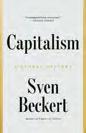
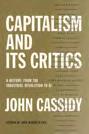
was born global. The shift from isolated islands of commerce to today’s interconnected economy was driven by the rise of global trade, which in turn was dominated by plunder. The triangle trade of cotton, sugar, and human slaves dominated Atlantic commerce. State-supported monopolies carried out imperialist trade across the Indian Ocean and the Paci $c.
Lenin later wrote that imperialism was the highest stage of capitalism. He got that wrong. As Cassidy and Beckert explain, imperialism was the earliest stage.
CASSIDY IS NO MARXIST, but he credits Marx with powerful and valid insights about capitalism as “a system of incessant expansion and change roiled by class con ict and technological advances.” The idea of a reserve army of the unemployed weakening worker bargaining power looks a lot more plausible today than it did during the anomalous postwar boom.
Cassidy devotes a chapter to William Thompson, an early socialist born in Cork, Ireland, who criticized Adam Smith in his *8!4 book An Inquiry Into the Principles of the Distribution of Wealth Most Conducive to Human Happiness. Thompson originated many insights later embellished by Marx. “Thompson referred to value that workers created but failed to receive in wages as ‘surplus value’—he seems to have been the $ rst writer to use this term—and he identi $ed it as the fundamental driver of economic inequality,” Cassidy writes.
Marx borrowed from Thompson, but lumped him with others such as Robert Owen, Saint-Simon, and Charles Fourier, whom he scorned as “utopian socialists” for their reformist support of co-ops, trade unions, and parliamentary democracy. But by demanding and predicting revolution, Marx was the bigger utopian. And the advocates of pure laissez-faire were the most utopian—or dystopian—of all.
One of Cassidy’s best chapters is on Karl Polanyi, who serves as both a complement and counterpoint to Marx. Polanyi, with the bene$t of almost a century more capitalist history than Marx, shared his critique of capitalism’s tendency to relentlessly commodify every aspect of human life. But where Marx both predicted and exhorted the unity of the world’s workers, Polanyi believed the more likely reaction to the terrible insecurity wrought by rampant capitalism would be ultranationalism and fascism.
Culture
In his masterwork The Great Transformation (*,44), Polanyi wrote, “[T]he idea of a self-adjusting market implied a stark utopia. Such an institution could not exist for any length of time without annihilating the human and natural substance of society.” As a refugee from Vienna, where he had seen successful municipal socialism in action undergirded by the strength of the trade union movement, and later as a resident in DD&’s America, Polanyi had witnessed successful democratic leftist governments as well as the turn to fascism.
In earlier writings quoted by Cassidy, Polanyi wrote about “the mutual incompatibility of democracy and capitalism”—the exact opposite of Milton Friedman’s later claims. In an essay titled “The Essence of Fascism,” Polanyi wrote that there were only two solutions: “the extension of the democratic principle from politics to economics, or the abolition of the democratic ‘political sphere’ altogether.”
Many other important works on capitalism were written against the backdrop of the Great Depression. A fascinating theme that emerges in Cassidy’s book is the differences and similarities in Marx, Polanyi, Keynes, and colleagues of Keynes to his left, like Michal Kalecki and Joan Robinson.
Keynes, alone among the pantheon, believed that because he had demonstrated that capitalism could be stabilized for the common good, there was no good reason for it not to be stabilized. For a very worldly person, he was almost willfully oblivious to the politics.
Many of the younger economists around Keynes were far more cognizant of the political obstacle from capital. In *,43 , Kalecki, a Polish-born economist who was part of Keynes’s inner circle, published an article titled “Political Aspects of Full Employment,” describing why Keynesian full employment would succumb to what he termed “the political business cycle.”
Employers would use their political power to resist full employment because they didn’t want to increase the power of a democratically controlled state, or of workers and their unions. They also feared in ation. “The social function of the doctrine of ‘sound $ nance’ is to make the level of employment dependent on the state of con $dence,” Kalecki wrote prophetically.
This sounds eerily like Alan Greenspan’s warning to Bill Clinton in *,,3 that de$cit reduction had to take priority over public
spending. Likewise Larry Summers’s bad advice to Obama to pivot to de$cit reduction in !)*). In Kalecki’s own day, Roosevelt’s more conservative advisers persuaded him in *,37 to cut spending to reassure financial markets, needlessly creating a recession within a depression. As another radical, Antonio Gramsci, would explain, the intellectuals entrusted with power by the capitalist state absorb and reinforce its hegemony, which infects both public understanding and public policy.
Another prescient critic of Keynes was Paul Sweezy, who was Marxian but not slavishly so. In *,4!, as a young lecturer at Harvard, Sweezy published The Theory of Capitalist Development , which also explained how capitalists would resist the state’s e orts toward full employment because it would increase worker bargaining power. “The Keynesians tear the economic system out of its social context,” Sweezy wrote, “and treat it as though it were a machine to be sent to the repair shop there to be overhauled by an engineer state.” Sweezy did not get tenure at Harvard. He left academia and co-founded the most influential and eclectic of neo-Marxian journals, Monthly Review
A key $gure in Keynes’s circle to whom Cassidy deservedly gives attention often denied to her is Joan Robinson. While still in her late twenties, Robinson originated the theory of imperfect competition. “In a market where $ rms have monopoly power,” Cassidy quotes Robinson, “they can set
prices above costs without losing all their market share.” Robinson persuasively demonstrated that imperfect competition, where prices were influenced by market power, was the norm and the textbook model of perfect competition the exception.
While she often tangled with Keynes, Robinson reserved her most scathing scorn for the economic traditionalists who tried to tone down the radicalism of Keynes into little more than a countercyclical program of public spending to moderate business cycles. Robinson called them “Bastard Keynesians.” She liked to say: “Study economics to avoid being deceived by economists.”
CASSIDY IS especially good at summarizing and contextualizing the important work of those whom mainstream economics has relegated to a fringe. Their insights are often a lot more useful than those taught in a typical economics classroom.
In standard economics, Thorstein Veblen is treated more as social critic than economic thinker, if he is treated at all. In fact, Veblen had a doctorate in economics from Cornell, and at the University of Chicago he ran the prestigious Journal of Political Economy. But he proved far too heterodox for mainstream economics.
His best-known work, The Theory of the Leisure Class , famous for inventing the concept of “conspicuous consumption,” is remembered mostly as a work of social satire, on the same bookshelf with Mark Twain. But as Cassidy reminds us, in that
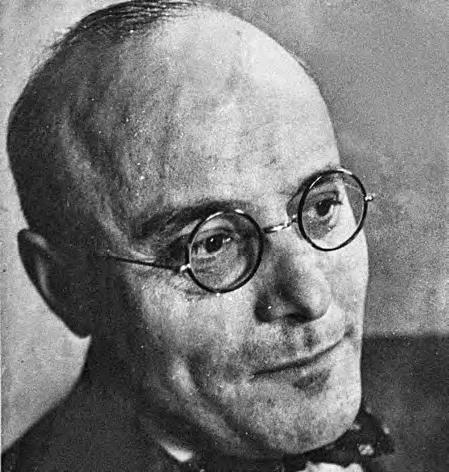
Karl
critiqued capitalism but believed the reaction to the insecurity it engendered would be ultranationalism and fascism.
Polanyi
In both China and the United States, different variants of authoritarian capitalism govern.
book and later in The Engineers and the Price System , Veblen as economist makes the important distinction between “industry”—the part of the economy that actually produces things—and the parasitic “pecuniary class” comprised of absentee owners, passive shareholders, and $ nanciers. That surely describes the capitalism of today.
Summarizing the literature on women’s rights in the economy, Cassidy has a $ ne chapter on Anna Wheeler, who became a close ally of William Thompson. The title of her *8!5 book gives you the idea: Appeal of One Half the Human Race, Women, Against the Pretensions of the Other Half, Men, to Retain Them in Political, and Thence in Civil and Domestic, Slavery. Flora Tristan, a contemporary of Wheeler, called for universal trade union organizing of women and men.
More than a century later, Silvia Federici renewed the call for wages for paid housework. As Cassidy points out, unpaid housework and child-rearing are not counted in gross domestic product, but “if a man hired a female housekeeper to clean his house and do his washing, the money he paid her was included in .DP.” The anomaly is more political than statistical.
More recent dissenting writers on capitalism include critics of corporate globalism like Harvard’s Dani Rodrik, Nobelist Joseph Stiglitz on the realities of unequal bargaining power, and Hyman Minsky’s contributions on the chronic tendency of capitalism to induce periodic $ nancial collapses. Cassidy also includes recent critics of capitalism and climate catastrophe.
With the sole exception of Thomas Piketty, the economists are celebrated by Cassidy for insights about capitalism as a system, not for technical, statistical, or methodological breakthroughs. While Cassidy includes many dozens of thinkers, he devotes little space to those who are consid-
ered lions of mainstream economic theory, beginning with Alfred Marshall, who $ rst translated the conceits of standard economics into mathematical models. Cassidy sympathizes with Joan Robinson’s critique of the Marshallian framework, which she felt “served to cloak rather than reveal the real dynamics of capitalism.” The same could be said of much of orthodox economics.
CAPITALISM AND ITS CRITICS mostly ignores capitalism’s celebrants. Cassidy includes Friedrich Hayek primarily to show how Margaret Thatcher treated him almost as revealed scripture. The choices of inclusion, he writes, were dictated by a desire for subjects “who capture an entire epoch” or to “highlight lesser-known $gures who made interesting contributions.” For the most part, he has chosen wisely.
One important critic Cassidy excludes is Robert Heilbroner. In the *,5)s and *,6)s, Heilbroner’s book The Worldly Philosophers was required reading for economics students and became a surprise best-seller. Writing while still a graduate student, Heilbroner introduced readers to the great economic thinkers, though unlike Cassidy, Heilbroner focused on fewer than ten.
Later, in *,85, Heilbroner published his own grand synthesis, The Nature and Logic of Capitalism , one of the best things ever written on the dynamics of capitalism as a regime. Unlike Marx, who viewed the state and the capitalist class as two faces of the same entity, Heilbroner believed that this bifurcation created political space for civil liberty, democratic control of the economy, and even democratic socialism, what he called “slightly imaginary Sweden.”
Like many brilliant thinkers whose knowledge was historical and institutional, Heilbroner was consigned to the fringes of a profession that was increasingly abstract and
mathematical. At The New School, where he spent his career, Heilbroner in *,7* became the Norman Thomas Professor of Economics, what may well be America’s only endowed economics chair named for a socialist.
Even as late as Heilbroner’s generation, economics students studied the history of economic ideas. No longer. You can get a graduate degree in economics without knowing word one about these thinkers and these arguments, or about the history of capitalism itself.
Joseph Schumpeter, who originated the theory of capitalism as creative destruction, once wrote that if he had to choose between studying history, statistics, or economic theory, he would choose history. “[M]ost of the fundamental errors currently committed in economic analysis are due to lack of historical experience more often than to any other shortcoming of the economist’s equipment,” he wrote in *,54 , when the equipment was a lot less abstract than it is today.
Today, the profession is plagued by a myopic refusal to consider history, a kind of learned incapacity (a phrase coined by Veblen). A good remedy for this lapse would be a required economics course on the history of economic ideas, and a good text would be Cassidy.
That splendid Schumpeter quote was unearthed by Sven Beckert, who seems to have read just about everything on capitalist history, and has *56 pages of endnotes in tiny type to prove it. The second half of Beckert’s book includes a fascinating and detailed history of the turbulent adventures of capitalism in recent centuries, from its dependence on slavery and imperialism to its recurrent crises and adaptations. Where Marx described early capitalist history in great detail, but then took leave of history for theory, Beckert o ers a rich narrative of capitalist history, well integrated with theory.
In the cold war between capitalism and communism, conservatives like to say that capitalism won. But the wrong kind of capitalism won. In both China and the United States, di erent variants of authoritarian capitalism govern. Rampant, predatory, and extractive capitalism, with its immense political power over both U.S. political parties, is the prime obstacle to the kind of democratic reforms that readers of the Prospect crave and that America needs. If we want a better understanding of those dynamics, we would do well to gain a deeper understanding of capitalism. n
The Legacy of the Subway Vigilante
Two
new books reveal how a 1980s shooting reflected rising right-wing attitudes
in a rapidly gentrifying New York.
BY MICHAEL FRIEDRICH
NEW YORK IN THE 1980 S WAS A downtrodden city with visions of upward mobility. Manhattan’s Greenwich Village was still a moist, low-rent bohemia of working-class punks and poets. Some South Bronx neighborhoods were more rubble than residence, with jobs and services stripped from a generation of Black and brown youth. Crack cocaine was incoming. Violent crime rates were at their zenith. Fiscal belttightening was squeezing the middle class. The people, it’s said, were sick with panic. Yet somehow, all at once, Wall Street was buzzing to life. A new class of urban professionals stampeded back from the suburbs to make bank, go jogging, and buy “gourmet” groceries. How would these forces collide in the city after decades of white ight?
An answer arrived in the $gure of Bernie Goetz. A few days before Christmas of *,84 , the self-employed electrical engineer stepped onto a gra (tied downtown ! train and shot four Black teenagers after one asked him for $5 . Each young man was badly wounded. The oor slick with blood, Goetz slinked off cartoonishly into the subway tunnel and ed to New England, where he spent nine days before turning himself in to the police. Across New York
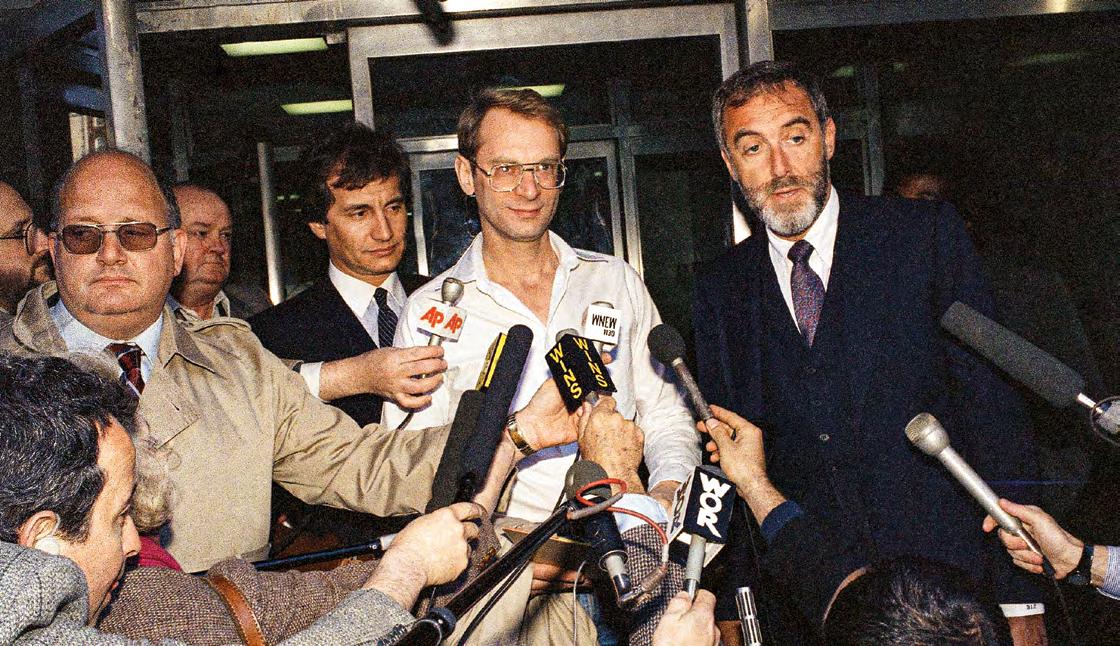
After his subway vigilantism, Bernie Goetz was celebrated in the tabloid media as a working-class hero.
City, politicians, the public, and the tabloid media celebrated Goetz as a hometown hero who had stood up to inner-city “thugs.”
The shooting’s lasting significance to American politics is now the subject of two recent books. In Fear and Fury, Heather Ann Thompson o ers a careful narrative history of the ways that Reagan-era inequality helped produce the racial resentment that surrounded the Goetz episode. Five Bullets, by BNN commentator Elliot Williams, is a snappy, slangy work of journalism centering on the legal and social elements of the trial that culminated with the exoneration of white violence. Both make a compelling argument that this half-remembered case marked a pivotal moment of racist rage that lives on in present-day vigilantism—and in the durable rightward lurch of the Trump era. But it’s also true that Goetz was a uniquely urban phenomenon. As whites returned to Gotham, they sought to reclaim its land, housing, and public transit for themselves. The shooting was, among other things, a highly publicized and violent opening salvo in a well-known process of gentri$cation.
FOR ALL ITS unpleasantness, the Goetz case is packed with curious archetypes of the urban drama. Goetz himself is what you might call a “transplant.” He grew up in rural New York and went on to work for his father in Florida as a real estate developer. In *,75, in his late twenties, he moved into a one-bedroom in the Village. After being mugged, he became obsessed with civic disorder and began illegally carrying Smith & Wesson revolvers. At a tenants’ association meeting, he opined that the only way to “clean up this street” was to “get rid of” Blacks and Latinos, using the most noxious of racial slurs. When the shooting took place, the tabloids cast him as a cool-handed Charles Bronson type. But Goetz was more the angry nerd, an evil Eddie Deezen in button-downs and the goggly eyeglasses favored by serial killers. By his own admission, he was looking for trouble when he stepped onto that fateful train car. He had been thinking of shooting the teens even before they asked for money.
Goetz’s victims—Barry Allen, Darrell Cabey, Troy Canty, and James Ramseur— were people the white city feared: young Black high school dropouts from the South Bronx, an environment rocked by the successive shock waves of the fiscal crisis, Reaganomics, and the crack epidemic. All
had arrest records for minor crimes of poverty, and it’s true that they were heading downtown that day to jimmy change out of arcade machines using screwdrivers. To her great credit, Thompson portrays the teens with illuminating detail and sympathy. Cabey, for example, had moved with his family from the suburbs to the projects after his father was killed in a carjacking. He was still a “baby-faced” kid who loved video games and had only recently begun dabbling in drug use. Cabey’s injuries were also the most appalling. Although he was sitting apart from his friends and posed no conceivable threat, Goetz $red at him twice. After missing once, Goetz approached and loomed above him. “You don’t look so bad,” he said. “Here’s another.” He then shot Cabey point-blank, puncturing his lung and severing his spinal cord. Cabey was instantly paralyzed and later su ered brain damage from the ordeal.
Nevertheless, the case became a cauldron of reactionary public sentiment. Every known hustler and hobgoblin crawled out of their holes in search of the spotlight. Curtis Sliwa, founder of the Guardian Angels civil-
FEAR AND FURY
THE REAGAN EIGHTIES, THE BERNIE GOETZ SHOOTINGS, AND THE REBIRTH OF
WHITE RAGE
By Heather Ann Thompson PANTHEON
FIVE BULLETS
THE STORY OF BERNIE GOETZ, NEW YORK’S EXPLOSIVE ‘80S, AND THE SUBWAY VIGILANTE TRIAL THAT DIVIDED THE NATION
By Elliot Williams PENGUIN PRESS
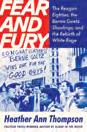

ian patrol group, grandstanded on Goetz’s behalf. Federal prosecutor Rudy Giuliani refused Rev. Al Sharpton’s demand to open a civil rights investigation. The National Ri e Association adopted Goetz as a “selfdefense” poster boy. At the same time, a newly energized tabloid media stirred a brew of misinformation that made the case a referendum on Black crime. The New York Post , recently slurped up by conservative media mogul Rupert Murdoch, lionized Goetz’s “courteous and unrattled style” while playing up his victims’ “extensive criminal records.” The Daily News falsely reported that the boys had been armed with “sharpened screwdrivers,” a claim that persists to this day. “The implication was clear,” Thompson writes. “The ostensible victims in this situation were really the villains.”
Beyond the court of public opinion, Goetz faced trial on counts of attempted homicide, aggravated assault, and illegal $ rearm possession. The courtroom spectacle hinged, as Williams takes pains to explain, on the question of “reasonableness”: Would society expect a person, in Goetz’s position, to respond as he did? Prosecutor Gregory Waples played jurors the video of Goetz’s confession, in which he acknowledges attempting “cold-blooded murder.” He presented witnesses to the shooting, and walked jurors through Goetz’s treatment of Cabey, the linchpin of the state’s charges. But Waples’s sober intensity was somewhat outmatched by the theatrical stunts of Barry Slotnick, a notorious mob lawyer whom Goetz retained using donations from conservative interest groups. The defense re-enacted the shooting employing menacing Guardian Angels as stand-ins for the teens and dragged jurors out of the courthouse into a model subway car for demonstrations. (Apparently a supremely annoying guy, Slotnick insisted on calling this visit a “class trip.”) A psychiatrist testi$ed that Goetz lacked “conscious control” of his actions and was on “automatic pilot” due to fear during the incident.
In the end, the prosecution could not overcome the public’s fear and fury. The jurors, some of whom had previously been victims of crime, convicted Goetz on the gun charges but nothing else; he served eight months, most of it in the protected “celebrity wing” of Rikers Island. Cabey’s mother, devastated by this leniency, summed up its social meaning: “It gives a license to people who want to shoot Black youths.”
Culture
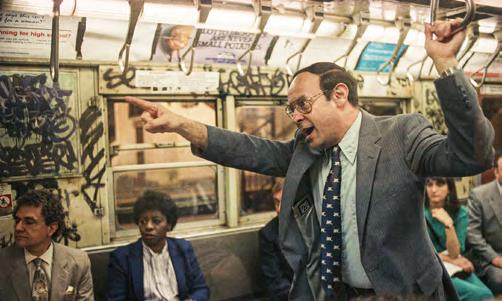
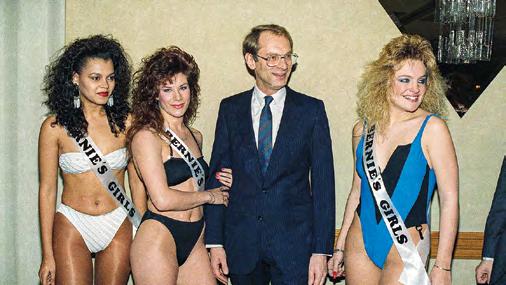
WHAT SHOULD WE MAKE, from our present vantage, of Goetz’s turn in the public eye? The shooting revealed a growing belief, Thompson and Williams agree, that poor Black citizens posed an urgent threat against which whites were entitled to $ght back. That attitude has only metastasized in the Trump era, even as crime rates continue their long decline. Firearms law has all but codi $ed that outlook: Supreme Court decisions and state-level “stand your ground” laws have made it easier to shoot $ rst and claim self-defense later, as Goetz did—and when white people shoot Black people under such laws, it is far more likely to be ruled justi$able than in any other racial combination. Both books observe in Goetz a grim outline for a more recent catalog of acquitted vigilantes, from George Zimmerman to Kyle Rittenhouse to Daniel Penny. For Williams, a former prosecutor, the legal niceties are paramount, then as now. He concludes that the Goetz jury’s hands were shackled. “It is possible that Goetz’s acquittal on violent crime charges was legally defensible but not just,” Williams writes, “supported by law but not morality.” Still, he’s quick to remind the reader that the arc of the case might have been di erent had the races of shooter and victims been
During Goetz’s trial, Judge Stephen Crane took the jury on a trip to a subway car (top); while Goetz became a celebrity (bottom left), Darrell Cabey (right), one of the shooting victims, would spend his life in a wheelchair.
reversed. Law is a societal agreement, one subject to interpretation that is shaped by crime-hyping media and the value assigned to certain lives. In this way, Five Bullets o ers insight. But it lacks a full account of the powers churning behind these realities. Thompson mounts the more ambitious argument, and her perspective is refreshingly materialist. Fear and Fury is ebulliently researched and readable (even if a bit at in the prose, especially when stacked against the Pulitzer-winning Blood in the Water, Thompson’s taut !)*6 history of the Attica prison uprising). In her telling, the Goetz episode is a vector for the dramatic political and economic makeover wrought by Ronald Reagan and continued with scant reprieve since his rule. The New Deal order was dead. Neoliberalism was ascendant. Tax cuts for the rich came with service cuts for the poor. Politicians and the media encouraged middle-class whites like Goetz to blame Black and brown citizens for the poverty and chaos that trickled down from policy. “The success of all this, of the Reagan Revolution itself, had depended upon the deliberate stoking of white racial resentment, as well as on the slow normalization and relegitimization of white vigilante fury,” Thompson writes.
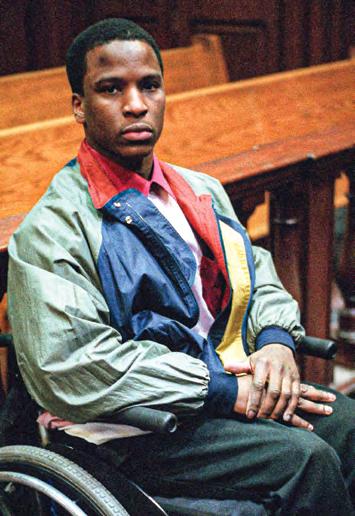
Goetz may have acted in the shadow of these grand historical shifts, but the darkest mark he left was, to my eye, far more local. The shooting signaled a new mood of urban exclusion, following decades of crisis. As early as the *,7)s, New York’s power elite, staring down a dwindling tax base, began scheming to attract the a Guent back to the city—even as they were systematically abandoning the poor. These boosters concocted a real estate cure: tax incentives, bond $nancing, more liberal zoning policies. “The housing boom that these measures helped to create,” the urban planner Tom Angotti points out , “have led since the *,8)s to large increases in land values and rents, the displacement of many low-income minorities, and the creation of massive homelessness.” Aggressive policing of streets and subways was stronger medicine still. Over the next decades, the strategy meant relentless criminalization of poor residents of color, as Thompson notes in her sharp discussion of this transformation. An increasingly “cleaned-up” city was a boon to developers and white in-movers, but homes and public space became scarcer for Black and brown New Yorkers.
In my personal lexicon, no ordinary city dweller is a “gentri $er,” a label rightly
reserved for politicians, urban planners, and real estate despots. But the actions of everyday citizens may manifest as symptoms of a deeper urban ill. Ordinary people in the *,8)s sought public safety, as ordinary people do. The Goetz $asco, however, was an expression of something more sinister: the city’s wish to “eliminate undesirables” rather than helping them. It reinforced a radical shift in New York’s makeup, long before the city became a wasteland of sleek towers and venture-funded salad chains that stretch from central Brooklyn to the Bronx riverfront. Viewed in this light, Goetz and his supporters formed something of a vanguard for the hyper-gentri $cation that has intensi $ed in recent decades.
In *,,6, a civil case against Goetz vindicated Darrell Cabey. It focused closely on the shooter’s attitudes toward race, and a mostly Black and brown jury, this time seated in the Bronx, held Goetz responsible for Cabey’s debilitating injuries, ordering him to pay the family $43 million in damages. Shortly thereafter, Goetz declared bankruptcy; he has never paid the Cabeys a cent. The other teens, by then grown, received no such grace or recognition. Two succumbed to prison and addiction and have since died; one cleaned up, married, and secluded himself north of the city. The Cabey family left the Bronx for Rockland County, in a now familiar type of displacement to the suburbs.
Goetz, for his part, still haunts the Village. His status solidi $ed as one of the city’s oddball mascots, he ran for public o (ce throughout the !)))s on a platform having to do with vegetarianism. In !)*3, he was arrested for selling weed to an undercover cop; he faced no legal consequences. You can still catch him feeding squirrels in Union Square Park, one of his lasting passions. “ NHB is nothing like it was 4) years ago,” he recently wrote to The New York Times, upon the publication of two books chronicling his most loathsome deeds. “Good shopping and you don’t have to own a car.” Goetz may be a reminder of New York’s unruly past, but now he’s just another consumer-citizen enjoying a sanitized but walkable metropolis. The American city today is, in many ways, Bernie’s world. n
Michael Friedrich is a journalist who writes about the politics of cities and housing, with a focus on the social problems caused by gentri cation.

Vertical Vertigo Brian Callaci’s book describes the deregulatory strategies franchisors use to protect their profits.
BY JAROD FACUNDO
TWENTY YEARS AGO, BHUPINDER “BOB” Baber shot himself three times in the chest with a .38) handgun inside the bathroom at his friend’s Quiznos in Whittier, California. Baber ran two Quiznos in nearby Long Beach, and at the time of his suicide, he had sunk $*)),))) and *8 months of his life into litigating Quiznos over a venue and arbitration clause, before the court ever got to hear the merits of his case.
The Toasted Subs Franchisee Association, of which Baber was a member, published his last words on their website, describing how the legal dispute had ruined his life. “My struggle will continue after my sacri $ce,” he wrote.
In response, Quiznos accused the Toasted Subs Franchisee Association of exploiting Baber’s death, and demanded they instead publish an apology calling their own actions “morally reprehensible,” as well as dropping any and all legal claims moving forward. This would cure the association’s supposed breach of contract.
The association refused, and so ** days after Baber’s death, Quiznos terminated its contracts with the Toasted Subs Franchisee Association’s eight board members. Seventeen days after his death, Quiznos noti $ed its remaining franchisees that “from time to time, we need to take the steps necessary to protect the brand, as we have in this case.”
Culture
Chains of Command: The Rise and Cruel Reign of the Franchise Economy, by Brian Callaci, unbundles the business and legal strategy behind why a franchisor’s branding power is inextricably tied up with the treatment of its franchising partners. The story begins with Dunkin’ Donuts founder William Rosenberg, who banded together with other early franchisors as the International Franchise Association (ID:) in *,5,. The ID: had a simple goal: protect franchisors from antitrust enforcement and organized labor. And they triumphed. “The ID: is the umbrella entity that, along with individual Franchisors, has enough money and power to buy the legislation that protects the Franchisor, and exploits the Franchisee,” Baber wrote in his suicide note.
It took decades to accomplish. But the ID: achieved near-immunity from the antitrust laws thanks to a dispute between a chain of retail electronics stores and a television maker. Before *,77, franchisors restricting how a franchisee operated their business was presumptively illegal under the antitrust laws. But in Continental T.V. v. GTE Sylvania , the Supreme Court upended this precedent by requiring that any alleged harm in a vertical relationship be analyzed on a case-by-case basis. No longer would franchisors need to fear the “haunting question” of the Sherman Act, the ID:’s attorney Philip Zeidman said afterward.
Sylvania was the culmination of a legal e ort begun in *,6!, when a young lawyer, Robert Bork, addressed franchisors at the ID:’s $rst legal symposium on the subject of vertical restraints. Callaci says it’s “less clear” how deeply Bork and other pro-monopoly economists and lawyers, who would come to be known as the Chicago school (named after the University of Chicago), coordinated their legal strategy with the ID:. But Justice Lewis Powell, who wrote the Court’s opinion in Sylvania , wrote the names of three Chicago school leaders in his pre-conference notes: “Posner, Baxter, Bork.”
The Chicago school’s origins are less grand than the world its movement birthed. University of Chicago professor Aaron Director’s key ideas, as Richard Posner later wrote, did not “emerge from a full-blown philosophy of antitrust” but from “pondering speci $c questions raised by antitrust cases,” and only in retrospect did they constitute the basis of a new general theory of antitrust. In the *,5)s, Director argued with students and colleagues—Bork, Posner, and
William Baxter—over tie-ins, resale price maintenance, and predatory pricing; that is, some of the precise vertical restraints at the core of the franchise business model.
Cases after Sylvania cemented the legal architecture of the franchise model’s use of vertical restraints. A federal court found in Principe v. McDonald’s that McDonald’s licensing agreement and the store lease were not two separate products, but the same thing, endorsing the ID:’s view that it sold a uni $ed “business package.” After Principe , every condition imposed by a franchisor protected the brand.
Callaci’s history brings clarity to when the rote abuses by franchisors metastasize into the public’s eye. For instance, Quiznos’ scorched-earth legal campaign against Bob Baber and the Toasted Subs Franchisee Association was supposedly about protecting the brand image. Yet one of the executives tasked with that duty had just been charged with attempted child tra (cking. Three months before Baber’s death, a senior vice president for the company’s marketing team, Scott Lippitt, had been charged with attempting to sexually exploit a girl he believed was *3 years old. Quiznos $red him shortly after and he pled guilty the following year.
Seven years before the D/I charged Jared Fogle with possessing child sexual abuse materials and paying for sex with minors, Cindy Mills, a Subway franchisee, warned the franchise’s chief marketing executive, Je Moody. “Please don’t tell me any more,” Moody said. “Don’t worry, he has met someone.”
That same year, Moody sent Fogle and his 6) -inch-waist pants on a Tour de Pants, which included stops at elementary schools.
CHAINS OF COMMAND THE RISE AND CRUEL REIGN OF THE
FRANCHISE ECONOMY
By Brian Callaci UNIVERSITY OF CHICAGO PRESS
BY THE END OF THE 1970 S, a yearslong battle led by anti-monopolist franchisees attempting to assemble their own counterweight to the ID: through federal and state legislation ended in failure, and the Federal Trade Commission’s prior skepticism of vertical restraints in franchising collapsed. “The law of the land is wrong,” the new DTB chief economist, Robert Tollison, said. The DTB instead established an ID: preferred franchise rule that required franchisors to disclose “buyer beware” to franchisees rather than address the vertical relationship itself.
Franchisees and their lawyers had disagreed about whether they were small-business owners or workers, and that prevented them from assembling a proper opposition to the ID:. Some franchisors feared that franchisees would see themselves as workers. But Thomas Murphy, a franchise consultant and advocate, understood that they entered into franchising to escape wage labor and secure property rights over their businesses.
Murphy’s publication, the Continental Franchise Review, acknowledged disclosure was never the issue: “It was the accompanying heavy-handed attempts to otherwise regulate the in-term relationships between the franchisor and the franchisee.”
The defeat left franchisees who had just spent a decade $ghting the ID: over vertical restraints shell-shocked. They could blame everybody: the courts, their lawyers, the ID: , the DTB, state and federal lawmakers.
But even after the victory, franchisors still needed to enlist their franchisees as the public face for a deregulatory agenda. They possessed the legitimacy and access to lawmakers that big business did not have because they tended to be “politically in uential leaders and employers in their local communities” while being spread across the entire country. Franchisees resisted linking arms with their overlords at $ rst, but were eventually won over on taxes, regulations, and labor relations.
The armistice didn’t last.
PepsiCo acquired Kentucky Fried Chicken in *,86, angering the Association of Kentucky Fried Chicken Franchisees, because it refused to honor the settlement agreements from an antitrust suit the decade before. The Kentucky Fried Chicken Franchisees’ contract with FDB gave franchisees freedom from some vertical restraints and included the “permanent right to renew on the same terms.” But PepsiCo removed all
The Fight for $15 emerged from 50 years of franchisors successfully keeping organized labor away from their franchisees.
of those in *,8, and inserted language for a “forum clause” requiring all litigation to take place at its headquarters.
Three years later, Iowa restored the concessions PepsiCo stripped from the Kentucky Fried Chicken Franchisees through legislation: good-cause requirements for termination, territorial protections, sourcing freedom, and the right to transfer a business. The ID: spent years trying to roll back the Iowa law in full but couldn’t. In !))!, the ID: called it “the worst law in the country.”
IN THE MID -2010 S, the ID: once again needed franchisees on their side to $ght an increased minimum wage. And they characteristically obliged.
Ray Kroc of McDonald’s, in his *,77 memoir, Grinding It Out , boasted about how the company defeated attempts to organize their stores: “[W]e don’t fool around. It’s always shocking to be a loser.”
But in the ensuing decades, the economic composition of who is a franchisee operator had changed. While there were more single franchisees than ever, their share of the total business fell sharply. By !))3, 8) percent of franchisees were single-store operators, but their stores represented less than half of franchisee businesses.
This new consolidation brought new dynamics for the ID:. Multi-store operators had the leverage to negotiate more favorable contracts with the franchisor, but cared less about the vertical relationship itself, and more about how to drive their labor costs down.
“They say the franchisee is just a small man in the middle,” Jorel Ware, a minimumwage McDonald’s worker in New York, said. “Then who am I?”
In !)),, a supervisor at a Domino’s franchise in California sexually harassed and assaulted a *6-year-old girl working at the
same location. She successfully sued the franchisee and franchisor, with the former declaring bankruptcy. But the Domino’s brand said it faced no liability since the franchisee was an independent contractor, meaning the franchisor’s assets were untouchable. The court disagreed, holding that the franchisor’s signi$cant control over the franchisee rendered Domino’s liable. But a later court overturned the lower court’s decision, because of the franchise business model’s “importance to California.”
By defeating the “No. * case of the year,” as the Franchise Times called it, the ID: succeeded in the lobbying and legal strategy Sylvania blessed decades before. Intentionally or not, this stoked the Fight for $*5 movement, which kicked o just a few years later. Organizers channeled the Domino’s suit into a grassroots campaign, merging it with the poverty wages paid in fast food. “[U]sed to be, people were glad to have a job, and now you’ve got a big shift,” a franchise consultant told Franchise Times. “You’re entitled, you’re entitled, you’re entitled.”
The best retort to the $*5 demand ID: could muster was the claim that bad jobs are better than no jobs. Seattle and a nearby suburb passed laws raising the minimum wage to $*5 by classifying franchise locations as large businesses rather than independent small businesses. The ID: responded: “The franchisor, which is the corporate entity, protects its trademark by providing franchisees with marketing, administrative and technical assistance. But it clearly doesn’t set the wages of franchisee employees.” It then sued Seattle. In the following years, the second Obama administration’s National Labor Relations Board issued *8* unfair labor practices against McDonald’s and its franchisees, and issued a ruling that a subcontractor and its corporate partner were joint employers for
the purposes of collective bargaining. The ID: responded by telling lawmakers that not only under Sylvania , but because of trademark law, the N-&/ and the Department of Labor were wrong. The ID:’s president and BE? said the N-&/ and the Service Employees International Union coordinated an assault “to destroy the franchise model” because “you can’t unionize one by one.”
The ID: created vice president roles for franchisees and organized 6),))) of them for lobbying blitzes across the country. Some franchisees resisted, but ultimately were more skeptical of organized labor. Nonetheless, SEIU threw its political muscle behind franchisee-friendly legislation in California.
It seemed like SEIU was gaining momentum—and then Donald Trump won. His N-&/ overruled the new controlling joint employer standard. In !)!! , President Biden’s N-&/ reversed course with a rule that brie y took e ect before federal courts blocked it.
The following year, the ID: cut a deal with SEIU to raise the minimum wage to $!! an hour and establish a $ rst-of-its-kind sectoral council governing wages and working conditions in fast food.
“If you look at this agreement compared to what it could have been, it’s far superior,” ID: president and BE? Matt Haller said. In return, SEIU agreed to halt lobbying in California for a joint employer rule. The franchisors escaped joint liability for store employees and “saddled the franchisees with the higher minimum wage,” Keith Miller, a franchisee leader said. “[T]here wasn’t true franchisee representation in the room, yet they will bear the cost of it.”
Two years later, a Burger King franchisor at a sectoral council meeting said: “If we make money, if we don’t make money, [franchisors] collect that fee. So I would ask the council to consider—beyond just minimum wage—how to get the franchisors involved in this conversation and help out our cause.”
Callaci sees an opportunity for franchisees to challenge franchisors, despite the contracts that control how they can $ght back; he says they $t the late Mike Davis’s characterization of small-business owners as “prisoners of the American dream.” The opening exists. But so did pro-franchisee laws in Iowa, and Bob Baber’s forum clause was in Colorado, not California. n
Jarod Facundo is an investigative journalist and former Prospect writing fellow.
Parting Shot
Finally, an Anti-Woke War America refuses a prolonged DEI quagmire.
BY FRANCESCA FIORENTINI

WHEN I WAS AN 18-YEAR - OLD PROTESTING THE IMPENDING
war on Iraq, I had my reasons: Saddam Hussein didn’t do ,/**, Dick Cheney was in it for oil, and yes, there was simply too much diversity in the Bush administration.
You see, when I got arrested outside of the United Nations, it wasn’t because Colin Powell was lying about evidence of weapons of mass destruction. It was because he was Black. As we all know, our enemies don’t respect diversity, equity, and inclusion, and they are too primitive to understand our concept of tokenism as a diversion. (And he wasn’t even a token because we also had Condoleezza Rice! *faints onto a divan*) Plus, there’s no greater sign of weakness than asking permission. Which is exactly what Powell was doing at the U.N. What’s the point of being the strongest country in the world when you still need a hall pass to kill other people’s leaders?
So of course I was thrilled when !3 years later, a far less diverse, AI-generated reboot of the Bush administration decided to invade Iran, Iraq’s hotter and more successful sister. It’s the kind of arm candy worth losing your life savings—or your life—over.
This time, things will be di erent. Because Secretary of War Pete Hegseth has stated loud and clear that this Middle East intervention will $ nally refuse to be woke. As he put it himself,
the U.S. war on Iran will have “no stupid rules of engagement, no nation-building quagmire, no democracy-building exercise, no politically correct wars.”
Yes! At last, no more gender-neutral burn pits, no more prebombing land acknowledgments, no more prohibitions on kamikaze missions because of fears about cultural appropriation. And nobody will mock you when you’re unable to locate Iran on a map. Maps are r*tarded. And thanks to Pete Hegseth, I can say that.
We need a war that can sit around and podcast with the other wars that the woke mob tried to cancel: Iraq, Vietnam, Wounded Knee.
I’ll never forget where I was when I saw the images of torture out of Abu Ghraib in Iraq. Imagine my embarrassment when learning that a woman had the privilege of carrying out the heroic act of parading around a grown man on a leash. In Hegseth’s torture camps, only men will be allowed to waterboard in order to extract useless information from innocent civilians. Women will only be involved in the Iran war for cooking, cleaning, and asking for directions.
When one re ects on the Iraq War, or Afghanistan for that matter, every analyst would agree that it was really too organized and ended too quickly. Organization is a soy boy task that no army of alpha males should concern themselves with. And alpha males never pull out quickly. They let it drag on and on.
In Iraq, there was an overreliance on woke ideologies like stability and safety, and too many “day after” plans, like which religious faction to sic on which other religious faction. Plans are e eminate. Forget the day after. Let’s Carpe Bomb Diem!
The lesson from the Iraq War wasn’t to obey “rules of engagement” and refrain from indiscriminate killing like the Nisour Square massacre, it was to not let transgender people like Chelsea Manning near IT. Trans people have a far too humanity-oriented disposition and can’t be trusted to lie. Thankfully, Pete Hegseth has retired transgender service members and spared the military their morals. And by the way, there’s a reason that America’s $ rst target in Iran was a girls’ school. It’s because both Hegseth and the Taliban agree: Women have no business getting an education.
At the end of the day, woke wars are for losers. And when it comes to the war with Iran, I personally want to be the opposite of woke. I would like to be asleep. Deeply asleep. Maybe even dreaming … of a completely di erent world. n
BE A CHAMPION FOR TAP
Did you know you can use your IRA to make donations to the Prospect?
If you’re 70.5 years or older, the Quali ed Charitable Distribution allows you to give up to $100,000 directly from your traditional IRA, exempt from federal income tax, even if you don’t need to itemize. Simply direct your IRA Administrator to distribute the funds to the Prospect. Is this right for you? To learn more about ways to share your wealth with e American Prospect, check out Prospect.org/LegacySociety
Your support will help us make a di erence long into the future

LISTEN! LEFT ANCHOR
Join senior editor Ryan Cooper and Alexi the Greek for grounded, novel, and irreverent perspectives on current events and political theory. Access free episodes and excerpts at Prospect.org/podcasts
Support the Prospect with a POWER level membership for access to ALL episodes Prospect.org/membership
The pessimist complains about the wind; the optimist expects it to change; the realist adjusts the sails.
—WILLIAM ARTHUR WARD