Women’s Trophy Team ISDE champion Rachel Gutish on a series of unfortunate events
12 BACKFIRES
Membership feedback on recent issues
14 BACK IN THE DAY
Where the photos are blurry but the memories are clear!
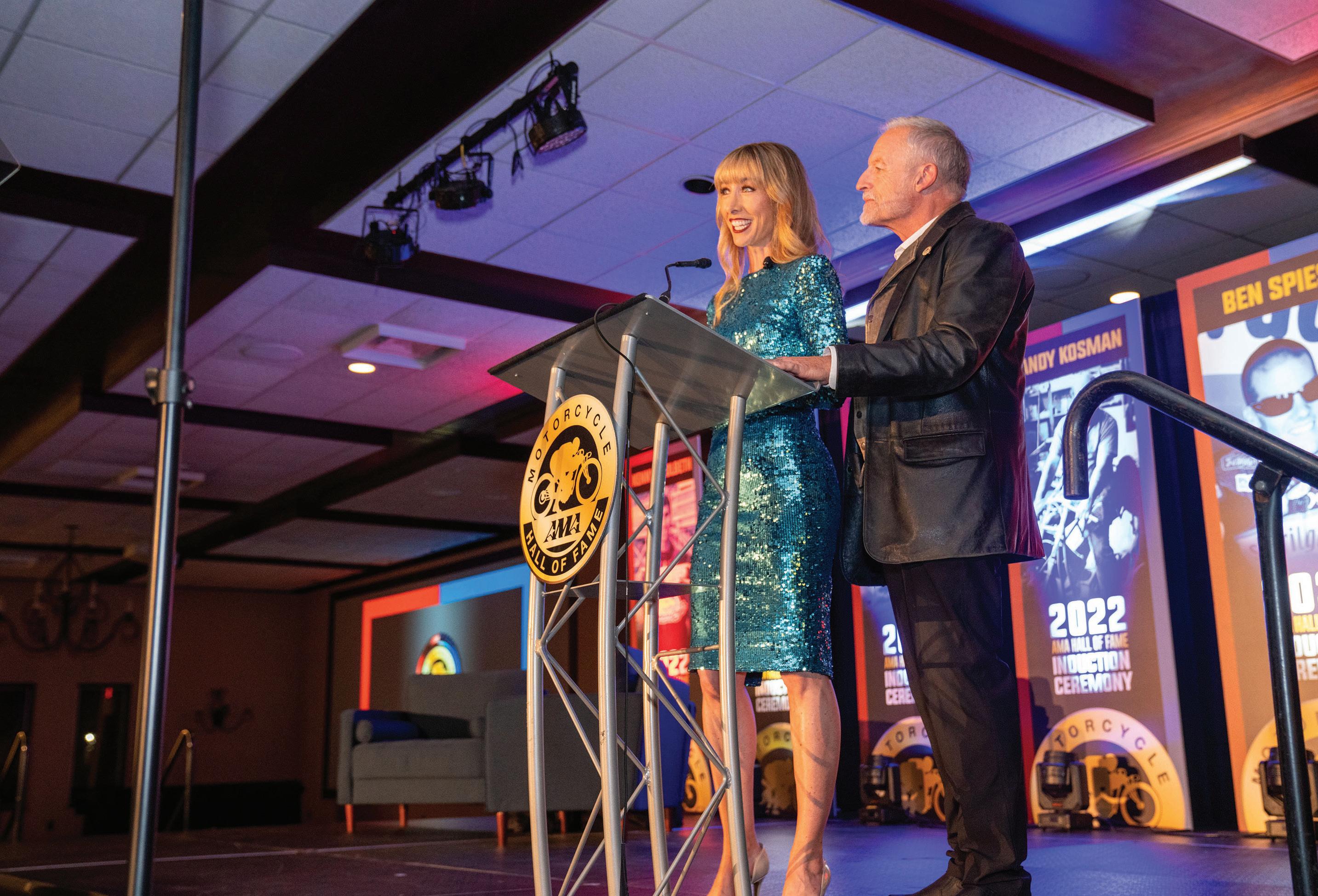
16 HALL OF FAME DAYS PREVIEW
Eveything there is to know about the brand-new September celebration
24 COVER STORY:
DON’T LET THE OLD MAN IN
Rick Wheaton’s trip across Australia proves age is nothing but a number
38 NO SMALL BORE
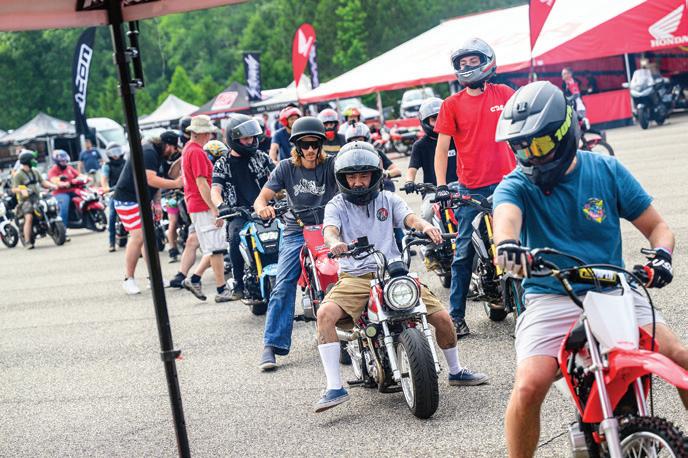
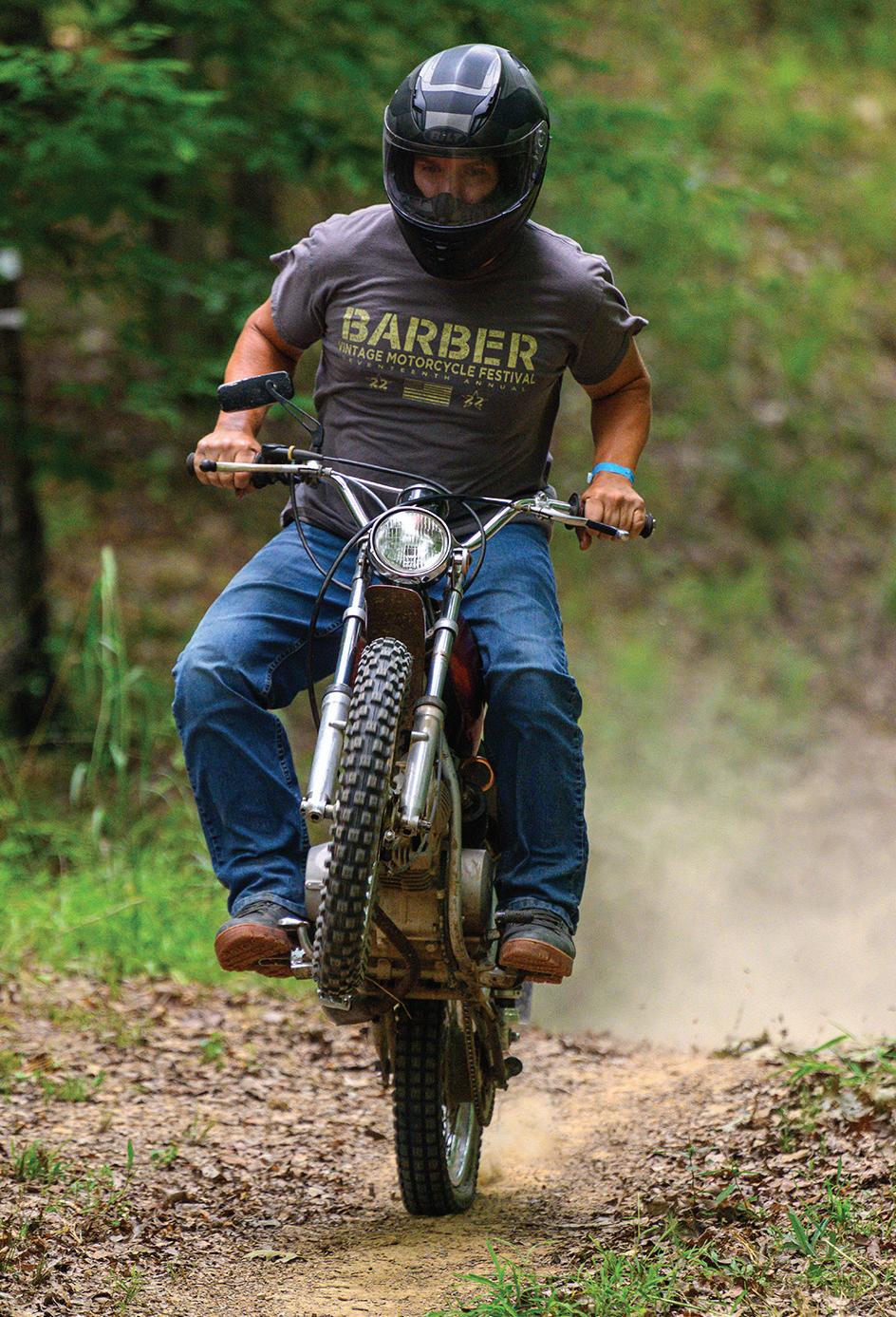
Thousands of mini motorcycles converge on Barber Motorsports Park’s Small Bore event
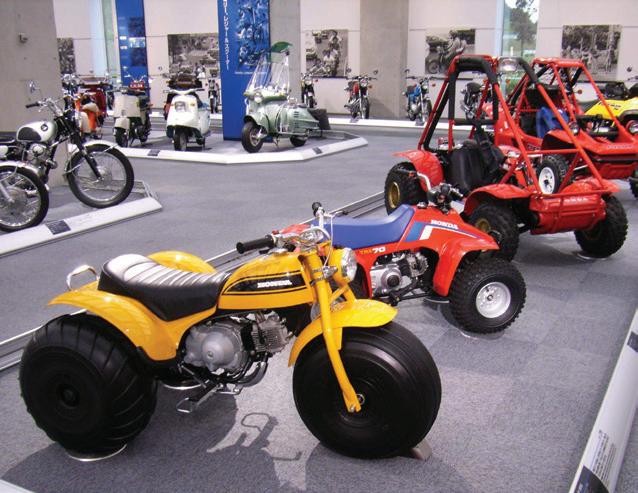
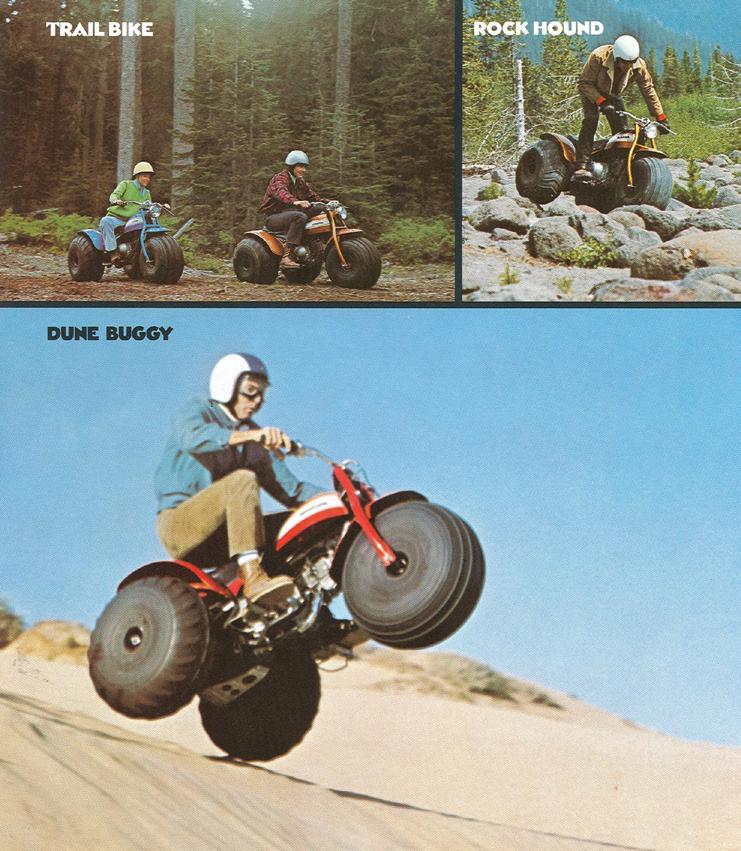
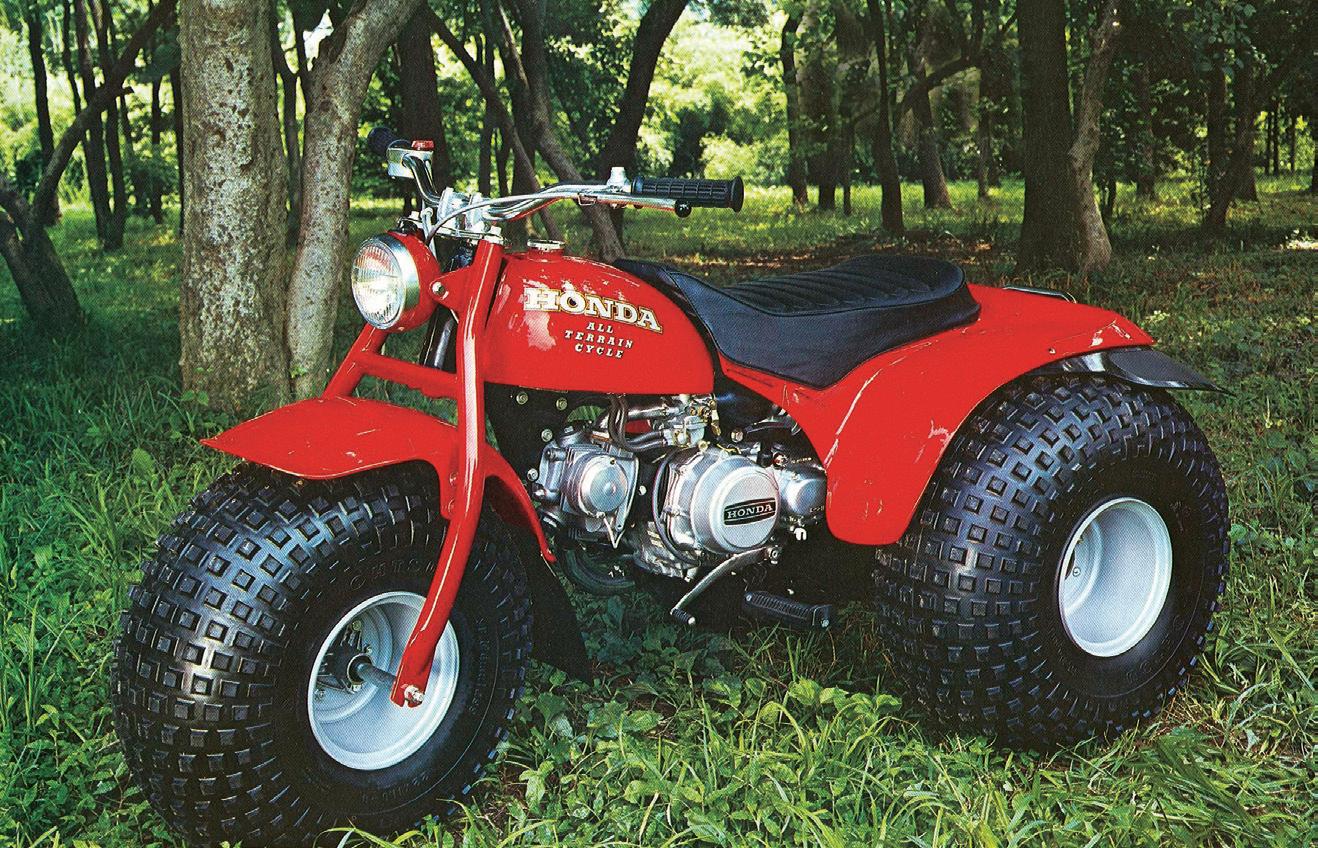
The trailblazing ATC90’s impact on the motorcycle world and its creation of an industry
58 EVENT CALENDAR
AMA-sanctioned rides, races and events
64 AMA GARAGE
Tips, tweaks, fixes and facts: The motorcycle ownership experience, explained
66 LAST PAGE
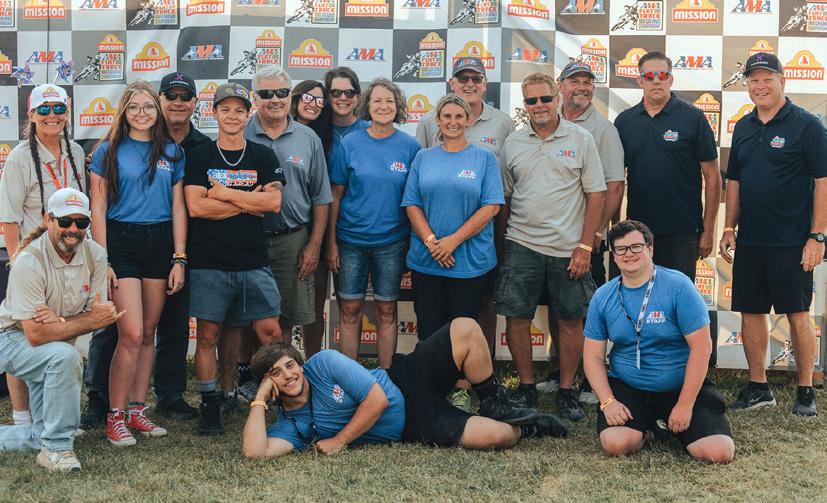
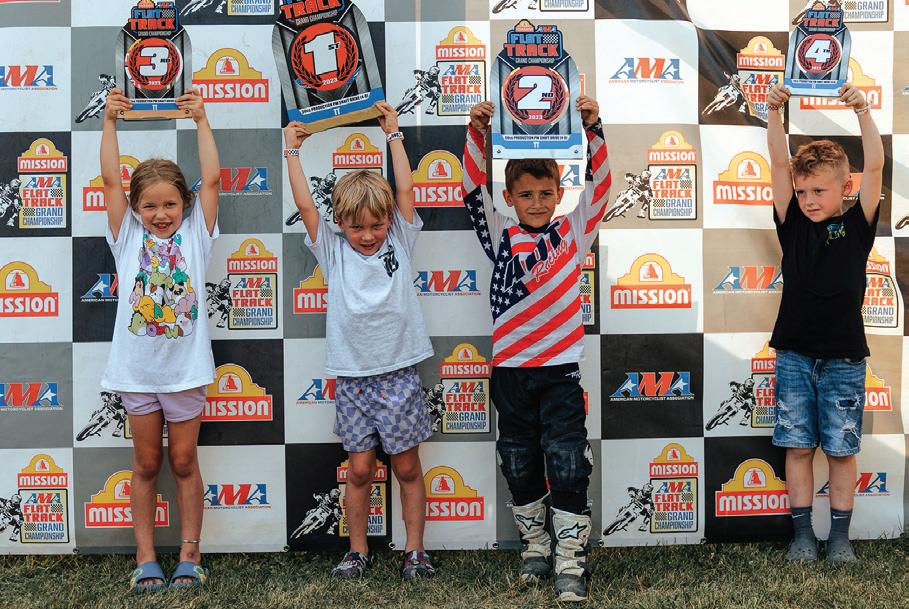
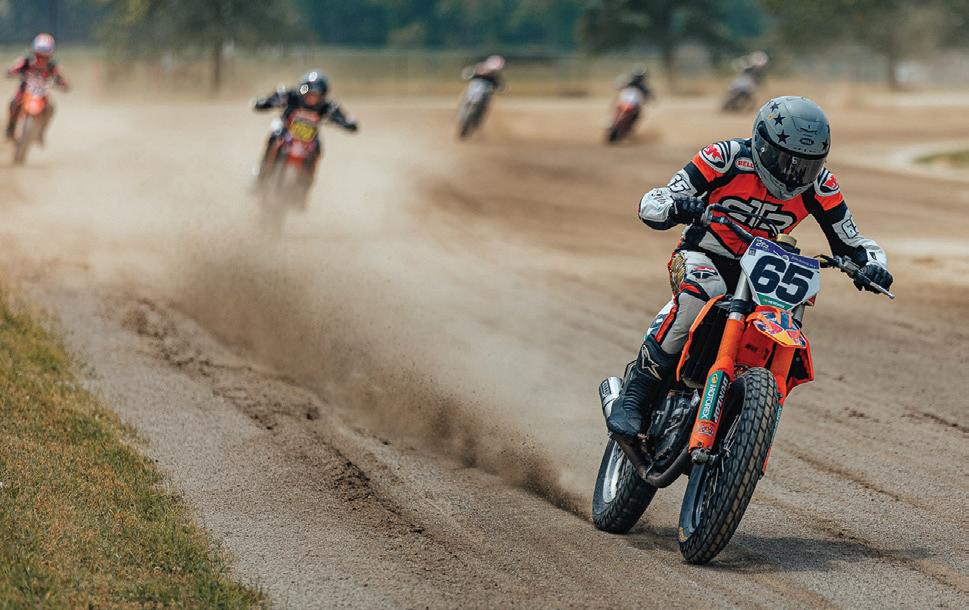
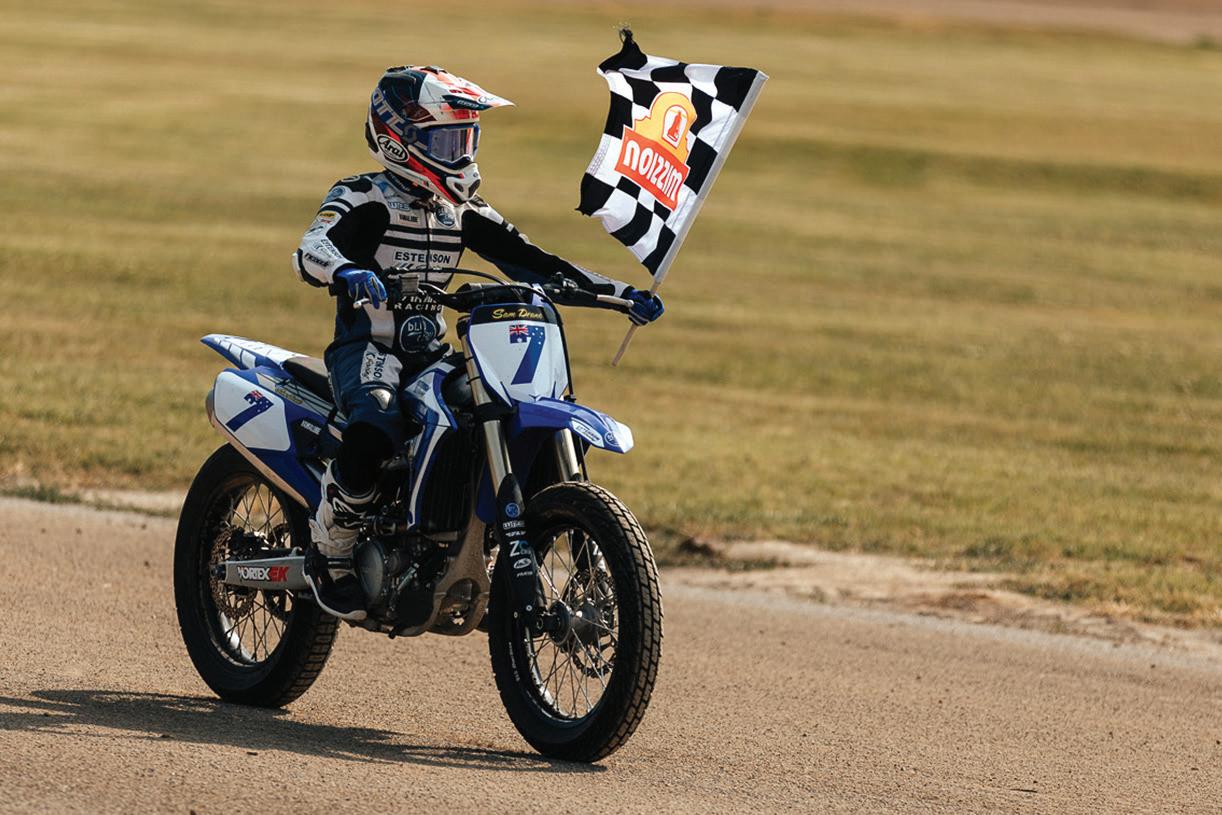
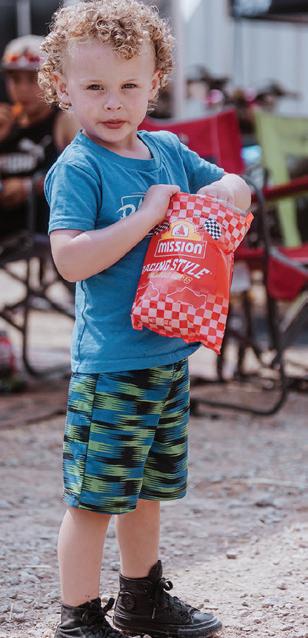
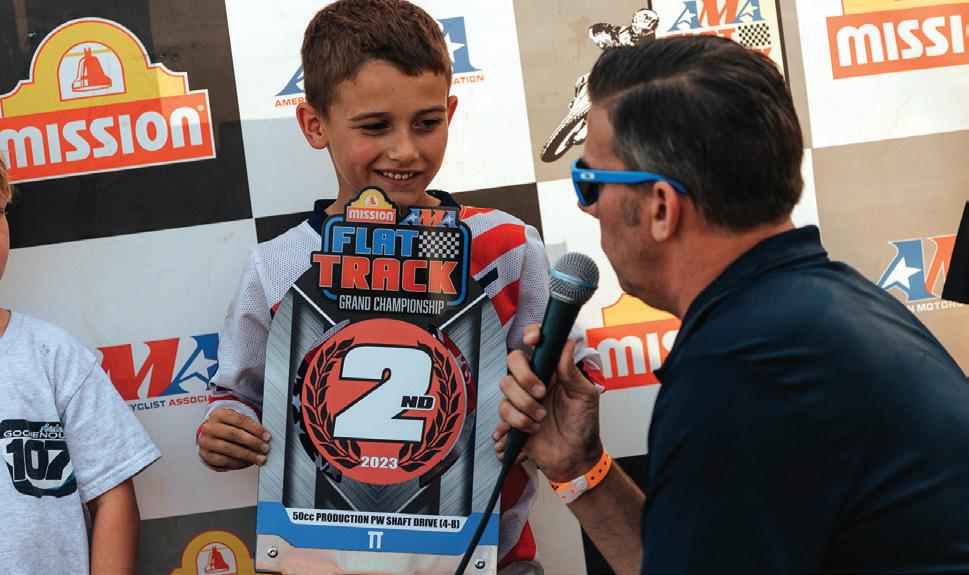
Snapshots from the 2023 Mission Foods AMA Flat Track Grand Championship
ON THE COVER:
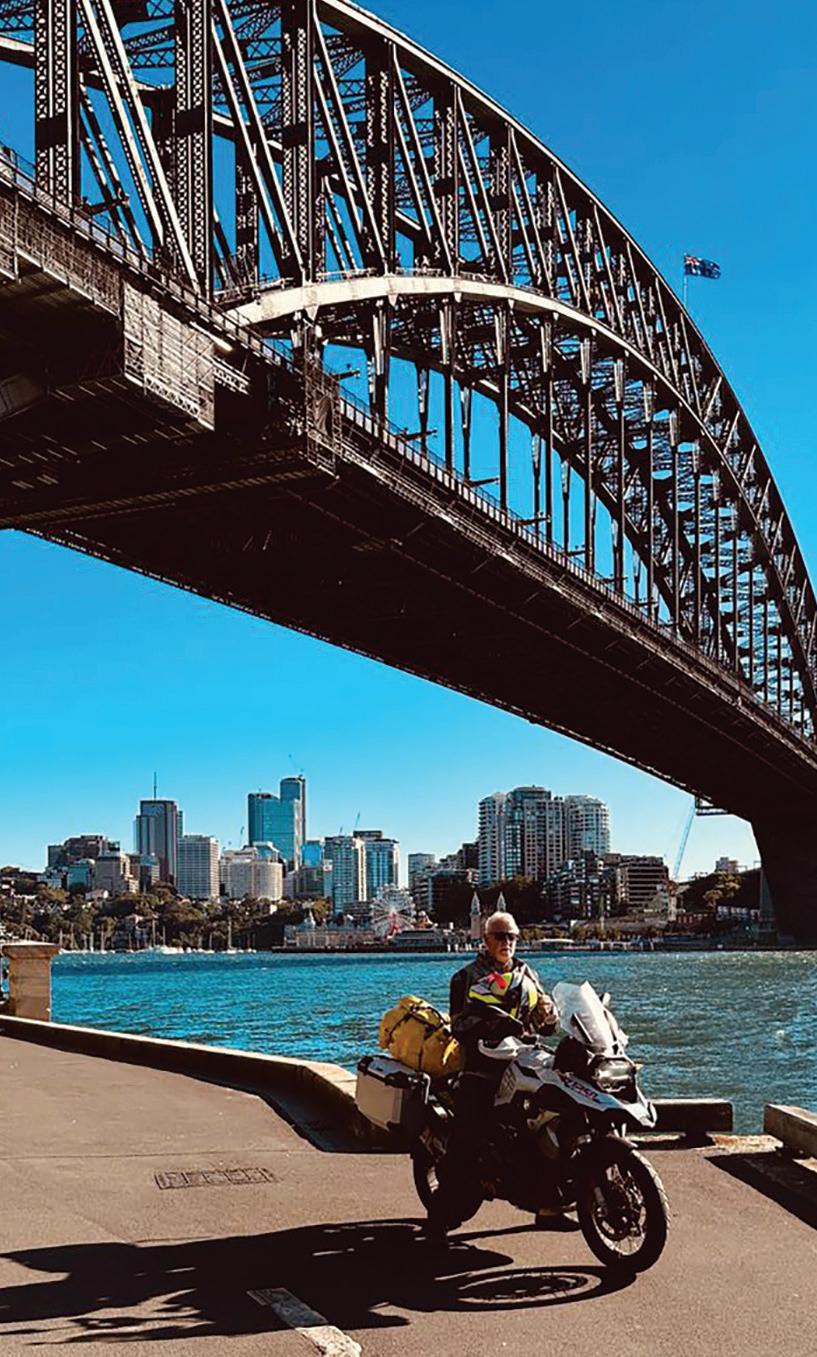
Rick Wheaton, 82, waited out a nearly three-year COVID-19 delay for a chance to travel coast-to-coast in Australia.
Traversing the Nullarbor Desert, meeting up with friends and family, learning local lingo, and understanding what it’s like to travel in a country full of ’roos, Rick has plenty of tales to tell.
by Rick Wheaton.
Photos
EDITORIAL
Mitch Boehm Editorial Director
Todd Westover Chief Creative Consultant
Keaton Maisano Managing Editor
Kerry Hardin Senior Graphic Designer
John Burns Contributing Editor
Contact the Editorial Team at: submissions@ama-cycle.org
Michael Kula Business Development Manager (949) 466-7833, mkula@ama-cycle.org
Alex Boehm Associate Sales Representative (614) 729-7949, aboehm@ama-cycle.org
All trademarks used herein (unless otherwise noted) are owned by the AMA and may only be used with the express, written permission of the AMA.
American Motorcyclist is the monthly publication of the American Motorcyclist Association, which represents motorcyclists nationwide. For information on AMA membership benefits, call (800) AMA-JOIN or visit AmericanMotorcyclist.com. Manuscripts, photos, drawings and other editorial contributions must be accompanied by return postage. No responsibility is assumed for loss or damage to unsolicited material.
Makenzi Martin Membership Event and Program Manager
Lauren Kropf Marketing and Communications Specialist
Bob Davis Program Volunteer Specialist
Jack Emerson Corporate Communications Specialist
MEMBER SERVICES
Amanda Donchess Director of Membership
Lynette Cox Membership Manager
Tiffany Pound Member Services Manager
Pam Albright Member Fulfillment Coordinator
Carolyn Vaughan Member Fulfillment Representative
Stephanie McCormick Member Services Representative
Vickie Park Member Services Representative
Charles Moore Member Services Representative
Kelly Anders Member Services Representative
Sarah Lockhart Member Services Representative
Sieara Thomas Member Services Representative
John Bricker Mailroom Manager
INFORMATION TECHNOLOGY DEPARTMENT
Shaun Holloway Director of Information Technology
Jarrod Gilliland Application Developer
Ed Madden Systems and Database Analyst
Rob Baughman Support Technician
American Motorcyclist magazine (ISSN 0277-9358) is published monthly (12 issues) by the American Motorcyclist Association, 13515 Yarmouth Drive, Pickerington, OH 43147. Copyright by the American Motorcyclist Association/American Motorcyclist 2021. Printed in USA. Subscription rate: Magazine subscription fee of $39.95 covered in membership dues.
Postmaster: Mail form 3579 to 13515 Yarmouth Drive, Pickerington, OH 43147. Periodical postage paid at Pickerington, Ohio, and at additional mailing offices.
• Mimi & Moto Children’s Books
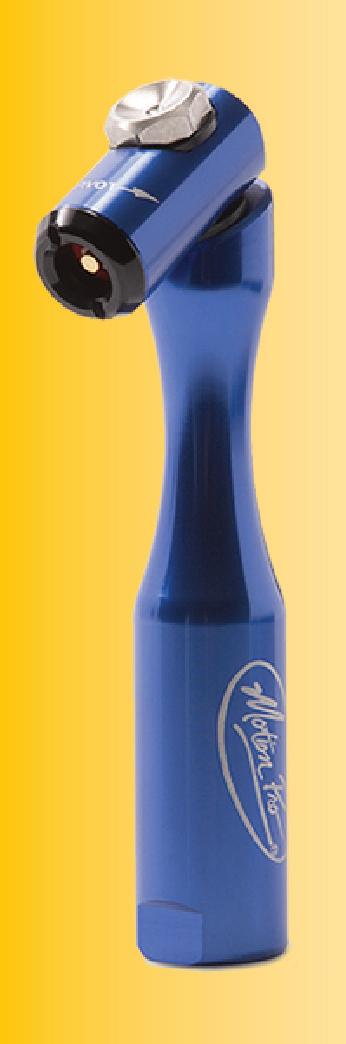
• Motion Pro: Pro Fill Airchuck
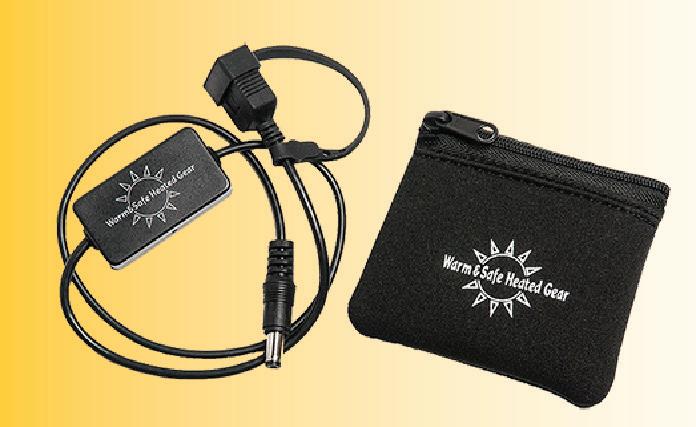
• Warm & Safe 12V USB Adapter
• Bohn Armor Skull Cap
• AMA T-Shirt
• nelson-rigG cover
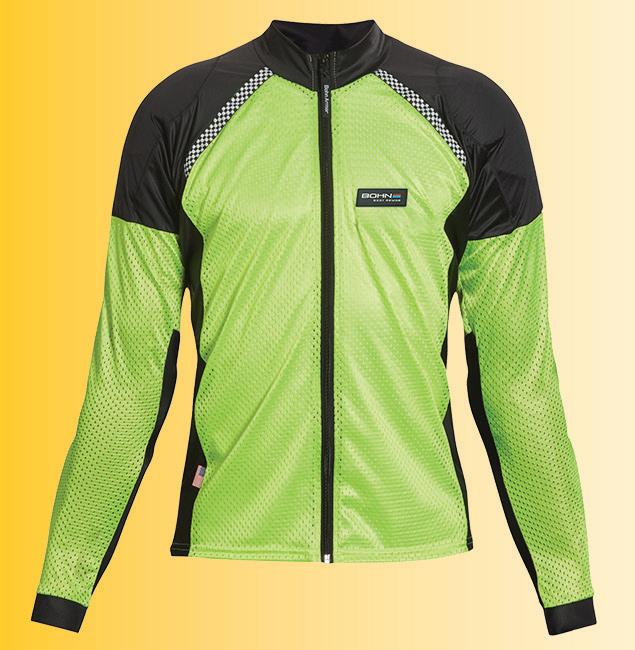
• Bohn Armor Pant & Shirt Set
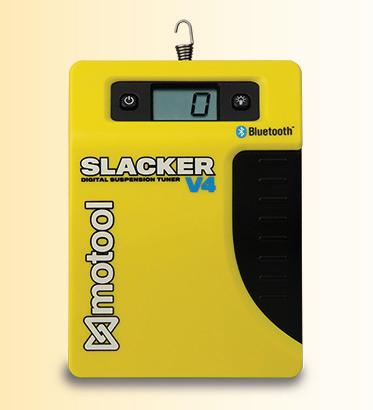
• Motool Slacker & Street Kit
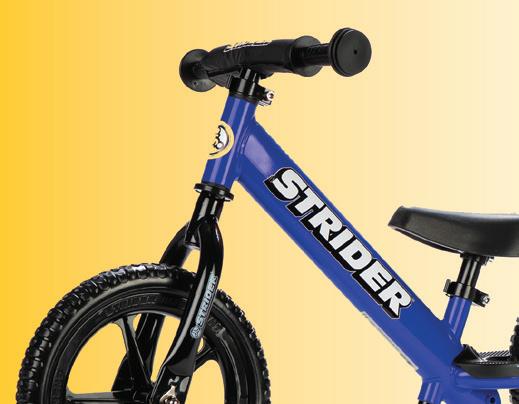
• Strider Bikes strider sport
Members who join or renew their AMA membership from Jan. 1, 2023, through Dec. 31, 2023 are automatically entered to win one of these awesome motorcycling prizes!
BACKFIRES
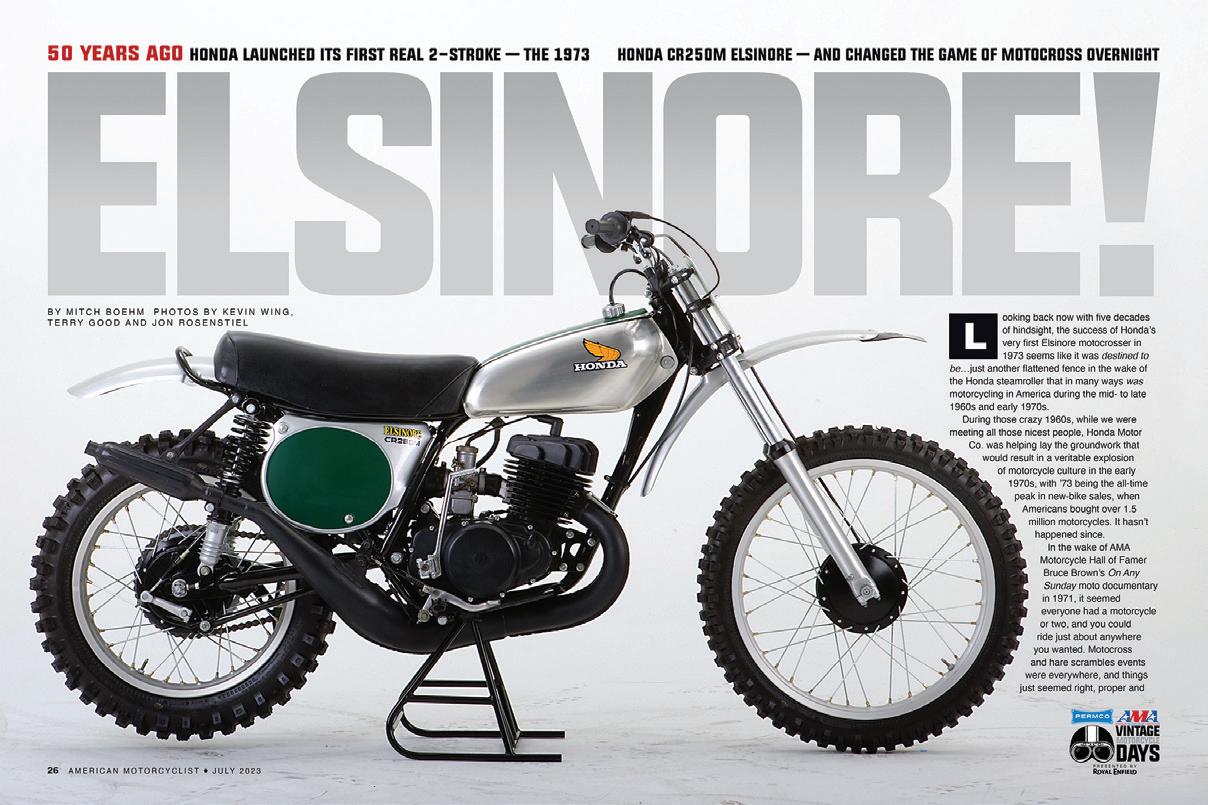
ELSINORES GALORE
Just read the Elsinore piece and it took me right back to 1974. I was a senior in high school racing this new thing called motocross on the Suzuki TS250 I’d acquired by delivering newspapers in our Sacramento, Calif., neighborhood. While in high school I found myself in a motorcycle club called McGill’s Racing Team. At that time, McGill’s Cycle Park just East of Sacramento was hosting motocross and hare scrambles races. I didn’t know anything about motorcycle clubs, but was willing to be part of something that would support this sport I loved. The park was hosting a series called the Penton Series that consisted of four motocross races and one hare scramble, with a new Penton motorcycle going to the overall high point winner.
I didn’t have any illusions of winning, but I had to be a part of it. Just prior to the third of the fiverace series, one member of our club purchased a brand-new 250 Elsinore. It was perfect, and for several days I laid awake in bed scheming of a way to scrape up the money to get my own Elsinore.
On the fourth mx race of the series, I found myself in third place in my second moto. But my dismal finish in moto one didn’t get me enough points to podium. I was disappointed. My friend with the Elsinore had lost his ride home and asked my dad if he wouldn’t mind taking his motorcycle to his house. I quickly asked if I could take it for a couple laps, and he agreed.
Without delay I strapped on my helmet and hit the track I’d ridden just two hours prior. The bike was so nimble and powerful and forgiving I ended up doing three of the fastest laps I had ever done there. When I came off the track my dad said, “you would have won today on that bike.”
I believed him because that was the best I’d ever felt on that track.
McGill’s Cycle Park is better known today as Prairie City OHV, home of the Hangtown Motocross. And though I’ve ridden that park more times than I have fingers and toes, I don’t think I’ve ever been as fast as I was that day at the age of 17 on that Elsinore. Then again, there’s that old adage,
“the older I get the faster I was.” Side note: 12-year-old Danny “Magoo” Chandler won the 250 Novice class that day. I didn’t have a chance. Ron Porteous Sacramento, Calif.
The Elsinore piece brought back a bunch of memories. Back in the day I was racing a Kawasaki KD125 in the
LETTER OF THE MONTH
Ijust received the July issue, and seeing the Elsinore on the cover made me do a double take, with fond memories flooding back. I know a lot of AMA members have different interests and tastes, but I have to say you folks are after my own heart here. After the Elsinore came out, I knew my Bultacos would no longer be competitive, so when my friend and neighbor broke his leg, I bought his 1973 Elsinore...and that bike changed everything. Hot damn,
it was fast, but the suspension was a horror! Every time I’d come back to the pits after a moto my hands would be bloody from the beating…but I always ran up near the front of the pack unless I did something stupid. What fun times those were!
Bob Krus, Charter Life Member Evergreen, Colo.
Well, in ’73, there wasn’t a lot of good suspension anywhere, right? Four or five inches can only cushion things so much! – Ed.
Letters to the editor are the opinions of the AMA members who write them. Inclusion here does not imply they reflect the positions of the AMA, its staff or board. Agree? Disagree? Let us know. Send letters to submissions@ama-cycle.org or mail to American Motorcyclist Association, 13515 Yarmouth Drive, Pickerington, OH 43147. Letters may be edited for clarity and brevity.
125 class, which means I was never making the podium. My buddy had a 1974 125 Elsinore, but he ended up farther back in the races than I did. One day he asked me to race his bike in the second moto instead of mine. I agreed. Wow, what a difference! I now knew why I wasn’t getting to that podium. I won that moto on his bike, and wanted an Elsinore for myself, but where was a 14-year-old kid gonna get a thousand bucks? I begged my parents, worked any odd job I could find, and for Christmas in 1976, with the help of my parents, I got a 1976 CR250 Elsinore. I never owned an original, but I got to ride and race one, and that memory is seared into my memory forever.
John Ramos
RIDE TO WORK DAY
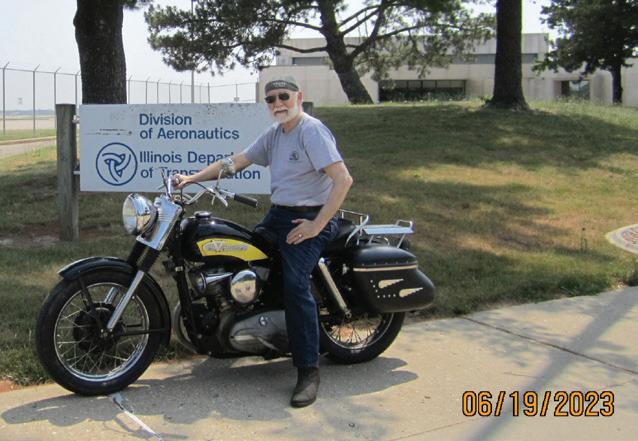
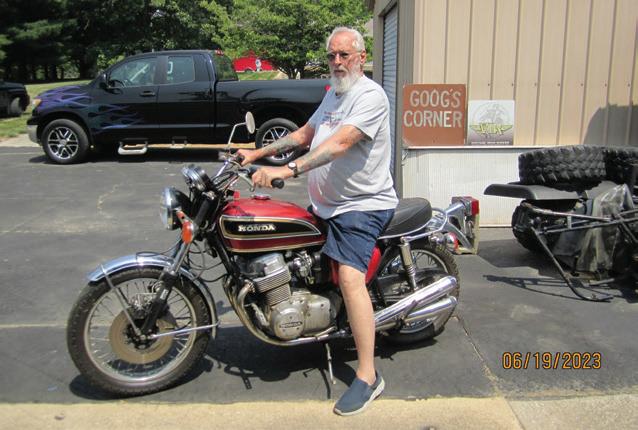
These photos were taken on Mr. Goldfine’s most recent Ride to Work Day, which was yesterday, June 19, and I wanted to share. One is of me on my ’56 Harley-Davidson KHK when I visited the site of my last job with the State of Illinois…Abraham Lincoln Capital Airport in Springfield, Ill. I was an aeronautics attorney for the last 12 years of my service. The other is Gary “Goog” Underfanger with his 1975 Honda CB750 at his shop in Springfield, Ill.
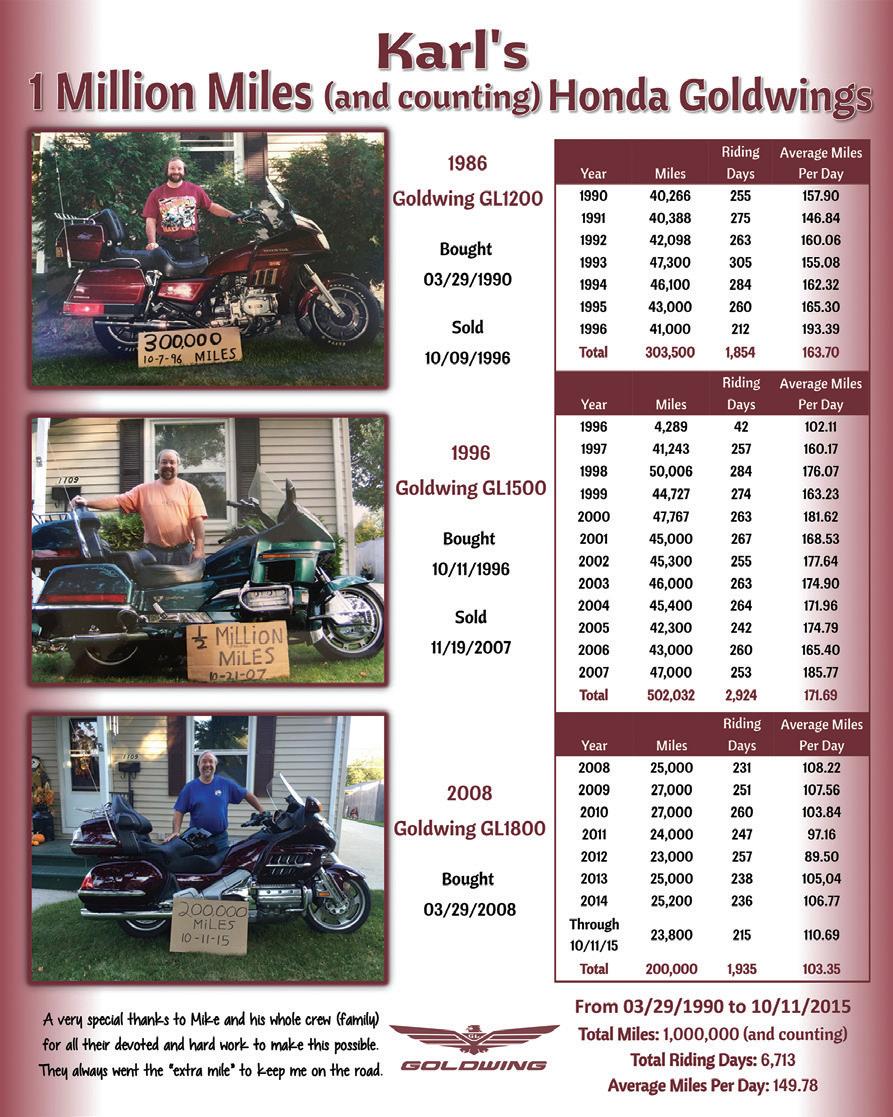
HIGH-MILER
After reading in the last few issues about members and their motorcycle-mileage milestones, I had to review my own mileage achievements. I’m 73 and have been riding for over 55 years, and have kept records on the last 10 of my motorcycles.
1970 Honda CL450 (new)
20,021 Miles
1971 Honda CB750 (new)
52,010 Miles
1975 Honda CB750 (new)
61,320 Miles
1980 Honda CB 750 “Custom” (new) 122,100 Miles
1983 Kawasaki 750 “Spectre” (bought new in 1986) 113,470 Miles
1986 Honda GLI200 (used) 303,500 Miles
1996 Honda GL1500 “Interstate” (used) 502,032 Miles
2008 Honda GL1800 (new) 300,465 Miles
2008 Honda GL1800 (used) 125,900 Miles
2020 Honda GL1800 (bought new in 2023) 12,000 Miles (so far)
Total 1,612,818 (and counting)
I’ve had a few earlier motorcycles but didn’t keep records on them. I don’t ride as far as I used to, but I still like to ride when I can. It’s not always the destination, but the ride. Enjoy it while you can! I’ve also included a poster I put together when I hit a million miles on three of my Hondas! Karl Goemans Life Member
George Tinkham Springfield, Ill.
BACK IN THE DAY
Where the photos are blurry but the memories are clear!
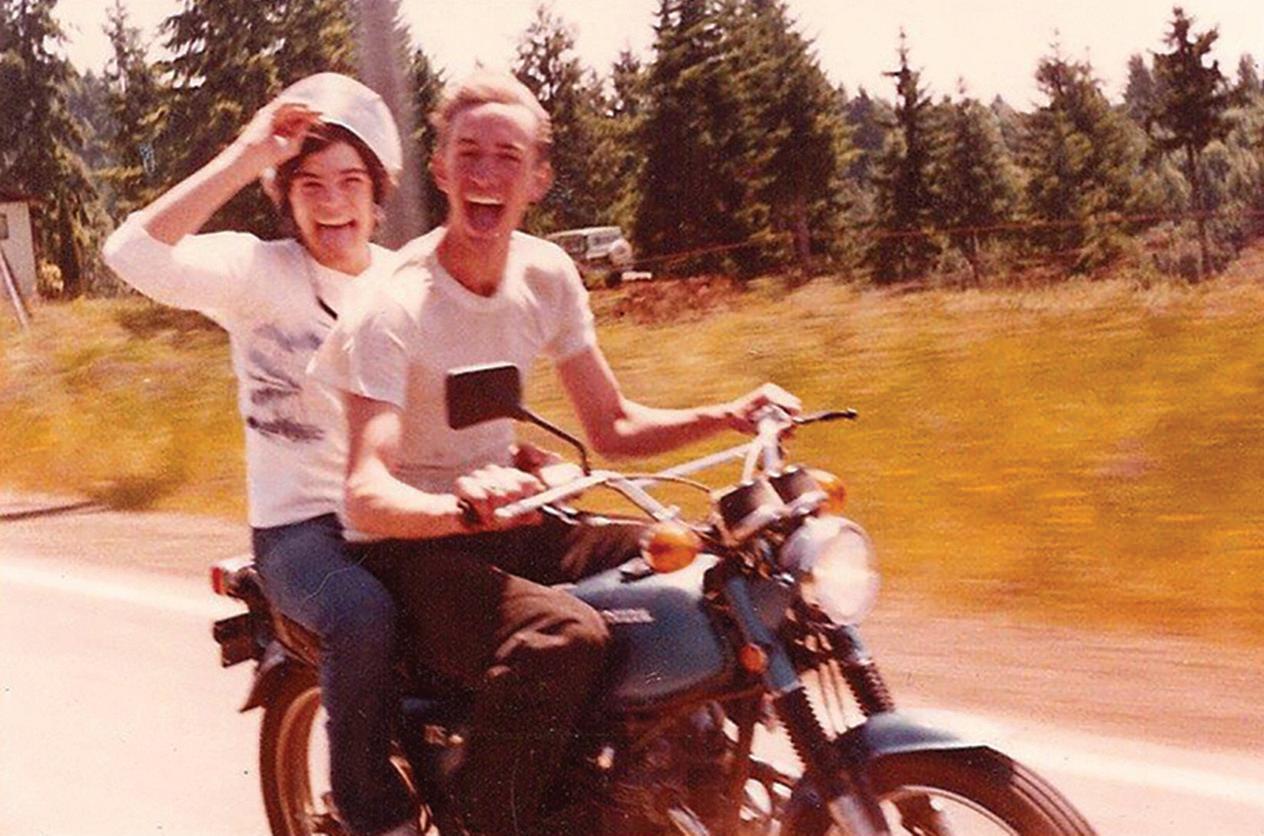
Iwas back in Dallas, Ore., for just a few days of leave after graduating Marine Corps boot camp in early 1984, and snapped this photo of my best friend on his Honda — with my little brother on the back — from another friend’s bike. The great times we had riding the backroads and logging trails around that little town lit the fire of a motorcycle lifestyle that’s yet to be extinguished.
John Garzon
We thank you for your service, JG. —Ed.
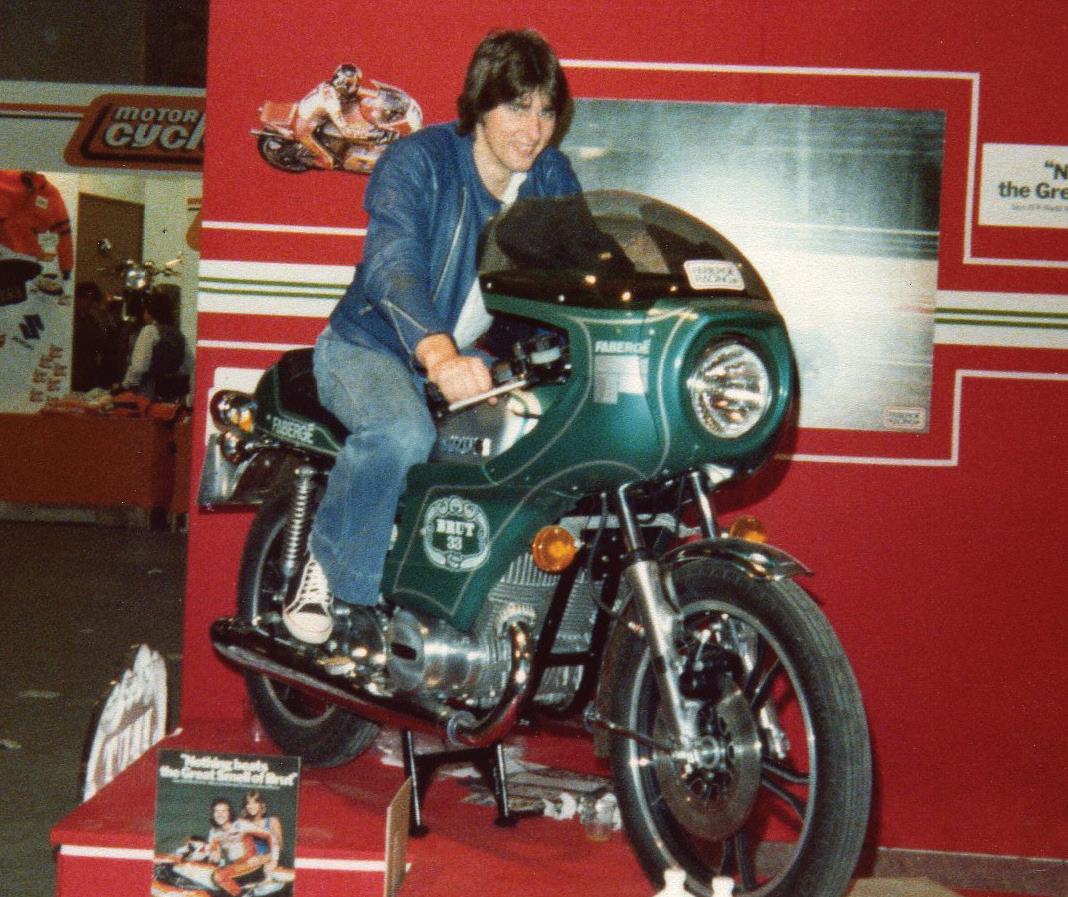
This photo was taken at Earls Court, London, the original home of the U.K. Motorcycle Show. I think this was taken in 1976 during the heyday years of Sheene vs. Roberts — riding crazy two-stroke Yamahas and Suzukis. I had huge posters of both riders on my bedroom wall. My uncle’s best mate took me down to London from Northeast England (about 365 miles) on the back of his old Mod scooter — an original from the 1960s — but these days he’s piloting a BMW RT. We camped all weekend in the rain, but that didn’t dampen our spirits. As for the Brut-sponsored 750 Suzuki in the photo, Barry Sheene was all over the advertising world in the U.K. at that time (and probably would boast millions of followers by today’s standards). He was always surrounded by pretty women and selling Brut to this unsuspecting 17-year-old sitting on the green bike. RIP Barry, and thanks for the memories.
Eric Bell
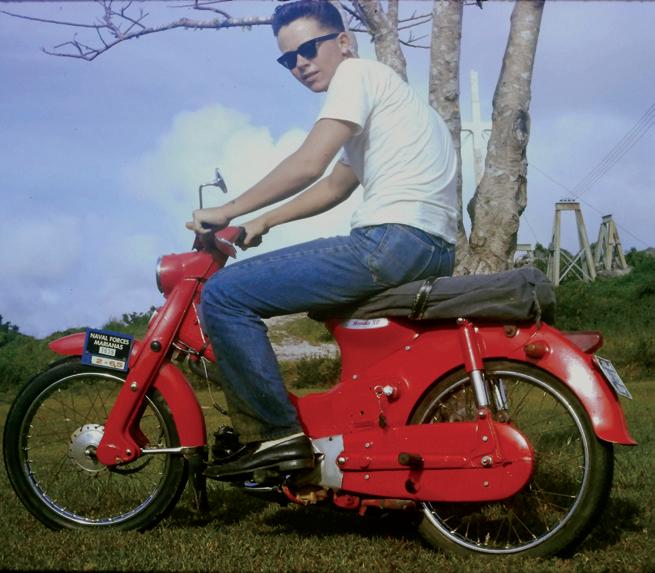
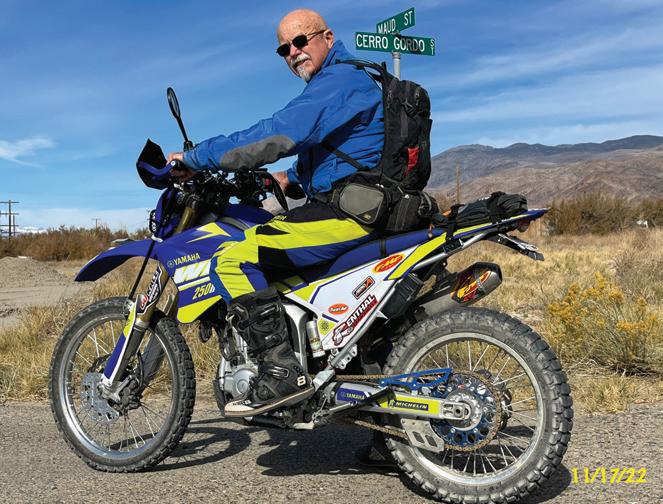
The attached photos are of me and my first motorcycle — a Honda 50 I bought in 1964 at the age of 17 while living on Guam — and me with my latest acquisition, a 2020 Yamaha WR250 dual sport I bought used with 70 miles on it in 2022.
My father was a U.S. Marine officer stationed on Guam with the family. It was his second tour there; his first was during WWII. I had declined an offer of financial assistance from my dad to buy a car, and since his offer did not apply to motorcycles, I wound up with the Honda 50. I sometimes wonder if my life would have been much different if I had gotten a car first. My two younger brothers give me the blame for them both becoming motorcyclists, and we still get together for rides in the deserts and mountains of California, Nevada and Utah. I am now 75 years old, and haven’t thrown in the towel yet, but I have been downsizing after owning a handful of KTM dirtbikes and some large-displacement street bikes.
Tom Rooney
up to speed
News, notes, insight and more from the motorcycling universe
HALL OF FAME DAYS
Multi-day celebration headlined by 2023 AMA Motorcycle Hall of Fame Induction Ceremony
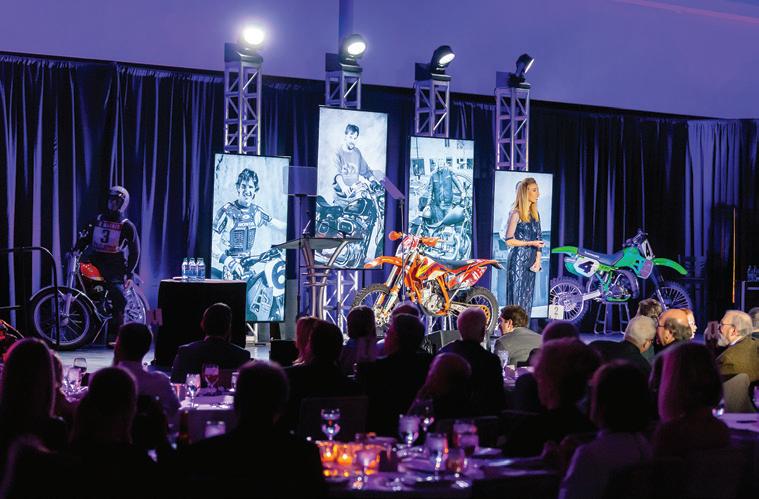
Four jam-packed days of activities. Five Hall of Fame inductees. And tons o’ fun.
That’s what awaits everyday motorcycle enthusiasts looking to celebrate the past and enjoy the present at the inaugural AMA Hall of Fame Days — a mix of AMA Hall of Fame induction celebration and a range of fun activities for the whole family.
AMA Hall of Fame Days runs Sept. 14-17 at the AMA campus in Pickerington, Ohio, with the 2023 AMA Motorcycle Hall of Fame Induction Ceremony taking place Friday, Sept. 15. Between getting to know the five members of the AMA Motorcycle Hall of Fame Class of 2023 and all the
fun festivities the AMA has planned, there’s plenty to know about this fastapproaching event.
DATES & LOCATION
Running Thursday, Sept. 14, through Sunday, Sept. 17, the AMA campus in Pickerington, Ohio, will serve as the main hub for all the festivities. The 2023 AMA Motorcycle Hall of Fame Induction Ceremony will be held Friday, Sept. 15, at the neighboring Violet Township Event Center.
HOF CLASS OF 2023
The AMA Motorcycle Hall of Fame Class of 2023 is
comprised of Rita Coombs, Ryan Dungey, Barry Hawk, Grant Langston and Travis Pastrana.
Rita Coombs is best known for her involvement in the creation of the AMA Amateur National Motocross Championship at Loretta Lynn’s, which has grown into the most prestigious and impactful amateur motocross event in the world over the last four decades. Coombs also helped form the AMA GNCC series and the AMA National Hare Scrambles championship. Ryan Dungey forged great success in AMA
Supercross and Pro Motocross from 2007 to 2017, tallying four 450SX and three 450MX titles. He also tallied three Motocross of Nations titles (2009, 2010, 2011) to go along with back-to-back ESPY Awards for Best Athlete in Men’s Action Sports (2015, 2016). With 98 national championship event wins, Barry Hawk cemented himself as one of the most successful off-road riders ever. Showing his versatility, he stands alone as the only rider to ever win AMA GNCC national titles on both an ATV and a motorcycle. Hawk retired from racing in 2010 with eight
AMA GNCC national
championships. Grant Langston is the only rider to win a World Motocross Championship, an AMA Motocross Championship, and both AMA Supercross Regional Championships — East and West — in the 125/250cc classification. Langston added both an AMA Supermoto title and an AMA 450cc Motocross title to his resume.
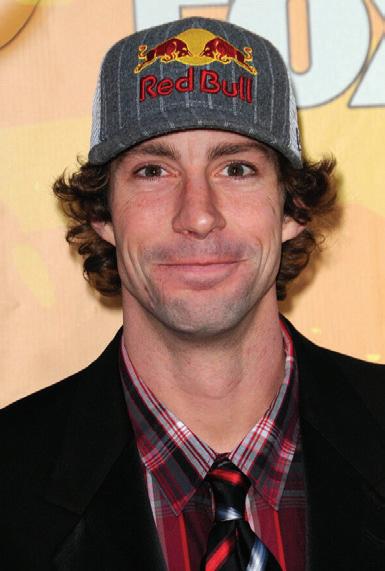
A racer turned daredevil, Travis Pastrana used motorcycling to build himself into a mainstream star. At the competition level, Pastrana became the youngest rider (16 years, 10 months, 26 days) to win an AMA Pro Motocross title. Pastrana also won a 125cc East AMA Supercross Championship and 17 total medals at the X Games.
INDUCTION CEREMONY & COCKTAIL RECEPTION
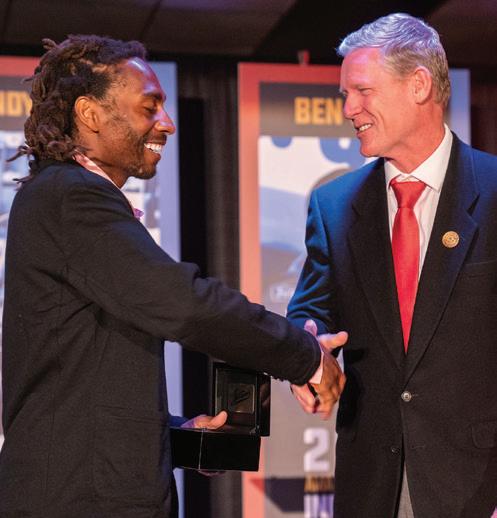
The 2023 AMA Motorcycle Hall of Fame Induction Ceremony serves to honor the five inductees and welcome them into the AMA Motorcycle Hall of Fame.
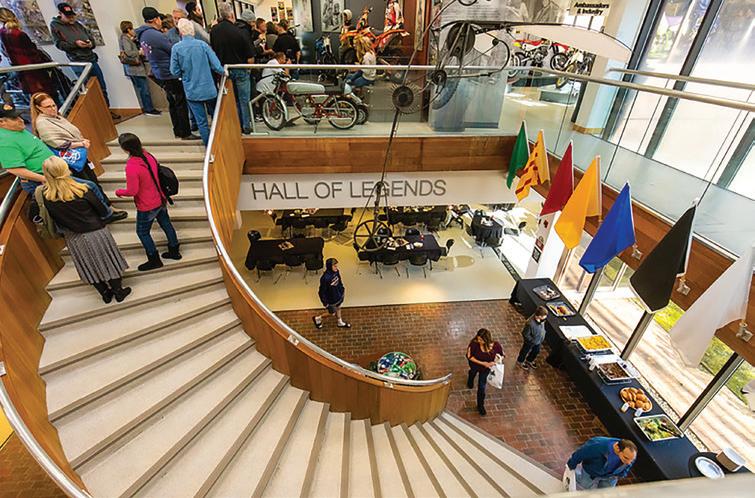
Immediately following the induction ceremony, an evening reception will be held back at the AMA Motorcycle Hall of Fame Museum.
BIKE NIGHT & MORE SATURDAY FUN
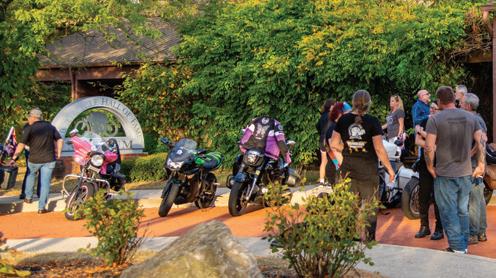
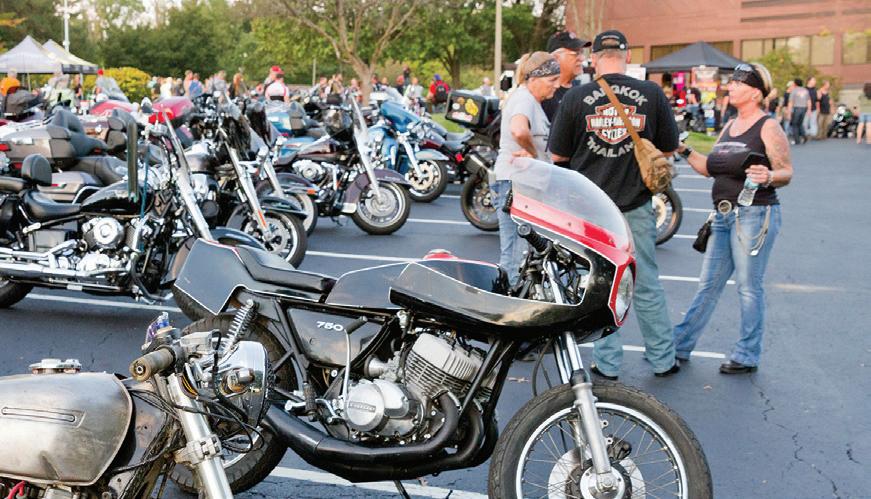
Saturday, Sept. 16, of AMA Hall of Fame Days kicks off with the Hall of Fame Supporter Brunch and public reveal of the Class of 2023 display in the museum, followed by an autograph session. A museum open house will transition the day
into a bike night with a DJ, food trucks, Hall of Famer judged bike show and more.
For those looking to scratch an itch for competitive motorcycling, an AMA SuperPitBikers invitational exhibition race will also be held on the AMA’s newly constructed motocross track on Saturday, Sept. 16.
ADVENTURE RIDE
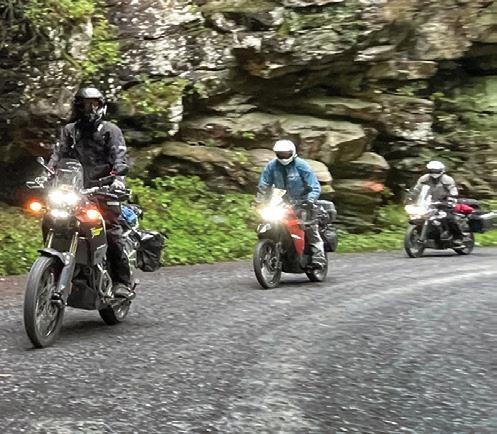
Kicking off the four days of fun is the AMA Motorcycle Hall of Fame Adventure Ride, which leaves from the AMA Motorcycle Hall of Fame Museum the morning of Thursday, Sept. 14, and explores Southeast Ohio before returning to the museum by early evening. The AMAsanctioned adventure ride is open to pre-registered AMA members.
MORE HAPPENINGS
The annual AMA member meeting will be held at the AMA Motorcycle Hall of Fame Museum Friday, Sept. 15. AMA Congress, which includes AMA Racing and Recreational Riding Commissions, will meet Sept. 15-16 to discuss rules and guidelines for AMA-sanctioned racing and riding activity.
On Sunday, Sept. 17, the FIM Mobility Commission — which deals with the safety of riders on the road and the quality and safety of products used in motorcycling — will meet at the AMA headquarters.
For more information on AMA Hall of Fame Days and how to be involved, go to AmericanMotorcyclist.com
—Keaton Maisano
BARRY HAWK
RITA COOMBS GRANT LANGSTON TRAVIS PASTRANA
RYAN DUNGEY
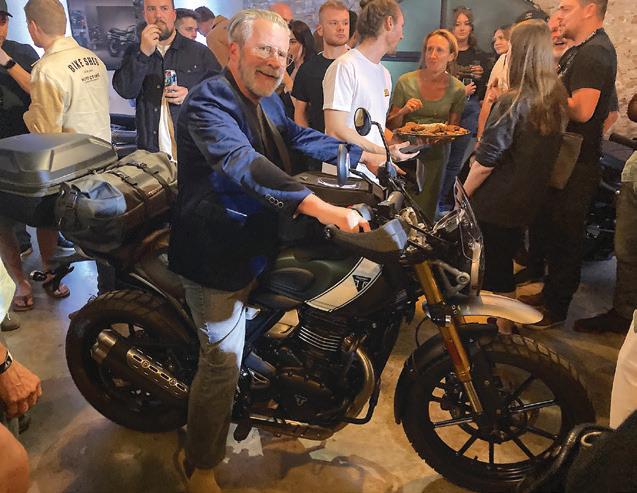
TRIUMPH GOES BIG
…
…by going small with its 2024 Speed 400 and Scrambler 400X singles
BY JOHN BURNS PHOTOS COURTESY OF TRIUMPH MOTORCYCLES
We published a piece in our May 2023 issue titled Triumph: On The Gas, and we meant it. Even though the reborn factory only got rolling again 30-some years ago, the legendary British marque has a motorcycle or two in its line-up for nearly every rider; even the dirt world is currently holding its breath waiting for Triumph’s new 450 and 250 MX machines to drop.
The only thing Triumph didn’t have, really, was an affordable entry-level machine. The Trident 660 triple is close, but it’s still an $8,600, 81-horsepower, 417-pound motorcycle. It could be a fine first bike, but the market lately seems to be leaning toward less being more, less money in particular.
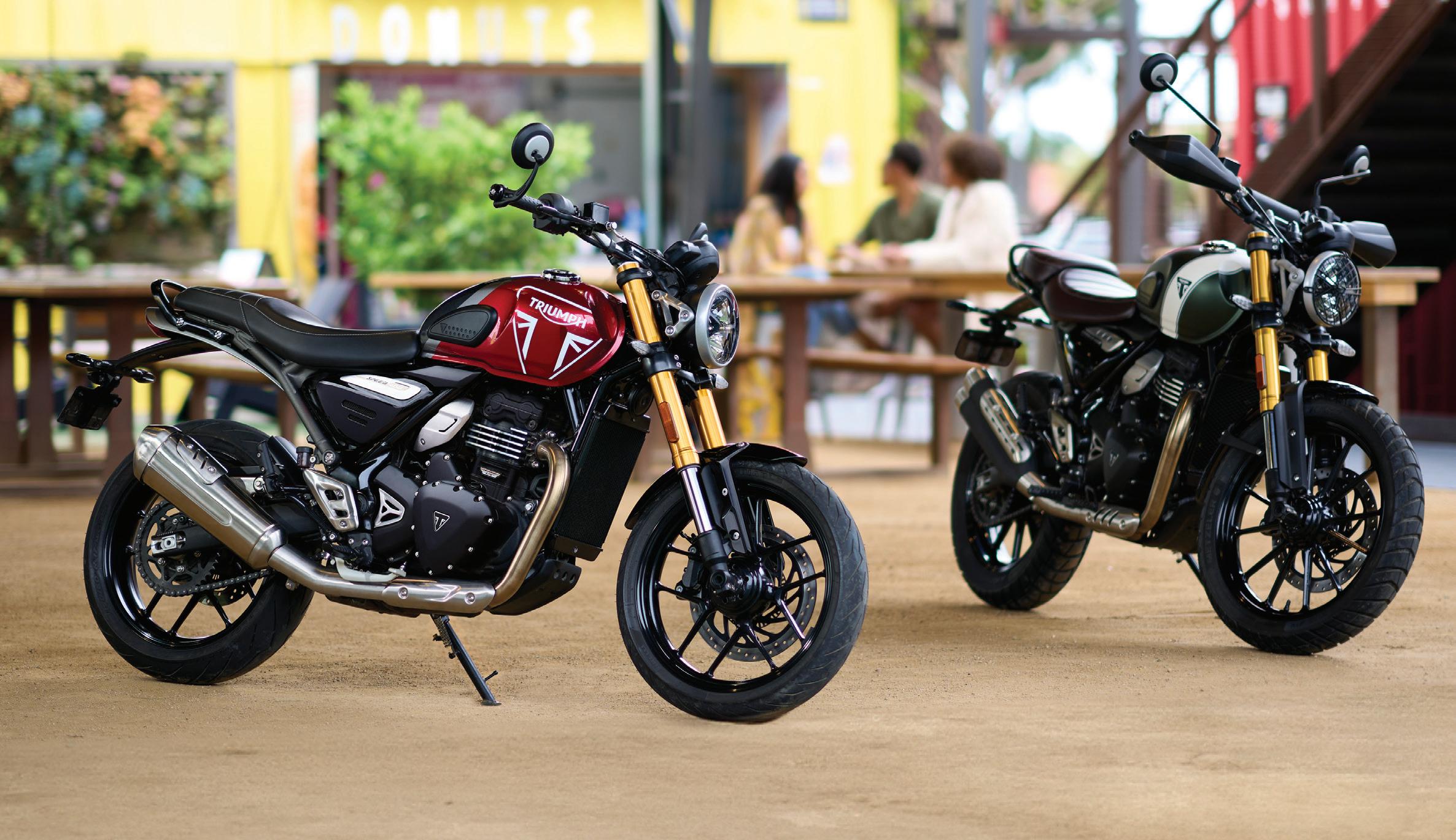
Perfect timing, then, for Triumph to launch a pair of bikes powered by a brand new 398cc single — the Street 400 and Scrambler 400X.
THE INDIAN CONNECTION
Both new bikes are designed in Hinckley, but in collaboration with
leading Indian vehicle manufacturer Bajaj Auto (“We know how to build Triumphs, and they know how to mass-produce things,” said a Triumph insider). They’ll be manufactured in India at first, and for that market.
There, the new Scrambler and Street 400s will be large, prestige motorcycles. When they make it to Western markets next January they’ll be more like entry-level Triumphs for new riders, though plenty of more experienced riders seem to lately be re-appreciating the beauty of smaller, less-powerful motorcycles (and especially ones said to be capable of around 80 mpg).
Not that 40 horsepower is all that less-powerful. That’s Triumph’s claim for the new DOHC 4-valve single, at 8000 rpm, and 28 pound-feet of torque at 6500 rpm. Triumph says that like all its engines, that torque begins early in the rev range for easy rideability, and feeds through a sixspeed gearbox with slipper clutch.
For comparison, HarleyDavidson’s just-announced Indianbuilt X440 claims just 27 horsepower
at 6000 rpm from its air-cooled single. The Triumph thumper gets a 12:1 compression ratio to the H-D’s 9.5:1, and will be propelling a 375-pound (wet) Street 400 —and 395-pound Scrambler 400X — compared to the Hero-built Harley’s claimed weight of 420 lbs.
KTM-ADJACENT
A better engine to compare the Triumph to might be the greatest little hit single of all time — the one that powers KTM’s 390 Duke and 390 Adventure. Both those bikes have
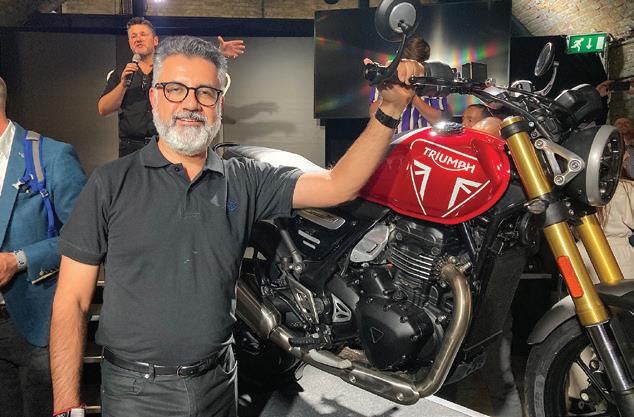
Bajaj Auto “President of Pro-Biking” Sumeet Narang is the main man when it comes to translating Triumph to Indian, and back again. Bajaj does lots of work with KTM, as well. Fuel capacity is 3.4 gallons.
won rave reviews from the critics (including this one) largely on the strength of that dual-counterbalanced engine, which runs so smoothly you wouldn’t even know it’s a single. For it, KTM claims about 43 hp at 9500 rpm, and a bit less torque at higher revs than the new Triumph. The Triumph uses a single counterbalancer, which is said to allow just enough vibration to convey that you’re riding a motorcycle.
Guess who builds KTM’s 390? That’s right, Bajaj. For about a decade now.
THE QUALITY IS THE THING
As a “premium European brand,” Triumph has a certain reputation for quality to live up to, and the new 400s have been five years in the planning with Bajaj. Both parties being cognizant of the strict scrutiny the new Street and Scrambler 400s will be under, they wanted to get these bikes right. From the looks of things, it’s hard to argue they didn’t.
From even a short distance, there’s nothing cut-rate about either bike, and you’re hard pressed to tell the difference between the 400s and their bigger 900 and 1200cc sibs. Gold-anodized inverted fork tubes with 43mm sliders guide both bikes (130mm of travel for the Street and 150mm for the Scrambler), with piggyback reservoir single shocks bringing up the rear (also 130 and 150mm travel).
Triumph always does a nice job on the details, and here that includes custom-looking round bar-end mirrors, discreet liquid-cooling plumbing, and even more discreet wiring. Paint and decals — both bikes are available in three color schemes — is on par with Triumph’s more expensive Roadsters and classic adventure bikes, or damn close to it.
On both sub-400-pound motorcycles, a single disc brake up front should be plenty (300mm for the Street, 320mm for the Scrambler), with another 230mm disc at the rear. ByBre calipers, Brembo’s Indian division, work fine on every other bike we’ve tried them on, and you can switch the ABS off on the Scrambler.
I JUST WANNA RIDE…
For most people, especially young ones just breaking into the game, minor details won’t matter as much as the big picture and the bottom line, and on the latter Triumph is stringing us along until later in the year. My best guess is that these won’t be as inexpensive as the very inexpensive (and also very nice) Royal Enfields, but they’ll have to be priced considerably less than the aforementioned $8,600 Trident 660.
The aforementioned KTM Duke 390 is priced at $5,899, while the 390 Adventure sells for $7,399. If the new Street 400 and Scrambler 400X can slot into that same premiumEuropean range, you have to think they’ll be pretty popular. Triumph is rolling these out in India now, but the rest of the world will have to wait until January.
Scrambler 400 X features a longer wheelbase, longer-travel suspension, a 19-inch front wheel and a wider handlebar. A larger cast steel brake pedal and high-grip footpegs are positioned lower and wider for a more natural standing position when riding off-road.
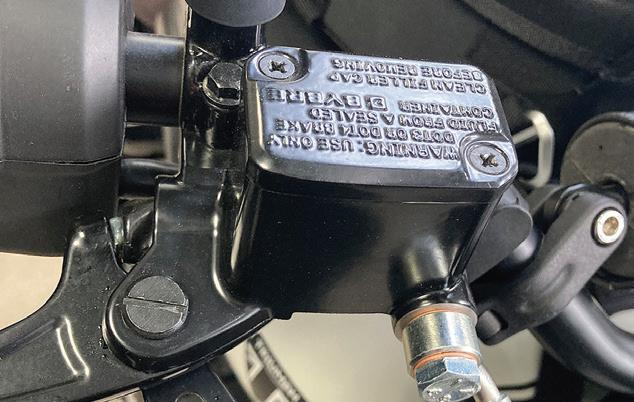
There are signs of economizing in areas like the non-adjustable brake lever and old-tech master cylinder, but it should all work fine on the road.
HISTORIC AMA
HISTORIC AMA
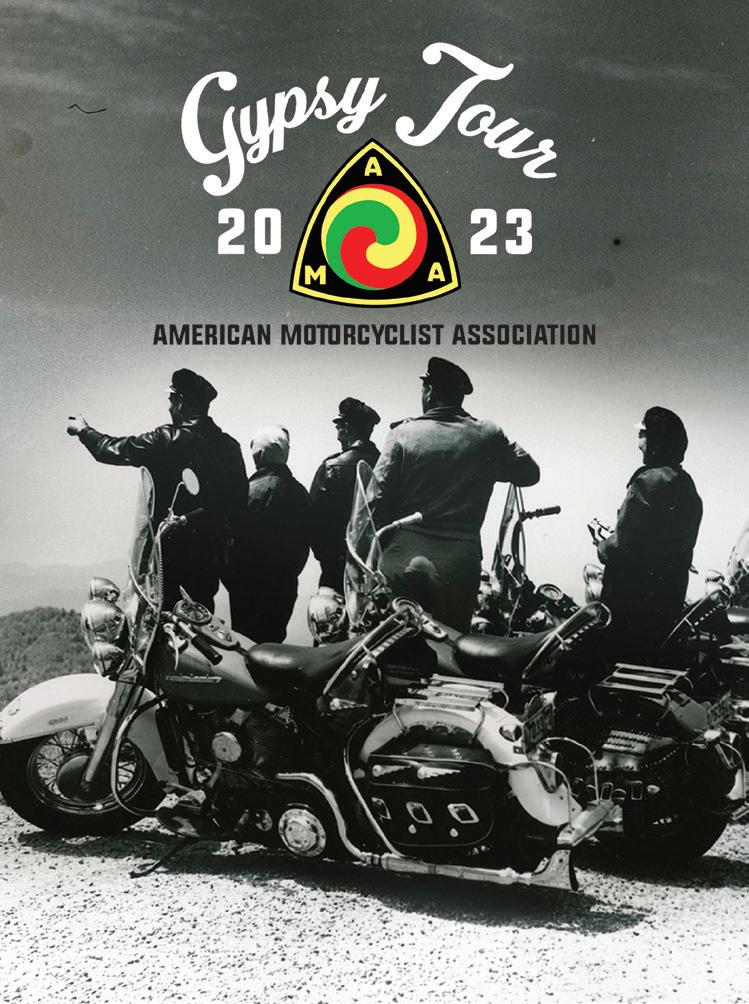
GYPSY TOURS
...got their start more than 100 years ago at places like Weirs Beach near Laconia, N.H., and Harley-Davidson Motor Co. in Milwaukee, Wis.
AMA Gypsy Tours have always been about riding and sharing the camaraderie of two wheels with like-minded enthusiasts at great destinations.
up to speed
RIGHTS Roundup
What’s trending in government relations and legislative affairs
BY KEATON MAISANO
AMA Sound Meter Program Makes an Impact out West
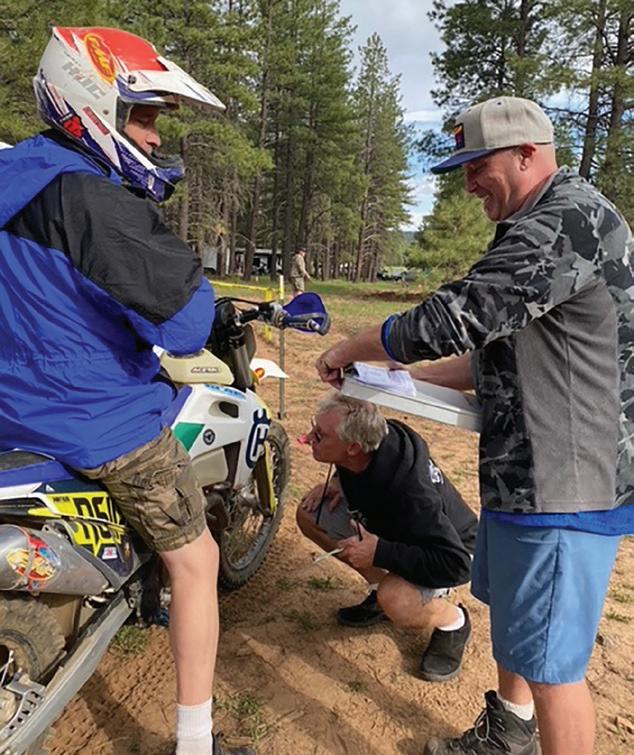
uring a race in June the Arizona Trail Riders used a sound test kit provided by the AMA and its annual Sound Meter Program to check sound emissions of competing motorcycles, a move aimed to help riders, crews and fans better understand acceptable sound levels according to AMA guidelines.
Utilizing the kit to test bikes, ATR member David Overfield and his partner tested close to 250 bikes between Saturday afternoon and Sunday morning.
The kit from the grant, administered
through the AMA’s Government Relations Department, includes a Type 2 sound meter, a tachometer, training materials, a spark-arrestor probe, personal protective equipment and a storage case. The kit shows quantitative data to complainants about levels that fall within acceptable legal ranges.
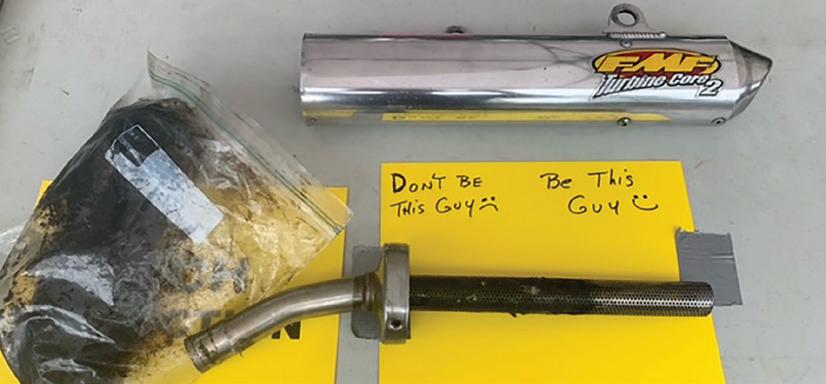
Along with the kit sent to the Arizona Trail Riders, Overfield said the tech inspection station was also supported by FMF, which provided banner stickers and half a dozen muffler packing kits.
“I also displayed a disassembled
Two Motorcyclists Hired IN Government Relations Department
OREMAINING EVENTS
Four Corners Motorcycle Rally Aug. 31 - Sept. 4
And that continues with the 2023 Gypsy Tour schedule, where riders can meet, share experiences and even grab their collectible AMA National Gypsy Tour pin dated with the year. www.americanmotorcyclist.com/gypsytour
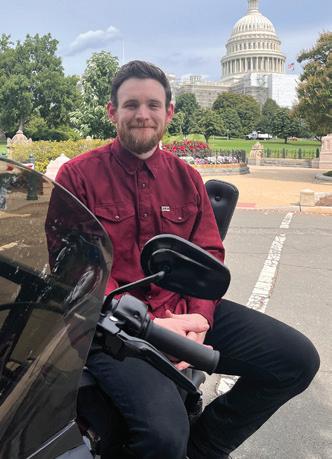
n the heels of the announcement to reimagine the AMA’s Government Relations Department to represent motorcyclists more effectively throughout the country, the AMA hired two individuals in July — Washington Representative Zach Farmer and Central States Representative Nick Sands — to help deliver on the AMA’s mission to protect the future of motorcycling.
A lifelong motorcycle enthusiast and rider since he was 7 years old, Farmer moved to Washington, D.C., to work in the office of a representative from his home state of North Carolina before transitioning to the Ohio delegation.
Farmer was previously the director of congressional affairs for the Council for Opportunity in Education, and with his new position at the AMA will now handle legislative and policy/regulatory issues at the federal level.
“This is an exciting opportunity to
ZACH FARMER NICK SANDS
muffler to show how to properly clean the core before repacking it,” Overfield told the AMA.
Striving to keep off- and on-road riding areas open to the public, the AMA Sound Meter Program started in 2005, and since its inception has awarded more than 130 sound meter kits to AMA Districts, club members, race
organizers and others who apply for it.
Acknowledging the damage that excessively loud motorcycles have on the perception of motorcycling, the AMA holds that motorcyclists have a responsibility to be part of the solution by being sensitive to community standards and respectful of their fellow citizens.
In addition, the AMA’s Government Relations Department fights to ensure law enforcement agencies do not single out motorcyclists when addressing the problem of sound pollution. The AMA Sound Meter Program looks to prevent the implementation of laws and regulations that specifically target riders.
advocate for the interests of the AMA in Washington, D.C.,” Farmer said, “and ensure motorcyclists have a prominent presence in policy-making discussions.”
Sands, a resident of Denver, is a motorcyclist with a political science degree from Earlham College, where he was a member of the basketball program for four years. After his graduation in May of 2019, Sands moved from Indiana to Colorado to work at the Colorado General Assembly as a legislative aide. With the Colorado House Minority office since 2021, he took over as chief of staff entering the 2023 legislative session.
As the central states representative, Sands will handle government relations within the Central United States.
—Keaton Maisano
up to speed
Racing Roundup
What’s what in the world of AMA amateur competition
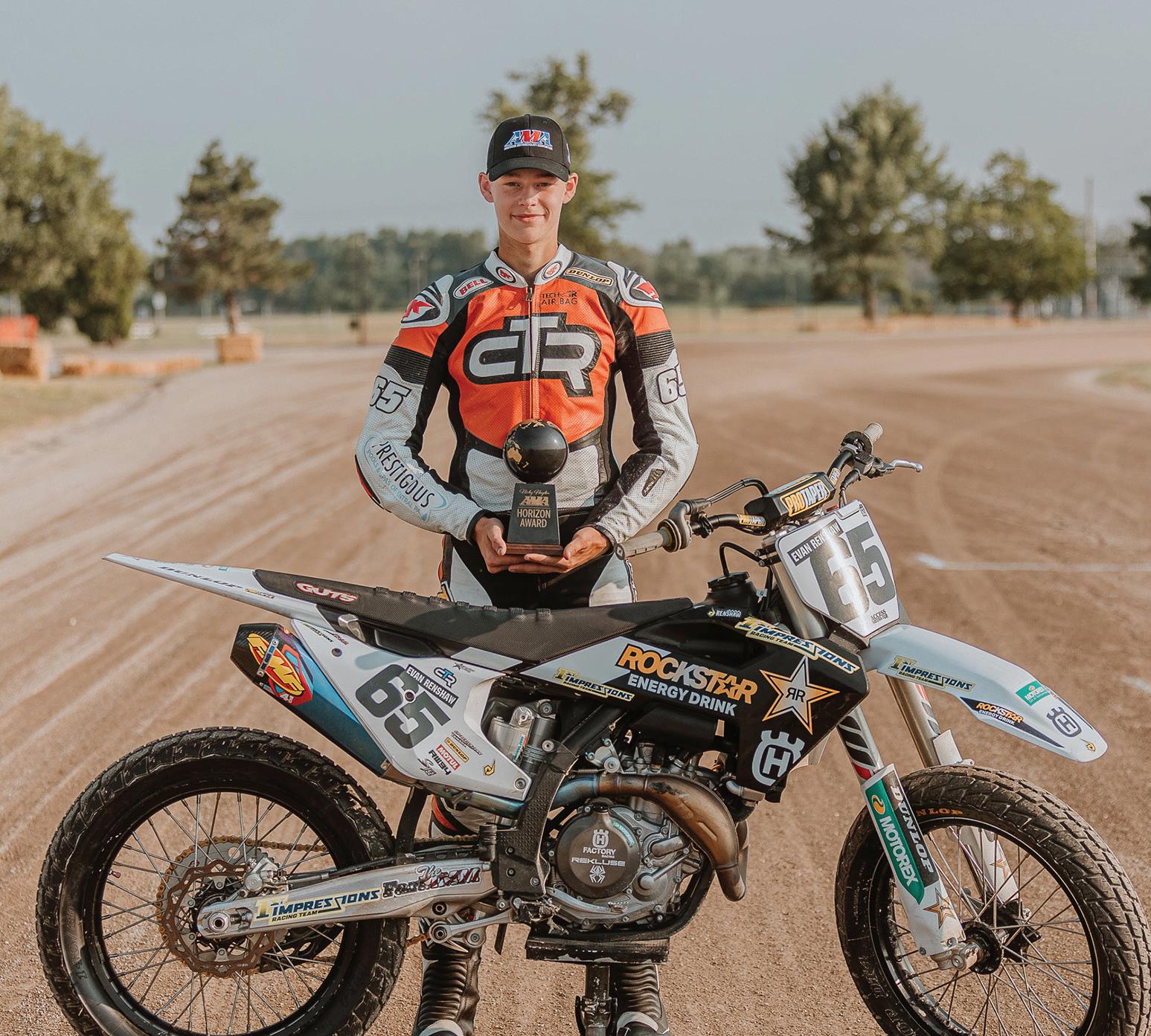
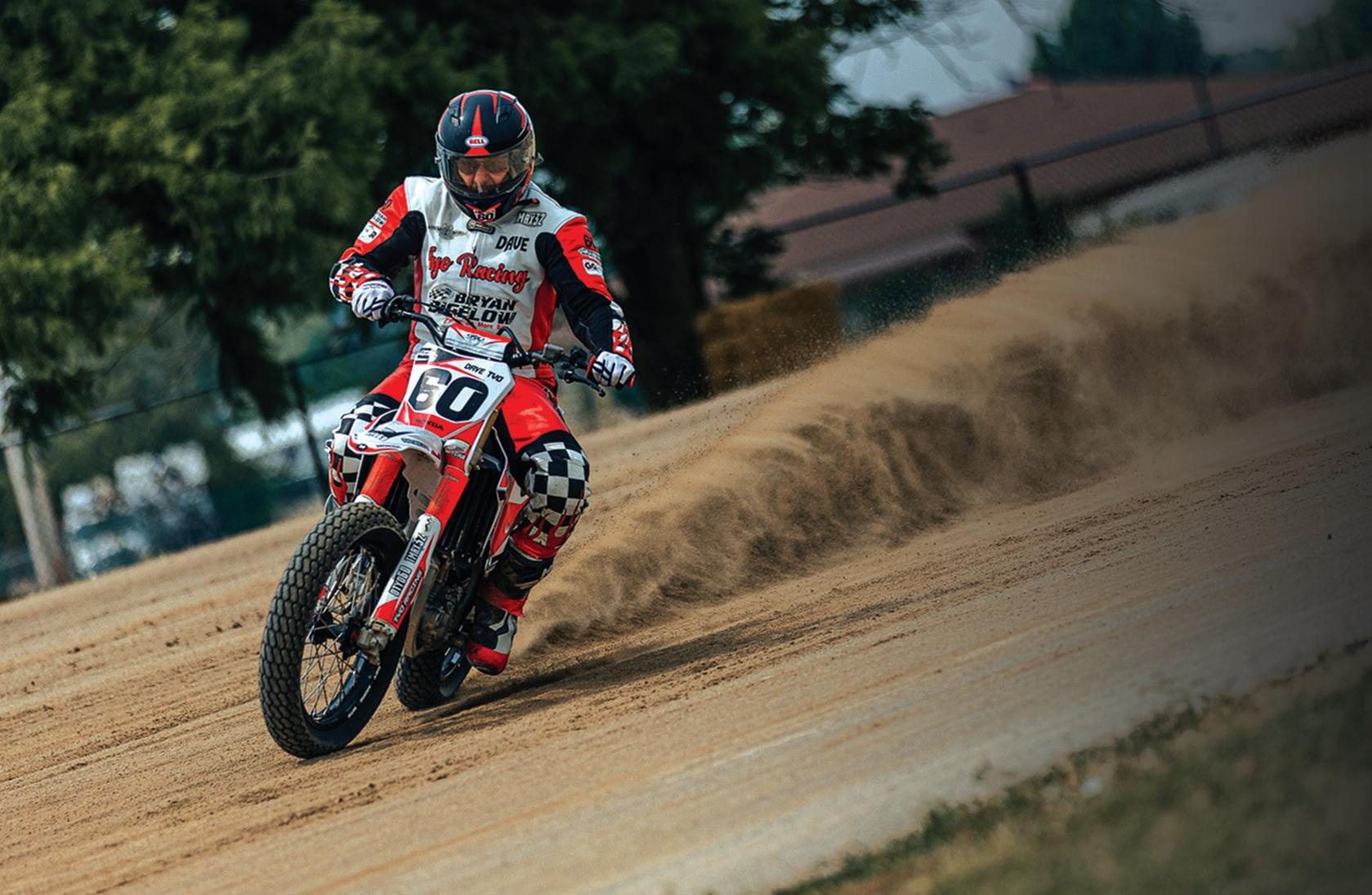
For years, Evan Renshaw was a staple on the podium at the Mission Foods AMA Flat Track Grand Championship in Du Quoin, Ill. Renshaw secured several national titles on previous trips to Du Quoin but claimed the ultimate prize on June 19, 2023, after finally taking home the 2023 Nicky Hayden AMA Flat Track Horizon Award, which honors the legacy and success of Nicky Hayden while recognizing the amateur racer who’s demonstrated the skill, character and aptitude to make a significant impact at the professional level.
For Renshaw, it was the culmination of years of hard work.
“I’m shocked, but at the same time, it was kind of what I was here for,” Renshaw said after claiming the award. “I’m definitely stoked; all this work I put in is paying off.”
With the Nicky Hayden AMA Flat Track Horizon Award in mind, Renshaw ramped up his training regimen over the last year while working closely with his mentor and former American Flat Track pro racer Cory Texter. Renshaw also continued to compete with Dunlop Flat Track Elite, who he’s raced with for the previous four seasons.
“The past year, I put in so much work with Cory Texter,” Renshaw said. “Even in the winter, we all stay in Florida and train hard, so I’m glad
Renshaw Claims 2023 Nicky Hayden AMA Flat Track Horizon Award
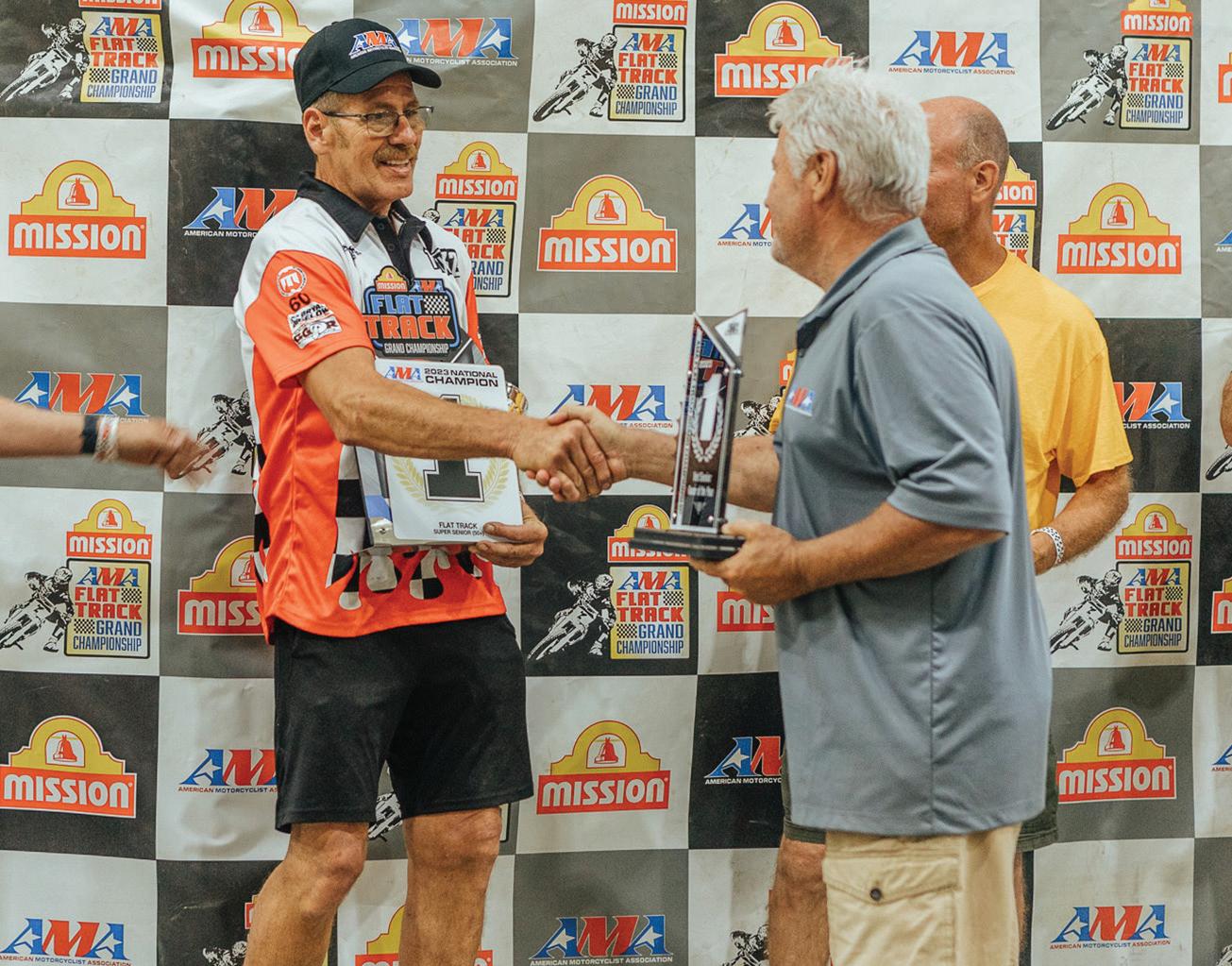
Evan Renshaw (top) separated himself from the field during the AMA Flat Track Grand Championship, claiming the 2023 Nicky Hayden AMA Flat Track Horizon Award. Michigan native David Tyo (bottom) held off fierce competition to earn the AMA Vet/Senior Racer of the Year.
DON’T LET THE
At 82, and after a nearly Three-year Covid delay, I finally get my chance to cross Australia coastto-coast via the Nullarbor desert
This year I celebrated my 82nd birthday, got fitted for a hearing aid, bought a walking stick, and rode a BMW R1250GS across Australia coast-to-coast — 3,877 miles, from Perth to Sydney — via the Nullarbor Desert.
A bit bonkers, as we say in Olde English, but it’s a dream I’ve had since I was a kid, more recently inspired by that great quote from Clint Eastwood — still making movies in his 90s — “I wake up every morning, and don’t let the old man in.”
Back when I was 15, like most kids that age, l craved excitement and found it in fiction — first at the movies, and then in the town library. I saw every western and war film that came out of Hollywood, and read every thrill-seeking book l could find. One I read over and over was called something like, World’s Top 10 Most Exciting Adventures, and it featured such trials as: “Sailing SingleHanded Across the Atlantic;” “Climbing Mount Everest;” and ”Motorcycling Across the Nullarbor Desert.”
STORY AND PHOTOS BY RICK WHEATON
As a gawky teenager without access to a 30-foot sailboat or climbing boots, most of these ordeals were well out of reach, but my dad sometimes let me borrow his 125 Vespa, and occasionally I’d sit on my Uncle Freddy’s 350 AJS — so there was hope. I rushed to the school atlas to look for the Nullarbor.
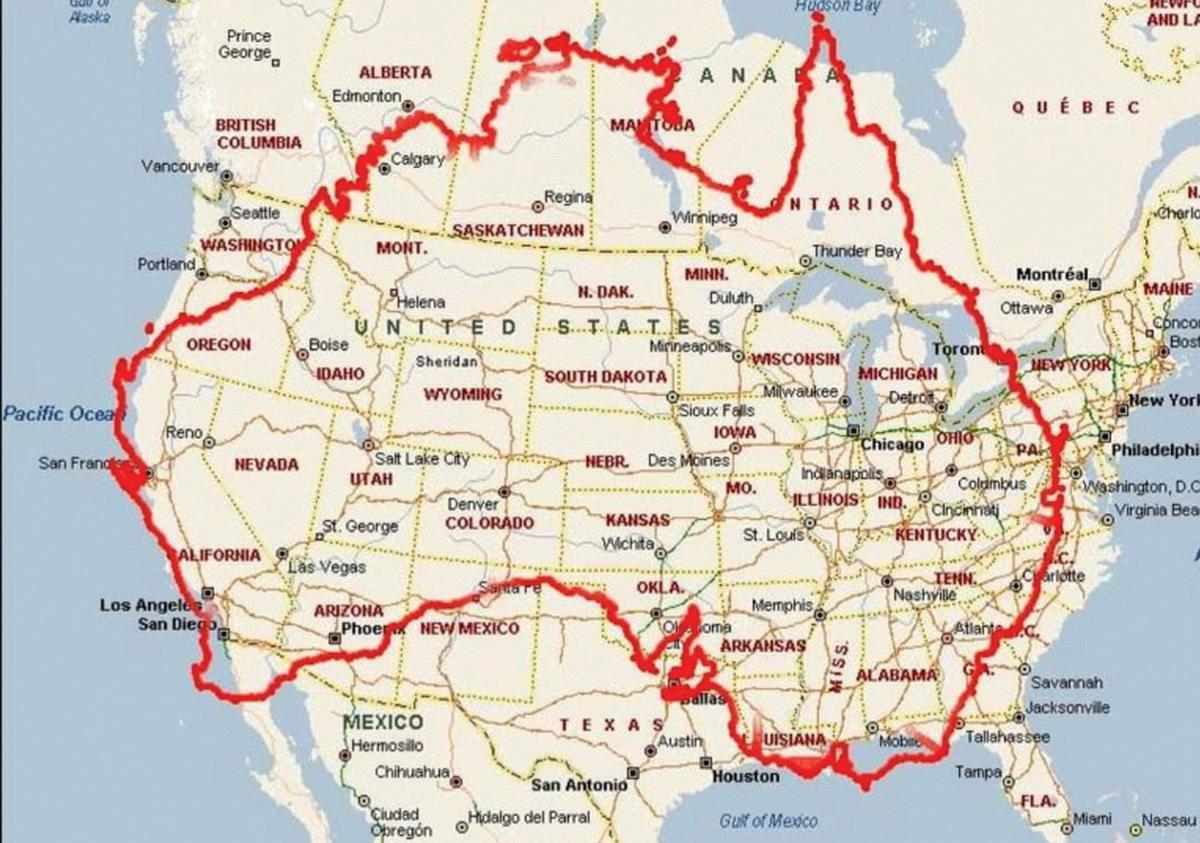
I found it on the Australia page, several pages, actually, “Oz” being a continent of 3 million square miles (the U.S.’s lower 48 comprise 3.1 million) and the sixth largest country on the planet. There it sat, spanning the bottom of a double spread: the huge Nullarbor Desert, bigger than South Dakota, its 750 miles East to West a dusty track, the world’s largest area of limestone bedrock, a flat plain where temperatures can hit 125 degrees in summer, and fall below freezing in winter. The indigenous people — with admirable economy — simply named it “Oondiri,” meaning “Waterless.”
Obviously, motorcycling across that in 1955 was practically impossible, the crazy temperatures and complete absence of a road put it firmly in the box marked “significantly inconvenient,” but the seed was planted. I read that even the early expeditions were doomed; an 1841 attempt failed when the horses perished for lack of water, and the following year another group set out, but two men died (it’s thought the bodies were never found), and a third attempt barely succeeded.
the school atlas showed me a route through France and Switzerland. Sadly, the resulting conversation with my dad is lost in the mists of time, but it must have gone something like, “Er, Dad…(clears throat nervously) can I borrow the Vespa?”… “Hmmm. Where’re you off to?”… “Well… (voice squeaks up an octave)…Italy?”
Improbable though it seems, he must’ve agreed, because off I went, 2,400 miles there and back, an early example of Being A Bit Bonkers, for a summer filled with excitement and wonder. The seed having taken root, other long rides came along over the decades: Spain and Portugal, Africa and India, Turkey and Greece, and when the bank balance allowed, the U.S. coast-tocoast, South America coastto-coast, and — my favorite — 15,000 miles through 23 European countries from the Arctic to the Sahara.
AUSTRALIA, PLANNED
The fact that Australia is a continent reminded me that riding “all the way across” would be my fourth. Did I have this in the tank? It was originally timed to celebrate my 80th birthday, but there was COVID. Two years on, I could let this be the big excuse, and scrap the whole idea, but I’d been thinking about it all my life, and I guessed Clint would twitch an eyebrow and agree with my Kiwi biker pal: “It’s there, might as well ride the darned thing.”
Eventually a track was established, the paved road was completed in 1976, and over the next 25 years, fuel, water and lodging sprang up in roadhouses along the way. Now it’s the mid-section of the well-travelled Perth to Sydney route, from the Indian Ocean to the Pacific. It’s almost the same distance as LA to New York, definitely an interesting ride, but probably not in the World’s Top 10 anymore.
Looking back, I think reading that “Top 10” book was one of those pivotal moments everybody has at some point…The missed train or the wonderful first date, after which life would never be the same.
A year later — I was 16 — this budding love affair with motorbikes led to my first proper two-wheeled adventure. My Italian pen pal invited me to stay for the long vacation, and
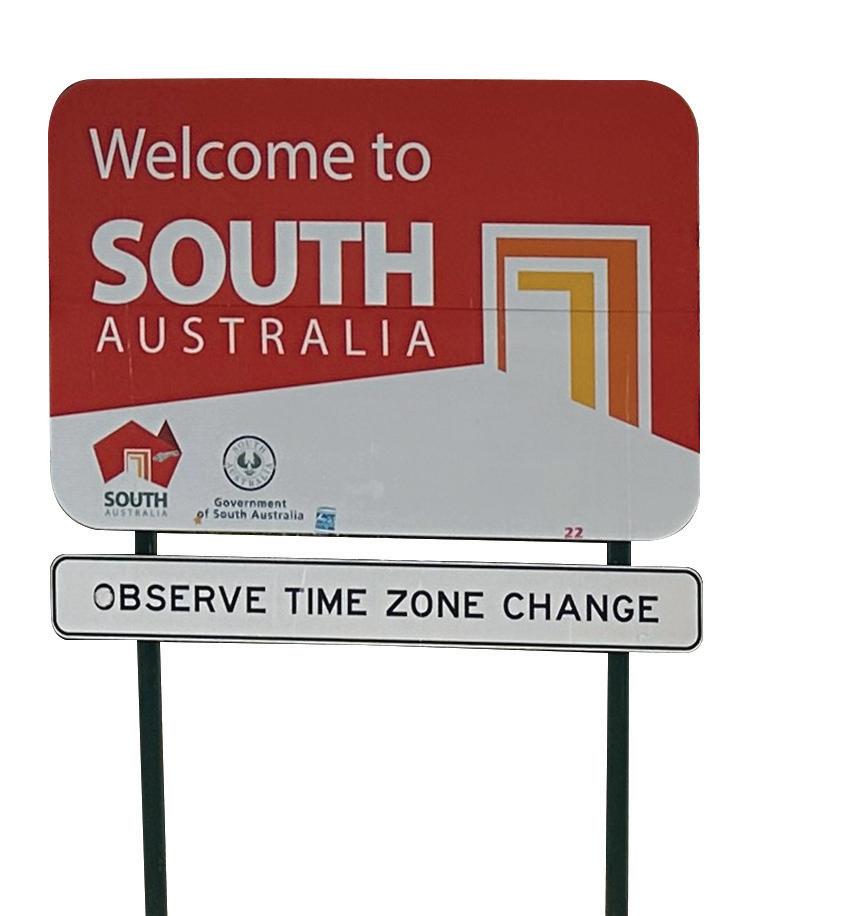
I’m a Brit — a “Pommie” in Australian slang — so riding the darned thing starts with an 18-hour flight from England to Australia and, right away, the hurdle of jet lag (see “Planning for the Nullarbor,” AM May 2020). There’s a 9-hour time difference between London & Perth, so to get over the jet lag I plan two days in Singapore, and three in Perth. Add these days to my flying time, and I’m well set to being in sync with the locals. l can only skate over the other early stuff…renting the bike, planning the route, organizing stopovers, deciding what gear to take, and the more difficult task of what gear not to take. Also — though it wasn’t difficult — the job of clearing this mad enterprise with my ever-supportive wife.
“Sweetie pie” she’d said, “I don’t want to ride all that way sitting on the back, but you go, be safe, and
have fun.” Who could ask for anything more?
A hatful of fun will be meeting friends and relatives scattered about this huge country. Students of history will know that two centuries of exodus from the British Isles led to the old joke “America got our puritans, Australia got our convicts.” It’s a joke with a nugget of truth, and I’m lucky enough to have many contacts in Oz…lucky, too, that some of them have invited me to stay a night or two along the way.
LET’S GO!
I’d been thinking about it all my life, and I guessed Clint would twitch an eyebrow and agree with my Kiwi biker pal: “It’s there, might as well ride the darned thing.”
Another slice of luck — one of many — was finding Mark, who runs the superb bike rental company BikeRoundOz near Perth. In 2020, when I’d originally planned this ride, his advice was invaluable, but then COVID closed Australia’s borders, and without his help, plus my wife’s encouragement, and Clint Eastwood’s inspirational words, I probably wouldn’t have hung on to try again two and a bit years later.
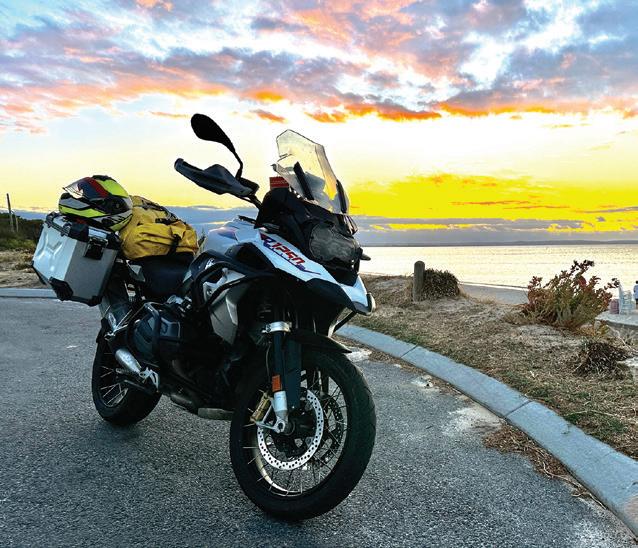
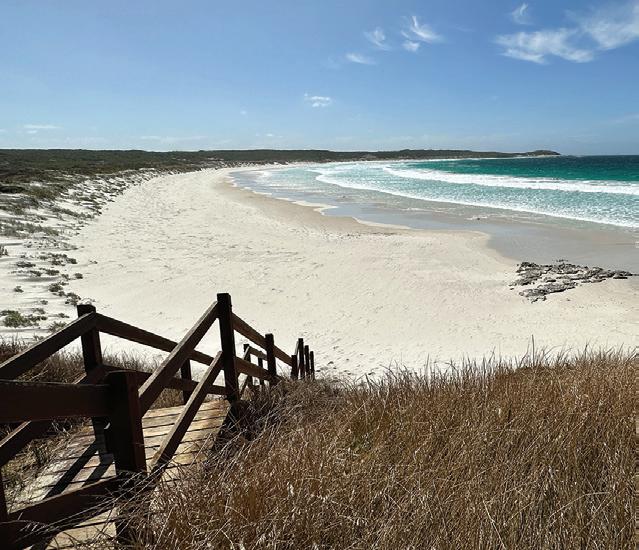
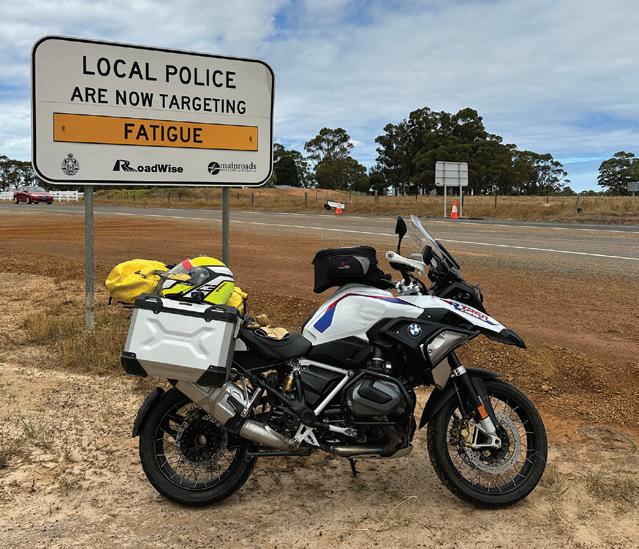
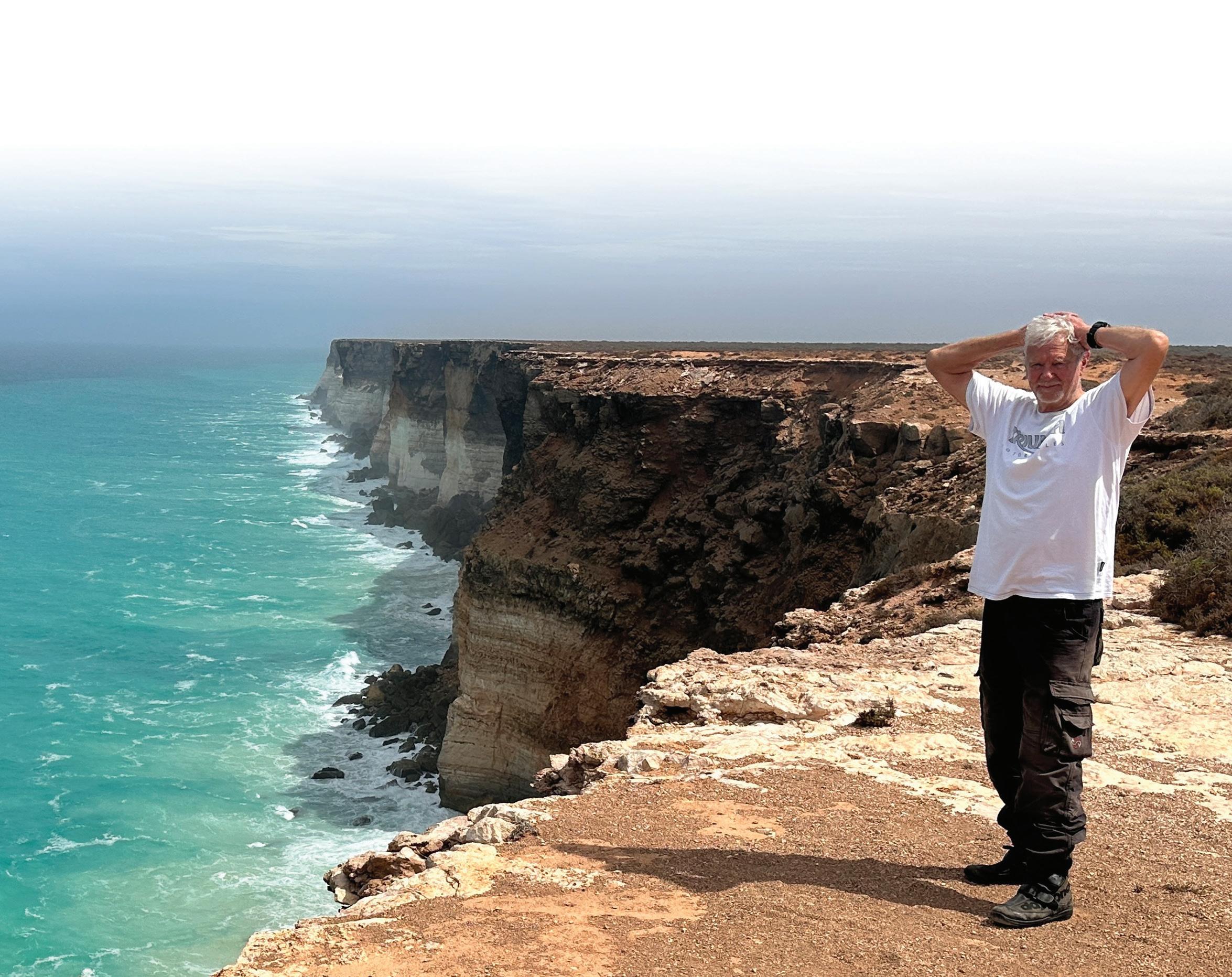
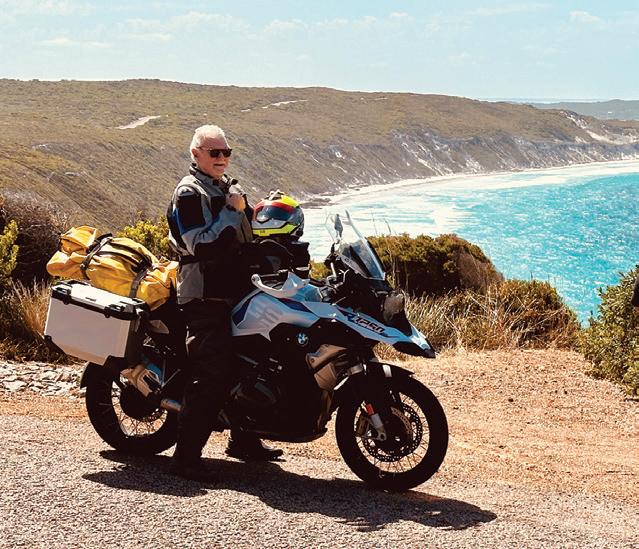
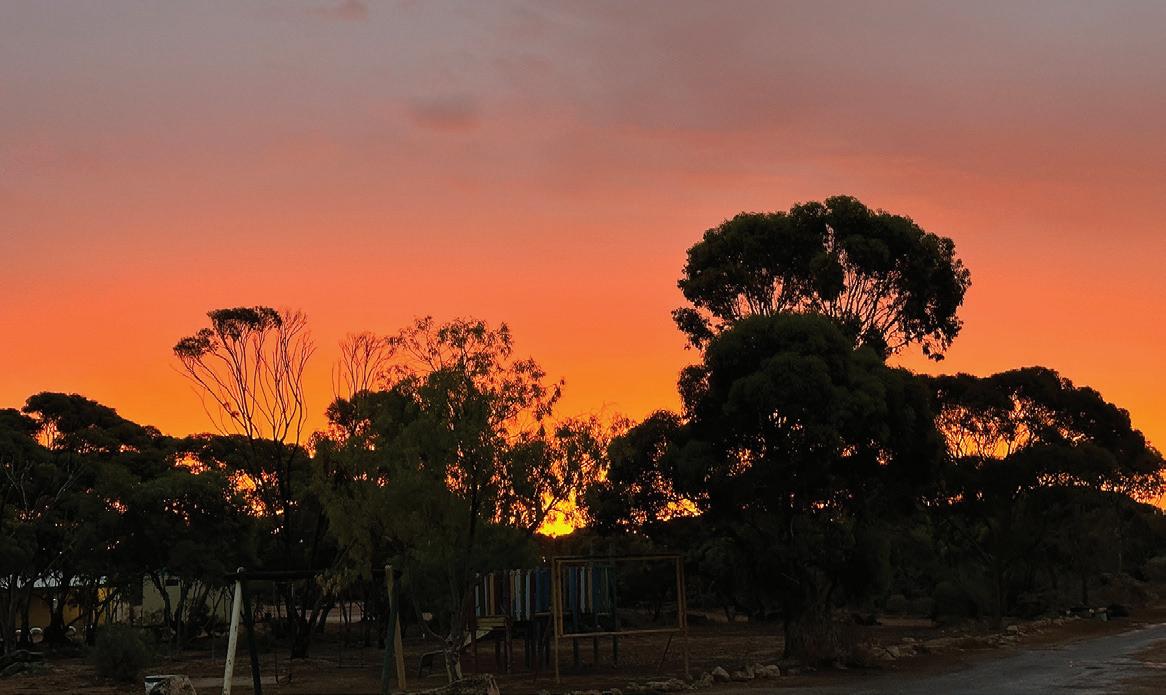
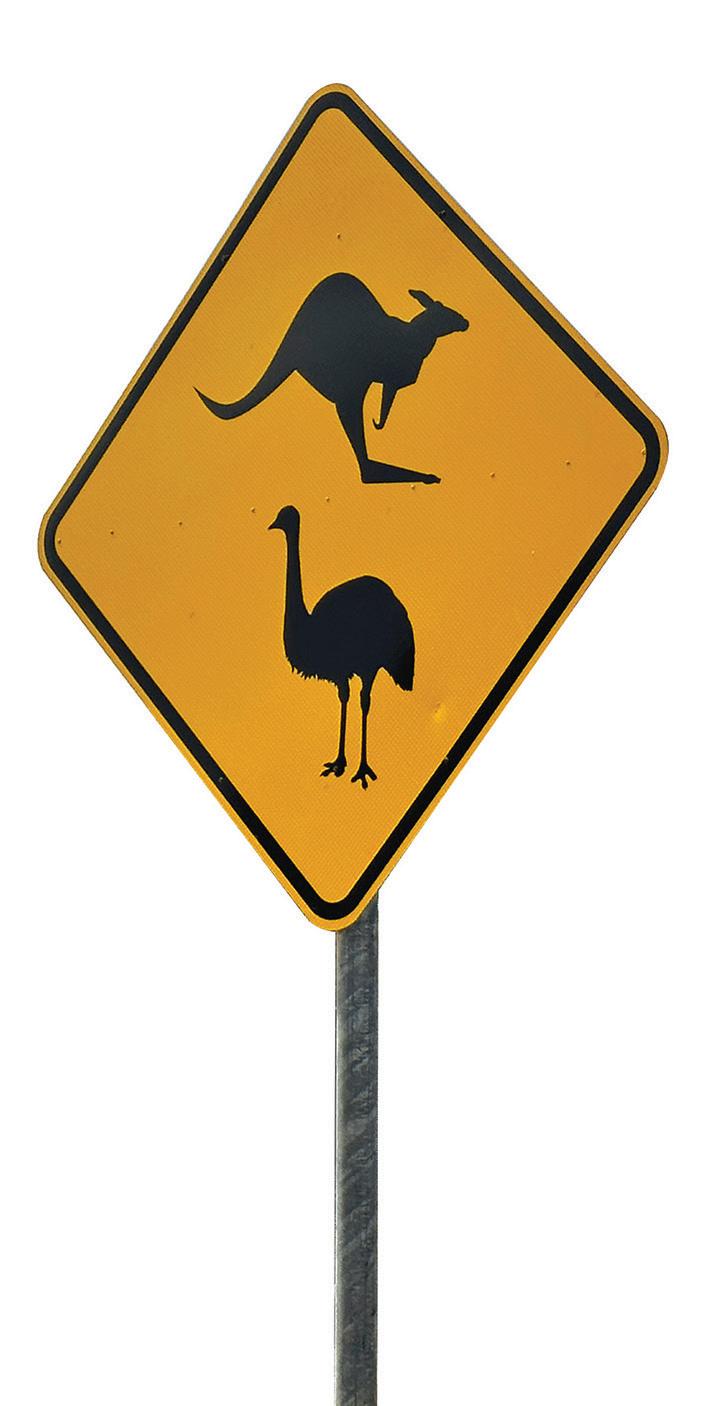
Left page: Australia, overlaid on North America. ’Roos…You have been warned! This page, clockwise from upper left: Busselton sunset. Gorgeous beach at Albany. Warning signs were frequent for fatigue, alcohol, speeding. Kept you on your toes. After the Nullarbor, the expanse of the Southern Ocean was hard to take in, especially from the crumbling edge of the Bunda Cliffs.
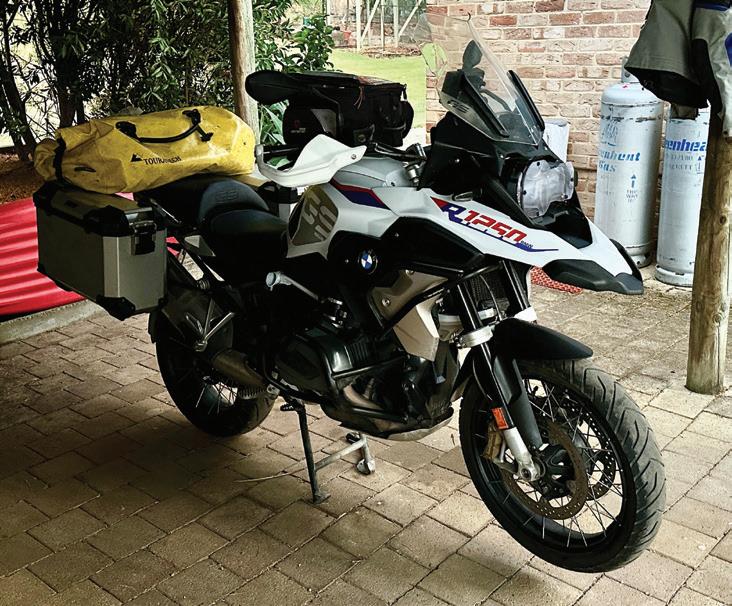
But I did hang on, and I’m finally on the Express bus to London’s Heathrow Airport, nervous and excited in equal measure. After a last-minute snafu involving a needed visa that raised my blood pressure but which was solved by my flight agent Chris (whew!), I made the flight, and all that jet-lag time whizzed by in a blink. I could only think of THE RIDE — fast forward — and here I am, passport properly stamped, hooked up with Mark in Perth, and making friends with a shiny red, white & blue BMW R1250GS, fitted with new tires, GPS, panniers and tank bag. It’s bigger and heavier than my trusty Tiger 800, but it feels comfortable right away, and “Day 1” in my ride notes sees me riding down the coast to the pretty seaside town of Busselton. This is a deliberately short run of 172 miles, but no tryout is needed. The morning traffic is quiet, I’m grinning
like a fool, the big GS is burbling along like a…well… like a big GS, and she got me there just in time to see a magnificent sunset.
Next day I’m invited to stay the night with friends Chris and Jane in Albany, further along the coast, a slightly longer run of 200 miles. I arrive in time for a walk to “their” beach, where I soak up the beauty and peace and quiet around their beautiful home. This bit of coast was almost deserted, as is much of Western Australia, a state the size of Texas and Alaska combined, but with about the same population as Chicago.
A FUELISH THING
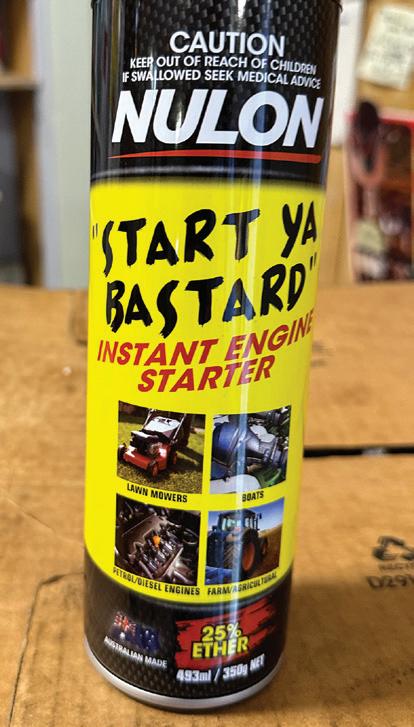
Sunday morning I set off for what was planned to be a beautiful run through the Great Western Woodlands, an enormous timber reserve, and the largest area of Mediterranean-climate forest on Earth. My reserve fuel light lit up, so I pulled into a gas station, and — my head full of the ride ahead, plus being unfamiliar with Australian fuel-pump codes (an exceptionally pathetic excuse, I realize) — I filled up with diesel. Repeat, diesel. The BMW is a magnificent machine, smooth and powerful, and tolerant of me, but as it coughed to a standstill 200 feet down the road, I knew asking it to run on truck fuel wasn’t going to work.
wound lost me almost two days. One day while I fumed at everything being closed — it was Sunday — the second a white-knuckle wait most of Monday while the local bike repair shop scrubbed the injectors and cleaned out the entire fuel system.
Thankfully, my Albany friends held my hand through this trauma, and I was soon on my way, lesson learned. Of course, the forest was still there, and even though I’d have wished it otherwise, worth the wait.
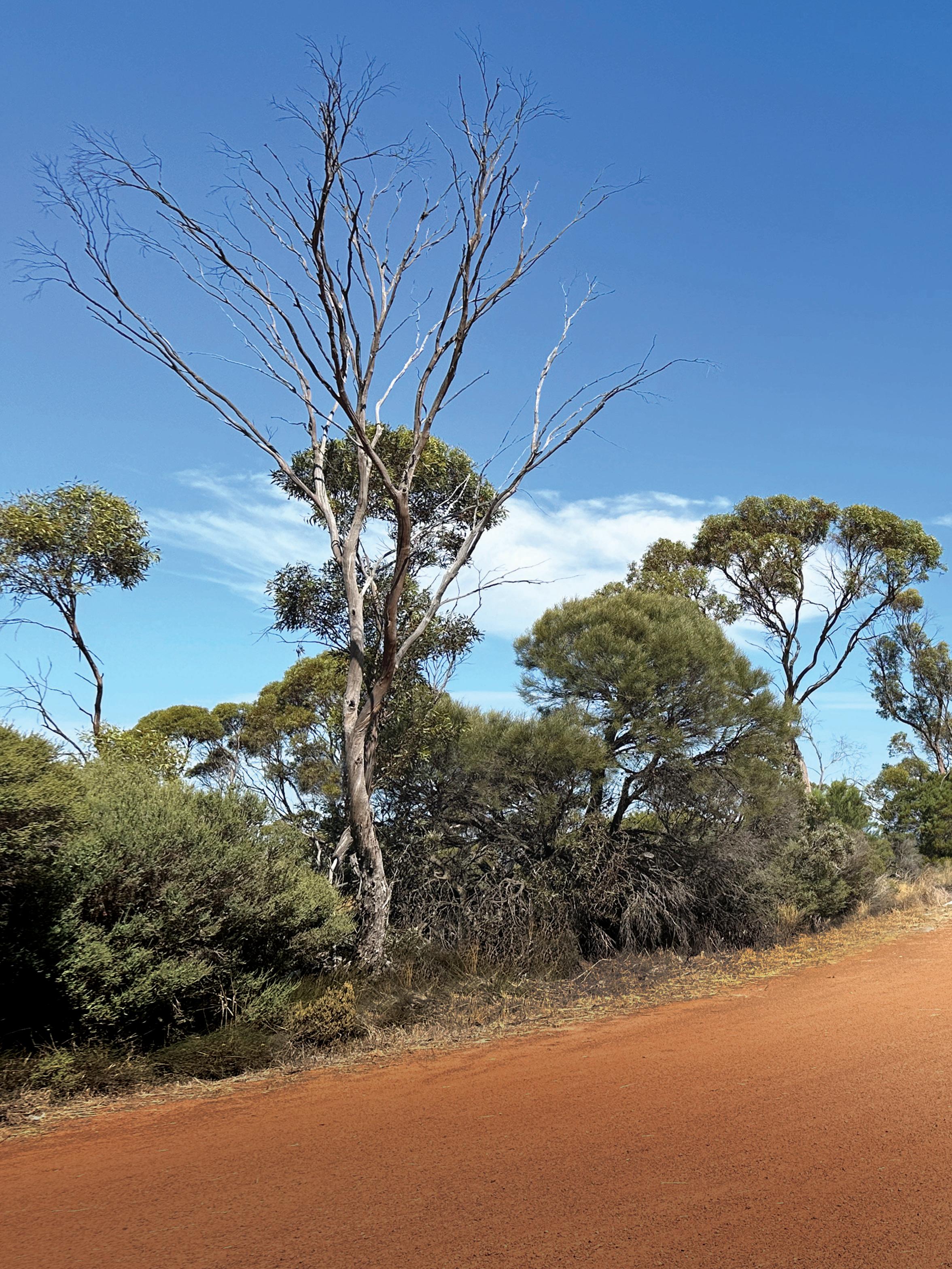
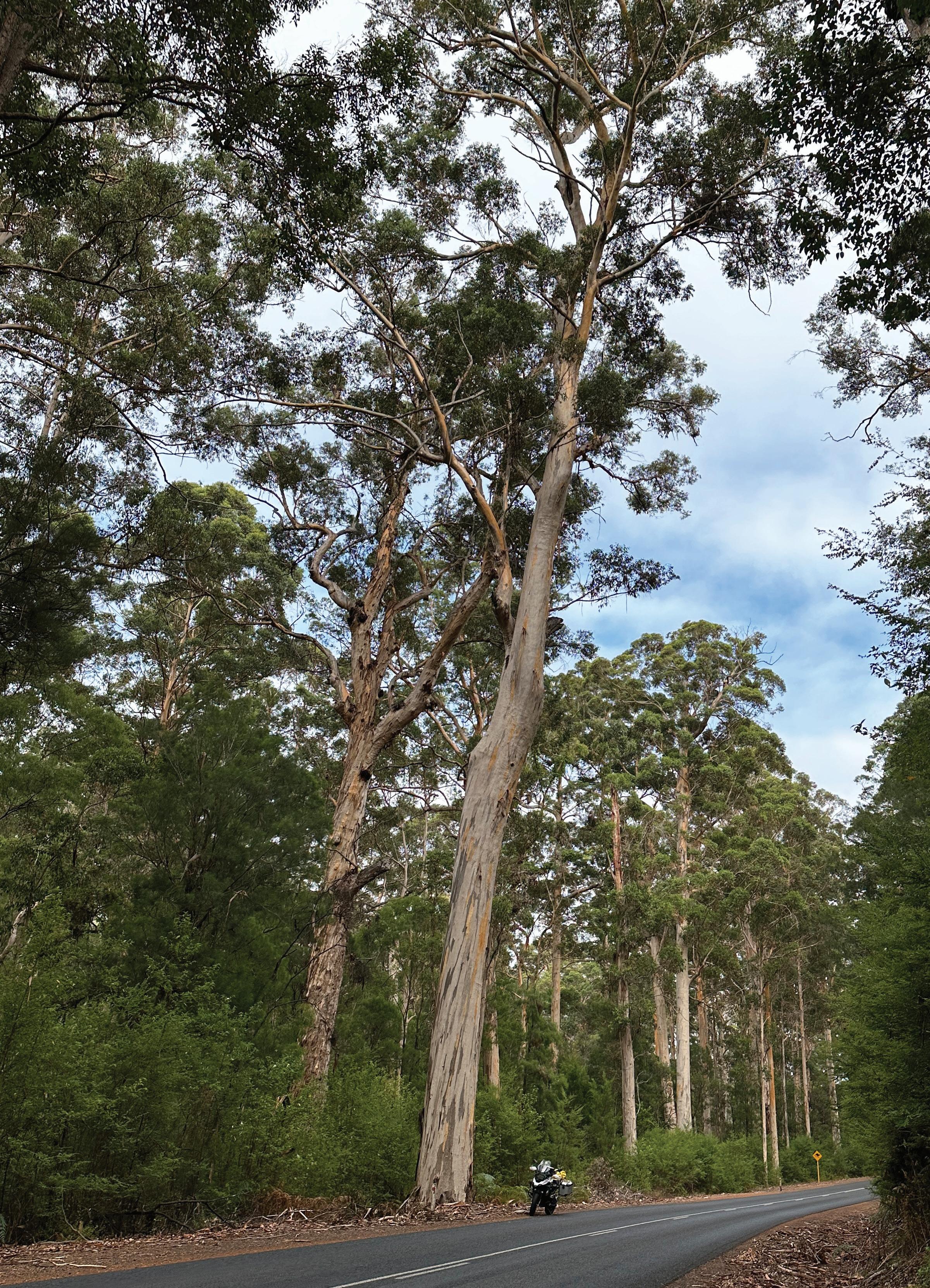
Thousands of ancient eucalyptuses, huge and magnificent, dwarfed the bike, and it was somewhere I’d have stayed longer if I hadn’t lost so much time.
KANGAS AND ROOS
It was pointless howling to the sky that in a lifetime of motoring I’d never been this stupid, and this self-inflicted
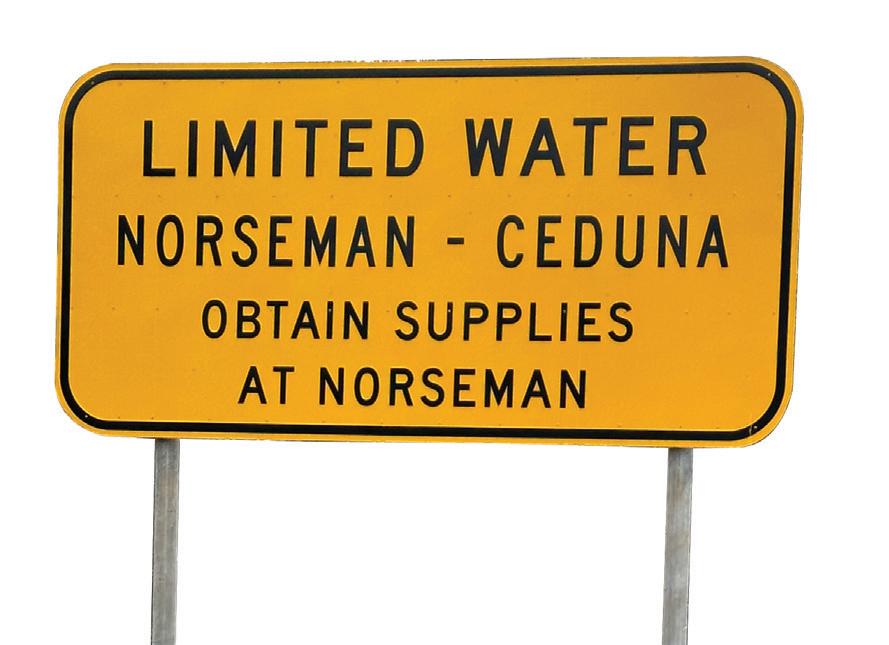
The free-and easy Australian way (top) with language was a constant joy. The sign pretty much tells you what this is. My face tells you it’s 100 degrees in the shade.
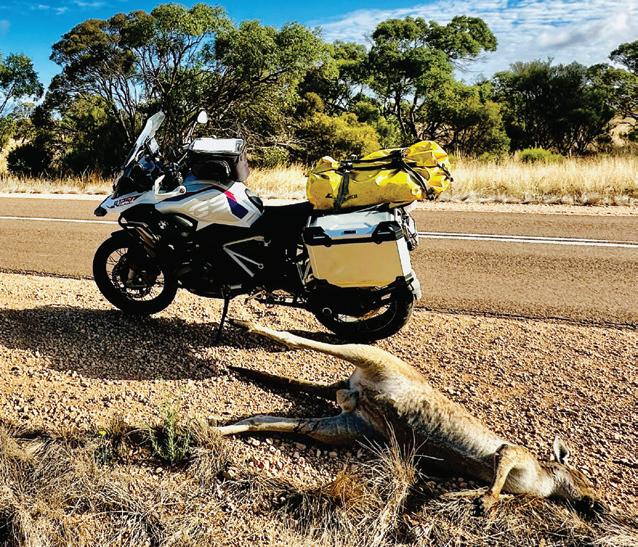
Now behind schedule, I wanted to catch up, and instantly ran into the kangaroo problem. There are an estimated 40-60 million “roos” in Australia, and while they might be comical looking, they result in around 10,000 vehicle collisions a year. I’d often seen one hopping across the road, always a long way off, but every day I’d see 10 times that number of dead ones on the gravel. Most collisions, I was told, are at dawn or dusk, roos not being active during the heat of the day. This effectively limits the time available for riding, a new problem, and definitely something for me to think about. Not only me: my two favorite nephews had a £50 bet I’d hit one. (I will find
out, Steve and Mike, whose idea that was!)
So I pushed on to Esperance, another lovely seaside town. The plan was to spend a day here, relaxing with my Aussie pal Ian, who’d ridden from his home on the East Coast to join me across the Nullarbor. I must highlight his extraordinary ride; Ian lives in Brisbane 2,340 miles from Esperance. To put this into an American perspective, this would be like riding from New York to Las Vegas, a distance Ian shrugged off as “nipping across.”
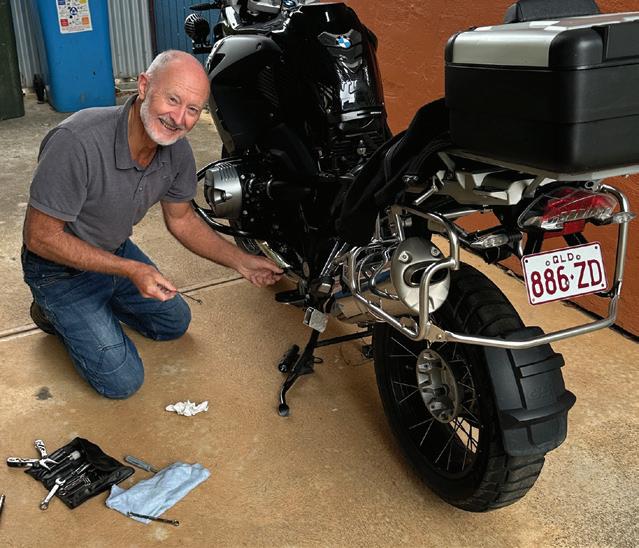
He also shrugged off my disaster with diesel. Much better here and now, he said, the Nullarbor is not the place for a stupid fuel problem. He’d be a good man to have along though, perfectly capable of rebuilding an entire
bike, rarely happier than kneeling on the floor surrounded by his tool kit, as here, making a minute adjustment to what was clearly a perfectly functioning rear suspension unit. (I obviously have no idea what I’m talking about.)
TIME FOR NULLARBOR
So after one last run along the coast — we’re inland for the next five days — we reluctantly leave the ocean behind for the run up to Norseman and the start of the Nullarbor.
Crossing the Nullarbor from Norseman to Ceduna is a 750-mile ride, and as the road is generally in good shape, this is usually three legs in fair weather. But it can be very hot and windy, even wet occasionally, and with no way of forecasting the conditions
The BMW is a magnificent machine, smooth and powerful, and tolerant of me, but as it coughed to a standstill 200 feet down the road, I knew asking it to run on truck fuel wasn’t going to work.
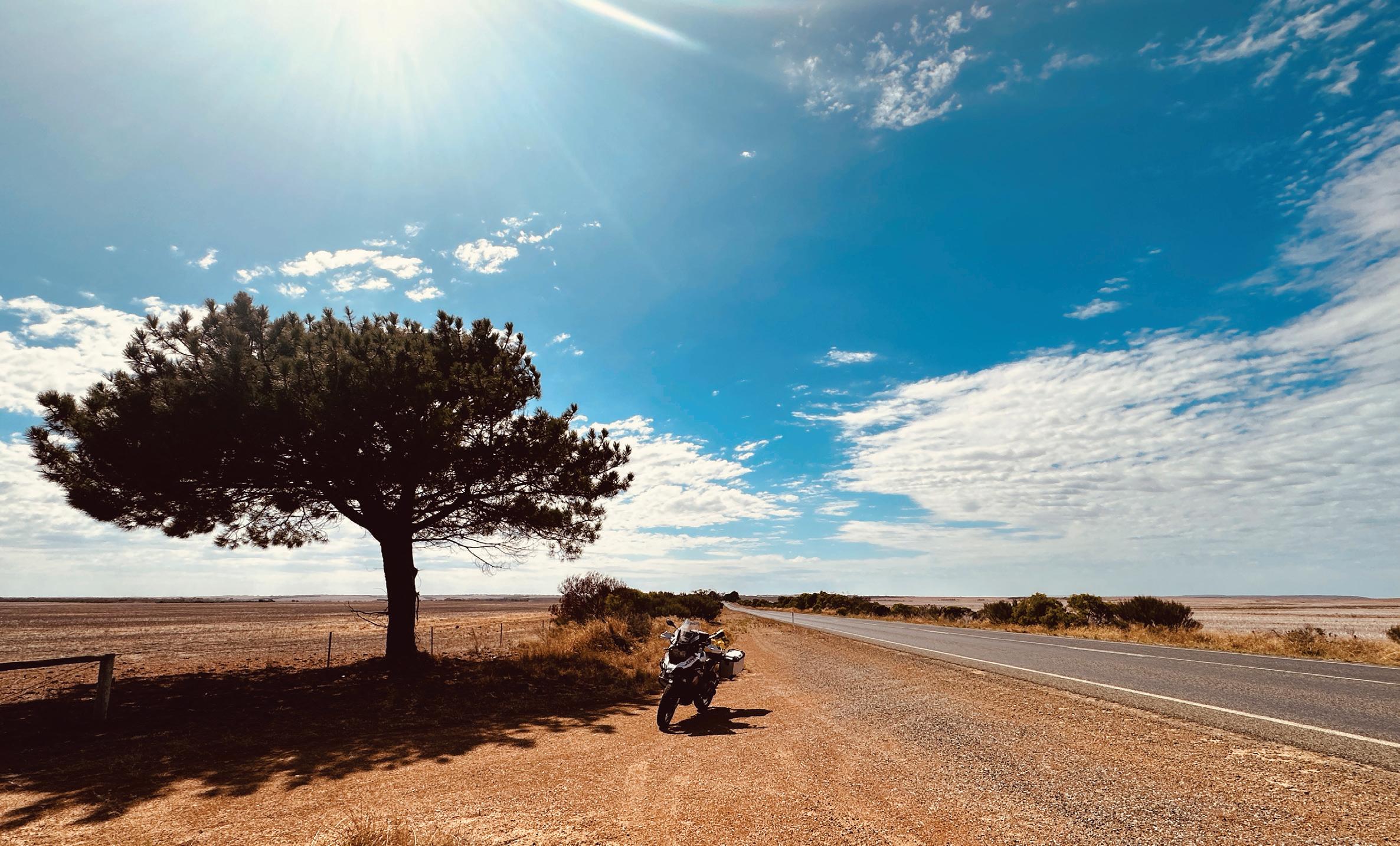
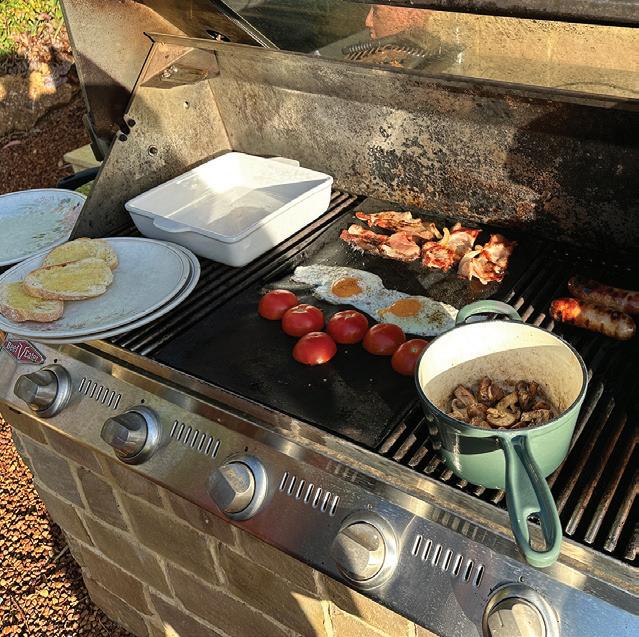
Clockwise from upper left: About to leave the coast at Esperance. My mate Ian… friend, mechanic, Aussie. You hope this ’roo wasn’t hit by a bike. The hydration challenge. Blue skies, empty road, big GS. The perfect Australian combo.
at long range, I plan for four stops along the way, with the last run skipping past Ceduna and down to the coast at Streaky Bay.
As well as heading through Streaky Bay, I’m aiming for Lucky Bay and Port Fairy, place names revealing their English-speaking origins. Further on there are the towns of Nowhere Else and Lost Hope, named perhaps with a stab at humor, surely the only explanation for Oona Woop Woop, sadly not on my route.
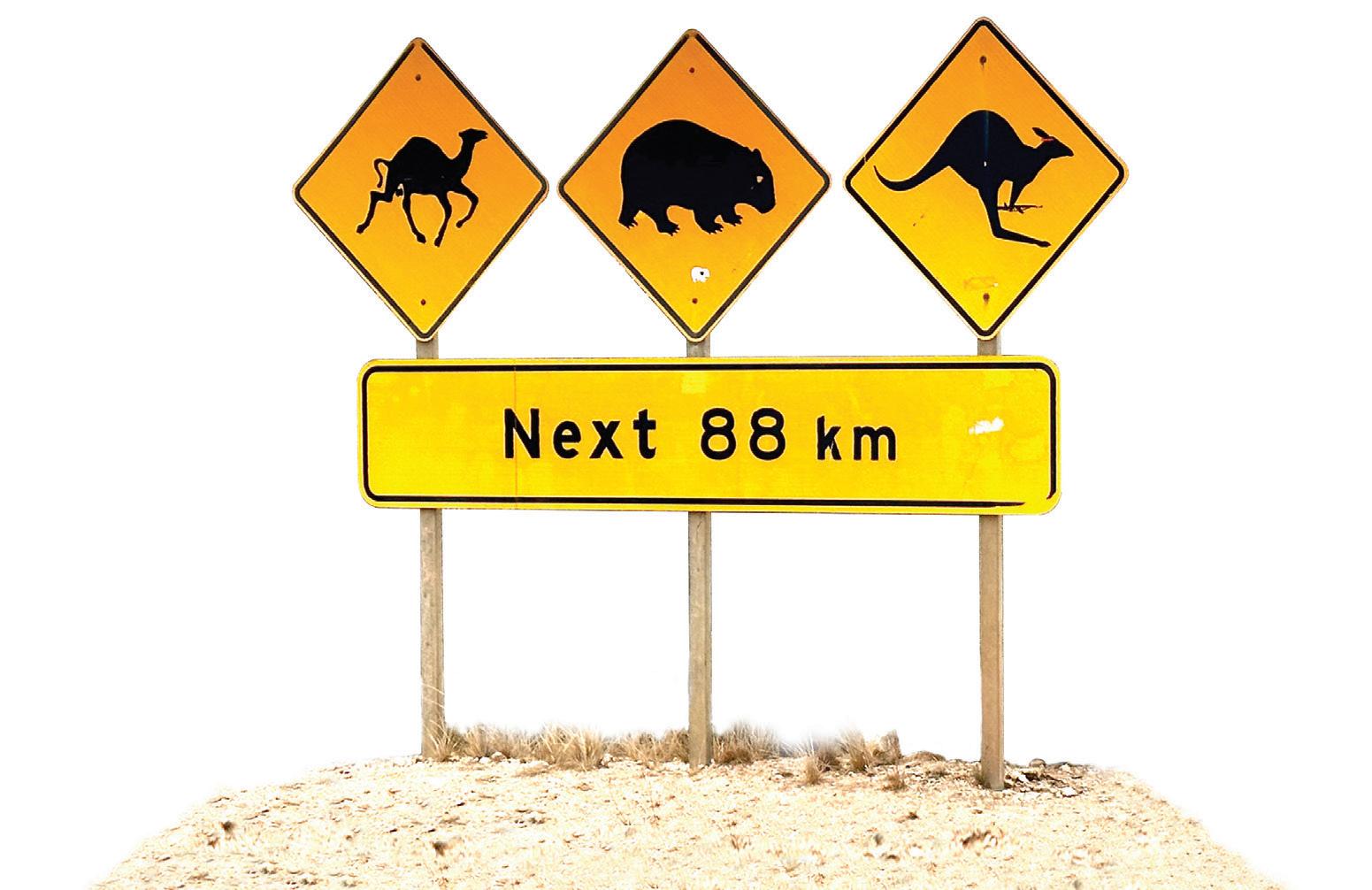
Now, on the Nullarbor, road signs suggest there’s more to watch out for than the ever-present kangaroo. We’re also warned about emus and — believe it or not — camels. The emu, large, powerful and flightless, is Oz’s answer to the ostrich, and camels — brought here in the 1800s as work animals — now run free in large numbers. All these animals share two things — an almost harmless looking appearance and the ability to bound across an unfenced road and watch you die in a ball of flame.
OF SLANG AND SKYLAB
Mentioning “Oz” again reminds me I’m enjoying picking up some local slang. I love the way Aussies shorten words... Australia is of course Oz; afternoon is “arvo;” a liquor store a “bottle-o;” and a service station a “servo.” Good morning? Never. It’s always “G’day,” usually “G’day mate,” Australians surely being among the friendliest people on the planet.
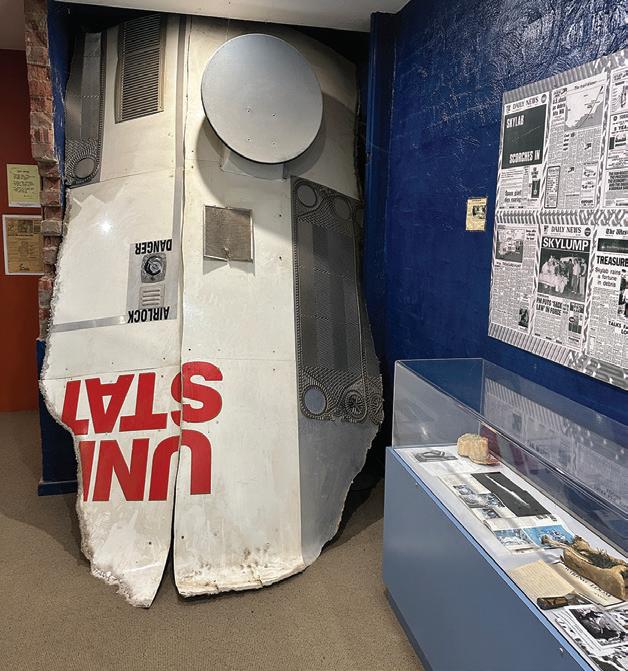
If I’m looking a bit hot here, the temperature is showing 38 C on the very comprehensive BMW display, a number that neatly translates into 100 F. Also on display is “Trip 1,” running since pick-up, and now showing a small milestone — exactly 1,000 kms from Perth. Fortunately it starts to cool off, and we have a welcome stop in Balladonia for a walk around the small museum there, largely devoted to the last few hours of SKYLAB, the American space station.
In all seriousness, such accidents are very rare, but a splendid feature of any visit to Oz is the relish with which Australians describe the many things that can cause the visitor to die horribly. Stories about crocodiles, sharks, snakes, spiders, and the summer heat will pepper many a hilarious conversation between native and tourist. Happily,
Its 84-day mission was brought to an abrupt end by a deteriorating orbit, and her crew was safely transferred before SKYLAB crashed to earth here in July 1979. Tons of debris flamed through the atmosphere, scattering over many square miles of this sparsely populated area. No one was hurt, but with typical Aussie humor, the Esperance Council issued NASA a $400
keeping your eyes peeled and carrying plenty of water is the answer to nearly all these hazards, with road signs a frequent reminder.
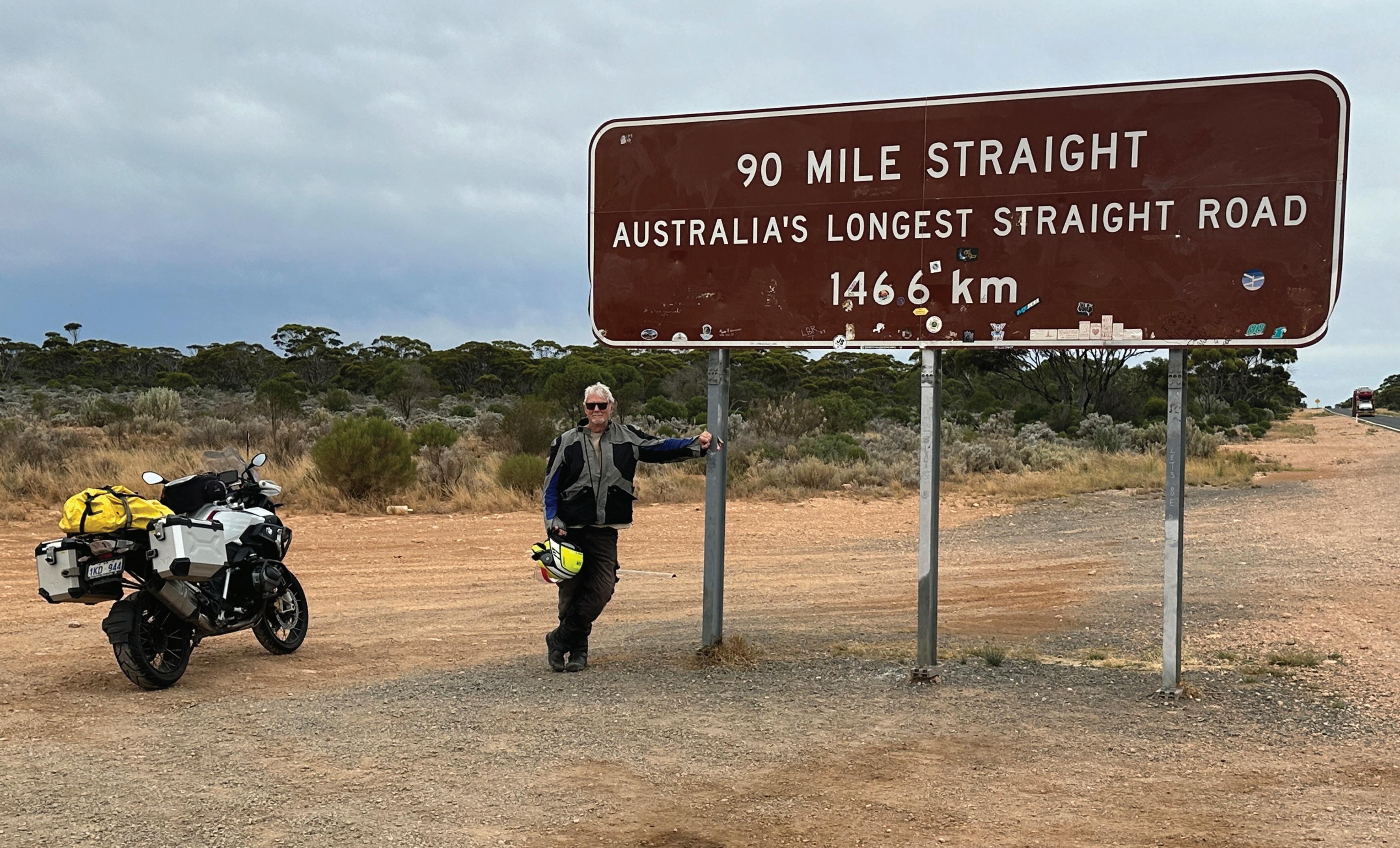
Not to belabor the point, unfenced roads take dawn starts off the table, so waiting for an hour after sunrise means we’re setting out from Norseman due east into the rising sun. This was the uncomfortable start to our 240-mile ride to Caiguna, eased by a gentle side wind, but without a single bend as the road enters the famous “90 Mile Straight,” the longest straight road in Oz and an unmissable photo op.
citation for littering, and with maybe typical astronaut humor, the fine was never paid.
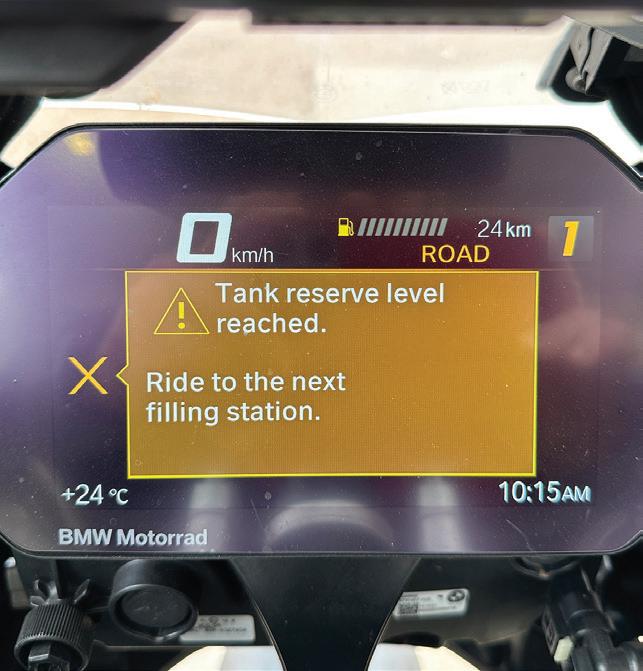
Toward the end of this ride my display flashed a fuel warning. I flagged Ian down, but he barely nodded — he is very Australian — and gave me a “No worries, mate” reply. True, the computer showed 70 kms to go, but when it lit up with 24 kms to go, I flagged Ian down again. I was a bit concerned but he only went to Aussie threat level two: “Aw. She’ll be right.” Sure enough we fueled up at Caiguna with no drama, so apparently there is no Aussie threat level three.
ROAD TRAINS
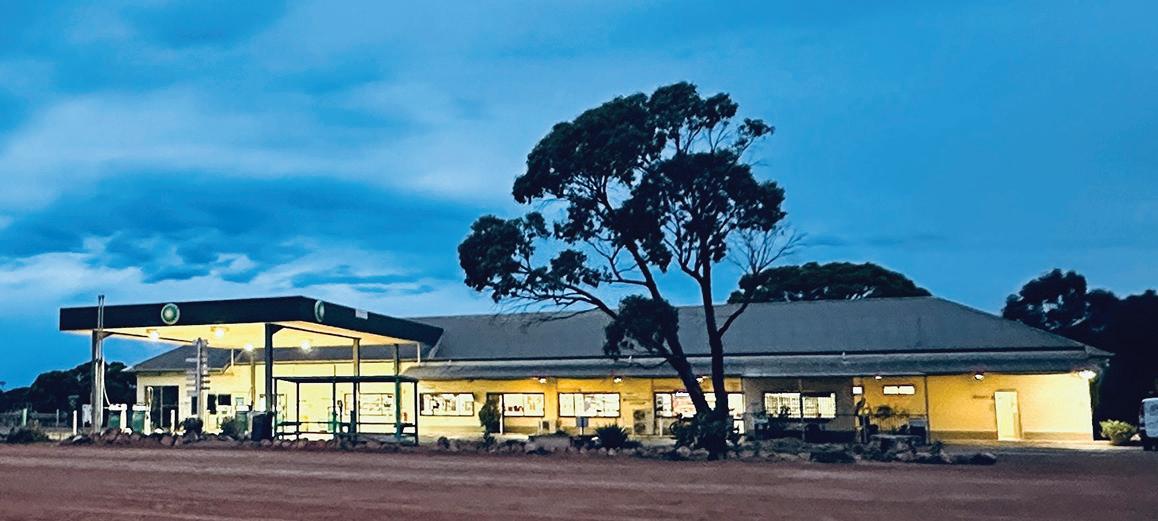
Next day we set off after breakfast into a ferocious headwind, and even though the ride to Mundrabilla was a short-ish 170 miles, we were more pleased than usual to reach our accommodation, the roadhouses being just what was needed. All these motel-style rooms are small but impeccably clean, and well equipped with fridge, A/C, TV, shower and toilet. There was usually a decent selection of grub on offer, too, so no problem stocking up on calories for the next day.
Although these stops were distinctly utilitarian, the quiet of the desert, the giant trailer trucks, and the remote locations lent the roadhouses a distinct hint of romance. I think at one point I heard the haunting words of Rickie Lee Jones’ Last Chance Texaco…
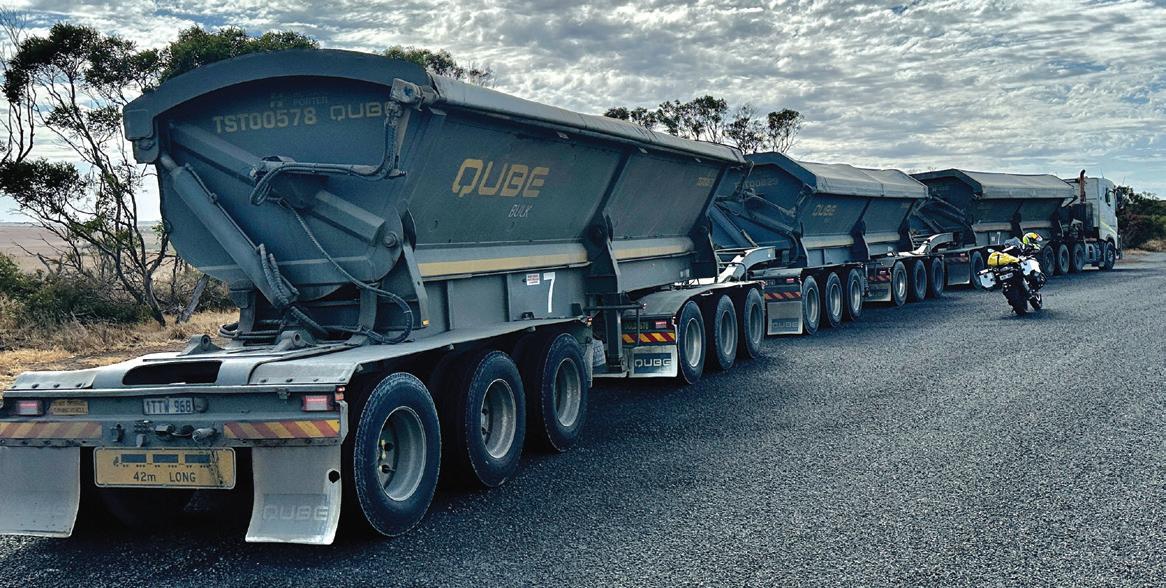
These giant truck and trailer combos — road trains — are a common sight on the main roads. Oz has a rail system, of course, but the populations are remote and sparse, so most long-distance goods transport tends to be by road haulage — enter the road train. These are monstrous and powerful tractor cabs pulling two, three or four trailers, anything up to 180 feet long.
Out-of-town speed limit is generally 75 mph, and I’d been told road trains are difficult to deal with because of their “bow wave.” There is one, of course, but in my limited experience this seems no worse than one from any large, fast-moving truck. Side winds add another complication, but in all circumstances the drivers are totally professional — they’ll usually pull over a foot or so when approaching, and will clearly signal when it’s safe to overtake.
STREAKY SCREW-UP
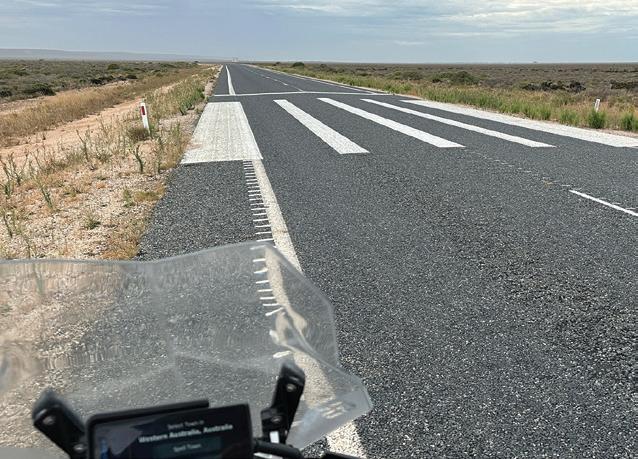
Leaving the Nullarbor Roadhouse, Day 4 was a 250mile run to the coast at Streaky Bay. We are leaving the long straight stretches behind, but we ride over one last Flying Doctor emergency runway. I counted four since Norseman, all part of the Aussie solution to the problem of getting medical help to the far corners of this huge country. The white stripes — pilots call them the piano keys — mark the beginning and end of the “runway.”
The road turns towards the ocean here, and quickly drops — the aboriginal peoples call this a “jump down” — giving us some welcome corners and change of altitude. Nearer the ocean the temperature falls a little, though the sky remains a gorgeous deep blue, reminding us again how astonishingly lucky
the quiet of the desert, the giant trailer trucks, and the remote locations lent the roadhouses a distinct hint of romance. I think at one point I heard the haunting words of Rickie Lee Jones’ Last Chance Texaco...
we’ve been with the weather.
After the “jump down” we find a rough track to get a proper look at the ocean. We take off jackets and helmets to walk to the edge where the land falls away in an enormous 120-mile-long stretch of almost vertical, multi-colored rock — the 360-foothigh Bunda Cliffs.
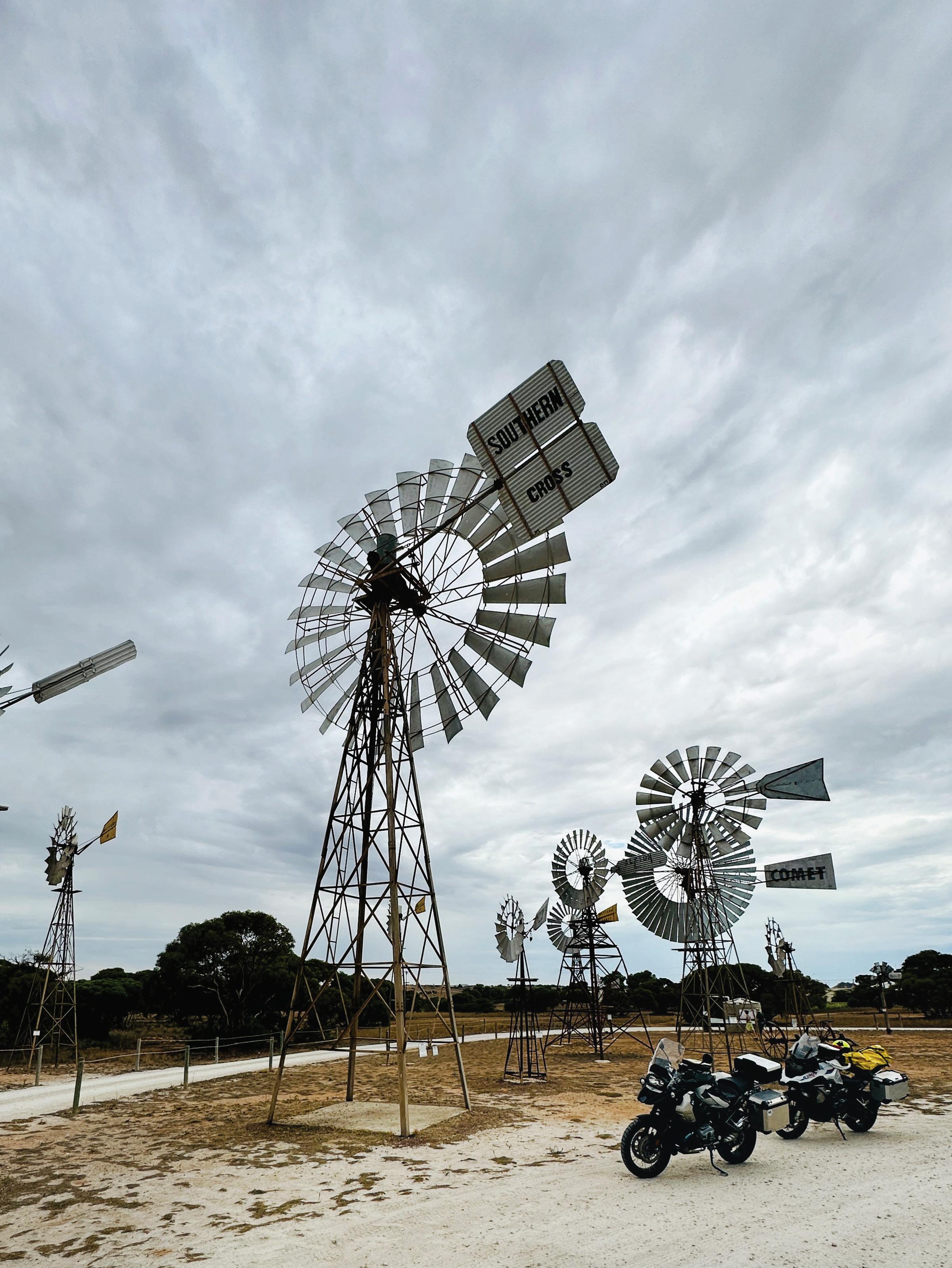
Fueling up at Penong, we stop at the slightly surreal Windmill Museum, feeling like extras in a sci-fi movie, and take a small detour to see the granite rock formations known locally as Murphy’s Haystacks, hundreds of millions of years old.
From Streaky Bay we run across the Eyre Peninsula towards Cowell, all going well until I turn into the sun and realize I’ve forgotten my smear of sunblock. No probs, I stop, heel the side-stand, open a pannier, dig out the factor 50, and I’m away in 90 seconds. A perfect example of a fast pit stop, except that
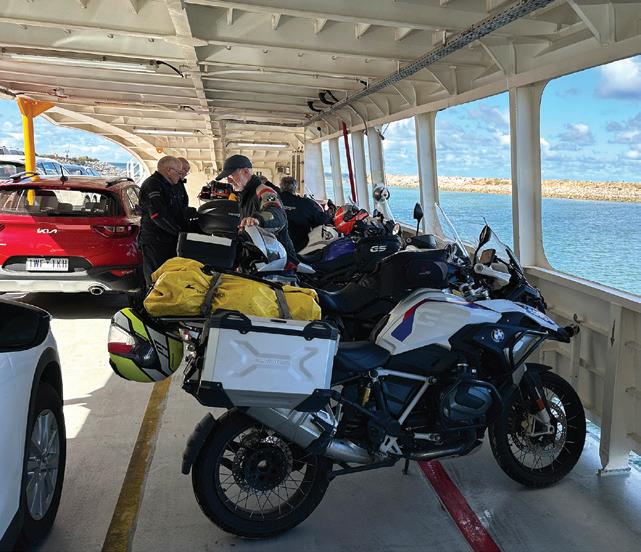
Left page, top to bottom: The “piano keys” marking the start of an emergency airstrip. A typically monstrous Road Train. Spot the bike? The melancholy and romantic Nullarbor roadhouse at Mundrabilla. The food was fantastic, too. l love ferries! This one is across the calm waters of the Spencer Gulf. This page: The slightly eerie wind pump museum at Penong.
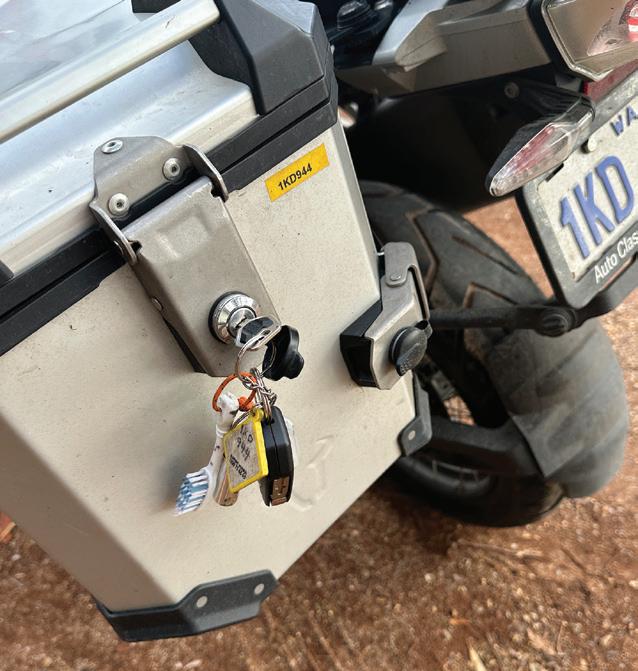
the Beemer has keyless ignition (I can’t think of a single good reason for this) and the engine starts quite happily — with the keys dangling in the pannier lock. With enormous good fortune, they stayed there for the 200 mile run to Cowell, but over the next few hours I think how bad that could’ve been. I was properly warned about losing the keys, was not given a spare, and I tell myself over and over, I don’t deserve such luck.
LUCKY ME
From Lucky Bay (aptly named under the circumstances), only a few kms from Cowell, the Spencer Gulf ferry sails daily to Wallaroo, a sea trip of three hours or so. It saves a couple of hundred kms over the road journey up to Port Augusta and down the other side, but I’d have taken the boat anyway, time saving or not. I absolutely love ferries. I think it stems from living in the south of England where
Thousands of ancient eucalyptuses, huge and magnificent, dwarfed the bike, and it was somewhere I’d have stayed longer if I hadn’t lost so much time.
ferries across to France, Spain, Belgium and Holland dot the coast, all offering — more romance — the magic of a boat ride to another world.
Well, Wallaroo isn’t another world, but a few miles later, the evening rush-hour traffic of Adelaide definitely is. It’s a small city, population just over a million, but after the peace and quiet of the West, and the near emptiness of the Nullarbor, the push and press of the evening commute quickly had me thinking, “You can keep this.”
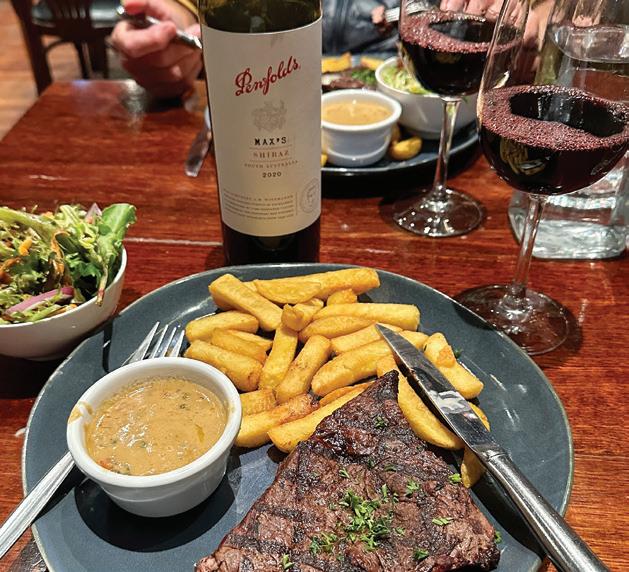
Ian and I were due to split the following morning, so we made the most of it, celebrating our ride together with a blow-out steak and a great bottle of Aussie Shiraz. I knew I’d held Ian back over the last week, as he was comfortable riding 500 miles a day, me only half that, but we’re old friends, he’s fantastic company, and we’d had a blast.
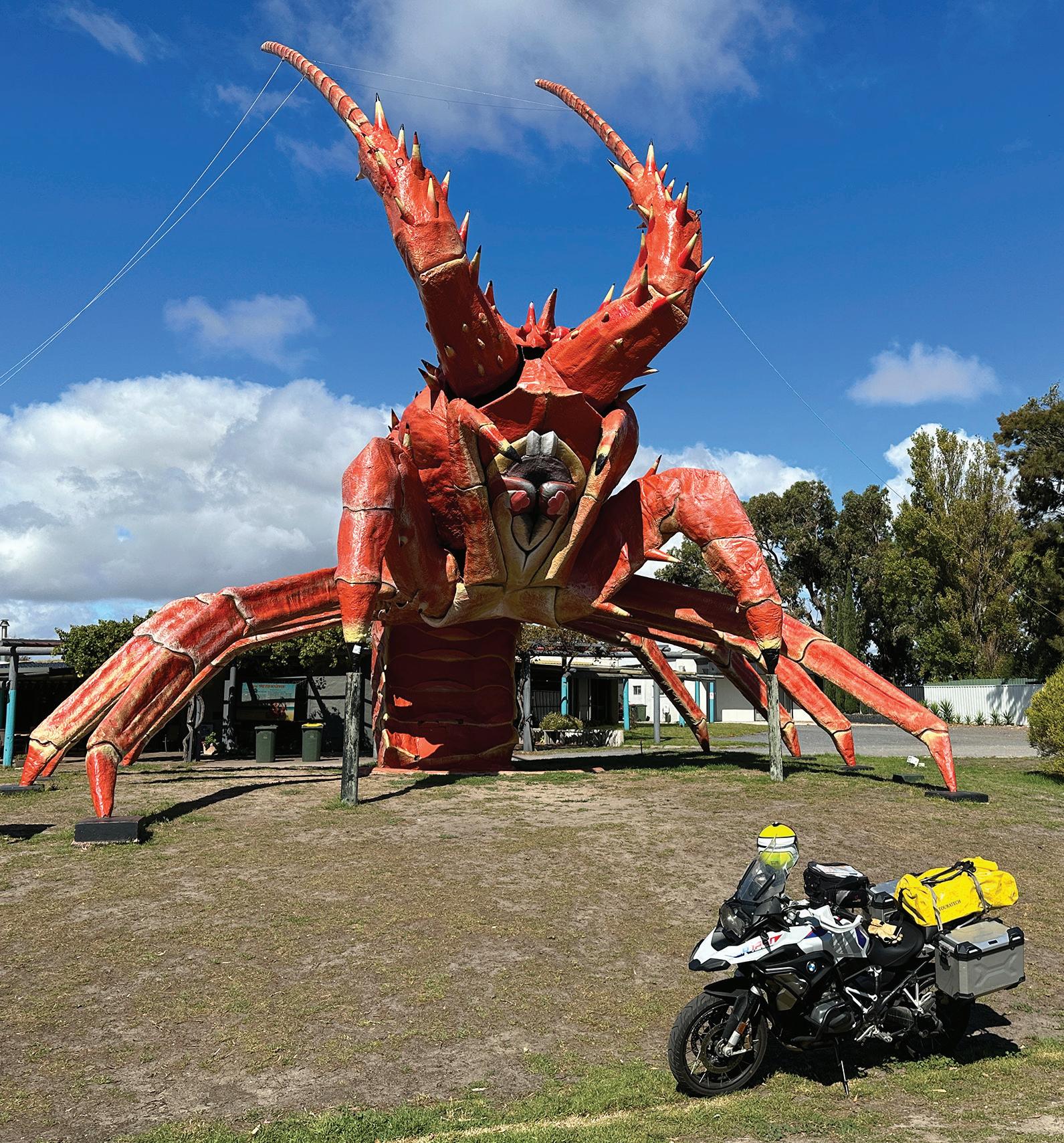
Now riding solo, I had an easy 195 miles along the coast to Robe, pausing — it was impossible not to — at a 52-foot, four-ton fiberglass lobster. Robe was delightful, deservedly famous for its seafood (hence, I guess, the lobster), as I discovered with a plate of oysters with chili and lime in the local pub. Outstanding.
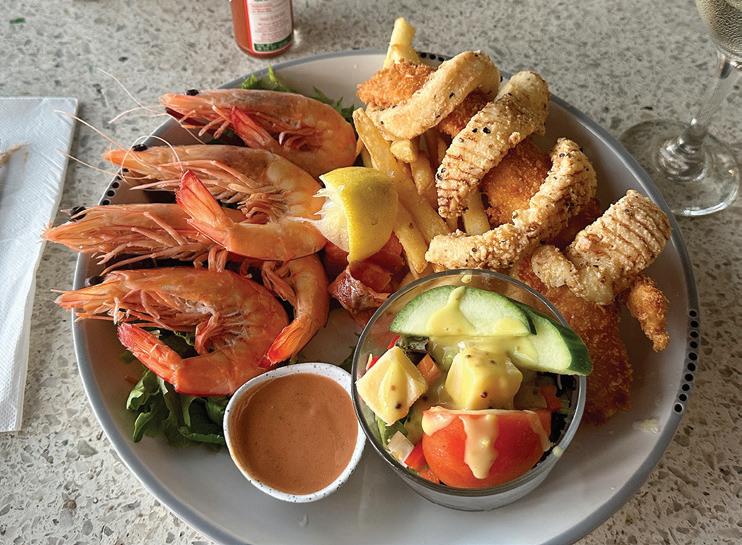
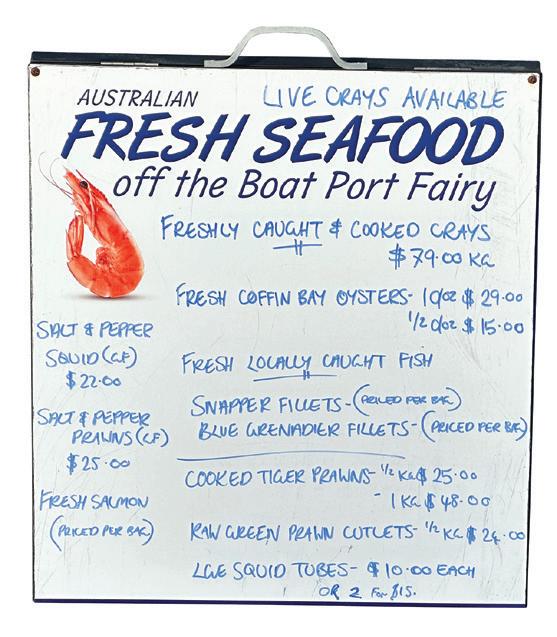
Continuing down the coast, I hooked up with nephew Jeremy, and stopped for the night in the delightfully named Port Fairy, a fishing port every bit as pleasant as its name suggests. Seafood was being sold directly off the boats — always a good sign — and the harbor-side was positively awash with nice places to eat and drink.
Now a superb 150-mile run along the spectacular Great Ocean Road, an enormous engineering project started after World War I, partly to honor the fallen, and partly to give employment to thousands of returning servicemen. Australia suffered over 200,000 casualties in the “Great War,” a huge proportion of their small population, and it’s fitting that this magnificent road claims to be the world’s largest official military memorial.
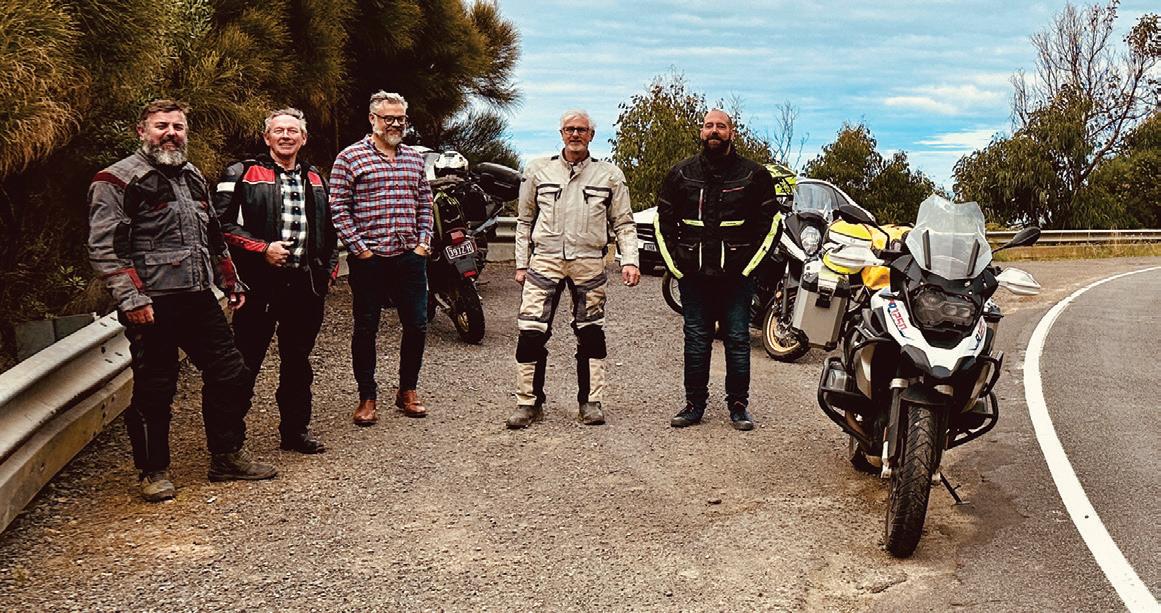
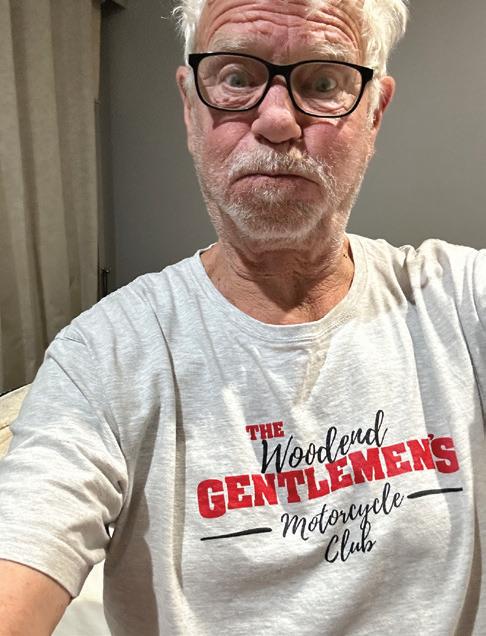
Jeremy knows the Great Ocean Road really well, but instead of just guiding me to the best spots, he also organized a ride with his mates from the Woodend Gentlemen’s Motorcycle Club. We all enjoy an exhilarating few hours letting it rip along the twists and turns of this fabulous road, the 90-mile straight a distant memory, and I’m delighted when these friendly Australians present me with one of their splendid T-shirts.
Top to bottom: Bikers going the other way. The Woodend Gentlemen’s Motorcycle Club. The matching T-shirt. The quaint “prawns on the barbie.” l lost count of the sensational sunsets.
MELBOURNE & MATCHLESS
Here I leave the coast, and with my nephew in the lead, skip through the leafy suburbs of Melbourne (Oz’s second largest city) to spend the night at his place. Next morning is the coolest yet, a chilly 40 F, and for the first time I’m glad of my heated seat and grips, riding through the 3,000-foot-high Macedon Park — Sydney and the end of the ride now only a couple of days away.
Happily, two of those days are spent again with generous friends Pete and Jill in their lovely home at Springhurst. I arrive feeling almost-at-the-end-of-trip tired, ready to enjoy 48 hours of their hospitality and beautiful surroundings.
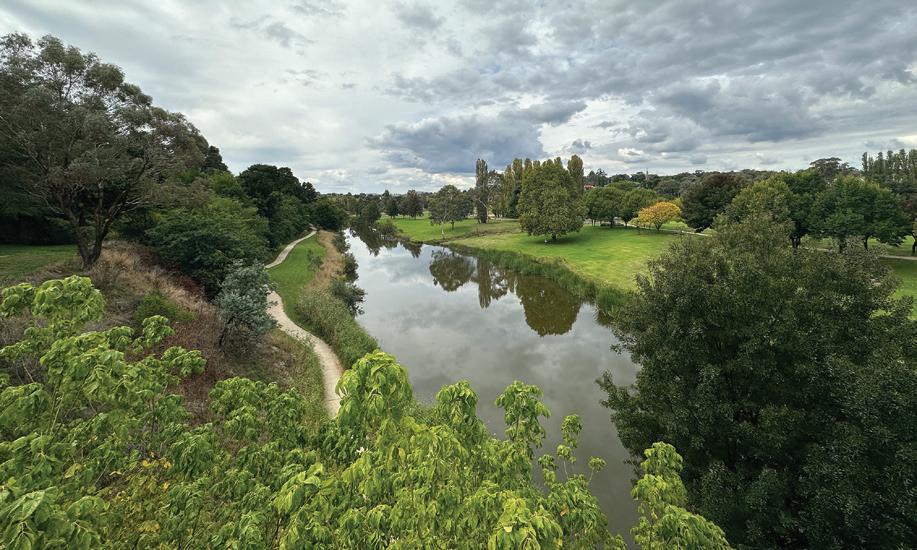
And I ride away well fed, well rested, and energized for the last 400 miles. This will be a ride of two halves, some heavy rain is forecast, perhaps my luck with the weather has finally run out. Halfway to Sydney — the storm not yet arrived — I reach the little town of Yass, in an altogether softer and gentler part of Australia. I take a photo from the bridge going in and another in an old garage just off
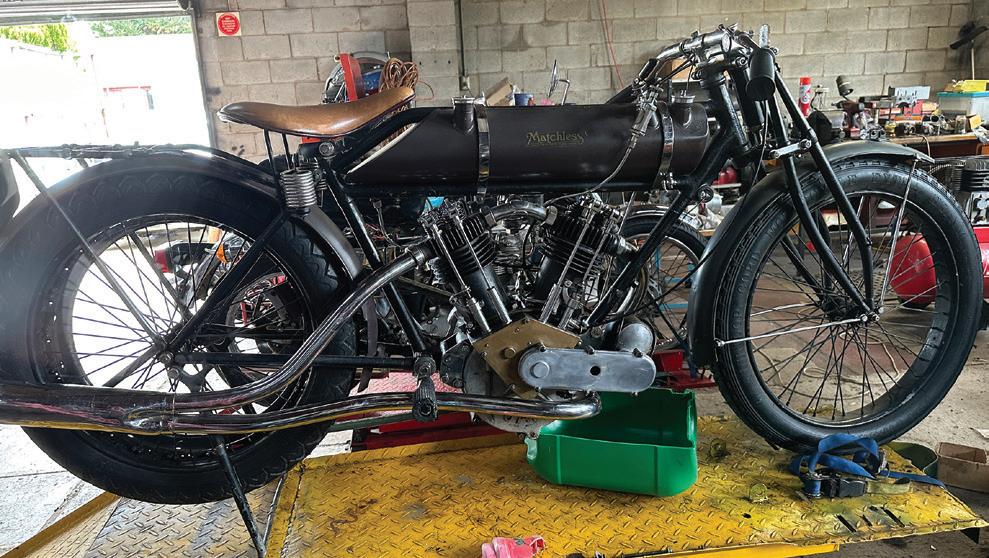
the main street. It’s a 1910 V-twin belt-drive Matchless with a JAP engine of around 700cc, no clutch, no gearbox, no front brake and an appalling apology for a rear brake. It’s being restored by Paul, the workshop owner, who told me how to start it. “Depress the valve lifter (removing the compression), push the bike as fast as you can, leap on, drop the valves, and hope she fires up.” He also wished anyone who manages to start the thing good luck when it came to stopping it. I liked everything about this machine from another age, even the green container to catch the oil. Very British! By the way, JAP comes from the engine builder, John Alfred Prestwich. His company, founded in 1895, made magnificent engines, way ahead of their time, later used to power the superb Brough Superior SS100 of Lawrence of Arabia fame.
ONTO SYDNEY
Next morning I wake up for my ride into Sydney, with the loud noise of heavy rain hammering on the roof. The
Aussie internet forecast doesn’t mince words — 100 percent rain and strong winds — so it seems my weather luck has finally run out. I grab a coffee, get into my heaviest heavyduty gear (so far unused) and while loading up the bike I hear the whoop of emergency vehicles. My B&B is in the town center, and in the pouring rain I watch a fire truck, an ambulance and three patrol cars roar up the main street.
looking like a 100-year-old drowned rat. I’m pretty sure I blend right in.
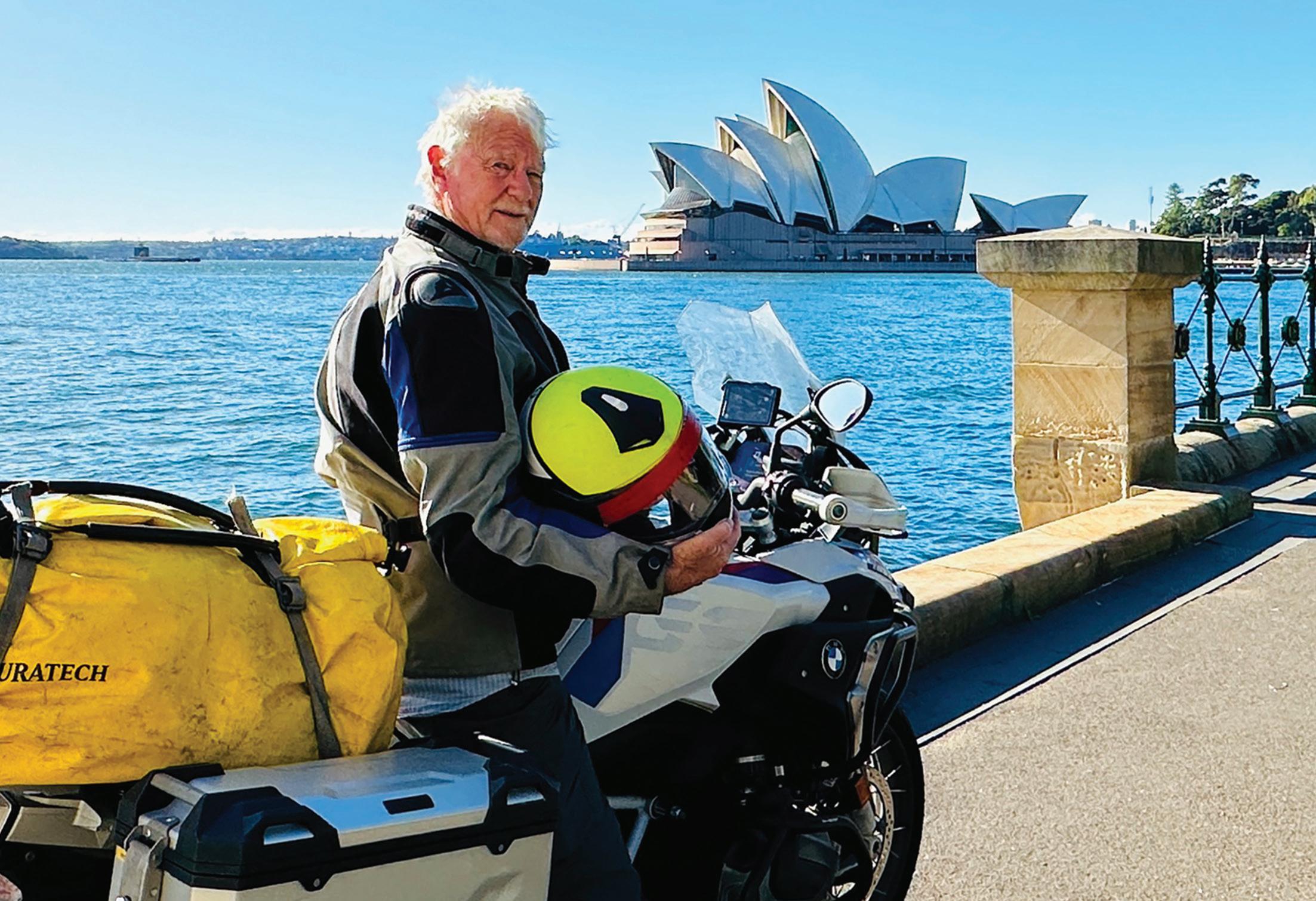
I have one huge Sydney bonus to come — my Kiwi biker pal has flown from New Zealand to meet and greet! He knows Sydney well and we swap stories as I pose for the end-of-ride photos. I’m knocked out he makes this effort to hook up. What is it with these Southern Hemisphere friends? Do distances mean nothing?
The accident isn’t on the freeway, and despite the drenching and frequent coffee stops, I reach Sydney around the end of the day. I’m booked into the Youth Hostel, right by the harbor, filled to the rafters with the young and beautiful — mostly backpackers. I walk in wearing my rain soaked daggy old Kevlar jeans and ancient waterproof over-jacket,
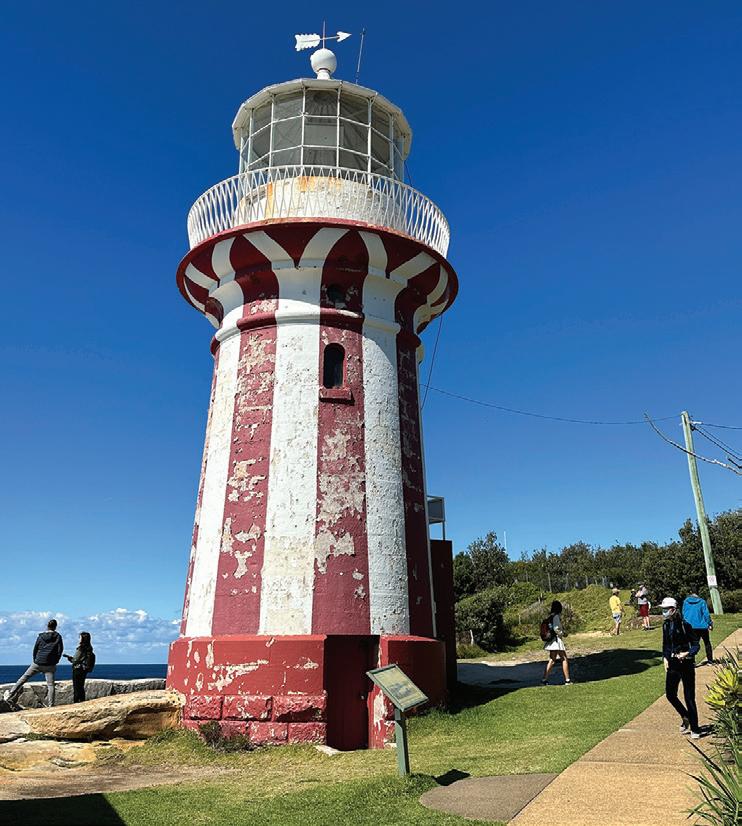
Left page, top to bottom: The River Yass. Impossible to ride past this without stopping. Aussie Pub grub. One of the many old Britishbuilt lighthouses at the entrance to Sydney harbor. This page: A fabulous old Matchless. A good sign in so many ways. The end of the road, doffing my helmet to the magnificent Sydney Opera House. Finally, major thanks to BikeRoundOz rentals and tours! Amazingly helpful folks.
We enjoy a delicious meal, and man hug. He flies back, and all that’s left for me is to unload the bike, drop her off at the Sydney office, and start trawling though the memories.
I happily look back on almost 4,000 miles of superb roads and polite road trains, gorgeous weather and magnificent landscapes, riding with old friends and making new ones, handsome nephews and beautiful cities, kangaroos and camels.
Also, dangling keys, missing visas, dangerous ’roos and possibly the worst-timed fuel problem of my entire life. Oh yes, and a 52-foot, four-ton lobster.
Cheerio, Australia. I’ll come back one sunny arvo. Thanks! AMA
BORE NO SMALL
BY JOHN BURNS PHOTOS BY THE AUTHOR AND 129PHOTOS.COM
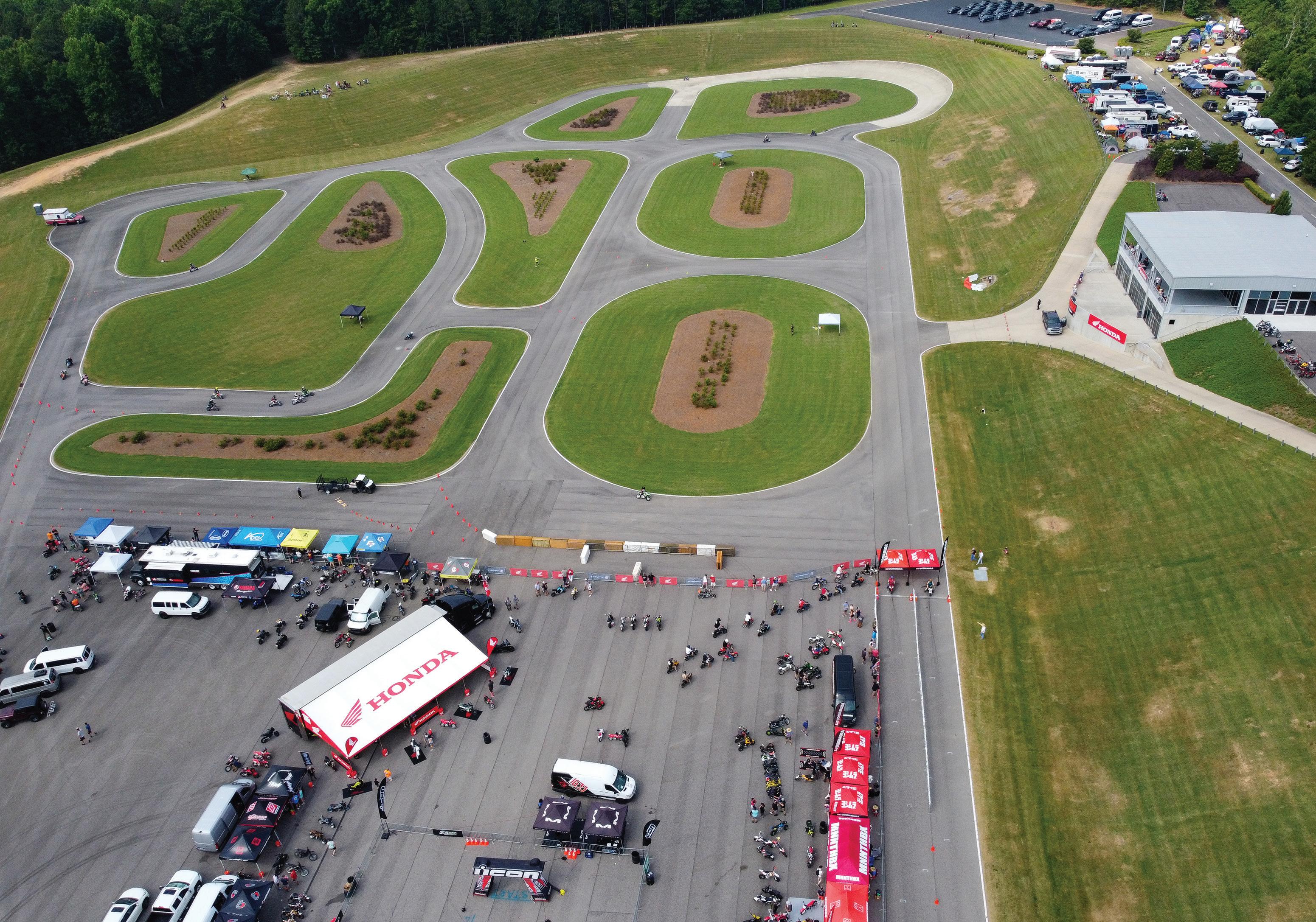
AMA Motorcycle Hall of Famer George Barber did well. When I met the man himself as he was cruising his grounds behind the wheel of a nondescript minivan, I shared how Barber Dairy had left milk — and sometimes ice cream! — on my doorstep as a child growing up in Birmingham, Ala., in the early ’60s. “It was probably me that delivered it,” he smiled. I hadn’t considered the personal connection, but I guess it’s entirely possible since Mr. B is only about 20 years older than I and started working at 9 years old. I guess it only seems impossible, given my current distance from 1960s Birmingham. It’s good to be back for the weekend.
George’s dad’s dairy cows gave way to commercial real estate along with what appeared to be some very savvy investing; today George Barber owns the biggest, grandest motorcycle museum in the world (230,000 packed square feet) along with the 2.38-mile
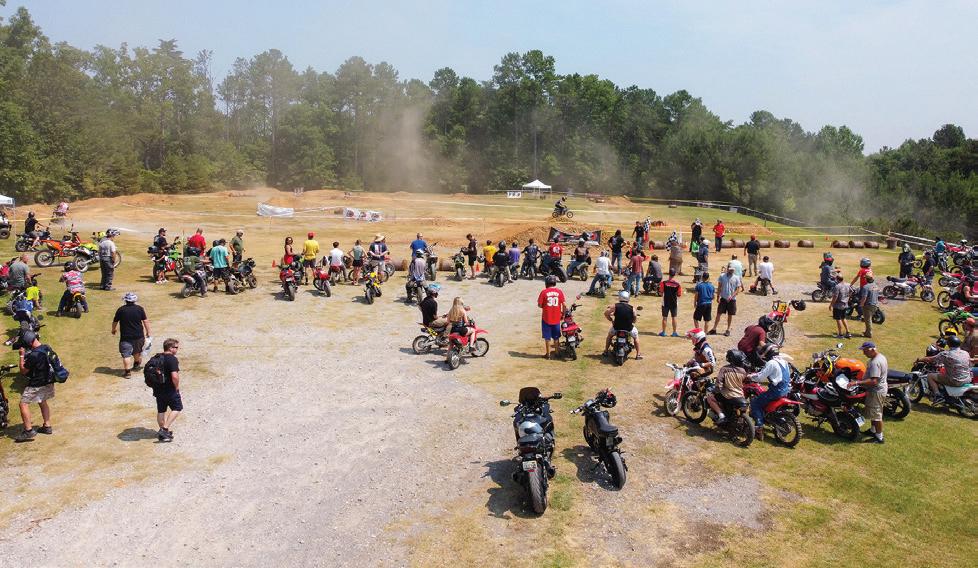
2,300 mini motorcycles at Barber Motorsports Park’s Small Bore event add up to big fun for the whole family
“You’ve got to do more than art. We’re always trying to think of new exhibits to draw in new demographics to the museum. Small Bore was a natural fit.”
NICK LACASSE
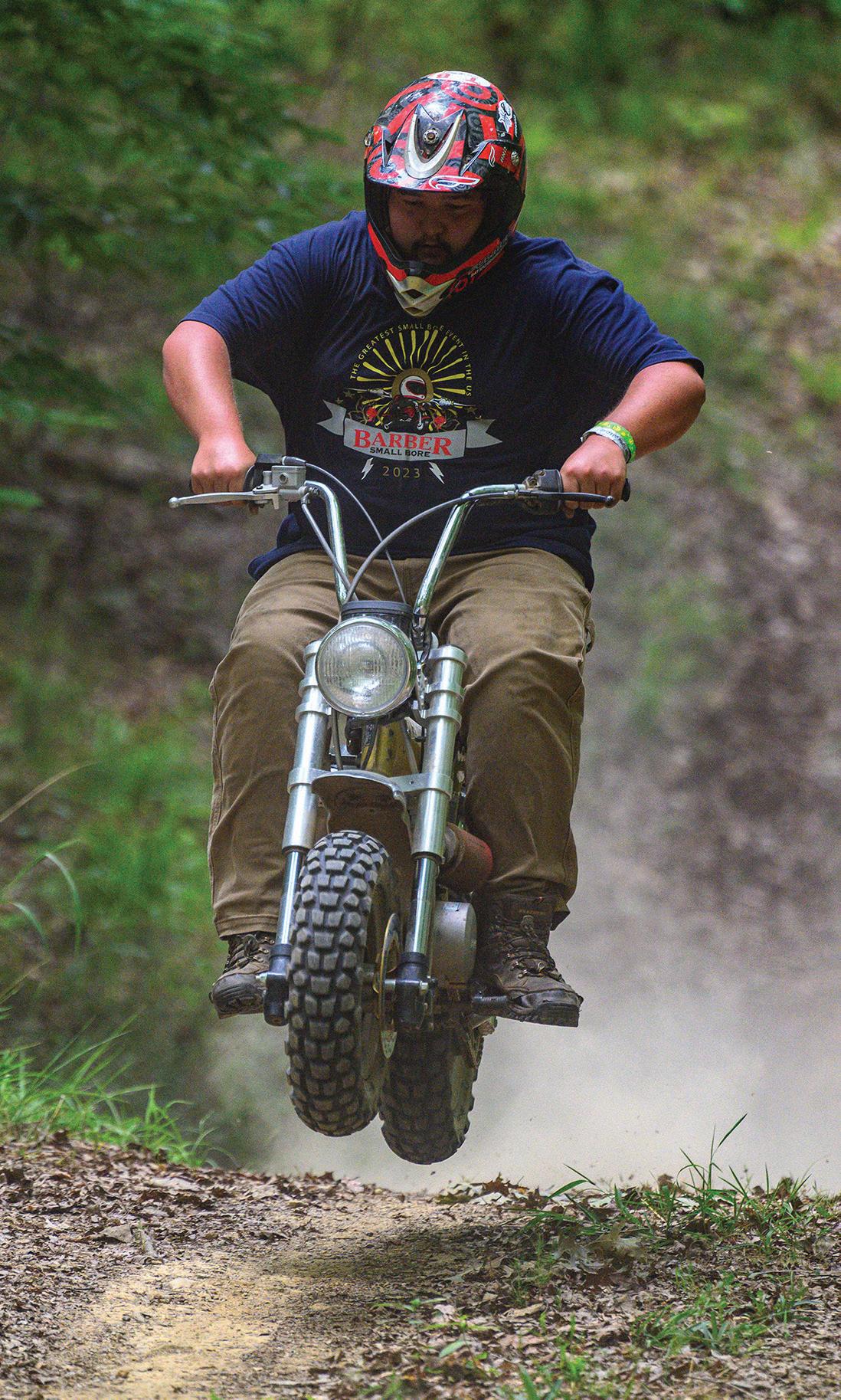
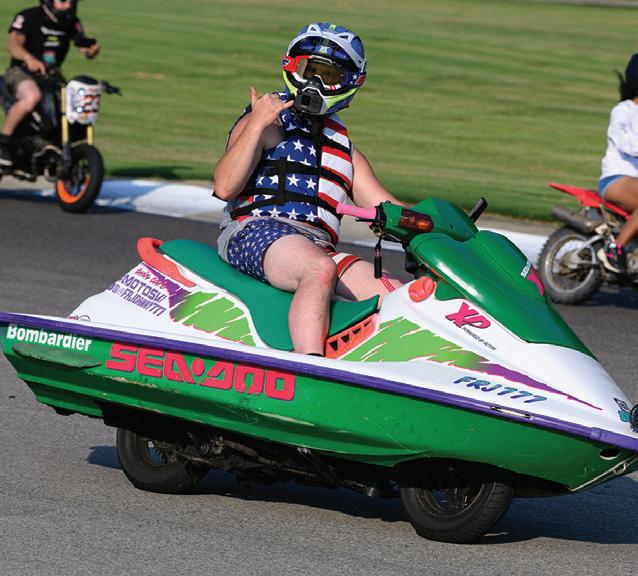
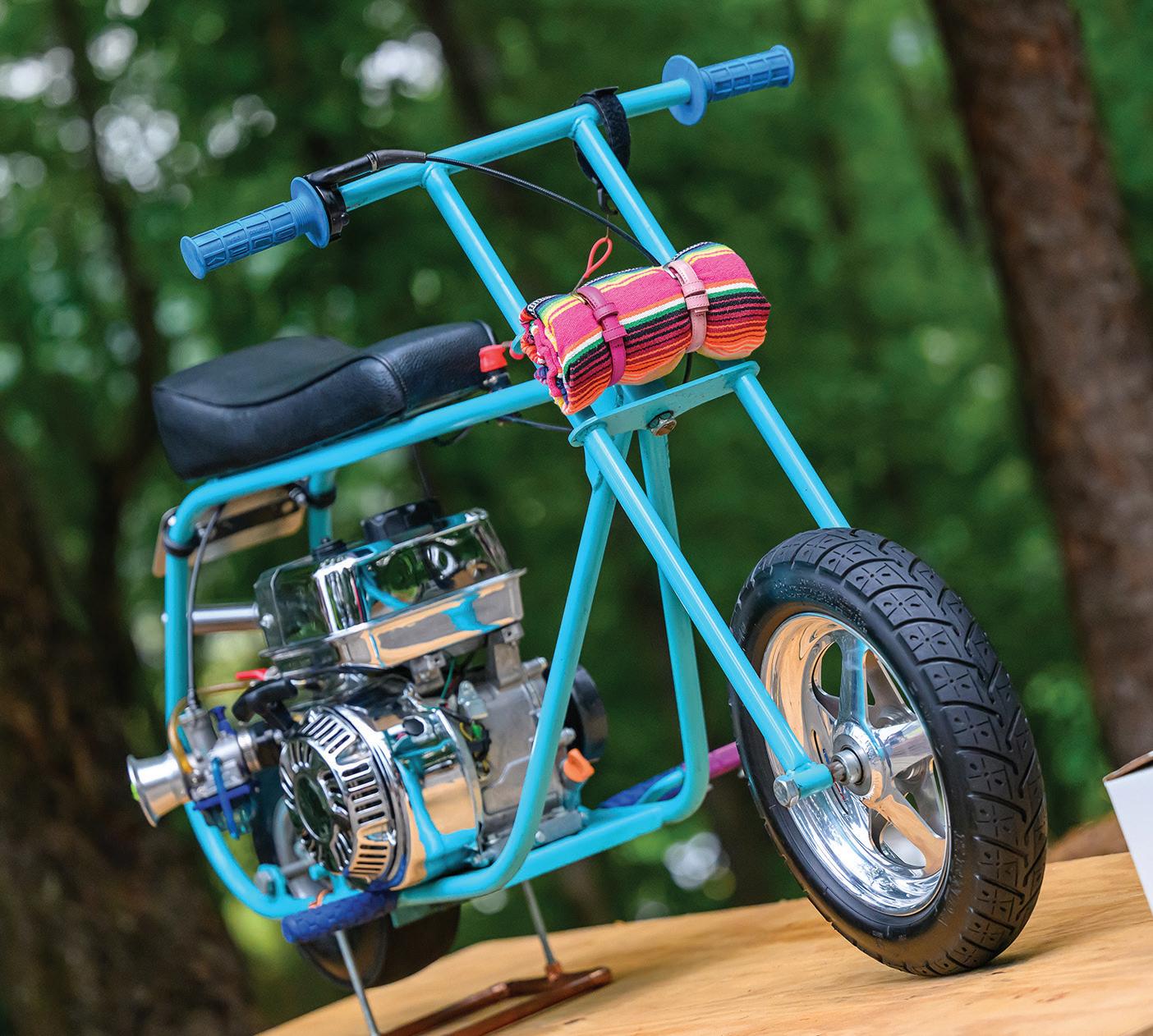
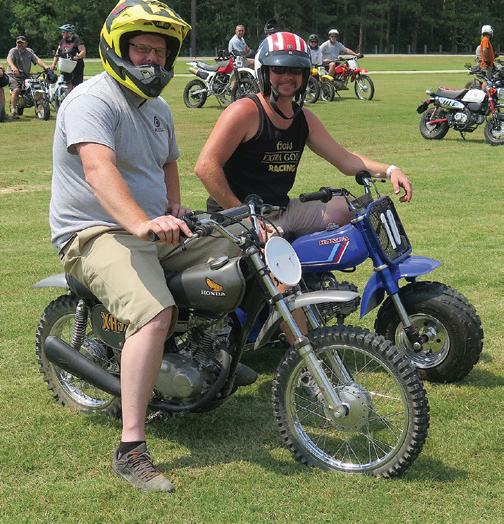
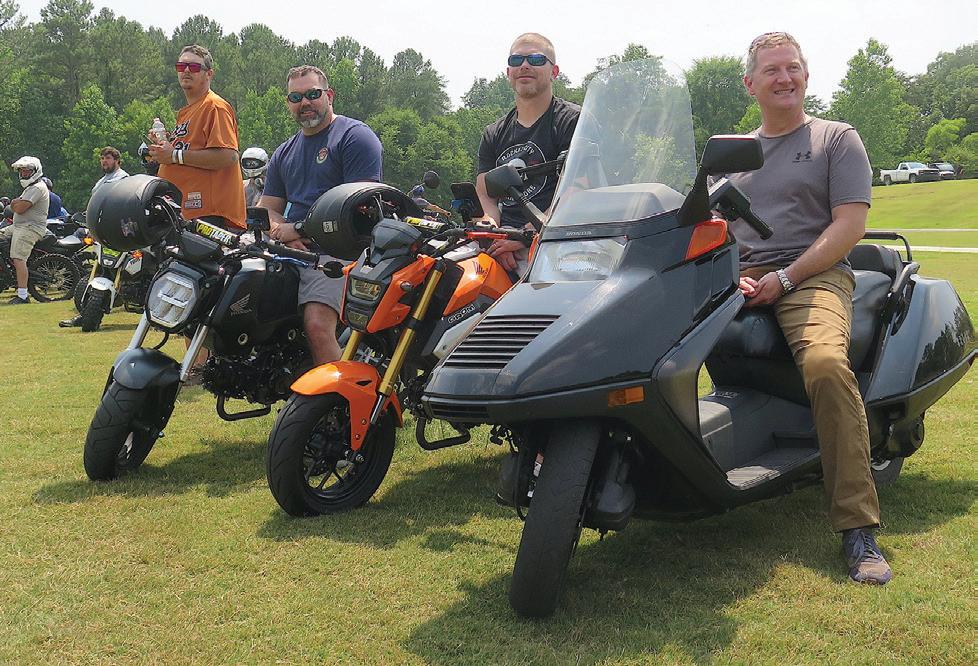
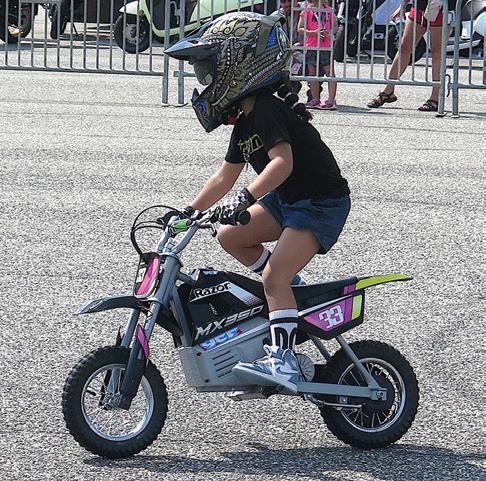
Alan Wilson-designed road course right beside it, draped upon 880 mostly manicured green acres that surround it. All 880 were crawling with all manner of minibikes and minivehicles as we spoke, ridden by all manner and ages of people — but mostly genteel(ish) Southerners. It was the great Kevin Cameron who once used the term “Brownian motion” to describe some motorcycle rally or other, and the term fits even better at Barber’s Small Bore happening, as the individual elements are that much closer to molecular in size: There goes a 6-year-old girl on a little electric motorcycle; here
Everybody’s
comes a bearded old-timer on a CT70 from 1972; and there goes a man on a…say, what is that?
WHERE DID ALL THIS COME FROM?
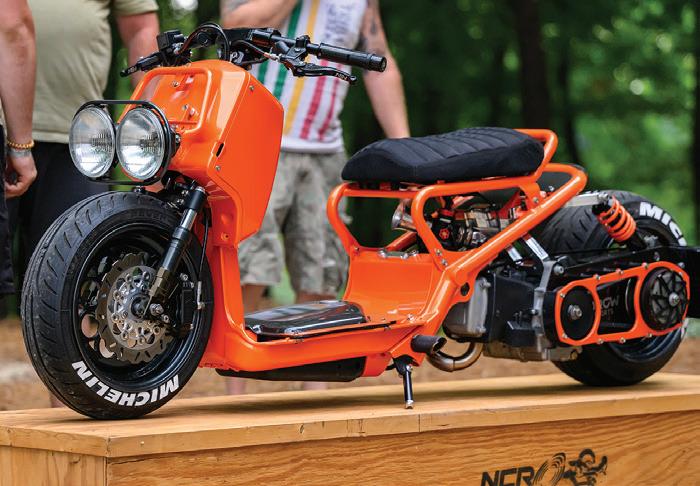
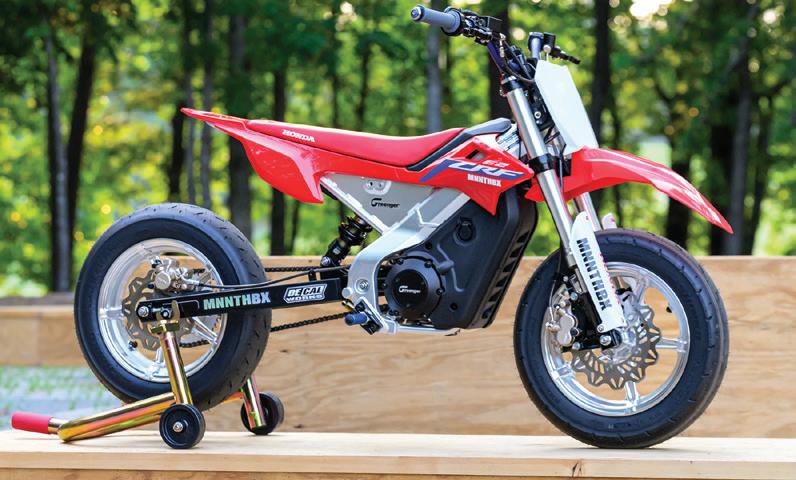
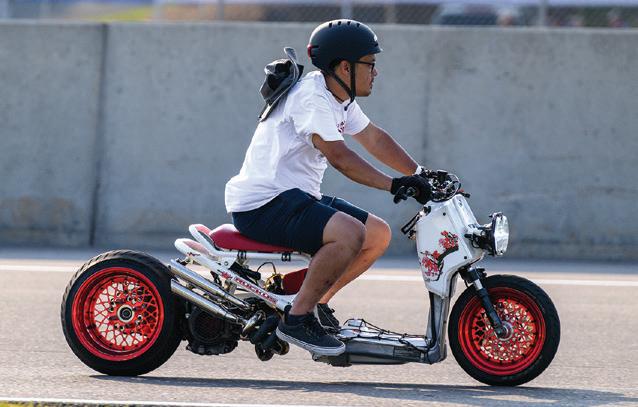
It all began because Greg Hatcher bought a Honda Ruckus in 2010 to run around on, started making a few parts for it, and gradually became MNNTHBX, which is an Alice in Chains song with the vowels removed. It was only going to be an email address, but things evolve. Soon, MNNTHBX’s minibike parts business was prosperous enough that Hatcher was able to quit his county health inspector job in Tennessee, then partner up with his good friend Kevin Estep (who soon quit his postmaster job). Now, a decade into it, business appears
to be booming and life is good. Little motorcycles are lately a big thing.
MNNTHBX headquarters is in Seymour, Tenn., 277 miles northeast of Birmingham. In 2015, MNNTHBX decided to hold a rally next door in Townsend, Tenn., the first Smoky Mountain Crawl. Why not? The Tail of the Dragon and a bunch of great roads are right there.
“We thought 20 people might show up,” Estep said, “but 150 or so did. And within five years, we were getting 1,500. Townsend’s not a big place, and it bills itself as ‘the Quiet Side of the Smokies,’ so we may have been on a collision course.”
Just in the nick of time, former Barber Museum Director Jeff Ray happened to be in Townsend on vacation and came across the Crawl. “He said [the bikes] were everywhere, like gnats,” current Barber Curator Nick Lacasse said. “We agreed that we should find a way to bring them here, as it would be a safe place for the event. I reached out to Greg and Kevin; they were already very familiar with our facility. They came down, expressed concerns about how the event had grown to a point where it was becoming too dangerous and difficult to manage in Tennessee. We agreed to take it on at the park as long as Greg and Kevin helped manage the move. We shared ideas on how the event could be, settled in on a new format, and the Small Bore has grown and evolved ever since
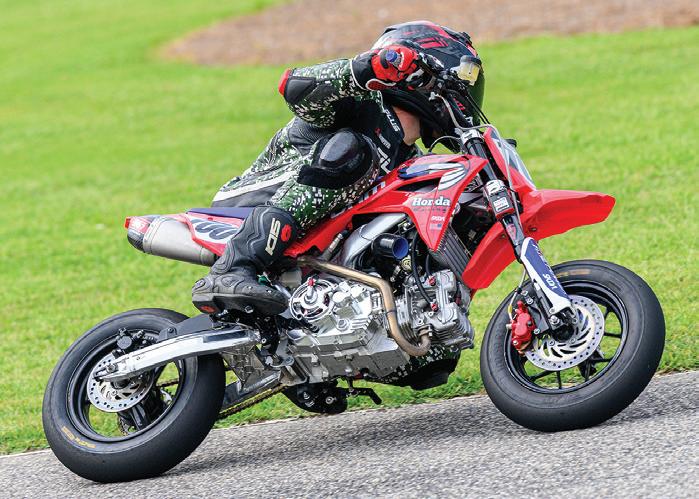
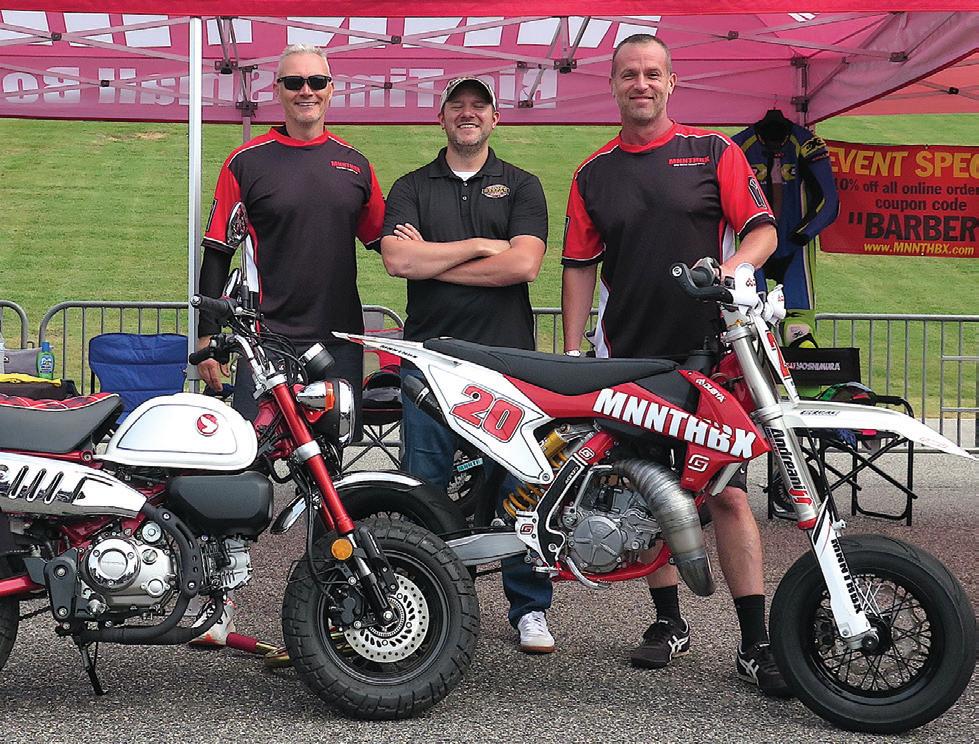
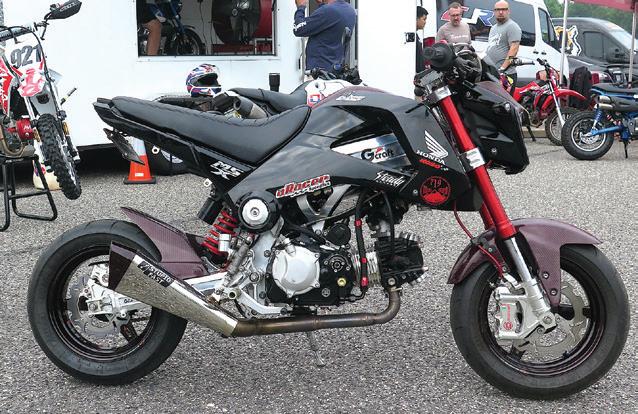
Kevin Estep (left) and Greg Hatcher, coowners of MNNTHEBX, flank Barber Museum Curator Nick Lacasse. A stock Grom puts out 8 horsepower. The one below, leaned on by MO Power in Colorado Springs, makes 35. Top speed 120 mph.
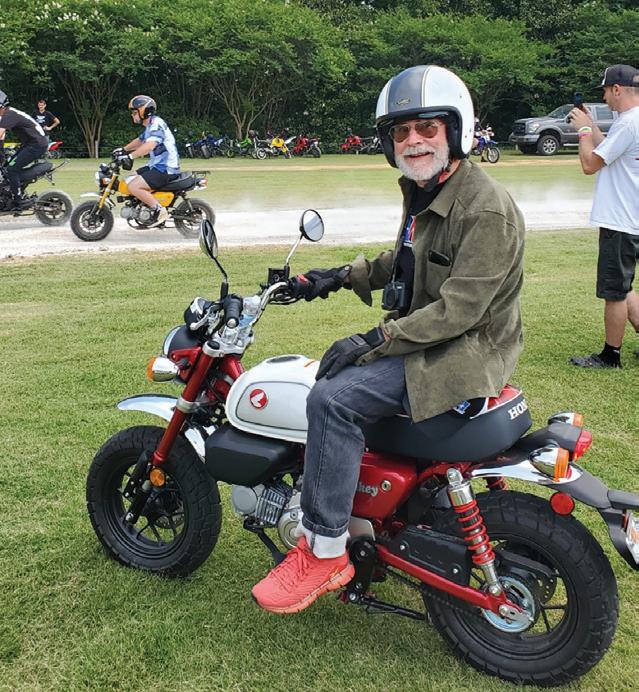
got something to hide ’cept for me and the Monkey American Honda so graciously loaned me for the weekend.
JODY EDWARDS
our first one here in 2019.”
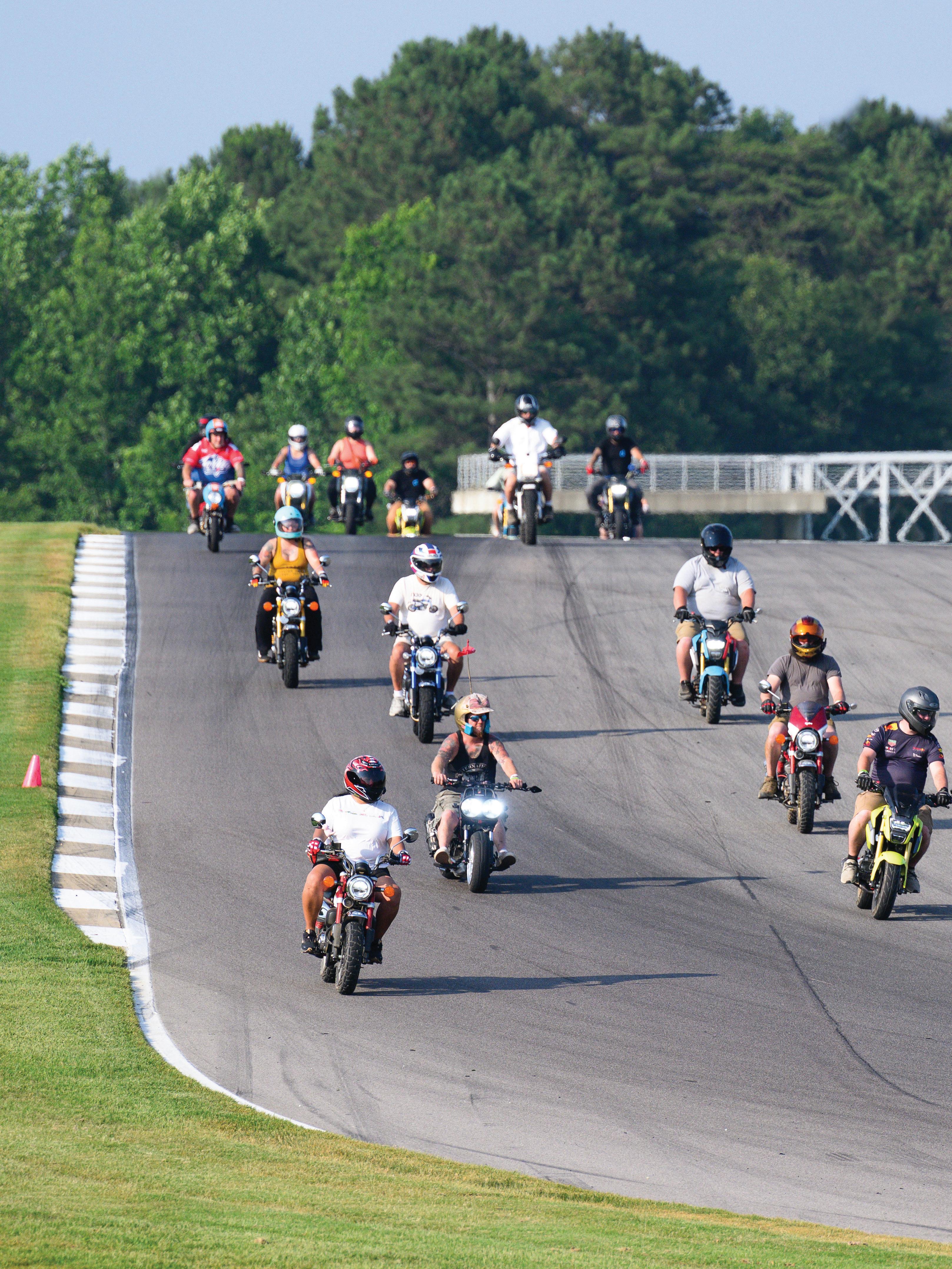
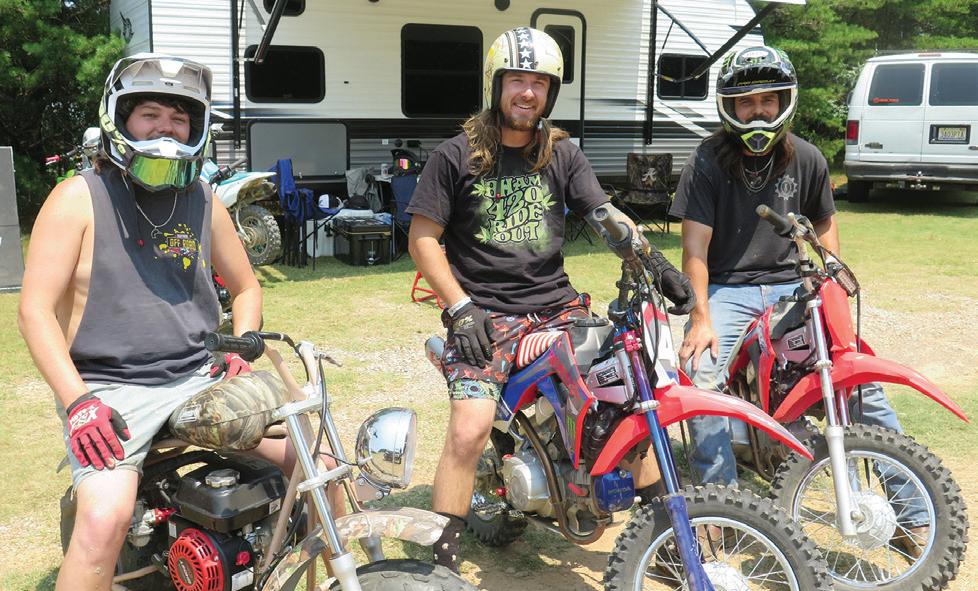
Now, acres of RVs show up at Barber with their offspring and smallbore vehicles in tow: You can fit a lot of Groms and things on a trailer that’s not too big, and there’s plenty of room for your RV or school bus on George Barber’s plush lawn. Everyone’s here to get along and have fun. There were also tons
of minibikes with Alabama plates carrying people who’d ridden in, and some from farther away.
LET’S GO TO THE PARK, DADDY
The fact that Barber is private and gated means you can feel free to let your youngsters run around like we used to do back in the day. Or
maybe they never stopped doing that in Alabama? “Here comes ol’ Double Ugly again,” I remember my dad saying as that ancient, amiable mongrel ambled down the street again in my Barber milk-drinking days, before helicopter parenting was a thing. Live free or die isn’t Alabama’s motto, but seems to be the philosophy. At least everybody’s
“We thought 20 people might show up, but 150 or so did.
And within five years, we were getting 1,500. Townsend’s not a big place, and it bills itself as ‘the Quiet Side of the Smokies,’ so we may have been on a collision course.”
KEVIN ESTEP
wearing a helmet.
This year’s Small Bore drew 2,200 attendees, and Nick said that doesn’t include the at-least 100 kids under 15 who got in free. (No telling how many were smuggled in via the trunk, the way we used to go to the drive-in movie).
Seemed more like 1,000 to me, but by Day Two I was beginning to realize
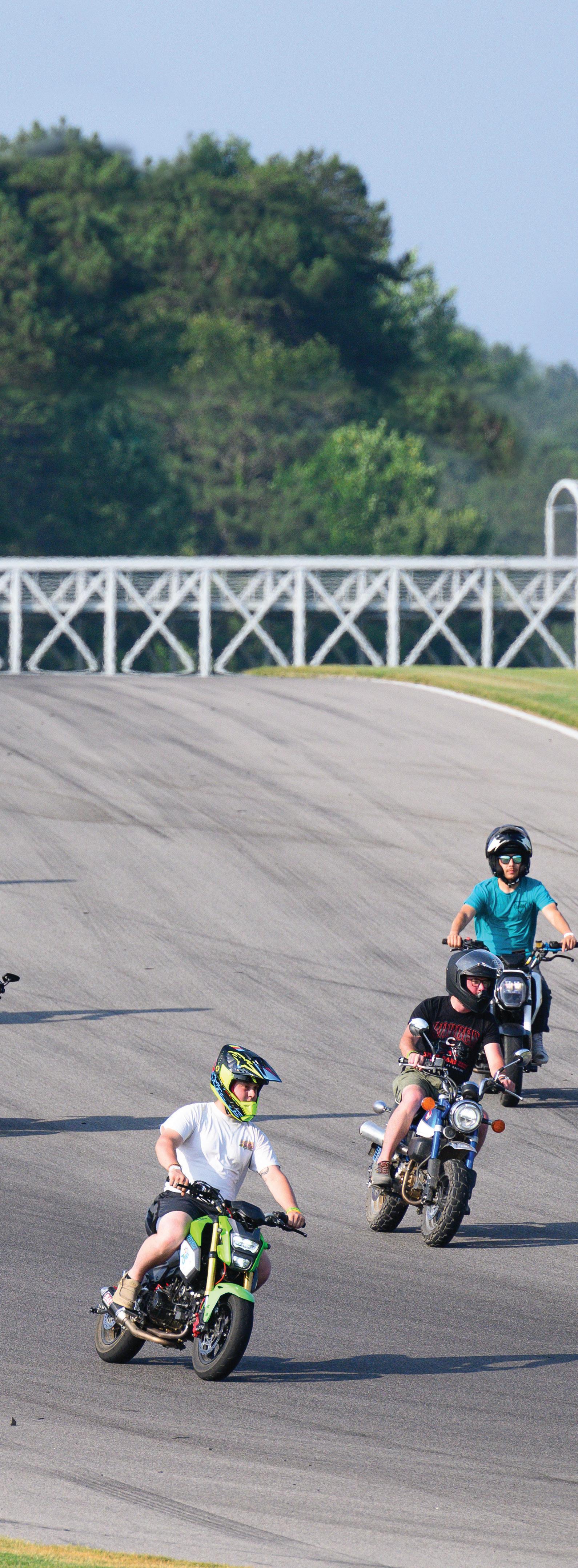
Parade laps on the big track, straight rhythm section. Below: Tony Rice rode in on his Helix-in-progress from Huntsville, Ala., where he’s semi-retired from working on Minuteman missiles for the Air Force. He’s got 11 or 12 other motorcycles he’s also working on. “If you can’t fix a thing,” he says, “it’s easy to find somebody in Huntsville who can.”
Left:
that our Brownian motion had me and my Monkey bouncing off the beaker walls and crossing paths with the same people repeatedly as we rolled from hospitality center to miniGP track to Creek Bottom Classic trails to stunt lot to dragstrip to museum. Okay, I admit I didn’t recognize the people as much as their bikes.
TYKES ON BIKES
It’s an ongoing lament that there aren’t enough young people on motorcycles anymore. You’d never guess it at the Small Bore, and that’s by design.
“You’ve got to do more than art,” said Nick the Curator. “We’re always trying to think of new exhibits to draw
in new demographics to the museum. Small Bore was a natural fit.”
The museum is an eye-opener even for an old motorcycle journalist who’s seen them all (I’ve written reviews of a surprising number of motorcycles in there that are now antiques; Ducati 750 Paso, anyone?) I can’t imagine how all those shiny objects would’ve affected me when I was 10 or 11 years old. All we had in museums when I was a kid were dusty stuffed wooly mammoths and things.
Besides the kids, while I was standing there talking to the Men in the Box under their awning, guys my age were walking up wanting to order Grom parts to go with their new ECU. “Ten percent Small Bore discount if you order by Monday!”
“From 15 to 80,” said Estep, “when it comes to toys, your mind doesn’t change.”
For 40 years, Estep said he didn’t ride, until he got back into it
thanks to his partner Greg. Now he’s taken up mini roadracing. Minis are just way more approachable and affordable, and that’s a theme totally agreed upon by the people under the Yoshimura, Vance & Hines, and Steady Garage adjacent EZUps, who all agree that Groms and Monkeys, etc., have breathed new life into their businesses, if not spawned them. As full-size sportbikes enter the realm of unaffordable and nearly unimprovable, you can still get your kicks hopping up a Grom. Honda’s new Navi is a huge hit too — just $1,800 and no gear-shifting required.
RACING? BUT OF COURSE…
No. 1, it’s Barber Motorsports Park. No. 2, there’s more than one motorcycle, so there must be competition.
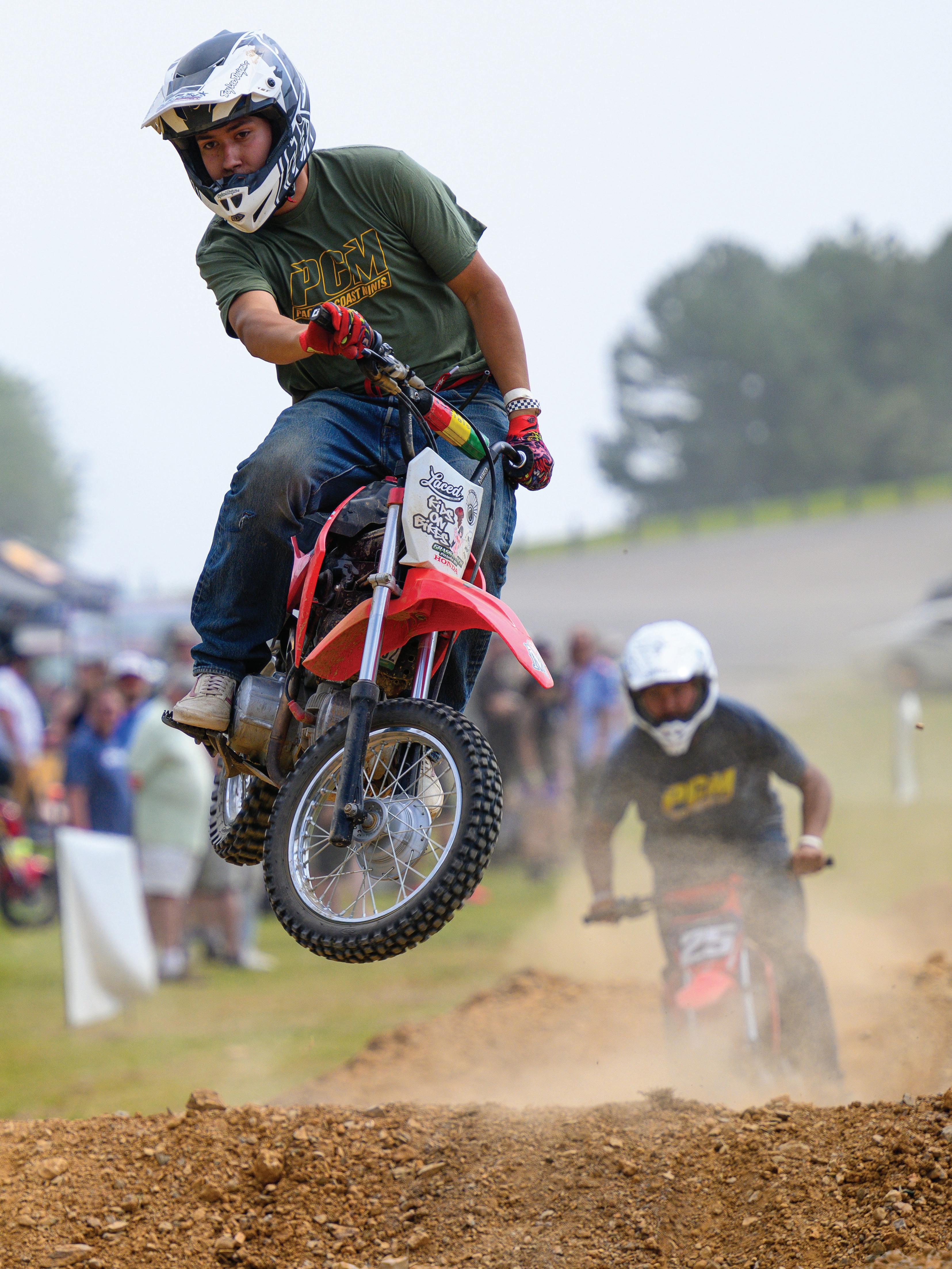
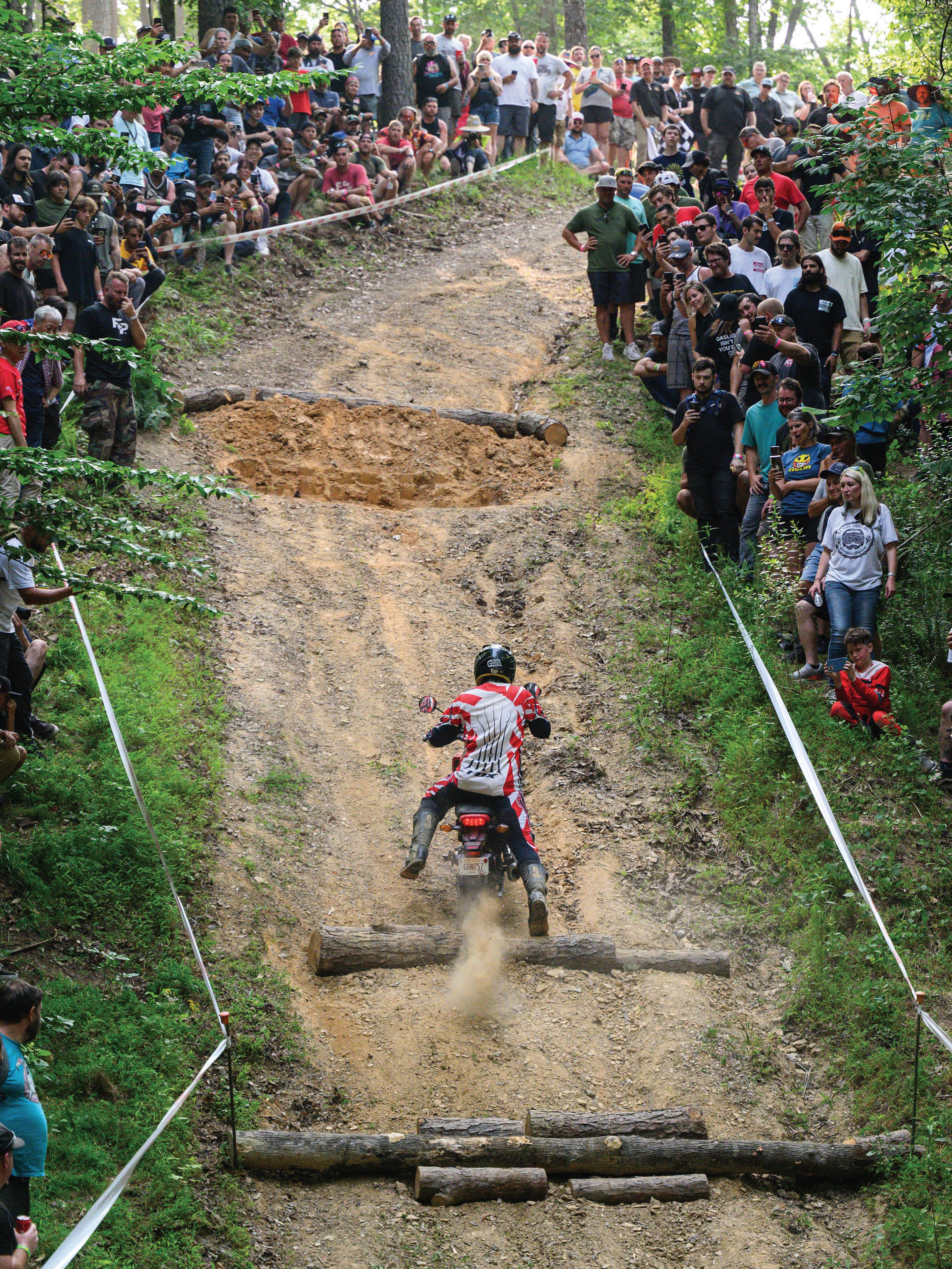
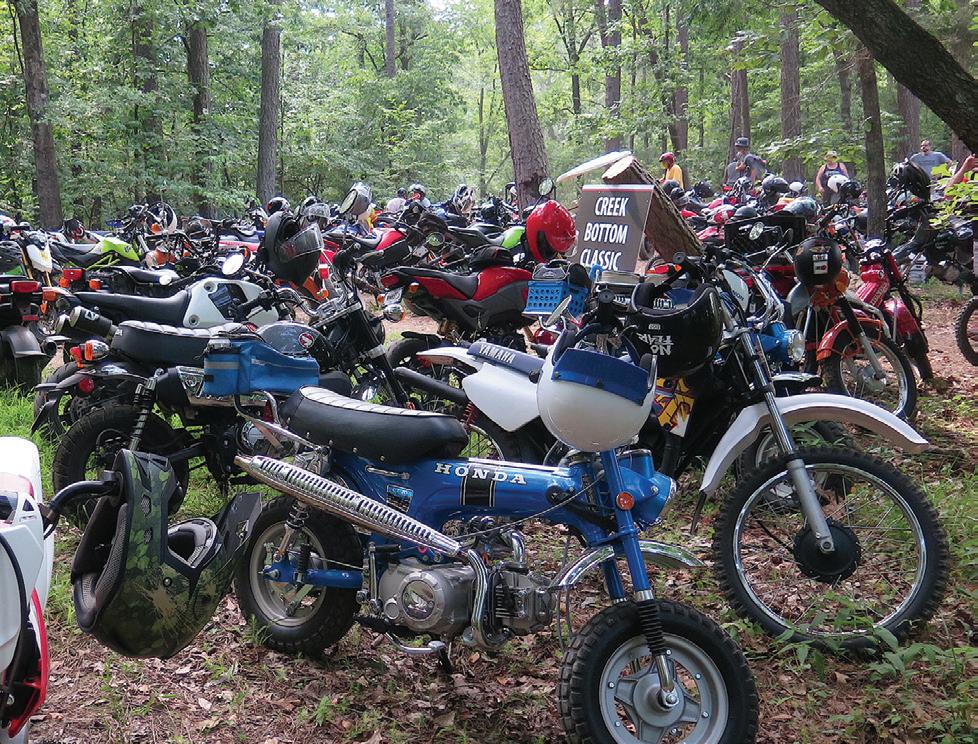
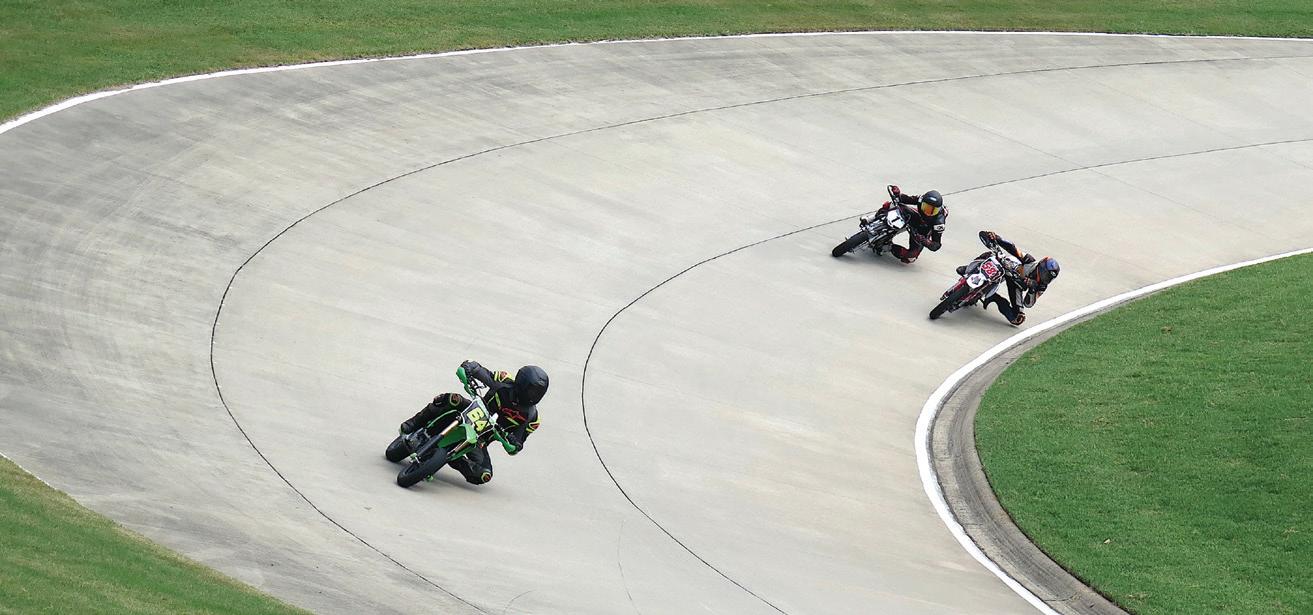
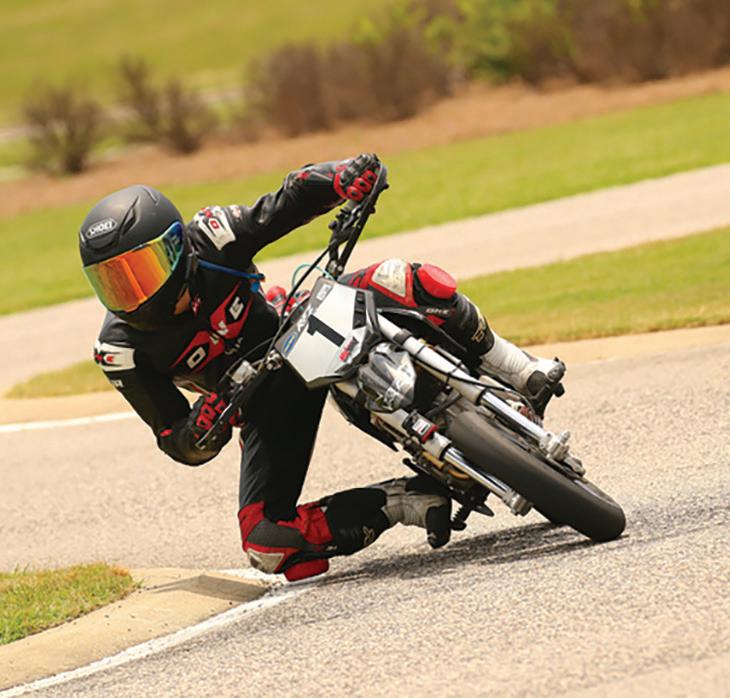
In addition to the dragracing (168foot strip), hillclimb, straight rhythm, and Creek Bottom Classic amateur events — highly casual and hugely popular affairs organized and even flagged off by our very busy museum curator Nick Lacasse — Barber Small Bore also hosted Round 5 of the Southeast Minimoto club’s 10-round series, on what looks like the coolest Mini GP track I’ve ever seen, complete with a slice-of-Daytona banked bowl turn. The fact that there were 1,000 Sacagawea silver dollars for the winning team I think makes it a professional event, and there was way less day-drinking than among the dirt racers.
I’d forgotten how much fun mini roadracing is. Fifteen years or so ago we put 17-inch wheels and slick tires on my kid’s Suzuki RM85 and had a blast, which might have been an even bigger, longer-lasting one if we’d ever got the suspension to work right.
EVERYBODY WANTS A NEW MOTORCYCLE
But something about being in sight of the world’s biggest motorcycle museum, full of golden oldies, makes it easy to love the one that brung you up: Barber is a celebration of the seeming indestructibility, possibly immortality — or maybe just the continuing great parts availability – of the Honda minibike: SL, CL, XR, XL, CR, CT, CR-F… I don’t even know, but there seemed to be three or four of every Honda mini ever made thumping happily around, amid a smattering of other brands. It’s fitting that Honda is a big sponsor and rolls out a transporter of its wares, including the new XR150L, a mere $2,971.
Mark your calendars if you’re into pint-sized fun. George Barber’s Small Bore is back for 2024, May 31 to June 2. AMA
Unusually, Trace Atchison (#1) had a mechanical problem on his Apollo 125 that cost his team some time in the 2-hour SEMM endurance race, but he still battled back to second place, crashing three or four times per lap without ever actually falling off. Motivation took the form of a chestful of 1000 Sacagawea silver dollars. Barber has the coolest mini track I’ve seen, complete with a Daytona-style bowl corner. Drone photo by Greg Hatcher.
BY MITCH BOEHM PHOTOS: WILL POSEY, MIKE PALMGREN
WHEEL 3WONDER
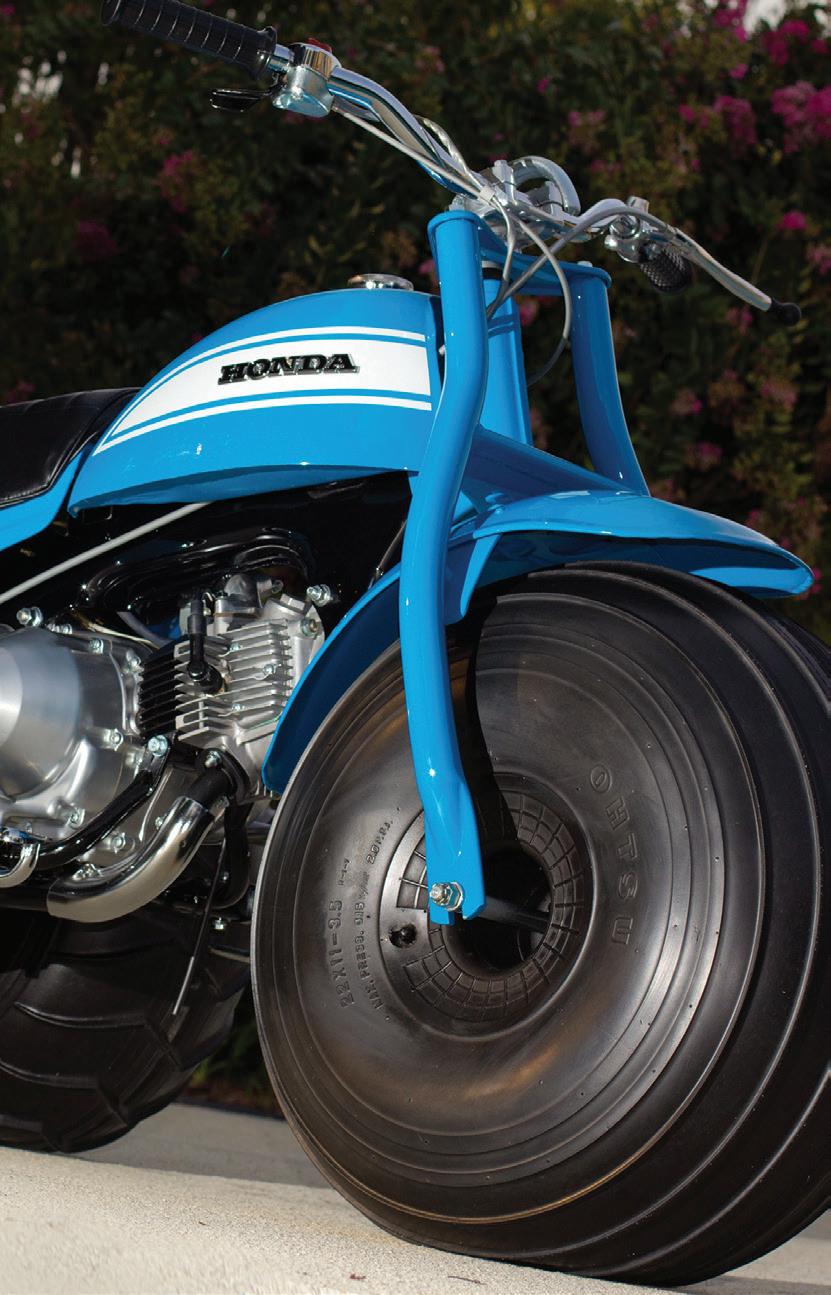
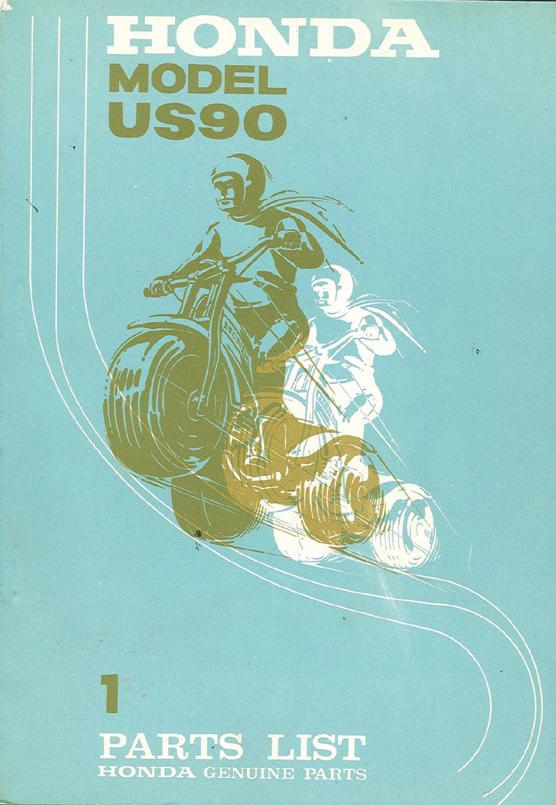
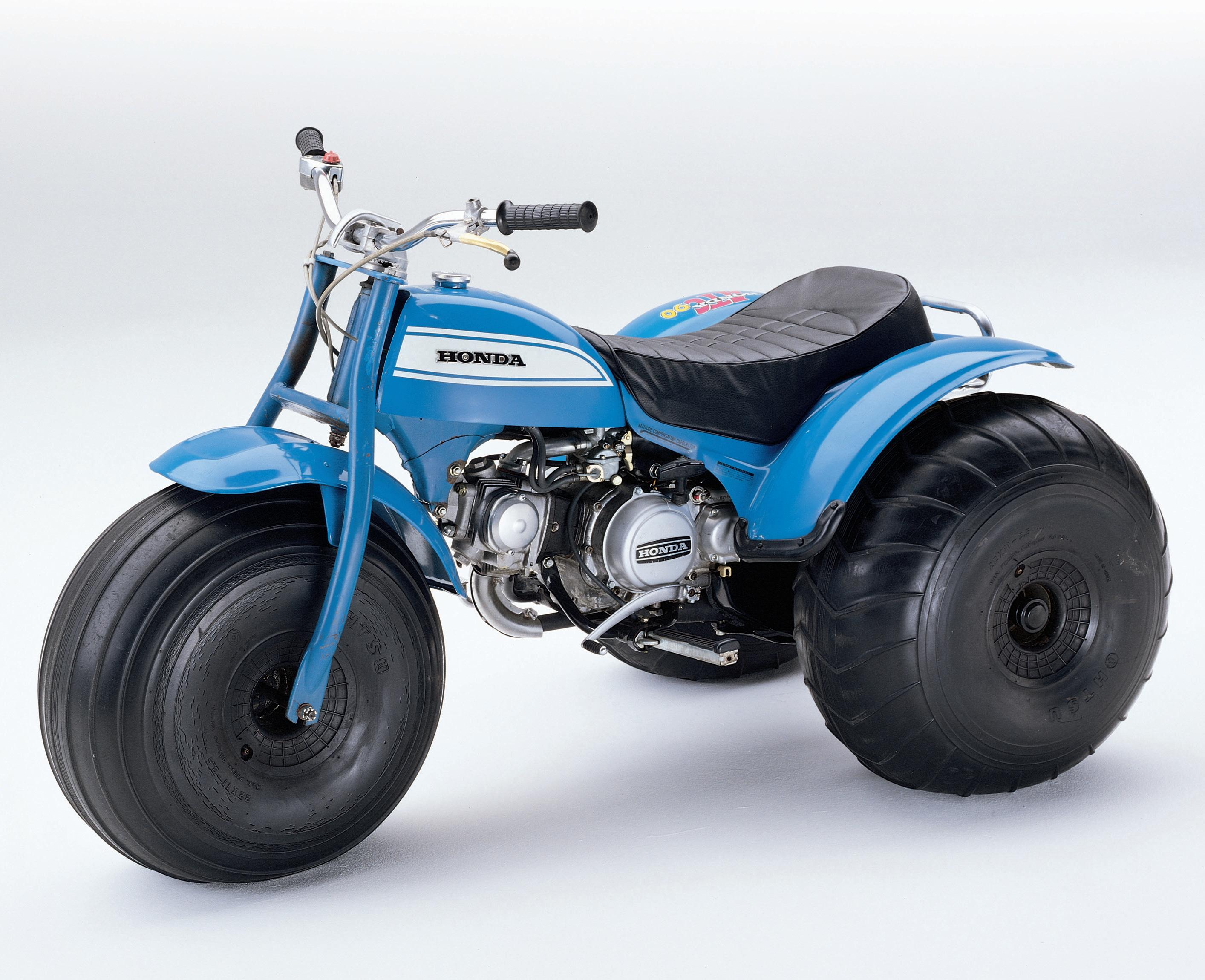
Motorcycle people who’ve been around the block often call certain motorcycles “game changers” due to the significant effect they had on a specific category or the sport of motorcycling itself. Model names like CB750, Elsinore, Z1, R80G/S, GSX-R and others certainly qualify. But some machines in motorcycling’s history have had an even larger effect, and one of those is the 1970 Honda US90, which not long after its introduction became known as the legendaryATC90. Many have called that first balloon- tiredATC a “game changer,” but that’s more misnomer than fact.
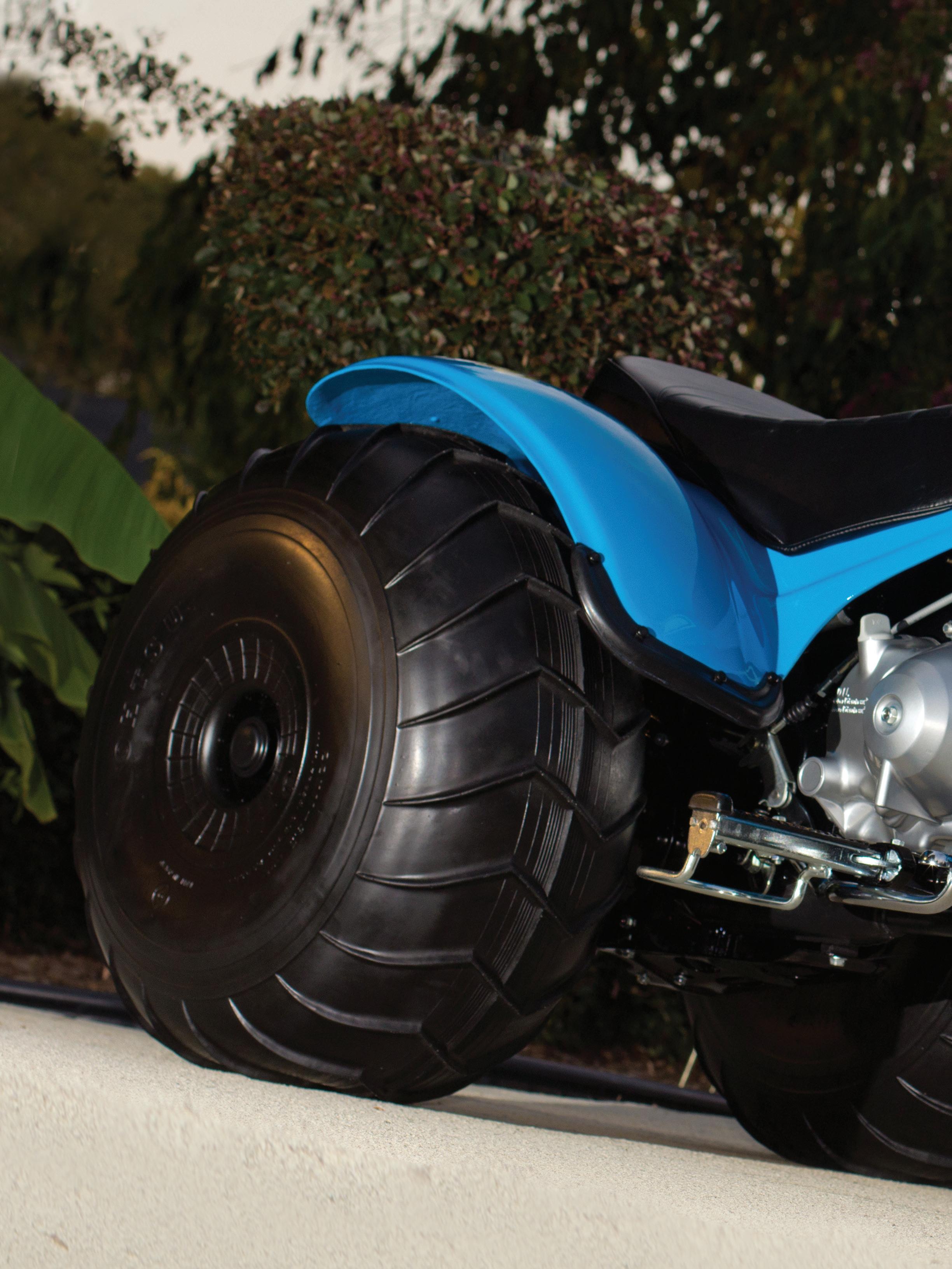
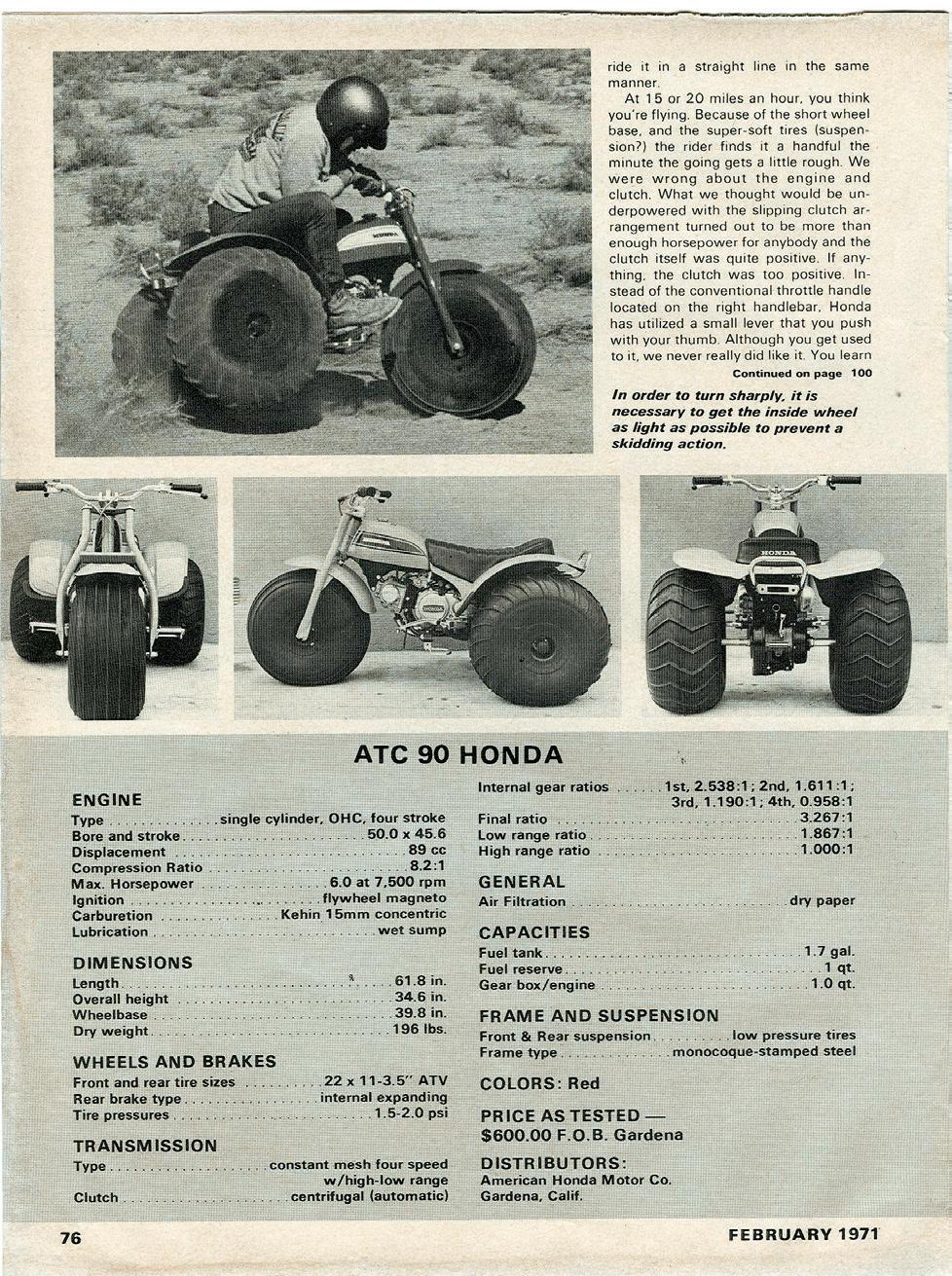
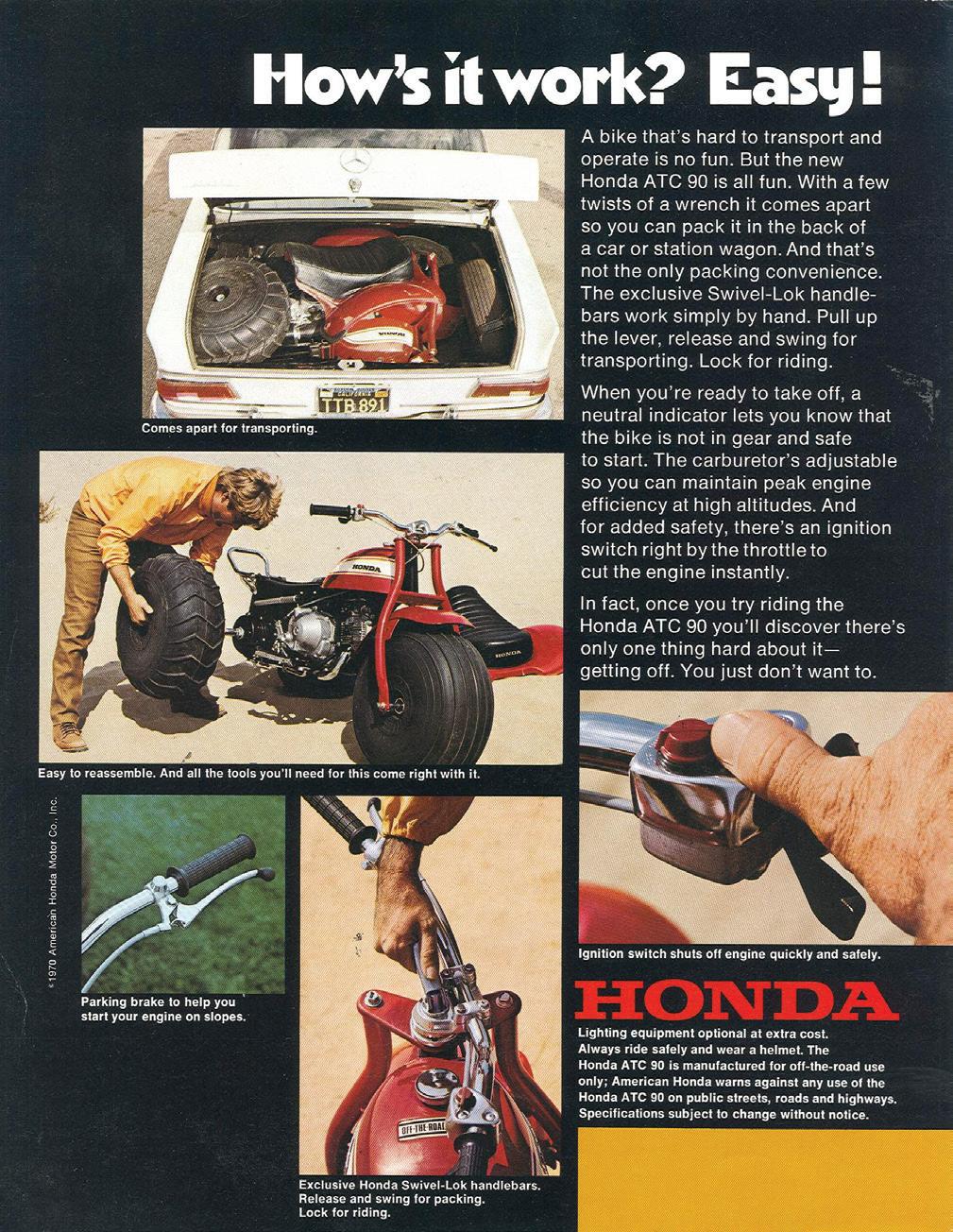
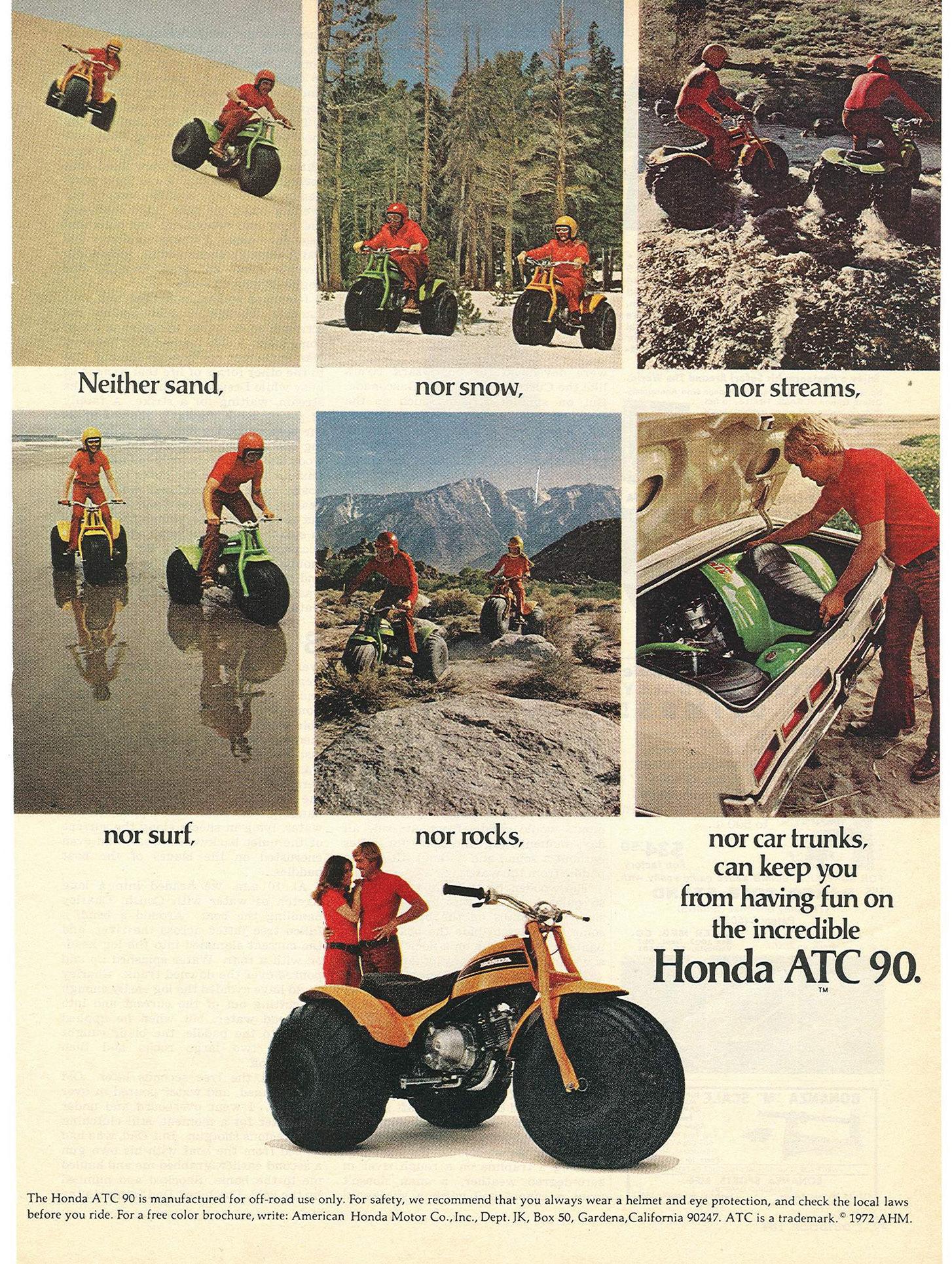
Honda’s 1970-spec US90 — known later as the ATC90 — was more than the world’s first “traditional” ATV. It launched a billion- dollar industry, one that altered the motorcycle terra firma forever.
And why? Because the words “game changer” imply there’s a game to be changed, and in that first ATC model’s case, there simply was no game. The All-Terrain Vehicle category didn’t exist at the time, and the few 6-wheel tub/buggy vehicles being built for fisherman were a curiosity, at best.
The ATC90 began life in 1970 as a curiosity, too. But within a few years that smoldering curiosity began to form what would become a multibillion-dollar industry in the coming decades, albeit with a speed bump or two along the way.
You might assume that the machine responsible for what’s become a massive chunk of today’s powersports industry — $20 billion currently in North America, and forecast to be $30 billion by 2030 — would have resulted from loads of market-desirability research by Honda’s R&D folks back in the late 1960s.
But you’d be mistaken, as the idea for the US90 came from an offhand message from an upper-level Honda Japan manager to his R&D folks: Come up with something for our upper-tier North American dealers to sell during the winter, the manager said, motorcycle sales typically slowing to a crawl at that time.
One of those R&D engineers was Osamu Takeuchi, who’d already been developing various alternative vehicles at Honda. Takeuchi got right to work, sketching and drawing, gathering parts (including a couple of already-in-production vehicles), then cutting, molding, welding and assembling a wide range of weird, funky and decidedly non-traditional prototypes with two, three, four and even six wheels.
Some didn’t even have wheels, tracked and ski vehicles reportedly having been designed and tested, as well. Tak and his team built all sorts of stuff for all sorts of terrain, with snow, mud and sand a primary focus.
By early 1968 — about the time semiconductor giant Intel was founded, the future Led Zeppelin
debuted as the New Yardbirds, and Yamaha launched the venerable DT-1 — Takeuchi settled on a prototype he felt held some promise.
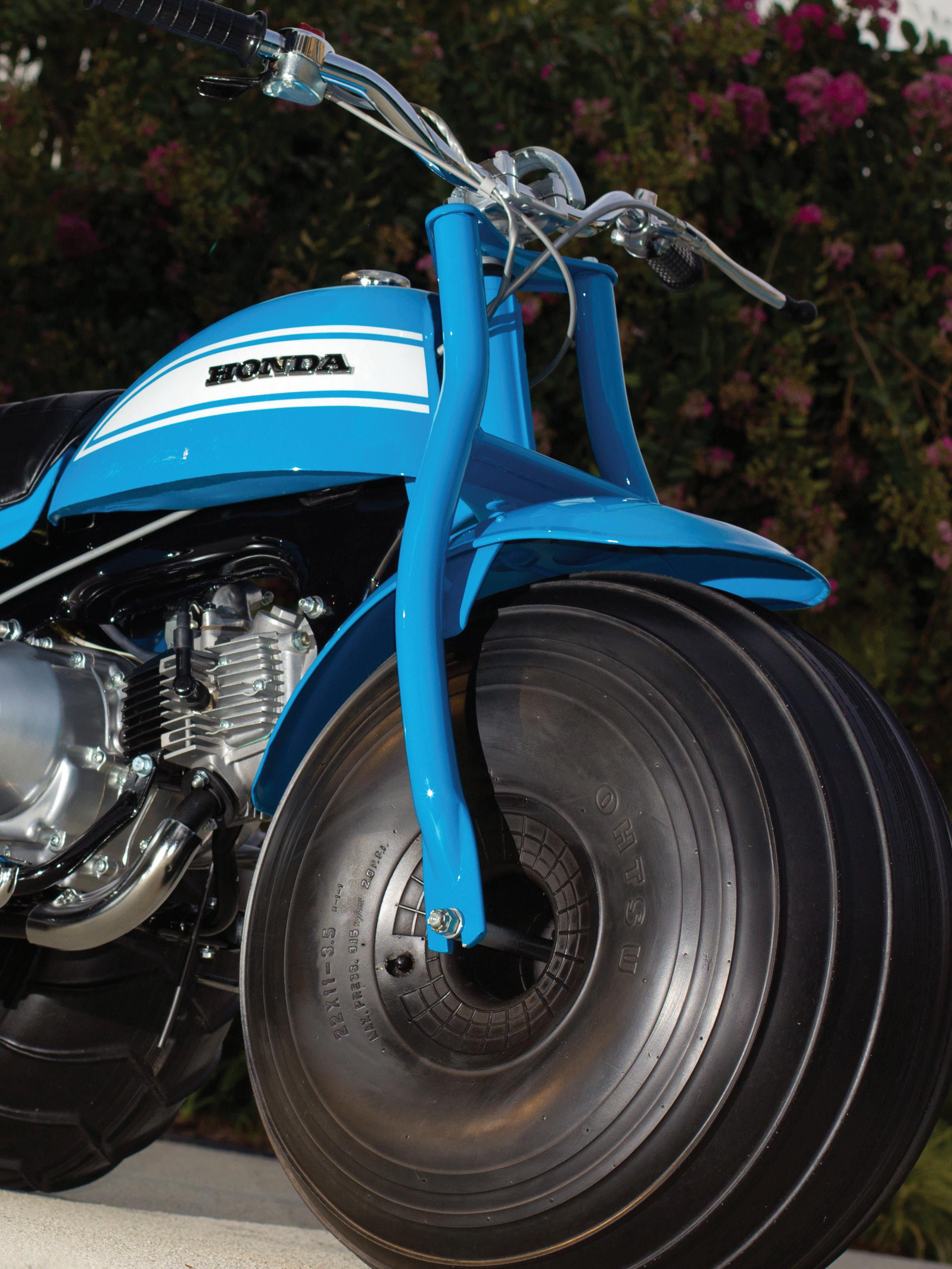
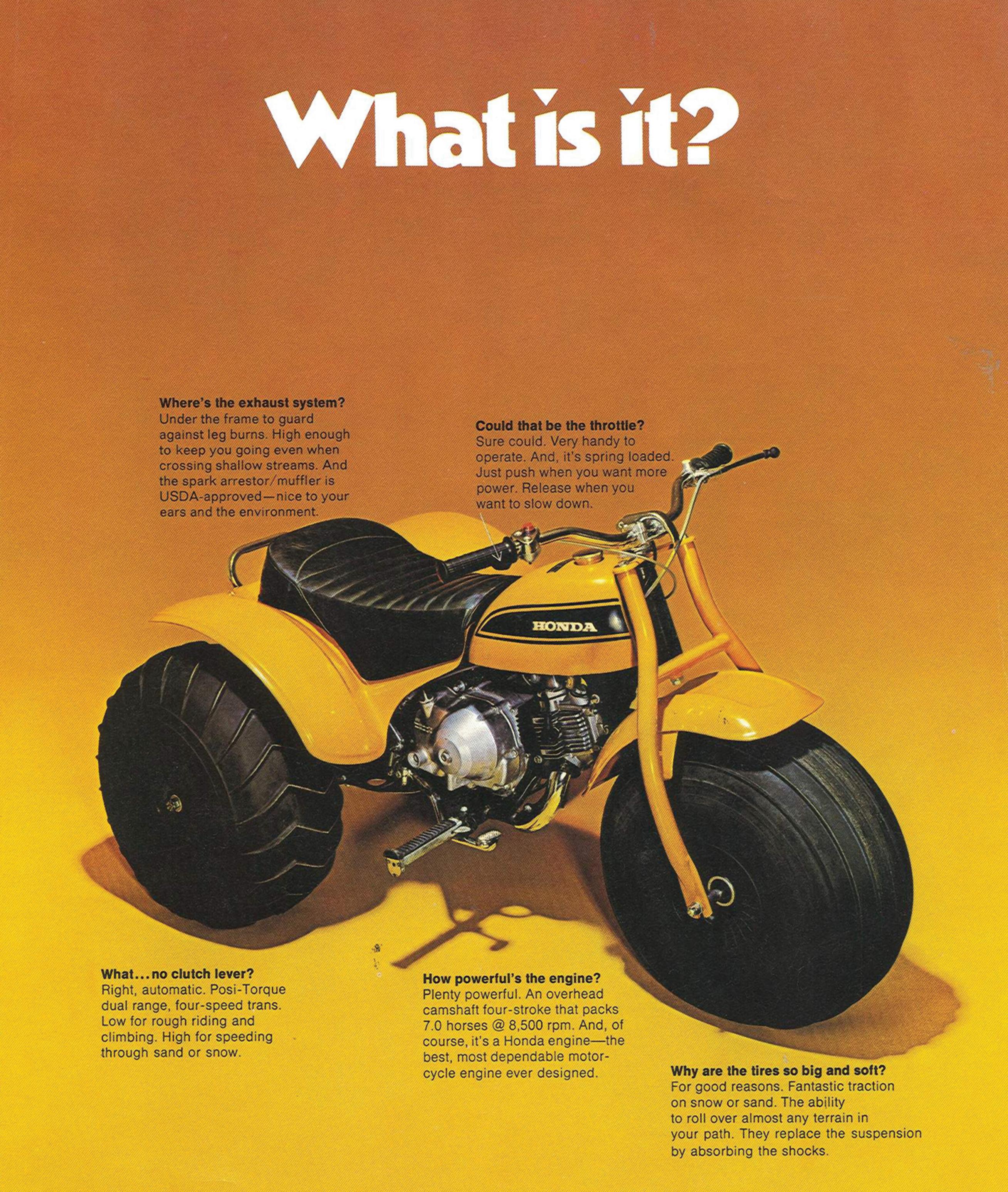
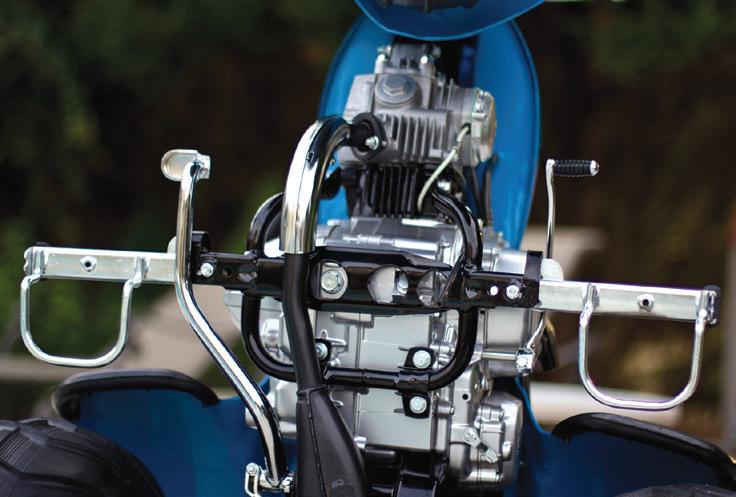
It was an unusual-looking thing, a balloon-tired 3-wheeler with some distinct motorcycle characteristics, including a rider-straddled chassis, a traditional fork/steering-stem front end with a handlebar bolted atop it, and the engine positioned below the tank and seat.
Despite its funky looks, Tak’s creation was undeniably cute. It was
also typical Honda — friendly, nicely shaped and plenty inviting in a “you meet the nicest people” sort of way.
Still, Tak’s prototype — and the production model based on it that would debut a year later as the Honda US90 — was nothing more than an experiment, an attempt to buttress the U.S. dealer body during a slow unit-sales period. No one — not Tak, his team, nor the Honda higher-ups — had a clue how it would sell, or if it would even be accepted.
And certainly, no one could have imagined the shocking, worldchanging effects the little 3-wheeler would have on the motorcycle industry and riding public during the following decades.
“The ATC90 is one of the few truly axis-shifting machines in our industry,” said ex-Yamaha product planning guru
Ed Burke, who watched Honda enter — and quickly dominate — the ATV industry during the ’70s and ’80s. “It was hugely significant in many ways.”
THREE-WHEEL ROOTS
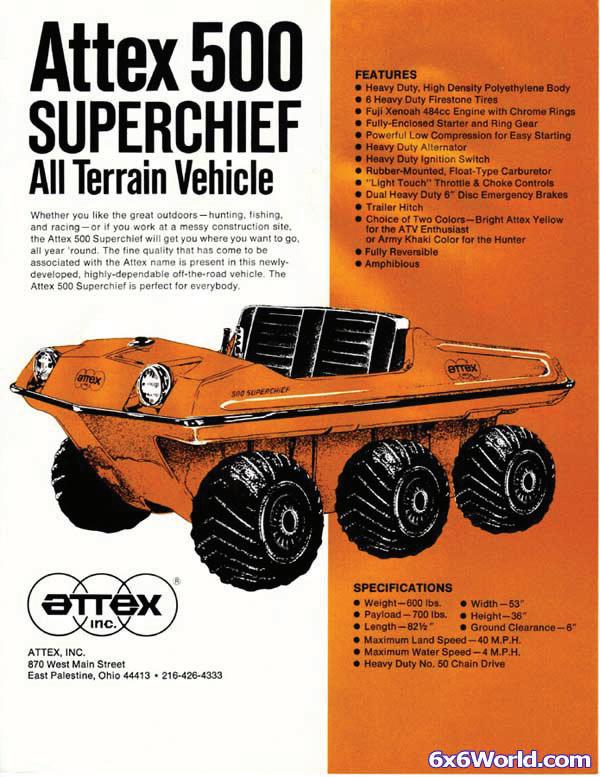
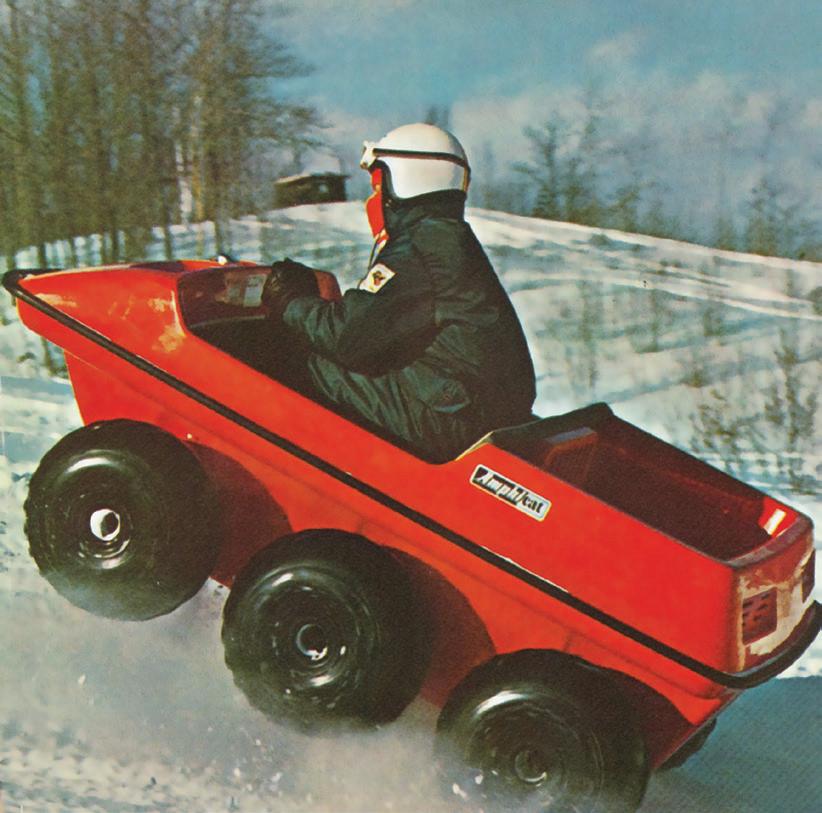
During the 1960s and prior to Tak’s foray into what we now call All-Terrain Vehicle territory, the category barely existed, and was represented by a small handful of (mostly) 6-wheel machines with a tub chassis and turning accomplished by “skid steering” — braking one set
of wheels (one side) at a time. The first of these, the 5.5-hp Jiger, came from Canada, and was initially built only to-order. Soon after, companies like Mobility Unlimited and Attex built balloon-tired, tub-chassis models such as the AmphiCat and Superchief 500, which catered primarily to outdoorsman. Some earned true amphibious status due to their ability to float and, with wheels whirring away below decks, make their way — albeit slowly, at about 4 mph —across lakes and ponds. Some owners even fitted small outboard motors to speed overwater progress.
Tak and his team reportedly settled on a 3-wheel concept relatively early in development, the triangular-footprint design offering what they felt would be the best combination of handling, traction and
maneuverability for the soft, slick and otherwise tricky environments in which it would be ridden. (The design was also unique enough to be patented in several ways, which would pay massive market-share and financial dividends later on.)
The team tried a handful of iterations of this triangulated concept: one wheel in front and two in back; two wheels in front and one in back; tandem wheels on dual axles in back; etc. Aggressively treaded and motorcycle-oriented wheel and tire
terrain was minimal…and just what he’d envisioned early on.
MORE MOTOR, ETC.
With chassis performance improving by the day, Tak’s team found the 70cc engine they’d been using to be insufficient powerwise, especially with an adult rider aboard. A switch to the company’s 90cc OHC engine was made, and functionality jumped yet another level, the bike now having the low end and midrange needed to handle
combinations were tried but weren’t optimal, as they chewed up soft terrain and didn’t allow the chassis to maneuver as intended.
The breakthrough came after American Honda associates sent Tak the wheels from an AmphiCat 6-wheeler to study and evaluate, the low-pressure balloon tires immediately turning on a light in the engineer’s head. Soon, Tak had designed and fitted large, 22inch balloon tires to his 3-wheel prototypes, seven versions of which made it to American Honda for study and testing. One in particular worked better than the rest, and with some modifications, things began to quickly gel around this optimal concept — one wheel up front, two in back. Traction and handling were better, and the footprint on soft
the softer, power-robbing surfaces — mud, sand, snow — it would surely encounter.
A range of late-stage testing in the U.S. proved the pre-production design’s overall goodness, and led to some unique technical approaches.
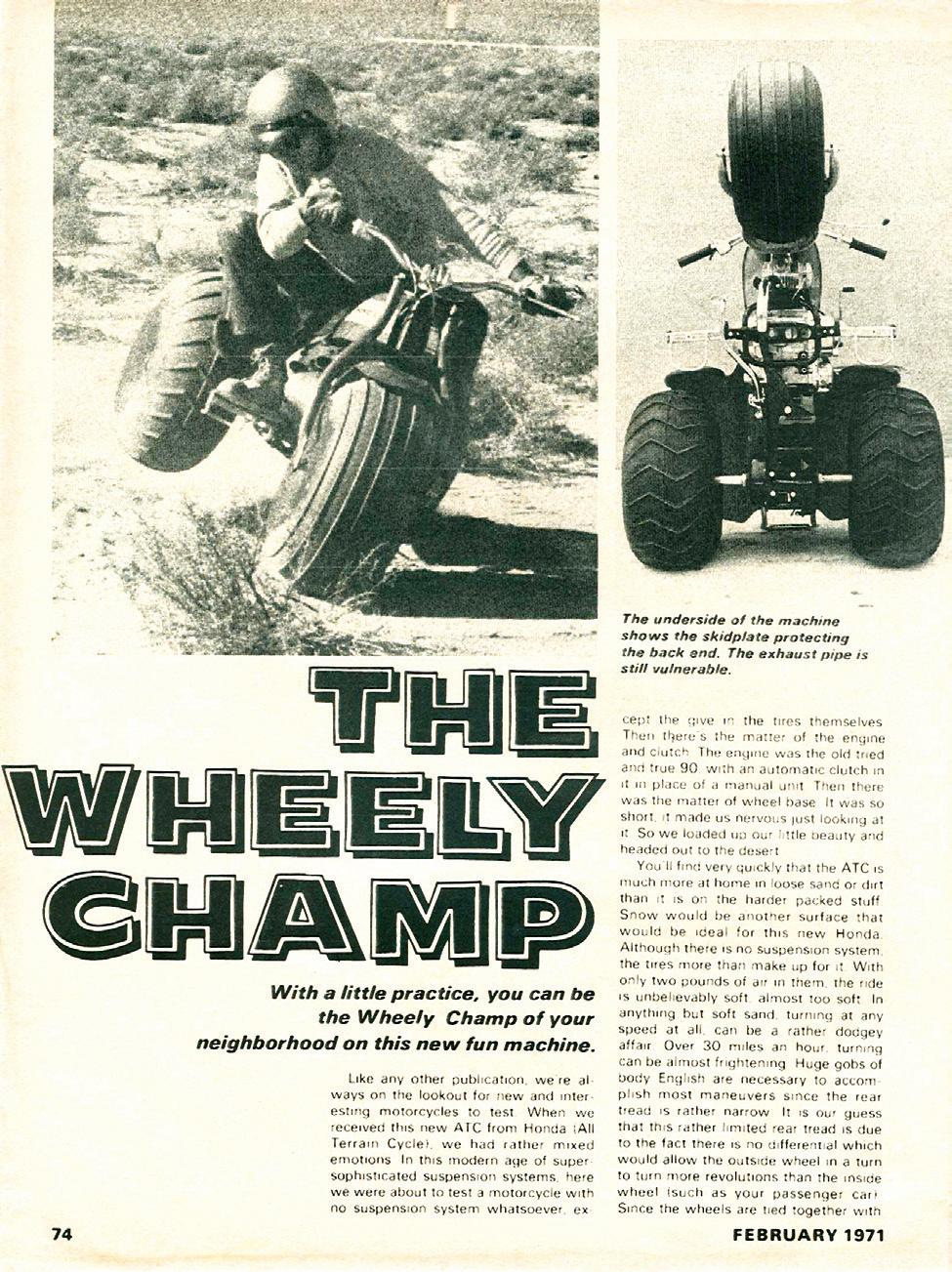
One was the thumb-operated throttle, still in use today, which allows riders to maintain precise throttle control even when hanging off one side of the machine to help steer it. Testing also showed the bike’s tire-supplied “suspension” to be adequate, at least for the relatively mellow use engineers and designers envisioned. The specter of powerful 250cc 2-stroke motocross- and Baja-ready 3-wheelers, so fast, capable and prominent in the 1980s and later, would’ve undoubtedly been quite a
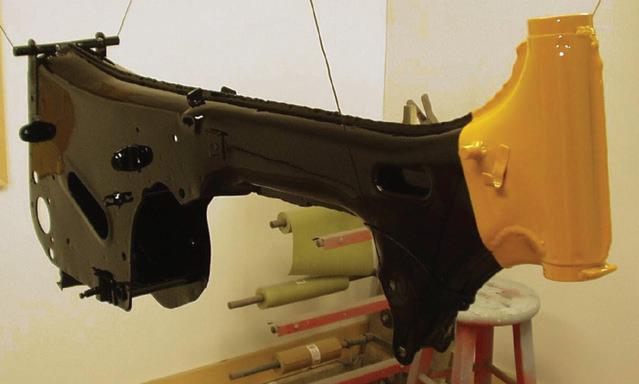
shock to Tak’s design team. While functionality was a primary reason for the machine’s overall design, production cost figured into the equation, as well. “Cost was a big issue during development,” says a Honda insider involved in the project. “Japan didn’t want to risk too much on such a new concept, and the ATC’s simple design helped. We already had the engine, and the chassis was pretty simple; stamped-steel frame, basic body parts…there wasn’t a lot of R&D to do or tooling to purchase.”
“I was in Honda’s auto division when the US90 was introduced. As a motorcycle rider since the early 1950s, and a CL72 owner since 1963, I thought the US90 was a little weird, and wondered if there was a market or buyers for it.”
TOM ELLIOTT
DEALER BUY-IN
By mid 1969, the Honda US90 — a name reflecting the new machine’s primary outlet — was finished, and about to enter full-scale production. Honda knew that introducing a totally new vehicle in a totally new category could pose challenges with its dealer body, and it developed a dramatic plan to get dealers on board. So, Honda’s R&D and production folks hand-built 130 pre-production units — machines comprised of production parts but not built on an actual assembly line — and shipped them to Gardena, Calif. — American Honda’s longtime headquarters from the ’60s to 1991 — for a large-scale dealer event at the sand dunes at Pismo Beach, located along California’s central coast. Pismo, with its square miles of oceanside dunes and
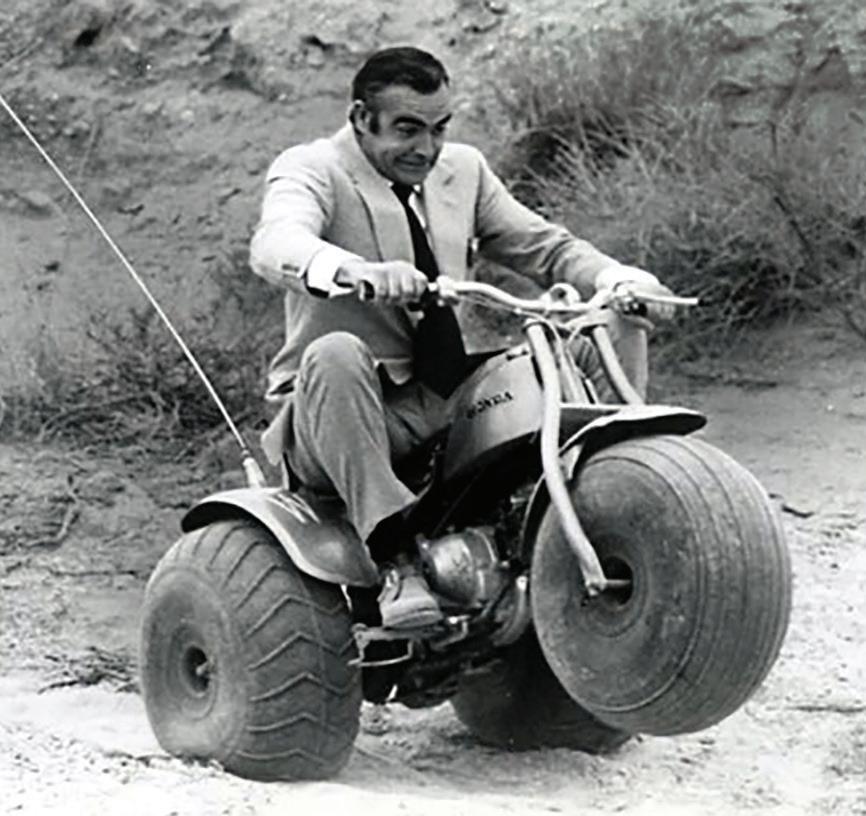
Sean Connery, aka Agent 007, on the ATC in the 1971 movie Diamonds Are Forever.
open riding areas, was perfect… picturesque, and packed with terrain ideal for the US90’s capabilities.
“That Pismo event in late ’69 was crazy,” says longtime and nowretired Honda associate Donovan Fuhrmann, who worked the event and who still has the embroidered yellow coveralls he wore during it, complete with the ATC logo and “All Terrain Vehicle” on the back. “It was a weeklong affair,” Fuhrmann remembered, “with us doing lead-andchase demo treks with dealers over the dunes and trails all day and every day. We had a ton of US90s there. Honda flew dealers in from around the country in groups, and for the most part they seemed to have fun — though a few got hurt. There was some crazy riding going on that week, some of it by our own president!”
The big question, of course, was how
the dealers would respond to the machine, and its potential for sales success. “Most seemed to have a hard time seeing the market,” said Fuhrmann, “unless, of course, they lived near sand dunes or maybe a gravel pit.” Given the unproven
little weird, and wondered if there was a market or buyers for it.”
“The ATC/US90 was a surprise to us. We’d been doing research on alternative products at the time…3-, 4-, 6-wheelers, etc. But we hadn’t moved on any of them.”
ED BURKE
new category, and the unit’s nontraditional look and makeup, that’s understandable.
Honda insiders weren’t sure the US90 had a future, either. “I was in Honda’s auto division when the US90 was introduced,” said longtime American Honda President Tom Elliott. “As a motorcycle rider since the early 1950s, and a CL72 owner since 1963, I thought the US90 was a
Still, times were good, motorcycle sales having set records for several straight years, and dealers bought plenty of US90s despite not really knowing what they were getting into. “I was working at a dealership when the bike debuted,” said longtime Honda advertising and PR man Jon Row, “and I remember having the feeling that our dealership — and others — didn’t quite ‘get’ the concept. It was just so different. When we uncrated the first one that arrived, we found we couldn’t get it out the door, so we had to remove a wheel and slide it through sideways!”
Many dealers promoted the non-traditional machine and its unique functionality in distinctly nontraditional ways. Mike Palmgren, one the world’s premier US90/ATC restorers and the man who restored the blue unit photographed for this
American Honda realized early that a lot of folks would ask the question, and provided answers in sales and marketing materials from the very beginning. Clever engineering was everywhere on the US90.
story (as well as the ATC90 on display in Honda’s Collection Hall museum), remembers hearing some of the stories. “The US90 will float on its tires,” he told me, “so several dealers over the years told me how they floated the machines in kiddie pools at their dealerships and at places like shopping malls to attract attention. They said I wouldn’t have believed all the people coming into the dealership wondering about this new machine.”
chase scene, which featured Sean Connery. A lot of people were exposed to the machine from the movie. Honda was very smart about US90 promotions.”
Not long after its debut, the US90 officially became the ATC90, Honda having successfully trademarked the “All Terrain Cycle” moniker. Its model-ID prefix would come to mean Big Fun for hundreds of thousands of riders over the coming decades.
“One dealer placed a couple of US90s at a local fairground on weekends,” Palmgren added. “His guys would ride around and convince people to let them run over their feet so they could see the soft footprint the bike had. That was part of the bike’s original concept; having the lightest possible footprint, even lighter than a human’s. And then there was the James Bond 007 movie Diamonds Are Forever. I was recently involved with the restoration of one of the bikes used in the movie’s
ATC introduced many people to motorcycling who wouldn’t have been interested otherwise. This machine, and ATVs that came later, definitely helped grow the sport. Soon the things were everywhere, at least at SoCal sand dune spots such as Glamis and Pismo, and of course out in the desert. They were better than most bikes on the sand.
“Instead of a family having one expensive dune buggy or sand rail,” remembered American Honda
THE INDUSTRY’S TAKE
“The ATC/US90 was a surprise to us,” said Yamaha’s Ed Burke. “We’d been doing research on alternative products at the time…3-, 4-, 6-wheelers, etc. But we hadn’t moved on any of them. I remember thinking the bike was pretty neat when I first saw it. The off-road market was really peaking at the time, and the ATC seemed like it could be a good fit. People could start their kids out on these if motorcycles were a bit intimidating. I’m sure the
associate Craig Crippen, who rode, owned and modified ATC90s for years after their introduction, “parents could buy everyone one — and everyone could ride, not just be a passenger. It really expanded the enthusiast base, as you didn’t have to be a motorcyclist per se to get involved.”
But as popular as the $595 ATC90 quickly became in Southern California, sales were spotty elsewhere. “In the rest of the U.S.,” said a Midwest district sales manager
for Honda during the early ’70s, “retail sales were uneven. One dealer with a riding area nearby, maybe a gravel or sand pit, or a good trail system, would sell a ton of the things in a season, while another dealer, maybe 30 miles away, and maybe in a more urban setting, would sell three. And without a Polk-style system in place to count and communicate what was happening where, a lot of dealers remained in the dark.” ATC90 sales during the first few years
“that the ATC is much more at home in loose sand or dirt than it is on the harder packed stuff. Snow would be another surface that would be ideal for this new Honda. Although there is no suspension system, the tires more than make up for it. With only two pounds of air in them, the ride is unbelievably soft…”
Cycle World found the ATC plenty fun. “By dint of heavy muscle on the handlebars, a judiciously applied throttle, and body lean to
averaged approximately 10,000, with 100,000-plus being sold by 1978, the machine’s final year of production. By then, the line had expanded to include the ATC70, with the mostly new ATC110 taking over the 90’s lineup spot that year.
MEDIA MATTERS
The magazines of the day were lukewarm about the ATC90, writing both positively and negatively about the balloon-tired terror. “You’ll find very quickly,” wrote Cycle Guide ,
you think you’re flying. Because of the short wheelbase and the super-soft tires (suspension?) the rider finds it a handful the minute the going gets a little rough.”
In the end, Cycle World put it right. “But the Honda is fun, despite its histrionic aspect, and does several of its appointed duties rather well. It climbs stairs. It jumps logs. Or butts them out of the way. It has excellent flotation on sand. Finally, it is so well made and tough that it is
the outside of the turn (against all logic), it turns. Wheewoo, the inside wheel is in the air! As one of us remarked, ‘It’s the first time I’ve ever been excited at 10 mph!’”
Of course, editors also noted obvious shortcomings. “In anything but soft sand,” wrote Guide, “turning at any speed at all can be a rather dodgy affair. Over 30 mph, turning can be almost frightening. Huge gobs of body English are necessary to accomplish more maneuvers…” Continued World: “At 15 or 20 mph,
nearly indestructible — an important feature considering the numerous roll-overs to which it will succumb.” Unfortunately, those final words would prove haunting years later… But we’ll get to that.
THE UTILITY ANGLE
If buyers were hesitant to fully embrace the 3-wheel concept en masse, farmers, workers and utility types had fewer reservations, especially as the machine became more saturated in the public’s
MIKE’S MASTERPIECE ATC
When the Honda Collection Hall called, ATC90 restoration guru Mike Palmgren answered
When I heard from my buddy Andrew Hyman (above, left) that Honda was looking for a restored and stock ATC90 for its Collection Hall museum in Japan in the early 2000s, I knew I had to throw my hat in the ring. After all, I’d restored 15 of the things by that point (and probably 20 more since then) and didn’t think anyone had the expertise I did with this particular model.
When Honda agreed to my proposal (wow!) I got to work, first finding a lowVIN carcass and then setting aside the very best brand-new NOS parts I had in my collection. Collection Hall manager Yutaka “Tony” Ikeda (above, middle, next to me) even visited me early in the restoration process to be sure we were all on the same page regarding details and quality, and I couldn’t have asked for a nicer guy to deal with.
I have to say, I have never been so nervous about a restoration in my life, as I’ve always loved and respected Honda’s commitment to quality and pushing the design envelope.
The resto took a few months to complete, and when the bike finally arrived in Japan, I was beside myself wondering what they thought of it. Tony called me a day or two later and said they’d not only uncrated and detailed it, but had already placed it on the museum floor!
I will be forever grateful for the opportunity to contribute, and knowing my work will forever be preserved in such a pinnacle museum is priceless. I have done a lot of ATC restorations, but this was the biggie. — Mike Palmgren
psyche. “We started to see them being used in all sorts of utility situations,” said one Honda insider, “and that surprised us a little, as the original concept was primarily recreation. Farmers and ranchers were natural users, as were many other utility types.” A roofing company in LA reportedly used ATCs to transport materials atop flat-roofed industrial buildings; they craned them up into the air, and due to the bike’s soft footprint, workers could ride right over the soft tar and make very little imprint.
Of course, Honda product planners took note of the trend, and over the years accumulated data that would eventually lead to utility-specific models (beginning with the rackequipped ’82 ATC200 Big Red), which eventually helped double the size of the already large ATV market.
But that was the 1980s. During the ’70s, the ATC90 (and the very similar ATC110 that replaced it in ’79) ruled the roost, and basically had the entire category to itself. Honda introduced the tiny, kid-friendly ATC70 alongside the Elsinore 250 in ’73. But when it came to a fullsized, bread-and-butter machine, the ATC90 — which changed very little during its 8-year production run, and stayed exactly the same during its first five years of production, was it, the only game in town.
PATENTLY TRUE
What allowed Honda to basically monopolize the market during the 1970s were Takeuchi’s patents, which kept companies such as Yamaha — who’d very much wanted in on the All-Terrain market — on the sidelines. “The patents certainly held us back for a number of years,” recalled Yamaha’s Burke. “We’d have gotten into it much sooner if [the patents] hadn’t been in place.”
In the end, Yamaha didn’t enter the market with its first Tri-Moto until 1980, and even then it had to be clever to get around some of the patent restrictions. “When we
“By dint of heavy muscle on the handlebars, a judiciously applied throttle, and body lean to the outside of the turn (against all logic), it turns. Wheewoo!”
CYCLE WORLD
finally jumped in, in 1980,” Burke said, “we shipped the machine with 2-inch footpegs that didn’t run afoul of one patent; dealers had to install the correct parts before they sold units!” The 2-stroke, 123cc Tri-Moto was indeed a 3-wheeler, but was comprised differently than the ATC, its engine positioned back between the rear wheels instead of in the more normal, below-tank position.
Eventually, Yamaha – and others – bit the bullet and paid Honda royalties until the patents expired.
But paying that price was worth every penny. “Once we got into [3-wheelers],” remembered Burke, “ATV sales became a significant part of our business. And in the early to mid ’80s, [3-wheelers] literally took over a good portion of the off-road market. Bike sales declined, but 3-wheeler sales grew. It was a very interesting time. In many ways, ATVs have helped buttress the industry and keep dealers alive during significant downturns. You saw this in the middle and late ’80s, and you’ve seen it again during the downturn of 2009 onward. That in itself is significant.”
Not only was the ATC90 fun, enthusiasts also discovered how cleverly designed it was. “Honda
made the ATC90 easy to transport,” Palmgren said. “The axle came apart via a single nut; the handlebar swiveled like a CT90’s; footpegs folded in to take up less room; and the entire rear fender assembly could be removed with the flick of a lever. It wasn’t easy to lever one into the trunk of a car, but it was done. And pickups and El Caminos had no trouble at all.
March of 1988, which continued the stop sale of 3-wheelers and forced freeof-charge training, a public-awareness program, improved labeling, age recommendations and more on the Japanese OEs and Polaris.
Despite that heavy dose of industry angst, it’s impossible to ignore the impact, significance and legacy of the ATC90. There’s the approximately 15
Some of these parts failed, but were quickly redesigned.
TROUBLED TIMES
Of course, an entirely different set of problems would eventually derail the ATC and 3-wheeler train in the 1980s — and lead to the rise of the 4-wheel ATV. A 3-wheel design’s inherent instability, coupled with doses of rider irresponsibility and a bit of opportunism on the part of some ATC owners and trial lawyers, helped bring the real and imagined issues of ATV injuries and “corporate malfeasance” to a boil — and to various government agencies, including the Consumer Product Safety Commission. All of this resulted in the famed Consent Decrees for All-Terrain Vehicles in
million units sold since 1970; the insane fun millions of riders and families have had in the last 53 years; the shops and dealerships – and the jobs, service and parts they provide – that exist because of the massive ATV industry that grew up around the ATC and its ilk over the years, especially during motorcycle-sales downturns; the massive aftermarket ATVs spawned; the racing they allowed; the help ATVs have provided to businesses, workers and doit-yourselfers; and today, the burgeoning side-by-side business.
All of this, one way or another, stemmed directly from Osamu Takeuchi’s little 3-wheel prototype. Come up with something to sell in the winter months, they’d instructed. We’d say Tak and his team did a pretty darn good job. AMA
Honda changed the ATC90 very little through 1978, with conventional wheels and tires fitted to its ATC110 replacement in 1979.
MAKE IT YOURS
The AMA offers a variety of card types and designs for members. In addition to our standard card, we offer a number of themed cards that identify you as belonging to a specific group or speak to your passion as a motorcyclist.
DEALS AND DISCOUNTS
THE ESSENTIALS
Lodging
Save 15% at participating Choice Hotels Properties.
Up to 10% off at Motel 6. Use code: M64AMA
20% discount off available rates, call (800) REDROOF and use the code VP+ 503343. To make reservations online use code: VP+ 503343 in the field labeled “VP+/ID#”
AMA Roadside Assistance Roadside assistance coverage for eligible members.
Car Rentals
Up to 25% off at any Avis or Budget. Avis Code: D388100 Budget Code: Z942000
Motorcycle Shipping Call Federal Companies at (877) 518-7376 for at least $40 off standard rates.
Motorcycle Shippers AMA members receive $50 off each bike one way or $100 off round trip or $50 each, multiple bikes, same addresses. AMA Gear Find patches, pins, T-shirts, hats and more.
PRODUCT DISCOUNTS
ADVMoto 20% discount. Use code AMADV20
AMA Motorcycle Hall Of Fame Free admission to the AMA Motorcycle Hall of Fame in Pickerington, Ohio.
AMA Supercross Tickets
Save $5 on up to 8 tickets at supercrosslive.com Use code AMA23
Anthony’s Leatherworks 10% discount on repair order Use code AMADISCOUNT
Blendzall
AMA members can save 20% at blendzall.com. Use code AMA20 at checkout.
Bohn Body Armor
10% AMA Member Exclusive Discount. Visit bohnarmor. com and use code AMAD22 at checkout.
EagleRider For Club EagleRider AMA members receive 2 free rental credits. Use code AMACLUBER
Edelweiss AMA members save on standard bike tour. Use code 21AMA-EBT03 at checkout.
Evans Cooling System
25% discount on Evans Coolants and Prep Fluid. Use code AMAFUN at evanscoolant.com.
EVS Sports 10% discount and free shipping on all orders. Use code AMAEVS20
Gryphon Moto
AMA members receive a 15% discount on Gryphon Moto orders at gryphonmoto.com. Use code AMA at checkout.
Haynes Save an additional 15% on all Haynes & Clymer print and online repair manuals. Use code AMA15
MAD Maps Save 15%. Use code AMA15
Matrix Concepts AMA members receive a 25% discount on most products for shop, garage & track necessities at matrixracingproducts.com Use code AMA25
Medjet
Air medical transport and travel security protection – visit Medjet.com/AMACycle or call 1.800.527.7478, referring to American Motorcyclist Association. Annual rates reduced by 20% and start at $235.
MotoAmerica
20% off 2-day and 3-day passes at select MotoAmerica events. Use discount code AMA20
Motool
AMA members can save 10% at motool.co. Use code AMASAVE20 at checkout.
Rockwell Time
Save 20% on select products. Rockwelltime. com. Use code AMA20
Butler Maps
AMA members receive a 20% discount at butlermaps.com. Use code AMAMEMBER Bugslide
AMA members enjoy 15% off all BugSlide® cleaning products. Use code AMA2023
Heli Bars Use code AMAM2020 for a 10% AMA Member Exclusive Discount at helibars.com.
Helix Racing Products
California Dual Sport Riders Members save 50%. Use code AMA. Visit cdsr.us to learn more.
Cardo Systems 20% discount online with valid AMA membership card. Use code AMA20
Colorado Motorcycle Adventures
10% discount with valid AMA membership card.
The Dirt Bike Academy 10% exclusive discount on instruction. Learn more at thedirtbikeacademy.com Use code TDBAAMA10
Dowco Powersports
20% discount.Use code AMA20
AMA members save 20 on all products at helixracingproducts. com. Use code AMA20 at checkout.
Helite Moto
AMA members get 15% off every order at helitemoto.com. Use code HELITEAMA
HertzRide
AMA members save 10% on rentals in all locations globally at hertzride.com/us/ promo/American-motorcyclistassociation-1065 or use code AMA10
Legacy Track Dayz 15% discount on Legacy Track Dayz events. Use code AMARideLTD
Liberty Sport Eyewear
30% discount on all “motorcycle collection” frames. Discount code AMA30.
MX Boot Repair 10% discount. Use code AMADISCOUNT
MX Mounts 10% off on our mounts Use AMADiscount at checkout
MYLAPS
20% discount off MSRP or current sales price on weborders or orders coordinated by the AMA. Use code AMA-789HJK
Nelson Rigg 20% AMA Member Exclusive Discount on all products! Use promo code AMA-NR20
The Quail MC Gathering AMA members recieve a discount on tickets using the code AMA2023
Quin Design Helmets 10% off crash detection, SOS beacon, Bluetooth communication & more with your new intelligent helmet. Use code AMAQUIN10
Concepts 15% off products at stkrconcepts.com. Use code AMA15
COMING EVENTS
Be sure to check the event website or call the organizer for the latest information, including postponements or cancellations.
Road Race: Sept. 4. Loudon. USCRA Granite State Championships, United States Classic Racing Association, raceuscra@yahoo.com, www.race-uscra.com
NEW JERSEY
Speedway: Sept. 2 - 3. Millville. ASRA Team Challenge Round 5, American Superbike Racing Association LLC, support@ asraracing.com, https://njmp.com/ Motocross: Sept. 2. Englishtown. Raceway Park Motocross Saturday Night Lights Series, Raceway Park, racewaypark1965@gmail.com, www.racewaypark.com
Motocross: Sept. 3. Englishtown. Raceway Park Motocross , Raceway Park, racewaypark1965@gmail.com, www. racewaypark.com
Motocross: Sept. 17. Millville. Field of Dreams MX, Field of Dreams MX, LLC, info@njmpfod.com, www.njmpfod.com
Motocross: Sept. 29 - Oct. 1. Englishtown. 47th Annual Race of Champions sponsored by Kawasaki, Raceway Park, racewaypark1965@gmail.com, www.racewaypark.com
Hare Scrambles/Cross Country: Sept. 23 - 24. Clifford. ECEA High Steaks Hare Scramble, Delaware Valley Trail Riders, dvtrevents@gmail.com, dvtrailriders.org
Road Ride/Run: Sept. 23. York. TRLR Ride for HOPE, Twin Rose Lady Riders, gnattrlr@gmail.com, twinroseladyriders.com
Flat Track - TT: Sept. 24. Parkesburg. Piston Poppers TT, E PA Piston Poppers MC Inc, pistonpoppersmc@hotmail.com, pistonpoppersmc.com
PAGE
Down ’n’ Dirty in Du Quoin
By the end of the week-long 2023 Mission Foods AMA Flat Track Grand Championship at the Du Quoin State Fairgrounds in Du Quoin, Ill., there had been more than 800 race entries, and the AMA presented 22 No. 1 plates and four prestigious awards with help from “The Voice of Flat Track” — and Grand Marshal — Scottie Deubler. From kids on 50cc bikes on the Short Track to veterans taking on the Magic Mile, there was plenty of bar-bangin’ action on the dirt at Du Quoin. — Joy Burgess
PHOTOS: SAMANTHA LOUCKS
Ride
your own way.
There are many things about riding that are dictated by habit. How you twist the throttle, how far you lean and where you go is up to you. The only thing that matters, is that you ride to get there.