Safety First: States Mandating Testing Before Licensing
Do You Live In The Best City To Be A Motorcyclist?
Photo Katy Weaver
YOUR JOURNEY IS ABOUT STAYING AHEAD OF THE CURVE.
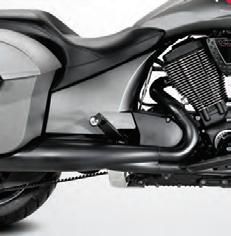
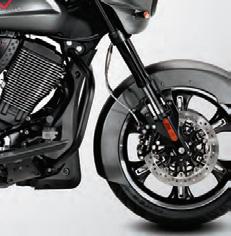
INNOVATIONS FOR MILES. Equal parts cruiser and sport-tourer, the CTX1300 has a 1261cc V-4 that delivers endless torque for the city and top-end power and comfort for longer rides. Plus, it’s loaded with advanced features like available ABS, traction control and Bluetooth® audio. The CTX1300 is different for all the right reasons.
American Motorcyclist magazine (ISSN 0277-9358) is published monthly by the American Motorcyclist Association, 13515 Yarmouth Dr., Pickerington, OH 43147. Copyright by the American Motorcyclist Association/American Motorcyclist 2014. Printed in USA.
Subscription rate: Magazine subscription fee of $19.95 covered in membership dues.
Postmaster: Mail form 3579 to 13515 Yarmouth Dr., Pickerington, OH 43147. Periodical postage paid at Pickerington, Ohio, and at additional mailing offices.
August 2014
Volume 68, Number 8
Published by the American Motorcyclist Association 13515 Yarmouth Dr. Pickerington, OH 43147 (800) AMA-JOIN (262-5646) www.americanmotorcyclist.com
STREET EDITION
States adopt mandatory safety training requirements, and clubs sound off on sound testing.
DIRT EDITION
Families that race together stay together, and off-highway groups work to expand access.
To switch the version you receive, call (800) 262-5646, ask for membership services. Want to read both versions? Call the above number to get both delivered to your home for just $10 more a year. Members can read both versions online at www.americanmotorcyclist.com/magazine for free.
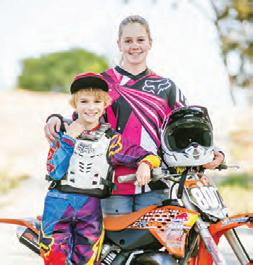
PAGE 26. TEAM MALISKA
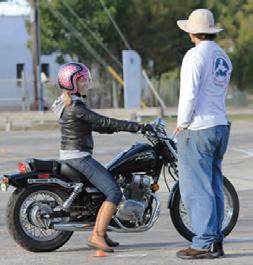
PAGE 26. GET TRAINED
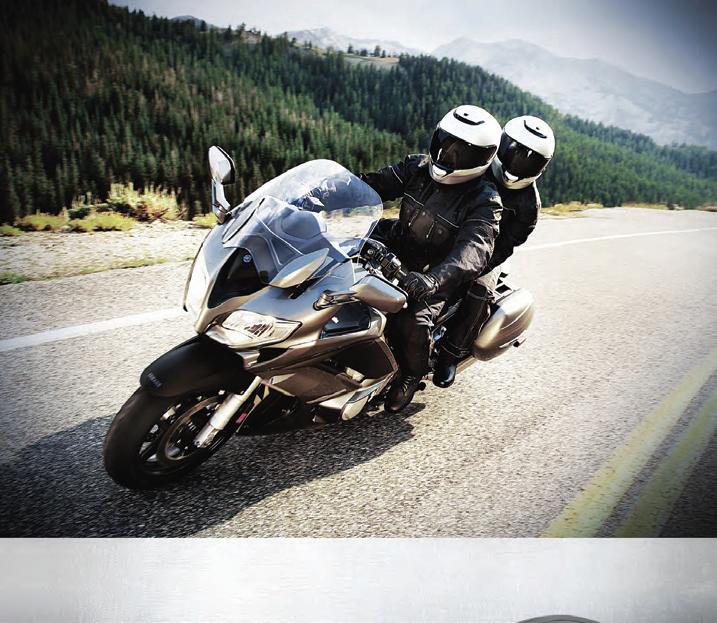
PAGE 20. AMERICA’S BEST CITIES FOR MOTORCYCLISTS
Sometimes, the best way of saying something is also the simplest. The Battlax Sport Touring T30.
Kevin Crowther, Director SX & Pro Racing Relations
Bill Cumbow, Director of Racing
Alex Hunter, MX Operational Coordinator
AMA RACING/ORGANIZER SERVICES (continued)
Tamra Jones, Racing Coordinator
D’Andra Myers, Organizer Services Coordinator
Ken Saillant, Track Racing Manager
Cherie Schlatter, Organizer Services Manager
Serena Van Dyke, Organizer Services Coordinator
Chuck Weir, Off Road Racing Manager
Conrad Young, Timing & Scoring Manager
DISTRIBUTION/FACILITIES SERVICES
John Bricker, Mailroom Manager
Heida Drake, Copy Center Operator
Bill Frasch, Mailroom Clerk
GOVERNMENT RELATIONS
Marie Wuelleh, Government Affairs Assistant
Danielle Fowles, Grassroots Coordinator
Nick Haris, Western States Representative
Sean Hutson, Legislative Assistant
Sharon Long, Legislative Coordinator
Rick Podliska, Deputy Director
Steve Salisbury, Government Affairs Manager - Off-Highway
Imre Szauter, Government Affairs Manager - On-Highway
INFORMATION TECHNOLOGY
Rob Baughman, Network Administrator
Dave Coleman, Network Architect
Amy Hyman, Senior Programmer/Analyst
MEMBER SERVICES/DATA ENTRY
Lori Cavucci, Member Services Representative
Deb D’Andrea, Member Services Representative
Linda Hembroff, Member Services Representative
Darcel Higgins, Member Services Manager
Kimberly Jude, Member Services Representative
Tiffany Pound, Member Services Representative
Jessica Robinson, Member Services Representative
MEMBER LETTERS
Letter of the Month
BE CAREFUL OUT THERE
Send your letters (and a high-resolution photo) to submissions@ama-cycle.org; or mail to 13515 Yarmouth Drive, Pickerington, OH 43147.
There have been numerous articles, opinions, letters, etc., written to the AMA regarding mufflers, lane splitting, insurance issues, motorcycle-only checkpoints, public relations, etc. I am writing about a very real, ever-growing and extremely dangerous threat to our pastime, and that is the many different problems posed by the repli-racer crotchrocketeers who treat our roads like their own private Isle of Man. We’ve all seen them, after they have blasted past us doing a ton on crowded roads that are strewn with pot holes, road kill, and chunks of dismembered retread. You think the slightly “too loud” muffler on my Harley is enraging J.Q. Public and his “perception” of bikers? What about these selfish idiots weaving through traffic at speeds that would make Mike Hailwood blanch, while doing wheelies and stoppies? They act like their $600 helmets will keep them safe.
Recently, the son of a friend of mine was driving his car on a Westchester County, N.Y., parkway at 55 mph when he was rear ended by one of those rocketeers. The force of the impact was enough to spin his car 90 degrees, where he was promptly T-boned by the next racer. The first rider walked away with bumps and bruises. The second was DOA. My friend’s son is physically fine, but has trouble sleeping, and will live with the memories of being in a fatal motor vehicle accident for the rest of his life. I wasn’t a physics major, but I can’t imagine what the requisite speed would be for a 400-plus pound bike to spin a 2,400-pound car moving in the same direction.
I’m a Charter Life Member of the AMA, a 24-year member of ABATE of N.Y., and have logged more than 250,000 miles since I first climbed on a Bridgestone 90 back in ‘68. I’m pretty sure I can securely say that most of these kamikaze pilots are not involved in the AMA, so even if you publish this letter, they won’t see it, let alone read it.
I truly wish I could offer suggestions, let alone solutions, to alleviate this pockmark on our sport. But I can’t. Somehow, however, it needs to be addressed and dealt with because this suicidal behavior will kill riding for us all.
Campbell Whitford Stormville, N.Y.
ONE GREAT ROAD
Thank you for publishing Chris Malvone’s “On the Road to Renewal” (June 2014). I really enjoyed it. I made a note of his top 10 roads. I’ve ridden most of them but not all. I will defi nitely try to make up for that defi cit soon. Of note was California Highway 155. Last summer my wife and I rode from our home in Texas to Fairbanks, Alaska, (my Gold Wing and her VTX) with a goal of visiting as many national parks as possible. By pure accident we stumbled on 155 along the way. Every couple of days we’d blog about our adventure. After riding 155, this is what I sent out: “If you are a motorcycle rider, pay attention to this. Highway 155 from Kernville west for 30 miles was the best motorcycle road I have ever ridden.
Granted, I haven’t ridden all the great ones. But after 43 years of riding, I’ve ridden quite a few, and this was the best one of my life. I need to go back and check, but it seems like we had 5,000
feet of elevation change over about eight miles and then back down for eight more, followed by another 15 miles or so of twisty turns. I can’t even begin to guess how many hairpin turns we had over 30 miles. It was great. If we had to come home tomorrow, the whole trip would be worth it for those 30 miles.”
Fortunately for us, we didn’t have to come home after riding 155. We ended up riding 11,700 miles over 47 days. It was great. But this summer we are already planning a return trip to Highway 155.
I certainly recommend this road to all riders.
Scott Finnell Georgetown, Texas
CHEAP TRAVELS
I could have written this same article [as Chris Malvone], but we did much of the same route only in the reverse direction. We started out in North Carolina and went up the coast to Maine and then across the northern parts of the country and a little into Canada. We made a left turn at the Oregon coast and headed southward. We then took another left to do the southern portions of the United States. We took fi ve weeks and traveled more than 10,000 miles through 30 states. Is our bucket list empty? No way. It only whetted our appetite for more.
We kept track of all expenses and kept within a budget. Including tires, oil changes, food, fuel and lodging the total cost was $6,022—34 days or $177 per day. Our plan was to stay below $200 per day. Looks like we did fi ne. Many people spend this much for a week long vacation in a place that is crowded with people who are not happy being there. And it’s only one week. This was fi ve weeks.
We are in the early stages of planning another long two-wheeled adventure.
Each month, a lucky AMA member wins a Bike Bandit gift card worth $100. Didn’t win? No worries. You can still take advantage of your 10% AMA member discount at BikeBandit.com.
Scott Finnell
Howard Bond
There’s so much more to see and do. I am on my 11th bike and just passed the 325,000-mile mark for total miles on two wheels.
And thank you AMA for keeping us all updated on issues that pertain to all motorcyclists.
Howard Bond Myrtle Beach, S.C.
OnE CLaSS WiLL DO
The “Women of Off-Road Racing” article in the July issue was great. I really appreciated the coverage of all the different disciplines. What I personally would find really cool, though, would be a look at track racing, especially road racing, land speed racing and dirt track. At these events, it’s traditional for the men and women to race against each other rather than in their own classes. There aren’t many sanctioned and organized sports that do that!
Alexia Bennett Darwin, Ohio
Sound Off!
On E15 ethanol…
Pete Livorsi: I am noticing more and more gas stations in the Chicago area converting their pumps to blender types. Makes me nervous to think what may happen to motorcycles, ATV’s and other small engines if the E15 lobbyists get their way. Let’s face it, congressional voting is nothing more than an auction. Votes go to the highest bidder. Need to stay vigilant on this matter.
On top motorcycling vacation spots…
Tim Wisner: I will have to wait until I have ridden everywhere before I can choose a favorite.
Get ready for Daytona Beach’s Biketoberfest® 2014. Four days of sun, sand, concerts, bike races and so much more. Don’t miss the time of your life. Come seize the day. Better yet...
A roundup of recent comments on our Facebook page at www.facebook.com/americanmotorcyclist OCTOBER 16 - 19, 2014 For more information, visit Biketoberfest.org or call 1-866-296-8970.
On motorcycle thefts…
John G. Rice: I guess my old bikes aren’t all that attractive. I once had a thief steal the cover off mine...and leave the bike!
On cool motorcycling photos…
Jessica Skeans: Pioneer Motorcycle Club Hillclimb, 85 junior and senior classes waiting to go.
Photo courtesy of the Daytona Beach News Journal
VIEWPOINT
ON THE OUTSIDE LOOKING IN
Motorized Recreation Excluded From Great Outdoors Month
In proclaiming June Great Outdoors Month, President Obama noted: Our natural landscapes provide refuge for those seeking solitude. They attract tourism, create jobs, and honor our history and cultural heritage. They are family campgrounds, arenas for recreation, and backdrops for countless adventures.
By Steve Salisbury
Of course, the AMA endorses all manner of outdoor recreation for their many benefits. I know of very few powersports enthusiasts who don’t also visit parks to sightsee, hike, camp or mountain bike and certainly don’t see a need to curtail the activities of those who choose only automobile or humanpowered activities. It is hard to argue that outdoor recreation doesn’t positively affect both the participating individual and the communities in which he or she does so.
The state of Colorado supported those assertions. The 2014 Colorado Statewide Comprehensive Outdoor Recreation Plan included the following: “Colorado’s economy and quality of life are integrally connected to the abundant and diverse array of outdoor recreation opportunities found within our state. Outdoor recreation contributes more than $34.5 billion statewide in annual economic activity and generates over $4.9 million in annual federal, state and local tax revenue while creating 313,000 jobs. Equally important is the fact that outdoor recreation plays an important role in promoting public health, tourism, environmental stewardship and efforts to connect more Coloradans to the outdoors.”
However, current policies seemingly serve only the hale and hearty and ignore those who are less-abled and need assistance to enjoy America’s natural beauty.
In fact, the Great Outdoors Month proclamation ignored the millions of responsible OHV users who contribute hundreds of millions of dollars (not to mention volunteer hours) annually to the economy through their purchases of vehicles, trailers, fuel, food and lodging. And the president failed to note the financial support for local, state and federal programs made by motorcyclists and all-terrain-vehicle operators who buy permits, pay gas taxes and pay fees to use our public lands.
Study after study shows that OHV users provide more economic benefits to the areas in which they ride than those who visit OHVrestricted Wilderness areas.
Among the more notable, an August 2012 report by Southwick Associates for the Outdoor Industry Association lists more than $47.5 billion in spending on vehicles, parts, maintenance, insurance, registration, apparel and storage related to motorcycling and off-road riding.
Also, a June 2011 issue brief published by the Jon M. Huntsman School of Business at Utah State University concludes, “Specifically, we find a significant negative relationship between the presence of Wilderness and county total payroll, county tax receipts and county average household income.”
In proclaiming June Great Outdoors Month, the president went on to say: “Together, let us ensure our children and grandchildren will be able to look upon our lands with the same sense of wonder as all the generations that came before.”
We’re afraid that is just about all that today’s children and future generations will be able to do: view America’s natural wonders from afar, on a video screen or in a photograph. Instead of developing the next generation of environmental stewards,
current policies are locking up millions of acres of public land from taxpayers. Lost will be the experience of recreating responsibly on—and appreciating the conservation of—America’s public lands.
The Great Outdoors Month proclamation also referenced First Lady Michelle Obama’s Let’s Move Outside! Initiative, encouraging “children to get active while getting to know the great outdoors.”
Yet his message ignored the health benefits and bonding that occur when families and friends gather to enjoy a day or a weekend of off-road adventures astride their off-road motorcycles, ATVs or other OHVs of choice.
A common comment we hear in Washington from AMA members is that public lands are our lands. Policies that unnecessarily increase designated Wilderness to disallow motorized recreation hardly encourage everyone to enjoy what is theirs. And that applies especially to decisions that circumvent Congress and dismiss the accomplishments of advocates of motorized- and non-motorized recreation who collaborate on effective and acceptable travel management plans.
The off-highway motorcycle community has proven itself to be made up of responsible stewards who volunteer innumerable hours to build and maintain sustainable trails. We’ve demonstrated that by taking part in our sport and providing enormous economic benefits to local and state economies.
Enlightened anti-OHV activists know they have to be careful not to curtail motorized recreation too much, since our community is the goose that lays the golden trail-funding egg through our gasoline taxes, which support the Recreational Trails Program.
As off-road enthusiasts talking to off-road enthusiasts, we hope you had a great month of outdoor recreation in June, as the riding season got into full swing for many. Whether you choose to visit public lands on or off your motorcycle or ATV, we also hope that you keep our hard-earned legacy in mind.
Remember this, and remind your riding friends: There is a very real need for everyone in the motorized community to be involved in increased stewardship and access-to-public-lands advocacy. As our user numbers increase and the positive economic impact we have on our communities expands, our commitment to the AMA needs to grow as well to help ensure our voice is heard in future designations, such as Great Outdoors Month.
Steve Salisbury is the AMA off-highway government affairs manager.
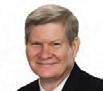
THREE QUESTIONS WITH… U.S. SEN. TIM JOHNSON (D-S.D.)
Sen. Johnson is chairman of the Banking, Housing and Urban Affairs Committee and serves on several other committees, including the powerful Appropriations Committee. He is retiring at the end of this term and took a few moments to talk about motorcycling and tourism.
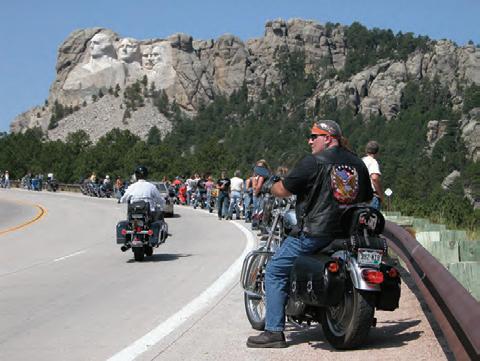
AMERICAN MOTORCYCLIST: The Sturgis Motorcycle Rally is celebrating its 74th anniversary this year. What impact has this event had on your state?
SEN. JOHNSON: The Sturgis Motorcycle Rally started out as a small gathering in the late 1930s and early 1940s, before becoming a regional draw in the 1960s. Now, every motorcycle enthusiast knows where Sturgis is, and many attend year after year.
The rally attracts hundreds of thousands of visitors each August. It is estimated that
motorcyclists spend hundreds of millions of dollars during the Rally.
AM: What is your favorite route in South Dakota?
or the Prairie Potholes Region in eastern South Dakota, you will get a one-of-a-kind riding experience.
Many of the roads throughout the state will take the rider through small communities, and those who stop at a convenience store, gas station, or city park are sure to be greeted with a friendly South Dakota welcome.
SEN. JOHNSON: South Dakota offers the motorcycle tourist a unique riding experience. There are numerous roads throughout the Black Hills that give the rider a true sense of the aesthetic beauty of the Black Hills.
There are the Pigtail Bridges on Iron Mountain Road leading to Mount Rushmore, the Pinnacles Highway in Custer State Park, and the scenic S-curves through beautiful Spearfish Canyon.
Whether you ride through the forests in western South Dakota, the stunning geologic formations of the Badlands, the open expanses of farmland and prairies,
AM: Is there anything you would like to add?
SEN. JOHNSON: I have enjoyed my rally experiences, and I encourage those who have never been to Sturgis and South Dakota to put it on their vacation bucket list. If they’ve been to Sturgis before, I’d encourage them to come back. There’s always something new to see and experience.
FEDERAL TRANSPORTATION BILLS INTRODUCED
Two Proposals Contain Issues Affecting Motorcyclists
The transportation bills announced by the Obama administration and the U.S. Senate Committee on Environment and Public Works retained funding for the Recreational Trails Program.
The RTP is an $85 million annual program that funds motorized recreational trails. This program is paid for through the excise tax that off-highway-vehicle users pay when fueling an OHV.
The president’s proposal, called the GROW America Act, also would boost funding by 22 percent for the highway trust fund by using tax revenue generated from a one-time repatriation of corporate profits.
The act also would increase the
funding for intelligent transportation systems (ITS) and vehicle-tovehicle (V2V) communications.
The National Highway Traffic Safety Administration says motorcycles will be included in future research related to ITS and V2V.
In the Senate, S. 2322—the MAP-21 Reauthorization Act, introduced by Sen. Barbara Boxer (D-Calif.)—is but one portion of the total transportation bill.
Important for all motorists—whether on two or four wheels—is that this proposal would continue highway funding for the next six years at current levels, plus inflation. This would provide planners with enough certainty to undertake long-term projects.
U.S. Sen. Tim Johnson (D-S.D.)
U.S. Sen. Barbara Boxer (D-Calif.)
PENNSYLVANIA CONSIDERS LIABILITY RELIEF
Change Would Help Landowners With Off-road Tracks, Trails
The AMA is supporting Pennsylvania H.B. 544, which has the potential to alleviate some off-highway-vehicle management issues and generate significant economic activity throughout the state.
SILURIAN VALLEY SOLAR PROJECT WOULD IMPACT TRAILS
AMA Voices Concerns To BLM
In addition, the AMA supports state Rep. Daniel Moul’s amendment A-06122 to the bill, but only that amendment.
Amendments offered by other legislators would clearly reverse the intent of the bill, such that private property owners would be discouraged from opening their land to responsible recreation of any sort.
The intention of H.B. 544 was to provide reasonable liability relief to landowners willing to open their properties to responsible OHV recreation.
Similar legislation has reduced illegal OHV use in other states and, more importantly, served as an impetus in creating billion-dollar recreation industries for some Eastern states.
AMA PART OF NATIONAL RENEWABLE FUEL STANDARD ‘DAY OF ACTION’
Group Calls For Overhaul Of Federal Ethanol Policies
A diverse group of organizations, including the AMA, has come together as “Smarter Fuel Future,” a coalition that coordinated a “Day of Action” in May in Washington, D.C.
Wayne Allard, AMA’s vice president for government relations, used the national stage to declare the federal government’s Renewable Fuel Standard a failed strategy that must be completely reconsidered because America’s engines, environment and food supply are endangered by the production, distribution and use of ethanol.
A massive California solar project approved by the federal government would be located alongside the famous Tonopah and Tidewater Railroad OffHighway-Vehicle Trail.
Wayne Allard, AMA vice president of government relations, sent a letter to Katrina Symons, the U.S. Bureau of Land Management’s Barstow field manager.
Allard outlined the AMA concern that the project may diminish the quality of the Tonopah and Tidewater OHV Trail by degrading its scenic attributes and potentially repurposing part of the trail for maintenance of the solar project.
“The trail is one of the few
expedition-quality OHV routes in the California desert,” Allard wrote. “Changes to the surrounding landscape that reduce the trails’ appeal to riders would adversely affect the local economy.”
The Silurian Valley solar project site is along State Route 127, about 10 miles north of Baker. The plan includes arrays of photovoltaic panels, 44 miles of service roads, and operation and maintenance facilities.
The project site encompasses 7,219 acres of public lands administered by the BLM in San Bernardino County.
AMA staff members and others called on officials from the U.S. Environmental Protection Agency to maintain its proposed 2014 renewable volume obligation.
U.S. Rep. Daniel Moul (R-Pa.)
ALLARD TESTIFIES BEFORE CONGRESS ON CLEAR CREEK ACCESS
AMA Supports H.R. 1776 To Allow OHVs
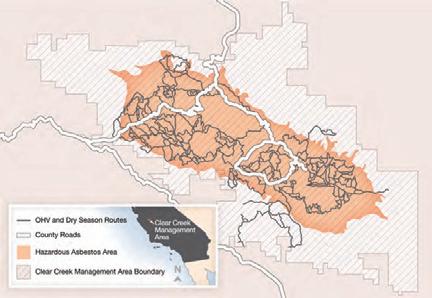
Wayne Allard, AMA’s vice president for government relations, testified before Congress in May in favor of legislation that would create the country’s first national OHV area in California’s Clear Creek Management Area.
The AMA supports H.R. 1776, the Clear Creek National Recreation Area and Conservation Act, which would reopen the CCMA for recreational use and designate about 21,000 acres of U.S. Bureau of Land Management land adjacent to Clear Creek as the Joaquin Rocks Wilderness.
The legislation would guarantee future access to the management area for offhighway-vehicle enthusiasts.
The bill is innovative in that it allows the BLM and state and local governments to form partnerships to improve the recreation experience in the CCMA.
Currently, the entire management area is closed to off-highway motorcycles due to concerns about naturally occurring asbestos.
However, the state of California’s Off Highway Motor Vehicle Recreation Commission published a study that revealed the levels of ambient asbestos to be less than the equivalent of smoking one cigarette a year.
The AMA’s concerns with the current BLM Record of Decision include:
• Many staging areas for OHV access are located in the Serpentine area; and
• Many trails run through the Serpentine area, which is situated in the middle of the CCMA, so restricting access to the Serpentine would eliminate routes.
The current policy permits enthusiasts to access the CCMA for only five days a year if participating in motorized recreation and non-motorized recreation just 12 days a year.
The 75,000-acre CCMA has been ranked as one of the top 10 places to ride by Dirt Rider magazine.
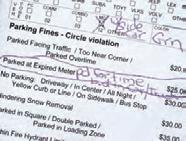
Down to the town of Old Orchard Beach, Maine, for keeping its confusing parking laws a secret. Troy R. Bennett, a columnist for the Bangor Daily News, couldn’t fi t his motorcycleand-sidecar rig into the motorcycle-only parking spaces, so he parked in and paid for a car space. He received a ticket for parking a motorcycle in a car/truck space, even though no signs were posted that informed him of the restriction. Bennett called it “a crime so made-up it’s not on the form.”
Up to Ohio motorcyclists Robert Woodland Sr. and Robert Woodland Jr., who interrupted an early-morning ride in May to help rescue a family of four, including a 4-month-old child, from a burning house. Woodland Sr. is a former firefighter.
Down to the driver who told police she was looking at her cell phone when she plowed into four motorcycles at a red light in Valley View, Ohio. Seven of the motorcyclists were injured, one seriously.
Up to the town of Brampton, Ontario, Canada, for creating a partnership with the Brampton Motorcycle Association for Motorcycle Mondays. The events, which run through the summer, are described as “meet and greets” and “show and shines.”
Troy R. Bennett
Off-Highway Issue Survey 2014
Every two years, the AMA’s Government Relations Department surveys association members to assist in establishing government relations policies and priorities. It is important for us to know how you ride and what you consider to be the important issues in motorcycling so that we can do the best job of setting AMA government relations priorities. This month, members are asked to share their views regarding offhighway motorcycling issues. Off-highway riding enthusiasts have done a great job of supporting this survey in past years. We hope you’ll continue that support by taking a few minutes to complete and return this survey by Sept. 30. If you don’t want to deface your copy of American Motorcyclist, please feel free to make a photocopy of the survey, complete the survey online, or download a PDF copy from www.americanmotorcyclist.com/offhighwaysurvey.aspx.
1. Are you an AMA member?
1.1 Yes 1.2 No
2. What is your ZIP code?
2.1 2.2 2.3 2.4 2.5
3. What is your age?
3.1
4. What is the last grade or class you completed in school? (Check one box only.)
4.1 Grade 8 or less
4.2 Some high school
4.3 High school graduate
4.4 Some college
4.5 College graduate
4.6 Post-graduate
5. What was your total household income last year? (Check one box only.)
5.1 Under $20,000
5.2 $20,000-$24,999
5.3 $25,000-$34,999
5.4 $35,000-$49,999
5.5 $50,000-$74,999
5.6 $75,000-$99,999
5.7 $100,000-$124,999
5.8 $125,000-$149,999
5.9 More than $150,000
6. What is your political party affiliation? (Check one box only.)
6.1 Democratic
6.2 Republican
6.4 Other (minor party, independent, etc.)
6.5 Not registered to vote
7. How many of the following motorized vehicles do you currently own?
7.1 ___ Street motorcycles
7.2 ___ Off-highway motorcycles
7.3 ___ ATVs
7.4 ___ Dual-sport motorcycles
7.5 ___ ROHVs (side-by-sides)
8. If you included a dual-sport motorcycle in your response to question 7, did you modify it to make it street legal in your state? (If you, or a previous owner, added lights, and/or other accessories to an off-highway motorcycle to make it street legal answer “Yes.” If your dual-sport motorcycle was originally manufactured for on-highway use, answer “No.”)
8.1 Yes
8.2 No
9. How many total miles did you ride your dual-sport motorcycles, off-highway motorcycles and/or ATVs in the last 12 months? (Check one box only.)
9.1 0-499
9.2 500-999
9.3
9.5
Mail in, or complete online at
10. Are your off-highway motorcycles or ATVs registered in your state as part of an off-highway vehicle program?
10.1 Yes
10.2 No
11. Your off-highway vehicles or dual-sport motorcycles are primarily used for: (Check one box only.)
11.1 Organized competition events
11.2 Organized Recreational events
11.3 Recreational riding, one day or less (not part of an organized event)
11.4 Backcountry touring (overnight or longer)
12. How many competitive or organized events did you participate in during 2013?
12.1 ___ Off-highway motorcycle events
12.2 ___ Dual-sport events
12.3 ___ ATV events
12.4 ___ Adventure tour events
12.5 ___ ROHV (side-by-side) events
13. In what type of competition do you most frequently participate? (Check ONLY one box.)
13.1 Enduro
13.2 Motocross
13.3 Hare & hound/harescrambles
13.4 Observed trials
13.5 Flat track
13.6 Other ________________________________
13.7 Don’t compete
14. How would you divide your recreational off-highway mileage among these five areas? (Your answers should total 100%.)
14.1 ___% National forest
14.2 ___% Federal Bureau of Land Management
14.3 ___% State land
14.4 ___% County/city/local public facility
14.5 ___% Private land
15. How far do you travel one way to the place you ride most often?
15.1 Less than 50 miles
15.2 50-100 miles
15.3 More than 100 miles
16. How many people, including yourself, are usually in your group when offhighway riding?
16.1 1 or 2
16.2 3 or 4
16.3 5 or more
17. How much do you and your group usually spend for food, accommodations and fuel on one of these trips?
17.1 $0-$99
17.2 $100-$199
17.3 $200-$299
17.4 $300 or more
18. How many gallons of fuel did you use for riding off-highway last year?
18.1 Less than 50
18.2 50 to 74
18.3 75 to 100
18.4 More than 100
19. Do you feel that special fees are an acceptable method for funding construction, operation and maintenance of recreational riding opportunities?
19.1 Yes
19.2 No
20. If your answer to question 19 is “yes,” which method do you prefer? (Check one box only.)
20.1 Annual registration fee
20.2 Per site, day-use fee
20.3 Other
Off-Highway Issue Survey 2014 (continued)
21. What do you feel is an acceptable annual registration fee per off-highway vehicle (motorcycle or ATV)? (Check one box only.)
21.1 $1-$15
21.2 $16-$30
21.3 $31-$50
21.4 More than $50
22. What do you feel is an acceptable day-use admission fee per person? (Check one box only.)
22.1 $1-$15
22.2 $16-$30
22.3 More than $30
23. Of the following issues, check the box on the left of that which you feel was the most important issue that motorcycle and ATV enthusiasts faced during the past two years. (Check one box only.)
23.1
23.5
23.6
24. In question 23 above, please check the box to the right for each issue with which you are not familiar.
25. Of the following issues, check the box on the left of that on which you think the AMA spent the most time. (Check one box only.) 25.1
31. If yes, with which of these groups did you volunteer? (Check all that apply.)
31.1 U.S. Forest Service
31.2 Federal Bureau of Land Management
31.3 Other federal agencies
31.4 State agency
31.5 County/local agency
31.6 Private property
32. Did you contribute financially to the AMA’s government relations efforts (Defender membership, AMPAC, etc.)? (Check all that apply.)
32.1 2012
32.2 2013
32.3 Didn’t contribute
33. Of the issues listed below, which do you believe has contributed the most to the loss of riding areas? (Check one box only.)
33.1 Excessive sound
33.2 Endangered species habitat
33.3 Irresponsible riders
33.4 Wilderness designation
33.5 Resource damage
33.6 Trespass
33.7 Land development
34. Check all of the motorized recreation advocacy activities in which you participated during the past year. (Check all that apply.)
34.1 Testified at a public hearing
34.2 Attended a public hearing but didn’t testify
34.3 Sent a letter to a politician or a government agency
34.4 Made a phone call to a politician or government agency
34.5 Wrote a letter to the editor or otherwise commented through the press
34.6 Attended a public land land-management meeting
34.7 Used e-mail to communicate with riders or to send messages to a politician or a government agency
34.8 Involvement in party politics or a campaign
34.9 Applied for a trails grant
34.10 Participated in party politics or a campaign
34.11 Used an AMA alert to contact a politician or government agency
34.12 Used social media (Facebook, Twitter, etc.) to communicate with riders or to contact a politician or government agency
34.13 Didn’t participate in any of these activities
35. Under what age are governmental bans on the operation of off-highway motorcycles and ATVs appropriate? (Check one box only.)
35.1 4 years and younger
35.2 8 years and younger
35.3 12 years and younger
35.4 16 years and younger
35.5 No mandated age bans are acceptable
26. In question 25 above, please check the box to the right for the one issue on which you feel the AMA should have spent the most time. (Check one box only.)
27. Which of the following terms best describes your opinion of the AMA’s Government Relations Department?
27.1
27.3
27.4 Ineffective
28. In your opinion, where should the AMA’s Government Relations Department be concentrating its off-highway vehicle efforts? (Check one box only.)
28.1 Federal agencies (Forest Service, BLM, EPA)
28.2 U.S. Congress
28.3 State legislatures
28.4 State agencies (DNR, DEP, state park dept.)
28.5 County/local agencies (including riding opportunities on private property)
29. Are you a member of a formal or informal riding club or organization?
29.1 Yes, and it is AMA chartered
29.2 Yes, but it is not AMA chartered
29.3 Yes, but I don’t know if it is AMA chartered
29.4 Not a member of any club
30. Have you participated in any volunteer trail maintenance or riding area cleanup projects in the past 12 months?
30.1 Yes
30.2 No
36. Which methods of addressing youth OHV safety concerns do you feel are appropriate? (Check all that apply.)
36.1 Rider fit (must demonstrate ability to reach all controls, etc.)
Government Relations alerts can be sent to the following email address
STATEWATCH
DELAWARE
House Bill 56, sponsored by Rep. Daniel B. Short (R-Seaford), limits motor vehicle data-reporting devices to prohibit the use by insurance companies of such data for anything other than considering premium discounts, requires disclosure to the insured of others who may gain access the data, and otherwise prohibits insurance companies from releasing data to others. Signed into law May 8 by Gov. Jack Markell, the bill takes effect immediately.
LOUISIANA
On May 28, Gov. Bobby Jindal signed into law SB-317, which requires the following addition to the Louisiana Revised Statutes:
Provisions prohibiting the establishment of checkpoints where the only vehicles subject to or targeted for inspection are motorcycles, as defined. The law takes effect Aug. 1.
MICHIGAN
CALIFORNIA ENFORCEMENT OPERATIONS RAISE QUESTIONS
AMA Seeks Information from NHTSA chief
The California Highway Patrol and local police departments have been spending federal money to set up and run Motorcycle Safety Enforcement Operations around the state.
During the operations, extra officers patrol roads frequented by motorcyclists and areas where motorcycle crashes are known to occur. The funds for the operations come from National Highway Traffic Safety Administration grants.
While the AMA supports the grants’ goal of making the roads safer, the association is concerned that MSEOs have been deployed primarily to target motorcyclists, instead of focusing on overall driving behaviors—such as distracted driving—that make the roads more dangerous for all motorists.
The AMA wrote a letter to NHTSA Administrator David Friedman seeking information about the operations and their affect on motorcyclists’ rights. No response was received by the magazine’s publication deadline.
Gov. Rick Snyder signed legislation in May encouraging motorcycle operators to
apply for a full operating endorsement rather than a temporary permit. H.B. 4781 allows a motorcyclist to apply for a temporary instruction permit only twice during a 10-year period. The permit enables a motorcyclist to ride for a period of 180 days, during daylight and without a passenger under the supervision of a fully endorsed motorcycle operator. Previously, there was no limit to the number of times a person could be granted a temporary permit.
MISSOURI
The Missouri General Assembly passed a bill that allows motorcycle and all-terrain vehicles (power sports equipment) to be sold, statewide, on Sundays. Kathi Harness, who lobbied for the bill on behalf of Worth HarleyDavidson of Kansas City, said the governor has until July 14 to approve the legislation. Some members of the Missouri Power Sports Dealers Association oppose the move and are expected to push for a veto.
Gov. Bobby Jindal (R-La.)
YOUR JOURNEY COULD LEAD YOU AROUND THE CORNER OR 300 MILES AWAY.
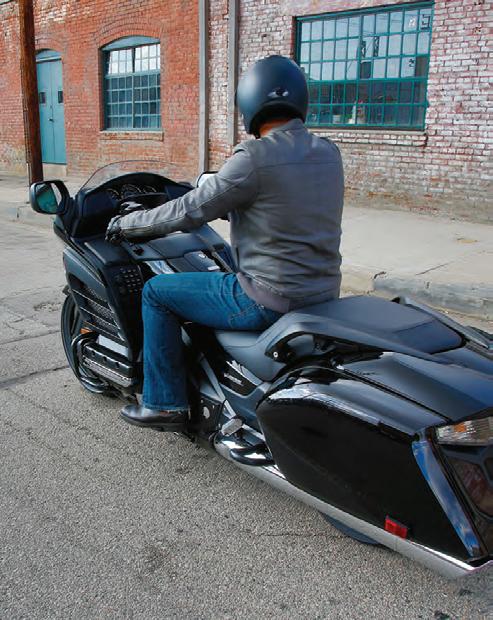
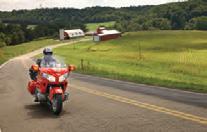
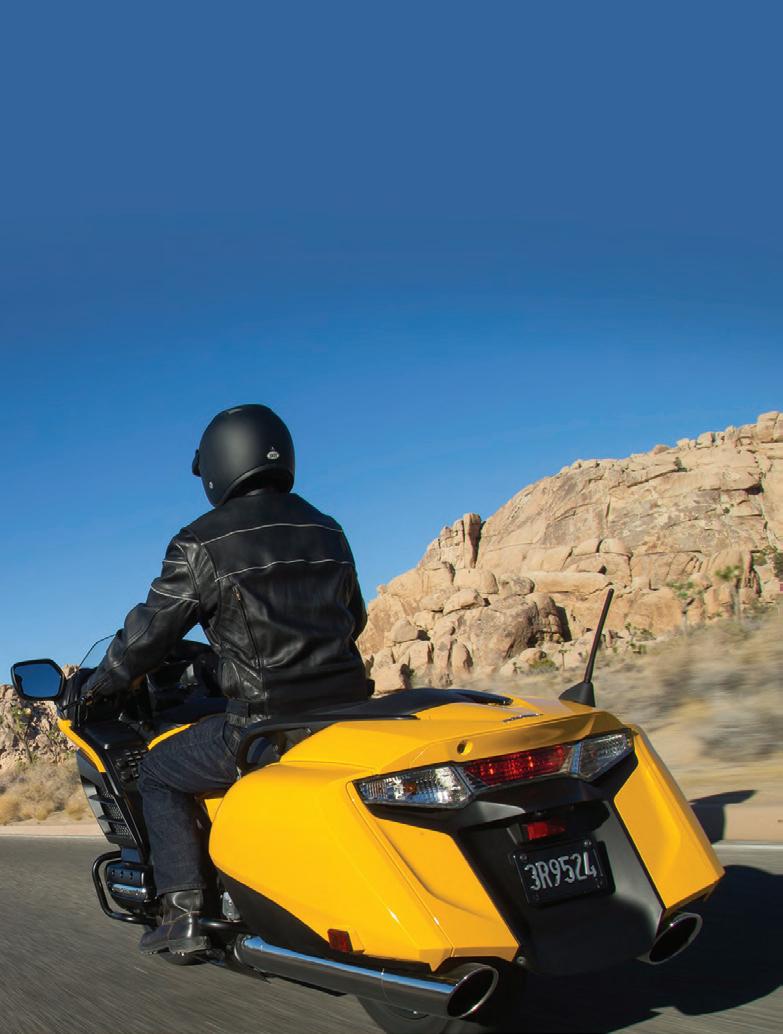
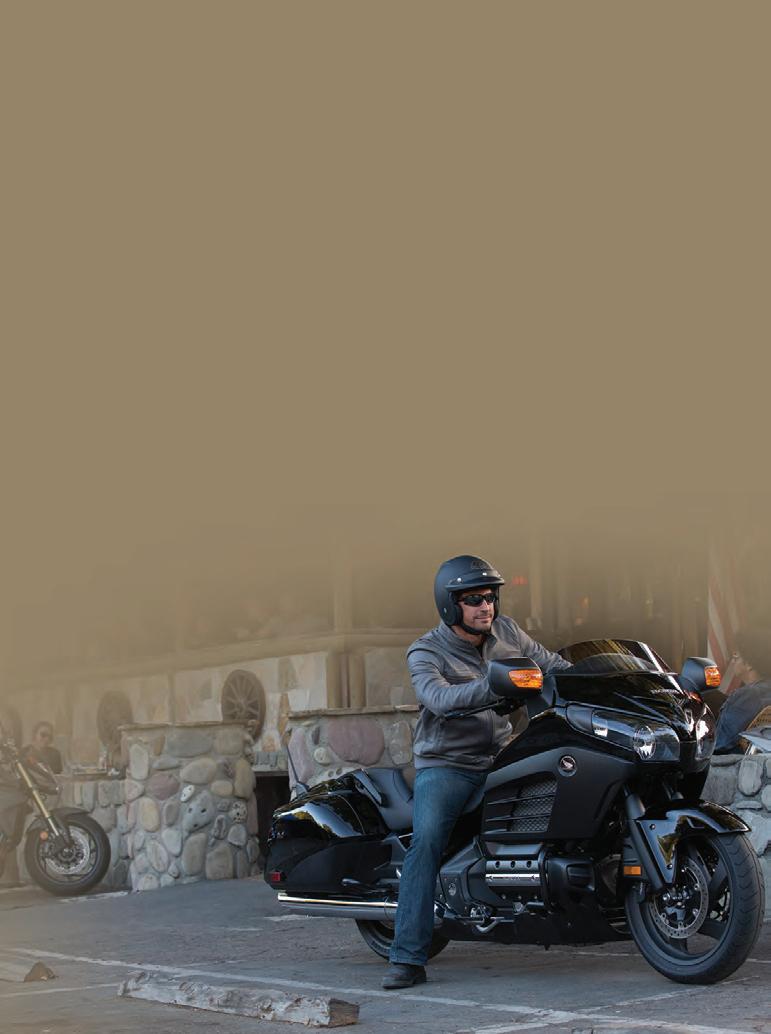
2014 GOLD WING F6B®
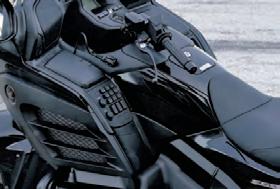
STREAMLINED FOR THE CITY AND POWER FOR EVERYTHING ELSE. This bike can do it all well. It’s nimble in the city and eats up the open road. Style-wise, its shorty windscreen and sleek, integrated hard bags make sure you’re going to get the thumbs-up wherever you decide to take the 1832cc of flat-six power.
Top 10 CiTies For MoTorCyClisTs
metropolis? No Problem. These urban Centers Offer motorcycling Respite
There are benefits—twisty roads outside your front door, garage space, low living expenses—to living in the middle of nowhere if you ride. But the reality for many of us is much more urban—traffic, stoplights, on-street parking, public transportation…
While motorcycles offer a lot of practical benefits to city dwellers, dwelling in the city can put some of the more fun parts of riding out of easy reach.
But some cities are less inconvenient than others, and a few are downright havens.
Focusing on major urban areas—only one on our list dips below 200,000 inhabitants—and taking advice from you, our members, we considered factors such as traffic and weather, as well as real estate’s three most-important qualities (location, location, location) to come up with this very unscientific list of the top 10 U.S. cities for motorcyclists.
There may be better places to live and ride, but if you have to live in the big city, these locales have a lot to offer.
No. 10: Boston, Mass.
Population: 645,966
We admit some handicapping for this jewel of the Northeast, but if you’re going to live with serious winters, Boston is a decent big city for motorcyclists.
First, Boston is a major city, with the conveniences you’d expect. There are world-class restaurants, great neighborhoods and plenty of opportunity.
While the great riding around Boston might not be obvious, it’s there if you look. Sweeping backroad rides take you north into New Hampshire and west toward Amherst. There’s the expected traffic, but a ride around Cape Cod is always a good time, and the old-country feel that permeates the New England area is something that you just can’t get out West.
No. 9: Cincinnati, Ohio
Population: 297,517
Cincinnati is a city of balance and compromise. It offers a big-city reputation with a small-town feel. With amenities such as great urban dining and professional sports teams, as well as defined neighborhoods with their own atmospheres, there’s a lot to like about this old Ohio River town.
While Cincinnati has milder weather than most of Ohio, there are definitely four seasons, with plenty of cold and snow in the winter months to keep most motorcyclists off the roads.
The appeal of Cincinnati is its proximity
to a variety of riding. There are the undiscovered curves of southern Ohio, the rolling hills of Kentucky and the incredible
routes that twist their way through West Virginia coal country.
No. 8: Albuquerque, N.M. Population: 556,495
The negative qualities portrayed in AMC’s hit “Breaking Bad” aside, the reality of living in Albuquerque is far more normal. For sure, there are great neighborhoods to call home in this cosmopolitan, if a bit isolated, desert community.
Once you’ve settled down, there’s a long list of roads to explore, most extending from the Interstate 40 and
25 corridors that cross through the city. But they all have one thing in common: breathtaking desert backdrops. Meteorologically speaking, all weather, from so-called “walking rain” to brilliant sunsets to lighting storms (best enjoyed off the bike), can be stunning.
Above all, Albuquerque captures the essence of the Wild West. Everything feels just a little less planned and a bit more free, whether you’re enjoying the open roads or relaxing in your own backyard desert oasis afterward.
No. 7: Reno, Nev.
Population: 233,294
Although Reno’s downtown is dominated by the casino scene, there’s wide variety in the neighborhoods, which are clean, safe and easy to get around.
The surrounding area offers numerous options for riding, from the the Tahoe Basin to Yosemite National Park. You can ride north on Nevada Route 447, skirting Pyramid Lake for some laid-back curves, or south toward Las Vegas and the backdrop of red rock desert.
Reno also serves as a gateway between the lushness of northern California and the more barren landscapes east. (The so-called Loneliest Road in America is the stretch of U.S. 50 across the state.) It’s not the greatest for twisties, but there’s plenty to explore and endless horizons to chase.
No. 6: Birmingham, Ala.
Population: 212,113
Although Birmingham’s nightlife may be a bit muted, The Magic City serves up a more refined slate of festivals, art shows, culinary options and cultural experiences.
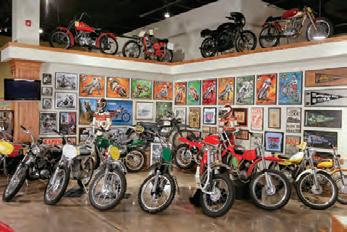
Speaking of the finer things, the suburb of Leeds, Ala., is home to the world-class Barber Vintage Motorsports Museum. Situated on the grounds of the Barber Motorsports Park—a 700-plus-acre
motorsports facility that includes a 16tur n, 2.38-mile road course—the museum offers a grandiose display of pristine motorcycles from all over the world.
The summer weather is humid, hot and a bit rainy, but riding seasons are long, winters are mild and the surrounding roads are excellent.
West of the city is the sprawling Bankhead Lake and great routes with names like Groundhog Road, Goodwater Road and Smith Camp Road. Lay Lake and even more tight twisties are south, while east is the Talladega National Forest and Cheaha State Park, which boast a number of great scenic byways.
If you hanker for the long summers, lush backdrops and ample curves of the South, Birmingham has you covered.
No. 5: Salt Lake City, Utah Population: 191,180
Salt Lake City seems bigger than its population suggests. It offers a bustling downtown area and a vibrant cultural community, and like most cities, there’s a neighborhood for every lifestyle.
Although Salt Lake City winters can be tough, and snowfall at times significant, the summers are dry and sunny. When the weather cooperates, the riding around Salt Lake City is amazing.
East, there’s Utah Routes 150 and 35 through the Uinta-Wasatch Cache National Forest. North, there’s a great twisty loop that runs from I-80 to the East Canyon Reservoir, while even farther north are some amazing rides toward Bear Lake.
The wide-open playground south of the city is arguably better, with Moab, Canyonlands National Park, the Grand Staircase-Escalante National Monument and more offering more paved bliss and glorious eye candy than you can imagine.
For race fans, there’s Miller Motorsports Park straight west on Interstate 80 and, just a little bit farther, the world-famous Bonneville Salt Flats.
No. 4: Winston-Salem, N.C. Population:
236,411
Any one of the so-called Piedmont Triad of cities, which also includes Greensboro and High Point, could have made this list, but Winston-Salem gets the nod due to its proximity to the amazing routes found amid the convergence of three states.
Some of America’s best-known motorcycling roads are less than a day’s ride away, from Virginia’s Crooked Road to North Carolina’s Tail of the Dragon to Tennessee’s Cherohala Skyway, as well as a number of other black-top attractions that are among the most-accessible great riding roads the world has to offer.
The entire area is very motorcycle friendly, with an attitude that doesn’t just accept bikers, but embraces what twowheeled tourists bring to the economy.
As for Winston-Salem itself—perhaps the most affordable city on our list—the town is a haven for the arts, with a number of institutions of higher learning that offer a diversity of experiences.
No. 3: Portland,
Ore.
Population: 609,456
The top three cities on our list are big— more than half a million people big. After all, we not looking for great places just to live and ride, but great cities—period.
Portland is undoutedly one of them. The city caters to mobility, and the restaurants and coffee shops are among America’s best. After-ride libations? Perhaps no American town has more microbreweries.
Winters are relatively mild, and while there is a long rainy season, summer riding months are dry.
If you’re into the café racer or retroscooter subcultures, you may never want to leave the city limits, but if you do, west is the undulating Pacific coast, and east is the Columbia River Gorge—home to the must-attend Rally in the Gorge. There are amazing roads and scenery, including the
eye-popping Mount Hood. The majestic Cascade Mountain Range runs along the spine of Oregon and nearby Washington State. Beyond is wonderful high-desert openness with plentiful two-lane twisties and small towns to explore.
No. 2: Austin, Texas
Population: 885,400
With a great nightlife, bolstered by an amazing live music scene, a vibrant tech industry and cutting-edge coolness,
“third-coast” Austin boasts some of the best big-city selling points.
Although temperatures can get toasty in July and August, weather can’t be beat 10 months of the year, with sunshine and just enough rain to keep things green.
The public transportation system may be lacking, but that only means the freedom and maneuverability of a bike pay even bigger dividends. As for the riding
outside of the city, it’s some of the best.
Nearby, there are some great routes northwest (Lime Creek Road toward Marble Falls), southwest toward Canyon Lake, and west toward Johnson City.
Farther west, Texas Hill Country boasts some of the best year-round riding in America, with minimal traffic, great curves, smooth pavement and gorgeous backdrops. The two-lane twisties offer an enormous smorgasbord of motorcycling adventure, as far as you are willing to ride.
No. 1: San Francisco Population: 837,442
What San Francisco gives up in cost and congestion, it earns back with uniqueness and diversity, whether you are looking for that perfect condo or a
special night out. And the food? World class.
As for riding, even city routes are interesting, whether it’s the hills that twist between the urban canyons or the aweinspiring rides over the bay.
But what makes San Francisco the best motorcycle city in America is simple. If you venture outside the city limits—a ride no doubt facilitated by the freedom of legal lane splitting in the Golden State— you’re rewarded with some of the best motorcycle roads in the world.
The Pacific Coast Highway goes south, its coast-hugging curves delivering you to the motorcycling mecca of Monterey— home to Laguna Seca—and beyond.
North is more PCH, not to mention the picturesque Napa and Sonoma Valleys and some of the finest national forest riding in the country.
Head east and curve your way around California Route 130 or longer routes that lead you to the seemingly endless backroads of Yosemite, Sequoia and Kings Canyon National Parks.
San Francisco has it all—unparalleled big-city living with amazing motorcycling a short ride away. What more could an urbanbound American motorcyclist want?
Runner-ups
They may not have made it into the top 10, but these cities are among the standouts that were nominated for our list: Charleston, W.Va., Charlotte, N.C., Denver, Colo., Little Rock, Ark., Los Angeles, Calif., Milwaukee, Wis., Nashville, Tenn., Richmond, Va., Sacramento, Calif., St. Louis, Mo., San Antonio, Texas, San Diego, Calif., and Tucson, Ariz.
What big cities did we miss? Let us know at submissions@ama-cycle.org.
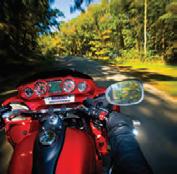
Honda’s Gold Wing
AMA REWARDS
Watch this space for updates about your valuable benefi ts as an AMA member.
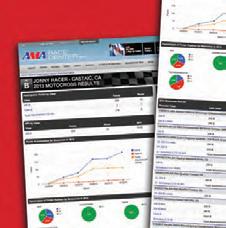
AMA Race Center
Your one-stop online source for all your motocross, Arenacross and ATV Motocross results from AMA-sanctioned events. Search by event, date, and even your name! http://results.americanmotorcyclist.com
You’re Among America’s Elite Racers
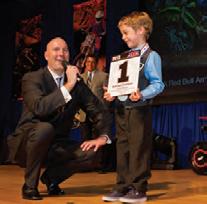
Only AMA members chase national No. 1 plates.
You’ll find everything you need— from races to rules to advice, at www.AmericanMotorcyclist.com > Racing. And as an AMA Competition Member, you’ll receive the competition edition of American Motorcyclist magazine.
AMA Roadside Assistance
Available at no extra charge if you choose to automatically renew your AMA membership.
• Coverage for bikes, cars, pickups, motorhomes and trailers (excluding utility trailers) registered to you, your spouse, and dependent children under the age of 24, living at home or away at college.
• Coverage in all 50 states and Canada.
• Towing up to 35 miles, with all dispatch and hook-up fees.
• Flat tire, lockout, battery and minormechanical assistance.
• Emergency fuel, oil, water, fluid delivery.
• No exclusions for older motorcycles.
• Toll-free assistance available 24/7/365.
• AMA Roadside Assistance pays first. No need to pay and wait for reimbursement.
STAYING INFORMED
American Motorcyclist
Each month, you receive the best magazine covering the motorcycle lifestyle with two versions to choose from: street or dirt.
THE ESSENTIALS
AMA Roadside Assistance
The Best Deal In Towing Get peace of mind with AMA Roadside Assistance, which covers all your vehicles, as well as those of your family members living with you. Best of all, you can get this coverage at no additional charge. For details, call (800) 262-5646.
Lodging
Save At Choice Hotels, Motel 6, Red Roof Inn
At Choice hotels, save15 percent off the best available rates at participating Comfort Inn, Comfort Suites, Quality Inn, Sleep Inn, Clarion, MainStay Suites, Suburban Extended Stay, Rodeway Inn and Econo Lodge hotels. Use the Member Discount code #00947556.
Special discounts at Motel 6 are also available up to 10 percent off. Use the Member Discount code CP540176.
Plus, get a 20 percent discount off available rates at Red Roof Inn. For discounts, call (800) RED-ROOF and use the code VP+ 503343. You can also make reservations online at www.redroof.com. Just enter the code VP+ 503343 in the field labeled “VP+/ID#” when making reservations. The discount will be automatically applied.
EagleRider Motorcycle Rentals
Arrive And Ride
EagleRider offers a 15 percent discount at corporate locations on HarleyDavidson, Honda, BMW and Polaris rentals and tours. Call (888) 900-9901 or book at www. AmericanMotorcyclist.com/Membership/EagleRider.aspx, using discount code AMA014.
Motorcycle Shipping
Ride Where You Want
In the United States, call Federal Companies, an agent for Specialized Transportation, Inc., at (877) 518-7376 for at least $60 off standard rates. For international shipments, call Motorcycle Express at (800) 245-8726. To get your discount, be sure to have your AMA number handy. Motorcycle Express also offers temporary international insurance.
Car Rentals
Save Money When You Drive
Get up to 25 percent off prevailing rates at any Avis or Budget car rental agency. For Avis, enter discount code: D388100. For Budget, enter code: Z942000. AMA
Members save up to 25% on year-round Hertz rentals with discount code CDP# 497193.
AMA Gear
Buy AMA Stuff Online
Find unique patches, pins, posters, T-shirts and books at AmericanMotorcyclist.com and at the AMA Motorcycle Hall of Fame in Pickerington, Ohio. Details at www.MotorcycleMuseum.org.
Rider Accident Medical Plan
All members of the AMA are eligible to purchase coverage. Benefits are paid when a covered member is injured. See http://www.americanmotorcyclist.com/ Membership/Members_Only/DiscountCodes for details.
PRODUCT DISCOUNTS
ActionStation/Bohn Body Armor
Save 10 percent on complete product line—plus bonus. Go to www.actionstation. com/ama/ and use coupon code AMAB4U at checkout. AMA Members also receive exclusive discounted pricing on the Bohn Bodyguard System at www.bohn-armorpants.com/ama/.
AIMExpo
Go to www.AIMExpoUSA.com and enter code AMAMEM14 to save on tickets.
BikeBandit.com
Get 10 percent off your order at BikeBandit.com by entering your AMA number at checkout. Exclusions apply. See www.BikeBandit.com for details.
Biker Rain Chaps
Save 25 percent. Visit www. bikerrainchaps.com/ama/ and use the code AMA-0714-USA at checkout to receive your discount.
ColorRite
AMA Motorcycle Hall Of Fame
Save $5 on admission to the AMA Motorcycle Hall of Fame at AMA headquarters in Pickerington, Ohio.
powered by
AMA/Sprocketlist Online Classifieds
AMA members can place free ads in the AMA member classifieds at AMA.Sprocketlist.com or AmericanMotorcyclist.com > Shop > Classifieds.
AMA Supercross And AMA Arenacross Tickets
Save on advanced tickets; AMA members can get $5 off when they buy tickets online at Supercrossonline.com and use password AMA15. AMA members can get $5 off when they buy tickets online at Arenacross.com and use password AMA5OFF. Certain restrictions apply, call (800) 262-5646 for details.
25 years of quality OEM matched paint. Enter code AMA2014 at www.ColorRite. com to save 15%.
Heat Demon
AMA members receive 10% off all products. Visit www.heatdemon.com/AMA and use the code AMAheat14 at checkout to receive your discount.
International Motorcycle Shows
AMA members save on advanced adult one-day general admission. The promo code is “NAAMA1410” when you buy your tickets online from www.motorcycleshows.com.
LifeLock Identity Theft Protection
Get 30 free days and 10 percent off. Use promo code AMACYCLE at www.LifeLock. com or by calling (800) 5433562.
MAD Maps
The best routes made easy. Save 20 percent. Use promo code AMATHXU at www.MADmaps.com.
Save 10 percent. Enter code TYES4AMA at checkout from www.powertye.com/ama.
Rider Magazine
Members pay only $19.99 for 2 years (24 issues) + 2 extra FREE issues. Visit the Members Only section on www.AmericanMotorcyclist. com for the discount link.
RoadRUNNER
Motorcycle Touring & Travel magazine
RoadRUNNER Motorcycle Touring & Travel magazine offers a 20 percent subscription discount to AMA members. RoadRUNNER is the touring expert of North America, providing info on the best places to ride. AMA discount code is CRIAMA at www.roadrunner.travel/promo/ ama.
Sam’s Club
As an AMA Member, you can join or renew your Sam’s Club membership and receive a $10 gift card (for a Sam’s Savings membership) or a $25 gift card (for a Plus membership) using a special members-only certificate. Visit the Members Only section on www. AmericanMotorcyclist.com to download the coupon.
Schampa Cold-Weather Gear
Save 15 percent. Enter SCHAMA during checkout at www.Schampa.com.
Spot LLC
AMA Members receive unprecedented and exclusive service credit on SPOT Spot Trace, Gen 3, and Satellite Phone products in addition to existing device promotions. Visit the Members Only section on www.AmericanMotorcyclist. com to view details.
Training, Not Testing, Trending
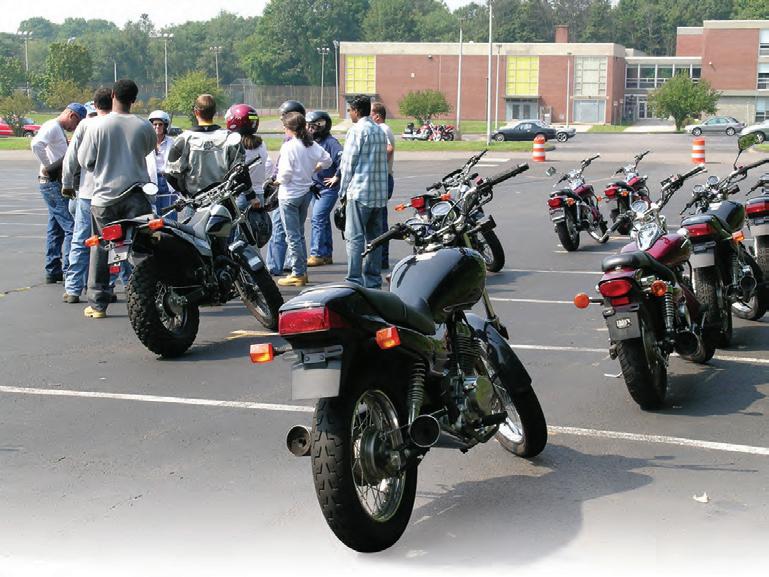
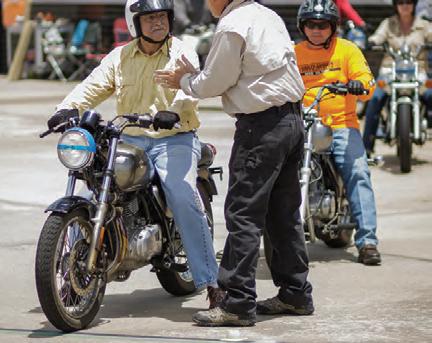
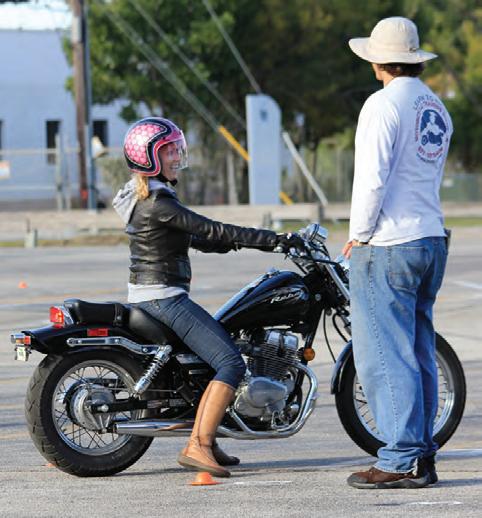
Six States Move To Mandatory Safety Courses For New Riders
By Jim Witters
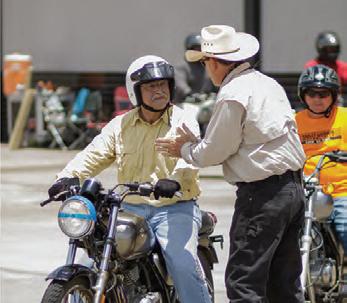
At the end of 2014, six states will require motorcycle safety training for all riders seeking the first motorcycle endorsement on their driver’s licenses.
Five of those states—Connecticut, Florida, Maine, Rhode Island and Texas— already require safety training for newly licensed riders of all ages.
In Oregon, the training requirement is being phased in. New riders 61 or older are exempt until Jan. 1, 2015. After that, all riders seeking motorcycle endorsements must successfully complete the training course, and the state Department of Motor Vehicles will no longer conduct motorcycle rider testing.
The AMA Stance
Attempts to enact mandatory training failed in Missouri three times since 2011.
The philosophy behind the mandates is simple: trained riders should be safer riders on the roadways.
“The motorcycle safety class gives riders hands-on experience, valuable knowledge, and skills that—if used—will increase the operator’s ability to safely operate a motorcycle, especially for new riders,” says Tom Vinger, press secretary for the Texas Department of Public Safety.
Bryan D. Lucier, spokesman for the Rhode Island Department of Transportation, adds: “The training is a chance for new riders to learn best practices from trainers with years of
Despite the indisputable value of a properly structured rider education program, the AMA opposes legislation that would make such training mandatory for adults. Mandated rider education can substantially increase the expense of training and delay the delivery of training. It also has the potential to exacerbate the problem of unlicensed riders.
The AMA believes that voluntary motorcycle rider training should be available as an incentive to increase licensure by permitting students to become licensed following the completion of an approved course. Riders who successfully
experience on the road. It brings specific motorcycle safety issues to the forefront and gives riders the skills they need to ride responsibly.”
Joe Laurance, state coordinator for ABATE of Oregon, offers: “The goal of mandatory training is nothing more or less than saving motorcyclists’ lives.”
While state motorcycle rights organizations typically rebel against any government mandates, the new training requirements faced little motorcyclist opposition as the legislation made its way through the state legislatures.
In Oregon and Maine, the rider groups largely supported the move and even helped implement the programs.
complete rider training have acquired basic knowledge and riding skills, and they can demonstrate the skills necessary to meet state licensing requirements.
Motorcycle rider training must remain available, convenient, affordable and effective if it is to contribute to a decline in motorcycle crashes that result in injuries and fatalities. As an alternative to mandatory rider training, increased funding of existing programs (while keeping user fees affordable), improved training reciprocity between states, and other incentives, such as insurance discounts, will result in more riders completing rider training courses.
Connecticut Rider Education Program
MANDATORY TRAINING
Laurance says Oregon’s rider education course was popular long before training became the law.
“ABATE of Oregon was instrumental in the founding and funding of TEAM OREGON, which has created what has become nationally recognized as one of the most innovative and successful motorcycle training programs ever developed,” Laurance says.
Patty A. Morneault, Maine’s deputy secretary of state, says the “minor backlash” in that state stemmed from the justification for the requirement, the cost of the courses and the availability of training facilities and instructors.
But the Maine motorcyclists did not object to the training itself.
Darrell Spears, president of United Bikers of Maine, says his organization paid the course fees to train the first instructors and establish a rider education program before the state mandated training.
Impetus For Change
In Texas, state Sen. John J. Carona says he introduced the mandatory motorcycle training bill in 2009 “to better protect motorcyclists on our roads.”
“This was achieved by, among other things, requiring proper training for persons wishing to obtain a motorcycle license, providing for a motorcycle awareness campaign to make the general public more aware of motorcyclists on the road, and increasing penalties for drivers that fail to yield the road to motorcyclists in order to encourage drivers to follow
motorcycle safety laws,” Carona says.
“I am especially proud of SB 1967 because stakeholders, including representatives of the motorcycle community, worked together to craft this legislation,” he explains. “I am pleased that the bill that was passed into law with the broad support of groups such as the Texas Motorcycle Rights Association, the Texas Motorcycle Roadriders Association, as well as a number of other motorcycle merchants and enthusiasts.”
Support from Texas motorcyclists was unwavering during the legislative process.
“The novice rider needs instruction in the basics of motorcycle use, just as there was driver education in schools when I was in school back in the ’60s,” says James Kelley, second vice president and legislative spokesman for the Texas Motorcycle Roadriders Association. “Yes, I have been riding a motorcycle a long time and have seen a lot of change but in this time the distractions are much greater driving any vehicle.
“The instruction given by certified
CONNECTICUT
Effective Jan. 1, 2011, all applicants must successfully complete a novice safety course before obtaining a motorcycle endorsement.1
trainers is a critical starting point for the beginning rider,” Kelley continues.
“Education gives the basics before they get on the street get into trouble and don’t know what to do.”
Florida’s legislature took action during a time of rising motorcycle fatalities, says John Lucas, press secretary at the Florida Department of Highway Safety and Motor Vehicles.
“The statistics showed that fatality rates among riders who participated in the Florida Rider Training Program were dramatically lower than those who had not been through the training,” he says. So, mandatory training seemed like a logical step.
For Connecticut, the training bill was the second option for legislators.
“Because Connecticut does not have a universal helmet law—which is the only proven method to reduce motorcycle fatalities according to National Highway Traffic Safety Administration— mandatory training was the next best countermeasure,” says Nicholas Just of the Motorcycle Safety/Connecticut
MANDATORY TRAINING — STATE-BY-STATE
FLORIDA
MAINE
OREGON
Starting on July 1, 2008, the state of Florida requires that new motorcyclists (regardless of age) must take and pass the Basic RiderCourse through the Florida Rider Training Program before they get a motorcycle-only license or can have the motorcycle endorsement added to their drivers license.2
Notwithstanding any other provision of law, a motorcycle learner’s permit, license or endorsement may not be issued to a person, unless that person presents a certificate of successful completion of a motorcycle driver education program and examination approved by the Secretary of State.3
If you apply for a motorcycle endorsement and you do not have a valid motorcycle endorsement from another state, the District of Columbia, a United States Territory or a Canadian Province, you must complete an approved motorcycle rider education course.4
RHODE ISLAND
Rhode Island requires a special license to operate a motorcycle and the completion of a motorcycle safety course provided by the Community College of Rhode Island.5
TEXAS
A Class M driver license is needed to operate a motorcycle or moped. To obtain a Class M driver license, individuals are required to take a DPS-approved motorcycle safety course.6
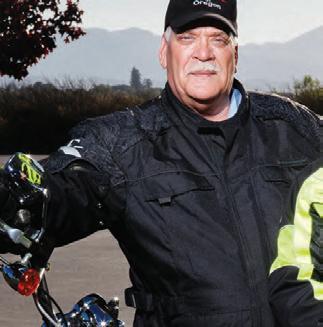
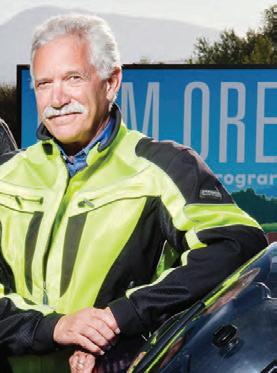
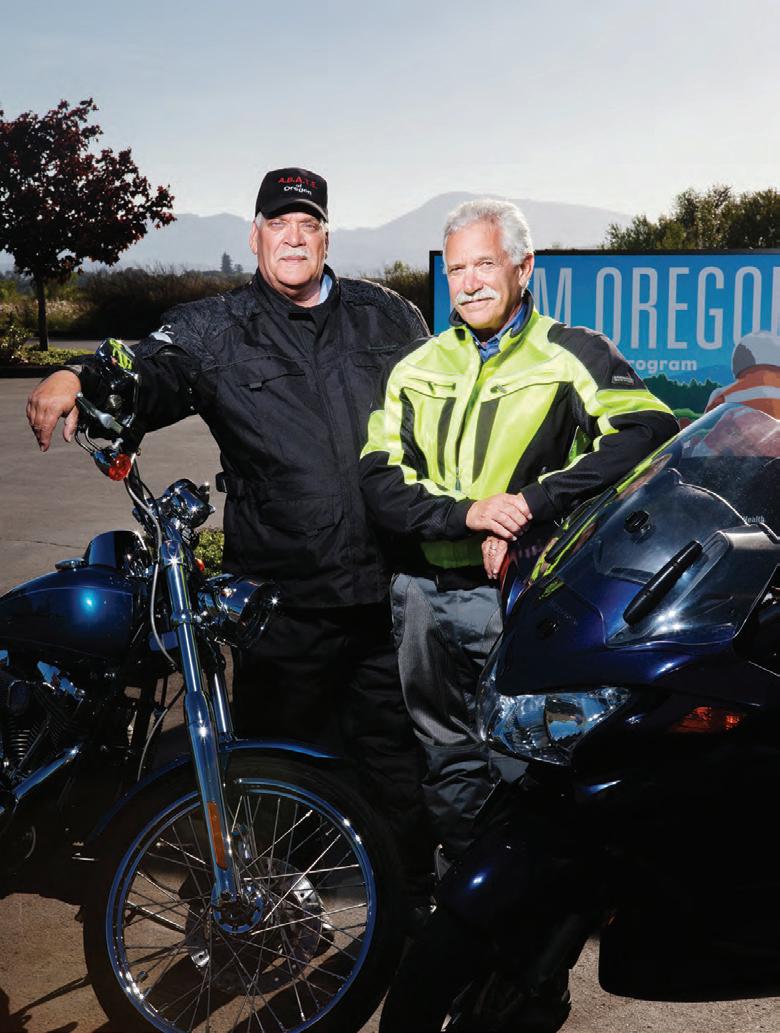
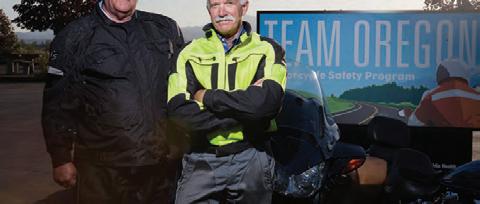
ABATE of Oregon State Coordinator Joe Laurance, left, and Steve Garets, director of TEAM OREGON worked together on a training program.
Katy Weaver
Education Program in the state Department of Transportation, Division of Highway Safety.
Laurance, in Oregon, says mandatory training ensures that all properly licensed motorcyclists possess the basic skills needed to ride safely.
“It is my belief that this [mandatory training] is particularly effective with regard to those re-entering the world of motorcycling after a long hiatus,” Laurance says. “For example, that person who rode a Honda Trail 90 in 1974, yet has not ridden since, may not feel the need for refresher training, even though the motorcycle he or she has just bought weighs 500 pounds more and has four times the horsepower. The Oregon State Legislature, TEAM OREGON, ABATE of Oregon, and I feel otherwise.”
In states that passed the mandatorytraining laws, opposition among the legislators centered on the cost to riders, press reports indicate.
In Connecticut, for example, some House members expressed concern that the $200 course fee was out of reach of many potential motorcyclists.
Capacity Concerns
Connecticut’s new riders initially were frustrated by delays in access to training.
“This was a concern in the beginning, as some students had a significant wait time to find an open spot in a class even before
the mandatory requirement,” Just says. “There was a roughly 20 percent increase in (Basic RiderCourse) registrations the first year of mandatory training.”
But things smoothed out.
“Additional classes were added, and the community colleges that run the courses saw this as a windfall,” Just says.
In neighboring Rhode Island, the experience was different.
“The rider training course has not been much of an issue in Rhode Island, other than concerns about some classes filling up too quickly during the peak riding season,” Lucier says. “The Community College of Rhode Island, which conducts the course using Motorcycle Safety Foundation standards, successfully trains more than 2,000 individuals each year.”
To help ease capacity concerns, Rhode Island modified its law to allow private vendors to apply for a license to train riders. But no individuals or companies have applied, Lucier says.
Lucas says that Florida already had numerous private motorcycle training facilities before the switch to mandatory training.
“Once the law changed, the department saw an increase in the number of sponsor school programs in underserved areas,” he says. “The training has not appeared to deter people from getting a motorcycle endorsement. There has been a slight increase in the numbers each year since training was mandated.”
To offset capacity concerns in Maine, all driver license examiners were trained as motorcycle safety instructors.
“However, the private
SMRO Skeptics
Sandra “Little Sister” Clark, legislative committee chairman for the Connecticut Motorcycle Riders Association, says her organization’s executive committee pretty much split on the issue.
“After three hours of discussion, arguments, promotion of the idea, expressed disgruntlements, and great debates, the CMRA E-Board had voted 7-6 to show support” for the bill, she says.
“With the CMRA E-Board vote having been so close, membership expressions of freedom of choice versus mandating of education were quite heated,” Clark recounts. “Pure and simple logic won the debate that day. Automobile operators have to train to drive, why shouldn’t motorcyclists be trained to ride?”
But, rather than take a public stance or offer testimony supporting the bill before the legislature, the CMRA encouraged individual members to voice their support or opposition to the mandate directly to their representatives.
In May 2010, after lengthy debate, the state House voted 117 to 31 in favor of the bill. The state Senate had earlier approved it unanimously.
In Texas, one SMRO still believes in training, but not necessarily the mandate or the way the law has been implemented.
Jean Hudgins, president of the Texas Motorcycle Roadriders Association, says her organization ran the training program on a volunteer basis in the 1970s and 1980s.
“We helped write and get sponsors for the mandatory training for minors,” Hudgins says. “We then worked to get funding provided for all riders in Texas.”
Texas’ training courses are not readily available, she says.
“I think the original program was very important and successful, but without funding the new law is not going to work,” she explains.
The motorcyclists believe the legislature is using the motorcycle education fund to bolster its balance sheet.
The motorcycle training fund has swelled to $16.2 million, with no money being spent since 2005, according to a comptroller’s report.
Texas MRH Rider Training
David Fross
Rider
MANDATORY TRAINING
driving schools stepped up and took over the burden of offering the course,” Morneault adds.
Oregon handled the issue differently.
Rather than risk becoming inundated with thousands of new riders to train immediately after the law passed, Oregon opted to phase in the training requirement over a period of five years.
In 2011, the state required new riders younger than 31 to take the class before receiving a motorcycle endorsement on their licenses.
Beginning Jan. 1, 2012, those younger than 41 were included. Those younger than 51 were brought in in 2013. This year, all new riders younger than 61 must undergo training.
As of Jan. 1, 2015, all new riders must complete the TEAM OREGON course.
“Having the law phased in over five years was critical, so we avoided the ‘snake-trying-to-swallow-a-bowlingball’ outcome,” says Pat Hahn, communications and outreach manager at TEAM OREGON Motorcycle Safety Program.
Hahn says that, even with the cushion provided by the phasing in of the training requirement, “we began aggressively increasing capacity each year—adding courses and ranges—to stay ahead of the anticipated demand.”
Money-Saving Measure
The training requirement is beginning to save some states money.
“By incorporating the on-cycle skills test into our training and offering the course as a license waiver class, the DMV no longer needed to offer on cycle skills testing,” says Connecticut’s Just. “This saved the DMV and the state large amounts of money and reduced redundancy.”
In Oregon, the DMV is discontinuing motorcycle skills testing at many of its sites, as the training requirements are phased in.
“Cost savings at DMV is a factor, but hard to measure,” says DOT spokesman David J. House.
“Essentially, it frees staff to serve other customer needs, so that we can serve a growing population with a shrinking work force,” he says. “In the long term, it also means that when DMV moves, remodels or upgrades a parking lot, space for motorcycle testing is not necessary.”
The Oregon DMV will cease motorcycle testing at the end of this year, but will continue to do skills tests for three-wheel
vehicles because the TEAM OREGON training courses are designed for twowheel motorcycles, House explains.
Overall Assessments
Using crash data, Florida estimates that the proportion of motorcyclists riding without an endorsement fell about eight percentage points from 36.4 percent in 2005 to 28.5 percent in 2012.
“The department believes Florida has benefited by the change in law, as riders are leaving the course with a better understanding of the proper methods and techniques of safely operating a motorcycle. A safer rider community is a direct attribute of this training,” Lucas says.
“There has also been an increase in awareness of the motorcycle laws by the automobile operators due to the law change and the public awareness campaigns that were associated with the change,” he adds.
Just believes that the Connecticut law has convinced a greater number of experienced riders to pursue training.
“We believe that after the mandatory
requirement came in, a lot of riders who had been riding unlicensed for a long period of time decided to finally take the class,” Just says. “Previous to the requirement, it was very hard to get these riders to take one of our courses. I think that the perception of ‘mandatory’ led to these riders ultimately taking the class.”
Michele O’Leary, of the Oregon Department of Transportation Safety Division’s motorcycle safety program, says mandatory training appears to be translating into fewer motorcycle crashes and fatalities, in proportion to the number of riders.
“We have observed the number of crashes each year has remained relatively constant, while the number of endorsement holders went up 7.64 percent during the same time period,” she explains.
“Data appear to demonstrate that crashes remain the same but fewer people are dying,” O’Leary says. “This may indicate that riders are better prepared for hazard avoidance during a crash.”
Laurance praises the TEAM OREGON program.
“I can state with confidence that the training I have received from TEAM OREGON has saved me on several occasions from injury or death,” he says.
Florida Rider Training Program
Sound Strategy: educating riderS and the Public
Nine More Groups Armed With Decibel-Measuring Devices
The AMA Sound Meter Grant Program made it possible for nine more organizations to obtain sound meter kits in 2014 and begin testing vehicles in their clubs and communities.
Since the program’s inception, the AMA has awarded 87 kits to groups around the country.
The sound testing kit consists of a Type 2 sound meter, tachometer, training materials, spark arrester probe, personal protective equipment and a storage case.
The 2014 recipients include ABATE of Illinois (represented here by “Hunter” John Harris, off-road legislative representative); Albany-Schenectady Harley Owners Group (James Diegel, club AMA representative); AMA District 16 (Brett Lobajeski, dual-
sport and road referee); and the Arizona Motorcycle Rider Association (Brian Jones, association secretary).
They also include Big Bike Riders’ Children’s Foundation (Ron Catronio, chairman of the board); Redding Dirt Riders (Karl Hankins, president); Shaft Twisters (Pat O’Connor, member and grant writer); Tri-State Motorcycle Club Ltd. (Gerry O’Neill, president); and Wisconsin Off-Highway Motorcycle Association (Bryan Much, member of WOHMA, the Governor’s State Trails Council and the Governor’s Off-Road Vehicle Council)
We asked each of the 2014 recipients about the program and their plans for the sound meters. Here’s an excerpt of their responses.
AM: What prompted your organization to apply for a sound meter grant?
ABATE’s H A rris: ABATE of Illinois does not ever want a noise ordinance or law at the state, city or county level. What’s noise to some is music to others.
HOG’s Di EGE l: Loud exhausts on motorcycles have been a longstanding issue within our community and surrounding areas. Applying for the sound meter grant program was our first step in the process of creating an awareness campaign.
AMA Dis T ric T 16’s lOBA j E ski: All of our AMA-sanctioned dual sport rides require a sound check. With almost 200 riders, the mornings can get quite busy and an extra meter helps things flow faster.
r D r ’s H A nkins: I was at the ChappieShasta OHV area one day, and there was a young rider with a really loud motorcycle riding around. I had just read about the AMA sound meter grants in the American Motorcyclist magazine and the idea was born. I thought, if I was annoyed by this single bike’s loud noise, how do the nonriders feel about it?
WOHMA’s Muc H : In working to expand our riding opportunities, I realized how important it is to convince other groups that we are very active in policing ourselves with regard to excessive noise and adverse behaviors.
AM: What specific goals do you hope to accomplish by using the meter?
ABATE’s H A rris: I use the sound meter to show city and county officials that motorcycles and all-terrain vehicles are not any louder than lawn mowers, weed eaters, semis, airplanes and so on. I also go to riding parks and meet with off-road riders, so they can check to see what decibels their motors are putting out.
HOG’s Di EGE l: Our goal is to educate the
AMA District 16
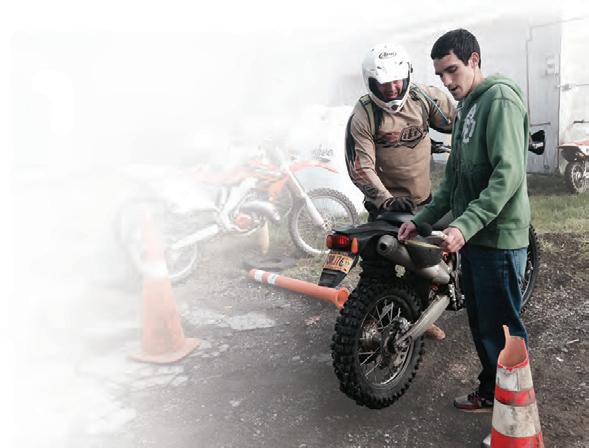
Brian Mullane
rider and the community about excessive noise and how it affects all of us as riders. Motorcycle riders should not be stereotyped. We need to send a message to both riders and the non-riding public that we, as motorcyclists, are just as concerned as they are about excessive noise. If we do nothing to curtail the problem, it will inevitably lead to legislation being drafted that could jeopardize our right to ride.
BBR’s Cat R onio: We hope to create more and better awareness of local noise pollution.
RDR’s Hankins: Sound testing during tech inspection prior to our events—a poker run, AMA West Harescrambles and AMA-sanctioned family and championship enduros—educational seminars/safety days; and compliance with recreational permits.
st ’s o ’Conno R : We want to foster public awareness and increase rider awareness. Technician Tom Gard tested club bikes at our May meeting and we are planning a public schedule.
ts MC’s o ’ n eill: To educate all motorcycle and ATV owners on being sensitive to and respecting the rights of those individuals/citizens not involved in the motorcycling community and also to educate and encourage our youth riders in the importance of respecting the rights
of others and promoting being responsible citizens, since they are the future of our sport.
a M: How receptive is your organization to this type of testing?
a B ate ’s Ha RR is: It has become an issue with some people on what is noise and what is not. When you have motorcyclists running straight pipes or dirt bikes without baffles, they can be very loud and illegal. It’s those motorcyclists that cause us the problems 90 percent of the time. We want to reach them and educate them about noise issues.
“loud” is and give them a number to use. Just saying “loud” isn’t enough.
a M a Dist R i C t 16’s l o B ajeski: As far as the board of directors goes, we are mostly in agreement that loud bikes lose riding areas. Sound is one of the biggest complaints, and any effort to reduce the sound signature is a positive step. We need to educate the riders as to what
BBR’s Cat R onio: Very much so. We are excited to offer it in South Florida at bike shops and at bike nights, as a public service.
a MR a’s j ones: We work closely with the Arizona State Land Trust, the U.S. Bureau of Land Management and private land owners to ensure we don’t lose more riding areas. It’s part of racing, and we are open to doing what we need to protect the
by location. An additional daily surcharge may apply for renters under 25 years old. Fuel charges are extra. Rental must begin by 12/31/12. 12/31/13.
Bill Emond tests the noise level on Kent Irick’s 2014 BMW R9T at an event held by Shaft Twisters. Pat O’Connor
sport and our reputation.
WOHMA’S MUCH: Our approach to getting riders to join us to keep sound levels within established limits works well. We make it clear that we need to do the right things to support an environment where we can get more places to ride. People see us working hard to make things better for them, and this is one way that they can participate to help support the cause.
AM: Do you have any community partners (government, business, nonprofit) in this endeavor?
HOG’S DIEGEL: Our sponsoring dealer,
Spitzie’s Harley Davidson, has partnered with us. We’re hoping to partner with local law enforcement and create a “SOUND MATTERS” public service announcement.
AMA DISTRICT 16’S LOBAJESKI: The only ones that come to mind are the motorcycle clubs that will benefit from the meter. Those are Madison Motorcycle club, Wisconsin Dual Sport Riders, and Kettle Moraine Sport Riders. I do plan on using the meter during our ice events as well, perhaps working with law enforcement when they come out to investigate noise complaints. We ride on the ice almost every weekend during the winter months and we need to self-police.
BBR’S CATRONIO: The Broward Health Foundation in Fort Lauderdale, Bikers Against Drunk Drivers, and Marisa’s Way, a South Florida organization dedicated to preventing “wrong-way” crashes on highways and interstates, to educate motorists of potential dangers, and to create greater driver awareness.
TSMC’S O’NEILL: We have partnered with one of our local town boards to promote competitive motorcycle events utilizing their property in a community park, with full support from the local police department, fire department and ambulance corps, as well as local community businesses. We just hosted a competitive event in another community, with full town and community support, and used our new meter to promote good sound management for all of our competitors.
WOHMA’S MUCH: I don’t think we have other formal community partners, per se, but we will use the meter to demonstrate to some communities that are involved with our riding areas that we actively do sound tests to ensure that riders are within established limits.
One community approached us about becoming a dual-sport destination, with an eye toward increasing their tourism. Some in the area that haven’t had much exposure to dual-sport motorcycles are concerned about noise. Doing sound testing of groups that visit the community to ride will demonstrate our commitment, level of compliance, and will, hopefully, satisfy those that have concerns.
Sound-Testing Standards
The Society of Automotive Engineers has published standards for measuring sound emissions for both on-highway and off-highway motorcycles.
The SAE J2825 recommended standard for street bikes, the Measurement of Exhaust Sound Pressure Levels of Stationary On-Highway Motorcycles (http:// standards.sae.org/j2825_200905/), includes:
• A limit of 92 decibels at idle for all machines;
• 100 decibels for three- or fourcylinder machines at 5,000 rpm or 75 percent of maximum engine speed, whichever is less; and
• 96 decibels for motorcycles with fewer than three or more than four cylinders at 2,000 rpm or 75 percent of maximum engine speed, whichever is less.
The procedure also recommends adding two decibels to the sound limits for unmodified motorcycle exhaust systems that have sound limit certification labels from the U.S. Environmental Protection Agency.
For off-road bikes, the Measurement of Exhaust Sound Levels of Stationary Motorcycles SAE J1287 (http:// standards.sae.org/j1287_199807/) procedures call for different tests, depending on the specific motorcycle or all-terrain vehicle.
The sound limit for off-highway vehicles is 96 decibels for public trails in most states.
Tri-State Motorcycle Club member
Shane O’Rourke shows a rider his result on a sound meter.
SINGLED OUT FOR TWO WHEELS
Inside A Motorcycle-Only Checkpoint
By Brian LeSchander
several things that could have been done differently at this checkpoint.
I am a 59-yearold married male, a homeowner, a business owner, a pilot and former airplane owner, a skydiver, a BASE jumper (retired), a ski instructor, and last but not least, a dedicated motorcyclist since the age of 12.
My motorcycle-only checkpoint story began on Sunday morning, May 25, 2014, as my wife and I donned our full-face helmets and riding gear and climbed aboard our 2005 touring motorcycle for about a two-hour ride. We headed east on New York Routes 5 and 20 to meet my brother in Auburn.
We were about an hour and a half into this ride when we crested a hill and joined what turned out to be a very long line established by the New York State troopers as a roadblock checkpoint. DWI checkpoints are common on holiday weekends, but this turned out to be
something I had yet to experience in my 40-plus years of riding.
I was directed by a trooper to pull into a dead-end road less than 50 yards long with at least a dozen bikes parked in every direction. The area was covered with rocks, stones and debris. I had an 850-pound motorcycle with a passenger aboard and would not have voluntarily chosen this as a stopping point.
I was ordered to shut down and get off the bike, produce my license, registration and insurance identification card. The officer held my documents and said he would return them to me after they did a lights, horn and tire check in case he had to write me a citation. The current New York State inspection sticker on this bike apparently wasn’t sufficient. My paperwork was also in order. He still insisted that we proceed with the check. He did the check and with a smile, handed back my paperwork and released me. I have the utmost respect for the police in this country. However, there were
• First, regarding safety—allegedly, the whole point of this checkpoint—they compromised my and my wife’s wellbeing by directing us to an area that was not suited for maneuvering large motorcycles.
• Second, they had no organization at the checkpoint. People and motorcycles were parked and moving in every direction—another unsafe condition.
• Third, at this point in the ride, both my wife and I were in search of a rest room. We were held at this stop about 15-20 minutes with no available facilities.
Motorcycle-only checkpoints like this one are a clear case of discrimination and a transparent attempt at revenue gain. I wouldn’t be as upset if they were stopping all vehicles and putting them through this check. They didn’t—just motorcycles.
Aside from the inconvenience and discrimination of probably hundreds of motorcyclists that day, I also question whether the ratio of citations served that day justified the 12-15 officers on duty. This checkpoint created a safety issue rather than prevented one.
Brian LeSchander is an AMA member from Spencerport, N.Y.
By Brian LeSchander
From The Road
ACROSS THE ALPS ON A VESPA
In the mid-1950s, I was a teenager living in rural England, where beautiful girls were out of reach.
Then I saw Gregory Peck in the movie “Roman Holiday” riding around Italy on a Vespa with a beautiful girl [Audrey Hepburn] on the pillion, and she was holding him very tight!
This was clearly the way to go. Of course, I looked more like [Walt Disney’s] Goofy than Gregory Peck, but my dad had a Vespa, the summer vacation was coming up, and I knew where Italy was. Better still, I had a pen friend who was happy for me to stay with his family in Milan. And
so, a few months later I was riding a green 125cc Vespa off the ferry to France with my passenger holding me very tight.
Sadly, my passenger wasn’t Audrey Hepburn, but my enormous rugbyplaying buddy Martin. Oh well. We were about to ride down the Rhone Valley into Switzerland and across the Alps into Italy. What we lacked in weight distribution, we made up for in energy and enthusiasm.
Unfortunately, we also lacked planning and cash. We could say “Excuse me, is this the road to Milan?” in three languages, and figured we could live off bread and jam: what could possibly go wrong?
Well, we soon learned that this 125 two-stroke drank gas if pushed beyond 40 mph, its lights and brakes were almost useless, and worst of all our 400 pounds of weight and luggage made it handle like a brick on Jell-O.
The first few days were slow and uneventful—until I dropped the Vespa on some wet cobbles, trapping my ankle under the scooter as we slid. Did we have any first aid?
No, but my sock quickly soaked up the blood and rugby-playing Martin declared the injury to be trivial.
Back then, France was cheap. We rode the 550 miles to the Swiss border staying in cheap hostels, filling up with cheap gas, and discovering that French bread and
jam were very cheap. Switzerland was a different story. Everything was about five times the price and in the mountains our fuel consumption rocketed as the temperatures dropped.
We soon worked out we had just enough money left for gas and the train through the Simplon Tunnel, so we spent the last couple of nights sleeping “rough.” On our last evening, we went through Swiss customs, put the scooter on the train and fell into a deep sleep in the warm carriage. Good news! Next morning we woke up in Milan.
Bad news? The Vespa had been taken off the train at the Italian border. That’s as far as our ticket took it. We’d slept through the border and arrived illegally—our passports not stamped, no Vespa and no cash. It dawned on us that sure enough we were in Milan, but with only enough Italian to say “Is this the road to Milan?”
The authorities could probably have locked us up and done that thing with the key, but they were quite lovely. With many smiles and sympathetic shakes of the head—I think we heard “Inglese stupido” a few times—we were put on the next train back to the border and re-united with our faithful steed.
With the Alps behind us, the ride to my pen friend’s house was literally downhill all the way. I remember the gorgeous Italian sunshine and enormous excitement of being on two wheels in a foreign land. We had ridden through France and Switzerland, but this was Italy, home to Ducati and MV Augusta, Ferrari and Maserati, Leonardo da Vinci and Michaelangelo. This was special.
Arriving at my friend’s house, we soon discovered other good things about Italy. The warmth of the welcome from the whole family—nine brothers and one sister—the color and life in the streets, and the delicious meals of fresh pasta and soft red wine.
Eventually, our parents got some cash out to us and we headed back to England. By now, we had enough experience to give the mountains a wide berth and ride into France via the Mediterranean coast, first-aid kit at the ready.
The word “unforgettable” accurately describes that summer, and ever since then Italy has occupied a special place in my biking heart. I’ve motorcycled there many times over the years: Certainly faster on my Honda, absolutely more comfortably on my Triumph, and positively safer on my BMW, but I’ve never had quite as much fun as my first ride there on the little green Vespa.
Rick Wheaton is an AMA member who writes about lessons learned from riding routes the world over. Comments? Email submissions@ama-cycle.org.
By Rick Wheaton
Ask The MSF
THE RIGHT FIT
Q: Regarding fit, is it just whatever is comfortable, or are there “rules of thumb” for determining the proper distance between the pegs and seat, the seat and bars, and the pegs and bars, for picking the right bike?
A: Long-term comfort entails more than simply a dimensional fit. Any rider should spend some time at dealerships sitting on several different sizes, styles, and brands of motorcycles. Some factors to evaluate while sitting on the motorcycle:
• The seat should be low enough that your feet reach the ground and you can support the motorcycle. You may be able to adjust suspension components, adjust seat height, or invest in replacing or re-sculpting
the seat to provide an easier reach to the ground.
• You should be able to easily reach the handlebars and turn them full left and full right. You may be able to adjust the handlebars to improve your reach to them.
DISCOUNT ON SPOT PERSONAL TRACKERS
Exclusive Benefit On Service
AMA members now can subscribe to the leading satellite personal tracking system for less. The SPOT family of products, which includes the SPOT Gen3 satellite GPS messenger, SPOT Global Phone and all new theft-alert tracking device, SPOT Trace, will provide AMA members with an unprecedented service credit on SPOT products.
• Without removing your palms from the handgrips, you should be able to reach and squeeze the clutch and front brake levers. Adjustments here may also allow an easier reach.
• Your body position should be comfortable, but how it relates to your riding style is still a factor in overall comfort and control. Body position is a factor that a test ride, if available, would help you evaluate. If you find you need to make adjustments or modifications, use caution. If in doubt, have a professional mechanic do the work. And always take it easy on the first few rides so you can get used to the motorcycle and how it responds to your input.
2 Years of Rider Magazine for $19.99
Join the adventure. Rider Magazine enhances your membership with an offer that’s 87% off newsstand rates. Rider takes you on favorite rides from California coastlines to quaint New England villages. You can rely on unbiased editors to offer valuable insight into buying, maintaining and equipping your bike.
SPOT uses satellite technology to work virtually anywhere on the planet. It allows users to log their travels online in near real-time. In addition, SPOT messaging devices can, at the push of a button, locate the user and send a preprogrammed text or e-mail message to friends, family or if necessary, send an SOS alert to emergency responders via GEOS (the International Emergency Response Coordination Center).
Learn more about these devices at www.FindMeSPOT. com/ama. For member benefit details, visit www.american motorcyclist.com > Member Discount Codes.
1992 YAMAHA YZ125
Jeff Emig’s First Championship
This 1992 Yamaha YZ125 is the bike that started AMA Motorcycle Hall of Famer Jeff Emig’s professional championship run. In the 1990s, Emig had one of the most successful careers of any U.S. racer with four AMA National Championships and three stints on title-winning FIM Motocross of Nations teams. With this Yamaha, Emig claimed the 1992 AMA National Motocross Championship.
The Yamaha was considered underpowered as a production bike, but Emig’s personal mechanic, Steve Butler, and Yamaha’s engine technician, Bob Oliver, tuned it into one of the most powerful bikes on the circuit.
Emig says that one strength of the YZ125
was its “mono-jet carburetor.” The pilot jet was closed off so that all fuel was fed through the main jet, with custom-filed needle jets used for fine tuning.
Small bore 125cc two-stroke engines were very temperamental, and Emig’s finesse on the track, and his team’s expertise off it, turned this Yamaha into one of the most legendary bikes in AMA Motocross history.
This bike is on loan to the AMA Motorcycle Hall of Fame from Jeff Emig, who was inducted in 2004. You can see it, along with many of the other machines that have shaped the history of American motorcycling, at the AMA Motorcycle Hall of Fame in Pickerington, Ohio.
The AMA Motorcycle Hall of Fame in Pickerington, Ohio, features the people and machines that have defined the sport, lifestyle and business of motorcycling in America. The Hall of Fame is a 501(c)3 non-profit corporation that receives support from the AMA and from the motorcycling community. For info and directions, visit www.motorcyclemuseum.org, or call (614) 856-2222.
Photos Rainer Ziehm
Hall of Famer
Mike Bast: speedway ChaMpion
Mike Bast was the top American speedway rider of the 1970s. A prolific performer, Bast compiled an amazing win record in speedway racing after the sport’s U.S. revival in the late 1960s. He established a record of seven American Speedway Championships, including an incredible streak of five consecutive titles from 1975 through 1979.
Bast was born in Los Angeles in 1953. He grew up in Van Nuys, Calif., in a family of motorcycle racers. Mike and his older brother, Steve, watched their Uncle Harlan race off-road and flat track races while growing up.
“We couldn’t wait to get old enough to race,” Mike says of his childhood. “I started riding when I was 9 and racing when I was 10.”
At first, the Bast brothers raced TTs and scrambles around Southern California, before getting flat-track experience on short tracks in the area. Mike’s first racing bike was a 50cc Honda C110. One of his first big wins came at the Grand Prix at Corriganville (later known as the Hopetown GP) in 1965 when he won the 50cc amateur class.
Bast’s future in racing took a sharp turn in 1968 when his family saw a poster advertising speedway races at Whiteman Stadium in Pacoima, which was close to their home. Whiteman Stadium was built on the corner of the Whiteman Airport. A quarter-mile asphalt track was built and later an eighth-mile speedway track was fashioned inside that oval.
Former speedway racer Dude Criswell began promoting the races, trying to revive the sport of speedway in America.
The competition utilized powerful 500cc single-cylinder alcohol-burning motors stuffed inside spindly-looking motorcycles with narrow tires. Riders raced on tight little bullring oval dirt tracks with no brakes and managed the bikes with delicate throttle control through the turns, pitching them sideways at seemingly impossible angles.
The Basts went to check out the racing at Whiteman and saw a few old speedway bikes circulating.
“We got our Bultaco short track bikes and came out the next week,” Bast says. “We didn’t know it at the time, but we were right there in the middle of the rebirth of speedway racing here in America.”
A year or so after Bast began racing speedway, he witnessed an exhibition put on by speedway world champions Ivan
Mauger and Barry Briggs, both of New Zealand.
“We were all racing American short track style [leaning the bikes into the turns] trying to ride like Sammy Tanner, Don Hawley and Eddie Mulder,” Bast says. “Mauger and Briggs showed us how to ride the real speedway style. We’d never seen anything like it before. They gave a school to us and taught us how to ride those old vintage bikes.
“Pretty soon Jack Milne began importing Jawa speedway bikes and selling them out of his shop in Pasadena,” he says. “Around 1970, we all had stateof-the-art speedway bikes. The sport really began to flower after that.”
With Speedway racing popping up all across California, Bast, still in his teens, found himself starting to earn very good money.
“In 1970 and ’71, I was averaging $2,000 per week racing speedway,” he says. “We started getting a percentage of the gate, and at a lot of these races we were packing 8,000 to 10,000 spectators in those little stadiums.
“I never had a trade. I just kept racing five nights a week,” Bast says. “Before we knew it, we were living a dream.”
In 1971, Bast surprised everyone by winning his first American Speedway Championship in a runoff against Mike Konle at the Costa Mesa Speedway at the Orange County Fairgrounds in Southern California. He was just 18 years old at the time.
“My dream was always to be a champion, and when I crossed the line I had tears in my eyes,” Bast says of winning his first national title. “I put my whole life into speedway racing and I was in awe that I won the championship.”
Bast lost the title to Rick Woods in ’72, before coming back to win the championship for a second time in 1973. Mike’s brother, Steve, won his second title in 1974. Then Mike went on his run of five consecutive U.S. championships, making him the undisputed king of speedway racing in America.
peak at only 32.
Bast was one of the key riders who played a major role in speedway racing’s rebirth in America, paving the way for American riders like Bruce Penhall, Sam Ermolenko, Billy Hamill and Greg Hancock, all of whom went on to win World Speedway titles.
He won his early titles riding a Jawa and his last four titles came aboard Westlake speedway racing bikes.
Bast continued to race through 1985. By then he was a family man and he retired while he was still riding at his
After retiring from full-time competition, Bast co-founded a construction company and later moved to Northern California. He and his wife, Dee, had three children. He stayed involved in the sport by working with up-and-coming riders.
Mike Bast was inducted into the AMA Motorcycle Hall of Fame in 2000.
Put yourself in the AMA Motorcycle Hall of Fame Museum
The AMA Motorcycle Hall of Fame is YOUR hall of fame—we couldn’t exist without the generous support of our donors. Now there’s a new way for you to show that support in a very visible way: My Hall of Fame. The idea is simple: A $20 charitable donation gets you a 3-inch-square space on the wall in the Hall of Fame entrance foyer that hangs during the campaign year. Want a bigger space? A 6-inch square is an $80 donation, and an 8-inch square is a $180 donation. You also get an official certificate noting that your picture is on display in the AMA Motorcycle Hall of Fame.
Hang your picture, your kid’s picture, your company logo, almost anything. It’s up to you! Get in the AMA Motorcycle Hall of Fame today!
A few of the hundreds of AMA-sanctioned events this month, detailed on the following pages.
2
The fastest racers on the planet will be at it once again at the AMA Land Speed Grand Championships— Bonneville Motorcycle Speed Trials Aug. 23-28 at the Bonneville Salt Flats in Utah. Info: www. bonnevillespeedtrials.com.
1
There’s a full slate of dual-sport rides on the schedule for August in the AMA Husqvarna National DualSport Series. Catch the dualsport ride in Walden, Colo., on Aug. 2-3; the Rat Dog Dual Sport Aug. 16-17 in Tillamook, Ore., and the Dual Sport Northwest ride Aug. 29-Sept. 1 in Hood River, Ore. For the full schedule, see page 51.
4
It’s one of the biggest and most storied motorcycling events on the planet. Just say the name—Sturgis—and every biker knows what you’re talking about. This AMA National Gypsy Tour happens Aug. 4-10 in Sturgis, S.D. Info: www.sturgismotorcyclerally.com.
3
The all-American sport of AMA Pro Racing Flat Track features competitors battling on the dirt oval this month in TT action in Castle Rock, Wash., on Aug. 2, at the Sturgis Half Mile in Rapid City, S.D. on Aug. 5, at the famous Indy Mile in Indianapolis on Aug. 8 and at the famed Peoria TT in Peoria Ill., on Aug. 17. For the full schedule, see page 49.
5
The high-flying racers in the Lucas Oil AMA Pro Motocross Series will be at Unadilla in New Berlin, N.Y., on Aug. 9, at Indiana National in Crawfordsville, Ind., on Aug 16 and in Tooele, Utah, on Aug. 23. For the full schedule, see page 49.
Mark your calendars now!
The 2014 AMA National Convention is coming together for Oct. 16-19 in Orlando, Fla. Taking place amid the grand hoopla of the AIMExpo, which will reveal a smorgasbord of motorcyclerelated product, the AMA National Convention will include the annual AMA member meeting and business member meeting, motorcycling-related seminars and the 2014 AMA Motorcycle Hall of Fame Induction Ceremony.
ARIZONA
RECREATIONAL
GRAND TOUR
AUG 28: TUCSON: SOUTHERN CALIFORNIA MOTORCYCLING ASSN, (562) 298-6236, SC-MA.COM CALIFORNIA
RECREATIONAL
DUAL SPORT-OFF ROAD
AUG 9: BIG BEAR CITY: 2 DAY EVENT, BIG BEAR TRAIL RIDERS, INC., (818) 391-3031, BIGBEARTRAILRIDERS.COM
AUG 16: PIONEER: 2 DAY EVENT, RACERS UNDER THE SON NORTH (RUTS-NORTH), (916) 276-7226, RUTSNORTH.ORG
POKER RUN
AUG 16: (Includes ATVs) POINT RICHMOND: RICHMOND RAMBLERS MC, (510) 620-0762, RICHMONDRAMBLERSMC.ORG COMPETITION
MOTOCROSS
AUG 10: (Includes ATVs) SAN BERNARDINO: UNITED MOTORCYCLE CLUB, (562) 319-3409, UEAMC.COM
AUG 22: SNELLING: A.M.P. RACING, LLC, (209) 656-9682, AMPGFIMOTOCROSS.COM
RECORD TRIALS
AUG 24: CEDAR RIDGE: DELICIATE PROMOTIONS LLC, (530) 263-7276, BONNEVILLESPEEDTRIALS.COM
SPEEDWAY
AUG 1: AUBURN: FAST FRIDAYS SPEEDWAY, (530) 878-7223, FASTFRIDAYS.COM
AUG 8: AUBURN: FAST FRIDAYS SPEEDWAY, (530) 878-7223, FASTFRIDAYS.COM
AUG 9: CITY OF INDUSTRY: INDUSTRY HILLS EXPO CENTER DBA: INDUSTRY RACING, (626) 330-0324, INDUSTRYRACING.COM
AUG 10: CITY OF INDUSTRY: INDUSTRY HILLS EXPO CENTER DBA: INDUSTRY RACING, (626) 330-0324, INDUSTRYRACING.COM
AUG 15: AUBURN: FAST FRIDAYS SPEEDWAY, (530) 878-7223, FASTFRIDAYS.COM
AUG 20: CITY OF INDUSTRY: INDUSTRY HILLS EXPO CENTER DBA: INDUSTRY RACING, (626) 330-0324, INDUSTRYRACING.COM
AUG 22: AUBURN: FAST FRIDAYS SPEEDWAY, (530) 878-7223, FASTFRIDAYS.COM
AUG 27: CITY OF INDUSTRY: INDUSTRY HILLS EXPO CENTER DBA: INDUSTRY RACING, (626) 330-0324, INDUSTRYRACING.COM
AUG 29: AUBURN: FAST FRIDAYS SPEEDWAY, (530) 878-7223, FASTFRIDAYS.COM
AMA M OTO rcycLE H A LL OF FAME MoTorcyclEMuSEuM org
The AMA Motorcycle Hall of Fame is on the AMA campus in Pickerington, Ohio, and is open 9 a.m. to 5 p.m. seven days a week. Closed: Easter, Thanksgiving, Christmas and New Year’s Day.
Main Hall: AMA Motorcycle Hall of Fame: Recognizing those who have made significant contributions to all aspects of motorcycling.
Bike c r aft: New-world craftmanship meets old-school motorcycles.
2 Wheels + Motor, A Fine Art Exhibition: The spirit, excitement and adventure of motorcycling is expressed through fine art.
Founder’s Hall: Honoring the AMA Motorcycle Hall of Fame’s generous contributors.
July 11-13, Lexington, Ohio: AMA Vintage Motorcycle Days Information: www. amavintagemotorcycle days.com.
AMA PrO r AcI N g
A MA PrO FLAT Tr Ack
a M a proraciNg c oM
July 19: Elma, Wash.: Grays Harbor Raceway
July 26: Sacramento, ca lif.: SAC Mile
Aug. 2: ca stle ro ck, Wash.: Castle Rock TT
Aug. 5: r a pid c i ty, S.D.: Sturgis Half Mile
Aug. 8: Indianapolis: Indy Mile
Aug. 17: Peoria, Ill.: Peoria TT
Aug. 23: New ke nt, Va.: Virginia Mega MIle
Aug. 31: Springfield, Ill.: Springfield Mile II
Sept. 28: Santa ro sa, ca lif.: Santa Rosa Mile
Oct. 11: Pomona, ca lif.: Flat Track Season Finale
AMA PrO H I LLcLIMB
a M a proraciNg c oM
July 13: West Branch, Mich.: Ogemaw Hills Bike Week
Aug. 3: Muskegon, Mich.: Muskegon MC All-Star Challenge
Sept. 21: Spring g r ove, Pa.: White Rose MC
Sept. 28: Freemansburg, Pa.: Bushkill Valley MC
Oct. 12: Oregonia, OH: Dayton MC
2014 EVENTS
LucAS O I L AMA PrO M OTO crO SS pro M oTocroSS co M
June 14: Mount Morris, Pa.: High Point National
June 28: Blountville, Tenn.: Tennessee National
Jul. 5: Buchanan, Mich.: RedBud National
Jul. 12: Mechanicsville, Md.: Budds Creek National
Jul. 19: Millville, Minn: Spring Creek National
Jul. 26: Washougal, Wash.: Washougal National
Aug. 9: New Berlin, N.y : Unadila National
Aug. 16: c r awfordsville, Ind.: Indiana National
Aug. 23: Tooele, u t ah: Utah National
AMA PrO rOAD r AcI N g
a M a proraciNg c oM
July 11-13: Monterey, ca lif.: FIM Superbike World Championship. GEICO Motorcycle U.S. Round
July 19-20: Lexington, Oh.: Mid-Ohio Sports Car Course
Aug. 8-10: Indianapolis, Ind.: 2014 RedBull Indianapolis GP
Sept. 13-14: Millville, N.J.: New Jersey Motorsports Park
MTN DEW ATV AMA PrO M OTO crO SS NATIONAL cH AMPIONSHIP
aT VM oTocroSS co M
July 12-13: New Berlin, N.y. : The NYCM Insurance
Northeastern ATV National, Unadilla Valley Sports Center
Oct. 11-12: Duquoin, Ill.: Indian Hills Motocross, Motocross League of America (MLA); motocrossleague ofamerica.com
Oct. 19: Blountville, Tenn.: Muddy Creek, Thor United States Mega Series; www.victory-sports.com
Oct. 26: Buckeye, Ariz.: Arizona Cycle Park, Western Pro-Am; www.arizonacyclepark.com
Nov. 1-2: Pell c i ty, Ala.: Mill Creek MX, Motocross League of America (MLA); motocross leagueofamerica.com
Nov. 23-26: g a insville, Fla.: Gatorback Cycle Park, Mini Olympics-Supercross; www.unlimitedsportsmx.com
Nov. 27-29: g a insville, Fla.: Gatorback Cycle Park, Mini Olympics-Motocross; www.unlimitedsportsmx.com
High Adventure. No Hassle. The best routes, roads and twotrack, mapped by local experts. A great challenge with like-minded riders. A full weekend’s activities, with camping, campfires, food and prizes. For more information visit AmericanMotorcyclist.com/Riding
n ov. 30: s t g e orge, u t ah: St. George MX; www.stgeorgemxw.com
ama national championship se R ies
a m soil ama gR a nd
n ational cRo ss countRy
s e R ies
gNCCR aCiNg.COM
s e pt. 6-7: n ew b erlin, n .y.: Can-Am Unadilla
s e pt. 20-21: tba , pa .: CarMate TBA
o c t. 4-5: s t . c la irsville, o h io: ITP Powerline Park
o c t. 25-26: c r awfordsville, i nd.: AMSOIL Ironman
g ei co ama
e ndu RocRoss ch ampionship
ENduROCROSS C OM
au g. 23: at lanta: Gwinnett Center
o c t. 4: d e nver, co lo.: National Western Complex
o c t. 11: s a lt l a ke c i ty, u t ah: Energy Solutions Arena
o c t. 18: everett, Wash.: Comcast Arena
n ov. 15: b o ise, i d aho.: Idaho Center
n ov. 22: o n tario, ca lif.: Citizen Business Bank Arena
k enda ama n ational endu Ro ch ampionship
N aTiON a l ENduRO C OM
July 27: c r oss Fork, pa .: Peter Burnett, Brandywine Enduro Riders; (610) 8837607, BER.us
au g. 10: g r and Junction, c olo.: Thomas Jundtoft, Bookcliff Rattlers MC; (970) 250-9942, bookcliffrattlersmc.com
au g. 31: u n ion, s .c. : Duane Wellington, Greenville Enduro Riders; (864) 908-6109, GreenvilleEnduroRiders.com
s ep t. 14: m a tthews, i nd .: Doug Spence, Muddobbers; (765) 998-2236, MuddobbersMC.com
ama e ast h a R e s cR a mbles championship
a M a R aCiNg COM
2014 EVENTS
July 13, yo uth & a m ateur:
b a ttle c r eek, m i ch.: Byron Kibby, Battle Creek Motorcycle Club; (269) 2098184, BattleCreekMotorcycle Club.com
au g. 16, yo uth; au g. 17, a m ateur: at hens, o h io: Kevin Brown, Athens Motorcycle Club; (740) 5903490, AthensMotorcycleClub. com
s e pt. 20, yo uth; s e pt. 21, a m ateur: b a rtow, Fla.: Keith Finnerty, Central Florida Trail Riders; (407) 774-9090, CFTRiders.com
o c t. 12, a m ateur & yo uth: pla inview, i l l.: Ron Whipple, WFO Promotions; (309) 3143343, WFOPromotions.com
ama s u pe R m oto national championship se R ies
a M a R aCiNg COM
July 26-27: s a lt l a ke c i ty, u t ah: During Bike Jam at Miller Motorsports Park
s e pt. 13-14: s t urgis, s d : Downtown street race
ama W est h a R e s cR a mbles championship
a M a R aCiNg COM
s e pt. 6, yo uth; s e pt. 7, a m ateur: a n za, ca lif.: Justin Shultz, SoCal MC/Big 6 GP; (949) 981-6776, SoCalMC.com
o c t. 4, yo uth; o c t. 5, a ma teur: Ridgecrest, ca lif.: Chris Cory, Viewfinders MC/Big 6 GP; (661) 450-8150, ViewfindersMC.com
s Rt ama ha R e & hound national championship
a M a R aCiNg COM
au g. 23, a m ateur and yo uth: ca liente, n ev.: Zack Livreri, Silver State Trailblazers; (702) 994-6823, http://sites.google.com/site/ silverstatetrail blazers/
s e pt. 20, yo uth; s e pt. 21, a m ateur: ye rington, n ev.: Erek Kudla, Get-Xtr-Eme; (805) 236-5866, Get-Xtr-Eme.com
o c t. 11, yo uth; o c t. 12, a m ateur: l u cerne va lley,
Rocky mountain atv/mc ama a mateu R n ational m otoc R o ss c ham pionship MXSPORTS.COM
National Championship
July 27- a u g. 2: h u rricane m i lls, te nn.: National Championship, Loretta Lynn’s Ranch
ca lif.: Darren Moen, 100s MC; (714) 863-7170, www.100sMC.org
ama/natc West youth mototR i als
a M a R aCiNg COM
July 18-20: h oward, c o lo.: Bill Markham, ITS Offroad; (719) 942-3372, ITSOffroad. com
ama s peedWay n ational championship
a M a R aCiNg COM
au g. 9: c i ty of i n dustry, ca lif.
s e pt. 19: a u burn, ca lif.
ama v i ntage d i Rt tR ack
a M a R aCiNg COM
July 12: a s hland, o h io: Half Mile; AMA Vintage Motorcycle Days; Ken Saillant, (800) 262-5646; ksaillant@ama-cycle.org; AmericanMotorcyclist.com
au g. 9: i ndia napolis: Short Track; Mid-America Speedway; (317) 871-4392; info@midamspeedway.com; MidAmSpeedway.com
Aug. 29: Springfield, Ill.: Short Track; Illinois State Fairgrounds; Steve Nace, Steve Nace Racing, (270) 442-7532; www.stevenace racing.com
s ep t. 20: c u ddebackville, n .y. : Short Track; Tri-Sate M/C Ltd.; (845) 5664956; TriStateClub.com
s ep t. 21: c u ddebackville, n .y. : Short Track; Tri-Sate M/C Ltd.; (845) 566-4956; TriStateClub.com
ama v intage
h a R e s cR a mbles
a M a R aCiNg COM
July 11: l exington, o h .: American Motorcyclist Association, Chuck Weir; (614) 856-1900; American Motorcyclist.com
ama v intage
m oto cRo ss
a M a R aCiNg COM
July 11-13: l exington, o h io: AMA Vintage Motorcycle Days, Mid-Ohio Sports Car Course
au g. 3: Walnut, i l l.: Sunset Ridge Motocross, www. sunsetridgemx.com
au g. 24: ca sey, i l l.: Lincoln Trail Motorsports, www. lincolntrailmotorsports.com
s e pt. 14: c o ldwater, m i ch.: Log Road Motocross, www.logroadmx.com
o c t. 4: g r eensburg, ky.: Russell Creek Motocross
o c t. 18: pa oli pe aks, i n d.: Mammoth East, www. podium1motoplex.com
ama atv h a R e s cR a mbles championship
a M a R aCiNg COM
July 13: b a ttle c r eek, m i ch.: Joe Wathen, Battle Creek Motorcycle Club; (269) 729-9691, BattleCreek MotorcycleClub.com
au g. 16: at hens, o h io: Kevin Brown, Athens Motorcycle Club; (740) 5903490, AthensMotorcycle Club.com
s e pt. 20: b a rtow, Fla.: Keith Finnerty, Central Florida Trail Riders; (407) 774-9090, CFTRiders.com
o c t. 4: pl ainview, i l l.: Ron Whipple, WFO Promotions; (309) 314-3343, WFOPromotions.com
mtn. de W atv motocRo ss national championship
aT VMOTOCROSS COM
July 12-13: n ew b e rlin, n .y. : Northeastern ATV National, Unadilla Valley Sports Center
July 26-27: b u chanan, m i ch.: RedBud ATV National, RedBud MX
au g. 9-10: h u rricane m ills, te nn.: ATV Dirt Days, Loretta Lynn’s
ama Featu Re d se R ies
a ll sta R national Fl at tR ack se R i es STEVEN aCER aCiNg C OM
au g. 4: b illi ngs, m ont .: Billings Motorsports Park, Half Mile
au g. 6: s t urgis, s d : Mead Co. Fairgrounds, Half Mile
aug . 15: l ewistown, i l l.: Spoon River Speedway, Short Track
Aug. 30: Springfield, Ill.: Illinois State Fairgrounds, Short Track
s e pt. 20: yo rk, pa .: York Expo Center Randy Texter Memorial, Half Mile
ama m R a n n i ght Race dese Rt s cR a mble se R ies
MR a NR aCiNg.C OM
June 28: pa bco Rd., n ev.: Gamblers
July 12: Jean, n ev.: Jackrabbits
July 25-26: s e archlight, n ev.: Bushwackers
b i g 6 ama West coast
gR a nd pR i x s e R ies
Big6RaCiNg COM
s e pt. 6-7: a n za, ca lif.: The Ranch, SoCal GP
o c t. 4-5: Ridgecrest, ca lif.: Ridgecrest Fairgrounds, Viewfinders GP
n ov. 1-2: g o ran, ca lif.: Quail Valley, Prospectors GP
d e c. 6-7: pa la, ca lif.: Pala Raceway, Vikings GP
e ast coast endu Ro Ri de R s e n du Ro s e R ies ECE a ORg
July 13: g i llett, pa .: b a rbed Wire e n duro, Southern Tier Enduro Riders; (607) 3828534
July 27: c r oss Fork, pa .: Rattlesnake n a tional e n duro, Brandywine Enduro Riders; (610) 368-7332, www.ber.us
au g. 10: t h ree s p rings, pa .: g r een m a rble e n duro, Green Marble Enduro Riders; (410) 638-9367, greenmarbleenduroriders.org
au g. 17: b e rkshire, n y : s pe edsville e n duro, Ithaca Dirt Riders; (607) 657-8248, www.ithacadirtriders.com
au g. 24: m a uricetown, n .J.: b e ehive e nd uro, Competition Dirt Riders; (609) 319-7496, competitiondirtriders.org
s e pt. 7: s h ippensburg, pa .: m i chaux e n duro, South Penn Enduro Riders; (717) 265-6055, southpenn enduroriders.com
s e pt. 21: b r andonville, pa .: m o onshine e nd uro, Valley Forge Trail Riders; (484) 9485361, vftr.org
n ov. 9: Warren g r ove, n J.: s t ump Jumper e nd uro, Motorcycle Competition Inc.; (609) 575-7820, ride-mci. com
n ov. 23: n ew l i sbon, n J.: pi ne h i ll e n duro, Central Jersey Competition Riders; (732) 558-6475, www.cjcrmc.org
e ast coast endu Ro Ri de R s h a R e scR a mbles
s e R ies
ECE a ORg
Jul. 19-20: a n thracite h arescrambles, Valley Forge Trail Riders; (610) 4763747
au g. 2-3: s h otgun h arescrambles, High Mountain Dirt Riders; (570) 954-7799
Aug. 29-Sept. 1: Hood River, Ore.: Rally in the Gorge; soundrider.com/rally
NATIONAL GYPSY TOURS
AMERICANMOTORCYCLIST.COM
July 28-Aug. 3: Tulsa, Okla.: 37th Annual National Bikers Roundup
Aug. 4-10: Sturgis, S.D.: SturgisMotorcycleRally.com
Aug. 28-31: Killington, Vt.: Killington Classic; killington classic.com
AMA SIGNATURE EVENTS
AMERICANMOTORCYCLIST.COM
March of Dimes Bikers For Babies Rides: Nationwide: www.bikersforbabies.org
Rides For Kids Events: Nationwide: www. rideforkids.org
AMA NATIONAL GRAND TOURS
AMERICANMOTORCYCLIST.COM
Jan. 1-May 24: Big Money Rally Grand Tour: bigmoneyrally.com; bigmoneyrally@hotmail.com
AMA HUSQVARNA NATIONAL DUAL-SPORT SERIES
AMERICANMOTORCYCLIST.COM
July 19-26: Newberry, Mich.: 30th Annual “Michael R. Burlingham Memorial” Six Days of Michigan, Cycle Conservation Club of Michigan, Lewis Shuler; (517) 781-4805; www. cycleconservationclub.org
Aug. 2-3: Walden, Colo.: Moose Run Dual Sport Rally, Front Range Riders, Deborah Nielsen; www. frontrangeriders.com
Aug. 16-17: Tillamook, Ore.: Rat Dog Dual Sport, NW Tour & Trail, Tom Niemela; (503) 681-8881;
Nov. 8-9: Wickenburg, Ariz.: Howlin’ at the Moon, Arizona Trail Riders, Don Hood; (623) 826-1092; www.arizonatrailriders.org
Nov. 28-29: Palmdale, Calif.: LA-Barstow to Vegas, AMA D37 Dual Sport, Paul Flanders; (626) 446-7386; www.district37ama.org
Nov. 8-9: Wickenburg, Ariz.: Howlin’ at the Moon, Arizona Trail Riders, Don Hood; (623) 826-1092; www.arizonatrailriders.org
Nov. 14-16: Hammonton, N.J.: Pine Barrens 500, BMW of Manhattan Motorcycles, Jack O’Connor; 732-7148874; pinebarrens500.org; info@pinebarrens500.org
Nov. 28-29: Palmdale, Calif.: LA-Barstow to Vegas, AMA D37 Dual Sport, Paul Flanders; (626) 446-7386; www.district37ama.org
AMA PREMIER TOURING SERIES
AMERICANMOTORCYCLIST.COM
AMA NATIONAL RALLIES AMERICANMOTORCYCLIST.COM
April 1-Oct. 31: Tour of Honor Grand Tour: tourofhonor.com; regis@ tourofhonor.com
March 1-Oct. 31: Team Strange Airheads 30th Anniversary Memory Lane Grand Tour: teamstrange.com/2014/ grandtours; bigmoneyrally@hotmail.com
AMA NATIONAL EXTREME GRAND TOURS
AMERICANMOTORCYCLIST.COM
Feb. 2-Dec. 15: USA Four Corners Grand Tour: Southern California Motorcycle Association
TBA: SCMA Three Flags Classic Grand Tour: Southern California Motorcycle Association
Employm E nt opportuniti Es
Ever think you might like to work for the AMA? This could be just the opportunity you have been waiting for as the AMA seeks to fill the following positions:
Software Developer – The AMA is looking for a versatile .Net developer with the ability to project manage as well as develop technology solutions. Based at the Pickerington, Ohio, office, the .Net developer will participate in the development, testing and support of web- and mobile-based applications. The ideal candidate will have a bachelor’s degree in computer science, experience with DotNetNuke’s Evoq Content CMS and Personify or similar association management software, five-plus years’ experience in product development in web and mobile, and database management and maintenance.
Government Affairs Manager – The AMA is seeking an experienced government relations professional to focus on on-road issues. Excellent written and oral communication skills required. Legislative and/or regulatory experience strongly desired. This position is based in the AMA’s Government Relations Office in Washington, DC.
Please email cover letter, resume and salary requirements to rchaddock@ ama-cycle.org. Equal Opportunity Employer.
No matter what or how you ride, the AMA has a special card for you. Want one? Just let us know by renewing early, or telling us when you renew via our online signup form at AmericanMotorcyclist.com, or calling (800) AMA-JOIN (262-5646).
Zero Vision
Why You Should Care What Happens To New York City Riders
By Jesse Erlbaum
New York City is on the front lines of a revolution in traffic planning. What is done in NYC will likely be a roadmap for many American cities. And, from where I sit, it’s not looking too good for motorcyclists.
When I started reaching out to policy makers, it was late 2008 and Michael Bloomberg had already been mayor for almost seven years. During his administration, an entirely new plan for street design was created and implemented. Roads were narrowed or closed. Parking was eliminated, and special “protected” bicycle lanes were created. Organizations like Transportation Alternatives were given a direct pipeline to have their ideas turned into action for the benefit of pedestrians and bicyclists.
Fast-forward to January of this year: A new mayor, Bill de Blasio, was sworn into office. A central pillar of his platform was “Vision Zero”—a plan with the stated goal of reducing traffic fatalities to zero. Despite that motorcyclists in NYC are the only road users whose fatalities and serious injuries are increasing (as opposed to pedestrians, bicyclists and car drivers, for whom the roads were getting safer), I didn’t expect this new plan would be any better than the last plan.
This “Vision Zero” plan is based on the work of Claes Tingvall, a Swede who once said: “We must prevent the recruiting of new motorcyclists. In long-term thinking, I regret to say that motorcycles must go.”
Tingvall later updated his statement, adding, “motorcyclists must be the most competent operators on the road.” This is undoubtedly true—though perhaps not exactly in the way Tingvall realized.
We have to be competent as motorcycle riders because this Vision Zero plan offers nothing to help us on the road. The new, 42-page “Vision Zero Action Plan” published by NYC has plenty of ideas about what to do for everybody else, but nothing about motorcycle safety. It appears we also have to become the “most competent” in the realms of politics and advocating on our own behalf because otherwise the only plan is to ignore motorcyclists to death.
The last week in May, the first Vision Zero laws were approved by the New York City Council. Included was a set of anti-motorcycle laws that elevate certain behavior to crimes punishable by up to six months in jail, such as revving your motor, doing a wheelie, “inviting” someone to race, and so on.
The purpose of these new laws is to “do something” about criminal riders, such as the people who dragged Alexian Lien from his SUV on the West Side Highway in front of his wife and child last September. I sympathize with the desire to try and stop this behavior, but these new laws won’t help. All the things they criminalize are already illegal.
There are already noise laws to address “revving” and loud pipes. “Racing” is covered by reckless driving statutes, and the New York Police Department’s failure to stop the massive “stunt rides” on public roads for the last few years has not been because they lacked any laws prohibiting it. They simply lack the will and the tactics necessary to enforce existing laws.
How do we make motorcyclists safer? We Need More Riders.
More motorcycles on the road—
particularly folks commuting year round in all weather—makes us all safer. When motorcycles and motor scooters become commonplace, car drivers start “seeing” us. They become more aware of how we move (and when legal, filter) through traffic. They start looking for a motorcycle-shaped vehicle when they are about to make a turn.
The same plan worked for bicyclists in NYC. As Paul Steely White, head of bicycle-advocacy group Transportation Alternatives said (based on public health statistics), “When you triple the number of ambient cyclists in a city you tend to at least halve the crash rate.” The same will be true for motorcyclists.
To discourage illegal riding, we need to make it easier for riders to get legal. The MSF Basic RiderCourse is cost prohibitive in New York. If we lower the cost of getting trained, more riders will do it.
Motorcycle-only checkpoints (which are common in NYC) are referred to by locals as “motorcycle stop and frisk.” They don’t make anyone safer, and only feed the image that the NYPD is an illegitimate authority that enjoys harassing riders two or three times a week during the summer.
Finally, we need to encourage a culture of law-abiding motorcycling, starting from youth. The New York City Parks Department provides 12 full golf courses, five horseback riding trails and 17 skateboard parks. At this moment, NYC Parks is building a 2,200-acre park on public land in Staten Island. Surely we have room for one place to legally ride off-highway vehicles.
More riders, ingrained with a culture of law-abiding riding, will lead to a safer generation of riders. All we need now are policy makers and leaders with sufficient “vision” to take us seriously.
Jesse Erlbaum is an AMA member from New York City.