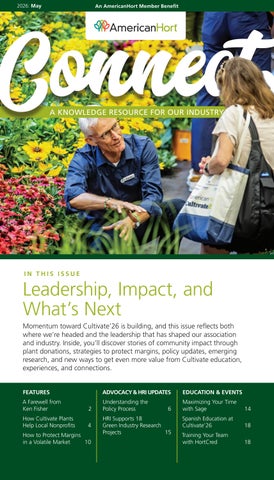
Connect May 2026

Page 1


Thank You for the Opportunity

As I prepare to step aside as CEO of AmericanHort, I’ve been asked several times to reflect on the defining accomplishments of the past decade.

I understand the question. Ten years is a meaningful chapter for any leader—and for me, it has been an incredibly rewarding one.

I believe that the moment leadership becomes about simply accomplishments, you risk losing sight of the mission. The success should be about the progress of the institution and the people it serves.

But more than any of that, I’m grateful—for the people.

I’m grateful for the AmericanHort team, whose commitment and professionalism made this work possible every day. I’m grateful for our board and volunteers who gave their time and perspective to move the organization forward. And I’m especially grateful to the growers, business owners, and families across this industry who welcomed me into their businesses, shared their challenges and ambitions, and trusted AmericanHort to represent them.

Those relationships are what made this role so meaningful.

What matters isn’t just what you built. It’s what continues to grow after you leave.

Legacy, if it means anything, is about establishing vision, direction, and momentum.

And the future of the horticulture industry will demand exactly that kind of long-term perspective.

“…I’m especially grateful to the growers, business owners, and families across this industry who welcomed me into their businesses, shared their challenges and ambitions, and trusted AmericanHort to represent them.”

We are entering a period of profound structural change in the green industry. In the last decade, we’ve seen meaningful consolidation across nurseries, greenhouse operations, and supply chain partners, as regional leaders grow into national platforms and companies pursue scale, operational sophistication, and broader market reach. More recently, private equity investment has begun to reshape parts of the sector, bringing new capital with new expectations around growth, technology adoption, operational performance, and professionalization.

At the same time, many of the family businesses that define this industry are navigating one of the most important transitions in their history - generational transfer. Founders and second-generation leaders are passing responsibility to the next generation, who are bringing new perspectives on technology, sustainability, branding, and workforce culture while honoring the values that built these companies. Being invited into those conversations, and earning the trust of those families, has been one of the most meaningful parts of this role.

Technology will accelerate these changes and transform how businesses operate. Artificial intelligence, automation, and advanced analytics are opening new possibilities for how companies manage production, forecast demand, optimize logistics, and connect with consumers. But opportunity rarely arrives without challenge.

Across the industry, companies continue to wrestle with labor shortages, immigration policy uncertainty, and regulatory complexity that affects everything from crop protection tools to trade policy. And like most sectors tied to housing and consumer spending, our businesses must continually manage through economic cycles and uncertainty.

Navigating this environment will require strong businesses—but it will also require strong industry institutions. That is where AmericanHort plays a critical role.

Our mission has always been to help the green industry succeed—by advocating for sensible policy, investing in research through the Horticultural Research Institute, building leadership capability, and bringing the industry together through events like Cultivate. The goal has never been simply to support the industry as it exists today, but to help prepare it for what it will become tomorrow.

What I’m most proud of isn’t a specific accomplishment. It’s that together—with our board, our volunteers, our staff, and our members—we focused on strengthening the institution so it can serve the industry through the next decade of change.

We strengthened the organization’s financial position and strategic clarity.

We reinforced advocacy so the industry has a stronger voice in Washington.

We invested in research and the long-term work of the Horticultural Research Institute.

We expanded leadership development and workforce initiatives.

And we continued to grow Cultivate as the premier gathering point for the entire green industry.

I’ve always believed leadership is temporary stewardship. You borrow the responsibility for a period of time. Your job is to leave the organization healthier than you found it—financially stronger, strategically clearer, and culturally stronger. And then you step aside so new energy, fresh ideas, and new ambition can take it further.

That’s why this moment feels like the right time to step aside. Not because the work is finished—far from it—but because the organization is strong, focused, and ready for its next chapter.

The horticulture industry has always been about renewal. Every growing season begins with the understanding that what we plant today will flourish long after we’re gone. Leadership should work the same way. If AmericanHort continues to grow, if the industry continues to innovate, and if the next generation of leaders builds something even stronger than what exists today, then the work mattered.

The real measure of leadership isn’t whether people remember who held the role. It’s whether the organization continues to thrive after you leave.

It has truly been an honor and a privilege to serve this industry and to work alongside so many exceptional people. Thank you— for the trust, the partnership, and the opportunity to be part of something that matters.

Build something that lasts. Do good—and then let it grow without you.

How Cultivate Plants Help Local Nonprofit Partners

Have you ever wondered what happens to all the leftover plants at Cultivate—or thought about the old Pete Seeger song lyrics, “Where did all the flowers go?”

At Cultivate, the answer is simple: they do good within the Columbus community.

Many of the plants and flowers you see in the concourse, in AmericanHort displays, at the tHRIve stage, the HortScholar display, and other locations throughout the venue are built and designed by volunteers and that year’s HortScholars, a group of college students invited to experience the event.

What many people don’t realize is just how important the plants are; they are not “extras.” Many plant materials are designated as donations that provide a positive, powerful impact.

They are redistributed to nonprofit partners to help fund affordable housing and bring moments of joy to older adults.

The plant materials go to several worthy causes, including Habitat for Humanity MidOhio and Stems for Seniors, and the City of Columbus. Other organizations have benefited from donations in the past, including The Franklin Park Conservatory, the City of Columbus, and Homeport.

Doing Good

After the show, donated plant material becomes an important contribution to Habitat for Humanity MidOhio, and its largest annual fundraising event, a plant sale, held at three ReStore locations in the Columbus area.

Rob Huff, associate director of donations and logistics at Habitat for Humanity MidOhio, said volunteers rapidly collect and transport plant materials from the Convention Center to the ReStore sites.

When asked what was important for Cultivate attendees to know about what happens to the plants, Rob said: “What happens after the show [with the plant donations] is just as powerful as the event and that support directly fuels our mission of affordable housing by turning generosity into real square footage and creating safe, stable homes for families."

Plant

The impact of the plant sales goes beyond revenue, it offers families dignity, a sense of belonging, and stability.

Plant Sale proceeds are an integral part of building a Habitat home. In a very real sense, the plants help build a bedroom, a kitchen, and a bathroom, all critical spaces that offer privacy, safety, comfort, and security, Huff explains. And this year, rising construction costs are significant, and proceeds help offset building material expenses, according to Huff.

Cultivate participants are encouraged to follow Habitat MidOhio on social media to view the home dedications and connect these donations to the families they support.

Flower Arrangements Brighten Lives

The impact doesn’t stop with the Cultivate plants. The flowers adorning tables in education rooms, meeting rooms, and special events—such as the Women in Horticulture Luncheon—do not go to waste, either.

Stems for Seniors is another nonprofit partner that receives floral donations. The organization delivers those arrangements to hospice centers and senior living communities, including memory care and assisted living facilities across the Columbus area. The flowers Cultivate participants enjoy are given a second life. They brighten the days of older adults, especially those receiving daily care.

So as Cultivate’26 closes this year, remember, a simple act of giving leads to something powerful: homes built, and people uplifted.

sale displays at the Habitat for Humanity MidOhio ReStore in 2025. Photos courtesy of Habitat for Humanity MidOhio.

Where Influence Happens: Understanding the Policy Process

Policy is shaped long before headlines or final votes. From early ideas to final implementation, laws and regulations move through a series of stages where input can influence outcomes. Understanding this process helps you see where your experience and perspective can make the greatest difference, and how to get involved at the right moments.

AmericanHort supports members throughout this process by monitoring legislation and regulations, providing timely updates, and guiding engagement opportunities.

The Path to Policy

Idea and Drafting

Policies often begin as ideas, proposals, or concerns brought to legislators from constituents, who are often business owners. This is the stage where problems are defined, and solutions first take shape, making early input especially valuable. At this point, industry members can provide input to local lawmakers using Voter Voice alerts, a tool provided by the AmericanHort advocacy team.

Where Advocacy Has the Most Impact

• The greatest influence happens before policies are finalized— when lawmakers and agencies are still shaping proposals.

• Practical insights, data, operational realities, and business stories, help decisionmakers understand the real implications of policy choices.

• Opportunities to engage exist at every level, from federal agencies to state and local bodies, where industry voices can shape outcomes.

Committee Review

Once proposed, committees review legislation, while agencies or advisory boards examine regulatory proposals. These groups evaluate feasibility, economic impact, and unintended consequences. AmericanHort collects member feedback, partners with allied organizations, and shares industry data to inform how proposals are shaped in committees.

Voting and Approval/Public Comment

Bills move through the House and Senate for votes, while regulatory proposals typically enter a public comment period before finalization. At this point, clear examples of how policies affect real businesses can influence outcomes. AmericanHort gathers member insights and works with allied organizations to submit comments that ensure horticulture perspectives are heard.

Implementation

After approval, policies move into implementation, which may include guidance documents, compliance timelines, or phased rollouts. While influence is more limited at this stage, ongoing feedback can improve clarity and address practical challenges.

Common Terms

• Rulemaking: How agencies turn laws into enforceable rules, often the stage where industry feedback can shape details that affect daily operations.

• Appropriations: Decisions about government funding that influence programs, enforcement, and industry support.

• Public comment: A formal opportunity for businesses and individuals to share insights, data, and real-world impacts before rules are finalized.

• Committee review: When lawmakers evaluate and revise proposals, an important moment for industry expertise to inform amendments.

• Guidance documents: Agency explanations of how new rules will be applied, where ongoing feedback can clarify requirements or timelines.

Typical Timelines

• Legislation: Months to years from idea  drafting  committee review  vote  enactment. Early engagement during drafting and committee stages can have the greatest impact.

• Regulatory changes: 6–24 months from proposal  public comment  final rule  implementation. Public comments and industry data are especially influential during this process.

Your Voice Matters

Even small actions like responding to advocacy alerts, submitting public comments, or sharing your business experience, help policymakers understand the real-world implications of decisions. Lawmakers rely on credible, practical input, and when members speak up early, the horticulture industry’s collective voice becomes a powerful tool.

Learn more about the AmericanHort Advocacy & Government Relations efforts at AmericanHort.org/Advocacy or scan the QR code.

GOSEEK & FIND

In each issue of Connect, we’ll be “hiding” a new small graphic. When you find it, email us at ConnectSeekAndFind@AmericanHort.org, and tell us where you found it. For this issue, respond by June 8

Mary Beth Miller Tree Tyme Nursery Austinburg, OH

Bluestone Perennials: From

Mail-Order Roots to AI-Ready Retail

Bluestone Perennials has evolved from a modest direct-to-consumer nursery into a tech-savvy operation navigating sustainability, scale, and the next frontier.

For Bluestone Perennials in Madison, Ohio, horticulture is both a family legacy and an evolving and incredibly techsavvy business. Founded in 1972 by Bill Boonstra’s father as a direct-to-consumer nursery, the company has grown dramatically while staying true to its original mission of getting top-quality plants into gardeners’ hands.

At his father’s suggestion, Bill spent a few years working outside the business before coming back to the family business in 1983. He came back to roughly an acre and a half undercover and 13 year-round employees, which has since expanded by as much as a factor of 17, Bill figures. “We have six and a half acres undercover, all direct to consumers or econ business, with a staff of about 80 people year-round, which grows to about 140 during our shipping seasons.” Bill says. And the number of varieties the staff cares for—upwards of 1,600—is staggering.

The Ways Business Changes

Over the last decade in particular, Bluestone has transformed how it grows, packages and markets its plants. Bill and his wife Sarah are incredibly proud of one particular milestone: The company’s move away from plastic pots and Pelaspan packaging material. Bluestone switched to plantable coir-based pots and packaging that is entirely recyclable.

“We don’t have any plastic in our boxes,” Bill says. “We made the switch about 15 years ago, and we’re still amazed that nobody else has really followed us in the industry,” Bill explains. “It’s hard to think of better stewards of Mother Earth than nurserymen. So, we don’t want to leave anything that would stay behind after us.”

Another big change has been the ways in which the Boonstra’s acquire and service customers. It now includes mastering data, logistics and digital marketing as much as horticulture. “I spend a lot of my time on the marketing side to make sure that we are actually going to be able to sell what we are producing,” Bill comments.

“I’m very proud to be able to give back to the industry that supported us so well and has given me my dream job.”

The looming “agentic AI” issue has Bluestone, and frankly, all retailers on the watch. “A website now has to be read by AI as well as humans, and we have to have those two methods coexist,” Bill says. “We are sprinting for our lives to be ready for when someone has their artificial assistant say, ‘Hey, I’m in Zone 7, I want a $200 shade garden. Deliver it in mid-April,’ and they’re done. We’ll have to deal and transact with a machine.”

Contributing to Cultivate

Education and community are central reasons the Boonstra’s value AmericanHort and Cultivate.

“We sign our people up for courses, and they’re benefiting from it,” Bill says. “We’re excited to be able to leverage that to help us be the best versions of ourselves that we could be. We just couldn’t be more impressed with their educational content.”

Having benefited from educational opportunities through AmericanHort for years, the Boonstra’s are thrilled to return the favor. Bluestone Perennials will be a tour stop during the Cultivate’26 Nursery Production Tour.

“We are excited to be on the tour, because a lot of wholesale growers now are seeing the benefits of going direct to consumer,” Bill notes. “I’m very proud to be able to give back to the industry that supported us so well and has given me my dream job.”

Visit Bluestone Perennials during the Nursery Production Tour at Cultivate’26.

Requires Cultivate registration, plus $179/person and includes lunch and transportation.

Learn more about the tours and sign up at AmericanHort.org/Cultivate or scan the QR code.

Peak Season Under Pressure: How to Protect Margins in a Volatile Market

Peak season is underway, and horticulture businesses are navigating a demanding operating environment with limited margin for missteps. Tightening margins, labor availability challenges, and input volatility are intersecting as production and service demands reach their busiest point.

At the same time, the industry continues to operate amid broader uncertainty—from ongoing farm bill discussions to evolving trade relationships with key partners like Mexico and Canada. Geopolitical tensions are influencing fertilizer markets, while changes to pesticide regulations are adding new layers of planning complexity.

While these variables remain unsettled, uncertainty does not have to mean inaction. By focusing on factors within your control, you can protect profitability and maintain stability.

1. Leverage Tax Strategy and Policy Awareness

During peak season, many business owners focus on operational decisions, but financial and tax planning are just as important when it comes to protecting margins. Take advantage of available provisions to improve your financial position now, rather than waiting until year-end:

• Maximize Capital Deductions through Section 179 to offset higher equipment costs.

• Use Farm Income Averaging (Schedule J) to smooth tax liabilities across years if your revenue fluctuates seasonally.

• Monitor Trade Credits by staying in close contact with your advisor on any emerging relief programs or credits tied to trade disruptions or input cost increases. Proactive documentation of costs today will make these opportunities easier to capture when tax time arrives.

2. Maximize Labor Efficiency

Labor remains one of the most significant cost pressures during peak season. When staffing is tight, improving output per hour becomes essential.

“In today’s environment, the real competitive advantage is consistency under pressure,” says Tommy Irvine, lead agriculture advisor at Pinion. “Operations with repeatable systems are far better positioned to manage labor gaps and tight margins during the busiest parts of the season.”

Focus on cross-training employees, refining schedules, and standardizing workflows— leveraging software to create consistency and reduce inefficiencies and rework.

3. Monitor Costs in Real Time

With fertilizer and crop protection markets in flux, static annual budgets are no longer sufficient. Monitor costs in-season to identify margin pressure early.

Where possible, lock in pricing through supplier agreements to reduce exposure to mid-season increases. At the same time, review overhead expenses and eliminate or reduce underused services that are not contributing to your bottom line.

4. Reassess Product Mix and Pricing Discipline

“Downturns expose what’s profitable and what’s just ‘busy,’” Irvine says. “In this environment, it’s critical to make sure every dollar and every hour is tied to your highestreturn work.”

Now is the time to evaluate your product mix and ensure resources are aligned with your most profitable opportunities. Revisit pricing regularly—especially as input costs fluctuate—and confirm that margins remain

intact. Adjust order minimums or delivery terms as needed to reflect current cost realities.

5. Protect Cash Flow and Liquidity

Disciplined cash management is critical during periods of peak activity.

Maintain a rolling cash flow forecast to anticipate potential shortfalls before they occur. Strengthen receivables processes by invoicing promptly and following up consistently on outstanding balances. Even small improvements in cash conversion can have a meaningful impact during the busiest months.

6. Use Data to Drive Decisions

When uncertainty is high, timely financial data becomes one of your most valuable tools. Use benchmarking and scenario planning to understand how shifts in labor, input costs, or market access could impact your operation. Pairing these insights with advisors who understand the horticulture industry can help you make informed decisions that balance short-term pressures with long-term performance.

The challenges facing horticulture businesses this season are real, and in some cases, significant. While the path forward may look different for every operation, disciplined execution, strong financial visibility, and proactive planning can help you protect what’s working, address what’s not, and move forward with greater clarity.

Connect with Pinion Experts

Premium members receive a complimentary phone consultation with Pinion experts. Other services can be arranged at a negotiated rate. To get started, contact AmericanHort at (614) 487-1117, or scan the QR code for more information.

Download the Latest Index of Prices Paid by Growers

Rising input costs and margin compression have reshaped the green industry growers who don’t fully understand their cost structure risk leaving profit on the table.

The Index of Prices Paid by Growers, developed by AmericanHort Chief Economist Dr. Charlie Hall, delivers the most relevant, industry-specific insight into how inflation is impacting nursery and greenhouse production. Going beyond standard economic measures, this data-driven report reflects the real-world inputs growers purchase every day, including labor, fuel, containers, freight, and packaging. By showing how input costs have risen, now more than 67% higher than in 2007 and 23.5% above pre pandemic levels, it helps growers make confident pricing and management decisions that reflect today’s cost realities.

Scan the QR code to download the report.

How Benchmarking Data Helps You Make Smarter, Faster Decisions

When you invest in supplies for your business, you compare options and choose what will deliver the best return—both financially and operationally.

The same business-minded approach applies to how you make decisions about performance: using benchmarking data helps you evaluate where you are today, identify opportunities, and make confident choices that support your overall business strategy.

Strategic planning is part of long-term success and stability in a business. This is why benchmarking data matters.

Financial Benchmarking

Industry benchmarks are a practical management tool for short and long-term goal setting and guiding the direction of your business. Whether you are planning long-term investments in equipment, or increasing operational capacity, financial data will be a key part of your decisionmaking process.

“If you’re serious about running your business by the numbers, the AmericanHort Financial Benchmark Survey is a no-brainer. It only takes about 15–20 minutes, and the report gives you real insight into where your company is performing well, and where the weaknesses are,” said Kent Fullmer, President, Fullmer’s Landscape,

and Chairman of the Board of Directors for AmericanHort. “It’s been a helpful tool for the strategic planning events we work on as a team, and it has been helpful for us to set priorities for the future.”

By completing the confidential financial benchmark survey, you gain access to aggregated data collected from all industry participants. The final report provides key performance indicators such as cost of goods sold (COGS), selling, general, and administrative (SG&A) metrics; profit margins; inventory; labor; transportation; and others. These metrics can help in understanding your profits, cost structures, and revenue trends.

Salary and Benefits Benchmarking

For businesses wanting to attract and retain high-quality staff, understanding the current industry trends in compensation and benefits packages will underscore how your business compares and ensures your company is successful.

Developing strategies to ensure fair and equitable compensation practices

“If you’re serious about running your business by the numbers, the AmericanHort Financial Benchmark Survey is a no-brainer. It only takes about 15–20 minutes, and the report gives you real insight into where your company is performing well, and where the weaknesses are.”

are in place can contribute to a positive workplace culture and help ensure longterm staff are happy and productive. This is where benchmarking metrics help determine strengths to tout in recruitment and retention efforts. Benchmarking also identifies improvement areas.

How to Get Started

AmericanHort provides members with two opportunities each year to obtain an industry report by offering an annual financial benchmark survey and a salary and benefits survey.

Industry Insights, an independent third-party expert, collects all survey data confidentially. For respondents who complete the survey, aggregate data provides actionable, relevant information to support strategy and decision-making.

Additionally, benchmarking data can support more accurate budgeting and forecasting. With access to real-world figures from similar businesses, members can set realistic goals and make evidencebased decisions about investments, staffing, and resource allocation. The information collected through this process also serves as a valuable tool for communicating with stakeholders, such as lenders or investors, by demonstrating how your business compares to industry standards.

“By participating in our benchmarking surveys, you can see how you stack up against other operations in your space to understand if you’re among the best or in need of improvement,” Karen Limbert, Vice President, Operations and Finance for AmericanHort. “You can identify where to focus your attention to make the biggest impact.”

For more information, visit AmericanHort.org/Benchmarking or scan the QR code.

Financial Benchmarking

• Data collection begins on June 1, 2026

• Report available in Fall 2026

Salary and Benefits Benchmarking

• Data collection begins August 1, 2026

• Report available December 2026

Company Comparison Report

• Premium members who complete a survey receive a complimentary report showing how their company compares to industry peers.

We extend a warm welcome to the new members who joined in February and March. See the rest at AmericanHort.org/NewMembers or scan the QR code.

Maximizing Your Time & Goals at Cultivate’26

Cultivate provides ample opportunities for you to work towards your professional goals. With education sessions, tours, amazing experiences and a trade show to walk, sometimes it is challenging to know where to begin.

There are some best practices that may work well for you, but if you’d like a more personalized approach to planning, you can turn towards Sage, the AmericanHort AI-assistant.

Just go to AmericanHort.org/Sage and ask your question, or use one of the prompts already set up on the webpage. To get the most customized advice from Sage, share key details such as your role within horticulture, background information to provide context about the topics you’re looking to explore, or skills you are trying to improve. With that information, Sage can point you to the sessions that fit your goals.

Below are a few Sage prompts you can try that are designed to help you make the most of your time at Cultivate. Members should log in to the membership portal first to obtain the most detailed responses.

The Sage AI tool is a resource to help guide you. Please remember that it continuously learns, so provide a thumbs up or thumbs down to provide valuable feedback.

Get started at AmericanHort.org/Sage or scan the QR code.

• Can you tell me what other activities are available at Cultivate, beyond the trade show and education sessions?

• How can I maximize my time on the trade show floor?

• Guide me through how I can get the most of my Cultivate experience.

• I want to know what sessions are relevant to me at Cultivate.

HRI Supports 18 Green Industry Research Projects with $564,521 Investment

The Horticultural Research Institute (HRI), the research affiliate of AmericanHort, announced $564,521 in research funding for 18 projects in 2026, supporting new work designed to strengthen every stage of the horticulture supply chain.

The selected projects address a wide range of industry priorities, including plant propagation and production efficiency, pest and disease management, landscape plant performance, and consumer engagement with horticultural products. Together, the projects reflect the breadth of challenges and opportunities facing growers, landscapers, retailers, and allied businesses.

HRI’s investments are guided by four strategic research priorities: quantifying plant benefits, creating innovative solutions, gathering consumer insights, and producing

practical and actionable solutions. By aligning funding with these priorities, HRI ensures that supported research delivers meaningful benefits to the horticulture industry.

“The projects funded through HRI reflect the industry’s commitment to investing in solutions that strengthen horticulture today and into the future,” said Mark Yelanich, HRI Board President and Research Director at Metrolina Greenhouses. “When businesses and researchers work together through HRI, the results benefit the entire green industry.”

To read about the HRI-funded projects, visit HRIResearch.org or scan the QR code.

Growing the Industry’s Next Generation

HRI proudly supports students preparing for careers in ornamental horticulture. Through the generosity of industry donors, HRI provides scholarship support that helps students advance their education and step into careers that will shape the future of our industry.

Eligible students are considered for more than $60,000 in awards across 20+ HRI Scholarship Funds and more than $20,000 through the Sidney B. Meadows Scholarship Endowment Fund. By investing in driven, talented students today, we are cultivating a stronger, more innovative horticulture industry for the future.

Applications for the 2026 program year close May 31, 2026.

Learn more at HRIResearch.org/Scholarships or scan the QR code.

Holly Walters works in The Gardens at Sheiyah Market in Berlin, Ohio, where she helps create an inspiring plantfilled retail experience. A graduate of the greenhouse and nursery management program at The Ohio State University Agricultural Technical Institute, Holly combines her horticulture training with a passion for helping people connect with plants. Since being named a HortScholar in 2017, she has remained closely connected to the industry.

Can you describe your current role and the work you’re most passionate about in horticulture?

I work in the gardens at Sheiyah Market in Berlin, Ohio. It’s a unique location with about five stores on the campus, and the part I work in is the greenhouse and garden center. We carry all sorts of plants— perennials, herbs, annuals—and I spend a lot of time working with houseplants, as well. We also have beautiful garden art,

Meet Holly Walters

Class of 2017 HortScholar

statuary, and lots of fountains, so it’s a beautiful place for people to visit.

I enjoy the retail side of horticulture, especially helping people get connected with plants. It’s a high-end garden store, and as a “gardenista,” I love helping customers find what plants fit them and getting them interested in gardening. What educational experiences helped prepare you for your career in horticulture?

I graduated with honors from Ohio State ATI in Wooster in their greenhouse and nursery management program. I specialized in greenhouse management, and I really enjoyed the program—it was a great experience. I still live in the area now, even though it’s a bit of a drive to Sheiyah Market from where I live with my husband and our daughter. It’s worth it, though, because it’s such a beautiful place to work.

How did being named a HortScholar influence your professional journey?

Being a HortScholar was an amazing experience. It was great to meet so many important people in the industry and have

the chance to talk with them. It’s also fun to see some of those same people again at Cultivate each year. I have a lot of great memories from the program, and it helped me make lasting connections in the industry. Those relationships are valuable, and you never know where they might lead in the future.

You’ve continued to volunteer at Cultivate over the years. What keeps you coming back?

I started volunteering when I was a student at ATI. They were looking for volunteers during the summer program, and the woman running the greenhouse asked if I’d be interested. I said yes and have volunteered almost every year since.

Cultivate’26

It’s been an awesome experience working with some amazing people. I get to work with [former HortScholar] Doug Schuster, who was my old boss when I was at Kingwood Center Gardens. I also love working with the AmericanHort staff; they’re so much fun. After so many years, it feels like a family you get to see once a year.

I especially love doing the displays and design work. It’s a chance to be creative on a really big scale. You want the displays to be big and showy and impressionable, so attendees have a memorable experience when they come to the show.

Experiences: Women in Horticulture Luncheon

How to Stay Inspired When You’re So Darn Tired

Keynote speaker Christine Cashen brings humor, real stories, and practical tools for women who care deeply about their work. Participants learn how to “compose and dispose” of worry, reduce stress, quiet self doubt, strengthen relationships, and choose an emotional state that supports confident leadership and personal wellbeing.

Monday, July 13 at 12:00–1:30 PM Short North Ballroom

Ticketed event, $65/person and includes lunch. Sign up when you register for Cultivate. Ticket sales close July 3.

Learn more about the luncheon and sign up at AmericanHort.org/Cultivate or scan the QR code.

Media Sponsors Presenting Sponsors

Keynote Speaker
Christine Cashen

An Opportunity You Won’t Find Anywhere Else: Spanish Education at Cultivate’26

At Cultivate’26, Spanish-speaking horticulture professionals will have access to an education track built specifically for them. The programming is practical and production-focused, delivered entirely in Spanish by respected industry experts.

For employers, this is a unique chance to invest in head growers, section leaders, and crew members through advanced training on topics like nitrogen management, water quality, substrates, pest and disease control, and hands-on pH and EC monitoring. When technical education is taught in the language people naturally think and problem-solve in, learning sticks faster, confidence rises, and ideas return to the operation ready to use.

Attendees have already seen the impact. One Cultivate’25 participant said it was “a very informative session when it came to identifying the pests we face,” reflecting the job-ready value of this programming. Beyond production, Cultivate’26 also offers Spanish-language career development and interactive roundtables focused on career growth and team leadership.

And then there’s the power of being there in person. Live demonstrations, candid Q&A, conversations that spark new ideas, networking with peers who understand the same challenges. It’s energizing, and that energy comes back with them.

Bringing your Spanish-speaking team to Cultivate’26 is a high-impact opportunity to build skills, motivation, and long-term commitment.

Explore the full list of Spanish-language sessions at Cultivate’26 and start planning your team’s experience.

Flexible

Custom

Recognition to motivate + retain staff

Building

Spring Survival Toolkit: On-Demand Support for Peak Season

Available May 1–31, 2026

Spring is the most demanding season in the green industry, marked by long hours, high expectations, and constant pressure on leaders and teams.

The Spring Survival Toolkit, available on demand starting May 1, offers practical, on-the-job support designed to help teams stay steady and resilient during peak season. This curated collection of short, actionable videos fits easily into busy workdays. Each resource is quick to access, easy to apply, and rooted in real-world work environments.

Save the Dates

About AmericanHort

AmericanHort is the national association of horticulture businesses and professionals across the spectrum of the industry. Perform better, grow stronger and prepare for the future as a member of AmericanHort, the green industry’s leading association.

AmericanHort.org

The on-demand package covers topics like stress management, effective communication, and practical stretching and body mechanics for teams. Additional sessions focus on everyday wellness, including ergonomics, physical strain, healthy eating, and injury risk reduction. The bundle also includes a downloadable handout on quick resets teams can use to relieve stress.

Get started at AmericanHort.org/Education or scan the QR code.

July 11–14, 2026 | Columbus, OH AmericanHort.org/Cultivate

September 14–16, 2026 | Philadelphia, PA AmericanHort.org/Plug

©2026 AmericanHort. All rights reserved. This material may contain confidential information, and it is for the sole use of AmericanHort members. The information contained herein is for general guidance and not for the purpose of providing legal advice. It cannot be distributed, reprinted, retransmitted, or otherwise made public without prior written permission by AmericanHort. Please contact the editor at (614) 884-1147 for permission with acknowledgment. Follow us on social media

AmericanHort Connect 2026: May

Publisher: Mary Beth Cowardin, Vice President, Marketing & Member Engagement

Editor: Cindy Whitt, Marketing Communications Manager Hello@AmericanHort.org 2130 Stella Court Columbus, OH 43215-1033 USA (614) 487-1117

Turn static files into dynamic content formats.

Create a flipbook
Connect May 2026 by AmericanHort - Issuu