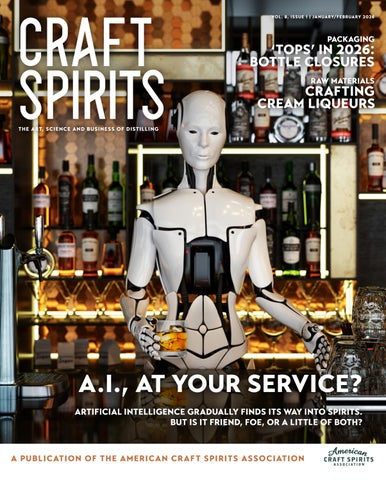
Craft Spirits January/February 2026

Page 1


A.I., AT YOUR SERVICE?

ARTIFICIAL INTELLIGENCE GRADUALLY FINDS ITS WAY INTO SPIRITS. BUT IS IT FRIEND, FOE, OR A LITTLE OF BOTH?

The Big A.I. Question

More than just chatbots, artificial intelligence holds promise for small distilleries—if used judiciously BY

RTD Cocktails - Taking Over Craft Spirits One Can At A Time

A closer look at the production process of RTDs, and what brands can do to find success in the category

MEMBER SPOTLIGHTS

Getting to Know ACSA Member Producers

Profiles on Whiskey Acres Distilling Co. and Altered State Distillery

DESTINATIONS

Deep Commitment in the Deep South

How Mississippi and Alabama-based distilleries are finding success 92 years after Prohibition

Rethinking Targeting Consumers

Demographics have their place, but they’re only part of the marketing equation

We spotlight some top cocktail destinations in Las Vegas and North Carolina

Closure suppliers are targeting the craft spirits market with more local supply and improved quality in the coming year

Key considerations for cream liqueur stability and consistency

CRAFT SPIRITS MAGAZINE

EDITOR-IN-CHIEF | Jeff Cioletti, jeff@americancraftspirits.org

ASSOCIATE EDITOR | Sydney German, sydney@americancraftspirits.org

ART DIRECTOR | Michelle Villas

ADVERTISING & SPONSORSHIP ASSOCIATE | Kristiane Weeks-Rogers, kristiane@americancraftspirits.org

CONTRIBUTORS | Kate Bernot, Lew Bryson, Andrew Kaplan, Jeremy Murrell, Lisa Wallace

AMERICAN CRAFT SPIRITS ASSOCIATION

CEO, AMERICAN CRAFT SPIRITS ASSOCIATION | Margie A.S. Lehrman, margie@americancraftspirits.org

COO, AMERICAN CRAFT SPIRITS ASSOCIATION | Emily Pennington, emily@americancraftspirits.org

EDUCATION MANAGER | Kirstin Brooks, kirstin@americancraftspirits.org

DIRECTOR OF MEMBERSHIP AND MARKETING | Carason Lehmann, carason@americancraftspirits.org

ADMINISTRATIVE ASSISTANT | Albab Melaku, albab@americancraftspirits.org

DIRECTOR OF MEETINGS & EVENTS | Stephanie Sadri, stephanie@americancraftspirits.org

ACSA ADVISORS

STRATEGIC COMMUNICATIONS | Alexandra S. Clough, GATHER PR LEGAL | Ryan Malkin, Malkin Law, P.A.

PUBLIC POLICY | Jim Hyland, The Pennsylvania Avenue Group STATE POLICY | Michael Walker, The Walker Group, LLC

ACSA BOARD OF DIRECTORS, 2025-2026 PRESIDENT | Jordan Cotton, Cotton & Reed (DC) VICE PRESIDENT | Jaime Windon, Windon Distilling Co. (MD) SECRETARY/TREASURER | Tom Bard, The Bard Distillery (KY)

EAST

Jordan Cotton, Cotton & Reed (DC)

Greg Eidam, Sugarlands Distilling Co. (TN)

Becky Harris, Catoctin Creek Distilling Co. (VA)

Adam Polonski, Lost Lantern Whiskey (VT)

Colin Spoelman, Kings County Distillery (NY)

Jaime Windon, Windon Distilling Co. (MD)

EX OFFICIO

Jeff Kanof, Copperworks Distilling Co. (WA)

CENTRAL

& MOUNTAIN

Tom Bard, The Bard Distillery (KY)

Murphy Quint, Cedar Ridge Distillery (IA)

Mark Shilling, Maverick Distilling (TX)

Phil Steger, Brother Justus Whiskey Co. (MN) Olivia Stewart, Oxbow Rum Distillery (LA)

Thomas Williams, Delta Dirt Distillery (AR)

ACSA PAST PRESIDENTS

2024-2025 | Kelly Woodcock, Westward Whiskey (OR) 2023-2024 | Gina Holman, J. Carver Distillery 2020-2023 | Becky Harris, Catoctin Creek Distilling Co. 2018-2020 | Chris Montana, Du Nord Craft Spirits 2017-2018 | Mark Shilling, Maverick Distilling 2016-2017 | Paul Hletko, FEW Spirits 2014-2016 | Tom Mooney, House Spirits

CRAFT SPIRITS MAGAZINE EDITORIAL BOARD

PACIFIC

Caitlin Bartlemay, Clear Creek Distillery (OR)

Orlando Lima, Bainbridge Organic Distillers (WA)

Alex Villicana, Re:Find Distillery (CA)

ACSA PAC

Jordan Cotton, Cotton & Reed (DC)

Lew Bryson, Alexandra S. Clough, Prof. Dawn Maskell, Adam Polonski, and Teri Quimby

For advertising inquiries, please contact Kristiane Weeks-Rogers, kristiane@americancraftspirits.org For editorial inquiries or to send a news release, contact news@americancraftspirits.org

P.O. Box 470, Oakton, VA 22124

© 2025 CRAFT SPIRITS magazine is a publication of the American Craft Spirits Association.

ROOM FOR RECOGNITION

You may recall that for the past couple of years, we’ve been honoring the top on-premise establishments in America with our annual Best Bars list. It’s become one of our most popular features, and we’re thrilled to be presenting it again this year. But not quite yet. Before we start accepting Best Bars nominations (likely in April, with a July/ August publication), we’d like to hear about the venues that are a bit closer to home for craft spirits producers: tasting rooms. In the March/April issue, we’ll be showcasing our inaugural Top Tasting Rooms list. As you may recall, we’ve purposely excluded distillery-owned cocktail bars from the Best Bars feature, as we felt they should be recognized on their own, among their peers. So, whether you operate a small, samples-only tasting room or offer full cocktail service (where legal, of course), you’re eligible to nominate your space for Top Tasting Rooms. Each type of venue will be evaluated independently of the other. So, in other words, distillery-run cocktail bars will be judged among other distillery-run cocktail bars, and samples-only tasting rooms will be judged among other samples-only tasting rooms. Our panel of independent judges will evaluate tasting rooms based on some or all of the following criteria:

Design/Décor

Atmosphere

What Type of Community-Building Events or Activities the Distillery Hosts

How The Space Reflects/Connects with the Distillery’s Ethos/Brand

Community Inclusivity

Overall Innovation

Once you complete the nomination form, you’ll be asked to provide images of the space. We strongly encourage video, with a complete, 360-degree view of the tasting room. Please keep those videos to under one minute in length. Still photos are also acceptable, but we recommend that you submit multiple images, so that it adequately captures the space from various angles. Three to five images should suffice. There’s no cost to nominate, and the deadline for Top Tasting Room nominations is February 23, 2026.

Speaking of deadlines, there’s also one coming up for the Sixth Annual Craft Spirits Packaging Awards. As always, the Craft Spirits Packaging Awards celebrates creativity in the design of craft spirits labels and packaging. The competition is open to all producers of craft spirits—including non-U.S.based brands—and packaging companies and/or designers may enter on behalf of their craft spirits producer customers. A separate panel of design and brand experts will judge entries and award gold, silver, and bronze medals in the following categories: brandy, gin, RTDs, rum, specialty spirits (including liqueurs, amari, agave spirits, shochu, and anything else that doesn’t fit the other categories), vodka and grain, whiskey, and zero-proof spirits. Brands may also enter the Portfolio category, which recognizes outstanding packaging across a range of three or more products. Portfolios must be entered separately from the individual category entries. And, of course, we’ll honor the cream of the crop with the Best in Show award. We’ll also be introducing an award this year that honors the packaging/design vendor whose craft distillery customers have garnered the most medals. Medals will be presented at the 2026 ACSA Convention & Expo in Sacramento, California, April 17-18. We look forward to honoring you there! ■

THE SIXTH ANNUAL CRAFT SPIRITS PACKAGING AWARDS

Thank You , Sponsors !

The American Craft Spirits Association would like to thank all of our annual sponsors and our key supporters of education. We are grateful for all of your support throughout the year. Interested in becoming a sponsor? Visit americancraftspirits.org/sponsors or contact membership@americancraftspirits.org.

Cask Strength Sponsors

Single Barrel Sponsors

Lew Bryson has been writing about beer and spirits full-time since 1995. He was the managing editor of Whisky Advocate from 1996 through 2015, where he also wrote the American Spirits column, and reviewed whiskeys. He has also written for the Daily Beast and American Whiskey. He is the author of “Tasting Whiskey,” “Whiskey Master Class,” and “American Whiskey Master Class.”

Jeremy Murrell has more than 20 years of experience in spirits marketing, including working for brands that include Jack Daniel’s, Woodford Reserve, and Old Forester. He is the owner of Morpheus Brand Consulting where he leverages marketing science to help brands grow. Connect with him at linkedin/in/jeremymurrell or jeremy@morpheusbc.com

Kate Bernot is a reporter covering beer, food, and spirits. She regularly contributes to Sightlines and Craft Beer & Brewing; her work has appeared in The New York Times, The Washington Post, Imbibe, and elsewhere. She is a BJCP-certified beer judge and a past director of the North American Guild of Beer Writers. She lives in Missoula, Montana.

Lisa Wallace grew up at the foot of the majestic Great Smoky Mountains. Her journey into logistics began at the University of Tennessee, where she laid the groundwork for her education, which she further developed during her advanced studies in Europe and Germany. Upon returning to Tennessee, Lisa seized the chance to collaborate with Barb Smith, a powerhouse in logistics and a true wizard in the spirits industry. Together, with more than 30 years of combined experience in supply chain management, they founded Luel Solutions.

Since its beginning, Michelle Villas has been CRAFT SPIRITS magazine’s art director—guiding the magazine’s aesthetic and visual storytelling. She is currenty the art director for Southbay magazine and was the art director for Beverage World and Beach Life magazine. She has worked for 30 years designing publications in New York, California and New Mexico. When she’s not designing publications, you can find her painting or spending time in nature with her three crazy boxers.

Andrew Kaplan is a freelance writer based in New York City. He was managing editor of Beverage World magazine for 17 years and has worked for a variety of other food and beverage-related publications, and also newspapers. Follow him on Twitter @andrewkap.

Quench your thirst for knowledge in ACSA’s Craft Spirits Classroom. For more information or to register, visit our website at americancraftspirits.org/education/webinars.

New Riff Distilling has announced that its acclaimed Single Barrel Experience will expand its offerings with a new addition: its first-ever Malted Rye single barrel selection Malted Rye will make its Single Barrel debut aged 6 years and distilled with a mashbill of 100% malted rye—a unique and seldom-seen recipe in today’s craft distilling scene.

Garrison Brothers is celebrating the release of limited-edition Spurs Single Barrel bourbon in partnership with the San Antonio Spurs. Each bottle of Garrison Brothers Single Barrel Bourbon, 94 proof, is hand-dipped in wax matching the 90s-era uniform colors and finished with a custom label inspired by the new design.

StilL 630, the craft spirits distillery based in St. Louis, announces the launch of the Indomitable Spirit of America 250th Birthday Bourbon, an exclusive line of rare single-barrel, bottledin-bond bourbons commemorating the semiquincentennial of the United States. This limitededition series celebrates American craftsmanship and the spirit of determination that has defined the United States for more than two centuries.

Cathead Distillery, Mississippi’s first and oldest legal distillery, introduces Tintype #3 ‘Kenny Brown,’ the latest addition to its blues-inspired Tintype Series of limited-edition Old Soul Bourbons. Aged 11 years and bottled at cask strength (103.5 proof), uncut and unfiltered, Tintype #3 showcases the effects of Mississippi’s climate on long-term maturation.

Wyoming Whiskey has released Barrel Strength Bourbon Whiskey #6429, a rare single-barrel expression selected from the top one or two barrels in the distillery’s Kirby, Wyoming rickhouses. Bottled at barrel proof to preserve maximum flavor and richness, Barrel Strength #6429 represents the highest tier of the distillery’s production.

Atheras Spirits introduces a debut collection of six amari and liqueurs. Crafted at its pioneering micro-distillery—within Bitter Monk cocktail bar in Industry City, Brooklyn—the collection features two amari and four liqueurs, each inspired by the intersection of art, history, music, and alchemy: Akhenaten Premium Amaro, Palatine Amaro, Cardoon Liqueur, Hierba Luisa Liqueur, Sykophilos Liqueur, Bergamot Liqueur

Klocke Estate, the Hudson Valley distillery, announced the launch of Referent—its first aged apple brandy. Blended from select barrels of varied age and character, Referent balances intensity and elegance—a golden brandy with aromas of baked apple, wildflower honey, and toasted oak, followed by layers of orchard fruit, vanilla, and spice.

Independent spirits producer Cooper Spirits Co. has debuted a new expression in its acclaimed Lock Stock & Barrel portfolio: the ultra-rare 25-Year-Old Straight Rye Whiskey. The Lock Stock & Barrel 25-Year-Old (111 proof, 55.5% ABV) opens with warm spice, toffee, and caramelized banana. The palate is lush with luxurious viscosity, folded with treacle, toffee, cocoa, cinnamon, nutmeg, black tea, and dried cherry. The extraordinarily long finish reveals layers of oak, slight smoke, and a rye-spice dry-down.

American Cane announced the launch of Banter Rum, the premier release from the House of American Cane, featuring two distinctive rums: Banter White Rum and Banter Amber Rum. Banter White Rum is a fresh, dry, and lively unaged pot-andcolumn blend with lime zest, vanilla bean, soursop, and a touch of macadamia creaminess.

Banter Amber Rum is a quietly rich, textural potand-column blend aged up to four years.

Catoctin Creek Distilling Company of Purcellville, Virginia, announces the arrival of three new products at Virginia ABC stores statewide beginning February 2026. The new Virginia ABC releases are: Shenandoah Gin – Strawberry & Pawpaw Flavored Gin, Applejack, and Roundstone Rye Whisky

Tequila Ocho, the original single-field, single-estate tequila, announces an evolution with the brand’s new Terroir Select vintages. The first Terroir Select vintage, Comunidad, is made with agaves grown at El Nacimiento de Abajo in Arandas, Jalisco, and is the neighboring community to Ocho’s homeplace Tequilera Los Alambiques, as well as its original home of Destilería La Alteńa. The vintage, released in both a Plata and Reposado expression, weighs in at 40% ABV/80 proof.

Rebel Bourbon has announced the return of fan-favorite Rebel Root Beer Whiskey to its Rebel Bourbon lineup. An unconventional twist on Rebel’s timehonored wheated recipe, Rebel Root Beer features Rebel Straight Bourbon Whiskey infused with the bold and creamy flavor of root beer. Rebel Root Beer is bottled at 70 proof (35% ABV) and available nationwide.

Hoot + Howl Spirits’s highly anticipated Amaro Cask Bourbon has officially launched, joining the distillery’s growing lineup of mountain-crafted, historically inspired spirits accessible outside Colorado. A blend of seven-yearold bourbon finished for one year in a Sicilian amaro cask, the Amaro Cask Bourbon balances rich sweetness with subtle bitterness and layered botanicals. Notes of vanilla, citrus peel, dried fruit, caramel, and herbal spice create a deeply complex whiskey that drinks like a Black Manhattan in a bottle.

Liberty Pole Spirits, Western Pennsylvania’s premier grain-to-glass whiskey distillery, is proud to announce its first-ever Double Oaked Wheated Bourbon. The whiskey was aged 3.5 years in its original barrels before being transferred into a second set of brand-new finishing barrels featuring a combination of heavy toast with light and medium char levels. This secondary maturation lasted 11 additional months.

Copperworks Distilling Co. has introduced Copperworks Pondera Cabernet Cask American Single Malt Whiskey, a limited-edition release celebrating the distillery’s partnership with awardwinning, family-owned boutique winery, Pondera Winery. Bottled at 50% ABV (100 proof), it was crafted using pale malt and matured for more than seven years in a refill Copperworks cask before finishing for six months in a Cabernet Sauvignon cask from Pondera.

Dos Maderas, the renowned rum under Bodegas Williams & Humbert, announces the release of Dos Maderas Origen Thailand, a limited-edition release crafted from 12-year-old Thai rum and finished in rare 80-year-old Oloroso sherry casks.

Coffee Cocktail Recipes for Home Bartenders

Author: Wilburn T. Myrick

Publisher: Independently Published

Release Date: November 21, 2025

“Coffee Cocktail Recipes for Home Bartenders” shows you how to turn everyday beans, a few bottles, and simple tools into espresso martinis, Irish Coffee, White Russians, Espresso Tonics, mochas, and full coffee mocktails that actually feel bar-worthy. Whether you are hosting Christmas brunch, a winter movie night, a New Year’s party, or just winding down after work, you will always have a coffee drink that fits the moment.

South Carolina Cocktails: An Elegant Collection of Over 100 Recipes Inspired by the Palmetto State

Author: Stephanie Burt

Publisher: Cider Mill Press

Release Date: February 10, 2026

Explore South Carolina’s rich history, charming cities, and lush landscapes through its cocktail culture. With more than 100 recipes and numerous bartender profiles, “South Carolina Cocktails” allows you to experience the state’s spirited lifestyle, whether you’re a resident mixing drinks for friends or a visitor looking to bring a piece of your travels back home. From rooftop bars to beachfront shacks, discover venues that offer an authentic taste of South Carolina’s diverse drinking scenes. Celebrate the best mixologists in the region and their signature concoctions with an insider’s guide to the must-visit spots.

The Madrusan Cocktail Companion

Author: Michael Madrusan, Zara Madrusan

Publisher: Murdoch Books

Release Date: October 7, 2025

“The Madrusan Cocktail Companion” is the comprehensive one-stop guide to classic drinks from every era, plus the best modern cocktails, curated by oracle Michael Madrusan with contributions from world-leading bartenders. Michael and Zara Madrusan draw on their own extensive library of books that date back to 1862 to present the stories behind the cocktail canon, alongside all the best variations, categorized by origin and by ingredient, and with an emphasis on readily available products and minimal preparation.

The Complete Guide to Grains, Distilling, and the Future of Craft Spirits

Author: Binyomin Terebelo

Publisher: Independently Published Release Date: January 5, 2026

Authored by experienced distiller and writer Binyomin Terebelo, this comprehensive guide explores the world of craft spirits by examining the foundational role of grains in distillation. The book blends tradition and innovation, making complex topics approachable for both enthusiasts and newcomers. It begins with an introduction highlighting the renaissance of distilling, then delves into the grains that have shaped civilizations and currently enrich the flavors of spirits, from barley and corn to rye, wheat, rice, and millet.

KENTUCKY DISTILLERS’ ASSOCIATION ANNOUNCES NEW BOARD OFFICERS, DIRECTORS

The Kentucky Distillers’ Association announced that Gigi DaDan has been elected Chair of the Board of Directors for the 146-year-old non-profit trade group that unites and leads Kentucky’s signature Bourbon and distilled spirits industry.

DaDan, General Manager of Louisville Distilling Co., which owns the Angel’s Envy brand and distillery, will serve through December. She succeeds Ken Lewis, founder of New Riff Distilling and member of the Kentucky Bourbon Hall of Fame®.

“As I take on the role of Chair, I’m deeply grateful for the leaders who have poured their wisdom, passion, and innovation into the Bourbon industry,” said DaDan.

“Helping create thousands of memorable Bourbon experiences has been one of the greatest privileges of my career, and stepping into this position feels both humbling and energizing. I’m honored to carry forward the legacy of America’s spirit and help build momentum for its rich, storied tradition as we grow stronger together.”

CONNIPTION GIN OFFERS NEW EXPERIENCE AT RALEIGH-DURHAM INTERNATIONAL AIRPORT

LAS VEGAS DISTILLERY ANNOUNCES VEGAS VALLEY DISTRIBUTION

Durham Distillery, the maker of Conniption Gin, has announced the opening of Conniption Cocktails & Cuisine at Raleigh-Durham International Airport (RDU), serving one of the fastest-growing regions in the United States. With an ambition to serve the best airport martini in the country, the craft distiller is captivating seasoned gin lovers and new gin converts alike through its portfolio of the highestawarded American gins.

“Conniption Gin is on a mission to revolutionize American gin by showing it can be modern, exciting, and most importantly, delicious,” says Melissa Katrincic, co-founder and CEO of Durham Distillery. “We’re celebrating our 10th anniversary by creating an elevated bar and dining experience at RDU, proving that a great airport cocktail doesn’t have to be the exception. It can be the standard.”

Founders Melissa and Lee Katrincic are leading the gin renaissance as the first U.S. distillers to combine their signature cold vacuum distillation method with traditional vapor distillation. The result is a collection of smooth yet complex gins that balance bold botanicals like juniper and coriander with delicate flavors such as cucumber and honeysuckle.

Las Vegas Distillery has secured a distribution agreeement for Vegas Valley and surrounding areas, working with Copa Fina to make its artisan spirits available throughout Nevada. This milestone brings Las Vegas Distillery’s 100% locally produced premium spirits available to bars, restaurants, and retail outlets throughout the state, allowing locals and visitors to support small businesses in Nevada.

“We are excited to be expanding our reach to Nevada residents who have supported us since we reimagined and reopened Las Vegas Distillery in 2024,” says Las Vegas Distillery Manager Cody Fredrickson. “With the partnership of Copa Fina distribution and the wonderful relationships we’ve created in the community, the craft spirits will now be available at favorite local bars, restaurants, and liquor stores. Our spirits are made entirely in the Vegas Valley, and we’re proud to be able to provide the perfect souvenir for visitors, and an excellent addition to home bars across the state.”

SOCIAL HOUSE VODKA EXPANDS WITH UNIVERSITY OF WISCONSIN ATHLETICS

Social House Vodka officially announces its new partnership with the University of Wisconsin Athletics. This collaboration deepens Social House’s commitment to Badger Nation, adding to its growing presence across the state of Wisconsin.

Following the successful launch of the Varsity Vodka bottle in 2024, created in partnership with The Varsity Collective, this new agreement marks a major step forward in Social House’s mission to blend exceptional taste with meaningful purpose. The Varsity bottle isn’t just a show of school pride—it’s a way to give back. A portion of the proceeds from each Varsity bottle sold directly supports University of Wisconsin student-athletes.

“Social House was built on the belief that life is richer when shared,” says Cary Joshi, Founder & CEO of Social House Vodka. “As we grow our relationship with Wisconsin Athletics, we’re honored to give Badger fans even more reasons to raise a glass—together. From studentathletes to alumni, tailgates to toasts, we’re here to celebrate everything Wisconsin stands for: pride, passion, and community.”

Backed by a growing group of investors with deep Wisconsin roots, Social House Vodka says it is proud to support the programs and people that define Badger culture. This new partnership brings the brand further into the UW Athletics family—appearing across official channels, select venue signage, and campus events—but the mission remains simple: help Wisconsin’s student-athletes succeed on and off the field, and give fans something exceptional to raise their glass to.

“Our partnership with Social House Vodka is a celebration of the

NEW LOW-CARBON ELECTRICITY SUPPLY AT SAVERGLASS NORTH AMERICAN MANUFACTURING SITE

Saverglass, part of the Orora Group, has announced the successful transition of its North American manufacturing site’s shift to a very low-carbon electricity source. With this change, Saverglass continues to advance its externally validated SBTi greenhouse gas reduction roadmap and take a step closer to its global target of achieving Net Zero greenhouse gas emissions by 2050.

Matt Wilson, senior vice president Americas at Saverglass, comments, “We have achieved a milestone in Saverglass’s CSR efforts to reduce our environmental footprint. Our Acatlan, Mexico, facility has transitioned from carbon-based electricity to very low-carbon electricity. The change has enabled us to reduce our site’s CO2 emissions by 30%.”

“The majority of glass and decoration production achieved at Saverglass’ Mexico facility is for its North American spirits customers. This change in our site’s carbon emissions means we have reduced our Scope 2 emissions close to zero. To give you an idea, this reduction in CO2 emissions is equivalent to the carbon sequestered by more than 19,000 hectares of forest every year. It represents a considerable impact for our clients’ carbon commitments,” comments

Paul Rosado-Rivial, CSR Manager, Saverglass Americas.

people and school spirit that brings Wisconsin together,” says Wisconsin Athletics deputy athletic director/chief revenue officer Mitchell Pinta. “We’re now thrilled to expand that impact across UW Athletics, as Social House has demonstrated its commitment to our studentathletes and fans.”

VIRGINIA DISTILLERY CO. PARTNERS WITH MAVERICK DRINKS

Virginia Distillery Company announced a strategic partnership with Maverick Drinks. Through this partnership, Maverick Drinks will provide full national distribution throughout the UK and increase visibility for both Courage & Conviction and Virginia Distillery Co. American Single Malt. A core range of products will be available immediately through the e-commerce platform www.MasterofMalt.com and the wholesale partner Master of Malt Trade.

The partnership marks a significant step in Virginia Distillery Co.’s international growth, bringing its acclaimed American Single Malt whiskies to more consumers in one of the world’s most influential whisky markets.

“We’re incredibly excited to partner with Maverick Drinks, a distributor whose values and vision align so closely with our own,” says Gareth H. Moore, CEO of Virginia Distillery Co. “The UK is one of the world’s most influential whisky markets, and Maverick’s dynamic route-tomarket and digital leadership, including their Master of Malt platform, make them the ideal partner to help us share our American Single Malt brands with more consumers across the region.”

“We’re pleased to welcome Virginia Distillery Co. into our portfolio,” said Juan-Marc Correia, sales director for Atom Brands, the brandbuilding arm behind Maverick Drinks. “American Single Malt is gaining real traction in the UK, and Virginia Distillery Co. stands out for quality and clarity of vision. We’re excited to bring their whiskies to our customers and build momentum in the category.”

Maverick Drinks will lead distribution, trade activation, and consum-

er engagement for both Courage & Conviction and Virginia Distillery Co. American Single Malt across the UK. Through their connected ecosystem of Maverick Drinks, Atom Brands, and Master of Malt, there is a strong opportunity to build visibility and trial.

This partnership with Maverick comes on the heels of recent global expansion efforts following the TTB’s ratification of the American Single Malt category in January 2025

MILAM & GREENE WHISKEY ENTERS 2026 WITH RENEWED FOCUS TO FUEL CONTINUED GROWTH

Following a successful 2025 marked by the launch of Provisions Bourbon and multiple other sold-out limited editions, Milam & Greene Whiskey enters 2026 with renewed focus and leadership structure to build momentum for the Texas Hill Country distillery.

Heather Greene, who has served as CEO since the brand’s founding in 2019, has stepped back from day-to-day operational leadership to focus on whiskey-making, innovation, and industry advocacy.

“Being CEO of Milam & Greene has been the challenge and reward of a lifetime,” says Greene. “I’m incredibly proud of what we built through extraordinary circumstances.”

In addition, Denis Johnston has been named interim CEO and national sales director, bringing decades of experience across the spirits industry to guide the brand through its next phase of growth. Johnston joins Milam & Greene after a career spanning leadership roles at Sidney Frank Importers, Diageo, Pernod Ricard, Don Q Rum, Southern Glazer’s Wine & Spirits, and most recently as director of the Southeast Region for Edrington USA.

“I’m looking forward to leading the team and the Milam & Greene brand to new heights in a challenging and evolving spirits landscape,” says Johnston. “We have truly unique whiskeys shaped by the Texas Hill Country, and we’re excited to share that experience with consumers nationwide.” Despite industry headwinds, Milam & Greene achieved significant growth in 2025. Both Unabridged and The Wildlife Collection sold out, while Provisions Bourbon 80 Proof quickly gained traction as a key driver within the portfolio.

To build on this momentum, Milam & Greene has formed a strategic

partnership with Blue Ridge Spirits & Wine Marketing, which will lead national sales efforts for the brand across the United States, providing the structure and resources needed to support continued expansion.

SILO DISTILLERY RELAUNCHES WITH FEMALE, LGBTQIA+ OWNERSHIP

SILO Distillery in Windsor, Vermont, has relaunched under the helm of former head distiller Erin Bell. She purchased the company this fall and has renovated the two-story tasting room and event space at 3 Artisan Park for a fresh, modern atmosphere matching Bell’s energy and passion for the craft.

From spirits to cider, the distillery aims to serve up barn-to-bottle bevs that showcase the best of what local growers have to offer. This includes 100% Vermont-grown corn vodka, russet apples from nearby Keene, New Hampshire, and more.

SILO prioritizes the relationships from which palate-pleasing spirits develop, emphasizing integrity and innovation in its carefully executed production.

Growing even more in 2026, SILO will introduce two new local-apple ciders, resume a ready-to-drink line featuring the distillery’s famous Lavender Cosmo, and a SILO twist on the spritz, while launching a bold new aperitif. Small-batch whiskeys will make a return, too, and partnerships for seasonal flavors will cool down the summer of 2026.

“We are a 13-year-old craft distillery, distilling from locally-grown corn and grain and made with great care; from the beginning to the end, you know where it comes from,” says Bell, who is working to create an asked-for, accessible product.

The revamped SILO, located in the vibrant Artisan Park, focuses on a wholehearted approach to sourcing, production, and imbibing in the products, one that celebrates communities and creates an inclusive

space to raise a glass.

In addition to being female- and LGBTQIA+-owned, SILO works to lift up and celebrate marginalized communities.

“The barn door is always open,” Bell says.

Total system including:

Electrical Controls

Safety Sensors and Guarding

External Settling Supply Tank

Feed Pump from Tank to Filler

Cap Sorter

Rinser Supply System (not shown)

316 L Liquid System

Constructed for Washdown.

(Options and upgrades available - consult with your sales representative.)

AHEAD OF DRY JANUARY, GEN Z INTEREST IN MONTHLONG ABSTINENCE STALLS

Monthlong abstinence is becoming less popular among Gen Z legal drinking age (LDA+) drinkers in several key markets around the world, according to the latest IWSR Bevtrac survey of consumer behaviour.

The number of Gen Z LDA+ drinkers in the UK who reported abstaining from alcohol for a month or longer during the past six months dropped from 33% in Autumn 2024 to 24% in Autumn 2025. An even larger fall was recorded in Australia, where monthlong abstinence takeup over the same period among Gen Z LDA+ drinkers shrank from 39% to 24%.

Monthlong abstinence spells, such as Dry January or Sober October, are especially popular among younger drinkers, but declines in monthlong abstinence among Gen Z were registered in most of the 15 markets surveyed. These include France (from 32% to 24%), Italy (from 26% to 16%), and Brazil (from 39% to 35%). In the US, the trend flatlined rather than declined, with a marginal drop from 32% to 31%. The only market to show a significant increase in monthlong abstinence among Gen Z LDA+ drinkers was Mexico, which moved from a 31% uptake in Autumn 2024 to 35% in Autumn 2025.

Across all 15 markets combined, participation in monthlong abstinence among Gen Z LDA+ drinkers fell slightly from 30% in Autumn 2024 to 28% in Autumn 2025.

The popularity of temporary abstinence of any length also appears to be stalling across all age groups. In the Autumn 2025 survey, 39% of all adult drinkers across all 15 markets reported engaging in temporary abstinence for one day or longer in the past six months. This is down from a recent increase, from 40% in Autumn 2024 to 41% in Spring 2025.

Individual markets where uptake in all temporary abstinence is faltering include the US (from 40% to 38%) and the UK (from 39% to 35%).

After significant increases over the past two years, the Gen Z LDA+ drinking rate has stabilized and is gradually converging with the drinking rate of the general population.

In Autumn 2025, 74% of Gen Z LDA+ respondents reported drinking in the last six months, up slightly from 73% recorded in Spring 2025. While not a significant change, the Gen Z LDA+ beverage alcohol participation rate remains substantially higher than Spring 2023, when only 66% reported drinking in the past six months.

The gap between drinking rates for Gen Z LDA+ and all adults (recorded as 77% in Autumn 2025) now stands at just 3%. This is down from the 9% gap recorded in the Spring 2023 survey, and is the smallest gap ever recorded by Bevtrac.

Individual markets with notable increases in Gen Z LDA+ drinking rates include the UK (up to 79% in Autumn 2025 from 76% in Spring 2025 and 66% in Spring 2023) and Taiwan (up to 78% in Autumn 2025 from 67% in Spring 2025 and 61% in Spring 2023).

REVELTON DISTILLING COMPANY STRENGTHENS EXECUTIVE TEAM FOR CONTINUED GROWTH

Revelton Distilling Co. has announced the continued build-out of its executive leadership team, naming John D’Attoma as vice president of sales, North America, effective January 16, 2026, and highlighting the recent addition of Don Boelens as chief operations officer, who joined the company in September 2025. Together, these appointments underscore Revelton’s commitment to assembling the leadership depth needed to support its next phase of growth and expansion.

D’Attoma brings more than four decades of leadership experience in the beverage and spirits industry, with senior roles spanning supplier,

distributor, and brand-building organizations. His career includes leadership positions at Broken Shed Vodka, Southern Glazer’s Wine & Spirits, Allied Beverage Group, and Standard Beverage Corporation, where he led market expansion initiatives, built high-performing sales teams, and strengthened distributor and trade partnerships across complex regional and multi-state markets.

In his role at Revelton, D’Attoma will lead the company’s North American sales strategy, with responsibility for distributor alignment, market development, sales team structure, and long-term commercial planning as the brand continues to expand beyond its home state.

Boelens joins Revelton with extensive executive leadership experience as both a chief financial officer and chief executive officer, including senior roles at Maytag and, before that, Wellshire Farms. Across his career, Boelens has led operations and finance for Midwest-based companies, guiding organizations through periods of significant growth, operational scaling, and brand expansion, including national market development.

MALKIN LAW ELEVATES ASHLEY HANKE TO PARTNER

Malkin Law, P.A., proudly announces that attorney Ashley Hanke has been promoted to Partner after eight years with the firm, recognizing her leadership and diligent work across the alcohol, cannabis, and non-alcoholic beverage sectors. This appointment also showcases the firm’s values and dedication to supporting the professional advancement of its team.

Since joining Malkin Law, Hanke has supported the firm’s growth, leading its intellectual property practice and managing a broad range of federal alcohol regulatory matters. Her work includes federal and state licensing, trade practice and regulatory compliance, contract drafting and negotiation, advertising compliance and distribution support, label and formula review, assistance with Craft Beverage Modernization Act (CBMA) refunds, and other matters affecting clients across the alcohol beverage and cannabis industries. She also expanded her practice to support clients in the e-commerce and technology fields, as well as the non-alcoholic adult beverage space, and advises on U.S. Food and Drug Administration (FDA) labeling compliance.

“Ashley has been instrumental to the firm’s success and expansion,” says Ryan Malkin, Founder and managing partner of Malkin Law. “Her unwavering commitment to our clients has made a lasting impact on the firm. This promotion reflects both her contributions over the past eight years and our confidence in her continued leadership.”

Hanke’s interest in the alcohol industry was shaped early in her career while working on a vineyard in Tuscany, Italy, where she gained hands-on experience across the wine production and export lifecycle. That journey continues to inform her practical, business-minded approach to regulatory and compliance matters.

“I’ve had the privilege of working alongside clients who are passionate about building responsible, innovative brands in highly regulated industries,” says Hanke. “As a partner, I look forward to continuing to help our clients navigate complex regulatory challenges while supporting their long-term growth and success.”

IRON FISH DISTILLERY ENTERS NEXT CHAPTER FOLLOWING PLANNED CO-FOUNDER TRANSITION

Iron Fish Distillery has announced a planned transition in ownership. Co-founders Richard Anderson and Sarah Anderson have agreed to sell their ownership interest to fellow co-founders David Wallace and Heidi Bolger. The transaction was completed effective December 31, 2025.

Founded in 2016, Iron Fish Distillery has grown into Michigan’s leading farm-based craft distillery, welcoming hundreds of thousands of guests to its agricultural destination while expanding distribution across Michigan and into multiple out-of-state markets. Over the past decade, the four co-founders worked collaboratively to shape the brand’s identity, build a nationally recognized visitor destination, develop an estate-distilled spirits program rooted in agriculture, and establish a growing wholesale and direct-to-consumer footprint.

“Creating Iron Fish has been a privilege and one of the most meaningful chapters of our lives,” says Richard and Sarah Anderson. “We are deeply proud of what the team has built—of the brand, the culture, the connection to agriculture, and the community that has grown around this place. We believe Iron Fish is well-positioned for its next chapter and for continued success under David and Heidi’s leadership.”

David Wallace and Heidi Bolger, who will continue as sole owners following the transaction, expressed appreciation for the partnership that shaped the business. “Iron Fish exists today because of the

shared vision, dedication, and collaboration of all four founders,” they note in a joint statement.

A CUPPA JOE

How about some Java, Joe, Java-jamoke, Jitter Juice, Rocket Fuel, a Daily Grind?

Maybe some Mocha, Macchiato, Mud, Cuppa, Pick-Me-Up, High-Test or Unleaded?

Get fancy: Espresso, Latte, Ristretto, Cappucino, Schümli, Noisette, Lechero, Americano…

When something has as many names, variations, and slang expressions connected to it as coffee does, you know we love it. As if confirmation was needed: coffee is one of the most popular drinks in the world (second or third, depending on the source), more popular than spirits, wine, or beer.

But we don’t make coffee, we make booze. Put coffee and spirits together, and you’ve maybe got a winner.

Coffee cocktails have a strong following. The Espresso Martini has become a topfive cocktail in America (people even ask for them in my basement bar). The White Russian still soars on the cult popularity of “The Big Lebowski,” and there’s its baroque offspring, the Mudslide. Folks try to recreate the secret magic that is the Erin Rose Frozen Irish Coffee.

Why? Because coffee is not just delicious, not just buzzy with the real or imagined boost of caffeine, but it’s mutable, able to blend with other flavors or step right out on its own. Keep it austerely black or literally lighten it with cream, add a touch or a ton of sweetness, add caramel, vanilla, chocolate, hazelnut, peppers, cinnamon, and coffee becomes a different creature. It is a black palette you can blend to your particular palate (get it?).

That is the opening in the category for you. Sure, Kahlua is a globally-known brand, and Mr. Black is the bartender’s favorite. But “Your Brand Here” could definitely be in that kind of company, given a good recipe, hard work by the production and sales teams…and a bit of luck, as always.

Don’t believe me? Here’s a success story.

I recently interviewed John Mleziva, the founder of State Line Distillery in Madison, Wisconsin for my podcast. I thought I was interviewing him about State Line’s new rye whiskey. I was passing through on a book tour, had seen a press release, and thought, ‘Why not, it’s a good episode.’

During the interview, John casually dropped a mention of their coffee liqueur, craftily named “Coffee Liqueur.” He just happened to have a bottle at the table, and poured some samples. Good spirit, and I said so. Yeah, he says, we wanted to have a Big Lebowski party, but Wisconsin law says we can only serve spirits we make. So we needed a coffee liqueur, and we came up with this.

Was it a one-off, I asked? And John says, ‘It’s currently 57% of our sales,’ which kinda grabbed my attention, and brought us here. State Line’s Coffee Liqueur isn’t just a quick run through the gin still with coffee beans. It’s a whole process, with long-steeped cold brew coffee and a judicious addition of other… stuff. But they’ve won three double golds and a platinum at the San Francisco World Spirits competition, not to be sneezed at.

Could you do that? Well, why not? I’ve certainly tasted some excellent coffee liqueurs from craft distillers. That same day I had the Good Land coffee liqueur at Great Lakes Distilling, another good one, with a gorgeous art deco label. In my latest podcast episode, I tasted four coffee liqueurs, including the original Kahlua, which I had over ice with a squeezed half lime in it, an amazing combo that…you could grab and make the signature drink of your coffee liqueur.

Because that’s one of the keys to success with a coffee liqueur: putting it in something that makes it yours. You have to decide on a coffee, both the beans and the roast level; it’s always good to work with a local roaster, or roast it in-house, if you happen to have that skill-set and equipment. Then home

Because that’s one of the keys to success with a coffee liqueur: putting it in something that makes it yours.

in on the level of sweet—will it be espresso robusto, or Turkishly syrupy—and any added flavors: vanilla, caramel, a hint of cinnamon or cardamom?

As you craft your flavor, keep a cocktail in mind. Not much coffee liqueur is sipped neat. A lot of it is simply added to coffee, and the rest mostly goes into cocktails. You want to find a delicious cocktail that shows off your spirit’s best characteristics, and uses it as the main ingredient (because a quarterounce float might look and smell nice, but it doesn’t sell cases).

Find that, and you’re on your way. People may need a little help to realize why they need your little pick-me-up, your cup of Joe, but once they do, they’ll want to have a bottle handy all the time. You’ll have to keep… grinding it out. ■

Lew Bryson has been writing about beer and spirits full-time since 1995. He is the author of “Tasting Whiskey” and “Whiskey Master Class.”

HHS DROPS NEW DIETARY GUIDELINES; ALCOHOL RECOMMENDATIONS CONTINUE TO SUPPORT MODERATION

Health and Human Services (HHS) Secretary Robert F. Kennedy Jr. and his key advisors announced the release of new dietary guidelines on January 7, 2026. Updated every five years, the Dietary Guidelines advise on what to eat and drink in order to promote health and meet nutritional needs.

As part of the new guidelines, explicit recommendations on drinks per day have been removed altogether. When asked about the omission, Dr. Mehmet Oz, Administrator for the Centers for Medicare & Medicaid Services (CMS), provided commentary on the role of alcohol as part of a healthy lifestyle, which is largely in line with ACSA’s longtime perspective: “Alcohol is a social lubricant that brings people together… There’s probably nothing healthier than having a good time with good friends in a safe way.” He also pointed to the Blue Zones around the world, where people live the longest, and noted that alcohol is sometimes part of this diet.

ACSA and the broader spirits industry have worked diligently to advocate reliance on scientific evidence that demonstrates alcohol in moderation can be part of a healthy lifestyle. ACSA has continued to champion that notion, while working to discredit sensationalized neoprohibitionist news reports and biased science. ACSA will continue to advocate for moderation with overall responsible drinking.

CRAFT SPIRITS MAGAZINE READY-TO-DRINK REPORT

Earlier in January, The American Craft Spirits Association’s CRAFT SPIRITS magazine published a special print supplement focused on ready-to-drink (RTD) cocktails, one of the fastest-growing segments in craft spirits. It delivers essential insight on packaging, production, regulation, competition, and marketing, along with highlights of new releases, current sales data, and growth projections. This report offers guidance to launch a product and give your brand an edge in the RTD market.

Segments Include: Ready-to-Drink By the Numbers, The United States of RTD Advocacy, Guide to Product Development & Formulation, Key Factors for Packaging

2026 CRAFT SPIRITS PACKAGING AWARDS

The American Craft Spirits Association and CRAFT SPIRITS magazine are thrilled to announce that the call for entries is open for the Sixth Annual Craft Spirits Packaging Awards. These awards, sponsored by the Glass Packaging Institute, celebrate excellence and creativity in the design of craft spirits labels and packaging.

The competition is open to all producers of craft spirits, and international entries are welcome. No physical samples are required for entry (although some winning entries may be asked to ship samples for photography).

SUBMIT YOUR SPIRITS

ELECTIONS OPEN FOR ACSA BOARD OF DIRECTORS

ACSA began the election cycle for five board seats on the Board of Directors on January 16, 2026. Individual members of a DSP can self-nominate or be nominated by a member of our craft spirits community.

Members of the ACSA Board of Directors play an integral role in shaping the craft spirits industry. Throughout a three-year term, each member shares a common goal of carrying out ACSA’s mission to elevate and

advocate for the community of craft spirits producers.

If you have the time, energy, and passion to make a difference in our spirits industry, please consider applying or nominating a colleague no later than March 13, 2026. Candidates will be invited to address the craft spirits community on April 17 during a Meet the Candidates Breakfast at ACSA’s Annual Convention.

ACSA CONVENTION FLIPS SCRIPT ON BUSINESS AS USUAL

The craft spirits community is coming together April 17–18, 2026, in Sacramento, California, for a reimagined ACSA Convention & Expo. We’re flipping the script on business as usual with an experience designed to tackle today’s challenges and unlock tomorrow’s opportunities.

Join distillers, suppliers, and industry partners for two days of meaningful conversations, hands-on experiences, and practical insights. Highlights include off-premise retailer perspectives, high-impact education sessions, and an energized expo floor featuring demos with both new and returning vendors.

Before the convention officially kicks off, choose from three distillery tours, take part in our new pre-convention Distribution Work-

shop, or join the TTB Bootcamp. Make the most of your time in Sacramento by arriving early and diving into immersive learning and behind-the-scenes experiences.

This convention is about being in the moment with your peers and enjoying the experience together. Step into the fun at the cornhole tournament, make new connections, and discover your next favorite craft spirit at the tasting. You’ll also have opportunities to join town hall discussions and celebrate industry excellence at the awards program luncheon. We can’t wait to welcome you to Sacramento for the 13th Annual American Craft Spirits Convention & Expo. Register by Monday, March 9, for general registration

NOMINATE YOURSELF
NOMINATE A COLLEAGUE

THE BIG A.I. QUESTION

More than just chatbots, artificial intelligence holds promise for small distilleries—if used judiciously.

Despite its ubiquity in other industries, artificial intelligence has yet to make meaningful inroads in the business of craft distilling. According to the U.S. Chamber of Commerce, 58 percent of small businesses reported using generative A.I. last year, more than double the 23 percent who reported doing so in 2023. Larger spirits brands, including Four Roses Bourbon, Macallan, and contract spirits company Bespoken Spirits, have been candid about their use of A.I. in production and operations. But for most small distilleries, A.I. remains a distant curiosity, or an occasional novelty used to generate goofy Instagram content.

Some of the hesitance could be due to a lack of understanding. A.I. is a broad field; it encompasses any type of technology that enables machines to simulate human cognition, autonomy, and decision-making, from chatbots to image generators. Much of the industry’s reticence is likely also due to the intensity of both sides of the A.I. debate. Its proponents—tech companies that sell A.I. products, or evangelists who see it as the future of productivity—seem to have the zeal of religious fanaticism, often ignoring concerns about the technology’s environmental impacts and the threat to human creativity and critical thinking. Its harshest critics, similarly, want nothing at all to do with A.I. They label it a scourge and warn that in a worst-case scenario, it destroys humanity itself. Presented with arguments that A.I. will either save the world or doom us to oblivion, it’s no wonder many small business owners simply shrug and move ahead with business as usual.

The truth for craft distilleries is that artificial intelligence might have a role to play in their companies, particularly when it comes to

business analysis, sales forecasting, and operations. It’s likely already integrated into some tech products that distilleries use, whether they’re aware of it or not. And, though there’s less consensus on this, some say generative A.I. can benefit the technical and creative work of recipe research, branding and marketing, and even some aspects of digital storytelling. The best way to approach it, experts say, is as a tool—not a decision-maker in itself, but an instrument to be wielded by a human in service of making smarter decisions.

“When I think about the future in this realm, there’s no replacing the creativity of a human,” says Stephanie Grant, the Atlantabased founder of She Loves Craft, which provides storytelling, branding, and social media strategy to hospitality companies. Grant uses A.I. assistants in her brainstorming and planning processes, but cautions against a reliance on it as a creator, particularly in a field like craft distilling, where consumers are looking for authenticity. “People want something real, and leaning on A.I. as a creator is not going to get you the results you want as a business.”

The Sales and Distribution Case for A.I. Generative A.I. is what most people think of when they hear the term A.I.; it’s what enables ChatGPT to spit out a poem about sandcastles or create an image of Arnold Schwarzenegger riding a unicorn. But it’s perhaps not the most salient way that A.I. could be a part of a craft distillery’s tech ecosystem. A.I. integrations in sales operations can unlock predictive capabilities for both a distillery’s customers and for the distillery itself, enabling smarter recommendations for online shoppers and better

forecasting for businesses.

Some of this technology is already in use at the wholesale level. Southern Glazer’s Wine & Spirits, America’s largest wine and spirits distributor, uses A.I. analytics dashboards to assist with decisions related to supply chain, warehousing, inventory, and routing. These dashboards combine various sources of data (for example, streams that show shipment timing, warehouse status, sales demand, and more) to help the distributor make betterinformed decisions.

Diego Fonseca, vice president of inbound supply chain and logistics at Southern Glazer’s, told Supply Chain Digital that these tools have improved the company’s forecasting BIAS metrics and improved problems related to under- and overstocking.

“With the use of A.I., we saw improvement … as human sentiment is taken out of the equation. This is helping us tremendously with significant inventory reductions as we place more accurate orders perpetually,” he told the trade publication.

It’s not only the biggest companies that can make use of such technology, though. Big Thirst and Pour Now, two alcohol retail technology companies, recently launched a joint ecommerce platform with A.I. integrations designed to help smaller spirits brands reach their fans no matter how they want to shop. The Big Thirst + Pour Now platform helps online shoppers see multiple purchasing options, whether it’s a nearby store, the distiller’s own website, or delivery from a retailer. On the back end of that platform, custom-coded A.I. aggregates customer data—including how they reached a particular shopping decision—and then enables Big Thirst to suggest personalized marketing campaigns or

“THE

TRUTH FOR CRAFT DISTILLERIES IS THAT ARTIFICIAL INTELLIGENCE MIGHT HAVE

A

ROLE TO PLAY IN THEIR COMPANIES”

targeted ads based on actual behavior.

“[Brands] sign up for ecommerce to be able to reach more markets, but the true benefit is understanding the customer trends, the sales trends, the marketing trends, to help you sell better,” says Matt McGinnis, CEO of Big Thirst. “Being able to use A.I. and forecasting to do predictive modeling on future trends, and then understanding your sales and marketing R.O.I., that’s where it’s at.”

Pour Now’s side of the platform, which allows a shopper to see where a particular bottle of rum or vodka or whiskey is available at retail near them, also integrates A.I. It’s helped Pour Now quickly scan tens of thousands of

retailer catalogs and meaningfully understand them, even if certain products are slightly misspelled or entered incorrectly. It can also enable more sophisticated recommendations for shoppers, using taste profiles to understand that a shopper who likes a particular rhum agricole might also be interested in a similar cachaça. A.I. means the platform can also understand that wines like Silver Oak Alexander Valley and Silver Oak Napa, while made by the same producer, can have more than a $100 price differential and should not be recommended to the same shopper for the same query.

The goal, says Pour Now CEO Paul Mabrey,

is to create a shopping experience that’s actually satisfying and intuitive. A.I. enables customers to see an omnichannel view and decide which type of retail makes sense for them. Maybe one day, a shopper wants to buy an expensive rum directly from the distillery and is willing to wait a week for shipping. But the next day, they need to find a good bottle of vodka at a store within 10 miles of their house so they can pick it up quickly for a party.

“It’s giving the power back to the consumer in a fast, efficient way,” Mabrey says. “And then on the backend of it, it’s combining those data sets as a way for us and brands to understand the customer better.”

A Middle Road on Generative A.I.

The way most people envision A.I. is in the form of chatbots and assistants like OpenAI’s ChatGPT, Anthropic’s Claude, and Google’s Gemini. Type a prompt or question into a simple web-based text box, and the bot responds near-instantly. These tools have been criticized on numerous grounds, namely over concerns that they’re a way to outsource creative work, critical thinking, and analysis that is part of what makes us, well, human. They’re known as generative A.I. for their ability to generate content, but because they’re only trained on information that already exists, they’re not truly creative in the way that humans are. That means they can also spew incorrect, incomplete, or biased information depending on what data they’ve been trained on. Garbage in, garbage

out is an old axiom in computer science, but it still holds.

Yet some small distilleries may find value in them, depending on the task with which they’re being asked to assist. That’s the key, says She Loves Craft’s Grant: to remember that these bots are assistants, not producers.

“It can help you brainstorm; it can help you refine what to say. But just asking it to create something like a newsletter … no,” she says. “I can see it doing more of the management parts of a [social media or marketing] job, like pulling analytics reports, and freeing you up to do the creative parts.”

Grant has built a custom A.I. assistant into which she’s fed her own work, which has helped train it on her voice and priorities. That assistant then helps her ideate, refine content ideas, and interpret social media analytics reports. When she feels stuck on a particular piece of content, like a TikTok video or Instagram post, she can describe an idea to her A.I. assistant, which suggests verbiage or visual options to her.

Of course, Grant takes these recommendations with a grain of salt, but she finds that the very act of brainstorming like this can often jog her creativity.

Cal Deline thinks similarly. He’s the founder of Golden, Colorado-based Hoot + Howl Spirits, which launched in 2025. He’s used A.I. assistants to help him research TTB- and FDA-approved botanical ingredients, and

to perform administrative tasks like drafting emails. He believes there’s potential for A.I. to act as a sort of in-house marketing or creative firm, but says he’d first want to create a custom assistant trained on Hoot + Howl’s identity and ethos.

Deline used ChatGPT to help refine the distillery’s branding in advance of its opening, feeding it logos, brand stories, and background that might eventually appear in marketing materials. Like Grant, he didn’t use it as an end in itself, but as a creative tool akin to a sounding board.

“You give it your story, and it will spit out 20 possible brands that you can go forward with. And we obviously didn’t end up going with any one of those, but I think that it can help you refine what you’re looking for and you start to figure out what you like and what you don’t like,” he says.

He notes the technology’s limitations, particularly when it comes to originality and staying true to a distillery’s particular voice. Because A.I. is trained on what’s already out there, it presented Deline with ideas that didn’t feel all that innovative. He’s also noticed that when he prompts it to create, say, a LinkedIn post on a certain topic, it might generate the correct post content, but in a voice or tone that doesn’t feel true to Deline himself. Similarly, he doesn’t envision ever using A.I. in the creative or technical processes of distillation. Hoot + Howl’s mission is to reimagine

historical spirits recipes and processes using modern ingredients and technology—but that doesn’t mean using a machine to evaluate or automate the distilling process itself. (Deline adds that because none of the distillery’s machines are currently digitally enabled, that wouldn’t be a possibility anyway.)

“We do all of our distillation cuts by sensory, by smell and taste. We never make a cut solely based on time, temperature, or proof, even though we use those as guides,” he says. “So I think A.I. ultimately probably can, but in my opinion never should, replace a distiller.”

As Deline has developed recipes, chatbots have proven helpful in combing through vast lists of approved ingredients from the U.S. Alcohol and Tobacco Tax and Trade Bureau and the Food & Drug Administration. Recently, he used ChatGPT to research which plants, native to the Rocky Mountain West, might be suitable for a new product that he describes as a hybrid of chartreuse, génépi, and absinthe. A deep search didn’t yield a perfect answer, but revealed the original source documents that Deline used to find it.

Deline urges other distilleries not to be intimidated by the technology, and instead to experiment with its applications and limitations. As to where to go for advice on where to go to learn more about it, well …

“Honestly I do think if you want to learn more, most of the time, I’d ask A.I. where to start,” he says. ■

“WHEN I THINK ABOUT THE FUTURE IN THIS REALM, THERE’S NO REPLACING THE CREATIVITY OF A HUMAN.”
- STEPHANIE GRANT, FOUNDER OF SHE LOVES CRAFT

RTD COCKTAILS: TAKING OVER CRAFT SPIRITS ONE CAN AT A TIME

Despite the uncertainty across the craft spirits community, ready-todrink cocktails have been cited as the fastest-growing segment in the industry. They are a popular addition to a distillery’s lineup and are a convenient way to showcase a spirit in a cocktail crafted by the distillery itself. They also lend themselves to more packaging and design options for the

company to stand out on the shelves.

With a line of RTDs, there are some key similarities, but also differences from working with spirits. Mobile canner Can Van and its brickand-mortar production facility, Tank Space, specialize in RTD cocktails. Lindsey Herrema, co-owner and founder of The Can Van, explains how understanding those qualities and the chemistry of the product leads to success

“It is crucial to know the chemistry of your formula and the limits of what will safely be held in a can.”
- Lindsey Herrema, co-owner and founder of The Can Van

during the canning process: “Careful control of oxygen, pH, chlorides, copper, ABV, and other critical variables…must remain within safe parameters.” More specifically, Herrema adds, “when canning spirits and RTDs, special attention needs to be paid to the science of ingredients vs. the can liner. Since so many different types of ingredients are being put into canned RTDs these days, it is crucial to know the chemistry of your formula and the limits of what will safely be held in a can without seeing reactions or corrosion of the can liner integrity.”

Deutsche Beverage + Process & Wild Goose Filling is also a prominent company in the canned cocktails space. Its mission is to provide distillers with “the equipment and integrated technologies needed to craft exceptional spirits and beverages.”

Fred Nixon, senior account manager, expands on how the conditions of the beverages can further impact the quality of the RTD. There are “considerations on CO2 volumes (ppm) and packaging temperature. Similarly, for all beverages, temperature and inert gas (NO2) are critical for packaging consistency and longevity of the canned beverage.”

For new distilleries or those getting into the RTD market, there are more factors involved than just the chemical components. As Nixon points out, many questions need to be answered before anything is on the shelf. These include, for example, operational space, style of vessel, type of can and packaging selection, volume, beverage conditions, formulation, and marketing.

To help with that learning curve, Herrema recommends finding a packaging partner that can offer support and guidance because it isn’t an easy endeavor. “There is no such thing as a ‘cheap test batch,’” says Herrema. “All the work and time have to be front-loaded to get the perfect formula and package, so plan to spend money according to that workload.” Once the testing has been completed, “RTD productions will get easier, smoother, and start gaining the economies of scale necessary to compete in the market.”

Partnering with companies like The Can Van and Deutsche Beverage is beneficial not only for their expertise in RTD cocktails but also for the advantages of mobile canning. While there are a few other options available, like adding a canning line to the facility or using a co-packer, mobile canning is the recommendation for testing the market, according to Nixon. It is best

for startup companies that want to complete test batches before investing in the canning equipment and its maintenance. However, as Herrema explains, “mobile canning does require that [distilleries] already have a production facility…with the right equipment to be able to link to the packaging process.” Without that equipment, it’s better to “find a co-packer like Tank Space that can be both your facility and your canning partner.” But, to note, distilleries aren’t limited to one option. Depending on the space in their facility, companies can choose to do both mobile canning and use a co-packer if it matches their production capacity.

As is the case with any product, distilleries must take the time necessary to perfect their formula and make the important production decisions. But, as the fastest-growing segment of the industry, the future is bright for RTDs and has only just begun to crack open, as Herrema points out, with “traditional cocktails, innovative flavors, new packaging sizes, health and wellness claims, low- and non-alcoholic, and flavors and brands targeting every palate and demographic.” It’s an exciting time with new brands and possibilities.

Nixon specifies that “the outlook for the RTD beverage category is very positive with year-over-year growth being driven by innovation, unique flavors, lower calories, distribution, and convenience, especially in spirit-based RTDs.” He also notes that “spirit categories with the most focus are vodka, tequila-ranch water, long drink, bourbon, hard teas, with market shifts from the once more popular malt-based seltzers to spiritbased RTDs. This sustained growth shows that estimates possibly reaching over 91 billion dollars globally within the next two to three years.” ■

“The outlook for the RTD beverage category is very positive with yearover-year growth”
- Fred Nixon, senior account manager of Deutsche Beverage + Process & Wild Goose Filling

WHO’S WHO IN CRAFT SPIRITS

Getting to know ACSA member producers in their own words

Altered State Distillery

Founded in 2017 by Gavin Maus, Altered State Distillery has grown to be a staple experience in Erie, Pennsylvania. The craft distillery is known for its quality spirits and offering an elevated experience with its restaurant, tasting room, and music venue. Popular spirits, like its B Side Bourbon and Black Bear Gin, celebrate the love for the Lake Erie community and a continued commitment to the craft.

Distilled Down: Our distillery is a grain-to-glass experience. Faytak Farm in Girard, PA, was contracted to grow our heirloom blue dent corn. We joined the Delaware Valley Fields Foundation in 2020 and received Rosen rye seed stock. We are the only distillery in Pennsylvania to carry this seed stock grown in the Lake Erie Region. We are a musically infused distillery hosting live music every Friday, Saturday, and Sunday. We also have a scratch kitchen restaurant to complement our craft cocktail bar.

Vibe: We are a Jam Band vibe. Imagine camping and going to a festival with all of your friends on a summer weekend.

Playlist: Goose, Grateful Dead, Small Desktop, Phish, Twiddle, Big Something, String Cheese Incident, MOE, to name a few.

Flagship Spirits: White Mink Vodka and B Side Bourbon. These are our highest-selling products.

Additional Notable Spirits: Black Bear Gin: 10 botanicals make this floral-forward, high-citrus gin; Spiced Rum: we use over 10 lbs of pineapple, banana, almond, allspice, ginger, cinnamon, vanilla, candied Belgian sugar, and distill like gin; Mystic Fox Rum: distilled of Panela Sugar and barreled for up to 6 months in our bourbon barrels.

Buzzworthy: Our Blue Corn Bourbon and Rosen Rye are coming of age at 5 years. We are currently working on new labels and designs from our friend John Vogl, who has done poster art for String Cheese Incident, Grateful Dead, Trey Anastasio just to name a few. He helps us create the custom poster art that exists across our lines, infusing music. Our blue corn bourbon will be proofed at 94 proof, and our Rosen rye will be proofed at 92 proof. We use only Pennsylvania white oak barrels, Lake Erie water, and locally grown grains to produce this unique product for our region.

The Distant Future: We hope to grow into a larger venue space with a larger restaurant and distillery, along with a rickhouse that lives on our property. Currently, we rent space for storing our barrels. With the launch of our new spirits, we hope to make a mark and draw attention to the Erie, Pennsylvania region.

Advice for Anyone Thinking About Starting a Distillery: Love the craft. Keep creating, connect local agriculture and/or local ingredients to your products, stay true to yourself, and dig deep to find what you love and what you want your brand to represent. Our brand has taken a lot of work and time to craft, and we are one of the most unique and high-quality grain-to-glass distilleries in the Pennsylvania region.

Learn more at alteredstatedistillery.com.

Whiskey Acres Distilling Co.

Co-founded in 2013, Whiskey Acres Distilling Co. has made its mark as a grain-to-glass distillery in the suburbs of Chicago. Co-founders Jim Walter, Jamie Walter, Nick Nagele, and their late mentor Dave Pickerell have created award-winning spirits using only the grain they grow and harvest from their farm. Every glass shares the story of the distillery and an appreciation for high-quality ingredients.

Distilled Down: We believe that Great Whiskey Isn’t Made—It’s Grown. We control every step of the process from Seed to Spirit on our fifth-generation family farm. We’re blessed with some of the most fertile soil in the world, and we take the time to curate and plant unique, high-quality genetics. We harvest our grain at ideal moisture levels to ensure high-quality starch and take the extra step of cleaning it before freshly milling. Our water is sourced from our own limestone aquifer. Our custom-made Vendome hybrid pot still gives our Heriot-Watt–trained Master

Distiller, Rob Wallace, the tools he needs to create truly unique distillate. We age our spirits in repurposed grain bins, exposing barrels to significant temperature and pressure changes thanks to volatile Illinois weather.

Vibe: Contemporary country with beautiful indoor and outdoor spaces. We’re proud of our farming roots while embracing progress and technology. You’ll feel at home—even if home is far away. And we repeatedly hear from our visitors that they appreciate our friendly, attentive, and knowledgeable staff. They are the epitome of “Midwest Nice.”

Playlist: It depends on who’s running the still. If it’s Rob, the distillery is quiet. If it’s our assistant distiller, Eric, you’ll hear classic rock, punk rock, and high-tempo hip hop. Nick plays everything from Garth Brooks to Yanni.

Flagship Spirits: Today, our most soughtafter product is our Blue Popcorn Bourbon.

From the beginning, we believed that corn genetics affects distillate flavor much like grape genetics affects wine. We discovered a very rare popcorn variety that we used in the first iteration of our Artisan Series. While we expected something unique and approachable, we were blown away by customer demand. On our first major release, we had to reduce the per-bottle limit after more than 300 people lined up before opening.

We’ve since invested heavily in expanding production, though the timeline is long, as we must account for at least one growing season before distillation. You’ll begin to see increased availability in 2026 and 2027.

Additional Notable Spirits: Other Artisan Series releases to watch include our Oaxacan Green Corn Bourbon and Glass Gem Bourbon.

Our Seven Year Bourbon is a classic offering and one of the older true craft-distilled bourbons available today.

Our most exciting upcoming product is a

to-be-named bourbon distilled from proprietary genetics we developed on our farm. We crossbred an open-pollinated yellow dent corn with Prohibition-era roots from the Upper Midwest and an open-pollinated red flint corn from Tuscany, Italy. It took three years to go from parent seed to enough hybrid grain to distill. Several years into barrel aging, we’re patiently waiting for it to reach maturity. This will be a game-changer, and we are in the process of securing some intellectual property rights around this exciting new hybrid.

Buzzworthy: We proudly accepted the “Best in State” award from the 2025 Heartland Spirits Competition. This is our second consecutive win and validates our strategy, care, and quality products. We are proud to now have more Estate Whiskey Certified® products than any other distillery in the world. Consumers can rest assured that independent verifiers from none other than the University of Kentucky have been to our farm, walked through our distillery, examined our process

and procedures, and independently certified that, essentially, we are a “no-B.S.” whiskey producer—100% estate grown and distilled.

In the Near Future: We’re taking inspiration from our friends in Wisconsin and hosting a meat raffle every other Friday through March, with all proceeds supporting our local fire department.

Mark your calendars for these releases:

March 20 – Bourbon Finished in Maple Syrup Casks

May 1 – Artisan Series Oaxacan Green Corn Bourbon

June 5 – Cigar Blend Bourbon

If you can’t make a release or a meat raffle, visit us every Friday, Saturday, and Sunday for tours, tastings, and cocktails. We also offer a Bottle Your Own experience featuring ultra-unique single barrels and cask finishes available only at our Visitors Center.

The Distant Future: Featuring distinct varietals, our Artisan Series will dominate our

The Clear Choice For Grain Neutral Spirits

Our GNS provides a superior base spirit designed to help RTD brands create, customize, and scale with confidence.

Exceptionally-Clean Base

Distilled 7x through 600ft of distillation & optional carbon filtering for the most neutral base.

Flexible Formats

lineup. Nearly everything we bring to market will be unique to Whiskey Acres. Our goal is to grow and distill products no one else can and release them with age statements that leave nothing to be desired.

Advice For Anyone Thinking About Starting a Distillery: First and foremost, you need a truly unique idea and quality product—the industry is too crowded to succeed by simply being craft and local. Next, be sure this is something you want to be doing in 5, 10, 15, and 20 years. Nothing moves quickly when you build from scratch and must wait for product maturity. Finally, control your costs, be well capitalized, and have a plan for cash flow while your spirits age. Don’t quit your day job (or have a really good side hustle) and be sure to have patient families who allow you to invest the time, money, and talent necessary to not only get the distillery up and running, but profitable and sustainable for years to come.

Learn more at whiskeyacres.com/home.

Shipping in drum, tote, tanker or rail, from our site to yours, with no middleman ever.

Consistent Quality

Reliable product, every batch.

Scalable supply

From pilot runs to nationwide rollouts.

Cost-Efficient

Reduce your production costs.

DRINKS TO SAVOR FROM ACSA MEMBERS

Whispering Cedar

Hatch Distilling Co. Egg Harbor, Wisconsin

This cocktail was inspired by Hatch Distilling Co.’s local landscape and agriculture in Egg Harbor, Wisconsin. It is made with Hatch Gin, distilled from Wisconsin wildflower honey, locally foraged juniper berries, and new growth white spruce. The resulting flavor profile is Door County coniferous notes balanced by citrus and herbs.

Ingredients

1 1/2 ounce Hatch Gin

1 ounce Mixed Meadia Sweet Vermouth

1 ounce Cedar Simple Syrup

3/4 ounce lemon juice

2 dashes of Fee Brothers Grapefruit Bitters

2 dashes of Fee Foam

Directions: Add all ingredients to a shaker with ice. Shake well for about 15 seconds. Strain into a chilled coupe glass. Garnish with a cedar sprig.

Bourbon Slush

Whiskey Acres Distilling Co.

DeKalb, Illinois

Inspired by a family recipe from a college friend of Whiskey Acres co-founder and CEO Jamie Walter, the Bourbon Slush is a refreshing cocktail featuring frozen orange juice, lemonade, black tea, and sugar syrup. Hand-scooped by bartenders who often refer to it as a “gateway cocktail” for those consumers less familiar with whiskey, it is little wonder that Chicago Tribune deemed it the “#1 drink of summer.”

Ingredients:

9 cups water, divided

3 black tea bags

2 cups sugar

2 cans of frozen lemonade concentrate

1 can of frozen orange juice concentrate

2 cups of Whiskey Acres Straight Bourbon Ginger Ale for a splash finish

Directions:

In a small saucepan, bring 2 cups of water to a boil. Add tea bags and allow them to seep for 10 minutes. Discard teabags. Stir in sugar until completely dissolved. In a large container, combine the tea/sugar mixture, lemon and orange juice concentrates, remaining water, and Whiskey Acres Straight Bourbon. Pour into a flat Tupperware container and freeze for four to six hours, or overnight if possible. Serve using an ice cream scoop. Top with a splash of ginger ale.

Cool Running

Altered State Distillery

Erie, Pennsylvania

Cool Running incorporates Altered States’s 90 proof panela sugar rum barrel aged for six months and adds summer flavors (remember summer?) of orange, pineapple, and grenadine or pomegranate syrup. The thyme garnish gives a strong herbal note that accompanies the citrus, which gives your three senses an overload from visual, smell, and taste.

Ingredients:

1 1/2 ounce Mystic Fox Rum

1 1/2 ounce orange juice

1 ounce pineapple juice

Splash of grenadine

Thyme garnish

Directions:

This drink is made in a highball glass with ice. Layer the ingredients in this order: rum, orange juice, pineapple juice, and, finally, grenadine.

Bluebird Manhattan

Bluebird Distilling Phoenixville, Pennsylvania

It’s called a classic for a reason —there’s nothing like a well-made Manhattan. Bluebird’s Straight Rye Whiskey contains a 100% rye mash bill, so instead of using the typical barley in the mash bill to convert starch to sugar, the distillers push the boundaries & use a rye malt. This enables a true 100% rye mash, focusing on all of the spice notes yet adding sweet, subtle, fruity malt notes—and yielding a truly great Manhattan.

Ingredients:

2 ounces Bluebird Distilling Straight Rye Whiskey

1 ounce Sweet Vermouth

2 dashes Angostura Bitters

Luxardo Cherry Garnish

Directions:

Add rye, sweet vermouth, and bitters into a mixing glass with ice. Stir until well-chilled. Strain into a chilled Nick & Nora or coupe glass. Garnish with a Luxardo cherry and enjoy.

Deep Commitment in the Deep South

How Mississippi and Alabama-based distilleries are finding success 92 years after Prohibition

Craft spirits in the south, especially states like Mississippi and Alabama, is rooted in history and perseverance. Legal limitations have required distilleries to take extra steps to not only put their brand on the map but also to legalize their product in their home state. For most of the country, the Prohibition era ended in 1933; however, in Mississippi, the strict ban on alcohol was not officially lifted until 1966. The Twenty-first Amendment, Section 2, after all, gave each state the ultimate authority to control the manufacturing of alcohol. Before the change, companies were restricted in where they could produce and distribute; however, since then, a thriving spirits space has emerged, inspiring creativity, innovation, and some of the most notable bourbons in the country.

Cathead Distillery, founded in 2010, is Mississippi’s first and oldest distillery and has experienced firsthand the growth of craft spirits in the Deep South. Located in Jackson, the state’s capital and site of the 1966 Jackson Country Club Liquor Raid that led to the repeal of prohibition laws in Mississippi, the distillery has woven the region’s history into its own story. The name Cathead, for one, refers to a compliment coined by blues musicians in

Mississippi back in the day. Artists and musicians would use it as a term of respect and praise for their fellow performers. The admiration for the blues and an overall support for live music and the arts continue to be a part of Cathead’s daily mission as they celebrate local artists and a love for the blues.

Along with their appreciation for Mississippi’s music scene, the distillery has capitalized on its region’s terroir by incorporating its grains and botanicals into the spirits. According to Richard Patrick, co-founder of Cathead Distillery, “We use satsuma mandarin for a botanical in our Bristow Gin and also in our Cathead Satsuma Flavored Vodka. We use honeysuckle flowers and raspberries for Cathead vodka flavors. We use sorghum grain, wheat, and rye from Mississippi for our estate whiskey and bourbon, and obviously, corn is the most abundant grain resource for us here in Mississippi.” Aside from the ingredients, he adds that “our heat and heavy humidity offer a fantastic stress to the barrel aging process providing very complex oak tannins of vanilla, caramel, and fruit notes.”

Cathead loves sharing its spirits with its community, but the team looks forward to opportunities that spread awareness of the

“Alabama, and Birmingham specifically, are very up and coming in the craft spirits world…recent changes have allowed for craft breweries and craft distilleries to blossom.”

distillery and what it has to offer. Patrick has noticed that tourism in Mississippi is growing because the state has successfully promoted its resources. College sports also drive traffic to the distillery with fans coming from all over to support Ole Miss, Mississippi State, Southern Miss, or Jackson State. “This year, Oxford gets an extra football game at home, and that’s huge for us!”

Since its founding in 2010, Cathead has directly influenced the availability and production of craft spirits in Mississippi. When looking ahead, Patrick claims to be optimistic about the future but notes that they’re in an interesting spot. “While it’s a great place to produce distilled spirits, it’s also a very rural community with about half of the state’s population residing in rural areas. Despite Mississippi having the lowest median household income and the highest poverty rate in the U.S., it presents a lot of opportunity because major suppliers in the space are focused elsewhere (i.e., affluent growth markets and densely populated areas) … we deem it critical to win our home market and still see an immense amount of growth opportunity here at home.”

Similarly, Alabama is also experiencing opportunities in craft spirits and is benefiting from the increasing value and respect

www.lallemanddistilling.com distilledspirits@lallemand.com @Company/Lallemand-Biofuels-&-Distilled-Spirits LallemandDistilling

in the Deep South. Although Alabama’s statewide prohibition laws were repealed sooner than Mississippi’s, it also experienced complicated limitations on the production and distribution of liquor.

“Alabama, and Birmingham specifically, are very up-and-coming in the craft spirits world…recent changes have allowed for craft breweries and craft distilleries to blossom,” says Suzanne Cisneros, director of operations at Dread River Distilling Co.

The distillery was founded by Dr. Jeff Dugas and John Cubelic in 2017 and officially opened to the public in 2019, making it the first distillery to legally produce bourbon in the city on a commercial basis since Prohibition.

“We went into business originally because there were no distilleries in Birmingham, Alabama, producing bourbon, and there were few distilleries in the entire state that were actively distilling the spirit,” explains Cisneros. “However, since we are located in the state of Alabama and we are a manufacturer, we have to produce anything and everything that we serve…although this was initially a limitation, it caused us to push the limits of creativity to expand our offerings for our visitors and guests.” Instead of just bourbon as initially intended, the distillery produces vodka, gin, rum, blue agave spirit, whiskey, bourbon, and rye as well as beer, wine, and ready-to-drink canned cocktails called Hammer Slammer.

That being said, the distillery has stayed true to its goal of creating bourbon that shares the beauty of the state. With a similar climate to Mississippi, Alabama has hot summers that accelerate the aging process of the straight bourbon whiskey barrels. The oak expands from the heat, which causes a richer flavor. Then, in the winter months, the barrel rests when the oak contracts and the whiskey extracts. Unlike bourbon produced in a cooler climate, the tasting notes are stronger and more sweet.

Located southeast of Birmingham in Troy, Alabama, Clyde May’s Whiskey, produced at the new Conecuh Ridge Distillery, has also mastered the art of distilling in the Deep South. Like many stories during Prohibition and in the years to follow, it started with moonshine, but evolved when Clyde May began creating what the locals referred to as “Clyde’s Christmas Whiskey,” using fresh Alabama spring water and local grains. Since then, the brand has honored Clyde May’s legacy by choosing Troy to “simulate rural economic growth and build something authentic that reflects who Clyde was and

what he stood for,” according to David Ballew, senior VP, commercial strategy at Conech Brands.

Now, that same Alabama spring water and local grains are used to produce true Alabama Style Whiskey. “Our portfolio continues to evolve, but being rooted in Alabama gives us a clear compass. The state has a deep connection to tradition, craftsmanship, and storytelling, and those values directly influence how we produce our whiskey,” Ballew expands.

But it isn’t just about the spirits, Alabama “has a thriving tourism scene, driven by beaches, renowned gold trails, and numerous historic sites across the state,” says Cisneros. In Birmingham, there is also the largest medical hospital in the state, so there are consistent business travelers who book events at distilleries like Dread River and have an interest in tours and learning more about the production of craft spirits.

There is a comparable experience in Troy with the city “experiencing real momentum, with more than $1 billion in economic growth projects announced in recent years,” notes Ballew. The Conecuh Ridge Distillery is a popular tourist site, and “we are building something that strengthens Troy’s role as a destination, brings visitors to Alabama, and supports a future that is rooted in legacy and driven by opportunity,” he elaborates.

As craft spirits continue to gain momentum across the South, “the future is bright,” says Ballew. “Alabama has a strong culinary scene, destination momentum, and a cultural identity rooted in doing things the right way. Those elements support craft distilling and create space for brands to grow and thrive here.”

In October 2025, the Educational Tourism Distillery license passed, which provided regulations for responsible tourism-driven experiences that include tasting rooms, on-site production, restaurant and bar, retail spaces, and educational programs all in one location.

Developments like this and the increasing activity of the Alabama Distillers Guild (ADG) are necessary to build on the achievements of the local craft distillers. “The ADG is working to advocate for key priorities and reforms that will help strengthen Alabama’s craft distilleries and position the industry for a brighter, more resilient future,” Cisneros explains.

Ballew shares a similar sentiment when it comes to the presence of Alabama spirits in the industry. “We want Alabama to be mentioned in the same breath as Kentucky and Tennessee for spirits tourism and quality… there is room to lead, collaborate, and build something lasting.” ■

“Being rooted in Alabama gives us a clear compass. The state has a deep connection to tradition, craftsmanship, and storytelling, and those values directly influence how we produce our whiskey.”
- David Ballew, senior VP, commercial strategy at Conech Brands

THINK LOGISTICALLY

Logistics touches every part of a distillery’s operation.

When people think about craft distilling, they usually picture copper stills, aging barrels, and carefully developed recipes.

Logistics rarely comes to mind. It’s often seen as something that happens quietly in the background—ordering supplies, scheduling trucks, managing storage—important, but not central to the craft itself.

In reality, logistics touches every single part of a distillery’s operation. From the moment grain is sourced to the second a finished bottle reaches a consumer’s hands, logistics is at work. And when it’s done well, it becomes a strategic advantage—fueling growth, protecting quality, improving margins, and supporting long-term sustainability.

More Than Transportation

One of the most common misconceptions in the industry is that logistics equals transportation. Trucks pick things up, trucks drop things off, and that’s about it. But logistics is much broader than that.

In a craft distillery, logistics includes: Sourcing and procuring grains, botanicals, flavorings, bottles, corks, labels, and packaging

• Managing inventory so materials arrive when needed—not too early and not too late

Coordinating production schedules with supplier timelines

Supporting quality control and traceability

Distributing finished product through wholesale, direct-to-consumer (DtC), and referral channels

Managing waste, returns, and sustainability initiatives

In short, logistics is the connective tissue that holds the entire operation together. When it works smoothly, production feels effortless. When it breaks down, the impact is immediate and expensive.

Raw Material Sourcing: Where Logistics Begins

Every distillery’s story starts with raw materials. Whether it’s locally sourced grain, specialty botanicals, or custom glass bottles, sourcing decisions have ripple effects throughout the operation. Over the past several years, many craft distillers have experienced firsthand how fragile supply

chains can be. Bottle shortages, long lead times on packaging, and rising transportation costs have forced producers to rethink how and where they source materials. In many cases, distilleries learned the hard way that relying on a single supplier—or failing to plan for delays—can bring production to a halt.

Strong logistics planning helps distilleries: Diversify suppliers to reduce risk Build long-term relationships that ensure consistency and quality

• Anticipate seasonal demand spikes, especially in Q4

• Avoid last-minute rush orders that inflate costs

Logistics partners can add value here by offering visibility into supplier performance, identifying alternative sourcing options, and helping distilleries plan inventory levels that balance cash flow with operational resilience.

Production Efficiency: Where Planning Meets Reality

Production efficiency is one of the clearest areas where logistics either proves its worth—or exposes its weaknesses. A missing shipment

of closures or delayed label delivery can shut down an otherwise ready bottling line. Staff are scheduled, tanks are full, and yet production stalls because one logistical detail wasn’t aligned. The result? Idle labor, missed deadlines, and lost revenue.

Poor logistical planning often leads to: Overtime or rush shipping fees

Underutilized staff and equipment

Bottlenecks during peak production periods

• Increased stress across teams

Conversely, when logistics is integrated into production planning, distilleries can:

• Align deliveries with production schedules

• Staff more efficiently

• Reduce emergency costs

• Maintain a predictable workflow

This level of coordination doesn’t require massive scale—it requires intention, communication, and the right systems and partners in place.

Quality Control: The Silent Role of Logistics

Quality control is usually associated with

distillation techniques, testing protocols, and sensory evaluation. But logistics plays a quiet, essential role in protecting quality at every stage.

Improper storage conditions, damaged packaging, or poor handling during transport can compromise a product long before it reaches the consumer. Traceability also becomes increasingly important as distilleries grow, particularly when dealing with multiple suppliers or distribution channels.

Effective logistics supports quality by:

• Ensuring materials are stored and transported under appropriate conditions

• Providing tracking and documentation for traceability

• Reducing handling errors and product damage

• Supporting compliance with regulatory requirements

When logistics is treated as part of the quality system—not separate from it— distilleries are better positioned to deliver consistent, reliable products that build trust with consumers.

Distribution and Sales

Distribution is where logistics becomes visible to the outside world. Late deliveries, damaged goods, or inconsistent availability directly affect customer relationships and brand perception. Today’s craft distilleries often operate across multiple sales channels:

Traditional wholesale and distributor networks

Direct-to-consumer (where permitted)

Tasting room and on-site sales

• Referral and partnership-driven channels

Each channel has its own logistical challenges, from compliance and shipping regulations to customer expectations for speed and transparency. Especially in the fourth quarter, when demand peaks and networks are strained, logistics performance can make or break the season.

Technology-enabled logistics—such as real-time tracking, route optimization, and data-driven forecasting—helps distilleries: Improve on-time delivery rates

Reduce shipping costs

Increase customer satisfaction

Scale DTC operations without chaos

In

short, logistics is the connective tissue

that

holds the entire operation together. When it works smoothly, production feels effortless. When it breaks down, the impact is immediate and expensive.

At this stage, logistics is no longer just operational—it becomes a sales and marketing asset.

Sustainability: Where Logistics and Responsibility Intersect

Sustainability has become a growing priority across the spirits industry, and logistics plays a central role in making those goals achievable. Transportation choices, packaging design, and waste management all fall under the logistics umbrella. Distilleries are

increasingly exploring:

• Lightweight or recycled packaging

• Consolidated shipments to reduce emissions

• More efficient routing and warehousing

• Waste reduction and recycling programs

These initiatives don’t just benefit the environment—they often reduce costs and resonate with consumers who value responsible production. A thoughtful logistics strategy allows sustainability to be embedded into daily operations rather than treated as a separate initiative.

Learning from the Field: The Power of Logistics Partnerships

Many craft distilleries reach a point where managing logistics internally becomes overwhelming. Growth introduces complexity, and informal systems that once worked begin to break down.

This is where experienced logistics partners can make a measurable difference. Distilleries that align with knowledgeable partners—such as those specializing in beverage or alcohol logistics—often see improvements in:

• Cost control

Delivery reliability

Inventory visibility

Risk management

Real-world case studies consistently show

that when logistics expertise is added to the equation, distilleries gain clarity, confidence, and control over their operations.

Established Distilleries: Why Logistics Still Matters

For well-established distilleries, logistics is not a solved problem—it’s an ongoing opportunity. As volume grows and markets expand, complexity increases. Advanced warehouse management systems, analytics, and forecasting tools become essential. Established distilleries that regularly revisit supplier relationships, distribution strategies, and logistics performance tend to be more resilient during periods of disruption.

Key focus areas for mature operations include:

• Scaling production without introducing bottlenecks

• Using data to refine distribution strategies

• Integrating sustainability into logistics decisions

• Remaining agile as regulations and markets evolve

Logistics becomes less about survival and more about optimization and innovation.

The Backbone of Success

Logistics may not be the most glamorous part of craft distilling, but it is

unquestionably one of the most important. It influences product quality, production efficiency, customer satisfaction, sustainability, and profitability. When logistics is understood, integrated, and prioritized, distilleries are better equipped to grow, adapt, and thrive—whether they’re just starting out or firmly established in the market.

In the end, logistics isn’t the back end of the business. It’s the backbone. ■

Lisa Wallace grew up at the foot of the majestic Great Smoky Mountains. Her journey into logistics began at the University of Tennessee, where she laid the groundwork for her education, which she further developed during her advanced studies in Europe and Germany. Upon returning to TN, Lisa seized the chance to collaborate with Barb Smith, a powerhouse in logistics and a true wizard in the spirits industry. Together, with more than 30 years of combined experience in supply chain management, they founded Luel Solutions.

RETHINKING TARGETING CONSUMERS

Demographics have their place, but they’re only part of the marketing equation.

Traditionally, marketers have defined consumers through demographics. It helps identify who is buying products and services and which media they use, and it’s a measure a brand’s size of prize in terms of volume. However, brands that only use demographic data to target consumers are missing a huge opportunity to drive growth.

Here are the challenges of only using demos to define your target:

• Demos can actually limit the brand’s growth opportunity. The No. 1 factor that impacts whether a brand grows is that it must constantly recruit new buyers and re-recruit existing buyers. Focusing on niche groups of people (e.g. males 21-29, which is a popular segment with beverage alcohol brands) limits the size a brand can achieve.

• Demos can influence creative messaging. Brands that focus on a specific gender or age group typically develop creative copy that they believe caters to that group. The challenge is that people who buy the brand who fall outside of that demographic may have a disconnect with the messaging and it inadvertently communicates the brand is not for them.

• Demos inform brands on “who” is buying and “where” they can be found, but they don’t explain “why” people buy a specific brand. Demographics will always play a role, but they’re no longer enough. Successful brands have evolved their approach to include a deep understanding of people’s needs and wants, as well as the world they live in to build a deeper connection. Think about your brand’s consumer. Do you know the demographic profile, the split of gender, age or income? Do you know what other brands they buy? Do you know their perceptions of your brand? Better yet, are you aware of what goes on in their daily lives? What are they celebrating, or

struggling with?

Here’s a reality check for brands: people make about 35,000 decisions on a daily basis. It’s estimated that people are exposed to between 5,000 and 10,000 brand messages daily, depending on their use of different media. Adults have on average 90 minutes each day of discretionary time for themselves. How is a brand supposed to grow and succeed in this type of environment? It boils down to three factors: consistency, frequency, and relevance.

Two of the three factors are simply discipline. Building a communication strategy is critical for all brands. Brands must have a plan of what they want to say, where they say it, and how often in order to stay top of mind with buyers. Keep in mind that not everyone is ready to buy at the same time, so an “always on” plan that includes owned media, paid media, and sales activation tools is needed to capture as many purchase occasions as possible.

The third factor is the most challenging to build, but drives the most impact. Relevance is defined as the quality of being closely connected or appropriate. In other words, relevance means a brand understands people and connects at an emotional level. Relevance opens up an entire new world for brands, and speaks to the needs, wants or desires of people versus their demographics. This can unlock growth with an entirely new group of buyers that brands wouldn’t consider if they only look at demographics. Relevance starts with why people would buy the brand, not who they are or how they look.

There are plenty of examples of brands in the beverage alcohol industry that are building relevance with consumers by developing a deeper understanding of people. The core of the Jack Daniel’s brand is focused on independence, and speaks to a consumer that lives their life in a confident way where the

opinions of others don’t keep them from being themselves. Patrón completely redefined the tequila category by building relevance on perfection and status, resonating with people who wanted to stand apart from others. Corona found white space in the beer category by communicating how their brand helps people relax and escape by “finding your beach.”

The common element within these three examples is that the foundation of their brand is focused on a relevant need or desire. They have a deep understanding of who they are and how they can show up in a relevant way in peoples’ lives. This relevance doesn’t just show up in advertising; it is used to help develop a strong story that can be shared among employees, distributor partners, bartenders, and consumers and helps set them apart from other brands.

There is also a belief that only big brands that have more resources use this type of approach. The reality is every single brand has the same opportunity to develop a brand positioning that resonates with consumers. It takes some work, but once a brand finds its space and uses it to begin building relationships with consumers, it can unlock tremendous growth.

Here are four tips for brands who want to begin building relevance with consumers: Do homework on the brand. Think about and record the stories associated with the brand. Most brands focus on people, place, and product which adds credibility and ensures quality, but there’s an opportunity to dig deeper. Spend time with consumers to understand their perceptions of the brand, as well as perceptions of competitors. Having these insights will help determine the strengths and weaknesses of a brand and help identify areas of relevance.

It’s

estimated that people are exposed to between 5,000 and 10,000 brand messages daily, depending on their use of different media. Adults have on average 90 minutes each day of discretionary time for themselves. How is a brand supposed to grow and succeed in this type of environment?

Do homework on consumers and culture. This is a step that many brands skip altogether. The best way to drive relevance is to have a deep understanding of what is happening in people’s lives and how that impacts their behavior and attitudes toward the category. Spending time to develop this understanding will give brands an edge over others in that people will see that you really understand them in an authentic and relevant way.

Many brands have a positioning document that outlines a brand’s personality, values and stories. While this adds value, it typically misses the most important factor: the relationship to people. The power of a brand narrative is that it is written from the lens of people and culture, and outlines the role that the brand plays in their lives. By focusing on the world outside of the brand, it makes the

brand stories and marketing much stronger and unique from other brands.

Leverage the brand narrative through all channels. The brand narrative adds tremendous value outside of just content strategy and advertising. Successful brands use their narrative to build out POS material, sales sheets for distributors, and stories for ambassadors to share with bartenders and other trade.

The spirits category is as competitive as ever. Every brand needs to evaluate decisions related to “push” strategies that include production, distribution, and pricing. However, brands that also spend time to understand their consumer and their lives will have a competitive advantage. This is because those brands will be more relevant over time and will create “pull” to drive short-term sales as well as long-term profits. ■

Jeremy Murrell has more than 20 years of experience in spirits marketing, including working for brands that include Jack Daniel’s, Woodford Reserve, and Old Forester. He is the owner of Morpheus Brand Consulting where he leverages marketing science to help brands grow. Connect with him at linkedin/in/jeremymurrell or jeremy@morpheusbc.com

THE SIPPING SCENE

The Golden Tiki Las Vegas, Nevada

The Tip: If you have a large party, reservations are recommended. Reserve your spot— well, unless you go at an odd hour, they’re open for all 24!

The Scene: Step inside The Golden Tiki and you’re instantly swept into a vibrant world of tiki culture, complete with animatronic parrots, shrunken skulls, and an experience you can’t help but become part of.

The Vibe: Stepping into The Golden Tiki feels like crossing the threshold into a glowing, otherworldly lagoon where the line between fantasy and nightlife blurs in the best possible way. The room is intentionally dark, but alive with neon—pinks, blues, greens—casting a dreamy, underwater shimmer across lanterns, vines, and the palapa-style bar back. Everywhere you look, something beckons: a giant pink clam you can actually sit in, perfect for photos or simply sinking into the kitschy magic; a towering blue sea monster whose open mouth serves as the entrance to a private party room, equal parts playful and theatrical. It’s immersive, cheeky, and fully committed to the mythology of tiki.

Tiki culture thrives here, not as a museum piece but as a living, breathing experience. Expect the classics like Mai Tais, 3 Dots & a Dash, Tiki Birds, and grogs crafted with the kind of flair that makes each drink feel like a small performance. The rum and liqueur selection is impressively deep, spanning beloved standards to unexpected gems, including craft spirits from local producers like Las Vegas Distillery. The bartenders know their way around a pour, a garnish, and a flame, and since you can add fire to any drink, you absolutely should. It’s part of the spectacle.

The Golden Tiki isn’t just a bar; it’s a sensory escape. A place where animatronic creatures chatter, neon vines glow, and every corner feels like a secret waiting to be discovered. It’s joyful, theatrical, and unmistakably Vegas in its commitment to going all-in.

The UnderFront Company

Wilmington, NC

The Tip: Whether you’re newly 21 or well into your prime, you will find yourself amongst friends.

The Scene: Through an elegant velvet curtain lies an intimate room with exposed brick, a marble bar, and low lighting, perfect for savoring a cocktail.

The Vibe: Hidden beneath North Front Street in the Historic District of Wilmington, North Carolina, The UnderFront Co. is a cocktail bar and lounge meant to match any evening vibe with a bit of speakeasy flair. The space seamlessly blends modern textures with historical preservation, featuring an eye-catching wall arch adorned with wooden shelves and local spirits, as well as textured marble countertops that extend around the bar to enhance the boutique cocktails.

No matter the mood you’re in, The UnderFront’s menu has something just for you. The menu is organized by flavor and ranges from “nice & spicy” and “bold & smokey” to “bitter & herbal” and “fresh & fruity.” Each category offers curated cocktails that highlight both the spirit and the craft. If you have a classic favorite, bartenders have incorporated methods to enhance the tasting notes and make them uniquely their own—like fat-washing with duck or bacon. A prime example is the bar’s take on an Old Fashioned: bacon-washed bourbon, maple syrup, angostura and orange bitters, flamed orange zest, and smoke from hickory chips. Notably, there is a full kitchen in the back where they make their own tinctures, syrups, dehydrated garnishes, and bitters all in-house.

Aside from the array of cocktails, the lounge also hosts events like live music on the open dance floor at the front of the room. But, if you’d prefer some heated competition, there are weekly trivia nights to test your skills as well as some special offers on qualifying menu items. And for those who are just looking for a drink and conversation, there is a mix of soft velvet chairs paired with longer leather couches and re-purposed wooden tables along the exposed brick wall.

So, whether you’re local or just passing through, take a journey to the heart of downtown Wilmington and enjoy the laid-back atmosphere of The UnderFront Company while sipping on a well-crafted cocktail and being in good company.

German

FIVE TRENDS SHAPING CLOSURES IN 2026

Closure suppliers are targeting the craft spirits market with more local supply and improved quality in the coming year.

A few years back, Colby Frey, founder of the Nevada-based Frey Ranch, was faced with a big decision over one of the smallest components of his operation: the closures on his bottles.

While Frey favored using cork—“I love it when you pull a cork off of the bottle, and it has that, like, pop, you know what I mean?” he says—he had trouble squaring that with the customer complaints he kept getting about breakage. “The shanks kept breaking off the topper, which is bad for the customer experience.”

So, Frey decided to switch to a bar-top with a Zamac metal head and a synthetic cork. He’s been quite happy with the results. “We haven’t had a problem since, just because they’re stronger and more durable.”

Frey’s experience shows how a closure can have an outsized impact when it comes to customer satisfaction, something that is important today as craft distillers fight for market share.

So, with the new year underway, we checked in with suppliers to see what trends they expect to shape craft spirits closures over the next 12 months.

“Closures have the potential to be great brand storytelling devices.”

A North American Production Boom President Trump’s tariffs have caused price hikes for some closures. For example, Frey has seen his metal toppers’ cost increase slightly due to tariffs on Argentina.

Experts see the tariffs as just the latest reason why closure suppliers want to move their production as close to American craft distillers as possible. The supply chain disruptions caused by the pandemic are another, not-too-distant, memory.

Expect this trend to continue in 2026. Over the past year, Amorim Cork Solutions began designing and producing closures for craft spirits at its facility in Napa, California. The company imports natural cork from Europe and then decorates, assembles, and finishes the closures in Napa.

According to Paulo Toledo, director of sales, spirits at Amorim Cork America, this local production capability significantly reduces lead times while also lowering minimum order requirements, giving craft distillers greater flexibility and faster access to customized solutions.

“This reduces minimum orders for craft distillers to just 350 pieces,” Toledo says.

“That’s a much smaller commitment and makes it easier to create special editions or limited runs. It also allows producers to better differentiate their product on the shelf, while maintaining premium quality and design.”

By manufacturing and assembling in the U.S., Amorim says it can respond more quickly to market demand and help emerging and mid-sized brands develop distinctive packaging without the longer timelines and higher minimums traditionally associated with imported, custom-designed closures.

Along with this announcement, Amorim also launched its Pacific Collection, a portfolio of customizable bar tops produced domestically in Napa. The collection features three distinctive wood color options and two versatile sizes, with easy personalization through laser decoration on the top and sides, as well as top silk screen stamping. For those seeking to elevate the classic wood bartop, the Pacific Collection offers these custom top decorations with a lead time of two or three weeks.

Proximity to U.S. craft distillers is also why Heinz Heidenreich, owner & business development, NimbleJack Partners, likes working with his Mexico-based suppliers.

“It takes six weeks on the boat to get corks from Italy while it takes one week to get corks from Mexico by truck,” he says. “We’re working with factories to make them the production centers for the United States, at least for synthetic closures. The freight’s cheaper, and it costs less to produce.”

Balancing Quality with Price

Expect cheaper closures to continue to improve for appearance and tactile quality in 2026.

One example is the new Suede offering by NimbleJack. For about 20 cents each, it features a softer finish than traditional knurled hard plastic bartops, more surface area for an easier grip for smooth extraction, and a height comparable to most wooden bartops.

Diego Gneri, head of sales for Apholos in North America, says his company is “constantly developing new products, which often include new materials we have not previously used, as well as new finishes. Continuous

finish development has become one of Apholos’s key differentiators.”

He adds, “We even develop unique closures with creative internal structures that allow us to deliver distinctive products while keeping costs under control, optimizing factors such as overall weight and internal components to meet different budgets. We are also seeing more interest in metalized plastic closures. I’m not sure it is a full trend yet, but demand is clearly growing.”

In terms of styles, Gneri sees T-tops with natural, micro-agglomerated, or synthetic corks remaining the standard. “Variability is high depending on each brand’s personality and packaging strategy,” he says.

Improved Engineering

Let’s face it, everyone has struggled with a problematic closure at one time or another. Expect suppliers to continue to tackle major issues like breakage in 2026.

Frey Ranch’s custom closure from Apholos

Co-injected / no glue bar-tops, as opposed to glued, is one advance in closure engineering that will continue to have a positive impact on breakage issues.

“Co-injection / no glue is a way of bonding the top to the shank without glue,” Heidenreich explains. “It locks the top into the wood or the plastic, making it unbreakable.”

And Amorim’s Monoblock is one of the company’s newer closure solutions designed specifically to reduce breakage and offer a more sustainable, premium alternative for craft distillers.

Its Fullcork version is a single piece made entirely from cork micro granules, designed to provide improved resilience and durability compared with rigid materials, such as wood tops and glass.

‘Heroic’ Closures

Closures have the potential to be great brand storytelling devices. Yet, suppliers say that craft distillers often go for cheaper stock options instead of investing in closures that really stand out. They are, in a sense, throwing away a great opportunity to capture new

interest in retail and in other settings.

“Beyond the always-important elements— fair pricing, quality, and service—brands today prioritize closures that help tell their story,” says Gneri of Apholos. “In many cases, the closure has become the hero element of the packaging. Customization, distinctiveness, and brand alignment are key factors guiding closure decisions going into 2026.”

Frey Ranch is an example of a craft distiller that has done the opposite. They have put a lot of thought and time into a closure that tells its brand story and is eye-catching at the same time.

“As farmers, we’re always reusing everything. My guys make fun of me because we just save everything, and eventually, we might use it. We take a piece of metal off something and weld it onto this other implement we’re fixing,” Frey explains. “So, my wife wanted it to kind of look almost like a bolt head, like it was screwed on.”

Frey uses this bolt-shaped closure on all his products but will change up the design for limited runs. For example, the company’s special edition Harvester series features a tractor on the top.

Amorim Fullcork
Suede by NimbleJack

Sustainability

Consumers continue to cite sustainable products as being very important, as do many craft distilleries. So, expect sustainability to remain a consistent focus of closures geared towards craft spirits in 2026.

OnTop, Estal’s closure division, this year will introduce Incoal, a new generation of sustainable closures that reduce the use of fossil-based virgin plastic by up to 78 percent, thanks to the use of natural-origin LLDPE derived from recycled oil and activated carbon. “This innovation reinforces our commitment to offering high-performance closures with a significantly lower environmental impact,” says Luciana Simoncelli, marketing manager of OnTop.

She adds that Estal has been working for years on Corkcoal closures, made from cork waste combined with activated carbon. Corkcoal is a hybrid solution that combines a Corkcoal stem— with all its benefits, including sustainability and full compatibility with clear spirits—with a wooden head. “This approach allows for unlimited customization options in terms of design, finishes, and branding, while maintaining excellent technical performance and a strong sustainability profile,” says Simoncelli.

At the same time, closure companies are working to reduce the amount of waste used in production. For example, Apholos says its 360° Sustainability Program has caused a reduction in its own water consumption during manufacturing by 80 percent.

The company has also developed a metal-recycling department where it recycles pre-consumer zinc alloy that can later be used for clients who request it. “We already have some clients purchasing products made out of this recycled zinc alloy,” says Gneri.

And while cork is one of the more natural and sustainable products by its very nature, Toledo says Amorim has taken this one step further through innovative waste programs. For instance, excess material generated during its manufacturing goes into everything from spaceship insulation to airport runways.

Additionally, these suppliers say 2026 could bring more surprises for closures in all areas.

“We are currently working on some very impressive stoppers that I cannot yet disclose in detail,” says Gneri. “They involve wood-and-metal combinations, glow-in-the-dark finishes, and other advanced concepts that will be exciting to release in the near future.’

When it comes to closures, expect the story to be anything but closed in the year ahead. ■

Your process demands precision. So does your business.

With Crafted ERP, intelligence is embedded in your data — not bolted on as an afterthought. It empowers your team to make the right decisions faster, while you maintain full control.

Traditional craft. Actionable intelligence. One unified system.

Amorim’s Pacific Collection

KEEPING IT TOGETHER

Key considerations for cream liqueur stability and consistency

Creating a headline-grabbing cream liqueur has become a bit of an art form in itself these days, with craft spirits producers taking some really big swings in the flavor department. But behind that ‘sky’s-the-limit’ art is a science that can be far less forgiving, especially when it comes to stability and consistency from batch to batch.

Mind the ABV

One of the keys to ensuring shelf stability is the ABV. Generally, the absolute floor for a cream liqueur’s alcohol content should be 12%. “Cream liqueurs will never need to be refrigerated as long as they’re over 12% alcohol,” says Luke Gambaro, director of beverage sales at dairy ingredients producer Galloway Company. “The alcohol at that level is enough to prevent any bacteria growth.”

Mind the Emulsion

Alcohol content is also one of the two major factors that could break a cream liqueur’s

emulsion. If you’re blending in an alcohol base, ensure that the base spirit has an ABV of no more than 50% (100 proof). Anything stronger than that risks breaking the emulsion.

The other key factor is pH. Dairy typically has a neutral pH of around 7. Anything too low (acidic) or too high (alkaline) could break the emulsion.

“It’s all about the pH,” says Scott Sanders, co-founder of Tobacco Barn Distillery in Hollywood, Maryland. Tobacco Barn, a farm distillery known for its whiskeys, produces Maryland Bourbon Cream with some of its signature spirit, combined with ultra-hightemperature (UHT) dairy supplied by flavor house Mother Murphy’s.

“You have to nurture it,” Sanders says. “You have to make sure that the way you’re putting the bourbon in, you’re not breaking [the emulsion] apart. That is a very careful process, a painfully exhausting process…but we’ve been making it for over two and a half years, and it’s come out beautifully every time.”

Flavors Require Extra Care

Things get trickier when you’re adding a variety of flavors beyond the dairy (or non-dairy alternative) and spirit. “[A lot of] flavors are really harmful in their pure form; they’re very acidic, typically,” says Gambaro.

High-proof alcohol will typically be used to extract those flavors—like orange, through maceration, for instance. “Alcohol is the main carrier [of the flavor],” Gambaro explains. So, in that form, it could be 85% alcohol and 3 pH—acidic. All you have to do is use something like food-safe sodium hydroxide that adjusts the pH of the flavor back to neutral. And at that point, you have a neutral pH flavor and a neutral pH cream, and you can combine those, and they get along just fine.”

Coffee tends to be one of the least cooperative ingredients to combine—coffee extracts, in particular.

“But it’s definitely doable,” Gambaro says. “Coffee extracts tend to lend the best real coffee taste as opposed to coffee flavor. But

it just takes a little more babying and time to adjust the pH of coffee because it tends to want to stay low and drop. So you just want to adjust, wait a little bit longer, and then check it again before blending with the cream.”

The Bard Distillery in Graham, Kentucky, has three different cream liqueurs in its portfolio, each bringing a radically different flavor experience to the category:

Muhlenberg Salted Caramel Cream Liqueur, Muhlenberg Blackberry Bourbon Cream Liqueur, and Muhlenberg Orange Cream Liqueur—the latter of which sports the flavor of a classic dreamsicle.

“The secret to all of them is mix, mix, mix,” reveals The Bard co-founder, CEO, and head distiller Tom Bard. “It wants to separate, it wants to go back to what it originally was, and you’re always fighting that. The thing you’re always dreading is having separation or having solidification in the bottle.”

Like Tobacco Barn, The Bard partners with

flavor supplier Mother Murphy’s, which supplies the cream with base alcohol in it.

“We told [Mother Murphy’s] what flavor we were going for…they sent us a list of what [ingredients] should go in…and we used it as our baseline, and started adding different amounts of those ingredients in different batches in a five-gallon bucket,” he explains. “With a liqueur, you’re mainly doing a blending, and it seems to scale fairly linearly. Once you figure out what tastes good in a bucket, you multiply it and scale it from there.”

The Bard also typically adds a bit of its own young bourbon to enhance the flavor and character.

“Once we started to do more than one cream liqueur, we started to play around with other ingredients that we had in stock,” Bard recalls. “You create your own recipe, which is based on a recipe you found, like you do at home, then just dial it in and say, ‘yeah, that’s what we’re going for.’”

The cream base arrives at the distillery at 34 proof. Once Bard and his team add the other ingredients, including the bourbon, the proof reduces to below 30. “That’s the universal sweet spot,” Bard says.

Of the three liqueurs he produces, Bard says Salted Caramel seems to be the easiest. Blackberry Bourbon Cream tends to be the most finicky from batch to batch, as blackberry can be a flavor that’s really tough to replicate. And he’s looking to emulate the flavor of the distillery’s Blackberry Mühl Whiskey. “There are lots of [blackberry whiskeys] out there, but the sad thing is most of them don’t taste like blackberry,” Bard argues, noting that they can often end up having more of a grape flavor. “[People who try ours] say ours blows theirs out of the water. [Blackberry Bourbon Cream] is a little more difficult because it’s a very specific flavor profile. We wanted it to be a nice, dessert, cocktail base, but we really wanted it to taste like blackberry.”

One key lesson Bard has learned from experience in this category is that some ingredients may absorb other components of the recipe more than one might expect. Coloring is a prime example. One liqueur might require a certain amount of coloring—like caramel color, for instance—but another might need a whole lot more or less. And, when it comes to natural flavors, they all behave very differently from one another.

Talk About the Weather

Beyond pH, alcohol content, and ingredientrelated idiosyncrasies, there’s another element that’s less of a concern, but still important to keep an eye on: heat.

Ingredients houses like Galloway keep extreme heat in mind when they formulate. “The creams are designed to survive in a variety of temperatures because we know that customers are located in Florida and customers are located in Texas, and you can’t control necessarily how a distributor’s going to treat your

products,” Gambaro notes. “But of course, anything at high enough heat for a long time is going to feel some pain from that.”

Variations in the local weather could also be an asset, particularly if you’re adding whiskey or another brown spirit to the formula. The barrel-to-barrel differences in those spirits can inform the final cream liqueur.

“Our bourbon is one of the reasons our cream liqueur tastes so good,” Sanders says. “Because of the climate around our area, the Chesapeake, it gets very humid in the summer, and our proof goes down over time. But we embrace the variables in the weather, our open atmosphere ferment, and changes from season to season.”

Stay Ahead of the Trends

Whatever the season, expect to see a lot more experimentation across the cream liqueurs segment. There likely will be a broadening beyond neutral and whiskey-enhanced alcohol bases. Gambaro points to the growing

embrace of agave spirits as a component of these types of products.

As far as flavors go, nostalgia seems to be a significant innovation driver. Bard’s Muhlenberg Orange Cream Liqueur very much plays within that space, as does one of the more prominent creations of the past few years, the waffles-and-syrup-centric Eggo Brunch in a Jar from Sugarlands Distilling Co. in Gatlinburg, Tennessee. Similarly, flavors that suggest the cereal milk consumers remember from the bottoms of their bowls during the cartoon-fueled Saturday mornings of their youth could be finding their way into more liqueurs. And don’t sleep on non-dairy cream liqueurs, using any of the dairyfree milks with which you might enhance your coffee at Starbucks. A prime example is Oatrageous, a line of oat milk-based liqueurs, available in bourbon cream, coconut, and espresso varieties.

“In cream liqueurs,” Gambaro says, “innovation is king.” ■

JUDGING THROUGH THE SNOW

Winter storm, be damned! Here’s a behind-the-scenes look at judging for ACSA’s 2026 Craft Spirits Competition. We’d like to extend a huge thanks to all of the judges, stewards and staff who made this event possible and braved the treacherous snow and ice to be with us in D.C. And an extra-special shout out to Cotton & Reed for hosting us once again this year (Check out C&R’s nifty stillhouse, right.) Join us at the ACSA Convention & Expo in Sacramento, California this April, when all medalists will be revealed!

Turn static files into dynamic content formats.

Create a flipbook