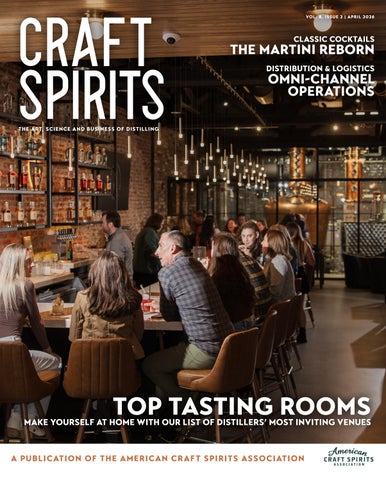
Craft Spirits April 2026

Page 1


TOP TASTING ROOMS

Tasting Rooms

We’’ve compiled our inaugural Top Tasting Rooms list, featuring the finalists of our call for nominations from the distilleries themselves, as well as their peers. 48 MEMBER SPOTLIGHTS

Getting to Know

ACSA Member Producers

Profiles on Klocke Estate, Ambix Spirits, and Charleston Distilling

The Gin Martini: A Classic with a Twist

How the martini earned its popularity and continues to inspire sophistication and change BY

South Dakota: The Land of Infinite Variety

A Look at the craft spirits scene in the rural midwestern state BY SYDNEY GERMAN

A conversation with New Castle Union Station Craft Distillery’s David Goldberg and Cara Firmi

60

Running the Room

A conversation with New Castle Union Station Craft Distillery’s David Goldberg and Cara Firmi DISTILLING OPERATIONS 62

Efficiency, Transparency, Growth

The Case for Digital Transformation in Distilling and Maturation BY STUART MAXWELL

The Flavor Factor

Non-traditional substrates give craft vodka a unique edge. BY SUSANNAH SKIVER BARTON

68

Reach Out and Touch Someone

How omni-channel distribution strategies are revolutionizing craft spirits sales BY

KAPLAN

Pour the Why, Not Just the What

The Sipping Scene

We spotlight some top cocktail destinations in Alabama and Sacramento. 74

The Brains Behind the Bars

On-premise exces ponder what’s happening and what’s next for the market BY

CRAFT SPIRITS MAGAZINE

EDITOR-IN-CHIEF | Jeff Cioletti, jeff@americancraftspirits.org

ASSOCIATE EDITOR | Sydney German, sydney@americancraftspirits.org

ART DIRECTOR | Michelle Villas

ADVERTISING & SPONSORSHIP ASSOCIATE | Kristiane Weeks-Rogers, kristiane@americancraftspirits.org

CONTRIBUTORS | Lew Bryson, Andrew Kaplan, Stuart Maxwell, Susannah Skiver Barton, Heather Wibbels

AMERICAN CRAFT SPIRITS ASSOCIATION

CEO, AMERICAN CRAFT SPIRITS ASSOCIATION | Margie A.S. Lehrman, margie@americancraftspirits.org

COO, AMERICAN CRAFT SPIRITS ASSOCIATION | Emily Pennington, emily@americancraftspirits.org

EDUCATION MANAGER | Kirstin Brooks, kirstin@americancraftspirits.org

DIRECTOR OF MEMBERSHIP AND MARKETING | Carason Lehmann, carason@americancraftspirits.org

ADMINISTRATIVE ASSISTANT | Albab Melaku, albab@americancraftspirits.org

DIRECTOR OF MEETINGS & EVENTS | Stephanie Sadri, stephanie@americancraftspirits.org

ACSA ADVISORS

STRATEGIC COMMUNICATIONS | Alexandra S. Clough, GATHER PR LEGAL | Ryan Malkin, Malkin Law, P.A.

PUBLIC POLICY | Jim Hyland, The Pennsylvania Avenue Group STATE POLICY | Michael Walker, The Walker Group, LLC

ACSA BOARD OF DIRECTORS, 2025-2026

PRESIDENT | Jordan Cotton, Cotton & Reed (DC) VICE PRESIDENT | Jaime Windon, Windon Distilling Co. (MD) SECRETARY/TREASURER | Tom Bard, The Bard Distillery (KY)

EAST

Jordan Cotton, Cotton & Reed (DC)

Greg Eidam, Sugarlands Distilling Co. (TN)

Becky Harris, Catoctin Creek Distilling Co. (VA)

Adam Polonski, Lost Lantern Whiskey (VT)

Colin Spoelman, Kings County Distillery (NY)

Jaime Windon, Windon Distilling Co. (MD)

EX OFFICIO

Jeff Kanof, Copperworks Distilling Co. (WA)

CENTRAL & MOUNTAIN

Tom Bard, The Bard Distillery (KY)

Murphy Quint, Cedar Ridge Distillery (IA)

Mark Shilling, Maverick Distilling (TX)

Phil Steger, Brother Justus Whiskey Co. (MN)

Olivia Stewart, Oxbow Rum Distillery (LA)

Thomas Williams, Delta Dirt Distillery (AR)

ACSA PAST PRESIDENTS

2024-2025 | Kelly Woodcock, Westward Whiskey (OR) 2023-2024 | Gina Holman, J. Carver Distillery 2020-2023 | Becky Harris, Catoctin Creek Distilling Co. 2018-2020 | Chris Montana, Du Nord Craft Spirits 2017-2018 | Mark Shilling, Maverick Distilling 2016-2017 | Paul Hletko, FEW Spirits 2014-2016 | Tom Mooney, House Spirits

CRAFT SPIRITS MAGAZINE EDITORIAL BOARD

PACIFIC

Caitlin Bartlemay, Clear Creek Distillery (OR)

Orlando Lima, Bainbridge Organic Distillers (WA)

Alex Villicana, Re:Find Distillery (CA)

ACSA PAC

Jordan Cotton, Cotton & Reed (DC)

Lew Bryson, Alexandra S. Clough, Prof. Dawn Maskell, Adam Polonski, and Teri Quimby

For advertising inquiries, please contact Kristiane Weeks-Rogers, kristiane@americancraftspirits.org For editorial inquiries or to send a news release, contact news@americancraftspirits.org

P.O. Box 470, Oakton, VA 22124

© 2026 CRAFT SPIRITS magazine is a publication of the American Craft Spirits Association.

SPIRITS AS SPAGHETTI WESTERN

We’re at the point on the calendar where most of the industry’s major numbers-crunchers have rolled out their data, offering a snapshot of the previous full year’s market performance, as well as a few projections for the rest of the current 12-month period and beyond. If you want to make sense of where the industry is and where it’s headed, SipSource’s annual presentation at the Wine and Spirits Wholesalers of America’s Access Live convention is typically a reliable place to start. With the challenging economic conditions that the spirits community has been weathering of late, I—and I’d imagine anyone else who was in the room—was on pins and needles going into the latest session.

And, as expected, there was a mix of the good, the bad, and the ugly, not necessarily in equal measure. In fact, dare I say, there could be some hope for a little more of the “good,” at least on the horizon. But be extremely cautious in your optimism, as we’ve still got a long way to go, and SipSource’s Danny Brager and Dale Stratton are, rightly, never ones to sugarcoat anything.

The Ugly

I want to reverse things and start on the negative extreme first. Most data outlets tend to show overall spirits revenue down around 2%. But RTDs, the only category with any significant growth, are doing most of the heavy lifting there. SipSource painted a hideous picture of how the market would look without RTDs in the mix. Core spirits revenue, sans RTDs, was down a stomach-turning 5.2%! (But that’s the worst news, and again, thank goodness for those RTDs).

The

Bad

Part of what’s pulling those dollar figures down is the fact that premiumization, once considered a juggernaut that defined spirits performance for the past couple of decades, doesn’t seem to pack the same punch it once did, at least for now. It used to be that you could count on the highest price tiers to offset the losses from the lowest ones as consumers traded up. But consumers have been a lot more cautious, with inflation being at least partially to blame. Although inflation has eased a bit since its big surge a couple of years

ago, it’s still affecting purchasing decisions. Overall grocery prices were 30% higher in 2025 than they were in 2020. Our industry depends on consumers’ disposable income, and they’ve had a lot less of it lately. Having said that, premiumization has survived previous market downturns— including the 2008 financial crisis and the Great Recession—so I’m going to bet that this is more of a blip than a long-term trend.

The Good(ish)

An argument to support that last point can be found within the collection of positive opportunities Brager and Stratton identified for the industry. The one that jumped out at me was high-end gin, priced between $50-$99.99—kind of the sweet spot for craft spirits producers. Cordials (liqueurs) in that price tier also show growth potential.

Additionally, when it came time for projections for the overall market, SipSource expects measured improvement for the latter part of 2026 and 2027. Brager and Stratton were quick to caution, however, that that doesn’t mean the industry’s likely to return to positive growth in that timeframe. Expect the decline to level off this and next year, and maybe we could see total revenue tick up into positive territory in 2028. Obviously, there are a lot of variables, such as the volatility in the macro economy, wars, and any other geopolitical crises that are beyond our control. But it’s spring, a time for rebirth and renewal, so let’s end on that uplifting note. ■

Thank You , Sponsors !

The American Craft Spirits Association would like to thank all of our sponsors and our key supporters of education. We are grateful for all of your support throughout the year. Interested in becoming a sponsor? Visit americancraftspirits.org/sponsors or contact membership@americancraftspirits.org.

Annual

Cask Strength Sponsors

Annual Single Barrel Sponsors

Lew Bryson has been writing about beer and spirits full-time since 1995. He was the managing editor of Whisky Advocate from 1996 through 2015, where he also wrote the American Spirits column, and reviewed whiskeys. He has also written for the Daily Beast and American Whiskey. He is the author of “Tasting Whiskey,” “Whiskey Master Class,” and “American Whiskey Master Class.”

A veteran journalist and seasoned critic, Susannah Skiver Barton writes about whisky and spirits from around the world. Bylines include Bon Appétit, Whisky Advocate, Food & Wine, Whisky Magazine, VinePair, PUNCH, and more. She is a Certified Spirits Specialist and recipient of the 2020 Alan Lodge Young International Drinks Writer Award. More at susannahskiverbarton.com

Stuart Maxwell leads Proof 8’s global expansion and platform development. Previously Head of Product, he joined from William Grant & Sons after a decade in operations, maturation, and process innovation. A CIBD Diploma graduate and Vice Chair of CIBD Scotland, he holds an MChem from the University of Strathclyde.

Since its beginning, Michelle Villas has been CRAFT SPIRITS magazine’s art director—guiding the magazine’s aesthetic and visual storytelling. She is currenty the art director for Southbay magazine and was the art director for Beverage World and Beach Life magazine. She has worked for 30 years designing publications in New York, California and New Mexico. When she’s not designing publications, you can find her painting or spending time in nature with her three crazy boxers.

Andrew Kaplan is a freelance writer based in New York City. He was managing editor of Beverage World magazine for 17 years and has worked for a variety of other food and beverage-related publications, and also newspapers.

Heather Wibbels, aka the Cocktail Contessa is a consultant, an award-winning mixologist and whiskey enthusiast, and former chair of the board of directors and managing director of Bourbon Women Association. She’s also the author of the book, “Bourbon Is My Comfort Food.” She focuses on making whiskey more approachable through cocktails and sensory education. Her work has appeared in Forbes, Bourbon+, Drinkhacker, and more.

Quench your thirst for knowledge in ACSA’s Craft Spirits Classroom. For more information or to register, visit our website at americancraftspirits.org/education/webinars.

Smoked gin is emerging as a significant subcategory within craft spirits, and State Line Distillery has released its Lapsang Smoked Gin. The expression represents a growing movement among craft distillers to challenge traditional botanical profiles by introducing savory, smoky notes typically associated with aged spirits.

Wigle Whiskey has launched Wigle Craft Cocktails, a new collection of ready-to-drink canned cocktails developed by Pennsylvania’s craft distillery. The new line debuts with five distinct varieties featuring bourbon- and vodka-based cocktails: Back Nine, Surely Shirley, Ginger Up, Cranberry Crush, and Front Porch Lemonade.

Augusta Distillery has expanded its portfolio with the introduction of Small Batch and Wheated Single Barrel, two cask-strength bourbons designed to broaden the distillery’s core offerings. Small Batch Bourbon is crafted from a curated selection of barrels chosen to maintain depth, structure, and consistency without compromising character. Wheated Single Barrel Bourbon marks the distillery’s first wheated expression.

Bardstown Bourbon Company’s Distillery Reserve has returned in 2026 with Cascadia Garryana Oak Barrel Finish, a limitedrelease bourbon. Finished in barrels crafted from rare Oregon white oak, this release highlights an exceptionally scarce American hardwood known for imparting distinctive character unlike any other in American whiskey.

Barrell Craft Spirits has introduced a limited-edition offering of a 12-year Bourbon Finished in Toasted American Oak Casks. The blend of straight bourbon whiskeys is part of the company’s Red Label Series, which features age-stated whiskeys and uses finishing casks to elevate blends.

Lux Row has continued its annual pact with bourbon drinkers with the release of Blood Oath Pact 12 Kentucky Straight Bourbon Whiskey Finished in Montepulciano and Sangiovese Casks.

Sugarlands Distilling Company is introducing the next phase of expansion for Broken Antler Flavored Whiskey, with two new flavors: Salted Caramel and Spiced Apple

Atlanta-based Shortbarrel has launched the Shortbarrel Afterswarm Meadowfoam, a firstof-its-kind rye whiskey finished in Meadowfoam honey barrels. The third batch in its popular “Afterswarm” series, it is blended and finished in the company’s hometown of Atlanta and bottled at 108.6 proof.

Chicken Cock Whiskey has announced the release of Chicken Cock Wheated Kentucky Straight Bourbon, the newest member of its core portfolio and the first wheated mash bill in the brand’s 168year history. Bottled at 94 proof and aged a minimum of 5 years, the whiskey delivers a softer, rounder approach without sacrificing depth.

High West Distillery is back with the Bourye. This annual, limited-edition release showcases a distinctive, premium blend of rich bourbon and rye whiskeys. This year’s release delivers an elevated ABV of 50.5%, along with bold notes of grilled peaches, brown sugar bacon, and sticky toffee pudding.

Garrison Brothers Distillery has unveiled its Lady Bird Texas Straight Bourbon Whiskey Infused with Honey & Finished in Cognac Casks. First released in 2023 as a tribute to nature and elegance, this limited expression is inspired by the legacy of its namesake, Lady Bird Johnson, and honors her commitment to the environment and Texas native wildflowers.

Green River Distilling Co. has launched Green River Wheated Full Proof Bourbon, available in 25 markets. Presented at a variable batchproof ranging from 109 – 116, the initial batch is bottled at 109.3 proof (54.65% ABV). Aged for five to seven years in Green River’s signature clay tile warehouses, the barrels experience a naturally insulated environment that accelerates flavor development.

Wyoming Whiskey, the state’s first legal distillery, has announced the nationwide release of National Parks No. 5 Straight Bourbon Whiskey: A Tribute to the Tetons alongside the debut of Moran

In the heart of Columbia, Tennessee, Columbia Creek Tennessee Whiskey is taking shape. Bottled at 95.6 proof, non-chill filtered, and unapologetically full-flavored, Columbia Creek Tennessee Whiskey is both smooth by nature and strong by proof.

Talnua Distillery has debuted Olde Saint’s Keep 2026, an American single pot still whiskey special release. The whiskey for this year’s expression was aged for a minimum of three years in Char #2 American White Oak barrels, then finished for 6-9 months in unique casks sourced from six Colorado distilleries.

Kentucky Artisan Distillery (KAD) has released two additions to its Artisan Series: KAD High Rye Bourbon and KAD Four Grain Bourbon, both Bottled in Bond. Like the other bottles in the Artisan Series, KAD High Rye and Four Grain bourbons are crafted from grains harvested from fields just a mile away and under the care of Peterson’s team, have undergone the process of milling, mashing, distilling, aging, and bottling on site.

Let’s Make Cocktails!: A Comic Book Cocktail Book

Author: Sarah Becan

Publisher: Ten Speed Graphic Release Date: April 7, 2026

Sarah Becan invites readers to wet their whistles in Let’s Make Cocktails! Featuring her colorful, engaging illustrations that have become a series favorite, the book opens with insight on the proper tools, glassware, and staple ingredients such as juices, sodas, homemade syrups, and garnishes to always have in stock. With vivid, easy-to-follow graphics, Becan guides readers through basic techniques such as shaking, stirring, muddling, and more. The book explores the origins, traditions, and popular legends surrounding foundational cocktails, including fun tidbits on drink accompaniments and occasions.

Florida Distilleries: Adventures in Florida Craft Distilleries

Author: Rodney Ellis Biddle

Publisher: Independently Published Release Date: December 23, 2025

Florida is home to more craft distilleries than many other states. And from coast to coast, there are unique flavors of whiskeys, bourbons, rums, vodkas, and more spirits with just as many unique craft distilleries. Let the book take you through many of these and help guide you through these wonderful experiences, as well as through the companion website for Florida Distilleries.

Drunkology 101: A Complete Knowledge and Guide to MasterClass Craft Cocktail Bartending, Even at Home

Author: Joel Lavelle

Publisher: Independently Published Release Date: March 5, 2026

Drunkology 101 is your backstage pass to the world of spirits, from ancient alchemy to modern craft mastery. Travel through centuries of liquid history as monks distill “aqua vitae,” pirates ration rum on the high seas, Kentucky farmers spark the Whiskey Rebellion, and Japanese blenders perfect elegance in a glass. Then bring that knowledge home, where technique meets creativity.

The Art of Mixology—Twist & Spritz: Celebrate Life with More than 75 Bubbly Cocktails

Author: Cottage Door Press Release Date: January 27, 2026

This book is your go-to guide for all things spritz—from timeless favorites like the Hugo Spritz and iconic Aperol Spritz, to breezy creations like the Limoncello Spritz that are perfect for poolside lounging. Inside, you’ll also discover an array of effervescent punches and crowd-pleasing batch cocktails ideal for summer soirées. Whether you’re a seasoned mixologist or just starting out, the simple step-by-step instructions and gorgeous cocktail photography will inspire and delight. For those seeking a spirited flavor without the spirits, many drinks can be beautifully adapted to be alcoholfree, so everyone can join in the celebration.

MASON DIXON DISTILLERY WINS AWARD & ANNOUNCES CANNED COCKTAIL EXPANSION PLANS

Pennsylvania-based Mason Dixon Distillery has won first place in the RTD Cocktail category at the PA Farm Show this year for its Jalapeno Mule canned cocktail.

Owner Yianni Barakos says, “We are so proud of our team. This is what happens when bold flavor meets disciplined craft. No shortcuts. No gimmicks. Just an awardwinning cocktail, ready when you are.”

Mason Dixon Distillery has also announced plans for expanding distribution of its popular canned cocktail lineup in the new year. Mason Dixon Canned Cocktails, had recently announced its expansion into the greater Philadelphia area, and in 2026, is planning expansion into Maryland.

These expansion plans are part of the brand’s strategy to be a top-tier player in the RTD space.

U.S. BEVERAGE ESTABLISHES INDEPENDENT SUBSIDIARY –GATEWAY BEVERAGE GROUP

U.S. Beverage, LLC (USB) created an independent company, Gateway Beverage Group (GBG), to help domestic and international brands efficiently enter, operate, and scale within the U.S. market.

Gateway Beverage Group is a next-generation beverage services and consulting platform that combines regulatory infrastructure, logistics, and strategic advisory services with deep industry expertise and national distribution connectivity.

“For nearly 30 years, through our work with craft and imported beers, we have built a national distributor ecosystem of more than 350 distributor partners across the country,” says Justin Fisch, CEO of US Beverage. “A year ago, we established a division to help make that network available to emerging spirit and RTD brands, but we realized that there is a tremendous number of brands that aren’t ready to sell to distributors. Gateway will offer a suite of resources and services to help those brands gain scale and a stronger footing that will prepare them to sell to distributors in the future.”

GBG will operate independently while maintaining strategic alignment with US Beverage.

BARRELL CRAFT SPIRITS SELLS BLENDING & BOTTLING FACILITY TO AMERICAN CRAFT BOTTLING

Barrell Craft Spirits (BCS) has sold its blending facility in Jeffersontown, Kentucky, to American Craft Bottling. Terms of the sale were not disclosed.

“We regularly refine our commercial strategy to stay ahead of evolving industry trends to support long-term growth,” says BCS Founder Joe Beatrice. “While the economic environment has presented challenges across the spirits industry, it has sharpened our focus and reinforced the importance of proactive decision-making.

BCS will consolidate all blending operations at its original Gilmore facility, which offers enough capacity to support current and future needs. The company will also invest in new equipment and technology to expand its operations without disrupting ongoing work.

“We’re grateful to our loyal fans and whiskey enthusiasts who have continued to support us with each release,” says Beatrice. “We plan to continue bringing you the most innovative, creative, and complex products our industry has to offer in 2026 and beyond.”

BARDSTOWN BOURBON COMPANY ANNOUNCES PACKAGING REDESIGN

Bardstown Bourbon Company will reveal a comprehensive packaging transformation across its core portfolio this year. The new design reflects the brand’s continued commitment to pushing the boundaries of bourbon while maintaining the exceptional quality standards of its award-winning American Whiskey portfolio.

Strategic Brand Evolution Enhances Retail Visibility with Palette That “Pops” on Shelf

The packaging update marks a strategic visual evolution for Bardstown Bourbon that speaks not only to the forward-thinking ethos that defines the brand, but more clearly to the premium spirit within. The refined modernist aesthetic keeps the brand’s signature bottle shape while introducing sophisticated design elements that strengthen the brand’s positioning.

JEPTHA CREED DISTILLERY CITES GROWTH DESPITE INDUSTRY HEADWINDS

As the spirits industry navigates well-documented headwinds, Jeptha Creed Distillery, a women-owned craft producer in Shelbyville, Kentucky, continues to move forward by focusing on what has always defined the brand: authenticity, education, meaningful consumer experiences, “our farm to your glass” distilling and its founding motto, “Ne Oublie” Scottish Gaelic for “never forget where you came from.”

In 2025, Jeptha Creed saw a 28% increase in distillery tourism year-over-year, reflecting a broader shift toward experiential travel and a renewed curiosity about the bourbon’s origins and craftsmanship. At the distillery, visitors are invited beyond the tasting room to engage directly with the distillery’s “our farm to your glass” philosophy, learning about heirloom corn varietals, fermentation, distillation, and maturation. In doing so, Jeptha Creed has positioned the distillery as both a destination and a learning experience for today’s whiskey drinkers.

LOST LANTERN CAPS A LANDMARK YEAR OF GROWTH, INVESTMENT, AND INDUSTRY RECOGNITION

Lost Lantern, the Vermont-based independent bottler of American whiskey, enters 2026 following a year of continued momentum, defined by strategic investment, team growth, solid consumer demand, and national recognition.

In 2025, Lost Lantern successfully closed a $1 million seed round led by FreshTracks Capital, a leading Vermont venture capital firm. The investment supports expanded sales and marketing initiatives as the company prepares for a major new release slated for 2026. The funding also enabled Lost Lantern to grow its team, reinforcing the company’s long-term vision and operational strength.

“2025 marked a very exciting year for Lost Lantern, even as the spirits industry faced some new challenges,” said Co-Founders Adam Polonski and Nora Ganley-Roper.

Looking ahead, Lost Lantern is poised for an ambitious 2026, with major new projects, releases, and development partnerships that the company looks forward to sharing in the coming year.

KENTUCKY BOURBON’S IMPACT ON STATE ECONOMY REMAINS STRONG & SUBSTANTIAL

As outside threats continue to jeopardize its future growth, Kentucky bourbon remains a key and substantial contributor to the state’s economy, as a $10.6 billion signature industry supporting nearly 24,000 jobs, a new report shows.

Yet its long-term fortunes remain a roller coaster of uncertainty and unpredictability, threatened by a volatile global trade arena, shifting generational consumer tastes, soaring barrel taxes, and evolving market and geopolitical conditions that have slowed alcohol sales and slashed exports.

The eighth edition of the biennial study using the latest data also shows the distilling industry bought a record 84% of its corn from Kentucky farm families and now generates an all-time high of $372 million in state and local tax revenue.

“This comprehensive analysis demonstrates the economic impact of Kentucky’s homegrown and historic bourbon industry, which remains significantly ahead in jobs, investment, and stature from over a decade ago,” said Eric Gregory, president of the Kentucky Distillers’ Association.

The report was conducted by noted Kentucky economist Dr. Mike Clark using the latest data from the U.S. Bureau of Labor Statistics, the U.S. Census Bureau, the Kentucky Department of Revenue, the Kentucky Cabinet for Economic Development and more trusted sources.

MILLIONTH BOTTLE FROM KINGS COUNTY DISTILLERY

Kings County Distillery has announced a defining moment: the sale of one millionth bottle. In an era where industrial distillers and non-distilling bottlers have started to see their fortunes wane, Kings County has achieved what many thought impossible for an independent craft distiller: true scale without compromise.

To immortalize the moment, the symbolic millionth bottle will be permanently installed in the Distillery’s Boozeum, joining the other artifacts of New York City’s distilling history.

Kings County started selling in small 200ml and 375ml bottles, which connected the brand to a wide audience with a small production,” said co-founder and distiller Colin Spoelman.

“Kings County has always produced whiskey under its own name from New York grain, mashing, distilling, and aging in-house—a rarity for whiskey brands, including some that purport to be local. To hit one million bottles is more than a sales figure; it’s a mandate from a new generation of drinkers who demand creativity and excellence over industrial products cloaked in legacy marketing.

VIRGINIA DISTILLERY CO.’S NEW LAUNCH AND CIERTO TEQUILA PARTNERSHIP

Virginia Distillery Co. (VDC) has announced the launch of Pound & Penny Spirits, a new sales and brand-building platform designed to partner with distinctive, premium spirits brands seeking strategic commercial growth and brand oversight.

The first brand to join the platform is Cierto Tequila, an additive-free tequila, crafted from 100% estate-grown Blue Weber agave in Jalisco, Mexico.

The launch marks a significant evolution for Virginia Distillery Co. With Pound & Penny Spirits, the company will now leverage its commercial infrastructure and brand-building expertise to support select partner brands that share a commitment to authenticity and quality.

“Over the past several years, we’ve built a best-in-class commercial organization within the growing American Single Malt category,” said Andrew Meissner, Chief Commercial Officer. “Pound & Penny allows us to extend that capability beyond our own distillery, partnering with exceptional brands that deserve strong strategic execution in the U.S. market and beyond.”

As the founding partner brand, Cierto Tequila embodies the type of

CATOCTIN CREEK ANNOUNCES NEW DISTRIBUTION PARTNERSHIP WITH PM SPIRITS IN NEW YORK

Catoctin Creek Distilling Co., Virginia’s first legal distillery since Prohibition, has a new distribution partnership with PM Spirits for the state of New York.

Through this new relationship, PM Spirits will represent Catoctin Creek’s portfolio throughout New York, expanding availability of its flagship Roundstone Rye expressions and specialty releases to retailers, restaurants, and bars across the state.

The spirits to be initially distributed in New York include Roundstone Rye 80 Proof, Roundstone Rye Cask Proof, Hot Honey Rye, AppleJack, and Peach Brandy.

uncompromising craftsmanship Pound & Penny was built to champion. Meaning “true,” Cierto is a 100% additive-free tequila crafted by fourth- and fifth-generation agaveros using fully mature estate-grown Highlands agave and regenerative farming practices

MINNESOTA-BASED BROTHER JUSTUS WHISKEY COMPANY NAMES CHIEF GROWTH OFFICER

“We are absolutely thrilled to be working in the New York market with PM Spirits,” says Becky Harris, founder and master distiller of Catoctin Creek. “New York is one of the most dynamic and influential spirits markets in the world, and PM Spirits shares our commitment to authenticity, quality, and long-term brand building. We couldn’t ask for a better partner to help tell our story and bring our organic rye whiskies to discerning New York consumers.”

“PM Spirits was started two years after Catoctin Creek. Both companies kept at it in their respective fields, without deviating from the path. It’s a cool feeling over 15 years later to finally get to work together in the NY market,” said Nicholas Palazzi, owner of PM Spirits.

The partnership reflects a shared philosophy between the two companies: championing integrity in production, honoring tradition, and supporting independent, craft-focused producers. Together, Catoctin Creek and PM Spirits aim to deepen engagement with New York’s vibrant cocktail community and whisky enthusiasts statewide.

Brother Justus Whiskey Co., a Minneapolis-based craft distillery, has announced the next step in its aggressive growth plans: naming George Simpson, a spirits industry vet, to the newly created role of Chief Growth Officer (CGO).

“We have devoted more than a decade to working the ground for growth: original, award-winning product, which American whiskey market mover Fred Minnick has called a ‘game-changer’ and ‘everything I want in a whiskey;’ manufacturing consistency, efficiency, and scalability; and an original brand rooted in Minnesota’s unique landscape and heroic history that every American can relate to,” said Phil Steger, Founder and CEO of Brother Justus Whiskey Company. “Last year was tough for the industry, but it was our biggest year yet, and 2026 is already off to the races. George’s industry knowledge and success with both large and early-stage beverage alcohol brands are what we need to reach the next level. Driving hockey stick sales growth is goal #1, 2, and 3. George is ready to run full tilt toward achieving it.”

As CGO, Simpson will build and oversee the execution of strategies in both the sales and marketing functions—building an efficient, integrated, and powerful capability that maximizes the company’s standing with consumers, the industry, and distributors. He will work directly with Steger and Helen Hardy (president) as part of the senior leadership team.

HAVE YOU TRIED SOMETHING WEIRD?

“When the going gets weird, the weird turn pro.”

This popular Hunter S. Thompson quote is from the otherwise-overlooked Fear and Loathing On The Campaign Trail ‘72. It was a weird election year, with a mad Richard Nixon facing an array of Democrats that ran from the liberal Shirley Chisholm to the openly racist George Wallace, and both Thompson and candidate George McGovern would thrive in it, for a while.

Let’s not go down that rabbit hole, much as I’d love to, because we’re here to talk about your weird situation. We’ve got liquor sales down in a struggling economy, strong competition from legal weed, and Canada

not buying any American booze. We’re still fighting off the aftereffects of a historic pandemic, and there’s a war on.

So let’s talk about wild leeks.

I was doing some visits for a podcast I do on central PA food and drink. The episode was a profile of Kane, PA, a town of about 3,400, out in the area called The Pennsylvania Wilds. Among other things, Kane, miles from any population centers, has two craft distilleries.

The weird stuff starts with an annual Leekfest held at one of the distilleries. CJ Craft Spirits, co-owned by local funeral director Sam Cummings. It’s the last weekend in April, and features live music and food trucks—of course it does, what craft distillery event

doesn’t?—a leek dip-making contest, and the release of the distillery’s Wilds Leek Vodka. (Just for clarification, you might know “wild leeks” as “ramps;” same plant.)

“We only make it in April, which is when leeks are in season and at the right size and flavor to use,” Sam told me. “We loved leeks, and although they grow in many places, they do not grow everywhere. We felt it would be something unique for our region.”

I cook with wild leeks; folks around here are a little crazy about them. I tasted a bottle of last year’s batch. It was all there, the pungent smell that hovers between garlic, scallion, and leek, and the take-no-prisoners flavor that lingered just long enough, while

the vodka underneath was clean and bright. Nicely done, spirit.

“We knew it would make an awesome Bloody Mary vodka,” Cummings said. “That is really what we created it for. Some people will drink it in martinis, and some will drink it other ways, but it was created as a Bloody Mary vodka.”

CJ Spirits capitalized on a local…Well, I hesitate to call wild leeks a delicacy, because they’re not delicate in any way; a local specialty, then. Leekfest draws people from a large region, and they buy a lot of spirits, not just the Leek Vodka.

While they’re there, they probably drive down the road to Kane’s other distillery, where they’re doing something maybe even more weird than wild leek vodka. The Wilds Sonshine Factory makes spirits from sunflower seeds.

Sonshine—it’s misspelled on purpose to make it trademarkable—grew out of a project to restore agricultural land that had gone to pasture. The original idea was to grow animal feed: corn, rye, soybeans. Then sunflowers were introduced. When the Instagram craze for sunflower fields started not long after, wheels started turning in the

heads of the founders.

About a quarter of the sunflower seeds come from local fields, another quarter from a historical center near Erie, PA, and the rest from farms in the PA Wilds region; a total of about 4 million sunflower seeds a year, all processed and stored at the Kane site. Agronomy and soil restoration have increased the seeds’ sugar content for better fermentation, but figuring out the whole path from seed to spirit was a steep learning curve, according to general manager Taylor McConnell.

The spirits are sold in a rainbow of flavors; literally, the distillery uses color freely! The root beer spirit is the most popular. The straight spirit has a good mouthfeel and tastes somewhat like a slightly nutty blanco tequila.

I know of no other sunflower spirit made anywhere. The unique nature and the lure of sunflowers draw thousands a year to the site already, where they enjoy the spirits and an array of all-Pennsylvania-made merchandise at the gift shop. They also drink at the world’s longest bar made from a single piece of wood (Guinness World Record certified), a 43.5-foot-long piece of Eastern Hemlock, the state tree.

Sunflowers, wild leeks. Unique. Weird. You know, “weird” comes from the AngloSaxon wyrd, which meant something like “fate,” or “destiny.” Think about it: what’s your weird? A pine eau de vie from the North Woods? I’ve had a European one and loved it. Buckwheat whiskey? It’s been done, but only in a handful of places. Truffle aquavit? You knew aquavit was coming…

You may think that the current economy is not the time when you’d want to be experimenting with anything that far out. Maybe rethink that; because when the going gets weird, the weird turn pro. It might be time to dust off your weird ideas and fly that freak flag. ■

Lew Bryson has been writing about beer and spirits full-time since 1995. He is the author of “Tasting Whiskey” and “Whiskey Master Class.”

MARGIE A.S. LEHRMAN TO RETIRE

AS ACSA CEO; EMILY PENNINGTON APPOINTED TO LEAD ORGANIZATION

Following more than a decade of leadership at the helm of the American Craft Spirits Association (ACSA), Margie A.S. Lehrman will retire from her role as Chief Executive Officer, transitioning into a newly created CEO Emeritus position on May 1. ACSA Chief Operating Officer Emily Pennington has been appointed Chief Executive Officer and will lead the organization into its next chapter.

Lehrman joined ACSA shortly after its inception and served as the organization’s inaugural CEO, building the organization from the ground up alongside its founding board members and playing a defining role in evolving the national trade association as it exists today. Over the course of her tenure, she left an indelible mark on the craft spirits and broader distilling industry.

Her hallmark achievements include helping secure the passage of a permanent federal excise tax reduction, advancing efforts to break down longstanding market access barriers for craft producers, shepherding federal hand sanitizer and economic relief programs vital to many distillers’ survival of the COVID-19 pandemic, supporting the introduction and passage of direct-to-consumer (DTC) shipping measures, influencing TTB’s improvement of regulations and processing times to reflect the new craft distilling landscape, and forging critical relationships with bipartisan policymakers in Washington and trade groups across the beverage alcohol and agricultural sectors.

“Helping craft spirits producers and the adjoining community of suppliers has been the greatest honor of my professional life,” says Lehrman. “This is a bittersweet moment, because I care so deeply about ACSA and the community of craft distillers we serve. But I am also incredibly optimistic about the future with much-needed modernization of state and federal law. I look forward to continuing to advise in this newly-created Emeritus role as Emily takes the helm. Emily is a thoughtful, strategic, and deeply experienced leader who understands both the challenges and opportunities facing this industry. She is exceptionally well-positioned to lead ACSA forward and continue to advocate for our community.”

Pennington joined ACSA as Chief Operat-

ing Officer in January 2025, bringing nearly 15 years of alcohol industry experience spanning content strategy, education, and organization management. She has worked closely with Lehrman on the association’s strategic priorities, with a particular focus on strengthening membership value, supporting industry outreach, and guiding mission-critical operations. Prior to joining ACSA, Pennington developed Wine & Spirits Daily and Park Street University, and also played an instrumental role in executing the CRAFT SPIRITS DATA PROJECT © (CSDP).

The leadership transition comes at an important time for the craft spirits industry. As producers continue to navigate a difficult economic and regulatory environment, ACSA remains focused on advocating for modernization, expanding opportunity for independent distillers and brands, and delivering the data, education, and community support needed to help its members succeed. As CEO, Pennington will continue to focus on strengthening ACSA’s value to members, advancing the organization’s advocacy agenda, expanding industry outreach, and ensuring the association remains a strong voice for independent craft distillers during a challenging economic period.

“I am deeply grateful to Margie for her extraordinary leadership, her tireless advocacy, and the foundation she has built for ACSA and the broader craft spirits community,” says Pennington. “Her contributions to this industry are profound, and I am honored to build on that work. As CEO, my focus will be on advancing a modern marketplace where craft distillers have access to sell through the channels that work for their business, and consumers have the ability to safely buy where and how they want.

I’m excited for the road ahead and for the opportunity to continue working with ACSA’s Board, members, partners, and staff to support craft distillers and help position this community for long-term success.”

STEPUP FOUNDATION ANNOUNCES MAJOR 2026 PROGRAM OVERHAUL

The Spirits Training Entrepreneurship Program for Underrepresented Professionals (STEPUP) has announced a significant overhaul of its annual training program, designed to expand access to more participants, modernize the curriculum, and further reduce barriers to entry for aspiring professionals seeking careers in the spirits industry.

Founded in 2020 as part of an effort led by the American Craft Spirits Association (ACSA), STEPUP Foundation has prepared emerging professionals for careers in the craft spirits industry through structured education, mentorship, and hands-on industry exposure. In 2026, STEPUP will celebrate its fifth class of graduates, marking continued progress in equipping participants with the knowledge, practical skills, and professional connections needed to succeed in the beverage sector.

Now entering its next chapter, the new

STEPUP program is designed to create more inclusive, flexible, and employment-ready pathways into the spirits workforce while ensuring the program remains free to all successful applicants.

New for 2026

The 2026 STEPUP program reflects a comprehensive redesign informed by participant feedback and industry needs:

• Expanded cohort size: STEPUP will select up to 10 trainees through a competitive application process, broadening access for underrepresented communities. Shorter, more efficient program duration: The streamlined structure allows participants to move more quickly toward entry-level positions in the spirits industry.

Fully online curriculum: Core coursework

is now delivered entirely online, removing time and travel barriers and enabling nationwide participation.

• Industry-recognized certifications: The curriculum now includes WSET Level 1 and Level 2 Awards in Spirits, virtual OSHA-10 safety training, and Forklift Certification provided by Industrial Safety & Training Services, helping trainees build tangible, employerrecognized credentials.

Flexible, self-directed learning: Trainees can immerse themselves in self-study on their own time, accommodating work, caregiving, and other personal commitments.

Local, in-person exposure: Participants will take part in a two-day shadowing experience at one of up to three host distilleries, ideally located close to home. Regional graduations: The Class of 2026 will be honored at regional graduation ceremonies in September, reinforcing local industry connections and community engagement.

• HR training and career support: The updated program includes HR coaching and professional development support to help trainees prepare for interviews, workplace expectations, and long-term career growth.

2026 ACSA CONVENTION & EXPO

The craft spirits community is coming together April 17–18, 2026, in Sacramento, California, for a reimagined ACSA Convention & Expo. We’re flipping the script on business as usual with an experience designed to tackle today’s urgent challenges and unlock tomorrow’s opportunities.

Distillers, suppliers, and industry partners will come together for two days of meaningful conversations, hands-on experiences, and practical guidance. Highlights include off-premise retailer perspectives, high-impact education sessions, and an energized expo floor featuring demos with both new and returning vendors.

Before the convention officially kicks off,

there are three distillery tours, the new preconvention Distribution Workshop, and a new, hands-on TTB Audit Bootcamp.

This convention is about being in the moment with your peers and enjoying the experience together. Stepping into the fun at the cornhole tournament, making new connections, and discovering your next favorite craft spirit at the Grand Tasting of American Craft Spirits. There will be opportunities to join Town Hall discussions and celebrate industry excellence at the Meet the Candidate & Awards Ceremony Lunch. We can’t wait to welcome our attendees and exhibitors to Sacramento for the 13th Annual American Craft Spirits Association Convention & Expo in just a few days!

LEARN MORE
READ MORE

TOP TASTING ROOMS

You only get one chance to make a first impression, and often the first time consumers connect with your distillery’s brands is right where it’s made. We’ve compiled our inaugural Top Tasting Rooms list, featuring the finalists of our call for nominations from the distilleries themselves, as well as their peers. The venues showcased on the pages that follow are a collection of both spirits-samples-only sites and full-service cocktail destinations, owned and operated by distilleries that produce their house brands. They’ve been selected and vetted by our panel of experts based on the overall visitor experiences they provide and how they forge long-lasting bonds with their legal-drinking age communities.

NORTHEAST

3BR Distillery

Keyport, New Jersey 3brdistillery.com

It’s likely the only distillery whose tasting room aesthetic is described as “Soviet-punk: eclectic, DIY, grandma chic with Soviet flair.” The space sports a great deal of Soviet-era memorabilia focusing on the soft prohibition of the 1980s in the USSR as well as other antiques. Its Pepsi machine from the ’70s reflects a funny story about how the USSR sold Pepsi naval equipment. The Pravda newspaper on its wall is authentic and reflects a real Soviet apartment wall. The distillery hosts regular LGBTQ+ mixers and markets through other community organizers as well as book clubs and cocktail class collaborations. The walls within the sprawling venue are also adorned with local art hosted by the Art Society of Keyport. Other event highlights include free clothing swap and fundraisers, as well as burlesque and a mini comic con.

Dismal Harmony Distilling

Morristown, New Jersey dismalharmony.com

Dismal Harmony’s northern New Jersey cocktail bar offers a marriage of Art Deco accents with modern flourishes, subtly evoking the

apothecaries (and their elixirs) of days gone by. Liqueur workshops, music bingo, Craft and Yap Social, Scripts and Sip Storytellers Open Mic, Messybun Bakery cookie decorating, trivia, game nights, and collaborations with local businesses are just some of the events Dismal Harmony has been known to host in its first two years in business. Another is The Motown Throwdown bartending tournament, with participants from bars and restaurants in the distillery’s hometown.

Klocke Estate

Hudson, New York klocke-estate.com

Sitting atop a hill in Upstate New York’s picturesque Catskills, Klocke Estate makes the most of its natural setting with views of its orchards, vineyards, and the aforementioned mountains. Culinary pop-ups, author series, and cultural programming are a few of the types of events that regularly find their way into the space. The tasting room was conceived as “a timeless expression of hospitality,” the distillery says, “cinematic yet restrained, layered yet deeply rooted in its landscape.”

Liberty Pole Spirits

Washington, Pennsylvania libertypolespirits.com

The atmosphere in Liberty Pole Spirits’ tasting room is warm, welcoming, and rooted in a sense of place. Inspired by early American meeting halls, the space feels both historic and comfortable, somewhere guests can slow down, enjoy a thoughtfully made whiskey or cocktail, and connect with others. The environment reflects their belief that whiskey is meant to be shared, creating a relaxed setting that encourages conversation, discovery, and community.

New Castle Union Station Craft Distillery

New Castle, Pennsylvania ncuscraftdistillery.com

The station was the central railway for New Castle since before the Civil War. The original station burned down in the first decade of the 20th century and the current one was the replacement. Everything in the New Castle space was designed and built by the two partners, including the bar and all the design work into presentation. Customers have called it the New Castle Cheers as it is quaint and “everybody knows your name.”

GlenPharmer Distillery

Franklin, Massachusetts glenpharmer.com

This rustic spirits tasting room is set in an old mill, so the historical building plays beautifully into the brand. From small elements like pieces inspired by apothecaries, to larger elements like the metal wall behind the bar, leather, and wood elements, the space is reflective of the craftsmanship that is carried out by distillers, mixologists, and servers combined. Behind the bar in addition to the overall spirit portfolio, mixologists and distillers collaborate to craft liqueurs and infused spirits using the existing portfolio.

Finger Lakes Distilling

Burdett, New York fingerlakesdistilling.com

The tasting room really mirrors the same values that define Finger Lakes Distilling as a brand— craftsmanship, authenticity, and a strong

connection to the local region. The space feels intentionally simple and rustic, which reflects the distillery’s focus on traditional distilling methods rather than flashy marketing. Overall, the space doesn’t just serve drinks—it tells the story of the distillery, the Finger Lakes region, and the care that goes into every bottle.

Covalent Spirits

Westminister, Maryland

covalentspirits.com

Pathfinder Farm Distillery

Boonsboro, Maryland pathfinder.farm

The tasting room is uniquely divided into five distinct areas that guide you through Pathfinder’s story. Visitors can browse the general store for its own farm-raised beef and

The tasting room at Covalent Spirits brings a touch of urban creativity and experimentation to historic downtown Westminister, but in a way that feels authentic and accessible. The cocktail program highlights Covalent’s spirits while introducing guests to new flavors, techniques, and cultural influences in a relaxed environment. The brand is rooted in scientific curiosity and that perspective is woven throughout the tasting room experience from chemistryinspired cocktails to educational programming.

Song Dog Farm Distillery

Boyds, Maryland

songdogdistilling.com

Opened in October 2025, the tasting room has only been open for a few months but has found support in the immediate community and from farther away, with people visiting from all over the D.C. metro area. One little detail that a lot of people love is that the bathrooms have framed photos of the wildlife found on the farm, courtesy of a field camera.

local goods, or step into the farm room to see the evolution of the distillery’s progress. For a more intimate experience, the barrel room offers a cozy space for small groups, while the Patio opens up for fresh Appalachian air during the warmer seasons. Although the space is fragmented, every room works together to create a complete ‘farm-to-glass’ narrative.

Windon Distilling Co.

Saint Michaels, Maryland lyonrum.com

A tropical delight and exotic escape, Windon Distilling Co.’s tasting room is all about welcoming people in and giving them a genuine experience with the owner and making guests feel like family. After 12 years of making rum and offering complimentary samples in its tasting room, Golden Hour was opened to further connect with and delight guests.

Frederick, Maryland tsdrum.com

The tasting room at True Standard Distilling blends historic character with a warm, modern feel, with 1800s brick, original carriage house doors, and an archive room set in the former blacksmith forge. The space is also known for its immersive themed décor and pop-up experiences—transforming throughout the year for holiday concepts, specialty cocktail menus, and collaborative events.

Catoctin Creek

Purcellville, Virginia catoctincreekdistilling.com

Built in 1921, the structure was Purcellville’s first Buick dealership at a time when cars looked like horseless carriages. This space was used for car sales for 51 years, and the Catoctin Creek team has since incorporated that history into the tasting room. It is a bold architectural statement showcasing classic industrial and art moderne elements that hearken back to the 1920s. Tables made from old automotive parts tie in that history, while the period glass windows showcase the distillery machinery in the adjacent room.

92 Acres

Charlottesville, Virginia 92acres.com

The space was originally a home of one of the founders of Ragged Branch Distillery. When a tasting room was needed, he moved out of the space to allow the business to flourish. His children sought to create a new venture and have taken on the mantles of founders in their own right with 92 Acres. They revamped the tasting room with new decor, added more spirits to the menu, and regularly host events.

Southern Distilling Company.

Statesville, North Carolina southerndistillingcompany.com

The tasting room blends “industrial grit with refined indulgence,” with warm copper accents and barrel-aged wood offering an aesthetic counterpoint to the exposed brick and steel beams. Polished concrete floors, ambient lighting, leather seating and a velvet-finished wood bar complete the space, which frequently hosts car shows, live music, sip-and-paints, holiday open houses, and more.

Distillery of Modern Art

Chamblee, Georgia

distilleryofmodernart.com

Twelve 33 Distillery

Little River, South Carolina twelve33distillery.com

The name Twelve 33 references month/year of Prohibition repeal and reflects South Carolina’s Prohibition history with its steampunk glam inspired hidden speakeasy, retail shop, and tasting room. It is warm, rustic, upscale, and offers live music and private events, with charity events often held for SCPA, Rotary Club, and COC.

The distillery lives up to its name, as the tasting room space includes a modern art gallery that is commission-free. Local artists who sell work in the gallery or tasting room receive 100% of the purchase price. The theme carries over to its events, as the distillery regularly hosts art classes, as well as standup comedy, chef dinners, live music, and yoga.

ChainBridge Distillery

Oakland Park, Florida

chainbridgedistillery.com

ChainBridge Distillery is an elegant and welcoming community space where everyone feels comfortable gathering, learning, and celebrating together. The tasting room offers an intimate, rustic-industrial atmosphere and education with frequent cocktail mixing classes.

Gulf Stream Distillery

Fort Lauderdale, Florida

gulfstreamdistillery.com

Gulf Stream Distillery’s collection of art, movie props, animal busts, and random items from across the world make it a visually engaging space. It is where industrial meets classic with a ton of unique items from across this world. From the jet engine chandelier to the fake bookcase that opens to the speakeasy— it’s an experience.

Manifest Distilling

Jacksonville, Florida manifestdistilling.com

This full-service cocktail bar is industrial, modern, and sleek, with a strong focus on education and community involvement. There are public and private tours, cocktail classes, monthly yoga, and monthly cooking classes hosted in the enclosed tasting room with views of the distillery equipment.

Larrikin Bourbon Co.

Lawrenceburg, Kentucky larrikinbourbon.com

The Land Down Under meets the Bluegrass State. Larrikin’s tasting room blends “refined Kentucky bourbon heritage with a bold, modern Australian edge,” with warm natural wood, leather seating, brushed brass accents, and textured stone elements that evoke the rugged landscapes of both Kentucky and Australia.

Sugarlands Distilling Company

Gatlinburg, Tennessee sugarlands.com

The tasting room at Sugarlands feels like a lively Appalachian moonshine barn mixed with a modern craft-distillery bar. It’s designed to be both a production space and a tourist experience, so the atmosphere is energetic and interactive. One of the most innovative aspects of the tasting room is the use of octagonal tasting stations, which shape how visitors interact with both the space and each other. Instead of a single linear bar or individual tables, the room is organized around multiple octagonshaped tasting pods.

Prova Spirits

Louisville, Kentucky provaspirits.com

Prova has hosted events that support and donate to LGBTQ+ charities, women’s networking events, and raising funds for animal welfare. The distillery, which prides itself on not being laser-focused on bourbon in the heart of bourbon country, says its tasting room was designed to be a safe space for anyone who wanted to enjoy cocktails but didn’t want to feel like they were at a “boys’ club.”

Water Town Distilling Co., LLC

Ypsilanti, Michigan watertowndistilling.com

Opened in May 2025, Water Town’s tasting room has given new life to the 150-year-old building. It has kept its historic charm with updates to electric and plumbing to bring it up to the 21st century. It’s a two story tasting room, with a stage area for live music. Also, as a woman-owned distillery with a queer head distiller, the brand is centered around inclusion and ensuring that people from under-served communities have a place, whether it’s as employees or guests.

Revelton Distilling Company

Osceola, Iowa reveltondistillery.com

The distillery itself is in the heart of Iowa, along the interstate but in a fairly rural setting. Step into the gorgeous Art Deco faciilty with navy velvet, brass, chandeliers and a great view of a large working column still. The cocktails all showcase the grain-to-glass spirts made on-site, and in glassware befitting a spectacular drink. Grain is sourced from local farmers with some rye grown onsite, which can be seen from the back deck of the tasting room. The experience is a combination of beauty, style, some industrial grain, and grit. It’s not what you may expect in the middle of rural Iowa. It feels elegant, yet comfortable. Come as you are and enjoy a fabulous drink.

Iron Fish Distillery

Thompsonville, Michigan

ironfishdistillery.com

Iron Fish Distillery welcomes guests to its northern Michigan farm with a family-friendly environment. The tasting room seamlessly utilizes the outdoor space and interior bar and seating area to give guests an atmosphere that leans heavily into the terroir of the region. Weekly events include live music and trivia, and there are yard games available in the expansive outdoor space during the spring, summer, and fall. A favorite event is the Annual Hats & Horses Kentucky Derby Party, where a real horse races down their dirt road.

J. Rieger & Co.

Kansas City, Missouri jriegerco.com

It’s hard to call J. Rieger’s visitor experience a tasting room, as it’s more a multi-tiered, multi-leveled complex. In fact, the space it

Driftless Glen Distillery

Baraboo, Wisconsin driftlessglen.com

Encouraging visitors to “Taste the American Spirit,” Driftless Glen’s tasting room, situated along the banks of the Baraboo River, offers an upbeat, welcoming and cozy vibe, with a handcrafted, artistic ethos.

calls its Tasting Room & Atrium is just one of four sipping venues on its campus. The others include the Monogram Lounge The Hey! Hey! Club! and the outdoor Electric Park Garden Bar. A two-story serpentine slide ties the interior together. The building also houses museum exhibits showcasing the distillery’s nearly 140-year history.

45th Parallel Distillery

New Richmond, Wisconsin 45thparalleldistillery.com

In the warm, open, elevated industrial space, weekly events include live music and trivia, with seasonal happenings including a farmers market. The circular bar is designed to present a slice of the globe at the 45th parallel latitude. “It’s not overly fancy, it’s refined and clean and intentional, just like our spirits,” the distillery says.

State Line Distillery

Madison, Wisconsin statelinedistillery.com

The team at State Line Distillery works hard to be good stewards of the community. From the ‘Rare Riffs’ cocktail programs designed to raise money for various causes, to the gallery space, which rotates local art on a quarterly basis, State Line believes that being active members of the community is a responsibility and a core tenet of the company’s identity. The tasting room offers a full range of events including live music, trivia, food trucks, slam poetry, community fundraisers, dog adoption events, and collaborations with other Madison beverage makers.

SOUTHWEST WanderFolk Distillery

Guthrie, Oklahoma wanderfolkspirits.com

The Wander Inn, official tasting room of WanderFolk Distillery, is located in the heart of Guthrie, Oklahoma’s historic district with the storefront space having been built 120 years ago. Upon entering, customers are initially charmed with an eclectic nod to the Victorian architecture of the area. There’s a wide array of games and books to borrow, and if you’re lucky, you might catch the head distiller playing a piano on the west wall.

Whiskey Del Bac

Tucson, Arizona

whiskeydelbac.com

It’s an inviting, high-ceilinged open air tasting room rooted in the desert southwest, adjacent to Whiskey Del Bac’s distillery operations and rackhouse, allowing guests to feel like they are a part of the process. For larger events, like release parties and fundraisers, the space offers flexibility, with modular tables, chairs, stools, and seating arrangements to facilitate flow at larger gatherings. String lighting and vintage lamps are featured to elevate the comfort and ambiance of the entire space. It also features small touches of mesquite wood throughout the tasting room, enhancing the brand’s ethos of being rooted in the Sonoran desert. Finally, there’s a black-and-white vintage photograph of Emiliano Zapata above the bar, a nod to the rich, cultural tapestry of the Sonoran desert and his fight to support the rights of the Mexican peoples.

Las Vegas Distillery

Henderson, Nevada lasvegasdistillery.com

For those who want to get a taste of classic Vegas, this is the place. Las Vegas Distillery’s brand is all about hospitality and paying homage to the time where hospitality was everything in Sin City. The distillery is very big on honoring and educating consumers about the city’s history. Every photo on the wall has a description and vistors can look them up using a QR code for more details and history. It also showcases scenes from films made in Vegas and famous moments in Vegas history.

The Whiskey Sanctuary at Laws Whiskey House

Denver, Colorado

lawswhiskeyhouse.com

The design mirrors the Laws brand’s “raw, no-frills ethos through Brutalistinspired architecture and expressive, low-cost materials,” the team explains. The space features the Whiskey Church, where distillery tours begin, defined by hand-built wooden pews and tall, cathedral-style windows. A spiral staircase inspired by the inside of a whiskey barrel connects guests to the second-floor cocktail lounge, which offers floor-to-ceiling windows and mountain views. Programming includes guided talks and tastings with the Colorado farmers who grow Laws’ grain, vinyl nights, the Laws Literary Lounge featuring Sip & Swap gatherings, and silent book club evenings. What’s more, the design team, BOSS. architecture earned the Design of Excellence Award at the American Institute of Architects Colorado Design Awards.

Dry Land Distillers

Longmont, Colorado

drylanddistillers.com

Dry Land Distillers honors its roots by respecting the original 1940s-1960s use as the Valley Farm Dairy. During the build, there was a focus on incorporating local artisans; for example, cabinets are crafted by a local woodworker from a giant plains cottonwood tree that was removed (almost 100 years old) from downtown Boulder. The breeze blocks for one of the walls were sourced from a 4th generation clockmaker in Durango, Colorado. Even the distilling equipment, which is integrated into the space, was crafted less than 30 miles away by a fabricator in Broomfield, Colorado.

Talnua Distillery

Arvada, Colorado talnua.com

Due to the tasting room’s intimate setting, visitors can experience the craft behind their libations firsthand—often overhearing staff discussions and even offering feedback on new cocktail creations. The atmosphere strikes a balance between sophistication and approachability, offering a space to explore and connect with friends, neighbors, and the community.

10th Mountain Whiskey

Vail, Colorado 10thwhiskey.com

The space that 10th Mountain describes as “casual, cozy, and inviting,” with “rustic, elevated ski lodge vibes,” features cozy leather chairs and wood accents, with one wall made from used upcycled barrel staves. 10th Mountain hosts a variety of fundraisers, from helping wounded veterans to learn adaptive sports to preserving local history. There are many historical artifacts on display to tell the story of the 10th Mountain (light infantry) Division’s history and particular the role it played in the ski industry. It’s got an amazing view of Gore Creek, to boot.

Backwards Distilling Co.

Casper, Wyoming

backwardsdistilling.com

The tasting room evokes the sense of stepping under the big top of a traveling circus, blending seedy circus nostalgia with a polished, loungey atmosphere. Vintage steamer trunks, stacked luggage, gilt mirrors, velvet-flocked wallpaper, vibrant colors and patterns, and warm Edison bulbs create a moody, theatrical setting. The calendar is packed with highly themed and immersive events, like “The Landlubber Lounge,” where the space becomes a kitschy, landlocked tropical pop-up, and “The Other Side,” a haunted circus tent Halloween pop-up. Then there’s the 12 Days of Christmas Cocktails Series and annual Christmas Eve Hot Cocoa Party where Backwards features one-day-only holiday cocktails for standingroom-only crowds. Other local favorites include I’Scream for Cocktails (an ice cream truck/cocktail collab), Boozy Donut Sundays, Tipsy Mother’s Day Tea, and the Good Old Fashioned Father’s Day event. Entertainment throughout the year includes magic shows, drag performances, and even interactive screenings like “The Rocky Horror Picture Show.”

Koenig Distillery

Caldwell, Idaho

koenigdistillery.com

The layout of Koenig’s tasting room and retail area is intentionally open, making it easy for the team to engage with guests wherever they are. Koenig’s also created a variety of seating options, from cozy couches and chairs for small groups to movable tables that can be rearranged for larger gatherings, so everyone can settle into a space that feels right for them. Koenig also doesn’t want to upstage the natural star of the show, offering breathtaking views of its orchards and Owyhee Mountains.

Alchemy Distillery

Arcata, California

alchemydistillery.com

All are welcome at Alchemy Distillery with its 16-person hexagon bar at the center, which encourages customers to leave with new friends even

Alpine Distilling

Park City, Utah

alpinedistilling.com

The folks at Alpine consider the tasting room to be a “sort of living room” for the Park City community, with regular events that include guided tastings, gin-making workshops with master distiller Sara Sergent, live music, art classes, and table games. The distillery also makes the space—which the team describes as “elegant, feminine, verdant, modern, unique, striking, comfortable, and relaxing—available for private events.

if they entered the room alone. There is also a sustainability-forward design with rocks glasses and light fixtures made from Alchemy’s spirits bottles, reclaimed bowling alley lanes for tables, glass straws, and bathrooms that have a sink with water/soap/hot air so no paper towels are needed.

St. George Spirits

Alameda, California stgeorgespirits.com

Situated on the edge of the former airstrip of the decommissioned Alameda Naval Air Station, the tasting room spans the entire western side of the aircraft hangar with panoramic views of the San Francisco city skyline and beyond. From its adjacent, gardened deck you can see the iconic bridges

Jettywave Distillery

Half Moon Bay, California jettywave.com

Scattered throughout Jettywave’s outdoor dining space are planters filled with edible plants and ingredients used in the distillery’s cocktails and food. The distillers say that by growing their own ingredients they can be certain of their quality and alignment with its commitment to source locally. Additionally, Jettwave is big on showcasing coastal elements throughout its decor, mirroring similar imagery on its bottles. Among the regular events are paint nights, line dancing, movie nights, and book signings.

of The Bay, the cranes of the Port of Oakland and sometimes even the outline of Mt. Tam. Taking inspiration from the mid-century industrial designs of the former WWII aircraft hangar, the tasting room incorporates bold elements of brushed aluminum, glass, concrete and steel work, with touches of dark wood, hand-printed stationary materials, green plants and some of the team’s favorite books filling the open spaces.

Webb’s Grainworks

Aliso Viejo, California webbsgrainworks.com

The vibe is “Old West industrial” with a nod to vintage automobilia. The high-ceilinged space offers a dramatic sense of place and time—in what other tasting room are you going to find a Santa Fe Railroad caboose built into the wall? The distillery leans into the “grain” part of its name, with bread baked fresh daily, as well as an on-site brewery.

Mastrogiannis Distillery

North Bend, Washington

mastrogiannisdistillery.com

The concept for the space was inspired by the owners’ Greek roots and family recipes passed down through generations. It features a palette of rustic textures, warm wood tones, and deep Mediterranean greens designed to evoke a sense of authenticity and comfort. At the heart of the space stands a striking custom bar, where the Greek key motif is the backdrop for “a timeless symbol of unity and eternity and was reinterpreted in the bar back shelving to echo the distillery’s logo and identity.” There’s also a hand-painted mural depicting olive branches, and the symbolic Greek evil eye pays homage to Greek culture and is a gesture of protection and good fortune. History and TV buffs take note: the tasting room is located in a historic downtown landmark, with the original wood beam ceiling. In the early ’90s, the second floor of the building served as the shooting location for the jail scenes on “Twin Peaks.”

Whistling Andy Distillery

Bigfork, Montana whistlingandy.com

This space distills the Montana landscape into a palette of warm wood, charcoal steel, and golden spirits. It blends a refined “highcountry” style with the genuine, down-to-earth warmth of a local community center. Whether it’s a lively family gathering in the afternoon or a round of craft cocktails in the evening, the open layout and natural wood finishes create a cozy setting for everyone. This is where Bigfork meets to celebrate, proving that world-class spirits and a friendly, open-door welcome go hand in hand.

WHO’S WHO IN CRAFT SPIRITS

Getting to know ACSA member producers in their own words

Klocke Estate

Klocke Estate is a vineyard and distillery in Claverack, New York, dedicated to producing estate-grown spirits by using traditional European methods. Founded in 2018 by John Krishkopf and Brett Mattingly, planting began in 2020 to establish the agricultural foundation, and the 160-acre estate officially opened to the public in 2024. Klocke Estate offers not just its distillery and restaurant to its visitors but a true experience of a terroir-driven approach to craft.

Distilled Down: We craft American brandy the old-world way—using traditional European methods, imported French and German stills, and Limousin French Oak barrels—to express the unique terroir of the Hudson Valley. As an estate distillery, we control every step from soil to spirit.

Vibe: Klocke Estate is a blend of luxurious design and the down-anddirty vibe of a real working farm and distillery.

Playlist: Organic, Global

Inspirations: Delamain and Fanny Fougerat in Cognac Chateau de Laquy in Armagnac Camut, Michel Huard, and Lemorton (Didier Lemorton), in Calvados Christophe Koessler in Austria Dan Farber at Osocalis Hubert Germain-Robi

Flagship Spirits: Currently, our flagship spirit is our Referent Apple Brandy, which is our first aged expression. According to F. Paul Pacult (Spirit Journal Inc.), Referent is…”world class and destined to be an exceptional American landmark.”

Notable Spirits: While we’re waiting for our brandies to age, we’re creating exquisite eaux de vie and exceptional Vermouth, designed for both sipping and for use in cocktails.

Buzzworthy: We’re aiming to have our first aged grape expression released in the fall of 2027 (if not earlier). To date, all of our tasting sessions point to the fact that this brandy will be sublime.

In the Near Future: Our distillers are having a lot of fun right now experimenting with liqueurs: Orange Curaçao, Creme de Menthe, possibly Cassis, and possibly something very herbal. What’s great is that our talented bar staff is able to create delicious concoctions with all of this.

The Distant Future: 10 years from now we hope to have 18 different SKUs across many categories, producing 5,000 cases of aged grape brandy a year, and are well known as an iconic Hudson Valley destination.

Advice For Anyone Thinking About Starting a Distillery: Do it for love and never compromise on quality.

Learn more at klocke-estate.com

Ambix Spirits

Ambix Spirits in Sonoma County, California, was co-founded in 2019 by David Klein and Zoe Osborne. Over the past seven years, it has become a well-respected distillery in the community by promoting its orchard-to-bottle technique and using apples grown right in Sonoma to produce its sophisticated apple brandy. In the heart of wine country, Ambix Spirits continues to bring passion and innovation to craft distilling.

Distilled Down: We are a farm-to-glass apple brandy distillery. Our focus is on capturing the unique flavors of the 300 different types of apples that we grow in the orchard that surrounds the distillery, as well as the apples and pears we source locally. We are grounded in French traditions and use an Alambic Charentais for distillation and large format French Limousin oak for aging, but are also infusing modern California innovation into the spirits.

Vibe: Agriculture meets Alchemy

Inspiration: We are, of course, inspired by

the distilleries of Calvados, but we are also inspired by the local brandy traditions. Hubert Germain Robin has helped us get started and is inspirational and aspirational. St. George has also been an inspiration with their growth and journey. We are also inspired by the historic brandy distilleries of Sonoma County that are forgotten but were once widespread.

Flagship: Founders Reserve Apple Brandy is our flagship. A 4-year brandy blended for traditional Calvados-type character, using over 30 different apples to highlight a baking spice and baked apple aromas.

Additional Notable Spirits: Poire is a classic Pear Williams eau de vie that was fermented and distilled on a pump to highlight the complex flavors of Bartlett pears grown in the Redwood Valley of Mendocino.f

Our Newtown Pippin Apple Brandy is a single-varietal apple brandy that highlights a famous Colonial apple. The Newtown Pippin apple offers a beautiful and delicate nose of mountain flowers, cedar, and vanilla that we were able to capture in the spirit.

Buzzworthy: We recently were awarded a Snail of Approval from Slow Foods

In the Near Future: In June, we are offering a Nocino-making workshop, and in July, we will be releasing our next special for club members. Three times a year, we release a special club-only spirit that we only announce shortly before it comes out. Recent releases have included a persimmon eau de vie, a chartreusestyle herbal liqueur, and a Zinfandel grappa.

The Distant Future: We will remain small and familly run with steady grass roots growth and a dedicated and passionate community of customers and partners

Advice For Anyone Thinking About

Starting a Distillery: Starting a distillery is hard, expensive, and more than a bit crazy. So don’t take half measures and don’t compromise. Fail big! Learn

DistilaViteTM HY

From survival to performance: rethinking yeast nutrition for grain‑based spirits. Grain fermentations place unique nutritional demands on yeast. DistilaVite HY delivers targeted amino acid availability through specific proteolytic activity, supporting stronger, faster, and more consistent fermentations across corn, rye, wheat, and other grain mashes. Developed through extensive research and distillery trials, DistilaVite HY helps distillers unlock higher ethanol yields and a reliable congener profile, batch after batch.

Order with SCOTTLABS

Charleston Distilling

Located in Johns Island, South Carolina, Charleston Distilling has earned a reputation for producing small-batch, handcrafted spirits using locally sourced ingredients. Since its founding in 2013 by Stephen Heilman, the distillery has stayed committed to the land and community. Whether you’re a tourist or a local of the Lowcountry, anyone is welcome to enjoy good hospitality and even better spirits.

Distilled Down: Beyond the bottle, we want people to know that we are a community hub. Sustainability isn’t just a buzzword for us; we repurpose our spent grain as cattle/goat feed for our neighbors and utilize a closed-loop water cooling system. When you sip our spirits, you aren’t just tasting a high-quality product; you’re supporting a transparent, eco-conscious ecosystem that honors the heritage of our region while pushing the boundaries of modern craft distilling.

Vibe: Casual industrial elegance. The interior features a spacious, high-ceilinged tasting room characterized by “rustic/vintage” aesthetics, with massive 50-foot-high copper stills serving as a glimmering focal point. The back patio offers a “peaceful setting” with a fire pit and lakeside views, making it a popular spot for sipping cocktails while watching the moon rise over the water.

Playlist: A curated mix of Outlaw Country and Lo-fi Beats to balance high-energy production with a relaxed tasting room vibe

Inspirations: Inspired by Charleston’s hospitality scene, we aim to make our distillery a destination where community and craftsmanship meet, offering a transparent ‘farm-to-bottle’ experience.

Flagship Spirits: Small-Batch Wheated Bourbon, aged 4 years in toasted/charred Missouri Oak. It’s 10% rye, spicy, and unapologetic.

Additional Notable Spirits: White Point Vodka and Vesey’s Bourbon consistently lead our sales charts. Also, there’s Crema Reserve (coffee liqueur with aged rum) and a Spicy Strawberry Liqueur infused with Carolina Reapers.

In the Near Future: A Chai-flavored Cream Liqueur is currently in development for a summer launch.

The Distant Future: To be the Southeast’s benchmark for craft spirits and a must-visit Charleston destination with an immersive “Lowcountry Spirits” history experience

Advice For Anyone Thinking About Starting a Distillery: Only start a distillery if you love high taxes, heavy regulation, and cleaning—otherwise, think twice.

Learn more at charlestondistilling.com

DRINKS TO SAVOR FROM ACSA MEMBERS

Trial by Ember

Inferno is a distillery concept built on the idea that fire, when controlled, refines rather than destroys—shaping spirits with depth, balance, and intention. Rooted in a fusion of old-world technique and modern sensory design, it emphasizes layered botanicals, char, and heat to create craft spirits that glow with complexity rather than burn. The experience extends into a cocktail program and unique apothecarystyle infusions inspired by Dante’s vision of hell, purgatory, and heaven, with each spirit and cocktail designed to embody a distinct progression—from dark, spiritforward intensity to balanced smoky transformations, and finally to bright, elevated botanical refinement.

Ingredients:

2 ounces infused bourbon

1/4 ounce demerara syrup

1 dash Angostura bitters

1 dash orange bitters (optional but recommended)

Slices of charred orange

Directions:

Gently stir over ice, and rim with slices of charred orange.

Berens Brandy Old Fashioned

Dancing Goat Distillery Cambridge, WI

The Brandy Old Fashioned isn’t just a cocktail in Wisconsin—it’s a tradition. Made with Berens Old Fashioned Brandy, this version celebrates the state’s signature style: brandy instead of whiskey, muddled fruit, bitters, and a splash of sweet or sour soda. It’s a true taste of Wisconsin supper club culture—bright, balanced, and meant to be shared with good company.

Ingredients:

2 ounces Berens Old Fashioned Brandy Orange wedge

Cherries

Sugar cube

2-3 dashes of bitters

Sweet, sour or press floater

Ice

Garnish: cherry, orange, olive

Directions:

Drop your orange wedge in a glass. Add the sugar cube, cherries, and bitters. Then, start your muddlers. Afterwards, add your brandy. Then some ice. Then your pop floater. Put a cherry, an orange slice, and an olive on a toothpick and drop it in.

Appletini

Klocke Estate Claverack, NY

The signature (and most popular) drink at the Klocke Estate bar; we serve it up and ice cold. It tastes of rich, ripe apple with hints of pear, and aromas of apple peel, citrus, meadow, and earth. The finish is bright and crisp, showcasing our apple brandy and the floral character of our white vermouth.

Ingredients:

1 ounce Klocke Estate Apple Brandy 00

1 1/2 ounce Brevis White Vermouth

1/2 ounce Honeycrisp apple juice

Directions:

Stir over ice and strain into a martini glass.

The Gin Martini: A Classic but with a Twist

How the martini earned its popularity and continues to inspire sophistication and change

Classic cocktails are considered classic for a reason; the martini, specifically, offers elegance and class and can lean more sweet or more savory depending on the drinker’s preference. While it never officially went out of style, the cocktail has had a resurgence in popularity, which has inspired spirit producers and bartenders to lean into the versatility and offer their own spin.

But, before there is the martini, there is the spirit. At State Line Distillery in Madison, Wisconsin, “the martini has always been our north star when exploring ratios of raw ingredients,” claims beverage director Mike McDonald. “The sage levels for our American Gin and the balance of juniper and cubeb for our London Dry Gin must all find their place when mixed with the nuances of a classic dry vermouth. We even test each gin with vermouths of French (Dolin Dry) and Italian

(Cocchi di Torino Extra Dry) origins. We start there for our first sensory element, then add orange bitters and a lemon twist to ensure they work well in many scenarios.”

Freeland Spirits in Portland, Oregon, undergoes a similar development process with its team of mixologists testing each batch of a new gin. According to Jill Keuhler, founder and CEO, “we think of what kind of martini it would be best in and the versatility it has for a big range of cocktails.”

Keeping the sensory element and range in mind is crucial when building a martini. Vodka is widely considered an acceptable alternative for the cocktail, but as McDonald explains, gin’s botanical backbone more naturally complements the vermouth’s botanical structure. So, while vodka still offers a smooth, refreshing drink, the more neutral spirit falls flat in creating a nuanced experience.

“Drinking a martini is a full experience. It’s an emotion and quite celebratory.”
- Natasha Bahrami, owner of The Gin Room

Natasha Bahrami, owner of The Gin Room in St. Louis, Missouri, expands further on how drinking a martini with gin differs from vodka. “The massive range of flavors that the category of gin provides, it really does allow the bartender to cater to the guest’s tastes and create a fully customized experience. Drinking a martini is a full experience. It’s an emotion

and quite celebratory.”

In recent years, imbibers have picked up on that celebration by labeling an espresso martini their drink of choice or experimenting with savory pairings that can look more like a meal than a cocktail. Bahrami comments that “martinis are sexy right now. They have continuously been in pop culture, and younger guests are starting to enjoy the nuances and flavors that are coming from a boozy, smooth, and cold martini.”

Trends like these may be owed to social media and its never-ending influences, but there is also clear nostalgia for the ’90s when the drink initially stepped away from the classic dry martini to more expressive options like the espresso martini or the appletini. In its iconic V-shaped cocktail glass, the drink could be sweet, sour, savory, and most importantly, made to the drinker’s preference. Kuehler has noticed that so many variations have been gaining in popularity and are being explored by customers. For example, “vespers, dirty. I find the Churchill style request of ‘I would like to observe the vermouth from across the room’ to be my favorite.” She further notes that “the beauty is the endless options.”

Depending on the type of martini, the garnish can offer some additional variety, too. Bahrami has noticed that olives and lemon or orange twists are commonly ordered, but she also recommends trying the Gibson onion, pickled tomatoes, or a bowl of salty french fries. Similarly, State Line Distillery’s cocktail lounge and Freeland Spirits believe in the power of the twist. McDonald elaborates further that State Line’s traditional offering is the “two-pass” method by “expressing the oils from two passes from a fresh lemon over the cocktail, then retreat to finish the twist before a final twist and placement on the glass.” Though he mentions that there is an occasional request for a lime or a pickled onion.

As martinis continue to be a mainstay on the cocktail menu and consumers experiment with the texture and flavor, the time ahead holds endless possibilities. McDonald believes that we have already been living in the future of martinis because of its ability to create unique infusions for vermouth, spirits, bitters, or all three. However, even with all of its versatility, it is important to select highquality, craft ingredients because, as Freeland Spirits bartender, Daniel Coenen, says, “it’s a deceivingly simple but delicate cocktail. There is no right way to make a martini but many wrong ways.” ■

“It’s a deceivingly simple but delicate cocktail. There is no right way to make a martini but many wrong ways.”
- Daniel Coenen, bartender at Freeland Spirits

South Dakota: The Land of Infinite Variety

A look at the craft spirits scene in the rural Midwestern state

South Dakota offers a diverse landscape with a mix of eastern prairies and rugged western plains that roll into the mountainous Black Hills. In addition to such breathtaking natural vistas, the land is rich with indigenous culture. Today, the state inspires travelers to re-live history with iconic American monuments, witness beautiful natural landscapes, and experience the true ‘grain-to-glass’ craft spirits philosophy.

With ties to the Old West, Badlands Distillery in Kadoka, South Dakota, represents that mindset with its traditional bourbon and a variety of more adventurous speciality spirits. A large part of their story is the “history in the heart of the Badlands that speaks to the pioneer spirit. South Dakota bootleggers played their part in that American history.” The company has continued that legacy by utilizing local ingredients grown at a nearby ranch. For example, according to business manager Sandy Eschenbacher, the corn is used in the distillery’s Iron Hills bourbon, honey, jalapenos, and other distilled spirits products. By sourcing many of the

“Our success is felt in the many repeat customers who have made our distillery a part of their stop when visiting the Badlands.” - Sandy Eschenbacher, business manager of Badlands Distillery

ingredients, fermenting the mash, distilling, bottling, and packaging the spirits, the distillery is offering every customer an authentic South Dakota experience.

Even though much of the state embodies an agricultural economy and rural lifestyle, there is still a strong tourism presence displayed at Badlands Distillery. Located just east of Badlands National Park, “our success is felt in the many repeat customers who have made our distillery a part of their stop when visiting the Badlands and Black Hills area.” Eschenbacher explains further, “they enjoy the laid-back, rustic feel of our tasting room and all the many offerings and changing swag options.” There is a family-friendly atmosphere with games for kids and a respite from a long road trip or hike in the Badlands. While the distillery is perfect for those looking for quality spirits, there is also a restaurant and a full coffee bar for anyone not drinking. Continuing to capitalize on local ingredients, the coffee bar offers South Dakota roasted beans and other drink options.

Badlands Distillery is a convenient stop on a traveler’s itinerary and has easy access to the parks, Sioux Falls Regional Airport, and the full-service town of Kadoka. Eschenbacher also notes that “by providing opportunities for key advertising in multiple outlets: the I90 corridor, wine and spirits map, and itinerary links in both printed literature and digital ads, it expands the experiences for the traveler, especially those looking for craft distillers.”

Another distillery taking advantage of the advertising opportunities in South Dakota is BlackFork Farms, a sixth-generation farming operation located in Brandt within the Prairie Coteau region. Since taking root in the area 130 years ago, BlackFork Farms has prioritized adding “value to their local community and

the region by providing a fun and interesting venue for people to visit all year round,” according to Gordon Ommen, founder and principal of BlackFork Farms.

For the benefit of those visitors and deep appreciation for the land, the farm cares for it “by utilizing sustainable farming practices to manage the health of both soil and water… wetlands, creek beds, and tree groves are left untouched, providing a habitat for local wildlife and plant species. The careful balance of stewardship and economic productivity ensures the legacy of this land for years to come.”

This established relationship has produced award-winning spirits. For example, Prairie Ghost Gin, Farmboy Oat Bourbon, and Ella Vodka. GW Bourbon from its legacy series has also gained a following, having been inspired by a Theodore Roosevelt speech at the Sorbonne in Paris, France, in 1909. It dares greatness, and BlackForm Farms faces that challenge head-on by growing all of the grain, including Native American Corn, Wheat, BlackElk Rye, Oats, and #2 field corn, on the family farm and living up to South Dakota’s belief in ‘field-to-glass.’

As far as the future of craft spirits in the Midwestern state, there is resounding optimism from BlackFork Farms and Badlands Distillery. Ommen is passionate about what his family and team have built with their “diversified family farming operation, with a long-term view. We focus on quality products, craftsmanship, and everything we do, and serve our guests.”

Eschenbacher shares the same passion and adds that “the future in craft distillery for us is to keep with the traditional spirit,” but at the same time, it is important to “be flexible and creative to keep [guests] as the main focus.” ■

RUNNING THE ROOM

A conversation with New Castle Union Station Craft Distillery’s David Goldberg and Cara Firmi

Tucked away in New Castle, Pennsylvania, New Castle Union Station Craft Distillery was founded by David Goldberg and Rodney Firmi in 2021, with its tasting room officially opening in 2023. Since then, the distillery has developed a bit of a reputation in the local area for supplying quality products and an atmosphere that keeps people coming back. It’s still growing and looking to expand beyond its local market. To learn more about the distillery and tasting room operations, CRAFT SPIRITS magazine spoke with David Goldberg, founder and owner, and Cara Firmi, Tasting Room Manager.

Tell us about your distillery and what makes it special to the New Castle area.

David Goldberg: We are in a historic train station that was once the heart of New Castle. A train station has existed on this location since before the Civil War, and when the original one burned down, in the first decade of the 20th century, they built the current building. We produce everything in-house and pride ourselves on being more concerned with quality than quantity.

As to the tasting room, we have created an atmosphere similar to the Cheers TV show, “where everybody knows your name.” One of the different events that we do is Philosophy at the Distillery, every Wednesday. This is a result of many of our customers being aware of my previous career (Philosophy Professor for 30 years), and a number of our regulars asked me to do this.

What is your job title and daily responsibilities? How long have you been in the industry?

Cara Firmi: I always joke that my job title is “whatever needs done that day,” but officially, I am the manager of the tasting room. I bartend, create cocktails, plan events, and make sure everyone who walks into Union Station Craft Distillery feels welcome. One minute I’m shaking drinks, the next I’m setting up a party or coming up with a new cocktail idea. I’ve been in the craft spirits/ hospitality world for a couple of years now, and I honestly can’t imagine doing anything else.

What brought you to the distilling industry?

Firmi: I fell in love with how creative it is. You’re not just pouring drinks—you’re creating something people remember. Plus, the atmosphere is everything. It’s not just about the alcohol, it’s about the experience, the conversations, and the people who walk through the door.

What has your learning experience been like?

Firmi: Very hands-on—and honestly, that’s the best way to learn this industry. You can read about cocktails all day, but until you’re behind the bar during a rush, you don’t really get it. I’ve learned by doing, asking questions, and just being in it the moment.

Before working in craft spirits, did you have a different career path?

Firmi: Yes! I was in real estate and customer service, which actually helped me more than I expected. It taught me how to read people, communicate, and stay calm when things get busy, which definitely comes in handy on a packed night at the distillery.

How has your role changed over time?

Firmi: In the beginning, I was just learning everything I could and helping out where needed. Now I’m a lot more involved in creating events, coming up with cocktail ideas, and helping shape the overall vibe of the place. It’s been really cool to grow along with the distillery.

What is frequently misunderstood about your job or the industry as a whole?

Firmi: People think it’s just “fun and drinks,” and don’t get me wrong, it is fun, but a lot is going on behind the scenes. Planning, organizing, problem-solving, marketing… and then still showing up with energy and a smile no matter what kind of day you’re having.

When getting ready for work every day, what excites you?

Firmi: Honestly, the people. Whether it’s our regulars or someone coming in for the first time, you never know what kind of

You’re not just pouring drinks— you’re creating something people remember. Plus, the atmosphere is everything. It’s not just about the alcohol, it’s about the experience, and the people who walk through the door.

conversations you’re going to have. It doesn’t feel like a typical job—it feels like you’re part of people’s good times.

For anyone looking to get into craft spirits as a career, what advice would you give?

Firmi: Just jump in. Start somewhere, be willing to learn, and don’t be afraid to mess up a little because that’s how you get better. And pay attention to how places make people feel, not just what they serve. That’s what really makes a difference. ■

ACSA Sponsor Spotlight: Fermentis

Fermentis is a business unit of the Lesaffre Group that develops, manufactures, and markets fermentation and characterization solutions for the beverage industry, based primarily on yeast and bacteria. Visit: https:// fermentis.com/en/ to learn more

What does being a sponsor of ACSA mean to you personally—and how do you see your role in shaping the future of craft spirits?

Fermentis contributions to the ACSA offer education and insight to those distilleries that look to experience and analytical science-backed research that encompasses fermentation, nutrition for fermentation, sugar-source preparation, and innovative beverage solutions.

What do you see as the greatest challenges for craft spirits producers, and how does your company help craft spirits producers navigate those global and domestic market pressures?

Today’s economic climate demands higher efficiencies from fermentation, and Fermentis can help guide distillers to meet those challenges with products that can help distinguish identity and effective efficiency goals with spirit-directed fermentations. As well, the inherent changes in agricultural commodities are evolving with climate changes, and developing products that can help distillers adapt to these differentiations helps establish Fermentis as a leader in diversity for fermentation solutions as natural agricultural sources evolve.

What innovations or product developments from your company are most exciting for craft distillers right now?

Fermentis looks to offer solutions for advanced nutrition and desired flavor composition with its portfolio of products. From various yeast strains, bacterial strains, and organic nutrition derived from yeast sources, distillers can make choices with regard to what direction they may take with respect to fermentation in order to craft and create an identity for their unique beverage signature.

How do you support sustainability or community-driven initiatives within the craft spirits ecosystem?

Fermentis, a division of Lesaffre, looks to align with CSR goals from

the largest of producers to the small craft producer of spirits. Corporate sustainability and responsibility within our company standard has been communicated and implemented as a mandated form of working and doing business with our partners in the food and beverage industries.

What role does technology and/or e-commerce play in your strategy to support distillers?

Fermentis dedicates substantial resources to research and development of new and existing products, consistently aligning with top-tier educational and research entities to further the understanding of how our products can relate to each distiller and the products that they manufacture. Working with our distribution partners, Fermentis strives to make every product and solution available to distillers with the premise of quality and consistency at the heart of our offerings for fermentation and beverage signature.

EFFICIENCY, TRANSPARENCY, GROWTH

The Case for Digital Transformation in Distilling and Maturation

I remember that first sip quite vividly. September 2013, the Robbie Dhu Lounge at Glenfiddich Distillery. Sitting with a group of fellow university graduates, I found myself staring at a lineup of Glencairn glasses filled with Glenfiddich’s core range. My only previous experience with whisky had been a few ill-advised shots of a blend at 18 that I’d won in a raffle.

As part of my graduate scheme at William Grant & Sons, I’d been invited on a brand induction course, and I listened carefully to the visitor centre manager explaining, in what felt like over-exuberant detail, what I should be smelling and tasting. The first was the Glenfiddich 12. Okay, I thought, better than the blend all those years ago. Then came the Glenfiddich 15. Oh, wow, this is different. Smooth as silk, honey, caramel, toffee. That first sip - I got it. I understood what whisky could be, and I’ve been hooked ever since.

In 1998, Glenfiddich produced the 15-yearold using a unique solera vatting system

where large marrying tuns are continuously topped up with new product and never allowed to be less than half full. The story of whisky is peppered with stories of innovation like this, using ingenious methods within the confines of tradition and regulations to find new, unique ways to bring eye-popping flavours to market.

My love of whisky has always been rooted in this area. Where some may see an unnecessary constraint to innovation, I see preservation of a craft and tradition that goes back hundreds of years, and it’s hard to argue that whisky hasn’t benefited from this clear definition (particularly Scotch). As time moves on, more and more innovations appear, and it can feel like maybe we are reaching the zenith. However, the opposite is true.

My own career took me uniquely between operations, with its rigour and repetition, and technical development, where blue sky thinking was actively encouraged. The experience in the latter often encouraged lateral thinking when problems occurred in

the former. One of the great frustrations was in our systems. Old and antiquated but so very critical to the operational running of the distillery, it often felt like the area that time forgot. Why can’t we amend this? Why are values calculated like that?

This curiosity led me to take a punt and leave my comfortable role at WG&S and join the team at Proof 8 in building a product I would have loved to have had as an operations manager.

1. Efficiency: Respecting Craft by Removing Friction

That first sip of the Glenfiddich 15 wasn’t just about flavor. It was about clarity. Suddenly, something that felt complex became intuitive. Good systems should do the same.

Distilling, whether in Dufftown or Denver, is built on repetition. Mash, ferment, distil. Fill, store, sample. Bottle, label, ship. That operational rhythm is what protects quality. But consistency shouldn’t mean tolerating inefficiency.

Across the U.S. craft sector, I still see distilleries reconciling inventory late at night before filing deadlines. Paper batch sheets rekeyed into spreadsheets. Production teams are spending more time validating numbers than acting on them.

Digital transformation isn’t about replacing craftsmanship with software. It’s about removing friction from the process. When a spirit is transferred, proofed down, or dumped, the data should move with it, automatically, accurately, and in real time. A connected production and inventory environment is today’s operational equivalent to the solera system, tracking proof gallons, bulk gallons, and yield losses automatically so distillers can focus on what matters, and that’s surely producing great spirit.

2. Transparency: From Warehouse to Digital Record

The American whiskey story is built on trust, but trust alone doesn’t scale. As more distilleries expand into direct-to-consumer

sales, private barrel programs, and interstate distribution, expectations are changing. Consumers want provenance. Retailers want traceability. Regulators want auditability. I’ve walked through enough warehouses to understand the romance. Outside of a freshly charred barrel, the greatest sensory moment in the industry is walking into an old maturation warehouse. But that romance doesn’t resolve ownership disputes. It doesn’t prevent inventory discrepancies. It doesn’t stand up in an audit.

Digital transformation allows transparency to extend beyond the physical warehouse. Structured, auditable records of every fill, transfer, and bottling. Clear ownership tracking for private barrels. A single source of truth that replaces fragmented spreadsheets and paper trails.

Just like that first sip where “it clicked,” today’s consumer wants that same moment of understanding, where the story of the liquid is supported by verifiable data. Transparency doesn’t diminish the story. It reinforces it.

3. Compliance: From Regulatory Burden to Operational Discipline

If there’s one universal truth in distilling, it’s this: no one got into the industry because they loved compliance reporting. In the U.S., that means TTB production reports, storage records, processing logs, and state-level requirements layered on top. For many craft distillers, compliance is time-consuming, manual, and often stressful. The same data you need for TTB reporting is the data you need to run your business effectively. When that data lives in disconnected systems, compliance becomes reactive. When it lives in an integrated platform, compliance becomes continuous.

Instead of scrambling at month-end, you monitor in real time. Instead of retroactively fixing discrepancies, you prevent them from happening in the first place.

For U.S. craft distillers operating on tight margins, small errors compound quickly. Digital systems don’t eliminate the need for oversight, but they significantly reduce risk.

Compliance, done well, becomes a by-product of operational discipline, not an afterthought.

4. Data-Driven Growth: From Instinct to Insight

There will always be a place for instinct in distilling. Palate, experience, intuition, these are the foundations of great spirits. But scaling a distillery in today’s market requires more than instinct alone. Growth decisions are easiest when the data is accurate and connected.

When data is fragmented, those decisions rely on partial visibility and educated guesswork. When systems are connected, the picture changes. Production, inventory, sales, and finance align to create a coherent view of the business.

Back when I was working in operations, I often asked, “Why are we calculating it this way?” Today, the more powerful question is, “What is this data telling us and what should we do about it?” Growth without structured

data is really just guesswork. But growth with it is strategy.

5. Culture: Innovation Without Compromise

If the case for digital transformation is so strong, why the hesitation? Because this industry values tradition, and rightly so. Digital transformation doesn’t change how you cut heads and tails. It doesn’t replace the art of fermentation. It doesn’t interfere with maturation. What it does is give you clarity over everything that surrounds those processes.

When I left a stable role to help build a system I wished I’d had as an operations manager, it wasn’t because I believed technology should replace craft. It was because I believed craft deserved better infrastructure.

That wide-eyed graduate in 2013 discovered what whisky could be. The U.S. craft spirits industry today is discovering

what it can become. Approach digital transformation with the same curiosity and respect for craft that produced the Glenfiddich 15, and the next chapter of American craft spirits will be just as memorable. ■

Stuart Maxwell leads Proof 8’s global expansion and platform development. Previously Head of Product, he joined from William Grant & Sons after a decade in operations, maturation, and process innovation. A CIBD Diploma graduate and Vice Chair of CIBD Scotland, he holds an MChem from the University of Strathclyde.

THE FLAVOR FACTOR

Non-traditional substrates give craft vodka a unique edge

For most of its life as a regulated spirit in the United States, vodka was required to be devoid of “distinctive character, aroma, taste or color,” according to the Alcohol and Tobacco Tax and Trade Bureau. But in 2020, things changed: While vodka is still classed as a neutral spirit, the language restricting its sensory characteristics is gone. Distillers now have the latitude to create vodkas that actually showcase flavor, aroma, and texture from their base ingredients.

Craft distillers are well placed to take advantage of the new rules. While some turn to the traditional vodka substrates of potatoes, corn, or wheat, others are employing more unusual base ingredients—from honey and maple syrup to discarded baked goods— with delightfully unique results.

Baked-In Values

At the beginning of the craft spirits boom, many distillers made vodka as a means to generate cash while more time-intensive products, like whiskey, were in process. Often, they were re-distilling grain neutral spirit (GNS), lending the craft halo to a product with little distinction that was eventually phased out once the brown spirits came of age.

If a craft distiller is offering vodka nowadays, chances are good that it’s actually being made—from fermentation to

distillation—in-house. And it’s just as likely that the substrate used for the vodka was chosen for its flavor potential, rather than cost or efficiency.

“We couldn’t find a more expensive sugar source if we tried,” says Don Kolp, head distiller and COO at Vermont Spirits Distilling Co., which makes Vermont Gold Vodka from maple sap. “The first two days of fermentation, I don’t sleep because it’s $10,000 a mash that I have sitting there. We make one uncleanly mistake, and that is a lot of money to pour down the drain.”

The expense is worth it for Vermont Spirits, which originally piped maple sap directly from the trees into the distillery. (Following a move, the distillery now buys maple syrup from a farm down the road and dilutes it to the appropriate Brix level.) The vodka’s singular palate, which Kolp describes as viscous and clean, with hints of butterscotch, intertwines with the company’s “forest to bottle” ethos.

Similarly, for other distillers, showcasing the flavors from a special base ingredient while supporting local agriculture and promoting sustainability are key parts of the formula. Another Vermont distillery, Caledonia Spirits, purchases honey from local apiaries for its vodka base. Some of that honey wouldn’t meet standards for commercial sale, so the distillery’s partnership guarantees income

for beekeepers while ensuring its own supply chain remains steady.

Sometimes the substrate is hyper-local. J.T. Meleck Distillery in Branch, Louisiana, is located on a family rice and crawfish farm, where Mike Frugé started making vodka in a year when demand for food rice was low. Using the farm’s surplus rice for spirits has given both businesses added stability. Similarly, at Corbin Cash Distillery in Atwater, California, low prices for sweet potatoes inspired David Souza to start converting some of his crop to vodka. It’s something of a kindred spirit to Helena, Arkansas-based Delta Dirt Distillery’s Sweet Blend Vodka, made from local sweet potatoes and corn. “We were selling thousand-pound bins for like $5 for cattle and hog feed,” Souza says. “That’s where I was like, there’s got to be something better we can do with this.”

But a focus on local ingredients sometimes requires flexibility. At Clear Creek Distillery in Hood River, Oregon, master distiller Caitlin Bartlemay makes vodka from 14 varieties of Pacific Northwest apple, though the exact makeup changes from year to year because of harvest variation. Bartlemay’s challenge is to strike a balance in the mix. “There’s going to be some green apples, some sweet golden apples; we’re going to have some that are a little bit more botanical or floral or acidic,” she says. “That blend of all those different kinds

of varieties over time will create a balanced through line of flavor.”

Outside the agricultural realm but still well in line with sustainability goals, Misadventure & Co. in Vista, California, makes vodka from discarded baked goods, collecting expired breads, bagels, muffins, and more from local food banks. “The most surprising thing we’ve thrown in the mix is cheesecake,” says general manager Jeremy Madix.

On-Premise Performance

Local flavor plus the usual challenges of distributing a craft brand lead these vodkas to perform best in their home markets. Distillers say they fit well into farm-to-table restaurants and high-minded craft cocktail bars where the bartender has time to tell the story to guests—and to find the right cocktail to show it off. “When you get somebody who loves mixology, they dive right into it,” Souza says.

Clear Creek offers two vodkas made with its apple base: Clear Creek vodka, which is 100-percent apple, and Timberline, which blends the apple spirit with grain spirit. Bartlemay says that Clear Creek vodka, priced at $40 retail, is a niche player; its botanical, apple-blossom sweetness doesn’t fit well into every kind of vodka cocktail. Timberline, on the other hand, is a “Swiss army knife.”

“We’re able to find a balance between both

the nuance that the apple provides as well as the cocktail velcro of a grain-based vodka,” Bartlemay explains. “Its versatility and price point really work to its advantage.” Timberline is priced between $18 and $21 at retail and packaged in an ergonomic bottle designed for the well.

Challenges to Overcome

As with most craft spirits, price can be a sticking point with consumers. More expensive ingredients and the hands-on care that goes into distilling mean that these vodkas sit at least a few dollars above Tito’s— and sometimes significantly more.

“Converting a vodka drinker is really tough these days,” Kolp says. Vermont Gold is priced at $55. “Oftentimes we have people here at the distillery buying a bottle, saying, ‘This is going to be for my really good friends when they come to dinner, and that’s it.’ Which is kind of sad, that a vodka needs to be locked away in a cabinet.”

Another challenge is communicating to consumers that these vodkas are not flavored. Their base ingredients impact the overall palate, but the spirits themselves are, as expected, clean and neutral with no added flavorings or sweeteners. “There is so much that we’re still doing on the education side,” says Bartlemay. “When you say

‘apple,’ unfortunately, there’s an automatic assumption that it’s apple-flavored.”

Once consumers taste the vodka, they understand what makes it special, though Souza notes that it isn’t a guaranteed sales driver. “People try it, and they’re like, ‘That’s so good. I don’t like vodka straight, but I could drink that,” he says. “The problem is most people don’t drink vodka straight.”

Although J.T. Meleck also makes an acclaimed rice whiskey, the vodka remains the top-seller. Frugé says newcomers often have a negative perception of rice as a spirit base, but they’re quickly converted. “The biggest reaction is shock,” he says. “They’re not expecting it; they don’t want to believe it. We’ve changed the minds of some really difficult customers. The product stands for itself. It holds up to the test.” ■

REACH OUT AND TOUCH SOMEONE

How omni-channel distribution strategies are revolutionizing craft spirits sales

Craft spirits companies are forging close relationships with loyal consumers and opening up new markets to find more of them, thanks to omni-channel distribution strategies.

An omni-channel distribution strategy for craft spirits is an approach where a brand coordinates all its sales and engagement channels—on-premise, retail, direct-to-consumer, and digital—so they work together as a single, connected system rather than separate silos.

For example, a consumer might begin their relationship with a craft distillery by ordering a whiskey online for direct shipping, and then later seek out that product in a brick-andmortar retailer or perhaps a bar, thus driving demand for more traditional distribution.

“The past six to eight years have seen so many more options opening up for consumers when it comes to where and how they buy your product,” says Mike Price, chief commercial officer for the Nevada-based Frey Ranch Distillery. “We want to be available everywhere that they could possibly buy us.”

Omni-channel comes as much of the alcohol industry weathers challenging times,

leaving craft spirits companies searching for new ways to keep their businesses growing.

Another craft spirits company, independent bottler Lost Lantern Whiskey, has successfully used omni-channel to open up new markets. As a result, today Lost Lantern’s sales are split 50/50 between online and brick-and-mortar.

Nora Ganley-Roper, co-founder and general manager, says Lost Lantern is able to track where its online sales are coming from and then target markets through brick-and-mortar distribution to build on that.

This is one reason why the San Francisco Bay market has been one of Lost Lantern’s most successful markets today, despite the company being headquartered across the country, in Vermont.

“Going through distribution is expensive because you need to make sure it sells, and knowing that there is demand there has been very valuable,” she says.

An Increasing Trend

Recent reports have uncovered a surprising trend amongst younger consumers: They

actually like to occasionally put down their phones and venture outside to the local store or mall to do their shopping.

In fact, a recent report by VML titled “Trailblazers of Tomorrow” finds: “Businesses must prepare for an omni-channel future, with digital and physical playing key roles. Omnichannel retail must therefore sit at the heart of growth strategies moving forward.”

The craft spirits industry has been late to the party when it comes to omni-channel. Estimates are that only around 4% of total spirits are sold online today, with only around 15 percent of craft spirits companies selling via their websites.

“With all the different state laws, e-commerce [for alcohol] is very complicated, and really took some people much smarter than myself to figure out how to activate it and how to reach the majority of states,” says Price. “It’s still almost impossible via e-commerce to reach all 50 states.”

But Price says today, Frey is able to reach consumers directly in just over 30 states. It does this by working with e-commerce

enablers like the online marketplace Flaviar. That company recently combined with Speakeasy, whose centralized fulfillment model allows brands to sell directly to consumers online while complying with the three-tier system. Brands are given the opportunity to own the data and analytics of their target customer.

“E-commerce is probably not going to sell more than traditional distribution, definitely not anytime soon,” points out Josh Jacobs, Speakeasy’s co-founder and CEO. “But if a brand like Frey Ranch can invest in driving e-com sales, then they’ll likely see more traditional distribution sales and more pull through their traditional distributor in other states as well.”

Another company facilitating omni-channel is Big Thirst, which allows craft distilleries to seamlessly process online orders through their website and fulfill them through a retailer network to consumers in more than 40 states.

“What we’re doing is combining the opportunity for online ordering and shipping with online ordering for delivery or pickup from a physical retailer near you and a marketplace,” says the company’s CEO and founder, Matt McGinnis. The company also allows consumers to click on the brand’s ads, either in a newsletter or somewhere else online, and buy the brand that way.

McGinnis says what makes his solution truly omni-channel is that instead of a potentially out-of date-store finder on a brand’s website, Big Thirst’s partner technology from Pour Now identifies where the buyer is logging in from and then presents them with various

options: buying from the brand directly and having it fulfilled and shipped to them through Big Thirst, or from a local retailer that has the product in their inventory in real-time if the craft distillery has distribution available in that state.

Also, Big Thirst aggregates all the data about purchasers so craft spirits customers and retailers can access it via a dashboard. “So our clients can get the best information about what sales they’re making, from what platform and which store.” This also allows customers to see any holes in inventory and thus boost sales.

Forging Close Relationships with Consumers

A foundational component of a successful omni-channel strategy for craft distillers has proven to be e-mail newsletters. These give the most loyal consumers the lowdown on anything from upcoming special releases, updated news about the company, like awards, to upcoming events. Online subscription

clubs have also proven extremely popular with fans.

Ganley-Roper says Lost Lantern’s newsletters regularly feature news about special releases, for example. “If you have a special release and you’re building buzz and excitement and that sells out quickly, then that makes people more excited to be engaged next time and builds our newsletter, which then drives more sales. There’s a definite FOMO (Fear Of Missing Out),” she says.

“We think the direct connection to the consumer is so valuable,” she continues. “And the great thing is our evangelists move from online into stores, which helps with the other part of our business, getting those traditional distributors, getting those store relationships. It’s a whole picture win-win that way to have the end customer feel so connected and engaged with what we’re doing at Lost Lantern.”

Price says Frey Ranch currently has 40,000 subscribers to its online newsletter, which it fittingly calls “The Dirt” in keeping with

the company’s farming background. This subscriber list is interconnected with Frey’s ecommerce strategy through which they were able to recently move 200 bottles of their latest offering in just 15 minutes.

“You just can’t do that anywhere else because we’re talking directly to the consumers that we know have an interest in our brand,” Price says. “If I tried to take those same bottles to the traditional channels, it’d be like a needle in a haystack.”

And yet, the online part of an omni-channel strategy requires a lot of time and energy to build, explains Ganley-Roper. “Convincing someone to buy something online is more difficult in the alcohol space,” she says. “I think that people will continue to gravitate more and more towards that as there are more interesting things available online, and people remember it as a solution, but the assumption currently is that people have to buy in-store, in person.”

A 360 Perspective

A section of the VML report predicts that social commerce (via social media and influencers) will become a big driver of sales for brands in the next 10 years. Though that would also be more complicated for alcohol companies, given the demographics of users of social media.

But it’s not that different from the brand evangelists that Lost Lantern has gained from its omni-channel strategy. “The beauty of this kind of approach is that we have built relationships with our customers both online and in person. So, I now know our best customers from online, and I’ll see them when I’m doing in-store tastings in the Bay Area of California or at a festival, and they have built that rapport with us,” says Ganley-Roper.

“I know them by name. They know us, and building that understanding of who they are and what makes them tick, and just that engagement is personally such a pleasure, because you actually get to see the person who’s enjoying your product. And for Lost Lantern, building word of mouth is the goal. And so it’s, it’s one of those things where, when it works well, it works from a 360 perspective.”

And the VML report also had some other advice that will probably come as no surprise to most craft spirits companies: “Through whatever channels consumers shop, they need their purchases to arrive fast,” it says. “It’s vital, therefore, that logistics is a key strategic pillar of any online or omni-channel seller.” ■

POUR THE WHY, NOT JUST THE WHAT

Tasting flights that fly

Most tasting rooms and brand flight experiences tell the story first, then walk guests through a series of pours. It’s easy to train staff, it’s comfortable to deliver, and guests leave happy after a few pours. But the flights people remember, the ones that resonate and turn enthusiasts into superfans, follow a different pattern. Those experiences tell the story through the sips, connecting sensation and the story so closely that you can’t imagine one existing without the other. They’re the ones where the story is tasted, not heard.

A tasting flight is one of the most powerful tools in the tasting room because it builds memory across multiple senses at once: sight, sound, smell, and taste. Humans are wired to notice differences. Line up three or more spirits side by side, and the mind immediately starts comparing them. This one tastes sweeter, another has more complexity, a third finishes with a punchy hit. That built-in contrast sparks curiosity and makes flights effective.

The most compelling flights use contrast to make the brand’s why tangible. Each pour anchors a different part of the narrative and moves it forward. Instead of hearing the story, guests taste it sip by sip.

The shift is simpler than it sounds: stop treating the tasting as support for the story and start treating it as the story in motion. Each well-constructed flight has a sequence it follows: story, spirit, sensory cue, meaning.

Start with the why. Guests don’t need the entire brand history or every last detail of your production to understand who you are. Just one central concept, theme, or story. It could be legacy, sustainability, terroir, or even something as simple as a philosophy of honor or service. It’s the idea that shapes the production choices the team makes. Choose the idea you want them to carry out the door.

Next, anchor the story around the spirits that best embody it. Every pour should have a job in the flight, representing one part of the brand’s larger why and helping you narrate

your story. Many craft tasting rooms build flights around a portfolio tour or current inventory, but that rarely deepens emotional connection to the brand. Ask yourself: Which spirit best expresses the part of the story we want the guest to grasp right here?

Then, identify a sensory cue. For each pour, staff should know exactly what they want guests to notice. Perhaps it’s a certain type of pepper or spice from the use of an heirloom grain, or oak structure from a specific method of maturation, or a shift in fruity or sweet notes from a secondary finishing barrel. The guide’s job is to direct attention. If the sensory difference is too vague, it’s harder for them to perceive. Give guests clear sensory anchors, and their attention sharpens. That language begins to shape how guests perceive the spirit.

Finally, create meaning: tell them why that difference matters. This is what locks the narrative to the glass. The guest needs to understand what that difference reveals about the brand. What does it reveal about the distillery’s choices, style, or priorities? Meaning ties those observations back to the brand and builds proof.

When a guest can smell and taste the difference, and the guide explains how it reflects the distillery’s intent, the message feels credible. The spirit becomes proof, and trust rises.

This is why flights work best when they’re built around contrast, sequence, purpose, and the brand’s why. Contrast in the lineup gives guests something to notice. It sharpens their perception and locks in the story elements that go with each pour. The sequence of pours highlights both sensory shifts and key turns in the narrative. Each pour should reveal something new about the spirit and push the narrative forward. Think of a flight as a storytelling progression that uncovers a new sensory element and connects back to the why at each step.

In tasting rooms and brand experiences,

this means building a repeatable way to direct attention and guide the narrative, not memorizing a script. For each pour, the guide moves guests through a mini-sensory loop: introduce the concept the spirit is meant to show, direct attention toward a few sensory anchors, let the guest taste and experience the pour, and then tell guests why it’s important.

It’s a practical shift: move from story first, tasting second to telling the story through sensory. When the chain of story, spirit, sensory cue, meaning runs through a well-built flight, guests feel the brand’s why on a visceral level. That builds trust and shapes sales. ■

Heather Wibbels, aka the Cocktail Contessa is a consultant, an award-winning mixologist and whiskey enthusiast, and former managing director of Bourbon Women Association. She’s also the author of the book, “Bourbon is my Comfort Food.”

THE SIPPING SCENE

Tongue & Groove Drinkery

The Tip: Doors swing open at 4 p.m. for weekday happy hour, while Saturdays kick off at noon, giving fans plenty of time to settle in for the full slate of college football.

The Scene: The interior is small, dark, and moody, while a tucked-away patio off the side door lets you enjoy your drink in the fresh bay breeze that’s practically a Fairhope signature.

The Vibe: Tucked into the heart of Fairhope, Tongue & Groove Drinkery is a snug, warmly lit hideaway where the bartop commands the room. The space is intentionally intimate, and the long wooden bar becomes the natural gathering point, a place where conversations stretch, ice clinks, and the bartenders’ choreography becomes part of the charm. Along the side wall, a couple of cozy booths offer just enough privacy for date nights or small groups, while a pair of small round tables accommodate parties of four without breaking the bar’s close-knit feel.

Whiskey lovers will find plenty to explore here, from familiar favorites to deeper cuts, and the house Old Fashioned is a standout. It’s a thoughtful twist on the classic, built with rhubarb and orange bitters and rounded out by an Earl Grey demerara syrup that adds a subtle, aromatic lift.

The cocktail menu is organized with intention and a wink: sections like “Classic, Variations, & Staff Favorites” sit alongside “House Cocktails,” making it easy to navigate whether you’re in the mood for something timeless or something playful. And playful is where Tongue & Groove shines. Drinks might feature an orange blossom mist, a rum cocktail built around fresh banana, or other ingredients that surprise without ever feeling gimmicky.

Tongue & Groove Drinkery is the kind of bar that rewards curiosity as a compact, character-rich space where craftsmanship leads, the menu delights, and every seat feels like the right one.

The Snug Sacramento, CA

The Tip: Open after 4 p.m. and pouring well into the early-morning hours, it’s the kind of spot built for settling in—just don’t come hungry, as there’s no food service on site

The Scene: Intimate and inventive, with drinks that nod to vintage styles while leaning into modern flair

The Vibe: Just across from the rowdy Ace of Spades venue, keep walking past the parking lot, and you’ll stumble upon a small tropical patio flanked by oversized tree fronds. A welcoming blue storefront simply reads SNUG. Inside, it’s dark and intimate, with a handful of scattered tables and a barback that stretches wall to wall, stocked with an impressive array of spirits.

There’s a not-so-secret obsession with sherry here (they call themselves Sacramento’s unofficial sherry bar), but that’s just the beginning. The drinks are playful and precise: a vodka cocktail clarified with coconut and whole milk, served alongside a shot of sweet sparkling wine; a cocktail aged on beeswax; an Old Fashioned offered in two distinct interpretations. The devotion to craft is unmistakable, and every pour feels like a love letter to a well-made cocktail. Join the “Snug Truth Society” and find out for yourself.

THE BRAINS BEHIND THE BARS

On-premise execs ponder what’s happening and what’s next for the market.

The past couple of years have undoubtedly been a roller-coaster for the beverage alcohol industry, and that’s something that’s been felt across all three tiers of the business. Often, it’s the retailers, particularly the on-premise ones, that get the most face time with the end consumer and can get a sense, in real time, where the market is heading. At the Wine & Spirits Wholesalers of America’s recent Access Live convention, a panel of on-premise executives from top hospitality groups offered their thoughts on what’s working and what they look for in a successful brand partner. Here are a few of the top takeaways.

Gen Z Teetotaling is a Myth

Gary Gruver, Marriott International’s director of beverage, global operations, says he’s not buying the narrative that Gen Z consumers have turned their back on imbibing.

“That, to me, is fake news,” Gruver says. “[Younger consumers] are drinking. They’re out there, they want their own brands, but they want value.” Also, given their relatively limited buying power, they’re not likely the ones who are going to spend $900 on a bottle at a nightclub.

Constantin Alexander, beverage director at Las Vegas-based Lev Restaurant Group, concurs, adding, “They’re still drinking, but they’re spending time finding the right products and spending their money more wisely.”

And, you can’t read a single paragraph these days without seeing the word “experience,” when it comes to what younger legaldrinking-age consumers want.

“I don’t think that’s really anything new,” says Chris Adams, formerly of Ritz-Carlton and now founder and CEO of thospitality consultancy Ellis Adams Group. “It’s definitely changed, it’s different than it was 10 to 15 years ago, but they’ve always been looking for an experience.”

What’s Old is New

One significant trend that most on the panel have witnessed is the reemergence of a classic among classic cocktails.

“Martinis are back in style,” says Alexander. “They’re back and people really care about how you make their martini.”

And consumers aren’t afraid to get a little dirty. Adams observes that the dirty martini is up 30%.

(For a deeper dive on the martini renaissance, read Associate Editor Sydney German’s feature on page 44).

How Not to Blow a Second Meeting

Often, getting a first meeting with a potential on-premise partner is relatively easy. Getting the all-important second meeting, not so much.

For Adams, a sure-fire way for a brand not to make it past the first meeting is a “cookiecutter presentation.”

“We know the product is not going to be for us because this is the way you present to everyone,” Adams says. “That’s control-altdelete for me.”

Understanding the specific business model of the business you’re trying to sell to is critical when trying to close the deal.

“I get that a lot, where one-size-fits all,” says Gruver, which especially doesn’t fly at Marriott’s higher-end, luxury-oriented nightlife establishments. “You’ve got to dig in, you’ve got to spend time in our nightclubs, you’ve got to understand the DJ game, why we spend

money on DJs and how it shows a return…New brands don’t understand that world enough. They think it’s the Applebee’s or TGIFridays [approach], and it’s just not going to work.”

But even more critical than the way the product is presented is whether the product’s actually any good.

“The most common thing for me,” says Alexander, “is quality of product…You’ve still got to put a good product in front of the guests…Most of the time, what happens to me [is] I try the product, I try the product [and realize] I just can’t serve this with a smile on my face and get my staff behind it. It’s just not good.”

How Not to Get Cut

It’s hard enough for a small brand to get on the radar of the decision makers at major on-premise establishments. It’s a whole other struggle to stay there. When asked for the number one reason that brands get cut, Gruver offers a collection of factors:

“[Lack of] consistency, not showing up, badgering our staff, badgering our managers…not understanding our business and overselling [the brand]. It’s a people business. It’s the most fun business you can be in. But if you’re constantly overselling at every single event, it eventually wears out its welcome.”

For Alexander, the answer is simple: “Collecting dust. [If we] look at depletions and [say] ‘wow, we haven’t sold a shot of that in six months to a year, I guess we don’t need to have it.”

However, Adams notes that if the brand owner is showing up at the venue consistently, making a good-faith sales support effort, and generally being a good trading partner, he’s going to do everything he can to keep the brand from getting cut.

“I’m going to look for a way to show up for you,” Adams says. “Let’s find a new cocktail, etc., let’s find a way.”

What’s Next

As the spirits industry continues to struggle, the consensus among the on-premise panelists is that the downturn is largely a temporary phenomenon.

“I think things are going to rebound, as far as ebbs and flows go,” says Alexander.

True partnerships among the three tiers are what’s going to help ensure the industry gets to the next phase of growth.

“At the end of the day, we all want to win,” says Adams. “The more you’re there to be a support system and to be solution-minded, and think outside the box right now, [that’s going to be] a huge asset for us.” ■

Turn static files into dynamic content formats.

Create a flipbook