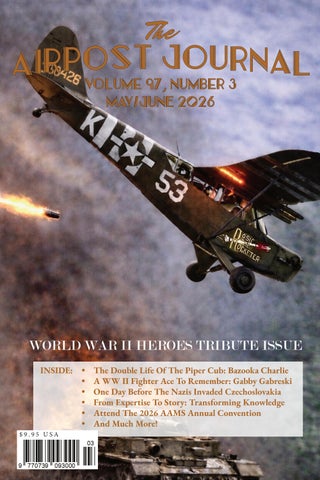
The
st Journal Airpo Volume 97, Number 3 MaY/JUNE 2026
WORLD WAR II HEROES TRIBUTE ISSUE INSIDE:
$9.95 USA
• • • • • •
The Double Life Of The Piper Cub: Bazooka Charlie A WW II Fighter Ace To Remember: Gabby Gabreski One Day Before The Nazis Invaded Czechoslovakia From Expertise To Story: Transforming Knowledge Attend The 2026 AAMS Annual Convention And Much More!
12 THE DOUBLE LIFE OF THE PIPER CUB: COVER STORY
BAZOOKA CHARLIE—a stranger-than fiction history GOLDEN AGE OF AIR MAIL EDITORIAL TEAM
Front Cover: Design by Bruce Wasserman.
To advertise in The Airpost Journal and reach our sophisticated member-collectors, Contact: Dr. Bruce Arlen Wasserman theAPJEditor@gmail.com
The
Airpost Journal 2
Whole No. 1139
Editor Dr. Bruce Arlen Wasserman Book Review Editor Michael L. Wilson Advertising Manager Dr. Bruce Arlen Wasserman Design Team Clementine Studios, Inc. Dr. Bruce Arlen Wasserman Proofreader Dr. Rebecca Z. Wright
Volume 97, Number 3: May/June 2026
The Airpost Journal • May/June 2026
WAR I I FI GH TE R ACE 40 ATOWORLD R E ME MBE R: GA BBY GABRESKI
EXPERTISE TO 58 FROM STORY: TRANSFORM-
2026’S AAMS 62 ATTEND ANNUAL CONVENTION
ING KNOWELEDGE
IN BOSTON
Join The American Air Mail Society
COLUMNS
Membership Secretary Judi Washington aamsmembsecretary@gmail.com
4
Viewpoint: The Editor
7
Above Ground Level
9
Aerograms
68 Books in Review 70 Window Into History 76 Airmail in the News 78 Philatelic Press News 79 Index of Advertisers The Airpost Journal • May/June 2026
3
The Double Life of the Piper Cub: Bazooka Charlie And A Stranger-Than-Fiction History Dr. Bruce Arlen Wasserman
F
or a moment, the electrical switch was stuck. And when he pushed the jury-rigged trigger, nothing happened. It was a moment when his heart stopped—for an instant—then raised to a flutter before racing off. The tiny L-4 airplane was tipped on its nose, all 65 of its horsepower fueling a dive that the little Piper shouldn’t dream of doing. And then it happened: a loud whoosh and flames followed by the almost lazy contrail of the launched, rocket-propelled bazooka round and the tank below flashed, then erupted 12
in flames. Charlie pulled straight back on the stick, then banked hard right. Everyman’s airplane, a J-3 Piper Cub dressed up and rechristened in the U.S. Army Air Forces as an L-4 Grasshopper, had done the impossible—reaching well beyond the almost innocence of the observation plane’s rubber-stamped call to duty—and mimicked a dive bomber, without the protection of armor or the chance for a quick getaway. The Grasshopper, as a dressed-in-fatigues version of the Cub, had a lineage originally emerged from the Taylor
The Airpost Journal • May/June 2026
Figure 1: A hand-painted Collins First Day Cover labeled “William Piper” and showing a J-3 Piper Cub, created for the USPS Airmail stamp commemorating “William T. Piper, Aviation Pioneer.” Issued May 17, 1991. Courtesy of the author.
Brothers Airplane Manufacturing Company in Bradford, Pennsylvania. In 1930 and 1931, Clarence Gilbert Taylor had developed his E-2 Taylor Cub, a small, affordable and light aircraft intended for private owners. It was simple and powered by a tiny engine, with a welded steel-tubing fuselage combined with wood for the plane’s wings’ skeleton, and the entire airframe covered in fabric. It could operate from short fields, had miserly fuel consumption, and was forgiving to fly. But financial troubles plagued Taylor’s company. Enter William T. Piper (Figures 1 and 2), a Harvard-trained engineer and successful businessman who believed aviation would flourish only if airplanes were made accessible to people of ordinary financial means. He was an initial investor in Taylor’s company, but despite his continued influx of money, the company was forced to file for bankruptcy in the early days of the Great Depression. When the comThe Airpost Journal • May/June 2026
Figure 2: A maxicard signed by William T. Piper, Jr, on the release of the U.S. stamp honoring his father, William T. Piper. Courtesy of the author.
13
36,000 square feet and production of the Taylorcraft Cubs grew to one a day. But all was not well between the two partners, and by that time they were not on speaking terms. Finally, Piper bought out Taylor’s share Figure 3: An airborne J-3 Piper Cub. Courtesy of Spartan7W, and Taylor left the company in Wikimedia Commons. December 1935. Piper immediately took control of the compapany’s assets were put up for sale, Pipny and made significant improvements er’s $761 bid was enough to purchase it. The new corporation was renamed The to the Cub, including the adoption of Taylor Aircraft Company and Piper improved Continental engines. He ingave Taylor half of the assets and made creased brand advertising, expanded his him president, with Piper as treasurer. dealer network, and reduced the price of The pair worked on aircraft develop- the plane. And all was going well until March ment and in 1931 received government approval to release the Taylorcraft E-2 1937, when tragedy struck and the Cub, a name that would stick through factory burned to the ground. After various incarnations of the plane as the obtaining significant funds from small company ramped up production. investors, Piper By 1935 their factory had expanded to
Figure 4: A hand-painted Collins First Day Cover showing a J-3 Piper Cub, issued for the USPS Airmail stamp sheet commemorating “Classic American Aircraft” on July 19, 1997. Courtesy of the author.
14
The Airpost Journal • May/June 2026
reorganized the firm as the Piper Aircraft Corporation and built a new factory in Lock Haven, Pennsylvania. With that change, he introduced more efficient assembly of the plane and brought his improved Piper J-3 Cub to market that same year. With its distinctive yellow paint and black lightning-bolt trim stripe, the J-3 Cub (Figures 3 and 4) quickly became a mainstay in American general aviation and could be considered the equivalent of the “Ford Model T” of the sky. By 1940, a Piper Cub rolled off the assembly line every twenty minutes, using efficiency in production no other aircraft manufacturer could claim at that time. The J-3 was powered by a Continental A-65 engine, producing an underwhelming sixty-five horsepower. The plane cruised at roughly seventy-five miles per hour and stalled at thirty-eight miles per hour. It carried two people sitting in tandem with the pilot normally flying the plane from the back seat. Early Cubs lacked electrical systems and had the extremely basic instruFigure 6: A vintage J-3C-65 Piper Cub owner’s manual—the model of the plane equipped with a 65 horsepower Continental engine as used in the AAF’s L-4 Grasshopper—issued by the Piper Aircraft Corporation. Courtesy of the author.
The Airpost Journal • May/June 2026
Figure 5: The spartan instrument array in the cockpit of a J-3 Cub and the Army equivalent L-4 Grasshopper. Courtesy of the Robert Frola Collection, Wikimedia Commons.
mentation of an airspeed indicator, tachometer, combined oil pressure and temperature gauges, an altimeter, as well as a compass in the cockpit (Figures 5 and 6). The engine was started by hand-propping and the landing gear used bungee cords as shock absorbers. The wings were braced by struts and built with wooden spars and ribs. Despite their basic instrumentation, pilots of the plane relied more on seat-of-the-pants flying as well as attention to the sound of the engine rather than watching the instrument panel, and they controlled the plane with a floor-mounted control stick and a pair of T-shaped, foot-operated rudder pedals. The Cub had a ceiling
15