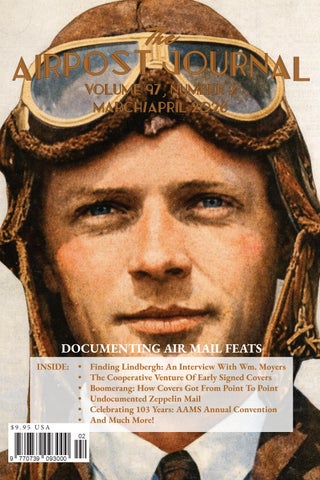
The
st Journal Airpo Volume 97, Number 2 March/april 2026
DOCUMENTING AIR MAIL FEATS INSIDE:
$9.95 USA
• • • • • •
Finding Lindbergh: An Interview With Wm. Moyers The Cooperative Venture Of Early Signed Covers Boomerang: How Covers Got From Point To Point Undocumented Zeppelin Mail Celebrating 103 Years: AAMS Annual Convention And Much More!
10 FINDING LINDBERGH: AN INTERVIEW COVER STORY
WITH WILLIAM COPE MOYERS
EDITORIAL TEAM
Front Cover: Design by Bruce Wasserman.
To advertise in The Airpost Journal and reach our sophisticated member-collectors, Contact: Dr. Bruce Arlen Wasserman theAPJEditor@gmail.com
The
Airpost Journal 2
Whole No. 1138
Editor Dr. Bruce Arlen Wasserman Book Review Editor Michael L. Wilson Advertising Manager Dr. Bruce Arlen Wasserman Design Team Clementine Studios, Inc. Dr. Bruce Arlen Wasserman Proofreader Dr. Rebecca Z. Wright
Volume 97, Number 2: Mar/Apr 2026
The Airpost Journal • March/April 2026
O PE R AT I VE VE N TU R E 36 TOHF EE CO A R LY S I G N E D COVE R S
48 BOOMERANG: HOW COVERS GOT
FROM POINT TO POINT
103 68 CELEBRATING YEARS: THE 2026 AAMS ANNUAL CONVENTION
Join The American Air Mail Society
COLUMNS
Membership Secretary Judi Washington aamsmembsecretary@gmail.com
4
Viewpoint: The Editor
6
Above Ground Level
8
Aerograms
60 Window Into History 64 Books in Review 66 Airmail in the News 74 Philatelic Press News 77 Index of Advertisers The Airpost Journal • March/April 2026
3
Finding Lindbergh: An Interview with William Cope Moyers Dr. Bruce Arlen Wasserman
We are very pleased to present this groundbreaking interview with William Cope Moyers, an author, journalist, an advocate for addiction recovery, and the son of renowned journalist Bill Moyers. William began his career in media working for CNN and other outlets before 10
turning to public policy and recovery advocacy. He is Vice President of Public Affairs and Community Relations at the Hazelden Betty Ford Foundation and has appeared on The Oprah Winfrey Show, Larry King Live, Good Morning America, and National Public Radio.
The Airpost Journal • March/April 2026
His work has been featured in the New York Times, the Washington Post, and Newsweek, among others. William has written four books and has become one of the most visible voices in American recovery advocacy. His insatiable drive to collect Lindbergh, focusing on ephemera from Lindbergh’s childhood, family correspondence both before and after his fame with an emphasis on his life in Minnesota, and a broad representation of covers, backlights a view into the private recesses of the famous aviator’s life.
D
espite the universal knowledge of Charles Lindbergh’s historical feat in his solo transatlantic flight—an event that both stunned the world and opened the door to more robust transoceanic air travel—the mystery behind the man remains hidden from public view. And while it is easy to find photos of all aspects of Lindbergh’s flight, uncovering an ephemera trail that leads to the deep heart of the man behind the myth is much more elusive and often not found in available archives. That is where the Lindbergh collections of William Moyers shine. Charles Lindbergh first soloed an airplane in April 1923. From that rank beginner’s experience, he went on to barnstorm in a war surplus Curtiss JN-4 Jenny and later enlisted in the Army Air Corps as a cadet, where he earned his wings in March 1925. That early flying saw him bail out of planes twice—once from a mere 350 feet above the ground when his plane went into an unrecoverable spin after a midair collision. Following a subsequent stint as a wing-walker and aerial acrobat, the next year he began a short career as the chief pilot
The Airpost Journal • March/April 2026
for Robertson Aircraft Corporation on the CAM 2 route from St. Louis to Chicago, where he flew a war surplus DeHavilland DH-4. By the end of that job, Lindbergh had accumulated 2,000 flight hours and he began to work out the dynamics of a transatlantic crossing. After all, could it be any harder than flying through rain, snow, or fog at night as he had done for timely delivery of the mail? It is the little things that led up to Lindbergh’s whirlwind career as a pilot prior to and after his record-making flight that show up in flight logs, personal letters, inspection sheets and other ephemera that collectively tell the untold story of the man, seen in the documents and ephemera of Moyers’ collections. TAPJ Editor: It’s a pleasure to meet you, William. William Moyers: Well, thanks, Bruce. I appreciate your interest in my collecting interest, and what you’re doing at The Airpost Journal is a benefit to all of us in this field, and I use that in the broadest sense because it is a field that’s disparate in a lot of ways but filled with history. And this history—if we don’t keep it alive—is going to disappear. So what you
1 11
and the small team are doing at The APJ is admirable and I think it’s going to pay off in terms of membership and in other ways. TAPJ Editor: Let’s start with a little on your background in journalism. How did you get your start? William Moyers: I am a journalist by trade. I grew up in a family of journalists. My father is that journalist, Bill Moyers who died last June at age 91, and so I had the journalism bug at an early age. In fact, I just came back two days ago from his memorial service at the LBJ Library in Austin, Texas where I spoke Thursday night, and there were a lot of journalists there talking about the impact that he’d had on them and on the world, and he 12
had it on me, too. He was always surprised that I wanted to be a journalist. He’d say, “are you sure you don’t want to be an archaeologist or a pilot?” He exposed me to that world in many, many ways beyond what we could talk about now, but from going to Cuba in 1977 and spending time with Fidel Castro to hanging out at Falaise, the mansion that Harry Guggenheim owned where Charles Lindbergh wrote his first book, We, in 1927. With those kinds of experiences, I was exposed to a world beyond what 2 was my own. I graduated in 1981 with a Bachelor of Arts in Journalism from a small school in Virginia. I worked for a newspaper in Dallas, Texas in the early 1980s and cut my teeth on writing the who, what, where, when, why, and how, which I think is so integral to communication of any kind, including The APJ. And then I went to work at CNN. But in the early 1990s, I was struggling with addictive substances. I am a recovering alcoholic and an addict, as we used to call ourselves. And in the early 90s I turned my whole life around in terms… and to do that, I had to step away from my father’s shadow, step away from journalism. I ended up going to work for an organization called the Hazelden Betty Ford Foundation, a renowned drug and alcohol treatment facility where I have used my communication skills to
The Airpost Journal • March/April 2026
3
do things like fundraising and writing books, interviews in the media, and helping people. TAPJ Editor: Regarding Charles Lindbergh and
his life and times, his influence in the world and his steadfast personality— some of the amazing difficulties that he faced, not just his flight over the ocean— you’ve assembled a remarkable collection of ephemera and historic documents related to Lindbergh… how did you get your start in that project?
4 The Airpost Journal • March/April 2026
13