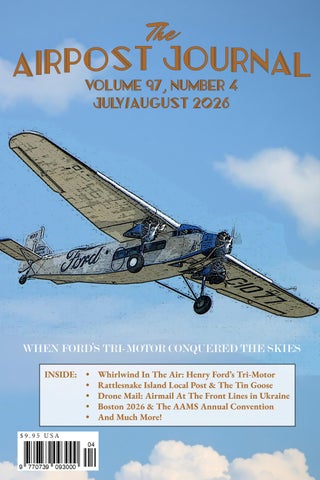
The
st Journal Airpo Volume 97, Number 4 JULY/AUGUST 2026
WHEN FORD’S TRI-MOTOR CONQUERED THE SKIES INSIDE:
$9.95 USA
• • • • •
Whirlwind In The Air: Henry Ford’s Tri-Motor Rattlesnake Island Local Post & The Tin Goose Drone Mail: Airmail At The Front Lines in Ukraine Boston 2026 & The AAMS Annual Convention And Much More!
10 WHIRLWIND IN THE AIR: COVER STORY
HENRY FORD’S TRI-MOTOR EDITORIAL TEAM
Front Cover: Design by Bruce Wasserman.
To advertise in The Airpost Journal and reach our sophisticated member-collectors, Contact: Dr. Bruce Arlen Wasserman theAPJEditor@gmail.com
The
Airpost Journal 2
Whole No. 1140
Editor Dr. Bruce Arlen Wasserman Book Review Editor Michael L. Wilson Advertising Manager Dr. Bruce Arlen Wasserman Design Team Clementine Studios, Inc. Dr. Bruce Arlen Wasserman Proofreader Dr. Rebecca Z. Wright
Volume 97, Number 4: July/August 2026
The Airpost Journal • July/August 2026
A KE I S L A N D LOCAL 34 RP OATSTT L&E SN TH E TI N GO O S E
MAIL: 2026 & THE 46 DRONE 60 BOSTON AIRMAIL AT THE FRONT AMERICAN AIR MAIL LINES IN UKRAINE
Join The American Air Mail Society Membership Secretary Judi Washington aamsmembsecretary@gmail.com
SOCIETY
COLUMNS 4
Viewpoint: The Editor
7
Above Ground Level
9
Aerograms
68 Books in Review 73 Airmail in the News 78 Philatelic Press News 80 Index of Advertisers
The Airpost Journal • July/August 2026
3
Whirlwind In The Air: Henry Ford's Tri-Motor Dr. Bruce Arlen Wasserman
When the U.S. Post Office Department launched its contract airmail network through the 1925 Kelly Act, aviation stood at a crossroads. Biplanes with open cockpits—remnants of the pioneer era and in many cases evolved from World War I planes like the iconic Curtiss Jenny—were mostly made of wood and wire, covered in dope-painted fabric. They could take off from short, rough airstrips but traveled at low speeds, carried little cargo, and pilots were fully exposed to the elements. Though they had defined the pioneer era, the increasing demands of scheduled airmail service, coupled with the public’s desire to see airplane-based transportation evolve, birthed dreams of something sturdier—a plane capable of carrying heavier cargo and providing in10
creased safety, while offering protection from winter and adverse weather. In this heady mix of demand versus aviation’s reality, Henry Ford joined the race to improve commercial aviation, providing his first Contract Air Mail (CAM) service in February 1926 with Ford’s groundbreaking airplane project—the single engine, all-metal Stout 2AT Pullman. Ford was a manufacturing icon who had revolutionized auto transport in the United States with his Model T, dubbed a “motor car for the great multitude” and his later and more-sophisticated Model A, as well as his Model AA trucks and Fordson tractors. His expertise in large scale, efficient manufacturing was legend, though the substantial role he played in advancing
The Airpost Journal • July/August 2026
American aviation beyond its barnstorming roots through the development and implementation of the Ford Tri-Motor airplane—nicknamed the Tin Goose—is less prominent in today’s rendition of the historical record. Despite the forgetfulness of cultural memory, Ford’s first Tin Goose—produced by the Stout Metal Airplane Company division of the Ford Motor Company (Figure 1) —became one of the most recognizable commercial airplanes of the mid-1920s and early 1930s. Though only 206 of the planes were ever built including ten experimental models, the Tri-Motor found a way to fulfill aviation needs around the world and in the process, lit a fire under the wings of early commercial aviation and left an indelible mark on airmail history. It was in 1923 that William Stout sent an audacious letter to 100 Detroit industrialists asking each for a $1,000 The Airpost Journal • July/August 2026
buy-in to help him create his concept plane, the Stout 1-AT Air Sedan, a single engine, all-metal aircraft. The 1-AT was strongly influenced by the German Junkers design—at that time, the model F 13 (Figure 2)—a single engine, aluminum-skinned plane developed in 1919 that could carry four passengers. Twenty investors, including Ford and his son, Edsel, took the bait with the net result that eventually saw Ford provide a factory building, an airfield, and financial backing that yielded the prototype. Once assembled, the Air Sedan was found to be underpowered and was quickly made obsolete. Later in 1924 the more refined single engine Model 2-AT Pullman, shown in Figure 3, emerged from the Stout Metal Airplane Company factory. The all-metal Pullman was powered by a 400 horsepower Liberty engine and could carry eight passengers in comfort. In
11
on CAM 6 (Figure 4) and from Detroit to Chicago and return on CAM 7 (Figure 5). A cover carried by Ford Air Transport Service in their single engine Model 2-AT on the CAM 7 route and paying twenty cents—a double rate— Figure 1: A Phostint real-photo postcard number 72273, “Ford Trifor the roundtrip, Motor Passenger Transport.” The model illustrated has wheel pants for taking off in Chicago, greater aerodynamics—an uncommon addition to the planes. Phostint was a trade name used by the Detroit Publishing Company. Courtesy flying to Dearborn of the author. Michigan (Detroit), then making the return 1925 Ford acquired the company, and flight on February 15, 1926 is shown in the planes carried their first freight— primarily Ford auto parts. It was with Figure 6. Ford held the original contract these Model 2-AT (Air Transport) for CAM 6 and 7 until July 19, 1928 planes that Ford carried the first airmail which marked the final day that Ford from Detroit to Cleveland and return Air Transport carried mail, ending its U.S. Post Office Department contract.
Figure 2: A Junkers F 13 prototype in 1919, the plane that inspired the Stout single-engine, all metal planes which evolved into the Ford Tri-Motor. Courtesy of Wikimedia Commons, Public Domain.
12
The Airpost Journal • July/August 2026
Figure 3: A Stout Model 2-AT, wearing Ford livery. This was Ford’s first plane to carry Contract Air Mail on their first routes—CAM 6 and CAM 7—on February 15, 1926. Ford held the contract for CAM 6 and 7 through July 19, 1928 which marked the final day that Ford Air Transport carried mail. Courtesy of the National Photo Company Collection, Public Domain.
Though their first flights were a success, the key players had plans to build something more powerful, an airplane able to move substantial cargo and with built-in redundancy in the form of
multiple engines. That push spawned the hurried development of the Ford Tri-Motor even before the Stout Pullman carried its first mail. That first Tri-Motor was the Model 3-AT, pow-
Figure 4: Ford carried the first air mail from Detroit to Cleveland and return in a Stout singleengine Model 2-AT, the predecessor of the Tri-Motor. Courtesy of the author.
The Airpost Journal • July/August 2026
13