Official Publication of the American Air Mail Society
Organized 1923, Incorporated 1944
June/July 2024
Volume 95
American Philatelic Society Affiliate #77
Whole No. 1128
Number 6
Published Bimonthly in February, April, June, August, October, and December
Society Officers
President ................................................ David S. Ball (davidsball47@gmail.com)
Vice President ..................................... Dan Gribbin (bluzeman1@hotmail.com)
Secretary ................................................ William C. Fort III (wcfortiii@aol.com)
Treasurer................................... Charlie Giorgetti (charlie.giorgetti@gmail.com)
Directors at Large: Gary Withrow Patrick Walters Ray Simrak Jim Haxby Kendall Sanford
Member Services
Auction Manager ............................... Don Lussky (aamsauctions@yahoo.com)
Merchandise Sales Manager J.L. Johnson, Jr. (fam14@tvcconnect.net)
Historian .................................................... Juan L. Riera (juanr377@gmail.com)
Membership Secretary ............ Judi Washington (j.washington65@gmail.com)
Webmaster .................... David Crotty (webmaster@americanairmailsociety.org)
Convention Coordinator ....................... Ken Sanford (kaerophil@gmail.com)
Publications Committee Chairman ....... Tom Reyman (tgraz356@msn.com)
Editor Charles Epting (charleseptingstamps@gmail.com)
Annual membership dues for new members, which includes a subscription to the Airpost Journal: $30 digital membership, $40 within the United States and Canada, $60 worldwide. Worldwide dues include first-class airmail shipment.



Charles Epting
First and foremost I’d like to take the opportunity to thank David S. Ball and the rest of the AAMS team for the opportunity to serve as Editor of the Airpost Journal.
A bit of background about myself, both professional and personal: I’ve been a stamp collector for about a decade, and a professional philatelist for eight years. After graduating from the American Philatelic Society’s Young Philatelic Leaders Fellowship I took a job with H.R. Harmer, where I served as President until joining Robert A. Siegel in September 2023. In that time I’ve directly overseen the sale of over $30 million worth of philatelic material, while also writing and speaking extensively about the hobby both in the United States and Europe. I am a columnist for the American Philatelist (“The Letter Opener”), a trustee of the Philatelic Foundation, the secretary of the American Philatelic Research Library, and a fellow of the Royal Philatelic Society London.
None of these experiences fully explain why I am so excited to assume the role of Editor of this wonderful journal, however. While still a student at the University of Southern California, I founded a magazine called Silent Film Quarterly. The history of cinema has long been one of my strongest passions, and for 10 issues I edited and distributed SFQ out of my kitchen. Over those two and a half years I was able to interview some of the field’s luminaries, attend countless screenings of rare films, and connect with people around the globe who shared my same niche interest. It was one of the most rewarding experiences of my life.
I have always hoped to have another opporutnity to edit a magazine, and in speaking with David S. Ball I realized that the APJ was a natural fit. I believe the American Air Mail Society has a unique advantage when compared to other philatelic organizations in that it has such a broad appeal to aviation enthusiasts who may not even realize how closely their own hobby ties into aerophilately.
Which brings me to my vision for this publication. The APJ has potential to be much more than merely a philatelic journal. Some changes are immediately evident, such as the decreased frequency of publication and larger physical size. But I also hope to fundamentally transform the APJ in more subtle ways, such as creating a product that can be sold at aviation museum gift shops and distributed at vintage airshows rather than solely distributed to the AAMS’s membership. Too much of philately is inside baseball; we should instead be focused on how we are presenting our hobby to the wider world in order to draw new people in.
This is my ultimate goal for the APJ: to produce a great magazine, rather than a great philatelic magazine. I welcome the challenge and look forward to any feedback, positive or negative, that you might have.
David S. Ball
I try to reserve this space for positive news that impacts our membership. Who is pitching in, how folks are working together, and what’s new.
To be sure, our recent Annual Meeting at Philatelic Show in Boxboro included lots of that. Bill Fort represented us on the jury with great exhibits from Jon Krupnick, Pat Walters, Murray Abramson, Brad Wilde, Jane Snowdon, Hugh Lawrence, Robert Brew, and yours truly. Michael Wilson gave a great talk on National Air Mail Week and Celine Poulin-Lape on Amelia Earhart.
During our Membership Meeting we heard from Treasurer Charlie Giorgetti, APJ Editor Charles Epting, Publications Chair Tom Reyman, and Assistant Archivist Jim Haxby. Each provided a thoughtful report on how progress is afoot. VP Dan Gribbin gave an update on inter-society collaboration efforts. The President’s Award was given to our Webmaster David Crotty for his many years of service. Ken Sanford and his Literature Award team had the list of last year’s best. Zoom master Gary Withrow simulcast the meeting for those who could not attend.
Which brings me to my disappointment. The current by-laws make it difficult to have a quorum, it doesn’t permit participation of members who are not at the meeting, and a number of other issues which impede progress in our society. I was asked to update the by-laws by a very vocal Board member. I enlisted the help of Life

Member Ray Getsug and others to help on this. Ray contacted 14 philatelic societies and did an exhaustive comparative review of their Bylaws and Constitutions.
From this we drafted a proposed revision (2.0) which we “shopped around” for comment. A guide to proposed changes articulating the rationale was created. The current and proposed by-laws along with the guide were posted on the website. 2.0 was approved by the Board and then brought to PIPEX for a vote of the membership (it too was simulcast). In keeping with our current by-laws, we were unable to bring the revision to a vote without getting a list of 25 attendees to request the vote. In the interim a new Board was elected and it too endorsed 2.0. I conducted a Zoom meeting to answer questions and gather input.
In an effort to include the widest possible membership participation (not allowed under our current Bylaws), Secretary Bill Fort and I agreed that all members, not just those attending the stamp show or tendering a proxy, could vote. This was accomplished by ballot in the APJ, email to the Secretary, or by Zoom. Unfortunately, the update failed to get the two-thirds vote in support it required.
At this point there remains plenty of other work to do with our reimagined APJ, getting the Archive off the ground, renewing our publishing plans, improving our finances, boosting membership, and more. I ask those that declined to support the Bylaws revision to pitch in and help get a 21st century update passed.
For any of you who haven’t made my acquaintance, I had my picture taken. I’m the handsome one standing next to my Subaru with the AAMS license plate.
I am pleased to introduce this periodic article that will review the financial position of the American Air Mail Society, especially in the newly redesigned Airpost Journal. I wish Charles success as he takes over the leadership of this award-winning publication and thank Vickie for her dedication and wish her well in her new endeavor.
I assumed the Treasurer’s role upon Stephen Reinhard’s retirement in January. I want to thank Steve for decades of service as the AAMS Treasurer. Additionally, I want to thank him for welcoming me in this role and for the smooth transition. I wish Steve good health and continued contributions to the AAMS.
My professional background was working in commercial high-tech, and while not a finance person by training I held executive management roles working closely with finance business partners. With this background and the support of the board I plan to guide the AAMS Treasurer’s role with the following principles:
1. Oversee, from a financial point of view, a thriving society that is growing through prudent fiscal management while providing our financial picture to members in an easy-to-understand form.
2. Focus on financial transparency, which includes proper oversight with regular communications to all AAMS members.
3. Treat membership like “customers,” meaning making financial transactions, such as renewals, easy and online. Continue to simplify membership processes and provide information access on demand.
The financial state of the American Air Mail Society is strong! Over the hundred-year history through the stewardship of those that came before and now the AAMS has $388,000 in cash and cash equivalents to support the AAMS. The concern is that over recent years our annual expenses exceed our income resulting in an approximately $20,000 per-year difference. While deficit spending is not always bad, the board’s near-term goal is focused on both raising our income while controlling spending to get to breakeven and then grow from there. In future articles I will discuss the details of these statements and the plans to achieve our goals.
A couple of points before closing:
Regarding treating members like customers, please note that all membership transactions can be conducted via PayPal, including new memberships, renewals, or donations for all U.S., Canadian or international transactions. Instructions are included on all forms. Of course, checks are still accepted by the AAMS, where appropriate.
Financial transparency is one critical factor for all to have confidence in the current. The first two actions taken under this goal:
1. The formation of the AAMS Finance Committee. This group will consist of volunteer members that will provide financial oversight while providing council on major financial matters that the AAMS considers. Additionally, a board member will serve on this group, along with myself. I will provide information about its composition and objectives shortly.
2. This article. As mentioned, this period article will provide you with updated financial information and actions taken by the board.
My overarching goal is to serve the AAMS members, and I appreciate the support received to date. Thank you for your attention and please let me know if you have any questions.
Members of the American Air Mail Society are encouraged to submit articles of any length to the Airpost Journal. Submissions should be made as a Microsoft Word Document (.doc) with accomanying images sent separately as JPEG or PNG files (rather than embedded in the text). Please email Editor Charles Epting for more information (charleseptingstamps@gmail.com) for more information.
by Ken Stach
Gannon
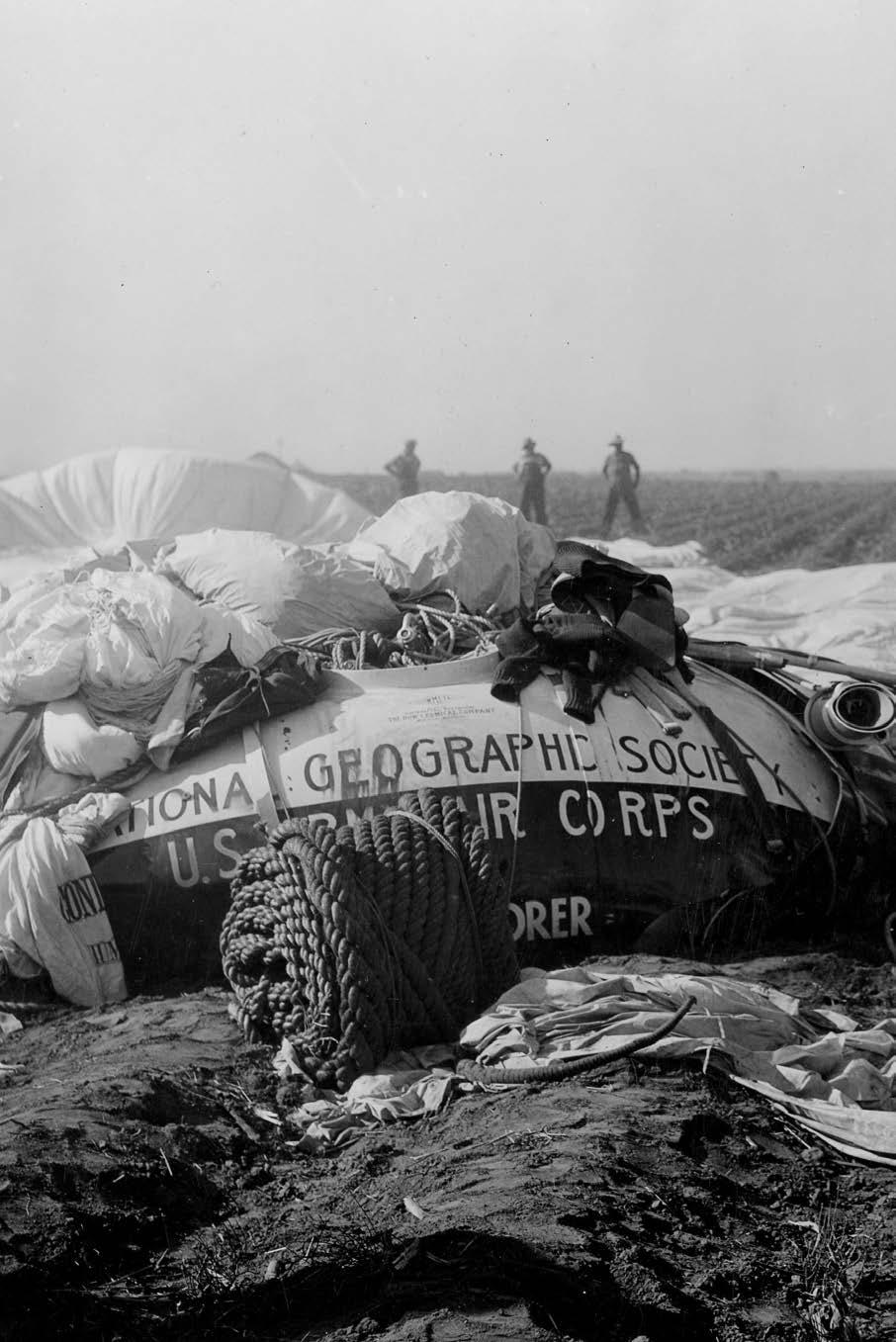
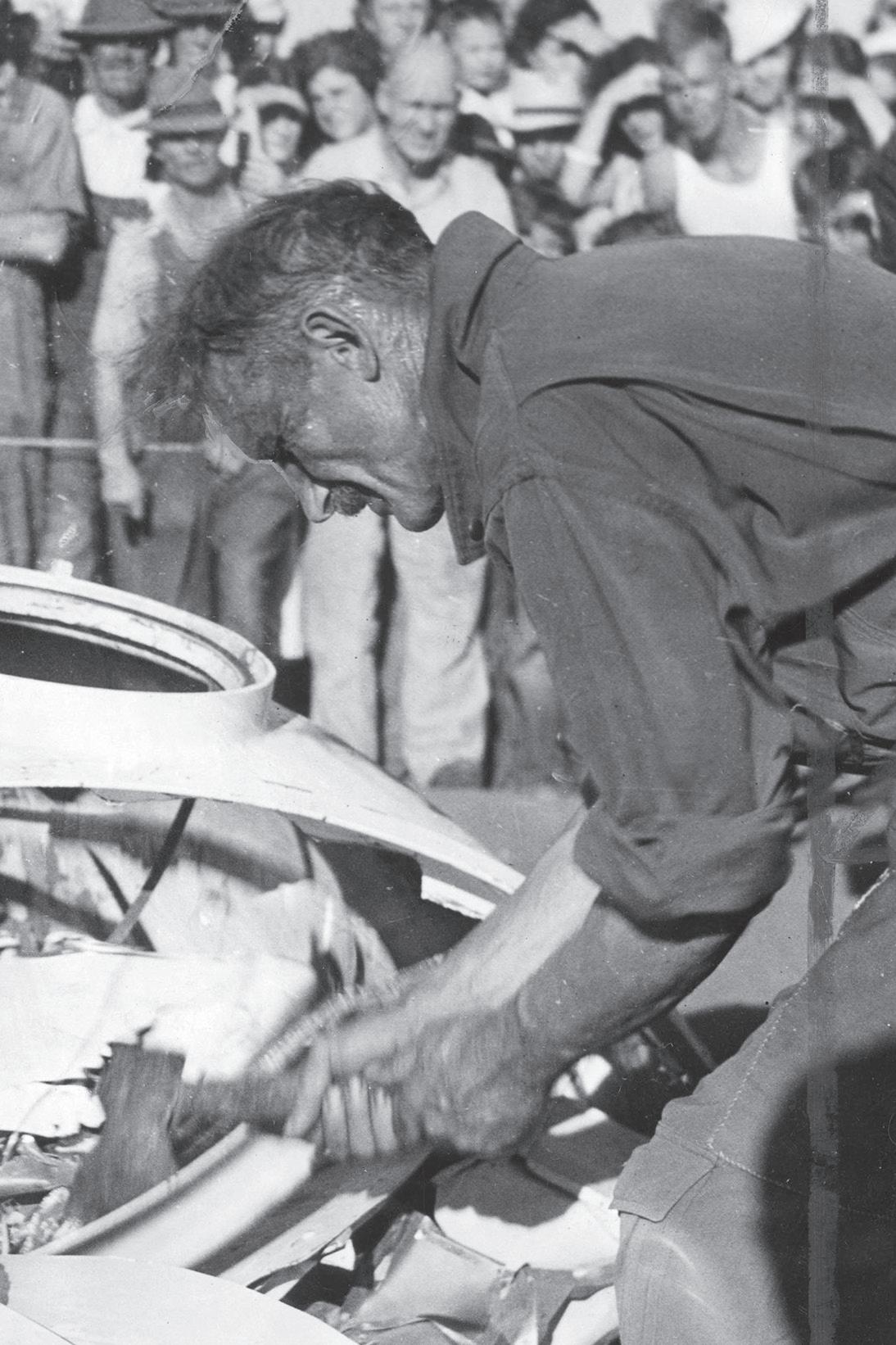
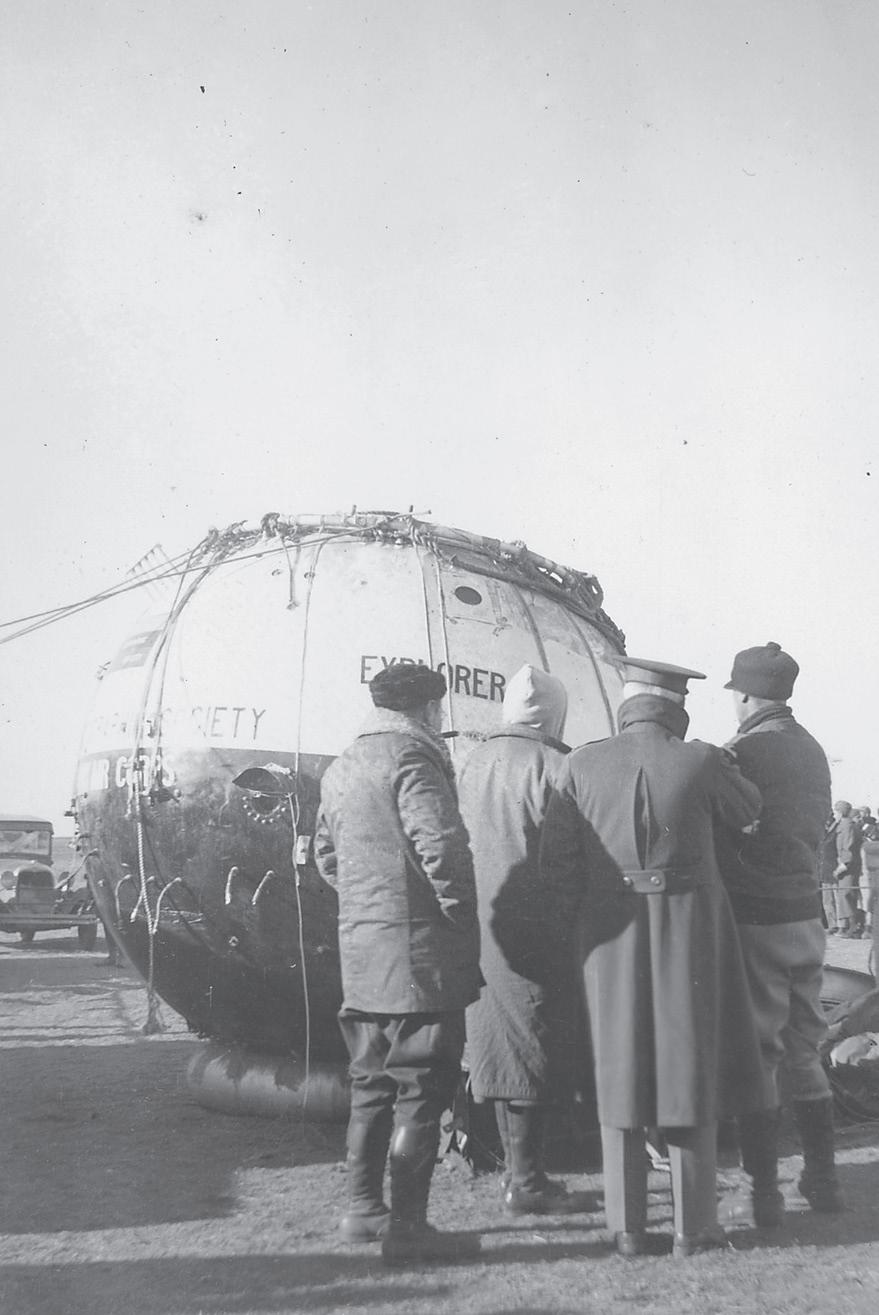
Pictured: Captain Albert W. Stevens uses an ax to access the crashed wreckage of the Explorer I gondola shortly after making his escape. Courtesy Charles
In this first part of a two-part series, author Ken Stach explores the postal history of the Explorer I stratospheric balloon flight conducted by the National Geographic Society and U.S. Army Air Corps in 1934. In the next issue, Stach will conclude by looking at the Explorer II flight of 1935.

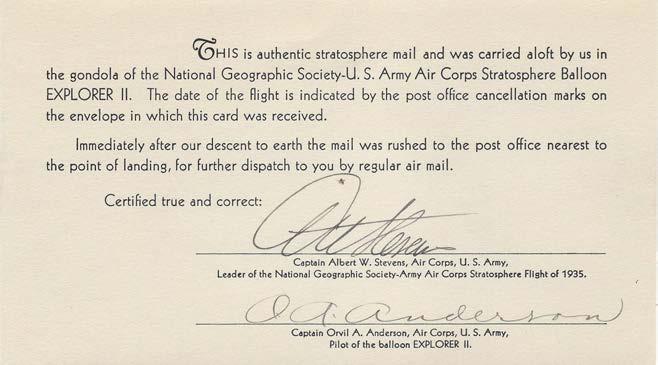
Figure 1 (a+b): An example of a cover carried aboard the Explorer II flight which rose to an altitude of 72,395 feet, a record that held for over 21 years. Postmarked the date of the launch “Rapid City, S. Dak. Nov 11, 5 AM, 1935,” the cover contains the authentication card signed by the pilots of that flight. The forwarding postmark at lower right is “White Lake, S. Dak. Nov 11, 4 PM, 1935” on the second 6-cent winged globe airmail stamp, as the balloon landed safely a few miles south of that small eastern South Dakota town (from the author’s collection).
Only a handful of articles have previously been published in postal history journals regarding the stratosphere balloon flights that ascended from the Black Hills of South Dakota in 1934 and 1935. The most comprehensive of those was authored by Dr. Max Kronstein in The Airpost Journal in April, 19561 (reprinted in the same journal in July, 19842 to commemorate the 50th anniversary of the July 28, 1934 inaugural flight). There are several other shorter references to these flights in The Airpost Journal, 3,4,5,6,7 but nothing substantial has been penned in nearly 70 years. The purpose of this article is to build upon the prior work of Kronstein and others by incorporating significant technical and historical aspects of the flights into an article illustrating key postal history artifacts. I feel the timing of this article especially appropriate, given the fact that this year commemorates the 90th anniversary of the inaugural ascent.
The 1934-1935 stratosphere balloon flights were a cooperative effort involving primarily the National Geographic Society and the U.S. Army Air Corps. The National Geographic Magazine (NGM) of July 19348 described the role of the participants as follows:
“The stratosphere flight is being made possible by the cooperation of a group of organizations and individuals keenly interested in obtaining the fullest data obtainable of the physical and chemical conditions
of the upper atmosphere. In addition to contributing the principal amount toward the expenses of the expedition from its research funds, The [National Geographic] Society has undertaken the management of the project, and is giving the services of its staff. The Society will publish the results of the flight in National Geographic Magazine, and technical accounts will be prepared for a series of scientific monographs.
“The Secretary of War, George H. Dern, through the Army Air Corps, has assigned three expert balloon officers to conduct the flight: Maj. William E. Kepner, pilot; Capt. Albert W. Stevens, observer; and Lieut. Orvil A. Anderson, alternate. The Air Corps has also made available the facilities of its admirably equipped machine shops and laboratories at Wright Field, Dayton, Ohio.” 8
The same article in NGM noted that “engineers of the National Broadcasting Company also have arranged for two-way communication between the balloon and Washington. Thus, officials of the Society and officers of the War Department may confer with the two balloonists at any time during their twelve hours in the air.”8
A number of other “contributors” to the effort were listed at the conclusion of the July 1934 article, including (partial listing): The American Telephone and Telegraph Company; The National Broadcasting Company; Capt. Albert W. Stevens; The California Institute of Technology; The United Aircraft and
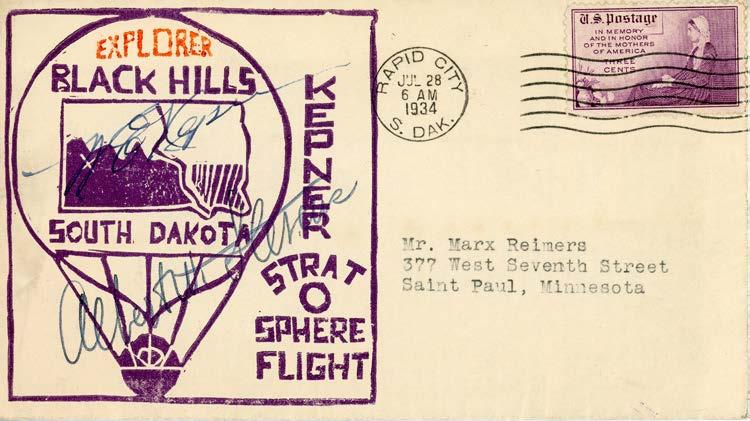
Figure 2: A non-flown souvenir cover postmarked the date and time of the launch “Rapid City, S. Dak. July 28, 6 AM, 1934” with “Kepner Strat O Sphere Flight” cachet. Numerous different types of cachets were applied to non-flown covers to commemorate the Explorer launch. This one happens to have been signed by crewmembers Kepner and Stevens (from the Charles Gannon collection).
Transport Company; The Sperry Gyroscope Company; The Eastman Kodak Company; The Bell and Howell Company; The Bausch and Lomb Optical Company; The Hamilton Watch Company; The General Electric Company; The University of Rochester; The Puritan Compressed Gas Corporation; The Chicago, Burlington and Quincy Railroad; The Chicago and Northwestern Railroad; The Illinois Central System; and the Rapid City Chamber of Commerce.8 I find it especially interesting to see that Capt. Stevens, one of the “stratonauts,” as they came to be called, personally contributed to financing the expedition. Stephen Neulander, in his 1990 COMPEX article on the subject, stated that Stevens donated $1,000 of his own money in 1932 (equivalent to
about $21,000 today) to try to get the Army involved in sponsorship of stratosphere balloon experimentation.
The original article in the July, 1934 issue of NGM provides the detailed answer to this question: “A sheltered pocket in the Black Hills of South Dakota, eleven miles southwest of Rapid City, has been selected as the starting point for the Stratosphere Flight sponsored by the National Geographic Society and the U.S. Army Air Corps.”8 NGM went on to state, “The ascent is to be made in early July, the date depending upon weather conditions. For the safety and full success of such flights, almost perfect weather is necessary during the time the balloon is in
the air, and over the entire area above which it drifts. The balloon cannot be sent aloft until it is determined, from hundreds of telegraphic reports supplied by the Weather Bureau, covering large regions of the United States and Canada, that fine weather lies just ahead.”8
Two of the crew members were personally involved in the site selection, per NGM: “The location near Rapid City was decided upon after Maj. William E. Kepner, pilot for the stratosphere expedition, and Lieut. Orvil A. Anderson, alternate pilot, had flown to numerous sites in several States and had examined them carefully from the air and from the ground.”8
The NGM article goes on to note, “The site is a level, grassy meadow 600 feet square, surrounded by cliffs and hills. In this natural amphitheater the balloon can be extended to 305 feet above the ground during inflation, yet remain protected from the winds.” Additionally, “a good road has been built, through the cooperation of the civic leaders in Rapid City, into the isolated pocket from which the ascent will be made.”8
An article from South Dakota History magazine9 provides additional perspective on the choice of the site in the Black Hills as well as a great summary of the “space program” of the period:
“United States scientists had been trying to reach and study the boundaries of space since the late 1920s. Public awareness and financial support had lagged behind until the successes of a foreign nation
spurred the country’s interest. In the 1930s, general interest in atmospheric exploration increased after Auguste Piccard of Switzerland flew a free-flying balloon to a height of 51,775 feet (9.81 miles) on 27 May 1931. In August of 1932, Piccard, using the first sealed gondola, broke the ten-mile barrier with a flight to 53,153 feet. These flights proved that expeditions to altitudes of over eleven miles, or into the stratosphere, were possible.
“Following the Piccard flights, the Army Air Corps and the National Geographic Society combined their resources and in 1933 began planning the United States Stratosphere Expedition. After design and construction of the craft were well underway, planners moved to select a launching site. A committee of Army Air Corps personnel was in charge of site location. This committee believed that three conditions were necessary in a site. It had to be far enough west to permit the balloon to drift about eight hundred miles eastward and still land in relatively level, unforested terrain. The area had to have good summer flying weather, and the site had to be sheltered from surface winds.
“Early in 1934, the Rapid City Chamber of Commerce learned of the search for a location and invited the committee to consider Rapid City, a small town in western South Dakota on the edge of the Black Hills. When the Army Air Corps site committee arrived in Rapid
City in March 1934, they were shown Halley Airport. Local tradition suggests that the committee was unhappy about being brought all the way to South Dakota to see an airport. With hundreds of airports in the United States to choose from, the committee explained, this was not what they were looking for. Luckily, Ben Rush, chairman of the Pennington County commissioners, had been giving the site requirements a great deal of thought and had located a ‘hole’ in the ground about eleven miles south of town near the Bonanza Bar Mine. With the help of the nearby Civilian Conservation Corps camp at Rockerville, Rush had a trail cut through to the rim of the bowl. The Rapid City businessmen persuaded the location committee to stay and look at this site. As the head of the site committee [Kepner] looked down into the treeless, bowl-shaped depression, he exclaimed, ‘God made that spot for a stratosphere flight.’
“The committee chose the Stratobowl, as the Black Hills site became known, on condition that the Rapid City Chamber of Commerce make the arrangements for leasing the land and building a road to the rim of the site and down into the bowl that would be suitable for heavily loaded trucks. The business parts of the project, the offices, storage sheds, workrooms, and a weather office, also had to be arranged locally. Rapid City residents quickly raised ten thousand dollars
toward the project and set to work to have the bowl ready by July 1934. By the end of 1935, hundreds of South Dakotans had worked on the project and more than nineteen thousand dollars had been raised within the state.”9
Thus, humble South Dakota was thrust into what was the original spacerace, the quest to go high into the stratosphere via balloon in the 1930s. The data gathered on the flights of 1934-1935 proved valuable in understanding the near reaches of space and paved the way for putting man into outer space and ultimately on the moon several decades later.
The first flight of the Explorer series took place on July 28, 1934 from the Stratobowl near Rapid City, SD. The official name for the expedition was actually “The National Geographic Society – U.S. Army Air Corps Stratosphere Flight of 1934.” Due to the length of that title, I will use the shortened version of “Explorer” in this article. After both the unsuccessful attempt and later successful flight the following year (of Explorer II), the 1934 flight became retroactively known as “Explorer I.” However, since it was simply called Explorer at the time (1934), it will be referred to by that name in this article.
The balloon itself was manufactured by the Goodyear-Zeppelin Corporation in Akron, Ohio and was made of fabric produced from specially selected cotton fibers which had been
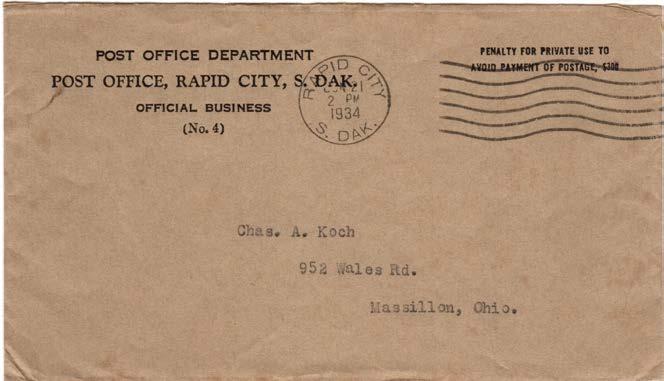
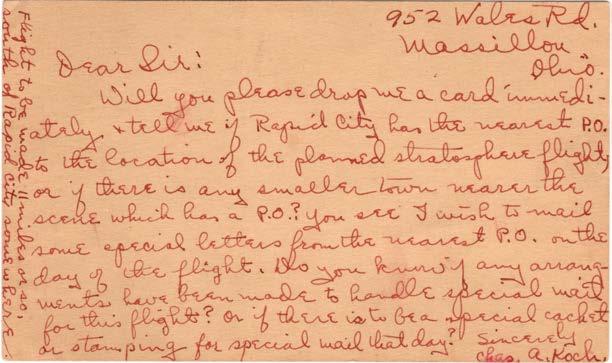
Figure 3 (a+b): The postcard shown immediately above was mailed by a collector from Ohio to Rapid City in June 1934 in anticipation of the upcoming Explorer flight. Mr. Chas. A. Koch wrote, in part, “Tell me if Rapid City has the nearest P.O. to the location of the planned stratosphere flight, or if there is any smaller town nearer the scene which has a P.O.? You see I wish to mail some special letters from the nearest P.O. on the day of the flight. Do you know if any arrangements have been made to handle special mail for this flight? Or if there is to be a special cachet or stamping for special mail that day?” Vertically at left, Koch added, “Flight to be made 11 miles or so south of Rapid City somewhere.” The Rapid City postmaster apparently mailed the card back to Mr. Koch in the envelope at top (Post Office Department penalty envelope) with “Rapid City, S. Dak. Jun 21, 2 PM, 1934” postmark. Based on the covers shown as Figure 4 and Figure 5, Koch’s request was fulfilled by the Rapid City postmaster (courtesy David S. Ball).
run through a rubberizing machine 30 times to apply the thin rubber layer required for air-tightness. The 2⅓ acres (101 thousand square feet) of the balloon’s surface consisted of 3,520 major pieces of the rubberized fabric along with “scores of smaller fragments.” Each piece was rubber-cemented to its next-door neighbor with each seam
having fabric-backed rubber tape on both sides. A total of 300 gallons of rubber cement were used in the process, giving some idea of the balloon’s massive size.8
The Explorer gondola was manufactured by Dow Chemical Company in Midland, Michigan by “welding together eight sections of the metal shaped
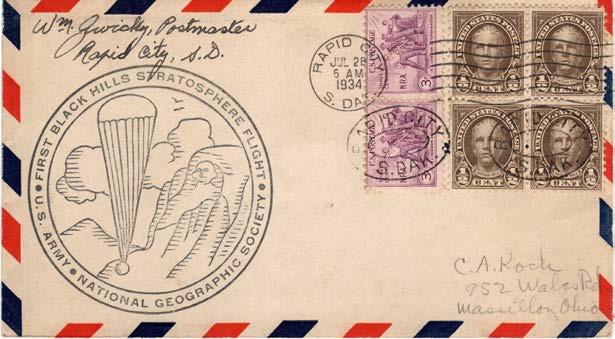
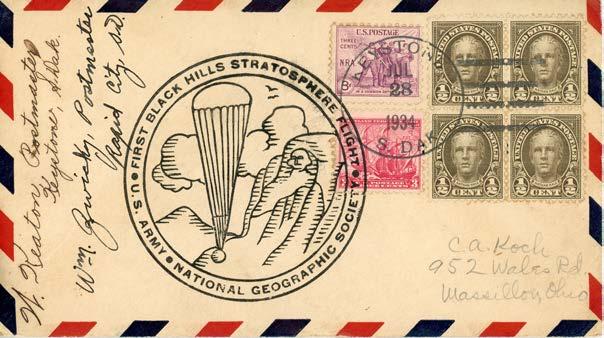
Figure 4 (top): This cover shows that Mr. Koch got his wish, as requested in the contents shown as Figure 3, in having some letters postmarked on the day of the balloon’s ascent. A special handstamped cachet was applied at left, along with the postmaster’s signature at upper left, on this cover postmarked “Rapid City, S. Dak. Jul 28, 6 AM, 1934.” This is another example of a non-flown souvenir cover, similar to the one shown previously as Figure 2 (courtesy Charles Gannon).
Figure 5 (bottom): Mr. Koch also had a cover postmarked on the day of ascent from “Keystone, S. Dak. Jul 28, 1934” with the handstamped cachet at left, along with both the Keystone and Rapid City postmasters’ signatures (courtesy Charles Gannon).
like pieces of orange peel.” The metal referenced was “Dowmetal,” an alloy consisting primarily of magnesium and weighing only about two-thirds that of aluminum. As such, the gondola, before various fittings were added, weighed only 450 pounds (it would have weighed almost a ton if it had been
made of steel). At Wright Field, in Dayton, Ohio, Captain Stevens personally supervised the construction of the instruments that were used aboard the flight.8
The October 1934 edition of NGM contained a detailed account of the harrowing journey of Explorer,
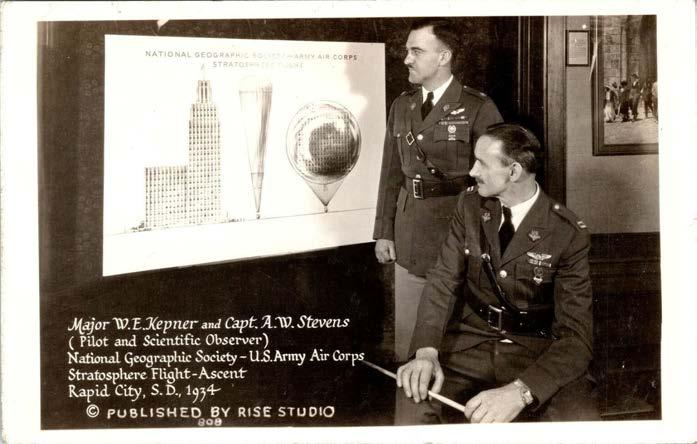
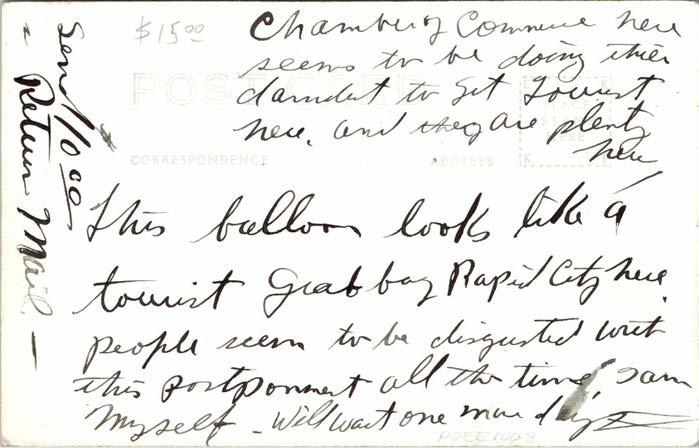
Figure 6 (a+b): This postcard shows Major Kepner and Captain Stevens posing in front of an illustration of the upcoming “Stratosphere Flight Ascent Rapid City, S.D. 1934.” The sender (who apparently enclosed the postcard in an envelope) wrote, “Chamber of Commerce here seems to be doing their darndest to get tourists here, and they are plenty here. This balloon looks like a tourist grab by Rapid City here. People seem to be disgusted with this postponement all the time. I am myself. Will wait one more day. Send $10.00 return mail.” As this postcard is undated and we don’t have the envelope in which it was mailed, we don’t know if the sender’s waiting “one more day” was in time for the July 28, 1934 launch (eBay image).
authored by none other than Capt. Albert W. Stevens, who had been aboard the flight.10 Stevens noted that, “takeoff was shortly after sunrise (5:45 mountain standard time), July 28, from the Black Hills of South Dakota. Here for many weeks, at the Stratosphere Flight Camp [‘Stratocamp’ as the locale became known] near Rapid City, scientists, Army officers, veteran balloonists, troops, and many civilian workers had toiled day and night in preparation for a flight by means of the largest free balloon ever constructed.”10
In his article, Captain Stevens said that “the last preparatory work was completed on July 9. From that time on we could have flown any day, so far as the equipment was concerned. But it was essential that we make our flight during very special—and, unfortunately, rare—weather conditions covering the area for seven or eight hundred miles east.” Thus, the team waited patiently for the weather to comply. Finally, Major Kepner officially announced at noon on July 27 that “the long-awaited high-pressure area had drifted in from the west and promised for the next day the conditions which we wanted both at Stratocamp and to the east.”10
News of the much-anticipated launch must have spread quickly throughout the day on July 27. The Aberdeen Evening News (Aberdeen, SD) reported in their July 28, 1934 edition that “the population of Pierre was reduced by an estimated several hundred late yesterday afternoon when it became known that the stratosphere balloon would take off this morning.
Automobiles loaded with citizens rushed westward over a period of several hours. The statehouse is partially deserted as employee[s] and some officials decided to witness the take off.”
Soldiers from Fort Meade helped with the balloon’s inflation throughout the night. Stevens wrote, “Before 2 o’clock in the morning the inflation had been completed.” Explorer used 1,500 cylinders of highly flammable compressed hydrogen gas for filling the massive balloon in order to provide the lift for the balloon, the gondola, and its contents.10 The May 6, 1937 Hindenburg airship disaster, which resulted from the use of hydrogen gas, was nearly three years away in the future. Nonetheless, this was the only Explorer expedition to use the dangerous gas. Helium was used in the balloon of Explorer II in 1935.
The earlier NGM article indicated that Lieut. Orvil A. Anderson was to have been “alternate pilot” on the flight and that only Kepner and Stevens were to be aboard.8 This earlier account was either incorrect or plans changed, all three “stratonauts” were aboard the maiden voyage of Explorer, with Stevens noting, “Captain Anderson and I climbed into the gondola, Major Kepner to its rope-enclosed top, the better to direct the take-off.”10
In Stevens’ account of the flight, he wrote that “at 1 o’clock we were approaching the 60,000-foot level and Major Kepner prepared to bring the balloon again into equilibrium.” Stevens went on to write, “At the time, I was giving some instrument readings
over the radio. Suddenly a clattering noise was heard on top of the gondola. We looked upwards through the threeinch upper port and saw that the noise had been caused by part of the appendix cord—a small rope—falling on the roof of the gondola…Looking still higher, we were startled to see a large rip in the balloon’s lower surface…To go higher after the rip appeared was inadvisable.” The flight had attained a near-record altitude of 60,613 feet, which was only 624 feet short of the existing record.10
Because of their almost constant radio contact with the ground, the events of the day’s flight were reported in at least one South Dakota newspaper on July 28, 1934. The Aberdeen Evening News (Aberdeen, SD) contained an article on page two that stated, “Major William E. Kepner radioed from the stratosphere balloon just as it started
its descent from a 52,000 foot level this afternoon that ‘The Balloon Bas Has Ripped Underneath.’”
Although they were now descending, the crew continued with their routine duties. After 45 minutes, the balloon was down to 40,000 feet and their speed downward was increasing. They were at 20,000 feet only 30 minutes thereafter. Stevens wrote, “we all climbed out on top [of the gondola] and took a good look at the balloon. It was pretty badly torn. Many more tears and rips had appeared in it. The question was, how long would it hold together?” Suddenly, the whole bottom of the bag dropped out such that it was acting basically like a parachute. Kepner and Anderson cut loose the heavy spectrograph and it floated down to earth on its own parachute. Stevens wrote that he climbed back into the gondola
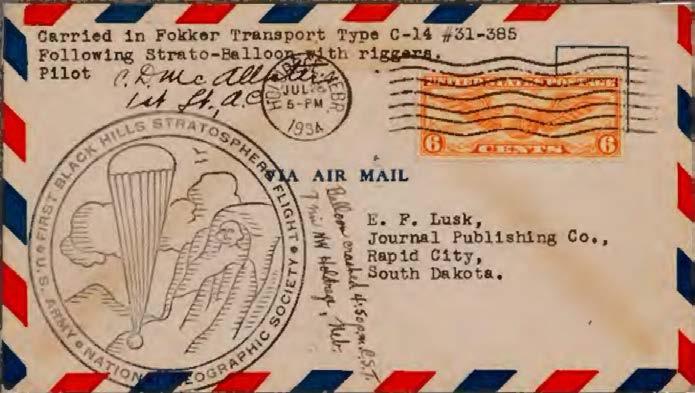
Figure 7: Cover postmarked “Holdrege, Nebr. Jul 28, 5 PM, 1934” with typed notation “Carried in Fokker Transport Type C-14 #31-385 Following Strato-Balloon with riggers. Pilot” and signed “C. D. McAllister 1st Lt., A.C.” (Air Corps). The cover has the additional notation in pen “Balloon crashed 4:50 P.M. C.S.T., 7 mi NW Holdrege, Neb.” (courtesy AmericanAstrophilately.com, Bachmann exhibit”).
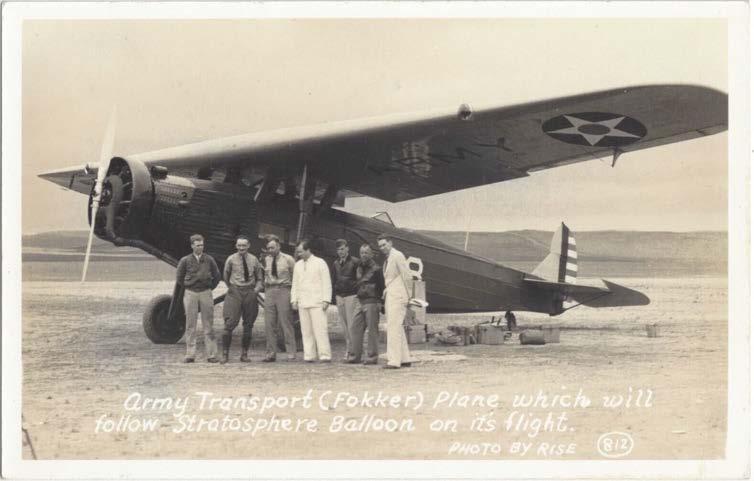
Figure 8: Photo postcard with inscription, “Army Transport (Fokker) Plane which will follow Stratosphere Balloon on its flight.” The cover shown in Figure 7 was carried by this plane in its pursuit of Explorer from the Stratobowl to near Holdrege, Nebraska (eBay image).
and starting discharging ballast, including the liquid air that remained.10
Stevens went on to write, “at 10,000 feet we really should have left the balloon, but we did not wish to abandon the scientific apparatus.” He added, “at 6,000 feet we again talked the matter over and decided we had better leave. The last altimeter reading I gave was 5,000 feet above sea level. Since this part of Nebraska was 2,000 feet above sea level, we were in reality only a little more than half a mile from the ground.”
Stevens continued, “in the meantime, Captain Anderson, atop the gondola, had been having difficulty with his parachute. The release handle had caught on something and the parachute pack had come open. It was a situation that might have been disconcerting to a less
cool head. There was only one thing to do – that was to gather the folds of silk under one arm preparatory to leaping.”
A few seconds later Anderson jumped, as he did so “the balloon exploded.” As a result, “the gondola dropped like a stone” wrote Stevens, still inside the plummeting sphere.10
Stevens continued to write of his harrowing ordeal, “Twice I tried to push myself through the hatch of the gondola, but wind pressure around the rapidly falling sphere forced me back. So I backed up and plunged headlong at the opening. I managed to hit it fairly, and went out in a horizontal position, face down, with arms and legs outspread like a frog. By that time we had fallen 1,500 feet and were descending so fast that the wind pressure held
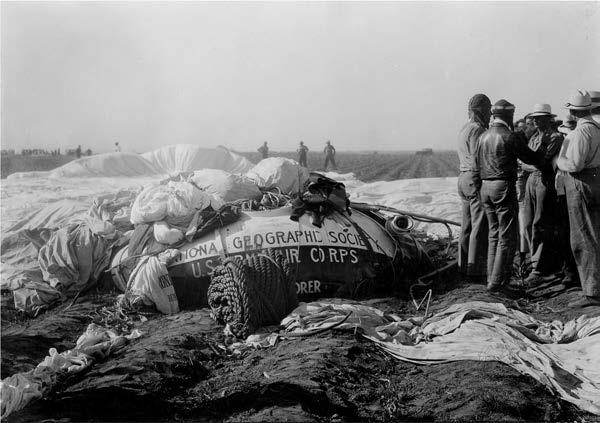
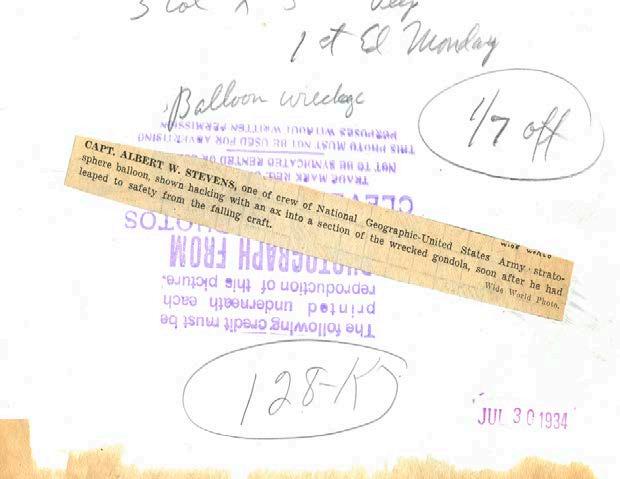

Figure 10 (a+b): Front and back of press photo showing “Capt. Albert W. Stevens, one of crew of National Geographic-United States Army stratosphere balloon, shown hacking with an ax into a section of the wrecked gondola, soon after he had leaped to safety from the falling craft” (courtesy Charles Gannon).
me practically even with the gondola. In other words, I was not falling away from it, but moving downward at the same rate of speed. I turned over half a revolution and, as I came right side up, pulled my rip cord. The parachute opened instantly.” Stevens wrote that he “looked around then saw the other two parachutes in the air and knew they [Kepner and Anderson] were safe. Directly below me, I heard the gondola hit with a tremendous thud, and saw a huge ring of dust shoot out.”10
Lieutenant J.F. Phillips, piloting the airplane following Explorer already had landed in the adjoining field. He and Sergeant G.B. Gilbert had followed the balloon flight, taking pictures along the way.10
Based on the cover shown as Figure 7, Phillips’ plane was not the only one following Explorer on its flight eastward. Kronstein wrote a short article illustrating this cover in 1986, noting that “this plane also carried the rigging equipment. Not only was this plane quickly at the crash site, it even carried some covers…”6
Stevens went on to write that they had landed “in a cornfield not far from the town of Holdrege, Nebraska.” He and Major Kepner went to the farmhouse of Reuben Johnson on whose field they had landed, to telephone and send some telegrams. Stevens continued, “The crowd of sight-seers lent willing assistance in rolling up the main section of the balloon fabric into a pile. But, like people the world over, they became relentless souvenir hunters. Numerous small fragments of balloon
had fallen like snowflakes all over the farm field, and probably near every member of the crowd had picked up a small strip of the rubberized fabric.” Kepner noted that he later received some of the pieces of balloon cloth by mail with the request for autographs.10
The American News (Aberdeen, SD) remarked in their July 29, 1934 issue that the gondola was “smashed like an egg and the valuable scientific instruments were scattered wide over the countryside.”
“We borrowed an ax,” wrote Stevens, “and cut through the few uncracked areas [of the gondola], removing sections of shell. Inside, the instruments of which we had been so proud were a heart-breaking mass of wreckage.” Later in the article, Stevens noted “Our balloon, gondola, and most of the apparatus were made at prices close to the cost of manufacture, and this cost, less than $60,000 [about $1.4 million in today’s dollars], although largely born by the National Geographic Society, was also shared by individuals, corporations, and laboratories interested in the advancement of scientific knowledge. The huge bag, the gondola, and the instruments were insured from damage while in flight by Lloyd’s of London.”10
One headline in the Omaha World-Herald (Omaha, NE) on July 30, 1934 was titled “Johnson’s Crop Damaged by Balloon and Crowds.” The article quoted farmer Reuben Johnson as saying that “such goings on had damaged his crops, probably caused his chickens to cease laying and given his
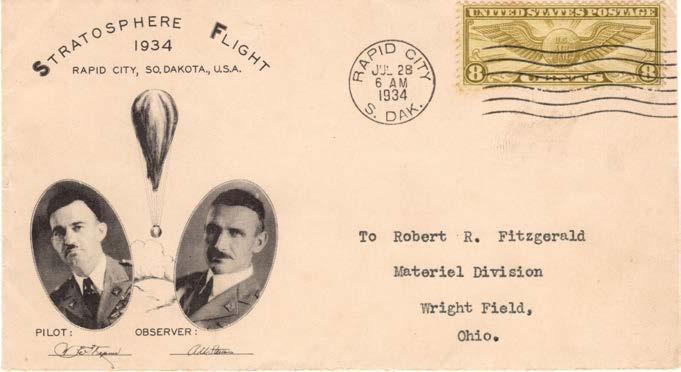
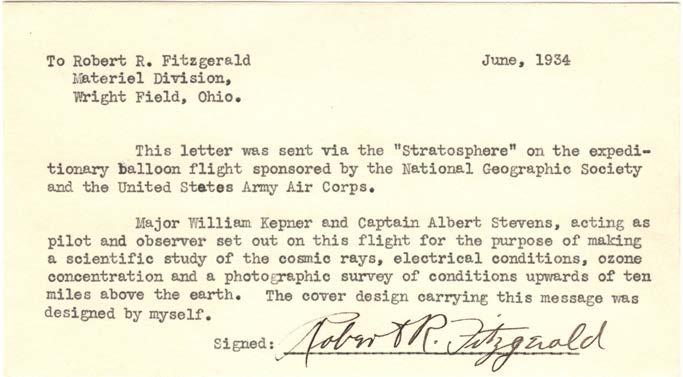
Figure 11 (a+b): Although the card inside this cover notes “This letter was sent via the ‘Stratosphere’ on the expeditionary balloon flight,” there is nothing other than the sender’s/cachet designer’s note to possibly verify that being the case. My opinion is that this is another type of non-flown souvenir cover (courtesy David S. Ball).
live stock the jitters.” Johnson went on to say, “One of the army fliers said they would pay damages. And, I expect it. You see, we had a pretty good rain last Monday night and I might have made a corn crop before the balloon popped down in my field.” “No sir,” Johnson stoutly insisted, “I don’t want no more balloons on my farm. Why, the plowed
ground out there is hard as pavement where people tramped all last night. They carted off pieces of the wreck and swarmed over this place for hours.”
The American Air Mail Catalogue (5th ed., 1974)11 lists these covers under “U.S. Souvenir Historical Flights” with the following description for Catalog #685:
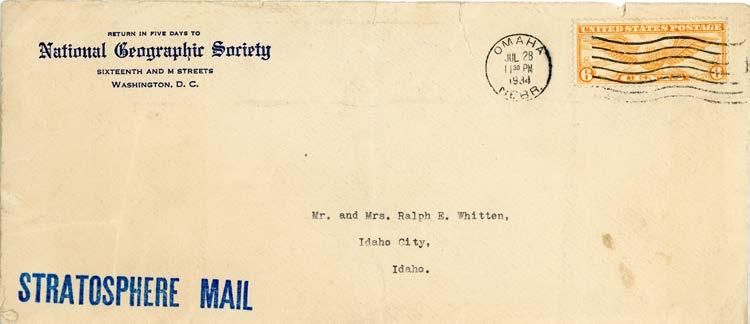
Figure 12: An example of a cover flown aboard Explorer, postmarked “Omaha, Nebr. Jul 28, 1130 PM, 1934” with return address of the National Geographic Society and “Stratosphere Mail” handstamp in blue at lower left. The contents of the cover are provided as Figure 13, further verifying the authenticity of this item (courtesy Charles Gannon).
1934, July 28 – National Geographic Society-U.S. Army Air Corps. Stratosphere Flight, Balloon ‘Explorer 1.’ This flight was made by Wm. E. Kempner [Kepner], Capt. A.W. Stevens and Capt. O.A. Anderson, U.S. Army Air Corps, in cooperation with the National Geographic Society. The ascent was started in the Black Hills near Rapid City, SD and ended on a farm near Holdredge, Nebr. After attaining an altitude of 62,000 ft the gas bag developed tears and the balloon crashed, the officers barely escaping with their lives. About five hundred covers were carried and are postmarked Omaha, Nebr, July 28, 1934. They also bear the imprint of the National Geographic Society and a blue handstamp ‘Stratosphere Mail’. $50.
Kronstein, in his 1956 article1 on
the subject, wrote, “In spite of the total wreck of the balloon there exist a number of flown covers from this exploration of the stratosphere. Contemporary reports estimated that the ‘postal cargo’ did not exceed 100 pieces. The mail was tied to the rigging and was retrieved from the debris. It consisted of covers from the National Geographic Society, Washington, D.C. with a 3 inch long blue cachet (6/16 inch high): ‘STRATOSPHERE MAIL.’ The 8 cent airmail stamp was cancelled at Omaha, Nebraska on Jul. 28 – 11:30 PM – 1934.”
Oddly, some of the July 28, 1934 flown covers have an 8-cent airmail stamp affixed and others have a 6-cent stamp. Effective July 1, 1934 the airmail rate for the first ounce had been reduced from 8 cents to 6 cents. Thus, some of the flown covers were apparently overpaid by 2 cents.

Figure 13: Letter enclosed in the cover of Figure 12, signed by all three “stratonauts” with an accompanying fragment of the balloon stating “This is a trimming of fabric from the actual balloon of the National Geographic Society –Army Air Corps Stratosphere Flight – 1934” (courtesy Charles Gannon).
Neulander, in his 1990 article12 , did not provide any data or estimate for the number of pieces of mail carried aboard Explorer. He did, however, go into some detail regarding mail carriage on the 1935 Explorer II flight, to be discussed in the next part.
Obviously, there is a wide discrepancy in the number of pieces of mail carried on this flight. Kronstein said the number “did not exceed 100 pieces,” yet failed to supply a reference/source for the data which he said was from a “contemporary report.” The Ameri-
can Air Mail Catalogue gives a much higher estimate of “about five hundred covers,” again without any reference to support that claim. The actual number of covers carried aboard Explorer to the 60,613-foot altitude13 achieved on that flight may never be accurately known. No mention is made of any other cachets or types of covers actually carried aboard the first flight other than those with the blue straight-line handstamp “STRATOSPHERE MAIL” at lower left and postmarked “Omaha, Nebr. July 28, 1130 PM, 1934.” □
1. Kronstein, Dr. Max. “The American ‘Stratosphere Mail’ Covers of 1934 and 1935.” APJ, April 1956, vol. 27: 211-212, 240-241.
2. Kronstein, Dr. Max. “The American ‘Stratosphere Mail’ Covers of 1934 and 1935.” APJ, July 1984, vol. 55: 402-405.
3. Armstrong, Thomas F. Jr. “Letter to the Managing Editor.” APJ, September 1935, vol. 6: 32.
4. Petty, Maurice S., “Dedication and Unofficial Air Mail Covers.” APJ, January 1936, vol. 7: 17-18.
5. Dille, J. Robert M.D., “Aviation Physiology and Medicine on Stamps and Covers, 1590-1935.” APJ, July 1986, vol. 57: front cover, 364.
6. Kronstein, Dr. Max, “Covers Flown In Plane Carrying Salvagers Of 1934 Stratosphere Mail.” APJ, December 1986, vol. 58: 87.
7. Bachmann, Beatrice, “Astrophilately, The Philatelic Record of the Conquest of Space.” APJ, April 1995, vol. 66: 137-149.
8. National Geographic Society, “World’s Largest Free Balloon to Explore Stratosphere.” National Geographic Magazine, July 1934, vol. LXVI, no. 1: 107-110.
9. Bauer, Gene. “On the Edge of Space: The Explorer Expeditions of 1934-1935,” South Dakota History, Spring 1982, vol. 12, no. 1: 1-16.
10. Stevens, Capt. Albert W. “Exploring the Stratosphere.” National Geographic Magazine, October 1934, vol. LXVI, no. 4: 397-434.
11. The American Air Mail Society. American Air Mail Catalog. Vol. VI, Fifth Edition (1974): 2623-2624.
12. Neulander, Stephen. “Solving the Mysteries of the 1935 Rapid City Stratosphere Flights Cancellations.” COMPEX ’90 Directory, vol. 3 (May 25-27, 1990): 119-124.
13. Grosvenor, Gilbert. “The Society Announces New Stratosphere Flight.” National Geographic Magazine, February 1935, vol. LXVII, no. 2: 265-272.
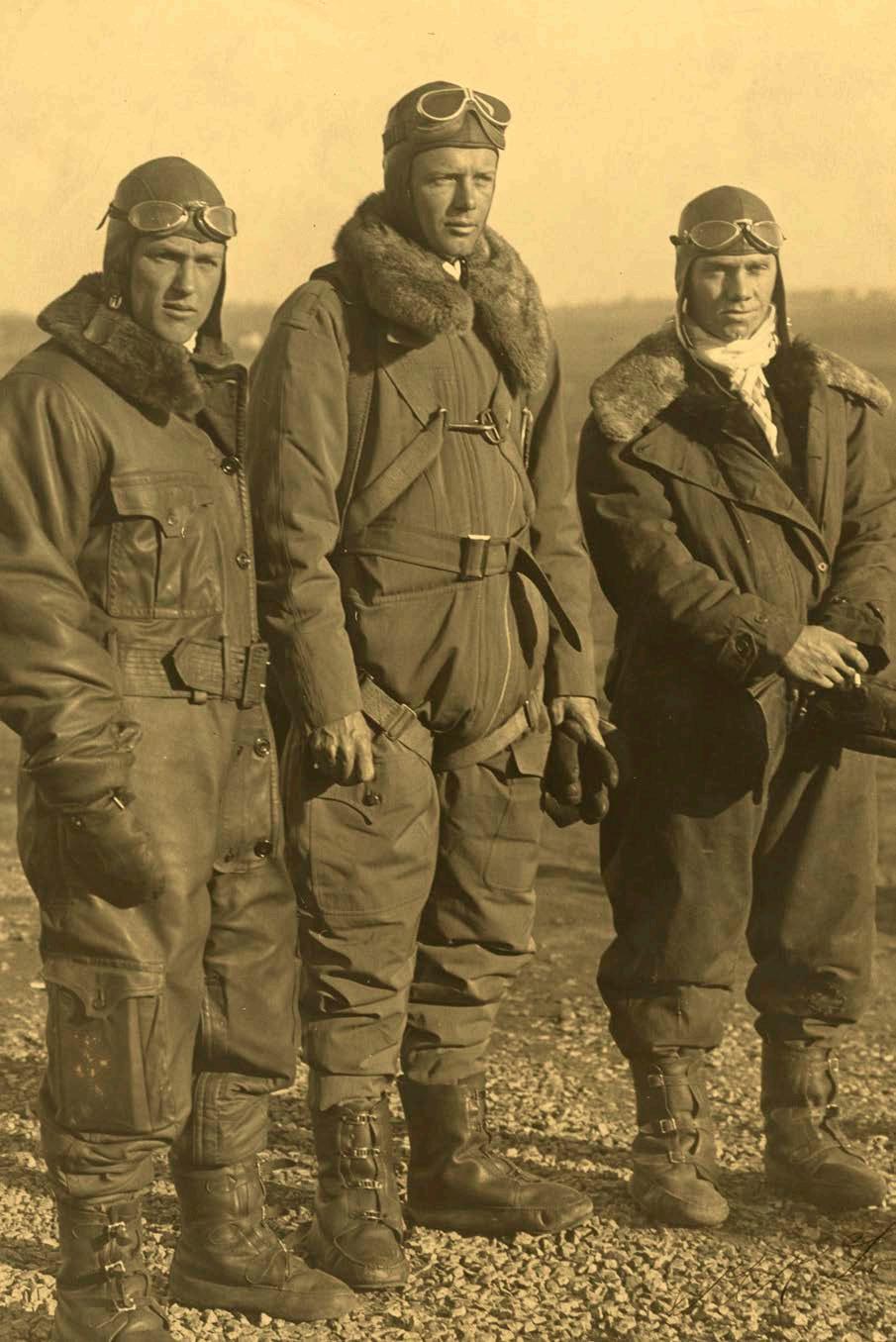
by Dan Gribbin
Charles Augustus Lindbergh is, by any measure, the blazing sun at the center of America’s aerophilatelic solar system. He is, after all, an aviator with an entire section of the American Air Mail Catalogue devoted to his exploits. Lindbergh’s epic 1927 solo transatlantic flight has been commemorated on three different U.S. stamps (his image appears on a fourth), as well as dozens of issues from other countries. And collectibles associated with his various achievements—both in flying the mail and in advancing the global reach of aviation—continue to be exceedingly popular.
As we approach the centennial of Lindy’s 3,600-mile flight from New York to Paris, then, it might be interesting to pause to consider a much shorter flight that took place a little over a year earlier, at a time when Lindbergh was preparing to launch his career as an air-
mail pilot by inaugurating the CAM-2 run between St. Louis and Chicago. Can we pin down the facts surrounding this so-called “test trip” that preceded the CAM-2 first flight? How do we even categorize the covers carried on that April 10, 1926, flight—sometimes called a “pathfinder flight”—from Springfield to Chicago? These and other questions have been raised through the years, but the search for answers, like a jaunt in the open cockpit of Lindy’s DeHavilland DH-4, can be a rather bumpy ride.
The May 1977 issue of the Airpost Journal was devoted to the career of Charles Lindbergh on the occasion of the 50th anniversary of his epic transatlantic flight. More about that issue in a moment. Back in May 1934, however, the APJ also devoted an issue to Lindbergh, and, in an article by H.H. Griffin, we come upon this reference to
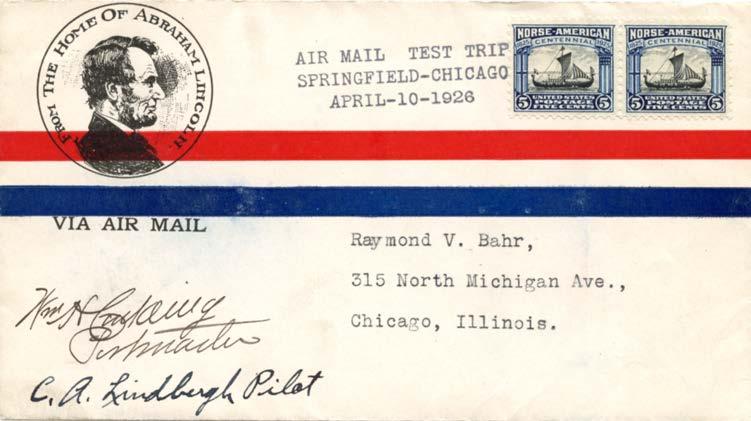
Figure 1: A cover prepared by Raymond V. Bahr for Charles Lindbergh’s April 10, 1926 “Pathfinder Flight”, signed by both Lindbergh and Springfield’s Postmaster William H. Conkling (from the author’s collection).
a cover for which Mr. Griffin expresses considerable enthusiasm, indeed: “I am eternally indebted to my good friend Ray Bahr of Springfield, Ill. for the gift of one of the rare covers autographed and carried on the ‘Pathfinder Flight’ in 1926.”1 The rare cover referred to here would have been one of a number of covers prepared by Raymond Bahr and addressed to himself (Figure 1), covers carried by his friend Charles Lindbergh on the April 10 flight which Bahr refers to in the handstamped cachet as:
APRIL-10-1926
These covers arrived in Chicago carried by and subsequently autographed by Lindbergh, but not yet signed by William H. Conkling, Postmaster of Springfield, Illinois.
Here is Bahr’s own account of the journey of the covers as it appeared in that May 1934 issue of the APJ:
“On this trip, [I] handed Capt. Lindbergh a few letters, the only ones carried on this test flight [from Springfield to Chicago]. He carried them in his pocket and after his arrival at the hotel, he autographed them and little did I realize how valuable they would be later on! My good friend, Hon. V. Y. Dallman, world famous Admiral of the Sangamon River Fleet, and the managing editor of the Illinois State Register accompanied Capt. Lindbergh
1. H. H. Griffin. “Some Passing Thoughts on a Lindbergh Collection.” APJ, May 1934, vol. 5: 23.
on this test trip. These boys together with Gregory Brandeweide, Supt. of the Robertson Aircraft Corp., and Ray Anderson of the St. Louis Post Despatch (sic) and others spent the night in Chicago. On Sunday, April 11th, began the return flight to St. Louis. Just before Lindy stepped up to his plane, he turned to Admiral Dallman, saying ‘Here are the letters for Ray Bahr; please deliver them to Postmaster Conkling so that he in turn can deliver them to Ray in the morning,’ which Mr. Conkling did after autographing them himself. Lindbergh did this for the reason that he, himself, made no stops between Chicago and St. Louis on the return part of the flight.”2
This account of Mr. Bahr’s preparation of the covers, their travel from Springfield to Chicago in Lindbergh’s pocket, and their subsequent journey south to receive the autograph of the Springfield postmaster is very informative. But if we turn back to the May 1977 APJ, we find George Sioras posing several questions about the test trip and about the covers. Sioras notes: “The covers are listed in the American Air Mail Catalogue as Lindberghiana 10. They are of particular interest because they are the earliest known philatelic souvenirs to have been flown by Lindbergh...Examination of the cover [from the Cardinal Spellman Philatelic Museum] raises two questions. The inscription says ‘Air Mail Test Trip.’ What
2. Raymond V. Bahr. “The Pathfinder Trip of C.A.M. Route Number 2.” APJ, May 1934, vol. 5, 25-26.
was being tested? And why wasn’t the stamp cancelled?”3
Sioras points out that Raymond Bahr, “an air mail collector, an early member of the American Air Mail Society, and a personal friend of Lindbergh’s...characterizes the flight as a ‘pathfinder trip.’” But Sioras feels that Lindbergh was too familiar with the route to need to do any testing or pathfinding, though he grants that a final inspection of the route might have been warranted. On the other hand, he feels that the presence of newspaper editors (to be discussed in the second part of this article in the following issue) is significant, stating that “a second purpose of the trip was, obviously, publicity.”
Sioras raises a very good point when he observes: “Conkling autographed the covers and returned them to Bahr, uncancelled...Why wasn’t the stamp (on the illustrated cover) cancelled? Was it an oversight? Was Conkling inhibited from cancelling the covers by some postal regulation? Might Conkling have felt that cancellation after the date of the flight would detract from these souvenirs?”
My response to these excellent questions would be that Conkling certainly could have arranged handback cancellation service at his own (Springfield) post office, but only if the covers actually bore postage at the time that he added his signature. My examination of four of the covers (either directly or via reproduced images) leads me to
3. George K. Sioras. “The CAM-2 Test Flights - Some Questions.” APJ, May 1977, vol. 48: 238-240.
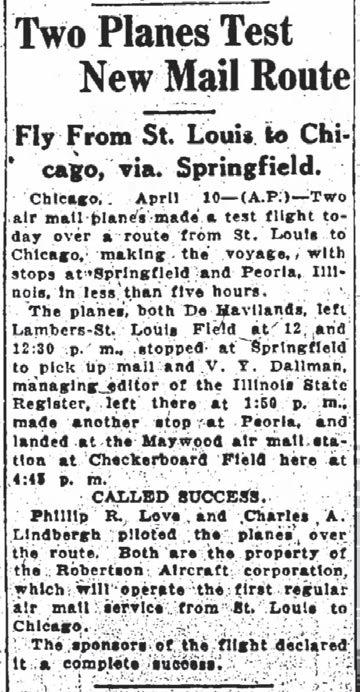
Figure 2: An article from the April 11, 1926 Decatur Daily Review details the previous day’s flight.
believe that the stamps and the handstamped “test-trip” cachet were applied by Raymond Bahr after the signatures were secured. Another question raised by Sioras has to do with who provided the “inscription,” by which I believe he means the three-line cachet that refers to the flight as a test trip. I can see no reason to doubt that Bahr arranged for the handstamp to be produced, and, as I’ve just speculated, applied this inscription (or three-line cachet, as I prefer to call it) to the now autographed enve-
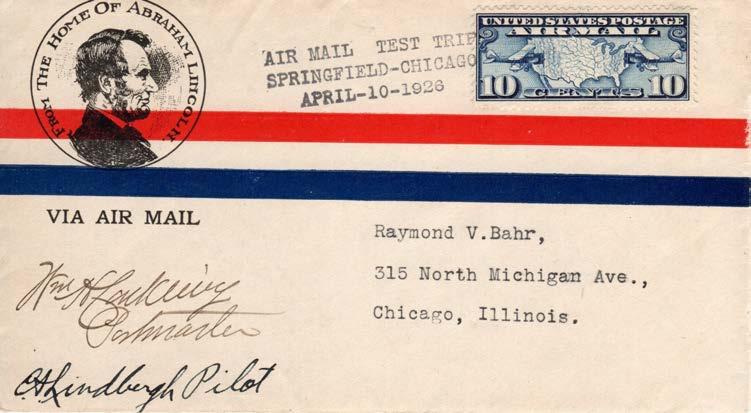
Figure 3: A second cover from the April 10, 1926 test flight, this time franked with a 10-cent airmail stamp, Scott C7 (from the collection of David S. Ball).
lopes at the same time as he applied the stamps.
My thanks to David S. Ball for supplying the scan of the cover in Figure 3, which resides in his collection. Two other test trip covers are depicted in published sources: One is illustrated in the AAMC (5th ed., L10); the other is depicted in the 1977 George Sioras article. Aside from its historical significance, part of my interest in obtaining the test trip cover in Figure 1 resided in the stamps themselves. Of the four covers under consideration, here, three are franked with Scott C7, while only the cover in Figure 1 bears non-airmail stamps. Franking with the attached pair of Scott 621, the 5-cent Norse American issue, suggests that, like me, Bahr had a weakness for that beautifully designed stamp. The question then becomes, is this test cover unique in its non-airmail franking? It’s a question
that readers might be able to help us answer.
David S. Ball has stated his belief that 11 test covers were carried by Lindbergh. He also indicates that at least two signed covers, test-trip covers with the large Lincoln portrait on the left, were put to use as first-flight CAM-2 covers from Springfield. That would reduce the total to nine covers flown by Lindbergh on April 10 that received the three-line test-trip cachet and never entered the mail stream. I would be interested in compiling an inventory of the test covers, with especial interest to learn whether franking on other covers than mine is limited to Scott C7. A note and a scan to our APJ editor concerning other existing test covers would be most appreciated, as would any further information about what seems to me to be a most intriguing corner of our aerophilatelic world. □
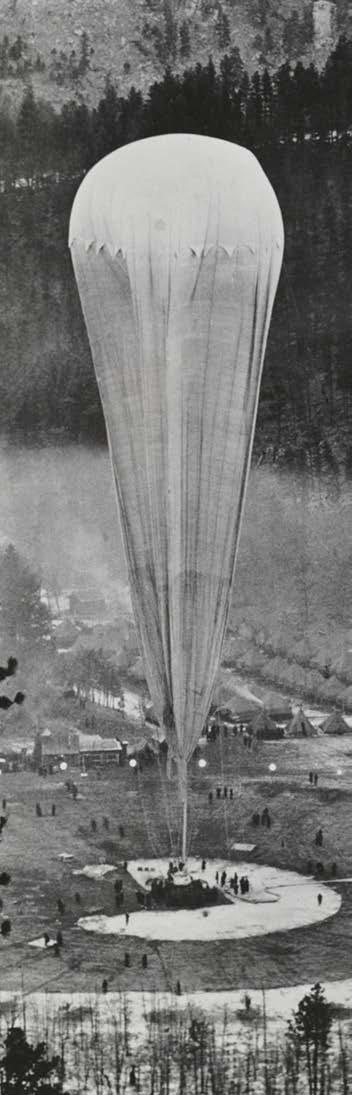
set a world manned altitude record of 72,395 feet on November 11, 1935
David S. Ball
In an effort to begin the exploration of the heavens, Auguste Piccard constructed and piloted a balloon in 1931 that reached an altitude of 51,777 feet. At the Century of Progress two years later his technology was put on display by U.S. Navy Lieutenant Thomas Settle and USMC Major Fordney. They would be the first to be recognized (although a trio of Russians exceeded the height two months earlier) to have entered the stratosphere.
All life and most weather exist in the first 10 miles of the atmosphere. From 11 to 23 miles (18-37 kilometers or 59,000 to 121,000 feet) represents the stratosphere. It is here where stratified temperature layers brought about by absorption of UV rays from the sun, drive much of our weather and offer protection from cancer causing solar radiation. It is not until one reaches 100 kilometers or 62 miles (the Karman Line) that one has reached space.
Many of the earliest aviators have been military men. In America, members of the Army Signal Corps, which traced its roots to Civil War observation balloons, learned to fly aircraft from the Wright brothers. Similarly, Piccard taught Settle and Fordney the intricacies of piloting a stratospheric balloon.
Army Major Kepner and Captains Anderson and Stevens would draw heavily on this expertise for their 1934 Explorer flight where they reached an elevation of 60,613 feet. The return from just barely kissing the stratosphere nearly doomed the trio. At the apex of
their flight, fabric seams that were glued (as opposed to sewn) began to disbond and caused the craft to plummet to Earth. The crew abandoned ship with the last parachute opening just seconds before impact (see Ken Stach’s ar.
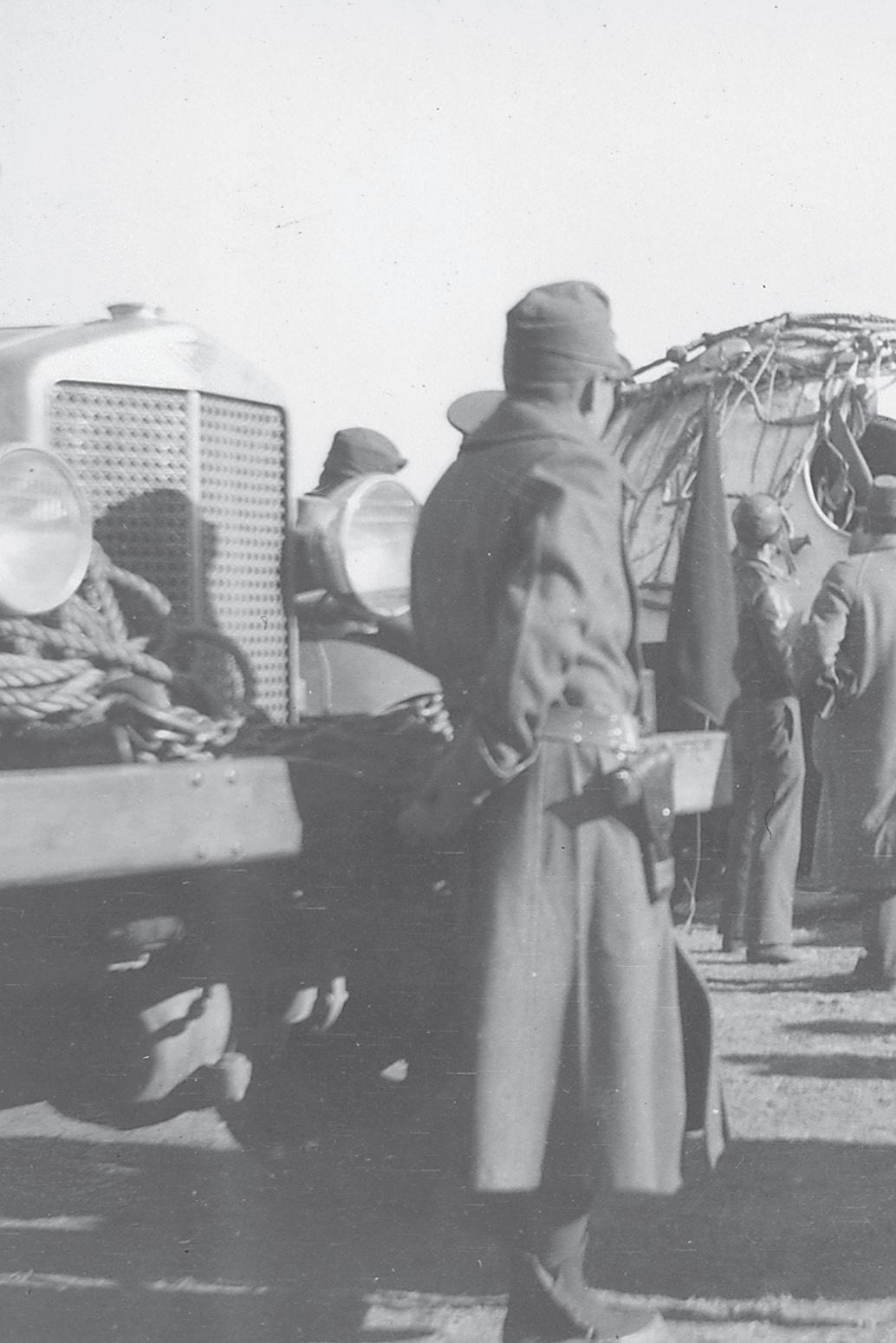
Explorer II the following year (Figures 1 and 2, following pages) would again be an Army Air Corps flight sponsored by the National Geographic Society with heavy involvement by the scientific community. With balloon envelope construction techniques stretched to the limits, fabric tears again emerged. Philatelic mail had received a 4 A.M. Rapid City, South Dakota postmark when the decision was made to delay the launch. It would be a three month before the team was ready and meteorologists forecast light winds best for flight. Army Captains Anderson and Stevens had additional stamps added on envelopes so the White Lake, South Dakota landing postmark could be applied.
Naval Institute Press author Craig Ryan wrote, “before liquid-fuel rockets had launched us full-sail onto what John Kennedy would call the ‘new ocean’, a small fraternity of daring, brilliant men made the first exploratory trips into the upper stratosphere to the edge of outer space in tiny capsules suspended beneath plastic balloons.” Beginning in 1954, the Office of Naval Research (ONR) began the Strato-Lab program for manned balloon ascents to the upper atmosphere. Unlike the Army focus on aerial reconnaissance prevalent in the 1930s, ONR sought to study the operational environment encountered at extreme altitudes. After a pair of training flights to 40,000 feet, naval officers Malcolm Ross and M. Lee Lewis took Strato-Lab I to a height of 76,000 feet in 1956 (Figure 3). This marked the first return of a manned U.S. balloon to the stratosphere in more than 20 years.
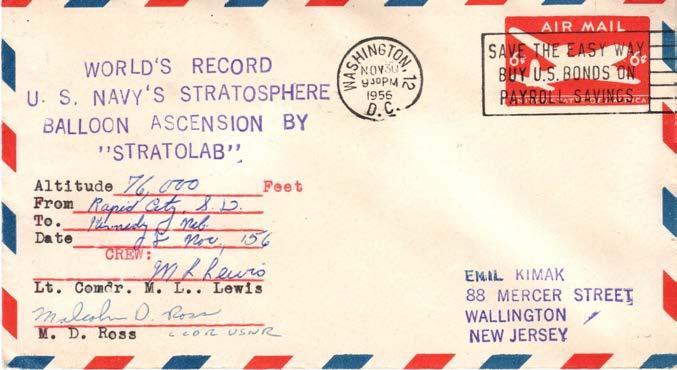
Figure 2: This oversized linen envelope is unusual in several respects. Unlike most covers used to document the flight of Explorer II, it was mailed to an Army officer near the Panama Canal. The recipient was awarded the Army Distinguished Service Medal for service in WWI for his leadership while in command of
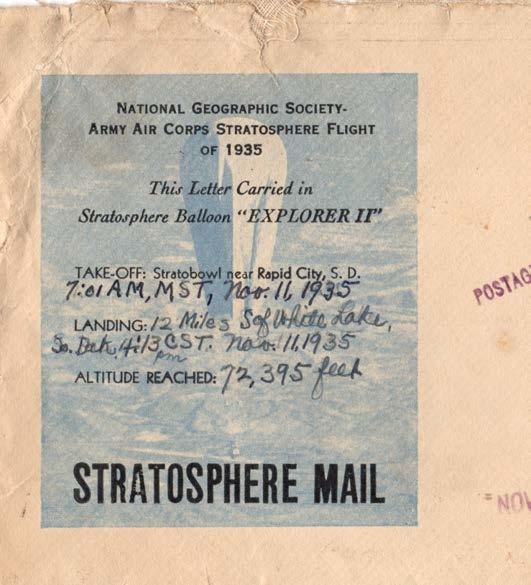
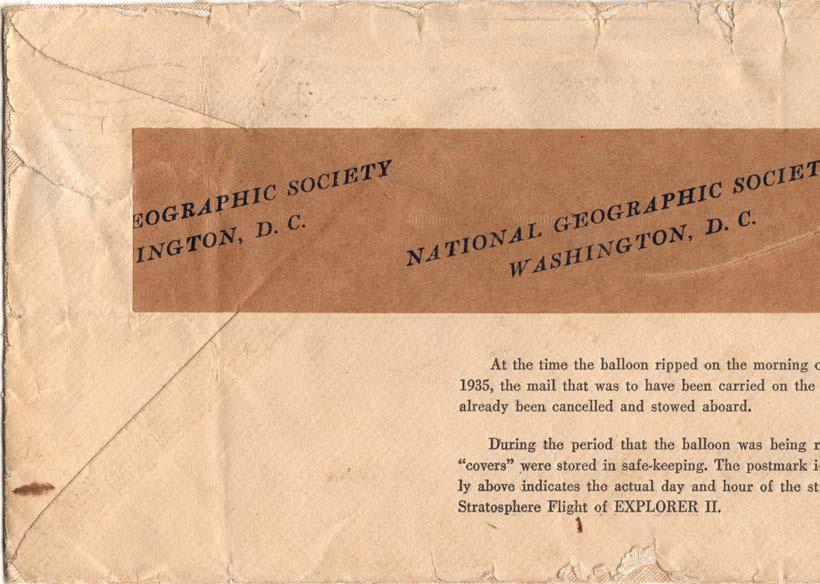
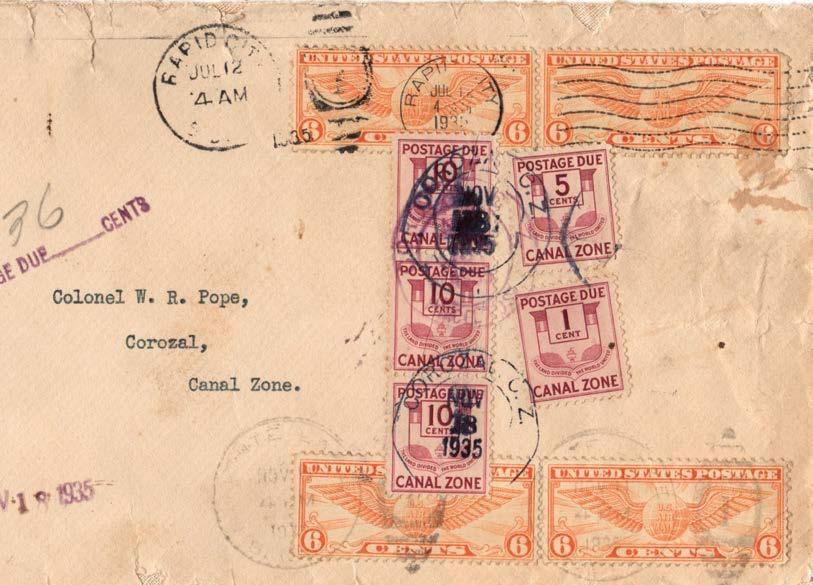
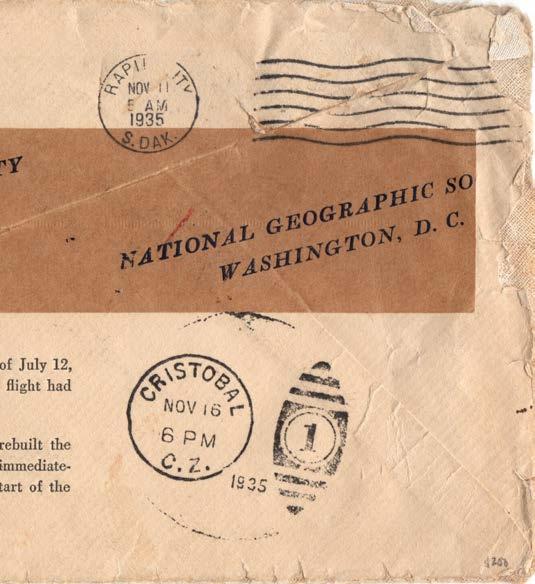
the 113th Infantry, 29th Division, during the Argonne offensive. The envelope took 5 days to travel from South Dakota to Cristobal, Canal Zone. Two days later the franking was judged insufficient by 36 cents at which point Canal Zone Postage Due stamps was affixed (from the author’s collection).
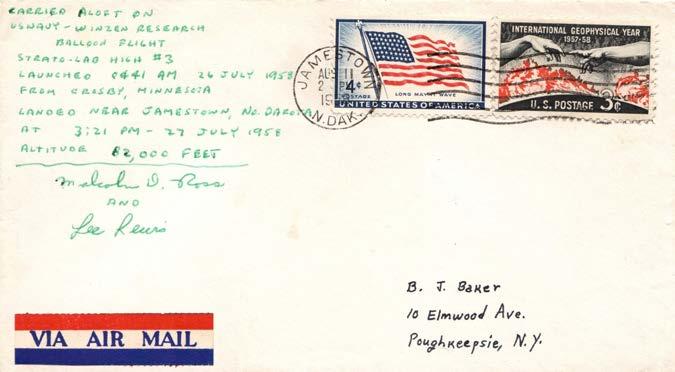
Figure 4: Cover carried to a height of 82,000 feet aboard Strato-Lab III in August 1958 (from the author’s collection).
Strato-Lab II bested the altitude record by ascending to an elevation of 85,700 feet a year later when Commander Ross again teamed up with Lieutenant Commander Lewis on a 10-hour flight to photograph Sputnik which had been launched a few weeks earlier. The duo was unable to track the world’s first artificial satellite but nonetheless returned important scientific data.
In 1958 Ross and Lewis ascended to 82,000 feet in Strato-Lab III (Figure 4). Wearing Air Force MC-3 partial prssure suits under Navy cold weather suits and carrying a back-pack parachute system with emergency bailout seat pans greatly restricted motion. Physiological monitoring equipment confirmed profound fatigue and performance issues which would require design of new life support equipment. Ironically, Lewis would lose his life later that year in a preflight test. He was only 3 feet off the ground doing stability tests in an
open-basket gondola when a 15-pound steel pulley fell 65 feet, striking him on the head. He died within the hour.
For Strato-Lab IV, flown to 81,000 feet in 1959, Commander Ross would be joined scientist Charle B. Moore (Figure 5). In this flight a Schmidt telescope supplied by John Hopkins University was mounted on the top side of the gondola. This would produce the first observation of water vapor in the atmosphere of Venus.
The final Navy flight, Strato-Lab V, reached an altitude of 113,740 feet (21 miles). During the 11-hour mission Commander Ross and Lieutenant Commander Victor Prather tested Project Mercury-type spacesuits with full body detectors to measure cosmic ray particle flux. Personal telemeter systems for human vital signs and many other devices were tested at ultra-high-altitudes for the first time.
For the flight, Ross and Prather rose from the deck of the aircraft carri-
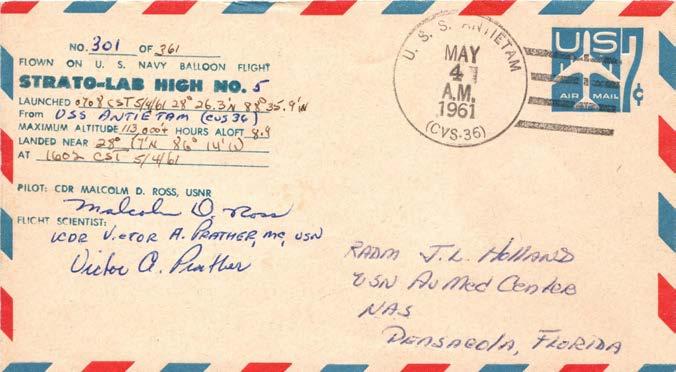
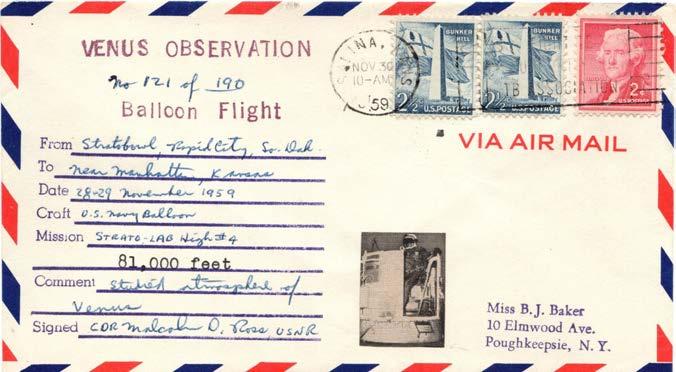
Figure 5 (bottom): 1959’s Strato-Lab IV produced the first observation of water vapor in the atmosphere of Venus (from the author’s collection).
Figure 6 (top): Strato-Lab V was the final Navy balloon flight and resulted in the tragic death of Lieutenant Commander Victor Prather (from the author’s collection).
er U.S.S. Antietam, used as a movable platform for launching the giant plastic balloon (Figure 6). For nine hours they were exposed to minus 94 degrees Fahrenheit and air pressures below 0.1 pounds per square inch. The ascent and descent were highly successful, but Ross slipped from the hook during the water rescue but was able to grab the hoist line and be successfully recovered. Prather similarly slipped but was unable to grasp the cable. With an open faceplate his heavy suit filled with sea-
water when he slipped from the rescue helicopter harness and he drowned.
The next day Alan Shepard became the first American in space when his Mercury-Redstone rocket reached an altitude of 101 miles. Gus Grissom, America’s second astronaut in space, nearly drowned two months later when his suit also filled with water following splashdown. As a result, the Navy put divers in the water on all subsequent space capsule recoveries in case an astronaut got into trouble. □
FDR’s New Deal and the National Recovery Administration: An Air Mail Perspective
by Paul M. Holland
President Franklin D. Roosevelt signed the National Industrial Recovery Act (NIRA) into law on June 13, 1933 as one of the final pieces of New Deal legislation enacted during “The Hundred Days.” This established voluntary “codes” for businesses that included minimum wages, a limited workweek and the banning of child labor. FDR’s choice to head the new National Recovery Administration (NRA) was General Hugh S. “Ironpants” Johnson, a colorful and irascible figure known for his “everybodys-arink-stink-but-Hughie attitude”.1 One of Johnson first acts was to create the NRA Blue Eagle publicity campaign with a special symbol for businesses to display, showing their compliance with NRA codes. The blue eagle design with 1. William Manchester. The Glory and the Dream: A Narrative History of America, 1932-1972. Little, Brown and Company: Boston (1974), 87-88.
the words “we do our part” had been originally sketched out by “Ironpants” Johnson himself.1
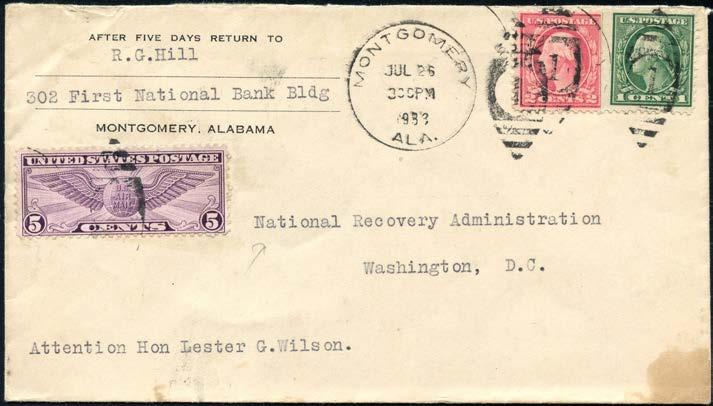
An airmail cover mailed to the new National Recovery Administration (NRA) on July 26, 1933 is shown in Figure 1. From Montgomery, Alabama this was to the attention of Lester G. Wilson, Executive Secretary of the Blue Eagle division of the NRA, and was apparently about becoming authorized to use the NRA’s new Blue Eagle emblem. Note the unusual franking that paid the 8-cent airmail rate. This employed a 5-cent winged globe airmail stamp (Scott C16) with the additional 3-cent postage made up by Washington-Franklin 3rd Bureau stamps (Scott 498-499). The useage does not appear to be philatelic, and was likely due to the using up of a few older stamps that were on hand during the Great Depression.
During a NRA code meeting concerning the advertising specialities in-
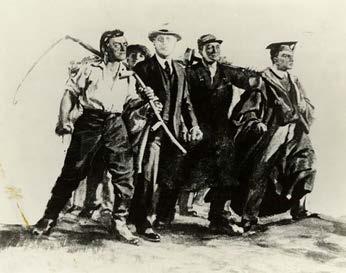
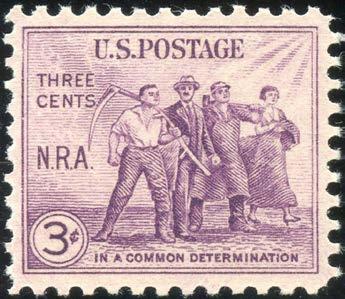
Figure 2 (a+b): Essay for the NRA postage stamp (top) and the finished design (bottom).
dustry, a poster urging people to participate in the national recovery effort was presented. The poster by Rudolph L. Bortel depicted four figures striding forward arm in arm, a farmer, President Roosevelt, a laborer and a student in cap and gown. When the poster was called to the attention of C.R. Churchill, Deputy Chief of Public Relations for NIRA, he immediately saw in it the possibly for a postage stamp and his suggestion was passed up the line to Johnson and Farley, where the idea was embraced.2
2. Max G. Johl. The United States Commemorative Postage Stamps of the Twentieth Century: Volume I, 1935-1947. H.
A photograph of a slightly modified version of the poster was supplied to the Bureau of Engraving and Printing (BEP) and design work began. However, at FDR’s request “the figure of the student was changed to that of a woman, a stenographer, and a mustache was added to the figure depicting Roosevelt, who then represented a business man.”2
The final design of the stamp compared with the photograph is shown in Figure 2. The wording includes the phrase “in a common determination” at the bottom and “N.R.A.” at the left. It might be said that the resulting stamp shows FDR himself walking while wearing a mustache as a disguise! Since FDR had been crippled by polio and was an avid stamp collector, this must have seemed deliciously ironic to him.
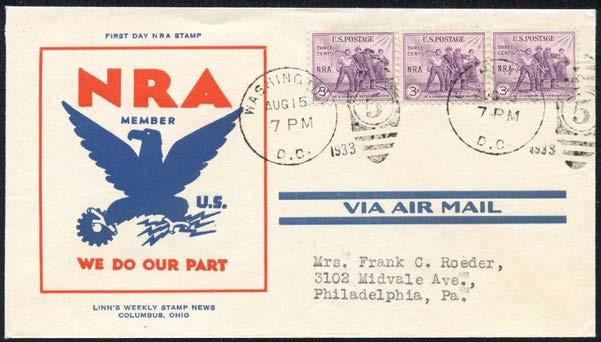
This special NRA Emergency stamp was rushed into production, with large printings made to encourage its widespread use. An airmail first day cover (FDC) for this that prominently shows the NRA Blue Eagle franked with a strip of three NRA Emergency stamps is shown in Figure 3. Note that unlike most commercial FDC cachets that were prepared for the NRA stamp, the cachets prepared by George W. Linn of Linn’s Weekly Stamp News faithfully follow the design of the official NRA logo. This was only possible since Linn himself had subscribed to the NRA code.3
L. Lindquist: New York (1947): 255256.
3. Paul M. Holland. “We Do Our Part: FDR, Farley and the New Deal’s Iconic 1933 NRA Stamp.” The United States
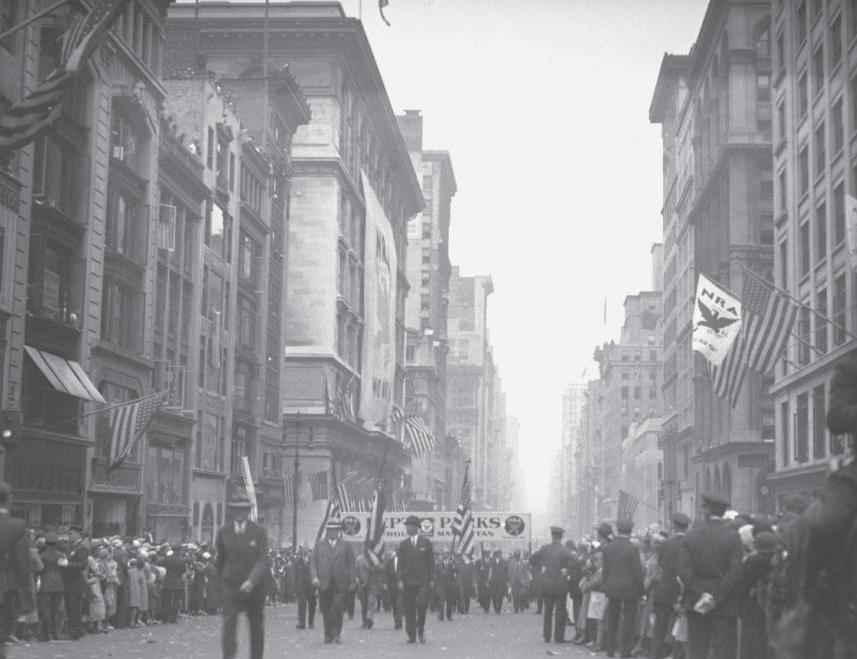
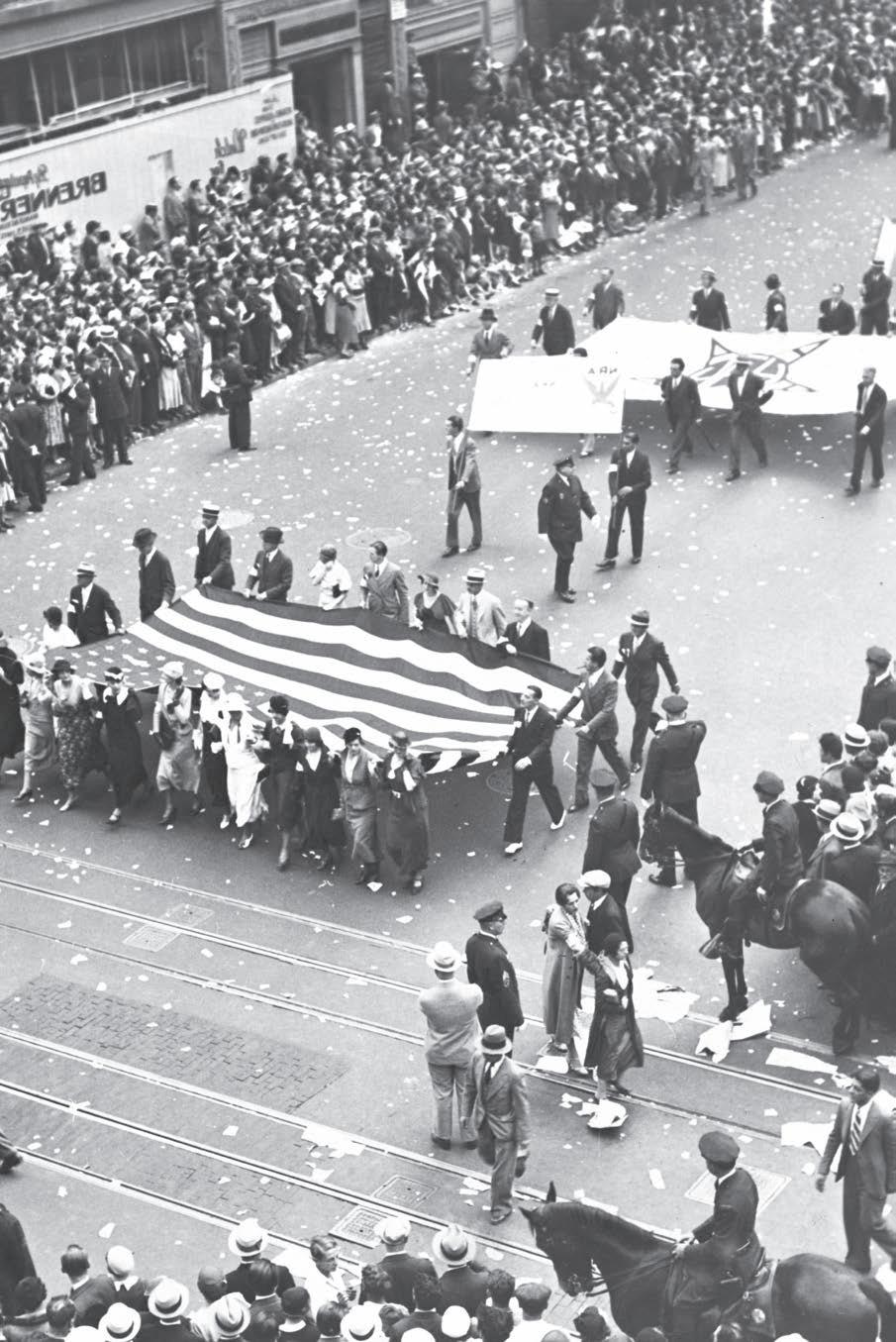
The NRA program proved to be widely popular with the American public and the NRA Blue Eagle began to appear everywhere, including being displayed prominently in store front windows, advertisements, and on products of all kinds.4 There were even massive parades, such as the one down Fifth Avenue in New York City on September 13, 1933 where a quarter of a million people marched in support
Specialist, April 2018, vol. 89: 177-184.
4. Charles Epting. “Roosevelt’s Blue Eagle: The NRA and Mass Culture.” The Ephemera Journal, September 2016: 11-14
of the NRA from early afternoon until midnight, as shown in Figure 4. 5
While I have ten covers mailed to FDR using the NRA Emergency Stamp in my collection, my favorite usage is shown in Figure 5. This 1934 special event cover employs a strip of three NRA stamps to pay the 8-cent airmail rate. More importantly, this cover commemorates the 10th anniversary of the first “Round the World” flight by the U. S. Army Air Service that
5. Kenneth S. Davis. FDR: The New Deal Years. Random House: New York (1986): 252.
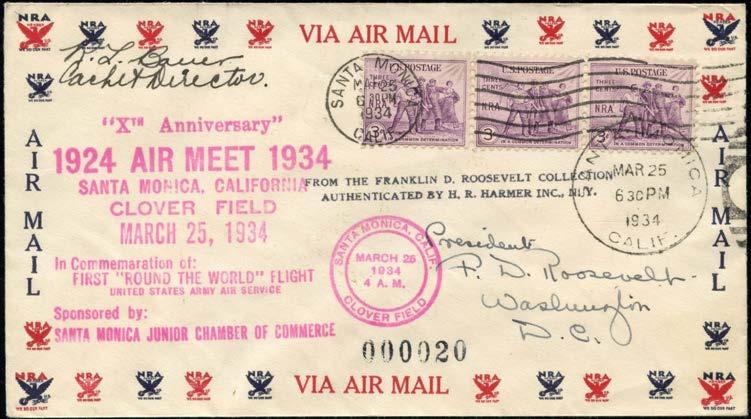
was celebrated at Clover Field in Santa Monica, California. The cover itself incorporates twenty-four miniature NRA Eagle emblems printed in red and blue around the border in the airmail envelope’s design. It is serial numbered and signed by the Cachet Director. Furthermore, this cover was actually flown by U.S. Army Air Corps pilots during the emergency Army Air Corps Mail Operation (AACMO) from February to June 1934, when army pilots flew the U.S. Mail during a contract dispute.6
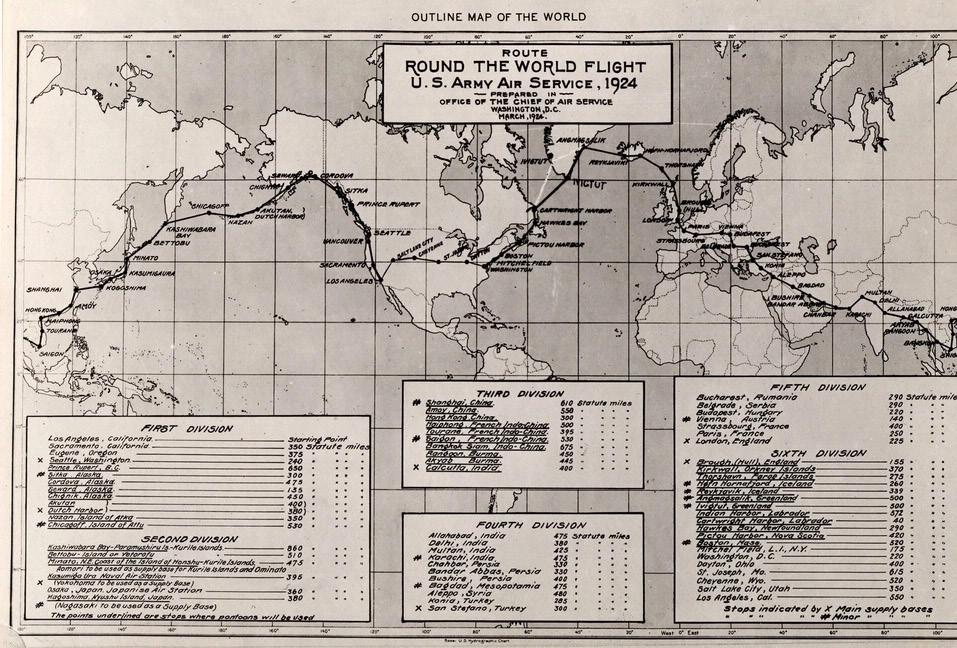
The 1924 “Round the World” flight by the U.S. Army Air Service was an important aviation milestone that occurred a century ago. This first aerial circumnavigation of the globe took 175 days and covered more than 26,345 miles. The route (shown in Figure 6)
6. Paul M. Holland. “Army Emergency Air Mail Covers Sent to FDR.” APJ, November 2017, vol. 88: 472-476.
began at Clover Field in Santa Monica, California and was from east to west, although the official starting point was listed as Seattle, Washington.
A group of four Douglas World Cruiser aircraft each piloted by a twoman Army Air Service crew set out on this arduous journey. These were single-engine, open cockpit biplanes with fabric wings, designed to be fitted with both pontoons for water landings and wheels. Only two of these aircraft successfully completed the “Round the World” flight, including the Chicago, shown in Figure 7. The journey itself proved to be quite an odyssey, with stops in Alaska, Russia, Japan, Southeast Asia, the Middle East, Europe, Iceland, Greenland, etc. There were close encounters with large icebergs, crash landings, and numerous repairs required along the way. Nonetheless, the Americans succeeded where British, Poruguese, French, Italian and Argen-
tinian efforts had all failed.
The Chicago is now in the Smithsonian’s collection at the National Air and Space Museum. When it was restored for 50th anniversary celebrations in 1974, the original 1924 “Round the World” flight wing fabric was removed and preserved. I’m fortunate in having an original 2” square swatch of this fabric mounted on a special 19” x 15” poster sold by the Smithsonian to help support the museum. At the time, I was also able to obtain similar posters with original fabric for the 1919 first transatlantic flight by the Navy’s Curtiss NC-4 and 1911 transcontinental flight by the Wright EX Vin Fiz. □
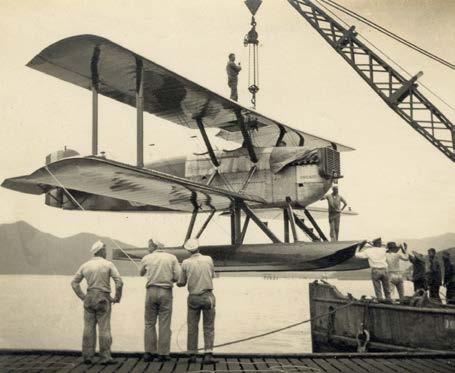
Figure 6 (top): Map depicting the route of the 1924 “round-the-world” flight by the U.S. Army Air Service, which covered over 26,000 miles in 175 days.
Figure 7 (bottom): The Douglas World Cruiser Chicago was one of two aircraft to complete the 1924 flight (the other being the New Orleans). The Seattle crashed into a mountainside in heavy fog in Alaska, while the Boston sank at sea before reaching the Faroes.
by Michael L. Wilson
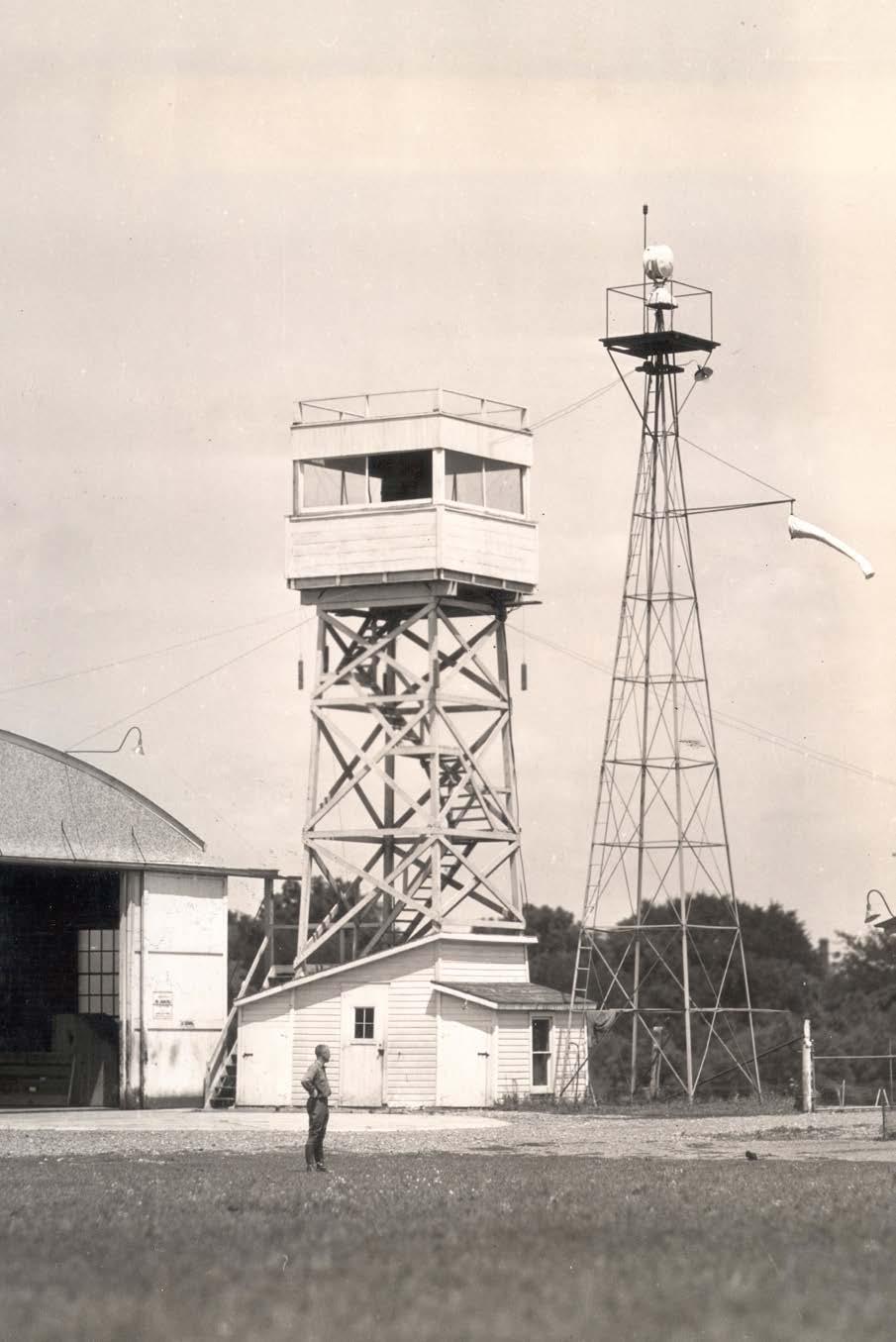
hangar and beacon in Iowa City, Iowa Courtesy National Postal Museum, Smithsonian Institution
July 1, 1924, was a momentous day in U.S. airmail service. It was on that day that the first scheduled transcontinental airmail flight involving night flying occurred. It marked the end of the U.S. Post Office Department’s (POD) pioneering days of airmail, which included the first experimental airmail flight in 1911 and the first regularly scheduled airmail service in 1918.
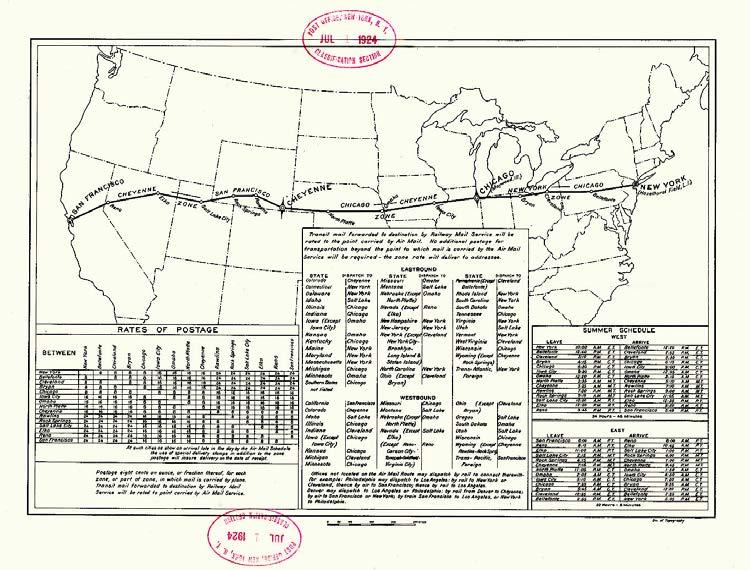
By September 1920, the POD had laid out a transcontinental airmail route (Figure 1), but it only flew segments of that route by day. Night flights were hazardous because there were no lights in the planes or on the ground. Consequently, the mail would be placed on
trains to continue its journey. The total elapsed time of that combination was about 3½ days, which was only about a day faster than an entire trip by rail.
The POD proved the time savings of an all-day coast-to-coast airmail trip when it undertook an experimental flight in February 1921. While not a complete success, one relay of flights (that depended in part on bonfires to find its way) managed to carry mail from San Francisco to New York in just under 33½ hours, a significant time savings over rail travel.
A lighted airway was needed to begin day and night transcontinental airmail. Responsibility for building that infrastructure fell to Paul Henderson (Figure 2), the second assistant
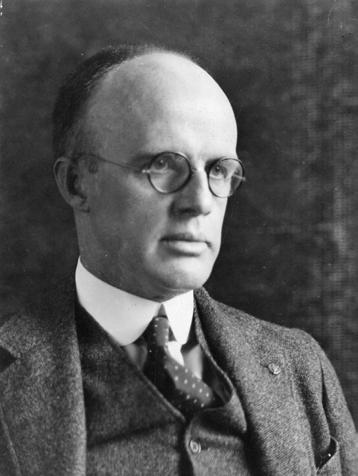
postmaster general from 1922 to 1925. Henderson believed that airmail service should eventually be turned over to the private sector, but he strove to improve the government’s service in the meantime. He was assisted in this goal by Carl F. Egge, the general superintendent of airmail service, and J.V. Magee, an illumination engineer.
Drawing on the Army’s experience with a lighted airway between Dayton and Columbus, Ohio, the POD installed giant 36-inch electric arc beacons that stood atop 35-foot towers at airfields in Chicago, Iowa City, Omaha, North Platte, and Cheyenne (Figure 3). These landing fields were well illu-
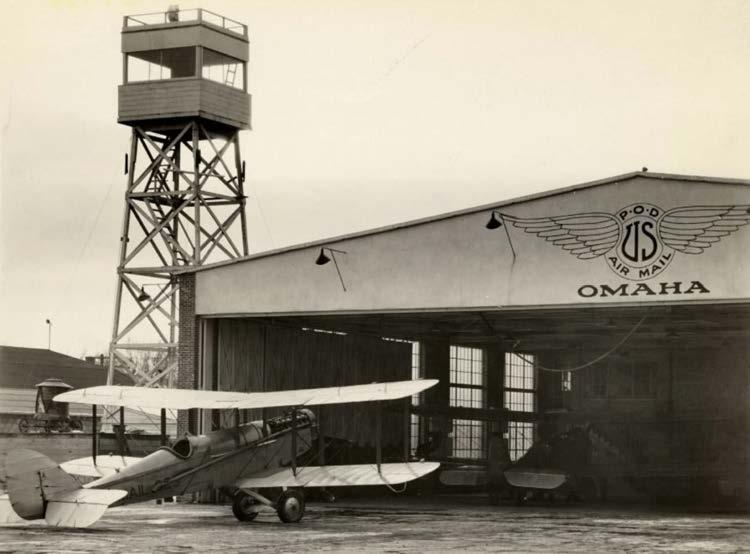
Figure 2 (top): Paul Henderson (1884-1951), Second Assistant Postmaster General (courtesy Smithsonian Institution).
Figure 3 (bottom): Lighted beacon tower in Omaha together with a De Havilland DH-4 mail plane (courtesy National Air and Space Museum).
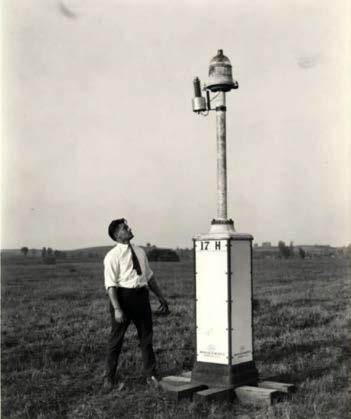
minated, with obstructions marked by red lights. Flashing beacon lights (Figure 4) operated by “sun valves” were installed every three miles along this 885mile route—dubbed the “great dark belt” by the Omaha Daily News. The POD also constructed 34 emergency landing fields along the route.
This section of the transcontinental route was selected for nighttime flights because it was relatively flat, which made the most sense for nighttime flights. That way, pilots could cross the Appalachians, Sierras and Rockies during the relative safety of daytime. (It was only relatively safer because weather was always a potential hazard at higher elevations.)
Henderson and his colleagues went about this task methodically, as reported in the Aircraft Year Book of 1925:
There is nothing phenomenal about the development of the Air Mail. Its growth and its occupancy today…have been the natural results of vision, coupled with sufficient conservatism to make but one move at a time. When Col. Paul Henderson… determined to fly mail at night, he did not order attempts to be made forthwith. Rather did he undertake a conscientious and prolonged examination of all factors, physical and psychological.
With the lighted airway completed, in August 1923 Henderson ordered a four-day demonstration of day-andnight service. The first day was a bit shaky, but all the flights the next three days ran without delay. Congratula-
tions poured in, and the POD won the Collier Trophy for 1923, an annual award given for the greatest achievement in aeronautics, for showing the practicability of night flying. Hopes ran high that the U.S. Congress would approve funding for day-and-night transcontinental airmail.
Like today, the legislative wheels moved slowly in the early 1920s, and it wasn’t until late March 1924 that funding was approved. Wasting no time, in early April Postmaster General Harry S. New announced that regularly scheduled day-and night transcontinental airmail flights would start July 1, 1924.
The POD was well prepared on July 1. The departure and arrival times at the airfields were set. Extra pilots and planes were positioned to deal with mail volume and mechanical or other problems. Henderson stationed himself in
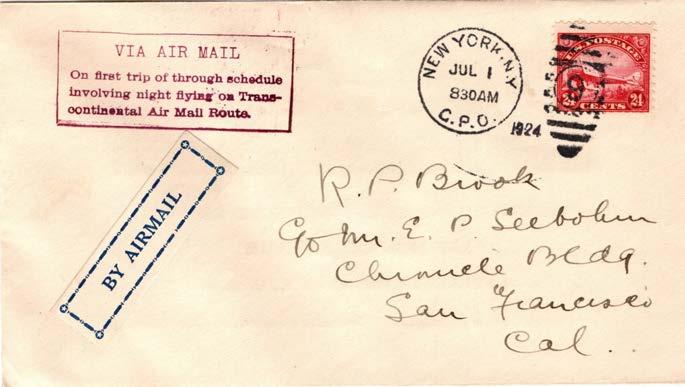
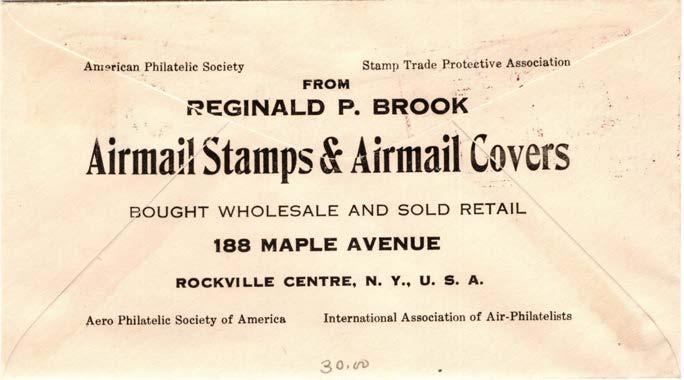
Figure 5 (a+b): Front and back of Reginald P. Brook’s self-addressed stamped cover postmarked in New York, July 1, 1924. Cover is franked with a single copy of Scott C6, a 24-cent stamp to cover the postage for the three zones between New York and San Francisco. Brook was born in England around 1871 and arrived in the U.S. in 1897. He was a physician by trade. He became a member of the American Philatelic Society in 1921 and began running ads in The American Philatelist for “aeroplane” stamps for sale that year. He died in 1931 and his passing was noted in the October 1931 Airpost Journal (from the author’s collection).
Chicago, while Egge traveled to Omaha for the nighttime transfer of mail.
Two De Havilland DH-4s took off from Hazelhurst Field in Mineola, New York at around 10:00 a.m. Eastern Time bound for Cleveland where another pilot and plane would fly the mail to Chicago. One plane was piloted by Wesley Smith; the other, E. Hamilton Lee. Between them, they carried a total of 23,600 letters weighing 590 pounds. Not surprisingly, most of the mail was philatelic or ceremonial in nature. Among the postal items on board was a letter from President Calvin Coolidge
to California Governor F.W. Richardson and a self-addressed envelope from Reginald P. Brook, a physician by trade and an early airmail stamp and cover dealer (Figure 5).
Letters on board this flight were subject to a new set of airmail rates that went into effect on July 1. Based on Henderson’s recommendation, postage was set at 8-cents per ounce per zone with three zones: New York to Chicago, Chicago to Cheyenne, and Cheyenne to San Francisco. The POD issued 8-, 16-, and 24-cent airmail stamps in August 1923 to satisfy these new rates. We
know these stamps today as Scott C4 through C6.
Henderson told the press that the San Francisco-bound mail also included a package of news reels taken in New York before the first plane left. He boasted that they would be developed and shown in San Francisco theaters less than two days after they were taken. The postage for this film came to more than $106, which means it weighed about 83 pounds, a significant percentage of the total weight carried on this initial flight.
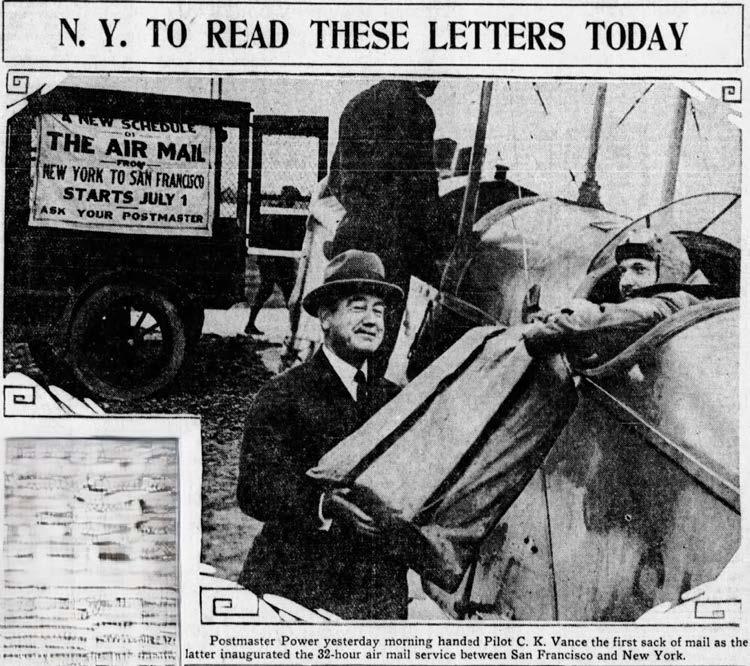
The San Francisco pilot, Claire Vance, got off to a rough start when after lifting off from Crissy Field at
6:00 a.m. Pacific Time he got lost in the fog and had to return (Figure 6). He eventually got on his way to Reno to hand off the mail to the next pilot. He carried about 15,000 letters weighing about 400 pounds. His mail included an assortment of fresh-cut California flowers from San Francisco Postmaster James L. Power and his wife to President Coolidge and the First Lady.
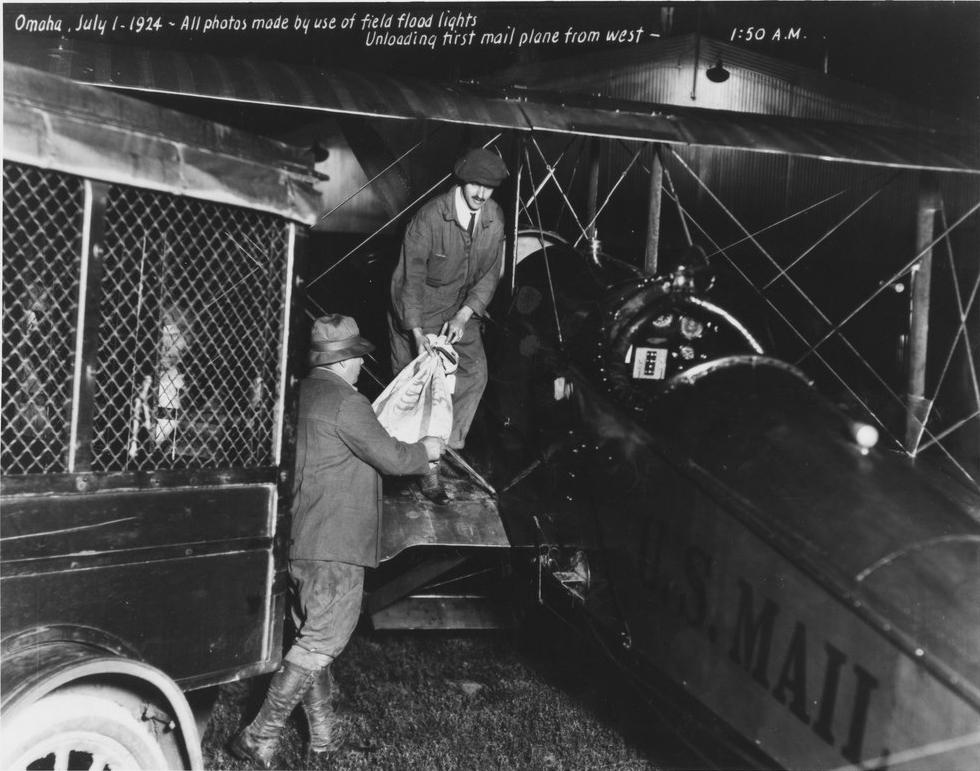
At stops along the way, crowds turned out to greet the airmail pilots, especially in Omaha where the eastbound and westbound flights met (Figure 7). The Omaha Daily News headline of July 1 read, “MAIL AIRPLANES WILL ROAR INTO OMA-
HA TONIGHT.” When asked by the Daily News if the POD was up to the challenge, Egge simply replied, “We are ready.”
Once the eastbound mail arrived in Chicago the morning of July 2, Henderson told the Associated Press, “It is only reasonable to believe that the first day’s transcontinental flight is a success. Already the Post Office Department has received many messages of congratulations.”
While premature, the congratulatory messages turned out to be warranted. The Pacific Coast mail arrived at Hazelhurst Field in New York a little after 5:00 p.m. Eastern Time in a plane piloted by Smith who spent the evening in Cleveland. That was 32 hours and 12 minutes after the leaving San Francisco and only six minutes behind schedule. According to press reports, Smith would have arrived ahead of schedule had he not been delayed for 14 minutes in Cleveland waiting for a mail truck to arrive. The Atlantic Coast mail arrived in San Francisco 34 hours and 40 minutes after the start from Mineola.
Business groups, such as the Aeronautical Chamber of Commerce of New York, were quick to appreciate the ability to send documents in a little more than a day coast-to-coast. By the third day of service, all the mail carried was business-related, mostly bank letters and documents; there were no ceremonial or souvenir covers on board, what Henderson would call “publicity junk” in a New York Times December
2, 1924, opinion piece.
The service also operated like clockwork. Indeed, Henderson reported in the middle of July that during the first ten days of service, 97 percent of all the flights were on time and 99.8 percent of mail arrived as scheduled. The weather still caused difficulties, but darkness did not.
The POD built on its success by extending the lighted airway eastward from Chicago to Cleveland in the summer of 1924 and westward to Rock Springs, Wyoming at the same time. By July 1, 1925, the lighted airway extended to New York, and the POD started five-night-per week overnight service between New York and Chicago. That service became daily on May 15, 1926.
The POD’s pioneering days of airmail were over. It had proven the feasibility and economic benefit of roundthe-clock airmail service, and it was now time to turn over responsibility to commercial operators, as Henderson and others believed. In 1925, the U.S. Congress passed the Contract Air Mail Act, also known as the Kelly Act after Representative Clyde Kelly of Pennsylvania, which allowed the POD to contract with private airlines to carry mail. By September 1, 1927, all airmail routes were being flown by private carriers.
Air transportation and travel would have taken off without the efforts of the POD, but it is fair to conclude that it would have taken longer. The POD rightfully deserves considerable credit for the development of private aviation. □
by Juan L. Riera
In 1931 Pan American Airways put out a request for proposals for a long range flying boat which would meet certain requirements. This resulted in the development of the Sikorsky S-42 that first flew in late March 1934. Ten were produced and used primarily by Pan Am. The S-42 also became known as the “Flying Clipper” and the “Pan Am Clipper.” Almost immediately Pan American Airways put out a request for proposals for a smaller version of the S-42 flying boat that was intended to operate along Pan Am river routes along the Amazon and Yangtze.
The first proposal came from the Fairchild Aircraft Corporation and was the Fairchild 91 A-942 that came
to be known as the Fairchild 91 Baby Clipper. Alfred Gassner designed this single-engine eight-passenger flying boat airliner. Unfortunately, before the prototype was competed, Pan Am no longer needed the plane for use in China, so Fairchild made the necessary adjustment for use in tropical Brazil. The first flight of this plane was on April 5, 1935 and seven planes were built. Two were delivered to Pan Am for use by Panair do Brazil (one wrecked in Belem in 1941 and the other was scrapped in 1945). Pan Am cancelled the order for the remaining airplanes, considering two to be sufficient for their needs along the Amazon.
The prototype was sold to the
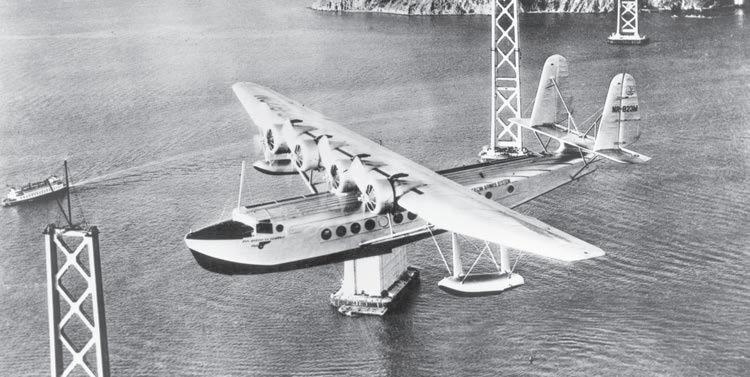
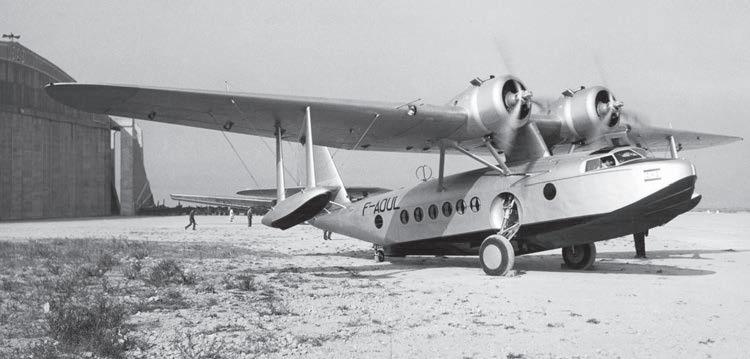
Figure 1 (top): The Sikorsky S-42 “Flying Clipper” over the Oakland Bay Bridge (courtesy National Air and Space Museum).
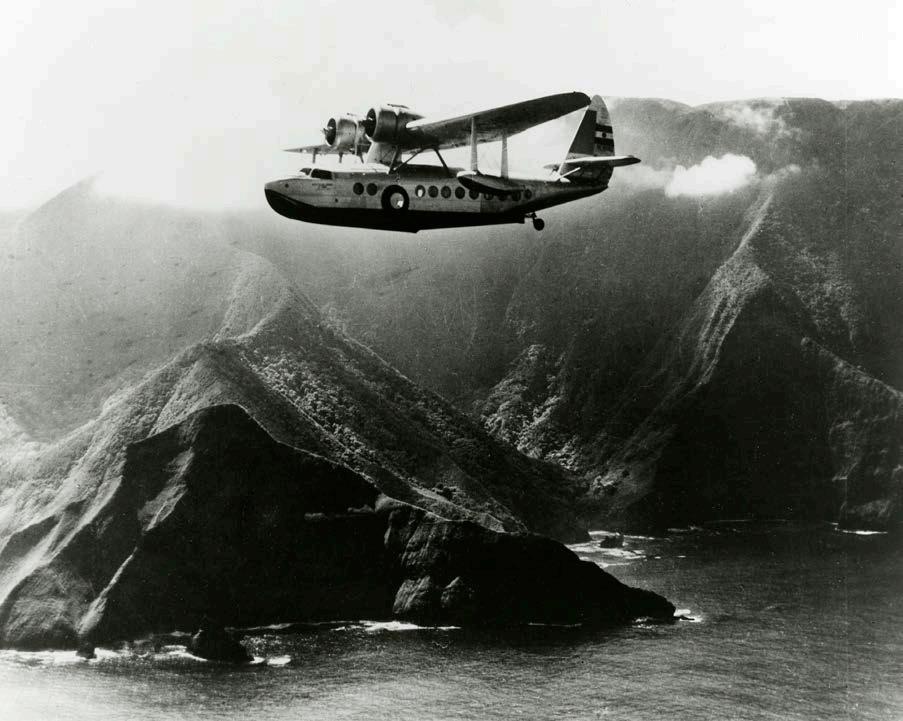
Figure 2 (bottom): The Sikorsky S-43 “Baby Clipper” in West Africa (courtesy AirHistory.net Photo Archive).
Spanish Republican Air Force, but the ship carrying it was captured by the Nationalists, who named it Virgen de Chamorro and scrapped it in 1941. One was purchased by the Imperial Japanese Air Service for evaluation, wrecking shortly after delivery in 1937. This caused the Japanese to purchase a second that wrecked in Nanking, China in 1939. Industrialist Garfield Wood
bought a Fairchild Clipper that he sold to the British American Ambulance Corps before being transferred to the Royal Air Force that used it in Egypt for air-sea rescue. Interestingly Fairchild specially designed and built for the American Museum of Natural History to be used by naturalist Richard Archbold for his second expedition to Papua New Guinea in 1936-1937.
The second proposal was from Sikorsky Aircraft, the S-43 Baby Clipper. This twin-engine flying boat airliner, designed by Igor Sikorsky, could accommodate between 18 and 25 passengers (although data shows that the limit was usually 19 passengers) with a separate two-crew forward cockpit. 53 planes were built with Pan American Airways being the primary user in conjunction with Inter-Island Airways of Hawaii (the airline changed its name to Hawaiian Airlines in 1941). Pan Am would fly passengers to Honolulu in Sikorsky S-42 “Flying Clippers” from the continental U.S. and Inter-Island Airways would operate four S-43’s to ferry Pan Am passengers and local residents from Honolulu throughout the Hawaiian Islands. Panair do Brasil (a Pan American Airway affiliate) operated seven S-43’s, French Aeromaritime
used 5 Baby Clippers on a colonial airway between Senegal and Congo, a few were used by miscellaneous companies in Alaska, KLM used one-presumably in the Caribbean, and Pan American used the majority of the S-43 Baby Clippers (including affiliate PANAGRA) throughout Cuba and Latin AmericaIncluding the Panama Canal Zone. As a matter of fact, a Pan American-Grace Airways S-43B crashed in the vicinity of Coco Solo, Panama Canal Zone, on August 2, 1937. Unfortunately all 14 on board died.
In conclusion, the Sikorsky S-43 “Baby Clipper” was used in and throughout Cuba, Hawaii, and the Panama Canal Zone for the carrying of mail and passengers from the mid1930s to mid-1940s due to the request for proposals put out by Pan American Airways. □
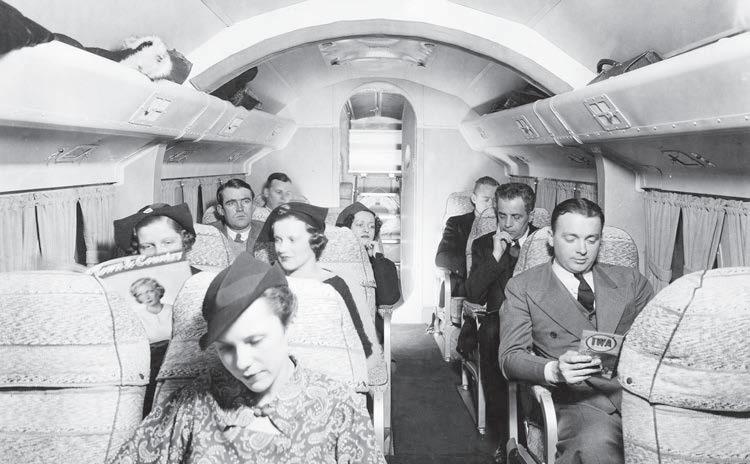
by Chris Hargreaves
When I started this column eleven years ago, it began with a brief introduction to Canadian airmail (“The Development of Canadian Air Mail 1912-1930,” March 2013, and “Further Developments 1931-1939,” June 2013).
The columns since then have looked at many different aspects of Canadian aerophilately, and when the topics are arranged in chronological order, they give a comprehensive history of Canadian airmail.
There’s been discussion from time to time as to which item should be regarded as Canada’s “first airmail”? The candidates include a letter “carried by a paper kyte” in 1848; the silk messages dropped from balloons during the search for the Franklin expedition in the 1850s1 (Figure 1); covers addressed
1. The 1853 silk is listed as PF-2 in The Air Mails of Canada and Newfound-
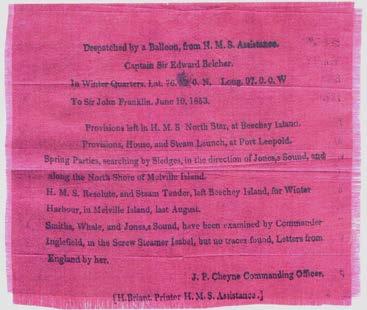
Figure 1: Message on red silk dropped from a balloon during the search for the Franklin Expedition in the Arctic during June 1853.
to Canada which were carried on the 1911 Coronation Air Mail flights in the United Kingdom; postcards for the proposed flight by Thomas McGoey land. Records of earlier messages from 1850 -1851 were added to the second edition, AMCN2, as PF-1A and PF-1B.
was delayed until the next day due to bad weather.
during the Manitoba Air Circus River Park in Winnipeg in May 1912; and Capt. Brian Peck’s flight from Montreal to Toronto on June 24, 1918 (Figure 2). These items were described in “Canada’s Earliest Airmails, 18481918 (September 2019).
There was also an unsuccessful attempt in the 1890s to develop a pigeon post service from Sable Island (“Pigeon Post in Canada,” March 2023).
Captain Brian Peck’s flight is generally recognized as the first air mail flight in Canada. The second successful flight was by Katherine Stinson from Calgary to Edmonton on July 9, 1918
(“Canadian Air Mail Centenaries 1918-2018: Capt. Peck & Katherine Stinson,” March 2018).
They were followed by the three exprimental flights in 1918 (“Experimental Toronto-Ottawa Air Mail Flights, 1918,” September 2018), and by several pioneer flights in 1919 (“Canadian Air Mail Centenaries 1919-2019,” December 2019).
The big aviation stories in 1919 were the attempted and successful Trans-Atlantic flights. These were described in a series of three columns (“Flying the Atlantic in 1919: Part 1: The Hopefuls and the NC-4,” March
2019; “Part 2: Alcock and Brown,” June 2019; and “Part 3: The R-100,” September 2019.
In 1920 there were more Pioneer flights (“Canadian First Flights of 1920,” December 2019).1
The first regular airmail service involving Canada was also inaugurated in 1920. This was actually operated by the United States Post Office as Foreign Air Mail Route 2, to provide a connection between Seattle and ships to and from Asia. The service allowed late mail from Seattle to connect with steamers to Asia when they stopped at Victoria outbound. It also enabled inventories of goods on incoming ships to be sent to Seattle 24 hours before the ship arrived, which gave merchants extra time in which to arrange onward transportation for the goods.
The service also carried mail from the Victoria Post Office that was
forwarded on U.S. mail routes after it arrived in Seattle (“Canada’s First Air Mail Service - Victoria to Seattle,” September 2014, with additional information on U.S. and Canadian covers in March 2015 and illustrations of rarely seen covers from Asia endorsed to be flown from Victoria in September 2021).
The first airmail service within Canada began in 1924, and was operated by Laurentide Air Service Ltd. between Haileybury, Ontario, and the Rouyn goldfields in Québec (Figure 3). The flight took one hour, and was an alternative to a portage and canoe route which took two days. It was described as a semi-official service as Laurentide was allowed to charge for carrying the mail, and to issue a sticker stamp to show that postage had been paid, but the Post Office did not accept responsibility for delivery of mail to the addressee

Figure 4: Based on a U.S. Post Office “Map of Canada and United States Showing Air Mail Routes 1929”.
after it was handed over to the airline (“1924 - Canada’s First Regular Air Mail Service,” March 2016, with recent research by Alec Globe correcting the inauguration dates for the service reported in September 2023).
The Laurentide service was followed by several more airlines which operated semi-official airmail services until 1934. A brief history of each company is given in The Air Mails of Canada and Newfoundland (2nd edition). The companies included Klondike Airways Limited which had a very complex history (“Klondike Airways Limited: New Research,” September 2023).
In 1925 letters from Canada were allowed to be carried on air mail services in the U.S., but only if the fee for airmail service was paid in U.S. stamps. The rates involved changed from time to time (“Mixed Franking on Canadian Air Mail to the U.S.A.,” June 2014).
In September 1927, the Canadian Post Office Department started to pay
for some air mail services. Thirteen services were inaugurated over the next sixteen months. Most were seasonal. Many carried mail to places otherwise cut off in winter, without an additional charge for flying the mail. Some were short-lived. The various routes inaugurated up until December 1928 are shown in Figure 4.
1. September 9, 1927: Rimouski to Montreal. This accelerated Trans-Atlantic mail service as mail was transferred to a pilot boat as ships passed Rimouski, and flown to Montreal (“The St. Lawrence Air Mail Service (Rimouski) 1927-1939,” September 2016).
2. October 4, 1927: Lac du Bonnet to Wadhope to Bissett.
3. December 14, 1927: Leamington to Pelee Island (“Was This the World’s Shortest Air Mail Route?,” December 2016)
4. December 25, 1927: La Malbaie
Figure 5: CNE Anniversary Flight, Windsor to Toronto. The Post Office offered a souvenir cachet on mail carried on the CNE flights, but to receive the cachet mail had to be paid at the air mail rate. Over 32,000 covers were sent in to be carried on the August 24 flights, and over 27,000 on the return flights on August 29.
to Seven Islands (“‘Finally Dr. Cuisiner Drew a Gun...!’ The First North Shore Air Mail Flight,” December 2014).
5. January 11, 1928: Moncton to Grindstone Island.
6. January 25, 1928: Rolling Portage to Red Lake.
7. February 8, 1928: La Malbaie to Port Menier (“Gulf of St. LawrenceNorth Shore Air Mail,” March 2015).
8. February 19, 1928: Moncton to Charlottetown.
9. May 5, 1928: Toronto to Montreal, and Ottawa to Montreal. A twice-weekly service, added when the Rimouski air mail service was resumed. Mail was carried on all the above
Post Office flights without an extra charge (“The Introduction of Canada’s 5-cents Air Mail Rate 1928,” December 2017).
10. August 24, 1928: Quebec City to Toronto, and Windsor to Toronto. These were special flights arranged as part of the 50th Anniversary Celebrations for the Canadian National Exhibition (Figure 5).
11. August 31, 1928: The Pas to Kississing.
12. October 1, 1928: Montreal to Albany, U.S. This was co-ordinated with the U.S. F.A.M. 1 service from New York to Montreal. A daily Montreal to Toronto airmail service was inaugurated at the same time (“U.S. - Canada Air Mail Route
Inaugurated,” July 2015; “Montreal’s Air Mail October 1, 1928 - What Actually Happened?,” June 2023).
The 5-cent first-ounce air mail rate was introduced by the Canadian Post Office on October 1, 1928, but only applied to “air mail services” which provided a faster alternative to surface routes. “Air stage routes” still flew regular mail franked at surface rates to remote locations.
Following the success of the cachets offered for the CNE flights, the Post Office now offered a special cachet on the inaugural flights of all new airmail services. However, if a first flight cachet was required when a new air stage service was inaugurated, covers had to be franked at the air mail rate.
To easily identify mail for which the higher air mail rate had been paid, the Post Office began to issue air mail stamps (“Canada’s Early Air Mail
Stamps: C1 to C6,” September 2022).
13. December 10, 1928: Winnipeg to Regina, Calgary and Edmonton (“The Perplexing Experimental Prairie Air Mail Service in December 1928,” December 2015).
During 1929 several new air mail and air stage services were introduced (“Two New Canada - U.S. Air Mail Routes,” September 2017; “Air Mail to the Arctic: Down the Mackenzie River to Aklavik,” December 2018).
A regular air mail service was established on the Prairies in 1930. This was linked to the U.S. air mail system in February 1931, after which mail could be flown from New Brunswick in the east to Alberta in the west (“The Winnipeg - Pembina - Minneapolis Air Mail Route,” March 2024).
As the airmail route network developed, air mail rates also evolved (“Overseas Air Mail Rates in 1931,”
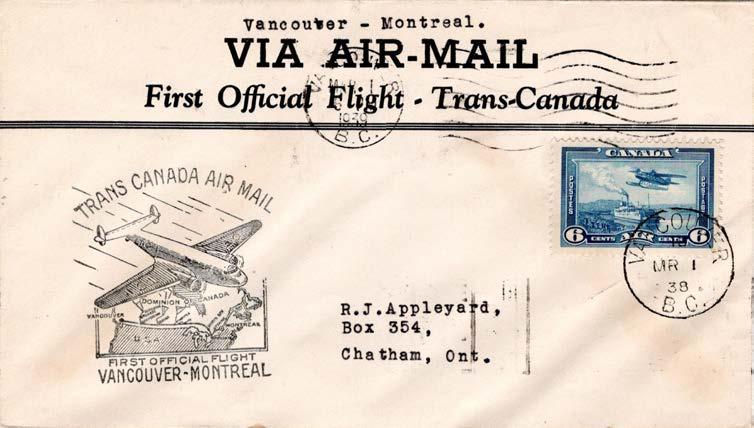
December 2013; “Air Mail to South America,” March 2014), “Covers with 18-Cents Postage: Which Are Correctly Franked?,” June 2017).
However, the development of air mail in Canada was not a story of continuous progress, as most of the fast air mail routes were cancelled during the Great Depression (Figure 6).
The air stage routes to remote places usually continued, and the Post Office produced numerous cachets for the inauguration of new services. The collecting of first flight covers as they were offered during the 1930s was described in “A History of Canadian Aerophilately - Reminiscences of Don Amos” (March 2022).
Most of these air stage routes were in northern Canada, and operating them was a challenge, especially in the winter. Rex Terpening was an air engineer during the 1930s, and wrote
a very readable and informative book about his experiences. The book was titled Bent Props and Blow Pots, and an extract was published at the time of his 100th birthday2 (“Airmail Through the Ice - 1934,” September 2013).
Towards the end of the 1930s, plans for Trans-Atlantic air mail services by flying boat were progressing rapidly. Canada wanted the flights to stop in Canada, and was concerned that the fast onward transmission of mail to Western Canada would be dependant on U.S. air mail routes. It therefore created Trans-Canada Airlines, which developed a Trans-Canada air mail service (Figure 7). A “next day” mail service was inaugurated in March 1939
2. Bent Props and Blow Pots by Rex Terpening was published by Harbour Publishing in 2003, and reprinted in 2015. It is available for purchase from their website.
between Vancouver on the west coast, and Montreal and Toronto in the east (“Cross Canada Air Mail 19391945,” September 2015).
Trans-Atlantic air mail flights began in the summer of 1939 (“Air Mail Through Shediac, New Brunswick,” June 2022; “Botwood, Newfoundland, and Pan American Airways,” June 2016); “Imperial Airways Inaugural Trans-Atlantic Air Mail Service,” Mach 2017).
Earlier, in April 1939, there was a much-publicized Russian attempt at a world record long distance flight from Moscow to New York. The flight had to land in New Brunswick (“1939 NonStop Flight from Moscow to Miscou Island,” December 2021).
The Pan American Airways TransAtlantic flights through Botwood were suspended during 1940 and 1941 due to American neutrality laws. Why these laws prevented service through Newfoundland, but flights through Bermuda were allowed, was questioned in “Pan American’s 1942 Northern Trans-Atlantic Route” (June 2018). The question was solved and explained in “Neutrality and New Information on North Atlantic Airmail” (March 2020).
After the flights resumed, there were constant capacity problems regarding the amount of mail which could be flown across the Atlantic. This led to several innovations to decrease the weight of air mail correspondence (“Airgraphs: Speeding Up the Mail During World War II: Part 1,” March 2021; “Air Letter Sheets: Speeding
Up the Mail During World War II: Part 2,” June 2021).
More information on all of these topics can be found in The Air Mails of Canada and Newfoundland. The first edition was published in 1997. A second edition which includs covers produced up to 2020, and much additional information on earlier covers, was published in 20223 (“AMCN1AMCN2: What’s the Difference?,” December 2022).
It is planned to produce annual updates to AMCN2, describing recently produced covers, new research findings, and corrections if necessary. The first of these was published as “AMCN2 Update #1” (December 2023).
The original AMCN was proposed and co-ordinated by Dick Malott, who was an avid aerophilatelist, and a very active researcher, writer, exhibitor, organizer and philatelic judge. His philatelic biography was published as “Dick Malott: The Collector and His Covers” (June 2020).
To Vickie Canfield-Peters as she moves away from The Airpost Journal. Many thanks for being such an easy editor to work with over the last eleven years.
And to Charles Epting as he takes over as editor of the APJ. I look forward to working with Charles, and seeing how the APJ evolves in the future. □
3. The AMCN2 can be ordered through the AAMS. For orders outside of the U.S. contact canadianairmail@gmail.com.
by Don Lussky
Well, this time we have to cover two months, so here’s both June and July 1924. Both reminded me that there is nothing new…history repeats. In June the Democrats met to nominate their candidate for the presidential election. But unlike this year’s convention, the selection was up for grabs. It took them from June 24 until July 9, 103 ballots, to name John W Davis. The special air mail flight from New York’s Madison Square Garden to Chicago (U.S. Government flight 166) required only two cents postage.
And then in July there was a postal rate increase. Sound familiar? The PO decided it would cost more to fly by night, so thy charged eight cents to fly a zone… either N.Y. to Chicago, Chicago to Cheyenne, or Cheyenne to San Francisco. But if you were mailing an air mail letter over two zones they wanted 16-cents and if it took three zones ‘twas 24-cents (see U.S. Government flight 167). □
Figure 1 (top): Cover sent by special airmail flight from the 1924 Democratic National Convention.

Figure 2 (center) and Figure 3 (bottom): Covers sent on the first scheduled airmail flights involving night flying.
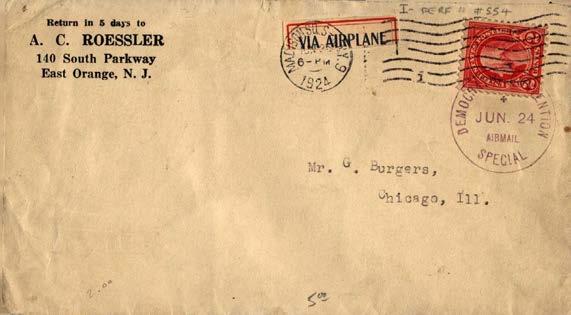
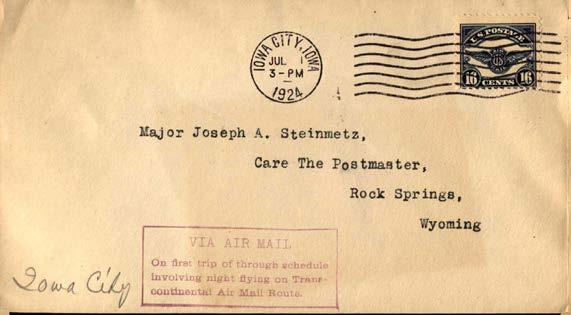
Membership dues for the American Air Mail Society are $30 for digital membership, $40 within the United States and Canada, and $60 worldwide. Membership includes a subscripton to the Airpost Journal, which is published six times annually. Membership applications can be found online at www.americanairmailsociety.org.
Publications:
Volume One (contains CAM 1 through CAM 34, Philippine Islands, and Foreign Flag Flights)
Price: AAMS Members $60, Non-Members $75
Volume Two (contains Polar Aerophilately)
Price: AAMS Members $80, Non-Members $100
Volume Three (contains Official CAM First Flight Covers: AM Routes 1-28, United States Pioneer Flights: 1910-1916, Canal Zone Airmails: 1918-1979, Amelia Earhart Flights, U.S. Glider Flights, and U.S. Governmental Flights)
Price: AAMS Members $80, Non-Members $100
Prices do not include shipping and handling. To order, please contact:
American Philatelic Society 100 Match Factory Place 814-933-3803 Bellefonte PA 16823
www.stamps.org
Air Crash Mail of the World, edited by Ken Sanford
Incorporating Recovered Mail by Henri Nierinck and American Air Mail Catalogue, 6th Edition, Volume 1
Covers all known air crashes from which mail has been recovered and is recorded in collectors’ hands. Over 2,000 pages and 1,600 illustrations of cachets, labels, post office memos and crash markings, many in full color. Provided on a USB drive in PDF and Microsoft Word formats.
Price: $32
For international pricing or to order, please contact: Ken Sanford 613 Championship Drive kaerophil@gmail.com Oxford CT 06478

ZEPPELIN- & AIRMAIL SPECIAL
1st North American flight 1937, crash cover of LZ 129 Hindenburg with onboard cancellation
LZ 6 / Z III 1909, first flight period messagecard
OUR DATES 2024
181. Auction 19. - 22. June
40. e@uction 9. - 11. September
Give us a call!
personal consultation & appointments
+49 (0)211-550 440
+49 (0)162-26 52 226
South America flight 1930, Austrian Roundtrip cover
LZ 10 Schwaben 1911, 3.9. Landau flight with Bavarian franking!
YOUR PARTNER FOR ZEPPELIN- & AIRMAIL
We gladly accept consignments at any time. Home visits are possible by arrangement. Please contact us! www.felzmann.de


Auktionshaus Ulrich Felzmann GmbH & Co. KG
40210 Düsseldorf • Immermannstr. 51 • Germany www.felzmann.de • info@felzmann.de