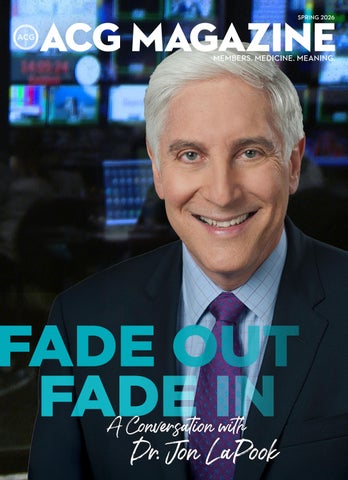
ACG MAGAZINE SPRING 2026
MEMBERS. MEDICINE. MEANING.
FADE OUT FADE IN A Conversation with Dr. Jon LaPook
CALL for
s t c a r t Abs ABSTRACT CATEGORIES • Biliary/Pancreas
• IBD
• Colon
• Infections and
• Colorectal Cancer
Microbiome
Prevention
• Interventional Endoscopy
• Diet, Nutrition, and
• Liver
Obesity
• Pediatrics
• Endoscopy Video
• Practice Management
• Esophagus
• Small Intestine
• Functional Bowel Disease
• Stomach and Spleen
• General Endoscopy
• Clinical Vignettes/
• GI Bleeding
Case Reports
SCAN FOR THE SUBMISSION SITE
bit.ly/ACG2026_Abstracts
Submission Dates:
MARCH 2 – JUNE 1, 2026
SPRING 2026 // VOLUME 10, NUMBER 1
FEATURED CONTENTS COVER STORY
FADE OUT, FADE IN
Dr. Jonathan LaPook shares his dual roles as a physician and media correspondent, with tips on working with the media.
PAGE 18
ACG PERSPECTIVES AfrECC's efforts to reduce the burden of esophageal cancer in Africa, with firsthand accounts from ACG members.
PAGE 13
GETTING IT RIGHT Ann Bittinger, Esq., shares legal considerations in locum tenens work.
PAGE 33
|1
ACG MAGAZINE MAGAZINE STAFF
CONNECT WITH ACG youtube.com/ACGastroenterology
Executive Director Bradley C. Stillman, JD
facebook.com/AmCollegeGastro Editor-in-Chief | Vice President, Communications Brian C. Davis
Managing Editor | Senior Manager, Communications Becky Abel
x.com/amcollegegastro
@amcollegegastro.bsky.social
bit.ly/ACG-Linked-In Art Director Emily Garel
CONTACT BOARD OF TRUSTEES
IDEAS & FEEDBACK We'd love to hear from you. Send us your ideas, stories, and comments.
ACGMag@ @gi.org President: William D. Chey, MD, MACG President-Elect: Costas H. Kefalas, MD, MMM, MS-PopH, FACG Vice President: Nicholas J. Shaheen, MD, MPH, MACG Secretary: Jean-Paul Achkar, MD, FACG Treasurer: Neil H. Stollman, MD, FACG Immediate Past President: Amy S. Oxentenko, MD, MACG Past President: Jonathan A. Leighton, MD, MACG
CONTACT ACG American College of Gastroenterology 11333 Woodglen Drive, Suite 100 North Bethesda, MD 20852 (301) 263-9000 | gi.org
Director, ACG Institute: Neena S. Abraham, MD, MSc, MACG Co-Editors, The American Journal of Gastroenterology: Jasmohan S. Bajaj, MD, MS, FACG Millie D. Long, MD, MPH, FACG
DIGITAL EDITIONS
GI.ORG/ACG-MAGAZINE
Chair, Board of Governors: Sita S. Chokhavatia, MD, MACG Vice Chair, Board of Governors: Harish K. Gagneja, MD, MACG Trustee for Administrative Affairs: Sunanda V. Kane, MD, MSPH, MACG
TRUSTEES Brooks D. Cash, MD, FACG Dayna S. Early, MD, FACG Jill K. J. Gaidos, MD, FACG Seth A. Gross, MD, FACG David J. Hass, MD, FACG James C. Hobley, MD, MSc, FACG Vonda G. Reeves, MD, MBA, FACG Aasma Shaukat, MD, MPH, FACG Jay N. Yepuri, MD, MS, FACG Patrick E. Young, MD, FACG
2 | GI.ORG/ACG-MAGAZINE
American College of Gastroenterology is an organization with an international membership of over 21,000 individuals from 86 countries. The College's vision is to be the preeminent organization supporting health care professionals who provide compassionate, equitable, high-quality, state-of-the-art, and personalized care to promote digestive health. The mission of the College is to provide tools, services, and accelerate advances in patient care, education, research, advocacy, practice management, professional development, and clinician wellness, enabling our members to improve patients’ digestive health and to build personally fulfilling careers that foster wellbeing, meaning, and purpose.
SPRING 2026 // VOLUME 10, NUMBER 1
CONTENTS
“We often ‘same brain,’ you and me, about things. I think we both appreciate that, my gosh, the world is aching for empathy, and medicine is no exception.” — DR. JONATHAN LAPOOK TO DR. MARK POCHAPIN: COVER STORY, PG 18
4 // MESSAGE FROM THE PRESIDENT
18 // COVER STORY
37 // INSIDE THE JOURNALS
Dr. William Chey highlights that change and uncertainty can lead to growth and improvement
FADE OUT, FADE IN Dr. Jon LaPook discusses his dual roles as a physician and media correspondant with colleague and friend Dr. Mark Pochapin
AJG Infections in Standard or Tapered Dose of Prednisolone for Alcohol-Associated Hepatitis: A Randomized Trial (STASH Trial) by Kulkarni, et al.
31 // TRAINEE HUB
CTG Characterizing Barriers to Engaging in Digestive Healthcare for Sexual and Gender Minority People in the United States by Clukey & Goldowski, et al.
6 // NOVEL & NOTEWORTHY Celebrating a Past President's retirement, a new opportunity for APPs, tributes to the late Dr. Richard Farmer and Dr. Kim Isaacs, and more
9 // PUBLIC POLICY Dr. Stephen Amann and Dr. Louis Wilson with a dialogue on advocacy, community, and commitment
AI-ASSISTED COLONOSCOPY Dr. Tessa Herman on what trainees should know
33 // GETTING IT RIGHT LAW MIND Ann Bittinger, Esq., on legal considerations in locum tenens work
13 // ACG PERSPECTIVES AFRICAN ESOPHAGEAL CANCER CONSORTIUM (AFRECC) A sustainable program to reduce the burden of esophageal cancer in Africa
ACGCRJ Pseudoachalasia in an Achalasia Patient: A Ticking Time Bomb by Goodrich, et al. ACG GUIDELINE HIGHLIGHTS Perioperative Risk Assessment and Management in Patients with Cirrhosis (September 2025)
Above: Dr. Jonathan LaPook with ACG Past President Dr. Mark Pochapin when Dr. LaPook received his named professorship at NYU’s Dean’s Honors Day in 2013. (COVER STORY, PG 18)
|3
WHAT GOT US HERE CAN GET US THERE William D. Chey, MD, MACG
These are indeed uncertain times, and there is nothing quite as unsettling as uncertainty. This year in particular, so much unanticipated uncertainty has been injected into the system. Of course, uncertainty is one of the main byproducts of change. The late President John F. Kennedy once said “Change is the law of life. And those who look only to the past or present are certain to miss the future.” In other words, change is inevitable and a foundational element of growth and progress. Within the realm of healthcare, change is at the same time exhilarating and frightening. Biomedical innovation in artificial intelligence (AI), virtual and digital health, and precision medicine is leading to transformational changes in the practice of medicine. It is hard to imagine what the next 10 years have in store for us. The optimist in me envisions the longanticipated transition from a time when technology created more problems than it solved to a time when technology provides solutions to the barriers that stand in the way of providing efficient, highquality healthcare. Think about how AI medical scribes, generative AI platforms like ChatGPT and OpenEvidence, and chatbots that manage patient inquiries are already transforming the way we practice. It is easy to overlook that the current versions of these technologies are constantly “learning” and will continue to evolve and improve over time. Of course, these remarkable innovations also beg the question— will innovation augment or replace us? This discussion reminds me of the old adage “What got us here won’t get us there,” a quote attributed to
4 | GI.ORG/ACG-MAGAZINE
the author and executive coach Marshall Goldsmith. As it pertains to clinical operations like where and how we see patients, document encounters, retrieve information, and synthesize large amounts of data to make management decisions, this is almost certainly true. However, in other more personal and emotional ways, it may be harder to replace what a wise and caring physician brings to an interaction with a patient. At its core, medicine is about a clinician trying to help and care for her or his patient. After all, isn’t that why each of us went into healthcare? I graduated from Emory Medical School in 1986, and over the past 40 years medicine has undergone a metamorphosis from a “profession” to a “business.” As a business, medicine has grown increasingly focused on “business models” and “return on investment.” An unintended but entirely predictable consequence of this change in focus is that medicine has and continues to grow increasingly “transactional.” All of this has moved the patient-provider interaction from the center of medicine to someplace more peripheral. Technology promises the opportunity to improve efficiency, throughput, and of course, the bottom line. Somewhere in this technological revolution, I hope we can discover some important revelations. We can and should leverage technology to make us better clinicians by putting the world’s medical knowledge at our fingertips any time of day or night, providing more time to actually talk to and build relationships with patients, and helping clinicians (and patients) to not feel so rushed. I always say that medicine is a marathon not a sprint and over the long haul of a medical career, these non-financial benefits of technology will not only benefit patients but could help to restore balance and satisfaction for clinicians as well.
Though the gifts of improved efficiency and the time it provides can enable more productive and satisfying interactions with our patients, it will be up to each of us to master the “soft skills” that our patients most value— human connection, empathy, caring, and trust, attributes that will be more difficult for technology to provide. These soft skills are a clinician’s secret sauce but unfortunately, are growing increasingly endangered in a specialty like gastroenterology, where incentives are aligned to reward doing procedures rather than spending time with patients in clinic. I am reminded of advice offered by the former surgeon general Dr. Vivek Murthy, who spoke of the “triad of fulfillment”—his keys to happiness and wellbeing— building meaningful relationships, which keeps us grounded and binds us together, understanding your purpose, which gives our lives direction and meaning, and providing service to others, which is after all the most important reason we all became healthcare providers. So, perhaps as it pertains to those important soft skills, maybe just maybe “what got us here can get us there.” In this, my second ACG presidential message, I have tried to highlight that change and uncertainty, while unsettling, can lead to growth and improvement. Despite my comments, I acknowledge that the sheer number of changes and magnitude of uncertainty can feel overwhelming. Amongst all of the uncertainty, one thing remains certain—ACG will always be there to support the needs of clinicians caring for patients with digestive issues. Whether it’s the highest quality education, supporting clinical research, leadership training, advocacy for our members and patients, or fostering innovation, ACG will be decisive, consistent, and supportive. We will do our level best to be THE professional home for clinical gastroenterologists. I hope 2026 brings you health, happiness, and success. —Bill
2026 ACG AWARD NOMINATIONS
Honor Your Colleague with an ACG Award Nomination
The ACG Awards Committee is seeking nominations from all members for the following distinguished awards: Berk/Fise Clinical Achievement Award
This award recognizes an ACG Member who has provided distinguished contributions to clinical gastroenterology, including: (a) clinical medicine, (b) technology application, (c) health care delivery, (d) related factors such as humanism and ethical concern. It is not intended that this award be given in honor of one’s laboratory research accomplishments.
Community Service Award
This award is bestowed upon an ACG Member who has initiated or has been involved in numerous volunteer programs/ activities, or has provided significant volunteer service post-training. The service must have been performed on a completely voluntary basis and not for the completion of training or position requirements.
Distinguished Mentorship and Teaching Award This award recognizes an ACG Member who has provided meaningful and sustained contributions to trainees/colleagues in gastroenterology. Such contributions could include mentorship or teaching to help develop the mentees’ career, clinical practice, research or academic practice.
Distinguished NP/PA Teaching Award
This award recognizes a distinguished nurse practitioner or physician assistant who is an ACG Member and has shown long-standing contributions to educating and mentoring NPs/ PAs in the field of gastroenterology and hepatology (GIH). Meaningful contributions in teaching include demonstrating mentorship, preceptorship, curricula development and/or other activities that have an impact in educating and developing future NPs/PAs in the field of GIH.
Diversity, Equity and Inclusion Award
This award recognizes an ACG Member whose work in the areas of clinical practice, research, teaching and/or leadership has demonstrated an emerging or sustained commitment to the values of diversity, health equity and inclusion.
International Leadership Award
This award is given to an ACG Member in recognition of outstanding and substantial contributions to gastroenterology, to the College, and to the international gastroenterology community.
Master of the American College of Gastroenterology
Masters of the American College of Gastroenterology shall have been ACG Fellows who, because of their recognized stature and achievement in clinical gastroenterology and because of their contribution to the College in service, leadership, and education, have been recommended for designation as Masters.
NP/PA Award for Clinical Excellence
This award recognizes a distinguished nurse practitioner or physician assistant who is an ACG Member and has shown longstanding contributions to advancing clinical practice in the fields of gastroenterology and hepatology. Substantial contributions to GI practice include demonstrated practice expertise, leadership, mentoring and collaborative activities that have an impact at the state, regional, national or international level.
Samuel S. Weiss Award
This award is given to an ACG Fellow or Master in recognition of outstanding service to the American College of Gastroenterology over the course of an individual’s career.
deadline for all nominations: April 15, 2026 Submit your nomination: gi.org/acg-award-nomination-form Nominations for all awards must: • Be accompanied by two letters of recommendation (three for the NP/PA Awards) • Include the nominee’s CV • Conform to the specific nomination requirements • Be unsolicited by the nominee
Nominations must be submitted online: gi.org/acg-award-nomination-form Nomination requirements: gi.org/award-nomination-guidelines
NOVEL
& NOTEWORTHY [MILESTONE]
The College congratulates ACG Past President Jonathan A. Leighton, MD, MACG, on his recent retirement from the Mayo Clinic after 35 years of service to his patients and colleagues. At Mayo, Dr. Leighton served as Professor of Medicine, Medical Director of the Office of Mayo Clinic Experience, Director of the Office of Joy and Wellbeing, and previously chaired the Gastroenterology and Hepatology Division. He joined ACG in 1988 and served on myriad committees before rising to a leadership position on the ACG Board of Trustees and his role as ACG President (2023–2024). “I used to tease Jonathan and call him the mayor of Mayo Clinic because his door was always open,” said Mayo Clinic Professor of Medicine and ACG Institute Director Neena S. Abraham, MD, MSc, MACG. “There was a steady flow of people stopping by to ask Jonathan questions and colleagues stopping by to connect. If he hadn’t seen you for a few days, Jonathan would pop into your office and check in. Jonathan believed in the power of relationships, not just with patients, but also with his colleagues. And his open-door policy allowed him to cultivate those relationships informally so when issues needed to be resolved, Jonathan felt comfortable picking up the phone and connecting with the right person to address any challenge. I’m going to miss Jonathan’s pop-ins to my office and our regular informal connections. Luckily, I know where he lives! So, I’m sure our friendship will thrive even during his retirement. Congrats on 35 years of service, Jonathan!”
L-R: Mayo Clinic Office of Joy & Wellbeing colleagues Keith Jones, Dr. Cynthia Stonnington, and Dr. Leighton in the Mayo Clinic Community Garden
Submit your CRC awareness projects for a SCOPY Award! [SKILL BUILDER]
ACG is thrilled to announce the official launch of the APP Academy for Clinical Excellence, a first-of-its-kind longitudinal learning platform specifically designed for advanced practice providers (APPs) in GI and hepatology. This comprehensive learning experience is designed to support professional growth, demonstrate competence, foster lifelong learning, and interprofessional collaboration for nurse practitioners and physician assistants. Explore a curated selection of expert-led modules and be among the first to join this brand-new learning platform! appacademy.gi.org
6 | GI.ORG/ACG-MAGAZINE
[IN MEMORIAM]
Richard G. Farmer, MD, PhD, MACG (1931–2025) The College mourns the loss of ACG Past President Richard G. Farmer, MD, PhD, MACG, on November 24, 2025, at age 94. Dr. Farmer was an internationally respected gastroenterologist, educator, and medical statesman whose career profoundly shaped clinical care, training, and health systems on three continents. He served as Chief of Gastroenterology and later Chair of Medicine at the Cleveland Clinic, where he helped build one of the nation’s leading centers for digestive disease care and research. His expertise drew patients from around the world, including two heads of state, while his scholarship established foundational insights into inflammatory bowel disease. Beyond his clinical and academic leadership, he played an influential role in international health, most notably coordinating multinational medical assessments in the immediate aftermath of the dissolution of the Soviet Union. His work as a physician, mentor, diplomat, and educator left a lasting imprint on modern gastroenterology and on the global medical community.
Kim L. Isaacs, MD, PhD, MACG (1956–2025) ACG notes with sadness the passing of Kim L. Isaacs, MD, PhD, MACG, on November 27, 2025. Dr. Isaacs was very active in the clinical care of patients with inflammatory bowel disease (IBD), endoscopy, and fellow education. She published multiple articles, guidelines, and book chapters on IBD, including co-authoring the 2018 ACG Guideline on the Management of Crohn’s Disease in Adults. She was also the first woman GI fellow at the University of North Carolina (UNC) and the first woman GI faculty member at UNC in 1991, serving the institution for 42 years. Dr. Isaacs was a long-term mentor in the ACG Mentoring Program, allowing her to provide career guidance to young gastroenterologists. The College is grateful for her service and sends condolences to her family, colleagues, and loved ones.
Courtesy of the University of Rochester Medical Center
Application Deadline: May 1
GI.ORG/SCOPY
[EAVP]
2026 EDGAR ACHKAR VISITING PROFESSORSHIPS *Linda Anh B. Nguyen, MD, FACG UT MD Anderson Cancer Center February 26–27, 2026
*Cynthia A. Moylan, MD, MHS University of Chicago April 27–28, 2026
*Sonali Paul, MD, FACG Creighton University – Omaha September 30, 2026
Millie D. Long, MD, MPH, FACG LSU Health Shreveport March 5, 2026
*Neil H. Stollman, MD, FACG Jefferson Einstein Philadelphia Hospital May 13, 2026
Sapna Syngal, MD, MPH, FACG Loyola University Medical Center October 5–6, 2026
*Michael T. Dolinger, MD Brown University March 12, 2026 Brian E. Lacy, MD, PhD, FACG University of North Carolina March 24–25, 2026
*Christina Y. Ha, MD, FACG University of Vermont Medical Center June 16, 2026 Satish S.C. Rao, MD, PhD, FACG University of Cincinnati September 14–15, 2026
*Adam S. Faye, MD, MS University of Wisconsin November 3, 2026 *Visits requested topics related to Equity, Diversity, and Ethical Care
Anita Afzali, MD, MPH, MHCM, FACG University of Mississippi Medical Center March 31, 2026
Novel & Noteworthy | 7
SUBMIT YOUR APPLICATION for the ACG
2026 International GI Training Grant Awards The International Relations Commi ee of the American College of Gastroenterology is now accepting applications for the 2026 International GI Training Grants. The grants are to be used for travel to and from the training center and to the ACG Annual Meeting, as well as for incidental expenses related to the training. The training must take place between July 1, 2026, and June 30, 2027.
INTERNATIONAL GI TRAINING GRANT
This $15,000 grant provides partial financial support to physicians outside the United States and Canada to receive clinical or clinical research training or education in Gastroenterology and Hepatology in selected medical training centers in North America. WHO IS ELIGIBLE? Physicians who are not citizens or residents of the United States or Canada, and who are working in gastroenterology or related areas, are eligible
SUBMISSION DEADLINE April 15, 2026 APPLY HERE traininggrant.gi.org
NORTH AMERICAN INTERNATIONAL GI TRAINING GRANT
This $10,000 grant provides partial financial support to United States and Canadian GI Fellows in training, or GI Physicians who have completed their training within the last five years, to receive clinical or clinical research training or education in Gastroenterology and Hepatology outside of North America. WHO IS ELIGIBLE? GI Fellows in training who are enrolled in an accredited gastroenterology fellowship program, or GI Physicians who completed their training within the last five years, and are citizens of the United States or Canada, or have a U.S. green card, are eligible to apply together with their training institution. 8 | GI.ORG/ACG-MAGAZINE
SUBMISSION DEADLINE April 15, 2026 APPLY HERE traininggrant.gi.org
PUBLIC POLICY
Local Roots and National Impact: Dialogue on Advocacy, Community, and Commitment By Stephen T. Amann, MD, FACG and Louis J. Wilson, MD, FACG
IN OCTOBER, ACG’s Legislative and Public Policy Council (LPPC) welcomed Stephen Amann, MD, FACG, of Tupelo, MS, as its Chair. The College also extends its deep appreciation to Louis Wilson, MD, FACG, whose many years of dedicated leadership have shaped the LPPC’s impact and direction. To reflect on this transition, Dr. Amann and Dr. Wilson sat down for a thoughtful conversation on past successes, emerging opportunities, and the vital role for GI providers in advocacy and the political process. Their dialogue offers valuable insight into why engagement matters now more than ever.
Public Policy | 9
// PUBLIC POLICY
Dr. Amann: Louis, we appreciate you taking some time to reflect on your tenure as ACG’s LPPC Chair. What are some of the highlights you look fondly upon? Dr. Wilson: Thanks, Steve. It’s been a real honor to serve as LPPC Chair, and I look forward to seeing you take it to the next level. Certainly, the highlights include the years of meetings in Washington, DC. Each year, I was privileged to make individual trips to meet with members of Congress from both sides of the aisle, important committee staff, and various public policy experts that all helped me better understand our policy challenges. I feel those visits laid the foundation for our incredibly successful fly-ins and luncheons and helped build relationships that will endure past my time as chair. Another highlight happened just this summer, when ACG was invited to attend a roundtable organized by the GOP Doctors Caucus. We were one of only 18 organizations represented from across the House of Medicine, and I was honored to share the GI perspective on how Congress can support independent practices and physician autonomy. Dr. Amann: It was wonderful to be alongside you at so many fly-ins. They really are terrific nonpartisan experiences to share the issues that matter for GI and to hear firsthand from our elected officials. In your time leading LPPC, how have the policy priorities of gastroenterology—and the needs of our members—evolved? Dr. Wilson: In some ways, our priorities are the same. Of course, we’re still focused on colorectal
cancer screening, protecting physicianled practices, and reigning in prior authorizations and administrative burdens. Unfortunately, many of the things we predicted would happen if we failed to reform the Medicare Physician Fee Schedule to keep pace with inflation have come to fruition. And so, five years later, we are in the advanced stages of health care consolidation. Now, there's a powerful need to address the fee schedule as a way of both reinvigorating physician practices and improving patient choices and competition in the marketplace. So yes, I think our conversations have evolved, and our urgency has increased, even if the issues are similar. Dr. Amann: Those conversations have become much broader, in my opinion. Patient access to care has evolved to also capture physician quality of life, because our practices’ viability not only ensures patient access to care, but also our ability to innovate and create new ways to serve our communities. Dr. Wilson: Steve, don’t you think that demonstrates why the close relationship between the LPPC and the Practice Management Committee (PMC) is so important? Like you, I transitioned from chairing PMC to then lead LPPC. When the practice management community is pointedly trying to solve problems—like managing prior authorization burdens, optimizing advanced practice provider use, or setting up ancillary services—it raises important policy questions, which then become the basis of the College’s public policy priorities. Dr. Amann: I absolutely agree, and I think that happened without us even recognizing it at the time. In the practice management world, we’re very focused on providing practical solutions to these big
problems—that’s the core of ACG’s Practice Management Toolbox series. But many of those exact problems come up because legislative issues have affected the way physicians practice medicine. So yes, the input from our PMC colleagues has been critical. I look forward to continuing our close partnership as we both develop more solutions and break down policy in a way that supports ACG members. Dr. Wilson: Steve, as you begin leading LPPC, I think it’s so important that you keep blending all these connections—with the PMC, with state societies, and of course, with the ACG Board of Governors and leadership. That collaboration will help keep the momentum going. You asked me to reflect, so now I’d like you to predict—Where do you see the greatest opportunities for ACG members and GI providers to make an impact moving forward? Dr. Amann: I see many opportunities for us at both the federal and state level. With our elected officials in Congress, a lot of what we do is relationship building, so they understand our needs and challenges and vice versa. When we have that mutual respect, we can serve as influential partners as Congress considers various reforms to Medicare reimbursement, telehealth, Stark laws, and more. But too often, federal systems don’t move quite as quickly as we’d like, whereas states can more efficiently and effectively address our concerns. Working with state legislatures in recent years, the ACG Governors and LPPC have already secured many legislative wins to expand colorectal cancer screening access and reform
Access the Practice Management Toolbox
“We’re very focused on providing practical solutions to these big problems—that’s the core of ACG’s Practice Management Toolbox series. But many of those exact problems come up because legislative issues have affected the way physicians practice medicine.” —Dr. Stephen Amann
10 | GI.ORG/ACG-MAGAZINE
the prior authorization process. So, I’m also very excited by the opportunities we’ll have at the state level. I’m also concerned about the down coding issue that has been put forward by large payers. We’re seeing them use AI to automatically down code without even having another physician review the medical record. These blanket policies hurt our patients and make our lives more difficult, so I expect it’s something we’re going to tackle as well. Dr. Wilson: I’m glad you mentioned the importance of relationships. Over the years, one of the most surprising things to me has been how few partners you need to make a lot of progress. It's not just who you have relationships with, but also the depth and strength of those relationships— and ACG has a number of real allies on both sides of the aisle. One of the temptations that I’ve noticed in organized medicine, especially when it comes to deepening these relationships, is to try to become a policy expert. I’m not sure that’s a winning strategy; instead, I try to learn from policy experts and focus my contributions on what it means to be a community physician. To many members of Congress, there’s nothing that speaks more than our integrity and the deep commitment we have to our patients. Dr. Amann: I agree. I think what’s always been more impactful is keeping it close to home. I keep the focus on my patients and the things I know and do every day as a gastroenterologist. You’ve been involved in advocacy for many years, Louis. How do you remain positive? Dr. Wilson: Again, it goes back to my commitment to my community, my patients, and my colleagues. There’s been plenty of times where it would’ve been easy to become discouraged or water down our legislative asks. But then I remembered, no—that’s not what our patients need. You have to be willing to say what you believe and say it with conviction. So, even when I’m not feeling positive, I know I’m still
“There’s been plenty of times where it would’ve been easy to become discouraged or water down our legislative asks. But then I remembered, no—that’s not what our patients need.” —Dr. Louis Wilson committed. Steve, you and I have a deep, deep understanding of rural medicine. We live it every day. I think that will be a powerful part of what you’ll bring as LPPC Chair. What works and helps our patients in north Texas and Mississippi is also what is needed to bring price transparency, competition, and patient choice back to health care. What about you? How do you stay positive? Dr. Amann: For me, my cup is always half full. Like you said, it’s easy to get discouraged and walk away from the table. But I remind myself it always comes back to why we all became physicians—to take care of patients. Over the years and through various ACG committees, I’ve always kept an open ear to the membership. Something I hear often is no matter what the specific policy issue is, we’re just all trying to make it easier to take care of patients and serve our communities. That keeps me going. What is your parting advice for ACG members who may not see themselves as policy inclined, but want to get involved?
But like you said, being an influential leader in your community, just with education or volunteering, is an easy way to start making a difference. It’s about promoting things to help our patients—and us as physicians—thrive. Dr. Wilson: Steve, I just want to say again how excited I am for you to take the reins and move us forward. I respect you a great deal and I appreciate that you were willing to take on this responsibility. I know the College’s leadership, the Board of Governors, and the membership are behind you. Dr. Amann: Thanks, Louis. That’s a blessing, and I look forward to what we can accomplish together in the coming years. Dr. Amann is a Partner at Digestive Health Associates, PA/One GI in Tupelo, MS.
Dr. Wilson is Managing Partner at Wichita Falls Gastroenterology Associates in Wichita Falls, TX.
Dr. Wilson: In a democracy, governance depends on us all being involved as citizens. We should all be active in our communities, our counties, our states, and on the largest level with our federal government. But your immediate circle is where you can have the most impact, and it’s from that initial foundation that you build national advocacy. If I am not an advocate for those in need in my community—the underserved, the homeless, the sick, the struggling rural practices—then I probably will not be successful in DC. So my best advice is, don’t be afraid to get involved! Dr. Amann: That’s great advice, and I think the ACG offers lots of opportunities for those looking to be more active politically.
Public Policy | 11
Attend an upcoming
ACG POSTGRADUATE COURSE 2026 2026 ACG’s Hepatology School & ACG/FGS Annual Spring Symposium March 20–22, 2026 Hyatt Regency Coconut Point | Naples, FL
ACG Weekly Virtual Grand Rounds REGISTER NOW: gi.org/ACGVGR Plus our monthly webinar series focused on career-based topics!
ACG 2026 ACG Summer School Series: Women’s Leadership Course, IBD School, and Esophagus School
June 5–7, 2026 Marriott Metro Center | Washington, DC 2026 ACG’s Functional GI and Motility Disorders School & Midwest Regional Postgraduate Course August 14–16, 2026 Fort Pontchartrain, a Wyndham Hotel | Detroit, MI 2026 ACG’s Obesity and Metabolic Disorders School (NEW!) & ACG/VGS/MASGNA Regional Postgraduate Course August 28–30, 2026 Williamsburg Lodge | Williamsburg, VA 2026 ACG’s Obesity and Metabolic Disorders School (NEW!) & Southern Regional Postgraduate Course December 4–6, 2026 Hyatt Regency Louisville | Louisville, KY
FOR MORE INFORMATION VISIT: gi.org/regional-meetings
12 | GI.ORG/ACG-MAGAZINE
African Esophageal Cancer Consortium (AfrECC) Development of a Sustainable Program to Reduce the Burden of Esophageal Cancer in Africa and to Invite International collaboration
By David E. Fleischer, MD, FACG, Sanford Dawsey, MD, Gift Mulima, MD, Mark D. Topazian, MD, and Mike Mwachiro, MD
Esophageal Cancer — A Health Crisis Esophageal cancer (EC) claims 500,000 lives annually worldwide, with especially high mortality in eastern and southern Africa, where 90% of the cases are esophageal squamous cell carcinoma (ESCC) and in 20% of cases the patient is under 40 years old. Most patients present with advanced disease, with symptoms of dysphagia, poor nutrition, and weight loss. The African Esophageal Cancer Consortium (AfrECC) was formed in 2016 after a meeting at the National Cancer Institute. It was appreciated that eastern and southern Africa had an unusually high incidence of EC, and little was known about the cause and the management of
ACG Perspectives | 13
// PERSPECTIVES
this disease in Africa. In addition, there was minimal cooperation between the leading medical centers in the region to perform EC research. Figure 1 shows the distribution of AfrECC sites in Africa, and the darker colors correlate with the frequency of EC.
Figure 1
AfrECC and the AfrECC Foundation The mission of AfrECC is to reduce the burden of esophageal cancer in Africa through clinical care, research, education, prevention, and public outreach. In 2024, the Foundation was established as a 501(c)(3) tax-exempt public nonprofit organization dedicated to supporting the work of AfrECC. Its mission includes developing a strategic plan, creating a sustainability model, and raising funds to complement the resources obtained through academic grants and equipment donations. AfrECC also plans to continue to collaborate with the American College of Gastroenterology (ACG) to foster international collaboration and global health learning. More information can be found on the AfrECC website, afreccfoundation.org, which was created in collaboration with Bentley University.
sites are referral centers for their region or country. The majority of African patients with EC present with advanced stage disease, and most are malnourished due to progressive, severe dysphagia. In these cases, palliation with esophageal stents is the most typical treatment. Although most patients survive only three to nine months, they experience a significantly improved quality of life after insertion of a stent. In addition to providing nutrition, the stent allows the patient to swallow their own saliva and take liquids and some solids. If the stents were not placed, most of the patients would quickly die due to dehydration, malnutrition, or aspiration. Palliation allows them to eat, drink, and spend quality time with family and friends. In addition, the ability to offer palliation gives the physicians and other healthcare workers a sense of purpose. They no longer need to say, “I'm sorry, but there is nothing I can do,” said Michael Mwachiro, MD, a Foundation Board member from Kenya. “Stents provide a way for nutrition, and beyond that a dignified palliation option,” he continued. Research In the past 10 years, AfrECC members have completed seven case control studies of ESCC with a total of 2,400 patients and 2,400 controls. This has led to a better understanding of the risk factors for ESCC, which include indoor air pollution, drinking hot beverages, poor oral health, and tobacco and alcohol use. Figure 2
Mission(s) of AfrECC Clinical Care Although all AfrECC sites in each participating country (Table 1) carry out some research and training, their major focus is clinical care, and all the Table 1
14 | GI.ORG/ACG-MAGAZINE
Figure 2
shows a smoky, unventilated cooking area, which exposes individuals to significant amounts of smoke carcinogens. Genomic material has also been collected and is now being evaluated on 3,000 cases and controls in a consortium-wide genomewide association study (GWAS). An endoscopic capacity survey found major needs for equipment and trained staff. An endoscopic screening study showed prevalent dysplasia, which is a curable precursor of ESCC, and multicenter quality-of-life and survival studies are ongoing. Each of the African medical centers has received research grants to support these studies. Important funding has come from the International Agency for Research on Cancer (IARC) and the National Cancer Institute (NCI). Dr. Valerie McCormack serves as the main liaison for IARC, while Dr. Christian Abnet and Dr. Sandy Dawsey lead the NCI program. “One of the unique aspects of AfrECC is its emphasis on multisite collaborations,” Dr. Dawsey said. “Five of the seven case-control studies used the same questionnaire, allowing analysis of answers both individually by site and combined across sites. Similar collaborative opportunities are available for the GWAS, endoscopic capacity, and survival data.” A list of publications by AfrECC members on topics related to EC in Africa can be found on the AfrECC website.
Education Educational activities are directed at two audiences. Epidemiological and statistical training are provided to collaborators participating in the aforementioned research studies. In addition, specific clinical courses are designed to train physicians on the management of EC. These courses involve hands-on endoscopic training in which trainee competence is measured by a validated scoring system. To date, 19 four- to five-day courses have been held, and 66 physician-nurse teams have been trained. In most instances, the trainees come from the host hospital, the local region, or other parts of the host country. On some occasions, the trainees also come from neighboring countries. The faculty include AfrECC members as well as other faculty from the United States and Europe. These courses are supported by Boston Scientific Corporation, Olympus Corporation, and Conmed Corporation. ACG has supported faculty participation for ACG members with advanced endoscopy skills (Figure 3). This collaboration with ACG began during the 2023–2024 ACG presidency of Jonathan A. Leighton, MD, MACG. “It is my hope that ACG continues to have a significant impact on global health learning through education and research. The collaboration we have with AfrECC can serve as a model to improve the quality of care for gastroenterology patients around the
Figure 3
“Beyond the technical aspects, the workshop was a powerful exchange of knowledge, experience, and culture, and an opportunity to learn as much as we taught." —Dr. Eduardo Pinto
Figure 4
globe,” Dr. Leighton said. Teaching is also enhanced by remote transmission of the courses using the PROXIMIE system (Proximie Ltd, London, UK). The original report using distant site technology for training in Uganda was published by ACG Past President Jerry D. Waye, MD, MACG, Emeritus Professor, Mt. Sinai New York, and an AfrECC Foundation Board member. Prevention Although palliative treatment improves the quality of life of patients with advanced EC, the main goals of AfrECC are early diagnosis and prevention. Early detection requires screening of asymptomatic individuals in high-risk populations. Currently, screening is done by endoscopy, which requires endoscopic equipment and physicians trained to perform the screening, both of which are in short
supply in Africa. The “holy grail” would be to initially utilize an inexpensive, non-endoscopic screening method that could triage patients accurately to or away from endoscopy without the need for a pathologist’s diagnosis. A study of one such possible method is now being carried out under the direction of Dr. Gift Mulima from Kamuzu Central Hospital (KCH) in Malawi and Dr. Shiraz Khan from a KCH-affiliated program run by the University of North Carolina. “Healthy asymptomatic adults from the community swallow a capsule containing a compressed sponge which is attached to a string. After a few minutes in the stomach the capsule dissolves, the sponge expands, and the sponge is pulled up the esophagus by the string, collecting surface mucosal cells as it goes,” said Dr. Mulima, describing the study. “The sponge is then immersed in a fixative and sent to the lab, where 100% of the cell sample is read by image analysis and an AI algorithm, without visual inspection by a pathologist. All participants then undergo Lugol’s chromoendoscopy with biopsy of unstained lesions, and the cytology and biopsy diagnoses are compared.” Figure 4 shows the capsule and a patient swallowing the capsule. Public Outreach Although EC is one of the top three leading causes of cancer mortality in both men and women in the AfrECC countries, there is a little awareness about this in the general public, and government programs have not spread the word. AfrECC has been meeting with African ambassadors and high-level government officials to try to change this situation, and a humanitarian grant from Boston Scientific (BSCI) has sponsored public
ACG Perspectives | 15
// PERSPECTIVES
from sustainable knowledge sharing. Follow-up has shown that this training empowered local gastroenterologists to independently place esophageal stents, even in remote parts of the country where access to advanced care is limited. Through AfrECC, I witnessed how high-quality cancer care can be delivered without compromise, even in low-resource environments. I believe there is a wealth of opportunity to help patients, advance collaboration between ACG and AfrECC, offer ACG members a unique life experience, and build lasting bonds between American physicians and African medical centers. I am deeply grateful to the ACG for enabling this work. Dr. Tiba practices at Kaiser Permanente in Rockville, MD. Figure 5
outreach educational programs. On a recent visit to Malawi, a delegation from AfrECC was led by the Malawian Ambassador to the US, Her Excellency, Esme Chombo, and outreach programs were carried out in conjunction with the Malawi Ministry of Health in two of the villages with the highest rates of ESCC (Figure 5). “We deeply appreciate AfrECC’s expertise and unwavering commitment. Together, we've made measurable differences in patient's lives,” said Carl Budge, BSCI Manager, Global Outreach.
Closing the Circle: Esophageal Cancer Care Across the Globe By Melik Tiba, MD I still remember patients I cared for as a young physician in Ethiopia—men and women with esophageal cancer who arrived unable to swallow, slowly dying from starvation and thirst. Two decades later, those memories returned with clarity when I stood again at the bedside, this time as a trained gastroenterologist.
16 | GI.ORG/ACG-MAGAZINE
After completing my training in the United States, I was honored in 2025 to return to Ethiopia as a volunteer faculty member through the African Esophageal Cancer Consortium (AfrECC) and ACG. Our mission was simple but powerful: to train local gastroenterologists and fellows in esophageal stent placement, an intervention that can immediately restore dignity and quality of life in resourcelimited settings. The burden of disease remains immense. In just three days, our team placed more than 25 esophageal stents. Watching patients take their first swallow—sometimes after months of inability—was profoundly moving. Yet the most meaningful impact came not from the procedures themselves, but
An Exchange of Knowledge, Experience, Culture, and Technique in Mozambique By Eduardo Pinto, MD, PhD From September 15–18, I had the privilege of serving as a faculty trainer at the Second Endoscopy Workshop in Maputo, Mozambique, supported by the African Esophageal Cancer Consortium (AfrECC). Alongside Mark D. Topazian, MD, and Michael Mwachiro, MD, we focused on building practical skills in palliative endoscopic care for esophageal cancer, particularly esophageal stent placement in low-resource settings. We also provided hands-on training in esophageal dilation and percutaneous endoscopic gastrostomy, with the shared goal of enabling Mozambican gastroenterologists to independently perform and disseminate these essential procedures. Early detection of esophageal cancer remains a major challenge across the eastern African corridor, and many patients present with advanced disease. In this context, access to effective palliative endoscopic interventions can be truly life changing. Over four intensive days, four Mozambican gastroenterologists
were trained in these techniques, and 22 patients were treated. Beyond the technical aspects, the workshop was a powerful exchange of knowledge, experience, and culture, and an opportunity to learn as much as we taught. Engagement with local media also allowed us to contribute to public awareness and advocacy. Experiences like this reaffirm the importance of sustainable, collaborative training in global gastroenterology. Dr. Pinto is a gastroenterologist at Centro Hospitalar in São João, Porto, Portugal.
A Sip of Water and a Smile on the Face: Experiences From Endoscopy Teaching in Uganda By Rahul Pannala, MD, MPH She was sitting up in bed when we saw her in the recovery room, her family by her side. She took a small sip of water from the glass by her bed, expecting to vomit it right back up, as she had done for the past couple of months. A smile slowly spread over her face as she recognized that she could now swallow following her esophageal stent placement. Esophageal cancer, specifically squamous cell cancer, is a major public health concern with very limited treatment options in east Africa. An esophageal stent can provide much needed nutrition and dignity to the patient. I was privileged to witness this moment in Jinja, Uganda, a small city on the banks of the River Nile, as part of a team supported by ACG, the African Esophageal Cancer Consortium (AfrECC), and industry
partners. We trained three teams of physicians, nurses, and technicians by performing more than 30 procedures. The training was held at Kyabirwa Surgical Center, a uniquely modern ambulatory surgery center in the heart of rural Uganda. In addition to worldclass facilities, the center is unique in having a long history of endoscopy training through telementoring from experts such as ACG Past President Jerome D. Waye, MD, MACG. The visit was also an opportunity to increase awareness about the disease within the local community and the national political leadership through joint symposia championed by AfrECC. As I reflect on this and similar trips in the past, I feel immense gratitude to the societies such as ACG, industry partners, nonprofit organizations, and most importantly the centers and their visionary leaders who believe in making a difference despite many constraints. Almost always, I have learned more than I have taught and formed new friendships and collaborations from these opportunities. Dr. Pannala is Professor of Medicine; Director, Pancreas Section; Associate Medical Director, Department of Business Development; and Program Director, Advanced Endoscopy Fellowship, Gastroenterology and Hepatology; Mayo Clinic, Scottsdale, AZ.
Get Involved in AfrECC AfrECC is grateful to ACG for its collaboration and support. We welcome the involvement of ACG members in the work of AfrECC—view the opportunities below and learn more at afreccfoundation.org. • ACG provides a limited number of stipends to members with advanced endoscopic skills who wish to serve as faculty for AfrECC courses. Please send a copy of your CV to msusano@gi.org if you’re interested.
• ACG members who can cover their expenses and wish to be involved can be matched with an AfrECC site. A process for this matching is in place so that these applicants will have a clear understanding of expectations. Scan the QR code below for a list of 2026 workshops, and please contact Dr. Fleischer at davidefleischer@gmail.com to learn more. • The AfrECC Foundation Board is looking for physicians with an interest in Africa to serve on the board. More details are available for those who wish to explore this possibility. Interested parties should contact Dr. Fleischer at davidefleischer@gmail.com.
Dr. Fleischer serves as Chairman of the Board of the AfrECC Foundation. He is an Emeritus Professor of Medicine at Mayo Clinic College of Medicine.
Dr. Dawsey serves as President of the AfrECC Foundation Board of Directors. Dr. Dawsey is a retired Senior Investigator of the National Cancer Institute of the National Institutes of Health, where he worked for 36 years.
Dr. Mulima serves as a Member of the AfrECC Foundation Board of Directors. He is a general surgeon who trained and is working at Kamuzu Central Hospital, Lilongwe, Malawi, the only tertiary and public referral hospital in the central region of Malawi.
Dr. Topazian serves as a Member of the AfrECC Foundation Board of Directors. He practices and teaches gastroenterology in Addis Ababa, Ethiopia.
Dr. Mwachiro serves as a Member of the AfrECC Foundation Board of Directors. He is a Consultant General Surgeon and Interventional Endoscopist based at Avenue HealthCare in Nairobi, Kenya.
SCAN THE QR CODE for a list of 2026 workshops, and please contact Dr. Fleischer at davidefleischer@gmail.com to learn more.
ACG Perspectives | 17
// COVER STORY
I
N THIS CONVERSATION, ACG Past President Mark B. Pochapin, MD, MACG, interviews his colleague and friend Jonathan D. LaPook, MD, FACG, a gastroenterologist and internist who for nearly 20 years has also learned from, been fulfilled by, and succeeded in a highly visible second role—as medical correspondent for CBS News. The two discuss what led Dr. LaPook into medicine and, ultimately, media, how he balances both roles, what he learns in each role that feeds into the other role, and perhaps his greatest passion—promoting a culture of empathy in medicine. DR. POCHAPIN: It’s a real pleasure today to speak to my friend and colleague, Dr. Jon LaPook, who is the Chief Medical Correspondent for CBS News. He’s also a Professor of Medicine at NYU Grossman School of Medicine. He’s an internist and a gastroenterologist. He’s here currently on our faculty at NYU Langone Health, and he is the Founder and President of really a unique and novel project called The Empathy Project, which seeks to promote a culture of empathy in medicine. Jon has been incredibly successful in all of his roles. For his media work, he’s won five Emmys, two Edward R. Murrow Awards, and many other awards, also being recognized as a finalist in the Peabody Awards.
No matter how successful and how recognized Dr. LaPook is in his journalism and his media work, I know that deep down he is first and foremost a physician, and that is critical to our profession, to the patients that he cares for, and to the people he speaks to in the media. Let me start by asking you a little bit about why you went into medicine, why you chose GI, and how that plays into your current role as a journalist? DR. LAPOOK: A Physician First First of all, it’s great to be here. I love your point about I am foremost a physician. My mantra here from the very beginning—I’ve been here [at CBS] since 2006—is “The Hippocratic Oath always trumps the Nielsen ratings.” That does come up. For example, when I was in Haiti right after the earthquake in 2010. There were times when I flipped into doctor role, and there’s sort of an unavoidable conflict of interest to having the cameras pointed at you when you do that. I told my producers, look, “If I’m going to ever flip into that [role], you turn off the cameras. There are plenty of other physicians here and other healthcare providers who are doing great work—point [the camera] at them.” There’s an unavoidable conflict of interest—like “Look at me, look at the work I’m doing.” In those moments, you’re a physician, and it can’t be that you’re doing this for television.
FADE O A Conversation with Dr. Jon LaPook and Dr. Mark Pochapin, Reflecting on Dr. LaPook's Dual Roles in Medicine and Media.
18 | GI.ORG/ACG-MAGAZINE
OUT Cover Story | 19
// COVER STORY
of other things that could be going on. I like the mystery there, the communication. Then, you get to do procedures. You know, Mark, what’s better than seeing a polyp, especially an easy polyp—one on a stalk and it’s sitting there and you take it off—and you say, “I am actually interrupting the natural history of this disease. This person potentially could have gotten cancer and instead they won’t get cancer.” Medicine can be so frustrating, but there’s the opportunity to interact with people, get to know people over a long period of time—which is why I do internal medicine and gastroenterology—and then do a procedure.
Choosing Medicine From the time I was growing up, my father was a dentist, a pioneer in maxillofacial prosthetics. I always thought I wanted to be in healthcare—I thought maybe a dentist. Then, as I got older, I loved science. I thought, well, dentistry was too much of a subspecialty. I wanted to learn about the entire body. My mother wanted to be a physician. Her father was a prominent physician at Harlem Hospital. She was a young woman who went to him and said, “I want to go into medicine.” He said, “No, women don’t go into medicine.” But, she went and wrote about medicine and became a writer.
When I became a physician, I could tell, I have a picture of her looking at me the day of my graduation—I know it was going through her head and she was just so proud to see me there. Choosing GI When it [came] to figuring out subspecialties, GI, I’ll tell you, it seemed to me that the happiest people were gastroenterologists. A lot of other people were burnt out. I thought GI was a great mixture of psych, surgery, and medicine. A person comes in with a bellyache, it could be anything—it could be that they had a bad pizza, or it could be that they have an aneurysm, or it could be that they have colon cancer, or any one of a million
“I’ve always felt—the Hippocratic Oath always trumps the Nielsen ratings. It’s never that I’m doing something for ratings. You can’t ‘unsay’ something. I learned very, very early that you cannot unsay something to millions of people.”
20 | GI.ORG/ACG-MAGAZINE
Dr. Pochapin: What’s so cool, Jon, is that you and I will bump into each other in the procedure room, in the office, and no matter all the other things that you might be doing that take you away from being the typical physician, you’re still a doctor through and through. That’s why I introduced you that way, because I know how much you’re still excited about GI and medicine and how much you really pride yourself on the fact that your first and foremost priority is your concern for patients and the desire to do the best type of medical care. Dr. LaPook: I know we both get excited when we meet in the endoscopy [suite]. We go, “Look at this, look at this.” I will tell you that to this day, when I’m doing a colonoscopy and I get up to the ileocecal valve and I look at it, I think, “This is amazing.” Eight billion people on Earth and they all have this thing. It’s connecting two different geometries. I think the day that I stop being excited—and actually in awe of the miracle of it all—maybe then it’ll be time to hang it up. But, I still get the same excitement and appreciation for the miracle of it. Dr. Pochapin: Hopefully everyone who is reading this will also feel that the reason we went into GI is because it is incredible what we’re able to do, what we’re able to see, how we’re
able to stop diseases like cancer, and all the tools available to us. We talked about your love of medicine, why you went into medicine. Tell us about the opportunity to join CBS. How did that come about? Where did the interest come for you to work in media, and had you done media work before? Dr. LaPook: Mark, it was total luck. I had no thought that I was going to go into [media]. I never talked to anybody about going into it. I, like you, I was on [television] a couple of times—just as a talking head. I think I was on Good Morning America talking about H. pylori for two minutes. I went to The Today Show and I met Katie Couric because I was an editor on the Columbia University Complete Home Medical Guide, which was sort of a health book for patients. We became friends. Then, as you well know, her husband Jay got colon cancer, and you were taking care of him. We were friends, so I was sort of helping to advise her. I actually then was on the Today Show a couple of times. I get a call in March of 2006 from Katie. She said, “I have a business proposition.” Dr. LaPook recalls the conversation with Couric, who was going to be the first solo female anchor of the CBS Evening News, who asked: “How would you like to be the medical correspondent?” “Do you have to know anything?” “No.” “Great. I can do that.” What I found out subsequently was I think there was a bit of a miscommunication. They thought I was the very well-trained medical correspondent for NBC. In Dr. LaPook’s first day at CBS News, his producer quickly discovered that he had never read a teleprompter before. He told Dr. LaPook to forget about the teleprompter and to simply chat with long-time CBS anchor Bob Schieffer about the story, which was on Chantix. Dr. LaPook was then connected with
Cover Story | 21
// COVER STORY
22 | GI.ORG/ACG-MAGAZINE
communications coach Priscilla Shanks, who worked with him for about four years “To sound like myself,” he said. Dr. LaPook: I learned how to write a piece and how to track a piece and how to read the teleprompter. Fade out, fade in, it’s now 19 and a half years later, I’ve done about 1,500 segments. Now, I’m the Chief Medical Correspondent. I’ve done segments on all platforms, including 60 Minutes, Sunday Morning, the CBS Evening News, CBS Mornings. I’ve done radio and Face the Nation. Dr. Pochapin: It’s an incredible arc that you describe—starting from not reading a teleprompter to really doing 60 Minutes, winning Emmys, and being a finalist for a Peabody. Tell us a little bit about your role as the Chief Medical Correspondent for CBS. What does that entail? Dr. LaPook: It’s a huge responsibility because I feel like there’s so much going on, especially right now, in terms of misinformation and disinformation. I’ve always felt—the Hippocratic Oath always trumps the Nielsen ratings. It’s never that I’m doing something for ratings. You can’t “unsay” something. I learned very, very early that you cannot unsay something to millions of people. So, I’m very, very careful about what I say. A lot of what I do is—we get EurekAlert!, which tells us beforehand what [science news] is coming. We go through it—what do we think is interesting? A lot of what we do is figuring out what not to put on the air. Then, when we put it on the air, by the time the evening news comes around, people already have seen the news on the internet or social media. So, if I’m going to be bringing anything to the table, it’s got to be some extra perspective. It’s been an amazing continuing medical education. I see patients in the morning. By about 12, maybe 1:00 pm, I leave. I’m doing internal medicine and GI. I may come in early afternoon and find out, “Hey, you’re doing a piece on some new treatment for sickle cell anemia.”
“...I get to pick up the phone and speak with the world’s expert or the people who have just done the study. It’s just a spectacular way of staying high on the learning curve. I think that echoes back to my practice...”
I go to the databases that you and I use—whether it’s UpToDate, or now OpenEvidence, or you name it—that brings me about 70% of the way there. Then, because I’m at CBS News, I get to pick up the phone and speak with the world’s expert or the people who have just done the study. It’s just a spectacular way of staying high on the learning curve. I think that echoes back to my practice because I can come back and talk to them about things that I’ve learned. A good example is cardiology, which you wouldn’t think that I would know a ton about, but I do know a ton about it because I have to report on it. Now I know people all over the country and even all over the world who I can reach out to. I’m a citizen of the world. Dr. Pochapin: It’s become such a small world, right? With the way we can access media and people and really get information. People get information so quickly. In the course of a week, you mentioned that you see patients often in the morning. How many times are you actually on the air? How many times are you on the air live? How often are you doing things like 60 Minutes where you need to really do a lot of background work to produce the end product? Dr. LaPook: I think I was on [the air] about 100 times in the last year on various platforms. What would that be, about once every three to four days. I’ll do one, maybe two 60 Minutes pieces a year. I mean, those take months to do. They’re just gold. I’ll do two, maybe three Sunday Morning pieces. Again, those are long—they take months to do. But I’ll tell you, a 60 Minutes piece and a Sunday Morning piece—they go on when they’re ready. The Evening News piece goes on at 6:30.
Dr. LaPook begins to reflect on some of the places he has been in his CBS News capacity. When you think about the opportunities I’ve had to meet people and to be places—I was in Haiti after the earthquake. I was there for cholera. That was an example where my knowledge of gastroenterology came in because there were a couple of cases of cholera. I said, “I’ve got to go down there.” I remember going into this outdoor cholera ward. You had to step through some Clorox so that it wasn’t on your feet and doing a [TV] standup and saying, “You see this baby has tears, which is great.” Normally, you don’t like to see a baby crying, but you love seeing a baby crying because, of course, if they were severely dehydrated, they wouldn’t be able to make tears. I was in Brazil during Zika. I went to Hurricane Maria in Puerto Rico. I’ve been to Israel—at the Weizmann Institute—talking about probiotics and the amazing research they’re doing. Dr. Pochapin: With all of that, the 1,500 or more reports that you’ve done, what’s the one or two stories that you consider either most consequential or moving or important that you’ve done? Dr. LaPook: There’s a couple that really stick out. Mike and Carol Daly One of them is Mike and Carol Daly. Carol Daly developed Alzheimer’s, and Mike was her very tough Staten Island cop, retired. I followed them over 10 years. I did pieces [on them] every year or two.
Cover Story | 23
// COVER STORY
At the beginning, [Mike] was like, “I got this, through better or through worse.” We saw the decline—gradual. By the end, he had had it. He made the mistake—like a lot of people do—of thinking “I can handle [caregiving] myself. I don’t need help.” By the end, he knew he needed help. Actually, it was a good example again of the Hippocratic Oath and the Nielsen ratings. Dr. LaPook then recalls the very last interview that 60 Minutes filmed with the Dalys, specifically a worrying comment from Mike Daly: “I’m ready to put the gun to my head. I really thought of suicide,” Daly said. I said, “Turn off the camera.” I said, “Look, Mike, I’m switching into doctor mode now.” I felt confident after a conversation that he was not suicidal— it was just an expression. He did have a gun, didn’t have a bullet in it. I was confident. He had a therapist and a plan to go to the therapist again. I said, “OK, he’s not really suicidal.” And we turned [the camera] back on. The conversation continued where it had left off: Dr. LaPook: “Really? Mike Daly: “Yeah. It got to that point.” Dr. LaPook: “Caregiving is really tough.” Mike Daly: “Hardest job I ever had.” Jennelle Stephenson I did another piece on sickle cell anemia. This woman, Jennelle Stephenson, who at the beginning talked about being on the floor in the emergency room and writhing in pain—bone-crushing pain—and being accused of drug seeking. She went through this miraculous procedure. At the beginning, I said, “What are some of the things that you’ve always wanted to do that you couldn’t do?” She said, “Honestly, everybody laughs at me for this, I just want to run, to be honest.” The [procedure] was tremendously successful. She was cured of her sickle
24 | GI.ORG/ACG-MAGAZINE
cell through genetic engineering. The last scene of the piece is her running in the forest—what’s better than that? Brittany Maynard My very first 60 Minutes piece was on death with dignity. Brittany Maynard was the young woman who had glioblastoma. She had to move from California to Oregon in order to have the ability to end her own life. I interviewed her husband, Dan Diaz. That was very moving. Dr. Pochapin: You have these two roles, physician/internist/ gastroenterologist and Chief Medical Correspondent for CBS News. What do you learn from each? How does one interact with the other? What are you learning that the other takes away? Dr. LaPook: Oh, they do this. Dr. LaPook says this as his hands come together and clasp. Of course, as a practicing physician, I’m bringing that real-life experience. Dr. LaPook describes how, at times, he will share with his CBS News anchor colleagues that he is now speaking to them as a doctor rather than as a reporter, often times relaying his patient experiences and interactions. There are times when there’s nothing like bringing a real-life experience to America, especially if it’s one that everybody can really relate to. In the morning, I’m seeing patients and I have questions from that. In the afternoon, I’m often answering a lot of the questions from the morning or I’m bringing information to people by the millions. I take that role very, very seriously. Dr. Pochapin: Jon, gastroenterologists are constantly giving presentations, we’re being asked to [speak with] our own local media—newspapers, television. What tips would you like to share with fellow gastroenterologists when they speak with the media?
“
Fade out, fade in, it’s now 19 and a half years later, I’ve done about 1,500 segments.”
Cover Story | 25
// COVER STORY
26 | GI.ORG/ACG-MAGAZINE
“In the morning, I’m seeing patients and I have questions from that. In the afternoon, I’m often answering a lot of the questions from the morning or I’m bringing information to people by the millions. I take that role very, very seriously.”
• When you’re up there giving a lecture, personalize it—tell stories about your own experience. 60 Minutes was built on four words—Tell me a story. Those are the four words. • Be animated. There’ll be some important breakthrough and we’ll say, “So, what do you think?” Dr. LaPook: • Avoid medical jargon; use language that’s easy to understand. • There are certain forbidden words. “Cohort.” As you’re talking, think, “Will every single person understand this word?” • If you can simplify it, simplify it. • Be very careful about analogies. We all love analogies. Analogies don’t play well on television—they just don’t. People misunderstand them. They take too long to explain. • If you’re on television, we’re doing a story where you’re probably being woven into a piece about whatever the subject is—colon cancer—don’t go off with a minute-and-a-half answer. If it’s going to be used, it’s going to be chopped and maybe you don’t like how it was chopped. Think about talking in eight- to 15-second sound bites. It’s hard to do. Dr. LaPook makes clear that, if you do ultimately provide lengthy answers, there is a tangible benefit to doing so— better informing the reporter as they write the story. • What are the points that—if the train is leaving the station and somebody’s on the train and you’re at the platform—you don’t have a ton of time—how can you say the most important stuff fairly quickly? Because that’s the nature of the beast.
Dr. LaPook then roleplays someone delivering an exciting message in a deadpanned tone. We want you to communicate your excitement. I’ll sometimes say, “OK, forget about your colleagues. When you got home and you spoke to whoever was home, what did you say?” When prompted in this fashion, Dr. LaPook relays how an interviewee’s excitement comes to life. That’s what we want. We want the excitement. We want the emotion. We don’t want you acting—don’t pretend. But if you’re really excited about something, be excited. Dr. Pochapin: All good advice. I want to now shift gears just a little bit and talk about some of the other work that you’ve done, which has really been groundbreaking. I’m talking about empathy. For the past 10-12 years, you’ve led The Empathy Project, which focuses on promoting a culture of empathy in medicine. Now, what prompted you to start this work and what have you learned in doing it? Dr. LaPook: I think the same stuff that would have prompted you, Mark, were you not doing 12 other things that are astonishing. We often “same brain,” you and me, about things. I think we both appreciate that, my gosh, the world is
aching for empathy, and medicine is no exception. I was very lucky to have wonderful mentors. I had people like Ed Leifer and Al Markowitz and other people who were just wonderful and great teachers and empathic, but it struck me that it was like a coin flip. There were plenty of people who didn’t have such great mentors. So, is there a way that we could really create curriculum about this to help make more empathic physicians? I came over here in 2013 to start The Empathy Project. The idea was to make Hollywood-quality short films and other materials to teach clinicians in training to be more empathic, sensitive, and competent, and empower patients to demand that. I had a connection to Hollywood. My father-in-law was Norman Lear, who’s done All in the Family, Maude, Good Times, The Jeffersons, and all sorts of other shows. I had that connection. I was at CBS News, so I had the journalism. I had a business hat—you know that I wrote software that runs a doctor’s office. Could you bring them all together and make something that would be a terrific tool for clinicians in training? Fade out, fade in. It’s now 12 years later, we have 10 films. We’ve created a Center for Empathy in Medicine, for which Dr. Jennifer Adams is the Frankfort Director for the Center for Empathy in Medicine. We’re doing AI work. Dr. Pochapin: Can you actually teach empathy? Dr. LaPook: 100%. That was the question, and you 100% can. It’s been shown—there’s a ton of research on
Cover Story | 27
// COVER STORY
it. At the beginning, maybe you fake it till you make it. We have an empathy bootcamp. The first week of medical school, we bring you to The Whitney [Museum of American Art] now, and we put you in front of a painting. We teach you the difference between observation and interpretation. Observation—if a woman comes in sort of hunched over to a GYN, she has an ovarian torsion. If [she] comes to us, you’ve got appendicitis. So, don’t mix up observation with interpretation. We tell the [medical students]—in not so simple words—if you think it’s “empathy schmempathy,” you’re not going to do well here. It turns out that you can teach empathy. There are tools that you can teach people. Engaged curiosity. Really being interested, leaning forward. We want a doctor who—when they’re in the room—they’re really in the room. What you find out is that, when you do practice empathy, your life gets better. It leads to better outcomes, patients follow your advice, you feel better. In a keynote address he delivered last fall in Leicester, England, Dr. LaPook coined “ROE”—return on empathy— asserting that when you have empathy in an organization, it goes down to the bottom line. He and Dr. Pochapin discuss how empathy can lead to greater authenticity and vulnerability— key hallmarks of great leadership. Dr. LaPook: That vulnerability and that connection and knowing your patient is the difference between night and day. About three years ago, a woman came into my office. I’ve known her 30 years. She [enthusiastically] said, “Hi!” I said, “What’s the matter?” She burst into tears—her life was falling apart. When she stopped crying, she said, “How did you know?” I said, “Too big of a ‘hi.’” After she left, I thought “Wait a second— what am I missing?” Now I’m very interested—a little tease on our current research—how do you find stuff in that [patient] interaction that’s isn’t so intuitively obvious?
28 | GI.ORG/ACG-MAGAZINE
Dr. Pochapin: Well, the last question is, what else do you want people to know about? Dr. LaPook: We have a lot of educational materials that we’ve created. They’re on our website. If you go to empathyproject.com, you can look at our movies. We [want] people to use them. The only thing we ask in return is that you give us feedback on how it’s being used and what the response has been. Dr. LaPook explains that The Empathy Project also collects empathy tools and moments of empathy— “A short story of a moment of empathy, a story that made a difference.” I saw the perfect example. There was a nurse who was asked in an emergency room by a patient, “Can I have a blanket? I’m cold.” What did she do? She brought two blankets, figuring that the patient was cold and the person who was with the patient was cold. That’s a moment of empathy. It could be passed forward, and it could be learned. I’m very excited. I will be doing this for the rest of my life. Long after I’ve retired from medicine, long after I’ve retired from CBS News, I will be doing The Empathy Project.
PG 20: Dr. LaPook with his mother on his medical school graduation day. PG 21: Dr. LaPook on set at 60 Minutes and CBS Mornings. Dr. LaPook interviews Former President Barack Obama. PG 22: Dr. LaPook and Dr. Pochapin in the Doctor Radio studio. PG 25: Dr. LaPook during a segment on Mike and Carol Daly. PG 26: A Vulcan salute from Dr. LaPook and Dr. Pochapin after an interview about the science of Star Trek. Dr. Pochapin and Dr. LaPook during the COVID-19 pandemic. PG 28: Dr. LaPook on the set of the TV show The Pitt with actor Noah Wyle, who plays Dr. Michael “Robby” Robinavitch. Dr. LaPook interviews Noah Wyle on the set of The Pitt. PG 29: Dr. LaPook and Dr. Pochapin with actor Alan Alda. Dr. LaPook on camera with CBS Mornings Plus. Dr. LaPook delivers a presentation that speaks to the work of The Empathy Project.
Dr. Pochapin: Jon, thank you. Thank you for the time. Thank you for all you do.
Dr. Pochapin is ACG Past President (2019–2020) and holds multiple roles at NYU Langone Medical Center: Sholtz-Leeds Professor of Medicine, Vice Chair of Clinical Affairs, and Director of the Division of Gastroenterology & Hepatology. He engages with the media and the public for his “Chief’s Rounds” show on SiriusXM’s Doctor Radio.
Dr. LaPook is Mebane Professor of Gastroenterology and Professor in the Department of Population Health at NYU Grossman School of Medicine. Since 2006, he has served as medical correspondent for CBS News.
Cover Story | 29
JUNE 5-N7,MAR2RI0OT26T AT METRO CENTER WASHINGTO WASHINGTON, DC
2026
: S E I R E S L O O H C S ACG SUMMER , E S R U O C P I H S R E D A WOMEN’S LE D N A , L O O H C S D B I L O O H C S S U G A H P ESO : ING WITH GUTS ACG'S LEAD ING THE FUTURE WOMEN SHAP ROLOGY TE OF GASTROEN EARN UP TO
4.75 CME
CREDITS
EARN UP TO
4.75
C MO POINTS
HAGUS SCHOOL
ACG’S ESOP
HOOL ACG’S IBD SC EARN UP TO
8.5
E CM CREDITS
EARN UP TO
8.5 MOC POINTS
EARN UP TO
7.25 CME
CREDITS
EARN UP TO
7.25 MOC POINTS
Register by
MAY 14TH TO SAVE!
30 | GI.ORG/ACG-MAGAZINE
SCAN THE QR CODE TO REGISTER!
TRAINEE HUB
Training in the Age of AI: What Trainees Should Know About Artificial Intelligence-Assisted Colonoscopy By Tessa Herman, MD
ARTIFICIAL INTELLIGENCE (AI)ASSISTED COLONOSCOPY IS BECOMING MORE PREVALENT IN ENDOSCOPIC PRACTICES. With this, gastroenterology (GI) trainees are becoming more exposed to the technology. GI fellows are key stakeholders in the adoption of AI, as their exposure and comfort with it may shape their future endoscopic practice. Thus, a thoughtful approach must be taken to learn how to incorporate AI—or not— into GI fellowship training. This article provides an overview of what AI-assisted colonoscopy is, what we know about its impact on trainees, and the benefits and concerns when incorporating it into endoscopic training.
WHAT IS AI-ASSISTED COLONOSCOPY? There are multiple types of AIassisted colonoscopy, including computer-aided detection (CADe) and computer-aided diagnosis (CADx). CADe detects polyps and is the primary technology that is currently used in clinical practice in the United States. It highlights potential polyps, typically with a colored bounding box on the monitor. CADx provides a real-time optical diagnosis of the polyp, predicting polyp histology (i.e., differentiating neoplastic versus non-neoplastic polyps) and is not yet widely disseminated in
routine endoscopic practice. Both CADe and CADx use deep-learning algorithms, are trained on large, annotated datasets, and are validated against expert consensus and/or histopathology. Different companies use proprietary algorithms that vary based on their training dataset and model design. Systematic review and metaanalysis data suggest that CADe may improve colonoscopy quality for colorectal cancer prevention exams by improving the adenoma detection rate (ADR) and adenomas per colonoscopy and decreasing the adenoma miss rate (AMR). However, CADe does not seem
Trainee Hub | 31
// TRAINEE HUB
to be effective in detecting advanced adenomas (likely because these tend to be large lesions that are easily detected by the eye without AI), may increase withdrawal times, and may lead to unnecessary polypectomies of non-neoplastic lesions.1, 2 Note that the long-term impacts on patient outcomes with AI are currently unclear, which is a contributing factor to why the American Gastroenterological Association could not make a recommendation for or against use of CADe during colonoscopy.3
IMPLICATIONS FOR TRAINEES: PROS AND CONS OF USING AIASSISTED COLONOSCOPY DURING FELLOWSHIP There are pros and cons to AI implementation during fellowship training. Regarding the pros, AI may serve as a safety net during early procedural training. The high cognitive load of learning endoscopic skills can be overwhelming to early fellows, and AI can help ease the burden by highlighting polyps that may have otherwise been missed. It can help teach new fellows how to identify colorectal neoplasia. Anecdotally, some fellows also find AI useful to keep a polyp in appropriate position while performing polypectomy. As for the cons, there is valid concern about the potential of overreliance on AI if implemented during endoscopic training—and even for attending endoscopists. Assuming high sensitivity of CADe to detect potential polyps, GI trainees may never build foundational skills to self-detect polyps. This could be especially difficult for endoscopists who used AI during fellowship but later work in a practice that does not have AI available. Similarly, there is concern that endoscopists with established skills who later implement AI may experience deskilling as they become less vigilant during colonoscopy due to overreliance on AI. Lastly, the frequent flashing and intermittent false positives of the bounding boxes could contribute to alert fatigue and, in turn, to the endoscopist ignoring AI.
32 | GI.ORG/ACG-MAGAZINE
STUDIES OF AI-ASSISTED COLONOSCOPY IN GI TRAINEES There is a limited but growing number of studies evaluating GI trainees’ perspectives and outcomes using AI-assisted colonoscopy. Survey studies demonstrate that GI fellows believe AI will play a large role in healthcare and that they generally express interest in incorporating AI into their endoscopic practice.4-6 However, Tariq, et al., found that fellows did not feel confident regarding how AI works or how to use it.⁶ This highlights a potential area of need for curriculum development in fellowship programs. Studies evaluating colonoscopy quality outcome measures when GI trainees use AI are largely limited to small, singlecenter studies. Results are mixed in terms of the ADR—Orzeszko, et al., found a 5% higher ADR in fellows who used AI versus conventional colonoscopy, whereas Chang, et al., only found an improvement in right colonic ADR but not overall ADR when trainees used AI, and Yamaguchi, et al., did not see an improvement in ADR, but only in AMR with AI.7-9 However, Yamaguchi, et al., also noted that trainees who used AI demonstrated a better ability to locate and identify adenomatous polyps as measured by the Assessment of Competency in Endoscopy tool.9, 10 Ultimately, there is a need for larger, multicenter studies evaluating colonoscopy quality outcomes when trainees use AI.
FUTURE CONSIDERATIONS As we are in the early adoption phases of AI-assisted colonoscopy in clinical practice and endoscopic training, careful consideration is required from both program leadership and the trainee regarding if, how, and when AI should be incorporated into training, provided the technology is available at their institution. From the leadership side, considerations could include creating curricula explaining how AI works and potentially creating simulations using AI aimed to teach colorectal neoplasia identification. Additionally, if AI is available, program leadership may consider whether or not AI should be used for all colonoscopies that trainees participate in or if a graduated approach should be taken, where trainees use AI more as they progress in fellowship.
As trainees, if AI is available, it may be helpful to keep track of how many colonoscopies are completed with versus without AI to ensure comfortability with polyp detection skills in both situations.
CONCLUSION Whether it is with AI or another endoscopic technology, GI is a field that requires endoscopists to be technically skilled and technologically fluent. As AI-assisted colonoscopy becomes more prevalent in endoscopic practice, GI fellowship programs and trainees should be thoughtful in considering how this technology is incorporated into training. Ultimately, a balanced approach that emphasizes foundational endoscopic skills while fostering an understanding of AI’s strengths and weaknesses will be essential to prepare trainees for their future endoscopic practice. Dr. Herman is a GI fellow at Vanderbilt University Medical Center in Nashville, TN. She currently serves on the ACG Women in GI Committee and as a Social Media Ambassador for Evidence-Based GI.
1. Hassan C, Spadaccini M, Mori Y, Foroutan F, Facciorusso A, Gkolfakis P, et al. Real-Time Computer-Aided Detection of Colorectal Neoplasia During Colonoscopy: A Systematic Review and Meta-analysis. Ann Intern Med. 2023;176(9):1209-20. 2. Soleymanjahi S, Huebner J, Elmansy L, Rajashekar N, Lüdtke N, Paracha R, et al. Artificial Intelligence-Assisted Colonoscopy for Polyp Detection: A Systematic Review and Meta-analysis. Ann Intern Med. 2024;177(12):1652-63. 3. Sultan S, Shung DL, Kolb JM, Foroutan F, Hassan C, Kahi CJ, et al. AGA Living Clinical Practice Guideline on Computer-Aided Detection-Assisted Colonoscopy. Gastroenterology. 2025;168(4):691-700. 4. Magahis PT, Pence CJ, Wan D, editors. Impact of Artificial Intelligence on Gastroenterology Training and Education: A Survey of Fellows' Perspectives. ACG; 2023; Vancouver, B.C. 5. Herman T, Dominitz J, Kaltenbach T, Gawron A, Hanson B, Guerrero Vinsard D. S1248: Training Future Endoscopists: Gastroenterology Fellows’ Perspectives and Hands-On Exposure to Artificial Intelligence for Polyp Detection in the United States. The American Journal of Gastroenterology; 2025. p. S269. 6. Tariq R, Dilmaghani S, Advani R, Soroush A, Berzin T, Khanna S. Perception and Understanding of Artificial Intelligence Among Gastroenterology Fellows and Early Career Gastroenterologists: A Nationwide Cross-Sectional Survey Study. Dig Dis Sci. 2025;70(8):2655-64. 7. Orzeszko Z, Gach T, Necka S, Ochwat K, Major P, Szura M. The implementation of computer-aided detection in an initial endoscopy training improves the quality measures of trainees' future colonoscopies: a retrospective cohort study. Surg Endosc. 2025;39(8):5276-86. 8. Chang PW, Nguyen DD, Kong N, Wang D, Wang S, Ong J, et al. Impact of artificial intelligence-assisted colonoscopy on gastroenterology fellow performance: A pragmatic randomized controlled trial. Gastrointest Endosc. 2025. 9. Yamaguchi D, Shimoda R, Miyahara K, Yukimoto T, Sakata Y, Takamori A, et al. Impact of an artificial intelligence-aided endoscopic diagnosis system on improving endoscopy quality for trainees in colonoscopy: Prospective, randomized, multicenter study. Dig Endosc. 2024;36(1):40-8. 10. Sedlack RE, Coyle WJ, Obstein KL, Al-Haddad MA, Bakis G, Christie JA, et al. ASGE's assessment of competency in endoscopy evaluation tools for colonoscopy and EGD. Gastrointest Endosc. 2014;79(1):1-7.
GETTING IT
LAW MIND
Locum Tenens: A Lay of the Land and Important Considerations By Ann Bittinger, Esq.
IF YOU WERE OFFERED A LOCUM TENENS CONTRACT in the past, you might have viewed the potential relationship with disdain. These types of relationships have become more common, though, and with that increase in use, professionalism has followed—for the most part. The term “locum tenens” is frequently misused. Although some think it means “part time,” it is really meant to mean “limited, short-term engagement,” akin to a substitute teacher. Because special Medicare rules apply to locums relationships, it’s important to use the term to describe the appropriate situation.
Getting It Right | 33
// GETTING IT RIGHT
WHAT HAS CHANGED? Changes to the health care provider market have made locums arrangements much more mainstream. But forces have been both good and bad. On the good side, the physician shortage has grown, putting physicians in greater demand and therefore in better negotiating positions to demand time away and to change jobs. Locums physicians fill in during those absences and during the gaps before a permanent hire is found. Some common usages of locum tenens work include the following: • A full-time employed physician takes a six-month leave of absence for illness, to take care of a newborn, to travel, or to acquire new skills elsewhere. The employer wants the physician to return and, to do so, hires a substitute physician on a locum tenens basis, working full time but for a limited engagement of six months. • A health system receives 90 days’ notice of termination of employment from a full-time physician in a specialty or geographic area that is difficult to replace. The health system starts a nationwide search for a replacement but is relatively sure it will not find a replacement in 90 days. Patient volume is too high for colleagues to cover effectively. The health system hires a physician on a locums basis to work until the new, permanent hire can start work. • A full-time physician at GI Physician Practice will be out for two weeks for surgery. Colleagues can’t absorb the patient volume in that physician’s absence. GI Physician Practice owners reach out to physicians in their professional networks and find another full-time employed physician in the same specialty who is willing and able to take two weeks off his full-time job at a health system in another town to work for the two weeks for GI Physician Practice. At the higher locums rate, it’s worth it to the physician to work through his vacation time to financially make up for his loss in pay after his guaranteed salary went away. The idea is that there is a limited engagement for a few weeks or months, not sporadic work here and there over an extended period of time.
34 | GI.ORG/ACG-MAGAZINE
The last example above is indicative of one of the negative drivers of the increased usage of locums work: many physicians’ earnings have decreased suddenly. Sometimes this is due to the initial base guaranteed salary going to a wRVU-only basis after a few years of employment or after a practice purchase by a private equity investor. Changed alignment in health care—loss of a hospital contract or loss of a payer contract—is also a frequent cause. The physician was used to a certain level of income and suddenly it dropped. Desperate, these physicians need side gigs to maintain their past economic status while still working their full-time job. We are living in a health care economic crisis in which full-time employed physicians are taking on side gig locums work on vacations, weekends, and nights— often via telemedicine—to reach their financial goals. The following are some common types of work in this situation, which may be called locums work but in fact may not be limited in duration: • A rural hospital employs the only two gastroenterologists in the community. It’s generally understood that to provide 24-hour coverage 365 days a year, at least 2.5 physicians are needed in the specialty. Accordingly, the hospital works with a company to find gastroenterologists to come to the community, work in clinic, and take call 12 weeks per year so that the employed physicians can take vacations, attend CME, and have a lighter call load while still managing the full patient load. • A telemedicine company hires physicians to do telemedicine consults at night and on the weekends. WHAT IS LOCUMS TENENS? In Latin, locum tenens means to “hold in place.” Basically, a locums physician is like a substitute teacher— someone who fills in during the absence of the permanent physician, holding in place that FTE role with a different (locums) physician.
MEDICARE PART B RULES AND WHY THE NAME MATTERS Is your side gig a locums job or is it something else? What you call it matters under Medicare rules. If you are truly a locums physician, then the work you do can be billed under the temporarily absent physician’s National Provider Identification (NPI) number. These rules are fairly strict and require an absent-and-returning physician. If the physician is gone for good, then the locums physician’s services must be billed under the locums physician’s NPI. That means that the locums physician must be fully credentialed by payers and the hospital before starting work (unless the payers allow for retroactive billing once the physician is credentialed, but often that leads to a big cash flow issue for the employer). Meeting the locums Medicare criteria, therefore, speeds up the process for the substitute locums physician to start work: • The regular physician is unavailable to provide the visit service, either due to a short-term absence or has left the job. • The patient has arranged or seeks to receive the visit from the regular physician. • The substitute physician provides the services over a continuous period of not longer than 60 days. • The claim is submitted to Medicare not with the locums physician’s NPI but the regular physician’s NPI with a Q6 modifier. Many private payers have informally adopted this Medicare rule. WHAT THIS MEANS TO THE PHYSICIANS This is one of the very few exceptions in Medicare regulations that allow a physician to provide services under another physician’s NPI. This is very important for Medicare fraud and abuse rules. The identification of the physician performing the work is an integral part of the system. If a company can’t meet the no-morethan-60-continuous-days rule, then Medicare requires that the NPI of the locums physician be used for billing
the locums physician’s services. Billing it under the absent physician’s NPI would be fraudulent. Doing so may also give rise to state medical practice laws in that the company would be billing for services that medical documentation shows were provided by a physician other than the one whose NPI was used. When a client tells me they are considering a locums contract, the first thing I ask about is whether the service will be billed under the physician’s NPI. Almost every time I ask that, the client has no idea. That’s not in the contract. No one spoke to the physician about that. But you can see it is crucial for legal compliance to know. It’s important to safeguard one’s NPI. The locums company could be failing to follow the Medicare rules and, even if you are not aware of how the billing is working, your NPI and therefore your billing credentials could get caught up in a federal Medicare billing or fraud investigation. Those investigations are often very expensive and time consuming to dig oneself out of. WHAT ELSE DO PHYSICIANS NEED TO KNOW? Locums contracts are almost always independent contractor relationships rather than employment relationships. With independent contractors, taxes are not taken out of paychecks, so tax surprises sometimes happen in April. More importantly, companies don’t have to give any benefits and don’t have to comply with laws like the Americans with Disabilities Act and the Family Medical Leave Act when it comes to independent contractors. Often, if not most of the time, a locums physician works for a locums staffing agency—like a temporary agency—not directly for the hospital or health system. In these situations, the locums company might assign a physician to Hospital A in one state for 60 days, then to Hospital B in another state for 45 days, and so on. If you are considering doing one of the quasi-locums gigs that are for a longer-term period, this matters. If you are harassed at the hospital to which you are assigned, laws that protect
employees from harassment may not apply to you as a contractor. INSURANCE Locums companies often utilize a unique type of professional liability insurance called “slot insurance.” The locums company buys 50 “slots” of coverage from a carrier. No one physician is specifically or directly covered; instead, the carrier agrees to cover physicians whose names fill 50 slots on a list. The locums company can substitute physicians on and off its roster as it gets assignments from health systems and hospitals. Sometimes this scares physicians away from locums jobs because of the lack of directly named insurance. But more important is whether the coverage ends when the locums physician’s assignment ends. If you work for two weeks at a hospital via a locums company and you are sued 18 months after your assignment ends, do you have coverage? Sometimes the answer from the locums company is, “As long as we pay for our 50 slots, the coverage is in place forever.” My response to that is: “And what happens if the locums company goes bankrupt or sells to another company and stops paying?” In my opinion, without some sort of assurance of the equivalent of “tail” coverage, a few weeks of locums work may not be worth it. This may be especially true in high-risk specialties. Also keep in mind as you do locums work that there are inherently higher risks in walking into a place where you are not familiar with the layout, staff, equipment, etc., but are expected to perform at the same speed and volume as the physician for whom you are substituting. Is the risk worth it? How long has this locums company been around? Are you able to vet the risk of each work assignment at the time that you sign your locums contract? Likely not. If they say, “We cover your malpractice,” do not end your inquiry there. Ask about the type of coverage and how long it is guaranteed to last. LOCUMS CONTRACTS Physicians must address the insurance issue in the locums contract. Typically, locums contracts include two documents. The first is boilerplate terms and conditions that you sign when you are first interested in doing work with the company
and want to get on their roster of available physicians. The second document is for each assignment and contains location, rate of pay, and schedule. They often address a stipend for hotel or short-term housing and airfare or gas cost reimbursement. It is very normal to have a physician contract specialist review the contract for these and other issues. A good lawyer will ask for indemnification for you for any issues that arise for Medicare billing issues and if malpractice insurance isn’t in place. A PERFECT FIT A physician client recently took a series of locums jobs after he left an unbearable job when he couldn’t stand to work there anymore. He did what everyone says not to do—quit before he had another job lined up. He said he’d seen locums jobs in the area advertised and he was pretty sure he could make ends meet with savings and the locums work until he could get started at another full-time position. When he reached out to me six months later to review his new full-time contract, he said he was so happy doing the locums work that he’s not sure he wanted to give them up. He enjoyed not having to deal with office politics, difficult bosses, longterm development plans, and so forth. He really liked having a clear end to each role. It was enjoyable to compare and contrast how the systems he was assigned to operate from a practical, operational, and medical standpoint over a short period of time. For some, locums work is a perfect full-time fit. In many geographic areas and specialties, the demand is definitely there.
Ann Bittinger, Esq., is a physician contract attorney who has been practicing health care business transactions and compliance law for 27 years. She can be reached at ann@bittingerlaw.com.
Getting It Right | 35
GUIDE TO THE GUIDELINES
Book Ser ies
Each chapter of the Guide to the Guidelines series includes carefully selected vignettes designed to illustrate key concepts from the guidelines, followed by a conversation-style discussion written to keep you engaged. The authors highlight noteworthy points and provide multiple-choice questions to test your knowledge of the material. Brennan Spiegel, MD, MSHS, FACG
Hetal A. Karsan, MD, FACG
Visit gi.org to purchase your copy! 36 | GI.ORG/ACG-MAGAZINE
Inside the
JOURNALS
G
AC RTS EPO E S CA RO J URN L G OM I.OR TS.C TS.G POR POR ERE ERE CAS CAS ACG ACG
VOLUME 6
orts edited by l of Case Rep orts edited by line Journa l of Case Rep An On logy Fellows line Journa logy & Hepato An On logy Fellows Gastroentero logy & Hepato Gastroentero
FROM THE RED JOURNAL, we share results from the STASH trial, which evaluated whether tapering the dose of prednisolone could reduce infections in patients with severe alcohol-associated hepatitis. ACG Summer Scholars program pair Dr. Christopher Vélez and Dr. Alexandra Goad co-author a CTG article on barriers to healthcare engagement in U.S. sexual and gender minority people. In ACGCRJ, GI fellow Dr. Hannah Fiske Goodrich publishes a case…with herself as the patient!
Inside the Journals | 37
// INSIDE THE JOURNALS
[THE AMERICAN JOURNAL OF GASTROENTEROLOGY]
INFECTIONS IN STANDARD OR TAPERED DOSE OF PREDNISOLONE FOR ALCOHOL-ASSOCIATED HEPATITIS: A RANDOMIZED TRIAL (STASH TRIAL) Kulkarni, et al.
This study explored whether tapering the dose of prednisolone could reduce infections in patients with severe alcohol-associated hepatitis. Patients who received a tapered dose of prednisolone had a lower infection rate (19.7%) after 90 days, compared to those on a fixed dose (33.1%). The tapered regimen was also associated with fewer microbiologically proven infections. READ: bit.ly/ajg-stash-trial LISTEN: bit.ly/ajg-pod-stash
[CLINICAL & TRANSLATIONAL GASTROENTEROLOGY]
[ACG CASE REPORTS JOURNAL]
CHARACTERIZING BARRIERS TO ENGAGING IN DIGESTIVE HEALTHCARE FOR SEXUAL AND GENDER MINORITY PEOPLE IN THE UNITED STATES
PSEUDOACHALASIA IN AN ACHALASIA PATIENT: A TICKING TIME BOMB
Clukey & Goldowsky, et al.
This study explored barriers faced by sexual and gender minority (SGM) patients and primary care providers in the U.S. in accessing SGM-affirming digestive healthcare. The authors found themes of discrimination, challenges in healthcare engagement, and GI symptoms related to psychological distress. The findings highlight systemic biases and a lack of understanding of SGM-specific needs in healthcare, and the need for further research and collaboration to address these health inequities. Editor’s Note: Co-authors Alexandra Goad and Dr. Christopher Vélez were paired in the ACG Summer Scholars program for medical students in 2024.
Hannah W.F. Goodrich, MD; Thiruvengadam Muniraj, MD & Amir E. Masoud, MD
In this case, a patient with known achalasia also developed pseudoachalasia due to dysphagia aortica, caused by an aortic aneurysm. A careful evaluation led to discovery of the aneurysm, which was considered a serious risk by the cardiothoracic surgery team. The authors emphasize the importance of Hickam's dictum, writing, “Patients can harbor multiple coexisting diseases, particularly when symptoms deviate from an expected clinical trajectory.” The twist? The patient is also the first author, Dr. Hannah Fiske Goodrich, a GI fellow at Yale School of Medicine! READ: bit.ly/crj-goodrich LISTEN: bit.ly/crj-pod-goodrich
READ: bit.ly/ctg-clukey-goldowsky
Top: (A) Midesophageal tortuosity, concerning for extrinsic compression. (B) Fundoplication from previous Heller myotomy, confirmed to be loose and not the cause of the patient's dysphagia. (C) Thoracic large saccular dilated vessel (43.6 mm, denoted by the yellow dashed line), later determined to be the aorta. Bottom: Images from the gated computed tomography scan, revealing a large saccular aneurysm (outlined by the yellow dashed line) causing compression on the esophagus.
38 | GI.ORG/ACG-MAGAZINE
ACG GUIDELINE Highlights ACG GUIDELINE
Highlights
Treatment of Helicobacter pylori Perioperative Risk Infection Assessment and Management in Patients with Cirrhosis
William D. Chey, MD, FACG; Colin W. Howden, MD, FACG; Steven F. Moss, MD, FACG; Douglas R. Morgan, MD, MPH, FACG; Katarina B. Greer, MD, MSEpi; Shilpa Grover, MD, MPH; Shailja C. Shah, MD, MPH Concept and Content: Erica Duh, MD | Reviewers: William D. Chey, MD, FACG and Shailja C. Shah, MD, MPH
Concept and Content: Christina Awad, MD | Reviewer: Nadim Mahmud, MD, MS, MPH, MSCE Epidemiology • H. pylori prevalence in North America is 30%-40% • Typically acquired in childhood Degree of portal hypertension is one of the most important surgical risk factors Risk Factors • More prevalent among non-White races or ethnicities, those living in crowded or poor sanitary conditions, and early generation immigrants from endemic regions. Operative Risk Factors Benign Conditions and Malignant Conditions • Etiology • Hemostatic markers • Premalignant Decompensation • Nutrition status When to Test Cirrhosis PHTN • Disease severity • Synthetic function • Immune for H. pylori Risks • Adult household members of • High risk gastric premalignant • MALT response lymphoma • Dyspepsia if <60 years• without
alarm features (GI bleeding, condition • Gastric epithelial polyps • Demographics H. pylori positive individuals • Alcohol/tobacco use • Malnutrition Non-Hepatic vomiting, loss, • ITP - Atrophy, intestinal Patient Risksunexplained•weight BMI • Sarcopenia • Frailty WHO recognizes iron deficiency) • Unexplained IDA metaplasia, dysplasia H. pylori as a group I Type/complexity • Elective emergent • Transfusions Surgery • Dyspepsia if <50 years• with high • Current or priorvshistory of PUD • Duration - Autoimmune gastritis (definite) carcinogen risk for gastric cancer • Organ system • Chronically taking NSAID or - Family history of gastric Risks • Laparoscopic vs. open • Anesthesia management • Center volume and expertise • Endoscopy with biopsies if dyspepsia starting daily aspirin cancer Special Considerations and alarm features, NSAID use, family therapies - Foreign born with immigration history of gastric cancer, immigration from high incidence region Very low platelet counts (<50-75/µL) from high incidence regionwith procedural bleeding and adverse post-op outcomes - High riskin race or ethnicity ly associated cirrhosis. • Independent
Treatment for H. pylori
Management
Rx and PHTN • May reflect severity of liver function Regimens for H. pylori Treatment Rx Experienced (Salvage) Naïve PT/INR • PPI b.i.d. Proven Rx • Not independently associated with procedural bleeding Empiric Empiric • Bismuth subcitrate (120-300 mg) or subsalicylate (300 -524 mg) q.i.d. Sensitivity Optimized bismuth Malnutrition • Tetracycline 500 mg q.i.d. • quadruple Nutritional optimization, high calorie (30-35 kcal/kg/day) and high protein (1.25-1.5 g/kg/day) at least 2 weeks prior to surgery • Metronidazole 500 mg t.i.d. or q.i.d. • Nasoenteric feeding may be required in selected patients substitute for tetracycline Doxycycline is not a recommended • Rifabutin 50 mg t.i.d. Preoperative Riskrifabutin Stratification Optimization Pathways (if dose unavailable, substitute 150 mgand b.i.d.) Rifabutin Triple • Amoxicillin 1000 mg t.i.d. Compensated cirrhosis/unclear CSPH • Omeprazole 40 mg t.i.d. • Obtain liver stiffness and platelet count assessment to rule in CSPH • Vonoprazan 20 mg b.i.d. •PCAB Obtain cross-sectional imaging to identify portosystemic collaterals/PHTN Dual • Amoxicillin 1000 mg t.i.d. • Vonoprazan 20 mg b.i.d. µL) Cirrhosis and severe thrombocytopenia (<50,000/ PCAB Triple • Clarithromycin 500 mg b.i.d. • If undergoing invasive procedures use thrombopoietin receptor agonists* dosed according to baseline platelet count • Amoxicillin 1000 mg b.i.d. *These agents reduce the need for perioperative transfusion and reduce the risk of bleeding • PPI b.i.d. Levofloxacin Triple • Amoxicillin 1000 mg b.i.d. Cirrhosis/CSPH/Indication for TIPS/Transplant • Levofloxacin 500 mg q.d.
• Consider pre-operative TIPS on case-by-case basis Recommended Suggested May be considered when no other options • Must consider center-level of expertise, extent/urgency of surgery, transplant candidacy Treatment Pearls • Pre-operative liver transplant evaluation if projected 90-day post-op mortality risk is >15%. Can be estimated using scoring* to clinical MELD, CTP, should Mayo, and VOCAL-Penn Scores are false usefulnegatives to estimate operative • *In All addition patients found to bejudgement, infected with H. pylori be treated • To avoid in test of cure risk. – hold PPI x 2 weeks; • Complete test of cure at least four weeks after therapy with either: bismuth and antibiotics x 4 weeks Herniaand repair Bariatric surgery Cholecystectomy • Urea breath test • Avoid clarithromycin levofloxacin-containing Rx • Optimizing ascites control may reduce • Can be safely done in well• Laparoscopic is favored in CTP • Fecal antigen test unless demonstrated susceptibility complications as incarceration and compensated patients • PCN allergy – consider A• Biopsy-based & B cirrhosis test referral forsuch formal PCN allergy testing and/or desensitization spontaneous rupture • Laparoscopic sleeve is preferred • CTP C have prohibitive risk/consider PTC or endoscopic drainage q.d. = once a day ITP = immune thrombocytopenic purpura PCN = penicillin
Abx = antibiotic b.i.d. = twice a day GIM = gastric intestinal metaplasia H. pylori = Helicobacter pylori
IDA = iron deficiency anemia PCAB = potassium-competitive acid blocker ControlPPI the Controllables mg = milligrams = proton pump inhibitor NSAID = non-steroidal anti-inflammatory drug PUD = peptic ulcer disease
Strict smoking and alcohol cessation
Treat reversible hepatic insults
(Hepatitis B/C,Katarina AIH, etc.) William D. Chey, MD, FACG; Colin W. Howden, MD, FACG; Steven F. Moss, MD, FACG; Douglas R. Morgan, MD, MPH, FACG; B. Greer, MD, MSEpi; Shilpa Grover, MD, MPH; Shailja C. Shah, MD, MPH The American Journal of Gastroenterology 119(9):p 1730-1753, September 2024. | DOI: 10.14309/ ajg.0000000000002968 AIH = Autoimmune hepatitis HCC = hepatocellular carcinoma Op = Operative READ THE GUIDELINE: bit.ly/acg-h-pylori-guideline CSPH = Clinically significant portal hypertension Hep = hepatitis PTC = Percutaneous
q.i.d. = four times a day Rx = treatment t.i.d. = three times a day
Stay current with routine cirrhosis management (HCC screening, etc.) PHTN = Portal hypertension
Nadim Mahmud, MD, MS, MPH, MSCE; Zachary P. Fricker, MD; Lisa M. McElroy, MD MS; Emad Qayed, MD, MPH, FACG; Robert J. Wong, MD, MS, FACG; George N. Ioannou, MD, MSc. The American Journal of Gastroenterology DOI: doi.org/10.14309/ajg.0000000000003616 READ THE GUIDELINE: bit.ly/acg-periop-cirrhosis
Inside the Journals | 39
Telehealth TelehealthIBD IBD Telehealth IBD Psychotherapy Groups Psychotherapy Groups A Crohn’s disease Psychotherapy Groups A pilot pilot program programfor forpatients patientswith with Crohn’s disease or ulcerative colitis A program for patients with Crohn’s disease orpilot ulcerative colitis Do you have IBD patients in need of support from a gut-brain or ulcerative colitis Do you have IBDprofessional? patients in need of support from a gut-brain behavioral health A telehealth psychotherapy group
For more information
behavioral professional? A telehealth psychotherapy group could behave thehealth right choice for them. For more information Do you IBD patients in need of support from a gut-brain about this program, could be the right choice for them. behavioral health professional? A telehealth psychotherapy group This program incorporates scientifi cally supported treatments about thisgroup program, For more information including the couldprogram be the right choice them. infl designed to reduce stress,for anxiety, ammation, and treatments flare This incorporates scientifi cally supported including the group about this program, style, fees, and schedule, frequency in people with Crohn’s disease or ulcerative colitis. designed to reduce stress, anxiety, inflsupported ammation, and flare This program incorporates scientifi cally treatments including the group style, and schedule, scan thefees, code or visit frequencytoin people with anxiety, Crohn’s infl disease or ulcerative designed reduce stress, ammation, and flarecolitis. Treatments include: style, fees,the andcode schedule, scan or visit gipsychology.com/ccf frequency people with Crohn’s disease or ulcerative colitis. •Treatments Cognitivein behavioral therapy (CBT) include: scan the code or visit • Gut-directed hypnotherapy gipsychology.com/ccf • Cognitiveinclude: behavioral therapy (CBT) Treatments gipsychology.com/ccf • Gut-directed hypnotherapy • Cognitive (CBT) Sessions arebehavioral offered fortherapy 75 minutes weekly for a total of eight • Gut-directed hypnotherapy weeks. Participants must be 18 years older with diagnosis of Sessions are offered for 75 minutesor weekly for a atotal of eight Crohn’s disease or ulcerative colitis (IBD), and access to a stable Sessions are offered for 75 be minutes weekly for awith totalaofdiagnosis eight weeks. Participants must 18 years or older of internet connection. weeks. be 18 colitis years or olderand with a diagnosis of Crohn’sParticipants disease or must ulcerative (IBD), access to a stable Crohn’s or ulcerative colitis (IBD), and access to a stable internetdisease connection. Conducted in partnership with internet connection. Conducted in partnership with Conducted in partnership with